
How to Run a Competitive Displacement Campaign: The Complete Playbook for Winning Deals From Incumbent Vendors

Every B2B company has a list of competitors whose customers they want. Most do nothing systematic about it. They wait for inbound leads who happen to mention a competitor, or they spray generic cold emails at accounts that may or may not be evaluating alternatives.
That is not a displacement campaign. That is hope.
A real competitive displacement campaign is a coordinated, multi-channel effort to identify accounts using a specific competitor, time your outreach to natural evaluation windows, and deliver messaging that creates enough dissatisfaction to trigger a switch. Done well, these campaigns convert at 3x the rate of net-new prospecting and produce customers with higher lifetime value — because they already understand the category and know exactly what they need.
This playbook walks through every step, from selecting your target competitor to closing the deal.
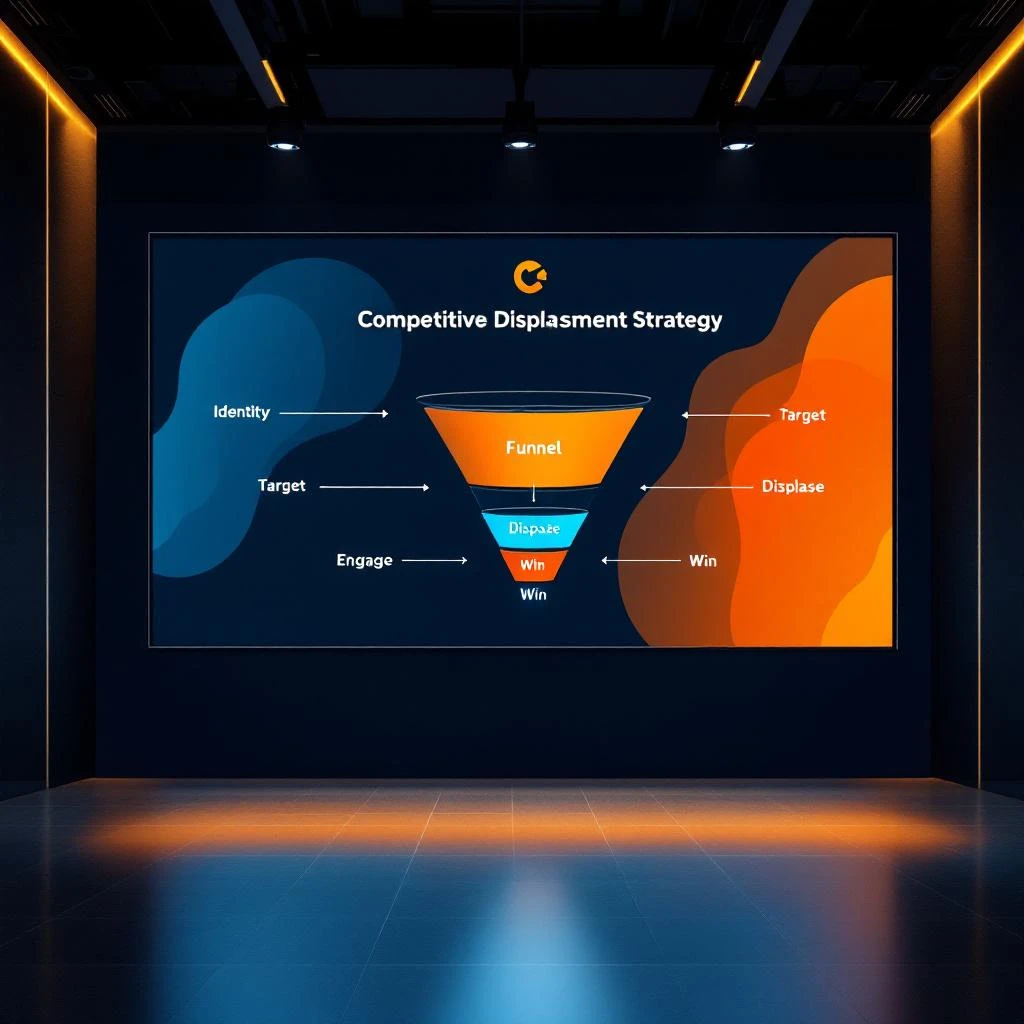
Why Displacement Campaigns Outperform Net-New Prospecting
Before building the playbook, understand why this motion works so well.
Displacement prospects are categorically different from net-new prospects:
| Factor | Net-New Prospect | Displacement Prospect |
|---|---|---|
| Category awareness | May not know the category exists | Already bought in — understands the value |
| Budget | Must create budget from scratch | Budget already allocated and approved |
| Internal champion | Must build from zero | Someone already owns the tool internally |
| Sales cycle | 4-8 months average | 2-4 months (20-30% shorter) |
| Win rate | 19% average | Up to 35% with proper targeting |
| Lifetime value | Baseline | Higher — they know what "good" looks like |
The math is compelling. You are selling to people who already believe in the solution category, already have budget, and already have internal processes built around the tool. Your job is not to convince them they need something new — it is to convince them that what they have is not good enough.
According to research from Gartner and Forrester, 54% of top-performing B2B sales organizations use challenger-based displacement approaches. The reported ROI on well-executed displacement campaigns can reach 24:1.
Step 1: Pick Your Target Competitor (And Only One)
The biggest mistake teams make is running a generic "competitive" campaign against everyone. That produces watered-down messaging that resonates with nobody.
Pick one competitor. The criteria:
- Market overlap: They sell to the same ICP you do
- Known weaknesses: You can articulate 3-5 specific pain points their customers experience
- Review evidence: G2, Capterra, and TrustRadius reviews confirm those pain points
- Winnable: You have a defensible advantage in the areas where they are weak
Do not pick the market leader just because they are big. Pick the competitor where your product advantage is most concrete and demonstrable. If your signal detection is real-time while theirs is weekly batched, that is a displacement campaign waiting to happen. If your email compliance is built in while theirs requires add-ons, that is another.
Mine Their Reviews
Before writing a single email, spend two hours reading every 1-star, 2-star, and 3-star review of your target competitor on G2 and Capterra. You are looking for:
- Repeated complaints — if five different reviewers mention the same problem, it is systemic
- Specific language — note the exact words customers use to describe their frustration
- Role patterns — which personas (SDR managers, RevOps, VPs of Sales) complain about what
- Recency — recent negative reviews suggest the problems are getting worse, not better
Build a pain-point matrix: rows are specific complaints, columns are the reviewer's role. This matrix drives every piece of content and outreach in your campaign.
Step 2: Build Your Target Account List With Technographic Data
You know who you are going after. Now identify every account currently using that competitor's product.
Technographic Sources
Multiple data sources reveal which companies use specific software:
- Website tracking pixels: Tools like BuiltWith and Wappalyzer detect competitor JavaScript snippets on prospect websites
- Job postings: Companies hiring for roles that mention specific tools ("Experience with [Competitor] required") are confirmed users
- G2 reviewer profiles: People who reviewed the competitor tool on G2 can be identified by company
- LinkedIn posts: Employees who post about using specific tools are signals
- Intent data: Accounts researching competitor alternatives are already in evaluation mode
MarketBetter's audience builder can layer technographic filters with firmographic and intent data to build precisely targeted displacement lists. The goal is not a list of 10,000 accounts — it is a list of 200-500 accounts where you have high confidence they use the target competitor and match your ICP.
Layer Intent Signals
A technographic match tells you who uses the competitor. Intent signals tell you who is actively unhappy or evaluating alternatives. The combination is where displacement campaigns get surgical:
- Competitor alternative searches: Accounts searching "[Competitor] alternatives" or "[Competitor] vs" are actively looking
- Pricing page visits: Accounts visiting your pricing page who also use the competitor
- Review site activity: Accounts reading competitor comparison pages on G2
- Category research: Accounts consuming content about the solution category
When you overlay technographic targeting (they use Competitor X) with intent signals (they are researching alternatives), you get a list of accounts that are both qualified and ready. That is your Tier 1 displacement list.
Step 3: Time Your Outreach to Trigger Events
Timing separates good displacement campaigns from great ones. The best time to reach a displacement prospect is during a natural evaluation window — not when you feel like running a campaign.
The Five Displacement Trigger Events
1. Contract renewal window (90 days out)
Most B2B SaaS contracts renew annually. The evaluation window opens 60-90 days before renewal. If you can identify renewal timing (through direct ask, LinkedIn intel, or technographic data showing when accounts first adopted the tool), you can time outreach to arrive exactly when the account is deciding whether to renew.
Set alerts at 120, 90, and 60 days before estimated renewal. The 90-day mark is your primary outreach window.
2. Leadership change
When a new VP of Sales, CRO, or Head of RevOps joins a company, they evaluate the existing tech stack within their first 90 days. Champion tracking and job change alerts catch this signal. A new leader who used your product at a previous company is your highest-conversion displacement opportunity — they are already a champion.
3. Competitor incident
When your target competitor has a public outage, data breach, pricing increase, or negative press coverage, the window opens immediately. This is not about being predatory — it is about being available when prospects are genuinely reconsidering their options. Have displacement messaging ready to deploy within 24 hours of any major competitor incident.
4. Funding or headcount surge
When an account raises a funding round or rapidly scales their sales team, they often outgrow their existing tooling. The tool that worked for 5 SDRs breaks at 20. This is a displacement opportunity driven by growth, not dissatisfaction.
5. Public complaints
When someone at a target account posts on LinkedIn, Twitter, or a community forum about frustrations with the competitor tool, that is a real-time displacement signal. Monitor competitor brand mentions for negative sentiment.
For a comprehensive list of trigger events and how to track them, see our complete guide to sales trigger events.
Step 4: Multi-Thread the Buying Committee
Displacement deals are never won by convincing one person. The incumbent vendor has relationships across the organization. You need to build yours.
The average B2B buying committee in 2026 has 6-13 stakeholders depending on deal size. In a displacement campaign, you are selling against an entrenched vendor who already has relationships with many of those stakeholders. Your multi-threading strategy needs to be deliberate.
Map the Committee
For each target account, identify and engage:
| Role | Their Concern | Your Message |
|---|---|---|
| End user (SDR/AE) | Daily workflow pain, missing features | "Here is how [specific task] takes 3 clicks instead of 12" |
| Manager | Team productivity, reporting gaps | "Your team is spending X hours/week on [manual task] that should be automated" |
| VP/Director | Pipeline impact, cost efficiency | "Companies switching from [Competitor] see Y% improvement in [metric]" |
| RevOps/Admin | Integration complexity, data quality | "Migration takes [timeframe], and here is exactly how the data maps" |
| Finance/Procurement | Total cost, contract flexibility | "Here is the TCO comparison including hidden costs they do not show you" |
Do not rely on a single champion to sell internally. The incumbent vendor's existing champion will fight to keep the status quo. You need at minimum three engaged contacts across different roles to overcome internal inertia.
The owner filtering approach ensures each rep sees exactly the accounts and contacts they own, preventing duplicate outreach that kills displacement credibility.
Step 5: Craft Displacement Messaging (Not Generic Competitive Messaging)
Generic competitive messaging: "We are better than [Competitor]."
Displacement messaging: "If you are experiencing [specific pain point that their G2 reviews confirm], here is exactly how that problem disappears."
The difference is specificity. Displacement messaging must:
Lead With Their Pain, Not Your Features
Wrong: "MarketBetter has real-time intent signals."
Right: "If your team is working with [Competitor]'s weekly intent reports, they are seeing buying signals 5-7 days after the prospect started evaluating. By then, your competitor already booked the demo."
Every displacement email, ad, and call script should reference a specific, verified pain point. Use the exact language from the review mining you did in Step 1.
Address Switching Costs Head-On
The number one objection in displacement deals is not "your product is not good enough." It is "switching is too hard." Address this proactively:
- Migration timeline: "Most teams migrate in [X] days, not months"
- Data portability: "Your existing sequences, templates, and contact data transfer automatically"
- Training: "Your team is productive in [X] hours because [similarity to what they already know]"
- Parallel running: "Run both platforms side by side for 30 days — no cold-turkey cutover"
If you have a migration guide for the specific competitor, lead with it. Nothing reduces switching anxiety like a step-by-step playbook.
Build a Competitive Battlecard
Your SDRs need a battlecard for every displacement campaign. The battlecard should include:
- Top 5 pain points from review mining (with quotes)
- Feature-by-feature comparison on the pain points (not a full feature matrix)
- Objection handling for "but we already use [Competitor]"
- Proof points: case studies, metrics, quotes from customers who switched
- Landmines: questions to ask that expose the competitor's weaknesses
Step 6: Run the Multi-Channel Campaign
Displacement campaigns do not work through a single channel. You need to create "surround sound" — the prospect sees your message across email, LinkedIn, ads, and phone within the same evaluation window.
Channel Orchestration
Week 1-2: Awareness
- Targeted LinkedIn ads to the account list (pain-point messaging, not product messaging)
- Connect requests from SDRs to 3+ contacts per account
- First email: value-led, referencing the specific pain point
Week 3-4: Education
- Email sequence with case study from a customer who switched from the target competitor
- LinkedIn content sharing (competitive comparison posts, not product demos)
- Retargeting ads showing migration ease and ROI data
Week 5-6: Conversion
- Direct outreach referencing specific signals ("I noticed your team posted about [pain point]")
- Phone calls to engaged contacts — use the smart dialer for call analysis
- Personalized demo offer with competitor-specific agenda
Week 7-8: Close or Nurture
- Accounts showing engagement get a personalized ROI analysis
- Accounts not engaging get moved to a longer nurture cadence timed to their next renewal window
The key is coordinating these touches across the buying committee. The SDR manager sees the LinkedIn ad about team productivity. The SDR sees the email about workflow pain. The VP sees the ROI case study. Different messages, same campaign, same account.
Content Assets You Need
Before launching, build these:
- Competitor-specific landing page: "[Competitor] vs MarketBetter" with pain-point messaging
- Migration guide: Step-by-step switching playbook
- ROI calculator: Show the cost of staying vs switching
- Case study: A real customer who switched (even anonymized, this is powerful)
- Comparison one-pager: PDF for the champion to share internally
We have extensive comparison content that can serve as the foundation for displacement landing pages.
Step 7: Handle the Incumbent's Counter-Move
When your displacement campaign starts working, the incumbent vendor will respond. Expect these counter-moves and prepare for them:
The discount play: "We will cut your price by 30% if you renew now." Counter: shift the conversation from price to cost-of-pain. "A 30% discount on a tool that costs your team 10 hours per week in manual work is still expensive."
The roadmap promise: "That feature is on our roadmap for Q3." Counter: "How long has it been on the roadmap? Features promised are not features delivered."
The relationship play: The incumbent AE calls the VP directly to "check in." Counter: make sure your champion is prepared with specific data points about what is broken and what the switch delivers.
The FUD play: "Switching will be disruptive and risky." Counter: your migration guide, parallel-run offer, and customer references from companies who switched successfully.
The incumbents who lose displacement deals almost always lose because they are reactive. They only engage when threatened. Your advantage is that you showed up first with a solution to a problem the prospect already had.
Measuring Displacement Campaign Performance
Track these metrics separately from your general pipeline metrics:
| Metric | Benchmark | Notes |
|---|---|---|
| Target account engagement rate | 15-25% | Accounts showing any signal of engagement |
| Multi-thread rate | 3+ contacts per engaged account | Below 3 = high risk of single-thread failure |
| Competitive win rate | 30-40% | On qualified displacement opportunities |
| Sales cycle length | 20-30% shorter than net-new | If not shorter, your targeting needs work |
| Migration completion rate | 90%+ | Below 90% = onboarding problem, not sales problem |
| Displacement revenue % of total | 15-25% of new ARR | Healthy target for mature programs |
For the full framework on SDR metrics and benchmarks, see our SDR metrics guide.
Common Mistakes That Kill Displacement Campaigns
Running against multiple competitors simultaneously. Each competitor has different weaknesses, different customer pain points, and different switching costs. One campaign, one competitor.
Leading with your product instead of their pain. The prospect does not care about your features until they believe their current situation is unacceptable. Pain first, solution second.
Ignoring the switching cost conversation. If you do not address migration complexity proactively, the incumbent wins by default because staying is always easier than switching.
Single-threading. The incumbent has multiple relationships. You need multiple relationships. Multi-threading is not optional in displacement — it is the entire strategy.
Bad timing. Reaching out 30 days before renewal when the prospect already committed to renewing is too late. 90 days is the window. Build your signal detection infrastructure to catch evaluation windows early.
No proof of successful switches. "Trust us, switching is easy" is not evidence. "Here is Company X, who switched from [Competitor] in 14 days and saw Y% improvement" is evidence.
Putting It All Together
A competitive displacement campaign is not a single email sequence. It is a coordinated, multi-channel, multi-stakeholder operation that requires:
- Deep research into competitor weaknesses (review mining, not assumptions)
- Precise targeting using technographic + intent data
- Trigger-based timing around natural evaluation windows
- Multi-threaded engagement across the buying committee
- Pain-first messaging with migration-cost neutralization
- Sustained execution over 8-12 weeks per campaign wave
The companies doing this well report competitive win rates 35% higher than their baseline and sales cycles 20-30% shorter than net-new prospecting. The upfront investment in research and targeting pays for itself many times over.
The question is not whether your competitors' customers are unhappy. Some percentage always are. The question is whether you have a systematic way to find them, reach them at the right time, and give them a reason to switch.
That is what a displacement campaign does.
Ready to build your displacement list? Start identifying competitor customers with real-time intent signals and time your outreach to the moments that matter.