
The 2026 ABM Playbook: How to Build a Full-Funnel Account-Based Engine

Most ABM programs die the same way: a marketing team builds a target account list in a spreadsheet, runs some LinkedIn ads against it, and six months later nobody can tell you whether it generated pipeline or just impressions.
The failure rate is staggering. According to Forrester, fewer than 20% of ABM programs deliver measurable pipeline impact within their first year. The reason is almost never strategy — it is execution. Specifically, the inability to connect fourteen discrete steps into a single closed-loop engine where every signal, every touchpoint, and every dollar traces back to revenue.
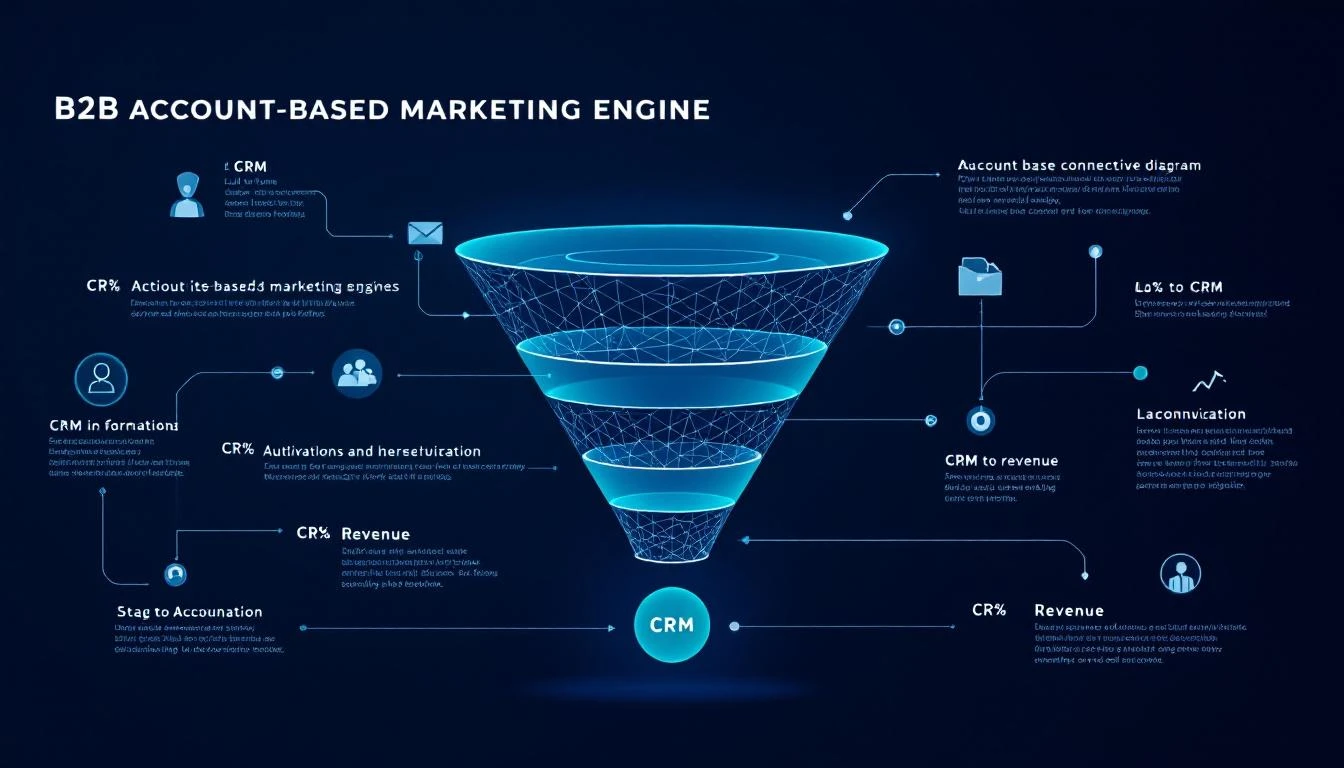
This playbook walks through every step of that engine, from CRM integration to revenue attribution, with the operational detail that actually matters.
Step 1: CRM Integration — The Foundation Layer
Every ABM program starts and ends in your CRM. If your account-based engine is not deeply wired into HubSpot or Salesforce, you are running two separate systems and hoping they agree.
The integration needs to be bidirectional and real-time:
- Inbound from CRM: Account records, deal stages, ownership, historical activity, and custom properties flow into your ABM platform continuously. Not nightly. Not weekly. Continuously.
- Outbound to CRM: Every signal, every engagement, every score change writes back to the account and contact records your reps already live in.
MarketBetter's CRM sync handles both HubSpot and Salesforce natively, mapping custom objects and properties without middleware. The goal is zero tab-switching — your rep sees ABM intelligence inside the CRM, not in a separate dashboard they forget to check.
The most common integration mistake: treating it as a one-time setup. CRM schemas evolve. New fields get added. Deal stages change. Your integration layer needs to handle schema drift without breaking downstream workflows.
Step 2: ICP Model — TAM/SAM Definition
Before you build a target account list, you need a defensible answer to: who are we actually going after?
The ICP (Ideal Customer Profile) model defines your Total Addressable Market (TAM) and Serviceable Addressable Market (SAM) using firmographic, technographic, and behavioral criteria:
| Dimension | TAM Filter | SAM Filter |
|---|---|---|
| Revenue | $5M–$500M | $20M–$200M |
| Employee count | 50–5,000 | 100–1,000 |
| Industry | B2B SaaS, FinTech, HealthTech | B2B SaaS with outbound motion |
| Tech stack | Uses any CRM | Uses HubSpot or Salesforce |
| Geography | North America, EMEA | US, UK, DACH |
The SAM is where you focus your ABM budget. The TAM is the outer boundary for awareness campaigns.
Most teams skip this step or do it once and never revisit. Your ICP should be re-validated quarterly against closed-won data. The accounts you actually win will surprise you — and the model needs to reflect reality, not assumptions.
Step 3: Direct CRM Map — Firmographics, Technographics, and Account Signals
With your ICP defined, the next step is mapping every account in your CRM against those criteria. This is not a manual exercise. You need automated enrichment that continuously evaluates:
- Firmographics: Revenue, headcount, industry, sub-industry, HQ location, growth rate
- Technographics: What tools are in their stack? Do they use a competitor? Are they on a platform you integrate with?
- Account signals: Recent funding rounds, leadership changes, hiring surges, expansion into new markets
MarketBetter pulls this data directly from your CRM records and enriches gaps automatically. The output is a scored, segmented view of every account in your database — not a static list, but a living map that updates as accounts change.
Step 4: Data Enrichment and Qualification
Raw CRM data is incomplete. Always. Industry benchmarks put the average CRM data decay rate at 30% per year — contacts leave, companies get acquired, phone numbers change, email addresses bounce.
Enrichment fills the gaps and keeps records current:
- Contact enrichment: Verified emails, direct dials, LinkedIn URLs, job titles, seniority levels
- Company enrichment: Revenue, funding history, tech stack, org charts, subsidiary mapping
- Qualification signals: Budget indicators, buying committee identification, previous vendor relationships
The key here is not just filling in blanks — it is qualifying as you enrich. Every enriched record should immediately pass through your ICP model and receive a fit score. MarketBetter's enrichment pipeline connects with providers like Lusha and layers qualification logic on top, so enriched records arrive pre-scored.
For a deeper look at enrichment tools, see our lead enrichment tools comparison.
Step 5: Account Scoring — Tier 1, 2, 3
Not all target accounts deserve the same investment. Account scoring creates a tiered system that determines resource allocation:
| Tier | Criteria | Treatment |
|---|---|---|
| Tier 1 | Perfect ICP fit + active buying signals + ≥3 contacts identified | 1:1 personalized outreach, custom content, direct mail, executive involvement |
| Tier 2 | Strong ICP fit + some signals OR strong fit without signals | 1:Few campaigns, semi-personalized sequences, targeted ads |
| Tier 3 | Moderate ICP fit, in TAM but not SAM | 1:Many campaigns, programmatic ads, content syndication |
The scoring model should combine fit (firmographic/technographic alignment) with intent (behavioral signals indicating active research). Fit without intent means the account could buy but is not looking. Intent without fit means someone is looking but is not your customer.
MarketBetter's account scoring blends both dimensions and re-scores continuously as new signals arrive, so accounts move between tiers automatically.
Step 6: Extended Target Account List (TAL)
Your initial TAL comes from the CRM map. But the best ABM programs extend beyond known accounts to find net-new companies that match your ICP but are not yet in your CRM.
The Extended TAL uses:
- Lookalike modeling: Companies that resemble your best customers across firmographic and technographic dimensions
- Intent-based discovery: Accounts showing buying signals for your category that you have never engaged
- Competitive displacement: Companies currently using a competitor whose contract is likely up for renewal
MarketBetter's audience builder generates extended TALs automatically by analyzing your closed-won patterns and matching them against the broader market. The list refreshes weekly, so you are always working from current data rather than a stale spreadsheet.
Step 7: ABM Mix — ABM Ads and LinkedIn
With your tiered TAL in place, the ABM mix determines how you reach each tier through paid channels:
- ABM display ads: Programmatic ads served specifically to accounts on your TAL. These are not broad display buys — they are account-targeted, personalized by industry or pain point, and capped to avoid ad fatigue.
- LinkedIn Matched Audiences: Upload your TAL to LinkedIn Campaign Manager and run sponsored content, InMail, and conversation ads against decision-makers at those accounts.
- Retargeting: Layer website visitor data on top of your TAL to serve ads to accounts that have already visited your site but have not converted.
The budget split typically follows the tier structure: 50% to Tier 1 (high-touch, personalized creative), 30% to Tier 2 (industry-specific messaging), and 20% to Tier 3 (category-level awareness).
Track spend per account, not just per campaign. ABM economics only work when you can say: "We spent $X on Acme Corp across all channels and generated $Y in pipeline."
Step 8: Content Sourcing — CRM Upload and Custom Properties
ABM ads and outreach are only as good as the content behind them. Content sourcing for ABM means mapping specific assets to specific account segments and buying stages:
- CRM custom properties track which content each account has engaged with, what stage they are in, and what messaging resonates
- Content libraries organized by industry, pain point, persona, and buying stage — not by marketing campaign
- Dynamic content that pulls CRM properties into ad copy, landing pages, and email sequences
The operational detail that matters: your CRM should have custom properties for last_content_engaged, content_stage, and content_topic at the account level. These properties drive routing logic downstream and ensure no account sees the same asset twice.
Step 9: Signal Tracking — The Intelligence Layer
Signals are what turn a static target account list into a dynamic, prioritized workflow. MarketBetter's Signals Hub tracks three categories:
First-party signals (your own properties):
- Website visits — page-level, person-level, frequency and recency
- Product usage — trial activity, feature adoption, usage drops
- Email engagement — opens, clicks, replies, forwards
Second-party signals (partner and review ecosystem):
- Review site activity on G2, TrustRadius, Capterra
- Partner referral data and co-sell signals
- Event attendance and webinar engagement
Third-party digital signals (the broader web):
- Intent data from content consumption networks
- Social listening — LinkedIn posts, Reddit threads, community mentions
- Job postings and hiring patterns that indicate tech stack changes
The critical difference in 2026: signals need to be real-time, not batched. A website visit that happened two hours ago is actionable. A weekly intent score is context. Both matter, but you need the infrastructure to act on the former within minutes.
Step 10: Scenario-Based Routing — Awareness, Considering, Converting
Raw signals are noise without routing logic. Scenario-based routing maps signal combinations to account stages and triggers the appropriate response:
Awareness stage: Account matches ICP but shows only passive signals (occasional website visits, low-frequency content consumption). Route to nurture sequences and Tier 2/3 ad campaigns.
Considering stage: Account shows active research signals — multiple stakeholders visiting the site, review site comparisons, intent data surges, competitor content engagement. Route to SDR outreach with personalized talk tracks and Tier 1 ad creative.
Converting stage: Account has engaged with sales, attended a demo, or shown high-frequency product page visits combined with multi-threaded stakeholder activity. Route to AE involvement, executive sponsorship, and deal-acceleration content.
The routing engine should evaluate these scenarios continuously, not on a weekly review cadence. When a Tier 2 account jumps from Awareness to Considering at 2pm on a Tuesday, your SDR should know by 2:05pm.
Step 11: Lead Routing with Custom Events, CRM Tasks, and Slack Notifications
Once scenario-based routing identifies an account's stage, the operational layer kicks in:
- Custom events fire in your CRM when an account changes stage, hits a signal threshold, or triggers a routing rule
- CRM tasks auto-create for the assigned rep with context: what signals fired, what content the account has engaged with, and a suggested next action
- Slack notifications hit the relevant channel or DM in real-time so the team can act immediately
MarketBetter pushes all three simultaneously. The rep gets a Slack alert with a deep link to the CRM record, the CRM record already has a task with signal context, and the custom event is logged for downstream reporting.
The signal-to-meeting playbook we published breaks down the exact workflow from notification to booked meeting in under 24 hours.
Step 12: Demand Generation — 1:1 and 1:Many
ABM demand gen splits into two motions that map directly to your tier structure:
1:1 (Tier 1 accounts):
- Personalized outreach referencing specific signals ("I noticed your team has been evaluating marketing automation tools — here's how we solved that for a similar company")
- Direct mail to key stakeholders at high-value accounts
- Custom content — bespoke ROI analyses, industry benchmarks tailored to their vertical, or competitive tear-downs relevant to their current stack
- Executive-to-executive introductions
1:Many (Tier 2 and 3 accounts):
- Webinars segmented by industry or use case
- Content syndication through targeted publisher networks
- Paid campaigns on LinkedIn, Google, and programmatic display
- Multi-touch sequences combining email, LinkedIn, and phone
The budget math: Tier 1 accounts might receive $500–$2,000 in direct investment per account per quarter. Tier 2 accounts get $50–$200 through semi-personalized campaigns. Tier 3 accounts get $5–$20 via programmatic channels. The ROI should be highest at Tier 1, but the volume comes from Tier 2.
Step 13: Push Back to CRM — Closed-Loop Reporting
Every touchpoint, every signal, every ad impression, and every email reply writes back to the CRM. This is where most ABM programs break. They generate activity in the ABM platform but never close the loop in the system of record.
Closed-loop reporting requires:
- Engagement data at the account and contact level — not just marketing-qualified metrics, but actual pipeline influence
- Channel attribution showing which combination of signals, ads, and outreach generated the opportunity
- Time-to-stage metrics tracking how quickly accounts move from Awareness to Considering to Converting
MarketBetter's CRM push ensures that every piece of ABM intelligence lives in HubSpot or Salesforce, not in a separate analytics tool your sales team never checks. Custom dashboards built on CRM-native data give leadership a single view of ABM performance.
Step 14: Final Output — Pipeline and Revenue Attribution
The entire engine exists to answer one question: which accounts generated pipeline, and what drove them there?
Revenue attribution for ABM needs to go beyond last-touch or first-touch models. A Tier 1 account might have been influenced by:
- An intent signal that put them on the TAL
- LinkedIn ads that generated awareness over 3 weeks
- A website visit that triggered an SDR outreach
- A webinar that engaged the economic buyer
- A custom ROI analysis that closed the deal
Multi-touch attribution assigns weighted credit across all touchpoints. The output is a clear picture of:
- Pipeline generated by tier, channel, and campaign
- Revenue influenced vs. revenue sourced
- Cost per opportunity at the account level, not just the campaign level
- Velocity — how fast accounts move through stages by tier and signal type
This is what separates an ABM program from an ABM engine. The program runs campaigns. The engine generates compounding returns because every cycle of data improves targeting, scoring, routing, and content for the next cycle.
Putting It All Together
Here is the complete ABM engine in one flow:
CRM Integration → ICP Model → Direct CRM Map → Data Enrichment → Account Scoring → Extended TAL → ABM Mix → Content Sourcing → Signal Tracking → Scenario Routing → Lead Routing → Demand Gen → Push to CRM → Revenue Attribution
Each step feeds the next. Attribution data from Step 14 refines the ICP model in Step 2. Signal patterns from Step 9 improve scoring in Step 5. CRM data from Step 13 updates the direct map in Step 3.
The teams that build this as a connected system — rather than fourteen separate tools stitched together with CSV exports — are the ones that turn ABM from a marketing initiative into a revenue engine.
If you are building an ABM program in 2026, stop thinking about campaigns. Start thinking about the engine.
Ready to build your ABM engine? MarketBetter connects every step — from CRM integration to revenue attribution — in a single platform. See how it works.