
MarketBetter vs 6sense/Bombora: Real-Time Buyer Signals vs Weekly Intent Reports

6sense and Bombora built their businesses on a simple promise: we will tell you which companies are researching topics related to your product. And for years, that was enough. Knowing that Acme Corp was reading about "endpoint security" sometime in the last seven days felt like a superpower compared to cold outreach.
But the game has moved on. Buyers move faster, committees form and dissolve in days, and your competitors are not waiting for a weekly CSV to show up before they pick up the phone.
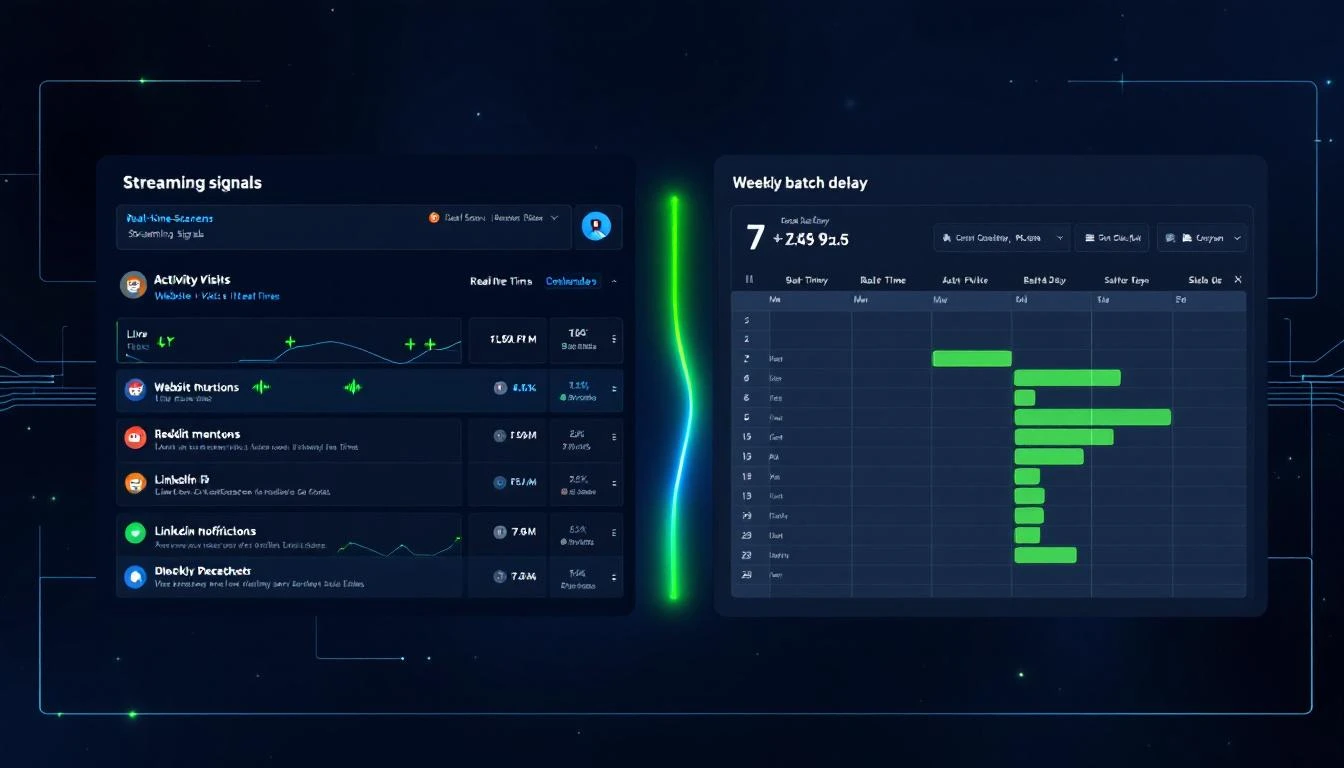
The Weekly Batch Problem
Here is how intent data works at 6sense and Bombora in 2026:
-
Bombora crawls its co-op network of 5,000+ B2B publisher sites. It aggregates content consumption patterns across those publishers and packages them into Company Surge scores. Those scores refresh weekly. If a buying committee started researching your category on Monday, your team might see that signal the following Monday — or later, depending on your delivery method.
-
6sense combines Bombora's third-party Surge data (delivered to 6sense via weekly SFTP) with its own first-party web tracking and predictive models. First-party data processes nightly, but the third-party intent layer — which is often the primary signal for net-new accounts not yet visiting your site — updates on that same weekly cadence.
The result: the core intelligence that drives account prioritization in both platforms is between 3 and 10 days old by the time it reaches your rep's workflow.
This is not a technical footnote. Research consistently shows that reply rates drop sharply 24 to 48 hours after a buying trigger fires. A signal that is a week old is not a signal — it is history.
What a Week Costs You
Consider a real scenario. A VP of Marketing at a mid-market SaaS company visits three vendor comparison pages on Tuesday, posts a question about marketing automation in a Reddit thread on Wednesday, and updates their LinkedIn headline to "Evaluating new marketing stack" on Thursday.
With Bombora or 6sense, your team sees a Surge score bump or an "Awareness" stage change sometime the following week. By then:
- Two competitors who track website visitors in real time already sent personalized outreach on Tuesday afternoon.
- A third competitor flagged the Reddit post within hours and replied with a helpful (non-salesy) comment linking to their comparison guide.
- The VP has already scheduled three demos before your SDR even knows the account is in-market.
This is not hypothetical. Teams that act on signals within hours report 30-40% shorter sales cycles compared to those working from weekly batch data. The math is straightforward: speed to first touch determines whether you make the shortlist.
How MarketBetter Signals Hub Works Differently
MarketBetter's Signals Hub does not batch signals. It streams them. Every signal type fires independently, in real time, the moment the underlying event occurs:
| Signal Type | What It Captures | Latency |
|---|---|---|
| Website Visits | Person-level identification of visitors on your site, including pages viewed, time on page, and visit frequency | Real-time |
| Reddit Mentions | Posts, comments, and questions in subreddits relevant to your product category | Minutes |
| LinkedIn Activity | Profile updates, job changes, posts, and engagement with competitor content | Minutes to hours |
| Community Mentions | Slack communities, Discord servers, forums, and niche industry boards where your buyers discuss problems | Minutes |
| Champion Job Changes | When a closed-won contact or active champion moves to a new company | Hours |
Each signal type has its own toggle. Your SDRs handling outbound might only care about website visits and Reddit mentions. Your account managers might want champion job changes and LinkedIn activity. Your marketing team might want everything. Nobody is forced to drink from the firehose.
This is fundamentally different from 6sense's approach, where intent signals are compressed into a single account-level "buying stage" (Awareness, Consideration, Decision, Purchase) that updates on a batch schedule. You lose the granularity of what happened and the immediacy of when it happened.
Signal Granularity vs. Black Box Scores
6sense's Revenue AI collapses dozens of signals into a single predictive score. Bombora's Company Surge does the same — you get a number between 0 and 100 for each topic, but you cannot see the underlying behavior that generated that number.
This creates three problems:
1. You cannot prioritize by signal type. A Surge score of 72 might mean the company visited ten comparison pages (high intent) or that five junior employees each read one introductory blog post (noise). The score is the same. Your rep has no way to distinguish between them without a separate investigation.
2. You cannot sequence based on what happened. The signal-to-meeting playbook that works for a website visitor is completely different from the one that works for a Reddit mention or a champion job change. When all signals are compressed into one score, your reps default to the same generic outreach for every account.
3. You cannot explain why an account is hot. When a rep asks "why is this account flagged?" and the answer is "the model says so," trust in the system erodes fast. In MarketBetter, the answer is specific: "Their VP of Ops visited your pricing page twice yesterday and posted in r/devops asking about tools in your category."
The Price of Waiting
Both 6sense and Bombora carry significant price tags for what amounts to weekly intelligence:
-
6sense contracts start around $55K/year for mid-market, with enterprise deployments running $130K-$300K+. Add implementation costs ($5K-$50K), credit overages, and the RevOps headcount required to manage segments and models ($60K-$120K/year), and your total cost of ownership can exceed $400K annually.
-
Bombora starts at $30K/year for basic Company Surge access, but the total stack cost — including the execution tools you need to actually act on the data — easily reaches $75K-$200K per year. Bombora is purely an intelligence layer. Every action requires a separate tool, a separate contract, and a separate integration.
MarketBetter includes signals, enrichment, audience building, sequencing, and campaign execution in a single platform. You are not paying $100K+ for a data feed that you then need to wire into three other tools before anyone can send an email.
Where 6sense and Bombora Still Make Sense
Credit where it is due. If your sales motion operates on a quarterly ABM cadence — where campaigns run for months targeting a fixed list of named accounts — weekly batch data is less of a handicap. The accounts are not going anywhere, and the goal is to warm them over time rather than catch a specific buying moment.
Bombora's co-op network of 5,000+ publishers also provides genuine breadth of third-party intent coverage that is hard to replicate. If you are selling into a niche vertical where your prospects read specialized trade publications that Bombora's network covers, that signal has real value even at a weekly cadence.
And 6sense's predictive models, when trained on enough historical data, can surface accounts earlier in the buying journey than any single signal type. The trade-off between signal quality and speed is real — 6sense prioritizes breadth and prediction, MarketBetter prioritizes immediacy and granularity.
When to Choose MarketBetter Instead
MarketBetter's Signals Hub is built for teams where speed matters more than prediction:
-
Your average deal cycle is under 90 days. The shorter your cycle, the more a seven-day signal delay hurts. If deals close in 30-60 days, a week-old signal means you have already lost 10-25% of your selling window before you even start.
-
Your reps compete against fast-moving competitors. If your market has aggressive SDR teams that respond to website visits within minutes, weekly batch data puts you at a structural disadvantage that no amount of messaging optimization can overcome.
-
You want to act on signals without building a Rube Goldberg machine. 6sense requires dedicated RevOps to manage segments, build audiences, and wire data into execution tools. Bombora requires separate platforms for every step after intelligence. MarketBetter closes the loop: signal fires, rep gets notified, outreach launches from the same platform.
-
You care about person-level signals, not just account-level scores. Both 6sense and Bombora operate at the account level. MarketBetter identifies individual visitors, individual LinkedIn profiles, individual Reddit users. Your rep knows exactly who to reach and what they were looking at.
-
You need multi-channel signal coverage without multi-vendor complexity. Website visits, social signals, community mentions, and job change alerts in one dashboard versus stitching together Bombora + a visitor identification tool + a social listening tool + a job change tracker.
The Shift from Intent to Signals
The broader industry is moving away from the "intent data" framing that 6sense and Bombora popularized and toward signal-based selling. The difference is more than semantic:
Intent data answers: "Is this account thinking about our category?" It is aggregated, delayed, and probabilistic.
Buyer signals answer: "What did this specific person do, when, and where?" They are granular, immediate, and observable.
The most effective B2B sales teams in 2026 are not waiting for a weekly Surge report to tell them an account is "in-market." They are watching real-time signals across multiple channels, routing those signals to the right rep instantly, and responding with context-specific outreach before the buyer has finished their research.
That is what MarketBetter's Signals Hub was built to do. Not to replace intent data — the concept still has value — but to move beyond the weekly batch paradigm that 6sense and Bombora have not been able to escape.
Getting Started
If you are currently paying for 6sense or Bombora and wondering whether those weekly reports are actually driving pipeline, run a simple test: track the time between when a signal appears in your dashboard and when your rep sends their first touch. If the median is measured in days, you are leaving deals on the table.
MarketBetter offers a free trial with full Signals Hub access. Connect your website, configure your signal types, and see the difference between real-time and weekly in the first 48 hours.
The data is clear: in B2B sales, the team that responds first wins more often. The only question is whether your signal infrastructure is fast enough to let you be that team.