
MarketBetter vs Apollo/ZoomInfo: Building Audiences in 30 Seconds With AI Chat

There is a moment every SDR knows. You have a meeting in 40 minutes. Your AE just pinged you about a new vertical they want to test. You need a list of 50 qualified prospects — now.
So you open Apollo. Or ZoomInfo. And you start clicking.
Industry dropdown. Employee count slider. Revenue range. Job title keywords. Geography filter. Technology filter. Funding stage. Then you run the search, scroll through 2,000 results that are half wrong, start excluding the garbage, re-filter, export to CSV, deduplicate against your CRM, and realize 30 minutes have evaporated.
MarketBetter takes a different approach entirely. You type one sentence into an AI chat — "Series B fintech companies in the US that recently hired a VP of Sales and use HubSpot" — and get a verified, enriched audience list in under 30 seconds.
This is not a marginal improvement. It is a fundamentally different way to build audiences.
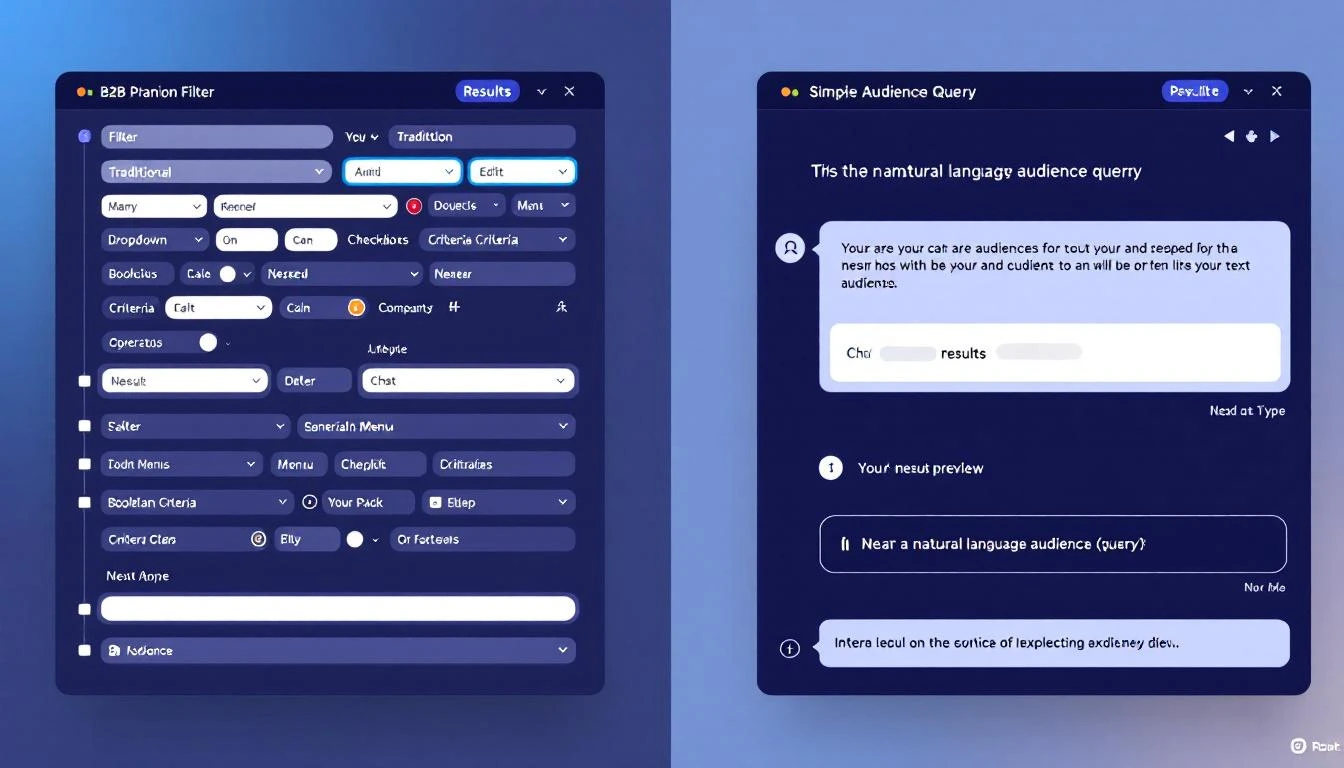
The Filter Tax: What Apollo and ZoomInfo Actually Cost You
Apollo and ZoomInfo are powerful databases. Nobody disputes that. Apollo has 275M+ contacts. ZoomInfo claims 600M+ professional profiles. The data exists.
The problem is not the data. The problem is how you access it.
Both platforms were built around the same paradigm: structured filters. You describe your audience by selecting values from dropdown menus, sliding range bars, and toggling boolean checkboxes. This works when your target is simple — "Marketing Directors in the US at companies with 100-500 employees." Dropdowns handle that fine.
But real prospecting targets are rarely that clean. Consider what sales leaders actually say when they describe who they want to reach:
- "Mid-market logistics companies that expanded into EMEA in the last year and are probably outgrowing their current TMS"
- "HR tech buyers at companies with 500+ employees who just posted a Director of People Operations role — they're probably building out the function"
- "SaaS companies using Salesforce that have at least 3 SDRs but no dedicated RevOps person yet"
Try building any of those in Apollo's filter panel. You cannot. The nuance gets crushed. "Expanded into EMEA" becomes a headquarters filter for Europe, which misses US-headquartered companies that just opened a London office. "Probably outgrowing their current TMS" has no filter at all. "No dedicated RevOps person" requires proving a negative that no database tracks.
ZoomInfo has the same structural limitation. More data, more filters, more intent signals — but still the same interaction model. You are always translating your actual knowledge into the system's language instead of speaking your own.
The Hidden Time Cost
We tracked how long it takes an experienced SDR to build a targeted audience list across each platform:
| Step | Apollo/ZoomInfo | MarketBetter AI Chat |
|---|---|---|
| Define audience criteria | 3-5 min (clicking filters) | 10-15 sec (type a sentence) |
| Run search and review results | 5-8 min | Instant |
| Filter out false positives | 5-10 min | Built into AI interpretation |
| Export and deduplicate | 3-5 min | Auto-syncs to campaign |
| Enrich missing fields | 5-10 min (if separate tool) | Included in results |
| Total | 20-40 minutes | Under 30 seconds |
That is not a rounding error. Over a week, an SDR building 3-4 audience lists per day recovers 5-8 hours of selling time. Multiply across a team of 10 and you are looking at 50-80 hours per week that shift from clicking dropdowns to having conversations with prospects.
How MarketBetter's AI Chat Audience Builder Works
MarketBetter's audience builder is a conversational interface powered by deep integrations with Exa's AI search engine, real-time enrichment providers, and your own first-party data.
Here is what happens when you type a query:
Step 1: Intent interpretation. The AI parses your natural language description and understands the semantic meaning — not just keyword matching. When you say "companies that are probably outgrowing their CRM," it looks for hiring signals, tech stack age, employee growth rate, and review site complaints. No filter can do that.
Step 2: Web-scale search. Unlike Apollo and ZoomInfo, which search their own static databases, MarketBetter queries across the live web through Exa Websets. This means it finds companies based on what they are actually doing right now — blog posts they published, jobs they listed, press releases they issued, conference talks they gave — not just what was true when someone last updated their firmographic record.
Step 3: Enrichment and verification. Every result gets enriched with verified contact information, company details, and technographic data. Emails are validated before they reach your list. No CSV export, no manual enrichment step, no bounce surprises.
Step 4: Campaign-ready output. The audience lands directly in MarketBetter's campaign builder. You can launch outreach immediately — AI-personalized email sequences, LinkedIn connection requests, or multi-channel cadences — without touching another tool.
Real Examples: Same Goal, Different Experience
Scenario: Target companies that just raised Series B and are hiring sales roles
Apollo approach: Filter by funding round (if available — Apollo's funding data is inconsistent). Cross-reference with a job board. Export both lists. Match company names in a spreadsheet. Import the overlap back. Enrich contacts. 25 minutes if nothing goes wrong.
MarketBetter approach: Type: "Series B companies that posted SDR or AE roles in the last 30 days." Get results in 15 seconds. Launch campaign.
Scenario: Find manufacturing companies using legacy ERP systems
ZoomInfo approach: Use technographic filters for specific ERP vendors (SAP R/3, Oracle EBS). But "legacy" is subjective — ZoomInfo does not track software version age. You get every SAP customer, including ones running S/4HANA. Manual review required. 30+ minutes.
MarketBetter approach: Type: "Manufacturing companies with 200-2000 employees still running on-premise ERP — look for SAP ECC, Oracle EBS, or Epicor mentions on their careers pages." The AI searches for actual evidence of legacy systems. 20 seconds.
Scenario: Reach HR leaders at companies with recent layoffs who might need outplacement services
Apollo approach: There is no "recent layoffs" filter. You would need to cross-reference WARN Act filings or news articles manually, then look up each company in Apollo one by one. Hours of work.
MarketBetter approach: Type: "Companies with 500+ employees that had layoffs in Q1 2026 — I need the VP of HR or Chief People Officer." Done.
Where Apollo and ZoomInfo Still Win
This is not a hit piece. Apollo and ZoomInfo have genuine strengths that matter for specific use cases.
Apollo's free tier is unmatched. If you are a solo founder doing 10 lookups a month, Apollo's free plan is legitimately useful. MarketBetter's free trial is generous but time-limited.
ZoomInfo's intent data network is massive. Their Bombora integration and proprietary intent signals cover more topics and more companies than any single source. If your entire strategy is intent-based account scoring at the enterprise level, ZoomInfo's signal breadth is hard to beat.
Both have deeper CRM integrations for complex workflows. If you run Salesforce Enterprise with custom objects, territory management, and CPQ — and you need your prospecting tool to write directly into that schema — Apollo and ZoomInfo have had years to build those connectors. MarketBetter integrates with HubSpot and Salesforce bidirectionally, but the edge-case enterprise Salesforce configurations are still catching up.
Apollo's Chrome extension is excellent. For quick LinkedIn lookups and one-off prospecting, Apollo's extension is fast and reliable. MarketBetter's Chrome extension does more (AI email drafting, video, enrichment), but Apollo's is lighter for pure data grabs.
The Audience Building Gap: Why It Matters Now
The shift from filter-based to conversational audience building is not just a UX preference. It changes what is strategically possible.
Speed compounds. When building an audience takes 30 seconds instead of 30 minutes, you test more hypotheses. You can try "let's see if procurement managers at companies switching from Workday respond better than HR directors" without burning half a morning on list building. Faster iteration means faster product-market fit for your outreach.
Nuance creates differentiation. Every team using Apollo filters on the same criteria gets the same list. When you can describe your audience in natural language — capturing the subtle signals that matter to your specific product — you reach prospects that your competitors literally cannot find through dropdowns.
First-party data integration closes the loop. MarketBetter's AI chat does not just search external data. It layers in your website visitor data, chatbot conversations, and CRM history. Ask it "companies similar to our last 10 closed-won deals that visited our pricing page this month" and it synthesizes internal and external intelligence in one query. Apollo and ZoomInfo cannot do this — they only know what is in their database.
Pricing: What You Actually Pay
| Platform | Audience Building Access | Starting Price | What's Included |
|---|---|---|---|
| Apollo | Filter-based search | $49/user/mo (Basic) | 10,000 exports/year, basic intent |
| ZoomInfo | Filter-based search | ~$15,000/year (SalesOS) | Intent, technographics, org charts |
| MarketBetter | AI chat + filters | Custom pricing | Visitor ID, chatbot, AI outreach, enrichment, audience builder |
Apollo is the budget option. ZoomInfo is the enterprise data play. MarketBetter is the platform that replaces 3-4 tools and gives you a fundamentally faster way to go from "I know who I want" to "I'm talking to them."
The Bottom Line
Apollo and ZoomInfo built great databases. MarketBetter built a better way to use them — and every other data source on the internet.
If your team spends meaningful time each week building prospect lists, the math is simple. AI chat audience building is not a feature. It is a category shift. The platforms that force you to think in filters are asking you to do the computer's job. The ones that understand natural language are doing theirs.
You can describe your ideal audience in one sentence. Your prospecting tool should be able to handle that.
Ready to build your first audience in 30 seconds? Start your free trial at MarketBetter and see the difference between clicking filters and having a conversation.