OpenClaw + HubSpot: Build the Ultimate CRM Automation Stack [2026 Guide]

· 6 min read

Your CRM is only as good as the data inside it. And let's be honest—most CRMs are graveyards of stale contacts, forgotten deals, and "I'll update it later" promises that never happen.

What if your CRM updated itself?

That's exactly what happens when you connect OpenClaw—the open-source AI agent gateway—to HubSpot. You get an always-on AI assistant that monitors your pipeline, enriches contacts automatically, and alerts you before deals go cold.

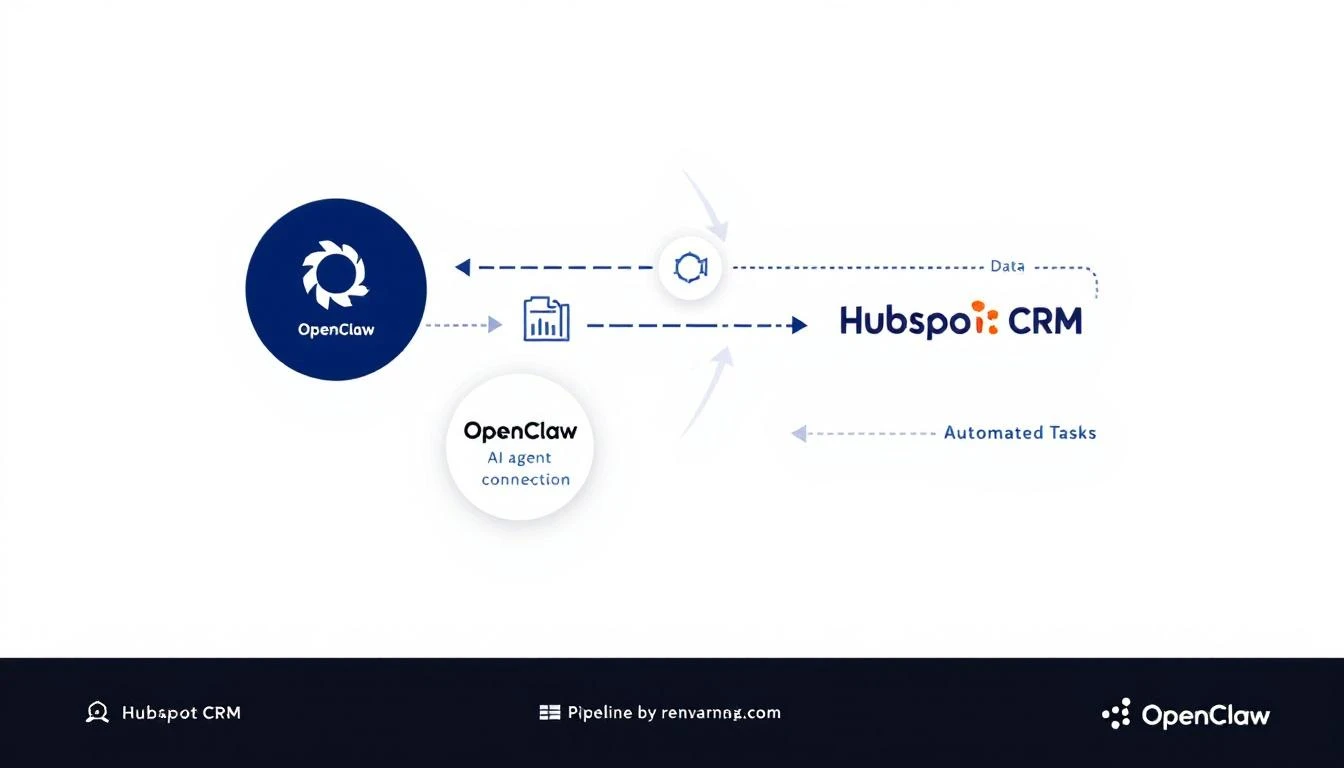
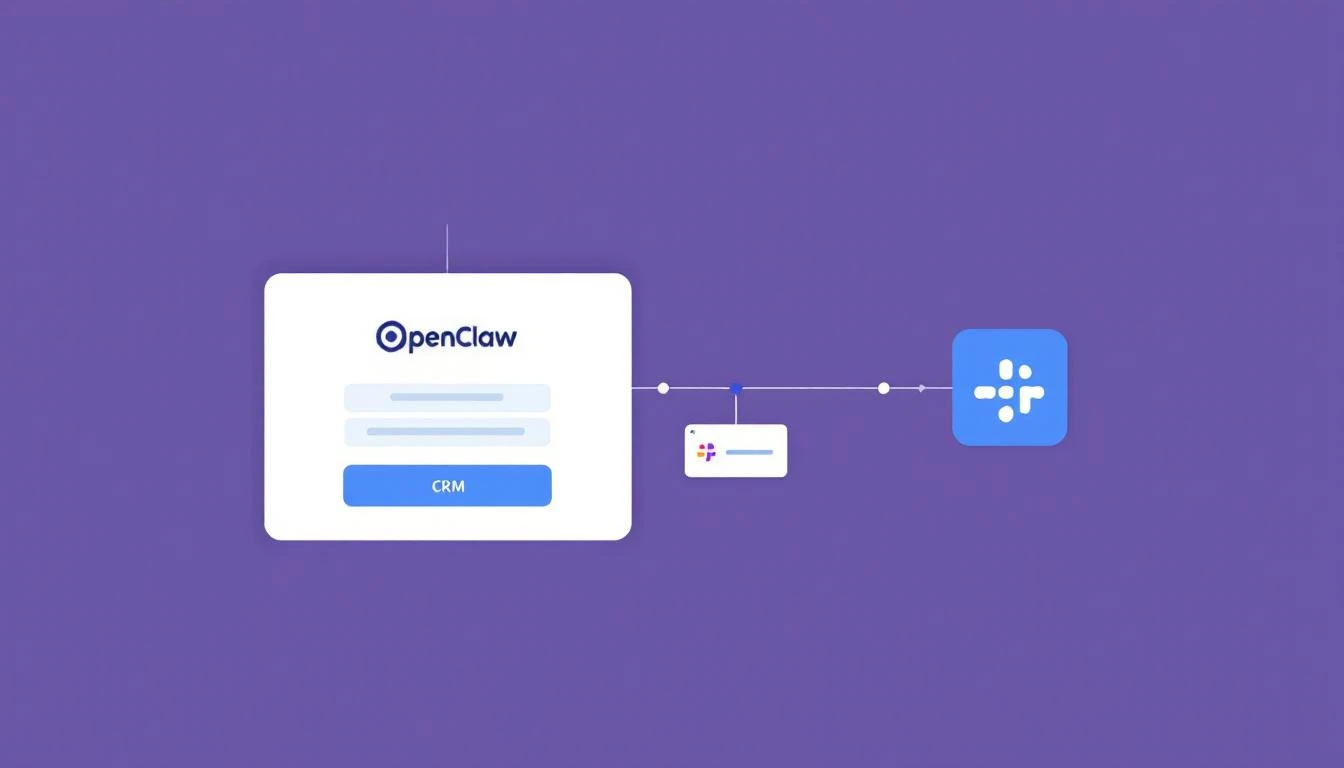
OpenClaw connecting to HubSpot CRM with automated data flows

Why Manual CRM Updates Are Killing Your Pipeline

The average SDR spends 28% of their week on administrative tasks. Most of that is CRM data entry:

  • Logging call notes
  • Updating deal stages
  • Adding contact information
  • Setting follow-up reminders

That's 11+ hours per week not selling.

Worse, when reps get busy (which is always), CRM hygiene drops. Deals sit in the wrong stages. Contact info goes stale. Follow-ups get missed.

The result? Pipeline visibility becomes a lie. Your forecast is based on outdated data, and winnable deals slip through the cracks.

What OpenClaw + HubSpot Actually Does

OpenClaw acts as a bridge between AI models (Claude, GPT-4, etc.) and your business tools. When connected to HubSpot, it can:

1. Auto-Enrich New Contacts

When a new contact hits HubSpot, OpenClaw can:

  • Research the contact's company
  • Find their LinkedIn profile
  • Pull recent news about their company
  • Add firmographic data (company size, industry, tech stack)

All without you touching the keyboard.

2. Monitor Deal Health

Set up cron jobs to check your pipeline daily:

  • Flag deals that haven't been updated in 7+ days
  • Alert you when a high-value deal goes silent
  • Summarize weekly pipeline changes

3. Auto-Log Meeting Notes

Connect your calendar and let OpenClaw:

  • Join meetings via transcript (Zoom, Gong, etc.)
  • Summarize key points
  • Update the HubSpot contact/deal record
  • Create follow-up tasks

4. Proactive Outreach Suggestions

Based on deal activity (or lack thereof), OpenClaw can:

  • Draft re-engagement emails
  • Suggest call scripts based on deal history
  • Recommend next best actions

Before and after: Manual CRM entry vs AI-automated updates

Setting Up OpenClaw with HubSpot

Here's how to connect them (no code required for basic setups):

Step 1: Install OpenClaw

npx openclaw@latest init

Follow the prompts to configure your AI provider (Claude recommended for CRM tasks).

Step 2: Get Your HubSpot Private App Token

  1. Go to HubSpot → Settings → Integrations → Private Apps
  2. Create a new app with these scopes:
    • crm.objects.contacts.read
    • crm.objects.contacts.write
    • crm.objects.deals.read
    • crm.objects.deals.write
    • crm.objects.companies.read
  3. Copy the access token

Step 3: Configure OpenClaw

Add to your OpenClaw config:

# In your openclaw config
agents:
defaults:
model: claude-sonnet-4-20250514

plugins:
hubspot:
enabled: true
token: ${HUBSPOT_TOKEN}

Step 4: Create Your First Automation

Example: Daily pipeline health check that messages you via WhatsApp:

cron:
jobs:
- name: "Pipeline Health Check"
schedule:
kind: cron
expr: "0 9 * * 1-5" # 9am weekdays
payload:
kind: agentTurn
message: |
Check HubSpot for:
1. Deals stuck in same stage for 7+ days
2. Deals over $10K with no activity this week
3. Contacts added yesterday that need enrichment

Summarize findings and alert me if anything needs attention.

Real-World Use Cases

Use Case 1: Automatic Lead Scoring

When a new contact comes in, have OpenClaw:

  1. Research the company
  2. Check if they match your ICP
  3. Update the lead score field in HubSpot
  4. Route hot leads to your Slack channel

Use Case 2: Stale Deal Recovery

Set up a weekly scan for deals that have gone quiet:

  • If no activity in 14 days, draft a re-engagement email
  • If no response after outreach, suggest moving to "Nurture"
  • If closed-lost, add to a win-back sequence after 90 days

Use Case 3: Meeting Prep Automation

Before any call, have OpenClaw:

  • Pull the contact's full history from HubSpot
  • Research recent company news
  • Summarize previous touchpoints
  • Suggest talking points

OpenClaw vs. Native HubSpot AI

HubSpot has its own AI features now. Here's how they compare:

FeatureHubSpot AIOpenClaw + HubSpot
PriceIncluded in paid plansFree (open source)
CustomizationLimited to HubSpot's featuresUnlimited (any AI model)
Cross-platformHubSpot onlyWorks with any CRM, messaging, calendar
Proactive alertsBasicFully customizable
Model choiceHubSpot's modelsClaude, GPT-4, Llama, etc.

The key difference: OpenClaw lets you build exactly what you need, while HubSpot AI gives you what HubSpot thinks you need.

Best Practices for CRM Automation

1. Start Small Don't automate everything at once. Start with one pain point (e.g., stale deal alerts) and expand from there.

2. Keep Humans in the Loop AI should suggest, not decide. Have agents create draft emails for your approval, not send them automatically.

3. Audit Regularly Review AI-updated fields monthly. Catch errors before they compound.

4. Document Your Automations Future you (or your replacement) will thank you. Keep a log of what agents do and why.

The Compound Effect of CRM Automation

One automated task saves 5 minutes. Multiply by 50 contacts per week, and you've saved 4 hours.

Now add:

  • Auto-enrichment (saves research time)
  • Deal monitoring (catches slipping deals early)
  • Meeting prep (better conversations)
  • Follow-up automation (nothing falls through cracks)

That's not 4 hours saved—that's a fundamentally different relationship with your CRM. It goes from a chore to a superpower.

Free Tool

Try our AI Lead Generator — find verified LinkedIn leads for any company instantly. No signup required.

Getting Started Today

  1. Install OpenClaw: docs.openclaw.ai
  2. Connect HubSpot: Use a Private App token
  3. Start with one automation: Stale deal alerts are the easiest win
  4. Iterate: Add more automations as you see what works

The best part? OpenClaw is free and open source. You're not adding another $500/month tool to your stack—you're building on infrastructure you control.


Want to see AI-powered SDR workflows in action? MarketBetter combines visitor identification, automated playbooks, and AI-driven outreach in one platform. Book a demo to see how it works.

OpenClaw vs $35-50K AI SDR Tools: The Real Cost Comparison [2026]

· 7 min read

You've seen the pitch: "AI SDRs that book meetings on autopilot."

Then you see the price: $35,000-$50,000/year.

For that money, you could hire a junior human SDR. Or fund your entire AI infrastructure for a decade.

Let's do the real math on build vs buy.

OpenClaw free vs enterprise AI SDR tools cost comparison

The Enterprise AI SDR Pricing Reality

Based on public pricing and what we've heard from customers:

ToolAnnual CostWhat You Get
Artisan$35,000-$50,000"AI SDR" Ava + sequence automation
11x$30,000-$45,000"AI SDR" Alice + email personalization
AiSDR$20,000-$35,000AI-generated emails + CRM sync
Regie.ai$24,000-$40,000AI writing + sequence management

That's $2,500-$4,000/month for AI that sends emails.

Now let's look at what it actually costs to build comparable (or better) automation yourself.

The OpenClaw Stack: Total Cost Breakdown

Core Infrastructure: $0-$100/month

OpenClaw Gateway: Free

Hosting Options:

  • Hetzner VPS: $5-10/month
  • DigitalOcean: $6-12/month
  • AWS/Azure/GCP: $10-25/month
  • Existing server: $0

AI Model Costs: $50-200/month

For a typical sales automation workload (1,000 prospects/month):

Claude 3.5 Sonnet (recommended for sales content):

  • Input: ~$3/million tokens
  • Output: ~$15/million tokens
  • Per prospect (research + email): ~$0.02-0.05
  • Monthly (1,000 prospects): $20-$50

GPT-4 Turbo:

  • Input: ~$10/million tokens
  • Output: ~$30/million tokens
  • Monthly (1,000 prospects): $40-$100

OpenAI Codex (for code-heavy automations):

  • Similar to GPT-4 pricing
  • Best for building custom tools

Supporting Services: $0-50/month

Email Sending:

  • SendGrid: Free for 100 emails/day
  • Amazon SES: ~$0.10 per 1,000 emails
  • Monthly (3,000 emails): $0-$10

Data Enrichment (optional):

  • Apollo: $0-49/month for basic
  • Hunter: $0-49/month
  • Clearbit: $99+/month
  • Or build with web scraping: $0

Total Monthly Cost: $55-350

Compare:

  • Enterprise AI SDR: $2,500-4,000/month
  • OpenClaw + Claude: $55-350/month

Annual savings: $26,000-47,000

Build vs buy ROI comparison

What You Can Build With OpenClaw

1. Lead Research Agent

# OpenClaw agent configuration
agents:
research-agent:
model: claude-3-5-sonnet-20241022
systemPrompt: |
You research B2B prospects for sales outreach.
For each prospect, find:
- Recent LinkedIn posts and activity
- Company news and announcements
- Relevant trigger events
- Potential pain points
Output structured JSON for the email agent.

This alone replaces what Artisan charges $35K/year for.

2. Personalized Email Generator

agents:
email-writer:
model: claude-3-5-sonnet-20241022
systemPrompt: |
You write hyper-personalized cold emails.
Reference specific details from prospect research.
No generic templates. Every email is unique.
Keep under 150 words. Clear CTA.

3. 24/7 Pipeline Monitor

cron:
- name: "Pipeline Monitor"
schedule: "0 * * * *" # Every hour
prompt: |
Check CRM for:
- Deals with no activity in 7+ days
- Upcoming renewals (30 days)
- Champion job changes
Alert on Slack if action needed.

4. Competitive Intelligence

agents:
competitive-intel:
model: claude-3-5-sonnet-20241022
tools: [web_search, web_fetch]
systemPrompt: |
Monitor competitors for:
- Pricing changes
- New features
- G2 reviews
- Job postings
Weekly digest to Slack.

The Hidden Costs of Enterprise AI SDRs

1. Vendor Lock-in

Your sequences, templates, and data live in their platform. Switch vendors? Start over.

OpenClaw: Your code, your data, your infrastructure. Fork it, modify it, own it.

2. Limited Customization

Enterprise tools give you their workflow. If it doesn't match yours, too bad.

OpenClaw: Build exactly what you need. Connect any API. Custom logic everywhere.

3. The "AI Tax"

Enterprise AI SDR tools charge a premium because "AI." But the underlying models are the same Claude and GPT you can access directly—at 1/100th the cost.

4. Scaling Costs

Most enterprise tools charge per seat or per prospect. Growing team? Costs scale linearly.

OpenClaw: Flat infrastructure cost. AI costs scale with usage, not seats.

Real Cost Scenarios

Startup (2 SDRs, 500 prospects/month)

Enterprise AI SDROpenClaw Stack
Platform$35,000/year$0
HostingIncluded$120/year
AI (Claude)Included$360/year
EmailIncluded$0 (SendGrid free tier)
Total$35,000/year$480/year

Savings: $34,520/year (98.6%)

Growth Stage (10 SDRs, 5,000 prospects/month)

Enterprise AI SDROpenClaw Stack
Platform$50,000/year$0
HostingIncluded$240/year
AI (Claude)Included$3,600/year
Email (SES)Included$180/year
Data enrichmentIncluded$1,200/year
Total$50,000/year$5,220/year

Savings: $44,780/year (89.6%)

Enterprise (50 SDRs, 25,000 prospects/month)

Enterprise AI SDROpenClaw Stack
Platform$150,000/year$0
HostingIncluded$1,200/year
AI (Claude)Included$18,000/year
EmailIncluded$900/year
Data enrichmentIncluded$6,000/year
Total$150,000/year$26,100/year

Savings: $123,900/year (82.6%)

Cost comparison across company sizes

When Enterprise Tools Make Sense

To be fair, there are cases where paying $35K+ might make sense:

  1. Zero technical resources — No one to deploy/maintain
  2. Need it yesterday — Can't wait for build time
  3. Compliance requirements — Need SOC2/HIPAA from day one
  4. Risk aversion — Board wants "enterprise" vendors

But these are edge cases. Most companies are paying 10-100x more than they need to.

The Implementation Path

Week 1: Foundation

  • Deploy OpenClaw on a VPS
  • Connect to Claude API
  • Set up basic chat agent

Week 2: Research Agent

  • Build prospect research workflow
  • Connect to LinkedIn (via browser automation)
  • Output to structured format

Week 3: Email Generation

  • Create email writing agent
  • Build personalization pipeline
  • Connect to email sending

Week 4: Automation

  • Set up cron jobs
  • Build CRM integration
  • Add Slack notifications

Total implementation: 4 weeks part-time

Compare to enterprise onboarding: often 4-8 weeks anyway, plus the ongoing contract.

What You're Really Paying For

When you pay $35K for an "AI SDR," you're paying for:

  • ✅ Hosted infrastructure (~$100/month value)
  • ✅ Pre-built UI (~$5K one-time value)
  • ✅ AI API access (~$500/year value)
  • ❌ The word "AI" in the pitch (~$30K markup)

The models are the same. The capabilities are the same. You're paying for packaging.

Getting Started Today

  1. Fork OpenClaw: github.com/openclaw/openclaw
  2. Deploy in 10 minutes: Follow the quickstart
  3. Get an API key: Anthropic or OpenAI
  4. Build your first agent: Use examples from docs

Within a day, you'll have more AI capability than a $35K tool—for under $10/month.

The Bottom Line

Enterprise AI SDR tools aren't selling you AI. They're selling you convenience at a 100x markup.

If you have:

  • A few hours to set up OpenClaw
  • $50-200/month for AI costs
  • Basic technical capability (or someone who does)

You can build better sales automation than any enterprise tool, for 1-10% of the cost.

That's not an exaggeration. That's math.


Free Tool

Try our AI Lead Generator — find verified LinkedIn leads for any company instantly. No signup required.

Want the Best of Both Worlds?

MarketBetter combines AI-powered intelligence with a ready-to-use SDR workflow platform. Get the daily playbook that tells your reps exactly who to contact, how to reach them, and what to say.

No $35K price tag. No months of DIY building.

Book a Demo →


Related reading:

Why Your Next SDR Hire Should Be an AI Agent (But Your Current SDRs Are Safe) [2026]

· 7 min read
sunder
Founder, marketbetter.ai

Let's address the elephant in the room: AI is coming for your SDR team.

At least, that's what the headlines want you to believe.

The reality? After running a team of AI agents at MarketBetter for the past quarter—watching them research prospects, draft emails, monitor competitors, and analyze deals—I can tell you definitively:

AI won't replace your SDRs. But AI will make your top SDRs unstoppable—and your average SDRs obsolete.

Here's what's actually happening.

The AI Panic Is Real (And Mostly Wrong)

Every sales leader I talk to has the same question simmering beneath the surface: "Should I be worried about my team?"

The panic is understandable. When you see AI tools:

  • Researching 100 prospects in the time a human researches 3
  • Personalizing 500 emails while maintaining quality
  • Working 24/7 across every timezone without complaining

…it's easy to imagine a future where human SDRs are simply obsolete.

But here's what the "AI will replace everyone" crowd misses:

Sales isn't data processing. Sales is psychology.

McKinsey's latest research shows that 42% of B2B decision-makers are implementing AI for sales—but only 7% have AI "fully scaled" across their organization. Why the gap?

Because they learned what we learned: AI is phenomenal at preparation. AI is terrible at persuasion.

What AI Actually Does Well

Let's be honest about AI's strengths. At MarketBetter, our AI agents (yes, we named them—Zenith, Orbit, Recon, Signal) handle:

1. Research at Scale

Before AI, researching a single enterprise account took 30-45 minutes. Now Recon synthesizes:

  • Company news and hiring patterns
  • Tech stack from job postings
  • Competitor relationships
  • Pain signals from G2 reviews
  • LinkedIn activity from key stakeholders

Time to insight: 3 minutes. Not 30.

2. First Drafts That Don't Suck

Our AI writes the first draft of prospecting emails. Not generic templates—actual personalized messages referencing specific company events, tech decisions, and pain points.

Human SDRs used to spend 40% of their time writing emails. Now they spend 10% editing AI drafts—and the output is better.

3. Repetitive Task Automation

  • CRM data entry? Automated.
  • Meeting prep briefs? Generated.
  • Follow-up scheduling? Handled.
  • Competitor monitoring? Continuous.

The average SDR spends 66% of their time on non-selling activities. AI can reclaim most of that.

4. Pattern Recognition at Scale

AI doesn't get tired. It doesn't have bad days. It notices patterns humans miss:

  • "Prospects who mention 'consolidating vendors' convert 3x higher"
  • "Reaching out within 2 days of a leadership change increases response by 47%"
  • "This prospect's company just hired 3 SDRs—they're investing in outbound"

Humans spot these patterns eventually. AI spots them instantly.

What AI Cannot Do (And Won't Anytime Soon)

Here's where the AI-replacement narrative falls apart:

1. Build Genuine Trust

When a VP of Sales is evaluating your product, they're not just buying software. They're betting their career on a decision.

No AI can look them in the eye (metaphorically or literally) and say: "I understand. I've been there. Here's how we've helped teams like yours."

Trust is built through shared vulnerability, through admitting uncertainty, through moments of genuine human connection. AI can simulate empathy. It cannot feel it—and people can tell the difference.

2. Navigate Political Complexity

Enterprise deals involve 6-10 stakeholders with conflicting priorities:

  • The CFO wants cost reduction
  • The VP of Sales wants quota attainment
  • The IT Director wants security compliance
  • The end users want simplicity

A skilled SDR reads the room, adjusts messaging in real-time, and builds individual relationships with each stakeholder. AI sees stakeholders as data points. Humans see them as people with fears, ambitions, and hidden agendas.

3. Handle True Objections

AI can respond to common objections with pre-programmed responses. But what about:

"We tried something similar and it destroyed our team's morale."

"Our CEO's golf buddy runs your competitor."

"I'm actually getting pushed out in 3 months, so I can't champion anything."

These aren't logical objections. They're human moments requiring human intuition.

4. Create Something From Nothing

The best SDRs aren't just executing playbooks—they're inventing new approaches:

  • A creative way to get past gatekeepers
  • An unexpected angle that resonates with a specific persona
  • A referral strategy that opens doors no email ever could

AI optimizes existing patterns. Humans create new ones.

5. Adapt to the Unexpected

AI thrives on patterns. Sales is unpredictable.

When a prospect suddenly pivots the conversation, brings up an unexpected concern, or makes an off-script comment that reveals their true priority—AI flounders. Great SDRs flourish.

The Hybrid Model: 10x SDRs

Here's the insight nobody's talking about:

The future isn't AI vs. humans. It's AI + humans vs. everyone else.

The most dangerous sales teams in 2026 aren't replacing SDRs with AI. They're giving each SDR an AI co-pilot that handles:

  • 100% of research
  • 80% of first-draft writing
  • 100% of data entry
  • 100% of scheduling

This transforms what an SDR can accomplish:

MetricTraditional SDRHybrid AI+SDR
Prospects researched/day10-15100+
Personalized emails sent30-50150-200
Time on actual selling34%75%+
Response rate2-3%5-8%

That's not a marginal improvement. That's a category shift.

What This Means for Your Team

If You're a Sales Leader

Don't replace your SDRs. Augment them.

  1. Identify time sinks: Where do your SDRs waste time? Research? CRM? Scheduling? Those are AI opportunities.
  2. Invest in AI tools: Not chatbot gimmicks—real AI workflows that integrate with your stack.
  3. Upskill your team: Train SDRs on working with AI, not against it. Prompt engineering is a sales skill now.
  4. Redefine metrics: Stop measuring "activities." Start measuring "conversations" and "pipeline influence."

If You're an SDR

Your job isn't disappearing. It's getting harder—and more valuable.

The SDRs who thrive will be those who:

  • Use AI to work at 10x scale while maintaining quality
  • Focus their human time on relationship-building and complex deals
  • Develop skills AI can't replicate: empathy, creativity, strategic thinking
  • Become invaluable because they're irreplaceable, not because they're cheap

If You're a Founder (Like Me)

Your next hire might be an AI agent.

Not instead of an SDR—alongside one. At MarketBetter, our AI squad does the work of 3-4 full-time employees in research, content, and ops. The humans on our team focus exclusively on what only humans can do.

The math works. The results speak for themselves.

Free Tool

Try our AI Lead Generator — find verified LinkedIn leads for any company instantly. No signup required.

The Bottom Line

AI won't replace SDRs in 2026, 2027, or anytime soon.

But AI will make the gap between great SDRs and average SDRs exponentially wider.

The question isn't "Will AI take my job?"

The question is "Will I learn to work with AI before my competitor's SDRs do?"


Ready to see how AI can amplify your sales team? MarketBetter combines AI-powered research, personalization, and workflow automation to make your SDRs 10x more effective—without replacing them.

Book a Demo →


Related reading:

How to Build a 24/7 Pipeline Monitor with OpenClaw [2026]

· 8 min read
MarketBetter Team
Content Team, marketbetter.ai

Your best deals are dying in your pipeline right now. And you won't know until your weekly forecast meeting.

Deal velocity stalls. Champions go silent. Competitors sneak in. By the time you notice, the damage is done.

What if you had an AI agent watching your pipeline 24/7—catching problems the moment they appear?

This guide shows you how to build exactly that using OpenClaw, for free.

Pipeline Monitor Dashboard

What You'll Build

By the end of this tutorial, you'll have an AI agent that:

  1. Monitors deal velocity — Alerts when deals stall for too long
  2. Tracks engagement signals — Knows when proposals are being viewed (or ignored)
  3. Detects risk patterns — Identifies deals that match historical loss patterns
  4. Sends smart alerts — Notifies you via Slack with context and recommended actions

The agent runs continuously on your infrastructure. No third-party access to your CRM data. No monthly fees.

Why DIY Pipeline Monitoring?

Generic tools miss the nuance. Every sales org has different velocity benchmarks, different risk signals, different thresholds. A deal that's "stalled" for an enterprise might be normal pace for a startup.

Off-the-shelf solutions are expensive. Clari, Gong, and similar tools charge $15-40K annually. Most of that cost is for features you don't need.

Your CRM already has the data. HubSpot, Salesforce, Pipedrive—they all expose APIs. The intelligence layer is what's missing.

With OpenClaw + a modern AI model, you can build exactly what you need.

Architecture Overview

Pipeline Monitor Architecture

Here's how the system works:

HubSpot/Salesforce API

OpenClaw Agent
(Scheduled every 4 hours)

AI Analysis
(Claude/GPT)

Slack Alerts
(With context + next actions)

The agent:

  1. Pulls active deals from your CRM
  2. Analyzes each deal against your defined risk criteria
  3. Uses AI to generate context-aware alerts
  4. Sends notifications to Slack with recommended next steps

Prerequisites

Before starting, you'll need:

  • OpenClaw installed (Quick start guide)
  • CRM API access (HubSpot, Salesforce, or similar)
  • Slack webhook (for notifications)
  • ~30 minutes for initial setup

Step 1: Define Your Risk Criteria

Before writing any code, define what "at risk" means for your org.

Common criteria:

SignalThresholdWhy It Matters
Days since last activity7+ days (varies by deal size)Champion may have gone cold
Proposal views0 views in 72 hoursThey're not engaged
Stage duration2x average for that stageSomething's blocking progress
Multiple stakeholders gone quiet2+ contacts inactiveDecision is stalled
Competitor mentionedAny recent mentionYou're being evaluated

Start with 3-5 criteria. You can always add more later.

Step 2: Create Your OpenClaw Agent Configuration

Create a new agent configuration file. OpenClaw uses a workspace folder structure:

~/openclaw-workspace/
├── AGENTS.md # Agent behavior rules
├── SOUL.md # Agent personality
└── pipeline-monitor/
├── config.json # Your risk criteria
└── HEARTBEAT.md # What to check on each run

Here's a sample config.json:

{
"riskCriteria": {
"daysWithoutActivity": 7,
"minDealSize": 10000,
"proposalViewThreshold": 72,
"stageVelocity": {
"demo_scheduled": 5,
"proposal_sent": 10,
"negotiation": 14
}
},
"notifications": {
"slackChannel": "#sales-alerts",
"urgentThreshold": 3
}
}

Step 3: Write the Monitoring Logic

Here's the core logic for your agent. This goes in your HEARTBEAT.md file (what OpenClaw checks periodically):

## Pipeline Check

Every 4 hours:

1. Pull all active deals from HubSpot with deal size > $10,000
2. For each deal, check:
- Days since last activity (email, call, meeting)
- Days in current stage vs. average
- Proposal engagement (if applicable)
3. If any deal meets 2+ risk criteria:
- Generate a brief analysis of why it's at risk
- Suggest 2-3 specific next actions
- Send to #sales-alerts with deal link
4. If a deal meets 3+ risk criteria:
- Mark as URGENT
- Send additional notification to deal owner directly

Step 4: Connect to Your CRM

OpenClaw can interact with any API. For HubSpot, you'll use their Deals API.

Example interaction flow (what you'd tell your agent):

Agent, fetch all deals from HubSpot where:
- Pipeline is "Sales Pipeline"
- Stage is not "Closed Won" or "Closed Lost"
- Amount is greater than $10,000

For each deal, also fetch:
- Last activity date
- Associated contacts and their last engagement
- Any notes from the past 30 days

OpenClaw's built-in exec tool can run curl commands against APIs, or you can write a simple Node.js script for more complex interactions.

Step 5: Set Up Slack Notifications

Slack webhooks make this easy. In your Slack workspace:

  1. Go to AppsIncoming Webhooks
  2. Create a new webhook for your alerts channel
  3. Copy the webhook URL

Your agent can then send alerts like:

🚨 **DEAL AT RISK: Acme Corp ($75,000)**

**Signals detected:**
- 12 days without activity (threshold: 7)
- Proposal sent 8 days ago, 0 views
- Champion hasn't opened last 3 emails

**Recommended actions:**
1. Try reaching Sarah's colleague (Mike, CTO) via LinkedIn
2. Send a breakup email to create urgency
3. Ask for a referral to re-engage

[View in HubSpot](https://app.hubspot.com/deals/...)

Step 6: Deploy and Test

With OpenClaw running, your agent will:

  1. Wake up every 4 hours (configurable)
  2. Run through the HEARTBEAT.md checklist
  3. Analyze your pipeline
  4. Send alerts as needed

Testing tip: Start with a shorter interval (every 30 minutes) and looser thresholds to make sure everything works. Then tune for production.

Advanced: AI-Powered Risk Scoring

Basic threshold-based monitoring is good. AI-powered analysis is better.

Here's how to level up:

Pattern Matching Against Historical Losses

Train your agent on your closed-lost deals:

Agent, analyze our last 50 closed-lost deals.
Identify common patterns in the 30 days before we lost them:
- How long were they in each stage?
- What was the engagement pattern?
- Were there any warning signs we missed?

Use these patterns to score current deals.

Natural Language Deal Analysis

Instead of just checking numbers, have your agent read recent communications:

For each at-risk deal:
1. Pull the last 5 emails exchanged
2. Pull meeting notes from the last 30 days
3. Analyze for sentiment and buying signals
4. Flag if you detect hesitation, competitor mentions, or budget concerns

Weekly Forecast Digest

Beyond individual alerts, generate a weekly summary:

Every Monday at 8 AM:
1. Analyze the full pipeline
2. Identify the 5 deals most likely to close this month
3. Identify the 5 deals most at risk
4. Calculate commit vs. best-case forecast
5. Send to #sales-leadership

Real Results: What This Looks Like in Practice

Here's what one SDR leader reported after implementing this system:

"We caught a $120K deal that had gone quiet. The agent flagged it at day 8. Turns out our champion had switched teams and nobody told us. We re-engaged the new stakeholder and closed it two weeks later. That one alert paid for our entire setup time."

Typical Outcomes:

  • 15-20% improvement in deal-to-close time
  • Earlier intervention on at-risk deals (average 5 days sooner)
  • Fewer surprises in forecast meetings
  • Better rep accountability (everyone knows deals are being watched)

Cost Breakdown

ComponentCost
OpenClawFree (open source)
Hosting (VPS)$5-10/month
AI API calls~$20-50/month
Your time2-4 hours setup

Total: ~$50/month vs. $15-40K/year for enterprise alternatives.

Common Pitfalls to Avoid

1. Alert Fatigue

Don't alert on everything. Start strict and loosen only if you're missing real problems.

2. Wrong Thresholds

Your thresholds should match your actual sales cycle. A 7-day activity gap means something different for a 2-week sales cycle vs. a 6-month enterprise deal.

3. No Next Actions

An alert without a recommended action is useless. Always include what to do.

4. Ignoring False Positives

When your agent is wrong, update the criteria. This is a learning system.

Extending the System

Once you have basic monitoring working, consider adding:

  • Competitor mention detection (scan emails and meeting notes)
  • Multi-thread tracking (are all stakeholders engaged?)
  • Renewal risk monitoring (for customer success)
  • Automated follow-up drafts (agent writes, human sends)
Free Tool

Try our AI Lead Generator — find verified LinkedIn leads for any company instantly. No signup required.

Getting Started Today

  1. Install OpenClaw: docs.openclaw.ai
  2. Define 3 risk criteria for your org
  3. Set up a test deal in your CRM that meets the criteria
  4. Watch the alert come through
  5. Iterate based on real results

Your pipeline is too important to check once a week. Build a system that watches it for you, 24/7.

The tools are free. The setup takes an afternoon. The deals you'll save are worth it.

Want to add visitor identification and buying signals to your pipeline monitoring? MarketBetter shows you who's on your site and what they care about. Book a demo →

MarketBetter vs Leadpipe: Visitor Identification Comparison [2026]

· 6 min read

Leadpipe has carved out a niche in the visitor identification space with claims of 35-40% match rates and person-level identification. But is identifying visitors enough to drive pipeline?

This guide compares MarketBetter and Leadpipe across features, pricing, and what actually matters: turning website visitors into booked meetings.

Quick Comparison

FeatureMarketBetterLeadpipe
Primary FocusSDR workflow automationVisitor identification
Visitor ID✅ Company + person✅ Company + person
Match RateCompany-level + enrichment35-40% claimed
SDR Playbook✅ Daily task assignments
Smart Dialer✅ Built-in
AI Email✅ Personalized sequences
CRM IntegrationSalesforce, HubSpotHubSpot, Salesforce
Best ForSDR teams who need workflowTeams who just need data

What is Leadpipe?

Leadpipe is a visitor identification platform that focuses on identifying anonymous website visitors at the person level. They claim 35-40% match rates (primarily for US and Canadian traffic) and provide 53+ data points per identified visitor.

What Leadpipe does well:

  • Person-level identification (names, emails, phone numbers)
  • Higher match rates than some competitors like RB2B
  • Real-time identification
  • Simple pricing tiers

What Leadpipe lacks:

  • No SDR workflow automation
  • No built-in dialer
  • No AI-powered email sequences
  • No daily task assignment system

What is MarketBetter?

MarketBetter is an AI-powered SDR command center that combines visitor identification with workflow automation. Instead of just showing you who's on your site, MarketBetter tells your SDRs exactly what to do with that information.

What MarketBetter does:

  • Identifies website visitors at company and person level
  • Creates daily SDR task lists with prioritized actions
  • Provides AI-written, personalized email sequences
  • Includes a smart dialer for outbound calls
  • Delivers pre-meeting briefs before every call
  • Syncs bidirectionally with Salesforce and HubSpot

The Core Difference: Data vs. Action

Here's the fundamental question: What happens after you identify a visitor?

With Leadpipe: You get a list of identified visitors with contact data. Your SDRs then need to:

  1. Review the list
  2. Decide who to prioritize
  3. Research each prospect
  4. Write personalized outreach
  5. Track follow-ups across tools

With MarketBetter: Visitor identification is just the starting point. The platform:

  1. Identifies the visitor
  2. Scores them against your ICP
  3. Researches their company automatically
  4. Creates a prioritized task for your SDR
  5. Drafts personalized outreach
  6. Assigns the task to the right rep

The difference? Leadpipe gives you data. MarketBetter gives you a workflow.

Pricing Comparison

Leadpipe Pricing

Leadpipe uses a simple per-visitor pricing model:

PlanPriceVisitors Identified
Starter$98/month100 visitors
Growth$147/month500 visitors
Scale$248/month1,000 visitors
Pro$398/month2,000 visitors
Business$819/month5,000 visitors
Enterprise$1,579/month10,000 visitors

Note: Pricing is purely based on visitor volume. There's no SDR workflow, dialer, or email automation included.

MarketBetter Pricing

MarketBetter pricing is based on your full SDR workflow needs — including visitor identification, task management, AI email, dialer, and CRM sync. Contact for pricing.

Feature Deep-Dive

Visitor Identification

Both platforms identify website visitors, but with different approaches:

Leadpipe:

  • Claims 35-40% match rate on US/Canadian traffic
  • Provides 53+ data points per visitor
  • Real-time identification via pixel
  • Focuses purely on the identification problem

MarketBetter:

  • Company and person-level identification
  • Enrichment with firmographic and technographic data
  • Intent scoring based on page behavior
  • Integrates identification into workflow automation

What Happens After Identification?

This is where the tools diverge completely.

Leadpipe: After identifying visitors, you're on your own. Export to CRM, build your own workflows, write your own sequences. The tool stops at identification.

MarketBetter: Identification triggers automated workflows:

  • Visitor is scored against your ICP criteria
  • High-fit visitors become prioritized tasks
  • AI researches the prospect's company
  • Personalized outreach is drafted
  • Task is assigned to the right SDR
  • SDR executes from a unified task list

Dialer Capabilities

Leadpipe: No dialer. You'll need a separate tool like Orum, Nooks, or your phone system.

MarketBetter: Built-in smart dialer with:

  • Click-to-call from task list
  • Automatic call logging
  • Voicemail drop
  • Call recording and analysis

Email Automation

Leadpipe: No email automation. You'll need Outreach, Salesloft, Apollo, or similar.

MarketBetter: AI-powered email sequences:

  • Personalized to each prospect's company
  • Based on research, not templates
  • Integrated into the SDR task flow
  • Automatic reply detection and routing

CRM Integration

Leadpipe: Connects to HubSpot and Salesforce to sync identified visitors.

MarketBetter: Bidirectional CRM sync that:

  • Pushes visitor data and tasks
  • Pulls existing contact records
  • Updates deal stages automatically
  • Logs all SDR activity

Who Should Choose Leadpipe?

Leadpipe makes sense if:

  • You only need visitor identification data
  • You already have a dialer, email tool, and workflow system
  • Your team is comfortable building their own processes
  • You want simple, volume-based pricing
  • You're testing visitor identification as a concept

Who Should Choose MarketBetter?

MarketBetter makes sense if:

  • You want identification + workflow in one platform
  • Your SDRs are overwhelmed with tool fragmentation
  • You need AI to help with research and personalization
  • You want SDRs following a unified playbook
  • You're focused on pipeline outcomes, not just data

The Real Question: What's Your Goal?

If your goal is simply to know who's on your website, Leadpipe delivers. It's a solid visitor identification tool with competitive match rates.

If your goal is to turn website visitors into booked meetings efficiently, you need more than identification. You need:

  • Prioritization (who matters most?)
  • Research (what should I say?)
  • Workflow (what do I do next?)
  • Execution (where do I call/email?)

MarketBetter combines visitor identification with the entire SDR workflow — so identifying a visitor automatically becomes a prioritized, researched, actionable task.

Free Tool

Try our AI Lead Generator — find verified LinkedIn leads for any company instantly. No signup required.

The Bottom Line

Leadpipe = Visitor identification as a standalone tool

  • Good match rates
  • Simple pricing
  • Requires additional tools for workflow

MarketBetter = Visitor identification + SDR command center

  • Identification is the starting point, not the end
  • AI-powered research and personalization
  • Single platform for the entire outbound workflow

The question isn't "which tool identifies more visitors?" It's "which tool helps my SDRs book more meetings?"


Ready to see how visitor identification fits into a complete SDR workflow? Book a demo to see MarketBetter in action.

MarketBetter vs Lusha: Contact Data vs SDR Workflow Automation [2026]

· 6 min read

Choosing between MarketBetter and Lusha? Here's the core difference:

Lusha tells you WHO to contact. MarketBetter tells you WHO to contact AND what to do next.

Lusha built its reputation on accurate B2B contact data—emails, phone numbers, and company information. It's a solid prospecting database with a popular Chrome extension.

MarketBetter takes a different approach. Instead of just providing data, it orchestrates your entire SDR workflow. It identifies website visitors, enriches them with intent signals, and delivers a daily playbook telling each rep exactly who to call, what to say, and which channel to use.

Let's break down how these tools compare and which one fits your sales team.

Quick Comparison Table

FeatureMarketBetterLusha
Primary FocusSDR workflow automationB2B contact database
Website Visitor ID✅ Full company + contact identification❌ No visitor identification
Daily SDR Playbook✅ AI-prioritized task list❌ No workflow automation
Smart Dialer✅ Built-in click-to-call❌ No dialer
Intent Signals✅ Website behavior + third-party intent⚠️ Basic "Signals" alerts
Email Sequences✅ Hyper-personalized AI sequences✅ "Engage" email outreach
Chrome Extension✅ LinkedIn enrichment✅ Strong LinkedIn extension
AI Chatbot✅ Engages visitors 24/7❌ No chatbot
Pricing ModelFlat monthlyCredit-based
Best ForSDR teams needing workflowReps needing contact data

What Lusha Does Well

Lusha excels at one thing: getting you accurate contact information fast.

Strengths

  • Chrome Extension: Their browser extension is excellent for pulling emails and phone numbers while browsing LinkedIn profiles
  • Data Quality: Generally reliable email addresses and direct dials, especially in North America
  • Quick Lookups: Perfect for individual contributors who need to find a contact and reach out immediately
  • Free Tier: 70 credits/month on the free plan lets smaller teams test before committing
  • CRM Integrations: Syncs with Salesforce, HubSpot, and other major CRMs

Limitations

  • No Workflow Layer: Lusha gives you data, but you still need to figure out who to prioritize and what to do
  • No Visitor Identification: Can't see who's on your website—you're limited to outbound prospecting
  • Credit-Based Pricing: Phone numbers cost 10 credits vs 1 for emails, which can get expensive for dial-heavy teams
  • No Dialer: You'll need a separate tool for actually calling prospects
  • Limited Intent: Basic "Signals" for job changes and news, but no deep buying intent analysis

What MarketBetter Does Differently

MarketBetter isn't a contact database—it's an SDR operating system that turns signals into action.

The Daily Playbook

Every morning, your SDRs open MarketBetter to find a prioritized list of tasks:

  • "Call John at Acme Corp" — He visited your pricing page 3x this week
  • "Send follow-up to Sarah" — Her email shows 4 opens, no reply
  • "Research this account" — Intent signals spiking, but no engagement yet

This isn't a dashboard you need to interpret. It's a task list your reps execute.

Website Visitor Intelligence

MarketBetter identifies companies visiting your website and the specific contacts most likely to be decision-makers. When someone from a target account hits your pricing page, you know about it—and you know who to contact.

Built-In Multi-Channel Execution

  • Smart Dialer: Click-to-call directly from the playbook
  • AI Email Sequences: Automatically personalized based on signals
  • AI Chatbot: Engages visitors when they're on your site
  • LinkedIn Integration: Suggested connection requests and InMail

Unified Analytics

See exactly which activities drive pipeline. No more guessing whether calls or emails work better for different segments.

Pricing Comparison

Lusha Pricing

Lusha uses a credit system:

  • Free: 70 credits/month, basic features
  • Pro: Custom pricing, starts around $39/user/month
  • Premium: Custom pricing for teams
  • Scale: Enterprise pricing with custom credits

The catch: Emails cost 1 credit, but phone numbers cost 10. Heavy dialers burn through credits fast.

MarketBetter Pricing

MarketBetter offers flat monthly pricing with unlimited usage within your plan tier. No counting credits or worrying about overage charges. Book a demo for current pricing.

When to Choose Lusha

Lusha is the right choice if:

  • ✅ You primarily need contact data for outbound campaigns
  • ✅ Your SDRs already have a clear workflow and prioritization system
  • ✅ You're using other tools for visitor identification and engagement
  • ✅ Budget is tight and you need a lower entry point
  • ✅ Your team does mostly email prospecting (to maximize credit value)

When to Choose MarketBetter

MarketBetter is the better fit if:

  • ✅ Your SDRs waste time figuring out who to call and what to say
  • ✅ You want to convert website visitors into pipeline
  • ✅ You need dialer, email, and chatbot in one platform
  • ✅ You want AI to prioritize tasks based on real buying signals
  • ✅ You're tired of stitching together 5+ tools for your SDR stack

The Real Question: Data vs Workflow

Here's the fundamental difference:

Lusha is a library. It stores contact information. Your reps still need to decide what book to read.

MarketBetter is a personal assistant. It hands your reps the right book, opened to the right page, at the right time.

If your SDRs are already efficient and just need better data, Lusha delivers.

If your SDRs are drowning in tabs, dashboards, and decisions—or if you want to capitalize on website visitor intent—MarketBetter turns chaos into a checklist.

FAQs

Can I use both Lusha and MarketBetter together?

You could, but there's overlap. MarketBetter includes contact enrichment. Adding Lusha would mainly give you additional LinkedIn prospecting capabilities via their Chrome extension.

Does MarketBetter have a Chrome extension?

Yes. MarketBetter's extension lets you enrich LinkedIn profiles and add contacts directly to your workflow.

How does MarketBetter's contact data compare to Lusha's?

MarketBetter partners with leading data providers for contact enrichment. For most B2B use cases, coverage is comparable. The difference is what happens after you have the data—MarketBetter turns it into action.

What's Lusha's data accuracy like?

Lusha claims 81%+ email accuracy. Phone accuracy varies—some users report excellent direct dials, others find cell numbers outdated. This is a common challenge across all B2B data providers.

Does MarketBetter work for outbound prospecting?

Yes. While MarketBetter excels at inbound (website visitors), you can also build outbound lists and run sequences. The daily playbook prioritizes all your contacts—inbound and outbound—based on signals.


Free Tool

Try our AI Lead Generator — find verified LinkedIn leads for any company instantly. No signup required.

Ready to See the Difference?

Stop giving your SDRs a database and expecting results. Give them a playbook.

Book a MarketBetter Demo →

See how MarketBetter turns website visitors and intent signals into a daily task list your SDRs actually follow.

10 Actionable Sales Cadence Best Practices for 2026

· 27 min read

Your sales cadence is either your most powerful pipeline-generating tool or a fast track to your prospect’s spam folder. The line between these two outcomes is razor-thin, and it’s defined by a commitment to strategic execution over repetitive, robotic outreach. If your team is stuck in a cycle of sending generic email blasts and making cold calls with no context, you’re not just losing deals; you’re actively damaging your brand’s reputation and burning out your best reps on low-impact work. The problem isn't a lack of effort, it's a lack of an intelligent framework.

This guide provides a direct, actionable blueprint to overhaul that broken process. We’re moving past the obvious advice and diving into ten proven sales cadence best practices that top-performing teams use to consistently book more meetings. You won't find vague theories here. Instead, we offer specific, implementable strategies covering every stage of the process, from designing multi-channel sequences that command attention to using CRM-native tools for flawless execution.

We'll provide side-by-side comparisons of effective versus ineffective tactics, showing you precisely how to:

  • Structure sequences based on prospect intent signals, not just a rigid schedule.
  • Personalize messaging at scale without sacrificing efficiency.
  • Optimize your follow-up rules based on real-time prospect behavior.
  • Integrate your tools to eliminate friction and maximize selling time.

These are the essential sales cadence best practices required to break through the noise, engage high-value accounts, and build a predictable revenue engine. Let's get started.

1. Multi-Channel Sequencing (Email → Call → LinkedIn → Email)

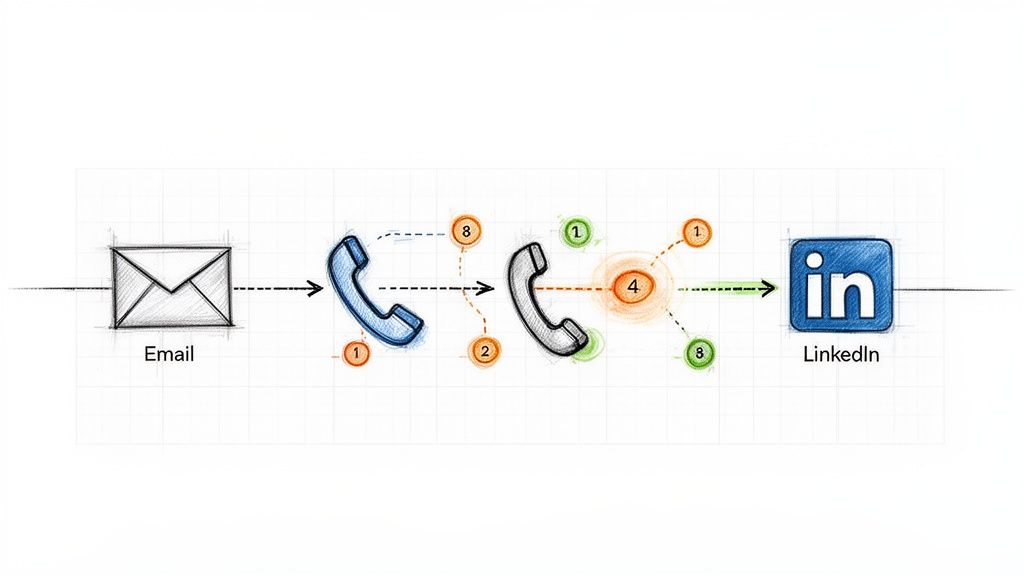
Relying solely on one communication channel, like cold email, is like fishing with a single line. One of the most impactful sales cadence best practices is to adopt a multi-channel sequence that layers different forms of outreach. This approach respects a prospect's communication preferences and significantly increases the chances of engagement by surrounding them with value across various platforms. Instead of sending five emails in a row, a multi-channel cadence might involve an email, a follow-up call, a LinkedIn connection request, and another email, all within a structured 7-10 day window.

Ineffective Tactic (Single-Channel)Effective Tactic (Multi-Channel)
Day 1: Email 1Day 1: Email 1
Day 3: Email 2 (Bump)Day 3: Call (Reference Email 1)
Day 5: Email 3 (Breakup)Day 4: LinkedIn Connection Request
Result: Low reply rate, high chance of being marked as spam.Result: Higher engagement, multiple touchpoints, professional persistence.

Illustration of a multi-channel outreach sequence, showing email, phone calls, and LinkedIn steps.

This method works because it combines asynchronous touches (email, LinkedIn), which prospects can review on their own time, with synchronous ones (calls) that create opportunities for immediate conversation. Companies like HubSpot and Salesloft have built their sales development playbooks around this model, often seeing reply rates jump from a standard 2-3% on email-only sequences to over 25% with multi-touch campaigns. The key is ensuring each touchpoint builds upon the last, creating a cohesive narrative rather than a series of disjointed, repetitive pings.

How to Implement Multi-Channel Sequencing:

  • Action Step 1: Map Your Sequence. Before building, sketch out the flow: Day 1: Email, Day 3: Call, Day 4: LinkedIn View + Connect, Day 6: Email 2. Define the goal for each touchpoint.
  • Action Step 2: Create Contextual Bridges. Your LinkedIn message should reference your email. A simple, "Hi [Name], I just sent an email regarding [topic] and wanted to connect here as well," is far more effective than a generic connection request.
  • Action Step 3: Use Engagement to Prioritize. If a prospect opens your email three times, move their call task to the top of your list. This focuses synchronous effort on engaged leads.
  • Action Step 4: Automate Logging. Ensure every touchpoint, whether an email sent via your sales engagement platform or a manual call, is automatically logged in your CRM. Platforms like MarketBetter.ai can automate this logging process, ensuring your data remains clean and actionable.

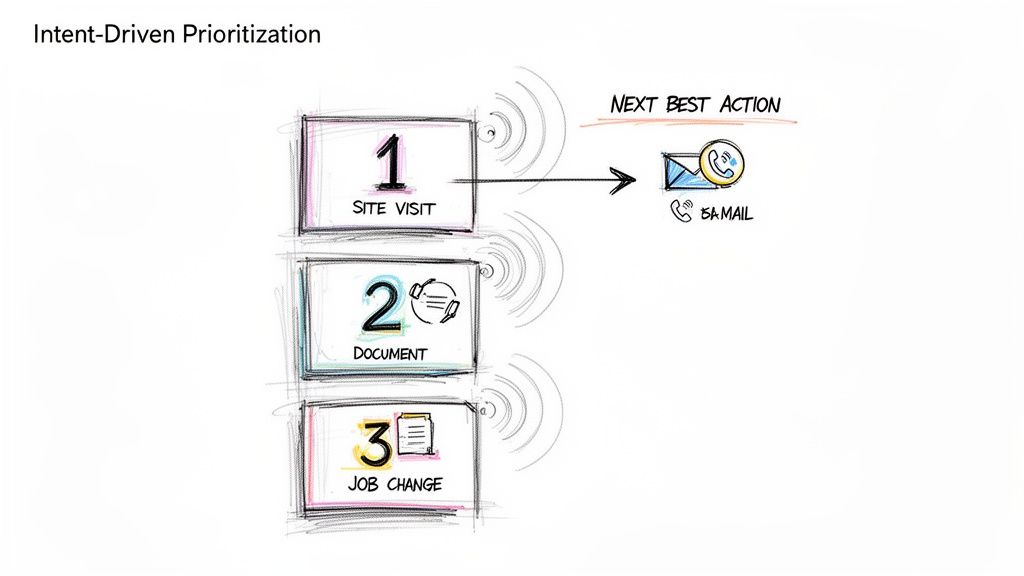
2. Intent-Driven Task Prioritization (Activity Signals → Next Best Action)

A static, alphabetical task list is a relic of the past. One of the most critical sales cadence best practices is to prioritize outreach based on real-time buyer intent signals. This data-driven approach shifts reps from a "who's next on the list" mentality to a "who's most likely to engage right now" strategy. Instead of treating all prospects equally, this model automatically surfaces and ranks targets based on high-value activities like visiting your pricing page, downloading a whitepaper, or recent job changes, ensuring reps focus their energy on the hottest leads.

Ineffective Tactic (Static List)Effective Tactic (Dynamic Prioritization)
Reps work through a list from A-Z.Reps are served tasks based on intent score (e.g., Pricing Page Visit = 10 points).
A "hot" lead who visited the site an hour ago might wait days for a call.The hot lead is automatically placed at the top of the task queue for immediate follow-up.
Reps waste time on cold, unengaged accounts.Reps spend 80% of their time on the 20% of leads most likely to convert.

A hand-drawn diagram illustrating intent-driven prioritization, showing Site Visit, Document, and Job Change leading to a Next Best Action: email or call.

This method transforms a sales cadence from a rigid schedule into a dynamic, responsive workflow. When platforms like 6sense and Outreach are integrated, they can deliver up to 40% higher SDR productivity by serving up the "next best action" based on a combination of intent, timing, and ICP fit. The goal is to align outreach with the buyer's journey, engaging them the moment their interest peaks rather than weeks later when your cadence says it's their turn.

How to Implement Intent-Driven Task Prioritization:

  • Action Step 1: Define Your High-Intent Signals. List the top 3-5 actions that indicate strong buying intent. Start with demo requests and pricing page visits.
  • Action Step 2: Set Strict SLAs. For a high-intent signal, create a rule for a rep to follow up within 2 hours. For medium-intent (e.g., webinar attendance), set a 24-hour SLA.
  • Action Step 3: Contextualize Your Outreach. Use the signal as your reason for outreach. “Saw you were looking at our case study on [Topic] and wanted to offer some additional details.”
  • Action Step 4: Filter with ICP Fit. Combine intent with your Ideal Customer Profile (ICP). A platform like MarketBetter.ai can automate this by scoring leads based on both behavioral data and firmographic fit, ensuring your team only pursues high-potential opportunities.

3. Personalized Opening Lines (Account/Persona Context in First Sentence)

Nothing kills a sales cadence faster than an opening line that screams "mass email." One of the most critical sales cadence best practices is to anchor your first sentence in specific, verifiable context about the prospect's company, recent activity, or role. This immediately signals that the outreach is a well-researched, 1-to-1 message, not a generic blast sent to thousands. Instead of a vague "I help companies like yours," a personalized opener gets straight to a relevant trigger point.

Ineffective Tactic (Generic Opener)Effective Tactic (Personalized Opener)
"Hi John, I help VPs of Sales like you solve their pipeline challenges.""Hi John, saw on LinkedIn your team is hiring three new AEs to expand into APAC."
Result: Instantly deleted. Reads like spam.Result: Grabs attention. Shows research and relevance.

This strategy works because it proves you've done your homework and respects the prospect's time by connecting your solution to their immediate reality. Research from Salesloft shows that account-based emails which mention specific products or features outperform generic templates by more than 3x. The goal is to make the prospect feel understood in the first 10 seconds.

How to Implement Personalized Opening Lines:

  • Action Step 1: Create a Trigger Checklist. Build a simple checklist for reps: 1. Check LinkedIn for recent posts/job changes. 2. Check company news for funding/launches. 3. Check G2 for recent reviews.
  • Action Step 2: Practice the "Trigger-to-Value" Bridge. Your first sentence states the observation, and the second connects it to your value. Example: “I noticed your team just launched a new integration with Salesforce. Typically, companies doing this face challenges with data syncing, which is where we help.”
  • Action Step 3: A/B Test Your Hooks. In your next 50 emails, test a hook based on a company trigger (e.g., funding) against a persona trigger (e.g., a recent LinkedIn post by the prospect). See which gets more replies.
  • Action Step 4: Leverage Technology for Scale. Use platforms like Amplemarket or MarketBetter.ai to create dynamic templates that pull in custom fields from your CRM, blending automation with genuine personalization.

4. Response-Triggered Sequencing (Adapting Based on Prospect Behavior)

A static, one-size-fits-all sales cadence treats every prospect the same, regardless of their interaction with your outreach. One of the most advanced sales cadence best practices is implementing response-triggered sequencing, a dynamic approach where the next step is determined by the prospect's real-time behavior. Instead of blindly following a pre-set path, this method adapts based on engagement signals like email opens, link clicks, or even a picked-up phone call that goes straight to voicemail.

Ineffective Tactic (Static Sequence)Effective Tactic (Dynamic Sequence)
A prospect clicks your case study link. The next step is still the automated "Just bumping this" email 3 days later.A prospect clicks your case study link. A high-priority call task is immediately created for the rep.
A prospect doesn't engage with 4 emails. They still get 4 more.After 4 unengaged touches, the prospect is automatically moved to a long-term, low-touch nurture sequence.

This intelligent sequencing transforms your cadence from a monologue into a conversation. If a prospect clicks a link to a case study in your first email, a dynamic cadence can automatically trigger a high-priority call task for the rep to follow up with relevant insights. Platforms like Outreach.io and Salesloft have built adaptive cadence features around this concept, empowering teams to create if/then logic that scales personalization and boosts efficiency.

How to Implement Response-Triggered Sequencing:

  • Action Step 1: Map Your If/Then Logic. Create a simple flowchart. If prospect clicks pricing link, then create a high-priority call task. If prospect opens email 3+ times but no click, then send follow-up email with a different value prop.
  • Action Step 2: Build Two Paths. Design an "Engagement Path" (more aggressive, personalized) and a "No-Engagement Path" (longer intervals, value-based content).
  • Action Step 3: Use Engagement Data in Your Outreach. Equip reps to use behavioral data as context. A call script can start with, "Hi [Name], I noticed you checked out the case study I sent over about [topic]..."
  • Action Step 4: Set an "Exit" Threshold. Define the point of diminishing returns. For example, after 5 touches with zero engagement, automatically exit the prospect from the active sequence. Tools like MarketBetter.ai can help automate this process, moving them to a quarterly check-in list to keep your pipeline clean.

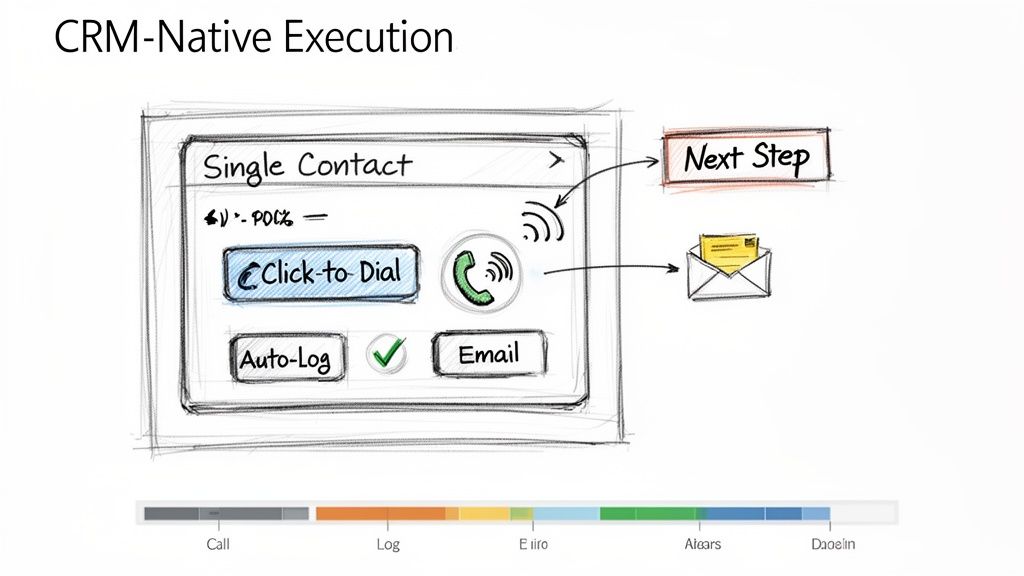
5. CRM-Native Execution (No Tab Switching; One-Click Call & Logging)

One of the biggest drags on sales productivity is friction. Constantly switching between your CRM, a separate dialer, your email client, and a note-taking app drains momentum and creates data silos. One of the most effective sales cadence best practices is to enable CRM-native execution, where all outreach activities are initiated and logged directly within your central system of record, like Salesforce or HubSpot. This unified workflow eliminates tab-switching and automates activity logging.

Ineffective Tactic (Multi-Tool Chaos)Effective Tactic (CRM-Native Workflow)
Rep copies a number from Salesforce, pastes it into a softphone, makes the call, then returns to Salesforce to manually log it.Rep clicks a "Call" button directly on the Salesforce contact record. The call is made and automatically logged with a disposition prompt.
Time per call: 2-3 minutes of admin work.Time per call: 10-20 seconds of admin work.

A hand-drawn sketch illustrating CRM-native execution with options for calling, logging, and emailing contacts.

This approach dramatically improves both adoption and efficiency. For example, when Outreach.io integrates its one-click dialer directly into a Salesforce contact page, call volume often increases by over 30% simply by removing the steps of copying and pasting numbers. The goal is to make the right action the easiest action, which means keeping reps in the one system that houses all customer data and context.

How to Implement CRM-Native Execution:

  • Action Step 1: Conduct a Workflow Audit. Shadow a rep for an hour and count every time they switch tabs to complete a task. Identify the top 3 friction points to solve.
  • Action Step 2: Configure Intelligent Auto-Logging. Set up rules to automatically log calls and emails the instant they happen. Allow reps a short window, perhaps 10 minutes post-call, to add detailed notes and context.
  • Action Step 3: Standardize Next Steps. Use your CRM's task management features to create templates for common follow-up actions like "Send Deck" or "Schedule Demo." This reduces manual entry and ensures consistent follow-through.
  • Action Step 4: Centralize Reporting. Train managers to use in-CRM dashboards for performance tracking instead of exporting data. Platforms like MarketBetter.ai can embed cadence analytics directly into the CRM, allowing for real-time coaching based on live activity data.

6. Call Prep Talk Tracks (Account Context + Objection Handling in 60 Seconds)

A structured sales cadence dictates when to call, but a pre-call talk track dictates what to say for maximum impact. One of the most critical sales cadence best practices is equipping reps with a concise, one-page talk track before every call. This isn't a rigid script; it's a strategic guide that synthesizes prospect context, a sharp opening pitch, anticipated objections, and key discovery questions into a 60-second preparatory tool.

Ineffective Tactic (Winging It)Effective Tactic (Prepared Talk Track)
Rep opens the CRM record and dials, hoping to figure it out on the fly.Rep spends 60 seconds reviewing a one-page summary: the prospect's trigger, a value hook, and answers to likely objections.
Result: Rambling, unfocused calls, and low confidence.Result: Confident, concise calls that get to the point and handle pushback effectively.

Gong’s research shows that reps who are prepared with objection handles close three times more deals. The goal is to internalize the flow, not just read the words, enabling a confident and natural conversation.

How to Implement Call Prep Talk Tracks:

  • Action Step 1: Create a One-Page Template. Use bullet points, not paragraphs. Sections should include: 1. Account Context (trigger), 2. Value Prop (20 seconds), 3. Top 3 Objections & Rebuttals, 4. Key Discovery Questions.
  • Action Step 2: A/B Test Your Openers. For your next 20 calls, try a curiosity-driven opener ("I noticed your company is expanding its logistics network..."). For the next 20, try a problem-driven one ("Many VPs of Ops are struggling with X..."). Track which leads to more conversations.
  • Action Step 3: Update Tracks Weekly. Review call recordings from your top performers weekly to identify what language is working. Use Conversation Intelligence to pull data-driven insights from real calls to refine objection handling.
  • Action Step 4: Train with Role-Playing. Run weekly 30-minute role-playing sessions. Give reps a scenario and a talk track, and have them practice delivering the key points authentically, not robotically.

7. Disposition-Based Routing (Not All Leads Go to Sales; Some Need Follow-Up)

Treating every lead outcome the same is a recipe for wasted effort and missed opportunities. One of the most critical operational sales cadence best practices is implementing disposition-based routing, a system that classifies every interaction outcome and automatically directs the lead to the appropriate next step. Instead of manually deciding what to do, reps simply log a disposition like "Not Now, Follow-Up in 6 Months," and automation takes over.

Ineffective Tactic (Manual Follow-up)Effective Tactic (Automated Routing)
Rep makes a note in a spreadsheet to "Follow up with Jane in Q3."Rep selects the "Nurture - Q3 Budget" disposition in the CRM.
Result: The note is forgotten, and the lead falls through the cracks.Result: An automated task is created for the rep on July 1st with all the previous context.

This practice prevents valuable but not-yet-ready leads from falling through the cracks and ensures Account Executives (AEs) only receive leads that are genuinely sales-ready. Companies like Outreach.io have shown that clear disposition-based routing can reduce friction between SDRs and AEs by over 40% by standardizing lead handoffs.

How to Implement Disposition-Based Routing:

  • Action Step 1: Define Your Core Dispositions. Standardize 5-7 clear options: 'Meeting Booked,' 'Schedule Follow-Up,' 'Not Now - Nurture,' 'Wrong Contact,' 'Not a Fit,' and 'Voicemail/No Answer.'
  • Action Step 2: Train on the Nuance. Coach your team on the difference between 'Not a Fit' (ICP mismatch, disqualify) and 'Not Now' (right fit, wrong timing, nurture).
  • Action Step 3: Build Automated Workflows. For each disposition, create a rule. 'Schedule Follow-Up' creates a task in 30 days. 'Not Now - Nurture' enrolls the prospect in a marketing email sequence. This automation is a key function of platforms like MarketBetter.ai.
  • Action Step 4: Require Contextual Comments. Make the "Comments" field mandatory for dispositions like 'Not Now.' A note like "Budget cycle ends in Q3, revisit in September" provides invaluable context for the next touchpoint.

8. Email Sequence Cadence Optimization (Testing Send Times,Frequency, and Subject Line Variants)

Treating your email sequence as a static, "set it and forget it" asset is a missed opportunity. One of the most critical sales cadence best practices is continuous optimization through systematic A/B testing. This involves rigorously testing variables like subject lines, send times, and follow-up frequency to discover precisely what resonates with your ideal customer profile. Instead of relying on assumptions, you use data to build a high-performing outreach machine.

Ineffective Tactic (Assumption-Based)Effective Tactic (Data-Driven A/B Testing)
"I think sending emails at 9 AM is best.""We tested 9 AM vs. 2 PM sends. For our manufacturing persona, 2 PM gets a 15% higher open rate."
The same subject line is used for months without analysis.Two subject lines are tested weekly, and the winner becomes the new control.

This data-driven approach moves you from guessing to knowing. Salesloft research shows that simple, one-word subject lines can outperform longer ones by 10% when targeting tech buyers. By isolating and testing one element at a time, you can incrementally improve engagement. To scale this process effectively, it is crucial to Master Email Follow Up Automation and implement these data-backed insights into your outreach.

How to Implement Email Sequence Optimization:

  • Action Step 1: Isolate One Variable. For your next campaign, test only the subject line. Keep the email body and send time identical for both variants to get clean data.
  • Action Step 2: Aim for Statistical Significance. Don't declare a winner after 20 sends. A good rule of thumb is to send at least 100 emails per variant to ensure the results are reliable.
  • Action Step 3: Track Opens and Replies Separately. A catchy subject line might boost opens, but a clear, value-driven one might generate more replies. Analyze both metrics to understand the full impact.
  • Action Step 4: Create a Quarterly Review Cadence. Set a recurring calendar event every quarter to review your test results, implement the winners, and plan the next round of experiments.

9. First-Response SLA (Responding to Prospect Replies Within 1 Hour)

A sales cadence doesn't end when a prospect replies; in fact, that's when the most critical phase begins. One of the most underrated sales cadence best practices is implementing a strict First-Response Service Level Agreement (SLA), committing your team to responding to all prospect replies within one hour during business hours. This discipline capitalizes on peak prospect intent.

Ineffective Tactic (Delayed Response)Effective Tactic (Sub-1-Hour SLA)
A prospect replies at 10 AM asking for info. The rep is busy with calls and replies at 4 PM.The prospect replies at 10 AM. An alert notifies the rep, who sends a thoughtful response by 10:30 AM.
Result: The prospect has moved on, their interest has cooled, and a competitor may have already engaged them.Result: The conversation continues while intent is high, leading to a much higher chance of booking a meeting.

Data from platforms like Salesloft reinforces this, showing that sales teams with a sub-one-hour response SLA achieve up to 35% higher meeting-booked rates. The goal isn't just to be fast, but to be fast and effective, moving the conversation forward while the prospect's interest is at its highest.

How to Implement a First-Response SLA:

  • Action Step 1: Create 'Hot Task' Alerts. Configure your sales engagement platform to create a high-priority task that appears at the top of a rep's queue the moment a prospect replies.
  • Action Step 2: Build Response Templates. Equip reps with pre-built templates for common replies (e.g., pricing request, scheduling inquiry). This allows for a rapid, high-quality initial response that can be personalized.
  • Action Step 3: Train the "Acknowledge and Ask" Method. Instead of just sending a calendar link, train reps to first acknowledge the prospect's message and then ask a clarifying question. Example: "Thanks for getting back to me. Before I send some times, what would be most helpful for us to cover on the call?"
  • Action Step 4: Schedule "Reply Blocks". Encourage reps to block 15 minutes on their calendar every 2 hours dedicated solely to responding to replies. This prevents constant context-switching while still meeting the SLA.

10. SLA Implementation & Coverage (Staffing, Escalation, and Quality Controls)

While outbound sequencing is crucial, one of the most overlooked sales cadence best practices is managing the inbound replies that your hard work generates. Implementing a strict First-Response Service Level Agreement (SLA), such as a 15-minute response time, requires an operational plan. This includes staffing, escalation paths for missed replies, and quality control to ensure speed doesn't sacrifice substance. Without this operational rigor, an SLA is just an empty promise.

Ineffective Tactic (Informal Expectation)Effective Tactic (Operationalized SLA)
A manager tells the team to "respond to leads quickly."A system is in place: replies create 'hot tasks.' If a task is unhandled for 30 mins, a Slack alert is sent. If unhandled for 45 mins, it escalates to a manager.
Result: Inconsistent response times, missed leads during busy periods or when reps are out of office.Result: Consistent, reliable response times, with built-in redundancy to prevent dropped leads.

This strategy operationalizes urgency and ensures no lead is left behind. Organizations that implement this system often see significant improvements in lead conversion. The goal is to build a system that guarantees rapid, high-quality engagement, turning a simple reply into a qualified meeting before the lead's focus shifts elsewhere.

How to Implement a First-Response SLA:

  • Action Step 1: Establish Clear Routing Rules. Use your sales engagement platform to create 'hot task' routing. Inbound replies should automatically appear at the top of a rep's task queue, prioritized above all outbound activities.
  • Action Step 2: Set Up Escalation Alerts. Create automated alerts. For instance, if a reply isn't actioned within 30 minutes, an alert can be sent to the rep. If it's still unhandled at 45 minutes, it can escalate to a team lead or manager for immediate intervention.
  • Action Step 3: Maintain Quality with Templates. Create a library of short, contextual reply templates that reps can customize with one personalized sentence. This balances speed with the consultative, value-driven tone needed to secure a meeting.
  • Action Step 4: Monitor and Coach. Conduct weekly audits of replies to monitor quality and coach reps on being both fast and consultative. Track metrics like meeting conversion rates for replies handled within the SLA versus those that miss it to demonstrate its direct impact on performance. Platforms like marketbetter.ai can help automate the monitoring of these SLAs.

10-Point Sales Cadence Best Practices Comparison

StrategyImplementation Complexity 🔄Resource Requirements ⚡Expected Outcomes ⭐ / 📊Ideal Use Cases 💡Key Advantages ⭐
Multi-Channel Sequencing (Email → Call → LinkedIn → Email)🔄 Medium–High: multi-channel coordination, scheduling and throttling rules⚡ Moderate–High: CRM, dialer, LinkedIn tools, automation, clean data⭐ High quality: 300–400% higher connect vs email-only; 📊 improved reply/connect rates and top-of-mind💡 Enterprise outbound or account-based programs where prospects use different channels⭐ Broader reach; higher connect rates; sustained familiarity across channels
Intent-Driven Task Prioritization (Activity Signals → Next Best Action)🔄 High: integrations with intent providers and ranking algorithms⚡ High: intent providers (6sense/Clearbit), CRM integration, analytics⭐ Very effective: faster conversion and ~40%+ SDR productivity gains; 📊 fewer wasted touches💡 Large lists where prioritizing hot accounts yields best ROI (ABM)⭐ Focuses reps on high-intent leads; reduces decision fatigue and increases velocity
Personalized Opening Lines (Account/Persona Context in First Sentence)🔄 Medium: data enrichment + template/AI generation⚡ Moderate: enrichment sources (LinkedIn, Crunchbase), AI copy tools, review time⭐ High impact: improves open/reply rates (5–15% vs 2–3%); 📊 better credibility and response quality💡 High-value or account-based outreach where personalization matters⭐ Higher reply rates and trust; differentiates from generic outreach
Response-Triggered Sequencing (Adapting Based on Prospect Behavior)🔄 High: dynamic rules, engagement tracking and decision trees⚡ Moderate–High: email tracking, workflow engine, monitoring⭐ Efficient: focuses on engaged prospects; 📊 increases productivity and better CRM signals💡 Teams with reliable engagement tracking aiming to prioritize signals in real time⭐ Reduces wasted effort; enables rapid escalation of interested prospects
CRM-Native Execution (No Tab Switching; One-Click Call & Logging)🔄 Medium: CRM customization and integration work⚡ Moderate: dialer/email inside CRM, training, config⭐ High adoption & data quality; 📊 saves ~15–20% admin time per rep💡 Organizations standardized on Salesforce/HubSpot wanting frictionless execution⭐ Higher adoption, automatic logging, faster coaching and reliable reporting
Call Prep Talk Tracks (Account Context + Objection Handling in 60 Seconds)🔄 Low–Medium: template creation and AI generation⚡ Low: AI/templating tools and brief rep prep time⭐ High quality: ~20–30% better first-call outcomes; 📊 shorter, more focused calls💡 Junior SDRs, high-volume calling, or complex product discovery calls⭐ Consistent objection handling; reduces ramp time and call anxiety
Disposition-Based Routing (Not All Leads Go to Sales; Some Need Follow-Up)🔄 Medium: standardized codes and routing rules⚡ Moderate: CRM workflows, reporting, rep training⭐ High operational value: ~25–30% improved sales focus; 📊 clearer pipeline hygiene💡 High-volume inbound/outbound where triage prevents sales overload⭐ Prevents pipeline clog; enables nurture and accurate attribution
Email Sequence Cadence Optimization (Testing Send Times, Frequency, and Subject Line Variants)🔄 Medium: structured A/B testing and analysis cadence⚡ Moderate: testing tools, volume (100+ per variant), analytics⭐ Incremental gains: small lifts compound; 📊 measurable increases in open/reply rates💡 High-volume email programs that can generate statistical samples⭐ Data-driven improvements; identifies winning subject/time/content combos
First-Response SLA (Responding to Prospect Replies Within 1 Hour)🔄 Medium: triage rules, monitoring, SLA enforcement⚡ High: staffing coverage, priority queues, templates, escalation alerts⭐ Strong: 30–40% more meetings/bookings; 📊 captures peak intent and boosts conversion💡 Inbound-heavy teams or competitive markets where speed wins⭐ Captures intent quickly; improves professionalism and meeting rates
SLA Implementation & Coverage (Staffing, Escalation, and Quality Controls)🔄 High: staffing models, escalation, audits and scheduling⚡ High: rostering, escalation tooling, audits, training overhead⭐ Sustained SLA performance: fewer missed replies; 📊 predictable coverage and quality metrics💡 Global teams, follow-the-sun models, or high-volume inbound operations⭐ Maintains SLA without burnout; preserves reply quality via templates and QA

From Best Practices to Daily Execution

Transitioning from understanding sales cadence theory to implementing a high-performance outbound engine is the ultimate goal. We've explored ten critical best practices that, when combined, transform a disjointed, manual effort into a predictable and scalable system for generating pipeline. The journey from a simple "email blast" approach to a sophisticated, intent-driven engagement model is what separates top-performing teams from the rest. The core theme is clear: success lies in creating a unified, data-informed, and rep-centric workflow.

An ad-hoc approach, where reps manually toggle between LinkedIn, their email client, and the CRM to piece together a sequence, is inherently inefficient and prone to error. It creates friction, slows down execution, and generates messy data. In contrast, a modern, integrated strategy built on these sales cadence best practices empowers reps to operate at peak efficiency. It’s the difference between a team guessing what to do next and a team executing the proven next-best action with precision.

Synthesizing the Core Pillars of Cadence Mastery

Let's distill the most crucial takeaways from our list into three foundational pillars. Mastering these areas will yield the most significant impact on your team's performance and pipeline generation.

  1. Systematize Personalization and Prioritization: Effective outreach is no longer a volume game; it's a relevance game. Best practices like Intent-Driven Task Prioritization and crafting Personalized Opening Lines ensure your team’s effort is focused where it matters most. Instead of treating all prospects equally, you empower reps to engage high-intent accounts first, armed with specific context that resonates immediately. This shifts the dynamic from a cold interruption to a timely, valuable conversation.

  2. Embed Responsiveness into Your DNA: Prospects operate in real-time, and your sales process must reflect that. Implementing a First-Response SLA of under an hour and building Response-Triggered Sequencing are not just "nice-to-haves." They are competitive necessities. The team that responds fastest with the most relevant information often wins the meeting. This agile approach, supported by SLA Implementation and Coverage plans, ensures no opportunity is lost due to slow follow-up, turning passive interest into active engagement.

  3. Unify Execution within a Single Pane of Glass: The greatest source of lost productivity is workflow friction. Requiring reps to jump between different tools to log calls, send emails, and research contacts is a recipe for wasted time and incomplete data. CRM-Native Execution is the antidote. By enabling reps to perform all sequence tasks, from one-click calls with Call Prep Talk Tracks to logging dispositions, directly within your CRM, you eliminate the administrative burden. This not only makes reps happier and more effective but also ensures every single interaction is captured cleanly for accurate reporting and coaching.

The Strategic Imperative: From Tactics to an Integrated System

Ultimately, the power of these sales cadence best practices is not in their isolated application but in their integration. A multi-channel sequence is good, but a multi-channel sequence that adapts based on prospect responses is better. A personalized email is effective, but a personalized email sent to a prioritized, high-intent contact within a CRM-native workflow is a game-changer. This is the evolution from executing a list of tactics to orchestrating a holistic system.

By embedding these principles into your daily operations, you are building more than just a sales process; you are building a scalable revenue engine. It's a system that learns, adapts, and empowers your sales development team to spend less time on manual administration and more time building relationships and creating qualified opportunities. The result is a more efficient, predictable, and successful outbound motion that drives sustainable growth for your business.


Ready to turn these best practices into your team's daily reality? marketbetter.ai is an execution-first platform designed to embed intent signals, task prioritization, and multi-channel sequencing directly within your existing CRM. See how you can eliminate workflow friction and empower your reps to execute the perfect sales cadence by visiting marketbetter.ai today.

Why Drift Users Are Switching to MarketBetter (Not Breakout or 1mind)

· 7 min read
MarketBetter Team
Content Team, marketbetter.ai

nWhy Drift Users Switch to MarketBetter

Drift is being sunset. After Salesloft acquired it in 2024 and subsequently merged with Clari, the combined entity announced they're winding down the Drift platform — directing customers to 1mind for AI-powered conversational agents.

But here's what's actually happening: most Drift teams aren't moving to 1mind. They're using this forced migration as an opportunity to rethink their entire inbound pipeline — and they're choosing platforms that do more than Drift ever did.

The two most common alternatives teams evaluate are Breakout (getbreakout.ai) and MarketBetter. Here's why the majority are landing on MarketBetter.

The Problem With "Like-for-Like" Drift Replacements

When your chatbot vendor shuts down, the natural instinct is to find the closest replacement. But that's the wrong approach.

Drift was built in 2015. The B2B sales landscape has fundamentally changed since then:

What Drift Was Built For (2015)What B2B Teams Need (2026)
Chat widget on websiteMulti-channel engagement (chat + email + phone + LinkedIn)
Decision-tree chatbot playbooksAI that understands context and adapts
Book meetings from chat onlyBook meetings across every channel
Inbound form/chat captureAnonymous visitor identification before they engage
Separate tools for everything elseOne platform that replaces 3-5 tools

The opportunity: Don't just replace Drift. Replace Drift + your email tool + your dialer + your visitor ID tool — with one platform.

Why Not 1mind?

Clari + Salesloft is officially directing Drift customers to 1mind's AI "Superhumans." Here's why most teams are looking elsewhere:

  • Narrow focus — 1mind builds conversational AI agents. No email sequences, no dialer, no visitor identification, no SDR workflow management.
  • Early stage — 1mind is positioning for the future but lacks the mature feature set Drift users depend on today.
  • No migration tooling — There's no direct Drift → 1mind migration path with feature parity.
  • Vendor risk — Moving from one vendor being sunset to a less-established vendor feels like repeating the same mistake.

Why Not Breakout?

Breakout (getbreakout.ai) is the most obvious "modern Drift replacement." Both are AI-powered chat tools for inbound pipeline. But Drift users who evaluate Breakout find three key problems:

1. Breakout Is Expensive for What You Get

Drift (Legacy Pricing)BreakoutMarketBetter
Basic plan~$2,500/mo$1,500/mo (no AI SDR!)All features included
Full-featured plan~$5,000/mo$2,500/moAll features included
Includes dialer
Includes email automation⚠️ Growth only
Includes visitor ID⚠️ ABM add-on
Total stack cost (10 reps)$6,000–$10,000/mo$4,000–$5,500/moSignificantly lower

Drift users are already paying for a fragmented stack. Switching to Breakout means paying $2,500/mo AND keeping your dialer, outbound tool, and other add-ons. The total cost doesn't improve much.

2. Breakout Doesn't Solve the Fragmentation Problem

The #1 complaint from Drift users isn't "my chatbot stopped working." It's:

"I have 5 tools, none of them talk to each other, and my SDRs waste 2 hours a day switching between dashboards."

Breakout adds another tool to the stack. MarketBetter replaces the stack.

3. Breakout's Pricing Isn't Transparent

Drift users already experienced opaque pricing — enterprise-only quotes, annual contracts, surprise renewal increases. Many are specifically looking for transparent pricing as a requirement in their next vendor:

  • Breakout: "Starts at $1,500/mo" / "Starts at $2,500/mo" — must request demo for actual pricing
  • MarketBetter: Transparent per-user pricing, no hidden fees, no mandatory demo to see costs

What Drift Users Actually Need

After talking with dozens of teams migrating from Drift, here's what they're actually looking for:

1. Chat + More (Not Just Chat)

Drift was a chatbot. Most teams had added Outreach, a dialer, RB2B, and a meeting scheduler on top. They don't want to rebuild that stack — they want one platform that combines all of it.

MarketBetter delivers: AI chatbot + email sequences + smart dialer + visitor ID + smart scheduling + daily SDR playbook — one platform.

2. AI That Actually Learns

Drift's chatbots used rigid decision trees. SDRs spent hours building and maintaining playbooks that broke every time the product changed. Modern teams want AI that:

  • Learns from your product documentation
  • Adapts to new questions without manual playbook updates
  • Understands context and nuance
  • Gets better over time

MarketBetter's AI chatbot is trained on your knowledge base and adapts automatically. No decision tree maintenance.

3. Smart Scheduling (Not Just "Book a Meeting" Button)

Drift booked meetings when someone asked. That's table stakes. What teams actually need:

  • AI-optimized timing — when is this prospect most likely to accept a meeting?
  • Form routing — instant meeting booking from HubSpot or Webflow forms
  • Round-robin with rules — territory, specialization, availability
  • Rep availability — never book a meeting when a rep is at capacity

MarketBetter's Smart Scheduler does all of this — analyzing engagement patterns to suggest optimal outreach and meeting times.

4. Outbound Capability

Here's Drift's biggest limitation that nobody talks about: Drift was inbound-only. If a prospect didn't come to your website and open chat, Drift couldn't help.

But most B2B pipeline comes from outbound. Drift users always needed Outreach, Salesloft, or Apollo alongside Drift. Now they want one platform that handles both.

MarketBetter handles inbound + outbound: visitor intelligence triggers automated outreach workflows. GTM signals (job changes, funding, news) create prioritized SDR tasks. Outbound sequences run alongside inbound chat — all in one system.

5. No More Vendor Risk

Drift's shutdown taught teams a painful lesson: don't build your pipeline on a platform that might disappear.

When evaluating replacements, teams are checking:

  • ✅ Is the company self-sustaining (not acquisition bait)?
  • ✅ Is the product actively developed?
  • ✅ Can I export my data if I need to leave?
  • ✅ Are there fair contract terms (no 3-year lock-in)?

Migration Timeline: Drift → MarketBetter

Most teams complete the full migration in 2-4 weeks:

WeekWhat Happens
Week 1Audit Drift setup, export data, set up MarketBetter account
Week 2Configure AI chatbot, smart scheduler, CRM sync, Slack alerts
Week 3Run Drift + MarketBetter in parallel, compare metrics
Week 4Remove Drift script, deploy MarketBetter across all pages, activate full SDR workflows

For a detailed step-by-step guide: Drift Migration Guide →

The Numbers

MetricDrift (Before)MarketBetter (After)
Tools in stack5-7 (Drift + email + dialer + visitor ID + scheduler + CRM + analytics)1-2 (MarketBetter + CRM)
Monthly tool cost$6,000–$10,000Significantly lower
SDR daily setup time30-60 min (logging into multiple tools)5 min (one daily playbook)
Channels coveredChat only (via Drift)Chat + email + phone + LinkedIn
Visitor identificationAfter they open chatBefore they take any action

Don't Wait for the Lights to Go Off

Drift's sunsetting timeline means existing customers will see reduced support, slower bug fixes, and eventually, complete shutdown. The security incident in August 2025 already showed what happens when a sunsetting product has problems — response times suffer.

Start your migration now while you still have time to run platforms in parallel and compare results.


Free Tool

Try our AI Lead Generator — find verified LinkedIn leads for any company instantly. No signup required.

Ready to Replace Drift With Something Better?

MarketBetter doesn't just replace Drift — it replaces Drift + your email tool + your dialer + your visitor ID tool. One platform. One login. One daily playbook.

Book a Demo →

See how MarketBetter turns your entire SDR workflow into a single AI-powered platform.

11 Best Lead Enrichment Tools for B2B Sales Teams [2026]

· 9 min read
MarketBetter Team
Content Team, marketbetter.ai

Your SDR team just got a new lead. An email address. Maybe a company name. Now what?

Without enrichment, that lead is just a name in a spreadsheet. Your rep doesn't know the company size, industry, tech stack, or whether this person is even a decision-maker. They're flying blind.

Lead enrichment tools fill in the gaps — turning anonymous contacts into complete profiles your sales team can actually work with.

But here's the problem most teams discover too late: enriched data without clear next steps is still just data. You need tools that not only enrich leads but help you act on them.

In this guide, we'll break down the best lead enrichment tools for 2026 — what they do well, where they fall short, and which ones actually help your SDRs close deals.

What to Look for in Lead Enrichment Tools

Before diving into the list, here's what matters most:

FactorWhy It Matters
Data AccuracyBad data = wasted outreach. Look for verified contacts, not scraped databases.
CoverageDoes it work for your target market? Global? SMB? Enterprise?
Real-Time EnrichmentBatch enrichment is fine for lists. Real-time matters for inbound leads.
IntegrationNeeds to work with your CRM, not require manual exports.
ActionabilityGreat data is useless without clear next steps for your SDRs.

The Best Lead Enrichment Tools for 2026

1. MarketBetter

Best for: SDR teams who need enrichment + workflow in one platform

MarketBetter takes a different approach to enrichment. Instead of just adding data fields to your leads, it combines visitor identification, contact enrichment, and a daily playbook that tells your SDRs exactly what to do next.

Key Features:

  • Website visitor identification with contact-level data
  • Automatic enrichment of inbound leads
  • Daily SDR playbook with prioritized tasks
  • Built-in smart dialer for warm outreach
  • CRM sync with HubSpot and Salesforce

What Sets It Apart: Most enrichment tools give you data and say "good luck." MarketBetter tells you WHO to contact, WHEN to reach out, and WHAT to say. It's enrichment that actually drives action.

Pricing: Custom pricing based on team size

Ideal For: B2B companies with 3-20 SDRs who want to consolidate their tech stack

Book a Demo →


2. Clearbit (Now Part of HubSpot)

Best for: HubSpot users who need seamless enrichment

Clearbit was acquired by HubSpot in 2023, making it the go-to enrichment tool for HubSpot customers. It offers real-time enrichment, form shortening, and IP-based visitor identification.

Key Features:

  • Real-time form enrichment
  • Company and contact data append
  • IP intelligence for visitor identification
  • Native HubSpot integration
  • Lead scoring data

Strengths:

  • Extremely tight HubSpot integration
  • Reliable company data
  • Good for marketing automation triggers

Limitations:

  • Best value if you're already on HubSpot
  • Limited phone number coverage
  • No built-in outreach tools

Pricing: Bundled with HubSpot plans; standalone pricing available


3. Apollo.io

Best for: Outbound-heavy teams on a budget

Apollo combines a massive B2B database with outreach sequencing. It's one of the most feature-rich tools at an accessible price point.

Key Features:

  • 275M+ contact database
  • Email verification built-in
  • Sequence automation
  • Chrome extension for LinkedIn prospecting
  • Intent data signals

Strengths:

  • Generous free tier (50 credits/month)
  • All-in-one prospecting and outreach
  • Strong LinkedIn integration

Limitations:

  • Data quality varies (crowdsourced)
  • Can feel overwhelming for small teams
  • Limited visitor identification

Pricing: Free tier available; paid plans from $49/user/month


4. ZoomInfo

Best for: Enterprise teams with big budgets

ZoomInfo is the 800-pound gorilla of B2B data. It offers the most comprehensive company and contact database, plus intent data, website visitor tracking, and more.

Key Features:

  • 100M+ business profiles
  • Intent data from Bombora
  • Website visitor tracking
  • Org chart mapping
  • Technographic data

Strengths:

  • Best-in-class data coverage
  • Strong intent signals
  • Comprehensive org charts

Limitations:

  • Expensive ($15K+ annual contracts)
  • Long sales cycles to buy
  • Overkill for SMB teams

Pricing: Custom pricing; typically $15,000-$50,000+/year


5. Cognism

Best for: Teams targeting European markets

Cognism excels in GDPR-compliant data for European prospects. Their "Diamond Data" offers phone-verified mobile numbers — critical for outbound calling.

Key Features:

  • Diamond Data® (phone-verified mobiles)
  • GDPR-compliant database
  • Intent data (12 topics included)
  • Job change alerts
  • Technographic data

Strengths:

  • Best European data coverage
  • Phone verification = higher connect rates
  • Strong compliance focus

Limitations:

  • Weaker US coverage than Apollo/ZoomInfo
  • Pricing not transparent
  • No built-in dialer

Pricing: Custom quotes; packages include Grow and Elevate tiers


6. Lusha

Best for: Individual contributors and small teams

Lusha offers a simple credit-based model that works well for individual SDRs or small teams who need quick contact lookups.

Key Features:

  • Browser extension for LinkedIn
  • Credit-based pricing (1 credit = email, 10 credits = phone)
  • CRM integrations
  • Bulk enrichment
  • Team management

Strengths:

  • Simple, predictable pricing
  • Easy to get started
  • Good mobile number coverage

Limitations:

  • Credits add up fast
  • Limited enrichment depth
  • No workflow tools

Pricing: Free plan (70 credits/month); Pro plans from $49/user/month


7. Clay

Best for: Growth teams who love automation

Clay is the Swiss Army knife of enrichment — it combines 50+ data providers and lets you build custom enrichment workflows with AI.

Key Features:

  • 50+ data provider integrations
  • AI-powered research
  • Custom workflow builder
  • Waterfall enrichment (tries multiple sources)
  • Spreadsheet-like interface

Strengths:

  • Incredible flexibility
  • Best data coverage (aggregates sources)
  • AI can research anything

Limitations:

  • Steep learning curve
  • Requires technical setup
  • Can get expensive at scale

Pricing: Starter from $149/month


8. Demandbase

Best for: Account-based marketing teams

Demandbase is an ABM platform with strong enrichment capabilities. It's built for marketing and sales alignment on target accounts.

Key Features:

  • Account identification
  • Intent data
  • Advertising integration
  • CRM enrichment
  • Journey analytics

Strengths:

  • Excellent for ABM strategies
  • Strong intent signals
  • Good for marketing-sales alignment

Limitations:

  • Enterprise pricing
  • Complex implementation
  • More marketing than sales focused

Pricing: Enterprise custom pricing


9. LeadIQ

Best for: SDRs doing outbound prospecting

LeadIQ focuses on making prospecting fast. Its Chrome extension lets SDRs capture and enrich contacts directly from LinkedIn.

Key Features:

  • LinkedIn prospecting extension
  • One-click capture to CRM
  • Email verification
  • Sequence integration
  • Team collaboration

Strengths:

  • Fast prospecting workflow
  • Good Salesforce integration
  • Affordable for individuals

Limitations:

  • Limited to prospecting use case
  • Smaller database than competitors
  • No visitor identification

Pricing: Free tier available; paid from $39/user/month


10. FullContact

Best for: Identity resolution and customer data

FullContact specializes in identity resolution — connecting fragmented customer data across touchpoints.

Key Features:

  • Identity resolution
  • API-first approach
  • Privacy-compliant enrichment
  • Real-time data append
  • Multi-source matching

Strengths:

  • Best for customer data platforms
  • Strong privacy focus
  • Reliable API

Limitations:

  • Not built for sales teams
  • Requires technical implementation
  • Limited sales-specific features

Pricing: API pricing based on usage


11. Kaspr

Best for: European SDRs on LinkedIn

Kaspr is a LinkedIn-focused tool popular in Europe. It offers a Chrome extension with real-time data extraction.

Key Features:

  • LinkedIn Chrome extension
  • Phone and email extraction
  • GDPR compliance
  • Team management
  • CRM integrations

Strengths:

  • Strong LinkedIn integration
  • Good European data
  • Affordable pricing

Limitations:

  • LinkedIn-focused only
  • Limited automation
  • Smaller database

Pricing: Free tier; paid from €49/user/month


Quick Comparison: Lead Enrichment Tools 2026

ToolBest ForStarting PriceKey Strength
MarketBetterSDR workflowCustomEnrichment + daily playbook
ClearbitHubSpot usersBundledReal-time form enrichment
ApolloBudget teamsFree/$49All-in-one platform
ZoomInfoEnterprise$15K+/yearBest data coverage
CognismEuropean marketsCustomPhone-verified mobiles
LushaSmall teamsFree/$49Simple credit model
ClayGrowth teams$149/moWorkflow automation
DemandbaseABM teamsEnterpriseIntent + advertising
LeadIQOutbound SDRsFree/$39Fast prospecting
FullContactIdentity resolutionUsage-basedAPI reliability
KasprEuropean LinkedInFree/€49LinkedIn extraction

The Real Question: Enrichment vs. Action

Here's what most lead enrichment comparison articles won't tell you:

Data alone doesn't close deals. Action does.

You can have perfect enrichment — every field filled in, every phone number verified, every intent signal captured. But if your SDR still has to:

  1. Log into 5 different tools
  2. Decide who to call first
  3. Research what to say
  4. Manually log the activity

...then enrichment is just creating more work.

The SDR teams seeing the best results in 2026 aren't just enriching leads — they're using tools that turn enriched data into specific daily actions.

That's why MarketBetter combines enrichment with a daily playbook. Instead of giving you data and wishing you luck, it tells your SDRs: "Call this person first. Here's why they're hot. Here's what to say."

Enrichment should be the beginning of the workflow, not the end.

How to Choose the Right Enrichment Tool

Choose based on your actual workflow:

  • HubSpot all-in? → Clearbit makes sense
  • Tight budget, need everything? → Apollo is hard to beat
  • Enterprise with ABM strategy? → ZoomInfo or Demandbase
  • Targeting Europe? → Cognism or Kaspr
  • Want enrichment + SDR workflow? → MarketBetter

Questions to ask vendors:

  1. What's your data accuracy rate? (Ask for specifics, not marketing claims)
  2. How do you handle data decay? (B2B data goes stale fast)
  3. What happens after enrichment? (Do they help you act on it?)
  4. What integrations matter to you?
Free Tool

Try our AI Lead Generator — find verified LinkedIn leads for any company instantly. No signup required.

The Bottom Line

Lead enrichment is table stakes in 2026. Every serious B2B sales team needs it.

But the winners aren't the teams with the most data — they're the teams that turn data into action fastest.

If you're still jumping between enrichment tools, CRMs, and dialers, you're leaving money on the table. Look for solutions that combine enrichment with clear next steps for your SDRs.

Ready to see enrichment + workflow in action?

Book a MarketBetter Demo →


Looking for more SDR tool comparisons? Check out our guides to the best website visitor identification tools and best sales dialers for SDR teams.

7 Cold Email Templates That Actually Book Meetings in 2026 (Real Examples)

· 29 min read

In B2B sales, a generic cold email is a deleted email. Sales Development Representatives (SDRs) are under immense pressure to generate pipeline, yet they often spend hours on manual research and crafting messages that get ignored. The problem isn't a lack of effort; it's a broken workflow that fails to scale personalization. A great template is a starting point, but true success comes from combining a proven structure with deep personalization and executing it efficiently within your CRM.

This guide moves beyond simple copy-paste solutions. We will provide an actionable framework for turning high-performing cold email templates into repeatable revenue. You'll get a direct comparison of the top platforms and resources, from static template libraries to dynamic AI-powered generation engines. We'll show you exactly how to implement these strategies and sequences within a real-world SDR workflow to get more replies and book more meetings. For a deeper understanding of the fundamental principles and strategies behind effective cold outreach, explore this comprehensive guide.

Each entry in our list includes screenshots, direct links, and a breakdown of its core strengths, so you can quickly identify the best fit for your team's specific needs. We’ll compare platforms like MarketBetter.ai for its AI-driven personalization, HubSpot for its integrated CRM templates, and Mailshake for its straightforward automation, giving you the insights needed to refine your outreach process. This isn't just a list; it's a playbook for building a more effective, scalable, and successful cold email strategy.

1. marketbetter.ai

MarketBetter.ai secures its position as our top choice by fundamentally redefining how sales teams approach cold outreach. Instead of offering a static library of cold email templates, it provides a dynamic, AI-powered task engine that turns buyer intent signals into perfectly timed, highly relevant outreach sequences directly within your CRM. This execution-first model addresses the core challenge of modern outbound: not just what to say, but when and why to say it, ensuring every email is rooted in context and data.

For SDRs, BDRs, and sales leaders, this platform is a significant upgrade from standalone AI writers or template repositories. It transforms the often-chaotic process of prospecting into a streamlined, prioritized workflow, significantly reducing the manual research and administrative busywork that consumes up to 70% of a rep's day.

Core Features and Strategic Advantages

MarketBetter.ai's strength lies in its cohesive, end-to-end workflow designed for high-performance outbound teams. It’s not just a tool for generating emails; it’s an operational system for executing a smarter, faster GTM strategy.

  • AI-Generated Cold Email Sequences: The platform's AI goes beyond generic templates. It produces short, sequence-ready first touches and follow-ups based on the prospect's persona, industry, and recent intent signals (like website visits or content engagement). It also generates subject line and CTA variants, allowing for A/B testing and continuous optimization.
  • Intent-Driven Task Prioritization: This is the key differentiator. MarketBetter automatically creates a daily task inbox for each SDR, pulling in leads from intent data, ICP triggers, and engagement signals. It then ranks these tasks by account fit, activity, and timing, ensuring reps always focus their energy on the most promising opportunities first.
  • Native CRM Execution: With a built-in dialer and seamless integration, reps execute all tasks (emails and calls) directly inside Salesforce or HubSpot. This eliminates the need to switch between tabs, ensures 100% of activity is auto-logged, and maintains pristine CRM data hygiene for accurate reporting and coaching.
  • AI-Assisted Cold Calling: Complementing its email capabilities, the AI Cold Call workflow provides reps with contextual research, relevant talk tracks, and automated post-call summaries. This comprehensive approach ensures message consistency across all touchpoints.

Practical Application: From Signal to Meeting

Here’s an actionable workflow for how a BDR would use MarketBetter.ai to operationalize cold email templates and outreach:

  1. Prioritized Tasks Appear: The SDR logs into Salesforce and finds their daily task queue, pre-populated and ranked by MarketBetter. A top task might be a Marketing VP at a target account who just downloaded a whitepaper.
  2. Context is Served: The task includes key research points: the prospect's LinkedIn activity, company news, and the specific content they engaged with.
  3. AI Crafts the Email: With one click, the AI generates a concise, relevant cold email referencing the whitepaper topic and connecting it to a relevant pain point for a Marketing VP.
  4. Execution is Instant: The SDR reviews the email, makes a minor tweak to match their personal style, and sends it directly from the Salesforce interface. The activity, including the email body, is logged automatically.
  5. Follow-up is Scheduled: The system queues up the next step in the sequence, whether it's a follow-up email or a call, ensuring no lead falls through the cracks.

Key Insight: The value of MarketBetter.ai isn't just in the quality of the AI-generated templates but in its ability to connect those templates to a specific, timely reason for outreach. This relevance is what drives a reported 5x increase in response rates for its users.

Pricing and Onboarding

MarketBetter.ai does not list public pricing, opting for a consultative sales process with custom quotes based on team size and feature requirements. They offer a free trial and a personalized demo to showcase the platform's value.

The company emphasizes fast time-to-value, with easy integrations for Salesforce, HubSpot, Gmail, Outlook, Slack, and Teams included at no extra cost. Their strong social proof, including a 4.97 G2 rating and awards for implementation support and ROI, suggests a smooth and effective onboarding experience.

Why It Stands Out

Feature ComparisonStandard Template LibraryStandalone AI WriterMarketBetter.ai
Primary FunctionStatic content repositoryOn-demand text generationEnd-to-end SDR workflow
CRM IntegrationManual copy/pasteManual copy/pasteNative Execution & Auto-Logging
PersonalizationRelies on manual researchRequires user-provided promptsAutomated from Intent Signals
WorkflowDisconnected from CRMDisconnected from CRMPrioritized, In-CRM Task Queue
Rep ProductivityLowModerateHigh (70% less manual work)

Ultimately, MarketBetter.ai is more than a source for cold email templates; it’s a strategic platform built to make your entire outbound engine more efficient, relevant, and effective. By embedding AI-powered content generation within a native CRM workflow driven by buyer intent, it empowers sales teams to act on the right signals at the right time with the right message.

Website: https://www.marketbetter.ai

2. HubSpot

HubSpot is a powerhouse in the sales and marketing world, and its resources for cold email templates are no exception. Far more than just a blog post with a few examples, HubSpot offers a comprehensive ecosystem that combines high-quality, free template packs with a powerful, integrated CRM and sales automation platform (Sales Hub). This makes it an ideal choice for sales teams who want to move from simply copying templates to operationalizing them within a structured, data-driven workflow.

Unlike standalone template libraries or specialized outreach tools like Mailshake, HubSpot's primary advantage is its native integration into a full-funnel CRM. You can access and deploy templates directly from your Gmail or Outlook inbox, track opens and clicks in real-time, and enroll prospects into multi-step sequences without ever leaving your CRM. This unified approach eliminates the friction of switching between tools and provides a single source of truth for all your outreach activities.
HubSpot's email template builder, which allows for easy creation and personalization of cold email templates.

Key Offerings and Features

HubSpot's template resources are split into two main categories: downloadable assets and in-product tools.

  • Free Downloadable Template Pack: HubSpot offers a popular pack of over 50 sales email templates. This collection covers the entire sales cycle, from the initial cold outreach and follow-ups to re-engagement and breakup emails. While access requires submitting your email (gated content), the quality is consistently high and provides a solid foundation for any SDR.
  • In-Product Templates & Sequences: Within the HubSpot Sales Hub, users can create, save, and share an unlimited number of templates. The platform supports personalization tokens that pull data directly from contact records in the HubSpot CRM, making it easy to customize emails at scale.
  • Built-in Analytics: Each template’s performance is tracked automatically. You can monitor open rates, click-through rates, and reply rates to identify your top-performing messages and continuously optimize your approach.

Pricing and Access

HubSpot's approach to templates is tiered, making it accessible for individuals while offering robust features for growing teams.

Feature/TierFree ToolsSales Hub Starter (from $15/mo/seat)Sales Hub Professional (from $90/mo/seat)
Template Access5 templates1,000 templates1,000 templates
Email SequencesNoYesYes (with advanced features)
Email Tracking200 notifications/monthUnlimited notificationsUnlimited notifications
Downloadable PacksYes (requires email signup)YesYes

How to Use HubSpot Templates Effectively: An Action Plan

  1. Start with the Free Pack: Download HubSpot's free sales email template pack. Don't just copy-paste; identify 2-3 templates that align with your specific use case (e.g., "Referral Request" or "Problem-Agitator-Solve").
  2. Adapt and Import: Rewrite the chosen templates in your own brand voice. Then, import them into the HubSpot templates tool (even the free version allows for five).
  3. Connect to Your CRM: Use HubSpot’s personalization tokens (like {{contact.firstname}} and {{contact.company}}) to dynamically insert prospect data. This is a critical step for scaling your outreach without sacrificing personalization.
  4. Test and Measure: Send your templates to a small, targeted list of prospects. Use the built-in analytics to see which subject lines get the most opens and which body copy generates the most replies. The data doesn't lie.

Website: https://www.hubspot.com/products/sales/email-templates-sales

3. Mailshake

Mailshake is a dedicated sales engagement platform designed to streamline and automate cold outreach. While it offers a complete suite of tools for running campaigns, its foundation is built on a powerful system for managing and deploying effective cold email templates. Unlike general-purpose CRMs like HubSpot where templates are one feature among many, Mailshake puts the outreach sequence front and center. This makes it an excellent choice for sales development teams and individuals whose primary goal is to book meetings through scalable, multi-touch email campaigns.

The platform's core advantage is its focus on the entire outreach workflow, from creation to deliverability. Instead of just providing static examples, Mailshake integrates template management directly into campaign sequences, which can include phone calls and social media tasks. This holistic approach ensures your templates are part of a cohesive strategy, not just one-off messages.
Mailshake

Key Offerings and Features

Mailshake combines a rich resource library with powerful in-app tools to help users master cold outreach.

  • Blog & Template Library: Mailshake maintains an extensive blog and resource center filled with tested cold email templates, playbooks, and strategies. These resources are freely available and cover a wide range of scenarios, from link building to enterprise sales.
  • AI Writing Assistant (SHAKESpeare): Integrated directly into the platform, this AI copywriter helps you generate new email ideas, rewrite existing templates for a different tone, or overcome writer's block. It's a practical tool for quickly creating personalized variations.
  • Built-in Deliverability Tools: Mailshake includes an email warm-up tool and list-cleaning integrations to ensure your templates land in the primary inbox. This focus on deliverability is a key differentiator from platforms that don't manage the technical side of sending.
  • Multichannel Sequences: You can build templates not just for the initial email but for every follow-up, and even add steps for phone calls and LinkedIn engagement, all within a single campaign view.

Pricing and Access

Mailshake’s pricing is straightforward, with two primary tiers for sales-focused users. Unlike some competitors, there is no free-forever plan or free trial; payment is required upfront.

Feature/TierEmail Outreach (from $58/mo/seat)Sales Engagement (from $83/mo/seat)
Email CampaignsYesYes
Template StorageUnlimitedUnlimited
AI Writing Asst.YesYes
Phone DialerNoYes
LinkedIn AutomationNoYes (Add-on)
Blog/Resource AccessYesYes

How to Use Mailshake Templates Effectively: An Action Plan

  1. Start with Proven Examples: Explore Mailshake's public blog to find a battle-tested cold email template for sales that matches your campaign goal. These serve as a great starting point.
  2. Use SHAKESpeare for Personalization: Once you have a base template, use the AI writing assistant to create 3-4 variations. Ask it to rewrite the template with a more casual tone, or to focus on a specific pain point.
  3. Build a Multi-Step Sequence: Don't rely on a single email. Import your template into a Mailshake campaign and build a sequence of 3-5 follow-up emails. Use slight variations of your core message for each step.
  4. A/B Test Your Subject Lines: Create two versions of your campaign that are identical except for the subject line. Mailshake's analytics will show you which one gets a higher open rate, allowing you to optimize for performance.

Website: https://mailshake.com/

4. lemlist

lemlist is a major player in the sales automation space, but its unique contribution to cold email templates comes from its community-driven and data-backed approach. Instead of just offering a static list of examples like a blog, lemlist provides a public hub of cold outreach sequences, many of which are submitted by its user community and include real-world performance benchmarks. This makes it an invaluable resource for SDRs who want to see what's actually working in the wild, not just what sounds good in theory.

The platform's core advantage is the direct bridge between inspiration and execution. You can browse templates filtered by goal (e.g., lead generation, link building) or industry, see their reported open and reply rates, and then, with a single click, duplicate an entire campaign sequence directly into your lemlist account. This seamless workflow is designed for action, helping teams move from learning best practices to implementing them with minimal friction.
lemlist's cold outreach templates hub, showcasing community-submitted campaigns with performance data.

Key Offerings and Features

lemlist’s resources are a blend of community-sourced templates and expert-led educational content, making it a well-rounded platform for outreach professionals.

  • Public Template Hub: This gallery features hundreds of cold email templates and multi-step sequences. The key differentiator is that many include performance data like open rates and reply rates, offering a baseline for what you can expect.
  • One-Click Campaign Duplication: For lemlist users, this is a game-changer. Found a sequence you like? You can import the entire thing, including all follow-up steps and timing, directly into your lemlist account to start a new campaign.
  • Educational Resources: Beyond templates, lemlist provides extensive free resources, including playbooks, guides, and ebooks. These materials offer deep dives into the strategy behind successful outreach, helping users understand the "why" behind the "what." For more foundational knowledge, our guide on how to write cold emails is an excellent starting point.

Pricing and Access

While the template gallery is free to browse, its full power is unlocked with a lemlist subscription.

Feature/TierFree AccessEmail Starter (from $39/mo)Email Pro (from $69/mo)
View Template HubYesYesYes
Duplicate CampaignsNoYesYes
Educational ResourcesYesYesYes
Performance BenchmarksYes (on select templates)Yes (on select templates)Yes (on select templates)

How to Use lemlist Templates Effectively: An Action Plan

  1. Browse with a Goal in Mind: Use the filters in the template hub to find sequences that match your specific objective, such as "SaaS sales" or "event invitation." Pay close attention to the reported performance benchmarks.
  2. Analyze the "Why": Don't just look at the template; analyze its structure. Why is the first follow-up a simple bump? Why does the third step use a different angle? The community data helps validate these strategic choices.
  3. Duplicate and Adapt: If you're a lemlist user, duplicate your chosen campaign. Immediately begin rewriting the copy to fit your unique brand voice, value proposition, and persona. The structure is your starting point, not the final product.
  4. A/B Test Against the Benchmark: Use the community-provided reply rate as your initial benchmark. Run an A/B test with your adapted version against the original to see if you can improve upon the results.

Website: https://www.lemlist.com/cold-email-templates

5. Yesware

Yesware is a sales productivity platform built directly into your inbox, making it a standout choice for sales reps and SDR teams who live in Gmail or Outlook. Its approach to cold email templates is focused on accessibility and immediate application. Instead of being a separate tool, Yesware integrates template management, tracking, and analytics into the native email-writing experience, drastically reducing friction for busy sellers.

The core advantage of Yesware is its in-inbox workflow. Sales reps can create, access, share, and analyze templates without ever leaving their email client. This is a significant differentiator from standalone platforms like Mailshake or Reply.io that require constant context switching. For small to mid-sized teams looking to standardize their messaging and get quick insights on what works, Yesware offers a powerful, low-overhead solution.
Yesware’s in-inbox template library, which allows sales reps to access and personalize cold email templates directly within Gmail or Outlook.

Key Offerings and Features

Yesware's template functionality is designed for speed and team collaboration within the familiar environment of an inbox.

  • In-Inbox Template Library: Create and save your best-performing cold emails directly within Gmail or Outlook. The library is easily searchable and allows for team-wide sharing, ensuring message consistency.
  • Template Performance Reporting: Yesware provides detailed analytics on a per-template basis. You can track open rates, reply rates, and link clicks to objectively determine which messages are driving results and which need to be refined.
  • Public Resources & Guides: Beyond the tool itself, Yesware offers a public library of proven templates and downloadable guides. These resources are excellent for inspiration and cover various scenarios, from initial outreach to follow-ups.
  • Team Collaboration: Managers can create and share a set of approved templates with their team, promoting best practices and accelerating the onboarding process for new reps.

Pricing and Access

Yesware offers a tiered pricing model that scales from individual users to enterprise teams, with template features becoming more robust at each level.

Feature/TierFreePro (from $15/mo/seat)Premium (from $35/mo/seat)
Template AccessYes (Limited)Unlimited Personal TemplatesUnlimited Personal & Team Templates
Email TrackingYes (Limited)UnlimitedUnlimited
Team ReportingNoNoYes
Downloadable GuidesYesYesYes

How to Use Yesware Templates Effectively: An Action Plan

  1. Start with Proven Examples: Explore Yesware’s public template library or free guides to find a structure that fits your outreach goal. Pay attention to how they frame the value proposition.
  2. Build Your Core Templates: Adapt 3-4 of these proven templates and save them in your personal Yesware library. Use clear naming conventions like "Cold Outreach - VP Marketing - Pain Point A" for easy access.
  3. Use Personalization Fields: Leverage Yesware’s dynamic fields to insert prospect details like {{First Name}} and {{Company}}. This is crucial for maintaining a personal touch while working efficiently. To make your messages stand out even more, craft compelling subject lines. Discover how to create your own by reading our guide on witty email subject lines.
  4. Monitor Team-Wide Performance: If you are on a team plan, use the template reporting feature to see which messages have the highest reply rates across the entire team. This data-driven approach helps everyone adopt the most effective messaging.

Website: https://www.yesware.com/email-templates/

6. Reply.io

Reply.io is a comprehensive sales engagement platform designed for multichannel outreach, and its approach to cold email templates is deeply integrated into its automation workflow. Unlike platforms that just offer a static library, Reply.io treats templates as dynamic assets within a larger sequence of touchpoints that can include email, LinkedIn interactions, calls, and even SMS messages. This makes it a powerful choice for sales teams looking to execute sophisticated, multi-pronged outreach campaigns from a single hub.

The core advantage of Reply.io is its focus on sequence-based selling. Compared to an inbox tool like Yesware, Reply.io manages the entire outreach cadence from a central platform. You can build entire sequences, embedding various email templates for different stages, such as the initial touch, follow-ups, and re-engagement. The platform's AI capabilities can then suggest improvements to these templates, help personalize them at scale using prospect data from LinkedIn or your CRM, and provide detailed analytics on what’s working and what isn’t.

Key Offerings and Features

Reply.io’s template functionality is woven directly into its sales engagement tools.

  • In-App Template & Sequence Library: The platform provides a library of pre-built, proven templates and multi-step sequences directly within its interface. These are categorized by goal (e.g., "Outbound Prospecting," "Inbound Lead Nurturing") and can be customized and saved for your team.
  • AI-Powered Personalization: Reply.io's AI can analyze a prospect's LinkedIn profile to generate highly personalized icebreakers and value propositions, which can be inserted directly into your templates to boost reply rates.
  • Multichannel Sequence Builder: Templates are not just for email. You can build sequences that automatically send an email, then schedule a LinkedIn connection request, and then create a call task for the sales rep, all from one visual builder.
  • Built-in Analytics & A/B Testing: Every template and sequence comes with detailed performance tracking. You can monitor open, click, and reply rates, and easily set up A/B tests to optimize subject lines, calls-to-action, or entire email bodies.

Pricing and Access

Reply.io offers flexible pricing plans that cater to both individuals focused on email and teams running multichannel campaigns.

Feature/TierFreeStarter (from $60/mo/user)Professional (from $90/mo/user)
Email Accounts122+
Templates & SequencesLimited accessYesYes
AI FeaturesLimited creditsYesYes (more credits)
MultichannelEmail onlyEmail, LinkedIn, Calls, SMSAdvanced multichannel features

How to Use Reply.io Templates Effectively: An Action Plan

  1. Choose a Sequence, Not Just a Template: Instead of looking for a single email, browse Reply.io's sequence library. Select a pre-built sequence that matches your goal, like the "Outbound Prospecting to C-level" cadence.
  2. Personalize with AI: Use the built-in AI assistant to generate personalized opening lines for your first-step email template. Connect your LinkedIn account to allow the AI to pull relevant details from your prospect's profile.
  3. Build a Multichannel Flow: Adapt the sequence to include more than just email. Add a LinkedIn profile view as step two and a connection request as step three. This surrounds the prospect and increases the likelihood of a response.
  4. Analyze and Optimize: After launching your campaign, review the sequence analytics. If you notice a high open rate on the first email but a low reply rate, A/B test the call-to-action in that specific template to improve its performance.

Website: https://reply.io

7. Saleshandy

Saleshandy is a dedicated cold outreach platform that focuses on delivering high-volume campaigns while maintaining personalization and deliverability. Its approach to cold email templates is practical and deeply integrated into its sending workflow, making it a strong contender for sales teams and agencies that prioritize affordable sending limits alongside robust template management. The platform is designed for users who want to move beyond basic email blasts and operationalize their outreach with features like spintax and team-sharing.

What sets Saleshandy apart from more generalist CRMs is its specialized focus on the technical aspects of cold emailing. While a platform like HubSpot bundles templates with a full suite of marketing and sales tools, Saleshandy centers its features around the core needs of an SDR: creating variable templates, ensuring they land in the primary inbox, and managing multi-stage follow-ups efficiently. This makes it an excellent choice for teams whose primary goal is to scale outbound prospecting.
Saleshandy's email outreach dashboard, showcasing sequence performance and analytics.

Key Offerings and Features

Saleshandy’s template features are built directly into its outreach and sequence tools, providing a seamless user experience.

  • Public Template Collections: Saleshandy provides several "playbooks" and blog posts featuring dozens of ready-to-use cold email templates for various scenarios, including B2B sales, link building, and recruitment. These serve as a great starting point for new campaigns.
  • In-App Template Management: Users can create, save, and share templates with their team directly within the platform. The editor supports merge tags for personalization (e.g., {{FirstName}}, {{Company}}) and, crucially, spintax. Spintax ({Hello|Hi|Hey}) allows you to create multiple variations of words or phrases within a single template, which helps avoid spam filters.
  • Integrated Deliverability Tools: Higher-tier plans include email warm-up and inbox placement testing. This unique offering allows you to not only use great templates but also ensure they are being delivered and seen by your prospects.

Pricing and Access

Saleshandy's pricing is competitive, offering high sending limits and a clear feature progression across its tiers.

Feature/TierOutreach Starter (from $36/mo)Outreach Pro (from $94/mo)Outreach Scale (from $187/mo)
Email Accounts2 per user5 per user10 per user
Active Prospects6,00030,00060,000
Template SharingYesYesYes
Email Warm-upAdd-onIncludedIncluded

How to Use Saleshandy Templates Effectively: An Action Plan

  1. Leverage the Playbooks: Start by browsing Saleshandy's public template collections. Find a playbook that matches your industry or goal (e.g., "SaaS Sales") and select a high-performing first-touch email.
  2. Enhance with Spintax: Import the template into the Saleshandy app. Use the spintax feature to create variations for common greetings, opening lines, and calls-to-action. This is a key step to improve deliverability for larger campaigns.
  3. Build a Multi-Step Sequence: Don't rely on a single email. Use the template as Step 1 in a multi-touch sequence within Saleshandy. Add 2-3 follow-up steps using different templates that reference the initial message.
  4. Warm Up Your Domain: Before launching a large campaign, use Saleshandy’s email warm-up feature. This builds your sender reputation and ensures your carefully crafted templates don't land in the spam folder, maximizing their potential impact.

Website: https://www.saleshandy.com/cold-email-templates/

Cold Email Template Platform Comparison

ToolIdeal User ProfileKey StrengthHow it ComparesActionable Takeaway
marketbetter.aiEnterprise & mid-market SDR teams using Salesforce/HubSpotIntent-driven workflow. Turns signals into AI-generated outreach directly in the CRM.Goes beyond templates to provide a full execution engine. Less about a static library, more about dynamic, timely outreach.Use this if your biggest problem is reps wasting time on manual research and failing to act on buying signals quickly.
HubSpotTeams already invested in the HubSpot ecosystem.Seamless CRM integration. Templates are part of a unified sales, marketing, and service platform.A great all-in-one solution but less specialized on advanced outreach tech (like deliverability) than dedicated tools.Perfect for centralizing your sales efforts. Use its built-in analytics to find your team's winning templates.
MailshakeSales teams focused on scalable, email-first campaigns.Deliverability and simplicity. Strong focus on email warm-up, A/B testing, and an easy-to-use AI writer.More focused on the technical aspects of sending emails than HubSpot, but less of a full CRM.Use this to scale your email volume confidently, knowing you have tools to protect your sender reputation.
lemlistCreative outreach teams looking for proven campaign structures.Community-backed templates. Provides sequences with real performance data from other users.Differentiates with creative personalization (images/videos) and transparent community data, unlike more private libraries.Don't just copy the templates; clone a high-performing sequence and use its structure as a proven blueprint for your own campaign.
YeswareIndividual reps or small teams living in Gmail/Outlook.Inbox-native workflow. All features (templates, tracking, scheduling) are accessible without leaving the inbox.Offers maximum convenience for inbox-centric sellers but lacks the advanced sequencing of Reply.io or Saleshandy.Implement this to boost individual rep productivity with minimal disruption to their existing workflow.
Reply.ioSales teams executing sophisticated, multi-channel cadences.Multichannel automation. Builds complex sequences involving email, LinkedIn, calls, and SMS from one platform.More robust for multi-channel than Mailshake or Yesware. Its AI personalization is a key differentiator.Go beyond email. Build a sequence that warms up a prospect on LinkedIn before the first cold email even lands.
SaleshandyAgencies and high-volume teams needing affordability at scale.Scalability with deliverability. Offers high sending limits and technical features like spintax.A more technical, volume-focused tool compared to the all-in-one nature of HubSpot or the creative angle of lemlist.Use spintax on every template you create to maximize deliverability and avoid spam filters when sending at scale.

From Templates to Pipeline: Your Next Move

We've journeyed through a comprehensive collection of high-conversion cold email templates, from piercing first-touch messages to persistent follow-up sequences. You’ve seen how to tailor outreach for different personas, adapt to various use cases, and integrate these frameworks into a modern sales workflow. But the most critical takeaway is this: a template is merely a starting point, not a final destination.

The true power of these cold email templates is unlocked when you treat them as strategic blueprints. The success of your outreach hinges not on blindly copying and pasting text, but on your ability to operationalize these blueprints efficiently. This means personalizing at scale, automating thoughtfully, and continuously iterating based on performance data. The goal is to build a repeatable system that empowers your SDRs and BDRs to spend less time on manual tasks and more time building relationships.

Synthesizing the Tools: How to Choose Your Engine

Choosing the right tool is the bridge between having a library of templates and actually generating pipeline. Your decision should be guided by your team's specific needs, existing tech stack, and strategic goals.

  • For Deep CRM Integration and AI-Powered Personalization: If your team lives in Salesforce or HubSpot and your primary goal is to leverage AI for hyper-relevant, real-time email generation, MarketBetter.ai is designed for this exact purpose. It excels at turning intent signals directly into AI-assisted, personalized outreach within your CRM, minimizing context switching.
  • For All-in-One Sales Engagement: Platforms like Reply.io and Saleshandy offer robust, multi-channel sequencing (email, calls, social touches) and are great for teams needing a comprehensive sales engagement platform that handles the entire outreach process from a central hub.
  • For Simplicity and Email-Centric Campaigns: If you're primarily focused on email and want a straightforward, easy-to-use tool for sending campaigns and tracking basic metrics, Mailshake is a strong contender. Its simplicity is its core strength.
  • For Creative, Visual Personalization: Teams that want to stand out with dynamic images, videos, and unique landing pages will find lemlist to be their ideal creative partner. It’s built for breaking through the noise with highly memorable, personalized visuals.
  • For Inbox-Native Productivity: If your reps prefer to work directly from their Gmail or Outlook inbox, Yesware provides excellent tracking, template management, and scheduling features without forcing them to leave their familiar environment.

The key is to evaluate where your biggest bottleneck lies. Is it the time spent researching and writing? AI-driven tools are your answer. Is it managing multi-step, multi-channel cadences? A full sales engagement platform is what you need. Is it simply a lack of visibility into email performance? An inbox-native tool might be the perfect first step.

Your Action Plan for Implementation

Having the right templates and the right tool is only half the battle. Execution is everything. Here are your actionable next steps to turn this knowledge into revenue.

  1. Benchmark Your Current State: Before you change anything, document your current open rates, reply rates, and meeting booked rates. This baseline is crucial for measuring the impact of your new strategy.
  2. Select and Adapt 3-5 Templates: Don't try to implement everything at once. Choose a handful of cold email templates from this guide that best fit your ideal customer profile and core value proposition. Adapt them with your own voice and personalization tokens.
  3. Run a Controlled A/B Test: Assign a small group of reps to use the new templates and workflow within your chosen tool. Compare their results against the control group (using the old method) over a two-to-four-week period.
  4. Analyze, Iterate, and Scale: Review the data. Which subject lines won? Which calls-to-action generated the most replies? Use these insights to refine your templates, and then roll out the winning strategy to the entire team.

Ultimately, the most successful sales teams are not those with a secret stash of "perfect" templates. They are the ones who build a scalable, data-driven system for outreach. They use templates as a foundation, technology as an accelerator, and personalization as their competitive edge to consistently start valuable conversations that become a predictable, growing pipeline.


Ready to stop manually adapting templates and start generating hyper-personalized emails in seconds, right inside your CRM? See how marketbetter.ai uses AI to turn sales signals into revenue-generating conversations. Explore the future of sales outreach at marketbetter.ai.