MarketBetter vs Clearbit (Breeze Intelligence): B2B Data Enrichment Comparison [2026]

ยท 5 min read

If you've been researching B2B data enrichment tools, you've likely come across Clearbit โ€” or more recently, Breeze Intelligence, since Clearbit was acquired by HubSpot and integrated into their ecosystem.

The acquisition has left many sales teams wondering: Should we stick with Clearbit/Breeze, or explore alternatives that offer more than just data?

This comparison breaks down how MarketBetter and Clearbit (Breeze Intelligence) differ โ€” and helps you decide which fits your sales workflow better.

The Core Difference: Data vs. Directionโ€‹

Here's the fundamental distinction:

  • Clearbit/Breeze Intelligence: Enriches your records with company and contact data. You get firmographics, technographics, and IP-to-company identification.

  • MarketBetter: Enriches your records AND tells your SDRs exactly what to do next. You get the data plus a prioritized playbook of actions.

The analogy: Clearbit hands you a map. MarketBetter hands you the map AND turn-by-turn navigation.

Feature-by-Feature Comparisonโ€‹

CapabilityClearbit (Breeze)MarketBetter
Data Enrichmentโœ… Strong (firmographics, technographics, industry)โœ… Included (company + contact data)
IP-to-Company IDโœ… Core featureโœ… Real-time visitor identification
Intent Scoringโš ๏ธ Basic (page views)โœ… AI-powered intent + ICP scoring
SDR Task AssignmentโŒ Not includedโœ… Daily prioritized task list
Personalized OutreachโŒ Data onlyโœ… AI writes emails based on research
Smart DialerโŒ Not includedโœ… Built-in with call prioritization
Chatbot + Live HandoffโŒ Not includedโœ… Qualified-style engagement
CRM Integrationโœ… HubSpot native (others limited)โœ… HubSpot + Salesforce bidirectional
Pre-Meeting BriefsโŒ Manual researchโœ… Automated before every call

Pricing Comparisonโ€‹

Clearbit / Breeze Intelligence Pricingโ€‹

Clearbit's pricing has always been enterprise-oriented and has become even more opaque since the HubSpot acquisition:

  • Now bundled within HubSpot's higher tiers
  • Standalone pricing typically starts at $15,000-$20,000/year for basic enrichment
  • Visitor identification (Reveal) adds additional cost
  • Per-record pricing can add up quickly at scale

The catch: If you're not already on HubSpot, getting Clearbit's full value means committing to HubSpot's ecosystem.

MarketBetter Pricingโ€‹

  • Transparent pricing starting at $39/month for visitor identification
  • All-in-one plans include enrichment, tasks, outreach, and dialer
  • No per-record fees for standard usage
  • Works with HubSpot OR Salesforce

Who Should Choose Clearbit (Breeze Intelligence)?โ€‹

Clearbit is a good fit if you:

  • Are already deeply invested in HubSpot's ecosystem
  • Need data enrichment primarily for marketing operations (scoring, segmentation)
  • Have a mature RevOps team to build workflows around enriched data
  • Want best-in-class firmographic accuracy and don't need SDR automation
  • Have budget for enterprise pricing

Common Clearbit use cases:

  • Form shortening (auto-fill fields from email)
  • Lead scoring based on firmographics
  • Account-based marketing segmentation
  • Data hygiene and deduplication

Who Should Choose MarketBetter?โ€‹

MarketBetter is a good fit if you:

  • Have an SDR team that needs clear direction on daily priorities
  • Want visitor identification + action in one platform
  • Need AI-powered outreach that writes personalized emails
  • Are looking for a Clearbit alternative with more sales execution features
  • Want transparent, accessible pricing

Why teams switch from Clearbit to MarketBetter:

  1. "We enriched 10,000 leads but SDRs still didn't know who to call first"

    • Clearbit tells you WHO the lead is
    • MarketBetter tells you WHO to call, WHEN to call, and WHAT to say
  2. "We're not ready to go all-in on HubSpot"

    • Clearbit's future is HubSpot-native
    • MarketBetter works with your existing CRM without lock-in
  3. "We need more than data โ€” we need workflow"

    • Data enrichment alone doesn't move pipeline
    • SDRs need prioritized tasks, not more data to interpret

The Visitor Identification Questionโ€‹

Both platforms identify companies visiting your website. Here's how they differ:

Clearbit Reveal:

  • Shows company name, industry, size
  • Requires separate workflows to action the data
  • Best when feeding into HubSpot for marketing automation

MarketBetter Visitor Intelligence:

  • Shows company + estimated buying intent
  • Automatically creates SDR tasks for high-intent visitors
  • Prioritizes visitors against your ICP criteria
  • SDRs see exactly who to contact and what to say

Example workflow:

Clearbit: VP of Sales at 500-person SaaS company visits your pricing page โ†’ Record created โ†’ You build a HubSpot workflow โ†’ Lead gets scored โ†’ SDR eventually sees it in a queue

MarketBetter: Same visitor โ†’ System identifies high-intent signal โ†’ SDR gets a task: "Call John at Acme Corp - visited pricing page 3x this week, ICP match: 92%" with suggested talking points

Making the Switchโ€‹

If you're currently on Clearbit and considering MarketBetter:

  1. Data continuity: Your enriched CRM records stay intact. MarketBetter adds to your data, doesn't replace it.

  2. HubSpot compatibility: MarketBetter integrates with HubSpot bidirectionally โ€” you don't lose your HubSpot investment.

  3. Pilot approach: Many teams run MarketBetter alongside existing tools first, then consolidate once they see SDR productivity gains.

Free Tool

Try our AI Lead Generator โ€” find verified LinkedIn leads for any company instantly. No signup required.

The Bottom Lineโ€‹

Choose Clearbit (Breeze Intelligence) if you need best-in-class B2B data enrichment for marketing operations and are committed to HubSpot's ecosystem.

Choose MarketBetter if you want data enrichment PLUS an AI-powered SDR command center that tells your team exactly what to do with that data.

The reality: Data alone doesn't close deals. The teams hitting quota in 2026 aren't the ones with the most data โ€” they're the ones turning signals into actions fastest.


Ready to see the difference? Book a demo and we'll show you how MarketBetter turns website visitors into SDR tasks in real-time.

MarketBetter vs Cognism: B2B Sales Intelligence Comparison [2026]

ยท 6 min read

Looking for a Cognism alternative? You're not alone.

Cognism is a premium B2B data provider with excellent European coverage. But at $1,500-$25,000+ per year, many teams wonder: is there a better way to spend that budget?

Here's the core difference:

Cognism gives you contact data. MarketBetter gives you contact data AND tells you exactly what to do with it.

Let's break it down.

What Is Cognism?โ€‹

Cognism is a UK-founded B2B sales intelligence platform specializing in contact and company data. Their key differentiator is Diamond Dataยฎ โ€” phone-verified mobile numbers with claimed 98% accuracy.

Cognism's strengths:

  • 400 million business profiles globally
  • 200 million verified business emails
  • Best-in-class European data coverage (EMEA, DACH, UK)
  • GDPR-native compliance from the ground up
  • Bombora intent data integration

Cognism is built for: Sales teams that need accurate contact data for cold outreach, particularly in European markets.

What Is MarketBetter?โ€‹

MarketBetter is an AI-powered SDR platform that combines visitor identification, contact data, and workflow automation into a unified system.

MarketBetter's strengths:

  • Website visitor identification (person-level)
  • AI-powered Daily SDR Playbook
  • Smart Dialer for outbound calls
  • AI Chatbot for real-time visitor engagement
  • Email automation with AI personalization
  • Built-in enrichment and sequencing

MarketBetter is built for: SDR teams that need an all-in-one platform to find, prioritize, and engage prospects.

Feature Comparison: Cognism vs MarketBetterโ€‹

FeatureCognismMarketBetter
Contact Databaseโœ… 400M+ profilesโœ… Integrated enrichment
Phone-Verified Mobilesโœ… Diamond Dataยฎโœ… Via enrichment
Website Visitor IDโŒ Not includedโœ… Person-level identification
Daily SDR PlaybookโŒ Not includedโœ… AI-prioritized task list
Smart DialerโŒ Not includedโœ… Built-in
AI ChatbotโŒ Not includedโœ… Real-time visitor engagement
Email SequencesโŒ Not includedโœ… AI-personalized
Intent Dataโœ… Via Bomboraโœ… First-party visitor signals
European Coverageโœ… Industry-leadingโœ… Good
GDPR Complianceโœ… Nativeโœ… Compliant

Pricing Comparisonโ€‹

Cognism Pricingโ€‹

Cognism doesn't publish pricing publicly. Based on market research:

TierPlatform FeePer UserAnnual Total (3 users)
Platinum$15,000/year$1,500/user/year~$19,500
Diamond$25,000/year$2,500/user/year~$32,500

Additional costs:

  • Implementation fees: $500-$1,500
  • Contact volume tiers: Price increases with exports
  • Renewal increases: 10-15% annually

MarketBetter Pricingโ€‹

MarketBetter offers transparent, predictable pricing:

PlanMonthly
Standard$99/user/month
EnterpriseCustom

Add-ons: +$200/5K actions | +$150/extra seat | +$100/500 enrichment credits per seat

What's included: All features โ€” visitor ID, playbook, dialer, chatbot, email automation. No per-seat fees. No contact export limits. Free trial available โ€” book a demo to get started.

The Mathโ€‹

For a 5-person SDR team:

  • Cognism Diamond: ~$37,500/year (platform + seats)
  • MarketBetter: $3,588/year

You save $33,900/year with MarketBetter โ€” and get visitor identification, a dialer, and a chatbot that Cognism doesn't offer.

The Real Difference: Data vs. Actionโ€‹

This is where Cognism and MarketBetter fundamentally diverge.

Cognism: Pure Data Playโ€‹

Cognism is excellent at what it does โ€” providing accurate contact data. But once you have the data, you need separate tools to:

  • Prioritize who to contact first
  • Write personalized outreach
  • Make calls (need a separate dialer)
  • Engage website visitors (need a chatbot)
  • Track engagement and follow up

You're buying ingredients, not the meal.

MarketBetter: Data + Executionโ€‹

MarketBetter starts where Cognism ends. Yes, you get contact enrichment. But you also get:

  1. Visitor identification โ€” Know who's on your site right now
  2. Daily SDR Playbook โ€” AI prioritizes your entire task list
  3. Smart Dialer โ€” Make calls without switching apps
  4. AI Chatbot โ€” Engage visitors in real-time
  5. Email automation โ€” AI-personalized sequences

You're buying the complete system, ready to drive pipeline.

When to Choose Cognismโ€‹

Cognism makes sense if you:

  • Need best-in-class European data โ€” Cognism's EMEA coverage is genuinely excellent
  • Already have your sales stack built โ€” You have a dialer, chatbot, sequencing tool, and just need data
  • Have enterprise budget โ€” $15K-30K+ per year for data alone
  • Focus purely on outbound โ€” No need for inbound visitor engagement

When to Choose MarketBetterโ€‹

MarketBetter makes sense if you:

  • Want one platform, not ten โ€” Tired of juggling visitor ID + data + dialer + sequences + chatbot
  • Need to act on signals, not just see them โ€” Daily Playbook tells you exactly what to do
  • Have an SDR team that needs prioritization โ€” Stop wasting time figuring out who to call
  • Want predictable pricing โ€” No surprise fees, no per-seat charges
  • Value speed-to-lead โ€” Website visitors get engaged immediately via chatbot and playbook

Real-World Scenarioโ€‹

Day in the life with Cognism:

  1. Export contact list from Cognism
  2. Upload to your CRM
  3. Check your website analytics separately
  4. Open your sequencing tool
  5. Open your dialer
  6. Figure out who to prioritize
  7. Start making calls

Day in the life with MarketBetter:

  1. Open MarketBetter
  2. See your Daily Playbook with prioritized tasks
  3. Start executing

The difference: 20 tabs vs. one task list.

What Cognism Users Sayโ€‹

From G2 and Capterra reviews:

Pros:

  • "Diamond Data mobile numbers are highly accurate"
  • "Best European B2B database I've used"
  • "GDPR compliance gives us peace of mind"

Cons:

  • "Pricing lacks transparency โ€” had to sit through demos"
  • "Outdated records and missing mobile numbers sometimes"
  • "Renewal processes felt misleading"
  • "US data coverage isn't as strong as European"

Common Questionsโ€‹

Does MarketBetter have European data?โ€‹

Yes. MarketBetter provides contact enrichment globally, including European markets. However, if your primary focus is EMEA and you need the absolute best European mobile coverage, Cognism specializes there.

Can I use both?โ€‹

Some teams use Cognism for data enrichment and MarketBetter for workflow/execution. This works, but you're paying for overlapping features. Most teams find MarketBetter's built-in enrichment sufficient.

What about intent data?โ€‹

Cognism partners with Bombora for third-party intent signals. MarketBetter uses first-party intent โ€” actual visitors on your website. First-party signals (someone visited your pricing page) are often more actionable than third-party signals (someone at that company searched "sales tools" somewhere).

Is Cognism better for enterprise?โ€‹

If you have an enterprise budget and an existing tech stack that just needs data, Cognism delivers. If you're an SMB/mid-market team looking for a complete solution, MarketBetter is more practical.

The Verdictโ€‹

Choose Cognism if:

  • European data coverage is your #1 priority
  • You already have dialer, chatbot, and sequencing tools
  • Budget isn't a constraint

Choose MarketBetter if:

  • You want one platform for SDR workflow
  • You need visitor identification + data + execution
  • You want transparent, predictable pricing
  • You're tired of managing multiple tools

Free Tool

Try our AI Lead Generator โ€” find verified LinkedIn leads for any company instantly. No signup required.

Ready to See the Difference?โ€‹

Stop paying premium prices for data you can't easily act on.

MarketBetter combines visitor identification, contact enrichment, AI-powered prioritization, smart dialing, and chatbot engagement โ€” all in one platform.

Book a Demo โ†’

See why SDR teams are switching from data-only tools to complete platforms.

MarketBetter vs Leadinfo (+ VisitorQueue): Complete Comparison [2026]

ยท 7 min read

Breaking news: On January 20, 2026, Leadinfo acquired VisitorQueue, creating a transatlantic visitor identification powerhouse serving 9,000+ customers across Europe and North America.

If you were evaluating either tool, you're now looking at one combined entity. The question is: does bigger mean better for your SDR team?

This comparison breaks down what the Leadinfo + VisitorQueue combination offers versus MarketBetter's all-in-one SDR platform โ€” so you can make an informed choice.

The Acquisition: What It Meansโ€‹

Leadinfo (Netherlands-based, team.blue backed) absorbed VisitorQueue (Canada-based) to expand its North American footprint. This is Leadinfo's fifth acquisition since joining team.blue in 2022, following Futy and Leadcamp.

What changed:

  • VisitorQueue's website now redirects to leadinfo.com
  • Combined customer base: 9,000+ across EU and NAM
  • Positioning: "Global visitor intelligence platform"

What didn't change:

  • Still company-level identification only
  • Still no SDR execution tools (no playbook, no dialer, no chatbot)
  • Still a single-purpose visitor tracking tool

Quick Comparisonโ€‹

FeatureMarketBetterLeadinfo (+ VisitorQueue)
Starting Price$99/user/monthโ‚ฌ69/mo (~$75/mo)
Visitor IDโœ… Company + person-levelโœ… Company-level only
Daily Playbookโœ… Prioritized task listโŒ Manual workflow
AI Chatbotโœ… 24/7 visitor engagementโŒ None
Smart Dialerโœ… Built-inโŒ Requires separate tool
Email Sequencesโœ… Native automationโŒ Requires separate tool
CRM Integrationsโœ… Salesforce, HubSpot, Pipedriveโœ… 70+ integrations
GDPR Focusโœ… Compliantโœ… GDPR-native
Geographic StrengthUS-primaryEU-primary (expanding NAM)

What Leadinfo Does Wellโ€‹

The Leadinfo + VisitorQueue combination has genuine strengths:

GDPR-Native Architectureโ€‹

Built in the Netherlands, Leadinfo was designed for European privacy requirements from day one. If your visitors are primarily EU-based, their compliance positioning is solid.

Transparent, Volume-Based Pricingโ€‹

Starting at โ‚ฌ69/month (~$75), scaling based on visitor volume. No per-seat fees. Transparent, predictable costs.

Extensive Integrationsโ€‹

70+ integrations including Salesforce, HubSpot, Pipedrive, and major EU CRMs. The acquisition adds VisitorQueue's existing integration ecosystem.

Strong European Company Dataโ€‹

Leadinfo's database excels at identifying European companies. The VisitorQueue acquisition adds North American coverage, though it remains to be seen how the data merges.

Team.blue Backingโ€‹

As part of team.blue (major European SaaS holding company), Leadinfo has resources and stability that smaller visitor ID startups can't match.

Where Leadinfo Falls Shortโ€‹

The acquisition makes Leadinfo bigger. It doesn't make it complete.

Company-Level Onlyโ€‹

Neither Leadinfo nor VisitorQueue identifies individuals โ€” only companies. You know "someone from Acme Corp visited your pricing page." You don't know WHO at Acme Corp.

Your SDRs still need to:

  1. Research the company
  2. Find the right contact
  3. Figure out what to say
  4. Decide which channel to use

That's hours of work Leadinfo doesn't help with.

No Execution Layerโ€‹

After Leadinfo tells you "Company X visited," you need:

  • A contact database (Apollo, ZoomInfo, Cognism)
  • Email automation (Outreach, Salesloft)
  • A dialer (Aircall, Nooks, Orum)
  • A chatbot (Drift, Intercom, Qualified)
  • A task manager

That's 4-5 additional tools, 4-5 additional subscriptions, and the "20 tabs problem" SDRs know too well.

~30% Match Rateโ€‹

Both Leadinfo and VisitorQueue have historically reported approximately 30% of website visitors identified. That's decent for the industry โ€” but it means 70% of your visitors remain unknown.

More importantly: even for the 30% you DO identify, you still need other tools to act on that intelligence.

Post-Merger Growing Painsโ€‹

Acquisitions create integration challenges. Expect some turbulence as:

  • VisitorQueue customers migrate to Leadinfo systems
  • Two different data pipelines merge
  • Support teams consolidate
  • Pricing potentially adjusts

If you're a VisitorQueue customer today, watch for changes.

How MarketBetter Is Differentโ€‹

MarketBetter includes visitor identification. But that's just the starting point.

The Daily SDR Playbookโ€‹

Every morning, your SDRs get a prioritized task list:

  1. Call John at Acme Corp โ€” visited pricing page 3x this week, decision-maker
  2. Email Sarah at TechCo โ€” engaged with AI chatbot, requested case study
  3. Follow up with Mike โ€” opened yesterday's email twice

No guessing. No prioritization paralysis. No "let me check 5 different tools."

Just: "Here's what to do next."

AI Chatbot That Engages Visitorsโ€‹

While Leadinfo tracks who's on your site, MarketBetter's AI chatbot engages them in real-time:

  • Answers product questions 24/7
  • Books meetings directly into your calendar
  • Qualifies visitors before they bounce
  • Captures intent signals that feed the playbook

The visitors Leadinfo would just log? MarketBetter converts them.

Built-in Dialer and Emailโ€‹

When the playbook says "call," you call from MarketBetter. When it says "email," you send from MarketBetter.

One platform. One login. Full context on every interaction.

Person-Level Identificationโ€‹

When possible, MarketBetter identifies individual contacts โ€” not just companies. Combined with our data enrichment, your SDRs get names, titles, and contact info ready to act on.

Pricing Comparisonโ€‹

Leadinfo Pricingโ€‹

PlanMonthly CostNotes
Starterโ‚ฌ69/mo (~$75)Scales with visitor volume
Growth tiersโ‚ฌ99-299/moHigher limits, more features
EnterpriseCustomLarge volume, dedicated support

All prices scale based on identified visitors

The Hidden Cost: Your Execution Stackโ€‹

Leadinfo identifies visitors. To actually DO something with them, add:

Tool TypeMonthly Cost
Contact database$50-200/user
Email automation$50-150/user
Dialer$50-150/user
Chatbot$100-500/mo
Stack total$250-1,000/user/mo

MarketBetter (All-In-One)โ€‹

PlanMonthly Cost
Standard$99/user/month
EnterpriseCustom

Add-ons: +$200/5K actions | +$150/extra seat | +$100/500 enrichment credits per seat

All plans include: visitor ID + daily playbook + dialer + email + chatbot. Free trial available โ€” book a demo.

No additional tools needed. No stack to manage.

When to Choose Leadinfoโ€‹

Be honest โ€” Leadinfo makes sense when:

  • Your visitors are primarily European and GDPR-native compliance is non-negotiable
  • You already have a complete execution stack (Outreach, Salesloft, Apollo) and just need visitor data piped in
  • You're marketing-focused โ€” want analytics on traffic patterns, not SDR workflow
  • Budget is extremely tight โ€” their โ‚ฌ69/mo starter plan is accessible

When to Choose MarketBetterโ€‹

MarketBetter wins when:

  • You want SDRs executing, not tool-juggling โ€” one platform replaces 4-5 tools
  • Speed-to-lead matters โ€” AI chatbot engages visitors before they bounce
  • You're building or scaling an SDR team โ€” need the full workflow, not just identification
  • ROI depends on action, not just intel โ€” knowing who visited doesn't pay the bills; booked meetings do

The Bottom Lineโ€‹

The Leadinfo + VisitorQueue acquisition creates a larger visitor identification company. It doesn't create a more complete one.

Leadinfo answers: "Which companies visited my website?"

MarketBetter answers: "Which companies visited, who should you contact, what should you say, and here's the dialer to make the call."

If you already have 4-5 SDR tools humming and just need visitor data, Leadinfo works.

If you want to consolidate your stack and give SDRs a daily playbook that actually drives meetings, try MarketBetter free.


Free Tool

Try our AI Lead Generator โ€” find verified LinkedIn leads for any company instantly. No signup required.

Frequently Asked Questionsโ€‹

What happened to VisitorQueue?โ€‹

VisitorQueue was acquired by Leadinfo on January 20, 2026. The VisitorQueue website now redirects to leadinfo.com. Existing VisitorQueue customers are being migrated to the Leadinfo platform.

Does MarketBetter work in Europe?โ€‹

Yes. MarketBetter is fully GDPR-compliant and works globally. While Leadinfo has stronger European company data coverage, MarketBetter's execution capabilities work regardless of geography.

Can I identify individual visitors, not just companies?โ€‹

Leadinfo identifies companies only. MarketBetter identifies both companies and individual contacts when possible through a combination of first-party tracking and data enrichment.

How does pricing compare for a 5-person SDR team?โ€‹

Leadinfo: โ‚ฌ69-299/mo for visitor ID + $1,000-5,000/mo for your execution stack = ~$1,100-5,300/mo total

MarketBetter: $299-699/mo for everything (visitor ID + playbook + dialer + email + chatbot)

MarketBetter typically costs 70-80% less for equivalent functionality.

Will the Leadinfo acquisition affect VisitorQueue pricing?โ€‹

Unknown. Acquisitions often lead to pricing changes, especially when migrating customers to a new platform. If you're a current VisitorQueue user, watch your renewal terms carefully.


Ready to stop tool-juggling? Book a demo and see how MarketBetter turns website visitors into booked meetings โ€” not just analytics.

MarketBetter vs Seamless.AI: B2B Sales Tools Comparison [2026]

ยท 6 min read

The core difference: Seamless.AI helps you find people you're already looking for. MarketBetter helps you find people who are already looking for YOU.

These tools solve fundamentally different problems. Seamless.AI is a contact database with real-time searchโ€”great for building outbound lists. MarketBetter is an SDR workflow platform that identifies anonymous website visitors and turns them into prioritized tasks with AI-powered outreach.

Let's break down where each tool wins.

Quick Comparisonโ€‹

FeatureMarketBetterSeamless.AI
Primary Use CaseInbound visitor โ†’ SDR workflowOutbound contact search
Website Visitor IDโœ… Yes (person + company)โŒ No
Daily SDR Playbookโœ… AI-prioritized tasksโŒ No
Smart Dialerโœ… Built-inโŒ No
AI Chatbotโœ… 24/7 visitor engagementโŒ No
Email Sequencesโœ… Hyper-personalizedโŒ No
Contact Databaseโœ… B2B enrichmentโœ… 700M+ contacts
Starting Price$99/user/month~$147/month (250 credits)
Pricing ModelFlat rateCredit-based

What is Seamless.AI?โ€‹

Seamless.AI is a real-time B2B contact search engine. You search for prospects by title, company, industry, or location, and Seamless uses AI to verify and return email addresses and phone numbers on the spot.

Seamless.AI's strengths:

  • 700M+ contacts in their database
  • Real-time verification โ€” searches return fresh data
  • Chrome extension โ€” prospect directly from LinkedIn
  • CRM integrations โ€” Salesforce, HubSpot, Outreach

What Seamless.AI does well: If you know WHO you want to target and need their contact info, Seamless can find it fast.

What is MarketBetter?โ€‹

MarketBetter is an AI-powered SDR platform that turns website visitors into pipeline. Instead of searching for contacts, MarketBetter tells you who's already interestedโ€”visitors on your site right nowโ€”and exactly what to do next.

MarketBetter's strengths:

  • Website visitor identification โ€” see who's browsing your site
  • Daily SDR Playbook โ€” AI-prioritized task list
  • Smart Dialer โ€” make calls without leaving the platform
  • AI Chatbot โ€” engage visitors 24/7
  • Hyper-personalized sequences โ€” AI writes the outreach

What MarketBetter does well: If you want to catch buyers while they're researching and give your SDRs a clear action plan, MarketBetter handles the full workflow.

The Fundamental Differenceโ€‹

Seamless.AI: "Here are 1,000 contacts that match your ICP. Go prospect them."

MarketBetter: "A VP of Sales from a target account just viewed your pricing page. Here's their contact info, a personalized email draft, and they're at the top of today's call list."

Seamless gives you data. MarketBetter gives you data + direction + execution.

Pricing Breakdownโ€‹

Seamless.AI Pricingโ€‹

Seamless.AI uses credit-based pricing. Every contact you reveal consumes credits.

PlanPriceCredits
Free$050 credits (one-time)
Basic~$147/month (annual)250 credits/month
Pro~$79-149/user/month1,000 daily credits (5+ users required)
EnterpriseCustom ($20K-100K+/year)Custom credits

The credit burn problem: Users report running out of credits within weeks. One Reddit user shared spending $177/month after top-ups when the plan was supposed to be $79. Another calculated they were paying $0.18 per verified contact.

Additional costs for:

  • AI Writer
  • Buyer intent data
  • Job change alerts
  • Prospecting automation
  • Data enrichment

Contract concerns: Seamless requires 60-day cancellation notice and auto-renews for a full year. Trustpilot has hundreds of complaints about billing surprises.

MarketBetter Pricingโ€‹

MarketBetter uses flat-rate pricing starting at $99/user/month with no credit limits on core features.

  • Visitor identification included
  • Daily SDR Playbook included
  • Smart Dialer included
  • AI Chatbot included
  • Email sequences included

No surprise overages. No credit burn. One price for the complete SDR workflow.

Feature Deep Diveโ€‹

Website Visitor Identificationโ€‹

CapabilityMarketBetterSeamless.AI
Identify website visitorsโœ… YesโŒ No
Company-level IDโœ… YesโŒ No
Person-level IDโœ… YesโŒ No
Real-time alertsโœ… YesโŒ No

Winner: MarketBetter

Seamless.AI doesn't offer visitor identification at all. It's a search tool, not a tracking tool. MarketBetter shows you exactly which companiesโ€”and often which individualsโ€”are browsing your site right now.

SDR Workflow & Prioritizationโ€‹

CapabilityMarketBetterSeamless.AI
Daily task listโœ… AI-prioritizedโŒ No
Lead scoringโœ… Behavior-basedโŒ No
Pre-meeting briefsโœ… AutomatedโŒ No
Activity trackingโœ… Full visibilityโŒ No

Winner: MarketBetter

Seamless finds contacts. What happens after that is on you. MarketBetter tells your SDRs exactly who to contact, in what order, and whyโ€”every single day.

Contact Data & Enrichmentโ€‹

CapabilityMarketBetterSeamless.AI
Contact databaseโœ… B2B enrichmentโœ… 700M+ contacts
Real-time searchโœ… Yesโœ… Yes
Email verificationโœ… Yesโœ… ~85% accuracy
Phone numbersโœ… Yesโš ๏ธ "Hit or miss" per reviews
Company dataโœ… Yesโœ… Yes

Winner: Tie (for different use cases)

Seamless has a massive database optimized for outbound list building. MarketBetter enriches inbound visitors and provides data for prioritized accounts.

Outreach & Engagementโ€‹

CapabilityMarketBetterSeamless.AI
Built-in dialerโœ… Smart DialerโŒ No
AI chatbotโœ… 24/7 engagementโŒ No
Email sequencesโœ… Hyper-personalizedโŒ No
LinkedIn automationโŒ NoโŒ No

Winner: MarketBetter

Seamless is data-onlyโ€”you need separate tools for calls, chat, and email. MarketBetter includes the dialer, chatbot, and sequences so your SDRs can act immediately.

What Customers Sayโ€‹

Seamless.AI Reviewsโ€‹

From G2 and Capterra:

"Sometimes the data isn't 100% accurate, so I have to double-check contacts. Also, the pricing can feel a bit high for smaller teams."

"It was very easy to run out of credits quickly."

From Reddit:

"The credit burn rate is real. I was doing about 40 lookups per day and constantly running out mid-month. What finally made me switch was when I calculated I was spending $0.18 per verified contact."

Common complaints:

  • Data accuracy issues (especially phone numbers)
  • Credits run out quickly
  • Contract/cancellation difficulties
  • Hidden costs add up

MarketBetter Reviewsโ€‹

From G2:

"MarketBetter tells us who's on our site and exactly what to do about it. Our SDRs actually follow the playbook because it works."

"We went from 20 tabs to one task list. Response times dropped from hours to minutes."

MarketBetter is rated 4.97/5 on G2 with recognition for Best Support, Easiest Setup, and Best ROI.

When to Choose Each Toolโ€‹

Choose Seamless.AI if:โ€‹

  • You're building outbound lists from scratch
  • You know your ICP but need contact info
  • Your team has a separate sales engagement platform
  • You need a large US contact database
  • You're okay with credit-based pricing

Choose MarketBetter if:โ€‹

  • You want to identify anonymous website visitors
  • Your SDRs need a daily prioritized task list
  • You want calling, chat, and email in one platform
  • You prefer flat-rate pricing without credit limits
  • You want to catch buyers while they're actively researching

The Bottom Lineโ€‹

Seamless.AI is a contact search engine. It helps you find prospects you're already looking for. Great for building cold outbound lists.

MarketBetter is an SDR workflow platform. It identifies visitors who are already looking at you and turns them into prioritized tasks with built-in outreach tools.

They're not really competitorsโ€”they solve different problems. But if you had to choose one:

  • For cold outbound at scale: Seamless.AI
  • For inbound-to-outbound conversion: MarketBetter

The real question: Would you rather chase cold contacts, or catch warm buyers who are already on your site?


Free Tool

Try our AI Lead Generator โ€” find verified LinkedIn leads for any company instantly. No signup required.

See MarketBetter in Actionโ€‹

Want to see how MarketBetter identifies visitors and prioritizes your SDR's day?

Book a Demo โ†’

Average response time: under 5 minutes. Because speed-to-lead matters.

OpenAI Codex vs Claude Code for Sales Automation [2026]

ยท 7 min read
MarketBetter Team
Content Team, marketbetter.ai

GPT-5.3-Codex dropped three days ago. Claude Code has been the go-to for AI-powered development. If you're building sales automation, which one should you use?

The honest answer: Both. For different things.

Codex vs Claude Comparison

This isn't a "which is better" post. It's a practical guide to when each tool excelsโ€”specifically for GTM use cases.

The Core Differenceโ€‹

Here's the fundamental distinction:

OpenAI Codex is optimized for building software. It excels at:

  • Writing code from scratch
  • Multi-file refactoring
  • Creating integrations
  • Building applications

Claude Code is optimized for reasoning and judgment. It excels at:

  • Analyzing unstructured data
  • Writing persuasive copy
  • Making nuanced decisions
  • Understanding context

For sales automation, you need both capabilities.

Head-to-Head: Sales Automation Tasksโ€‹

Let's get specific. Here's how each performs on common GTM automation tasks:

Task 1: Build a CRM Integrationโ€‹

Goal: Create a script that syncs data between HubSpot and your custom database.

CriteriaCodexClaude Code
Code qualityโญโญโญโญโญโญโญโญโญ
Speedโญโญโญโญโญโญโญโญ
Error handlingโญโญโญโญโญโญโญโญ
Documentationโญโญโญโญโญโญโญโญ

Winner: Codex

Codex was literally built for this. It understands API patterns, handles edge cases well, and the new mid-turn steering lets you course-correct as it builds.

Task 2: Analyze Sales Call Transcriptsโ€‹

Goal: Extract action items, objections, and next steps from call recordings.

CriteriaCodexClaude Code
Comprehensionโญโญโญโญโญโญโญโญ
Nuance detectionโญโญโญโญโญโญโญโญ
Context retentionโญโญโญโญโญโญโญโญ
Output qualityโญโญโญโญโญโญโญโญ

Winner: Claude Code

Claude's 200K context window and superior reasoning make it far better at understanding long, nuanced conversations. It catches subtleties that Codex misses.

Task 3: Write Personalized Cold Emailsโ€‹

Goal: Generate custom outreach based on prospect research.

CriteriaCodexClaude Code
Personalization qualityโญโญโญโญโญโญโญโญ
Tone consistencyโญโญโญโญโญโญโญโญ
Creativityโญโญโญโญโญโญโญ
Template variationโญโญโญโญโญโญโญโญ

Winner: Claude Code

Writing persuasive copy requires understanding human psychology. Claude consistently produces more natural, compelling emails.

Task 4: Build a Lead Scoring Modelโ€‹

Goal: Create a system that scores leads based on behavioral data.

CriteriaCodexClaude Code
Algorithm designโญโญโญโญโญโญโญโญโญ
Implementationโญโญโญโญโญโญโญโญ
Data pipelineโญโญโญโญโญโญโญโญ
Iteration speedโญโญโญโญโญโญโญโญ

Winner: Codex

Building a scoring model means writing code, connecting data sources, and iterating on logic. Codex handles this better.

Task 5: Prioritize Accounts for SDRsโ€‹

Goal: Analyze a list of accounts and rank them by likelihood to convert.

CriteriaCodexClaude Code
Data processingโญโญโญโญโญโญโญโญ
Qualitative assessmentโญโญโญโญโญโญโญโญ
Reasoning explanationโญโญโญโญโญโญโญโญ
Pattern recognitionโญโญโญโญโญโญโญโญโญ

Winner: Claude Code

Account prioritization requires judgmentโ€”understanding market signals, company trajectory, buying patterns. Claude's reasoning shines here.

The Winning Stack: Use Bothโ€‹

Sales Automation Workflow

Here's the pattern that works best for most GTM teams:

Data Processing / Infrastructure โ†’ Codex
Analysis / Judgment / Writing โ†’ Claude
Orchestration / 24/7 Operation โ†’ OpenClaw

Real Example: Automated Competitive Intelโ€‹

Let's say you want to monitor competitors and alert sales when relevant changes happen.

Step 1: Build the monitoring system (Codex)

  • Create web scrapers for competitor pricing pages
  • Set up alerts for their job postings
  • Build RSS feed aggregation for their blogs
  • Store everything in a database

Step 2: Analyze and prioritize (Claude)

  • Read new competitor content and extract key messages
  • Identify changes that affect specific deals
  • Generate briefings for sales team
  • Write custom battle card updates

Step 3: Orchestrate everything (OpenClaw)

  • Run scrapers on schedule
  • Route data to Claude for analysis
  • Send alerts to appropriate channels
  • Maintain state across sessions

Real Example: SDR Research Assistantโ€‹

Step 1: Build data pipelines (Codex)

  • LinkedIn profile scraper
  • Company database enrichment
  • News aggregation system
  • CRM integration layer

Step 2: Generate insights (Claude)

  • Analyze prospect's recent activity for conversation hooks
  • Identify likely pain points based on company signals
  • Write personalized research summaries
  • Suggest specific talking points

Step 3: Deploy as always-on agent (OpenClaw)

  • Trigger research when new lead enters pipeline
  • Deliver summary to rep via Slack
  • Update research weekly for active deals

Speed vs. Quality Trade-offsโ€‹

When Speed Matters Mostโ€‹

Use Codex when:

  • You need working code fast
  • You're iterating on infrastructure
  • The task is well-defined
  • You'll review the output anyway

Codex's 25% speed improvement over the previous version makes it noticeably faster for rapid prototyping.

When Quality Matters Mostโ€‹

Use Claude when:

  • The output goes directly to prospects
  • You need nuanced judgment
  • Context is complex or ambiguous
  • Mistakes would be embarrassing

Claude's longer context window (200K tokens) means it can hold entire conversation histories, deal contexts, and company profiles in memory.

Cost Comparisonโ€‹

Both tools charge by token usage. Here's a rough comparison for typical sales automation tasks:

TaskCodex CostClaude Cost
Build CRM integration~$0.50~$0.80
Analyze 10 call transcripts~$2.00~$1.50
Generate 50 personalized emails~$1.00~$0.75
Weekly competitive analysis~$0.30~$0.50

Monthly estimate for active GTM automation: $30-80 (using both tools for their strengths)

Compare this to enterprise sales automation platforms at $35-50K/year.

Integration Considerationsโ€‹

Codex Strengths for Integrationโ€‹

  • Native support for most programming languages
  • Better at handling API authentication flows
  • Superior error handling for production code
  • Mid-turn steering allows real-time debugging

Claude Strengths for Integrationโ€‹

  • Better at explaining what it's doing (self-documenting)
  • More reliable for structured output (JSON formatting)
  • Superior at following complex, multi-step instructions
  • Better at handling ambiguous requirements

The OpenClaw Layerโ€‹

Both Codex and Claude are powerful, but they're toolsโ€”not agents.

OpenClaw turns them into always-on systems that:

  • Run on schedules
  • Respond to events
  • Maintain memory
  • Connect to your channels

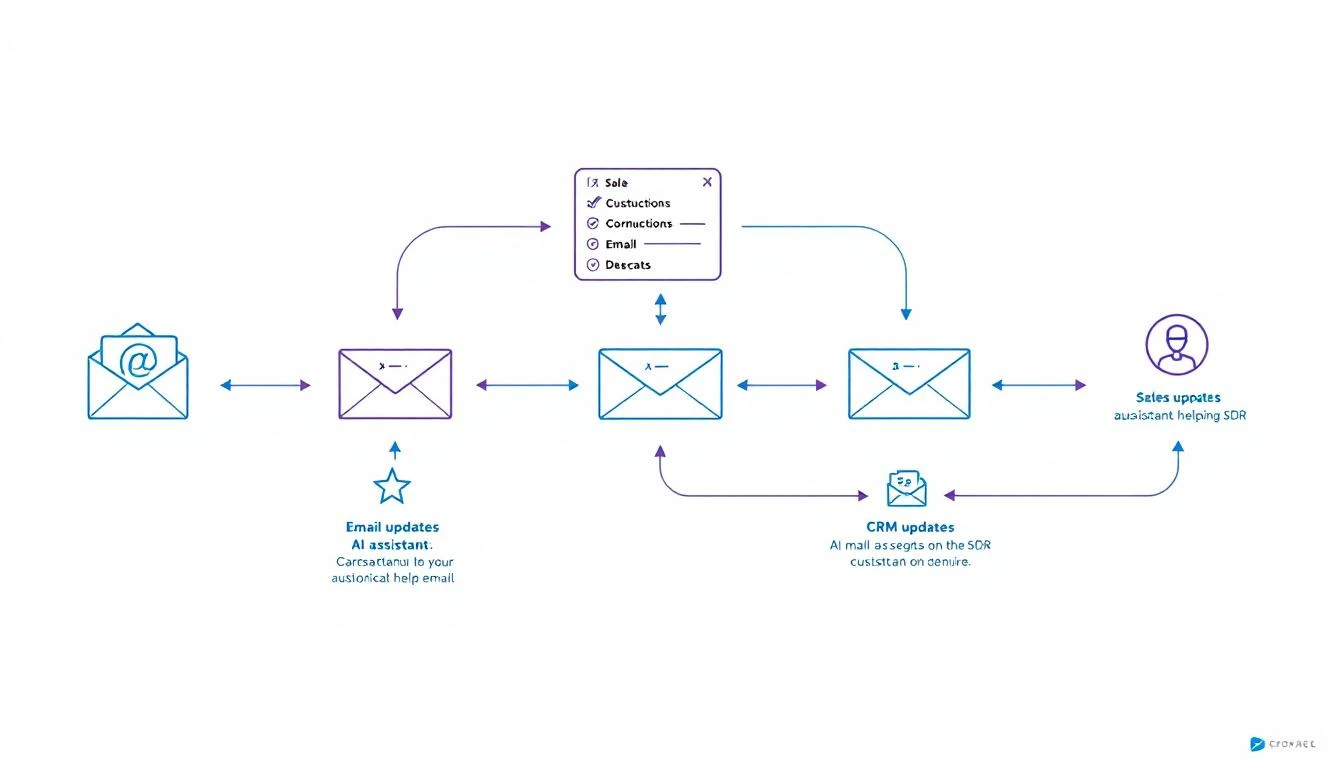
The architecture:

Your Sales Process
โ†“
OpenClaw
โ†“
Routes to:
โ”œโ”€โ”€ Codex (for building/coding tasks)
โ””โ”€โ”€ Claude (for analysis/writing tasks)
โ†“
Delivers via:
โ”œโ”€โ”€ Slack
โ”œโ”€โ”€ Email
โ””โ”€โ”€ CRM updates

Practical Recommendationsโ€‹

If You're Just Startingโ€‹

Pick one tool first. Claude is more forgiving for beginners because it explains its reasoning. Once you're comfortable, add Codex for infrastructure work.

If You're Building Production Systemsโ€‹

Use both from the start. Design your architecture to route tasks to the appropriate model. The cost difference is negligible compared to the quality improvement.

If You're Budget-Constrainedโ€‹

Start with Claude. It's more versatile for sales tasks specifically. Add Codex when you need to build more complex integrations.

If You Need Maximum Speedโ€‹

Lead with Codex. The 25% speed improvement in GPT-5.3-Codex makes it noticeably faster for iteration. Use Claude for final review of customer-facing content.

Common Mistakes to Avoidโ€‹

1. Using Codex for Copywritingโ€‹

Codex can write functional copy, but Claude writes persuasive copy. For anything customer-facing, use Claude.

2. Using Claude for Complex Infrastructureโ€‹

Claude can write code, but Codex handles multi-file projects and API integrations more reliably.

3. Not Combining Themโ€‹

The tools complement each other. Building with one while ignoring the other limits what you can achieve.

4. Manual Orchestrationโ€‹

Without OpenClaw (or similar), you're manually running prompts. Automation requires an agent layer.

Future-Proofing Your Stackโ€‹

Both OpenAI and Anthropic are shipping improvements constantly. The pattern that will survive:

  1. Keep your prompts modular. You should be able to swap models without rewriting your entire system.

  2. Abstract the orchestration layer. OpenClaw (or your own framework) should handle routing, not your application code.

  3. Store your context externally. Don't rely on model memory. Keep prospect data, conversation history, and preferences in your own database.

Free Tool

Try our AI Lead Generator โ€” find verified LinkedIn leads for any company instantly. No signup required.

The Bottom Lineโ€‹

Use CaseBest Tool
Build integrations and pipelinesCodex
Analyze conversations and dataClaude
Write customer-facing contentClaude
Create automation infrastructureCodex
Make judgment callsClaude
Rapid prototypingCodex
Always-on operationOpenClaw (orchestrating both)

Don't pick a side. The teams winning with AI automation in 2026 are using the right tool for each job.


Want to see how MarketBetter combines visitor intelligence with AI automation? We identify who's on your site and what they care aboutโ€”then help you act on it. Book a demo โ†’

Why General AI Won't Replace Your SDR Stack (Claude Cowork Analysis)

ยท 6 min read

On February 1, 2026, Anthropic launched 11 new plugins for Claude Coworkโ€”including a Sales plugin that can connect to CRMs, research prospects, and handle follow-ups.

Wall Street panicked.

$285 billion evaporated from software stocks in a single day. Salesforce, ServiceNow, and DocuSign fell 6-8%. Jefferies dubbed it the "SaaSpocalypse"โ€”the moment investors realized AI might not just help software companies, but replace them.

But here's what the panic missed: General-purpose AI and purpose-built SDR tools solve completely different problems.

Let me explain why Claude Cowork won't replace your SDR stackโ€”and might actually make it more important.

What Claude Cowork Actually Doesโ€‹

Claude's new Sales plugin is impressive. It can:

  • Connect to CRMs like Salesforce or HubSpot
  • Research prospects using web search and company data
  • Draft follow-up emails with context from previous conversations
  • Log activities back to your CRM

For a general-purpose AI, this is genuinely useful. But notice what's missing?

What Claude Cowork Can't Doโ€‹

โŒ Identify Anonymous Website Visitorsโ€‹

Claude has no visibility into who's visiting your website right now. It can't tell you that a VP of Sales from a target account just spent 4 minutes on your pricing page.

That's not a plugin limitationโ€”it's an architectural impossibility. Website visitor identification requires pixel tracking, IP intelligence, and identity resolution infrastructure that no general AI has.

โŒ Prioritize Your Dayโ€‹

Claude can help you research a prospect once you know who they are. But it can't:

  • Rank your 200 open accounts by buying signals
  • Tell you which 5 calls to make first
  • Alert you when a hot lead goes cold
  • Sequence your outreach for maximum efficiency

A general AI answers questions. A purpose-built SDR platform tells you what to do next.

โŒ Make Callsโ€‹

Claude can draft a call script. It can't pick up the phone. It has no dialer, no click-to-call, no local presence numbers, no voicemail drop.

For SDRs who live on the phone, this is kind of important.

โŒ Engage Visitors in Real-Timeโ€‹

A prospect lands on your site at 2:47 PM. They're browsing use cases, clearly evaluating solutions.

Claude is sitting in a tab somewhere, waiting for you to prompt it.

A purpose-built AI chatbot is already saying: "Hey! I noticed you're looking at our enterprise features. Want me to schedule a quick call with someone who can walk you through them?"

Speed-to-lead matters. Inbound leads contacted within 5 minutes have dramatically higher conversion rates. General AI can't interceptโ€”it can only respond when asked.

โŒ Execute Multi-Channel Sequencesโ€‹

Claude can draft one email at a time. It can't:

  • Execute a 12-touch sequence across email, phone, and LinkedIn
  • A/B test subject lines automatically
  • Pause sequences when a prospect engages
  • Manage deliverability across domains

These aren't AI problemsโ€”they're infrastructure problems. And general AI doesn't come with infrastructure.

The "Swiss Army Knife vs. Surgical Scalpel" Problemโ€‹

Claude is brilliant at general tasks. Need to summarize a document? Excellent. Draft a strategy memo? Great. Research a company before a call? Perfect.

But SDR productivity isn't about general tasks. It's about specific workflows executed at scale:

  1. Identify โ†’ Who should I call?
  2. Prioritize โ†’ Who should I call first?
  3. Prepare โ†’ What context do I need?
  4. Execute โ†’ Dial, email, messageโ€”now.
  5. Track โ†’ What worked? What didn't?

General AI can help with step 3. Purpose-built tools handle all five.

The Real Lesson from the SaaSpocalypseโ€‹

Here's the nuance Wall Street missed:

General AI makes individual contributors more productive. It doesn't replace specialized systems.

Claude Cowork will make SDRs better at research, writing, and preparation. That's genuinely valuableโ€”especially for the 47% of sales teams still struggling with basic personalization.

But it won't:

  • Replace your CRM (Claude needs somewhere to log activities)
  • Replace your dialer (Claude can't make calls)
  • Replace your engagement platform (Claude can't execute sequences)
  • Replace your visitor ID tool (Claude can't see anonymous traffic)

AI agents are entering the Gartner "trough of disillusionment" in 2026. MIT Sloan Management Review predicts we'll see a reality check as companies realize that autonomous agents require significant technical and compliance work.

The winners won't be pure AI plays. They'll be platforms that combine AI intelligence with execution infrastructureโ€”the companies that give SDRs both the insight AND the tools to act on it.

What This Means for Your Tech Stackโ€‹

If you're evaluating AI SDR tools in 2026, here's the framework:

CapabilityGeneral AI (Claude, GPT)Purpose-Built SDR Platform
Prospect researchโœ… Goodโœ… Great (built-in enrichment)
Email draftingโœ… Goodโœ… Great (knows your sequences)
Website visitor IDโŒ Noโœ… Yes
Daily task prioritizationโŒ Noโœ… Yes
DialerโŒ Noโœ… Yes
Real-time chatโŒ Noโœ… Yes
Sequence executionโŒ Noโœ… Yes
Deliverability managementโŒ Noโœ… Yes

The question isn't Claude vs. SDR tools. It's Claude + SDR tools vs. SDR tools alone.

How MarketBetter Approaches Thisโ€‹

Full transparency: We built MarketBetter as a purpose-built SDR platform.

We don't think general AI is the enemyโ€”we think it's a complement. Here's our approach:

AI for intelligence:

  • AI-powered email personalization based on intent signals
  • Smart lead scoring that learns from your wins
  • Automated research enrichment at scale

Infrastructure for execution:

  • Website visitor identification (company + person level)
  • Daily SDR playbook that ranks and sequences tasks
  • Built-in smart dialer with local presence
  • AI chatbot that engages visitors in real-time

Human judgment where it matters:

  • SDRs approve messaging before it sends
  • Reps control call cadence and timing
  • Managers see performance at a glance

The result? Your SDRs spend less time figuring out what to do and more time doing it.

Free Tool

Try our AI Lead Generator โ€” find verified LinkedIn leads for any company instantly. No signup required.

The Bottom Lineโ€‹

Claude Cowork is a powerful tool. Use it for research. Use it for drafting. Use it as a thinking partner.

But don't expect it to replace the infrastructure that actually makes SDRs productive. General AI tells you things. Purpose-built tools help you do things.

The companies that win in 2026 won't be the ones betting everything on autonomous AI agents. They'll be the ones that give their reps:

  1. The right intelligence (AI-powered insights)
  2. The right tools (dialer, email, chat)
  3. The right workflow (prioritized daily playbook)

That's not a bet against AI. It's a bet on AI + humans + infrastructure beating AI alone.


Ready to see what a purpose-built SDR platform looks like? Book a demo โ†’

10 Codex Prompts That 10x SDR Productivity [2026]

ยท 9 min read
MarketBetter Team
Content Team, marketbetter.ai

GPT-5.3-Codex isn't just for developers. It's the most capable AI assistant for anyone willing to describe what they want in plain English.

These 10 prompts are battle-tested. Copy them, modify them for your workflow, and start saving hours every week.

SDR Productivity Prompts

Before You Start: Quick Setupโ€‹

Install the Codex CLI:

npm install -g @openai/codex

Or use Codex directly in the OpenAI dashboard at codex.openai.com.

Pro tip: Use mid-turn steering. When Codex starts going in the wrong direction, just interrupt with corrections.


Prompt 1: Instant Company Research Summaryโ€‹

Use case: Before reaching out, get a 60-second briefing on any company.

Research [COMPANY NAME] and create a sales briefing. Include:

1. What they do (2 sentences max)
2. Recent news (funding, acquisitions, product launches, leadership changes)
3. Their likely tech stack (based on job postings)
4. Pain points companies like them typically face
5. Potential conversation starters based on recent events

Format as bullet points. Be specific. Skip anything you can't verify.

Output example:

Acme Corp Briefing

  • B2B logistics software for mid-market freight companies (Series B, 200 employees)
  • Recent: Raised $45M in January, expanding to European markets
  • Tech stack: Salesforce, Snowflake, AWS (based on job postings)
  • Likely pains: Scaling customer support, data integration complexity, international compliance
  • Conversation starter: "Congrats on the European expansionโ€”how's the team handling GDPR compliance for your customer data?"

Time saved: ~15 minutes per prospect


Prompt 2: LinkedIn Profile Analyzerโ€‹

Use case: Understand your prospect's priorities and communication style.

Analyze this LinkedIn profile and tell me:

[PASTE LINKEDIN PROFILE TEXT]

1. What they care about (based on posts, interests, experience)
2. Their communication style (formal/casual, technical/business)
3. Best topics to lead with
4. What NOT to mention (based on their apparent values)
5. Suggested subject line for a cold email

Be specific. Don't guessโ€”only include what's supported by the profile.

Why it works: Codex picks up on subtle signals in how people present themselves. The "what NOT to mention" is often the most valuable insight.

Time saved: ~10 minutes per prospect


Prompt 3: CRM Data Cleanup Scriptโ€‹

Use case: Fix inconsistent data in your CRM without manual editing.

Write a script that:
1. Connects to HubSpot using their API (I'll provide API key later)
2. Finds all contacts where:
- Job title is blank but company is filled
- Phone number format is inconsistent
- Email domain doesn't match company domain
3. For job titles: Enriches using the company's LinkedIn page
4. For phone numbers: Standardizes to E.164 format
5. For mismatched emails: Flags for review (don't auto-change)

Output a report of what would change before actually making changes.

Use Node.js with proper error handling.

Why it works: Codex handles the tedious API work. You get a working script instead of spending hours in the HubSpot UI.

Time saved: 5+ hours of manual cleanup


Prompt 4: Meeting Prep One-Pagerโ€‹

Use case: Walk into every meeting prepared without the prep work.

I have a meeting with [PROSPECT NAME] at [COMPANY] about [TOPIC/PRODUCT].

Create a one-page meeting prep doc:

1. **Key Facts** โ€” Company size, industry, recent news (3-5 bullets)
2. **Likely Objections** โ€” What will they push back on?
3. **Discovery Questions** โ€” 5 questions that uncover real pain
4. **Competitive Position** โ€” Who else might they be talking to?
5. **Success Metrics** โ€” What would make this a "win" for them?
6. **Next Step Options** โ€” 3 logical next steps if the meeting goes well

Keep each section to 3-5 bullets. Prioritize actionable info.

Time saved: ~20 minutes per meeting


Prompt 5: Objection Response Generatorโ€‹

Use case: Never get caught off-guard by common objections.

Generate responses for these sales objections in [INDUSTRY].

For each objection, provide:
1. A brief acknowledgment (show you understand)
2. A reframe (shift the perspective)
3. A proof point (specific example or stat)
4. A question to continue the conversation

Objections:
- "We're already using [COMPETITOR]"
- "We don't have budget this quarter"
- "We need to talk to [OTHER STAKEHOLDERS] first"
- "Can you just send me some info?"
- "The timing isn't right"

Keep responses conversational, not scripted. SDRs need to sound human.

Why it works: You get battle-tested frameworks, not generic scripts. The "question to continue" keeps the conversation moving.


Prompt 6: Email Sequence Builderโ€‹

Use case: Create a multi-touch sequence in minutes.

SDR Prompts Checklist

Build a 5-email sequence for [ICP DESCRIPTION] selling [PRODUCT/SERVICE].

Sequence structure:
- Email 1: Pattern interrupt (day 1)
- Email 2: Social proof (day 3)
- Email 3: Pain agitation (day 6)
- Email 4: Different angle/use case (day 10)
- Email 5: Breakup email (day 14)

Requirements:
- Subject lines under 40 characters
- Body under 100 words each
- One clear CTA per email
- Personalization placeholders marked with [BRACKETS]
- Tone: professional but not corporate, direct but not pushy

Don't use: "Hope this email finds you well," "Just following up," or "Checking in"

Why it works: The constraints force quality. Specifying what NOT to include prevents generic AI-speak.

Time saved: 1-2 hours per sequence


Prompt 7: Call Script Frameworkโ€‹

Use case: Structure your cold calls without sounding robotic.

Create a cold call framework for calling [ICP TITLE] at [COMPANY TYPE].

Structure:
1. **Opening** (5 seconds) โ€” Pattern interrupt, state name/company
2. **Permission** (5 seconds) โ€” Brief reason for call + ask for 30 seconds
3. **Hook** (15 seconds) โ€” Specific pain point or insight
4. **Qualify** (30 seconds) โ€” 2-3 questions to confirm fit
5. **Bridge to meeting** โ€” How to transition if qualified
6. **Objection handlers** โ€” Top 3 objections and responses
7. **Exit** โ€” Graceful close if not interested

Include exact language options, not just concepts. Make it sound natural.

Time saved: 30+ minutes crafting talk tracks


Prompt 8: Lead Prioritization Logicโ€‹

Use case: Build a scoring system for your specific pipeline.

Create a lead scoring model for my sales process.

Context:
- We sell [PRODUCT] to [ICP]
- Average deal size: [AMOUNT]
- Average sales cycle: [LENGTH]
- Our best customers tend to have: [CHARACTERISTICS]

Build a scoring system (1-100) that weighs:
- Company fit signals (industry, size, tech stack)
- Behavioral signals (website visits, content downloads, email opens)
- Timing signals (funding, hiring, tech changes)

Output as a decision matrix with specific thresholds:
- 80+ โ†’ Hot lead, prioritize
- 60-79 โ†’ Warm lead, nurture
- 40-59 โ†’ Potential, needs more info
- Below 40 โ†’ Low priority

Include the logic so I can implement it in my CRM.

Why it works: Codex creates a customized scoring model based on YOUR sales process, not a generic template.


Prompt 9: Competitive Battle Cardโ€‹

Use case: Win more deals against specific competitors.

Create a battle card for competing against [COMPETITOR NAME].

Include:

1. **Positioning Summary** โ€” How they describe themselves vs. how we do
2. **Their Strengths** โ€” What they're actually good at (be honest)
3. **Their Weaknesses** โ€” Where they fall short (with specific examples)
4. **Common Objections** โ€” What prospects say when evaluating them
5. **Discovery Questions** โ€” Questions that expose their weaknesses
6. **Landmines to Plant** โ€” Things to mention early that hurt them later
7. **Proof Points** โ€” Specific wins/case studies against them
8. **Quick Comeback Sheet** โ€” 5 common competitor claims and how to respond

Be specific and tactical. This is for reps who encounter them weekly.

Time saved: 2-3 hours of competitive research


Prompt 10: Proposal Customization Engineโ€‹

Use case: Customize templates instantly for each prospect.

I have a proposal template for [PRODUCT]. Customize it for [COMPANY NAME].

Original template sections to customize:
- Executive summary (make it about THEIR goals)
- Problem statement (reference THEIR specific challenges)
- Solution overview (connect features to THEIR use case)
- Timeline (adjust for THEIR urgency)
- Investment section (frame ROI for THEIR situation)

Context about this deal:
- [DEAL CONTEXT]

Maintain my company's voice and formatting. Only change the content to reflect this specific prospect's situation.

Output the full customized proposal with changes highlighted.

Why it works: You keep your proven template structure but personalize the substance. Prospects feel like it was written for themโ€”because it was.

Time saved: 45+ minutes per proposal


Bonus: Combining Prompts with OpenClawโ€‹

These prompts are powerful on their own. They're unstoppable when automated.

With OpenClaw, you can:

Trigger prompt 1 automatically when a new lead enters your CRM

Run prompt 3 on a weekly schedule to keep data clean

Chain prompts together:

  1. New deal created โ†’ Run company research (Prompt 1)
  2. Meeting scheduled โ†’ Generate prep doc (Prompt 4)
  3. Proposal requested โ†’ Customize template (Prompt 10)

The prompts become agents that work while you sleep.


Tips for Better Prompt Resultsโ€‹

1. Be Specific About What You Don't Wantโ€‹

Listing exclusions ("don't use buzzwords," "no generic openers") improves output more than adding requirements.

2. Include Examplesโ€‹

When asking for a specific format or style, paste an example of what good looks like.

3. Use Mid-Turn Steeringโ€‹

GPT-5.3-Codex lets you redirect while it's generating. If you see it going off-track, just tell it.

4. Iterate in the Same Sessionโ€‹

Codex maintains context within a session. Follow up with "make it more concise" or "add more specific data points" instead of starting over.

5. Save Your Best Promptsโ€‹

Build a library of prompts that work for YOUR sales process. They get better as you refine them.


Free Tool

Try our AI Lead Generator โ€” find verified LinkedIn leads for any company instantly. No signup required.

The Productivity Mathโ€‹

TaskManual TimeWith CodexWeekly OccurrencesWeekly Time Saved
Company research15 min2 min204.3 hours
Meeting prep20 min3 min82.3 hours
Email sequences90 min15 min22.5 hours
CRM cleanup3 hours30 min12.5 hours
Proposal customization45 min10 min31.75 hours

Total weekly time saved: ~13 hours

That's 13 hours back for actual sellingโ€”calls, meetings, relationship building.


Want to supercharge these prompts with real buyer intent data? MarketBetter shows you who's on your site and what they care about, so your AI-powered outreach hits even harder. Book a demo โ†’

Master the b2b sales funnel: Turn Leads into Revenue

ยท 24 min read

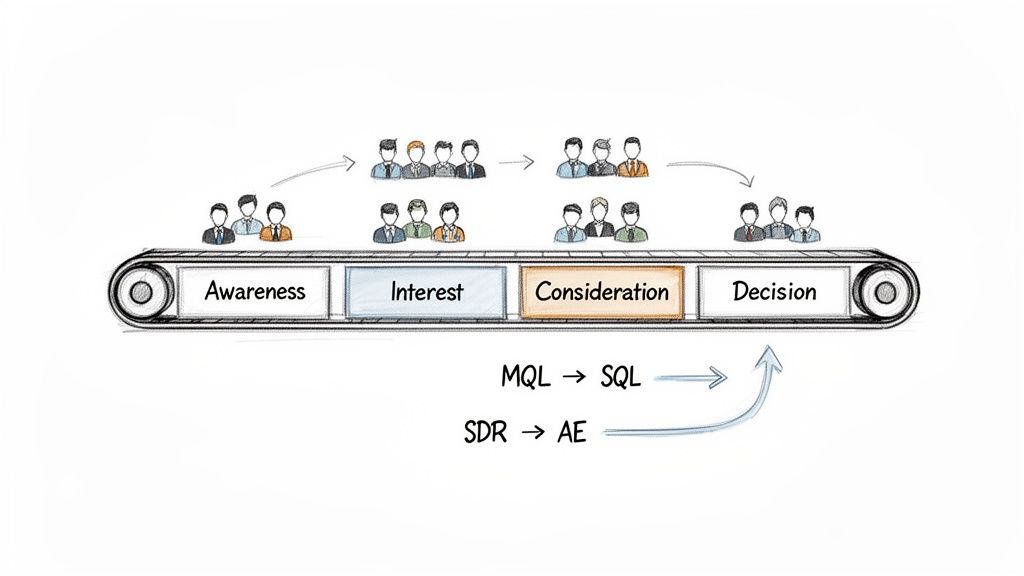
Let's be honest, the term "sales funnel" feels a bit dated. It brings to mind a simple kitchen funnelโ€”pour leads in the top, get customers out the bottom. But for B2B, that's not how it works at all. A modern B2B sales funnel is less of a funnel and more of a sophisticated assembly line for building relationships and, ultimately, revenue.

What a Modern B2B Sales Funnel Really Isโ€‹

The whole game is different when you're selling to a business. A consumer buying a pair of shoes makes a quick, personal, often emotional decision. A business buying new software is making a high-stakes investment. They're navigating a committee of decision-makers, each obsessed with logic, ROI, and not getting fired for making the wrong choice.

This is exactly why B2B sales cycles drag on for so long. Itโ€™s not a single transaction; it's a campaign to build consensus. In fact, a staggering 83% of B2B buyers admit to changing their minds about which vendor they prefer after they've already started their research. Your funnel can't just grab their attentionโ€”it has to hold it, educate them, and guide them for weeks or even months.

B2B vs. B2C Funnels: Itโ€™s All About the Buyerโ€‹

The core difference boils down to the buyer's mindset and just how complex the deal is. A B2C funnel is a straight line designed for a single player, while a B2B funnel is a multi-lane highway built for a convoy. This distinction isn't just academicโ€”it dictates every choice you make, from your marketing channels to your sales tactics.

Here is a practical comparison:

FactorB2C Funnel (e.g., selling sneakers)B2B Funnel (e.g., selling CRM software)
Buyer ProfileAn individual consumer.A buying committee (IT, Finance, End-Users, Execs).
Sales Cycle LengthMinutes to days.Weeks, months, or even years.
Decision DriverEmotion, desire, brand loyalty, immediate need.Logic, ROI, efficiency gains, long-term value.
Risk FactorLow (a bad purchase is a minor annoyance).High (a bad purchase can cost millions and careers).
Content StrategyFocus on lifestyle, trends, and user reviews.Focus on case studies, whitepapers, ROI calculators, and demos.

Mapping the Core Stages and Handoffsโ€‹

While the classic funnel stages (Awareness, Interest, etc.) are still useful concepts, buyers don't move through them in a neat, orderly line anymore. They jump around, doing their own research and consuming content on their own schedule. Your real job is to have a rock-solid internal process that can keep up.

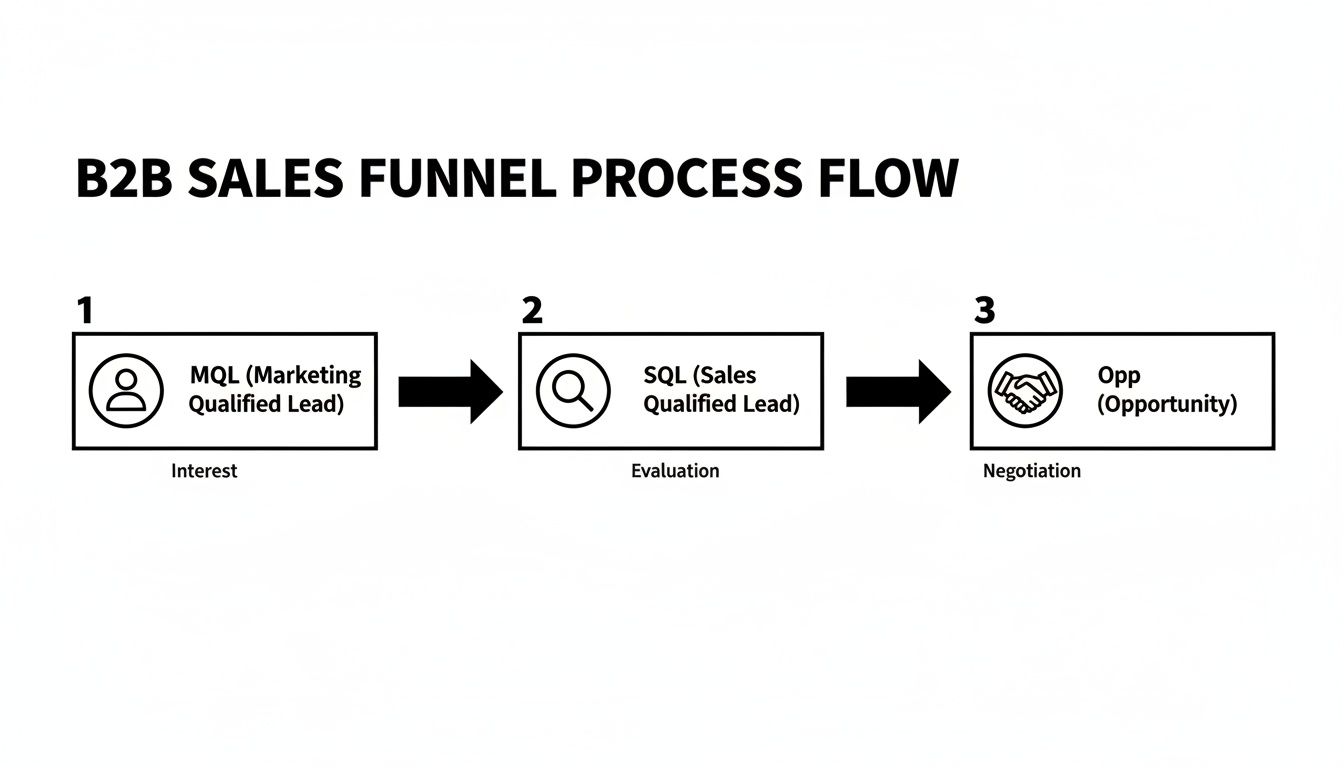
This flow shows the critical handoffs, moving a prospect from a curious onlooker to a closed deal.

Diagram illustrating the B2B sales funnel process flow with MQL, SQL, and Opportunity stages.

Every one of those arrows is a moment of truth where a lead gets validated and passed deeper into your revenue engine. Get them right, and you have a smooth-running machine. Get them wrong, and everything grinds to a halt.

The two most critical handoffs on this assembly line are:

  1. Marketing to Sales Development (MQL โ†’ SQL): This is the first pass. A Marketing Qualified Lead (MQL) is someone who has shown interest by, say, downloading an ebook. The baton is passed to a Sales Development Representative (SDR), who digs in to see if they're a real potential buyer. The SDR checks them against your ideal customer profileโ€”company size, industry, technology usedโ€”to turn them into a Sales Qualified Lead (SQL).
  2. Sales Development to Sales (SQL โ†’ Opportunity): The SDR's main job after qualifying the lead is to book a meeting. Once that meeting happens and an Account Executive (AE) confirms there's a real project, a clear pain point, and a potential budget, the SQL officially becomes a sales Opportunity. This is where the active, one-on-one sales cycle truly begins.

Getting these handoffs right is the absolute foundation of a predictable revenue engine. Any fumbles here lead to leaky funnels, stalled deals, and a whole lot of friction between your marketing and sales teams.

How to Measure Your Funnel's Performanceโ€‹

You can't fix what you don't measure. That old saying is the gospel in B2B sales. A healthy funnel isn't just about feeling busy; it's about seeing real, measurable progress as a potential customer moves from one stage to the next.

Tracking the right Key Performance Indicators (KPIs) is what turns your funnel from a vague concept into a predictable, data-driven engine for revenue. This isn't about vanity metrics like website traffic. Itโ€™s about zeroing in on the critical conversion points where a prospect either moves forward or leaks out.

Think of these metrics as the dashboard for your sales machine. Theyโ€™ll help you spot a problem long before it torpedoes your revenue forecast.

Diagram of a B2B sales funnel on a conveyor belt, showing stages from Awareness to Decision, with lead and role transitions.

Top-of-Funnel Conversion KPIsโ€‹

The earliest stages of your funnel are almost always the leakiest. It's a numbers game, and measuring your efficiency right from the jump is absolutely critical. Success here means youโ€™re not just attracting an audienceโ€”youโ€™re attracting the right audience and doing a good job of capturing their initial interest.

The metric that matters most here is your Visitor-to-Lead Rate. It's simple but powerful: what percentage of unique website visitors take a meaningful action to become a lead? This could be filling out a form, downloading a guide, or requesting a demo. It tells you, point-blank, how compelling your initial pitch is.

Don't be discouraged by the numbers. The B2B world is a tough nut to crack, with average visitor-to-lead rates hovering between just 2% and 5%. Thatโ€™s because B2B buying cycles are long and complicated, often involving a whole committee of decision-makers. Out of 10,000 visitors to your site, you might only get 200-500 actual leads, which sets a pretty narrow base for the rest of your funnel.

Mid-Funnel Handoff Metricsโ€‹

Once a lead is in your system, the game changes. Now, it's all about qualification and the critical handoffs between marketing and sales. This is where things so often fall apart, making it non-negotiable to measure the flow.

Your primary KPI here is the MQL-to-SQL Conversion Rate. This tracks the percentage of Marketing Qualified Leads (MQLs) that your sales team actually accepts and qualifies as Sales Qualified Leads (SQLs). If this number is low, you have a massive red flag.

A poor MQL-to-SQL rate almost always points to a fundamental misalignment between marketing and sales. It might mean marketing's lead-scoring model is off, or maybe the sales team has an overly rigid definition of a "good" lead. Fixing this is foundational to building a funnel that can actually scale.

Another one to watch closely is the SQL-to-Opportunity Rate. This measures how many of those qualified conversations turn into a legitimate sales opportunity with a clear need, budget, and timeline. This KPI is a direct reflection of your SDR team's skill in qualifying prospects and booking solid meetings for the Account Executives.

Bottom-of-Funnel Closing KPIsโ€‹

As a qualified opportunity enters the active sales cycle, your focus shifts again. We're moving away from lead volume and now care about deal velocity and, of course, win rates. These are the metrics that tie directly to your bottom line.

Two KPIs are king at this stage:

  • Opportunity-to-Win Rate: This is the ultimate report card for your sales team's closing ability. It calculates the percentage of qualified opportunities that end up as a closed-won deal. Simple as that.
  • Average Sales Cycle Length: This tracks how long it takes, on average, for an opportunity to go from creation to close. If this number starts creeping up, it can signal friction in your sales process, ineffective negotiation tactics, or even a shift in the market itself.

To help you track these metrics, here's a simple breakdown of each stage and its core KPI.

B2B Sales Funnel Stages and Core KPIsโ€‹

Funnel StagePrimary GoalCore KPIIndustry Benchmark
Top-of-Funnel (ToFu)Generate awareness and capture initial interest.Visitor-to-Lead Rate2%-5%
Middle-of-Funnel (MoFu)Qualify leads and create sales opportunities.MQL-to-SQL Rate10%-30%
Bottom-of-Funnel (BoFu)Convert opportunities into closed deals.Opportunity-to-Win Rate20%-30%

Tracking these benchmarks gives you a realistic baseline to compare your own performance against.

Whether you're using Salesforce, HubSpot, or another CRM, building a dashboard around these core metrics is essential. It gives you a clear, actionable view of your entire B2B sales funnel so you can see not just what's happening, but why. For a more detailed breakdown, check out our guide on the top KPIs for lead generation.

Finding and Fixing Common Funnel Bottlenecksโ€‹

Every B2B sales funnel leaks. Thatโ€™s just a fact of life. The real difference between a top-performing revenue team and an average one isnโ€™t a leak-proof funnelโ€”itโ€™s how fast they find and plug the holes.

These leaks, or bottlenecks, are the friction points where good leads stall out, get lost in the shuffle, or just plain disappear. Theyโ€™re the silent killers of your forecast.

Think of your funnel like a plumbing system. A clog in one pipe doesnโ€™t just stop the flow there; it builds up pressure and causes problems down the line. A bottleneck in your sales process works the same way. It doesn't just slow down one stageโ€”it starves the next one, creating a ripple effect that hits the one number everyone cares about: revenue.

To fix these issues, you have to look past the obvious symptoms. If your SDRs are missing their meeting quota, the problem might not be with their effort. It could be a mess further upstream.

The Low-Quality MQL Floodโ€‹

This is one of the most commonโ€”and most damagingโ€”bottlenecks. It happens right at the handoff from marketing to sales. Marketing hits their MQL number and celebrates, while the SDR team is drowning in leads that are going absolutely nowhere. Itโ€™s not just a waste of time; it's a morale crusher for reps who spend all day disqualifying contacts.

The culprit is almost always a poorly defined MQL. Marketing might be scoring leads based on a single ebook download, but sales needs to talk to people from specific industries who are actually showing signs they want to buy something. You end up with a flood of "qualified" leads that are really just a drain on your SDRs' precious time.

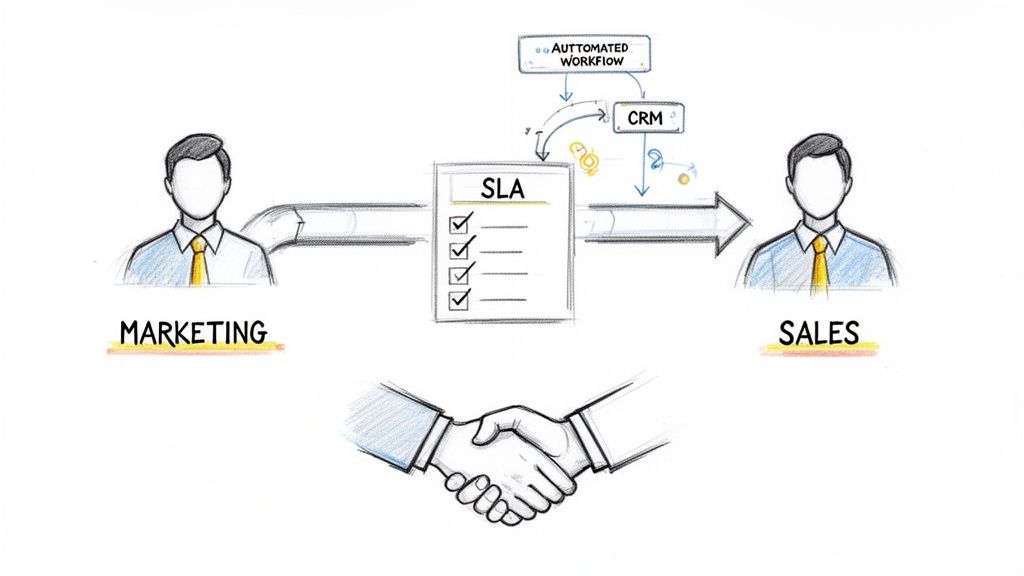
The Actionable Fix: Get marketing and sales in a room (virtual or otherwise) and redefine what an MQL actually is. And don't just talk about itโ€”get it in writing in a Service Level Agreement (SLA).

  • Firmographics: Nail down your Ideal Customer Profile (ICP). What are the non-negotiables? Company size, industry, locationโ€”get specific.
  • Behaviors: Agree on what actions signal real intent. A demo request is a blazing hot signal. Reading a blog post is not. Assign different scores to different actions so the hottest leads rise to the top.
  • Disqualification Reasons: Give SDRs a clear, standardized list of reasons in your CRM to explain why a lead was rejected. This creates a feedback loop built on data, not feelings, so marketing can fine-tune their campaigns.

High No-Show Rates for Demosโ€‹

There are few things more frustrating than a high no-show rate for demos. An SDR grinds to qualify a lead and book a meeting, only for the prospect to ghost them. The Account Executive's calendar slot is wasted, and any deal momentum dies before it can even start.

This usually points to a weak qualification process or a simple failure to build value. If the prospect doesnโ€™t truly get why they should show up or what problem this meeting solves for them, they have zero reason to protect that time on their calendar.

A booked meeting is not the same as a committed meeting. The SDR's job isn't just to get a "yes" for a time slot but to build enough perceived value that the prospect sees the meeting as a priority they cannot miss.

Stalled Mid-Funnel Opportunitiesโ€‹

This is maybe the most painful bottleneck of all. A promising deal that felt like a sure thing justโ€ฆ stalls. The prospect goes dark, pushing back meetings and ignoring your follow-ups. This is the pipeline graveyard where deals go to die a slow, painful death, wrecking your forecast in the process.

More often than not, this happens because of a flimsy or non-existent qualification framework. That first discovery call might have felt great, but if the AE didn't dig in and confirm the critical details, they're flying blind. It's a tough world out thereโ€”B2B funnel benchmarks show how hard conversions are. Even the top channel, paid search, only converts at 3.2% on average, and B2B tech is even lower at under 2%. This just screams for a rigorous qualification process to avoid chasing deals that were never going to close. You can dig into more data on industry-specific conversion hurdles to see how you stack up.

The Actionable Fix: Bring in a formal qualification methodology. It gives everyone a common language and a checklist to make sure no crucial details are missed during discovery.

FrameworkWhat It IsBest For
BANTA classic framework focusing on Budget, Authority, Need, and Timeline.Simpler, more transactional sales cycles where you can identify these four things pretty easily.
MEDDPICCA more robust framework covering Metrics, Economic Buyer, Decision Criteria, Decision Process, Paper Process, Identify Pain, Campion, and Competition.Complex, high-value enterprise deals with lots of stakeholders and a formal procurement gauntlet.

By using a framework like MEDDPICC, you force your AEs to map out the entire buying process, find their internal champions, and truly understand the economic impact your solution will have. Qualification stops being a simple checklist and becomes a strategic tool for navigating complex deals and keeping them from getting stuck in the mud.

Actionable Strategies to Optimize Funnel Conversionโ€‹

Knowing where your sales funnel is leaking is one thing. Knowing how to actually patch the holes is something else entirely. This is where the rubber meets the roadโ€”where we move from diagnosing problems to deploying fixes that actually work.

Optimizing your funnel isn't about telling your team to work harder. Itโ€™s about working smarter, replacing guesswork with data-driven plays that give you an edge at every single stage. The big shift happening right now is moving away from reactive, manual sales tasks and into proactive, intelligent workflows. It's a night-and-day difference.

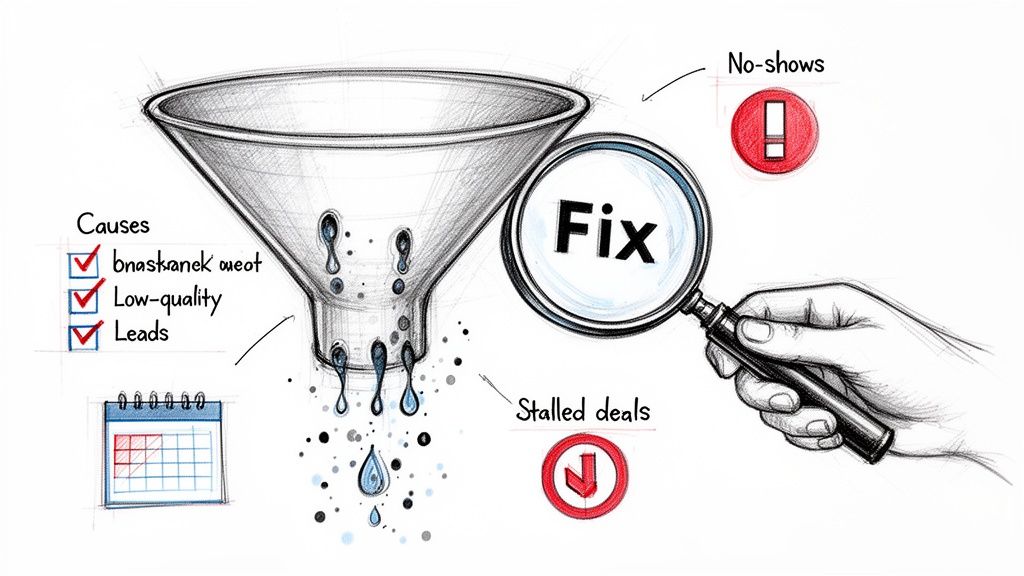
A hand holding a 'Fix' magnifying glass analyzes a leaking sales funnel with low-quality leads, no-shows, and stalled deals.

This image nails it. Low-quality leads, no-shows, stalled dealsโ€”these are the symptoms. Targeted optimization is the cure. The goal isn't just to spot these issues but to build a process that stops them from happening in the first place.

From Manual Guesswork to AI-Powered Precisionโ€‹

Think about a typical SDR's morning. They log in, stare at a giant list of leads in the CRM, and start guessing. Who seems like a good person to call? Who might actually open this email? Itโ€™s a process fueled by caffeine and gut feelingsโ€”slow, inefficient, and wildly inconsistent.

The modern approach completely flips that script. Instead of the SDR asking, "Who should I contact?" an intelligent system tells them. By analyzing real-time buyer intent signalsโ€”like someone from a target account revisiting your pricing page or downloading a whitepaperโ€”an AI engine can instantly surface the hottest opportunities and prioritize the SDR's to-do list.

This changes the SDR's job from a glorified list-checker to a strategic closer. The system serves up the "next best action" and provides all the context needed to make the outreach timely and ridiculously relevant.

This directly impacts the metrics that matter most. Sales call conversion rates from qualified leads to closed deals can be all over the map, typically hovering between 13% and 25%. Some simpler industries might see conversions north of 26%, while complex enterprise sales can dip below 9%. An AI-guided process helps close that gap by ensuring your reps spend their precious time only on the accounts ready to talk.

Manual vs. AI-Powered SDR Workflow Comparisonโ€‹

Let's get practical. The difference in the day-to-day grind is huge. A manual workflow is bogged down by admin tasks and constant context switching. An AI-powered workflow is built for speed and relevance.

Here's a quick breakdown of what that actually looks like for your SDRs:

SDR ActivityTraditional Manual ApproachAI-Powered Approach (e.g., marketbetter.ai)
Task PrioritizationReps scroll through CRM views, using gut instinct to pick who to call. This leads to cherry-picking the "easy" leads while high-value ones go cold.The system automatically creates and ranks tasks based on real-time buyer signals and ICP fit. Reps get a clear, prioritized list of the highest-impact actions.
Outreach PersonalizationSDRs burn hours toggling between LinkedIn, the company website, and their email client, trying to craft a personalized message from scratch.AI drafts context-aware emails using account data, news, and persona details. This frees up reps to focus on executing great calls and follow-ups.
CRM Data EntryEvery call, email, and outcome has to be logged by hand. It's tedious, often gets skipped, and leads to a messy CRM with unreliable data.All activities are automatically logged back to Salesforce or HubSpot, ensuring data hygiene is perfect and reporting is accurate.

This isn't about replacing your SDRs; it's about making them superhuman. The AI-powered approach turns their CRM from a dusty old database into a proactive engine that drives relentless, consistent outbound motion.

Embedding Intelligence Directly into Your CRMโ€‹

The final piece of the puzzle is making all this intelligence dead simple to use. The best tools don't add another tab to your team's browser; they live right inside the CRM where your reps already spend their day.

For example, a platform like marketbetter.ai works as an intelligent layer inside your CRM. When it detects a strong buyer signal, it doesn't just send a Slack notification. It creates a high-priority task directly in the SDR's queue in Salesforce, complete with a pre-drafted email or a call script loaded with key talking points.

This native integration is what drives adoption. When the dialer, task list, and AI assistant are all in one place, the friction just disappears. Reps are faster, managers have a clear view of whatโ€™s working, and the entire B2B sales funnel runs like a well-oiled machine. If you want to go even deeper, you can explore our detailed guide on conversion rate optimization best practices.

Unifying Your Funnel from Marketing to Closeโ€‹

A high-performing B2B sales funnel isnโ€™t a series of disconnected stages; it's a single, cohesive revenue machine. We've all seen the classic disconnect: marketing celebrates hitting its MQL target, while the sales team is drowning in low-quality leads that go nowhere.

This friction is more than just annoying. It wastes budget, burns out your team, and lets perfectly good opportunities die on the vine. The fix isn't another round of meetingsโ€”it's building a process where seamless collaboration is the only option. It starts by treating the handoffs between teams with the same seriousness as a product launch.

Forging an Ironclad Marketing and Sales SLAโ€‹

The most common point of failure in any funnel is the handoff from marketing to sales. The best way to patch this leak for good is with a Service Level Agreement (SLA). Think of this less as a dusty legal document and more as a practical, written rulebook that defines the entire engagement and creates mutual accountability.

A weak SLA is vague and just leads to finger-pointing. A strong one is specific, measurable, and lives right inside your CRM.

Actionable Comparison: Weak vs. Strong SLA

ElementWeak SLA (The "We'll Try" Approach)Strong SLA (The Actionable Approach)
MQL Definition"A lead who downloads our content.""A lead from an ICP account (100+ employees, Tech/Finance) who requests a demo or visits the pricing page 3+ times."
Follow-up Speed"SDRs should follow up in a timely manner.""SDRs must attempt first contact within 10 minutes for all demo requests and within 4 hours for all other high-intent MQLs."
Follow-up Depth"SDRs will attempt to contact leads.""SDRs will execute a 10-touch sequence over 14 days (email, call, LinkedIn) before disqualifying a lead for non-response."
Feedback Loop"Sales should let us know if leads are bad.""SDRs must select a standardized 'Disqualification Reason' from a dropdown in Salesforce for every rejected MQL, triggering an automated report to marketing."

This level of detail kills ambiguity. Marketing knows exactly what a "good" lead looks like, and sales has a clear playbook for what to do with it. You can learn more about how to get these systems running by reading about the power of marketing automation workflows.

Mastering the SDR to AE Handoffโ€‹

The second critical handoff happens when a Sales Development Representative (SDR) passes a qualified opportunity to an Account Executive (AE). A clumsy handoff is a deal killer. It forces the prospect to repeat themselves and makes the AE start from square one, destroying any momentum the SDR built.

The goal is a seamless transition where the AE walks into the first meeting armed with all the context needed to have a strategic conversation, not a basic discovery call.

To make sure nothing gets lost in translation, build a handoff checklist directly into your CRM. Before an opportunity can even be transferred, the SDR has to complete a set of required fields.

The Essential Handoff Checklist

  • Confirmed Qualification Criteria: Don't just say it's "qualified." Show the proof. Was a framework like BANT or MEDDPICC used? The AE needs to see confirmed Need, Authority, and Timeline right in the notes.
  • Key Pain Points: What is the actual business problem they're trying to solve? List the top one or two pains, ideally using the prospect's own words.
  • Critical Business Context: What is the AE walking into? Include details like other stakeholders who have been identified, the software they're using now, and any competitors they've mentioned.
  • Next Steps Confirmed: The meeting must be on the calendar with a clear agenda that the prospect has already seen and agreed to.

By making these fields mandatory in Salesforce or HubSpot, you make it impossible to pass an under-qualified or context-free opportunity. This simple workflow creates accountability and, more importantly, ensures your AEs spend their valuable time on deals that are actually primed to close.

Your Blueprint for a Predictable Revenue Engineโ€‹

Diagram illustrating marketing and sales alignment through an SLA, automated workflow, and CRM, ending in a handshake.

Building a high-performing B2B sales funnel isnโ€™t a one-and-done project. Itโ€™s a constant process of tuning and improvement. Think of it less like a static flowchart gathering dust on a server and more like a predictable revenue engine youโ€™re actively engineering for growth.

That means treating your funnel like a living system. A reactive team waits for deals to stall before asking why. A proactive one is already watching lead quality and conversion rates, spotting bottlenecks before they ever have a chance to form. That mindset shift is everything.

The real goal here is predictability. When you can look at your funnelโ€™s performance and confidently forecast your pipeline, youโ€™ve officially graduated from reactive selling to strategic revenue generation.

To get there, you need a solid framework to improve sales productivity and a clear plan of attack. The blueprint involves a few non-negotiable steps:

  • Map Your Stages: Define every single step of the journey, from the first touchpoint to a closed-won deal. No ambiguity allowed.
  • Define Your KPIs: Settle on the core metrics that tell you if each stage is healthy or bleeding.
  • Diagnose the Bottlenecks: Use your data to methodically find and fix the leaks in your funnel.
  • Optimize & Align: Roll out targeted improvements and, most importantly, make sure marketing and sales are perfectly in sync.

Common Questions from the Fieldโ€‹

Revenue leaders are always fine-tuning their funnels. Here are a few questions that come up all the time when building out a high-performance B2B sales machine.

Whatโ€™s the Real Difference Between a B2B and a B2C Sales Funnel?โ€‹

The biggest split comes down to two things: complexity and time. A B2C funnel is usually a short, straight line driven by a single buyer making an emotional choice. You're selling to one person, and you're doing it fast.

A B2B sales funnel, on the other hand, is a long, winding road. It involves multiple stakeholders, a logical ROI-based decision, and a whole lot of consensus-building. You're not just trying to convince one person; you're helping an entire buying committee agree on a strategic partnership.

B2C is a sprint to a transaction. B2B is a marathon to a partnership. Your funnel has to be built for the right race.

How Can I Actually Improve My MQL to SQL Conversion Rate?โ€‹

Getting this handoff right is all about alignment and speed. The first move? Get marketing and sales in a room and hammer out a crystal-clear, shared definition of a "qualified lead." Then, write it down in an SLA so there's no confusion.

Next, take a hard look at your lead scoring. Prioritize actions that scream intentโ€”like a demo requestโ€”over basic firmographics. This gets your sales team focused on people who are ready to talk now, not just those who look good on paper. And finally, be fast. The time it takes you to follow up on that initial signal is a massive factor in whether an MQL ever becomes a real conversation.

My Team Practically Lives in Salesforce. Why on Earth Do We Need Another Tool?โ€‹

Thatโ€™s exactly the right way to think about it. The goal is never to add another login or another tab to keep open. The best tools don't pull your reps out of their CRM; they work right inside it to make it smarter.

Think of it this way: Salesforce is the map. It holds all the locations, all the data. An intelligent task engine is the GPS. It takes all that raw data on the map and turns it into a prioritized, turn-by-turn to-do list for your reps. It handles the admin grunt workโ€”logging calls, drafting emailsโ€”without ever making them leave the CRM. Your team stays focused on selling, your data stays clean, and you actually get the full value out of the system you already pay for.


Ready to turn your CRM from a database into a revenue engine? marketbetter.ai embeds an AI-powered task engine directly into Salesforce and HubSpot, turning buyer signals into prioritized tasks your SDRs can execute instantly. Learn how to build a predictable outbound motion with marketbetter.ai.

12 Best B2B Website Visitor Identification Tools 2026 (Real Match Rates โ€” Most Vendors Lie About Theirs)

ยท 31 min read
sunder
Founder, marketbetter.ai

Comparison of the 12 best website visitor identification tools for B2B teams in 2026

98% of your website visitors leave without filling out a form. They read your pricing page, compared you to competitors, and vanished.

Website visitor identification software reveals who those anonymous visitors are โ€” company name, contact info, even which pages they viewed โ€” so your sales team can reach out while intent is hot.

But here's what the vendors won't tell you: "80% match rate" usually means 80% of companies identified, not people. Person-level identification is much harder, and most tools quietly inflate their numbers by mixing the two. We tested 12 platforms and tracked the real match rates across company-level and person-level identification, with actual pricing for each.

This guide covers the 12 best tools for 2026, with honest match rates, real pricing, and which ones actually turn identified visitors into booked meetings.

โšก Quick Pick Guide

Limited budget (<$200/mo): RB2B free tier or Leadfeeder free SMB wanting person-level ($100-500/mo): RB2B Pro, Leadpipe, or Snitcher Mid-market teams ($500-2K/mo): Warmly or Koala (PLG) Want action, not just data: MarketBetter โ€” book a demo โ†’ Enterprise ABM ($50K+/yr): 6sense or Demandbase Already in HubSpot: Clearbit Breeze Already in ZoomInfo: WebSights add-on Already in Instantly: Instantly Pixel (built-in)


Table of Contentsโ€‹

  1. How Website Visitor Identification Actually Works
  2. The Remote Work Problem Nobody Talks About
  3. Comparison Table: All 12 Tools
  4. MarketBetter | Warmly | Leadfeeder | RB2B | Koala | 6sense | ZoomInfo | Clearbit Breeze | Demandbase | Instantly | Leadpipe | Snitcher
  5. The Real Question: Data vs Action
  6. How to Calculate ROI
  7. Implementation Guide
  8. How to Choose
  9. FAQ

How Website Visitor Identification Actually Worksโ€‹

Before we compare tools, let's get honest about what these products can (and can't) do.

The Three Identification Methodsโ€‹

  1. IP-to-Company Matching

    • Matches visitor IP addresses against databases of known business networks
    • Identifies the company, not the individual person
    • Works best for corporate office traffic; struggles with remote workers
    • Most mature technology โ€” nearly every tool uses this as a baseline
  2. First-Party Cookie + Data Enrichment

    • Combines browsing behavior with third-party data to infer contact identity
    • Can identify specific people at visiting companies
    • Match rates vary wildly (5-40% depending on traffic source)
    • Privacy regulations increasingly limit cookie-based tracking
  3. Reverse Email Lookup / Identity Graph

    • When visitors have previously engaged (clicked an email, filled a form), systems track return visits
    • Some tools use cross-site identity graphs to match visitors to known profiles
    • Most reliable method, but limited to known contacts or opted-in users
    • B2C-oriented tools (like Leadpipe) lean heavily on this approach

Match Rate Reality Checkโ€‹

Don't believe vendors claiming 80%+ match rates. Here's what's actually achievable in 2026:

Identification LevelRealistic Match RateNotes
Company-level30-65%Corporate traffic only; remote workers much lower
Person-level5-20%US traffic typically higher than international
Combined (company + person fallback)60-80%What most tools actually deliver

Key insight: Anyone promising 80%+ contact-level identification is likely counting company matches, not individual people. Always ask vendors: "What percentage of my traffic will you identify to a specific person with an email address?"

What Most Guides Get Wrongโ€‹

Most comparison articles rank tools by feature count or vendor claims. That's backwards. What actually matters:

  1. Match rate for YOUR traffic โ€” A tool that matches 30% of US enterprise traffic might match 5% of international SMB traffic
  2. Data quality โ€” 1,000 accurate identifications beat 5,000 stale contacts
  3. What happens next โ€” Does the tool just show you names, or does it tell your SDR what to do?
  4. Time to value โ€” An enterprise ABM platform that takes 3 months to deploy isn't "better" than a tool that works in 30 minutes

The Remote Work Problem Nobody Talks Aboutโ€‹

Here's the elephant in the room that every visitor ID vendor avoids discussing: remote work has fundamentally broken IP-based identification.

Before 2020, most B2B website visitors browsed from corporate office networks. These networks have static IP addresses mapped to company names. Identification was straightforward.

In 2026, over 60% of knowledge workers are remote or hybrid. They browse from home networks, coffee shops, and coworking spaces. These IP addresses map to ISPs like Comcast or AT&T โ€” not their employer.

What This Means for Your Match Ratesโ€‹

Traffic SourceExpected Company-Level Match RateWhy
Enterprise visitors from offices50-65%Static corporate IPs well-mapped
SMB visitors from offices30-45%Smaller firms have less IP coverage in databases
Remote workers at enterprise companies10-20%VPN traffic may still resolve; otherwise lost
Remote workers at SMBs5-10%Residential IPs rarely map to employers
International traffic15-30%US databases are richest; EU/APAC much sparser

The implication: If your target market is SMB companies with remote teams, pure IP-based tools will underperform. You need tools that layer person-level identification (cookies, identity graphs, data enrichment) on top of IP matching.

How Top Tools Handle Remote Workโ€‹

  • RB2B and Leadpipe: Use identity graphs and cross-site matching to identify individuals regardless of IP
  • Warmly: Stacks 20+ data providers in a "data waterfall" to compensate for IP gaps
  • 6sense and Demandbase: Add third-party intent data (what companies are researching elsewhere) to supplement weak on-site identification
  • MarketBetter: Combines visitor identification with daily playbook intelligence โ€” even when you can't identify every visitor, the AI prioritizes the ones you can identify and tells your SDR exactly what to do with them

Best Website Visitor Identification Tools: Comparison Tableโ€‹

ToolBest ForID LevelStarting PriceMatch RateSDR Workflow
MarketBetterSDR teams wanting actionCompany + Contact + TasksCustomVaries by sourceโœ… Full
WarmlyReal-time chat engagementCompany (65%) + Person (15%)$700/mo15-25% personโš ๏ธ Partial
LeadfeederEuropean companiesCompany onlyFree / โ‚ฌ99/mo10-15%โŒ No
RB2BFreemium person-levelPerson (US only)Free / $79/mo10-20% personโŒ No
KoalaPLG companiesCompany + Product signalsCustomVariesโš ๏ธ Partial
6senseEnterprise ABMCompany + Intent~$55K/yr median10-20%โš ๏ธ Partial
ZoomInfoEnterprise data teamsCompany + Intent$15K+/yr15-30%โš ๏ธ Partial
Clearbit BreezeHubSpot usersCompany + EnrichmentCredit-based15-20%โŒ No
DemandbaseEnterprise ABMCompany + Intent$18K+/yr<30%โš ๏ธ Partial
InstantlyOutbound-first teamsCompany + Contact$37/mo (CRM plan)Variesโš ๏ธ Partial
LeadpipePerson-level at scalePerson + Company$98/moClaims 35%+ personโŒ No
SnitcherBudget-friendly company IDCompany only$39/mo30-50% companyโŒ No

SDR Workflow column explained: โœ… Full = prioritized task lists, AI outreach, dialer built in. โš ๏ธ Partial = some automation but requires other tools. โŒ No = data only, requires separate tools for execution.


1. MarketBetterโ€‹

Best for: SDR teams who want to ACT on visitor data, not just view it

Most visitor identification tools stop at "Company X visited your pricing page." Then your SDR has to:

  • Research the company
  • Find the right decision-maker
  • Prioritize against dozens of other signals
  • Write personalized outreach
  • Actually make the call

That's 15-30 minutes of work per visitor โ€” which means 90% of visitor data goes unused.

MarketBetter takes a fundamentally different approach. We don't just identify WHO visited. We identify them, find the decision-maker, score the opportunity, and create a prioritized task for your SDR โ€” complete with AI-generated outreach and a click-to-dial button.

Key Featuresโ€‹

  • Website visitor identification via IP-to-company + contact enrichment
  • Daily SDR Playbook with AI-prioritized tasks (not just a dashboard)
  • AI-generated email sequences and call scripts personalized to each prospect
  • Smart dialer with call recording and coaching
  • AI chatbot that qualifies visitors and books meetings 24/7
  • CRM sync with HubSpot and Salesforce
  • Chrome extension for LinkedIn prospecting and real-time enrichment

What Makes It Differentโ€‹

When your SDR opens MarketBetter each morning, they see exactly:

  • Who to call (prioritized by fit + intent)
  • Why they're a fit (company size, tech stack, recent activity)
  • What to say (AI-drafted outreach based on their browsing behavior)

No research. No prioritization paralysis. Just execute.

"MarketBetter tells you WHO + WHAT TO DO. Other tools just tell you WHO."
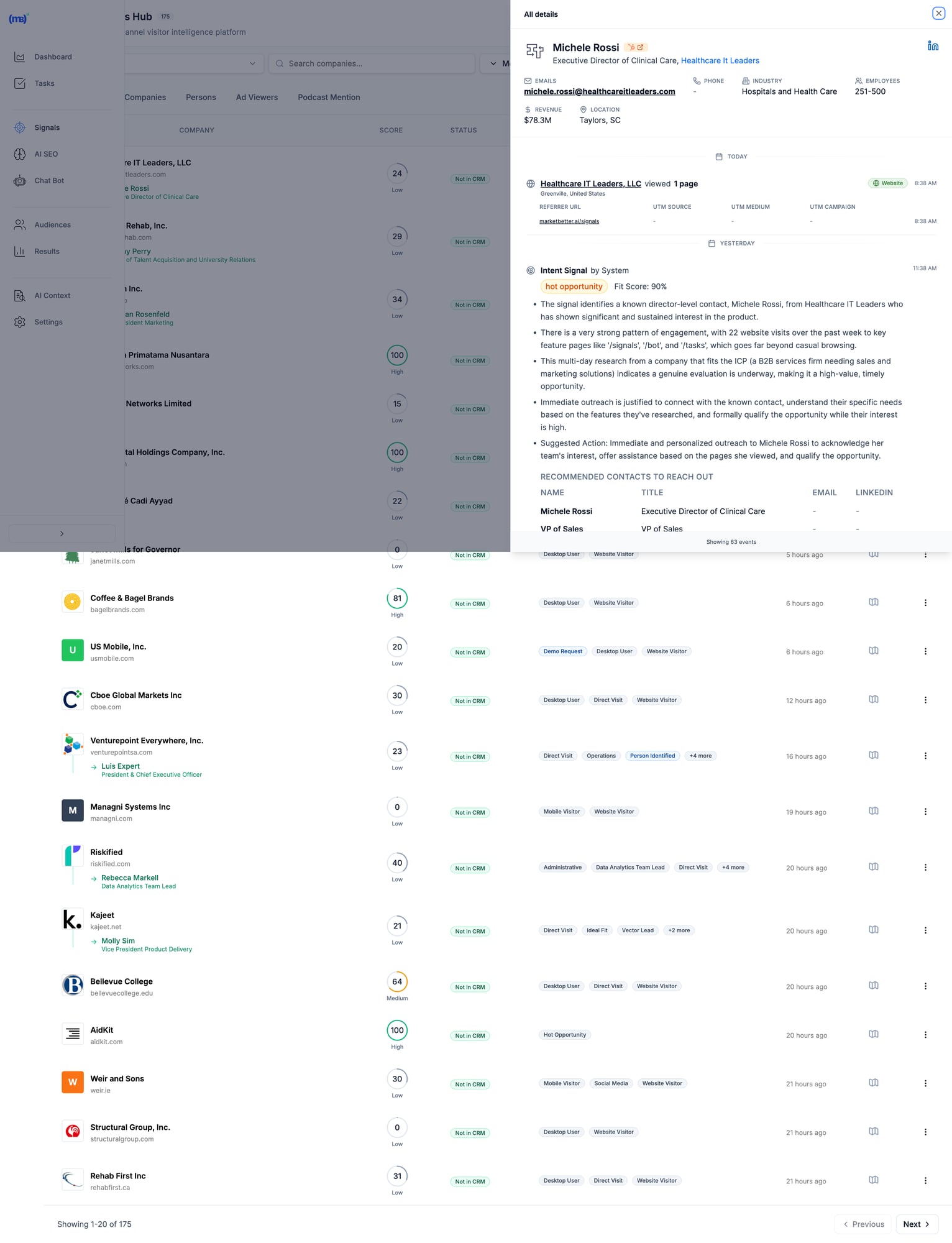
MarketBetter Signals Hub showing visitor intelligence with contact details, intent scores, and recommended actions MarketBetter's Signals Hub shows AI-prioritized visitor signals with intent scoring, identified contacts, and suggested actions โ€” all in one view.

Pricingโ€‹

Custom based on team size and volume. Transparent pricing โ€” no hidden fees or long-term contracts. Book a demo โ†’

When MarketBetter Is Betterโ€‹

โœ… You have an SDR team that needs to execute, not analyze โœ… You want one platform instead of 5+ tools stitched together โœ… Visitor data currently sits unused in dashboards โœ… You care about pipeline, not just "visibility" โœ… Speed-to-lead matters (90% faster lead response)

When To Look Elsewhereโ€‹

โš ๏ธ You only need raw data for your existing ABM stack โš ๏ธ Enterprise with 6sense/Demandbase already deployed and working โš ๏ธ Pure marketing use case with no SDR execution

Read more: MarketBetter vs Warmly | MarketBetter vs Apollo | MarketBetter vs ZoomInfo | MarketBetter vs 6sense


2. Warmlyโ€‹

Best for: Companies wanting real-time visitor engagement via chat

Warmly bundles visitor identification with AI chatbot engagement. Their strength is catching visitors while they're still on your site and starting conversations immediately. In 2026, they've expanded with an "AI Data Agent" tier that automates more of the outreach workflow.

Key Featuresโ€‹

  • 65% company-level identification (claimed) via 20+ data providers in a "data waterfall"
  • 15-25% person-level identification via enrichment partnerships
  • AI chatbot for real-time visitor engagement
  • Slack/Teams alerts for high-intent visitors
  • Bombora intent data integration
  • Video calling widget for live sales conversations on-site
  • Orchestrator for automated outreach sequences

Pricingโ€‹

PlanPriceWhat You Get
Free$0500 visitors/mo, 10 Bombora signals/week
Startup~$700/moHigher limits, basic automation
Business$1,440-1,740/mo10K-100K visitors, full features
AI Data Agent$10,000/yrAdvanced AI features, automated outreach

When Warmly Is Betterโ€‹

โœ… Real-time chat engagement is your primary use case โœ… You already have outbound tools (Outreach, Apollo) and need signals โœ… Catching visitors while they're on-site matters most โœ… Budget of $700+/mo for a dedicated visitor ID tool

When To Look Elsewhereโ€‹

โš ๏ธ You need a full SDR workflow (no smart dialer, no daily task prioritization) โš ๏ธ Budget under $700/mo (free tier is very limited) โš ๏ธ You want person-level at scale (15-25% may not be enough) โš ๏ธ You need multi-channel execution beyond chat

Read more: MarketBetter vs Warmly Comparison | Warmly Review 2026 | Warmly Pricing Breakdown | Best Warmly Alternatives


3. Leadfeeder (Dealfront)โ€‹

Best for: European companies prioritizing GDPR compliance

Dealfront (the merger of Leadfeeder and Echobot) focuses on the European market with strong GDPR compliance. Solid company-level identification with good CRM integrations at a reasonable price. They've been in the visitor ID game longer than most, which means deep integration partnerships.

Key Featuresโ€‹

  • Company-level visitor identification (IP-to-company)
  • GDPR-compliant data handling โ€” a real differentiator for EU companies
  • Strong European company database (best coverage outside US)
  • CRM integrations with Salesforce, HubSpot, Pipedrive
  • Lead scoring and filtering by company attributes
  • Google Analytics integration for enhanced insights

Pricingโ€‹

PlanPriceWhat You Get
Freeโ‚ฌ0100 companies/mo, 7-day data retention
Paidโ‚ฌ99-165/moUnlimited companies, 365-day retention

Annual billing gives 40% discount. The free tier is genuinely useful for testing.

When Leadfeeder Is Betterโ€‹

โœ… European market focus (best EU company database in the category) โœ… GDPR compliance is non-negotiable for your team โœ… Budget-conscious teams wanting basic visitor ID to test the concept โœ… Already using Pipedrive or European CRMs

When To Look Elsewhereโ€‹

โš ๏ธ You need person-level identification (company-only) โš ๏ธ US market focus (weaker coverage than US-focused tools) โš ๏ธ You want SDR workflow, not just data and dashboards โš ๏ธ You need real-time alerts for high-intent visitors


4. RB2Bโ€‹

Best for: Freemium person-level identification (US traffic)

RB2B has become the go-to for teams wanting to test person-level identification without a big commitment. Their free tier is genuinely generous, and the Slack integration makes it easy to see results immediately. Founded by Adam Robinson, they've built strong community momentum on LinkedIn.

Key Featuresโ€‹

  • Person-level identification targeting 10-20% match rate
  • Slack notifications with LinkedIn profiles (the "killer feature")
  • Simple setup (just add a script tag โ€” 5 minutes)
  • Free tier with 150 credits/month
  • Demandbase partnership for company-level fallback
  • Coworker filtering on Pro plans (remove known contacts)

Pricingโ€‹

PlanPriceWhat You Get
Free$0150 credits/mo, company-level only, LinkedIn profiles
Starter$79/moPerson-level identification, basic integrations
Pro$349+/moBusiness emails, all integrations, coworker filtering

Match Rates (Honest Assessment)โ€‹

  • Person-level: 10-20% (US traffic only)
  • Company-level: 70-80% when combined with Demandbase fallback
  • International: Not supported for person-level โ€” this is a US-only tool

When RB2B Is Betterโ€‹

โœ… You want to test person-level ID before committing serious budget โœ… US-focused B2B traffic (mandatory โ€” doesn't work internationally) โœ… You have existing outreach tools and just need the names โœ… PLG company wanting LinkedIn profiles of engaged users

When To Look Elsewhereโ€‹

โš ๏ธ International traffic (US-only for person-level identification) โš ๏ธ You need workflow, not just names dropped in Slack โš ๏ธ Business emails required (need Pro at $349+/mo โ€” significant jump) โš ๏ธ You want a complete SDR platform, not a point solution


5. Koalaโ€‹

Best for: PLG companies tracking product intent signals

Koala stands out by combining website visitor identification with product usage signals. If you have a freemium or trial product, Koala shows you which trial users are showing buying intent โ€” a capability most visitor ID tools completely lack.

Key Featuresโ€‹

  • Website + product activity tracking in one unified platform
  • Account scoring based on engagement patterns and product usage
  • Real-time Slack alerts for high-intent accounts
  • CRM sync with automatic enrichment
  • Built for PLG motions (trial โ†’ paid conversion signals)
  • ICP scoring to filter noise and focus on fits

Pricingโ€‹

Custom pricing based on volume. Free trial available. Generally positioned between SMB tools and enterprise platforms.

When Koala Is Betterโ€‹

โœ… You have a freemium/trial product (PLG motion is your core GTM) โœ… Product engagement signals matter more than just website visits โœ… You want to identify which trial users are ready for a sales conversation โœ… Engineering resources to implement product-level tracking

When To Look Elsewhereโ€‹

โš ๏ธ No freemium/trial product (pure sales-led GTM) โš ๏ธ You need full SDR workflow (no dialer, no sequences built in) โš ๏ธ Enterprise ABM programs (better options exist at that budget) โš ๏ธ Non-technical team (requires dev work to instrument product events)


6. 6senseโ€‹

Best for: Large marketing teams running enterprise ABM programs

6sense is a full ABM platform with visitor identification as one component of a broader intent data suite. Powerful but complex โ€” built for large marketing teams with dedicated ops resources. In 2026, they've added AI-powered "Revenue AI" features, though the core platform remains enterprise-focused.

Key Featuresโ€‹

  • Account identification via IP + intent signals
  • Predictive buying stage scoring (Awareness โ†’ Decision) โ€” genuinely useful for ABM
  • Third-party intent data (Bombora + proprietary 6sense data)
  • Multi-channel ABM orchestration (ads, email, sales activation)
  • AI account summaries and recommendations (Revenue AI)
  • Deep CRM integrations with Salesforce, HubSpot
  • Audience creation for targeted advertising

Pricingโ€‹

6sense doesn't publish pricing. Based on Vendr and third-party data:

TierTypical CostWhat You Get
Free$050 credits/mo, Chrome extension
Team~$25K-50K/yrBasic platform, limited seats
Growth~$55K/yr (median)Full platform, intent data
Enterprise$100K-200K+/yrAdvanced features, custom integrations

Source: Vendr reports median buyer pays $55,211/year. Implementation takes 1-3 months.

When 6sense Is Betterโ€‹

โœ… Enterprise budget ($50K+ annually) and you can justify the ROI โœ… Marketing-led ABM programs where you're running coordinated campaigns โœ… You have ops resources to manage the platform (RevOps or dedicated admin) โœ… Multi-channel orchestration across ads + email + sales is the goal

When To Look Elsewhereโ€‹

โš ๏ธ SMB or mid-market budget (minimum ~$25K/yr) โš ๏ธ Sales-first teams (6sense is marketing-first, sales activation is secondary) โš ๏ธ You want simplicity (3-6 month implementation typical) โš ๏ธ Contact-level identification priority (6sense is company/account-level)

G2 reviewer feedback:

"My problem with 6sense is that the tool's visitor identification reveals only companies and not individuals."

Read more: MarketBetter vs 6sense | 6sense Review 2026 | 6sense Pricing Breakdown | Best 6sense Alternatives


7. ZoomInfo WebSightsโ€‹

Best for: Enterprise GTM teams already using ZoomInfo data

ZoomInfo is the 800-pound gorilla of B2B data. WebSights is their visitor identification product, plugging into their massive database of 320M+ contacts and 100M+ company profiles. If you're already paying for ZoomInfo, WebSights is a natural add-on. If you're not, the total cost makes this an enterprise play.

Key Featuresโ€‹

  • Account-level visitor identification with deep company intel
  • Buyer intent signals (1B+ monthly data points)
  • Deep CRM/MAP integrations (native Salesforce, HubSpot, Marketo)
  • Form enrichment for progressive lead capture
  • DSP integration for retargeting ads to identified accounts
  • Copilot AI for account research and outreach drafting

Pricingโ€‹

ZoomInfo bundles WebSights with their core platform. Expect:

ComponentTypical Cost
SalesOS$15,000-25,000/yr starting
WebSights add-onIncluded or ~$5K extra
Intent data$9K-20K additional
Engage (sequences/dialer)~$15K additional

Total cost for full suite: $40K-100K+/yr depending on seats and features. Annual contracts, difficult to exit mid-term.

When ZoomInfo Is Betterโ€‹

โœ… Already a ZoomInfo customer (marginal cost is low) โœ… Enterprise data needs where database size matters โœ… Budget for $15K+ annually โœ… Dedicated ops team to manage the platform

When To Look Elsewhereโ€‹

โš ๏ธ SMB budget (minimum $15K/yr for the base platform) โš ๏ธ You want SDR workflow, not just data enrichment โš ๏ธ Quick implementation needed (enterprise complexity and training required) โš ๏ธ Contact data accuracy concerns (G2 reviews flag stale data as #1 issue)

Read more: MarketBetter vs ZoomInfo | ZoomInfo Review 2026 | ZoomInfo Pricing Breakdown | Best ZoomInfo Alternatives


8. Clearbit Breeze (HubSpot)โ€‹

Best for: HubSpot users wanting native enrichment

Now owned by HubSpot, Clearbit excels at form enrichment and real-time company identification. If you're already in the HubSpot ecosystem, it's the most seamless option โ€” no integration work, no data syncing issues. The rebranding to "Breeze Intelligence" has been a bit confusing, but the core product remains strong.

Key Featuresโ€‹

  • Real-time form enrichment (shorter forms, same data)
  • Company and contact data appending to existing CRM records
  • Native HubSpot integration (zero setup if you're already a customer)
  • Reveal for anonymous visitor identification at account level
  • API for custom enrichment workflows (developers love this)
  • Auto-enrichment triggers based on lifecycle stage changes

Pricingโ€‹

Credit-based system integrated into HubSpot. Contact HubSpot for details. Historically:

  • Enterprise plans include Clearbit/Breeze credits
  • Standalone was $12,000+/yr before acquisition
  • Credits consumed per enrichment (form fill, reveal, or API call)

When Clearbit Is Betterโ€‹

โœ… You're committed to the HubSpot ecosystem (this is a natural extension) โœ… Form enrichment is the priority (reduce form fields, increase conversions) โœ… You want seamless CRM data without export/import workflows โœ… Marketing-first use case with existing HubSpot workflows

When To Look Elsewhereโ€‹

โš ๏ธ Not a HubSpot user (ecosystem lock-in makes this pointless) โš ๏ธ Person-level visitor identification priority (better options exist) โš ๏ธ You need SDR workflow beyond enrichment (no dialer, no task lists) โš ๏ธ Budget-conscious (credit system can get expensive at scale)


9. Demandbaseโ€‹

Best for: Enterprise ABM with advertising + sales intelligence

Demandbase is a full ABM platform competing with 6sense at the enterprise level. Their strength is combining account identification with ABM advertising capabilities โ€” if you're running targeted ads to identified accounts, Demandbase's DSP integration is best-in-class.

Key Featuresโ€‹

  • Account identification (AI-powered anonymous visitor reveal)
  • Identity graph (cookies, IP, device IDs, cross-channel matching)
  • Intent data + engagement scoring with proprietary signals
  • ABM advertising platform with native DSP
  • Sales intelligence with account insights and buyer journey mapping
  • GDPR-safe global reach (better international coverage than 6sense)

Pricingโ€‹

Demandbase doesn't publish pricing. Based on Vendr and third-party data:

TierTypical Cost
Minimum$18,000+/yr
Median~$65,000/yr
Enterprise$100K+/yr

When Demandbase Is Betterโ€‹

โœ… Enterprise budget ($50K+ annually) โœ… ABM advertising is part of your strategy (best DSP integration) โœ… Global reach with GDPR compliance matters (stronger internationally than 6sense) โœ… Marketing + sales alignment on target accounts

When To Look Elsewhereโ€‹

โš ๏ธ SMB or mid-market budget โš ๏ธ Person-level identification priority (company/account-level focus) โš ๏ธ Quick implementation needed (enterprise onboarding) โš ๏ธ You need SDR workflow, not marketing dashboards


10. Instantly Pixelโ€‹

Best for: Outbound-first teams already using Instantly for cold email

Instantly โ€” best known as a cold email platform โ€” has added website visitor identification via their "Instantly Pixel." If you're already using Instantly for outbound sequences, adding visitor ID data into the same workflow is seamless. It's not the deepest visitor ID tool, but the workflow integration is hard to beat for existing customers.

Key Featuresโ€‹

  • Website visitor identification via pixel tracking
  • Built into Instantly CRM โ€” visitor data flows directly into your outreach workflows
  • Custom views for filtered visitor segments (e.g., pricing page visitors only)
  • Contact enrichment from Instantly's B2B database
  • Automated sequence enrollment โ€” identified visitors auto-added to campaigns
  • Multi-channel (email + call + SMS from one platform)

Pricingโ€‹

Visitor identification is included in Instantly's CRM plans:

PlanPriceWhat You Get
Growth CRM$37/moBasic CRM + visitor tracking
Hyper Growth CRM$97/moAI features + advanced sequences

Note: You may also need a sending plan ($30-78/mo) for the outreach side. Total cost: $67-175/mo for the full stack.

When Instantly Is Betterโ€‹

โœ… Already using Instantly for cold email (natural extension, no new tools) โœ… Outbound-first GTM where visitor ID supplements cold outreach โœ… Budget-conscious (cheapest "all-in-one" option at $67-175/mo total) โœ… Want email + calling + visitor ID in one platform

When To Look Elsewhereโ€‹

โš ๏ธ Visitor ID is your primary need (Instantly's pixel is secondary to their email product) โš ๏ธ You need deep visitor analytics and segmentation (basic compared to Warmly or 6sense) โš ๏ธ Enterprise-grade identification with intent data (not their strength) โš ๏ธ Inbound-first GTM (Instantly is built for outbound)


11. Leadpipeโ€‹

Best for: Person-level identification at scale with aggressive pricing

Leadpipe is a newer entrant focused on high-volume person-level identification. They claim 35%+ person-level match rates โ€” aggressive but worth testing. Their pricing model is credit-based and straightforward, making it easy to forecast costs.

Key Featuresโ€‹

  • Person-level identification โ€” names, emails, phone numbers, LinkedIn profiles
  • Company + contact enrichment in one view
  • Real-time visitor tracking with page-level behavior data
  • Automated list building โ€” identified visitors auto-exported to your email tool
  • Simple pixel installation (similar to RB2B)
  • No contract โ€” month-to-month pricing

Pricingโ€‹

PlanPriceCredits
Starter$98/mo100 identified visitors
Growth$147/mo500 identified visitors
Scale$248/mo1,000 identified visitors
Pro$398/mo2,000 identified visitors
Business$819/mo5,000 identified visitors
Enterprise$1,579/mo10,000 identified visitors

Per-credit cost: $0.16-0.98 depending on volume. 200 free credits to test.

When Leadpipe Is Betterโ€‹

โœ… Person-level identification is the priority (not just company names) โœ… You want transparent, predictable pricing per identified visitor โœ… High-traffic site where per-credit pricing scales well โœ… Need email addresses + phone numbers for outreach (not just LinkedIn profiles)

When To Look Elsewhereโ€‹

โš ๏ธ You need SDR workflow (data-only, no task management or dialer) โš ๏ธ International traffic (US-focused, like most person-level tools) โš ๏ธ Enterprise security requirements (newer vendor, less established) โš ๏ธ You want intent data beyond just page visits


12. Snitcherโ€‹

Best for: Budget-friendly company-level identification

Snitcher is a straightforward, no-frills company identification tool starting at just $39/month. No person-level ID, no intent data, no AI โ€” just solid IP-to-company matching with clean reporting. Sometimes simple is exactly what you need.

Key Featuresโ€‹

  • Company-level visitor identification via IP matching
  • Google Analytics integration (enhances existing GA data)
  • CRM integrations (Salesforce, HubSpot, Pipedrive)
  • Custom alerts based on company attributes or page visits
  • Clean dashboard with session-level detail
  • GDPR-compliant (EU-based, privacy-first approach)

Pricingโ€‹

Usage-based starting at $39/month, scaling with identified companies. Affordable option for teams testing the visitor ID concept before committing to larger platforms.

When Snitcher Is Betterโ€‹

โœ… Budget under $200/mo and you want to test visitor identification โœ… Company-level is sufficient (you have separate tools for contact finding) โœ… European company wanting GDPR-compliant solution (EU-based) โœ… Clean, simple tool without enterprise complexity

When To Look Elsewhereโ€‹

โš ๏ธ You need person-level identification (company-only) โš ๏ธ You want SDR workflow or outreach automation โš ๏ธ US-focused team (US-centric tools have better North American coverage) โš ๏ธ Need intent data or buying stage signals


The Real Question: What Happens AFTER Identification?โ€‹

Here's what most comparison guides won't tell you:

Identifying visitors is the easy part.

The hard part is turning that data into action. Most SDRs don't have time to:

  • Research every identified company
  • Find the right decision-maker
  • Write personalized outreach
  • Prioritize who to contact first
  • Actually make the call

That's why 90% of visitor ID data goes unused. It sits in a dashboard. Nobody acts on it. And the tool becomes shelfware within 3 months.

The "Data vs Action" Gapโ€‹

Data-First ToolsAction-First Tools
Show you WHO visitedShow you WHO + WHAT TO DO
Require manual researchAuto-enrich with decision-makers
Leave prioritization to youAI-prioritize by fit + intent
Integrate with your sequence toolsInclude sequences + dialer
Dashboards for analysisTasks for execution
Value depends on SDR disciplineValue is built into the workflow

Most tools on this list are data-first. They give you visibility. What happens next is your problem.

MarketBetter is action-first. We turn every visitor into a prioritized task with AI-drafted outreach and click-to-dial. Your SDR opens a list and executes. No research required, no prioritization paralysis.

The Multi-Tool Problemโ€‹

Here's how most teams cobble together a visitor ID workflow today:

  1. Visitor identification (RB2B or Warmly) โ†’ $79-700/mo
  2. Contact enrichment (Apollo or ZoomInfo) โ†’ $49-$15,000/yr
  3. Email sequences (Outreach or Salesloft) โ†’ $100-150/seat/mo
  4. Dialer (Orum or Nooks) โ†’ $150-200/seat/mo
  5. CRM (HubSpot or Salesforce) โ†’ $50-150/seat/mo

Total: $500-2,000+/mo per SDR across 5 different tools, with manual data transfer between each one.

MarketBetter replaces tools 1-4 in one platform. Visitor identification, enrichment, sequences, and dialer โ€” with AI connecting them so data flows into action automatically.

See how it works โ†’


How to Calculate Visitor Identification ROIโ€‹

Before investing in any visitor ID tool, run these numbers:

Step 1: Estimate Your Identifiable Trafficโ€‹

MetricYour Number
Monthly website visitors_______
ร— Realistic match rate (use 15% for company-level)ร— 0.15
= Identified companies per month_______

Step 2: Estimate Pipeline Impactโ€‹

MetricYour Number
Identified companies per month_______
ร— % that fit your ICP (use 20%)ร— 0.20
= ICP-fit leads_______
ร— Outreach-to-meeting rate (use 5%)ร— 0.05
= Meetings booked per month_______

Step 3: Calculate Revenueโ€‹

MetricYour Number
Meetings per month_______
ร— Demo-to-close rate (use 20%)ร— 0.20
= New customers per month_______
ร— Average deal sizeร— $_______
= Monthly revenue from visitor ID$_______

Example Scenarioโ€‹

MetricExample
10,000 monthly visitors
ร— 15% company match rate= 1,500 identified
ร— 20% ICP fit= 300 ICP leads
ร— 5% meeting rate= 15 meetings/month
ร— 20% close rate= 3 new customers
ร— $15,000 ACV= $45,000/month revenue

Even at conservative rates, a tool costing $500-2,000/month that generates $45,000 in monthly revenue is a 20-90x return. The math almost always works โ€” the question is whether your team will actually act on the data.


Implementation Guide: Getting Started in Under 30 Minutesโ€‹

No matter which tool you choose, here's how to get maximum value fast:

Week 1: Install and Baselineโ€‹

  1. Add the tracking pixel/script โ€” Every tool on this list requires adding a JavaScript snippet to your site. Most take under 5 minutes.
  2. Connect your CRM โ€” Sync identified visitors with your existing pipeline. HubSpot and Salesforce integrations are standard.
  3. Set up alerts โ€” Configure Slack or email notifications for high-intent page visits (pricing page, demo page, comparison pages).
  4. Establish your baseline โ€” How many visitors does the tool identify in the first week? What's your actual match rate?

Week 2: Prioritize and Filterโ€‹

  1. Define your ICP filter โ€” Set company size, industry, and geography filters so you only see relevant visitors. Without filters, your SDR drowns in noise.
  2. Set up lead scoring โ€” Prioritize visitors by behavior: pricing page > blog > homepage. Multiple visits > single visit.
  3. Test outreach on 20 leads โ€” Manually reach out to the first batch. Measure response rates. Refine your messaging.

Week 3-4: Automate and Scaleโ€‹

  1. Build sequences โ€” Create automated email sequences triggered by visitor identification events.
  2. Assign territory rules โ€” If you have multiple SDRs, set up round-robin or territory-based lead routing.
  3. Measure pipeline โ€” Track how many identified visitors become meetings, opportunities, and closed deals.

Common Mistakes to Avoidโ€‹

โŒ Contacting every identified visitor โ€” Most are researchers, not buyers. Filter by ICP and intent signals. โŒ Mentioning you tracked them โ€” "I saw you visited our pricing page" is creepy. Frame outreach around their company's challenges. โŒ Setting and forgetting โ€” Review match rates and outreach results monthly. Adjust ICP filters as you learn. โŒ Buying enterprise tools for SMB problems โ€” A $55K/yr platform won't help if your team has 2 SDRs and 5,000 monthly visitors. โŒ Expecting person-level magic โ€” Realistic person-level match rates are 5-20%. If your traffic is low, the absolute number of identified individuals will be small. Supplement with company-level identification + manual prospecting.


How to Choose the Right Visitor ID Toolโ€‹

After evaluating all 12 tools, here are the three questions that matter:

1. Do You Need Data or Action?โ€‹

If you have a mature ops team that can turn visitor data into SDR workflows (research, enrich, prioritize, sequence, call), tools like ZoomInfo, 6sense, or Warmly give you rich data to feed those workflows.

If you want visitors to become prioritized SDR tasks automatically โ€” no manual research, no tool-switching โ€” look at MarketBetter.

2. Company-Level or Person-Level?โ€‹

  • Company-level (30-65% match rate) = table stakes, every tool on this list does this
  • Person-level (5-20% match rate) = harder, consider RB2B, Leadpipe, Warmly, or MarketBetter

If person-level is critical, verify the vendor's methodology. Many claim high rates by counting company matches in their headline number.

3. What's Your Budget?โ€‹

BudgetBest Options
Free/$0RB2B free, Leadfeeder free
Under $200/moSnitcher ($39), RB2B Starter ($79), Leadpipe Starter ($98)
$200-500/moRB2B Pro ($349), Leadpipe Growth ($147-248)
$500-2,000/moWarmly ($700+), MarketBetter, Instantly stack ($67-175)
$2,000+/moMarketBetter, Warmly Business
$25K+/yr6sense, ZoomInfo
$50K+/yr6sense Enterprise, Demandbase, ZoomInfo Enterprise

Decision Frameworkโ€‹

Choose MarketBetter if your SDRs need a daily playbook that tells them who to call, why, and what to say โ€” not another dashboard to monitor.

Choose Warmly if real-time chat engagement while visitors are on-site is your highest priority.

Choose RB2B or Leadpipe if you just need person-level data piped into Slack and you'll handle outreach separately.

Choose 6sense or Demandbase if you're running enterprise ABM programs with $50K+ budgets and dedicated RevOps.

Choose ZoomInfo if you already have their data platform and want to add visitor ID as an incremental capability.

Choose Snitcher or Leadfeeder if you want affordable company-level identification to test the concept before scaling up.

Choose Instantly if you're already running cold email campaigns and want to layer in visitor identification without adding another vendor.


Frequently Asked Questionsโ€‹

What is the best free website visitor identification tool?โ€‹

RB2B offers the best free tier for person-level identification (US traffic only, 150 credits/month with LinkedIn profiles). Leadfeeder offers free company-level identification (100 companies/month, 7-day retention). Both are limited but useful for testing the concept before committing budget.

What is a realistic match rate for visitor identification?โ€‹

Expect 30-65% for company-level identification and 5-20% for person-level. Rates are higher for corporate office traffic and lower for remote workers. Any vendor claiming 80%+ contact-level match rates is likely counting company matches. Always ask: "What percentage of my traffic will you identify to a specific person with a verified email?"

Do I need visitor identification if I have Google Analytics?โ€‹

Google Analytics shows you anonymous traffic patterns โ€” pages visited, time on site, traffic sources, conversion funnels. Visitor identification reveals who those visitors are (company names, sometimes individual contacts with emails). They serve completely different purposes. Most teams use both: GA4 for marketing analytics, visitor ID for sales activation.

Is website visitor identification GDPR compliant?โ€‹

It depends on the method. IP-to-company matching is generally compliant as it identifies organizations, not individuals. Person-level identification tools must ensure proper consent mechanisms and legal basis for processing. European-focused tools like Leadfeeder (Dealfront) and Snitcher prioritize GDPR compliance. If you operate in the EU, consult your legal team and look for tools with explicit GDPR documentation.

What's the difference between visitor identification and intent data?โ€‹

Visitor identification tells you WHO visited your website specifically โ€” first-party data. Intent data tells you WHO is researching your category across the web โ€” third-party signals from publishers, review sites, etc.

Some tools (6sense, Demandbase, Warmly) combine both. Others focus on one or the other. Intent data is broader but noisier; visitor identification is narrower but higher-signal (they're on YOUR site, not just reading about the category).

How long does implementation take?โ€‹

  • Simple tools (RB2B, Leadpipe, Snitcher): 5-30 minutes (add a script tag)
  • Mid-market tools (Warmly, Koala, MarketBetter): 1-2 weeks (includes CRM setup and workflow configuration)
  • Enterprise tools (6sense, Demandbase, ZoomInfo): 1-3 months (training, custom integrations, change management)

Can I use multiple visitor ID tools together?โ€‹

Yes, and many teams do. A common stack: RB2B for person-level identification (free tier) + Leadfeeder for company-level (free tier) to test both approaches. Then consolidate into one paid tool once you know which data type (person vs company) drives more pipeline for your specific business.

What's the biggest mistake teams make with visitor identification?โ€‹

Buying the tool without a plan for what happens after identification. 90% of visitor ID data goes unused because there's no workflow to turn "Company X visited" into "SDR calls Jane at Company X with this pitch." Before choosing a tool, define your process: Who reviews the data? How fast do they act? What do they say? If you can't answer those questions, the tool won't help โ€” you need a workflow-first platform like MarketBetter that handles this automatically.

Should I care about AI features in visitor ID tools?โ€‹

In 2026, every tool has slapped "AI" on their marketing. What actually matters: AI for prioritization (which visitors to contact first), AI for personalization (writing outreach based on visitor behavior), and AI for automation (auto-enrolling high-intent visitors into sequences). Skip tools where "AI" just means a chatbot that answers FAQ. Look for AI that saves your SDRs 15-30 minutes per lead.


Free Tool

Try our AI Lead Generator โ€” find verified LinkedIn leads for any company instantly. No signup required.

The Bottom Lineโ€‹

Website visitor identification is only valuable if someone acts on it.

The best tools don't just show you dashboards of anonymous visitors turned into company names. They turn those visitors into prioritized tasks your SDRs execute every day.

Ask yourself: Do you need another dashboard? Or do you need more booked meetings?

If the answer is booked meetings, you need a tool that bridges the gap between "identified visitor" and "SDR picks up the phone." That's what separates a data product from a revenue product.


Ready to turn anonymous visitors into pipeline?

Book a demo with MarketBetter โ†’

We'll show you how visitor identification becomes SDR execution โ€” not just another data source collecting dust.

Related reading:

MarketBetter vs 6sense: The SDR-First Alternative [2026]

ยท 6 min read

6sense is the Rolls-Royce of account-based marketing platforms. It's powerful, sophisticated, and costs $60,000 to $130,000 per year.

For enterprise marketing teams with dedicated ABM operations, 6sense delivers. But for most B2B sales teams? It's like buying a semi-truck to deliver pizzas.

The real question isn't "which platform has more features?" It's "which one helps your SDRs book more meetings?"

The Core Differenceโ€‹

What You Need6senseMarketBetter
Primary UserMarketing Ops + ABM TeamsSDRs + Sales Managers
Setup TimeWeeks to monthsDays
Daily WorkflowDashboards to interpretTasks to complete
Pricing$60K-$130K/yearFraction of the cost
Best ForEnterprise ABM campaignsSMB/Mid-market SDR teams

6sense tells your marketing team which accounts are showing intent.

MarketBetter tells your SDRs exactly what to do nextโ€”and does half the work for them.

What 6sense Does Wellโ€‹

Let's be fair. 6sense has earned its reputation:

  • Intent Data at Scale: Tracks billions of buyer signals across the web
  • Predictive Analytics: AI models that forecast which accounts will buy
  • ABM Orchestration: Coordinates advertising, email, and sales outreach
  • Enterprise Integrations: Deep connections to Salesforce, Marketo, Eloqua

If you have a 10-person marketing ops team, a dedicated ABM manager, and a budget that doesn't make your CFO cry, 6sense is genuinely impressive.

Where 6sense Falls Short for SDR Teamsโ€‹

1. Complexity Kills Adoptionโ€‹

6sense is designed for marketing operations teams who love dashboards and data models.

SDRs don't want to interpret intent scores and buying stage predictions. They want to know: Who do I call? What do I say? What's the next step?

6sense gives you the data. You still have to figure out what to do with it.

2. The Price Tagโ€‹

Let's talk real numbers:

  • 6sense: $60,000-$130,000/year (multi-year contracts common)
  • MarketBetter: A fraction of that cost

For that 6sense budget, you could hire an additional SDR. Or two.

3. Time to Valueโ€‹

6sense implementations take weeks to months. You need:

  • Data integrations configured
  • Intent topics defined
  • ABM segments built
  • Team training completed
  • Campaigns orchestrated

MarketBetter? Your SDRs can start working tasks on day one.

4. It's Built for Marketing, Not Salesโ€‹

6sense shines at telling marketing teams which accounts to target with ads and nurture campaigns.

But SDRs don't run ad campaigns. They:

  • Send personalized emails
  • Make phone calls
  • Respond to inbound leads
  • Follow up on website visitors

6sense doesn't write your emails. It doesn't prioritize your call list. It doesn't recover your missed meetings.

How MarketBetter Approaches This Differentlyโ€‹

SDR Playbook vs. Intent Dashboardsโ€‹

6sense approach: Here's a dashboard showing 47 accounts with "high intent" in the "consideration stage." Go figure out what to do.

MarketBetter approach: Here's your task list for today. Call Sarah at Acme Corpโ€”she visited your pricing page 3 times this week. Here's a personalized email we drafted based on her company's recent news.

The difference is actionable workflow vs. interpretable data.

Visitor Intelligence That Actually Helpsโ€‹

Both platforms identify website visitors. The difference is what happens next.

6sense adds them to an account list for your ABM campaigns.

MarketBetter:

  • Scores them based on ICP fit
  • Routes them to the right SDR automatically
  • Generates personalized outreach
  • Adds them to your task list with context

MarketBetter&#39;s SDR task list with prioritized actions and AI-generated outreach MarketBetter gives SDRs a prioritized task list with AI-generated outreachโ€”not just dashboards to interpret.

AI That Does the Workโ€‹

6sense uses AI to predict buying stages and recommend accounts.

MarketBetter uses AI to:

  • Write personalized emails based on prospect research
  • Generate pre-meeting briefs before sales calls
  • Recover missed meetings with automated follow-ups
  • Surface the highest-priority tasks each morning

It's the difference between AI as analysis and AI as an assistant.

Feature Comparisonโ€‹

Feature6senseMarketBetter
Website Visitor IDโœ… Account-levelโœ… Company + person-level
Intent Dataโœ… Industry-leadingโœ… Behavioral + firmographic
AI Predictive Scoringโœ…โœ…
SDR Task ManagementโŒโœ…
AI Email WritingโŒโœ…
Smart DialerโŒโœ…
Pre-Meeting BriefsโŒโœ…
Missed Meeting RecoveryโŒโœ…
Chatbot with Live HandoffโŒโœ…
CRM Syncโœ… Salesforce, HubSpotโœ… Salesforce, HubSpot
Setup TimeWeeks-monthsDays
Typical Contract$60K-$130K/yearAccessible to SMBs

When to Choose 6senseโ€‹

6sense is the right choice if you:

  • Have a dedicated ABM team with marketing operations expertise
  • Run large-scale advertising campaigns to target accounts
  • Need to coordinate marketing and sales across hundreds of accounts
  • Have an enterprise budget ($60K+/year for a single tool)
  • Want best-in-class third-party intent data across the web

When to Choose MarketBetterโ€‹

MarketBetter is the right choice if you:

  • Want SDRs executing within days, not months
  • Need AI that does the work, not just analyzes data
  • Want one platform for visitor ID, email, calling, and chat
  • Have a realistic SMB/mid-market budget
  • Care more about meetings booked than intent scores tracked

The Real ROI Calculationโ€‹

Here's how sales leaders should think about this:

6sense ROI Model:

  • Cost: $80,000/year (mid-range estimate)
  • Value: Better account targeting for marketing campaigns
  • Metric: Influenced pipeline (hard to attribute directly)

MarketBetter ROI Model:

  • Cost: Fraction of 6sense
  • Value: SDRs complete 2x more quality activities per day
  • Metric: Meetings booked, replies received (directly measurable)

When your SDRs can follow an AI-generated playbook instead of interpreting dashboards, they book more meetings. It's that simple.

What Customers Sayโ€‹

MarketBetter customers consistently highlight the same benefits:

"SDRs onboard in days instead of months" โ€” The AI tells them exactly what to do. No training on complex platforms required.

"29% positive reply rates" โ€” Because AI-personalized outreach beats template blasts every time.

"Never miss an inbound lead" โ€” Chatbot + visitor alerts + missed meeting recovery means zero leads fall through cracks.

Making the Switchโ€‹

If you're currently on 6sense and considering a switch, here's the honest assessment:

Keep 6sense if: Your marketing team actively uses it for ABM campaigns and you're seeing attributed pipeline from their efforts.

Switch to MarketBetter if: Your SDRs aren't using 6sense daily, you're paying for features you don't use, or you want a tool built for sales execution rather than marketing analysis.

Free Tool

Try our AI Lead Generator โ€” find verified LinkedIn leads for any company instantly. No signup required.

Bottom Lineโ€‹

6sense is a marketing intelligence platform that happens to have sales features.

MarketBetter is an SDR workflow platform that happens to include intelligence.

The question is: Do you need your SDRs interpreting data, or executing tasks?

If it's the latter, MarketBetter delivers what 6sense can'tโ€”a daily playbook that turns intent signals into booked meetings.


Ready to see the difference? Book a demo and we'll show you exactly how MarketBetter would work for your SDR team.