Every professional services firm hits the same ceiling. Business is good — until the referrals slow down.
You've built something real: expertise that clients rave about, a reputation that precedes you, a network that keeps the pipeline moving. But here's the uncomfortable truth that most services firm owners avoid confronting: referral-based growth is not a strategy. It's luck with a nice suit on.
The moment a key referral partner retires, a whale client churns, or the economy tightens and everyone stops introducing vendors to each other — the pipeline goes cold. And unlike SaaS companies with inbound marketing engines and SDR teams, most services firms have zero infrastructure to generate their own demand.
This isn't a theoretical problem. It's the #1 growth constraint for professional services businesses across every vertical — from investigation firms to boutique consultancies, from specialized staffing agencies to niche advisory practices.
This is the story of how one professional services firm — a mid-sized operation with roughly $750K in annual revenue, a lean team where the founder was simultaneously the lead practitioner, the sales team, and operations — broke the referral dependency entirely.
I want to tell you about the hardest problem in B2B sales technology. It's not lead generation — we solved that years ago (arguably too well, which is its own problem). It's not personalization — LLMs made that almost trivially easy. It's not even multi-channel orchestration, although that's closer.
The hardest problem is intent signal orchestration: ingesting signals from dozens of sources, prioritizing them in real time, and activating the right response before the buying window closes.
Every serious GTM team talks about being "signal-based." Very few actually are. And the current crop of AI sales agents — the open source repos making the rounds on GitHub and Twitter — reveal exactly why.
Stage 2: Prioritization. Not all signals are equal. A pricing page visit from a company that matches your ICP and has an open opportunity in your CRM is dramatically more valuable than a blog post view from a random domain. Prioritization requires:
Signal scoring based on historical conversion data
Account-level aggregation (combining multiple weak signals into a strong composite signal)
Temporal weighting (recent signals matter more than old ones)
Deduplication and noise filtering (bot traffic, internal visits, competitor research)
ICP matching and enrichment
Cross-referencing against existing pipeline to identify acceleration vs. net-new opportunities
Stage 3: Activation. Converting a prioritized signal into an action within the buying window. This means:
Routing the signal to the right rep or sequence based on territory, account ownership, or round-robin rules
Triggering the appropriate response (email, call, LinkedIn touch, content share) based on signal type and strength
Personalizing the outreach based on the specific signal and account context
Executing through deliverability-safe channels with proper throttling
Logging the action and creating a feedback loop for future signal scoring
This three-stage pipeline — ingest, prioritize, activate — is intent signal orchestration. Every stage is hard. Doing all three in real time, reliably, at scale? That's where almost everyone fails.
Here's where the current AI agent movement runs into a wall.
I recently examined a popular GTM agent repo — 92 agents, 67 Claude Code plugins, covering the full GTM spectrum. It includes an agent called something like "intent-signal-orchestration." Sounds perfect, right?
Open it up. It's a prompt. A well-written prompt, but a prompt. It instructs an LLM to "analyze intent signals and prioritize accounts for outreach based on buying stage and signal strength."
Think about what's missing:
There's no actual signal data. The prompt assumes signals will be provided as input. But where do the signals come from? The agent doesn't have a JavaScript pixel on anyone's website. It doesn't have access to Bombora or G2 buyer intent feeds. It doesn't know who visited your pricing page at 2 AM. It doesn't track job changes on LinkedIn.
The prompt is an analytical engine with no fuel.
There's no real-time data pipeline. Intent signals are perishable. A pricing page visit from 3 hours ago is an urgent buying signal. The same visit from 3 weeks ago is a data point. Orchestration requires real-time (or near-real-time) data ingestion — webhooks, streaming APIs, event-driven architectures. A prompt that runs when a human triggers it isn't real-time orchestration. It's batch analysis with extra steps.
There's no historical scoring model. Effective signal prioritization requires training on your own conversion data. Which signals in your business actually correlate with closed-won deals? A prompt can apply generic heuristics ("pricing page visits are high intent"), but it can't learn from your specific win/loss patterns unless it has access to your historical CRM data — enriched with signal attribution.
There's no activation infrastructure. Even if the prompt perfectly prioritizes accounts, what happens next? Someone has to copy the output, switch to their sequencing tool, find the contacts, build a sequence, and hit send. The gap between "AI recommends" and "rep executes" is where urgency goes to die.
This is the prompt-based orchestration fallacy: the belief that intelligence alone can solve an infrastructure problem. It can't. Intelligence without data is guessing. Intelligence without infrastructure is advising. Neither is orchestrating.
I realize this is a counterintuitive claim in the age of AI, so let me be specific.
Consider two hypothetical sales teams:
Team A has a brilliant AI agent that can analyze intent signals with PhD-level sophistication. But it only gets data when a rep manually exports their CRM and pastes it into a prompt. The agent has no access to website visitor data, no third-party intent feeds, and no way to execute outreach.
Team B has a relatively simple rules-based system (if pricing page visit + ICP match, trigger high-priority sequence). But it has real-time website visitor identification, direct CRM integration, automated sequence execution through deliverability-safe email infrastructure, and an integrated dialer.
Team B will outperform Team A every time. Not because their intelligence is better — it's objectively worse. But because they can see the signal, act on the signal, and execute the response within the buying window.
Infrastructure creates the floor. Intelligence raises the ceiling. But you need the floor first.
The Three Types of Intent Signals (and Why Most Teams Only Capture One)
There's a hierarchy of intent signals that most sales teams don't think about clearly:
First-Party Signals (Highest Value, Hardest to Capture)
These come from your own properties: website visits, product usage, email engagement, chatbot conversations, content downloads, webinar attendance.
First-party signals are the most valuable because they represent direct engagement with your brand. When someone visits your pricing page, they're not doing generic research — they're evaluating you specifically.
But capturing first-party signals requires infrastructure:
Website visitor identification technology that de-anonymizes traffic
Event tracking across your web properties
CRM integration that connects web behavior to account and contact records
Real-time processing that surfaces signals while they're still actionable
This is where platforms like MarketBetter differentiate — they provide the actual visitor identification and behavioral data capture infrastructure that turns anonymous website traffic into actionable signals. No prompt can replicate this. It requires JavaScript pixels, IP resolution, cookie management, and data processing pipelines.
Second-Party Signals (High Value, Available via Partners)
These come from platforms where your prospects engage: review sites (G2, TrustRadius), publisher networks, event platforms, communities. A prospect comparing you to a competitor on G2 is an extremely high-intent signal.
Second-party signals require data partnerships and API integrations. They're available as commercial products (Bombora, G2 Buyer Intent, TrustRadius Intent), but they're not free and they're not accessible to open source agents.
These come from broader market data: hiring trends, funding announcements, technology adoptions, news mentions, social media activity. They indicate general market interest or company change, but don't necessarily signal intent to buy your product.
Third-party signals are the easiest to access — many are available through public APIs. This is why most AI agent frameworks focus here. They can scrape LinkedIn for job changes and Crunchbase for funding rounds. But third-party signals alone are noisy. Without first-party signals to anchor them, you're guessing about intent rather than observing it.
The teams that win at signal-based selling capture all three layers and weight them appropriately. First-party signals trigger immediate action. Second-party signals accelerate existing pipeline. Third-party signals inform targeting and timing for net-new outbound.
Raw signals need to be cleaned, scored, and aggregated:
Deduplication to prevent the same signal from triggering multiple actions
Scoring based on signal type, source, recency, and historical conversion correlation
Account-level aggregation that combines multiple signals into a composite account score
ICP matching that filters out signals from companies that don't match your target profile
Pipeline awareness that distinguishes "new opportunity" signals from "existing deal acceleration" signals
This is where AI adds genuine value. An LLM can synthesize multiple weak signals into a nuanced account assessment that a rules-based system would miss. The key is that the AI needs structured, clean signal data as input — not raw noise.
The timing of the GTM agent movement is significant. It's emerging at exactly the moment when:
LLMs are good enough to handle the analytical layer of signal orchestration — scoring, synthesis, personalization, recommendation.
Intent data is more available than ever — the number of signal sources and the richness of the data have exploded.
Email deliverability is getting harder — making signal-based targeting (reaching the right people at the right time) more important than ever.
Buyer behavior has shifted — prospects do 70%+ of their research before engaging sales, which means the signals they leave during that research phase are the most valuable asset in B2B selling.
The convergence creates both an enormous opportunity and a dangerous trap. The opportunity: teams that nail signal orchestration will have a structural advantage in pipeline generation and conversion. The trap: teams that confuse "AI agent that talks about signals" with "infrastructure that captures and activates signals" will waste time building on a foundation that doesn't exist.
Here's the question every revenue leader should be asking right now:
When a high-intent prospect visits your website at 10 PM on a Tuesday, what happens?
If the answer is "nothing, until a rep notices tomorrow" — you don't have signal orchestration. You have data collection with a 12-hour delay that kills half the buying windows you capture.
If the answer is "they're automatically identified, scored, enriched, and queued in a rep's morning playbook with personalized outreach recommendations" — you're in the game.
If the answer is "we're going to build that with an open source AI agent" — I'd love to know how you plan to identify the visitor.
Because that's the part no prompt can solve.
MarketBetter captures first-party intent signals — real website visitors, real behavioral data — and turns them into prioritized, actionable pipeline through an integrated daily playbook. See how signal orchestration actually works at marketbetter.ai.
The morning our dashboard ticked past $5M in annual recurring revenue, I didn't celebrate. I sat in my car in the parking lot for fifteen minutes, staring at my phone, thinking about every door that got slammed in our face to get there.
Here's a quick experiment. Open your company's tech stack spreadsheet — you know, the one finance keeps asking about. Count the tools your revenue team uses.
If you're a typical B2B company in 2026, the number is somewhere between 8 and 15. A CRM. An enrichment tool. A sequencing platform. An intent data provider. A dialer. An email warmup service. A LinkedIn automation tool. A conversation intelligence platform. Maybe a sales engagement layer on top. Maybe a data warehouse underneath.
Each tool does one thing. Each tool has its own login, its own billing, its own onboarding, its own integrations. Your ops person spends half their week maintaining the glue between them. Your reps spend 30 minutes a day just switching contexts between tabs.
Something interesting is happening in the open source AI community that most revenue leaders haven't noticed yet. It's a leading indicator of where the entire GTM technology market is headed.
Developers are building AI agent repositories — not organized by tool category, but by workflow. Instead of "here's a dialer tool" and "here's an email tool" and "here's an enrichment tool," they're creating agents named things like cold-email-sequence, pipeline-health-check, account-research-brief, and intent-signal-orchestration.
See the difference? The organizing principle isn't the technology. It's the job to be done.
One of the most notable examples — a repo with 92 AI agents and 67 Claude Code plugins — maps the entire GTM function into workflow-based agents covering prospecting, pipeline management, content creation, ABM orchestration, churn prediction, and more. Each agent represents a complete workflow, not a feature.
This isn't just an open source trend. It's the blueprint for how the next generation of GTM platforms will be built.
The tool-per-function model made sense when each function was genuinely specialized and no single platform could do everything well. In 2018, you needed Outreach for sequences, ZoomInfo for data, 6sense for intent, and Gong for call recording because no one product was good at more than one of those things.
Three things have changed:
1. AI collapsed the intelligence layer. The hardest part of most sales tools was the analytical engine — scoring leads, personalizing messages, detecting patterns, recommending next actions. LLMs now handle these tasks at a level that equals or exceeds purpose-built ML models. You don't need five specialized AI engines anymore. You need one good foundation model connected to the right data.
2. Integration tax became unbearable. Every tool in your stack requires bi-directional sync with your CRM. Every sync has lag, data loss, and edge cases. Every edge case creates bad data. Bad data creates bad decisions. The integration tax isn't just a technical cost — it's a revenue cost. How many deals have stalled because a signal in one tool didn't flow to the platform where the rep would actually see it?
3. Context switching kills conversion. Reps who work in a single unified workflow convert at measurably higher rates than reps who bounce between tabs. The data on this is clear: every context switch adds cognitive load, and cognitive load kills the urgency and momentum that drive outbound success. When a rep has to leave their sequence tool to check intent data in a different tool, the moment is often lost.
The emerging agent-based model flips the stack on its head. Instead of buying tools and wiring them together, you define workflows and let agents execute them end to end.
Here's what that looks like in practice:
Morning pipeline review. An agent scans your CRM, flags deals that have stalled for 14+ days, identifies accounts with recent activity spikes, and generates a prioritized list of the 10 accounts that need attention today — with specific recommendations for each one. No rep had to open a dashboard, run a report, or cross-reference intent data. The workflow just runs.
Account research. A rep enters an account name. An agent pulls firmographic data, recent news, tech stack information, key stakeholders, and any existing engagement history from your CRM. It synthesizes all of it into a one-page brief with suggested talk tracks. What used to take 20 minutes of clicking through LinkedIn, Crunchbase, and your CRM now takes 30 seconds.
Cold outreach sequence. An agent takes a target list, enriches each contact, personalizes a multi-touch sequence based on the prospect's role, company context, and any available intent signals, and schedules the sequence across email and phone — all with deliverability guardrails built in. The rep reviews and approves. The whole thing runs.
Deal coaching. An agent reviews call transcripts, email threads, and CRM notes for a specific opportunity. It identifies risk factors (competitor mentions, stakeholder gaps, timeline concerns), generates suggested next steps, and even drafts follow-up emails. A rep gets AI-powered deal strategy without hiring a $300/hour sales consultant.
Notice what's absent in all of these workflows: tool names. The rep doesn't care whether the enrichment came from Clearbit or Apollo or a proprietary database. They don't care whether the email sends through SendGrid or a custom SMTP relay. They care that the workflow worked.
The AI agent repos flooding GitHub are onto something real, even if most of them aren't production-ready. What they get right:
Workflow-first architecture. Organizing by outcome rather than function is the correct design philosophy. A "pipeline-health-check" agent is more useful than a "dashboard tool" because it embeds the analytical work directly into the workflow.
Composability. Good agent frameworks let you chain agents together. The output of a research agent feeds the input of a personalization agent feeds the input of a sequence agent. This is how workflows actually work — as chains, not as isolated tools.
Customizability. Every sales team sells differently. Open source agents let you tune prompts, adjust scoring criteria, modify templates, and add custom logic. You're not locked into some PM's idea of what "good outbound" looks like.
Transparency. With open source, you can see exactly what the agent is doing. No black box scoring. No mystery algorithms. If the agent is making bad recommendations, you can see why and fix it.
For all their architectural elegance, open source GTM agents have a fundamental problem: they're brains without bodies.
The agents can think — analyze data, generate text, make recommendations. But they can't do — send deliverability-safe emails, make phone calls through an integrated dialer, capture website visitor data, or sync activities back to a CRM in real time.
The doing requires infrastructure that doesn't exist in a GitHub repo:
Email sending infrastructure with warmup, rotation, and reputation management
Phone systems with local presence, parallel dialing, and recording
Website tracking with visitor identification and behavioral data capture
CRM integration that's bidirectional, real-time, and reliable
Compliance frameworks for GDPR, CAN-SPAM, and TCPA
This is the gap. And it's exactly the gap that the next generation of GTM platforms is rushing to fill.
The winning architecture in 2026 isn't "open source agents" or "legacy SaaS stack." It's a unified platform that combines the workflow-first design philosophy of the agent movement with the execution infrastructure that only a purpose-built platform can provide.
MarketBetter is a good example of what this looks like in practice. Instead of selling separate tools for intent data, email sequences, visitor identification, and phone — it orchestrates the entire workflow. A daily AI playbook surfaces the right accounts. An integrated chatbot qualifies inbound in real time. Email sequences execute with deliverability infrastructure baked in. A smart dialer handles the phone channel. Everything flows through one system.
The key insight: the AI layer and the infrastructure layer aren't separate products. They're the same product. The AI is only as good as the data it can access and the channels it can activate. The infrastructure is only as efficient as the intelligence directing it.
If you're evaluating your GTM stack in 2026, here's the framework I'd use:
Does the platform organize by workflow or by feature? If the sales page talks about "our dialer" and "our sequencer" and "our intent data" as separate value props, that's a legacy architecture wearing a modern UI. Look for platforms that talk about outcomes: "prioritized daily playbook," "AI-powered account research," "automated multi-channel sequences."
Can the AI access first-party data? The biggest limitation of generic AI agents is they don't have access to your data — your website visitors, your CRM history, your engagement signals. A platform that combines AI with proprietary first-party data will always outperform a generic agent connected to public APIs.
Is the execution infrastructure integrated? If you still need a separate email warmup tool, a separate dialer, or a separate deliverability monitoring service, the platform isn't really unified. Execution infrastructure should be invisible — it just works.
How fast is the feedback loop? The best AI workflows learn from results. When a sequence converts, the system should adjust future personalization. When a call connects, the system should update account scoring. Tight feedback loops are what separate "AI-assisted" from "AI-powered."
Can you customize the workflows? Every team is different. A good platform gives you default workflows that work out of the box, plus the ability to tune prompts, adjust scoring weights, modify sequence logic, and add custom steps. You want guardrails, not handcuffs.
We're at the beginning of a massive consolidation wave in B2B sales technology. The 10-tool stack is collapsing into 2-3 platforms. CRM stays (Salesforce and HubSpot aren't going anywhere). A unified GTM execution platform replaces the rest.
The catalyst is AI. When a single intelligence layer can handle enrichment, personalization, scoring, and analysis — the only differentiation left is data and infrastructure. And data and infrastructure favor consolidated platforms over fragmented point solutions.
The companies that figure this out in 2026 will have a structural advantage: lower tool costs, less integration overhead, faster rep ramp, and tighter feedback loops between execution and results.
The companies that don't will still be debugging Zapier integrations while their competitors book meetings.
Your move.
Ready to consolidate your GTM stack into one AI-powered workflow? MarketBetter combines visitor ID, intent signals, AI playbook, smart dialer, and deliverability-safe email — no integration duct tape required.
At its core, sales lead generation is the engine of your sales machine. It’s the entire process you build to find and attract potential customers, with the ultimate goal of turning their initial interest into a closed deal. This isn't just about finding names; it's about creating a predictable flow of qualified opportunities for your team.
The game has changed. The old playbook of building static prospect lists and blasting them with generic outreach just doesn't cut it anymore. Winning in 2026 comes down to two things: speed and relevance. It’s no longer enough to find leads. You have to build a system that engages the right person at the exact moment they’re ready to talk.
This is where the 'first-to-respond' principle becomes your biggest competitive advantage. Today’s buyers do their own research and move fast. The vendor who shows up first to answer their questions is the one who usually wins.
You can't overstate how much response time affects your chances of winning a deal. When a prospect signals interest—maybe they visit your pricing page, download a whitepaper, or click an ad—a stopwatch starts. And it’s ticking fast.
The data is pretty staggering. Responding to a new lead within 5 minutes can boost your contact rates by an incredible 900%. What’s more, 78% of buyers will end up going with the company that responded to their inquiry first. This means your sales development team needs a rock-solid process for acting on these buying signals the second they appear. If you want to dig deeper, you can explore more data on how speed impacts sales success.
Actionable Comparison: The old model of sales lead generation was like fishing with a static net, hoping prospects would swim into it. The new reality is more like precision hunting, where you detect movement and react instantly with the right tools.
Of course, knowing you need to be fast and actually being fast are two different things. This new reality creates some serious hurdles for most sales teams.
Even when buyer intent is crystal clear, many sales development representatives (SDRs) are stuck in neutral. They get bogged down by the same frustrating obstacles that kill momentum and let good leads go cold:
Administrative Overload: Reps burn hours just jumping between their CRM, email, phone dialer, and various research tools. All that context-switching is time they aren't spending selling.
Inconsistent Outreach: Without a clear, unified workflow, the quality of outreach is all over the place. One rep's messaging is sharp, another's is off-brand, and the buyer gets a confusing, disjointed experience.
Manual Task Management: Figuring out who to call next, what to say, and when to follow up becomes a manual guessing game. Great opportunities inevitably fall through the cracks.
To break this cycle, you need a different kind of operational backbone—what you might call a 'task engine' built for pure execution. This is where platforms like marketbetter.ai come in. They act as the bridge, taking those fleeting buyer intent signals and instantly turning them into a prioritized to-do list for your SDRs. This is how you move from reactive chaos to proactive, intelligent outreach—and it’s the foundation for everything we'll cover next.
Think of your lead generation strategy like a fishing expedition. You wouldn't use a massive deep-sea net in a tiny creek, and you wouldn't try to catch a specific trophy fish with a worm on a hook. The tools and techniques you use have to match the fish you're after, the water you're in, and how much time you have.
Your approach to finding B2B leads is no different. We'll break down the three core models: Inbound, Outbound, and the game-changing Intent-Driven approach. Understanding how they operate—and how they can work together—is your first real step toward building a pipeline you can count on.
Inbound is all about attracting customers to your front door. You put valuable, helpful content out into the world, and it draws the right people to you naturally. This is your wide-net strategy; you create a strong presence in a productive part of the ocean and let interested prospects swim right in.
This is a long game, for sure. It’s about building brand authority and earning trust, which doesn't happen overnight. But once you get an inbound machine humming, it can become an incredible, self-sustaining source of high-quality leads. A crucial piece is making it incredibly easy for those prospects to take the next step. Looking at high-converting lead generation form examples is a great way to see what works for capturing that interest effectively.
Actionable Inbound Tactics:
Content Marketing: Publish blog posts, whitepapers, and guides that solve a specific problem for your target audience. Action Step: Survey your existing customers about their biggest challenges and build your content calendar around those themes.
Search Engine Optimization (SEO): Getting your website to the top of Google for the terms your prospects are searching for. If they can't find you, you don't exist.
Social Media: Build a community and share your content where your audience already spends their time. Action Step: Identify the top 3 LinkedIn groups or online forums where your ideal customer hangs out and start by answering questions, not pitching.
On the flip side, you have outbound. This is a direct, proactive hunt. Instead of waiting for leads to find you, your sales team goes out and finds them. This is spear fishing—you identify a very specific, high-value target and go right after it with precision.
Outbound is often the quickest way to get some runs on the board, especially if you're a new company or breaking into a new market. You have total control over who you're talking to, making it perfect for targeting accounts that fit your Ideal Customer Profile (ICP). The catch? It demands real skill and personalization. A generic, mass-sent email is the equivalent of throwing your spear into an empty patch of water and hoping for the best.
Actionable Tip: Never send a "just checking in" email. Use an AI-powered tool to find a trigger event—a recent funding round, a new executive hire, a major company announcement—and lead with that in your outreach. It instantly shows you've done your homework and aren't just spamming them.
Now, this is where things get really interesting. The intent-driven approach focuses on prospects who are already showing you they're in the market. It’s like spotting a school of fish literally jumping out of the water. These people are actively researching solutions, visiting your competitors' pricing pages, or searching for highly specific keywords.
This model combines the best of both worlds. You use data to pinpoint these motivated buyers and then deploy targeted, outbound-style tactics to engage them at the perfect moment. This is precisely where tools like the SDR Task Inbox from marketbetter.ai are so critical. They turn those faint signals into concrete tasks, empowering your team to act within minutes, not days.
Comparing Inbound vs Outbound vs Intent-Driven Strategies
So, which one is right for you? The honest answer is that the most successful go-to-market teams don't just pick one; they build a system that blends all three. A startup might lean heavily on outbound to land its first 10 customers, while a market leader can rely on its massive inbound engine.
This table breaks down the core differences to help you decide on the right mix for your team's goals and resources.
Strategy
Methodology
Best For
Pros
Cons
Inbound
Attract leads with valuable content and SEO
Building long-term brand authority and a scalable lead flow
High-quality, educated leads; builds trust; cost-effective over time
Slow to start; requires significant content creation resources
Outbound
Proactively target and contact ideal customer profiles
Fast results; market testing; targeting specific, high-value accounts
Predictable and controllable; immediate feedback loop
Can be perceived as intrusive; lower response rates without personalization
Intent-Driven
Engage prospects who are actively showing buying signals
Capitalizing on timely opportunities and high-intent buyers
Extremely high conversion potential; hyper-relevant outreach
Requires intent data tools; can be more expensive; needs a rapid response process
Ultimately, understanding these models is the foundation. A strong inbound presence fills the top of your funnel, a sharp outbound motion allows you to target dream accounts, and an intent-driven layer ensures you never miss a buyer who's ready to talk right now.
How to Build a Modern SDR Workflow That Actually Works
Having a great strategy is one thing, but turning it into results on the ground requires a solid, repeatable workflow. For Sales Development Representatives (SDRs), their daily process is what separates hitting quota from total burnout. An effective workflow for sales lead generation isn’t about working harder; it’s about focusing your team’s energy where it truly matters.
Unfortunately, I see too many sales teams stuck in the past. The "old way" is a frustrating grind of manual tasks and disconnected tools that just kills momentum. Reps waste hours bouncing between their CRM, LinkedIn, a separate dialer, and their email inbox. All that context switching is a massive productivity drain, which leads to sloppy CRM data and, you guessed it, missed opportunities.
The traditional SDR workflow is reactive and painfully inefficient. A rep starts their day by staring at a static list in Salesforce, randomly picks a name, and then opens five more browser tabs to piece together who the person is and what their company does. By the time they’ve found a tidbit of information, written a semi-personalized email, and logged the activity, a huge chunk of their morning is gone.
The modern workflow, on the other hand, is proactive, integrated, and built for speed. It completely flips the script.
The Old Way (Manual & Fragmented)
The New Way (Automated & Integrated)
Manual Lead Research: SDRs burn hours hunting for trigger events or contact details.
Automated Signal Detection: The system flags high-intent signals for you.
Guesswork Prioritization: Reps decide who to call next based on gut feelings or just going down a list.
Automated Task Prioritization: Tasks are created and ranked based on real data and buying intent.
Disconnected Tooling: Juggling a CRM, dialer, email, and research tabs is the daily reality.
Integrated Execution: All actions—calling, emailing, researching—happen in one unified workspace.
Inconsistent Logging: Manually tracking activities leads to messy data and useless reports.
Automatic Logging: Every touchpoint is logged to the CRM automatically, keeping your data clean.
This shift takes the SDR role from being a glorified data-entry clerk to a strategic operator focused on having high-value conversations.
A truly modern workflow isn't random; it follows a logical, automated sequence. This process ensures every action a rep takes is timely, relevant, and directly connected to a real buying signal. That alone dramatically improves the odds of successful sales lead generation.
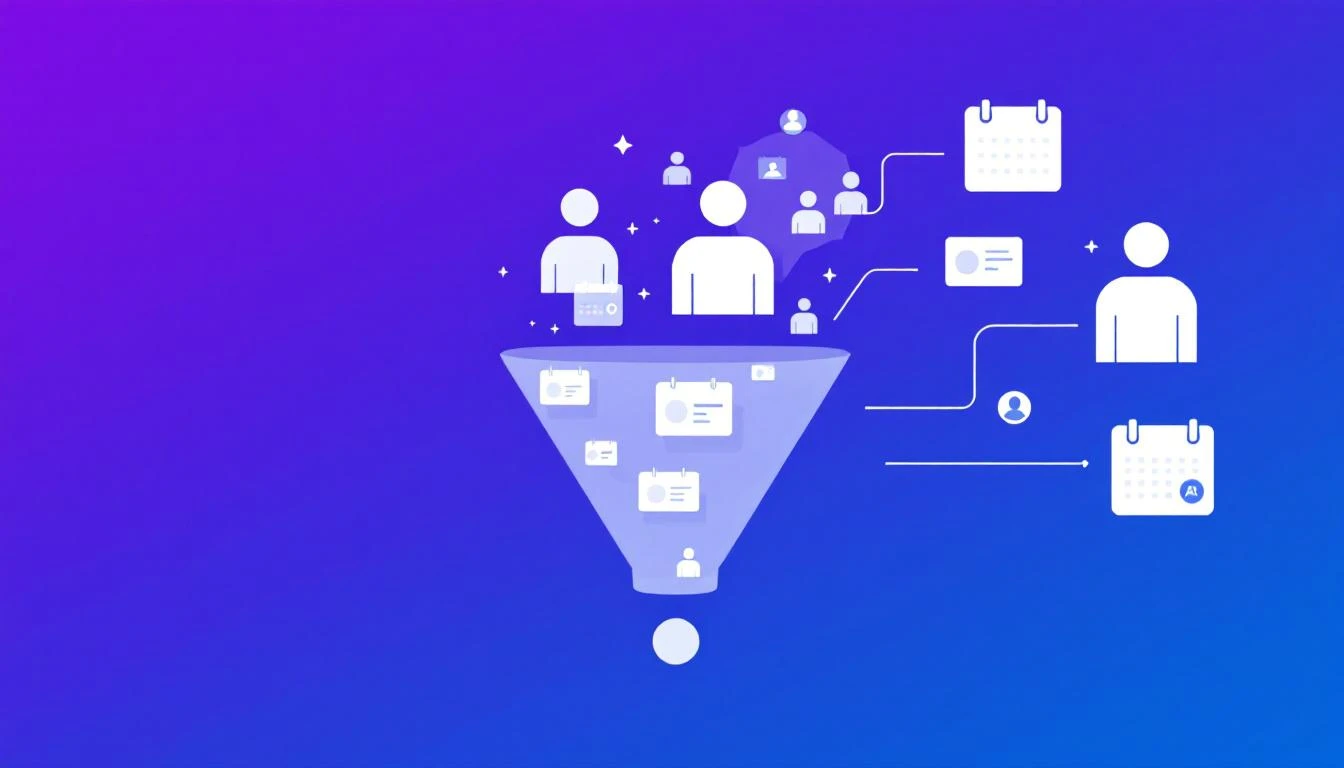
This visual breaks down the ideal flow, moving from casting a wide net to targeting the right accounts and engaging them at the perfect moment.
This process shows how modern lead generation funnels broad attraction into precise, high-intent engagement—the very heart of an effective SDR workflow.
Actionable Takeaway: The core principle is simple: convert buying signals into a prioritized to-do list. The system should tell the SDR what to do next, not the other way around.
Platforms like the MarketBetter.ai SDR Task Inbox are built to make this happen. They act as a central command center where signals from different sources—like someone visiting your pricing page or downloading a whitepaper—are automatically converted into prioritized tasks right inside your CRM, whether it's Salesforce or HubSpot. This eliminates the guesswork and administrative drag that slows reps down.
The good news is that AI and automation are fundamentally reshaping how sales teams work. The right tools can slash research time by 50% and have been shown to improve response rates by up to 300% by enabling personalization at scale. The winning formula is human-AI collaboration: let automation handle the grunt work, and free up your reps to focus on creativity, strategy, and building relationships. If you want to dive deeper into the numbers behind this shift, you can discover more insights on emerging lead generation trends here.
This new approach puts your SDRs back in control, letting them do what they do best: connecting with people and filling the pipeline. By embracing an integrated, signal-based workflow, you give your team the tools they need to win.
Let’s be honest. In a world drowning in automated noise, the single biggest hurdle in sales lead generation is simply getting someone to reply. Prospects' inboxes and voicemails are under constant attack, and generic outreach gets deleted in the blink of an eye. This is where a lot of sales teams get nervous, worrying that using AI will just make their messages sound even more robotic and out of touch.
But here's the secret: the goal isn't to avoid automation. It's to use it for surgical precision, not for carpet bombing. A smart, modern outreach strategy throws out the tired, old templates. Instead, it focuses on short, relevant, and context-aware messages that respect a prospect’s time and intelligence.
Most cold emails are dead on arrival because they're selfish and lazy. They drone on about the sender's product without giving a single thought to the recipient's world. A powerful email, on the other hand, is built on a simple three-part framework that immediately signals you've done your homework.
The structure is refreshingly straightforward:
Observation: Kick things off with a specific, recent, and relevant trigger. This is your "why I'm reaching out now."
Value Proposition: Connect that observation directly to a problem you can help them solve.
Call-to-Action (CTA): Suggest a clear, low-effort next step.
This simple shift turns your email from an annoying interruption into a timely, and potentially helpful, suggestion. Getting this right is a game-changer, and a big part of it is mastering the fundamentals of the cold email itself. If you're looking to go deeper on this, you can check out our guide on cold email outreach.
Let's make this real. Say you're selling a project management tool and you notice a target company just announced a major expansion.
Before (Generic & Doomed to Fail):
Subject: Boost Your Team's Productivity
Hi Jane,
I’m John from ProjectFlow. We offer a best-in-class project management solution that helps teams like yours improve efficiency.
Can we schedule a 15-minute demo next week?
This email is all about John and his product. It’s generic, offers zero specific value, and gives Jane no reason to care. Delete.
After (Observation -> Value Prop -> CTA):
Subject: Your recent expansion plans
Hi Jane,
Saw the news about your plans to double the engineering team in Q3. Managing that kind of rapid growth without clear project visibility can often lead to missed deadlines.
Our platform is built to help scaling teams keep complex projects on track as they grow.
Worth a brief chat to see if this is a priority for you?
See the difference? This version is about Jane's world. It uses a real observation (the expansion) to tee up a relevant problem (missed deadlines) and then offers a solution with a simple, no-pressure CTA. This is the line between spam and professional B2B communication. With tools like marketbetter.ai, AI can draft these context-aware emails for your reps in seconds, keeping your brand's quality high without the hours of manual research.
These same principles are just as critical for cold calls. A great call doesn't come from winging it; it comes from a quick but powerful "pre-call ritual" that gives the SDR the right context. The problem is, trying to do this manually for every single call is a massive time-drain, which is why most reps end up skipping this crucial step.
Here's a look at how things change:
The Old Way (Manual Prep)
The New Way (AI-Assisted Ritual)
10-15 mins of frantic research hopping between browser tabs.
30 seconds to review AI-generated talking points.
Generic, one-size-fits-all opening lines that get you hung up on.
A specific opening line based on the prospect's company or role.
Forgetting key points or fumbling through objections.
Pre-loaded objection handling points and key context snippets.
This ritual makes sure every call starts with confidence and relevance. AI-powered tools can instantly pull together a brief with key talking points, like a recent company announcement or a common pain point for that specific industry. This gives your SDR the exact ammunition they need to make the first 30 seconds of the call count. The goal isn't a rigid script; it's a set of smart prompts that helps guide a natural, informed conversation.
Even the most brilliant strategy will fall flat without the right tools to bring it to life. When it comes to sales lead generation, you're not just buying a few apps; you're building a high-performance engine. The only way to do this right is with a "hub-and-spoke" model, where one piece of software acts as the undisputed center of your sales world.
That non-negotiable hub is your Customer Relationship Management (CRM) system. Whether you’re running on a powerhouse like Salesforce or a versatile platform like HubSpot, the CRM is your single source of truth. Every other tool you use must plug into it. If it doesn't, you're just creating data chaos and operational headaches down the line.
So many sales teams end up with a messy, fragmented tech stack without even realizing it. They’ll have one tool for finding emails, a different dialer for calls, a separate app for sending sequences, and task lists living in random spreadsheets. While each tool might do its one job well, the setup creates enormous friction.
This fragmentation is the number one enemy of adoption and clean data. When your reps have to constantly jump between tabs, copy-paste information, and manually log every single activity, they’re going to cut corners. It's not that they're lazy—it's that the workflow is actively working against them and pulling them away from what they should be doing: selling.
A unified, CRM-native approach flips the script entirely. It brings all the essential tools directly into the CRM interface where your reps spend their day. This is the thinking behind a platform like MarketBetter.ai, which embeds the task engine, AI-powered email, and dialer right inside Salesforce or HubSpot.
Fragmented Stack (The Old Way)
Unified Stack (The Modern Way)
Reps constantly switch between 5+ browser tabs.
Reps work from a single, unified inbox within the CRM.
Activity logging is manual, inconsistent, and often forgotten.
All calls, emails, and outcomes are logged automatically.
Reporting is inaccurate due to messy or missing data.
Data is clean and reliable, enabling trustworthy reports.
Onboarding is complex, requiring training on multiple tools.
Onboarding is simpler with a focus on one core workflow.
Tool adoption is low because of high workflow friction.
Adoption is high because the tool simplifies the rep's job.
This comparison drives home a critical point for any sales leader or RevOps pro: the best tech stack isn't the one with the most bells and whistles. It’s the one your team will actually use day in and day out.
To build a truly seamless system for sales lead generation, you need to get three core components working in perfect harmony. Think of it like building a race car—you need a chassis, an engine, and fuel.
The CRM (The Chassis): This is the foundation holding everything together. It houses all your customer data and provides the structure for every sales activity.
Intent Data Source (The Fuel): This tells you where to point your car. Intent data provides the crucial signals—like website visits or keyword searches—that identify which accounts are actively looking for a solution like yours right now.
Task & Execution Engine (The Engine): This is what actually turns the fuel into forward motion. It takes the intent signals, converts them into a prioritized list of tasks, and gives reps the tools (dialer, email) to act on them instantly.
Actionable Takeaway: When these three pillars are tightly integrated, that's when the magic happens. An intent signal is captured automatically, a prioritized task pops up in the SDR's CRM-native workspace, and they can make a call or fire off an email with a single click. Every action is logged back to the CRM without a second thought. This is how you get speed, relevance, and scale.
For teams looking to get more out of their technology, understanding how these pieces fit together is the first and most important step. To explore this further, you can read our complete SDR tech stack guide for a deeper look at choosing and integrating the right tools. The ultimate goal is to create a frictionless workflow that lets your reps focus on what they do best: building relationships and generating pipeline.
You’ve probably heard the old saying, “If you can’t measure it, you can’t improve it.” In B2B sales, that’s not just a cliché—it’s the absolute truth. The catch is that tracking a bunch of numbers isn't the goal. You need to focus on the key performance indicators (KPIs) that tell you what’s actually working, not just the vanity metrics that make a dashboard look busy.
To get reliable data, everything has to talk to each other. Your dialer, your email tools, all of it needs to live inside your CRM. When every touchpoint is logged automatically, you can finally ditch the messy spreadsheets and stop guessing. This is how you get clean data that lets you diagnose performance issues, coach your team effectively, and make decisions that actually move the needle.
It's so easy to get fixated on big, impressive-looking numbers. A sales rep sending 1,000 emails a week might look incredibly productive on paper. But if none of those emails are getting a reply or booking a meeting, all that activity is just noise.
The secret is to think about your metrics in layers. This approach helps you see the complete story of your team’s performance. I like to break them down into three simple groups:
Activity Metrics: This is the raw effort. Think calls made and emails sent.
Efficiency Metrics: This tells you how good that effort is. Are people picking up the phone? Are they replying to emails?
Outcome Metrics: This is the bottom line. Are you booking meetings and generating real pipeline?
Let's look at how these three types of metrics work together. Seeing them side-by-side really clarifies how to spot problems and opportunities in your sales lead generation process.
Metric Category
Key Examples
What It Tells You
Activity Metrics
• Emails Sent, • Dials Made
This is all about volume—the "how much" of your team's daily grind. It's the starting point.
Efficiency Metrics
• Email Reply Rate, • Call Connect Rate
This measures the quality of that work. It's the "how well" that tells you if your activity is effective.
Outcome Metrics
• Meetings Booked, • Pipeline Generated
This is the ultimate impact on the business. It’s the "so what?" that proves your ROI.
Here’s a real-world example: say Dials Made (Activity) are through the roof, but your Connect Rate (Efficiency) is terrible. Your reps are probably calling bad numbers or dialing at the wrong time of day.
On the flip side, what if your Email Reply Rate (Efficiency) is great, but it’s not leading to Meetings Booked (Outcome)? That’s a strong signal that your reps’ call-to-action is weak or they aren't pushing for the meeting. If you want to dig deeper into this, you might be interested in our guide on lead generation KPIs.
When you track these metrics together, you stop guessing and start seeing exactly where your process is breaking down. It gives you the data-driven insights you need to coach your reps and fine-tune your entire sales strategy.
Frequently Asked Questions About Sales Lead Generation
As you start putting all these pieces together, some practical questions always pop up. We hear them all the time. Let’s walk through the most common ones so you can build your process with confidence and sidestep a few common headaches.
How Do I Build a Sales Lead Generation Process from Scratch?
Getting started can feel overwhelming, but it boils down to a few key steps. First things first: get crystal clear on your Ideal Customer Profile (ICP). Who are you actually trying to sell to? Everything else flows from that answer.
Once you know your ICP, you can pick the right channels to find them—maybe that’s inbound content, aggressive outbound prospecting, or tapping into intent data. Then, build a simple tech stack that revolves around your CRM. Don't overcomplicate it. Your CRM is your source of truth, so add a task engine and any execution tools that plug right into it.
Finally, give your SDRs a playbook. It doesn’t have to be perfect, but it should clearly outline the workflow from spotting a signal to starting a conversation. And make sure you’re tracking the core metrics (Activity, Efficiency, and Outcomes) right from the start.
What Is the Difference Between a Sales Engagement Platform and a Task Engine?
This is a great question, and the distinction is really important for building a modern sales motion.
Sales Engagement Platforms (SEPs), like Salesloft or Outreach, are designed for orchestrating complex, long-term outreach campaigns. Think of them as campaign builders. They're fantastic for managing intricate, multi-touch sequences over weeks or months, but they often force reps to work in yet another browser tab, away from the CRM.
A Task Engine, like marketbetter.ai, is all about acting on what’s important right now. It takes buying signals and turns them into a simple, prioritized to-do list that lives directly inside the CRM. The goal isn't to build a 12-step sequence; it’s to empower the rep with the context and tools to take the best next action instantly.
Comparative Summary: The core difference is focus. SEPs are for orchestrating long-term campaigns, while a Task Engine is for executing prioritized, signal-based actions in real-time. Use an SEP to nurture a list of 100 target accounts over a quarter; use a Task Engine to ensure you call the one lead who visited your pricing page 5 minutes ago.
How Can I Ensure My Team Adopts a New Sales Tool?
Great tools are useless if nobody uses them. The secret to adoption is simple: make the rep's job easier, not harder. Any tool that adds friction, requires them to switch between tabs, or forces them to do manual data entry is dead on arrival.
The best bet is to choose tools that live entirely inside your CRM, whether that's Salesforce or HubSpot. This kills the friction of context-switching. When you roll it out, start small with a single use case that gives them a quick win, show them exactly how it saves time, and connect its use to the metrics they care about, like booked meetings.
Ready to transform your sales team's productivity? marketbetter.ai turns buyer signals into a prioritized SDR task engine with AI-powered email and calling—all inside your CRM. Get your demo at https://www.marketbetter.ai.
Here's a question most sales leaders never do the math on: What does it actually cost when an SDR walks out the door?
Not the recruiting fee. Not the salary savings during the vacancy. The total cost — including the pipeline that evaporates, the meetings that never happen, the remaining team members who pick up the slack and burn out faster, and the 3-5 months your replacement spends ramping before booking a single qualified meeting.
We built a complete cost model using 2025-2026 benchmark data from The Bridge Group, Xactly, SalesHive, and our own customer conversations. The number we landed on will make you rethink every hiring, retention, and technology decision you make this year.
Let's start with the industry benchmarks that feed the model:
Metric
Benchmark
Source
Average SDR tenure
14-18 months
Bridge Group, SalesHive
Average SDR ramp time
3.1-3.2 months
Bridge Group
SDRs who quit within 90 days
20%
SalesSo Research
SDRs consistently missing quota
83.4%
SalesSo Research
Average SDR OTE
$65K-$85K
Glassdoor, Martal
Meetings booked per month (avg)
15
Industry benchmark
Cost to ramp (total)
3x base salary
Xactly
Companies with subpar onboarding
88%
SalesSo Research
Show rate on booked meetings
80%
Industry benchmark
These numbers alone tell a story. Your average SDR stays 16 months, takes 3.2 months to ramp, and has only 12.8 months of full productivity before the cycle starts again.
But the financial impact is what should keep you up at night.
Most leaders think about turnover cost as "recruiting fee + salary gap." That captures maybe 30% of the real number. Here are the five actual cost layers:
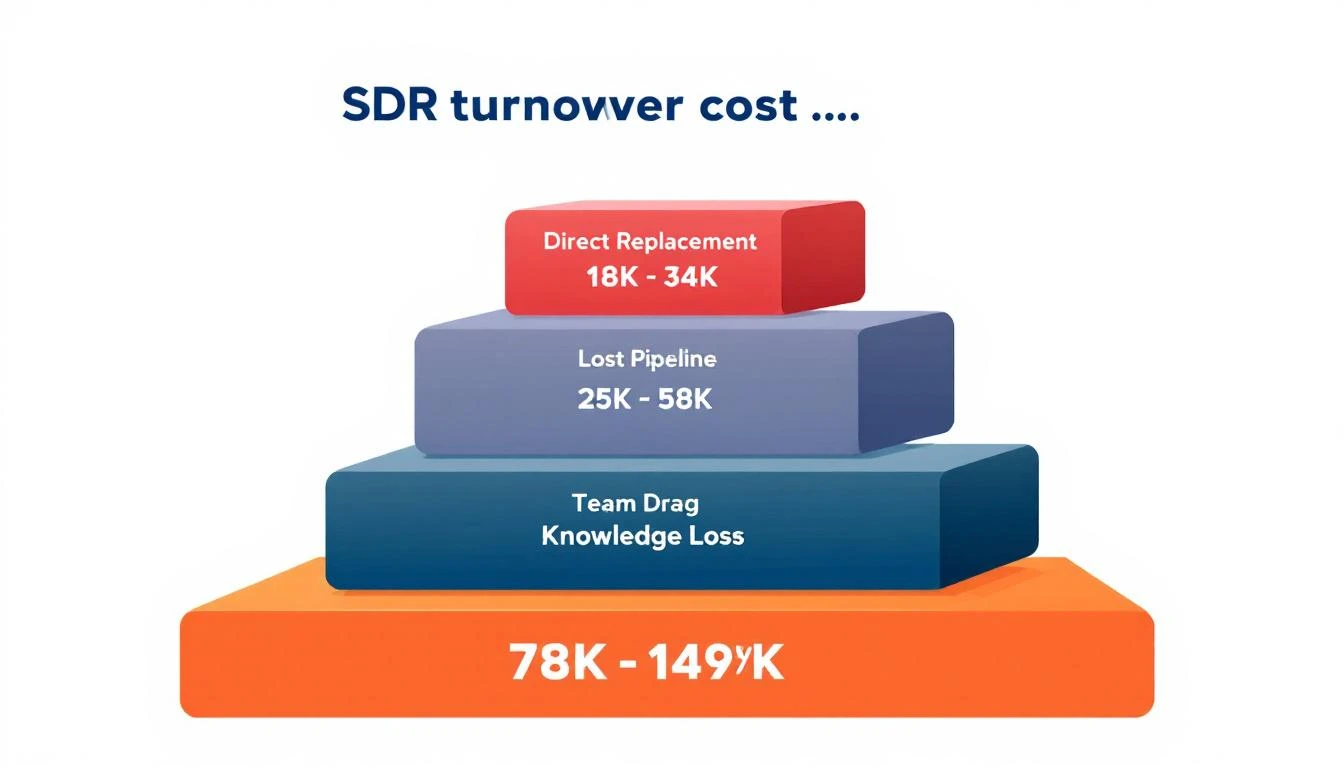
Layer 1: Direct Replacement Costs — $18,500-$32,000
Cost Component
Low Estimate
High Estimate
Recruiting (agency or internal)
$8,000
$15,000
Job posting and sourcing
$500
$2,000
Interview time (managers + team)
$3,000
$5,000
Background check and onboarding admin
$500
$1,000
Training materials and programs
$2,500
$4,000
New hire tech stack setup
$1,000
$2,000
First-month salary (zero productivity)
$3,000
$5,000
Subtotal
$18,500
$34,000
Agency recruiting fees for SDR roles typically run 15-20% of first-year OTE. Internal recruiting isn't free either — when you factor in recruiter salary, hiring manager time, and team interviews, it costs $8K-$12K per hire.
Layer 2: Lost Pipeline During Vacancy — $25,000-$50,000
This is the cost nobody calculates. When an SDR seat is empty:
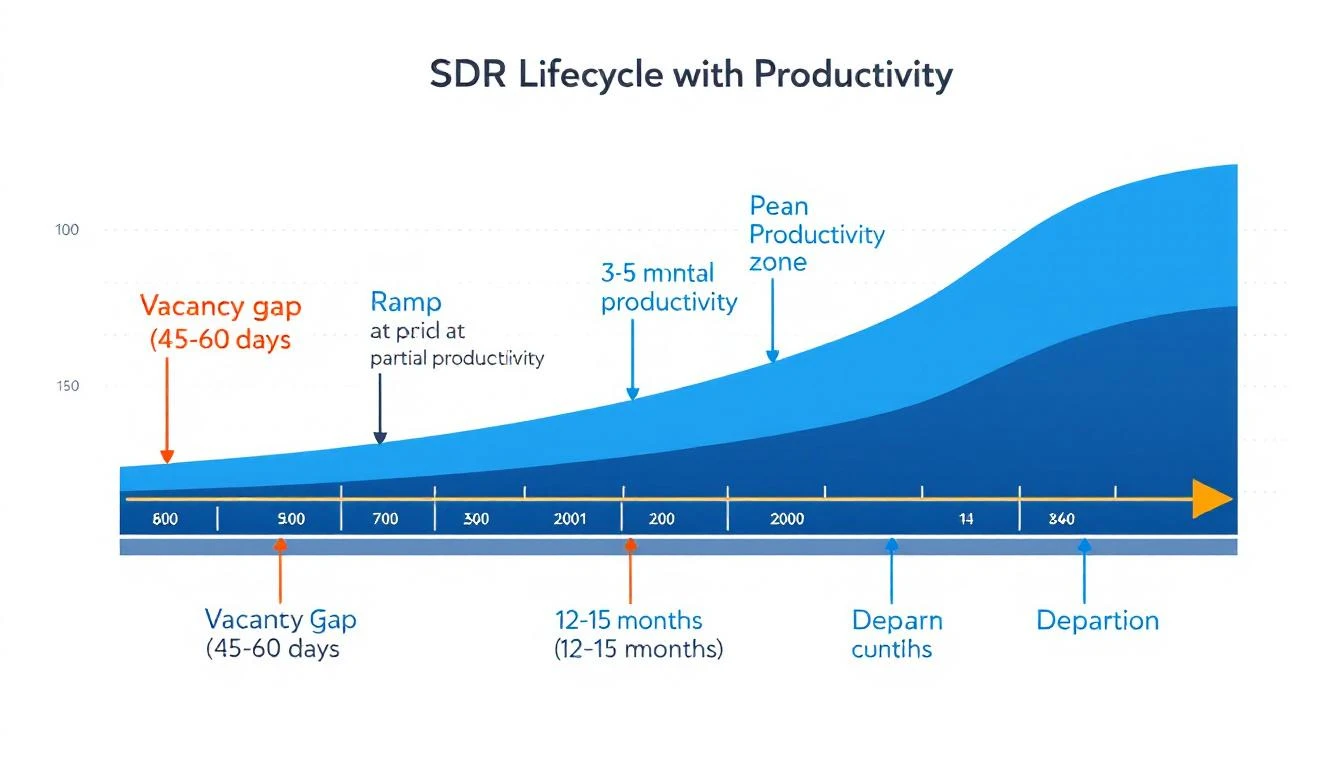
Average vacancy length: 45-60 days (time to hire after notice)
Meetings not booked: 22-30 meetings (15/month x 1.5-2 months)
Pipeline value per meeting: $1,100-$1,700 (based on $22K avg ACV at 5% close rate)
Total lost pipeline: $24,200-$51,000
That's not revenue you "don't get." It's pipeline your competitors win because your territory is uncovered. These deals don't wait for you to backfill the role.
And here's the compounding effect: those 22-30 meetings would have generated second and third touches, referrals, and warm follow-ups over the following months. The downstream impact is 2-3x the immediate pipeline loss.
Layer 3: Ramp Period Productivity Loss — $22,000-$38,000
Your new hire isn't at zero for 3 months, then magically at 100%. The productivity curve looks like this:
Month
Expected Productivity
Meetings vs. Target
Month 1
10-15%
1-2 meetings
Month 2
30-40%
4-6 meetings
Month 3
60-70%
9-10 meetings
Month 4
80-85%
12-13 meetings
Month 5+
90-100%
13-15 meetings
Over the first three months, your new SDR books roughly 15-18 meetings instead of the 45 a fully ramped rep would deliver. That's 27-30 missed meetings, worth $29,700-$51,000 in pipeline.
But you're paying full salary during this period: $16,250-$21,250 for three months of sub-target performance. Some of that salary investment is recovered through the meetings they do book, netting a real cost of $22,000-$38,000.
When an SDR leaves, the remaining team absorbs the impact in three ways:
Manager time drain: Your sales manager spends 15-20 hours on exit logistics, coverage planning, interviewing candidates, and onboarding the replacement. At a $120K manager salary, that's $900-$1,200 in diverted management time.
Buddy system tax: The senior SDR assigned to train the new hire loses 10-15% productivity for 6-8 weeks. That's 6-9 missed meetings worth $6,600-$15,300 in pipeline.
Morale ripple: This is the hardest to quantify, but Bridge Group data shows teams that experience turnover see a 5-8% productivity dip across remaining team members for 4-6 weeks. For a 5-person team losing one rep, that's 8-15 missed meetings across the remaining four.
Layer 5: Institutional Knowledge Loss — $5,000-$12,000
When an SDR leaves, they take with them:
Prospect relationships — warm conversations that go cold
Territory intelligence — which accounts respond to what messaging
Tribal knowledge — workarounds, objection responses, competitive intel that lives in their head
CRM data quality — notes go stale, follow-ups fall through cracks
Even with the best CRM hygiene, we estimate 30-40% of in-flight opportunities degrade or die when the owning rep leaves. For a rep managing 50-100 active prospects, that's 15-40 conversations that restart from scratch.
Wait — that's lower than $150K? Here's the part that pushes it over: the cycle repeats. With average tenure at 16 months, you're doing this calculation again before the replacement's second anniversary.
Annualized over a three-year window with two turnover events (which is statistically likely), the per-seat cost of turnover reaches $157,000-$298,000 — or $52K-$99K per year in perpetual replacement cost, layered on top of salary and tools.
For a 5-person SDR team with industry-average turnover, that's $260K-$500K per year in hidden turnover costs.
What Actually Reduces Turnover (It's Not Ping Pong Tables)
The data points to three levers that meaningfully reduce SDR attrition:
Companies with structured onboarding programs retain reps 82% longer than those without (SalesSo Research). That's not coincidence — reps who feel productive stay. Reps who flounder for 4-5 months finding their footing leave.
The fastest path to ramp? Give reps fewer decisions to make. A daily SDR playbook that tells them exactly who to contact, in what order, through which channel — that's not micromanagement, it's removing the activation energy that drains new reps.
Teams using AI tools ramp 30% faster and their reps are 3.7x more likely to hit quota (SalesSo Research). Not because AI does the work — because it reduces the cognitive load of figuring out what to do next.
SDRs using 5+ tools spend 30-40% of their day context switching between applications. That's not just wasted time — it's the #1 driver of frustration and burnout.
When we analyzed our customer data, teams that consolidated from 5+ point solutions to an integrated platform saw:
40% reduction in ramp time (less tools to learn)
25% increase in daily activity volume (less time switching)
Measurably higher rep satisfaction in quarterly surveys
You can build a full SDR stack for $3,600/rep/year with an all-in-one platform. Compare that to the $6,000-$27,000/rep sprawl stacks we see — and factor in that sprawl drives the burnout that causes turnover.
83.4% of SDRs miss quota. That's not a training problem — it's a targeting problem. Reps cold-calling into the void burn out. Reps reaching out to companies showing active buying signals book meetings and feel successful.
The data is clear: SDRs using intent signals convert at 2-3x the rate of reps doing pure cold outreach. Higher conversion rates mean hitting quota, which means bonuses, which means retention.
SDR turnover isn't a "people problem" you solve with better culture. It's an operations problem with a clear financial model.
Every dollar you spend reducing ramp time, simplifying the tool stack, and improving signal quality pays back 5-10x in avoided turnover costs.
Here's the simple math:
Reducing one departure per year across a 5-person team saves $115K-$195K
That's $9,500-$16,250/month in budget you can reinvest in tools, training, or comp
Or roughly 2-3 additional SDR seats worth of tooling budget
The companies that win in 2026 won't be the ones that hire faster. They'll be the ones whose reps don't leave.
MarketBetter cuts SDR ramp time by replacing 5-7 tools with one platform. Daily playbook, visitor ID, email sequences, smart dialer, and AI chatbot — all in one tab. Your new hire's first day is productive, not overwhelming. See how it works →
Methodology: Cost estimates based on published benchmarks from The Bridge Group (2024-2025), Xactly sales compensation data, SalesSo/SalesHive research reports, Glassdoor salary data, and aggregated customer data from MarketBetter users. Pipeline value calculations assume mid-market B2B (50-500 employees, $10K-$50K ACV). Individual results will vary based on market, role level, and geography.
Selling to school districts is a different beast from selling to enterprise tech companies. And most B2B sales advice — built for SaaS-to-SaaS, startup-to-enterprise motions — is borderline useless for education technology companies navigating the realities of public sector procurement.
Consider what you're dealing with:
13,000+ school districts in the United States, each with its own budget cycle, technology director, and procurement rules
Buying windows measured in fiscal years, not quarters — miss the budget planning season and you're waiting 12 months
Committee decisions where the technology director likes your product but the superintendent controls the budget and the school board has final approval
Geographic territory complexity where your 3 SDRs each own 4,000+ districts across multi-state regions
RFP-driven purchasing that rewards lowest-bid compliance over product-market fit
And yet, despite these unique challenges, most edtech companies still try to sell with the same playbook they'd use for selling CRM software to mid-market companies: cold email blasts, LinkedIn connection requests, and conference booth scanning.
This is the story of how one education technology company — an IoT connectivity platform serving over 1,400 school districts nationwide — rebuilt their entire sales motion around buying signals instead of cold outreach. The result: 3x demo volume without adding a single SDR.
I've watched SDR teams lose winnable deals for a decade. And the number one killer isn't bad messaging, weak value props, or even the wrong ICP. It's time.
Specifically, it's the 47 minutes — on average — between when an inbound lead fills out a form and when a human being actually responds. In those 47 minutes, that lead has already opened three competitor tabs, re-read a G2 comparison, and started to forget why they were excited about you in the first place.
We all know the data. Harvard Business Review published the speed-to-lead research years ago: companies that respond within five minutes are 100x more likely to connect than those that wait 30. And yet, the average B2B company still takes over 40 minutes.
Why? Because between "lead fills out form" and "rep picks up phone," there's a broken chain of manual steps, routing logic, and round-robin roulette that nobody has fixed.
Here's a stat that should make every VP of Sales uncomfortable: roughly 40% of inbound leads never get a meaningful first response. Not "never close" — never get responded to properly.
Some get lost in CRM assignment queues. Some get routed to reps who are on PTO. Some hit a round-robin and land on a rep who already has 15 open opportunities and isn't checking their new lead notifications. Some arrive at 4:47 PM on a Friday and by Monday, they're ghosts.
This isn't a people problem. Your SDRs aren't lazy. Your ops team isn't incompetent. The system is broken.
Here's what the typical inbound flow looks like at most B2B companies:
Lead fills out a form
Marketing automation assigns a lead score (maybe)
Lead gets pushed to CRM
CRM assignment rules fire (round-robin, territory, whatever)
Assigned rep gets a notification
Rep checks their queue 2-3 hours later
Rep researches the lead manually
Rep tries to qualify via email or phone
Maybe — maybe — a meeting gets booked
That's nine steps. Nine failure points. Nine places where a perfectly good lead can fall through the cracks.
The median time from step 1 to step 9? Three to five days, if you're being honest. And by then, the lead is cold, distracted, or has already talked to your competitor who got there first.
If you're still running legacy lead routing processes, you're fighting a battle that was lost before your reps even knew it started.
MarketBetter's Smart Scheduler does something deceptively simple: it compresses those nine steps into one continuous flow that takes seconds, not days.
Here's the waterfall:
Lead arrives → AI qualifies in real-time → CRM lookup matches company to existing owner → Meeting books directly on the right rep's calendar
The moment a lead submits any form — demo request, content download, chatbot interaction — AI evaluates the submission against your qualification criteria. Not a static lead score. Not a threshold number somebody set six months ago and forgot about. Actual, contextual qualification.
Does this person match your ICP? Is their company in your target segment? Is the signal strong enough to warrant immediate action?
This happens in seconds, not hours. No human queue. No waiting for an SDR to manually research the company on LinkedIn. The lead gets qualified while they're still looking at your thank-you page.
Step 2: CRM Owner Lookup — The Most Underrated Feature in Sales Tech
Here's where Smart Scheduler does something that almost no other scheduling or routing tool gets right: CRM owner matching.
When a new inbound lead arrives, the system checks your CRM — whether that's HubSpot or Salesforce — to see if that lead's company already has an assigned owner. If Sarah owns the Acme Corp account because she's been working that deal for three months, the new lead from Acme Corp goes to Sarah. Period.
This sounds obvious. It is not.
Most round-robin systems treat every inbound lead as a net-new contact and distribute them randomly. That means a new contact from an account that already has an active opportunity might get assigned to a completely different rep. The new rep doesn't know the account history. The existing rep doesn't know someone else from their account just raised their hand. The prospect ends up confused, getting outreach from two different people at the same company.
I've seen this happen at companies doing $50M+ in revenue. It's more common than anyone admits.
CRM owner lookup eliminates this entirely. If the company exists in your CRM with an owner, the inbound lead goes to that owner. It's account-level routing, not contact-level routing. And it works across both HubSpot and Salesforce, which matters because CRM migration is messy and plenty of companies are running hybrid setups during transition periods.
What about truly net-new leads — companies that don't exist in your CRM yet? That's where configurable routing rules take over.
Smart Scheduler doesn't just default to basic round-robin. You can configure routing based on:
Territory: Geographic or vertical-based assignment
Round-robin: Equal distribution across available reps
Capacity: Weighted by current pipeline load
Specialization: Route based on product interest, company size, or use case
The key word is configurable. Every sales org is different. Some have strict territory models. Some run pods. Some have different teams for inbound vs. outbound. Smart Scheduler adapts to your model rather than forcing you into a one-size-fits-all distribution.
This is the part that changes everything. Once the lead is qualified and routed to the right rep, the meeting booking happens immediately. The lead sees the rep's calendar and can book a time — right then, while they're still engaged, while the intent is still hot.
No "someone will reach out within 24 hours." No "check your email for scheduling options." No five-email back-and-forth to find a time that works.
The lead goes from form fill to booked meeting in one unbroken flow. That's the speed-to-lead advantage that every sales org claims to want but almost none actually achieve.
Let me spend a minute on why traditional round-robin routing is so destructive, because most sales leaders underestimate this.
Round-robin assumes all leads are equal and all reps are interchangeable. Both assumptions are wrong.
Not all leads are equal. An inbound demo request from a VP at a 500-person company in your target vertical is worth dramatically more than a content download from a student. Treating them the same — distributing both through the same round-robin queue — means your best leads get the same treatment as your weakest ones.
Not all reps are interchangeable. Some reps specialize in enterprise. Some crush it in the mid-market. Some know a specific vertical cold. Round-robin ignores all of this. It's the scheduling equivalent of random assignment in a world where pattern matching drives conversion.
And then there's the account ownership problem I mentioned earlier. Round-robin actively works against account-based selling strategies. If you're investing in ABM, if you're building account plans, if you're trying to create unified experiences for buying committees — and then your inbound routing randomly assigns new contacts to different reps — you're undermining your own strategy.
Smart Scheduler's CRM owner matching is designed specifically to prevent this. It respects your existing account relationships and only falls back to configurable rules for genuinely new accounts.
The average B2B deal now involves 11+ stakeholders. That means multiple people from the same company will hit your website and fill out forms at different times. If each one gets round-robined to a different rep, you're creating chaos instead of coherence. CRM owner matching ensures every touchpoint from the same account flows to the same rep — building a complete picture instead of fragmented conversations.
Competitors are deploying AI chatbots and AI-powered qualification tools that respond instantly. If your competitors are booking meetings in 30 seconds and you're booking them in 30 hours, you're not competing. You're spectating. Smart Scheduler puts you at parity — or ahead — by automating the qualification-to-booking pipeline end to end.
Inbound Volume Is Increasing, But Quality Is Noisy
With more content, more ads, and more channels driving traffic, SDR teams are dealing with higher inbound volume but more noise. AI qualification acts as a real-time filter, ensuring reps spend their time on leads that actually match your ICP rather than manually triaging a queue that's 60% unqualified.
Most people focus on speed-to-lead when they think about scheduling automation. And speed matters — that 5-minute response window is real.
But the bigger ROI is accuracy. Getting the lead to the right rep, not just a fast rep.
When a lead gets routed to the rep who already owns that account, conversion rates jump — not by 10 or 20 percent, but often by 2-3x. Why? Because that rep already knows the company's pain points, their tech stack, their buying process, their internal champions. They don't need 20 minutes of discovery to get up to speed. They can have a relevant, intelligent conversation from minute one.
This is the difference between "I saw you filled out a demo request, tell me about your business" and "Hey, I've been working with your team on the deployment project — saw you wanted to discuss the new use case, let's dive in."
One of those sounds like a vendor. The other sounds like a partner. The difference is routing accuracy.
Not every lead will book a meeting immediately, even with a frictionless scheduling flow. Some people prefer email. Some want to do more research first. Some fill out forms on mobile and plan to follow up later.
Smart Scheduler accounts for this. Leads that are qualified but don't book in the initial flow get assigned to the matched rep (or the appropriate fallback rep) with full context about the lead's qualification profile. The rep can then follow up via email, phone, or personalized outreach — but they're following up with a warm, pre-qualified lead, not starting from scratch.
The system doesn't treat unboooked-but-qualified leads as failures. They're opportunities in motion, and the rep who gets them has all the context they need to convert.
Here's how the complete flow works for every single inbound lead:
1. Lead Arrives
Form submission, chatbot interaction, or scheduling request triggers the workflow.
2. AI Qualification
Real-time evaluation against your ICP criteria, qualification rules, and engagement signals. Qualified leads proceed; unqualified leads get appropriate nurture treatment.
3. CRM Owner Lookup
The system checks HubSpot or Salesforce for an existing company match. If the lead's company has a CRM owner, that owner is the routing target.
4. Owner Match → Direct Booking
Lead sees the account owner's calendar and can book immediately. No round-robin, no queue, no delay.
5. No Owner → Configurable Routing
For net-new companies, routing rules fire based on your configuration — territory, round-robin, capacity, specialization, or any combination.
6. Meeting Confirmed
Calendar invite sent, CRM updated, rep notified with full lead context. The entire process completes in seconds.
Every step is automated. Every step happens in real-time. Every step is designed to ensure that no qualified lead ever waits in a queue wondering if anyone's going to call them back.
The hard truth is that most B2B companies are losing 30-40% of their inbound pipeline to slow response times and wrong rep assignment. That's not a marketing problem. That's not a demand gen problem. That's a plumbing problem.
Smart Scheduler fixes the plumbing.
If you want to see what your inbound conversion rates look like when every lead gets qualified in seconds, routed to the right rep, and given a frictionless path to booking — it's worth seeing it in action.
Because in the time it took you to read this post, someone at your company probably lost a lead.
Adam Grant leads GTM at MarketBetter, where he helps B2B sales teams turn inbound intent into booked meetings — without the manual triage that kills conversion rates.
Big week at MarketBetter. The team shipped a stack of updates that make your day-to-day workflow faster and give you more control over your pipeline — without ever leaving the platform.
We rebuilt the meeting routing experience from the ground up.
What changed:
Previously, setting up meeting routing meant configuring abstract rules in a list. Now you'll see a clear, visual two-step waterfall flow that makes it obvious exactly how leads get routed:
Step 1: CRM Account Owner — When a lead comes in, MarketBetter checks your CRM for an existing account owner. If there's a match, the meeting goes directly to the right rep.
Step 2: Unmatched Leads — Leads without a CRM match get distributed via round robin or routed to a specific fallback rep.
The entire UI uses generic "CRM" terminology now, because this brings us to the biggest improvement:
Smart Scheduler now works with both Salesforce and HubSpot. If you're connected to either CRM (or both), the system automatically detects your integration and routes leads through the right one. No configuration needed — it just works.
For teams on HubSpot, this means you finally get the same intelligent owner-based routing that Salesforce users have had.
Also new: You can't accidentally activate Smart Scheduler with an empty SDR pool anymore. The toggle stays disabled until you add at least one rep, with a clear warning explaining why.
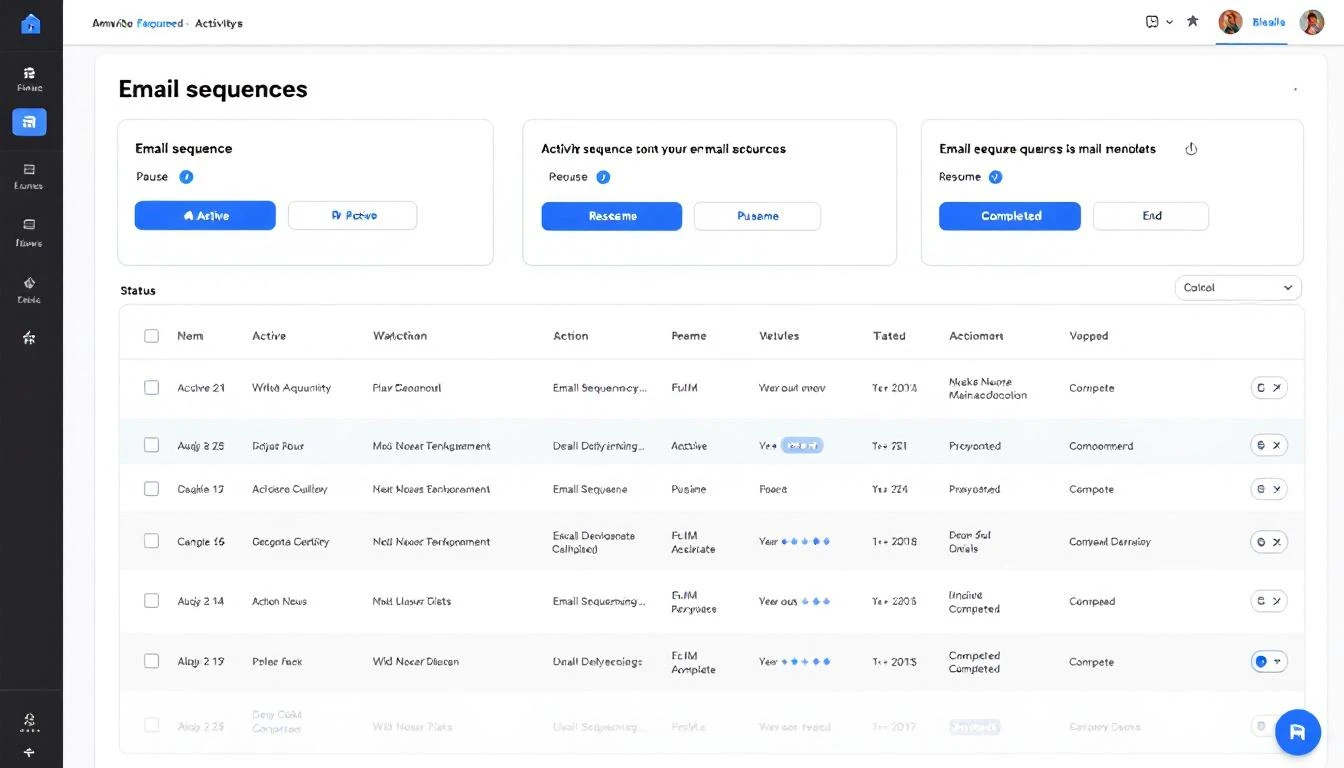
Pause, Resume & End Sequences — Right From Activity
Your Activity page just became a lot more powerful.
Every lead in your Activity feed now shows its current sequence status — Active, Paused, Ended, or Completed — with a colored badge so you can scan at a glance.
More importantly, you can now take action directly from the Activity page:
Pause a running sequence to temporarily stop outreach
Resume a paused sequence to pick back up where you left off
End a sequence entirely (with a confirmation dialog, so you don't accidentally kill a live campaign)
No more digging through separate sequence management screens. See a lead's engagement dropping? Pause the sequence right there. Ready to re-engage? Resume with one click.
Running out of AI credits mid-campaign is the kind of thing that quietly kills pipeline. Now you can set it and forget it.
How it works:
Go to Settings → Billing & Usage
Under AI Credits, toggle on Auto-Recharge
Set your recharge threshold (e.g., when balance drops below 500K credits)
Pick a package size (small, medium, or large)
When your balance hits the threshold, MarketBetter automatically charges your card and tops up your credits. You'll get an email notification every time it fires. Same flow you already know from enrichment credit auto-recharge — now available for AI credits too.
When you try to enable a team member and you're at your seat limit, instead of getting an error, you'll see an "Add Seat ($99/mo)" dialog. Click confirm, complete the Stripe checkout, and your new seat is immediately available. No back-and-forth with support, no waiting.
The billing page also now shows a clear seat counter (e.g., 3/5 seats used) so you always know where you stand.
New workspaces are now tied to your email domain. One domain, one workspace — no more accidental duplicate accounts or unauthorized joins.
Self-service "join workspace" links have been retired. Team members are now added by workspace admins only, giving you full control over who has access.
We upgraded our email validation engine under the hood. What this means for you: more accurate bounce prediction and better deliverability scores across your outreach sequences. Fewer emails hitting dead inboxes means higher sender reputation and more replies landing where they should.
One small rename: Outreach in your settings menu is now Channels. Same settings, clearer name — because your outreach spans email, dialer, chat, and more. The label should reflect that.
We're deep into the next batch of improvements — smarter dialer workflows, expanded analytics, and tighter credit controls for enterprise teams. More soon.
There's a new GitHub repo making the rounds on LinkedIn. Sixty-seven Claude Code plugins. Ninety-two AI agents. Covers everything from cold-email-sequence generation to churn prediction to ABM campaign orchestration. It's called GTM Agents, and if you read the README, you'd think the entire SDR function just got automated overnight.
I've spent the last week pulling apart repos like this — and I have a contrarian take that's going to annoy a lot of the "AI will replace salespeople" crowd:
Open source GTM agents won't replace your SDR platform. Not this year. Probably not next year either.
Let me paint the picture these repos sell. You clone a repo, plug in your API keys, write a prompt like "find me 50 Series B fintech companies in the Midwest with 100-200 employees who recently hired a VP of Sales," and boom — a list materializes. Maybe it even drafts personalized cold emails for each one.
Impressive demo. Terrible GTM motion.
Here's what that workflow is actually doing: it's querying an LLM with some structured prompts, maybe hitting a public API or two, and returning text. That's it. There's no verification that those companies exist as described. There's no signal that any of them are in-market right now. There's no check on whether the emails it generated will actually land in an inbox instead of a spam folder.
You've got a list. Congratulations. You also had a list when you bought a CSV from ZoomInfo in 2019. The list was never the hard part.
When I audit these open source GTM agent repos — and I've looked at several dozen at this point — they all share the same blind spots. Every single one is missing at least four critical layers that separate "AI-generated list" from "revenue pipeline."
The entire premise of modern outbound is timing. You reach out when someone is actively researching your category, not when your AI randomly decides they match an ICP filter.
Open source agents don't have access to intent signals. They can't tell you that a prospect visited your pricing page yesterday, or that their company just started evaluating competitors, or that a champion from a closed-lost deal just changed jobs to a new target account.
Without signals, you're back to spray-and-pray with better grammar. The AI writes a prettier email, but you're still guessing on timing.
Here's a specific capability that matters enormously and doesn't exist in any prompt-based agent: identifying the anonymous visitors on your website.
When someone from Acme Corp lands on your product page, reads three case studies, and checks your pricing — that's the highest-intent signal in B2B. But to capture it, you need pixel-level visitor identification infrastructure. JavaScript snippets. IP-to-company resolution. Cookie management. Privacy compliance frameworks.
No LLM prompt does this. No agent framework does this. This is infrastructure, not intelligence.
This is where the "generate 1,000 cold emails" repos get genuinely dangerous.
Email deliverability is a system. It involves domain warmup schedules, sender rotation across multiple domains, SPF/DKIM/DMARC authentication, bounce management, reputation monitoring, throttling to stay under ESP rate limits, and constant adjustment based on inbox placement rates.
An AI agent that generates emails without this infrastructure is like a race car engine without a chassis. You've got power with no way to use it. Worse — if you actually send those AI-generated emails through a half-configured outbound setup, you'll burn your domain reputation in weeks. And once your domain is blacklisted, you're not getting it back easily.
Phone is still the highest-conversion outbound channel in B2B. The data on this is unambiguous: multi-channel sequences that include phone connect at 2-3x the rate of email-only sequences.
Open source GTM agents are entirely text-based. No parallel dialing. No local presence numbers. No voicemail drop. No call recording, transcription, or AI-powered coaching. No integration with your CRM that logs the call, updates the contact record, and triggers the next sequence step.
The phone gap alone is disqualifying for any serious SDR operation.
Here's the deeper issue. These repos conflate intelligence with infrastructure.
An LLM is intelligence. It can analyze an ICP, draft messaging, score leads against criteria, even suggest which accounts to prioritize. That's valuable! I'm not saying the AI layer is useless.
But GTM execution requires infrastructure:
Data pipes that ingest signals from website visitors, CRM updates, job changes, technographic shifts, and funding events in real time
Orchestration engines that sequence multi-channel touches across email, phone, LinkedIn, and direct mail with proper cadence and rules
Deliverability systems that protect your sender reputation while maximizing reach
Analytics platforms that track attribution from first touch to closed-won revenue
Intelligence without infrastructure is a thought experiment. Infrastructure without intelligence is 2020-era sales tech. You need both.
I don't want to be purely negative. There are areas where these AI agent frameworks genuinely add value — just not as standalone SDR replacements.
ICP refinement. Pointing an LLM at your closed-won data and asking it to find patterns is legitimately useful. It'll surface segments and firmographic patterns that humans miss.
Message testing. Generating 20 variations of a cold email and A/B testing them at scale is a great use of AI. Just make sure you've got the deliverability infrastructure to actually run those tests.
Pipeline analysis. The "pipeline-health-check" agents that review your CRM data and flag stale deals, coverage gaps, or velocity anomalies? Genuinely helpful. These are analytical tasks that LLMs handle well.
Content generation. Blog posts, case studies, competitive battle cards, objection handling guides — AI is a force multiplier here. No infrastructure dependency, just raw intelligence applied to content.
The pattern: AI agents excel at thinking tasks and fail at doing tasks that require real-world infrastructure.
What Actually Works: Intelligence + Infrastructure
The teams I see crushing outbound in 2026 aren't choosing between AI agents and SDR platforms. They're using platforms that bake intelligence into infrastructure.
That means a system where visitor identification happens automatically, intent signals flow into a prioritized daily playbook, AI drafts personalized outreach based on real behavioral data (not hallucinated firmographics), and the whole thing executes through deliverability-safe email infrastructure and an integrated dialer.
This is what platforms like MarketBetter are built around — the full stack from signal capture to execution, with AI woven through every layer rather than bolted on top as a prompt.
The distinction matters because the value of AI in GTM isn't the AI itself. It's the AI applied to real data and connected to real execution channels. A brilliant AI with no data and no channels is a demo. A mediocre AI with great data and reliable channels is a pipeline machine.
One more thing worth addressing: the appeal of these repos is partly that they're free. Open source. Clone and go.
But "free" in GTM tooling is a misnomer. The costs are hidden:
API costs. Running 92 AI agents against production LLM APIs gets expensive fast. Claude, GPT-4, Gemini — none of these are free at scale.
Data costs. The agents need data to query. Enrichment APIs, intent data feeds, contact databases — all paid.
Engineering time. Someone has to integrate these agents into your actual workflow. Connect them to your CRM. Build the glue code. Maintain it when APIs change.
Opportunity cost. Every hour your team spends wiring together open source agents is an hour they're not selling.
When you add it all up, "free" open source agents often cost more than a purpose-built platform — and deliver less, because you're building the infrastructure yourself.
Open source GTM agents are a fascinating development. They represent the bleeding edge of what's possible when you point large language models at sales and marketing workflows. I'm genuinely excited about the innovation happening in this space.
But excitement and production readiness are different things.
If you're a developer who wants to experiment with AI-driven prospecting, these repos are a playground. If you're a revenue leader who needs to hit quota, they're a distraction.
The future of GTM isn't AI agents OR infrastructure. It's AI agents WITH infrastructure. And right now, the infrastructure side is where the actual value — and the actual competitive moat — lives.
Stop chasing clever prompts. Start investing in the pipes that make those prompts useful.
Want to see what signal-based selling looks like when the AI layer and infrastructure layer work together? Check out MarketBetter — real-time visitor ID, intent signals, AI playbook, smart dialer, and deliverability-safe email in one platform.