
The Inbound Triage Tier System: How SDR Teams Hit 5-Minute Response Without Calling Every Lead [2026]

Every SDR leader has heard the rule: respond to inbound leads in under 5 minutes or you lose them. The MIT study on lead response times is gospel — 21x more qualification, 78% of buyers go with whoever responds first.
So teams chase 5-minute SLAs on every lead. They route everything to a human. They build dashboards that turn red when a form sits for 6 minutes.
And then their best SDRs quit, because they're spending half their day calling people who downloaded a whitepaper out of curiosity.
The 5-minute rule is real. The way most teams implement it is broken.
This playbook is the fix: a 4-tier triage system that gets you to 5-minute response on the leads that matter, automates the middle, and stops your reps from hand-dialing tire-kickers. Built from the signal quality data we've been writing about all year and the daily SDR playbook we run internally.
The Problem With "5 Minutes On Every Lead"
A typical mid-market B2B funnel looks like this in a given week:
- 12 demo requests (high intent, ready-to-buy signal)
- 40 content downloads (mixed intent — some buyers, some researchers)
- 60 newsletter subscriptions (low intent, mostly tire-kickers)
- 200 pricing page visits with no form fill (variable intent — depends on company)
That's 312 "leads" hitting your funnel. If you apply a uniform 5-minute SLA to all of them, you need roughly 4-5 SDRs working full-time just to handle inbound. Most teams have 2-3.
So what actually happens? Two failure modes:
- The SDR team picks favorites. They prioritize demos and ignore everything else. Half the funnel goes dark for 48 hours. Plenty of pipeline-worthy signals get missed.
- The SDR team tries to do everything. They call newsletter subscribers at 2 PM on a Tuesday, get hung up on, and eventually start treating every inbound lead as a low-priority chore. Quality of outreach collapses across the board.
The fix isn't more SDRs. It's better triage.
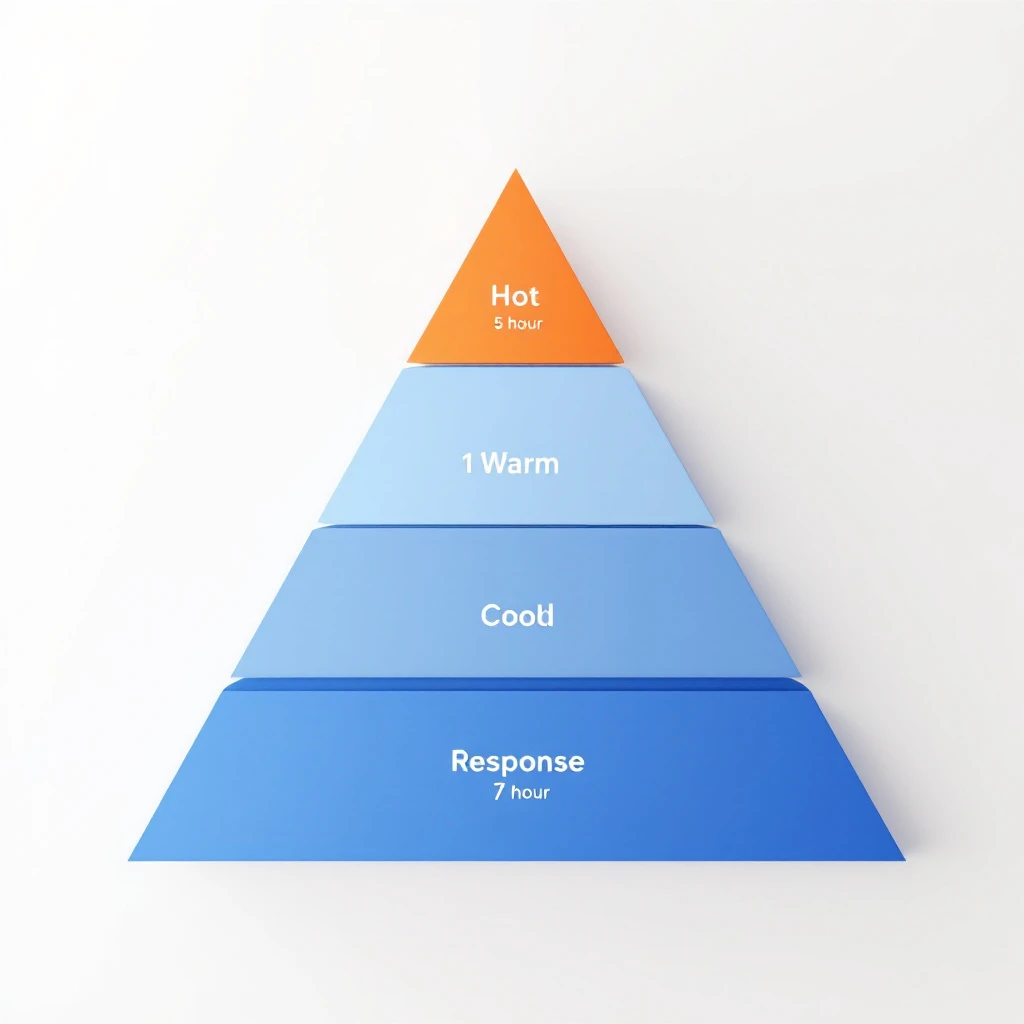
The 4-Tier Triage System
Treat inbound the way an ER treats patients. Not first-come-first-served — most acute first, with response times calibrated to the urgency of the signal.
| Tier | Signal Examples | Response SLA | Handler | Channel |
|---|---|---|---|---|
| Tier 1 — Hot | Demo request, pricing page visit + ICP match, "talk to sales" | 5 minutes | Human SDR | Phone + email + LinkedIn |
| Tier 2 — Warm | Content download + ICP fit, repeat visitor with intent pages, webinar attendee | 1 hour | AI agent drafts, human approves | Email + LinkedIn |
| Tier 3 — Cool | Single content download, non-ICP form fill, light intent | 24 hours | Automated sequence | Email only |
| Tier 4 — Cold | Newsletter signup, blog comment, anonymous traffic | 7 days or nurture | Marketing automation | Email nurture |
The point isn't the exact response times — those depend on your ACV and sales cycle. The point is that the same SLA cannot apply to every lead. Signal intensity determines speed. Speed determines headcount allocation.
What Goes Into Each Tier
Tier 1 — Hot (5-minute response, human)
These are the only leads where the 5-minute rule literally applies. Characteristics:
- Explicit purchase intent (demo, sales, pricing inquiry)
- ICP match (right industry, right size, right title)
- Recent on-site behavior showing active evaluation
For a mid-market B2B company, this is usually 3-8% of total inbound volume. It is by far the highest-converting bucket. Every minute of delay here is measurable pipeline lost. This is where you spend your speed budget.
Tier 2 — Warm (1-hour response, AI-assisted)
These leads are evaluating, but haven't asked to talk yet. They downloaded the buyer's guide. They came back to your site twice this week. They attended your webinar and stayed for the Q&A.
The mistake here is treating Tier 2 like Tier 1. A 5-minute call to someone who just downloaded a PDF feels stalker-ish and converts worse than a thoughtful email 45 minutes later.
The right pattern: an AI agent drafts a personalized email referencing the content they consumed and their company context. An SDR scans the draft, edits if needed, and sends. The whole loop takes 90 seconds of human time. Response goes out within an hour while the topic is fresh.
This is the workflow we walked through in Visitor ID to First Outreach in 30 Minutes — same logic applies to any Tier 2 signal.
Tier 3 — Cool (24-hour response, automated)
Low-intensity signals. Single content downloads, non-ICP form fills, leads from outside your serviceable territory. These go into an automated sequence — 3 to 5 emails over 2-3 weeks, designed to either escalate them up the tier system (by triggering a Tier 1 or 2 signal) or filter them out.
No human SDR time spent. Period. If they raise their hand later, they move up the tier system and get re-routed.
Tier 4 — Cold (nurture)
Newsletter signups, blog readers, anonymous traffic, top-of-funnel content engagement. Marketing automation handles this entirely. They are not yet leads — they are subscribers. Treat them accordingly. They escalate into Tier 3 or higher only when behavior signals it.
The Routing Logic (How Leads Move Between Tiers)
Static tier assignment is brittle. Real lead behavior is dynamic — a newsletter subscriber today might be a demo request next week. The system has to move them.
Three routing rules govern movement:
- Up-tier on intent escalation. Any Tier 2-4 lead that submits a higher-intent action (pricing visit, demo request, "contact sales" click) jumps immediately to Tier 1. The clock restarts.
- Down-tier on disengagement. Any Tier 1-2 lead that goes silent through three touches drops one tier. This frees SDR capacity for fresher signals.
- Re-rank weekly. Pull the full active-lead list every Monday. Re-score against the tier criteria. Reroute anyone whose behavior has shifted.
Most teams skip rule 3 and end up with a queue full of dead Tier 1 leads. Re-ranking is the maintenance pass that keeps the system honest.
This is the same intent-tier logic we used in the signal-based SDR routing post — applied to inbound instead of outbound.
How To Automate Tiers 2 and 3 (Without Sounding Like a Bot)
The tier system is only useful if Tier 2 and 3 don't need human attention. Here is the workflow that makes that real.
For Tier 2 (AI-drafted, human-approved)
- Signal detected. Content download, repeat visit, webinar attendance — whatever your trigger is.
- Enrichment fires. Company data, role data, recent on-site behavior, mutual connections, news mentions in the last 90 days.
- AI drafts the response. A short email referencing the specific content consumed, the company context, and one specific reason your platform fits their stack. Includes a soft CTA — "happy to share how others at companies like yours used this — open to a 15-min call next week?"
- SDR reviews draft. Should take 30-90 seconds. Approve, edit, or skip.
- Send + log. Goes into the SDR's sent folder so the next touch is from them, not a generic inbox.
The pattern we covered in From Buying Signal to Booked Meeting in 24 Hours is the template here — same enrichment, same drafting loop, different SLA.
For Tier 3 (Fully automated)
- Signal detected. Low-intensity action.
- Sequence enrolled. Lead enters a 4-touch sequence calibrated to the content they engaged with. Touch 1 references the asset. Touch 2 (4 days later) shares a related case study. Touch 3 (10 days) offers a soft CTA. Touch 4 (21 days) is a breakup email.
- Behavior monitored. Any open, click, or site revisit that crosses a threshold up-tiers them. They get pulled from the sequence and routed accordingly.
- Quiet exits. No re-engagement after 4 touches? They drop to Tier 4 and join the newsletter nurture.
The risk in Tier 3 automation is sounding generic. Avoid it by enriching the sequence with company-specific lines from public sources — recent news, hiring activity, tech stack changes. Two or three concrete references per email is enough to feel human.
Why This Matters (The Capacity Math)
Run the numbers for a typical mid-market SaaS team:
- 312 weekly inbound leads
- 4% Tier 1 = 12 leads → 1 hour of SDR time each = 12 hours of focused work
- 18% Tier 2 = 56 leads → 2 minutes of SDR review each = ~2 hours total
- 38% Tier 3 = 119 leads → 0 SDR time (fully automated)
- 40% Tier 4 = 125 leads → 0 SDR time (marketing nurture)
Total SDR inbound load: ~14 hours/week. One SDR can handle the inbound queue with time left over for outbound. Without the tier system, the same 312 leads require 3-4 SDRs and still produces worse outcomes — because the Tier 1 leads get the same treatment as the newsletter subscribers, and nothing gets the attention it deserves.
That's the unlock. Not faster response on everything. Faster response on the leads that pay back the speed.
Common Failure Modes
A few patterns I've seen kill tier systems even when they're well-designed:
1. Tier 1 over-population. Sales leaders push to flag more leads as Tier 1 because it feels like progress. Within a quarter, 25% of leads are "hot" and SDRs are back to chasing volume. Fix: gate Tier 1 promotion on hard signals only, not gut feel.
2. No re-ranking. The Monday re-score pass falls off when the team gets busy. Within a month, the active queue is full of stale Tier 1 leads that should have been demoted. Fix: automate the re-rank. Make it a system event, not a calendar reminder.
3. Tier 2 drafts that read like spam. AI drafts without enrichment produce form-letter outreach. The whole point of Tier 2 is human-quality response at machine speed. Without enrichment, you've just built a slow spam cannon. Fix: invest in the enrichment layer first, then turn on drafting.
4. Routing without a CRM source of truth. If the tier lives in a spreadsheet, it dies in a spreadsheet. The tier must be a field on the lead record that every system reads from. Fix: pick one system of record and make tier a first-class field there.
The Tooling Layer
You can run this system manually if your volume is small. Past about 50 weekly inbound leads, you need automation. The capability set you need:
- Visitor identification — who is on your site, even without a form fill
- Real-time enrichment — company + person data within seconds of trigger
- Intent scoring — assigns a tier based on signal combinations
- AI drafting with context — pulls enrichment + content history into the draft
- Routing engine — sends Tier 1 to humans, Tier 2 to drafts, Tier 3 to sequences, all automatically
- Behavior-based re-tiering — moves leads between tiers based on action
Several tools cover parts of this. Best lead routing software in 2026 and the ChiliPiper alternative breakdown both go deeper. Most teams stitch together 3-5 tools — visitor ID, enrichment, MAP, AI assistant, scheduler.
This is what MarketBetter consolidates. We don't just identify the visitor and score the signal — we draft the response, route to the right rep, and tell them exactly what to do next. The difference between knowing who's hot and acting on it in under an hour is the whole game.
The 30-Day Rollout
If you're starting from a flat 5-minute-everything SLA, here's the migration:
- Week 1: Define your tier criteria. Pull last 90 days of inbound. Manually classify into 4 tiers. Confirm the distribution feels right.
- Week 2: Set up Tier 3 automation. Build the 4-touch sequence. Stop manually responding to single-content-download leads.
- Week 3: Set up Tier 2 enrichment + AI drafting. Pilot with one SDR. Measure response quality.
- Week 4: Roll Tier 2 to the team. Establish the Monday re-rank pass. Lock in Tier 1 as the only human-priority queue.
By day 30, your SDRs should be spending 70% of their inbound time on Tier 1 and Tier 2 reviews. The previous 70% — the busywork on Tier 3 and 4 — is now automated.
The Bottom Line
The 5-minute rule isn't wrong. It's just narrowly true. It applies to hot, ICP-fit, ready-to-buy leads — and almost nobody else.
Build the tier system. Reserve speed for the leads that pay it back. Automate the rest. Your SDRs get their best hours back, your hot leads get the response time the data says they need, and the leads who weren't going to buy this quarter don't burn capacity that should have closed deals.
The teams winning inbound in 2026 aren't the fastest on everything. They're the most disciplined about what deserves speed and what doesn't.
Want to see how MarketBetter automates Tier 1 and Tier 2 inbound response — including visitor ID, AI drafting, and routing? Book a demo.
Related reading:
- Speed to Lead Guide — the underlying research
- Signal Quality vs Speed — why speed alone loses deals
- Visitor ID to First Outreach in 30 Minutes — the Tier 2 workflow
- Signal to Meeting in 24 Hours — the Tier 1 workflow
- Daily SDR Playbook — how this fits into the rep's day
- Signal-Based SDR Routing — outbound tier routing
- Best Lead Routing Software in 2026 — the tooling landscape