20 posts tagged with "SDR productivity"

View All Tags

What If You Could Run Your Entire Sales Stack From One Search Bar? [2026]

Β· 10 min read
sunder
Founder, marketbetter.ai

Open your laptop. Launch your CRM. Switch to your email platform. Pull up LinkedIn in another tab. Fire up your dialer. Open your enrichment tool. Check your intent data dashboard. Flip to Slack. Back to CRM to log the note.

That's not a workflow. That's a scavenger hunt.

And it's how the average SDR starts every single morning.
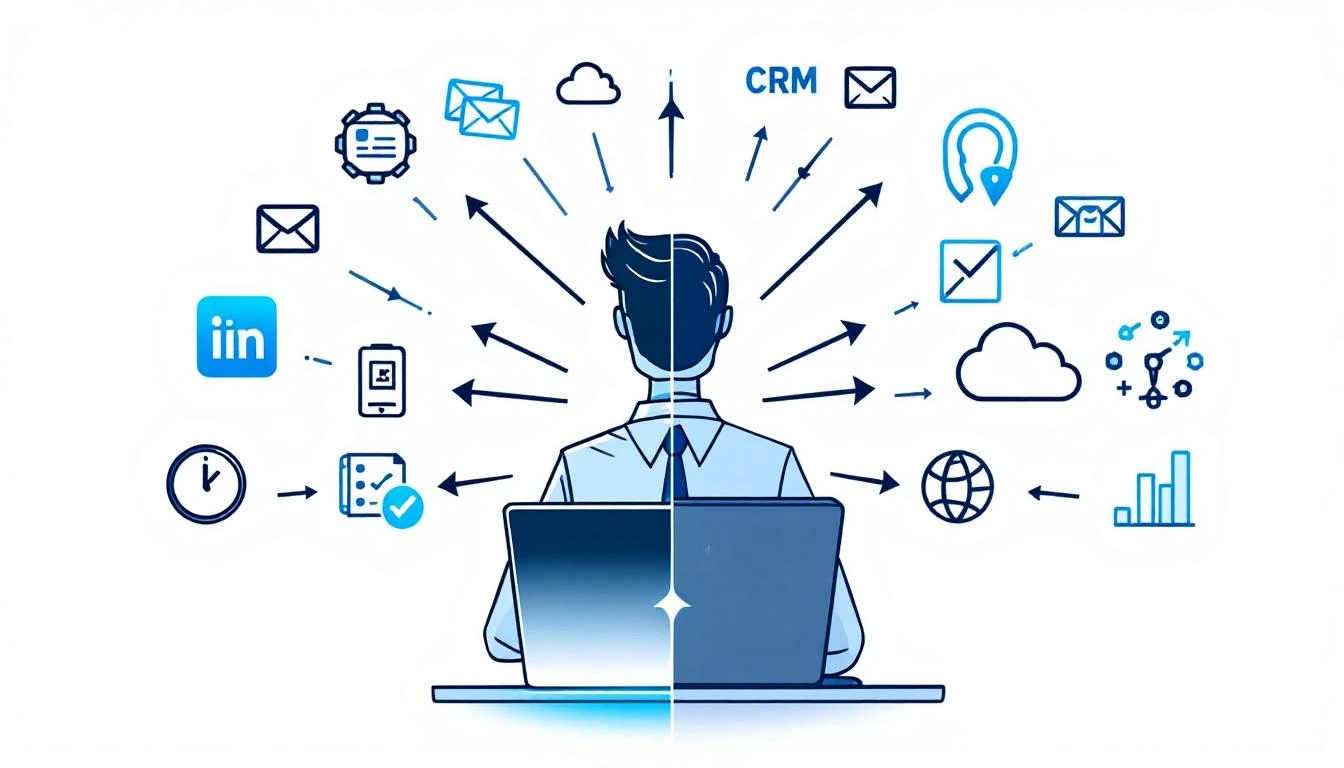
Sales reps switching between 12 different tools versus a unified command bar interface

The Productivity Tax Nobody Talks About​

Here's a number that should make every sales leader uncomfortable: 23 minutes and 15 seconds.

That's how long it takes to fully regain focus after switching between tasks, according to research by Gloria Mark at UC Irvine. Not 23 seconds. Not 2 minutes. Twenty-three minutes of cognitive recovery β€” every single time your rep alt-tabs from their CRM to check an email notification.

Now multiply that across the average SDR's day.

The typical sales rep uses 8 to 12 different tools daily. CRM. Email sequencer. Dialer. LinkedIn Sales Navigator. Enrichment platform. Intent data dashboard. Calendar. Slack. Analytics. Maybe a couple more. Salesforce's 2026 State of Sales report confirms that sellers use an average of 8 tools just to close deals.

Each tool switch isn't just a click β€” it's a cognitive reset. Mark's research found that knowledge workers switch between windows and tabs 566 times per day on average. That's 566 micro-interruptions. 566 moments where your rep's brain has to ask: "Where was I? What was I doing?"

The cumulative cost? Workers spend nearly 4 hours per week just reorienting after switching between applications. Over a year, that's roughly 5 full working weeks lost to the overhead of navigating between tools. Not selling. Not prospecting. Just... switching.

The Real Numbers on SDR Time​

Let's look at where SDR time actually goes, because the data is damning:

  • Only 2 hours per day are spent actively selling (Salesforce)
  • 65% of time goes to non-selling activities β€” data entry, lead research, CRM updates
  • 37% of the workday is consumed by prospect research alone
  • 27% of time is spent on data entry and contact research

Finding a single decision-maker's email, tracking down their direct dial, and confirming their job title can take 5 to 15 minutes per prospect. Across 40 qualified prospects in a week, that's 4 to 10 hours β€” gone.

And here's the kicker: 42% of sales reps say they feel overwhelmed by their tools. Those overwhelmed sellers are 45% less likely to hit quota.

We've been asking SDRs to be productive inside systems designed to fragment their attention.
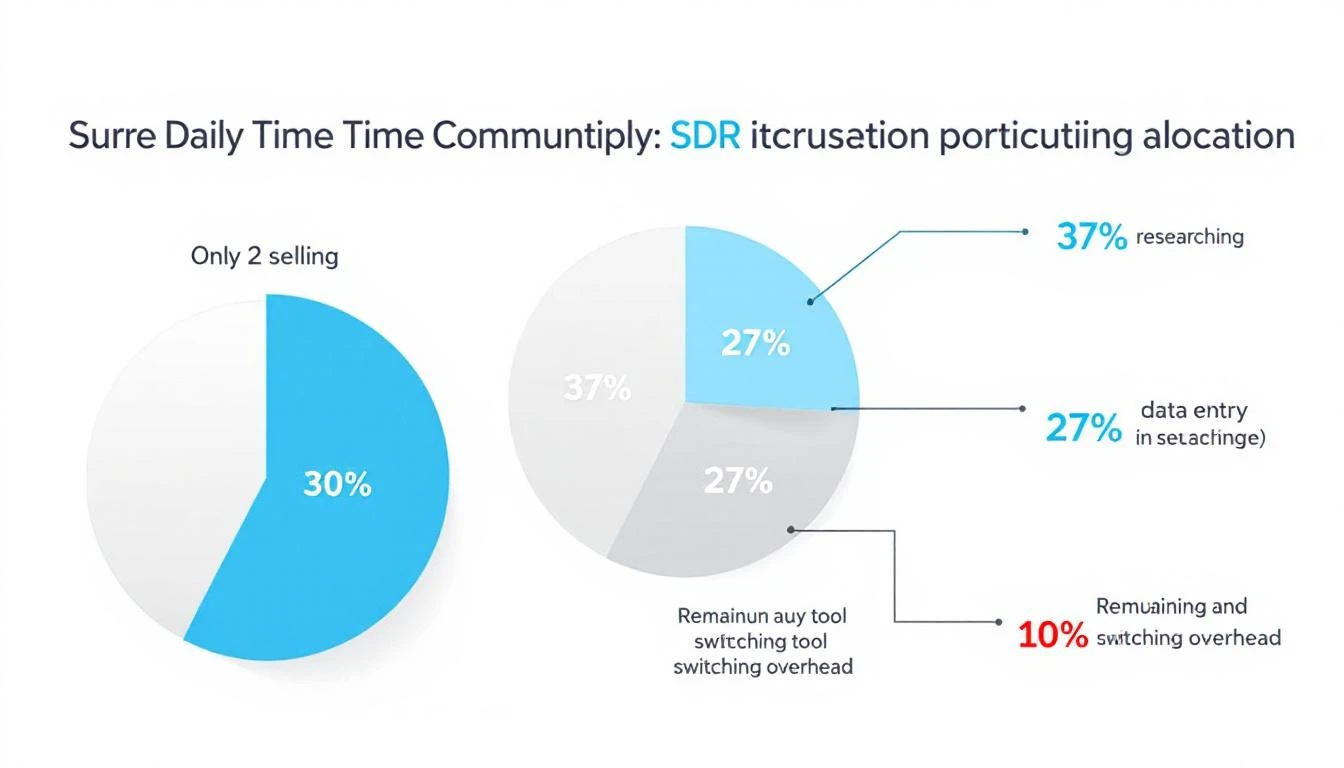
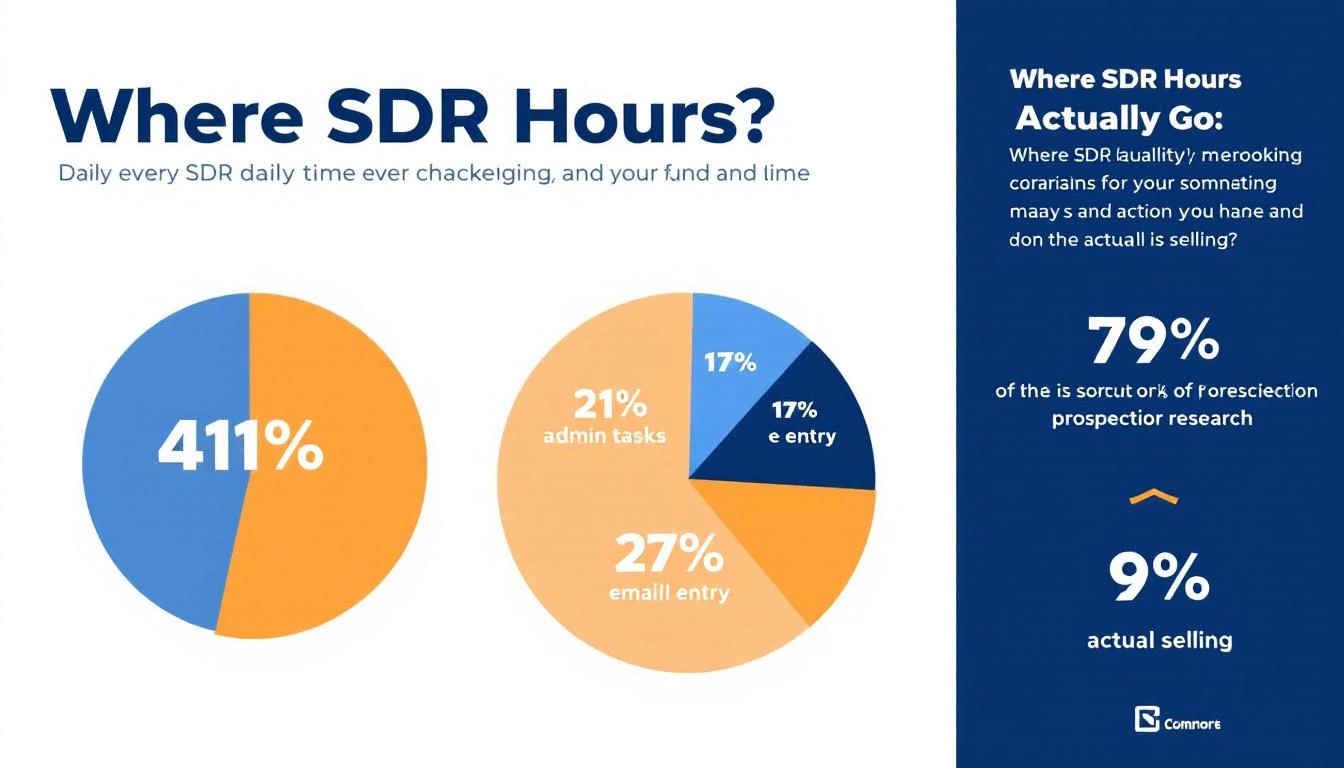
SDR daily time allocation breakdown showing only 2 hours of active selling

Something has to break.

What Context Switching Really Costs Your Pipeline​

The damage goes beyond lost minutes. Every context switch carries three hidden costs:

1. Decision fatigue compounds. Each tool has its own interface, its own logic, its own way of presenting information. Your rep doesn't just switch screens β€” they switch mental models. By 2 PM, they're not making worse calls because they're lazy. They're making worse calls because their brain has been context-switching since 8 AM.

2. Speed-to-lead collapses. When a hot intent signal comes in β€” a target account visiting your pricing page β€” your rep needs to act in minutes, not hours. But if they're buried in their email sequencer and the signal is sitting in a separate intent dashboard they haven't checked since this morning? That lead gets called 3 days late. The moment is gone.

3. Institutional knowledge stays trapped. Every tool is a silo. Your CRM knows one thing. Your enrichment tool knows another. Your conversation intelligence platform has the call recordings. No single view shows your rep the full picture of a prospect β€” their company's tech stack, recent funding, website visits, email engagement, and social activity β€” in one place.

The result? SDRs spend more time hunting for context than using it.

The Command Bar Thesis: One Interface to Rule Them All​

Here's the thought experiment: What if instead of 12 tabs, your reps had one search bar?

Not a Google search bar. Not a Slack search bar. A command interface β€” a single Ctrl+K shortcut that could:

  • Search contacts across your entire database instantly
  • Pull up company research β€” firmographics, tech stack, recent news β€” without leaving the page
  • Launch workflows β€” start a sequence, schedule a call, create a task β€” with a keyboard shortcut
  • Ask your AI assistant questions like "What signals has Acme Corp shown this week?" and get an answer in seconds
  • Navigate your entire platform without touching a mouse

This isn't science fiction. It's the direction the entire GTM stack is moving.

The concept borrows from developer tools. Engineers have had command palettes for years β€” VS Code's Ctrl+Shift+P, Raycast, Alfred, Spotlight. These interfaces let power users bypass menus, skip navigation, and execute actions at the speed of thought.

Sales has been stuck in the click-and-navigate era while engineering moved to the type-and-execute era years ago.

What a Unified Command Interface Means for SDR Velocity​

Let's get specific about the impact.

Morning routine β€” before vs. after:

Before (traditional multi-tool setup):

  1. Open CRM, check assigned leads (2 min)
  2. Switch to intent data dashboard, scan for signals (3 min)
  3. Open enrichment tool, research top prospect (5 min)
  4. Switch to email sequencer, start a sequence (3 min)
  5. Open dialer, make first call (2 min to set up)
  6. Back to CRM to log the outcome (2 min)

That's 17 minutes and 6 tool switches before a single meaningful conversation. With each switch costing cognitive recovery time, the real cost is closer to 30-40 minutes.

After (unified command interface):

  1. Hit Ctrl+K, type prospect name β€” full context appears (10 sec)
  2. See intent signals, enrichment data, engagement history in one view (15 sec)
  3. Type "start sequence" β€” done (5 sec)
  4. Click to dial β€” call launches in-platform (2 sec)
  5. Outcome auto-logged (0 sec)

Total: under a minute. Zero context switches. Zero cognitive recovery.

The math on recovered selling time:

If a unified platform eliminates even 50% of tool-switching overhead, that's roughly 2.5 hours per week returned to each rep. Across a 10-person SDR team, that's 25 hours per week β€” essentially hiring a part-time rep for free.

At average SDR fully-loaded costs, tool-switching overhead costs organizations $150K+ annually in lost productivity per rep. And that's before you factor in the pipeline that never gets built because signals went cold while reps were alt-tabbing.

Why Consolidation Is Winning Over "Best of Breed"​

The sales tech stack has gotten expensive β€” and bloated. The average B2B company spends $1,200-$2,400 per rep per month across their sales tools.

But here's what's changing: the "best of breed" era is ending.

For years, the conventional wisdom was to pick the best tool for each job. Best CRM. Best sequencer. Best dialer. Best enrichment. Best intent data. Stitch them together with integrations and pray they talk to each other.

That worked when sales teams had 3-4 tools. It broke when they had 12.

The integration tax is real. Data syncs fail silently. Contact records drift between systems. One tool updates a field that another tool doesn't see for 6 hours. Your rep calls a prospect who already replied to an email two hours ago β€” because the CRM hadn't synced yet.

The future isn't 12 best-in-class tools loosely connected. It's one platform that does 80% of what those 12 tools do β€” with everything connected natively, in real time, accessible from a single interface.

The Keyboard-First Sales Rep​

There's a cultural shift happening alongside the technology shift.

The next generation of SDRs grew up on keyboard shortcuts. They use Cmd+Space to launch apps, Ctrl+K to search Notion, Cmd+T to open new tabs. They think in commands, not clicks.

Giving these reps a click-heavy, menu-driven sales platform is like giving a developer Notepad when they want VS Code. It works, technically. But it's fighting against how they naturally operate.

A command-first interface doesn't just save time. It changes the rep's relationship with their tools. Instead of the platform being something they navigate through, it becomes something they operate with. The tool disappears. The work stays.

That's the difference between a dashboard and a playbook. Dashboards show you data. Playbooks tell you what to do next. A command interface takes it one step further β€” it lets you do the next thing without leaving the conversation.

What This Looks Like in Practice​

Imagine this scenario:

Your rep gets a notification: a target account just visited the pricing page for the third time this week. Instead of switching to the intent dashboard, then the CRM, then the enrichment tool, then the sequencer, they hit Ctrl+K and type the company name.

Instantly, they see:

  • Who visited β€” matched to specific contacts when possible
  • Company context β€” industry, size, tech stack, recent funding
  • Engagement history β€” every email opened, every page visited, every call made
  • AI recommendation β€” "Call Sarah Chen (VP Sales) β€” she opened your last email twice and visited pricing 3x this week. Here's a talk track based on their tech stack."
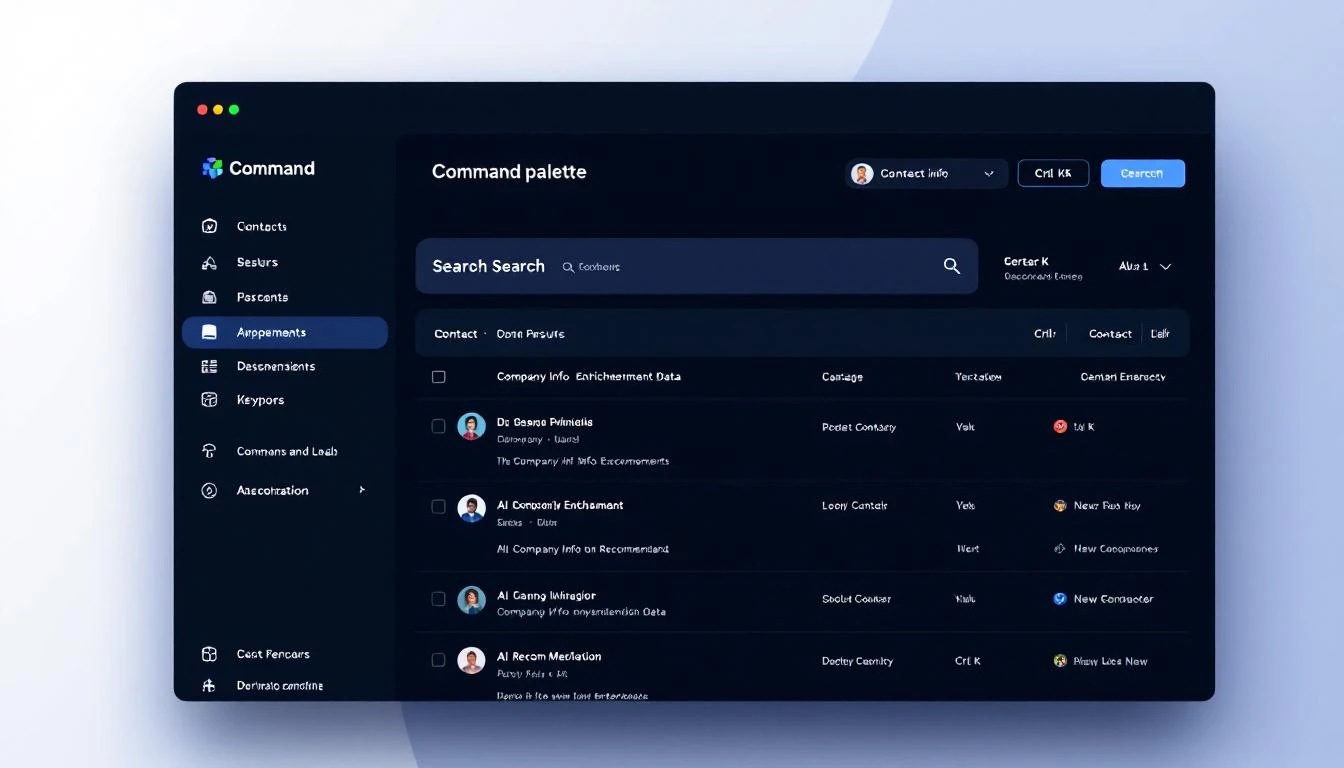
Command palette interface showing contact search with enrichment data and AI recommendations

One keystroke. Full context. Clear action. No tab-switching. No data hunting.

The rep makes the call in 30 seconds instead of 10 minutes. That's not a marginal improvement. That's a fundamentally different approach to speed-to-lead.

The Bottom Line​

The sales productivity crisis isn't about lazy reps or bad training. It's a systems problem.

We've given SDRs a dozen specialized tools and told them to be productive while constantly switching between them. We've optimized each tool individually while ignoring the friction between them. We've measured activity metrics while the real bottleneck β€” cognitive overhead from tool fragmentation β€” went unmeasured and unaddressed.

The command bar isn't just a UI pattern. It's a philosophy: every action your rep needs should be one keystroke away.

One search bar. Full context. Instant action. Zero switching.

That's not a feature. That's a paradigm shift.


Want to see what a unified command interface looks like for sales? Book a demo β†’

Your Reps Are Winging Sales Calls β€” Here's What Happens When AI Writes the Script [2026]

Β· 12 min read
sunder
Founder, marketbetter.ai

Your SDR opens the dialer. The prospect is a VP of Sales at a mid-market SaaS company. Your rep glances at a generic script:

"Hi {Name}, this is {Rep} from {Company}. We help companies like yours improve their sales process. Do you have a few minutes?"

The VP hangs up in 8 seconds. Your rep moves to the next call. Rinse, repeat, 80 times a day.

Here's what your rep didn't know:

  • That VP just evaluated a competitor last week
  • Their company posted a Director of Sales Enablement job 3 days ago β€” they're scaling
  • They have 3 stalled deals in HubSpot that haven't moved in 45 days
  • They visited your pricing page twice yesterday

All of that context was sitting in your CRM, your website analytics, and publicly available signals. Nobody connected the dots. Nobody put it in the script.

That's the gap AI closes.

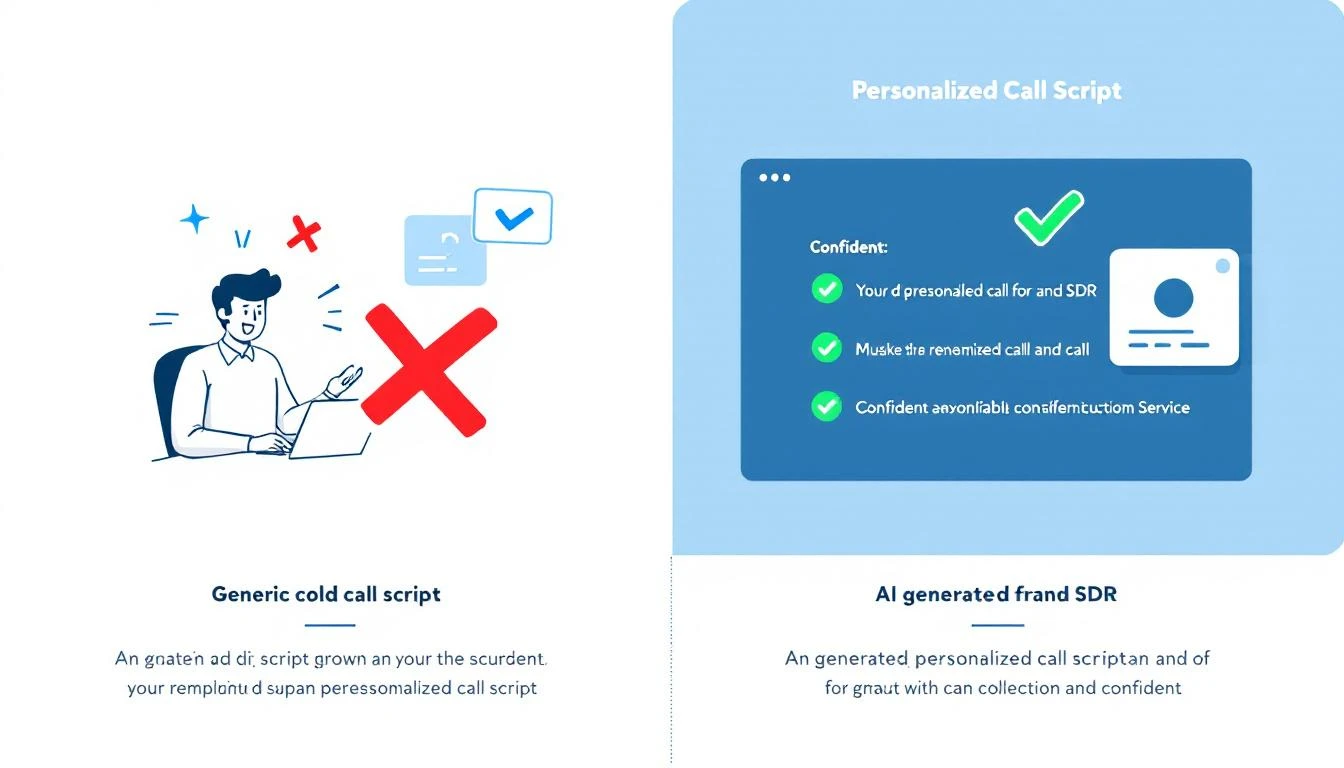
Before and after: generic script vs. AI-generated personalized call script

The Cold Call Success Rate Problem​

Let's start with the brutal numbers.

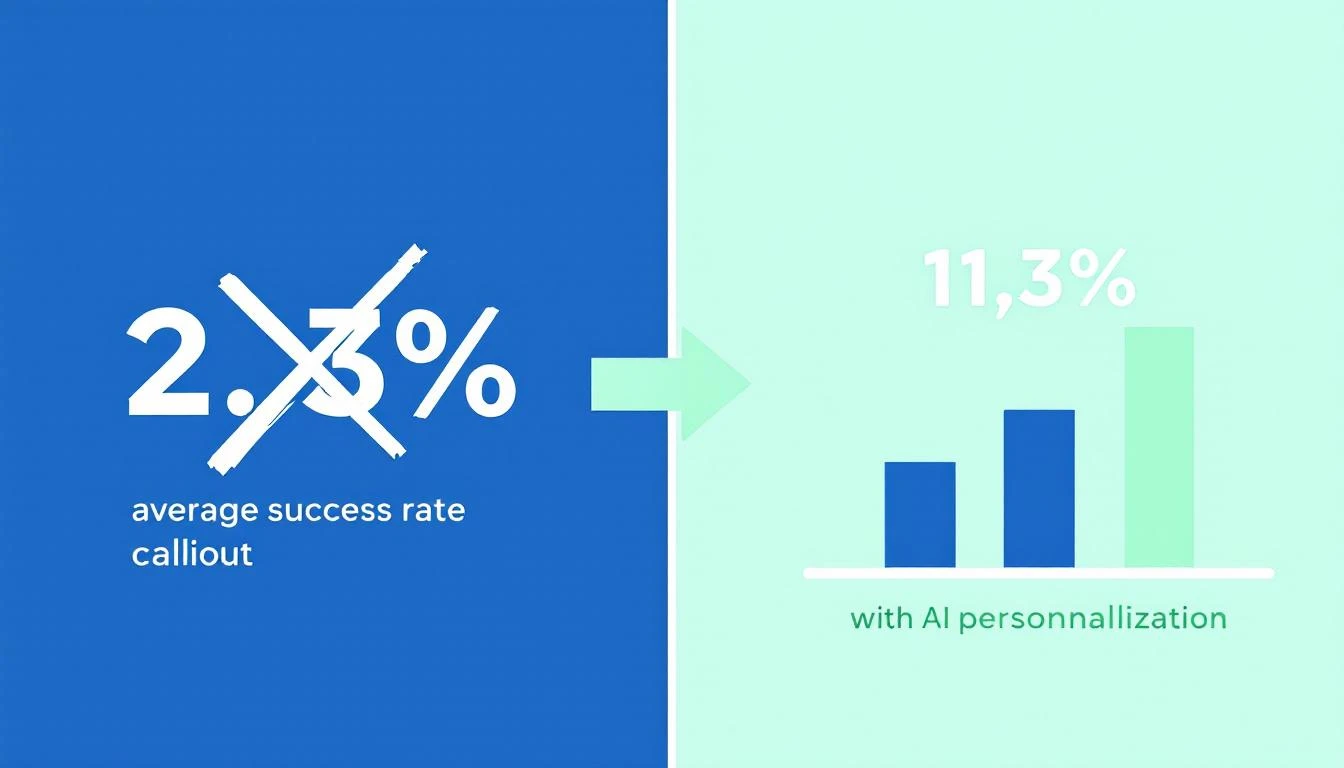
The average cold calling success rate in 2026 is 2.7%. That means for every 100 calls your SDR makes, fewer than 3 turn into anything. Cognism's 2026 report β€” which analyzed over 200,000 calls β€” found that teams using generic scripts and spray-and-pray tactics sit at or below that average.

But here's the number that matters: teams using AI-powered personalization and real-time context are hitting 6.7% to 11.3% success rates. That's 3-4x the industry average.

Outreach's 2025 dataset showed it plainly: personalized cold calls with AI-generated context had a 36% higher meeting conversion rate than generic calls.

The difference isn't talent. It's context.

Cold calling success rates: generic scripts vs. AI-personalized approaches

What a Generic Script Actually Looks Like​

Here's what most SDR teams are working with today. If this looks familiar, that's the problem.

The "Standard" Cold Call Script:

"Hi Sarah, this is Mike from Acme Software. We're an AI-powered sales platform that helps companies improve their outbound efficiency. I was wondering if you had a few minutes to learn how we've helped companies like yours increase their pipeline by 40%?"

What's wrong with this:

  • No research signal. Nothing tells Sarah you know anything about her company
  • Generic value prop. "Improve outbound efficiency" could be any of 200 vendors
  • No trigger. Why are you calling TODAY? What changed?
  • Permission-based opener. "Do you have a few minutes?" is an invitation to say no
  • Zero personalization. Swap the name and this works for literally anyone

Your rep might as well be reading from a cereal box. The prospect can tell β€” and they hang up.

This is what we mean by "winging it." Even teams that HAVE scripts are winging it if the script doesn't reflect what you already know about the prospect.

What an AI-Generated Call Script Looks Like​

Now here's the same call β€” but the script was generated 30 seconds before the dial, using everything the system knows about this specific prospect.

AI-Generated Script (Anonymized):

"Hi Sarah β€” quick question. I noticed Datastream just posted a Director of Sales Enablement role, and your team's been evaluating outbound tools. We work with a few mid-market SaaS companies that were in a similar spot β€” scaling their SDR team while deals were stalling in pipeline. Curious if that resonates, or if I'm off base?"

What changed:

  • Hiring signal β†’ "posted a Director of Sales Enablement role" (from job board data)
  • Competitor evaluation β†’ "evaluating outbound tools" (from intent data)
  • Company context β†’ "mid-market SaaS" (from CRM enrichment)
  • Pipeline awareness β†’ "deals stalling in pipeline" (from CRM sync)
  • Pattern interrupt β†’ "Curious if that resonates, or if I'm off base?" (earns the conversation instead of asking permission)

The prospect doesn't hear a script. They hear someone who did their homework. That's the difference between a hang-up and a 4-minute conversation.

Where the Data Comes From​

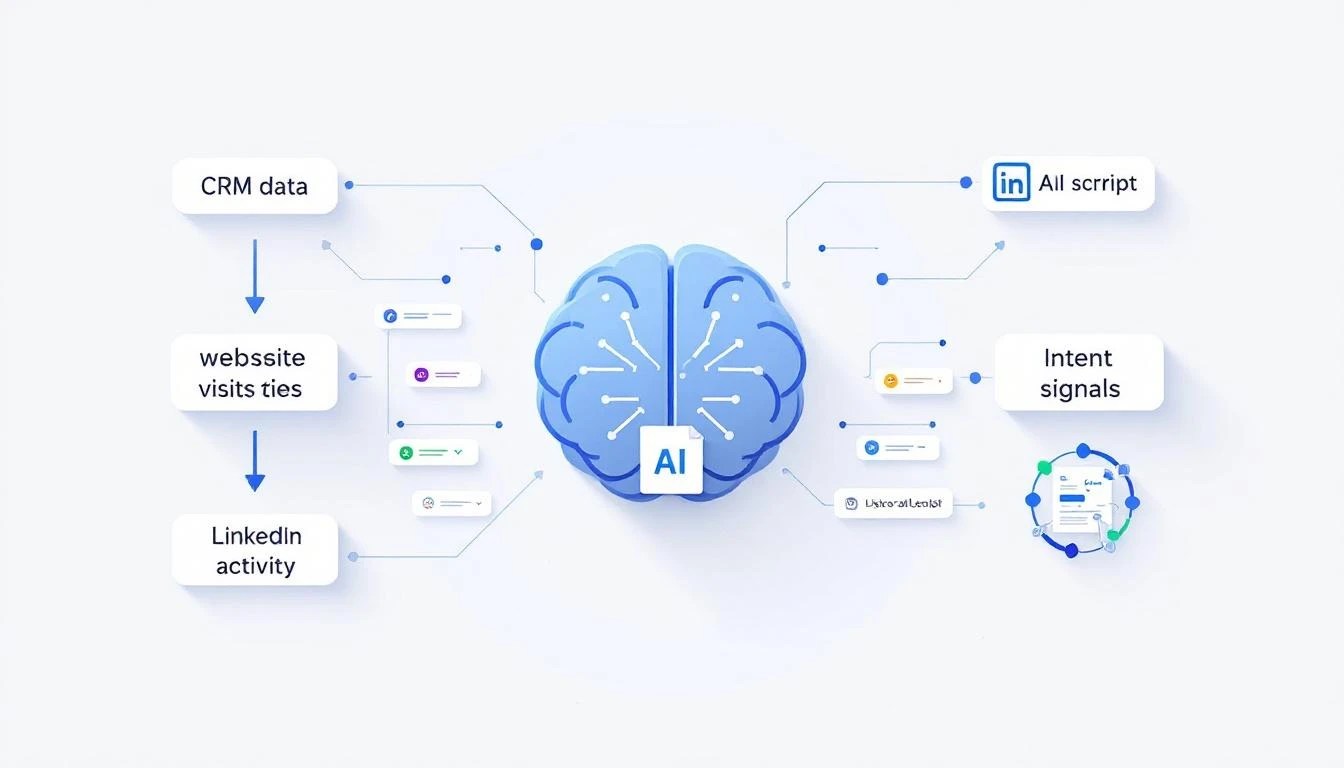
AI-generated scripts aren't magic. They're the result of connecting data sources your team already has β€” but nobody's stitching together manually.

How data flows into an AI-generated call script

Here's what feeds into a good AI call script:

1. CRM Data (HubSpot, Salesforce)​

  • Deal stage and velocity (are deals stalling?)
  • Last activity date (when did someone last engage?)
  • Contact role and title
  • Previous conversation notes
  • How your reps spend their time matters β€” if they're manually pulling this context, they're losing hours per day

2. Website Visitor Intelligence​

  • Which pages did this prospect visit? (Pricing = high intent)
  • How many visits in the last 7 days?
  • Identifying anonymous visitors turns nameless traffic into call-ready context

3. Intent Signals​

  • Are they researching your category on third-party review sites?
  • Did they engage with competitor content?
  • Intent data reveals who's in-market before they raise their hand

4. Public Signals​

  • Recent job postings (hiring = budget, scaling, change)
  • Funding announcements
  • Leadership changes
  • Company news and press releases

5. Conversation History​

  • Past email threads (what objections came up?)
  • Previous call notes
  • LinkedIn engagement (did they view your profile?)

When all five data sources feed into a single script generator, every call opens with context the prospect didn't expect you to have.

Before and After: A Real SDR's Day​

Let's make this concrete. Here's what changes when you move from static scripts to AI-generated ones.

BEFORE: Static Scripts​

MetricResult
Calls per day80
Connect rate4%
Conversations3.2
Meetings booked0.3
Time spent on pre-call research0 min (no time)
Script personalizationNone β€” same script for every call

The rep blasts through a list. They don't research because there's no time. Every call sounds the same. Prospects hear it. Connect rates stay low.

AFTER: AI-Generated Scripts​

MetricResult
Calls per day60 (fewer, but targeted)
Connect rate8%
Conversations4.8
Meetings booked1.2
Time spent on pre-call research0 min (AI does it)
Script personalizationUnique per prospect

Fewer calls, more conversations, 4x the meetings. The math works because every call is a quality at-bat, not a coin flip.

This is the same pattern we see across SDR workflow optimization β€” less tool-switching, more selling.

How to Build AI-Generated Call Scripts (Step by Step)​

You don't need to build this from scratch. But you do need to understand the components.

Step 1: Connect Your Data Sources​

Your AI script generator is only as good as the data it can access. At minimum, you need:

  • CRM integration (bidirectional sync with HubSpot or Salesforce)
  • Website visitor tracking (who's on your site right now)
  • Intent data feed (who's researching your category)

Most teams already have these tools. The problem is they're siloed. Your CRM doesn't talk to your visitor ID tool, which doesn't talk to your intent data provider. The best SDR tools in 2026 solve this by consolidating signals into one place.

Step 2: Define Your Script Framework​

AI needs guardrails. You're not replacing the script β€” you're making it dynamic. Define:

  • Opening structure: Pattern interrupt + signal reference + relevance check
  • Value prop library: 3-5 core value props matched to different buyer personas
  • Objection responses: Pre-loaded but contextual
  • Call-to-action: Meeting request calibrated to deal stage

A good framework follows the same principles as a proven cold call script template β€” but with dynamic slots that AI fills per prospect.

Step 3: Generate Scripts in Real-Time​

The script should be ready before the rep clicks "dial." That means:

  1. AI pulls the latest data on the prospect (CRM, signals, research)
  2. It identifies the strongest hook (what's the most relevant signal?)
  3. It generates a personalized opener, talking points, and objection prep
  4. The rep sees the script in their dialer view β€” no tab-switching, no research time

This is the difference between an AI approach to prospecting and the old way. The AI does the prep work. The rep does the human work β€” building rapport and listening.

Step 4: Feed Outcomes Back Into the System​

After each call, the outcome feeds back:

  • Connected, booked meeting β†’ What signals correlated with success?
  • Connected, no interest β†’ What objections came up? Update the script library
  • No answer β†’ Adjust optimal call times
  • Voicemail β†’ Generate a personalized voicemail script for next attempt

This creates a feedback loop. Scripts get better over time because they learn from what actually works for YOUR prospects, not generic best practices.

The Multi-Channel Advantage​

Call scripts are just the start. Once you have AI generating personalized context, the same engine powers every channel:

  • Voicemail drops β€” personalized to the signal that triggered the call
  • Follow-up emails β€” reference the call attempt with the same context (cold email best practices)
  • LinkedIn messages β€” short, signal-driven connection requests
  • Pre-meeting briefs β€” when the meeting is booked, AI generates a full brief with company background, stakeholder map, and pricing guidance

The key insight: all-channel personalization from a single context engine. Your rep doesn't re-research for every touchpoint. The AI carries the context across every interaction.

This is what separates real cold calling best practices in 2026 from the playbooks that worked in 2020.

What "Good" Looks Like: 3 AI-Generated Script Examples​

Here are three anonymized examples of what AI-generated scripts look like in practice β€” each pulling from different signal types.

Example 1: Hiring Signal​

"Hey Chris β€” saw that TechFlow is hiring two SDR managers. Usually when teams are scaling outbound, the biggest bottleneck isn't headcount β€” it's ramping new reps fast enough. We've helped a few teams cut SDR ramp time from 3 months to 3 weeks using AI-generated playbooks. Worth a 15-minute look?"

Signals used: Job posting data, company size, SDR ramp benchmarks

Example 2: Competitor Evaluation Signal​

"Hi Dana β€” I'll be direct. I know your team's been looking at {Competitor}. A few of our customers switched from them because they got the data but not the 'what to do next' part. If you're still evaluating, might be worth seeing how we handle that differently. Open to a quick comparison?"

Signals used: Intent data (competitor research), CRM stage, product differentiation

Example 3: Website Visitor + Stalled Deal​

"Jessica β€” we noticed someone from CloudBase has been on our pricing page a few times this week. I also see we've been in conversation for a while but things went quiet around January. Wanted to check in β€” has anything changed on your end, or can I send over something more specific to where you are now?"

Signals used: Visitor ID, CRM deal stage, last activity date, page visits

Each script took zero prep time from the rep. The AI had the context. The rep just had to be human.

Why Static Scripts Are Costing You Pipeline​

Let's quantify the cost of winging it.

Assume a team of 5 SDRs, each making 80 calls/day:

With static scripts (2.7% success rate):

  • 400 calls/day Γ— 2.7% = 10.8 meetings/week
  • At $500 average deal value per meeting: $5,400/week in pipeline

With AI-generated scripts (8% success rate):

  • 300 calls/day (fewer, targeted) Γ— 8% = 24 meetings/week
  • At $500 average: $12,000/week in pipeline

That's an extra $6,600 per week β€” over $340K annually β€” from the same team. No new hires. No new tools (assuming your tools are already connected). Just better scripts.

The SDR productivity crisis isn't about effort. It's about context. Your reps are working hard. They're just working blind.

Getting Started: What to Do This Week​

You don't need to overhaul your entire stack. Here's a practical starting point:

  1. Audit your current scripts. When was the last time they were updated? Do they reference any prospect-specific data? If the answer is "never" and "no," you know the problem.

  2. Inventory your data sources. What signals do you already collect that never make it into a call script? CRM notes, website visits, intent data β€” most teams have more context than they use.

  3. Pick your highest-value call list. Start with your top 20 target accounts. Manually build AI-assisted scripts for those calls using the framework above. Measure the difference.

  4. Evaluate tools that automate this. The right platform connects your data sources and generates scripts automatically. Look for CRM sync, visitor intelligence, intent signals, and AI content generation in one system.

  5. Measure what matters. Track connect rate, conversation rate, and meetings-per-call β€” not just dial volume. The goal isn't more calls. It's more conversations that convert.

The Bottom Line​

Your SDRs aren't bad at cold calling. They're under-equipped.

A generic script is a guess. An AI-generated script is an informed conversation starter. The data shows the difference: 36% more meetings, 3-4x higher success rates, and reps who actually look forward to picking up the phone because they know something about the person on the other end.

The question isn't whether AI will write your call scripts. It's whether your competitors are already doing it.


Ready to see AI-generated call scripts in action? Book a demo β†’

SDR Automation in 2026: What to Automate and What to Keep Human

Β· 18 min read
sunder
Founder, marketbetter.ai

Your SDRs are drowning. Not in leadsβ€”in busywork.

According to HubSpot's 2024 Sales Trends Report, the average sales rep spends just 2 hours per day actually selling. The rest? Data entry. Tab-switching. CRM updates. Research rabbit holes. Meeting scheduling. Admin that never ends.

And the numbers get worse when you zoom out: research from SalesSo shows reps spend only 18-30% of their workday on revenue-generating activities, while administrative tasks consume 41% of their time. The result? 83.4% of SDRs fail to consistently hit quota.

That's not a people problem. That's a workflow problem.

This guide breaks down everything you need to know about SDR automation in 2026: what to automate, what to keep human, how to build the right stack, and how to measure whether it's actually working.

SDR daily time breakdown showing most hours go to admin, not selling


The SDR Productivity Crisis (By the Numbers)​

Before we talk solutions, let's quantify the problem.

For an SDR earning $60,000 annually, approximately $22,200 is spent on research time alone, according to MarketsandMarkets research. That's 37% of their salary going toward activities that could be automated or dramatically accelerated.

Here's where a typical SDR's 8-hour day actually goes:

ActivityTimeAutomatable?
Prospecting research2.5 hrsβœ… Mostly
Email/message drafting1.5 hrsβœ… Partially
CRM data entry1.5 hrsβœ… Fully
Internal meetings1 hr❌ Not really
Actual selling (calls, demos, conversations)1.5 hrs❌ Keep human

That means roughly 5.5 hours per day are spent on tasks that automation can either eliminate or dramatically reduce. And yet most SDR teams are still running the same manual playbook they used in 2020.

The teams that figure this out first don't just save timeβ€”they fundamentally change their unit economics. When your SDRs spend 5 hours selling instead of 1.5, you don't need to hire 3x more reps. You need better workflows.

The Real Cost of Manual SDR Work​

Let's do the math on a 5-person SDR team:

  • 5 SDRs Γ— $60K salary = $300K/year
  • 41% on admin = $123K wasted on non-selling activities
  • At 83.4% missing quota, you're likely generating pipeline from only 1-2 of those reps consistently

Now compare that to a team running proper automation:

  • Same 5 SDRs, but reclaiming even half of that admin time
  • That's the equivalent of adding 2.5 more full-time sellers without a single new hire
  • At average SDR pipeline generation of $3M/year per rep, that's $7.5M in additional pipeline capacity

The ROI case for SDR automation isn't theoretical. It's mathematical.


What Should (and Shouldn't) Be Automated​

Here's where most teams get it wrong: they try to automate everything, including the parts that require human judgment. Or they automate the easy stuff (like email sends) while ignoring the high-leverage bottlenecks (like lead prioritization).

βœ… Automate These (High ROI, Low Risk)​

1. Lead identification and enrichment Stop having SDRs manually research companies. Website visitor identification can tell you exactly which companies are on your site. Enrichment tools fill in the contacts, tech stack, and firmographics automatically.

2. Lead scoring and prioritization Your SDRs shouldn't decide who to call first. A scoring model that weighs intent signals, fit score, and engagement should surface the hottest leads automatically every morning.

3. CRM updates and activity logging Every minute spent updating Salesforce is a minute not spent selling. Auto-log emails, calls, and meeting notes. Period.

4. Email sequencing and follow-ups The first touch, the follow-up cadence, the "checking in" emailsβ€”these should run on autopilot with well-built sequences. Human reps step in when someone replies.

5. Meeting scheduling Calendar links, round-robin routing, timezone detection, confirmation emails. All automatable. All still done manually at most companies.

6. Data hygiene Bounced emails, job changes, company updates. Champion tracking and data validation should run in the background, not eat into selling time.

❌ Keep These Human (For Now)​

1. Discovery calls and demos AI can book the meeting. A human should run it. Buyers still want to talk to someone who understands their problem, asks good follow-up questions, and adapts in real-time.

2. Objection handling on live calls Nuance matters. A prospect saying "we're not ready" vs. "we're evaluating competitors" requires completely different responses that AI still struggles with in real-time conversation.

3. Strategic account research for enterprise deals For your top 20 target accounts, you want a human doing deep researchβ€”reading 10-Ks, understanding org charts, finding the real pain. Don't automate your most important deals.

4. Relationship building A personalized LinkedIn message referencing someone's recent podcast appearance can't be templated. The best SDRs earn trust through genuine connection.

⚠️ The Gray Zone (Automate Carefully)​

Personalized first-touch emails: AI can draft them, but a human should review before sending to high-value prospects. For mid-market and below, AI personalization at scale is increasingly viable.

Call preparation: Automate the research summary, but the rep should actually read it and form their own point of view before dialing.

LinkedIn outreach: Automate connection requests at your peril. Thoughtful, automated follow-up messages after a connection? That works.


The 5 Pillars of SDR Automation​

Think of SDR automation not as a single tool, but as five interconnected systems. Miss one, and the whole thing underperforms.

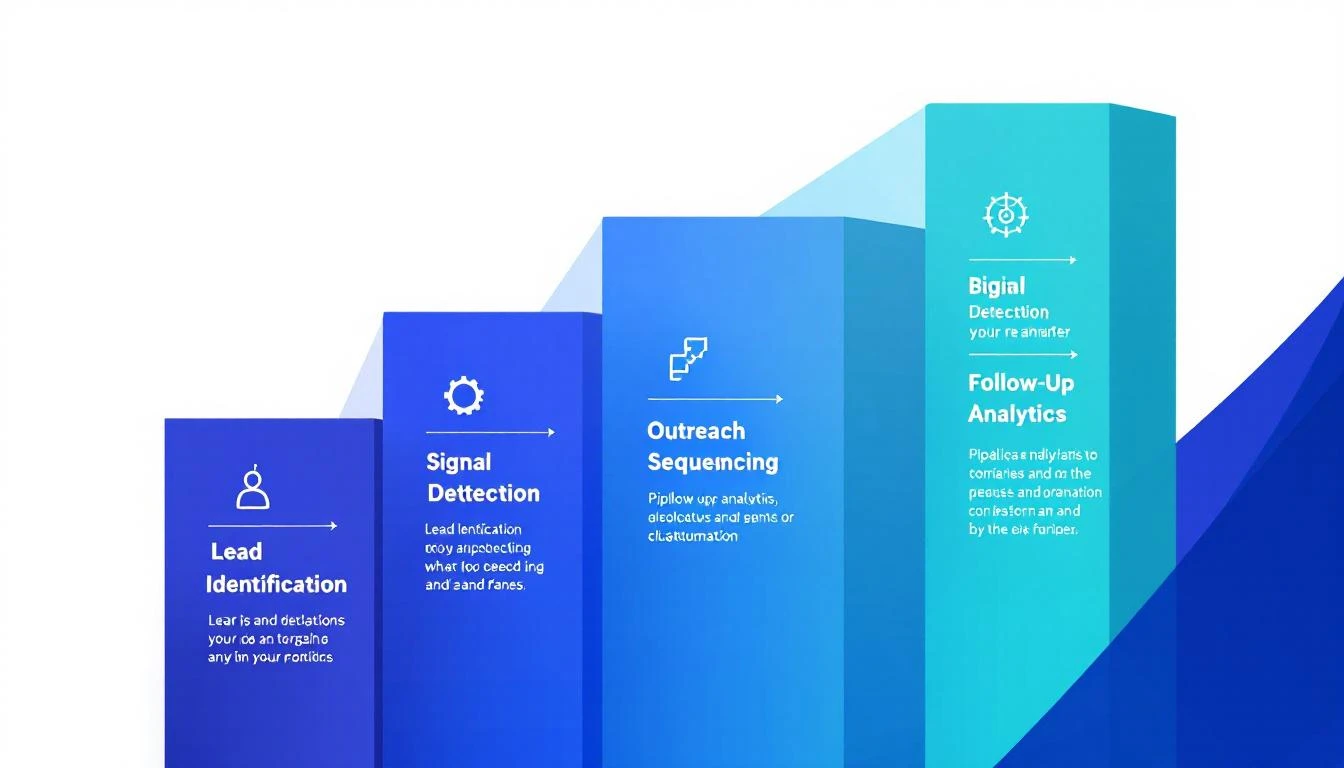
The five pillars of SDR automation: identification, signals, outreach, follow-up, and analytics

Pillar 1: Lead Identification​

The question: Who should we be talking to?

This is the foundation. If you're still waiting for form fills to know who's interested, you're seeing maybe 2% of your actual demand. The other 98% visit your site, read your content, and leave without ever raising their hand.

Website visitor identification changes the game by revealing which companies are actively researching you. Combined with enrichment dataβ€”contacts, tech stack, revenue, headcountβ€”your SDRs start each day knowing exactly who showed up.

What good looks like:

  • You know which companies visited your site in the last 24 hours
  • Each company is automatically matched to contacts in your ICP
  • Contact data (email, phone, LinkedIn, title) is pre-enriched
  • Everything flows into your CRM without manual entry

Key metrics: Match rate, enrichment accuracy, time from visit to SDR notification.

Read more: Best Website Visitor Identification Tools in 2026

Pillar 2: Signal Detection and Scoring​

The question: Who should we talk to first?

Not all leads are equal. A VP of Sales who visited your pricing page three times this week is a fundamentally different prospect than a marketing intern who clicked a blog post once.

Intent signals come in layers:

  • First-party signals: Website visits, content downloads, email opens, chatbot conversations
  • Third-party signals: G2 category research, review site comparisons, competitor keyword searches
  • Behavioral signals: Pricing page visits, demo page bounces, repeat visits within 48 hours

The best SDR automation stacks don't just collect these signalsβ€”they score and prioritize them into a daily action list that tells reps: call this person first, email this person second, skip this one until next week.

This is where most tools stop. They show you a dashboard of signals and say "figure it out." The playbook approach is different: it turns signals into specific actions. Not "Company X visited your site" but "Call Jane Smith, VP Sales at Company X. She visited the pricing page twice. Here's what to say."

Key metrics: Signal-to-meeting conversion rate, time from signal to first touch, speed to lead.

Pillar 3: Outreach Sequencing​

The question: What do we say, and when?

Once you know who to contact and why, the outreach needs to be multi-channel, well-timed, and personalized enough to not feel automated.

A solid sales cadence in 2026 typically looks like:

  • Day 1: Personalized email referencing their specific signal (site visit, G2 research, etc.)
  • Day 2: LinkedIn connection request with a brief note
  • Day 3: Phone call with voicemail drop
  • Day 5: Follow-up email with relevant case study
  • Day 8: LinkedIn message referencing the email
  • Day 12: Final breakup email

The key insight: the sequence should adapt based on engagement. If someone opens email #1 three times but doesn't reply, the system should automatically escalateβ€”move up the call, adjust the messaging angle, maybe trigger a different sequence entirely.

Cold email templates that worked in 2023 are largely dead. Modern outreach needs to reference real context: what the prospect's company is doing, what they researched on your site, what's happening in their industry. That's where AI-powered personalization becomes essentialβ€”not to replace the human touch, but to make it scalable.

Key metrics: Reply rate by channel, positive reply rate, meetings booked per sequence.

Pillar 4: Follow-Up Automation​

The question: How do we make sure nothing falls through the cracks?

This is the silent killer of SDR teams. A prospect says "reach out next quarter" and it goes into a mental note that never gets acted on. A demo gets booked but the follow-up email with the case study never sends. A champion changes jobs and nobody notices for three months.

Automated follow-up handles:

  • Post-meeting sequences: Recap email, case study, ROI calculatorβ€”all triggered automatically after a completed call
  • Re-engagement sequences: Prospects who went dark get a fresh touch after 30, 60, 90 days
  • Job change alerts: When a champion moves to a new company, your system flags it and creates a new opportunity
  • Renewal and expansion signals: Existing customers showing research behavior get routed to the right team

The difference between a good SDR and a great one often comes down to follow-up discipline. Automation doesn't make SDRs lazyβ€”it makes the disciplined ones superhuman.

Key metrics: Follow-up compliance rate, re-engagement reply rate, pipeline recovered from dormant leads.

Pillar 5: Pipeline Analytics​

The question: Is any of this actually working?

You can't optimize what you don't measure, and most SDR teams measure the wrong things. Activity metrics like "emails sent" and "calls made" are vanity metrics that tell you nothing about pipeline quality.

What matters:

  • Cost per qualified meeting: Total SDR cost (salary + tools + overhead) divided by qualified meetings booked
  • Signal-to-meeting conversion: What percentage of identified signals turn into booked meetings?
  • Speed to lead: How fast does your team respond to high-intent signals? (Under 5 minutes is the target)
  • Pipeline velocity: How quickly do SDR-sourced opportunities move through your funnel?
  • Channel attribution: Which outreach channel (email, phone, LinkedIn, chat) drives the most pipeline?

Good automation platforms track all of this natively. If yours requires you to build dashboards in a separate BI tool, that's a red flag.


Building Your SDR Automation Stack: Step by Step​

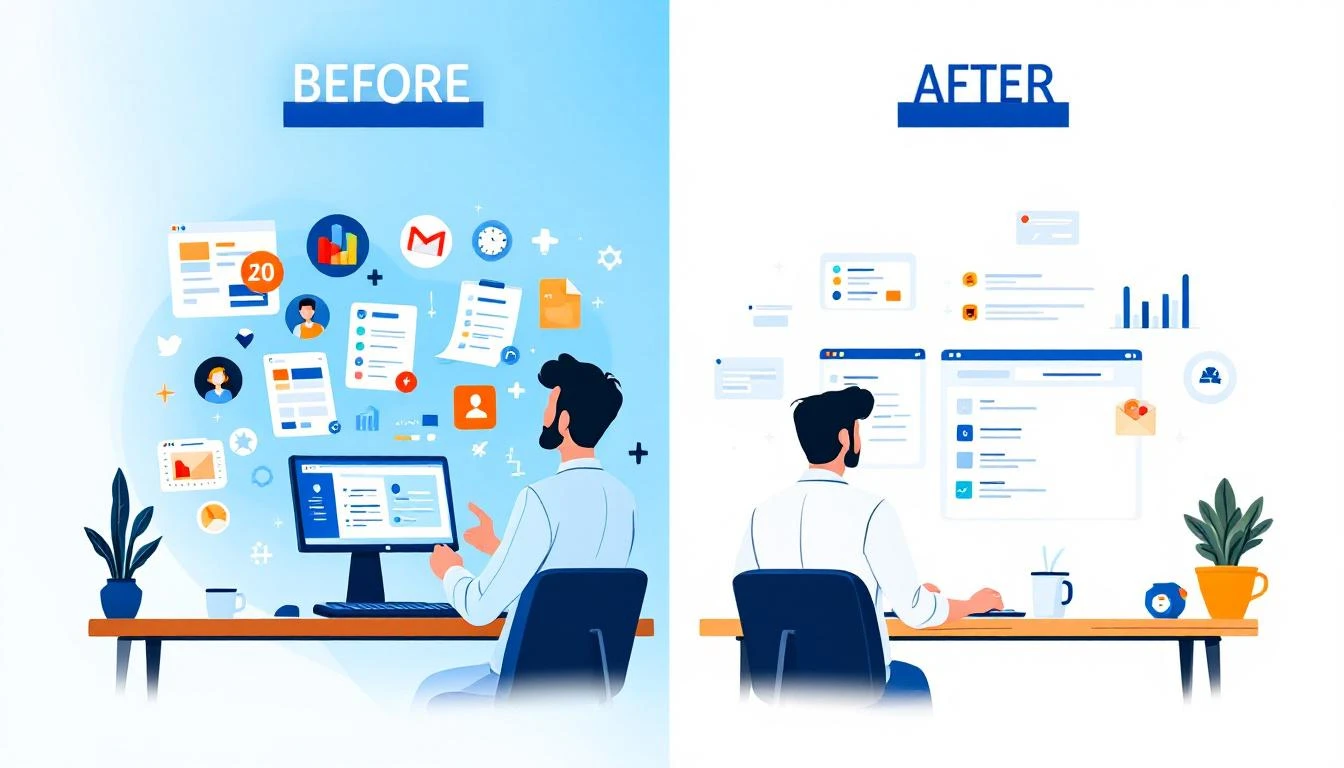
Before and after SDR automation: from 20 tabs to one task list

Here's the practical implementation path, ordered by impact and difficulty.

Phase 1: Foundation (Week 1-2)​

Goal: Know who's on your site and get them into your CRM automatically.

  1. Deploy website visitor identification. This is the single highest-ROI automation move you can make. Overnight, you go from guessing who's interested to knowing exactly which companies visited and what they looked at.

  2. Set up enrichment. Every identified company should automatically resolve to specific contacts with verified email and phone. Your SDRs should never manually look up a prospect's contact info again.

  3. Connect to your CRM. New leads flow in automatically. No CSV exports. No manual entry. Real-time sync.

Expected impact: 10-20 new qualified leads per week that you were previously missing entirely.

Phase 2: Prioritization (Week 3-4)​

Goal: Stop letting SDRs decide who to call. Let data decide.

  1. Implement lead scoring based on fit (ICP match) and intent (behavioral signals). Weight pricing page visits and repeat visits heavily.

  2. Build a daily SDR playbook that surfaces the top 20-30 actions each rep should take, ranked by likelihood to convert.

  3. Set up speed-to-lead alerts. When a high-intent prospect hits your site, the assigned SDR should know within minutesβ€”not hours.

Expected impact: 2-3x improvement in meetings booked per rep, because they're calling the right people at the right time.

Phase 3: Outreach (Week 5-8)​

Goal: Multi-channel sequences that run themselves until a prospect engages.

  1. Build 3-5 core cadences for different scenarios: warm inbound, cold outbound, re-engagement, event follow-up, champion job change.

  2. Set up email automation with personalization tokens that pull from your enrichment dataβ€”not just {First Name}, but references to their industry, tech stack, and recent signals.

  3. Integrate your dialer. Calls should be one-click from the playbook. Call recordings and notes should auto-log to the CRM. Smart dialers with AI-powered voicemail drop save 30+ minutes per day per rep.

Expected impact: 50-70% reduction in time spent on manual outreach setup. Consistent multi-channel coverage for every lead.

Phase 4: Intelligence (Week 9-12)​

Goal: The system gets smarter over time.

  1. Layer in third-party intent data. G2 research, review site activity, competitor keyword searchesβ€”these signals tell you who's in-market before they ever visit your site.

  2. Implement signal orchestration to combine first-party and third-party signals into unified priority scores.

  3. Set up A/B testing on email templates, call scripts, and sequence timing. Let the data tell you what works, not gut feel.

Expected impact: Pipeline predictability. You can start forecasting how many meetings next month based on current signal volume and conversion rates.


The Playbook Approach vs. The Dashboard Approach​

This is the most important strategic decision you'll make in SDR automation, and it's one most buyers don't even think about.

The Dashboard Approach (most tools): Here's a dashboard with all your signals, leads, and data. Your SDRs log in, interpret the data, decide who to contact, figure out what channel to use, craft the message, and execute. The tool provides information. The SDR provides the judgment.

The Playbook Approach (where the industry is heading): Here's your task list for today, ranked by priority. Call this personβ€”here's why and what to say. Email this personβ€”here's the draft, customized to their signal. Skip this one, they're not ready yet. The tool provides the action. The SDR provides the execution.

The difference sounds subtle but it's massive:

  • Dashboard approach: SDR opens 6 tabs, spends 20 minutes deciding who to call
  • Playbook approach: SDR opens one screen, starts calling immediately

Teams using the playbook approach consistently report going from 20 tabs to one task list, with dramatic improvements in both productivity and rep satisfaction.

When you're evaluating SDR automation tools, ask this question: "Does this tool tell my SDRs what to do, or just show them data?" The answer reveals everything.


Measuring SDR Automation ROI​

Don't trust vendors who only show "emails sent" or "contacts enriched." Those are input metrics. Here's how to actually measure ROI:

The Formula​

Monthly ROI = (Pipeline Generated - Total Cost) / Total Cost Γ— 100

Where:

  • Pipeline Generated = Meetings booked Γ— average opportunity value Γ— close rate
  • Total Cost = SDR salaries + tool costs + management overhead

Benchmarks Worth Tracking​

MetricBefore AutomationAfter Automation (Target)
Meetings booked per SDR/month8-1220-30
Time to first touch4-24 hoursUnder 5 minutes
Emails personalized per day15-2575-100
CRM data entry time1.5 hrs/dayNear zero
Quota attainment16.6%40%+

Red Flags Your Automation Isn't Working​

  • More emails sent, same reply rate: You automated volume, not quality
  • SDRs still spending 1+ hour on research daily: Your enrichment isn't working
  • No improvement in speed-to-lead: Your routing and alerts are broken
  • Reps don't trust the lead scores: Your scoring model needs recalibration
  • Tool adoption under 60%: Your workflow doesn't match how reps actually work

The 7 Most Common SDR Automation Mistakes​

1. Automating bad processes If your manual outreach gets 0 replies, automating it just sends 0-reply emails faster. Fix the strategy first.

2. Over-automating personalization "Hi {First_Name}, I noticed {Company_Name} is in the {Industry} space" is not personalization. It's mail merge with extra steps. Real personalization references specific signals and context.

3. Ignoring data quality Automation amplifies whatever you feed it. Bad email data = bounced sequences = domain reputation damage = all your emails go to spam. Invest in data hygiene before scale.

4. Building a Frankenstein stack 8 different tools that barely integrate is worse than 1 tool that does 80% of what you need. The trend toward consolidated platforms exists for a reason.

5. Not measuring what matters If you're celebrating "10,000 emails sent this month" instead of "40 qualified meetings booked," your metrics are broken. Read our SDR metrics guide.

6. Forgetting the human element The best automation makes your SDRs better, not redundant. If your reps feel like button-pushers, you've automated wrong. The goal is to eliminate busywork so they can focus on what humans do best: build relationships and solve problems.

7. Set-and-forget deployment SDR automation needs continuous tuning. Sequences that worked last quarter might underperform now. Scoring models drift as your market evolves. Budget time for monthly optimization.


What's Next: SDR Automation in 2026 and Beyond​

The landscape is shifting fast. Here's what's coming:

AI SDR agents are getting real. Not the "send 10,000 cold emails" kindβ€”the ones that can hold a genuine conversation, qualify in real-time, and book meetings without human intervention. Salesforce, Qualified, and several startups are making progress here. But we're still early. For most teams in 2026, AI augments SDRs rather than replacing them.

Signal quality matters more than signal volume. As more companies deploy intent data, the competitive advantage shifts from "having signals" to "acting on the right signals, faster than anyone else." Signal quality vs. speed is the new battleground.

Consolidation is accelerating. The days of stitching together 10 point solutions are ending. Buyers want one platform that handles identification β†’ scoring β†’ outreach β†’ analytics. The GTM agent stack is replacing the GTM tool stack.

Outbound isn't deadβ€”it's evolving. The teams claiming outbound is dead are the ones still doing spray-and-pray. Signal-based, relevant, well-timed outbound is working better than ever. The bar is just higher.


Getting Started Today​

You don't need to automate everything at once. Start here:

  1. Audit your SDRs' time. Have each rep track their activities for one week. The results will shock you (and justify the investment).

  2. Deploy visitor identification. This is the single biggest unlock. You'll immediately see 10-20x more demand than your forms capture.

  3. Build your first automated cadence. Start with your most common scenarioβ€”probably warm outbound to identified visitors.

  4. Measure ruthlessly. Meetings booked, speed to lead, pipeline generated. Everything else is noise.

The math is simple: SDRs who spend more time selling book more meetings. Automation is how you get there.


Ready to see what SDR automation looks like in practice? Book a demo β†’ and we'll show you how MarketBetter turns visitor signals into a daily action plan your SDRs will actually use.


Related reading:

The SDR Productivity Crisis: 83% Miss Quota While Selling Just 2 Hours a Day [2026 Data]

Β· 11 min read
MarketBetter Team
Content Team, marketbetter.ai

SDR time allocation breakdown showing only 40% spent on actual selling activities

Here's the number that should alarm every sales leader: 83.4% of SDRs fail to consistently hit quota. Not occasionally miss β€” consistently fail.

That's not a talent problem. It's a systems problem.

We pulled data from seven major studies published in 2024–2026 β€” covering 170,000+ leads, 114 B2B companies, and millions of sales activities β€” to understand why SDR productivity has gotten worse despite a decade of increasingly sophisticated sales technology. The findings reveal a structural crisis hiding in plain sight.

The average SDR sells for roughly two hours a day. The rest disappears into CRM entry, lead research, tool switching, internal meetings, and manual tasks that technology was supposed to eliminate. Meanwhile, the leads they do work sit unanswered for an average of 29 hours β€” and 63% never get a response at all.

This isn't a collection of disconnected statistics. It's a picture of an industry-wide failure to solve the core SDR problem: too many tools, not enough direction.

The Data: Where SDR Time Actually Goes​

Salesforce's 2026 State of Sales report dropped the most sobering stat of the year: sales reps spend 60% of their time on non-selling tasks. That means in an 8-hour workday, your SDRs are actively selling for just over 3 hours.

But the reality may be worse. When you break down what "selling" means in practice β€” and remove time spent on call prep, pre-call research, and post-call logging that most teams still count as "selling" β€” the actual time spent in live conversations with prospects drops below 2 hours.

Here's how the average SDR day breaks down according to aggregated data from Salesforce, InsideSales, and Bridge Group reports:

Activity% of DayHours (8hr day)
Active selling (calls, emails, demos)40%3.2 hrs
CRM data entry and admin21%1.7 hrs
Lead research and preparation17%1.4 hrs
Internal meetings12%1.0 hrs
Tool switching and context changes10%0.8 hrs

The 10% lost to tool switching is particularly insidious because it's invisible. Nobody tracks how many times an SDR alt-tabs between their CRM, email tool, dialer, LinkedIn, enrichment platform, and sales engagement software. But research on context-switching costs suggests each switch carries a cognitive penalty of 15–25 minutes to fully refocus.

If your SDRs use 7+ tools (the B2B average), they're paying that penalty dozens of times daily.

The Speed-to-Lead Collapse​

The data on lead response times tells a story of an industry moving backward.

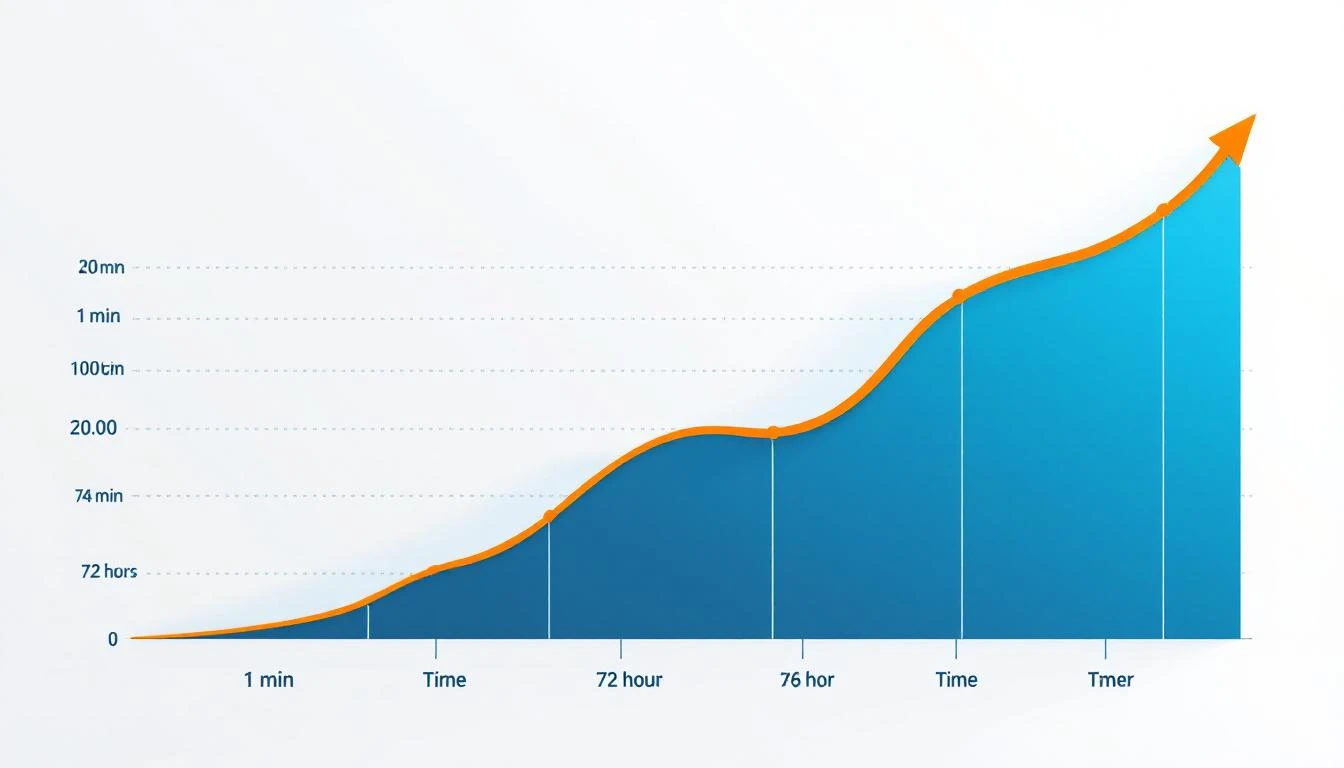
Lead response time decay curve showing conversion probability dropping rapidly after 5 minutes

The Timeline of Decline​

StudyYearKey Finding
Harvard Business Review201142-hour average response time
Velocify2016Responding within 1 minute = 391% higher conversion
InsideSales2021Only 0.1% of companies respond within 5 minutes
RevenueHero202463% of companies never respond; 29+ hour average
Workato202599%+ fail the 5-minute test; 11h 54m average email

Read that timeline again. In 2011, the average response time was 42 hours. In 2024, it's 29 hours for the companies that respond at all β€” but 63% don't respond at all. The non-response rate nearly tripled from 23% in 2011 to 63% in 2024.

More tools. More automation. Worse results.

Why It Matters: The Revenue Math​

The conversion impact is not linear. It's a cliff.

  • Within 1 minute: 391% higher conversion (Velocify)
  • Within 5 minutes: 9x more likely to convert (InsideSales)
  • Within 1 hour: 7x higher qualification rate vs. waiting longer (HBR)
  • After 24 hours: You're cold-calling someone who's already moved on

And here's the stat that should end every debate about speed to lead: 78% of buyers purchase from the first company that responds. Not the best product. Not the cheapest option. The first one to show up.

When your average response time is 29 hours, you're not competing for the deal. You're already out of it.

The Hidden Bottleneck Nobody Blames​

Here's what most teams miss. The Workato study broke response time into two components:

Lead Response Time = Lead Processing Time + Rep Response Time

Most companies blame slow reps. The data shows the opposite. The average SDR responds within minutes of seeing a lead in their queue. But the lead takes hours to get routed to them.

The processing pipeline β€” enrichment, lead-to-account matching, territory assignment, routing rules, round-robin logic β€” is where deals go to die. The average personalized email response takes 11 hours and 54 minutes (Workato), and most of that delay is processing, not rep laziness.

You can't coach your way out of a broken routing system.

The Quota Attainment Crisis​

The headline number β€” 83.4% of SDRs miss quota β€” becomes less surprising when you see the underlying metrics:

  • Average meetings booked per month: 15 (Bridge Group)
  • Dials to connect: 18+ attempts per connection
  • Call-back rate: Under 1%
  • Cold email response rate: 1–2%
  • Quality conversations per day: 3.6

That means your average SDR has fewer than 4 real conversations per day. To book 15 meetings from ~72 monthly connects, they need a 21% connect-to-meeting conversion rate. That's achievable for veterans. It's brutal for the 60% of SDRs in their first 12 months.

And tenure compounds the problem. Average SDR tenure is 6–23 months. Just as someone becomes proficient, they promote out or leave. The team is perpetually in ramp mode.

What Top Performers Do Differently​

The data reveals a clear pattern separating the 16.6% who consistently hit quota:

1. They qualify ruthlessly. Companies with thorough qualification processes saw closing ratios jump from 11% to 40% (InsideSales). Top SDRs don't work more leads β€” they work the right leads.

2. They use signal-based prioritization. Instead of working leads alphabetically or by age, elite SDRs prioritize by intent signals β€” who's on the website right now, who just changed jobs, who's researching competitors.

3. They batch their day. The "Golden Hours / Platinum Hours" framework separates prime prospecting time (calls and outreach) from admin work. Top reps protect their selling time aggressively.

4. They hit 14.5% meaningful conversation rates with decision-makers β€” nearly 4x the average β€” through better targeting and personalization, not more volume.

The $2.7 Billion Waste Problem​

Let's put a dollar figure on this crisis.

B2B marketers spend over $4.6 billion annually on advertising to generate leads. An estimated $2.7 billion of that is wasted due to slow or nonexistent follow-up (Credofy). You're paying to generate demand and then letting it rot.

At the individual company level, the math is just as ugly. Consider a mid-market B2B company:

MetricValue
Monthly inbound leads200
Average deal value$15,000
Conversion rate (fast response)3%
Conversion rate (slow response)0.15%
Revenue lost monthly$8,550
Revenue lost annually$102,600

That's $100K+ per year lost β€” not to bad marketing, not to a weak product, but to slow response. For most B2B companies, that's 1–2 SDR salaries that could be funded by simply responding faster.

The AI Inflection Point​

The good news: the industry is finally addressing this structurally, not just incrementally.

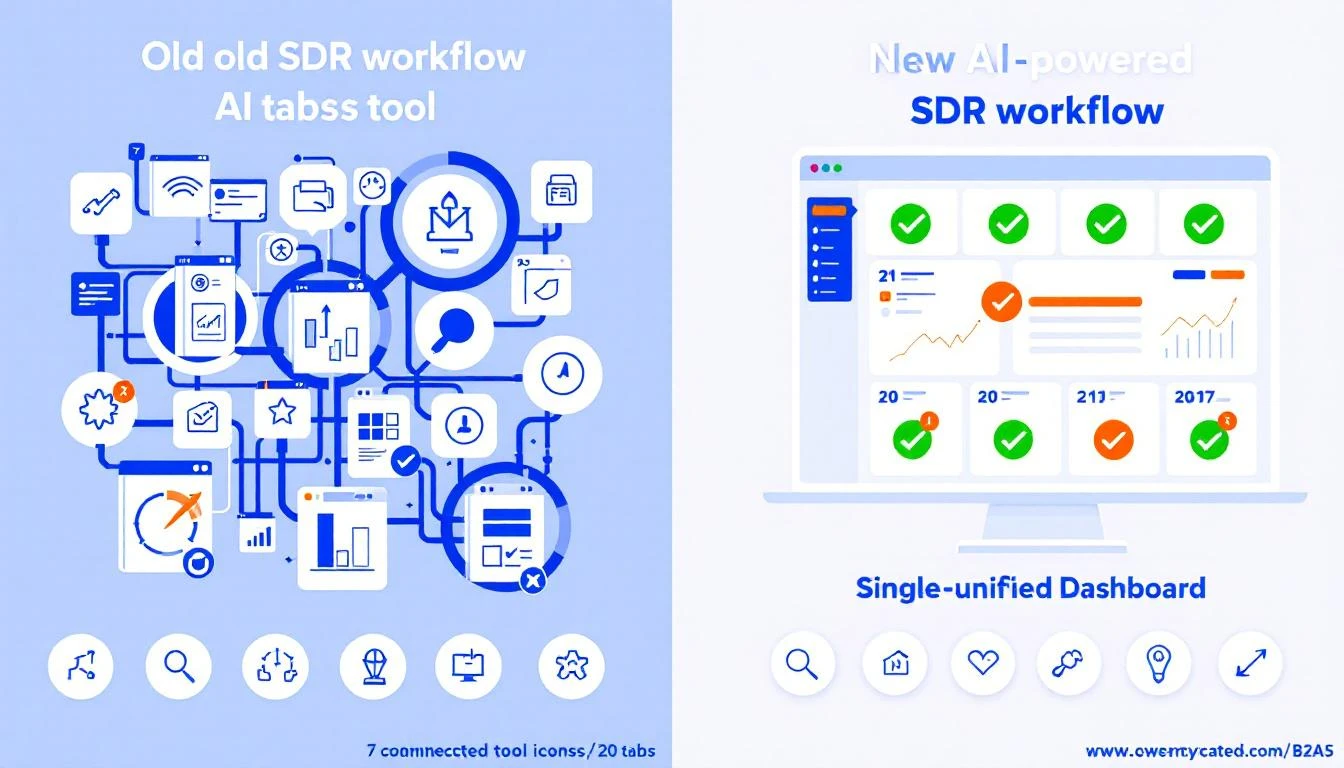
Comparison of the old SDR workflow with disconnected tools versus the new AI-powered unified workflow

AI adoption in sales has exploded from 39% to 81% in just two years (Salesforce). And the results are significant:

  • 46% productivity increase for teams using AI-powered sales tools
  • 20% increase in pipeline volume with AI implementation
  • 30% improvement in lead conversion rates
  • AI-powered personalization delivers 9.25% appointment rate β€” better than most manual outreach

Salesforce reported that their own AI SDR agent created 3,200 opportunities in four months by working the low-score leads that human SDRs couldn't justify spending time on.

But here's the nuance the "AI will replace SDRs" crowd misses: AI doesn't replace selling. It replaces the 60% of the day that isn't selling.

The best implementations aren't replacing human SDRs with AI agents. They're using AI to:

  1. Eliminate processing delay β€” Route, enrich, and prioritize leads in seconds, not hours
  2. Kill the research tax β€” Pre-populate account context so reps don't spend 17% of their day Googling prospects
  3. Automate admin β€” CRM updates, activity logging, and follow-up scheduling happen automatically
  4. Provide daily direction β€” Instead of "here are your 200 leads, figure it out," AI tells the SDR exactly who to call, what to say, and why now

This is the difference between an AI that replaces the SDR and an AI that makes the SDR 3x more effective. The former is a race to commoditized outreach. The latter is how you win.

The Consolidation Imperative​

The average B2B sales team uses 7–12 tools across prospecting, enrichment, engagement, dialing, and analytics. At $1,500–$4,000 per user per month, that's an enormous expense delivering a 40% selling rate and 29-hour response times.

The answer isn't another tool. It's fewer tools that do more.

Organizations with well-integrated enablement tech stacks are 42% more likely to boost sales productivity (Highspot). Integration isn't a nice-to-have. It's the difference between 3-hour and 6-hour selling days.

What does the right consolidated stack look like?

  • Signal layer: Website visitor identification, intent data, buying signals in one view
  • Enrichment layer: Contact data, company data, and champion tracking without manual lookups
  • Execution layer: Email, dialer, and multi-channel outreach from one interface
  • Intelligence layer: AI that tells the SDR what to do next β€” not just shows data and makes them figure it out

This is what "from 20 tabs to one task list" actually means in practice.

What to Do About It​

If you're a sales leader reading this data and recognizing your own team, here's the playbook:

1. Audit Your True Selling Time​

Have each SDR log their actual activities for one week. Not what the CRM says β€” what they actually did. You'll likely find selling time closer to 2 hours than the 3.2 you assumed.

2. Measure Lead Processing Time Separately​

Break your response time into processing (system) and rep response (human). Fix the system first β€” it's usually the bigger bottleneck and doesn't require behavior change.

3. Cut Your Stack, Don't Add To It​

Every tool you add increases context-switching cost. Before buying tool #8, ask: can tool #3 do this if I configured it properly? Tool consolidation is the highest-ROI move in sales ops right now.

4. Move From Data Dashboards to Daily Playbooks​

Your SDRs don't need more data. They need direction. A daily prioritized task list β€” who to call, what to say, and why today β€” eliminates the 17% research tax and dramatically improves response times.

5. Adopt AI for the Non-Selling 60%, Not the Selling 40%​

The highest-impact AI use cases in sales aren't automated email blasts. They're lead routing in seconds instead of hours, automatic enrichment, CRM auto-updates, and intelligent prioritization. Keep humans on the conversations. Let AI handle everything else.

The Bottom Line​

The SDR productivity crisis isn't caused by lazy reps. It's caused by:

  • Tool sprawl that eats 10%+ of every day in context switching
  • Processing delays that turn hot leads cold before reps ever see them
  • Data overload without direction β€” dashboards instead of playbooks
  • Constant ramp from 6–23 month average tenure

The teams solving this aren't buying more tools. They're consolidating into platforms that combine signals, enrichment, and execution into a single daily SDR workflow β€” and using AI to eliminate the 60% of the day that was never selling to begin with.

The data is clear: the gap between top-performing SDR teams and everyone else is no longer effort. It's architecture.


Want to see what an AI-powered SDR workflow looks like in practice? Book a demo β†’


Sources​

  • Salesforce State of Sales Report, 2026
  • RevenueHero Lead Response Study, 2024 (1,000+ companies)
  • Workato Lead Response Time Study, 2024–2025 (114 B2B companies)
  • InsideSales.com Lead Response Study, 2021 (55M activities, 5.7M leads)
  • Harvard Business Review (Oldroyd, McElheran, Elkington), 2011 (15K leads)
  • Velocify Lead Response Analysis, 2016 (millions of records)
  • Highspot State of Sales Enablement Report, 2025
  • Bridge Group SDR Metrics and Compensation Report
  • Credofy B2B Lead Response Framework

The AI-Powered SDR: How Claude Code + MarketBetter Changes Everything

Β· 12 min read
MarketBetter Team
Content Team, marketbetter.ai

🟒 Series Difficulty: BASIC (Part 1 of 10) β€” No AI experience needed. Start here.

There's a quiet revolution happening in sales development, and most SDRs are about to get left behind.

While everyone's talking about AI replacing salespeople, the real story is different: the SDRs who learn to work with AI tools are outperforming their peers by 5-10x. Not because they're better sellers. Because they've eliminated the busywork that eats 70% of their day.

This is the first post in our 10-part series on how SDRs can use Claude Code together with MarketBetter to become radically more effective. No coding background needed. No engineering degree required. Just practical workflows that any sales professional can start using today.

What Is Claude Code (and Why Should You Care)?​

Let's start simple. Claude Code is an AI assistant built by Anthropic that lives in your terminal β€” think of it like having a super-smart research analyst sitting next to you, ready to do whatever you ask.

But here's what makes it different from ChatGPT or other AI chatbots: Claude Code can actually do things. It doesn't just generate text. It can:

  • Read and analyze files β€” drop in a CSV of 500 leads and ask it to prioritize them
  • Search and research β€” pull together company intel from multiple sources in seconds
  • Write and edit β€” craft personalized emails, call scripts, and LinkedIn messages
  • Process data β€” clean up your CRM exports, find duplicates, standardize job titles
  • Build simple tools β€” create lead scoring models, competitive tracking sheets, and more

Think of it this way: if your current AI tool is a calculator, Claude Code is a full spreadsheet. Same category, completely different capability.

"But I'm Not a Developer..."​

Good. You don't need to be. The way you interact with Claude Code is by typing plain English. You tell it what you want, and it figures out how to do it.

Here's a real example:

"I have a meeting with the VP of Sales at Acme Corp tomorrow. Pull together everything you can find about them β€” recent news, their tech stack, any recent job postings, and what their LinkedIn presence looks like. Give me a one-page brief I can review in 5 minutes."

That's it. That's the "prompt." No code. No special syntax. Just tell it what you need like you'd tell a colleague.

The Current SDR Reality (It's Not Pretty)​

Let's be honest about what most SDRs' days actually look like:

ActivityTime SpentRevenue Impact
Researching prospects2-3 hoursIndirect
Updating CRM1-2 hoursZero
Writing/personalizing emails1-2 hoursModerate
Actual selling (calls, meetings)1-2 hoursHigh
Admin tasks1 hourZero

The math is brutal. Out of an 8-hour day, the average SDR spends less than 2 hours on activities that directly generate revenue. The rest? Research, data entry, email drafting, and the soul-crushing ritual of tabbing between 12 different browser tabs trying to figure out if a prospect is worth calling.

This isn't a "work harder" problem. It's a leverage problem. And AI is the lever.

Enter Claude Code + MarketBetter: The 10x SDR Stack​

Here's our thesis: when you combine Claude Code's analytical power with MarketBetter's signal-driven platform, you create a workflow that turns an average SDR into a top performer.

Not by making them faster at bad activities. By fundamentally changing which activities they spend time on.

How the Stack Works Together​

MarketBetter is your signal engine. It tells you:

  • Which companies are visiting your website right now
  • Who the actual people are behind those visits (person-level identification)
  • What pages they looked at and how many times they came back
  • When a cold lead suddenly re-engages
  • Which accounts are showing buying intent

Claude Code is your research and execution engine. It:

  • Takes those signals and instantly builds detailed prospect briefs
  • Crafts hyper-personalized outreach based on real research
  • Cleans and enriches your contact data
  • Analyzes patterns in your pipeline
  • Builds custom workflows for your specific sales process

Together, they create a loop:

  1. MarketBetter surfaces the signal β†’ "Company X visited your pricing page 3 times this week"
  2. Claude Code does the research β†’ "Here's everything about Company X: they're a 200-person SaaS company, just raised Series B, hiring 5 SDRs, their VP of Sales just posted about outbound challenges on LinkedIn..."
  3. You make the call β†’ Armed with context that would have taken 30 minutes to gather manually, in 30 seconds
  4. MarketBetter delivers the sequence β†’ AI-written follow-up sequences triggered by behavior

That's the loop. Signal β†’ Research β†’ Action β†’ Follow-up. And it happens in minutes, not hours.

What This Series Will Cover​

Over the next nine posts, we're going deep into every part of this workflow. The series is structured as a progression β€” Basic β†’ Medium β†’ Advanced β€” so you build skills step by step. Each post builds on what you learned in the previous ones, and by the end, you'll have a complete AI-powered SDR workflow.

Here's what's coming:

🟒 BASIC (Posts 1-3) β€” Getting Started​

These posts assume zero AI experience. If you've never used Claude Code, start here.

Part 2: Prospect Research in 30 Seconds β€” Your first real use case. Learn how to use Claude Code to build complete account dossiers instantly. Pair with MarketBetter's visitor identification to know exactly who to research and when.

Part 3: Writing Hyper-Personalized Cold Emails at Scale β€” Build on your research skills to craft emails that genuinely feel personal. Then deploy them through MarketBetter's AI sequences.

🟑 MEDIUM (Posts 4-6) β€” Building Your System​

Now that you're comfortable with basic prompts, these posts show you how to build repeatable workflows.

Part 4: LinkedIn-to-Pipeline β€” Automate your Sales Navigator workflow. Combines the research skills from Part 2 with the email writing from Part 3, plus MarketBetter's Chrome Extension for importing leads.

Part 5: Competitive Intelligence on Autopilot β€” Monitor what your competitors' customers are saying. Turn insights into targeted outreach using the techniques from earlier posts.

Part 6: Building a Lead Scoring Model β€” Create simple but effective scoring logic without a data team. Use MarketBetter's daily playbook to act on the scores.

πŸ”΄ ADVANCED (Posts 7-9) β€” Mastering AI-Powered Sales​

These posts tackle more complex workflows that combine multiple skills. Best tackled after you're comfortable with Parts 1-6.

Part 7: CRM Cleanup in Minutes β€” Process large datasets, fix dirty data, and build maintenance systems. Clean data powers everything else in this series.

Part 8: Meeting Prep That Doesn't Suck β€” Build an automated meeting prep system that combines Claude Code research with MarketBetter behavioral data. Multi-step workflows for every meeting on your calendar.

Part 9: Never Let a Lead Go Cold β€” AI-powered follow-up sequences that combine signal detection, research, and personalized re-engagement. The most sophisticated workflow in the series.

πŸ† CAPSTONE (Post 10) β€” The Full Playbook​

Part 10: The Complete AI SDR Playbook β€” Everything from Posts 1-9, assembled into a complete daily routine. Your minute-by-minute schedule as an AI-powered SDR.

The 5 Principles of the AI-Powered SDR​

Before we dive into tactics, let's establish the mindset. These five principles guide everything in this series:

1. Signals Over Spray-and-Pray​

Traditional outbound is a numbers game. AI-powered outbound is an intelligence game. Instead of emailing 200 people and hoping 5 respond, you identify the 20 who are most likely to buy and reach out with perfect context. The result? Higher response rates with less effort.

For a deep dive on this approach, check out our guide to signal-based selling.

2. Research Speed = Revenue Speed​

The faster you can go from "who is this prospect?" to "here's exactly what to say to them," the more conversations you have. Claude Code compresses research from 20 minutes to 20 seconds. Over a day, that's hours reclaimed for actual selling.

3. Personalization Is a Competitive Moat​

Generic outreach is dead. When every SDR is using the same templates, the reps who win are the ones who make every touchpoint feel custom. AI lets you achieve true personalization at volume β€” not "Hi {first_name}, I see you work at {company}" personalization, but "I noticed you just posted about scaling your outbound team, and your company is hiring 3 new SDRs β€” here's how others in that situation have approached it" personalization.

Learn more in our post on how to write cold emails that actually get replies.

4. Clean Data Is Non-Negotiable​

AI tools are only as good as the data you feed them. Garbage in, garbage out. That's why Part 7 of this series focuses entirely on using Claude Code to clean your CRM data. It's not sexy, but it's the foundation everything else is built on.

5. The Human Makes the Decision​

AI doesn't close deals. People do. The role of AI in this stack is to give you better information faster so you can make better decisions about who to call, what to say, and when to follow up. You're still the one building relationships, reading rooms, and closing business. AI just makes sure you're spending your time on the right prospects.

A Day in the Life: AI-Powered SDR vs. Traditional SDR​

Let's make this concrete. Here's how the same morning looks for two SDRs:

Traditional SDR: Sarah's Morning​

  • 8:00 AM β€” Opens CRM, scrolls through her list of 200 accounts. No idea which ones to prioritize.
  • 8:15 AM β€” Picks 10 accounts alphabetically (she left off at "M" yesterday). Opens LinkedIn to research the first one.
  • 8:30 AM β€” Spends 15 minutes on the first account. Finds the VP of Sales on LinkedIn, reads their last 3 posts, checks the company news page, looks up their tech stack on BuiltWith.
  • 8:45 AM β€” Writes a personalized email. Revises it twice. Sends it.
  • 8:50 AM β€” Starts researching the second account...
  • 10:00 AM β€” Has sent 4 personalized emails. Feeling productive but exhausted.

AI-Powered SDR: Marcus's Morning​

  • 8:00 AM β€” Opens MarketBetter's daily playbook. Sees that 12 accounts visited the website overnight, 3 of them hit the pricing page, and 1 is a return visitor from a cold lead that went dark 2 months ago.
  • 8:05 AM β€” Asks Claude Code to research all 12 accounts. Gets back complete dossiers β€” company overview, key contacts, recent news, tech stack, LinkedIn activity β€” for all 12 in under 2 minutes.
  • 8:10 AM β€” Reviews the briefs for the 3 pricing page visitors. Asks Claude Code to draft personalized emails for each based on the research.
  • 8:15 AM β€” Reviews and tweaks the emails. Sends all 3 through MarketBetter with AI-powered follow-up sequences attached.
  • 8:20 AM β€” Calls the return visitor. Already knows their website visit history (MarketBetter), their recent LinkedIn activity (Claude Code research), and that they just posted a job opening for a demand gen role (Claude Code found it). Opens with: "Hey, I noticed you're building out your demand gen team β€” we've been helping companies in your space solve exactly that challenge..."
  • 8:30 AM β€” Books a meeting. Moves to the next batch.
  • 10:00 AM β€” Has sent 15 personalized emails, made 8 calls, and booked 2 meetings.

Same two hours. Wildly different outcomes.

Getting Started: What You Need​

Ready to try this yourself? Here's what you'll need:

  1. Claude Code β€” Available from Anthropic. You can use it through the terminal or through tools that integrate it. If you're not sure where to start, your team's RevOps or sales ops lead can set it up for you in minutes.

  2. MarketBetter β€” Sign up to start identifying anonymous website visitors and running AI-powered sequences. Book a demo to see how it works with your existing workflow.

  3. Your existing tools β€” Claude Code works with the data you already have. CRM exports, lead lists, Sales Navigator searches β€” it all feeds into the workflow.

That's it. No complex integrations. No months-long implementation. You can start using Claude Code for prospect research today and layer in MarketBetter's signals as you go.

What About Other AI Tools?​

Fair question. We've written about the differences between Claude Code, ChatGPT, and Codex for sales teams. The short version: Claude Code's ability to handle large amounts of context (up to 200K tokens β€” think of it as being able to read an entire book at once) and its agentic capabilities make it particularly powerful for sales research and analysis.

That said, the principles in this series apply to any capable AI tool. We focus on Claude Code because it currently offers the best combination of research depth, context handling, and practical utility for SDRs.

Free Tool

Try our AI Lead Generator β€” find verified LinkedIn leads for any company instantly. No signup required.

Try This Today​

Here's your homework before the next post:

Open Claude Code and give it this prompt:

"I'm an SDR at [your company]. We sell [your product] to [your target market]. My biggest time wasters are [list 2-3 things]. Suggest 5 specific ways I could use AI to reclaim that time and spend more of my day on actual selling."

Take the response and highlight the one suggestion that would save you the most time. That's your starting point.

Then read Part 2: Prospect Research in 30 Seconds to learn how to turn Claude Code into your personal research analyst.


This is Part 1 (🟒 Basic) of our 10-part series on using Claude Code + MarketBetter to become a more effective SDR. Start with Part 2: Prospect Research β†’

Want to see how MarketBetter's signal-driven platform fits into your sales workflow? Book a demo and we'll show you exactly how it works with your existing tools.

Prospect Research in 30 Seconds: Using Claude Code to Build Account Dossiers

Β· 13 min read
MarketBetter Team
Content Team, marketbetter.ai

🟒 Series Difficulty: BASIC (Part 2 of 10) β€” No AI experience needed. This is your first hands-on use case.

Every SDR knows the drill. You get a name and a company. Maybe a job title if you're lucky. And then the clock starts: LinkedIn profile, company website, recent news, Crunchbase, BuiltWith, G2 reviews, LinkedIn posts... fifteen tabs later, you've spent 20 minutes and you're still not sure if this person is worth calling.

Now multiply that by 50 accounts a day.

This is the research bottleneck, and it's the single biggest destroyer of SDR productivity. Not because the research isn't valuable β€” it absolutely is. Personalized outreach based on real intel dramatically outperforms generic messaging. The problem is that the time investment doesn't scale.

Until now.

In this post β€” Part 2 of our 10-part Claude Code + MarketBetter series β€” we'll show you exactly how to use Claude Code to build complete account dossiers in 30 seconds or less. And how to pair that with MarketBetter's visitor identification signals so you're never wasting research time on the wrong accounts.

If you haven't read Part 1 yet, start there β€” it explains what Claude Code is, why SDRs should care, and the overall thesis behind this series. But if you're ready to get your hands dirty with your first real AI workflow, this is where it starts.

What You'll Need​

Before we dive in, make sure you have:

  • Claude Code installed and ready to use (your team's sales ops or RevOps lead can help with setup β€” it takes about 5 minutes)
  • MarketBetter account with visitor identification enabled (book a demo if you don't have one yet)
  • A list of accounts you want to research (even 3-5 will do for your first try)

That's it. No coding skills. No special training. If you can type a sentence, you can use Claude Code.

The Old Way vs. The New Way​

The Old Way: Manual Research (15-25 Minutes Per Account)​

Here's the typical SDR research workflow:

  1. LinkedIn Profile (3-5 min) β€” Find the contact, read their bio, check recent posts, look at career history
  2. Company Website (3-5 min) β€” About page, product pages, recent blog posts, press releases
  3. News & PR (2-3 min) β€” Google the company name, check for recent funding, acquisitions, partnerships
  4. Tech Stack (2-3 min) β€” BuiltWith or Wappalyzer to see what tools they use
  5. Hiring Signals (2-3 min) β€” Check their careers page or LinkedIn jobs for relevant openings
  6. Social Presence (2-3 min) β€” Twitter/X activity, any podcast appearances, speaking engagements
  7. Compile Notes (2-3 min) β€” Write it all up in your CRM or a doc

Total: 15-25 minutes for a single account.

At 50 accounts per day (a typical SDR target), that's 12-20 hours of research. More hours than exist in a workday. So what actually happens? SDRs skip the research and send generic outreach. Response rates drop. Pipeline suffers. It's a vicious cycle.

The New Way: Claude Code + MarketBetter (30 Seconds Per Account)​

Here's the same workflow, reimagined:

  1. MarketBetter alerts you that Acme Corp visited your pricing page twice this morning
  2. You paste one prompt into Claude Code:

"Research Acme Corp (acmecorp.com). I need: company overview, recent news (last 90 days), their tech stack, current job openings (especially in sales/marketing), key decision makers with LinkedIn profiles, and any personalization hooks I can use for cold outreach. Format it as a one-page brief."

  1. Claude Code delivers a complete dossier in 20-30 seconds
  2. You scan the brief, pick your angle, and reach out β€” with the same quality of personalization that used to take 20 minutes

That's not hypothetical. That's the actual workflow. Let's break down exactly how to do it.

Step-by-Step: Building Your First Account Dossier​

Step 1: Start With a Signal (Not a Cold List)​

The biggest mistake SDRs make with AI research tools is researching the wrong accounts. If you research 50 accounts but only 3 of them were actually in-market, you wasted time on 47 accounts.

This is where MarketBetter comes in. Instead of guessing who to research, you start with confirmed intent signals:

  • Website visitors β€” Companies visiting your site, especially pricing or product pages
  • Return visitors β€” Someone who came back after going dark (a huge signal β€” see Part 9: Never Let a Lead Go Cold)
  • Person-level identification β€” Not just "someone from Acme Corp" but "Sarah Chen, VP of Sales at Acme Corp" visited your site

When you know who's looking at your site right now, your research has immediate, actionable value. You're not building a dossier for "someday." You're building a dossier for a call you're about to make.

For more on how intent signals work, read our guide to intent data.

Step 2: Craft Your Research Prompt​

The quality of your dossier depends on the quality of your prompt. Here's a template that works consistently:

The Basic Dossier Prompt:

"Research [Company Name] ([domain]). Give me:

  1. Company overview β€” what they do, size, funding stage, HQ location
  2. Recent news from the last 90 days β€” funding, product launches, partnerships, executive changes
  3. Their tech stack β€” what tools/platforms they use, especially [your category]
  4. Current job openings β€” focus on [relevant departments]
  5. Key decision makers β€” [target titles like VP Sales, CRO, Head of Marketing] with LinkedIn profile URLs
  6. 3 personalization hooks I can use for cold outreach

Format this as a scannable one-page brief. Keep it concise."

The Deep-Dive Prompt (for high-value accounts):

"Deep research on [Company Name]. I sell [your product/solution] to [your ICP].

I need:

  1. Full company profile β€” founding year, employee count, revenue range, funding history, key investors
  2. Their current go-to-market approach β€” how do they sell? Do they have an SDR team? What does their outbound look like?
  3. Pain points they're likely facing based on their size, growth stage, and recent activity
  4. Competitive landscape β€” who else are they likely evaluating?
  5. Recent content from their executives β€” LinkedIn posts, blog articles, podcast appearances, conference talks
  6. Tech stack analysis β€” current tools, potential gaps where [your solution] fits
  7. Champion mapping β€” who would be the buyer, influencer, and end user for [your product]?
  8. 5 personalized outreach angles ranked by likely effectiveness

Be specific. Use real data. Flag anything you're uncertain about."

Step 3: Review and Refine​

Claude Code will return a structured brief. Here's what a typical output looks like:


ACCOUNT DOSSIER: Acme Corp

Company Overview

  • B2B SaaS, marketing automation platform
  • ~350 employees (LinkedIn), HQ in Austin, TX
  • Series C ($45M, led by Sequoia, June 2025)
  • Growing ~40% YoY based on job posting volume

Recent News (Last 90 Days)

  • Launched new AI features for email personalization (Jan 2026)
  • Named in G2's "Best Marketing Automation" for mid-market (Feb 2026)
  • VP of Engineering departed (LinkedIn activity suggests Dec 2025)

Tech Stack

  • Salesforce CRM, HubSpot Marketing, Outreach for sequences
  • No visitor identification tool detected
  • Using Clearbit for enrichment

Job Openings (Relevant)

  • 3 SDR roles (posted last 2 weeks) β€” scaling outbound
  • 1 Demand Gen Manager β€” suggests inbound isn't enough
  • 1 RevOps Analyst β€” building out operations

Key Decision Makers

  • James Wilson, CRO (LinkedIn: linkedin.com/in/jwilson)
  • Maria Garcia, VP of Sales (LinkedIn: linkedin.com/in/mgarcia)
  • David Park, Head of Growth (LinkedIn: linkedin.com/in/dpark)

Personalization Hooks

  1. They're hiring 3 SDRs β€” they're clearly investing in outbound. Your solution helps SDR teams perform at scale.
  2. The VP of Engineering departure may signal internal shifts. Tread carefully but it's a potential change catalyst.
  3. Their recent AI email features suggest they value automation β€” they're already bought into the AI thesis.

Review this in 60 seconds. Highlight the hooks you want to use. Move to outreach.

Step 4: Connect the Signals​

Here's where the magic happens. You're not just looking at Claude Code's research in isolation β€” you're layering it with MarketBetter's behavioral data.

MarketBetter tells you: Maria Garcia from Acme Corp visited your pricing page twice yesterday and your case studies page this morning.

Claude Code tells you: Acme Corp is hiring 3 SDRs, just raised Series C, and their CRO recently posted about scaling outbound.

Your outreach writes itself: "Maria, I see Acme is building out the SDR team β€” congrats on the growth. When companies hit your stage, the biggest question is usually 'how do we maintain personalization at scale?' That's exactly what we help with..."

That's not a cold email. That's a warm, relevant, perfectly-timed message. And it took you 2 minutes total.

Batch Research: The Power Move​

Once you're comfortable with individual dossiers, level up to batch research. This is where Claude Code really shines.

The Batch Research Workflow​

  1. Export your MarketBetter daily signal list (the companies showing intent today)
  2. Feed Claude Code the entire list:

"I have a list of 15 companies that visited our website today. Research each one and give me a brief for each with: company size, what they do, one key recent development, and the best personalization angle. Rank them by likely fit for [your ICP]. Here's the list:

  1. Acme Corp (acmecorp.com)
  2. Beta Industries (betaindustries.io)
  3. Gamma Solutions (gammasolutions.com) ..."
  1. Claude Code returns 15 mini-briefs, ranked by fit
  2. You focus your morning on the top 5

Instead of spending your entire morning researching, you spend 5 minutes reviewing Claude Code's output and then the rest of your morning selling.

Advanced Prompt Patterns for SDRs​

Here are some specialized prompts for common research scenarios:

The "Pre-Meeting" Deep Dive​

"I have a meeting with [Name], [Title] at [Company] in 2 hours. Research them like my career depends on it. I need: their career history, recent LinkedIn activity, anything they've published or said publicly, mutual connections, their company's recent news, and 3 talking points that will make me sound like I've known their business for years."

(For a complete meeting prep workflow, see Part 8: Meeting Prep That Doesn't Suck.)

The "Competitor Customer" Research​

"I need to research [Company] as a potential customer. They currently use [Competitor]. Research what they might be frustrated with based on [Competitor] reviews on G2 and Reddit. Find their most likely pain points and suggest an angle for approaching them about switching."

(More on competitive intelligence in Part 5.)

The "Trigger Event" Research​

"I just saw that [Company] announced [trigger event β€” new funding, executive hire, product launch]. Research everything about this event and how it creates an opportunity for us to reach out with [our solution]. Give me the angle and draft an email opening."

The "Reactivation" Research​

"[Company] was a prospect 6 months ago but went cold. Research what's changed since then β€” new leadership, new funding, new challenges, shifts in their tech stack. Help me find an angle to re-engage them."

Common Mistakes to Avoid​

1. Researching Without Intent​

Don't just research random accounts because you can. Start with a signal β€” a website visit, a LinkedIn engagement, a trigger event. Research is only valuable when it leads to action.

2. Over-Researching​

Claude Code can give you pages of information. You don't need pages. You need 3 things: who to contact, what to say, and why now. Everything else is noise.

3. Not Verifying Key Claims​

Claude Code is incredibly capable, but it can occasionally get details wrong. If your outreach hinges on a specific fact β€” "I saw you just raised Series B" β€” verify it before you reference it. Nothing kills credibility faster than getting a basic fact wrong.

4. Copy-Pasting Without Personalization​

Claude Code gives you raw material, not finished outreach. Always add your own voice, adjust for tone, and make it feel like something a real human would write. (More on this in Part 3: Writing Hyper-Personalized Cold Emails.)

Making It a Daily Habit​

The SDRs who get the most value from Claude Code don't use it sporadically. They build it into their daily routine:

Morning Sprint (15 minutes):

  1. Check MarketBetter for overnight website visitors and intent signals
  2. Feed the top 10-15 accounts into Claude Code for batch research
  3. Review the dossiers, pick your top 5, and plan your outreach

Before Every Call (2 minutes):

  1. Quick Claude Code research on the specific person you're about to call
  2. Scan for recent LinkedIn posts, company news, or mutual connections
  3. Walk into the call with context

End of Day (5 minutes):

  1. Research tomorrow's follow-up targets
  2. Use Claude Code to draft follow-up messages for today's conversations
  3. Queue them in MarketBetter for morning delivery

For the full daily routine, check out Part 10: The Complete AI SDR Playbook.

The ROI of AI-Powered Research​

Let's put real numbers on this:

  • Time saved per account: ~18 minutes (from 20 minutes to 2 minutes)
  • Accounts researched per day: 50 (up from 10-15)
  • Hours reclaimed per day: ~3 hours (redirected to selling)
  • Expected impact on pipeline: 2-3x more conversations with researched, personalized outreach

That's not incremental improvement. That's a fundamentally different job.

Free Tool

Try our Tech Stack Detector β€” instantly detect any company's tech stack from their website. No signup required.

Try This Today​

Here's your action item:

  1. Pick 3 accounts that you're planning to reach out to this week
  2. Open Claude Code and use the Basic Dossier Prompt from above for each one
  3. Compare the output to what you'd have found doing manual research
  4. Time yourself β€” how long did Claude Code take vs. how long you'd normally spend?

Most SDRs who try this have a reaction somewhere between "wait, that's it?" and "I've been doing this manually like a fool." Either way, you'll never go back.


This is Part 2 (🟒 Basic) of our 10-part series on Claude Code + MarketBetter for SDRs. Next up: Part 3: Writing Hyper-Personalized Cold Emails at Scale β†’

Ready to pair AI research with real-time buyer intent signals? Book a MarketBetter demo to see visitor identification in action.

Building a Lead Scoring Model Without a Data Team

Β· 11 min read
MarketBetter Team
Content Team, marketbetter.ai

🟑 Series Difficulty: MEDIUM (Part 6 of 10) β€” Uses research skills from Part 2 and connects to MarketBetter's signal data. The most analytical post so far.

Every SDR knows the frustration: you've got 200 leads in your queue, and they all look the same. Same priority level. Same generic tags. No clear signal about who to call first.

So you do what every SDR does β€” you start at the top of the list and work your way down. Or you sort alphabetically. Or you go with gut instinct. None of these are strategies. They're survival mechanisms.

Meanwhile, the enterprise sales teams down the hall have sophisticated lead scoring models built by data teams, powered by Marketo or HubSpot, with algorithms that predict which leads are most likely to convert. You don't have that. You don't have a data team. You don't have a marketing ops person who can build predictive models. You have a CRM, a list of leads, and a quota.

Here's the good news: you can build a lead scoring model in 30 minutes using Claude Code. It won't be as sophisticated as a machine-learning-powered enterprise system. But it'll be 10x better than alphabetical sorting. And when you pair it with MarketBetter's daily playbook, you'll have a complete system for knowing exactly who to call first, every morning.

This is Part 6 of our Claude Code + MarketBetter series β€” the last of the Medium-level posts. In the Basic posts (Parts 1-3), you learned to research and write. In Parts 4 and 5, you built multi-step workflows for LinkedIn and competitive intel. Now you're going to do something more analytical: use Claude Code to build a system that makes decisions for you. You'll define scoring rules, apply them to data, and create a repeatable process that gets smarter over time.

If that sounds complex, don't worry. The Claude Code prompts are just as straightforward as the ones you've been using. You're just asking slightly more structured questions.

Let's build your scoring model.

What Is Lead Scoring (and Why Do You Need It)?​

Lead scoring assigns a numerical value to each lead based on how likely they are to buy. Higher score = more likely to convert = call them first.

Simple concept. But most scoring models fail because they're either:

  • Too complex β€” Built by data teams with 47 variables that nobody understands
  • Too simple β€” "Enterprise = high priority" doesn't tell you anything useful
  • Too static β€” Set once and never updated, even as your market changes
  • Disconnected from action β€” Great model, but nobody uses it in their daily workflow

The model we're going to build avoids all of these traps. It uses three categories of signals, is easy to understand, and plugs directly into your MarketBetter daily playbook.

For a deeper dive on scoring best practices, check out our lead scoring best practices guide.

The Three Pillars of SDR Lead Scoring​

Your scoring model is built on three pillars:

Pillar 1: Firmographic Fit (Does this company match our ICP?)​

This is the "who are they?" question. It includes:

  • Company size (employee count or revenue)
  • Industry
  • Geography
  • Technology used
  • Funding stage

Pillar 2: Behavioral Signals (Are they actively interested?)​

This is the "what are they doing?" question:

  • Website visits (especially high-intent pages like pricing)
  • Email engagement (opens, clicks, replies)
  • Content downloads
  • Social media interactions
  • Event attendance

Pillar 3: Timing Signals (Is now the right moment?)​

This is the "when is the right time?" question:

  • Recent funding rounds
  • Leadership changes
  • Job postings in relevant departments
  • Competitor contract renewals
  • Seasonal buying patterns

Each pillar contributes to a total score. The leads with the highest combined score get your attention first.

Step-by-Step: Building Your Model with Claude Code​

Step 1: Define Your Ideal Customer Profile​

Before you can score leads, you need to know what a great lead looks like. Ask Claude Code:

"Help me define my Ideal Customer Profile (ICP). I sell [your product] to [your market]. My best customers tend to be:

  • Company size: [range]
  • Industry: [industries]
  • Typical buyer title: [titles]
  • Common pain points: [pains]

Based on this, create a firmographic scoring rubric with a 0-30 point scale. Give me the exact criteria for each score level."

Claude Code returns something like:

Firmographic Scoring (0-30 points)

CriteriaPointsDetails
Company Size0-101-49 employees: 2pts, 50-200: 7pts, 201-500: 10pts, 500-1000: 8pts, 1000+: 5pts
Industry0-10SaaS/Tech: 10pts, Financial Services: 8pts, Healthcare: 6pts, Manufacturing: 3pts, Other: 1pt
Geography0-5US: 5pts, UK/Canada: 4pts, Western EU: 3pts, Other: 1pt
Funding Stage0-5Series A-C: 5pts, Seed: 3pts, Bootstrapped: 2pts, Public: 2pts

Notice how the scoring reflects YOUR specific ICP. A 200-person SaaS company in the US scores higher than a 5,000-person manufacturer in Asia β€” because that's who buys from you.

Step 2: Build the Behavioral Scoring Component​

Now add the engagement signals. This is where MarketBetter's data becomes critical:

"Now create a behavioral scoring rubric (0-40 points) based on these engagement signals I can track:

  • Website visits (from MarketBetter visitor identification)
  • Pages visited (pricing page, case studies, product pages)
  • Visit frequency (one-time vs. return visitor)
  • Email engagement (opens, clicks, replies)
  • LinkedIn engagement (profile views, connection accepts, post interactions)

Weight the signals by purchase intent. A pricing page visit is more valuable than a blog page visit."

Claude Code returns:

Behavioral Scoring (0-40 points)

SignalPointsDetails
Pricing page visit10Single strongest buying signal
Case study/testimonial page7Evaluating social proof
Product/feature pages5Active research phase
Blog/content visit2Awareness stage
Return visitor (2+ sessions)8Sustained interest
Multi-page session (3+ pages)5Deep engagement
Email opened (2+ times)3Interest but not action
Email link clicked5Active engagement
Email replied8Direct interest
LinkedIn connection accepted3Openness to conversation

Step 3: Build the Timing Scoring Component​

Finally, add signals that indicate the timing is right:

"Create a timing/trigger scoring rubric (0-30 points) based on these signals:

  • Recent funding announcement
  • Executive leadership changes
  • Job postings in relevant departments
  • Company expansion/new office
  • Technology changes or migrations
  • Contract renewal season (if known)

Weight by urgency of the buying window."

Claude Code returns:

Timing Scoring (0-30 points)

SignalPointsDetails
New funding (last 60 days)8Budget available, growth mandate
New CRO/VP Sales (last 90 days)7New leaders bring new tools
Hiring SDRs/AEs (active postings)6Scaling sales = needs tools
Hiring demand gen/marketing5Building pipeline infrastructure
Technology migration announced6Open to new vendors
Competitor contract likely up for renewal5Evaluation window
Expansion/new market entry4Growing pains = new needs

Step 4: Score Your Existing Leads​

Now apply the model. Export your lead list from your CRM and feed it to Claude Code:

"I have a list of 100 leads. Apply this scoring model to each one:

[paste your scoring rubrics]

For each lead, I have:

  • Company name, size, industry, geography
  • Website visit data from MarketBetter (pages visited, frequency)
  • Email engagement data (opens, clicks, replies)
  • Any known trigger events

Score each lead across all three pillars, calculate the total, and rank them from highest to lowest. Group them into tiers:

  • Hot (70-100): Call immediately
  • Warm (40-69): Prioritize this week
  • Cool (20-39): Nurture sequence
  • Cold (0-19): Low priority

Here's the data: [paste your lead list with available data]"

In 2-3 minutes, you have a fully scored, prioritized lead list. No data team required.

Using MarketBetter's Daily Playbook as the Execution Layer​

A scoring model is useless if it doesn't change your daily behavior. Here's how to connect your Claude Code scoring model to your MarketBetter workflow:

The Morning Ritual (10 minutes)​

  1. Check MarketBetter's daily playbook β€” New website visitors, return visitors, engaged prospects
  2. Apply your scoring model β€” New behavioral signals from overnight activity change scores
  3. Identify your Hot tier β€” These are your first calls of the day
  4. Identify new entrants to Warm tier β€” Prospects who were Cool but just visited your pricing page. They jumped tiers overnight.
  5. Execute β€” Start with the highest-scored leads and work down

Signal-Triggered Score Updates​

MarketBetter sends you real-time signals throughout the day. Each signal should update your mental scoring:

  • Prospect visited pricing page β†’ +10 points. If they were Warm, they're now Hot. Call them.
  • Prospect opened your email 3 times β†’ +5 points. They're interested. Send a follow-up.
  • Prospect visited your site from a new device β†’ +3 points. They might be sharing your site with colleagues. Multi-stakeholder interest.
  • Cold lead returned to your site β†’ Re-score them entirely. They might have jumped from Cold to Warm in one visit. (More on re-engagement in Part 9.)

Automated Scoring with MarketBetter​

MarketBetter's built-in engagement tracking does much of the behavioral scoring automatically. Your Claude Code model handles the firmographic and timing scoring that MarketBetter doesn't cover. Together, they give you a complete picture.

For more on how intent data drives this process, read our guide to what intent data is and how it drives growth.

Refining Your Model Over Time​

Your first scoring model won't be perfect. That's fine. Here's how to improve it:

Monthly Review (15 minutes)​

"Here are my last month's results:

  • 15 leads scored Hot β†’ 8 converted to meetings (53%)
  • 30 leads scored Warm β†’ 6 converted to meetings (20%)
  • 45 leads scored Cool β†’ 2 converted to meetings (4%)
  • 10 leads scored Cold β†’ 0 converted to meetings (0%)

Also, 3 meetings came from leads scored Cool or Cold. Here's what those leads had in common: [details]

Based on this data, what adjustments should I make to my scoring model? Are any signals over- or under-weighted?"

Claude Code will analyze the conversion data and suggest specific adjustments. Maybe pricing page visits should be worth 15 points instead of 10. Maybe industry scoring needs recalibration. Make the adjustments and run the updated model.

The Feedback Loop​

Over 3-6 months, your scoring model gets increasingly accurate because you're refining it based on actual conversion data. This is essentially what data teams do with machine learning β€” just simpler and driven by your domain expertise instead of algorithms.

Advanced: Multi-Persona Scoring​

If you sell to multiple buyer personas, you might need different scoring models for each:

"I sell to two different personas:

Persona 1: VP of Sales (cares about pipeline and team productivity) Persona 2: RevOps Leader (cares about data quality and tech stack efficiency)

Create separate behavioral scoring rubrics for each persona. A VP of Sales visiting a case study page is different from a RevOps leader visiting an integration page β€” weight them differently."

This gives you nuanced prioritization. A RevOps leader on your integrations page might score higher than a VP of Sales on your blog β€” even though the VP is the more senior title β€” because the RevOps behavior signals active evaluation.

Common Scoring Mistakes to Avoid​

  1. Over-weighting title/seniority β€” A Director who's actively researching is more valuable than a VP who isn't
  2. Ignoring negative signals β€” Unsubscribes, bounced emails, and "not interested" replies should decrease scores
  3. Scoring once and forgetting β€” Scores should be dynamic, updated with every new signal
  4. Too many tiers β€” Hot/Warm/Cool/Cold is enough. Don't create 10 tiers that nobody can remember
  5. Ignoring the denominator β€” If your Hot leads aren't converting at a higher rate than Warm leads, your model isn't working
Free Tool

Try our AI Lead Generator β€” find verified LinkedIn leads for any company instantly. No signup required.

Try This Today​

Here's your concrete action item:

  1. Open Claude Code and use the prompts from Steps 1-3 above to build your scoring rubrics
  2. Pick 20 leads from your current queue
  3. Score them manually using your new model (estimate where you can)
  4. Sort them by score and compare the order to how you would have prioritized them with gut instinct
  5. Work the list in score order for one week and track your results

Most SDRs find that their intuition was right about 60-70% of the time. A scoring model gets you to 80-90%. That 20-30% improvement in prioritization translates directly to more meetings with less effort.


This is Part 6 (🟑 Medium) of our 10-part series. You've completed the Medium tier! Next up: Part 7: CRM Cleanup in Minutes β†’ β€” your first Advanced-level post.

MarketBetter's daily playbook surfaces the behavioral signals that power your lead scores. Book a demo to see how it works.

CRM Cleanup in Minutes: Using AI to Fix Your Dirty Data

Β· 11 min read
MarketBetter Team
Content Team, marketbetter.ai

πŸ”΄ Series Difficulty: ADVANCED (Part 7 of 10) β€” Processes large datasets and builds maintenance systems. Best after completing Parts 1-6.

Nobody becomes an SDR because they love data hygiene. But here's the uncomfortable truth: dirty data is silently destroying your pipeline.

Every duplicate contact means wasted outreach. Every wrong email address means a bounced message hurting your domain reputation. Every outdated job title means you're personalizing against information that's no longer true. And every inconsistent company name means your reporting is wrong, your targeting is off, and your sequences are hitting the wrong people.

The average CRM has a 25-30% data decay rate every year. That means if you haven't cleaned your database in 12 months, nearly a third of your contacts have bad data β€” wrong emails, outdated titles, people who've left the company entirely.

Most SDRs know this. They just don't have time to fix it. Manual CRM cleanup is mind-numbing work that can take days. Nobody wants to spend their Friday afternoon deduplicating 3,000 contacts.

What if you could clean your entire CRM database in minutes instead of days? That's what we're covering in Part 7 of our Claude Code + MarketBetter series.

Welcome to the Advanced tier. In the Basic posts (Parts 1-3), you learned to research and write one prospect at a time. In the Medium posts (Parts 4-6), you built multi-step workflows and analytical models. Now we're leveling up to working with large datasets β€” hundreds or thousands of records at once. You'll feed Claude Code entire CRM exports, ask it to find patterns and problems, and build automated maintenance routines.

The prompts are still plain English β€” but you're processing more data, chaining more steps together, and building systems that run on their own. If you've been following the series, you're ready. If you're jumping in here, I'd recommend at least skimming Part 2 to understand the basics of prompting Claude Code.

Why Clean Data Matters for SDRs (More Than You Think)​

Before we get into the how, let's be clear about why this matters for your specific workflow:

1. Deliverability​

Every email that bounces hurts your sender reputation. Enough bounces and your emails start landing in spam β€” even the ones sent to valid addresses. If you're running outbound sequences through MarketBetter, clean data is the foundation of deliverability.

For more on improving email deliverability, see our guide on how to improve email open rates.

2. Targeting Accuracy​

MarketBetter's power comes from matching website visitors to your contact database and triggering the right outreach at the right time. If your CRM data is messy β€” duplicate companies, inconsistent names, missing fields β€” those matches don't happen. You miss signals.

3. Personalization Quality​

When you use Claude Code for prospect research and email writing (as we covered in Parts 2 and 3), you're pulling from your CRM data. If the title says "VP of Sales" but they were promoted to CRO six months ago, your personalization is wrong. Wrong personalization is worse than no personalization.

4. Reporting and Forecasting​

Your lead scoring model from Part 6 is only as good as the data feeding it. Dirty data produces inaccurate scores, which leads to bad prioritization, which means you're calling the wrong people first.

The Five Types of Dirty Data (and How Claude Code Fixes Each)​

Type 1: Duplicates​

The Problem: The same contact exists in your CRM multiple times with slightly different information. "Sarah Chen" and "S. Chen" at the same company. "Acme Corp" and "Acme Corporation" and "ACME" as three separate accounts.

The Claude Code Fix:

"I have a CRM export with [X] contacts. Find all probable duplicates based on:

  1. Same email address
  2. Same name + same company (accounting for variations like 'Sarah' vs 'S.')
  3. Same company domain with different company names

For each duplicate set, tell me:

  • Which record is the most complete (has the most filled fields)
  • Which record was most recently updated
  • Your recommendation for which to keep as the primary record
  • What data from the duplicate(s) should be merged into the primary

Output as a CSV I can use for cleanup."

Claude Code can process thousands of records and identify duplicate clusters in minutes. What would take a sales ops person days takes AI minutes.

Type 2: Outdated Information​

The Problem: People change jobs every 2-3 years. Your CRM still shows them at their old company with their old title.

The Claude Code Fix:

"I have a list of 500 contacts. For each one, check if:

  1. They're still at the listed company (based on any available public information)
  2. Their job title might have changed
  3. The company itself has changed (acquired, merged, shut down)

Flag any contacts that likely have outdated information. For each flagged contact, give me your best guess at updated information and your confidence level.

Here's the list: [paste or attach contact list]"

Pair this with MarketBetter's data enrichment to fill in the gaps. MarketBetter can verify email addresses and update contact information as part of its lead intelligence platform.

Type 3: Inconsistent Formatting​

The Problem: Company names are spelled 10 different ways. Job titles aren't standardized. Phone numbers have different formats. States are sometimes abbreviated, sometimes spelled out.

The Claude Code Fix:

"Standardize this CRM data:

  1. Company names: Use the official company name (e.g., 'Salesforce' not 'salesforce.com' or 'SFDC' or 'Salesforce Inc.')
  2. Job titles: Standardize to a consistent format (e.g., 'VP of Sales' not 'Vice President, Sales' or 'VP - Sales' or 'V.P. Sales')
  3. Phone numbers: Format as +1 (XXX) XXX-XXXX
  4. States: Use 2-letter abbreviations
  5. Industries: Map to a standard list: [your industry categories]

Output the cleaned data in the same CSV format."

This sounds boring, but it's incredibly important for segmentation and targeting. When your company names are standardized, MarketBetter can accurately match website visitors to CRM records. When titles are consistent, your lead scoring model works properly.

Type 4: Missing Data​

The Problem: Half your contacts are missing key fields β€” no phone number, no industry, no company size. You can't score or prioritize leads you don't have data on.

The Claude Code Fix:

"I have 200 contacts with incomplete data. For each contact where I have at least a name and company, research and fill in:

  1. Company size (employee count)
  2. Industry
  3. Company HQ location
  4. Likely phone number format (direct dial if available publicly)
  5. LinkedIn profile URL
  6. Company website

Mark each enriched field with a confidence level (high/medium/low).

Here's the list: [paste contact list]"

This is where Claude Code's research capabilities really shine. It can enrich contacts at a pace that would take a human team weeks.

Type 5: Invalid Emails​

The Problem: Bounced emails hurt your sender reputation. But you don't know which emails are invalid until they bounce β€” and by then, the damage is done.

The Claude Code Fix:

"Analyze these email addresses for potential validity issues:

  1. Obvious typos (e.g., '@gmial.com' instead of '@gmail.com')
  2. Role-based emails that shouldn't be in a prospect database (info@, support@, sales@)
  3. Personal email domains used for a business contact (gmail, yahoo, hotmail)
  4. Email format inconsistencies within the same company (e.g., 'firstname.lastname@' vs 'flastname@')
  5. Defunct domains

Flag and categorize each issue. For typos, suggest the corrected email.

[paste email list]"

This pre-screening catches obvious issues before you send. For full email validation, use a dedicated verification tool β€” but Claude Code's analysis catches the low-hanging fruit that most SDRs miss.

The Complete CRM Cleanup Workflow​

Here's the full process, start to finish:

Phase 1: Export and Assess (5 minutes)​

  1. Export your CRM contacts as a CSV
  2. Feed it to Claude Code:

"I just exported my CRM. It has [X] contacts. Give me a data quality assessment:

  1. How many records have missing email addresses?
  2. How many have missing phone numbers?
  3. How many have missing company size or industry?
  4. How many potential duplicates can you identify?
  5. What's the overall data quality score (1-10)?
  6. What should I fix first for the biggest impact?"

This assessment takes 2 minutes and tells you exactly where to focus.

Phase 2: Deduplicate (10 minutes)​

Run the duplicate detection prompt above. Review Claude Code's recommendations. Merge or delete the duplicates in your CRM.

Phase 3: Standardize (10 minutes)​

Run the standardization prompt. Import the cleaned, formatted data back into your CRM. Everything is consistent now.

Phase 4: Enrich (15 minutes)​

Run the enrichment prompt for contacts with missing data. Review the results (especially anything flagged as medium or low confidence). Update your CRM.

Phase 5: Validate Emails (5 minutes)​

Run the email validation prompt. Remove or correct invalid addresses. This saves your sender reputation from day one.

Total time: about 45 minutes for a complete CRM cleanup. Compare that to the 2-3 days it would take manually.

Maintaining Clean Data (So You Never Have to Do This Again)​

Cleanup isn't a one-time event. Data decays constantly. Here's how to stay clean:

The Weekly 5-Minute Check​

Every Friday, export your new contacts from the past week and run them through a quick Claude Code quality check:

"Review these 30 new CRM contacts added this week. Check for:

  1. Duplicates with existing records
  2. Missing key fields
  3. Formatting issues
  4. Obvious email validity issues

Flag anything that needs fixing."

Five minutes. Clean data maintained.

The Monthly Enrichment Refresh​

Once a month, take your top 100 accounts and check for updates:

"Check these 100 contacts for potential changes:

  1. Have they changed jobs or titles?
  2. Has their company been acquired, merged, or shut down?
  3. Has the company announced funding, expansion, or layoffs?

Flag any records that need updating."

Automated Hygiene with MarketBetter​

MarketBetter helps maintain data quality in real time:

  • Email verification on import β€” bad addresses are flagged before they enter your sequences
  • Contact enrichment β€” missing fields are filled automatically using multiple data sources
  • Company matching β€” website visitors are matched to your CRM records, surfacing both new leads and existing contacts that need updating

The ROI of Clean Data​

Let's put numbers on this:

  • Bounce rate reduction: From 5-8% to under 2% β†’ Protects your sender reputation
  • Targeting accuracy: 25-30% more accurate matching β†’ More website visitors connected to the right sequences
  • Personalization quality: Fewer wrong titles and outdated references β†’ Higher reply rates
  • Time saved: 3-5 hours per week that you'd spend manually fixing data errors β†’ Redirected to selling
  • Sequence performance: Clean data + good targeting = 2-3x better email performance

Clean data isn't glamorous, but it's the infrastructure that makes everything else in this series work. Your lead scoring model (Part 6) needs accurate data. Your personalized emails (Part 3) need current information. Your Sales Nav imports (Part 4) need to not create duplicates.

Free Tool

Try our AI Lead Generator β€” find verified LinkedIn leads for any company instantly. No signup required.

Try This Today​

Here's your action item:

  1. Export your CRM contacts (or even just one segment β€” like your top 200 accounts)
  2. Ask Claude Code for a data quality assessment using the prompt from Phase 1
  3. Fix the top 3 issues it identifies
  4. Set a calendar reminder for a Friday 5-minute check

Your CRM will be cleaner by end of day than it's been in months. And every email, sequence, and outreach effort you run from that point forward will perform better because of it.


This is Part 7 (πŸ”΄ Advanced) of our 10-part series. Next up: Part 8: Meeting Prep That Doesn't Suck β†’

Clean data powers better MarketBetter targeting and deliverability. Book a demo to see how the platform keeps your contact data fresh.

Meeting Prep That Doesn't Suck: Auto-Research Every Prospect Before a Call

Β· 12 min read
MarketBetter Team
Content Team, marketbetter.ai

πŸ”΄ Series Difficulty: ADVANCED (Part 8 of 10) β€” Combines research, behavioral data, and multi-step workflows into an automated system.

You booked the meeting. Nice work. Now the real anxiety begins.

Who is this person? What does their company do? What did they look at on your website? What have they been talking about on LinkedIn? Do you share any mutual connections? Are they evaluating competitors? What should you lead with?

Most SDRs handle meeting prep one of two ways:

Option A: The 30-second glance. Quick peek at their LinkedIn profile, maybe a Google search. Walk into the meeting knowing their title and company name. Hope for the best.

Option B: The 45-minute deep dive. Open 15 tabs. Read every LinkedIn post. Stalk their company's news page. Check Crunchbase. Look at their tech stack. Write notes. Realize you've spent your entire morning prepping for one meeting.

Neither is great. Option A means you're underprepared and it shows. Option B means you prepared brilliantly for one meeting but didn't have time for anything else.

There's an Option C. In Part 8 of our Claude Code + MarketBetter series, we'll show you how to generate a comprehensive one-page prospect brief in under 3 minutes β€” for every single meeting on your calendar.

Why this is an Advanced post: In Part 2, you learned to research a single prospect. That was a one-step process: give Claude Code a name, get a dossier back. Meeting prep is different β€” it's a multi-step system that combines Claude Code research with MarketBetter's behavioral data, processes multiple meetings in a batch, and generates structured outputs for different meeting types (discovery vs. follow-up vs. executive). You're also layering in techniques from Part 5's competitive intel and Part 6's lead scoring to create briefs that are more strategic, not just informational.

The One-Page Brief: What You Actually Need to Know​

Before we get into the workflow, let's define what a great meeting prep brief contains. You don't need everything β€” you need the right things:

The Essential Six​

  1. Person profile β€” Career history, role tenure, what they've done before this job, key LinkedIn activity
  2. Company snapshot β€” What they do, size, growth stage, recent news (last 90 days)
  3. Website behavior β€” What pages they visited, how many times, how recently (from MarketBetter)
  4. Likely pain points β€” Based on their role, company size, and industry, what are they probably struggling with?
  5. Talking points β€” 3 specific things you can reference that show you did your homework
  6. Mutual connections β€” Anyone in your network who knows them or works at their company

That's it. Six categories, one page. You can review it in 2-3 minutes before the call and walk in prepared.

The Auto-Research Workflow​

Step 1: The Morning Brief Batch​

Every morning, check your calendar for the day's meetings. Then batch-process your prep:

"I have 4 meetings today. Research each prospect and generate a one-page brief for each:

  1. Sarah Chen, VP of Sales at Acme Corp β€” Meeting at 10:00 AM
  2. James Miller, CRO at Beta Labs β€” Meeting at 1:00 PM
  3. David Park, Head of Growth at Gamma Solutions β€” Meeting at 2:30 PM
  4. Lisa Wang, Director of Revenue Operations at Delta Tech β€” Meeting at 4:00 PM

For each person, I need:

Person Profile:

  • Current role and how long they've been in it
  • Previous roles (last 2-3 positions)
  • Recent LinkedIn activity (topics they post about, articles they share)
  • Education or notable affiliations

Company Snapshot:

  • What the company does (one sentence)
  • Employee count and growth trend
  • Recent news (funding, product launches, leadership changes, last 90 days)
  • Key competitors in their space

Likely Pain Points:

  • Based on their role and company stage, what are they probably dealing with?
  • What challenges are common for someone with their title at a company of their size?

Talking Points:

  • 3 specific things I can reference to show I've done my homework
  • Include at least 1 reference to their recent LinkedIn activity or public statements

Conversation Starters:

  • 2-3 open-ended questions that will get them talking about their challenges

Format each brief to be scannable in under 3 minutes. No fluff."

Claude Code processes all 4 in 3-5 minutes. You now have meeting prep for your entire day β€” done before your first coffee is cold.

Step 2: Layer in MarketBetter Signals​

Now add the behavioral intelligence that only MarketBetter can provide. Check each prospect's website visit history:

  • Pages visited: Did they look at pricing? Case studies? A specific product page? This tells you what they care about.
  • Visit frequency: A prospect who visited 5 times in the past week is more serious than a one-time visitor.
  • Visit timeline: Did they visit before or after agreeing to the meeting? Visiting after suggests they're actively evaluating.
  • Multi-person visits: Is anyone else from their company browsing your site? This could indicate a buying committee forming.

Add these signals to your brief. Now you know not just WHO you're meeting, but WHAT they're already interested in.

Example:

"MarketBetter shows Sarah Chen visited our pricing page 3 times this week and our case studies page twice. Two other people from Acme Corp (titles unknown) visited our integrations page yesterday."

What this tells you: Sarah is past the "what does this product do?" phase. She's evaluating price and looking for social proof. Multiple visitors suggest she's not the only decision maker β€” there's likely a buying committee. Lead with ROI and case studies, not a product demo.

Step 3: The 5-Minute Pre-Call Review​

Ten minutes before your meeting, pull up your brief and do a final review:

  1. Scan the key facts β€” Name pronunciation, title, company basics
  2. Check MarketBetter one more time β€” Any new website activity since this morning?
  3. Pick your opening β€” Which talking point or conversation starter feels most natural?
  4. Identify your ask β€” What's your goal for this meeting? Next steps, intro to another stakeholder, demo scheduling?
  5. Deep breath β€” You're prepared. You know more about this person than 95% of SDRs who take this meeting.

The Prospect Brief Template​

Here's what Claude Code's output looks like in practice:


MEETING BRIEF: Sarah Chen, VP of Sales β€” Acme Corp​

Meeting: Tuesday 10:00 AM | Duration: 30 min | Type: Discovery

πŸ‘€ PERSON

  • VP of Sales at Acme Corp since March 2025 (~11 months)
  • Previously: Director of Sales at XYZ Co (3 years), Senior AE at BigCo (2 years)
  • Background: Promoted internally from SDR β†’ AE β†’ Director β†’ VP. Knows the trenches.
  • Recent LinkedIn: Posted about "the myth of the 100-activity day" (2 weeks ago). Shared an article about AI in sales with comment "skeptical but curious" (last week). Commented on a post about SDR burnout.
  • Education: UCLA, Business Economics

🏒 COMPANY

  • Acme Corp: B2B SaaS, marketing automation platform
  • ~350 employees, Series C ($45M, June 2025)
  • HQ: Austin, TX
  • Recent: Launched AI email features (Jan 2026), hiring 3 SDRs and a Demand Gen Manager
  • Competitors: HubSpot Marketing, Mailchimp, ActiveCampaign

🌐 WEBSITE ACTIVITY (MarketBetter)

  • Visited pricing page 3x this week (Mon, Tue, Wed)
  • Visited case studies page 2x
  • 2 other Acme Corp visitors on integrations page yesterday
  • First visit was 2 weeks ago (shortly after her "AI in sales" LinkedIn post)

🎯 LIKELY PAIN POINTS

  1. Scaling SDR team (hiring 3 new reps) while maintaining quality outreach
  2. New SDR ramp time β€” she came from the trenches and knows how long it takes
  3. Pressure to show ROI on Series C investment β€” sales needs to grow fast

πŸ’¬ TALKING POINTS

  1. Reference her LinkedIn post about the "100-activity day myth" β€” ask what she thinks the right metric is
  2. Mention the SDR hiring β€” "building a team from scratch is exciting but brutal. How are you thinking about ramp time?"
  3. Her "skeptical but curious" comment about AI β€” perfect opening to discuss practical AI applications without over-promising

❓ CONVERSATION STARTERS

  1. "I saw your post about rethinking activity metrics for SDRs β€” what does the ideal day look like for your team?"
  2. "With 3 new SDRs coming on, what's your biggest concern about getting them productive quickly?"
  3. "You mentioned being 'skeptical but curious' about AI in sales β€” what would change skeptical to convinced?"

That brief took Claude Code about 45 seconds to generate. You can review it in 3 minutes. And you'll walk into that meeting better prepared than Sarah's last 10 sales calls combined.

Advanced Meeting Prep Techniques​

The "Second Meeting" Prep​

First meetings are about discovery. Second meetings are about depth. Adjust your Claude Code prompt:

"I had a first meeting with [Name] last week. Here's what I learned: [paste your notes]. We have a second meeting tomorrow.

Research what's changed since our last conversation (any new company news, LinkedIn activity, market developments). Also:

  1. Based on what they told me, what follow-up questions should I ask?
  2. What competitive alternatives might they be evaluating?
  3. Draft a brief agenda for the second meeting that builds on our first conversation
  4. What objections should I be prepared for?"

The "Executive Meeting" Prep​

When you're meeting a C-suite executive, you need different preparation:

"I have a meeting with the CEO of [Company]. This is different from a typical SDR meeting. Research:

  1. Their public speaking history β€” keynotes, podcasts, interviews
  2. Their strategic vision for the company (based on public statements)
  3. Board members and investors (who's influencing their decisions?)
  4. Their management style and communication preferences (based on their public persona)
  5. Business-level talking points β€” not feature-level, but ROI and strategic value"

The "Multi-Stakeholder" Prep​

When MarketBetter shows multiple people from the same company visiting your site, you might have a buying committee forming:

"I have a meeting with [Name] at [Company], but MarketBetter shows 3 other people from the company also browsing our site. Research:

  1. Who are the other likely stakeholders? (Based on typical buying committee for our product)
  2. What does each stakeholder care about? (VP Sales cares about pipeline, CFO cares about cost, etc.)
  3. How should I tailor my messaging to address all stakeholders even though I'm only meeting one?
  4. What questions should I ask to uncover the rest of the buying committee?"

Connecting Meeting Prep to Your Full Workflow​

Meeting prep doesn't exist in isolation. It connects to everything else in this series:

  • Part 2: Prospect Research gave you the initial dossier. Meeting prep goes deeper.
  • Part 3: Cold Emails got you the meeting. Now you deliver on the promise of that personalized outreach.
  • Part 6: Lead Scoring told you this prospect was worth pursuing. Meeting prep confirms and refines that assessment.
  • Part 9: Follow-Up starts immediately after the meeting. Your prep notes become the foundation of your follow-up sequence.

After the Meeting: Closing the Loop​

Great meeting prep doesn't end when the meeting starts. Here's how to maximize the value:

Immediate Post-Meeting (5 minutes)​

"Here are my notes from the meeting with [Name] at [Company]: [paste raw notes]

Organize these into:

  1. Key pain points they mentioned
  2. Decision criteria and timeline
  3. Other stakeholders involved
  4. Competitive alternatives they're considering
  5. Specific next steps agreed upon
  6. Draft a follow-up email that recaps the conversation and confirms next steps"

Update Your CRM​

Use the organized notes to update your CRM with structured information, not a wall of text. Your future self (and your AE, if you're handing off) will thank you.

Trigger the Right Sequence​

Based on how the meeting went, set up the appropriate MarketBetter sequence:

  • Meeting went well, next steps agreed β†’ Nurture sequence with relevant content
  • Meeting went well, need to loop in other stakeholders β†’ Multi-threading sequence
  • Meeting was lukewarm, needs more time β†’ Soft-touch follow-up sequence
  • Meeting didn't go well β†’ Long-term nurture or remove from active sequence
Free Tool

Try our AI Lead Generator β€” find verified LinkedIn leads for any company instantly. No signup required.

Try This Today​

Here's your action item:

  1. Check your calendar for tomorrow's meetings
  2. Run the Meeting Brief Batch prompt from Step 1 above for every meeting tomorrow
  3. Add MarketBetter website visit data to each brief
  4. Review each brief for 3 minutes before the meeting
  5. After each meeting, note whether the prep helped and what you wish you'd known

Track your results for a week. Most SDRs report that AI-prepped meetings convert at a significantly higher rate than unprepared ones β€” because the prospect can tell you've done your homework, and they respect your time because you respect theirs.


This is Part 8 (πŸ”΄ Advanced) of our 10-part series. Next up: Part 9: Never Let a Lead Go Cold β†’

MarketBetter shows you exactly which pages your prospects visited before the meeting. Walk in knowing what they care about. Book a demo.

Never Let a Lead Go Cold: AI-Powered Follow-Up Sequences

Β· 13 min read
MarketBetter Team
Content Team, marketbetter.ai

πŸ”΄ Series Difficulty: ADVANCED (Part 9 of 10) β€” The most sophisticated workflow in the series. Combines signal detection, research, scoring, and personalized outreach.

Here's a stat that should keep every SDR up at night: 80% of sales require 5+ follow-ups after the initial contact, but 44% of salespeople give up after just one follow-up.

You've lived this. A prospect seemed interested. Maybe they responded to your first email. Maybe they even took a meeting. Then... silence. You sent a follow-up. Nothing. Another follow-up. Crickets. So you moved on to the next lead, and that once-promising prospect became another cold record in your CRM.

But here's the thing: cold leads aren't dead leads. They're leads who weren't ready at the time. Their priorities shifted. Their budget got frozen. Their champion left the company. A competitor swooped in. Whatever the reason, "not now" doesn't mean "not ever."

The SDRs who crush their quota know this. They're not just great at opening new conversations β€” they're relentless at re-opening old ones. And in Part 9 of our Claude Code + MarketBetter series, we'll show you exactly how to build an AI-powered system that ensures no lead ever truly goes cold.

Why this is the most advanced post in the series: This workflow pulls together nearly everything you've learned. You'll use research skills from Part 2 to understand what's changed with cold leads. Email writing from Part 3 to craft re-engagement messages. Competitive intel from Part 5 to find new angles. Lead scoring from Part 6 to prioritize which cold leads are worth reactivating. And clean CRM data from Part 7 to make sure your records are accurate before you reach out. This is where all the pieces come together β€” the dress rehearsal before the full playbook in Part 10.

Why Leads Go Cold (And Why That's Okay)​

Understanding why a lead went cold is the first step to bringing them back. Here are the most common reasons:

  1. Bad timing β€” They weren't actively buying when you reached out
  2. Changed priorities β€” An internal project took precedence
  3. Budget freeze β€” End of quarter/year budget cuts
  4. Champion left β€” Your internal advocate changed jobs
  5. Competitor won β€” They went with someone else (this one's not permanent either)
  6. Lost in the noise β€” Your follow-ups got buried and they forgot about you
  7. Content gap β€” You didn't provide enough value to stay top of mind

Notice that most of these are temporary conditions. Budgets get refreshed. New champions emerge. Competitors disappoint. Priorities shift back. The question isn't whether cold leads come back β€” it's whether you're watching when they do.

MarketBetter's Secret Weapon: Signal Detection for Cold Leads​

This is where MarketBetter changes the game. While most SDRs rely on hope and manual follow-ups, MarketBetter is actively monitoring your website for returning visitors. Including the leads you wrote off months ago.

Here's what MarketBetter's signal detection does for cold leads:

  • Return visitor alerts β€” A prospect who hasn't visited your site in 3 months suddenly shows up on your pricing page. That's a signal.
  • Increased engagement β€” A cold account that used to visit once starts visiting 3-4 times a week. Something changed.
  • New stakeholders β€” Someone else from a cold account starts browsing your site. Maybe a new champion.
  • Page-level intent β€” Not just "they visited" but "they visited your comparison page vs. [Competitor]." That's a very specific signal.

When MarketBetter detects these return signals, it's like getting a second chance β€” but only if you move fast and move smart.

The Cold Lead Reactivation Framework​

Step 1: Audit Your Cold Leads​

Start by understanding what you're working with:

"I have a list of 50 leads that went cold in the last 3-6 months. For each one, I have: company name, contact name, title, last interaction date, and the stage where they went cold.

Analyze this list and categorize each lead:

  1. High reactivation potential β€” Company is growing, may have new budget, likely still has the original pain point
  2. Medium reactivation potential β€” Worth a touch but don't expect miracles
  3. Low reactivation potential β€” Company situation has changed significantly (downsizing, acquired, etc.)
  4. Champion changed jobs β€” The person left the company. Research where they went (this might be an even better opportunity)

For each high-potential lead, suggest a reactivation angle based on what's likely changed since we last spoke."

This audit takes Claude Code a few minutes and saves you from wasting time on leads that genuinely won't come back.

Step 2: Research What Changed​

For your high-potential cold leads, you need to understand what's different now:

"Research these 15 high-potential cold leads. For each one, tell me what's changed in the last 3-6 months:

  1. Company changes β€” New funding, leadership changes, acquisitions, expansion, layoffs
  2. Industry changes β€” New regulations, market shifts, competitive landscape changes
  3. Technology changes β€” New tools adopted, tech stack changes
  4. Personnel changes β€” Did my contact get promoted? Did new stakeholders join?
  5. Public signals β€” Recent LinkedIn posts, press mentions, job postings

For each lead, give me a 'reactivation angle' β€” a specific, relevant reason to reach out that doesn't feel like a generic follow-up."

Step 3: Craft Reactivation Messages​

Generic "just checking in" follow-ups don't work. They signal that you have nothing new to offer. Instead, use Claude Code to write value-led reactivation messages:

The "New Development" Re-engagement:

"Write a re-engagement email to [Name] at [Company]. They went cold 3 months ago. Since then, [specific thing that changed at their company]. Connect this change to our solution without being heavy-handed. Don't reference our old conversation. Make it feel like a new, timely touchpoint."

Example output:

Subject: quick thought on the European expansion

Hi Sarah, I noticed Acme just opened the London office β€” congrats. When US SaaS companies expand into EMEA, one of the tricky parts is maintaining outbound quality in a new market where your brand doesn't have the recognition it does at home.

We've been helping a few companies in a similar stage solve this β€” essentially getting new-market outbound performing at domestic levels within 60 days instead of 6 months. Thought it might be relevant to what you're building over there.

Worth a conversation?

Notice: no mention of the old conversation, no "just following up," no desperation. It reads like a fresh, relevant outreach based on a current event.

The "Competitor Disappointment" Re-engagement:

"Write a re-engagement email to [Name] at [Company]. They went with [Competitor] 6 months ago. Based on recent G2 reviews, [Competitor]'s customers are reporting [specific issue]. Write a helpful, non-salesy email that addresses this topic without directly suggesting they should switch."

The "New Stakeholder" Re-engagement:

"[Company] went cold 4 months ago. My contact was [Original Name]. MarketBetter shows someone new from the company β€” possibly [New Name/Title] β€” visiting our site. Write an email to the new person that introduces our solution fresh, without referencing the old relationship."

The "Value-First" Re-engagement:

"Write a re-engagement email to [Name] that leads with genuine value β€” an insight, a benchmark, or a relevant trend β€” with zero sales pitch. The goal is to restart the conversation by being useful. We can sell later. Right now, I just want them to reply."

For more on crafting effective cold emails that get replies, see Part 3 of this series and our standalone guide on how to write cold emails.

Building Multi-Touch Reactivation Sequences​

One email won't reactivate a cold lead. You need a sequence. Here's a proven 5-touch reactivation cadence:

Touch 1 (Day 1) β€” The Value Lead: Email with a relevant insight, benchmark, or trend. No pitch. Just value.

Touch 2 (Day 3) β€” The LinkedIn Engage: Like or comment on their recent LinkedIn post. Not a sales comment β€” a genuine, thoughtful reaction. (Use Claude Code to draft the comment based on their post content.)

Touch 3 (Day 5) β€” The Resource Share: Share a relevant blog post, case study, or industry report via email. Position it as "thought you'd find this interesting" not "look at our product."

Touch 4 (Day 8) β€” The Direct Ask: A short, direct email: "I think we could help with [specific challenge]. Worth 15 minutes?"

Touch 5 (Day 12) β€” The Breakup Email: "I don't want to keep cluttering your inbox. If [specific pain point] isn't a priority right now, totally get it. If it ever becomes one, I'm here."

Use Claude Code to write the entire sequence at once:

"Write a 5-touch reactivation email sequence for [Name] at [Company]. They went cold [X months] ago because [reason if known]. Here's what's changed since then: [new developments].

Sequence:

  • Email 1 (Day 1): Value-led, no pitch
  • Email 2 (Day 5): Share a relevant resource
  • Email 3 (Day 8): Direct but low-pressure ask
  • Email 4 (Day 12): Breakup email

Also draft a LinkedIn comment I can leave on one of their recent posts between emails 1 and 2.

Rules: Under 80 words per email. Conversational. No 'just checking in.' Each email should stand alone β€” they might only see one."

Load this sequence into MarketBetter for automated delivery with smart send timing.

Signal-Triggered Reactivation (The Killer Feature)​

The most powerful reactivation strategy isn't on a schedule β€” it's signal-triggered. Here's how to set it up:

The Signal β†’ Research β†’ Reach Out Loop​

  1. MarketBetter detects a signal: Cold lead returns to your website
  2. You research immediately: Ask Claude Code what's changed since they went cold
  3. You reach out within the hour: Strike while the signal is hot

"I just got a MarketBetter alert that [Name] from [Company] β€” a lead that went cold 4 months ago β€” visited our pricing page and our [feature] page today. Research what's happened at their company since [last interaction date] and draft an immediate outreach email. This needs to feel timely but not stalkerish β€” don't mention the website visit directly. Use a recent company development as the reason for reaching out."

Why speed matters: When a cold lead returns to your site, there's a window. They're actively thinking about a solution. They might be evaluating you and 2 competitors. The first SDR to reach out with a relevant message has a massive advantage.

Automating Signal Response with MarketBetter​

You don't have to manually watch for return signals all day. MarketBetter can be configured to:

  • Send you instant alerts when cold leads return to your website
  • Trigger automated sequences based on specific page visits
  • Flag return visitors in your daily playbook for immediate action
  • Show you the full visit history so you can tailor your approach

For more on signal-based selling and how to act on intent signals, read our signal-based selling guide.

Analyzing Your Cold Lead Pipeline​

Use Claude Code to understand patterns in your cold leads:

"Here's a list of 100 leads that went cold in the last 6 months, including: company, contact, title, when they entered the pipeline, when they went cold, the stage where they stalled, and the reason (if known).

Analyze this data and tell me:

  1. Where do leads most commonly go cold? (After first meeting? After proposal? After demo?)
  2. When do they go cold? (Time of year, number of days after first contact)
  3. Who goes cold? (Certain titles, company sizes, industries more than others)
  4. Why do they go cold? (Common reasons if documented)
  5. What patterns suggest they'll come back vs. stay cold?
  6. Based on these patterns, what should I change about my process to prevent leads from going cold in the first place?"

This analysis often reveals systemic issues. Maybe your follow-up timing is off. Maybe you're losing deals at a specific stage. Maybe certain ICPs just don't convert for you. These insights improve your entire pipeline, not just your reactivation efforts.

The "Champion Changed Jobs" Play​

When your contact leaves the company, most SDRs see it as a loss. Smart SDRs see it as two opportunities:

  1. New company opportunity: Your champion knows your product. They might bring it to their new company.
  2. Old company opportunity: Someone new took over their role. They might be reevaluating vendors.

"My contact [Name] just left [Old Company] and joined [New Company] as [New Title]. Research:

  1. Does [New Company] fit our ICP? (Size, industry, likely needs)
  2. Is [Name]'s new role relevant to our product?
  3. What is [New Company] currently using for [our category]?
  4. Draft a congratulatory email to [Name] that naturally opens a conversation about their new role's needs

Also research who replaced [Name] at [Old Company] and draft an introductory email to them."

This is one of the highest-converting plays in sales. A champion at a new company is essentially a warm lead at a cold account.

Measuring Reactivation Success​

Track these metrics monthly:

  • Reactivation rate: % of cold leads that re-engage after your outreach
  • Signal-triggered vs. scheduled: Which reactivation method produces more meetings?
  • Time to reactivation: How long after going cold do leads typically come back?
  • Reactivation-to-pipeline: % of reactivated leads that become active opportunities
  • Revenue from reactivated leads: The ultimate metric

Most SDRs find that reactivated leads convert at a higher rate than brand-new cold leads, because there's already some familiarity and trust. The prospect already knows who you are. You're not starting from zero.

Free Tool

Try our AI Lead Generator β€” find verified LinkedIn leads for any company instantly. No signup required.

Try This Today​

Here's your concrete action item:

  1. Pull 10 leads that went cold in the last 3-6 months
  2. Feed them to Claude Code with the audit prompt from Step 1
  3. Pick the top 3 with highest reactivation potential
  4. Research what's changed for each one (Step 2 prompt)
  5. Write one reactivation email for each using the "New Development" approach
  6. Send them through MarketBetter with a 3-touch follow-up sequence attached

If even one of those three replies, you've just generated pipeline from something you'd otherwise written off. And you did it in less than 30 minutes.


This is Part 9 (πŸ”΄ Advanced) of our 10-part series. Final post: Part 10: The Complete AI SDR Playbook β€” Putting It All Together β†’

MarketBetter detects when cold leads come back to life. Don't miss the signal. Book a demo to see return visitor alerts in action.