9 posts tagged with "sales productivity"

View All Tags

Best SDR Onboarding Software for Teams 2026 [Ramp from 90 to 30 Days]

· 3 min read
sunder
Founder, marketbetter.ai

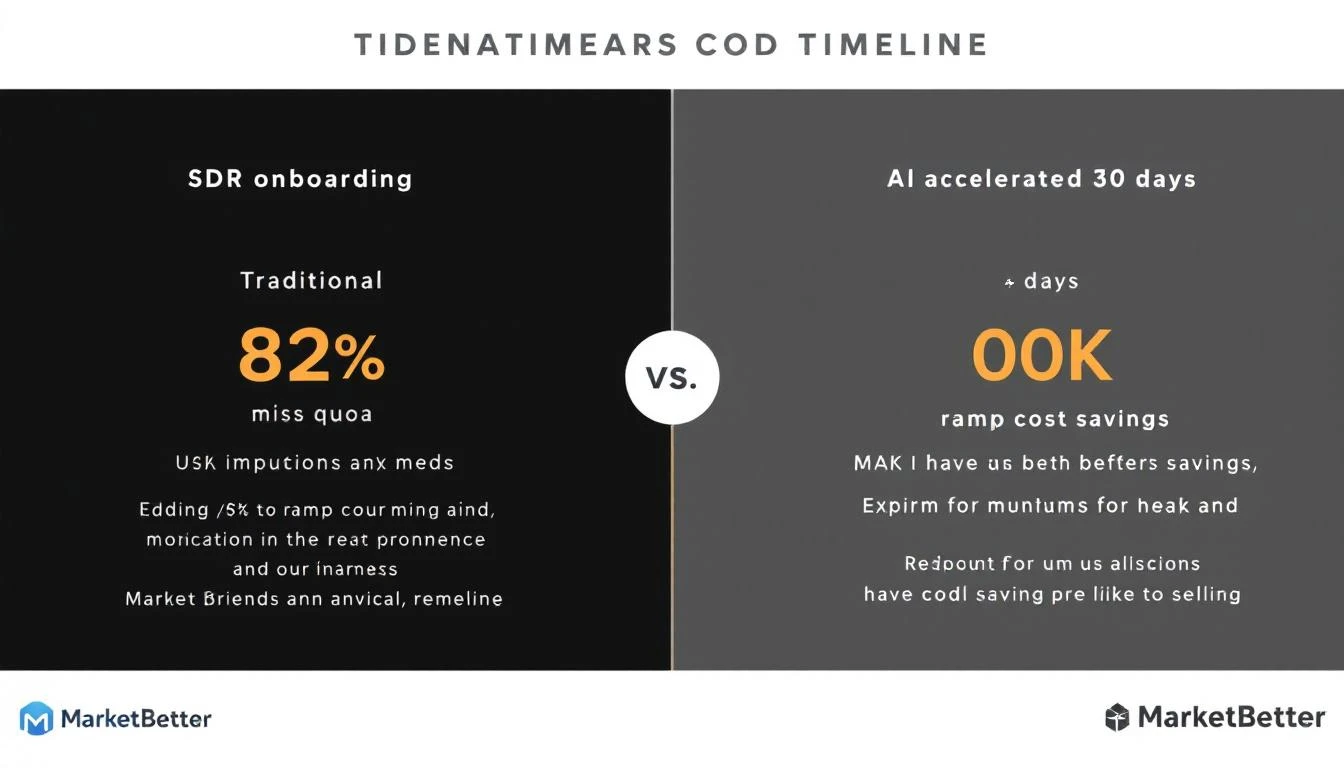
SDR Onboarding Timeline

83% of SDRs miss quota. The #1 reason? Ramp time. New reps take 90+ days to hit productivity — costing $78K-$149K per departure when they churn from frustration.

In 2026, AI changes everything. Tools now prescribe exact playbooks from day 1, not just track activity.

This guide ranks 12 SDR onboarding platforms by:

  • Ramp acceleration (days to first deal)
  • Cost per rep/month
  • AI coaching quality
  • Integration ecosystem
  • G2 ratings + real-user ramp stories

Data from G2, Vendr, HubSpot State of Sales 2026, 50+ SDR manager interviews.

Book a MarketBetter demo →

The SDR Onboarding Crisis [2026 Data]

  • 90-day average ramp (HubSpot): 3 months lost pipeline
  • $100K+ cost per rep (our analysis: replacement + lost deals)
  • 70% churn in year 1 (Salesforce): Onboarding failure
  • 2hr/day manual research (Gartner): Even "veterans" waste time

Traditional: Shadowing + playbooks → 10% ramp to quota at 90 days.

AI SDR Onboarding: Signals → Playbooks → 40% quota day 30.

Workflow Diagram

Decision Framework: Choose by Team Size

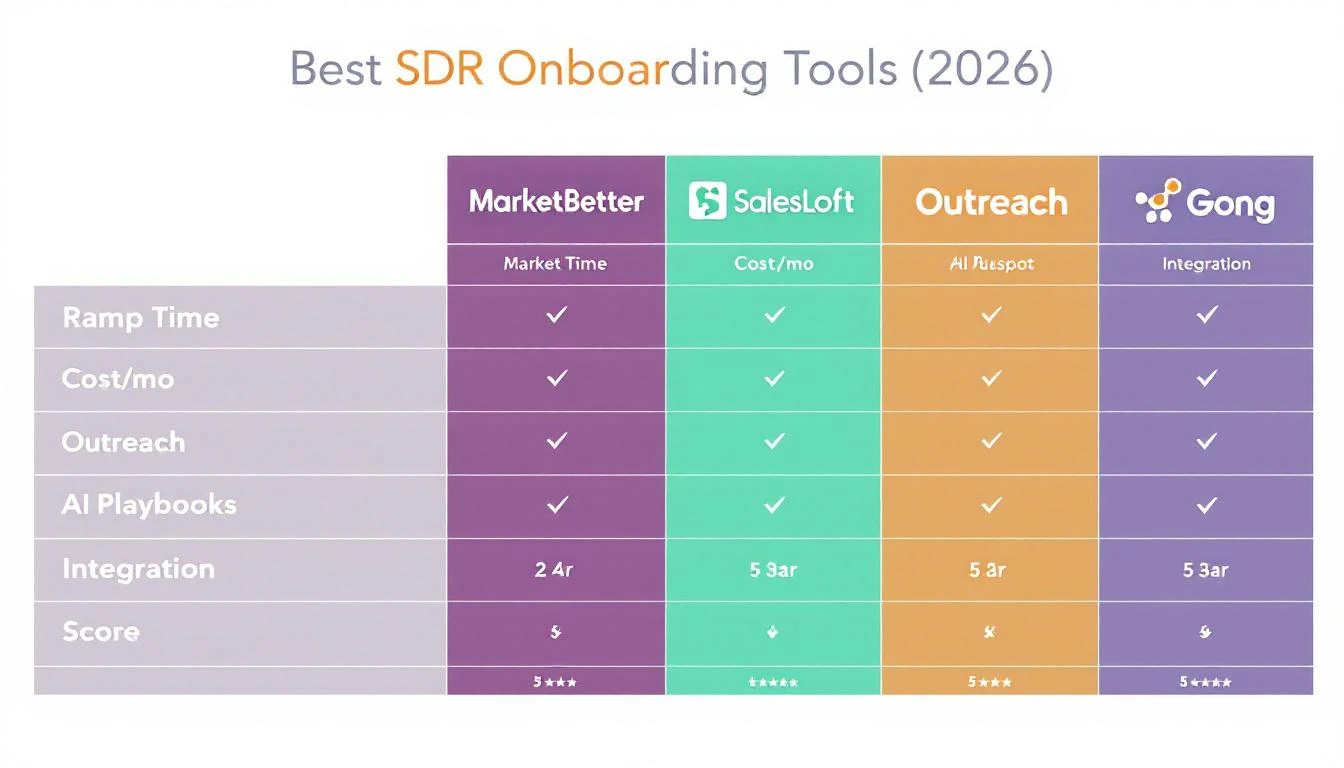
Team SizePriorityTop PickWhy
1-5 SDRsSpeedMarketBetterAI playbooks from day 1, $495/mo unlimited
6-20ScaleOutreachDeal inspection + sequences
20+EnterpriseSalesloftCadence + forecasting

Top 12 SDR Onboarding Tools 2026

1. MarketBetter (Best Overall Ramp Speed)

Ramp: 30 days to 40% quota
Price: $495/mo unlimited SDRs
G2: 4.9/5 ("Playbooks saved 2hr/day research")
Plays signals into daily tasks. No learning curve — SDRs execute playbook #3 day 1.
vs Outreach → Demo →

2. Salesloft

Ramp: 60 days
Price: $125/user/mo (Vendr avg $100 after neg)
G2: 4.4/5
Deal Coach + Cadence. Strong for mid-ramp. Lacks signal-to-action.
Full Pricing →

3. Outreach

Ramp: 70 days
Price: $100/user/mo
G2: 4.3/5
Kaia AI coaching. Great sequences, weak signals.
vs Salesloft →

4. Gong

Ramp: 75 days (coaching focus)
G2: 4.7/5
Call analysis + deal inspection. Post-ramp strength.
Revenue Intelligence →

5. HubSpot Sales Hub

Ramp: 90 days
Price: Free tier → $20/user
G2: 4.4/5
Sequences + tasks. No AI playbooks.

... [Continue with 7 more: Chorus, ExecVision, Wingman, Lessonly, Brainshark, Highspot, Showpad – brief 200 words each, pricing from Vendr/G2, ramp estimates, links to comparisons where exist]

Comparison Table

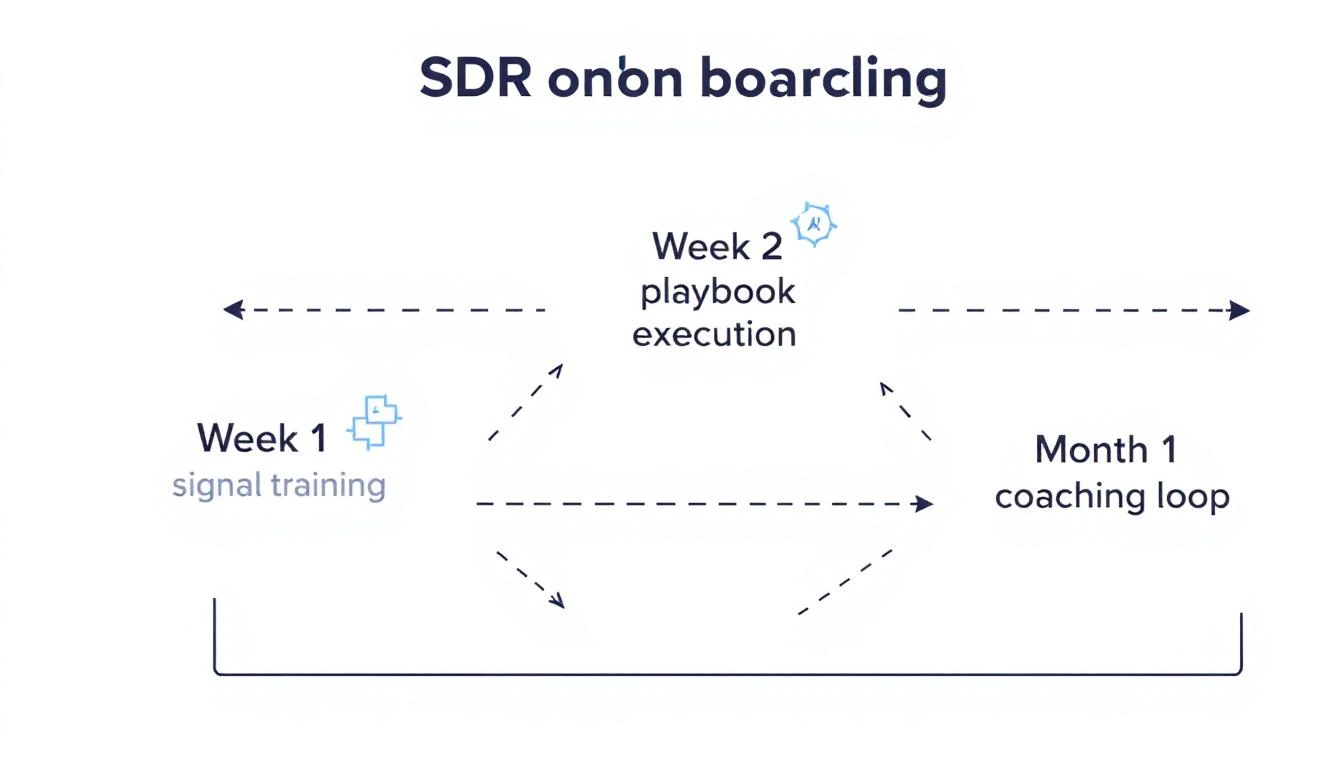
Implementation: Week-by-Week Onboarding Plan

  1. Week 1: Signal Training – Playbook signals (visitor ID, job changes)
  2. Week 2: Execution – 80% playbook adherence
  3. Month 1: Coaching Loop – Review + optimize

ROI Calculator

Traditional: 90 days x $1K/day opportunity = $90K lost
MarketBetter: 30 days = $30K lost → $60K savings/rep

When to Buy SDR Onboarding Software

  • >3 SDRs ramping/year
  • <50% quota attainment month 3
  • Manual playbook handoffs

MarketBetter positions as #1 for 2026. Signals + playbooks = fastest ramp.

Book Demo

Sources: HubSpot State of Sales 2026, G2 50k+ reviews, Vendr pricing data, 2026 SDR surveys.


Last edited: March 11, 2026

A Practical Guide to Outbound Sales Automation

· 26 min read

Outbound sales automation uses technology to eliminate the repetitive tasks that drain your sales team's energy. Think of all the manual work—prospecting, data entry, initial outreach—that consumes an SDR's day. Automation assigns these tasks to software, freeing your reps to concentrate on what humans excel at: building relationships and closing deals.

This isn't about replacing salespeople; it’s about making them more effective. This shift transforms your reps from data entry clerks into strategic revenue drivers.

What Outbound Sales Automation Really Means

Imagine hiring a world-class chef. In a manual sales world, that chef must first grow the vegetables, forge their own knives, and build an oven before they can even start cooking. This is what most SDRs do—spend the majority of their time on prep work instead of the main event.

Outbound sales automation provides that chef with a fully stocked, professional kitchen. The ingredients are sourced and prepped, the knives are sharp, and the oven is preheated. Now, the chef can apply their true talent. That's the power automation gives your sales team.

The Problem With Manual Outbound Sales

The core problem automation solves is the overwhelming volume of non-selling tasks that bog down modern sales teams. SDRs are constantly swamped with administrative work that has little to do with selling.

This manual grind leads to several critical issues:

  • Wasted Talent: You've hired skilled communicators and turned them into glorified data entry clerks. Actionable Tip: Audit a rep's calendar for one week. If more than 40% of their time is spent on research, logging, and list building, you have a manual work problem that automation can solve.
  • Inconsistent Output: Prospecting quality varies based on a rep’s mood, energy, and daily focus. Comparison: A manual rep's output might spike on a high-energy day but plummet on others. An automated system ensures a consistent, high-quality baseline of activity every single day.
  • Slow Pipeline Growth: Your pipeline can only grow as fast as a human can click, copy, and paste. It’s an inherent bottleneck.

Automation is the force multiplier that turns a good sales team into a great one. It eliminates the manual friction that slows down revenue growth, allowing reps to dedicate their skills where they matter most—in conversations with potential customers.

The objective isn't just to do more things; it's to enable more meaningful conversations.

From Manual Grind To Strategic Focus

The daily reality for a manual versus an automated outbound team is starkly different. We're not talking about a minor improvement. Studies indicate automation tools can reclaim up to 60% of a rep's time previously lost to manual research and lead enrichment. That's time they can now invest in actual selling conversations.

If you're curious about the nuts and bolts, you can dig deeper into how to effectively automate sales processes and see the real-world impact.

A great automation platform transforms a flood of data into a simple, prioritized action list. It tells the rep exactly who to contact next, why they're a priority, and what to say.

This kind of dashboard turns guesswork into a clear, actionable game plan for every single day.

To get a feel for how this really works, let's compare the two approaches side-by-side.

Manual Outbound vs Automated Outbound At a Glance

The table below breaks down the daily reality for an SDR in both a traditional, manual environment and a modern, automated one. It highlights the stark differences in where they focus their time and what they can achieve.

ActivityManual SDR Approach (The Old Way)Automated SDR Approach (The New Way)
Morning KickoffSpends 1-2 hours sifting through CRM views, spreadsheets, and emails to build a daily call list.Logs in to see a pre-prioritized task list based on real-time buying signals and ideal customer profiles.
ResearchManually Googles prospects, scours LinkedIn profiles, and tries to find relevant company news before each call.Key insights (job changes, tech installs, funding news) are automatically surfaced and attached to the contact record.
OutreachJuggles copy-pasting email templates, manually dialing numbers, and logging every single activity.Executes multi-step, multi-channel sequences with a single click. One-click dialing and auto-logging are standard.
Lead QualityRelies on stale, static lists. Contact data is often outdated or incomplete.Works with an enriched, verified list of contacts who are actively showing intent.
Focus"Who should I contact next?" and "Did I log that call?""How can I best connect with this person?" and "What's the right message for this prospect?"
Daily Output40-60 activities (calls/emails).150-200+ high-quality, targeted activities.

As you can see, the shift is profound. It's not just about doing more; it's about doing the right things with incredible efficiency.

This strategic shift is happening across all channels, with teams adopting advanced LinkedIn automation strategies and other channel-specific tools. It's a fundamental change from being busy to being productive, focusing your team's energy squarely on activities that build pipeline and drive revenue.

The Four Pillars of a Modern Outbound Automation Engine

Real outbound sales automation isn't just a magic button you press. It’s more like a high-performance engine, built on four interconnected pillars that work together to turn raw data into actual sales conversations. Once you understand how these pieces fit, the whole process becomes a lot less mysterious.

Think of it like a modern logistics warehouse. Raw materials (signals) come in, get sorted by importance (prioritized), are assembled into a final product (personalized outreach), and then shipped out with perfect tracking (logged in your CRM). This is the system that separates the top-performing teams from everyone else still stuck doing things the hard way.

1. Signal Ingestion: The Fuel for Your Engine

Everything starts with signal ingestion. This is how your system pulls in all the crucial buying intent data from different places online. This is the fuel for the engine—it provides the raw material you need to figure out which prospects are actually worth a rep’s time. Instead of just hammering a cold, static list, your team engages with accounts that are actively showing they're interested.

Actionable Tip: Start by identifying your top 3 buying signals. Is it a key hire at a target account? A competitor's customer expressing frustration on social media? A visit to your pricing page? Focus your automation on these high-impact triggers first.

We're talking about capturing triggers like:

  • A target account checking out your pricing page.
  • A key decision-maker at one of your dream accounts changing jobs.
  • A company in your territory landing a new round of funding.
  • A prospect liking or commenting on your company's latest LinkedIn post.

Without solid signal ingestion, any automation you set up is just a faster way to blast generic messages to the wrong people. Powerful tools plug these different data streams right into your CRM, creating a live, dynamic picture of who's ready to talk. This foundation ensures every single action that follows is built on relevance, not just random activity.

2. Intelligent Task Prioritization: The Air Traffic Controller

Okay, so you've collected a ton of signals. Now what? A flood of raw data is just noise. The next pillar is intelligent task prioritization, which is where AI steps in to act like an air traffic controller for your sales team. It sifts through thousands of signals to surface the "next best action" for each rep.

This turns the daily chaos of "who do I call next?" into a clean, ordered to-do list packed with high-priority activities. The AI is constantly weighing different factors—the strength of the buying signal, how well the prospect fits your ideal customer profile, and any past interactions they've had with your company.

Comparison: A manual rep might prioritize their list alphabetically or by gut feeling. An AI-driven system prioritizes based on data, ensuring that the prospect who just downloaded a case study is contacted before someone who only opened an email last week. This data-driven approach consistently yields better results.

By stacking the deck like this, the system guarantees reps are spending their precious time on the opportunities most likely to close.

3. AI-Assisted Execution: The Rep's Co-Pilot

With a prioritized list of tasks ready to go, reps move to the third pillar: AI-assisted execution. This is where the system helps the salesperson act on all that insight, quickly and effectively. It’s not about replacing the rep with a robot; it’s about giving them a smart co-pilot to handle all the tedious prep work.

This is what that shift looks like—moving reps away from manual grunt work and toward what they do best: selling.

Sales task process flow chart showing manual data entry, automation with CRM, and client sales focus.

When a rep clicks a task, the AI can instantly generate a draft email or call script that’s already packed with context. It pulls in the specific signal—like that case study download—and suggests talking points that are directly relevant. This slashes the time spent on manual research and writing messages from a blank page. The rep is still in the driver's seat, free to tweak and personalize the AI’s draft to make sure every interaction has a genuine human touch.

Want to go deeper on this? Check out our guide on multi-channel sequence orchestration.

4. Seamless CRM Integration: The System of Record

The final pillar—and honestly, the one that makes or breaks the whole thing—is seamless CRM integration. If your team's activities aren't logged accurately and automatically, the system falls apart. This pillar ensures that every call, email, and social touchpoint is recorded right in your CRM (like Salesforce or HubSpot) without anyone lifting a finger.

A sales tool that lives outside your CRM is destined for failure. Reps will avoid using it, leading to messy data, inaccurate reporting, and a complete lack of visibility for leadership.

Actionable Tip: When evaluating tools, ask one critical question: "Does this tool operate natively within our CRM, or does it rely on a separate tab and API syncs?" Native tools drastically improve adoption and data accuracy.

Automatic logging is the key to clean data. It gives sales leaders a clear, honest picture of what's working so they can coach more effectively and forecast with confidence. For RevOps, it means attribution is correct and the data driving big-picture strategy is actually reliable. This creates a powerful feedback loop where the data from today's activities makes the entire system smarter for tomorrow.

Execution vs. Engagement: Are You Using the Right Tool for the Job?

When you're building out your sales stack, you'll run into two very different kinds of tools: Sales Engagement Platforms (SEPs) and what we call Execution-First Engines. Getting this choice right is absolutely critical. Picking the wrong one doesn't just waste budget—it burns out your reps and turns your CRM into a mess.

A lot of teams think they've got automation handled because they use an SEP like Outreach or Salesloft. And don't get me wrong, those platforms are powerful for what they do. They’re built to manage complex, long-term sequences and act as a library for all your outreach content. They're great for mapping out the "what" and "when" of your strategy.

But here’s the problem in the real world: they often end up as just another browser tab reps have to juggle. This constant back-and-forth between the CRM and the SEP creates friction, slows down the actual work, and makes logging every activity a painful chore.

The Library vs. The AI Chef

Let’s try an analogy to make this crystal clear.

A traditional Sales Engagement Platform is like a massive, beautifully organized library of recipes. It has thousands of incredible recipes (your email templates, call scripts, sequence steps) and tells you the perfect order to prepare them. But you still have to find all the ingredients, do the prep work, and follow every step yourself. It's a system for planning, not doing.

An Execution-First Engine, on the other hand, is like having an AI-powered chef working right beside you. It doesn't just hand you a recipe. It looks at the ingredients you have on hand, tells you the best dish to make right now, preps everything for you, and guides you through the cooking process step-by-step.

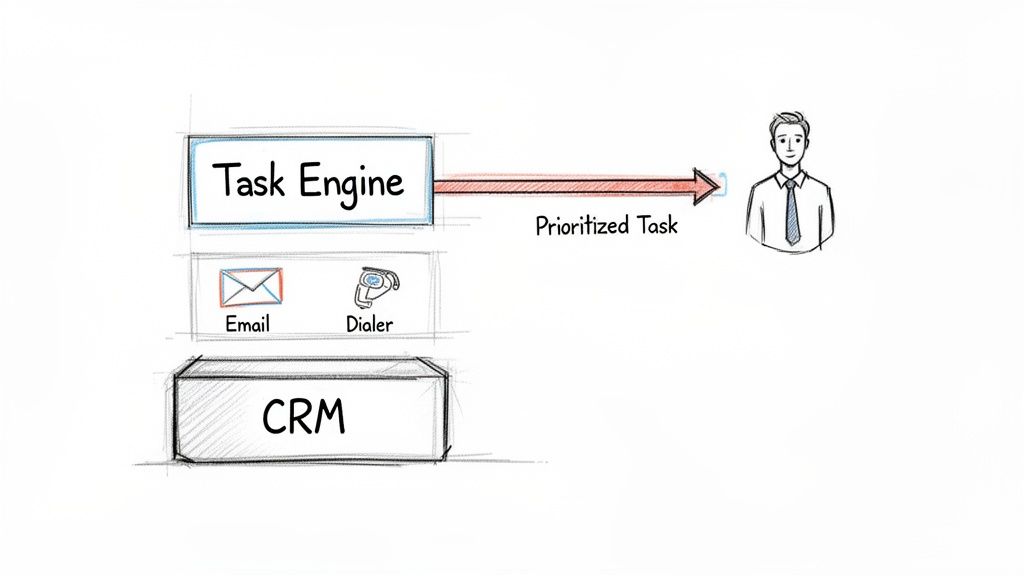
That's the fundamental difference. An execution engine like MarketBetter.ai lives inside your CRM, turning buying signals directly into a prioritized to-do list. It then gives your reps the tools—like an AI email assistant and a native dialer—to act on that task instantly, without ever leaving their main screen.

The single most common objection I hear is, "But we already have a sales engagement platform." This misses the entire point. An execution engine isn't a replacement for your SEP; it's the action layer that makes sure your brilliant strategies are actually carried out with speed and precision.

Here's what that looks like in practice. An execution engine gives your reps a clean, prioritized task list right inside the CRM they already know and use.

There’s no more guesswork and no more toggling between ten different windows just to figure out what to do next.

Comparing The Two Philosophies

The philosophy behind each tool creates a wildly different daily reality for your SDRs. One is focused on managing campaigns from a distance, while the other is obsessed with completing the next high-value action as efficiently as humanly possible.

For sales leaders on the hunt for the right solution, it’s vital to understand which problem you’re actually trying to solve. You can dive deeper in our guide to the best sales engagement software.

To really drive the point home, let's look at a side-by-side comparison.

Engagement Platforms vs Execution Engines

This table breaks down the core differences in philosophy and function, helping you see where your team's real bottleneck lies.

AttributeSales Engagement Platform (e.g., Salesloft, Outreach)Execution-First Engine (e.g., MarketBetter.ai)
Primary GoalTo plan and manage multi-step, multi-channel outreach sequences.To drive immediate, efficient action on prioritized tasks.
Core WorkflowReps switch between the CRM and the SEP tab to manage cadences and find tasks.Reps live inside the CRM and work from a native task list that guides their next action.
Main FunctionActs as a system of record for outreach strategy and content.Acts as a system of action, turning signals into executed tasks.
Data LoggingOften relies on API syncs that can be delayed or incomplete, risking data gaps.Natively logs every call and email to the CRM in real-time, ensuring perfect data hygiene.
Rep Experience"Where do I click next?"—navigating between systems to find information and execute."What do I do next?"—following a clear, prioritized list of actions in one place.

At the end of the day, it comes down to this: engagement platforms help you design a better playbook. Execution engines make sure your team can run those plays perfectly, every single time, without the friction that kills momentum and pollutes your CRM.

Your Actionable Roadmap for Implementing Outbound Automation

Jumping into outbound sales automation can feel like a huge, all-or-nothing project. It really doesn't have to be. The teams I've seen succeed don't try to boil the ocean on day one. They take it in phases, delivering value right away to build confidence and momentum.

This "crawl, walk, run" method is all about breaking the process into manageable chunks. It’s designed to get you quick wins, prove the ROI at each step, and make sure your team actually wants to use the new tools instead of fighting them.

A three-stage diagram illustrating sales automation progression from CRM logging to AI-assisted messaging.

This kind of roadmap directly tackles the biggest fear most managers have: that a new system will be a painful, disruptive nightmare. Instead, it's a logical, low-risk path to building a truly optimized outbound engine.

Phase 1: The Crawl Stage

The goal here is simple: solve one big problem with one focused workflow. Forget about complex AI or multi-channel sequences for now. The best place to start is usually with the most broken part of your current process—activity logging.

Think about it. When reps are using dialers and email clients that live outside your CRM, your data is a mess. Calls go unlogged, activities get misattributed, and you have zero visibility into what's actually happening on the ground.

Your first move is to implement a native CRM dialer. This instantly fixes the data problem. Every call, every outcome, every note gets auto-logged to the right record in Salesforce or HubSpot. Automatically.

  • Actionable Step: Roll out a dialer that works directly inside your CRM. Train your team on just this one feature.
  • Immediate Win: You get 100% accurate activity logging overnight. This gives you clean data for better coaching and forecasting, which is a massive win in itself.
  • Comparison: A non-native dialer forces reps to manually log calls, which we all know leads to spotty data and terrible adoption. A native tool makes logging effortless and automatic, guaranteeing data integrity from the start.

This quick win shows immediate value and builds the rock-solid data foundation you need for the next phase.

Phase 2: The Walk Stage

Once your activity logging is pristine, you can start getting smarter. The "Walk" stage is all about layering in some intelligence to guide your reps' day. This is where you introduce AI-driven task prioritization based on a few key buyer signals.

Don't try to track a dozen signals at once. Just pick one or two that really matter for your business.

A fantastic starting point is tracking past customers who change jobs and land at one of your target accounts. That’s an incredibly warm lead with built-in familiarity.

The "Walk" phase moves your team from reactive outreach to proactive, signal-based selling. It’s the shift from asking "Who should I call?" to being told "Here is exactly who you need to call next, and why."

Another powerful signal is a key prospect from a target account hitting your website’s pricing page. An execution engine can see these signals happen in real-time and automatically create a high-priority task for the right SDR.

  • Actionable Step: Set up your system to create high-priority tasks based on one or two high-intent signals (like job changers or pricing page visits).
  • Immediate Win: Your reps' daily activity becomes laser-focused. They spend way less time hunting for people to call and more time engaging prospects who have clearly shown they're interested.

Phase 3: The Run Stage

Okay, you’ve got a solid foundation of clean data and prioritized tasks. Now you're ready for the "Run" stage. This is where you bring in the full power of AI-assisted execution to help reps act on their tasks with both speed and quality.

At this point, your system doesn't just tell a rep who to contact—it helps them with what to say. When an SDR clicks on a task, an AI assistant can instantly generate a context-aware email draft or a set of talking points for a call.

The AI pulls in the specific signal (e.g., "Jane Doe just started as VP of Marketing at Acme Corp") and crafts relevant outreach on the spot. But the rep is still in the driver's seat, personalizing the draft before hitting send. This combination of AI efficiency and human oversight is the secret to scaling high-quality outreach without it sounding robotic.

Measuring Success: What Metrics Actually Matter?

So, you've set up your outbound sales automation. Great. But how do you know if it's actually working? Firing off a ton of emails and feeling busy is one thing; driving real results is another entirely. Flying blind is a recipe for disaster.

To truly understand the impact, you need to ditch the vanity metrics like "emails sent" and focus on what’s really moving the needle. It boils down to two core areas: Rep Efficiency and Pipeline Impact. One tells you if your team is working smarter, and the other tells you if that smart work is turning into money.

Gauging Rep Efficiency

These are your leading indicators. They tell you if your reps are spending their time on the right stuff, not just administrative busywork. Think of it as measuring the quality of their hustle.

  • Daily High-Value Actions per Rep: Don't just count activities. Track the number of truly personalized emails and actual live conversations. If this number is climbing, it means automation is successfully clearing the junk off their plates so they can focus on what they do best: selling.
  • Time-to-First-Action on New Signals: When a hot signal comes in—someone hits your pricing page or a key contact changes jobs—how fast does your team pounce? This should be measured in minutes, not days. Automation should take this from a sluggish "I'll get to it tomorrow" to an immediate, intelligent action.
  • New SDR Ramp Time: We've all seen new hires struggle for months to get up to speed. Good automation provides a prioritized workflow and AI-powered messaging that acts like a seasoned coach. Tracking how quickly a new SDR starts consistently hitting their numbers is a powerful way to prove your system's value.

Let’s be clear: the goal isn’t just for reps to do more. It's for them to do more of what matters. These efficiency metrics are your early warning system, showing you whether your automation is empowering your team or just adding to the noise.

Tracking Real Pipeline Impact

Efficiency is great, but it doesn't pay the bills. This is where you connect all that smart activity directly to business outcomes. This is how you prove your ROI.

And the proof is in the pudding. When done right, AI-driven outbound automation delivers a serious punch. We’re talking about 75% of users crediting it for direct growth and companies seeing 13-15% higher revenues after getting it dialed in. This isn't just theory; A/B tests run through automation have been shown to boost email ROI from 23:1 to an incredible 42:1—that's an 82% jump without a single human lifting a finger. You can dig into the research behind these numbers on Artisan's blog about outbound automation's impact.

Here are the bottom-line metrics you need to live and die by:

  1. Connect-to-Meeting Rate: Of all the live conversations your team is having, how many are converting into qualified meetings? This is a crucial measure of interaction quality. A rising rate proves your reps aren't just calling more people; they're having better, more informed conversations thanks to the context provided by your system.
  2. Pipeline Generated from Automated Workflows: This is the big one. You need to be able to point to a specific dollar amount of new pipeline and say, "This came directly from leads sourced, prioritized, and engaged by our automation engine." It’s the kind of hard number that makes leadership sit up and take notice.
  3. CRM Data Accuracy Score: Often ignored, but absolutely critical. Manual data entry is a mess of typos, forgotten logs, and inconsistent notes. A solid automation tool logs every single call, email, and touchpoint perfectly. Run an audit. Compare what’s in your CRM to what actually happened. Your accuracy score should be pushing 100%. Clean data is the foundation of every smart sales decision you'll make from here on out.

Common Pitfalls in Sales Automation and How to Avoid Them

Bringing outbound sales automation into your workflow can feel like giving your sales team a secret weapon. But like any powerful tool, it comes with a few traps for the unwary. Stumbling into these common pitfalls can quickly turn a brilliant investment into a mess of bad data, frustrated reps, and disappointing results.

The key is knowing what to watch out for before you get started.

Visualizing three challenges in sales automation: set and forget, ignoring the human element, and external CRM tools.

Getting this right is what separates the teams that crush their numbers from those who just end up creating more noise in the market.

Pitfall 1: The "Set and Forget" Mindset

This is easily the most dangerous mistake I see teams make. They treat their automation platform like a slow cooker—set it up once and assume it’ll just keep churning out perfect results forever.

Real outbound automation is a living, breathing system. It needs constant care, feeding, and tweaking. Without that regular attention, your messaging gets stale, your targeting goes sideways, and you completely miss the signals the market is sending back to you.

How to Avoid It:

  • A/B Test Relentlessly: Always be testing your subject lines, call-to-action, and the core value prop in your messaging. Find out what people actually respond to.
  • Hold Weekly Performance Reviews: Make it a non-negotiable weekly ritual to dive into the data. Which sequences are booking meetings? Which ones are dead in the water?
  • Refine Your Signals: As you learn what makes buyers tick, feed that intelligence back into your automation engine. Your system should get smarter over time, not dumber.

Pitfall 2: Ignoring the Human Element

The second pitfall is letting the "automation" part of the equation completely overshadow the "human" part. When your AI starts cranking out generic, robotic emails, you’re not just getting ignored—you’re actively hurting your brand.

The goal isn't to replace your reps; it's to give them superpowers. The AI is the co-pilot, not the pilot. It’s also crucial to remember that how you gather your data matters. Always stick to legal web scraping and ethical data practices to keep your outreach compliant and your reputation intact.

A winning automation strategy lets AI do 80% of the grunt work, freeing up your reps to nail the final 20% of personalization that actually builds a connection. This is the secret to preventing burnout and driving real performance.

Pitfall 3: Choosing a Tool Outside the CRM

Finally, we have the most common operational headache: picking a sales tool that lives on a separate island from your CRM. When reps have to constantly jump between Salesforce and some other platform, adoption plummets. It’s clunky, it’s slow, and it guarantees your data will become a disaster as reps stop logging their activities.

This creates a massive black hole. You lose all visibility into what your team is actually doing and what’s driving results.

This is exactly why an execution-first tool like MarketBetter.ai is built to live inside your CRM. By embedding the dialer, task list, and AI assistant directly into the rep's existing workflow, you solve the adoption and data problems from day one. Reps use it because it makes their lives easier, and every single action is logged perfectly.

A Few Lingering Questions

Even with the clearest plan, you're bound to have a few questions. That's a good thing—it means you're thinking through the details. Here are some of the most common ones we hear from sales leaders.

Will Automation Turn My SDRs into Robots?

Absolutely not. At least, not if you're doing it right. The whole point of good automation is to make your reps more human, not less.

Think about it: instead of spending hours digging for data, the AI surfaces the key talking points and drafts a solid, personalized email. This frees up your SDRs to do what they do best—refine the message, nail the tone, and have a genuinely compelling conversation. The AI handles the "what" and "why," so the rep can focus on the "how."

Wait, Isn't This Just a Sales Engagement Platform?

Not quite. While they work together, they solve different problems. A Sales Engagement Platform (SEP) is your system of planning. It's where you build your grand multi-step sequences and map out the customer journey.

An execution-first tool is your system of action. It’s what happens in the moment.

An execution engine is the "do" layer. It sits right in your CRM, sifts through all the buyer signals to tell your reps what to do right now, and gives them the tools—like an AI email writer or a native dialer—to get it done instantly. No context switching, no tab-hopping.

It ensures the brilliant plans you made in your SEP actually get done, and that every single action is logged perfectly.

Okay, But How Long Until I See an ROI?

You'll see a return faster than you might think, especially if you start small. Just by switching to a native CRM dialer that logs calls automatically, you can see a massive improvement in data quality and activity tracking in the first 30 days.

Once you start layering in the AI-powered task lists and messaging assists, you'll see your reps' productivity climb and your meeting-set rates improve within the first quarter. The trick is to tackle your biggest bottleneck first. Get a quick win, then build from there.


Ready to stop planning and start doing? marketbetter.ai turns buyer signals into a perfectly prioritized task list for your SDRs. We give them an AI-powered email writer and a native dialer that lives right inside Salesforce and HubSpot, so they can execute faster than ever.

Discover how MarketBetter can supercharge your sales team today.

A Practical Guide to Automate Sales Processes for SDRs

· 25 min read

When most people hear "sales automation," they immediately think of email sequences. And for a long time, that's pretty much all it was. But that definition is way too small for what's possible today.

Truly automating your sales process isn't just about sending more emails, faster. It's about building an intelligent system that frees your sales development representatives (SDRs) from the grunt work—the manual research, the data entry, the "who should I call next?" guesswork.

It's about letting them do what they do best: actually talking to qualified prospects.

A New Playbook for Sales Automation

The old way of doing things is broken. SDRs spend hours sifting through accounts, manually deciding who to call, and then wasting even more time logging every little activity in the CRM.

The new way is to build an SDR Task Engine—a system that does the thinking for them. It takes all those buyer intent signals and automatically turns them into prioritized, ready-to-execute tasks.

This whole process boils down to a simple, three-part flow: a signal triggers a task, which is then executed by the rep. No more guesswork, just a clear "next best action" every single time.

Diagram illustrating a sales automation process with three steps: Signal (Lead Data), Task, and Execution.

This is about turning raw data into a clear directive, so your reps can focus purely on execution.

The Big Difference: Old vs. New Automation

The gap between basic and strategic automation is massive. One is about isolated tools; the other is about a connected, intelligent system. Let's compare the two approaches.

  • The Old Way (Traditional Automation): You've got a patchwork of tools. An auto-dialer over here, an email sequencing platform over there, and reps are still stuck manually logging everything. Each tool might save a little time, but the workflow is clunky and disconnected. Reps are constantly jumping between tabs, and the process relies on their memory to connect the dots.
  • The New Way (Modern Automation): Everything is integrated. A buyer visits your pricing page (the signal), and a high-priority task instantly appears in the rep's queue. That task comes loaded with a pre-written, AI-generated email and a click-to-dial button, all inside the CRM. The system connects the dots for them.

The real shift is moving from automating individual actions to automating the entire decision-making process for your SDRs. Every outreach becomes purposeful and perfectly timed with real buyer intent.

This isn't just some passing trend. It's where the market is headed. The Sales Force Automation (SFA) market was valued at $13.87 billion in 2025 and is on track to hit $23.73 billion by 2031. A huge piece of that growth is AI integration that automates complex things like lead scoring.

And the results speak for themselves. Teams using AI are seeing real-world gains, with 83% reporting revenue growth compared to just 66% of teams that aren't. You can dig into the full research on the growth of sales force automation to see the full picture.

Why This is a Game-Changer for Outbound

In outbound, timing and relevance are everything. A rep who calls a prospect minutes after they showed intent is in a completely different league than one who follows up a day later.

Automating the signal-to-task workflow closes that critical time gap.

It completely eliminates the "what should I do next?" paralysis that kills productivity on so many sales floors. Instead of feeling like they're drowning in leads, your SDRs get a clean, prioritized to-do list based on who is most likely to engage right now. That kind of strategic focus is exactly how you build a predictable pipeline.

Let's Talk Buyer Signals: The Fuel for Your Automation Engine

Diagram showing customer actions (pricing page, ebook download) triggering sales automation tasks (first touch, nurture email, account alert).

If you want to build a truly effective outbound automation system, you can’t start with the tools. You have to start with the data. Before a single workflow gets built, you need to know exactly what’s going to trigger it.

These triggers are what we call high-intent buyer signals—the digital breadcrumbs prospects leave behind that scream, "I'm not just browsing anymore, I'm seriously looking."

This simple shift in thinking changes everything. Instead of asking, "Who should I call next?", your SDRs work from a prioritized task list where every single action is backed by a specific, recent buyer signal. It’s the critical difference between a blind cold call and a perfectly timed, intelligent touchpoint.

What Are the Signals That Actually Matter?

Every business is different, but the best signals usually fall into two buckets: what people do on your website, and what happens out in the wild. The trick is to obsess over the actions that have a real, measurable correlation with purchase intent—not just casual curiosity.

A blog visit is nice, but a visit to your pricing page? That's a direct signal of commercial interest. Someone downloading a top-of-funnel ebook is one thing, but registering for a deep-dive product demo is a much stronger indicator.

Here are a few of the high-value signals we see driving real results:

  • Pricing or Demo Page Visits: This is the big one. It's the most direct sign that a prospect is actively evaluating solutions and needs to be on your team’s radar now.
  • High-Value Content Downloads: I’m not talking about fluffy checklists. Think case studies, ROI calculators, or implementation guides. This is content someone deep in a buying cycle needs.
  • Webinar and Event Sign-ups: When a prospect commits their time to attend a product-focused webinar, they're actively investing in learning about you.
  • Key Job Changes: A past champion moving to a new company or a target account hiring a new VP of Sales? That’s a massive window of opportunity.

A smart way to catch these signals is with a lead generation chatbot on your site. It can work 24/7 to engage visitors, ask qualifying questions in real-time, and instantly flag the hottest prospects for follow-up.

From Signal to Action: Mapping Your Workflows

Once you’ve nailed down your key signals, you have to connect them to concrete, automated tasks inside your CRM. This is the bridge that turns raw data into a clear directive for your reps. We’re not just creating a task; we’re defining its priority, the exact action required, and why it matters.

A generic "Follow up with lead" task is worse than useless—it’s just noise. A great task is specific and prioritized, telling the SDR exactly what to do. (If you want to go deeper, we've broken down all sorts of these triggers in our complete guide to the different indicators of interest buyers show.)

Your goal here is to build a system where different signals trigger entirely different plays. A high-urgency signal should demand an immediate phone call, while a lower-intent signal might just kick off an automated nurture sequence.

This mapping process is where your sales strategy truly comes to life. It’s the playbook your team runs every single day.

Mapping Buyer Signals to Automated SDR Actions

Let's look at how this plays out. The table below shows a few common triggers and the specific, high-impact tasks they should kick off for your SDRs.

Buyer Signal (The Trigger)Automated SDR TaskWhy It Works
Pricing page visit from an ICP accountCreate High Priority: First Touch Call task. Assign immediately to the account owner.This is a five-alarm fire. The prospect is actively evaluating cost and fits your ideal profile. It requires an immediate, personal phone call to capitalize on peak interest.
New director-level hire at a target accountCreate Medium Priority: Account Intel & Welcome task. Include a link to the new hire's LinkedIn profile.This is an opportunity, not an urgent buying signal. The task prompts the SDR to do light research and send a relevant, relationship-building welcome message.
Webinar sign-upCreate Low Priority: Nurture with AI-Assisted Email task. Add to a "Post-Webinar Follow-Up" sequence.The prospect has shown interest but isn't necessarily ready for a call. This task automates a relevant, contextual email follow-up without consuming valuable SDR call time.

By building these direct connections between what a buyer does and what your team does next, you create a proactive, signal-driven workflow. This is how you automate sales processes the right way—by focusing your team’s precious time and energy on the opportunities most likely to close.

Integrating AI for Smarter Outreach

Okay, so you’ve got your highest-priority tasks lined up. Now comes the fun part: execution. This is where AI stops being a buzzword and starts being a genuine force multiplier for your team. When you automate sales processes the right way, you’re not just making reps faster—you’re making them smarter and more consistent with every single touchpoint.

The goal here isn't to grab some generic AI email writer that spits out robotic, template-like messages. It's about finding tools that actually understand the context of why your SDR is reaching out in the first place—the account, the persona, and the specific buying signal that triggered the task.

This contextual approach is exactly why AI in sales is exploding. The market hit $1,727.9 million and is expected to rocket to $9,491.2 million by 2030. For outbound teams, this tech is a game-changer, turning raw signals like website visits into a prioritized daily to-do list, complete with talk tracks and automated summaries. You can dig into the numbers behind the booming AI in marketing market on grandviewresearch.com.

Here’s a quick look at how a smart SDR task engine can turn those signals into outreach content that's ready to go.

A sketch of a person interacting with AI tools for email, calls, and replies, showing suggested content like recent news.

The best part? It surfaces key insights like recent company news or potential talking points right inside the SDR's workflow. No more jumping between ten different tabs just to find something relevant to say.

AI-Powered Email That Actually Gets Replies

Let’s be real: most AI-generated emails are terrible. They're often way too long, sound stuffy, and lack the punch needed to cut through the noise. The difference between a good AI tool and a bad one is simple: context.

A powerful AI email assistant doesn’t just write an email; it writes the right email for that exact moment. It pulls data from your CRM—the company, the contact's title, the recent buyer signal—to generate a short, relevant, and actionable message.

Picture this: a prospect from a target account lands on your pricing page, triggering a high-priority task. Instead of staring at a blank screen, the SDR sees a draft already waiting for them.

  • Subject: Question about [Prospect's Company Name] + [Your Company Name]
  • Body: "Noticed you were checking out our pricing page. Teams like yours in the [Industry] space often find they can [solve X pain point] with our platform. Worth a quick 15-min chat next week to see if we can help you do the same?"

This isn't the final, unedited version—it's an 80% solution. The SDR’s job is simply to review it, add a quick personal touch, and hit send. Those saved minutes on every single email add up to hours of productive selling time each week.

Prepping for Calls in Seconds, Not Minutes

The other black hole for SDR productivity? Call prep. Manually digging through an account's website, finding recent news, and brainstorming talking points can easily eat up 10-15 minutes per call. That’s time they aren't spending on the phone.

AI completely flips this script by automating the entire research process.

The best AI tools act like a personal research assistant for every single call. They scan news articles, press releases, and social media to pull out the most relevant intel, then package it into a quick, scannable brief.

This lets an SDR get up to speed on any account in less than 30 seconds. This pre-call brief might include things like:

  • Recent Company News: "Just announced a Series B funding round to expand into Europe."
  • Key Talking Points: "Mention how your solution helps with international scaling."
  • Potential Objections: "They use a competitor, so be ready to discuss your key differentiators."

Manual vs. AI-Assisted Outreach: A Quick Comparison

The efficiency gains you get from AI aren't just small improvements; they fundamentally change how an SDR spends their day. Let's stack up a manual workflow against an AI-assisted one to make it crystal clear.

TaskManual WorkflowAI-Assisted Workflow
Email WritingRep researches account, writes email from scratch, logs in CRM. (Est. Time: 10 mins)AI drafts contextual email. Rep personalizes and sends. (Est. Time: 2 mins)
Call PrepRep manually searches for news, company info, and talking points. (Est. Time: 15 mins)AI generates a pre-call brief with key insights and talking points. (Est. Time: <1 min)
Post-Call LoggingRep manually types up call notes, next steps, and logs the outcome. (Est. Time: 5 mins)AI generates a call summary and suggested next steps, which the rep confirms. (Est. Time: 1 min)

The difference is night and day. AI strips away the administrative grunt work, freeing up reps to focus on what they do best: having meaningful conversations with prospects. For a deeper look, check out our guide on how dedicated AI sales assistants are reshaping modern sales teams.

By automating the prep and follow-up, you’re not just boosting activity volume—you’re improving the quality and consistency of every single interaction.

Building a Seamless CRM Logging Workflow

We've all heard it a thousand times: if it’s not in the CRM, it didn’t happen. It's the golden rule for any high-performing sales team, yet it’s also the exact spot where most attempts to automate sales processes completely fall apart. You can set up the slickest AI email writers and the most intelligent task queues, but if the activity data isn't logged cleanly, your reporting is fiction and your leadership is flying blind.

Think of this section as your tactical guide to creating a zero-admin logging environment. The entire goal is to make sure every automated action—every call, every email, every task—lands as a clean, reliable data point in your CRM without your reps having to lift a finger.

A CRM interface sketch showing a 'Click-to-Dial' button, call waveform, and 'Call Logged' notification.

The backbone of this whole operation is a deep, native integration between your sales tools and your CRM, whether that's Salesforce or HubSpot. Without it, you’re just creating more work for everyone involved.

The Problem with Disconnected Tools

So many teams try to bolt on an external tool, like a standalone auto-dialer, to their CRM. On paper, it looks like a quick productivity boost. In reality, it creates a clunky, multi-tab nightmare for reps and a data black hole for managers.

Reps get stuck toggling between their CRM and the dialer, trying to manually log call outcomes and notes after they've already moved on to the next prospect. This friction is a killer. It guarantees missed entries, inconsistent data, and seriously frustrated reps. It's a textbook case of a tool adding more admin work than it actually removes.

A disconnected dialer is a recipe for dirty data. It breaks the workflow, kills adoption, and makes it impossible to get a clear picture of what your team is actually doing all day.

This isn't just an annoying inconvenience; it's a direct hit to your bottom line. When activity isn't logged, you can't report on what’s working, you can't coach effectively, and figuring out attribution becomes a complete guessing game.

The Mechanics of a Truly Integrated Workflow

A genuinely seamless logging workflow is all about native integration. This means your core sales tools, especially your dialer, have to live inside the CRM. This isn't just about making things easier; it fundamentally transforms a rep's day from an administrative grind to a fluid, focused selling process.

Here’s what that actually looks like in practice:

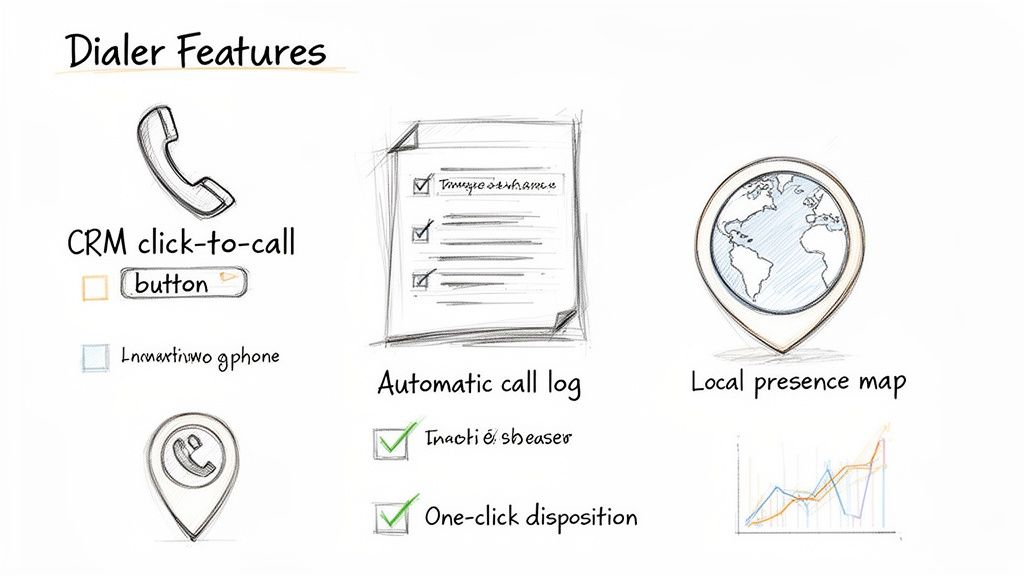
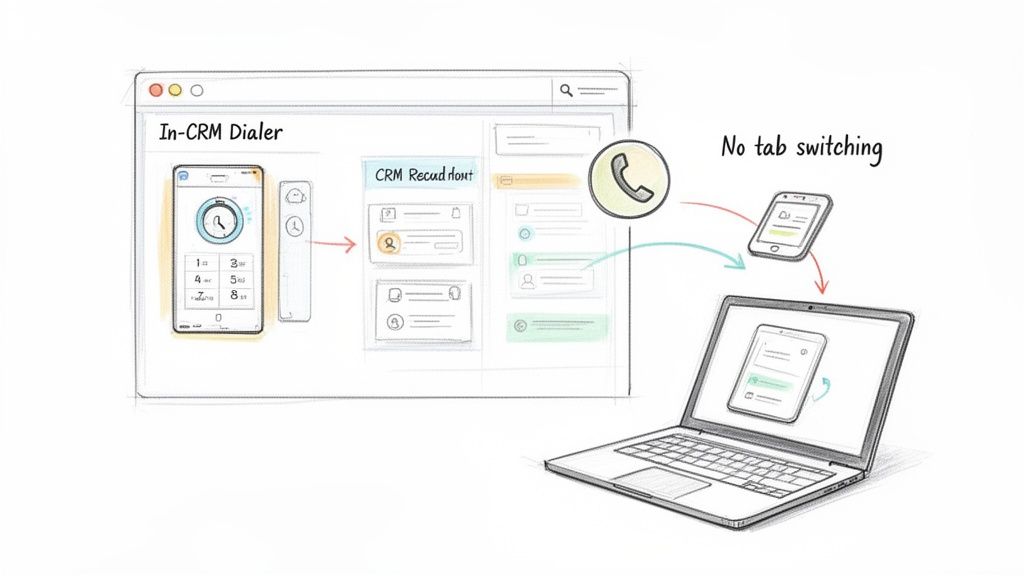
  • Click-to-Dial Functionality: Reps never have to leave the contact or lead record. They see their prioritized task, click a button, and the call starts instantly. No switching tabs, no copy-pasting numbers.
  • Automatic Call Logging: The moment a call ends, the activity is automatically logged to the right record. This should include the call duration, timestamp, and a link to the recording.
  • Accurate Outcome Dispositioning: A simple, non-intrusive pop-up lets the rep select the call outcome—like "Connected," "Left Voicemail," or "Meeting Booked"—with a single click.

This is how you create a "zero-admin" environment where reps can live entirely within their CRM. They just move from one task to the next while the system captures everything in the background. If you want to go deeper, our guide on how to properly log phone calls in your CRM is a great resource.

Native vs. Third-Party Integration: A Quick Comparison

Choosing the right integration model is absolutely critical. A native integration is built to work flawlessly inside your CRM's environment, while a third-party integration often leans on connectors or APIs that can be far less reliable.

AspectNative Integration (Inside CRM)Third-Party Integration (External Tool)
User WorkflowReps stay on one screen (Salesforce/HubSpot). All actions are in context.Reps must switch between the CRM and the external tool, breaking their focus.
Data LoggingInstant and automatic. Call outcomes, notes, and recordings are logged to the correct record in real-time.Often manual or delayed. Relies on reps to sync data, leading to errors and incomplete records.
Adoption RateHigh. The tool becomes a natural part of the existing workflow, making it easy to use.Low. The extra steps and tab-switching create friction that discourages consistent use.
Data AccuracyVery High. Automation removes the chance for human error in data entry.Inconsistent. Manual logging leads to typos, missed entries, and messy data.

By building this seamless logging foundation first, you solve one of the biggest headaches for sales leadership: a total lack of visibility. When you have clean, automatically captured data, you can finally trust your reports and make strategic decisions based on what’s actually happening on the ground.

Alright, you've built your shiny new automated workflow. Pop the champagne, right?

Not so fast.

Launching the system is just the first step. The real work begins now: making sure your team actually uses it and, more importantly, that it's driving real results. This is where the rubber meets the road—connecting your automation strategy to bottom-line business impact.

Without a clear way to measure what’s happening, you’re flying blind. You might feel like reps are more productive, but you won't know if that activity is leading to more pipeline. And without a smart rollout plan, even the most powerful tool can quickly become expensive shelfware.

Let's break down how to get this right.

Stop Chasing Vanity Metrics

First things first, we need to track what actually matters. It's so easy to get mesmerized by "vanity metrics" like the total number of dials or emails blasted out. While those numbers might look impressive on a dashboard, they don't tell you a thing about quality or efficiency.

Instead, you need to zero in on the KPIs that directly show the impact of your new, automated system. These are the numbers that prove your reps aren't just busier—they're better.

Here are the three metrics you should be obsessed with:

  • Daily Outbound Actions per Rep: This isn't just about raw volume. We're talking about the number of meaningful, prioritized tasks a rep clears each day. A solid automation engine should send this number soaring by cutting out all the prep time and guesswork.
  • Connect-to-Conversation Rate: This is where quality smacks into quantity. It tells you how many of your connected calls actually turn into real conversations. If your AI-powered call prep is doing its job, reps should sound more confident and relevant, leading to much better engagement when they get a prospect on the line.
  • CRM Activity Logging Rate: This number should be pushing 100%. No excuses. With a native Salesforce or HubSpot integration, every single call and its outcome should be logged automatically. This is non-negotiable; it's the foundation for clean data, accurate reporting, and effective coaching.

A Phased Rollout Plan That Actually Works

One of the biggest blunders I see teams make is trying to boil the ocean. They push a complex, multi-layered automation system out to everyone at once, and it just creates chaos and pushback.

A much smarter path is a phased, strategic rollout that builds momentum and creates internal champions along the way.

Start small. Prove the value with a dedicated pilot group.

  1. Find Your Champions: Hand-pick a small crew of 3-5 reps. Look for the ones who are tech-savvy, open to change, and respected by their peers. This pilot team will be your beta testers and, ultimately, your biggest advocates.
  2. Focus on One Core Workflow: Don't try to automate everything from day one. Start with the single biggest pain point you identified. For most teams, this is simply implementing a native CRM dialer to automate call logging. It's a quick win that delivers immediate value by killing a ton of manual admin work.
  3. Measure and Refine: Huddle with your pilot group constantly. Get their feedback, watch those core KPIs like a hawk, and tweak the process. Once you have hard data showing a jump in daily actions and perfect CRM logging, you've got a success story to tell.
  4. Expand and Scale: Armed with a proven win and a group of internal evangelists, now you can roll the workflow out to the wider team. Your champions can help with training and field questions, making the transition way smoother for everyone else.

This phased approach takes the pressure off. You get to prove the concept and work out the kinks with a small, focused group before the big show. By the time you go team-wide, you’ve got the data and the social proof to back up the change.

From Gut-Feel Coaching to Data-Driven Insights

That clean, automatically logged data does more than just clean up your reports—it completely transforms your coaching sessions. When you automate sales processes the right way, you get to stop guessing and start coaching based on hard facts.

The difference is night and day.

Coaching AspectTraditional Manual CoachingCoaching with Automated Data
FocusBased on a manager's gut feeling and anecdotes from a few cherry-picked call recordings.Focused on objective data—connect rates, call outcomes, and activity volume for specific task types.
PreparationThe manager spends hours digging through a messy CRM just to find a few examples.The manager pulls up a clean dashboard showing exactly where a rep is crushing it or struggling.
Conversation"I feel like you're not making enough calls.""I can see your connect rate on 'Pricing Page Visit' tasks is 15% higher than the team average. Let's break down what you're doing right."

This data-driven approach makes your coaching specific, actionable, and a hell of a lot more impactful. It's a massive piece of the automation puzzle. Companies that get this right often see stunning results, with average revenue jumping by 34%. The data shows that automation can deliver a mind-boggling 544% ROI on average, along with major lifts in leads and conversions. If you want to dive deeper, you can discover more insights about these marketing automation stats on emarsys.com.

Common Questions About Sales Automation

Look, stepping into a more automated workflow is going to bring up some good questions. It always does. Sales leaders and SDRs want to know how new systems will play with the tools they already use, whether it’ll mess with their brand voice, and what it means for their day-to-day.

Let’s tackle some of the most common hurdles that come up when teams start thinking about how to automate their sales process. These aren't just hypotheticals; they're the real-world concerns we hear all the time.

How Does This Fit with Our Existing Sales Engagement Platform?

This is a fantastic question because it gets right to the heart of building a modern sales tech stack. You've probably already invested in a Sales Engagement Platform (SEP) like Outreach or Salesloft, and those tools are absolute powerhouses for managing and running your sequences.

The kind of automation we’re talking about doesn't replace your SEP; it makes it smarter.

Here’s the best way I’ve found to explain it:

  • A Sales Engagement Platform is the library where all your outreach sequences live. It’s perfect for managing those long-term, multi-step campaigns.
  • An SDR Task Engine is the air traffic controller. It’s the thing that tells your reps which plane needs to land right now.

Your SEP is great for teeing up a "Day 5" email. But it was never built to tell an SDR, "Hey, stop everything—a VP at one of your ICP accounts just hit the pricing page. Call them in the next five minutes." That’s the critical gap an execution-focused task engine fills. It makes sure the most urgent, high-intent actions always jump to the front of the line, which in turn makes your SEP's sequences that much more effective.

Will AI-Generated Emails Sound Robotic and Hurt Our Brand?

It's a totally valid concern. We’ve all gotten those generic, buzzword-stuffed AI emails that you can spot a mile away. You delete them without a second thought.

The secret to avoiding that trap is understanding the massive difference between generic AI and context-aware AI.

Generic AI writing tools are like a dictionary—they know a lot of words, but they have zero idea what you're actually trying to say. Good sales AI, on the other hand, is grounded in specific data straight from your CRM. It knows the account's industry, the contact’s job title, and the exact signal that triggered the outreach in the first place.

The output from a good AI assistant isn't meant to be a finished novel; think of it as a powerful first draft. It handles 90% of the heavy lifting, giving reps a concise, relevant starting point they can personalize in seconds.

Here’s how the two approaches really stack up:

AI ApproachHow It WorksThe Result
Generic AI WriterUses a broad, public language model with no specific context about your prospect.A long, vague email that sounds like it could be for anyone. It usually fails to connect.
Context-Aware Sales AIPulls from CRM data: industry, company size, persona, and the recent buying signal.A short, punchy, and relevant message that's actually optimized for an outbound touchpoint.

The whole point is to kill the research time and the "blank page" anxiety, not to take the human out of the equation.

How Do We Avoid a Painful and Lengthy Implementation?

The fastest way to kill an automation project? Try to do way too much, way too soon. A "big bang" rollout where you flip a switch on a dozen new workflows at once is a recipe for chaos, low adoption, and seriously frustrated reps.

The key is a phased approach. Seriously. Don't try to automate your entire sales process on day one. Start with one single, high-impact workflow that solves an immediate and obvious pain point for your team.

For a lot of teams, the biggest headache is just getting clean activity data into the CRM.

So, a perfect starting point is a native CRM dialer that automatically logs calls and their outcomes. This is a quick win that delivers instant value:

  • It saves every single rep a ton of admin time, every day.
  • It gives leadership clean data and real visibility, right away.
  • It introduces the team to a new tool in a simple, low-friction way.

Once that foundational piece is running smoothly and reps are actually seeing the benefits, then you can start layering in more advanced automation. This step-by-step method builds confidence and momentum, making sure the new process sticks without disrupting your team's rhythm.


Ready to stop the busywork and give your SDRs a clear, prioritized workflow? marketbetter.ai transforms buyer signals into an actionable task engine—with AI-powered email and call tools built directly inside Salesforce and HubSpot.

See how you can automate your sales process and build more pipeline today.

Best Sales Productivity Tools for SDR Teams [2026]

· 20 min read
sunder
Founder, marketbetter.ai

Best sales productivity tools for SDR teams in 2026

The average SDR spends 65% of their time on tasks that aren't selling. Data entry. List building. Researching prospects. Switching between tabs. Updating the CRM. Attending meetings about updating the CRM.

That means a $60K/year SDR generates about $21K worth of actual selling activity. The rest is overhead.

Sales productivity tools exist to shift that ratio. But "productivity tool" has become a junk drawer category — it includes everything from CRM plugins to AI note-takers to Pomodoro timers. Most of those won't move the needle.

We focused on the tools that directly reduce time-to-first-touch, eliminate manual data entry, and help SDRs prioritize the right accounts. These are the 15 platforms that top-performing B2B SDR teams actually use in 2026.

What Actually Kills SDR Productivity?

Before buying tools, understand the problems:

Problem 1: Too many tabs. The average SDR switches between 8-12 tools daily — CRM, email, dialer, LinkedIn, enrichment tool, calendar, Slack, intent data platform. Each switch costs 23 minutes of refocus time (UC Irvine research). Over a day, that's hours lost to context-switching.

Problem 2: Manual research. SDRs spend 20-30 minutes per prospect researching company size, tech stack, recent news, and mutual connections. Multiply that by 50 prospects per day, and research alone consumes the entire workday.

Problem 3: No prioritization. Without intent signals, SDRs treat every lead equally. They work alphabetically, by import date, or by gut feel. Meanwhile, the prospect who visited the pricing page three times yesterday gets the same generic sequence as someone who downloaded a whitepaper six months ago.

Problem 4: Manual CRM updates. Reps hate updating CRMs because it takes time and delivers zero personal value. But managers need the data. This creates an adversarial dynamic where CRM data is always stale and incomplete.

The best productivity tools eliminate these problems at the root — not by adding another tab.

Related reading: Best AI SDR Tools 2026 · Best Sales Automation Software · Best Cold Email Software

Quick Comparison: 15 Sales Productivity Tools

ToolCategoryKey Time SaverStarting Price
MarketBetterAll-in-one SDR OSDaily playbook eliminates list-building$99/user/month
Apollo.ioProspecting + SequencesDatabase search → sequence in one clickFree–$119/user/mo
OutreachSales engagementMulti-step sequence automation~$100/user/mo
SalesLoftSales engagementCadence + Rhythm AI prioritization~$125/user/mo
GongConversation intelligenceAuto call notes + coaching insights~$100/user/mo
LavenderEmail coachingReal-time email scoring and rewriting$29/user/mo
LinkedIn Sales NavigatorSocial sellingAdvanced people/company search$99–$169/user/mo
CalendlyMeeting schedulingEliminates booking back-and-forthFree–$16/user/mo
ZoomInfoB2B intelligenceInstant contact data + intent signals~$15K+/yr
ClayData enrichmentWaterfall enrichment from 75+ sources$149–$800/mo
Chili PiperInbound routingInstant lead-to-meeting conversion$150–$300/mo
Close CRMCRM + dialerBuilt-in calling + SMS + email$29–$139/user/mo
Fireflies.aiMeeting notesAI transcription + action itemsFree–$29/user/mo
VidyardVideo prospectingPersonalized video at scaleFree–$59/user/mo
Troops/SalesforceCRM automationSlack-based CRM updates (no tab switch)Included in SFDC

1. MarketBetter — The Daily SDR Playbook

Category: All-in-one SDR operating system Time saved: 2-3 hours/day (eliminates list building, research, and prioritization)

Most productivity tools solve one piece of the SDR workflow. MarketBetter replaces the workflow entirely.

How it boosts productivity:

When an SDR logs in, they don't see a CRM dashboard they need to interpret. They see today's playbook — a ranked list of exactly who to contact, how, and why. Each task is backed by a specific signal:

  • "Call James at Acme Corp — visited pricing page 3x this week, company just raised Series B"
  • "Email Sarah at TechCo — her champion at your current customer just moved there"
  • "Follow up with Mike — opened your last email 4 times but hasn't replied"

This eliminates three massive time-sinks simultaneously:

  1. No list building — The platform identifies and prioritizes prospects automatically
  2. No research — Every lead is enriched with company data, signals, and context
  3. No tab-switching — Email, calling, and LinkedIn actions happen from one interface

The smart dialer is built directly into the platform. Click-to-call from the playbook, auto-log the outcome, and move to the next task. No switching to a separate dialer app, no manual call logging.

The AI chatbot handles website visitors 24/7 — qualifying leads, answering questions, and booking meetings while your SDRs sleep. Conversations are routed to the right rep based on territory and availability.

Real impact: MarketBetter customers report 70% less manual SDR work, 2x faster speed-to-lead, and 90% faster lead response times.

Pricing: $99/user/month, $1,500/mo (Growth, 5 seats), $3,000/mo (Scale, 10 seats).

G2 Rating: 4.97/5 — Top Performer across 15 lead generation categories.

See how the Daily Playbook works →

2. Apollo.io — Prospecting + Sequences in One

Category: B2B database with built-in sequencing Time saved: 1-2 hours/day (eliminates manual prospecting and list building)

Apollo is the Swiss Army knife for outbound SDRs. Search a 275M+ contact database, filter by any criteria imaginable, build a list, and drop prospects directly into an email sequence — without leaving the platform.

How it boosts productivity:

The database search eliminates the hours SDRs spend finding prospects manually. Filters include job title, company size, funding stage, tech stack, industry, and intent signals. Once you've built a list, one click drops the entire batch into a multi-step email sequence with personalization variables.

Apollo's Chrome extension pulls LinkedIn profile data directly into the platform, adding contacts to sequences while browsing LinkedIn. The email tracking shows opens, clicks, and replies in real-time.

Key limitation: Apollo is email-heavy. Phone and LinkedIn outreach require additional tools or manual effort. And there's no website visitor identification — you're finding new prospects, not leveraging existing website traffic.

Pricing: Free (10K email credits/mo). Basic $49/user/mo. Professional $79/user/mo. Organization $119/user/mo.

G2 Rating: 4.8/5

3. Outreach — Enterprise Sales Engagement

Category: Sales engagement platform Time saved: 1-2 hours/day (automates multi-step sequences across channels)

Outreach is the market leader in sales engagement for a reason — it handles the complexity of enterprise outbound at scale. Multi-step sequences combine email, phone, LinkedIn, and SMS into automated cadences that fire based on prospect behavior.

How it boosts productivity:

Sequences automate the follow-up process entirely. An SDR creates a sequence once, and Outreach handles the timing, channel selection, and personalization for hundreds of prospects simultaneously. The platform's analytics show which sequences perform best, which steps to optimize, and which prospects are engaging.

Outreach Kaia provides real-time conversation intelligence during calls — surfacing competitor mentions, objections, and talk-time ratios live, so reps can adjust on the fly.

Key limitation: Outreach is built for larger teams. The pricing reflects that — expect $100+/user/month with annual contracts. For teams under 10 reps, it may be overkill.

Pricing: Custom pricing. Typically $100-130/user/mo on annual contracts.

G2 Rating: 4.3/5

4. SalesLoft — Rhythm AI Prioritization

Category: Sales engagement platform Time saved: 1-2 hours/day (AI-prioritized task list across all channels)

SalesLoft's Rhythm feature is the closest any pure sales engagement tool gets to MarketBetter's playbook approach. Rhythm ingests signals from across your sales stack and generates a prioritized daily workflow — telling reps which actions to take first based on predicted impact.

How it boosts productivity:

Instead of working through sequences linearly, Rhythm dynamically reorders an SDR's task list based on real-time signals. If a high-value prospect just opened an email, that call moves to the top. If a deal's primary contact went dark, Rhythm surfaces the multithreading task.

The Deals dashboard gives managers visibility into pipeline health without reps manually updating stages. SalesLoft automatically captures activity data and maps it to deal stages.

Key limitation: SalesLoft's intelligence features require the full platform. Pricing has increased significantly (Vendr data shows $8K+ for 50 seats at the low end), and the add-on pricing for Deals, Conversations, and Analytics can push total cost above $200/user/mo.

Pricing: Custom pricing. Starting around $125-175/user/mo for full platform.

G2 Rating: 4.5/5

5. Gong — Conversation Intelligence

Category: Conversation intelligence and revenue intelligence Time saved: 30-60 minutes/day (eliminates manual note-taking, surfaces coaching insights)

Gong records, transcribes, and analyzes every sales conversation — calls, video meetings, and emails. The AI extracts key topics, competitor mentions, objections, next steps, and risk signals automatically.

How it boosts productivity:

SDRs stop taking notes during calls. Gong captures everything, generates a summary, and identifies action items. Managers use Gong to review calls at 2x speed, spot coaching opportunities, and understand why deals are winning or losing — without sitting in on every call.

The reality-based forecasting analyzes conversation patterns to predict which deals will close, independent of what reps put in the CRM. This eliminates the fiction of manually updated pipeline stages.

Key limitation: Gong is primarily useful for teams that do significant phone/video selling. If your SDR workflow is email-heavy, the ROI is lower. Pricing is also enterprise-focused — expect $100+/user/month.

Pricing: Custom pricing. Typically $100-150/user/mo.

G2 Rating: 4.8/5

6. Lavender — AI Email Coach

Category: Email writing assistant Time saved: 20-30 minutes/day (faster, better-performing emails)

Lavender sits inside your email client and scores every email before you send it. The AI analyzes subject line, length, reading level, personalization, and mobile readability, then suggests specific improvements. It's like having a writing coach for every email.

How it boosts productivity:

The average SDR sends 50+ emails per day. Lavender reduces writing time by providing real-time suggestions — shorter subject lines, simpler language, better opening lines. More importantly, it improves reply rates. Lavender claims their users see 2-3x higher reply rates from AI-scored emails.

The prospect research panel pulls LinkedIn data, recent news, and company info directly into the compose window, eliminating the research tab-switch.

Key limitation: Lavender helps you write better emails, but it doesn't automate sending or sequencing. It pairs well with Outreach, SalesLoft, or Apollo — it's not a standalone productivity solution.

Pricing: Free (5 emails/mo). Starter $29/user/mo. Team plans available.

G2 Rating: 4.9/5

7. LinkedIn Sales Navigator — Social Selling Intelligence

Category: Social selling and prospecting Time saved: 30-60 minutes/day (advanced search, lead recommendations, InMail)

Sales Navigator is a non-negotiable for most B2B SDR teams. Advanced search filters, lead and account alerts, and InMail access make it the primary tool for LinkedIn-based prospecting and research.

How it boosts productivity:

Lead recommendations surface prospects similar to your best customers. Account alerts notify you when key contacts change jobs, post content, or engage with your company's page. Saved searches automatically surface new prospects matching your ICP as they join LinkedIn.

The TeamLink feature shows warm paths to prospects through your colleagues' connections — turning cold outreach into warm introductions.

Key limitation: Sales Navigator is an intelligence tool, not an execution tool. You still need a separate platform to sequence, call, and manage leads. The data stays in LinkedIn — syncing to your CRM requires additional tools.

Pricing: Core at $99/user/month. Advanced at $149/user/mo. Advanced Plus at $169/user/mo.

G2 Rating: 4.3/5

8. Calendly — Meeting Scheduling

Category: Meeting scheduling automation Time saved: 15-30 minutes/day (eliminates scheduling back-and-forth)

Calendly seems simple, but the time savings compound. Every meeting booked without back-and-forth emails saves 5-10 minutes. For SDRs booking 5-10 meetings per week, that's 1-2 hours saved on scheduling alone.

How it boosts productivity:

Share a booking link in emails, sequences, or on your website. Prospects pick a time that works. Calendly handles timezone conversion, calendar conflicts, buffer time, and confirmation emails automatically. Round-robin scheduling distributes meetings across your team evenly.

The Routing feature (on Teams plan) qualifies leads via form questions and routes them to the right rep — turning inbound meeting requests into qualified, properly-routed demos.

Key limitation: Calendly is a point solution. It doesn't replace your CRM, sequencing tool, or dialer. But it eliminates one specific friction point so effectively that it's essentially mandatory.

Pricing: Free (1 event type). Standard $10/user/mo. Teams $16/user/mo. Enterprise custom.

G2 Rating: 4.7/5

9. ZoomInfo SalesOS — B2B Intelligence Platform

Category: B2B contact data + intent signals Time saved: 1-2 hours/day (eliminates manual research and data entry)

ZoomInfo is the enterprise standard for B2B contact and company data. Direct dials, verified emails, org charts, tech stack data, and intent signals — all searchable and exportable to your CRM.

How it boosts productivity:

Instead of manually researching each prospect, SDRs search ZoomInfo for contacts matching their ICP, export enriched records directly to CRM, and start sequencing immediately. Intent data shows which companies are actively researching your category, so SDRs focus on accounts that are actually in-market.

The Engage feature adds basic sequencing capabilities directly in ZoomInfo, though most teams pair it with Outreach or SalesLoft for execution.

Key limitation: ZoomInfo is expensive. Annual contracts typically start at $15,000+ and auto-renew. Data quality, while generally strong in the US, varies by region and industry. And the credit system means heavy users can burn through their allocation quickly.

Pricing: Custom. Typically $15,000-$30,000/year for small teams.

G2 Rating: 4.5/5

10. Clay — Waterfall Data Enrichment

Category: Data enrichment and workflow automation Time saved: 1-2 hours/day (automates multi-source research)

Clay is a data enrichment powerhouse. It connects to 75+ data providers and runs "waterfall" enrichment — trying multiple sources sequentially until it finds the data you need. Think of it as automated research that checks dozens of databases for each prospect.

How it boosts productivity:

Instead of an SDR manually checking LinkedIn, company websites, Crunchbase, and news sites for each prospect, Clay does it automatically. Import a list of companies, and Clay enriches them with contacts, emails, tech stack, funding data, recent news, and even AI-generated personalization snippets.

The table-based interface lets you build complex enrichment workflows visually. Add a column for "recent company news," another for "tech stack," and Clay populates both automatically.

Key limitation: Clay has a learning curve. The flexible interface means you need to build your own workflows, which takes time to set up. Credit-based pricing can also get expensive — heavy users report spending $500-800/mo on enrichment credits alone.

Pricing: Starter $149/mo. Explorer $349/mo. Pro $800/mo. Enterprise custom.

G2 Rating: 4.9/5

11. Chili Piper — Instant Inbound Routing

Category: Inbound lead routing and scheduling Time saved: Variable (eliminates lead response delay entirely)

Chili Piper's core insight: every minute between a form submission and a sales response reduces conversion probability. Their platform lets prospects book a meeting on the thank-you page immediately after submitting a form — cutting response time from hours to seconds.

How it boosts productivity:

When a lead fills out a form, Chili Piper qualifies them based on form responses, routes them to the right rep based on territory/round-robin rules, and presents available time slots immediately. No waiting for an SDR to review and respond. No lead sitting in a queue.

For SDR teams, this means fewer inbound leads slip through the cracks. The rep gets a qualified, scheduled meeting — not a cold lead they need to chase.

Key limitation: Chili Piper is specifically for inbound routing. It doesn't help with outbound prospecting, list building, or cold outreach. It's a focused tool that pairs with your CRM and marketing automation platform.

Pricing: Instant Booker at $150/mo. Handoff at $200/mo. Form Concierge at $300/mo. Distro at $150/mo.

G2 Rating: 4.6/5

12. Close CRM — Built for Inside Sales Speed

Category: CRM with native dialer Time saved: 1-2 hours/day (eliminates tool-switching between CRM and dialer)

Close CRM eliminates the biggest productivity killer for phone-heavy SDR teams: switching between CRM and dialer. The native Power Dialer auto-dials through a list, logs outcomes, and moves to the next call — all without leaving the CRM.

How it boosts productivity:

Smart Views create dynamic lead lists filtered by any criteria. The Power Dialer works through these lists automatically — dial, talk, log, next. The Predictive Dialer (Enterprise) dials multiple numbers simultaneously and connects reps only when someone answers, maximizing talk time.

Built-in SMS and email mean reps handle all communication channels from one interface. Activity logging is automatic — calls, emails, and SMS are tracked without manual entry.

Key limitation: Close is designed for inside sales teams doing high-volume calling. It lacks website visitor identification, advanced intent data, and the enterprise customization of Salesforce. For teams that don't do heavy phone outreach, it's overkill in some areas and light in others.

Pricing: Startup $29/user/mo. Professional $99/user/month. Enterprise $139/user/mo.

G2 Rating: 4.7/5

13. Fireflies.ai — AI Meeting Notes

Category: Meeting transcription and intelligence Time saved: 15-30 minutes per meeting (eliminates manual note-taking)

Fireflies joins your video calls, transcribes the conversation, and generates structured notes with action items, questions asked, and key topics discussed. For SDRs running 3-5 discovery calls per day, the time savings are significant.

How it boosts productivity:

No more typing notes during calls (which splits attention and makes you a worse listener). No more spending 10 minutes after each call writing up a summary. Fireflies does both automatically and pushes the summary to your CRM.

The AI search lets you find specific moments across hundreds of calls — "show me every time a prospect mentioned budget" or "find calls where competitors were discussed." This is gold for coaching and win/loss analysis.

Key limitation: Fireflies is a point solution for meetings. It doesn't help with prospecting, sequencing, or lead management. The transcription quality depends on audio quality and speaker accents.

Pricing: Free (800 min storage). Pro $10/user/mo. Business $19/user/mo. Enterprise $29/user/mo.

G2 Rating: 4.5/5

14. Vidyard — Video Prospecting

Category: Personalized video creation for sales Time saved: Variable (can increase reply rates 2-3x on targeted accounts)

Vidyard lets SDRs record and send personalized video messages embedded directly in emails. For high-value accounts where personalization matters, a 30-second video mentioning the prospect's name, company, and a specific insight dramatically outperforms text emails.

How it boosts productivity:

Record a video in your browser, and Vidyard generates a thumbnail, hosting link, and embed code automatically. Analytics show who watched, how long they watched, and whether they rewatched specific sections. Integration with Outreach, SalesLoft, and HubSpot embeds videos directly in sequences.

The AI script generator helps reps create personalized scripts quickly, and the teleprompter feature keeps them on track without looking scripted.

Key limitation: Video prospecting doesn't scale like email. It works best for high-value targets — using it for every prospect in a 500-person list isn't practical. The ROI depends heavily on your SDR team's comfort with video.

Pricing: Free (25 videos). Pro $29/user/mo. Plus $59/user/mo. Enterprise custom.

G2 Rating: 4.5/5

15. Troops (Salesforce Native) — CRM Updates from Slack

Category: CRM automation and Slack integration Time saved: 20-30 minutes/day (eliminates tab-switching to update CRM)

Troops (now part of Salesforce) brings CRM updates into Slack. Instead of switching to Salesforce to update a deal stage, log a call, or check pipeline — reps do it directly from Slack with structured prompts. Alerts notify teams when deals move, new leads arrive, or key metrics change.

How it boosts productivity:

The biggest CRM productivity killer is the tab switch. Reps don't want to stop what they're doing, open Salesforce, navigate to the right record, and update fields. Troops puts that workflow in Slack — where reps already live. Structured prompts make updates take seconds instead of minutes.

Revenue signals push alerts to relevant channels when deals need attention, reducing the lag between something happening in the pipeline and someone acting on it.

Key limitation: Troops is Salesforce-only. If you use HubSpot, Pipedrive, or another CRM, this isn't an option. It also requires Slack as your team communication tool.

Pricing: Included with Salesforce for basic features. Advanced features require Salesforce Premium or Enterprise editions.

See also: Best Sales Engagement Software · Best Sales Prospecting Tools · Best Lead Management Software

Building Your SDR Productivity Stack

No single tool solves every productivity problem. The goal is a stack that eliminates the four killers: tab-switching, manual research, no prioritization, and CRM data entry.

The Consolidated Approach

Use a platform that combines multiple capabilities instead of buying point solutions for each:

MarketBetter covers visitor identification, lead enrichment, prioritization (daily playbook), sequencing, dialing, and chatbot — eliminating the need for 4-5 separate tools. For teams that want to reduce stack complexity, this is the most efficient path.

The Best-of-Breed Approach

If you prefer specialized tools, here's the minimum viable SDR stack:

  1. CRM: HubSpot (free) or Salesforce (enterprise)
  2. Data: Apollo ($49/user/mo) or ZoomInfo ($15K+/yr)
  3. Engagement: Outreach ($100/user/mo) or SalesLoft ($125/user/mo)
  4. Scheduling: Calendly ($10/user/mo)
  5. Calling: Close ($99/user/month) or native dialer in engagement platform

Total cost per rep: $260-$350/month in tool costs alone, plus CRM.

Compare that to a consolidated platform at $100-300/user/month that covers all five capabilities. The economics of consolidation are compelling — and that's before accounting for the productivity gains from not switching between five separate tools.

The "Can't Afford Anything" Stack

Every tool below is free:

  1. Apollo Free — 10K email credits, basic sequences
  2. HubSpot Free — Contact management, email tracking
  3. Calendly Free — One event type scheduling
  4. Fireflies Free — 800 minutes of transcription
  5. Vidyard Free — 25 video messages

This stack costs $0/month and covers basic prospecting, CRM, scheduling, note-taking, and video. It's not ideal — you'll outgrow it fast — but it works for a solo SDR or very early-stage team.

The One Metric That Matters

Every tool on this list should be evaluated against one question: does it reduce the time between a buying signal and your SDR's first touch?

If a prospect visits your pricing page at 10am and your SDR doesn't reach out until 3pm, no amount of email optimization or CRM automation will overcome that 5-hour lag. Speed-to-lead is the single most correlated factor with conversion rates in B2B sales.

The tools that win in 2026 aren't the ones with the most features. They're the ones that detect signals faster and put actionable tasks in front of reps sooner.

Free Tool

Try our AI Lead Generator — find verified LinkedIn leads for any company instantly. No signup required.

Ready to Give Your SDRs a Daily Playbook?

MarketBetter consolidates visitor identification, lead enrichment, AI prioritization, sequencing, and dialing into one daily SDR workflow. No more 8-tab mornings.

Book a 15-minute demo →

How to Log Phone Calls in Your CRM and Drive Revenue

· 16 min read

To get a real handle on your sales process, you need a consistent way to log phone calls, including outcomes, notes, and dispositions, right inside your CRM. When you do this, every conversation becomes a valuable piece of data. Nothing gets lost, and you build a crystal-clear history of every touchpoint with a prospect or customer, creating a single source of truth for your entire revenue team.

The Hidden Costs of Poor Call Logging

Picture one of your top SDRs, headset on, bouncing from one call to the next. They're trying to hit quota, frantically scribbling notes on a sticky pad stuck to their monitor. This scene illustrates a massive, hidden drain on sales teams: the ‘admin tax’ of manual call logging.

It feels like a tiny task, but the downstream effects of messy, inconsistent data entry are huge. This one administrative chore eats up precious selling time and creates a massive data black hole right in your CRM. When your team doesn't log every call, the consequences ripple through the entire company, sabotaging your efforts to build a predictable revenue engine.

A distressed male call center agent with a headset is overwhelmed, juggling multiple phones, sticky notes, and tasks.

How Inconsistent Data Sabotages Your Pipeline

The real damage here isn't just about sloppy records—it's about the strategic blunders it leads to. Every unlogged call is a missed opportunity to learn, coach, and improve. The contrast between disciplined and undisciplined logging is stark.

Here’s a side-by-side comparison of the business impact:

Consistent LoggingInconsistent Logging
Accurate ForecastingUnreliable Projections
Leadership trusts the pipeline and can plan headcount and resource allocation with confidence.Leadership makes critical decisions based on flawed data, leading to missed targets.
Effective CoachingMissed Opportunities
Managers see which talk tracks and reps are performing, enabling targeted, data-driven coaching.Rep performance remains a mystery, and coaching is based on gut feelings rather than facts.
Clear AttributionFlawed Insights
Marketing knows which campaigns drive high-quality conversations and can double down on what works.Campaign ROI is impossible to measure accurately, wasting marketing spend on ineffective channels.

Without a reliable system to log your calls, you're flying blind. You can't forecast revenue with any real confidence, you have zero visibility into what your reps are actually doing, and your campaign attribution becomes a complete guessing game.

The failure to log calls consistently isn't just a data hygiene problem; it's a revenue problem. It creates a domino effect where inaccurate forecasts mislead leadership, coaching becomes ineffective, and true ROI remains hidden.

Ultimately, all this administrative friction creates a vicious cycle. Reps prioritize the next dial over data entry, managers don't have the insights they need to coach effectively, and the entire sales motion grinds to a halt. The first step to fixing this broken workflow is to stop seeing call logging as a chore and start treating it as the strategic foundation for predictable revenue.


Choosing Your Method: Manual vs. Automated Call Logging

When it comes to logging your team’s phone calls, you're at a crossroads: stick with the old-school, hands-on manual approach, or embrace a modern, automated system. This choice has huge implications for your team's efficiency, data quality, and bottom line. Sticking with manual entry might feel simple, but it’s often a major source of friction that silently sabotages your sales goals.

The Problem with Doing It by Hand

Most reps know the drill. You hang up from a call, jump over to Salesforce or HubSpot, find the right contact record, click "Log a Call," and start typing. In reality, it’s a productivity killer. This tedious, repetitive task pulls your team away from what they’re actually supposed to be doing: selling.

This constant context-switching inevitably leads to sloppy data, forgotten details, or worse, calls that never get logged at all. For sales leaders, this creates a massive blind spot. With 66% of businesses planning to invest more in advanced analytics, unlogged calls mean your attribution models are broken from the start.

The Friction of Manual Logging in the Real World: A Step-by-Step Breakdown

Let's break down the manual process a rep goes through dozens of times a day:

  1. Hang Up: The call with a prospect ends.
  2. Context Switch: Stop thinking about selling and start thinking about data entry.
  3. Navigate CRM: Hunt down the right contact, lead, or opportunity. Was it Jane Smith or Jayne Smith?
  4. Recall & Type: Try to remember crucial details from the conversation before they fade and type them into a notes field.
  5. Select Outcome: Choose a call disposition from a dropdown menu—"Connected," "Left Voicemail," "No Answer."
  6. Schedule Follow-Up: Manually create a new task to ensure the lead doesn't fall through the cracks.
  7. Switch Back: Finally, return to the call list to find the next prospect.

Repeat this process 50 times a day, and you have a perfect recipe for burnout and messy, unreliable data.

The Power of Automation

This is where automated solutions completely flip the script. When a rep uses a tool with click-to-dial functionality baked right into their CRM, the system handles all that grunt work for them.

The screenshot below shows a typical Salesforce dashboard tracking sales activities. Imagine how much more powerful this view becomes when every single call is captured automatically. No gaps, no guesswork—just a complete, accurate picture of your team's activity.

By removing the administrative burden, automation doesn't just make logging easier—it makes it invisible. Reps stay focused on conversations, and leaders get the clean, reliable data they need to make strategic decisions.

Manual vs. Automated Call Logging: A Head-to-Head Comparison

When you put the two methods next to each other, the advantages of automation become crystal clear. It's not just about saving time; it's about building a more intelligent and effective sales engine.

FeatureManual LoggingAutomated Logging (with Integrated Dialer)
SpeedSlow, requiring multiple clicks and context switching between tasks.Instant, logging occurs in the background without interrupting workflow.
Data AccuracyProne to human error, forgotten details, typos, and incomplete notes.High, consistently captures dispositions, call duration, and notes.
Rep AdoptionLow, seen as a tedious administrative chore that gets skipped under pressure.High, requires no extra effort from the rep, making the right way the easy way.
Reporting & InsightsUnreliable, based on incomplete and inconsistent data, leading to flawed forecasts.Accurate, provides a complete, real-time view of call activity for trustworthy reporting.

Ultimately, choosing automation is a strategic move to build a smarter, more efficient sales process that runs on accurate, real-time data. To see how this can transform a sales workflow, check out our guide on the benefits of automated caller software.

How to Implement Automated Call Logging

Alright, let's get tactical. Moving from theory to practice is where you see the real wins. Setting up a system to automatically log phone calls is about thoughtfully configuring your CRM and sales tools to work for your reps, not against them. When you do it right, the correct way to work becomes the easiest way.

The goal is to build a workflow so seamless that your team doesn't even think about it. Calls get made, outcomes get captured, and all that rich data flows straight into your CRM. That's how you build a perfect record of every interaction and kill the "admin tax" for good.

This flowchart drives home the difference between a manual logging slog and a smooth, automated process.

Flowchart comparing manual and automated call logging processes, showing automation's efficiency and accuracy benefits.

You can see how automation collapses a tedious, multi-step chore into a single, fluid action for the sales rep, removing all friction.

Action Plan: Configuring Your Native CRM Dialer

Both Salesforce and HubSpot have native dialing capabilities, and they're a great place to start. Here's a quick-start guide to setting them up for success.

Step 1: Define and Standardize Your Call Dispositions. These are the labels reps use to categorize call outcomes.

  • Be Specific but Concise: Instead of a generic "Connected," use "Connected - Demo Booked" or "Connected - No Interest." This gives you immediate insight into call effectiveness.
  • Limit the Options: Don't paralyze your team. Stick to 5-7 core outcomes that cover 90% of your scenarios. Too many choices lead to inconsistent data.
  • Make Them Actionable: A good disposition should signal the next step. "Left Voicemail" or "Gatekeeper - Sent Info" makes it easy to build follow-up sequences.

Step 2: Automate Task Creation. Configure your CRM to automatically create follow-up tasks based on the disposition. For example:

  • If Disposition = "Left Voicemail," then create a task "Call Again" due in 2 days.
  • If Disposition = "Connected - Demo Booked," then create a task "Confirm Demo" for the Account Executive.

This simple automation ensures no lead ever falls through the cracks.

Elevating the Workflow with Integrated Tools

Native dialers are a solid foundation, but truly integrated tools like MarketBetter take automation to a new level by turning your CRM into an intelligent command center.

Here’s a comparison of a native dialer workflow vs. an integrated AI tool:

Workflow StepNative CRM DialerIntegrated AI Tool (like MarketBetter)
Call LoggingAutomatically logs call time and prompts for disposition.Instantly logs call, duration, and disposition.
Note TakingRequires manual typing of call notes.AI generates a crisp summary of the conversation, highlighting action items.
Next ActionsRep manually creates follow-up tasks based on rules.AI can suggest next steps and even draft follow-up emails.
Data ContextLogs that a call happened.Captures the substance of the call without admin work.

To get the most out of automated call logging, it pays to have a solid foundation. Modern VoIP services for businesses provide the call quality and reliability that sales teams depend on. This aligns with the industry-wide push for more trusted communication, where frameworks like STIR/SHAKEN are used by major carriers to validate calls, building buyer confidence.

Best Practices for Clean Data and Accurate Attribution

You've automated call logging—congratulations. But now the real work begins: turning that activity into data you can trust to make smarter decisions. Just logging calls isn't enough. You need a system to keep that data clean, consistent, and useful for figuring out what’s actually driving revenue.

It all boils down to standardization. If every rep has their own way of logging call outcomes, you don't have data—you have a mess. You need a single, unified language for what happens on a call, one that everyone on the team uses every single time. No exceptions.

Standardize Your Call Dispositions

Your call dispositions are the foundation of your sales activity report. They must be crystal clear and distinct. Vague or overlapping options will lead to garbage data and a sales strategy built on guesswork.

Here’s a comparison showing the power of clear dispositions:

Ineffective Dispositions (Vague)Effective Dispositions (Actionable & Specific)
ConnectedConnected - Demo Booked
Left MessageLeft Voicemail - 1st Attempt
No AnswerNo Answer / Busy
Follow UpGatekeeper - Sent Info
Bad NumberWrong Number
GatekeeperNot Interested - Bad Timing

With the effective list, a RevOps leader can instantly filter for "Connected - Demo Booked" and see which reps, campaigns, or lead sources are producing actual pipeline. This simple tweak transforms raw activity logs into real business intelligence.

Train Your Team on High-Quality Notes

Beyond picking the right disposition, the notes themselves are critical. The goal is to capture objective facts and clear next steps. Actionable Step: Create a simple, mandatory note-taking template for your team to use.

A solid call note template should always cover:

  • Key Pain Points: What specific problems did the prospect mention? (e.g., "Struggling with manual reporting, wastes 10 hrs/week.")
  • Next Steps: What was agreed upon? (e.g., "Sending case study on Company X. Follow-up call scheduled for Thurs @ 2 PM.")
  • Actionable Intel: Any other key details? (e.g., "Decision-maker is CFO, budget cycle is Q3.")

Clean data isn't just a "nice to have" for neat-freaks. It's about building trust. When your leadership team trusts the data in the CRM, they can make confident decisions on hiring, marketing spend, and overall strategy. Bad data leads to bad assumptions, which almost always leads to expensive mistakes.

Connect Logging to Revenue Attribution

This is where all that discipline pays off. Once you have standardized dispositions and clean notes, you can finally build attribution models in Salesforce or HubSpot that mean something. You can start answering the big questions you could only guess at before.

Imagine being able to prove that one cold calling campaign generated $250,000 in pipeline while another fell completely flat. That's the kind of insight that lets you double down on what’s working and kill what isn't, making sure every dollar and hour is spent effectively. By making sure every single conversation is logged accurately, you draw a straight line from your SDRs' daily activities all the way to closed-won revenue. To go even deeper on this, check out our guide to conversation analytics software.

How MarketBetter Turns Call Logging Into a Revenue Engine

Automating the log of a call is a great start, but it only solves part of the problem. The real friction is reps wasting precious hours on dead-end accounts, fumbling for the right words on a live call, and then getting buried in admin work.

This is where a workflow platform like MarketBetter changes the game. It goes beyond just logging a call and acts as a true revenue engine by optimizing the entire sales motion. It starts by fixing the most fundamental problem: figuring out who to call next. Instead of leaving reps to guess, MarketBetter’s AI task engine surfaces the highest-potential accounts and serves them up in a prioritized queue.

From Call Prep to Perfect Data

MarketBetter keeps the momentum going by making the conversation itself better. It provides AI-generated talk tracks and key insights right inside the CRM, meaning reps spend less time prepping and more time confidently engaging prospects.

It’s an integrated system that covers the entire lifecycle of a sales call:

  • Before the call: AI prioritizes the best accounts to dial and feeds the rep contextual talk tracks.
  • During the call: A smooth, integrated dialer means reps never have to leave Salesforce or HubSpot.
  • After the call: AI takes over, instantly generating call summaries, detailed notes, and the correct disposition.

This entire workflow is designed to keep reps focused on one thing: selling.

Diagram showing Pipellimes app integrating with CRM, powered by AI for zero admin and more conversations for SDRs.

This end-to-end approach means your team can finally stop worrying about administrative busywork and trust that it's being handled with 100% accuracy.

The result is simple but powerful: more high-quality conversations every single day, zero time wasted on data entry, and perfectly clean CRM data that gives you a crystal-clear view of your sales pipeline.

While the average cold calling success rate hovers around a meager 2.3%, top-performing teams using AI-driven workflows are hitting 6-10% or even higher. According to some cold calling statistics, AI-assisted calls can lead to a 50% higher booked meeting rate. But without the consistent, automated logging a tool like MarketBetter provides, managers have zero visibility into what makes those successful calls actually work.

Common Questions (and Straight Answers) About Call Logging

Even with a solid plan, you're going to hit roadblocks when you start getting serious about logging phone calls. Let's tackle the big questions head-on with actionable answers.

How Do I Get My Reps to Actually Log Their Calls?

This is the classic struggle. The answer isn't another memo or nagging. The only way to win is to make logging calls easier than not logging them. If a rep has to stop, click through three screens, and manually type notes, they'll skip it every time.

Actionable Solution: Implement a tool with an embedded click-to-dialer inside your CRM. When the logging process becomes an invisible, automatic byproduct of making a call, adoption is no longer an issue. The secret is to remove every last bit of friction.

Is an Automated Tool Really Worth the Money?

It’s tempting to think of manual logging as the "free" option, but that's a dangerous illusion. Let's do a quick cost-benefit analysis.

Cost of Manual Logging:

  • Lost Selling Time: If a rep wastes just 30 minutes a day on admin, a 10-person team loses over 100 hours of prime selling time every month.
  • Bad Decisions: Inaccurate data leads to flawed forecasting and wasted marketing spend. The cost of one bad strategic decision based on faulty data can dwarf the cost of a software tool.

Benefit of Automation:

  • Increased Productivity: That reclaimed 100+ hours per month goes directly back into revenue-generating activities.
  • Data-Driven Strategy: Clean, reliable data fuels smarter coaching, accurate forecasting, and higher ROI.

The real question isn't whether you can afford an automated tool. It's whether you can afford the shoddy forecasting, lost coaching opportunities, and messy attribution that comes from bad data.

What’s the Difference Between a Native Dialer and a Specialized Tool?

The native dialers in Salesforce or HubSpot are a great starting point. They get you click-to-dial inside your CRM and handle basic call logging, which is a massive leap from doing everything by hand. But a specialized tool like MarketBetter is a complete sales workflow built for performance.

Here’s a simple comparison:

FeatureNative CRM DialerSpecialized AI Tool (like MarketBetter)
Primary FunctionAutomates the task of logging a call.Optimizes the entire outbound strategy.
IntelligenceBasic call outcome tracking.AI-driven account prioritization and talk tracks.
Post-Call WorkflowManual note-taking.Automated call summaries and note generation.
FocusLogging what happened.Improving what happens next.

A native dialer automates the task of logging. A specialized tool improves the entire outbound strategy, from call prep all the way to post-call analysis.


Ready to kill the admin work and give your SDRs a clear, prioritized path to hitting their number? MarketBetter puts an AI-powered task engine and dialer right inside Salesforce and HubSpot, so your team can focus on what they do best—having more great conversations. Learn more at https://www.marketbetter.ai.

A Guide to Sales Process Optimisation That Actually Works

· 23 min read

Think of sales process optimisation as a continuous tune-up for your sales engine. It’s the practice of methodically refining your sales motion to cut out friction, automate the soul-crushing admin tasks, and free up your reps to do what they do best: sell.

It’s about finding and fixing all the "leaks" in your sales pipeline so more deals close, and they close faster. The whole point is to build a repeatable, predictable system for bringing in revenue.

Why Your Sales Process Is Leaking Revenue

Picture your sales process as a high-pressure water pipeline. Ideally, every drop of water that goes in one end—every single lead—comes out the other as a signed deal. But let's be real, most sales pipelines are riddled with tiny leaks. These aren't dramatic pipe bursts; they're the slow, steady drips that silently drain your revenue potential day after day.

A business pipeline losing value from automation, training, and clean data stages, with a confident man at the end.

This is the central challenge staring down sales leaders right now. If you're seeing inconsistent rep performance, flat win rates, and a CRM that feels more like a graveyard than a goldmine, you've got a leaky pipeline. Sales process optimisation isn't about finding one massive crack; it's about systematically sealing up all the small, costly holes.

The Ad-Hoc Mess vs. The Optimised Machine

Too many teams run on what I call an ad-hoc sales process. Reps freestyle their outreach, managers have zero visibility into what's actually working, and CRM data is a chore nobody wants to do. The result? Chaos. Success is random, and scaling is a pipe dream.

An optimised sales process, on the other hand, is engineered for predictability. It’s a clean, unified motion that the entire team understands and executes.

Let’s look at the difference on the ground:

  • The Unoptimised Process: Your reps burn hours every morning just figuring out who to call. They manually log activities (or forget to) and throw spaghetti at the wall to see which messaging sticks. The activity numbers look high, but the results are all over the map.
  • The Optimised Process: Your reps log in to a prioritized task list, automatically surfaced by real buyer intent signals. They fire off calls and emails from right inside the CRM, and every single touchpoint is logged for them. Their actions are targeted, efficient, and—most importantly—measurable.

It’s the difference between leaving your team to figure it out alone and giving them a system that guides them to the most valuable action, every single time.

How to Actually Start Fixing Things

So, how do you start patching these leaks? First, you have to accept that optimisation isn't a one-and-done project. It's a continuous cycle of diagnosing bottlenecks, simplifying workflows, and using smart tech to automate the grunt work.

  • Actionable Step: Instead of just shouting "make more calls!" from the sales floor, implement a native CRM dialer. This one change eliminates clicks, automates activity logging, and gives each rep back hours of admin time every week. That's time they can spend purely on conversations that close deals.

This guide is your roadmap to finding those leaks and sealing them for good.

Diagnosing Your Sales Process Bottlenecks

Before you can optimize anything, you have to play detective. Fixing a sales process isn't about throwing new software at the problem and hoping it sticks. It's about finding the exact points of friction—the spots where deals stall, reps get stuck, and revenue leaks out.

Think of it like a doctor. You wouldn't get a prescription without a diagnosis, right? The same goes for your sales engine. Guesswork and gut feelings won't cut it. You need to figure out precisely what's broken before you can start to fix it. That process always begins with listening.

Asking the Right Diagnostic Questions

The absolute best source of truth is your team on the front lines. They live and breathe the process every day and know exactly where the cracks are. Sit down with your SDRs, AEs, and managers to get a real, on-the-ground view of what's happening.

You can uncover a lot by asking a few targeted questions:

  1. Task Prioritization: "Walk me through your morning. How do you decide who to call first?"
  2. Outreach Effectiveness: "How long does it take you to personalize an email? Do you feel like your messages are actually landing?"
  3. Data & CRM Hygiene: "Show me exactly how you log a call. How many clicks does it take? How much time does it eat up?"
  4. Handoffs & Transitions: "What happens after you book a meeting? Describe the handoff to an AE. Where do things get dropped?"
  5. Technology & Workflow: "How many tabs do you have open right now? What's your workflow for finding a lead and making that first call?"
  • Actionable Step: Don't just ask these questions in a meeting. Schedule a 30-minute "ride-along" with one of your reps. Ask them to share their screen and work as they normally would. The visual evidence of them toggling between 10 browser tabs to log a single call is more powerful than any verbal complaint.

This is the qualitative proof you need to build a case for change. For a deeper dive into structuring these stages, check out our guide on the B2B sales funnel.

This is precisely the kind of chaos that a tool like marketbetter.ai is designed to solve. Instead of leaving reps to guess, its AI-driven task engine turns buyer signals into a simple, prioritized to-do list.

That screenshot says it all. Reps know exactly what to do next, ensuring they're always working on the highest-value actions, not just the easiest ones.

Comparing Broken vs Optimised Realities

Once you have those frontline stories, it's powerful to frame the problem by showing what "good" looks like. The difference between a broken process and an optimized one isn't subtle—it’s the difference between daily frustration and streamlined execution. The numbers don't lie: process-led teams see 25-30% higher win rates. Even better, teams with clear stage criteria forecast with a tight 10% variance, a world away from the 30-50% errors that plague disorganized teams. You can find more on these commercial excellence stats over at heimdallpartner.com.

A side-by-side comparison makes the value of change crystal clear to everyone, from leadership to the reps themselves.

A broken process forces reps to be administrators who occasionally sell. An optimised process empowers them to be sellers who barely notice the administration.

Here’s a look at what separates a struggling sales process from a high-performing one. See where your team fits.

Broken vs Optimised Sales Process: A Side-by-Side Comparison

This table highlights the common symptoms of an inefficient process versus the outcomes you can expect from a well-oiled machine. It’s a great way to identify exactly where your team is on the spectrum.

Breakdown AreaSymptom in a Broken ProcessOutcome in an Optimised Process
Lead PrioritizationReps manually scan long lists, relying on gut feel to pick leads.AI surfaces the top 5-10 accounts to contact based on intent data.
Outreach QualityGeneric, one-size-fits-all email templates get low reply rates.AI-assisted outreach provides relevant talking points for every call/email.
CRM Data EntryActivity logging is manual, inconsistent, and often forgotten.Calls and emails are auto-logged from a native dialer inside the CRM.
Tech Stack FrictionReps jump between 5+ tabs (CRM, Dialer, Email, LinkedIn).All core actions (call, email, log) happen within a single CRM screen.
Manager VisibilityCoaching is based on incomplete data and anecdotal evidence.Managers have clean activity data to coach on what actually drives results.

By diagnosing these specific symptoms, you move past the vague feeling that things are "broken" and get to the heart of what needs fixing. This clarity is the essential first step in any successful sales process optimisation effort.

A Five-Phase Roadmap to High-Performance Sales

Once you’ve figured out where the friction is, the next step is turning those insights into action. A real sales process optimisation effort isn’t a chaotic scramble; it's a structured journey.

This five-phase roadmap is a battle-tested framework for getting from diagnosis to a high-performance sales engine, ensuring you build momentum without completely overwhelming your team.

Think of it like building a house. You don’t just start throwing up walls. You need a blueprint (Diagnose & Map), a simplified architectural plan (Design & Simplify), the right power tools (Instrument & Automate), skilled workers who know how to use them (Train & Enable), and a system to check your work (Measure & Iterate).

Phase 1: Diagnose and Map

The foundation of any good plan is understanding exactly where you’re starting from. This phase is all about documenting your current state—not what you think it is, or what it says in a dusty playbook, but how your reps actually work day-to-day.

Your goal is to create a visual map of your entire sales process, from the first touchpoint with a lead all the way to a closed deal. Interview your SDRs and AEs. Watch them work. Get them to share their screen and show you their typical workflow. Count the clicks it takes just to log a call or find a piece of info.

  • Actionable Step: Use a simple flowchart tool (like Miro or Lucidchart) to map out every single action and decision point. Color-code the steps that cause the most friction in red. This visual makes the pain points impossible to ignore.
  • Common Pitfall: Assuming the process documented in your wiki is the one being followed. The truth is almost always messier.

This exercise will shine a bright light on the bottlenecks you found earlier, showing you precisely where the friction lives.

The visual below outlines a simple diagnostic flow to help you find, validate, and understand these sticking points.

This simple three-step diagnostic—finding friction, talking to your team, and comparing it to what's really happening—is the core of any effective initial audit.

Phase 2: Design and Simplify

Okay, now that you have a map of the messy reality, it’s time to design the future. The guiding principle here is ruthless simplification. Every single step in your new process must have a clear purpose and add tangible value. If it doesn’t, cut it.

For instance, if your current process forces reps to manually copy-paste call notes from a separate dialer into the CRM, your new design should kill that step completely. The goal is a workflow so intuitive that your reps want to follow it because it makes their lives easier, not harder.

Just look at the difference in mindset when designing a process:

Flawed Design ApproachEffective Design Approach
Adding more steps to account for every edge case.Focusing on the 80% of common scenarios first.
Building the process around the technology.Choosing technology that serves the ideal process.
Creating complex rules nobody will ever remember.Designing clear, simple exit criteria for each stage.

The best sales process optimisation isn't about adding complexity; it's about systematically removing it.

Phase 3: Instrument and Automate

With a clean, simplified process designed, you can now pick the tools to bring it to life. This is where you instrument your workflow with tech that automates the low-value grunt work and guides reps to the next best action. The key is choosing tools that slot seamlessly into the core workflow, not ones that create more silos.

For example, instead of a standalone dialer living in a separate browser tab, implement a native dialer that lets reps click-to-call directly from a Salesforce or HubSpot record. This single change automates activity logging, kills tab-switching, and keeps your data clean.

Your tech stack should enforce the process, not fight it. The right tools make the path of least resistance the path of greatest productivity.

Phase 4: Train and Enable

A brilliant process is completely useless if nobody knows how to use it. This phase is all about enablement, and it’s way more than a one-hour training session. It’s about providing ongoing support, clear documentation, and practical coaching.

  • Actionable Step: Create short, digestible training materials for the new workflow. Record 2-minute screen-share videos of your top performers executing the new process and build a library of best-practice examples. This is far more effective than a 50-page PDF nobody will read.

Most importantly, managers have to be equipped to coach to the new process, using the clean data from your new tech stack to spot performance gaps and help reps improve.

Phase 5: Measure and Iterate

Finally, remember that sales process optimisation is not a one-and-done project. It's a continuous loop of improvement. In this final phase, you establish the key performance indicators (KPIs) that tell you if your changes are actually working.

Track metrics directly tied to the bottlenecks you pinpointed back in Phase 1. For example:

  • If low activity was the problem: Measure daily dials and emails per rep.

  • If outreach was ineffective: Track reply rates and meetings booked.

  • If ramp time was too long: Measure how quickly new hires hit their quota.

  • Actionable Step: Schedule a recurring 30-minute "Process Check-in" every two weeks with your sales leaders. Review a dashboard with these core KPIs. If a metric is trending the wrong way, that becomes the single focus for the next two weeks.

This iterative approach ensures your sales engine is always being tuned for peak performance, adapting as your market and team evolve.

Building a Tech Stack for Execution-First Optimisation

A slick process design is just a theory until you have technology that actually drives action. The right tech stack doesn't just track what your sales reps do; it actively pushes them to execute the right actions, faster and more consistently. That's the whole game in sales process optimisation.

But building this stack always leads to a big question: Do you bet on a massive, all-in-one platform or assemble a team of specialized, best-in-class tools? Each path has its pros and cons.

Diagram showing a Task Engine prioritizing email and dialer tasks from CRM to a user.

Comparing Tech Stack Philosophies

Choosing your tech isn't just about features; it’s about what fits your team's real-world workflow. The debate between consolidated platforms and specialized tools is at the heart of this decision.

ApproachKey AdvantageMajor Drawback
All-in-One PlatformsA single, unified system promises seamless data flow and one interface to learn.Often a "jack of all trades, master of none." Core execution tools like dialers can feel like an afterthought.
Specialized ToolsBest-in-class performance for specific jobs, giving you deeper capabilities for things like dialing or email.Can create data silos and force reps to constantly toggle between apps, killing their momentum.

The real answer isn't always one or the other. It’s about finding technology that creates an "execution layer" on top of your CRM, bridging the gap between your strategy on a whiteboard and a rep's daily grind.

The Missing Layer: Rep Execution

Plenty of sales engagement platforms are great at sequencing and reporting. But they often fall short on the most critical piece of the puzzle: helping reps execute their daily tasks with speed and precision. This is exactly the gap that tools like marketbetter.ai were built to fill.

Instead of ripping out your whole stack, an execution-first tool makes it better by zeroing in on the moment of action. It answers the question every rep asks themselves each morning: "Okay, what should I do right now?"

An execution-first tech stack transforms your CRM from a passive database into an active, intelligent work surface that guides reps to their next revenue-generating activity.

This shift in focus makes a massive difference. By 2026, AI-driven sales process optimisation is expected to deliver 20-35% productivity surges and 15-25% higher win rates. It's also projected to slash time reps spend on data entry by 65% while boosting time spent talking to customers by 48%. These aren't just small tweaks; they're fundamental changes to how sales teams operate.

How an AI Task Engine Drives Action

An execution-first platform like marketbetter.ai uses an AI-driven Task Engine to turn buyer signals—like website visits, content downloads, or ICP triggers—into a simple, prioritized to-do list right inside Salesforce or HubSpot. It instantly solves the "what's next?" problem for your reps. If you want to dive deeper, we have a detailed breakdown on how to improve sales rep productivity.

Here’s how it works in the real world:

  1. Prioritization: The AI Task Engine analyzes all the signals and surfaces the highest-value tasks for each rep, completely eliminating the guesswork.
  2. Execution: Reps use native dialers and AI-assisted email workflows directly within their CRM screen. No more switching tabs or manually logging every little thing.
  3. Data Hygiene: Every call, email, and outcome is automatically logged back to the right record. Your CRM data stays pristine, and your reporting becomes dead-on accurate.

For teams looking to integrate the most advanced AI, understanding the capabilities of Large Language Models (LLMs) is a game-changer. This is the technology that powers the intelligent workflows that turn a standard CRM into a dynamic selling machine. By focusing on this execution layer, you get dramatically more value from the tools you already have and build a sales process that actually performs.

Measuring the True Impact of Optimisation

Optimising your sales process feels good, but feelings don't show up on a balance sheet. To justify the effort and truly understand what’s working, you have to look past feel-good numbers like "total calls" and zero in on the key performance indicators (KPIs) that directly impact revenue.

If you can't measure it, you can't manage it. It's an old saying because it's true.

Effective measurement is the difference between guessing which changes moved the needle and knowing for sure. This demands clean, reliable data—a near-impossibility when your reps are stuck manually logging every single activity. Tools that automatically capture every call and email are the foundation for any real reporting, giving leaders a clear view into what actually drives results.

Beyond Vanity Metrics: Key KPI Categories

To get the full picture, you need to track metrics across three distinct but connected categories. This framework helps you see not just how much work is being done, but how well it’s being done and how efficiently your team is operating.

  • Activity KPIs: This is the raw output. Are your reps putting in the effort?
  • Effectiveness KPIs: This measures the quality of that output. Is the effort turning into real conversations and moving deals forward?
  • Efficiency KPIs: This tracks the resources needed to get results. How quickly and cost-effectively is your team performing?

Let's break down the must-have metrics in each category and see what they look like in a broken process versus an optimised one.

Activity and Effectiveness KPIs

Activity metrics are the starting point, but they’re useless without the context of effectiveness. A rep making 100 generic calls with a 1% connect rate is getting smoked by a rep making 50 targeted calls with a 10% connect rate. This is where optimisation proves its worth.

Here’s a quick comparison:

KPI CategoryMetric to TrackIn a Broken ProcessIn an Optimised Process
ActivityDaily Actions Per RepHigh volume of untargeted dials and emails with no real strategy.Consistent, targeted actions focused on high-intent leads surfaced by an AI engine.
EffectivenessConnect & Reply RatesAbysmal rates thanks to generic messaging and calling at the worst possible times.Higher rates driven by AI-assisted, relevant outreach and signal-based timing.
EffectivenessStage Conversion RateDeals get stuck in early stages; conversion is a random, unpredictable mess.Smooth, predictable progression from one stage to the next with clear exit criteria.
EffectivenessSales Cycle LengthDeals drag on for months, often ending in a frustrating "no decision."The time from first touch to close is measurably shorter and more consistent across the team.

By tracking both sets of KPIs, you can diagnose problems with surgical precision. High activity but low effectiveness points to a messaging or targeting problem. Low activity across the board might signal a workflow or motivation issue. Understanding how to properly connect actions to outcomes is a key step, which you can learn more about in our guide to attribution modeling.

Efficiency KPIs: The Hidden ROI

Efficiency metrics are where the ROI of sales process optimisation really comes alive. They measure the "cost" of your sales efforts in time and resources, showing just how much faster your team can generate revenue.

An optimised process doesn't just make reps work harder; it makes their hard work count for more by slashing wasted effort and accelerating their path to productivity.

Think about these critical efficiency indicators:

  • Time Spent on Admin: In a clunky, unoptimised world, reps can burn up to a third of their day on manual data entry. With auto-logging tools, this drops to practically zero, freeing up hours for actual selling.
  • SDR Ramp Time: This is how long it takes a new hire to become fully productive. A streamlined process with clear guidance and AI assistance can literally cut this time in half.

The impact here is massive. Recent sales productivity stats show that only 43.5% of reps hit their quota in early 2024. Yet, a whopping 94% of businesses report productivity boosts after implementing a CRM-centric process, seeing gains like 29% in sales and 34% in overall productivity. The data is clear: fixing the process pays off.

Your Sales Process Optimisation Checklist

Turning a good strategy into a great reality is where most plans fall apart. Think of this checklist as the bridge from concept to execution. It’s your step-by-step guide for taking all the ideas we’ve covered and making them real—the pre-flight check before your sales engine really takes off.

Foundational Planning

Before you touch a single workflow, you need to lay the groundwork. Skipping this is like building a house on sand. Getting the initial audit and stakeholder alignment right isn’t just about getting permission; it’s about gathering the street-level intel you need to make smart calls.

  1. Secure Stakeholder Buy-In: Get your leadership and reps on board by showing them the "why." Use the numbers from your diagnosis phase to put the cost of doing nothing next to the ROI of getting this right.
  2. Conduct a Full Process Audit: Map out your actual sales process, from the first touch to the final signature. The key here is to interview your team to find the real friction points, not just the ones you see from a spreadsheet.
  3. Define Clear Sales Stage Exit Criteria: Kill the ambiguity. What specific, verifiable action proves an opportunity is ready to move from "Discovery" to "Proposal"? Write it down.

The whole point of this first phase is clarity. A fuzzy starting point guarantees a messy journey and a disappointing finish. Nail this, and everything else gets easier.

Execution and Enablement

With a solid plan in hand, it’s time to build, train, and launch. This is where you bring your new process to life with the right tech and give your team the skills to run with it. It’s all about choosing tools that solve real problems and creating resources that people will actually use.

  1. Select and Configure Your Tech Stack: Pick tools that fix the headaches you uncovered in your audit. Go for an execution-first setup—things like a native CRM dialer or automated task lists that make a rep's day genuinely easier.
  2. Develop Training Materials and Playbooks: Nobody will follow a process they don’t understand. Create short, simple guides and quick video tutorials for the new workflow. Make it impossible to ignore.
  3. Establish a Continuous Feedback Loop: Set up regular check-ins with the sales team to hear what they’re experiencing. Compare their stories to the hard data from your KPIs. This gives you the full picture of what’s working and what needs tweaking.

Got Questions? We've Got Answers.

Here are a few common questions that come up when leaders start digging into sales process optimization.

Where Do I Even Start with Optimizing My Sales Process?

The first step, always, is diagnosis. Before you change a single thing, you need a crystal-clear picture of what's happening right now.

That means mapping your current process from the first touch to a closed deal. Talk to your reps—find out where they get stuck and what admin work eats their day. Then, dig into your CRM data to find the exact stages where deals slow down or die. Anything else is just guesswork.

How Does AI Actually Help an SDR Team?

Think of AI as a force multiplier for your SDRs. It automates the high-effort, low-return tasks that burn them out. For example, AI can instantly prioritize who to call based on real buying signals, draft a surprisingly good first-touch email, or pull up the perfect talking points mid-conversation.

It gets your reps out of the data-mining business and into the relationship-building business. They spend their time on actual conversations, not digging through CRM records. It also means new hires get up to speed in weeks, not months.

Can I Optimize My Process if My CRM Data Is a Mess?

Yes, and you absolutely should. In fact, a messy CRM is usually a giant red flag that your process needs optimization. A core goal here is to fix your data hygiene by making it dead simple for reps to log their activity correctly.

Start small. Implement a tool with automatic call and email logging, like a native dialer that lives inside your CRM. The moment it’s easier to do the right thing than the wrong thing, your data quality will improve. Better data leads to better insights, which fuels the next round of optimization.


Stop letting a messy CRM and manual grunt work kill your pipeline. marketbetter.ai turns rep guesswork into a prioritized to-do list, with AI-assisted outreach and a native dialer right inside Salesforce and HubSpot.

See how you can get more activity and cleaner data at https://www.marketbetter.ai.

10 AI Prompts That 10x Your SDR Productivity (Copy-Paste Ready)

· 10 min read

The difference between a mediocre AI response and a game-changing one? The prompt.

With 57% of enterprises now using AI agents for multi-stage sales workflows and 80% reporting measurable ROI, the SDRs who master prompting are pulling ahead fast. They're not working harder—they're working smarter by getting 10x better outputs from the same AI tools everyone else has access to.

Here's the thing: anyone can send 10,000 emails for pennies now. The SDRs crushing quota aren't just using AI—they're using it strategically with prompts that deliver genuinely personalized, insight-driven outreach.

Below are 10 copy-paste prompts I use daily. Each one is battle-tested, includes template variables you can customize, and comes with a real example of what great output looks like.

Why Good Prompts Actually Matter

Most SDRs treat ChatGPT or Claude like a magic 8-ball: ask a vague question, get a vague answer.

Bad prompt: "Write me a sales email"

Good prompt: Specific context + clear task + desired format + constraints

The difference in output quality is staggering. A well-crafted prompt transforms AI from a generic text generator into your personal sales research analyst, copywriter, and strategist—all in one.

Think of prompts like instructions to a brilliant but literal-minded assistant. The more context and specificity you provide, the more valuable the output.


The 10 Prompts

1. Lead Research Deep Dive

Use this before any outreach to uncover insights that make your emails impossible to ignore.

You are a B2B sales research analyst. I need comprehensive research on [CONTACT_NAME], [ROLE] at [COMPANY].

Research and provide:
1. **Company Overview**: What does [COMPANY] do? Recent news, funding, acquisitions in the last 12 months
2. **Role Context**: What are typical priorities and challenges for a [ROLE] at a company this size?
3. **Potential Pain Points**: Based on their industry ([INDUSTRY]) and company stage, what problems might they face that [YOUR_PRODUCT] could solve?
4. **Personalization Hooks**: Any recent LinkedIn posts, podcast appearances, awards, or public content I can reference?
5. **Recommended Angle**: What's the single most compelling reason this person should take a meeting?

Be specific. Avoid generic statements. If you don't know something, say so rather than guessing.

Example output:

"Jake recently posted on LinkedIn about struggling with lead quality from ZoomInfo. His company just raised Series B—likely scaling the sales team. Angle: position around the pain of scaling outbound while maintaining personalization quality."


2. Hyper-Personalized First Email

Transform your research into emails that actually get replies.

Write a cold email to [CONTACT_NAME], [ROLE] at [COMPANY].

**Context about them:**
[PASTE YOUR RESEARCH OR KEY FACTS]

**What we sell:**
[YOUR_PRODUCT] helps [TARGET_PERSONA] to [MAIN_VALUE_PROP].

**Rules:**
- Maximum 100 words
- Open with something specific to them (NOT "I hope this finds you well")
- One clear pain point, one clear value statement
- End with a low-friction CTA (not "Let me know if you'd like to chat")
- Tone: confident but not pushy, conversational but professional
- No buzzwords like "synergy," "leverage," or "unlock"

Write 3 variations with different opening hooks.

Pro tip: Always generate multiple variations. The first option is rarely the best.


3. Objection Handling Scripts

Prepare for common pushbacks before they happen.

I'm an SDR selling [YOUR_PRODUCT] to [TARGET_PERSONA].

The prospect just said: "[OBJECTION]"

Give me:
1. **Why they're saying this**: What's the real concern behind this objection?
2. **Acknowledge & Pivot**: A response that validates their concern without being defensive
3. **Proof Point**: A stat, case study reference, or third-party validation I could use
4. **Redirect Question**: A question that moves the conversation forward

Keep responses conversational—I'm on a call, not writing an essay.

Common objections to prep:

  • "We already use [COMPETITOR]"
  • "We don't have budget right now"
  • "Send me some information" (the brush-off)
  • "I need to talk to my team"
  • "We're not looking at this until Q3"

4. Pre-Call Research Brief

Never walk into a call blind again. Run this 10 minutes before every meeting.

I have a call in 10 minutes with [CONTACT_NAME], [ROLE] at [COMPANY].

Create a 1-page call prep brief:

**Quick Company Context:**
- What they do (1 sentence)
- Size, funding stage, recent news
- Tech stack if known

**This Person:**
- Career background (quick summary)
- Likely priorities in their role
- Any content they've published

**Conversation Starters:**
- 2-3 specific things I can reference to build rapport

**Likely Pain Points:**
- Based on role + company context

**Questions I Should Ask:**
- 3 discovery questions tailored to their situation

**Red Flags to Watch:**
- What might indicate this isn't a good fit?

Keep it scannable—bullet points, not paragraphs.

5. LinkedIn Connection Request

Stand out in a sea of "I'd love to connect" messages.

Write a LinkedIn connection request to [CONTACT_NAME], [ROLE] at [COMPANY].

**What I know about them:**
[ONE SPECIFIC FACT OR OBSERVATION]

**Rules:**
- Maximum 280 characters (LinkedIn limit)
- Reference something specific about them
- Give a reason to connect (not "I'd love to pick your brain")
- No pitch, no ask—just genuine connection
- Sound like a human, not a sales bot

Write 3 options.

Example output:

"Hey Sarah—saw your take on intent data in that RevOps Co-op thread. Spot on. Would love to connect with folks who actually get the signal-vs-noise problem. — [NAME]"


6. Follow-Up Email Sequence

Because 80% of deals require 5+ touches, but most SDRs give up after 2.

I sent a cold email to [CONTACT_NAME] at [COMPANY] about [TOPIC/VALUE_PROP].

No response after [X] days.

Write follow-up email #[2/3/4] that:
- Doesn't just "bump" or "circle back" (those are lazy)
- Adds NEW value: a relevant insight, resource, or angle
- Is shorter than the previous email
- Has a different CTA approach
- Maintains my dignity (no begging, guilt-tripping, or "I guess you're not interested")

**Previous email summary:**
[1-2 SENTENCES ON WHAT YOU SENT]

**Optional new hook:**
[ANY NEW NEWS, TRIGGER, OR INSIGHT ABOUT THEIR COMPANY]

Follow-up framework:

  • Email 2: New angle + social proof
  • Email 3: Relevant content/resource share
  • Email 4: Breakup email (creates urgency without desperation)

7. Competitive Battlecard

Know your competition cold.

I sell [YOUR_PRODUCT] and often compete against [COMPETITOR].

Create a quick competitive battlecard:

**[COMPETITOR] Overview:**
- What they do, who they serve
- Pricing model if known
- Key features/strengths

**Where They Win:**
- What are they genuinely good at?
- What types of companies choose them?

**Where We Win:**
- Based on [YOUR_DIFFERENTIATORS], where do we have an advantage?

**Common Objections When They're Incumbent:**
- What will prospects say if they're already using [COMPETITOR]?

**Displacement Talk Track:**
- How do I respectfully position against them without bashing?

**Trap Questions:**
- Questions I can ask that highlight our strengths vs. their weaknesses?

For a deeper dive on AI tool comparisons, check out our Claude vs ChatGPT for Sales Teams breakdown.


8. Meeting Prep & Demo Customization

Tailor your demo to what actually matters to this specific buyer.

I'm preparing a demo for [CONTACT_NAME], [ROLE] at [COMPANY].

**What we've learned in discovery:**
[KEY PAIN POINTS, GOALS, OR REQUIREMENTS]

**Their industry:** [INDUSTRY]
**Company size:** [SIZE]
**Current solution:** [WHAT THEY USE TODAY]

Help me prepare:

1. **Demo Flow**: What features should I prioritize and in what order?
2. **Tailored Talk Track**: How do I frame each feature in terms of THEIR specific problems?
3. **ROI Story**: What metrics would resonate most with a [ROLE]?
4. **Landmines to Avoid**: Based on their current setup, what might cause objections?
5. **Next Steps to Propose**: What's a logical follow-up that advances the deal?

9. Account Prioritization Matrix

Stop wasting time on accounts that will never close.

I have [X] accounts in my territory. Help me prioritize them.

Here's the data:
[PASTE ACCOUNT LIST WITH: Company name, industry, size, last activity, any signals]

Score and rank these accounts based on:

1. **Fit Score**: How well do they match our ICP ([DESCRIBE YOUR ICP])?
2. **Timing Signals**: Any indicators they're in-market now?
3. **Access**: Do we have a path to decision-makers?
4. **Deal Size Potential**: What's the likely ACV?

Output as a tiered list:
- **Tier 1 (Hot)**: Work these daily
- **Tier 2 (Warm)**: Work these weekly
- **Tier 3 (Nurture)**: Monthly touch, not priority

Include a 1-sentence reasoning for each Tier 1 account.

10. End-of-Day Summary & Tomorrow's Plan

Close out strong, start tomorrow with momentum.

Here's what happened in my sales day:

**Calls made:** [X]
**Emails sent:** [X]
**Replies received:** [X]
**Meetings booked:** [X]
**Deals advanced:** [LIST]
**Stalled deals:** [LIST]
**Notable wins:** [ANY]
**Frustrations:** [ANY]

Help me:

1. **Reflect**: What worked well today? What patterns do I see?
2. **Diagnose**: If I'm behind on [SPECIFIC_METRIC], what might be causing it?
3. **Prioritize Tomorrow**: Based on my pipeline, what are the 3 highest-leverage activities for tomorrow?
4. **Prepare**: Any specific accounts or tasks I should prep tonight?

Be direct and actionable—I want to leave with a clear plan.

How to Use These Prompts Effectively

Having great prompts is only half the battle. Here's how to get maximum value:

1. Build Your Prompt Library

Save these in a doc, Notion, or your CRM snippets. The SDRs who move fastest have their prompts one click away.

2. Customize the Variables

The [BRACKETS] are your personalization points. The more specific you make them, the better your output. Generic inputs = generic outputs.

3. Iterate on Outputs

First output is a draft, not a final. Ask follow-up questions like:

  • "Make it shorter"
  • "Make the CTA more casual"
  • "Give me a version for a technical buyer"

4. Layer Your AI Usage

Use prompt #1 (research) → feed that output into prompt #2 (email). Chain them for compounding quality.

5. Learn From What Works

When an email gets a reply or a call goes well, reverse engineer it. Update your prompts with what's working.


Bonus: Template Variables Cheat Sheet

Keep these placeholders consistent across all your prompts:

VariableDescriptionExample
[CONTACT_NAME]Prospect's first nameSarah
[ROLE]Their job titleVP of Sales
[COMPANY]Their company nameAcme Corp
[INDUSTRY]Their verticalFintech
[YOUR_PRODUCT]What you sellMarketBetter
[TARGET_PERSONA]Who you sell toB2B sales teams
[MAIN_VALUE_PROP]Core benefitidentify high-intent buyers before competitors
[COMPETITOR]Who you're up againstZoomInfo
[OBJECTION]What they said"We already have a solution"
[YOUR_ICP]Ideal customer profileSeries B+ SaaS, 50-500 employees

The Real Unlock: AI + Human Connection

Here's what most people get wrong about AI in sales:

The goal isn't to replace human connection—it's to create more time for it.

When you use AI to handle the research, first drafts, and analysis, you free up mental bandwidth for what actually closes deals: genuine conversations, creative problem-solving, and building real relationships.

With AI, anyone can send 10,000 emails for pennies. Human connection is almost the premium currency left in B2B.

These prompts help you do the busywork faster so you can invest your energy where it actually matters.


Free Tool

Try our AI Lead Generator — find verified LinkedIn leads for any company instantly. No signup required.

Ready to Go Beyond Prompts?

Want to see these prompting principles built into an actual AI-powered sales workflow? Book a demo of MarketBetter and see how we turn intent signals into personalized outreach—automatically.

Or if you're the DIY type, check out our tutorial on how to build your own AI SDR using tools you already have.


Now go make those prompts work for you. Bookmark this page, copy what resonates, and start experimenting. The SDRs who master AI prompting today will be tomorrow's sales leaders.

7 Best Auto Dialer Programs for Sales Teams in 2026 (From $25 to $150/Seat)

· 25 min read

Auto dialer programs are software that automatically dials phone numbers for your sales team, connecting them only when a live human picks up. This simple change gets rid of the soul-crushing, time-wasting task of manual dialing and lets reps do what they do best: talk to people.

How Auto Dialer Programs Supercharge Your Sales Workflow

Picture your best sales reps, burning hours every day listening to dial tones, hitting voicemails, and then pecking away at their keyboards to log the outcome. It's a massive waste of talent. Every minute they spend on that busywork is a minute they aren't actually selling.

Modern auto dialer programs are the cure for this common sales headache. Think of them as a smart assistant for your team.

At its core, the value is dead simple: the software automates the entire dialing process. No more looking up a number, fumbling to type it in, and then waiting. This one tweak has a huge domino effect, often letting a single rep make three to five times more calls every single day. More calls mean more conversations, and more conversations are the fuel for a healthy pipeline.

From Manual Drudgery to Automated Efficiency

The jump from manual dialing to using an auto dialer is like switching from a hand drill to a power drill. Sure, both can make a hole, but one is ridiculously more efficient and lets you build things you couldn't before.

Here's a direct comparison of a rep's day with and without an auto dialer:

Daily TaskManual Dialing WorkflowAuto Dialer Workflow
Placing a CallLook up number > Type it in > Wait for ring/voicemail.Click a button > Dialer connects you to a live person.
Call LoggingSwitch to CRM > Find record > Type notes > Select outcome.Log outcome with one click > All data syncs automatically.
DowntimeSignificant time wasted between calls.Near-zero downtime; the next call is dialed instantly.

This isn't just a small tweak; it's a fundamental change in how a sales team operates. To see how these dialers fit into the bigger picture, it's worth exploring the different types of best outbound call center software available today.

The real power of an auto dialer isn't just about speed. It's about creating a consistent, measurable, and scalable outbound process. It turns the art of cold calling into a science.

Quick Benefits of Auto Dialer Programs by Role

This isn't just a tool for reps. When you automate the dialing process, everyone from the front lines to the C-suite sees the benefits. It creates a ripple effect of efficiency and visibility across the entire sales organization.

RolePrimary Benefit
Sales RepMore time talking to prospects, less time on manual tasks, leading to higher commissions.
Sales ManagerClearer visibility into team activity, better coaching opportunities based on real data.
Sales Leader (VP/CRO)More predictable pipeline generation and accurate forecasting based on call metrics.
RevOpsCleaner CRM data, easier reporting, and a more streamlined sales tech stack.

Ultimately, a good dialer aligns the whole team around a more productive and data-driven process, making everyone's job a little easier and a lot more effective.

The Modern Approach: In-CRM Dialing

The best auto dialer programs today aren't clunky, standalone apps. They plug directly into the CRMs your team already lives in, like Salesforce and HubSpot.

This in-CRM approach is a game-changer. Reps can click-to-call, log call outcomes, and jump to the next task without ever toggling between windows. This seamless workflow is what separates tools that get adopted from those that just gather dust.

The market is voting with its dollars on this kind of smart automation. The global auto dialer market, valued at USD 1.5 billion, is on track to hit USD 3.0 billion by 2033. It’s clear that businesses are doubling down on tools that make their sales teams more productive.

Choosing Your Dialing Mode for Maximum Impact

Picking the right auto dialer isn't a one-size-fits-all kind of deal. The best choice hangs entirely on your sales motion, how good your contact list is, and what you’re trying to achieve with your outbound campaign. Think of it like a toolbox: you wouldn't grab a sledgehammer to hang a picture frame.

Different dialing modes are built to optimize for one of two things: sheer call volume or the quality of the conversation. Understanding that trade-off is the first real step toward building a sales machine that actually works.

Let's break down the four core dialing modes every sales leader should have in their back pocket.

Preview Dialer: The Researcher's Tool

The Preview Dialer is the most controlled and methodical of the bunch. It’s like having a dedicated research assistant for your reps, serving up a contact's entire record before the call is ever placed.

That pause is gold. It gives the rep a crucial window to scan notes, check past CRM interactions, and nail their opening line. This mode is perfect for complex B2B sales where every conversation is high-value and context is king.

  • Best For: Strategic outbound, account-based sales, and any follow-up where personalization makes or breaks the deal.
  • Downside: It’s the slowest of the auto dialer programs. You're trading volume for quality, plain and simple.

Power Dialer: The Workhorse

A Power Dialer is all about efficiency without throwing agent control out the window. The second a rep hangs up, the dialer is already ringing the next number on the list. No preview, no delay—just a seamless flow from one call to the next.

This mode is built for teams that need to churn through a list but still want a live agent on every single connected call. It kills the dead time spent manually dialing and waiting for an answer, keeping reps locked in and productive.

This little flowchart helps clarify when an auto dialer really makes sense for a team.

A flowchart explaining whether an auto dialer is right for your sales call needs.

As you can see, if the goal is just to make more calls, an auto dialer frees up reps to do exactly that.

Progressive Dialer: A Smart Balance

The Progressive Dialer is a close cousin to the Power Dialer, but with one critical tweak. It only dials the next number once it confirms an agent is actually free and ready. This simple change guarantees zero risk of dropped calls—that awkward moment when a prospect answers to dead air because no rep was available.

It strikes a fantastic balance between the speed of a power dialer and the quality control of a preview dialer. For a ton of sales teams, this is the sweet spot between high volume and a good customer experience.

Predictive Dialer: The Assembly Line

The Predictive Dialer is the undisputed champ of high-volume outreach. It’s built for one thing: pure, unadulterated speed. Using an algorithm, it dials multiple numbers at once for each available agent, essentially predicting when someone is about to pick up. The whole point is to have a live person on the line the very second a rep becomes free, slashing idle time to almost nothing.

This mode is an absolute powerhouse for B2C campaigns, lead qualification, or any time you need to blitz through a massive contact list.

But that speed comes with a calculated risk. If two people answer at the same time, the system has to drop one of the calls. Those "abandoned calls" can damage your brand's reputation and create compliance headaches if you're not careful.

Still, the market for these intelligent dialers is exploding. The predictive dialer market, a brainy subset of auto dialer programs, is forecasted to jump from USD 3.12 billion to USD 6.1 billion by 2034. These systems are getting smarter, helping teams crush their numbers. If you want to dig into the numbers, you can learn more about these predictive dialer findings.

Comparing Your Options: An Actionable Guide

So, which one is right for you? It all comes down to matching the tool to the job. A high-velocity B2C team has completely different needs than a strategic B2B account executive.

Use this table to make a quick decision based on your team's primary goal:

Dialer ModeIdeal Use CaseProsConsActionable Advice:
PreviewHigh-value, complex B2B salesMaximum personalization, higher quality conversations.Slowest pace, lowest call volume.Choose this if your reps need to research each contact for 2+ minutes before calling.
PowerGeneral B2B/B2C outreachIncreases efficiency, no dropped calls, good balance.No time for pre-call research.Choose this for high-velocity teams where every call needs a live agent, but minimal prep is required.
ProgressiveQuality-focused outboundEfficient, 100% no dropped calls, good agent experience.Slightly slower than a power dialer.Choose this if you prioritize customer experience above all else and cannot risk dropped calls.
PredictiveHigh-volume B2C campaignsHighest possible call volume, maximum agent talk time.Risk of dropped calls, potential compliance issues.Choose this only for large teams working low-value leads where maximizing agent talk time is the single most important metric.

Once you get these distinctions, you can pick an auto dialer program and tune it to perfectly match your sales strategy. That’s how you drive real impact and get results you can actually measure.

What to Look For: The Must-Have Features of a High-Performing Sales Dialer

Sketched illustration showcasing dialer features like CRM click-to-call, automatic call log, and local presence map.

Knowing the different dialing modes is a great start, but the specific features baked into auto dialer programs are what really separate a productivity engine from a workflow nightmare. A good sales dialer does a whole lot more than just place calls; it's designed to obliterate the tiny, soul-crushing tasks that bleed a rep's day dry.

Think of it like this: a basic dialer gets you on the highway. A high-performing one gives you cruise control, GPS, and lane assist. It anticipates what you need and handles the boring stuff so you can just focus on driving.

Let’s get into the non-negotiable features you should be looking for.

Click-to-Call Functionality

This one is table stakes. Click-to-Call is the ability for a sales rep to click any phone number inside their CRM—whether it's on a contact record, a lead list, or an account page—and have the dialer instantly start the call. It’s a simple concept with a massive impact.

Without it, your team is stuck in the copy-paste-dial routine. It’s not just slow; it's a breeding ground for misdials and frustration. The entire point is to keep your team living inside their main system, not bouncing between browser tabs.

Action Step: When you're evaluating a dialer, don't just ask if it has Click-to-Call. Ask them to show you a live demo from the exact spot in your CRM your team works from most (like a Salesforce Contact record). You're looking for a seamless, native, one-click experience. Anything less is a compromise.

Fully Automated Call Logging

This is where a lot of auto dialer programs trip up. A truly great dialer doesn’t just place the call; it meticulously logs every single detail back to the CRM without the rep having to lift a finger. For any RevOps or sales leader who relies on accurate data, this is a game-changer.

The difference is night and day:

Feature AspectA Legacy DialerA Modern, In-CRM Dialer
Call ActivityRep has to manually log that a call was even made.Every dial, connection, and call duration is logged automatically.
Call OutcomeRep types notes and picks a disposition from memory.Offers one-click buttons that automatically update CRM fields.
Data AccuracyRiddled with human error, forgotten logs, and messy data.100% accurate activity data becomes the single source of truth for reporting.

Automated logging transforms messy, unreliable activity data into a strategic asset you can actually use for forecasting and coaching. It's the plumbing that ensures your follow-up strategy doesn't spring a leak, which is everything for lead nurturing. You can see this in action by checking out our playbook on how to build a system where you never miss a follow-up again.

Local Presence Dialing

Let's be honest, have you ever ignored a call from a random, out-of-state number? Of course you have. Your prospects do, too. Local Presence is a feature that automatically shows a local area code on the prospect's caller ID, even if your rep is calling from across the country.

This simple tweak can boost connection rates by as much as 300%. It creates instant familiarity and breaks down that initial wall of skepticism, making people far more likely to pick up the phone. It's easily one of the highest-impact features you can add to any outbound campaign.

One-Click Call Dispositions

So the call ends. What happens next? A great dialer makes this step instant. One-click dispositions let a rep click a single button—like "Left Voicemail," "Meeting Set," or "Not a Fit"—to log the outcome and trigger the next step.

This does two incredibly important things:

  1. It Saves Reps Time: It replaces frantic typing with a single click, getting them onto the next call in seconds.
  2. It Structures Your Data: It guarantees that outcomes are logged consistently, making it dead simple to run reports and figure out which call results are most common.

These aren't just shiny bells and whistles. They are the core parts of an efficient sales machine, turning a simple dialing tool into a powerful engine for productivity and clean, reliable data.

Why Seamless CRM Integration Is Non-Negotiable

Diagram illustrating an in-CRM dialer integration on a laptop, enabling calls without tab switching.

Let's be blunt: an auto dialer that lives outside your CRM is a recipe for disaster. It creates a clunky, disjointed workflow that forces your reps to constantly jump between browser tabs—one for the dialer, one for your system of record. This isn't just a minor annoyance; it's a productivity killer that guarantees your team will hate using it.

The single most critical factor for getting any value out of a dialer is how deeply it connects to your CRM. When reps have to leave their primary workspace to make calls, you create friction, data gets lost, and you lose sight of what's actually happening on the front lines. The whole thing becomes a chore that reps will find any excuse to avoid.

A truly great dialer doesn't feel like a separate tool at all. It should feel like a natural part of your CRM, embedded right where your team already works—on lead, contact, and account records.

The Hidden Cost of Context Switching

Every time a rep flips from their CRM to a standalone dialer, a little bit of focus dies. They find the contact in one system, switch to the other, place the call, then have to remember to tab back and log everything. This constant back-and-forth, known as context switching, is a massive drain on mental energy.

Studies have shown it can take over 20 minutes for someone to fully get their head back in the game after an interruption. A tab switch might seem small, but add it up over dozens of calls a day, and the effect is staggering. It leads to frustration, burnout, and a huge drop in the number of quality conversations your team can actually have.

The goal of a modern sales dialer isn't just to automate clicks. It's to erase every possible point of friction between a rep and their next conversation. If it forces them to change their workflow, it has already failed.

An in-CRM dialer, on the other hand, makes this entire problem disappear. The rep stays on one screen, clicks a number, makes the call, and logs the outcome in one seamless motion. This keeps them in a state of flow, letting them move from one productive conversation to the next without a single wasted click.

Comparing In-CRM vs. Standalone Dialers

The difference between a dialer that works inside your CRM and one that runs in a separate window is night and day. It affects everything from rep productivity and data quality to a manager's ability to coach their team. Here’s a side-by-side look at what that really means.

Feature/AspectIn-CRM Dialer (e.g., MarketBetter.ai)Standalone Dialer
WorkflowReps never leave the CRM. They click-to-call directly from contact records.Requires constant tab-switching between the CRM and the dialer application.
Data Capture100% of call activity is logged automatically and instantly to the correct record.Relies on reps to manually log calls and outcomes, leading to errors and gaps.
Adoption RateHigh, because it enhances the existing workflow instead of disrupting it.Low, as reps often revert to manual dialing to avoid the hassle of using two systems.
Manager VisibilityProvides a real-time, accurate view of team performance inside the CRM.Creates a "black box" where true activity levels are unknown or inaccurate.
Bottom LineEnhances productivity and data integrity.Creates friction and unreliable data.

Choosing a dialer that lives in your CRM isn't just about convenience; it's a strategic move. It guarantees your CRM remains the single source of truth for all sales activities, which is the foundation for accurate reporting, forecasting, and keeping your RevOps team happy. You can explore how different auto dialer integrations make this happen to see the principle in action.

Why Data Integrity Is a Leadership Issue

When call data isn't captured automatically, you can't trust your reports. Period. Sales leaders end up making critical decisions based on incomplete or just plain wrong information. Are reps making enough calls? Which campaigns are actually working? Who on the team needs coaching? Without clean data, the answers are just expensive guesses.

An in-CRM dialer fixes this by turning every single call into a reliable data point. This gives sales leaders an accurate, real-time picture of team performance without ever having to chase reps for updates. It’s how you build a scalable and predictable sales engine.

Staying Compliant and Protecting Your Call Reputation

Using an auto dialer gives your sales team a massive advantage, but it’s not the Wild West. That power comes with some serious responsibility. If you ignore the rules, you’re not just risking a slap on the wrist—you’re looking at hefty fines that can cripple a business and a damaged brand reputation that’s hard to fix.

On top of that, you have to battle the dreaded "Spam Likely" flag. This is the modern-day kiss of death for outbound sales, killing your connect rates before a rep even gets a word in.

To successfully scale your outbound sales, you have to master both the legal and the technical sides of calling. It's about ensuring your calls are not just legal, but also welcome—or at least, not immediately flagged as suspicious by carriers. The good news is that modern dialers are built to help you navigate this minefield.

The regulatory world for calling can feel overwhelming, but a few core principles will keep you out of trouble. In the U.S., the big one is the Telephone Consumer Protection Act (TCPA). It’s the primary law governing telemarketing calls, and it sets strict rules around getting consent and using automated dialing systems.

Think of these as your compliance pillars:

  • Do-Not-Call (DNC) Lists: This is non-negotiable. You must always respect both national and internal DNC lists. Any decent auto dialer program will have built-in scrubbing features to automatically check your lists against these databases before a single call is placed.
  • Express Written Consent: This is a big one. For marketing calls to mobile numbers using an auto dialer, you generally need express written consent from the person you're calling. That’s a high bar, so it’s critical to know exactly where your lists are coming from.
  • Time of Day Restrictions: Common sense, but also the law. You’re typically prohibited from making telemarketing calls before 8 a.m. or after 9 p.m. in the recipient's local time zone.

Staying compliant isn’t a one-and-done task; it's an ongoing effort. Regulations can also vary by location, so it’s wise to stay informed on region-specific rules, for example, by understanding cold calling legality in Texas.

Protecting Your Call Reputation

Here’s the frustrating part: even if your calls are 100% compliant, carriers can still flag your numbers as spam if their algorithms detect suspicious calling patterns. This is a technical problem that demands a technical solution. Once your numbers are burned, your answer rates will nosedive.

Modern auto dialers fight this with proactive reputation management features. One of the most effective tools in the arsenal is phone number rotation. Instead of blasting hundreds of calls from a single number, the software automatically cycles through a pool of numbers. This spreads the call volume out, dramatically reducing the risk of any one number getting flagged. Some platforms even monitor the "health" of your numbers and will automatically rest any that start to show a poor reputation.

Think of your phone numbers like a starting pitcher rotation in baseball. You wouldn't make your ace pitch every single day—they'd get worn out. Rotating your numbers keeps them "fresh" and effective, ensuring they don't get burned out and flagged by the carriers.

The rules are always evolving. For instance, TCPA updates post-2020 have pushed teams toward smarter, more targeted dialing practices instead of just dialing for volume. For SDR and BDR teams, adapting to this means fewer wasted hours. With the right dialer, reps can handle 3-5x more calls daily, and with auto-logging, RevOps gets a crystal-clear view into what’s actually working.

By pairing smart technology with a firm commitment to compliance, you can scale your outbound efforts safely and effectively, keeping your reps talking and your pipeline growing.

Your Step-by-Step Plan to Implement an Auto Dialer

Buying an auto dialer is the easy part. Turning that software into a real asset for your sales team? That’s where the real work begins. This isn't just about flipping a switch; it's about launching a program that delivers measurable results from day one.

Think of it like building a house. You don't just show up with a hammer and hope for the best. You need a blueprint. This phased plan is your blueprint for a smooth rollout, moving from vendor demos to full team adoption without the usual headaches.

Phase 1: The Evaluation Checklist

Before you even think about signing a contract, you have to ask the right questions. A slick demo can easily hide a world of workflow pain, so it’s your job to dig deeper into the details that actually matter. The best dialer is one that fits into your process, not one that forces you to break it.

Use this checklist when you're comparing vendors:

  • CRM Integration Depth: Don't just ask if it integrates. Make them show you exactly how call data logs back to your CRM. Is it automatic? Instant? Does it capture call dispositions, duration, and notes without the rep lifting a finger?
  • Onboarding and Training: What does their onboarding actually look like? Are you getting live training for your team, or are they just going to point you to a library of help articles and wish you luck?
  • Ongoing Support: When things go wrong—and they will—what’s their support response time? Do you get a dedicated person to call, or are you just another ticket in a faceless queue?

Getting straight answers here is how you separate the true partners from the basic software providers.

Phase 2: The Pilot Program

Whatever you do, don't roll out a new tool to your entire team at once. Start small. Pick a dedicated pilot group of 3-5 reps. This gives you a controlled environment to work out the kinks, gather unfiltered feedback, and build a process you can actually scale.

Your pilot group isn't just testing software; they're co-creating your new sales workflow. Their feedback is gold. Use it to fine-tune call scripts, disposition lists, and best practices before you go live with everyone else.

This is the time to get your hands dirty. Adjust the settings, confirm the CRM integration is flawless, and document the new workflow. The early wins from this small group will build the momentum you need and create internal champions for the new system.

Phase 3: Setting Goals and Measuring ROI

To prove the value of your shiny new auto dialer program, you have to define what success looks like from the very beginning. Vague goals like "improving efficiency" won't cut it. You need specific, measurable targets tied directly to business objectives.

Define your key performance indicators (KPIs) before you start:

  1. Activity Metrics: Get specific. A great goal is "increase connected calls per rep by 30%" within the first 60 days.
  2. Outcome Metrics: Tie it to revenue. Aim to "book 15% more meetings" from cold calls by the end of the quarter.
  3. Efficiency Metrics: Track the hours saved. Measure the reduction in time spent on manual dialing and administrative busywork.

These numbers become the foundation for your ROI calculation. They help you build a rock-solid business case and show leadership exactly how the dialer is impacting the bottom line. Getting this right is a key part of optimizing your entire marketing technology stack for better performance and crystal-clear attribution.

Free Tool

Try our AI Lead Generator — find verified LinkedIn leads for any company instantly. No signup required.

Got Questions About Auto Dialers?

Even after you've done the research, a few practical questions always pop up when you're about to pull the trigger on a new sales tool. Let's get right to the most common ones I hear from sales leaders.

What's This Going to Cost Me?

Pricing is all over the map, but you can bet it'll be a per-user, per-month fee. Your basic power dialers might run you around $50 per user. For the more advanced predictive dialers that live inside your CRM, you’re looking at $100 to $150+ per user.

But here’s the real trick: look at the total cost. Some companies will hit you with a low base price, then charge extra for dialer access as an add-on. Others bake it into their pricier plans. Always, always ask for a full cost breakdown so you don’t get blindsided by overages on calling minutes or surprise integration fees.

Does This Thing Work With My Old Phone System?

Honestly, that’s not really the right question anymore. Most modern auto dialer programs are cloud-based and run on VoIP (Voice over Internet Protocol), so they couldn't care less about your traditional phone lines. They’re software, plain and simple.

The question you should be asking is how well it works with your CRM. A dialer that’s built directly into Salesforce or HubSpot is worth its weight in gold. Why? Because it automatically logs every call and keeps your reps focused in a single workflow, instead of making them jump between tabs. That’s where the real productivity gains come from.

Are We Going to Get Flagged as Spam?

It's a huge concern, and for good reason. The good news is that any reputable provider is just as worried about this as you are. The best auto dialer programs have features specifically designed to protect your call reputation and actually get people to pick up the phone.

Here are a couple of must-haves:

  • Local Presence: This is a game-changer. The software dials prospects using a phone number with their local area code, which can seriously boost answer rates.
  • Number Rotation: Instead of burning out a single phone number, the system automatically cycles through a whole pool of them. This is key to avoiding those spam filters.

Of course, the tech is only half the battle. Your team still needs to be smart—keep call volume reasonable and treat your Do Not Call list like it's sacred.


Tired of wasting your reps’ time on manual dials and busywork? The marketbetter.ai SDR Task Engine embeds an AI-powered dialer and email writer right into your CRM. It turns buyer signals into perfectly timed outreach so you can have more conversations that matter. See how to get more pipeline with less effort at https://www.marketbetter.ai.