33 posts tagged with "sales-engagement"

View All Tags

7 High-Conversion Cold Email Templates & Platforms for SDRs in 2026

· 29 min read

In B2B sales, a generic cold email is a deleted email. Sales Development Representatives (SDRs) are under immense pressure to generate pipeline, yet they often spend hours on manual research and crafting messages that get ignored. The problem isn't a lack of effort; it's a broken workflow that fails to scale personalization. A great template is a starting point, but true success comes from combining a proven structure with deep personalization and executing it efficiently within your CRM.

This guide moves beyond simple copy-paste solutions. We will provide an actionable framework for turning high-performing cold email templates into repeatable revenue. You'll get a direct comparison of the top platforms and resources, from static template libraries to dynamic AI-powered generation engines. We'll show you exactly how to implement these strategies and sequences within a real-world SDR workflow to get more replies and book more meetings. For a deeper understanding of the fundamental principles and strategies behind effective cold outreach, explore this comprehensive guide.

Each entry in our list includes screenshots, direct links, and a breakdown of its core strengths, so you can quickly identify the best fit for your team's specific needs. We’ll compare platforms like MarketBetter.ai for its AI-driven personalization, HubSpot for its integrated CRM templates, and Mailshake for its straightforward automation, giving you the insights needed to refine your outreach process. This isn't just a list; it's a playbook for building a more effective, scalable, and successful cold email strategy.

1. marketbetter.ai

MarketBetter.ai secures its position as our top choice by fundamentally redefining how sales teams approach cold outreach. Instead of offering a static library of cold email templates, it provides a dynamic, AI-powered task engine that turns buyer intent signals into perfectly timed, highly relevant outreach sequences directly within your CRM. This execution-first model addresses the core challenge of modern outbound: not just what to say, but when and why to say it, ensuring every email is rooted in context and data.

For SDRs, BDRs, and sales leaders, this platform is a significant upgrade from standalone AI writers or template repositories. It transforms the often-chaotic process of prospecting into a streamlined, prioritized workflow, significantly reducing the manual research and administrative busywork that consumes up to 70% of a rep's day.

Core Features and Strategic Advantages

MarketBetter.ai's strength lies in its cohesive, end-to-end workflow designed for high-performance outbound teams. It’s not just a tool for generating emails; it’s an operational system for executing a smarter, faster GTM strategy.

  • AI-Generated Cold Email Sequences: The platform's AI goes beyond generic templates. It produces short, sequence-ready first touches and follow-ups based on the prospect's persona, industry, and recent intent signals (like website visits or content engagement). It also generates subject line and CTA variants, allowing for A/B testing and continuous optimization.
  • Intent-Driven Task Prioritization: This is the key differentiator. MarketBetter automatically creates a daily task inbox for each SDR, pulling in leads from intent data, ICP triggers, and engagement signals. It then ranks these tasks by account fit, activity, and timing, ensuring reps always focus their energy on the most promising opportunities first.
  • Native CRM Execution: With a built-in dialer and seamless integration, reps execute all tasks (emails and calls) directly inside Salesforce or HubSpot. This eliminates the need to switch between tabs, ensures 100% of activity is auto-logged, and maintains pristine CRM data hygiene for accurate reporting and coaching.
  • AI-Assisted Cold Calling: Complementing its email capabilities, the AI Cold Call workflow provides reps with contextual research, relevant talk tracks, and automated post-call summaries. This comprehensive approach ensures message consistency across all touchpoints.

Practical Application: From Signal to Meeting

Here’s an actionable workflow for how a BDR would use MarketBetter.ai to operationalize cold email templates and outreach:

  1. Prioritized Tasks Appear: The SDR logs into Salesforce and finds their daily task queue, pre-populated and ranked by MarketBetter. A top task might be a Marketing VP at a target account who just downloaded a whitepaper.
  2. Context is Served: The task includes key research points: the prospect's LinkedIn activity, company news, and the specific content they engaged with.
  3. AI Crafts the Email: With one click, the AI generates a concise, relevant cold email referencing the whitepaper topic and connecting it to a relevant pain point for a Marketing VP.
  4. Execution is Instant: The SDR reviews the email, makes a minor tweak to match their personal style, and sends it directly from the Salesforce interface. The activity, including the email body, is logged automatically.
  5. Follow-up is Scheduled: The system queues up the next step in the sequence, whether it's a follow-up email or a call, ensuring no lead falls through the cracks.

Key Insight: The value of MarketBetter.ai isn't just in the quality of the AI-generated templates but in its ability to connect those templates to a specific, timely reason for outreach. This relevance is what drives a reported 5x increase in response rates for its users.

Pricing and Onboarding

MarketBetter.ai does not list public pricing, opting for a consultative sales process with custom quotes based on team size and feature requirements. They offer a free trial and a personalized demo to showcase the platform's value.

The company emphasizes fast time-to-value, with easy integrations for Salesforce, HubSpot, Gmail, Outlook, Slack, and Teams included at no extra cost. Their strong social proof, including a 4.97 G2 rating and awards for implementation support and ROI, suggests a smooth and effective onboarding experience.

Why It Stands Out

Feature ComparisonStandard Template LibraryStandalone AI WriterMarketBetter.ai
Primary FunctionStatic content repositoryOn-demand text generationEnd-to-end SDR workflow
CRM IntegrationManual copy/pasteManual copy/pasteNative Execution & Auto-Logging
PersonalizationRelies on manual researchRequires user-provided promptsAutomated from Intent Signals
WorkflowDisconnected from CRMDisconnected from CRMPrioritized, In-CRM Task Queue
Rep ProductivityLowModerateHigh (70% less manual work)

Ultimately, MarketBetter.ai is more than a source for cold email templates; it’s a strategic platform built to make your entire outbound engine more efficient, relevant, and effective. By embedding AI-powered content generation within a native CRM workflow driven by buyer intent, it empowers sales teams to act on the right signals at the right time with the right message.

Website: https://www.marketbetter.ai

2. HubSpot

HubSpot is a powerhouse in the sales and marketing world, and its resources for cold email templates are no exception. Far more than just a blog post with a few examples, HubSpot offers a comprehensive ecosystem that combines high-quality, free template packs with a powerful, integrated CRM and sales automation platform (Sales Hub). This makes it an ideal choice for sales teams who want to move from simply copying templates to operationalizing them within a structured, data-driven workflow.

Unlike standalone template libraries or specialized outreach tools like Mailshake, HubSpot's primary advantage is its native integration into a full-funnel CRM. You can access and deploy templates directly from your Gmail or Outlook inbox, track opens and clicks in real-time, and enroll prospects into multi-step sequences without ever leaving your CRM. This unified approach eliminates the friction of switching between tools and provides a single source of truth for all your outreach activities.
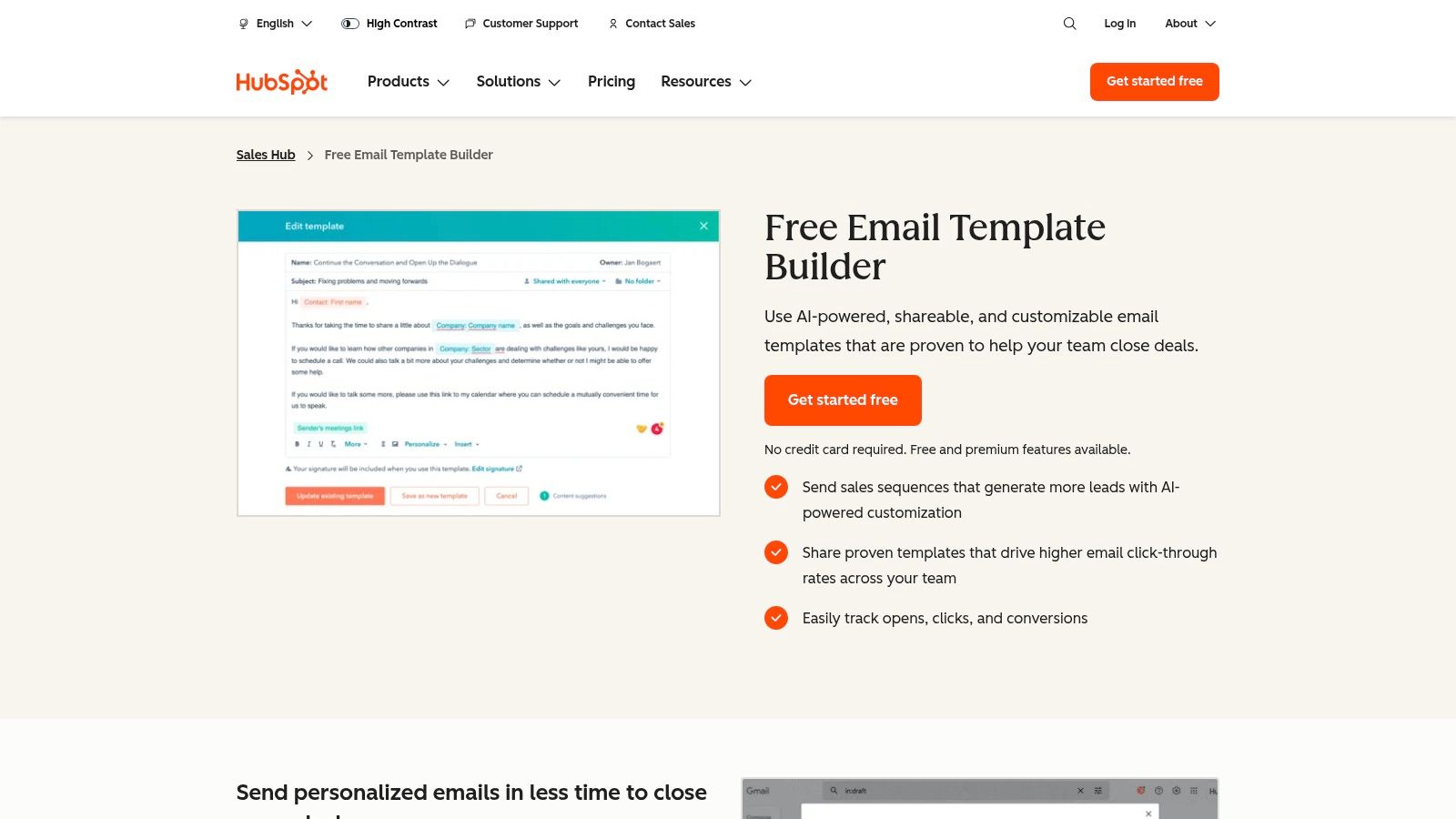
HubSpot's email template builder, which allows for easy creation and personalization of cold email templates.

Key Offerings and Features

HubSpot's template resources are split into two main categories: downloadable assets and in-product tools.

  • Free Downloadable Template Pack: HubSpot offers a popular pack of over 50 sales email templates. This collection covers the entire sales cycle, from the initial cold outreach and follow-ups to re-engagement and breakup emails. While access requires submitting your email (gated content), the quality is consistently high and provides a solid foundation for any SDR.
  • In-Product Templates & Sequences: Within the HubSpot Sales Hub, users can create, save, and share an unlimited number of templates. The platform supports personalization tokens that pull data directly from contact records in the HubSpot CRM, making it easy to customize emails at scale.
  • Built-in Analytics: Each template’s performance is tracked automatically. You can monitor open rates, click-through rates, and reply rates to identify your top-performing messages and continuously optimize your approach.

Pricing and Access

HubSpot's approach to templates is tiered, making it accessible for individuals while offering robust features for growing teams.

Feature/TierFree ToolsSales Hub Starter (from $15/mo/seat)Sales Hub Professional (from $90/mo/seat)
Template Access5 templates1,000 templates1,000 templates
Email SequencesNoYesYes (with advanced features)
Email Tracking200 notifications/monthUnlimited notificationsUnlimited notifications
Downloadable PacksYes (requires email signup)YesYes

How to Use HubSpot Templates Effectively: An Action Plan

  1. Start with the Free Pack: Download HubSpot's free sales email template pack. Don't just copy-paste; identify 2-3 templates that align with your specific use case (e.g., "Referral Request" or "Problem-Agitator-Solve").
  2. Adapt and Import: Rewrite the chosen templates in your own brand voice. Then, import them into the HubSpot templates tool (even the free version allows for five).
  3. Connect to Your CRM: Use HubSpot’s personalization tokens (like {{contact.firstname}} and {{contact.company}}) to dynamically insert prospect data. This is a critical step for scaling your outreach without sacrificing personalization.
  4. Test and Measure: Send your templates to a small, targeted list of prospects. Use the built-in analytics to see which subject lines get the most opens and which body copy generates the most replies. The data doesn't lie.

Website: https://www.hubspot.com/products/sales/email-templates-sales

3. Mailshake

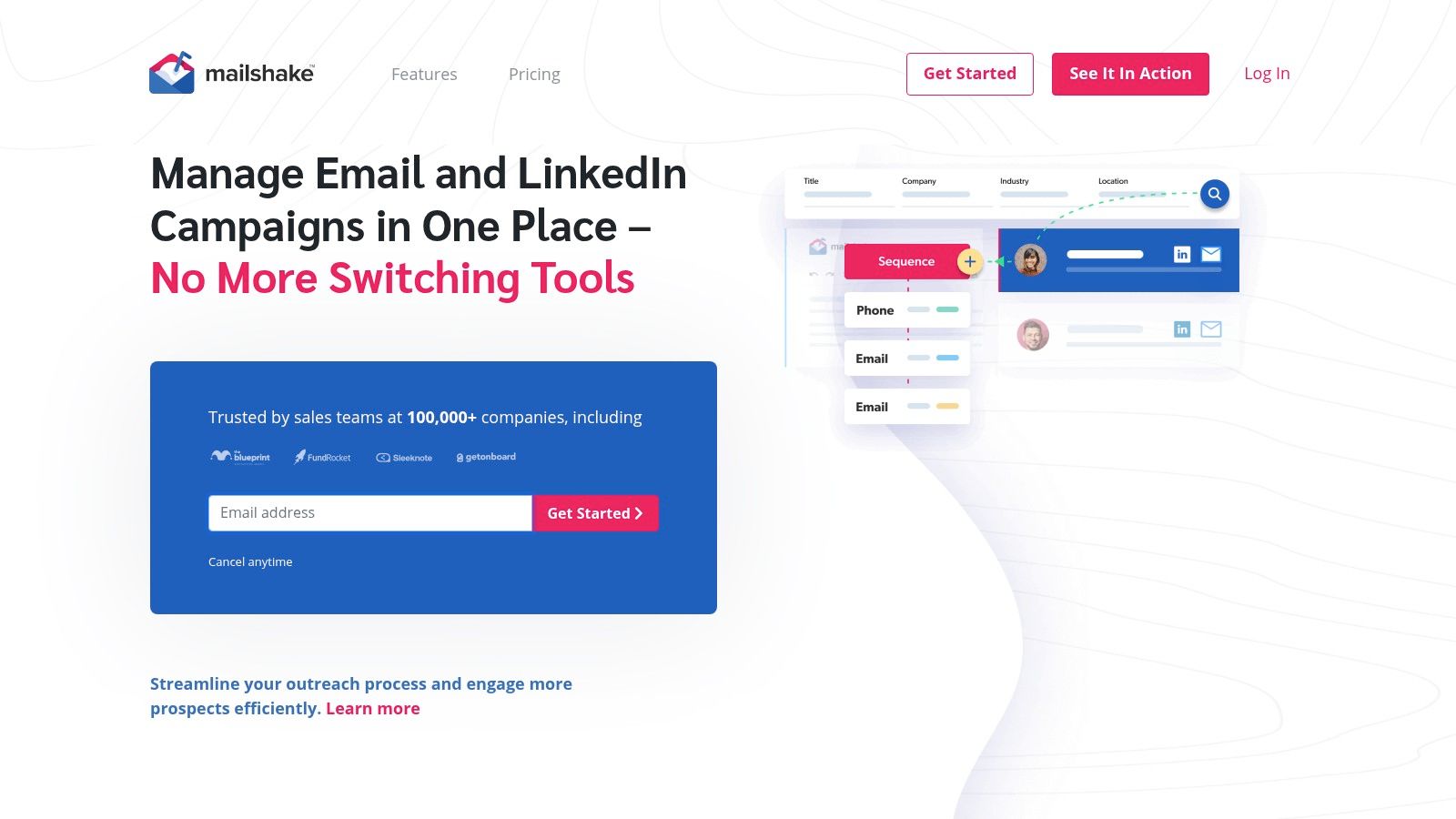
Mailshake is a dedicated sales engagement platform designed to streamline and automate cold outreach. While it offers a complete suite of tools for running campaigns, its foundation is built on a powerful system for managing and deploying effective cold email templates. Unlike general-purpose CRMs like HubSpot where templates are one feature among many, Mailshake puts the outreach sequence front and center. This makes it an excellent choice for sales development teams and individuals whose primary goal is to book meetings through scalable, multi-touch email campaigns.

The platform's core advantage is its focus on the entire outreach workflow, from creation to deliverability. Instead of just providing static examples, Mailshake integrates template management directly into campaign sequences, which can include phone calls and social media tasks. This holistic approach ensures your templates are part of a cohesive strategy, not just one-off messages.
Mailshake

Key Offerings and Features

Mailshake combines a rich resource library with powerful in-app tools to help users master cold outreach.

  • Blog & Template Library: Mailshake maintains an extensive blog and resource center filled with tested cold email templates, playbooks, and strategies. These resources are freely available and cover a wide range of scenarios, from link building to enterprise sales.
  • AI Writing Assistant (SHAKESpeare): Integrated directly into the platform, this AI copywriter helps you generate new email ideas, rewrite existing templates for a different tone, or overcome writer's block. It's a practical tool for quickly creating personalized variations.
  • Built-in Deliverability Tools: Mailshake includes an email warm-up tool and list-cleaning integrations to ensure your templates land in the primary inbox. This focus on deliverability is a key differentiator from platforms that don't manage the technical side of sending.
  • Multichannel Sequences: You can build templates not just for the initial email but for every follow-up, and even add steps for phone calls and LinkedIn engagement, all within a single campaign view.

Pricing and Access

Mailshake’s pricing is straightforward, with two primary tiers for sales-focused users. Unlike some competitors, there is no free-forever plan or free trial; payment is required upfront.

Feature/TierEmail Outreach (from $58/mo/seat)Sales Engagement (from $83/mo/seat)
Email CampaignsYesYes
Template StorageUnlimitedUnlimited
AI Writing Asst.YesYes
Phone DialerNoYes
LinkedIn AutomationNoYes (Add-on)
Blog/Resource AccessYesYes

How to Use Mailshake Templates Effectively: An Action Plan

  1. Start with Proven Examples: Explore Mailshake's public blog to find a battle-tested cold email template for sales that matches your campaign goal. These serve as a great starting point.
  2. Use SHAKESpeare for Personalization: Once you have a base template, use the AI writing assistant to create 3-4 variations. Ask it to rewrite the template with a more casual tone, or to focus on a specific pain point.
  3. Build a Multi-Step Sequence: Don't rely on a single email. Import your template into a Mailshake campaign and build a sequence of 3-5 follow-up emails. Use slight variations of your core message for each step.
  4. A/B Test Your Subject Lines: Create two versions of your campaign that are identical except for the subject line. Mailshake's analytics will show you which one gets a higher open rate, allowing you to optimize for performance.

Website: https://mailshake.com/

4. lemlist

lemlist is a major player in the sales automation space, but its unique contribution to cold email templates comes from its community-driven and data-backed approach. Instead of just offering a static list of examples like a blog, lemlist provides a public hub of cold outreach sequences, many of which are submitted by its user community and include real-world performance benchmarks. This makes it an invaluable resource for SDRs who want to see what's actually working in the wild, not just what sounds good in theory.

The platform's core advantage is the direct bridge between inspiration and execution. You can browse templates filtered by goal (e.g., lead generation, link building) or industry, see their reported open and reply rates, and then, with a single click, duplicate an entire campaign sequence directly into your lemlist account. This seamless workflow is designed for action, helping teams move from learning best practices to implementing them with minimal friction.
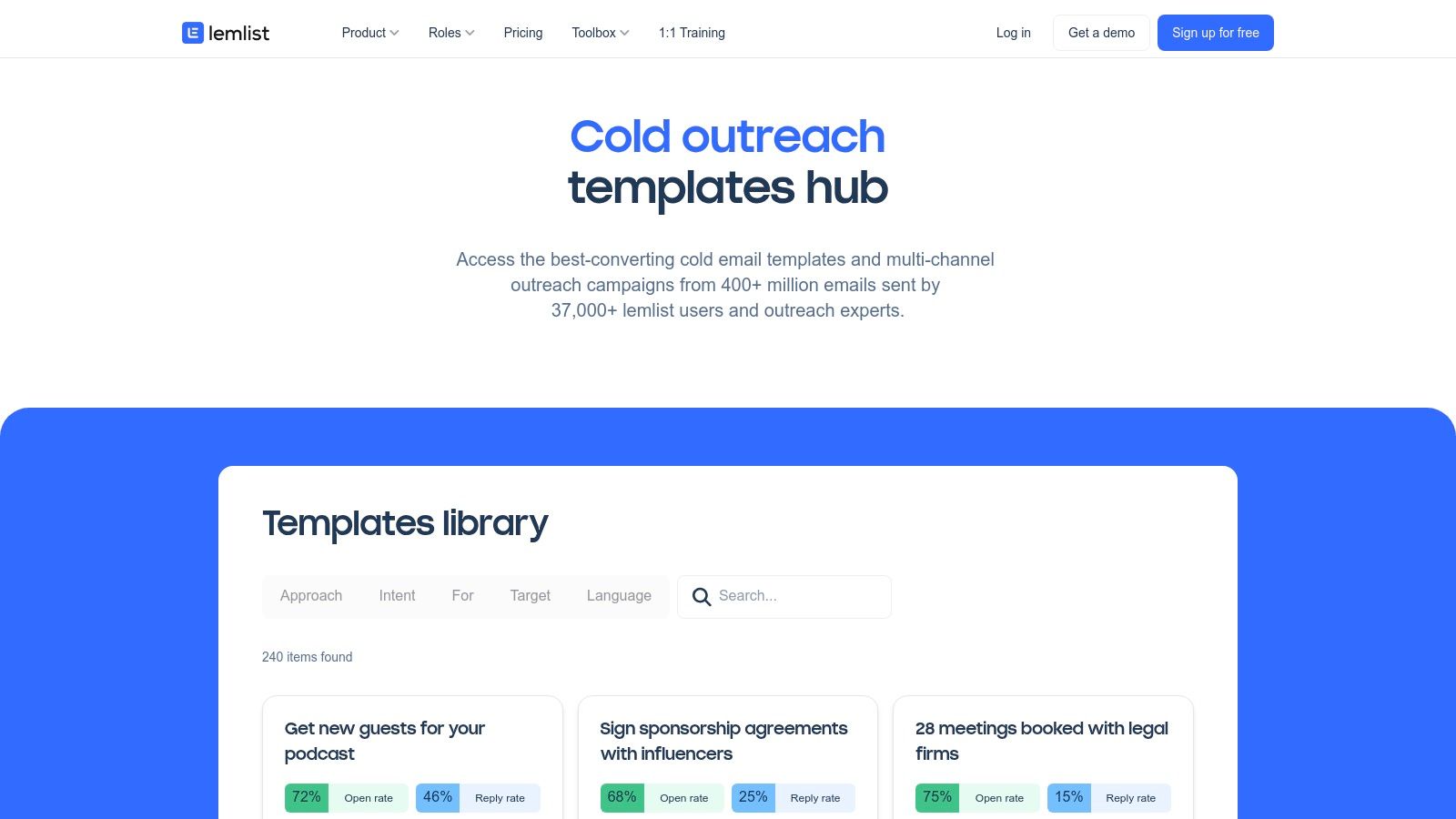
lemlist's cold outreach templates hub, showcasing community-submitted campaigns with performance data.

Key Offerings and Features

lemlist’s resources are a blend of community-sourced templates and expert-led educational content, making it a well-rounded platform for outreach professionals.

  • Public Template Hub: This gallery features hundreds of cold email templates and multi-step sequences. The key differentiator is that many include performance data like open rates and reply rates, offering a baseline for what you can expect.
  • One-Click Campaign Duplication: For lemlist users, this is a game-changer. Found a sequence you like? You can import the entire thing, including all follow-up steps and timing, directly into your lemlist account to start a new campaign.
  • Educational Resources: Beyond templates, lemlist provides extensive free resources, including playbooks, guides, and ebooks. These materials offer deep dives into the strategy behind successful outreach, helping users understand the "why" behind the "what." For more foundational knowledge, our guide on how to write cold emails is an excellent starting point.

Pricing and Access

While the template gallery is free to browse, its full power is unlocked with a lemlist subscription.

Feature/TierFree AccessEmail Starter (from $39/mo)Email Pro (from $69/mo)
View Template HubYesYesYes
Duplicate CampaignsNoYesYes
Educational ResourcesYesYesYes
Performance BenchmarksYes (on select templates)Yes (on select templates)Yes (on select templates)

How to Use lemlist Templates Effectively: An Action Plan

  1. Browse with a Goal in Mind: Use the filters in the template hub to find sequences that match your specific objective, such as "SaaS sales" or "event invitation." Pay close attention to the reported performance benchmarks.
  2. Analyze the "Why": Don't just look at the template; analyze its structure. Why is the first follow-up a simple bump? Why does the third step use a different angle? The community data helps validate these strategic choices.
  3. Duplicate and Adapt: If you're a lemlist user, duplicate your chosen campaign. Immediately begin rewriting the copy to fit your unique brand voice, value proposition, and persona. The structure is your starting point, not the final product.
  4. A/B Test Against the Benchmark: Use the community-provided reply rate as your initial benchmark. Run an A/B test with your adapted version against the original to see if you can improve upon the results.

Website: https://www.lemlist.com/cold-email-templates

5. Yesware

Yesware is a sales productivity platform built directly into your inbox, making it a standout choice for sales reps and SDR teams who live in Gmail or Outlook. Its approach to cold email templates is focused on accessibility and immediate application. Instead of being a separate tool, Yesware integrates template management, tracking, and analytics into the native email-writing experience, drastically reducing friction for busy sellers.

The core advantage of Yesware is its in-inbox workflow. Sales reps can create, access, share, and analyze templates without ever leaving their email client. This is a significant differentiator from standalone platforms like Mailshake or Reply.io that require constant context switching. For small to mid-sized teams looking to standardize their messaging and get quick insights on what works, Yesware offers a powerful, low-overhead solution.
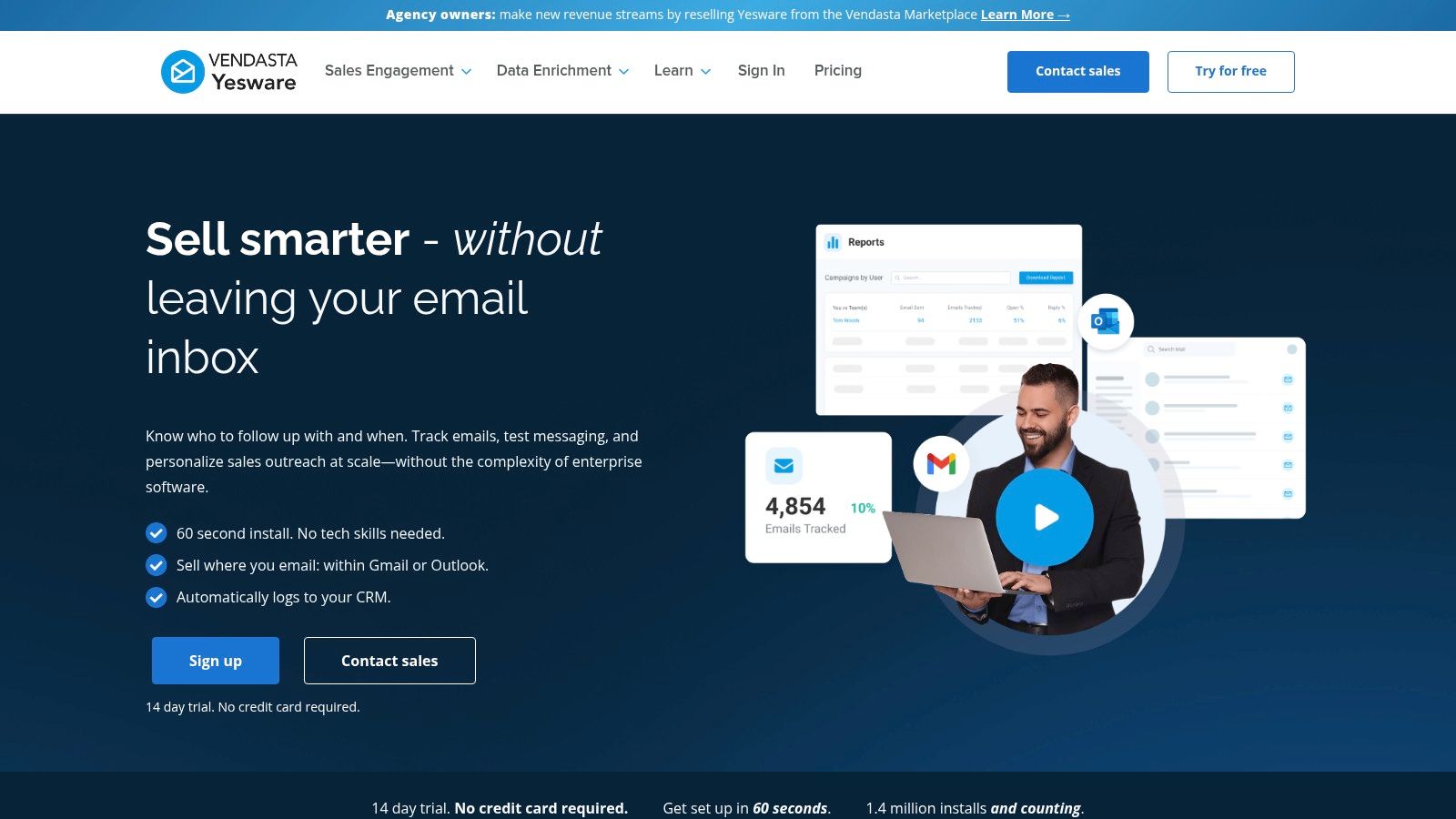
Yesware’s in-inbox template library, which allows sales reps to access and personalize cold email templates directly within Gmail or Outlook.

Key Offerings and Features

Yesware's template functionality is designed for speed and team collaboration within the familiar environment of an inbox.

  • In-Inbox Template Library: Create and save your best-performing cold emails directly within Gmail or Outlook. The library is easily searchable and allows for team-wide sharing, ensuring message consistency.
  • Template Performance Reporting: Yesware provides detailed analytics on a per-template basis. You can track open rates, reply rates, and link clicks to objectively determine which messages are driving results and which need to be refined.
  • Public Resources & Guides: Beyond the tool itself, Yesware offers a public library of proven templates and downloadable guides. These resources are excellent for inspiration and cover various scenarios, from initial outreach to follow-ups.
  • Team Collaboration: Managers can create and share a set of approved templates with their team, promoting best practices and accelerating the onboarding process for new reps.

Pricing and Access

Yesware offers a tiered pricing model that scales from individual users to enterprise teams, with template features becoming more robust at each level.

Feature/TierFreePro (from $15/mo/seat)Premium (from $35/mo/seat)
Template AccessYes (Limited)Unlimited Personal TemplatesUnlimited Personal & Team Templates
Email TrackingYes (Limited)UnlimitedUnlimited
Team ReportingNoNoYes
Downloadable GuidesYesYesYes

How to Use Yesware Templates Effectively: An Action Plan

  1. Start with Proven Examples: Explore Yesware’s public template library or free guides to find a structure that fits your outreach goal. Pay attention to how they frame the value proposition.
  2. Build Your Core Templates: Adapt 3-4 of these proven templates and save them in your personal Yesware library. Use clear naming conventions like "Cold Outreach - VP Marketing - Pain Point A" for easy access.
  3. Use Personalization Fields: Leverage Yesware’s dynamic fields to insert prospect details like {{First Name}} and {{Company}}. This is crucial for maintaining a personal touch while working efficiently. To make your messages stand out even more, craft compelling subject lines. Discover how to create your own by reading our guide on witty email subject lines.
  4. Monitor Team-Wide Performance: If you are on a team plan, use the template reporting feature to see which messages have the highest reply rates across the entire team. This data-driven approach helps everyone adopt the most effective messaging.

Website: https://www.yesware.com/email-templates/

6. Reply.io

Reply.io is a comprehensive sales engagement platform designed for multichannel outreach, and its approach to cold email templates is deeply integrated into its automation workflow. Unlike platforms that just offer a static library, Reply.io treats templates as dynamic assets within a larger sequence of touchpoints that can include email, LinkedIn interactions, calls, and even SMS messages. This makes it a powerful choice for sales teams looking to execute sophisticated, multi-pronged outreach campaigns from a single hub.

The core advantage of Reply.io is its focus on sequence-based selling. Compared to an inbox tool like Yesware, Reply.io manages the entire outreach cadence from a central platform. You can build entire sequences, embedding various email templates for different stages, such as the initial touch, follow-ups, and re-engagement. The platform's AI capabilities can then suggest improvements to these templates, help personalize them at scale using prospect data from LinkedIn or your CRM, and provide detailed analytics on what’s working and what isn’t.

Key Offerings and Features

Reply.io’s template functionality is woven directly into its sales engagement tools.

  • In-App Template & Sequence Library: The platform provides a library of pre-built, proven templates and multi-step sequences directly within its interface. These are categorized by goal (e.g., "Outbound Prospecting," "Inbound Lead Nurturing") and can be customized and saved for your team.
  • AI-Powered Personalization: Reply.io's AI can analyze a prospect's LinkedIn profile to generate highly personalized icebreakers and value propositions, which can be inserted directly into your templates to boost reply rates.
  • Multichannel Sequence Builder: Templates are not just for email. You can build sequences that automatically send an email, then schedule a LinkedIn connection request, and then create a call task for the sales rep, all from one visual builder.
  • Built-in Analytics & A/B Testing: Every template and sequence comes with detailed performance tracking. You can monitor open, click, and reply rates, and easily set up A/B tests to optimize subject lines, calls-to-action, or entire email bodies.

Pricing and Access

Reply.io offers flexible pricing plans that cater to both individuals focused on email and teams running multichannel campaigns.

Feature/TierFreeStarter (from $60/mo/user)Professional (from $90/mo/user)
Email Accounts122+
Templates & SequencesLimited accessYesYes
AI FeaturesLimited creditsYesYes (more credits)
MultichannelEmail onlyEmail, LinkedIn, Calls, SMSAdvanced multichannel features

How to Use Reply.io Templates Effectively: An Action Plan

  1. Choose a Sequence, Not Just a Template: Instead of looking for a single email, browse Reply.io's sequence library. Select a pre-built sequence that matches your goal, like the "Outbound Prospecting to C-level" cadence.
  2. Personalize with AI: Use the built-in AI assistant to generate personalized opening lines for your first-step email template. Connect your LinkedIn account to allow the AI to pull relevant details from your prospect's profile.
  3. Build a Multichannel Flow: Adapt the sequence to include more than just email. Add a LinkedIn profile view as step two and a connection request as step three. This surrounds the prospect and increases the likelihood of a response.
  4. Analyze and Optimize: After launching your campaign, review the sequence analytics. If you notice a high open rate on the first email but a low reply rate, A/B test the call-to-action in that specific template to improve its performance.

Website: https://reply.io

7. Saleshandy

Saleshandy is a dedicated cold outreach platform that focuses on delivering high-volume campaigns while maintaining personalization and deliverability. Its approach to cold email templates is practical and deeply integrated into its sending workflow, making it a strong contender for sales teams and agencies that prioritize affordable sending limits alongside robust template management. The platform is designed for users who want to move beyond basic email blasts and operationalize their outreach with features like spintax and team-sharing.

What sets Saleshandy apart from more generalist CRMs is its specialized focus on the technical aspects of cold emailing. While a platform like HubSpot bundles templates with a full suite of marketing and sales tools, Saleshandy centers its features around the core needs of an SDR: creating variable templates, ensuring they land in the primary inbox, and managing multi-stage follow-ups efficiently. This makes it an excellent choice for teams whose primary goal is to scale outbound prospecting.
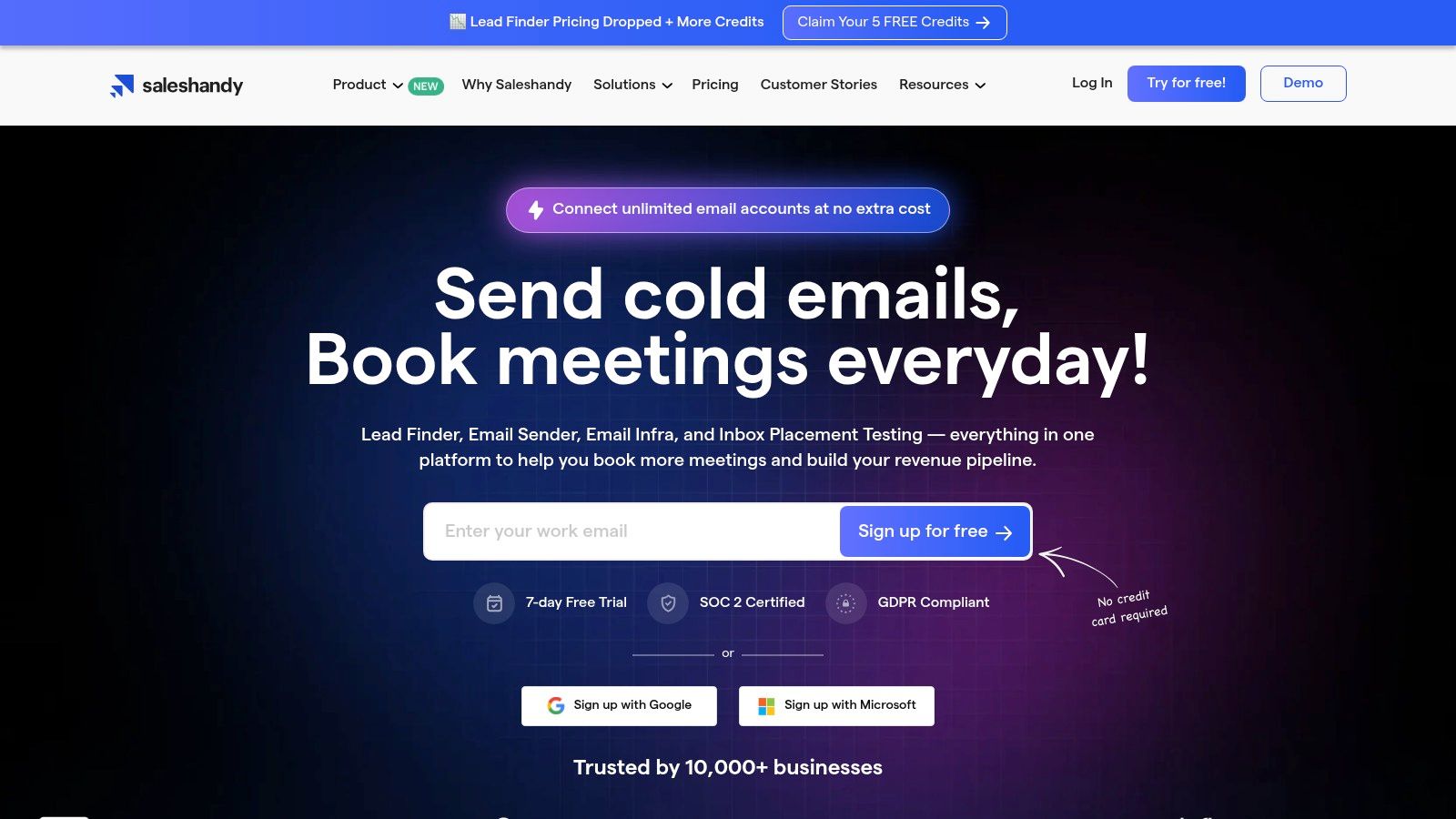
Saleshandy's email outreach dashboard, showcasing sequence performance and analytics.

Key Offerings and Features

Saleshandy’s template features are built directly into its outreach and sequence tools, providing a seamless user experience.

  • Public Template Collections: Saleshandy provides several "playbooks" and blog posts featuring dozens of ready-to-use cold email templates for various scenarios, including B2B sales, link building, and recruitment. These serve as a great starting point for new campaigns.
  • In-App Template Management: Users can create, save, and share templates with their team directly within the platform. The editor supports merge tags for personalization (e.g., {{FirstName}}, {{Company}}) and, crucially, spintax. Spintax ({Hello|Hi|Hey}) allows you to create multiple variations of words or phrases within a single template, which helps avoid spam filters.
  • Integrated Deliverability Tools: Higher-tier plans include email warm-up and inbox placement testing. This unique offering allows you to not only use great templates but also ensure they are being delivered and seen by your prospects.

Pricing and Access

Saleshandy's pricing is competitive, offering high sending limits and a clear feature progression across its tiers.

Feature/TierOutreach Starter (from $36/mo)Outreach Pro (from $94/mo)Outreach Scale (from $187/mo)
Email Accounts2 per user5 per user10 per user
Active Prospects6,00030,00060,000
Template SharingYesYesYes
Email Warm-upAdd-onIncludedIncluded

How to Use Saleshandy Templates Effectively: An Action Plan

  1. Leverage the Playbooks: Start by browsing Saleshandy's public template collections. Find a playbook that matches your industry or goal (e.g., "SaaS Sales") and select a high-performing first-touch email.
  2. Enhance with Spintax: Import the template into the Saleshandy app. Use the spintax feature to create variations for common greetings, opening lines, and calls-to-action. This is a key step to improve deliverability for larger campaigns.
  3. Build a Multi-Step Sequence: Don't rely on a single email. Use the template as Step 1 in a multi-touch sequence within Saleshandy. Add 2-3 follow-up steps using different templates that reference the initial message.
  4. Warm Up Your Domain: Before launching a large campaign, use Saleshandy’s email warm-up feature. This builds your sender reputation and ensures your carefully crafted templates don't land in the spam folder, maximizing their potential impact.

Website: https://www.saleshandy.com/cold-email-templates/

Cold Email Template Platform Comparison

ToolIdeal User ProfileKey StrengthHow it ComparesActionable Takeaway
marketbetter.aiEnterprise & mid-market SDR teams using Salesforce/HubSpotIntent-driven workflow. Turns signals into AI-generated outreach directly in the CRM.Goes beyond templates to provide a full execution engine. Less about a static library, more about dynamic, timely outreach.Use this if your biggest problem is reps wasting time on manual research and failing to act on buying signals quickly.
HubSpotTeams already invested in the HubSpot ecosystem.Seamless CRM integration. Templates are part of a unified sales, marketing, and service platform.A great all-in-one solution but less specialized on advanced outreach tech (like deliverability) than dedicated tools.Perfect for centralizing your sales efforts. Use its built-in analytics to find your team's winning templates.
MailshakeSales teams focused on scalable, email-first campaigns.Deliverability and simplicity. Strong focus on email warm-up, A/B testing, and an easy-to-use AI writer.More focused on the technical aspects of sending emails than HubSpot, but less of a full CRM.Use this to scale your email volume confidently, knowing you have tools to protect your sender reputation.
lemlistCreative outreach teams looking for proven campaign structures.Community-backed templates. Provides sequences with real performance data from other users.Differentiates with creative personalization (images/videos) and transparent community data, unlike more private libraries.Don't just copy the templates; clone a high-performing sequence and use its structure as a proven blueprint for your own campaign.
YeswareIndividual reps or small teams living in Gmail/Outlook.Inbox-native workflow. All features (templates, tracking, scheduling) are accessible without leaving the inbox.Offers maximum convenience for inbox-centric sellers but lacks the advanced sequencing of Reply.io or Saleshandy.Implement this to boost individual rep productivity with minimal disruption to their existing workflow.
Reply.ioSales teams executing sophisticated, multi-channel cadences.Multichannel automation. Builds complex sequences involving email, LinkedIn, calls, and SMS from one platform.More robust for multi-channel than Mailshake or Yesware. Its AI personalization is a key differentiator.Go beyond email. Build a sequence that warms up a prospect on LinkedIn before the first cold email even lands.
SaleshandyAgencies and high-volume teams needing affordability at scale.Scalability with deliverability. Offers high sending limits and technical features like spintax.A more technical, volume-focused tool compared to the all-in-one nature of HubSpot or the creative angle of lemlist.Use spintax on every template you create to maximize deliverability and avoid spam filters when sending at scale.

From Templates to Pipeline: Your Next Move

We've journeyed through a comprehensive collection of high-conversion cold email templates, from piercing first-touch messages to persistent follow-up sequences. You’ve seen how to tailor outreach for different personas, adapt to various use cases, and integrate these frameworks into a modern sales workflow. But the most critical takeaway is this: a template is merely a starting point, not a final destination.

The true power of these cold email templates is unlocked when you treat them as strategic blueprints. The success of your outreach hinges not on blindly copying and pasting text, but on your ability to operationalize these blueprints efficiently. This means personalizing at scale, automating thoughtfully, and continuously iterating based on performance data. The goal is to build a repeatable system that empowers your SDRs and BDRs to spend less time on manual tasks and more time building relationships.

Synthesizing the Tools: How to Choose Your Engine

Choosing the right tool is the bridge between having a library of templates and actually generating pipeline. Your decision should be guided by your team's specific needs, existing tech stack, and strategic goals.

  • For Deep CRM Integration and AI-Powered Personalization: If your team lives in Salesforce or HubSpot and your primary goal is to leverage AI for hyper-relevant, real-time email generation, MarketBetter.ai is designed for this exact purpose. It excels at turning intent signals directly into AI-assisted, personalized outreach within your CRM, minimizing context switching.
  • For All-in-One Sales Engagement: Platforms like Reply.io and Saleshandy offer robust, multi-channel sequencing (email, calls, social touches) and are great for teams needing a comprehensive sales engagement platform that handles the entire outreach process from a central hub.
  • For Simplicity and Email-Centric Campaigns: If you're primarily focused on email and want a straightforward, easy-to-use tool for sending campaigns and tracking basic metrics, Mailshake is a strong contender. Its simplicity is its core strength.
  • For Creative, Visual Personalization: Teams that want to stand out with dynamic images, videos, and unique landing pages will find lemlist to be their ideal creative partner. It’s built for breaking through the noise with highly memorable, personalized visuals.
  • For Inbox-Native Productivity: If your reps prefer to work directly from their Gmail or Outlook inbox, Yesware provides excellent tracking, template management, and scheduling features without forcing them to leave their familiar environment.

The key is to evaluate where your biggest bottleneck lies. Is it the time spent researching and writing? AI-driven tools are your answer. Is it managing multi-step, multi-channel cadences? A full sales engagement platform is what you need. Is it simply a lack of visibility into email performance? An inbox-native tool might be the perfect first step.

Your Action Plan for Implementation

Having the right templates and the right tool is only half the battle. Execution is everything. Here are your actionable next steps to turn this knowledge into revenue.

  1. Benchmark Your Current State: Before you change anything, document your current open rates, reply rates, and meeting booked rates. This baseline is crucial for measuring the impact of your new strategy.
  2. Select and Adapt 3-5 Templates: Don't try to implement everything at once. Choose a handful of cold email templates from this guide that best fit your ideal customer profile and core value proposition. Adapt them with your own voice and personalization tokens.
  3. Run a Controlled A/B Test: Assign a small group of reps to use the new templates and workflow within your chosen tool. Compare their results against the control group (using the old method) over a two-to-four-week period.
  4. Analyze, Iterate, and Scale: Review the data. Which subject lines won? Which calls-to-action generated the most replies? Use these insights to refine your templates, and then roll out the winning strategy to the entire team.

Ultimately, the most successful sales teams are not those with a secret stash of "perfect" templates. They are the ones who build a scalable, data-driven system for outreach. They use templates as a foundation, technology as an accelerator, and personalization as their competitive edge to consistently start valuable conversations that become a predictable, growing pipeline.


Ready to stop manually adapting templates and start generating hyper-personalized emails in seconds, right inside your CRM? See how marketbetter.ai uses AI to turn sales signals into revenue-generating conversations. Explore the future of sales outreach at marketbetter.ai.


11 Witty Email Subject Lines That Actually Work in 2026

· 31 min read

In an inbox overflowing with automated sequences and generic pitches, the standard subject line is a one-way ticket to the archive folder. What makes a subject line truly stand out isn't just a clever pun; it's the strategic fusion of curiosity, relevance, and a clear, implied value that respects the recipient’s intelligence and time. Too often, sales reps mistake "witty" for "vague" or "clickbait," leading to a quick delete and a damaged reputation. This guide is designed to fix that.

We're moving beyond tired templates to deconstruct the anatomy of genuinely effective, witty email subject lines. You won't just get a list; you'll get a strategic playbook. We will analyze 11 distinct categories of subject lines, from curiosity-driven hooks to data-backed insights, providing a detailed breakdown for each.

This article will show you:

  • Why specific subject lines capture attention based on psychological triggers.
  • When to deploy each type for maximum impact, whether it's a first touch, a follow-up, or a persona-specific campaign.
  • How to customize them with personalization tokens and quick A/B testing notes for immediate application.

The objective isn't merely to boost your open rates. It’s to initiate meaningful conversations that convert. Moving beyond purely witty to strategically effective requires a deep understanding of what drives action. For a broader look at this, exploring various strategies for crafting High-Converting Email Subject Lines can provide a solid foundation. This comprehensive library will equip you and your team with the actionable tactics needed to turn cold outbound into your most reliable pipeline generator.

1. The Curiosity Gap Subject Line

The Curiosity Gap is a powerful psychological trigger that leverages the human desire for closure. By intentionally omitting a key piece of information, this subject line technique creates an “information gap” that compels the recipient to open the email to satisfy their curiosity. For sales outreach, it’s one of the most effective witty email subject lines because it stands out in a crowded inbox filled with generic benefit claims.

Hand-drawn sketch of an open email envelope with a magnifying glass examining its content.

Strategic Breakdown & Examples

This approach works best when you need to break through the noise of a high-value prospect's inbox. It feels more personal and less automated than a subject line screaming a generic benefit. Compared to a 'Specific Value' subject line, this one sacrifices immediate clarity for intrigue. It's a trade-off that works well when the recipient is hard to reach.

  • Example 1: Quick question about [Company Name]
    • Why it works: It’s direct, personal, and implies the email requires their specific expertise. The vagueness of "question" creates the necessary intrigue.
  • Example 2: This might not apply, but...
    • Why it works: This uses reverse psychology. It lowers the recipient's guard and makes them wonder, "What might not apply? Now I need to know."
  • Example 3: Found this while researching [Competitor Name]
    • Why it works: It combines curiosity with a hint of competitive intelligence, a highly valuable topic for any decision-maker.

Actionable Takeaways & A/B Testing

To implement this strategy effectively, follow these best practices:

  • Align Body with Subject: The email body must deliver on the intrigue. If your subject is "Quick question," ask a genuine, insightful question immediately. Misleading your prospect kills trust instantly. Your action item: Draft the email body first to ensure your question is valuable enough to warrant the mysterious subject line.
  • Keep it Short: Aim for under 50 characters to avoid being cut off on mobile devices, which enhances the feeling of mystery.
  • A/B Test: Pit a curiosity-gap subject line against a direct-benefit one. For example, test Your thoughts on this? against Save 20% on your software spend. Track open rates in your CRM to see which approach resonates more with your specific audience.

2. The Social Proof Subject Line

This technique leverages one of the most powerful psychological principles in sales: people trust what other people trust. By referencing credible signals like customer logos, company achievements, or industry recognition directly in the subject line, you establish legitimacy before the recipient even opens the email. For B2B outreach, mentioning that similar companies or direct competitors are already engaged is a surefire way to reduce skepticism and signal value.

Strategic Breakdown & Examples

Social proof is most effective when your prospect is aware of the companies you're referencing. It immediately positions your solution as a validated choice within their industry, making it one of the most impactful witty email subject lines for overcoming initial resistance. This approach is a direct contrast to the 'Contrarian' subject line; instead of challenging the status quo, it reinforces it by showing that peers have already adopted your solution.

  • Example 1: Why [Competitor] switched to us
    • Why it works: This is a direct and provocative use of social proof. It creates immediate urgency and a fear of missing out (FOMO) by implying their competitor now has an advantage.
  • Example 2: Used by [Competitor] and 200+ other [Industry] leaders
    • Why it works: This combines specific social proof (a named competitor) with broad proof (the number of other users). It tells the prospect, "You're late to the party, and everyone you respect is already here."
  • Example 3: Trusted by [Well-Known Company/Brand] admins everywhere
    • Why it works: It associates your brand with a highly trusted, household-name company. This "trust by association" elevates your own credibility instantly.

Actionable Takeaways & A/B Testing

To deploy social proof effectively, your claims must be both credible and highly relevant to the prospect.

  • Ensure Relevance: The social proof must resonate. Mentioning a competitor in a completely different industry will have zero impact. The more similar the referenced company is to your prospect, the stronger the effect. Your action item: Create a list of your top 5 customers for each target vertical and have it ready for your email campaigns.
  • Keep Proof Current: Social proof goes stale. Update your subject line templates quarterly with new customer wins, awards, or media mentions to keep them fresh and impactful.
  • A/B Test: Compare a specific social proof subject line against a more general one. For instance, test Why [Direct Competitor] uses us against Trusted by leaders in the [Prospect's Industry] space. This will show if your audience responds more to direct competitive pressure or broader industry validation.

3. The Specific Value Statement Subject Line

This approach cuts through the noise by leading with a quantifiable, results-oriented promise. Unlike vague claims like "improve your process," the Specific Value Statement uses hard numbers and concrete outcomes (e.g., 'save 6 hours/week,' 'reduce churn by 15%') to immediately signal relevance and business impact. This is one of the most effective witty email subject lines for grabbing the attention of analytical, results-driven buyers like VPs and RevOps leaders who live and breathe metrics.

Strategic Breakdown & Examples

This technique works best when you have a clear, demonstrable ROI and are targeting personas who are directly responsible for performance metrics. It trades cleverness for clarity, which is often a more powerful strategy for senior-level outreach. Compared to a 'Curiosity Gap' subject line, this is the polar opposite: it provides the conclusion upfront, making the email's value proposition immediately obvious.

  • Example 1: Save your SDRs 3 hours per day on research
    • Why it works: It’s hyper-specific to the recipient's team (SDRs) and quantifies the time-saving benefit. A sales leader can instantly calculate the productivity gain across their entire team.
  • Example 2: How [Company] could close 2 more deals/month
    • Why it works: This subject line is a direct challenge to the status quo and frames your solution in terms of revenue, the ultimate metric for any sales organization.
  • Example 3: Cut SDR ramp time from 90 to 30 days
    • Why it works: It addresses a critical and costly business problem (new hire onboarding) with a dramatic, specific improvement. This is highly compelling for scaling teams.

Actionable Takeaways & A/B Testing

To deploy this strategy, you must be confident in your value proposition and ready to back it up.

  • Justify the Metric: Your email body must immediately explain the "how" behind the number in your subject line. Use a brief, credible calculation or customer case study to build trust. Your action item: Prepare a one-sentence "value calculation" for each of your key personas that you can drop into the email body.
  • Personalize the Metric: Use public data (like company headcount or industry benchmarks) to tailor your metric. For example, change "save 3 hours/day" to "reclaim 60 hours/week for your 20-person SDR team."
  • A/B Test: Test a time-based metric against a revenue-based one. For a VP of Sales, compare Log calls in Salesforce in 10 seconds with Increase call volume by 20%. Track which type of metric drives more replies to understand what your target persona values most.

4. The Personalized Problem Recognition Subject Line

This advanced technique moves beyond generic pleasantries to prove you’ve done your homework. By acknowledging a specific, company-relevant challenge directly in the subject line, you immediately build rapport and demonstrate empathy. For sales reps, these witty email subject lines are invaluable because they show you understand the prospect's world before you ever ask for a meeting, making your outreach feel consultative instead of transactional.

Strategic Breakdown & Examples

This approach is most effective when targeting mid-market or enterprise accounts where deep personalization is non-negotiable. It leverages timely business triggers like new hires, product launches, or funding rounds to create a hyper-relevant entry point. This differs from the 'Pain Point Agitation' style because it's based on specific, observed data about the company, not a general industry problem.

  • Example 1: Post-Series B teams always struggle with outbound efficiency
    • Why it works: It uses a common "pattern" associated with a specific company stage (Series B funding). This shows you understand their growth trajectory and the predictable challenges that come with it.
  • Example 2: [Company] just hired 2 SDRs—must be scaling outbound
    • Why it works: This is a direct observation from public data (like LinkedIn). It connects a specific action (hiring) to a strategic priority (scaling sales), making your subsequent message incredibly relevant.
  • Example 3: Noticed you launched [Product feature]—curious about adoption
    • Why it works: It proves you are following their company news and frames your outreach as a genuine inquiry about a key initiative, positioning you as a peer rather than a typical salesperson.

Actionable Takeaways & A/B Testing

To execute this strategy, you need a system for tracking and acting on company-specific triggers.

  • Leverage Triggers: Use sales intelligence tools to get alerts on funding, hiring trends, and technology changes. Turn these events into the core of your subject line. Your action item: Set up Google Alerts or LinkedIn Sales Navigator alerts for your top 10 target accounts today.
  • Be Accurate: Double-check your facts. If you mention a new product launch or a recent hire, ensure the information is correct. An inaccurate reference will instantly discredit you.
  • A/B Test: Compare a personalized problem subject line against a solution-focused one. Test Struggle with [Competitor Tool] integration? against Seamless integration for your tech stack. Measure both open and reply rates to see if demonstrating empathy outperforms pitching a benefit.

5. The Unexpected Question Subject Line

This technique cuts through inbox noise by posing a genuine, thought-provoking question that prompts immediate internal reflection. Instead of leading with a statement or a benefit, it invites the recipient to consider a problem they might not have actively articulated. For B2B sales, these witty email subject lines are effective because they shift the dynamic from a sales pitch to a consultative conversation starter.

Strategic Breakdown & Examples

This approach is ideal for the first or second touchpoint in a sequence. It establishes you as a thoughtful problem-solver rather than just another vendor. The goal is to ask a question that aligns directly with a core business challenge your solution addresses. This is softer than the 'Benefit-Forward Negative' approach, as it invites reflection rather than directly stating a problem.

  • Example 1: What if your Salesforce dialer actually worked?
    • Why it works: It’s provocative and speaks directly to a common frustration for sales teams using integrated tools. This question implies a better reality exists, creating a compelling reason to open the email and learn more.
  • Example 2: Are your reps logging calls consistently?
    • Why it works: This question targets a critical data integrity issue that plagues sales leaders and RevOps managers. It’s a tactical question with strategic implications, making it relevant to multiple personas.
  • Example 3: What's eating your RevOps team's time?
    • Why it works: It's open-ended and empathetic, showing you understand the operational burdens of a specific department. It feels less like a sales pitch and more like a genuine inquiry into their workflow challenges.

Actionable Takeaways & A/B Testing

To make this strategy work, the question must be both insightful and relevant to the recipient's role.

  • Match Question to Persona: Frame questions strategically for VPs (How much are your SDRs actually selling?) and tactically for managers (Why do outbound sequences fail?). The former cares about outcomes, the latter about process. Your action item: For your top 3 buyer personas, write one strategic "what if" question and one tactical "how do you" question.
  • Avoid Yes/No Questions: Use open-ended formats starting with "what," "how," or "why." These encourage more profound thought than a simple yes/no, increasing the likelihood of an open and a reply.
  • A/B Test: Test a pain-focused question against a curiosity-gap subject line. For example, pit Are your reps logging calls consistently? against Quick question about your call logging. Track open and reply rates in your CRM to see which resonates more deeply with your target audience.

6. The Time Constraint / Scarcity Subject Line

This technique leverages the psychological principles of scarcity and urgency, also known as Fear Of Missing Out (FOMO). By framing an opportunity as time-sensitive or limited, it prompts immediate action, encouraging recipients to prioritize opening your email over others. For sales outreach, this is one of the more powerful witty email subject lines because it breaks prospect inertia and compels a faster decision, making it ideal for time-bound campaigns or high-intent leads.

Strategic Breakdown & Examples

This approach is most effective when the urgency is genuine and tied to a clear, valuable offer. It signals that the contents are not evergreen noise but a fleeting opportunity that warrants immediate attention. False scarcity can damage trust, so authenticity is paramount. This is a high-risk, high-reward strategy compared to the evergreen 'Social Proof' subject line, which relies on long-term credibility rather than short-term pressure.

  • Example 1: Findings expire Friday: [Company Name] results attached
    • Why it works: It combines a hard deadline with the promise of personalized, valuable information ("results"). The word "expire" creates a strong sense of loss if ignored.
  • Example 2: Quick window to discuss your Q4 motion
    • Why it works: This subject line is timely and relevant, tying the urgency directly to the prospect's business planning cycle (Q4). It feels strategic, not just pushy.
  • Example 3: We're only targeting 5 accounts in [Industry] this month
    • Why it works: This creates exclusivity and high value. Being one of only five targets makes the prospect feel singled out and important, driving them to find out why.

Actionable Takeaways & A/B Testing

To deploy scarcity without alienating prospects, align it with real-world constraints and value.

  • Justify the Urgency: The email body must transparently explain why the offer is time-sensitive. Is it an event deadline, a limited cohort for a beta program, or a seasonal promotion? Your action item: Before using a scarcity subject line, write down a one-sentence justification. If it sounds weak, don't use it.
  • Use Sparingly: Overusing this technique will dilute its impact and lead to "urgency fatigue." Reserve it for high-priority prospects or truly time-sensitive campaigns.
  • A/B Test: Compare a time-constraint subject line against a benefit-driven one. For instance, test Report: SDR benchmarks (3 days only) against New report on SDR benchmarks for you. Track open and reply rates to see if urgency or direct value performs better for your audience.

7. The Mutual Connection / Referral Subject Line

Leveraging a shared connection is the digital equivalent of a warm handshake. This subject line technique instantly establishes credibility by referencing a mutual contact, customer, or colleague. For sales teams, it’s one of the most powerful witty email subject lines because it bypasses the "stranger danger" filter in a prospect's mind and signals immediate relevance and trust. The implied social proof dramatically reduces the friction of cold outreach.

Sketch of a red question mark, two speech bubbles, and 'What if?' text above a table.

Strategic Breakdown & Examples

This approach is essential for SDRs navigating tight-knit industries or executing an account-based marketing (ABM) strategy. The goal is to transform a cold email into a warm introduction, significantly increasing the likelihood of a response. This is arguably the most effective opener, providing a powerful advantage over all other types by borrowing trust instead of trying to build it from scratch.

  • Example 1: [Mutual Customer] suggested I reach out
    • Why it works: This is the gold standard. It implies a happy customer has vouched for you, which is the strongest form of social proof available. The prospect is almost obligated to open it.
  • Example 2: Spoke with [Peer Name] about [Company]—mentioned you'd be perfect
    • Why it works: It shows you've done your homework within their organization. Referencing an internal peer creates an immediate sense of familiarity and validates your reason for reaching out.
  • Example 3: Quick intro from [Shared Contact]
    • Why it works: It's concise, direct, and leverages the authority of the shared connection. This format works especially well when the contact is well-known or respected in your industry.

Actionable Takeaways & A/B Testing

Proper execution is key to maintaining the trust this subject line creates.

  • Verify Permission: Never name-drop without explicit consent from the mutual contact. A quick "Mind if I mention we spoke?" is crucial. Betraying this trust can damage two relationships at once. Your action item: Add a step in your outreach process to log referral permissions in your CRM to ensure compliance and accuracy.
  • Be Specific Immediately: The first line of your email must immediately provide context for the referral. "John Smith and I were discussing [topic], and he suggested I connect with you about..."
  • A/B Test: Test the directness of your referral. Compare [Referral Name] sent me against a slightly softer approach like Following up on my chat with [Referral Name]. Measure which phrasing feels more natural and generates a better reply rate with your audience.

8. The Contrarian / Reframe Subject Line

The Contrarian subject line challenges conventional industry wisdom or a commonly held belief. This technique works by creating immediate intrigue and positioning your message as a fresh, disruptive perspective. For sales outreach, it's a powerful way to reframe a problem your prospect faces, making them question their current approach and open their mind to a new solution. It’s one of the most intellectually stimulating witty email subject lines because it promises a valuable insight, not just a sales pitch.

Strategic Breakdown & Examples

This approach is highly effective when targeting forward-thinking leaders or those in roles focused on innovation, like VPs of Sales or RevOps. It establishes you as a thought leader, not just a vendor, from the very first touchpoint. This is the opposite of a 'Social Proof' subject line, as it suggests the crowd is wrong, appealing to early adopters rather than the safety-in-numbers crowd.

  • Example 1: Stop trying to log every call (here's why)
    • Why it works: It directly contradicts a common SDR best practice. The promise of "why" makes it irresistible for any manager obsessed with activity metrics and efficiency.
  • Example 2: Your sales engagement tool is wrong
    • Why it works: This is a bold, provocative claim that forces a click. It makes the recipient defensive and curious, compelling them to open the email to see the justification for such a strong statement.
  • Example 3: Outbound emails shouldn't be long (they should be specific)
    • Why it works: It reframes a familiar debate with a nuanced solution. This shows you understand the prospect's world deeply and have a strategic, not just a generic, point of view.

Actionable Takeaways & A/B Testing

To deploy this strategy without coming across as arrogant, follow these best practices:

  • Back Up Your Claim: The email body must substantiate your contrarian subject line with compelling logic, data, or a customer example. Failure to do so destroys credibility instantly. Your action item: Create a one-pager or short slide deck that proves your contrarian point, ready to be linked in your email.
  • Target Innovators: Reserve this approach for personas who are incentivized to find a competitive edge, such as new leaders or those in rapidly scaling companies. It may fall flat with more traditional-minded contacts.
  • A/B Test: Test a contrarian subject line against a standard benefit-driven one. For instance, pit SDR tasks are backwards against A better way to structure SDR workflows. Track which subject line generates more replies and meetings booked, not just opens, to measure true engagement.

9. The Data Point / Insight Subject Line

This technique leads with a surprising, relevant statistic or market trend that directly relates to the recipient's business. It works by establishing your authority and providing immediate value through insight, not a product pitch. For analytical audiences like VPs of Sales or RevOps leaders, data-driven witty email subject lines cut through the fluff and signal that you've done your homework.

Strategic Breakdown & Examples

This approach is most effective when targeting data-savvy decision-makers who appreciate quantitative evidence. It frames you as a strategic partner who understands their industry's challenges, rather than just another vendor. This is a more credible version of the 'Specific Value' subject line, as it uses objective, third-party data to make a point rather than a direct product claim.

  • Example 1: [Industry] companies lose 8% pipeline to bad outbound
    • Why it works: It’s specific, alarming, and directly tied to a core business metric (pipeline). The recipient is immediately prompted to wonder if their company is part of that 8%.
  • Example 2: 78% of SDRs spend >2 hours/day on admin (new report)
    • Why it works: This statistic highlights a common and costly pain point for sales leaders. Citing a "new report" adds credibility and urgency, making them want to learn more.
  • Example 3: Outbound response rates up 24% with intent signals
    • Why it works: It combines a problem with a potential solution. It presents a compelling gain (24% increase) and introduces a key concept (intent signals) you can elaborate on in the email body.

Actionable Takeaways & A/B Testing

To leverage data effectively, you must connect it to the prospect's reality.

  • Cite Your Sources: Always reference the source of your data in the email body (e.g., Gartner, Forrester, or your own proprietary research). This builds trust and positions you as a credible expert. Your action item: Maintain a running document of the top 5 most compelling stats for your industry, complete with source links.
  • Connect Data to Value: Don't just drop a statistic. Your first sentence should tie the data point directly to your prospect's potential challenges or opportunities. For example, "I saw this stat and immediately thought of [Company Name]'s growth goals."
  • A/B Test: Test a "pain" statistic against a "gain" statistic. For example, compare Companies without Salesforce dialers log 34% less activity (pain) against Teams with our dialer increase call volume by 45% (gain). Track open and reply rates in your CRM to see which resonates more with different personas.

10. The Benefit-Forward Negative Subject Line

This approach flips the traditional benefit-oriented pitch on its head. Instead of leading with a positive outcome, it highlights a specific, well-researched pain point the prospect is likely experiencing. This witty email subject line works by tapping into the powerful human motivator of loss aversion; people are often more driven to avoid a loss than to achieve an equivalent gain. It resonates deeply because it validates a prospect’s frustration and signals that you understand their world.

Strategic Breakdown & Examples

This technique is most potent when you have strong intelligence on a prospect's challenges, making it feel less like a cold email and more like a timely intervention. It's a bold move that separates you from the flood of "Save X%" or "Increase Y%" subject lines. This is more direct and provocative than the 'Unexpected Question' subject line, making a strong statement of pain rather than asking about it.

  • Example 1: Your Salesforce dialer isn't working (and you know it)
    • Why it works: It’s provocative and highly specific. It directly calls out a known issue with a core tool, making the recipient think, "Yes, it is! How did they know?" This creates an immediate bond over a shared understanding of a problem.
  • Example 2: SDR ramp taking 90+ days? Doesn't have to.
    • Why it works: This subject line quantifies a common pain point (long ramp times) and then immediately introduces a hint of a solution. It speaks directly to a sales leader's operational and financial concerns.
  • Example 3: Call coaching is impossible without transcripts
    • Why it works: It frames a problem as a definitive, almost universal truth. For a manager struggling with coaching effectiveness, this statement feels like an undeniable fact, compelling them to open the email to see the proposed solution.

Actionable Takeaways & A/B Testing

To deploy this strategy without sounding overly negative or presumptive, precision is key.

  • Validate the Pain: Never use this approach without solid research. If you’re guessing about their pain point, you risk looking foolish. Use LinkedIn posts, job descriptions, or company news to confirm the problem is real for them. Your action item: Before sending, ask yourself, "Do I have at least one piece of evidence that this company faces this problem?" If not, choose another style.
  • Balance with Optimism: The email body must quickly pivot from the problem to a clear, optimistic solution. The subject line grabs attention by highlighting the negative, but the email itself must provide the positive path forward.
  • A/B Test: Run this against a traditional benefit-forward subject line. Test Reps aren't logging calls consistently against Improve CRM data accuracy by 40%. Track not just open rates but also reply rates to see which framing drives more meaningful engagement with your target persona.

11. The Pain Point Agitation Subject Line

Pain point agitation is a direct, highly effective psychological tactic that immediately surfaces a known industry or business challenge your prospect is likely facing. Instead of leading with a benefit, you lead with the problem. This approach demonstrates empathy and industry knowledge, positioning you as a consultant rather than just another salesperson. It's one of the most powerful witty email subject lines for grabbing the attention of busy executives who are more motivated by avoiding loss than by gaining something new.

A hand-drawn bar chart showing progress towards an insight represented by a lightbulb.

Strategic Breakdown & Examples

This strategy is most potent when your research has uncovered a specific, quantifiable pain point relevant to your prospect's role or company. It cuts through the noise by being hyper-relevant and speaking directly to their daily struggles. This is a broader version of the 'Personalized Problem Recognition' style; it focuses on common industry pains rather than company-specific triggers.

  • Example 1: Is your team still wrestling with [Common Software] integration?
    • Why it works: It’s specific and zeroes in on a well-known technical headache. This signals you understand their tech stack and its limitations, making your outreach feel less like a cold call and more like a timely solution.
  • Example 2: The Q4 challenge with [Specific Business Goal]
    • Why it works: This subject line creates urgency by tying a known pain point to a time-sensitive business objective, such as hitting end-of-year targets. It shows you’re thinking about their strategic priorities.
  • Example 3: A better way to handle [Prospect's Department] grunt work
    • Why it works: It uses relatable, slightly informal language ("grunt work") to build rapport and highlights a universal desire for efficiency. The promise of "a better way" is a compelling hook for any manager looking to improve team productivity.

Actionable Takeaways & A/B Testing

To deploy this technique without sounding presumptuous, precision is key.

  • Research is Non-Negotiable: This only works if the pain point is real and relevant. Use LinkedIn posts, case studies, or job descriptions to identify genuine challenges before reaching out. Your action item: Identify the top 3 pain points for each of your key buyer personas and craft a subject line for each.
  • Transition to Solution Quickly: The first line of your email must immediately validate their pain and then pivot to your solution. For example, "Saw your team is hiring three new reps. Onboarding them without a proper system can be chaotic, which is why I'm reaching out."
  • A/B Test: Test a pain-focused subject line against a benefit-focused one. For instance, Tired of manual data entry? versus Automate your data entry by 80%. Compare open and reply rates to see if your audience is more motivated by problem-solving or by positive outcomes.

11 Witty Email Subject Line Types Compared

Subject Line Strategy🔄 Implementation Complexity⚡ Resource Requirements⭐ Expected Effectiveness📊 Typical Outcomes / Impact💡 Ideal Use Cases & Key Advantage
The Curiosity Gap Subject LineLow–Medium — short, clever copy; needs promise alignmentLow — basic copywriting & A/B tests⭐⭐⭐⭐↑ Opens; moderate clicks; dependent on follow-up deliverability💡 Best for 2nd–3rd touches on saturated inboxes; entices opens via intrigue
The Social Proof Subject LineMedium — verify and adapt proof pointsMedium — account research + up-to-date collateral⭐⭐⭐⭐Higher trust & opens; fewer spam flags; better enterprise engagement💡 Works for enterprise/mid-market; use relevant competitor/customer references
The Specific Value Statement Subject LineMedium — requires accurate metrics and tailoringMedium–High — data sourcing and persona alignment⭐⭐⭐⭐⭐High opens & quicker qualification from execs; clearer CTA relevance💡 Ideal for VP/RevOps outreach where ROI/time savings matter
The Personalized Problem Recognition Subject LineHigh — deep account research requiredHigh — intent signals, news, LinkedIn, AI assistance⭐⭐⭐⭐⭐Strong opens and trust; higher response quality when accurate💡 Use on high-priority accounts with clear intent signals; shows genuine research
The Unexpected Question Subject LineLow–Medium — craft relevant, thought-provoking questionsLow — copy + light research⭐⭐⭐⭐High opens; conversational engagement; needs strong body copy💡 Good for initial touches to provoke reflection; use open-ended how/what/why
The Time Constraint / Scarcity Subject LineLow — concise urgency framing; must be authenticLow–Medium — timing data & segmentation⭐⭐⭐⭐Faster responses and quicker action; risk of fatigue if overused💡 Use only for genuinely time-sensitive offers or intent-driven windows
The Mutual Connection / Referral Subject LineMedium — needs verified referral infoMedium–High — CRM/linkedin checks & permission⭐⭐⭐⭐⭐Highest open & response rates; strong pipeline progression💡 Best for warm outreach and high-value accounts; always verify referral permission
The Contrarian / Reframe Subject LineMedium — provocative but evidence-backed messagingMedium — supporting data/case studies for credibility⭐⭐⭐⭐High memorability and engagement among innovators; polarizing risk💡 Target innovation-minded buyers; pair with data or thought leadership
The Data Point / Insight Subject LineHigh — requires timely, relevant dataHigh — research, proprietary reports or analysis⭐⭐⭐⭐⭐Strong opens with data-driven buyers; builds authority pre-ask💡 Use for VP/RevOps and content-led campaigns; cite sources in body
The Benefit-Forward Negative Subject LineMedium — accurate pain identification neededMedium — task/intent signals and validation⭐⭐⭐⭐Resonates with frustrated prospects; good for re-engagement/follow-ups💡 Best in 2nd–3rd touches when pain is confirmed; balance negativity with hope
The Pain Point Agitation Subject LineMedium — needs verified industry/role knowledgeMedium — persona research & validation⭐⭐⭐⭐Strong resonance with targeted personas; shows empathy💡 Use when a common, well-known problem exists for a specific role or industry
Free Tool

Try our AI Lead Generator — find verified LinkedIn leads for any company instantly. No signup required.

From Witty to Winning: Making Your Subject Lines Actionable

We've explored a comprehensive arsenal of witty email subject lines, from the curiosity-stoking question to the hard-hitting data point. But having a list of clever phrases is like having a toolkit without knowing how to build anything. The real power lies not in copying and pasting but in understanding the strategic psychology behind each approach and adapting it to your unique sales context.

The most crucial takeaway is that wit is a tool, not a goal. A subject line that makes a prospect smile but doesn't compel them to open the email has failed. The ultimate measure of a "good" subject line is its ability to start a valuable conversation, and that requires more than just creativity; it demands precision, personalization, and a commitment to testing.

From Frameworks to Actionable Strategy

Mastering the art of the witty email subject line means moving from isolated tactics to an integrated system. Instead of randomly picking a subject line from a list, top-performing sales teams build a repeatable process based on proven frameworks.

Think of it as the difference between a one-off joke and a well-honed comedic routine.

  • Compare your options: A Curiosity Gap subject line might get more opens, but a Specific Value subject line gets opens from more qualified buyers. Know which goal you're optimizing for.
  • Match tactic to context: A Personalized Problem Recognition subject line is highly effective, but it requires research that doesn't scale. Reserve it for high-value accounts. For broader campaigns, a Pain Point Agitation subject line is more efficient.
  • Balance risk and reward: A Contrarian subject line grabs attention but can alienate some prospects. A Social Proof subject line is safer but might blend in. Your choice depends on your brand's voice and the prospect's seniority.

The goal is to match the framework to the moment. A cold outreach to a C-level executive might benefit from a direct, data-driven subject line, while a follow-up with a manager who has gone quiet might be the perfect spot for a more playful, unexpected question.

Building Your Subject Line Playbook

To transform these concepts into a consistent pipeline-generating engine, you need a system. This involves categorizing, testing, and iterating on your approaches.

  1. Segment Your Efforts: Don't use the same subject lines for every persona or industry. Create mini-playbooks for your key target segments. A subject line for a Head of Marketing at a SaaS startup should feel different from one targeting a VP of Operations in manufacturing. Your first action: Create a simple table listing your top 3 personas and the top 2 subject line types you'll test for each.
  2. Establish a Testing Cadence: The golden rule is to always be testing. A/B testing isn't a one-time event; it's an ongoing discipline. Start simple: test a question-based subject line against a statement-based one for a specific campaign. Measure the open rates, but more importantly, track the reply and meeting-booked rates. Your next action: Schedule a recurring 30-minute meeting every two weeks to review your campaign metrics and decide on the next A/B test.
  3. Integrate Your Tools and Data: Your subject line is the tip of the spear, but the spear itself is your entire sales and marketing stack. The data in your CRM is a goldmine for personalization. Furthermore, ensuring your communication channels are connected is vital. For instance, a strong email campaign might drive immediate interest, and having a Mailchimp Live Chat integration can provide a seamless way for engaged prospects to get instant answers, converting email interest into a real-time conversation.

Ultimately, crafting winning, witty email subject lines is about becoming a student of your buyer. It’s about listening to their language on LinkedIn, understanding their industry's challenges from reports, and using that intelligence to craft an inbox message that feels less like an interruption and more like the beginning of a helpful conversation.


Ready to move beyond guesswork and manual A/B testing? marketbetter.ai connects buyer intent data directly to your outreach, using AI to suggest and test hyper-personalized, witty subject lines that are proven to convert. Stop hoping your emails get opened and start building a data-driven system that turns clever words into measurable pipeline at marketbetter.ai.

What Is Customer Engagement And How It Drives B2B Growth

· 25 min read

Let's be honest, "customer engagement" is one of those terms that gets thrown around so much it's almost lost its meaning. But get this right, and it’s the difference between a customer who’s a flight risk and one who becomes your biggest advocate.

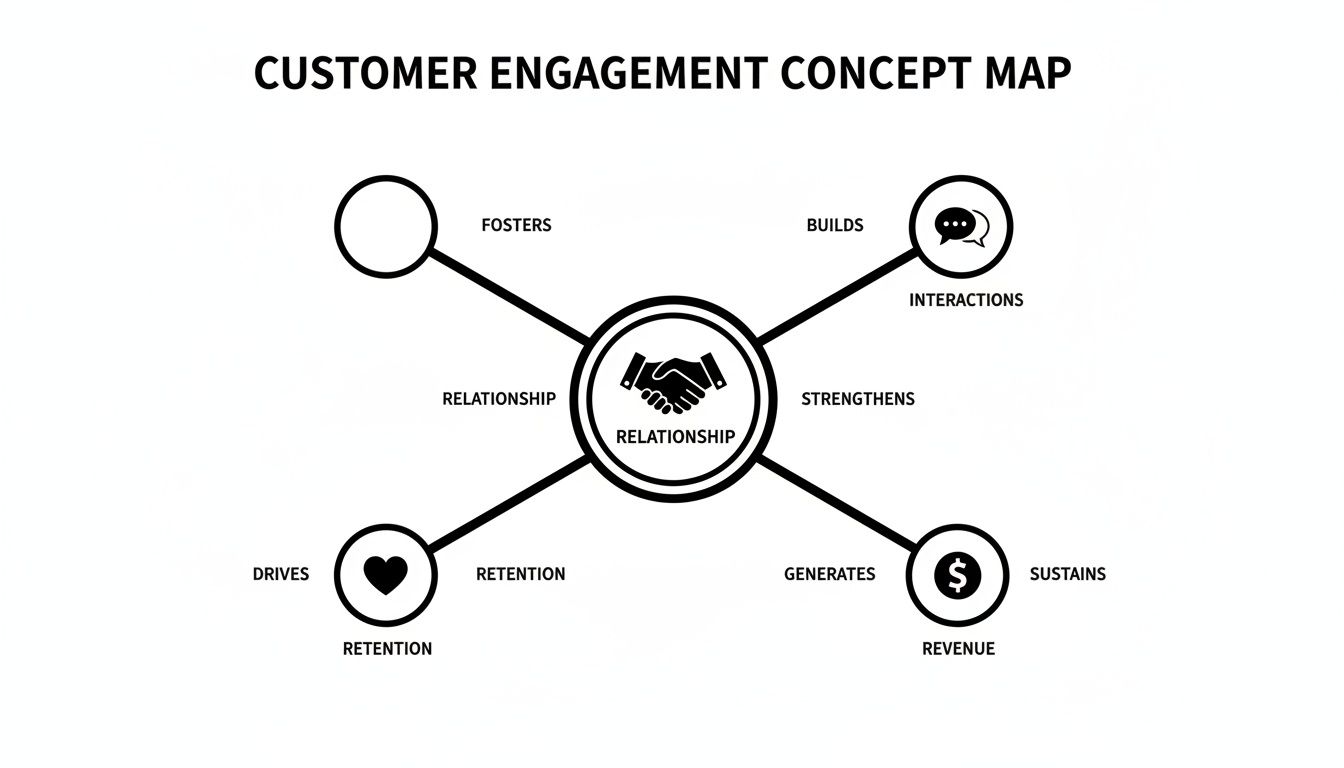
So, what is it, really? Customer engagement isn't just a single action; it's the ongoing, value-driven relationship you build with your customers, measured by the quality of every interaction they have with your brand. It’s the sum of all touchpoints—the webinar they attended, the case study they downloaded, the feedback they gave your product team—that shapes their perception and loyalty.

Defining Customer Engagement In The B2B World

Forget the simple retail model where the goal is just to make a sale. In the complex, high-stakes world of B2B, the initial deal is just the starting line. The real objective is to move a customer from being a passive buyer to an active, strategic partner.

When this shift happens, they're no longer just using your product; they’re collaborating with you. An engaged B2B customer doesn't just log into your software. They show up for your events, give you unfiltered product feedback, and—most importantly—they become the internal champion who defends your value when renewal time comes around.

From Passive Buyer To Active Partner

The gap between a disengaged and an engaged customer is massive. A disengaged customer might pay their invoices on time, but they’re constantly one foot out the door. An engaged customer, on the other hand, is woven into your ecosystem.

  • A disengaged customer sees your product as just another tool. If a competitor dangles a slightly lower price or a shiny new feature, they're gone.
  • An engaged customer sees your solution as fundamental to their own success. They’re invested in the relationship because you’ve proven you’re invested in them.

This journey from a purely transactional setup to a relational one is where real, sustainable value gets created. It's what turns a customer into a predictable source of recurring revenue and organic growth.

"True engagement isn't about the volume of interactions; it's about the quality and value delivered in each one. It’s the proactive support call before a problem arises, the relevant case study that helps a customer achieve their goals, and the consistent proof that you are invested in their success."

To make this concept crystal clear, we can break down B2B customer engagement into four core pillars. Each one builds on the last, creating a strong, multi-faceted relationship.

Here's a quick summary table that breaks it all down.

The Four Pillars of B2B Customer Engagement

PillarDescriptionExample in Action
Cognitive EngagementThis is the "thinking" part. The customer understands the value of your product and how it fits into their strategic goals.They read your blog posts, download your whitepapers, and can clearly articulate your product's ROI to their own leadership team.
Emotional EngagementThis is the "feeling" part. The customer trusts your brand, feels supported by your team, and believes you're a true partner in their success.They give you high NPS scores, speak positively about you to peers, and feel a sense of relief, not dread, when they need to call your support team.
Behavioral EngagementThis is the "doing" part. The customer actively uses your product, participates in your community, and interacts with your content.They log in frequently, use advanced features, attend your webinars, and contribute to your online user forums.
Social EngagementThis is the "sharing" part. The customer advocates for your brand, both internally within their company and externally to their network.They write a positive review on G2, refer a new customer, or agree to be a subject for one of your case studies.

Thinking about engagement through these four pillars helps you see it's not just about usage stats. It's about building a relationship that's intellectual, emotional, and actionable all at once.

Why This Definition Matters For Your Bottom Line

Getting a handle on customer engagement isn't just a feel-good exercise; it has a direct impact on your financials. There’s a reason companies are pouring money into this area. The global market for customer engagement solutions shot up from USD 14.23 billion in 2023 and is on track to hit USD 44.49 billion by 2032.

That kind of growth isn't a fluke. It shows a massive shift in business priorities toward building and maintaining these critical relationships. You can dive deeper into the numbers by checking out recent market growth insights from industry reports.

Ultimately, a sharp engagement strategy builds a competitive moat around your business. It's a defense that competitors can't easily breach with a lower price or a new feature, because it's built on a foundation of trust and a history of delivering real value. That's the stuff that drives retention, grows customer lifetime value, and fuels the kind of growth that lasts.

The Three Dimensions Of Customer Engagement

If you want to truly understand customer engagement, you have to look beyond a single metric. It’s not just one action or feeling. It's a mix of how customers act, how they feel, and what they spend. By breaking it down into three core parts—behavioral, emotional, and transactional—we can turn a fuzzy idea into a clear, measurable framework for growth.

Think of it as a simple map showing how these pieces connect. They all feed into building a strong customer relationship, which in turn drives interactions, keeps customers around, and grows revenue.

A concept map illustrating the core components of customer engagement: relationships, interactions, retention, and revenue.

As you can see, these elements aren't isolated. They create a cycle where positive interactions build loyalty, and that loyalty secures and grows the bottom line.

Behavioral Engagement: The What

Behavioral engagement is the most obvious dimension. It’s what your customers do. These are the tangible, trackable actions that show a customer is actively involved with your brand, product, or content. Think of it as their digital body language.

In the B2B world, this goes way beyond just logging into your platform. It’s about the depth and frequency of their actions. Are they just using one core feature, or are they digging into the advanced stuff? This kind of engagement is a powerful leading indicator of an account's health.

Look at the difference:

  • Low Behavioral Engagement: A user logs in once a month just to pull a single report. They ignore new feature announcements and have never once clicked on your help center.
  • High Behavioral Engagement: A team actively uses multiple product modules, shows up for your quarterly roadmap webinars, and regularly opens and clicks through your email newsletters.

When you see high behavioral engagement, it means your solution is becoming part of their daily workflow. That makes it a whole lot stickier and much harder for a competitor to replace.

Emotional Engagement: The Why

Emotional engagement is the feeling behind the click. It’s the why that drives a customer to pick you, trust you, and stay with you—even when a competitor dangles a lower price. This dimension is built on confidence, brand affinity, and the belief that you’re a genuine partner in their success.

While it’s trickier to measure than logins, emotional engagement is arguably the most powerful force at play. It’s the sentiment that transforms a regular customer into a vocal advocate who sings your praises. A customer who feels understood and supported will forgive a minor hiccup and champion your product internally.

A customer with high emotional engagement doesn't just buy from you; they believe in you. This belief is the foundation of long-term loyalty and the strongest defense against competitive threats.

This is where the quality of your customer service and the relevance of your content really shine. A quick, empathetic response from a support agent or a case study that solves a real problem forges an emotional connection that raw product features never could.

Transactional Engagement: The Result

Transactional engagement is the ultimate payoff for building strong behavioral and emotional connections. It’s where the relationship translates directly into revenue. We’re talking about contract renewals, product upsells, cross-sells, and expanding into new departments.

This is the bottom-line proof that your engagement strategy is working. When a customer renews their annual contract without a fuss or proactively asks about an add-on module, that’s a loud-and-clear signal that they see real value in what you provide. This is what turns engagement from a "nice-to-have" metric into a predictable engine for business growth.

Here’s a practical look at how these dimensions work together to drive real results.

DimensionLow Engagement ExampleHigh Engagement ExampleBusiness Outcome
BehavioralInfrequent logins; basic feature use only.Attends webinars; uses advanced features.Deeper product adoption and stickiness.
EmotionalLow Net Promoter Score (NPS); no interaction with the success team.High NPS; provides positive feedback and case study participation.Strong brand advocacy and positive word-of-mouth.
TransactionalConsiders non-renewal; pushes back on price.Proactively renews; inquires about upgrading their service tier.Increased Customer Lifetime Value (CLV) and stable revenue.

By tracking all three dimensions, you get a complete, 360-degree view of customer health. This holistic understanding lets you spot risks before they become problems, identify opportunities for growth, and build relationships that are not only strong but also profitable.

How To Measure What Actually Matters In Engagement

An engagement strategy without solid metrics is just wishful thinking. To get real traction and drive growth, you have to move past guesswork and start measuring the things that genuinely signal a healthy, growing customer relationship. It’s about separating the numbers that look good on a slide from the ones that actually tell you if a customer is happy and likely to stick around.

The trick is to connect your KPIs back to the three dimensions of engagement: behavioral, emotional, and transactional. When you track metrics across all three, you get a complete picture of account health. This is how you stop just tracking random activities and start making smart, data-driven decisions.

Pinpointing The Right KPIs For Each Dimension

Each dimension tells a different part of the customer's story. If you only focus on one, you're going to get a skewed view of reality. You need a balanced diet of metrics to truly understand what's going on.

Here’s a practical breakdown of what to track for each:

  • Behavioral Metrics: This is all about what customers do. Are they actively using your product in a meaningful way? Look at daily/monthly active users (DAU/MAU), feature adoption rates, and session duration. A spike in demo requests for a new feature is a fantastic sign of deep, active interest.

  • Emotional Metrics: This is about how your customers feel about you. It's where you find out if they’re loyal advocates or quiet churn risks. The essentials here are your Net Promoter Score (NPS), Customer Satisfaction (CSAT) scores, and any qualitative feedback you can get from surveys and customer calls.

  • Transactional Metrics: This is the bottom line—the financial result of all your engagement efforts. Zero in on Customer Lifetime Value (CLV), renewal rates, and upsell/cross-sell revenue. A steadily climbing CLV is the ultimate proof that your strategy is hitting the mark.

When you connect these dots, you can start seeing powerful patterns. For instance, you might notice that a jump in webinar attendance (behavioral) leads to better NPS scores (emotional), which then translates into more expansion revenue a quarter later (transactional). For a deeper dive into connecting actions to outcomes, check out our guide on marketing performance metrics.

Actionable Metrics vs. Vanity Metrics

One of the biggest traps you can fall into is obsessing over vanity metrics. These are the numbers that are easy to track and often look impressive, but they don't give you any real insight into the health of your business. A million social media followers feel great, but a rising churn rate tells a much more important story.

True measurement isn't about finding the most flattering numbers; it's about identifying the data that gives you the power to act. An actionable metric tells you what's working, what's broken, and where to focus your resources next.

To get a real sense of your impact, it's critical to focus on measuring content effectiveness in a way that goes beyond surface-level clicks and views. The table below draws a clear line between the numbers that drive decisions and those that just decorate a dashboard.

Actionable Engagement Metrics vs Vanity Metrics

Metric TypeActionable Metric (Drives Decisions)Vanity Metric (Looks Good, Lacks Impact)
BehavioralProduct Feature Adoption Rate: Shows how deeply customers are using your solution, indicating stickiness and value realization.Website Page Views: Can be inflated by low-quality traffic and doesn't confirm if visitors are qualified or engaged.
EmotionalNet Promoter Score (NPS) Trends: Tracks customer loyalty over time, providing a leading indicator of retention and advocacy.Social Media Likes: Easy to acquire but often lacks correlation with actual customer satisfaction or purchasing intent.
TransactionalCustomer Lifetime Value (CLV): Measures the total revenue a customer generates, reflecting overall relationship health and profitability.Number of New Leads: A high volume of unqualified leads can drain sales resources without contributing to revenue.

Focusing on the "Actionable" column is how you ensure your team's efforts are directly tied to tangible business outcomes, not just noise.

The Tech Stack That Powers Measurement

You can't track what you can't see. Having the right tools in place is non-negotiable for capturing and making sense of engagement data. Your Customer Relationship Management (CRM) platform, whether it's Salesforce or HubSpot, acts as the central nervous system, pulling together interaction histories, purchase data, and support tickets into one coherent customer view.

From there, specialized tools add more color to the picture. Sales engagement platforms give you granular data on outreach, while product analytics tools show you exactly how people are behaving inside your app. This kind of data ecosystem isn't just a nice-to-have anymore.

In fact, North America has pulled ahead in the customer engagement space, now owning a massive 40.73% share of the global market. The U.S. alone makes up a staggering 72.8% of that revenue, driven almost entirely by the adoption of technologies that enable smarter, more effective customer interactions.

Ultimately, these platforms aren't just for collecting data. Modern tools like marketbetter.ai use this information to trigger AI-driven workflows, turning customer signals into prioritized actions for your team. This is how you build a smarter, more responsive engagement strategy that actually moves the needle.

Proven Strategies To Boost B2B Customer Engagement

Alright, we've talked theory. Now let's get practical. Knowing what customer engagement is and why it matters is one thing, but turning that knowledge into pipeline is another beast entirely. It’s time to move from the 'what' and 'why' to the 'how'.

Here are the plays that actually work—the tactics that drive real interactions and build relationships that last.

Hand-drawn 'Before and after' diagram showing a transformation from traditional mail to a digital customer engagement process with metrics.

The big idea is simple: stop broadcasting and start connecting. This means ditching the generic, one-size-fits-all blasts for interactions that are relevant, timely, and genuinely valuable.

Personalize Outreach At Scale

In B2B, "personalization" isn't just dropping {\{first_name\}} into an email. It’s showing a customer you get their specific world—their challenges, their goals, their industry. That's what cuts through the noise. It’s what makes a prospect feel seen.

But let's be real: your team can't manually research every single contact. It's just not scalable. The key is using technology to deliver that one-to-one feeling, at scale, based on real data about what a customer is doing and what they need. We dive deep into the mechanics in our guide to marketing personalization strategies.

Look at the difference in approach:

ApproachThe Generic "Before"The Personalized "After"
TriggerA static list is uploaded once a month for a generic email blast.An SDR gets an alert when a target account hits the pricing page twice in one week.
Message"Hi, check out our new software feature...""Noticed your team was exploring our pricing. Companies like yours in logistics often use feature X to solve Y. Is that a priority for you?"
ResultLow open rates, high unsubscribes, and a quick "not interested."A much higher response rate and a real conversation based on a timely pain point.

This shift is fundamental. You're respecting the buyer's time and positioning your team as helpful advisors, not just another vendor begging for a demo.

Create High-Value Content That Solves Problems

Your content is one of your main engagement channels. Every blog post, webinar, and case study is a chance to provide value and build trust. Generic, self-promotional fluff gets ignored. Content that solves a real problem gets read, shared, and remembered.

To get this right, you have to think like your customer. What keeps them up at night? What are they typing into Google at 10 PM? What piece of information would actually make their job easier tomorrow?

An effective content strategy is less about what you want to sell and more about what your audience needs to learn. When you consistently provide answers, you earn their attention. Then you earn their trust.

Here are three types of content that always move the needle in B2B:

  1. Practical How-To Guides: Step-by-step instructions that help customers get more value from your product or tackle a common industry headache.
  2. Data-Backed Research Reports: Original research that offers a unique point of view and positions your company as a thought leader who’s done the homework.
  3. Customer Success Stories: Relatable case studies that show, don't just tell, how you’ve helped similar companies get from point A to point B.

Every piece should be designed to help the customer make progress, not just to show off a feature.

Build A Seamless Omnichannel Journey

Your customers don’t live in a silo. They might see you on LinkedIn, read a G2 review, visit your website, and then get a call from a sales rep. A winning engagement strategy makes this journey feel like one connected conversation, not a series of disjointed, repetitive pings.

An omnichannel approach means each interaction is aware of the last one. The rep who calls knows the prospect just attended your webinar. The email they get references the whitepaper they downloaded. It creates a smooth, intelligent experience that shows you’re actually paying attention.

This is becoming a massive business driver. The market for customer engagement solutions is projected to explode from USD 25.7 billion to an incredible USD 49.9 billion by 2030. That growth isn't random; it reflects a huge shift toward platforms that can unify customer data and create these seamless experiences. You can explore more data on customer engagement trends to see the full market projection.

By personalizing outreach, creating genuinely useful content, and building a connected journey, you can turn your customer relationships from transactional to foundational—setting the stage for real growth and loyalty.

Using AI To Supercharge Your Engagement Engine

Let’s be honest: running a high-touch, personalized engagement strategy by hand is a fast track to burnout. Your team spends hours digging through data, researching accounts, and just guessing which prospects are actually ready to talk. That administrative drag doesn’t just kill momentum—it leaves real money on the table.

This is where AI changes the entire game. Instead of guesswork, your team gets to operate with speed and precision. AI-powered platforms automate the tedious, soul-crushing work, freeing up your reps to do what humans do best: build relationships and close deals.

Shifting From Manual Guesswork To AI-Powered Precision

The difference between a traditional outbound motion and an AI-driven one is night and day. The old way leans on static lists, repetitive manual research, and a "spray and pray" approach that rarely pays off. The new way is dynamic, targeted, and intelligent.

Exploring modern Frontline AI solutions can help bridge the gap between raw data and actionable sales tasks, creating a much smarter workflow for your entire team.

Let's just put the two side-by-side.

Workflow StepThe Old Way (Manual & Reactive)The New Way (AI-Driven & Proactive)
PrioritizationReps scroll through CRM lists, trying to guess which account to hit next based on gut feel or job title.AI scans thousands of buyer signals—like website visits and content downloads—and automatically serves up the highest-priority tasks first.
ResearchSDRs burn 20-30 minutes per account jumping between LinkedIn, company websites, and news feeds to find a relevant hook.AI instantly summarizes key account details, recent news, and persona-specific pain points, delivering talking points in seconds.
OutreachReps rely on generic, one-size-fits-all email templates and struggle to make each message feel personal.AI generates hyper-relevant email drafts tailored to the account's industry, challenges, and recent activities.
Follow-UpFollow-up is inconsistent because it’s tracked manually. Warm leads inevitably go cold.AI schedules and prompts every follow-up task, ensuring no opportunity gets missed and engagement stays consistent.

This isn't just about saving time. It's about making every single interaction smarter.

Identifying High-Intent Accounts Automatically

One of the biggest wins with AI is its ability to find the needle in the haystack for you. Platforms like marketbetter.ai plug into your data sources and analyze thousands of buyer signals in real time.

What kind of signals are we talking about?

  • Website Behavior: Seeing when a target account hits your pricing page or watches a specific case study video.
  • Content Engagement: Tracking who from your target list is actually showing up to webinars or downloading your latest whitepaper.
  • Third-Party Intent Data: Flagging accounts that are actively researching solutions like yours across the web.

The AI engine takes all this information, scores each account, and pushes the ones with the strongest buying signals right to the top of your team's to-do list. This simple shift ensures your reps are always working on the opportunities most likely to close.

The diagram below gives you a glimpse of how an AI system turns all that noisy input into clear, prioritized tasks for a sales team.

AI brain diagram shows inputs, task prioritization, high intent identification, and lack of buyer signals.

It takes all those scattered buyer signals and transforms them into a clean, actionable game plan, totally eliminating the "what should I do next?" problem.

Empowering Reps To Focus On Selling

When you automate task prioritization and outreach prep, you hand your sales team back a massive chunk of their day—up to two-thirds, by some estimates. They spend less time on grunt work and more time actually talking to qualified prospects. If you want to go deeper on this, you can learn more about the role of AI in B2B marketing.

"AI doesn't replace great salespeople; it liberates them. By handling the repetitive, data-heavy tasks, AI allows reps to dedicate their energy to strategic thinking, relationship-building, and navigating complex deals—the very things that drive revenue."

Imagine your SDRs armed with AI-generated talking points and hyper-relevant email copy. They walk into every conversation with more confidence and context. The result? Higher-quality conversations, faster pipeline growth, and a team that’s actually excited to come to work. Ultimately, this approach turns your sales process into a predictable, scalable, and efficient growth machine.

Free Tool

Try our Lookalike Company Finder — find companies similar to your best customers in seconds. No signup required.

Your Actionable Checklist For Building An Engagement Strategy

Alright, let's get down to brass tacks.

You know what customer engagement is and why it matters. But turning that knowledge into a real, pipeline-driving strategy is a different game entirely. This isn't about flipping a switch; it's about building a solid foundation, one intentional step at a time.

Think of this checklist as your roadmap. It's designed to force the right conversations and get your teams aligned before you ever roll out a new tool or process. Let's build this thing to last.

1. Audit Your Current State

Before you build anything new, you have to know what you’re working with. A brutally honest audit of your current engagement efforts will show you where you're strong and, more importantly, where the gaps are.

Get your sales, marketing, and customer success leaders in a room and start asking the tough questions:

  • Technology: What tools are we actually using to talk to customers? CRM, email platform, dialer, chat? Where is our data getting stuck in silos?
  • Process: How do we track interactions right now? Is it consistent, or is every rep doing their own thing? Be honest.
  • Performance: What are our baselines? Pull the real numbers for email reply rates, demo bookings, and customer renewals.

This audit is your "before" picture. It’s the difference between guessing where to focus and knowing exactly what’s broken.

2. Define Clear and Measurable Goals

A strategy without goals is just a collection of busywork. You have to define what winning looks like in concrete, measurable terms that are tied directly to business outcomes.

"Improve engagement" is a wish, not a goal. Get specific.

Vague GoalActionable Goal
"Increase sales outreach.""Increase qualified demos booked by SDRs by 15% this quarter."
"Be more customer-centric.""Improve our Net Promoter Score (NPS) from 45 to 55 by year-end."
"Do more personalization.""Achieve a 25% reply rate on outbound sequences targeting our top three ICPs."

These are the kinds of goals that create real alignment. They give your team a clear target to hit and turn the abstract idea of what is customer engagement into a set of tangible business objectives.

3. Align Sales and Marketing Teams

Silos kill engagement. It’s that simple. If marketing is celebrating lead volume while sales is complaining about lead quality, the customer gets caught in the middle of a confusing, disjointed experience.

True alignment means shared goals, shared data, and a shared definition of what a qualified, engaged lead actually is.

"Team alignment isn't a one-off project; it's an ongoing commitment. It requires a shared language for defining a good lead, a unified view of the customer journey, and a tight feedback loop where sales insights constantly inform marketing strategy."

Here’s how to start making it real:

  • Create a Service Level Agreement (SLA): Get marketing’s commitment to lead quality and sales' commitment to follow-up speed down on paper.
  • Unify Your Tech Stack: Make sure both teams are working from the same CRM data. You need one source of truth.
  • Hold Regular Cross-Functional Meetings: Create a dedicated time to review pipeline, discuss what’s working, and solve problems as one team.

4. Plan The Team Rollout and Enablement

Dropping a new strategy or tool on your team without proper training is a recipe for failure. Your reps need to understand not just the "how" but the "why" behind the change. A thoughtful rollout plan builds momentum and actually gets people to use the new stuff.

  1. Communicate the Vision: Start by explaining the problems you're solving and what the future state will look like for them, in their daily workflow. What's in it for them?
  2. Provide Hands-On Training: Go way beyond a quick demo. Run workshops and build playbooks that show reps exactly how to use new tools and tactics to hit their numbers.
  3. Establish a Feedback Loop: Create a channel—Slack, a weekly huddle, whatever works—for the team to share what’s working, what isn’t, and what they need to succeed.

This is how you make sure your investment in a new engagement strategy actually pays off through high adoption and consistent execution.


Ready to turn these steps into action? marketbetter.ai provides the AI-powered task engine to make it happen. We turn buyer signals into prioritized tasks for your SDRs and help them execute with AI-written emails and a dialer that lives right inside Salesforce and HubSpot. Learn how to build a consistent outbound motion without the busywork.