MarketBetter vs Nooks: AI Dialer vs AI SDR Platform Compared [2026]

· 9 min read
sunder
Founder, marketbetter.ai

MarketBetter vs Nooks Comparison

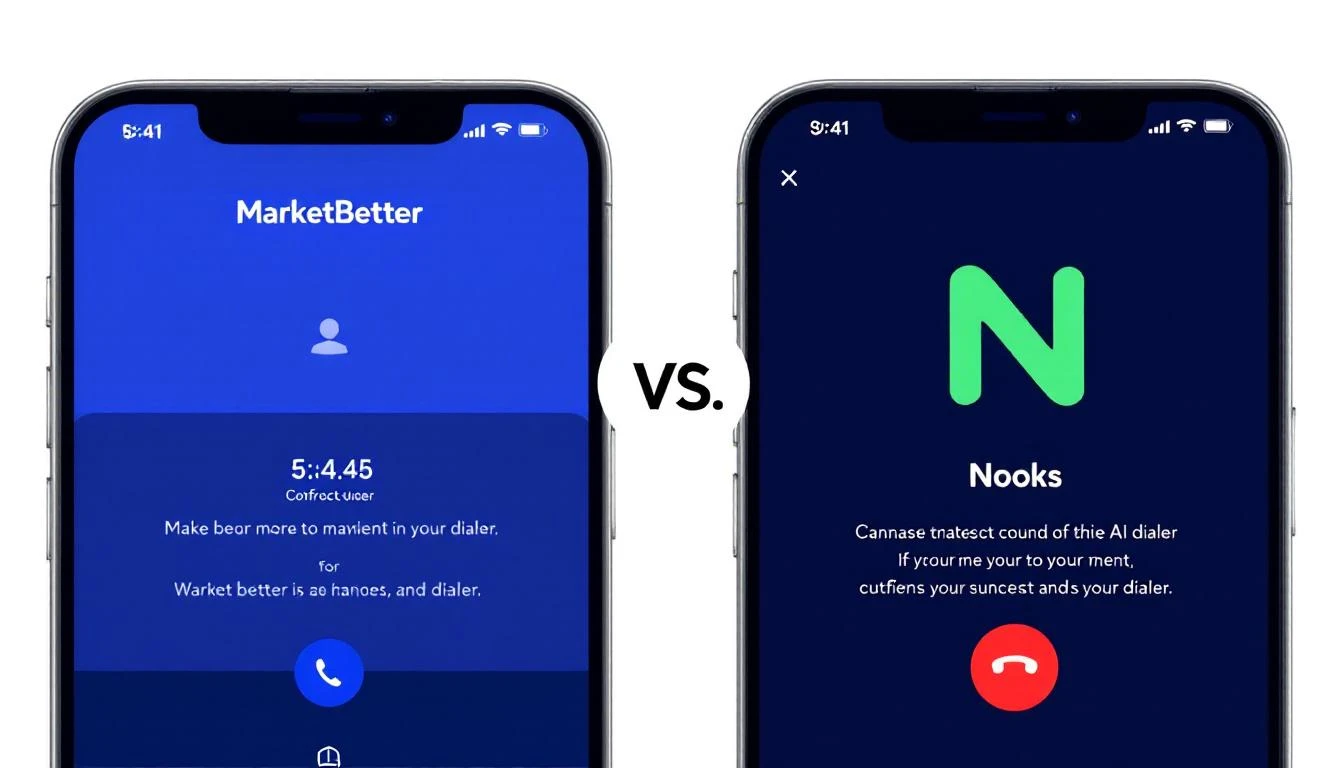
Nooks and MarketBetter both help SDR teams book more meetings. But they solve different slices of the problem. Nooks is a parallel dialer with a virtual salesfloor — it helps reps make 5x more calls and recreates the energy of an in-person sales floor for remote teams. MarketBetter is a full AI SDR operating system — it combines visitor identification, email automation, AI chatbot, smart dialer, and a daily playbook that tells reps exactly who to contact and why.

Nooks is one of the best tools at what it does. The question is whether you need a dialer, or whether you need the entire outbound workflow in one place.

Quick Comparison

FeatureMarketBetterNooks
Starting Price$99/user/month$5,000/user/year ($417/mo per user)
Core FocusFull AI SDR platformAI parallel dialer + coaching
Website Visitor ID✅ Built-in❌ Not available
Daily SDR Playbook✅ Prioritized task list❌ Not available
Parallel Dialer❌ Smart dialer (not parallel)✅ Up to 5 lines simultaneously
Virtual Salesfloor❌ Not available✅ Pioneered the category
AI Chatbot✅ 24/7 visitor engagement❌ Not available
Email Sequences✅ Full automation✅ AI email writer (newer feature)
AI Call Coaching❌ Not built-in✅ AI scorecards + roleplay
Intent Signals✅ First-party + third-party✅ Buying signal library
Voicemail Drop❌ Not available✅ Pre-recorded voicemails
Live Listen❌ Not available✅ Real-time coaching
CRM Integration✅ HubSpot, Salesforce✅ HubSpot, Salesforce, Apollo, Outreach
Monthly Billing✅ Available❌ Annual contracts only
G2 Rating4.97 ★4.8 ★

Two Different Problems, Two Different Solutions

Nooks: Make Your Phone Team 5x More Productive

Nooks was built for one thing: helping SDRs make more phone calls, faster, together. Their innovation was the virtual salesfloor — a Zoom-like environment where SDRs dial side by side, managers can live-listen, and the energy of a bullpen sales floor comes alive even for remote teams.

Core capabilities:

  • Parallel dialer — call up to 5 numbers simultaneously, connect to whoever picks up first
  • Virtual salesfloor — video, audio, screenshare, live chat while dialing
  • AI battle cards — real-time objection handling suggestions during calls
  • AI scorecards — automatic call scoring for coaching
  • AI roleplay — practice conversations with AI bots
  • Voicemail drop — pre-recorded voicemails delivered automatically
  • Call analytics — transcription, sentiment analysis, keyword tracking

If your team's primary outbound motion is cold calling, Nooks is excellent at eliminating the mechanical parts of dialing and adding coaching layers.

MarketBetter: The Entire SDR Workflow, Not Just Calls

MarketBetter doesn't try to be the best dialer on the market. Instead, it answers a broader question: "Who should my SDRs contact today, through which channel, and what should they say?"

Core capabilities:

  • Website visitor identification — know which companies are on your site right now
  • Daily playbook — each SDR gets a prioritized list: who, why, and how
  • Email automation — hyper-personalized sequences at scale
  • Smart dialer — integrated calling, but single-line (not parallel)
  • AI chatbot — engages every website visitor 24/7
  • Champion tracking — alerts when past buyers change companies
  • Multi-signal aggregation — website visits + email engagement + intent data in one view

MarketBetter is the operating system. Nooks is a specialized instrument within it.

Pricing: The Math That Matters

Nooks Pricing

Nooks pricing isn't publicly listed, but industry data confirms:

MetricDetails
List Price$5,000/user/year
Monthly Equivalent~$417/user/month
5 SDR Team$25,000/year
10 SDR Team$50,000/year
BillingAnnual contracts only
Add-onsPhone numbers via Twilio (~$10-15/number/month)
DiscountsOften negotiable for startups or larger teams

All features included — no tier confusion. But that $5K/user/year adds up fast.

MarketBetter Pricing

PlanPriceWhat's Included
Standard$99/user/monthAll features included: Daily SDR Playbook, Website Visitor ID, AI Chatbot, Email Automation, Smart Dialer ($50/seat add-on), 5M AI credits + 500 enrichment credits per seat
EnterpriseCustomEverything in Standard + custom integrations, dedicated support, volume discounts

Monthly billing available. No annual lock-in required.

Head-to-Head Cost for a 5-Person Team

PlatformAnnual CostWhat You Get
Nooks$25,000 + phone numbersParallel dialer, virtual salesfloor, AI coaching
MarketBetter$18,000Visitor ID, daily playbook, email sequences, chatbot, smart dialer, enrichment credits
Both Together$43,000+Full stack (but significant feature overlap on dialing)

Key insight: Nooks costs $25K/year and covers one channel (phone) extremely well. MarketBetter costs $18K/year and covers every channel (phone, email, chat, LinkedIn) with the added intelligence layer of knowing who to contact and why.

Feature Deep Dive

Dialing: Nooks Wins on Volume, MarketBetter Wins on Intelligence

Nooks parallel dialer is genuinely best-in-class. Dialing 5 numbers at once means your SDRs connect to live conversations 3-5x faster than sequential dialing. The virtual salesfloor adds energy and coaching that solo dialers can't match.

MarketBetter's smart dialer is single-line, not parallel. It won't match Nooks on raw call volume. But it's integrated with the daily playbook — your SDR sees "Call Sarah at Acme because they visited your pricing page 2 hours ago" rather than just working through a cold list.

The real question: Do your SDRs need to make 200 calls a day to a cold list? Nooks. Do they need to make 50 highly targeted calls to prospects showing buying intent? MarketBetter.

Coaching and Training

Nooks: ✅ This is a major strength. AI scorecards automatically grade every call. AI roleplay lets new SDRs practice objection handling with configurable AI bots. Managers can live-listen and jump in. Call recordings are transcribed, analyzed, and searchable.

MarketBetter: ❌ No built-in coaching features. You'd need a separate tool like Gong or Chorus for call recording and coaching.

Edge: Nooks, clearly. If SDR coaching and ramp-time reduction are priorities, Nooks has a mature suite that MarketBetter doesn't match.

Website Visitor Identification

MarketBetter: ✅ Identifies companies visiting your website and feeds that data directly into the daily playbook. Your SDRs know "Acme Corp was on the case studies page this morning" before they pick up the phone.

Nooks: ❌ No website visitor identification. You'd need Leadfeeder, Clearbit, or similar — and manually sync that data to your dialer workflow.

Edge: MarketBetter. First-party intent data from your own website is the highest-quality signal available, and having it in the same platform as your outreach tools eliminates integration friction.

AI Chatbot and Inbound Lead Capture

MarketBetter: ✅ AI chatbot engages every website visitor, qualifies leads with natural conversation, and routes hot prospects to SDRs in real-time.

Nooks: ❌ No chatbot capability. Nooks is purely outbound.

Edge: MarketBetter. The chatbot turns your website into a 24/7 lead machine — something a dialer simply can't do.

Email Automation

MarketBetter: ✅ Full email sequencing and automation. Hyper-personalized campaigns at scale with deliverability monitoring.

Nooks: ✅ Recently added an AI email writer (Chrome plugin) for drafting personalized emails. But email sequences and automation are newer and less mature than dedicated platforms.

Edge: MarketBetter's email engine is more established and comprehensive.

Virtual Salesfloor

Nooks: ✅ Pioneered this category. Remote SDR teams can dial together in a shared virtual space — video on, live chat, leaderboards, Spotify integration. It recreates the energy of an in-person sales floor, which is uniquely motivating for cold calling.

MarketBetter: ❌ No equivalent. SDRs work independently within their dashboard.

Edge: Nooks, uniquely. No other platform has replicated this experience as well. For remote SDR teams that struggle with isolation and motivation during cold calling blitzes, the virtual salesfloor is genuinely valuable.

What Real Users Say

MarketBetter (4.97 ★ on G2)

  • "The daily playbook changed how our team operates"
  • "Go from 20 tabs to one SDR task list"
  • "Best support I've ever experienced with any SaaS product"
  • Top Performer in 15 G2 lead generation categories

Nooks (4.8 ★ on G2)

What users love:

  • "Transforms cold calling into an event that's more fun"
  • "Calling 50+ people per day is way easier with parallel dial"
  • "The salesfloor builds confidence knowing colleagues are rooting you on"
  • "Auto-dial and voicemail drop save hours daily"

What users complain about:

  • Pricing is steep at $5K/user/year
  • Spam detection uses NoMoRobo (not the most accurate)
  • Numbers can get flagged as spam after 100-200 dials/day
  • Annual contracts with no monthly option
  • Phone number quality depends on Twilio
  • One Reddit post from an SDR Director: "Nooks, Orum, and the rest of the parallel dialers have lost their minds" on pricing

When to Choose Each

Choose MarketBetter if:

  • You need the full outbound stack in one platform (email + phone + chat + visitor ID)
  • Knowing who to call and why matters more than call volume
  • You want AI chatbot and website visitor identification
  • Your team runs multi-channel outreach, not just phone
  • You prefer transparent pricing with monthly billing options
  • You're a team of 3-10 SDRs looking for maximum ROI per seat

Choose Nooks if:

  • Cold calling is your primary outbound motion (70%+ of rep time is on the phone)
  • You manage a remote SDR team and need virtual salesfloor energy
  • SDR coaching and ramp-time are your biggest challenges
  • You need parallel dialing to maximize connect rates on high-volume lists
  • Your team is large enough (5+ SDRs) to justify $5K/user/year
  • You already have email automation and visitor ID tools elsewhere

Consider Both if:

  • You have the budget ($43K+/year for 5 reps)
  • Phone is critical but you also need visitor ID and email automation
  • Your SDR team is 10+ and you want best-in-class across every channel
Free Tool

Try our AI Lead Generator — find verified LinkedIn leads for any company instantly. No signup required.

The Bottom Line

Nooks is the best parallel dialer on the market. Full stop. If your SDRs spend most of their day making phone calls, the virtual salesfloor and 5-line parallel dialing will measurably increase their output.

But most B2B sales teams don't just need a dialer. They need to know who to call, when to email, and what to say — across every channel. That's what MarketBetter's daily playbook delivers.

At $18K/year for 5 seats versus $25K/year for 5 seats (with narrower capabilities), MarketBetter offers more value per dollar for teams running multi-channel outbound. If you're all-in on phones, Nooks earns its price tag.


Want to see how the daily playbook prioritizes your outreach across every channel? Book a demo and we'll show you how MarketBetter combines visitor ID, intent signals, and AI-driven task lists into one SDR workspace.

MarketBetter vs Regie.ai: Which AI Sales Platform Actually Delivers Pipeline? [2026]

· 8 min read
sunder
Founder, marketbetter.ai

MarketBetter vs Regie.ai comparison

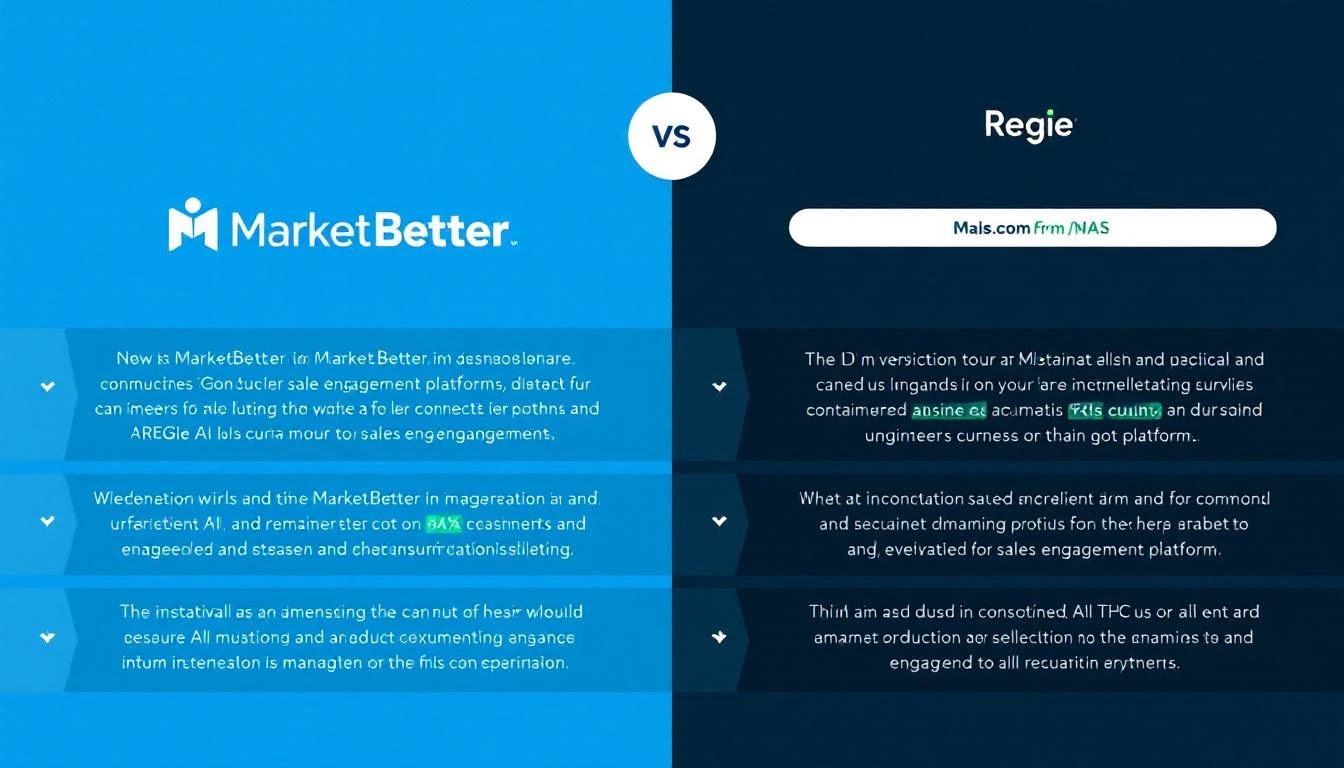
Regie.ai has positioned itself as "the world's only AI Sales Engagement Platform" — a bold claim that reflects real ambition. They've built AI prospecting agents, a unified sales workflow, and a native dialer into a single platform that replaces fragmented tooling.

Sound familiar? It should. MarketBetter has been building toward the same vision — but from a fundamentally different starting point.

Where Regie.ai starts with outbound content generation and works backward to data, MarketBetter starts with buyer signals and works forward to action. That distinction shapes everything about how each platform operates and, more importantly, what results your SDR team can expect.

Let's dig into the details.

What Each Platform Does

Regie.ai: AI-Powered Sales Engagement

Regie.ai calls itself "RegieOne" — a consolidated platform replacing your SEP, data provider, dialer, and content tools. Key capabilities:

  • AI Prospecting Agents: Autonomous agents that source contacts from 220M+ records, enrich them, and build outreach sequences with minimal human input
  • Generative AI Messaging: Creates personalized emails and LinkedIn messages using prospect data, pain points, and intent signals
  • AI Dialer: Built-in parallel dialer bundled with agent functionality (cannot be purchased standalone)
  • Signal Selling: Monitors 100+ built-in signals (Google, LinkedIn, 10-K filings, G2, Crunchbase, BuiltWith, company news, call transcripts, CRM data)
  • Dynamic Workflows: Auto-adjusts outreach timing, messaging, and prioritization based on engagement patterns
  • Content Hub: Centralized library for managing sales messaging and ensuring brand consistency

Founded in 2020 and backed by significant VC funding, Regie has pivoted from a pure content generation tool into a full AI sales platform — competing directly with Outreach and SalesLoft for the sales engagement market.

MarketBetter: Signal-First SDR Operating System

MarketBetter approaches the same problem from the other direction — starting with who's already interested:

  • Website Visitor Identification: Identifies companies visiting your site and surfaces decision-maker contacts
  • Daily SDR Playbook: Each morning, reps get a prioritized task list based on signals, not guesswork
  • AI Email Automation: Hyper-personalized sequences driven by visitor behavior and intent data
  • Smart Dialer: Built-in calling with full prospect context visible during every call
  • AI Chatbot: Engages website visitors in real time, qualifies leads, and books meetings
  • Champion Tracking: Alerts you when past customers or advocates change companies
  • Intent Signals: First-party website data combined with behavioral signals for smarter prioritization

Feature-by-Feature Comparison

CapabilityMarketBetterRegie.ai
AI email generation✅ Signal-driven sequences✅ Generative AI messaging
AI prospecting agentsDaily playbook with priorities✅ Autonomous agents
Website visitor ID✅ Built-in❌ Not available
AI chatbot✅ Built-in❌ Not available
Smart/parallel dialer✅ Built-in✅ AI Dialer (bundled only)
Intent signal monitoring✅ First-party + behavioral✅ 100+ third-party signals
Content personalization✅ Visitor behavior-based✅ Persona + signal-based
Daily SDR playbook✅ Prioritized task list❌ Not available
Champion tracking✅ Job change alerts❌ Not available
LinkedIn automation❌ Not built-in✅ Built-in
Contact databaseEnrichment credits✅ 220M+ contacts
A/B testing✅ Campaign testing✅ Message testing
Team analytics✅ Dashboard + metrics✅ Performance reporting
CRM integrationHubSpot, SalesforceSalesforce, HubSpot, Outreach

Pricing: Transparency vs. Sales Conversations

Regie.ai Pricing

Here's the uncomfortable truth: Regie.ai doesn't publish pricing on their website.

Their pricing page asks you to "book a demo" with no concrete numbers. Based on third-party research:

  • Estimated annual contracts start at $35,000+/year (per SalesRobot's analysis)
  • The tiered add-on structure makes calculating true costs nearly impossible without engaging their sales team
  • The AI Dialer cannot be purchased separately — it's bundled with agent packages
  • Enterprise features require custom negotiation

One review site noted: "This tiered add-on structure makes it nearly impossible to calculate your true cost without engaging their sales team — a deliberate friction that forces prospects into lengthy sales conversations."

MarketBetter Pricing

Fully transparent, published on the website:

  • $99/user/month - one plan, everything included
  • Visitor identification, AI chatbot, email automation, smart dialer, daily SDR playbook
  • 5M AI credits + 500 enrichment credits per seat
  • No contracts, cancel anytime. Free unlimited viewer seats

No surprises. No multi-month negotiation. You see the price, you pick a plan.

Total Cost of Ownership

For a 5-person SDR team:

MarketBetterRegie.ai (estimated)
Annual cost$18,000/year$35,000–$60,000+/year
Includes visitor ID✅ Yes❌ Need separate tool
Includes chatbot✅ Yes❌ Need separate tool
Includes dialerScale plan✅ Bundled
Pricing transparency✅ Public❌ Requires sales call

The Fundamental Difference: Outbound-First vs. Signal-First

This is where the real distinction lives.

Regie.ai: "Cast a Wider Net, Faster"

Regie's AI agents are designed to scale outbound volume. They pull contacts from a massive database, generate personalized messages using AI, and execute multichannel sequences automatically. The platform leans heavily on third-party signals (10-K filings, Crunchbase, BuiltWith, etc.) to personalize outreach.

The strength: If you need to reach 3–5x more accounts with your existing team, Regie's autonomous agents can generate massive outbound volume with solid personalization.

The risk: Volume without first-party signal data can mean a lot of well-crafted emails hitting prospects who have zero awareness of your product. One Reddit user reported: "It didn't make a difference in email or cadence performance (engagement, open rates) but did help us make sequences a little more efficient — quantity over quality."

MarketBetter: "Start With Who's Already Interested"

MarketBetter flips the equation. Instead of blasting outbound and hoping for signal, it starts with the signals you already have:

  1. Someone visits your pricing page → Identified, enriched, prioritized
  2. A champion from a closed deal changes jobs → Instant warm outreach triggered
  3. AI chatbot engages a visitor → Qualified conversation before any SDR touches the lead
  4. All signals feed the daily playbook → SDRs know exactly who to contact and why

The strength: Every outbound action is backed by first-party intent. You're not guessing who might be interested — you're responding to people who already demonstrated interest.

The gap: MarketBetter's contact database relies on enrichment credits rather than a massive native database, so purely cold outbound to net-new accounts requires more data sourcing.

What Users Are Saying

Regie.ai Positives (from G2, Reddit, TrustRadius)

  • AI personalization that leverages relevant pain points and intent signals
  • Consolidated platform reduces tool sprawl significantly
  • AI dialer is a genuine productivity multiplier when paired with agents
  • Dynamic workflows that adapt based on engagement patterns
  • RegieOne's persona-specific messaging guidance helps maintain consistency

Regie.ai Concerns

  • Pricing opacity: Multiple users frustrated by the inability to estimate costs before a sales call
  • Computer performance: Reports of the platform slowing down systems during heavy use
  • Content quality: Some users find AI-generated copy sounds "robotic" and needs heavy editing
  • Complexity: The platform's depth means a significant learning curve for new teams
  • LinkedIn automation friction: G2 reviewers note that generating LinkedIn messages requires too many inputs — "it asks for so many things that I might as well write it myself"

MarketBetter Positives

  • 70% reduction in manual SDR work through the daily playbook
  • 2x faster speed-to-lead with signal-based prioritization
  • 90% faster lead response via AI chatbot engagement
  • 4.97 rating on G2 — Top Performer in 15 Lead Generation categories
  • Transparent pricing with no negotiation required

When to Choose Each

Choose Regie.ai If:

  • Your primary motion is high-volume cold outbound to net-new accounts
  • You need autonomous AI agents that operate with minimal human oversight
  • You have budget for $35K+/year and prefer a platform that replaces Outreach/SalesLoft
  • Your team is large enough (10+ SDRs) to justify enterprise pricing
  • LinkedIn automation is a critical channel for your outreach
  • You're comfortable with opaque pricing and lengthy sales processes

Choose MarketBetter If:

  • You want to capture and convert the website traffic you're already generating
  • Your SDRs need a daily playbook that tells them exactly who to prioritize and why
  • You need email + phone + chatbot in one platform, not just email + LinkedIn
  • Pricing transparency matters to you — you want to see costs before talking to sales
  • You're a mid-market team (3–10 SDRs) that needs enterprise capabilities at a fair price
  • You believe in signal-first selling — reaching out to people who've already shown interest

Can You Use Both?

Actually, yes — though it's an expensive stack.

Some teams use Regie.ai for cold outbound to net-new accounts (where there's no first-party signal) and MarketBetter for warm outbound triggered by website visits, chatbot conversations, and champion tracking.

But for most mid-market teams, the smarter play is choosing one platform and going deep. If your inbound motion generates meaningful website traffic, MarketBetter turns those anonymous visitors into prioritized pipeline. If you're purely outbound with no inbound traffic to leverage, Regie's volume play makes more sense.

Free Tool

Try our AI Lead Generator — find verified LinkedIn leads for any company instantly. No signup required.

The Bottom Line

Regie.ai is building an impressive AI-native sales engagement platform. Their autonomous agents and generative AI capabilities are genuinely differentiated, and for large enterprise teams running pure cold outbound at massive scale, the platform delivers real pipeline.

But for teams that generate website traffic, want multichannel coverage (email + phone + chat), and need a daily playbook that eliminates SDR guesswork — MarketBetter delivers more value at a fraction of the cost with full pricing transparency.

The question isn't which platform has more AI. It's which platform turns your specific signals into pipeline faster.

See MarketBetter's signal-first approach in action →


Exploring other options? Compare MarketBetter against Outreach, SalesLoft, Apollo, Clay, Nooks, and Amplemarket.

Sales Trigger Events: The Complete Guide + 10 Best Tools for 2026

· 15 min read
sunder
Founder, marketbetter.ai

Sales Trigger Events Guide for B2B Prospecting

Cold outreach has a 1-3% reply rate. Trigger-based outreach hits 15-25%.

That's not a marginal improvement — it's a completely different game. The difference? Timing and relevance.

A sales trigger event is any change in a prospect's world that creates a window of opportunity for your product. New VP of Sales hired? They're rebuilding the tech stack. Company just raised a Series B? They're scaling the team. Prospect visited your pricing page three times this week? They're evaluating.

The best SDR teams in 2026 don't prospect randomly. They react to triggers — and the ones who react fastest win.

This guide covers everything: what trigger events are, the 15 types that actually convert, how to build response playbooks, and the 10 best tools for detecting triggers automatically.

What Are Sales Trigger Events?

A sales trigger event is a specific, observable change in a company or contact that signals potential buying intent. Unlike static firmographic data ("they're a 200-person SaaS company"), triggers are dynamic — they represent movement.

Why triggers work:

  • Timing: You're reaching out when something just changed, not randomly
  • Relevance: Your message connects to something real in their world
  • Urgency: Many trigger windows close in 7-14 days as decisions get made
  • Differentiation: While competitors blast generic sequences, you reference specific events

The math is simple: If 3% of your TAM is actively buying at any given time, trigger events help you find that 3% instead of spraying the other 97%.

The 15 Sales Trigger Events That Actually Convert

Not all triggers are created equal. Here's a ranked breakdown by conversion potential, detection difficulty, and response urgency.

Tier 1: High Intent — Act Within 48 Hours

1. Website Visits (Pricing/Product Pages)

What it is: A target account or known contact visits your website, especially pricing, product, or comparison pages.

Why it converts: This is the strongest first-party signal you can get. Someone at a potential customer is actively researching your product. They may be comparing you to competitors right now.

Response window: 24-48 hours. After that, they've moved on or chosen someone else.

Playbook:

  • Pricing page visit → Personalized email referencing their industry use case + offer a demo
  • Product page (specific feature) → Reference that specific capability and how similar companies use it
  • Blog/resource visit → Softer touch — share a related resource, don't sell yet
  • Multiple visits in a week → They're evaluating. Direct outreach with a calendar link

Key insight: Most marketing automation platforms detect this but don't act on it. The signal goes into a dashboard. What you need is the signal showing up in an SDR's daily task list with a recommended action — that's the difference between intelligence and execution.

2. Champion Job Change

What it is: A current customer or warm contact moves to a new company.

Why it converts: They already know your product, trust it, and want to look good in their new role by bringing proven solutions. UserGems data shows champion job changes convert at 3-5x the rate of cold outreach.

Response window: First 90 days at new role. The first 30 are golden — they're building their stack.

Playbook:

  • Week 1-2: Congratulations message (no pitch)
  • Week 3-4: "Now that you're settled, would it make sense to explore [product] for [new company]?"
  • If they were a power user: Reference specific results they achieved

3. Funding Round Announced

What it is: A company raises venture capital, private equity, or debt financing.

Why it converts: Fresh capital means hiring, scaling, and buying tools. Series A companies build their initial stack. Series B companies professionalize it. Growth equity means the board is pushing for efficiency.

Response window: 2-4 weeks after announcement. Budget conversations happen fast.

Playbook:

  • Reference the funding and the stated use of funds
  • Connect your product to their growth plan
  • If they're hiring SDRs (check job boards), lead with how you help new SDR teams ramp faster

Tier 2: Strong Signal — Act Within 1 Week

4. Executive Hire (VP Sales, CRO, Head of Growth)

What it is: A company hires or promotes a new leader in a relevant department.

Why it converts: New leaders evaluate the existing tech stack within their first 90 days. They want to put their stamp on the organization and bring tools they trust.

Response window: 30-60 days after start date. They need time to assess before they buy.

Playbook:

  • Wait 2-3 weeks (let them settle)
  • Reference their background and what you've seen work for similar leaders
  • Offer a peer conversation, not a demo

5. Hiring Surge (SDR/BDR Roles)

What it is: A company posts multiple SDR, BDR, or sales development roles.

Why it converts: If they're hiring SDRs, they need tools for those SDRs. More reps = more seats = bigger deal. They're also feeling pain — hiring means current capacity can't keep up with demand.

Response window: 2-4 weeks. They want tools ready before new hires start.

Playbook:

  • "I noticed you're growing the SDR team — when those new reps start, how will you handle [specific workflow]?"
  • Lead with ramp time reduction and onboarding efficiency

6. Technology Change (New CRM, New Tool Adoption)

What it is: A company adopts, switches, or removes a technology in their stack.

Why it converts: Technology changes signal budget availability, process transformation, and openness to new tools. If they just adopted Salesforce, they'll need tools that integrate with it.

Response window: 1-4 weeks depending on the change.

Playbook:

  • "Congrats on the move to [new tool]. Teams we work with who use [tool] typically also need [your category] — happy to show you how they work together."

7. Contract Renewal Period

What it is: A competitor's contract with a prospect is up for renewal (typically annual).

Why it converts: Renewal periods are natural evaluation windows. If they're unhappy with their current tool, this is when they look at alternatives.

Response window: 60-90 days before renewal date.

Playbook:

  • "Many teams evaluate alternatives 2-3 months before their [competitor] renewal. If you're open to a comparison, I can show you what's different."

Tier 3: Contextual Signal — Act Within 2 Weeks

8. Expansion or New Office

What it is: A company opens a new office, enters a new market, or expands geographically.

Why it converts: Expansion means new team members, new processes, and often new tools. The pain of managing distributed teams creates demand for unified platforms.

Response window: 2-4 weeks after announcement.

9. Product Launch

What it is: A company launches a new product, service, or major feature.

Why it converts: Product launches require marketing support, sales enablement, and GTM execution. New products need pipeline.

Response window: 1-3 weeks. They're in "build mode."

10. Merger or Acquisition

What it is: Two companies merge or one acquires another.

Why it converts: M&A forces tech stack consolidation. The acquiring company typically standardizes on one platform, and the acquired company's tools are up for replacement.

Response window: 3-6 months. M&A moves slowly, but decisions get made.

11. Earnings Report / Revenue Growth

What it is: A public company reports strong earnings, revenue growth, or increased guidance.

Why it converts: Growth means investment. Companies spending more on growth are buying tools to support that growth.

Response window: 2-4 weeks after earnings.

12. Industry Regulatory Change

What it is: New regulations, compliance requirements, or industry standards that affect your prospect's business.

Why it converts: Compliance drives urgency. When GDPR hit, every company in Europe bought consent management tools within 6 months.

Response window: Depends on regulation timeline. Usually months of lead time.

13. Conference or Event Attendance

What it is: A prospect attends, sponsors, or speaks at an industry conference.

Why it converts: Conference attendance signals active engagement in the space. Sponsors especially are investing in their category.

Response window: During or immediately after the event.

Playbook:

  • "Saw you're attending [conference]. We'll be there too — would you have 15 minutes to connect?"
  • Post-event: Reference a specific session or trend from the event

14. Negative News About Current Vendor

What it is: A prospect's current vendor experiences an outage, data breach, price increase, or negative press.

Why it converts: Dissatisfaction with a current tool is the #1 reason companies evaluate alternatives.

Response window: 1-2 weeks while the frustration is fresh.

15. Social Engagement

What it is: A prospect likes, comments, or shares content related to your product category on LinkedIn or Twitter.

Why it converts: Social engagement reveals what people are thinking about. If a VP Sales shares an article about AI SDR tools, they're interested in the category.

Response window: 24-72 hours. Social signals decay quickly.

Building Your Trigger Response Playbook

Knowing about triggers is useless without a system to detect and act on them. Here's how to build one:

Step 1: Map Triggers to Your ICP

Not all triggers matter equally for your product. Prioritize:

Your Product CategoryTop 3 Triggers
SDR/Sales toolsHiring surge, champion job change, website visit
Marketing automationFunding round, executive hire, technology change
CRMM&A, expansion, executive hire
Security/ComplianceRegulatory change, data breach, audit period
HR TechHiring surge, expansion, funding round

Step 2: Define Response Timing

Create a response matrix:

TriggerDetection SourceResponse TimeChannelFirst Touch
Pricing page visitVisitor ID toolSame dayEmail + LinkedInPersonalized demo offer
Champion job changeLinkedIn alertsWeek 2-3EmailCongratulations
Funding roundNews monitoringWeek 1-2Email + phoneGrowth conversation
SDR hiringJob board APIWeek 1-2EmailRamp time pitch

Step 3: Pre-Build Templates

For each trigger, create a message framework:

Structure: [Trigger reference] + [Empathy/insight] + [Value prop tied to their situation] + [Soft CTA]

Example (funding trigger):

"Congrats on the Series B — building out the go-to-market team is always the exciting (and chaotic) part. We help SDR teams at [similar company] go from first hire to first meeting in under a week. Worth a 15-minute look?"

Step 4: Automate Detection

This is where tools matter. Manual trigger detection doesn't scale past 50 accounts.

10 Best Sales Trigger Event Tools for 2026

1. MarketBetter

Trigger types detected: Website visits (company + individual level), email engagement, chatbot interactions, content downloads, return visits

What makes it different: MarketBetter doesn't just detect triggers — it converts them into a Daily SDR Playbook. Every morning, each SDR sees a prioritized list of accounts to contact, which channel to use, and a personalized message to send. The trigger detection and response action are unified in one platform.

Pricing: $99/user/month - one plan with everything included. Visitor ID, email automation, smart dialer, AI chatbot, daily SDR playbook, 5M AI credits + 500 enrichment credits per seat. No contracts.

Best for: SDR teams that want trigger detection AND execution in one tool, not two separate platforms that require manual stitching.

See how the playbook works →

2. UserGems

Trigger types detected: Champion job changes, new hires, promotions, departures

What makes it different: The gold standard for tracking champion movement. When your buyer moves companies, UserGems alerts your team and syncs the new contact into your CRM automatically.

Pricing: Custom — typically $30K-$80K/yr for mid-market

Best for: Companies with large customer bases where champion tracking has the highest ROI.

3. Cognism

Trigger types detected: Funding rounds, hiring signals, technographic changes, leadership changes

What makes it different: Combines a B2B contact database with real-time trigger events. Their Diamond Data verification ensures phone numbers actually connect. GDPR-compliant across Europe.

Pricing: Custom — estimated $15K-$50K/yr

Best for: European-focused teams that need compliant data with trigger overlays.

4. ZoomInfo

Trigger types detected: Funding, hiring, technology installs/removals, leadership changes, corporate news, Scoops (crowdsourced intent)

What makes it different: The broadest trigger detection in the market. ZoomInfo tracks 14+ trigger types across their 100M+ company database. Their Scoops feature adds crowdsourced intelligence from verified contributors.

Pricing: Professional from $14,995/yr. Advanced from $24,995/yr. Elite from $39,995/yr.

Best for: Enterprise teams that need maximum trigger breadth across a large TAM.

5. Bombora

Trigger types detected: Topic-level intent surges (third-party intent data)

What makes it different: Bombora operates the largest B2B intent data co-op, tracking content consumption across 5,000+ publisher sites. When a company researches your category more than baseline, Bombora flags the surge.

Pricing: Custom — typically $25K-$60K/yr

Best for: ABM teams that want to identify in-market accounts before they visit your site.

6. 6sense

Trigger types detected: Intent surges, account engagement, buying stage changes, contact-level engagement

What makes it different: Goes beyond trigger detection to buying stage prediction. 6sense tells you not just that an account is active, but whether they're in awareness, consideration, or decision stage.

Pricing: Custom — typically $60K-$120K/yr

Best for: Enterprise ABM teams with budget for comprehensive intent infrastructure.

7. Dealfront (formerly Leadfeeder)

Trigger types detected: Website visits, company news, trigger events across European markets

What makes it different: Strong European coverage, GDPR-native. Combines website visitor identification with firmographic triggers. Good for teams selling into EMEA.

Pricing: Free plan available. Paid from €99/mo.

Best for: European-focused B2B teams needing website visitor tracking with compliance.

8. LinkedIn Sales Navigator

Trigger types detected: Job changes, company growth, lead/account activity, shared content engagement

What makes it different: Direct access to LinkedIn's data — the most accurate source for job changes and professional movement. Lead alerts notify you when saved leads change roles, post content, or are mentioned in news.

Pricing: Core at $99.99/mo. Advanced at $149.99/mo. Advanced Plus custom.

Best for: Individual SDRs and small teams who prospect primarily through LinkedIn.

9. Apollo.io

Trigger types detected: Job changes, company news, technology installs, hiring signals, email engagement

What makes it different: Combines trigger detection with a contact database and outreach sequences at a fraction of the price of ZoomInfo or Cognism. The signal-to-noise ratio isn't as refined, but the value-to-cost ratio is hard to beat.

Pricing: Free plan available. Basic at $49/mo. Professional at $79/mo.

Best for: Budget-conscious teams that need basic trigger detection bundled with prospecting.

10. Common Room

Trigger types detected: Community engagement, social signals, product usage, content engagement, job changes

What makes it different: Common Room aggregates signals from communities (Slack, Discord, GitHub), social media, and product analytics. Strongest for companies with active developer communities or user bases.

Pricing: Free plan available. Team from $625/mo. Enterprise custom.

Best for: Product-led growth companies where community engagement signals buying intent.

Trigger Event Detection: Build vs. Buy

You don't necessarily need a dedicated trigger tool. Here's what you can do for free:

Free Trigger Monitoring

  • Google Alerts — Set up alerts for target companies (funding, news, hires)
  • LinkedIn Sales Navigator — Free alerts on saved leads and accounts
  • Job board monitoring — Check Indeed/LinkedIn for SDR postings at target accounts
  • Google News — Search "[company] funding" or "[company] new hire" weekly
  • Press releases — Monitor PRWeb, BusinessWire for target account announcements

When to Buy a Tool

Free monitoring works for 20-50 target accounts. Beyond that, you need automation:

  • 50-200 accounts: LinkedIn Sales Navigator + Google Alerts
  • 200-1,000 accounts: Apollo or Dealfront for automated trigger monitoring
  • 1,000+ accounts: MarketBetter, ZoomInfo, or Cognism for full-scale trigger detection
  • Enterprise ABM: 6sense or Bombora for intent data overlays

Common Trigger Selling Mistakes

1. Waiting Too Long

The #1 mistake. A funding announcement has a 2-week window. A pricing page visit has a 24-hour window. If your response time is "next sprint planning," you've already lost.

2. Being Too Obvious

"I noticed you visited our pricing page" is creepy. "I noticed companies in [your industry] are evaluating [your category] right now" is relevant. Reference the category, not the surveillance.

3. Treating All Triggers Equally

A pricing page visit is a Tier 1 signal. A LinkedIn post like is Tier 3. Don't deploy the same response intensity for both.

4. Manual Processes That Don't Scale

"I check LinkedIn every morning for job changes" works for 20 accounts. It fails at 200. Automate detection, keep personalization human.

5. No Follow-Up System

Detecting a trigger and sending one email is barely better than cold outreach. Build a multi-touch sequence around each trigger type: email → LinkedIn → phone → email.

Free Tool

Try our AI Lead Generator — find verified LinkedIn leads for any company instantly. No signup required.

The Future: From Trigger Detection to Trigger-Driven Execution

The gap in most sales stacks isn't detection — it's the bridge between "we know something happened" and "an SDR took the right action."

Today, trigger detection and sales execution live in different tools:

  • ZoomInfo detects the trigger
  • Salesforce stores the lead
  • Outreach sends the email
  • The SDR clicks between all three

Tomorrow's best platforms collapse this into one flow. The trigger is detected, the playbook is updated, and the SDR's morning starts with: "Here are the 12 accounts that had trigger events overnight. Here's what to do for each one."

That's not a prediction — it's how the top-performing SDR teams already operate in 2026.

See trigger-driven selling in action →


Related reading:

SDR Onboarding Guide: How to Cut Ramp Time in Half [2026]

· 11 min read
sunder
Founder, marketbetter.ai

The average SDR takes 3 to 6 months to reach full productivity. That's 3 to 6 months of salary, benefits, and management attention before a single qualified meeting hits your pipeline.

For a team hiring 5 SDRs per quarter, that's the equivalent of $150K–$300K in unproductive payroll before anyone hits quota.

The problem isn't the SDRs. It's the onboarding.

Most sales teams still onboard reps the same way they did in 2019: dump a pile of PDFs, schedule a week of product training, assign a buddy, and pray. Then they wonder why ramp times keep stretching.

In 2026, the best SDR teams are cutting ramp time to 6–8 weeks — not by rushing training, but by replacing information dumps with structured, signal-driven onboarding systems.

This guide breaks down exactly how to do it.

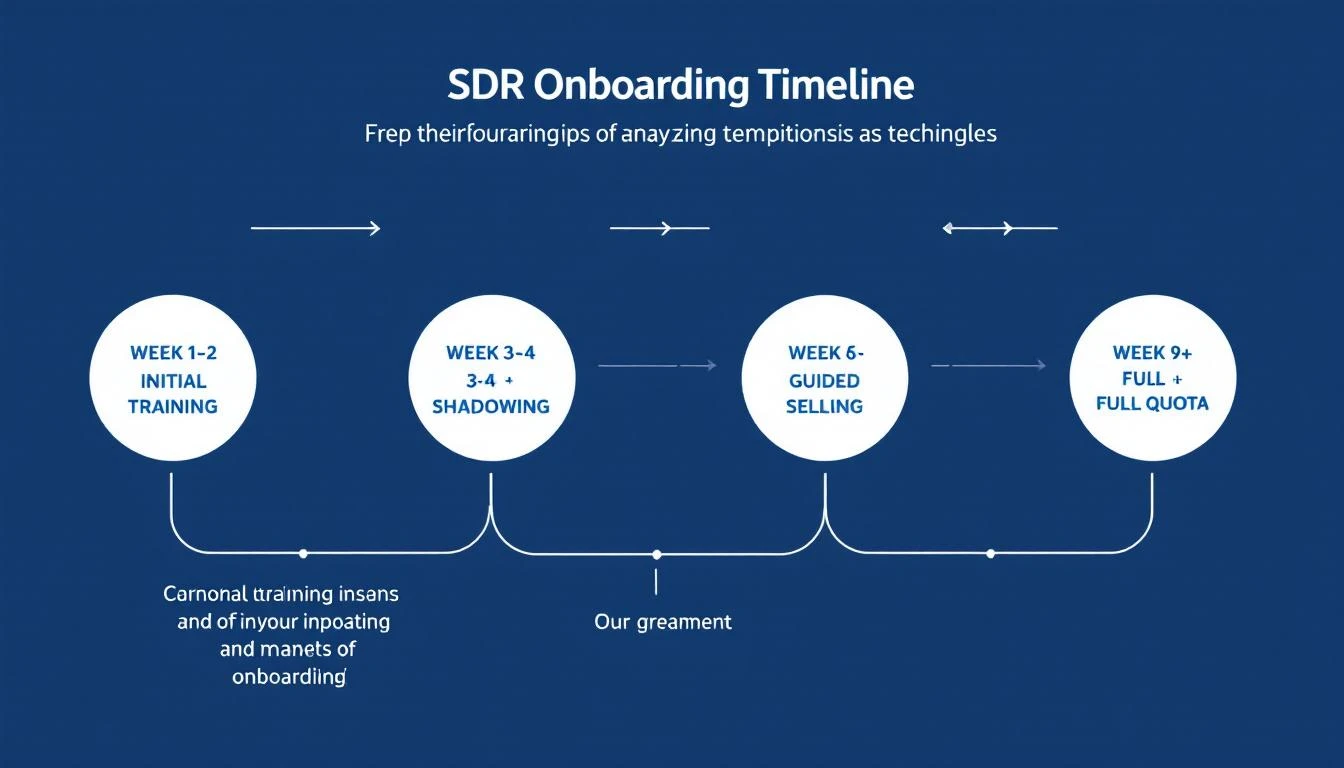
SDR Onboarding Timeline

Why SDR Ramp Time Is Getting Worse (Not Better)

Before we fix it, let's understand why it's broken.

The Information Overload Problem

New SDRs face more complexity than ever:

  • More tools: The average sales tech stack includes 10–15 tools (CRM, sequencer, dialer, enrichment, LinkedIn, intent data, chatbot, calendar...)
  • More channels: Email, phone, LinkedIn, video, chat — reps need fluency in all of them
  • More data: Intent signals, visitor identification, technographics, job changes — knowing what to act on is harder than finding it
  • More competition: Buyers get 50+ cold outreach messages per week. Differentiation requires deep product and persona knowledge

The Coaching Bandwidth Problem

Sales managers average 6–9 meetings per day. They don't have time to sit with every new rep. So training becomes passive: recordings to watch, docs to read, maybe a weekly 1:1 to "check in."

The result? New reps learn in isolation, build bad habits unchecked, and take months to course-correct.

The Metrics Misalignment Problem

Most onboarding programs measure the wrong things:

  • ❌ "How many calls did you make today?"
  • ❌ "Did you complete the training modules?"
  • ❌ "How many emails did you send?"

None of these tell you whether a rep is actually learning to sell. Activity metrics during onboarding create the illusion of progress while hiding fundamental gaps in messaging, targeting, and qualification skills.

The 8-Week SDR Onboarding Framework

Here's the framework top-performing teams use to get SDRs productive in half the time:

Week 1–2: Foundation (Product, ICP, Tools)

Goal: The rep can articulate your value proposition to any persona in your ICP without reading from a script.

Day 1–3: Company and Product Immersion

  • Company history, mission, and competitive positioning
  • Product demo (as a buyer, not a feature walkthrough)
  • Listen to 5 recorded discovery calls from top performers
  • Read 10 customer case studies or G2 reviews

Day 4–7: ICP and Persona Deep Dive

  • Define your top 3 buyer personas (title, pain points, language they use)
  • Map the buying committee for each target account size
  • Study 5 closed-won deals: what triggered the purchase? Who was involved?
  • Assignment: Write a 1-paragraph pitch for each persona. Get feedback from your AE.

Day 8–10: Tool Proficiency

  • CRM setup, pipeline stages, deal hygiene standards
  • Sequencer/email platform: build a test sequence
  • Dialer: make 10 practice calls (to internal team, not prospects)
  • LinkedIn Sales Navigator: build a sample target list
  • Signal tools setup: Configure visitor identification alerts, intent data filters, champion tracking notifications

Key Metric: Role-play assessment score (graded by manager or AE on value prop delivery, persona awareness, objection handling basics).

Week 3–4: Shadowing and Guided Practice

Goal: The rep can run a cold call and send a personalized email sequence without step-by-step guidance.

Shadowing Protocol:

  • Shadow 10+ live calls from experienced SDRs (mix of cold calls, follow-ups, and discovery)
  • After each call, write a 3-sentence debrief: what worked, what didn't, what they'd do differently
  • Shadow 2 AE discovery calls to understand what "good" looks like downstream

Guided Practice:

  • Co-pilot calls: rep leads the call, experienced SDR listens and coaches after
  • Send first real email sequences (manager reviews before send)
  • Respond to first inbound leads with manager oversight

Daily Rhythm:

  • Morning: 30 min call review + coaching
  • Mid-day: Outreach block (with feedback)
  • End of day: 15 min debrief with manager or buddy

Key Metric: Number of "coachable moments" identified per call (not call volume). If a rep isn't making mistakes, they're not pushing themselves hard enough.

Week 5–6: Independent Outreach with Training Wheels

Goal: The rep is working their own book of business with decreasing oversight.

Transition Steps:

  • Assign a real territory or account list
  • Rep builds their own target list using intent data and visitor identification signals
  • Rep prioritizes outreach based on buying signals (not alphabetical order)
  • Manager reviews sequences weekly (not daily)
  • Rep attends team call reviews and contributes feedback

Signal-Based Selling Introduction:

This is where modern onboarding diverges from the old playbook. Instead of giving reps a static list and saying "go," you teach them to read and act on buying signals:

  • Website visitors: "Company X visited your pricing page 3 times this week — that's your first call"
  • Champion job changes: "Your contact at Acme just moved to TechCorp — warm intro opportunity"
  • Content engagement: "This VP downloaded your ROI calculator — they're evaluating"
  • Tech stack signals: "They just adopted Salesforce — they'll need outbound tools next"

Reps who learn signal-based prioritization during onboarding consistently outperform those who start with cold lists. The data is clear: warm outreach based on buying signals converts 3–5x better than cold spray-and-pray.

Key Metric: Signal-to-meeting conversion rate (how many identified signals turn into booked meetings).

Week 7–8: Quota Ramp and Performance Calibration

Goal: Rep hits 50–75% of full quota with increasing independence.

This Phase Includes:

  • Full quota assignment (or ramped quota at 50–75%)
  • Weekly pipeline review with manager
  • Monthly deal review with AE
  • Peer coaching sessions (reps review each other's calls)
  • Self-directed learning: rep identifies their own skill gaps

Graduation Criteria:

  • Can articulate value prop for all personas without notes
  • Has booked meetings from at least 2 different channels
  • Pipeline generation meets or exceeds ramped quota
  • AE confirms lead quality is acceptable
  • Can handle top 5 objections without coaching

5 Common Onboarding Mistakes That Double Ramp Time

1. Training on Features Instead of Problems

New reps don't need to know every feature your product has. They need to know what problems buyers are trying to solve and how your product solves them differently than alternatives.

Fix: Replace feature training with "problem-solution" training. For each use case, teach: the buyer's pain → their current workaround → how your product eliminates it → proof it works (case study or metric).

2. Delaying Real Outreach Until "They're Ready"

Some managers keep reps in training mode for weeks because they're "not ready." But reps don't learn to sell by watching — they learn by doing.

Fix: Start guided outreach by Week 3. Early mistakes with coaching are more valuable than late perfection without practice.

3. Measuring Activity Instead of Quality

If your onboarding dashboard shows "calls made" and "emails sent," you're measuring effort, not skill. A rep can make 80 calls a day and learn nothing.

Fix: Measure coachable moments per call, signal-to-meeting conversion rate, and AE satisfaction scores on lead quality.

4. One-Size-Fits-All Onboarding

A rep with 3 years of SDR experience doesn't need the same training as someone straight out of college. Yet most programs run everyone through identical 4-week bootcamps.

Fix: Assess experience level on Day 1 (role play, ICP quiz, tool proficiency check). Fast-track experienced reps. Give more structure to newer ones.

5. No Feedback Loop Between AEs and SDRs

If your AEs don't give structured feedback on lead quality, SDRs have no way to calibrate. They'll keep booking meetings that go nowhere.

Fix: Weekly AE-SDR alignment meetings. AEs rate lead quality on a 1–5 scale. SDRs adjust targeting based on what converts downstream.

The Role of AI in SDR Onboarding (2026)

AI isn't replacing SDR onboarding — it's accelerating it. Here's how the best teams are using AI tools during ramp:

AI-Powered Call Coaching

Tools like Gong and Chorus record and analyze every call. During onboarding, they surface patterns that human coaches miss:

  • "You're talking 70% of the time on discovery calls — flip it to 30/70"
  • "Top performers mention the competitor by name — you're avoiding it"
  • "Your average call is 3 minutes — qualified meetings come from 8+ minute calls"

Signal-Based Daily Playbooks

Instead of giving new reps a cold list, platforms like MarketBetter generate a daily playbook that tells each rep exactly:

  • Who to contact (based on website visits, intent signals, and champion tracking)
  • Why they're a priority (the specific signal that triggered the action)
  • How to reach them (recommended channel and suggested messaging angle)
  • What to say (personalized talking points based on their company and activity)

This is transformative for new reps. Instead of spending an hour deciding who to call, they log in and their priority list is waiting. The platform does the research; the rep does the selling.

AI Email Personalization at Scale

New reps struggle with personalization because they don't know enough yet. AI tools can analyze a prospect's LinkedIn, company news, and website to generate personalized email openers that sound like the rep did 30 minutes of research.

The rep still controls the message, but the research barrier drops from 10 minutes per prospect to 30 seconds.

Automated CRM Hygiene

Nothing kills an SDR's ramp faster than CRM confusion. AI-powered CRM automation handles:

  • Auto-logging calls and emails
  • Updating deal stages based on activity
  • Flagging stale leads for follow-up
  • Deduplicating contacts before outreach

Reps spend less time on admin and more time learning to sell.

SDR Onboarding Checklist: The Complete List

Use this checklist as a template. Customize for your team, product complexity, and typical rep experience level.

Pre-Start (1 Week Before Day 1):

  • Send welcome doc with company overview, ICP summary, and competitive landscape
  • Set up all tool access (CRM, dialer, sequencer, LinkedIn Sales Nav, signal platform)
  • Assign onboarding buddy (experienced SDR, not AE)
  • Schedule Week 1 calendar with training sessions

Week 1–2 (Foundation):

  • Product demo from buyer's perspective
  • Listen to 5 top performer calls
  • Read 10 case studies / G2 reviews
  • ICP and persona deep dive
  • Write persona-specific pitches (get AE feedback)
  • CRM, sequencer, and dialer proficiency test
  • Signal platform setup (visitor ID, intent alerts, champion tracking)
  • Role-play assessment #1

Week 3–4 (Shadowing):

  • Shadow 10+ live calls
  • Write call debriefs
  • Shadow 2 AE discovery calls
  • Complete 5 co-pilot calls
  • Send first supervised email sequences
  • Role-play assessment #2

Week 5–6 (Independent):

  • Own territory / account list assigned
  • Build target list using signals
  • Prioritize outreach by buying signals
  • Weekly sequence review with manager
  • Attend and contribute to team call reviews

Week 7–8 (Quota Ramp):

  • Hit 50-75% of quota target
  • Weekly pipeline review
  • Monthly deal review with AE
  • Self-identified skill gaps documented
  • Graduation assessment passed

How MarketBetter Accelerates SDR Ramp Time

MarketBetter's daily SDR playbook is designed specifically to solve the #1 onboarding problem: new reps don't know where to start.

Instead of handing a new SDR a list of 500 accounts and saying "figure it out," MarketBetter:

  1. Identifies who's visiting your website — so reps focus on accounts that are already showing interest
  2. Scores and prioritizes accounts by buying signals — website visits, content downloads, champion job changes, tech stack changes
  3. Generates a daily action list — every morning, your rep sees exactly who to contact, why, and what to say
  4. Tracks multi-channel engagement — email opens, LinkedIn views, call outcomes all feed back into signal scoring
  5. Provides AI-powered email personalization — so new reps can send relevant, personalized outreach from Day 1

The result: SDRs spend Week 1 learning the product and ICP. By Week 3, they're working signal-prioritized accounts with AI assistance. By Week 6, they're booking meetings at rates that used to take 4+ months to reach.

Ready to see how it works? Book a demo →

Free Tool

Try our AI Lead Generator — find verified LinkedIn leads for any company instantly. No signup required.

The Warm Outbound Playbook: How to Turn Buying Signals Into Meetings [2026]

· 11 min read
sunder
Founder, marketbetter.ai

Cold outbound is dying. Not because outbound doesn't work — but because cold outbound doesn't work.

The numbers tell the story:

  • Average cold email reply rate: 1–3% (down from 8% in 2020)
  • Average cold call connect rate: 4.8% (Gong, 2025)
  • Percentage of buyers who say cold outreach is "irrelevant to their needs": 72% (LinkedIn State of Sales)

Meanwhile, warm outbound — reaching out to prospects who've already shown buying signals — converts at 3–5x higher rates than cold approaches.

The difference isn't the rep. It's not the script. It's not even the product. It's timing and relevance.

Cold outbound interrupts strangers. Warm outbound engages buyers who are already looking.

This playbook shows you exactly how to build a warm outbound motion from scratch — what signals to track, how to prioritize them, and how to turn them into meetings.

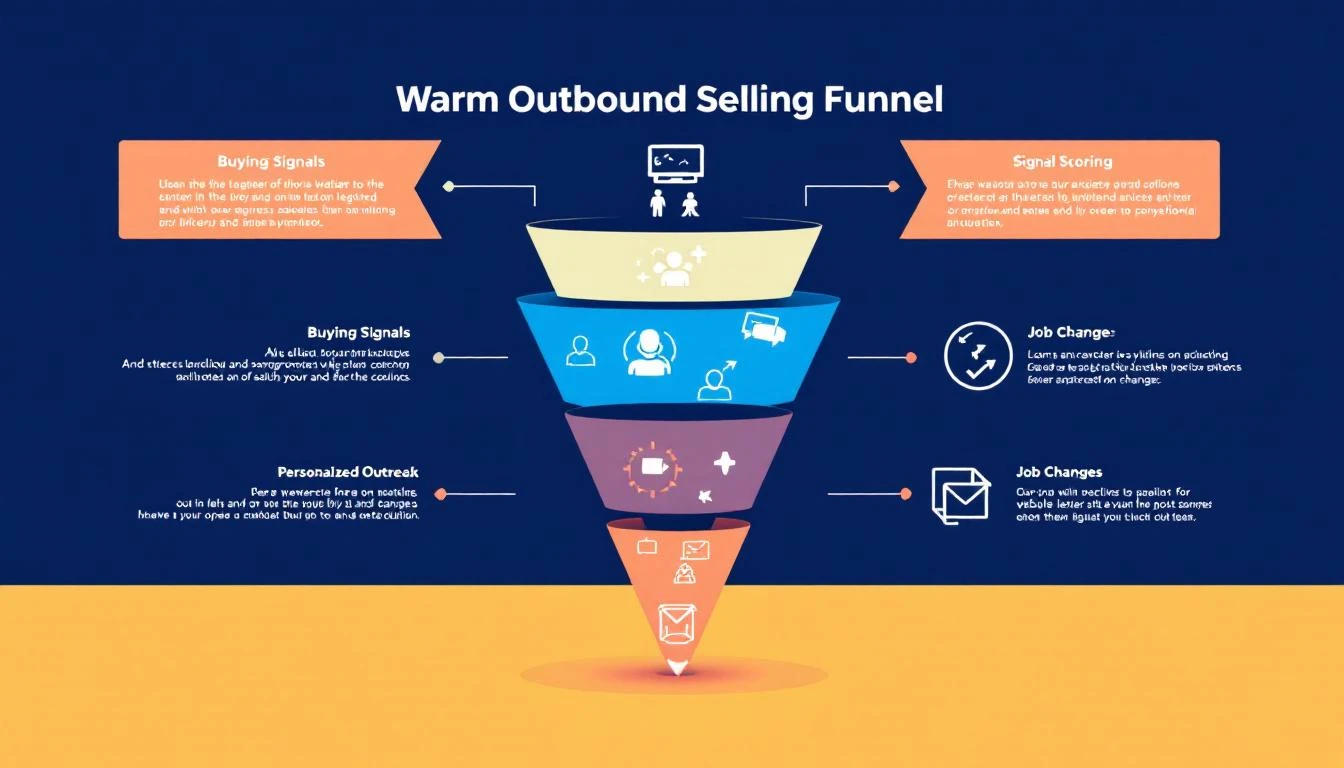
Warm Outbound Signal Funnel

What Is Warm Outbound?

Warm outbound is proactive sales outreach to prospects who've shown intent or interest signals — but haven't yet raised their hand (filled out a form, requested a demo, etc.).

It sits between two extremes:

ApproachSignal LevelExample
InboundHand-raise"I want a demo" form fill
Warm OutboundIntent signalsVisited pricing page 3x, competitor search, champion moved
Cold OutboundNo signalRandom list from a data provider

Warm outbound captures the 95% of buyers who are researching but haven't filled out a form. They're evaluating. They're comparing. They're building internal business cases. They just haven't reached out yet.

Your competitors are waiting for the form fill. You're going to reach them first.

The 7 Buying Signals That Power Warm Outbound

Not all signals are equal. Here's how to tier them:

Tier 1: High-Intent Signals (Act Within 24 Hours)

1. Website Visitor Identification — Pricing & Demo Pages

When a company visits your pricing page or demo page multiple times, someone is actively evaluating your product. This is the single highest-converting warm outbound signal.

  • What it looks like: "3 visitors from Acme Corp viewed your pricing page in the last 48 hours"
  • Why it matters: They're past awareness. They're doing math. They're probably comparing you.
  • How to act: Direct call or email to the likely buyer (VP Sales, SDR Manager). Reference their evaluation: "I noticed your team has been evaluating SDR tools — mind if I share how we compare on the areas that usually matter most?"

2. Champion Job Changes

When a previous champion, power user, or customer moves to a new company, you have a built-in referral. They already know your product works.

  • What it looks like: "Sarah Chen (former AE at Hologram, your customer) just joined TechCorp as VP Sales"
  • Why it matters: 70% of champions who move will evaluate their previous tools at the new company (UserGems data)
  • How to act: Personal, non-pushy outreach: "Congratulations on the move to TechCorp. When you're settled in, would love to see if we can help there too."

3. Active Competitor Evaluation

When a prospect is searching for your competitors, reading comparison pages, or visiting G2 comparison pages, they're in active buying mode.

  • What it looks like: "Prospect searched 'Apollo vs ZoomInfo' and landed on your comparison page"
  • Why it matters: They're deciding NOW. Not next quarter. Now.
  • How to act: Fast, relevant outreach that positions your differentiation: "I see you're comparing outbound tools — most teams in [their industry] choose us for [specific differentiator]. Worth 15 minutes?"

Tier 2: Medium-Intent Signals (Act Within 48–72 Hours)

4. Content Engagement Patterns

A single blog post visit means nothing. But a pattern — 3 blog posts about SDR productivity, a whitepaper download, and a webinar registration in the same week — signals active research.

  • What it looks like: "Director of Sales Ops at DataCorp downloaded your ROI calculator and read 3 SDR-related blog posts"
  • Why it matters: They're building a business case. They might not know your product yet, but they're solving a problem you solve.
  • How to act: Value-led outreach tied to their research topic: "I saw you downloaded our SDR ROI calculator — curious what you found. Most teams we talk to in [industry] are seeing [specific metric]. Mind sharing what you're working on?"

5. Tech Stack Changes

When a company adopts or drops specific technologies, it creates adjacent buying needs. New Salesforce adoption? They'll need outbound tools. Dropped their dialer? They're looking for a new one.

  • What it looks like: "TechCorp just adopted Salesforce (detected via technographic data)"
  • Why it matters: Technology adoption creates buying windows — 60–90 day periods where adjacent purchases spike
  • How to act: Frame your outreach around the transition: "Noticed you recently adopted Salesforce — most teams add outbound tooling within the first quarter. Happy to share what we've seen work."

Tier 3: Contextual Signals (Act Within 1–2 Weeks)

6. Hiring Signals

When a company posts SDR or sales manager job listings, they're investing in outbound. That means they need tools to make those new hires productive.

  • What it looks like: "Acme Corp posted 4 SDR roles and a Head of Sales Development position on LinkedIn"
  • Why it matters: They're building or scaling a sales team — exactly when they need your platform
  • How to act: Frame around their growth: "Saw you're scaling the SDR team — the ramp time challenge is real. We help teams get new reps productive in 6 weeks instead of 4 months."

7. Funding and Expansion Events

A company that just raised Series B, opened a new office, or announced expansion plans is spending money. GTM is almost always a top priority post-funding.

  • What it looks like: "DataFlow just raised $30M Series B (Crunchbase alert)"
  • Why it matters: Post-funding companies allocate 30–40% of new capital to sales and marketing (First Round data)
  • How to act: Relevant, congratulatory outreach: "Congrats on the raise — exciting time. Most Series B teams we work with are figuring out how to scale outbound without scaling headcount linearly. Worth a conversation?"

Building Your Signal Stack

Warm outbound requires three layers of technology:

Layer 1: Signal Collection

You need tools that capture buying signals from multiple sources:

  • Website visitor identification — Know which companies are visiting your site and which pages they're viewing
  • Intent data providers — Track off-site research behavior (G2 visits, competitor comparisons, keyword searches)
  • LinkedIn monitoring — Job changes, company updates, hiring patterns
  • Technographic data — Tech stack adoptions and changes
  • CRM signals — Re-engagement from closed-lost deals, email opens on old threads

Layer 2: Signal Scoring and Prioritization

Raw signals are noise. You need a system that scores and ranks them so reps know what to act on first.

A simple scoring model:

SignalPointsDecay
Pricing page visit (3+ times)507 days
Demo page visit407 days
Champion job change4530 days
Competitor comparison page3514 days
Content pattern (3+ pieces)2514 days
Tech stack change2030 days
Hiring signal1530 days
Funding event1060 days

Accounts that cross your threshold (e.g., 50+ points) go into the "act now" queue. Everything else goes to nurture.

Layer 3: Action Orchestration

This is where most signal stacks fail. They collect data and score it — but they don't tell reps what to do.

Your action layer should:

  • Generate a daily prioritized list for each rep
  • Recommend the best channel (call vs. email vs. LinkedIn) based on persona and signal type
  • Suggest personalized messaging based on the specific signal
  • Track multi-touch sequences across channels
  • Feed outcomes back into the scoring model (closed-won = boost similar signals)

The Warm Outbound Workflow (Step-by-Step)

Here's the daily rhythm for an SDR running warm outbound:

Morning (8:00–8:30 AM): Signal Review

  1. Open your daily playbook / signal dashboard
  2. Review new signals from overnight (website visits, champion moves, intent spikes)
  3. Prioritize: High-intent signals first, then medium, then contextual
  4. Identify the top 10–15 accounts to work today

Mid-Morning (8:30–11:00 AM): Phone Block

  1. Call high-intent signal accounts first (pricing page visitors, champion moves)
  2. Reference the signal in your opener: "I'm calling because [specific reason]"
  3. Log outcomes and next steps in CRM
  4. Queue follow-up sequences for no-answers

Late Morning (11:00 AM–12:00 PM): Email and LinkedIn

  1. Send personalized emails to medium-intent signal accounts
  2. Connect on LinkedIn with contextual connection notes
  3. Engage with prospect content (genuine comments, not "Great post!")
  4. Follow up on opened emails from previous sequences

Afternoon (1:00–3:00 PM): Follow-Up and Research

  1. Follow up on callbacks and email replies
  2. Research new signals for tomorrow's priority list
  3. Update CRM with signal data and engagement history
  4. Review call recordings from the morning (self-coaching)

End of Day (3:00–3:30 PM): Pipeline Review

  1. Update opportunity stages
  2. Note any signals that changed (new visits, additional engagement)
  3. Flag accounts for AE warm handoff
  4. Set next-day priorities

Cold vs. Warm Outbound: The Performance Gap

Here's what the data looks like when teams switch from cold to warm:

MetricCold OutboundWarm OutboundImprovement
Email reply rate1–3%8–15%3–5x
Cold call connect rate4.8%12–18%2.5–3.7x
Meeting conversion rate0.5–1%3–6%5–6x
Pipeline per SDR per month$50K–$100K$150K–$300K2–3x
Average deal cycle45–60 days28–38 days30–40% faster
SDR quota attainment52%78%50% higher

The ROI is undeniable. But it requires infrastructure, not just hustle.

5 Warm Outbound Mistakes to Avoid

1. Treating Every Signal the Same

A pricing page visit and a blog post visit are not equal signals. If your reps treat them with the same urgency, they'll waste time on low-intent accounts and miss high-intent ones.

Fix: Build a tiered signal scoring model (see above) and prioritize ruthlessly.

2. Over-Automating the Outreach

Warm outbound works because it's relevant and personal. If you blast automated sequences to every signal, you'll kill the advantage.

Fix: Automate signal collection and prioritization. Keep the outreach human. A 2-sentence personalized email beats a 5-paragraph automated one.

3. Ignoring Signal Decay

A pricing page visit from 3 weeks ago is stale. A champion job change from 6 months ago is ancient history. Signals have a shelf life.

Fix: Build decay into your scoring model. Signals lose value over time. A 50-point pricing visit should drop to 25 after 7 days and 0 after 14.

4. No Feedback Loop

If your reps don't know which signals actually convert to revenue, they can't improve their prioritization. Most teams track signals in → meetings out, but never close the loop to pipeline and revenue.

Fix: Track signal-to-revenue attribution. Which signal types generate the highest-value pipeline? Double down on those.

5. Separate Signal and Action Tools

If your reps need to check one tool for visitor ID, another for intent data, another for champion tracking, and then manually build their outreach list — they'll spend more time toggling than selling.

Fix: Consolidate into a single platform that collects signals AND orchestrates actions.

How MarketBetter Powers Warm Outbound

MarketBetter was built specifically for warm outbound. Here's how it works:

Signal Collection → Scoring → Daily Playbook → Execution

  1. Website Visitor Identification: Know which companies visit your site, which pages they view, and how often — no form fills required
  2. Buying Signal Aggregation: Website visits, email engagement, champion job changes, and intent data all feed into a single signal score
  3. Daily SDR Playbook: Every morning, each rep gets a prioritized list of who to contact, why they're a priority, and what to say
  4. Multi-Channel Execution: Email sequences, smart dialer, and LinkedIn — all from one platform
  5. AI Personalization: The AI researches each prospect and generates personalized outreach based on their specific signals
  6. Closed-Loop Attribution: Track which signals generate pipeline and revenue, then optimize your scoring model

Most signal platforms tell you who. MarketBetter tells you who, why, and what to do next.

That's the difference between a dashboard and a playbook.

Ready to switch from cold to warm? Book a demo →

Free Tool

Try our AI Lead Generator — find verified LinkedIn leads for any company instantly. No signup required.

14 Best Account-Based Marketing Tools 2026: Pricing + G2 Compared

· 15 min read

Best ABM tools for B2B teams in 2026

Account-based marketing sounds sophisticated. In practice, it means stop wasting money on leads that will never buy and focus on accounts that actually match your ideal customer profile.

The problem is that most ABM platforms were built for enterprise teams with $100K+ budgets and dedicated ABM managers. If you're a mid-market B2B company trying to run account-based selling without a six-figure tech stack, your options have been limited — until now.

We tested 14 ABM tools across five categories — all-in-one platforms, intent data providers, visitor identification, orchestration engines, and AI-native alternatives — to help you find the right fit for your team size, budget, and ABM maturity level.

Quick Comparison: ABM Tools at a Glance

ToolBest ForStarting PriceG2 RatingFree Trial
MarketBetterSignal-to-action ABM for SDR teams$99/user/month4.97/5Yes
Demandbase OneEnterprise ABM orchestration~$18K/yr (200 employees)4.3/5Demo only
6senseAI-powered buying stage predictionCustom (~$30K+/yr)4.3/5Free tier available
TerminusABM advertising and chatCustom (~$2K+/mo)4.4/5Demo only
RollWorksMid-market ABM advertising~$1K/mo4.3/5Demo only
ZoomInfoContact data and intent enrichmentCustom (~$15K+/yr)4.4/5Demo only
BomboraThird-party intent dataCustom (~$25K+/yr)4.4/5Demo only
Apollo.ioAffordable ABM prospectingFree / $49/mo4.8/5Free tier
HubSpot Marketing HubIntegrated ABM in existing CRM$800/mo4.4/5Free tools
WarmlyWebsite visitor deanonymization$499/mo4.7/5Free tier
Common RoomSignal aggregation from communitiesCustom4.5/5Free tier
Clearbit (HubSpot)Real-time data enrichmentIncluded with HubSpot4.4/5Free tier
Leadfeeder (Dealfront)European website visitor tracking$99/mo4.3/5Free tier
TechTarget Priority EngineTech buyer intent dataCustom4.1/5Demo only

What Makes ABM Software Different from Regular Marketing Tools

Standard marketing automation (Marketo, HubSpot, Pardot) works on a lead-by-lead basis: capture an email, score it, nurture it, pass it to sales. Account-based marketing flips that model entirely.

ABM starts with accounts, not leads. You identify 50-500 target companies, then run coordinated campaigns across every contact at those companies simultaneously. The buying committee at a B2B company typically includes 6-10 decision-makers. Standard lead-based marketing only reaches one of them.

That means ABM tools need to solve fundamentally different problems:

  • Account identification: Which companies should you target?
  • Buying group mapping: Who are the decision-makers at each account?
  • Intent signals: Which target accounts are actively researching solutions?
  • Orchestration: How do you coordinate email, ads, content, and sales outreach across an entire buying committee?
  • Attribution: Did the campaign influence the account, or did they just happen to buy?

The tools below tackle these problems from different angles. Some do everything. Some do one thing exceptionally well. Your choice depends on where your ABM program stands today.

Tier 1: All-in-One ABM Platforms

1. MarketBetter — Best for Signal-to-Action ABM

starting at $99/user/month | 4.97/5 on G2

Most ABM tools tell you WHICH accounts are showing interest. MarketBetter tells your SDRs exactly WHAT TO DO about it.

The platform combines website visitor identification, intent signal aggregation, and AI-powered email automation into a daily SDR playbook. Instead of logging into a dashboard and interpreting data, your team gets a prioritized action list every morning: who to call, what to email, and what messaging to use — based on real-time buying signals.

What sets it apart for ABM:

  • Daily SDR Playbook: Converts intent signals into specific, actionable tasks for each rep. No dashboard interpretation required.
  • Website visitor identification: Identifies companies visiting your site and maps them against your target account list automatically.
  • AI-powered email sequences: Generates hyper-personalized outreach based on the prospect's actual behavior, not generic templates.
  • Smart Dialer: Built-in calling with AI-suggested talking points based on intent signals and engagement history.
  • AI Chatbot: Engages target account visitors in real-time, qualifying and routing based on your ABM tier definitions.

Pricing:

  • Standard: $99/user/month — All products included (Daily SDR Playbook, Website Visitor ID, AI Chatbot, Email Automation, Smart Dialer add-on). 5M AI credits + 500 enrichment credits per seat.
  • Enterprise: Custom pricing — Everything in Standard + custom integrations and volume discounts.

Best for: B2B teams running ABM without dedicated ABM managers. If your SDRs need to execute account-based plays without interpreting complex dashboards, MarketBetter turns signals into actions automatically.

See how MarketBetter compares →

2. Demandbase One — Best for Enterprise ABM Orchestration

Custom pricing (~$18K-$108K/yr depending on company size) | 4.3/5 on G2

Demandbase is the category leader for a reason. After acquiring Engagio (account-based orchestration) and InsideView (intent data), they built the most comprehensive ABM platform on the market. If you have budget, headcount, and ABM maturity, Demandbase is the gold standard.

Core capabilities:

  • Account Intelligence: Proprietary intent data + IP-based company identification + technographic data. Covers ~1.5M companies.
  • ABM advertising: Programmatic display ads targeted to specific accounts. Reporting at the account level, not just impression level.
  • Orchestration: Multi-channel campaign coordination across email, ads, web personalization, and sales alerts.
  • Sales Intelligence: Account insights delivered directly in Salesforce or HubSpot. Reps see intent surges, engagement scores, and recommended actions.

The real cost breakdown: Demandbase doesn't publish pricing, but based on Vendr and G2 data:

  • 200-employee company: $18,100-$31,700/year
  • 500-employee company: $35,000-$65,000/year
  • 1,000+ employees: $58,500-$108,600/year
  • Enterprise (full platform): Up to $300,000/year

Additional costs include per-user fees ($1,200-$3,000/year), ad spend (separate), and implementation services.

Best for: Enterprise marketing teams with $50K+ ABM budgets and dedicated ABM managers who need full-stack orchestration.

Not ideal for: Mid-market teams under 200 employees or companies without existing ABM processes. The platform's power is wasted without the team to operate it.

3. 6sense Revenue AI — Best for Predictive Account Targeting

Custom pricing (~$30K+/yr) | 4.3/5 on G2

6sense's core pitch is predicting which accounts will buy before they ever fill out a form. Their AI analyzes billions of intent signals to predict where each account sits in the buying journey — from awareness to decision stage.

What makes it different:

  • Predictive buying stages: AI categorizes accounts into 6 stages (Target → Awareness → Consideration → Decision → Purchase → Loyalty). Your team focuses effort on accounts in active buying stages.
  • Dark funnel visibility: 6sense claims to capture intent signals from the "dark funnel" — anonymous research that happens before prospects engage with your brand.
  • Audience building: Create targeted audiences based on predicted buying stage, then push to LinkedIn, Google, and display ad platforms.
  • Revenue AI for Sales: Gives individual reps account-level intelligence inside their CRM, including predicted close dates and recommended contacts.

Pricing reality: 6sense offers a free tier (Revenue AI for Marketing, up to 50 credits/month), but production use typically starts at $30K-$60K/year. Enterprise contracts regularly exceed $100K/year.

Best for: Marketing teams that want AI-driven account prioritization and are willing to invest in predictive analytics. Works best with 12+ months of historical CRM data for model training.

Watch out for: 6sense's value compounds over time. First-quarter results can be underwhelming while the AI learns your patterns.

Tier 2: ABM Advertising and Engagement

4. Terminus — Best for ABM Advertising

Custom pricing (~$2K+/mo) | 4.4/5 on G2

Terminus started as a pure ABM advertising platform and has expanded into a broader engagement hub. Their display advertising capabilities remain best-in-class for account-level targeting — you're buying impressions against specific companies, not broad audience segments.

Key features:

  • Account-level display advertising across 30K+ publisher sites
  • LinkedIn integration for sponsored content targeting
  • Chat Experiences: web chat that identifies and routes target account visitors
  • Email Experiences: dynamic email signatures and banner ads
  • Measurement Studio: multi-touch attribution at the account level

Pricing: Not public, but typically starts around $2,000/month for the base platform. Ad spend is separate and typically $3,000-$10,000/month for meaningful coverage.

Best for: Teams where advertising is the primary ABM channel and you need account-level ad reporting that goes beyond impression counts.

5. RollWorks (NextRoll) — Best Mid-Market ABM Advertising

Custom pricing (~$1K/mo) | 4.3/5 on G2

RollWorks is Terminus for teams that don't have Terminus budgets. Built on NextRoll's advertising infrastructure, it provides account-based display advertising, retargeting, and basic ABM orchestration at a more accessible price point.

Key features:

  • Account-level display and social advertising
  • Account scoring and prioritization
  • Lead-to-account matching
  • Journey analytics and attribution
  • Integration with Salesforce and HubSpot

Pricing: Typically starts just under $1,000/month. More accessible than Demandbase or Terminus, but still requires meaningful ad spend on top.

Best for: Mid-market companies (50-500 employees) running their first ABM advertising programs. Lower barrier to entry than enterprise platforms.

Tier 3: Intent Data and Enrichment

6. ZoomInfo — Best Contact Database for ABM

Custom pricing (~$15K+/yr) | 4.4/5 on G2

ZoomInfo isn't an ABM platform per se, but it's the backbone of most ABM programs. Their B2B contact database is the largest on the market, with 600M+ professional profiles and 135M+ verified phone numbers.

ABM-relevant features:

  • Intent data (powered by Bombora integration)
  • Website visitor identification
  • Contact discovery across target account buying committees
  • Workflows for automated outreach when intent surges
  • FormComplete for enriching form submissions in real-time

Pricing: ZoomInfo starts around $15,000/year for the basic SalesOS plan. Intent data, website visitor ID, and advanced features push costs to $25K-$50K+/year. Contracts are annual.

Best for: Teams that need to build out contact lists within target accounts. If you know WHICH accounts to target but can't find the right PEOPLE, ZoomInfo fills that gap.

7. Bombora — Best Third-Party Intent Data

Custom pricing (~$25K+/yr) | 4.4/5 on G2

Bombora is the largest B2B intent data co-op, aggregating research behavior from 5,000+ B2B media publishers. Their Company Surge® data tells you when accounts are researching topics related to your product at rates above normal baseline.

How it works: Bombora tracks when employees at a company consume content about specific topics (e.g., "sales automation," "visitor identification," "ABM software") at volumes significantly higher than their historical average. A "surge" indicates the company may be in an active buying cycle.

ABM application: Layer Bombora intent data on top of your target account list. Instead of pursuing all 500 target accounts equally, focus on the 50-75 currently showing research surges. Most ABM and sales platforms (Demandbase, 6sense, ZoomInfo, Salesforce) integrate with Bombora directly.

Best for: Adding intent signals to an existing ABM stack. Bombora is a data layer, not a platform — you'll still need tools for activation.

8. Clearbit (Now Part of HubSpot) — Best for Real-Time Enrichment

Included with HubSpot / Free tier available | 4.4/5 on G2

HubSpot acquired Clearbit in late 2023, and the enrichment capabilities are now baked into HubSpot's platform. Clearbit provides real-time firmographic and technographic data on companies and contacts: employee count, revenue, technology stack, funding stage, and more.

ABM use cases:

  • Enrich form submissions instantly (turn an email into a full company profile)
  • Score and route leads based on firmographic fit
  • Identify anonymous website visitors at the company level
  • Dynamic audience building based on technographic data

Best for: HubSpot users who need enrichment built into their existing workflow without adding another vendor.

Tier 4: Visitor Identification for ABM

9. Warmly — Best for Website Visitor Deanonymization

Free tier / $499/mo | 4.7/5 on G2

Warmly identifies companies and individuals visiting your website, then orchestrates outreach through email and LinkedIn. Their approach is closer to "warm outbound" than traditional ABM — catching accounts while they're actively on your site.

Key features:

  • Individual-level visitor identification (not just company level)
  • Automated LinkedIn and email outreach when target accounts visit
  • AI chat for real-time engagement
  • CRM sync with engagement scoring

Pricing:

  • Free: Basic identification features
  • Business: $499/month
  • Enterprise: Custom pricing

Best for: Teams focused on converting website visitors from target accounts. If your ABM strategy centers on "strike while the iron is hot," Warmly catches accounts at peak intent.

Limitation: Warmly identifies visitors reactively. It doesn't help you build target account lists or run proactive advertising. It's an ABM activation tool, not a planning tool.

10. Leadfeeder (Dealfront) — Best for European Market ABM

Free tier / $99/mo | 4.3/5 on G2

Leadfeeder identifies companies visiting your website using reverse-IP lookup and matches them against their database. After merging with Echobot to form Dealfront, they've become the strongest option for B2B visitor identification in European markets.

ABM application:

  • Identify target accounts visiting your site
  • Filter by industry, size, and geography
  • Feed account visits into CRM as activity triggers
  • GDPR-compliant data processing (important for EU-focused ABM)

Best for: B2B companies with European target accounts. Dealfront's data quality in DACH, Nordics, and UK markets is stronger than most US-centric competitors.

Tier 5: AI-Native ABM Alternatives

11. Apollo.io — Best Affordable ABM Starting Point

Free tier / $49/mo per user | 4.8/5 on G2

Apollo isn't marketed as an ABM tool, but its combination of a 275M+ contact database, intent data, and email sequencing makes it a practical ABM execution platform for teams that can't afford Demandbase.

ABM-relevant features:

  • Build target account lists by industry, size, technology, and intent signals
  • Find buying committee members across those accounts
  • Create multi-step email sequences personalized per account
  • Intent data to prioritize accounts (included in paid plans)
  • LinkedIn integration for social selling

Pricing:

  • Free: 10K credits, basic search
  • Basic: $49/user/month (unlimited credits, email sequencing)
  • Professional: $79/user/month (advanced filters, call recording)
  • Organization: $149/user/month (intent data, custom reports)

Best for: Early-stage ABM teams that need to identify, research, and contact target accounts without spending $50K+ on an enterprise platform. Apollo won't orchestrate multi-channel ABM campaigns, but it handles the research-and-outreach fundamentals affordably.

12. Common Room — Best for Community Signal ABM

Free tier / Custom pricing | 4.5/5 on G2

Common Room aggregates buying signals from community channels — GitHub stars, Discord activity, Stack Overflow questions, Twitter mentions, LinkedIn engagement. If your target accounts are active in developer or professional communities, Common Room surfaces signals that traditional intent data providers miss.

ABM use cases:

  • Identify prospects engaging with your open-source project or community
  • Score accounts based on community engagement depth
  • Alert sales when target account employees are active in relevant communities
  • Enrich contacts with social and community data

Best for: Product-led growth companies where community engagement is a leading indicator of purchase intent. Not ideal for traditional enterprise sales motions.

How to Choose the Right ABM Tool

By Team Size and Budget

Startup (1-3 people running ABM, budget under $1K/month):

  • Start with Apollo.io + MarketBetter
  • Apollo handles contact research and list building
  • MarketBetter identifies website visitors and creates daily action plans
  • Total cost: ~$550-$600/month

Mid-market (3-5 people, budget $2K-$5K/month):

  • MarketBetter for daily execution
  • Add Bombora or ZoomInfo for intent data layering
  • Consider RollWorks for account-based advertising
  • Total cost: $2,500-$5,000/month

Enterprise (5+ people, dedicated ABM manager, budget $5K+/month):

  • Demandbase One or 6sense as the core platform
  • ZoomInfo for contact enrichment
  • Terminus for advertising if display is a key channel
  • Total cost: $8,000-$25,000+/month

By ABM Maturity

Just starting ABM:

  • Don't buy a $50K platform. Start with a target account list in a spreadsheet, use Apollo or MarketBetter to identify and contact buying committees, measure results for 90 days, then invest in more tooling.

Running basic ABM:

  • You have target account lists and some personalized outreach. Add intent data (Bombora, 6sense free tier) to prioritize accounts. Add visitor identification (MarketBetter, Warmly) to catch accounts at peak intent.

Mature ABM program:

  • You need orchestration across advertising, email, website personalization, and sales. Demandbase or 6sense becomes worth the investment. Layer in Terminus for advertising and ZoomInfo for enrichment.

What Most Teams Get Wrong

Mistake 1: Buying an enterprise ABM platform before having ABM processes. Demandbase and 6sense are powerful, but they're wasted on teams that haven't defined target accounts, mapped buying committees, or built account-specific messaging. Start simple.

Mistake 2: Confusing intent data with action. Knowing an account is "surging" on a topic doesn't close deals. Your SDRs need specific instructions: who to call, what to say, when to follow up. That's where tools like MarketBetter bridge the gap between data and execution.

Mistake 3: Running ABM in isolation from sales. ABM is a team sport. If marketing runs account-based advertising but sales doesn't follow up with personalized outreach, you're wasting ad spend. Choose tools that connect marketing signals to sales actions.

Free Tool

Try our Lookalike Company Finder — find companies similar to your best customers in seconds. No signup required.

The Bottom Line

Account-based marketing doesn't require a six-figure tech stack. It requires knowing which accounts to target, understanding their buying signals, and executing coordinated outreach.

For most B2B teams, the winning formula is:

  1. A way to identify and prioritize target accounts (intent data)
  2. A way to reach the buying committee (contact data + outreach automation)
  3. A way to turn signals into daily SDR actions (playbook automation)

Enterprise platforms like Demandbase and 6sense excel at #1 and partly #2. Tools like MarketBetter focus on turning #1 into #3 — giving your SDRs a daily playbook instead of a dashboard.

Start with what your team can actually use today. Scale the stack as your ABM program matures.


Ready to see how MarketBetter turns ABM signals into SDR actions? Book a demo →

Best AI Sales Chatbots for B2B Teams in 2026 [Compared]

· 16 min read

Best AI Sales Chatbots for B2B Teams in 2026

Your best leads are on your website right now. They're reading your pricing page, comparing you to competitors, and evaluating whether to reach out.

Most of them leave without saying a word.

An AI sales chatbot changes that equation. Instead of passive "How can I help?" popups that visitors instantly dismiss, modern AI chatbots identify who's on your site, understand their intent, and start relevant conversations that lead to booked meetings.

But not all chatbots are created equal. Some are glorified FAQ bots. Others require six-figure budgets and a Salesforce admin to configure. And a few actually deliver what matters: qualified meetings on your calendar without manual effort.

We evaluated 30+ AI chatbot solutions and narrowed it down to the 12 that actually drive pipeline for B2B sales teams in 2026.

What to Look For in an AI Sales Chatbot

Before comparing tools, here's what separates a real AI sales chatbot from a fancy contact form:

1. Visitor Intelligence

The chatbot should know who it's talking to. Anonymous visitors get generic greetings. But when a VP of Sales from your ICP visits your pricing page for the third time? That's a signal that demands a personalized response.

2. Conversation Quality

"Hi there! How can I help you?" is not a sales conversation. The best chatbots reference the visitor's company, their browsing behavior, and tailor messaging to their stage in the buying journey.

3. Lead Qualification

Your sales team doesn't need more conversations — they need more qualified conversations. The chatbot should ask the right questions (company size, timeline, budget range) and route based on the answers.

4. Meeting Booking

Every extra click between "I'm interested" and "meeting booked" costs you conversions. The chatbot should check rep calendars and book meetings in real-time, not just collect email addresses.

5. Human Handoff

AI handles 80% of conversations. But when a $50K deal prospect says "I need to talk to someone now," the chatbot should instantly notify the right rep via Slack and hand off the conversation with full context.

6. CRM Integration

If chat conversations don't flow into your CRM automatically, you're creating data entry work instead of eliminating it. Native HubSpot and Salesforce integration is table stakes.

Quick Comparison: AI Sales Chatbots at a Glance

ChatbotBest ForStarting PriceVisitor IDMeeting BookingCRM Integration
MarketBetterSDR teams wanting chat + visitor ID + playbook in oneContact for pricing✅ Built-inHubSpot, Salesforce
WarmlyABM teams with Salesforce$10,000/year✅ Built-inSalesforce, HubSpot
Drift (Salesloft)Enterprise inbound qualificationContact sales❌ Add-onSalesforce, HubSpot
QualifiedSalesforce-native enterprises$3,500/month✅ With 6senseSalesforce only
IntercomProduct-led growth companies$39/seat/monthHubSpot, Salesforce
Chili PiperForm-to-meeting conversion$22.50/user/monthHubSpot, Salesforce
ZoomInfo ChatData-rich enterprise conversations~$24,800/year✅ Built-inSalesforce, HubSpot
TidioSMBs needing affordable automation$29/monthHubSpot
HubSpot ChatbotTeams already on HubSpotFree (basic)HubSpot native
Salesforce EinsteinSalesforce-heavy enterprisesContact salesSalesforce native
FreshchatBudget-conscious mid-market$19/agent/monthFreshsales, HubSpot
DocketTechnical sales (AI sales engineer)Contact salesSalesforce, HubSpot

The 12 Best AI Sales Chatbots in 2026

1. MarketBetter

Best for: B2B sales teams that want AI chat, visitor identification, and SDR workflow automation in a single platform.

Most AI chatbots sit in isolation. They capture a lead, maybe book a meeting, and that's where their value ends. Your SDR still needs to research the prospect, figure out what they care about, and decide what to do next.

MarketBetter takes a fundamentally different approach. The AI chatbot is just one part of a complete SDR operating system. When a visitor lands on your site, MarketBetter identifies their company, tracks their browsing behavior, and feeds that context directly into the chatbot conversation.

But here's what makes it unique: after the chat, the lead doesn't just land in your CRM. It flows into your SDR's daily playbook — a prioritized task list that tells reps exactly who to contact, through which channel, and what to say.

Key capabilities:

  • Built-in visitor identification — Know the company before the conversation starts
  • Intent-aware conversations — Chatbot references pages visited, return frequency, and engagement signals
  • Daily SDR Playbook — Chat leads automatically prioritized alongside email, call, and LinkedIn tasks
  • Smart Dialer integration — If the chat reveals a hot lead, your SDR can call them immediately from the same platform
  • Multi-channel follow-up — Automated email sequences triggered by chat interactions
  • Team deduplication — Ensures two reps don't chase the same prospect who chatted and also filled out a form

What sets it apart: MarketBetter doesn't just capture leads from chat — it orchestrates the entire follow-up workflow across every channel. The chatbot is the entry point; the playbook is the execution engine.

Pricing: Contact for pricing. Plans include chatbot, visitor identification, email automation, and smart dialer.

Book a Demo →


2. Warmly

Best for: ABM-focused teams that want intent-driven chatbot engagement on Salesforce.

Warmly combines website visitor identification with AI-powered chat that engages prospects based on intent signals. The chatbot monitors both on-site behavior (pages visited, time spent) and off-site signals (ad engagement, email opens) to determine when and how to engage.

The platform can identify anonymous visitors at the company level, score them based on ICP fit, and trigger personalized chatbot messages only for high-intent prospects. This avoids the "chatbot pops up on every page for every visitor" problem that annoys more people than it converts.

Key capabilities:

  • Intent-based chat triggers (only engage ICP-fit, high-intent visitors)
  • Closed-lost account reactivation via personalized chat messaging
  • Slack notifications for real-time human handoff
  • Round-robin lead routing on Business plan and above
  • CRM integration with Salesforce and HubSpot

What's missing: Warmly focuses primarily on the chatbot and visitor identification layer. It doesn't include outbound email automation, a dialer, or SDR workflow tools. If a chatbot lead needs follow-up via phone or email, your reps switch to another tool.

Pricing: Free plan available. Paid plans start at $10,000/year.


3. Drift (Now Part of Salesloft)

Best for: Enterprise B2B teams running complex inbound qualification workflows.

Drift was the pioneer of "conversational marketing" — the idea that chat could replace forms for lead capture. Since being acquired by Salesloft in 2024, Drift's chatbot capabilities have been integrated into Salesloft's broader sales engagement platform.

The AI chatbot qualifies inbound leads through multi-step conversations, answers product questions using your knowledge base, and books meetings with the right rep based on routing rules. Drift's playbook system lets you create different chat flows for different pages, visitor segments, and campaign sources.

Key capabilities:

  • AI-powered lead qualification with custom playbooks
  • Revenue orchestration across chat, email, and calls (via Salesloft)
  • Account-based targeting for named accounts
  • Real-time meeting booking with calendar integration
  • Conversation analytics and attribution reporting

What's missing: Drift doesn't include native visitor identification — you need a separate tool or integration. Pricing is opaque and typically enterprise-level. The Salesloft acquisition has created some uncertainty about Drift's standalone roadmap.

Pricing: Not publicly disclosed. Reportedly $30,000-$150,000+/year depending on features and volume.


4. Qualified

Best for: Salesforce-native enterprises that want pipeline generation from website visitors.

Qualified is built from the ground up on Salesforce. If your CRM is Salesforce and you want deep bi-directional sync, Qualified delivers the tightest integration in the category. The platform uses AI (branded "Piper") to engage, qualify, and convert website visitors.

It integrates with 6sense for intent data, enriching chatbot conversations with buying signals that go beyond website behavior. Qualified Signals scores accounts based on research intent, allowing the chatbot to prioritize high-value conversations.

Key capabilities:

  • Salesforce-native architecture (real-time CRM sync)
  • AI agent "Piper" for autonomous qualification and meeting booking
  • 6sense integration for account-level intent scoring
  • VIP alerts for sales reps when target accounts visit
  • Voice and video chat escalation

What's missing: Salesforce-only. If you're on HubSpot, look elsewhere. Pricing starts at $3,500/month, putting it out of reach for most SMBs and mid-market teams. Setup requires Salesforce admin expertise.

Pricing: Starts at approximately $3,500/month.


5. Intercom

Best for: Product-led growth companies that want support + sales chat in one.

Intercom straddles the line between customer support and sales. Its AI agent ("Fin") can handle both support tickets and sales conversations, which makes it efficient for companies where the same team handles both. Fin resolves support questions autonomously and routes sales inquiries to reps.

For pure B2B outbound sales, Intercom is less purpose-built than dedicated sales chatbots. But for PLG companies where prospects self-serve and occasionally need sales help, it's a strong all-in-one option.

Key capabilities:

  • AI agent Fin handles support and sales queries
  • Product tours and onboarding flows
  • Custom bots with conditional logic
  • Inbox for managing conversations across chat, email, and social
  • Reporting on conversation outcomes and resolution rates

What's missing: No visitor identification at the company level. Limited intent signals compared to purpose-built sales tools. Better for inbound support-to-sales handoff than proactive outbound-style chat engagement.

Pricing: Starts at $39/seat/month. Enterprise plans with AI features are significantly more.


6. Chili Piper

Best for: Converting inbound form fills into booked meetings instantly.

Chili Piper isn't a traditional chatbot — it's a conversion layer that sits on top of your existing forms. When a lead submits a form, Chili Piper instantly qualifies them and presents available meeting times without redirecting to a separate scheduling page.

Form Concierge handles web forms, Distro automates lead distribution, and Handoff manages internal meeting scheduling between teams. If your problem is "leads fill out forms but never book a call," Chili Piper solves it.

Key capabilities:

  • Instant meeting booking from form submissions
  • Lead qualification and routing rules
  • Round-robin distribution across reps
  • Calendar integration (Google, Outlook)
  • Salesforce and HubSpot native integration

What's missing: It's not an AI chatbot in the conversational sense — it doesn't have autonomous AI conversations. No visitor identification. No proactive engagement with anonymous visitors. It's a form optimization tool, not a chat engagement tool.

Pricing: Starts at $22.50/user/month (Instant Booker). Full platform pricing varies by features.


7. ZoomInfo Chat (Copilot Chat)

Best for: Enterprise teams that want data-enriched chat conversations.

ZoomInfo Chat leverages ZoomInfo's massive B2B database (100M+ companies, 500M+ contacts) to identify and enrich website visitors in real-time. When a visitor starts a chat, ZoomInfo can surface their name, title, company, tech stack, and intent signals — giving the chatbot extraordinary context for personalization.

For large enterprises already paying for ZoomInfo's data platform, adding chat is a logical extension. The integration is seamless, and the data quality is industry-leading.

Key capabilities:

  • Real-time visitor identification powered by ZoomInfo's database
  • AI chatbot with access to firmographic and technographic data
  • Automated routing based on account ownership and territory
  • Intent-based prioritization for high-value visitors
  • Deep CRM integration with enrichment workflows

What's missing: ZoomInfo's pricing puts it out of reach for most small and mid-market teams. The chat product is an add-on to the broader platform — you can't buy it standalone. Setup and administration require dedicated RevOps resources.

Pricing: Reportedly starts around $24,800/year for the platform. Chat pricing varies by package.


8. HubSpot Chatbot Builder

Best for: Teams already on HubSpot who want basic chat without another vendor.

HubSpot's built-in chatbot builder lets you create conversational flows directly within the HubSpot ecosystem. It's free at the basic level and integrates natively with HubSpot CRM, making it a zero-friction starting point for teams already on the platform.

The bot builder uses a visual flow editor — no coding required. You can create qualification sequences, route leads to specific reps, book meetings, and trigger HubSpot workflows based on chat interactions.

Key capabilities:

  • Visual chatbot builder with no-code flow editor
  • Native HubSpot CRM integration (contacts, deals, tickets)
  • Meeting booking via HubSpot scheduling
  • Workflow triggers based on chat interactions
  • Live chat with rep availability routing

What's missing: The AI capabilities are basic compared to purpose-built sales chatbots. No visitor identification at the company level. Conversations feel more scripted than conversational. Limited personalization based on intent signals.

Pricing: Free for basic chatbot. Advanced features require Sales Hub Professional ($99/user/month) or Enterprise ($99/user/month).


9. Salesforce Einstein Bots

Best for: Large enterprises deeply embedded in the Salesforce ecosystem.

Einstein Bots are Salesforce's native AI chatbot solution, available within Service Cloud and Sales Cloud. They leverage Einstein AI for natural language understanding and can handle multi-turn conversations, route leads, and trigger Salesforce automations.

For enterprises that run everything on Salesforce, Einstein Bots offer the tightest possible integration — every conversation, every data point flows directly into your Salesforce records without any middleware.

Key capabilities:

  • Native Salesforce integration with zero data latency
  • Multi-language support for global teams
  • Einstein AI for natural language processing
  • Omnichannel deployment (web, mobile, messaging apps)
  • Automated case and lead creation in Salesforce

What's missing: Requires Salesforce Service Cloud or Sales Cloud (expensive). Setup needs Salesforce admin expertise. The chatbot is more support-oriented than sales-focused. Lacks visitor identification and intent-based engagement.

Pricing: Included with Salesforce Service Cloud (starts at $25/user/month) or as an add-on. Einstein AI features require additional licensing.


10. Tidio

Best for: SMBs and startups that need affordable chatbot automation.

Tidio offers a practical entry point for small businesses that want AI chat without enterprise pricing. The Lyro AI agent handles common customer questions, qualifies leads, and routes conversations to human reps when needed.

The visual flow builder makes it easy to create custom chatbot sequences, and the pricing is accessible enough that even early-stage startups can justify it.

Key capabilities:

  • Lyro AI agent for autonomous conversations
  • Visual chatbot flow builder
  • Live chat with operator dashboard
  • Email and Messenger integration
  • Visitor tracking (page views, session duration)

What's missing: Limited B2B features. No company-level visitor identification. No CRM integration beyond basic options. Not built for complex sales cycles with multiple stakeholders. Better for e-commerce and SMB than B2B enterprise sales.

Pricing: Free plan available. Paid plans start at $29/month.


11. Freshchat (Freshworks)

Best for: Mid-market teams wanting omnichannel messaging at a reasonable price.

Freshchat is Freshworks' messaging product that handles chat, email, phone, and social messaging in one inbox. The Freddy AI engine powers chatbot conversations, and the platform integrates with Freshsales CRM for lead management.

It's a solid middle-ground option — more capable than HubSpot's basic chatbot, less expensive than Drift or Qualified, and with enough features for mid-market B2B teams.

Key capabilities:

  • Freddy AI for automated conversations and lead qualification
  • Omnichannel inbox (chat, email, phone, WhatsApp, social)
  • Canned responses and FAQ bot
  • Assignment rules and team inbox
  • Freshsales CRM integration

What's missing: No visitor identification. Limited intent signals. The B2B sales functionality is secondary to customer support. Fewer integrations than Intercom or Drift.

Pricing: Starts at $19/agent/month. Enterprise plans with AI features cost more.


12. Docket

Best for: Technical sales teams that need a 24/7 AI sales engineer.

Docket takes a unique angle — instead of qualifying leads with generic questions, it acts as a technical sales engineer that can answer detailed product questions, walk through use cases, and handle objections. It's designed for companies selling complex, technical products where prospects need deep answers before they'll book a call.

Key capabilities:

  • Technical Q&A trained on your product documentation
  • Demo-style conversations that walk through features
  • Objection handling based on your sales playbook
  • Meeting booking after technical qualification
  • Integration with Salesforce and HubSpot

What's missing: Newer entrant with a smaller customer base. Less proven at scale compared to Drift or Intercom. Best suited for technical products — may be overkill for simpler sales cycles.

Pricing: Contact for pricing.

How to Choose the Right AI Sales Chatbot

The "best" chatbot depends on your stack, budget, and sales motion:

If you need chat + visitor ID + SDR workflow in one:

MarketBetter. The chatbot is part of a complete SDR operating system — visitor identification, daily playbook, smart dialer, email automation. One platform replaces four or five point solutions.

If you're a Salesforce-heavy enterprise:

Qualified or Salesforce Einstein Bots. Both offer deep native integration. Qualified adds AI-powered engagement; Einstein is included if you already have Service Cloud.

If you're doing ABM and want intent-driven chat:

Warmly or ZoomInfo Chat. Both identify visitors and trigger conversations based on intent signals. ZoomInfo brings more data; Warmly is more accessible for mid-market teams.

If you need support + sales in one tool:

Intercom. The best option for PLG companies where the same team handles both functions.

If you're budget-conscious:

Tidio or HubSpot Chatbot Builder. Both offer free tiers. HubSpot is better if you're already on their CRM.

If your problem is form-to-meeting conversion:

Chili Piper. Not a chatbot per se, but it solves the specific problem of leads filling out forms and never booking a call.

Free Tool

Try our AI Lead Generator — find verified LinkedIn leads for any company instantly. No signup required.

The Bottom Line

AI sales chatbots in 2026 fall into two categories:

  1. Standalone chatbots that capture leads and book meetings (Drift, Intercom, Tidio)
  2. Integrated platforms that combine chat with visitor intelligence and SDR workflow (MarketBetter, Warmly, ZoomInfo)

If your only problem is "we need a chat widget," a standalone chatbot works fine. But if your real problem is "we need more qualified meetings and our SDRs spend too much time on manual research," you need the integrated approach.

The most effective setup combines visitor identification (know who's chatting), intelligent conversations (say the right thing), and workflow automation (ensure follow-up happens). That's where the real pipeline impact lives.

Related reading:

See how MarketBetter's AI chatbot fits into the complete SDR workflow →

15 Best B2B Contact Database Software for Sales Teams [2026]

· 17 min read

Best B2B Contact Database Software 2026

Your SDR team is only as good as the data they work from. Bad emails bounce. Wrong numbers waste time. Outdated titles mean pitching someone who left six months ago.

The B2B contact database market has exploded — but most tools solve only half the problem. They give you a spreadsheet of names and expect you to figure out who to call, when, and why.

The best platforms in 2026 don't just give you contacts. They tell you which contacts are worth your time right now.

We tested 15 platforms across data accuracy, pricing transparency, integration depth, and — most importantly — whether they actually help reps close deals faster.

How We Evaluated These Platforms

Every tool was scored on five criteria:

  • Data accuracy: Email deliverability rates, phone connect rates, how often records are verified
  • Coverage: Total contacts, geographic reach, industry depth
  • Pricing transparency: Can you find real pricing without a sales call?
  • Intent signals: Does the platform tell you who's actively researching solutions?
  • Action layer: Does it go beyond data and tell reps what to do next?

Most databases score well on the first two. Very few deliver on the last three.

Quick Comparison Table

PlatformBest ForStarting PriceDatabase SizeIntent DataAction Layer
MarketBetterSDR teams needing signals + action$99/user/monthFiber-powered enrichment✅ First-party + third-party✅ Daily playbook
ZoomInfoEnterprise with big budgets~$15K/yr321M+ profiles✅ Bidstream-based❌ Dashboard only
CognismEuropean market expansionCustom (est. $15K+/yr)400M+ profiles✅ Bombora partnership❌ Data only
Apollo.ioStartups on a budgetFree–$79/mo275M+ contacts✅ Basic signalsPartial — sequences
LushaIndividual contributors$37/mo150M+ profiles❌ Limited❌ Data only
LinkedIn Sales NavigatorRelationship selling$99/mo1B+ members❌ No intent❌ Manual workflow
Clearbit (HubSpot)HubSpot-native teamsBundled w/ HubSpot50M+ companies✅ Via HubSpotPartial
Seamless.AIHigh-volume prospecting$147/mo (est.)1.9B+ records (claimed)❌ Limited❌ Data only
UpLeadData accuracy focus$99/mo160M+ contacts❌ Limited❌ Export only
DealfrontEuropean B2BCustom180M+ contacts✅ Web visitor IDPartial
Lead411Verified direct dials$99/mo450M+ contacts (claimed)✅ Growth signals❌ Data only
RocketReachEmail finding$53/mo700M+ profiles❌ None❌ Lookup only
KasprLinkedIn prospecting€45/moCognism-powered❌ None❌ Chrome extension
SaleshandyCold email + data$24/mo800M+ contacts (claimed)❌ NonePartial — email
ClayCustom enrichment workflows$149/moAggregated (50+ sources)❌ Via integrationsPartial — waterfall

1. MarketBetter

Best for: SDR teams that need signals AND a daily action plan

Most contact databases give your reps a list of names. MarketBetter gives them a prioritized playbook — who to contact, why, and what to say.

Instead of building a massive static database, MarketBetter focuses on dynamic intelligence: identifying which prospects are showing buying signals right now, enriching them with verified contact data, and delivering a daily SDR playbook that turns data into specific next steps.

What Makes It Different

  • Daily SDR Playbook: Every morning, reps get a prioritized task list — not a dashboard to interpret, but specific actions to take
  • Website Visitor Identification: See which companies are researching your solution right now
  • Smart Dialer: Built-in dialer that connects reps to warm prospects, not cold lists
  • AI Chatbot: Engages every website visitor in real-time conversations
  • Enrichment Credits: Fiber-powered prospect discovery with verified emails and phone numbers included in every plan

Pricing

  • Standard ($99/user/month): , chatbot + visitor reveal, 500 enrichment credits per seat
  • Standard ($99/user/month): 5 seats, full SDR dashboard + playbook, 500 enrichment credits per seat, 2
  • Enterprise (custom pricing): 10 seats, smart dialer, 1500 enrichment credits per seat

Why SDR Teams Choose MarketBetter

The gap between "having data" and "using data" is where most SDR teams lose hours every day. MarketBetter closes that gap. Your reps don't need to cross-reference intent signals, enrich contacts, prioritize accounts, and build sequences — the platform does it for them.

"MarketBetter tells your SDRs who to call, when to call, and what to say. Every other database just gives you a phone number."

G2 Rating: 4.97/5 | Best for: Teams that want fewer tools and more booked meetings

Start your free trial →


2. ZoomInfo

Best for: Enterprise organizations with $15K+ annual budgets

ZoomInfo remains the 800-pound gorilla in B2B data. With 321M+ professional profiles, it offers the deepest US contact database available. Their acquisition of Chorus added conversation intelligence, making it a sprawling platform.

Key Strengths

  • Massive US database with frequent verification cycles
  • Intent data powered by bidstream signals
  • Org charts and reporting hierarchies
  • WebSights for website visitor identification
  • Chorus conversation intelligence (included in some plans)

Key Weaknesses

  • Pricing is opaque — expect $15K–$40K/year for a small team
  • Data quality complaints have increased (CB Insights survey found growing customer dissatisfaction)
  • European data coverage lags behind Cognism
  • Platform complexity — most teams use 20% of features

Pricing

Not publicly available. Requires a sales conversation. Based on Vendr data, typical contracts range from $15K–$40K/year depending on seats and modules. Per-user costs can reach $200–$300/month when bundled.

Who Should Use It

Large enterprises with dedicated RevOps teams who can manage the platform complexity and justify the cost. If you're under 50 employees, you're likely overpaying.


3. Cognism

Best for: Teams selling into European markets

Cognism has carved out a strong niche as the go-to B2B database for European data. Their phone-verified mobile numbers ("Diamond Data") claim 3x higher connect rates than competitors.

Key Strengths

  • 90% coverage of EU decision-makers
  • GDPR/CCPA compliant by design (15+ DNC lists checked)
  • Phone-verified mobile numbers with claimed 98% accuracy
  • Strong Bombora intent data integration
  • Chrome extension for LinkedIn prospecting

Key Weaknesses

  • US data coverage isn't as deep as ZoomInfo or Apollo
  • Pricing is opaque (estimated $15K+/year)
  • No built-in outreach tools — purely a data provider
  • Intent data comes from Bombora partnership, not proprietary

Pricing

Two tiers: Grow (essential data + phone-verified numbers) and Elevate (adds buyer signals). Neither price is published — expect annual contracts starting around $15K.

Who Should Use It

B2B companies expanding into Europe or primarily selling in EMEA markets. Cognism's regulatory compliance and European data quality are genuinely best-in-class.


4. Apollo.io

Best for: Startups and SMBs who want data + outreach in one tool

Apollo democratized B2B data with a generous free tier and affordable paid plans. 275M+ contacts with built-in email sequencing makes it the default choice for budget-conscious teams.

Key Strengths

  • Free plan with 10K email credits/month
  • Built-in email sequences and dialer
  • 65+ search filters for targeted list building
  • Strong Chrome extension for LinkedIn
  • Growing intent signals capability

Key Weaknesses

  • Data accuracy is inconsistent — G2 reviewers report outdated emails and numbers
  • Phone number accuracy significantly lower than Cognism or ZoomInfo
  • Email deliverability issues when sending from Apollo directly
  • Can become expensive at scale ($79/user/month for Professional)

Pricing

  • Free: 10K email credits, basic features
  • Basic: $49/user/month — 900 mobile credits
  • Professional: $79/user/month — unlimited email credits, advanced filters
  • Organization: $149/user/month — everything

Who Should Use It

Early-stage startups and small SDR teams (under 5 reps) who need data + outreach in one affordable tool. Outgrow it as data accuracy becomes critical.


5. Lusha

Best for: Individual contributors who need quick contact lookups

Lusha keeps things simple: find emails and phone numbers from LinkedIn profiles. No platform bloat, no complexity. Install the extension, find contacts, export them.

Key Strengths

  • Clean, fast Chrome extension
  • Reasonable accuracy for US direct dials
  • Simple CRM integrations (HubSpot, Salesforce, Pipedrive)
  • Free plan available (5 credits/month)

Key Weaknesses

  • Limited to individual lookups — not built for bulk prospecting
  • No intent data or buyer signals
  • Credit-based pricing gets expensive for high-volume teams
  • Minimal enrichment beyond basic contact info

Pricing

  • Free: 5 credits/month
  • Pro: $37/user/month — 40 credits
  • Premium: $59/user/month — 80 credits
  • Scale: Custom pricing

Who Should Use It

Individual SDRs, recruiters, or founders who need occasional contact lookups. Not suitable for teams doing systematic outbound at scale.


6. LinkedIn Sales Navigator

Best for: Relationship-based enterprise selling

Sales Navigator isn't technically a contact database — you can't export data. But it's the largest professional network (1B+ members) and the de facto prospecting tool for relationship sellers.

Key Strengths

  • Unmatched professional profile data
  • Advanced lead and account filters
  • InMail for direct outreach
  • Real-time job change alerts
  • TeamLink for warm introductions

Key Weaknesses

  • No email or phone number exports (need a separate tool)
  • No intent data beyond "posted on LinkedIn"
  • $99–$149/user/month is steep for what you get
  • InMail response rates have declined significantly

Pricing

  • Core: $99/user/month
  • Advanced: $149/user/month (TeamLink, CRM sync)
  • Advanced Plus: Custom (enterprise features)

Who Should Use It

Enterprise AEs doing strategic, relationship-based selling. Not ideal for high-volume SDR outbound — you'll need a separate tool for contact data export.


7. Clearbit (Now Part of HubSpot)

Best for: HubSpot-native teams wanting embedded enrichment

Clearbit was acquired by HubSpot in late 2023, and the integration is now deep. If your CRM is HubSpot, Clearbit enrichment happens automatically — no extra tools needed.

Key Strengths

  • Native HubSpot integration (automatic enrichment)
  • Strong company data (technographics, firmographics)
  • Real-time form enrichment reduces friction
  • Reveal for website visitor identification
  • API-first architecture for custom workflows

Key Weaknesses

  • Contact-level data (emails, phones) isn't as deep as ZoomInfo
  • Pricing bundled with HubSpot makes standalone value hard to assess
  • Less useful if you're not on HubSpot
  • European data coverage is limited

Pricing

Now bundled with HubSpot Marketing Hub and Sales Hub plans. Standalone access is being phased out. Contact HubSpot for current pricing.

Who Should Use It

Teams already on HubSpot who want seamless enrichment without adding another vendor. The integration quality is genuinely excellent.


8. Seamless.AI

Best for: Reps who want real-time contact finding

Seamless.AI uses AI to find and verify contact information in real-time rather than maintaining a static database. This means data is theoretically fresher, but accuracy varies.

Key Strengths

  • Real-time search finds contacts on demand
  • Chrome extension works across the web
  • Claims 1.9B+ records (aggregated from multiple sources)
  • Autopilot feature for automated list building

Key Weaknesses

  • Aggressive sales tactics and contract terms (check Reddit complaints)
  • Data accuracy is inconsistent — real-time verification doesn't always deliver
  • UI can be clunky and slow
  • Annual contracts with difficult cancellation

Pricing

Not published. Estimated $147/user/month based on user reports. Requires annual commitment. Free trial available but limited.

Who Should Use It

High-volume prospectors who are willing to tolerate inconsistency for breadth. Read the contract carefully before signing.


9. UpLead

Best for: Teams that prioritize data accuracy over volume

UpLead differentiates on accuracy: they claim 95% email accuracy with real-time verification. The database is smaller than ZoomInfo or Apollo, but what's there is generally reliable.

Key Strengths

  • 95% email accuracy guarantee (real-time verification)
  • Transparent pricing (rare in this space)
  • Technographic filters for targeting by tech stack
  • Intent data available on higher plans
  • No annual contract required

Key Weaknesses

  • Smaller database (160M+ contacts) limits coverage for niche industries
  • Phone number accuracy doesn't match email quality
  • No built-in outreach tools
  • Intent data is basic compared to Bombora or ZoomInfo

Pricing

  • Essentials: $99/mo — 170 credits
  • Plus: $199/mo — 400 credits
  • Professional: Custom pricing — unlimited credits

Who Should Use It

Small-to-mid-size teams that value data quality over quantity. The transparent pricing and no-contract terms make it low-risk to try.


10. Dealfront (Formerly Leadfeeder + Echobot)

Best for: European B2B companies needing visitor ID + contact data

Dealfront merged Leadfeeder's website visitor identification with Echobot's European company database. The result is a GDPR-compliant platform that combines intent signals with contact data.

Key Strengths

  • Strong European company database (180M+ contacts)
  • Website visitor identification built in
  • GDPR compliant by design
  • Trigger events (hiring, funding, expansion)
  • Good integration with European CRMs

Key Weaknesses

  • US/global data coverage is thinner than competitors
  • Pricing isn't published — requires sales conversation
  • Platform can feel fragmented (merger growing pains)
  • Contact-level data not as deep as Cognism for European markets

Pricing

Custom pricing based on modules (Leadfeeder vs. full Dealfront suite). Leadfeeder starts around $99/mo for basic visitor identification.

Who Should Use It

European B2B companies that want website visitor tracking and contact data in one GDPR-compliant platform.


11. Lead411

Best for: Teams that want verified direct dials

Lead411 focuses on verified emails and direct-dial phone numbers with a trigger-based approach — alerting you when companies show growth signals like hiring, funding, or expansion.

Key Strengths

  • Claimed 96% email accuracy with verification
  • Growth intent data (hiring, funding, tech installs)
  • Unlimited email views on all plans
  • Direct dials included (not an add-on)

Key Weaknesses

  • Database size and coverage aren't as deep as ZoomInfo or Cognism
  • UI feels dated compared to modern competitors
  • Limited international data
  • Some reviews cite inconsistent phone number quality

Pricing

  • Basic Plus Unlimited: $99/user/month — unlimited email views, 200 phone exports
  • Enterprise: Custom pricing

Who Should Use It

SMB sales teams that prioritize phone outreach and want growth signals without ZoomInfo pricing.


12. RocketReach

Best for: Quick email lookups across platforms

RocketReach is a straightforward email and phone finder with a Chrome extension that works across LinkedIn, company websites, and more.

Key Strengths

  • 700M+ professional profiles
  • Chrome extension works across multiple sites
  • Bulk lookup capabilities
  • Simple API for developers

Key Weaknesses

  • No intent data or buyer signals
  • Phone number accuracy is limited
  • No outreach tools built in
  • Credit-based pricing limits heavy usage

Pricing

  • Essentials: $53/mo — 80 lookups
  • Pro: $107/mo — 200 lookups
  • Ultimate: $269/mo — 500 lookups

Who Should Use It

Researchers, recruiters, and individual contributors who need occasional contact lookups without a platform commitment.


13. Kaspr

Best for: LinkedIn-first prospecting in Europe

Kaspr (part of Cognism) offers a lightweight Chrome extension for pulling contact data from LinkedIn profiles. Think of it as Cognism's affordable entry point.

Key Strengths

  • Simple LinkedIn Chrome extension
  • Strong European phone number data (especially France)
  • All plans include unlimited email credits
  • GDPR aligned
  • Free plan available

Key Weaknesses

  • Limited to LinkedIn-based prospecting
  • No intent data or buyer signals
  • Can't build lists outside LinkedIn
  • Smaller feature set than parent company Cognism

Pricing

  • Free: 5 phone credits + 5 email credits/month
  • Starter: €45/user/month — 300 phone + 300 email credits
  • Business: €79/user/month — unlimited emails, more phone credits
  • Organization: €99/user/month — API access

Who Should Use It

Individual SDRs or founders doing LinkedIn-first prospecting in European markets who don't need Cognism's full platform.


14. Saleshandy

Best for: Cold email teams that want data + sending in one tool

Saleshandy combines a B2B lead finder with cold email infrastructure — find prospects and email them without switching tools.

Key Strengths

  • Claimed 800M+ contacts with email verification
  • Built-in cold email sending with deliverability tools
  • Affordable starting price ($24/month)
  • Email warmup included
  • Unified inbox for managing replies

Key Weaknesses

  • Database accuracy claims are hard to verify at 800M+
  • Phone number data is limited
  • No intent signals or buyer data
  • Primarily an email tool — limited multichannel capabilities

Pricing

  • Outreach Starter: $24/mo — 2K prospects, 10K emails
  • Outreach Pro: $49/mo — 30K prospects, 125K emails
  • Outreach Scale: $79/mo — 60K prospects, 250K emails

Who Should Use It

Cold email-focused teams on a budget who want data + sending in one affordable tool. Not for teams that need phone numbers or intent data.


15. Clay

Best for: RevOps teams building custom enrichment workflows

Clay isn't a traditional database — it's an enrichment orchestration layer. It connects to 50+ data sources and runs "waterfall" enrichment to find the best data for each prospect.

Key Strengths

  • Aggregates data from 50+ providers (ZoomInfo, Apollo, Clearbit, etc.)
  • Waterfall enrichment finds best data at lowest cost
  • AI-powered personalization at scale
  • Flexible tables for custom workflows
  • Strong API and integrations

Key Weaknesses

  • Not a standalone database — requires other data sources
  • Credit system is complex and can get expensive ($1.50–$3 per enriched record)
  • Steep learning curve for non-technical teams
  • No built-in outreach or dialer
  • Total cost for data + Clay can exceed $3K–$4K/month

Pricing

  • Free: 100 credits/month
  • Starter: $149/mo — 2K credits
  • Explorer: $349/mo — 10K credits
  • Pro: $800/mo — 50K credits
  • Enterprise: Custom

Who Should Use It

RevOps-savvy teams that want maximum data quality through multi-source enrichment and have the technical chops to build workflows. Not for teams that want a simple database.


The Real Question: Data vs. Action

Here's what most "best database" articles won't tell you: the database isn't the bottleneck anymore.

Every tool on this list can find you an email address. Most can find a phone number. The actual problem is what happens after you have the data.

Your SDRs still need to:

  1. Figure out which contacts to prioritize
  2. Research each account
  3. Write personalized outreach
  4. Decide which channel to use
  5. Follow up at the right time

That's 2–3 hours of work before a single conversation happens. And it's why most SDR teams waste 60% of their day on admin instead of selling.

The Signal-to-Action Gap

Traditional databases solve step zero — giving you contact information. But they leave the five steps above entirely to the rep.

A new generation of platforms (MarketBetter included) is closing this gap by combining data with signals and turning both into specific daily actions. Instead of handing reps a spreadsheet of 500 names, they deliver a prioritized list of 15 prospects with reasons to call, suggested talking points, and the right channel for each.

The difference isn't the data quality. It's the time-to-first-conversation.

How to Choose the Right Platform

By Team Size

  • Solo founder or 1–2 reps: Apollo (free tier), Kaspr (LinkedIn-first), or Lusha (quick lookups)
  • 3–10 SDRs: MarketBetter (signals + action), Apollo Pro, or Lead411
  • 10–50 reps: ZoomInfo, Cognism (Europe), or MarketBetter Enterprise
  • 50+ reps: ZoomInfo or Cognism with dedicated RevOps

By Primary Need

  • Just need emails/phones: UpLead, Lusha, or RocketReach
  • Data + outreach: Apollo, Saleshandy, or MarketBetter
  • European markets: Cognism or Dealfront
  • Custom enrichment workflows: Clay
  • Signals + daily action plan: MarketBetter

By Budget

  • Free: Apollo (generous free tier), Kaspr (5 credits)
  • Under $100/mo: Saleshandy, Lusha, UpLead
  • $100–$500/mo: Apollo Pro, Clay Starter, Lead411
  • $99/user/month with everything included: MarketBetter, Clay Pro
  • $15K+/year: ZoomInfo, Cognism
Free Tool

Try our AI Lead Generator — find verified LinkedIn leads for any company instantly. No signup required.

Bottom Line

The B2B contact database market is mature. Data accuracy differences between top providers are narrowing. The real differentiator in 2026 is what the platform does with the data after it finds it.

If you need raw contact data at scale, ZoomInfo and Cognism remain the enterprise standards. If you need affordable data + outreach, Apollo is hard to beat on price.

But if you need your SDR team to actually use the data — to know who to call, when, and why — look at platforms that close the gap between intelligence and action.

That's where pipeline is built.


Ready to see the difference between data and action?

MarketBetter turns intent signals into a daily SDR playbook — so your reps spend time selling, not researching.

Book a demo →

12 Best B2B Data Enrichment Tools for 2026 (CRM Accuracy)

· 17 min read

Best B2B Data Enrichment Tools for 2026

Your CRM is full of contacts with missing job titles, outdated emails, and no phone numbers. Your SDRs waste 30% of their day manually researching prospects before they can even start outreach. And every day, your data decays — people change jobs, companies get acquired, tech stacks evolve.

Data enrichment tools fix this by automatically filling in the gaps: firmographics, technographics, contact details, intent signals, and more. But the category ranges from simple email finders to full enrichment platforms that cost $50K+ per year.

After evaluating 12 tools across data accuracy, enrichment depth, pricing transparency, and real user feedback, here's what's actually worth your budget in 2026.

What to Look For in a Data Enrichment Tool

Accuracy over volume. A tool that returns 10,000 contacts at 60% accuracy creates more work than one that returns 5,000 at 95% accuracy. Bad data wastes SDR time, damages sender reputation, and erodes trust in your CRM.

Enrichment depth. Basic tools give you email and phone. Better tools add firmographics (revenue, headcount, industry), technographics (what software they use), and intent signals (are they actively researching solutions like yours).

Refresh cadence. Data decays at 30-40% per year. Tools that enrich once and forget create stale records. The best platforms continuously re-enrich your CRM as contacts change roles and companies evolve.

Integration fit. Does it work with your CRM? Can it enrich records automatically, or do you need to export/import CSVs? Native integrations save hours of manual work.

Total cost of ownership. Credit-based pricing sounds cheap until you calculate what a real SDR team actually needs. A $49/month plan with 500 credits runs dry in a week of active prospecting.

The 12 Best Data Enrichment Tools for 2026

1. MarketBetter

Best for: Teams that want enrichment embedded in their prospecting workflow — not as a separate step

MarketBetter approaches data enrichment differently than standalone tools. Instead of giving your reps a database to search and enrich from, MarketBetter identifies companies showing buying signals (website visits, intent data, ICP match) and automatically enriches those contacts with the details SDRs need to take action.

What it enriches:

  • Company firmographics (size, revenue, industry, tech stack)
  • Contact details (email, phone, LinkedIn) via Fiber enrichment engine
  • Behavioral signals (pages visited, time on site, return visits)
  • Intent context (what problem they're likely solving)

Key differentiator: Enrichment isn't a separate step — it's embedded in the Daily SDR Playbook. When MarketBetter identifies a high-priority prospect, the enriched data is already attached to the action item. Your SDR sees the contact's name, title, verified email, phone number, company context, and a recommended approach — all in one view.

Pricing: Standard $99/user/month includes 500 enrichment credits per seat. Standard $99/user/month includes 5,000 credits. Enterprise custom pricing includes 15,000 credits. Buy-more packages: 1K=$50, 5K=$200, 15K=$450.

Best for: B2B sales teams (3-10 SDRs) that want enrichment as part of their workflow, not another tool to manage.


2. ZoomInfo

Best for: Enterprise teams that need the deepest, broadest B2B database available

ZoomInfo's database is the gold standard for B2B data — 600M+ professional profiles, 135M+ verified phone numbers, and 1.3B company records. For raw data volume and coverage, nothing else comes close.

What it enriches:

  • Contact details (email, direct dial, mobile)
  • Company firmographics and org charts
  • Technographic data (tech stack identification)
  • Intent signals (Streaming Intent powered by Bombora)
  • Scoops (funding, leadership changes, expansions)

Key differentiator: ZoomInfo's database size and refresh frequency are unmatched. Their data team makes 1.5B+ verification checks per year. For enterprise teams that need to prospect across industries and geographies, it's the most complete source.

What to watch out for: ZoomInfo is expensive, especially for smaller teams. The credit system means you're paying for every lookup, and overages add up fast. Renewal pricing often increases 30-50% from initial contract.

Pricing: Professional starts at ~$15,000/year (5,000 annual bulk credits, 1 user). Advanced at ~$25,000/year (10,000 credits + intent data). Elite at $40,000+/year (AI features, pipeline management). Additional users cost $1,500+ each.

Best for: Enterprise sales and marketing teams (50+ employees) with budget for the most comprehensive data platform.


3. Clay

Best for: RevOps teams that want to build custom enrichment waterfall workflows

Clay isn't a data provider — it's an enrichment orchestration platform. It connects to 100+ data sources (Clearbit, Apollo, Hunter, Lusha, and more) and lets you build "waterfalls" that try multiple providers sequentially until you get the data you need. This multi-source approach typically yields 30-40% more data than any single provider.

What it enriches:

  • Pulls from 100+ data providers via unified interface
  • Custom waterfall logic (try Provider A, if no result try B, then C)
  • AI enrichment for custom research (company descriptions, recent news)
  • Spreadsheet-like interface for building enrichment workflows
  • CRM sync for automated enrichment

Key differentiator: Instead of being locked into one data provider's accuracy, Clay lets you combine multiple sources. If ZoomInfo doesn't have a phone number, Clay automatically checks Cognism, then Lusha, then RocketReach — maximizing coverage.

What to watch out for: Credit costs compound quickly since you're paying Clay's platform fee PLUS credits from underlying data providers. The flexibility comes with complexity — building effective waterfalls requires RevOps expertise.

Pricing: Free plan with 100 credits/month. Starter at $149/month (2,000 credits). Explorer at $349/month (10,000 credits). Pro at $800/month (50,000 credits). Enterprise is custom. Each enrichment action uses credits — multi-step waterfalls consume credits per step.

Real cost: A team enriching 1,000 contacts/month with a 5-step waterfall could burn through Pro plan credits in 2-3 weeks. Budget $1,000-4,000/month for real usage.

Best for: RevOps-led teams (50-500 employees) that want maximum data coverage and have the technical chops to build enrichment workflows.


4. Apollo.io

Best for: Startups that need enrichment + outreach without buying two tools

Apollo combines a 275M+ contact database with built-in email sequences, a dialer, and LinkedIn automation. The enrichment isn't as deep as ZoomInfo's, but for many teams, the all-in-one value beats having a superior database with no way to act on it.

What it enriches:

  • Email addresses (unlimited lookups on paid plans, fair-use capped)
  • Phone numbers (mobile credit pools per plan)
  • Company firmographics and technographics
  • Job title, seniority, and department
  • Export credits for CRM sync

Key differentiator: Apollo's pricing makes enrichment accessible to teams that can't afford ZoomInfo. The free plan gives you 1,200 credits per year to test data quality before committing.

What to watch out for: Mobile number accuracy is weaker than Cognism or ZoomInfo. Email data is generally reliable but not as frequently refreshed. The "unlimited email credits" are subject to fair-use policies that can restrict high-volume prospecting.

Pricing: Free plan (1,200 annual credits). Basic at $49/user/month (5,000 mobile credits/year, 10,000 export credits/year). Professional at $79/user/month (most popular — unlimited email, more mobile credits). Organization at $119/user/month (min 3 users).

Best for: Startups and SMBs (5-50 employees) that need good-enough enrichment combined with outreach execution at a reasonable price point.


5. Cognism

Best for: Teams that need phone-verified mobile numbers, especially in Europe

Cognism's "Diamond Data" — phone-verified mobile numbers with 98% accuracy — sets it apart from every other enrichment provider. If your SDR team relies on cold calling (and they should), verified direct dials are worth a premium.

What it enriches:

  • Phone-verified mobile numbers (Diamond Data — 98% connect rate)
  • Email addresses with verification
  • Company firmographics
  • Technographic data
  • Bombora intent signals (included in plans)

Key differentiator: The phone verification process is manual — Cognism's team actually calls numbers to verify they're real and belong to the right person. This is expensive to provide but invaluable for calling-heavy SDR teams tired of disconnected numbers and switchboards.

What to watch out for: North American data coverage isn't as comprehensive as ZoomInfo's. The platform fee plus per-seat pricing makes it expensive for larger teams. Quote-based pricing means you're negotiating blind.

Pricing: Platform fee starting around €15,000/year + approximately €1,500/user/year. Diamond data (phone-verified) ranges $2,550-$25,000/year. All plans are quote-based — expect negotiation.

Best for: Cold-calling-heavy SDR teams (5-20 reps) selling internationally who are frustrated with disconnected phone numbers.


6. Breeze Intelligence (formerly Clearbit)

Best for: HubSpot-native teams that want enrichment without leaving their CRM

After HubSpot acquired Clearbit in 2023, it became Breeze Intelligence — a native enrichment layer inside HubSpot. If your team lives in HubSpot, this is the most seamless option for keeping records clean and enriched.

What it enriches:

  • Company firmographics (100+ data attributes)
  • Contact details (email, phone, title)
  • Technographic data (tech stack identification)
  • Form shortening (auto-fill known data fields)
  • Website visitor identification (company level)

Key differentiator: Zero integration friction. Breeze Intelligence enriches records directly inside HubSpot — no exports, no syncing, no middleware. Form shortening alone can increase conversion rates 20-40% by reducing form fields for known visitors.

What to watch out for: Only works within HubSpot — it's not standalone anymore. Credit costs are high relative to dedicated enrichment tools. Larger credit packs (1,000+) aren't publicly priced, creating opacity at scale.

Pricing: Starts at $45/month for 100 credits (annual commitment) or $50/month (monthly). Requires existing HubSpot subscription. Larger credit packs require sales engagement. Derrick estimates equivalent per-credit costs are 180x more expensive than some alternatives.

Best for: Teams already on HubSpot (any size) who want native enrichment without adding another vendor to their stack.


7. Lusha

Best for: Reps who need fast, affordable contact lookups from LinkedIn

Lusha is the simplest enrichment tool on this list. Install the Chrome extension, browse LinkedIn, click a button, and get the contact's email and phone number. No complex workflows, no waterfall logic, no enterprise contracts.

What it enriches:

  • Email addresses (personal and work)
  • Direct dial phone numbers
  • Basic company information
  • Job title and seniority

Key differentiator: Speed and simplicity. Lusha is the fastest path from "I found this person on LinkedIn" to "I have their contact info." The Chrome extension works instantly and the UX requires zero training.

What to watch out for: Limited enrichment depth — no technographics, no intent data, no behavioral signals. Phone number accuracy is lower than Cognism's verified data. Credits burn quickly for active prospectors.

Pricing: Free plan with 50 credits/month. Pro at $29/user/month (480 credits/year). Premium at $51/user/month (960 credits/year). Scale plan is quote-based for larger teams.

Best for: Individual reps and small teams (1-5 people) who need quick, no-fuss contact lookups at the lowest possible price.


8. Crustdata

Best for: Data teams that want API-first enrichment with headcount and hiring signals

Crustdata is a newer entrant focused on company-level enrichment — particularly headcount trends, hiring velocity, tech stack changes, and funding signals. It's designed for data teams that want to build custom enrichment into their workflows via API.

What it enriches:

  • Company headcount trends (growth/decline over time)
  • Hiring velocity and open role analysis
  • Technographic data
  • Funding history and financial signals
  • LinkedIn company data at scale

Key differentiator: Crustdata's headcount and hiring data is significantly more granular than competitors. You can see not just how many employees a company has, but which departments are growing, what roles they're hiring for, and how fast — powerful buying signals that most platforms miss.

What to watch out for: Crustdata is company-level enrichment, not contact-level. You'll still need a contact finder (Apollo, Lusha, etc.) to get individual email/phone data. The platform is API-first, requiring technical resources to implement.

Pricing: Not publicly disclosed. API-based pricing — contact for quote.

Best for: Data-driven revenue teams and RevOps professionals who want unique company signals beyond standard firmographics.


9. Leadspace

Best for: Enterprise marketing teams that need a unified customer data platform with enrichment

Leadspace combines B2B data enrichment with audience management, lead scoring, and account prioritization. It's essentially a B2B CDP (Customer Data Platform) with enrichment built in, favored by enterprise companies like Microsoft, Salesforce, and Workday.

What it enriches:

  • Company and contact firmographics
  • Multi-source data unification
  • Predictive fit scoring
  • Intent and engagement signals
  • Custom persona modeling

Key differentiator: Leadspace pulls from 30+ data sources and uses AI to resolve conflicts between providers — if ZoomInfo says a contact has 500 employees but Dun & Bradstreet says 450, Leadspace determines the most likely accurate figure.

What to watch out for: Enterprise-only pricing and implementation complexity. Not practical for teams under 50 employees. Long sales cycles and significant onboarding investment.

Pricing: Enterprise-only. Reports suggest $40,000-$100,000+/year depending on data volume and features.

Best for: Enterprise marketing teams (500+ employees) running sophisticated demand gen programs that need unified, high-accuracy data across multiple sources.


10. FullEnrich

Best for: Teams that want multi-provider waterfall enrichment without Clay's complexity

FullEnrich is a simplified waterfall enrichment tool that connects to 15+ data providers and automatically tries multiple sources to find email addresses and phone numbers. Think of it as Clay's waterfall concept, but simpler and cheaper.

What it enriches:

  • Email addresses (multi-provider waterfall)
  • Phone numbers (verified across sources)
  • LinkedIn profile matching
  • Basic company data

Key differentiator: FullEnrich claims to find 58% more emails than any single provider by cascading across sources. The interface is much simpler than Clay — you don't need to build custom workflows, just upload a list and let the waterfall run.

What to watch out for: Limited to contact-level enrichment (email/phone). No firmographic or technographic enrichment. Newer platform with smaller user base and fewer integrations than established players.

Pricing: Starter at €29/month (500 credits). Most popular plans range €79-299/month. Credits are per-contact (one credit finds email + phone for one person).

Best for: Teams that want better email/phone coverage than a single provider but don't need Clay's full workflow automation.


11. Saleshandy Connect

Best for: Cold emailers who want enrichment and sending in one platform

Saleshandy combines email finding with cold email sending, making it a budget-friendly option for teams focused on outbound email campaigns. The enrichment isn't as deep as dedicated tools, but the integrated workflow saves time.

What it enriches:

  • Work email addresses
  • LinkedIn profile data
  • Basic company information
  • Email verification built in

Key differentiator: Built specifically for cold email — the enrichment feeds directly into email sequences with built-in deliverability optimization. You go from "I found this prospect" to "I sent a personalized sequence" without switching tools.

What to watch out for: Phone number coverage is weak. No intent data or behavioral signals. Email accuracy varies by region and industry.

Pricing: Starter at $25/month (10,000 emails). Growth at $75/month (50,000 emails). Scale at $150/month (150,000 emails). Email finder credits are separate from sending credits.

Best for: Small outbound teams (1-5 people) running high-volume cold email campaigns on a tight budget.


12. Hunter.io

Best for: Marketers and link builders who need domain-level email discovery

Hunter is the original email finder tool. Enter a company domain, and it shows you all the email addresses associated with that domain along with their sources. It's simple, transparent about data sources, and offers a generous free plan.

What it enriches:

  • Email addresses (individual and domain-level)
  • Email verification (separate verification credits)
  • Email format patterns per company
  • Source attribution (where each email was found)

Key differentiator: Hunter shows you WHERE it found each email address — public web pages, social profiles, etc. This transparency helps you judge data reliability, unlike black-box tools that just return an email with no source.

What to watch out for: Email-only — no phone numbers, no firmographics, no intent. The domain search approach works better for larger companies with many employees than for small businesses. Data freshness varies by source.

Pricing: Free plan with 25 monthly searches and 50 verifications. Starter at $34/month (500 searches). Growth at $104/month (5,000 searches). Business at $349/month (30,000 searches).

Best for: Content marketers, link builders, and PR professionals who need email addresses at scale for outreach campaigns.


Data Enrichment Pricing Comparison

ToolStarting PriceCredits/LookupsPrimary Strength
MarketBetter$99/user/month500 enrichment credits per seatEnrichment + action workflow
ZoomInfo~$15,000/yr5,000 bulk creditsLargest database
Clay$149/mo2,000 creditsMulti-provider waterfall
Apollo.ioFree–$49/user/mo1,200–unlimitedAll-in-one with outreach
Cognism~€15K/yrQuote-basedPhone-verified mobiles
Breeze Intelligence$45/mo100 creditsHubSpot-native
LushaFree–$29/user/mo50–480/yearFastest lookups
CrustdataQuote-basedAPI pricingHeadcount/hiring signals
Leadspace~$40K+/yrEnterprise volumesMulti-source unification
FullEnrich€29/mo500 creditsSimplified waterfall
Saleshandy$25/moSeparate creditsEmail + sending combined
Hunter.ioFree–$34/mo25–500 searchesDomain email discovery

How to Choose the Right Enrichment Tool

The real cost calculation

Don't compare sticker prices. Calculate your cost per usable contact.

Here's how: Take your monthly plan cost, divide by credits used, then multiply by your data accuracy rate. A $49/month tool with 60% accuracy costs more per usable contact than a $500/month tool with 95% accuracy.

Example:

  • Tool A: $49/mo, 500 credits, 60% accuracy = $0.16/usable contact
  • Tool B: $500/mo, 2,000 credits, 92% accuracy = $0.27/usable contact
  • Tool C: $15,000/yr ($1,250/mo), 5,000 credits, 85% accuracy = $0.29/usable contact

Tool A looks cheapest per credit but gives your SDRs 200 bad contacts per month to waste time on. Factor in the SDR time cost of chasing bad data (at $25/hr, that's $50+ per bad contact in wasted effort) and the cheapest-looking tool becomes the most expensive.

By enrichment need:

"I just need emails" → Hunter.io or FullEnrich

"I need emails AND phones" → Lusha, Apollo, or Cognism (verified mobiles)

"I need full company context" → ZoomInfo, MarketBetter, or Clay

"I need enrichment inside my CRM" → Breeze Intelligence (HubSpot) or ZoomInfo (Salesforce)

"I need enrichment embedded in my prospecting workflow" → MarketBetter (enrichment + daily playbook + outreach in one)

By budget:

Under $100/month: Hunter.io, Lusha free, or Apollo free plan

$100-500/month: Apollo paid, FullEnrich, Saleshandy, or Clay Starter

$500-2,000/month: MarketBetter ($99/user/month, enrichment built into the full SDR workflow), Clay Pro, or Cognism entry

$2,000+/month: ZoomInfo, Cognism Diamond, Leadspace, or MarketBetter Enterprise

The enrichment stack problem

Most companies end up using 2-3 enrichment tools because no single provider covers everything. ZoomInfo for broad data, Cognism for phone-verified numbers, and Hunter for domain searches. Clay exists specifically to solve this multi-tool mess.

But tool sprawl creates its own problems: duplicate contacts, conflicting data, and operational complexity. Before adding another enrichment vendor, ask whether your current tool's gaps justify the integration tax.

The ideal scenario is a platform that handles enrichment as part of the prospecting workflow — not as a separate data-prep step that happens before the real work begins. When enrichment is embedded in signal detection and action planning, your SDRs never have to think about "enriching" at all. They just see prioritized prospects with everything they need to make contact.

Free Tool

Try our AI Lead Generator — find verified LinkedIn leads for any company instantly. No signup required.

Stop Enriching. Start Acting.

Your SDRs shouldn't be spending time "enriching data." They should be talking to prospects.

MarketBetter identifies high-intent companies visiting your site, automatically enriches the right contacts, and delivers a prioritized Daily SDR Playbook with everything your reps need to take action — contact details, company context, and recommended approach. No manual enrichment step. No CSV uploads. No credit math.

Book a demo →

See why teams with 4.97/5 on G2 are replacing their enrichment stack with one platform that does it all.

12 Best Conversation Intelligence Software for Sales Teams [2026]

· 15 min read

Best Conversation Intelligence Software 2026

Conversation intelligence software records, transcribes, and analyzes sales calls to help reps improve and managers coach. The category has exploded — Gong alone reached a $7.2B valuation — but the market is shifting fast.

The old model: record calls, flag keywords, generate summaries. Managers review recordings after the fact. Reps get coached days later on mistakes they've already repeated.

The new model: real-time coaching during calls, AI that surfaces deal risks before they kill pipeline, and platforms that connect what reps say to what they should do next.

We evaluated 12 platforms across transcription accuracy, coaching capabilities, CRM integration, pricing transparency, and whether insights actually change rep behavior.

Quick Comparison

PlatformBest ForStarting PriceReal-Time CoachingCRM IntegrationDeal Intelligence
MarketBetterSDR teams (dialer + intelligence)$99/user/month✅ Smart Dialer AI✅ Full sync✅ Pipeline signals
GongEnterprise revenue teams~$160/user/mo + platform fee❌ Post-call✅ Deep Salesforce✅ Forecast + pipeline
Chorus (ZoomInfo)ZoomInfo customersBundled w/ ZoomInfo❌ Post-call✅ Multi-CRM✅ Deal insights
Clari CopilotRevenue forecasting teams~$100/user/mo (est.)✅ Real-time cue cards✅ Salesforce✅ Revenue intelligence
AvomaSMBs wanting affordable CI$79/user/mo✅ Live answer cards✅ Multi-CRMPartial
Fireflies.aiBudget-conscious teamsFree–$19/user/mo❌ Post-call✅ Basic❌ Limited
Otter.aiMeeting transcriptionFree–$20/user/mo❌ Transcription only❌ Limited❌ None
Revenue.ioReal-time guided sellingCustom✅ Real-time✅ Salesforce-native✅ Full pipeline
SalesloftSales engagement + CI~$125/user/moPartial✅ Multi-CRM✅ Cadence analytics
OutreachSequence-driven teamsCustom (~$100/user)Partial — Kaia AI✅ Multi-CRM✅ Deal health
JiminnyEuropean sales teams~$85/user/mo✅ Real-time nudges✅ Multi-CRMPartial
Enthu.AICall center QA teams$59/user/mo❌ Post-call QA✅ Basic❌ QA focused

1. MarketBetter

Best for: SDR teams that need calling + intelligence + daily action in one platform

Most conversation intelligence tools are built for AEs who take demos and close deals. They record Zoom calls, analyze talk-to-listen ratios, and flag coaching moments.

But SDR teams have a different problem. They make 50–100 calls per day. They need a dialer that's fast, intelligence that's actionable, and a workflow that doesn't require switching between five tools.

MarketBetter's Smart Dialer combines power dialing with conversation intelligence — recording calls, capturing insights, and feeding everything back into the daily SDR playbook.

What Makes It Different

  • Smart Dialer: Power dialer built specifically for warm outbound. Reps call prospects showing buying signals, not random lists
  • Signal-Driven Prioritization: The platform identifies which prospects are worth calling based on website visits, intent data, and engagement signals
  • Daily Playbook: Call insights feed into tomorrow's priorities. If a prospect engaged on a call but didn't convert, they surface at the right follow-up time
  • Website Visitor ID + Chatbot: Capture conversations from every channel, not just phone calls
  • AI-Powered Coaching: Call transcripts analyzed for objection handling, competitor mentions, and sentiment

Pricing

  • Standard ($99/user/month): 3 seats, chatbot + visitor reveal, no dialer
  • Standard ($99/user/month): 5 seats, SDR dashboard + playbook, full signals
  • Enterprise (custom pricing): 10 seats, Smart Dialer

Why SDR Leaders Choose MarketBetter

The insight from most conversation intelligence tools dies in a dashboard. A manager reviews calls on Friday, coaches on Monday, and reps forget by Wednesday.

MarketBetter closes the loop: call intelligence feeds directly into the next day's action plan. What reps learn from conversations yesterday determines who they call today.

"Your call data shouldn't live in a report. It should determine tomorrow's first call."

G2 Rating: 4.97/5 | Book a demo →


2. Gong

Best for: Enterprise revenue teams with $50K+ CI budgets

Gong is the market leader in conversation intelligence for good reason. Their AI analysis is sophisticated, their deal intelligence is deep, and their platform handles everything from call recording to revenue forecasting.

But that power comes at a price — literally.

Key Strengths

  • Industry-leading transcription accuracy across 70+ languages
  • Deep deal intelligence with pipeline analytics
  • Talk patterns analysis (monologue detection, question ratios, filler words)
  • Competitive mention tracking and battlecard integration
  • Revenue forecasting capabilities (Gong Forecast)
  • Massive data set — trained on billions of customer interactions

Key Weaknesses

  • Pricing is opaque and expensive (~$160/user/month + platform fee). A 10-person team can pay $25K–$40K/year
  • Post-call analysis only — no real-time coaching during calls
  • Heavy Salesforce dependency for full value
  • Overwhelming for small teams (feature bloat)
  • Can take 2–3 months to fully onboard and configure
  • Gong + Clari stack can reach $400–$500/user/month combined

Pricing

Not publicly listed. Based on Vendr data and user reports:

  • Platform fee: $5K–$10K/year
  • Per user: ~$160/month (annual commitment)
  • Typical 10-person team: $25K–$40K/year
  • Enterprise (50+ users): Custom, often $100K+

Who Should Use It

Enterprise sales organizations (50+ reps) with dedicated sales enablement teams, complex deal cycles, and the budget to justify premium pricing. Overkill for SMB SDR teams.


3. Chorus (ZoomInfo)

Best for: Teams already on ZoomInfo who want bundled CI

Chorus was acquired by ZoomInfo and is now deeply integrated into the ZoomInfo platform. If you're already paying for ZoomInfo data, adding Chorus is a logical (and sometimes discounted) move.

Key Strengths

  • Native ZoomInfo integration — intent data meets conversation intelligence
  • Keyword and topic tracking across calls
  • Deal intelligence with momentum scoring
  • Competitive analysis from actual call mentions
  • Reasonable accuracy for transcription

Key Weaknesses

  • Pricing has increased post-acquisition — hard to get standalone
  • Being absorbed into ZoomInfo's platform (reduced standalone identity)
  • Innovation has slowed since acquisition — Gong has pulled ahead on features
  • No real-time coaching capabilities
  • Lock-in with ZoomInfo contract terms

Pricing

Typically bundled with ZoomInfo Sales packages. Standalone pricing is available but rarely offered. Expect $100–$150/user/month when added to an existing ZoomInfo contract.

Who Should Use It

Existing ZoomInfo customers who want conversation intelligence without adding another vendor. The integration with ZoomInfo's intent and contact data is genuinely useful.


4. Clari Copilot (Formerly Wingman)

Best for: Revenue teams focused on forecasting accuracy

Clari acquired Wingman to add conversation intelligence to their revenue operations platform. Clari Copilot provides real-time cue cards during calls — one of the few platforms that actually coaches in the moment.

Key Strengths

  • Real-time battle cards and cue cards during live calls
  • Revenue forecasting integrated with conversation data
  • Deal inspection with risk scoring
  • Monologue alerts and talk-time analysis
  • Strong Salesforce integration

Key Weaknesses

  • Full value requires Clari's broader revenue platform (additional cost)
  • Pricing is opaque (estimated ~$100/user/month for Copilot alone)
  • Smaller market presence means less community and fewer integrations
  • Real-time features require stable internet connection
  • Can feel like two products stitched together (Wingman + Clari)

Pricing

Not publicly available. Clari Copilot is often sold as part of the broader Clari Revenue Platform. Estimated $100–$150/user/month based on user reports.

Who Should Use It

Revenue leaders who care about forecast accuracy and want conversation intelligence connected to pipeline analytics. The real-time coaching during calls is a genuine differentiator.


5. Avoma

Best for: SMBs wanting full-featured CI without enterprise pricing

Avoma positions itself as the affordable alternative to Gong, and it delivers. Their AI meeting assistant covers the full lifecycle — scheduling, note-taking, transcription, coaching, and analytics — at a fraction of Gong's cost.

Key Strengths

  • Live answer cards for real-time coaching during calls
  • Customizable scorecards for structured coaching
  • Meeting scheduling and note-taking included
  • Topic and keyword tracking
  • Transparent pricing starting at $79/user/month
  • AI-generated summaries with action items

Key Weaknesses

  • Smaller training data set than Gong (less sophisticated pattern detection)
  • Limited deal intelligence compared to Gong or Clari
  • Integrations aren't as deep (fewer CRM options)
  • Less robust for large team analytics
  • Brand recognition is lower — harder to get executive buy-in

Pricing

  • Starter: Free — basic recording and AI notes
  • Plus: $79/user/month — full coaching and analytics
  • Business: Custom — advanced controls, integrations

Who Should Use It

SMB sales teams (5–30 reps) who want Gong-level features at 50–60% of the cost. The real-time coaching capabilities are legitimately competitive with Gong's post-call analysis.


6. Fireflies.ai

Best for: Teams that want simple meeting transcription and search

Fireflies.ai is a lightweight meeting transcription tool with AI summarization. It's not a full conversation intelligence platform — think of it as a smart note-taker that joins your calls.

Key Strengths

  • Joins meetings automatically (Zoom, Google Meet, Teams, etc.)
  • AI-generated summaries with action items
  • Searchable transcript database with keyword filters
  • Generous free plan
  • Dead-simple setup (under 5 minutes)

Key Weaknesses

  • No real-time coaching
  • No deal intelligence or pipeline analytics
  • Limited sales-specific features (no scorecard, no competitive tracking)
  • Transcription accuracy drops with accents or poor audio
  • Security concerns — some organizations block meeting bots

Pricing

  • Free: 800 minutes storage, AI summaries
  • Pro: $19/user/month — unlimited storage, CRM integrations
  • Business: $39/user/month — team analytics, custom vocabulary
  • Enterprise: Custom

Who Should Use It

Small teams that need meeting transcription and searchable notes but don't need full conversation intelligence. Great for internal meetings too, not just sales calls.


7. Otter.ai

Best for: General-purpose meeting transcription (not sales-specific)

Otter.ai is primarily a transcription tool, not a sales conversation intelligence platform. But many small sales teams use it because it's cheap, accurate, and easy.

Key Strengths

  • Excellent transcription accuracy (especially English)
  • Real-time transcription during meetings
  • OtterPilot joins meetings automatically
  • Collaboration features (comments, highlights, sharing)
  • Mobile app for in-person meeting recording

Key Weaknesses

  • Not designed for sales — no deal intelligence, coaching, or pipeline features
  • No CRM integration beyond basic exports
  • Limited analytics for sales managers
  • Business plan required for team features
  • Not a replacement for purpose-built CI platforms

Pricing

  • Free: 300 monthly transcription minutes
  • Pro: $20/user/month — 1,200 minutes
  • Business: $33/user/month — 6,000 minutes, team features
  • Enterprise: Custom

Who Should Use It

Teams that just need transcription and don't want to pay for a full CI platform. Common in early-stage startups where every dollar counts.


8. Revenue.io

Best for: Salesforce-native teams wanting real-time guided selling

Revenue.io (formerly RingDNA) is a Salesforce-native platform that combines conversation intelligence with real-time guided selling. Their AI coaches reps during live calls — not after.

Key Strengths

  • Deep Salesforce integration (native, not bolted on)
  • Real-time coaching notifications during calls
  • Guided selling workflows that prompt next-best-actions
  • Call dispositioning directly in Salesforce
  • Voicemail drop and multi-line dialing

Key Weaknesses

  • Salesforce dependency — minimal value without it
  • Pricing isn't published (custom quotes only)
  • Smaller customer base limits AI training data
  • Interface can feel enterprise-heavy for SMB teams
  • Setup requires Salesforce admin involvement

Pricing

Custom pricing only. Based on user reports, expect $100–$200/user/month depending on modules and team size.

Who Should Use It

Salesforce-heavy organizations that want conversation intelligence embedded in their CRM workflow. The real-time coaching during calls is a genuine standout.


9. Salesloft

Best for: Teams that want CI embedded in their sales engagement platform

Salesloft acquired conversation intelligence capabilities and embedded them into their sales engagement platform. If you're already using Salesloft for cadences, the CI is a natural add-on.

Key Strengths

  • Conversation intelligence built into the engagement workflow
  • Cadence performance analytics (which sequences drive best conversations)
  • Call recording, transcription, and coaching
  • Strong CRM integrations
  • Large customer base with proven ROI data

Key Weaknesses

  • CI capabilities aren't as deep as dedicated platforms (Gong, Avoma)
  • Pricing has increased significantly — Vendr data shows $8K+ per 50 seats baseline
  • Best CI features require higher-tier plans
  • Not a standalone CI choice — you're buying the whole platform
  • Post-acquisition by Vista Equity, innovation pace is questioned

Pricing

Not published. Based on Vendr data: ~$125/user/month for full platform. CI features included in higher tiers. Annual contracts required.

Who Should Use It

Teams already using (or evaluating) Salesloft for sales engagement who want conversation intelligence without adding a separate vendor.


10. Outreach

Best for: Sequence-driven teams wanting embedded call intelligence

Like Salesloft, Outreach has added conversation intelligence (powered by Kaia AI) to their sales engagement platform. The CI enriches sequence performance data.

Key Strengths

  • Kaia AI provides real-time content recommendations during calls
  • Sequences + call intelligence in one platform
  • Deal health scoring based on conversation signals
  • Strong marketplace of integrations
  • Proven at scale (enterprise customer base)

Key Weaknesses

  • Full CI capabilities require premium plans
  • Real-time features are less mature than dedicated CI tools
  • Platform complexity — long ramp-up time for new users
  • Pricing is opaque and can reach $100+/user/month
  • Best results require Outreach as your primary engagement tool

Pricing

Custom only. Estimated $100–$130/user/month for full platform with CI capabilities. Annual commitment required.

Who Should Use It

Teams running Outreach for sequences who want call intelligence without Gong's price tag. The integration between sequence data and call data is genuinely useful.


11. Jiminny

Best for: European sales teams wanting real-time coaching

Jiminny is a conversation intelligence platform popular in Europe that offers real-time coaching nudges during calls, deal intelligence, and team analytics.

Key Strengths

  • Real-time coaching nudges during live calls
  • Strong European presence and compliance
  • Deal intelligence with pipeline visibility
  • Affordable compared to Gong (~$85/user/month)
  • Clean, modern interface
  • Good integration with European CRMs

Key Weaknesses

  • Smaller training data set than Gong or Chorus
  • Limited brand recognition in North America
  • Fewer integrations than US-based competitors
  • Analytics depth doesn't match Gong's
  • Customer support timezone can be an issue for US teams

Pricing

Estimated ~$85/user/month based on published ranges. Contact for exact pricing.

Who Should Use It

European sales teams (especially UK-based) who want real-time coaching at a lower price point than Gong. The GDPR compliance and European focus are genuine advantages.


12. Enthu.AI

Best for: Call center QA and compliance teams

Enthu.AI focuses on call quality assurance rather than sales coaching. It's designed for teams that need to monitor calls for compliance, script adherence, and quality scoring.

Key Strengths

  • Automated QA scorecards
  • Compliance monitoring with keyword flagging
  • G2 rating of 4.9/5 (highest in the category)
  • Agent performance analytics
  • Affordable pricing ($59/user/month)
  • Custom evaluation forms

Key Weaknesses

  • QA-focused, not sales coaching
  • Limited deal intelligence features
  • No real-time coaching during calls
  • Smaller market presence outside call centers
  • Not designed for AE/SDR workflows

Pricing

  • Growth: $59/user/month — AI QA, custom forms
  • Enterprise: Custom — advanced analytics, API access

Who Should Use It

Call centers, customer success teams, and any organization that needs compliance monitoring and quality assurance on calls. Not a fit for SDR/AE sales teams.


The Evolution: From Recording to Revenue

Conversation intelligence started as "record the call, read the transcript." That was table stakes by 2023.

The platforms that matter in 2026 are the ones that answer three questions:

  1. What happened on this call? (Transcription + analysis — every tool does this now)
  2. What should the rep do differently? (Coaching — only real-time tools do this well)
  3. What should the rep do next? (Action layer — very few tools connect insights to next steps)

Most CI platforms stop at question two. They tell managers what went wrong but leave it to the rep to figure out what to do next.

The Insight-to-Action Gap

Here's the real problem with standalone CI tools: they create more data for managers to review, not less.

A typical sales manager already reviews CRM notes, pipeline reports, email engagement, and social signals. Adding 50 hours of call recordings per week doesn't help — even with AI summaries.

The platforms winning in 2026 are the ones that synthesize all of this — call intelligence, intent data, engagement signals, pipeline health — into a single view that tells reps exactly what their next move should be.

How to Choose the Right Platform

By Call Volume

  • Under 20 calls/week: Fireflies or Otter (transcription is enough)
  • 20–100 calls/week: Avoma or Jiminny (coaching matters at this volume)
  • 100+ calls/day: MarketBetter Smart Dialer or Revenue.io (need integrated dialer + intelligence)

By Existing Stack

  • Already on Salesloft: Use their built-in CI
  • Already on Outreach: Use Kaia AI
  • Already on ZoomInfo: Add Chorus
  • Salesforce-native: Revenue.io
  • HubSpot or independent: Gong, Avoma, or MarketBetter

By Budget

  • Free–$20/user: Fireflies, Otter
  • $50–$100/user: Avoma, Enthu.AI, Jiminny
  • $100–$200/user: Gong, Chorus, Revenue.io, Clari Copilot
  • Platform-included: MarketBetter (CI built into SDR platform)

By Primary Need

  • Call transcription only: Fireflies or Otter
  • Post-call coaching: Gong or Chorus
  • Real-time coaching: Avoma, Clari Copilot, or Revenue.io
  • QA and compliance: Enthu.AI
  • Dialer + intelligence + daily action: MarketBetter
Free Tool

Try our AI Lead Generator — find verified LinkedIn leads for any company instantly. No signup required.

Bottom Line

Conversation intelligence is no longer optional for sales teams making more than a handful of calls per day. The question is whether you need a standalone CI tool or a platform that embeds intelligence into the workflow.

If you're an enterprise with 50+ AEs running complex deals, Gong remains the gold standard — expensive, but comprehensive.

If you're an SMB sales team, Avoma delivers 80% of Gong's value at half the price.

But if you're running an SDR team that needs to make calls, capture intelligence, and know exactly what to do tomorrow — you need a platform that connects the dots. Recording calls is easy. Turning call insights into pipeline is the hard part.


Stop reviewing calls. Start using them.

MarketBetter's Smart Dialer captures conversation intelligence and feeds it directly into your SDR team's daily playbook — so insights drive action, not reports.

Book a demo →