
The 3-Layer Signal Stack: How to Build a Buyer Intelligence System That Doesn't Drown Your SDRs [2026]

Every B2B revenue team has the same dirty secret right now: their "signal stack" is just five SaaS tools sending alerts into five different Slack channels, and the SDRs have muted four of them.
Bombora is firing surge alerts. 6sense is flagging accounts in the buying journey. Apollo is pinging job changes. Warmly is identifying visitors. ZoomInfo is pushing intent topics. And somewhere in the middle of all that noise, an SDR is supposed to figure out which of the 400 alerts they got this week deserve a real human response.
Spoiler: they pick the ones from the loudest dashboard. Or they pick none of them.
The problem isn't that signals are bad. Signals work — when they're ranked correctly. The problem is that almost nobody has the architecture to turn raw signals into prioritized action. They have a pile of tools, not a stack.
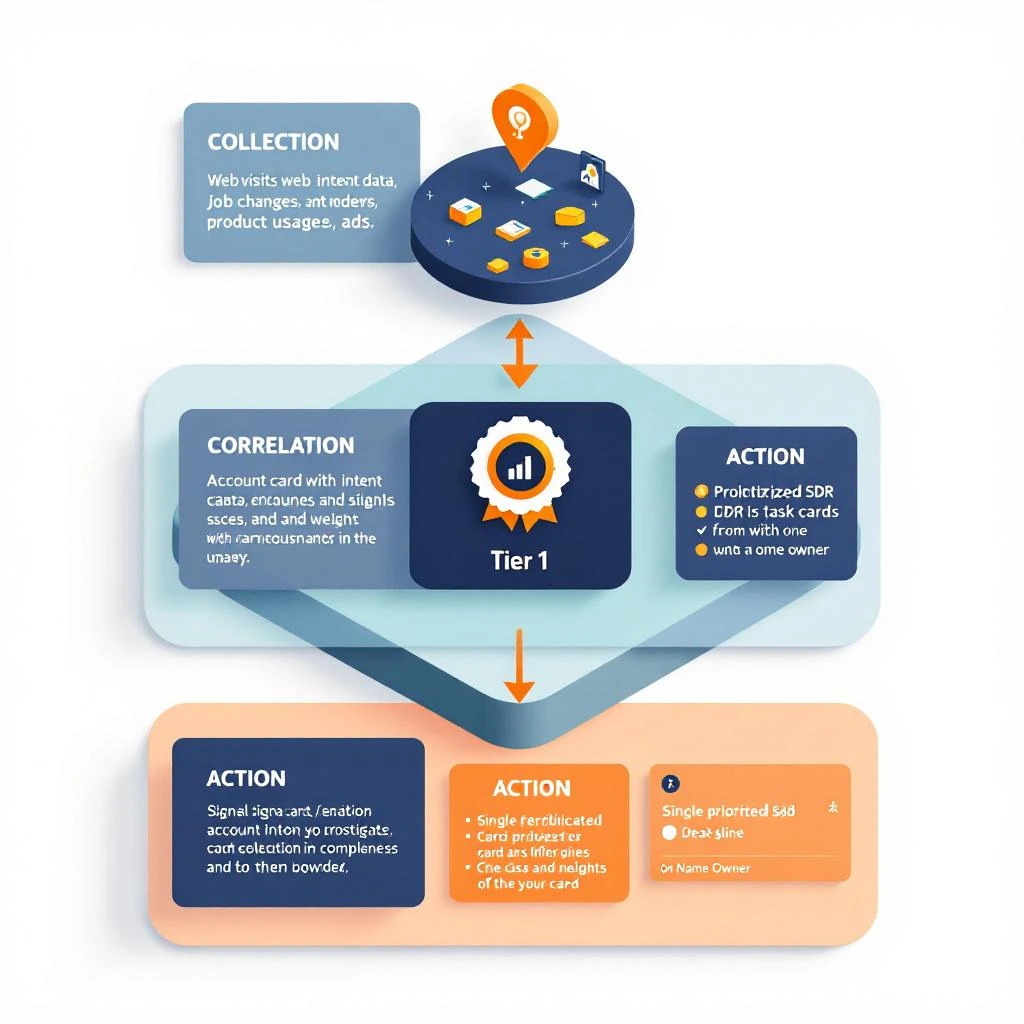
This post is the architecture. It is a three-layer model — collection, correlation, and action — that we have watched separate the teams who get demos from signals and the teams who just get more alerts.
Why most "signal stacks" are not stacks
A stack is not a list of products. A stack is a system where each layer does one job, hands its output to the next layer, and the layers cannot be skipped without breaking the system.
What most companies have today is a bundle: five vendors selling overlapping outputs into the same SDR inbox. Each vendor is its own collection layer, its own scoring layer, and its own (mostly nonexistent) action layer. There is no correlation between them. There is no priority across them. There is no shared definition of what "good" looks like.
The result is what we call alert blindness — the predictable state of an SDR who has been getting 60 daily alerts for nine months and now opens exactly zero of them.
You cannot fix alert blindness by adding a sixth signal vendor. You fix it by replacing the bundle with a real stack.
Layer 1: Collection — capture every relevant signal once, in one place
The bottom layer of the stack is collection. Its only job is to ingest raw signals from every source that might indicate buying intent, and to deposit them into a single account-keyed store.
That sentence has three load-bearing words: every, single, and account-keyed.
- Every means you do not pick favorites. Intent topics, web visits, ad clicks, content downloads, job changes, hiring posts, technographic shifts, support tickets, expansion conversations from CS, product usage events, replies to old sequences — all of it gets ingested. Signal coverage is the cheapest part of the stack; do not be precious about it.
- Single means one store, not five. If Bombora data lives in Bombora, 6sense data lives in 6sense, and visitor data lives in Warmly, you do not have collection — you have storage silos. The correlation layer above cannot do its job if it has to ask five different APIs which signals fired this week for Acme Corp.
- Account-keyed means every signal is normalized to a domain (and, where possible, to a person at that domain) before it lands in the store. Most signal vendors give you signals keyed to their own internal IDs. That is useless across vendors. Resolve every signal to
acme.comandpriya@acme.comat ingest time, or you will spend the rest of your life writing reconciliation scripts.
What collection looks like in practice
A working collection layer does five things:
- Pulls from every signal vendor you already pay for via API, webhook, or daily export
- Captures first-party signals from your own properties — website, product, email, ads, gated content
- Normalizes every signal to a domain and (optionally) a person
- Tags each signal with a source, type, and timestamp
- Writes the whole thing to one table or one warehouse, accessible to the layer above
If your data team owns this, it goes in the warehouse (Snowflake, BigQuery, Redshift). If your RevOps team owns this, it goes in the CRM as a custom object. If you are a smaller team and you do not have either, it can go in a signal platform that ingests for you — that is the category MarketBetter and a few others operate in.
What matters is that one place exists where the question "what signals fired for Acme Corp in the last 30 days?" returns a complete answer in one query. If that query requires logging into three dashboards, you have not built collection yet.
Layer 2: Correlation — score the account, not the signal
The middle layer is where most signal stacks die. Vendors will sell you "scoring" — but what they sell you is scoring within their own dataset. Bombora scores your account on Bombora's signals. 6sense scores it on 6sense's. Apollo scores it on Apollo's. None of them score it on all of them together.
Correlation is the layer that does that. Its job is to look at every signal that fired on an account, weight each signal by predictive value, decay older signals, and emit a single number — or, better, a single tier — that ranks every account against every other account.
Two non-negotiable rules of correlation
Rule 1: Score the account, not the signal.
A single Bombora surge alert is almost meaningless. A Bombora surge alert plus a pricing page visit plus a job posting for the buyer persona is a meeting. The correlation layer's entire reason for existing is to recognize the combination. If your "signal stack" scores each signal independently and shows them as separate alerts, you are not correlating — you are just sorting.
Rule 2: Weight signals by predictive value, not by recency.
The default behavior of every signal tool is to surface the newest signal. That is wrong. Some signals (pricing page visits, demo form abandonment, repeat visits from the same identified person) are dramatically more predictive than others (intent topic surges, generic content downloads). We wrote a full hierarchy of which signals predict closed-won and which are noise — use it as the starting weight table.
What correlation looks like in practice
A working correlation layer outputs, for every account in your ICP:
- A tiered priority (Tier 1 / Tier 2 / Tier 3 / cold)
- The combination of signals that put them in that tier
- The freshness of the most recent qualifying signal
- The recommended persona to engage
Tiering beats scoring because humans cannot act on a 73 versus a 71. They can act on "this account is Tier 1, here's why."
If you already have an account scoring model in your CRM, this layer is where it lives. If you do not, the simplest thing that works is a rules table in a spreadsheet: signal type, weight, decay window. Start with five signals, three weights, and iterate.
Layer 3: Action — turn the score into a task with a deadline
This is the layer that 95% of buyer intelligence stacks skip entirely. It is also the only layer that produces revenue.
The action layer's job is to translate a correlated, prioritized account into a specific task assigned to a specific human with a specific deadline.
Not an alert. Not a dashboard row. A task.
The difference matters. An alert says "Acme Corp surged on intent." A task says: "Today by 11am, Priya Patel: send the demo follow-up template to Marcus Chen at Acme Corp, referencing their hiring post for a VP of Demand Gen. They visited pricing twice this week and abandoned the demo form on Tuesday."
One of those gets ignored. The other gets sent.
What action looks like in practice
A working action layer does four things:
- Translates each tiered account into the right play — demo follow-up, multi-thread, re-engagement, expansion, etc.
- Assigns the play to an owner — usually the SDR for that territory, sometimes the AE if it is an active opportunity
- Sets a deadline measured in hours, not days — Tier 1 signals decay fast; if you do not act in the first 24 hours, the buyer has already talked to two competitors
- Closes the loop — when the task is done (sent, called, booked, replied), the action is recorded back against the account so the correlation layer can learn
The end state of a working action layer is a prioritized SDR task list at the start of every morning — typically 8–15 accounts, ranked, each with a specific play and a deadline. Not a queue of 400 alerts.
This is the layer where MarketBetter spends most of its energy, and it is the layer that almost no other signal vendor is willing to own. They will tell you who is in market. They will not tell you what your SDR should do about it by 11am tomorrow.
That gap — between who and what to do — is where most signal investments evaporate.
What a working 3-layer stack looks like end to end
To make this concrete, here is what a single account moving through the stack looks like in a real B2B SaaS team:
Monday 9:14am — Collection
Acme Corp posts a job for a VP of Demand Gen on LinkedIn. The job posting is scraped, normalized to acme.com, tagged with source=linkedin, type=hiring_signal, persona=demand_gen_leader, and written to the signal store.
Monday 11:02am — Collection
A person at acme.com visits the MarketBetter pricing page, then the integrations page, then bounces. The visitor is identified as Marcus Chen, Director of Marketing Operations, via reverse-IP plus a known cookie. Two new signals are written: pricing_visit and integrations_visit, both tagged to Marcus.
Monday 11:03am — Correlation The correlation layer runs. Acme Corp had a Bombora surge on "intent data" last week (weight: 8), a pricing visit today (weight: 20), and a hiring signal for the buying persona (weight: 12). Total score: 40. Tier 1.
Monday 11:04am — Action Priya Patel, SDR for the territory, receives a single task in her morning queue: "Tier 1: Acme Corp. Priya, by today 1pm — send the 'pricing-page + hiring' play to Marcus Chen, reference VP Demand Gen role. Loop Sarah Lin (their CMO) on send."
Monday 1:11pm Priya sends. The action is recorded.
Wednesday 4:32pm Marcus replies. Sarah is forwarded. A demo is booked for the following Tuesday.
Six minutes of human work. One booked meeting. Zero alerts.
That is what a 3-layer stack produces. Everything else is theater.
How to build the stack you actually need
You do not need to rip and replace every signal vendor you already own. You need to clarify which layer each vendor is playing in — and then plug the gaps.
A diagnostic in five questions:
- Collection: Is every signal we pay for landing in one queryable store, keyed to a domain? If no — your collection layer is broken. Fix it before adding more vendors.
- Collection: Are we capturing first-party signals (web, product, email, ads) with the same fidelity as third-party? If no — you are paying for intent data while ignoring the strongest signals you already own.
- Correlation: Do we score accounts on the combination of signals across vendors, or do we score each signal independently? If independently — your correlation layer does not exist; you are just sorting.
- Correlation: Do we have a tiering definition that every SDR understands without looking it up? If no — your correlation layer exists but no one trusts it.
- Action: When a Tier 1 account is flagged, does an SDR get a specific task with a specific deadline and a specific play — or just an alert? If just an alert — you have no action layer. You have a notification system.
Most teams flunk three or more of these. That is fine. The right move is to fix the layers in order — collection first, correlation second, action last. You cannot correlate signals you have not collected, and you cannot drive action from a tier no one believes in.
The vendor landscape, mapped to the stack
Because everyone asks: here is where common tools fit in the three-layer model. (This is not exhaustive — see our website visitor identification tool roundup and buyer intent data tools roundup for deeper category breakdowns.)
| Tool | Strongest layer | Where it leaves a gap |
|---|---|---|
| Bombora | Collection (intent topics) | No correlation across other signals; no action |
| 6sense | Collection + partial correlation | Correlation is closed to 6sense's own signals; weak action layer |
| ZoomInfo Intent | Collection | No correlation; alerts only |
| Apollo | Collection (job changes, basic intent) | Action layer is sequence-only, not prioritized task |
| Warmly | Collection (visitor ID) | Single signal type; correlation is rule-based, not weighted |
| Clay | Collection + enrichment | Not a correlation engine; you build the logic |
| MarketBetter | Correlation + action | We assume you already collect; we focus on tiering and SDR task generation |
The honest read: most "signal platforms" are really collection platforms with a dashboard on top. Correlation across vendors and action that drives SDR behavior are the two layers the market is still figuring out.
The takeaway
If you remember nothing else from this post, remember this:
- Collection is cheap and most teams over-invest here
- Correlation is where signal quality is created and most teams under-invest here
- Action is where revenue is made and almost no team invests here at all
Buy signals, sure. Buy more signals. But until those signals roll up into a single tiered account view and then translate into a specific task with a deadline, you do not have a signal stack. You have a louder alert system.
The teams that win the next two years of B2B sales will not be the ones with the most data. They will be the ones whose SDRs open a clean queue of 12 accounts every morning, know exactly what to do about each one, and finish their high-priority work before lunch.
Build the stack. Skip the dashboards.
Want to see a 3-layer signal stack running on a real territory? Book a 20-minute walkthrough →
Related reading:
- The Buying Signal Hierarchy: Which Signals Actually Predict Closed-Won
- From Buying Signal to Booked Meeting in 24 Hours
- The First 30 Minutes of an SDR's Morning
- The Complete Guide to B2B Intent Data
- Why Intent Data Fails Sales Teams
- Daily SDR Playbook: Prioritized Task List
- Best Buyer Intent Data Tools
- Best Website Visitor Identification Tools 2026