11 Witty Email Subject Lines That Actually Work in 2026
In an inbox overflowing with automated sequences and generic pitches, the standard subject line is a one-way ticket to the archive folder. What makes a subject line truly stand out isn't just a clever pun; it's the strategic fusion of curiosity, relevance, and a clear, implied value that respects the recipient’s intelligence and time. Too often, sales reps mistake "witty" for "vague" or "clickbait," leading to a quick delete and a damaged reputation. This guide is designed to fix that.
We're moving beyond tired templates to deconstruct the anatomy of genuinely effective, witty email subject lines. You won't just get a list; you'll get a strategic playbook. We will analyze 11 distinct categories of subject lines, from curiosity-driven hooks to data-backed insights, providing a detailed breakdown for each.
This article will show you:
- Why specific subject lines capture attention based on psychological triggers.
- When to deploy each type for maximum impact, whether it's a first touch, a follow-up, or a persona-specific campaign.
- How to customize them with personalization tokens and quick A/B testing notes for immediate application.
The objective isn't merely to boost your open rates. It’s to initiate meaningful conversations that convert. Moving beyond purely witty to strategically effective requires a deep understanding of what drives action. For a broader look at this, exploring various strategies for crafting High-Converting Email Subject Lines can provide a solid foundation. This comprehensive library will equip you and your team with the actionable tactics needed to turn cold outbound into your most reliable pipeline generator.
1. The Curiosity Gap Subject Line
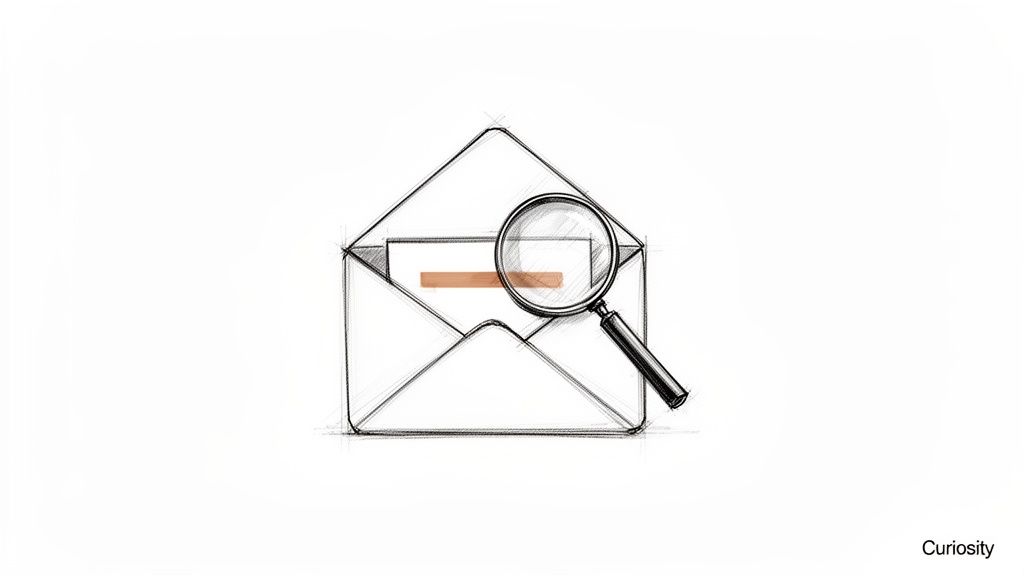
The Curiosity Gap is a powerful psychological trigger that leverages the human desire for closure. By intentionally omitting a key piece of information, this subject line technique creates an “information gap” that compels the recipient to open the email to satisfy their curiosity. For sales outreach, it’s one of the most effective witty email subject lines because it stands out in a crowded inbox filled with generic benefit claims.
Strategic Breakdown & Examples
This approach works best when you need to break through the noise of a high-value prospect's inbox. It feels more personal and less automated than a subject line screaming a generic benefit. Compared to a 'Specific Value' subject line, this one sacrifices immediate clarity for intrigue. It's a trade-off that works well when the recipient is hard to reach.
- Example 1:
Quick question about [Company Name]- Why it works: It’s direct, personal, and implies the email requires their specific expertise. The vagueness of "question" creates the necessary intrigue.
- Example 2:
This might not apply, but...- Why it works: This uses reverse psychology. It lowers the recipient's guard and makes them wonder, "What might not apply? Now I need to know."
- Example 3:
Found this while researching [Competitor Name]- Why it works: It combines curiosity with a hint of competitive intelligence, a highly valuable topic for any decision-maker.
Actionable Takeaways & A/B Testing
To implement this strategy effectively, follow these best practices:
- Align Body with Subject: The email body must deliver on the intrigue. If your subject is "Quick question," ask a genuine, insightful question immediately. Misleading your prospect kills trust instantly. Your action item: Draft the email body first to ensure your question is valuable enough to warrant the mysterious subject line.
- Keep it Short: Aim for under 50 characters to avoid being cut off on mobile devices, which enhances the feeling of mystery.
- A/B Test: Pit a curiosity-gap subject line against a direct-benefit one. For example, test
Your thoughts on this?againstSave 20% on your software spend. Track open rates in your CRM to see which approach resonates more with your specific audience.
2. The Social Proof Subject Line
This technique leverages one of the most powerful psychological principles in sales: people trust what other people trust. By referencing credible signals like customer logos, company achievements, or industry recognition directly in the subject line, you establish legitimacy before the recipient even opens the email. For B2B outreach, mentioning that similar companies or direct competitors are already engaged is a surefire way to reduce skepticism and signal value.
Strategic Breakdown & Examples
Social proof is most effective when your prospect is aware of the companies you're referencing. It immediately positions your solution as a validated choice within their industry, making it one of the most impactful witty email subject lines for overcoming initial resistance. This approach is a direct contrast to the 'Contrarian' subject line; instead of challenging the status quo, it reinforces it by showing that peers have already adopted your solution.
- Example 1:
Why [Competitor] switched to us- Why it works: This is a direct and provocative use of social proof. It creates immediate urgency and a fear of missing out (FOMO) by implying their competitor now has an advantage.
- Example 2:
Used by [Competitor] and 200+ other [Industry] leaders- Why it works: This combines specific social proof (a named competitor) with broad proof (the number of other users). It tells the prospect, "You're late to the party, and everyone you respect is already here."
- Example 3:
Trusted by [Well-Known Company/Brand] admins everywhere- Why it works: It associates your brand with a highly trusted, household-name company. This "trust by association" elevates your own credibility instantly.
Actionable Takeaways & A/B Testing
To deploy social proof effectively, your claims must be both credible and highly relevant to the prospect.
- Ensure Relevance: The social proof must resonate. Mentioning a competitor in a completely different industry will have zero impact. The more similar the referenced company is to your prospect, the stronger the effect. Your action item: Create a list of your top 5 customers for each target vertical and have it ready for your email campaigns.
- Keep Proof Current: Social proof goes stale. Update your subject line templates quarterly with new customer wins, awards, or media mentions to keep them fresh and impactful.
- A/B Test: Compare a specific social proof subject line against a more general one. For instance, test
Why [Direct Competitor] uses usagainstTrusted by leaders in the [Prospect's Industry] space. This will show if your audience responds more to direct competitive pressure or broader industry validation.
3. The Specific Value Statement Subject Line
This approach cuts through the noise by leading with a quantifiable, results-oriented promise. Unlike vague claims like "improve your process," the Specific Value Statement uses hard numbers and concrete outcomes (e.g., 'save 6 hours/week,' 'reduce churn by 15%') to immediately signal relevance and business impact. This is one of the most effective witty email subject lines for grabbing the attention of analytical, results-driven buyers like VPs and RevOps leaders who live and breathe metrics.
Strategic Breakdown & Examples
This technique works best when you have a clear, demonstrable ROI and are targeting personas who are directly responsible for performance metrics. It trades cleverness for clarity, which is often a more powerful strategy for senior-level outreach. Compared to a 'Curiosity Gap' subject line, this is the polar opposite: it provides the conclusion upfront, making the email's value proposition immediately obvious.
- Example 1:
Save your SDRs 3 hours per day on research- Why it works: It’s hyper-specific to the recipient's team (SDRs) and quantifies the time-saving benefit. A sales leader can instantly calculate the productivity gain across their entire team.
- Example 2:
How [Company] could close 2 more deals/month- Why it works: This subject line is a direct challenge to the status quo and frames your solution in terms of revenue, the ultimate metric for any sales organization.
- Example 3:
Cut SDR ramp time from 90 to 30 days- Why it works: It addresses a critical and costly business problem (new hire onboarding) with a dramatic, specific improvement. This is highly compelling for scaling teams.
Actionable Takeaways & A/B Testing
To deploy this strategy, you must be confident in your value proposition and ready to back it up.
- Justify the Metric: Your email body must immediately explain the "how" behind the number in your subject line. Use a brief, credible calculation or customer case study to build trust. Your action item: Prepare a one-sentence "value calculation" for each of your key personas that you can drop into the email body.
- Personalize the Metric: Use public data (like company headcount or industry benchmarks) to tailor your metric. For example, change "save 3 hours/day" to "reclaim 60 hours/week for your 20-person SDR team."
- A/B Test: Test a time-based metric against a revenue-based one. For a VP of Sales, compare
Log calls in Salesforce in 10 secondswithIncrease call volume by 20%. Track which type of metric drives more replies to understand what your target persona values most.
4. The Personalized Problem Recognition Subject Line
This advanced technique moves beyond generic pleasantries to prove you’ve done your homework. By acknowledging a specific, company-relevant challenge directly in the subject line, you immediately build rapport and demonstrate empathy. For sales reps, these witty email subject lines are invaluable because they show you understand the prospect's world before you ever ask for a meeting, making your outreach feel consultative instead of transactional.
Strategic Breakdown & Examples
This approach is most effective when targeting mid-market or enterprise accounts where deep personalization is non-negotiable. It leverages timely business triggers like new hires, product launches, or funding rounds to create a hyper-relevant entry point. This differs from the 'Pain Point Agitation' style because it's based on specific, observed data about the company, not a general industry problem.
- Example 1:
Post-Series B teams always struggle with outbound efficiency- Why it works: It uses a common "pattern" associated with a specific company stage (Series B funding). This shows you understand their growth trajectory and the predictable challenges that come with it.
- Example 2:
[Company] just hired 2 SDRs—must be scaling outbound- Why it works: This is a direct observation from public data (like LinkedIn). It connects a specific action (hiring) to a strategic priority (scaling sales), making your subsequent message incredibly relevant.
- Example 3:
Noticed you launched [Product feature]—curious about adoption- Why it works: It proves you are following their company news and frames your outreach as a genuine inquiry about a key initiative, positioning you as a peer rather than a typical salesperson.
Actionable Takeaways & A/B Testing
To execute this strategy, you need a system for tracking and acting on company-specific triggers.
- Leverage Triggers: Use sales intelligence tools to get alerts on funding, hiring trends, and technology changes. Turn these events into the core of your subject line. Your action item: Set up Google Alerts or LinkedIn Sales Navigator alerts for your top 10 target accounts today.
- Be Accurate: Double-check your facts. If you mention a new product launch or a recent hire, ensure the information is correct. An inaccurate reference will instantly discredit you.
- A/B Test: Compare a personalized problem subject line against a solution-focused one. Test
Struggle with [Competitor Tool] integration?againstSeamless integration for your tech stack. Measure both open and reply rates to see if demonstrating empathy outperforms pitching a benefit.
5. The Unexpected Question Subject Line
This technique cuts through inbox noise by posing a genuine, thought-provoking question that prompts immediate internal reflection. Instead of leading with a statement or a benefit, it invites the recipient to consider a problem they might not have actively articulated. For B2B sales, these witty email subject lines are effective because they shift the dynamic from a sales pitch to a consultative conversation starter.
Strategic Breakdown & Examples
This approach is ideal for the first or second touchpoint in a sequence. It establishes you as a thoughtful problem-solver rather than just another vendor. The goal is to ask a question that aligns directly with a core business challenge your solution addresses. This is softer than the 'Benefit-Forward Negative' approach, as it invites reflection rather than directly stating a problem.
- Example 1:
What if your Salesforce dialer actually worked?- Why it works: It’s provocative and speaks directly to a common frustration for sales teams using integrated tools. This question implies a better reality exists, creating a compelling reason to open the email and learn more.
- Example 2:
Are your reps logging calls consistently?- Why it works: This question targets a critical data integrity issue that plagues sales leaders and RevOps managers. It’s a tactical question with strategic implications, making it relevant to multiple personas.
- Example 3:
What's eating your RevOps team's time?- Why it works: It's open-ended and empathetic, showing you understand the operational burdens of a specific department. It feels less like a sales pitch and more like a genuine inquiry into their workflow challenges.
Actionable Takeaways & A/B Testing
To make this strategy work, the question must be both insightful and relevant to the recipient's role.
- Match Question to Persona: Frame questions strategically for VPs (
How much are your SDRs actually selling?) and tactically for managers (Why do outbound sequences fail?). The former cares about outcomes, the latter about process. Your action item: For your top 3 buyer personas, write one strategic "what if" question and one tactical "how do you" question. - Avoid Yes/No Questions: Use open-ended formats starting with "what," "how," or "why." These encourage more profound thought than a simple yes/no, increasing the likelihood of an open and a reply.
- A/B Test: Test a pain-focused question against a curiosity-gap subject line. For example, pit
Are your reps logging calls consistently?againstQuick question about your call logging. Track open and reply rates in your CRM to see which resonates more deeply with your target audience.
6. The Time Constraint / Scarcity Subject Line
This technique leverages the psychological principles of scarcity and urgency, also known as Fear Of Missing Out (FOMO). By framing an opportunity as time-sensitive or limited, it prompts immediate action, encouraging recipients to prioritize opening your email over others. For sales outreach, this is one of the more powerful witty email subject lines because it breaks prospect inertia and compels a faster decision, making it ideal for time-bound campaigns or high-intent leads.
Strategic Breakdown & Examples
This approach is most effective when the urgency is genuine and tied to a clear, valuable offer. It signals that the contents are not evergreen noise but a fleeting opportunity that warrants immediate attention. False scarcity can damage trust, so authenticity is paramount. This is a high-risk, high-reward strategy compared to the evergreen 'Social Proof' subject line, which relies on long-term credibility rather than short-term pressure.
- Example 1:
Findings expire Friday: [Company Name] results attached- Why it works: It combines a hard deadline with the promise of personalized, valuable information ("results"). The word "expire" creates a strong sense of loss if ignored.
- Example 2:
Quick window to discuss your Q4 motion- Why it works: This subject line is timely and relevant, tying the urgency directly to the prospect's business planning cycle (Q4). It feels strategic, not just pushy.
- Example 3:
We're only targeting 5 accounts in [Industry] this month- Why it works: This creates exclusivity and high value. Being one of only five targets makes the prospect feel singled out and important, driving them to find out why.
Actionable Takeaways & A/B Testing
To deploy scarcity without alienating prospects, align it with real-world constraints and value.
- Justify the Urgency: The email body must transparently explain why the offer is time-sensitive. Is it an event deadline, a limited cohort for a beta program, or a seasonal promotion? Your action item: Before using a scarcity subject line, write down a one-sentence justification. If it sounds weak, don't use it.
- Use Sparingly: Overusing this technique will dilute its impact and lead to "urgency fatigue." Reserve it for high-priority prospects or truly time-sensitive campaigns.
- A/B Test: Compare a time-constraint subject line against a benefit-driven one. For instance, test
Report: SDR benchmarks (3 days only)againstNew report on SDR benchmarks for you. Track open and reply rates to see if urgency or direct value performs better for your audience.
7. The Mutual Connection / Referral Subject Line
Leveraging a shared connection is the digital equivalent of a warm handshake. This subject line technique instantly establishes credibility by referencing a mutual contact, customer, or colleague. For sales teams, it’s one of the most powerful witty email subject lines because it bypasses the "stranger danger" filter in a prospect's mind and signals immediate relevance and trust. The implied social proof dramatically reduces the friction of cold outreach.

Strategic Breakdown & Examples
This approach is essential for SDRs navigating tight-knit industries or executing an account-based marketing (ABM) strategy. The goal is to transform a cold email into a warm introduction, significantly increasing the likelihood of a response. This is arguably the most effective opener, providing a powerful advantage over all other types by borrowing trust instead of trying to build it from scratch.
- Example 1:
[Mutual Customer] suggested I reach out- Why it works: This is the gold standard. It implies a happy customer has vouched for you, which is the strongest form of social proof available. The prospect is almost obligated to open it.
- Example 2:
Spoke with [Peer Name] about [Company]—mentioned you'd be perfect- Why it works: It shows you've done your homework within their organization. Referencing an internal peer creates an immediate sense of familiarity and validates your reason for reaching out.
- Example 3:
Quick intro from [Shared Contact]- Why it works: It's concise, direct, and leverages the authority of the shared connection. This format works especially well when the contact is well-known or respected in your industry.
Actionable Takeaways & A/B Testing
Proper execution is key to maintaining the trust this subject line creates.
- Verify Permission: Never name-drop without explicit consent from the mutual contact. A quick "Mind if I mention we spoke?" is crucial. Betraying this trust can damage two relationships at once. Your action item: Add a step in your outreach process to log referral permissions in your CRM to ensure compliance and accuracy.
- Be Specific Immediately: The first line of your email must immediately provide context for the referral. "John Smith and I were discussing [topic], and he suggested I connect with you about..."
- A/B Test: Test the directness of your referral. Compare
[Referral Name] sent meagainst a slightly softer approach likeFollowing up on my chat with [Referral Name]. Measure which phrasing feels more natural and generates a better reply rate with your audience.
8. The Contrarian / Reframe Subject Line
The Contrarian subject line challenges conventional industry wisdom or a commonly held belief. This technique works by creating immediate intrigue and positioning your message as a fresh, disruptive perspective. For sales outreach, it's a powerful way to reframe a problem your prospect faces, making them question their current approach and open their mind to a new solution. It’s one of the most intellectually stimulating witty email subject lines because it promises a valuable insight, not just a sales pitch.
Strategic Breakdown & Examples
This approach is highly effective when targeting forward-thinking leaders or those in roles focused on innovation, like VPs of Sales or RevOps. It establishes you as a thought leader, not just a vendor, from the very first touchpoint. This is the opposite of a 'Social Proof' subject line, as it suggests the crowd is wrong, appealing to early adopters rather than the safety-in-numbers crowd.
- Example 1:
Stop trying to log every call (here's why)- Why it works: It directly contradicts a common SDR best practice. The promise of "why" makes it irresistible for any manager obsessed with activity metrics and efficiency.
- Example 2:
Your sales engagement tool is wrong- Why it works: This is a bold, provocative claim that forces a click. It makes the recipient defensive and curious, compelling them to open the email to see the justification for such a strong statement.
- Example 3:
Outbound emails shouldn't be long (they should be specific)- Why it works: It reframes a familiar debate with a nuanced solution. This shows you understand the prospect's world deeply and have a strategic, not just a generic, point of view.
Actionable Takeaways & A/B Testing
To deploy this strategy without coming across as arrogant, follow these best practices:
- Back Up Your Claim: The email body must substantiate your contrarian subject line with compelling logic, data, or a customer example. Failure to do so destroys credibility instantly. Your action item: Create a one-pager or short slide deck that proves your contrarian point, ready to be linked in your email.
- Target Innovators: Reserve this approach for personas who are incentivized to find a competitive edge, such as new leaders or those in rapidly scaling companies. It may fall flat with more traditional-minded contacts.
- A/B Test: Test a contrarian subject line against a standard benefit-driven one. For instance, pit
SDR tasks are backwardsagainstA better way to structure SDR workflows. Track which subject line generates more replies and meetings booked, not just opens, to measure true engagement.
9. The Data Point / Insight Subject Line
This technique leads with a surprising, relevant statistic or market trend that directly relates to the recipient's business. It works by establishing your authority and providing immediate value through insight, not a product pitch. For analytical audiences like VPs of Sales or RevOps leaders, data-driven witty email subject lines cut through the fluff and signal that you've done your homework.
Strategic Breakdown & Examples
This approach is most effective when targeting data-savvy decision-makers who appreciate quantitative evidence. It frames you as a strategic partner who understands their industry's challenges, rather than just another vendor. This is a more credible version of the 'Specific Value' subject line, as it uses objective, third-party data to make a point rather than a direct product claim.
- Example 1:
[Industry] companies lose 8% pipeline to bad outbound- Why it works: It’s specific, alarming, and directly tied to a core business metric (pipeline). The recipient is immediately prompted to wonder if their company is part of that 8%.
- Example 2:
78% of SDRs spend >2 hours/day on admin (new report)- Why it works: This statistic highlights a common and costly pain point for sales leaders. Citing a "new report" adds credibility and urgency, making them want to learn more.
- Example 3:
Outbound response rates up 24% with intent signals- Why it works: It combines a problem with a potential solution. It presents a compelling gain (24% increase) and introduces a key concept (intent signals) you can elaborate on in the email body.
Actionable Takeaways & A/B Testing
To leverage data effectively, you must connect it to the prospect's reality.
- Cite Your Sources: Always reference the source of your data in the email body (e.g., Gartner, Forrester, or your own proprietary research). This builds trust and positions you as a credible expert. Your action item: Maintain a running document of the top 5 most compelling stats for your industry, complete with source links.
- Connect Data to Value: Don't just drop a statistic. Your first sentence should tie the data point directly to your prospect's potential challenges or opportunities. For example, "I saw this stat and immediately thought of [Company Name]'s growth goals."
- A/B Test: Test a "pain" statistic against a "gain" statistic. For example, compare
Companies without Salesforce dialers log 34% less activity(pain) againstTeams with our dialer increase call volume by 45%(gain). Track open and reply rates in your CRM to see which resonates more with different personas.
10. The Benefit-Forward Negative Subject Line
This approach flips the traditional benefit-oriented pitch on its head. Instead of leading with a positive outcome, it highlights a specific, well-researched pain point the prospect is likely experiencing. This witty email subject line works by tapping into the powerful human motivator of loss aversion; people are often more driven to avoid a loss than to achieve an equivalent gain. It resonates deeply because it validates a prospect’s frustration and signals that you understand their world.
Strategic Breakdown & Examples
This technique is most potent when you have strong intelligence on a prospect's challenges, making it feel less like a cold email and more like a timely intervention. It's a bold move that separates you from the flood of "Save X%" or "Increase Y%" subject lines. This is more direct and provocative than the 'Unexpected Question' subject line, making a strong statement of pain rather than asking about it.
- Example 1:
Your Salesforce dialer isn't working (and you know it)- Why it works: It’s provocative and highly specific. It directly calls out a known issue with a core tool, making the recipient think, "Yes, it is! How did they know?" This creates an immediate bond over a shared understanding of a problem.
- Example 2:
SDR ramp taking 90+ days? Doesn't have to.- Why it works: This subject line quantifies a common pain point (long ramp times) and then immediately introduces a hint of a solution. It speaks directly to a sales leader's operational and financial concerns.
- Example 3:
Call coaching is impossible without transcripts- Why it works: It frames a problem as a definitive, almost universal truth. For a manager struggling with coaching effectiveness, this statement feels like an undeniable fact, compelling them to open the email to see the proposed solution.
Actionable Takeaways & A/B Testing
To deploy this strategy without sounding overly negative or presumptive, precision is key.
- Validate the Pain: Never use this approach without solid research. If you’re guessing about their pain point, you risk looking foolish. Use LinkedIn posts, job descriptions, or company news to confirm the problem is real for them. Your action item: Before sending, ask yourself, "Do I have at least one piece of evidence that this company faces this problem?" If not, choose another style.
- Balance with Optimism: The email body must quickly pivot from the problem to a clear, optimistic solution. The subject line grabs attention by highlighting the negative, but the email itself must provide the positive path forward.
- A/B Test: Run this against a traditional benefit-forward subject line. Test
Reps aren't logging calls consistentlyagainstImprove CRM data accuracy by 40%. Track not just open rates but also reply rates to see which framing drives more meaningful engagement with your target persona.
11. The Pain Point Agitation Subject Line
Pain point agitation is a direct, highly effective psychological tactic that immediately surfaces a known industry or business challenge your prospect is likely facing. Instead of leading with a benefit, you lead with the problem. This approach demonstrates empathy and industry knowledge, positioning you as a consultant rather than just another salesperson. It's one of the most powerful witty email subject lines for grabbing the attention of busy executives who are more motivated by avoiding loss than by gaining something new.

Strategic Breakdown & Examples
This strategy is most potent when your research has uncovered a specific, quantifiable pain point relevant to your prospect's role or company. It cuts through the noise by being hyper-relevant and speaking directly to their daily struggles. This is a broader version of the 'Personalized Problem Recognition' style; it focuses on common industry pains rather than company-specific triggers.
- Example 1:
Is your team still wrestling with [Common Software] integration?- Why it works: It’s specific and zeroes in on a well-known technical headache. This signals you understand their tech stack and its limitations, making your outreach feel less like a cold call and more like a timely solution.
- Example 2:
The Q4 challenge with [Specific Business Goal]- Why it works: This subject line creates urgency by tying a known pain point to a time-sensitive business objective, such as hitting end-of-year targets. It shows you’re thinking about their strategic priorities.
- Example 3:
A better way to handle [Prospect's Department] grunt work- Why it works: It uses relatable, slightly informal language ("grunt work") to build rapport and highlights a universal desire for efficiency. The promise of "a better way" is a compelling hook for any manager looking to improve team productivity.
Actionable Takeaways & A/B Testing
To deploy this technique without sounding presumptuous, precision is key.
- Research is Non-Negotiable: This only works if the pain point is real and relevant. Use LinkedIn posts, case studies, or job descriptions to identify genuine challenges before reaching out. Your action item: Identify the top 3 pain points for each of your key buyer personas and craft a subject line for each.
- Transition to Solution Quickly: The first line of your email must immediately validate their pain and then pivot to your solution. For example, "Saw your team is hiring three new reps. Onboarding them without a proper system can be chaotic, which is why I'm reaching out."
- A/B Test: Test a pain-focused subject line against a benefit-focused one. For instance,
Tired of manual data entry?versusAutomate your data entry by 80%. Compare open and reply rates to see if your audience is more motivated by problem-solving or by positive outcomes.
11 Witty Email Subject Line Types Compared
| Subject Line Strategy | 🔄 Implementation Complexity | ⚡ Resource Requirements | ⭐ Expected Effectiveness | 📊 Typical Outcomes / Impact | 💡 Ideal Use Cases & Key Advantage |
|---|---|---|---|---|---|
| The Curiosity Gap Subject Line | Low–Medium — short, clever copy; needs promise alignment | Low — basic copywriting & A/B tests | ⭐⭐⭐⭐ | ↑ Opens; moderate clicks; dependent on follow-up deliverability | 💡 Best for 2nd–3rd touches on saturated inboxes; entices opens via intrigue |
| The Social Proof Subject Line | Medium — verify and adapt proof points | Medium — account research + up-to-date collateral | ⭐⭐⭐⭐ | Higher trust & opens; fewer spam flags; better enterprise engagement | 💡 Works for enterprise/mid-market; use relevant competitor/customer references |
| The Specific Value Statement Subject Line | Medium — requires accurate metrics and tailoring | Medium–High — data sourcing and persona alignment | ⭐⭐⭐⭐⭐ | High opens & quicker qualification from execs; clearer CTA relevance | 💡 Ideal for VP/RevOps outreach where ROI/time savings matter |
| The Personalized Problem Recognition Subject Line | High — deep account research required | High — intent signals, news, LinkedIn, AI assistance | ⭐⭐⭐⭐⭐ | Strong opens and trust; higher response quality when accurate | 💡 Use on high-priority accounts with clear intent signals; shows genuine research |
| The Unexpected Question Subject Line | Low–Medium — craft relevant, thought-provoking questions | Low — copy + light research | ⭐⭐⭐⭐ | High opens; conversational engagement; needs strong body copy | 💡 Good for initial touches to provoke reflection; use open-ended how/what/why |
| The Time Constraint / Scarcity Subject Line | Low — concise urgency framing; must be authentic | Low–Medium — timing data & segmentation | ⭐⭐⭐⭐ | Faster responses and quicker action; risk of fatigue if overused | 💡 Use only for genuinely time-sensitive offers or intent-driven windows |
| The Mutual Connection / Referral Subject Line | Medium — needs verified referral info | Medium–High — CRM/linkedin checks & permission | ⭐⭐⭐⭐⭐ | Highest open & response rates; strong pipeline progression | 💡 Best for warm outreach and high-value accounts; always verify referral permission |
| The Contrarian / Reframe Subject Line | Medium — provocative but evidence-backed messaging | Medium — supporting data/case studies for credibility | ⭐⭐⭐⭐ | High memorability and engagement among innovators; polarizing risk | 💡 Target innovation-minded buyers; pair with data or thought leadership |
| The Data Point / Insight Subject Line | High — requires timely, relevant data | High — research, proprietary reports or analysis | ⭐⭐⭐⭐⭐ | Strong opens with data-driven buyers; builds authority pre-ask | 💡 Use for VP/RevOps and content-led campaigns; cite sources in body |
| The Benefit-Forward Negative Subject Line | Medium — accurate pain identification needed | Medium — task/intent signals and validation | ⭐⭐⭐⭐ | Resonates with frustrated prospects; good for re-engagement/follow-ups | 💡 Best in 2nd–3rd touches when pain is confirmed; balance negativity with hope |
| The Pain Point Agitation Subject Line | Medium — needs verified industry/role knowledge | Medium — persona research & validation | ⭐⭐⭐⭐ | Strong resonance with targeted personas; shows empathy | 💡 Use when a common, well-known problem exists for a specific role or industry |
Try our AI Lead Generator — find verified LinkedIn leads for any company instantly. No signup required.
From Witty to Winning: Making Your Subject Lines Actionable
We've explored a comprehensive arsenal of witty email subject lines, from the curiosity-stoking question to the hard-hitting data point. But having a list of clever phrases is like having a toolkit without knowing how to build anything. The real power lies not in copying and pasting but in understanding the strategic psychology behind each approach and adapting it to your unique sales context.
The most crucial takeaway is that wit is a tool, not a goal. A subject line that makes a prospect smile but doesn't compel them to open the email has failed. The ultimate measure of a "good" subject line is its ability to start a valuable conversation, and that requires more than just creativity; it demands precision, personalization, and a commitment to testing.
From Frameworks to Actionable Strategy
Mastering the art of the witty email subject line means moving from isolated tactics to an integrated system. Instead of randomly picking a subject line from a list, top-performing sales teams build a repeatable process based on proven frameworks.
Think of it as the difference between a one-off joke and a well-honed comedic routine.
- Compare your options: A Curiosity Gap subject line might get more opens, but a Specific Value subject line gets opens from more qualified buyers. Know which goal you're optimizing for.
- Match tactic to context: A Personalized Problem Recognition subject line is highly effective, but it requires research that doesn't scale. Reserve it for high-value accounts. For broader campaigns, a Pain Point Agitation subject line is more efficient.
- Balance risk and reward: A Contrarian subject line grabs attention but can alienate some prospects. A Social Proof subject line is safer but might blend in. Your choice depends on your brand's voice and the prospect's seniority.
The goal is to match the framework to the moment. A cold outreach to a C-level executive might benefit from a direct, data-driven subject line, while a follow-up with a manager who has gone quiet might be the perfect spot for a more playful, unexpected question.
Building Your Subject Line Playbook
To transform these concepts into a consistent pipeline-generating engine, you need a system. This involves categorizing, testing, and iterating on your approaches.
- Segment Your Efforts: Don't use the same subject lines for every persona or industry. Create mini-playbooks for your key target segments. A subject line for a Head of Marketing at a SaaS startup should feel different from one targeting a VP of Operations in manufacturing. Your first action: Create a simple table listing your top 3 personas and the top 2 subject line types you'll test for each.
- Establish a Testing Cadence: The golden rule is to always be testing. A/B testing isn't a one-time event; it's an ongoing discipline. Start simple: test a question-based subject line against a statement-based one for a specific campaign. Measure the open rates, but more importantly, track the reply and meeting-booked rates. Your next action: Schedule a recurring 30-minute meeting every two weeks to review your campaign metrics and decide on the next A/B test.
- Integrate Your Tools and Data: Your subject line is the tip of the spear, but the spear itself is your entire sales and marketing stack. The data in your CRM is a goldmine for personalization. Furthermore, ensuring your communication channels are connected is vital. For instance, a strong email campaign might drive immediate interest, and having a Mailchimp Live Chat integration can provide a seamless way for engaged prospects to get instant answers, converting email interest into a real-time conversation.
Ultimately, crafting winning, witty email subject lines is about becoming a student of your buyer. It’s about listening to their language on LinkedIn, understanding their industry's challenges from reports, and using that intelligence to craft an inbox message that feels less like an interruption and more like the beginning of a helpful conversation.
Ready to move beyond guesswork and manual A/B testing? marketbetter.ai connects buyer intent data directly to your outreach, using AI to suggest and test hyper-personalized, witty subject lines that are proven to convert. Stop hoping your emails get opened and start building a data-driven system that turns clever words into measurable pipeline at marketbetter.ai.