
2 posts tagged with "sales enablement strategy"

View All Tags

Your Actionable Sales enablement strategy Playbook

· 26 min read

Let's be honest, a sales enablement strategy isn't some abstract business school concept. It's the playbook that stops your sales team from running in circles and starts them closing deals. Think of it as the difference between a garage band making a racket and a symphony orchestra creating something powerful. Without a conductor—your strategy—you just have a lot of talented people playing their own tune, making noise instead of revenue.

A strategy without actionable steps is just a wish. A sales team without a clear strategy is just a group of individuals making calls. This guide will give you both: a clear strategy and the actionable steps to implement it.

Why You Can't Afford to Ignore Sales Enablement Anymore
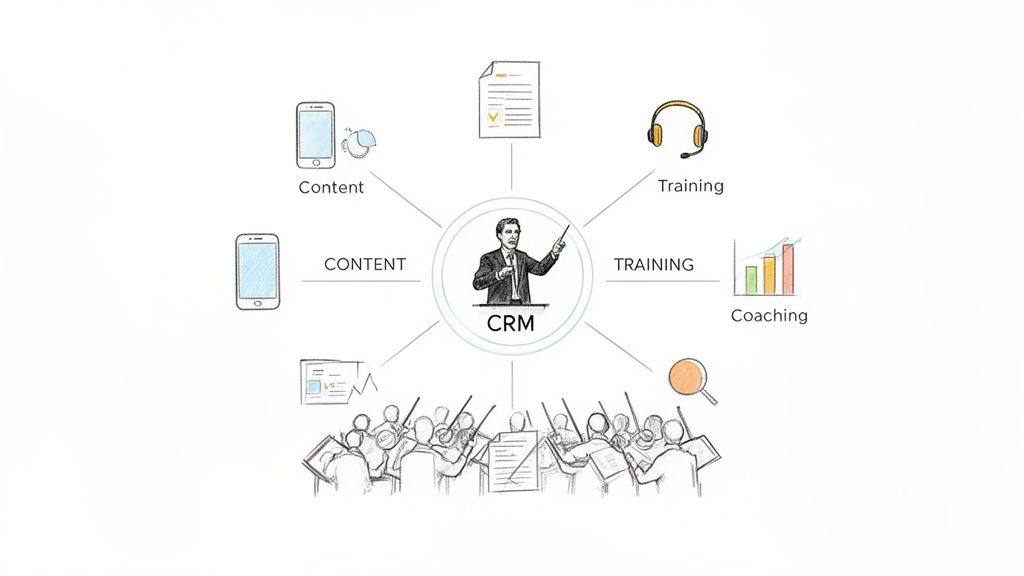
A diagram illustrating a central CRM system orchestrating content, training, coaching, and a sales team.

Cutting through the jargon, a sales enablement strategy is all about systematically removing friction from the sales process. It attacks the biggest problem on most sales floors: your reps are drowning in busywork and spending way too little time actually selling.

Let’s compare the two realities:

  • Without a Strategy: "Sales support" is chaotic. Marketing creates content that sales never uses. A great training session is forgotten by next week. Expensive new tools gather digital dust. The team runs on gut feelings, leading to inconsistent results and frustrated reps.
  • With a Strategy: The entire process is proactive and predictable. The right asset is delivered to the right rep at the right time. Training sticks because it’s reinforced. Tools are adopted because they eliminate work, not create it. The team operates as a cohesive, revenue-generating machine.

A well-executed sales enablement strategy transforms this reactive chaos into a proactive, predictable sales machine. It’s not just about giving reps more stuff; it’s about delivering the right asset, at the right time, in the right context to move a deal forward.

From Disconnected Tools to an Integrated Engine

Picture a typical sales development representative (SDR). They're juggling a CRM, a separate dialer, a messy folder of outdated PDFs, and their email client. This chaos forces them to toggle between a dozen tabs and manually log every single activity, burning through precious selling time.

It's a bigger problem than you think. In today's B2B world, reps spend just 30% of their time selling. The rest is lost to admin tasks, internal meetings, and wrestling with their CRM. But there's good news: companies with formal enablement programs see 49% higher win rates on forecasted deals because they reclaim that lost time. You can dig into more sales enablement statistics and their impact on team performance to see the full picture.

A modern sales enablement strategy tackles this mess head-on by integrating tools and processes right where reps work. Instead of a clunky, standalone dialer, imagine a click-to-call button inside the CRM that automatically logs every conversation. Instead of reps digging through folders for a case study, picture the perfect one being suggested based on the deal stage and prospect's industry.

This is where a CRM-native execution engine changes the game. It embeds productivity directly into the daily workflow by connecting three critical areas:

  • Signals: Spotting buyer intent from things like website visits or content downloads.
  • Tasks: Turning those signals into a prioritized to-do list for each rep.
  • Execution: Giving them the tools—like an integrated dialer or AI-assisted email writer—to complete those tasks efficiently, all without leaving the CRM.

By tying these pieces together, a strong enablement strategy does more than just support your sales team. It becomes the central nervous system that guides every action, ensuring reps spend their days building pipeline, not fighting their tech stack.

Core Pillars Of A Modern Sales Enablement Strategy

PillarCore PurposeKey Activities & Tools
Content EnablementTo arm reps with the right marketing and sales assets at the perfect moment in the buyer's journey.- Content Management Systems (CMS): Highspot, Seismic
- Activities: Creating battle cards, case studies, one-pagers, ROI calculators, and organizing them for easy access.
Sales TrainingTo build foundational knowledge and skills, from product expertise to mastering the sales methodology.- Learning Management Systems (LMS): Lessonly, Brainshark
- Activities: Onboarding programs, product training, certification courses, and competitive intelligence sessions.
Sales CoachingTo provide personalized, real-time feedback that reinforces training and improves rep performance on live deals.- Conversation Intelligence: Gong, Chorus.ai
- Activities: Call shadowing, deal reviews, role-playing, and one-on-one coaching based on call recordings.
Tools & TechnologyTo automate administrative tasks and streamline workflows, freeing up reps to focus on selling.- CRM-Native Execution Engines: marketbetter.ai
- Activities: Implementing dialers, email automation, lead routing, and reporting dashboards directly within the CRM.

Ultimately, these four pillars aren't separate functions; they're interconnected parts of a single engine designed to make your entire sales organization more effective and predictable.

The Four Pillars Of A Powerful Enablement Program

A killer sales enablement strategy doesn’t just happen. It's built on four pillars that have to work together, feeding off each other to create a high-performance sales engine. When these pillars are solid, your team is set up to win. When they're wobbly or disconnected, all you get is friction, wasted time, and missed quotas.

Enough with the theory. Let's look at what actually makes each pillar work by comparing the broken, old-school approach with a modern, actionable one.

Pillar 1: Content

First up is Content. At its core, this is all about giving your reps the right thing to say at exactly the right moment.

The old way is a dumpster fire of decentralized folders. Picture a shared drive choked with outdated PDFs, slide decks with names like Final_Deck_v9_USE_THIS_ONE, and case studies from three years ago. Reps burn more time hunting for a decent asset than they do talking to prospects. Eventually, they just give up and create their own rogue materials.

A modern content strategy is the polar opposite. It’s a living, breathing, central hub where every single asset is current, on-brand, and dead simple to find.

Ineffective Content ApproachEffective Content Strategy
Decentralized & Chaotic: Assets are lost in shared drives, ancient email threads, and local desktops.Centralized & Organized: A single source of truth, usually a content management system (CMS), where reps know to go.
Static & Outdated: Content gathers dust, leaving reps to share wrong pricing or obsolete product features.Dynamic & Contextual: Assets are updated in real-time and even suggested to reps based on deal stage or a competitor's name.
Generic & Irrelevant: One-size-fits-all materials that land with a thud because they don't speak to specific buyers.Personalized & Timely: Battle cards, ROI calculators, and industry-specific case studies are available instantly.

Actionable Tip: Don't just build a content library; build a playbook. For each stage of your sales process, define the one key asset reps need to move the deal forward. Make that the priority.

Pillar 2: Training

Next is Training, which is how you build and lock in the skills your team needs to actually close deals.

Bad training is all about one-off events. The classic example is the annual sales kickoff—a high-energy workshop packed with information that everyone forgets within two weeks. Without reinforcement, the knowledge just evaporates, and reps slide right back into their old habits.

A winning training program, on the other hand, builds a culture of continuous learning.

The goal of training isn't just to dump information on people; it's to change their behavior. The best training is reinforced daily, right inside the tools reps already use, connecting the dots between theory and the live deals they're working on.

Instead of one huge event, think of an ongoing drip of micro-learnings. A new rep gets short, video-based lessons on handling objections delivered to their inbox weekly, maybe with a quick quiz. This approach makes learning stick because it's bite-sized and directly tied to the challenges they're facing right now. For more on this, you can dig into various sales enablement best practices that champion this continuous approach.

Actionable Tip: Implement a "certification" program for core skills like your elevator pitch or a key objection response. Have reps record themselves, submit it, and get direct feedback from a manager. This turns passive learning into active practice.

Pillar 3: Coaching

While training builds the foundation, Coaching is what sharpens the skills. This pillar is all about personalized, one-on-one guidance that actually moves the needle on performance.

Poor coaching is vague and runs on gut feelings. A manager listens to one call and offers useless advice like, "You need more confidence," or "Just build more rapport." That kind of feedback is impossible to act on and almost never leads to improvement.

Data-driven coaching delivers specific, actionable insights. Using a tool like Gong or Chorus to analyze call recordings, a manager can pinpoint the exact moment a deal started to go south.

  • Vague Feedback: "You lost control of the call during the pricing part."
  • Data-Driven Coaching: "I noticed you did 90% of the talking after the prospect mentioned price. Next time, let's try asking an open-ended question right there to figure out their budget concerns before you present our numbers."

Actionable Tip: Dedicate a specific part of your weekly 1:1s to reviewing one call recording. Don't just talk about deals; listen to them. This makes coaching a consistent, expected part of the rhythm of the business.

Pillar 4: Technology

Finally, the Technology pillar holds everything else up. This is the infrastructure that automates the grunt work and connects workflows so your reps can spend their time, you know, selling.

A fragmented tech stack is the enemy of productivity. When reps have to bounce between their CRM, a separate dialer, an email tool, and a content portal, they waste a ton of time on context switching and manual data entry. Adoption tanks because the tools create more work than they save.

An integrated tech stack kills that friction. The most powerful setup is a CRM-native execution engine. Instead of bolting on yet another standalone tool, it embeds key functions—like a dialer or an AI email writer—directly within the CRM. When a rep needs to make a call, they click a button right on the contact record in Salesforce. The call is made, logged, and dispositioned without ever leaving the screen.

Actionable Tip: Before buying any new sales tool, ask one question: "Does this integrate seamlessly into our CRM and remove a manual step, or does it add one?" If it adds a step, it will likely fail.

How To Build Your Sales Enablement Strategy

Building a killer sales enablement strategy isn't about flipping a switch. It's a deliberate process, like building a high-performance engine piece by piece, designed to create a revenue machine that actually lasts. For sales leaders and RevOps pros, this means getting beyond random acts of sales support and finally building a real framework. You can't just bolt on new tools and hope for the best. You need a blueprint.

That blueprint follows four distinct phases: Audit, Align, Build, and Integrate.

This isn’t just a checklist; it’s a flow.
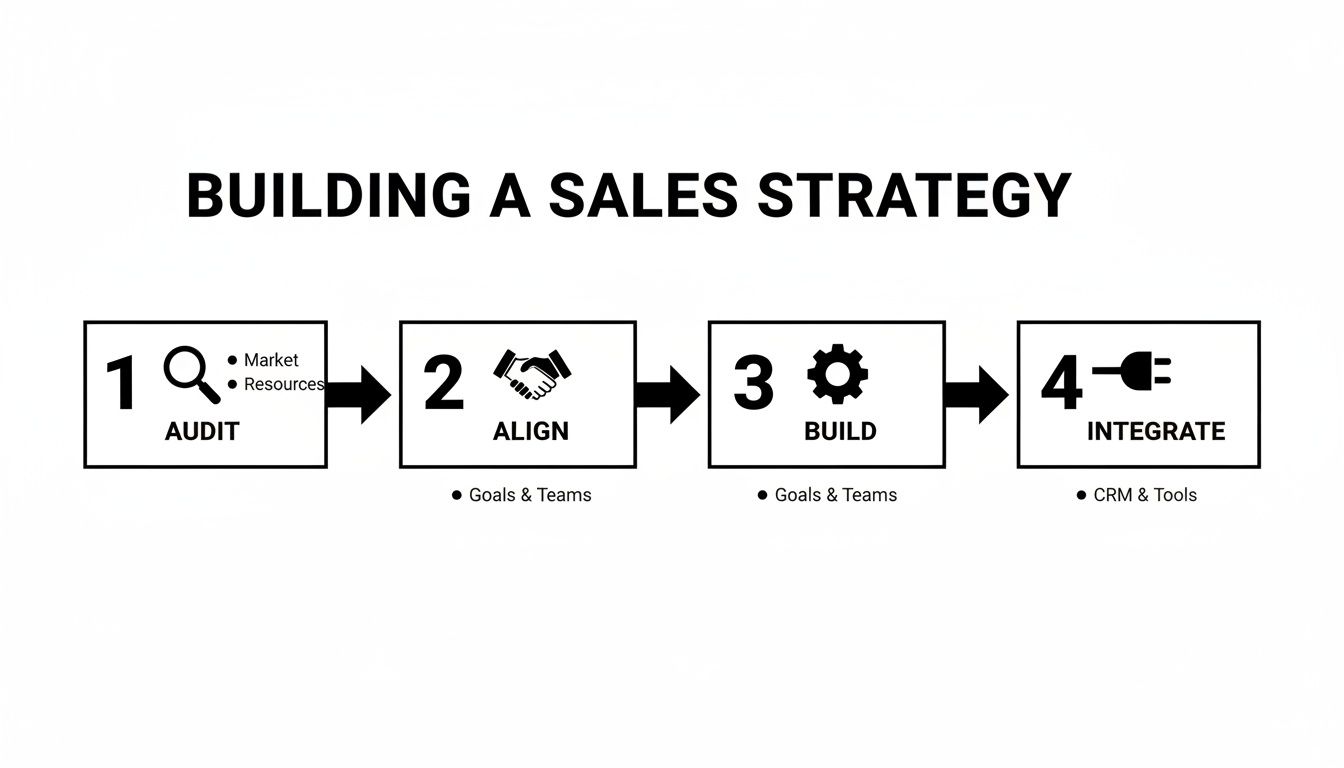
A four-step process for building a sales strategy: audit, align, build, integrate.

Each stage stacks on the one before it, making sure your strategy is built on solid data, backed by the right people, and actually has the teeth to drive results.

Phase 1: Audit And Goal Setting

Before you can build anything, you have to know what you're working with. The audit phase is about getting brutally honest about where your sales process is leaking money. This isn't about pointing fingers; it's about finding the friction that grinds your reps to a halt and quietly kills deals.

Actionable Steps for Your Audit:

  1. Map the Sales Process: Identify every single step from lead to close. Where do deals consistently get stuck or slow down?
  2. Interview Your Team: Ask SDRs and AEs to walk you through their day. Where do they waste the most time? What manual tasks are slowing them down? Use a simple survey if needed.
  3. Analyze Content Usage: Run a report in your CMS or shared drive. Which assets are used most? Which are never touched? Ask reps why.
  4. Review the Tech Stack: List every tool the sales team uses. Which ones have high adoption? Which are being ignored?

This process will uncover the ugly truth about productivity gaps. Once you’ve pinpointed the real problems, you can set goals that matter.

A vague goal like "improve sales" is completely useless. An actionable goal is "increase meetings booked per SDR by 15% this quarter by cutting call prep time in half."

That level of clarity turns a simple review into a strategic weapon. It gives your entire enablement effort a clear target to hit.

Phase 2: Stakeholder Alignment

A sales enablement strategy built in a silo is dead on arrival. You absolutely need buy-in from every single department that touches the revenue journey. This alignment phase is all about getting everyone rowing in the same direction, with shared goals and a crystal-clear understanding of their part to play.

Actionable Steps for Alignment:

  1. Form an Enablement Council: Schedule a recurring meeting with leaders from Sales, Marketing, Product, and RevOps. This is not a one-time thing.
  2. Share the Audit Findings: Present the data from Phase 1. Frame the problems in terms of shared business impact (e.g., "Our outdated content is costing us deals, which affects both Marketing ROI and sales quota.").
  3. Define a Shared Charter: Create a one-page document that outlines the enablement program's mission, primary goal for the quarter, and each department's role.

Alignment isn't a one-off meeting; it's an ongoing conversation. By setting up a cross-functional "enablement council," you create a permanent feedback loop where marketing learns what content actually moves the needle and sales understands the why behind new campaigns.

Phase 3: Content And Training Development

With your goals locked in and your teams aligned, it’s time to start building the actual assets. This phase is all about creating the resources your reps will lean on every single day to be more effective.

First, focus on building a practical content library, not a digital graveyard where PDFs go to die. This is all about quality over quantity.

Actionable Steps for Content:

  • Prioritize Based on Gaps: Use your audit findings. If reps are losing to a specific competitor, make that battle card the #1 priority.
  • Build Reusable Templates: Create email templates for common scenarios (e.g., post-demo follow-up, breaking up with a prospect) and load them into your sales engagement tool.
  • Launch an "Asset of the Week": Highlight one new or underused piece of content in your weekly sales meeting to drive awareness and adoption.

Next, design an SDR onboarding and training program that actually sticks. Forget those week-long bootcamps crammed with theory. The modern approach is all about continuous, in-workflow learning. New reps should get bite-sized lessons on objection handling, immediately followed by role-play sessions with managers who can give instant, data-backed feedback.

Phase 4: Technology Integration

Finally, you need the right tech to bring your strategy to life. This is where so many companies stumble. The old way was to just bolt another standalone tool onto an already bloated tech stack. This just creates more friction, kills adoption, and forces reps to work outside the one system they live in all day—the CRM.

A modern, integrated approach is the only way to win. When you’re choosing your tools, think consolidation and workflow. You can find some of the best CRM software options to serve as your foundation.

Actionable Steps for Technology:

  1. Conduct a Tech Audit: Review your existing tools. Are there overlapping functionalities you can consolidate to save money and reduce complexity?
  2. Prioritize CRM-Native Solutions: When evaluating new tech, make "deep integration with our CRM" a non-negotiable requirement.
  3. Focus on Adoption, Not Just Implementation: A tool isn't "launched" when it's turned on. It's launched when reps are using it consistently. Build a simple dashboard to track weekly active usage for every key tool.

There's a reason over 90% of high-growth companies now run dedicated sales enablement programs. The most mature functions see 32% higher quota attainment because they've cracked this code of integration and efficiency.

How To Measure The ROI Of Your Sales Enablement

Figuring out if your enablement strategy is actually working can feel like trying to nail Jell-O to a wall. But proving its value to the C-suite isn't about fuzzy feelings or vanity metrics. It’s about drawing a straight, undeniable line from your efforts to the company's bottom line.

To do that, you need to track what matters. This means splitting your KPIs into two buckets: leading indicators (the activities) and lagging indicators (the results).

  • Leading indicators are your early warning system. They track adoption and behavior—is the team doing the things you enabled them to do?
  • Lagging indicators are the final score. They measure business outcomes like revenue, win rates, and quota attainment.

Leading Indicators: Are We On The Right Track?

Leading indicators give you a real-time pulse check. Is the team actually using the new content, tools, and processes you rolled out? These metrics are your secret weapon for course-correcting mid-quarter, long before you miss a target.

Here's what to keep an eye on:

  • Content Adoption Rate: What percentage of reps are actively using the new battle cards in live deals?
  • Training Program Completion & Certification: Are reps not just finishing modules but also passing skill certifications?
  • Key Tool Adoption: How many reps are logging in and using the new dialer or content portal daily?

If you ignore these, you're basically flying blind. A low adoption rate is a sign that your initiative is irrelevant or too complex, and you can fix it before the quarter is lost.

Lagging Indicators: Did We Actually Make More Money?

While leading indicators track the doing, lagging indicators measure the winning. These are the results you march into the boardroom with to justify your budget and prove the ROI of your entire strategy.

Focus on these heavy hitters:

  • Quota Attainment Percentage: What slice of your sales team is hitting or crushing their number?
  • Win Rate: Of all the qualified opportunities your team works, what percentage do they actually close?
  • Average Sales Cycle Length: How long does it take to get a deal done, from the first "hello" to a signed contract?

The data backs this up. Organizations where sales and marketing are tightly aligned through enablement see 20% annual revenue growth, while misaligned teams can actually see a 4% revenue decline. Some studies on the financial returns of mature enablement programs show they can deliver as high as a 4:1 return on investment.

Leading vs Lagging Indicators For Enablement ROI

This table breaks down how to think about both types of metrics. Leading indicators tell you if your process is working today, while lagging indicators confirm it's impacting the business tomorrow.

Metric TypeKPI ExampleWhat It MeasuresHow An Integrated System Helps
LeadingContent Adoption RateAre reps using the right assets in active deals?Automatically links content usage to CRM opportunities.
LeadingTraining Assessment ScoresIs knowledge from training being retained and applied?Tracks completion and ties performance to rep activity data.
LeadingCRM Activity LoggingAre calls and emails being captured accurately?Auto-logs all activities, eliminating manual data entry.
LaggingWin Rate PercentageHow effective are reps at closing qualified deals?Provides clean data to connect winning deals to specific plays.
LaggingSales Cycle LengthHow efficient is the sales process from start to finish?Clearly shows how new processes impact deal velocity.
LaggingQuota AttainmentWhat percentage of the team is hitting their target?Connects individual rep performance to their adoption of tools.

Ultimately, you need both. Leading indicators let you coach and fix problems in real-time, while lagging indicators prove the long-term value of your program.

The Manual Nightmare vs. Integrated Clarity

Let's be honest about how this data gets collected in most companies.

  • The Old Way (Manual Nightmare): The RevOps leader spends half their week begging reps to log their calls. The data is messy and incomplete. Trying to connect which email template drove the most meetings is a pipe dream.
  • The Modern Way (Integrated Clarity): A CRM-native system auto-logs activities. When a rep uses a tool like marketbetter.ai to make a call from inside Salesforce, the activity is captured automatically. The data is clean and reliable.

This is how you stop guessing about your impact and start knowing it. The principles for tracking sales enablement ROI are closely related to proving the value of any GTM function. You can explore a deeper dive in our guide on how to calculate marketing ROI.

Common Sales Enablement Traps That’ll Kill Your Momentum

Even the smartest sales leaders fall into them. A sales enablement plan looks great on a whiteboard, but it can quickly unravel in the real world. It usually isn't one big disaster that sinks the ship; it's a series of small, well-intentioned mistakes that create drag, frustrate reps, and ultimately fail to move the needle on revenue.

Let's walk through the most common traps and, more importantly, how you can sidestep them.

Pitfall 1: Launching "Random Acts of Enablement"

This is the classic, number-one mistake. A sales leader sees a problem—call connect rates are down—and their first move is to buy a shiny new dialer. Problem solved, right? Wrong. This is a “random act of enablement.” It’s a knee-jerk reaction that treats a symptom without ever diagnosing the actual disease.

The Trap (What Not To Do)The Fix (What To Do Instead)
Reactive Problem-Solving: Buying a new tool for every little hiccup. The result? A messy, expensive, and fragmented tech stack that nobody fully uses.Strategic Diagnosis: Hit pause. Ask why connect rates are low. Is it bad data? Are we calling at the wrong times? Are the talk tracks stale? Or is the tool actually the issue?
Siloed Decisions: The sales manager buys the dialer without talking to RevOps, marketing, or the very reps who have to use it every single day.Cross-Functional Huddle: Get a small group together from sales, marketing, and ops. Make sure every new initiative solves a real, agreed-upon problem that everyone sees.

Actionable Tip: Before launching any new initiative, force yourself to complete this sentence: "We are doing this because [insert data-backed problem from your audit] in order to achieve [insert specific, measurable goal]." If you can't fill in the blanks, don't do it.

Pitfall 2: Drowning Reps in Theory, Not Practice

So many enablement programs feel like a college course. Reps get fire-hosed with hours of PowerPoints on sales methodologies, product specs, and competitor battle cards. That knowledge is important, but it has a shockingly short half-life if it’s not put into practice immediately.

You end up with reps who can ace a multiple-choice quiz but freeze up when a real prospect hits them with an objection they weren't expecting.

The goal isn't to create reps who are certified academics. The goal is to build reps who can consistently run the right play when a deal is on the line. Training is measured by behavior change, not by certificates of completion.

Actionable Tip: Follow the "3:1 Rule." For every three hours of theoretical training, schedule at least one hour of practical application like role-playing, call reviews, or a certification exercise. This ensures knowledge is immediately put into practice.

Pitfall 3: Picking Tech That Reps Hate (and Ignore)

This trap is the direct result of the first two. You buy that standalone dialer or a separate content portal, thinking you’ve checked a box. But because it doesn't live inside the CRM—the place where your reps spend 90% of their workday—it gets ignored. Forcing reps to constantly juggle tabs is a workflow killer.

Think about the classic standalone dialer fail: A manager rolls out a new dialer. Reps have to alt-tab out of Salesforce, find the contact, make the call, then tab back to Salesforce to manually log the activity. By week three, adoption has flatlined.

Now, compare that with an integrated approach: With a CRM-native task engine like marketbetter.ai, the dialer is built right into the Salesforce interface. A rep clicks a button on the contact record, the call connects, and the outcome is logged automatically. Zero friction.

Actionable Tip: Create a "Day in the Life" map of your reps' workflow. Before buying any new tech, physically map out how it will fit into that day. How many extra clicks does it add? If it adds friction instead of removing it, it's the wrong tool.

The Future Of Enablement Is Integrated
A whimsical sketch of a software interface with floating digital icons, representing content management.

If this playbook makes one thing clear, it's this: modern sales enablement isn’t just another department. It's the operational engine that drives your entire revenue team. The days of fragmented tools and siloed initiatives are over. Frankly, they create more friction than they solve.

The future belongs to integrated—or embedded—enablement. This is where your content, your coaching, and your execution tools live directly inside the platforms your reps use all day, every day. Think CRM.

Instead of forcing reps to hunt for a battle card in one portal and log a call in another, an integrated system surfaces the right asset and auto-logs the activity without them ever leaving their workflow.

This approach just makes sense. It kills the friction that tanks tool adoption and gives leadership a crystal-clear, real-time view of what actually drives performance.

The takeaway is simple: stop adding more tabs to your tech stack. It's time to build a unified system that makes your sales process smarter from the inside out. A huge piece of this puzzle is making sure your core systems are set up for it. You can see how the best tools achieve seamless integration with SFDC to make this a reality.

Common Questions, Answered

If you're building a sales enablement program, you've probably got questions. Here are a few of the most common ones I hear from leaders trying to get it right.

What’s The Biggest Mistake People Make In Sales Enablement?

Without a doubt, it's launching what I call "random acts of enablement." This is when leaders buy a shiny new tool or create a one-off training deck without first tying it to a real business problem. It’s a solution in search of a problem.

A great strategy doesn't start with a tool. It starts by diagnosing the friction in your sales process. A reactive approach just buys a new dialer. A strategic one digs in and asks why call volume is low—is it bad data? Clunky workflows? Weak talk tracks?—and then builds a focused plan to fix it.

How Is Sales Enablement Different From Sales Operations?

This one comes up all the time, and it's a critical distinction. The easiest way to think about it is like a Formula 1 race team.

  • Sales Operations is the pit crew chief. They build and maintain the car—territory planning, comp plans, forecasting, and keeping the CRM running. Ops makes sure the machine is in perfect working order.
  • Sales Enablement is the driver's coach. Their job is to make the driver faster and smarter on the track. They provide the right training, content, and in-the-moment coaching to help the driver navigate every turn and win the race.

They work hand-in-glove, but Ops owns the process and infrastructure, while Enablement owns the rep’s effectiveness and productivity.

How Do You Actually Measure If An Enablement Strategy Is Working?

You measure success by drawing a straight line from your enablement activities to real business outcomes. Forget vanity metrics like how many times a PDF was downloaded.

The only way to prove value is by tracking both leading and lagging indicators. Leading indicators—like tool adoption or reps completing a new training module—show if your team is engaging. Lagging indicators—like higher quota attainment, better win rates, and shorter sales cycles—prove it's actually hitting the bottom line.

Modern enablement makes this easy. Instead of guessing, you can see clear proof, like reps who use a specific battle card having a 10% higher win rate. That's an undeniable ROI.

What Does The Future Of Enablement Look Like?

The future is all about being integrated and AI-driven. Standalone tools and one-off training are on their way out. The next evolution is "embedded enablement," where support lives directly inside the tools your reps use every single day, like the CRM.

Instead of a rep digging through a content library to find the right case study, AI will surface it for them in the middle of a live call. The focus is shifting from simply equipping reps to actively helping them execute in the moment, automating the grunt work so they can spend all their energy selling.


Ready to embed an execution engine directly into your CRM? marketbetter.ai turns buyer signals into prioritized tasks and helps SDRs execute faster with an AI-powered dialer and email writer inside Salesforce and HubSpot. Stop chasing reps to log activities and start building a predictable outbound motion. Learn more at marketbetter.ai.

7 Sales Enablement Best Practices That Cut Ramp Time by 40% [2026]

· 25 min read

In today's competitive market, providing your sales team with the right tools, content, and training isn't just an advantage; it's the foundation of sustainable growth. The term 'sales enablement' is frequently used, but what does it actually mean to implement it effectively? It’s about transitioning from inconsistent, ad-hoc support to a strategic, data-driven framework that empowers every sales representative to perform at their peak. A robust strategy ensures your team has precisely what it needs to engage buyers, close deals, and drive revenue consistently.

This article cuts through the noise to deliver a comprehensive guide to sales enablement best practices that top-performing organizations are using right now. We move beyond theory to provide actionable steps you can take to build a powerful enablement function. Instead of just listing concepts, we will compare different approaches, offering clear implementation frameworks and real-world examples to illustrate how these strategies work in practice.

You will learn how to:

  • Centralize content for maximum accessibility and impact.
  • Implement continuous coaching that elevates seller skills.
  • Harness data to make smarter sales decisions.
  • Achieve true sales and marketing alignment.
  • Map the buyer journey for hyper-personalized outreach.

We’ll dive deep into each practice, providing step-by-step guidance to help you transform your sales function from a cost center into a predictable revenue engine. Get ready to learn not just the 'what,' but the 'how' and 'why' behind proven strategies that deliver measurable results.

1. Centralized Content Management and Repository

Imagine your top sales representative is minutes away from a crucial demo and can't find the latest case study. They waste 15 minutes digging through emails, shared drives, and old Slack channels, finally settling for an outdated version. This scenario is all too common and highlights a fundamental breakdown in sales efficiency. A centralized content management repository is one of the most impactful sales enablement best practices because it directly solves this problem, creating a single source of truth for all sales and marketing collateral.

Compare the approaches: A disorganized system relies on tribal knowledge and scattered folders, leading to wasted time, inconsistent messaging, and frustrated reps. In contrast, a centralized repository acts as an intelligent, accessible hub where sales teams can instantly find the right content for the right stage of the buyer's journey. Instead of reps recreating materials or using off-brand messaging, a centralized system ensures everyone uses approved, up-to-date, and on-brand assets, from pitch decks and battle cards to testimonials and pricing sheets.

Why It's a Game-Changer

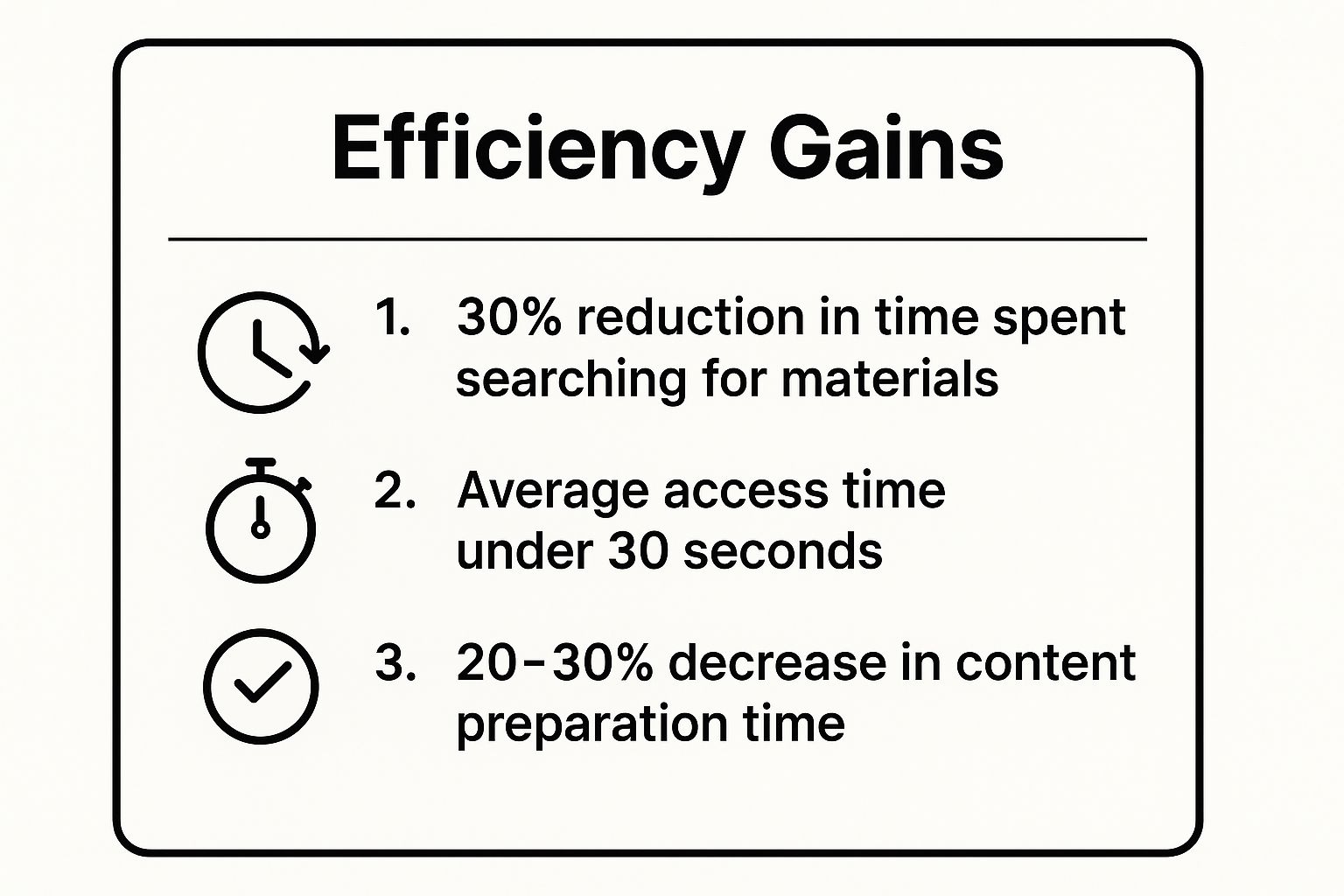
Companies that master content centralization see significant returns on their investment. For example, Salesforce leverages Highspot to empower its massive global sales team, ensuring consistent messaging and quick access to relevant materials across different regions and languages. Similarly, HubSpot's internal content library is so efficient that its reps can typically find and share relevant content in under 30 seconds, dramatically shortening their sales cycle preparation time.

This infographic summarizes the quantifiable impact of adopting a centralized content strategy.

Infographic showing key data about Centralized Content Management and Repository

As the data shows, the primary benefit is reclaiming valuable selling time by drastically reducing administrative friction.

How to Implement It

Getting started doesn't require an immediate, large-scale overhaul. Follow these actionable steps to build an effective repository:

  • Actionable Step 1: Conduct a Content Audit & Catalog High-Impact Assets. Before you build anything, know what you have. Start by cataloging your top 10-20 most-used pieces of content. Focus on high-impact assets like your main sales deck, key case studies, and product one-pagers. This gives you a quick win and a foundation to build upon.
  • Actionable Step 2: Establish a Simple, Scalable Governance Model. Create a logical folder structure and a strict naming convention (e.g., AssetType_Topic_Version_Date). For robust content governance and accessibility, explore effective digital asset management best practices.
  • Actionable Step 3: Implement Quarterly Content Reviews. Schedule reviews to archive outdated materials and identify content gaps. This ensures the repository remains trustworthy and relevant. To dive deeper into optimizing your content strategy, you can find valuable insights by learning more about leveraging AI for advanced content analysis.
  • Actionable Step 4: Run an Adoption Campaign, Not Just a Training. A system is only as good as its adoption. Host training sessions focused on search functionality and tagging, but also gamify the launch. Create a scavenger hunt for key documents or reward the first rep to share a new asset with a prospect. Set up automated notifications to alert reps when new or updated content is published.

2. Continuous Sales Training and Coaching

Many companies treat sales training as a one-time event, an intensive onboarding boot camp that reps are expected to remember for the rest of their tenure. This "set it and forget it" approach ignores a critical reality: markets evolve, products update, and skills atrophy. Continuous sales training and coaching is one of the most vital sales enablement best practices because it transforms training from a single event into an ongoing process, fostering a culture of perpetual improvement and adaptation.

Compare the approaches: One-time training results in an estimated 87% of knowledge being forgotten within a month. Continuous coaching, on the other hand, integrates learning into the daily workflow with bite-sized modules, personalized coaching, and relevant skill development. Instead of relying on outdated knowledge from their initial onboarding, salespeople receive timely updates on products, competitors, and sales methodologies, ensuring they are always equipped to handle the modern buyer's objections and questions.

Continuous Sales Training and Coaching

Why It's a Game-Changer

Organizations that commit to continuous development see a direct correlation with revenue growth. For instance, IBM's targeted sales training program famously increased its deal closure rates by 25%. Similarly, Oracle implemented a continuous coaching model that improved quota attainment by 18% across its sales teams. Modern tools like Gong.io exemplify this practice by using conversation intelligence to analyze sales calls and provide managers with targeted, data-driven recommendations for personalized coaching.

This shift from episodic training to a continuous loop of learning, application, and feedback is what separates top-performing sales organizations from the rest. It ensures that every member of the team, from rookie to veteran, is constantly sharpening their skills.

How to Implement It

Building a culture of continuous learning is a strategic initiative that pays long-term dividends. Follow these actionable steps to get started:

  • Actionable Step 1: Create a "Deal of the Week" Breakdown. Instead of generic quarterly training, pick one recent win (or loss) and have the rep walk the team through the key decision points and tactics. This makes learning hyper-relevant and peer-driven.
  • Actionable Step 2: Establish Peer-to-Peer "Skill Pods." Group reps into small pods of 3-4 to practice specific skills, like objection handling or negotiation. Have them role-play and give each other feedback in a low-stakes environment.
  • Actionable Step 3: Use Technology for "Just-in-Time" Learning. Use sales enablement platforms or learning management systems (LMS) to push short quizzes and reinforcement exercises to reps over time. For example, if a rep adds a specific competitor to a deal in the CRM, automatically send them the latest competitor battle card. One key area for reinforcement involves consistent client communication; you can explore expert strategies for crafting the perfect follow-up email to learn more about mastering follow-up cadences.
  • Actionable Step 4: Gamify Skill Certification. Introduce leaderboards, badges, and rewards for completing training modules or demonstrating new skills on calls. Friendly competition is a powerful motivator that can dramatically increase engagement with training materials. For example, offer a bonus for the rep with the most improved talk-to-listen ratio in a given month.

3. Data-Driven Sales Analytics and Insights

Consider a sales manager leading a team meeting, asking why Q3 numbers are lagging. One rep blames the market, another points to weak leads, and a third suggests the pricing is off. Without data, this is just a collection of opinions. This common scenario is where gut-feel selling hits a wall. Implementing data-driven sales analytics is a critical sales enablement best practice that replaces guesswork with strategic intelligence, giving teams a clear roadmap to success.

Compare the approaches: A gut-driven sales culture relies on intuition and past experiences, which are often biased and not scalable. In contrast, a data-driven culture transforms raw data from your CRM and other tools into actionable insights. It helps answer crucial questions like: Which lead sources generate the highest conversion rates? What specific behaviors indicate a prospect is ready to buy? At what stage do most deals stall, and why? By leveraging analytics, you empower reps to focus their energy on the most promising opportunities and tailor their approach based on proven patterns.

Why It's a Game-Changer

Organizations that embed analytics into their sales process gain a significant competitive advantage. For instance, Salesforce Einstein uses AI-powered insights to analyze customer data and predict which deals are most likely to close, reportedly helping some customers increase deal closure by up to 30%. Similarly, LinkedIn Sales Navigator provides powerful analytics that help teams understand their prospecting effectiveness, with users reporting up to 40% improvement in finding the right decision-makers.

These tools don't just report numbers; they provide prescriptive guidance. Imagine your system automatically flagging an at-risk account because customer engagement has dropped or highlighting an upsell opportunity based on a client's product usage data. That's the power of transforming data from a historical record into a forward-looking strategic asset.

How to Implement It

You can build a data-driven culture incrementally without needing a team of data scientists from day one. Follow these actionable steps:

  • Actionable Step 1: Define Your "One Metric That Matters" (OMTM). Don't try to track everything. Focus on a single, core metric that directly impacts revenue for the quarter, such as lead-to-opportunity conversion rate, sales cycle length, or average deal size. Build your initial dashboard around this primary KPI.
  • Actionable Step 2: Implement a CRM "Data Hygiene" Sprint. Your insights are only as good as your data. Dedicate one week to a team-wide effort to clean up the CRM. Run a contest for who can update the most contacts or close out old opportunities. Implement simple rules like "no contact without an email address" to maintain quality.
  • Actionable Step 3: Run "Data Storytelling" Sessions. Provide training that goes beyond how to read a dashboard. Teach your sales team how to find a "story" in the data. For example, show them how to use engagement scores to prioritize their daily outreach by focusing on the prospects telling the most promising story with their actions.
  • Actionable Step 4: Create Actionable Dashboards, Not Data Dumps. Instead of just showing that "Q3 deals are down 10%," build a dashboard that shows why. For instance, a component could show "Deals are stalling 40% more often at the proposal stage compared to last quarter," giving your team a specific problem to solve.

4. Sales and Marketing Alignment (Smarketing)

Your marketing team celebrates a record-breaking month for lead generation, yet the sales team complains that the leads are low-quality and a waste of time. This disconnect is a classic symptom of sales and marketing misalignment, a costly problem that sabotages growth and creates internal friction. True sales enablement best practices must bridge this gap, transforming two separate functions into a single, cohesive revenue engine. This unified approach is often called "Smarketing."

Compare the approaches: Misaligned teams operate in silos with separate goals (MQLs vs. closed deals), leading to finger-pointing and wasted resources. Aligned teams, or "Smarketers," collaborate seamlessly with shared revenue goals, processes, and communication channels. This ensures consistent messaging from the first ad a prospect sees to the final closing call, directly impacting lead quality, conversion rates, and the overall customer experience.

Why It's a Game-Changer

Organizations that master smarketing gain a powerful competitive advantage. HubSpot, a pioneer in this space, attributed much of its early 100%+ annual growth to its tight internal smarketing culture. Similarly, after focusing on alignment, marketing automation giant Marketo achieved a 10% increase in revenue. Adobe also saw significant returns, improving its lead quality scores by 25% by creating a unified approach between its sales and marketing departments.

When marketing understands precisely what a "sales-ready" lead looks like and sales provides feedback on campaign effectiveness, the entire revenue funnel becomes more efficient. Marketing delivers higher-quality leads, and sales can close them faster because they are better informed and more engaged. This synergy eliminates wasted effort and maximizes ROI on both marketing spend and sales time.

How to Implement It

Building a strong smarketing foundation requires intentional effort and structural change. Use these steps to foster genuine collaboration:

  • Actionable Step 1: Launch a Weekly "Smarketing Huddle." Schedule regular, mandatory cross-team meetings (weekly or bi-weekly) to discuss pipeline health, campaign performance, and potential roadblocks. The agenda should be collaborative: marketing presents upcoming campaigns, and sales shares real-time feedback from the field.
  • Actionable Step 2: Build a Unified Funnel Dashboard. Move beyond separate MQL (Marketing Qualified Lead) and SQL (Sales Qualified Lead) targets. Instead, focus on shared revenue goals. Build a single dashboard that tracks the entire funnel from initial touchpoint to closed-won deal, giving both teams visibility into their joint impact.
  • Actionable Step 3: Draft a Two-Way Service Level Agreement (SLA). Formally document the commitments each team makes to the other. Define what constitutes a qualified lead, the exact process for handoffs, and the expected follow-up time from sales. Crucially, include a sales commitment to provide structured feedback on lead quality within a specific timeframe.
  • Actionable Step 4: Mandate Sales Involvement in Content Creation. Involve sales in the creation of key marketing content like case studies, blog posts, and email campaigns. Their frontline insights are invaluable for crafting messaging that truly resonates with buyers and addresses common objections. This also increases the likelihood that sales will actually use the content marketing produces.

5. Buyer Journey Mapping and Personalization

Consider a sales rep sending a technical implementation guide to a new lead who just became aware of your brand. It’s like proposing marriage on a first date-the timing is completely off. This common misalignment happens when sales teams operate without a clear understanding of the customer's mindset and needs. Buyer journey mapping and personalization is one of the most critical sales enablement best practices because it shifts the focus from a company-centric sales process to a customer-centric buying experience.

Compare the approaches: A generic sales process uses a one-size-fits-all pitch for every prospect. A personalized approach, guided by a buyer journey map, tailors the conversation and content to the prospect's specific stage—from awareness to consideration to decision. This transforms generic outreach into a helpful, relevant conversation, building trust and guiding prospects toward a confident purchase decision.

Why It's a Game-Changer

The masters of personalization have built empires on this principle. Amazon attributes an estimated 35% of its revenue to its recommendation engine, a direct result of understanding user behavior and personalizing the experience. Similarly, Netflix’s content personalization engine is so effective that it drives 80% of all viewer activity, keeping users engaged by predicting what they want to watch next. These B2C giants prove that anticipating customer needs based on their journey is incredibly powerful.

In a B2B context, this means delivering a case study to a prospect in the consideration phase rather than a broad industry report, or offering a targeted demo that addresses specific pain points they've already revealed. This strategic empathy accelerates the sales cycle by removing friction and making the buyer feel understood.

How to Implement It

You can begin personalizing your sales approach without a massive data science team. Start with a focused strategy and build from there:

  • Actionable Step 1: Map the Journey for One Key Persona. Don't try to map every possible customer journey at once. Begin with your ideal customer profile (ICP). Interview 3-5 recent customers from this segment to understand their "aha!" moments, their research process, and their decision-making criteria. Document the key stages.
  • Actionable Step 2: Identify "Trigger Actions" for Each Stage. Leverage data from your CRM and marketing automation platform. Key actions like downloading a specific whitepaper, visiting the pricing page multiple times, or watching a product demo are strong indicators of a prospect's stage in the journey. List these triggers for your sales team.
  • Actionable Step 3: Create a "Content Playbook" for Each Stage. For each stage, define the key questions prospects are asking and map specific assets (blog posts, case studies, battle cards) to answer them. This creates a simple playbook for your reps to follow. For a deeper understanding of how to prioritize prospects based on their behavior, explore insights on leveraging AI for intelligent lead scoring.
  • Actionable Step 4: Automate with a Human Touch. Use sales enablement tools to automate the delivery of personalized content based on CRM triggers. However, train your reps to add a human touch. A personal note in an automated email like, "Saw you checked out our case study on X, thought you might find this related article useful," makes the interaction feel authentic, not automated.

6. Mobile-First Sales Enablement

Today’s sales professional is rarely chained to a desk. They are in the field, meeting clients, traveling between appointments, and working from anywhere. A sales enablement strategy that doesn't prioritize mobile access is a strategy designed for a bygone era. Mobile-first sales enablement means designing tools, content, and processes with smartphones and tablets as the primary platform, ensuring reps have everything they need at their fingertips, exactly when they need it.

Compare the approaches: A desktop-centric strategy forces reps to save administrative tasks for the end of the day, leading to inaccurate CRM data and delayed follow-ups. A mobile-first approach integrates these tasks into the rep's real-time workflow. They can pull up a battle card seconds before a meeting, update the CRM on the spot, and share a case study from their phone, making them more agile and prepared.

Why It's a Game-Changer

Adopting a mobile-first mindset yields immediate and measurable results in productivity and responsiveness. For instance, when Salesforce launched its enhanced mobile experience, it saw an 85% increase in adoption among its field sales teams, leading to more accurate data and faster deal cycles. Similarly, Dropbox's mobile sales tools empowered its reps to deliver proposals and contracts 40% faster, directly impacting their ability to close deals ahead of competitors.

These companies recognize that mobile isn't an afterthought; it's the main stage for sales activity. By reducing the friction between a rep and the information they need, you empower them to be more agile, prepared, and effective in every customer interaction.

How to Implement It

Transitioning to a mobile-first strategy requires a deliberate and user-centric approach. Follow these actionable steps to ensure your team is equipped for success on the go:

  • Actionable Step 1: Survey Your Field Team on Their Top 5 Mobile Needs. Don’t guess. Ask your reps to rank the most critical actions they need to perform on the go (e.g., logging calls, accessing contacts, viewing dashboards). Optimize those features first for a quick adoption win.
  • Actionable Step 2: Test Real-Time Synchronization. Have two team members work on the same record, one on mobile and one on desktop. Ensure that data flows effortlessly between platforms in real time. A rep updating a deal stage on their phone should see that change reflected instantly on their laptop, eliminating duplicate data entry.
  • Actionable Step 3: Simulate an "Offline Day." Test your platform's offline capabilities. Ask a rep to go into airplane mode for an hour, access key documents, and update information. Then, have them reconnect to ensure the app syncs automatically and correctly.
  • Actionable Step 4: Create Mobile "Micro-Trainings." Don't use a desktop-based webinar to train on mobile. Create a series of 60-second video tutorials that reps can watch on their phones, covering specific workflows like "How to log a meeting in 30 seconds" or "How to share a case study from the mobile app."

7. Conversation Intelligence and Call Analytics

Picture your top-performing salesperson. What makes them so effective? For most sales leaders, the answer is a mix of intuition, skill, and experience that feels impossible to replicate. Conversation intelligence and call analytics platforms are designed to demystify this "magic," turning every customer interaction into a rich source of data and a powerful coaching tool. This practice uses AI to record, transcribe, and analyze sales conversations, revealing what truly works and what doesn't.

Compare the approaches: Traditional call coaching relies on a manager randomly listening to a few calls and providing anecdotal feedback. Conversation intelligence analyzes 100% of calls, providing unbiased, data-driven insights. Instead of a manager saying, "I think you talk too much," the data can show, "Your talk-to-listen ratio is 70:30, while our top performers average 45:55." This transforms coaching from subjective advice to objective, actionable guidance.

Why It's a Game-Changer

The impact of conversation intelligence is direct and quantifiable. For instance, Zendesk used Gong.io to analyze its sales calls and discovered that discussing pricing later in the conversation led to better outcomes. By operationalizing this insight, they increased their win rate by 22%. Similarly, Qualtrics leveraged Chorus.ai to identify and replicate the behaviors of its top reps, ultimately reducing its sales cycle length by 18%. These tools turn every call into a learning opportunity, creating a feedback loop that continuously improves performance.

These platforms move coaching from abstract advice to concrete, evidence-based guidance. A manager can say, "Instead of mentioning our competitor here, try this framing that we saw work on three other deals this week," and provide a direct link to the call recording as an example.

How to Implement It

Successfully integrating conversation intelligence requires a focus on trust and improvement, not just oversight. Follow these actionable steps to roll it out effectively:

  • Actionable Step 1: Launch with a "Coaching Pilot" for Volunteers. Introduce the tool to a pilot group of trusted reps who are eager to improve. Their positive experiences and success stories will build buy-in and help ease concerns from more skeptical team members.
  • Actionable Step 2: Frame It as a "Game Tape" for Sales. Position the technology as a tool for personal and professional development, just like athletes reviewing game footage. Use insights to highlight what reps are doing well and to identify specific, coachable moments for improvement. This fosters a culture of learning rather than one of micromanagement.
  • Actionable Step 3: Create a "Greatest Hits" Playlist. Build a library of successful calls or key moments. Share short clips that demonstrate effective objection handling, compelling value propositions, or successful negotiation tactics. Make this a core part of your onboarding and continuous training.
  • Actionable Step 4: Run a Compliance and Transparency Briefing. Be transparent with both your team and your customers. Hold a dedicated meeting to explain how the tool works and review all local and international call recording laws and privacy regulations, ensuring everyone understands their responsibilities regarding consent.

7 Sales Enablement Best Practices Comparison

ItemImplementation Complexity 🔄Resource Requirements ⚡Expected Outcomes 📊Ideal Use Cases 💡Key Advantages ⭐
Centralized Content Management and RepositoryMedium - significant setup & ongoing maintenanceModerate - tech integration and content curation20-30% less prep time; up to 30% time saved searchingSales content organization and rapid onboardingConsistent messaging; quick access to materials
Continuous Sales Training and CoachingHigh - ongoing programs, management supportHigh - time, cost, and coaching resources15-20% sales performance boost; 50% higher net sales per employeeSkill development and performance improvementMeasurable skill gains; retention increase
Data-Driven Sales Analytics and InsightsHigh - complex integration and data quality needsHigh - analytics tools and training10-30% conversion increase; better forecasting accuracySales performance optimization and forecastingProactive strategies; objective measurement
Sales and Marketing Alignment (Smarketing)Medium to High - requires cultural shiftModerate - shared processes and tech stack20%+ annual revenue growth; 67% more qualified leadsCross-team collaboration and lead qualityImproved lead conversion; consistent brand message
Buyer Journey Mapping and PersonalizationMedium to High - research, continuous updatesModerate to High - content personalization efforts50-80% engagement increase; shorter sales cyclesPersonalized prospect engagementHigher conversion rates; enhanced CX
Mobile-First Sales EnablementMedium - mobile tech and security challengesModerate to High - mobile tools and training25-85% productivity increase; 60% faster response timeField sales and remote access to infoWork anywhere; real-time info access
Conversation Intelligence and Call AnalyticsHigh - AI tools plus legal/privacy complianceHigh - AI tech and cultural adoption20-30% win rate improvement; 50% onboarding time reductionSales coaching and conversation optimizationData-driven coaching; scalable performance insights
Free Tool

Try our AI Lead Generator — find verified LinkedIn leads for any company instantly. No signup required.

Putting Enablement into Action: Your Path to Higher Revenue

Navigating the landscape of sales enablement best practices can feel like assembling a complex engine without a manual. We've journeyed through seven critical components, from building a centralized content repository and fostering continuous coaching to harnessing data-driven analytics and aligning sales with marketing. We’ve explored the nuances of buyer journey mapping, the necessity of a mobile-first approach, and the transformative power of conversation intelligence. Each of these practices represents a powerful lever for growth, but their true potential is unlocked when they work in concert.

The path forward isn't about a revolutionary, all-at-once overhaul. Attempting to implement all seven strategies simultaneously is a recipe for organizational fatigue and diluted results. Instead, the most successful enablement transformations begin with a focused, diagnostic approach. The key is to identify the single greatest point of friction in your current sales process and start there.

From Silos to Synergy: A Strategic Comparison

Consider the contrast between a reactive and a proactive enablement strategy. A reactive organization might invest in a new content management system because reps complain they can't find materials (addressing Practice #1). While helpful, this is a point solution.

A proactive, strategic organization sees the bigger picture. They understand that a content repository isn't just about storage; it's about performance. They connect it to their CRM data and buyer journey maps (Practices #3 and #5) to automatically recommend the most effective asset for a specific deal stage and persona. They then use conversation intelligence (Practice #7) to analyze which pieces of content actually resonate on calls, creating a data-driven feedback loop that informs future content creation and sales coaching (Practice #2). This shift from isolated tools to an integrated ecosystem is where sustainable revenue growth is born.

Your Actionable Roadmap to Enablement Mastery

To translate these concepts into tangible results, you need a clear plan. Don't let this list remain a collection of ideas; turn it into a strategic initiative.

  1. Conduct an Enablement Audit: Start by gathering feedback. Survey your sales team to identify their biggest time sinks and roadblocks. Is it finding relevant content? Is it a lack of confidence in handling objections? Use this data to prioritize which best practice to tackle first.
  2. Define a Pilot Program: Select one or two of the practices discussed that directly address your audit's findings. For example, if your team struggles with inconsistent messaging, focus on a pilot program combining a centralized content library (Practice #1) with targeted coaching sessions (Practice #2) for a small group of reps.
  3. Measure and Iterate: Define your key performance indicators (KPIs) before you begin. For the example above, you might track metrics like the sales cycle length, win rates for the pilot group versus a control group, and qualitative feedback from the reps. Use these insights to refine your approach before rolling it out company-wide.

Ultimately, mastering these sales enablement best practices is about creating a culture of continuous improvement. It’s about empowering your sales team not just with what they need to sell today, but with the skills, knowledge, and tools to adapt and win tomorrow. This strategic investment also means equipping your team for top-of-funnel success. To truly realize higher revenue, sales enablement must equip teams with the knowledge and tools for effective lead generation, including these proven lead generation best practices that ensure a healthy pipeline.

By committing to this journey, you’re not just supporting a department; you are building a predictable, scalable, and intelligent revenue engine that becomes your company’s most significant competitive advantage.


Ready to transform your sales enablement strategy from a series of disconnected tasks into a unified revenue engine? marketbetter.ai integrates AI-powered content creation, sales analytics, and campaign automation into a single platform designed to implement these best practices seamlessly. See how you can empower your team and drive predictable growth by visiting marketbetter.ai today.