22 posts tagged with "outbound sales"

View All Tags

A Digital Marketing Strategy Framework Built for High-Performing SDRs

· 25 min read

Think of a digital marketing strategy framework as the official playbook for your sales development team. It’s what turns random, hopeful outreach into a systematic, repeatable process for booking qualified meetings. For a Sales Development Representative (SDR), this isn't just theory; it's a GPS for hitting quota.

Without a framework, an SDR is navigating rush hour traffic blindfolded. With one, they have a clear, step-by-step route from a prospect's name to a call on the calendar. This is the difference between hoping for pipeline and building a pipeline you can actually count on.

Why Your SDR Team Needs a Framework More Than Ever
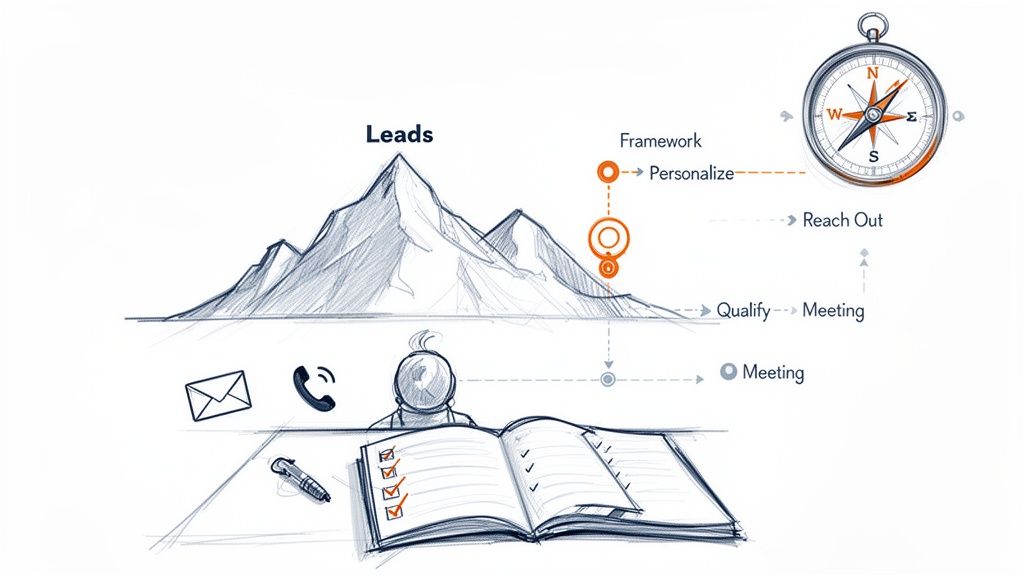
A sketch illustrating a digital marketing and sales lead management process with steps and a compass.

For too many SDRs, the daily routine is a reactive scramble. You're staring at a mountain of leads in your CRM with no clear path forward, which inevitably leads to wasted effort and rollercoaster results. This unstructured approach is like trying to build a house without a blueprint. Sure, you might get a wall up, but the structure is weak, unreliable, and will eventually collapse.

A digital marketing strategy framework changes the game entirely. It injects the structure needed to move from chaos to clarity. Instead of relying on gut feelings, reps can execute a proven process for identifying, engaging, and converting the right prospects, day in and day out.

From Unstructured Outreach to a Predictable Playbook

Without a solid framework, SDRs often operate in silos. Everyone is left to figure out what works on their own, leading to the same pain points that absolutely kill productivity and morale:

  • Wasted Time on Manual Research: Reps burn hours digging for scraps of information on prospects, only to end up with generic details that don't help them personalize their outreach in a meaningful way.
  • Generic, Ineffective Messaging: With no clear guidance on the Ideal Customer Profile (ICP) or their specific pain points, emails become bland templates that prospects ignore and delete in a heartbeat.
  • Inconsistent Activity and Results: Some days are a flurry of frantic activity, while others are dead slow. This feast-or-famine cycle makes building a predictable sales pipeline impossible.

A framework tackles these problems head-on by defining the "who, what, where, and when" of outreach. It provides actionable guidance, giving your SDRs the confidence to act decisively and effectively.

It's a shocking statistic, but nearly half of all businesses are operating without a defined digital marketing strategy. For SDR teams, this gap translates directly into missed opportunities and clunky workflows, because there's no unified plan for engaging their audience online.

The Actionable Advantage of a Framework

Comparing the two approaches makes the benefit for an SDR crystal clear. An SDR without a framework might blast out 100 generic emails and just hope for a response. Their day is reactive and driven by volume alone.

In contrast, an SDR with a framework knows exactly which 20 high-fit accounts to target, what specific pain points to mention, and which sequence of calls and social touches will actually get a conversation started. Their day is proactive and driven by quality.

The goal isn't just to work harder; it's to work smarter. This structure empowers your team by providing a clear set of rules and guidelines that remove the guesswork, turning your SDR team into a high-performing pipeline engine.

The Core Components of an SDR-Centric Framework
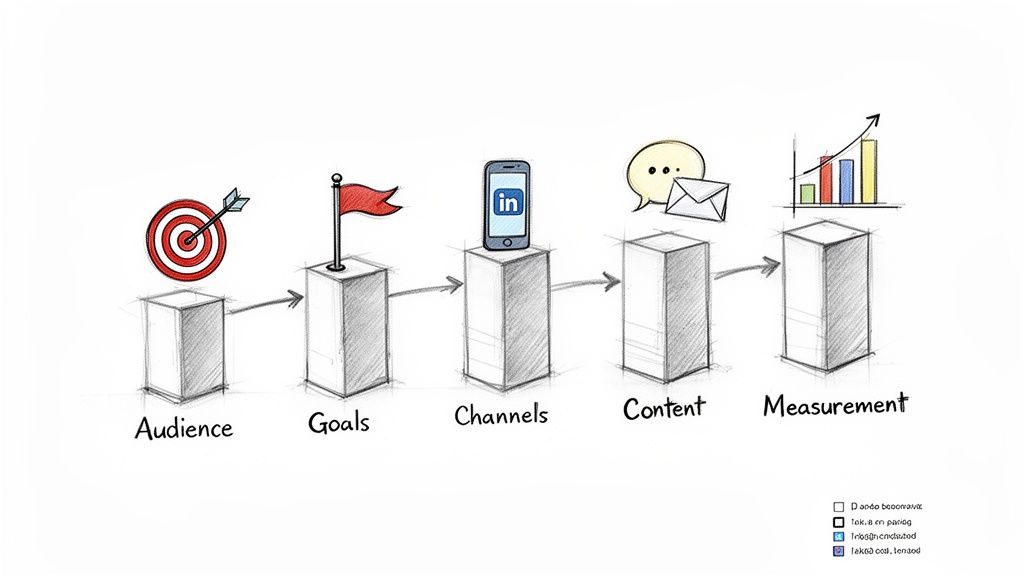
Hand-drawn digital marketing strategy framework with five steps: Audience, Goals, Channels, Content, and Measurement, with icons.

Let's be honest. A generic digital marketing strategy framework often feels like it was written for a different department. To make it a real-world tool for SDRs generating pipeline, we need to translate its core concepts into the language of outbound sales.

This isn't about some high-level marketing plan that collects dust. An SDR-centric framework is a rep’s operational blueprint. It answers the questions that actually matter on the ground: Who do I call? What are my targets? How do I reach them? What do I say? And how do I know if any of this is actually working?

It's shocking how many companies skip this. Research shows that almost 47% of businesses are flying blind without a defined digital marketing strategy. This gap absolutely cripples outbound teams, even those using powerful CRMs like Salesforce and HubSpot. Reps are left guessing, and that leads to burnt-out teams and empty pipelines.

Redefining the Audience as ICP Intelligence

For an SDR, "audience" isn't a vague demographic pulled from a marketing slide. It’s a hit list—a specific set of high-value accounts and the key decision-makers inside them. This part of the framework is all about deep Ideal Customer Profile (ICP) and Persona Intelligence.

It's about arming reps with the context needed to personalize outreach in a way that actually connects. You have to know more than just company size and industry. You need to know their specific business pains, recent trigger events like a new funding round or an executive hire, and the tech they're already using.

Actionable Step for SDRs: Instead of just getting a list, demand the context. Ask your manager: "What are the top three trigger events that signal an account is ready to buy now?" This shifts the focus from a static list to dynamic opportunities.

Translating Goals into Daily Activity Metrics

Vague marketing goals like “increase brand awareness” are useless for planning a Tuesday morning. In an SDR-centric world, goals must be translated into tangible Pipeline Targets and Daily Activity Metrics—things a rep can actually control.

This gives reps clear benchmarks for success. It breaks down a massive quarterly pipeline goal into monthly, weekly, and daily actions, shifting the focus from abstract outcomes to concrete inputs.

A framework transforms chaotic, high-volume outreach into a systematic, repeatable process. It empowers reps by providing a clear playbook, turning guesswork into confident, strategic action that consistently generates pipeline.

Actionable Step for SDRs: Take your quarterly pipeline goal and work backward. If the goal is $250,000 in pipeline, and your average deal size is ~$25k, you need to source 10 opportunities. If your meeting-to-opportunity conversion rate is 50%, you need to book 20 qualified meetings this quarter. That's your target. Break it down weekly and daily.

Mastering Channels for Outbound Success

"Channels" here don't mean broad platforms like Facebook or Google Ads. For an SDR, this is about mastering the outbound mix of email, calls, and social platforms like LinkedIn. The framework is what dictates how these tools work together in a coordinated sequence.

This is where your strategy gets tactical. It defines the cadence—when to call versus when to email, and how to use a LinkedIn connection request to warm up a cold outreach. This is a fundamental piece of building a strong outreach motion, and you can dig deeper by exploring some essential sales enablement best practices.

This structure prevents the "spray and pray" approach that kills productivity. The table below shows just how different the day-to-day reality is for an SDR with and without a clear framework.

Unstructured Outreach vs Framework-Driven SDR Strategy

ActivityUnstructured SDR (Reactive)Framework-Driven SDR (Proactive)
ProspectingPulls random lists, guessing who to target.Focuses on a pre-defined ICP with clear trigger events.
MessagingBlasts one-size-fits-all templates.Personalizes messages based on persona pain points and research.
CadenceMakes random calls and emails with no clear sequence.Follows a multi-touch, multi-channel sequence over several days.
GoalsVague targets like "make 100 calls a day."Clear targets like "book 3 qualified meetings per week."
MeasurementFocuses on vanity metrics like email open rates.Focuses on pipeline generated and Sales Accepted Leads.
OutcomeBurnout, low morale, and unpredictable results.Predictable pipeline, higher conversion rates, and rep confidence.

As you can see, a framework doesn't just add structure—it fundamentally changes the quality and impact of every single activity.

Crafting Content for Real Conversations

For an SDR, "content" isn't about writing blog posts. It’s about crafting compelling outreach messages and talk tracks designed to spark a real conversation, not just dump information.

This part of the framework gives reps the building blocks for effective communication: battle-tested email templates, scripts for handling the most common objections on a cold call, and value-driven questions to ask during that first critical discovery call. It provides structure without killing the human touch.

Measuring What Matters for Pipeline Growth

Finally, "measurement" is all about the KPIs That Matter for SDRs. We're pushing vanity metrics like open rates to the side and focusing on business outcomes that actually drive revenue. This ensures every action is tracked and analyzed for its real impact on the sales pipeline.

Key performance indicators in a solid SDR framework include:

  • Activity-to-Conversation Ratio: How many calls or emails does it take to get a real response?
  • Meetings Booked: The primary output of all SDR efforts.
  • Pipeline Generated: The dollar value of the opportunities created from those meetings.
  • Sales Accepted Leads (SALs): The number of opportunities that account executives accept and move forward.

By sharpening these core components through an SDR-specific lens, a digital marketing strategy framework becomes the ultimate playbook for building a predictable and scalable sales engine.

Building Your Framework: A Step-by-Step Guide

Theory is great, but action is where a digital marketing strategy framework earns its keep. Don't mistake this for a complex, months-long project. For an SDR team, this is a practical, step-by-step process for building a powerful playbook you can use on day one.

Think of it like assembling a high-performance engine. You'll put each piece together in the right order, making sure every component works together to drive your sales motion forward. Follow these five actionable steps to turn concepts into a real-world plan that builds a predictable pipeline.

Step 1: Define SMART Goals for Your SDR Team

Every great strategy starts with a clear destination. Before your SDRs can hit their targets, they need to know what they're aiming for. This is where SMART goals—Specific, Measurable, Achievable, Relevant, and Time-bound—are non-negotiable.

SDR Action: Instead of just accepting a quota, ask "What are the specific activity inputs needed to hit this?" This turns a lagging indicator (quota) into leading indicators you can control (calls, emails, social touches).

  • Specific: Don't say "book more meetings." Say, "Book 12 qualified meetings with VPs of Marketing in the SaaS industry."
  • Measurable: The goal has to be a number you can track. For instance: "Increase qualified meetings booked by 15% in the upcoming quarter."
  • Achievable: Be ambitious, but stay grounded in reality. Pushing for a 200% increase in one month just sets your team up for burnout.
  • Relevant: Your SDR team's goals have to lock in with the bigger company objectives for revenue growth. If they don't, you're just spinning wheels.
  • Time-bound: Every goal needs a deadline. "In Q3" or "by the end of the fiscal year" creates urgency and gives you a clear timeline for measuring success.

Step 2: Refine Your Ideal Customer Profile

Once you know your destination, you need to identify the right passengers. An SDR's time is their most valuable asset. Wasting it on accounts that are a poor fit is a recipe for failure. This step is all about sharpening your Ideal Customer Profile (ICP) using your own data.

SDR Action: Go into your CRM and find the last 5 deals your company closed that came from outbound. Analyze them. Find the common threads:

  • What industry are they in?
  • What's their typical company size or annual revenue?
  • What tech are they using that signals they're a perfect fit for you?
  • What was the original pain point that made them buy in the first place?

With this data, you can build a laser-focused ICP and the buyer personas that go with it. This ensures you're not prospecting blindly; you’re targeting the accounts most likely to convert, armed with the context to start a real conversation.

Step 3: Map the Buyer Journey for Outreach

Okay, you know who to target. Now you need to understand how they buy. Mapping the buyer’s journey means figuring out the key stages a prospect moves through and identifying the moments where an SDR can actually add value. This is how you stop asking for the meeting too early or sending the wrong message at the wrong time.

SDR Action: For each stage, define one key action.

  1. Awareness: The prospect has a problem but isn't actively looking for a fix yet. Your job is to educate. Share a valuable LinkedIn post or a non-gated resource.
  2. Consideration: The prospect is now actively researching solutions. Your job is to be a resource. Share a relevant case study or a useful comparison guide.
  3. Decision: The prospect is evaluating vendors and is close to making a call. Your job is to facilitate the next step. Get them connected with an Account Executive for a smooth handoff.

When you understand this flow, you can build outreach sequences that match the prospect's mindset at each stage. It’s a simple shift that makes a massive difference in your response rates.

Step 4: Select Channels and Craft Initial Messaging

With a clear picture of your goals, ICP, and buyer journey, it’s time to choose your weapons and load the ammunition. For most SDR teams, the core channels are a mix of email, phone calls, and social platforms like LinkedIn. The secret sauce is creating a coordinated, multi-touch approach where each channel supports the others.

When building your comprehensive digital marketing strategy, a well-defined approach such as a 3-2-1 LinkedIn Strategy Framework can provide a structured plan for your SDR team's social selling efforts.

SDR Action: Create a simple 8-touch sequence outline over 10 business days. For example: Day 1: LinkedIn view + personalized email. Day 3: Cold call. Day 5: Email with a valuable resource. This simple structure ensures consistent follow-up.

Step 5: Set Up Your Tech Stack for Execution

Finally, a strategy is powerless without the tools to bring it to life. This last step is all about setting up your technology stack to make execution and measurement feel effortless. The goal is to build a workflow where reps spend less time on admin tasks and more time actually selling.

The most effective SDR tech stacks are not a random collection of tools, but a tightly integrated system built around the CRM. This ensures every action is logged, every interaction is tracked, and every insight is captured without forcing reps to constantly switch between different apps.

Your CRM—whether it's Salesforce or HubSpot—has to be the single source of truth. Every other tool, from your dialer to your email automation platform, should feed data directly back into it. This tight integration is what makes a digital marketing strategy framework something you can actually measure and improve, turning your plan into results you can see.

Supercharging Your Framework with AI and Automation

A solid digital marketing strategy framework is your blueprint. But here’s the thing about blueprints: they don’t build the house. To turn that static plan into a dynamic, pipeline-generating engine, you need to plug in AI and automation. This is where your framework stops being a document and becomes a living, breathing part of your daily sales motion.

Instead of just guiding your SDRs, technology can actively help them execute faster and more effectively, finally closing that frustrating gap between strategy and action. For your reps, it means less time buried in spreadsheets and more time in actual conversations.

This isn't some far-off future, either. It’s happening right now. AI has become a core component of modern marketing frameworks, with a staggering 92% of businesses ready to invest in generative AI. The AI marketing world is set to grow at a 26.7% CAGR through 2034, and the commitment is real—71% of marketers are planning to pour at least $10 million into AI over the next three years.

For outbound sales teams, platforms like marketbetter.ai are leading this charge. We're using AI to generate highly personalized emails and call workflows that don't just save time—they eliminate entire steps, logging every touchpoint directly into Salesforce or HubSpot. You can go deeper on these trends in our guide to AI for marketing automation.

The process below shows the foundational steps of building a framework, every single one of which can be put on steroids with the right tech.
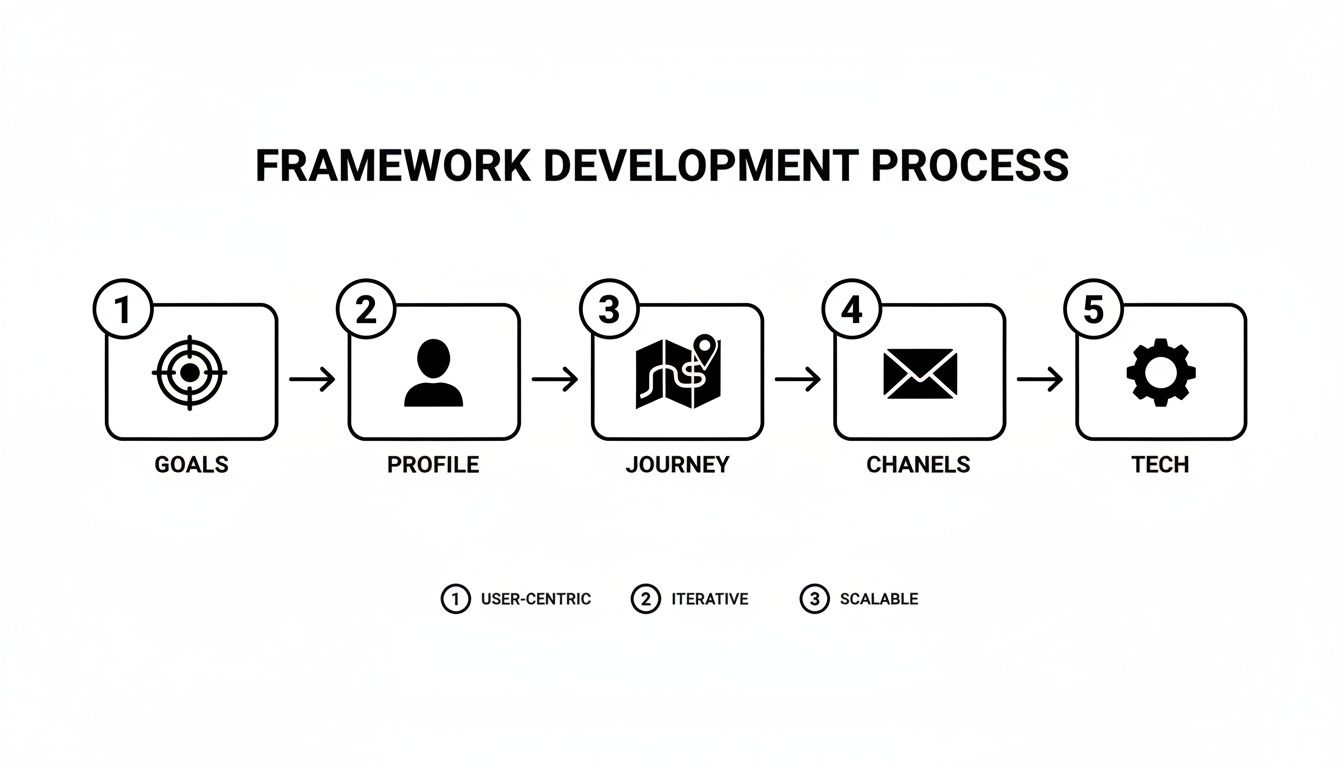
A clear diagram outlining a five-step framework development process: Goals, Profile, Journey, Channels, Tech.

From setting goals to picking your tech, automation makes each stage smarter and faster.

Accelerating Audience Identification with AI

Let's be honest about the "Audience" part of a manual framework. It’s a grind. Your SDRs spend hours sifting through LinkedIn profiles, news articles, and company websites, trying to stitch together a halfway-decent reason to reach out. It's slow, wildly inconsistent, and usually comes down to a gut feeling.

AI completely flips this on its head.

Instead of just checking boxes against a static ICP, AI can analyze dynamic intent signals in real-time. It spots accounts that are actively looking for a solution by tracking behaviors like website visits, content downloads, or even changes in their tech stack. A cold, overwhelming list suddenly becomes a warm, prioritized queue of accounts that are actually ready to talk.

AI-Powered Content That Actually Connects

The "Content" pillar of most frameworks is usually just a folder of templates. The problem? Even the best templates sound robotic without a ton of manual work. An SDR can easily burn 20 minutes trying to customize a single email with a few account-specific details.

This is where AI-powered tools like marketbetter.ai change the math. They generate AI-written cold emails and call scripts that pull in relevant, timely context automatically.

  • An AI can grab a company’s recent funding announcement and drop it into the first sentence of an email.
  • It can whip up talking points for a call based on a prospect’s latest LinkedIn post.
  • It serves up contextual icebreakers on a silver platter, so every interaction feels authentic.

A framework without execution is just a document. An AI Task Engine transforms that document into a prioritized, actionable daily workflow for every SDR, telling them exactly who to contact, what to say, and when to say it.

The AI Task Engine for Flawless Execution

This is where the rubber truly meets the road. The "Execution" phase is where most frameworks fall apart because, well, we're human. An SDR might have a list of 50 tasks for the day but gets paralyzed by choice, struggling to figure out what's most important.

An AI Task Engine solves this by creating a prioritized task inbox for each rep. It synthesizes all the intent signals, account data, and sequence steps to serve up the next best action. No more guessing who to call next; the system tells them, complete with the AI-generated script or email ready to fire. AI and automation can even give SDRs an edge during live conversations with tools that offer real-time agent assistance.

This ensures every single activity is perfectly aligned with the strategy you built. And with automated CRM logging, every call, email, and outcome is recorded without the rep lifting a finger, keeping your data pristine. The result? A far more productive team and a framework that finally delivers predictable, measurable results.

Measuring Success with KPIs That Actually Matter

A framework is only as good as the results it drives. Let’s be honest, staring at a dashboard full of vanity metrics like email opens and social media likes is like judging a car's performance by its shiny paint job—it looks nice, but it tells you nothing about the engine.

To figure out if your SDR-focused digital marketing strategy framework actually works, you have to track the Key Performance Indicators (KPIs) that sales leaders actually care about. This means getting past the superficial numbers and measuring the real-world outcomes that build a healthy pipeline. Good measurement isn't just about proving ROI; it’s about creating a tight feedback loop to coach reps, fine-tune your messaging, and make smart adjustments to the framework itself.

Leading vs. Lagging Indicators for SDRs

A great way for an SDR to understand their performance is to split KPIs into two buckets: leading and lagging indicators. This simple separation helps you understand the effort you're putting in versus the results you're getting out.

Leading indicators are your Activity Metrics. These are the daily and weekly inputs you have direct control over. They measure the work being done.

  • Emails Sent: The total number of personalized emails sent out to prospects.
  • Calls Made: The raw volume of outbound calls an SDR hits each day.
  • LinkedIn Touches: Meaningful actions like connection requests, InMails, or thoughtful comments.

These are your bread-and-butter metrics for managing your own day-to-day performance. They tell you if you're putting in the reps needed to succeed.

On the flip side, lagging indicators are your Outcome Metrics. These track the results of all that work and are what ultimately drive revenue.

  • Positive Conversations Held: Not just answered calls, but actual, meaningful dialogues with prospects.
  • Meetings Booked: For most SDR teams, this is the holy grail of their activity.
  • Pipeline Generated: The real dollar value of the sales opportunities created from those booked meetings.

When you track both, you get the full story. If your activity is sky-high but your outcomes are flat, you don’t have an effort problem—you have a quality or messaging problem.

Crucial Efficiency Metrics

Okay, tracking inputs and outputs is a solid start. But to really dial things in, you need to measure how efficiently your team turns one into the other. Efficiency metrics are the conversion points inside your framework that reveal what’s working and, more importantly, what’s broken.

The most powerful SDR dashboards don't just show what happened; they show why it happened. By focusing on conversion ratios, you can pinpoint the exact stage in your outreach process that needs coaching or optimization.

Think of these metrics as the diagnostic codes for your sales engine:

  • Connect Rate: Of all the calls you make, what percentage actually result in a conversation with the right person?
  • Email Reply Rate: How many of your emails get any kind of response (positive or negative)?
  • Activity-to-Meeting Ratio: On average, how many touches (calls, emails, etc.) does it take to book one qualified meeting?

A dismal connect rate might point to bad phone data or calling at the wrong times. A poor email reply rate is a huge red flag that your messaging is falling flat and needs a complete overhaul. For a deeper look, check out our guide on essential lead generation key performance indicators. These are the numbers that should guide your coaching sessions and strategic tweaks.

With digital marketing budgets surging globally—a full 63% of businesses recently upped their spending—the pressure to prove every dollar counts has never been higher. Digital channels now influence 60% of all marketing investments, making a data-driven framework absolutely non-negotiable for any SDR team looking to compete.

Turning Your Framework into a Competitive Advantage

Look, a digital marketing strategy framework isn't some static document you create, print, and shove in a drawer. Think of it less like a finished blueprint and more like the live, breathing operating system for your sales team. Its real power is only unlocked when you get into a rhythm: execute, measure, tweak, repeat.

An SDR without a framework is relying on brute force and luck. They burn precious hours on low-impact activities and can't explain why their pipeline is a rollercoaster. A solid framework, on the other hand, gives them clarity and direction to turn daily grind into measurable results.

Moving from Chaos to Clarity: A Comparison

The difference between SDR teams with and without a framework is night and day. One operates with precision and purpose, the other relies on guesswork.

  • Without a Framework: Reps chase random leads with generic messages. Their success is sporadic, and their pipeline is a series of peaks and valleys. They can't explain their wins or their losses.
  • With a Framework: Reps know exactly which accounts to target, what pain points to address, and how to measure effectiveness. Their success becomes repeatable, and their pipeline becomes predictable.

This is the competitive advantage. It’s the ability to consistently generate high-quality opportunities because your outreach is systematic, not sporadic.

A framework transforms sales development from an art of individual heroics into a science of repeatable success. It’s the engine that drives predictable growth in a crowded, competitive market.

Ultimately, sales leaders have to get their teams out of the chaos of unstructured outreach. The final, critical step is embedding your strategy directly into your team's daily workflow. This is where a tool like marketbetter.ai becomes the execution layer that brings your framework to life right inside your CRM.

By turning those strategic plans into prioritized daily tasks, marketbetter.ai makes sure your reps are always focused on the next best action. It closes the gap between planning and doing, turning your digital marketing strategy framework into measurable pipeline growth and a real, durable competitive edge.

Free Tool

Try our Marketing Plan Generator — generate a complete AI-powered marketing plan in minutes. No signup required.

Frequently Asked Questions

Got questions? You're not alone. Rolling out a new framework can feel like a massive project, especially when you're already sprinting to hit your number. But it doesn't have to be. The trick is to start small and build momentum.

Don't try to boil the ocean. A great first step for any SDR is to sit down with a top performer on your team and get crystal clear on your Ideal Customer Profile (ICP). Nailing that one thing makes every other step ten times easier and more effective.

How Do I Get My Reps to Actually Use It?

Adoption. It’s the single biggest hurdle. A brilliant framework is just a pretty document if your reps ignore it. The secret isn't about enforcing rules; it's about showing them the shortcut to hitting their number.

Compare the reality: An SDR's day without a framework is drowning in manual research, guessing who to call and what to say. With one, they get a prioritized list and a playbook.

To make it stick, bake the framework directly into the tools they already live in. Integrate it with your CRM workflow. When it feels less like a new mandate and more like a cheat code for booking meetings, they'll use it.

The #1 reason frameworks gather dust is a lack of frontline buy-in. If SDRs see it as another administrative task from management, they will find a workaround. You have to position it as a tool built for them—a playbook designed to help them crush their quota with less guesswork.

I Have a Small Team and Limited Resources. Where Do I Start?

You don't need an enterprise-level budget. In fact, a small team has a huge advantage: you're agile. You can move fast.

The simplest way to start is by documenting what your best reps are already doing instinctively. That's your V1 framework right there.

  • Define Your ICP: Pull up your last 10 closed-won deals. What's the common thread? Industry, company size, title? Write it down. That's your target list.
  • Find Your Best Messaging: Grab the top 3 email templates that consistently get replies. That's your starting point for content.
  • Map a Simple Cadence: What does a basic outreach sequence look like? Outline a simple 5-step process of calls and emails over a week. That's your channel strategy.

That's it. This simple, documented process is your framework. It creates a baseline for consistency and gives you something to build on as you grow. The goal here is progress, not perfection. A simple plan is infinitely better than no plan at all.


Ready to turn that framework from a document into an action plan? marketbetter.ai is the AI engine that brings your strategy to life inside Salesforce and HubSpot. It tells your SDRs exactly who to contact, what to say, and when to say it. Stop the guesswork and start building a predictable pipeline.
12 Actionable Small Business Growth Strategies for SDR Teams in 2026

· 30 min read

Every small business leader is chasing sustainable growth, but a critical bottleneck often goes unnoticed: the Sales Development Representative (SDR) team. Your SDRs are the engine of your pipeline, yet they spend an astonishing amount of their day on non-selling activities. Hours are lost to manual prospect research, logging calls and emails, and simply trying to figure out which account to prioritize next. This isn't just a minor inefficiency; it's a direct cap on your revenue potential and a primary driver of SDR burnout. When your team is buried in administrative tasks, they have less time for the high-value conversations that actually close deals.

This article provides a playbook to reclaim that lost time and transform your outbound process into a predictable growth machine. We will break down twelve high-impact small business growth strategies specifically designed to eliminate this friction and empower your SDRs. Instead of generic advice, we offer a direct comparison between outdated manual methods and modern, technology-driven workflows that enable reps to execute with precision and speed.

You will learn actionable tactics to automate low-value tasks, prioritize high-intent leads, and scale personalized outreach without overwhelming your team. We'll cover everything from AI-powered personalization and multichannel orchestration to data-driven coaching and intelligent territory design. By implementing these strategies, you can shift your SDRs' focus from busywork to building pipeline, turning your sales development function from a costly operational drag into a powerful and scalable revenue driver. Let's dive in.

1. Strategy #1: Intent-Based Lead Prioritization & Task Automation

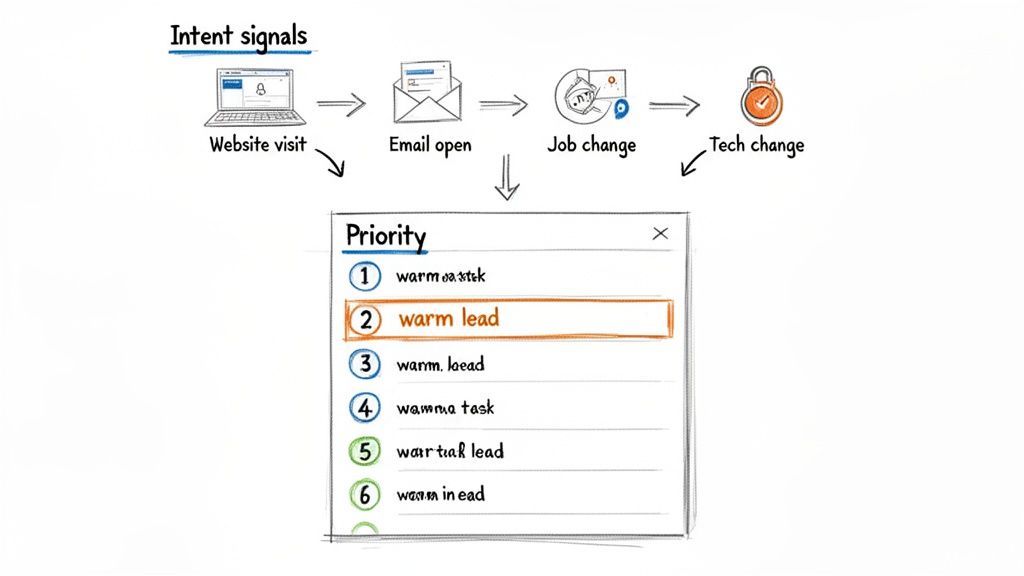
Intent-based lead prioritization is a game-changing small business growth strategy that moves your SDRs away from inefficient "dial-down-the-list" cold calling. Instead of treating all leads as equal, this data-driven approach uses real-time buyer intent signals to automatically prioritize prospects who are actively showing interest, ensuring SDRs spend their time on the warmest, most conversion-ready leads.

The Comparison: A traditional SDR workflow involves working through a static list, where every prospect receives the same effort, regardless of their current buying stage. In contrast, an intent-driven SDR's workflow is dynamic; their task list is automatically re-prioritized daily based on which accounts are actively researching solutions. This shifts the focus from sheer volume of activity to the quality and timeliness of each interaction.

A diagram illustrating intent signals like website visits, email opens, and job changes, which inform lead prioritization.

Why It's a High-Impact Growth Strategy for SDRs

For SDRs, this strategy is revolutionary. It transforms their daily workflow from a high-volume, low-success grind into a strategic, high-impact activity. By automatically surfacing accounts that are actively researching solutions like yours, it increases connect rates, boosts morale, and shortens the sales cycle. Platforms like 6sense and Demandbase pioneered this for large-scale Account-Based Marketing (ABM), while tools like Outreach and Salesloft have integrated intent data directly into sales engagement workflows, making it accessible for teams of all sizes.

Actionable Steps for Implementation:

  • Start Small: Instruct your SDRs to track 2-3 high-value intent signals. A powerful combination is a recent website visit to a pricing page, a job change for a key contact, and engagement with a recent email campaign.
  • Weight Your Signals: Analyze historical conversion data to determine which actions most often lead to a sale. Work with RevOps to weight these signals more heavily in your prioritization model so SDRs see the most valuable leads first.
  • Automate Task Creation: Use your sales engagement platform to automatically create tasks for SDRs when an account hits a specific intent score. For example, a contact from a target account visiting your pricing page could trigger a "High Priority Call" task in the SDR's queue.
  • Review and Recalibrate: This is not a set-it-and-forget-it system. Meet with your SDR team monthly to review which signals are leading to the best conversations and adjust your model's weights accordingly.

2. AI-Powered Personalized Outreach (Email & Call Prep)

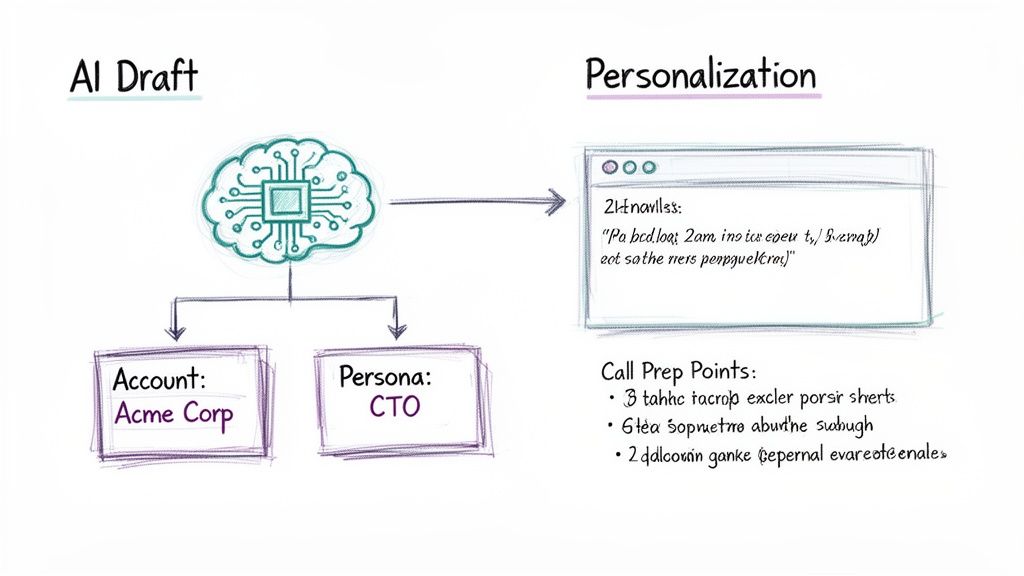
AI-powered personalized outreach is a critical small business growth strategy that dramatically reduces the manual research and writing time for SDRs. This approach uses artificial intelligence to instantly analyze prospect data, company news, and social profiles to generate highly relevant cold emails and call prep notes. It moves SDRs beyond generic templates and enables personalization at a scale previously impossible.

The Comparison: A traditional SDR spends over 30% of their day manually researching each prospect on LinkedIn, company websites, and news articles to find one or two personalization snippets. An AI-equipped SDR, however, can generate a personalized opening line and relevant talking points in seconds. This automation frees up hours each week, allowing SDRs to focus on high-value activities like having conversations and building relationships, rather than being bogged down by research.

AI draft diagram showing a brain generating personalized content based on account and persona data.

Why It's a High-Impact Growth Strategy for SDRs

For SDRs, AI-powered outreach is a force multiplier. It directly addresses their biggest bottleneck: the time-consuming and often unscalable task of personalization. By automating the most tedious parts of their workflow, it empowers them to send more high-quality, personalized messages, leading to significantly higher reply rates and more booked meetings. Platforms like Amplemarket and Persado leverage AI for email copy, while tools like Gong and Outreach use AI to analyze calls and coach reps on what messaging resonates, turning every interaction into a learning opportunity.

Actionable Steps for Implementation:

  • Integrate Fresh Data Sources: Connect your AI tool with reliable, real-time data sources like LinkedIn Sales Navigator, news APIs, and your company CRM. The quality of the AI's output is directly dependent on the quality of its input.
  • Start with AI-Assisted Templates: Instruct your SDRs to start by using AI to enhance existing, proven email templates. Use it to generate personalized opening lines or to suggest relevant P.S. notes based on prospect activity, rather than starting from scratch.
  • Enable Human Review and A/B Testing: Always have an SDR review and approve AI-generated copy before sending. Coach them to continuously A/B test AI-written emails against their own versions to identify what language, tone, and personalization angles perform best.
  • Build a Dynamic Objection Library: Use an AI call recording tool (like Gong) to analyze thousands of sales calls. Automatically identify common objections and transcribe the most effective, real-world responses from your top performers to build a powerful coaching resource for the entire SDR team.

3. Native CRM-Embedded Execution Workflows

Native CRM-embedded execution workflows are a powerful small business growth strategy designed to boost SDR productivity by eliminating context switching. Instead of juggling multiple applications, critical outreach tools like dialers, email clients, and task managers are built directly inside the CRM (like Salesforce or HubSpot). This approach ensures the CRM remains the single source of truth, allowing SDRs to execute their entire workflow without ever leaving a single screen.

The Comparison: The average SDR toggles between 5-8 different applications (CRM, email, dialer, LinkedIn, etc.), wasting time and leading to inaccurate data logging. An SDR using an embedded workflow stays in one system. This centralization means all activity data is captured automatically and accurately within the CRM, creating a clean, reliable dataset for reporting and coaching, which is often compromised when reps have to manually sync data between platforms.

Why It's a High-Impact Growth Strategy for SDRs

For SDRs, this strategy radically simplifies their daily grind and maximizes their "golden hours" of selling. Staying within one system means less friction, faster execution, and more time for meaningful conversations. It transforms the CRM from a passive data repository into an active workspace. Platforms like Outreach and Salesloft have pioneered deep integrations that embed their sales engagement features directly into Salesforce, while HubSpot and Salesforce offer their own native dialer and email tools, creating a seamless, unified environment that accelerates ramp time and drives efficiency.

Actionable Steps for Implementation:

  • Audit Current Workflows: Before implementing, shadow your SDRs for a day. Identify every instance they switch windows and note the associated friction and time lost. This audit will highlight the most impactful workflows to centralize first.
  • Start with a Core Workflow: Begin by integrating one critical function, such as a dialer that automatically logs calls and outcomes in the CRM. Coach SDRs on this new process until it's seamless before expanding to email sequencing or task management.
  • Standardize Disposition Codes: Work with your RevOps team to create a clean, mandatory set of call disposition codes (e.g., "Connected - Meeting Booked," "Left Voicemail"). This ensures all data captured is structured and reportable, making coaching more effective.
  • Train on the "Why": When rolling out the new workflow, focus training on the benefits for the SDR: less administrative work, more accurate data for performance reviews, and faster progression through their task list.

4. Sales Development Team Scaling & Hire-to-Productivity Acceleration

Scaling an SDR team is a pivotal small business growth strategy, but its success hinges on speed-to-productivity. This strategy focuses on building a repeatable system to hire, onboard, and ramp new SDRs to full quota attainment within 30-60 days.

The Comparison: Many businesses use slow, informal "shadowing" for training, where a new hire's success depends on the quality of the senior rep they follow. This leads to inconsistent performance and long ramp times (90+ days). A structured approach, however, uses documented playbooks, clear metrics, and robust coaching frameworks. This systematizes the knowledge transfer from your top performers, ensuring every new SDR gets the same high-quality foundation from day one.

Why It's a High-Impact Growth Strategy for SDRs

For a growing business, a well-oiled SDR machine is the engine of new revenue. This strategy directly impacts pipeline velocity by ensuring new hires contribute to targets faster. It creates a predictable and forecastable model for growth, allowing leadership to confidently invest in sales headcount. For scaling your Sales Development team, consider the advantages of expanding your talent pool; it can be a truly smart business move to hire remote workers from Latam to access a wider range of talent.

Actionable Steps for Implementation:

  • Create a 'First 30 Days' Playbook: Document a week-by-week plan for new SDRs, covering everything from CRM setup to call scripts. Include specific goals, like completing certifications by Day 5 and making the first live calls by Day 10.
  • Build a Call Recording Library: Tag and save call recordings from your top-performing SDRs that demonstrate effective objection handling and value proposition delivery. Make listening to 2-3 of these recordings a daily task for new hires in their first two weeks.
  • Implement Metric-Driven 1:1s: Track leading indicators of success for new SDRs, such as dials, conversations, and meetings booked. Review these metrics weekly to identify coaching opportunities and ensure they are on track to hit their ramp quota.
  • Launch a Peer Mentor Program: Pair every new SDR with a seasoned rep for their first 30 days. This gives them a go-to resource for tactical questions and helps integrate them into the team culture, accelerating their learning curve significantly.

5. Account-Based Outreach & Segmentation Strategy

Account-based outreach is a focused small business growth strategy that flips the traditional sales funnel on its head. Instead of casting a wide net with generic cold outreach, SDRs concentrate their efforts on a curated list of high-value, "best-fit" accounts.

The Comparison: The traditional lead-centric model has SDRs calling individual contacts with little regard for the overall account strategy. In an account-based model, SDRs work to map out the entire buying committee within a target company, tailoring messaging to different roles and pain points. This alignment ensures that every touchpoint, from an SDR's email to a marketing ad, is consistent and relevant, dramatically improving the odds of securing a meeting with the right people.

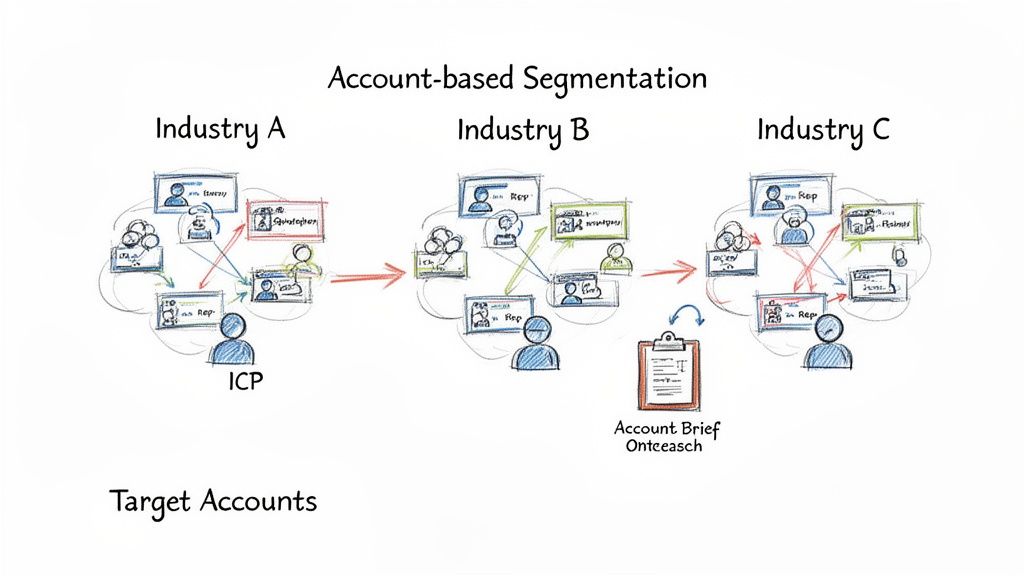
Diagram illustrating account-based segmentation across three industries (A, B, C) with Ideal Customer Profiles.

Why It's a High-Impact Growth Strategy for SDRs

For SDRs, this strategy replaces high-volume, low-yield activity with strategic, high-impact engagement. It empowers them to become true experts on a smaller set of accounts, leading to more meaningful conversations and higher conversion rates. By focusing on accounts that are pre-qualified as ideal fits, SDRs waste less time on prospects who will never buy. This transforms the SDR role from a simple dialer to a strategic business developer.

Actionable Steps for Implementation:

  • Define Your Ideal Customer Profile (ICP): Work with sales and marketing leadership to create a detailed ICP based on your best current customers. Use firmographic, technographic, and intent data to build this profile.
  • Build Your Target Account List: Start small. Instruct your SDR team to identify their top 25 target accounts that perfectly match the ICP. Assign these accounts exclusively to foster ownership and deep knowledge.
  • Coordinate Multi-Channel Outreach: Align with marketing to ensure your SDRs' target accounts are seeing ads, receiving relevant content, and being engaged on social media while direct outreach is conducted. For more details on this, explore these advanced customer segmentation strategies.
  • Measure Account-Level Metrics: Shift your SDRs' focus from individual activity metrics (like calls made) to account-level engagement metrics (like meetings booked per account or account penetration). Review and refresh the target list quarterly.

6. Sales Enablement & Coaching Leverage at Scale

Sales enablement and coaching leverage is a powerful small business growth strategy that moves managers from inconsistent, one-off feedback to a scalable system for improving SDR performance. It uses tools like call recording and AI-powered transcription to analyze real sales conversations, identify what top performers are doing differently, and systematically transfer those winning playbooks to the entire team.

The Comparison: Traditional coaching relies on random call listening or subjective ride-alongs, which are not scalable and often miss key moments. A modern, data-driven approach provides a complete, searchable library of every prospect interaction. This allows managers to pinpoint specific moments for praise or improvement, making coaching objective, consistent, and highly targeted.

Why It's a High-Impact Growth Strategy for SDRs

For SDRs, this strategy transforms coaching from a subjective review into an objective, data-backed development plan. By analyzing call recordings, managers can identify specific areas for improvement, such as objection handling, talk-to-listen ratios, or value proposition delivery. This creates a continuous feedback loop that accelerates ramp time for new hires and elevates the performance of the entire team. For further insights into empowering your sales team, explore these actionable sales enablement best practices for building a high-performing culture.

Actionable Steps for Implementation:

  • Start with Trust: Position call recording as a performance improvement tool for SDRs, not a surveillance tactic. Begin with opt-in participation from a few reps to build trust and demonstrate value.
  • Build a Playbook Library: Use AI tagging to identify and save call snippets where SDRs successfully handle objections or book meetings. Organize these into a "greatest hits" library for training new hires.
  • Create a 'Lost Call' Library: Similarly, tag and analyze calls where meetings were not booked. Use these examples to build countermeasures and practice new talk tracks as a team, turning losses into learning opportunities.
  • Host Weekly Coaching Sessions: Dedicate time each week to review anonymized call snippets with the SDR team. Focus on one specific skill per session (e.g., handling the "we're not interested" objection) to provide focused, actionable feedback.

7. Multichannel Outreach Orchestration (Email + Call + LinkedIn + SMS)

Multichannel outreach orchestration is a systematic growth strategy that coordinates communication across multiple platforms like email, phone, LinkedIn, and SMS. Instead of relying on a single channel, SDRs engage prospects through a pre-defined sequence of touches, meeting buyers on the channels they frequent most.

The Comparison: Traditional, siloed outreach has an SDR send five emails and then give up, never trying another channel. A modern, orchestrated approach uses a sequence like an initial email, a LinkedIn connection request the next day, and a follow-up call two days later. This creates a cohesive brand presence and acknowledges that a prospect might ignore an email but respond to a LinkedIn message, making outreach more resilient and effective.

Why It's a High-Impact Growth Strategy for SDRs

For SDRs, multichannel orchestration is a force multiplier. It dramatically increases connect and response rates by breaking through the noise of any single channel. Instead of being one of 200 emails in an inbox, an SDR's name becomes familiar through a LinkedIn view, a thoughtful comment, and a relevant voicemail. This boosts the likelihood of a positive response and helps build rapport before the first live conversation. Platforms like Outreach, Salesloft, and Apollo.io have built their businesses on this principle, enabling SDRs to execute complex, personalized sequences at scale.

Actionable Steps for Implementation:

  • Design a 3-Channel Cadence: Instruct your SDRs to start with a simple sequence involving email, phone calls, and LinkedIn. For example: Day 1 (Email), Day 2 (LinkedIn Connection Request), Day 4 (Call + Voicemail), Day 6 (Follow-up Email).
  • Space Your Touches: Coach your team to avoid overwhelming prospects. Leave 2-3 business days between touches on different channels to appear persistent, not pushy.
  • Personalize Your "Steps": For high-value accounts, require SDRs to customize steps within the sequence. Instead of a generic LinkedIn connection, they should reference a recent post or shared connection to increase acceptance rates.
  • Track Channel Effectiveness: Work with your team to monitor which channels generate the most responses. If you notice your target audience is highly active on LinkedIn, re-weight your cadences to include more steps on that platform.

8. Data-Driven Activity Metrics & Pipeline Attribution

Data-driven activity metrics and pipeline attribution is a critical small business growth strategy that moves sales development beyond simple volume tracking (like calls made) to understanding true performance and ROI. It involves systematically tracking SDR activities and then connecting that effort directly to pipeline created and deals closed.

The Comparison: Traditional SDR management often focuses on top-of-funnel metrics in isolation (e.g., "make 50 calls a day"). This can lead to reps optimizing for the wrong behavior. A data-driven approach links activity to revenue outcomes, answering the crucial question: "What specific activities from our SDR team are generating the most valuable opportunities?" A rep making 30 highly targeted calls might be more valuable than one making 60 generic ones.

Why It's a High-Impact Growth Strategy for SDRs

For SDRs, this strategy transforms performance management from a subjective process into an objective, data-backed one. It empowers them with real-time visual dashboards showing exactly how their efforts contribute to sales, fostering a sense of ownership and motivation. Instead of being judged on raw call volume, they are measured on impact. Platforms like Outreach and Gong have revolutionized this by providing built-in dashboards that correlate call data with successful outcomes.

Actionable Steps for Implementation:

  • Enforce Logging Discipline: Before you can trust the data, you must capture it. Mandate that all SDR activities are logged consistently in your CRM or sales engagement platform.
  • Track Leading and Lagging Indicators: Coach your SDRs to monitor their own leading indicators (daily activities like calls and emails) to manage effort, and lagging indicators (meetings booked, pipeline generated) to measure results.
  • Give Reps Real-Time Dashboards: Provide each SDR with a personal dashboard showing their key metrics against team goals. This promotes self-management and healthy competition.
  • Connect Activity to Revenue: Use your CRM's reporting tools to build attribution reports. For a deeper understanding of how multiple touchpoints contribute to a sale, explore advanced techniques discussed in our guide to multi-touch attribution models.
  • Use Data for Coaching: In 1:1s, review SDR metrics to identify specific areas for improvement. A high call volume with a low connect rate might indicate a need for coaching on call times or list quality, not just a need to "make more calls."

9. Inbound + Outbound Alignment (SDR/Marketing/Sales Coordination)

Inbound and outbound alignment is a powerful small business growth strategy that breaks down the silos between Marketing, SDRs, and Account Executives. Instead of operating as separate engines, this unified approach ensures that marketing campaigns directly fuel outbound efforts, inbound leads are routed to SDRs instantly, and all teams share intelligence to create a consistent buyer experience.

The Comparison: In a siloed organization, Marketing "throws leads over the wall" to the SDR team, with little context or coordination. An aligned team operates with a feedback loop: SDR insights from outbound calls inform marketing messaging, and marketing's campaigns warm up cold accounts for SDR outreach. The result is a highly efficient revenue engine where no lead is wasted and no prospect receives mixed signals.

Why It's a High-Impact Growth Strategy for SDRs

For SDRs, this alignment is transformative. It means they no longer waste time on ice-cold outreach to accounts that have never heard of their company. Instead, their outbound prospecting is amplified by marketing's efforts, leading to higher connect rates and more meaningful conversations. Simultaneously, it guarantees that valuable, time-sensitive inbound leads are acted upon immediately, maximizing the chances of conversion for the SDR.

Actionable Steps for Implementation:

  • Create a Lead Quality Agreement: Marketing and SDR leaders must formally agree on the definition of a Marketing Qualified Lead (MQL). This document should outline the specific criteria that make a lead ready for SDR follow-up.
  • Implement Speed-to-Lead Rules: Use your CRM to create automation rules that route new inbound leads to the appropriate SDR in under 15 minutes. This is a critical KPI for SDRs working inbound leads.
  • Maintain a Shared Campaign Calendar: Give your SDR team access to a shared calendar where marketing logs all upcoming webinars, content launches, and ad campaigns. SDRs can use this to time their outbound sequences for maximum relevance.
  • Hold a Weekly 10-Minute Sync: Host a brief, standing meeting between Marketing and SDR leads. The only agenda items should be: "What's working?", "What's not working?", and "What are we doing next week?".

10. Territory Design & Account Assignment Strategy

A well-defined territory design is a foundational small business growth strategy that moves SDRs from a chaotic free-for-all to a focused, efficient go-to-market motion. Instead of letting reps chase the same high-profile accounts or neglect entire market segments, this approach systematically carves up the total addressable market (TAM) into equitable territories.

The Comparison: Without territories, SDRs often operate in a "Wild West" environment, leading to duplicate outreach, internal conflict, and missed opportunities. A strategic territory plan provides each SDR with a clear, manageable "book of business" to own and develop. It’s the operational backbone that supports scalable growth, enabling SDRs to build deep expertise within their assigned patch. It’s the difference between targeted prospecting and simply hoping for the best.

Why It's a High-Impact Growth Strategy for SDRs

For SDRs, clear territory rules are a game-changer. It provides them with ownership and focus, allowing them to become true experts in their assigned segment. This specialization leads to more relevant messaging, deeper industry knowledge, and stronger relationships. It also creates a fair and balanced system for lead distribution, which directly impacts morale and motivation. This clarity removes friction and allows SDRs to concentrate fully on execution.

Actionable Steps for Implementation:

  • Segment Your Market: Use firmographic and technographic data to divide your TAM. A common starting point is segmenting by company size (SMB, Mid-Market, Enterprise) and then by geography or industry within those segments.
  • Balance Workload Equitably: Don't just divide the number of accounts evenly. Model potential revenue and account complexity to create territories with similar quota attainment potential. Ensure each SDR has a fair shot at success.
  • Automate Assignment Rules: Use your CRM to create lead routing rules that automatically assign new accounts to the correct SDR territory owner. This eliminates manual work and ensures rapid follow-up.
  • Establish Clear Rules of Engagement: Define what happens when an account moves between segments or when a rep leaves. Create a transparent policy for account ownership to prevent disputes and keep your SDRs focused on selling.

11. Compliance, Privacy & Data Quality Considerations

While not a direct outreach tactic, establishing a robust framework for compliance, privacy, and data quality is a foundational growth strategy. It protects your business from legal risks and ensures that your SDRs are working with accurate, reliable data, which directly impacts the effectiveness of every other strategy.

The Comparison: A reactive approach to data waits for problems to arise—bounced emails, stale contacts, or legal complaints. A proactive approach integrates data governance directly into sales operations. It prevents the accumulation of duplicate or inaccurate contact information that wastes SDR time and ruins personalization efforts, ensuring the foundation of all outreach is solid.

Why It's a High-Impact Growth Strategy for SDRs

For SDRs, high-quality, compliant data is the fuel for their engine. It means fewer bounced emails, fewer wrong numbers, and more confidence that the person they are contacting has a legitimate interest. This eliminates wasted cycles on dead-end leads and protects the SDR from personal liability in certain jurisdictions. It empowers reps to engage prospects effectively and ethically, leading to better conversations and higher conversion rates.

Actionable Steps for Implementation:

  • Centralize Suppression Lists: Create a master suppression or "do not contact" list that is automatically respected by all outreach channels. This is a critical safeguard for every SDR.
  • Automate Data Hygiene: Implement automated CRM rules or use a data enrichment service to periodically deduplicate contacts and verify email addresses. This saves SDRs countless hours of manual data cleaning.
  • Build Consent into Workflows: Ensure that lead capture forms and data import processes include clear consent mechanisms. Train SDRs to tag these contacts appropriately in your CRM.
  • Consult Legal Early: Before launching a new outreach channel, especially SMS or automated dialing, partner with legal counsel to review your proposed cadence and ensure it complies with all relevant regulations like TCPA.

12. Strategy #12: Solidify Technology & Integration Requirements

A powerful growth engine requires a well-oiled technical foundation. For SDRs, this means ensuring the systems that feed them leads and insights are seamlessly integrated and reliable. This strategic focus involves defining technical prerequisites for your entire GTM tech stack, including CRM integrations, bidirectional data syncs, and the ingestion of buyer intent signals.

The Comparison: Many teams simply buy software and hope it works, leading to data lags, sync errors, and system downtime that frustrates SDRs. A strategic approach architects a resilient ecosystem where data flows freely and accurately between platforms. This backend work is one of the most crucial yet overlooked small business growth strategies.

Why It's a High-Impact Growth Strategy for SDRs

For SDRs, solid technical integration is the difference between a high-performance workflow and a day spent fighting bad data. When systems are integrated correctly, SDRs can trust the information in front of them. High-priority lead alerts are delivered in near-real-time, and they don't have to waste time manually correcting data or switching between ten different browser tabs. This reliability allows them to focus 100% of their energy on high-value outreach activities, directly boosting productivity.

Actionable Steps for Implementation:

  • Define Integration SLAs: Before implementing any new tool, establish a Service Level Agreement (SLA) with the vendor. This should define acceptable data lag, error rates, and uptime, ensuring the tool reliably supports your SDRs.
  • Normalize Your Data: Implement a middleware or data normalization layer to standardize data from various sources before it enters your CRM. This ensures the data SDRs see is consistent and trustworthy.
  • Involve RevOps Early: Keep your Revenue Operations (RevOps) team closely involved in any new tool rollout. They are essential for testing at scale and ensuring data integrity for the SDR team.
  • Document and Version Mappings: Create clear documentation for all data mappings between systems. This "source of truth" helps SDRs understand where their data comes from and helps IT troubleshoot issues faster.

12-Point Small Business Growth Strategy Comparison

ItemImplementation Complexity 🔄Resource Requirements 💡Expected Outcomes ⭐📊Ideal Use Cases 💡Key Advantages ⚡
Intent-Based Lead Prioritization & Task AutomationMedium–High: integrations + signal weighting; revops involvementIntent feeds, scoring engine, CRM sync, ongoing tuning⭐⭐⭐⭐⭐ · ↑Connects 20–40%; faster time-to-first-touch; prioritized pipelineSDR inbox prioritization; ABM day-to-day execution; high-volume outbound⚡ Work warm leads first; scalable outbound; manager visibility
AI-Powered Personalized Outreach (Email & Call Prep)Medium: prompt engineering + data freshness controlsClean account data, AI models/APIs, review workflows⭐⭐⭐⭐ · ↓Prep time 60–75%; higher open/reply rates; faster rampScalable personalization; fast SDR ramp; high-volume email/call programs⚡ Rapid personalized content; consistent messaging; improved call quality
Native CRM-Embedded Execution WorkflowsHigh: deep Salesforce/HubSpot API work; RevOps coordinationEngineering for native integrations; maintenance; change control⭐⭐⭐⭐ · ↑CRM data quality 40–60%; reduced context switching; faster adoptionTeams wanting single-source workflow; dual-CRM environments⚡ Stay-in-CRM execution; automatic logging; better coaching data
Sales Development Team Scaling & Hire-to-Productivity AccelerationMedium: playbooks + enablement systems; change mgmtTraining content, coaching library, AI tooling, manager time⭐⭐⭐⭐ · 50% productivity in 4–6 weeks; consistent onboarding outcomesRapid SDR hiring; startups scaling SDR headcount⚡ Faster ramp; repeatable onboarding; improved retention
Account-Based Outreach & Segmentation StrategyMedium: ICP definition + coordination overheadICP modeling, account lists, marketing alignment, intent data⭐⭐⭐⭐ · Higher conversion and deal sizes; clearer account metricsEnterprise/strategic accounts; cross-functional campaigns⚡ Focus on high-fit accounts; deeper personalization; sales/marketing alignment
Sales Enablement & Coaching Leverage at ScaleMedium: tooling + culture change; privacy considerationsCall recording, AI transcription/tagging, coaching workflows⭐⭐⭐⭐ · Faster rep improvement; scalable best-practice rolloutTeams focused on quality improvement and manager-driven coaching⚡ Data-driven coaching; scalable knowledge transfer; objective QA
Multichannel Outreach Orchestration (Email + Call + LinkedIn + SMS)Medium–High: cadence logic + compliance rulesIntegrations (LinkedIn, SMS, email, dialer), compliance tooling⭐⭐⭐⭐ · Higher connect/conversion; better channel match; multi-touch liftComplex sequences for varied personas; high-engagement segments⚡ Improved reach and response; channel optimization; reduced no-shows
Data-Driven Activity Metrics & Pipeline AttributionMedium: requires reliable logging and dashboardsCRM logging discipline, BI/reporting, attribution models⭐⭐⭐⭐ · Predictable forecasting; targeted coaching; clear ROI by activityOperations-driven teams needing measurable SDR impact⚡ Objective performance insights; data-backed hiring and coaching
Inbound + Outbound Alignment (SDR/Marketing/Sales Coordination)Medium: process + routing rules; frequent syncsShared lists, routing automation, campaign calendar⭐⭐⭐⭐ · Faster inbound response; fewer duplicate touches; consistent messagingOrganizations combining inbound leads with outbound motions⚡ Better lead handling; consistent cross-team messaging; clear attribution
Territory Design & Account Assignment StrategyMedium: segmentation + quota modeling; political sensitivityICP/intent data, quota models, RevOps support⭐⭐⭐ · Focused ownership; predictable hiring plans; fairer quotasCompanies scaling coverage and specialization (vertical/geography)⚡ Clear ownership; reduced internal conflict; predictable capacity planning
Compliance, Privacy & Data Quality ConsiderationsMedium–High: ongoing legal & engineering effortConsent management, audit logs, suppression lists, data ops⭐⭐⭐ · Reduced legal risk; better deliverability; cleaner dataAny multichannel outreach; regulated markets (EU/US/phone/SMS)⚡ Risk mitigation; higher deliverability; auditability
Technology & Integration RequirementsHigh: middleware, bidirectional syncs, monitoringEngineering, RevOps, middleware, real-time ingestion pipelines⭐⭐⭐ · Enables real-time prioritization; reliable data flows when done wellOrganizations integrating many vendors and dual-CRM setups⚡ Centralized signals; resilient integrations; reduced manual work
Free Tool

Try our Marketing Plan Generator — generate a complete AI-powered marketing plan in minutes. No signup required.

Turn Your SDR Team Into a Growth Engine, Not a Cost Center

We've explored twelve high-impact small business growth strategies, each designed to transform your SDR team from a high-effort cost center into a predictable, highly efficient growth engine. The common thread weaving through every strategy is the shift away from manual, repetitive tasks and toward intelligent, data-driven execution. Sustainable growth is not born from simply demanding longer hours; it's the result of empowering your SDRs with the right focus, tools, and insights at the exact moment they need them.

This journey from manual chaos to strategic execution is the single most important transition a scaling sales team can make. It's the difference between reps spending their days buried in CRM admin and reps spending their time building relationships and generating qualified pipeline. By embracing these principles, you are not just optimizing a process; you are fundamentally changing the DNA of your sales organization.

From Strategy to Execution: Your Actionable Roadmap

The strategies outlined in this article are a practical blueprint for building a high-performance sales development function. Your immediate next steps should be to assess where the most significant friction exists in your current SDR workflow.

Is it in lead prioritization? If your SDRs waste hours sifting through low-quality leads, the problem can be directly solved by Intent-Based Lead Prioritization (Strategy #1) and intelligent Territory Design (Strategy #10).

Is it in outreach quality and efficiency? If your SDRs struggle to personalize at scale, this challenge is addressed by leveraging AI-Powered Personalized Outreach (Strategy #2) and orchestrating follow-ups with a Multichannel Strategy (Strategy #7).

Or is the problem rooted in your tech stack? If SDRs are constantly switching between tabs and manually logging activities, it's time to implement Native CRM-Embedded Execution Workflows (Strategy #3) to keep them focused and productive in their primary workspace.

The True Measure of an Elite SDR Program

Ultimately, an elite SDR program is defined by its predictability and scalability. It’s about more than hitting quota this month; it’s about building a system that can consistently generate pipeline and onboard new reps efficiently. This is where Data-Driven Activity Metrics (Strategy #8) and streamlined Sales Development Team Scaling (Strategy #4) become critical. You need clear visibility into what’s working and a repeatable process to turn new hires into productive team members quickly.

Mastering these small business growth strategies means you stop guessing and start engineering your success. It means every action an SDR takes is purposeful, every piece of technology serves to accelerate their workflow, and every conversation they start is more likely to convert into real revenue. This strategic alignment across your people, processes, and technology is the foundation upon which lasting business growth is built, turning your sales development team into the powerful, consistent engine it was always meant to be.


Ready to stop managing tasks and start driving revenue? See how marketbetter.ai embeds these powerful small business growth strategies directly into your CRM, helping your SDRs execute faster and smarter. Discover the all-in-one execution platform at marketbetter.ai and turn your sales team into an unstoppable growth engine.