
10 Actionable Content Repurposing Strategies for High-Performing SDRs
In the world of sales development, the pressure to hit quota often translates into a simple, brutal command: ‘do more.’ More calls, more emails, more activity. But what if the secret to outperforming isn't just volume, but velocity and relevance? Top-performing SDRs understand this distinction. Compare the typical SDR, who starts each day with a blank slate, to an SDR who has a library of proven, battle-tested messaging at their fingertips. The latter doesn't just work harder; they work smarter.
This is the power of content repurposing, specifically tailored for the high-stakes environment of a Sales Development Representative (SDR). This isn't about turning a blog post into a tweet for marketing. For a comprehensive look at those approaches, you can explore 8 powerful B2B content repurposing strategies that work. Our focus here is different. This is about transforming proven sales interactions—a successful cold call, a high-reply email, an objection handled flawlessly—into a scalable engine that helps every SDR create more pipeline, more efficiently.
We'll explore ten battle-tested content repurposing strategies designed to help SDRs stop reinventing the wheel and start leveraging every successful interaction. You will learn actionable steps to turn CRM data, call recordings, and even sales objections into powerful assets that sharpen outreach. We'll compare different approaches to show you when to use each strategy. The goal is to make every SDR more effective from their very first call of the day by systematically cloning and redeploying the wins you've already secured.
1. Email-to-Call Sequence Repurposing
One of the most immediate and high-impact content repurposing strategies for any SDR team is transforming your highest-performing cold email sequences into structured call scripts. This approach bridges the gap between digital outreach and direct conversation. The traditional method treats emails and calls as separate channels, often with inconsistent messaging. In contrast, this strategy unifies them into a cohesive sequence, leveraging data-backed messaging to improve call outcomes.
This method is particularly powerful for SDRs because it removes the guesswork from cold calling. Instead of staring at a name and number with a generic pitch, they are equipped with proven language that already resonates with the target audience, boosting their confidence and conversion rates.
How to Action This: A Step-by-Step Guide
- Identify Top-Performing Emails: Analyze your email engagement data. Pinpoint the emails with the highest open, click-through, and positive reply rates. These are your validated messaging assets.
- Extract Core Components: Isolate the key elements: the primary value proposition, the specific pain point it solves, and the clear call-to-action (CTA).
- Convert to Talking Points: Translate the email's key sentences into 3-5 natural-sounding talking points. The goal is a conversational guide, not a rigid script. This allows the SDR to adapt while staying on message.
- Create a Bridge Statement: A crucial step is to explicitly connect the call to the email. Train SDRs to open with, "Hi [Prospect Name], I'm following up on an email I sent last Tuesday regarding [Topic]." This provides context and feels far less intrusive than a completely cold call.
Why This Strategy Works for SDRs
This repurposing strategy directly addresses common SDR challenges. While a junior SDR might struggle to improvise an effective cold call opener, this method provides a tested, data-driven script. Teams at tech companies like Outreach and Salesloft build their entire sales engagement cadences around this principle. By using messaging already validated through email engagement, SDRs can anticipate prospect needs more effectively, turning a difficult cold call into a warm, informed follow-up.
2. Intent Signal-to-Task-to-Content Repurposing
This advanced strategy transforms raw buyer intent signals, such as website visits or content downloads, into highly contextual outreach. The traditional approach is to send generic messaging to anyone showing any interest. In comparison, this method involves repurposing the insight from the signal itself into the core of your email and call scripts, creating hyper-relevant, timely touchpoints.
For SDRs, this is a game-changer. It eliminates the cold, intrusive nature of traditional outreach by providing a legitimate, data-backed reason to connect. Referencing a recent, relevant action demonstrates that the SDR has done their research and is reaching out with purpose, dramatically increasing the likelihood of a positive response.
How to Action This: A Step-by-Step Guide
- Identify and Map Key Signals: Define your top 5-10 high-value intent signals (e.g., pricing page visits, competitor comparisons). Map each signal to a corresponding pain point and value proposition.
- Automate Task Creation: Use a tool like 6sense or Demandbase to automatically create a task in your CRM when a target account triggers a specific signal.
- Repurpose Signal Insight into Messaging: Create a library of email and call script templates, each tailored to a specific signal. The messaging should directly, yet naturally, reference the prospect's activity.
- Launch and Prioritize Outreach: The SDR receives a prioritized task with the signal's context and the appropriate messaging. A pricing page visit becomes the opening line: "Hi [Prospect Name], saw someone from your team was exploring our pricing, and I wanted to offer context on how it applies to companies like yours."
Why This Strategy Works for SDRs
This method moves SDRs from broadcasting to narrowcasting. A generic SDR might send 100 emails hoping for one reply. An SDR using this strategy sends 10 highly targeted emails based on intent signals and gets three replies. A workflow using Demandbase can trigger a task in Salesforce when a target account visits the integration page. The SDR immediately receives an alert with a pre-written email snippet that highlights the benefits of that specific integration. This hyper-personalization turns a low-probability cold outreach into a high-relevance, warm follow-up.
3. Call Recording-to-Battle Card Repurposing
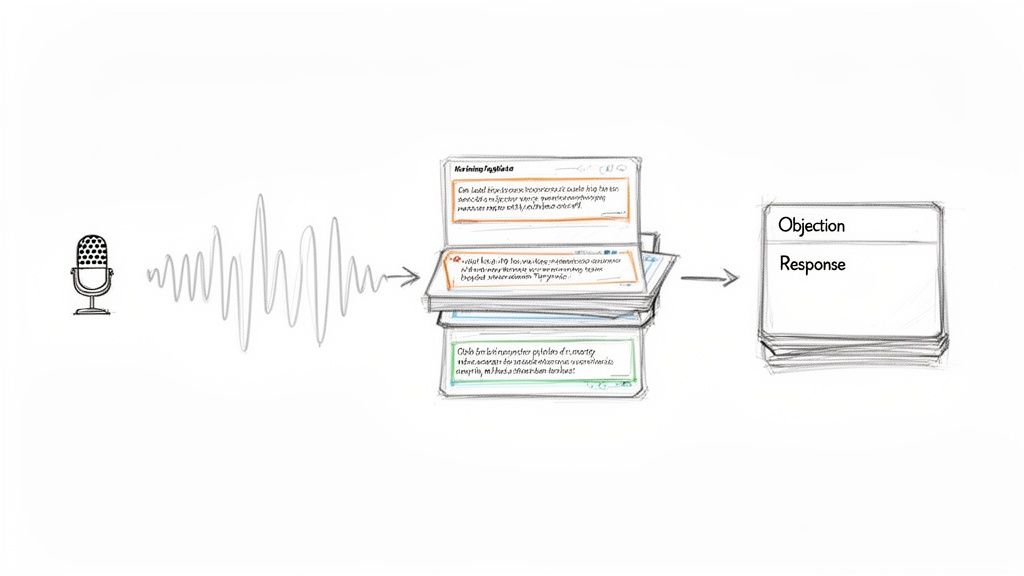
A highly effective content repurposing strategy for sales teams is transforming raw call recordings into structured, actionable sales battle cards. Traditionally, call recordings are used for one-off coaching. This strategy, in contrast, mines those recordings for proven messaging that can be deployed across the entire team, turning tribal knowledge into a scalable training asset.
This method is a game-changer for SDRs because it provides them with validated, peer-tested responses to the toughest objections. It closes the gap between top performers and the rest of the team, arming everyone with the exact phrases that win conversations.
How to Action This: A Step-by-Step Guide
- Identify Top-Performer Calls: Isolate call recordings from your top 3-5 SDRs who consistently book meetings. Focus on calls where a key objection was successfully overcome.
- Transcribe and Tag Key Moments: Use a conversation intelligence tool (like Gong or Chorus) to capture and tag moments by objection type (e.g., "no budget," "happy with current provider").
- Extract Objection-Response Pairs: For each tagged moment, pull out the exact objection raised and the verbatim response from the SDR that successfully moved the conversation forward.
- Structure the Battle Card: Organize the content into a simple format: Objection, Winning Response, and Key Talking Points. This creates a quick-reference guide for live calls.
Why This Strategy Works for SDRs
This repurposing strategy directly builds SDR confidence and competence. A new SDR might freeze when they hear "we have no budget." An SDR with a battle card has a proven, peer-tested response ready. This is one of the most powerful sales enablement best practices for rapidly scaling an SDR team. By crowdsourcing effective language from actual calls, you empower new hires to handle difficult conversations like seasoned veterans, shortening their ramp time.
4. CRM Activity-to-Social Proof & Case Study Repurposing
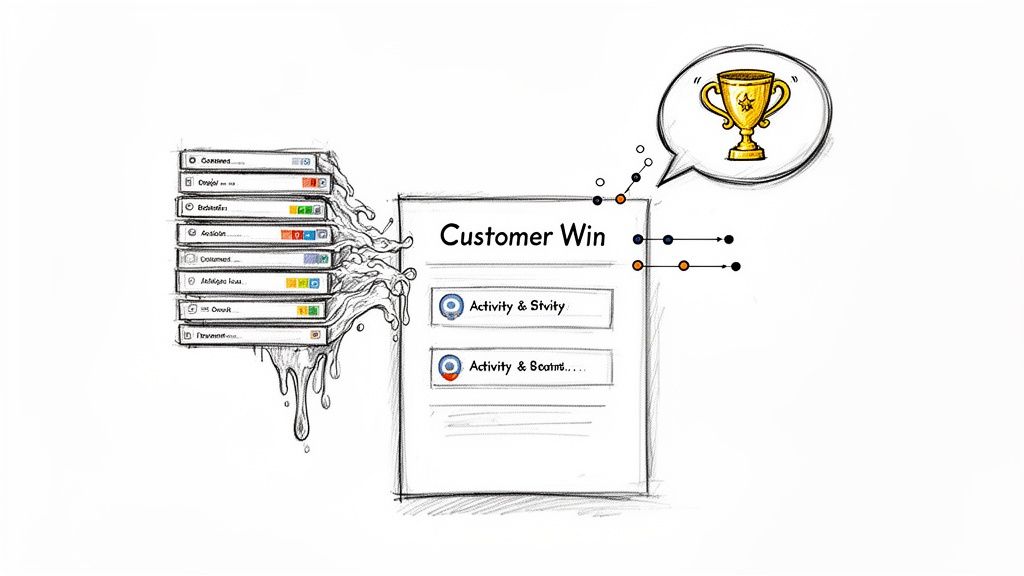
One of the most underutilized content repurposing strategies involves mining your CRM activity logs to generate authentic case studies and social proof. The old way is to wait for marketing to create a polished, generic case study. This new approach transforms raw sales data—call notes, email threads, and deal stages—into compelling, hyper-relevant narratives SDRs can use immediately.
This is incredibly valuable for SDRs because it provides them with concrete examples of how your solution solved a specific problem for a similar company. It moves their pitch from abstract benefits to tangible proof, making their cold outreach feel much warmer and more credible.
How to Action This: A Step-by-Step Guide
- Identify Case Study Candidates: Create a report in your CRM for closed-won deals with detailed activity logs. Look for deals where the journey from initial contact to close is well-documented.
- Extract the Core Narrative: Analyze the call notes and email threads. Pinpoint the exact pain points mentioned, the objections raised, and the "aha" moment where the value clicked.
- Build a Story Template: Structure the narrative simply: Who was the customer? What was their problem? How did your team help solve it? What was the final, quantifiable outcome?
- Repurpose for Outreach: Convert the findings into concise snippets for emails or call scripts. The customer's main pain point becomes a new subject line. A successful objection-handling sequence becomes a new talking point.
Why This Strategy Works for SDRs
This strategy arms SDRs with authentic selling points. A generic SDR says, "We can help you improve efficiency." An SDR using this strategy says, "I saw you're in logistics, and we just helped a similar company, [Customer Name], solve the exact challenge of X by implementing Y." The second approach is far more impactful. This transforms a generic pitch into a tailored, evidence-backed discussion, directly improving an SDR's ability to build trust and book meetings.
5. Email Performance Data-to-Personalized Call Prep Repurposing
This strategy treats email engagement not as an end-goal, but as a rich data source to fuel smarter sales calls. A basic SDR dials through a list, blind to any prior engagement. In contrast, an advanced SDR uses prospect actions like opens, clicks, and reply sentiment to prioritize outreach and personalize call scripts, turning raw email metrics into actionable intelligence.
This method is a game-changer for high-velocity SDRs. It empowers them to move beyond generic scripts and engage prospects based on their demonstrated interests, turning a cold outreach sequence into a highly relevant conversation.
How to Action This: A Step-by-Step Guide
- Establish Engagement Tiers: Define what different email interactions signify. Multiple opens signal interest; a click on a pricing page link indicates buying intent.
- Create Prioritization Rules: In your sales engagement platform, set up rules to automatically move prospects who click a case study link to the top of the call queue.
- Surface Data in the Dialer: Configure your CRM to display key engagement data (e.g., "Clicked link: ROI Calculator") just before the SDR makes the call.
- Develop Contextual Talking Points: Create script variations based on engagement type. If a prospect downloaded a guide on "implementation," the SDR's opener is tailored: "Hi [Prospect Name], saw you were looking at our implementation guide and wanted to share a few insights..."
Why This Strategy Works for SDRs
This is one of the most powerful content repurposing strategies because it translates digital "body language" into conversational advantages. Compare an SDR calling 100 random leads versus an SDR calling 20 leads who clicked on a case study link in the last hour. The second SDR will have a much higher connection and conversion rate. For SDRs, this means no more wasted dials on disengaged leads. Instead, they can confidently call a prospect knowing what content they’ve consumed and which value propositions are most likely to resonate.
6. Sales Objection Library-to-Proactive Email Messaging Repurposing
This strategic approach transforms your team’s most common sales objections into proactive email messaging. The reactive SDR waits for objections on a call and tries to handle them on the fly. The proactive SDR addresses potential roadblocks head-on within their outreach, disarming skepticism before it derails a conversation.
This is especially valuable for SDRs because it helps them control the narrative and build credibility early. By systematically cataloging and repurposing objection-handling content, you equip your entire team with battle-tested responses that improve meeting-booked rates.
How to Action This: A Step-by-Step Guide
- Build Your Objection Library: Systematically log every objection SDRs hear on calls. Use call recording software to tag moments where prospects mention budget, timing, or competitors.
- Categorize and Prioritize: Group similar objections into themes like Budget Constraints, Bad Timing, and Happy with Current Vendor. Prioritize the top 3-5 most frequent objections.
- Craft Proactive Email Snippets: For each core objection, write a concise, value-driven paragraph that counters it. For "bad timing," the snippet might highlight the cost of inaction.
- Integrate into Email Sequences: Weave these proactive snippets into your outbound sequences. For example, an email could say, "While many teams we speak with initially feel it's not the right time to evaluate new tools, they often find that delaying a solution to [Pain Point] costs them more in the long run."
Why This Strategy Works for SDRs
This empowers SDRs to preemptively tackle the issues that kill deals. When an SDR knows the top three objections for their ICP, they can deploy an email variation that directly addresses the most likely concern. This is the difference between falling into a trap and disarming it before you get there. It shows empathy and awareness, filtering for more qualified conversations and ensuring SDRs spend their time on calls with prospects who have already mentally overcome the first hurdle.
7. Winning Talk Track-to-LinkedIn/Social Content Repurposing
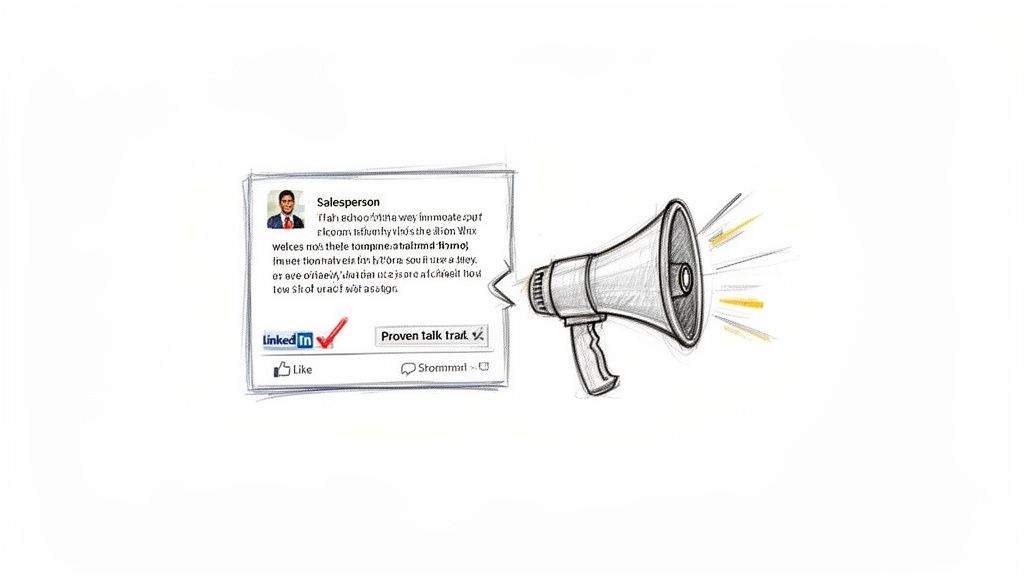
One of the most powerful content repurposing strategies is to transform your sales team's most effective talk tracks into engaging social media content. Traditionally, a great talk track lives and dies in a one-to-one conversation. This strategy amplifies its reach across platforms like LinkedIn to build brand authority and attract inbound interest.
This method is incredibly beneficial for SDRs because it helps them build a strong personal brand. Compare an SDR who only cold calls to one who also shares valuable insights on LinkedIn. The latter positions themselves as a knowledgeable advisor, making their future outreach warmer and more effective.
How to Action This: A Step-by-Step Guide
- Identify 'Greatest Hits' Talk Tracks: Use call recording software to pinpoint phrases and questions that consistently appear in successful calls. Look for moments that generate "aha!" reactions.
- Extract and Sanitize Key Insights: Pull out the core discovery questions or value statements. Crucially, remove all client-specific details to protect confidentiality.
- Convert to Social Content Formats: Reframe the insights into a LinkedIn poll, a "Sales Tip" graphic, or a short post detailing a "How to handle X" scenario. For more in-depth strategies, explore our guide on LinkedIn prospecting automation.
- Create and Distribute Content Kits: Provide SDRs with pre-written, ready-to-post content based on these validated talk tracks. This increases adoption and ensures message consistency.
Why This Strategy Works for SDRs
This repurposing strategy empowers SDRs to generate inbound leads, turning a traditionally outbound role into a hybrid one. SDRs who share proven tips on LinkedIn not only help their peers but also attract the attention of potential buyers who appreciate practical advice. This turns their social media profiles into lead-generation assets, making their jobs easier and more rewarding.
8. CRM-to-Sequence Playbook Repurposing
This highly strategic approach involves analyzing historical outreach data from your CRM to engineer repeatable sales playbooks. Many teams let top performers' successful methods remain a mystery. This strategy transforms those improvised sequences into a standardized, scalable asset for the entire team, codifying what works, when, and for whom.
This method is a game-changer for sales development teams because it institutionalizes success. It provides a proven roadmap for new and existing SDRs, removing the uncertainty from campaign execution and establishing a clear benchmark for performance.
How to Action This: A Step-by-Step Guide
- Identify Closed-Won Opportunities: In your CRM, filter for closed-won deals that originated from your SDR team's outbound efforts.
- Extract the Winning Sequence: Trace the exact sequence of activities that led to the meeting. Document every touchpoint: Email 1 (subject line, message), Call 1 (opener), LinkedIn message, etc.
- Document Timing and Cadence: Note the specific timing between each touchpoint. Was it a 2-day gap between the first email and the follow-up call? This cadence is as critical as the messaging.
- Standardize into a Playbook Template: Consolidate these findings into a formal playbook with templates for different segments, such as an "Enterprise Tech Leader Sequence," complete with message snippets and timing guidelines.
Why This Strategy Works for SDRs
This strategy directly accelerates an SDR's path to proficiency. Compare a new SDR trying to figure things out through trial and error versus one who can immediately execute a proven, 7-touch, 15-day cadence on day one. The second SDR will ramp up significantly faster. This turns historical data into a powerful training tool, ensuring that every rep starts with the team's best possible approach.
9. Competitive Win/Loss-to-Sales Asset Repurposing
One of the most powerful content repurposing strategies involves transforming your team’s competitive win/loss data into actionable sales assets. Most teams just note "lost to competitor" in the CRM. This approach digs into call recordings and notes to extract the exact language that successfully beats competitors, turning anecdotal victories into a scalable competitive playbook.
This is a game-changer for SDRs, who are often the first to hear competitor mentions. It equips them with proven, authentic messaging to confidently handle objections and reframe the conversation around your unique value.
How to Action This: A Step-by-Step Guide
- Identify Competitive Deals: Filter your CRM for deals where a specific competitor was mentioned, both in wins and losses.
- Extract Winning Language: Listen to call recordings from "won" deals. Document the specific phrases your top reps used to neutralize the competitor and win the deal.
- Convert Insights into Battle Cards: Organize these insights into simple battle cards. Structure each card by competitor, listing their common claims and your validated, effective responses.
- Create Proactive Email Angles: Repurpose the core differentiators into proactive email copy that subtly positions your solution against the competition before the prospect even brings them up.
Why This Strategy Works for SDRs
This strategy arms SDRs with confidence. Compare an SDR who freezes when a prospect says, "We're looking at Competitor X," to one who can confidently respond with a proven angle. The second SDR turns a potential dead end into a valuable discovery opportunity. This moves SDRs from making generic claims to articulating battle-tested differentiators.
10. Customer Success Case Studies-to-First-Touch Cold Outreach Repurposing
This strategy involves converting in-depth customer success stories into potent, bite-sized hooks for first-touch cold outreach. A generic SDR outreach makes abstract claims about value. A strategic SDR leads with tangible, proven results, immediately anchoring the conversation in the success of a similar company.
This method is a game-changer for SDRs because it builds instant credibility and relevance. It shifts the conversation from "what we do" to "what we've already done for a company just like yours," dramatically lowering a prospect's skepticism.
How to Action This: A Step-by-Step Guide
- Identify Relevant Case Studies: Analyze your library of case studies and filter them by industry, company size, or pain point. Match these stories to your target account lists.
- Extract the "Hero" Metric: Find the single most impressive, quantifiable result from the case study (e.g., a percentage increase in revenue, a reduction in costs).
- Craft a "Similar To You" Hook: Convert that metric into a sharp, one-sentence opener. For example, "We recently helped [Customer Name], another company in the logistics space, reduce their average delivery time by 18%."
- Prepare the Proof: Have the full case study ready to share as a follow-up asset. The initial hook piques interest; the case study provides the proof.
Why This Strategy Works for SDRs
This strategy directly combats the biggest challenge in cold outreach: earning trust in the first 10 seconds. SDRs at Salesforce often lead with industry-specific outcomes, stating, "Hi [Prospect Name], we've helped over 50 financial services firms like yours automate compliance reporting." This is far more compelling than a generic pitch. By starting with a validated success story, SDRs pivot directly to a conversation about achieving similar results for the prospect, making the outreach more relevant and impactful.
10-Point Content Repurposing Comparison
| Repurposing Approach | Implementation Complexity 🔄 | Resource Requirements 💡 | Expected Outcomes ⭐📊 | Ideal Use Cases | Key Advantages ⚡ |
|---|---|---|---|---|---|
| Email-to-Call Sequence Repurposing | Low–Medium — adapt written to spoken tone; simple mapping | Moderate — top email templates, CRM link, coaching time | ⭐⭐⭐⭐ — higher connect rates; unified attribution | Follow-up calls after email, high-velocity SDR teams | Consistent messaging; faster prep & ramp |
| Intent Signal → Task → Content Repurposing | High — integrations + real-time routing logic | High — intent feeds, automation, RevOps support | ⭐⭐⭐⭐⭐ — highly relevant touches; prioritized active buyers | ABM, enterprise targeting, behavior-driven outreach | Real-time personalization; prioritized, scalable outreach |
| Call Recording → Battle Card Repurposing | Medium–High — transcribe, tag, curate examples | Moderate — recording/transcription + enablement effort | ⭐⭐⭐⭐ — better objection handling; repeatable tactics | Training, coaching, scaling top-performer language | Authentic responses; improved coaching & knowledge transfer |
| CRM Activity → Social Proof & Case Study Repurposing | Medium — data mining and narrative assembly | Moderate–High — analytics, writers, legal/privacy checks | ⭐⭐⭐⭐ — credible case studies; evidence-backed content | Marketing-driven ABM, content for demand gen, testimonial creation | Data-backed credibility; faster case creation; personalized proof |
| Email Performance Data → Personalized Call Prep | Low–Medium — surface engagement into dialer/workflow | Moderate — email tracking, dialer integration, training | ⭐⭐⭐⭐ — improved call quality & connect rates | Teams using email sequences that call back quickly | Prioritized calls; contextual openers; reduced prep time |
| Sales Objection Library → Proactive Email Messaging | Medium — build taxonomy and template linkage | Moderate — tagging, enablement, analytics to validate | ⭐⭐⭐⭐ — fewer preventable objections; shorter cycles | Reps facing repeatable objections; enterprise sales | Preemptive objection handling; scalable, consistent messaging |
| Winning Talk Track → LinkedIn / Social Content | Medium — edit for public voice + governance | Low–Moderate — content editing, approvals, rep coaching | ⭐⭐⭐ — brand lift; inbound interest; rep visibility | Thought leadership, employer branding, ABM amplification | Authentic brand content; rep personal branding; content supply |
| CRM → Sequence Playbook Repurposing | Medium — analyze sequences and document playbooks | Moderate — data analysis, playbook platform, testing | ⭐⭐⭐⭐ — repeatable success; faster ramp & consistent cadences | Scaling teams, onboarding, campaign standardization | Data-driven cadences; faster sequence creation; consistency |
| Competitive Win/Loss → Sales Asset Repurposing | High — sensitive analysis; win/loss capture required | High — recordings, cross-team review, update cadence | ⭐⭐⭐⭐ — validated competitive messaging; quicker escalation | Competitive markets, RFP responses, enterprise deals | Proven competitive responses; faster team enablement |
| Customer Success Case Studies → First-Touch Outreach | Medium — map case studies to prospect profiles | Moderate — case study library, matching logic, permissions | ⭐⭐⭐⭐ — higher opens & trust; stronger first-touch credibility | Account-based outreach, industry-specific prospection | Proven social proof in outreach; improved credibility |
Try our Marketing Plan Generator — generate a complete AI-powered marketing plan in minutes. No signup required.
Turn Your Sales Content into a System, Not a Series of One-Offs
We've explored ten distinct content repurposing strategies, but the real power isn't in executing one of them; it's in recognizing the interconnected system they create. For Sales Development Representatives, the daily grind can feel like an endless series of one-off tasks: one more email, one more call, one more prospect. This traditional approach is a recipe for burnout and inconsistent results. It forces SDRs to constantly reinvent the wheel, hunting for the right message or the perfect talk track for each interaction. The strategies detailed in this article offer a fundamental shift away from this fragmented model.
Instead of seeing a call recording as just a call recording, you now see it as the raw material for a winning battle card. An email with a high reply rate is no longer just a single success; it's the proven template for your next personalized call preparation. This is the essence of building a sales content ecosystem. Each action an SDR takes, from logging a CRM activity to handling an objection, generates valuable data and content. Effective repurposing ensures that this value is captured, refined, and systematically redeployed to make every future interaction more intelligent and impactful. It transforms your sales floor from a collection of individual efforts into a cohesive, self-improving engine.
From Tactical Actions to a Strategic Advantage
Adopting these content repurposing strategies fundamentally changes the role of an SDR. They evolve from being simple executors of tasks to active participants in an intelligence-gathering and content-generation loop.
Consider the contrast between two SDRs:
- SDR A (The Traditionalist): Spends hours each week crafting emails from scratch, relying on memory for what worked last time. They listen to call recordings for self-coaching but the insights rarely leave their own notebook. Every win is a personal victory, but it’s difficult to scale that success across the team.
- SDR B (The System-Builder): Leverages winning email templates (from performance data) to personalize outreach in minutes. They use an objection library (built from past calls) to proactively address concerns. Their successful talk tracks are turned into LinkedIn posts, building their personal brand and attracting inbound interest.
SDR B isn't just working harder; they are working smarter within a system designed for continuous improvement. This systemic approach makes onboarding new reps faster, as they can immediately tap into a library of proven assets. It also makes coaching more effective, as managers can point to specific, data-backed examples of what "good" looks like. To truly embed repurposing into your sales content strategy and build a cohesive system, an in-depth resource is essential to learn how to master the fundamentals. You can find that comprehensive guidance in this ultimate guide on how to repurpose content, which provides a framework for scaling these concepts.
Activating Your Content Repurposing Engine
The journey from one-off content to a systematic powerhouse starts with a single step. Don't try to implement all ten strategies at once. Choose one or two that address your team's most significant bottleneck. Is your team struggling with handling objections? Start by building the Sales Objection Library-to-Proactive Email Messaging loop. Are your top performers' methods a mystery? Implement the Winning Talk Track-to-LinkedIn/Social Content strategy to codify and share their expertise.
By integrating these workflows directly into your CRM with AI-powered tools, you remove the friction and ensure adoption. The goal is to make content repurposing an invisible, automatic part of the daily sales motion. When your SDRs no longer have to think about how to find the best content, they can focus all their energy on what they do best: building relationships and starting valuable conversations. You're not just giving them better content; you're giving them a smarter, more efficient way to sell. Stop asking your team to simply do more; empower them with a system that makes every action count for more.
Ready to turn these strategies into an automated system your SDRs can execute directly within your CRM? marketbetter.ai embeds these content repurposing workflows into daily tasks, helping your team use proven content to book more meetings. See how to build your sales content engine at marketbetter.ai.