Marketing Workflow Automation: 5 Workflows That Save 15+ Hours/Week (Templates Inside) [2026]

· 18 min read

Let's be honest, "marketing automation" often just means scheduling social media posts. But that's not what we're talking about here. Real marketing workflow automation is about building an intelligent, interconnected system. It’s where one action automatically triggers the next logical step, creating a seamless journey that nurtures leads and keeps customers engaged without you lifting a finger for every little task.

This is the shift from manual, often chaotic processes to a strategic, data-informed approach that actually scales.

Beyond Efficiency: Why Automation Is No Longer Optional

Image

Forget the simple "save time" argument for a second. Yes, efficiency is a huge plus, but the real magic of automation is its ability to run complex, personalized customer journeys at a scale that is flat-out impossible for a human team. Today's customers expect you to be on the ball with relevant, timely communication. Every single time.

A manual approach guarantees you'll drop that ball.

Imagine a hot lead downloads one of your whitepapers. Manually, it might take hours—or even a full day—for a marketer to see the notification and follow up. By then, the lead has moved on. Their initial spark of interest is gone. An automated workflow, on the other hand, can fire off a thank-you email, slot that lead into a specific nurture sequence, and ping a sales rep in Slack, all within seconds. That’s the difference between a missed opportunity and a potential new customer.

The Strategic Shift from Manual to Automated

The numbers don't lie. Right now, 50% of companies are already using marketing automation. Digging deeper, marketing teams are adopting it 76% more than sales teams, which tells you just how critical it's become for managing complex campaigns and guiding leads from curiosity to conversion.

Here's the core difference: Manual marketing is reactive and capped by how many hours your team has in a day. Automated marketing is proactive, endlessly scalable, and works 24/7. It never misses an opportunity.

Where Manual Processes Break Down

Relying on manual processes doesn't just slow you down; it actively stunts your growth and creates a clunky, inconsistent experience for everyone involved.

  • Inconsistent Lead Nurturing: Manually, one lead gets a detailed follow-up while another gets radio silence, depending on who's on duty. An automated workflow ensures every lead gets the same high-quality, on-brand experience, building trust from the first touchpoint.
  • Lack of Personalization: It's a fantasy to think you can manually tailor content for thousands of contacts based on their specific behaviors. Automation makes true one-to-one personalization a reality by using data to send the right message at the right time.
  • Delayed Sales Handoffs: The dead space between marketing qualifying a lead and sales actually reaching out is where deals go to die. Automation closes that gap instantly, ensuring a smooth, immediate transition that boosts conversion rates.

Ultimately, marketing workflow automation isn't just a tool; it's the strategic foundation for any business serious about building a resilient and scalable marketing engine. For a deep dive into putting these systems to work, check out this guide on mastering marketing workflow automation.

How To Build Your First Automated Workflow

So, you’re ready to jump into marketing workflow automation. It feels a bit like standing at the edge of a pool, right? You can dip a toe in, or you can dive.

Actionable Tip: Start with a high-impact, low-complexity task. Don't try to automate your entire customer journey at once.

A perfect first candidate is a simple lead nurturing sequence for people who sign up for your webinar. It's a defined process with a clear starting point and a specific goal. This approach lets you learn the ropes and see a tangible return quickly, without getting tangled in a complex web of "if this, then that" logic right out of the gate.

Start by Mapping Your Process on a Whiteboard

Before you even think about touching any software, grab a whiteboard or open a simple flowchart tool. The goal here is to visually map every single step of the process just as it exists today. Don't skip the small stuff.

Actionable Step: For our webinar example, your map should include:

  • Trigger: Someone submits your webinar registration form.
  • Immediate Action: Add them to a "Webinar Registrants" list.
  • Confirmation: Send an email with event details.
  • Reminder 1: Send an email 24 hours before the webinar.
  • Reminder 2: Send a final reminder 1 hour before showtime.
  • Post-Webinar: Send a follow-up email with the recording.
  • Goal: Include a call-to-action to book a demo.

This visual map becomes your blueprint. It shows you exactly where the manual touchpoints are and clarifies the logic you need to build into your automation platform.
Image

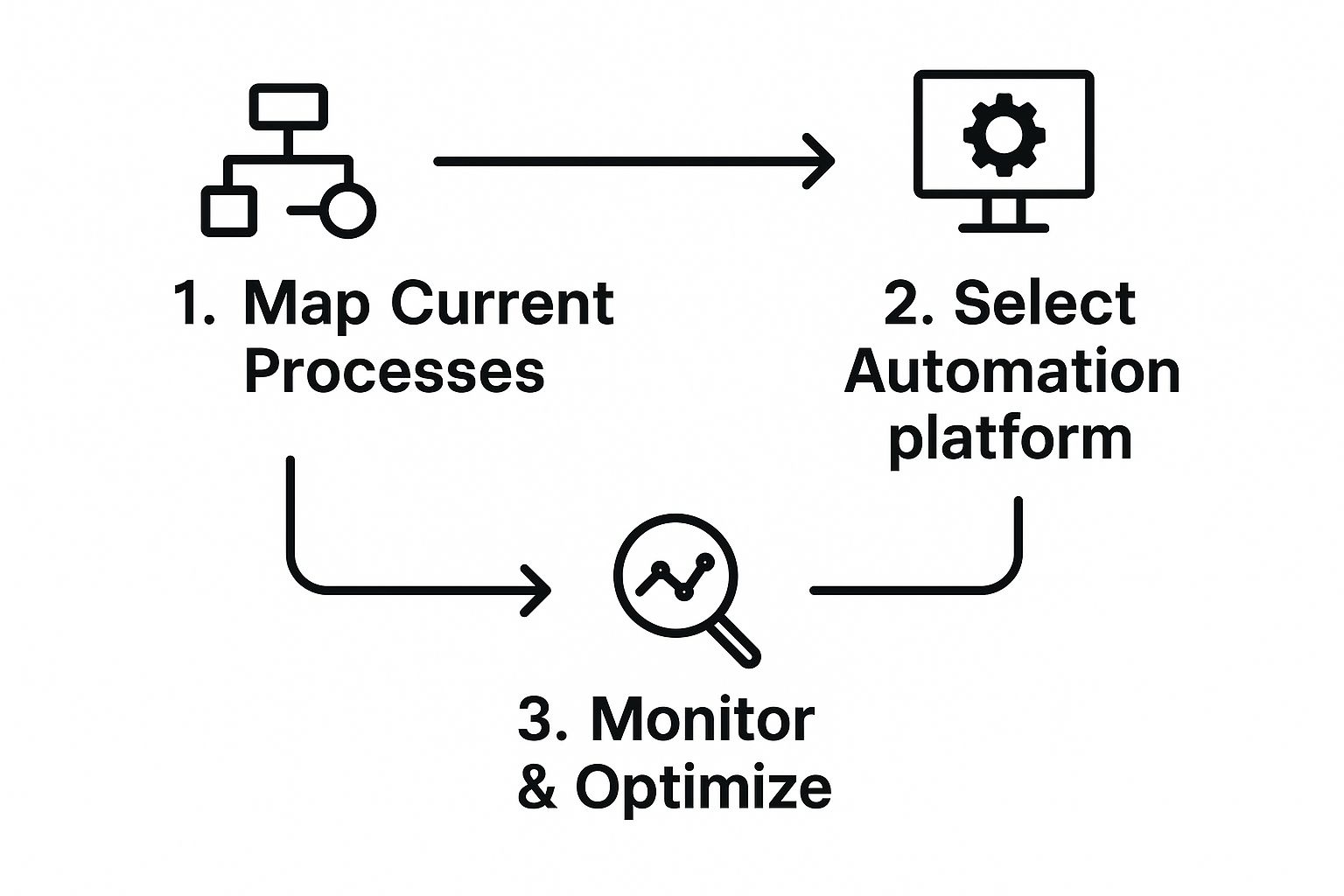
This diagram gets to the heart of it: you map what you do now, pick the right tool to do it automatically, and then keep an eye on it to make it better over time. Successful automation isn't a "set it and forget it" task; it's a continuous cycle of refinement.

Define Your Triggers, Conditions, and Actions

With your map in hand, it's time to translate it into the language of automation. Every automated workflow, no matter how simple or complex, is built from three core components. Get these down, and you can build anything you can imagine.

  1. Triggers: The specific event that kicks off your workflow. This is the "if this happens..." part. Example: A form submission, a link click, or a product purchase.

  2. Conditions: The rules that steer the workflow down different paths. Example: "Lead score is above 50" or "Contact's industry is 'Technology'."

  3. Actions: The tasks the system performs. Example: Send an email, wait for a set period, create a task in your CRM, or update a contact's profile.

A well-built workflow has one, and only one, clear goal. For our webinar follow-up, the goal might be to get attendees to book a demo. Every single email, every delay, and every action should be designed to move that person closer to that single objective.

This structured approach delivers real results. I've seen teams implement workflow automation and increase their lead quantity by 80% and boost conversions by 75%. Most impressively, it can drive a 451% increase in qualified leads. These aren't just vanity metrics; you’re not just saving time, you’re building a much more effective sales pipeline.

Building a great workflow is also about being relentlessly consistent. For more on that, check out our guide on how to never miss a follow-up with a prospect again.

Choosing The Right Marketing Automation Platform

Picking the right software to automate your marketing is one of the most important calls you'll make. This isn't just about buying a tool; it's about choosing the engine that will power your entire strategy. Get it wrong, and you’re stuck with friction, a wasted budget, and a system your team actively avoids.

The trick is to look past the flashy feature lists and get brutally honest about what your business actually needs. A platform that's a dream for a B2B SaaS company could be a total nightmare for a direct-to-consumer e-commerce brand. It's all about matching the tool to the job.

Matching The Platform To The Business Need

Different platforms are built with specific playbooks in mind. Think of it like buying a vehicle: you wouldn't get a two-seater sports car to haul lumber. The same logic applies here.

  • For E-commerce: A platform like Klaviyo is an absolute beast. It’s designed from the ground up to integrate deeply with Shopify and other e-commerce systems, making it dead simple to build workflows around purchase history, abandoned carts, and browsing behavior.

  • For B2B Lead Generation: HubSpot is often the gold standard. Its marketing hub and free CRM are so tightly connected that you get a seamless view of a lead from their first anonymous website visit all the way to a closed deal. Its real strength is in content marketing and sales alignment.

  • For Small Businesses (All-in-One): This is where a tool like ActiveCampaign really shines. It delivers a powerful, affordable mix of email marketing, serious automation muscle, and a surprisingly capable CRM. You get enterprise-level segmentation and workflow logic without the enterprise price tag.

Most of these tools offer some kind of visual builder, letting you map out customer journeys with "if/then" logic. Here's what that looks like inside HubSpot.

Image

You can see how a simple action—like someone clicking a link—can send them down a completely different, more relevant path. That's the core of effective automation.

Core Factors For Your Decision

Beyond your specific business model, a few universal truths should guide your choice. Getting these wrong will cause major headaches later.

The best automation platform isn't the one with the most bells and whistles. It's the one that plugs into your existing tech stack, is intuitive enough for your team to actually use, and won't break as you grow.

To help you cut through the noise, here's a quick comparison of the top platforms, framed around what really matters for day-to-day use.

Marketing Automation Platform Comparison

PlatformIdeal ForKey StrengthsIntegration Focus
KlaviyoE-commerce brandsDeep data sync with stores, predictive analytics for CLV, pre-built e-commerce flows.Shopify, BigCommerce, Magento, WooCommerce.
HubSpotB2B, inbound marketingAll-in-one CRM, marketing, sales & service hub. Strong content and SEO tools.Salesforce, and a massive app ecosystem.
ActiveCampaignSMBs, startupsPowerful "if/then" logic, affordable pricing, combines email, CRM, and automation.Great for connecting various small business tools.
Pardot (Salesforce)Enterprise B2BNative Salesforce integration, advanced lead scoring, robust analytics for complex sales cycles.Deeply embedded within the Salesforce ecosystem.

Ultimately, no single platform is "the best"—there's only the one that's best for you. It needs to align with your team's skills, your budget, and where you plan to be in three years.

For a more granular look at how different tools compare on very specific features, our Marketbetter vs. Sendspark comparison dives into the weeds on video personalization and outreach automation. It's a great example of how to frame your own evaluation.

Advanced Strategies to Fine-Tune Your Workflows

Getting your first few workflows live is a huge win. But once the foundational pieces are humming along, the real fun begins. Basic automation saves you time, but advanced marketing workflow automation is where you start printing money.

This is where you graduate from simple, linear sequences to building a smart, data-driven conversion machine. A machine that actually learns and gets better on its own.

The goal shifts from just doing tasks to making every single automated touchpoint more effective than the last. You stop asking "Did the welcome email send?" and start asking, "Which welcome email gets more clicks?" That simple mindset shift is the key to unlocking the real power of your platform.

A/B Testing Your Automated Emails

One of the most powerful things you can do is build A/B testing directly into your sequences. Never just set an email and assume it's the best it can be. Test it.

Most modern automation platforms let you create a split path right inside a workflow. You can send 50% of your audience one version of an email and 50% another. Or, even better, send a 10/10 split, find a winner, and then send that winning version to the remaining 80%.

Actionable Tip: Pick one variable to test at a time for clear results. Common tests include:

  • Subject Lines: Try a direct, benefit-driven line ("Your webinar recording is inside") against one that sparks curiosity ("Did you see this?").
  • Call to Action (CTA): Test a button that says "Book a Demo" against one that says "See Pricing."
  • Email Copy: Pit a short, punchy email against a longer, more detailed one that's packed with value.
  • Sender Name: Does an email from "Sarah at Marketbetter" get more opens than one from "The Marketbetter Team"?

This creates a constant feedback loop. Your workflows aren't just running; they're actively improving with every single person who enters them.

Implementing Dynamic Content Personalization

While A/B testing makes your overall message stronger, dynamic content takes personalization to a whole new level. It's about showing different content blocks, offers, or images to different people—all within the same email. This is way beyond just using a {first_name} tag.

Imagine sending out one promo email. Leads in the tech industry see a case study about a SaaS company, while leads in healthcare see a testimonial from a hospital network. You're not sending two separate emails; you're using one smart template with rules based on the data in your CRM.

It's a subtle but critical distinction from A/B testing.

Personalization MethodHow It WorksBest Use Case
A/B TestingSends two distinct versions (A and B) to a sample audience to find a winner.Optimizing a single element like a headline or CTA for the entire audience.
Dynamic ContentShows or hides specific content blocks within one email based on segment rules.Tailoring offers, images, or testimonials to different audience segments in one send.

Using Lead Scoring to Prioritize Your Hottest Leads

Lead scoring is the secret ingredient that connects your marketing engine directly to your sales team's pipeline. It's a system for assigning points to leads based on who they are and what they do.

A VP of Marketing gets more points than an intern (demographics). Someone who visits your pricing page gets a massive point bump compared to someone who only reads your blog (behavior).

The core idea is simple: a lead's score reflects their sales-readiness. By setting a threshold—say, 100 points—you can create a rule that automatically routes leads to the sales team for immediate follow-up the moment they become a Marketing Qualified Lead (MQL). This completely eliminates the manual guesswork and ensures sales reps only spend time on prospects who are genuinely interested and engaged.

How to Measure Automation Success and ROI
Image

If you can't prove your marketing automation is making money, you can't justify paying for it. It’s really that simple. Measuring success isn’t just about clawing back a few hours for your team; it's about drawing a straight line from your automated workflows to actual revenue and customer growth.

The trick is to stop obsessing over surface-level metrics like email opens and start digging into the KPIs that tell the real story of the customer journey.

Pinpointing the KPIs That Actually Matter

Too many teams get bogged down tracking vanity metrics. They’re easy to see, they look good on a chart, but they don't mean much. Real success is measured by how your automation impacts pipeline velocity and bottom-line results.

It’s time to shift your focus. Instead of just tracking clicks, start monitoring how your automation directly influences key business outcomes.

Instead of This (Vanity Metric)Focus on This (Impact Metric)
Email Open RateStage-by-Stage Conversion Rate (e.g., Lead to MQL)
Number of Emails SentLead-to-Customer Conversion Time
Social Media LikesCustomer Lifetime Value (CLV) of nurtured vs. non-nurtured leads

These are the metrics that matter. They show you exactly how well your workflows are moving leads from a flicker of interest to a signed deal. For instance, if you can show that your automated nurture sequence shortens the sales cycle by 15%, that’s a powerful story to tell leadership.

Building Your Real-Time Automation Dashboard

Most automation platforms come with solid reporting features. Your job is to wrangle them into a dashboard that gives you an at-a-glance view of these critical KPIs. Don't clutter it. Create a clean, focused view of the metrics that directly reflect the health of your automated engine.

Actionable Step: Build a simple dashboard answering these questions:

  • How many MQLs did our nurture workflow generate this month compared to last month?
  • What’s the average time from first touch to becoming a customer for an automated lead vs. a manual one?
  • Which automated email in our welcome series has the highest click-to-open rate?

This real-time feedback loop is your secret weapon for making smart, data-backed adjustments. It helps you see which parts of your marketing workflow automation are driving growth and which ones need a tune-up. For more strategies on proving business value, it’s worth exploring resources on maximizing the ROI of marketing automation.

Calculating a simple ROI is straightforward. Sum your automation software costs and the time spent managing it. Then, calculate the new revenue generated from automated campaigns or the cost savings from efficiency gains. A positive result builds the business case for continued investment.

And if you really want to connect the dots, tying automation success back to individual customer data is incredibly powerful. Our guide on using person-level identification shows you how to get a much more granular view of each customer's automated journey.

Free Tool

Try our Marketing Plan Generator — generate a complete AI-powered marketing plan in minutes. No signup required.

Common Questions About Marketing Automation

As you start mapping out your marketing automation strategy, some practical questions always come up. Let's tackle the big ones I hear most often from marketing teams.

How Much Does Marketing Workflow Automation Cost?

There’s no single price tag. The cost swings wildly depending on the platform’s horsepower, how many contacts you have, and the features you absolutely need.

For small businesses just dipping their toes in, entry-level tools often start in the $50-$100 per month ballpark. Then you have the mid-tier players like HubSpot or ActiveCampaign, which can run from a few hundred to several thousand dollars a month. Enterprise platforms like Marketo or Pardot are in a different league entirely, built for large-scale operations with a price to match.

But here’s the thing: looking only at the monthly subscription is a classic mistake. You have to factor in the total cost of ownership. That means adding any one-time setup fees, the cost of training your team, and any specialized support you might need down the line.

Can I Integrate Automation Tools with My Existing CRM?

Yes, and you absolutely must. This is non-negotiable.

Pretty much any respectable marketing automation platform has native, easy-to-configure integrations with popular CRMs like Salesforce, Zoho, and Microsoft Dynamics. This connection is the central nervous system for a healthy sales and marketing relationship.

It’s what ensures a seamless, real-time flow of data—syncing everything from new lead info and their engagement history to critical lead scores. Before you even think about committing to a tool, confirming it plays nice with your current tech stack should be at the very top of your checklist.

What Is the Biggest Mistake to Avoid When Starting Out?

The most common pitfall I see is trying to automate everything all at once. It comes from a good place—ambition—but it’s a direct path to frustration and a messy, ineffective system. Don't try to build a massive, multi-branched workflow for the entire customer journey on day one. It's just too much, and it almost never works right out of the gate.

A much smarter approach is to think small and build momentum.

  • Start with one simple, high-impact process. A welcome email series for new subscribers is a classic for a reason. It’s self-contained, easy to build, and you can measure its success clearly.
  • Absolutely nail that one workflow. Get obsessive about it. Monitor its performance, tweak the subject lines, adjust the timing between emails, and truly understand the impact it’s having.
  • Expand from there, methodically. Once you have a proven win under your belt, take what you’ve learned and apply it to your next automation. This phased approach keeps things manageable, builds confidence, and secures those crucial early successes that get everyone excited.

Ready to build smarter, more effective automated workflows with the power of AI? With marketbetter.ai, you can move beyond simple sequences and create data-driven customer journeys that boost conversions and prove your ROI. See how our integrated platform can transform your marketing engine by exploring our solutions.


Outbound Lead Generation in 2026: The Signal-Based Playbook That Books 3x More Meetings

· 23 min read

In a world drowning in content, it’s easy to think that the only way to win is to publish more, rank higher, and wait for people to find you. That’s the inbound game.

But what if you didn’t have to wait?

That's where outbound lead generation comes in. It’s the art of proactively starting conversations with potential customers who haven't raised their hand yet. Instead of setting up a shop and hoping for foot traffic, your sales team is out there knocking on the right doors.

Why Outbound Lead Generation Still Wins

While a solid inbound strategy builds a great foundation over time, outbound is the catalyst for immediate growth. It gives you control.

Think of it this way: inbound is like setting up a fantastic storefront and hoping the right people wander in. Outbound is like sending your best ambassador to a high-stakes business conference to talk directly to your ideal buyers. You aren’t waiting for opportunities; you're creating them.

This direct approach puts you in the driver's seat of your sales pipeline. You're no longer at the mercy of search engine mood swings or the slow burn of content marketing. You decide exactly who you’re talking to, and when.

The Power of Proactive Engagement

The real magic of outbound is its precision. You can zero in on specific companies, job titles, and industries that perfectly match your Ideal Customer Profile (ICP). This is a game-changer in B2B, where deals are bigger and the right decision-makers are notoriously hard to reach.

While inbound often casts a wide net, outbound uses a spear.

This proactive approach delivers a few key wins:

  • Immediate Feedback Loop: You find out fast what messaging hits home with your target market. This lets you sharpen your value proposition on the fly.
  • Predictable Pipeline Growth: Because you control the volume of outreach, you can forecast your lead flow and sales opportunities with much greater accuracy.
  • Market Penetration: It’s your ticket into new markets or a direct line to high-value accounts that might never stumble across your blog posts.

Outbound isn't about annoying people. It's about starting relevant conversations with the right people, at the right time. When you lead with genuine value and personalization, you build relationships just as strong as any other method.

A Necessary Complement to Inbound

The smartest strategies today don't pit outbound against inbound—they weave them together. A thoughtful outbound campaign can warm up a cold account long before they even start searching for a solution.

Imagine a prospect receives a sharp, helpful cold email from your team. A few weeks later, when they see your brand’s content pop up, they’re far more likely to recognize and engage with it.

Lots of people will tell you that tactics like cold calling are dead. But for anyone questioning the raw power of picking up the phone, a look at some crucial cold calling statistics proves it’s still incredibly effective, especially when you arm your team with modern data and a personal touch.

The key is to stop seeing outbound as a standalone tactic. It’s a vital engine for creating predictable, scalable revenue.

Choosing Your Growth Engine: Outbound vs. Inbound

Trying to decide between outbound and inbound lead generation isn't an "either/or" question. It’s more like choosing between two different engines for your business. One is a rocket ship—built for speed and precision. The other is a locomotive—designed for steady, long-term momentum. The right one for you depends entirely on where you're trying to go.

Image

Outbound is your rocket ship. It’s a proactive strategy where you kick things off, reaching out to prospects you've specifically chosen. You’re not waiting for them to stumble upon you; you're heading straight to them through cold email, social selling on LinkedIn, or direct calls. This gives you a ton of control over who you talk to and when.

Inbound, on the other hand, is your locomotive. It works by drawing potential customers in with valuable content and helpful experiences. They find you through your blog posts, social media updates, or search results. This method is fantastic for building your brand's authority and creating a consistent, reliable flow of leads over time.

Key Strategic Differences

The whole game boils down to one simple question: who starts the conversation? With outbound, you start it. With inbound, your prospect starts it. That single distinction changes everything—from speed to cost to how you scale your efforts.

Need to land a few high-value enterprise clients, and fast? An aggressive outbound campaign is your best bet. If you’re selling a high-ticket B2B service, sitting around and hoping the CEO of a Fortune 500 company finds your blog just isn't a strategy. Outbound lets you cut through the noise and get straight to the decision-makers.

But if your goal is to build long-term brand equity and a sustainable lead-gen machine, an inbound content strategy is the way to go. By consistently putting out helpful content, you become the trusted resource in your industry. That trust translates into a steady stream of warm, qualified leads who already see you as an expert.

The smartest growth strategies don't pick one over the other—they integrate both. Use outbound to spark immediate opportunities and break into key accounts, while your inbound engine builds the foundation for sustainable, long-term growth.

This integrated approach is where the magic really happens. B2B markets still rely heavily on outbound, and the data shows it works even better when paired with inbound. For instance, a major software company saw a 28% jump in quarterly sales and a much shorter sales cycle after mixing inbound lead capture with outbound outreach on LinkedIn and email. Another B2B logistics firm slashed its sales cycle by 20% by combining its content marketing with targeted outbound plays. You can find more examples of this synergy in recent case studies on Martal.ca.

An Actionable Comparison

To help you figure out where to put your time and money, let's break down how these two approaches stack up across the business metrics that actually matter.

Outbound vs. Inbound Lead Generation: A Strategic Comparison

This table breaks down the key differences between outbound and inbound lead generation across critical business metrics to help you choose the right approach.

FactorOutbound Lead GenerationInbound Lead Generation
Speed to ResultsFast. You can see initial results and book meetings within days or weeks of launching a targeted campaign.Slow. It typically takes 6-12 months of consistent effort to build authority and see significant lead flow.
Targeting PrecisionHigh. You can hand-pick the exact companies and job titles you want to engage, making it ideal for ABM.Moderate. You target personas, but you can't control which specific individuals find your content.
Cost Per Lead (CPL)Higher initially. CPL can be high at the start but becomes more predictable as you optimize campaigns.Lower over time. The initial investment is high, but as content assets mature, CPL drops significantly.
ScalabilityLinear. To get more leads, you must increase outreach volume (more emails, more calls), which requires more resources.Exponential. A single piece of high-performing content can generate leads for years with minimal ongoing effort.
Best ForQuickly validating a new market, targeting high-value enterprise accounts, and generating predictable pipeline now.Building brand trust and authority, creating a sustainable long-term lead source, and lowering customer acquisition costs over time.

By really understanding these trade-offs, you can start building a smarter, more balanced growth strategy. Stop thinking of it as outbound versus inbound. Start thinking of it as outbound and inbound, working together to create an unstoppable engine for your business.

Proven Outbound Strategies That Actually Work

Knowing you need to do outbound is one thing. Knowing which strategies actually move the needle is another ballgame entirely. The days of spraying and praying with generic, high-volume blasts are long gone. Success today is all about precision, genuine personalization, and delivering value from the very first hello.

Image

So, let's get out of the theory and into your practical playbook. These are the outbound methods that are consistently delivering results for B2B teams right now. We'll break down not just what they are, but how you can actually execute them effectively.

Hyper-Personalized Cold Emailing

Cold email isn’t dead. But lazy, template-driven cold email absolutely is. The chasm between an email that gets instantly deleted and one that earns a reply is deep personalization.

This goes way beyond plugging in a {FirstName} tag. It's about proving you've done your homework.

Hyper-personalization means you’re referencing a recent company win, a specific point they made in a LinkedIn post, or a challenge you know their industry is wrestling with. The whole point is to make your email feel like it was written for an audience of one.

Your Action Plan:

  1. Do Your 5-Minute Homework: Before you type a single word, spend five minutes on your prospect's LinkedIn profile and their company's "News" section. Find one specific, relevant hook.
  2. Write a Real Subject Line: Ditch the clickbait. Try something human, like "Question about [Prospect's Recent Project]" or "An idea for [Their Company Name]."
  3. Lead with Them, Not You: Your opening sentence should be about them, not your product. "Saw your post on scaling sales teams—your point about coaching was spot on."
  4. Connect Their Pain to Your Solution: In one or two sentences, build a bridge from their world to what you offer. "Many fast-growing teams we work with hit a wall with [specific problem]. Our platform helps by..."
  5. End with a Low-Friction Ask: Don't ask for a 30-minute demo right away. Go for a simple, interest-gauging question like, "Is tackling this a priority for you right now?"

Strategic Social Selling on LinkedIn

LinkedIn is no longer an online resume cabinet. It's the most powerful B2B database and networking platform on the planet. Strategic social selling isn't about spamming connection requests; it's about building authority and nurturing real relationships where your prospects already spend their time.

This approach is less about the hard sell and more about becoming a trusted resource. It’s a slower burn than cold email, but the conversations you start are infinitely warmer. In fact, 78% of salespeople who use social selling outsell their peers who don't.

The core principle here is simple: give, give, give, then ask. Provide value through insightful comments, helpful content, and smart DMs long before you ever think about pitching.

To really scale this, many teams use automation thoughtfully. If you want to expand your reach without sounding like a robot, a good guide on LinkedIn prospecting automation can give you a proven framework to follow.

Account-Based Marketing Plays

Account-Based Marketing (ABM) flips the traditional sales funnel on its head. Instead of casting a wide net to catch as many leads as possible, you hand-pick a small list of high-value "target accounts" and treat each one like its own market. This is a highly coordinated dance between your sales and marketing teams.

ABM vs. Traditional Outbound: The Key Differences

AspectTraditional OutboundAccount-Based Marketing (ABM)
FocusVolume of individual leadsQuality of target accounts
ApproachCasting a wide netSpear-fishing for specific companies
MessagingBroad, persona-basedHyper-personalized to the account
MetricsLeads, MQLs, conversion ratesAccount engagement, pipeline velocity

A killer ABM play might involve a multi-touch sequence that combines personalized emails to different stakeholders, LinkedIn ads targeted only to employees at that company, and maybe even some high-impact direct mail. You're surrounding the account with value from every possible angle.

Reviving Direct Mail for High-Value Targets

In a world of overflowing digital inboxes, a physical package can cut through the noise like nothing else. We're not talking about sending generic flyers. For high-value outbound, this is about sending something thoughtful, creative, and memorable to a key decision-maker at a dream account.

Think of it as a "shock and awe" box. It could be a fantastic book on a topic you know they care about, a custom gift related to one of their hobbies, or a clever package that directly illustrates the problem your product solves. The goal is simple: be unforgettable and earn the follow-up call.

Sure, this strategy has a higher cost-per-touch, but it can deliver an insane ROI when you're targeting enterprise accounts with six- or seven-figure potential. It's the ultimate pattern-interrupt.

Building Your Modern Outreach Tech Stack

Let’s be honest: successful outbound today isn't about brute force. It's about smart execution, and that comes down to having the right technology. Trying to do it all manually is a slow, tedious grind that just doesn't scale. A modern tech stack turns that grind into an efficient, personalized, and measurable engine for starting conversations.

Think of it like upgrading from a hand drill to a precision power tool. Sure, both make holes, but one does it faster, more accurately, and with way less effort.

This section will demystify the essential tools you need. We'll walk through how to assemble a stack that automates the repetitive stuff without killing the human touch that actually closes deals.

Image

Core Components of Your Stack

Your tech stack really boils down to three fundamental pieces. Each has its own job, but they all work together to create a smooth workflow, from finding a prospect to booking a meeting.

  1. Customer Relationship Management (CRM): The Central Hub

    • This is the brain of your entire sales operation. A CRM like HubSpot or Salesforce is non-negotiable. It’s your single source of truth, holding all your prospect data, tracking every interaction, and managing your sales pipeline. Without it, you're flying blind.
  2. Sales Intelligence: Finding the Right People

    • Think of these platforms as your sonar for finding ideal prospects. Tools like ZoomInfo or LinkedIn Sales Navigator give you accurate contact data, company insights, and buying signals. They help you build hyper-targeted lists so you’re not wasting outreach on people who can’t buy.
  3. Sales Engagement: Automating the Outreach

    • This is where you scale personalized communication. Platforms such as Outreach.io or Lemlist let you build multi-touch sequences that combine email, social media, and calls. They automate the follow-ups, making sure no lead ever falls through the cracks.

How the Tools Work Together

So, how does this actually look in practice? Imagine your goal is to target VPs of Marketing at SaaS companies.

First, you’d jump into LinkedIn Sales Navigator to build a precise list based on title, industry, and company size. Next, you'd run that list through a tool like ZoomInfo to get verified email addresses and direct-dial phone numbers.

Then, you import this clean list into an engagement platform like Outreach.io. Here, you design a sequence that might include a personalized email, a LinkedIn connection request, and a follow-up email a few days later. The best part? Every interaction—every open, click, and reply—is automatically logged back into your CRM, giving you a complete picture of your campaign's performance.

A well-integrated tech stack does more than just save time. It empowers your team to focus on high-value activities—like crafting compelling messages and having meaningful conversations—instead of getting bogged down in manual data entry.

The Rise of AI in Outbound

Artificial intelligence is changing the outbound game in a big way. We're seeing a major shift where AI-driven platforms make personalization at scale a reality. Companies using AI see much higher engagement because the tech helps adapt outreach on the fly. For instance, when over half of an email's content is personalized using AI, email providers like Google are less likely to flag it as spam, which is a huge win for deliverability. You can dig into more AI insights on lemlist.com.

AI is also becoming crucial for prioritizing your team's effort. By analyzing engagement data, these systems can pinpoint which prospects are heating up and most likely to convert. For a deeper dive, check out our guide on how AI lead scoring works to see how you can focus your team’s energy where it matters most.

By carefully choosing and connecting your CRM, intelligence, and engagement tools, you build a powerful system for modern outbound lead generation. This isn’t about replacing salespeople; it’s about giving them the technology to be more strategic, efficient, and ultimately, more successful.

Your Step-by-Step Outbound Campaign Framework

Theory is great, but talk is cheap. Results come from having a smart, repeatable process. Building a successful outbound machine isn’t about finding a single magic bullet; it’s about executing a series of well-defined steps, over and over again, driven by data.

This framework breaks the whole messy process into five clear, manageable stages. Think of it as your roadmap from a blank slate to a pipeline full of qualified leads.

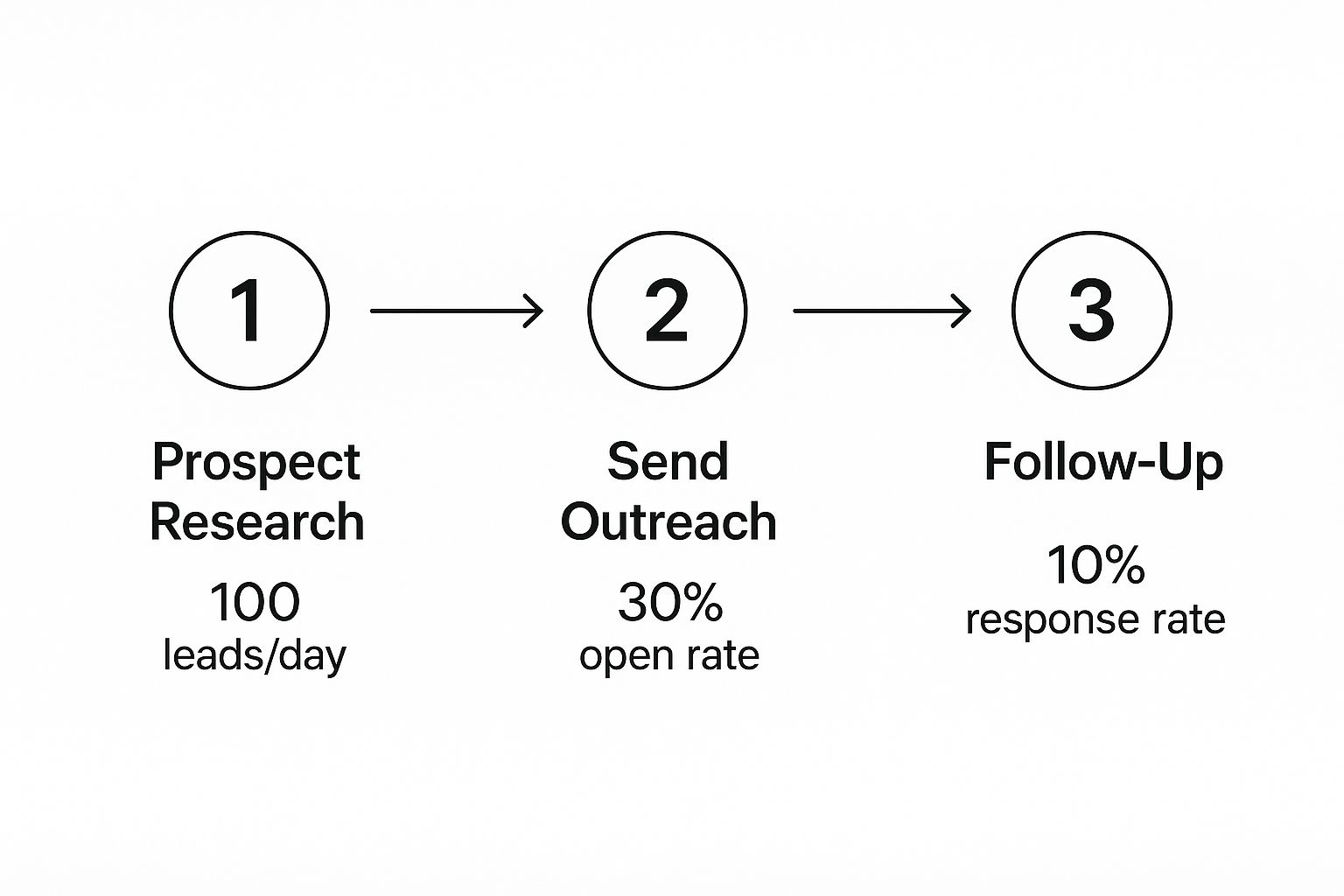
This visual shows how the funnel works—starting broad and narrowing down at each step.

Image

The big takeaway here is that outbound is a numbers game rooted in quality. Even with great open and reply rates, you need a healthy volume of the right people at the top to get meaningful results at the bottom.

Stage 1: Define Your Ideal Customer Profile

Before you write a single email or make one call, you have to know exactly who you're talking to. Your Ideal Customer Profile (ICP) is a painfully specific description of the perfect company for your product or service. This isn't a vague persona—it's a data-backed blueprint.

And don't confuse your ICP with a buyer persona. An ICP defines the perfect company (industry, size, revenue, what tech they use), while a buyer persona describes the people inside that company (their job title, headaches, and goals). You need both, but the company profile comes first.

For example, "we sell to tech companies" is useless. A sharp ICP is "B2B SaaS companies with 50-200 employees, using HubSpot, that have recently hired a VP of Sales." That level of detail makes every other step a thousand times easier.

Stage 2: Build a High-Quality Prospect List

With that crystal-clear ICP in hand, your next job is to build a list of companies and contacts that match it perfectly. This is probably the most critical step of all. Why? Because the quality of your list sets the ceiling for your campaign's success. A brilliant message sent to the wrong person is just spam.

You'll hear a lot of debate about buying lists versus building them.

  • Buying Lists: It's fast, sure, but you're often getting stale, low-quality data. It can be a starting point, but you risk high bounce rates and torching your domain reputation.
  • Building Lists: This takes more time, but the result is a hyper-accurate, targeted list. Using tools like LinkedIn Sales Navigator alongside data enrichment services gives you complete control over quality.

My advice? Build your list. The upfront effort pays for itself many times over with higher engagement and better conversations. Your goal is quality over quantity—a list of 200 perfect-fit prospects is infinitely more valuable than a list of 2,000 generic ones.

Stage 3: Craft Compelling Multi-Touch Sequences

Now it’s time to think about your messaging. A "sequence" is just a series of coordinated outreach attempts across different channels—email, LinkedIn, maybe a call—spread out over several days or weeks. Anyone can ignore a single email. A thoughtful, multi-touch sequence shows polite persistence.

Your sequence should tell a story, with each touchpoint building on the last. You might start with a hyper-personalized email, follow up with a LinkedIn connection request a couple of days later, then send another email referencing a different pain point.

The goal isn't to bombard your prospect. It's to show up in different places with a helpful perspective, increasing your chances of starting a conversation when the timing is right. Remember, it often takes 8 or more touches to get that first meeting.

If you want to get more advanced, think about adding video to your outreach. Our guide on video email automation breaks down how to embed personalized videos to make your emails impossible to ignore.

Stage 4: Execute and Handle Responses

With your list built and your sequence written, it's time to hit "go." A sales engagement platform can automate the sending schedule, but your work is just beginning. The most important part is how you manage the replies that start trickling in.

You need a system. Triage every response into a few key buckets:

  • Positive: "Sounds interesting, tell me more." Get these to a sales rep to book a meeting, fast.
  • Neutral: "Can you send more info?" Fulfill the request immediately and add them to a longer-term nurture track.
  • Objection: "Not the right time." Thank them for the reply and ask for permission to check back in a few months.
  • Negative: "Not interested / Unsubscribe." Respect their wishes. Remove them from all lists immediately. No exceptions.

Stage 5: Measure and Optimize Performance

You can't improve what you don't measure. The final stage is a continuous feedback loop of digging into your campaign data and figuring out how to make it better. Focus on the metrics that actually matter for outbound lead generation.

  • Open Rate: Are your subject lines grabbing attention? (Aim for 40%+)
  • Reply Rate: Is your message actually connecting with people? (Aim for 5%+)
  • Positive Reply Rate: How many of those replies are real leads vs. "no thanks"? (Aim for 1-2%)
  • Meetings Booked: This is the ultimate bottom line.

Use this data to A/B test everything. Try new subject lines. Tweak your call to action. Change the timing of your follow-ups. This constant cycle of testing and optimizing is what turns a decent campaign into a predictable revenue engine.

Free Tool

Try our AI Lead Generator — find verified LinkedIn leads for any company instantly. No signup required.

Frequently Asked Questions About Outbound Lead Generation

Even with the best game plan, a few questions always pop up when you start digging into outbound lead generation. It's totally normal. Here are the most common hurdles I see teams run into, along with some straightforward answers to help you sharpen your approach.

Is Outbound Marketing a Numbers Game?

Yes and no. It used to be. The old "spray and pray" model of blasting thousands of generic emails is not just dead—it's dangerous. It’ll wreck your brand’s reputation and get your domain blacklisted in a heartbeat.

Modern outbound is a game of quality at scale.

Success isn’t about how many people you hit up; it’s about how many of the right people you connect with using a message that actually means something to them.

The real goal is to start as many high-quality conversations as possible, not just to smash an arbitrary outreach number. A tight list of 100 perfectly matched prospects will crush a list of 1,000 random ones. Every time.

Think of it like this: are you sending a mass-produced flyer or a handwritten invitation? One is designed for volume, the other for impact. Your outbound needs to feel like that invitation.

How Do I Know If Outbound Is Right for My Business?

Outbound lead generation isn't a silver bullet for everyone, but it’s incredibly powerful in the right situations. It’s probably a perfect fit if you find yourself nodding along to any of these:

  • You have a high-value product or service: If your average deal size is chunky, the ROI on targeted, personal outreach is a no-brainer.
  • You sell to a well-defined niche: When you can pinpoint your ideal customers by their industry, company size, or job title, outbound lets you walk right up to their digital front door.
  • You need predictable revenue, fast: Inbound is a long game that can take months to build momentum. A solid outbound campaign can start booking meetings in weeks.
  • You're breaking into a new market: Got zero brand recognition in a new territory? Outbound is the fastest way to get your name in front of the key players who matter.

On the flip side, if you're selling a low-cost, high-volume product to a huge consumer audience, inbound marketing will likely give you better bang for your buck long-term.

What Is a Good Reply Rate for Cold Outreach?

Setting the right expectations is everything. It keeps you from getting discouraged when you don't get a 50% reply rate on day one.

For cold email, a solid benchmark is a reply rate between 5% and 10%. If you’re clearing 10%, you're killing it. If you’re dipping below 2%, something’s off with your list, your message, or both.

But the raw reply rate isn't the whole story. You need to obsess over the positive reply rate—the percentage of responses that are actual signs of interest. A 1-2% positive reply rate is a great goal. It tells you the campaign is generating real, qualified opportunities, not just "unsubscribe" messages.

How Does Outbound Compare to Modern Digital Marketing?

A lot of people mistakenly think of outbound as some old-school, outdated tactic. That couldn’t be further from the truth. Modern outbound is completely woven into the digital fabric.

Sure, the perception can be skewed—only 18% of marketers believe outbound delivers high-quality leads.

But look at the data. Today, 78% of businesses use email marketing for lead generation. And 66% of marketers are successfully pulling in leads from social media with very little time invested. This shows that a multi-channel outbound strategy, using both email and social selling, is a powerhouse. You can dig into more of these lead generation statistics on ExplodingTopics.com.

The core difference is simple: inbound marketing pulls people in with content, while outbound marketing proactively starts the conversation on the platforms where your prospects already live.


Ready to stop the manual grind and build a predictable revenue engine? marketbetter.ai uses AI to create hyper-personalized campaigns, automate your follow-ups, and pinpoint your most promising leads. Our platform frees up your team to do what they do best: close deals.

Discover how to scale your outbound success with marketbetter.ai today!

Inbound Lead Generation: The 5-Channel Framework That Replaced Our Outbound Spend [2026]

· 23 min read

Inbound marketing isn't just a tactic; it's a fundamental shift in how you attract customers. Rather than interrupting people with ads, you pull them in with genuinely helpful content and experiences they're already searching for. You stop being an interruption and start becoming a trusted resource.

This shift creates a powerful, sustainable pipeline of high-quality leads who actually want to talk to you. This guide provides an actionable framework to build your own inbound marketing lead generation engine.

Rethinking Inbound Marketing Lead Generation

Let's move past the textbook definitions. Effective inbound lead generation is more than just avoiding spammy tactics. It’s a strategic philosophy built on making your business the exact solution your ideal customer is searching for.

Instead of shouting your message at a wide, mostly uninterested audience (outbound), you create a magnetic presence that draws in prospects who have already raised their hand and said, "I have this problem."

Image

This is a fundamental departure from old-school outbound methods. Consider the difference between a cold call that interrupts someone's day versus a blog post they find on Google that perfectly answers their burning question. One creates friction and annoyance; the other builds instant trust and positions you as an authority. The first is a transaction; the second is the start of a relationship.

Inbound vs Outbound: A Clear Comparison

The power of inbound marketing becomes crystal clear when you compare it directly against outbound. Outbound is a constant grind—a numbers game that often feels like you're renting attention. Inbound, on the other hand, is about building assets that work for you 24/7, generating value long after you've hit "publish."

This table breaks down the core differences in a practical way.

Inbound vs Outbound Lead Generation Quick Comparison

MetricInbound MarketingOutbound Marketing
ApproachPulls customers in with helpful contentPushes messages out to a broad audience
CommunicationTwo-way, conversational, and permission-basedOne-way, interruptive, and often unsolicited
Lead QualityHigh-intent leads actively seeking solutionsLower-intent leads who may not have a need
ROIBuilds over time as content assets matureOften provides short-term spikes but lacks sustainability

It boils down to two things: consent and value. With inbound, you earn the right to have a conversation by first offering something valuable. This simple act builds a foundation of trust that makes the entire sales process smoother and far more effective.

The Clear ROI of an Inbound Strategy

The numbers don't lie. Inbound tactics don't just feel better for your customers; they perform better for your bottom line.

Industry data consistently shows that inbound marketing generates 54% more leads than traditional outbound channels. Even better, it does so while costing 62% less per lead. For many businesses, that efficiency adds up to an average annual savings of around £12,000. It’s a smarter way to invest your marketing budget.

Ultimately, the leads you generate through methods like SEO are just plain better. They have a lead-to-close rate that is seven times greater than outbound leads because they’re already problem-aware and actively looking for a solution.

Actionable Takeaway: If you want to transform how you attract customers, mastering sustainable organic lead generation is non-negotiable. This approach doesn't just fill your pipeline; it fills it with prospects who are genuinely ready to engage.

Create Content That Actually Pulls in Your Ideal Customers

Let's get one thing straight: content is the engine of your entire inbound marketing program. This isn't about churning out generic blog posts or random social media updates. It's about methodically building a library of resources that acts as a powerful magnet for your ideal customers, pulling them in by solving their very specific problems.

Think of great content as your best salesperson. It works 24/7, answering questions, building trust, and gently guiding prospects toward your solution. It’s the difference between someone stumbling on a vague "marketing tips" article and finding an in-depth guide that speaks directly to the exact challenge their company is wrestling with right now.

Image

Uncover Your Audience’s Real-World Problems

Before you write a single word, you have to know who you're writing for—far beyond basic demographics. You need to dig deep to uncover their true pain points, their motivations, and the exact language they use to talk about their challenges.

Stop guessing. Become an investigator. Here’s an actionable plan to get ground-level intelligence:

  • Talk to Your Sales Team: They are on the front lines every single day. Action Step: Schedule a 30-minute meeting and ask them, "What are the top five questions you get on every sales call?" and "What are the biggest objections that completely kill deals?" Their answers are pure gold.
  • Mine Your Customer Support Tickets: Your support team is sitting on a treasure trove of customer struggles. Action Step: Spend an hour reviewing the last month's support tickets. Look for recurring themes and questions that signal a gap in understanding—either about your product or the problem it solves.
  • Lurk in Online Communities: Dive into forums like Reddit, Quora, and industry-specific LinkedIn Groups. Action Step: Search for keywords related to your business and just listen. You’ll find raw, unfiltered conversations about people's frustrations and goals. Document the exact phrases they use.

This research lets you create content that hits home because it’s based on real-world needs, not your team's internal assumptions. It’s the foundation of any inbound plan that actually generates leads.

Map Your Content to the Buyer’s Journey

Okay, you know their problems. Now what? The next move is to align your content with where they are in their decision-making process. Someone just realizing they have a problem needs something completely different from someone who's actively comparing vendors.

Here’s a practical breakdown of how your content should shift:

Top of Funnel (TOFU) - The Awareness Stage

  • Your Goal: Attract a broad audience by educating them about their problem.
  • Content to Use: Blog posts ("5 Signs Your Lead Nurturing is Broken"), short educational videos, infographics, and simple checklists.
  • The Vibe: This content is 100% problem-focused, not solution-focused. You aren't selling anything here. You're building trust by being genuinely helpful.

Middle of Funnel (MOFU) - The Consideration Stage

  • Your Goal: Nurture those early leads by showing them solutions and positioning your company as a credible authority.
  • Content to Use: In-depth guides, compelling case studies, comparison whitepapers ("Our Software vs. The Competition"), and detailed webinars.
  • The Vibe: Now you can start introducing your solution as a viable path forward. The content gets more detailed, more specific, and more targeted.

Bottom of Funnel (BOFU) - The Decision Stage

  • Your Goal: Convert those qualified leads into paying customers by proving your value.
  • Content to Use: Free trials, live demos, clear pricing pages, and powerful customer testimonials.
  • The Vibe: The focus shifts entirely to your product or service and why it's the smartest choice they can make.

Actionable Takeaway: The single biggest mistake companies make is creating too much BOFU content (like product feature lists) and not nearly enough TOFU content (like helpful blog posts). Without a strong top of the funnel, your pipeline will eventually run dry. You'll simply have no one to nurture.

Build Topic Clusters to Dominate SEO

Creating great content is pointless if no one can find it. To get discovered, you have to think like a search engine. One of the most effective SEO tactics is building topic clusters. This strategy organizes your content in a way that signals deep expertise to Google, helping you rank for valuable, high-intent keywords.

The model is surprisingly simple:

  1. Pillar Page: A long, comprehensive piece of content on a broad topic central to your business. Think "The Ultimate Guide to Inbound Marketing Lead Generation."
  2. Cluster Content: Several shorter, specific blog posts that dig into subtopics related to your pillar, like "How to Create High-Converting Landing Pages" or "7 Lead Nurturing Email Templates That Actually Work."
  3. Internal Linking: This is the glue. Each cluster post links back up to the pillar page, and the pillar page links out to all the cluster posts.

This structure tells Google, "Hey, we are an authority on this entire topic." That signal can boost your rankings across a whole range of related search terms. It's a much smarter approach than just writing random, disconnected blog posts. For a more advanced look, you can even explore using https://marketbetter.ai/playbooks/ai-content-analysis to pinpoint these cluster opportunities.

Turn Anonymous Website Visitors into Qualified Leads

Getting traffic is a good start, but it's a vanity metric. Anonymous visitors don't pay the bills. Qualified leads do. This is where your strategy pivots from simply attracting an audience to actively converting them into real people you can build a relationship with.

The whole game boils down to a simple value exchange. You offer something so genuinely useful, so perfectly aligned with their problem, that a visitor is happy to give you their email address to get it. That single transaction is the magic moment a passive browser becomes an engaged lead.

Crafting Irresistible Lead Magnets

A lead magnet is that valuable item you offer. Forget the generic "sign up for our newsletter" CTA. A powerful lead magnet is a specific solution for a specific problem your ideal customer is dealing with right now. The value has to be so obvious that handing over their email feels like a no-brainer.

Compare these two approaches:

  • Weak (Self-serving): "Subscribe to Our Weekly Newsletter for Updates." This is all about you, not them. It’s vague and the value is a total mystery.
  • Strong (Customer-centric): "Download Our 5-Point Checklist for Reducing Customer Churn by 15%." Now that speaks to a real business pain point and promises a tangible result.

The best lead magnets are practical and immediately useful. These formats work time and time again:

  • Checklists & Templates: Simple, actionable tools that cut through complexity.
  • In-depth eBooks or Guides: The definitive resource that cements your authority on a topic they care about.
  • Exclusive Webinar Access: Live or on-demand training that delivers expert insights they can't get anywhere else.
  • Case Studies: Real-world proof that you've already solved this exact problem for someone just like them.

Designing High-Converting Landing Pages

Your landing page has one job: get the visitor to fill out the form. That's it. Anything that distracts from that goal—navigation menus, sidebars, social links—is friction that will tank your conversion rate. Strip it all away.

A high-performing landing page absolutely must have:

  1. A Killer Headline: It must instantly scream, "You're in the right place, and here's the valuable thing you're about to get."
  2. Persuasive Copy: Talk about benefits, not features. Don't just list what's in the eBook; explain what the reader will be able to achieve after reading it.
  3. Frictionless Forms: Only ask for what you absolutely need. Every extra field you add can slash conversions by up to 50%. You can always ask for more info later as you nurture the lead.
  4. A Clear Call-to-Action (CTA): The button needs to pop. Use action-oriented text like "Get My Free Checklist" instead of a boring, passive word like "Submit."

Actionable A/B Test Story: A B2B software company was testing their CTA button. The original said "Download Now." The new version said "Get Your Free Template." That simple change, which emphasized ownership ("Your") and the specific offer, boosted lead captures on that page by 22% in just one month.

Strategic Placement of Your CTAs

Where you put your CTAs is just as important as what they say. The goal is to make your offer feel like the logical next step, not a jarring interruption.

Actionable Example: A CTA for a guide on "Advanced SEO Tactics" belongs at the end of a blog post about keyword research—not slapped on your homepage. This contextual placement makes the offer feel helpful, not salesy. As you get more advanced, you can start digging into how technology is changing the game. Exploring concepts like person-level identification for inbound marketing can open up entirely new ways to personalize these offers before a visitor even fills out a form.

There’s a reason this is so critical. About 50% of marketers call lead generation a top priority. While businesses generate an average of 1,877 leads per month, it comes at a steep price, with the average cost per lead hitting $198.44. To keep those costs in check, 76% of marketers are leaning on content marketing to do the heavy lifting. You can discover more lead generation statistics and trends to see how your own efforts stack up.

Nurture and Qualify Leads with Smart Automation

Getting a new lead is just the starting line. The real work begins now, and it's where smart automation can turn your lead gen efforts from a leaky bucket into a high-pressure pipeline.

The goal is simple: deliver the right message to the right person at exactly the right time, all on autopilot.

Compare the manual approach versus automation. Without it, you’re stuck trying to personally email every new download, track their site visits, and guess when they’re ready for a sales call. It doesn’t scale, and opportunities are missed. Automation, on the other hand, creates a consistent, personalized experience for every single person who shows interest.

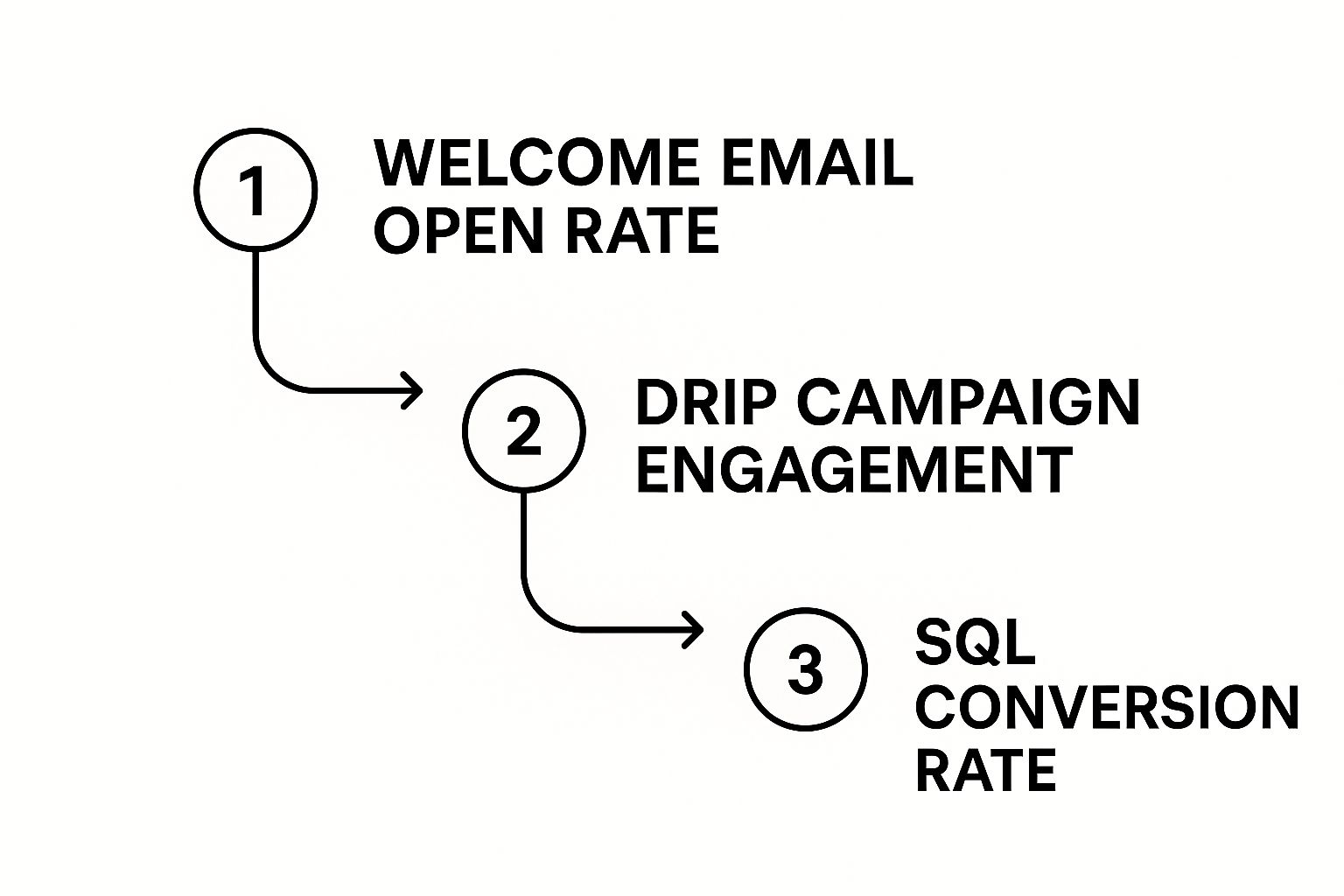
This flow shows how that journey typically unfolds, taking someone from their first interaction all the way to becoming a sales-qualified lead.

Image

You can see how each stage builds on the last. Strong engagement early on directly fuels the success of your later conversion efforts.

Building Your First Nurturing Workflow

A lead nurturing workflow is an automated sequence of emails, usually triggered by a specific action, like downloading an ebook. The point isn’t to hammer them with sales pitches. It’s to provide more value, build trust, and gently guide them toward seeing you as the solution.

Let's compare two ways to handle a lead who downloaded "The Ultimate Guide to Social Media Marketing."

The Basic (and ineffective) Workflow:

  • Email 1: "Thanks for downloading! Here's your guide."
  • Email 2 (3 days later): "Did you read the guide? Want to book a demo of our tool?"
  • Email 3 (7 days later): "Just checking in again about that demo..."

This feels abrupt and pushy. It rushes the sale and fails to build a relationship. It’s all about you.

The Smart (and effective) Workflow:

  • Email 1 (Instant): "Here's your guide! In a few days, I'll send over a free post scheduling template that complements it."
  • Email 2 (3 days later): "As promised, here's that social media template. It works great for planning out your content."
  • Email 3 (7 days later): "I saw you visited our pricing page. If you're curious how our tool stacks up, here's a short video walkthrough."
  • Internal Alert: Fire off a notification to a sales rep that this lead is showing high-intent behavior.

See the difference? The smart workflow delivers continuous value, uses behavioral data (like a pricing page visit) to personalize the message, and only triggers a sales interaction when the lead is clearly engaged.

Demystifying Lead Scoring

Not all leads are created equal. Some are just kicking the tires, while others are ready to have a serious conversation. Lead scoring is how you automatically separate the hot prospects from the curious researchers. You assign points based on who they are and what they do.

Here is an actionable starting point for your scoring model:

  • High-Value Actions (+15 points): Requesting a demo, visiting the pricing page multiple times.
  • Medium-Value Actions (+10 points): Downloading a bottom-of-funnel case study, attending a webinar.
  • Low-Value Actions (+5 points): Opening an email, downloading a top-of-funnel ebook.
  • Ideal Fit (+10 points): Their job title is "Marketing Manager," and the company size is 50-200 employees.

Once a lead hits a certain score—say, 50 points—they can be automatically flagged as a Sales Qualified Lead (SQL) and routed to the sales team. This simple system ensures your reps spend their precious time on the opportunities most likely to close.

You can get even more sophisticated with this. For a more detailed guide, it's worth exploring how to set up AI lead scoring systems that can refine these rules for you over time. You can learn more here: https://marketbetter.ai/playbooks/ai-lead-scoring.

The impact here is huge. It's no surprise that 76% of companies are now using automation. Nurtured leads produce, on average, a 20% increase in sales opportunities versus non-nurtured leads. By automating your lead generation, you're building a system that drives real, measurable growth.

Lead Nurturing Automation Workflow Examples

To bring this to life, here's a quick look at how you might structure automated workflows for different types of leads.

Lead SegmentTriggerAutomated Action/Content
New Subscriber (ToFu)Subscribes to newsletterSend welcome email with links to top 3 most popular blog posts.
Ebook Downloader (MoFu)Downloads "Guide to X"3-part email series: 1. Deliver the guide. 2. Send related case study. 3. Invite to a relevant webinar.
Pricing Page Visitor (BoFu)Visits pricing page 2+ timesSend an email from a sales rep offering a personalized demo or consultation.
Webinar AttendeeAttends webinar on "Topic Y"Send a follow-up with the recording, slides, and a link to a related case study.
Stale LeadNo engagement for 90 daysTrigger a re-engagement email with a new, high-value offer (e.g., a free tool or new research report).

This table shows how you can tailor your follow-up based on a lead’s specific context and behavior, making every interaction more relevant. This structured approach is fundamental to scaling your inbound efforts effectively.

Measure and Optimize Your Lead Generation Engine

An inbound lead gen program isn't a crockpot—you can't just set it and forget it. The best ones are living engines that demand constant monitoring and fine-tuning. This is where you graduate from just creating stuff to actually proving its value to the business.

Launching campaigns is only half the battle. The other half is won in the data, where you discover what’s truly connecting with your audience, what’s falling flat, and where your biggest growth opportunities are hiding.

Moving Beyond Vanity Metrics

It's easy to get hypnotized by numbers that look impressive but don’t actually move the needle. These are vanity metrics. A big spike in website traffic or a jump in social media followers feels great, but it tells you nothing about whether you're generating qualified leads that turn into revenue.

You must shift your focus to Key Performance Indicators (KPIs) that directly measure the health of your sales funnel.

Here’s a comparison to reframe your thinking:

Vanity MetricActionable KPI
Total Website TrafficTraffic-to-Lead Conversion Rate: How well does your site turn anonymous visitors into real leads? High traffic with a low conversion rate signals a leaky bucket.
Social Media LikesLead-to-Customer Conversion Rate: What percentage of generated leads became paying customers? This is the ultimate bottom-line metric.
Email Open RateCost Per Qualified Lead (CPQL): How much are you spending to get a lead that sales actually wants? This is the true measure of your campaign ROI.

Focusing on these KPIs forces you to connect the dots between marketing activity and sales outcomes. You stop asking "How many people saw our content?" and start asking "How did our content help close a deal?"

Using Analytics to Pinpoint Bottlenecks

Your analytics platform is mission control for optimization. It’s where you can track the entire customer journey, from the first click to the final conversion, and see exactly where people are getting stuck.

Take this screenshot from a Google Analytics dashboard, for example, showing user acquisition by channel.

At first glance, you might see that 'Organic Search' drives the most users and call it a day. But look closer. 'Direct' traffic has a much higher engagement rate. That's a huge clue. Actionable question: "Why are direct visitors so much more engaged, and how can we improve the experience for our search traffic to match that engagement?"

Key Insight: Don’t just look at what channel brings the most traffic; analyze which channel brings the best traffic. A channel that brings fewer visitors who convert at a high rate is often far more valuable than one that brings thousands of visitors who just bounce.

An Actionable Framework for A/B Testing

Once you've found a weak spot—say, a landing page with a dismal conversion rate—it's time to experiment. A/B testing, or split testing, is a simple but powerful method for comparing two versions of a webpage to see which one performs better.

Here’s an actionable framework you can use right away:

  1. Identify Your Problem & Form a Hypothesis: Start with a clear hypothesis rooted in data. Example: "I believe changing our landing page headline to be more benefit-focused will increase form submissions because the current one is too generic."
  2. Create a Variation (Change Only One Thing): This is critical. If you change the headline, the CTA button color, and the main image all at once, you’ll have no clue which change actually made the difference.
  3. Run the Test: Use a testing tool to split your traffic evenly between the original version (the control) and your new version (the variation).
  4. Analyze the Results: Let the test run long enough to get a statistically significant result. Don't pull the plug after just a day or two.
  5. Implement the Winner & Repeat: If your new version shows a clear improvement, make it the new standard. Your new winner is now the control for your next test.

This cycle of continuous improvement is the secret to systematically growing your results. Small, incremental wins from consistent A/B testing can compound over time, leading to massive gains.

Free Tool

Try our AI Lead Generator — find verified LinkedIn leads for any company instantly. No signup required.

Common Questions About Inbound Lead Gen

Even the best-laid inbound marketing plans run into roadblocks. Theory is one thing, but execution is another. Let's tackle some of the most common questions from marketers on the ground.

Image

How Long Until I See Real In-Demand Leads?

This is the big one. The honest, no-fluff answer is that inbound is a marathon, not a sprint. If you're looking for overnight clicks, you should be running paid ads. Inbound is about building a real asset—trust and authority—and that takes time.

Typically, you'll start to feel some momentum in the first 3-6 months. But to see a significant, predictable flow of qualified leads, you should plan for a 6-12 month runway.

Compare the two approaches: outbound ads are like a firework—a spectacular, short burst of attention, and then it's over. Inbound is like planting a tree. It takes a while to grow, but once it’s mature, it provides value for years with very little maintenance. Those blog posts become evergreen lead-generating machines working for you 24/7.

Should I Gate All My Content?

Gating content is a fantastic way to capture leads, but if you put a form in front of everything, you’ll just annoy people and torpedo your SEO. The key is striking a balance between growing your list and building your brand's reputation as a go-to resource.

Here’s an actionable framework to decide:

Content TypeGated or Ungated?Why It Works
Blog Posts & ArticlesUngatedThis is your top-of-funnel fuel. It powers your SEO, draws in the widest possible audience, and builds trust without asking for anything.
Checklists & TemplatesGatedThese are high-value, practical tools. Someone is getting immediate utility, so asking for an email is a fair trade.
In-Depth eBooks & GuidesGatedThis is your premium stuff. Gating your most comprehensive content signals its value and filters for prospects with a higher level of interest.
Case Studies & TestimonialsUngatedMake these as easy to find and share as possible. They are sales tools designed to build social proof and remove friction, not create it.

Actionable Tip: Try a "hybrid" model. For a beefy guide, offer the first chapter or an executive summary for free (ungated) and then gate the full download. You give visitors a taste of the value before asking for their contact info.

What Is The Difference Between MQL and SQL?

Getting this right is absolutely critical for keeping your marketing and sales teams on the same page. When these definitions are fuzzy, you get internal friction, wasted effort, and leads that fall through the cracks.

Here’s a simple comparison:

  • Marketing Qualified Lead (MQL): This is someone who has engaged with your marketing content but isn't ready for a sales pitch. They’ve downloaded an ebook or subscribed to your webinar. They are problem-aware—they know they have a pain point, but they're still exploring.

  • Sales Qualified Lead (SQL): This is a lead who has signaled a clear intent to buy. They've requested a demo, spent a lot of time on your pricing page, or filled out a "contact sales" form. They are solution-aware—they're actively evaluating options, and yours is on the list.

The handoff from MQL to SQL is the most crucial moment in your entire funnel. Marketing’s job is to nurture MQLs with helpful content until they raise their hand. Once they show those buying signals, they become an SQL, and it’s time for sales to step in.


Ready to stop guessing and start growing? marketbetter.ai uses an integrated AI approach across your content and campaigns to drive measurable results. See how our platform can help you generate more qualified leads and prove your marketing ROI. Learn more about our AI-powered marketing platform.

7 B2B Lead Generation Campaign Examples to Replicate in 2026

· 25 min read

Generating a consistent flow of high-quality leads is the lifeblood of any B2B organization, yet cutting through the market noise to capture attention feels more challenging than ever. True success isn't found in a single magic-bullet tactic, but in a well-executed portfolio of strategies tailored to your audience. This article moves beyond theory to deconstruct seven proven lead generation campaign examples, offering a strategic blueprint that marketing and sales teams can adapt and implement immediately.

We won't just describe what these companies did. Instead, we'll dive deep into the specific tactics, replicable methods, and critical metrics behind their success. For marketers seeking a comprehensive overview of foundational tactics, understanding various effective B2B lead generation strategies can provide essential context for the specific examples we are about to explore.

Each example in this listicle includes:

  • A direct comparison against an alternative approach.
  • An actionable "How to Replicate" guide.
  • Key performance indicators to track your own campaign's success.

This breakdown is designed to equip you with the practical insights needed to build, launch, and optimize your own high-converting lead generation engine. Let's get started.

1. HubSpot’s Website Grader: The Ultimate Top-of-Funnel Tool

One of the most enduring and effective B2B lead generation campaign examples comes from HubSpot. Instead of a temporary campaign, they built a perpetual lead generation engine: the Website Grader. Launched in 2006, this free tool analyzes a website's performance in areas like SEO, mobile-friendliness, and security, then provides an instant, detailed report.

The brilliance of this strategy lies in its value-first approach. It doesn't ask for a sale; it offers a solution to a pressing question every business has: "How effective is my website?" By providing immediate, personalized, and actionable insights, HubSpot establishes itself as an authority and builds trust from the very first interaction.

Strategic Breakdown

The Website Grader is a masterclass in inbound marketing. It perfectly aligns with HubSpot’s core product offering-marketing automation and CRM software. A user who discovers their website has performance issues is instantly a warm lead for the very tools HubSpot sells to fix those problems.

The tool acts as a powerful qualifier. A user who takes the time to grade their site is demonstrating a clear interest in improving their digital marketing, making them a high-quality lead for sales and marketing teams to nurture. This approach is far more effective than a generic "Download our Free Ebook" form, as the interactive tool provides personalized value, making the lead more qualified and the follow-up conversation more relevant. The initial conversation is framed around the user's specific pain points, not a cold sales pitch.

Key Insight: The most powerful lead magnets solve a tangible problem for your target audience before they ever become a customer. This exchange of value for contact information creates a foundation of trust and positions your brand as a helpful expert.

How to Replicate This Strategy

While building a complex software tool might be out of reach for some, the core principle is highly adaptable. Your action plan is to create a simpler, yet equally effective, lead generation asset.

  • Step 1: Identify a Key Calculation or Diagnosis. Brainstorm a frequent, quantifiable question your ideal customer has.
  • Step 2: Choose Your Format. Select a simple, interactive format based on that question. Examples include:
    • A Niche Calculator: Create an interactive calculator that helps prospects estimate ROI, project costs, or potential savings. For example, a logistics company could offer a "Freight Shipping Cost Calculator."
    • A Diagnostic Quiz: Build a short quiz that helps users diagnose a problem. A cybersecurity firm might offer a "Cyber Risk Assessment Quiz" that provides a score and recommended next steps.
    • A Template Generator: Provide a tool that generates a customized document. A legal tech company could offer a "Basic Non-Disclosure Agreement Generator."
  • Step 3: Build & Gate. Use a no-code tool like Outgrow or a simple form builder to create the tool. Gate the final results behind an email capture form.
  • Step 4: Promote. Feature the tool prominently on your homepage, blog sidebars, and in relevant articles to drive traffic.

The goal is to create a resource so valuable that your target audience is happy to exchange their email address for access. This makes your lead generation feel less like a transaction and more like the start of a helpful partnership.

2. OptinMonster’s Exit-Intent Pop-ups: The Last-Chance Lead Capture

One of the most effective, behavior-triggered lead generation campaign examples is the exit-intent pop-up. Popularized by tools like OptinMonster, this strategy works by tracking a user's mouse movements and displaying a targeted offer the moment they show an intention to leave the page, such as moving their cursor toward the back button or to close the tab.

Exit-Intent Pop-up Campaigns

This tactic is powerful because it's a final, highly relevant attempt to engage a visitor who would otherwise be lost forever. In contrast to a time-delayed pop-up that can interrupt a user's reading experience, an exit-intent pop-up is less intrusive because it appears only at the precise moment of disengagement, offering a compelling reason to stay. For example, e-commerce sites use it to offer a last-minute discount code, while B2B companies might present a free e-book or a trial offer to capture an email.

Strategic Breakdown

Exit-intent campaigns are a masterclass in behavioral marketing. They transform a moment of potential abandonment into a lead generation opportunity. The core principle is simple: you have the visitor's attention for a fleeting second, so the offer must be immediately valuable and highly relevant to their original interest on that page.

This strategy acts as a safety net for your conversion funnel. Many visitors browse without converting on their first visit. An exit-intent pop-up gives you a second chance to capture their contact information for future nurturing. It's far more effective than a static sidebar form because it leverages urgency and pattern interruption to grab attention when it matters most.

Key Insight: Don't let interested visitors leave empty-handed. By presenting a high-value, low-commitment offer just as they're about to depart, you can convert otherwise lost traffic into valuable leads for your sales and marketing pipeline.

How to Replicate This Strategy

Implementing an exit-intent pop-up is accessible for businesses of all sizes using widely available tools. Your action plan should focus on matching the offer to the user's context.

  • Step 1: Choose Your Tool. Select a pop-up tool like OptinMonster, Sumo, or HubSpot's built-in features.
  • Step 2: Segment Your Audience. Don't show the same pop-up to everyone. Create different offers for different pages (e.g., pricing page vs. blog page).
  • Step 3: Craft a Compelling Offer. The key to success lies in the value of the offer, not the complexity of the technology. Choose one:
    • Offer an Irresistible Discount: For e-commerce, a simple "10% off your first order" in exchange for an email is a proven winner.
    • Provide a Content Upgrade: If a visitor is leaving a blog post, offer a related checklist, template, or e-book. For example, on a post about SEO, offer a "Free SEO Audit Checklist."
    • Launch a Free Trial or Demo: For SaaS, present a no-obligation free trial or a quick demo sign-up to move them from awareness into consideration.
  • Step 4: A/B Test Your Copy. Test different headlines and calls-to-action to see what resonates most with your audience and maximizes conversion rates.

The goal is to make the offer a "no-brainer." It should be so relevant and valuable that the visitor feels they are getting a great deal by simply providing their email address, turning a potential bounce into a new lead.

3. Social Media Contest Lead Generation

Social media contests are one of the most direct and engaging lead generation campaign examples for B2C and even some B2B brands. This strategy combines the viral potential of social sharing with a clear value exchange: participants provide their contact information in exchange for a chance to win a desirable prize. The result is a rapid influx of new leads and a significant boost in brand visibility.

Unlike evergreen lead magnets that generate a slow, steady stream of leads, contests are high-impact, time-sensitive campaigns designed for quick list growth and maximum brand exposure in a short period. For instance, beauty brand Glossier famously ran Instagram photo contests that generated over 40,000 email signups by asking users to share content. This approach taps into the audience's creativity and desire for recognition, turning them into active brand promoters.

Social Media Contest Lead Generation

Strategic Breakdown

The core of a successful social media contest is the alignment between the prize and the ideal customer profile. Offering a generic prize like a gift card attracts a wide, unqualified audience, but offering a specific prize like a year's supply of your product or a premium subscription exclusively attracts people genuinely interested in your offering.

Platforms like Gleam.io and Rafflecopter have popularized this by creating simple entry mechanisms. Users can gain entries by following a social profile, signing up for a newsletter, or referring a friend. Each action is a micro-conversion that deepens engagement while capturing valuable lead data, turning passive followers into active prospects for nurturing campaigns.

Key Insight: A well-designed social media contest isn’t about getting the most leads; it's about getting the right leads. The prize you offer acts as a filter, ensuring the list you build is full of potential customers, not just freebie seekers.

How to Replicate This Strategy

You don’t need a massive budget to run an effective contest. The key is creativity and strategic alignment with your marketing goals. Here is your action plan to launch one.

  • Step 1: Define a Clear Goal. Is your primary objective email sign-ups, social follows, or user-generated content? This will shape your contest rules.
  • Step 2: Choose a Relevant Prize. Select a prize that your ideal customer would love but that a general audience might not. Examples:
    • A "Product Stack" Giveaway: Partner with complementary, non-competing brands to offer a bundle of products or services.
    • A User-Generated Content (UGC) Contest: Encourage your audience to submit photos or videos using your product. The prize could be a feature on your website or a product bundle.
    • A Referral-Based Contest: Use a tool like KingSumo to reward participants with more entries for each friend they refer. This is ideal for rapid list growth.
  • Step 3: Set Up the Mechanics. Use a contest platform like Gleam.io or ShortStack to manage entries, track actions, and select a winner fairly.
  • Step 4: Promote Heavily. Announce the contest across all your channels—email list, social media, and website banners—for a set period (e.g., 7-14 days) to create urgency.

The goal is to create a win-win scenario. Your audience gets a chance to win something they truly want, and you generate a highly targeted list of leads who have already shown interest in what you offer. This makes the follow-up process much warmer and more effective.

4. LinkedIn’s Personalized Outreach: The Modern Cold Call

In the B2B world, LinkedIn has evolved from a simple networking site into a primary channel for high-value lead generation. Unlike broad, impersonal email blast campaigns that often land in spam folders, a well-executed LinkedIn outreach campaign is a surgical tool, allowing teams to connect directly with specific decision-makers in a professional and contextual environment.

The power of this strategy comes from its blend of data-driven targeting and human-to-human interaction. Instead of blasting a generic message, top performers use LinkedIn to research prospects, understand their challenges, and initiate conversations built on genuine value and relevance. This transforms the "cold call" into a warm, contextual introduction.

Strategic Breakdown

Effective LinkedIn outreach is a multi-step process, not a one-time message. It begins with leveraging Sales Navigator to build hyper-targeted prospect lists based on industry, company size, role, and even recent activity. The goal is to identify individuals who are most likely to benefit from your solution right now.

The next step is personalized connection and messaging. Successful campaigns often see connection acceptance rates of 40-50% by moving beyond the generic template. Mentioning a shared connection, a recent post they published, or a specific company achievement shows you’ve done your homework. This approach positions you as a thoughtful peer, not just another salesperson, and paves the way for a meaningful conversation.

Key Insight: The most successful LinkedIn outreach campaigns prioritize relationship-building over immediate sales. By providing value upfront through shared content, insights, or helpful comments, you earn the right to ask for a prospect's time later in the funnel.

How to Replicate This Strategy

This is one of the most accessible lead generation campaign examples to implement, as it requires more strategy than budget. Here is your actionable plan.

  • Step 1: Define Your Ideal Customer Profile (ICP). Before sending a single message, clearly define who you are targeting. Use LinkedIn Sales Navigator's filters to build precise lists that match your ICP criteria.
  • Step 2: Craft a Value-First Sequence. Develop a multi-touchpoint messaging sequence that spans 2-3 weeks.
    • Touch 1: Personalized connection request (e.g., "Hi [Name], I saw your recent post on [Topic] and was impressed. Would love to connect.").
    • Touch 2 (3 days later): Follow up with a valuable resource (like a relevant article or case study), not a sales pitch.
    • Touch 3 (7 days later): Ask a relevant question to start a conversation, then pivot to your ask for a meeting.
  • Step 3: Engage Beyond the Inbox. Don't just live in the DMs. Actively engage with your target prospects' content by leaving thoughtful comments on their posts. This builds familiarity and credibility, making your eventual outreach message feel much warmer.
  • Step 4: Track and Optimize. Monitor your connection acceptance rate and reply rate. Test different message templates to see what performs best.

To master the nuances of this approach, you can explore detailed guides on LinkedIn prospecting automation to build a scalable and effective system.

5. Salesforce’s Trailhead Webinars: Scaling Education for Lead Generation

Webinars represent one of the most powerful B2B lead generation campaign examples because they offer a direct, high-value exchange: an hour of an expert's time for a prospect's contact information and attention. Salesforce masterfully employs this with its Trailhead educational webinars, turning product education into a scalable lead generation and user adoption engine.

Compared to pre-recorded video demos, which are static and one-directional, live webinars create an interactive, high-engagement environment that fosters trust and allows for real-time objection handling. Salesforce provides live and on-demand sessions that teach users how to solve real-world business problems using its platform. This approach attracts highly qualified individuals who are actively looking to either adopt Salesforce or deepen their existing usage, creating a pipeline of engaged, educated leads.

Strategic Breakdown

Salesforce’s webinar strategy is a masterclass in combining top-of-funnel attraction with bottom-of-funnel conversion. By addressing specific pain points-like "How to Automate Sales Processes"-they attract new users who are problem-aware. For existing customers, advanced topics encourage deeper product adoption and upsell opportunities, contributing to customer retention and expansion.

This live, interactive format creates a sense of urgency and community that a static blog post cannot replicate. The Q&A portion allows Salesforce to overcome objections and gather direct feedback from the market at scale. Each registration is a high-intent signal, providing the sales team with warm leads who have already been educated on the platform's value proposition, significantly shortening the sales cycle.

Key Insight: High-touch, educational experiences like webinars are invaluable for complex B2B products. They bridge the gap between awareness and consideration by demonstrating value and building a direct relationship with potential customers long before a sales call ever happens.

How to Replicate This Strategy

You don't need a massive platform like Salesforce to leverage the power of webinars. Your action plan should focus on sharing expertise to attract the right audience.

  • Step 1: Choose a High-Pain Point Topic. Identify a single, painful problem your target audience faces and dedicate a 45-minute webinar to solving it. Frame it as a "how-to" workshop, not a sales pitch.
  • Step 2: Select Your Format.
    • Problem/Solution Workshop: A tactical session, e.g., "How to Run Your First Agile Sprint."
    • Live "Ask Me Anything" (AMA): Position a company leader as an expert for a live Q&A session.
    • Product Demo Day: Host a monthly group demo that walks through your product's core features to qualify leads efficiently.
  • Step 3: Promote for Registrations. Use all channels: email signature banners, social media posts, and paid ads. Promote for at least two weeks leading up to the event.
  • Step 4: Execute a Robust Follow-up. Send the recording to all registrants. Segment attendees from no-shows and send tailored follow-up sequences.

The key is consistent promotion and a robust follow-up process. A well-executed webinar can generate leads for months, and with the right strategy, you can learn more about crafting the perfect webinar follow-up sequence.

6. CoSchedule's Headline Analyzer: The Content Marketer's Secret Weapon

Another prime example of a powerful lead generation campaign comes from CoSchedule, a marketing calendar software company. Their free Headline Analyzer tool has become a go-to resource for content creators, helping them craft more compelling and clickable headlines. Users simply enter a headline, and the tool provides an instant score based on word balance, length, sentiment, and other key factors.

The strategy's success is rooted in its highly targeted utility. This approach is more potent than offering a generic content marketing checklist because the interactive tool provides immediate, personalized feedback that helps a user with their daily workflow, creating a stronger sense of value and dependency on the brand. By offering a valuable solution that improves a daily task, CoSchedule builds immediate brand affinity and captures high-intent leads.

Strategic Breakdown

The Headline Analyzer is a perfect top-of-funnel asset that seamlessly guides users toward CoSchedule's paid products. Someone using the tool to optimize headlines is almost certainly managing a content calendar, the very problem CoSchedule's software solves. This creates a natural and logical next step in the customer journey.

Unlike a static PDF guide, this interactive tool provides instant, personalized feedback, making the value exchange feel substantial. CoSchedule initially offered the tool for free, later gating more advanced features behind an email signup. This "freemium" approach allowed them to build a massive user base and SEO authority first, then convert that traffic into a consistent stream of qualified leads for their marketing automation sequences.

Key Insight: The best lead generation tools address a small, frequent pain point within a larger workflow that your core product solves. This positions your tool as an indispensable daily utility and your product as the logical upgrade.

How to Replicate This Strategy

You don't need a massive development budget to create a valuable interactive tool. Your action plan is to identify a micro-problem your audience faces and build a simple solution.

  • Step 1: Identify a Repetitive Task. What is a small, frequent calculation, diagnosis, or creative task your ideal customer performs?
  • Step 2: Design a Simple Solution. Choose a format that delivers quick value:
    • ROI Calculator: A financial services firm could offer a "Compound Interest Calculator" to demonstrate potential growth.
    • Grading or Scoring Tool: An HR software company might build a "Company Culture Health Grader" quiz that provides a score and a downloadable report.
    • Simple Generator: A social media agency could create a "Hashtag Generator" for specific industries.
  • Step 3: Build & Launch. Use low-code platforms or simple scripts to create the tool. Offer the basic version for free and gate the detailed results or extra features behind an email form.
  • Step 4: Integrate into Your Content. Embed the tool in relevant blog posts and promote it as a standalone resource to build backlinks and drive traffic.

The goal is to move beyond passive content like ebooks. By creating an interactive resource that delivers immediate, personalized results, you provide a far more memorable and valuable experience, making prospects eager to provide their contact information.

7. Email Signature Lead Generation: The Untapped Daily Opportunity

Not all lead generation campaigns need a dedicated budget or a massive launch. One of the most powerful, yet often overlooked, strategies transforms a routine activity into a constant source of leads: the employee email signature. By embedding a strategic call-to-action (CTA) into every email sent, companies turn their daily communications into a scalable marketing channel.

While a dedicated email marketing campaign requires building a list and crafting specific broadcasts, an email signature campaign leverages the thousands of one-to-one emails your team already sends daily, acting as a passive but persistent lead generation channel with zero additional outreach effort. It capitalizes on the existing trust and context of an email conversation, presenting a relevant offer at a moment of high engagement.

Strategic Breakdown

Email signature lead generation is a masterclass in passive, high-volume marketing. Unlike a cold outreach campaign, the CTA in an email signature is delivered within a warm context, making the recipient more receptive. It allows you to segment offers by department; for instance, the sales team’s signatures can promote a demo, while the customer support team’s can link to a new feature tutorial or a case study.

This tactic seamlessly integrates marketing efforts into sales and operational workflows without adding extra work for employees. Tools like WiseStamp or HubSpot’s free generator allow for centralized management, ensuring every signature is on-brand and promotes the current campaign. This turns your entire organization into a lead generation engine, amplifying your marketing reach with every single email sent.

Key Insight: Your team's daily outbound emails are a high-trust, high-volume marketing channel. Activating it with a strategic signature CTA transforms an operational necessity into a consistent and cost-effective lead generation asset.

How to Replicate This Strategy

Implementing this strategy is straightforward and highly effective for nearly any business. Here is a simple action plan.

  • Step 1: Define a Single, Clear Offer. Choose one primary CTA for the entire company or for each department. It should be a high-value offer. Examples:
    • High-Value Content Offer: "Download our 2024 Industry Trends Report."
    • Webinar or Event Registrations: "Register for our free webinar on AI in Marketing."
    • Free Tool or Trial: "Try our 14-Day Free Trial" or "Use our Free ROI Calculator."
  • Step 2: Design a Simple Banner. Create a clean, clickable banner (e.g., 600x100 pixels) with a clear CTA. Use your brand colors and keep the text minimal.
  • Step 3: Use a Management Tool. Implement a tool like WiseStamp or Newoldstamp to centrally manage and deploy signatures across your entire team. This ensures consistency and allows you to update campaigns instantly.
  • Step 4: Track Your Clicks. Use UTM parameters in the banner's link to track clicks and conversions in your analytics platform, so you can measure the campaign's effectiveness.

The key is to treat the signature like a mini-advertisement that provides value. Start by defining a clear, compelling offer and creating a simple, clickable banner to deploy across your organization.

7 Lead Generation Campaigns Comparison

StrategyImplementation Complexity 🔄Resource Requirements ⚡Expected Outcomes 📊Ideal Use Cases 💡Key Advantages ⭐
Content Gating StrategyMedium to High (content creation + optimization)Moderate to High (content & marketing tools)High-quality leads; 15-25% conversion rateB2B, SaaS, professional servicesHigh-value leads; builds credibility; cost-effective
Exit-Intent Pop-up CampaignsLow to Medium (setup with existing tools)Low to Moderate (tool subscriptions)2-4% conversion of exit traffic; lead recoveryE-commerce, SaaS, websites needing last-chance captureEasy implementation; urgent offer triggers; recovers abandoning visitors
Social Media Contest Lead GenMedium (campaign coordination + legal compliance)Moderate (prizes and promotion)Rapid lead growth; 300-500% increase in social reachBrands focused on awareness and viral reachViral reach; rapid list growth; community engagement
LinkedIn Outreach CampaignsHigh (personalization + ongoing messaging)Moderate to High (time + premium tools)15-25% response rate; high-quality B2B leadsB2B sales, professional servicesDirect access to decision-makers; high-quality leads; professional trust
Webinar Marketing CampaignsHigh (preparation, promotion, tech setup)High (presenters, platform, promotion)20-40% attendee conversion; 40-50% attendanceEducational, SaaS, thought leadershipThought leadership; direct engagement; repurposable content
Free Tool/Calculator MagnetsHigh (development + maintenance)High (technical development + upkeep)25-40% conversion for valuable toolsIndustries with complex problems; inbound lead focusHigh perceived value; repeated use; viral potential
Email Signature Lead GenLow (simple design + integration)Low (design and tracking tools)1-3% CTR on signature links; passive lead genAll industries; internal teams with high email volumePassive, consistent exposure; low cost; easy maintenance
Free Tool

Try our AI Lead Generator — find verified LinkedIn leads for any company instantly. No signup required.

From Examples to Execution: Building Your Lead Generation Engine

We've explored a diverse set of powerful lead generation campaign examples, from the high-value exchange of a gated content strategy to the direct, personalized approach of a LinkedIn outreach campaign. Each example showcases a unique method for capturing interest and converting prospects. However, the true power doesn't lie in executing these tactics in isolation; it lies in understanding them as interconnected components of a comprehensive, multi-channel lead generation engine.

The key is to move from inspiration to implementation. The most successful marketing teams don't just copy what works for others; they adapt these frameworks to their specific audience and goals. They understand that a free tool might be perfect for capturing top-of-funnel interest, while a targeted webinar is ideal for nurturing middle-of-funnel leads who are actively evaluating solutions.

Matching the Campaign to Your Funnel

To build a truly effective engine, you must align each tactic with the appropriate stage of the buyer's journey. Thinking strategically about where each campaign fits will prevent wasted effort and ensure you're delivering the right message at the right time. Here’s a simple framework to help you map these examples to your own marketing funnel:

Campaign TypePrimary Funnel StageKey Goal & Objective
Social Media ContestsTop of Funnel (ToFu)Awareness & Reach: Rapidly expand audience and generate a high volume of initial contacts.
Free Tool/CalculatorTop/Middle of Funnel (ToFu/MoFu)Value & Engagement: Attract problem-aware prospects by offering an immediate, tangible solution.
Content Gating StrategyMiddle of Funnel (MoFu)Education & Qualification: Nurture interested leads by providing in-depth knowledge in exchange for contact info.
Exit-Intent Pop-upsMiddle of Funnel (MoFu)Opportunity Capture: Convert abandoning visitors who have already shown interest in your content or product.
Webinar MarketingMiddle/Bottom of Funnel (MoFu/BoFu)Consideration & Trust: Engage qualified leads with expert insights and demonstrate product value in real-time.
LinkedIn OutreachBottom of Funnel (BoFu)Decision & Conversion: Directly engage high-intent, decision-making prospects with personalized, solution-focused messaging.
Email Signature BannersAll StagesPassive Nurturing: Consistently promote relevant assets and offers to your entire network with every email sent.

Your Actionable Next Steps

The common thread weaving through all these successful lead generation campaign examples is the principle of providing undeniable value upfront. Whether it’s an insightful ebook, a useful calculator, or an educational webinar, you earn the right to ask for a prospect's information by giving them something meaningful first.

As you begin to build or refine your strategy, focus on integration and efficiency. Consider how a lead captured from a free tool can be nurtured through a targeted email sequence that invites them to a webinar. When your engine is running, efficiency becomes critical, and exploring methods for automating lead generation processes can significantly boost your output without sacrificing quality. The ultimate goal is to create a seamless journey that guides a prospect from initial awareness to a final purchasing decision.


Ready to turn these examples into your own success story? marketbetter.ai is the AI-powered platform designed to help you execute these campaigns at scale, from generating high-converting copy for your gated assets to crafting personalized outreach messages for your next LinkedIn campaign. Stop guessing and start building your lead generation engine by visiting marketbetter.ai today.

How to Improve Email Open Rates: 11 Tactics That Took Us From 18% to 42%

· 24 min read

To get more people opening your emails, you have to nail three things: the subject line, who you're sending it to, and when you send it. Get those right, and you’ll cut through the noise of a crowded inbox every time. Instead of just sending emails, this guide will show you how to start strategic conversations that demand to be opened.

How to Scale Content Marketing From 10 to 100 Posts/Month — Without Hiring [2026]

· 23 min read

Trying to scale content marketing without a system is like trying to build an assembly line after the factory is already running. It's pure chaos. Before you can hit the gas, you have to build a repeatable blueprint for how your content gets made.

Content Marketing Strategy Guide: The 7-Part Framework Behind $2M+ Pipeline [2026]

· 22 min read

A content marketing strategy guide isn't just a document; it's your North Star. It's the high-level thinking that ensures every blog post, video, and social update you publish actually moves the needle for your business.

9 B2B Content Marketing Best Practices That Actually Generate Pipeline

· 23 min read

In the crowded B2B marketplace, simply creating content is a losing strategy. The difference between content that drives pipeline and content that gets ignored lies in a sophisticated, data-driven approach. Generic advice no longer cuts it. Success requires moving past the foundational tactics and embracing a modern playbook designed for high-impact results. This guide bypasses the filler to deliver nine essential content marketing best practices tailored for today's B2B marketers who are accountable for proving ROI.

How to Use AI in Marketing in 2026: 7 Use Cases That Actually Drive Revenue

· 22 min read

When people talk about using AI in marketing, it's not about letting robots take over. It's about automating repetitive tasks, personalizing experiences for your audience at a scale you could never manage manually, and using data to make much smarter decisions.