Marketing automation for small business that actually works

· 20 min read

For any small business owner, marketing automation is the great equalizer. It’s how you go toe-to-toe with the big guys without needing their massive budgets. It takes over the repetitive, time-sucking tasks—think email follow-ups and social media posts—so you can get back to focusing on strategy and talking to your customers. It's about doing more with less.

Why Smart Automation Is Your Secret Weapon

Let's be real for a second. As a small business owner, your time is everything. You're constantly juggling marketing, sales, customer service, and a dozen other things. It's a relentless grind against the clock.

This is where smart automation stops being a buzzword and becomes your most valuable employee. It’s not about replacing you; it’s about amplifying what you can do.

Think of it as a direct comparison:

  • The Manual Way: You spend your Monday morning exporting a list of new leads, copy-pasting their names into a generic email template, and hitting 'send' one by one. By the time you're done, half the day is gone.
  • The Automated Way: You spend one afternoon setting up a "welcome" workflow. From that day on, every new lead instantly gets a personalized, professional email the moment they sign up—even if it's 2 AM on a Sunday. You do the work once, and it pays you back forever.

Automating these jobs claws back hours in your schedule for the things only you can do—building relationships, innovating, and actually growing the business.

From Theory to Tangible Impact

This isn't just a hypothetical. The shift is already happening. Small and mid-sized businesses are jumping on these tools, with 47% now using software to manage their social media. Even better, businesses that use automation report a 25% drop in manual data entry time, freeing up their teams for work that actually moves the needle.

Let's ground this with a real-world example. Imagine a local landscaping company. Before automation, the owner spent hours every week manually sending booking confirmations, appointment reminders, and follow-up emails begging for reviews. It was a chore.

After setting up a simple automated workflow, everything changed. Now, when a client books online, they instantly get a confirmation email. A friendly reminder lands in their inbox 24 hours before the job. And two days after the crew leaves, a thank-you email with a direct link to leave a review goes out automatically.

That one change saved the owner over 10 hours a week and boosted their repeat customer rate by 15%. That’s the real-world power of smart automation. If you want to dig deeper, you can see how to transform communication with automated text messages for even bigger wins.

Key Takeaway: Automation isn't just for huge corporations with massive teams. For a small business, it's a practical way to level the playing field, work smarter, and drive real growth. You can learn more about the benefits of AI in marketing in our related guide.

Quick Wins with Marketing Automation

If you're wondering where to start, the good news is you don't have to boil the ocean. There are plenty of simple, high-impact automations you can set up quickly to see immediate results. Here are a few ideas to get you started.

Manual TaskAutomated SolutionImmediate Benefit
Sending a welcome email to every new subscriberA "Welcome Series" workflowEngages new leads instantly, 24/7.
Following up with leads who fill out a formAn instant confirmation and follow-up sequenceNo leads fall through the cracks.
Reminding customers about abandoned cartsAn automated email reminder after a few hoursRecovers potentially lost sales.
Manually posting to social media dailyA social media scheduling toolConsistent online presence without daily effort.
Asking for reviews after a purchaseA post-purchase email sent after a set delayBoosts social proof and online ratings.

These aren't complex, enterprise-level strategies. They're practical, straightforward wins that any small business can implement to save time, improve the customer experience, and ultimately, make more money.

Choosing The Right Tools Without Overspending

The market for marketing automation software is noisy. Every platform promises to be the magic bullet, but for a small business, the wrong choice is more than just a headache—it's a budget-killer.

The goal isn't to snag the tool with a million features you'll never touch. It's about finding the one that solves your specific problems, fits your budget, and doesn't require a computer science degree to operate.

So, how do you cut through the hype? I always tell clients to zero in on three things: ease of use, integrations, and scalability. Can your team actually build a workflow without calling for help? Does it play nice with the tools you already depend on, like your ecommerce platform or CRM? And can it grow with you, or will you be stuck migrating everything in a year?

Comparing The Top Contenders

Let's get practical and look at a few of the platforms small businesses typically run into. Each has its own sweet spot, so the "best" one really depends on what you're trying to accomplish.

For instance, many modern platforms offer a visual workflow builder. This is what you should be looking for—something that lets you drag and drop triggers and actions to map out a customer journey.

A builder like the one above lets you create sophisticated sequences based on what people actually do (or don't do) on your site. That's where the real power is.

Small Business Automation Platform Comparison

To give you a clearer picture, here's a quick rundown of how three popular options stack up. Think of this as your starting point for research.

FeaturePlatform A (e.g., Mailchimp)Platform B (e.g., ActiveCampaign)Platform C (e.g., HubSpot Starter)
Best ForBeginners, simple email campaignsBusinesses needing powerful, behavior-based automationCompanies wanting an all-in-one CRM & marketing hub
Ease of UseVery easy, clean interfaceModerate learning curveEasy, but can get complex with more features
Key StrengthSimplicity and brand recognitionAdvanced automation and segmentationSeamless integration with its own powerful CRM
Pricing ModelTiered by contacts and features; can get expensive quicklyTiered by contacts and feature level; great value for automation powerBundled pricing; offers a free CRM with paid marketing add-ons

Mailchimp is a fantastic entry point. If you just need to manage a list and send basic newsletters or a simple welcome series, it's hard to beat for simplicity. But if your strategy involves sending different messages based on site visits or purchase history, you'll hit a ceiling fast.

That's where a tool like ActiveCampaign comes in. It offers much deeper logic for a price that’s still accessible. Then there's HubSpot, which is brilliant if your goal is to have sales and marketing data living under one roof from day one.

For a broader look, check out dedicated comparison lists like the 8 best ecommerce marketing automation platforms to see what else is out there.

Pro Tip: Don't let a salesperson run the demo. Before you sign anything, get them on a call and ask them to build one of your ideal workflows right in front of you. If they can't do it quickly, your team probably can't either.

Red Flags And Must-Ask Questions

Choosing a platform is a real commitment. To avoid making a costly mistake, you need to go into your demos with a checklist of tough questions.

Here's what I always push people to ask:

  • Integrations: "Don't just tell me it connects to Shopify. Show me. I want to see how a new customer in Shopify ends up in a workflow here, live on this call."
  • Support: "When I'm stuck on a Tuesday afternoon, what happens? Am I filling out a ticket and waiting 24 hours for an email, or can I get a human on a chat or a call?"
  • Onboarding: "What's the plan for getting my team up and running? Will you help us migrate our contacts and get our first critical campaign built?"
  • Hidden Costs: "Let's talk about the real final bill. Are there overage fees for contacts? Extra charges for image hosting? I want to know every single thing that could make my monthly invoice higher than the price on your website."

Getting this right from the start saves you a world of pain later. Making a smart choice on your tools is just as important as setting the right budget. For more on that, take a look at our guide on marketing budget allocation best practices.

Building Workflows That Actually Drive Sales

Okay, you’ve picked your software. That’s the easy part. The real magic of marketing automation for small business happens when you build smart, efficient workflows that hum along in the background, talking to customers and pulling in revenue 24/7. This is where we stop talking and start doing.

A "workflow" is just a fancy name for a series of automated actions that kick off when something specific happens. Instead of you manually sending every welcome email or updating a contact's status, you map out the journey once. The system takes it from there, executing flawlessly every time. It’s how you make sure no lead ever gets forgotten and every new customer gets a consistent, warm welcome.

Think of it as a simple cycle: you figure out what you need, plug in the right tools, and then double down on what’s working.
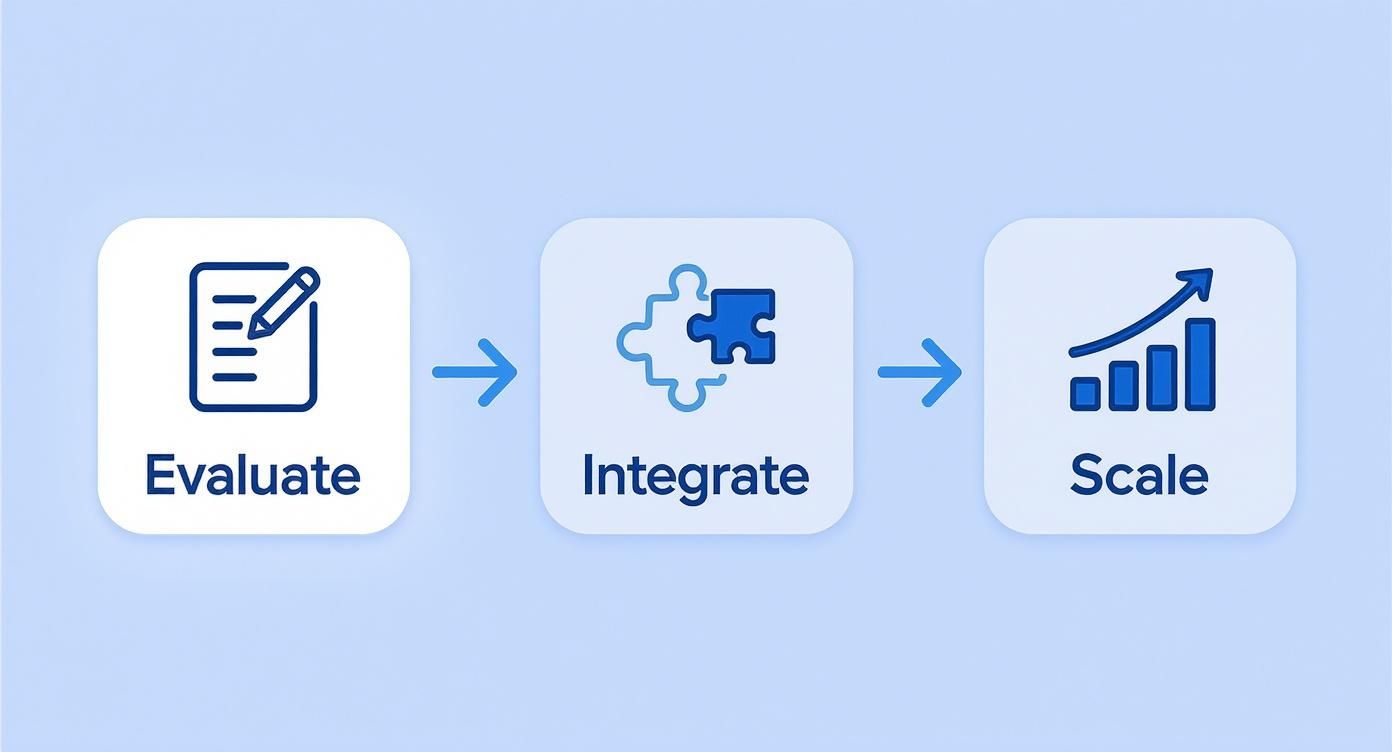
Three-step business process workflow diagram showing evaluate, integrate, and scale stages with icons

This process isn't a "set it and forget it" deal. It’s a loop of evaluating, integrating, and scaling. Let's build three foundational workflows any small business can put into action this week to see a real impact.

The Welcome Series That Creates Fans

Your welcome series is your digital handshake. It’s your single best chance to turn a casual subscriber into someone who actually looks forward to your emails. The data doesn't lie: welcome emails can score an open rate of over 80%, blowing your standard newsletters out of the water.

The goal here isn't a hard sell. It's about building trust and proving you're worth their time. A simple but incredibly effective welcome sequence looks something like this:

  • Email 1 (Immediately): The second they subscribe, this email hits their inbox. It confirms they're signed up, delivers whatever you promised them (like a PDF guide or a discount code), and tells them what to expect from you.
  • Email 2 (2 Days Later): Tell them your story. Why did you start this business? What big problem are you passionate about solving? This email is all about connection, not conversion.
  • Email 3 (4 Days Later): Deliver pure, unadulterated value. Link to your most popular blog post, a genuinely helpful video tutorial, or a case study that shows off a customer's win. This cements your expertise and shows you're not just there to take their money.

This sequence warms up the relationship before you ever ask for the sale. When you finally do, they'll be much more likely to listen.

The Lead Nurturing Workflow for Inbound Leads

So, what happens after someone downloads that handy guide from your website? They can't just go into a black hole. A lead nurturing workflow is designed to take that flicker of interest and gently guide them toward making a purchase. Companies that get this right generate 50% more sales-ready leads at a 33% lower cost.

Let’s say a prospect downloads your "Guide to DIY Landscaping." Your automated workflow could be:

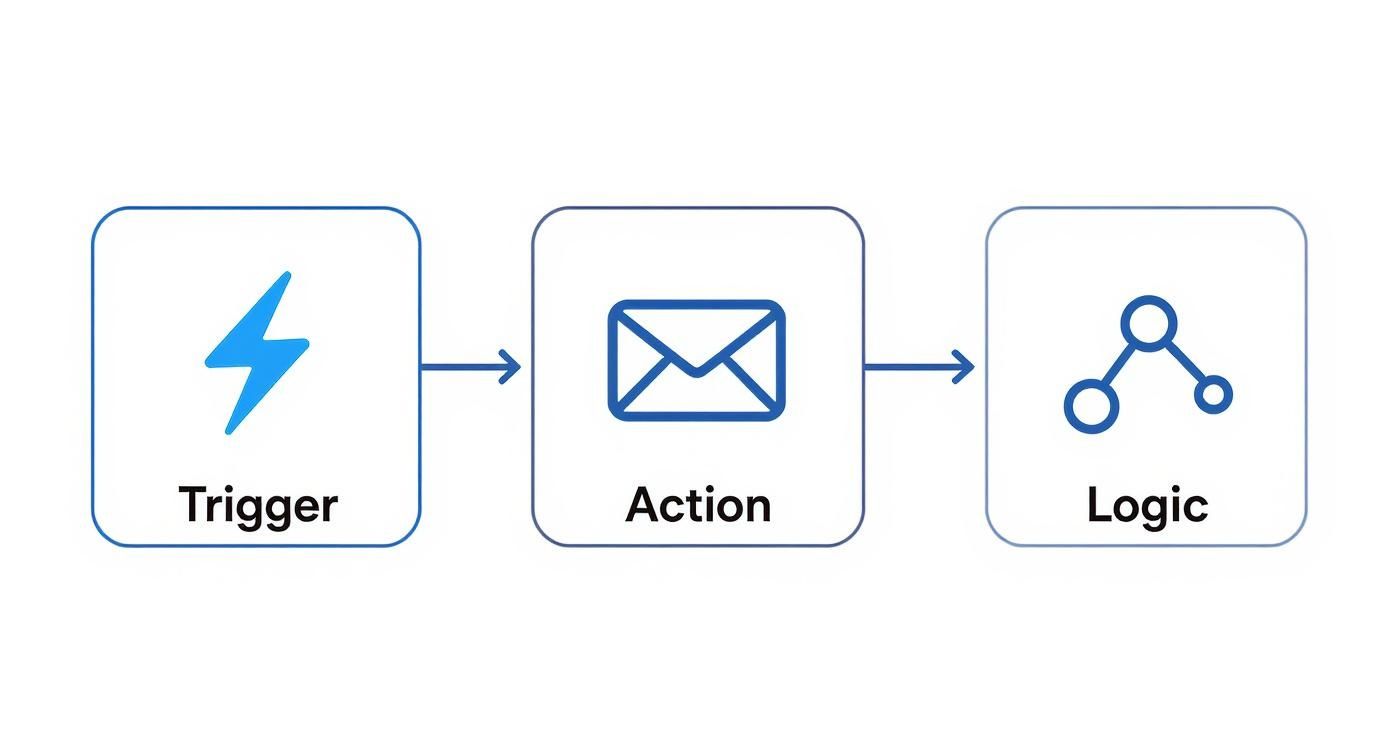
  1. Trigger: Contact downloads the "DIY Landscaping Guide."
  2. Action 1 (Immediate): Send an email delivering the guide with a simple "thanks."
  3. Action 2 (3 Days Later): Follow up with a related blog post, like "5 Landscaping Mistakes That Cost Homeowners a Fortune." You're adding more value and staying on their radar.
  4. Action 3 (7 Days Later): Time for a soft pitch. Mention your landscaping consultation service and share a quick story about a client you helped. The call-to-action is a low-pressure "Learn More," not "Buy Now."
  5. Action 4 (12 Days Later): Now you can make a direct offer. Clearly present your service with a strong call-to-action like "Book Your Free Consultation."

This workflow educates, builds trust, and positions you as the obvious expert to call when they're finally ready to pull the trigger.

Key Insight: The difference between a welcome series and lead nurturing is all about intent. A welcome series builds general brand love. A nurturing sequence is built to move a specific person closer to a sale based on an action they already took.

The Cart Abandonment Workflow for E-commerce

If you run an e-commerce store, cart abandonment is the silent killer of your revenue. The good news? It's one of the easiest leaks to plug with automation. A few well-timed emails can claw back a surprising number of those almost-sales.

A solid cart abandonment flow is short, sweet, and gets right to the point:

  • Trigger: A customer adds items to their cart but doesn't check out within an hour.
  • Email 1 (1-2 Hours Later): A gentle nudge. "Did you forget something?" Show them exactly what they left in their cart and give them a big, obvious link to go finish the purchase.
  • Email 2 (24 Hours Later): Introduce a little urgency. A simple line like "Your items are selling fast!" can work wonders. You can also offer to answer any questions they might have.
  • Email 3 (48 Hours Later): This is your final shot. If it makes sense for your margins, consider offering a small sweetener, like 10% off or free shipping, to get them over the finish line. Use this one sparingly, or you'll train customers to wait for a discount.

This simple, three-part sequence runs on its own and can recover sales you would have otherwise lost for good. It's a massive win with zero ongoing effort.

Connecting Your CRM and Automation Tools

Running your marketing automation and your CRM in separate silos is a massive missed opportunity. One tool knows who’s opening your emails and clicking your links; the other knows who your hottest leads are and what deals are about to close. When they don’t talk, you’re flying with one eye closed.

Connecting them is a genuine game-changer. You get a single, unified view of every customer, letting you personalize their entire journey from first click to final sale. This isn't just about syncing data—it's about making that data do something so you can send the perfect message at exactly the right moment.

Why Integration Is Non-Negotiable

A connected system is what turns abstract marketing data into actual sales opportunities. For a small business, that efficiency is everything. Without it, you’re stuck manually entering data, which is just a recipe for typos, mistakes, and leads slipping through the cracks.

With a proper connection, you create powerful, automated feedback loops. Let’s say a prospect has been quietly getting your nurture emails for a few weeks. Then, suddenly, they click a link to your pricing page.

A seamless integration can instantly ping your CRM, create a high-priority task for a salesperson, and tag that contact as a “Hot Lead”—all without anyone lifting a finger. Sales-ready leads never get left waiting.

A Practical Comparison: Native vs. Third-Party Integration

When you're ready to bridge the gap between these two platforms, you really have two main paths. Knowing the difference will help you pick the right approach for your tech stack and how much you like to tinker.

Integration TypeBest ForKey AdvantagePotential Downside
Native IntegrationBusinesses using popular, all-in-one platforms (like the HubSpot CRM with HubSpot Marketing Hub).Simplicity and Reliability. These are built-in, one-click connections. They’re officially supported and dead simple to set up.Limited Flexibility. You're stuck with whatever connections the platform developers decided to build.
Third-Party Tools (e.g., Zapier)Businesses using a mix of niche or less common tools that don't talk to each other out of the box.Maximum Flexibility. You can connect almost any two apps, creating custom "if this, then that" workflows for anything.More Complexity. Can require more setup, troubleshooting, and often involves an extra subscription cost.

Creating a Cohesive Customer Journey

Ultimately, the whole point is to create a seamless handoff where marketing and sales work as one team. When your CRM knows a lead just attended a webinar (thanks to your automation tool), your next sales call can be about the webinar content, not a generic, "Hey, just checking in."

This is the kind of cohesion that separates businesses drowning in scattered data from those that are running on unified customer intelligence. A well-integrated system is the backbone of any real growth strategy.

For teams looking to take this even further, understanding how a customer data platform integration works can unlock a whole new level of insight by centralizing every scrap of customer information for maximum impact.

How to Measure Your Automation Success

Getting marketing automation set up for your small business feels great, but it’s really just the starting line. The real win comes from proving it actually works.

Without measuring the right things, you’re just paying for software. When you track what matters, you’re making a strategic investment that you can watch grow.

The trick is to stop obsessing over vanity metrics. Things like email open rates or social media likes can give you a nice ego boost, but they don't pay the bills. We need to zero in on the key performance indicators (KPIs) that connect directly to your bottom line.

Moving Beyond Vanity Metrics

True success is measured by the impact on your revenue, not just how many people clicked a link. This is where automation really shines.

Think about it: research shows small businesses using automation see an 18% increase in lead generation and a 12% improvement in conversion rates. Why? Because they're having timely, personalized conversations at scale. You can find more stats on how automation boosts small business performance over at 310creative.com.

To see this in your own business, focus on these core KPIs:

  • Conversion Rate from Automated Campaigns: What percentage of people who get your welcome email series or abandoned cart reminders actually buy something? This ties a specific workflow directly to a sale.
  • Lead-to-Customer Conversion Time: How long does it take for a new name in your system to become a paying customer? Good automation should shorten that cycle by nurturing them for you.
  • Customer Lifetime Value (CLV): Are your automated upsell, cross-sell, or loyalty campaigns getting customers to spend more over time? If your CLV is going up, your automation is building stronger relationships.

Calculating Your Automation ROI

Let's get practical. You need a simple way to calculate the return on investment (ROI) for your automation software. Here’s a straightforward formula.

Simple ROI Formula: (Gain from Investment - Cost of Investment) / Cost of Investment

Let’s run the numbers for a hypothetical small B2B consulting firm spending $150/month on their automation platform.

1. Calculate the Gain: Their automated lead nurturing sequence lands them 2 new clients every month—clients they can directly attribute to that specific campaign. Each client is worth $1,000, so their monthly gain is $2,000.

2. Calculate the Cost: The software itself is $150/month. They also spend about 5 hours a month managing it. If their time is worth $50/hour, that's a time cost of $250. Total monthly investment: $150 (software) + $250 (time) = $400.

3. Calculate the ROI:

  • ($2,000 Gain - $400 Cost) / $400 Cost = $1,600 / $400 = 4
  • To get a percentage, just multiply by 100. Their ROI is 400%.

That single number is incredibly powerful. It proves your marketing automation is a profit center, not just another line item on your expense report. The good news is most platforms have built-in dashboards that make tracking the "Gain" part of this equation easier than ever.

Free Tool

Try our Marketing Plan Generator — generate a complete AI-powered marketing plan in minutes. No signup required.

Got Questions About Automation? You're Not Alone.

Jumping into marketing automation can feel like a huge leap, especially for a small business. It’s completely normal to have a dozen questions swirling around. Let's walk through some of the big ones I hear all the time from entrepreneurs who are right where you are.

How Much Time Will This Actually Take to Set Up?

This is the big one, right? The honest answer: it's front-loaded. You're not going to flip a switch and be done in an hour.

Plan on investing a solid 8-10 hours in your first month. That’s for the real setup—picking your platform, getting your contacts loaded in, and building out one or two of your most important workflows, like a welcome email series for new subscribers.

But here's the payoff. Once those core pieces are humming along, you’re looking at maybe 2-3 hours a month for upkeep. A little bit of monitoring, a few tweaks here and there. It's an investment that pays you back in time, over and over again.

What's the Difference Between a CRM and Marketing Automation Anyway?

This is a critical distinction, and it trips a lot of people up. Let’s break it down simply.

  • A CRM (Customer Relationship Management) tool is your digital rolodex on steroids. It’s where you store customer info, track sales deals, and see your pipeline. Think of it as your database—it holds the data.
  • Marketing Automation Software is the engine that acts on that data. It sends the emails, nurtures the leads, and sorts your audience based on what they do. It’s proactive—it does things with your data.

Some tools, like HubSpot, bundle them together, but it’s common to start with two separate systems. The absolute key is making sure they talk to each other. Your marketing actions are only as good as the customer data feeding them.

The magic happens when they work in tandem. Your CRM tells you who people are, and your automation platform helps you talk to them at the right time, in the right way, without you lifting a finger for every single message.

Will This Make My Marketing Feel Robotic and Impersonal?

It's a totally valid fear. Nobody wants to sound like a robot. But here's the counterintuitive truth: good marketing automation for a small business is the secret to making your marketing more personal, not less.

Think about it. Right now, you probably send one newsletter to your entire list. With automation, you can send a follow-up email based on the exact product page someone just visited. You can automatically send a birthday discount, or share a helpful article related to something they bought last month.

Automation doesn’t get rid of the human touch. It just handles the logistics so you can create more relevant, personal touchpoints at a scale you could never manage by hand. It’s about being thoughtful, automatically.


Ready to stop drowning in repetitive tasks and start building a real growth engine? marketbetter.ai uses AI to build and run the powerful marketing automations that drive sales, freeing you up to focus on what you do best. See how we can change your marketing game at https://www.marketbetter.ai.

Reducing customer churn: Practical retention strategies that work

· 21 min read

Let's be honest: tackling customer churn isn't about just plugging a leak. It’s about understanding the true cost of losing a customer and reframing retention as a core growth engine. The game shifts entirely when you move from a reactive mindset—frantically trying to save customers who are already leaving—to a proactive strategy that builds loyalty from day one. Inaction is a strategy of its own, leading to a slow bleed of revenue, whereas a proactive approach turns retention into your most powerful growth lever.

Why Churn Is So Much More Than Just a Number

Customer churn often gets flattened into a single percentage on a dashboard. But that simple metric hides a far more complex and costly reality. It's not just a number; it’s a direct reflection of your company's health, your product-market fit, and the actual value you deliver.

One of the biggest mistakes is treating churn as a lagging indicator. This locks businesses into an expensive and exhausting cycle of constantly acquiring new customers just to replace the ones who leave—a treadmill you can't win on. A reactive approach means you're always playing catch-up, whereas a proactive one lets you set the pace.

The financial drain is almost always bigger than teams realize. That seemingly small monthly churn rate? It has a massive compounding effect. For instance, a 3% monthly churn rate doesn't just mean you lose 36% of your customers annually. Because of compounding losses, you actually lose nearly 43% of your customer base. Your sales and marketing teams end up running faster and faster just to stand still.

The Real-World Cost of a Leaky Bucket

The damage from high churn goes way beyond lost subscription fees. Globally, companies are estimated to lose $4.7 trillion every single year because of poor customer experiences, with a huge chunk of that coming directly from churn.

Think about this: 67% of consumers will jump to a competitor after just one bad experience. That's how little room for error you have. Nextiva's research digs into the impact of poor service, and it's a real eye-opener.

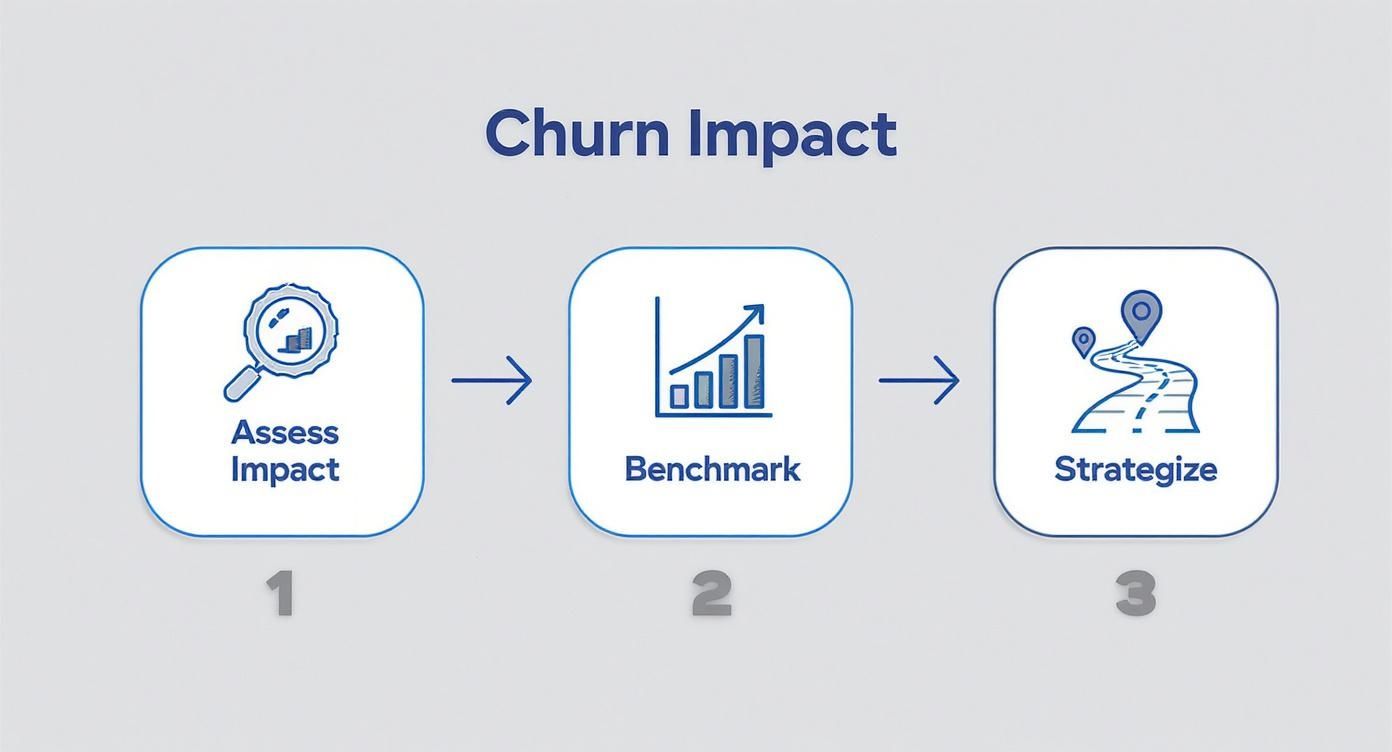
This is why having a simple, repeatable framework to understand and act on your churn data is non-negotiable.

Three-step churn impact framework showing assess impact, benchmark performance, and strategize retention solutions

The path forward is clear: assess the real impact, benchmark your performance against what’s possible, and then build a targeted plan to fix it. This guide will walk you through each of those pillars, providing actionable steps you can implement today.

Your Churn Reduction Strategy at a Glance

Strategy AreaKey ActionPrimary Goal
Measurement & AnalysisImplement cohort analysis and track churn KPIs.Gain a clear, accurate picture of when and why churn happens.
Root-Cause DiagnosisConduct qualitative surveys and customer interviews.Uncover the "human story" behind the numbers.
Segmentation & PredictionUse predictive modeling to identify at-risk customers.Focus retention efforts where they'll have the most impact.
Proactive EngagementOptimize onboarding and drive product adoption.Build loyalty and "stickiness" from the very beginning.
Personalized RetentionLaunch targeted campaigns for at-risk segments.Deliver the right message at the right time to save customers.
Cross-Functional AlignmentCreate feedback loops between CS, Product, and Marketing.Make retention a company-wide responsibility.
AI-Powered OperationalizationAutomate workflows and personalization with tools like marketbetter.ai.Scale your retention efforts efficiently and effectively.

This table is your roadmap. Each area builds on the last, creating a comprehensive system for turning churn into a source of sustainable growth.

Customer Churn vs. Revenue Churn

Before we dive deeper, it's absolutely critical to distinguish between two types of churn. They tell very different stories about your business, and you need to be tracking both.

  • Customer Churn (or Logo Churn): This is the percentage of customers you lose in a given period. Actionable Step: Calculate this weekly to get an early warning signal on volume. It tells you exactly how many logos walked out the door.
  • Revenue Churn (or MRR Churn): This measures the percentage of monthly recurring revenue lost from existing customers. This includes downgrades and cancellations. Actionable Step: Track this monthly alongside customer churn to understand the financial impact.

Imagine you lose ten small, low-tier customers but manage to keep one massive enterprise client. Your customer churn rate might look terrible, but your revenue churn could be minimal. Conversely, losing just one of those enterprise clients could obliterate your revenue, even if your customer churn percentage barely moves. This is why revenue churn is often the more critical metric for understanding the financial health of a subscription business. It’s where the real pain is felt.

Finding the Real Reasons Customers Leave

Guesswork is the enemy of retention. To stop customers from walking away, you must kill your assumptions and find out why they actually leave. Churn isn't just a single event; it's the final, painful outcome of a journey that went sideways long before they hit "cancel." Comparing a guess-based strategy to a data-driven one is like navigating with a treasure map versus a GPS—one leads to dead ends, the other to your destination.

Your overall churn rate is just a flashing red light on the dashboard. It tells you there's a problem, but it doesn't tell you where the engine is smoking. The real answers only surface when you blend different types of data.

Tablet displaying stop revenue leak message on desk with financial documents and smartphone

Using Cohort Analysis to Pinpoint Problems

One of the most powerful tools in your diagnostic kit is cohort analysis. Instead of lumping all your customers into one giant pool, you group them by the month they signed up. This lets you track each group's behavior over their lifecycle, revealing patterns that are otherwise invisible.

Imagine your cohort analysis shows that customers who signed up in March have a 30% higher churn rate in their first month compared to those who joined in February. That’s a massive red flag.

Suddenly, you're not just guessing. Your investigation shifts from a vague "is our product bad?" to a laser-focused "what happened in March?"

The culprit could be anything:

  • A buggy new feature release that soured the initial experience.
  • A tweak to the onboarding flow that created a new point of friction.
  • A new marketing campaign that brought in a flood of poorly-fit customers.

Actionable Step: Run a cohort analysis this week. Compare the first 90-day retention rates for your last three monthly cohorts. If you see a dip, start investigating marketing campaigns or product changes from that period.

Blending Quantitative and Qualitative Insights

Pinpointing the "when" is only half the battle; you still need to understand the "why." This is where you combine the hard numbers from your analytics with the human stories from your customers. The best churn reduction strategies live at this intersection.

Data TypeWhat It Tells YouHow to Collect It
Quantitative (The "What")Identifies behavior at scale—feature adoption, login frequency, time in-app.Product analytics tools (like Mixpanel or Amplitude), CRM data, usage logs.
Qualitative (The "Why")Uncovers the motivations, frustrations, and context behind the numbers.Exit surveys, NPS comments, customer interviews, support tickets, sales call notes.

Let's say your quantitative data shows 70% of churned users never touched your "Project Reporting" feature. That’s an interesting correlation. This is where qualitative data closes the loop. Digging into exit surveys, you might find comments like, "I couldn't figure out how to generate a report." Now you have a clear, actionable problem to solve.

Your product analytics show you where the smoke is, but your customer feedback tells you what’s actually on fire. Neglecting one for the other is like trying to diagnose a patient by only looking at their lab results without ever speaking to them.

Turning Raw Data into a Clear Narrative

The final step is to weave all this information into a cohesive story. You're not just collecting data points; you're building a narrative that explains why a specific group of customers isn't succeeding.

Here’s an actionable framework to connect the dots:

  1. Map the Churned Customer Journey: Use analytics to trace the typical path of a user who churns. Compare it to the path of a highly retained power user. Actionable Step: Identify the top 3 divergence points where at-risk users fail to take a critical action—like inviting a teammate or completing onboarding.
  2. Analyze In-App Behavior vs. Support Tickets: Cross-reference product usage data with support tickets. If you see tickets about "billing confusion" from users with low login rates, it’s a signal that perceived value isn't justifying the price.
  3. Listen to the Voice of the Customer (VoC): Systematically categorize feedback. Create buckets for every source (surveys, support) and tag themes. You can find excellent voice of customer examples and frameworks to structure this. This transforms anecdotes into quantifiable insights like "poor onboarding experience."

By combining these diagnostic tools, you move past symptoms and uncover true root causes—be it a confusing onboarding process or a competitor's killer offer—and build a targeted retention plan that actually works.

Don’t Just React to Churn—Get Ahead of It

The best time to stop a customer from leaving is long before they’ve even thought about it.

If you’re only scrambling to save accounts after they hit the cancel button, you’re playing a losing game. A proactive strategy isn’t damage control; it's about creating an environment where customers are so successful that looking elsewhere never crosses their minds. This is the difference between being a firefighter and an architect—one reacts to disasters, the other designs a structure to prevent them.

And you need to get on this, fast. A monthly churn rate of just 5% might sound manageable, but it compounds to losing nearly half (46%) of your customers over a year. As the Churnkey’s 2025 State of Retention report shows, it gets catastrophic very quickly.

Business professional using magnifying glass to analyze data charts and graphs for root cause analysis

Segment Your Customers to Make Your Outreach Count

Trying to talk to all your customers at once is like shouting into a void. The foundation of any good proactive strategy is smart segmentation. You group customers by shared traits to deliver timely, personalized help.

Here are a few powerful ways to slice up your customer base:

  • Lifecycle Stage: A new user needs help getting started; a two-year veteran might be a fit for a beta program. Match your message to their journey.
  • Customer Health Score: This early-warning system combines metrics like login frequency, key feature adoption, and NPS scores. Segment customers into "Healthy," "At-Risk," and "Endangered" buckets to create a specific playbook for each.
  • Behavioral Data: Group users based on what they do. Actionable Step: Build a segment of users who haven’t used a key sticky feature in their first 30 days and hit them with a targeted tutorial campaign this month.

High-Touch vs. Low-Touch: Know When to Automate and When to Call

Once you have your segments, you can decide how much attention each one gets. Wasting your best customer success manager on a low-value account is as inefficient as neglecting an enterprise client with a generic email.

Here’s how the two approaches stack up:

Tactic ComparisonHigh-Touch (Top-Tier Accounts)Low-Touch (Scalable for Everyone Else)
OnboardingDedicated 1-on-1 calls, custom implementation plan, and success goals.Automated email sequences, in-app product tours, and group webinars.
EngagementQuarterly business reviews (QBRs), proactive check-ins, direct line of access.Monthly newsletters, product update announcements, educational content.
At-Risk InterventionA personal call from their CSM, a custom success plan, and maybe even executive outreach.An automated re-engagement email campaign or targeted in-app messages.
Loyalty & AdvocacyExclusive access to new features and invitations to customer advisory boards.Milestone-based rewards and bonuses for the referral program.

This two-pronged approach ensures your most critical accounts get white-glove service while you still nurture the rest of your customers efficiently.

Actionable Campaigns That Keep Customers Hooked

Okay, you have your segments and you know your tactics. Now it’s time to build campaigns that continuously prove your value.

Here are three campaigns you can implement this quarter:

  1. The "Aha!" Moment Onboarding Flow: Forget the generic welcome email. Map out the one critical action a new user must take to see your product's value. Then, focus your entire onboarding sequence on getting them to complete just that.
  2. The "Sleeping User" Re-engagement Drip: Set up an automated email sequence for users who haven't logged in for 30 days. The first email highlights a new feature. The next shares a case study. The last is a simple, plain-text email asking for feedback.
  3. The Proactive "Feature Adoption" Nudge: When you launch a new reporting tool, send a targeted email to power users of a related feature, explaining exactly how this new tool solves a problem you know they have.

A core component of any proactive retention strategy is fostering deep brand loyalty, which can be significantly enhanced by providing exceptional customer support. Learn more about building brand loyalty through exceptional customer support.

This kind of targeted effort is what separates companies with killer retention from those stuck on the hamster wheel of endless acquisition. By getting the right message to the right customer at the right time, you don't just stop churn—you create opportunities for expansion and end up improving customer lifetime value across the board.

Using AI to Predict and Prevent Churn

Welcome to the new era of customer retention. The game has shifted from a reactive scramble to a proactive, intelligent system that spots trouble long before it ever surfaces. This is where you learn to see the future.

Forget waiting for a customer to complain or stop logging in. Modern AI tools analyze massive datasets in real time—support ticket sentiment, login frequency, payment history, and feature usage patterns. This creates a rich, multi-dimensional view of each customer's health.

The goal is to get beyond simple metrics. A drop in logins is a clue, but an AI model might find that a drop in logins combined with a recent failed payment and a support ticket tagged "bug" is a 90% predictor of churn within 30 days. That’s the kind of insight you can act on.

From Raw Data to Actionable Health Scores

This is where the magic happens. AI solutions synthesize raw data into a simple, actionable metric: a predictive customer health score. Think of it like a credit score for customer loyalty, telling your team who needs attention right now.

Here's how the old way compares to the new:

  • Rule-Based Systems (The Old Way): You manually set triggers like, "If a user hasn't logged in for 14 days, mark them as 'at-risk'." It's rigid and misses subtle signals. It's like only looking at a patient's temperature to diagnose an illness.

  • AI-Powered Predictive Models (The New Way): These systems learn from your actual historical data. They identify the complex, non-obvious patterns your past churned customers exhibited. The model might discover that users who ignore a specific feature during onboarding and then contact support about billing are your highest flight risk. It’s far more nuanced and accurate.

By using predictive analytics, companies can reduce churn by up to 15%. The power lies in spotting disengagement early, giving you more time and options to intervene with the right support.

Turning AI Insights into Proactive Interventions

A predictive score is useless if it just sits on a dashboard. The real value comes from plugging these AI insights directly into your operational workflows. To pull this off, businesses often need to integrate real-time customer data. Understanding how to approach integrating customer insights via a Widget API can be a key technical step in making these insights truly operational.

Here’s how you can make it actionable:

  1. Automated Alerts for Customer Success: When a high-value customer's health score drops from "Green" to "Yellow," the system should automatically create a task in your CRM for their CSM: "Proactive Check-In: [Customer Name]'s engagement has dipped."
  2. Personalized Marketing Campaigns: For a segment of "at-risk" users who haven’t adopted a key feature, trigger an automated email campaign showing them exactly how to use it. This is a core part of how predictive analytics in marketing is changing the game.
  3. In-App Nudges and Guidance: If a user’s behavior indicates they are struggling, an AI-driven tool can trigger a helpful in-app pop-up or guided tour at the perfect moment.

This approach completely flips the script on churn management. You stop fighting fires and start fireproofing your entire customer base.

Making Retention a Company-Wide Mission

Too many companies treat customer churn like a leaky faucet in the Customer Success team's office. But churn isn't a CS problem. It's a company problem. It's a lagging indicator of a breakdown that happened much earlier in the customer's journey. Lasting retention happens when every single team views the customer journey as a shared mission. A unified front isn't just nice to have; it's the only way to win.

Customer service representative wearing headset viewing AI health score dashboard showing performance metrics

Building Your Cross-Functional Feedback Loops

The bedrock of a retention-focused culture is a set of powerful, automated feedback loops. Imagine a customer fills out an exit survey, saying they left because a key reporting feature was too confusing. In a siloed company, that feedback dies in a spreadsheet. In a connected company, it becomes a catalyst for action.

Here’s how that looks in the real world:

  • CS to Product: Insights from support tickets and exit surveys are tagged and funneled directly into the product team's backlog in a tool like Jira or Asana. The product team stops guessing and starts building based on direct user pain.
  • Product to Marketing: Once the product team ships a fix, they close the loop with marketing. Marketing can then craft campaigns to re-engage users who churned for that exact reason, reinforcing the message: "We hear you, and we're taking action."
  • CS to Marketing: Churn data is a goldmine for refining your ideal customer profile (ICP). By analyzing the traits of customers who churn quickly versus those who stay, CS provides priceless intel to Marketing to attract better-fit prospects.

The most powerful retention strategies aren't born from last-minute heroics. They are the cumulative result of hundreds of small, interconnected improvements made across the entire organization.

How Each Team Fights Customer Churn

Every department plays a crucial, distinct role in the fight against churn. Clearly defining these roles and the metrics they own is the key to creating accountability. When responsibilities are clear, finger-pointing disappears.

Here’s a simple breakdown of how different departments contribute to a unified customer retention strategy.

How Each Team Fights Customer Churn

DepartmentPrimary Role in RetentionKey Metrics Owned
MarketingAttract and qualify the right customers who align with the product's core value.Lead-to-Customer Conversion Rate, Customer Acquisition Cost (CAC) by Channel, and Churn Rate by Acquisition Cohort.
ProductBuild an intuitive, valuable, and "sticky" product that solves real problems and encourages deep engagement.Feature Adoption Rate, Time to Value (TTV), and User Engagement Scores.
Customer SuccessEnsure customers achieve their desired outcomes through proactive guidance, support, and relationship management.Net Revenue Retention (NRR), Customer Health Score, and Net Promoter Score (NPS).

This table isn't just about assigning tasks; it’s about creating a common language and shared goals.

Running Meetings That Actually Drive Action

Building these feedback loops isn't just about software; it demands a structured, human touch. A recurring, cross-functional churn meeting is where raw data gets turned into actionable strategy.

Here's an actionable agenda to keep the meeting focused:

  1. Review the Numbers (5 mins): Briefly look at key churn and retention metrics from the last period.
  2. Analyze the "Why" (15 mins): CS presents the top 3-5 themes from recent churn feedback.
  3. Connect to the Roadmap (10 mins): Product discusses how these themes align with or challenge current priorities.
  4. Refine the Target (10 mins): Marketing shares how these insights are being used to sharpen targeting.
  5. Assign Action Items (5 mins): No discussion ends without a clear "who, what, and when."

This simple process transforms churn from a dreaded metric into a strategic asset. And that’s critical, because churn rates vary wildly by industry. For instance, the average churn rate for professional services can be 27%, while the wholesale sector can see rates as high as 56%. This data underscores why a one-size-fits-all approach fails. You can dig into more of these numbers by checking out these churn benchmarks from Customer Gauge's 2025 report.

Free Tool

Try our Lookalike Company Finder — find companies similar to your best customers in seconds. No signup required.

Common Questions About Reducing Churn

When you're in the trenches trying to plug the leaks, a handful of questions always pop up. Let's tackle some of the most common ones head-on.

What Is a Good Customer Churn Rate?

This is the million-dollar question, and the honest answer is: it depends. A young B2B SaaS company might be okay with a 3-5% monthly churn. But an established enterprise player? The expectation is to keep that number well under 1%. A B2C subscription box will naturally have a much higher churn rate than enterprise software.

Comparison Point: Instead of chasing an arbitrary benchmark, compare your churn rate to your own performance last quarter. The goal is a consistent downward trend. Improvement is the name of the game.

How Do You Calculate Customer Churn?

The basic formula is straightforward: take the number of customers you lost, divide it by the number you had at the start, and multiply by 100.

(30 lost customers ÷ 1,000 starting customers) x 100 = 3%

But that only tells you part of the story. You must also track revenue churn (MRR churn) to measure the actual dollars you lost. Losing three small customers is a completely different problem than losing one massive enterprise account.

Actionable Step: Calculate both customer churn and revenue churn for the last month. The difference between the two will immediately tell you if you are losing high-value or low-value customers.

What Is the First Step to Reduce Churn?

Before you do anything else, you have to diagnose the root cause. Jumping straight into solutions without understanding why people are leaving is like trying to fix an engine by randomly replacing parts.

To get started, triangulate your data:

  • Set up an Exit Survey: This is non-negotiable. When a customer cancels, an automated survey should immediately ask them why.
  • Dive into Product Analytics: Look for patterns among churned users. Did they never adopt that one sticky feature?
  • Talk to Your Front-Line Teams: Your support and success teams are a goldmine of insights. Actionable Step: Schedule a 30-minute meeting with them this week and ask one simple question: "What are the top three frustrations you hear from customers?"

By blending the quantitative "what" (analytics) with the qualitative "why" (surveys and team feedback), you can build a retention roadmap that solves real problems.

Should I Focus on Churn Prevention or New Customers?

Both are critical, but pound for pound, retention almost always delivers a better return. It can be anywhere from 5 to 25 times more expensive to acquire a new customer than to keep an existing one. A tiny 5% bump in customer retention can boost profits by 25% to 95%.

Think of your business as a leaky bucket. Pouring more water (new customers) in is a fool's errand if you don't plug the holes first. A balanced approach is ideal, but a rock-solid retention strategy creates the stable foundation you need for sustainable growth. Plus, happy, loyal customers become part of your acquisition engine through referrals.


Ready to stop guessing and start predicting? marketbetter.ai uses AI to identify at-risk customers, automate personalized retention campaigns, and give your teams the insights they need to act before it's too late. See how you can reduce churn and drive sustainable growth by visiting https://www.marketbetter.ai today.

12 B2B Marketing Channels Ranked by Cost-Per-Lead and Pipeline Impact [2026]

· 29 min read

In the complex B2B landscape, selecting the right marketing channels is the difference between stagnation and exponential growth. While the options are vast, from traditional trade shows to sophisticated ABM plays on LinkedIn, a handful of channels consistently deliver measurable ROI. Choosing where to invest your budget and team's energy is a critical strategic decision that directly impacts lead quality, sales cycle length, and ultimately, revenue.

This guide moves beyond generic advice to provide a comprehensive breakdown of the top marketing channels B2B leaders are leveraging today. We'll offer a direct comparison of each channel's strengths and weaknesses, helping you build a multi-channel strategy that aligns perfectly with your business goals. You won't just learn what the channels are; you'll understand how and when to deploy them effectively.

For each of the twelve channels covered, you will find:

  • Practical Use Cases: Clear scenarios detailing when a specific channel is most effective.
  • Target Audience Alignment: Guidance on matching the channel to your ideal customer profile.
  • Essential KPIs: The key metrics you must track to measure success and justify investment.
  • Actionable Workflows: Step-by-step implementation frameworks to get you started quickly.

Furthermore, we will explore how AI-driven platforms like marketbetter.ai are revolutionizing these channels. You'll see how to use AI to scale content creation, personalize engagement, and optimize campaign performance with unprecedented efficiency, turning your marketing efforts into a predictable growth engine. Let's dive into the channels that will define your success.

1. LinkedIn Marketing & Account-Based Marketing (ABM)

LinkedIn stands as the undisputed champion of B2B social media, but its true power is unlocked when combined with a targeted Account-Based Marketing (ABM) strategy. While broad LinkedIn marketing casts a wide net, ABM focuses marketing and sales resources on a predefined set of high-value target accounts, treating each one as a market of its own. This hybrid approach transforms one of the most effective marketing channels b2b has to offer from a lead generation tool into a precision-guided revenue engine.

Instead of just broadcasting content, ABM on LinkedIn involves creating hyper-personalized campaigns for key decision-makers within specific companies. For example, a company like Salesforce might use LinkedIn Matched Audiences to serve case studies about financial services transformation directly to C-suite executives at major banks, while simultaneously having their account executives engage through personalized InMail.

Strategic Implementation

  • When to Use: Ideal for B2B companies with high-value, long sales cycles where multiple stakeholders are involved in the buying decision. It’s particularly effective for breaking into enterprise-level accounts or specific, lucrative industry verticals.

  • Sample Workflow:

    1. Account Selection: Sales and marketing collaboratively build a target account list using firmographic data and revenue potential. Actionable Tip: Use your CRM data to identify closed-won deals with the highest lifetime value and shortest sales cycles to model your ideal target accounts.
    2. Contact Identification: Use LinkedIn Sales Navigator to map out the buying committee at each target account.
    3. Campaign Activation: Launch a multi-touch campaign featuring sponsored content tailored to the account's pain points, personalized InMail from sales reps, and retargeting ads. To further empower your team, explore practical advice on writing effective LinkedIn posts for B2B sales managers to enhance organic reach.
    4. Measurement & Refinement: Track account-level engagement (not just individual leads) using KPIs like account penetration, engagement score, and pipeline velocity. For those looking to streamline their outreach, you can learn more about automating LinkedIn prospecting on marketbetter.ai.

2. Email Marketing & Nurture Campaigns

Despite the rise of social media, email remains one of the highest-ROI marketing channels b2b offers, especially when paired with automated nurture campaigns. This strategy moves beyond simple email blasts by using segmented, automated sequences to guide prospects through the buyer's journey. Instead of a one-size-fits-all message, nurture campaigns deliver the right content at the right time, building trust and moving leads from awareness to conversion methodically.

For instance, a company like Marketo might use a multi-touch nurture campaign to guide an enterprise prospect who downloaded a whitepaper, sending them a case study a week later, followed by an invitation to a relevant webinar. This is a stark contrast to simply adding them to a generic newsletter, as it tailors the journey to the user's initial interest and engagement level, significantly increasing the likelihood of a sales-qualified lead.

Lead Nurture software dashboard displayed on laptop screen with notebook on wooden desk workspace

Strategic Implementation

  • When to Use: Essential for B2B companies with a considered purchase process and a steady flow of inbound leads. It is highly effective for educating prospects, re-engaging cold leads, and warming up marketing-qualified leads (MQLs) before they are passed to the sales team.

  • Sample Workflow:

    1. Lead Capture & Segmentation: A user downloads a top-of-funnel asset (e.g., an ebook) and is tagged based on their industry, job title, and the content's topic. Actionable Tip: Use hidden fields on your forms to capture source data (e.g., "Source=LinkedIn Ad") to tailor the first nurture email to the context of their visit.
    2. Nurture Sequence Activation: The contact is automatically enrolled in a pre-built 5-7 touchpoint email sequence. The first email delivers the requested asset, subsequent emails offer related case studies, blog posts, and webinar invites.
    3. Lead Scoring & Hand-off: The automation platform tracks engagement (opens, clicks, website visits). Once a lead reaches a predefined score threshold, they are flagged as an MQL and assigned to a sales representative for personalized follow-up.
    4. Optimization: Continuously A/B test subject lines, CTAs, and send times to improve open and click-through rates. Monitor unsubscribe rates to ensure content remains relevant and valuable.

3. Content Marketing & Thought Leadership

Content marketing and thought leadership are foundational marketing channels b2b companies use to build trust and authority long before a sales conversation begins. Instead of a direct sales pitch, this strategy focuses on creating and distributing valuable, relevant content like in-depth blog posts, original research reports, and insightful webinars. This approach attracts and educates target audiences, positioning your brand as the go-to expert in your industry and drawing prospects to you organically.

A prime example is HubSpot, which built its empire by providing an extensive library of free marketing and sales resources, attracting millions of visitors who later become customers. Similarly, McKinsey & Company uses its proprietary research and industry insights to engage C-suite executives, building credibility that directly supports its high-value consulting services. This channel works by trading expertise for attention and trust.

Thought leadership workspace with laptop, microphone, open book, and coffee on wooden desk

Strategic Implementation

  • When to Use: Essential for B2B organizations with complex products or services, long sales cycles, and a need to educate the market. It is particularly powerful for building a long-term, sustainable pipeline and differentiating from competitors on expertise rather than just features or price.

  • Sample Workflow:

    1. Audience & Topic Research: Identify your ideal customer profile's primary pain points and conduct keyword research to find topics with high search intent. Actionable Tip: Interview your sales team and ask, "What are the top 5 questions prospects ask on every demo call?" Turn those answers into your next blog posts.
    2. Content Creation & Pillar Strategy: Develop a "pillar" piece of content, like an ultimate guide or research report, then break it down into smaller assets (blog posts, social media updates, video clips) to maximize its reach.
    3. Gated & Ungated Distribution: Promote ungated content (blogs, articles) broadly to build brand awareness. Use high-value gated content (whitepapers, webinars) to capture leads for nurturing.
    4. Performance Measurement: Track metrics like organic traffic, keyword rankings, time on page, and conversion rates on gated assets. Use tools like Google Analytics to measure how content contributes to lead generation and pipeline influence.

4. Trade Shows, Conferences & Events

Despite the digital shift, in-person and virtual events remain one of the most impactful marketing channels b2b offers for direct engagement. Events provide a unique opportunity to connect with high-intent prospects, demonstrate complex products, and build tangible relationships that are difficult to replicate online. Unlike digital channels that rely on asynchronous communication, events create a focused environment for real-time interaction, competitive analysis, and partnership building, making them a high-stakes, high-reward channel.

From massive industry gatherings like Salesforce's Dreamforce, which attracts over 170,000 attendees, to niche vertical-specific symposiums, events allow companies to get in front of key decision-makers actively seeking solutions. This direct access compresses the sales cycle by enabling on-the-spot qualification and relationship nurturing, moving beyond lead generation to create genuine pipeline momentum.

Strategic Implementation

  • When to Use: Best suited for B2B companies with complex products or services that benefit from in-person demonstrations. It is highly effective for penetrating new markets, strengthening relationships with existing customers, and generating high-quality leads in industries where face-to-face trust is paramount.

  • Sample Workflow:

    1. Event Selection: Research and select events based on the quality and relevance of the attendee list, not just the total number of participants. Prioritize events where your ideal customer profile (ICP) is highly concentrated.
    2. Pre-Event Outreach: Launch a targeted campaign weeks in advance to schedule meetings with key attendees and prospects. Use email and social media to promote your booth number and any special offers. Actionable Tip: Offer a high-value, exclusive "event-only" demo or consultation to incentivize pre-booked meetings.
    3. On-Site Execution: Staff your booth with well-trained team members who can qualify leads effectively. Use lead capture technology to scan badges and immediately segment contacts for follow-up.
    4. Post-Event Nurturing: Initiate a follow-up sequence within 24-48 hours of the event. To maximize your ROI, you can learn more about crafting an effective post-event follow-up strategy on marketbetter.ai.

5. Paid Search Advertising (SEM/Google Ads)

Paid Search Advertising, often called Search Engine Marketing (SEM), is the practice of placing ads on search engines like Google and Bing. This channel captures high-intent prospects at the exact moment they are actively searching for solutions, making it one of the most direct and measurable marketing channels b2b has available. Unlike SEO, which builds organic visibility over time, SEM offers immediate placement at the top of search results for critical keywords.

This channel's power lies in its precision. A company like HubSpot can bid on "CRM software for small business" to capture users in the final stages of their buying journey. Similarly, a specialized SaaS provider like ServiceTitan can run highly targeted ads for keywords such as "HVAC dispatch software," ensuring their budget is spent only on reaching their ideal customer profile. This direct approach delivers qualified traffic straight to dedicated landing pages, accelerating the sales cycle.

Strategic Implementation

  • When to Use: Essential for capturing bottom-of-the-funnel demand where prospects show clear purchase intent. It’s also highly effective for launching new products, promoting time-sensitive offers like webinars, or quickly testing messaging and value propositions in a live market environment.

  • Sample Workflow:

    1. Keyword Research: Build comprehensive keyword lists mapped to different stages of the buyer journey, from problem-aware (e.g., "how to improve customer support") to solution-aware (e.g., "Zendesk competitors").
    2. Campaign Structuring: Organize campaigns using tight themes, such as Single Keyword Ad Groups (SKAGs), to maximize ad relevance and Quality Score. Aggressively use negative keywords to filter out irrelevant clicks. Actionable Tip: Create a negative keyword list from your site search data to see what irrelevant terms users are already searching for on your own website.
    3. Ad & Landing Page Creation: Write compelling ad copy that speaks directly to the searcher's pain point and create a dedicated, high-converting landing page for each ad group to ensure a seamless user experience.
    4. Tracking & Optimization: Implement robust conversion tracking for every stage, from initial form submission to a qualified demo request. Continuously analyze performance data, A/B test ad copy, and adjust bids to maximize return on ad spend (ROAS).

6. Webinars & Virtual Events

Webinars and virtual events have evolved from simple online presentations into powerful, interactive platforms for lead generation and nurturing. Unlike static content like a whitepaper, webinars offer a dynamic, real-time channel to demonstrate expertise, answer questions directly, and build personal connections with a qualified audience. This makes them one of the most effective marketing channels b2b has for engaging prospects in a high-value, educational setting, guiding them from awareness to consideration within a single session.

For instance, a company like HubSpot leverages webinars to attract thousands of marketing professionals by offering expert-led training on relevant topics. Similarly, Gartner uses its webinars to showcase its analyst expertise, reinforcing its authority and generating leads for its research services. The key is to provide genuine value, solving a specific prospect problem rather than delivering a thinly veiled sales pitch.

Strategic Implementation

  • When to Use: This channel is ideal for B2B companies looking to educate prospects on complex solutions, generate high-quality leads, and accelerate pipeline movement. It works exceptionally well for mid-to-bottom-of-funnel engagement, where prospects are actively seeking solutions and detailed information.

  • Sample Workflow:

    1. Topic Selection: Identify a critical pain point your target audience faces and frame the webinar as the solution. Use compelling, benefit-driven titles.
    2. Promotion & Registration: Promote the event across email, social media, and paid channels at least two weeks in advance. Use a dedicated landing page to capture registrations.
    3. Engagement Strategy: During the event, use interactive elements like polls, Q&A sessions, and chat to keep the audience engaged. Present for 45 minutes, leaving 15 minutes for questions. Actionable Tip: Launch a poll at the 10-minute mark asking about attendees' biggest challenge related to the topic; use the results to tailor the rest of your presentation.
    4. Post-Event Follow-up: Within 24 hours, send the recording to all registrants (both attendees and no-shows), segmenting the messaging. Offer attendees a clear next step, like a demo booking, and offer no-shows another chance to engage.
    5. Content Repurposing: Maximize ROI by turning the webinar content into blog posts, short video clips for social media, and a downloadable slide deck.

7. Direct Sales & Outbound Prospecting

Direct sales and outbound prospecting represent one of the most traditional yet enduring marketing channels b2b offers. This hands-on approach involves sales development representatives (SDRs) proactively reaching out to potential customers through channels like phone calls, personalized emails, and direct mail. While often seen as purely a sales function, modern outbound prospecting is a highly strategic marketing channel that combines data intelligence, deep personalization, and multi-touch sequences to engage cold prospects and convert them into qualified opportunities.

This method moves beyond generic cold calling, focusing instead on a value-driven, consultative approach. For instance, a company like Gong uses its own conversation intelligence software to train its SDRs, enabling them to analyze call recordings and refine their objection handling for better outcomes. Similarly, HubSpot’s sales team uses a highly coordinated strategy of warm outreach, leveraging inbound content engagement to fuel their personalized prospecting efforts, demonstrating the powerful synergy between inbound and outbound tactics.

Strategic Implementation

  • When to Use: This channel is indispensable for companies with a high average contract value (ACV), complex products requiring education, or when targeting specific, hard-to-reach enterprise accounts. It is most effective when your ideal customer profile (ICP) is clearly defined and you need to generate high-quality pipeline proactively rather than waiting for inbound leads.

  • Sample Workflow:

    1. ICP & List Building: Define your ideal customer profile and build a highly targeted, verified list of prospects and key decision-makers. Actionable Tip: Don't just build a list; tier it. A-tier gets hyper-personalization, B-tier gets semi-personalized, C-tier gets automated outreach.
    2. Research & Personalization: Before any outreach, research each prospect and their company to identify pain points, recent achievements, or industry trends to tailor your message.
    3. Multi-Touch Cadence: Launch a structured outreach sequence across multiple channels (e.g., email, phone, LinkedIn) over several weeks. A typical cadence involves 5-8 touches.
    4. Engage & Qualify: Focus initial conversations on understanding the prospect's challenges and qualifying their fit. Lead with value and insights, not a hard product pitch.
    5. Measure & Optimize: Track key metrics like connection rate, reply rate, meetings booked, and pipeline generated. Use this data to A/B test messaging and refine your outreach cadence for continuous improvement.

8. Sponsorships & Partnerships

Beyond creating your own content, strategically aligning your brand with established platforms and complementary companies can be one of the most powerful marketing channels b2b has to offer. This channel moves beyond simple advertising by borrowing trust and accessing highly-curated audiences through sponsorships of industry podcasts, newsletters, and events, or through deeper co-marketing partnerships. This approach provides a powerful endorsement, placing your brand directly within the ecosystem your target audience already trusts.

For instance, a cybersecurity firm might sponsor a popular IT leadership podcast, gaining direct access to engaged CIOs and CISOs. Similarly, a project management software like Asana might partner with a time-tracking tool like Harvest for a co-branded webinar, offering a comprehensive productivity solution to a shared audience. This symbiotic relationship provides immediate credibility and a targeted distribution channel that would take years to build independently.

Strategic Implementation

  • When to Use: This channel is highly effective for building brand awareness and credibility within niche markets. It's ideal for startups looking to gain a foothold, or established companies aiming to penetrate a new vertical. Partnerships are particularly valuable when your product's value is enhanced by integration with another tool.

  • Sample Workflow:

    1. Audience & Partner Identification: Pinpoint podcasts, newsletters, and events where your ideal customer profile (ICP) is highly engaged. Simultaneously, identify non-competing companies that serve a similar customer base.
    2. Opportunity Vetting: Analyze the potential partner's audience demographics, engagement rates, and brand alignment. For sponsorships, request a media kit and past performance data. For partnerships, outline a clear joint value proposition. Actionable Tip: Before committing, ask the potential partner for an anonymous case study or reference from a previous sponsor to verify their ROI claims.
    3. Campaign Co-Creation: Work with the sponsor to create an authentic ad read or sponsored segment. For partnerships, develop a joint marketing campaign, such as a co-authored whitepaper, integrated product feature, or a shared booth at a trade show.
    4. Performance Measurement: Track referrals using unique URLs or promo codes. Measure impact through brand lift studies, direct traffic from partner sites, and the number of leads generated from co-marketing activities.

9. Display Advertising & Programmatic Display

Display advertising, often seen as a B2C staple, has evolved into a sophisticated tool for B2B marketers, especially when powered by programmatic technology. Programmatic display uses AI and real-time bidding to automate the purchase of ad space, ensuring visual ads are placed on websites, apps, and networks to reach highly specific professional audiences. This moves beyond simple brand awareness, turning display into one of the more versatile marketing channels b2b marketers can use for retargeting, account-based advertising, and top-of-funnel engagement.

Instead of just blanketing the web, a B2B company like HubSpot can use programmatic display to retarget website visitors who downloaded an e-book, serving them ads for a product demo across relevant industry publications. Similarly, a company like G2 can target users who have recently searched for specific software categories, placing ads on tech news sites they frequent. This targeted approach ensures ad spend is focused on audiences already showing interest or fitting a precise ideal customer profile.

Strategic Implementation

  • When to Use: Excellent for building brand awareness in new markets, retargeting engaged website visitors, and supporting ABM campaigns by keeping your brand in front of target accounts. It is most effective for top-of-funnel and mid-funnel activities where visual reinforcement is key.

  • Sample Workflow:

    1. Audience Definition: Define your target audience using first-party data (website visitors, CRM lists) and third-party data (job titles, company size, industry). Actionable Tip: Build a retargeting audience of users who visited your pricing page but didn't convert, and serve them a testimonial ad to build social proof.
    2. Creative Development: Design multiple ad creative variations (3-5 per campaign) with clear calls-to-action tailored to different stages of the buyer's journey.
    3. Platform & Targeting Setup: Choose a demand-side platform (DSP) and set up campaigns using a mix of targeting methods like contextual (placing ads on industry-relevant sites), lookalike audiences, and direct retargeting.
    4. Optimization & Measurement: Monitor performance using KPIs like view-through conversions, click-through rates (CTR), and cost per acquisition (CPA). Implement frequency capping to prevent ad fatigue and A/B test ad copy and visuals to improve engagement.

Search Engine Optimization (SEO) is the long-game strategy for dominating the digital shelf. Unlike paid channels that stop delivering once the budget runs out, a well-executed SEO strategy builds a durable asset that generates compounding returns over time. It’s about making your website the most authoritative and helpful answer for the complex questions your B2B buyers are asking, transforming organic search into one of the most cost-effective and sustainable marketing channels b2b practitioners can leverage to drive high-intent traffic.

For B2B, SEO isn't just about ranking for product names; it's about capturing intent across the entire buying journey. A company like Stripe, for instance, doesn’t just rank for "payment processing"; it also dominates developer-focused queries like "API documentation for payments," capturing both executive and technical audiences. This approach establishes deep topical authority and builds a moat against competitors.

Computer monitor displaying organic growth chart with upward trend line and colorful pie graph

Strategic Implementation

  • When to Use: Essential for B2B companies in established markets with a high volume of problem-aware search queries. It's a foundational channel for businesses aiming for long-term, scalable growth and brand authority, particularly when the cost-per-click in paid channels is prohibitively high.

  • Sample Workflow:

    1. Buyer Persona Keyword Research: Go beyond simple keywords. Map the entire customer journey and identify the questions, pain points, and comparison terms used by each persona at every stage. Actionable Tip: Use tools like AlsoAsked.com to find the "People Also Ask" questions related to your core keywords and build content that answers them directly.
    2. Pillar & Cluster Content Creation: Develop comprehensive "pillar" pages (e.g., "The Ultimate Guide to CRM Implementation") supported by in-depth "cluster" articles that target niche, long-tail keywords (e.g., "how to migrate data to a new CRM").
    3. Technical & On-Page Optimization: Ensure your site is technically sound with a logical structure, fast load times (Core Web Vitals), and strong internal linking. Optimize every page for its target search intent.
    4. Authority Building: Execute a targeted backlink strategy, focusing on acquiring links from reputable industry publications, partners, and directories to build your site's domain authority and trustworthiness in the eyes of search engines.

11. Customer Referral Programs & Word-of-Mouth

While many B2B marketing channels focus on acquiring new customers from scratch, referral programs leverage your most valuable asset: your existing satisfied clients. This channel transforms happy customers into a powerful extension of your sales team, driving high-quality, high-trust leads through structured incentives and organic advocacy. Unlike colder outbound tactics, referred leads enter the sales process with a pre-established level of trust, drastically shortening sales cycles and increasing conversion rates.

This approach capitalizes on the inherent credibility that comes from a peer recommendation. For example, Dropbox's famous referral program rewarded both the referrer and the new user with extra storage, creating a viral loop that fueled its initial growth. Similarly, B2B companies can offer service credits, gift cards, or exclusive features to incentivize referrals. This transforms word-of-mouth from a passive benefit into an active, scalable one of your core marketing channels b2b.

Strategic Implementation

  • When to Use: Best for B2B companies with a strong base of satisfied, long-term customers and a product or service that delivers clear, demonstrable value. It is particularly effective for businesses looking to lower their customer acquisition cost (CAC) and improve lead quality.

  • Sample Workflow:

    1. Identify Advocates: Use Net Promoter Score (NPS) surveys or customer satisfaction (CSAT) scores to identify your most enthusiastic customers. Actionable Tip: Automatically trigger a referral program invitation email to any customer who gives you a 9 or 10 on an NPS survey.
    2. Define Incentives: Create a clear, compelling two-sided incentive structure that rewards both the referrer for their effort and the new customer for signing up.
    3. Launch & Promote: Make the program highly visible on your website, in email signatures, and through customer newsletters. To effectively manage and scale these programs, consider leveraging the right tools, such as the top referral marketing software platforms that automate tracking and reward fulfillment.
    4. Track & Nurture: Integrate referral tracking into your CRM to attribute new business correctly. Immediately follow up with referred leads with a personalized message acknowledging the referrer.

12. Marketing Automation & Lead Nurturing Platforms

Marketing automation platforms are the central nervous system for modern B2B marketing, orchestrating and scaling personalized communication across multiple touchpoints. Far more than just an email tool, these systems integrate CRM data, web behavior, and content engagement to nurture leads from initial awareness to sales-readiness. They are the engine that powers many other marketing channels b2b professionals rely on, ensuring no qualified lead falls through the cracks.

For instance, a platform like HubSpot can automatically trigger a personalized email sequence when a prospect downloads a whitepaper. Meanwhile, a more enterprise-focused tool like Marketo can build sophisticated, branching nurture streams based on a lead’s industry, job title, and specific content interactions, ensuring each prospect receives the most relevant information at the right time. This automated, intelligent nurturing is crucial for managing long and complex sales cycles.

Strategic Implementation

  • When to Use: Essential for B2B companies with a consistent flow of inbound leads that need systematic nurturing over time. It is particularly powerful for businesses aiming to align sales and marketing teams by creating a standardized, data-driven process for lead handoffs.

  • Sample Workflow:

    1. Define a Lead Scoring Model: Collaboratively with sales, assign point values to demographic data (e.g., job title, company size) and behavioral actions (e.g., webinar attendance, pricing page visits). Actionable Tip: Schedule a quarterly review of your lead scoring model with the sales team. Analyze closed-won deals to see if the scoring accurately predicted success and adjust accordingly.
    2. Build Nurture Streams: Create segmented email and content workflows tailored to different buyer personas and their stage in the funnel. For example, a "Technical Evaluator" gets case studies, while a "C-Suite" contact receives ROI reports.
    3. Set MQL Criteria: Establish a lead score threshold that, once met, automatically qualifies a lead as "Marketing Qualified" and assigns it to a sales representative in the CRM.
    4. Monitor and Optimize: Regularly analyze workflow performance, A/B test email subject lines, and refine lead scoring rules based on which leads convert to customers. To stay ahead of the curve, you can discover a new generation of AI-powered marketing automation tools on marketbetter.ai that further enhance personalization.

B2B Marketing Channels — 12-Point Comparison

ChannelImplementation Complexity 🔄Resource Requirements ⚡Expected Outcomes 📊Ideal Use Cases 💡Key Advantages ⭐
LinkedIn Marketing & ABMHigh — multi-channel setup, personalization workflowsHigh cost + dedicated team; Sales Navigator & ad spendHighly qualified pipeline; strong enterprise ROITargeting C‑suite and named accounts, account expansionPrecise decision‑maker targeting; measurable conversions
Email Marketing & Nurture CampaignsMedium — automation + segmentation setupLow–Medium tool cost; content and list maintenanceHigh ROI; predictable lead progression and conversionsLead nurturing, onboarding, cross‑sell campaignsDirect inbox access; excellent attribution and scale
Content Marketing & Thought LeadershipHigh — editorial strategy and production cadenceHigh time and creative resources; SEO investmentAuthority building, organic traffic, long‑term leadsInbound growth, brand differentiation, sales enablementEvergreen value; improves SEO and trust
Trade Shows, Conferences & EventsHigh — logistics, booth and staffing coordinationVery high cost (booth, travel, materials); time‑intensiveHigh‑quality, relationship‑driven leads; brand visibilityProduct demos, industry leadership, large‑scale networkingFace‑to‑face trust building; immediate feedback
Paid Search (SEM / Google Ads)Medium — campaign structure and ongoing optimizationVariable budget; requires skilled PPC managementImmediate high‑intent traffic and measurable ROICapturing active demand and short‑term lead generationFast visibility; precise intent targeting and tracking
Webinars & Virtual EventsMedium — platform setup and content productionModerate cost; promotion and presenter prep neededEngaged leads; demo-ready prospects; repurposable assetsProduct demos, educational lead capture, thought leadershipHigh engagement; scalable and repurpose‑friendly
Direct Sales & Outbound ProspectingHigh — team hiring, training, and sequence designHigh human resource cost; CRM and data toolsDirect conversions; relationship-driven dealsComplex sales, enterprise or passive prospectsPersonalized outreach; immediate objection handling
Sponsorships & PartnershipsMedium — partner selection and negotiationVariable cost; coordination with partner teamsTargeted brand exposure and third‑party credibilityNiche audience reach, co‑marketing and integrationsEndorsement effect; access to engaged audiences
Display Advertising & ProgrammaticMedium — audience setup and creative testingModerate media spend; programmatic platform feesTop‑of‑funnel awareness and retargeting reachBrand awareness, remarketing, wide reach campaignsScalable reach and frequency; advanced targeting options
SEO & Organic SearchHigh — technical and content strategy over timeModerate ongoing investment in content & devSustainable qualified traffic and improved SERP presenceLong‑term inbound acquisition and competitive categoriesCost‑effective long‑term traffic; high trust signals
Customer Referral Programs & Word‑of‑MouthLow–Medium — program design and trackingLow cost per lead but needs satisfied customersVery high conversion rates and LTV; low CACProduct‑led growth, satisfied customer bases, communityHighest conversion and retention; strong advocacy
Marketing Automation & Lead Nurturing PlatformsHigh — integration, workflows, and data hygieneHigh platform costs + marketing ops resourceScaled personalization, better lead-to-opportunity ratesComplex multi‑channel journeys and enterprise orchestrationScales nurture, analytics, and marketing‑sales alignment

Integrating Your Channels for Maximum Impact

Navigating the landscape of B2B marketing channels can feel like standing at a complex crossroads with a dozen different paths. We've explored the unique strengths of twelve powerful avenues, from the precision of LinkedIn ABM and the authority of content marketing to the direct impact of trade shows and the scalability of SEO. Each channel offers a distinct advantage, whether it's building brand awareness, generating high-quality leads, or nurturing long-term customer relationships.

However, the most crucial takeaway is not which single channel is "best," but how you can weave them together into a cohesive, revenue-generating engine. Treating your marketing channels b2b strategy as a collection of isolated tactics is a recipe for wasted budget and disjointed customer experiences. The real power is unlocked through strategic integration, creating a system where each component amplifies the others.

From Silos to Synergy: Building Your Integrated Strategy

Think of your marketing channels as members of a high-performing team. SEO doesn't just bring in organic traffic; it populates your email nurture campaigns with highly relevant leads. The thought leadership content you create becomes the cornerstone for your webinar presentations, LinkedIn posts, and even the talking points for your direct sales team.

Here’s a practical comparison of a siloed versus an integrated approach:

  • Siloed Approach: A paid search campaign runs to generate leads. Separately, an email team sends out a monthly newsletter. The sales team makes cold calls from a purchased list. The efforts are disconnected, the messaging is inconsistent, and lead quality is often poor because there's no shared context.
  • Integrated Approach: A high-value whitepaper is created (Content Marketing). Its landing page is optimized for search engines (SEO). A targeted Google Ads campaign (Paid Search) drives traffic to it. New leads are entered into a specific nurture sequence (Email Marketing & Automation) that references their initial interest, and high-fit accounts are flagged for personalized outreach by the sales team (ABM & Direct Sales).

This integrated model ensures a seamless journey for your prospects. They encounter your brand across multiple touchpoints, each one building on the last, reinforcing your message and moving them closer to a purchasing decision. This synergy is the hallmark of a mature and effective B2B marketing function.

Actionable Next Steps: Your 30-Day Integration Plan

Mastering the orchestration of these marketing channels b2b is what separates market leaders from the competition. It’s about creating a predictable system for growth. Here’s how to start building that system today:

  1. Conduct a Channel Audit: For the next week, map out every channel you currently use. Identify the primary goal for each (e.g., lead generation, brand awareness, customer retention). More importantly, identify where they overlap and where gaps exist. Are your social media and email content completely separate? Does your sales team know what webinars a prospect has attended?
  2. Identify One Integration "Quick Win": Don't try to connect everything at once. Choose two channels and create a simple workflow. For example, create a dedicated email nurture track specifically for leads who downloaded a guide from a recent paid search campaign. Measure the difference in engagement and conversion.
  3. Centralize Your Data: The biggest barrier to integration is fragmented data. Your CRM, email platform, and ad accounts need to communicate. Explore tools that can unify this data, giving you a single view of the customer journey. This is where AI-driven platforms become invaluable, as they can process cross-channel signals to identify patterns and opportunities you might miss.

By embracing an integrated mindset, you transform your marketing from a series of disjointed activities into a strategic, multi-channel dialogue. You create a more compelling customer experience, shorten your sales cycle, and ultimately prove marketing’s direct and undeniable contribution to the bottom line.


Ready to break down your channel silos and build a truly integrated B2B marketing machine? marketbetter.ai uses AI to unify your data, automate cross-channel workflows, and provide the holistic insights you need to optimize your strategy. See how our platform can connect your marketing channels b2b for maximum impact by visiting marketbetter.ai today.

How to Track Website Visitors: 8 Methods From Free to Enterprise [2026]

· 24 min read

If you want to track website visitors effectively, you need more than just a tool like Google Analytics. You need a game plan. It's not about watching pageview counters spin; it’s about piecing together the entire user journey, from the first click to the final handshake, and then taking action on what you find.

Why Tracking Website Visitors Matters

Professional marketer analyzing website visitor data and user analytics at modern office desk

Before you even think about dropping a tracking script on your site, let's get the 'why' straight. This isn't about hoarding data. It's about turning raw numbers into a clear story of how real people interact with your brand online. When you learn how to track website visitors, you stop making guesses and start making smart, informed decisions that directly impact your bottom line.

This stuff didn't just appear overnight. Back in the 1990s, the best we could do was scan server log files to count 'hits'—which were really just file requests. By the late '90s, the game changed with JavaScript-based tracking. Suddenly, we could see browsers, screen sizes, and the actual paths people took through a site. That leap forward set the stage for the powerful platforms we rely on today.

Distinguishing Between Data and Insights

At its core, website tracking is about one thing: separating anonymous traffic from identified leads.

Anonymous traffic is everyone who visits your site whose name you don't know. But you can still learn a ton from their behavior—what pages they look at, how long they stay, and where they came from.

Identified leads are the people who raise their hand. They fill out a form, subscribe to a newsletter, or request a demo. They give you a direct line of contact.

Understanding this difference is the first step to personalizing their experience and tightening up your marketing funnel. The entire goal is to guide those anonymous visitors toward an action that turns them into a known contact.

What You Can Genuinely Learn

When your tracking is set up correctly, you unlock a treasure trove of information that directly shapes your strategy. You move beyond surface-level metrics and start seeing the real patterns.

Here's what you can actually uncover:

  • Popular Content and Dead Ends: Pinpoint which pages are your superstars and which ones are causing people to hit the back button and leave for good. Actionable Step: Use this data to feature your popular content more prominently and create an improvement plan for underperforming pages.
  • User Journey Mapping: Trace the exact steps someone takes, from landing on a blog post via Google to filling out your demo request form. This is pure gold. Actionable Step: Identify common drop-off points in the journey and optimize those pages to keep users moving toward conversion.
  • Audience Demographics: Get a clear picture of your visitors' locations, the devices they prefer (mobile vs. desktop), and even their browsers. This helps you optimize your site's design and performance where it counts. Actionable Step: If 70% of your traffic is mobile, prioritize a mobile-first redesign.

This table breaks down some of the most critical metrics and why they should be on your radar.

Key Visitor Metrics and Their Business Impact
Metric
Sessions
Bounce Rate
Average Session Duration
Pages per Session
Conversion Rate

Tracking these metrics gives you the hard data you need to not only improve your website but also to justify your marketing spend.

By connecting specific visitor actions to real business outcomes, you can confidently calculate what’s working and what isn’t. Our guide on how to calculate marketing ROI dives much deeper into this crucial process.

When you focus on these foundational concepts, you'll build a tracking strategy that delivers real growth—not just a dashboard full of vanity metrics.

Comparing Core Website Tracking Methods

Deciding how to track visitors on your website isn't a simple, one-size-fits-all choice. The right approach really depends on what you're trying to achieve, your tech stack, and how seriously you take user privacy. Getting a handle on the core methods is the first real step toward building a tracking strategy that gives you data you can actually trust.

Most people start with client-side tracking. It's the classic setup you get out of the box with tools like Google Analytics. A little snippet of JavaScript runs in your visitor's browser (the "client"), collects info, and sends it straight to the analytics platform. It's pretty easy to set up and great for capturing rich, real-time user interactions like mouse clicks and form entries.

But this approach has some serious weaknesses. Because it all happens in the browser, it's easily blocked. Ad-blockers and privacy-first browsers can stop your script from ever loading, making a chunk of your audience completely invisible. And it's not a small chunk—recent data shows nearly 43% of internet users worldwide use an ad-blocker. That's a massive blind spot.

Server-Side Tracking for a Truer Picture

This is where server-side tracking comes in. Instead of running everything in the user's browser, you move the data collection process to your own web server. When a visitor does something on your site, their browser sends a request to your server first. Then, your server forwards that information to your analytics tools. It creates a much more direct and controlled data stream.

This method is just inherently more reliable. It’s completely immune to browser-based ad-blockers and sidesteps many of the cookie restrictions that trip up client-side scripts. The result is a far more complete and accurate dataset, giving you a much truer picture of your actual website traffic.

Key Takeaway: Server-side tracking puts you back in control of your data. By processing information on your own server before passing it to third-party tools, you can filter, enrich, and manage what gets shared—boosting both accuracy and privacy.

To make it more concrete, here’s how these two methods really stack up against each other.

Client-Side vs Server-Side Tracking A Practical Comparison

This table directly compares the two primary tracking methodologies to help you decide which approach, or combination of approaches, is right for your needs.

FeatureClient-Side Tracking (e.g., GA4 via Browser)Server-Side Tracking (e.g., via GTM Server Container)
ImplementationEasier and quicker to set up; often just adding a script to your site's header.More complex setup requiring a server environment and technical configuration.
Data AccuracySusceptible to ad-blockers, browser restrictions, and network issues, leading to data loss.Highly accurate and resilient to ad-blockers, providing a more complete dataset.
Site PerformanceCan slow down page load times by adding multiple third-party scripts to the browser.Minimal impact on site speed as the heavy lifting is done on the server, not the user's device.
Data ControlData is sent directly from the user's browser to third-party vendors with less oversight.You control the data flow, allowing for filtering and enrichment before sending it to vendors.
CostGenerally lower initial setup cost, often included with free analytics tools.Involves server hosting costs, which can vary based on traffic volume.

Ultimately, many teams find a hybrid approach works best, using server-side for core analytics and client-side for specific user experience tools. For a deeper dive into how different platforms handle this, there's a great resource offering a detailed comparison of Sitecore CDP Personalize and Google Analytics.

Don't Forget Pixels and UTMs

Beyond these core architectures, two other tools are absolutely essential for any serious marketer: tracking pixels and UTM parameters.

  • Tracking Pixels: These are tiny, invisible 1x1 pixel images placed on your website. When a page with a pixel loads, it "fires" and sends data back to an ad platform like Meta or LinkedIn. They are absolutely critical for tracking ad conversions and building retargeting audiences.

  • UTM Parameters: Think of these as simple tags you tack onto the end of a URL to see how your campaigns are performing. By tagging links from emails, social posts, or paid ads, you can tell your analytics tool exactly where a visitor came from. This is fundamental for figuring out which channels are actually driving results and which are just noise.

Connecting all these dots to correctly attribute conversions is a huge challenge. To get a better handle on how to build a cohesive picture from these data points, check out our guide on multi-touch attribution models. Choosing the right mix of these methods will be the difference between guessing and knowing what works.

Getting Started with Google Analytics 4

Let's be honest: setting up website tracking usually starts with Google Analytics 4. It’s the industry gorilla for a reason, but a sloppy setup is a fast track to messy, unreliable data. If you get one thing right, make it the initial configuration.

It's no secret that Google Analytics is everywhere—more than 50 million websites use it to understand what visitors are doing. The latest version, GA4, gives you a granular look at user behavior, from session counts and page views to actual conversion rates. For context, the average session duration on most sites is around 2-3 minutes, though that number swings wildly depending on your industry. If you want to dive deeper into the different tools out there, Tidio.com has some good insights on visitor tracking tools.

This guide will walk you through the three main ways to get the GA4 tracking tag on your site. The goal is to start collecting clean, actionable data from the moment you flip the switch.

First, Create Your GA4 Property

Before you can track anything, you need a home for your data. In GA-speak, this is your "property."

  1. Sign in to Google Analytics: If you’re new, you’ll be walked through creating an account.
  2. Head to the Admin section: Look for the gear icon in the bottom-left corner.
  3. Create a new property: Give it a sensible name (like "YourCompany Website"), pick your reporting time zone and currency, and just follow the prompts.

After you create the property, Google will prompt you to set up a "data stream." This is the pipeline that funnels data from your website into your GA4 property. Here, you'll find your Measurement ID, which is a unique code that looks like G-XXXXXXXXXX.

The basic flow of information is pretty simple: it goes from the user's browser (client-side) to your backend systems and analytics platforms (server-side).

Diagram showing client-side browser interface connecting to server-side database infrastructure with arrow

Understanding this helps you pick the right installation method, letting you balance how easy the setup is with how accurate you need your data to be.

Choosing Your Installation Method

You’ve got three main options for getting the tracking code live. Your choice really boils down to your technical comfort level and what platform your website is built on.

Installation MethodBest ForProsCons
Direct HTML InsertionSimple, static websites or developers who want direct control.Fast and straightforward; no extra plugins needed.Requires editing code; can be overwritten by theme updates.
CMS Plugin (e.g., WordPress)Beginners and users of platforms like WordPress, Shopify, or Wix.Very easy to install; no coding required and often includes extra features.Adds another plugin to manage; may have limited customization options.
Google Tag Manager (GTM)Marketers and teams who manage multiple tracking scripts (e.g., GA4, Meta Pixel).The most flexible and scalable method; centralizes all tags.Steeper learning curve; initial setup is more involved.

For most marketing pros, my recommendation is almost always Google Tag Manager. Yes, it takes a bit more effort upfront, but the long-term payoff is huge. It lets you add, edit, and remove tracking codes for all your marketing tools without ever having to file a ticket with a developer. You get full control.

Pro Tip: As soon as you set up your GA4 property, go to Data Settings > Data Retention. Change the event data retention from the default of 2 months to 14 months. This is critical for doing any kind of year-over-year analysis later on.

Key Configuration Settings to Check

Once your tag is installed and data starts flowing, a couple of initial settings are crucial for keeping that data clean.

  • Enable Google Signals: This one is a must. It collects aggregated, anonymous data from users who are signed into their Google accounts and have Ads Personalization on. This is how GA4 pieces together cross-device user journeys, giving you a much clearer picture of how a single person interacts with your site on their phone, then their laptop, then their tablet.
  • Define Internal Traffic: You and your team are visiting your site all the time. To avoid skewing your data, create a filter to exclude traffic from your office IP addresses. This keeps your reports focused on actual customers and prospects.

By taking these first steps thoughtfully, you’re building a solid foundation. You'll go from having zero visibility into your site’s performance to having a reliable system for tracking visitors and gathering the insights you need to make smarter business decisions.

Tracking Actions That Actually Drive Growth

Person using tablet to track conversions with checkmarks on digital interface for website analytics

Knowing someone landed on your site is one thing. Knowing what they did once they got there is where the money is. If you want to track website visitors in a way that actually sharpens your strategy, you have to look past simple page views and start monitoring the specific interactions—or events—that signal real intent.

It's the difference between knowing someone walked into your store versus knowing they picked up a product, read the label, and headed for the checkout counter. One is a vanity metric; the other is a qualified lead staring you in the face.

Setting Up Meaningful Event Tracking

This is where Google Tag Manager (GTM) becomes your best friend. Think of it as a middleman that lets you set up tracking for specific user actions without constantly bugging your developers to edit the site's code. Instead of just firing a tag on a page load, you can configure triggers for the actions that truly matter.

Here are a few high-value events you should be tracking yesterday:

  • Button Clicks: Not all clicks are created equal. Focus on the ones that move people down your funnel, like "Request a Demo" or "Download Case Study."
  • Form Submissions: This is the classic conversion. Tracking completions for lead forms, contact forms, or newsletter signups is absolutely non-negotiable.
  • Video Engagement: Did someone watch 75% of your product demo? That's a massive buying signal. You can set up triggers to fire at key completion milestones (25%, 50%, 75%, 100%).
  • File Downloads: When a visitor grabs a PDF whitepaper or your pricing sheet, they're signaling serious interest. This is a critical micro-conversion.

For example, to track a specific button click in GTM, you’d create a trigger that listens for a click on an element with a specific CSS ID, like id="demo-request-button". You then wire that trigger up to a GA4 event tag, which sends clean, actionable data right into your analytics property.

From Events to Conversions: The Final Step

Capturing events is only half the job. The most crucial part is telling Google Analytics which of these events actually define success for your business. You do this by flagging specific events as conversions right inside the GA4 interface.

By marking an event like "demo_request_form_submit" as a conversion, you elevate it from a simple interaction to a key performance indicator. This is what allows GA4 to attribute these valuable actions back to the specific marketing channels that drove them.

This simple toggle transforms your analytics from a passive data dump into a powerful optimization tool. You can finally see which blog posts, ad campaigns, or social channels are generating actual leads—not just empty clicks.

Of course, once you know what's converting, the next question is always about profitability. It helps to understand the difference between ROI vs ROAS to connect your conversion data to real financial outcomes.

Comparing High-Intent vs. Low-Intent Actions

Let's be clear: not all events carry the same weight. You have to distinguish between actions that show casual interest and those that scream "I'm ready to buy." This distinction is what helps you prioritize your efforts and focus your budget.

Action TypeLow-Intent ExampleHigh-Intent Example
EngagementScrolling 50% down a blog postWatching 75% of a product demo video
ContentDownloading an introductory guideDownloading a detailed pricing sheet
ContactSubscribing to a general newsletterSubmitting a "Contact Sales" form

By focusing your analysis on these high-intent conversions, you get a much cleaner signal of what’s actually working. This is how you turn your website tracking from a passive report into an active growth engine, empowering you to double down on the channels that attract your most valuable customers.

Staying Compliant in a Cookieless World

Knowing how to track visitors is only half the battle. Doing it ethically and legally is where the real work begins. Privacy isn't a checkbox anymore; it’s a core requirement for building trust and ensuring your whole tracking strategy doesn't get wiped out by the next browser update.

Regulations like GDPR in Europe and CCPA in California aren't just suggestions. They're enforceable laws that hand control back to the user.

This isn’t just about government mandates, either. The entire industry is finally moving on from third-party cookies, the tech that powered cross-site tracking for decades. Major browsers are pulling the plug, forcing a pivot toward more transparent, consent-based data collection.

This new reality is forcing businesses to adapt, and fast. The future is being built on first-party data and server-side tracking, with over 70% of businesses expected to adopt server-side methods just to stay in the game. It’s a massive shift toward privacy-first solutions.

The first line of defense is a proper consent banner. A lazy, vague "By using this site, you accept cookies" banner just won't cut it anymore. You absolutely need a modern consent management platform (CMP) to give visitors real, granular control.

A compliant banner must:

  • Clearly state what you track and why. Ditch the legal jargon. Explain in plain language what data you're collecting and how it helps you.
  • Offer a simple 'Accept' and 'Reject' option. The button to opt-out needs to be just as easy to find and click as the one to opt-in. No dark patterns.
  • Allow granular control. Let users choose which types of tracking they're okay with (e.g., Analytics, Marketing, Functional) instead of forcing an all-or-nothing decision.

Key Takeaway: Consent is an active agreement, not a passive assumption. Your tracking tags should not fire until a user has explicitly given you the green light. Anything less is a direct risk to your business.

Just having a banner isn’t enough; it has to actually do something. This is where Google Tag Manager's Consent Mode becomes your best friend. It acts as a gatekeeper, changing how your Google tags (like GA4 and Google Ads) behave based on what the user chooses.

When a user says yes, the tags fire normally. When they say no, Consent Mode sends anonymous, cookieless pings to Google. This clever workaround allows you to model conversion data from non-consenting users without stomping all over their privacy choices. It’s a vital middle ground that helps you fill in reporting gaps ethically.

Adopting Future-Proof Tracking Methods

To get ahead of the curve, you have to look beyond the browser. Two key strategies are paving the way for a compliant, cookieless future.

StrategyHow It WorksKey Benefit for Compliance
Server-Side TrackingInstead of data going from the user's browser straight to Google, it hits your server first. Your server then decides what to forward to third parties.It gives you absolute control. You can strip out sensitive info before it ever leaves your environment, which massively boosts privacy.
Privacy-First AnalyticsThese are alternatives like Fathom or Plausible built from day one to be cookieless and GDPR-friendly. They only focus on essential, aggregated metrics.These tools offer a dead-simple, ethical way to see traffic trends without ever collecting personally identifiable information (PII). Compliance is automatic.

The most durable path forward is combining these tactics with a solid first-party data strategy. Every email you collect from a form or every account created on your site becomes that much more valuable. Getting all that data into one place is critical; our guide on customer data platform integration breaks down how this creates a single, powerful view of your audience.

By respecting user privacy, you're not just following the law—you're building a brand people actually trust.

Free Tool

Try our AI Lead Generator — find verified LinkedIn leads for any company instantly. No signup required.

Answering Your Most Common Visitor Tracking Questions

Even with the best tools in place, some questions always pop up when you're getting serious about tracking visitors. Moving from setup to analysis is a big step, and a few key concepts can trip anyone up.

Getting these fundamentals right is the difference between staring at a dashboard full of numbers and seeing a clear story about what's working. This is your go-to guide for those common sticking points.

What’s the Real Difference Between Users, Sessions, and Pageviews?

It's so easy to glance at these three metrics and think they're basically the same thing. They're not. Understanding the hierarchy is the key to knowing what your traffic reports are actually telling you.

Let’s use a simple analogy. Think of your website as a local coffee shop.

  • A User: This is a single, unique person. We'll call him Dave. Dave is one user, no matter how many times he comes in for a latte.
  • A Session: This is a single visit to the coffee shop. Dave might stop by on his way to work Monday morning (that’s one session). He might come back Wednesday afternoon for a meeting (that’s a second session). In the web world, a session usually times out after 30 minutes of inactivity.
  • Pageviews: These are the individual things Dave does during his visit. On Monday, maybe he just looks at the menu and orders a coffee (two pageviews). On Wednesday, he looks at the menu, orders a coffee, checks out the pastry case, and then looks at the Wi-Fi login page (four pageviews).

So, in our coffee shop story, we have one user (Dave), two sessions (his Monday and Wednesday visits), and a total of six pageviews. Seeing the difference helps you understand not just how many people are showing up, but how often they return and what they do when they’re there.

Can I Actually Track Visitors Without Using Cookies?

Yes, you absolutely can. Cookieless tracking isn't some fringe tactic anymore; it's quickly becoming the standard for any business that takes user privacy seriously. As browsers phase out third-party cookies, having alternatives is non-negotiable.

The most reliable method is server-side tracking. Instead of depending on the visitor's browser to store and send data, you log activity directly on your own web server. This approach is totally immune to cookie blockers and ad blockers, giving you a much more accurate picture of who’s on your site.

Beyond that, a new wave of privacy-first analytics tools has emerged. Platforms like Fathom and Plausible were built from the ground up to give you the essential website insights you need without using a single cookie or collecting personal data. This makes complying with regulations like GDPR a whole lot simpler.

Setting up a server-side container in Google Tag Manager is another fantastic way to reduce your reliance on browser cookies. It gives you direct control over what data gets collected and where it goes, effectively future-proofing your entire analytics stack.

How Do I Know Which of My Marketing Campaigns Are Actually Working?

This is the million-dollar question, and the answer is refreshingly simple: UTM parameters. Think of them as little tracking codes you tack onto the end of your URLs to tell your analytics platform exactly where a visitor came from.

By adding tags like utm_source, utm_medium, and utm_campaign, you can trace every single click back to its origin—whether that's a specific ad, a social media post, or an email newsletter.

For example, a link from a LinkedIn ad campaign might look like this: yourwebsite.com/landing-page?utm_source=linkedin&utm_medium=cpc&utm_campaign=q4_promo

When you look at your "Traffic acquisition" report in Google Analytics 4, you'll see a perfectly clean breakdown of which sources, mediums, and campaigns are driving traffic. More importantly, you'll see which ones are driving conversions. It’s the single most reliable way to measure your marketing ROI.

Why Does My Website Traffic Data Look... Wrong?

If your numbers just don't feel right, you're probably looking at a configuration issue. Bad data is worse than no data—it can send you on a wild goose chase fixing problems that don't exist while you miss out on real opportunities.

Here are the usual suspects when your data seems off:

  • Missing or Duplicate Tracking Code: Your analytics script needs to be on every single page, but only once. A duplicate tag will double-count pageviews and sessions, while a missing tag creates a black hole in your data where users just disappear.
  • Forgetting to Filter Internal Traffic: If you haven't excluded IP addresses from your own office (or your remote team), you're counting your own activity. This will kill your conversion rates and make your engagement metrics look much better than they really are.
  • Bot Traffic: Unfiltered bots and web crawlers can generate thousands of fake sessions, often with a 100% bounce rate. Most analytics platforms have a simple "bot filtering" checkbox—make sure it's turned on.
  • A Bad Cookie Consent Setup: If your consent banner is set up incorrectly, it might be blocking your tracking tags from firing for a huge chunk of your audience. If users don't interact with the banner, they become invisible.

A great first diagnostic step is to use the Google Tag Assistant browser extension. It lets you go page by page and see exactly which tags are firing, which are blocked, and why.


By turning raw data into actionable insights, marketbetter.ai helps you understand not just who your visitors are, but what they need next. Our AI-powered platform optimizes your content and campaigns to engage users at every stage of their journey, turning website traffic into measurable growth. Discover how you can activate your data with marketbetter.ai.

A Practical Guide to Building Actionable Marketing Automation Workflows

· 26 min read

Imagine your marketing team had a secret weapon: a super-smart GPS for every single customer. That's what a good marketing automation workflow feels like. Instead of blasting everyone with the same generic map, you're giving each person precise, turn-by-turn directions—a timely email, a perfectly placed offer, or a helpful resource—right when they need it most.

What Are Marketing Automation Workflows, Really?

A diagram showing the flow of a marketing automation workflow, with icons representing user actions and automated responses.

Strip away the jargon, and a marketing automation workflow is just a series of actions you set up to run on autopilot. These actions kick off based on what someone does (or doesn't do), who they are, or simply after a certain amount of time has passed.

Think of it as a set of "if this happens, then do that" rules for your marketing. It’s a massive leap from the old way of doing things.

Instead of a marketer manually sending a one-off email blast to their entire database, a workflow sends a specific, relevant message to one person based on their unique behavior. For instance, if someone downloads your latest ebook, a workflow can instantly send a thank-you note, then follow up a few days later with a case study on a similar topic. Simple, but powerful.

The whole point is to stop thinking in terms of disconnected tasks and start building a smart, cohesive system that nurtures leads and builds real relationships around the clock. It’s your safety net, ensuring no opportunity slips through the cracks and every interaction feels personal.

The Contrast with Manual Marketing

To really get why this matters, let's put it side-by-side with the manual grind most of us are familiar with.

  • Manual Marketing: This is all about one-time campaigns. Think of a holiday sale email sent to your entire list. It’s incredibly labor-intensive, often generic, and a nightmare to scale. A real person has to build, schedule, and send every single message.
  • Automated Workflows: These are always on, running continuously in the background based on individual triggers. They're deeply personal, built to scale, and don't require constant babysitting. Once you build a solid workflow, it can engage thousands of people with tailored messages all at once.

A marketing automation workflow transforms your marketing from a series of broadcasts into a series of conversations. It listens for user signals and responds appropriately, creating a more dynamic and engaging customer journey.

Why This Is an Essential Strategy

The shift from manual to automated isn't just a small step up; it's a game-changer. The numbers don't lie. Companies that use automation to nurture leads see an 80% increase in the number of leads generated. Even more impressive, they see a 451% increase in qualified leads.

Why such a massive jump? Because workflows deliver the right message to the right person at the right time, consistently and at scale. It’s a level of personalization that’s just impossible to achieve manually.

This structured approach doesn't just save your team countless hours; it creates a more reliable and effective customer experience. It frees up your best people to focus on big-picture strategy and creative work instead of getting bogged down in repetitive tasks.

If you want to dig deeper into the core mechanics, this piece on What Is Workflow Automation is a great primer on how these systems work under the hood, even beyond marketing. At the end of the day, it's all about achieving better results with less manual effort.

The Building Blocks of Every Great Workflow

Think of a marketing automation workflow like a recipe. You don’t just start with a finished dish; you start with a few core ingredients. Combine them the right way, and you can create something incredible. The same goes for automation—every complex, elegant journey is built from just four simple parts.

If you can master these elements, you’re on your way to designing workflows that do more than just send messages. They guide customers intelligently.

Let's break them down.

Triggers: The Starting Gun

A trigger is what kicks off your workflow. It's the "if this happens..." part of the equation—the specific signal that tells your system, "Okay, go time." Without a trigger, your workflow just sits there, waiting. It's the starting gun for the race.

Triggers can be based on all sorts of things: what someone does, who they are, or even just the passage of time. A new user signing up for your newsletter? Classic behavioral trigger. A contract renewal date popping up on the calendar? That's a time-based trigger.

  • Actionable Tip: Choose a trigger that signals clear intent. A "downloads pricing guide" trigger is much stronger than a "visits homepage" trigger, allowing you to create a more relevant follow-up.

Actions: The Automated Response

If the trigger is the "if," then the action is the "then." An action is any task your workflow performs automatically once it's been triggered. This is where the machine does the work for you. Sending an email is the most common one, but modern platforms can do so much more.

Actions are the actual output. They can update a contact record in your CRM, ping a sales rep on Slack, or even add someone to a retar.geting audience on Facebook.

A rookie mistake is thinking workflows are just for email. A great workflow coordinates multiple actions—like updating a CRM and sending an SMS—to create a seamless experience for the user.

Delays: The Strategic Pause

Imagine signing up for a webinar and getting five emails in five minutes. You'd feel spammed, and it would come across as totally robotic. This is why delays are so important.

A delay is just a strategic pause you build between actions. It makes the whole conversation feel more natural and human-paced. It's a small detail, but it's critical. Delays give your contacts time to breathe, digest information, or take the action you want them to take.

  • Actionable Tip: Use "wait until a specific time" delays instead of fixed day delays. Sending an email at 9:00 AM in the recipient's time zone will perform better than sending it at 2:00 AM their time.

Conditions: The Intelligent Fork in the Road

This is where your automation goes from basic to brilliant. Conditions (sometimes called logic or branching) create personalized paths for different people inside the same workflow. It's the "if/then" logic that splits the journey.

For instance, a new lead from a Fortune 500 company probably needs a high-touch follow-up from sales. A lead from a small startup? They might be better served with some more educational content. Conditions make that kind of smart routing possible.

Here’s how it changes things:

Workflow ComponentWithout Conditions (Linear)With Conditions (Branched)
TriggerUser downloads an ebook.User downloads an ebook.
Action 1Send a generic follow-up email.Send a follow-up email.
LogicNoneIF user's company size > 500 employees...
Path A ActionN/ATHEN notify a sales rep to call.
Path B ActionN/AELSE add user to a long-term nurture sequence.

This branching logic is the key to creating experiences that feel truly relevant. Of course, to use conditions well, you need a solid grasp of who you're talking to. You can get a head start by exploring different customer segmentation strategies in our guide, which will help you figure out the best criteria for your workflow branches.

Essential Workflow Templates You Can Use Today

Alright, let's move from theory to action. This is where the real fun begins. Knowing what a workflow is is one thing; knowing which ones to build first is another. Instead of staring at a blank screen, you can start with proven blueprints that tackle your biggest marketing goals right out of the gate.

Think of these templates as recipes. They give you the core ingredients and steps, but you can always add your own spice.

This infographic nails the basic pattern you’ll see in every workflow we talk about. It’s a simple, powerful loop: something happens, the system does a task, and then it makes a decision.

Infographic about marketing automation workflows

Get that rhythm down—trigger, action, logic—and you’re ready to build just about anything.

Here are four essential workflows that solve common business problems. I’ll break down what they are, who they’re for, and how to measure if they're actually working.

To make it even clearer, let's quickly compare these four foundational workflows side-by-side before we dive into the details of each.

Comparison of Essential Workflow Types

Workflow TypePrimary GoalTarget AudienceCommon TriggersKey Metric
WelcomeIntroduce the brand, set expectations, and drive initial engagement.New subscribers, trial users, first-time customers.Submitting a form (e.g., newsletter signup).Click-Through Rate (CTR)
Lead NurturingGuide interested prospects toward a sales conversation.Marketing-qualified leads (MQLs) who aren't sales-ready.Downloading mid-funnel content (e.g., case study).MQL-to-SQL Conversion Rate
Re-EngagementReactivate dormant contacts before they're lost for good.Subscribers who haven't opened or clicked in 90+ days.A time-based rule identifying an inactive contact.Re-Engagement Rate
Customer UpsellIncrease customer lifetime value by promoting related products.Existing customers who have made a recent purchase.A specific purchase event or product usage milestone.Repeat Purchase Rate

This table gives you the high-level view. Now, let’s get into the weeds on how to build each one.

The Welcome Workflow

First impressions matter. A lot. The welcome workflow is your handshake, your first hello. It’s your chance to greet new subscribers or customers, tell them what to expect, and get them to take that first small, valuable action. Honestly, if you build only one workflow, make it this one. Engagement is never higher than when someone first signs up.

Actionable Steps to Build It:

  • Trigger: User submits your "newsletter signup" form.
  • Immediate Action: Send a "Welcome & Thank You" email. Deliver the promised asset (like a guide or discount code) instantly.
  • Delay: Wait 2 days.
  • Action: Send a second email that points them to your greatest hits—your most popular blog posts, a helpful video, or a guide on getting started. You're building trust by being useful.
  • Delay: Wait 3 days.
  • Action: Send one last email with a low-commitment ask. Invite them to follow you on social media or check out a customer story.

The main thing to watch here is the click-through rate (CTR) on these first few emails. A high CTR means your new contacts are leaning in and paying attention.

The Lead Nurturing Workflow

Let’s be real: almost no one is ready to buy the second they download your ebook. The lead nurturing workflow is how you build a relationship over time. It’s designed to educate prospects, earn their trust, and gently move them along until they are ready to talk to sales. This isn't about a warm welcome; it's about strategic conversation.

Actionable Steps to Build It:

  1. Trigger: A contact downloads a case study.
  2. Immediate Action: Send them the case study. No delays.
  3. Delay: Wait 4 days. Let them digest it.
  4. Action: Follow up with a related blog post that digs into a pain point the case study solved.
  5. Delay: Wait 5 days.
  6. Action: Send an invitation to an upcoming product demo webinar.
  7. Condition: Did they click the registration link for the demo?
    • If Yes: Perfect. End this workflow and add them to a "Registered for Demo" list.
    • If No: No problem. Send one final, friendly follow-up with a powerful customer testimonial video.

Your north star metric here is the MQL-to-SQL conversion rate. Are these nurtured leads actually turning into real sales opportunities? That’s the only question that matters.

The Re-Engagement Workflow

It happens to the best of us. Over time, some contacts just go quiet. A re-engagement (or "win-back") workflow is your shot at waking them up before they churn for good. This is smart marketing—it costs way less to keep a contact you already have than to find a new one.

A re-engagement campaign isn't just about sending a "we miss you" email. It's a strategic attempt to remind subscribers of the value you offer and give them a compelling reason to stick around.

Actionable Steps to Build It:

  • Trigger: A contact has not opened or clicked an email in 90 days.
  • Action 1: Send an email with a compelling subject line like "Is this goodbye?" or "A special offer to win you back."
  • Delay: Wait 7 days.
  • Condition: Did they open or click the first email?
    • If No: Send a final email asking them to confirm they want to stay subscribed. If no action, automatically tag them for list cleanup.
    • If Yes: Add them back to your main mailing list and send a "welcome back" email with your latest popular content.

Success is measured by the re-engagement rate. It's the percentage of those sleepy contacts who open or click an email in the sequence, signaling they're back in the game.

The Customer Upsell Workflow

The sale is not the end of the relationship; it’s the beginning of the next phase. An upsell workflow focuses on your existing customers to increase their lifetime value (CLV). The goal is to introduce them to other products, premium features, or services that solve their next problem. This is totally different from lead nurturing—you're talking to happy customers, not skeptical prospects.

Actionable Steps to Build It:

  1. Trigger: A customer buys "Product A."
  2. Delay: Wait 14 days. Let them get value from their purchase first.
  3. Action: Send a helpful email with tips on getting the most out of Product A. Reinforce their smart decision.
  4. Delay: Wait 14 days.
  5. Action: Send an email showing how "Product B" is the perfect companion to Product A, perhaps with a short case study.
  6. Action: Follow up with a small, exclusive "thank you" discount on Product B for being a loyal customer.

Here, you’re tracking the repeat purchase rate or upgrade conversion rate. You want to see if your happy customers are willing to invest even more with you.

How to Build Your First Workflow Step by Step

Jumping into marketing automation can feel like trying to pilot a spaceship on your first day. You see all the dials and buttons, and the temptation is to build a complex, multi-layered beast right out of the gate.

Don't do it. The best approach is to start small, build something simple, and get a win on the board.

The goal isn't immediate perfection; it's about building a foundation you can improve upon. This straightforward, five-step process will guide you through launching a workflow that delivers real value without the overwhelm.

Step 1: Define One Clear Goal

Before you even think about logging into your automation tool, stop and ask: What do I actually want to achieve?

A vague goal like "nurture leads" is a recipe for a confusing, ineffective workflow. You have to get specific. What is the single, measurable action you want a contact to take by the end of this journey?

Clarity here is everything. A single, focused goal dictates every trigger, every action, and every piece of content you'll create.

Actionable Tip: Frame your goal using the SMART method (Specific, Measurable, Achievable, Relevant, Time-bound). For example, change "nurture leads" to "Increase demo bookings from blog subscribers by 15% in Q4."

Your goal is your North Star. If a step in your workflow doesn't directly contribute to achieving that goal, it probably doesn't belong there.

Step 2: Map the Customer Journey

Now that you have your destination, it's time to draw the map. Sketch out the ideal path a customer would take to get there.

Seriously, don't do this in your automation software yet. Grab a whiteboard, a notebook, or a simple flowchart tool. This forces you to think from the customer's perspective, not from the tool's limitations.

What are the key touchpoints? What information do they need at each stage? A simple journey map for converting trial users might look like this:

  1. User signs up for a free trial.
  2. They immediately get a welcome email with their login info.
  3. A few days later, they get a quick tip on using a key feature.
  4. After a week, they receive a case study showing what's possible.
  5. Near the end of the trial, an offer to upgrade lands in their inbox.

This process is critical for building marketing automation workflows that feel helpful and timely, not robotic and pushy.

Step 3: Identify Triggers and Segments

With your journey mapped out, it's time to get into the technical "if/then" logic. What specific event kicks off this whole process? This is your trigger. It has to be a clean, unambiguous signal.

Next, think about segmentation. Does everyone who enters this workflow really need the exact same experience? Maybe a trial user from a huge enterprise needs a different message than a user from a two-person startup.

Let's compare two approaches for a simple welcome workflow.

ApproachLinear (No Segmentation)Segmented (Conditional Logic)
TriggerUser signs up for the newsletter.User signs up for the newsletter.
PathAll users get the same three emails.Users are split based on a stated interest (e.g., "sales" vs. "marketing").
ContentGeneral company info and popular blog posts.Each segment receives content tailored to their specific interest.
OutcomeDecent engagement, but feels pretty generic.Higher click-through rates and a far more relevant experience.

Starting with a linear path is perfectly fine for your first workflow. You can always add segmentation later once you start gathering data.

Step 4: Create Your Content and Assets

This is where you build the actual "stuff" your workflow will deliver. We're talking emails, landing pages, forms, or even internal notifications for your sales team.

It's time to write your email copy, design your visuals, and get everything loaded up and ready to go.

Focus on value above all else. Each piece of content should help the user take the next logical step. The adoption of marketing automation is soaring for a reason; recent data shows 79% of marketers automate their customer journey to some extent. This shift is all about creating more efficient and personalized communication at scale.

Step 5: Build, Test, and Launch

Alright, now it's time to jump into your automation software. Recreate the journey you mapped out in Step 2, using the triggers from Step 3 and the content from Step 4.

But before you hit "activate," you have to test it rigorously.

Actionable Checklist for Testing:

  • Enroll Yourself: Use a test email address to go through the workflow from the beginning.
  • Check All Links: Click every single link in every email.
  • Review Delays: Do the pauses between steps feel natural?
  • Verify Personalization: Make sure personalization tokens (like {\{first_name\}}) are pulling in the right data.
  • Test Logic: If you have conditional splits, test each path to ensure they work as expected.

Once you're confident, launch it. And remember, this is just version one. The real magic comes from measuring its performance and making smart improvements over time. As technology evolves, you'll find more ways to make these processes even smarter. For a deeper look, check out our guide on how AI is transforming marketing automation for a glimpse into what's next.

How to Measure and Optimize Your Workflows

A screenshot from HubSpot's marketing automation software, showing a visual workflow editor with branching logic and performance metrics.

Getting your first marketing automation workflow live is a massive win, but it's the starting pistol, not the finish line. The real magic—and the real growth—happens next.

Think of your workflow not as a static, "set it and forget it" tool, but as a living system that needs a little attention to hit its stride. By constantly measuring what’s working and tweaking what isn’t, you turn a simple tactic into a legitimate growth engine. This is where you shift from just building workflows to perfecting them.

Identifying Your Key Performance Metrics

Before you can make anything better, you have to know what you’re measuring. The right metrics are tied directly to whatever goal you set for that workflow in the first place. Tying your analysis back to that original objective is the only way to know if you're actually succeeding.

Start with these four foundational metrics:

  • Email Open Rate: The percentage of people who actually opened your email. It’s your first and best signal for a killer subject line and brand recognition.
  • Click-Through Rate (CTR): The percentage of openers who clicked a link. This tells you if your message and call-to-action were compelling enough to get someone to act.
  • Conversion Rate: The percentage of contacts who completed the workflow's main goal—like booking that demo or making a purchase. This is the number that really matters.
  • Unsubscribe Rate: The percentage who opted out. A sudden spike here can mean your content is off-target or you're sending emails too often.

But these are just the beginning. To really understand the impact, you need to connect your automation to business results. That's why Return on Investment (ROI) is the ultimate scoreboard. It's not just a vanity metric; over half of businesses expect to see a positive ROI within the first year. And the numbers back it up—research shows the average ROI for marketing automation can climb as high as 544% over three years.

For a deeper dive, our guide on tracking key marketing performance metrics will help you connect the dots between your efforts and the bottom line.

The Art of A/B Testing

So, how do you actually improve those numbers? The single best tool in your optimization toolkit is systematic A/B testing. It's simple: you create two versions of one thing (an A and a B) and show them to different segments of your audience to see which one performs better.

A/B testing is how you take the guesswork out of your strategy. Instead of running on gut feelings, you’re making data-backed decisions that create small, compounding improvements over time.

The key is to test one thing at a time. If you change the subject line and the CTA, you’ll never know which one made the difference.

Here are a few high-impact elements to test right away:

  • Subject Lines: Try a direct, no-nonsense subject line against one that sparks a little curiosity.
  • Email Copy: Test a short, punchy message against a more detailed, story-driven version.
  • Calls-to-Action (CTAs): Does "Book Your Demo" work better than "Learn More"? Test it and find out.
  • Timing and Delays: Experiment with sending emails on different days or changing the delay between steps from three days to five.

Analyzing Reports and Fixing Bottlenecks

Most marketing automation platforms give you detailed reports that show exactly how people are flowing through your sequences. This visual data is a goldmine.

You’re looking for the bottlenecks—the steps with a massive drop-off rate. This is where people are getting stuck or losing interest.

For example, if you see a great open rate on email #1 but a terrible CTR, the problem isn't your subject line; it's the email's content or CTA. If everyone seems to bail after email #2, take a hard look at that message. Is it actually helpful, or just another sales pitch?

By systematically finding these friction points and using A/B tests to smooth them out, you can continuously level up your workflow performance. Companies that nail this kind of intelligent automation have seen productivity jump by 20-30% and customer acquisition costs drop by up to 25%. These aren't small wins; they're game-changers.

Free Tool

Try our Marketing Plan Generator — generate a complete AI-powered marketing plan in minutes. No signup required.

A Few Common Questions About Marketing Workflows

Once you start mapping out your own automations, a few questions always pop up. It's just part of the process. Getting good, practical answers to these can be the difference between a workflow that just… runs, and one that actually gets results.

This isn't about textbook definitions. Let's tackle the most common questions marketers have with some real-world advice you can put to work right away.

How Many Emails Should I Put in a Nurturing Workflow?

There's no magic number here, but a great place to start for most nurturing sequences is somewhere between 3-5 emails. The goal isn't to hit a specific number; it's to build momentum and deliver value without becoming a nuisance.

The real answer comes from watching your engagement. If you see a massive drop-off after email #3, your sequence is probably too long or your content isn't hitting the mark. On the flip side, if people are still clicking and opening by the end, you might have room to add another helpful touchpoint.

Think of it like this:

ApproachShort & Punchy (3 Emails)Extended Nurture (5+ Emails)
Best ForLower-commitment goals like getting someone to a webinar or downloading an ebook.Higher-commitment goals, like getting a prospect to book a demo or sign up for a trial.
PacingTighter spacing between sends (maybe 2-3 days apart).More breathing room between emails (like 4-6 days) to avoid burnout.
Content FocusEvery email has one clear job and a single call-to-action.You’re building a story, introducing a few different ideas, and offering a variety of resources.

The takeaway: Start with three. Keep a close eye on your click-through rates and, more importantly, your goal conversions. If folks are still with you at the end, test adding a fourth email that handles a common objection or showcases a quick case study.

What's the Biggest Mistake People Make?

Easy. Overcomplicating it right out of the gate. It happens all the time. Marketers get excited about all the cool things automation can do and immediately try to build a monster workflow with a dozen different branches and "if/then" splits.

While that kind of complexity can be powerful down the road, it's a nightmare to build, test, and fix when you're just starting. This "go big or go home" mindset usually ends with a workflow that's either broken or so tangled that nobody on the team knows what it's actually doing.

The smartest move is to start with a dead-simple, linear workflow that solves one specific problem. Nail the basics. Once that first simple automation is running smoothly and you have some real data, then you can start layering in more complexity and personalization based on how your audience actually behaves.

Can I Use Workflows for More Than Just Email?

Absolutely. In fact, you have to. If you're only thinking about email, you're leaving a huge opportunity on the table. Modern automation tools are built to connect channels, which creates a much more seamless experience for your customers.

Thinking beyond the inbox lets you show up where your customers are. For example, when a high-value lead clicks on your pricing page, a workflow can do a lot more than just send another email.

Here are a few simple, non-email actions to get you started:

  • Update a CRM Property: Automatically change a contact's status from "Lead" to "Marketing Qualified Lead."
  • Notify a Sales Rep: Ping the right sales rep on Slack or via an internal email the moment their lead revisits the pricing page.
  • Manage Ad Audiences: Add a contact to a Facebook Custom Audience for retargeting, or pull them out of it once they buy.
  • Send an SMS Message: Use text messages for urgent things like event reminders or flash sale alerts where you need to cut through the noise.

This is what turns a basic email sequence into a truly smart automation engine.

How Do I Know If My Workflow Is Actually Working?

Success isn't about open rates. The only way to know if your workflow is doing its job is to measure it against the specific goal you set for it in the first place.

If the goal was lead nurturing, your number one metric is the goal conversion rate—what percentage of people who entered the workflow actually completed the final action (like requesting a demo)? If it was a re-engagement campaign, you're looking at the percentage of dormant contacts who clicked a link and came back to life.

Here’s a quick breakdown of what to track for different types of workflows:

Workflow TypePrimary Success MetricSecondary Metrics to Watch
Welcome SeriesClick-through rate on the first few emails.Engagement over the whole series, unsubscribe rate.
Lead NurturingGoal Conversion Rate (e.g., MQL to SQL).Where people are dropping off, what content they click.
Re-EngagementRe-engaged Rate (% who click a link).Unsubscribe rate, positive replies.

Always start by defining what "winning" looks like for that specific campaign. When you track your goal conversion rate alongside your standard email metrics, you get the full story of your workflow's performance and its real impact on the business.


Ready to stop building campaigns from scratch and start scaling your marketing with intelligence? marketbetter.ai provides an integrated AI platform to create, manage, and optimize your workflows faster than ever before. From generating high-performing email copy to personalizing entire customer journeys, our tools are designed to drive real results.

Discover how marketbetter.ai can transform your marketing automation strategy.

10 Proven Demand Gen Strategies for B2B Growth in 2026

· 34 min read

In the competitive B2B landscape, simply generating leads is no longer sufficient. The real challenge, and the greatest opportunity, lies in creating sustainable, predictable demand for your solutions. This requires a strategic, multi-channel approach that not only captures existing interest but actively cultivates it where it didn't exist before. The problem many marketing and sales teams face is navigating the overwhelming number of available tactics, from targeted Account-Based Marketing (ABM) to AI-powered predictive analytics.

This guide cuts through the noise. We will explore 10 powerful demand gen strategies, providing actionable comparisons and practical frameworks to help you build a robust and predictable revenue pipeline. Instead of generic advice, you'll find a detailed breakdown of what works, why it works, and how to implement it. We'll detail the pros and cons of each strategy, offer real-world examples, and show you how to measure what truly matters, ensuring your efforts translate directly to business growth. For a broader perspective on scaling your business through demand generation, explore these proven SaaS growth strategies to see how these concepts fit into a larger framework.

Our goal is to equip you with a comprehensive playbook covering the full spectrum of demand creation and capture. You'll learn how to integrate content marketing with paid advertising, leverage social proof to accelerate deals, and use intent data to prioritize your most valuable accounts. Let's dive into the specific tactics that will define B2B marketing success in 2025 and beyond.

1. Account-Based Marketing (ABM): The High-Value Play

Account-Based Marketing (ABM) flips the traditional demand generation funnel on its head. Instead of casting a wide net to capture as many leads as possible (inbound marketing), ABM focuses marketing and sales resources on a predefined set of high-value target accounts. This highly personalized approach is one of the most effective demand gen strategies for businesses with long, complex sales cycles and high-value deals.

Comparison: Think of traditional lead generation as fishing with a net, hoping to catch some relevant fish. ABM is like spear-fishing: you identify the exact fish you want and go after it with precision. While the net might yield more "leads," the spear is far more likely to land the high-value prize.

How to Implement ABM: An Actionable Checklist

An effective ABM program involves a strategic, multi-step process that aligns sales and marketing from the start.

  1. Identify and Select High-Value Accounts: Work with your sales team to define your Ideal Customer Profile (ICP). Use firmographic data (industry, company size, revenue) and intent data to build a target account list. Action Step: Create a shared spreadsheet or CRM dashboard for your top 20 target accounts and assign an owner for each.
  2. Research and Personalize: Map out the key decision-makers and influencers within each account. Research their individual pain points, business goals, and recent company news to create hyper-relevant messaging and content. Action Step: For each target account, create a one-page "briefing doc" summarizing key stakeholders, their challenges, and potential talking points.
  3. Execute Coordinated Campaigns: Launch multi-channel campaigns tailored to each account. This could involve personalized email sequences, targeted social ads on LinkedIn, direct mail packages, and custom-built landing pages or content hubs. Action Step: Design a 30-day "campaign sprint" for one target account, involving at least three different touchpoints (e.g., LinkedIn ad, personalized email, sales call).
  4. Measure and Optimize: Track engagement at the account level, not just individual lead scores. Key metrics include account penetration (number of engaged contacts), pipeline velocity, and ultimately, deal size and close rate. Action Step: Set up an "Account Engagement" dashboard in your CRM to track meetings booked and opportunities created from your target list.

Example in Action

Consider a SaaS company selling enterprise-level cybersecurity software. Instead of running broad ads about "cybersecurity solutions," an ABM campaign would target a specific financial institution.

  • Content: They create a whitepaper titled "How [Target Bank Name] Can Mitigate Q3 Phishing Threats."
  • Ads: LinkedIn ads are run targeting only employees with titles like "CISO," "VP of IT Security," and "Director of Compliance" at that specific bank.
  • Outreach: The sales team follows up with personalized messages referencing the whitepaper and recent industry news relevant to that bank.

This coordinated, high-touch approach builds relevance and trust, shortening the path to a high-value conversation. ABM is resource-intensive but delivers a significantly higher ROI by focusing efforts exclusively on accounts with the greatest revenue potential.

2. Content Marketing: The Engine of Inbound

Content marketing is the foundational practice of creating and distributing valuable, relevant, and consistent content to attract and retain a clearly defined audience. Unlike outbound tactics that interrupt prospects, this approach pulls them in by addressing their questions and solving their problems. As one of the most scalable demand gen strategies, it fuels nearly every other marketing channel by building trust and establishing your brand as an authority.

Comparison: Content marketing is like planting a fruit tree, while paid advertising is like buying fruit from the store. Buying fruit gives you immediate results but stops the moment you stop paying. Planting a tree requires upfront effort and patience, but it eventually produces fruit consistently and at a very low cost for years to come.

Content Marketing

How to Implement Content Marketing: An Actionable Checklist

A successful content marketing program is a strategic, ongoing process, not a one-off campaign. It requires a deep understanding of your customer's needs and a commitment to quality.

  1. Define Your Audience and Topics: Use keyword research and customer interviews to identify pain points and demand signals. Build content pillars around core topics your Ideal Customer Profile (ICP) is actively searching for. Action Step: Identify three core "content pillars" and brainstorm 10 specific blog post titles for each.
  2. Align Content to the Buyer's Journey: Create top-of-funnel content (blog posts, social media updates) to attract new visitors, mid-funnel content (webinars, whitepapers) to capture leads, and bottom-of-funnel content (case studies, demos) to convert them. Action Step: Map your existing content assets to a ToFu/MoFu/BoFu framework and identify the biggest gaps.
  3. Create and Distribute Consistently: Establish a publishing schedule and stick to it. Promote your content across multiple channels, including email newsletters, social media, and industry forums. Repurpose high-performing assets into different formats. Action Step: Take your highest-performing blog post and create three new assets from it: a short video script, an infographic, and a LinkedIn carousel post.
  4. Measure and Analyze Performance: Track key metrics like organic traffic, time on page, conversion rates, and the number of marketing-qualified leads (MQLs) generated from content. Use this data to refine your strategy. For a complete walkthrough, you can learn more about building a powerful content marketing strategy on marketbetter.ai.

Example in Action

Consider a B2B company that sells project management software to marketing agencies. Instead of running ads that say "Buy Our Software," they build a content engine.

  • Content: They publish a comprehensive blog post titled "The 10 Biggest Project Management Challenges for Marketing Agencies in 2024" and create a downloadable "Agency Project Plan Template."
  • Distribution: The blog post is optimized for SEO to capture search traffic, shared on LinkedIn targeting marketing managers, and emailed to their subscriber list.
  • Nurturing: Visitors who download the template are entered into an email nurture sequence that offers more tips and eventually introduces their software as the ultimate solution.

This strategic approach builds an audience, captures intent, and nurtures leads at scale, making it an indispensable component of modern demand generation.

3. Email Marketing and Nurturing Campaigns

Email marketing remains a cornerstone of successful demand generation, serving as the primary channel for building and nurturing long-term relationships with prospects. Unlike one-off campaigns, email nurturing delivers a systematic sequence of targeted messages based on a prospect's behavior, interests, and lifecycle stage. This methodical approach is one of the most cost-effective demand gen strategies for guiding leads through the funnel until they are sales-ready.

Comparison: A single email blast is like a billboard—a one-time message seen by many. An email nurture campaign is like a series of helpful conversations with a guide. The billboard might catch someone's eye, but the guide builds a relationship and leads them to their destination.

How to Implement Email Nurturing: An Actionable Checklist

A powerful email nurturing program requires careful segmentation, automation, and a deep understanding of the buyer's journey.

  1. Segment Your Audience: Group your contacts based on clear criteria like industry, company size, website behavior (e.g., pages visited, content downloaded), or their current stage in the sales funnel. Action Step: Create at least three new segments in your email platform today: "New Subscribers," "Demo Request - No Show," and "Engaged - No Conversion (90 days)."
  2. Map Out Nurture Workflows: Design automated email sequences for each segment. For example, a new lead who downloaded a top-of-funnel ebook should receive a different sequence than a lead who viewed your pricing page. Action Step: Outline a simple 3-email "Welcome Series" workflow for new subscribers, focusing purely on education and value.
  3. Create Valuable Content: Develop content for each stage of the funnel. Early-stage emails might share blog posts and infographics, while later-stage emails could offer case studies, demo invitations, or free trials. Action Step: Identify one case study and one blog post that can be used in a new nurture sequence.
  4. Implement Lead Scoring: Assign points to leads based on their engagement (email opens, link clicks, form submissions). Once a lead reaches a certain score, they are automatically flagged as a Marketing Qualified Lead (MQL) and passed to the sales team. Action Step: Define 5 simple lead scoring rules (e.g., +10 for pricing page visit, +5 for webinar registration) and implement them in your marketing automation platform.

Example in Action

Consider a B2B SaaS company that sells project management software. A new lead signs up for their newsletter.

  • Welcome Sequence: The lead immediately receives a welcome email, followed by a series of three emails over the next week highlighting popular blog posts about productivity tips and team collaboration.
  • Behavioral Trigger: The lead clicks on a link in an email about "Advanced Gantt Chart Features." This action triggers a new, more product-focused nurture track.
  • Nurturing: The lead now receives emails with a case study on how a similar company improved efficiency, a short video tutorial of the Gantt chart feature, and an invitation to a relevant webinar. Improving your click-through and open rates is key to making this strategy work. You can explore how to improve your email open rates to maximize engagement.

This automated, behavior-driven approach ensures the lead receives the right information at the right time, effectively warming them up for a productive sales conversation.

4. Paid Advertising and PPC: Driving Scalable, Targeted Traffic

Paid Advertising, often known as Pay-Per-Click (PPC), is a foundational pillar of modern demand generation. Unlike organic strategies that take time to build momentum, paid channels like Google Ads and LinkedIn Ads offer immediate visibility. This approach allows you to place your brand directly in front of highly specific audiences who are actively searching for solutions or fit your ideal customer profile, making it one of the most scalable demand gen strategies.

Comparison: If organic SEO is like building your own highway to attract traffic over time, PPC is like renting a high-speed teleporter. It gets people to your destination instantly, but you have to pay for every trip, and the traffic stops as soon as your budget runs out.

How to Implement Paid Advertising: An Actionable Checklist

A successful paid advertising program requires a methodical approach that blends creative strategy with data-driven optimization.

  1. Define Objectives and KPIs: Start by establishing clear goals. Are you aiming for demo requests, whitepaper downloads, or webinar sign-ups? Define your target Cost Per Acquisition (CPA) and build your campaign budgets and bidding strategies around this number. Action Step: Define one primary conversion goal (e.g., "Demo Request") and calculate your maximum allowable CPA based on customer lifetime value.
  2. Select Channels and Target Audiences: Choose platforms where your audience is most active. For high-intent search, use Google Ads. For targeting based on job titles and company data, LinkedIn Ads is unparalleled. Action Step: Create one Google Ads campaign for your top 3 bottom-of-funnel keywords, and one LinkedIn Ads campaign targeting 3 key job titles.
  3. Develop Compelling Creative and Offers: Create ads and landing pages with a clear, singular call-to-action (CTA). Your ad copy, creative assets, and the offer itself must be perfectly aligned and speak directly to the pain points of your target audience. Action Step: Write two different versions of ad copy for your primary campaign to A/B test a key message.
  4. Implement Conversion Tracking and Optimize: Proper tracking is non-negotiable. Set up conversion tracking pixels and events to measure what happens after a click. Continuously A/B test ad copy, headlines, landing page designs, and offers to improve your Quality Score and lower your CPA. Action Step: Verify that your conversion tracking is working correctly by using the platform's test/debug tools (e.g., Google Tag Assistant).

Example in Action

Consider a B2B project management software company like Asana or Trello. They want to capture demand from teams looking for better collaboration tools.

  • Ads: They run Google Ads campaigns targeting keywords like "best project management software for marketing teams" and "trello alternative." The ad copy highlights features like "Kanban Boards" and "Automated Workflows."
  • Targeting: On LinkedIn, they target users with titles like "Marketing Manager" or "Head of Operations" at companies within specific industries (e.g., tech, creative agencies) and promote a free trial.
  • Measurement: They track not just free trial sign-ups but also the rate at which those free trials convert into paid subscriptions, allowing them to calculate the true ROI of their campaigns.

This multi-channel paid approach ensures they capture both active search intent and reach relevant passive audiences, driving a consistent flow of qualified leads into their funnel.

5. Webinars and Virtual Events: The Authority Play

Webinars and virtual events are powerful tools for engaging a broad audience in a scalable, interactive format. Unlike static content like whitepapers, live events create a sense of urgency and provide a direct channel for real-time interaction, making them a cornerstone of many modern demand gen strategies. They serve to educate prospects, establish your brand as a thought leader, and generate a high volume of qualified leads through registration data.

Comparison: A whitepaper is like reading a textbook; a webinar is like attending a live lecture with the author. The textbook contains valuable information, but the live lecture is more engaging, allows for questions, and builds a stronger connection with the expert.

Webinars and Virtual Events

How to Implement Webinars and Virtual Events: An Actionable Checklist

Executing a successful virtual event requires careful planning from promotion to post-event follow-up, ensuring maximum attendance and conversion.

  1. Choose a Compelling, Relevant Topic: Select a topic that addresses a critical pain point for your Ideal Customer Profile (ICP). Use benefit-driven titles that promise a clear, valuable takeaway for attendees. Action Step: Brainstorm three potential webinar topics and survey your email list or social media audience to see which one resonates most.
  2. Promote Across Multiple Channels: Begin promotion 3-4 weeks in advance using email marketing, paid social ads, organic social posts, and partner co-marketing. Action Step: Create a simple promotional checklist including 4 emails, 6 social posts, and one paid ad campaign.
  3. Deliver an Engaging Presentation: Keep live webinars concise, ideally under 45 minutes, with 10-15 minutes reserved for a Q&A session. Incorporate polls, interactive elements, and guest speakers. Action Step: Plan at least two interactive poll questions to include in your next webinar presentation to boost audience engagement.
  4. Execute a Strategic Follow-Up: Immediately send the recording to all registrants. Segment your follow-up communication based on attendance: send a "sorry we missed you" email to no-shows and a more sales-focused message to those who attended the full session. Action Step: Draft two separate follow-up email templates: one for attendees and one for registrants who did not attend.

Example in Action

Consider a B2B SaaS company like HubSpot that sells marketing automation software. Instead of just writing a blog post about email marketing, they host a live webinar.

  • Topic: The webinar is titled "5 Data-Backed Email Strategies to Double Your Conversion Rate in 90 Days."
  • Speakers: They invite a well-known email marketing influencer to co-present, leveraging their audience for additional reach.
  • Promotion: The event is promoted to their email list and through targeted LinkedIn ads aimed at "Marketing Managers" and "Demand Generation Specialists."
  • Follow-Up: Attendees receive a link to the recording and a special offer for a demo of HubSpot's email marketing tools.

This approach not only generates thousands of leads but also positions HubSpot as an authority, nurturing prospects with high-value educational content before ever making a direct sales pitch.

6. Social Media Marketing and Thought Leadership

Social media marketing has evolved far beyond simple brand awareness. Today, it’s a powerful engine for demand generation, focused on building authority, nurturing communities, and starting meaningful conversations. Instead of direct selling, this approach uses valuable content and thought leadership to attract and engage potential customers on platforms where they are already active, like LinkedIn and Twitter.

Comparison: Traditional social media marketing is like shouting your message through a megaphone in a crowded square. Thought leadership on social media is like hosting an engaging roundtable discussion in that same square; you attract the right people who want to listen and participate, not just those who hear your noise.

How to Implement Social Media and Thought Leadership: An Actionable Checklist

A successful program requires a consistent, value-driven approach that prioritizes engagement over promotion.

  1. Select the Right Platforms: Don't try to be everywhere. Focus your efforts where your Ideal Customer Profile (ICP) spends their time. For B2B, LinkedIn is often the primary choice, while Twitter (X) is excellent for tech and media audiences. Action Step: Analyze your website traffic sources. Double down on the social platform that already sends you the most engaged visitors.
  2. Develop a Content Strategy: Plan a mix of content types, including educational posts, industry analysis, company news, and behind-the-scenes insights. Action Step: Apply the 80/20 rule: Plan for 80% of your posts to be purely educational/valuable and only 20% to be promotional.
  3. Establish a Consistent Presence: Create a realistic posting schedule and stick to it. Consistency builds anticipation and keeps your brand top-of-mind. Leverage scheduling tools to maintain a steady flow of content. Action Step: Choose one key executive and commit to helping them post three valuable insights on LinkedIn per week for the next month.
  4. Engage and Build Community: Social media is a two-way street. Actively respond to comments, participate in relevant groups, and engage with content from other industry leaders. Action Step: Block 15 minutes in your calendar each day solely for engaging with others' content in your industry (commenting, sharing, etc.).

Example in Action

Consider a B2B FinTech company that wants to establish itself as an authority on digital payment solutions.

  • Content: The company’s CMO regularly posts short, insightful analyses on LinkedIn about emerging payment trends, regulatory changes, and consumer behavior shifts.
  • Engagement: They don’t just post and leave. The team actively comments on posts from financial publications and other industry experts, adding value to the conversation.
  • Community: They create a LinkedIn poll asking, "Which payment friction point is the biggest headache for your e-commerce business?" This sparks a discussion and provides valuable market insights.

This strategy positions the company as a helpful resource, not just a vendor. When a follower's company needs a new payment solution, this FinTech brand is already a known and trusted entity, making it easier to generate a qualified lead.

7. Search Engine Optimization (SEO): The Long-Term Demand Engine

Search Engine Optimization (SEO) is the practice of optimizing your digital content to rank higher in organic search engine results. Unlike paid channels that stop delivering once you stop paying, SEO is one of the most sustainable demand gen strategies, designed to attract high-intent prospects actively searching for the solutions you provide. It builds brand authority and creates a consistent, long-term flow of qualified inbound leads.

Comparison: SEO is like owning a well-located retail store on a busy street. It takes a significant upfront investment to build and establish, but once you're there, you benefit from a constant stream of free, relevant foot traffic. In contrast, paid search is like paying for a pop-up stall at a big event—you get a burst of traffic, but it disappears when the event is over.

How to Implement SEO: An Actionable Checklist

A successful SEO program is an ongoing process of creation, optimization, and analysis, not a one-time project.

  1. Conduct Keyword and Topic Research: Identify the terms your Ideal Customer Profile (ICP) uses to find solutions. Focus on long-tail keywords (e.g., "b2b lead generation software for startups") which have lower competition and higher conversion intent. Action Step: Use a free tool like Google Keyword Planner to find 10 long-tail keywords related to your main product category.
  2. Create High-Value Content: Develop comprehensive content that fully answers the user's search query. This often takes the form of pillar pages, in-depth blog posts, and resource hubs that establish your expertise on a core topic. Action Step: Choose one of your target long-tail keywords and outline a 1,500-word blog post that comprehensively answers the user's query.
  3. Build Authority with Backlinks: Earn links from other reputable websites in your industry. A robust SEO strategy necessitates a deep understanding of your backlink profile, which significantly influences search engine rankings and demonstrates your content's credibility. Action Step: Find one relevant, non-competing industry blog and pitch a guest post idea that would be valuable to their audience.
  4. Optimize for User Experience (UX): Ensure your site is fast, mobile-friendly, and easy to navigate. Search engines prioritize websites that provide a positive experience for users. Action Step: Use Google's PageSpeed Insights tool to test your homepage and identify one key technical improvement you can make this week.

Example in Action

Consider a B2B project management software company. Instead of just targeting the highly competitive term "project management software," their SEO strategy focuses on attracting specific user needs.

  • Content: They create an in-depth guide titled "The Ultimate Guide to Agile Project Management for Remote Teams."
  • Keywords: The guide is optimized for long-tail keywords like "agile workflow for distributed teams" and "best remote project collaboration tools."
  • Backlinks: They share the guide with industry blogs and publications on remote work, earning high-quality backlinks that boost its authority.

This approach attracts a highly qualified audience actively seeking solutions for a specific pain point. By ranking for these intent-driven searches, the company generates a steady stream of demo requests and sign-ups without direct ad spend.

8. Partnership and Co-Marketing: The Audience Amplifier

Partnership and co-marketing is a powerful approach where two or more non-competing companies collaborate on marketing initiatives to reach a shared target audience. Instead of building an audience from scratch, you tap into an established, relevant community built by a trusted partner. This is one of the most cost-effective demand gen strategies for expanding market reach and generating high-quality, referral-based leads.

Comparison: Building your own audience is like throwing a party and trying to convince people to come. Co-marketing is like co-hosting a party with someone who is already popular—you instantly get access to their entire guest list and gain credibility by association.

How to Implement Partnership and Co-Marketing: An Actionable Checklist

A successful co-marketing program is built on mutual trust, clear goals, and a well-defined plan that benefits all parties involved.

  1. Identify and Vet Strategic Partners: Look for companies that share your Ideal Customer Profile (ICP) but are not direct competitors. Analyze their audience size, engagement, and brand reputation. Action Step: Make a list of 10 companies whose products integrate with yours or serve the same customer base.
  2. Establish Clear Goals and Agreements: Define what success looks like for both sides. Is the goal lead generation, brand awareness, or something else? Formalize the partnership with an agreement that outlines responsibilities, resource commitments, and lead sharing processes. Action Step: Draft a one-page partnership proposal outlining a single co-marketing idea (e.g., a joint webinar) with clear "what's in it for them" benefits.
  3. Execute Joint Campaigns: Launch collaborative marketing efforts. Common tactics include co-hosted webinars, joint whitepapers or ebooks, guest blogging on each other's sites, or integrated product promotions. Action Step: Pick your top partner prospect and pitch them the joint webinar idea.
  4. Track, Attribute, and Share Results: Implement a system to track leads generated from the partnership. Use unique tracking links (UTMs) or dedicated landing pages. Regularly review performance against your shared goals. Action Step: Create a simple shared dashboard (e.g., in Google Sheets) to track registrations, attendees, and leads generated from the joint campaign.

Example in Action

Consider a project management software company (like Asana) partnering with a time-tracking software company (like Harvest). Their products are complementary, and their target audience of small to medium-sized businesses overlaps significantly.

  • Content: They co-author an ebook titled "The Ultimate Guide to Maximizing Team Productivity and Profitability," combining insights on project workflows and time management.
  • Webinar: They host a joint webinar demonstrating how to integrate the two tools to create a seamless project management and billing process.
  • Promotion: Both companies promote the ebook and webinar to their respective email lists and social media followers, effectively doubling their promotional reach.

This symbiotic relationship provides immense value to both audiences while generating warm, qualified leads for each company, showcasing the power of strategic collaboration in demand generation.

9. Case Studies and Social Proof: Building Trust Through Results

Case studies and social proof are foundational demand gen strategies that build credibility and reduce buyer friction by showcasing real-world success. Instead of telling prospects your solution works, you show them through the validated experiences of satisfied customers. This approach moves beyond marketing claims and provides concrete evidence of your value proposition in action.

Comparison: Making a marketing claim is like saying, "I'm a great chef." Providing a case study is like showing a 5-star review from a famous food critic with photos of your delicious food. One is an unverified statement; the other is compelling, trustworthy evidence.

How to Implement a Social Proof Strategy: An Actionable Checklist

A powerful social proof engine requires a systematic process for collecting, crafting, and distributing customer stories.

  1. Identify and Recruit Advocates: Work with your customer success and sales teams to identify happy customers who have achieved significant results. Look for clients who represent your Ideal Customer Profile (ICP). Action Step: Create a simple nomination form for your sales and success teams to submit customers who would make a great case study.
  2. Capture the Story: Conduct structured interviews to understand their challenges before your solution, the implementation process, and the specific results they achieved. Focus on gathering hard data. Action Step: Develop a standard list of 10 interview questions focused on "before," "after," and "quantifiable results."
  3. Create and Distribute Assets: Transform the story into multiple formats. A detailed case study can be gated on your website, a video testimonial can be used in social ads, key quotes can become social media graphics. Action Step: From your next case study, extract three powerful quotes and turn them into shareable graphics for LinkedIn.
  4. Integrate Across the Funnel: Weave social proof into every stage of the buyer's journey. Feature logos on your homepage, testimonials on landing pages, and case studies in nurture emails. Action Step: Add a "Customer Success Stories" section to your main product page and feature three compelling customer logos and testimonials.

Example in Action

Consider a project management software company targeting marketing agencies. A generic claim like "our software boosts productivity" is forgettable. A social proof-driven approach is far more compelling.

  • Case Study: They publish a detailed story titled, "How [Agency Name] Reduced Project Delivery Times by 30% with Our Platform." It includes direct quotes from the agency's Director of Operations.
  • Video Testimonial: They create a short, engaging video where the agency's team lead discusses how the software simplified client reporting and improved team collaboration.
  • Sales Enablement: The sales team is armed with a one-page summary of the case study, highlighting the 30% efficiency gain, to share with other agency prospects during discovery calls.

This multi-faceted approach leverages a single customer's success to create a powerful engine of trust, providing prospects with the validation they need to move forward. It’s an indispensable strategy for demonstrating ROI and accelerating the sales cycle.

10. Predictive Analytics and Intent Data: The Proactive Play

Predictive analytics and intent data shift demand generation from a reactive to a proactive model. Instead of waiting for a prospect to fill out a form, this approach uses AI and data science to identify accounts actively researching solutions like yours before they make direct contact. It's one of the most powerful demand gen strategies for prioritizing efforts and engaging prospects at the perfect moment.

Comparison: Traditional demand generation is like having a store and waiting for customers to walk in. Using intent data is like having a security camera that alerts you the moment someone starts looking intently at your store's window display, so you can go out and greet them before they even reach the door.

How to Implement Predictive Analytics and Intent Data: An Actionable Checklist

Integrating this data-driven approach requires a focus on technology, alignment between teams, and a clear activation plan.

  1. Define Your Ideal Signals: Work with sales to identify the topics, keywords, and competitor names that strongly indicate purchase intent. This is what your intent data provider will track across the web. Action Step: List your top 3 competitors and 5 core product-related topics to begin tracking.
  2. Integrate Data Sources: Choose a platform (like 6sense or Demandbase) to aggregate intent signals. Connect it with your CRM and Marketing Automation Platform to enrich existing contact and account records. Action Step: Start with your own first-party data. Create a "high-intent" list in your CRM of contacts who have visited your pricing page more than once in 30 days.
  3. Create Activation Workflows: Build automated plays based on intent spikes. For example, if an account in your ICP shows high intent for a specific topic, automatically add them to a targeted ad campaign and alert the assigned sales representative. Action Step: Set up a simple alert to notify the account owner in your CRM whenever a contact from a target account visits the pricing page.
  4. Measure Impact on Pipeline: Track how accounts with high intent signals convert compared to those without. Key metrics include the speed at which these accounts move through the funnel (pipeline velocity), deal size, and win rates. Action Step: Run a report comparing the sales cycle length for leads flagged with "high intent" versus those that were not.

Example in Action

Imagine a B2B project management software company wants to find new enterprise clients. Instead of just targeting by company size and industry, they use intent data.

  • Signals: They monitor for companies searching for terms like "enterprise agile planning tools," "Asana alternatives," and "project portfolio management."
  • Activation: When a target account, a large retail chain, shows a spike in these searches, they are automatically enrolled in a marketing campaign. The sales team receives an alert flagging this account as "in-market."
  • Outreach: The sales rep engages with a hyper-relevant message: "Noticed your team might be exploring new ways to manage complex projects. We recently helped another major retailer streamline their Q4 launch planning."

This approach ensures marketing and sales focus their limited resources on accounts that are already in a buying cycle, dramatically increasing efficiency and the probability of securing a meeting.

Demand Gen Strategies: 10-Point Comparison

StrategyImplementation Complexity 🔄Resource Requirements ⚡Expected Outcomes 📊Ideal Use CasesKey Advantages ⭐Quick Tip 💡
Account-Based Marketing (ABM)High — cross-team coordination and personalization workflows 🔄High — ABM platforms, data, dedicated sales/marketing resources ⚡Targeted account wins, larger deal sizes, improved ROI 📊Enterprise B2B, high-value account targetingDeep personalization and sales-marketing alignment ⭐Start with 10–20 accounts and use predictive signals 💡
Content MarketingMedium — editorial processes and SEO integration 🔄Medium — writers, designers, SEO tools, distribution budget ⚡Long-term organic traffic growth and steady inbound leads 📊Brand building, education, top-of-funnel demand genBuilds authority and sustainable organic reach ⭐Map content to buyer stages and repurpose formats 💡
Email Marketing & NurturingMedium — automation setup and segmentation 🔄Low–Medium — ESP, CRM integration, creative resources ⚡High ROI and scalable lead nurturing; measurable conversions 📊Lead nurturing, retention, product announcementsDirect, measurable channel with strong ROI ⭐Segment aggressively and A/B test subject lines & timing 💡
Paid Advertising & PPCMedium — campaign setup, bidding, and optimization 🔄Medium–High — ad spend, creative, platform expertise ⚡Immediate visibility and traffic; fast conversion testing 📊Time-sensitive offers, rapid demand generation, remarketingSpeed and scale; precise audience targeting ⭐⚡Define KPIs (CPA/ROAS) and implement proper tracking 💡
Webinars & Virtual EventsMedium — production, promotion, and hosting logistics 🔄Medium — platform, speakers, promotion budget ⚡High-quality leads and reusable content assets; strong engagement 📊Product demos, thought leadership, lead qualificationInteractive education and high lead intent ⭐Promote early, use reminders and repurpose recordings 💡
Social Media & Thought LeadershipMedium — consistent content and community management 🔄Low–Medium — content creators, community managers ⚡Increased brand awareness and audience engagement 📊Executive presence, community building, content amplificationAuthentic engagement and amplified reach ⭐Prioritize LinkedIn for B2B and post consistently (3–5x/week) 💡
Search Engine Optimization (SEO)High — technical, content and ongoing optimization 🔄Medium–High — SEO expertise, content production, tools ⚡Sustainable high-intent organic traffic and long-term leads 📊Long-term demand gen, product-market fit, content-driven growthCost-effective, compounding return over time ⭐Target long-tail keywords and build pillar/cluster content 💡
Partnership & Co‑MarketingMedium — coordination and joint planning required 🔄Low–Medium — shared resources, co-created assets ⚡Expanded reach, shared costs, access to partner audiences 📊Market expansion, complementary audiences, reseller programsCredibility via association and cost-sharing ⭐Choose aligned, non-competing partners and set clear KPIs 💡
Case Studies & Social ProofLow — collect and package customer results 🔄Low — customer interviews, production time ⚡Increased trust, reduced objections, improved close rates 📊Sales enablement, late-stage conversion, trust-buildingConcrete evidence of value; persuasive in decision stage ⭐Include specific metrics and refresh stories regularly 💡
Predictive Analytics & Intent DataHigh — model building, integrations, and validation 🔄High — data subscriptions, analytics tools, skilled staff ⚡Early identification of high-intent prospects; higher conversion efficiency 📊Account prioritization, ABM enablement, sales accelerationPrioritizes outreach and optimizes spend using signals ⭐Begin with first‑party data, enforce data governance and testing 💡
Free Tool

Try our Marketing Plan Generator — generate a complete AI-powered marketing plan in minutes. No signup required.

Unifying Your Strategies for Maximum Impact

Throughout this guide, we've explored ten distinct yet interconnected demand gen strategies, from the precision of Account-Based Marketing to the broad reach of SEO. We’ve detailed how content marketing fuels audience engagement, how paid advertising accelerates visibility, and how predictive analytics provides the intelligence to guide it all. However, executing these tactics in isolation is a common pitfall that limits potential and drains resources. A paid ad campaign without strong, relevant content behind it will fail. A brilliant webinar with no email nurturing to follow up will be forgotten.

The true breakthrough in modern demand generation lies not in mastering a single channel but in building a cohesive, integrated system. The most effective demand gen strategies are not a collection of siloed activities; they are a synchronized engine where each part amplifies the others. This is the difference between simply being busy and being strategically effective. It's the transition from launching sporadic campaigns to building a predictable revenue machine.

From Silos to Synergy: A Practical Blueprint

To achieve this unification, you must consciously build bridges between your marketing functions. Think of it as a flywheel: one strategy’s output becomes another’s input, creating self-sustaining momentum.

Consider this practical comparison:

  • Siloed Approach: The SEO team creates a blog post based on keyword research. The paid media team runs a generic lead gen ad to a landing page. The email team sends a standard welcome sequence to new leads. Each team hits its individual KPIs, but the customer journey is disjointed and inefficient.
  • Unified Approach: The SEO team identifies a high-intent keyword cluster. They collaborate with the content team to create a comprehensive pillar page and a downloadable guide on the topic. The paid media team then uses this guide as the lead magnet for a highly targeted LinkedIn campaign aimed at specific job titles identified through intent data. When a lead downloads the guide, they enter a tailored email nurture sequence that references the content they consumed and offers a related case study, eventually leading to a webinar invitation.

This integrated model creates a seamless, value-driven experience for the prospect. Each touchpoint is relevant, building upon the last and guiding them naturally through the funnel.

Actionable Next Steps: Building Your Integrated Engine

Transitioning from a fragmented to a unified approach requires deliberate action. Don’t try to boil the ocean. Instead, focus on incremental integration.

Here’s where you can start tomorrow:

  1. Conduct a Cross-Functional Audit: Gather your content, paid, SEO, and email leads in one room. Map out a recent campaign from start to finish. Identify the handoffs, the gaps, and the missed opportunities for collaboration. Where could one team’s efforts have better supported another’s?
  2. Choose One Core Campaign to Integrate: Select a single, high-priority initiative, like a new product launch or a push into a new vertical. Design the entire demand generation plan collaboratively from the outset. Define how your content marketing will support your ABM plays and how your paid ads will amplify your top-performing SEO content.
  3. Unify Your Measurement: Move beyond channel-specific metrics (like clicks or open rates) and focus on shared, business-impact KPIs. Track metrics like pipeline velocity, customer acquisition cost (CAC), and marketing-sourced revenue across the entire integrated campaign. This aligns everyone toward a common goal.

Key Takeaway: The ultimate goal is to create a system where your demand gen strategies are no longer competing for budget but are instead compounding each other's results. Every piece of content should have a distribution plan, every paid click should lead to a nurturing opportunity, and every piece of data should inform the next strategic move.

Mastering this integrated approach is what separates high-growth companies from the rest. It ensures that every dollar spent and every hour worked contributes directly to a larger, more powerful revenue engine. The complexity can be daunting, but the right technology can serve as the central nervous system for your entire operation. An AI-powered platform can connect the dots, automate the handoffs, and provide the unified intelligence needed to turn your strategic vision into a measurable reality. The future of demand generation is not about doing more things; it's about making everything you do work together.


Ready to unify your B2B marketing efforts and transform disparate tactics into a predictable revenue engine? marketbetter.ai provides the AI-powered intelligence to orchestrate, measure, and optimize your most critical demand gen strategies from a single platform. Stop managing silos and start building a system by exploring what’s possible at marketbetter.ai today.

Boost Growth With AI for B2B Marketing

· 20 min read

AI for B2B marketing taps into advanced algorithms to sift through complex customer data and automate critical tasks at scale. AI systems can spot high-value leads, craft tailored campaigns, and even replace those endless manual spreadsheets. This guide walks you from static lists to live, actionable insights—complete with head-to-head comparisons, clear action steps, and next steps you can implement today.

Why AI Transforms B2B Marketing

AI orchestrating data

Picture a B2B team juggling half a dozen disconnected spreadsheets. Each one feels like its own silo—data everywhere but nowhere in sync.

AI steps in as the conductor, pulling in streams of metrics, spotting hidden patterns, and steering campaigns on the fly.

  • Predictive segmentation replaces manual contact lists
  • Dynamic creatives outpace one-size-fits-all templates
  • Budget shifts in real time versus fixed allocations

At the same time, early adoption bumps like data silos and integration hurdles must be tackled head-on.

Comparing Manual Vs AI-Driven Processes

Old-school workflows drag campaign timelines and mask the insights you need. AI platforms gather every metric under one roof and automate the next best action, slashing cycle times by more than half.

Key takeaway AI-driven B2B marketing boosts efficiency by up to 40% and improves lead conversion.

Action Steps:

  1. Audit existing campaign workflows and identify 2 manual pain points.
  2. Benchmark current cycle times and set target reductions.
  3. Pilot an AI-driven segment or creative test in one campaign.

Adoption speeds differ across teams—often because of where data lives and how smoothly tools connect. Start by:

  • Mapping existing data sources and tagging missing fields
  • Choosing a pilot with obvious ROI potential
  • Monitoring performance weekly and tuning your models

These feedback loops let you refine your approach before scaling up.

Next In This Guide

Up next, we’ll unpack core AI concepts, weigh different implementation methods, and share real-world success stories.

You’ll discover how to gauge shifts in pipeline velocity and content engagement, building a data-driven case for a wider AI rollout.

Pro Tip Align AI metrics with sales KPIs to secure and sustain executive support.

With clear comparisons and a structured roadmap, you’ll deliver measurable results from AI initiatives in B2B marketing.

Understanding AI Concepts for B2B Marketing

Before you dive into vendor demos or write a single line of code, it helps to sketch out a clear picture of AI for B2B marketing. Picture AI as a toolkit brimming with specialized instruments—not a mysterious black box.

At its foundation, AI in this space breaks down into three main approaches:

  • Machine Learning
  • Natural Language Processing
  • Generative AI

Each of these fits specific use cases—from predictive lead scoring to automated content drafts—and choosing the right one starts with matching its strengths to your goals.

Machine Learning As Data Analyst

Machine Learning thrives on data pulled in from your CRM, web analytics, and engagement logs. Over time, it spots patterns in customer behavior and generates lead scores based on things like click paths and firmographic details.

For instance, an ML model might surface accounts with climbing engagement metrics as prime targets.

Key Takeaway
Machine Learning helps you invest in leads where the data signals are loudest—and that focus often translates into higher conversion rates.

Natural Language Processing As Translator

When you’re swimming in customer feedback, email threads, or social media chatter, NLP steps in to make sense of all that unstructured text. By applying sentiment analysis, it identifies enthusiastic advocates and critical detractors.

You could, for example:

  • Tag email sentiment to speed up urgent replies
  • Run social listening to catch emerging industry trends
  • Analyze chatbot transcripts to sharpen automated responses

Generative AI As Creative Partner

Generative AI serves as your idea factory. Feed it brand guidelines and a tone brief, then let it produce:

  • Blog post outlines
  • Ad copy variations
  • Email subject line experiments

Having multiple drafts on tap can dramatically speed up your content workflow.

AI Workflow From Data To Automation

A solid AI workflow ties data capture to real-world action. Here’s the sequence most teams follow:

  1. Data Ingestion: Gather CRM entries, web analytics, and third-party data.
  2. Model Training: Run your cleaned data through ML algorithms to detect patterns.
  3. Model Validation: Compare predictions against actual outcomes and tweak parameters.
  4. Decision Automation: Push lead scores and content suggestions into campaign tools.
  5. Continuous Monitoring: Keep an eye on performance, retrain models, and adjust triggers as new data flows in.

Pro Tip
A tidy, well-structured dataset at the ingestion stage can make or break your model’s accuracy—and the relevance of your campaigns.

According to a survey, 75% of B2B marketers globally already use AI tools for content creation, data analysis, and campaign optimization. 90% report productivity gains, 39% say content performance improved, and 12% note mixed results on quality. Learn more about these insights in the survey on SurferSEO.

To truly leverage AI, B2B marketers must first grasp how it transforms raw data into actionable insights, enabling them to master competitive marketing intelligence.

Check out our guide on predictive analytics in marketing for a detailed workflow from data ingestion to decision automation.

Action Steps

  • Map your top 3 use cases to ML, NLP, and Generative AI.
  • Audit your data sources for completeness and quality.
  • Define success metrics (e.g., lift in conversion rate or time saved).

This framework sets you up to compare different AI approaches side by side—and choose the one that fits your objectives like a glove. Stay tuned for practical checklists and tips coming up next.

Comparing AI Approaches For B2B Marketing

Choosing the right AI tool is like picking the right lens for a camera—you need clarity on what you want to capture. Do you need pinpoint lead scoring or a high-volume content engine? Your objectives and resources should steer the decision.

Below, you’ll find a concept map that lays out three pillars of AI in B2B marketing: machine learning, natural language processing, and generative AI.

Infographic about ai for b2b marketing

This visual highlights how ML digs into data patterns, NLP handles conversational text, and Gen AI powers large-scale content creation.

Comparison Of AI Approaches

Here’s a side-by-side look at three distinct methods. Use this snapshot to spot which approach matches your goals, budget, and team skills.

ApproachUse CaseProsCons
Rule-Based AILead qualification, workflow automationPredictable outcomes; quick setupRigid rules; struggles with nuance
Machine LearningDemand forecasting, account scoringLearns over time; tackles complexityNeeds clean data; less transparent
Generative AIScalable content creation, personalizationEndless variations; creative flexibilityQuality varies; higher compute cost

Use this table as your quick reference before you dive into vendor pitches.

Real-World Pros And Insights

Rule-based systems often win on speed to launch. Think of simple “if-then” triggers that qualify leads in minutes. A tech firm might set a form-response rule and instantly sort high-value prospects—but if your scenarios shift, those rules can crack.

On the flip side, machine learning layers in adaptability. One B2B team used ML on engagement logs and saw conversion rates climb by 18% over three months. The catch? You’ll need a steady stream of quality data and someone to tune the models.

Generative AI feels a bit like having a junior copywriter on demand. Marketing teams have spun out 50+ email or ad variations in under ten minutes. Still, you’ll want a human in the loop to fact-check and keep the tone on-brand.

And here are a few industry benchmarks to keep in mind:

  • 73% of B2B marketers lean on ML for predictive insights, improving forecast accuracy by 20%
  • Generative AI adoption climbed 45% last year, slashing content production time by half
  • 62% of companies rely on rule-based workflows for basic lead qualification

Decision Checklist

  1. Define Budget Range – Compare implementation and ongoing costs.
  2. Assess Data Readiness – Confirm your CRM and analytics data are clean and tagged.
  3. Evaluate Vendor Expertise – Look for case studies in your vertical.
  4. Pilot A Small Use Case – Start with lead scoring or a few content snippets.
  5. Review Scalability – Make sure the platform grows with your volume and complexity.

Key Takeaway: Match the approach to your team’s data maturity and outcome targets to boost ROI in AI for B2B marketing.

Action Steps

  • Pilot ML vs Gen AI: run both on a sample dataset and compare accuracy and speed.
  • Score rule-based workflows against machine-learned scores to measure lift.
  • Define vendor evaluation criteria based on pros, cons, and benchmarks above.

Vendor Selection Tips

  • Test integration with your CRM (for example, Salesforce or HubSpot) and CMS in a sandbox before signing on
  • Look for security certifications like SOC 2 or ISO 27001 to safeguard sensitive information
  • Confirm access to responsive support and training materials for faster onboarding
  • Compare customization options so you can tweak AI models to your marketing playbook
  • Scan community forums and peer reviews for real-world feedback, warts and all

With these insights and practical steps, you’ll be ready to pick the AI approach that delivers real, measurable value in your next B2B marketing campaign. Next, roll out your pilot, track key metrics, and iterate toward peak performance.

Implementing AI Personalization And Automation

Driving growth in B2B marketing isn’t just about more data—it’s about the right data, at the right time, for the right person. Personalization fuels engagement, and automation keeps your team focused on strategy rather than spreadsheets.

Here’s how to move from raw inputs to campaign-ready audiences:

  • Gather Data Sources: Pull CRM records, web behavior logs, and third-party intent feeds.
  • Segment With AI Models: Group contacts by browsing patterns and firmographic signals.
  • Build Dynamic Workflows: Automate emails, landing pages, and ads that shift based on real-time triggers.
  • Integrate Platforms: Connect your CRM and marketing stack for seamless data flow.
  • Monitor And Adjust: Track performance metrics, retrain models, and enforce privacy measures.

Think of your data as puzzle pieces. Alone, they don’t show much—but when AI spots the edges and corners, suddenly you see the big picture. Timestamped website clicks, whitepaper downloads and form fills often hint at buying intent days before a salesperson even reaches out.

Once your data is in place, AI-driven segmentation carves your audience into hyper-relevant cohorts. Each micro-segment then gets messaging crafted to its exact journey stage—no more guessing which email or offer will stick.

Building Real-Time AI Workflows

Dynamic workflows are where the magic happens: content adapts on the fly, delivering exactly what a prospect needs in that very moment. Picture a user who downloads your ROI case study—within seconds, they’re served a landing page packed with testimonials from companies just like theirs.

  • Select Triggers: Identify actions such as link clicks or form submissions.
  • Design Rules: Map those triggers to specific content variants and offers.
  • Configure Tools: Implement on platforms like Marketo or Pardot for execution.
  • Test Thoroughly: Run A/B experiments to confirm which variants perform best.
  • Launch And Scale: Start small, then widen the net as you monitor engagement.

Dynamic AI Workflow

With workflows live, your CRM becomes the central hub. Native connectors in Salesforce or HubSpot push AI scores and segment tags straight into contact records—no manual imports needed.

Always encrypt data at rest and in transit. And don’t skip regular audits of your model inputs to guard against bias or inadvertent PII exposure.

Tracking Key Metrics

Success hinges on clear KPIs: think conversion rate lift, average deal size, and engagement uplift. Start by comparing email click-through rates or account engagement scores before and after AI deployment.

83% of businesses say AI lets them scale personalization more effectively, and 87% agree it boosts automation efficiency. Organizations using AI-powered segmentation see higher engagement rates and are seven times more likely to exceed their goals compared to those without AI. Discover more insights about B2B marketing trends on Adobe

To practically apply ai for b2b marketing, exploring the best sales chatbot platforms can boost conversions and enhance customer interactions.
Check out our guide on AI marketing automation tools for a deep dive into platform comparisons and integration tips.

But remember—over-automation can feel robotic. Build in human reviews and set throttle points so every outreach still sounds like it came from a real person.

Rollout Checklist

  1. Pilot Segment – Start with 500 high-intent accounts for initial testing.
  2. Weekly Reviews – Measure engagement lift, click rates, and automation health.
  3. Data Audit – Confirm segmentation tags, purge stale or duplicate records.
  4. Human Oversight – Schedule spot checks on automated messages.
  5. Privacy Compliance – Validate encryption, consent logs, and data-flow rules.
  6. Scale Gradually – Broaden cohorts once KPIs show 15% lift in engagement.
  7. Document Findings – Share performance reports and lessons learned.
  8. Continuous Optimization – Iterate workflows and segments quarterly based on new insights.

Action Steps

  • Map your key triggers and design 3 workflow scenarios.
  • Test a dynamic email and landing page variation side by side.
  • Schedule bi-weekly performance reviews to refine triggers and content.

Evaluating Financial Impact Of AI In B2B Marketing

Investing in AI without hard figures can leave your finance team uneasy. In B2B marketing, you need clear benchmarks to justify every dollar.

For instance, swapping manual segmentation for AI-driven personalization often cuts campaign costs and lifts close rates. With that kind of proof, allocating budget becomes a whole lot easier.

  • Revenue Increase: Average uplift of 15–30% from predictive lead scoring
  • Cost Reduction: Automated workflows trim marketing spend by 20–25%
  • Lead Volume Boost: AI chatbots drive 10–20% more net leads

Financial Impact Metrics For AI Adoption

Key ROI figures, revenue growth percentages, cost savings, and market projections in one view.

MetricValueSource
Revenue Increase15–30%Industry Benchmarks
Cost Savings20–25%Market Surveys
Market Size Projection$107.5B by 2028DBS Website
Chatbot Adoption57% of B2BDBS Website
Lead Volume from Chatbots10–20% boostDBS Website

These numbers aren’t pulled from thin air. They come from surveys and market studies showing how AI reshapes budgets and performance.

Expert polls reveal that 65% of organizations report higher revenue after rolling out AI in marketing and sales. At the same time, 41% of teams see spending dip, and 26% of chatbot adopters note a 10–20% lift in leads. For the full breakdown, learn more about these findings.

Statistical Highlight
65% revenue growth and 41% cost reduction underscore AI’s measurable impact on marketing budgets.

Building Your Business Case

To get the green light, model different scenarios so stakeholders can see projected returns side by side with costs. Factor in everything: licensing, integration, training, even ongoing maintenance.

Budgets vary by company size. Small teams often plan for $50K–$100K a year. Midsize firms might set aside $200K–$500K, and enterprises frequently budget $1M+.

Follow these steps when you craft your proposal:

  • Calculate licensing and subscription fees
  • Estimate integration and customization expenses
  • Factor in internal training hours and vendor support
  • Account for maintenance, updates, and retraining

For a deeper dive on putting these figures into your spreadsheet, check out our guide on how to calculate marketing ROI.

Scenario Modeling Tips

Start by mapping current marketing costs across each channel. Then layer in AI-related expenses and forecast the gains you expect.

  • Licensing: Compare annual fees and seat-based models
  • Integration: Include setup, testing, and customization costs
  • Training: Estimate internal hours plus vendor-led workshops
  • Maintenance: Plan for periodic retraining and software updates

Run best-case and worst-case scenarios to show how swings in performance affect ROI. A simple sensitivity analysis can reveal which variables matter most.

Tip
Test small shifts—like a 5% change in lead volume—and see how your overall ROI adjusts.

With well-structured scenarios, your finance team will view AI investment as a low-risk, high-reward decision. Keep revisiting these models quarterly, involve sales, IT, and operations, and update your assumptions. That transparency ensures your AI initiatives stay on track as market conditions evolve.

Real World AI Case Studies In B2B Marketing

B2B AI case study overview

There’s nothing like seeing AI in motion to bridge the gap between idea and impact. Below are three stories—one from a mid-sized SaaS vendor, one from a global manufacturer, and one from a boutique consultancy. Each walks through goals, rollout steps, results, and the single insight you can apply right away.

Predictive Lead Scoring For Tech Provider

A mid-sized SaaS company was wrestling with a slow MQL-to-SQL funnel. Their fix? An AI-driven scoring model built on 20 variables spanning firmographics, engagement signals, and buying intent.

  • Data Cleansing: Unified fields, purged duplicates
  • Model Training: Fed historical pipeline data into a supervised ML engine
  • CRM Integration: Pushed fresh scores into Salesforce every 24 hours

In just three months, conversion rates jumped by 18%, and the average hand-off time fell by 30%. The big lesson: without clean, well-labeled data and routine drift checks, even the smartest model will underperform.

Automated Support With Chatbots

A global manufacturing firm faced a torrent of support tickets and sluggish response times. Their answer was an AI chatbot for first-level queries on web and mobile.

They assembled a knowledge base of 5,000 FAQs, trained the bot on past tickets, then linked it to CRM and ERP systems.

“The chatbot handles 65% of incoming questions without any human handoff,” says their operations director. “That freed our engineers to tackle the tough stuff.”

The outcome? A 45% drop in escalations and a shift from 4-hour resolutions to 1.5-hour averages. The secret: continuous updates fueled by agent feedback keep the bot sharp.

Generative AI For Consultancy Content

A boutique B2B consultancy needed to ramp up thought leadership without blowing its budget. They turned to a generative AI platform to draft blogs, white papers, and social posts.

Feed in brand voice guidelines and example articles, and the system spit out first drafts for 50+ assets in under a week.

  • Content Briefing: Defined tone, style, and audience
  • Draft Generation: Automated outlines and supporting copy
  • Human Review: Editors refined facts and brand alignment

This slashed writing time by 70% and tripled output, delivering a 60% cost cut per asset versus an all-manual process. The key? A human-in-the-loop step ensures quality never takes a back seat.

Practical Steps To Adapt These Cases

  1. Audit Data Sources – Confirm your datasets are clean and tagged.
  2. Pilot One Workflow – Start with lead scoring or a chatbot trial.
  3. Embed Human Oversight – Schedule review checkpoints to catch issues early.
  4. Measure Key Metrics – Track conversion lift, resolution times, and content velocity.
  5. Scale Gradually – Expand once you’ve demonstrated ROI.
  6. Review Models Quarterly – Guard against performance drift with retraining.

Key Takeaway: Effective AI in B2B marketing thrives on data readiness, phased pilots, and ongoing human checks.

Free Tool

Try our Marketing Plan Generator — generate a complete AI-powered marketing plan in minutes. No signup required.

Best Practices And Next Steps For AI Integration

Starting an AI initiative without a clear plan is like setting off on a road trip without a map—you’ll burn through resources and still wonder where you’re headed. Here, we’ll walk through how to pilot, govern, and scale AI in your B2B marketing efforts, step by step.

First, get everyone aligned on strategic goals before touching any data or code. That shared vision becomes your decision-making compass and prevents costly detours.

Think of your AI roadmap as a GPS: pick a destination, choose the fastest route, and follow the directions.

“When strategy and technology move in sync, your AI investment turns into an engine, not an expense.”

Pilot Projects And Team Setup

Every major AI deployment should begin with a tight pilot. It helps you validate assumptions fast and spot unexpected hurdles.

Pull together a cross-functional crew—marketing, IT, data science—and secure an executive sponsor who can clear roadblocks.

  • Define Pilot Scope: Select 1–2 high-impact use cases with clear KPIs.
  • Assign Roles: Who handles data ingestion? Who trains models? Who runs campaigns?
  • Set Timelines: Aim for a 6–8 week minimum viable test phase.

“A focused pilot with concrete success criteria accelerates buy-in and minimizes risk.”
– AI Strategy Lead

Once you’ve demonstrated value, evolve that team into a dedicated AI Center of Excellence. This hub will govern standards, share best practices, and oversee multiple projects.

  • AI Program Manager: Coordinates across teams.
  • Data Engineer: Keeps data pipelines clean.
  • ML Engineer: Tunes models and tracks performance.

A Center of Excellence ensures consistency and speeds up growth.

Governing Data And Model Monitoring

Healthy data and robust models require ongoing attention. Without governance, models drift and campaigns plateau.

ElementFocus AreaFrequency
Data Quality ChecksCompleteness & AccuracyWeekly
Bias AuditsFairness & Ethical RisksMonthly
Performance ReviewsKey Metrics & ROIQuarterly

Set up automated alerts for sudden dips in lead scores or relevance. That way, your AI stays sharp and reliable.

Vendor Evaluation And Change Management

Choosing the right AI vendor can make or break your initiative. Rather than chasing features, match platforms to your priorities and workflows.

  1. Identify Must-Have Features: segmentation, predictive analytics, content generation.
  2. Check Security Certifications: SOC 2, ISO 27001.
  3. Request Case Studies: find examples in your industry.
  4. Pilot Integrations: test connectors in your CRM/CMS sandbox.
  5. Negotiate SLAs: agree on uptime and support commitments.

Rolling out new tech also means winning hearts and minds:

  • Communicate benefits early and often.
  • Provide hands-on training sessions.
  • Gather feedback and iterate quickly.
CriteriaImportanceNotes
IntegrationHighNative CRM connectors required
CostMediumFactor TCO over 2 years
SupportHighResponse time under 4 hrs

Continuous Improvement And Ethical Oversight

Adopting AI is a marathon, not a sprint. After launch, establish a cycle of learning and optimization.

  • Quarterly Reviews: Measure results against your baseline.
  • Model Retraining: Refresh algorithms with new datasets.
  • Stakeholder Feedback: Collect input from sales and customer success.
  • Governance Updates: Tighten privacy and ethics policies.

Privacy must be baked in from day one:

  • Consent Audits: Verify opt-in status every quarter.
  • Legal Review: Ensure GDPR and CCPA compliance.
  • Audit Logs: Track data access and processing events.

Think of your AI like a garden—it needs regular watering and weeding to thrive. Ethical guardrails keep you from harvesting bias.

Set realistic timelines based on your maturity level:

Maturity LevelTimelineGoals
Early3–6 monthsPilot and initial team formation
Intermediate6–12 monthsDeploy multiple use cases
Advanced12+ monthsFull Center of Excellence and enterprise scale

By combining structured pilots, strong governance, and continuous iteration, you’ll build a marketing engine that delivers real, lasting AI impact.


Ready to accelerate your marketing with AI? Experience how marketbetter.ai streamlines content creation, campaign optimization, and customer personalization. Start Your Free Trial today and unlock your AI advantage.

Your Guide to Actionable Lead Generation KPIs

· 21 min read

Lead generation KPIs (Key Performance Indicators) are the specific, measurable numbers that tell you if your marketing and sales efforts are actually working. They go way beyond simple counts. Instead of just tracking activity, they focus on the outcomes that directly grow your business—things like lead quality and how many of those leads turn into actual customers.

Why Lead Generation KPIs Are Your Growth Compass

Trying to run a marketing campaign without tracking KPIs is like driving cross-country without a map. Sure, you're moving, but you have no idea if you're getting any closer to your destination.

It’s easy to get caught up in vanity metrics like just collecting contacts, but the real goal is to generate qualified opportunities that drive revenue. Measuring the right things is what turns marketing from a cost center into a predictable growth engine.

This is more important than ever. The global lead generation industry is on track to hit $295 billion by 2027, growing at a blistering pace of 17% each year. That kind of growth means data-driven strategies are no longer optional—they're essential for staying in the game.

This infographic paints a clear picture of how KPIs form the critical bridge between your day-to-day marketing activities and the revenue you’re trying to generate.

Infographic about lead generation kpis

As you can see, great marketing isn't just about making noise. It’s about using the right KPIs to translate that effort into results you can take to the bank.

Moving Beyond Metrics to Meaningful Action

It’s crucial to understand the difference between a simple metric and a true KPI. For instance, website traffic is a metric. The traffic-to-lead conversion rate? That's a KPI. The first one tells you how many people showed up; the second tells you how effective your site is at getting them to raise their hand. Making this distinction is the cornerstone of any solid demand generation strategy.

Actionable Tip: A metric counts activity, but a KPI measures effectiveness. To make a metric actionable, compare it to a business goal. Don't just report "10,000 website visits." Instead, analyze "Our website converted 2% of its 10,000 visitors into leads, hitting our 2% goal."

To really use KPIs as a compass for growth, you need to connect them to proven lead generation best practices. This alignment makes sure your measurement framework is built on strategies that are already known to work.

When you focus on the right indicators, you can:

  • Pinpoint Inefficiencies: Immediately see which channels or campaigns are wasting your time and money.
  • Optimize Spending: Confidently shift your budget to the activities that deliver the highest impact.
  • Improve Sales Alignment: Hand over higher-quality, conversion-ready leads that your sales team will actually love.

Measuring Awareness with Top-of-Funnel KPIs

Your lead generation engine starts at the top of the funnel (ToFu). This is where you cast your net, trying to attract a broad but still relevant audience. Think of these top-of-funnel KPIs as your sonar—they tell you if you're fishing in the right spots and if your bait is actually interesting.

Getting this stage wrong causes huge problems later. If you attract the wrong crowd here, you'll be dealing with unqualified leads all the way down the pipeline. Let's dig into the core metrics that show you how well your initial outreach is working.

Click-Through Rate (CTR)

Click-Through Rate is the first real test of your messaging. It tells you what percentage of people who saw your ad, social post, or email subject line actually bothered to click it. It’s a direct gut-check on how compelling your creative and copy are.

Formula: (Total Clicks / Total Impressions) x 100 = CTR (%)

A high CTR means your message is hitting the mark. A low one means you've got a disconnect. For example, a CTR of 2% is often considered good for search ads, while a 0.5% CTR on a social media ad might signal poor targeting or uninspired creative.

Actionable Tip: If your CTR is low, don't just scrap the campaign. Test different headlines or images. A simple A/B test comparing "Save 20% Today" vs. "Stop Wasting Time on Admin Tasks" can quickly reveal which message resonates with your audience and double your CTR.

Cost Per Lead (CPL)

This one is simple but powerful: Cost Per Lead is the final price tag for acquiring one new contact. It’s the metric that keeps your budget honest, tying your marketing spend directly to a tangible result.

Formula: Total Campaign Cost / Total New Leads = CPL

Actionable Tip: Don't just track your overall CPL. Segment it by channel to find your most efficient sources. If LinkedIn ads generate leads at a CPL of $75 but your organic blog generates them for $20, you have a clear directive: invest more in content creation and SEO to scale your most profitable channel.

The real magic happens when you compare CPL across channels. Let's say your LinkedIn ads bring in leads for $75 a pop, but your organic blog content generates them for just $20. That tells you exactly where to double down. Mastering your CPL is the foundation of a healthy inbound marketing lead generation strategy.

Traffic-to-Lead Ratio

While CTR shows initial interest, the Traffic-to-Lead Ratio tells you what happens after the click. Of all the people who landed on your page, how many actually filled out the form and became a lead? This metric puts your landing page experience under the microscope.

Formula: (Total New Leads / Total Website Visitors) x 100 = Traffic-to-Lead Ratio (%)

Here's where looking at these KPIs together paints the full picture.

  • Scenario A (High CTR, Low Conversion): You have a killer CTR (5%) but a terrible Traffic-to-Lead Ratio (1%). Your ad is fantastic at getting people to click, but your landing page is dropping the ball. The problem isn't the ad; it's what happens next. Action: A/B test your landing page headline, form length, or call-to-action button.
  • Scenario B (Low CTR, High Conversion): Your CTR is dismal (0.5%), but your Traffic-to-Lead Ratio is amazing (10%). Your ad is clearly missing the mark. But the few people who do click are so motivated they convert instantly. Your landing page is great, but your ad targeting or copy is broken. Action: Refine your ad audience or rewrite your ad copy to better match your high-converting landing page.

By analyzing these metrics together, you stop guessing and start diagnosing. You can see exactly where the leaks are in your funnel and plug them, making sure a steady stream of good prospects keeps flowing in.

Gauging Interest with Middle-of-Funnel KPIs

So you’ve grabbed a lead's attention. Great. Now the real work begins. The middle of the funnel (MoFu) is where that initial curiosity has to become real intent. The KPIs at this stage are your heat map, showing you exactly who’s warming up and who’s going cold.

This is the make-or-break handoff between marketing and sales. Nail it, and your sales team gets a steady stream of promising conversations. Get it wrong, and they’ll burn hours chasing dead ends, leading to wasted money and a seriously frustrated team.

A person at a desk analyzing charts and graphs on multiple screens, representing the tracking of middle-of-funnel KPIs.

Differentiating MQLs from SQLs

First things first: you need to draw a clear line between a Marketing Qualified Lead (MQL) and a Sales Qualified Lead (SQL). This isn't just fluffy jargon—it's the fundamental agreement that gets your marketing and sales teams rowing in the same direction.

  • MQL (Marketing Qualified Lead): This is someone who's definitely interested but not quite ready to talk to a salesperson. They’ve downloaded your ebook, joined a webinar, or maybe they keep coming back to your pricing page. They fit your ideal customer profile and are engaging with your content.

  • SQL (Sales Qualified Lead): This lead is the real deal. They've been vetted, either by automation or a sales development rep, and they check the important boxes: a clear need, a budget, and the authority to pull the trigger. They've taken a high-intent action, like requesting a demo or a quote.

Think of it like fishing. An MQL is a fish that’s nibbling at your bait. An SQL is the one you've hooked and are ready to reel in. The whole point of MoFu KPIs is to figure out which nibblers are about to bite down hard.

The Power of Lead Scoring

How do you tell the difference between a window shopper and a serious buyer automatically? The answer is Lead Scoring. It's a system that assigns points to leads based on who they are (demographics, company size) and what they do (website visits, email opens, content downloads).

A VP of Marketing at a 500-person tech firm? They’ll get more points than an intern from a tiny agency. Someone who requests a demo gets a massive score bump compared to someone who just reads a blog post.

This isn’t just a nice-to-have; it's a powerful lever for growth. Companies that implement Lead Score Tracking can see conversion rates jump by up to 28%. It’s a data-driven way to automatically surface your hottest prospects, so your sales team always knows who to call first.

Actionable Lead Scoring Model Comparison

You don't need a data science degree to build a lead scoring model. It’s really about comparing different signals of intent and assigning a logical value to each one.

Action Taken by LeadPoint ValueRationale
Visited Pricing Page+15Shows strong buying intent and consideration.
Attended a Webinar+10Demonstrates a commitment of time and interest in a solution.
Downloaded Ebook+5Indicates interest in a topic but is lower-intent.
Opened an Email+1A basic engagement signal, shows the lead is still active.

Actionable Tip: Set a threshold—let's say 50 points. Once a lead hits that number, automate two actions: flag them as an MQL in your CRM and immediately send a notification to the assigned sales rep. This simple automation bridges the gap between marketing interest and timely sales follow-up, ensuring hot leads never go cold.

Connecting Marketing to Revenue with Bottom-of-Funnel KPIs

This is where the rubber meets the road. If top-of-funnel metrics are about starting conversations, bottom-of-funnel (BoFu) KPIs are about cashing the checks.

These are the numbers your CFO and CEO actually care about. Why? Because they draw a straight line from your marketing campaigns to the company's bank account, proving your work isn't just a cost center—it's a revenue engine. We're moving past clicks and downloads to focus purely on efficiency and profit.

Getting this right lets you confidently answer the most important question: "Which of our marketing activities are making us the most money?"

A person pointing at a financial chart on a large screen, symbolizing the direct connection between marketing efforts and revenue.

Customer Acquisition Cost (CAC)

While Cost Per Lead (CPL) tells you what you paid for a handshake, Customer Acquisition Cost (CAC) tells you the total cost of winning a paying customer. It's the real deal.

CAC rolls up all your sales and marketing expenses—salaries, ad spend, software licenses, the whole shebang—and divides it by the number of new customers you closed in a set period.

Formula: Total Sales & Marketing Costs / Number of New Customers = CAC

Think of CAC as the ultimate stress test for your go-to-market strategy. A high CAC can bleed your company dry, even if you’re closing deals left and right. The goal isn't just to lower it, but to lower it without sacrificing the quality of the customers you bring in.

Comparing CAC Across Different Channels

To make CAC truly useful, you have to slice it up by channel. An overall CAC is a good health metric, but channel-specific CAC is where the strategic magic happens.

Imagine your paid search campaigns have a CAC of $1,500, but the customers coming from your organic blog content cost only $400 to acquire. That data isn't just a report card; it's a roadmap. It tells you exactly where to pour your next dollar for the biggest impact.

Actionable Tip: Create a simple table comparing the CAC of each marketing channel against the average deal size from that channel. If Channel A has a $500 CAC but brings in $5,000 deals, while Channel B has a $250 CAC but only brings in $1,000 deals, you can make a strategic decision to invest more in Channel A for higher ROI, despite its higher initial cost.

SQL-to-Customer Conversion Rate

This KPI is all about the handoff between marketing and sales. It measures how many of the leads your sales team accepted as qualified (SQLs) actually signed on the dotted line and became customers.

Formula: (New Customers / Total SQLs) x 100 = SQL-to-Customer Rate (%)

A low number here screams that there's a disconnect. Either marketing is sending over-hyped leads that aren't truly ready to buy, or the sales process has a leak that needs plugging. A common benchmark for B2B is around 20-30%. If yours is at 5%, it’s time for a joint meeting between marketing and sales to review lead qualification criteria.

Customer Lifetime Value (CLV)

Finally, we have Customer Lifetime Value (CLV). This isn't about the first sale; it's about the entire relationship. CLV predicts the total amount of revenue you can expect from a single customer over the entire time they do business with you. It’s the long game.

Formula: (Average Purchase Value x Average Purchase Frequency) x Average Customer Lifespan = CLV

Comparing your CLV to your CAC is the moment of truth for your business model. A healthy, scalable business needs its CLV to be much higher than its CAC. The classic benchmark is a 3:1 ratio.

Actionable Tip: If your CLV:CAC ratio is a dangerous 1:1, you have two levers to pull. You can work to decrease CAC by optimizing your marketing channels, or you can work to increase CLV by launching customer retention programs, upsell campaigns, or loyalty initiatives. Analyzing this ratio tells you whether to focus on acquisition efficiency or customer satisfaction.

Tying all these numbers together requires a solid grasp of where the revenue is actually coming from. To get a clearer picture, it’s worth exploring different multi-touch attribution models to see which touchpoints are doing the heavy lifting. This kind of analysis is what allows you to invest with confidence, knowing every decision is backed by hard financial data.

Building Your Lead Generation KPI Dashboard

Knowing your lead generation KPIs is one thing. Actually tracking them is how you win. A good dashboard turns a mountain of raw data into a handful of smart decisions, giving you a live look at the health of your marketing engine. It gets you out of the spreadsheet weeds and helps you see the story the numbers are telling.

The right tool really just depends on your scale. If you're a startup, a well-organized spreadsheet can be a surprisingly powerful (and free) command center. But once you're scaling, automated platforms like HubSpot or Marketo become non-negotiable for taming the complexity and seeing the entire funnel in one place.

Choosing Your Dashboard Tools

When you're comparing tools, the big differentiators are automation and integration. A simple spreadsheet means someone has to manually punch in the numbers. That's fine for a weekly review, but it’s not going to cut it for daily monitoring.

A dedicated marketing platform, on the other hand, does the heavy lifting for you. It pulls data automatically from all your sources—your website, your CRM, your ad accounts—and gives you a single source of truth.

  • Spreadsheets (Google Sheets, Excel): You get total flexibility at zero cost. Best for: Early-stage companies focusing on a few core metrics like CPL and conversion rate. Actionable Use: Create a weekly scorecard where you manually input leads, cost, and customers by channel.
  • Marketing Platforms (HubSpot, Marketo): These give you automated, real-time dashboards that connect the dots from first touch to final sale. Best for: Scaling businesses that need to track the full customer journey and complex attribution. Actionable Use: Build a "Funnel Health" dashboard showing MQLs generated this month, SQL-to-Customer rate, and channel-specific CAC.

The screenshot below from a HubSpot dashboard is a perfect example of this. It turns performance data into something you can actually understand at a glance.

This visual approach makes it dead simple to spot trends, like which channels are bringing in the best leads, without having to become a spreadsheet wizard.

Making KPI Reviews Actionable

A dashboard is just a pretty picture if you don't act on what it's showing you. You need a rhythm for reviewing it. I recommend weekly check-ins for small tactical tweaks and monthly meetings for bigger strategic shifts.

During these reviews, don't just read the numbers off the screen. Ask why. Why did CPL suddenly spike? Was it that new ad campaign we launched? Did that blog post go viral and flood the top of our funnel?

This focus on turning insights into action has never been more critical. In 2025, lead generation is still the top priority for 34% of companies. Yet a mind-boggling 80% of those leads never become sales. That’s a huge disconnect. As you can find in these lead generation statistics on DesignRush.com, it highlights a massive need to focus on lead quality, not just quantity—a shift you can only make with consistent KPI analysis.

Your dashboard's job is to flag problems and opportunities. Treat it like a diagnostic tool for your growth engine. It helps you find the bottlenecks, celebrate the wins, and constantly refine your game plan.

Common KPI Mistakes and How to Avoid Them

Tracking your lead generation KPIs is non-negotiable, but let’s be honest—tracking the wrong things is even worse than tracking nothing at all. It’s like sending your team on a wild goose chase for ghosts while real, paying customers walk right out the door.

The biggest trap? Vanity metrics. We all know them. Social media likes, page views, email open rates. They feel good, they look great in a report, but they don't pay the bills. A blog post with 10,000 likes that brings in zero leads is a distraction. The targeted article with only 100 views that lands two high-quality MQLs? That's the real winner.

A signpost with confusing arrows pointing in different directions, representing common KPI mistakes.

Mistake 1: Ignoring Context and Segmentation

Another classic pitfall is staring at numbers in a vacuum. Let’s say your overall Cost Per Lead (CPL) is a tidy $50. Sounds great, right? But what happens when you start slicing up that data?

You might find your LinkedIn ads are actually costing you $200 per lead, while your organic search CPL is a lean $15. Without digging into the segments, you'd keep pouring money down the drain, completely clueless that one channel is bleeding you dry while another is a goldmine.

Your top-level numbers tell you what happened. Segmented data tells you why. Always slice your KPIs by channel, campaign, and audience to get the real story behind the numbers.

This tunnel vision often leads to another problem: celebrating top-of-funnel wins without looking at the whole picture. A huge spike in new leads is great, but if none of them ever become Sales-Qualified Leads (SQLs), you've just created a lot of noise. You have to connect the dots from the first click all the way to the final sale.

Actionable Solutions to Common Pitfalls

Building a smart measurement system isn't complicated—it just requires discipline. Here’s how you can steer clear of these common traps:

  • Tie Everything to Revenue: For every single KPI you track, ask yourself: "How does this number get us closer to a sale?" If you can't draw a straight line, it’s probably a vanity metric. Action: Replace a "Page Views" goal with a "Traffic-to-Lead Ratio" goal.
  • Compare Apples to Apples: Don't just look at your overall CPL. Track the CPL for your Google Ads campaign versus your content marketing efforts. Compare the SQL-to-Customer rate from webinar leads against ebook downloads. Action: Create a monthly "Channel Performance" report that ranks your channels by CPL and CAC to force a data-driven budget conversation.
  • Build a Full-Funnel View: Your dashboard should tell a story. Put your Traffic-to-Lead Ratio right next to your MQL-to-SQL Rate and your Customer Acquisition Cost (CAC). Action: Structure your marketing meetings around the funnel stages (ToFu, MoFu, BoFu) to ensure no single stage is analyzed in isolation.
Free Tool

Try our AI Lead Generator — find verified LinkedIn leads for any company instantly. No signup required.

A Few Final Questions About Lead Generation KPIs

You've got the list, the formulas, and the strategy. But a few common questions always pop up when teams start getting serious about measurement. Let's tackle them head-on.

What’s the Real Difference Between a Metric and a KPI?

Think of it like driving. A metric is your speedometer—it tells you how fast you're going right now. It's just a number, a piece of data. Your website traffic is a metric. It just tells you how many people showed up.

A KPI, on the other hand, is your GPS. It tells you if you're actually getting closer to your destination. Your traffic-to-lead ratio is a KPI because it measures how good your website is at turning those visitors into actual leads, directly tying your speed (traffic) to your goal (more business).

The difference is all about focus. Chasing metrics like social media likes can keep you busy but not productive. Focusing on KPIs like SQL-to-customer conversion rate ensures every move you make is aimed squarely at driving revenue.

How Often Should I Actually Look at These Numbers?

This isn't a one-size-fits-all answer. Your review schedule should match the speed of the channel you're managing. A clear comparison helps:

  • Fast-Paced Channels (e.g., Paid Ads): Review these weekly. Bids, creative, and CPC can fluctuate rapidly. A weekly check-in lets you shift budget from an underperforming ad set to a winning one before you waste money.
  • Long-Term Channels (e.g., SEO, Content): Review these monthly. It takes time for content to rank and for organic trends to become clear. A monthly review helps you spot overarching trends, like which content clusters are driving the most organic leads, without overreacting to daily traffic dips.

Actionable Tip: Schedule two recurring meetings: a 30-minute "Weekly Tactical Huddle" to review ad performance and a 60-minute "Monthly Strategic Review" to analyze full-funnel trends and make bigger decisions on budget and channel focus.

We’re a B2B SaaS Company. Which KPIs Matter Most?

For B2B SaaS, the game is all about long-term value, not just a quick win. While top-of-funnel KPIs are important, the ones that truly define success are at the bottom of the funnel. Here's a comparison of what to prioritize:

  • Good to Track: Cost Per Lead (CPL) and number of MQLs. These are early health indicators.
  • Critical to Track: Customer Acquisition Cost (CAC), Customer Lifetime Value (CLV), and the CAC to CLV Ratio. These are the bottom-line truths of your business model.

A healthy, sustainable SaaS business should be aiming for a CLV that's at least 3x its CAC. Anything less, and you're likely spending too much to acquire customers who don't stick around long enough to pay you back. If your ratio is 1:1, you have a financial emergency. If it's 5:1, you are likely underinvesting in growth and should spend more aggressively.


Ready to turn your data into decisions? marketbetter.ai uses AI to optimize your campaigns and prove your marketing impact. Stop guessing and start growing by exploring our AI-powered marketing platform.

10 Lead Scoring Best Practices: The Framework Behind 3x Conversion Rates

· 30 min read

Is your sales team drowning in "qualified" leads that go nowhere? It's a common story. Many businesses implement lead scoring with high hopes, only to create a system that adds noise instead of clarity, fueling friction between sales and marketing. The problem isn't the concept; it's the execution. Generic, "set-and-forget" models ignore the nuances of your ideal customer and fail to capture true buying intent. This leads to wasted sales cycles, missed opportunities, and a frustrating disconnect between effort and results.

A well-oiled lead scoring system is foundational to an efficient revenue engine. It ensures that every lead passed to sales has a high probability of closing, which is a critical step in building a predictable pipeline. For a deeper dive into how this fits into the bigger picture, this comprehensive SaaS sales funnel guide provides excellent context on structuring your entire revenue process for growth. Optimizing lead scoring is the first step to making that funnel work seamlessly.

In this guide, we will move beyond the basics. We'll break down 10 advanced, actionable lead scoring best practices that transform your scoring from a vanity metric into a powerful revenue driver. We'll provide specific comparisons and show you not just what to do, but precisely how to implement these strategies. Get ready to turn your lead flow into a predictable source of high-value pipeline, prove marketing ROI, and achieve scalable growth.

1. Define Clear Lead Scoring Criteria and Weightings

The foundation of any successful lead scoring model is a well-defined set of criteria and a logical weighting system. This practice involves identifying the specific attributes and behaviors that indicate a lead's sales-readiness and then assigning numerical values to each. Without this clarity, your scoring system becomes arbitrary, leading to inconsistent lead quality and a breakdown in trust between marketing and sales. This is one of the most critical lead scoring best practices because it ensures every stakeholder understands precisely what constitutes a "good" lead.

This foundational step transforms lead qualification from a subjective guessing game into a data-driven process. By codifying what your ideal customer profile (ICP) looks like and how they interact with your brand, you create a universal language for evaluating leads across the entire organization.

Define Clear Lead Scoring Criteria and Weightings

How to Implement and Compare Scoring Models

Implementing a criteria-based system requires a collaborative effort, primarily between your marketing and sales departments. The goal is to translate historical conversion data and sales team insights into a mathematical model.

Actionable Steps:

  1. Hold a Sales & Marketing Workshop: Get both teams in a room to analyze the last 10-20 closed-won deals. Identify common job titles, company sizes, industries, and the marketing touchpoints they engaged with before becoming a customer.
  2. Create a Scoring Matrix: Build a simple spreadsheet listing these attributes.
    • Explicit Data: Job Title, Company Size, Industry, Geographic Location.
    • Implicit Data: Website Visits, Email Opens, Content Downloads, Webinar Attendance.
  3. Assign Initial Points: Start with a baseline. A high-value attribute like "Director" title could be +15 points, while a high-intent action like a "Pricing Page Visit" could be +10 points.

Comparison of Weighting Philosophies:

  • Behavior-Heavy Model: This approach prioritizes actions over attributes. For example, a lead with a less-than-ideal title who requests a demo gets a higher score than a C-level executive who only opens a newsletter. This is best for high-volume, transactional sales cycles where recent intent is the strongest buying signal.
  • Fit-Heavy Model: This model prioritizes firmographic and demographic fit. A lead from a Fortune 500 company in your target industry gets a high score even with minimal engagement. This is ideal for account-based marketing (ABM) or enterprise sales where getting into the right account is the primary goal.

Key Insight: The goal isn't to copy a template but to build a model that reflects your unique customer journey. Start simple with 5-10 core criteria, document everything in a shared repository, and plan to review and adjust weights quarterly based on performance data. This iterative process is a hallmark of effective lead scoring.

2. Implement Behavioral Scoring for Engagement Signals

While demographic data tells you if a lead is a good fit, behavioral scoring reveals if they are genuinely interested. This practice involves tracking and scoring a lead's explicit actions, such as website visits, content downloads, email opens, and demo requests. These engagement signals provide real-time insight into a lead's buying intent, complementing static firmographic information. This is one of the most essential lead scoring best practices because it allows you to prioritize leads who are actively seeking a solution right now.

This dynamic layer of scoring transforms your system from a simple filter into a powerful intent-detection engine. By quantifying engagement, you can differentiate between a curious researcher and a motivated buyer, ensuring your sales team focuses its energy on the most promising opportunities.

How to Implement and Compare Scoring Models

Implementing behavioral scoring requires mapping the customer journey and assigning values to key interactions. The goal is to create a hierarchy of actions that correlate with sales-readiness, a process heavily popularized by platforms like HubSpot and Pardot.

Actionable Steps:

  1. List and Categorize Touchpoints: Create three buckets for all possible lead actions.
    • High-Intent Actions (25-50 points): "Contact Sales" form, demo request, pricing page view. These signal an active buying motion.
    • Mid-Intent Actions (10-15 points): Case study download, product webinar attendance, ROI calculator use. These show active research.
    • Low-Intent Actions (1-5 points): Newsletter open, blog post read, social media follow. These indicate top-of-funnel awareness.
  2. Implement in Your Marketing Automation Platform: Build the rules to assign these point values automatically as leads engage.

Comparison of Scoring Logic:

  • Simple Additive Scoring: This is the most common approach. A pricing page visit (+10) plus a demo request (+25) equals a score of 35. It's easy to implement but can be misleading if a lead performs many low-value actions.
  • Multiplicative or Weighted Scoring: A more advanced method where certain combinations are worth more. For example, a pricing page visit from a lead with a "Director" title might trigger a "hot lead" flag, multiplying their score or adding a significant bonus. This better reflects the value of high-fit, high-intent combinations.

Key Insight: Implement score decay to maintain accuracy. A lead who visited your pricing page six months ago is less "hot" than one who did so yesterday. Actionable Tip: Set up an automation rule to subtract 5 points for every 30 days of inactivity. This ensures your data reflects current engagement levels.

3. Align Sales and Marketing on Lead Quality Definitions

Even the most sophisticated lead scoring algorithm will fail if sales and marketing operate with different definitions of a "qualified lead." This practice involves creating a shared, documented understanding of what constitutes a Marketing Qualified Lead (MQL), Sales Accepted Lead (SAL), and Sales Qualified Lead (SQL). This alignment is one of the most crucial lead scoring best practices because it eliminates the friction that causes high-potential leads to be ignored or mishandled, ensuring both teams are working toward the same revenue goals.

This collaborative step shifts the dynamic from a "lead handoff" to a unified revenue engine. By establishing a common language and agreed-upon thresholds, marketing can confidently deliver leads that sales values, and sales can provide clear feedback to refine marketing's efforts.

Align Sales and Marketing on Lead Quality Definitions

How to Implement and Compare Alignment Strategies

Achieving alignment requires proactive communication and creating a formal Service Level Agreement (SLA) between the two departments. The goal is to move beyond assumptions and codify the entire lead management process, from generation to close.

Actionable Steps:

  1. Define and Document Lead Stages: Write down the exact criteria for each stage.
    • MQL: Must have a score of 75+ AND be from a company with >50 employees.
    • SAL: An MQL that sales reviews and accepts within 24 hours. They confirm the contact is reachable and the account is not an existing customer or active opportunity.
    • SQL: An SAL that has a discovery call booked.
  2. Build a Feedback Mechanism: Create a required "Disqualification Reason" field in your CRM for sales to use when rejecting an MQL. Common reasons include "No Budget," "Wrong Contact," or "Unresponsive."

Comparison of Systems:

  • Informal "Handoff" System: Marketing sends leads over a certain score to a general sales queue. Result: Low accountability, high lead rejection rates, and friction as sales claims leads are poor quality while marketing points to high scores.
  • Formal SLA-Driven System: Marketing commits to delivering a specific number of MQLs meeting the agreed-upon criteria. Sales commits to following up within a set timeframe and providing structured feedback. Result: Mutual accountability, a data-driven feedback loop for refining scoring, and higher conversion rates. For more on building this structure, explore our guide on sales enablement best practices.

Key Insight: Create a "lead council" with members from both marketing ops and sales leadership. Hold monthly meetings to review the MQL-to-SQL conversion rate and discuss rejected leads. This creates a formal, data-driven feedback mechanism that allows you to continuously refine scoring criteria and improve lead quality for the entire organization.

4. Incorporate Firmographic and Demographic Data

Beyond a lead's behavior, their inherent characteristics are often the most powerful predictors of future value. This practice involves scoring leads based on who they are (demographic data) and where they work (firmographic data). Attributes like job title, company size, industry, and annual revenue provide crucial context, ensuring you prioritize leads that perfectly match your ideal customer profile (ICP). This is a cornerstone of effective lead scoring best practices because it prevents sales teams from wasting time on enthusiastic but unqualified prospects.

This foundational layer of scoring grounds your model in reality. While high engagement is a positive signal, it means little if the lead is from a company too small to afford your solution or from an industry you don't serve. By systematically scoring these explicit data points, you build a qualification filter that aligns marketing efforts directly with business objectives.

How to Implement and Compare Scoring Models

Implementing firmographic and demographic scoring begins with a crystal-clear definition of your ICP. Sales and marketing must agree on the exact attributes that constitute a high-value lead. This data can be sourced from form submissions or enriched using tools like ZoomInfo, Clearbit, or Apollo.io.

Actionable Steps:

  1. Define Your ICP Tiers: Don't just have one ICP. Create tiers.
    • Tier 1 (Perfect Fit): Assign the highest scores (e.g., +20 for "Director" title, +15 for target industry).
    • Tier 2 (Good Fit): Assign moderate scores (e.g., +10 for "Manager" title, +5 for adjacent industry).
    • Tier 3 (Poor Fit): Assign zero or negative scores.
  2. Automate Data Enrichment: Integrate a tool like Clearbit or ZoomInfo to automatically append firmographic data to new leads. This ensures your scoring is based on accurate, complete information, not just what a lead self-reports on a form.

Comparison of Data Strategies:

  • Relying on Form Fills: This method is free but highly unreliable. Leads often enter inaccurate data for job titles or company sizes.
  • Using a Data Enrichment Tool: This costs money but provides standardized, accurate data. The ROI is realized through more precise scoring, better lead routing, and higher conversion rates. To get this right, you can explore how a customer data platform integration can help centralize this information for more accurate scoring.

Key Insight: Don't be afraid to use negative scoring. If a lead's attributes clearly disqualify them (e.g., student, competitor, wrong country), assign a significant negative score (like -100) to automatically filter them out. This keeps your MQL pipeline clean and focused on revenue-generating opportunities.

5. Use Negative Scoring to Disqualify Unsuitable Leads

While most scoring focuses on rewarding positive signals, an equally powerful practice is to penalize negative ones. This involves applying negative point values to attributes or behaviors that indicate a lead is a poor fit, actively disengaged, or even a competitor. This subtractive approach is one of the most effective lead scoring best practices for filtering out noise and ensuring your sales team's pipeline remains clean and focused on genuine opportunities.

This method actively purges your MQL pool of unqualified contacts, preventing sales from wasting valuable time on leads that will never convert. By automatically downgrading or disqualifying contacts based on specific red flags, you sharpen the accuracy of your entire lead management process.

How to Implement and Compare Negative Scoring Models

Implementing negative scoring requires close collaboration with sales to define undeniable disqualification criteria. The goal is to identify characteristics that consistently correlate with lost deals or customers who are a poor fit for your product or service.

Actionable Steps:

  1. Brainstorm a "Red Flag" List with Sales: Ask them, "What are the instant deal-breakers?"
    • Demographic/Firmographic: Job title contains "Student" or "Intern" (-50), email domain is "gmail.com" (-10), country is outside your service area (-100).
    • Behavioral: Visited "Careers" page (-25), unsubscribed from all emails (-1000).
  2. Create Two Tiers of Negative Scores:
    • Filtering Scores (-10 to -50): These lower a lead's priority but don't remove them entirely.
    • Disqualification Scores (-100 or more): These effectively remove a lead from sales consideration, moving them to a "nurture" or "unqualified" list.

Comparison of Approaches:

  • Aggressive Disqualification: This model uses large negative scores (-100) to immediately remove any lead with a red flag. This is best for teams with very high lead volume who must ruthlessly prioritize. The risk is creating false negatives.
  • Soft Penalty Model: This model uses smaller negative scores (-10 to -20). A competitor visiting the pricing page might get a penalty, but their score won't plummet to zero. This is better for markets where roles are fluid (e.g., a competitor today might be a prospect tomorrow) and you want to keep leads in the system for future nurturing.

Key Insight: Negative scoring isn't just about disqualification; it's about resource allocation. Document your "deal-breaker" criteria with sales leadership and review them quarterly. Start with 3-5 clear negative attributes and create audit trails to monitor for any "false negatives" that were incorrectly disqualified, ensuring your model remains accurate and fair.

6. Establish Lead Score Decay and Re-engagement Mechanisms

A lead's interest is not permanent; it has a shelf life. Implementing a score decay system ensures your lead scoring model reflects current engagement, not past behavior. This practice involves systematically reducing a lead's score over time when they show no new activity, preventing your pipeline from getting clogged with cold, irrelevant contacts. This is one of the most essential lead scoring best practices because it keeps your sales team focused on genuinely active opportunities and maintains the integrity of your MQL threshold.

This mechanism transforms your lead database from a static archive into a dynamic, responsive system. By automatically downgrading disengaged leads, you create a more accurate picture of your active funnel and build triggers for proactive re-engagement before a lead goes completely cold.

Establish Lead Score Decay and Re-engagement Mechanisms

How to Implement and Compare Decay Models

Implementing score decay requires defining rules that align with your typical sales cycle. The goal is to create automated workflows that reduce scores based on inactivity and trigger campaigns to win back attention.

Actionable Steps:

  1. Calculate Your Decay Timeline: Base it on your average sales cycle. A good rule is to start decaying a score after one-third of your sales cycle passes with no engagement. (e.g., for a 90-day cycle, start decay after 30 days of inactivity).
  2. Set the Decay Rate: A common starting point is subtracting 10% of the lead's score per month of inactivity.
  3. Build a Re-engagement Workflow: Create an automation rule that triggers when a lead's score drops below a certain threshold (e.g., from MQL status of 75 down to 40). This trigger should enroll them in a targeted email sequence designed to win them back, such as offering a new piece of content or a special trial.

Comparison of Decay Models:

  • Linear Decay Model: A lead loses a fixed number of points (e.g., -5 points) every week they are inactive. This is simple to implement and works well for shorter sales cycles.
  • Percentage-Based Decay Model: A lead loses a percentage of their current score over time. This is more complex but better reflects reality, as a very "hot" lead (score of 150) cools off faster than a lukewarm one (score of 50). This is better for longer, more variable sales cycles.

Key Insight: Your decay timeline should be directly proportional to your average sales cycle length. A good starting point is to trigger the first score reduction after one-third of your sales cycle passes with no engagement. Create different decay curves for different segments, such as excluding known long-cycle enterprise deals from aggressive decay while applying it to SMB leads.

7. Integrate Intent Data for Predictive Scoring

Relying solely on your own website and email engagement provides an incomplete picture of a lead's interest. Integrating third-party intent data elevates your scoring model from reactive to predictive by revealing buying signals that occur across the wider web. This advanced practice involves tracking which topics and keywords companies are actively researching, indicating a strong, often early, interest in your solution category. This is one of the most powerful lead scoring best practices for identifying in-market buyers before they even visit your site.

This proactive approach transforms your lead qualification by capturing purchase intent that internal behavioral data would otherwise miss. By identifying accounts researching your competitors or complementary solutions, you can engage prospects at the very beginning of their buying journey, gaining a significant competitive advantage.

How to Implement and Compare Intent Data Models

Implementing intent data requires partnering with specialized providers like Bombora, 6sense, or Demandbase to access their vast data co-ops. The goal is to match this external activity with the accounts in your database and score them based on the relevance and intensity of their research.

Actionable Steps:

  1. Define Your Intent Topics: Work with your provider to create a topic cluster that includes:
    • Your Brand Name: To track awareness.
    • Your Top 3 Competitors: To identify competitive bake-offs.
    • Core Problem Keywords: The pain points your solution solves (e.g., "lead attribution," "sales pipeline management").
  2. Integrate and Score: Connect the intent data platform to your marketing automation system. Create a rule to add a significant score (e.g., +40 points) to any lead from an account showing a "surge" on a high-priority topic.
  3. Trigger Sales Alerts: Set up an automation that sends an immediate notification to the account owner in sales when a target account shows a spike in intent, providing them with the context needed for timely outreach.

Comparison of Platforms:

  • Bombora: Excellent for topic-level intent data ("what" they are researching). It identifies when an account's content consumption on a specific topic spikes above its normal baseline.
  • 6sense/Demandbase: These platforms are more holistic, combining intent data with firmographic, technographic, and predictive analytics to tell you "who" is in-market and "when" they are likely to buy. They are often used for more mature ABM strategies. Many find that combining intent data with their internal scoring, as discussed in our guide to predictive analytics in marketing, yields the most accurate results.

Key Insight: Don't replace your existing scoring model; augment it. Weight high-relevance intent signals heavily, often accounting for 40-50% of a lead's total score. Start by activating workflows that trigger alerts to sales when a target account shows a surge in intent on one of your critical topics, enabling timely and hyper-relevant outreach.

8. Implement Account-Based Scoring for Enterprise Sales

Traditional lead scoring focuses on the individual, but in enterprise B2B sales, decisions are rarely made by one person. Account-based scoring shifts the focus from a single contact to the entire buying committee within a target organization. This approach acknowledges that a high score from a junior employee means less than moderate engagement from multiple key decision-makers. This is a crucial one of the lead scoring best practices for businesses with long, complex sales cycles, as it aligns marketing efforts with the reality of how enterprise deals are won.

This strategy transforms qualification by aggregating engagement signals across an entire company. Instead of just tracking one lead, you gain a holistic view of an account's collective interest, ensuring your sales team engages with organizations that are truly showing buying intent, not just individuals doing research.

How to Implement and Compare Scoring Models

Implementing account-based scoring requires mapping out your ideal buying committee and assigning scores based on roles and aggregated actions. Platforms like 6sense and Demandbase are built specifically for this, while tools like Marketo and Salesforce Einstein can be configured to support it.

Actionable Steps:

  1. Map Your Buying Committee: Identify the key personas involved in a purchase decision.
    • Champion (e.g., Manager, Director): End-user who feels the pain point.
    • Decision-Maker (e.g., VP, C-Suite): Controls the budget.
    • Influencer (e.g., IT, Ops): Has a say in the technical requirements.
  2. Weight Personas: Assign a multiplier to each persona's individual score. For example, a Decision-Maker's score could be multiplied by 1.5x, while an Influencer's is 1.2x.
  3. Aggregate at the Account Level: Create a custom "Account Score" field in your CRM that sums the weighted scores of all known contacts at that company. Set MQL thresholds at the account level (e.g., Account Score > 200).

Comparison of Approaches:

  • Lead-Centric Scoring: Prioritizes individuals. A company with one highly active intern (score: 120) would appear "hotter" than a company with three moderately engaged Directors (individual scores: 50 each). This is misleading for enterprise sales.
  • Account-Centric Scoring: In the same scenario, the first account's score remains low because the intern's role is not weighted heavily. The second account's aggregated score would be high, accurately reflecting broad interest from key decision-makers. This provides a far more accurate signal for sales.

Key Insight: The power of account-based scoring is its ability to reveal hidden opportunities. An account might look cold if you only see one contact's score, but aggregating engagement from 8-12 contacts could reveal it's your hottest prospect. Start by identifying the top 2-3 roles in your buying committee and weighting their actions most heavily.

9. Measure and Optimize Lead Scoring Model Performance

Implementing a lead scoring model is not a one-time setup; it is an ongoing process of refinement and validation. This practice involves continuously monitoring your model's effectiveness using key performance indicators (KPIs) like MQL-to-SQL conversion rates, sales cycle length, and win rates. Without consistent measurement, even the most thoughtfully designed model can become outdated and ineffective, leading to poor lead quality and wasted sales efforts. This iterative approach is one of the most crucial lead scoring best practices as it ensures your model adapts to market changes and delivers sustained ROI.

This data-driven feedback loop transforms your lead scoring from a static system into a dynamic strategic asset. By analyzing performance data, you can pinpoint weaknesses, validate assumptions, and make informed adjustments that directly improve sales efficiency and pipeline value.

How to Implement and Compare Performance Metrics

Effective optimization begins with establishing clear baseline metrics before making any changes. This allows you to accurately measure the impact of your adjustments. The core goal is to connect scoring changes to tangible business outcomes.

Actionable Steps:

  1. Create a Lead Scoring Dashboard: Build a report in your CRM or BI tool that tracks:
    • MQL-to-SQL Conversion Rate: The single most important metric for lead quality.
    • Conversion Rate by Score Range: Compare the win rate for leads with scores of 50-75 vs. 75-100 vs. 100+.
    • Sales Cycle Length by Score: Do higher-scoring leads close faster?
  2. Run A/B Tests: Don't guess if a change will work. Test it. For example, create a new scoring rule that gives +10 points for visiting a new case study page. Apply this rule to only 50% of new leads. After a month, compare the MQL-to-SQL conversion rate of the test group against the control group.
  3. Schedule Quarterly Reviews: Set a recurring meeting with sales and marketing leadership to review the dashboard and feedback, and to decide on the next A/B test.

Comparison of Optimization Approaches:

  • Reactive Tuning: Making changes only when sales complains. This leads to inconsistent, knee-jerk adjustments that often fail to address the root cause.
  • Proactive, Data-Driven Optimization: Using performance data and controlled A/B tests to make incremental improvements. This is a more scientific approach that ensures changes are based on evidence, not anecdotes, leading to sustained gains in lead quality and sales efficiency.

Key Insight: Treat your lead scoring model like a product that requires regular updates and feature enhancements. Establish a review cadence (e.g., quarterly) to analyze performance dashboards, gather qualitative feedback from sales, and run controlled experiments to test new scoring logic. The goal is continuous improvement, not one-time perfection.

10. Automate Lead Scoring and Routing Based on Predictive Models

Moving beyond manual rule-setting, predictive lead scoring uses machine learning algorithms to analyze historical conversion data and automatically identify the attributes and behaviors most likely to result in a sale. This advanced practice bypasses the need for constant human calibration by creating a dynamic, self-optimizing model. This is one of the most powerful lead scoring best practices for mature organizations because it scales intelligence across vast datasets and adapts in real-time to shifting market trends.

This automated approach transforms lead scoring from a static, rules-based system into a predictive engine. By learning from every closed-won and closed-lost deal, the model continuously refines its understanding of what makes a high-quality lead, ensuring sales teams are always focused on the opportunities with the highest probability of closing.

How to Implement and Compare Scoring Models

Implementing a predictive model requires clean, comprehensive historical data and a platform with machine learning capabilities. The goal is to train an algorithm to recognize complex patterns that are often invisible to humans.

Comparison of Scoring Models:

  • Rule-Based Scoring: You manually define rules and assign points (e.g., "Job Title is 'VP of Sales' = +15 points").
    • Pros: Transparent, easy to understand, full control.
    • Cons: Brittle, requires constant manual updates, can't uncover hidden correlations.
  • Predictive Scoring: The algorithm analyzes all available data from past conversions to determine their statistical importance. It assigns a score (often a probability from 1-100) based on how closely a new lead matches the profile of past successful customers.
    • Pros: Self-optimizing, highly accurate, uncovers non-obvious patterns.
    • Cons: Can be a "black box," requires large and clean historical data, more expensive.

Actionable Steps for Implementation:

  1. Conduct a Data Audit: Before investing in a tool, ensure you have sufficient data. You need at least 1,000 "converted" records and 1,000 "unconverted" records from the last 1-2 years with consistent data fields.
  2. Choose the Right Platform: Tools like Salesforce Einstein, HubSpot (Enterprise), and dedicated platforms like 6sense offer predictive capabilities. Evaluate based on your existing tech stack and data volume.
  3. Run in Parallel: Don't switch off your rule-based model overnight. Run the predictive model in the background for a month. Compare the quality of leads it identifies against your existing MQLs. Once you validate its accuracy, you can make it the primary system.

Key Insight: Don't abandon your rule-based system immediately. Use it as a baseline to validate the predictive model's accuracy. Before fully committing, ensure you have a large, clean dataset of at least 1,000 conversions (both won and lost) to train the model effectively. Plan to retrain the model quarterly to incorporate new data and maintain its predictive power.

10-Point Lead Scoring Best Practices Comparison

StrategyImplementation Complexity 🔄Resource Requirements ⚡Expected Outcomes ⭐ / 📊Ideal Use CasesKey Advantages / Tip 💡
Define Clear Lead Scoring Criteria and WeightingsMedium 🔄🔄Low–Medium ⚡⚡⭐⭐⭐ — Consistent, scalable qualification; measurable benchmarks 📊Establishing baseline scoring, cross-team alignmentReduces subjectivity; document rules centrally; start with 5–10 criteria 💡
Implement Behavioral Scoring for Engagement SignalsMedium–High 🔄🔄🔄Medium ⚡⚡⚡⭐⭐⭐⭐ — Prioritizes high-intent prospects; improves outreach timing 📊High-volume digital engagement, lead prioritizationCaptures real-time intent; weight demo/trial actions heavily 💡
Align Sales and Marketing on Lead Quality DefinitionsMedium 🔄🔄Low ⚡⚡⭐⭐⭐ — Faster follow-up, improved MQL→SQL conversion 📊Organizations with separate sales & marketing teamsCreates SLAs and accountability; hold monthly reviews and track MQL→SQL rates 💡
Incorporate Firmographic and Demographic DataLow–Medium 🔄🔄Medium ⚡⚡⚡⭐⭐⭐ — Better-fit targeting; fewer wasted outreach efforts 📊ICP-driven targeting, enterprise prospectingFilters poor-fit leads at scale; define ICP and use multiple enrichment sources 💡
Use Negative Scoring to Disqualify Unsuitable LeadsLow 🔄Low ⚡⭐⭐⭐ — Removes clear negatives; saves sales time 📊High-volume inbound lists, initial triagePrevents embarrassing outreach; keep audit trails and a 'review' bucket for borderline cases 💡
Establish Lead Score Decay and Re-engagement MechanismsMedium 🔄🔄🔄Medium ⚡⚡⚡⭐⭐⭐ — Keeps database fresh; can revive stalled leads with campaigns 📊Long sales cycles, large aging databasesTailor decay to sales cycle; trigger re-engagement at key thresholds 💡
Integrate Intent Data for Predictive ScoringHigh 🔄🔄🔄🔄High ⚡⚡⚡⚡⭐⭐⭐⭐ — Detects accounts in buying mode earlier; higher conversion rates 📊ABM, competitive/market-intent detection, enterprise salesWeight topic-level intent heavily; trial providers and combine with firmographics 💡
Implement Account-Based Scoring for Enterprise SalesHigh 🔄🔄🔄🔄High ⚡⚡⚡⚡⭐⭐⭐⭐ — Reflects committee buying behavior; improves win rates for target accounts 📊Enterprise B2B, ABM programsAggregate contact scores to account level; map buying committee roles first 💡
Measure and Optimize Lead Scoring Model PerformanceMedium 🔄🔄🔄Medium ⚡⚡⚡⭐⭐⭐⭐ — Continuous improvement; validates ROI and removes ineffective criteria 📊Mature ops focusing on optimization and growthUse cohort analysis & A/B tests; establish baselines before changes 💡
Automate Lead Scoring and Routing Based on Predictive ModelsHigh 🔄🔄🔄🔄High ⚡⚡⚡⚡⭐⭐⭐⭐ — Scales accuracy and routing; reduces manual maintenance 📊Large historical datasets, teams ready for ML-driven routingEnsure data quality, retrain regularly, use explainable AI and keep backup rules 💡
Free Tool

Try our AI Lead Generator — find verified LinkedIn leads for any company instantly. No signup required.

Putting It All Together: Your Blueprint for a High-Performance Scoring Engine

We've explored ten critical lead scoring best practices, moving from foundational principles to advanced, data-driven strategies. It's clear that modern lead scoring is far more than a simple points system; it's a dynamic, intelligent engine that fuels predictable revenue growth. By transforming raw prospect data into a prioritized queue of sales-ready opportunities, a well-calibrated model becomes the central nervous system of your entire go-to-market strategy.

The journey from a basic, static model to a high-performance engine is an iterative one. A simple model might only track explicit data like job titles and company size. In contrast, a sophisticated system integrates behavioral signals (like repeated pricing page visits), firmographic details (like technology stack), and negative scoring (to filter out students or competitors). The difference is profound: one provides a vague guess, while the other delivers a high-confidence prediction of purchase intent.

From Theory to Action: Your Implementation Roadmap

Mastering this discipline requires moving beyond theoretical knowledge to practical application. The key is to start small, prove value, and build complexity over time. Don't try to implement all ten practices at once. Instead, create a phased rollout plan that aligns with your current resources and strategic priorities.

Here’s a practical, three-stage approach to get started:

  1. Stage 1: Build the Foundation (Weeks 1-4): Your immediate priority is to stop the guesswork.

    • Action: Schedule a mandatory workshop between sales and marketing leaders to formally agree on the definition of a Marketing Qualified Lead (MQL) and Sales Qualified Lead (SQL). This is the cornerstone of all lead scoring best practices.
    • Action: Implement your first scoring model based on core demographic and firmographic data (job title, industry, company size) combined with simple negative scoring to filter out obvious mismatches.
  2. Stage 2: Introduce Dynamic Signals (Weeks 5-12): Now, you can start layering in real-time indicators of interest.

    • Action: Integrate behavioral scoring that tracks high-value actions like demo requests, webinar attendance, and pricing page views. Assign higher scores to these activities than to passive ones like blog reads.
    • Action: Establish a formal sales feedback loop. Create a dedicated Slack channel or a required CRM field for reps to mark leads as "poor fit" or "unqualified," with a mandatory reason. Review this feedback weekly to adjust scoring criteria.
  3. Stage 3: Advanced Optimization & Automation (Ongoing): With a solid model in place, you can focus on predictive capabilities and efficiency.

    • Action: Explore third-party intent data providers to add a predictive layer, scoring leads who are actively researching solutions like yours across the web, even before they visit your site.
    • Action: Automate lead routing based on score thresholds. For example, leads scoring over 100 are instantly assigned to an account executive, while those between 50-99 enter a targeted nurture sequence.

The True Value of a World-Class Scoring Model

Ultimately, a world-class scoring model redefines the relationship between sales and marketing. It shifts conversations from lead quantity to lead quality, fostering a partnership built on mutual trust and shared goals. When sales reps consistently receive leads that are well-informed, actively engaged, and aligned with your ideal customer profile, their productivity soars. They spend less time on fruitless prospecting and more time closing deals.

This data-driven alignment provides marketing with a clear, defensible metric for its contribution to the bottom line. It’s no longer just about generating clicks and downloads; it's about creating pipeline and revenue. To continue refining your approach, exploring additional frameworks can provide fresh perspectives. To further enhance your high-performance scoring engine, delve into these 8 Lead Scoring Best Practices for Peak Conversion to ensure your model is always optimized. By committing to this process of continuous improvement, you build a resilient, scalable system that delivers a powerful competitive advantage.


Ready to replace manual guesswork with an intelligent, automated lead scoring engine? marketbetter.ai integrates firmographic, behavioral, and predictive intent data to build and refine a scoring model that delivers truly sales-ready leads. See how our platform can help you implement these best practices and supercharge your revenue growth at marketbetter.ai.

Conversion Rate Optimization Checklist: 7 Quick Wins (We Went From 1.2% to 4.7%) [2026]

· 21 min read

In a competitive market, attracting traffic is only half the battle. The real challenge lies in efficiently converting those hard-won visitors into leads and customers. Too often, teams rely on guesswork, launching redesigns or copy changes without a clear strategy. This is like renovating a house without a blueprint, leading to wasted resources and stagnant results. A website that merely exists compared to one that actively drives revenue is defined by its systematic approach to improvement. This is where a comprehensive conversion rate optimization checklist becomes an indispensable tool, transforming your digital presence from a passive brochure into an active, high-performing sales engine.

This guide provides a structured, actionable framework to systematically enhance your website's performance. Forget vague advice; we will break down the 10 most impactful areas for testing and refinement, from headline copy and form fields to mobile experience and page speed. You'll get specific, actionable comparisons and practical steps to implement immediately. For a deeper dive into the fundamental principles behind these strategies, read this guide on What Is Conversion Rate Optimization. This checklist is your blueprint for building a high-converting machine that drives measurable growth and maximizes the ROI of every single visitor. Let's begin.

1. Headline and Copy Testing

Your headline and body copy are your digital first impression. They are the primary tools you use to communicate value, and even a minor change can dramatically impact whether a user clicks, converts, or bounces. Headline and copy testing involves systematically creating and comparing different versions of your text to discover which messaging resonates most powerfully with your target audience. This is a foundational step in any conversion rate optimization checklist because it directly influences user engagement from the very first glance.

Why It Works & How to Implement It

Testing allows you to move from guesswork to data-driven decisions. For example, a feature-focused headline like "Our Software Has 10 Integrations" is far less compelling than a benefit-focused alternative: "Connect All Your Tools in 5 Minutes." The first is about you, the second is about them. Basecamp famously saw a 40% conversion lift by making a similar switch from features to benefits.

Actionable Steps for Implementation:

  • Isolate Variables: Don't test a new headline, new image, and new CTA all at once. Compare Headline A vs. Headline B while keeping everything else constant. This tells you exactly what caused the change.
  • Run for Significance: Let tests run long enough to achieve statistical significance, typically at least 1-2 weeks. A test stopped too early might show a "winner" based on random chance, not true user preference.
  • Segment Your Audience: Analyze results based on traffic source or user segment. A headline that works for organic traffic might not perform as well for paid ads, where user intent is different.

This same testing principle is crucial for email marketing; you can see how to apply it by learning more about improving email subject lines.

2. Form Field Optimization

Your web forms are the final hurdle between a user and a conversion. Every additional field you ask a user to fill out introduces friction, which can significantly decrease completion rates. Form field optimization is the process of streamlining these forms to make them as easy and intuitive as possible. This is a critical component of any conversion rate optimization checklist because it directly tackles one of the biggest drop-off points in the customer journey.

Form Field Optimization

Why It Works & How to Implement It

Optimizing forms works by reducing cognitive load and perceived effort. Compare a daunting 12-field form that asks for everything at once to a simplified 5-field version. The latter feels much more approachable. Marketo famously saw a 50% increase in conversions by cutting their form from 12 fields down to 7. The principle is simple: the less you ask for, the more you get.

Actionable Steps for Implementation:

  • Reduce Fields: Scrutinize every field. Is "Phone Number" absolutely essential for an ebook download? If not, remove it. A 3-5 field form is ideal for initial lead capture compared to longer forms which should be reserved for high-intent, bottom-of-funnel actions.
  • Implement Smart Logic: Use progressive profiling or conditional logic. Tools like HubSpot can show different fields to returning visitors, while Typeform only displays questions relevant to a user's previous answers. This is more efficient than showing every possible field to every user.
  • Improve Usability: Use clear, concise labels and inline validation to provide immediate feedback on errors. A single-column layout is better for mobile viewing than a multi-column layout, and placing easy fields like "Email" before more complex ones can build momentum.

3. Call-to-Action (CTA) Button Testing

Your Call-to-Action (CTA) button is the final gateway between a visitor and a conversion. It’s the single most important click on a page, and its design, text, and placement can make or break your conversion goals. CTA testing involves experimenting with different button elements like color, wording, size, and location to determine what prompts the most users to take action. This element is a non-negotiable part of any conversion rate optimization checklist because it directly impacts the final decision-making moment.

Why It Works & How to Implement It

Testing your CTA moves you beyond design assumptions and into data-backed optimization. For instance, Performable (now HubSpot) famously increased conversions by 21% simply by changing their CTA button color from green to red. This wasn't because red is a "better" color, but because it created a stronger visual contrast on their specific page. A button that blends in is worse than a button with a non-brand color that stands out.

Actionable Steps for Implementation:

  • Test One Variable: Isolate changes to see what truly moves the needle. Test button text "Book Now" vs. "Reserve Your Spot" but keep the color and placement the same. This is more insightful than changing three things at once.
  • Prioritize High-Impact Pages: Start testing on pages with the highest traffic and conversion potential, like your homepage or pricing page. A 5% lift on a high-traffic page is more valuable than a 20% lift on a low-traffic one.
  • Use Action-Oriented Language: Compare passive words like "Submit" against more compelling, benefit-driven phrases like "Get Your Free Quote" or "Start My Trial." The former is generic; the latter sets a clear expectation of value.

By systematically refining your CTAs, you guide users more effectively toward the desired action, turning passive interest into measurable conversions.

4. Landing Page Layout & Design Testing

The visual structure of your landing page is the road map that guides visitors toward your conversion goal. Layout and design testing involves experimenting with different arrangements of page elements, from content hierarchy to visual balance, to discover the most intuitive and persuasive path for users. This process is a critical component of any conversion rate optimization checklist because it directly impacts user flow and how easily a visitor can find and act on your call-to-action.

Why It Works & How to Implement It

An optimized layout reduces friction and cognitive load, making it easier for users to convert. For instance, compare a simple, single-column layout to a busy multi-column design. The single-column version often wins because it presents a clear, linear path to conversion. ConvertKit simplified its landing page to a single column, which focused user attention on a clear value proposition and led to improved sign-ups.

Actionable Steps for Implementation:

  • Analyze User Behavior: Use heat mapping tools like CrazyEgg to see where users click and how far they scroll. If users aren't scrolling to your CTA, that's a layout problem to fix immediately.
  • Test Major Layout Variations: Don't just tweak padding. Test fundamentally different structures. Pit a single-column layout against a two-column one, or test a version with the hero image on the left versus the right.
  • Prioritize "Above the Fold": Test the placement of your most critical elements, such as your primary headline and CTA button. Ensure they are immediately visible without scrolling. A CTA below the fold might as well not exist for many users.
  • Ensure Mobile Responsiveness: A layout that works perfectly on a desktop can be a disaster on a smaller screen. Always A/B test layout variations on mobile devices to ensure a positive experience for all users.

5. Value Proposition & Benefit Communication

Your value proposition is the promise you make to a customer. It’s a clear, concise statement explaining the tangible benefits they will receive by choosing your product or service. This goes beyond a list of features to articulate the transformation or outcome a user can expect. Effectively communicating this value is a cornerstone of any conversion rate optimization checklist because it directly answers the user’s most critical question: "What's in it for me?"

Why It Works & How to Implement It

A strong value proposition resonates with a user’s specific pain points, making your solution feel like the obvious choice. Compare Slack's old messaging, "Messaging and search for teams," to its current "Where work happens." The first is descriptive (a feature list), while the second is transformative (an outcome). This shift communicates a broader, more impactful benefit, aligning better with user needs and boosting conversions.

Actionable Steps for Implementation:

  • Focus on Outcomes vs. Features: Instead of saying "We offer a 10-megapixel camera," try "Capture crystal-clear memories that last a lifetime." The first describes a feature; the second sells an experience. Always frame your copy around the user's end goal.
  • Use Customer Language: Conduct interviews or surveys to understand how your customers describe the problem you solve. A value proposition using your internal jargon will fail compared to one using the customer's exact terminology.
  • A/B Test Your Statements: Systematically test different value propositions on your key pages. Pit a security-focused message against a convenience-focused one to see which angle drives more action for a specific audience segment.

By grounding your messaging in real customer insights, you ensure it is both compelling and believable. You can discover powerful examples by exploring the concept of voice of customer analysis.

6. Trust Signal & Social Proof Optimization

Trust is the currency of the internet. Before a user will share their email, let alone their credit card information, they need to feel confident in your business. Trust signal and social proof optimization involves strategically placing elements like testimonials, security badges, and user counts to alleviate purchase anxiety and build credibility. This is a non-negotiable part of any conversion rate optimization checklist because it directly addresses the user's subconscious question: "Can I trust this company?"

Why It Works & How to Implement It

This strategy works by leveraging psychological principles like social proof. Compare a generic statement like "Customers love our product" to a specific testimonial with a name, company, and a quantified result like, "We increased our lead quality by 45% using this tool." The first is a claim; the second is proof. The specific, verifiable statement is exponentially more powerful.

Actionable Steps for Implementation:

  • Be Specific and Authentic: Use real customer photos and include their full name, title, and company. Quantified results in testimonials ("Saved 10 hours per week") are far more persuasive than vague praise ("It's a great product!").
  • Show, Don't Just Tell: Display logos of well-known clients near your primary call-to-action. A row of recognizable logos (like Slack does with Uber and Target) provides instant credibility compared to a blank space.
  • Secure the Transaction: Place security badges (like SSL certificates) and payment provider logos (Stripe, PayPal) prominently on checkout pages. This directly counters purchase anxiety and is a simple way to reduce cart abandonment.

7. Checkout & Payment Process Optimization

The checkout process is the final and most critical step in a customer's journey. A confusing, lengthy, or untrustworthy checkout is the primary cause of cart abandonment, a major conversion killer for any e-commerce business. Optimizing this flow involves streamlining every action from cart to confirmation, reducing friction, and building trust to ensure users complete their purchase. This element is essential in any conversion rate optimization checklist because it directly recovers revenue that would otherwise be lost.

Why It Works & How to Implement It

A streamlined checkout removes barriers to purchase. Compare forcing a user to create an account before purchase versus offering a prominent "Guest Checkout" option. The latter consistently results in higher completion rates because it removes a significant point of friction. Similarly, Unbounce saw its conversion rate increase by 35% by reducing its checkout from three steps to one.

Actionable Steps for Implementation:

  • Reduce Form Fields: Only ask for essential information. Use tools like address auto-fill to speed up the process. A 5-field checkout is better than a 10-field one.
  • Offer Guest Checkout: Forcing account creation is a major conversion killer. Make guest checkout the most prominent option. You can always ask them to create an account on the confirmation page.
  • Show Progress Indicators: In a multi-step checkout, a visual progress bar lets users know where they are in the process. This reduces anxiety compared to a process with no clear endpoint.
  • Display Trust Signals: Prominently feature security badges (SSL, McAfee) and accepted payment logos (Visa, PayPal) to reassure customers their data is safe, especially near the credit card input fields.

Implementing automated abandoned cart email sequences is another powerful tactic to recover lost sales. You can explore how to set these up by reading more about e-commerce marketing automation.

8. Page Speed & Performance Optimization

In a world of instant gratification, your website's load time is a critical, non-negotiable factor in user experience. Page speed optimization involves a set of techniques used to reduce the time it takes for a web page to fully display its content. A 3-second load time is significantly better than a 5-second one, as every one-second delay can lead to a 7% reduction in conversions. This is an essential but often overlooked item on any conversion rate optimization checklist.

Page Speed & Performance Optimization

Why It Works & How to Implement It

A faster website feels more professional and reliable, keeping users engaged and encouraging them to complete their goals. Compare two identical e-commerce sites: one loads in 2 seconds, the other in 6. Users will trust and convert on the faster site. Amazon calculated that every 100ms of latency cost them 1% in sales, while Walmart saw a 2% conversion increase for every one-second improvement in load time.

Actionable Steps for Implementation:

  • Establish a Baseline: Use tools like Google PageSpeed Insights and GTmetrix to measure your current performance. You can't improve what you don't measure.
  • Optimize Your Media: Compress images before uploading them and use modern formats like WebP. An unoptimized 2MB image is a conversion killer compared to a compressed 150KB version that looks nearly identical.
  • Streamline Your Code: Minify your CSS, JavaScript, and HTML files to remove unnecessary characters and reduce file sizes. This is a simple, technical win.
  • Leverage Caching and CDNs: Implement browser caching so repeat visitors load the site faster. Use a Content Delivery Network (CDN) to serve assets from servers closer to your users, reducing latency.
  • Monitor Core Web Vitals: Pay close attention to Google's key performance metrics (LCP, FID, CLS) as they are crucial for both SEO and user experience.

9. Mobile Experience Optimization

With more than half of all web traffic coming from mobile devices, a clunky mobile experience is no longer a minor inconvenience; it's a major conversion killer. Mobile experience optimization ensures your site is not just accessible but fully functional and enjoyable on smaller screens. Compare a desktop site shrunk to fit a phone (requiring pinching and zooming) to a truly responsive design with large, touch-friendly buttons. The latter will always convert better. Making this a priority in your conversion rate optimization checklist is essential.

Why It Works & How to Implement It

A mobile-optimized site meets users where they are, often on-the-go and looking for quick, simple interactions. Etsy recognized this early, optimizing its mobile experience to the point where mobile transactions grew to over 70% of their total sales. The key is reducing friction. A desktop-first design ported to mobile creates friction; a mobile-first design anticipates user needs and creates a seamless journey.

Actionable Steps for Implementation:

  • Adopt a Mobile-First Design: Build your user experience for the smallest screen first, then scale up. This forces you to prioritize essential content and functionality.
  • Test on Real Devices: Emulators are helpful, but nothing beats testing on actual iPhones and Android devices. This is the only way to truly understand touch responsiveness and real-world performance.
  • Focus on Touch-Friendliness: Ensure all buttons and interactive elements are large enough for fingers, with a minimum recommended size of 44x44 pixels. Tiny links are a primary source of mobile frustration. For developers, using a rem converter for responsive design can be an invaluable tool for consistent scaling.
  • Simplify Navigation and Forms: Use collapsible menus (hamburgers) and break long forms into smaller, manageable steps. A multi-page mobile form is far less intimidating than a single, long-scrolling page of fields.

10. Personalization & Segmentation Testing

A one-size-fits-all approach no longer works in a competitive digital landscape. Personalization and segmentation testing involves tailoring the user experience for different audience groups. Instead of showing everyone the same generic message, you present content that feels uniquely relevant to their situation. Compare a landing page showing the same offer to all visitors versus one that dynamically changes the headline based on the user's location or the ad they clicked. The personalized version will feel more relevant and convert higher.

Why It Works & How to Implement It

Personalization boosts conversions by increasing relevance. For example, a visitor arriving from a social media ad about "starting a blog" should see a different landing page than a visitor from a Google search for "advanced email marketing software." The former needs beginner-friendly language, while the latter is ready for feature-deep content. Companies like Amazon and Netflix have built their empires on this principle.

Actionable Steps for Implementation:

  • Segment by Source: Create distinct landing page experiences for key traffic channels like paid search, organic, social, and email. Your message to a cold prospect from a Facebook ad should be different from your message to a warm lead from an email newsletter.
  • Use Dynamic Content: Implement tools that can dynamically change images, text blocks, or calls-to-action based on user data (e.g., showing different testimonials based on industry).
  • Test Against a Control: Always A/B test your personalized experience against the generic version. This is the only way to validate that your personalization efforts are actually improving conversion rates and not just adding complexity.

This data-driven segmentation allows you to speak directly to individual user needs, turning a broad marketing message into a personal conversation.

10-Point Conversion Rate Optimization Checklist Comparison

Technique🔄 Implementation Complexity⚡ Resource & Dev Requirements⭐ Expected Outcomes📊 Typical Impact💡 Ideal Use Cases / Key Advantage
Headline and Copy TestingLow — simple A/B tests on textLow — copywriter + A/B toolImproves messaging clarity and CTR20–50% lift reported in examplesBest for early-stage messaging tweaks; test one variable at a time
Form Field OptimizationLow–Medium — UX changes, validationLow–Medium — front-end dev + analyticsIncreases completion rates and data qualityUp to ~50% form conversion gainsIdeal for lead-gen and signup flows; reduce fields, use inline validation
CTA Button TestingLow — visual/text variantsLow — design + simple experimentsQuick wins on click-through and conversions20–90% swings possible per testUse contrasting colors and action verbs; ensure accessibility
Landing Page Layout & Design TestingMedium–High — structural changesMedium–High — design, dev, sufficient trafficImproves overall UX and funnel flow10–15% typical lifts; varies with trafficBest for major conversion pages; use heatmaps and test hierarchy
Value Proposition & Benefit CommunicationMedium — research + copy iterationsMedium — customer research + skilled copywritingAligns audience expectations and boosts intentVariable; can be material to conversion and retentionUse customer language; focus on outcomes not features
Trust Signal & Social Proof OptimizationLow — content placement & assetsLow — content gathering + designReduces purchase anxiety and builds credibility15–50% improvements in some casesEffective for B2B/high-value purchases; use specific, recent proof
Checkout & Payment Process OptimizationMedium–High — flows and integrationsMedium–High — payment gateways, security, devDirectly reduces cart abandonment and friction20–40% conversion increases typicalCritical for e-commerce; enable guest checkout and clear pricing
Page Speed & Performance OptimizationMedium–High — technical optimizationsHigh — dev, infra, CDN, monitoringImproves conversions, SEO, and engagement1s improvement -> measurable % gains (platform-dependent)Prioritize images, caching, and Core Web Vitals monitoring
Mobile Experience OptimizationMedium — responsive & touch UXMedium — device testing, responsive devImproves mobile conversions and retentionSignificant for mobile-first audiences (50%+ traffic)Mobile-first design; test on real devices and optimize touch targets
Personalization & Segmentation TestingHigh — data, tooling, segmentationHigh — analytics, personalization engine, privacy complianceIncreases relevance and long-term engagement20–50%+ lifts when well-executedStart simple (source/device); respect privacy and test vs. control
Free Tool

Try our Marketing Plan Generator — generate a complete AI-powered marketing plan in minutes. No signup required.

From Checklist to Conversion Engine: Putting Your Plan into Action

The journey through this extensive conversion rate optimization checklist has provided a comprehensive blueprint for transforming your digital assets. We've moved beyond surface-level advice, dissecting everything from the magnetic pull of a well-crafted headline to the frictionless flow of a mobile-optimized checkout process. You now have a strategic framework covering critical touchpoints: compelling copy, intuitive forms, high-impact CTAs, and the trust-building power of social proof.

The true takeaway, however, is not just the list itself, but the mindset it represents. Conversion rate optimization is not a project with a finish line; it is a continuous, iterative process. A static website is a depreciating asset. In contrast, a website that embraces constant testing and refinement becomes an appreciating asset, a true conversion engine that consistently drives revenue and growth for your business.

From Static List to Dynamic Strategy

Treating this guide as a one-time "fix-it" list is a common mistake. Instead, view it as a recurring cycle of improvement. Where a novice might simply change a CTA button color and hope for the best, a seasoned professional understands the interconnectedness of these elements. The optimization of your form fields, for instance, directly impacts the effectiveness of your CTA, and both are influenced by the clarity of your value proposition.

Your first step should be to prioritize. Don't try to tackle all ten areas at once. Use your analytics to identify the biggest "leaks" in your conversion funnel.

  • High Bounce Rate on Landing Pages? Start with Headline Testing, Value Proposition Communication, and Page Speed Optimization.
  • High Cart Abandonment? Focus intensely on Checkout Process Optimization and bolstering Trust Signals.
  • Low Form Submissions? Immediately dive into Form Field Optimization and CTA Button Testing.

This diagnostic approach ensures your efforts are concentrated where they will yield the highest return, creating momentum and securing early wins.

The Compounding Power of Incremental Gains

Mastering CRO is about embracing the power of compounding. A 5% improvement in your landing page conversion, followed by a 3% reduction in form abandonment, and a 4% lift from a new CTA doesn't just add up; it multiplies. These seemingly small, incremental gains stack on top of each other, leading to significant, bottom-line impact over time.

This is the fundamental difference between tactical tweaks and a strategic optimization program. It requires a commitment to a data-driven culture where every hypothesis is tested, every result is analyzed, and every learning is reapplied. By consistently applying the principles from this conversion rate optimization checklist, you're not just improving a metric; you are building a more customer-centric experience, fostering a deeper understanding of your audience, and creating a formidable competitive advantage. You are now equipped to stop guessing and start engineering growth.


Ready to move from manual testing to an automated conversion engine? The principles in this checklist are powerful, but implementing them at scale can be complex. marketbetter.ai uses AI to automate A/B testing, personalize user journeys based on real-time behavior, and deliver predictive insights, helping you execute your CRO strategy faster and more effectively. See how you can accelerate your results by visiting marketbetter.ai today.