
MarketBetter vs Clari: AI Deal Intelligence Without Another $50K Platform

Clari has been the default answer to "how do we get visibility into our pipeline?" for years. And if you are a VP of Revenue who lives in forecast rollups and wants AI-powered pipeline inspection dashboards, it delivers. The problem is that Clari costs a fortune, takes months to implement, and the people who actually close deals — your reps — get almost nothing from it.
The $4,200 Per User Reality
Clari does not publish pricing. That alone should tell you something. But third-party benchmarks and buyer reports converge on a clear picture:
- Base platform: $100 to $120 per user per month
- With premium modules (Copilot, Inspect, forecasting): $200 to $310 per user per month
- Professional services: $15,000 to $75,000
- Implementation timeline: 8 to 16 weeks, adding 20 to 30 percent to your first-year costs
- Training: $10,000 to $25,000
For a 50-person sales team, you are looking at roughly $210,000 in Year 1 — approximately $4,200 per user per year before annual price increases of 15 to 20 percent kick in.
And that is just Clari. Most teams running Clari also run Gong for conversation intelligence, which adds another $100 to $200 per user per month. Combined, that is $400 to $500 per user per month for pipeline visibility and call analysis. For a 50-seat team, that is north of $300,000 annually.
MarketBetter's Standard plan is $149 per seat per month. Deal intelligence is included. There is no separate module to buy, no implementation project, and no professional services invoice.
The Frankenstein Problem
Clari has been on an acquisition spree. Wingman in 2022, rebranded to Copilot. Groove in 2023 for sales engagement. The Salesloft merger in December 2025. Each acquisition brought overlap:
- Two conversation intelligence products — Copilot and Salesloft CI
- Two sales engagement products — Groove and Salesloft's core platform
- No unified product — Groove is still not fully integrated two years after acquisition
Users feel this. One G2 reviewer put it bluntly: "Not to mention the place is a nightmare internally with all the layoffs and acquisitions." Another called Groove "terrible" and said the workflow was "clunky and confusing."
When your vendor is busy merging four overlapping products, your feature requests go to the bottom of the pile. When your platform is a single product built for a single purpose, it ships features instead of integration patches.
Leaders Love It. Reps Hate It.
This is the complaint that shows up in nearly every Clari review when you filter by role. Sales leaders and RevOps teams rate Clari highly — it gives them the dashboards and forecast accuracy they need. But frontline sellers?
"Clari is a tool for sales leaders. It adds no value to reps as far as I can see."
That is a direct G2 quote, and it is not an outlier. The pattern is consistent: high satisfaction among VPs and directors, low satisfaction among SDRs, BDRs, and account executives. The people generating revenue see Clari as another system they are forced to update, not a tool that helps them close.
This makes sense architecturally. Clari is designed top-down — it ingests CRM data, email signals, and call metadata to produce dashboards that roll up to leadership. The insights flow upward. Reps get risk flags and a to-do list, not actionable intelligence that helps them prepare for their next call.
What Deal Intelligence Looks Like Inside Your Sales Platform
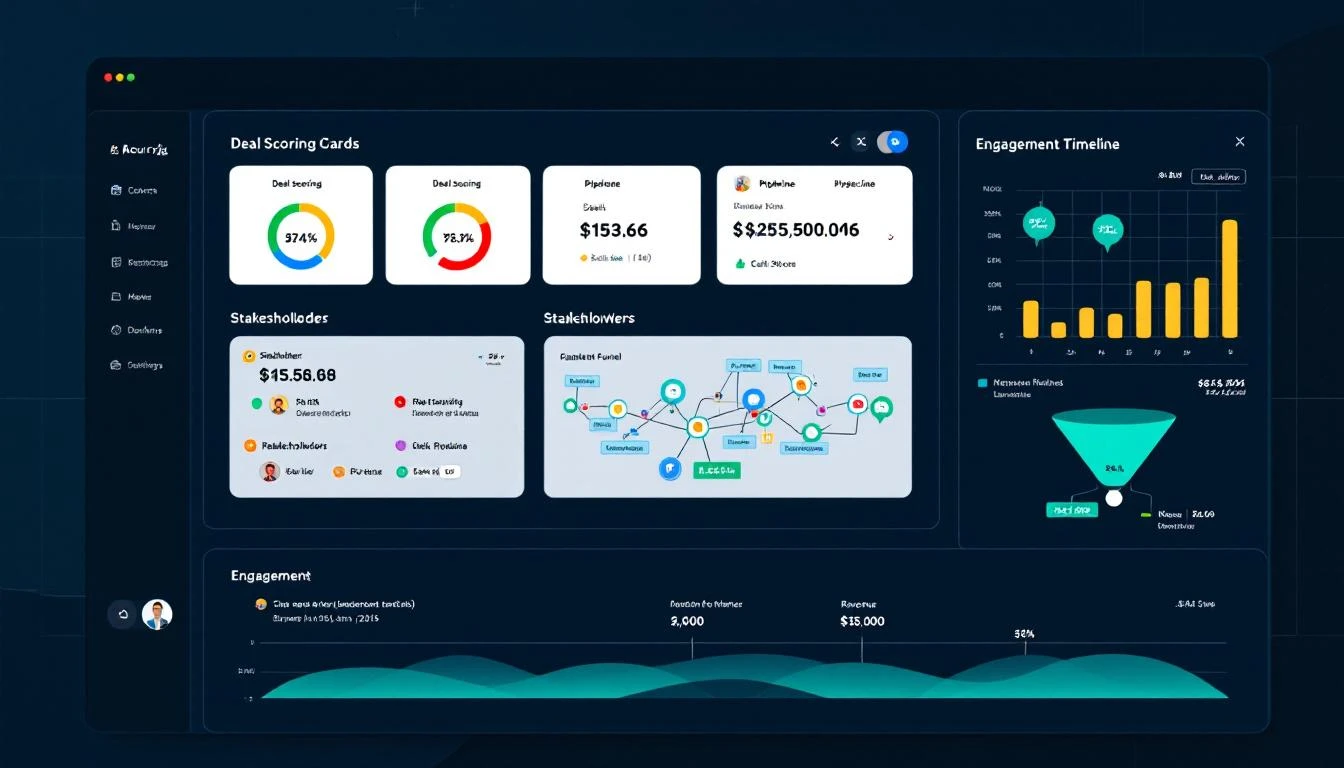
MarketBetter's Deal Intelligence block lives on the prospect page — the screen your reps already have open when they are working a deal. No separate login. No new tab. No $50,000 contract.
Here is what it shows:
Deal Score
Not your ICP fit score — a separate momentum score that evaluates whether a deal is progressing or stalling. It weights engagement velocity (30%), stakeholder coverage (25%), stage health (20%), market context (15%), and fit (10%). A deal can have a perfect ICP score and a terrible deal score if nobody on the buying committee has engaged in three weeks.
Stakeholder Map
A visual layout of the buying committee: who you have identified, their roles (champion, decision maker, evaluator, blocker), and who is missing. Multi-threaded selling is the single strongest predictor of enterprise deal closure, and most reps have no idea whether they are single-threaded until the deal stalls. This makes it obvious at a glance.
Stage Health
How long has this deal been in its current stage versus your historical win/loss benchmarks? If your average deal spends 12 days in Evaluation and this one has been sitting there for 31, that is a red flag that should be visible without running a report.
AI-Recommended Next Action
One action, evidence-backed. Not a list of five things that might help. A single recommendation based on what has worked on similar deals: "Schedule a follow-up with the CFO within 48 hours — executive engagement at this stage increases close rate by 34%."
Key Signals
A synthesized timeline of what has changed: new stakeholder engaged, competitor mentioned in a call, procurement involved earlier than expected. These are the signals that experienced reps track intuitively but that junior reps miss entirely.
The Data Problem Nobody Talks About
Clari depends on clean, complete CRM data. If your reps are inconsistent about logging activities, updating deal stages, or adding contacts to opportunities — and they are, because they always are — Clari's insights degrade. Garbage in, garbage out.
Clari tries to mitigate this with email and calendar auto-capture, but it cannot fix deals that are in the wrong stage or missing key contacts. It cannot infer that the VP of Engineering was on the last three calls if nobody added them to the opportunity.
MarketBetter's approach is different. Because enrichment, email, LinkedIn outreach, and call analysis all happen inside the same platform, the data is already there. The system knows who was on the call, what emails were exchanged, which LinkedIn messages were sent, and what the enrichment data says about the prospect — without requiring the rep to log anything.
This is not a minor advantage. It means deal intelligence in MarketBetter is based on first-party activity data that the platform collected automatically, not on CRM records that reps may or may not have updated.
What You Give Up
Clari's forecasting engine is genuinely best-in-class for enterprise revenue organizations. If you have 200+ reps, a dedicated RevOps team, and your primary pain point is forecast accuracy for the board — Clari is built for that specific problem.
Clari also has deeper Salesforce integration for complex enterprise CRM configurations with custom objects, validation rules, and multi-currency pipelines. MarketBetter's CRM sync covers the core objects (deals, contacts, activities, stage history) but does not replicate every custom Salesforce configuration.
If you are a 500-person sales org reporting to a public company board, Clari's enterprise forecasting is worth the investment. If you are a 10 to 100 person team that wants deal intelligence to help reps close — not dashboards to help leaders report — the $50K platform is solving the wrong problem.
The Real Question
The deal intelligence market has been built on the assumption that pipeline visibility is a leadership problem. Clari, Gong, and their peers built products that flow upward — ingesting rep activity to produce executive dashboards.
MarketBetter flips the direction. Deal intelligence flows downward to the rep, on the page where they are already working, using data the platform already collected. The VP still gets their pipeline view. But the rep gets something they actually use.
Your reps do not need another system to update. They need one that tells them what to do next and why. That should not cost $4,200 per user per year and take four months to implement.
MarketBetter's Deal Intelligence block puts deal scoring, stakeholder mapping, stage health, and AI-recommended actions right on the prospect page — where your reps already work. No separate tool. No $50K contract. See it in action.