
The Warm Outbound Playbook: How to Turn Buying Signals Into Meetings [2026]

Cold outbound is dying. Not because outbound doesn't work — but because cold outbound doesn't work.
The numbers tell the story:
- Average cold email reply rate: 1–3% (down from 8% in 2020)
- Average cold call connect rate: 4.8% (Gong, 2025)
- Percentage of buyers who say cold outreach is "irrelevant to their needs": 72% (LinkedIn State of Sales)
Meanwhile, warm outbound — reaching out to prospects who've already shown buying signals — converts at 3–5x higher rates than cold approaches.
The difference isn't the rep. It's not the script. It's not even the product. It's timing and relevance.
Cold outbound interrupts strangers. Warm outbound engages buyers who are already looking.
This playbook shows you exactly how to build a warm outbound motion from scratch — what signals to track, how to prioritize them, and how to turn them into meetings.
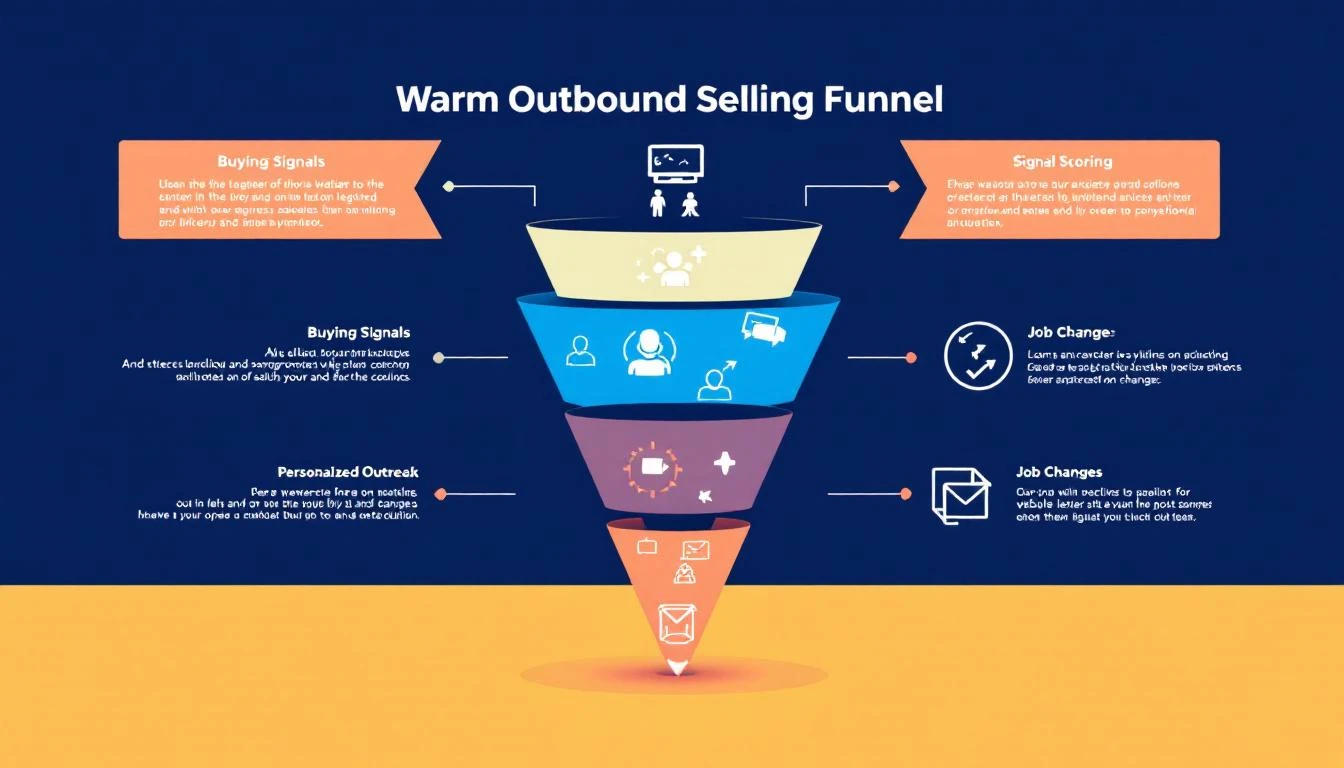
What Is Warm Outbound?
Warm outbound is proactive sales outreach to prospects who've shown intent or interest signals — but haven't yet raised their hand (filled out a form, requested a demo, etc.).
It sits between two extremes:
| Approach | Signal Level | Example |
|---|---|---|
| Inbound | Hand-raise | "I want a demo" form fill |
| Warm Outbound | Intent signals | Visited pricing page 3x, competitor search, champion moved |
| Cold Outbound | No signal | Random list from a data provider |
Warm outbound captures the 95% of buyers who are researching but haven't filled out a form. They're evaluating. They're comparing. They're building internal business cases. They just haven't reached out yet.
Your competitors are waiting for the form fill. You're going to reach them first.
The 7 Buying Signals That Power Warm Outbound
Not all signals are equal. Here's how to tier them:
Tier 1: High-Intent Signals (Act Within 24 Hours)
1. Website Visitor Identification — Pricing & Demo Pages
When a company visits your pricing page or demo page multiple times, someone is actively evaluating your product. This is the single highest-converting warm outbound signal.
- What it looks like: "3 visitors from Acme Corp viewed your pricing page in the last 48 hours"
- Why it matters: They're past awareness. They're doing math. They're probably comparing you.
- How to act: Direct call or email to the likely buyer (VP Sales, SDR Manager). Reference their evaluation: "I noticed your team has been evaluating SDR tools — mind if I share how we compare on the areas that usually matter most?"
2. Champion Job Changes
When a previous champion, power user, or customer moves to a new company, you have a built-in referral. They already know your product works.
- What it looks like: "Sarah Chen (former AE at Hologram, your customer) just joined TechCorp as VP Sales"
- Why it matters: 70% of champions who move will evaluate their previous tools at the new company (UserGems data)
- How to act: Personal, non-pushy outreach: "Congratulations on the move to TechCorp. When you're settled in, would love to see if we can help there too."
3. Active Competitor Evaluation
When a prospect is searching for your competitors, reading comparison pages, or visiting G2 comparison pages, they're in active buying mode.
- What it looks like: "Prospect searched 'Apollo vs ZoomInfo' and landed on your comparison page"
- Why it matters: They're deciding NOW. Not next quarter. Now.
- How to act: Fast, relevant outreach that positions your differentiation: "I see you're comparing outbound tools — most teams in [their industry] choose us for [specific differentiator]. Worth 15 minutes?"
Tier 2: Medium-Intent Signals (Act Within 48–72 Hours)
4. Content Engagement Patterns
A single blog post visit means nothing. But a pattern — 3 blog posts about SDR productivity, a whitepaper download, and a webinar registration in the same week — signals active research.
- What it looks like: "Director of Sales Ops at DataCorp downloaded your ROI calculator and read 3 SDR-related blog posts"
- Why it matters: They're building a business case. They might not know your product yet, but they're solving a problem you solve.
- How to act: Value-led outreach tied to their research topic: "I saw you downloaded our SDR ROI calculator — curious what you found. Most teams we talk to in [industry] are seeing [specific metric]. Mind sharing what you're working on?"
5. Tech Stack Changes
When a company adopts or drops specific technologies, it creates adjacent buying needs. New Salesforce adoption? They'll need outbound tools. Dropped their dialer? They're looking for a new one.
- What it looks like: "TechCorp just adopted Salesforce (detected via technographic data)"
- Why it matters: Technology adoption creates buying windows — 60–90 day periods where adjacent purchases spike
- How to act: Frame your outreach around the transition: "Noticed you recently adopted Salesforce — most teams add outbound tooling within the first quarter. Happy to share what we've seen work."
Tier 3: Contextual Signals (Act Within 1–2 Weeks)
6. Hiring Signals
When a company posts SDR or sales manager job listings, they're investing in outbound. That means they need tools to make those new hires productive.
- What it looks like: "Acme Corp posted 4 SDR roles and a Head of Sales Development position on LinkedIn"
- Why it matters: They're building or scaling a sales team — exactly when they need your platform
- How to act: Frame around their growth: "Saw you're scaling the SDR team — the ramp time challenge is real. We help teams get new reps productive in 6 weeks instead of 4 months."
7. Funding and Expansion Events
A company that just raised Series B, opened a new office, or announced expansion plans is spending money. GTM is almost always a top priority post-funding.
- What it looks like: "DataFlow just raised $30M Series B (Crunchbase alert)"
- Why it matters: Post-funding companies allocate 30–40% of new capital to sales and marketing (First Round data)
- How to act: Relevant, congratulatory outreach: "Congrats on the raise — exciting time. Most Series B teams we work with are figuring out how to scale outbound without scaling headcount linearly. Worth a conversation?"
Building Your Signal Stack
Warm outbound requires three layers of technology:
Layer 1: Signal Collection
You need tools that capture buying signals from multiple sources:
- Website visitor identification — Know which companies are visiting your site and which pages they're viewing
- Intent data providers — Track off-site research behavior (G2 visits, competitor comparisons, keyword searches)
- LinkedIn monitoring — Job changes, company updates, hiring patterns
- Technographic data — Tech stack adoptions and changes
- CRM signals — Re-engagement from closed-lost deals, email opens on old threads
Layer 2: Signal Scoring and Prioritization
Raw signals are noise. You need a system that scores and ranks them so reps know what to act on first.
A simple scoring model:
| Signal | Points | Decay |
|---|---|---|
| Pricing page visit (3+ times) | 50 | 7 days |
| Demo page visit | 40 | 7 days |
| Champion job change | 45 | 30 days |
| Competitor comparison page | 35 | 14 days |
| Content pattern (3+ pieces) | 25 | 14 days |
| Tech stack change | 20 | 30 days |
| Hiring signal | 15 | 30 days |
| Funding event | 10 | 60 days |
Accounts that cross your threshold (e.g., 50+ points) go into the "act now" queue. Everything else goes to nurture.
Layer 3: Action Orchestration
This is where most signal stacks fail. They collect data and score it — but they don't tell reps what to do.
Your action layer should:
- Generate a daily prioritized list for each rep
- Recommend the best channel (call vs. email vs. LinkedIn) based on persona and signal type
- Suggest personalized messaging based on the specific signal
- Track multi-touch sequences across channels
- Feed outcomes back into the scoring model (closed-won = boost similar signals)
The Warm Outbound Workflow (Step-by-Step)
Here's the daily rhythm for an SDR running warm outbound:
Morning (8:00–8:30 AM): Signal Review
- Open your daily playbook / signal dashboard
- Review new signals from overnight (website visits, champion moves, intent spikes)
- Prioritize: High-intent signals first, then medium, then contextual
- Identify the top 10–15 accounts to work today
Mid-Morning (8:30–11:00 AM): Phone Block
- Call high-intent signal accounts first (pricing page visitors, champion moves)
- Reference the signal in your opener: "I'm calling because [specific reason]"
- Log outcomes and next steps in CRM
- Queue follow-up sequences for no-answers
Late Morning (11:00 AM–12:00 PM): Email and LinkedIn
- Send personalized emails to medium-intent signal accounts
- Connect on LinkedIn with contextual connection notes
- Engage with prospect content (genuine comments, not "Great post!")
- Follow up on opened emails from previous sequences
Afternoon (1:00–3:00 PM): Follow-Up and Research
- Follow up on callbacks and email replies
- Research new signals for tomorrow's priority list
- Update CRM with signal data and engagement history
- Review call recordings from the morning (self-coaching)
End of Day (3:00–3:30 PM): Pipeline Review
- Update opportunity stages
- Note any signals that changed (new visits, additional engagement)
- Flag accounts for AE warm handoff
- Set next-day priorities
Cold vs. Warm Outbound: The Performance Gap
Here's what the data looks like when teams switch from cold to warm:
| Metric | Cold Outbound | Warm Outbound | Improvement |
|---|---|---|---|
| Email reply rate | 1–3% | 8–15% | 3–5x |
| Cold call connect rate | 4.8% | 12–18% | 2.5–3.7x |
| Meeting conversion rate | 0.5–1% | 3–6% | 5–6x |
| Pipeline per SDR per month | $50K–$100K | $150K–$300K | 2–3x |
| Average deal cycle | 45–60 days | 28–38 days | 30–40% faster |
| SDR quota attainment | 52% | 78% | 50% higher |
The ROI is undeniable. But it requires infrastructure, not just hustle.
5 Warm Outbound Mistakes to Avoid
1. Treating Every Signal the Same
A pricing page visit and a blog post visit are not equal signals. If your reps treat them with the same urgency, they'll waste time on low-intent accounts and miss high-intent ones.
Fix: Build a tiered signal scoring model (see above) and prioritize ruthlessly.
2. Over-Automating the Outreach
Warm outbound works because it's relevant and personal. If you blast automated sequences to every signal, you'll kill the advantage.
Fix: Automate signal collection and prioritization. Keep the outreach human. A 2-sentence personalized email beats a 5-paragraph automated one.
3. Ignoring Signal Decay
A pricing page visit from 3 weeks ago is stale. A champion job change from 6 months ago is ancient history. Signals have a shelf life.
Fix: Build decay into your scoring model. Signals lose value over time. A 50-point pricing visit should drop to 25 after 7 days and 0 after 14.
4. No Feedback Loop
If your reps don't know which signals actually convert to revenue, they can't improve their prioritization. Most teams track signals in → meetings out, but never close the loop to pipeline and revenue.
Fix: Track signal-to-revenue attribution. Which signal types generate the highest-value pipeline? Double down on those.
5. Separate Signal and Action Tools
If your reps need to check one tool for visitor ID, another for intent data, another for champion tracking, and then manually build their outreach list — they'll spend more time toggling than selling.
Fix: Consolidate into a single platform that collects signals AND orchestrates actions.
How MarketBetter Powers Warm Outbound
MarketBetter was built specifically for warm outbound. Here's how it works:
Signal Collection → Scoring → Daily Playbook → Execution
- Website Visitor Identification: Know which companies visit your site, which pages they view, and how often — no form fills required
- Buying Signal Aggregation: Website visits, email engagement, champion job changes, and intent data all feed into a single signal score
- Daily SDR Playbook: Every morning, each rep gets a prioritized list of who to contact, why they're a priority, and what to say
- Multi-Channel Execution: Email sequences, smart dialer, and LinkedIn — all from one platform
- AI Personalization: The AI researches each prospect and generates personalized outreach based on their specific signals
- Closed-Loop Attribution: Track which signals generate pipeline and revenue, then optimize your scoring model
Most signal platforms tell you who. MarketBetter tells you who, why, and what to do next.
That's the difference between a dashboard and a playbook.
Ready to switch from cold to warm? Book a demo →
Try our AI Lead Generator — find verified LinkedIn leads for any company instantly. No signup required.