
7 Sales Enablement Best Practices That Cut Ramp Time by 40% [2026]
In today's competitive market, providing your sales team with the right tools, content, and training isn't just an advantage; it's the foundation of sustainable growth. The term 'sales enablement' is frequently used, but what does it actually mean to implement it effectively? It’s about transitioning from inconsistent, ad-hoc support to a strategic, data-driven framework that empowers every sales representative to perform at their peak. A robust strategy ensures your team has precisely what it needs to engage buyers, close deals, and drive revenue consistently.
This article cuts through the noise to deliver a comprehensive guide to sales enablement best practices that top-performing organizations are using right now. We move beyond theory to provide actionable steps you can take to build a powerful enablement function. Instead of just listing concepts, we will compare different approaches, offering clear implementation frameworks and real-world examples to illustrate how these strategies work in practice.
You will learn how to:
- Centralize content for maximum accessibility and impact.
- Implement continuous coaching that elevates seller skills.
- Harness data to make smarter sales decisions.
- Achieve true sales and marketing alignment.
- Map the buyer journey for hyper-personalized outreach.
We’ll dive deep into each practice, providing step-by-step guidance to help you transform your sales function from a cost center into a predictable revenue engine. Get ready to learn not just the 'what,' but the 'how' and 'why' behind proven strategies that deliver measurable results.
1. Centralized Content Management and Repository
Imagine your top sales representative is minutes away from a crucial demo and can't find the latest case study. They waste 15 minutes digging through emails, shared drives, and old Slack channels, finally settling for an outdated version. This scenario is all too common and highlights a fundamental breakdown in sales efficiency. A centralized content management repository is one of the most impactful sales enablement best practices because it directly solves this problem, creating a single source of truth for all sales and marketing collateral.
Compare the approaches: A disorganized system relies on tribal knowledge and scattered folders, leading to wasted time, inconsistent messaging, and frustrated reps. In contrast, a centralized repository acts as an intelligent, accessible hub where sales teams can instantly find the right content for the right stage of the buyer's journey. Instead of reps recreating materials or using off-brand messaging, a centralized system ensures everyone uses approved, up-to-date, and on-brand assets, from pitch decks and battle cards to testimonials and pricing sheets.
Why It's a Game-Changer
Companies that master content centralization see significant returns on their investment. For example, Salesforce leverages Highspot to empower its massive global sales team, ensuring consistent messaging and quick access to relevant materials across different regions and languages. Similarly, HubSpot's internal content library is so efficient that its reps can typically find and share relevant content in under 30 seconds, dramatically shortening their sales cycle preparation time.
This infographic summarizes the quantifiable impact of adopting a centralized content strategy.
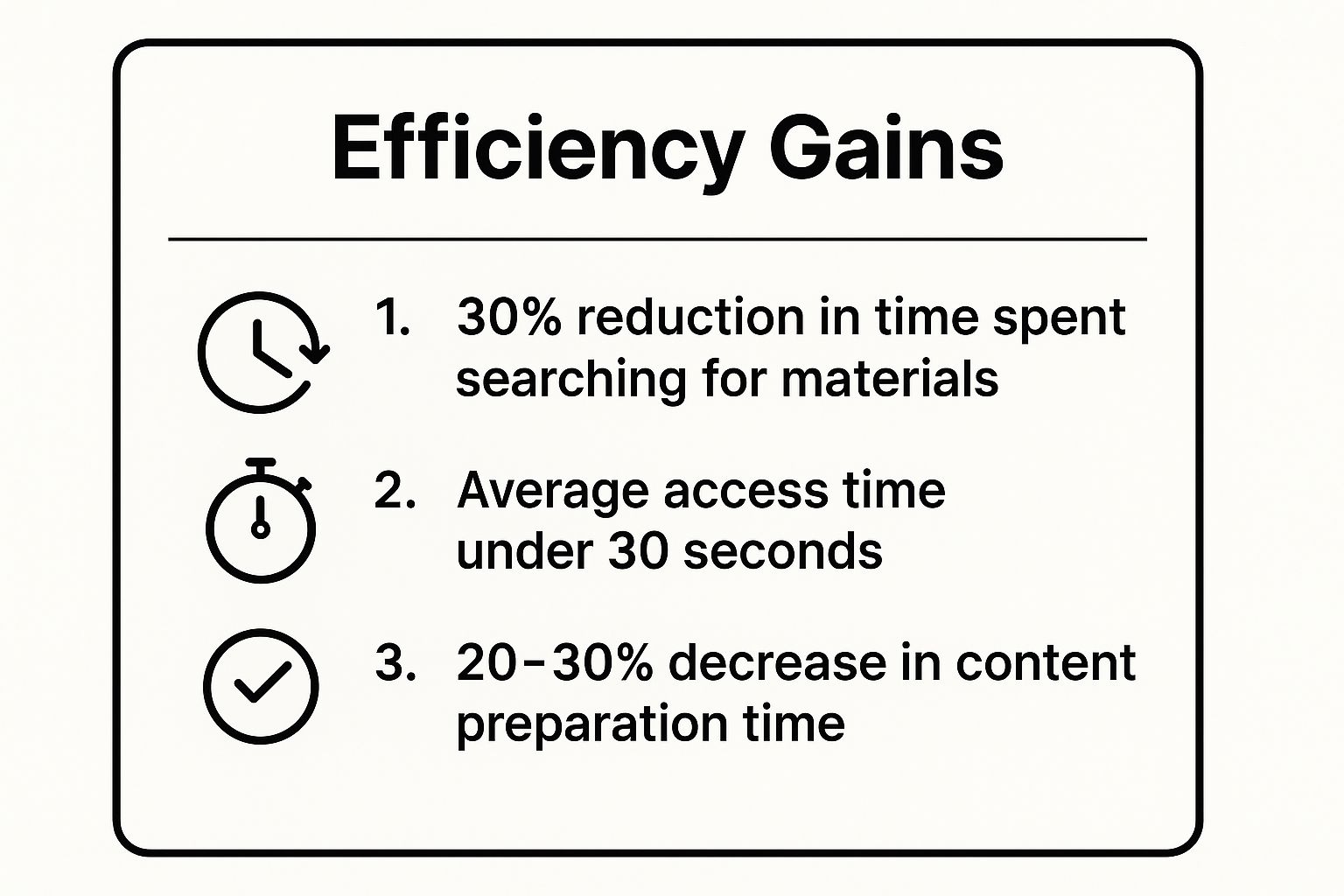
As the data shows, the primary benefit is reclaiming valuable selling time by drastically reducing administrative friction.
How to Implement It
Getting started doesn't require an immediate, large-scale overhaul. Follow these actionable steps to build an effective repository:
- Actionable Step 1: Conduct a Content Audit & Catalog High-Impact Assets. Before you build anything, know what you have. Start by cataloging your top 10-20 most-used pieces of content. Focus on high-impact assets like your main sales deck, key case studies, and product one-pagers. This gives you a quick win and a foundation to build upon.
- Actionable Step 2: Establish a Simple, Scalable Governance Model. Create a logical folder structure and a strict naming convention (e.g.,
AssetType_Topic_Version_Date). For robust content governance and accessibility, explore effective digital asset management best practices. - Actionable Step 3: Implement Quarterly Content Reviews. Schedule reviews to archive outdated materials and identify content gaps. This ensures the repository remains trustworthy and relevant. To dive deeper into optimizing your content strategy, you can find valuable insights by learning more about leveraging AI for advanced content analysis.
- Actionable Step 4: Run an Adoption Campaign, Not Just a Training. A system is only as good as its adoption. Host training sessions focused on search functionality and tagging, but also gamify the launch. Create a scavenger hunt for key documents or reward the first rep to share a new asset with a prospect. Set up automated notifications to alert reps when new or updated content is published.
2. Continuous Sales Training and Coaching
Many companies treat sales training as a one-time event, an intensive onboarding boot camp that reps are expected to remember for the rest of their tenure. This "set it and forget it" approach ignores a critical reality: markets evolve, products update, and skills atrophy. Continuous sales training and coaching is one of the most vital sales enablement best practices because it transforms training from a single event into an ongoing process, fostering a culture of perpetual improvement and adaptation.
Compare the approaches: One-time training results in an estimated 87% of knowledge being forgotten within a month. Continuous coaching, on the other hand, integrates learning into the daily workflow with bite-sized modules, personalized coaching, and relevant skill development. Instead of relying on outdated knowledge from their initial onboarding, salespeople receive timely updates on products, competitors, and sales methodologies, ensuring they are always equipped to handle the modern buyer's objections and questions.

Why It's a Game-Changer
Organizations that commit to continuous development see a direct correlation with revenue growth. For instance, IBM's targeted sales training program famously increased its deal closure rates by 25%. Similarly, Oracle implemented a continuous coaching model that improved quota attainment by 18% across its sales teams. Modern tools like Gong.io exemplify this practice by using conversation intelligence to analyze sales calls and provide managers with targeted, data-driven recommendations for personalized coaching.
This shift from episodic training to a continuous loop of learning, application, and feedback is what separates top-performing sales organizations from the rest. It ensures that every member of the team, from rookie to veteran, is constantly sharpening their skills.
How to Implement It
Building a culture of continuous learning is a strategic initiative that pays long-term dividends. Follow these actionable steps to get started:
- Actionable Step 1: Create a "Deal of the Week" Breakdown. Instead of generic quarterly training, pick one recent win (or loss) and have the rep walk the team through the key decision points and tactics. This makes learning hyper-relevant and peer-driven.
- Actionable Step 2: Establish Peer-to-Peer "Skill Pods." Group reps into small pods of 3-4 to practice specific skills, like objection handling or negotiation. Have them role-play and give each other feedback in a low-stakes environment.
- Actionable Step 3: Use Technology for "Just-in-Time" Learning. Use sales enablement platforms or learning management systems (LMS) to push short quizzes and reinforcement exercises to reps over time. For example, if a rep adds a specific competitor to a deal in the CRM, automatically send them the latest competitor battle card. One key area for reinforcement involves consistent client communication; you can explore expert strategies for crafting the perfect follow-up email to learn more about mastering follow-up cadences.
- Actionable Step 4: Gamify Skill Certification. Introduce leaderboards, badges, and rewards for completing training modules or demonstrating new skills on calls. Friendly competition is a powerful motivator that can dramatically increase engagement with training materials. For example, offer a bonus for the rep with the most improved talk-to-listen ratio in a given month.
3. Data-Driven Sales Analytics and Insights
Consider a sales manager leading a team meeting, asking why Q3 numbers are lagging. One rep blames the market, another points to weak leads, and a third suggests the pricing is off. Without data, this is just a collection of opinions. This common scenario is where gut-feel selling hits a wall. Implementing data-driven sales analytics is a critical sales enablement best practice that replaces guesswork with strategic intelligence, giving teams a clear roadmap to success.
Compare the approaches: A gut-driven sales culture relies on intuition and past experiences, which are often biased and not scalable. In contrast, a data-driven culture transforms raw data from your CRM and other tools into actionable insights. It helps answer crucial questions like: Which lead sources generate the highest conversion rates? What specific behaviors indicate a prospect is ready to buy? At what stage do most deals stall, and why? By leveraging analytics, you empower reps to focus their energy on the most promising opportunities and tailor their approach based on proven patterns.
Why It's a Game-Changer
Organizations that embed analytics into their sales process gain a significant competitive advantage. For instance, Salesforce Einstein uses AI-powered insights to analyze customer data and predict which deals are most likely to close, reportedly helping some customers increase deal closure by up to 30%. Similarly, LinkedIn Sales Navigator provides powerful analytics that help teams understand their prospecting effectiveness, with users reporting up to 40% improvement in finding the right decision-makers.
These tools don't just report numbers; they provide prescriptive guidance. Imagine your system automatically flagging an at-risk account because customer engagement has dropped or highlighting an upsell opportunity based on a client's product usage data. That's the power of transforming data from a historical record into a forward-looking strategic asset.
How to Implement It
You can build a data-driven culture incrementally without needing a team of data scientists from day one. Follow these actionable steps:
- Actionable Step 1: Define Your "One Metric That Matters" (OMTM). Don't try to track everything. Focus on a single, core metric that directly impacts revenue for the quarter, such as lead-to-opportunity conversion rate, sales cycle length, or average deal size. Build your initial dashboard around this primary KPI.
- Actionable Step 2: Implement a CRM "Data Hygiene" Sprint. Your insights are only as good as your data. Dedicate one week to a team-wide effort to clean up the CRM. Run a contest for who can update the most contacts or close out old opportunities. Implement simple rules like "no contact without an email address" to maintain quality.
- Actionable Step 3: Run "Data Storytelling" Sessions. Provide training that goes beyond how to read a dashboard. Teach your sales team how to find a "story" in the data. For example, show them how to use engagement scores to prioritize their daily outreach by focusing on the prospects telling the most promising story with their actions.
- Actionable Step 4: Create Actionable Dashboards, Not Data Dumps. Instead of just showing that "Q3 deals are down 10%," build a dashboard that shows why. For instance, a component could show "Deals are stalling 40% more often at the proposal stage compared to last quarter," giving your team a specific problem to solve.
4. Sales and Marketing Alignment (Smarketing)
Your marketing team celebrates a record-breaking month for lead generation, yet the sales team complains that the leads are low-quality and a waste of time. This disconnect is a classic symptom of sales and marketing misalignment, a costly problem that sabotages growth and creates internal friction. True sales enablement best practices must bridge this gap, transforming two separate functions into a single, cohesive revenue engine. This unified approach is often called "Smarketing."
Compare the approaches: Misaligned teams operate in silos with separate goals (MQLs vs. closed deals), leading to finger-pointing and wasted resources. Aligned teams, or "Smarketers," collaborate seamlessly with shared revenue goals, processes, and communication channels. This ensures consistent messaging from the first ad a prospect sees to the final closing call, directly impacting lead quality, conversion rates, and the overall customer experience.
Why It's a Game-Changer
Organizations that master smarketing gain a powerful competitive advantage. HubSpot, a pioneer in this space, attributed much of its early 100%+ annual growth to its tight internal smarketing culture. Similarly, after focusing on alignment, marketing automation giant Marketo achieved a 10% increase in revenue. Adobe also saw significant returns, improving its lead quality scores by 25% by creating a unified approach between its sales and marketing departments.
When marketing understands precisely what a "sales-ready" lead looks like and sales provides feedback on campaign effectiveness, the entire revenue funnel becomes more efficient. Marketing delivers higher-quality leads, and sales can close them faster because they are better informed and more engaged. This synergy eliminates wasted effort and maximizes ROI on both marketing spend and sales time.
How to Implement It
Building a strong smarketing foundation requires intentional effort and structural change. Use these steps to foster genuine collaboration:
- Actionable Step 1: Launch a Weekly "Smarketing Huddle." Schedule regular, mandatory cross-team meetings (weekly or bi-weekly) to discuss pipeline health, campaign performance, and potential roadblocks. The agenda should be collaborative: marketing presents upcoming campaigns, and sales shares real-time feedback from the field.
- Actionable Step 2: Build a Unified Funnel Dashboard. Move beyond separate MQL (Marketing Qualified Lead) and SQL (Sales Qualified Lead) targets. Instead, focus on shared revenue goals. Build a single dashboard that tracks the entire funnel from initial touchpoint to closed-won deal, giving both teams visibility into their joint impact.
- Actionable Step 3: Draft a Two-Way Service Level Agreement (SLA). Formally document the commitments each team makes to the other. Define what constitutes a qualified lead, the exact process for handoffs, and the expected follow-up time from sales. Crucially, include a sales commitment to provide structured feedback on lead quality within a specific timeframe.
- Actionable Step 4: Mandate Sales Involvement in Content Creation. Involve sales in the creation of key marketing content like case studies, blog posts, and email campaigns. Their frontline insights are invaluable for crafting messaging that truly resonates with buyers and addresses common objections. This also increases the likelihood that sales will actually use the content marketing produces.
5. Buyer Journey Mapping and Personalization
Consider a sales rep sending a technical implementation guide to a new lead who just became aware of your brand. It’s like proposing marriage on a first date-the timing is completely off. This common misalignment happens when sales teams operate without a clear understanding of the customer's mindset and needs. Buyer journey mapping and personalization is one of the most critical sales enablement best practices because it shifts the focus from a company-centric sales process to a customer-centric buying experience.
Compare the approaches: A generic sales process uses a one-size-fits-all pitch for every prospect. A personalized approach, guided by a buyer journey map, tailors the conversation and content to the prospect's specific stage—from awareness to consideration to decision. This transforms generic outreach into a helpful, relevant conversation, building trust and guiding prospects toward a confident purchase decision.
Why It's a Game-Changer
The masters of personalization have built empires on this principle. Amazon attributes an estimated 35% of its revenue to its recommendation engine, a direct result of understanding user behavior and personalizing the experience. Similarly, Netflix’s content personalization engine is so effective that it drives 80% of all viewer activity, keeping users engaged by predicting what they want to watch next. These B2C giants prove that anticipating customer needs based on their journey is incredibly powerful.
In a B2B context, this means delivering a case study to a prospect in the consideration phase rather than a broad industry report, or offering a targeted demo that addresses specific pain points they've already revealed. This strategic empathy accelerates the sales cycle by removing friction and making the buyer feel understood.
How to Implement It
You can begin personalizing your sales approach without a massive data science team. Start with a focused strategy and build from there:
- Actionable Step 1: Map the Journey for One Key Persona. Don't try to map every possible customer journey at once. Begin with your ideal customer profile (ICP). Interview 3-5 recent customers from this segment to understand their "aha!" moments, their research process, and their decision-making criteria. Document the key stages.
- Actionable Step 2: Identify "Trigger Actions" for Each Stage. Leverage data from your CRM and marketing automation platform. Key actions like downloading a specific whitepaper, visiting the pricing page multiple times, or watching a product demo are strong indicators of a prospect's stage in the journey. List these triggers for your sales team.
- Actionable Step 3: Create a "Content Playbook" for Each Stage. For each stage, define the key questions prospects are asking and map specific assets (blog posts, case studies, battle cards) to answer them. This creates a simple playbook for your reps to follow. For a deeper understanding of how to prioritize prospects based on their behavior, explore insights on leveraging AI for intelligent lead scoring.
- Actionable Step 4: Automate with a Human Touch. Use sales enablement tools to automate the delivery of personalized content based on CRM triggers. However, train your reps to add a human touch. A personal note in an automated email like, "Saw you checked out our case study on X, thought you might find this related article useful," makes the interaction feel authentic, not automated.
6. Mobile-First Sales Enablement
Today’s sales professional is rarely chained to a desk. They are in the field, meeting clients, traveling between appointments, and working from anywhere. A sales enablement strategy that doesn't prioritize mobile access is a strategy designed for a bygone era. Mobile-first sales enablement means designing tools, content, and processes with smartphones and tablets as the primary platform, ensuring reps have everything they need at their fingertips, exactly when they need it.
Compare the approaches: A desktop-centric strategy forces reps to save administrative tasks for the end of the day, leading to inaccurate CRM data and delayed follow-ups. A mobile-first approach integrates these tasks into the rep's real-time workflow. They can pull up a battle card seconds before a meeting, update the CRM on the spot, and share a case study from their phone, making them more agile and prepared.
Why It's a Game-Changer
Adopting a mobile-first mindset yields immediate and measurable results in productivity and responsiveness. For instance, when Salesforce launched its enhanced mobile experience, it saw an 85% increase in adoption among its field sales teams, leading to more accurate data and faster deal cycles. Similarly, Dropbox's mobile sales tools empowered its reps to deliver proposals and contracts 40% faster, directly impacting their ability to close deals ahead of competitors.
These companies recognize that mobile isn't an afterthought; it's the main stage for sales activity. By reducing the friction between a rep and the information they need, you empower them to be more agile, prepared, and effective in every customer interaction.
How to Implement It
Transitioning to a mobile-first strategy requires a deliberate and user-centric approach. Follow these actionable steps to ensure your team is equipped for success on the go:
- Actionable Step 1: Survey Your Field Team on Their Top 5 Mobile Needs. Don’t guess. Ask your reps to rank the most critical actions they need to perform on the go (e.g., logging calls, accessing contacts, viewing dashboards). Optimize those features first for a quick adoption win.
- Actionable Step 2: Test Real-Time Synchronization. Have two team members work on the same record, one on mobile and one on desktop. Ensure that data flows effortlessly between platforms in real time. A rep updating a deal stage on their phone should see that change reflected instantly on their laptop, eliminating duplicate data entry.
- Actionable Step 3: Simulate an "Offline Day." Test your platform's offline capabilities. Ask a rep to go into airplane mode for an hour, access key documents, and update information. Then, have them reconnect to ensure the app syncs automatically and correctly.
- Actionable Step 4: Create Mobile "Micro-Trainings." Don't use a desktop-based webinar to train on mobile. Create a series of 60-second video tutorials that reps can watch on their phones, covering specific workflows like "How to log a meeting in 30 seconds" or "How to share a case study from the mobile app."
7. Conversation Intelligence and Call Analytics
Picture your top-performing salesperson. What makes them so effective? For most sales leaders, the answer is a mix of intuition, skill, and experience that feels impossible to replicate. Conversation intelligence and call analytics platforms are designed to demystify this "magic," turning every customer interaction into a rich source of data and a powerful coaching tool. This practice uses AI to record, transcribe, and analyze sales conversations, revealing what truly works and what doesn't.
Compare the approaches: Traditional call coaching relies on a manager randomly listening to a few calls and providing anecdotal feedback. Conversation intelligence analyzes 100% of calls, providing unbiased, data-driven insights. Instead of a manager saying, "I think you talk too much," the data can show, "Your talk-to-listen ratio is 70:30, while our top performers average 45:55." This transforms coaching from subjective advice to objective, actionable guidance.
Why It's a Game-Changer
The impact of conversation intelligence is direct and quantifiable. For instance, Zendesk used Gong.io to analyze its sales calls and discovered that discussing pricing later in the conversation led to better outcomes. By operationalizing this insight, they increased their win rate by 22%. Similarly, Qualtrics leveraged Chorus.ai to identify and replicate the behaviors of its top reps, ultimately reducing its sales cycle length by 18%. These tools turn every call into a learning opportunity, creating a feedback loop that continuously improves performance.
These platforms move coaching from abstract advice to concrete, evidence-based guidance. A manager can say, "Instead of mentioning our competitor here, try this framing that we saw work on three other deals this week," and provide a direct link to the call recording as an example.
How to Implement It
Successfully integrating conversation intelligence requires a focus on trust and improvement, not just oversight. Follow these actionable steps to roll it out effectively:
- Actionable Step 1: Launch with a "Coaching Pilot" for Volunteers. Introduce the tool to a pilot group of trusted reps who are eager to improve. Their positive experiences and success stories will build buy-in and help ease concerns from more skeptical team members.
- Actionable Step 2: Frame It as a "Game Tape" for Sales. Position the technology as a tool for personal and professional development, just like athletes reviewing game footage. Use insights to highlight what reps are doing well and to identify specific, coachable moments for improvement. This fosters a culture of learning rather than one of micromanagement.
- Actionable Step 3: Create a "Greatest Hits" Playlist. Build a library of successful calls or key moments. Share short clips that demonstrate effective objection handling, compelling value propositions, or successful negotiation tactics. Make this a core part of your onboarding and continuous training.
- Actionable Step 4: Run a Compliance and Transparency Briefing. Be transparent with both your team and your customers. Hold a dedicated meeting to explain how the tool works and review all local and international call recording laws and privacy regulations, ensuring everyone understands their responsibilities regarding consent.
7 Sales Enablement Best Practices Comparison
| Item | Implementation Complexity 🔄 | Resource Requirements ⚡ | Expected Outcomes 📊 | Ideal Use Cases 💡 | Key Advantages ⭐ |
|---|---|---|---|---|---|
| Centralized Content Management and Repository | Medium - significant setup & ongoing maintenance | Moderate - tech integration and content curation | 20-30% less prep time; up to 30% time saved searching | Sales content organization and rapid onboarding | Consistent messaging; quick access to materials |
| Continuous Sales Training and Coaching | High - ongoing programs, management support | High - time, cost, and coaching resources | 15-20% sales performance boost; 50% higher net sales per employee | Skill development and performance improvement | Measurable skill gains; retention increase |
| Data-Driven Sales Analytics and Insights | High - complex integration and data quality needs | High - analytics tools and training | 10-30% conversion increase; better forecasting accuracy | Sales performance optimization and forecasting | Proactive strategies; objective measurement |
| Sales and Marketing Alignment (Smarketing) | Medium to High - requires cultural shift | Moderate - shared processes and tech stack | 20%+ annual revenue growth; 67% more qualified leads | Cross-team collaboration and lead quality | Improved lead conversion; consistent brand message |
| Buyer Journey Mapping and Personalization | Medium to High - research, continuous updates | Moderate to High - content personalization efforts | 50-80% engagement increase; shorter sales cycles | Personalized prospect engagement | Higher conversion rates; enhanced CX |
| Mobile-First Sales Enablement | Medium - mobile tech and security challenges | Moderate to High - mobile tools and training | 25-85% productivity increase; 60% faster response time | Field sales and remote access to info | Work anywhere; real-time info access |
| Conversation Intelligence and Call Analytics | High - AI tools plus legal/privacy compliance | High - AI tech and cultural adoption | 20-30% win rate improvement; 50% onboarding time reduction | Sales coaching and conversation optimization | Data-driven coaching; scalable performance insights |
Try our AI Lead Generator — find verified LinkedIn leads for any company instantly. No signup required.
Putting Enablement into Action: Your Path to Higher Revenue
Navigating the landscape of sales enablement best practices can feel like assembling a complex engine without a manual. We've journeyed through seven critical components, from building a centralized content repository and fostering continuous coaching to harnessing data-driven analytics and aligning sales with marketing. We’ve explored the nuances of buyer journey mapping, the necessity of a mobile-first approach, and the transformative power of conversation intelligence. Each of these practices represents a powerful lever for growth, but their true potential is unlocked when they work in concert.
The path forward isn't about a revolutionary, all-at-once overhaul. Attempting to implement all seven strategies simultaneously is a recipe for organizational fatigue and diluted results. Instead, the most successful enablement transformations begin with a focused, diagnostic approach. The key is to identify the single greatest point of friction in your current sales process and start there.
From Silos to Synergy: A Strategic Comparison
Consider the contrast between a reactive and a proactive enablement strategy. A reactive organization might invest in a new content management system because reps complain they can't find materials (addressing Practice #1). While helpful, this is a point solution.
A proactive, strategic organization sees the bigger picture. They understand that a content repository isn't just about storage; it's about performance. They connect it to their CRM data and buyer journey maps (Practices #3 and #5) to automatically recommend the most effective asset for a specific deal stage and persona. They then use conversation intelligence (Practice #7) to analyze which pieces of content actually resonate on calls, creating a data-driven feedback loop that informs future content creation and sales coaching (Practice #2). This shift from isolated tools to an integrated ecosystem is where sustainable revenue growth is born.
Your Actionable Roadmap to Enablement Mastery
To translate these concepts into tangible results, you need a clear plan. Don't let this list remain a collection of ideas; turn it into a strategic initiative.
- Conduct an Enablement Audit: Start by gathering feedback. Survey your sales team to identify their biggest time sinks and roadblocks. Is it finding relevant content? Is it a lack of confidence in handling objections? Use this data to prioritize which best practice to tackle first.
- Define a Pilot Program: Select one or two of the practices discussed that directly address your audit's findings. For example, if your team struggles with inconsistent messaging, focus on a pilot program combining a centralized content library (Practice #1) with targeted coaching sessions (Practice #2) for a small group of reps.
- Measure and Iterate: Define your key performance indicators (KPIs) before you begin. For the example above, you might track metrics like the sales cycle length, win rates for the pilot group versus a control group, and qualitative feedback from the reps. Use these insights to refine your approach before rolling it out company-wide.
Ultimately, mastering these sales enablement best practices is about creating a culture of continuous improvement. It’s about empowering your sales team not just with what they need to sell today, but with the skills, knowledge, and tools to adapt and win tomorrow. This strategic investment also means equipping your team for top-of-funnel success. To truly realize higher revenue, sales enablement must equip teams with the knowledge and tools for effective lead generation, including these proven lead generation best practices that ensure a healthy pipeline.
By committing to this journey, you’re not just supporting a department; you are building a predictable, scalable, and intelligent revenue engine that becomes your company’s most significant competitive advantage.
Ready to transform your sales enablement strategy from a series of disconnected tasks into a unified revenue engine? marketbetter.ai integrates AI-powered content creation, sales analytics, and campaign automation into a single platform designed to implement these best practices seamlessly. See how you can empower your team and drive predictable growth by visiting marketbetter.ai today.