3 posts tagged with "revops strategy"

View All Tags

Hubspot Salesforce Integration Guide: RevOps Playbook

· 28 min read

Connecting HubSpot and Salesforce is the single most powerful step you can take to get your marketing and sales teams rowing in the same direction. When you sync this data, sales reps get crucial marketing insights right inside their CRM, and marketers can finally see which campaigns actually make the cash register ring.

This guide will show you exactly how to build a rock-solid, practical integration designed specifically for the needs of an outbound SDR team. We'll move beyond theory and give you actionable steps, comparisons, and workflows to turn this connection into a revenue-driving machine.

Why Bother Integrating HubSpot and Salesforce for Your SDR Team?

A salesperson benefiting from HubSpot and Salesforce integration, prioritizing leads and eliminating manual entry.

Let's be honest. Your SDRs are probably wasting a huge chunk of their day flipping between browser tabs and copy-pasting information. This isn't just inefficient; it’s a direct hit to your pipeline. When HubSpot's marketing brain isn't talking to Salesforce, your sales floor is flying blind.

SDRs end up chasing leads that marketing already knows are a dead end. Or worse, they call a prospect moments after that person received a completely unrelated marketing blast. This disjointed approach creates a jarring experience for buyers and torches good leads. All the while, sales leaders can't trust their forecasts because the data in Salesforce is only half the story.

Turning Raw Data Into Real Conversations

The entire point of this integration is to turn passive marketing data into an active, intelligent outbound sales strategy. Instead of reps having to log into HubSpot to see if a lead opened an email, that activity just shows up on the contact record in Salesforce. Simple.

The real magic happens when you turn HubSpot’s marketing intelligence into prioritized, actionable tasks inside Salesforce. This gives reps the context they need for meaningful conversations, moving them from generic "cold calls" to well-timed, informed outreach.

This unified view gives your team immediate answers to the questions that matter most:

  • What marketing campaign got this person's attention?
  • Did they look at our pricing page in the last 24 hours?
  • Have they downloaded a key whitepaper or case study?

This kind of real-time insight is non-negotiable. As of 2026, HubSpot's native Salesforce integration has become essential for mid-market B2B teams. It flawlessly syncs contacts, companies, deals, and activities, breaking down the data silos that frustrate 70% of teams using hybrid CRM setups.

From Disconnected Tools to a Cohesive Sales Engine

Think about the daily grind with a disconnected tech stack. An SDR wastes their first hour cross-referencing new MQLs in HubSpot against Salesforce to hunt for duplicates. It's a manual, soul-crushing task that’s ripe for errors and a complete waste of selling time.

A properly built integration automates that entire mess. A new lead in HubSpot can instantly create a corresponding record in Salesforce, assign it to the right rep, and even generate a follow-up task—all based on rules you set. This means your speed-to-lead is as fast as it can be, and your reps can spend their time actually selling.

Before you even start the integration, having the right foundation is key. If you're still evaluating your core platform, reviewing a guide on the best CRM for sales teams can help ensure your primary system is built for success.

Common Outbound Challenges and Integration Solutions

For SDR teams, the gap between marketing and sales isn't just a philosophical problem—it creates tangible, daily roadblocks. The table below breaks down these common headaches and shows exactly how a solid HubSpot-Salesforce sync provides the cure.

SDR ChallengeImpact of Disconnected SystemsHow Integration Provides the Solution
Lack of ContextReps make generic, "cold" calls without knowing a lead's recent marketing engagement.Marketing activities (email opens, page views) are logged directly on the Salesforce contact record, providing instant context.
Slow Lead HandoffMarketing Qualified Leads (MQLs) sit in a queue, waiting for manual review and assignment.Automation rules instantly create and assign new leads in Salesforce the moment they hit the MQL threshold in HubSpot.
Manual Data EntrySDRs waste hours logging calls, emails, and notes in two separate systems.Activities logged in one system (e.g., a call in HubSpot) automatically sync to the other, eliminating double work.
Inaccurate ReportingSales leadership can't accurately attribute revenue to specific marketing campaigns.Closed-won deals in Salesforce sync back to HubSpot, providing a clear ROI picture for marketing efforts.
Poor Lead PrioritizationReps don't know which leads are "hot" right now and treat all MQLs equally.Lead scoring from HubSpot syncs to Salesforce, allowing reps to build views and prioritize the most engaged prospects first.

As you can see, the integration isn't just about moving data around. It's about creating a smarter, faster, and more informed sales process that directly impacts your team's ability to hit its numbers.

Your Pre-Integration Strategic Checklist

Jumping straight into the technical setup without a solid game plan is a classic recipe for disaster. A truly successful HubSpotSalesforce integration starts with strategy, not software. Before you even think about connecting the two, you need a blueprint. This is what separates a clean, efficient sync from the all-too-common "plug and pray" approach that leaves you with a data nightmare.

This whole planning phase is really about asking the tough questions upfront. Who actually owns the data? Which system gets the final say on a contact's lifecycle stage? What’s the rule for when a record gets updated in both systems at the same time? Answering these questions now will save you countless hours of untangling messy data and chasing sync errors later.

Define Your Single Source of Truth

This is probably the most critical decision you'll make. You have to define the single source of truth for each core data object. This is what tells the integration which platform's data wins out and overwrites the other during a conflict. If you get this wrong, your SDRs could be working with stale contact info while marketing runs campaigns based on totally incorrect sales statuses.

There’s no one-size-fits-all answer here; it’s all about how your teams actually work. For most outbound SDR teams I've worked with, this is a pretty effective setup:

Data ObjectRecommended Source of TruthWhy It Works for SDR Teams
New LeadsHubSpotMarketing is generating the inbound leads from web forms, content, and campaigns. Let that be the entry point.
Contact InfoSalesforceSDRs and AEs are on the front lines, constantly enriching and verifying phone numbers, titles, etc. Their data should be king.
Lead StatusSalesforceYour sales team owns the lead lifecycle, hands down. From 'New' to 'Disqualified' or 'Converted,' Salesforce dictates the stage.
Company DataSalesforceSales typically owns the account-level details like firmographics and complex parent-child relationships.

Getting this logic nailed down from the start prevents a ton of confusion and protects the integrity of your most valuable asset—your data.

Audit and Clean Your Existing Data

Look, connecting two messy databases just creates one giant, exponentially messier database. Before you sync anything, you absolutely have to audit the data in both HubSpot and Salesforce. This step is non-negotiable if you want to avoid a flood of duplicate records and frustrating sync failures.

Start by running some simple reports in both systems to flag:

  • Duplicate Records: Hunt for contacts and companies that share the same email or company domain.
  • Inconsistent Data: Standardize your picklist values. "USA," "United States," and "U.S.A." should all be the same thing.
  • Outdated Information: Find those contacts with no activity for over a year or accounts for companies that no longer exist.

Pro Tip: Don't just clean up the current mess and call it a day. Use this as a chance to build a real, long-term data hygiene strategy. Document the rules and set up processes to keep it clean. For a much deeper look at this, our guide on automating your CRM hygiene has some great frameworks.

This isn’t just busywork; it's directly tied to the integration's ROI. A clean, well-oiled integration can deliver an average ROI of 324% within the first year. Why? Because it slashes manual data entry—saving reps up to 15 hours a week—and finally gives you unified reporting that connects marketing spend directly to revenue. If you need to build a business case, these integration ROI statistics are pretty compelling.

Map Your End-to-End Customer Journey

Last but not least, you need to document every single field and process that a lead touches, from their very first visit to your website all the way to a closed-won deal. This means mapping out every lifecycle stage, every custom property in HubSpot, and every corresponding custom field in Salesforce.

You'll find the native integration app right in the HubSpot Marketplace, and this is your technical starting point.

This screen is just the gateway. The real work is in making sure the data structures behind it are ready for a smooth handoff.

This exercise forces you to be ruthless about what data is actually essential for your SDR team. Do they really need all 50 of marketing’s custom properties cluttering up the Salesforce contact record? Probably not. A clear data map ensures you only sync the information that drives action, keeping Salesforce clean and your reps focused on what matters.

Getting Your Hands Dirty: A Practical Walkthrough of the Connection

Alright, you've done the strategic thinking. Now it's time to roll up your sleeves and actually connect the two platforms. Don't worry, this isn't nearly as intimidating as it sounds. The HubSpot integration wizard does a great job of holding your hand, but knowing the critical decision points before you start clicking is the key to a smooth, error-free setup.

The whole process kicks off in HubSpot, not Salesforce. You'll just head over to the App Marketplace, search for the official Salesforce integration, and get started. Make sure you use the native, HubSpot-built app—steer clear of any third-party connectors for now. Keeping it simple and officially supported is the name of the game.

Making the Handshake: Authentication and Permissions

Once you find the app and click install, you’ll be prompted to log into your Salesforce account. This is your first major checkpoint, and it's a big one. You absolutely must authenticate with a Salesforce user that has the right permissions.

Trying to use a standard user profile will cause headaches right out of the gate. You need a Salesforce user with "Modify All Data" and "API Enabled" permissions, which usually means a System Administrator profile. Giving the integration this level of access is non-negotiable; it's what allows it to freely create, read, and update records between both systems as you've intended.

I've seen teams try to use a lower-permission user to "limit" the integration's scope. It always backfires. This leads to a constant stream of frustrating sync errors for records the integration user can't "see" or edit in Salesforce. Just use a dedicated integration user or a full System Admin and save yourself the trouble.

Setting Up the Bouncer: Your Inclusion List

After you've logged in, HubSpot will walk you through setting up an inclusion list. Honestly, this is probably the single most powerful feature for preventing data chaos. Instead of just opening the floodgates and syncing your entire Salesforce database, the inclusion list acts as a bouncer at the door, only letting specific, pre-approved records pass between systems.

This is the critical difference between a clean, intentional setup and a "sync everything" disaster. A wide-open sync can instantly pull thousands of old, irrelevant contacts into HubSpot, blowing up your contact tier limits and filling your marketing database with junk.

For an SDR-focused setup, a Salesforce Active Rule is the perfect starting point for your inclusion list.

  • Actionable Step: Create a new Salesforce Active List in HubSpot with a rule like: Lead Status is not one of (Unqualified, Bad Data) AND Contact: Do Not Email is False. This simple but effective rule ensures only active, contactable leads and contacts ever make it into HubSpot. Your marketing database stays clean and focused on engageable prospects from the very beginning.

Choosing What to Sync: Objects, Fields, and Activities

Next up, you'll decide which objects to sync. The standards are Contacts, Companies, and Deals. For most teams, syncing all three is the right call. You'll also configure how activities—like tasks, emails, and notes—flow between the systems. This is where you really start to dial in the integration for your SDR team's specific workflow.

A key decision here is the direction of your activity sync. Should a logged call in HubSpot create a completed task in Salesforce, or should it work the other way around?

Activity Sync DirectionThe GoodThe BadWho It's For
HubSpot to SalesforceCaptures every marketing and sales touchpoint in your system of record (Salesforce).Can clutter the Salesforce activity timeline if you don't manage it carefully.Teams where SDRs live in HubSpot tools (sequences, dialer) but leadership lives in Salesforce reports.
Salesforce to HubSpotKeeps the HubSpot contact timeline fresh with sales activities, which is great for lead scoring and automation.A less common setup, since Salesforce is usually the main activity hub.Niche cases where HubSpot automation relies heavily on specific sales actions being logged.

When you're starting out, a one-way sync from HubSpot to Salesforce for tasks and engagements is a fantastic choice. It enriches the Salesforce record with all that great activity context without creating confusing bidirectional loops. If you want to dive deeper, a good HubSpot Salesforce integration guide can walk you through all the nuances of connecting your platforms and mapping your fields.

Flipping the Switch: The First Sync and Monitoring

Once you've locked in your settings, you're ready to start the initial data sync. Now, be patient. Depending on the size of your inclusion list, this can take several hours. HubSpot gives you a health dashboard where you can watch the progress and, more importantly, see any sync errors that pop up.

Don't panic when you see errors. They are 100% normal during the first pass as the integration bumps into unique data validation rules or weird formatting in your records. The dashboard will tell you exactly which records failed and why, so you can fix them one by one. Think of this initial sync as the final, real-world test of your planning and data hygiene—it’s the last layer of validation before you let your teams loose on the new setup.

2. Nailing the Field Mapping and Sync Logic

Okay, getting the two platforms connected is the first step, but it’s just the plumbing. The real magic happens when you control exactly what data flows through those pipes, how it flows, and what happens when there's a disagreement. This is where you graduate from a simple data mirror to an intelligent system that actually helps your SDRs sell.

This is all about field mapping and sync logic. You're essentially telling the integration which pieces of information to share, which direction they should travel, and which system gets the final say. Get this right, and your SDRs will have unshakable trust in their Salesforce data. Get it wrong, and you introduce a subtle but constant drag on their productivity and confidence.

This flowchart walks through the essential checkpoints for getting the connection right before you even think about syncing data.

A decision tree flowchart for platform connection, outlining steps for user permissions and inclusion list configuration.

As you can see, confirming user permissions and setting up a clear inclusion list aren't just suggestions—they are foundational steps to prevent absolute data chaos down the line.

Turning Marketing Signals into Sales Actions

Let's get practical. A generic field map is fine, but one designed specifically for an SDR workflow is a massive advantage. The goal is to translate HubSpot's rich marketing engagement data into specific, actionable fields inside Salesforce that your reps can use to prioritize their day.

Think about it this way: a prospect opens your latest marketing email three times and clicks through to the pricing page. In a disconnected setup, that’s just a number on a marketing dashboard. With smart mapping, it becomes an immediate, high-priority sales trigger.

Here’s an actionable playbook to build this:

  • Step 1: Create a custom field in Salesforce. Go to the Contact object and add a new date field called something like "Last Marketing Engagement Date."
  • Step 2: Map the HubSpot property. Jump into your integration settings and map the standard HubSpot property "Last marketing email open date" directly to that new custom field in Salesforce.
  • Step 3: Build the automation in Salesforce. Use a simple Flow that says, "When the 'Last Marketing Engagement Date' field is updated today, automatically create a high-priority task for the contact owner."

Just like that, your SDRs are no longer just working down a static list. They're getting real-time alerts about who's most engaged right now, letting them strike while the iron is hot.

One-Way vs. Bidirectional Syncs: A Comparison for SDR Teams

Choosing between a one-way and a two-way (bidirectional) sync is a critical decision. It dictates who "owns" the data and can prevent valuable sales insights from being accidentally overwritten by marketing automation.

Sync TypeHow It WorksBest ForSDR Team Impact
One-Way SyncData flows in only one direction (e.g., HubSpot → Salesforce). Changes in the destination system are ignored.Data points with a single, clear owner, like Lead Source from marketing or Lead Status from sales.High Predictability. Reps know that certain fields won't change unexpectedly. This builds trust in the data.
Bidirectional SyncData flows in both directions. An update in either system will sync to the other.Fields that both teams need to update, like First Name or basic contact info.High Flexibility, Higher Risk. Makes it easy for anyone to update data, but requires strict "source of truth" rules to prevent data conflicts.

The secret is to use a hybrid approach. Don’t set everything to be bidirectional. Instead, establish a clear "owner" for every important piece of data and set the sync direction accordingly.

Sample Sync Logic and Rules for an SDR Team

Here’s a practical, actionable template for setting up your field-level sync logic.

Data FieldRecommended Source of TruthSync Direction and RuleSDR Workflow Impact
First Name, Last Name, EmailSalesforceBidirectionalBoth teams can update, but Salesforce wins in a conflict. Ensures the SDR's direct contact info is always preserved.
Lead SourceHubSpotOne-Way: HubSpot to SalesforceMarketing owns the initial source. SDRs see exactly where the lead came from (e.g., "Webinar," "eBook Download").
Lead/Contact StatusSalesforceOne-Way: Salesforce to HubSpotSales owns the pipeline stage. This prevents marketing from nurturing a lead an SDR has already disqualified or is actively working.
MQL DateHubSpotOne-Way: HubSpot to SalesforceThe date a lead met marketing's criteria is a key piece of context. It’s a marketing-owned data point that SDRs need to see.
Last SDR Activity DateSalesforceOne-Way: Salesforce to HubSpotSDRs log calls/emails in SFDC. This data flows to HubSpot to suppress these contacts from general marketing campaigns.

This kind of hybrid approach gives each team autonomy over their core data while providing everyone with the visibility they need to do their jobs effectively. If you're managing even more complex data flows, you can find great strategies for managing multi-CRM sync automation that build on these same principles.

Making Sense of Conflict Resolution

Even with the best logic, conflicts are inevitable. An SDR updates a phone number in Salesforce at the exact same moment an automation rule updates a different field on the same record in HubSpot. Who wins? That’s where your conflict resolution settings come in.

You essentially have two choices:

  • Prefer Salesforce: If a record is updated in both systems simultaneously, the Salesforce value is kept.
  • Prefer HubSpot: In the same situation, the HubSpot value overwrites the change made in Salesforce.

The rule of thumb here is dead simple: Always set your conflict resolution to prefer your designated source of truth. If Salesforce is where your official contact data lives, the rule should be "Prefer Salesforce." This is your safety net.

While you can set it to prefer the most recent update, I strongly advise against it. It can be wildly unpredictable and is a nightmare for SDR teams who live and breathe out of Salesforce as their system of record. Sticking with a clear "prefer X" rule removes all ambiguity.

Automating SDR Tasks and Activity Logging

Diagram showing marketing activities (email, forms, webinars) integrating with Salesforce to generate high-priority SDR tasks.

Alright, your data is flowing cleanly between HubSpot and Salesforce. Now for the fun part: turning that passive data stream into an active, intelligent engine that fuels your SDR team. This is where the integration moves beyond simple data hygiene and starts making a real impact on productivity.

We're going to take those rich marketing signals from HubSpot and use them to automatically tee up the next best action for your reps, right inside Salesforce.

First things first, let's talk about visibility. Out of the box, the integration adds a HubSpot Intelligence Visualforce component to your page layouts. This is your SDR's secret weapon. It gives them a clean, chronological view of every email open, website visit, and form submission without junking up the main Salesforce activity timeline. Reps get instant context on a prospect’s entire journey before they ever pick up the phone.

Building Proactive Task Creation in Salesforce

Passive activity logs are great for context, but proactive task creation is what really moves the needle. You want to use HubSpot's data to explicitly tell your SDRs what to do next. Instead of making them hunt through activity feeds for a buying signal, we can build automations that create and assign tasks the moment a high-intent action happens.

Think about a prospect who fills out a "Request a Demo" form. In a disconnected world, that lead might sit in a marketing inbox for hours. With this integration, you can build a Salesforce Flow that fires the instant that form submission syncs from HubSpot.

Here is an actionable recipe for this automation:

  • Trigger: Create a Record-Triggered Flow in Salesforce on the Contact object that runs when a record is updated.
  • Condition: Set the entry condition to hs_latest_source contains "Demo Request Form."
  • Action: Add a "Create Records" element to create a new Task.
  • Details: Assign it to the Contact Owner ($Record.OwnerId), set the priority to "High," and use a crystal-clear subject like "Follow Up on Demo Request."

This one automation can slash your speed-to-lead time from hours down to seconds. That’s a massive advantage when research shows that 35-50% of sales go to the vendor that responds first.

The goal isn't just to move data; it's to create motion. By automating task creation based on real-time engagement, you're building a system that ensures no hot lead ever goes cold due to manual delays. Your SDRs can stop hunting for opportunities and start working them.

Comparing Automation Tools: HubSpot vs. Salesforce

A question I get all the time is where to actually build these automations—should you use HubSpot Workflows or Salesforce Flow? While both are fantastic tools, for any SDR-focused process, Salesforce is almost always the right answer for task creation.

Here’s a quick breakdown of why:

Automation PlatformBest ForSDR Workflow Implications
HubSpot WorkflowsMarketing nurturing, internal notifications, and updating HubSpot properties.Great for enrolling leads into email sequences but not ideal for creating tasks that need to live permanently in the sales CRM.
Salesforce Flow/Process BuilderCreating and assigning sales-owned records like Tasks, Opportunities, and Cases.This is the native environment for sales. Tasks follow Salesforce assignment rules and are instantly visible in the reports and dashboards your sales leaders live in.

Building your task automations in Salesforce keeps your reps in their primary system, reinforces Salesforce as the source of truth for all sales activities, and makes reporting on SDR productivity a breeze for leadership.

Logging Outbound Calls and Emails

Finally, we need to close the loop by making sure your SDRs' own outbound activities get logged back correctly. Sure, reps can create records manually, but a truly efficient setup automates this away. This is where tools with native CRM dialers are an absolute must.

For instance, when an SDR uses a Salesforce-native dialer to make a call, the system should automatically log that activity, its outcome ("Connected," "Left Voicemail," etc.), and any notes right on the Contact record. This completely eliminates the manual "after-call work" that slows reps down and ensures your activity data is 100% accurate. For a deeper dive, check out our guide on the best practices for logging phone calls and outcomes in your CRM.

This automated two-way street—marketing signals creating tasks in Salesforce and sales activities logging back—is the hallmark of an integration that genuinely empowers your outbound team.

Troubleshooting Common Integration Pitfalls

Let’s be real: no matter how carefully you plan, every integration project hits a few snags. The real test isn't avoiding problems, but knowing how to squash them quickly before your teams lose faith in the data. Think of this as your field manual for the most common issues you'll run into when connecting HubSpot and Salesforce.

When things go wrong, your first stop should always be HubSpot’s Sync Health dashboard. This is command central for seeing what’s breaking and why. It gives you specific reasons a record failed to sync, so you can fix the root cause instead of just patching over the symptoms.

Decoding API Limit Errors

One of the first brick walls you might hit is the Salesforce API call limit. Salesforce gives your organization a set number of API calls it can make every 24 hours. A busy integration, especially during the initial sync or after a big data import, can chew through that limit faster than you’d think.

Once you hit the cap, the sync simply stops, and your dashboard will light up with API limit errors.

The quick fix is just to wait for the 24-hour clock to reset. But for a real, long-term solution, you need to get smarter about your inclusion list. Are you trying to sync every single record? Probably not. Tighten up those sync criteria to reduce the noise, and you'll drastically cut down on the API calls needed to keep everything up to date.

Managing Sync Delays and Latency

Sometimes the sync just feels slow. An SDR updates a lead in Salesforce, grabs a coffee, comes back, and the change still isn't showing up in HubSpot. When your team's workflow depends on timely data, these delays can be more than just a minor annoyance.

It's crucial to remember that the native integration isn't instantaneous. It syncs data in batches, usually every 5 to 10 minutes. This is perfectly normal, but if you're pushing huge volumes of data or have a ton of complex rules, that timeframe can stretch out.

If you’re consistently seeing frustrating delays, it's often a sign the integration is overloaded. Take a hard look at your field mappings. Do you really need to sync all 50 of those custom fields? Every mapped field adds a little bit of processing overhead, and syncing dozens of Salesforce formula fields, for example, can really slow things down.

Salesforce Validation Rules Blocking HubSpot Updates

This is, without a doubt, the most common problem I see pop up after an integration goes live. A well-meaning Salesforce admin adds a new validation rule—say, making the "Phone" field required before a Lead Status can be changed to "Working." Suddenly, all your automated updates from HubSpot start failing.

The good news is that the error message in your Sync Health dashboard is usually crystal clear, often even naming the exact validation rule that’s causing the trouble.

Two Ways to Fix This—And One Clear Winner

You have a couple of options here, but one is far more sustainable than the other.

ApproachDescriptionPros & Cons
Update the Validation RuleThis involves tweaking the rule in Salesforce to specifically exclude the integration user. The logic might look something like: AND(ISBLANK(Phone), $User.Id <> "INTEGRATION_USER_ID").Pro: A clean, permanent fix. It lets the integration do its job without compromising data integrity for your human users.
Con: Requires you to have (or get) Salesforce admin access.
Adjust HubSpot WorkflowsYou could try to make sure your HubSpot automations always provide the required data. For example, you could make the phone number field mandatory on a HubSpot form that might trigger the rule.Pro: Can be handled entirely on the HubSpot side.
Con: It’s a reactive fix. You'll constantly be playing whack-a-mole as new validation rules are added.

My advice? Updating the validation rule in Salesforce is almost always the right call. It’s a proactive, robust solution that solves the problem at its source. This approach keeps your integration stable and saves you a world of headaches down the road.

Answering Your Burning Integration Questions

Even the most meticulously planned integration project will have its share of "what if" moments. It's just the nature of the beast. Here are some of the most common questions that pop up from RevOps leaders and SDR managers, along with straight-to-the-point answers from our experience in the trenches.

How Often Does HubSpot Actually Talk to Salesforce?

This is a big one for setting team expectations. The native integration doesn't sync in real-time. Instead, it runs in batches, usually every 5 to 10 minutes.

For the most part, that’s perfectly fine. A lead created in HubSpot will show up in Salesforce for your SDRs pretty quickly. But you need to be aware that during a massive data import or the initial sync, things can slow down a bit. It's crucial to tell your team that a new contact won't appear instantaneously. A little bit of patience goes a long way.

What About Our Salesforce Custom Objects? Can We Sync Those?

Yes, you absolutely can, but there's a catch, and it's a big one. Syncing custom objects between Salesforce and HubSpot is an enterprise-level feature. You'll need a HubSpot Enterprise plan (like Operations Hub or Sales Hub) to make it happen.

This is a make-or-break consideration during your planning phase:

  • Standard Integration (Pro Tiers): You're limited to the basics—Contacts, Companies, Deals, and Activities.
  • Enterprise Integration: This unlocks the ability to map and sync all those unique custom objects you've built in Salesforce.

If your SDRs live and breathe out of a custom "Target Accounts" or "Product Interest" object in Salesforce, you have to budget for an Enterprise plan. There's no getting around it.

Look, the whole point here is to build a seamless workflow for your reps. If a key piece of their process is locked away in a custom object, that data has to flow into HubSpot. Trying to work around it just creates confusion and kills adoption.

What Happens When Someone Deletes a Record?

This question trips up a lot of people. By default, when you delete a record in HubSpot, it does not delete the matching record in Salesforce (and vice-versa). This is a safety net built into the integration, designed to prevent a single mistake from wiping out data across both platforms.

You can change this setting to enable deletions to sync, but you need to be extremely careful. We almost always advise clients to leave this setting off. It's far safer to manage record deletion through a deliberate, controlled archival process within each system separately. Think of it as a failsafe; a mistake in one CRM won't cause a permanent, irreversible data catastrophe in the other.


Your SDRs shouldn't be guessing what to do next. marketbetter.ai turns buyer signals into a prioritized task list and helps reps execute immediately with AI-powered emails and a dialer that lives inside Salesforce. See how we help you drive more outbound motion at https://www.marketbetter.ai.
A Guide to Sales Process Optimisation That Actually Works

· 23 min read

Think of sales process optimisation as a continuous tune-up for your sales engine. It’s the practice of methodically refining your sales motion to cut out friction, automate the soul-crushing admin tasks, and free up your reps to do what they do best: sell.

It’s about finding and fixing all the "leaks" in your sales pipeline so more deals close, and they close faster. The whole point is to build a repeatable, predictable system for bringing in revenue.

Why Your Sales Process Is Leaking Revenue

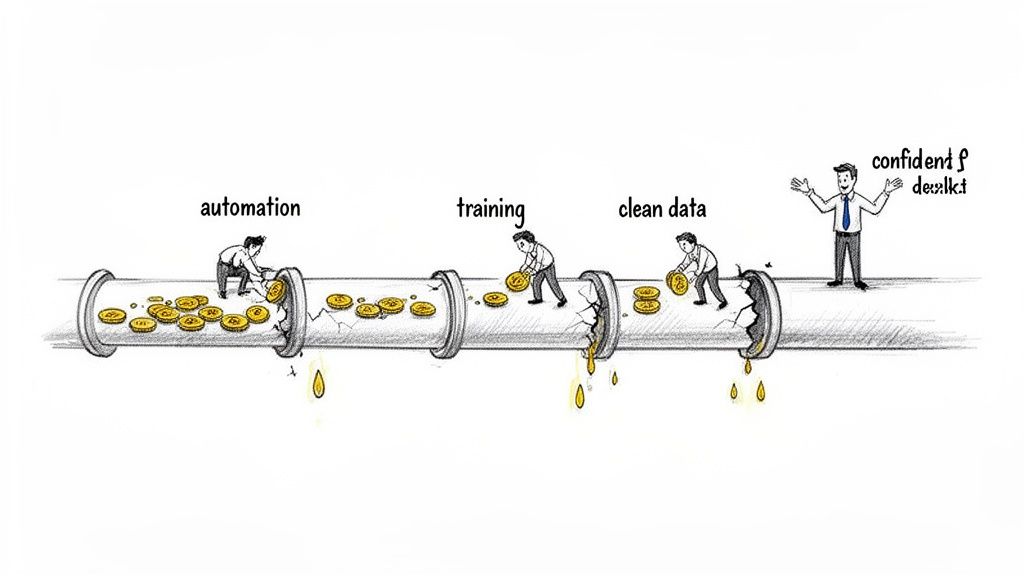
Picture your sales process as a high-pressure water pipeline. Ideally, every drop of water that goes in one end—every single lead—comes out the other as a signed deal. But let's be real, most sales pipelines are riddled with tiny leaks. These aren't dramatic pipe bursts; they're the slow, steady drips that silently drain your revenue potential day after day.

A business pipeline losing value from automation, training, and clean data stages, with a confident man at the end.

This is the central challenge staring down sales leaders right now. If you're seeing inconsistent rep performance, flat win rates, and a CRM that feels more like a graveyard than a goldmine, you've got a leaky pipeline. Sales process optimisation isn't about finding one massive crack; it's about systematically sealing up all the small, costly holes.

The Ad-Hoc Mess vs. The Optimised Machine

Too many teams run on what I call an ad-hoc sales process. Reps freestyle their outreach, managers have zero visibility into what's actually working, and CRM data is a chore nobody wants to do. The result? Chaos. Success is random, and scaling is a pipe dream.

An optimised sales process, on the other hand, is engineered for predictability. It’s a clean, unified motion that the entire team understands and executes.

Let’s look at the difference on the ground:

  • The Unoptimised Process: Your reps burn hours every morning just figuring out who to call. They manually log activities (or forget to) and throw spaghetti at the wall to see which messaging sticks. The activity numbers look high, but the results are all over the map.
  • The Optimised Process: Your reps log in to a prioritized task list, automatically surfaced by real buyer intent signals. They fire off calls and emails from right inside the CRM, and every single touchpoint is logged for them. Their actions are targeted, efficient, and—most importantly—measurable.

It’s the difference between leaving your team to figure it out alone and giving them a system that guides them to the most valuable action, every single time.

How to Actually Start Fixing Things

So, how do you start patching these leaks? First, you have to accept that optimisation isn't a one-and-done project. It's a continuous cycle of diagnosing bottlenecks, simplifying workflows, and using smart tech to automate the grunt work.

  • Actionable Step: Instead of just shouting "make more calls!" from the sales floor, implement a native CRM dialer. This one change eliminates clicks, automates activity logging, and gives each rep back hours of admin time every week. That's time they can spend purely on conversations that close deals.

This guide is your roadmap to finding those leaks and sealing them for good.

Diagnosing Your Sales Process Bottlenecks

Before you can optimize anything, you have to play detective. Fixing a sales process isn't about throwing new software at the problem and hoping it sticks. It's about finding the exact points of friction—the spots where deals stall, reps get stuck, and revenue leaks out.

Think of it like a doctor. You wouldn't get a prescription without a diagnosis, right? The same goes for your sales engine. Guesswork and gut feelings won't cut it. You need to figure out precisely what's broken before you can start to fix it. That process always begins with listening.

Asking the Right Diagnostic Questions

The absolute best source of truth is your team on the front lines. They live and breathe the process every day and know exactly where the cracks are. Sit down with your SDRs, AEs, and managers to get a real, on-the-ground view of what's happening.

You can uncover a lot by asking a few targeted questions:

  1. Task Prioritization: "Walk me through your morning. How do you decide who to call first?"
  2. Outreach Effectiveness: "How long does it take you to personalize an email? Do you feel like your messages are actually landing?"
  3. Data & CRM Hygiene: "Show me exactly how you log a call. How many clicks does it take? How much time does it eat up?"
  4. Handoffs & Transitions: "What happens after you book a meeting? Describe the handoff to an AE. Where do things get dropped?"
  5. Technology & Workflow: "How many tabs do you have open right now? What's your workflow for finding a lead and making that first call?"
  • Actionable Step: Don't just ask these questions in a meeting. Schedule a 30-minute "ride-along" with one of your reps. Ask them to share their screen and work as they normally would. The visual evidence of them toggling between 10 browser tabs to log a single call is more powerful than any verbal complaint.

This is the qualitative proof you need to build a case for change. For a deeper dive into structuring these stages, check out our guide on the B2B sales funnel.

This is precisely the kind of chaos that a tool like marketbetter.ai is designed to solve. Instead of leaving reps to guess, its AI-driven task engine turns buyer signals into a simple, prioritized to-do list.

That screenshot says it all. Reps know exactly what to do next, ensuring they're always working on the highest-value actions, not just the easiest ones.

Comparing Broken vs Optimised Realities

Once you have those frontline stories, it's powerful to frame the problem by showing what "good" looks like. The difference between a broken process and an optimized one isn't subtle—it’s the difference between daily frustration and streamlined execution. The numbers don't lie: process-led teams see 25-30% higher win rates. Even better, teams with clear stage criteria forecast with a tight 10% variance, a world away from the 30-50% errors that plague disorganized teams. You can find more on these commercial excellence stats over at heimdallpartner.com.

A side-by-side comparison makes the value of change crystal clear to everyone, from leadership to the reps themselves.

A broken process forces reps to be administrators who occasionally sell. An optimised process empowers them to be sellers who barely notice the administration.

Here’s a look at what separates a struggling sales process from a high-performing one. See where your team fits.

Broken vs Optimised Sales Process: A Side-by-Side Comparison

This table highlights the common symptoms of an inefficient process versus the outcomes you can expect from a well-oiled machine. It’s a great way to identify exactly where your team is on the spectrum.

Breakdown AreaSymptom in a Broken ProcessOutcome in an Optimised Process
Lead PrioritizationReps manually scan long lists, relying on gut feel to pick leads.AI surfaces the top 5-10 accounts to contact based on intent data.
Outreach QualityGeneric, one-size-fits-all email templates get low reply rates.AI-assisted outreach provides relevant talking points for every call/email.
CRM Data EntryActivity logging is manual, inconsistent, and often forgotten.Calls and emails are auto-logged from a native dialer inside the CRM.
Tech Stack FrictionReps jump between 5+ tabs (CRM, Dialer, Email, LinkedIn).All core actions (call, email, log) happen within a single CRM screen.
Manager VisibilityCoaching is based on incomplete data and anecdotal evidence.Managers have clean activity data to coach on what actually drives results.

By diagnosing these specific symptoms, you move past the vague feeling that things are "broken" and get to the heart of what needs fixing. This clarity is the essential first step in any successful sales process optimisation effort.

A Five-Phase Roadmap to High-Performance Sales

Once you’ve figured out where the friction is, the next step is turning those insights into action. A real sales process optimisation effort isn’t a chaotic scramble; it's a structured journey.

This five-phase roadmap is a battle-tested framework for getting from diagnosis to a high-performance sales engine, ensuring you build momentum without completely overwhelming your team.

Think of it like building a house. You don’t just start throwing up walls. You need a blueprint (Diagnose & Map), a simplified architectural plan (Design & Simplify), the right power tools (Instrument & Automate), skilled workers who know how to use them (Train & Enable), and a system to check your work (Measure & Iterate).

Phase 1: Diagnose and Map

The foundation of any good plan is understanding exactly where you’re starting from. This phase is all about documenting your current state—not what you think it is, or what it says in a dusty playbook, but how your reps actually work day-to-day.

Your goal is to create a visual map of your entire sales process, from the first touchpoint with a lead all the way to a closed deal. Interview your SDRs and AEs. Watch them work. Get them to share their screen and show you their typical workflow. Count the clicks it takes just to log a call or find a piece of info.

  • Actionable Step: Use a simple flowchart tool (like Miro or Lucidchart) to map out every single action and decision point. Color-code the steps that cause the most friction in red. This visual makes the pain points impossible to ignore.
  • Common Pitfall: Assuming the process documented in your wiki is the one being followed. The truth is almost always messier.

This exercise will shine a bright light on the bottlenecks you found earlier, showing you precisely where the friction lives.

The visual below outlines a simple diagnostic flow to help you find, validate, and understand these sticking points.

This simple three-step diagnostic—finding friction, talking to your team, and comparing it to what's really happening—is the core of any effective initial audit.

Phase 2: Design and Simplify

Okay, now that you have a map of the messy reality, it’s time to design the future. The guiding principle here is ruthless simplification. Every single step in your new process must have a clear purpose and add tangible value. If it doesn’t, cut it.

For instance, if your current process forces reps to manually copy-paste call notes from a separate dialer into the CRM, your new design should kill that step completely. The goal is a workflow so intuitive that your reps want to follow it because it makes their lives easier, not harder.

Just look at the difference in mindset when designing a process:

Flawed Design ApproachEffective Design Approach
Adding more steps to account for every edge case.Focusing on the 80% of common scenarios first.
Building the process around the technology.Choosing technology that serves the ideal process.
Creating complex rules nobody will ever remember.Designing clear, simple exit criteria for each stage.

The best sales process optimisation isn't about adding complexity; it's about systematically removing it.

Phase 3: Instrument and Automate

With a clean, simplified process designed, you can now pick the tools to bring it to life. This is where you instrument your workflow with tech that automates the low-value grunt work and guides reps to the next best action. The key is choosing tools that slot seamlessly into the core workflow, not ones that create more silos.

For example, instead of a standalone dialer living in a separate browser tab, implement a native dialer that lets reps click-to-call directly from a Salesforce or HubSpot record. This single change automates activity logging, kills tab-switching, and keeps your data clean.

Your tech stack should enforce the process, not fight it. The right tools make the path of least resistance the path of greatest productivity.

Phase 4: Train and Enable

A brilliant process is completely useless if nobody knows how to use it. This phase is all about enablement, and it’s way more than a one-hour training session. It’s about providing ongoing support, clear documentation, and practical coaching.

  • Actionable Step: Create short, digestible training materials for the new workflow. Record 2-minute screen-share videos of your top performers executing the new process and build a library of best-practice examples. This is far more effective than a 50-page PDF nobody will read.

Most importantly, managers have to be equipped to coach to the new process, using the clean data from your new tech stack to spot performance gaps and help reps improve.

Phase 5: Measure and Iterate

Finally, remember that sales process optimisation is not a one-and-done project. It's a continuous loop of improvement. In this final phase, you establish the key performance indicators (KPIs) that tell you if your changes are actually working.

Track metrics directly tied to the bottlenecks you pinpointed back in Phase 1. For example:

  • If low activity was the problem: Measure daily dials and emails per rep.

  • If outreach was ineffective: Track reply rates and meetings booked.

  • If ramp time was too long: Measure how quickly new hires hit their quota.

  • Actionable Step: Schedule a recurring 30-minute "Process Check-in" every two weeks with your sales leaders. Review a dashboard with these core KPIs. If a metric is trending the wrong way, that becomes the single focus for the next two weeks.

This iterative approach ensures your sales engine is always being tuned for peak performance, adapting as your market and team evolve.

Building a Tech Stack for Execution-First Optimisation

A slick process design is just a theory until you have technology that actually drives action. The right tech stack doesn't just track what your sales reps do; it actively pushes them to execute the right actions, faster and more consistently. That's the whole game in sales process optimisation.

But building this stack always leads to a big question: Do you bet on a massive, all-in-one platform or assemble a team of specialized, best-in-class tools? Each path has its pros and cons.

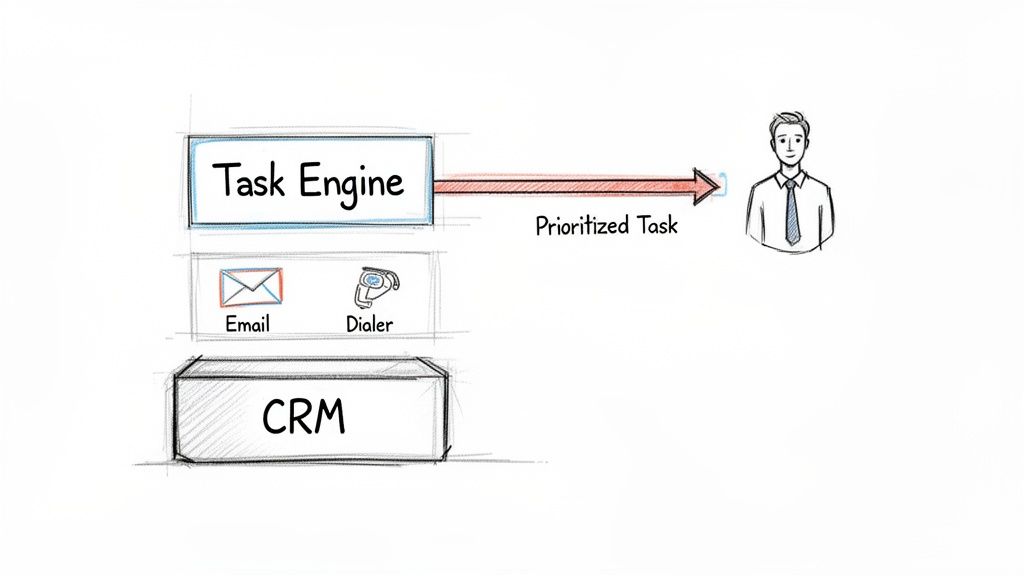
Diagram showing a Task Engine prioritizing email and dialer tasks from CRM to a user.

Comparing Tech Stack Philosophies

Choosing your tech isn't just about features; it’s about what fits your team's real-world workflow. The debate between consolidated platforms and specialized tools is at the heart of this decision.

ApproachKey AdvantageMajor Drawback
All-in-One PlatformsA single, unified system promises seamless data flow and one interface to learn.Often a "jack of all trades, master of none." Core execution tools like dialers can feel like an afterthought.
Specialized ToolsBest-in-class performance for specific jobs, giving you deeper capabilities for things like dialing or email.Can create data silos and force reps to constantly toggle between apps, killing their momentum.

The real answer isn't always one or the other. It’s about finding technology that creates an "execution layer" on top of your CRM, bridging the gap between your strategy on a whiteboard and a rep's daily grind.

The Missing Layer: Rep Execution

Plenty of sales engagement platforms are great at sequencing and reporting. But they often fall short on the most critical piece of the puzzle: helping reps execute their daily tasks with speed and precision. This is exactly the gap that tools like marketbetter.ai were built to fill.

Instead of ripping out your whole stack, an execution-first tool makes it better by zeroing in on the moment of action. It answers the question every rep asks themselves each morning: "Okay, what should I do right now?"

An execution-first tech stack transforms your CRM from a passive database into an active, intelligent work surface that guides reps to their next revenue-generating activity.

This shift in focus makes a massive difference. By 2026, AI-driven sales process optimisation is expected to deliver 20-35% productivity surges and 15-25% higher win rates. It's also projected to slash time reps spend on data entry by 65% while boosting time spent talking to customers by 48%. These aren't just small tweaks; they're fundamental changes to how sales teams operate.

How an AI Task Engine Drives Action

An execution-first platform like marketbetter.ai uses an AI-driven Task Engine to turn buyer signals—like website visits, content downloads, or ICP triggers—into a simple, prioritized to-do list right inside Salesforce or HubSpot. It instantly solves the "what's next?" problem for your reps. If you want to dive deeper, we have a detailed breakdown on how to improve sales rep productivity.

Here’s how it works in the real world:

  1. Prioritization: The AI Task Engine analyzes all the signals and surfaces the highest-value tasks for each rep, completely eliminating the guesswork.
  2. Execution: Reps use native dialers and AI-assisted email workflows directly within their CRM screen. No more switching tabs or manually logging every little thing.
  3. Data Hygiene: Every call, email, and outcome is automatically logged back to the right record. Your CRM data stays pristine, and your reporting becomes dead-on accurate.

For teams looking to integrate the most advanced AI, understanding the capabilities of Large Language Models (LLMs) is a game-changer. This is the technology that powers the intelligent workflows that turn a standard CRM into a dynamic selling machine. By focusing on this execution layer, you get dramatically more value from the tools you already have and build a sales process that actually performs.

Measuring the True Impact of Optimisation

Optimising your sales process feels good, but feelings don't show up on a balance sheet. To justify the effort and truly understand what’s working, you have to look past feel-good numbers like "total calls" and zero in on the key performance indicators (KPIs) that directly impact revenue.

If you can't measure it, you can't manage it. It's an old saying because it's true.

Effective measurement is the difference between guessing which changes moved the needle and knowing for sure. This demands clean, reliable data—a near-impossibility when your reps are stuck manually logging every single activity. Tools that automatically capture every call and email are the foundation for any real reporting, giving leaders a clear view into what actually drives results.

Beyond Vanity Metrics: Key KPI Categories

To get the full picture, you need to track metrics across three distinct but connected categories. This framework helps you see not just how much work is being done, but how well it’s being done and how efficiently your team is operating.

  • Activity KPIs: This is the raw output. Are your reps putting in the effort?
  • Effectiveness KPIs: This measures the quality of that output. Is the effort turning into real conversations and moving deals forward?
  • Efficiency KPIs: This tracks the resources needed to get results. How quickly and cost-effectively is your team performing?

Let's break down the must-have metrics in each category and see what they look like in a broken process versus an optimised one.

Activity and Effectiveness KPIs

Activity metrics are the starting point, but they’re useless without the context of effectiveness. A rep making 100 generic calls with a 1% connect rate is getting smoked by a rep making 50 targeted calls with a 10% connect rate. This is where optimisation proves its worth.

Here’s a quick comparison:

KPI CategoryMetric to TrackIn a Broken ProcessIn an Optimised Process
ActivityDaily Actions Per RepHigh volume of untargeted dials and emails with no real strategy.Consistent, targeted actions focused on high-intent leads surfaced by an AI engine.
EffectivenessConnect & Reply RatesAbysmal rates thanks to generic messaging and calling at the worst possible times.Higher rates driven by AI-assisted, relevant outreach and signal-based timing.
EffectivenessStage Conversion RateDeals get stuck in early stages; conversion is a random, unpredictable mess.Smooth, predictable progression from one stage to the next with clear exit criteria.
EffectivenessSales Cycle LengthDeals drag on for months, often ending in a frustrating "no decision."The time from first touch to close is measurably shorter and more consistent across the team.

By tracking both sets of KPIs, you can diagnose problems with surgical precision. High activity but low effectiveness points to a messaging or targeting problem. Low activity across the board might signal a workflow or motivation issue. Understanding how to properly connect actions to outcomes is a key step, which you can learn more about in our guide to attribution modeling.

Efficiency KPIs: The Hidden ROI

Efficiency metrics are where the ROI of sales process optimisation really comes alive. They measure the "cost" of your sales efforts in time and resources, showing just how much faster your team can generate revenue.

An optimised process doesn't just make reps work harder; it makes their hard work count for more by slashing wasted effort and accelerating their path to productivity.

Think about these critical efficiency indicators:

  • Time Spent on Admin: In a clunky, unoptimised world, reps can burn up to a third of their day on manual data entry. With auto-logging tools, this drops to practically zero, freeing up hours for actual selling.
  • SDR Ramp Time: This is how long it takes a new hire to become fully productive. A streamlined process with clear guidance and AI assistance can literally cut this time in half.

The impact here is massive. Recent sales productivity stats show that only 43.5% of reps hit their quota in early 2024. Yet, a whopping 94% of businesses report productivity boosts after implementing a CRM-centric process, seeing gains like 29% in sales and 34% in overall productivity. The data is clear: fixing the process pays off.

Your Sales Process Optimisation Checklist

Turning a good strategy into a great reality is where most plans fall apart. Think of this checklist as the bridge from concept to execution. It’s your step-by-step guide for taking all the ideas we’ve covered and making them real—the pre-flight check before your sales engine really takes off.

Foundational Planning

Before you touch a single workflow, you need to lay the groundwork. Skipping this is like building a house on sand. Getting the initial audit and stakeholder alignment right isn’t just about getting permission; it’s about gathering the street-level intel you need to make smart calls.

  1. Secure Stakeholder Buy-In: Get your leadership and reps on board by showing them the "why." Use the numbers from your diagnosis phase to put the cost of doing nothing next to the ROI of getting this right.
  2. Conduct a Full Process Audit: Map out your actual sales process, from the first touch to the final signature. The key here is to interview your team to find the real friction points, not just the ones you see from a spreadsheet.
  3. Define Clear Sales Stage Exit Criteria: Kill the ambiguity. What specific, verifiable action proves an opportunity is ready to move from "Discovery" to "Proposal"? Write it down.

The whole point of this first phase is clarity. A fuzzy starting point guarantees a messy journey and a disappointing finish. Nail this, and everything else gets easier.

Execution and Enablement

With a solid plan in hand, it’s time to build, train, and launch. This is where you bring your new process to life with the right tech and give your team the skills to run with it. It’s all about choosing tools that solve real problems and creating resources that people will actually use.

  1. Select and Configure Your Tech Stack: Pick tools that fix the headaches you uncovered in your audit. Go for an execution-first setup—things like a native CRM dialer or automated task lists that make a rep's day genuinely easier.
  2. Develop Training Materials and Playbooks: Nobody will follow a process they don’t understand. Create short, simple guides and quick video tutorials for the new workflow. Make it impossible to ignore.
  3. Establish a Continuous Feedback Loop: Set up regular check-ins with the sales team to hear what they’re experiencing. Compare their stories to the hard data from your KPIs. This gives you the full picture of what’s working and what needs tweaking.

Got Questions? We've Got Answers.

Here are a few common questions that come up when leaders start digging into sales process optimization.

Where Do I Even Start with Optimizing My Sales Process?

The first step, always, is diagnosis. Before you change a single thing, you need a crystal-clear picture of what's happening right now.

That means mapping your current process from the first touch to a closed deal. Talk to your reps—find out where they get stuck and what admin work eats their day. Then, dig into your CRM data to find the exact stages where deals slow down or die. Anything else is just guesswork.

How Does AI Actually Help an SDR Team?

Think of AI as a force multiplier for your SDRs. It automates the high-effort, low-return tasks that burn them out. For example, AI can instantly prioritize who to call based on real buying signals, draft a surprisingly good first-touch email, or pull up the perfect talking points mid-conversation.

It gets your reps out of the data-mining business and into the relationship-building business. They spend their time on actual conversations, not digging through CRM records. It also means new hires get up to speed in weeks, not months.

Can I Optimize My Process if My CRM Data Is a Mess?

Yes, and you absolutely should. In fact, a messy CRM is usually a giant red flag that your process needs optimization. A core goal here is to fix your data hygiene by making it dead simple for reps to log their activity correctly.

Start small. Implement a tool with automatic call and email logging, like a native dialer that lives inside your CRM. The moment it’s easier to do the right thing than the wrong thing, your data quality will improve. Better data leads to better insights, which fuels the next round of optimization.


Stop letting a messy CRM and manual grunt work kill your pipeline. marketbetter.ai turns rep guesswork into a prioritized to-do list, with AI-assisted outreach and a native dialer right inside Salesforce and HubSpot.

See how you can get more activity and cleaner data at https://www.marketbetter.ai.

Unlocking Growth with Marketing Automation B2B

· 23 min read

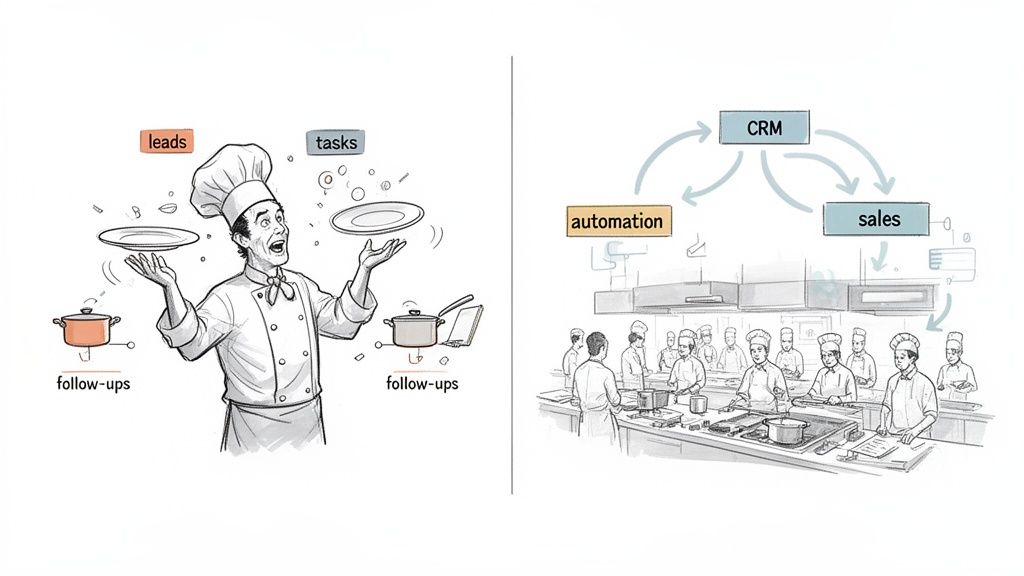
Picture a top-tier restaurant kitchen. Now imagine trying to run it all by yourself—taking orders, cooking, cleaning, and serving every single table. That’s what a B2B sales team is doing without marketing automation B2B software. It’s not just another tool; it's the operational engine that turns chaos into a smooth, efficient service where nothing gets missed.

What Is B2B Marketing Automation, Really?

Illustrates the difference between chaotic manual marketing and efficient B2B automation.

At its heart, B2B marketing automation is all about using software to handle the repetitive, manual tasks that bog down marketing and sales teams. The B2B world is a different beast than B2C. Sales cycles are long, decisions are made by committees, and the journey is complex. This is where manual follow-ups, inconsistent messaging, and administrative overload become massive business risks.

It’s the difference between a lone chef frantically juggling pans and an orchestrated kitchen with dedicated stations for prep, cooking, and plating. Without automation, reps burn valuable time logging calls, sending one-off follow-up emails, and trying to remember which lead to call next. Good leads inevitably slip through the cracks. In a manual setup, a hot inbound lead might wait hours for a response. With automation, that same lead can be routed, assigned, and have a task created in the rep's queue within seconds.

The Strategic Shift from Manual Labor to an Execution Engine

True B2B automation is more than just scheduling a few emails. It’s a fundamental shift in how you operate, turning manual, error-prone processes into a finely tuned engine for revenue growth. This tech was built to solve specific, painful problems that plague B2B sales teams every single day.

The adoption rates tell the story. A whopping 79% of marketers are now automating parts of their customer journey. This isn’t just a trend; it's a response to a real need, with 91% of organizations reporting that requests for automation are on the rise across the board. If you want the full picture, you can dive deeper into the latest marketing automation statistics.

A B2B sales team without automation is just a collection of individual efforts. With automation, it becomes a coordinated system designed to engage the entire buying committee at the right time, with the right message, every single time.

Key Problems Solved by B2B Automation

So, what headaches does it actually cure? Here are actionable problems you can solve today:

  • Eliminating Inconsistent Follow-Up: Automation makes sure every lead gets timely, relevant communication based on what they do.
    • Actionable Tip: Set up a simple "lead nurture" workflow. If a lead downloaded a whitepaper, trigger a 3-email sequence over 10 days that offers related content and a call with a specialist.
  • Freeing Up Sales Reps: By taking over tedious tasks like data entry and activity logging, it lets reps focus on what they do best: building relationships and closing deals.
    • Actionable Tip: Choose an automation tool that automatically logs every call and email to your CRM. This single change can give reps back an hour a day.
  • Preventing Lost Leads: It acts as a safety net. It captures and nurtures leads that aren't quite ready to buy, keeping them warm so they don’t just vanish from your pipeline.
    • Actionable Tip: Create a "recycling" workflow. When a lead is marked "closed-lost," automatically add them to a 6-month check-in sequence to stay top-of-mind.

Ultimately, marketing automation platforms turn chaotic, person-dependent workflows into predictable, scalable systems. This paves the way for faster growth, more accurate forecasting, and a sales team that can finally hit its full potential.

The Real Payoff: What B2B Automation Actually Delivers

Let’s be honest, "saving time" is a lazy promise. It doesn't get a budget approved. The real value of marketing automation b2b isn’t just about doing things faster; it’s about turning your team's daily grind into predictable revenue. It’s about giving leadership the hard numbers they need to see this isn't just another tool—it's a growth engine.

For a VP of Sales, this means a fatter pipeline, faster. It’s about watching lead-to-opportunity rates climb because follow-up is sharp and immediate. For an SDR leader, it's about giving your reps the superpower to have more quality conversations every single day. And for the RevOps team? It's the holy grail: clean, automatically logged CRM data you can actually trust for forecasting and attribution.

More Selling, Less Clicking

The first and most obvious win happens on the sales floor. Right now, your Sales Development Reps (SDRs) are probably burning hours on tasks that generate zero pipeline—manually logging calls, hunting for contact info, and guessing who to reach out to next. An automation platform rips that friction right out of their day.

It serves up the "next best action" on a silver platter, based on what a buyer is actually doing. No more digging. Just clear, prioritized tasks inside their workflow. When your dialer and an AI email writer live right inside the CRM, reps can pounce on an opportunity instantly. No more context switching, no more tab juggling—just pure execution.

This is a massive accelerator for new hires, too. Instead of spending months learning a Frankenstein's monster of a tech stack, they just follow the guided workflow. They become productive in weeks, not quarters.

Finally, Data You Can Believe In

Bad CRM data is a silent killer for B2B teams. When reps forget to log calls or fudge their notes, leadership is flying blind. You can't forecast with any confidence, you have no idea which campaigns are really working, and you can't attribute a single dollar of pipeline correctly.

Marketing automation flips the script by making perfect data hygiene the path of least resistance. When every single call, email, and touchpoint is launched from the CRM and logged automatically, you get 100% data integrity by design, not by begging your reps to do it.

This gives RevOps a pristine dataset to build dashboards and attribution models that reflect reality. It’s the end of chasing down reps for updates and trying to build a forecast on a foundation of swiss cheese.

The Before and After Transformation

Putting a manual process next to an automated one shows just how massive the shift is. It’s not a small step up; it’s a different league entirely. A core benefit here is how automation scales your outreach, which is a key pillar of the top B2B lead generation strategies that winning teams deploy.

Let's look at what this transformation actually looks like for a sales development team.

Manual SDR Workflow vs Automated Execution Engine

Here’s a snapshot of a typical B2B sales development team's performance before and after integrating their workflow into a unified automation and execution platform. The numbers speak for themselves.

MetricManual Process (Before)Automated Workflow (After)
Daily Outbound Actions50-60 calls/emails per rep120+ calls/emails per rep
CRM Data Accuracy~65% (manual, inconsistent logging)~100% (automatic logging)
New SDR Ramp Time3-4 months to full productivity4-6 weeks to full productivity
Lead-to-Opportunity Rate8% (inconsistent follow-up)15% (timely, relevant outreach)

This isn't just an incremental improvement—it’s a fundamental change in your team’s capacity to generate pipeline. B2B automation turns the art of sales into a science, driving predictable outcomes by making sure the right actions happen at the right time, every time, with flawless data capture.

A Practical Roadmap to Your First Automation Win

The thought of rolling out a new automation platform can make any team groan. You picture months of painful setup, disrupted workflows, and a long, slow crawl before you see any actual value. It doesn't have to be that way.

Successful marketing automation b2b adoption isn't about boiling the ocean on day one. It's about securing a quick, high-impact win that builds real momentum.

This roadmap is designed to get you from planning to tangible results without derailing your team. It's a simple, four-phase framework to help you start small, solve a real problem, and expand when you're ready. The goal is to deliver immediate value that gets your reps excited and your leadership convinced.

Phase 1: Pinpoint Your Biggest Bottlenecks

Before you can automate anything, you need to know exactly where the friction is. The best automation targets the most painful, time-consuming, and error-prone parts of your current process. Don't start with a vague goal like "improve efficiency." Get specific.

Actionable Step: Interview three of your sales reps. Ask them: "What is the single most annoying, time-wasting task you do every day?" Listen for patterns. Common answers include:

  • Manual Data Entry: "Logging my calls and updating Salesforce fields after a block of dials takes forever."
  • Poor Lead Follow-Up: "I get an alert that a hot lead visited the pricing page, but by the time I can research them and reach out, they've gone cold."
  • Low Email Relevance: "I spend too much time researching accounts just to write a semi-personalized first email."

Find the one or two bottlenecks doing the most damage to your pipeline and your team's morale. This isn't a wishlist—it's a diagnosis of your most critical operational wound.

Phase 2: Prioritize a High-Impact Use Case

Once you've found the bottleneck, pick a single, high-impact use case to solve it. Instead of trying to automate everything at once, focus on one contained workflow that will deliver a clear, measurable win. This is how you build confidence and drive adoption from the ground up.

A great example is automating tasks that come from intent data. Manually, a rep has to see a signal, research the account, find the right contact, create a CRM task, and then finally reach out. The process is slow and full of drop-off points.

An automated workflow, on the other hand, could instantly take that same signal, create a prioritized task in the CRM, and serve it to the right rep with an AI-generated email draft and a click-to-call button. That single change turns a 15-minute manual slog into a 30-second action.

To get ideas for your own high-impact workflows, you can learn more about common marketing automation workflows that deliver rapid results.

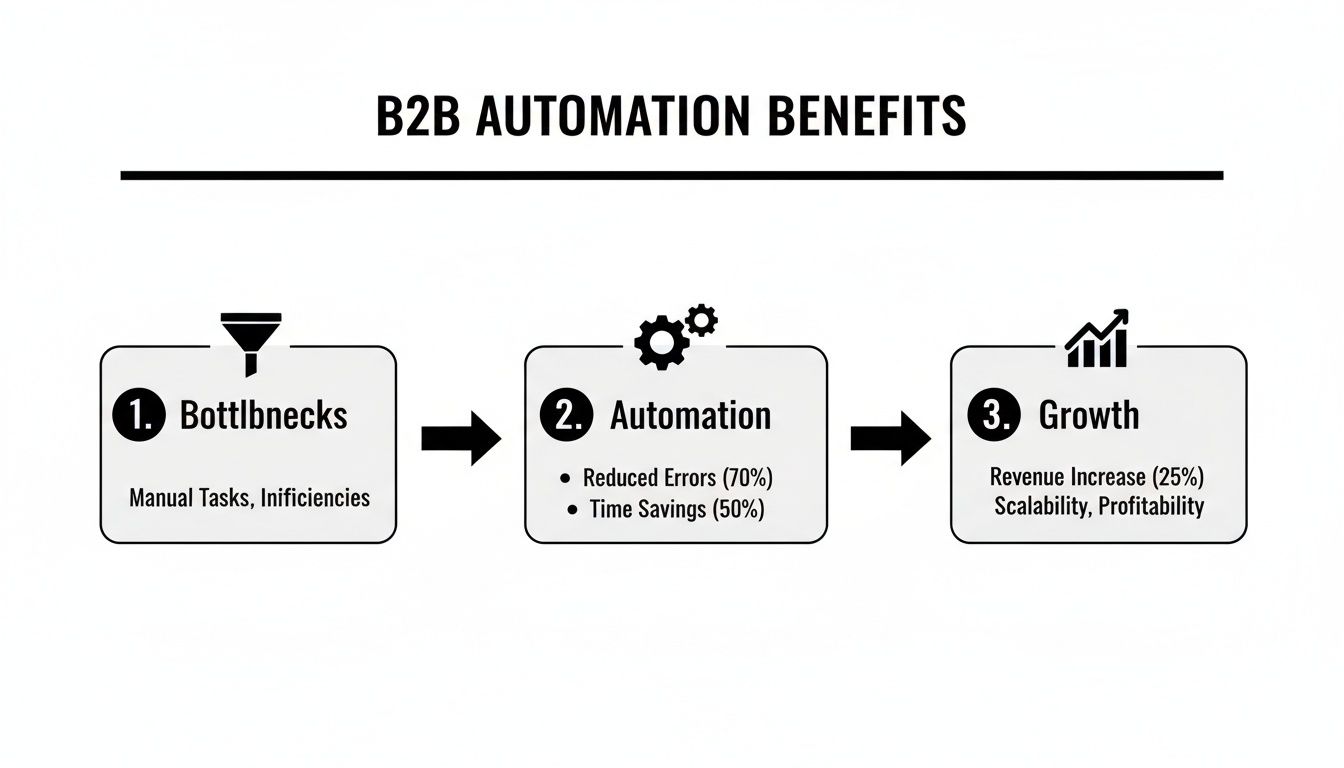
This visual shows exactly how finding bottlenecks and applying automation leads to measurable growth.

Diagram showing B2B automation benefits: reducing bottlenecks, increasing efficiency, and driving growth.

The key insight? Growth isn't just about strategy; it's about removing the operational friction that slows your team down.

Phase 3: Seamlessly Integrate with Core Systems

The number one reason automation rollouts fail is poor user adoption. And the fastest way to kill adoption is to force your reps into yet another browser tab.

Your automation engine has to live where your team works—inside your CRM.

Actionable Step: During vendor demos, insist on seeing the workflow from a rep's perspective. Ask them: "Show me exactly how a rep completes their five most common tasks without leaving the CRM." If they have to switch tabs, it's a red flag. Whether you use Salesforce or HubSpot, a native integration is non-negotiable. For instance, a key part of a practical roadmap involves strategies like turning LinkedIn outreach into a B2B sales machine, which is most effective when managed from a central system.

Phase 4: Measure, Iterate, and Expand

With your first workflow live, the final phase is all about proving its value and scaling your success. Start by tracking the metrics tied directly to your initial bottleneck.

Actionable Step: Before you launch, create a simple "before" and "after" dashboard.

  • If you automated activity logging: Measure the percentage of calls logged before and after. The goal should be a jump from ~60% to 100% accuracy.
  • If you automated intent signal follow-up: Track the average time-to-first-touch (in minutes) and the lead-to-meeting conversion rate. Aim to cut the time by at least 90%.

Share these early wins with your team and leadership. Use that momentum to identify the next bottleneck and repeat the process. By tackling one problem at a time, you methodically build a powerful automation engine that solves real-world challenges and drives sustainable growth—without disrupting your entire organization.

How to Choose the Right B2B Automation Platform

Picking the right automation platform is one of those decisions that can either supercharge your revenue team or bog them down in useless complexity. It’s not about finding the longest feature list. It’s about finding a tool that fits so neatly into your reps' daily grind that they wonder how they ever worked without it.

The wrong choice adds another login, another dashboard, another layer of friction. The right one becomes the engine that drives everything.

The very first question you should ask any vendor is simple: "Where does your platform live?" If the answer involves opening yet another browser tab outside of their CRM, you're looking at a huge adoption problem right out of the gate. Real, effective automation works where your team works—natively, inside the tools they already have open all day, like Salesforce or HubSpot.

Execution Engine or Just Another Dashboard

A lot of platforms are built for managers, not for reps. They're packed with complex dashboards and analytics suites that look impressive in a demo. But analytics don't book meetings. Execution does.

Your SDRs need a tool built to help them act—to make one more call, send a smarter email, and have every single touchpoint logged perfectly without a second thought. So, the question is, is this an execution-first engine designed to tee up the "next best action" for a rep? Or is it just another dashboard they have to manage?

This is the critical difference between a tool reps actually love and one they ignore.

The Critical Role of Guaranteed Data Hygiene

This brings us to the next deal-breaker: data integrity. You have to ask vendors how their system guarantees that every activity is logged accurately. Manual data entry is the silent killer of reliable reporting and accurate forecasting.

A platform that automatically logs every call, email, and meeting outcome by design is in a completely different league than one that depends on reps remembering to update records after the fact.

The best B2B automation platforms make perfect data hygiene the path of least resistance. When every action is launched from and logged back to the CRM automatically, you get 100% data visibility without having to chase down your team.

This is how RevOps and sales leaders get a clean, trustworthy dataset for attribution, performance tracking, and strategic planning. Without it, you’re just guessing.

The sketch below nails the difference between a cluttered, multi-app mess and a clean, CRM-native workflow.

As you can see, execution-first tools don't add to the chaos. They simplify the tech stack by plugging directly into the CRM, keeping reps focused instead of forcing them to juggle a half-dozen different applications.

Comparing All-in-One Platforms to Execution Engines

To really get to the heart of the matter, you need to understand the two competing philosophies in the sales automation world. On one side, you have the "all-in-one" platforms that try to be everything to everyone. On the other, you have specialized "execution-first" engines built for one purpose: solving the core problems of an outbound sales team. This becomes especially important when you start looking at modern AI marketing automation tools that all claim to make reps more efficient.

Here's a quick table to help you compare the two approaches.

Sales Engagement Platform vs Execution-First Task Engine

This comparison clarifies the fundamental differences in approach. All-in-one platforms often act as a separate command center, while execution-first engines are designed to be an invisible, powerful extension of your CRM.

Evaluation CriteriaAll-in-One Sales Engagement Platform (e.g., Salesloft/Outreach)Execution-First SDR Task Engine (e.g., marketbetter.ai)
Primary FocusManages sequences, contacts, and reporting in a separate application.Executes prioritized tasks (calls/emails) from within the CRM.
User WorkflowReps must switch between the CRM and the platform's browser tab.Reps stay entirely within their Salesforce or HubSpot workflow.
Data LoggingOften relies on syncing, which can lead to delays, errors, or incomplete data.Every action is logged instantly and automatically to the CRM record.
Main Value PropA centralized library for managing large-scale outreach campaigns.Maximum SDR efficiency and perfect data hygiene by design.
Adoption RiskHigh. Reps often resist using "yet another tool" that complicates their day.Low. It makes the job easier inside the system they already use.

Ultimately, your choice boils down to what problem you’re actually trying to solve. If your biggest headaches are slow SDR workflows, low daily activity numbers, and messy data that makes attribution impossible, an execution-first engine is your answer. It’s purpose-built to fix the operational bottlenecks that kill pipeline growth, not just to add another pretty dashboard to your tech stack.

Measuring the KPIs and ROI That Truly Matter

Putting a B2B marketing automation platform to work isn't about making your team look busier. It's about driving real, tangible business outcomes. The whole point is to turn those newfound efficiencies into financial and operational wins. To do that, you have to connect the dots between your team's daily grind and bottom-line growth.

Success isn't found in tracking activity metrics like emails sent or calls logged. While those numbers are useful for measuring raw output, the real story—the one your leadership team actually cares about—is told by outcome metrics.

Activity vs. Outcome: Knowing the Difference

Think of it this way: activity metrics measure the work being done, while outcome metrics measure the impact of that work. An SDR manager needs to see a high volume of daily outbound actions, but a VP of Sales is fixated on the pipeline that activity generates.

You need to track both, but always with an eye on how one drives the other. A spike in daily calls is only valuable if it leads directly to a higher meeting-booked rate. Here's a comparative look:

  • Activity Metrics (The "How Busy"): These are leading indicators. They're easy to measure but don't tell the whole story.

    • Number of calls logged per rep
    • Number of personalized emails sent
    • Tasks completed from the queue
  • Outcome Metrics (The "How Effective"): These are lagging indicators that prove the strategy is working and tie directly to revenue.

    • Pipeline generated from outbound efforts
    • Lead-to-opportunity conversion rate
    • Sales cycle length (and how much you're shrinking it)

Actionable Tip: Create a dashboard that connects one key activity metric to one key outcome metric. For example, show a chart that plots "Calls per Rep per Day" against "Meetings Booked per Rep per Week." This visually proves that increased, focused activity is driving real results.

Calculating the True Return on Investment

Measuring the ROI of marketing automation goes way beyond simple cost savings. Automation is flexing some serious financial muscle in B2B sales development, delivering an impressive 544% average return—that's a whopping $5.44 back for every single dollar spent.

Digging a little deeper, B2B automation has been shown to drive a 451% increase in qualified leads, turning faint signals into genuine sales opportunities. For any demand gen manager or sales leader whose team is drowning in admin work, that kind of impact is massive. Platforms like marketbetter.ai embed AI-powered cold email writers and dialers right into Salesforce or HubSpot, auto-logging every single action for pristine data hygiene. You can get more stats on the financial impact of marketing automation on flowlyn.com.

The core of automation ROI is proving you're not just doing more things, but that you're doing the right things more efficiently. It's about showing how a smarter workflow leads directly to a healthier sales pipeline and faster revenue growth.

When every single action is logged perfectly, you also get a massive leg up on attribution. For any RevOps leader, this clean data is priceless. It finally allows them to build attribution models that accurately show which activities are creating and influencing revenue. That clarity helps you double down on what works and kill what doesn't. You can dive deeper into this topic by exploring our guide on the most important marketing KPIs for B2B teams.

KPIs That Resonate with Different Leaders

To truly prove your automation platform's worth, you have to speak the language of your stakeholders. Every leader cares about a different slice of the pie, so tailor your reporting to highlight the KPIs that matter most to them.

What Different Leaders Want to See

RoleKey ConcernsKPIs to Report
SDR ManagerRep productivity, ramp time, daily outputDaily actions per rep, connect rates, meetings booked
VP of SalesPipeline growth, forecast accuracy, team capacityPipeline created, lead conversion rates, sales cycle duration
RevOps LeaderData integrity, attribution, tech stack ROICRM data accuracy, influenced revenue, cost per opportunity

When you frame your results in the context of what each leader values, you demonstrate a holistic impact across the entire revenue organization. This approach shifts the conversation from, "How much does this tool cost?" to "How much more revenue can we generate with this tool?" That strategic alignment is what ensures continued investment and support for your automation programs.

Free Tool

Try our Marketing Plan Generator — generate a complete AI-powered marketing plan in minutes. No signup required.

Common Questions About B2B Marketing Automation

When you’re looking at a new marketing automation b2b strategy, the tough questions and skeptical objections are guaranteed to pop up. And they should. The goal isn't to brush those concerns aside, but to meet them head-on with straight, real-world answers.

Let's dive into the practical challenges that VPs of Sales, SDR leaders, and RevOps pros bring up when they're kicking the tires on a new platform.

We Already Have a Sales Engagement Platform. How Is This Different?

That’s a perfectly fair question, and one we hear all the time. Most sales engagement tools like Salesloft or Outreach operate like a separate library for your contacts and sequences. They're great for planning, but they force reps to work in another tab, away from their source of truth—the CRM.

Here's the key comparison: An all-in-one platform is like a separate kitchen built next to your restaurant. An execution-first engine is like upgrading the equipment inside your existing kitchen.

It doesn’t make reps switch windows to see what’s next. Instead, it serves up the "next best action" based on live buyer signals—and gives them the tools, like a native dialer or an AI email writer, to act on it instantly within the CRM record. You're moving from a planning tool to an action tool that ensures the work gets done and the data gets logged, perfectly, every single time.

Will AI-Generated Emails Sound Generic or Robotic?

The output you get from AI is only as good as the input you give it. This is where most basic AI writers fall flat; they have no context, so they spit out generic, bland content.

A smarter system grounds its AI in your own CRM data.

It looks at the account history, the specific persona you're targeting, and the buyer's recent activity to draft outbound emails that are genuinely relevant and punchy. The idea isn't to replace the rep's brain, but to give them a killer first draft they can quickly tweak and send. It’s about assistance, not full automation. Think of it as a sous chef prepping ingredients versus a robot cooking the whole meal. The rep is still the chef.

The single biggest failure point is poor user adoption, which almost always stems from a workflow that operates outside the team's primary system. Success comes from embedding automation directly into the existing CRM workflow.

What Is the Most Common Reason an Automation Rollout Fails?

Hands down, the number one killer of any new tool is poor user adoption. And that almost always comes from forcing a workflow that lives outside the team's main system. If you give your reps another tool that makes them constantly juggle windows, they just won't use it consistently. It's that simple.

Success is all about embedding the automation right into the CRM workflow they already know.

Actionable takeaway: A great implementation makes the rep's job easier within the system they already live in all day. Every action is simpler and logged automatically. That native approach is the difference between a tool that collects digital dust and one that actually drives revenue.

How Long Does It Take to See a Return on Investment?

You'll see the full ROI build over a few quarters, but the initial returns can show up incredibly fast by tackling the most immediate pain points first.

  • Immediate Gains (First 30 Days): Just by flipping on a CRM-native dialer, you can see a rep's daily call volume and connect rate jump within the first month. By automating activity logging, you get 100% data visibility from day one. No more gaps.
  • Strategic Returns (First 1-2 Quarters): The bigger wins—like shorter sales cycles and higher conversion rates—start to become obvious within one or two quarters. That's when the daily efficiency gains really start to compound and your team finds its rhythm.

At marketbetter.ai, we turn buyer signals into prioritized SDR tasks and help reps execute with AI-powered tools inside Salesforce and HubSpot. Discover how our execution-first engine can transform your outbound motion.