3 posts tagged with "personalization"

View All Tags

What Is Dynamic Content? A Practical Guide to Personalization

· 23 min read

So, what exactly is dynamic content? At its core, it’s digital material that changes on the fly based on who's looking at it—their behavior, their preferences, their location. Instead of blasting everyone with the same generic message, it creates a personalized experience by adapting what someone sees on a website, in an email, or inside an app.

Understanding Dynamic Content in Simple Terms

Picture walking into your favorite coffee shop. The barista greets you by name and asks, "The usual today?" That small, personal touch feels good. It builds a connection and makes you want to come back.

Dynamic content brings that exact feeling to the digital world. It transforms a website from a static billboard into a living, responsive conversation.

It works by using data—like your location, browsing history, or past purchases—to show you things you'll actually care about. If you want to go a bit deeper on the mechanics, this is a great explainer on What Is Dynamic Content?. The goal is simple: make every interaction more relevant and ditch the one-size-fits-all approach for good.

Static vs Dynamic Content

The easiest way to really get what dynamic content is all about is to put it side-by-side with its opposite: static content. A static website is like a printed brochure. Every single person who picks it up sees the exact same information, images, and offers. It's fixed. Unchanging.

Dynamic content, on the other hand, is like a personal shopper. It quickly figures out who you are and what you might be looking for, then presents you with the perfect options. This isn't just a gimmick; it's a cornerstone of modern marketing.

The fundamental difference is simple: Static content speaks at an audience, while dynamic content speaks to an individual. It’s the shift from broadcasting a single message to having millions of personalized conversations at once.

Static Content vs Dynamic Content at a Glance

Let’s lay out the key differences in a table to make it crystal clear. Think of static content as that billboard on the highway everyone sees, while dynamic content is the personal shopper who knows your style.

FeatureStatic Content (The Billboard)Dynamic Content (The Personal Shopper)
User ExperienceUniform, one-size-fits-all. Everyone sees the same thing.Unique journey tailored to each visitor’s interests and needs.
PersonalizationImpossible. The message is fixed.Built around personalization, showing relevant offers or messages.
PerformanceCan load quickly but often has lower engagement.Drives higher engagement, conversions, and long-term loyalty.
Use CasesBasic info pages, blogs, company "About Us" sections.E-commerce recommendations, targeted ads, personalized emails.

This side-by-side view really highlights why the shift toward dynamic experiences is so critical for any brand that wants to connect with its customers, not just talk at them.

Here are the practical takeaways:

  • User Experience: Static is predictable and impersonal. Dynamic creates a unique journey for every single person based on their interests.

  • Personalization: With static content, you can't personalize anything. Dynamic content is built for it, using data to show relevant products or messages. To see how this plays out in the real world, check out our guide on effective marketing personalization strategies.

  • Performance: A static page might have a slight edge on initial load speed, but dynamic content absolutely crushes it in the metrics that matter—engagement, conversion rates, and customer loyalty.

This distinction isn't just academic. It directly shapes how customers see your brand and whether they decide you're worth their time and money.

The Engine Behind Personalized Experiences

Ever wonder how a retailer's website knows to show you a winter coat in January while a visitor in Florida sees swimsuits? It’s not magic. It’s a well-oiled machine humming just beneath the surface. To really get what dynamic content is, you need to peek under the hood at the three core parts that make it all happen.

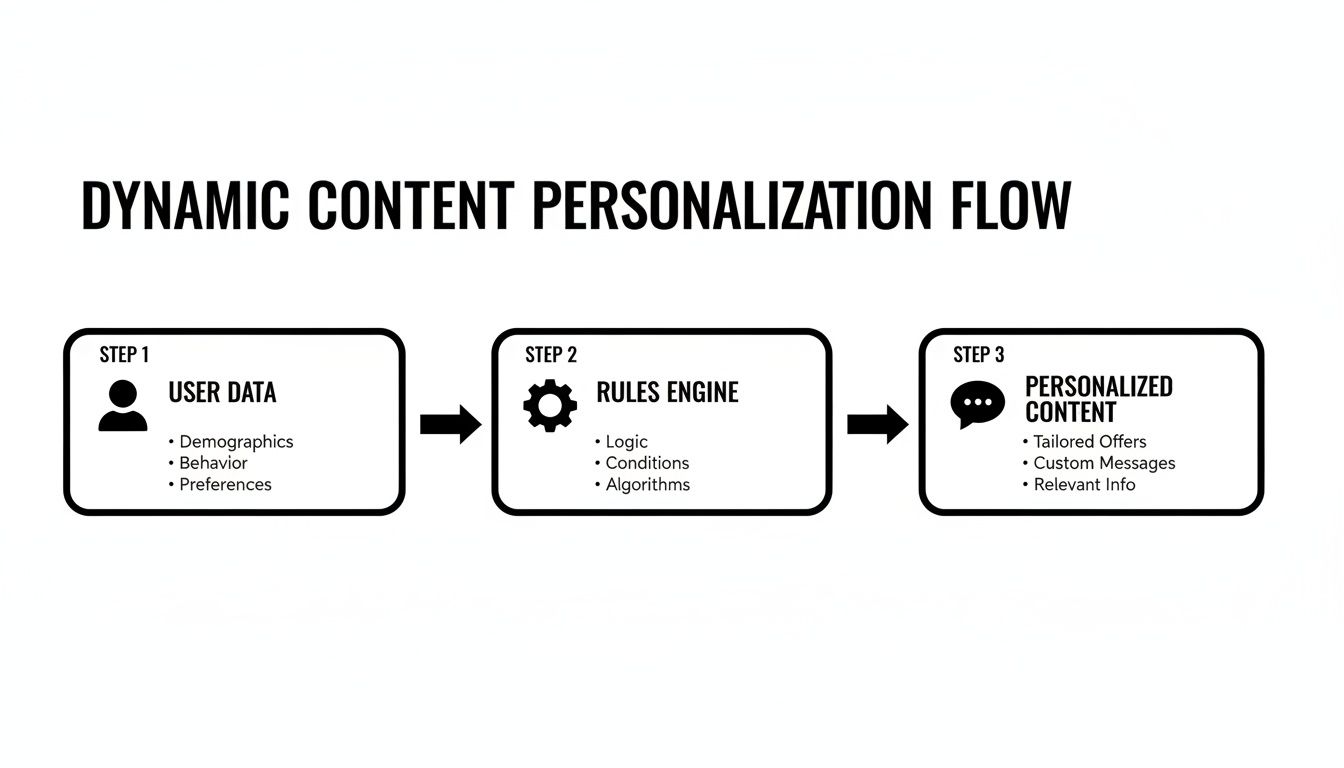
Think of it like a simple conversation: listening, thinking, and then speaking. First, the system "listens" by gathering clues about the user. Next, it "thinks" by applying a set of rules to that information. Finally, it "speaks" by delivering the perfect piece of content.

This diagram breaks down that simple but powerful flow—from raw user data to a perfectly timed, personalized message.

Diagram illustrating the dynamic content personalization flow from user data through a rules engine to personalized content.

As you can see, the process is all about turning anonymous data points into a relevant, one-to-one experience by filtering them through a decision-making engine.

Step 1: Data Collection — The Listening Phase

Every dynamic interaction starts with data. This is the "listening" phase, where your website or app is quietly collecting clues about who the visitor is and what they're looking for. This information can stream in from all over the place.

Some of the most valuable data points include:

  • Behavioral Data: Which pages did they visit? What products did they click on? Did they ditch a full shopping cart?
  • Contextual Data: What’s their geographic location? Are they browsing on a phone or a desktop? What time of day is it?
  • Demographic Data: For known users, this could be their age, industry, or job title, often pulled straight from your CRM.

To get even sharper, marketers often look at external signals, like intent data, to understand what topics a user is actively researching across the wider web. It adds another layer of insight.

Step 2: Rules Engine — The Thinking Brain

Once the data is in, it’s fed into the "thinking" brain of the operation: the rules engine. This is where the logic lives. A rules engine runs on simple "if-then" statements that you get to define.

For example, a rule might be as basic as:

  • IF a visitor is from Canada, THEN show them the winter collection banner.
  • IF a visitor is a returning customer, THEN greet them with a "Welcome Back" message and personalized recommendations.

These rules can be straightforward or incredibly complex, layering multiple conditions to create hyper-targeted audience segments. The engine’s job is to instantly check a user’s data against these rules and decide which content variation to serve up.

The rules engine is the critical bridge between raw data and a relevant experience. It’s where abstract information like location or click history is translated into a concrete, actionable decision about what content to display.

This is where you can start getting sophisticated. A basic engine just follows the commands you set. But more advanced systems use AI and machine learning to analyze data and make predictive decisions on their own, without you having to write an "if-then" rule for every possible scenario.

Step 3: Content Delivery — The Speaking Part

The final piece is content delivery—the "speaking" part. After the rules engine makes its split-second decision, the system serves the right content to the user in real time. The generic homepage banner gets swapped for the personalized version, and the user is none the wiser.

This whole process happens in the blink of an eye. The visitor never sees the logic whirring in the background; they just get a webpage that feels like it was made just for them. It’s this seamless execution that makes dynamic content so powerful. To pull this off effectively, you need a solid handle on your data, which is where a strong customer data platform integration becomes essential.

Bringing Dynamic Content to Life in Your Marketing

Knowing the theory is great, but seeing dynamic content actually drive results? That's the real win. It's time to move from concepts to concrete plays and look at how these strategies transform generic marketing messages into powerful, personalized experiences that actually work.

Every single use of dynamic content should tie back to a real business goal—whether that's more conversions, better engagement, or just earning some long-term loyalty. The trick is to start with a clear "why" and then figure out the "how."

A person holding a smartphone next to a tablet displaying 'Personalized Marketing' on a wooden desk.

This isn't about one-off tricks. Effective personalization is a sequence of targeted touchpoints, each designed to guide a user through their own unique journey with your brand.

Dynamic Website Personalization

Your website is your digital storefront. It's often the first real impression someone gets. Instead of laying out a generic welcome mat for everyone, you can create a tailored experience from the moment they land. And this goes way beyond just plugging in their first name.

Think about these practical examples:

  • Smarter Hero Banners: A B2B software company could show a hero image that speaks directly to a visitor's industry. Someone from a healthcare company sees a hospital case study, while a visitor from the finance world sees a testimonial from a bank. Same page, completely different feel.
  • Location-Based Offers: A retail brand can instantly show a promotion for the nearest physical store or highlight products that are trending in the visitor's city. It makes the offer feel immediate and far more relevant.
  • Custom CTA Buttons: The call-to-action can change based on where someone is in their journey. A brand-new visitor might see a "Learn More" button, but a returning lead who has already downloaded a guide sees "Request a Demo." It’s a simple, smooth way to guide them down the funnel.

When you swap static elements for dynamic ones, your website stops being a passive brochure and becomes an active participant in the sales conversation. It starts anticipating what users need instead of just waiting for them to find it.

Hyper-Personalized Email Campaigns

Email is where dynamic content really flexes its muscles. It's the difference between a generic email blast that gets instantly archived and a one-to-one conversation that people actually open and click.

Here’s a quick breakdown of a static vs. dynamic email:

Email ElementStatic Approach (Everyone gets this)Dynamic Approach (Personalized for you)
Subject Line"Our Weekly Newsletter Is Here!""John, Here Are 3 Products You'll Love"
Product SectionShows the same 5 best-sellers to all subscribers.Displays products the user previously viewed but didn't buy.
OfferA generic 10% off coupon for everyone.A special offer on an item left in the user's abandoned cart.

The difference is night and day. The dynamic approach speaks directly to what you know about the user, making the content impossible to ignore. It’s not just a hunch; dynamic strategies can generate three times more leads per dollar than paid ads and boost email open rates by a whopping 26%.

Dynamic In-App and Ad Content

This thinking shouldn't be confined to your website or inbox. You can (and should) extend this personalized strategy to your in-app messages and digital ads to create a single, seamless experience everywhere your brand shows up.

Here’s how to put it into action:

  1. Custom In-App Notifications: If a user hasn't tried a key feature in your app, you can send a push notification with a quick tutorial. It’s a smart way to re-engage them based on their actual behavior inside the product.
  2. Smarter Retargeting Ads: Go beyond showing a generic ad to everyone who visited your site. Instead, serve up a dynamic ad that features the exact product someone looked at. It’s a powerful reminder that brings their interest right back to the forefront.
  3. Lifecycle-Aware Banners: Inside a SaaS app, a brand-new user might see a banner with links to onboarding guides. A seasoned power user, on the other hand, could see an invitation to a webinar on advanced features.

Many of these complex, data-driven campaigns are now managed through advanced platforms. If you're curious about the tech making this possible, you can learn more about how AI is used for marketing automation in our detailed guide.

When you start implementing these strategies, you stop broadcasting and start communicating. Every dynamic element you add works to build a stronger, more relevant connection with your audience—and that has a direct impact on engagement and your bottom line.

Measuring the Real-World Impact of Your Strategy

A great strategy is only as good as the results it delivers. Rolling out dynamic content just feels right, but to get budget and keep stakeholders happy, you need to back up that gut feeling with cold, hard data. It’s time to move past assumptions and connect your personalization efforts to actual business outcomes.

The goal here is simple: translate fuzzy benefits like "better engagement" into specific, measurable wins. Instead of just hoping for the best, you need a clear way to track the key performance indicators (KPIs) that prove your strategy is actually working.

Key Metrics That Prove Your Success

When you swap a static, one-size-fits-all experience for a dynamic one, you’re fundamentally changing how people interact with your brand. The right metrics will tell that story for you, showing exactly where personalization is paying off.

Focus on tracking these core performance indicators:

  • Engagement Metrics: Are people sticking around? Look for a lower bounce rate and a higher time on page. These are the clearest signs that your content is relevant enough to hold attention.
  • Conversion Metrics: This is where the money is. Keep a close eye on your click-through rate (CTR) for personalized calls-to-action and, most importantly, the overall conversion rate for your main goals, whether that's a sign-up or a sale.
  • Loyalty and Revenue Metrics: For the long game, track Customer Lifetime Value (CLV). A truly personalized journey encourages repeat business and builds loyalty, directly boosting how much each customer is worth to you over time.

Comparing Dynamic vs Static with A/B Testing

To build an undeniable business case, you have to put your new dynamic approach head-to-head with the old static version. This is where A/B testing becomes your secret weapon. It’s the cleanest way to isolate the impact of personalization and show a direct return on your investment.

Here’s a simple framework to get your tests running:

  1. Isolate One Variable: Don't try to boil the ocean. Start small by testing a single dynamic element, like a personalized hero banner or a targeted call-to-action.
  2. Define Your Audience Split: Serve the static version (Control Group A) to 50% of your audience and the new dynamic version (Test Group B) to the other 50%.
  3. Set a Clear Goal: Decide what success looks like before you start. Is it a higher CTR on the banner? More form submissions?
  4. Run the Test and Analyze: Let it run long enough to get statistically significant results, then compare the performance of Group A versus Group B. The numbers won't lie.

A well-structured A/B test kills all the guesswork. It gives you clear, quantitative proof that showing the right message to the right person drives a better outcome than a generic blast.

There’s a reason the content analytics market is projected to grow at an 18.9% CAGR. Companies that use these insights to deliver truly personalized experiences are seeing a 20% uplift in engagement. You can discover more insights about content analytics on Grand View Research. By measuring what matters, you can confidently prove the real-world impact of your dynamic content strategy.

Building Your First Dynamic Content Campaign

Alright, let's move from theory to action. Getting your first dynamic content campaign off the ground can feel like a huge lift, but it’s really about breaking the process down into manageable chunks. This is your roadmap for getting started.

Success here doesn’t start with cool tech. It starts with strategy—knowing exactly what you want to accomplish and who you're talking to.

Step 1: Define Your Goals and Audience Segments

Before you touch a line of code or design a single graphic, you have to nail two questions: What business result are we chasing? And who, specifically, are we trying to influence? Without sharp answers, you're just making noise.

Your goals need to be concrete. "Increase engagement" is a wish. "Reduce bounce rate by 15% on our pricing page for enterprise visitors" is a goal. It's specific, measurable, and gives you a clear target.

Once you have that goal, think about the distinct groups of people who will see different versions of your content. These are your segments.

For example, a B2B software company might slice its audience like this:

  • By Industry: Show a healthcare-focused case study to visitors clicking in from a hospital network.
  • By Company Size: Display an enterprise pricing plan to someone whose IP address traces back to a Fortune 500 company.
  • By Behavior: Offer a product demo popup to a user who has visited the pricing page three times this week.

Step 2: Organize Your Data and Pick Your Tools

With your goals and segments clear, it's time to check the fuel tank: your data. What information are you actually collecting on your customers, and is it organized in a way that’s usable? This data is what your system will use to decide which content to show to whom.

This is also the perfect time to look at your tech stack. It doesn’t need to be some complicated, multi-headed beast, but it must be able to execute the rules you plan on setting.

Here’s a quick way to think about your options:

Tool CategoryBest ForKey Function
Email Service Provider (ESP)Basic email personalization (e.g., first name, city).Segmenting lists and inserting simple dynamic fields.
All-in-One Marketing PlatformWebsite and email personalization based on known data (like a lead's lifecycle stage).Connecting website behavior to your CRM for a single view of the customer.
Dedicated Personalization EngineAdvanced, real-time personalization for anonymous and known visitors.Using AI and complex rule sets to deliver hyper-relevant experiences on the fly.

The right tool depends entirely on your ambition. A simple name-merge in an email? Your ESP is fine. Real-time website changes based on browsing behavior? You’ll need a dedicated engine.

Step 3: Create and Launch Your Content Variations

Now for the fun part. You get to create the different versions of content—the headlines, images, and calls-to-action—that each of your segments will see. The magic is in making each variation speak directly to that specific group's pain points or context.

Let’s say you’re personalizing the hero section of your homepage for different industries. You’d create:

  • A headline, image, and CTA for the Finance segment.
  • A different headline, image, and CTA for the Healthcare segment.
  • And a default version for anyone who doesn't fit a defined segment.

Always, always have a default version of your content. This is your safety net. It ensures any visitor who doesn't match a specific rule still gets a coherent, functional experience, preventing any weird gaps or broken pages.

Once your variations are built and the rules are plugged into your platform, you're ready to go live. But this isn't the end. It's the beginning.

Step 4: Test and Optimize Continuously

Launching the campaign isn't the finish line; it’s the starting gun. The best dynamic content strategies are built on a relentless cycle of testing and optimization. You have to measure everything.

Run A/B tests to get clean, data-backed answers. Is your personalized CTA actually getting more clicks than the generic one? Did that industry-specific banner really lower the bounce rate? Let the numbers guide your next move. This process of launching, measuring, and refining is how you turn a good campaign into a great one.

Inspiring Examples of Dynamic Content in Action

Theory is one thing, but seeing how the pros do it is where the real lightbulbs go off. Let's look at how some of the biggest brands use dynamic content to build real connections with their customers. These aren't just clever tricks; they're proven strategies that turn generic broadcasts into personal handshakes.

Think of this as a playbook you can borrow from for your own marketing.

Three large digital display screens on a tiled wall in a modern public space.

We'll break down how these companies use data to create experiences that feel like they were made just for you, stacking them up against the old-school static approach to really show the difference.

Amazon: The Recommendation Powerhouse

It's impossible to talk about this stuff without mentioning Amazon. Their product recommendation engine is the gold standard—it’s like having a personal shopper who knows what you want before you do.

  • The Old Way (Static): An e-commerce site shows every single visitor the same "Top Sellers" or "New Arrivals" list. It’s a one-size-fits-all approach that completely ignores individual tastes.
  • The Amazon Way (Dynamic): Amazon is always watching. It tracks your browsing history, past purchases, and even the items you hover over but don't buy. With that data, it populates your homepage with sections like "Inspired by your shopping trends" and "Frequently bought together," making the entire store feel like it was curated for you and you alone.

The Takeaway: Amazon’s strategy isn’t just about showing you more stuff; it’s about anticipating your needs. They use behavioral data to create a discovery loop that keeps you clicking, drives up the average order value, and makes you want to come back.

Netflix: The Art of the Personalized Thumbnail

Netflix has figured out that the image you see can be the deciding factor in whether you click "play." They’ve turned thumbnail selection into a data-driven art form, using dynamic content to grab your attention in a sea of options.

So how do they pick the perfect image for you? It all comes down to your viewing history.

If You Watch...You Might See a Thumbnail Featuring...
Lots of action moviesAn explosion or a high-speed car chase.
Dramas with strong female leadsA powerful close-up of the main actress.
Stand-up and sitcomsA shot of the cast in a laugh-out-loud moment.

This isn't just guesswork. Netflix runs thousands of A/B tests to see which thumbnail gets the most clicks from different audience segments. It's why you and a friend can look at the exact same movie title and see completely different artwork, each one optimized to match your viewing habits.

Skyscanner: The Localized Travel Companion

Travel sites like Skyscanner have perfected the art of using contextual data to make life easier for their users. Their whole game is about removing friction and getting you the right information, faster.

Here’s what that looks like in practice:

  • The Clunky Way (Static): You land on the homepage and have to manually type in your departure city every single time. It’s a small hassle, but it adds up and feels repetitive.
  • The Smart Way (Dynamic): Skyscanner uses your IP address to guess your location. It then automatically pre-fills the "From" field with your nearest major airport, saving you a step and making the whole process feel way more intuitive.

This simple use of location data shows a deep respect for the user's time. By anticipating a basic need, Skyscanner builds a little bit of trust and smooths the path to booking a flight. When people ask what is dynamic content at its best, it's this—a tool for creating smarter, more helpful, and ultimately more profitable customer experiences.

Questions We Hear All the Time

So, you're sold on the idea, but the practical side of things is still a bit fuzzy. That’s perfectly normal. Let's tackle the most common questions marketers have when they're getting ready to make the switch from static to dynamic.

Do I Need a Ton of Data to Get Started?

Honestly, you can get going with a lot less than you'd think. Forget massive data warehouses for a minute. The best first steps use simple, powerful data points you probably already have.

  • User Location: Easy win. Show different store hours or offers based on a visitor's city or country.
  • Visitor Status: Is this their first visit? Greet them with an intro offer. Are they a returning customer? Welcome them back by name.
  • Device Type: Optimize the layout and buttons for someone tapping on a phone versus clicking on a desktop.

The trick is to start small and focused. Pick one audience segment, set a clear goal, and prove the concept works with the data you have. Once you see the lift, you’ll have the business case to scale up.

Is This Going to Wreck My SEO?

This is a big one, but the short answer is no—when done right, it actually helps. Modern personalization platforms are smart enough to show a stable, default version of your page to search engine crawlers like Googlebot. This means your core content always gets indexed without a hitch.

But here's the real magic: dynamic content sends positive signals that search engines absolutely love.

When you give people a more relevant experience, they stick around longer. Your bounce rates drop and time-on-page goes up. Those are powerful signals that tell Google your site is high-quality, which can give your rankings a nice boost over time.

Wait, Isn't This Just A/B Testing?

I get this question all the time. It's a common mix-up, but they serve two completely different—and complementary—purposes. Think of it like this: A/B testing is about finding the best message, while dynamic content is about delivering it to the right person.

A/B testing is a hunt for the single best "winner." You show random groups of people different versions of a page to see which one performs best overall. The goal is to find one universally superior option for everyone.

Dynamic content isn't looking for one winner. Its whole job is to serve up different, highly relevant experiences to different people at the same time. Visitor A sees one version, Visitor B sees another, and both are "correct" because they're personalized.

Simply put: A/B testing finds the best generic message. Dynamic content delivers the right message to the right individual.


Ready to stop broadcasting one message and start having millions of personalized conversations? marketbetter.ai is the integrated AI platform that makes creating, managing, and scaling dynamic content straightforward. Explore how marketbetter.ai can elevate your marketing strategy today.

What Is Audience Segmentation? A Practical Growth Guide

· 25 min read

Audience segmentation is the difference between shouting into a crowded stadium and having a real conversation. It's the actionable strategy that stops you from broadcasting one generic message to everyone and helps you start talking to smaller, specific groups about what they actually care about.

This shift ensures your marketing efforts land with the people who matter most, turning generic outreach into personalized, high-impact communication.

What Is Audience Segmentation and Why Does It Matter?

Imagine you run a high-end coffee shop. You've just sourced some incredible single-origin espresso beans and you need to sell them.

You could take out a generic ad targeting everyone in your city. That’s the "spray and pray" approach—a fantastic way to waste money. It's the equivalent of mass marketing, where the message is broad and the results are unpredictable.

Three business professionals discuss audience segmentation in a meeting room with a stadium view.

Now, what if you segmented your audience? This is where targeted marketing comes in. You could create a group called "Coffee Connoisseurs"—people who've bought premium beans before or attended your tasting events. Another group might be "Home Baristas," folks who recently bought an espresso machine.

You can now tailor your message. The connoisseurs get an email about a rare new bean. The home baristas get a guide on pulling the perfect shot. Suddenly, your marketing isn't just noise; it's genuinely useful. That’s the entire point of audience segmentation: treating different customers differently because you understand who they are.

The True Cost of Ignoring Segmentation

Skipping segmentation is like trying to fit a square peg in a round hole. You're blasting a one-size-fits-all message at diverse groups with unique problems and motivations. It doesn't just lead to poor results; it can actively annoy potential customers who feel like you don't get them at all.

This isn't just a theory; the numbers are staggering. Companies that get this right see a 760% jump in email revenue compared to those that don't. With 81% of consumers saying they're more likely to buy from brands that offer personalized experiences, the case is closed.

In fact, a massive 77% of marketing ROI comes directly from segmented, targeted campaigns. You can explore more data on audience segmentation's impact to see the full picture.

Audience segmentation isn't just a marketing tactic; it's a fundamental business strategy. It transforms your communication from a monologue into a dialogue, building stronger relationships and driving sustainable growth by showing customers you understand them.

Audience Segmentation At a Glance

To make this crystal clear, let's compare the before and after. This table sums up the core ideas behind audience segmentation and why it's a non-negotiable for any business that wants to connect with customers in a meaningful way.

ConceptDescriptionCore Benefit
WhoThe specific subgroups of your larger audience, defined by shared traits like behavior, location, or interests.Moves you from speaking to a faceless crowd to engaging with distinct groups of people.
WhatThe process of grouping these individuals using data from your CRM, website analytics, and customer feedback.Allows you to create targeted campaigns, content, and product offers that are highly relevant.
WhyTo deliver personalized experiences that increase engagement, boost conversion rates, and foster long-term loyalty.Improves marketing ROI by focusing resources on the most receptive and valuable customer segments.

At the end of the day, understanding audience segmentation means recognizing that relevance is the new currency in marketing. When you group your audience thoughtfully, you stop wasting time and money and start building real connections that drive your business forward.

The Four Core Segmentation Methods You Need to Know

Think of understanding your customers like getting to know a new friend. At first, you only know the basics—their name, where they live. That's surface-level stuff. To really get them, you need to understand how they think, what they care about, and what they actually do.

Audience segmentation works the same way. We start with the simple, observable facts and then layer on deeper insights to build a complete picture. These methods aren't just different ways to slice data; they're different lenses for seeing your audience. When you combine them, you move from guessing games to genuine, actionable understanding.

Demographic Segmentation: The "Who"

This is your starting point. Demographic segmentation is the most straightforward way to group people, answering the fundamental question: "Who, exactly, are we talking to?" It categorizes your audience based on objective, easily verifiable attributes.

It's like sorting a deck of cards by suit or number—clear, defined characteristics. For a business, that looks like:

  • Job Title: A B2B software company selling project management tools targets "Project Managers" or "Heads of Operations."
  • Company Size: An IT provider might create a segment for small businesses with 10-50 employees.
  • Age and Gender: A direct-to-consumer brand could target skincare products for women aged 45-60.
  • Income Level: A wealth management firm will focus on households earning over $250,000 annually.

Demographics are solid and easy to get, but they only tell you who is buying, not why.

Geographic Segmentation: The "Where"

Next up is geography, which answers the simple question: "Where are these people located?" This isn't just for brick-and-mortar stores. For digital businesses, location dictates everything from language and currency to cultural norms and legal rules.

Think about it: you wouldn't try to sell heavy winter coats to customers in Miami. And a global SaaS company knows that messaging that works in Silicon Valley might need a tweak for an audience in Berlin.

Common geographic data points include:

  • Country or Region: Crucial for localization, currency, and compliance.
  • Climate: Directly impacts demand for seasonal products.
  • Urban vs. Rural: A city-dweller's needs (food delivery, public transport) are wildly different from a rural customer's (gardening supplies, off-road vehicles).

Psychographic Segmentation: The "Why"

This is where it gets really interesting. If demographics are the skeleton, psychographics are the personality. This method digs into the why behind customer choices, grouping people by their values, attitudes, interests, and lifestyles.

Psychographics uncover what truly motivates someone to buy. You could have two people who look identical on paper—say, 35-year-old men with high incomes living in the same city. But one is a risk-averse saver who values security above all else, while the other is an adventurous thrill-seeker who spends his money on experiences. You can't reach both with the same message.

Key psychographic variables look at:

  • Values and Beliefs: A brand built on sustainability will naturally attract environmentally conscious consumers.
  • Lifestyle: A meal-prep delivery service is a perfect fit for busy professionals who value convenience.
  • Interests and Hobbies: A tech company knows to market its new gaming laptop to people who follow esports.

Behavioral Segmentation: The "What"

Finally, we have the most powerful method of all: behavioral segmentation. This one cuts through all the assumptions and focuses on what people actually do. It answers the question, "How is my audience interacting with my brand?"

This is pure, actionable data based on observed engagement. It’s the difference between what someone says they’ll do and their real-world actions.

There are many ways to approach advanced segmentation. While these four are the foundation, experts also look at things like technographic (what tech they use) or transactional data. The key is using the right lens for the job. You can learn more about these different segmentation approaches and see which ones fit your strategy.

Common behavioral data points include:

  • Purchase History: Separating frequent, high-value customers from one-time discount shoppers.
  • Website Activity: Creating a segment for users who abandoned their carts to send a targeted follow-up.
  • Feature Usage: A software company can identify power users of a specific feature and reach out for a case study.
  • Email Engagement: Rewarding your most engaged subscribers (the ones who open every email) with an exclusive offer.

Comparing The Four Core Segmentation Methods

To make it even clearer, here's a simple breakdown of how these four methods stack up against each other. Each one provides a different piece of the puzzle, and knowing when to use which is key to building a smart marketing strategy.

Segmentation TypeWhat It AnswersCommon Data PointsExample Use Case
DemographicWho are they?Age, job title, income, company sizeA B2B SaaS company targeting "Marketing Directors" at firms with 500+ employees.
GeographicWhere are they?Country, city, climate, urban/ruralA retailer promoting snow blowers to customers in the Northeastern US in October.
PsychographicWhy do they buy?Values, lifestyle, interests, beliefsA sustainable fashion brand targeting consumers who prioritize eco-friendly products.
BehavioralWhat do they do?Purchase history, website clicks, email opensAn e-commerce site sending a discount code to users who abandoned their shopping carts.

Ultimately, no single method tells the whole story. The real power comes from layering these approaches together to create a full, three-dimensional view of your customer.

The most effective strategies rarely rely on a single segmentation method. The magic happens when you layer them. A B2B company might target "Marketing Directors" (demographic) at "SaaS companies in North America" (geographic) who have "downloaded a whitepaper on AI" (behavioral). This creates a highly specific, relevant, and actionable audience segment.

Real World B2B Audience Segmentation Examples

Knowing the different ways to slice up an audience is one thing. Watching those slices turn into actual business results? That's another entirely. The real magic of segmentation happens when you stop thinking in theory and start applying it to solve tangible, everyday business problems. For B2B companies, especially, the shift away from generic, one-size-fits-all outreach can be dramatic.

So, let's get practical. I'm going to walk you through three real-world scenarios showing how B2B teams use segmentation to drive upgrades, sharpen their sales pitches, and find revenue hiding in plain sight.

Each example is broken down into a simple Problem, Solution, and Result. Think of it as a blueprint you can steal for your own challenges. They all build on the four core pillars of segmentation you see below—the different lenses we can use to understand who our customers are and what they need.

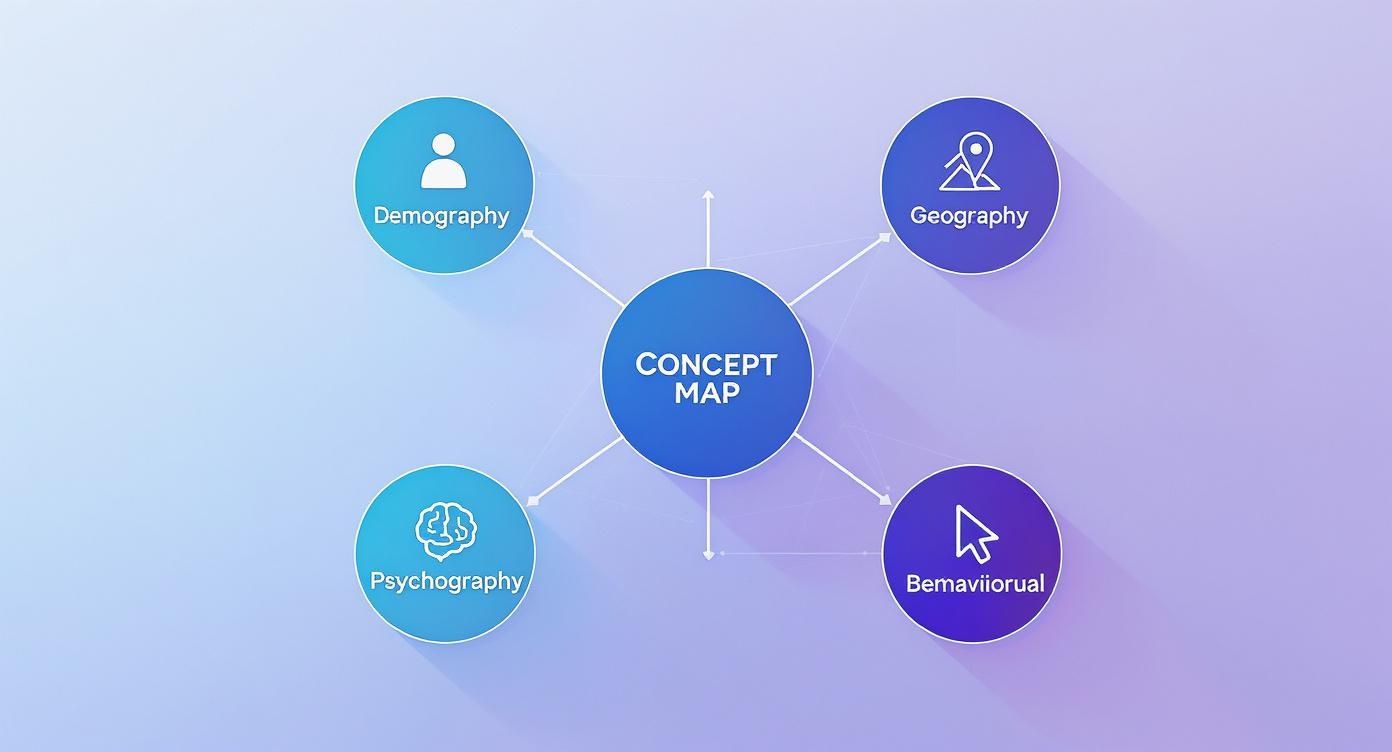
A concept map illustrating audience segmentation categories: demography, geography, psychography, and behavioral.

This map is a good reminder that you can view your audience through multiple lenses—from who and where they are to why and how they act.

SaaS Company Driving Upgrades with Behavioral Segmentation

The Problem: A mid-sized project management SaaS company had a problem. A huge chunk of their "Basic" tier users never even clicked on the more advanced features. This meant upgrade rates were flat, and worse, churn risk was high because these users weren't getting the full value. Their generic "Upgrade Now!" emails were going straight to the trash.

The Solution: They stopped blasting everyone and got smart with behavioral segmentation. They split their users into two simple, action-based groups right inside their platform:

  • "Power Users": These were the folks constantly hitting the limits of the Basic plan—running out of projects, maxing out storage. They were using every feature available to them.
  • "Under-Engaged Users": These customers logged in but stuck to just one or two basic functions, completely unaware of the more powerful tools they had access to.

"Power Users" got campaigns that felt like a secret handshake, showing them exactly how premium features would solve the bottlenecks they were already experiencing. Meanwhile, the "Under-Engaged Users" received gentle, educational content—like short video tutorials—highlighting a single advanced feature that would make their current workflow even better.

The Result: It worked. They saw a 35% increase in upgrades from the "Power Users" group in just three months. They also cut churn by 15% among the "Under-Engaged" segment, simply by helping them get more value from the product.

By focusing on what customers did (behavioral data) instead of just who they were, the company made every message feel relevant. They connected the dots between user actions and business outcomes.

Manufacturing Firm Tailoring Sales Pitches by Industry

The Problem: A manufacturer of industrial automation gear was spinning its wheels. Their sales team was pitching the same generic script to everyone, from car factories to pharmaceutical labs. The message wasn't landing because it failed to address the vastly different pain points and regulations in each sector.

The Solution: The marketing team switched gears to a firmographic segmentation strategy. They looked at their best customers and broke their target market into three core industries. Then, they built a completely separate playbook for each one.

  • The automotive segment saw case studies and emails all about boosting assembly line speed and cutting downtime.
  • The pharmaceutical segment got content that hammered on precision, FDA compliance, and sterile production—the things that actually keep them up at night.

The Result: By speaking each industry's language, the company boosted its marketing-qualified leads (MQLs) by a massive 50%. Even better, the sales cycle shrank by 20% because prospects were coming to the table already knowing the company understood their world.

Professional Services Firm Cross-Selling with Client History

The Problem: A digital marketing agency offered a full suite of services—SEO, PPC, content—but most clients only ever bought one. They knew they were sitting on a goldmine of cross-sell opportunities but had no systematic way to figure out who to approach and what to say.

The Solution: The agency dug into its own data, segmenting clients based on their transactional and behavioral history. They created a hyper-specific segment they called "SEO-Only Success Stories." These were clients who had seen a huge jump in organic traffic (a behavioral metric) from their SEO service (a transactional metric).

This group then received a highly personalized campaign. It showed them their own success and then explained how adding PPC could instantly capitalize on that newfound visibility to capture high-intent leads. They even wove in testimonials from similar clients, a tactic we break down in our guide on using voice of customer examples.

The Result: The campaign was a hit, converting 25% of those single-service clients into multi-service accounts. This dramatically increased their average client lifetime value without having to go out and find a single new customer.

How to Build Your Audience Segmentation Strategy

Alright, so we’ve covered the what and the why of segmentation. Now for the fun part: actually doing it. Moving from theory to a real, working strategy can feel like a huge leap, but it’s not. It's a step-by-step process, not some massive, all-at-once project.

Think of it like building with LEGOs. You don’t just dump the whole bin on the floor and hope a spaceship appears. You start with a plan, find the right pieces, and click them together thoughtfully. Let’s walk through the five essential steps to build your own strategy from the ground up.

A 'Segmentation Playbook' notebook on a wooden desk with a pen, plant, and laptop, showing a numbered list.

Step 1: Define Your Business Goals

Before you slice up your audience list, you have to answer one simple question: Why are we doing this? What's the business outcome you're trying to drive? Without a clear goal, you’ll end up with a bunch of interesting-but-useless segments.

This goal becomes your North Star. It guides every single decision you make from here on out. Are you trying to:

  • Increase customer lifetime value? Then you’ll probably segment based on purchase history to find juicy cross-sell opportunities.
  • Reduce churn? That means you'll want to segment by product usage to spot the accounts that are starting to drift away.
  • Improve lead conversion rates? Your focus would be on segmenting new leads by their industry or the specific pain point they came in with.

A well-defined goal—like "increase upgrade rates from our 'Freemium' user base by 15% in the next quarter"—provides the focus you need to build segments that actually move the needle. Start with the end in mind.

Step 2: Gather and Analyze Your Data

With your goal locked in, it’s time to find your LEGO bricks. This is all about pulling data from every place your customers interact with you. Good, clean data is the bedrock of any solid segmentation effort.

You’ll find gold in a few key places:

  • CRM: This is your home base for firmographics and basic account details like job titles, company size, and location.
  • Website Analytics: Tools like Google Analytics or Matomo are treasure troves of behavioral data. You can see which pages people visit, what features they click on, and how long they stick around.
  • Customer Surveys and Feedback: Don't be afraid to just ask. Direct feedback gives you rich psychographic insights into your customers' actual challenges, goals, and motivations that you can’t get anywhere else.

Once you have the data, you need to centralize it. For a deeper dive, there are great resources on building a data-driven customer segmentation strategy that can help you get this foundation right.

Step 3: Choose Your Segmentation Models

Now you get to decide how to group everyone. This is where you combine the different methods we talked about—demographic, behavioral, firmographic—to create segments that directly serve the goal you set in step one. A classic B2B starting point is to simply mix firmographics with behavior.

Actionable Comparison: Two Common Starting Models

Model NameDescriptionBest For
Value-Based SegmentationGroups customers by their economic value—past, present, or future. Think high-spend, mid-spend, and low-spend tiers.Businesses focused on maximizing revenue from existing customers and giving their high-value accounts the white-glove treatment.
Needs-Based SegmentationGroups customers based on the specific problems they're trying to solve or the benefits they want from your product.Companies with multiple products or features who need to make their marketing and sales messaging hyper-relevant.

The key is to start simple. Pick one or two models that make sense. You can always get fancier later.

Step 4: Develop Detailed Segment Profiles

Your segments can't just be rows in a spreadsheet. To be useful, they need to feel like real groups of people. This is where you build a simple profile or “persona” for each one, making it dead simple for your marketing and sales teams to know exactly who they’re talking to.

Give each segment a memorable name, like “Tech-Savvy Startups” or “Established Enterprise Accounts.” Then, flesh it out with their key characteristics, common pain points, and what motivates them. This is the step that turns raw data into a practical tool your whole company can rally around.

Step 5: Launch, Test, and Refine

Time to put your work into the wild. Pick one or two of your most promising segments and launch a targeted campaign. This could be anything from a tailored email sequence to a specific ad campaign on LinkedIn or even personalized content on your website.

And then? You measure everything. Track the metrics that matter for your goal—open rates, click-through rates, demo requests, conversion rates. Compare the results for each segment against your old, one-size-fits-all approach.

Segmentation isn't a "set it and forget it" project. It’s a living strategy. You’ll learn, you’ll tweak, and you’ll get better with every campaign. This is a cycle of continuous improvement.

How AI Is Reshaping Audience Segmentation

Manual audience segmentation has its place, but let's be honest—it has limits. It’s a bit like trying to sort a mountain of LEGO bricks by hand. You can group them by color and shape, but you'll miss the subtle patterns and the really interesting combinations.

AI is the supercomputer that sorts the entire pile in seconds, uncovering connections you never knew existed. It elevates segmentation from a static, rule-based chore into a dynamic, predictive engine. Instead of just looking at what customers have done, AI helps you see what they’re likely to do next.

A person in glasses views AI-powered data segments on a large interactive screen in a modern room.

This isn't just a minor tweak; it's a fundamental shift. We're moving beyond simple groupings to create fluid segments that adapt in real time as customer behavior changes.

And the market reflects this. The global AI market is on a trajectory to blast from $22.6 billion in 2020 to $190.6 billion by 2025. This explosive growth is driven by businesses like yours adopting AI-powered tools to make sense of overwhelmingly complex data.

From Reactive to Predictive Segmentation

The biggest change AI brings to the table is the move from being reactive to predictive.

Think about it. Machine learning algorithms can chew through massive datasets—purchase history, website clicks, support tickets, social media mentions—and spot hidden correlations a human analyst would almost certainly miss. The system learns which signals are most likely to predict a future action, like a purchase or, just as importantly, a cancellation.

This is the heart of predictive segmentation, a way of grouping customers based on their likelihood to do something.

  • Traditional Segmentation: "Let's pull a list of customers who haven't bought anything in 90 days." This is reactive. You're looking backward.
  • Predictive Segmentation: "Let's find customers who are showing the same behavioral red flags as the ones who churned last quarter—even if they just bought something yesterday." This is predictive. You're looking forward.

AI doesn't just categorize your audience; it forecasts their future needs. This lets you step in with the right message before a customer decides to look elsewhere or cancel their plan. It's a massive competitive advantage.

This analytical firepower is a game-changer for marketers. To see how this works under the hood, check out our guide on predictive analytics in marketing.

Hyper-Personalization at Scale

The other huge win from AI segmentation is hyper-personalization.

Traditional methods might let you personalize an email with a customer's name and recommend a product based on their last purchase. That’s a good start, but AI takes it leagues further. It can analyze an individual's entire journey with your brand and create a "segment of one."

This means the website content, product recommendations, and marketing messages can all change dynamically for each person. It’s the difference between a store clerk who remembers your last purchase and a personal shopper who knows your style, your budget, and what you’ll be looking for next season.

Comparing Personalization Approaches

AspectTraditional PersonalizationAI-Powered Hyper-Personalization
Data UsedBasic demographics, past purchasesEntire customer journey, real-time behavior, predictive scores
ExecutionManual, rule-based campaigns ("If this, then that")Automated, dynamic content that adapts to each user's actions
OutcomeRelevant content ("You bought X, you might like Y")Anticipatory experiences ("We know you like X, so here’s an exclusive look at Z before it launches")

This level of granular targeting used to be the exclusive domain of giants like Amazon or Netflix. Not anymore. Modern platforms are making it accessible for everyone.

For example, AI's impact extends well into lead generation, where it can dramatically improve how you segment and target prospects. It's why so many companies are now adopting AI-powered lead generation strategies to find high-value leads with far greater precision. This shift from broad targeting to individual engagement is how modern businesses build deeper, more profitable customer relationships.

Common Segmentation Mistakes to Avoid

So, you've decided to get serious about audience segmentation. That’s a huge step. But like any powerful strategy, there are a few classic ways it can go sideways. Knowing what segmentation is also means knowing where the landmines are buried.

Think of this as your field guide to sidestepping the traps that can turn a brilliant plan into a complicated mess. Nail these, and your segments will stay sharp, actionable, and tied directly to your business goals. Let's walk through the most common mistakes I've seen and a simple "Instead of This, Do That" fix for each one.

Over-Segmenting Your Audience

It’s tempting, I get it. You have all this data, and it feels productive to slice and dice your audience into a dozen or more hyper-specific groups. This is a classic rookie mistake. While it looks precise on a spreadsheet, you've just created a management nightmare. There's no way your team can create unique, meaningful campaigns for every single micro-segment.

Instead of: Creating 15 micro-segments that are impossible to manage. Do This: Focus on 4-6 high-impact segments that represent distinct, valuable groups. Prioritize quality and actionability over sheer quantity.

This approach lets you give each important segment the attention it deserves. It keeps you from letting the whole strategy collapse under its own weight.

Using Outdated or Stale Data

Your audience isn't frozen in time—people change, companies evolve, and priorities shift. A segment you built on data from six months ago might be completely useless today. Relying on old information is like navigating with an old map. You're going to get lost.

This is how you end up with misaligned messaging and wasted ad spend. The contact who was a "New Lead" last quarter might be a "Loyal Advocate" now. They need to be treated that way.

Stale vs. Fresh Data: The Bottom Line

MistakeThe Painful ConsequenceThe Simple Fix
Relying on old dataYour messaging feels tone-deaf and irrelevant, killing engagement and conversions.Refresh your data quarterly. Put a recurring reminder on your calendar to re-pull analytics and review your segment rules.
Ignoring real-time signalsYou miss golden opportunities to engage customers at critical moments, like right after a purchase.Integrate real-time behavioral triggers. Use marketing automation to move contacts between segments based on what they just did.

Creating Segments That Aren't Distinct

Here’s another common pitfall: building segments that bleed into each other. If your "Budget-Conscious SMBs" and your "Early-Stage Startups" groups are filled with mostly the same companies, your segments aren't different enough to matter. They lack clear lines.

Every segment should have unique DNA and require a distinct marketing angle. The sniff test is simple: if you can send the exact same email to two different segments, they probably shouldn't be two different segments.

  • Instead of: Having segments with 70% audience overlap.
  • Do This: Make sure each segment is clearly defined and mutually exclusive. Run a test on your criteria to confirm that less than 10% of your audience could reasonably fit into multiple segments. This clarity is what makes your targeting lethal.

By sidestepping these common errors, you're not just creating complexity. You're building a segmentation framework that’s tough, smart, and actually drives business results.

A Few Common Questions on Audience Segmentation

Jumping into segmentation usually brings up the same handful of questions. Let's tackle them head-on so you can move from theory to practice with confidence.

How Many Segments Should I Actually Create?

It’s easy to fall into the trap of creating a dozen hyper-specific segments, but that just creates noise and a ton of extra work. A good rule of thumb? Start with three to five high-impact segments.

Focus on the groups that will move the needle the most. Think "High-Value Repeat Customers," "At-Risk Churn Accounts," or "New Leads from Top-Tier Industries." You can always get more granular later, once you’ve nailed the process of targeting these core groups.

Audience vs. Market Segmentation—What’s the Real Difference?

This is a big one, and the distinction is crucial. The easiest way to think about it is with an analogy.

  • Market Segmentation: This is like looking at a map of the entire country. You're dividing the total potential market into logical groups, including millions of people who have never even heard of your company.
  • Audience Segmentation: This is like looking at your personal address book. You're focused on dividing your known contacts—the people already in your world, like existing customers, leads, and email subscribers.

The key difference is scope. Market segmentation is for high-level strategy, like product development or new market entry. Audience segmentation is for tactical marketing and communication with the people you can already reach.

How Often Should I Revisit My Segments?

Your segments aren't a "set it and forget it" project. People's needs and behaviors change, so your segments need to keep up. A good rhythm is to review them quarterly or right after any major marketing campaign.

When you do, ask yourself a couple of simple questions: Are these groups still distinct from one another? Are they still driving the results we expect? This regular check-in keeps your strategy sharp and prevents you from making decisions based on old, outdated assumptions.


Ready to stop guessing and start targeting with precision? marketbetter.ai uses AI to uncover your most valuable audience segments, automate personalized campaigns, and drive real growth. Discover how our AI-powered marketing platform can transform your strategy at https://www.marketbetter.ai.

Boost Growth With AI for B2B Marketing

· 20 min read

AI for B2B marketing taps into advanced algorithms to sift through complex customer data and automate critical tasks at scale. AI systems can spot high-value leads, craft tailored campaigns, and even replace those endless manual spreadsheets. This guide walks you from static lists to live, actionable insights—complete with head-to-head comparisons, clear action steps, and next steps you can implement today.

Why AI Transforms B2B Marketing

AI orchestrating data

Picture a B2B team juggling half a dozen disconnected spreadsheets. Each one feels like its own silo—data everywhere but nowhere in sync.

AI steps in as the conductor, pulling in streams of metrics, spotting hidden patterns, and steering campaigns on the fly.

  • Predictive segmentation replaces manual contact lists
  • Dynamic creatives outpace one-size-fits-all templates
  • Budget shifts in real time versus fixed allocations

At the same time, early adoption bumps like data silos and integration hurdles must be tackled head-on.

Comparing Manual Vs AI-Driven Processes

Old-school workflows drag campaign timelines and mask the insights you need. AI platforms gather every metric under one roof and automate the next best action, slashing cycle times by more than half.

Key takeaway AI-driven B2B marketing boosts efficiency by up to 40% and improves lead conversion.

Action Steps:

  1. Audit existing campaign workflows and identify 2 manual pain points.
  2. Benchmark current cycle times and set target reductions.
  3. Pilot an AI-driven segment or creative test in one campaign.

Adoption speeds differ across teams—often because of where data lives and how smoothly tools connect. Start by:

  • Mapping existing data sources and tagging missing fields
  • Choosing a pilot with obvious ROI potential
  • Monitoring performance weekly and tuning your models

These feedback loops let you refine your approach before scaling up.

Next In This Guide

Up next, we’ll unpack core AI concepts, weigh different implementation methods, and share real-world success stories.

You’ll discover how to gauge shifts in pipeline velocity and content engagement, building a data-driven case for a wider AI rollout.

Pro Tip Align AI metrics with sales KPIs to secure and sustain executive support.

With clear comparisons and a structured roadmap, you’ll deliver measurable results from AI initiatives in B2B marketing.

Understanding AI Concepts for B2B Marketing

Before you dive into vendor demos or write a single line of code, it helps to sketch out a clear picture of AI for B2B marketing. Picture AI as a toolkit brimming with specialized instruments—not a mysterious black box.

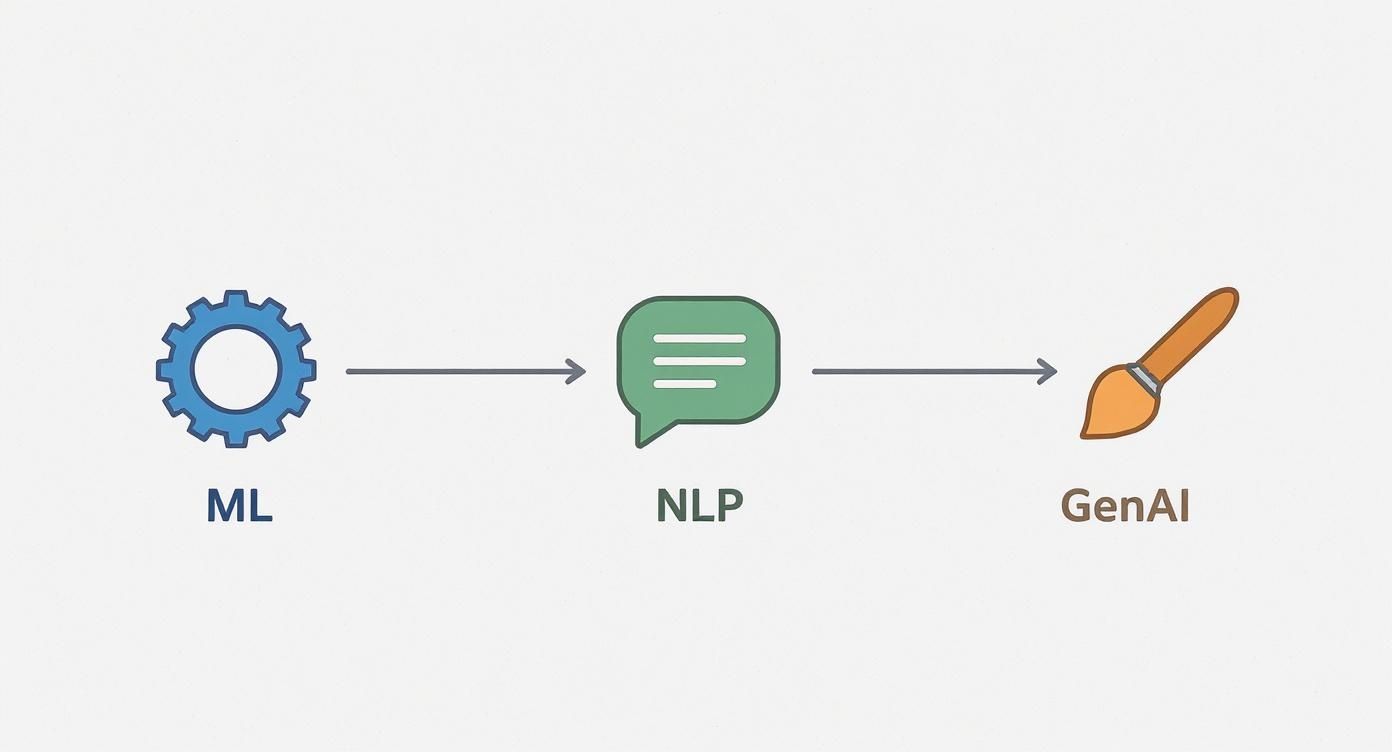
At its foundation, AI in this space breaks down into three main approaches:

  • Machine Learning
  • Natural Language Processing
  • Generative AI

Each of these fits specific use cases—from predictive lead scoring to automated content drafts—and choosing the right one starts with matching its strengths to your goals.

Machine Learning As Data Analyst

Machine Learning thrives on data pulled in from your CRM, web analytics, and engagement logs. Over time, it spots patterns in customer behavior and generates lead scores based on things like click paths and firmographic details.

For instance, an ML model might surface accounts with climbing engagement metrics as prime targets.

Key Takeaway
Machine Learning helps you invest in leads where the data signals are loudest—and that focus often translates into higher conversion rates.

Natural Language Processing As Translator

When you’re swimming in customer feedback, email threads, or social media chatter, NLP steps in to make sense of all that unstructured text. By applying sentiment analysis, it identifies enthusiastic advocates and critical detractors.

You could, for example:

  • Tag email sentiment to speed up urgent replies
  • Run social listening to catch emerging industry trends
  • Analyze chatbot transcripts to sharpen automated responses

Generative AI As Creative Partner

Generative AI serves as your idea factory. Feed it brand guidelines and a tone brief, then let it produce:

  • Blog post outlines
  • Ad copy variations
  • Email subject line experiments

Having multiple drafts on tap can dramatically speed up your content workflow.

AI Workflow From Data To Automation

A solid AI workflow ties data capture to real-world action. Here’s the sequence most teams follow:

  1. Data Ingestion: Gather CRM entries, web analytics, and third-party data.
  2. Model Training: Run your cleaned data through ML algorithms to detect patterns.
  3. Model Validation: Compare predictions against actual outcomes and tweak parameters.
  4. Decision Automation: Push lead scores and content suggestions into campaign tools.
  5. Continuous Monitoring: Keep an eye on performance, retrain models, and adjust triggers as new data flows in.

Pro Tip
A tidy, well-structured dataset at the ingestion stage can make or break your model’s accuracy—and the relevance of your campaigns.

According to a survey, 75% of B2B marketers globally already use AI tools for content creation, data analysis, and campaign optimization. 90% report productivity gains, 39% say content performance improved, and 12% note mixed results on quality. Learn more about these insights in the survey on SurferSEO.

To truly leverage AI, B2B marketers must first grasp how it transforms raw data into actionable insights, enabling them to master competitive marketing intelligence.

Check out our guide on predictive analytics in marketing for a detailed workflow from data ingestion to decision automation.

Action Steps

  • Map your top 3 use cases to ML, NLP, and Generative AI.
  • Audit your data sources for completeness and quality.
  • Define success metrics (e.g., lift in conversion rate or time saved).

This framework sets you up to compare different AI approaches side by side—and choose the one that fits your objectives like a glove. Stay tuned for practical checklists and tips coming up next.

Comparing AI Approaches For B2B Marketing

Choosing the right AI tool is like picking the right lens for a camera—you need clarity on what you want to capture. Do you need pinpoint lead scoring or a high-volume content engine? Your objectives and resources should steer the decision.

Below, you’ll find a concept map that lays out three pillars of AI in B2B marketing: machine learning, natural language processing, and generative AI.

Infographic about ai for b2b marketing

This visual highlights how ML digs into data patterns, NLP handles conversational text, and Gen AI powers large-scale content creation.

Comparison Of AI Approaches

Here’s a side-by-side look at three distinct methods. Use this snapshot to spot which approach matches your goals, budget, and team skills.

ApproachUse CaseProsCons
Rule-Based AILead qualification, workflow automationPredictable outcomes; quick setupRigid rules; struggles with nuance
Machine LearningDemand forecasting, account scoringLearns over time; tackles complexityNeeds clean data; less transparent
Generative AIScalable content creation, personalizationEndless variations; creative flexibilityQuality varies; higher compute cost

Use this table as your quick reference before you dive into vendor pitches.

Real-World Pros And Insights

Rule-based systems often win on speed to launch. Think of simple “if-then” triggers that qualify leads in minutes. A tech firm might set a form-response rule and instantly sort high-value prospects—but if your scenarios shift, those rules can crack.

On the flip side, machine learning layers in adaptability. One B2B team used ML on engagement logs and saw conversion rates climb by 18% over three months. The catch? You’ll need a steady stream of quality data and someone to tune the models.

Generative AI feels a bit like having a junior copywriter on demand. Marketing teams have spun out 50+ email or ad variations in under ten minutes. Still, you’ll want a human in the loop to fact-check and keep the tone on-brand.

And here are a few industry benchmarks to keep in mind:

  • 73% of B2B marketers lean on ML for predictive insights, improving forecast accuracy by 20%
  • Generative AI adoption climbed 45% last year, slashing content production time by half
  • 62% of companies rely on rule-based workflows for basic lead qualification

Decision Checklist

  1. Define Budget Range – Compare implementation and ongoing costs.
  2. Assess Data Readiness – Confirm your CRM and analytics data are clean and tagged.
  3. Evaluate Vendor Expertise – Look for case studies in your vertical.
  4. Pilot A Small Use Case – Start with lead scoring or a few content snippets.
  5. Review Scalability – Make sure the platform grows with your volume and complexity.

Key Takeaway: Match the approach to your team’s data maturity and outcome targets to boost ROI in AI for B2B marketing.

Action Steps

  • Pilot ML vs Gen AI: run both on a sample dataset and compare accuracy and speed.
  • Score rule-based workflows against machine-learned scores to measure lift.
  • Define vendor evaluation criteria based on pros, cons, and benchmarks above.

Vendor Selection Tips

  • Test integration with your CRM (for example, Salesforce or HubSpot) and CMS in a sandbox before signing on
  • Look for security certifications like SOC 2 or ISO 27001 to safeguard sensitive information
  • Confirm access to responsive support and training materials for faster onboarding
  • Compare customization options so you can tweak AI models to your marketing playbook
  • Scan community forums and peer reviews for real-world feedback, warts and all

With these insights and practical steps, you’ll be ready to pick the AI approach that delivers real, measurable value in your next B2B marketing campaign. Next, roll out your pilot, track key metrics, and iterate toward peak performance.

Implementing AI Personalization And Automation

Driving growth in B2B marketing isn’t just about more data—it’s about the right data, at the right time, for the right person. Personalization fuels engagement, and automation keeps your team focused on strategy rather than spreadsheets.

Here’s how to move from raw inputs to campaign-ready audiences:

  • Gather Data Sources: Pull CRM records, web behavior logs, and third-party intent feeds.
  • Segment With AI Models: Group contacts by browsing patterns and firmographic signals.
  • Build Dynamic Workflows: Automate emails, landing pages, and ads that shift based on real-time triggers.
  • Integrate Platforms: Connect your CRM and marketing stack for seamless data flow.
  • Monitor And Adjust: Track performance metrics, retrain models, and enforce privacy measures.

Think of your data as puzzle pieces. Alone, they don’t show much—but when AI spots the edges and corners, suddenly you see the big picture. Timestamped website clicks, whitepaper downloads and form fills often hint at buying intent days before a salesperson even reaches out.

Once your data is in place, AI-driven segmentation carves your audience into hyper-relevant cohorts. Each micro-segment then gets messaging crafted to its exact journey stage—no more guessing which email or offer will stick.

Building Real-Time AI Workflows

Dynamic workflows are where the magic happens: content adapts on the fly, delivering exactly what a prospect needs in that very moment. Picture a user who downloads your ROI case study—within seconds, they’re served a landing page packed with testimonials from companies just like theirs.

  • Select Triggers: Identify actions such as link clicks or form submissions.
  • Design Rules: Map those triggers to specific content variants and offers.
  • Configure Tools: Implement on platforms like Marketo or Pardot for execution.
  • Test Thoroughly: Run A/B experiments to confirm which variants perform best.
  • Launch And Scale: Start small, then widen the net as you monitor engagement.

Dynamic AI Workflow

With workflows live, your CRM becomes the central hub. Native connectors in Salesforce or HubSpot push AI scores and segment tags straight into contact records—no manual imports needed.

Always encrypt data at rest and in transit. And don’t skip regular audits of your model inputs to guard against bias or inadvertent PII exposure.

Tracking Key Metrics

Success hinges on clear KPIs: think conversion rate lift, average deal size, and engagement uplift. Start by comparing email click-through rates or account engagement scores before and after AI deployment.

83% of businesses say AI lets them scale personalization more effectively, and 87% agree it boosts automation efficiency. Organizations using AI-powered segmentation see higher engagement rates and are seven times more likely to exceed their goals compared to those without AI. Discover more insights about B2B marketing trends on Adobe

To practically apply ai for b2b marketing, exploring the best sales chatbot platforms can boost conversions and enhance customer interactions.
Check out our guide on AI marketing automation tools for a deep dive into platform comparisons and integration tips.

But remember—over-automation can feel robotic. Build in human reviews and set throttle points so every outreach still sounds like it came from a real person.

Rollout Checklist

  1. Pilot Segment – Start with 500 high-intent accounts for initial testing.
  2. Weekly Reviews – Measure engagement lift, click rates, and automation health.
  3. Data Audit – Confirm segmentation tags, purge stale or duplicate records.
  4. Human Oversight – Schedule spot checks on automated messages.
  5. Privacy Compliance – Validate encryption, consent logs, and data-flow rules.
  6. Scale Gradually – Broaden cohorts once KPIs show 15% lift in engagement.
  7. Document Findings – Share performance reports and lessons learned.
  8. Continuous Optimization – Iterate workflows and segments quarterly based on new insights.

Action Steps

  • Map your key triggers and design 3 workflow scenarios.
  • Test a dynamic email and landing page variation side by side.
  • Schedule bi-weekly performance reviews to refine triggers and content.

Evaluating Financial Impact Of AI In B2B Marketing

Investing in AI without hard figures can leave your finance team uneasy. In B2B marketing, you need clear benchmarks to justify every dollar.

For instance, swapping manual segmentation for AI-driven personalization often cuts campaign costs and lifts close rates. With that kind of proof, allocating budget becomes a whole lot easier.

  • Revenue Increase: Average uplift of 15–30% from predictive lead scoring
  • Cost Reduction: Automated workflows trim marketing spend by 20–25%
  • Lead Volume Boost: AI chatbots drive 10–20% more net leads

Financial Impact Metrics For AI Adoption

Key ROI figures, revenue growth percentages, cost savings, and market projections in one view.

MetricValueSource
Revenue Increase15–30%Industry Benchmarks
Cost Savings20–25%Market Surveys
Market Size Projection$107.5B by 2028DBS Website
Chatbot Adoption57% of B2BDBS Website
Lead Volume from Chatbots10–20% boostDBS Website

These numbers aren’t pulled from thin air. They come from surveys and market studies showing how AI reshapes budgets and performance.

Expert polls reveal that 65% of organizations report higher revenue after rolling out AI in marketing and sales. At the same time, 41% of teams see spending dip, and 26% of chatbot adopters note a 10–20% lift in leads. For the full breakdown, learn more about these findings.

Statistical Highlight
65% revenue growth and 41% cost reduction underscore AI’s measurable impact on marketing budgets.

Building Your Business Case

To get the green light, model different scenarios so stakeholders can see projected returns side by side with costs. Factor in everything: licensing, integration, training, even ongoing maintenance.

Budgets vary by company size. Small teams often plan for $50K–$100K a year. Midsize firms might set aside $200K–$500K, and enterprises frequently budget $1M+.

Follow these steps when you craft your proposal:

  • Calculate licensing and subscription fees
  • Estimate integration and customization expenses
  • Factor in internal training hours and vendor support
  • Account for maintenance, updates, and retraining

For a deeper dive on putting these figures into your spreadsheet, check out our guide on how to calculate marketing ROI.

Scenario Modeling Tips

Start by mapping current marketing costs across each channel. Then layer in AI-related expenses and forecast the gains you expect.

  • Licensing: Compare annual fees and seat-based models
  • Integration: Include setup, testing, and customization costs
  • Training: Estimate internal hours plus vendor-led workshops
  • Maintenance: Plan for periodic retraining and software updates

Run best-case and worst-case scenarios to show how swings in performance affect ROI. A simple sensitivity analysis can reveal which variables matter most.

Tip
Test small shifts—like a 5% change in lead volume—and see how your overall ROI adjusts.

With well-structured scenarios, your finance team will view AI investment as a low-risk, high-reward decision. Keep revisiting these models quarterly, involve sales, IT, and operations, and update your assumptions. That transparency ensures your AI initiatives stay on track as market conditions evolve.

Real World AI Case Studies In B2B Marketing

B2B AI case study overview

There’s nothing like seeing AI in motion to bridge the gap between idea and impact. Below are three stories—one from a mid-sized SaaS vendor, one from a global manufacturer, and one from a boutique consultancy. Each walks through goals, rollout steps, results, and the single insight you can apply right away.

Predictive Lead Scoring For Tech Provider

A mid-sized SaaS company was wrestling with a slow MQL-to-SQL funnel. Their fix? An AI-driven scoring model built on 20 variables spanning firmographics, engagement signals, and buying intent.

  • Data Cleansing: Unified fields, purged duplicates
  • Model Training: Fed historical pipeline data into a supervised ML engine
  • CRM Integration: Pushed fresh scores into Salesforce every 24 hours

In just three months, conversion rates jumped by 18%, and the average hand-off time fell by 30%. The big lesson: without clean, well-labeled data and routine drift checks, even the smartest model will underperform.

Automated Support With Chatbots

A global manufacturing firm faced a torrent of support tickets and sluggish response times. Their answer was an AI chatbot for first-level queries on web and mobile.

They assembled a knowledge base of 5,000 FAQs, trained the bot on past tickets, then linked it to CRM and ERP systems.

“The chatbot handles 65% of incoming questions without any human handoff,” says their operations director. “That freed our engineers to tackle the tough stuff.”

The outcome? A 45% drop in escalations and a shift from 4-hour resolutions to 1.5-hour averages. The secret: continuous updates fueled by agent feedback keep the bot sharp.

Generative AI For Consultancy Content

A boutique B2B consultancy needed to ramp up thought leadership without blowing its budget. They turned to a generative AI platform to draft blogs, white papers, and social posts.

Feed in brand voice guidelines and example articles, and the system spit out first drafts for 50+ assets in under a week.

  • Content Briefing: Defined tone, style, and audience
  • Draft Generation: Automated outlines and supporting copy
  • Human Review: Editors refined facts and brand alignment

This slashed writing time by 70% and tripled output, delivering a 60% cost cut per asset versus an all-manual process. The key? A human-in-the-loop step ensures quality never takes a back seat.

Practical Steps To Adapt These Cases

  1. Audit Data Sources – Confirm your datasets are clean and tagged.
  2. Pilot One Workflow – Start with lead scoring or a chatbot trial.
  3. Embed Human Oversight – Schedule review checkpoints to catch issues early.
  4. Measure Key Metrics – Track conversion lift, resolution times, and content velocity.
  5. Scale Gradually – Expand once you’ve demonstrated ROI.
  6. Review Models Quarterly – Guard against performance drift with retraining.

Key Takeaway: Effective AI in B2B marketing thrives on data readiness, phased pilots, and ongoing human checks.

Best Practices And Next Steps For AI Integration

Starting an AI initiative without a clear plan is like setting off on a road trip without a map—you’ll burn through resources and still wonder where you’re headed. Here, we’ll walk through how to pilot, govern, and scale AI in your B2B marketing efforts, step by step.

First, get everyone aligned on strategic goals before touching any data or code. That shared vision becomes your decision-making compass and prevents costly detours.

Think of your AI roadmap as a GPS: pick a destination, choose the fastest route, and follow the directions.

“When strategy and technology move in sync, your AI investment turns into an engine, not an expense.”

Pilot Projects And Team Setup

Every major AI deployment should begin with a tight pilot. It helps you validate assumptions fast and spot unexpected hurdles.

Pull together a cross-functional crew—marketing, IT, data science—and secure an executive sponsor who can clear roadblocks.

  • Define Pilot Scope: Select 1–2 high-impact use cases with clear KPIs.
  • Assign Roles: Who handles data ingestion? Who trains models? Who runs campaigns?
  • Set Timelines: Aim for a 6–8 week minimum viable test phase.

“A focused pilot with concrete success criteria accelerates buy-in and minimizes risk.”
– AI Strategy Lead

Once you’ve demonstrated value, evolve that team into a dedicated AI Center of Excellence. This hub will govern standards, share best practices, and oversee multiple projects.

  • AI Program Manager: Coordinates across teams.
  • Data Engineer: Keeps data pipelines clean.
  • ML Engineer: Tunes models and tracks performance.

A Center of Excellence ensures consistency and speeds up growth.

Governing Data And Model Monitoring

Healthy data and robust models require ongoing attention. Without governance, models drift and campaigns plateau.

ElementFocus AreaFrequency
Data Quality ChecksCompleteness & AccuracyWeekly
Bias AuditsFairness & Ethical RisksMonthly
Performance ReviewsKey Metrics & ROIQuarterly

Set up automated alerts for sudden dips in lead scores or relevance. That way, your AI stays sharp and reliable.

Vendor Evaluation And Change Management

Choosing the right AI vendor can make or break your initiative. Rather than chasing features, match platforms to your priorities and workflows.

  1. Identify Must-Have Features: segmentation, predictive analytics, content generation.
  2. Check Security Certifications: SOC 2, ISO 27001.
  3. Request Case Studies: find examples in your industry.
  4. Pilot Integrations: test connectors in your CRM/CMS sandbox.
  5. Negotiate SLAs: agree on uptime and support commitments.

Rolling out new tech also means winning hearts and minds:

  • Communicate benefits early and often.
  • Provide hands-on training sessions.
  • Gather feedback and iterate quickly.
CriteriaImportanceNotes
IntegrationHighNative CRM connectors required
CostMediumFactor TCO over 2 years
SupportHighResponse time under 4 hrs

Continuous Improvement And Ethical Oversight

Adopting AI is a marathon, not a sprint. After launch, establish a cycle of learning and optimization.

  • Quarterly Reviews: Measure results against your baseline.
  • Model Retraining: Refresh algorithms with new datasets.
  • Stakeholder Feedback: Collect input from sales and customer success.
  • Governance Updates: Tighten privacy and ethics policies.

Privacy must be baked in from day one:

  • Consent Audits: Verify opt-in status every quarter.
  • Legal Review: Ensure GDPR and CCPA compliance.
  • Audit Logs: Track data access and processing events.

Think of your AI like a garden—it needs regular watering and weeding to thrive. Ethical guardrails keep you from harvesting bias.

Set realistic timelines based on your maturity level:

Maturity LevelTimelineGoals
Early3–6 monthsPilot and initial team formation
Intermediate6–12 monthsDeploy multiple use cases
Advanced12+ monthsFull Center of Excellence and enterprise scale

By combining structured pilots, strong governance, and continuous iteration, you’ll build a marketing engine that delivers real, lasting AI impact.


Ready to accelerate your marketing with AI? Experience how marketbetter.ai streamlines content creation, campaign optimization, and customer personalization. Start Your Free Trial today and unlock your AI advantage.