2 posts tagged with "marketing metrics"

View All Tags

A Guide to Content Marketing ROI

· 23 min read

Let's be honest. Content marketing ROI is just a fancy way of asking: "Is all this blogging, video-making, and social media stuff actually making us money?"

It’s the simple calculation that compares the revenue your content brings in against what you spent to create and share it. Getting a handle on this number is the single most important step in turning your content from a creative "nice-to-have" into a predictable, revenue-driving machine.

Why You Must Measure Content Marketing ROI

Too many marketers get hung up on vanity metrics. Page views, likes, shares—they feel good, but they don't pay the bills. Think of your content like a stock portfolio. You wouldn't just throw money at stocks and hope for the best; you'd track their performance obsessively. The same exact logic applies here.

Measuring your content marketing ROI is the only way to know if your investment is actually growing your business.

Without that data, you're just marketing in the dark. It’s the classic "spray and pray" approach, and it’s a fast track to wasted budgets and missed opportunities. When you start focusing on ROI, you shift to a data-backed strategy where every piece of content has a purpose and a measurable financial goal.

Shifting from Cost to Investment

The moment you start seeing content as an investment instead of an expense, everything changes. An expense is money gone. An investment is money you expect to see again, with friends. This mindset shift is fundamental.

  • Smarter Budgeting: When you know that your webinar series delivered a 300% ROI compared to the 50% ROI from your last blog post sprint, you know exactly where to put your next dollar. No more guessing games.
  • Proving Marketing's Value: Nothing gets an executive's attention like a clear ROI figure. Comparing a marketing-sourced revenue report to your department's budget is the ultimate proof that marketing isn't just a cost center—it's a growth engine. This is how you justify your budget and secure more for the future.
  • Predictable Growth: Once you start tracking ROI consistently, you can compare performance over time to build a repeatable system for success. Content stops being a series of one-off campaigns and becomes a reliable source of leads and sales.

Measuring content marketing ROI isn't about justifying your job. It's about building a strategic framework that turns creative work into a predictable, scalable source of revenue. It’s the compass that points every decision toward profit.

The Financial Impact of a Strong Strategy

And this isn't just theory. When done right, content marketing delivers serious financial returns. A comprehensive, decade-long analysis found that the average yearly ROI for a well-run content campaign is a staggering $984,000. That number shows the incredible potential waiting for businesses that track and optimize their content for performance. Discover more about these industry ROI statistics.

Ultimately, getting a firm grip on content marketing ROI is non-negotiable for any serious marketer. It gives you the clarity to make smart decisions, prove your team’s value, and build a content program that directly fuels the bottom line.

How to Calculate Your Content ROI

Alright, let's get down to brass tacks. Moving from theory to practice is where you see if your content is actually pulling its weight. Calculating your content marketing ROI isn't some dark art—it’s a straightforward process that brings a ton of clarity to your strategy.

At its heart, the formula is simple. It gives you a clean percentage that shows you exactly what you’re getting back.

((Return - Investment) / Investment) x 100% = Content Marketing ROI

Think of it this way: if you generated $25,000 in new business from a content campaign that cost you $5,000 to create and promote, your ROI would be a very healthy 400%. That means for every single dollar you put in, you got five dollars back. Simple enough, right?

The real work isn't the math. It's in nailing down exactly what counts as "Return" and what counts as "Investment."

This visual map helps break down that journey, showing how a smart investment flows all the way through to a real business impact.
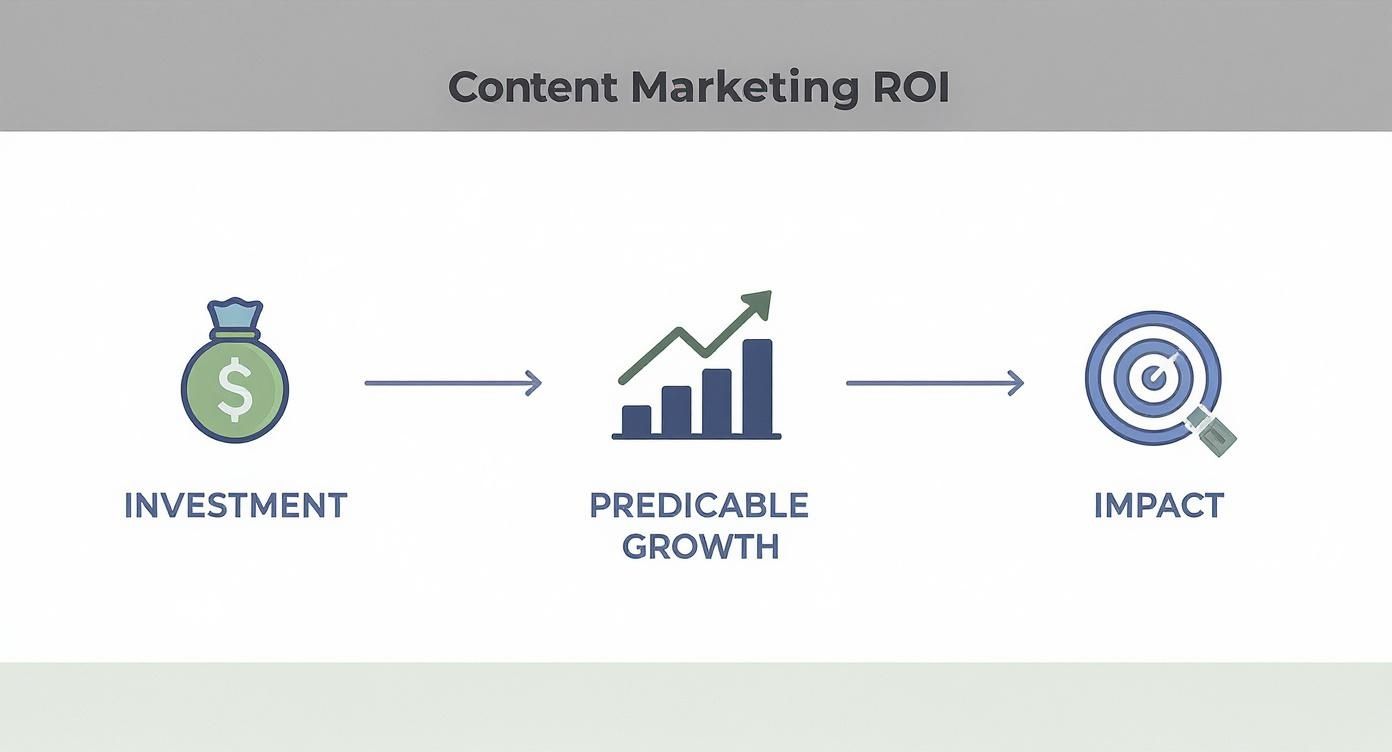
Infographic about content marketing roi

The key takeaway here is that you're not just spending money and hoping for the best. You're building a system for predictable growth that you can tie directly to your bottom line.

Nailing Down Your Total Investment

To get a real ROI figure, you have to count everything. Too many marketers make the mistake of only counting the obvious stuff, like the invoice from a freelance writer. That just leads to vanity metrics and an inflated sense of success.

Your total investment needs to include all the moving parts:

  • Creation Costs: This is the big one. It covers salaries for your in-house writers, designers, and videographers, or what you pay out to agencies and freelancers.
  • Tools & Software: Don't forget the monthly subscriptions for your tech stack. Think SEO tools like Ahrefs, analytics platforms, social media schedulers like Buffer, and your CMS.
  • Promotion & Distribution: Any cash you put behind paid social ads, search ads, or influencer campaigns to get more eyeballs on your content counts.

Actionable Tip: Create a simple spreadsheet to track these costs. Assign a portion of your monthly tool subscriptions and team salaries to your content budget. For example, if you pay $150 a month for an SEO tool and you publish 10 articles, attribute $15 of that tool's cost to each piece. Getting granular like this is what separates a guess from a true calculation.

Quantifying Your Financial Return

This is where things get a little trickier, but it’s also where the magic happens. The "Return" side of the equation is more complex because content influences revenue in so many different ways. The goal is to connect your content to tangible business outcomes, not just traffic spikes.

It's a step that a surprising number of businesses miss—one study found that a whopping 53% don't tie their content efforts directly to revenue goals. To measure your return properly, you have to track specific conversions and put a dollar value on them.

Attributing Revenue and Leads

  • Direct Sales: If you're running an e-commerce store, this is as direct as it gets. Actionable Step: Use UTM parameters in the URLs you share on social media or in newsletters. This allows you to track in Google Analytics exactly how many sales came from a click on a specific blog post or social update.
  • Lead Value: For B2B or service businesses, leads are the name of the game. But what’s a lead worth? Actionable Step: To figure it out, talk to your sales team to find two numbers: your average lead-to-customer conversion rate and the lifetime value (LTV) of a customer. If 1 in 10 leads becomes a customer worth $5,000, then every single lead you generate is worth $500.
  • Customer Lifetime Value (LTV): Good content doesn't just bring in new customers; it keeps the ones you have. If your tutorials or case studies are helping reduce churn, that's a real return you can and should factor in.

Cost and Return Analysis for Different Content Types

Not all content is created equal. Some formats require a heavy upfront investment of time and money but can deliver massive SEO returns over the long haul. Others are quick to produce and great for generating immediate leads. This table breaks down the typical trade-offs.

Content TypeTypical InvestmentPrimary Return MetricTime to See ROI
Blog PostsLow-Medium (Time-intensive writing)SEO Traffic, Organic Leads3-6 months
Ebooks/WhitepapersMedium (Writing, design, promotion)Gated Lead Generation1-3 months
Video ContentHigh (Production, editing, gear)Brand Awareness, Engagement2-4 months
WebinarsMedium-High (Platform, promotion, prep)High-Quality MQLsImmediate to 1 month
Case StudiesMedium (Interviews, writing, approval)Sales Enablement, Conversion1-2 months

Understanding these dynamics helps you build a balanced content strategy. You can mix long-term plays like SEO-focused blog posts with short-term wins from a high-impact webinar to keep the pipeline full.

Calculation Examples in the Wild

Let's look at how two different businesses might run the numbers on their content marketing ROI.

A SaaS Company Example: A SaaS company drops $8,000 on a series of deep-dive guides. That campaign brings in 50 demo requests. The sales team is solid, closing 20% of those leads, which lands them 10 new customers. If the LTV of each customer is $3,000, the total return is a sweet $30,000.

  • ROI Calculation: (($30,000 - $8,000) / $8,000) x 100 = 275%

An E-commerce Store Example: An online store invests $3,000 in a video marketing campaign showing off its products. They track everything with custom links and see the campaign directly drives $12,000 in sales.

  • ROI Calculation: (($12,000 - $3,000) / $3,000) x 100 = 300%

Sure, these are simplified, but they show just how critical it is to connect your content to real money. If you want to go deeper on this, you can learn more about how to calculate marketing ROI and apply the same thinking to your content program.

When you diligently track both your full investment and the return you can attribute to it, you can finally answer the question everyone in the C-suite is asking: "Is our content actually making us money?"

Essential Tools for Tracking Content ROI

Let's be honest: you can't measure ROI with guesswork and spreadsheets. To really get a grip on your content marketing ROI, you need the right tech stack. These tools are what connect the dots between someone reading a blog post and that same person eventually becoming a paying customer. They’re your source of truth, turning fuzzy metrics into a cold, hard financial picture.

Building this stack isn't about buying every flashy tool on the market. It’s about covering three critical jobs: seeing how people behave on your site, managing the relationships you build, and tracking your organic search footprint. When these systems talk to each other, you get a powerful feedback loop that makes your entire content strategy smarter.

Analytics Platforms for Web Traffic and Conversions

Everything starts with a solid analytics platform. This is mission control for understanding how people find and use your content. Without it, you're flying blind, unable to link a piece of content to a meaningful action.

There's a reason Google Analytics 4 (GA4) is the default for most marketers. Its event-based model is built for tracking the specific steps that lead to a conversion. You’re not just counting pageviews; you’re tracking PDF downloads, demo requests, and newsletter sign-ups—the actions that actually matter.

Actionable Tip: In GA4, set up a custom conversion event for your most valuable bottom-of-funnel action, like a "Contact Us" form submission. By tracing the user paths that lead to that conversion, you can see which blog posts or landing pages pushed them over the line. That creates a direct data trail for your ROI calculation.

CRM Systems for Connecting Content to Revenue

Analytics tells you what users are doing. A Customer Relationship Management (CRM) system tells you who they are and connects their activity to actual money. This is the most crucial link in the chain for proving financial return, especially in B2B where sales cycles can drag on for months.

Platforms like HubSpot or Salesforce become the central nervous system for every lead and customer interaction. When someone fills out a form on your blog to get an ebook, their info lands in the CRM. From that moment on, every touchpoint—every email opened, every sales call—is logged.

Image

This is where you strike gold. You can definitively say that a new $10,000 customer first found you through a specific blog post three months ago. You’re no longer just reporting on leads; you’re reporting on revenue. To get a better handle on how different pieces of content contribute to a final sale over time, it's worth understanding the various multi-touch attribution models that a good CRM makes possible.

A CRM transforms your content metrics from "we got 50 leads" to "this blog post generated $50,000 in pipeline." It’s the tool that finally allows you to speak the same language as your sales team and executives.

SEO and Social Tools for Measuring Growth and Reach

A huge chunk of content's value is its long-term power to pull in organic traffic and build your brand's authority. SEO tools are non-negotiable for putting a number on that contribution to your content marketing ROI.

Tools like Ahrefs or Semrush let you track keyword rankings, see who is linking to you, and even estimate the dollar value of your organic traffic. For example, if your blog post hits #1 for a keyword that would cost $5,000 a month to target with paid ads, that's a tangible return. It’s a direct cost saving and a sustainable traffic source you own.

Likewise, you need to track what's happening on social media. Using a comprehensive social media analytics dashboard is the smart way to gather data for ROI calculations across different platforms. These tools help you measure engagement, click-throughs, and actual conversions that started with a social post.

Building a Strategy for Higher Content ROI

Great content marketing ROI isn't a happy accident—it’s engineered from the ground up. Pumping out more content without a clear plan is just a recipe for burning through your budget. A high-ROI approach, in contrast, focuses on creating fewer, better assets that are precisely targeted and ruthlessly optimized.

A person at a desk drawing a strategic plan on a large sheet of paper, with charts and graphs in the background

Think of it like building a house versus just piling up bricks. A high-ROI strategy is the architectural blueprint. It ensures every blog post, video, and case study serves a distinct purpose and contributes to the final structure: generating revenue. Without that blueprint, you're just making noise.

This proactive approach is what separates the top-tier marketing teams from everyone else. Data from Semrush shows that 79% of companies considered "very successful" in their marketing dedicate more than 10% of their total marketing budget to content. Even more telling? 80% of these successful teams have a formal content strategy, directly linking intentional planning to better financial outcomes. You can find more trends about successful content marketing strategies and what they have in common.

Aligning Content with the Sales Funnel

Your audience's needs shift dramatically as they move from "I have a problem" to "I'm ready to buy." A winning strategy maps your content directly to these stages, ensuring you're delivering the right message at exactly the right time. This alignment is everything when it comes to maximizing conversions and, ultimately, your ROI.

  • Top of Funnel (TOFU): This is the awareness stage. Your goal is to attract a broad audience with educational, problem-focused content that doesn't feel like a sales pitch. Think blog posts, infographics, and social media updates that answer common questions.
  • Middle of Funnel (MOFU): Now they're in the consideration stage. Prospects know they have a problem and are actively looking for solutions. Your content should position your brand as a credible expert. This is where webinars, case studies, and deep-dive guides really shine.
  • Bottom of Funnel (BOFU): This is the decision stage. The audience is ready to buy, and your content needs to give them that final nudge. Use product demos, free trials, and detailed comparison pages to seal the deal.

Trying to hit someone with a demo (BOFU) when they're just starting their research (TOFU) is like trying to sell a car to someone who’s just starting to think about learning to drive. It's the wrong message at the wrong time, and it tanks your conversion potential.

Targeting Commercial Intent Keywords

Let's be clear: not all keywords are created equal. To juice your content marketing ROI, you have to prioritize keywords that signal a user is getting close to pulling out their wallet. This is the difference between attracting casual readers and attracting future customers.

Think about the gap between "what is content marketing" and "best content marketing software for small business." The first is purely informational, targeting a TOFU audience. The second one screams commercial intent, attracting a BOFU audience that is actively looking for a solution to buy.

Focusing on commercial intent keywords ensures your content creation efforts are directly tied to revenue-generating opportunities. It's about attracting traffic that is far more likely to convert into leads and sales.

Actionable Step: Use your SEO tool to filter for keywords containing modifiers like:

  • Best (e.g., "best CRM for startups")
  • Alternatives (e.g., "HubSpot alternatives")
  • Vs (e.g., "Ahrefs vs Semrush")
  • Pricing (e.g., "Salesforce pricing plans")

Building content around these terms puts you squarely in the path of motivated buyers, dramatically shortening the path from click to conversion.

Creating Content Clusters for Topical Authority

Search engines reward expertise. A "content cluster" strategy is a powerful way to demonstrate deep knowledge in a specific area, helping you rank higher and drive more qualified organic traffic. It’s all about creating a central "pillar page" on a broad topic and linking it to multiple, in-depth "cluster pages" that cover related subtopics.

For example, your pillar page might be a massive guide to email marketing. Your cluster pages could then dive into the nitty-gritty, like "email list segmentation," "writing effective subject lines," and "email A/B testing best practices."

This structure signals to Google that you are an authority on the topic, boosting the SEO performance of all the related content. More importantly, it creates a seamless user experience, guiding visitors to the exact information they need and keeping them engaged on your site for longer. To get this right, you can follow a detailed content marketing strategy guide that walks through the process of building real authority.

Proven Tactics to Maximize Content Returns

Having a solid strategy is your blueprint, but disciplined execution is what actually builds the house. If you want to really crank up your content marketing ROI, you have to treat every single piece of content like a valuable asset. That means actively managing it, not just hitting "publish" and hoping for the best. That's a surefire recipe for disappointment.

The sharpest marketers I know get that creation is only half the battle. They work tirelessly to squeeze every drop of value out of their investment by focusing on promotion, optimization, and repurposing. It’s about multiplying the impact of their efforts long after the content goes live.

This isn't a small side project for most businesses anymore. In fact, a whopping 58% of companies now invest between $5,000 and $10,000 every single month on content. The numbers back it up: businesses that blog consistently see 55% more website visitors than those who don’t, which opens up a ton more opportunities to convert.

Amplify Your Reach with Smart Promotion

Your content can't generate a return if nobody sees it. It's that simple. A smart, multi-channel promotion strategy is non-negotiable for getting your work in front of the right audience and stretching its lifespan. Think of it as giving your content the rocket fuel it needs to take off.

  • Email Marketing: Your email list is a direct line to your most loyal audience. Announce new content to your subscribers to drive a quick burst of traffic and re-engage people who already know and trust your brand. It's a low-cost, high-return channel that you completely own.
  • Paid Promotion: Don't be afraid to put some money behind your best work. Actionable Step: Instead of boosting every post, identify your top 5 converting blog posts from the last quarter and put a small paid budget behind them on LinkedIn to target your ideal customer profile.
  • Social Media Distribution: Share your content across all your relevant platforms, but tailor the message for each one. A short video clip for Instagram, a thought-provoking question for LinkedIn, and a slick, eye-catching graphic for X (formerly Twitter) will go a lot further than a generic "new blog post" update.

Optimize for Conversions

Getting traffic feels good, but turning that traffic into leads or sales is what actually drives ROI. This is where Conversion Rate Optimization (CRO) comes in—it’s the science of methodically tweaking your content to guide more visitors toward taking the action you want them to take. It’s all about turning passive readers into active participants.

A huge piece of this puzzle is implementing clear and compelling Calls-to-Action (CTAs). Ditch the generic "Contact Us" and try something specific and value-driven, like "Get Your Free Content Audit."

Effective CTAs bridge the gap between your content and your business goals. They provide a clear next step, transforming an informational asset into a conversion tool and directly boosting your content marketing ROI.

Just as critical is a smart internal linking strategy. By linking to relevant product pages, case studies, or other bottom-of-funnel content, you create a natural pathway for readers to move deeper into your world, dramatically increasing the chances they'll convert.

Multiply Your Impact with Content Repurposing

Why create ten new assets from scratch when you can turn one great piece into ten different formats? Content repurposing is one of the most efficient tactics for maximizing your content marketing ROI, bar none. It lets you reach new audiences on different platforms and hammer your message home without starting over.

The amount of time and resources this saves is massive. For example, a single, in-depth webinar can be spun into gold.

Original AssetRepurposed FormatsTarget Audience
60-Minute WebinarA series of short blog posts, a downloadable slide deck, quote graphics for social media, a podcast episode, and short video clips for TikTok and YouTube Shorts.Extends reach from live attendees to blog readers, social media followers, and podcast listeners.

This whole approach breathes new life into your existing work, extending its value far beyond the day it was first published. To get even more mileage from your videos, converting YouTube video to text with AI is a killer tactic for turning spoken words into a fully readable and SEO-friendly blog post.

By making these tactics part of your standard process, you ensure every piece of content you create works a whole lot harder for your business.

Still Have Questions About Content Marketing ROI?

Even with the best strategy, some questions about content marketing ROI just keep coming up. Let's tackle the most common ones I hear from marketers so you can get back to measuring with confidence.

How Long Does This Actually Take to Work?

Let's get one thing straight: content marketing is a long game. It’s a marathon, not a sprint. Compare it to paid ads, where you see results (and costs) immediately. Content marketing is an asset that appreciates over time.

You might see some early signs of life—a little more traffic, a few more social shares—within 3-6 months. But a real, meaningful financial return? You're usually looking at 6-12 months, sometimes even longer.

Think of it like planting a tree. It feels slow at first, but once it takes root, it provides value for years with very little extra work. Content works the same way. It compounds over time as your articles start ranking for keywords and pulling in a steady stream of organic traffic long after you hit "publish."

What's a "Good" Content Marketing ROI Anyway?

If you're looking for a number to aim for, the industry benchmark that gets tossed around most is a 5:1 ratio. That’s a 400% ROI, or earning $5 for every $1 you put in.

But here’s the thing: chasing some universal number is a distraction. What really matters is setting your own baseline and then consistently beating it, quarter after quarter. A high-margin SaaS company might hit a 10:1 ratio, while a business in a different space might be thrilled with 3:1. Focus on your own growth.

How Do I Measure ROI for Top-of-Funnel Blog Posts?

This is the classic headache. How do you tie a blog post about "10 Tips for X" directly to a closed deal? The short answer is, you don't—not directly, anyway.

Trying to force a direct sales connection for top-of-funnel (TOFU) content is a recipe for frustration. Instead, you need to look at leading indicators and proxy metrics that show its value.

  • Contribution to Pipeline: Use a multi-touch attribution model in your analytics tool or CRM. This lets you see how many of your eventual customers first found you through that "fluffy" TOFU piece. It’s often more than you think.
  • Key Performance Indicators: Track the metrics that prove the content is doing its job. Are you seeing more organic traffic? Ranking for new keywords? Getting more newsletter sign-ups from those posts? Is your branded search volume going up? These are all signs of a healthy top of funnel.

What Are the Biggest Mistakes People Make When Calculating ROI?

Even sharp marketers can trip up here. I see the same few mistakes pop up again and again.

  1. Ignoring Hidden Costs: The most common error is forgetting to include everything. Team salaries, software subscriptions, and your ad spend for promotion all count. Miss these, and your ROI will look way better than it actually is.
  2. Relying Only on Last-Touch Attribution: This model is the enemy of content marketing. It gives 100% of the credit to the last thing a person did before converting, completely ignoring the five blog posts they read that got them there in the first place.
  3. Having No Clear Conversion Goals: If you don't define what a "conversion" is for a piece of content (like a demo request or an ebook download), you’re just measuring traffic and vibes. You have nothing concrete to measure against your investment.
  4. Giving Up Too Soon: This one hurts to see. Pulling the plug on your content strategy after three months because you aren't seeing a massive return is the fastest way to guarantee a negative ROI. You have to give it time to mature.

Ready to stop guessing and start engineering a higher ROI? The marketbetter.ai platform uses AI to help you create high-performing content, optimize campaigns, and prove your marketing's impact with clear, data-backed insights. Discover how to maximize your content returns today.


Mastering Lead Generation Key performance Indicators

· 24 min read

Let's be honest. For a long time, the name of the game in marketing was just "more leads." We'd chase a big number, slap it on a slide, and call it a win.

But here’s the problem with that approach: more leads doesn't always mean more business. In fact, it often means more noise, more wasted time for your sales team, and a flatlining revenue chart that makes everyone scratch their head.

This is where we need to get smarter. We have to move past simply counting leads and start measuring what actually matters. That's what Lead Generation Key Performance Indicators (KPIs) are all about. They are the measurable values that tell you how effective you really are at generating new business.

Tracking these metrics is the difference between guessing and knowing. It’s how you make data-driven decisions that build a predictable growth engine for your company.

Why Tracking Leads Alone Is a Trap

Imagine a marketing team proudly announcing they doubled their lead count in a single quarter. High fives all around, right? But then the finance team runs the numbers and discovers revenue hasn’t budged an inch.

Sound familiar? This is the classic pitfall of focusing on quantity over quality.

An avalanche of leads is worthless if they're a bad fit, aren't ready to buy, or cost more to acquire than you'll ever see back in profit. Relying on that single, vanity metric—the raw number of leads—is dangerously misleading. It can make you feel successful while your business is actually standing still.

Moving Beyond the Vanity Metric

To avoid this trap, you need a more sophisticated toolkit. Think of your lead gen KPIs as the dashboard of your car. Just looking at the odometer (your lead count) tells you you're moving, but it's the other gauges that give you the critical context you need to actually get somewhere.

  • Your Speedometer: How fast are you bringing in qualified leads?
  • Your Fuel Gauge: Is your cost to acquire a customer sustainable, or are you about to run out of gas?
  • Your Engine Temp: Is your sales process efficient, or is it overheating with bad-fit prospects?

Without these other data points, you’re basically driving blind. You're burning fuel and hoping you end up at the right destination.

Relying solely on lead volume is like judging a restaurant's success by the number of people who walk through the door, not by how many actually sit down and order a meal. True performance is measured by conversion and profitability, not just foot traffic.

This guide will give you a practical framework to identify, track, and optimize the KPIs that truly matter. We're going to turn your lead generation from a guessing game into a predictable revenue driver. By the end, you'll know exactly how to connect your marketing efforts to bottom-line results, ensuring every dollar you spend is a smart investment in real, sustainable growth.

Understanding Your Foundational KPIs

If you want to get good at lead generation, you have to start with the basics: your foundational, top-of-funnel metrics. These are the core numbers that give you a quick pulse check on your marketing health. Think of them less as a final report card and more as the first few clues in solving your growth puzzle.

It's easy to get lost tracking dozens of different numbers, creating complex reports that hide more than they reveal. The real key is to focus on the vital few that tell the clearest story about how well you're grabbing your audience's initial attention.

This infographic breaks down the hierarchy of the most essential KPIs every marketer should be watching.

Infographic about lead generation key performance indicators

You can see how each metric builds on the last, moving from broad awareness to specific, measurable actions. Let's dig into what each one really tells you.

Number of Leads

This is the most basic KPI you can track: the raw Number of Leads. It’s your starting line.

Imagine you own a retail store. This number is simply counting every single person who walks through the front door. It's a non-negotiable metric because, without any foot traffic, you have zero chance of making a sale. But on its own, it’s just a raw count that tells you nothing about why they came in or if they actually want to buy something.

Actionable Insight: If your lead volume is too low, your immediate action is to broaden your reach. This could mean increasing your ad spend, expanding your keyword targeting, or testing new content formats to attract a larger audience. A sudden spike in leads might look great, but it could just mean you're attracting a crowd of window shoppers with no real intent.

Click-Through Rate (CTR)

Next up is your Click-Through Rate (CTR). If the number of leads is your total foot traffic, then CTR measures the effectiveness of your window display.

It tells you what percentage of people who saw your ad, email, or social media post were intrigued enough to actually click on it. The formula is simple:

(Total Clicks / Total Impressions) x 100 = CTR

Actionable Insight: A low CTR is a clear signal to rework your creative and messaging. Action Step: A/B test your headlines, images, and calls-to-action. For example, compare a benefit-driven headline ("Save 10 Hours a Week") against a curiosity-driven one ("The Secret to Effortless Project Management"). This direct comparison will show you what resonates with your audience. A high CTR, on the other hand, means your "window display" is successfully pulling people inside.

Conversion Rate

Once they're inside your "store," the Conversion Rate tells you what percentage of those visitors took the specific action you wanted them to. This doesn't have to be a final sale. For top-of-funnel marketing, a conversion is often something like:

  • Filling out a contact form
  • Downloading an ebook
  • Subscribing to your newsletter

The calculation is just as straightforward:

(Number of Conversions / Total Visitors) x 100 = Conversion Rate

Actionable Insight: A low conversion rate points to friction on your landing page. Action Step: Analyze your page for issues. Is your form too long? Is the call-to-action button hard to find? Compare a page with a 5-field form against one with a 3-field form. The shorter form will almost always convert better, showing you precisely how much friction your audience will tolerate. A high conversion rate means your page is doing its job.

By looking at these three KPIs together, you get the full story. High CTR but a low conversion rate? Your ad is great, but your landing page needs work. Low CTR but a high conversion rate? Your offer is a winner, but not enough of the right people are seeing it.

These foundational metrics work together to paint a clear picture of your campaign's performance from the very start. Nail these, and you're on your way to building a predictable and profitable marketing engine. For a deeper look at tracking and analyzing your core data, check out these crucial sales performance metrics.

Measuring the Cost and Efficiency of Your Leads

While it's great to know how many leads you're generating, those numbers don't tell the full story. To really understand your marketing's impact, you have to connect your efforts back to the budget. This is where cost-efficiency metrics come in, revealing the actual price tag on your lead gen machine.

These aren't just nice-to-have numbers; they're non-negotiable for proving marketing's value. They change the conversation from "how many leads did we get?" to "how much did we pay for them, and was it worth it?" This financial clarity is what lets you make smart budget decisions and justify every dollar spent.

Cost Per Lead (CPL): The Price of a Prospect

Cost Per Lead (CPL) is one of the most fundamental financial KPIs you can track. It tells you exactly what you paid, on average, to get a single person to raise their hand and show interest. Think of it as the cover charge for getting a potential customer into your club.

The math is simple:

Total Marketing Spend / Total New Leads = CPL

So, if you drop $5,000 on a Google Ads campaign and it brings in 100 new leads, your CPL is a clean $50. That number immediately gives you a baseline for that campaign's performance.

Actionable Insight: Tracking CPL by channel is critical. If your CPL from SEO is $25 but your CPL from paid ads is $75, you have a clear action item: analyze why your paid campaigns are so expensive. Are you targeting the wrong keywords? Is your ad quality score low? This comparison forces you to optimize your spend or shift budget to the more efficient channel. You can learn more about these important lead generation metrics from Abstrakt Marketing Group.

Before diving deep into channel-specific CPL, it helps to see a high-level comparison of what you might expect from different marketing avenues. Each channel has its own economic realities, with unique pros and cons that affect what you'll ultimately pay for a lead.

Comparing CPL Across Different Marketing Channels

Marketing ChannelAverage CPL (B2B)ProsCons
SEO/Content Marketing$20 - $75High-quality, long-term asset, builds authorityTakes time to see results, requires consistent effort
Email Marketing$40 - $60Nurtures existing database, cost-effective at scaleList fatigue is real, requires strong content
Social Media Ads$50 - $100Precise targeting, great for brand awarenessCan attract lower-intent leads, platform-dependent
PPC (e.g., Google Ads)$50 - $150+Captures active intent, highly measurable, fast resultsCan be very expensive, requires constant optimization
Webinars/Events$60 - $120Highly engaged leads, positions you as an expertHigh effort to produce, attendance can be unpredictable
LinkedIn Ads$75 - $200+Excellent for B2B targeting, professional contextOften the most expensive channel, ad fatigue is high

This table makes it clear that there's no single "best" channel. The right choice depends entirely on your budget, your audience, and whether you're playing the long game or need results right now.

Cost Per Acquisition (CPA): The Cost of a Customer

CPL measures the cost of a potential customer, but Cost Per Acquisition (CPA) goes one crucial step further. It measures the average cost to land an actual paying customer. This is the bottom-line metric because it ties your marketing spend directly to closed deals and revenue.

The formula is just as straightforward, but it focuses on the finish line:

Total Marketing Spend / Total New Customers = CPA

If that same $5,000 campaign ultimately produced 10 paying customers, your CPA would be $500. This is the number that answers the most important question of all: how much does it really cost us to win?

CPL vs. CPA: An Actionable Comparison

Knowing the difference between CPL and CPA is what separates tactical marketers from strategic ones. A cheap CPL is a vanity metric if those leads never, ever convert. The real magic happens when you look at both numbers side-by-side to judge your channels.

Let's walk through a real-world scenario:

  • Channel A (Google Ads): You spend $2,000 and get 100 leads ($20 CPL). Of those, 2 become customers ($1,000 CPA).
  • Channel B (LinkedIn Ads): You spend $2,000 and get 40 leads ($50 CPL). Of those, 5 become customers ($400 CPA).

At first glance, Google Ads looks like the clear winner with a $20 CPL—it's less than half of what LinkedIn costs! But the CPA tells the real story. The leads from LinkedIn, while more expensive up front, were far higher quality and converted at a much better clip. The result? A dramatically lower CPA.

This comparison reveals a powerful truth: Obsessing over a low CPL can trick you into pouring money into channels that generate cheap, junk leads, which ultimately costs you more to land a real customer.

To make this data actionable, your team would shift more budget toward Channel B. By focusing on the channel with the better CPA, you’re putting your resources where they generate the most profitable growth. This is the kind of data-driven decision that turns a marketing team from a cost center into a predictable revenue engine.

How to Measure Lead Quality and Sales Readiness

A team of marketers reviewing sales readiness charts and data on a large screen in a modern office.

So far, we’ve been talking about getting attention and figuring out what it costs. But a cheap lead that goes nowhere is just a waste of time and money. A low Cost Per Lead (CPL) is a vanity metric if those leads have zero shot at becoming customers.

This is where we pivot from a numbers game to a quality game. We’re moving into the lead generation key performance indicators that build the bridge between your marketing efforts and your sales team’s success. It’s time to stop asking "how many?" and start asking "how good?"

Let’s be honest: not all leads are created equal. Some are just kicking the tires, while others are pulling out their wallets. Telling the difference between the two is the secret sauce to an efficient sales process and a pipeline that actually delivers.

MQL vs. SQL: What Is the Difference?

To figure out lead quality, you first have to agree on what a "good" lead actually looks like. This brings us to two of the most critical acronyms in the business: Marketing Qualified Lead (MQL) and Sales Qualified Lead (SQL). Getting this right is everything.

A simple comparison helps clarify the distinction:

  • An MQL is someone who downloaded a top-of-funnel ebook. They are problem-aware.
  • An SQL is someone who requested a personalized demo. They are solution-aware and showing purchase intent.

The MQL is curious; the SQL is serious. Your marketing team's job is to nurture the curious MQLs, while your sales team's job is to close the serious SQLs.

The core difference isn't just their level of interest; it's their readiness for a sales conversation. MQLs are nurtured by marketing, while SQLs are actively pursued by sales.

Nailing this definition demands a tight alignment between marketing and sales. Both teams have to agree on the exact criteria that graduate a lead from MQL to SQL. This shared rulebook stops marketing from just "throwing leads over the wall" that sales will inevitably ignore.

MQL-to-SQL Conversion Rate

Once your definitions are locked in, you can track the single most important handoff metric between your teams: the MQL-to-SQL Conversion Rate. This KPI tells you how well your marketing is setting up real, valuable opportunities for sales.

The math is simple:

(Total SQLs / Total MQLs) x 100 = MQL-to-SQL Conversion Rate

Actionable Insight: A low MQL-to-SQL rate is a red flag signaling a disconnect. Action Step: Hold a joint marketing and sales meeting to review the last 20 leads that sales rejected. Was the lead's company too small? Were they in the wrong industry? This direct feedback loop is the fastest way to refine your MQL criteria and improve lead quality immediately.

For instance, if your marketing team generates 200 MQLs in a month and sales accepts 20 of them as SQLs, your conversion rate is 10%. Watching this number over time is how you find and fix the leaks in your funnel.

Implementing a Simple Lead Scoring System

So, how do you decide which MQLs are ready for prime time in a way that isn't just guesswork? The answer is lead scoring. It’s a system where you assign points to leads based on who they are and what they do, creating a score that signals their sales readiness.

Instead of relying on gut feelings, you build an objective, data-backed process. A higher score means a hotter lead, telling your sales team exactly where to focus their energy.

Here’s a basic framework you can put to work today.

1. Identify Key Behavioral Triggers

These are the actions a person takes that show they're interested.

  • Requesting a demo: +25 points (This is a big one)
  • Visiting the pricing page: +15 points
  • Downloading a case study: +10 points
  • Attending a webinar: +10 points
  • Opening a marketing email: +2 points

2. Define Important Demographic or Firmographic Data

This is all about who they are and where they work.

  • Job title (e.g., Director or VP): +15 points
  • Company size (matches your Ideal Customer Profile): +10 points
  • Industry (your target vertical): +10 points

By adding up these scores, you can set a clear threshold. For example, any lead who hits 50 points is automatically flagged as an SQL and routed to a salesperson. This ensures your team spends their precious time on the opportunities most likely to close.

If you want to go deeper, you can find a more advanced look at building these systems in our guide to AI lead scoring.

Connecting Your KPIs to Revenue and Growth

At the end of the day, marketing is here for one reason: to grow the business. While metrics like CTR and CPL are great for taking the temperature of a campaign, they don’t speak the language of the C-suite. To prove marketing’s real value, you have to draw a straight, undeniable line from your lead generation key performance indicators to actual revenue.

This is the jump from measuring activities to measuring impact. It's about showing how a click on a social media ad turned into a signed contract in your CRM. When you can do that, you stop being a cost center and become a predictable, powerful growth engine.

Customer Lifetime Value (CLV): The Ultimate Context

The single most powerful metric in this conversation is Customer Lifetime Value (CLV). In simple terms, CLV is the total revenue you can expect to earn from a single customer over the entire time they do business with you. It’s the long-term view that puts all your short-term spending into perspective.

Actionable Insight: Compare your Customer Acquisition Cost (CPA) to your CLV. A healthy business model typically aims for a CLV:CPA ratio of at least 3:1. If your ratio is 1:1, you're losing money with every new customer. Action Step: If your ratio is too low, you have two levers to pull: either find ways to decrease your CPA (by optimizing ad spend) or increase your CLV (by improving customer retention and upselling).

CLV is the KPI that gives you permission to spend more to acquire the right customers. It shifts the focus from finding the cheapest leads to finding the most profitable ones.

This one number reframes your entire strategy. Instead of hunting for the lowest CPL, you start hunting for the highest CLV—a fundamentally smarter, more profitable way to grow.

Lead-to-Close Ratio: Your Sales Efficiency Score

While CLV is your long-term lens, the Lead-to-Close Ratio (sometimes called Lead Conversion Rate) is your snapshot of how efficiently your sales process is working right now. It tells you exactly what percentage of the leads you generate actually become paying customers.

The math is simple:

(Total New Customers / Total Leads) x 100 = Lead-to-Close Ratio

If you generated 200 leads last month and 10 of them signed on the dotted line, your Lead-to-Close Ratio is 5%. This is a crucial health check on your sales effectiveness. A consistently low ratio is a red flag—it might mean you're chasing low-quality leads, or there’s a serious bottleneck somewhere in your sales funnel.

A Tale of Two Channels: A Case Study in Profitability

Let's put this all together with a real-world example. Imagine a B2B SaaS company running lead gen campaigns on two different channels.

  • Channel A (Social Media Ads): This channel was a CPL machine, generating leads at a ridiculously low $40 CPL. The marketing team loved it. The problem? These leads had a dismal Lead-to-Close Ratio of just 1% and a CLV of $1,500.
  • Channel B (Industry Webinars): The leads from here were way more expensive, costing $150 CPL. This looked inefficient at first glance. But these were high-intent, engaged leads with a Lead-to-Close Ratio of 8% and a massive CLV of $12,000.

If you only looked at CPL, Channel A would win every time. But when you connect the dots to revenue, the story completely flips.

To land one customer from Channel A, they needed 100 leads. That cost them $4,000 (100 leads x $40 CPL) for a $1,500 return. Ouch.

Meanwhile, Channel B only required about 13 leads to get one customer (100 / 8). The acquisition cost was just $1,950 (13 leads x $150 CPL) for a whopping $12,000 return.

By shifting their budget away from the "cheap" CPL channel and toward the high-CLV one, the company supercharged its profitability. This is why it's so important to look past surface-level metrics and understand how to measure marketing ROI to prove your team's true impact on the business.

Building Your Actionable KPI Dashboard

A marketing team collaborating around a large screen displaying an actionable KPI dashboard.

Tracking individual lead generation key performance indicators is a great start, but looking at them one by one is like trying to navigate a city by only looking at a single street sign. You get a piece of the picture, but you have no context. A real KPI dashboard pulls all that data together, transforming scattered metrics into a clear story that actually guides your strategy.

Think about your car's dashboard. You don't get separate, random alerts for low fuel, engine temperature, and tire pressure. You get one central display that gives you the full picture at a glance. That's what a good marketing dashboard does. It lets you make faster, smarter decisions instead of getting lost in a dozen different spreadsheets.

The goal is to create a single source of truth. It kills data silos and gets everyone, from marketing ops to the C-suite, working from the same playbook. It’s about clarity, not clutter.

Choosing the Right KPIs for Your Audience

This is where most teams go wrong. They build a single, monstrous dashboard that tries to show everything to everyone. The result? It's overwhelming, and nobody uses it. The secret is tailoring the view to the person looking at it, because different teams need to see wildly different things.

  • For the Marketing Team (The Operational View): This is your tactical command center, updated daily or weekly. It needs the nitty-gritty details: Cost Per Lead (CPL) by channel, landing page conversion rates, and MQL volume. Action Step: If CPL on one channel spikes, the team's immediate action is to pause that ad set and investigate.
  • For Leadership (The Strategic View): This is the big-picture view, reviewed monthly or quarterly. Forget the tactical weeds. This dashboard needs to focus on the metrics that tie directly to the bottom line: Customer Acquisition Cost (CPA), Customer Lifetime Value (CLV), and total marketing ROI. Action Step: If the CLV:CPA ratio dips below 3:1, leadership's action is to question the profitability of a channel and decide on budget reallocation for the next quarter.

By creating these distinct views, you give each person exactly what they need to make decisions. The data starts driving real conversations instead of just being numbers on a screen. And as your data game gets more sophisticated, you can layer in advanced tactics like those in our guide to person-level identification to make your dashboards even sharper.

An effective dashboard doesn't just report what happened. It gives you the context to understand why it happened and what to do next. It turns reactive data-checking into proactive strategy.

Checklist for Your First Dashboard

You don't need a data science degree to build your first dashboard. Start simple. Tools like Google Data Studio or even your CRM’s built-in reporting can get you surprisingly far.

Here’s a quick checklist to get you started:

  1. Define the Goal: What’s the single most important question this dashboard must answer? (e.g., "How efficiently are we acquiring new customers?")
  2. Identify the Audience: Who is this for? The marketing team? Sales? The CEO?
  3. Select 5-7 Core KPIs: Pick only the essential metrics that directly answer the main question for that audience. No vanity metrics allowed.
  4. Connect Your Data Sources: Hook up your analytics, CRM, and ad platforms.
  5. Visualize the Data: Use clear charts and graphs. A timeline for trends, a pie chart for channel mix—make it tell a story.
  6. Set a Review Cadence: Put it on the calendar. Schedule regular check-ins to actually discuss the data and decide on next steps.

A Few Common Questions About Lead Gen KPIs

Alright, we've covered the what and the why. But when the rubber meets the road, practical questions always pop up. How many of these things should you actually stare at? And how often? Let's get into the real-world answers.

How Many KPIs Should I Actually Track?

It’s incredibly tempting to measure everything. More data feels safer, right? But this almost always leads to "analysis paralysis," where you're drowning in numbers but have no idea what to do next.

Instead of tracking a dozen-plus metrics, zero in on a core set of 5-7 KPIs that truly connect to your main business goals.

A solid way to start is by picking one or two from each part of your funnel:

  • Top-of-Funnel: Click-Through Rate (CTR) or Cost Per Lead (CPL)
  • Mid-Funnel: MQL-to-SQL Conversion Rate
  • Bottom-of-Funnel: Customer Acquisition Cost (CPA) and Lead-to-Close Ratio
  • Big Picture: Customer Lifetime Value (CLV)

This gives you a complete, high-level view of what's happening without bogging your team down in noise.

Don't mistake motion for progress. A cluttered dashboard with 20 metrics is less useful than a focused one with five that actually drive action. The real goal is clarity, not complexity.

How Often Should I Review My KPIs?

The right cadence isn't one-size-fits-all. It completely depends on the metric itself and who's looking at it. Trying to review everything on the same schedule is a recipe for bad decisions.

A practical comparison for review frequency:

  • Weekly Review (Marketing Team): Focus on fast-moving, tactical KPIs like CPL, CTR, and Conversion Rates. These are the levers you can pull immediately to optimize live campaigns.
  • Monthly Review (Sales & Marketing Leadership): Focus on pipeline velocity KPIs like MQL-to-SQL Conversion Rate and Lead-to-Close Ratio. This cadence allows enough time for leads to move through the funnel and reveals trends.
  • Quarterly Review (Executive Team): Focus on strategic, slow-moving KPIs like CPA and CLV. These metrics reflect the overall health and profitability of the business and inform major budget decisions for the next quarter.

Matching the review frequency to the metric’s purpose is key. It stops you from overreacting to daily blips in big-picture numbers while keeping you agile enough to fix the small things that are happening right now.


Ready to stop guessing and start growing? marketbetter.ai uses AI to help you optimize every stage of your funnel, from the first click to the final close. See how our platform can help you turn your KPIs into predictable revenue. Learn more about what marketbetter.ai can do for you.