14 posts tagged with "marketing analytics"

View All Tags

Multi-Touch Attribution Models Explained: Which One Matches Your Sales Cycle? [2026]

· 20 min read

Let’s be honest—your marketing data is probably lying to you.

It's not malicious, but if you're only looking at the last click before a sale, you’re missing 90% of the story. This is where multi-touch attribution comes in. Instead of giving all the credit to one single interaction, it spreads the credit across the entire series of touchpoints that led a customer to convert.

Think of it as the difference between crediting only the final goal-scorer in a soccer match versus acknowledging the assists, the passes, and the defensive plays that made the goal possible.

Why Your Marketing Data Is Lying to You

A chart showing various marketing channels and data points connected to a central goal, illustrating the complexity of the modern customer journey.

The modern customer journey is a maze, not a straight line. Someone might see your ad on Instagram, read a blog post a week later, click an email link, and finally convert through a branded Google search.

If you only credit that final search click, your data is telling you to pour all your money into search ads. In reality, Instagram and your blog did the heavy lifting to build awareness and trust. This is the massive blind spot created by single-touch models like last-click or first-click attribution. They’re simple, but they’re wrong.

Before you can fix the problem, you have to admit you have one. This means understanding why your old methods might be flawed, especially if you’re trying to accurately calculate marketing ROI.

The Shift Toward a Complete Picture

Relying on a single touchpoint is like giving all the credit for a championship win to the person who scored the final point. It completely ignores the teamwork and strategy that set up the opportunity. Smart businesses are catching on and moving away from these outdated methods fast.

Multi-touch attribution gives you a far more honest and complete view of the customer journey. It helps you see how different channels work together, so you can finally put your budget where it will actually make a difference.

This isn't just some passing trend; it's a strategic necessity. The multi-touch attribution market, already valued at USD 2.43 billion, is on track to hit USD 4.61 billion by 2030. With over 68% of enterprises already on board, the message is loud and clear: if you don’t understand the full journey, you’re flying blind.

By embracing multi-touch attribution models, you unlock a few key advantages:

  • Identify Hidden Influencers: You can finally see which channels are the unsung heroes of your funnel—the ones assisting conversions even if they don’t get the final click.
  • Optimize Budget Allocation: Stop guessing and start investing confidently in the channels that deliver real value across the entire customer journey.
  • Understand Customer Behavior: Get a true, ground-level view of how people actually interact with your brand before they decide to buy.

Decoding the Core Attribution Models

Once you stop giving 100% of the credit to a single click, you need a system to figure out how that credit gets divided. This is where rule-based multi-touch attribution models come into play. Think of them as different playbooks for assigning value across the entire customer journey.

Each model follows a specific, pre-set logic. To see how they work, let's follow a customer buying a new pair of sneakers:

  1. Touchpoint 1: Sees an ad on Instagram (First Touch).
  2. Touchpoint 2: Clicks a link in an email newsletter.
  3. Touchpoint 3: Reads a blog post about the "Top 5 Running Shoes."
  4. Touchpoint 4: Clicks a branded Google Search ad (Last Touch) and makes the purchase.

Now, let's see how different models would score this exact journey. If you're looking for a deeper dive into the fundamental concepts, this guide on What is Marketing Attribution is a great place to start.

The Linear Model: Equal Credit for All

The Linear model is the simplest and most democratic of the bunch. It’s straightforward: it splits the credit equally among every single touchpoint that played a part in the sale. No favorites, no fuss.

In our sneaker example, the conversion credit would be divided evenly:

  • Instagram Ad: 25%
  • Email Newsletter: 25%
  • Blog Post: 25%
  • Google Search Ad: 25%

Comparison: Unlike a last-click model which would give 100% credit to the Google Search Ad, the Linear model ensures the Instagram ad and blog post are recognized for their role. It's a great starting point for seeing the whole picture.

Actionable Tip: Use the Linear model if you have a long sales cycle and believe every interaction contributes to the final decision. It prevents you from mistakenly cutting the budget for top-of-funnel channels that don't get the final click.

The Time-Decay Model: Credit Where It’s Most Recent

The Time-Decay model works on a simple premise: the closer an interaction is to the sale, the more influential it was. The touchpoints nearest the finish line get the most credit, while earlier touches get progressively less.

For our sneaker purchase, the credit might look something like this:

  • Instagram Ad: 10%
  • Email Newsletter: 20%
  • Blog Post: 30%
  • Google Search Ad: 40%

Comparison: This model is the direct opposite of a first-click approach. It heavily favors closing channels over awareness channels. Compared to the Linear model, it provides a more weighted view based on timing.

Actionable Tip: This model is killer for shorter sales cycles or promotion-driven campaigns, like a weekend flash sale. It gives you a clear signal on which channels are most effective at closing deals, helping you decide where to double down for immediate results.

This infographic breaks down some of the most common multi-touch attribution models, including the ones we've just covered.
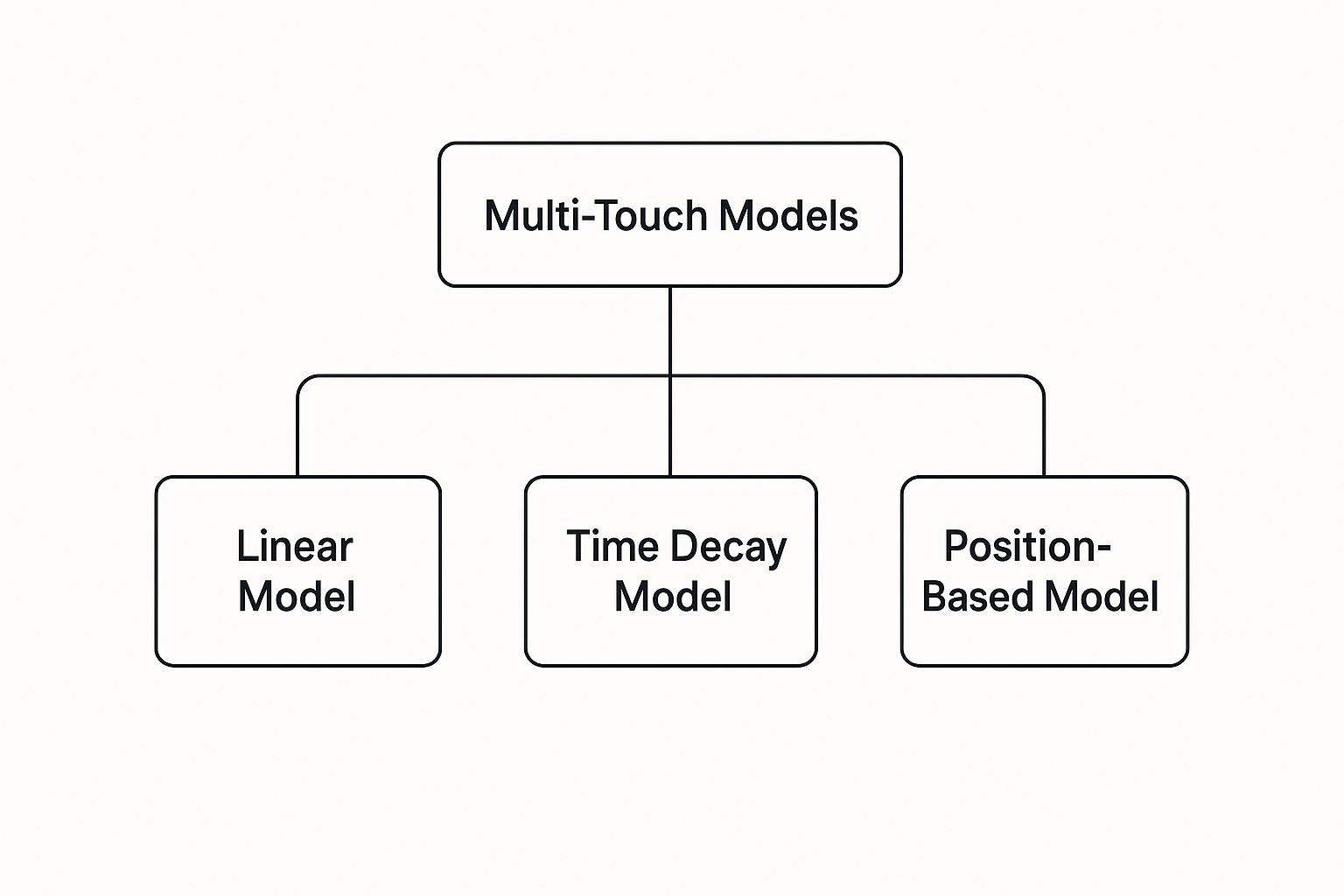
Infographic about multi-touch attribution models

As you can see, each framework prioritizes certain stages of the customer journey, which is why picking the right one is so critical.

Position-Based Models: U-Shaped and W-Shaped

Position-based models are all about giving the most weight to specific milestone touchpoints. The two most common variations are the U-Shaped and W-Shaped models.

The U-Shaped model (also called Position-Based) emphasizes the very beginning and the very end of the journey. It assigns 40% of the credit to the first touch, another 40% to the last touch, and sprinkles the remaining 20% across all the interactions in between.

In our sneaker example, the U-Shaped model would assign credit like this:

  • Instagram Ad (First Touch): 40%
  • Email & Blog (Middle Touches): 10% each
  • Google Search Ad (Last Touch): 40%

The W-Shaped model takes this a step further by introducing a third major milestone: the moment a person becomes a qualified lead (like signing up for a demo).

This model typically assigns 30% credit to the first touch, 30% to the lead-creation touch, and 30% to the final conversion touch. The last 10% gets split among the rest. It’s an ideal fit for B2B companies with very distinct, measurable funnel stages.

Comparing Rule-Based Multi-Touch Attribution Models

Choosing a model isn't just a technical decision; it reflects what you value most in your marketing strategy. Do you care more about what starts the conversation, what closes the deal, or the entire journey? This table breaks down the core rule-based models to help you see the differences at a glance.

ModelHow Credit Is AssignedBest ForActionable Insight
LinearCredit is split equally across all touchpoints.Long sales cycles and brand awareness campaigns.Reveals the full path, preventing you from cutting mid-funnel content.
Time-DecayTouchpoints closer to the conversion get more credit.Short, promotion-driven sales cycles.Identifies your strongest "closing" channels for quick wins.
U-Shaped40% to first touch, 40% to last touch, 20% to the middle.Valuing both lead generation and conversion equally.Helps you balance budget between top-of-funnel and bottom-of-funnel tactics.
W-Shaped30% each to first, lead creation, and last touch; 10% to others.B2B marketing with a clear lead qualification stage.Shows which channels are best at creating MQLs, not just initial clicks.

Ultimately, the right model provides actionable insights that align with your business goals. Whether you need to understand top-of-funnel impact or what’s pushing customers over the finish line, there’s a framework that can bring clarity to your data.

Stepping into Data-Driven Attribution

A person interacting with an abstract, glowing interface of data points and machine learning algorithms, symbolizing data-driven attribution.

While the rule-based models we've covered bring some much-needed order to the chaos, they all share a fundamental flaw: they're based on our assumptions. You're the one telling the system what's important—the first touch, the last click, or an even split.

But what if you could take the guesswork out of the equation entirely? What if the data itself could tell you which touchpoints were actually doing the heavy lifting?

That’s the promise of data-driven attribution, often called algorithmic attribution. It’s a massive leap forward from fixed rules to intelligent, adaptive measurement. Think of it as the difference between following a static, pre-written script and having a smart assistant that learns and adjusts from every single customer interaction.

Instead of force-fitting your data into a rigid formula, data-driven models use machine learning to analyze the unique, messy, and complex paths your customers take. The algorithm sifts through thousands of journeys—both those that end in a sale and those that don't—to spot the real patterns. It then assigns credit based on the actual, measured impact each channel has on the final decision.

The Algorithmic Advantage

The single biggest benefit here is accuracy. Period. You move beyond educated guesses and get a custom model built specifically around how your customers behave on your site.

This approach is brilliant at uncovering the true value of those middle-of-the-funnel touchpoints—the ones that play a subtle but critical role in nurturing a lead but rarely get the final credit.

By comparing successful conversion paths against unsuccessful ones, a data-driven model can calculate the real probability of a conversion at each step. This allows for a much more nuanced and accurate distribution of credit than any rule-based system could ever hope to achieve.

Getting this right is becoming non-negotiable. The market is shifting toward advanced AI models that can analyze millions of data points to deliver this kind of insight. For companies that get it right, the payoff is huge—often boosting marketing ROI by 25-40%.

What You Need to Make It Work

Data-driven attribution is powerful, but it’s not a magic wand you can wave over a sparse dataset. Its effectiveness is completely dependent on the quality and, more importantly, the volume of data you feed it.

Before you jump in, you need to be honest about a few things:

  • Data Volume: To get statistically significant results, you need a lot of data. We're talking thousands of conversions and tens of thousands of unique user paths every single month. Without that, the algorithm is just guessing.
  • Technical Chops: A true data-driven model isn't a simple toggle in your analytics tool. It often requires specialized platforms or an in-house team that can manage the complexity.
  • Data Hygiene: The model is only as good as the information it’s fed. Clean, consistent tracking across every single channel is an absolute prerequisite. For a deeper dive into the tech behind this, our guide on person-level identification breaks down how individual journeys are tracked.

If your business has lower conversion volumes or you're just starting out, sticking with a solid rule-based model like Linear or U-Shaped is a perfectly smart and practical first step. But for any organization sitting on a mountain of good data, making the move to a data-driven model is like turning on the lights in a dark room.

Your Action Plan for Choosing the Right Model

Alright, let's get out of the textbook and into the real world. Figuring out which attribution model to use isn't some academic exercise—it's about picking the right tool for the job.

The perfect model for a fast-moving e-commerce brand is going to be completely wrong for a B2B SaaS company with a six-month sales cycle. It's that simple.

Making the right call means taking an honest look at your goals, how your customers actually behave, and what resources you have on hand. Let's walk through a few questions to get you pointed in the right direction.

Your Decision-Making Framework

Your business isn't a generic template, so your attribution model shouldn't be either. Think of these questions as a filter to help you match what your business needs with what each model does best.

1. How Long Is Your Sales Cycle?

This is the big one. The time it takes for someone to go from "who are you?" to "take my money" changes everything.

  • Short Sales Cycle (days to weeks): If customers make decisions fast, the touchpoints right before the sale are usually the most important. The Time-Decay model is built for this. It gives more credit to the last few interactions that got the customer across the finish line. Think about a weekend flash sale—you want to know which last-minute email or retargeting ad sealed the deal.

  • Long Sales Cycle (months to a year): When the journey is a marathon, not a sprint, every touchpoint plays a role. The Linear model is your friend here. It gives equal credit to every interaction, making sure you don't accidentally kill the budget for that blog post that introduced a customer to your brand six months before they finally converted. It prevents short-term thinking.

2. What Are Your Primary Business Goals?

What are you actually trying to accomplish right now? Growing your email list? Driving brand awareness?

Your model has to line up with your strategy. If you're all-in on lead generation, a U-Shaped model makes sense—it credits both the first touch (the lead) and the last touch (the conversion). But if you're running a huge brand awareness campaign, a Linear model might be better to value every single impression and click along the way.

3. How Complex Is Your Customer Journey?

Next, map out how many channels and steps are usually involved before someone buys from you.

  • Simple Journey (a few touchpoints): If your path to purchase is pretty direct—say, a social ad straight to a product page—a U-Shaped model is a fantastic place to start. It gives props to what started the journey and what closed it, which is often all the signal you need.

  • Complex Journey (many touchpoints and clear stages): For businesses with a more defined funnel, like most B2B companies, a W-Shaped or Full-Path model is a much better fit. These models let you assign major credit to those key moments in the middle of the funnel, like when a lead becomes marketing-qualified (MQL) or books a demo.

4. What Are Your Available Resources?

Let’s be real about your data and your team's technical skills.

If you have a massive amount of conversion data (thousands per month) and a data science team on standby, then a Data-Driven model is the holy grail. It ditches the guesswork and builds a custom algorithm based on what your actual customers are doing.

But for most businesses, that's overkill. You can get 90% of the value with only 10% of the complexity by starting with a well-chosen, rules-based model. Don't let the hunt for perfection stop you from making solid progress today.

Your Action Plan for Implementation

An attribution model is only as good as its implementation. Moving from theory to practice requires a clear, actionable roadmap. You need to make sure your data is clean, your goals are defined, and your team is on the same page. This plan will get you from initial setup to analyzing your first results.

A successful rollout isn't just a technical task; it's a strategic one. Careful planning is the only way to avoid common pitfalls like incomplete tracking or picking a tool that can't grow with you.

Define Your Key Conversion Events

Before you can track anything, you have to decide what a "win" actually looks like. Is your main goal a completed purchase? A demo request? A newsletter signup?

Be specific and prioritize. A B2B company might map out its key conversion events like this:

  • Micro-conversion: Whitepaper download
  • Macro-conversion: Demo request submitted
  • Sales conversion: Deal closed-won in the CRM

Defining these events ensures your multi-touch attribution models measure what truly matters to the business. You get actionable insights, not just vanity metrics.

Ensure Clean and Comprehensive Data Collection

Your attribution system is completely dependent on the data you feed it. Inaccurate or incomplete data will lead to flawed conclusions, no matter which model you choose. The principle is simple: garbage in, garbage out.

To keep your data clean, focus on two core areas:

  1. Consistent UTM Tagging: Implement a standardized UTM structure across all your campaigns. This is the only way to accurately track the source, medium, and campaign for every single click, ensuring no touchpoints are miscategorized.
  2. Robust Tracking Pixels: Double-check that your tracking pixels (like those for Google or Meta) are correctly installed on every relevant page. This is non-negotiable for capturing user interactions and building a complete picture of the customer journey.

Here's an example from Google's documentation showing how a data collection tag is implemented.

Screenshot from https://developers.google.com/analytics/devguides/collection/ga4/tag-guide

This little code snippet is the foundation of your data collection. It has to be implemented correctly for every touchpoint to be captured accurately.

Select the Right Attribution Tool

Choosing the right software is a make-or-break step. The global marketing attribution software market is projected to grow at a CAGR of 13.6% from 2025 to 2030, all because companies need to make sense of fragmented digital journeys. The right tool should fit what you need today while having the horsepower to grow with you tomorrow.

A common mistake is picking a tool that's either too simplistic for your needs or way too complex for your team to manage. Your choice should line up with your data volume, technical resources, and business goals.

Analyze, Iterate, and Get Buy-In

Once your system is live and data is flowing, the real work begins. Your first batch of reports won't be the final word; they're your new baseline for understanding performance. Share these initial findings with other teams—especially sales and IT—to get their buy-in and different perspectives. Collaboration is what makes everyone trust the data.

The insights from your attribution model should directly inform your strategy. You can use this data to fine-tune other marketing processes, too. For instance, you might check out our guide on AI-powered lead scoring to see how attribution data can help you prioritize your most valuable leads. The goal is to create a continuous loop: analyze, act, and improve.

Free Tool

Try our Marketing Plan Generator — generate a complete AI-powered marketing plan in minutes. No signup required.

Answering Your Top Attribution Questions

You've got the concepts down, but let's be real—moving to a new way of measuring marketing always brings up some practical questions. We get it. Here are some straight, no-fluff answers to the things marketers usually ask when they're ready to see the whole picture.

What Is the Main Difference Between Single-Touch and Multi-Touch Attribution?

Think of it like a soccer game.

Single-touch attribution is like giving 100% of the credit to the player who scored the final goal. The first-touch model gives it to the first player who touched the ball, and the last-touch model gives it to the final scorer. It’s simple, but you completely miss the assists and defensive plays that made the goal possible.

Multi-touch attribution, on the other hand, is like watching the game replay. It distributes credit across all the players who passed the ball, created the opening, and set up the final shot. You get a far more realistic view of how the entire team—your entire marketing mix—worked together to score.

How Much Data Do I Need for a Data-Driven Attribution Model?

This is a big one. Data-driven models are powerful, but they're also data-hungry. Because they rely on algorithms to find patterns, they need a ton of information to produce anything reliable.

There isn't a perfect magic number, but a good rule of thumb is you'll need thousands of conversions and tens of thousands of individual touchpoints every single month. If you're not at that scale, the model's conclusions can be shaky.

Don't have enterprise-level data volume? No problem. That's exactly why rule-based models like Linear or U-Shaped exist. They offer a huge step up from single-touch and give you actionable insights without needing a massive dataset.

For teams with higher data volumes, our case studies on attribution show just how powerful a data-driven approach can be for uncovering hidden channel value.

Can I Use Multi-Touch Attribution Without an Expensive Tool?

Absolutely. You don't need to jump straight to a pricey, dedicated platform, but be prepared for some manual work.

You can actually start with tools you probably already have. Google Analytics, for instance, has built-in multi-touch reports that let you compare different models right out of the box. It’s a great way to dip your toes in the water.

For a more custom setup, you can export your data to a BI tool and build your own models. The main trade-off is time and effort. Dedicated attribution software automates all the messy data collection and number-crunching, which saves a ton of hours, cuts down on human error, and gets you clearer answers, faster.


Ready to stop guessing and start seeing the full picture of your marketing performance? marketbetter.ai provides an integrated AI platform that simplifies multi-touch attribution, helping you optimize your budget and prove your ROI with confidence. Discover how our platform can transform your marketing analytics.

Predictive Analytics in Marketing: How Top B2B Teams Forecast Revenue (Not Just Leads) [2026]

· 23 min read

For years, marketing felt like driving down a highway while only looking in the rearview mirror. We’d pour over last quarter's campaign data, trying to figure out what worked yesterday. It’s a purely reactive game—like trying to steer a ship by watching its wake. Sure, it tells you where you’ve been, but it offers zero help with what’s coming up ahead.

Predictive marketing completely flips the script.

Think of it as having a real-time GPS with live traffic updates. Instead of just looking back, you’re now using data to see the road ahead. Predictive analytics in marketing doesn't just report on what happened; it forecasts what your customers are likely to do next. That shift from guesswork to informed strategy is a massive competitive advantage.

From Reactive to Proactive Strategies

The real change is in the questions we can finally ask. A traditional marketer asks, "Which customers bought our product last quarter?" But a predictive marketer asks, "Which customers are most likely to buy our product next week?"

This proactive mindset transforms how marketing gets done:

  • Audience Targeting: Forget casting a wide net with broad demographics. Now you can pinpoint the actual individuals with the highest probability of converting.
  • Customer Retention: Instead of finding out about churn after it’s too late, you can identify customers who are at risk of leaving and step in with the right offer to keep them.
  • Budget Allocation: You can put your marketing dollars into the channels that are forecasted to deliver the best ROI, before you even spend them.

Predictive analytics doesn't just tweak marketing—it redefines the entire goal. The objective is no longer just to reach a big audience. It’s about engaging the right person at the exact moment they’re ready to listen.

The New Standard for Modern Marketing

This kind of tech used to be locked away in the ivory towers of massive companies with teams of data scientists. Not anymore. The rise of more accessible AI and machine learning has put these tools in the hands of businesses of all sizes.

Now, you can use predictive models to optimize everything from a simple email subject line to a complex, multi-channel customer journey. Understanding how this powers modern tactics like data-driven content marketing is the key to seeing why it’s no longer optional. It delivers a level of personalization and raw efficiency that was pure science fiction just a decade ago, making it an essential part of any serious marketing strategy today.

How Predictive Analytics Actually Works

A marketer analyzing complex data charts on a computer screen.

Predictive analytics might have a futuristic ring to it, but the concept is surprisingly straightforward. Think of it like a master chef who knows exactly which ingredients to combine to get the perfect dish every single time. It's about looking at what you have (your data) to create a recipe for what's coming next (an accurate prediction).

This isn't just about reporting on past performance. It’s about forecasting the future.

This forward-looking magic is powered by machine learning algorithms. These algorithms are built to dig through mountains of historical data, finding the subtle patterns and hidden connections a human would miss. That’s the real secret sauce of predictive analytics in marketing—it spots the quiet signals that come right before a customer makes a move.

But here’s the catch: the whole thing falls apart without the right data. The quality and variety of the information you feed the system determines everything. You can't cook a gourmet meal with bad ingredients.

The Key Ingredients: Your Data

To make accurate predictions, these models need a rich diet of different data types. Each one adds another layer to the customer's story, giving the algorithm a much clearer picture to analyze.

The main data sources are:

  • Behavioral Data: This is all about what your customers do. Think website clicks, pages they linger on, emails they open, and content they download. It’s your direct line into their interests and engagement level.
  • Transactional Data: This covers what your customers buy. Purchase history, how often they order, average cart size, and returns—all of it reveals their buying habits and what they value.
  • Demographic Data: This is who your customers are. Age, location, job title, or company size for B2B. This data helps build the foundational segments you'll work from.

To really get how these models work, you have to start by understanding intent data, which is all about spotting the online behaviors that signal someone is ready to buy.

By blending these sources, you build a complete customer profile. The algorithm then finds the money-making correlations—like noticing that customers who view a specific product page three times are 85% more likely to buy in the next 48 hours.

Turning Data Into Actionable Predictions

Once the data is wrangled, the algorithms get to work building predictive models. These aren't generic, one-size-fits-all tools. They’re highly specialized, each trained to answer a specific marketing question.

Here are three of the most common predictive models you'll see in marketing:

Predictive ModelWhat It PredictsKey Business Question It Answers
Predictive Lead ScoringThe odds that a new lead will actually become a paying customer."Which leads should my sales team call right now?"
Customer Churn PredictionThe probability that a current customer is about to leave."Who is at risk of churning, and what can we do to save them?"
Customer Lifetime Value (CLV)The total revenue you can expect from a customer over their entire relationship with you."Who are our VIPs, and how do we find more people just like them?"

Each model spits out a clear, actionable score. A lead gets a 95 (hot) or a 20 (cold). A customer is given an 80% churn risk. This simple output shifts a marketing team from just reporting on the past to proactively shaping the future. If you want to see how these individual data points are woven together, our guide on person-level identification dives deep into the more advanced techniques.

This ability to see around the corner is why the AI in marketing industry is set to hit $107.5 billion by 2028. It’s the engine behind the hyper-personalized experiences that customers don't just want anymore—they expect.

Predictive Marketing vs. Traditional Marketing

For decades, marketing ran on a familiar playbook. It was a craft built on historical data, broad demographic segments, and a healthy dose of professional gut feeling.

Think of the traditional marketer as an archaeologist. They spend their time carefully digging through past campaign results to figure out what worked yesterday. It’s a method that relies entirely on looking backward.

Predictive marketing, on the other hand, is more like being an astronomer with a powerful telescope. Instead of digging in the dirt, you're charting the stars to forecast future movements. Predictive analytics in marketing doesn't just analyze what happened; it uses that data to calculate what’s most likely to happen next. This single shift flips the entire discipline from reactive to proactive.

This is a fundamental change that impacts everything, from how you see your audience to how you spend your budget.

The Audience Building Shift

In traditional marketing, we built audiences using static, broad buckets. A classic approach was grouping people by demographics—think age, location, or job title. It's like sorting your music library by genre. Sure, it’s organized, but it tells you nothing about what someone actually wants to listen to right now.

Predictive marketing builds dynamic clusters based on behavior. It identifies customers not by who they are, but by what their actions suggest they will do. A predictive model might create a segment of "customers showing a 90% probability of buying a specific product in the next 7 days," completely independent of their demographics. That’s a far more precise and actionable way to target.

From Blasts to Personalized Journeys

Campaign execution is another area where the contrast is stark. The old way involved broad message blasts sent to those static segments. It was a one-to-many approach that just hoped the message resonated with enough people to scrape by with a positive return.

A predictive approach makes one-to-one personalized journeys possible at scale. Instead of a generic seasonal promo sent to everyone, a predictive campaign identifies an individual customer as a high churn risk and automatically sends them a personalized "we miss you" offer. The message, timing, and discount are all determined by their forecasted behavior.

The infographic below gives you a sense of the complex data modern analytics tools are crunching to make these kinds of sophisticated strategies a reality.

Infographic about predictive analytics in marketing

This kind of synthesis is what allows marketers to move beyond simple reporting and into true forecasting.

Forecasting ROI Instead of Just Reporting It

Perhaps the biggest advantage is how you measure results. Traditional ROI analysis is almost always a look in the rearview mirror. You run a campaign, wait for the dust to settle, and then report on what happened.

With predictive marketing, you can run pre-campaign forecasting. Models can estimate the potential conversion rates and revenue lift of different campaign strategies before you spend a single dollar. This leads to much smarter budget allocation and takes a significant amount of risk out of your marketing spend.

The core difference is simple: Traditional marketing reports on the past. Predictive marketing provides a roadmap for the future.

The market is catching on fast. By 2025, over 55% of businesses globally are expected to be using AI-powered predictive analytics to sharpen their decision-making. The global predictive analytics market is projected to rocket from $9.5 billion in 2022 to $41.2 billion by 2030, a testament to its massive growth and impact. You can dig into more research on the expansion of predictive analytics statistics to see its trajectory.

To make this crystal clear, here’s a side-by-side view of the old playbook versus the new one.

Predictive Analytics vs Traditional Marketing Approaches

This table breaks down the core differences, showing how a proactive, data-driven approach changes the game across key marketing functions.

Marketing FunctionTraditional Approach (Reactive)Predictive Analytics Approach (Proactive)
Audience BuildingStatic, demographic-based segments (e.g., "males, 25-34").Dynamic, behavior-based clusters (e.g., "users likely to convert").
Campaign ExecutionBroad, one-to-many message blasts.Personalized, one-to-one customer journeys.
ROI AnalysisAfter-the-fact reporting on past performance.Pre-campaign forecasting to predict outcomes.
PersonalizationBased on basic attributes like name or location.Based on predicted intent and future needs.
Primary GoalReach a wide audience and analyze what happened.Engage the right individual at the right time and shape what happens next.

The takeaway is straightforward: while traditional methods focus on what has already occurred, predictive analytics gives marketers the tools to anticipate and influence what will happen next.

Predictive Analytics in Action: Real-World Examples

Theory is one thing, but seeing predictive analytics in marketing actually work is another. The funny thing is, you probably bump into predictive models every single day without even realizing it. These aren’t just abstract ideas cooked up in a lab; they’re the engines quietly running some of the most personalized experiences you have online.

From the next show you binge-watch to the price you pay for a ride home, predictive analytics is in the driver's seat. Let’s pull back the curtain on four powerful examples and see how this tech goes from a buzzword to a bottom-line booster.

The Netflix Effect: Hyper-Personalized Recommendations

Ever wonder how Netflix seems to know exactly what you want to watch next? It’s not a lucky guess—it’s a world-class predictive recommendation engine. The platform doesn’t just see what you’ve watched; it crunches thousands of data points to figure out what you’ll probably love in the future.

And this goes way beyond just matching genres. Netflix’s models are looking at everything:

  • Viewing Habits: What time you watch, how long you stick around, and even if you pause or re-watch a particular scene.
  • Device Information: Are you on a big-screen TV, a laptop, or your phone? That context matters.
  • User Interactions: Everything from your search queries and ratings to which movie poster artwork you’re most likely to click on.

By piecing all this together, the algorithm predicts your tastes with almost spooky accuracy. The business result is simple but powerful: a more addictive user experience that keeps people from canceling their subscriptions. A happy, engaged subscriber sticks around.

Proactive Churn Prevention in Telecommunications

The telecom world is notoriously cutthroat, and customer churn is the monster under the bed. For companies like Verizon or AT&T, every customer who walks away is a big financial hit. So instead of waiting for people to leave, they use predictive analytics to spot who’s getting restless before they switch carriers.

They do this by building a churn prediction model that looks for subtle signs of unhappiness. These might be a sudden drop in data usage, a spike in calls to customer support, or recent billing problems.

The model assigns a "churn risk score" to every single customer. Anyone with a high score gets automatically flagged. This lets the retention team jump in with a proactive, personalized offer—maybe a special discount or a data plan upgrade—to convince them to stay loyal.

This is a complete shift from the old, reactive "exit survey" model to a smart, proactive retention strategy. It directly plugs a hole in the revenue bucket, saving customers who would have otherwise been long gone. To see how companies translate these kinds of insights into real wins, check out some of the detailed marketing analytics case studies that show the before-and-after.

Dynamic Pricing for Airlines and Ride-Sharing

If you’ve ever booked a flight or hailed an Uber during rush hour, you’ve been on the receiving end of predictive pricing. Airlines and ride-sharing apps don't just set a price and forget it; they use sophisticated models to adjust fares in real-time based on what they think demand will be.

These dynamic pricing models are constantly swallowing a stream of data to make their next move:

  • Historical booking patterns for a specific route.
  • Current search volume and website traffic.
  • External factors like the weather, local events, or upcoming holidays.
  • What the competition is charging right now.

With these inputs, the algorithm predicts what's coming. If it expects a huge surge in ride requests when a concert lets out, prices automatically go up. If it sees that a Tuesday morning flight is looking empty, fares drop to fill those seats. This whole strategy is about maximizing revenue by making sure the price is always perfectly matched to the predicted demand.

Smart Budget Allocation for E-Commerce Brands

For any e-commerce brand, the question of where to spend the next advertising dollar is a million-dollar one. Predictive models help take the guesswork out of it by forecasting the potential return on investment (ROI) from every marketing channel.

Instead of just looking at the last click before a sale, these models analyze the entire customer journey. They predict which channels are most likely to bring in high-value customers. For instance, a model might reveal that while social media ads get a ton of initial clicks, email marketing is 75% more likely to convert a big spender for a specific product line.

Armed with that kind of foresight, marketing teams can confidently shift their ad spend away from channels that aren't pulling their weight and double down on the ones with the highest forecasted ROI. This makes sure every dollar in the marketing budget is working as hard as it possibly can.

Your Five-Step Predictive Analytics Implementation Plan

A professional team collaborating on a predictive analytics implementation plan in a modern office.

Jumping into predictive marketing can feel like you’re trying to boil the ocean. It’s a huge concept. But you don't have to. The best way to get started is by breaking it down into a clear, step-by-step roadmap that builds a real predictive engine for your business.

This isn’t about flipping a switch and hoping for the best. It's a methodical process. And it doesn't start with algorithms or fancy tech—it starts with a simple, focused question about what you're trying to fix.

Let's walk through the five stages to make it happen.

Step 1: Pinpoint Your Core Business Objective

Before you look at a single data point, you need to know what you’re aiming for. A fuzzy goal like "improve marketing" is useless. You need a specific, measurable target that a predictive model can actually be trained to hit.

Start with a real pain point. Are you losing customers and you don't know why? Is your cost to acquire a new customer getting out of control? Are you leaving money on the table because one-time buyers never come back?

Frame that problem as a sharp, clear goal:

  • Reduce customer churn by 15% in the next six months.
  • Increase the conversion rate of new leads by 20% this quarter.
  • Boost customer lifetime value (CLV) by 25% over the next year.

This clarity is everything. Your objective is your North Star. It guides every decision you make from here on out and ensures all this work actually connects to real business value.

Step 2: Unify and Prepare Your Data

Your predictions are only ever as good as the data you feed them. To find meaningful patterns, predictive models need clean, consolidated, and complete data. The problem? For most companies, customer data is a mess, scattered across a dozen disconnected silos—your CRM, e-commerce platform, email tools, web analytics, you name it.

The mission here is to create a single customer view. This is a unified profile that stitches together every single touchpoint and interaction a person has with your brand. It’s non-negotiable. Fragmented data leads to half-baked analysis and, worse, flat-out wrong predictions.

This means you have to invest time in a data audit and cleanup. Standardize formats, zap duplicate entries, and make sure your historical data is accurate. It’s the least glamorous part of the process, but it’s the absolute bedrock of your success.

Step 3: Select the Right Tools for Your Team

Okay, you have a clear goal and clean data. Now it's time to pick your tech. The market for predictive analytics in marketing has exploded, with options for teams of all sizes and skill levels. You basically have two paths you can go down.

This table should help you figure out which approach fits your company best.

Tooling ApproachBest ForKey AdvantagesPotential Drawbacks
User-Friendly PlatformsTeams without data scientists who need quick wins.Out-of-the-box models, easy-to-use interfaces, and fast setup.Less customizable; might not solve super-specific business problems.
Custom-Built ModelsBig companies with data science teams and unique needs.Highly tailored to your exact goals, giving you maximum control.Expensive, takes a long time to build, and requires specialized talent.

For most marketing teams, starting with a platform that has predictive features already built-in is the most practical move. It lets you prove the value of this approach without needing a massive upfront investment in hiring a data science team.

Step 4: Train and Validate Your Predictive Model

Once your tool is in place, it’s time to train your model. This is where you feed all your historical data into the algorithm so it can learn the patterns that lead to your goal. For instance, to build a lead scoring model, you'd give it data on all your past leads—the ones that converted and the ones that went cold.

The model chews through thousands of data points to find the signals that matter. It might learn, for example, that a lead who downloads a specific whitepaper and then visits your pricing page is 80% more likely to buy. Our guide on AI lead scoring goes deeper into how these models build a smarter sales pipeline.

After the initial training, you have to validate the model's accuracy. You do this by testing it on a fresh set of data it has never seen before. This step is critical—it confirms that your model's predictions are reliable and not just a lucky guess based on the training data.

Step 5: Weave Insights into Action

Here's the bottom line: a perfect prediction is completely worthless if you don't do anything with it. The final, most important step is wiring the model's output directly into your day-to-day marketing. This is how you turn foresight into automated, personalized campaigns that actually drive revenue.

For example:

  • A churn prediction model can automatically enroll at-risk customers into a "we miss you" email campaign.
  • A lead scoring model can instantly push your hottest leads to the top of the sales team's queue.
  • A CLV model can trigger exclusive offers designed to delight your most valuable customers.

This is what modern marketing looks like. Instead of just reacting to what already happened, you're proactively shaping what happens next. You’re moving from rearview-mirror reporting to dynamic forecasting. By putting your predictions to work, you close the loop and turn raw data into real, measurable growth.

Free Tool

Try our AI Lead Generator — find verified LinkedIn leads for any company instantly. No signup required.

Common Questions About Predictive Marketing

Let’s get real. Diving into predictive marketing brings up a ton of practical, "how does this actually work for me?" questions. It's one thing to talk about algorithms and another to figure out the people, data, and budget you actually need to pull it off.

So, let's cut through the noise and tackle the most common concerns marketers have. Think of this as the straight-talk guide to getting started.

Do I Need a Team of Data Scientists?

This is the big one. The myth that stops so many teams before they even start.

The short answer? No—not anymore.

Sure, big enterprise companies might have a whole team of PhDs building custom models from the ground up. But that's like building your own car engine just to get to the grocery store. It's no longer the only way to get there.

Today, a new wave of marketing platforms has incredibly powerful predictive features built right in. These tools are designed for marketers, not coders. They do all the heavy lifting behind the scenes and serve up the insights on a silver platter.

The goal isn't to become a data scientist. It's to become a marketer who can use the outputs of data science to make much, much smarter decisions.

So, what's the right path for you?

ApproachBest ForWhat It Looks Like in Practice
In-House Data Science TeamHuge enterprises with unique, complex problems and even bigger budgets.Building proprietary algorithms from scratch to predict hyper-specific customer behaviors.
User-Friendly AI PlatformsPretty much every other B2B and B2C marketing team looking for proven, scalable solutions.Using a tool with "out-of-the-box" features like predictive lead scoring or churn risk analysis.

For most businesses, the smartest move is to find your biggest marketing headache and pick a user-friendly tool that solves it.

What Kind of Data Do I Really Need?

Here’s the thing about predictive models: they're only as good as the clues you give them. Garbage in, garbage out. The good news is you probably already have most of the data you need sitting right under your nose.

The trick is getting it all in one place. To start, you need a solid foundation of historical data, which usually breaks down into three buckets:

  • Transactional Data: All the "what" and "when." Purchase history, average order value, product categories, and subscription dates. This is the story of what your customers buy.
  • Behavioral Data: The "how." Website visits, email clicks, content downloads, app usage, and support tickets. This stuff reveals how customers actually engage with you.
  • Customer Data: The "who." Demographics, firmographics, location, job titles, company size, and how they found you in the first place. This adds critical context.

If you do one thing first, make it this: break down your data silos. Get everything flowing into a central hub, like your CRM or a Customer Data Platform (CDP). If your data is a scattered, messy disaster, your first and most important project is a data cleanup. Without that single source of truth, your predictions will never be reliable.

How Can I Measure the ROI of Predictive Analytics?

Proving the value of a new investment is always job number one for marketers. Thankfully, the impact of predictive analytics isn't some fuzzy, abstract concept—it’s incredibly measurable. The key is to set a clear baseline before you start and then run a clean comparison.

Here are four simple ways to nail down your ROI:

  1. A/B Test Your Campaigns: This is the cleanest test. Send a predictive, hyper-personalized offer to one segment. Send a generic offer to a control group. The difference in the conversion rate is your lift. Simple as that.
  2. Track Customer Retention: Use your churn model to flag a group of at-risk customers. Proactively reach out to half of them with a retention offer. Do nothing for the other half. The difference in the churn rate between the two groups is pure, measurable ROI.
  3. Compare Customer Lifetime Value (CLV): Look at the CLV of customers you brought in through predictive targeting versus those who came from your old methods. A higher CLV in the predictive group shows you’re not just getting more customers—you’re getting better customers.
  4. Calculate Cost Per Acquisition (CPA): When you stop wasting ad spend on leads who were never going to convert, your CPA naturally drops. Track this metric before and after you roll out predictive lead scoring to see exactly how much you’re saving.

By setting these KPIs from day one, you’ll have no trouble connecting your predictive efforts directly to revenue gains and cost savings.


Ready to stop guessing and start predicting? marketbetter.ai integrates powerful AI across your entire marketing workflow, from content creation to campaign optimization. Our platform makes it easy to turn data into revenue without needing a team of data scientists. Discover how you can drive growth with actionable insights by exploring our solutions.

How to Measure Marketing Effectiveness: The Attribution Framework CMOs Actually Use [2026]

· 27 min read

Figuring out if your marketing is actually working means tying what you do every day to real business results, like revenue and new customers. It’s about getting past the fluffy, surface-level numbers to see which strategies are pulling their weight. This is how you optimize your budget and prove your team's value. It all comes down to setting clear goals, picking the right metrics, and using a smart framework to turn data into decisions.

Building Your Marketing Measurement Framework

Image

Before you can measure anything accurately, you need a game plan. Think of a measurement framework as your blueprint—it ensures every single thing you do is intentional and connected to the big-picture business goals. Without one, you’re just collecting random data points that don't tell a story. With one, you're building a system to make better decisions.

The first step? Stop chasing vanity metrics. A post with 10,000 likes that generates zero leads is a failure compared to a targeted article that only brings in 50 qualified leads who actually convert. The actionable insight here is to shift your focus from metrics that feel good (likes) to metrics that drive growth (qualified leads). That’s the difference between activity and impact.

Get Aligned With Stakeholders on What "Success" Means

Your framework is useless if nobody agrees on the definition of success. The metrics that get you excited might not be the same ones your CEO or head of sales cares about. They’re thinking in terms of revenue, customer growth, and market share. Your job is to translate your marketing performance into their language.

Here's an actionable plan to get aligned: schedule a 30-minute meeting with key stakeholders and ask direct questions.

  • For your CEO: "What is the single most critical business goal for us this quarter? Is it pure customer acquisition, breaking into a new market, or boosting customer lifetime value?" This helps you anchor your KPIs to top-line business objectives.
  • For the Head of Sales: "Can we define exactly what a 'qualified lead' is for your team? What criteria must they meet?" This prevents you from delivering leads that the sales team rejects, ensuring your efforts are valued.
  • For the Product Team: "Which features are we pushing right now, and how can marketing help with user adoption and getting feedback?" This aligns your campaigns with the product roadmap.

Having these conversations upfront prevents painful misalignment later. It allows you to build a framework that directly supports company-wide objectives, making it way easier to show how your department is moving the needle.

Pick the Right Metrics for Each Stage of the Funnel

A good measurement framework tells the whole story, from the first time a prospect hears about you all the way to their purchase. This means you need specific KPIs for each stage of the customer journey, not just the final conversion. It’s like a relay race—each stage hands off to the next, and a weak link anywhere in the chain messes up the final result.

A classic mistake is getting obsessed with last-touch attribution, which gives 100% of the credit to the final ad someone clicked. A smart framework recognizes that the blog post they read last month, the social video they watched last week, and the webinar they attended yesterday all played a part.

Let's compare how you'd measure success for different channels at each stage:

  • Top-of-Funnel (Awareness): For a LinkedIn brand campaign, you might track Impressions and Share of Voice. A better, more actionable metric is qualified reach—are the right people seeing your content? Compare this to an SEO-driven blog, where you’d measure Organic Traffic and Keyword Rankings for high-intent terms.
  • Middle-of-Funnel (Consideration): A webinar’s performance is judged by its Registration Rate and Attendee Engagement. But to make this actionable, track how many attendees ask questions or respond to polls. Compare this to an ebook's success, which is all about its Landing Page Conversion Rate and the Quality of Leads it generates (i.e., how many become MQLs).
  • Bottom-of-Funnel (Conversion): For a Google Ads campaign, the most important metric is Cost Per Acquisition (CPA). For a final-push email sequence, compare the Click-Through Rate on "Book a Demo" links to the ultimate Sales Conversion Rate. If CTR is high but conversions are low, the issue is on the landing page, not the email.

By building this kind of balanced scorecard, you avoid the trap of calling a top-of-funnel campaign a "failure" just because it didn't drive sales directly. That wasn't its job. Its job was to fill the pipeline, and your framework should prove it did just that. For a deeper dive into setting up a solid foundation for tracking your efforts, check out this modern guide for impactful marketing. This approach helps you build a clear, defensible story about how every marketing dollar contributes to the bottom line.

Choosing The Right Marketing Metrics And KPIs

Image

Alright, you've got your strategy sketched out. Now comes the hard part: cutting through the noise. It’s incredibly easy to get buried in a mountain of data, staring at charts that go up and to the right without actually telling you if you're growing the business.

Effective measurement isn't about tracking everything. It’s about being ruthless and focusing only on the numbers that signal real business momentum, not just marketing activity. A spike in website traffic is a classic vanity metric. It feels good, but it means nothing if none of those visitors are the right people.

The goal is to connect every single metric you track back to a tangible business outcome. You need to tell a story with your data—a story that ends with marketing’s direct contribution to the bottom line.

Aligning Metrics To The Marketing Funnel

You wouldn't judge a sprinter on their marathon time, right? The same logic applies here. Different stages of the customer journey demand different yardsticks. One of the most common mistakes I see is teams judging an awareness campaign by its direct sales impact. It’s a recipe for killing good campaigns before they have a chance to work.

Think of your funnel metrics as a diagnostic tool. If conversions are tanking, a funnel-based view lets you look upstream. Is the problem weak leads coming from the middle of the funnel? Or is it that you just aren't getting enough eyeballs at the top?

Let's walk through what this looks like in practice, comparing standard metrics to more insightful ones:

  • Awareness Stage (Top of Funnel): Instead of just tracking Impressions (how many times your content was seen), a much sharper metric is Share of Voice (SOV). It answers a better question: "How much of the conversation in our market do we actually own compared to our competitors?" This gives you a competitive benchmark.

  • Consideration Stage (Middle of Funnel): Click-Through Rate (CTR) is a solid indicator that your creative and messaging are hitting the mark. But a more holistic metric is Engagement Rate (likes, shares, comments). It tells you if your content is truly resonating, not just getting a passing click. Actionable insight: high engagement but low CTR means your content is good, but your call-to-action is weak.

  • Conversion Stage (Bottom of Funnel): Conversion Rate is your bread and butter—it’s the percentage of people who take the action you want them to. But the real gut-check metric is Cost Per Acquisition (CPA). It tells you exactly how much you're spending to get one new customer, making it a direct line to campaign efficiency and profitability. Compare the CPA across different channels to decide where to allocate your budget.

To make this even clearer, here's a quick reference table breaking down the essential KPIs for each stage of the journey.

Key Marketing Metrics by Funnel Stage

Tracking the right metrics at each stage gives you a clear, actionable picture of your marketing performance, from initial brand exposure to the final conversion.

Funnel StageMetric/KPIWhat It MeasuresExample Tool
AwarenessImpressionsTotal times content is displayed.Google Ads
AwarenessShare of Voice (SOV)Your brand's visibility vs. competitors.Brandwatch
ConsiderationClick-Through Rate (CTR)Percentage of impressions that result in a click.HubSpot
ConsiderationEngagement RateLikes, shares, comments as a % of audience.Sprout Social
ConversionConversion RatePercentage of users who complete a desired action.Google Analytics
ConversionCost Per Acquisition (CPA)The total cost to acquire a single new customer.Salesforce

Using this framework helps you pinpoint weaknesses and double down on what’s working, ensuring your entire marketing engine is firing on all cylinders.

The Business-Level Metrics Executives Actually Care About

While funnel metrics are your day-to-day guide for optimizing campaigns, the C-suite speaks a different language. They're focused on growth, profitability, and the long-term health of the business. To earn their trust (and bigger budgets), you need to translate your marketing efforts into their language.

The most effective marketers don't just report on clicks and leads; they demonstrate how marketing drives the core financial health of the business. This is how you get a seat at the strategic table.

Two numbers matter more than almost any others here: Customer Acquisition Cost (CAC) and Customer Lifetime Value (CLV).

  • Customer Acquisition Cost (CAC): This is the total sales and marketing spend it takes to land a single new customer over a specific time. You calculate it by dividing all your acquisition costs by the number of new customers you brought in. No hiding here—it's the true cost of growth.

  • Customer Lifetime Value (CLV): This is a prediction of the total net profit you'll get from a customer over their entire relationship with you. It’s about their long-term worth, not just their first purchase.

The real power move is comparing these two. The CLV:CAC ratio is your ultimate proof point for sustainable marketing. A healthy ratio, typically 3:1 or higher, is a clear signal that you're acquiring customers who generate far more value than they cost to win. Understanding how to calculate ROI to prove investment value is non-negotiable for justifying your spend.

This isn’t just about reporting, either. It directly shapes your strategy. Actionable step: calculate the CLV for customers acquired from different channels. If you discover that leads from your webinar series have a sky-high CLV compared to those from paid social, you can confidently shift budget away from lower-performing channels and double down on webinars. This is also where AI can give you a massive edge, helping you qualify leads better and focus your team's energy only on high-value prospects. We dive deep into that topic in our guide on how to use AI for better lead scoring.

So you’ve got your KPIs locked in. The next question is the one that sparks endless debate in marketing meetings: who gets the credit? A customer might see a Facebook ad, read a couple of blog posts, open an email, and then finally click a Google Ad before they buy. Which one of those channels actually did the work? This is the classic attribution problem, and it’s where a lot of marketers get stuck trying to prove their budget is well-spent.

Attribution modeling is just a fancy term for a set of rules that assign value to the different touchpoints in that messy customer journey. If you get it right, you can confidently measure what’s working. But if you choose the wrong model, you might end up cutting the budget for a channel that’s quietly doing all the heavy lifting at the start of the journey.

Comparing Single-Touch vs. Multi-Touch Models

The simplest models are single-touch, which give 100% of the conversion credit to just one interaction. They're easy to set up but can be dangerously misleading because they only show you a tiny sliver of a much bigger picture. In contrast, multi-touch models distribute credit, offering a more realistic view.

Let's compare the common single-touch models:

  • First-Touch Attribution: This model gives all the credit to the very first interaction. It’s useful if your main goal is driving top-of-funnel awareness. The problem? It completely ignores everything that happened afterward to actually nurture that lead and convince them to buy. Actionable Use: Use this model to identify your best "introducer" channels.
  • Last-Touch Attribution: This is the default setting in a lot of analytics platforms. It gives all the credit to the final touchpoint right before the conversion. It’s great for figuring out which channels are your best "closers," but it gives zero value to the channels that introduced and educated the customer in the first place. Actionable Use: Use this model to optimize your bottom-of-funnel conversion campaigns.

Relying on these is like giving all the credit for a championship win to the person who scored the final goal, ignoring the assists, the defense, and the coaching. For a more accurate view, you have to look at multi-touch attribution.

Multi-touch models get that modern customer journeys aren't a straight line. They distribute credit across multiple touchpoints, giving you a far more balanced and realistic understanding of what’s actually driving results.

A Deeper Look at Multi-Touch Attribution

Multi-touch models give you a more nuanced view by assigning partial credit to different interactions along the path. Yes, they’re more complex, but the insights they generate are gold for making smart budget decisions.

Here’s a breakdown of the most common multi-touch models and where they shine:

Attribution ModelHow It WorksBest Used When...
LinearGives equal credit to every single touchpoint in the journey.You want a simple, balanced view and value every interaction equally, which is common for long B2B sales cycles.
Time-DecayGives more credit to touchpoints that happened closer to the conversion.The consideration phase is short, and recent interactions are genuinely more influential, like during a flash sale.
Position-BasedGives 40% credit to the first touch, 40% to the last touch, and the remaining 20% is split among the middle touches.You value both the channel that hooked them and the channel that closed them the most. This is a common and balanced approach for many businesses.

Picking the right model really depends on your business and how long it takes for a customer to decide. A B2B company with a six-month sales cycle might lean toward a Linear model, while an e-commerce brand could get more value from a Position-Based or Time-Decay model.

Actionable Step: Don't just pick one model and stick with it. In your analytics tool (like GA4), compare the results from 2-3 different models. Does your content marketing look more valuable under a Linear model than a Last-Touch model? This comparison itself is a powerful insight. Of course, this requires solid tracking, which our guide to understanding person-level identification can help you nail down.

The Rise of Marketing Mix Modeling in a Privacy-First World

With privacy rules getting stricter and third-party cookies going away, tracking individual users is getting a lot harder. This is where Marketing Mix Modeling (MMM) is making a comeback. Instead of following individual users, MMM uses statistical analysis on big-picture data—like channel spend, sales revenue, and even external factors like seasonality—to measure the impact of each marketing channel.

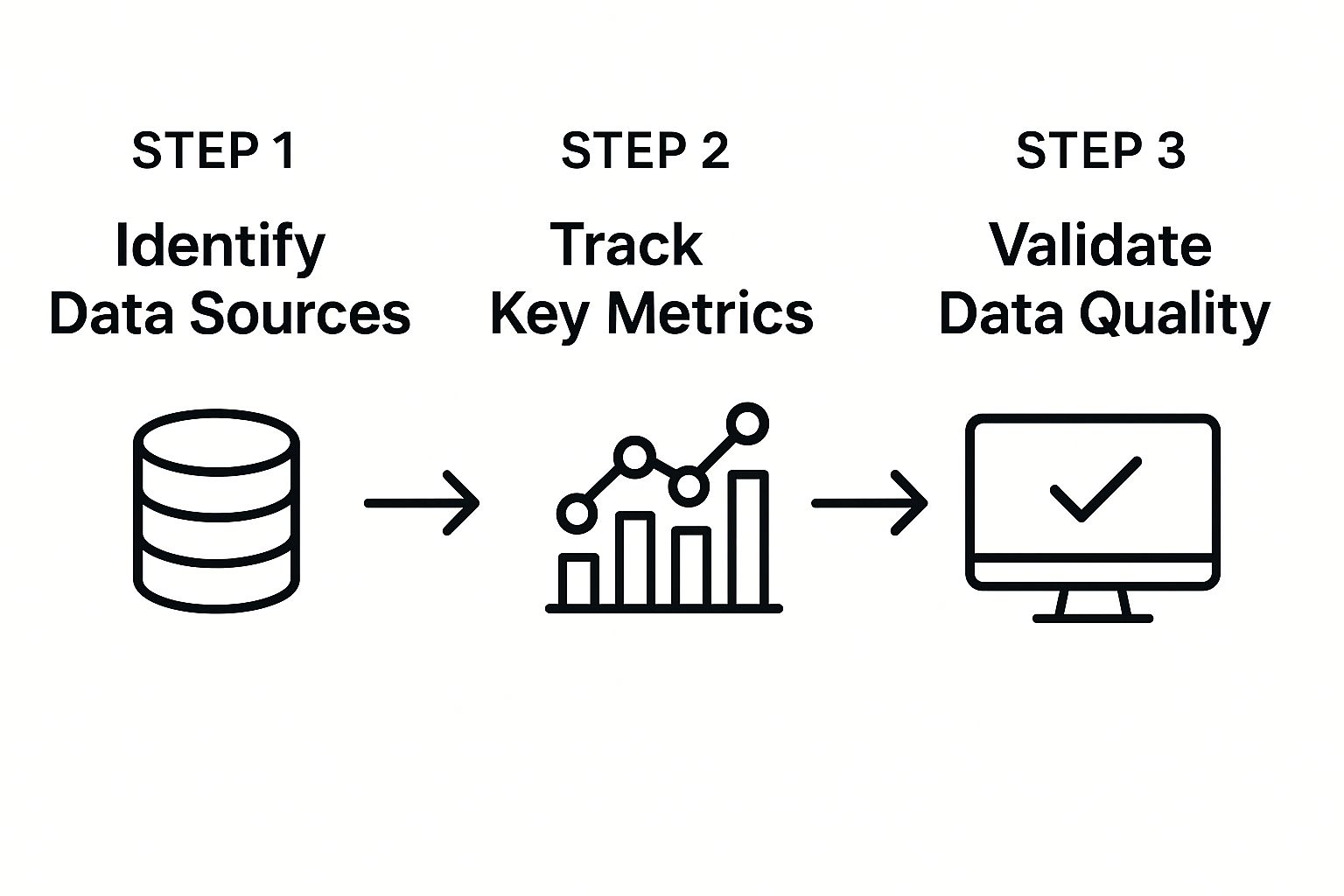
This visual lays out the foundational steps for any good measurement strategy, starting with identifying your data sources and ensuring everything is tracked correctly.

Image

This process is the bedrock for MMM, which needs high-quality, aggregated data to deliver trustworthy insights on channel performance.

MMM became the talk of the town again after privacy updates like Apple's App Tracking Transparency in 2021 made user-level attribution a nightmare. Now, many see it as the 'new gold standard' for measurement. It helps you answer the big questions like, "For every dollar we spend on TV ads, how much incremental revenue do we generate?"—all without needing to track a single cookie.

Using AI to Find Insights That Actually Matter

Let's be honest. Traditional analytics are like a rearview mirror—they tell you exactly what you just passed. That’s useful, but it won’t help you navigate what’s ahead. AI analytics, in comparison, are like a GPS with live traffic data. They don't just show you the map; they predict the traffic jams and suggest faster routes. This is the biggest shift in marketing measurement today: moving from simply reporting on what happened to proactively shaping what happens next.

Forget spending hours in spreadsheets trying to connect the dots. Modern AI tools chew through massive datasets in seconds. They spot the subtle customer behaviors your team would miss, predict which campaigns will actually hit their numbers, and automate the kind of deep analysis that used to take weeks.

This isn't just about efficiency. It's about getting a real, sustainable edge on the competition. The whole game is changing, thanks to a mix of new tech, economic pressures, and privacy rules. According to the Marketing Effectiveness Trends 2025 report by ScanmarQED, AI is now central to everything from personalizing content to forecasting ROI with startling accuracy.

Finding the "Why" Behind the "What"

One of the most valuable things AI does is find connections humans can't easily see. By looking at actual behavior—what people click, how long they stay, which content they consume—AI builds customer segments based on what they do, not just who they are. This goes so much deeper than old-school personas.

An AI tool might surface a segment it calls "high-intent researchers." These aren't just VPs of Marketing from tech companies. These are the specific people who read three of your technical blog posts, watched 75% of a product demo, and visited your pricing page twice this week.

AI isn't just grouping people together. It’s identifying the exact sequence of micro-actions that scream "I'm ready to buy." This lets you stop guessing and start focusing your best efforts on your highest-value prospects with laser precision.

This completely changes how you measure success. You move from asking, "Did our email campaign get a good open rate?" to "Did our email campaign successfully nudge our 'high-intent researchers' into booking a demo?" It shifts the focus from vanity metrics to real business impact.

Platforms like Salesforce use AI to pull all these disparate data points into a single, unified view of the customer, making these kinds of insights accessible. It's about seeing the entire journey, not just isolated touchpoints.

This kind of dashboard isn't just a pretty picture; it’s a command center that shows how AI is connecting every interaction to build an intelligent profile you can act on.

Trading Yesterday's Reports for Tomorrow's Forecasts

This is where things get really interesting. Predictive analytics uses your past performance data to forecast what's likely to happen next. Instead of waiting for a campaign to end to see if you hit your cost-per-acquisition (CPA) goal, a predictive model can tell you what your CPA is likely to be after just a few days of data.

It’s a fundamental shift from reactive to proactive. Let's compare the two approaches:

TaskThe Old Way (Reactive)The AI Way (Proactive)
Budget AllocationBased on what worked last quarter.Reallocated in real-time to channels predicted to have the highest ROI this week.
Lead ScoringStatic points system based on job title and company size.A dynamic score that changes based on a lead's real-time website behavior.
Content StrategyWriting about topics you think your audience wants.Creating content on topics AI has identified as having high engagement potential with your target segments.

This means you can optimize campaigns while they're still running. Actionable Step: If an AI tool predicts a specific ad set is on a path to fail, you can pull the plug and move that budget to a winner before you've wasted thousands of dollars. It’s about making smarter decisions, faster.

Think about an e-commerce company. An AI model could identify customers at a high risk of churning based on their recent purchasing and browsing behavior. That model flags the accounts, triggering a targeted retention campaign with a special offer—before they actually leave. That's a direct line from a marketing action to saving revenue.

A huge part of this is digging into the content they engage with. If you want to get better at that, our guide on leveraging AI for smarter content analysis is a great place to start.

Turning Analysis Into Actionable Campaign Improvements

Image

All the frameworks, KPIs, and attribution models in the world are just theory until you use them to make your marketing better. Measurement is meaningless without action. This is where you close the loop—turning raw numbers into smarter decisions that actually drive growth.

Successfully measuring marketing isn't a one-and-done project. It's a continuous rhythm of reviewing, testing, and refining. You're building a system where data doesn't just sit in a dashboard but actively fuels your next move.

It all comes down to diagnosing what’s working, understanding why, and then systematically improving your strategy based on hard evidence, not just gut feelings.

Establishing a Rhythm for Performance Reviews

To make data-driven decisions a habit, you need to get a consistent review schedule on the calendar. Sporadic check-ins lead to missed opportunities and reactive firefighting. A structured approach ensures you’re always on top of what’s happening.

Here's an actionable cadence you can implement today:

  • Weekly Tactical Check-ins: These are quick, 30-minute huddles focused on campaign-level metrics. You’re looking for immediate red flags or quick wins. Is a specific ad’s Cost Per Click (CPC) suddenly spiking? Can we shift budget to a high-performing social post? Keep it fast and actionable.
  • Monthly Strategic Reviews: This is a deeper dive into channel performance and how you’re tracking toward quarterly goals. Are we on track to hit our MQL target? How is our SEO traffic growth trending month-over-month? This is where you connect the dots between tactics and strategy.
  • Quarterly Business Reviews: Here, you zoom all the way out and connect marketing efforts directly to business outcomes. You'll be presenting your CLV:CAC ratio, overall marketing ROI, and contribution to the sales pipeline to stakeholders. It's about showing real business impact.

This tiered approach keeps everyone aligned without causing data overload. The goal is to make these meetings about insight and action, not just reading numbers off a screen.

Designing Tests That Deliver Clear Answers

The fastest way to improve is to test. But unfocused testing is just as wasteful as not testing at all. To get real answers, you need to be deliberate about what you're trying to learn. The two most common methods are A/B testing and multivariate testing.

A/B testing is your go-to for a clean, simple, and direct comparison between two versions of a single element. You get a clear winner. For example, you might test two different email subject lines to see which one gets a higher open rate.

Multivariate testing, on the other hand, is for when you want to test multiple changes at once to see which combination performs best. You could test two headlines, two images, and two calls-to-action all at the same time on one landing page. This is way more complex and requires a ton of traffic to get statistically significant results, but it can uncover powerful interaction effects between elements you’d never have spotted otherwise.

Don’t just test for the sake of testing. Start with a clear hypothesis. Something like: "I believe that changing the CTA button color from blue to orange will increase the landing page conversion rate because orange creates a stronger visual contrast." This transforms a random guess into a scientific experiment.

Here’s a quick comparison to help you choose the right approach for your needs.

A/B Testing vs. Multivariate Testing Comparison

Deciding between these two really just depends on your goal, how much traffic you have, and how quickly you need an answer.

AspectA/B TestingMultivariate Testing
Primary GoalTo determine which of two versions of a single element performs better (e.g., Headline A vs. Headline B).To determine which combination of multiple elements performs best (e.g., Headline A + Image B + CTA C).
ComplexitySimple to set up and analyze.More complex, as it tests multiple variables and their interactions simultaneously.
Traffic RequiredLower. You can get statistically significant results with less traffic since you're only comparing two versions.Much higher. It needs enough traffic to test every possible combination of elements effectively.
Best ForOptimizing specific, high-impact elements like CTAs, subject lines, or hero images for quick wins.A full redesign or overhaul of a key page, like a pricing page or homepage, where many elements are changing.

For most teams, starting with a series of simple A/B tests is the most practical way to build momentum and see immediate results. Once you’re in a good rhythm, you can explore more complex multivariate tests on your highest-traffic pages.

Diagnosing Performance and Refining Your Strategy

Once your reports and tests start generating data, the real work begins. This part is all about asking "why" and turning those answers into strategic adjustments.

Imagine your data shows a landing page has a crazy high bounce rate. The diagnosis phase is about figuring out the cause. Is the page loading too slowly? Is the headline misleading compared to the ad copy? Are there way too many form fields?

Use your analytics to formulate an actionable plan. If you suspect the form is too long, your next action is to run an A/B test with a shorter form. If the test proves your hypothesis and conversions increase by 15%, you’ve successfully turned an insight into a tangible improvement.

This is how you foster a culture of continuous, data-informed progress—closing the loop and turning your marketing measurement into a true engine for business growth.

Free Tool

Try our Marketing Plan Generator — generate a complete AI-powered marketing plan in minutes. No signup required.

Your Top Marketing Measurement Questions, Answered

Let's be honest, navigating the world of marketing analytics can feel like trying to drink from a firehose. You’ve got data coming from everywhere. Here are some straightforward answers to the questions I hear most often from marketers trying to connect their work to real results.

How Often Should I Actually Look at My Metrics?

This is a classic. The right answer depends entirely on what you're looking at. Checking your customer lifetime value every morning is a recipe for anxiety, but waiting a month to check on a new ad campaign's CPC is a great way to waste money.

You need to think in tiers. Here’s a simple, actionable schedule that works:

  • Daily or Weekly: This is for the fast-twitch metrics. Think Cost Per Click (CPC), ad impressions, social media comments, and shares. These are the numbers that tell you if a live campaign is healthy or needs immediate attention. You're looking for spikes and dips—anything that needs a quick fix.
  • Monthly: Now you can zoom out a bit. It's time to review channel performance. How is overall organic traffic growing? What's our Cost Per Lead (CPL) looking like for the month? Are email open rates trending up or down? This is where you spot broader trends and decide where to focus your energy for the next 30 days.
  • Quarterly: This is the big picture review. It’s when you report on the metrics that matter to the C-suite: Customer Lifetime Value (CLV), Customer Acquisition Cost (CAC), and total marketing-generated revenue. These high-level numbers inform major strategic decisions and budget allocations.

What's the Best Analytics Stack for a Small Business?

If you're a small business, your goal is to get the most insight for the least amount of complexity and cost. You absolutely do not need some massive, enterprise-level platform that requires a dedicated analyst to run.

Instead, a few key tools, used together, can give you a surprisingly powerful view of what's working.

Here’s a fantastic starting point:

  • Google Analytics (GA4): This is non-negotiable. It’s free, and it's the bedrock for understanding who is coming to your website, how they got there, and what they do once they arrive.
  • Your CRM's Built-in Analytics: Whether you're using HubSpot, Zoho, or something else, your CRM is a goldmine. It's where you can finally connect a specific marketing campaign to an actual closed deal.
  • Native Social Media Analytics: Don't overlook the free tools built right into platforms like LinkedIn and Instagram. They offer incredibly deep insights into your audience, what content resonates, and how people are engaging with your brand.

This simple trio gives you a 360-degree view without breaking the bank. As you grow, you can layer in more specialized tools for things like SEO or heat mapping, but this is the perfect foundation.

How Do I Prove the ROI of My Content Marketing?

This one feels tricky, right? Content marketing's impact often builds slowly and indirectly. A blog post doesn't always lead to an immediate sale like a direct-response ad. The secret is to stop focusing on vanity metrics like page views and start connecting content to tangible business goals.

The biggest mistake I see is when teams judge content on last-touch attribution alone. Someone might read five of your articles over three months before they finally click an ad, but that ad gets 100% of the credit. You need a smarter way to look at it.

Here’s a practical, step-by-step way to calculate content ROI:

  1. Find Your Content-Sourced Leads: Dive into your analytics and identify how many people who first found your site through a piece of content (like a blog post) eventually became a lead (by downloading an ebook, signing up for your newsletter, etc.).
  2. Give Those Leads a Dollar Value: Sit down with your sales team and figure out the average value of a lead. Let's say 10% of leads become customers, and the average customer is worth $5,000 in their first year. Simple math tells you each lead is worth $500 in potential revenue.
  3. Do the ROI Math: If a single blog post cost you $500 to create and it generated 4 leads in six months, it has produced $2,000 in pipeline value. That's a 300% ROI.

This approach ties your content creation costs directly to potential revenue, giving you a powerful, defensible metric that proves your content is more than just words on a page—it's a revenue driver.


Ready to stop guessing and start knowing what drives your marketing success? marketbetter.ai uses predictive analytics to connect every campaign to real business outcomes, helping you optimize spend and prove your impact. See how our AI-powered platform can transform your measurement strategy at https://www.marketbetter.ai.

15 Marketing Performance Metrics That Predict Revenue — Not Vanity [2026]

· 27 min read

Marketing performance metrics are the numbers you track to see if your campaigns are actually working. They’re the hard data that tells you what’s a hit, what’s a miss, and where to put your budget next to get the best results.

Think of it this way: running a marketing campaign without metrics is like sailing a ship without a compass. You’re definitely moving, but you have no clue if you’re heading toward your destination or just drifting out to sea. Marketing performance metrics are your navigation system, giving you the critical feedback needed to steer your strategy with confidence.

Image

In a world where every dollar needs to be justified, these metrics are what turn marketing from a perceived cost center into a predictable revenue driver. They give you the proof you need to defend your budget, show your value, and fix small problems before they become massive headaches.

Turning Data Into Decisions

The real power of metrics is how they turn vague goals into something you can actually measure and improve. Instead of just "increasing brand awareness," you can now track specific numbers like social media reach, website traffic, and share of voice. It’s this shift from guesswork to guided action that separates the top-performing teams from everyone else.

We're all swimming in data these days. Projections show that by 2025, marketers will be using 230% more data than they were back in 2020. But here’s the catch: even with all this information, a shocking 56% of marketers feel they don’t have enough time to actually analyze it.

This is exactly why having a focused set of clear, actionable metrics is non-negotiable. They help you cut through the noise and zero in on the numbers that truly move the needle for your business.

“At the simplest level, you need to measure what you set out to achieve with your marketing objectives.”

To help you get started, it's useful to group metrics into a few key categories. Each one tells a different part of your marketing story.

Key Metric Categories at a Glance

This table gives you a quick rundown of the main types of marketing metrics and what they're designed to measure. Think of it as a cheat sheet for understanding the landscape.

Metric CategoryWhat It MeasuresExample MetricActionable Insight
Traffic & EngagementHow many people are finding your content and how they're interacting with it.Website SessionsCompare session sources (e.g., Organic vs. Social) to see which channel brings more traffic.
Conversion MetricsThe effectiveness of your marketing in prompting desired actions (e.g., sign-ups).Lead Conversion RateA/B test your landing page headline to see if you can increase the conversion rate by 5%.
Revenue & ROI MetricsThe direct financial impact and profitability of your marketing efforts.Customer Acquisition Cost (CAC)If CAC is rising, analyze your ad spend to cut underperforming campaigns.
Brand MetricsThe perception and awareness of your brand in the market over time.Share of Voice (SOV)Track SOV against competitors to gauge your market presence.
Customer MetricsThe health and value of your existing customer relationships.Customer Lifetime Value (CLV)Compare CLV of customers from different channels to find your most valuable audiences.

With these categories in mind, you can start building a dashboard that gives you a complete picture of your performance, not just isolated data points.

From Vanity to Value

One of the most common traps marketers fall into is obsessing over "vanity metrics" instead of "actionable metrics." The difference is critical.

  • Vanity Metrics: These are the numbers that look great in a report but don’t really connect to your business goals. Think of things like total page views or social media likes. They might feel good, but they don't tell you if you're making money.
  • Actionable Metrics: These numbers are directly tied to your bottom line. We're talking about things like Customer Acquisition Cost (CAC), Conversion Rate, and Return on Ad Spend (ROAS). These are the metrics that give you clear insights you can actually do something with.

Actionable Comparison: Imagine your page views went up 50% (vanity), but your conversion rate dropped 20% (actionable). The actionable metric tells you the new traffic is low quality, prompting you to review your targeting. The goal is to build a measurement framework that prioritizes real value over fluff. To get a deeper look at what truly matters, check out this excellent guide on how to measure advertising effectiveness.

Drowning in marketing data? I get it. The sheer number of metrics can feel overwhelming. The trick isn't to track everything, but to organize the numbers into a story that actually makes sense—one that follows your customer from their very first click to the final sale.

Let's cut through the noise. We can sort pretty much all marketing data into three simple tiers: Acquisition, Engagement, and Conversion. Think of it as a diagnostic tool. Each tier answers a critical question about your performance, helping you pinpoint exactly what's working and what’s falling flat.

Tier 1: Acquisition Metrics That Attract Customers

Acquisition is all about your first handshake. How well are you pulling new people into your world? These metrics live at the very top of your funnel, measuring your ability to grab attention and draw in potential customers before you've even had a real conversation.

This tier answers one fundamental question: "Are we reaching the right people, and what's it costing us?"

Here are the big three to watch:

  • Customer Acquisition Cost (CAC): This is the bottom line of your growth efforts. Simply put, it’s the total you spend on marketing and sales divided by the number of new customers you actually land. A high CAC can be a red flag for inefficient ad spend, while a low CAC is a sign you're growing profitably.
  • Cost Per Lead (CPL): A more granular look, CPL tells you how much you're shelling out for a single new lead. Comparing your CPL from Google Ads versus LinkedIn, for instance, shows you where your budget is working hardest.
  • Click-Through Rate (CTR): This is the percentage of people who see your ad and are compelled enough to click it. If your CTR is in the gutter, it’s a strong signal that your creative or ad copy just isn't hitting the mark.

A pro tip? Always compare your CAC to your Customer Lifetime Value (CLV). A healthy business model usually has a CLV that's at least three times higher than its CAC. If that ratio is off, it’s time to rethink your targeting or tighten up your messaging.

To really get a handle on performance, you need to see how all your channels work together. This is where owned, paid, and earned media come into play, feeding into your overall strategy.

Image

As you can see, a strong marketing foundation doesn't lean on just one pillar. It's a balanced mix of your own assets (like your website), paid campaigns, and the social proof that builds trust.

Tier 2: Engagement Metrics That Build Relationships

Okay, so you've got their attention. Now what? The next step is holding it. Engagement metrics tell you how people are interacting with your brand once they're in the door. This is where you separate the casual window shoppers from a genuinely interested audience.

This tier answers the question: "Is our content actually connecting with people?"

Think of a high bounce rate like someone walking into your store, taking one look around, and immediately leaving. It screams "This isn't what I expected!" By comparing the bounce rate of two different landing pages, you can quickly see which one is doing a better job of delivering on its promise.

Tools like Google Analytics are your best friend here, giving you a clear dashboard view of what’s happening.

Image

Dashboards like this make it easy to see which channels are bringing in the most engaged visitors, so you know exactly where to double down.

Keep an eye on metrics like Time on Page, Bounce Rate, and Social Media Interactions (likes, shares, comments). These are the numbers that tell you if your content is truly hitting home or just creating noise.

Tier 3: Conversion Metrics That Drive Revenue

This is it. The moment of truth. Conversion is where all your hard work turns into tangible business results. These are the "money metrics" that track actions directly tied to revenue—making a purchase, booking a demo, or downloading an ebook. They prove your marketing ROI.

They answer the most important question of all: "Are we actually making money from all this?"

While there are many conversion metrics, two reign supreme:

  1. Conversion Rate: The percentage of visitors who take the specific action you want them to. A dead-simple way to improve this? A/B test your calls-to-action (CTAs). I've seen a simple text change from "Learn More" to "Get Your Free Trial" literally double a page's conversion rate overnight.
  2. Return on Ad Spend (ROAS): This measures the raw revenue you generate for every single dollar you put into advertising. A 4:1 ROAS means you're making $4 for every $1 spent. Comparing ROAS across your different campaigns is the fastest way to find your most profitable channels and cut the fat.

Comparing Metrics Across Your Marketing Channels

Image

Treating all your marketing performance metrics the same is like using a hammer for every job in your toolbox—it’s clumsy, inefficient, and you'll probably break something. A metric that signals a huge win in one channel might be a total distraction in another. The real key is learning to speak the unique language of each platform.

A high Click-Through Rate (CTR) is a clear victory for a PPC ad, proving your copy and creative were sharp enough to grab immediate attention. But for an email campaign? The hero metric is often the Open Rate. That tells you if your subject line even earned a glance in a crowded inbox. Understanding these differences is what turns a generic marketing plan into a smart, channel-specific strategy.

SEO Success Metrics That Build Long-Term Value

Search Engine Optimization (SEO) is a marathon, not a sprint. The goal here isn't a quick burst of attention; it's about attracting high-quality, organic traffic by earning real estate on search engine results pages. Success isn’t measured in flashy, short-term spikes. It's all about steady, sustainable growth.

The SEO metrics that truly matter are the ones that build over time:

  • Organic Traffic: This is your bread and butter—the total number of visitors who find your site from a search engine. A steady upward trend means your content is hitting the mark with both search algorithms and actual humans.
  • Keyword Rankings: Tracking your position for target keywords tells you how visible you are for the exact terms your customers are using. Moving from page two to page one isn't just a small jump; it can exponentially increase your traffic.
  • Backlink Profile: Think of each high-quality backlink as a vote of confidence from another credible site. The quantity and quality of these "votes" are a massive signal to search engines that you're an authority worth listening to.

A powerful way to move the needle is to focus on topic clusters instead of isolated keywords. Build a central "pillar" page on a core topic and link out to related sub-topic articles. This strategy shows search engines you have deep expertise, improving rankings across a whole range of terms and driving more organic traffic over the long haul.

PPC Metrics That Drive Immediate Action

Pay-Per-Click (PPC) advertising is all about speed and precision. You’re paying for every interaction, so efficiency is the name of the game. The goal is to get immediate, measurable results by placing ads directly in front of a highly targeted audience.

For PPC, your dashboard should be focused on these core numbers:

  • Return on Ad Spend (ROAS): This is the ultimate bottom-line metric. It cuts through the noise and tells you exactly how much revenue you’re generating for every single dollar you put into your ads.
  • Cost Per Click (CPC): This shows you what you're paying for a single click. Keeping a close eye on CPC helps you spot cost-effective keyword opportunities and avoid getting dragged into expensive bidding wars.
  • Conversion Rate: A high CTR is great, but it doesn't pay the bills. This metric tracks the percentage of users who actually take the desired action—like making a purchase—after clicking your ad. If your conversion rate is low, it's a sign your landing page isn't delivering on the ad's promise.

To sharpen your PPC performance, you have to be constantly testing. A/B test your ad copy, your headlines, your calls-to-action, and your landing pages. Even a tiny tweak can have a massive impact on your ROAS.

Comparing channels reveals their unique strengths. SEO builds a foundational asset that generates traffic over the long term, while PPC acts as a faucet you can turn on for immediate, targeted leads. A strong strategy uses both in tandem.

Social Media Metrics That Foster Community

Social media marketing plays a different game. While it can absolutely drive sales, its primary strength lies in building brand awareness, fostering a community, and actually engaging with your audience. The metrics here are less about hard conversions and more about audience sentiment and interaction.

On social, you need to be tracking:

  • Engagement Rate: This is the sum of all interactions—likes, comments, shares, and saves. It’s a direct measure of how compelling your content is and whether your audience is leaning in to be part of the conversation.
  • Reach and Impressions: Reach is the number of unique people who see your content, while impressions are the total number of times it was displayed. Tracking both helps you understand just how far your brand's voice is carrying.

For marketers looking to get a much sharper picture of their audience, new tracking technologies are making a huge difference. You can learn more about how person-level identification is changing the game in our detailed guide.

Email Marketing Metrics That Nurture Leads

Email marketing is the workhorse of lead nurturing. It’s one of the most personal and effective channels for moving subscribers down the funnel by delivering valuable content straight to their inbox. It's where you build lasting customer relationships.

Success in email marketing comes down to these key indicators:

  • Open Rate: The percentage of recipients who opened your email. This is your first and most important hurdle, heavily influenced by your subject line and sender reputation.
  • Click-Through Rate (CTR): The percentage of people who clicked on a link inside your email. A solid CTR tells you that your message and call-to-action were compelling enough to spark action.
  • Unsubscribe Rate: The percentage of subscribers who opt out. A high rate is a massive red flag that your content is missing the mark or you're sending too frequently.

Recent data shows just how powerful this channel remains for tech companies. Email marketing continues to show its strength with an average open rate of 28%, proving it’s still a vital tool for engagement. This sits alongside other key benchmarks like a 3.2% CTR for LinkedIn Ads and an average Customer Acquisition Cost of $95, which are setting new standards for performance.

Channel-Specific Metric Comparison

To bring it all together, it's helpful to see these metrics side-by-side. Each channel has a different job to do, and therefore, a different scorecard.

Marketing ChannelPrimary GoalKey Metrics to TrackIndustry Benchmark Example
SEOBuild organic visibility, attract qualified trafficOrganic Traffic, Keyword Rankings, Backlinks5-10% monthly growth in organic traffic
PPCDrive immediate conversions and targeted leadsROAS, CPC, Conversion Rate4:1 ROAS (varies widely by industry)
Social MediaBuild community, increase brand awarenessEngagement Rate, Reach, Follower Growth1-5% average engagement rate on posts
Email MarketingNurture leads, drive repeat businessOpen Rate, CTR, Unsubscribe Rate28% average open rate (tech industry)

This table isn't about declaring a "winner"—it's about clarity. By focusing on the right metrics for the right channel, you stop comparing apples to oranges and start making smarter decisions that drive real growth across your entire marketing ecosystem.

Turning Numbers Into Results: A Framework That Actually Works

Knowing your marketing performance metrics is one thing. Actually improving them is the entire game. The difference between the two is having a repeatable process—a framework that takes you from staring at a dashboard to actively shaping the numbers on it.

This isn't complicated. It’s a simple, four-stage loop: Define, Measure, Analyze, and Optimize. Think of it as a flywheel. Each time you complete the cycle, your marketing gets a little sharper, a little smarter, and a lot more effective.

Step 1: Define Your Objective

Before you can fix anything, you have to know exactly what you’re trying to achieve. "Increase traffic" isn't an objective; it's a wish. A real objective is specific, measurable, and tied directly to a business outcome.

For example, don't just say, "get more leads." Instead, get specific: "Reduce Customer Acquisition Cost (CAC) by 15% in Q3 by improving lead quality from our paid search campaigns." See the difference? Now you have a clear target and a specific area to focus your energy on.

A well-defined objective is your North Star. It stops you from chasing shiny objects and keeps the entire team focused on what actually drives growth.

Step 2: Measure the Right Things

With a clear objective locked in, the next step is picking the right metrics to track your progress. This is where so many marketers get lost, drowning in dozens of numbers that don't actually matter for their specific goal.

If your objective is to slash CAC, you shouldn’t be obsessing over social media likes. Instead, you’d zero in on a few key performance indicators (KPIs) that are directly wired to that outcome.

  • Cost Per Click (CPC): How efficient is your ad spend at the very top of the funnel?
  • Cost Per Lead (CPL): How much are you actually paying to get a potential customer to raise their hand?
  • Lead-to-Customer Conversion Rate: This one’s crucial. It tells you if the leads you’re generating are actually any good.

Just comparing CPL across different campaigns can be a powerful diagnostic tool. If Campaign A has a CPL of $50 and Campaign B is running at $150, you immediately know where to start digging. A solid CRM is non-negotiable for tracking these numbers from the first click to the final sale.

Step 3: Analyze Your Performance

Now for the fun part: connecting the dots. Analysis is all about digging into the data to understand the "why" behind the numbers. Why is one ad campaign crushing it while another is a dud? Where's the bottleneck in your funnel?

You might discover your CPC is nice and low, but your Lead-to-Customer Rate is terrible. That’s a huge insight. It suggests your ad is great at getting clicks but it’s attracting the wrong crowd, or maybe your landing page isn’t delivering on the promise you made in the ad. This is the moment data becomes intelligence.

Here’s a snapshot of a Google Ads dashboard, a primary tool for measuring and analyzing paid campaign performance.

This gives you a high-level view of critical metrics like clicks, impressions, and cost, letting you quickly check the health of your campaigns. By drilling down into these numbers, you can start to figure out which ads and keywords are driving the most valuable actions.

Step 4: Optimize for Better Results

This is where you turn your analysis into action. Based on your insights, you’ll form a hypothesis and run a test to see if you can move the needle. Optimization isn't a one-and-done task; it's an ongoing process of experimenting, learning, and iterating. You make small, calculated bets to produce better outcomes.

Here are a few common scenarios and the optimization plays that follow:

  • If your CAC is too high: Your targeting is probably too broad. Try refining it to reach a more specific audience. A great first step is to test negative keywords to filter out all the irrelevant search traffic that's eating your budget. You can see how one of our partners did just that by reading about how LevelBlue optimized their ad spend in our case study.

  • If your conversion rate is low: Your landing page is the likely culprit. A/B test your headlines, your call-to-action (CTA) buttons, and the overall page layout. Sometimes a simple change from "Submit" to "Get My Free Guide" can make a world of difference.

  • If your ROAS is weak: Time to reallocate your budget. Be ruthless. Shift spending from the campaigns that are underperforming to your proven winners. Compare the ROAS of your social media ads to your search ads to find your most profitable channel, and then double down on it.

By running through this Define, Measure, Analyze, Optimize cycle again and again, you build a powerful engine for growth. You stop guessing what works and start building a marketing strategy based on hard evidence and real results.

The Future of Measurement: AI and Analytics are Changing the Game

For years, marketing performance metrics have been a rearview mirror. They show you where you’ve been—what worked last quarter, which campaign drove clicks last month. It’s useful, sure, but it’s always historical. You're constantly reacting.

The arrival of AI and predictive analytics is flipping that script entirely. It's turning measurement from a history report into a weather forecast, giving you a real shot at seeing what’s coming before it happens. This isn't just about getting reports faster; it’s about making smarter, proactive decisions instead of constantly playing catch-up.

This isn't some far-off trend, either. The AI marketing space was already worth around $20 billion in 2022 and is on track to hit $40 billion by the end of 2025. That’s not slow adoption—that’s a full-on sprint as businesses race to get an edge. If you're curious about the numbers, Cubeo.ai has a great breakdown of AI's marketing impact.

From Reactive to Predictive Measurement

So what's the real difference here? It’s all about the questions you can ask. A traditional dashboard tells you your Customer Acquisition Cost (CAC) last quarter. An AI model can forecast your CAC for the next quarter based on your planned ad spend and expected market shifts. See the leap? It’s the difference between reaction and prediction.

This is possible because AI can chew through massive datasets and spot subtle patterns a human analyst would almost certainly miss. It connects the dots between thousands of customer behaviors, market signals, and campaign results to make some remarkably accurate guesses about the future.

AI lets us move beyond asking, "What happened?" to asking, "What’s likely to happen next, and what should we do about it?" It turns your data from a record of the past into a roadmap for the future.

How AI is Actually Used in Marketing Analytics

This all sounds great in theory, but what does it look like on the ground? We’re talking about real tools that are already changing how marketing teams work and measure success.

Here are a few game-changing applications you can use today:

  • Predictive Lead Scoring: Forget manually assigning points for email opens. AI digs into thousands of data points—from website clicks to social media engagement—to figure out which leads are genuinely hot. This lets sales teams stop chasing ghosts and focus their energy where it’ll actually count. We have a full playbook on implementing AI-powered lead scoring if you want to go deeper.

  • AI-Driven Budget Allocation: Trying to manually spread a big ad budget across dozens of campaigns is a nightmare of spreadsheets and guesswork. AI algorithms can watch performance in real-time and automatically shift money to the channels and ads that are actually working, squeezing every last drop of value from your Return on Ad Spend (ROAS).

  • Customer Churn Prediction: AI is fantastic at spotting the quiet signals that a customer is about to bail. By analyzing past behavior, it can flag at-risk accounts, giving you a critical window to step in with a retention offer or some extra support before they’re gone for good.

The Old Way vs. The New Way

When you put them side-by-side, the difference is stark. One approach is static and historical; the other is dynamic and forward-looking. This table breaks down that fundamental shift.

CapabilityTraditional AnalyticsAI-Powered Analytics
FocusHistorical performance ("What happened?")Predictive outcomes ("What will happen?")
OptimizationManual A/B testing and tweaksAutomated, real-time optimization
AudienceBroad, demographic-based segmentsHyper-personalized, behavior-based micro-segments
InsightsShows you correlations in dataUncovers causal relationships—the "why"
SpeedWeekly or monthly reportsReal-time analysis and instant alerts

This isn't just about keeping up with the latest tech. By embracing these tools, you're building a system that can anticipate and adapt. You’re setting up your marketing to be a step ahead, no matter what changes come next.

Free Tool

Try our Marketing Plan Generator — generate a complete AI-powered marketing plan in minutes. No signup required.

Common Questions About Marketing Metrics

Image

Alright, we've covered the what and the why. But let's be real—the day-to-day work of wrangling marketing data always sparks a few questions. This is where the rubber meets the road.

Here are the practical hurdles and strategic puzzles I see marketers run into all the time, along with some straight-up, actionable answers to help you get unstuck.

How Often Should I Review My Marketing Metrics?

There’s no one-size-fits-all answer here. The right cadence depends entirely on what you're measuring. Think of it like this: some metrics are speedboats, and others are oil tankers. You don't pilot them the same way.

A simple way to break it down is by speed and impact:

  • Daily or Weekly Checks: These are your fast-moving, tactical numbers. Think PPC ad spend, website traffic, social media engagement, and conversion rates on a new campaign. These metrics can change on a dime and often need quick adjustments to stop a budget leak or double down on something that's working.
  • Monthly or Quarterly Reviews: This is for your big-picture, strategic metrics. We're talking Customer Lifetime Value (CLV), Customer Acquisition Cost (CAC) trends, and overall market share. Peeking at these every day is like trying to watch a plant grow—you won't see meaningful change, and you'll drive yourself crazy.

The key is matching your review cycle to the metric's nature. Checking CLV daily is pointless. Checking a failing ad campaign monthly is a recipe for wasted cash.

What's the Difference Between a KPI and a Metric?

This is a classic point of confusion, but the distinction is simple—and powerful.

Picture your car's dashboard. All the readings are metrics: engine temperature, tire pressure, RPMs. But the ones you actually rely on to get to your destination are your Key Performance Indicators (KPIs)—your speedometer and your fuel gauge.

A metric is just a number you can track (like website visitors or email opens). A KPI is a specific metric you’ve hand-picked because it directly measures progress toward a critical business goal (like new qualified leads per month).

So, all KPIs are metrics, but not all metrics are KPIs. Your social media follower count is a metric. The number of sales-qualified leads you generate from social media? That’s a KPI, because it's directly tied to the goal of driving revenue.

How Do I Choose the Right Metrics for My Business?

Stop guessing. The most effective way to choose the right marketing metrics is to work backward from what the business actually wants to achieve. Don't start with the data you have; start with the outcome you need.

Here’s a simple, three-step framework:

  1. Define Your Primary Business Objective: Get specific. Is it to grow overall revenue by 20% this year? Or maybe to break into a new market segment within six months? Write it down.
  2. Identify the Supporting Marketing Outcomes: What has to happen in marketing for that objective to become a reality? To hit that 20% revenue goal, you might need to "generate 500 new sales-qualified leads" or "increase customer retention by 10%."
  3. Select the Metrics That Measure Those Outcomes: Now, and only now, you pick your tools. To measure those 500 leads, you'll track Cost Per Lead (CPL) and Lead Conversion Rate. For retention, you'll watch Churn Rate and Repeat Purchase Rate.

This top-down approach forces every metric on your dashboard to justify its existence. No passengers allowed.

What Are Vanity Metrics and Should I Ignore Them?

Vanity metrics are the numbers that make you feel good but don't actually tell you much about the health of the business. Think social media likes, total page views, or your raw number of email subscribers. They look great in a presentation but often have a weak-to-nonexistent link to revenue.

But should you ignore them completely? Not necessarily.

While they should never be your main measure of success, they can act as useful early warning signals or indicators of top-of-funnel health. A sudden explosion in social media likes could be a sign of growing brand awareness—the very first step in your customer journey.

The trick is to know what they're good for and what they aren't.

Metric TypePurposeExampleWhat It Really Means
Vanity MetricSignals top-of-funnel activity or brand reach.10,000 new followers."More people are aware of our brand."
Actionable MetricMeasures progress toward a business goal.15% lift in conversion rate from social traffic."Our social strategy is now generating leads."

Use vanity metrics as a canary in the coal mine, but always connect them to the actionable metrics that prove you're making a real impact.


Ready to stop reacting and start predicting? marketbetter.ai uses an integrated AI approach to turn your marketing data into a powerful roadmap for the future. Our platform helps you automate budget allocation, predict which leads will convert, and generate high-performing content at scale. Discover how marketbetter.ai can elevate your marketing strategy today.