5 posts tagged with "demand generation"

View All Tags

A Modern Demand Gen Strategy That Drives Revenue

· 25 min read

A modern demand gen strategy isn't just a marketing plan; it's a full-funnel machine built to create predictable revenue. The goal is to shift from just capturing existing leads to proactively creating new demand for whatever you sell.

When you do this right, you build trust and become the obvious choice long before a buyer is even ready to talk to sales.

Beyond Lead Capture: A New Demand Gen Strategy

Let’s get one thing straight: the old playbook of just capturing leads at the bottom of the funnel is broken. A winning demand gen strategy doesn't obsess over the tiny fraction of your market that's ready to buy today. It focuses on educating and nurturing the massive portion who aren't, making your solution the one they think of first when the need finally hits.

This is a fundamental shift in thinking. Instead of pouring all your budget into "request a demo" CTAs, you build a comprehensive engine that informs, educates, and establishes your authority. This is how you align marketing and sales around a single shared goal: creating a pipeline filled with educated, high-intent buyers who are already sold on you.

The 95-5 Rule of B2B Marketing

The entire philosophy of modern demand generation hangs on one critical market insight. Research consistently shows that only about 5% of your total addressable market is actively looking to buy at any given moment. The other 95% are future buyers who aren't in a purchasing cycle right now.

Any strategy that ignores 95% of its potential market is, by definition, broken. The real goal is to become the go-to vendor for that massive group, so when they eventually enter that 5% "in-market" segment, you're already their top choice.

This is where you move from chasing leads to building an audience.

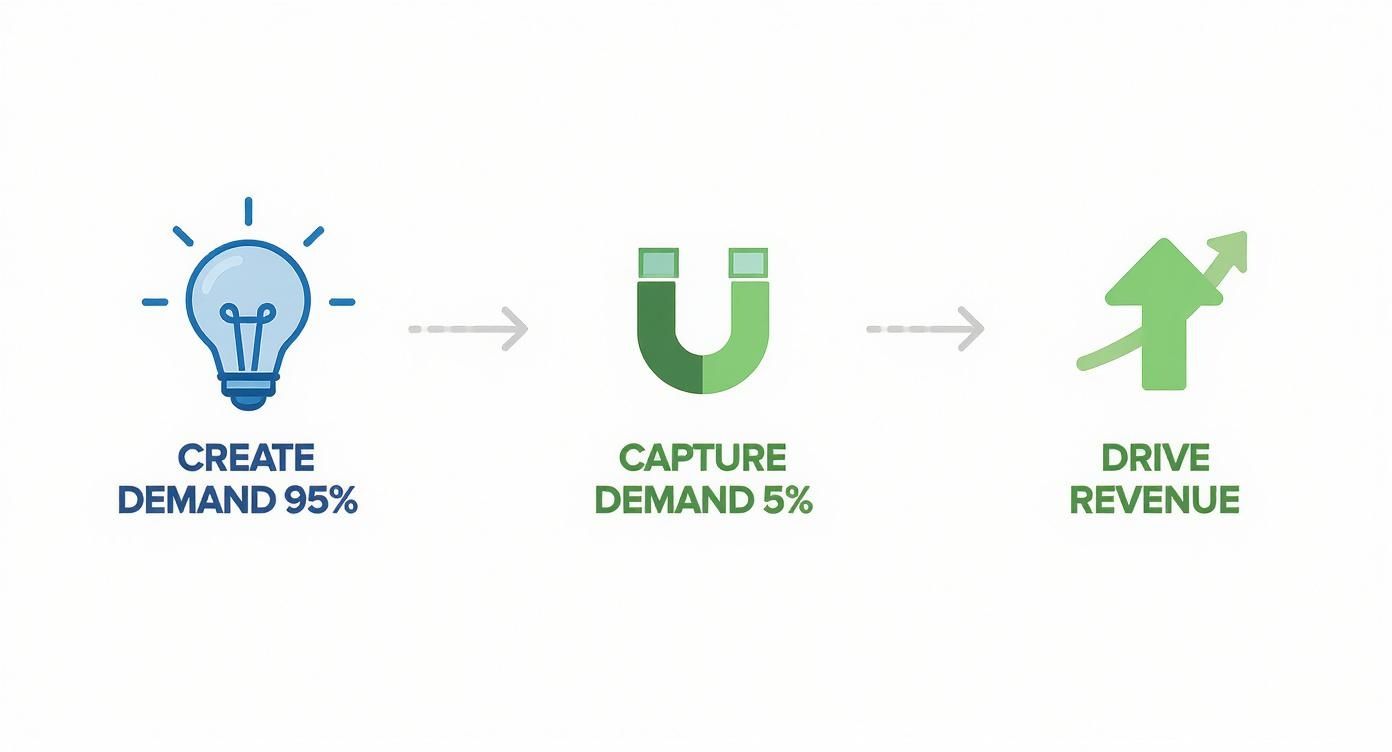
Diagram illustrating the three steps of demand generation: create, capture, and drive revenue.

As you can see, the process starts by creating broad awareness and interest before funneling that cultivated demand into actual revenue opportunities. You play the long game.

Demand Creation vs. Demand Capture

To make this work, you have to understand the two core pillars: creating demand and capturing it. They are two sides of the same coin, and you absolutely need both for a balanced, resilient strategy.

  • Demand Creation is your "educate and inform" motion. The goal is to make your audience aware of a problem they might not even know they have and position your solution as the answer. This is all about targeting that dormant 95%.
  • Demand Capture is the "convert" phase. Here, you're focused on prospects who are already problem-aware and actively looking for a solution. The goal is to intercept their buying journey and make it easy for them to choose you. This targets the in-market 5%.

To see how this plays out in the real world, it helps to put them side-by-side.

AttributeDemand CaptureDemand Creation
GoalConvert existing, high-intent interest into pipeline.Educate the market and build brand affinity over time.
AudienceThe 5% actively searching for a solution.The 95% who are not currently in-market.
ChannelsPaid search, G2, Capterra, SEO for bottom-funnel keywords.Social media, podcasts, content hubs, communities, events.
MetricsMQLs, SQLs, Demo Requests, Pipeline Generated, CAC.Share of voice, branded search volume, direct traffic, content engagement.

Both are essential. Without creation, your capture channels will eventually dry up. Without capture, all the brand awareness you build will never turn into revenue.

For a deeper look at the tactics involved, check out these practical B2B demand generation strategies. The key is balancing both creation and capture to build a revenue engine that works, no matter what the market is doing.

Defining Your Audience and Revenue Goals

A demand gen strategy without a laser-focused target is just wishful thinking. It's like having a map but no destination—you'll spend a lot of time, energy, and money going nowhere fast. Before you write a single line of copy or launch an ad, you need absolute clarity on two things: who you're talking to and what you want them to do.

This is the bedrock of a predictable revenue engine. Everything else builds on this foundation.

Two men discuss at a table with a laptop, next to a glass wall displaying 'Predictable Revenue Engine' diagram.

It all starts with your Ideal Customer Profile (ICP). This isn't just a list of industries or company sizes. A great ICP gets into the nitty-gritty: the specific business pains, the tech stack they use, the buying triggers that signal they need you now. It's about finding the companies that are a perfect fit for what you sell.

Move Beyond Personas to a Pinpoint ICP

Too many marketers get stuck on buyer personas—those semi-fictional profiles like "Marketing Mary." While personas are decent for nailing down your content's tone of voice, they miss the bigger picture. They don't have the business context you need for a winning demand gen strategy.

The ICP, on the other hand, is all about the account.

Think of it this way: a persona describes the person. An ICP describes the company where that person works. You absolutely need both, but the ICP has to come first. It tells you where to aim your budget.

Here’s how the two approaches stack up in the real world:

FeaturePersona-Led Approach (Broad)ICP-Led Approach (Focused)
FocusIndividual roles and their personal goals.Firmographics, technographics, and business challenges.
Example"Marketing managers who want to be more efficient.""B2B SaaS companies with 200-1000 employees, using Salesforce, and who recently hired a new VP of Marketing."
ActionCreate general content about marketing efficiency.Develop targeted campaigns addressing integration pains with Salesforce.
OutcomeHigh volume of low-quality, unqualified leads.Lower volume of high-quality, high-intent accounts.

Building a rock-solid ICP isn't guesswork. You need to get your hands dirty. Interview your best customers. Sit down with your sales team and find out what their best deals had in common. Dig through your CRM data for patterns. For a deeper dive, our guide to customer segmentation strategies can walk you through the process step-by-step.

Set Goals That Actually Drive Revenue

Once you know who you're after, you have to define what a "win" looks like. This is where most demand gen efforts go off the rails. They get fixated on vanity metrics—impressions, clicks, even raw Marketing Qualified Leads (MQLs)—that look good in a report but don't actually tie back to business growth.

A successful demand gen strategy is measured by its impact on pipeline and revenue, not by the volume of leads it generates. Shifting your focus from MQLs to revenue-centric KPIs is non-negotiable for long-term success.

Stop chasing a high MQL count. It’s a recipe for friction between sales and marketing. Instead, focus on goals the C-suite actually cares about. That’s how you prove marketing’s value and earn the right to ask for more budget.

Actionable Revenue-Focused KPIs to Track:

  • Pipeline-Influenced Revenue: This shows the total value of sales opportunities that marketing has touched. It’s about demonstrating influence, not just sourcing.
  • Customer Acquisition Cost (CAC): How much are you spending to bring in each new customer? Your goal is to keep this number well below their lifetime value.
  • Sales Cycle Length: A great strategy doesn't just find leads; it delivers more educated buyers to sales, which should shorten the time it takes to close a deal.
  • Marketing-Sourced Revenue: This is the ultimate metric. It’s the bottom-line number—the total revenue generated directly from opportunities your team created.

For example, a weak goal is "increase MQLs by 30%." A powerful, revenue-focused goal is to "generate $2 million in marketing-sourced pipeline this quarter with a target CAC of $5,000."

See the difference? That kind of goal aligns your team’s daily work directly with the company's financial objectives. It makes your demand gen strategy an indispensable part of the business, not just a cost center.

Your Content and Channel Playbook

Alright, you know who you’re talking to and what you want to achieve. Now for the fun part: building the engine that drives your entire demand gen strategy. I’m talking about your content and the channels you use to get it in front of the right people.

Content is the fuel for every single interaction, but it’s completely useless without a smart distribution plan. This is where we stop guessing and start building an actionable playbook—one that connects the right message with the right person at exactly the right time.

The goal isn't just to crank out more stuff. It's about creating the right stuff for each stage of the buyer's journey. A big-picture, thought leadership webinar is perfect for someone just realizing they have a problem. But a detailed, data-heavy case study? That's what you need for someone who's already deep in the consideration phase, comparing their options.

Mapping Content to the Buyer's Journey

A truly effective playbook doesn't just throw content at the wall to see what sticks. It strategically maps specific formats and channels to each stage of the buying cycle, guiding prospects from that first flicker of awareness all the way to a final decision. This approach is what keeps your efforts relevant and, just as importantly, efficient.

Here's a breakdown of how this actually looks in practice:

Buyer's StageContent FormatsPrimary ChannelsKey Metric
AwarenessBlog posts, podcasts, short-form video, infographics, industry reports, thought leadership articles.Organic social (LinkedIn), SEO/organic search, targeted display ads, industry publications.Website traffic, social engagement, reach, new subscribers.
ConsiderationWebinars, in-depth guides, comparison sheets, white papers, email mini-courses.Retargeting ads, email marketing, LinkedIn sponsored content, niche communities (Slack/Discord).MQLs, webinar registrations, content downloads, time-on-page.
DecisionCase studies, customer testimonials, ROI calculators, free trials, product demos, implementation guides.Direct email outreach, targeted search ads (branded keywords), sales-led conversations, review sites (G2/Capterra).Demo requests, trial sign-ups, sales qualified leads (SQLs), pipeline velocity.

As you can see, the key is to align every single piece of content with a specific purpose and audience mindset. Top-of-funnel content for the "Awareness" stage should be educational and problem-focused, never salesy. As prospects move into "Consideration," your content has to shift gears to be solution-oriented. Finally, at the "Decision" stage, you need assets that build trust and prove your solution works in the real world.

The most successful demand generation efforts don’t just happen; they are the result of strategic clarity and confidence. This allows marketing teams to allocate resources more intelligently and build personalized buyer experiences at scale.

This kind of clarity is mission-critical, especially as more companies double down on content and account-based marketing (ABM) to hit their growth targets. The top-performing teams know that a well-defined content map is non-negotiable, a fact underscored by the findings in the 2025 Demand Generation Benchmark Survey.

Choosing Your Channel Strategy

Picking the right distribution channels is just as critical as creating great content. One of the most common mistakes I see is teams trying to be everywhere at once. A focused, multi-channel approach that prioritizes the watering holes where your ICP actually spends their time is infinitely more effective.

Let's compare two common paths: the broad, high-volume shotgun blast versus a targeted, niche laser beam.

  • The Broad Strategy (Volume Play): This is where you push content across every major platform—LinkedIn, X (formerly Twitter), Facebook, broad industry pubs. The goal is maximum reach. While this might build some general brand awareness, it almost always leads to low engagement and a ton of unqualified traffic because the message is too generic.

  • The Targeted Strategy (Value Play): This approach zeroes in on a few key channels where your ideal customers are highly active and engaged. This could be a specific Slack community, a niche industry podcast, or hyper-targeted LinkedIn Ads aimed at a precise audience segment. The reach is smaller, sure, but the quality of engagement and the leads that come from it are dramatically higher.

For most B2B companies, the targeted strategy wins. Every. Single. Time. It's about depth, not breadth.

The Art of Repurposing Content

Let's be real: one of the biggest headaches for any marketing team is producing enough high-quality content consistently. The secret isn't working harder; it's working smarter by repurposing a single "pillar" piece of content into an entire ecosystem of assets. This maximizes your investment and squeezes every last drop of value out of your best ideas.

Imagine you just hosted a killer 60-minute webinar with an industry expert. That one event can fuel your content calendar for weeks.

Here's how to do it.

An Actionable Repurposing Playbook:

  1. The Pillar Piece: The full webinar recording. Host it on your website behind a simple email gate.
  2. Blog Posts: Write 2-3 detailed blog posts that dive deep into the key themes and takeaways. Don't forget to embed short video clips from the webinar directly into the posts for extra engagement.
  3. Social Media Videos: Edit the recording into 5-7 short, punchy video clips (30-90 seconds). Each clip should highlight one compelling insight or quote. These are gold for LinkedIn and YouTube Shorts.
  4. Quote Graphics: Create 10-15 slick, visually appealing graphics featuring powerful quotes from the speaker. Share them across all your social channels.
  5. In-Depth Guide: Combine the webinar transcript, slides, and some additional research into a comprehensive downloadable guide or eBook. This is a perfect mid-funnel asset.
  6. Email Nurture Sequence: Build a short email series that shares different webinar highlights over several weeks, driving traffic back to the full recording and the related blog posts.

By adopting this model, that one hour of effort can generate weeks of promotional material, making sure your demand gen strategy is both efficient and impactful. It’s a sustainable system for creating value without burning out your team.

Using AI and Automation to Scale Your Efforts

Let's be honest: trying to scale a modern demand gen strategy by hand is a losing game. To keep up with the market, you need technology—specifically, AI and automation—to work smarter, not just harder. These aren't just nice-to-have tools anymore; they are the core engine for executing at the pace and scale required to win.

This isn’t about replacing marketers. It's about augmenting their skills. It’s about automating the repetitive, soul-crushing tasks that drain their time and unlocking insights a human simply couldn't find in the noise. When you nail this, you free up your team to focus on what actually moves the needle: strategy, creativity, and building real relationships.

Shifting from Manual to AI-Driven Processes

The difference between a traditional, manual approach and an AI-powered one is night and day. It's the difference between guessing and knowing. Between reacting to the market and predicting its next move. A manual process is slow, riddled with human error, and struggles to adapt. An AI-driven one is fast, data-backed, and always learning.

Take a classic marketing function like lead scoring. The old way feels ancient by comparison.

FeatureManual Lead ScoringAI-Powered Predictive Scoring
MethodRelies on simple actions like email opens and form fills, tied to a rigid, arbitrary points system.Analyzes thousands of data points—behavioral signals, firmographics, and real-time buying intent.
FocusShows you who engaged, but often misses the subtle signals of true buying intent.Predicts which accounts are actually likely to convert, sometimes before they even engage with you.
SpeedSlow. Requires constant manual updates and rule tweaks from the marketing team.Happens in real-time and self-optimizes as new data flows in, no human intervention needed.
OutcomeSales ends up chasing low-quality leads, creating friction and wasting everyone's time.Delivers a prioritized, high-intent account list to sales, boosting conversion rates and efficiency.

This same shift applies across your entire strategy, from creating content to analyzing campaign results. If you want to go deeper, we've broken down more examples in our guide to AI for marketing automation.

Scaling Personalized Content with AI

One of the most powerful places to put AI to work is content creation. Gone are the days of a one-size-fits-all blog post. Tools like marketbetter.ai let you produce high-quality, genuinely personalized content at a scale that was impossible just a few years ago. You can finally create tailored blog posts, social media updates, and ad copy for dozens of micro-segments without burning out your entire team.

Here's a look at how a platform can help teams orchestrate their content and campaign planning in one place.

Overhead view of a modern workspace with a laptop displaying a calendar, a smartphone, and a 'Content Playbook' text.

This kind of centralized view is critical. It ensures every single piece of content, from a tweet to a whitepaper, is perfectly aligned with the broader demand gen strategy.

The results speak for themselves. We've seen AI-driven personalization boost customer engagement by up to 40%. In other cases, chatbot implementations have pushed conversion rates up by nearly 30%. By using AI to analyze massive datasets and spot behavior patterns, you stop guessing what your audience wants and start delivering it before they even ask.

Building Your Automation Tech Stack

Of course, none of this happens without the right tech stack. The goal isn't just to buy tools; it's to build an integrated system where data flows seamlessly, automating workflows and creating a single source of truth for your team.

Your tech stack should be a force multiplier for your strategy, not a messy garage full of disconnected tools. Pick platforms that automate the grunt work, deliver deep insights, and empower your team to do high-impact work.

A solid B2B demand gen stack usually includes a few core components:

  • Marketing Automation Platform (MAP): Your central hub for email, landing pages, and nurturing. Think HubSpot or Marketo.
  • Customer Relationship Management (CRM): The system of record for every customer and prospect interaction, like Salesforce.
  • AI Content Platform: The engine for scaling the creation and personalization of content across every channel (e.g., marketbetter.ai).
  • Analytics and Attribution Tool: To measure what's actually working and tie marketing efforts directly to revenue. This could be Google Analytics or a more dedicated attribution platform.
  • Intent Data Provider: To find accounts that are actively researching solutions like yours right now. Players like Bombora or 6sense are key here.

When you carefully select and integrate these tools, you're not just buying software. You're building a powerful, automated engine that scales your demand gen strategy efficiently and gives your team the freedom to become true drivers of business growth.

Measuring Performance That Ties to Revenue

Your demand gen strategy is an engine. But without a dashboard, you're driving blind. Is it actually working?

To prove it, you have to get past the surface-level metrics like clicks and impressions. It’s time to focus on the numbers the C-suite and your CFO actually care about. This is how you stop defending marketing as a cost center and start presenting it as a predictable revenue driver.

The goal is to build a tight feedback loop: analyze performance, find what's working, and double down on it to improve your return.

A person points at a computer screen displaying an 'AI Powered Scale' dashboard with data visualizations and charts.

From Vanity Metrics to Revenue KPIs

Too many marketing teams get stuck reporting on metrics that feel good but mean nothing to the bottom line. A spike in website traffic is nice, but if none of it converts into pipeline, who cares? The key is connecting every single activity to a real business outcome.

Don't just measure what's easy. Measure what matters. Your credibility hinges on drawing a clear, undeniable line from your team's efforts to the company's revenue goals.

This means obsessing over a handful of core metrics that tell the whole story.

The KPIs That Prove Your Worth:

  • Customer Acquisition Cost (CAC): This is the total spend across sales and marketing to land one new customer. An effective demand gen strategy should consistently drive this number down.
  • Lifetime Value (LTV): This is the total revenue you can expect from a single customer over their entire relationship with you. The gold standard is an LTV that's at least 3x your CAC—that’s the sign of a healthy, sustainable business.
  • Pipeline Velocity: How fast are deals moving from first touch to closed-won? A solid content strategy educates buyers before they even talk to sales, which should directly shorten your sales cycle and boost velocity.
  • Marketing-Sourced Revenue: This is the ultimate proof. It’s the total revenue generated from opportunities that came directly from your campaigns. There’s no ambiguity here—it’s the clearest measure of your team’s contribution.

Choosing the Right Attribution Model

Once you’re tracking the right things, the next question is: which activities get the credit? This is where attribution models come in, and getting this wrong is a huge risk. You could end up cutting budget from a channel that’s quietly doing the heavy lifting.

Let’s break down the two most common ways to look at this.

Attribution ModelFirst-Touch AttributionMulti-Touch Attribution
How it WorksGives 100% of the credit to the very first marketing interaction a prospect had.Spreads the credit across multiple touchpoints that influenced the buyer's journey.
Best ForSimple, top-of-funnel analysis. Good for seeing what generates initial awareness.Complex B2B sales cycles where people interact with lots of content over time.
The DownsideIgnores every other interaction that nurtured the lead, giving you a skewed, incomplete picture.Can be more complicated to set up and often requires better analytics tools to get right.

For any modern demand gen strategy, a multi-touch model is almost always the way to go. It reflects reality. A prospect might see a LinkedIn post, attend a webinar a month later, and finally book a demo after reading a case study. Each of those moments played a part.

A multi-touch model gives you the insight to invest wisely across the entire journey. If you’re ready to get more sophisticated, you can explore the different types of multi-touch attribution models to see which approach fits your business best.

Common Demand Gen Strategy Questions

Even with the best-laid plans, building a demand gen strategy always kicks up a few tricky questions. I've heard them all. Below, I’ll tackle the ones that come up most often, giving you straight answers and practical advice to help you build and scale your revenue engine with confidence.

How Is Demand Generation Different From Lead Generation

This is, without a doubt, the most common point of confusion. Getting this right is critical because they are two fundamentally different philosophies. One is about harvesting existing demand; the other is about creating it from scratch.

Think of it like fishing.

Lead generation is like dropping a baited hook in a well-stocked pond. You know the fish are there, you know they're hungry, and your only job is to catch them. This is all about targeting that small slice of your market—maybe 3-5%—who are actively looking for a solution right now.

Demand generation, on the other hand, is like building an entire, thriving lake ecosystem. You’re not just fishing; you’re cultivating the environment. You're making sure the water is clean, the food source is rich, and the habitat is perfect. It's a long-term play focused on educating your entire market, building trust, and becoming the only name people think of when they eventually get hungry.

A lead gen mindset asks, "How can we capture more demo requests today?" A demand gen mindset asks, "How can we become the undisputed authority in our space so the best buyers come to us automatically?"

What Is a Good Starting Budget

There’s no magic number here. Anyone who gives you one is just guessing. The right budget depends completely on your context: your industry, company stage, market competition, and how aggressive your growth goals are.

Instead of picking a number out of thin air, work backward from your revenue target. It's the only way to ground your budget in reality.

  1. Start with the Revenue Goal: Let’s say you need to generate $500,000 in new pipeline this quarter. That's your north star.
  2. Calculate Required Deals: If your average deal size is $25,000, you know you need to close 20 new customers.
  3. Factor in Your Close Rate: Maybe your sales team closes 20% of qualified opportunities. That means you need to generate 100 sales-qualified opportunities (SQOs) for them.
  4. Estimate Your Costs: Now you can start looking at channel costs. If you know from experience or industry benchmarks that a paid LinkedIn campaign costs roughly $5,000 per SQO, you suddenly have a real number to build a budget around.

A seed-stage startup might start lean, maybe $5,000 - $10,000 a month, focusing on just one or two channels to prove a concept. A more established scale-up trying to grab market share might invest $50,000+ per month across a more diverse playbook. The key is to start with a data-informed estimate and be ready to pivot as the real performance data rolls in.

How Long Until I See Results

This is where patience becomes a marketer’s greatest virtue. The timeline for seeing results from demand gen depends entirely on what you're doing. I find it helpful to think about this in two buckets.

  • Demand Capture (Short-Term Results): These are activities aimed at that 5% of the market actively buying now. Think Google Ads targeting bottom-funnel keywords or sponsoring a category on a software review site. With these tactics, you can often see qualified leads and meetings hitting the calendar within 30 to 90 days.

  • Demand Creation (Long-Term Results): This is the long game. You're playing to win over the other 95% who aren't in a buying cycle. Building authority with a podcast, a killer blog, or an industry community doesn't happen overnight. You’ll see leading indicators like more website traffic, branded searches, and social engagement within 3 to 6 months. But the real, tangible impact on pipeline often takes 6 to 12 months (or more) to fully kick in.

Your best bet is to run a balanced playbook. Use demand capture tactics to get some quick wins and keep the sales team happy, while your demand creation engine builds the foundation for predictable, long-term growth.

Which Channels Are Best for B2B Demand Generation

The "best" channels are simply wherever your ideal customers hang out to learn and connect with their peers. Don’t overcomplicate it. While every business is different, a few channels are consistently heavy hitters in the B2B world.

  • LinkedIn: It’s still unbeatable for targeting specific job titles, industries, and company sizes. Great for sharing thought leadership, running sponsored content, and even tasteful, direct outreach.

  • Organic Search (SEO): This is the ultimate long-term asset. Creating genuinely helpful content that solves your ICP's problems builds a competitive moat and delivers a steady stream of high-intent visitors who are literally searching for what you do.

  • Niche Communities: This could be a specific Slack group, an industry forum, or a subreddit. These are high-signal places where you can build real trust by providing value first and selling second (or never).

  • Podcasts: Whether you're a guest on a popular show in your space or you start your own, audio is an incredibly intimate way to build brand affinity. You're literally in your prospect's ear, establishing expertise while they walk the dog or commute to work.

My advice? Start small. Pick two channels you have a strong gut feeling about and run a focused experiment. Once you find a repeatable motion that works, you can earn the right to expand from there.


Ready to stop guessing and start building a predictable revenue engine? marketbetter.ai gives you the AI-powered tools to scale your content, personalize customer journeys, and prove your marketing's impact on the bottom line. See how you can accelerate your demand gen strategy by visiting https://www.marketbetter.ai.

The Actionable Guide to B2B Marketing Automation

· 19 min read

Ever feel like you need a clone of your best marketer? Someone who could work 24/7, engaging every single prospect with the perfect message at just the right moment. That’s not science fiction; it’s the core promise of marketing automation for B2B. And these days, it’s not just a nice-to-have—it’s the engine for modern growth.

Why Marketing Automation Is Your B2B Growth Engine

A marketing professional using a tablet to analyze data visualizations related to B2B growth and automation.

Let’s be honest: the B2B buyer’s journey is a long and winding road. It’s rarely a straight line from “hello” to a signed contract. You’re dealing with multiple decision-makers, months of research, and dozens of touchpoints along the way.

Trying to manage all that manually is like directing rush-hour traffic with a single stop sign. It’s chaotic, inefficient, and you’re going to cause a lot of pile-ups.

Marketing automation is your intelligent traffic control system for the entire sales pipeline. It uses smart technology to handle repetitive tasks, nurture leads with relevant content, and get your sales and marketing teams perfectly in sync. It turns a collection of random campaigns into one cohesive system that guides buyers from curiosity to close.

From Manual Grind to Automated Impact

Without automation, marketers are stuck in the weeds. They spend hours blasting one-off emails, wrestling with spreadsheets, and just guessing which leads are actually ready for a sales call. It’s a grind.

With automation, the system takes over the heavy lifting.

Here’s a practical comparison:

  • Manual Approach: A marketer spends half a day exporting a list, importing it into an email tool, and sending a generic follow-up to everyone who attended a webinar.
  • Automated Approach: The moment the webinar ends, the platform automatically sends a thank-you email with the recording, tags attendees in the CRM, and enters them into a nurture sequence based on whether they asked a question during the Q&A. This happens instantly, for every single person.

The real magic of B2B marketing automation is how it scales personalization. It lets you deliver what feels like a one-to-one conversation to thousands of prospects at once. No one ever goes cold simply because you ran out of time to follow up.

This shift gives you a serious competitive edge by solving some of the biggest headaches in B2B:

  • Long Sales Cycles: Automation drips relevant content to prospects over weeks or even months. This keeps your brand top-of-mind and builds trust without a human needing to hit "send" every time.
  • Complex Buying Committees: A good system can track and engage multiple people within a single target account, sending different messages to the CFO than it does to the IT manager.
  • Sales and Marketing Misalignment: By automatically scoring leads and handing off only the sales-ready ones, it stops marketing from "fire-hosing" sales with unqualified contacts. Sales can finally focus on the opportunities most likely to close.

The Numbers Don't Lie

This isn't just theory; the industry is betting big on these platforms. Recent data shows that a massive 98% of B2B marketers now see automation as essential to their success.

Looking ahead, 73% of B2B marketing professionals plan to increase their automation budgets in 2025. That proves it's become a foundational piece of the revenue puzzle. You can dig into more marketing automation statistics to see just how deeply companies are investing in this tech.

The Core Tools Inside Your Automation Platform

A visual representation of interconnected marketing tools like email, lead scoring, and landing pages on a digital interface.

A B2B marketing automation platform isn’t just one tool; it’s a whole workshop. You have different machines for different jobs, but their real power comes from how they work together to build a predictable revenue engine. Forget a simple hammer—this is the complete assembly line.

Instead of just rattling off a list of features, let's look at the core capabilities and see how they actually connect to turn anonymous website visitors into real, qualified sales opportunities. It's all about the "why" behind each piece of the puzzle.

Automated Email Workflows

This is the central nervous system of your whole operation. It’s so much more than just sending a monthly newsletter. Think of automated workflows (often called nurture sequences) as pre-built roadmaps that guide prospects with timely, relevant content based entirely on their behavior.

The difference is night and day:

  • Manual Email Blast: One message, fired off to everyone at once. It’s like a highway billboard—tons of people see it, but it’s only relevant to a handful.
  • Automated Workflow: A series of emails triggered by a specific action, like downloading a whitepaper. The system instantly sends a thank-you note. Three days later, it follows up with a related case study. A week after that, it might invite them to a demo—but only if they’re still clicking and engaging.

This intelligent follow-up changes everything. In fact, by 2025, 82% of B2B marketers were already using email automation. The results speak for themselves: an 8x increase in open rates compared to old-school campaigns. With 79% of B2B firms calling email their number one distribution channel, you simply can't compete without it.

Lead Scoring and Grading

Let’s be honest: not all leads are created equal. Some are just kicking the tires, while others are ready to pull out the company credit card. Lead scoring is how you tell the difference, automatically. It’s a system for assigning points to prospects based on who they are (demographics) and what they do (engagement).

Lead scoring is your platform’s internal compass, constantly pointing your sales team toward the hottest opportunities. It stops them from wasting time on tire-kickers and lets them focus entirely on prospects who are showing clear buying intent.

Here’s a simple scoring model you can implement today:

  • High-Value Action: Visiting the pricing page? +15 points.
  • Medium-Value Action: Opening a marketing email? +5 points.
  • Negative Signal: Email address ends in .edu (student)? -20 points.
  • Key Demographic: Title contains "Director" or "VP"? +25 points.

Once a lead hits a preset score—say, 100 points—the system automatically pings a sales rep. This data-driven handoff ensures marketing is only passing over genuinely sales-ready leads. To really dial this in, you need to understand the top features of marketing automation for B2B revenue growth.

Landing Pages and Forms

If email workflows are the nervous system, then landing pages and forms are the front door. This is where anonymous website visitors first raise their hand and become known contacts in your database.

A form connected to your automation platform does more than just grab a name and email. The moment someone hits "submit," the system adds them to your CRM, tags them based on the content they downloaded, and kicks off the right email nurture sequence. This seamless flow of data is what powers everything else. Getting this right is so critical, which is why we've put together a full guide on customer data platform integration.

Choosing the Right B2B Automation Platform

Picking your B2B marketing automation platform is a bit like choosing a new business partner. This is the system that’s going to power your growth engine, so finding the right fit is everything. The market is absolutely packed with options, but the decision doesn't have to be a headache if you focus on your actual business needs instead of just chasing the longest feature list.

Forget about finding the single "best" platform. The real goal is to find the best platform for you. We'll break down a few of the heavy hitters in the B2B space—HubSpot, Marketo, and Salesforce Marketing Cloud Account Engagement (what we all used to call Pardot)—to help you see where you might fit.

How to Evaluate Platforms for Your Business

Your company’s size, technical bench, and (most importantly) your existing CRM are the biggest factors here. A platform that feels nimble and perfect for a startup will likely drive a large enterprise team crazy, and the reverse is just as true.

Here’s an actionable checklist to guide your decision:

  1. Define Your Core Use Case: Are you primarily focused on email nurturing, account-based marketing (ABM), or inbound lead generation? Prioritize platforms that excel at your number one goal.
  2. Assess Your CRM Integration: Does the platform offer a deep, native integration with your CRM (e.g., Salesforce, HubSpot CRM)? A shallow or buggy connection is a deal-breaker.
  3. Evaluate Your Team's Skills: Be realistic. Does your team have the bandwidth and technical expertise for a complex tool like Marketo, or do you need the user-friendly interface of HubSpot?
  4. Request a Custom Demo: Don't settle for a canned presentation. Ask the sales rep to show you exactly how to build a campaign that mirrors your real-world needs.

This G2 Grid® makes it clear: there’s no single winner, just different leaders for different segments of the market.

A Comparative Look at the B2B Leaders

Let’s get practical. To help you map your needs to the right tool, we've created a simple comparison table looking at the big three. It’s designed to give you a high-level feel for where each platform shines and who it’s really built for.

B2B Marketing Automation Platform Comparison

PlatformIdeal ForKey StrengthPricing Model
HubSpotSmall to Mid-Sized Businesses (SMBs) who need an all-in-one system that’s easy to get started with.Ease of Use. Its user-friendly interface covers marketing, sales, and service without needing a dedicated technical team to run it.Tiered Subscription. Starts with free tools and scales up with different "Hubs" and features.
MarketoLarge Enterprises with dedicated marketing ops teams that need deep customization and control.Power & Flexibility. Offers incredibly robust lead management and advanced features for complex, multi-layered campaigns.Quote-Based. Pricing is customized based on database size and feature set, typically geared for enterprise budgets.
Pardot (Marketing Cloud Account Engagement)Companies deeply invested in the Salesforce ecosystem, regardless of size.Seamless Salesforce Integration. The connection to Salesforce CRM is unmatched, creating a truly unified environment for sales and marketing.Tiered Subscription. Pricing is based on features and contact limits, designed to align with Salesforce CRM editions.

At the end of the day, the right tool is the one your team will actually log into and use every single day to get real results.

It all boils down to your main goal. Need to get up and running fast? HubSpot is your best bet. Need to build a powerful, highly customized marketing machine? Marketo is your answer. Is your entire world built around Salesforce? Pardot is the no-brainer.

Your final decision should be a balance of features, scalability, and the total cost of ownership. The best marketing automation for b2b platform isn't the one with the most bells and whistles—it's the one that becomes an invisible, indispensable part of how you grow.

Your First Automated Lead Nurturing Campaign

Theory is one thing. Actually building your first automated workflow is where you see the magic happen. This is the moment you turn a concept into a real asset that works for you 24/7. Let's walk through building a practical, high-impact campaign from scratch.

The scenario is a classic for a reason: someone downloads a valuable ebook from your site. Instead of letting that lead turn cold, we're going to build a smart sequence that nudges them toward the real goal—booking a demo with your sales team. Think of this as a blueprint you can use again and again.

Step 1: Define Your Goal and Gather Your Assets

Every good automation starts with a single, crystal-clear objective. For this campaign, our goal is to convert ebook downloaders into qualified demo requests. That focus keeps every email, every delay, and every action pointed in the same direction.

Before you even open the workflow builder, get your pieces in place:

  • The Entry Point: A solid landing page with a simple form. They give you their info; you give them the ebook.
  • The Content: The ebook itself, delivered the second they hit "submit."
  • The Nurture Emails: A series of 3-4 emails designed to add more value and gently introduce your solution. (Pro Tip: Write all the copy before you start building the workflow.)

Getting this right from the start is half the battle. If you're looking for more ideas, digging into some proven B2B lead nurturing strategies can give you a major head start.

Step 2: Design the Workflow Logic

This is where you get to play puppet master. We'll use simple "if/then" logic to create a personalized journey based on how each person interacts with your content. It’s like a digital conversation that adapts to the other person's level of interest.

Here’s a simple but incredibly effective structure:

  1. Trigger: The workflow kicks off the instant a prospect submits the ebook form.
  2. Immediate Action: Send "Email #1" right away. This email delivers the ebook and says thanks, establishing value from the first second.
  3. Time Delay: Wait three days. This gives them a chance to actually read the thing without feeling rushed.
  4. Second Touchpoint: Send "Email #2." This could be a related case study showing how a company just like theirs solved a big problem using your product.
  5. Branching Logic: Wait another four days, then check: did they click the link in Email #2?
    • If YES: They’re leaning in. This person is engaged. Send "Email #3," a direct but friendly invitation to a personalized demo.
    • If NO: They're cooler. Send "Email #4," which offers one last piece of value—maybe a checklist or a popular blog post—with a softer call-to-action.

This fork in the road is crucial. It sends your hottest leads a direct path to sales, while giving cooler leads another chance to warm up.

Step 3: Launch, Measure, and Optimize

Once the workflow is live, your job changes from builder to analyst. You absolutely have to track performance to see what’s hitting the mark and what’s falling flat. For each email in the sequence, keep a close eye on your key metrics.

Actionable Tip: Create a simple spreadsheet to track the Open Rate, Click-Through Rate (CTR), and Unsubscribe Rate for each email in the sequence. After the first month, identify the weakest-performing email and create an A/B test with a new subject line or call-to-action to try and beat the original.

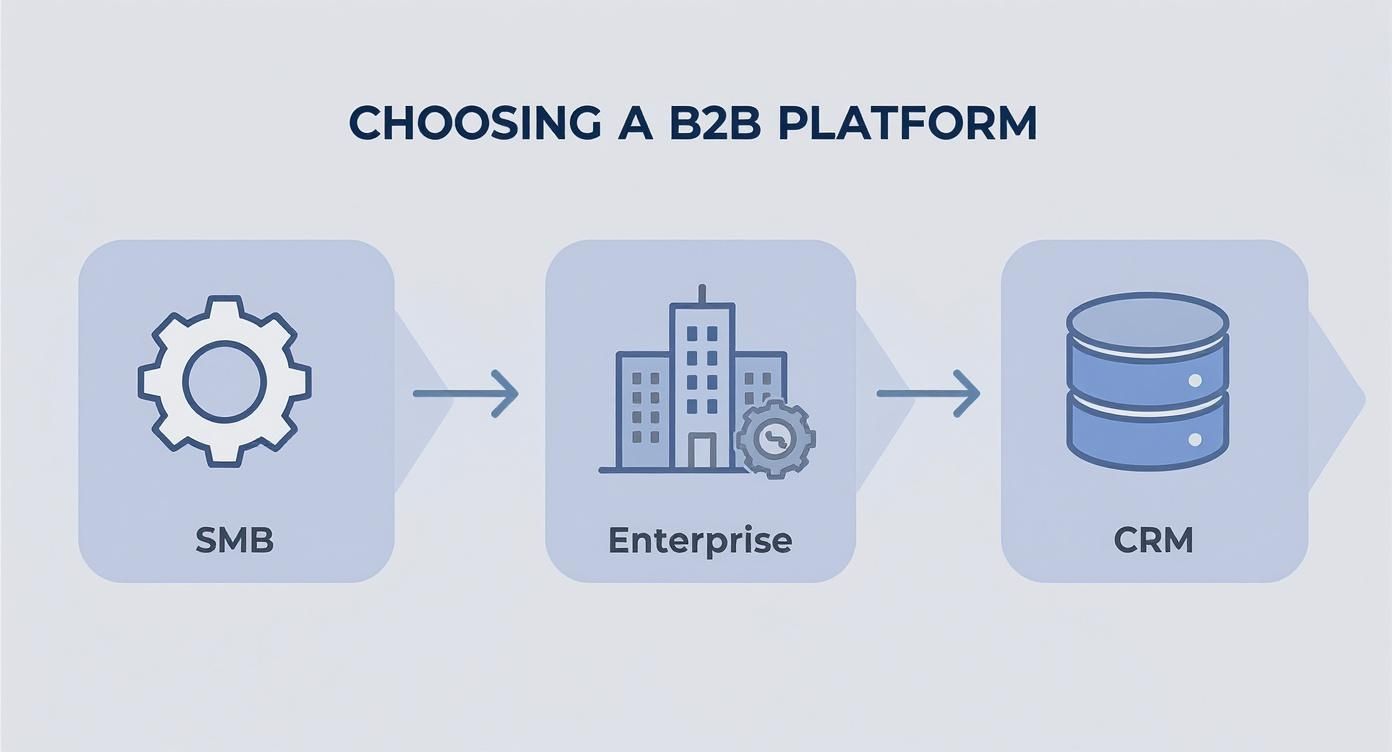
Infographic showing the process flow for choosing a B2B marketing automation platform, with icons for SMB, Enterprise, and CRM integration.

As the infographic shows, the platform you choose depends a lot on your company size and what CRM you’re already using. This choice directly impacts how you'll build and scale campaigns like the one we just designed.

The biggest mistake I see is "set it and forget it." Your first campaign is just a starting point, not the final product. Use the data to ask questions. Is the open rate on Email #2 tanking? Try a new subject line. Are clicks low on Email #3? Maybe your call-to-action isn't clear enough.

By constantly testing and tweaking, you turn a good automation into a lead-generating machine. You can even boost the quality of leads entering the funnel in the first place by using smarter tactics like AI for lead scoring to make sure you're focusing on the best prospects from the get-go.

Let's be honest: just buying a powerful marketing automation platform doesn't magically solve all your problems. If it were that easy, everyone would be crushing their numbers. The reality is, success comes from sidestepping the common roadblocks that can turn a promising investment into a frustrating headache.

These hurdles aren't just about tech. They're about people and process.

In fact, a recent survey laid out the big three pretty clearly. When B2B marketers were asked about their biggest headaches, 56% pointed to data integration. Right behind that was getting sales and marketing to actually use the thing (40%), followed closely by proving it was all worth it (37%). You can dig into more of these marketing automation statistics yourself.

Let's break down how to conquer each one.

Conquering Data Integration Issues

Your automation platform is only as smart as the data you feed it. Think of it like a high-performance engine—if you fill it with dirty fuel, it’s going to sputter and fail.

If your CRM is a chaotic mess of duplicate contacts, old info, and inconsistent fields, your campaigns are dead on arrival. You'll end up sending the perfect message to the wrong person, or worse, annoying your best prospects with irrelevant content.

Action Plan: Establish your CRM as the single source of truth.

  1. Audit Your Data (This Week): Export a sample of 1,000 contacts from your CRM. How many have missing job titles? How many are duplicates? This will reveal the scale of the problem.
  2. Implement Data Hygiene Rules (This Month): Create a simple, one-page document outlining data entry standards (e.g., all state fields must use two-letter abbreviations). Make it required reading for anyone who touches the CRM.
  3. Schedule a Quarterly Cleanup: Dedicate one day every quarter for the marketing and sales teams to tackle data cleanup projects together.

This isn't just a technical step; it's the foundation for everything that follows.

Bridging the Sales and Marketing Divide

One of the biggest promises of automation is finally getting sales and marketing to play nice together. But a piece of software can't force teamwork.

Without a crystal-clear agreement on what makes a lead "qualified," marketing will celebrate a mountain of MQLs that sales sees as total junk. This is where the finger-pointing starts.

Action Plan: Create a Service Level Agreement (SLA). It's a simple, written contract between sales and marketing that takes all the guesswork out of the equation.

Think of an SLA as the official rulebook for the lead handoff. Marketing agrees to deliver a specific number of qualified leads each month (defined by a lead score of 100+), and sales agrees to contact those leads within 24 hours. It replaces assumptions with accountability.

Proving Your Return on Investment

"So... is this thing actually working?" It’s the question every marketer dreads if they don't have a good answer. The pressure to connect your campaigns directly to closed deals is intense, and for many, it’s the toughest hurdle.

To prove ROI, you have to look past vanity metrics like open rates and clicks. Those are nice, but they don't pay the bills.

Action Plan: Start with first-touch attribution. It's the simplest model to implement and provides immediate insight. Inside your platform, create a report that shows which marketing channel (e.g., Organic Search, Paid Social, Email Marketing) sourced the contacts that eventually became closed-won deals. This report will directly tie marketing efforts to revenue. If you're new to this, our complete guide on multi-touch attribution models is the perfect place to start.

B2B Marketing Automation FAQs

Diving into marketing automation for B2B always brings up a few big questions. We get it. You're thinking about cost, team size, and the million-dollar question: when will I actually see a return on this thing?

Let's clear the air. Here are the straight-up answers to the most common questions we hear from B2B marketing leaders. Think of it as your cheat sheet for moving forward with confidence.


QuestionAnswer
How soon can I expect to see an ROI?It comes in stages. Within 3-6 months, you'll see efficiency gains—better lead organization, faster follow-ups. The real pipeline and revenue impact usually shows up between 6-12 months, once your automated nurture campaigns have had time to work through a typical B2B sales cycle.
Is this stuff only for huge companies?Not anymore. That's a common myth. While enterprise beasts like Marketo are built for massive, complex teams, a whole new category of platforms like HubSpot are designed for small and mid-sized businesses. They're user-friendly, scalable, and won't break the bank.
Will automation make my marketing feel robotic?It's actually the opposite—if you do it right. Bad automation feels robotic because it's just blasting generic messages. Great automation feels personal because it uses real behavior—like which pages a prospect visited or what content they downloaded—to deliver the perfect next message at the perfect time. It scales the human touch.
Do I need a dedicated team to manage it?Not on day one. Most modern platforms are intuitive enough for one or two tech-savvy marketers to get up and running. As you grow and get more sophisticated with your strategy, you might hire a dedicated marketing ops person, but that's an evolution, not a starting point.

Hopefully, that clears up a few things. The goal isn't to replace your team's smarts; it's to give them the tools to execute those smarts at a scale you could never manage by hand.


Ready to see how an intelligent platform can transform your B2B marketing? The marketbetter.ai platform integrates AI across content creation, campaign management, and customer engagement to drive measurable growth. Discover how marketbetter.ai can help you scale personalization and prove your ROI.

Mastering Inbound Leads Generation

· 23 min read

Forget the megaphone. Think of your business as a powerful magnet.

That’s the simplest way to understand inbound lead generation. Instead of blasting your message at anyone who might be listening, you create valuable experiences that pull people in—specifically, the people already looking for what you offer. This guide provides actionable steps and clear comparisons to help you build a lead generation machine that works.

What Is Inbound Lead Generation?

Inbound lead generation is a marketing mindset built on a simple idea: earn attention, don't buy it. It's about attracting prospects by giving them something useful, whether that's a helpful blog post, an insightful guide, or a tool that solves a small problem for them. This is the complete opposite of old-school outbound tactics like cold calls or generic email blasts that just interrupt people's day.

Instead of shoving a sales pitch in someone's face, you become the go-to resource. You answer questions, solve problems, and build a relationship before you ever ask for the sale. Over time, this builds the trust you need to turn your website into a 24/7 lead-generating machine that fuels real, sustainable growth.

The Core Difference: Inbound vs. Outbound

The big distinction comes down to who starts the conversation. Outbound marketing is seller-driven; you decide who to contact and when. Inbound marketing flips that script, putting the buyer in the driver's seat and letting them engage on their own terms. This comparison makes the contrast clear:

AspectInbound Marketing (Magnet)Outbound Marketing (Megaphone)
InitiatorThe customer initiates contact by finding your content.The seller initiates contact by reaching out.
ApproachPulls customers in with valuable, helpful content.Pushes messages out to a broad audience.
CommunicationTwo-way conversation (blogs, social media, comments).One-way broadcast (TV ads, cold calls, email blasts).
GoalTo educate, build trust, and become a resource.To make a direct sale as quickly as possible.
ExampleA prospect finds your guide on "How to Improve Project Workflow" and downloads it.A sales rep cold-calls a list of project managers.

Actionable Tip: To shift from outbound to inbound, start by identifying the top 10 questions your customers ask. Turn the answers into detailed blog posts. This simple action transforms your website from a brochure into a valuable resource that attracts motivated buyers.

This shift is more than just a preference; it’s a necessity. Today's buyers are in control. They do their own homework. In fact, research shows a huge percentage of the buyer's journey is already over before they ever pick up the phone to talk to a sales rep. They're out there reading reviews, comparing options, and educating themselves. Inbound meets them right where they are, with the right answer at just the right moment.

Why This Customer-Centric Approach Wins

Switching to an inbound strategy isn't just a feel-good move; it drives serious business results. When you're attracting people who already have a problem you can solve, the leads you generate are naturally higher quality and way more likely to become customers.

Think about the advantages:

  • Builds Trust and Authority: When you consistently publish helpful content, you stop being just another vendor and start being seen as an expert.
  • Higher Quality Leads: Inbound leads have already raised their hand. They sought you out, which means they have a genuine interest and are far less likely to be a bad fit.
  • Cost-Effective and Scalable: A single great blog post or guide can work for you around the clock, generating leads for months or even years after you hit "publish."
  • Aligns with Modern Buyer Behavior: It respects that people are smart and want to educate themselves. This creates a much better first impression and a positive brand experience right from the start.

Great inbound marketing doesn't just happen by accident. The journey someone takes from being a total stranger to your biggest fan follows a clear, repeatable path—the inbound marketing funnel. If you want to master inbound leads generation, you need to understand this framework inside and out. It’s your roadmap.

Think of it as building a relationship. You wouldn't ask someone to marry you on the first date, right? Instead, you guide potential customers through four distinct stages. Each step has a specific goal, moving them logically and helpfully toward a decision without being pushy. It’s all about adding value and building trust along the way.

This infographic breaks down how providing real value from the get-go creates the trust needed to pull people into your world.

Infographic about inbound leads generation

As you can see, it's not just about getting traffic. It's about earning attention and trust from the very first click.

Stage 1: The Attract Stage

First things first, you have to Attract the right people. The goal isn't just to get any traffic; it's to draw in the specific individuals who are a perfect fit for what you offer. These are your ideal customers, and they’re already out there searching for solutions to problems you can solve.

So, how do you get on their radar? With valuable content and smart SEO.

  • Content Marketing: This is your magnet. You create genuinely helpful blog posts, deep-dive guides, or engaging videos that answer your audience's burning questions.
  • Search Engine Optimization (SEO): This makes sure your content actually gets found. By optimizing your site, you show up in Google right when people need you most.
  • Actionable Step: Brainstorm five problems your ideal customer faces. Create a detailed blog post for each one, using keywords they would search for. For example, instead of a loud ad that screams, "Buy our software!" you publish an article like, "Five Project Management Mistakes Costing You Money."

Stage 2: The Convert Stage

Okay, you've got visitors. Now what? The next step is to Convert them into actual leads. An anonymous person browsing your site is a ghost—you need a way to start a conversation. This is where you offer them something valuable in exchange for their contact info.

This trade is a critical moment. You're asking for permission to enter their inbox, so the offer has to be compelling. This is where calls-to-action (CTAs), landing pages, and forms shine.

  • Calls-to-Action (CTAs): These are the buttons or links that prompt action, like "Download the Free Checklist" or "Save Your Seat for the Webinar."
  • Landing Pages: A simple, dedicated page with one job: convincing the visitor to take that action. It highlights the value and presents the form.
  • Forms: This is the finish line. They fill in their details to get the goods, and voilà, you have a new lead.
  • Actionable Step: Create a simple checklist that complements one of your most popular blog posts. Offer it as a free download behind a form on that page. This is called a "content upgrade" and it's highly effective.

Stage 3: The Close Stage

You have a lead. Now it's time to Close the deal by nurturing that relationship and turning them into a customer. Most people aren't ready to buy the second they download an ebook. This is where you gently guide them toward a decision.

This isn’t about spamming them with sales pitches. It’s about delivering the right information at the right time.

Actionable Tip: Set up a simple 3-email welcome series for new leads. Email 1 delivers the resource they requested. Email 2 offers a related article or case study. Email 3 asks if they have any questions. This builds trust without being aggressive.

You can set up automated email workflows that send helpful follow-ups based on what a lead has shown interest in. Someone who downloaded a beginner’s guide gets a different set of emails than someone who viewed your pricing page. That level of personalization shows you're paying attention and you’re there to help.

Stage 4: The Delight Stage

The work isn't over when the sale is made. The final stage, Delight, is all about turning customers into enthusiastic promoters of your brand. It costs way less to keep a customer than to find a new one, and happy customers become your best marketing channel through word-of-mouth.

  • Actionable Step: A month after a customer makes a purchase, send them a personalized email asking for feedback and offering a helpful tip for getting more value out of your product or service. This shows you care beyond the initial sale.

This ongoing engagement makes them feel valued, turns them into loyal advocates, and fuels a powerful, self-sustaining cycle of inbound growth through referrals and glowing reviews.

Proven Strategies To Attract And Convert Leads

A team collaborating on a marketing strategy using post-it notes on a glass wall

Getting leads is more than just putting up a website and hoping for the best. It takes a real, multi-channel strategy. I like to think of it as a three-legged stool: Content Marketing, Search Engine Optimization (SEO), and Social Media. Sure, each leg can stand on its own, but when they work together, they create a rock-solid foundation for a steady stream of inbound leads.

Content is your fuel, SEO is the engine that gets you found, and social media is how you get it in front of people. If one leg is wobbly, the whole thing can fall apart. For example, writing a brilliant article without thinking about SEO is like hiding a masterpiece in your desk drawer—no one’s ever going to see it.

On the flip side, perfect SEO for thin, useless content might get you clicks, but it won't build an ounce of trust. The real magic happens when these three pillars work in lockstep to pull in, engage, and ultimately convert the right kind of audience.

The Power Of Value-Driven Content Marketing

Content is the absolute heart of any good inbound strategy. It's how you answer your audience's questions, solve their problems, and prove you know your stuff long before they ever think about buying from you. The trick is to create content that speaks directly to the headaches your ideal customers are dealing with.

To get started, map out their pain points. What’s keeping them up at night? What are they frantically typing into Google? Knowing this is the key to creating something they'll actually want to read. Digging into different customer segmentation strategies can help you dial in your messaging for specific groups.

Once you know their problems, you can pick the right format to deliver the solution. This isn't just a nice-to-have anymore; it's central to modern marketing. About 50% of marketers see lead generation as a top priority, and in the B2B world, a staggering 85% of marketers use content specifically for that purpose. The most popular formats right now for attracting prospects are podcasts (77%), blog posts (76%), and videos (59%).

Making Your Content Discoverable With SEO

Search Engine Optimization (SEO) is what makes sure your amazing content actually shows up when people are looking for answers. It's the difference between hoping customers stumble upon you and meeting them exactly where they are.

Think of SEO and content as partners. Your content delivers the value, and SEO delivers the eyeballs. Without SEO, even the best blog post on the planet is invisible to search engines and, by extension, your future customers.

There are two sides to the SEO coin: on-page and off-page. Here's a quick comparison of what to focus on for each.

Strategy AspectOn-Page SEO (Your Website)Off-Page SEO (The Wider Internet)
Primary FocusOptimizing elements on your website, like content, keywords, and HTML tags.Building your site's authority through external signals, like backlinks from other sites.
Key Actions- Keyword research and integration
- Writing compelling meta descriptions
- Optimizing page load speed
- Earning backlinks from reputable sites
- Guest blogging
- Social media mentions
Main GoalTo make it crystal clear to search engines and users what your content is about.To prove to search engines that your content is trustworthy and authoritative.
Actionable First StepFor every blog post, ensure your target keyword is in the title, the first paragraph, and at least one subheading.Find one relevant industry blog and offer to write a guest post in exchange for a link back to your site.

Building Community With Social Media

Social media is where you distribute your content, chat with your audience, and build a real community around your brand. It’s your chance to give your content a human voice and connect with prospects in a more relaxed setting.

While SEO grabs people with an immediate problem, social media helps you build relationships with those who might not be ready to buy today but will be down the road. It's a long game that fosters loyalty and keeps your brand top-of-mind.

Your goal on social media isn't just to shout about your content. It's to start conversations, listen to what people are saying, and provide value right there on the platform. When the time is right, you can then guide that targeted traffic back to your site.

Here are a few practical ways to use social media for lead generation:

  • Promote Gated Content: Share links to landing pages where people can download your ebooks, whitepapers, or case studies in exchange for their contact info.
  • Host Live Events: Use platforms like LinkedIn Live or Facebook Live for webinars or Q&A sessions, and collect registrations to capture lead information.
  • Engage in Relevant Groups: Jump into industry-specific groups on LinkedIn or Facebook. Share your expertise, be helpful, and subtly point people toward your resources.

Ultimately, to really nail inbound lead generation, you need to understand how all these pieces fit together, from creating great content to mastering email list building. Each pillar—Content, SEO, and Social Media—plays a crucial, interconnected role in building a machine that consistently generates high-quality leads.

Turning Leads Into Customers With Smart Nurturing

A person working on a laptop, analyzing data charts and graphs on the screen, symbolizing lead nurturing.

Capturing a lead is like getting a phone number at a party. It's the start of a conversation, not a signed deal. A new contact in your CRM is a good sign, but let's be real—most people aren't ready to buy the second they download your ebook. This is where smart lead nurturing comes in, turning that initial flicker of interest into actual purchase intent.

Lead nurturing is all about building a relationship. Instead of slamming new contacts with a sales pitch, you deliver a steady stream of valuable, relevant information that speaks to their problems. It’s the difference between being a pushy salesperson and a trusted guide. You're gently steering them toward your solution by being genuinely helpful.

This approach keeps your brand top of mind, so when they are finally ready to pull the trigger, you're the first one they think of. And the data backs this up. Companies that nail automated nurturing can see a 10% revenue increase in as little as six months. Inbound tactics are proving to be up to 10 times more effective at converting leads than old-school outbound methods. If you're curious about the numbers, you can review these inbound marketing statistics and trends.

From Generic Blasts to Personalized Journeys

The days of the one-size-fits-all email blast are long gone. Effective nurturing is built on personalization and segmentation. You wouldn't give a rookie and a seasoned pro the same advice, so why would you send them the same marketing content?

Segmentation means grouping your leads based on who they are and what they've done—their industry, job title, or the specific content they've clicked on. This lets you build targeted email workflows that feel like they were written just for them, making your communication a whole lot more effective.

The goal is to make every lead feel like you're speaking directly to them. A great nurturing campaign feels less like marketing automation and more like a personal, one-on-one conversation that anticipates their next question.

Think about it: a lead who downloaded a "Beginner's Guide to SEO" needs a completely different set of emails than someone who just requested a pricing demo. The beginner needs foundational content to build trust. The demo requester is much further down the funnel and needs case studies, testimonials, and feature comparisons to seal the deal. This is how you build real rapport.

You can take this even further by using our guide on how to use AI for lead scoring to get even sharper at identifying who needs what content, and when.

Comparing Nurturing Approaches

Not all nurturing strategies are created equal. The right one for you depends on your resources, how complex your sales cycle is, and what your audience responds to. Let's break down two of the most common methods to help you choose where to start.

Nurturing ApproachDrip Campaigns (Time-Based)Behavioral Workflows (Trigger-Based)
How It WorksSends a pre-set sequence of emails at fixed intervals (e.g., Day 1, Day 4, Day 7).Sends emails based on what a lead actually does (e.g., visits your pricing page, watches a webinar).
Best ForWelcoming new subscribers, simple onboarding, or general brand awareness.Nurturing high-intent leads, re-engaging cold contacts, and navigating complex sales cycles.
ProsEasy to set up and manage. Ensures consistent communication.Highly personalized and timely. Leads to much higher conversion rates and is more efficient.
ConsCan feel generic and disconnected from a lead's actual readiness to buy.Requires more sophisticated automation tools and a solid strategic plan.
Actionable TakeawayStart with a simple 3-part drip campaign for new blog subscribers. Once you master that, build one behavioral workflow for leads who visit your pricing page but don't convert.

While drip campaigns are a fine place to start, the real magic happens with behavior-triggered workflows. By reacting to a lead's real-time actions, you ensure every message hits the mark, dramatically boosting your chances of turning that conversation into a customer.

Measuring The ROI Of Your Inbound Marketing

Creating fantastic content and building relationships is the heart of inbound, but how do you actually prove it’s working? Let’s be honest: without hard numbers, your marketing efforts are just shots in the dark. Measuring your return on investment (ROI) is what turns your strategy from an art into a science, giving you the data you need to justify your budget and make smarter decisions.

Think of it like a fitness tracker for your marketing. You wouldn’t just guess if your workouts are paying off—you’d track your steps, your heart rate, and your progress. It’s the same with inbound leads generation. You track key performance indicators (KPIs) to see what’s working, what’s not, and where to double down for the best results.

Core Metrics You Must Track

To get a real sense of your inbound success, you have to look past vanity metrics like website traffic. The real story is in the numbers that connect your marketing activities directly to lead quality and, most importantly, to revenue.

Here are the non-negotiables:

  • Visitor-to-Lead Rate: What percentage of people visiting your site actually become leads by filling out a form? A low rate here could mean your content isn't hitting the mark or your calls-to-action are too weak.
  • Cost Per Lead (CPL): How much are you spending to get one single lead? This is a critical gut-check for the financial efficiency of your campaigns and helps you compare which channels are pulling their weight.
  • Lead-to-Customer Conversion Rate: This is the money metric. It shows how many of your qualified leads turn into paying customers and reveals the true health of your entire inbound funnel, from that first blog post to the final sale.

These numbers don't live in a vacuum—they tell a story together. A sky-high visitor-to-lead rate is great, but not if your CPL is through the roof or none of those leads ever buy anything. The goal is to find a healthy, sustainable balance across the board.

Key Metrics For Inbound Lead Generation Success

Tracking metrics can feel overwhelming, so this table breaks down the essentials for each funnel stage. Think of it as your cheat sheet for knowing what to measure and what action to take based on the data.

Funnel StageKey MetricWhat It MeasuresActionable Question to Ask
AttractVisitor-to-Lead RateThe effectiveness of your content and CTAs in capturing initial interest.Is our offer compelling enough? Are our forms too long?
ConvertCost Per Lead (CPL)The financial efficiency of your lead acquisition efforts across different channels.Which channels give us the lowest CPL? Can we shift budget there?
CloseLead-to-Customer RateThe overall health and effectiveness of your sales and nurturing process.Are we nurturing leads effectively? Is there a leak between marketing and sales?
DelightCustomer Lifetime Value (CLV)The total revenue a customer brings in over their entire relationship with your company.How can we increase repeat purchases or upsell existing customers?

By keeping an eye on these KPIs, you get a clear, data-backed view of your entire inbound engine, helping you spot leaks and opportunities at every step.

Calculating Your Inbound Success

Putting these metrics into practice is easier than you think. A few simple formulas are all you need to start turning raw data into powerful insights.

1. Visitor-to-Lead Rate This shows you how well your website converts eyeballs into actual leads.

  • Formula: (Number of New Leads / Total Website Visitors) x 100
  • Example: You generated 50 leads from 2,000 website visitors last month. Your visitor-to-lead rate is 2.5%. If that number suddenly drops, it’s a red flag telling you to look at your landing pages and offers.

2. Cost Per Lead (CPL) This reveals the efficiency of your marketing spend.

  • Formula: Total Marketing Spend / Number of New Leads
  • Example: You spent $5,000 on marketing and got 50 leads. Your CPL is $100. When you compare that to the average lifetime value of a customer, you know right away if your spending is sustainable. For a deeper dive, check out our guide on how to calculate marketing ROI.

3. Lead-to-Customer Rate This is the metric that connects your marketing efforts directly to the bottom line.

  • Formula: (Number of New Customers / Total Leads) x 100
  • Example: If those 50 leads resulted in 5 new customers, your lead-to-customer rate is 10%.

By tracking these numbers, you create a powerful feedback loop. You can test new content, adjust your ad spend, or refine your nurturing process and see the direct impact on your bottom line.

Understanding these benchmarks is key. Industry data suggests the average cost per lead is around $198.44, with an average lead-to-customer conversion rate of 2.9%. On top of that, effective lead nurturing can boost purchase rates by a massive 47%, proving just how vital that follow-up is. For those interested in how this applies to newer tech, there's a great piece on Measuring the ROI of your WhatsApp Chatbot that offers some specific examples.

Common Questions About Inbound Lead Generation

Jumping into a full-on inbound lead generation strategy can feel like a big leap, especially if your team is used to the old-school playbook. It’s totally normal to have questions about how it all works, what the timeline looks like, and what you should really expect. Let's clear up a few of the most common ones.

How Long Does It Take To See Results?

Look, inbound is a long game. This isn't about flipping a switch and watching leads pour in tomorrow. While you might see some early green shoots in 3-6 months—a bump in traffic, a few interesting downloads—it really takes 6-12 months to build the kind of authority and organic momentum that delivers a steady, predictable stream of leads.

Here's a comparison of inbound vs. outbound timelines:

  • Outbound (e.g., Paid Ads): You see results (clicks, impressions) almost immediately. However, when you stop paying, the results stop instantly. It's like renting an audience.
  • Inbound (e.g., SEO & Content): It's a slow build. Your first blog posts might feel like they're shouting into the void. But over time, they start to rank on Google and become assets that generate leads 24/7 without continuous ad spend. It's like owning your audience.
  • Actionable Advice: Don't get discouraged in month two. Commit to publishing consistently for at least six months before evaluating the strategy's success.

What Is The Difference Between MQL and SQL?

Getting this distinction right is one of the biggest levers for making your sales and marketing teams work together instead of against each other. It stops sales from chasing people who are just kicking tires and makes sure marketing is actually nurturing the right leads.

Here’s a clear comparison to help define the handover process:

Lead TypeMarketing Qualified Lead (MQL)Sales Qualified Lead (SQL)
DefinitionA lead who fits your ideal customer profile and has shown interest by engaging with marketing content.An MQL who has taken a high-intent action indicating they are ready for a sales conversation.
Example Actions- Downloads a whitepaper
- Subscribes to your blog
- Attends a webinar
- Requests a demo
- Asks for a price quote
- Fills out a "Contact Sales" form
Next StepNurture with more targeted content to educate them and build trust.Hand off to the sales team for a direct, one-on-one follow-up.
Who Owns It?Marketing TeamSales Team

Actionable Tip: Sit down with your sales team and create a "lead scoring" system. Assign points to different actions (e.g., 5 points for an ebook download, 20 points for a pricing page visit). Agree that any lead who reaches a certain score (e.g., 50 points) automatically becomes an SQL and gets passed to sales. This eliminates guesswork.


Ready to transform your marketing with an integrated AI platform that drives real results? marketbetter.ai helps you create better content faster, optimize campaigns with predictive analytics, and deliver personalized customer journeys at scale. Learn more and book your demo today.

Your Actionable Guide to a Winning B2B Demand Generation Strategy

· 23 min read

Let's be honest, the term "demand generation" gets thrown around a lot. But a modern B2B demand gen strategy is much more than just a fancy new name for lead gen. It's a completely different way of thinking.

We're talking about a full-funnel approach designed to create genuine interest in what you do long before a prospect even thinks about filling out a form. The goal isn't just to chase leads; it's to build a predictable revenue engine by becoming the go-to resource in your space.

Moving Beyond Leads to Create Real Demand

A group of professionals collaborating on a strategic plan for demand generation.

The old playbook is broken. Gating every piece of content and hammering MQLs is a fast track to burning out your sales team and annoying your potential customers.

Today’s B2B buyers are in the driver's seat. They do their own research, read reviews, and talk to peers. A huge chunk of their decision is made before they ever want to talk to a sales rep. A smart demand generation strategy not only accepts this reality but leans into it.

Instead of just capturing contacts, the focus shifts to creating a groundswell of interest with your Ideal Customer Profile (ICP). It’s about being so consistently helpful and insightful that when a need finally arises, your brand is the only one they think of.

Demand Generation vs. Lead Generation

Getting this distinction right is everything. It dictates your entire marketing motion.

Think of it like this: lead generation is like fishing with a giant net, hoping to catch anything that swims by. Demand generation is like creating the perfect, irresistible habitat that attracts the exact fish you want.

  • Lead Generation (The "Old Way"): This is about capturing contact info. The primary metric is the quantity of leads (MQLs), and it's often a volume game.
    • Action: Gate content, run lead forms, measure cost-per-lead.
    • Outcome: A CRM full of low-quality contacts who aren't ready to buy. Your sales team wastes cycles on dead ends.
  • Demand Generation (The "Modern Way"): This is about educating the market and building brand love. The primary metric is the quality of engagement, which ultimately drives pipeline and revenue.
    • Action: Ungate valuable content, build community, measure pipeline influence.
    • Outcome: A pipeline of educated, high-intent prospects who already understand your value.

"A powerful B2B demand generation strategy helps in building brand awareness while producing highly valuable, engaging content that drives interest and nurtures leads."

This guide is your roadmap for building a strategy that does exactly that. We'll walk through the pillars of this modern approach, from defining your ICP to measuring what actually matters.

For a deeper dive, check out this excellent Full Cycle B2B Marketing Playbook). It’s a fantastic resource for building out your entire marketing function from the ground up.

Build Your Demand Gen on a Bedrock of First-Party Data

Before you even think about launching a campaign, let's talk about the single most critical piece of your B2B demand generation strategy: knowing exactly who you're aiming at. Too many marketers take the easy route, buying third-party data lists. It's a trap. Those lists are often stale, inaccurate, and a great way to burn cash.

The real gold isn't out there—it's already in your systems. Your first-party data is the ground truth.

We're not just talking about basic firmographics like company size or industry. This is about rolling up your sleeves and digging into your CRM, your analytics, and customer feedback to find the rich, behavioral clues that define your absolute best customers.

First-Party vs. Third-Party Data: Not Even a Fair Fight

It's crucial to understand the difference here. Third-party data is basically a commodity. It’s scraped together from countless sources and sold to anyone who will buy it. It's wide but incredibly shallow, lacking any real context about your specific audience.

First-party data, on the other hand, is information you've earned directly from your audience through their actions—website visits, purchase history, webinar sign-ups, and direct conversations.

Data TypeReliability & AccuracyDepth of InsightActionability
First-Party DataHigh (collected directly)Deeply contextual and specificHighly actionable for personalization
Third-Party DataLow to moderate (often outdated)Generic and lacks nuanceLimited for precise targeting

Trusting third-party lists is like trying to find a specific person in a packed stadium with a blurry photo. Using your own data is like having their direct phone number and knowing exactly what they care about.

Actionable Step: Mine Your CRM and Analytics for Gold

Your CRM isn't just a digital Rolodex; it's a collection of stories about your most successful customer relationships. Start right there. Pull a list of your top 10-20 customers and get ready to go deep. The goal is to build a hyper-specific Ideal Customer Profile (ICP), and to do that, you have to ask the right questions.

Look for the hidden patterns:

  • Business Pains: What fire were they trying to put out when they found you? Your sales team's discovery notes and call recordings are treasure troves for this.
  • Buying Committee: Who really signed the check? And who championed the deal internally? Pinpoint the roles of the champion, the economic buyer, and the end-user. This tells you who you actually need to win over.
  • Tech Stack: What other tools are they using? This isn't just trivia—it signals their technical maturity, budget, and potential integration needs, which can qualify them as a great fit.
  • Content Consumption: Which pages did they visit on your site right before they became a customer? Your web analytics will show you which blog posts, case studies, or webinars did the heavy lifting.

Actionable Takeaway: By piecing this together, you stop chasing vague personas like "Marketing Manager at a tech company." Instead, you get a razor-sharp ICP like, "A Marketing Ops Leader at a Series B SaaS company with 50-200 employees, using HubSpot, and struggling to prove marketing ROI." That level of clarity changes everything.

Turning Raw Data Into Actionable Segments

Once you have this rich profile, you can stop shouting one message to everyone. Instead, you can build powerful segments and create tailored content that speaks directly to the specific pains of each group. Your messaging for an enterprise CFO focused on cost savings should be worlds apart from how you talk to a mid-market content manager focused on productivity.

This isn't just theory. Businesses that get serious about their first-party data strategies see a 2x increase in conversion rates and a 30% reduction in customer acquisition costs. S2W Media, for example, reported a 35% jump in engagement rates and a 50% improvement in audience segmentation just by leaning into its own data. You can read more on how first-party data is shaping B2B marketing to see the full picture.

Of course, this data is useless if it's trapped in different systems. This is where a Customer Data Platform (CDP) becomes essential. A well-implemented CDP unifies all those scattered data points—from your website, CRM, and support tools—into a single customer view. This powers everything from smarter ad targeting to more relevant sales outreach. For a practical look at making this happen, check out this guide on Customer Data Platform integration.

Ultimately, grounding your strategy in first-party data isn't just a "best practice." It's your single biggest competitive advantage. It ensures every dollar you spend is aimed squarely at prospects who look just like your best customers, making your entire demand gen engine more efficient and predictable.

Matching Your Content And Channels To Buyers

Once you have a rock-solid Ideal Customer Profile built on real, first-party data, it's time to show up where your buyers actually are. But it’s not about blasting the same generic message everywhere. A smart B2B demand generation strategy is about precision—matching the right content, to the right channel, at the right moment in their journey.

Think of your channels like different tools in a toolkit. Each one has a specific job.

  • LinkedIn is where you build community and establish yourself as an authority. It's the place for nuanced conversations, sharing deep insights, and getting in front of decision-makers at your target accounts. It’s a long game for creating demand.
  • SEO, on the other hand, is your engine for capturing active, high-intent demand. When someone searches "best accounting software for mid-market," they have a problem and they're looking for a solution right now. Ranking for those terms puts you directly in their path when it matters most.

Framing it this way helps you move from "spray and pray" to strategic investment. You use LinkedIn to create demand by educating the market, and you use SEO to capture the demand that's already out there.

Aligning Content Formats With The Buyer's Journey

The goal is to create a content ecosystem that seamlessly guides a prospect from "I think I have a problem" all the way to "this is the solution I'm buying." This means mapping specific assets to the three core phases: Awareness, Consideration, and Decision. A mismatch here can kill a deal before it even starts.

You wouldn't hit someone at the top of the funnel with a detailed pricing sheet. That’s like asking for a commitment on a first date—it’s just too much, too soon.

The infographic below shows how to use your internal data to lay the groundwork for this targeted content strategy.

Infographic about b2b demand generation strategy

This process of gathering data, analyzing it, and defining your ICP ensures that every piece of content you create is aimed squarely at the right audience.

To help visualize this, here’s a breakdown of how different content formats fit into the buyer's journey.

Content Format vs Buyer Journey Stage

Buyer's Journey StagePrimary GoalEffective Content FormatsKey Metrics
AwarenessEducate & inform; generate initial interestBlog posts, research reports, infographics, short videos, social media contentWebsite traffic, social shares, backlink acquisition, brand mentions
ConsiderationBuild trust & showcase expertise; provide solutionsWebinars, whitepapers, ebooks, solution briefs, checklistsLead magnet downloads, webinar registrations, email sign-ups, time on page
DecisionValidate choice & remove final barriers; drive actionCase studies, customer testimonials, product demos, comparison guides, ROI calculatorsDemo requests, free trial sign-ups, sales inquiries, conversion rates

By mapping your content this way, you create a logical path for buyers to follow, building their confidence at every step.

Content For The Awareness Stage

At the top of the funnel, you're a teacher, not a salesperson. People in this stage are just starting to put a name to their problem or see a new opportunity. Your content needs to be genuinely helpful and insightful, without a heavy sales pitch.

Here’s what works well:

  • Research Reports & Industry Surveys: This kind of content positions you as an authority. Better yet, others will cite your data, earning you valuable backlinks and organic traffic.
  • Blog Posts & Articles: These are your SEO workhorses. By answering the common questions your ICP is typing into Google, you draw them to your site naturally.
  • Infographics & Short Videos: These are perfect for social channels like LinkedIn. They make complex ideas easy to grasp and are highly shareable.

Nurturing Interest In The Consideration Stage

Okay, they understand their problem. Now they're actively looking at solutions. Your content has to shift gears from general education to showing how your solution helps solve their specific challenges.

This is where you introduce your brand as a credible option. The goal is to build trust and showcase expertise, guiding them deeper into your ecosystem without a hard sell.

This middle stage of the funnel is the perfect home for:

  • Webinars & Virtual Events: These let you do a deep dive on a specific topic and engage with prospects directly, answering their questions in real-time.
  • Whitepapers & Ebooks: Gated assets like these are a classic value exchange. You provide in-depth expertise, and they provide their contact information, turning an anonymous visitor into a known lead.
  • Solution Briefs: These are the bridge between high-level content and product-specific details. They clearly outline what your product does and the exact problems it solves.

Driving Action In The Decision Stage

We're at the bottom of the funnel. Prospects are comparing you against competitors and looking for proof that they're making the right call. Now your content needs to be laser-focused on proving your value and knocking down any final hurdles. This is where social proof and product deep dives are king.

Case studies are the heavyweight champion here. A staggering 57% of marketing leaders point to them as their most effective tool for influencing buyer decisions. The same report also found that 29% of organizations now have a fully integrated approach to brand and demand, which is exactly why this strategic alignment is so critical. You can discover more insights from the 2025 Demand Generation Benchmark Survey to see how top performers are pulling this off.

Content that gets the deal signed includes:

  1. Case Studies & Customer Testimonials: Nothing beats a real success story from a happy customer. It’s concrete proof that your solution delivers on its promises.
  2. Product Demos & Free Trials: Let them get their hands on the wheel. A direct, hands-on experience is one of the fastest ways to show value and de-risk the purchase.
  3. Comparison Guides & ROI Calculators: These tools tackle last-minute objections head-on. They show exactly how you stack up against the competition and demonstrate the tangible financial upside of choosing you.

When you thoughtfully map your content and channels to each stage, you build a journey that feels natural and persuasive, turning strangers into your biggest fans.

Activating Your Strategy With ABM and Intent Data

Having a sharp Ideal Customer Profile and a library of perfectly mapped content is a fantastic start. But a plan sitting on a shelf doesn’t generate pipeline. Now comes the critical part: activation. This is where you use data to find the right accounts and engage them with a level of precision that feels almost unfair to the competition.

This is the moment the game shifts from broad marketing to surgical execution. It’s all about spotting the faint signals of buying intent and acting on them before your competitors even know an opportunity exists.

Spotting Buyers With Intent Data

Imagine knowing which of your target accounts are actively researching solutions like yours right now. That’s the magic of intent data. It tracks the digital footprints companies leave across the web, flagging signals like spikes in research on specific topics, visits to review sites, or even engagement with a competitor’s content.

This insight changes everything. Instead of your sales team burning cycles on a cold list, they can pour their energy into accounts that are already in-market and problem-aware.

You'll encounter two main flavors of intent data:

  • First-Party Intent: This is the gold you mine from your own properties—your website, your marketing channels. Think of someone who downloaded a whitepaper, attended your webinar, or spent a suspicious amount of time on your pricing page. These are the strongest signals you’ve got.
  • Third-Party Intent: This data comes from providers who monitor activity across millions of online sources. It gives you that crucial wider view, showing you which of your target accounts are researching relevant keywords or topics across the broader internet.

When you blend both, you get a powerful, 360-degree view of an account's real interest level. Our guide on what is behavioral targeting digs deeper into how you can read these digital tea leaves to inform your outreach.

Traditional Demand Gen vs. Account-Based Marketing

With solid intent data in hand, you can pick the right activation model. The two heavy hitters in B2B are traditional demand generation and Account-Based Marketing (ABM), and they’re built for different jobs.

ApproachTarget FocusPrimary GoalBest For
Traditional Demand GenBroad (ICP)Generating a high volume of individual leads (MQLs)High-velocity sales models, lower ACV products, building broad brand awareness
Account-Based Marketing (ABM)Narrow (Named Accounts)Engaging the entire buying committee at high-value accountsComplex sales cycles, high ACV products, breaking into strategic accounts

One isn’t better than the other; they're just different tools. In fact, most of the smartest companies I've seen use a hybrid approach. They run broad demand gen programs to build awareness and catch inbound interest, while simultaneously running hyper-focused ABM plays against a shortlist of their most strategic, high-value accounts.

Actionable Step: Tier Your Accounts for a Hybrid Approach

A really practical way to pull off this hybrid model is to tier your target account list. This lets you allocate your resources—time, budget, and creative energy—where they’ll make the biggest dent.

Here's a simple way to think about it:

  • Tier 1 (The "Big Fish"): These are your top 10-20 dream accounts. They get the full, bespoke, 1:1 ABM treatment. We're talking deep research, highly personalized content, slick direct mail, and tightly coordinated outreach from both sales and marketing.
  • Tier 2 (The Lookalikes): These 50-100 accounts look a lot like your Tier 1 targets. They get a "one-to-few" ABM approach. You might create industry-specific content or run small, targeted digital ad campaigns aimed at the key personas within these companies.
  • Tier 3 (The Wider Net): This is everyone else in your addressable market who fits your ICP. These accounts are handled by your broader, "one-to-many" demand gen efforts—SEO, content marketing, and general social media campaigns.

This tiered system creates a balanced portfolio. It makes sure you're still feeding the top of the funnel with broader programs while giving your most important target accounts the white-glove treatment they deserve.

Aligning Sales and Marketing for Execution

Let's be clear: this entire activation strategy completely falls apart without tight alignment between your sales and marketing teams. They absolutely have to agree on the target account list, the definition of a qualified account, and the rules of engagement.

This is where data becomes the ultimate peacemaker. Research shows that a staggering 98% of B2B marketers believe intent data is essential for finding and engaging high-potential accounts. When both teams are looking at the same intent signals and CRM data, the conversation shifts from "we need more leads" to "how can we best engage the buying committee at Account X?"

By activating your strategy with intent data and a smart ABM framework, you stop marketing at people and start creating meaningful engagements with the right accounts at the perfect time.

Measuring Success and Proving Your ROI

A dashboard displaying key performance indicators and ROI metrics for a B2B marketing campaign.

Getting a sophisticated B2B demand generation strategy off the ground is a massive win, but it’s only half the job. If you can't prove it's actually working, you'll be fighting an uphill battle for budget, trust, and the resources to scale.

The secret is to stop talking about marketing activities and start talking about business outcomes. Your leadership team isn’t losing sleep over clicks or MQLs. They care about one thing: revenue. To prove your worth, you have to speak their language.

Moving Past Vanity Metrics

It's incredibly easy to get lost in a sea of data. Website traffic spikes and social media engagement feel good, but they don't pay the bills. The real story of your success is written much deeper in the funnel.

To show you're making a real impact, your dashboard needs to be built around three metrics that carry serious weight:

  • Marketing-Sourced Pipeline: This is the big one—the total dollar value of every sales opportunity that started with one of your marketing efforts. It's the cleanest line you can draw from your team's work to future revenue.
  • Pipeline Velocity: How quickly are deals moving from that first touchpoint to a signed contract? Speeding this up means a more efficient sales cycle and cash in the bank sooner.
  • Customer Acquisition Cost (CAC): Simply put, how much does it cost you in sales and marketing to land one new customer? If this number is going down over time, your demand engine is getting more efficient.

Focusing on these KPIs completely changes the conversation. You’re no longer saying, "We got 1,000 clicks." You're saying, "We generated $500,000 in new pipeline this quarter." That’s a conversation every executive wants to be a part of.

Choosing The Right Attribution Model

To accurately claim that marketing-sourced pipeline, you need a clear way to connect the dots between your actions and a closed deal. This is where attribution models come into play, and your choice here can completely change the story your data tells.

A first-touch attribution model gives 100% of the credit to the very first interaction. Maybe it was a blog post someone read six months ago. It's simple, but it’s also wildly misleading because it ignores everything that happened in between.

On the other hand, a multi-touch attribution model spreads the credit across several key touchpoints in the buyer's journey. This paints a far more realistic picture of what's actually driving results. For instance, it recognizes that the initial blog post, a mid-funnel webinar, and the final demo request all played a role.

For any B2B company with a sales cycle longer than a few weeks, a multi-touch model is the only way to go. It acknowledges the reality that a single piece of content rarely closes a six-figure deal. If you want to dive deeper, this is a great breakdown of the different multi-touch attribution models available.

Actionable Takeaway: Choosing the right attribution model isn't just a technical exercise. It fundamentally shapes how you value your channels and content, directly influencing your budget allocation and strategic focus.

Actionable Step: Building Your ROI Dashboard

Your goal isn't to build a dashboard with 50 different charts that no one understands. It’s to create a single source of truth that tells a clear, compelling story about performance.

Here's a look at the essential metrics to include in your dashboard.

Key Demand Generation Metrics and Their Business Impact

This table breaks down the metrics that matter most, showing you exactly what they measure and why they're critical for proving the financial return on your efforts.

MetricWhat It MeasuresWhy It Matters for ROI
Marketing-Sourced Pipeline ($)The total value of sales opportunities created by marketing campaigns.Directly ties marketing spend to potential revenue, answering the "what did we get for our money?" question.
Customer Acquisition Cost (CAC)The total cost of sales and marketing to acquire a single new customer.Measures the efficiency of your go-to-market engine; a decreasing CAC shows improving ROI.
Pipeline Velocity (Days)The average time it takes for a lead to become a closed-won deal.Indicates the speed of your revenue cycle. Faster velocity means marketing is delivering more sales-ready opportunities.
Lead-to-Opportunity Rate (%)The percentage of leads that are accepted by sales and converted into a qualified opportunity.A key indicator of lead quality. A high rate proves marketing is delivering prospects who are genuinely interested and a good fit.

Tracking and reporting on these core numbers shifts you from a position of defending your budget to one of demonstrating your value. You'll be armed with hard data that proves your B2B demand generation strategy isn't just a cost center—it's a predictable engine for business growth.

Common B2B Demand Generation Questions

Even the sharpest marketers run into a few tricky questions when they're deep in the demand generation trenches. Let's tackle some of the most common ones I hear and get you clear, straightforward answers.

Demand Generation vs. Lead Generation: What Is The Real Difference?

This is the big one. Get this wrong, and your whole strategy can go sideways. The simplest way I've found to explain it is creating demand versus capturing it.

  • Lead Generation is purely transactional. It’s about getting contact info to fill the top of the funnel. The key question here is, "How many MQLs did we get?" It's a numbers game, often focused on volume.

  • Demand Generation is the whole strategy. It’s about teaching your market something valuable and building a brand they trust. The goal is to create a pipeline full of educated, high-intent buyers who actually seek you out. The question becomes, "How much qualified pipeline did we create?"

Think of lead generation as a single tactic inside your broader demand generation strategy. If you only chase leads, you end up with a huge list of low-quality contacts that just exhausts your sales team. A real demand gen approach means that when a lead does come in, they already know who you are and understand the problem you solve. If you really want to nail the fundamentals, this guide on What Is Demand Generation Marketing is a great deep dive.

How Do I Get Budget and Buy-In From Leadership?

You have to stop talking like a marketer and start sounding like the CFO. Your leadership team cares about revenue, pipeline, and how efficiently you're spending money—not the marketing activities themselves.

So instead of saying, "I need $50,000 for a new content campaign," you need to reframe it.

Try this: "I'm requesting a $50,000 investment to generate an estimated $500,000 in marketing-sourced pipeline over the next two quarters."

Actionable Takeaway: The key is to connect the dots with a clear, data-backed forecast. Dig into your historical conversion rates and build a model that links every dollar you plan to spend directly to revenue goals. Show them the math.

How Long Until I See Results?

Patience isn't just a virtue here; it's a requirement. This isn't a paid search campaign where you can see results in a few days. A true B2B demand generation engine is a long-term investment.

You'll probably start seeing leading indicators—like a bump in website traffic or more people searching for your brand name—within the first 3-6 months.

But for the metrics that really matter, like marketing-sourced pipeline, you're looking at a 9-12 month timeline. This is especially true if you have a long sales cycle. The most important thing you can do is set this expectation with your leadership team right from the start.


Ready to build a predictable revenue engine? marketbetter.ai uses an integrated AI approach to scale your content creation, optimize campaign performance, and prove your marketing impact with powerful analytics. Transform your demand generation strategy by visiting https://www.marketbetter.ai today.

Demand Generation Strategies That Fuel Growth

· 27 min read

Demand generation is all about creating genuine interest and awareness for what you do. It's not just a fancy term for collecting email addresses. It’s about building a brand and an audience that actively seeks you out, turning casual browsers into loyal fans who are actually excited to hear from you.

Done right, this approach moves you away from unpredictable, one-off campaigns and toward building a reliable engine for long-term revenue growth. To make that happen, you need an actionable plan.

What Is Demand Generation and Why It Matters Now

Let's use an analogy. Imagine your business is a new band trying to make it.

You could stand on a street corner, shoving flyers into the hands of everyone who walks by. That's a lot like traditional lead generation—a pure numbers game focused on grabbing as many contacts as possible, hoping a few are a good fit. This approach is reactive and volume-based.

Demand generation is different. It’s like booking a gig, dialing in your sound, and playing music so good that a crowd starts to form on its own. People are drawn in. They start talking about you. They want to know when your next show is and where they can buy your album. You're creating a buzz, a genuine demand, not just interrupting people. This strategy is proactive and quality-based.

This isn’t just a marketing tactic; it's a complete shift in mindset. Today's B2B buyers are smarter and more skeptical than ever. They’ve done their research. They don't want a cold call or a hard sell. They want answers to their problems. A solid demand generation program focuses on educating and helping your ideal customers, building trust long before a sales rep ever enters the picture.

The Big Difference: Demand Generation vs. Lead Generation

It’s easy to get these two mixed up, but they play very different roles in getting a customer from "who are you?" to "take my money."

  • Demand Generation (The "Why"): This is the long game. It’s about building brand awareness and positioning your company as the go-to expert in your space. It answers the question, "Why should I even care about this company or their solution?" The goal is to make the market aware of a problem and excited about your way of solving it.

    • Actionable Step: Start a podcast series interviewing industry leaders about the biggest challenges in your field. Don't mention your product; just provide value.
  • Lead Generation (The "Who"): This is much more direct and short-term. It's about capturing the contact information of people who have shown interest. It answers the question, "Who is interested right now?" The goal is to convert that existing interest into a qualified name and email for your sales team to follow up with.

    • Actionable Step: Offer a downloadable checklist, like "10 Things to Look for in a New SaaS Vendor," behind a simple email form on your highest-trafficked blog post.

Think of it this way: demand generation creates the fertile ground where high-quality leads can actually grow. To see how that second piece works in practice, you can dig into some effective B2B lead generation strategies.

The Evolution Toward a Smarter Funnel

Demand generation has come a long way from just stuffing the top of the funnel with as many names as possible. Over the last decade, it’s matured from a simple volume play into a sophisticated, data-driven strategy that spans the entire customer journey. It's now laser-focused on lead quality and tight alignment with sales.

The massive shift to digital, especially after 2020, cemented this change. Personalized digital experiences became the standard, forcing marketing efforts to be more precise and genuinely helpful than ever before.

The Core Pillars of a Modern Demand Strategy

To build a machine that consistently drums up interest, you need a blueprint. The best demand generation strategies aren't a single action item on a checklist; they're a structured system built on three core pillars: Attract, Engage, and Delight. This isn't just marketing jargon—it’s a framework for moving customers from "Who are you?" to "Where do I sign up?"

Each pillar has a specific job, and each one builds on the last. Think of the Attract stage as your opening act, Engage as the main performance, and Delight as the unforgettable encore that has the crowd chanting your name.

This visual shows you exactly how the pieces fit together—creating awareness, sparking real interest, and ultimately building a sales pipeline you can count on.

Infographic about demand generation strategies

As you can see, a central demand generation engine is what fuels awareness. That awareness then cultivates genuine interest, which in turn feeds a healthy, predictable sales pipeline. It’s a flywheel, not a funnel.

Attract Your Ideal Customers

The first pillar, Attract, is all about capturing attention at the very top of the funnel. This is where you connect with people who might not even realize they have a problem yet, let alone know that you sell the solution. The goal isn't a sales pitch; it's to be genuinely helpful.

Forget about the old-school outbound tactics that interrupt people’s day. This is about drawing them in naturally by solving their problems with valuable, ungated content that proves you know your stuff. Every B2B company that consistently shows up on page one of Google for helpful searches is nailing this pillar.

Key tactics to put to work here include:

  • SEO-Optimized Blog Content: Write articles that directly answer the questions your ideal customers are typing into search engines. This makes you a trusted expert from the very first click.
  • Social Media Advocacy: Get your team involved. When your own experts share company content and their insights on platforms like LinkedIn, it comes across as authentic and builds trust way faster than a branded post.
  • Podcast Appearances or Hosting: Share your knowledge on industry podcasts. It’s a fantastic way to reach new, highly relevant audiences who are already dialed into topics in your niche.

Engage and Nurture Interest

Once you have their attention, the Engage pillar takes over. This is where you turn that flicker of curiosity into a real relationship. You do this by offering even more valuable resources that help prospects dig deeper into their challenges and explore potential solutions.

This stage is all about building trust and showing off your expertise in a more direct way. It's the difference between someone stumbling upon a single blog post versus them subscribing to your newsletter because they can't afford to miss what you say next.

The trick to demand generation is to have no expectation of anything back from your prospects. Only the knowledge that you’re creating a good feeling between them and your brand.

To really nail the engage phase, you have to provide undeniable value. This often means offering more in-depth content or interactive experiences, usually in exchange for a little bit of information, like an email address.

This quick table breaks down the crucial differences between the broad approach of demand gen and the more targeted action of lead gen. Understanding this distinction is key to building a balanced strategy.

Demand Generation vs Lead Generation: A Strategic Comparison

AspectDemand Generation (Building an Audience)Lead Generation (Capturing Contacts)
Primary GoalCreate awareness and educate the market about problems and solutions.Identify and capture contact information from interested prospects.
Audience FocusBroad; targets an entire ideal customer profile (ICP).Narrow; targets individuals who have shown specific buying signals.
Core TacticsSEO, blogging, social media, podcasts, brand advertising.Gated content (eBooks, webinars), contact forms, free trials, demos.
MeasurementWebsite traffic, brand search volume, social engagement, share of voice.Leads, MQLs, SQLs, cost per lead (CPL), conversion rates.
Funnel StageTop of the Funnel (TOFU).Middle of the Funnel (MOFU) and Bottom of the Funnel (BOFU).
TimelineLong-term relationship building; a continuous process.Short-term results-focused; often campaign-based.

In short, demand generation makes people want your solution, while lead generation gives them a way to get it. You can't have one without the other.

Delight and Convert with Proof

The final pillar is Delight. This is where you transform that nurtured interest into real, qualified opportunities for your sales team. By now, your prospects know they have a problem and are aware of the solutions out there. Your job is to convince them that your solution is the best one.

This is all about proof. You stop talking about theoretical problems and start showing how you've solved them for real companies just like them.

Great delight tactics make the decision to talk to sales feel like the obvious next step, not a risky leap. This is where you bring out the heavy hitters: compelling case studies, tailored product demos, and customer testimonials that provide the social proof needed to turn a warm prospect into a new customer.

Building Your Content Engine for Demand

Content is the fuel for every great demand generation strategy. It’s the real, tangible value you give your audience long before they even think about buying. A solid content engine isn't about just churning out random articles; it’s about systematically creating assets that attract, educate, and pull your ideal customer through their entire decision-making process.

Think of it like building a library. A single book is nice, but a well-stocked library with sections covering every possible interest? That becomes an indispensable resource for the entire community. Your content needs to do the same thing—become the go-to resource in your industry, the one future customers learn to depend on.

This requires a real plan, not just a sporadic publishing schedule. You have to map your content to where people are in their journey, from the moment they first realize they have a problem to the point where they’re actively comparing vendors like you.

People collaborating on content creation around a large desk with sticky notes and laptops

Matching Content to the Buyer's Journey

The sharpest content engines align every single asset with a clear purpose. You wouldn’t hand a dense, technical whitepaper to someone who isn’t even sure they have an issue yet. That’s just a waste of everyone’s time. Matching the content format to the funnel stage is how you build real momentum.

Here’s a simple way to break it down:

  • Top of Funnel (Awareness): Your goal here is to attract a broad audience and teach them about the problems you solve—not your product. The content should be easy to find and even easier to share. Think blog posts that nail common questions, snappy short-form videos for social, or infographics that make complex ideas simple.
  • Middle of Funnel (Consideration): Okay, now your audience knows they have a problem and they're starting to look for answers. This is your chance to offer deeper, more practical value. Host webinars, publish detailed guides or eBooks, and create interactive tools like checklists that help them sort through their options.
  • Bottom of Funnel (Decision): By now, they're solution-aware and are sizing you up against the competition. Your content needs to build trust and prove you're the right choice. This is prime time for compelling case studies, customer testimonials, product demos, and no-fluff comparison guides.

Choosing the Right Content Format

Picking between a blog post, a video, or a podcast isn't just a matter of taste. It's a strategic decision based on your audience and what you're trying to achieve. Each format has its own strengths, and making the right call can be the difference between content that lands and content that flops.

A classic debate is video versus written content. They're both incredibly powerful, but they shine in different scenarios.

Comparing Video vs. Blog Posts

FactorVideo ContentBlog Posts (Written Content)
EngagementDelivers a higher emotional punch and grabs attention fast. Perfect for product demos and storytelling.Lets readers skim for highlights or dive deep. Better for technical details, data, and complex info.
SEO ValueA powerhouse for YouTube and Google video results. Descriptions and transcripts can be packed with keywords.The foundation of traditional SEO. It's much easier for search engines to crawl and index for a huge range of keywords.
ComplexityBest for showing how something works and building a personal connection with the presenter.Ideal for explaining complex ideas with charts, data, and step-by-step instructions readers can follow at their own pace.
Action StepUse video to walk someone through your product's UI or to feature powerful customer stories.Use blog posts to create the definitive guide on a topic or to break down industry trends with hard data.

When you get these differences, you can build a much more dynamic and effective content plan. To get even deeper into structuring this, check out our complete guide on building a powerful content marketing strategy.

Scaling Your Content Creation Workflow

Creating great content consistently is tough. The solution? A scalable workflow. It’s what turns the chaos of reactive content creation into a predictable, efficient system that just works.

Here are the four steps to get it done:

  1. Ideation and Research: Start a central backlog for every content idea that pops up. Use tools to dig into keywords and see what your competitors are doing to spot the gaps you can fill.
  2. Prioritization: Score your ideas based on their potential impact, relevance to your audience, and how well they line up with your business goals. A simple scoring system keeps you focused on the topics that will actually move the needle.
  3. Creation and Review: Assign topics to your creators with crystal-clear briefs. Outline the target audience, keywords, and the main takeaways. Set up a straightforward review process to keep quality high and your brand voice consistent.
  4. Distribution and Promotion: Your job isn't over when you hit "publish." That's when the real work starts. Have a distribution checklist for every piece—share it on social, send it to your email list, and think about how you can slice it up into other formats.

The data is clear: content is the absolute cornerstone of modern demand generation. A 2024 survey found that 83% of marketers see content marketing as their single most effective demand gen tactic.

This isn't a niche opinion. 73% of businesses around the world say content is a critical piece of their overall strategy. The most popular formats? Blogs and videos, used by about 95% of marketers, with case studies right behind at 90%. You can dig into more trends and stats on the future of demand generation.

At the end of the day, building a content engine is an investment. You're creating a long-term asset. Every article, video, and guide you create acts like a digital salesperson, working for you 24/7 to attract and educate the customers you haven't even met yet.

Amplifying Your Reach with Multi-Channel Distribution

Creating incredible content is only one side of the coin. The other, arguably more important side, is making sure the right people actually see it. This is where so many strategies fall flat. A "publish and pray" approach just doesn't cut it anymore. Real growth comes from a smart, multi-channel distribution plan that squeezes every last drop of value out of the assets you work so hard to create.

Think of your content as a powerful message you've crafted. You wouldn't just write it down and leave it on your desk, right? Of course not. You need to broadcast it across every channel where your ideal customers are already hanging out. It’s time to stop waiting for them to find you and start actively pushing your content into their world.

SEO vs. Paid Social: A Tale of Two Channels

Two of the heaviest hitters in your distribution arsenal are organic search (SEO) and paid social media. They’re both incredibly powerful, but they play completely different games. Figuring out their unique roles is the key to spending your time and money wisely.

SEO is the long game. It’s all about capturing intent. When someone types a query into Google, they are actively hunting for an answer or a solution to a problem they have right now. By ranking for those keywords, you put your brand directly in their path at the exact moment of need. It's a slow burn, but it builds lasting authority and a steady stream of highly qualified traffic.

  • Actionable Step: Use a keyword research tool to find a long-tail question your customers ask, like "how to integrate CRM with marketing automation," and write the most comprehensive blog post on the internet about it.

Paid social, on the other hand, is built for precision. Platforms like LinkedIn let you bypass the waiting game and put your content directly in front of people based on their job title, industry, or company size. These are folks who perfectly fit your ideal customer profile but probably aren't searching for you... yet. It's the perfect tool for creating awareness and getting in front of niche audiences, fast.

  • Actionable Step: Take your best-performing blog post and run a LinkedIn ad campaign targeting job titles that match your ideal customer, driving traffic to that ungated content.

The secret isn't picking one over the other. The best demand gen programs use SEO to capture existing demand and paid social to create new demand—at the same time.

Expanding Your Distribution Playbook

While SEO and paid ads are your cornerstones, a truly dominant strategy uses a mix of channels to create a surround-sound effect for your brand. This is how you connect with your audience across multiple touchpoints, making your brand feel familiar and credible.

Here’s how a few other channels fit into the puzzle:

  • Email Marketing: This is your home turf. You own this channel, and it’s the best place to nurture the relationships you've already started. Use it to send out your latest blog posts, promote upcoming webinars, or deliver hyper-relevant resources to specific audience segments.
  • Community Engagement: Stop just broadcasting on social media and start participating. Dive into relevant LinkedIn Groups, Slack communities, and niche forums where your audience is already asking questions. Share your content when it’s genuinely helpful, not just as a cheap plug.
  • Strategic Partnerships: Team up with non-competing companies that serve the same audience. Co-hosting a webinar or co-authoring a guide lets you tap into their hard-won audience, giving you an instant reach and a powerful dose of third-party credibility.

A truly integrated strategy weaves these channels together into a seamless customer journey. For a closer look at how the pros pull this off, you can check out these detailed omnichannel marketing examples to see how leading brands connect all the dots.

Key Demand Generation Channels and Their Primary Role

Making smart decisions about where to invest your energy starts with understanding what each channel is best at. This table gives you a quick breakdown of where each channel delivers the most punch in your demand generation funnel.

ChannelPrimary Funnel StageKey ObjectiveActionable Tip
SEO & BloggingTop of Funnel (TOFU)Attract users actively searching for solutions and build organic authority.Create a "pillar page" on a core topic and surround it with related blog posts.
Paid Social MediaTop/Middle of FunnelTarget specific personas with educational content to generate awareness and interest.Retarget website visitors with an invitation to a relevant, high-value webinar.
Email MarketingMiddle/Bottom of FunnelNurture existing contacts with valuable content and guide them toward a decision.Set up a 5-day email course that solves a specific problem for your subscribers.
Community & ForumsTop/Middle of FunnelEstablish expertise and build trust by answering questions in relevant online spaces.Spend 15 minutes a day answering one question in a key LinkedIn Group or subreddit.
Partnerships & Co-MarketingTop of Funnel (TOFU)Access a new, relevant audience and borrow credibility from a trusted partner.Identify one partner and pitch a joint webinar on a topic you both care about.

At the end of the day, a multi-channel approach isn't about being everywhere all at once. It's about being in the right places with the right message, creating a consistent and valuable presence that makes you the only logical choice when your audience is finally ready to buy.

Measuring Demand Generation That Drives Revenue

Creating great content and pushing it out across a dozen channels is a strong start, but it's only half the story. If you can't connect your demand generation strategy to the bottom line, you're just flying blind. It's time to stop chasing vanity metrics like social media likes and start focusing on the KPIs that prove your marketing is actually making the cash register ring.

This isn't just about justifying your budget to the CFO. It's about making smarter, data-backed decisions. By tracking the right key digital marketing performance metrics, you can see exactly what's working, kill what isn't, and fine-tune your entire engine for predictable growth.

A person analyzing charts and graphs on multiple computer screens, representing data-driven marketing decisions.

From Leads to Revenue: The Metrics That Matter

To really get a grip on performance, you have to follow the money. That means tracking a prospect's entire journey, from their very first interaction with your brand all the way to the final sale. The sharpest demand gen teams are obsessed with a handful of core metrics that draw a straight line from marketing activity to sales outcomes.

Here are the essentials you should have on your dashboard:

  • Marketing Qualified Leads (MQLs): This isn't just any lead. It's a prospect who has taken a specific action—like downloading an eBook or joining a webinar—that signals they're more likely to become a customer. They've raised their hand.
  • Sales Qualified Leads (SQLs): An SQL is an MQL that the sales team has looked at and agreed is a legitimate opportunity worth pursuing. That handoff is a make-or-break moment, and the MQL-to-SQL conversion rate tells you how well marketing is setting sales up for the win.
  • Pipeline Velocity: Think of this as the speedometer for your sales process. It measures how quickly leads are zipping through your pipeline and becoming revenue. A faster velocity means a shorter sales cycle and a more efficient money-making machine.
  • Customer Acquisition Cost (CAC): This is the bottom-line number: the total cost of your sales and marketing efforts divided by the number of new customers you brought in. A healthy demand gen strategy should constantly be pushing your CAC down.

A rookie mistake is treating every lead the same. The real win isn't just generating more leads; it's generating leads that convert faster and cost less to acquire. That's how you drive profitability.

Multi-Touch Attribution: The Key to True Insight

For years, marketers lived in a "last-click" world. If a prospect requested a demo after clicking a Google Ad, the ad got 100% of the credit for the sale. Simple, right? But it's also dangerously wrong. This model completely ignores all the other crucial steps, like the blog post that first caught their eye or the webinar that built their trust.

This is where multi-touch attribution changes the game. It’s a way of looking at the entire customer journey and giving credit to the multiple touchpoints that influenced the final decision. It gives you a much clearer, more honest picture of what’s actually working.

Comparing Attribution Models: Last-Click vs. Multi-Touch

FactorLast-Click AttributionMulti-Touch Attribution
FocusGives 100% credit to the final touchpoint before conversion.Distributes credit across multiple touchpoints in the buyer's journey.
Insight LevelSimple to track but highly misleading. Overvalues bottom-funnel tactics.Complex to set up but provides a true, holistic view of what works.
Impact on StrategyLeads to over-investment in direct-response channels like search ads.Allows you to justify and optimize top-of-funnel investments like content and social.
Actionable StepUse for basic, directional insights if you're just starting out.Your Goal: Implement a U-shaped or W-shaped model to properly value both the first and last touches, as well as key mid-journey interactions.

Imagine a buyer who reads three of your blog posts, follows you on LinkedIn for a month, and then finally clicks a retargeting ad to book a demo. Last-click gives all the glory to the ad. A multi-touch model recognizes that the blog and social media work were absolutely essential in getting them to that point.

This kind of insight is a superpower for budget allocation. You might discover that your top-of-funnel content, while not a direct conversion driver, is the secret ingredient filling your pipeline with qualified buyers. To go deeper, you can explore various multi-touch attribution models and find the one that fits your business. Once you understand the whole journey, you can double down on the strategies that deliver real value, every step of the way.

How to Align Sales and Marketing for a Seamless Funnel

Let's be honest. Even the slickest demand generation strategy will completely fall apart if your sales and marketing teams are speaking different languages. When they're not in sync, it's not just a small hiccup—it's a critical failure that bleeds qualified leads, stalls deals, and kills momentum.

The only real fix is to stop thinking of them as two separate departments. You need one unified revenue team, plain and simple.

This whole process kicks off with getting on the same page about what a "good lead" actually is. If marketing's definition is different from sales', you're already set up to fail. This is where a Service Level Agreement (SLA) becomes your best friend.

Forging a Service Level Agreement

Think of an SLA as a peace treaty. It’s a formal contract between sales and marketing that lays out exactly who is responsible for what. This isn't about pointing fingers; it's about creating crystal-clear expectations.

A solid SLA should nail down the specific criteria for a Marketing Qualified Lead (MQL) and what, exactly, sales has to do once that lead is handed over.

A strong SLA must include:

  • A Bulletproof MQL Definition: Get granular. What are the exact demographic, firmographic, and behavioral signals that say a lead is truly ready for a sales conversation?
  • The Handoff Protocol: Map out the literal process of moving a lead from your marketing automation tool into the sales CRM. No gray areas.
  • The Follow-up Cadence: Agree on how fast and how many times sales will attempt to contact each MQL.

This simple document gets rid of the classic back-and-forth—"marketing's leads are junk" versus "sales never follows up." It swaps out assumptions for firm, mutual commitments.

Creating a Unified System

Once you're speaking the same language, it's time to build transparency with the right tech and processes. A shared CRM isn't a nice-to-have; it's non-negotiable. It becomes the single source of truth, giving both teams a complete, real-time picture of every prospect’s journey.

Marketing finally sees which campaigns are creating leads that actually close. And sales gets the full backstory on a lead's every interaction.

This shared view is what makes consistent feedback possible. Sales needs a dead-simple way to give feedback on lead quality right inside the CRM. That data flows back to marketing, who can then sharpen their targeting and messaging. Your demand engine gets smarter with every cycle.

Without this, you're just throwing leads into a black hole. Misalignment is incredibly wasteful; stats show that 44% of sales reps feel they're too swamped to follow up on leads, and old-school tactics are DOA when 97% of people flat-out ignore cold calls. Tightly integrated demand generation strategies are the only way forward. You can dig deeper into these challenges over at Exploding Topics.

Got Questions About Demand Generation? You're Not Alone.

Even with the best plan laid out, you're going to hit a few forks in the road when you start running a real demand generation playbook. It happens.

Here are straight answers to the two questions that come up most often, designed to give you clarity and keep you moving forward.

How Long Does This Stuff Actually Take to Work?

It's the million-dollar question, and I'll give you the honest answer: it's not an overnight fix. If you're looking for instant form fills, you're thinking about lead gen. Demand gen is a different game entirely—it’s about building an asset, not just running a transaction.

I like to think of it like this:

  • Lead Generation is picking a flower. You get an immediate, tangible result. You run an ad, you get a lead. Simple.
  • Demand Generation is planting a tree. It takes time to grow roots. You have to consistently show up, publish great content, build real authority, and earn the trust of your audience.

You'll see the first green shoots—like more website traffic and better social engagement—within 3-6 months. But the real harvest, the impact on metrics like sales pipeline and customer acquisition cost, usually takes 9-12 months of sticking with it. The reward for your patience? A predictable, sustainable engine that brings you high-quality opportunities month after month.

Should I Gate My Content or Let It All Run Free?

Ah, the great gate debate. The truth is, it's not a simple "either/or" choice. The smart move is "both, but strategically." It all boils down to your goal for a specific piece of content and where your buyer is on their journey.

Let's break it down.

Gated vs. Ungated: The Simple Breakdown

ApproachUngated ContentGated Content
Your Main GoalGetting your name out there, building brand awareness, and being genuinely helpful.Pinpointing interested buyers and getting their contact info.
When to Use ItPerfect for top-of-funnel stuff that educates and attracts: blog posts, infographics, short-form videos.Best for high-value, deep-dive assets that signal buying intent: eBooks, webinars, detailed case studies.
The Bottom LineLeave it ungated when you want to reach the widest possible audience and position your brand as the go-to expert.Gate it when you're offering something so valuable that someone is willing to trade their email for it. This tells you they're serious.

The most effective demand generation strategies don't pick a side; they use both. Ungated content builds your audience. Gated content helps you identify the people in that audience who are ready to talk business.


Ready to stop guessing and start growing? The marketbetter.ai platform uses AI to help you create better content faster, optimize your campaigns for revenue, and personalize every customer interaction. See how you can build a smarter demand engine at https://www.marketbetter.ai.