What Is Customer Engagement And How It Drives B2B Growth
Let's be honest, "customer engagement" is one of those terms that gets thrown around so much it's almost lost its meaning. But get this right, and it’s the difference between a customer who’s a flight risk and one who becomes your biggest advocate.
So, what is it, really? Customer engagement isn't just a single action; it's the ongoing, value-driven relationship you build with your customers, measured by the quality of every interaction they have with your brand. It’s the sum of all touchpoints—the webinar they attended, the case study they downloaded, the feedback they gave your product team—that shapes their perception and loyalty.
Defining Customer Engagement In The B2B World
Forget the simple retail model where the goal is just to make a sale. In the complex, high-stakes world of B2B, the initial deal is just the starting line. The real objective is to move a customer from being a passive buyer to an active, strategic partner.
When this shift happens, they're no longer just using your product; they’re collaborating with you. An engaged B2B customer doesn't just log into your software. They show up for your events, give you unfiltered product feedback, and—most importantly—they become the internal champion who defends your value when renewal time comes around.
From Passive Buyer To Active Partner
The gap between a disengaged and an engaged customer is massive. A disengaged customer might pay their invoices on time, but they’re constantly one foot out the door. An engaged customer, on the other hand, is woven into your ecosystem.
- A disengaged customer sees your product as just another tool. If a competitor dangles a slightly lower price or a shiny new feature, they're gone.
- An engaged customer sees your solution as fundamental to their own success. They’re invested in the relationship because you’ve proven you’re invested in them.
This journey from a purely transactional setup to a relational one is where real, sustainable value gets created. It's what turns a customer into a predictable source of recurring revenue and organic growth.
"True engagement isn't about the volume of interactions; it's about the quality and value delivered in each one. It’s the proactive support call before a problem arises, the relevant case study that helps a customer achieve their goals, and the consistent proof that you are invested in their success."
To make this concept crystal clear, we can break down B2B customer engagement into four core pillars. Each one builds on the last, creating a strong, multi-faceted relationship.
Here's a quick summary table that breaks it all down.
The Four Pillars of B2B Customer Engagement
| Pillar | Description | Example in Action |
|---|---|---|
| Cognitive Engagement | This is the "thinking" part. The customer understands the value of your product and how it fits into their strategic goals. | They read your blog posts, download your whitepapers, and can clearly articulate your product's ROI to their own leadership team. |
| Emotional Engagement | This is the "feeling" part. The customer trusts your brand, feels supported by your team, and believes you're a true partner in their success. | They give you high NPS scores, speak positively about you to peers, and feel a sense of relief, not dread, when they need to call your support team. |
| Behavioral Engagement | This is the "doing" part. The customer actively uses your product, participates in your community, and interacts with your content. | They log in frequently, use advanced features, attend your webinars, and contribute to your online user forums. |
| Social Engagement | This is the "sharing" part. The customer advocates for your brand, both internally within their company and externally to their network. | They write a positive review on G2, refer a new customer, or agree to be a subject for one of your case studies. |
Thinking about engagement through these four pillars helps you see it's not just about usage stats. It's about building a relationship that's intellectual, emotional, and actionable all at once.
Why This Definition Matters For Your Bottom Line
Getting a handle on customer engagement isn't just a feel-good exercise; it has a direct impact on your financials. There’s a reason companies are pouring money into this area. The global market for customer engagement solutions shot up from USD 14.23 billion in 2023 and is on track to hit USD 44.49 billion by 2032.
That kind of growth isn't a fluke. It shows a massive shift in business priorities toward building and maintaining these critical relationships. You can dive deeper into the numbers by checking out recent market growth insights from industry reports.
Ultimately, a sharp engagement strategy builds a competitive moat around your business. It's a defense that competitors can't easily breach with a lower price or a new feature, because it's built on a foundation of trust and a history of delivering real value. That's the stuff that drives retention, grows customer lifetime value, and fuels the kind of growth that lasts.
The Three Dimensions Of Customer Engagement
If you want to truly understand customer engagement, you have to look beyond a single metric. It’s not just one action or feeling. It's a mix of how customers act, how they feel, and what they spend. By breaking it down into three core parts—behavioral, emotional, and transactional—we can turn a fuzzy idea into a clear, measurable framework for growth.
Think of it as a simple map showing how these pieces connect. They all feed into building a strong customer relationship, which in turn drives interactions, keeps customers around, and grows revenue.
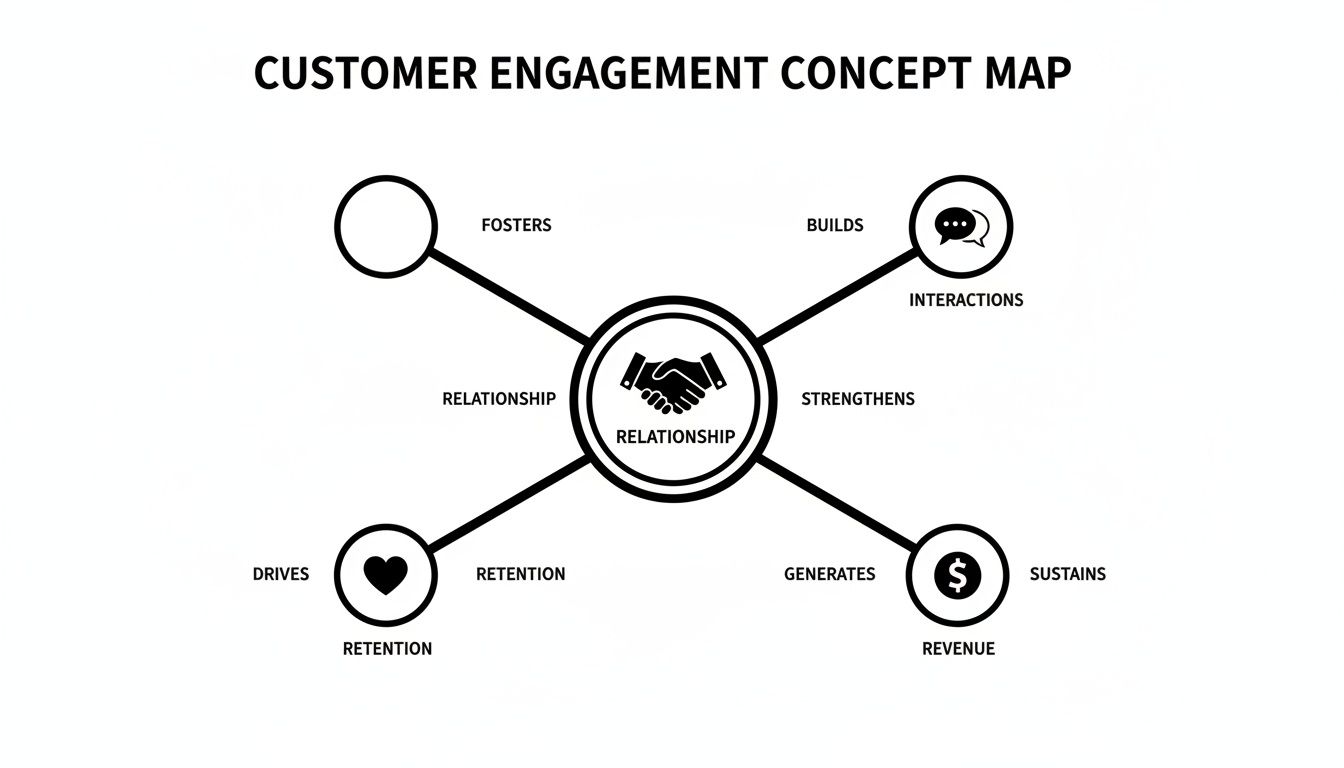
As you can see, these elements aren't isolated. They create a cycle where positive interactions build loyalty, and that loyalty secures and grows the bottom line.
Behavioral Engagement: The What
Behavioral engagement is the most obvious dimension. It’s what your customers do. These are the tangible, trackable actions that show a customer is actively involved with your brand, product, or content. Think of it as their digital body language.
In the B2B world, this goes way beyond just logging into your platform. It’s about the depth and frequency of their actions. Are they just using one core feature, or are they digging into the advanced stuff? This kind of engagement is a powerful leading indicator of an account's health.
Look at the difference:
- Low Behavioral Engagement: A user logs in once a month just to pull a single report. They ignore new feature announcements and have never once clicked on your help center.
- High Behavioral Engagement: A team actively uses multiple product modules, shows up for your quarterly roadmap webinars, and regularly opens and clicks through your email newsletters.
When you see high behavioral engagement, it means your solution is becoming part of their daily workflow. That makes it a whole lot stickier and much harder for a competitor to replace.
Emotional Engagement: The Why
Emotional engagement is the feeling behind the click. It’s the why that drives a customer to pick you, trust you, and stay with you—even when a competitor dangles a lower price. This dimension is built on confidence, brand affinity, and the belief that you’re a genuine partner in their success.
While it’s trickier to measure than logins, emotional engagement is arguably the most powerful force at play. It’s the sentiment that transforms a regular customer into a vocal advocate who sings your praises. A customer who feels understood and supported will forgive a minor hiccup and champion your product internally.
A customer with high emotional engagement doesn't just buy from you; they believe in you. This belief is the foundation of long-term loyalty and the strongest defense against competitive threats.
This is where the quality of your customer service and the relevance of your content really shine. A quick, empathetic response from a support agent or a case study that solves a real problem forges an emotional connection that raw product features never could.
Transactional Engagement: The Result
Transactional engagement is the ultimate payoff for building strong behavioral and emotional connections. It’s where the relationship translates directly into revenue. We’re talking about contract renewals, product upsells, cross-sells, and expanding into new departments.
This is the bottom-line proof that your engagement strategy is working. When a customer renews their annual contract without a fuss or proactively asks about an add-on module, that’s a loud-and-clear signal that they see real value in what you provide. This is what turns engagement from a "nice-to-have" metric into a predictable engine for business growth.
Here’s a practical look at how these dimensions work together to drive real results.
| Dimension | Low Engagement Example | High Engagement Example | Business Outcome |
|---|---|---|---|
| Behavioral | Infrequent logins; basic feature use only. | Attends webinars; uses advanced features. | Deeper product adoption and stickiness. |
| Emotional | Low Net Promoter Score (NPS); no interaction with the success team. | High NPS; provides positive feedback and case study participation. | Strong brand advocacy and positive word-of-mouth. |
| Transactional | Considers non-renewal; pushes back on price. | Proactively renews; inquires about upgrading their service tier. | Increased Customer Lifetime Value (CLV) and stable revenue. |
By tracking all three dimensions, you get a complete, 360-degree view of customer health. This holistic understanding lets you spot risks before they become problems, identify opportunities for growth, and build relationships that are not only strong but also profitable.
How To Measure What Actually Matters In Engagement
An engagement strategy without solid metrics is just wishful thinking. To get real traction and drive growth, you have to move past guesswork and start measuring the things that genuinely signal a healthy, growing customer relationship. It’s about separating the numbers that look good on a slide from the ones that actually tell you if a customer is happy and likely to stick around.
The trick is to connect your KPIs back to the three dimensions of engagement: behavioral, emotional, and transactional. When you track metrics across all three, you get a complete picture of account health. This is how you stop just tracking random activities and start making smart, data-driven decisions.
Pinpointing The Right KPIs For Each Dimension
Each dimension tells a different part of the customer's story. If you only focus on one, you're going to get a skewed view of reality. You need a balanced diet of metrics to truly understand what's going on.
Here’s a practical breakdown of what to track for each:
-
Behavioral Metrics: This is all about what customers do. Are they actively using your product in a meaningful way? Look at daily/monthly active users (DAU/MAU), feature adoption rates, and session duration. A spike in demo requests for a new feature is a fantastic sign of deep, active interest.
-
Emotional Metrics: This is about how your customers feel about you. It's where you find out if they’re loyal advocates or quiet churn risks. The essentials here are your Net Promoter Score (NPS), Customer Satisfaction (CSAT) scores, and any qualitative feedback you can get from surveys and customer calls.
-
Transactional Metrics: This is the bottom line—the financial result of all your engagement efforts. Zero in on Customer Lifetime Value (CLV), renewal rates, and upsell/cross-sell revenue. A steadily climbing CLV is the ultimate proof that your strategy is hitting the mark.
When you connect these dots, you can start seeing powerful patterns. For instance, you might notice that a jump in webinar attendance (behavioral) leads to better NPS scores (emotional), which then translates into more expansion revenue a quarter later (transactional). For a deeper dive into connecting actions to outcomes, check out our guide on marketing performance metrics.
Actionable Metrics vs. Vanity Metrics
One of the biggest traps you can fall into is obsessing over vanity metrics. These are the numbers that are easy to track and often look impressive, but they don't give you any real insight into the health of your business. A million social media followers feel great, but a rising churn rate tells a much more important story.
True measurement isn't about finding the most flattering numbers; it's about identifying the data that gives you the power to act. An actionable metric tells you what's working, what's broken, and where to focus your resources next.
To get a real sense of your impact, it's critical to focus on measuring content effectiveness in a way that goes beyond surface-level clicks and views. The table below draws a clear line between the numbers that drive decisions and those that just decorate a dashboard.
Actionable Engagement Metrics vs Vanity Metrics
| Metric Type | Actionable Metric (Drives Decisions) | Vanity Metric (Looks Good, Lacks Impact) |
|---|---|---|
| Behavioral | Product Feature Adoption Rate: Shows how deeply customers are using your solution, indicating stickiness and value realization. | Website Page Views: Can be inflated by low-quality traffic and doesn't confirm if visitors are qualified or engaged. |
| Emotional | Net Promoter Score (NPS) Trends: Tracks customer loyalty over time, providing a leading indicator of retention and advocacy. | Social Media Likes: Easy to acquire but often lacks correlation with actual customer satisfaction or purchasing intent. |
| Transactional | Customer Lifetime Value (CLV): Measures the total revenue a customer generates, reflecting overall relationship health and profitability. | Number of New Leads: A high volume of unqualified leads can drain sales resources without contributing to revenue. |
Focusing on the "Actionable" column is how you ensure your team's efforts are directly tied to tangible business outcomes, not just noise.
The Tech Stack That Powers Measurement
You can't track what you can't see. Having the right tools in place is non-negotiable for capturing and making sense of engagement data. Your Customer Relationship Management (CRM) platform, whether it's Salesforce or HubSpot, acts as the central nervous system, pulling together interaction histories, purchase data, and support tickets into one coherent customer view.
From there, specialized tools add more color to the picture. Sales engagement platforms give you granular data on outreach, while product analytics tools show you exactly how people are behaving inside your app. This kind of data ecosystem isn't just a nice-to-have anymore.
In fact, North America has pulled ahead in the customer engagement space, now owning a massive 40.73% share of the global market. The U.S. alone makes up a staggering 72.8% of that revenue, driven almost entirely by the adoption of technologies that enable smarter, more effective customer interactions.
Ultimately, these platforms aren't just for collecting data. Modern tools like marketbetter.ai use this information to trigger AI-driven workflows, turning customer signals into prioritized actions for your team. This is how you build a smarter, more responsive engagement strategy that actually moves the needle.
Proven Strategies To Boost B2B Customer Engagement
Alright, we've talked theory. Now let's get practical. Knowing what customer engagement is and why it matters is one thing, but turning that knowledge into pipeline is another beast entirely. It’s time to move from the 'what' and 'why' to the 'how'.
Here are the plays that actually work—the tactics that drive real interactions and build relationships that last.
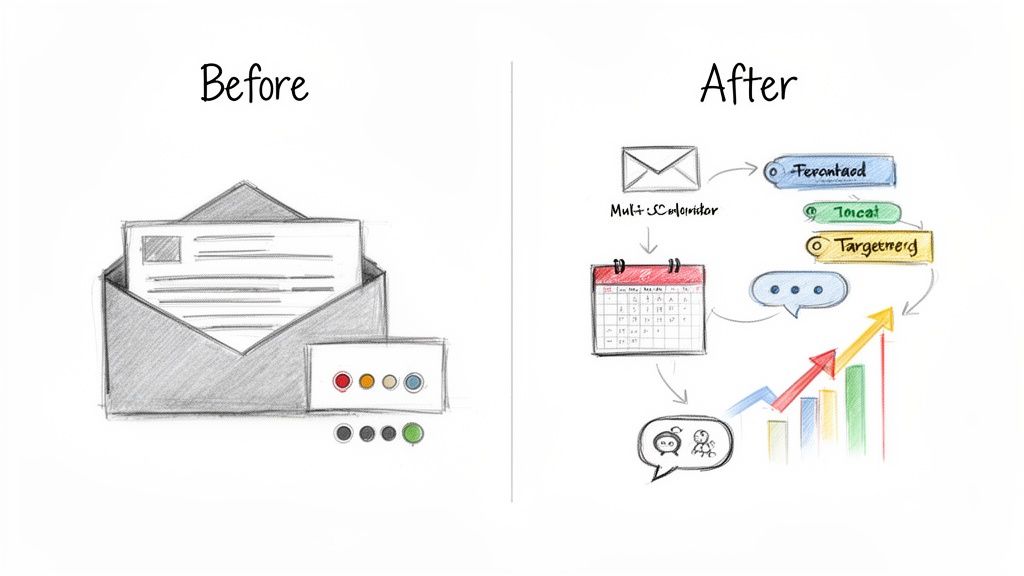
The big idea is simple: stop broadcasting and start connecting. This means ditching the generic, one-size-fits-all blasts for interactions that are relevant, timely, and genuinely valuable.
Personalize Outreach At Scale
In B2B, "personalization" isn't just dropping {\{first_name\}} into an email. It’s showing a customer you get their specific world—their challenges, their goals, their industry. That's what cuts through the noise. It’s what makes a prospect feel seen.
But let's be real: your team can't manually research every single contact. It's just not scalable. The key is using technology to deliver that one-to-one feeling, at scale, based on real data about what a customer is doing and what they need. We dive deep into the mechanics in our guide to marketing personalization strategies.
Look at the difference in approach:
| Approach | The Generic "Before" | The Personalized "After" |
|---|---|---|
| Trigger | A static list is uploaded once a month for a generic email blast. | An SDR gets an alert when a target account hits the pricing page twice in one week. |
| Message | "Hi, check out our new software feature..." | "Noticed your team was exploring our pricing. Companies like yours in logistics often use feature X to solve Y. Is that a priority for you?" |
| Result | Low open rates, high unsubscribes, and a quick "not interested." | A much higher response rate and a real conversation based on a timely pain point. |
This shift is fundamental. You're respecting the buyer's time and positioning your team as helpful advisors, not just another vendor begging for a demo.
Create High-Value Content That Solves Problems
Your content is one of your main engagement channels. Every blog post, webinar, and case study is a chance to provide value and build trust. Generic, self-promotional fluff gets ignored. Content that solves a real problem gets read, shared, and remembered.
To get this right, you have to think like your customer. What keeps them up at night? What are they typing into Google at 10 PM? What piece of information would actually make their job easier tomorrow?
An effective content strategy is less about what you want to sell and more about what your audience needs to learn. When you consistently provide answers, you earn their attention. Then you earn their trust.
Here are three types of content that always move the needle in B2B:
- Practical How-To Guides: Step-by-step instructions that help customers get more value from your product or tackle a common industry headache.
- Data-Backed Research Reports: Original research that offers a unique point of view and positions your company as a thought leader who’s done the homework.
- Customer Success Stories: Relatable case studies that show, don't just tell, how you’ve helped similar companies get from point A to point B.
Every piece should be designed to help the customer make progress, not just to show off a feature.
Build A Seamless Omnichannel Journey
Your customers don’t live in a silo. They might see you on LinkedIn, read a G2 review, visit your website, and then get a call from a sales rep. A winning engagement strategy makes this journey feel like one connected conversation, not a series of disjointed, repetitive pings.
An omnichannel approach means each interaction is aware of the last one. The rep who calls knows the prospect just attended your webinar. The email they get references the whitepaper they downloaded. It creates a smooth, intelligent experience that shows you’re actually paying attention.
This is becoming a massive business driver. The market for customer engagement solutions is projected to explode from USD 25.7 billion to an incredible USD 49.9 billion by 2030. That growth isn't random; it reflects a huge shift toward platforms that can unify customer data and create these seamless experiences. You can explore more data on customer engagement trends to see the full market projection.
By personalizing outreach, creating genuinely useful content, and building a connected journey, you can turn your customer relationships from transactional to foundational—setting the stage for real growth and loyalty.
Using AI To Supercharge Your Engagement Engine
Let’s be honest: running a high-touch, personalized engagement strategy by hand is a fast track to burnout. Your team spends hours digging through data, researching accounts, and just guessing which prospects are actually ready to talk. That administrative drag doesn’t just kill momentum—it leaves real money on the table.
This is where AI changes the entire game. Instead of guesswork, your team gets to operate with speed and precision. AI-powered platforms automate the tedious, soul-crushing work, freeing up your reps to do what humans do best: build relationships and close deals.
Shifting From Manual Guesswork To AI-Powered Precision
The difference between a traditional outbound motion and an AI-driven one is night and day. The old way leans on static lists, repetitive manual research, and a "spray and pray" approach that rarely pays off. The new way is dynamic, targeted, and intelligent.
Exploring modern Frontline AI solutions can help bridge the gap between raw data and actionable sales tasks, creating a much smarter workflow for your entire team.
Let's just put the two side-by-side.
| Workflow Step | The Old Way (Manual & Reactive) | The New Way (AI-Driven & Proactive) |
|---|---|---|
| Prioritization | Reps scroll through CRM lists, trying to guess which account to hit next based on gut feel or job title. | AI scans thousands of buyer signals—like website visits and content downloads—and automatically serves up the highest-priority tasks first. |
| Research | SDRs burn 20-30 minutes per account jumping between LinkedIn, company websites, and news feeds to find a relevant hook. | AI instantly summarizes key account details, recent news, and persona-specific pain points, delivering talking points in seconds. |
| Outreach | Reps rely on generic, one-size-fits-all email templates and struggle to make each message feel personal. | AI generates hyper-relevant email drafts tailored to the account's industry, challenges, and recent activities. |
| Follow-Up | Follow-up is inconsistent because it’s tracked manually. Warm leads inevitably go cold. | AI schedules and prompts every follow-up task, ensuring no opportunity gets missed and engagement stays consistent. |
This isn't just about saving time. It's about making every single interaction smarter.
Identifying High-Intent Accounts Automatically
One of the biggest wins with AI is its ability to find the needle in the haystack for you. Platforms like marketbetter.ai plug into your data sources and analyze thousands of buyer signals in real time.
What kind of signals are we talking about?
- Website Behavior: Seeing when a target account hits your pricing page or watches a specific case study video.
- Content Engagement: Tracking who from your target list is actually showing up to webinars or downloading your latest whitepaper.
- Third-Party Intent Data: Flagging accounts that are actively researching solutions like yours across the web.
The AI engine takes all this information, scores each account, and pushes the ones with the strongest buying signals right to the top of your team's to-do list. This simple shift ensures your reps are always working on the opportunities most likely to close.
The diagram below gives you a glimpse of how an AI system turns all that noisy input into clear, prioritized tasks for a sales team.
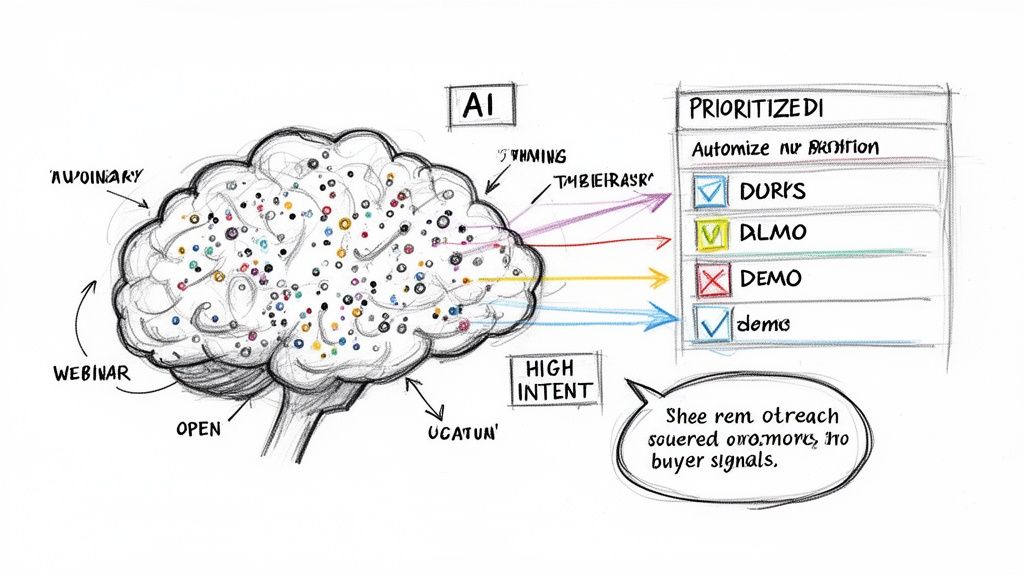
It takes all those scattered buyer signals and transforms them into a clean, actionable game plan, totally eliminating the "what should I do next?" problem.
Empowering Reps To Focus On Selling
When you automate task prioritization and outreach prep, you hand your sales team back a massive chunk of their day—up to two-thirds, by some estimates. They spend less time on grunt work and more time actually talking to qualified prospects. If you want to go deeper on this, you can learn more about the role of AI in B2B marketing.
"AI doesn't replace great salespeople; it liberates them. By handling the repetitive, data-heavy tasks, AI allows reps to dedicate their energy to strategic thinking, relationship-building, and navigating complex deals—the very things that drive revenue."
Imagine your SDRs armed with AI-generated talking points and hyper-relevant email copy. They walk into every conversation with more confidence and context. The result? Higher-quality conversations, faster pipeline growth, and a team that’s actually excited to come to work. Ultimately, this approach turns your sales process into a predictable, scalable, and efficient growth machine.
Try our Lookalike Company Finder — find companies similar to your best customers in seconds. No signup required.
Your Actionable Checklist For Building An Engagement Strategy
Alright, let's get down to brass tacks.
You know what customer engagement is and why it matters. But turning that knowledge into a real, pipeline-driving strategy is a different game entirely. This isn't about flipping a switch; it's about building a solid foundation, one intentional step at a time.
Think of this checklist as your roadmap. It's designed to force the right conversations and get your teams aligned before you ever roll out a new tool or process. Let's build this thing to last.
1. Audit Your Current State
Before you build anything new, you have to know what you’re working with. A brutally honest audit of your current engagement efforts will show you where you're strong and, more importantly, where the gaps are.
Get your sales, marketing, and customer success leaders in a room and start asking the tough questions:
- Technology: What tools are we actually using to talk to customers? CRM, email platform, dialer, chat? Where is our data getting stuck in silos?
- Process: How do we track interactions right now? Is it consistent, or is every rep doing their own thing? Be honest.
- Performance: What are our baselines? Pull the real numbers for email reply rates, demo bookings, and customer renewals.
This audit is your "before" picture. It’s the difference between guessing where to focus and knowing exactly what’s broken.
2. Define Clear and Measurable Goals
A strategy without goals is just a collection of busywork. You have to define what winning looks like in concrete, measurable terms that are tied directly to business outcomes.
"Improve engagement" is a wish, not a goal. Get specific.
| Vague Goal | Actionable Goal |
|---|---|
| "Increase sales outreach." | "Increase qualified demos booked by SDRs by 15% this quarter." |
| "Be more customer-centric." | "Improve our Net Promoter Score (NPS) from 45 to 55 by year-end." |
| "Do more personalization." | "Achieve a 25% reply rate on outbound sequences targeting our top three ICPs." |
These are the kinds of goals that create real alignment. They give your team a clear target to hit and turn the abstract idea of what is customer engagement into a set of tangible business objectives.
3. Align Sales and Marketing Teams
Silos kill engagement. It’s that simple. If marketing is celebrating lead volume while sales is complaining about lead quality, the customer gets caught in the middle of a confusing, disjointed experience.
True alignment means shared goals, shared data, and a shared definition of what a qualified, engaged lead actually is.
"Team alignment isn't a one-off project; it's an ongoing commitment. It requires a shared language for defining a good lead, a unified view of the customer journey, and a tight feedback loop where sales insights constantly inform marketing strategy."
Here’s how to start making it real:
- Create a Service Level Agreement (SLA): Get marketing’s commitment to lead quality and sales' commitment to follow-up speed down on paper.
- Unify Your Tech Stack: Make sure both teams are working from the same CRM data. You need one source of truth.
- Hold Regular Cross-Functional Meetings: Create a dedicated time to review pipeline, discuss what’s working, and solve problems as one team.
4. Plan The Team Rollout and Enablement
Dropping a new strategy or tool on your team without proper training is a recipe for failure. Your reps need to understand not just the "how" but the "why" behind the change. A thoughtful rollout plan builds momentum and actually gets people to use the new stuff.
- Communicate the Vision: Start by explaining the problems you're solving and what the future state will look like for them, in their daily workflow. What's in it for them?
- Provide Hands-On Training: Go way beyond a quick demo. Run workshops and build playbooks that show reps exactly how to use new tools and tactics to hit their numbers.
- Establish a Feedback Loop: Create a channel—Slack, a weekly huddle, whatever works—for the team to share what’s working, what isn’t, and what they need to succeed.
This is how you make sure your investment in a new engagement strategy actually pays off through high adoption and consistent execution.
Ready to turn these steps into action? marketbetter.ai provides the AI-powered task engine to make it happen. We turn buyer signals into prioritized tasks for your SDRs and help them execute with AI-written emails and a dialer that lives right inside Salesforce and HubSpot. Learn how to build a consistent outbound motion without the busywork.