6 posts tagged with "content strategy"

View All Tags

Roi on content marketing: Proven Ways to Measure and Boost ROI

· 25 min read

Figuring out the ROI on content marketing isn't as simple as checking your bank account after a flash sale. If you’re looking for a quick benchmark, a 3:1 return is a decent starting point, but the real story is almost always hidden deeper. Too many marketers get this wrong, treating content like a one-off transaction, and their numbers end up being incomplete and flat-out misleading. The true power of content is in its compounding value—it’s an asset that should grow over time.

Why Most Content ROI Calculations Are Incomplete

Let's start with a hard truth: most marketers can't prove the value of their work because they’re measuring it the wrong way. They're laser-focused on the final sale, completely ignoring the long, winding journey that brought the customer to their door in the first place. That narrow view just doesn’t capture the full financial picture your content is painting.

A desk setup featuring a laptop with 'CONTENT PORTFOLIO' on screen, a plant, a notebook with coins, and a pen.

Think of your content less like an expense and more like a financial portfolio. Every article, video, and case study is an asset you own. Over time, these assets appreciate, kicking off dividends in the form of organic traffic, brand authority, and customer trust. This is a world away from paid ads, which are more like a one-time stock trade—the value vanishes the second you stop paying.

The Four Layers of Content Marketing ROI

To really get the full picture, you need to look at the different ways content creates value, from immediate cash to long-term strategic influence. This isn't a single metric, but a stack of returns. Here's an actionable way to compare the layers:

ROI LayerWhat It MeasuresExample MetricAction To Take
Direct RevenueThe most straightforward layer. How much money did a piece of content directly generate?Sales from a product-focused blog postTrack conversions from "Buy Now" links within content.
Lead GenerationThe value of new leads entering your pipeline.MQLs from a downloadable ebookImplement lead magnets (guides, templates) in high-traffic posts.
Brand EquityThe "soft" value of becoming a trusted authority in your space.Increase in branded search volumeCreate thought leadership content and promote it in industry forums.
Cost SavingsHow content reduces expenses in other departments.A support article deflecting customer service ticketsInterview your support team to identify common questions to answer with content.

Each layer builds on the one before it. Focusing only on the top layer, Direct Revenue, means you're ignoring the foundational value your content is creating across the business.

The Problem with a Transactional Viewpoint

When you only measure the direct revenue from a single blog post, you miss the forest for the trees. This transactional approach gives you a distorted view of what’s actually working and leads to terrible strategic decisions. It’s like judging the strength of a building’s foundation by looking at the first brick you laid. The real strength is how it supports the entire structure for years to come.

Your content isn't an expense; it's a balance sheet asset. Calculating its ROI requires you to measure not just the immediate sales but also its appreciating value as a long-term business driver.

A smarter analysis of content marketing ROI looks at leading indicators—the metrics that predict future revenue. These numbers show the compounding effect of your work long before a final purchase ever happens.

Here are a few key leading indicators to watch and act on:

  • Organic Traffic Growth: This shows the growing reach of your content assets without you having to pay for every click. Action: Perform a content audit to find articles on page 2 of Google and update them with fresh data to push them to page 1.
  • Lead Quality Improvement: Are your sales reps telling you the leads from content are better? This tracks if you're attracting more qualified prospects who are easier to convert. Action: Add a "How did you hear about us?" field to your forms to directly attribute lead quality.
  • Brand Authority and Trust: This measures how your content is positioning you as an industry leader, which makes the entire sales process smoother and faster. Action: Track mentions of your brand in industry publications and on social media after a major content launch.

Comparing Content to Paid Advertising

The difference in value snaps into focus when you compare the returns. Content marketing consistently delivers, with B2B companies hitting an average ROI of 3:1—that’s $3 back for every $1 invested.

Paid ads, on the other hand, average just $1.80 per dollar spent. And worse, that return evaporates the moment you turn off the campaign. You can learn more about how content marketing ROI stacks up against other channels, but the distinction is critical. It’s the key to securing budgets and justifying a strategy that builds sustainable growth, not just short-term wins.

Gathering the Right Data for Your ROI Calculation

Before you can run the numbers, you need the right ingredients. Any calculation for ROI on content marketing is only as good as the data you feed it. This isn't just about grabbing a few metrics from Google Analytics; it's about building a complete, defensible story about your spending and your returns.

To get this right, we need to split our data into two clean piles: the Investment (everything you spent) and the Return (all the value you created). Think of it as your pre-flight check before you even touch a spreadsheet.

Tallying Your Total Content Investment

The most common mistake I see marketers make is massively undercounting their investment. They’ll remember the freelancer's invoice but completely forget the dozen other things that made that content actually work. Getting a true picture of your investment means looking way beyond the obvious costs.

For a real-world number, you have to track every expense, direct and indirect. When you’re pulling this data together, it's also a good time to look at how efficient your processes are. For instance, a quick look at a CRM automation vs. manual data entry ROI comparison can shine a light on just how much team time costs and where you can tighten things up.

Here’s a quick-and-dirty checklist of costs you can't afford to miss:

  • Content Production Costs: This one’s the easiest. It’s what you paid your freelance writers, videographers, designers, or the prorated salaries of your in-house team who created the assets.
  • Software and Tool Subscriptions: What’s in your tech stack? List out your SEO tools (like Ahrefs or Semrush), content platforms, design software (Canva, Adobe), and any scheduling tools.
  • Promotional Spend: Did you boost that blog post on social or run a paid campaign to get it in front of more eyeballs? Every single dollar you spent promoting the content is part of the investment.
  • Team Time (Overhead): This is the silent killer of ROI calculations. Figure out the hourly rate for everyone involved—strategy, editing, project management, promotion—and multiply it by the hours they spent. This gives you the real cost of your internal effort.

Measuring Your Complete Content Return

Measuring the return is where things get really interesting. Sure, direct sales are the ultimate goal, but they're just one piece of the puzzle. A complete picture includes both the immediate cash (lagging indicators) and the signals that predict future gains (leading indicators).

The true return on your content is a blend of immediate revenue and the appreciating value of the assets you've created. Ignoring leading indicators like organic traffic value is like measuring a stock's worth by its last dividend payment alone—you miss the bigger picture of its growth potential.

To capture the full story, make sure you're tracking these metrics:

1. Direct Revenue and Attributed Leads

This is the money trail. Track every sale that came directly from a content link and every lead that filled out a form on a content asset. To make this data useful, you have to assign a dollar value to your leads.

Here’s a simple, actionable formula:

Lead Value = Customer Lifetime Value (LTV) x Lead-to-Customer Conversion Rate

So, if your average customer is worth $5,000 over their lifetime (LTV) and you convert 10% of your leads into customers, then every single qualified lead your content generates is worth $500. Easy.

2. Leading Performance Indicators

These metrics show that your content is building long-term value, even if it hasn't turned into cash yet.

  • Organic Traffic Value: Use an SEO tool to figure out what your organic traffic would cost if you had to buy it through PPC ads. As that number goes up, so does your return.
  • Improved Keyword Rankings: Climbing the ranks for high-value keywords means more visibility and more future traffic. This is a direct measure of your content’s value as an asset that appreciates over time.
  • Lower Customer Acquisition Cost (CAC): How much does it cost to acquire a customer through your content versus, say, paid ads? Content is almost always cheaper, and that difference is a real, tangible return.

A Step-by-Step Guide to Calculating Content ROI

Let's move from theory to reality. This is where the rubber meets the road in figuring out your ROI on content marketing. The industry is massive—on track to hit $107 billion by 2026—but a shocking number of companies are flying blind. While 82% of businesses are doing content marketing, only 38% are actually measuring its ROI. That’s a huge gap between effort and understanding.

So, how do you get it right? Let's break down the math with a framework you can use again and again. At its heart, the formula is refreshingly simple.

Content ROI % = ((Return - Investment) / Investment) x 100

This little equation is your North Star. The trick, of course, is knowing exactly what numbers to plug into it. Let’s walk through a real-world example for a B2B company to see how this plays out.

A Foundational ROI Calculation Example

Imagine your B2B software company just wrapped up a three-month content campaign designed to generate qualified leads for your sales team. Here’s how you’d break down the numbers to get a clean ROI calculation.

Step 1: Calculate Your Total Investment

First things first: add up every single dollar you spent. And I mean every dollar. Don’t just count the obvious stuff; getting this right means tracking both direct and indirect costs.

  • Content Production: You hired a freelance writer for four deep-dive blog posts and a whitepaper. Total cost: $6,000.
  • Design Assets: A graphic designer created custom visuals and laid out the whitepaper. That was another $1,500.
  • Promotional Spend: You put some budget behind targeted social media ads to get eyeballs on the content, spending $2,500.
  • Team Time: Your content manager spent about 40 hours on strategy, editing, and project management. At an internal rate of $50/hour, that’s $2,000 worth of time.

Your Total Investment adds up to $12,000. That’s the true, all-in cost to get this campaign out the door.

Step 2: Calculate Your Total Return

Next up, let's figure out the value you created. The campaign brought in 60 qualified leads. To translate that into a revenue figure, you need to pull in a couple of key sales metrics.

  • Lead-to-Customer Rate: Historically, your sales team converts 10% of qualified leads into paying customers.
  • Customer Lifetime Value (LTV): On average, a new customer is worth $6,000 to your business over their entire relationship with you.

Now we can do the math:

  1. Calculate New Customers: 60 Leads x 10% Close Rate = 6 New Customers
  2. Calculate Total Revenue: 6 Customers x $6,000 LTV = $36,000

Your Total Return from this campaign is $36,000.

Step 3: Calculate the Final ROI

With your investment and return figures ready, just plug them into our formula:

(( $36,000 - $12,000 ) / $12,000 ) x 100 = 200% ROI

That number tells a powerful story. For every $1 you put into this campaign, you got $2 back in profit. If you want to dig deeper into the mechanics, check out our complete guide on https://marketbetter.ai/blog/2025-10-11-how-to-calculate-marketing-roi.

An Advanced Model for Compounding Value

The basic model is perfect for campaigns with a clear start and end. But what about the long game? Mature content programs build assets that generate value over time, and a more sophisticated model should account for this.

This is where you factor in the growing value of your organic traffic. Think of it as an asset that appreciates.

You can use an SEO tool to estimate the "organic traffic value" of the articles you created. This metric tells you what you'd have to pay in Google Ads to get the same amount of traffic.

Let’s say your new content now brings in an extra $500 in organic traffic value each month. Over a year, that’s another $6,000 in value the content generated for free. Adding this to your return gives you a much fuller picture of your content's long-term financial clout. To get a broader perspective on measuring ROI across all your marketing efforts, it's worth reading up on how to measure marketing ROI the right way.

Choosing an Attribution Model That Tells the Truth

Figuring out the ROI on content marketing isn't as simple as plugging numbers into a formula. The whole calculation hinges on one critical choice: your attribution model. This is the rulebook you use to decide which piece of content gets credit for a sale, and if you get it wrong, your ROI numbers will be a complete fantasy.

Think about a real customer journey. Someone finds your brand by reading a killer blog post. A few weeks later, they see one of your ads on LinkedIn. Then, finally, a sharp email convinces them to buy. So, who gets the credit? The blog, the ad, or the email? The answer completely depends on the story your attribution model is set up to tell.

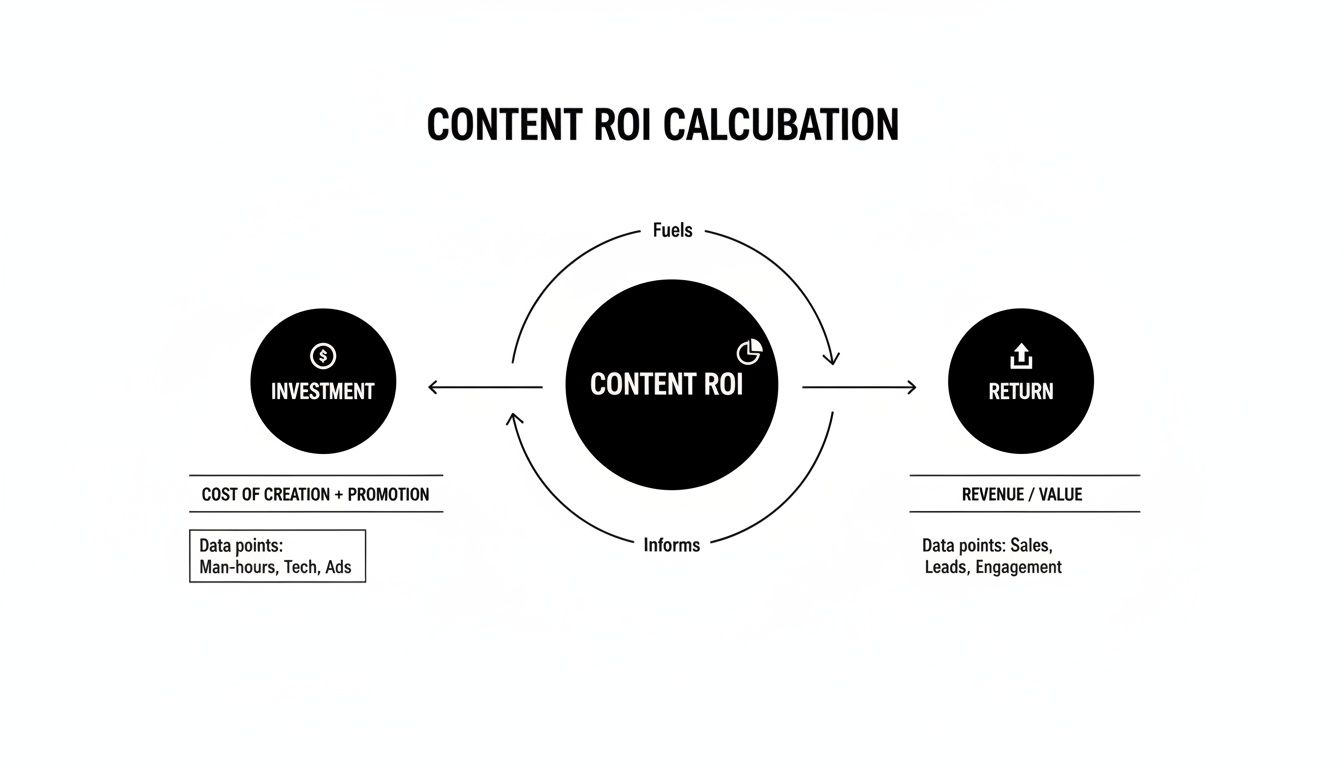
This is the basic flow—you put money in, you get a return out. But connecting those dots is where things get tricky.

A diagram illustrating content ROI calculation, showing investment, content ROI, and return with key data points.

Without the right model, you can't possibly understand the journey from investment to actual revenue.

The Dangers of Last-Touch Attribution

The most common model out there is also the most misleading: Last-Touch Attribution. It’s brutally simple. It gives 100% of the credit for a sale to the very last thing a customer clicked before they converted. In our example, the email gets all the glory.

That blog post that started the whole relationship? Worthless, according to this model. The social ad that kept your brand on their radar? Got you nothing. Last-Touch makes all your top- and mid-funnel content look like a total waste of money, even when it was doing the essential work of getting people in the door.

Last-Touch Attribution is the marketing equivalent of giving all the credit for a championship win to the player who scored the final point, ignoring the assists, defense, and teamwork that made the victory possible.

This simplistic view is dangerous because it systematically undervalues the very assets that build awareness and trust over time. It makes bottom-of-funnel tactics look like superstars and can trick you into cutting the budget for the content that’s actually fueling your entire pipeline.

A More Balanced View with Multi-Touch Models

To get a real, truthful picture of what's working, you need a model that sees the entire customer journey. Multi-touch attribution models are designed to do just that. They spread the credit across multiple touchpoints, giving you a far more accurate view of how each piece of content contributes to a sale.

For a deeper look at the mechanics, check out our complete guide on multi-touch attribution models.

But let's quickly break down a few of the most practical models using our example journey (Blog Post -> Social Ad -> Email).

A Practical Comparison of Attribution Models

This table shows how different models assign credit across a customer journey, directly impacting your content's perceived ROI.

Attribution ModelHow It Assigns CreditBest Suited ForCommon Pitfall
LinearSpreads credit evenly across all touchpoints (e.g., 33.3% each).B2B companies with long sales cycles where every touchpoint plays a role in nurturing the lead.Can undervalue the crucial first and last touches that start and close the journey.
Time-DecayGives more credit to touchpoints closer to the conversion. The email gets the most, the blog gets the least.Businesses with shorter, more impulsive sales cycles (like e-commerce) where recent interactions matter most.Systematically devalues top-of-funnel content that builds initial awareness but happened long ago.
U-ShapedGives 40% to the first touch, 40% to the last touch, and splits the remaining 20% among the middle touches.Sales cycles where capturing initial interest and closing the deal are considered most important.The "messy middle" of the journey gets very little credit, even if it's critical for education.

Choosing the right model really comes down to knowing your business. A company with a long, complex sales cycle might get the truest picture from a Linear or U-Shaped model. A direct-to-consumer brand, on the other hand, might find the Time-Decay model better reflects how its customers actually behave.

The goal isn't to find a perfect model—it's to pick one that honestly reflects how your customers interact with your brand. Only then will your ROI calculations start telling you the truth about what’s really driving growth.

Actionable Strategies to Increase Your Content ROI

Knowing your ROI is one thing. Actually making that number go up is where the real work begins. The good news? Boosting your ROI on content marketing doesn't mean you have to scrap everything and start over. It's about focusing on a few smart strategies to get more mileage out of what you've already built.

This isn't about working harder; it’s about making your content work smarter. By zeroing in on repurposing, distribution, and conversion, you can create a powerful flywheel that multiplies your returns without blowing up your budget.

A modern desk with an open book, two tablets, and a coffee mug, illustrating content strategy.

Content Repurposing and Optimization

The fastest way to crank up your ROI is to squeeze more value out of your existing content. Let’s be real, creating a new blog post from scratch is a heavy lift. It costs time and money. Updating an old post or spinning it into new formats? That delivers fresh value for a fraction of the cost.

Start with a content audit to find your "quick wins." Look for posts that are already ranking, but maybe on the second or third page of Google for keywords that matter. A simple update—fresh stats, new examples, better internal links—can often be enough to bump them onto page one and unlock a wave of new traffic.

Next, think about atomization. One big, comprehensive guide can be the seed for dozens of smaller assets. You're not creating new content, you're just changing its shape.

Content PieceRepurposing ActionNew Asset Comparison
A 2,000-word blog postTurn key statistics into an infographic.Design a completely new infographic from scratch.
A webinar recordingCreate 5-7 short video clips for social media.Film 5-7 new, standalone videos.
A customer case studyPull out a powerful quote for a testimonial graphic.Interview a different customer for a new quote.

This approach dramatically lowers your investment per piece of content, which directly pumps up your overall ROI. For a deeper look at this, check out our guide on how to scale content marketing without burning out.

Smarter Content Distribution

Hitting "publish" is only half the job. If nobody sees your brilliant content, its ROI is exactly zero. A smarter distribution strategy gets your work in front of way more people than search engines alone ever could, making sure your investment actually pays off.

Ditch the old "publish and pray" method. Instead, build a distribution checklist you run through for every single piece of content. This forces you to hit multiple channels, every time.

  • Email Sequences: Don't just send a one-off newsletter. Weave your new content into automated email sequences for leads who've already shown interest in that topic. It's about nurturing, not just announcing.
  • Niche Communities: Where does your audience actually hang out online? Find them. Share your content in relevant Slack channels, LinkedIn Groups, or Reddit communities—not as a spammy link drop, but as a helpful answer to a real question.
  • Video Formats: The data here is impossible to ignore. Video is delivering returns 49% faster than just text. Recent surveys put short-form video at the top of the heap, with the highest ROI at 31%, easily beating blogs (15%) and podcasts (14%). You can find more marketing ROI statistics to see how different formats stack up.

A great piece of content with poor distribution will always underperform an average piece of content with excellent distribution. Your amplification strategy is just as important as your creation strategy.

Improving Your Conversion Paths

Lots of traffic is nice, but it's a vanity metric if it doesn't lead to anything. Optimizing your conversion paths is the final lever for boosting ROI. This is how you turn readers into actual leads and customers.

A/B testing is your best friend here. You'd be amazed at how small tweaks to your calls-to-action (CTAs) and landing pages can have a massive impact on your conversion rates.

Actionable A/B Test Ideas:

  1. CTA Button Text: Test a benefit-driven CTA like "Get Your Free Template" against a direct one like "Download Now."
  2. CTA Placement: See what works better: a CTA at the very end of a post, or one that slides into view as the user scrolls down the page.
  3. Landing Page Forms: How many fields is too many? Test a form with five fields against one with only three. Less friction often means more sign-ups.

By systematically testing and improving these small but critical elements, you wring more value out of the traffic you already have. You don't need to spend another dime on content creation. That direct impact on lead generation makes it one of the most powerful ways to improve your ROI on content marketing.

What to Do When Your Content Isn't Performing

Even the best-laid content plans can go sideways. Your numbers aren't where they should be, and it's frustrating. But this isn't a dead end—it's a diagnostic opportunity. Instead of guessing, we can pinpoint exactly what’s broken and apply the right fix. This turns a low ROI on content marketing from a mystery into a solvable problem.

Think of it like a car that won't start. You don't just rip out the engine. You check the simple stuff first: the battery, the gas, the ignition. We'll use the same logic here, breaking down the most common performance issues into a simple "Problem/Fix" format to get your content engine firing on all cylinders again.

Problem One: High Traffic, Low Conversions

This is probably the most common (and maddening) issue. You look at Google Analytics, and traffic is climbing. Fantastic. But leads and sales? Flatlined. It means your content is great at attracting eyeballs but terrible at its real job: turning readers into customers.

Nine times out of ten, the culprit is a broken or invisible conversion path. The content is doing its part, but the bridge from reading to acting is missing a few planks.

The Fix: You need to rebuild that bridge with clear, compelling calls-to-action (CTAs) and lead magnets that people actually want.

  • Audit Your CTAs: Are they generic and boring ("Contact Us") or specific and valuable ("Get Your Free SEO Audit")? A/B test your button text, colors, and placement. See what gets the click.
  • Upgrade Your Lead Magnets: Does your ebook or checklist genuinely solve a problem for someone reading that specific article? The offer has to feel like the natural next step, not a random interruption.
  • Reduce Friction: Take a hard look at your landing page forms. Do you really need their company size and phone number right away? Shorter forms almost always convert better. Get the basics first, then qualify them later.

Problem Two: You've Mismatched Search Intent

Here's another classic. You create a piece of content that ranks for a keyword, but it doesn't actually answer the user's question. You get the click, but they bounce immediately. Why? Because your article on "best project management software" is a high-level think piece when they were just looking for a simple feature comparison table.

This happens when you obsess over the keyword itself and ignore the why behind the search.

When your content fails to align with search intent, you're essentially inviting guests to a dinner party and serving them breakfast. They might show up, but they won't stay long, and they definitely won't come back for more.

The Fix: Before you write another word, you have to become a student of the search engine results page (SERP). It holds all the clues.

  1. Analyze the Top-Ranking Content: What format are the top results? Are they "how-to" guides, listicles with big images, or technical product pages? This is Google telling you exactly what searchers want to see.
  2. Read the "People Also Ask" Box: This is a goldmine. These are the literal questions your audience is asking. Answer them directly and clearly in your content.
  3. Adjust Your Format: If the SERP is full of videos and you wrote a 5,000-word article, you've brought a knife to a gunfight. Match the format to the intent.

When you align your content with what people are actually looking for, you don't just improve your bounce rate. You send a powerful signal to Google that your page is a high-quality result, which is absolutely critical for long-term ROI on content marketing.

A Few Common Questions About Content ROI

Look, proving the value of your content can feel fuzzy. It's not as simple as tracking clicks on a PPC ad. You're going to run into some recurring questions from your team, your boss, and probably yourself. Getting straight answers is the first step to confidently measuring and defending your content marketing ROI. Let's clear up a few of the big ones.

What’s a "Good" ROI, Anyway?

You’ll hear people throw around a 3:1 ratio—$3 in for every $1 spent—as a decent benchmark. And it is. But honestly, a “good” ROI is completely dependent on your business model. It's not a one-size-fits-all number.

Think about it: a high-margin SaaS company might be ecstatic with a 3:1 return. Their cost of goods is basically zero, so that's almost pure profit. On the other hand, an e-commerce brand selling physical products with thin margins might need a 5:1 ratio or even higher just to break even. The only way to set a realistic goal is to stack your returns against your actual costs and unique sales cycle.

How Long Until I Actually See a Return?

This is where you have to play the long game. Content isn’t an ad you turn on for instant results. It’s an asset you build. While you might see early indicators like a nice bump in organic traffic or better keyword rankings within 3-6 months, the real, dollars-and-cents return takes more time to materialize.

Get this in your head: you can expect to see measurable, revenue-driven ROI build over 6-12 months. Content has a compounding effect. Its value grows as it earns more backlinks, builds authority, and pulls in more organic traffic over time.

This is the critical difference. A paid ad is dead the second you stop funding it. A great piece of content can keep delivering value for years, long after you paid for it.

My Content Doesn't Directly Sell Anything. How Do I Prove Its Value?

This is the classic top-of-funnel problem. That awesome blog post about industry trends? It’s probably not going to be the last thing someone reads before they click "buy." So how do you prove it’s working?

You have to look beyond that final click. This is where multi-touch attribution models in a tool like Google Analytics become your best friend. Instead of just looking at the last touchpoint, you can track assisted conversions. This shows you every single time a piece of content was a stop on a customer journey that eventually led to a sale. It proves your content didn't close the deal, but it was essential in starting the conversation. You can also point to non-financial wins like audience growth, email sign-ups, and improved brand sentiment.


Ready to stop guessing and start proving your content's financial impact? The marketbetter.ai platform gives you the tools to track every touchpoint, assign accurate attribution, and calculate a defensible ROI that executives will understand. Learn how to connect your content efforts directly to revenue with marketbetter.ai.

A Guide to AI in Content Creation

· 24 min read

Let’s be real for a second. When you hear “AI in content creation,” it’s easy to picture robots churning out soulless blog posts. Forget that. The reality is far more practical and, honestly, more exciting.

Think of AI less as a replacement for your creativity and more as the ultimate co-pilot. It’s the tireless assistant that handles the grunt work—the endless research, the first-pass drafting, the mind-numbing data sifting. This frees you up to do what humans do best: focus on strategy, nail the nuance, and build a genuine connection with your audience.

The New Content Creation Playbook is Here

This guide isn't about sci-fi futures; it's about showing you exactly how artificial intelligence fits into your workflow today. We’re going to break down how the sharpest content teams are using AI to scale their output and stay ahead in a ridiculously crowded digital world.

The core idea is simple. Let the machine manage the repetitive, time-sucking tasks, while you steer the ship. A classic example is keyword research. The old way involved manually digging through spreadsheets for hours. The new, actionable approach? Use an AI tool to generate a list of high-potential topics with search volumes and difficulty scores in under five minutes. It’s a no-brainer.

Your Role is Shifting from Writer to Content Director

This is the most important change to grasp. Adopting AI fundamentally flips your job description on its head. Instead of spending 80% of your time on the nitty-gritty of drafting and only 20% on strategy, you get to reverse that.

Your expertise becomes the most valuable part of the equation. You're the one directing the AI, refining its output, and making sure every piece of content perfectly captures your brand’s voice and hits its strategic goals.

This shift is what makes true scalability possible. Compare these two scenarios: you need 100 unique product descriptions for a new launch.

  • Traditional Method: A human writer could be tied up for weeks, writing each one from scratch.
  • AI-Assisted Method: An AI generates the initial drafts for all of them in an afternoon, leaving you with the much faster job of reviewing, refining, and adding a human touch.

Before we go any further, it helps to know a little about the engine driving all this. If you want a quick primer, this simple guide explains What is Generative AI? and how the technology actually works.

The numbers don't lie, either. The generative AI market is on a tear, hitting a global value of $63 billion by 2025. With North America making up over 40% of that revenue and the market projected to grow at a compound annual rate of 42%, it’s clear this isn’t just a trend—it's a fundamental business shift.

The Real-World Benefits of Bringing AI into Your Workflow

This is about more than just moving faster. It's about creating smarter, more effective content. Here are the biggest wins, compared to traditional methods:

  • Serious Scalability: Instead of being limited by human hours, you can produce high volumes of content—from social posts to in-depth articles—without needing to hire an army of writers.
  • Off-the-Charts Efficiency: Automate tasks that drain your time, like research and outlining. This turns production timelines from days into hours, allowing you to react faster to market trends.
  • Data-Driven Decisions: Manually analyzing data is slow and prone to error. Use AI to chew through performance data and spot content gaps so your strategy is always guided by what your audience actually cares about.

Think of AI as your creative co-pilot. It crunches the data and draws the map, but you're still the one in the captain's chair, steering the ship to its final destination. This human-machine partnership is the future of content.

How AI Is Rewriting the Content Lifecycle

Let's get one thing straight: AI isn't just another tool you pull out for one part of the job. It’s a collaborator that plugs into every single stage of the content lifecycle. What used to be a slow, step-by-step march from idea to published piece is now a fast, dynamic cycle. This shift helps you move quicker, make smarter calls, and ultimately, create content that actually hits the mark.

The whole game changes before you even write a single word. Traditionally, topic research was a mix of guesswork and manual keyword tool analysis. With AI, tools can chew through massive amounts of data—search trends, what your competitors are doing, audience engagement—to find topic opportunities a human would almost certainly miss. This isn't about guesswork anymore; it's about focusing your energy on what your audience is already telling you they want.

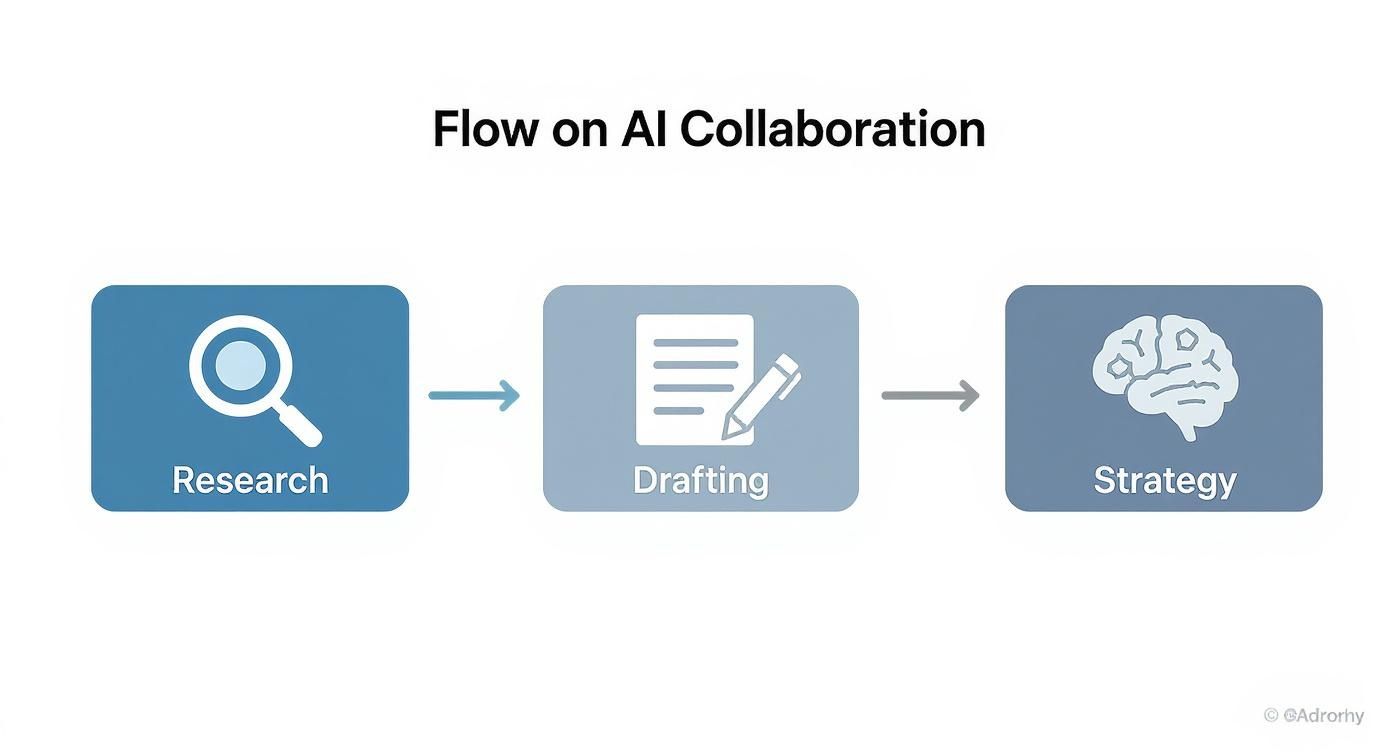
This new partnership between creator and machine is reshaping how modern content teams operate. This infographic gives you a good look at how AI jumps in to help with everything from research and drafting to optimization.

Infographic about ai in content creation

As you can see, AI acts like a force multiplier at every stage. It turns tedious manual tasks into automated processes, freeing up humans to focus on strategy and creativity.

From Blank Page To First Draft

Once you've landed on a winning topic, AI puts the drafting process into overdrive. The terror of the blank page? Gone. You can generate a structured outline in seconds, complete with H2s, H3s, and the main talking points you need to cover. This gives you a solid skeleton to build on, so you can pour your time into adding your own unique insights, telling great stories, and providing real expert analysis.

Let's compare the old way versus the new way:

  • Old: Spend hours researching and structuring an outline, then more hours writing a messy first draft from scratch.
  • New: Generate a data-informed outline in 60 seconds. Use that outline to prompt an AI for a first draft, handling the foundational work. Your job shifts from writer to strategic editor.

AI fundamentally changes the starting line for content creation. Instead of beginning with zero, you start with a structured, well-researched draft that’s ready for your expertise and refinement.

This isn't some future-gazing prediction; it's happening right now. In 2025, a massive 76% of marketers are using generative AI for content creation, with 71% leaning on it for creative inspiration. The proof is in the output, too, with 74.2% of new webpages published in 2025 including AI-generated content. But—and this is a big but—the human touch is still critical. 86% of marketers report editing AI outputs to match their brand voice and hit quality standards.

Optimizing And Repurposing At Scale

Once the draft is solid, AI slips into its optimizer role. These tools can scan your text for SEO, suggesting keywords, flagging readability issues, and even checking the emotional tone. This step is all about making sure every piece is fine-tuned to perform, whether that’s ranking on Google or connecting with a specific audience on social media.

But the real magic happens when it’s time to repurpose. This is where AI becomes a game-changer. It makes it almost ridiculously easy to spin one core piece of content into a dozen different assets.

  • Actionable Tip: Blog Post to Social Media. Feed your article to an AI with the prompt: "Create an 8-tweet thread from this article. Make the first tweet a strong hook and the last one a question to drive engagement."
  • Actionable Tip: Webinar to Email Series. Use an AI transcription tool on your webinar recording. Then prompt it: "Based on this transcript, write a 3-part email nurture sequence highlighting the most valuable takeaways."
  • Article to Audio: The tech is getting incredibly good at multimedia, too. Understanding models like OpenAI's Whisper AI for speech recognition shows just how far we've come in turning text into high-quality audio.

This ability to repurpose content on the fly is a massive win for any team trying to maximize its reach. By automating the grunt work of converting content from one format to another, you can scale content marketing without having to scale your team or budget. It’s about getting your message in front of your audience, wherever they happen to be.

Let's be honest, the real "aha!" moment with AI in content creation happens when you put it side-by-side with the old way of doing things. The difference is night and day. It’s not just about going faster; it’s a complete overhaul of the entire production line, turning a manual marathon into a strategic sprint.

This shift changes everything—it redefines roles, crushes timelines, and unlocks a scale that most teams could only dream of before.

Think about the classic process for writing a solid blog post. It always started with hours of grunt work: digging through SERPs, pulling stats, and vetting sources. Then came the slow, painful process of outlining, followed by the even slower staring contest with a blank page. After all that, you still had editing, proofing, and SEO optimization. It was a linear, exhausting slog that could easily eat up a full day (or more) for one quality piece.

Now, let's look at the AI-assisted workflow. Forget hours of research; an AI tool can analyze the top-ranking content and spit out a data-driven brief in minutes. That terrifying blank page? It’s gone, replaced by a solid first draft built from that brief.

This frees up the writer to do what they do best. Their role flips from assembly-line worker to strategic director—guiding the AI, injecting unique expertise, and polishing the final piece until it shines.

Image

The Creator’s Role Gets an Upgrade

When AI handles the heavy lifting, the content creator is suddenly free to focus on high-value work. Your brainpower is no longer wasted on basic drafting. Instead, you're refining, fact-checking, and adding the human insight that AI simply can't replicate. You become the editor, the strategist, and the final quality gatekeeper.

This isn’t about replacing creativity. It’s about amplifying it.

Imagine an e-commerce brand that needs to write 500 unique product descriptions for a new launch. Traditionally, that's a soul-crushing project. A human writer might get through twenty in a good day. With an AI partner, the first drafts for all 500 can be generated in the time it takes to write just a handful, leaving the team to focus on perfecting the copy that actually sells.

A Head-to-Head Workflow Comparison

The practical differences in speed, cost, and output are stark. What once took a full day can now be done in a fraction of the time, leading to a massive return on your investment.

To make this crystal clear, here’s a direct comparison that shows how the workflows stack up on key performance indicators.

AI-Assisted vs Traditional Content Workflow Comparison

MetricTraditional WorkflowAI-Assisted WorkflowImpact
Research Time2-4 hours15-30 minutesOver 85% reduction in manual research time
Drafting Time3-5 hours1 hourFrees up hours for strategic editing and refinement
Total Time-to-Publish8-12 hours2-4 hours3x faster content delivery and increased velocity
Cost Per ArticleHigh (based on hourly rates)Low (fixed subscription cost)Drastically reduces content production expenses
ScalabilityLimited by team sizeNearly unlimitedEnables mass content production without hiring more staff

The numbers don't lie. An AI-assisted approach doesn't just speed up the old process; it creates an entirely new, more efficient model for getting content out the door.

The real win here is how you reallocate your team's talent. Instead of spending 80% of their time on manual tasks like research and first drafts, creators can now invest that time in strategy, creativity, and adding unique value—the very things that make content great.

At the end of the day, bringing AI into your content process lets your team produce more, publish faster, and operate with a sharper strategic focus. It empowers creators to break free from the constraints of manual labor and hit a level of output and quality that was once completely out of reach.

Putting AI to Work in the Real World

Theory is great, but the real magic happens when you see how actual businesses are using AI in content creation to solve problems they face every single day. This is where the rubber meets the road.

These aren't just hypotheticals. We’re talking about marketing agencies doubling their output and SaaS companies finally getting a handle on their technical documentation. Let's dig into some concrete examples of companies winning with AI right now.

Scaling SEO Content for a Marketing Agency

Picture a boutique marketing agency hitting a wall. They're good at what they do—maybe too good. Their client list is growing, but their ability to produce high-quality SEO content isn't keeping pace. The manual grind of creating detailed content briefs and writing first drafts was a serious bottleneck, capping how many clients they could actually serve.

Their solution? Weave AI into their core workflow with these actionable steps:

  1. Automated Brief Generation: First, they used an AI tool to scope out the competition. It analyzed the top-ranking articles for a target keyword and, in minutes, spit out a comprehensive brief—complete with word count targets, key topics, semantic keywords, and a suggested outline.
  2. AI-Powered First Drafts: With that detailed brief in hand, a generative AI model knocked out a solid first draft. This handled all the heavy lifting of basic research and structure.
  3. Strategic Human Refinement: This is the key part. Their expert writers then stepped in to transform the AI draft into something great. They fact-checked, added unique insights, sprinkled in the client's brand voice, and polished it until it shined.

The results were immediate. The agency sliced its content production time by over 50%. Suddenly, they could handle twice the client work without hiring more people. This shifted their writers from content grinders to strategic editors, which not only improved job satisfaction but also the final product.

Automating Technical Documentation for a SaaS Company

For any fast-growing SaaS company, keeping technical docs up-to-date is a nightmare. Engineers are busy building the product; writing documentation feels like a chore. This common problem leads to outdated guides, frustrated customers, and a support team drowning in preventable tickets.

They got clever and built an AI-powered system that created documentation straight from developer notes.

By plugging AI directly into their development cycle, they saved hundreds of engineering hours each quarter and saw a 30% drop in support tickets related to documentation. The AI essentially became the translator between technical jargon and user-friendly guides.

The process was deceptively simple. Whenever a developer committed new code, their technical notes were automatically piped into a custom-trained AI. This model was taught to turn dense, technical language into clear, step-by-step instructions, perfectly formatted for their knowledge base. Just like that, their documentation was always in sync with the product—a feat that was nearly impossible to achieve manually.

Repurposing Content for a Media Publisher

A digital media publisher was creating fantastic long-form articles but struggling to get the most out of them. Manually turning one great article into a video script, a social media thread, and an email newsletter was a huge time sink. They were leaving a ton of audience engagement on the table.

So, they turned to AI to become a content repurposing machine. After publishing a big article, they would feed it into an AI tool with specific, actionable prompts:

  • For Video: "Create a 3-minute video script from this article, focusing on the most compelling points. Include visual suggestions."
  • For Social Media: "Turn this article into an engaging 8-part Twitter thread. Start with a strong hook and end with a question."
  • For Email: "Draft a concise email newsletter summarizing the key takeaways from this article for our subscriber list."

This simple change allowed them to spin a single piece of content into a full-blown multi-channel campaign in less than an hour. If you want to see this strategy in action, there are many social media content creation tools that can help automate the process. Their reach and engagement shot up across all platforms, all without adding to the team's workload. It’s a perfect example of how AI can amplify your best work.

Building Your AI Content Strategy From Scratch

Jumping into AI in content creation without a plan is like trying to build furniture without the instructions. You might end up with something, but it probably won’t be the sturdy, functional piece you imagined. A real strategy is what separates teams generating soulless, generic copy from those producing high-quality content that actually moves the needle.

The goal here isn't just "using AI." It's about weaving it so seamlessly into your workflow that it becomes a natural extension of your team's own talent. This means getting past the fun of just playing with prompts and taking a more deliberate approach. You need to spot the right opportunities, pick the right tech, and set up clear rules to protect your brand.

Here’s a practical, step-by-step roadmap to get you started without turning your content process upside down.

Start Small and Target High-Impact Areas

The single biggest mistake you can make is trying to automate everything all at once. That's a recipe for chaos. A much smarter approach is to find a low-risk, high-impact area to dip your toes in. This lets your team get comfortable with the tools and see some early wins before you go all-in.

Think about the most grinding, repetitive tasks in your current workflow. Those are your prime candidates for a first experiment. Here’s an actionable list to choose from:

  • Blog Topic Ideation: Instead of staring at a blank page, use an AI to analyze search trends and see what your competitors are ranking for. You'll get a list of data-backed ideas in minutes.
  • Social Media Captions: Ask an AI to generate 5 or 10 different captions for a single post. Test them out and see what your audience actually responds to.
  • Meta Descriptions: Automate the creation of SEO-friendly meta descriptions for your blog posts or product pages. It’s a small task that adds up to a ton of saved time.

Starting with these smaller tasks lets you prove the value of AI in content creation on a manageable scale. You build momentum and get team buy-in by showing results, not just making promises.

Choose the Right Tools for Your Team

Let's be clear: not all AI tools are created equal. The market is absolutely flooded with options, and each has its own strengths, weaknesses, and quirks. The "best" tool isn't the one with the flashiest features; it's the one that fits your team's specific needs, budget, and existing tech stack.

When you're kicking the tires on different platforms, use this actionable checklist to compare them:

  1. Functionality: Does this thing do one thing really well (like writing), or is it more of an all-in-one suite with features for SEO, image generation, and analytics?
  2. Ease of Use: How steep is the learning curve? A super-powerful tool is worthless if your team finds it too confusing to actually use.
  3. Integration: Can it talk to the tools you already rely on, like your CMS or project management software? You want to reduce friction, not create more of it.
  4. Cost: Does the pricing model—per-user, per-word, or a flat subscription—make sense for how much you'll use it?

Take the time to actually compare your options. For a deep dive, this guide on the best AI marketing tools is a great resource for seeing how different platforms stack up against each other. Making the right choice upfront will save you a world of headaches later on.

Create Your AI Rulebook

Before you hand over the keys and let your team run wild with generative AI, you need to establish some guardrails. Think of it as your "AI Rulebook"—a clear set of guidelines for maintaining your brand's voice, ensuring accuracy, and just generally using the tech responsibly.

Your AI rulebook isn't about restricting creativity; it's about protecting quality. It ensures that every piece of content, whether human- or AI-assisted, meets your brand's high standards.

This document should give clear, simple answers to the big questions. Here are actionable items to include in your rulebook:

  • Brand Voice: How do you make sure the AI's output doesn't sound like a generic robot? Provide it with concrete examples of your tone and build a style guide for it to follow.
  • Fact-Checking: What's the non-negotiable process for verifying every statistic, claim, and quote the AI produces?
  • Disclosure: Will you tell your audience when AI was used? If so, when and how?
  • Human Oversight: Which steps in the content process must have a human review and final sign-off? (Hint: it’s probably more than you think.)

This rulebook becomes the single source of truth for your team. It’s not set in stone, either. Treat it as a living document that you update as you learn what works and what doesn't.

The Future Is Human and AI Collaboration

A person and a robot collaborating on a project together

As we look at the horizon of AI in content creation, one thing is becoming crystal clear: this isn't about humans being replaced. Not even close. It's about collaboration—a powerful, symbiotic partnership between creator and machine.

The future belongs to the people who learn to treat AI less like a vending machine for words and more like a strategic partner. A partner that can amplify their vision and execute on ambitious ideas that were, until recently, just too time-consuming or complex to even attempt. It’s a shift from just generating text to building a sophisticated, AI-assisted workflow.

The real magic of AI won't come from letting it run wild. It comes from skillfully guiding it. Your expertise, your creativity, and your strategic oversight are what turn a generic AI output into something truly exceptional.

This partnership model is essential. Why? Because while AI crushes speed and scale, it has zero lived experience. It can't feel empathy or build a genuine connection with your audience. That’s your job. You provide the context, the nuance, and the storytelling that resonates. The AI provides the raw processing power to bring those ideas to life at a pace we've never seen before.

The Next Wave of Content Innovation

The evolution of AI in content is speeding up, pushing the boundaries of what’s possible every single day. There are two huge trends you need to have on your radar right now. Getting ahead of them will give you a serious advantage.

First up is hyper-personalization at scale. Think about tailoring every blog post, every email, every social update to the specific interests of each individual user. That's always been the dream, but it was manually impossible. AI makes it feasible. You can finally create content that feels uniquely personal to every single person in your audience.

Second, AI is moving way beyond just text. We're seeing the automation of video and audio creation, where AI can generate scripts, create visuals, and even produce shockingly realistic voiceovers.

The difference between the old way and the new way is stark.

TaskTraditional MethodAI-Assisted Method
Video ScriptingDays of writing and reviewMinutes to generate drafts
Voiceover RecordingHours in a recording studioSeconds with realistic AI voices
B-Roll SourcingHours searching stock sitesAutomated selection based on script

The message here is simple: the future is a partnership. The best way to prepare is to start experimenting with the tools available today. Get your hands dirty. Learn what works, sharpen your prompting skills, and position yourself at the front of this massive shift. The creators who embrace this collaborative spirit are the ones who will lead the next wave of content innovation.

Got Questions About AI in Content Creation?

Let’s be honest, jumping into AI feels a bit like stepping into the deep end. It's natural to have questions. The good news is the answers are usually simpler than you'd expect. Let's clear up some of the most common ones.

Will AI Replace Content Writers?

No, but it will absolutely change the job description. Think of it less as a replacement and more as a promotion.

Compare the roles: A traditional writer spends most of their time on research and drafting. An AI-powered writer spends most of their time on strategy, editing, and adding unique insights. AI handles the grunt work, freeing up human writers to focus on what really moves the needle. The future belongs to creators who learn to work with AI, not the ones trying to outrun it.

How Do I Make Sure My AI Content Is Actually Original?

Originality comes down to one thing: your oversight. AI models are trained on the internet, so there's always a chance they'll spit out something that sounds a little too familiar. The golden rule is to treat AI output as a starting point, never a finished product.

Here’s an actionable playbook:

  • Run it through a plagiarism checker. Always. No exceptions.
  • Inject your own secret sauce. Weave in your personal stories, proprietary data, and expert opinions that an AI could never dream up.
  • Rewrite and refine. Never just copy and paste. Your job is to take the clay the AI gives you and shape it into something that sounds like you.

What's the Best Way for a Small Business to Start?

Start small and solve one specific problem. Don't try to overhaul your entire content machine on day one.

A perfect first step is using an AI tool for ideation. Ask it to generate a list of blog topics or social media post ideas based on a few of your target keywords. It’s a low-risk, high-reward way to see the value immediately without getting bogged down in a steep learning curve. Actionable step: Sign up for a free trial of an AI writer and give it this prompt: "Generate 10 blog post ideas for a [your business type] targeting [your ideal customer]."

Can AI Really Capture My Brand Voice?

Not right out of the box, no. But with a little coaching, it can get surprisingly close.

The trick is to give the AI a crystal-clear "brand voice" brief. This isn't just a vague instruction; it's a detailed prompt that includes your tone (e.g., "witty and informative," "professional and authoritative"), who you're talking to, and specific words you love or hate. Actionable tip: Create a document with examples of your best-performing content and feed it to the AI as context before asking it to write. When you feed it this prompt consistently, you're effectively training the AI to mimic your style over time.


Ready to stop guessing and start building a smarter content engine? The marketbetter.ai platform puts powerful AI across your entire workflow, from first idea to final polish. See how you can scale your content strategy today.

A Guide to Content Marketing ROI

· 23 min read

Let's be honest. Content marketing ROI is just a fancy way of asking: "Is all this blogging, video-making, and social media stuff actually making us money?"

It’s the simple calculation that compares the revenue your content brings in against what you spent to create and share it. Getting a handle on this number is the single most important step in turning your content from a creative "nice-to-have" into a predictable, revenue-driving machine.

Why You Must Measure Content Marketing ROI

Too many marketers get hung up on vanity metrics. Page views, likes, shares—they feel good, but they don't pay the bills. Think of your content like a stock portfolio. You wouldn't just throw money at stocks and hope for the best; you'd track their performance obsessively. The same exact logic applies here.

Measuring your content marketing ROI is the only way to know if your investment is actually growing your business.

Without that data, you're just marketing in the dark. It’s the classic "spray and pray" approach, and it’s a fast track to wasted budgets and missed opportunities. When you start focusing on ROI, you shift to a data-backed strategy where every piece of content has a purpose and a measurable financial goal.

Shifting from Cost to Investment

The moment you start seeing content as an investment instead of an expense, everything changes. An expense is money gone. An investment is money you expect to see again, with friends. This mindset shift is fundamental.

  • Smarter Budgeting: When you know that your webinar series delivered a 300% ROI compared to the 50% ROI from your last blog post sprint, you know exactly where to put your next dollar. No more guessing games.
  • Proving Marketing's Value: Nothing gets an executive's attention like a clear ROI figure. Comparing a marketing-sourced revenue report to your department's budget is the ultimate proof that marketing isn't just a cost center—it's a growth engine. This is how you justify your budget and secure more for the future.
  • Predictable Growth: Once you start tracking ROI consistently, you can compare performance over time to build a repeatable system for success. Content stops being a series of one-off campaigns and becomes a reliable source of leads and sales.

Measuring content marketing ROI isn't about justifying your job. It's about building a strategic framework that turns creative work into a predictable, scalable source of revenue. It’s the compass that points every decision toward profit.

The Financial Impact of a Strong Strategy

And this isn't just theory. When done right, content marketing delivers serious financial returns. A comprehensive, decade-long analysis found that the average yearly ROI for a well-run content campaign is a staggering $984,000. That number shows the incredible potential waiting for businesses that track and optimize their content for performance. Discover more about these industry ROI statistics.

Ultimately, getting a firm grip on content marketing ROI is non-negotiable for any serious marketer. It gives you the clarity to make smart decisions, prove your team’s value, and build a content program that directly fuels the bottom line.

How to Calculate Your Content ROI

Alright, let's get down to brass tacks. Moving from theory to practice is where you see if your content is actually pulling its weight. Calculating your content marketing ROI isn't some dark art—it’s a straightforward process that brings a ton of clarity to your strategy.

At its heart, the formula is simple. It gives you a clean percentage that shows you exactly what you’re getting back.

((Return - Investment) / Investment) x 100% = Content Marketing ROI

Think of it this way: if you generated $25,000 in new business from a content campaign that cost you $5,000 to create and promote, your ROI would be a very healthy 400%. That means for every single dollar you put in, you got five dollars back. Simple enough, right?

The real work isn't the math. It's in nailing down exactly what counts as "Return" and what counts as "Investment."

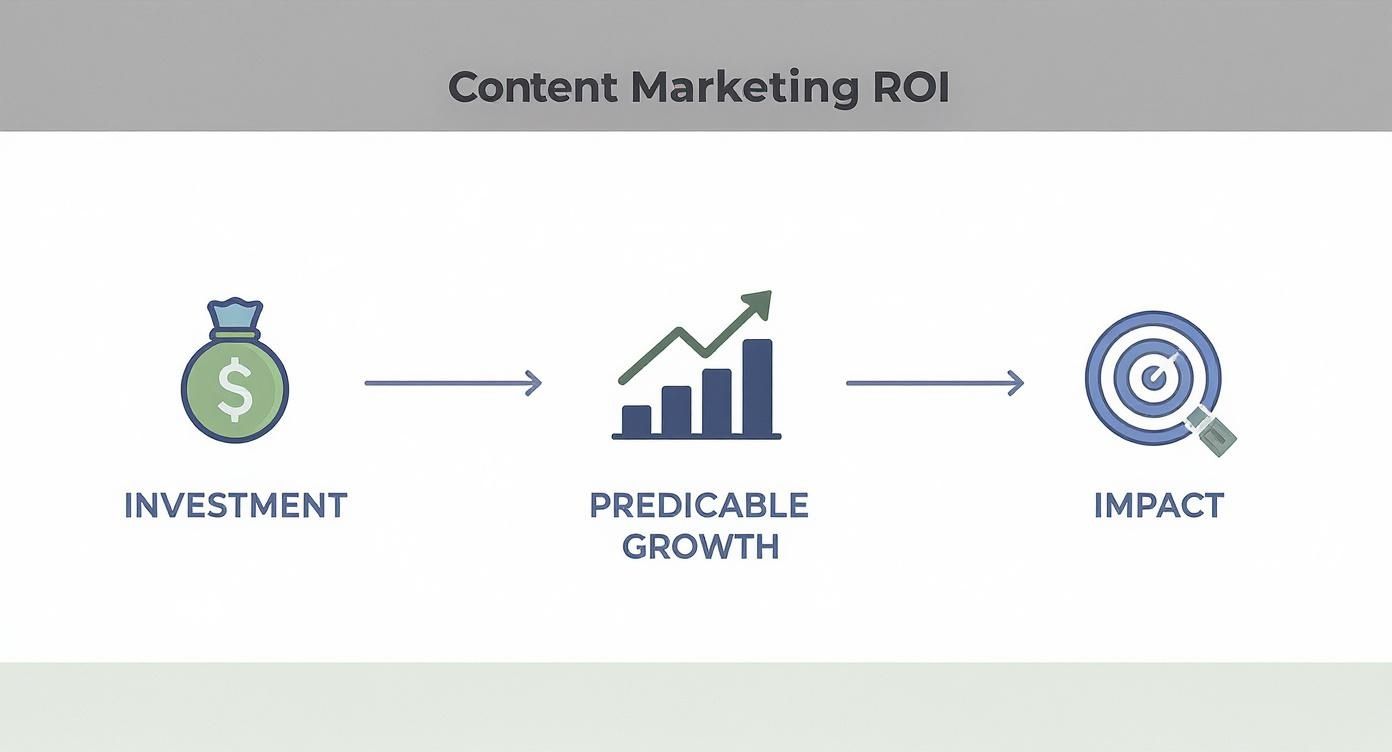
This visual map helps break down that journey, showing how a smart investment flows all the way through to a real business impact.

Infographic about content marketing roi

The key takeaway here is that you're not just spending money and hoping for the best. You're building a system for predictable growth that you can tie directly to your bottom line.

Nailing Down Your Total Investment

To get a real ROI figure, you have to count everything. Too many marketers make the mistake of only counting the obvious stuff, like the invoice from a freelance writer. That just leads to vanity metrics and an inflated sense of success.

Your total investment needs to include all the moving parts:

  • Creation Costs: This is the big one. It covers salaries for your in-house writers, designers, and videographers, or what you pay out to agencies and freelancers.
  • Tools & Software: Don't forget the monthly subscriptions for your tech stack. Think SEO tools like Ahrefs, analytics platforms, social media schedulers like Buffer, and your CMS.
  • Promotion & Distribution: Any cash you put behind paid social ads, search ads, or influencer campaigns to get more eyeballs on your content counts.

Actionable Tip: Create a simple spreadsheet to track these costs. Assign a portion of your monthly tool subscriptions and team salaries to your content budget. For example, if you pay $150 a month for an SEO tool and you publish 10 articles, attribute $15 of that tool's cost to each piece. Getting granular like this is what separates a guess from a true calculation.

Quantifying Your Financial Return

This is where things get a little trickier, but it’s also where the magic happens. The "Return" side of the equation is more complex because content influences revenue in so many different ways. The goal is to connect your content to tangible business outcomes, not just traffic spikes.

It's a step that a surprising number of businesses miss—one study found that a whopping 53% don't tie their content efforts directly to revenue goals. To measure your return properly, you have to track specific conversions and put a dollar value on them.

Attributing Revenue and Leads

  • Direct Sales: If you're running an e-commerce store, this is as direct as it gets. Actionable Step: Use UTM parameters in the URLs you share on social media or in newsletters. This allows you to track in Google Analytics exactly how many sales came from a click on a specific blog post or social update.
  • Lead Value: For B2B or service businesses, leads are the name of the game. But what’s a lead worth? Actionable Step: To figure it out, talk to your sales team to find two numbers: your average lead-to-customer conversion rate and the lifetime value (LTV) of a customer. If 1 in 10 leads becomes a customer worth $5,000, then every single lead you generate is worth $500.
  • Customer Lifetime Value (LTV): Good content doesn't just bring in new customers; it keeps the ones you have. If your tutorials or case studies are helping reduce churn, that's a real return you can and should factor in.

Cost and Return Analysis for Different Content Types

Not all content is created equal. Some formats require a heavy upfront investment of time and money but can deliver massive SEO returns over the long haul. Others are quick to produce and great for generating immediate leads. This table breaks down the typical trade-offs.

Content TypeTypical InvestmentPrimary Return MetricTime to See ROI
Blog PostsLow-Medium (Time-intensive writing)SEO Traffic, Organic Leads3-6 months
Ebooks/WhitepapersMedium (Writing, design, promotion)Gated Lead Generation1-3 months
Video ContentHigh (Production, editing, gear)Brand Awareness, Engagement2-4 months
WebinarsMedium-High (Platform, promotion, prep)High-Quality MQLsImmediate to 1 month
Case StudiesMedium (Interviews, writing, approval)Sales Enablement, Conversion1-2 months

Understanding these dynamics helps you build a balanced content strategy. You can mix long-term plays like SEO-focused blog posts with short-term wins from a high-impact webinar to keep the pipeline full.

Calculation Examples in the Wild

Let's look at how two different businesses might run the numbers on their content marketing ROI.

A SaaS Company Example: A SaaS company drops $8,000 on a series of deep-dive guides. That campaign brings in 50 demo requests. The sales team is solid, closing 20% of those leads, which lands them 10 new customers. If the LTV of each customer is $3,000, the total return is a sweet $30,000.

  • ROI Calculation: (($30,000 - $8,000) / $8,000) x 100 = 275%

An E-commerce Store Example: An online store invests $3,000 in a video marketing campaign showing off its products. They track everything with custom links and see the campaign directly drives $12,000 in sales.

  • ROI Calculation: (($12,000 - $3,000) / $3,000) x 100 = 300%

Sure, these are simplified, but they show just how critical it is to connect your content to real money. If you want to go deeper on this, you can learn more about how to calculate marketing ROI and apply the same thinking to your content program.

When you diligently track both your full investment and the return you can attribute to it, you can finally answer the question everyone in the C-suite is asking: "Is our content actually making us money?"

Essential Tools for Tracking Content ROI

Let's be honest: you can't measure ROI with guesswork and spreadsheets. To really get a grip on your content marketing ROI, you need the right tech stack. These tools are what connect the dots between someone reading a blog post and that same person eventually becoming a paying customer. They’re your source of truth, turning fuzzy metrics into a cold, hard financial picture.

Building this stack isn't about buying every flashy tool on the market. It’s about covering three critical jobs: seeing how people behave on your site, managing the relationships you build, and tracking your organic search footprint. When these systems talk to each other, you get a powerful feedback loop that makes your entire content strategy smarter.

Analytics Platforms for Web Traffic and Conversions

Everything starts with a solid analytics platform. This is mission control for understanding how people find and use your content. Without it, you're flying blind, unable to link a piece of content to a meaningful action.

There's a reason Google Analytics 4 (GA4) is the default for most marketers. Its event-based model is built for tracking the specific steps that lead to a conversion. You’re not just counting pageviews; you’re tracking PDF downloads, demo requests, and newsletter sign-ups—the actions that actually matter.

Actionable Tip: In GA4, set up a custom conversion event for your most valuable bottom-of-funnel action, like a "Contact Us" form submission. By tracing the user paths that lead to that conversion, you can see which blog posts or landing pages pushed them over the line. That creates a direct data trail for your ROI calculation.

CRM Systems for Connecting Content to Revenue

Analytics tells you what users are doing. A Customer Relationship Management (CRM) system tells you who they are and connects their activity to actual money. This is the most crucial link in the chain for proving financial return, especially in B2B where sales cycles can drag on for months.

Platforms like HubSpot or Salesforce become the central nervous system for every lead and customer interaction. When someone fills out a form on your blog to get an ebook, their info lands in the CRM. From that moment on, every touchpoint—every email opened, every sales call—is logged.

Image

This is where you strike gold. You can definitively say that a new $10,000 customer first found you through a specific blog post three months ago. You’re no longer just reporting on leads; you’re reporting on revenue. To get a better handle on how different pieces of content contribute to a final sale over time, it's worth understanding the various multi-touch attribution models that a good CRM makes possible.

A CRM transforms your content metrics from "we got 50 leads" to "this blog post generated $50,000 in pipeline." It’s the tool that finally allows you to speak the same language as your sales team and executives.

SEO and Social Tools for Measuring Growth and Reach

A huge chunk of content's value is its long-term power to pull in organic traffic and build your brand's authority. SEO tools are non-negotiable for putting a number on that contribution to your content marketing ROI.

Tools like Ahrefs or Semrush let you track keyword rankings, see who is linking to you, and even estimate the dollar value of your organic traffic. For example, if your blog post hits #1 for a keyword that would cost $5,000 a month to target with paid ads, that's a tangible return. It’s a direct cost saving and a sustainable traffic source you own.

Likewise, you need to track what's happening on social media. Using a comprehensive social media analytics dashboard is the smart way to gather data for ROI calculations across different platforms. These tools help you measure engagement, click-throughs, and actual conversions that started with a social post.

Building a Strategy for Higher Content ROI

Great content marketing ROI isn't a happy accident—it’s engineered from the ground up. Pumping out more content without a clear plan is just a recipe for burning through your budget. A high-ROI approach, in contrast, focuses on creating fewer, better assets that are precisely targeted and ruthlessly optimized.

A person at a desk drawing a strategic plan on a large sheet of paper, with charts and graphs in the background

Think of it like building a house versus just piling up bricks. A high-ROI strategy is the architectural blueprint. It ensures every blog post, video, and case study serves a distinct purpose and contributes to the final structure: generating revenue. Without that blueprint, you're just making noise.

This proactive approach is what separates the top-tier marketing teams from everyone else. Data from Semrush shows that 79% of companies considered "very successful" in their marketing dedicate more than 10% of their total marketing budget to content. Even more telling? 80% of these successful teams have a formal content strategy, directly linking intentional planning to better financial outcomes. You can find more trends about successful content marketing strategies and what they have in common.

Aligning Content with the Sales Funnel

Your audience's needs shift dramatically as they move from "I have a problem" to "I'm ready to buy." A winning strategy maps your content directly to these stages, ensuring you're delivering the right message at exactly the right time. This alignment is everything when it comes to maximizing conversions and, ultimately, your ROI.

  • Top of Funnel (TOFU): This is the awareness stage. Your goal is to attract a broad audience with educational, problem-focused content that doesn't feel like a sales pitch. Think blog posts, infographics, and social media updates that answer common questions.
  • Middle of Funnel (MOFU): Now they're in the consideration stage. Prospects know they have a problem and are actively looking for solutions. Your content should position your brand as a credible expert. This is where webinars, case studies, and deep-dive guides really shine.
  • Bottom of Funnel (BOFU): This is the decision stage. The audience is ready to buy, and your content needs to give them that final nudge. Use product demos, free trials, and detailed comparison pages to seal the deal.

Trying to hit someone with a demo (BOFU) when they're just starting their research (TOFU) is like trying to sell a car to someone who’s just starting to think about learning to drive. It's the wrong message at the wrong time, and it tanks your conversion potential.

Targeting Commercial Intent Keywords

Let's be clear: not all keywords are created equal. To juice your content marketing ROI, you have to prioritize keywords that signal a user is getting close to pulling out their wallet. This is the difference between attracting casual readers and attracting future customers.

Think about the gap between "what is content marketing" and "best content marketing software for small business." The first is purely informational, targeting a TOFU audience. The second one screams commercial intent, attracting a BOFU audience that is actively looking for a solution to buy.

Focusing on commercial intent keywords ensures your content creation efforts are directly tied to revenue-generating opportunities. It's about attracting traffic that is far more likely to convert into leads and sales.

Actionable Step: Use your SEO tool to filter for keywords containing modifiers like:

  • Best (e.g., "best CRM for startups")
  • Alternatives (e.g., "HubSpot alternatives")
  • Vs (e.g., "Ahrefs vs Semrush")
  • Pricing (e.g., "Salesforce pricing plans")

Building content around these terms puts you squarely in the path of motivated buyers, dramatically shortening the path from click to conversion.

Creating Content Clusters for Topical Authority

Search engines reward expertise. A "content cluster" strategy is a powerful way to demonstrate deep knowledge in a specific area, helping you rank higher and drive more qualified organic traffic. It’s all about creating a central "pillar page" on a broad topic and linking it to multiple, in-depth "cluster pages" that cover related subtopics.

For example, your pillar page might be a massive guide to email marketing. Your cluster pages could then dive into the nitty-gritty, like "email list segmentation," "writing effective subject lines," and "email A/B testing best practices."

This structure signals to Google that you are an authority on the topic, boosting the SEO performance of all the related content. More importantly, it creates a seamless user experience, guiding visitors to the exact information they need and keeping them engaged on your site for longer. To get this right, you can follow a detailed content marketing strategy guide that walks through the process of building real authority.

Proven Tactics to Maximize Content Returns

Having a solid strategy is your blueprint, but disciplined execution is what actually builds the house. If you want to really crank up your content marketing ROI, you have to treat every single piece of content like a valuable asset. That means actively managing it, not just hitting "publish" and hoping for the best. That's a surefire recipe for disappointment.

The sharpest marketers I know get that creation is only half the battle. They work tirelessly to squeeze every drop of value out of their investment by focusing on promotion, optimization, and repurposing. It’s about multiplying the impact of their efforts long after the content goes live.

This isn't a small side project for most businesses anymore. In fact, a whopping 58% of companies now invest between $5,000 and $10,000 every single month on content. The numbers back it up: businesses that blog consistently see 55% more website visitors than those who don’t, which opens up a ton more opportunities to convert.

Amplify Your Reach with Smart Promotion

Your content can't generate a return if nobody sees it. It's that simple. A smart, multi-channel promotion strategy is non-negotiable for getting your work in front of the right audience and stretching its lifespan. Think of it as giving your content the rocket fuel it needs to take off.

  • Email Marketing: Your email list is a direct line to your most loyal audience. Announce new content to your subscribers to drive a quick burst of traffic and re-engage people who already know and trust your brand. It's a low-cost, high-return channel that you completely own.
  • Paid Promotion: Don't be afraid to put some money behind your best work. Actionable Step: Instead of boosting every post, identify your top 5 converting blog posts from the last quarter and put a small paid budget behind them on LinkedIn to target your ideal customer profile.
  • Social Media Distribution: Share your content across all your relevant platforms, but tailor the message for each one. A short video clip for Instagram, a thought-provoking question for LinkedIn, and a slick, eye-catching graphic for X (formerly Twitter) will go a lot further than a generic "new blog post" update.

Optimize for Conversions

Getting traffic feels good, but turning that traffic into leads or sales is what actually drives ROI. This is where Conversion Rate Optimization (CRO) comes in—it’s the science of methodically tweaking your content to guide more visitors toward taking the action you want them to take. It’s all about turning passive readers into active participants.

A huge piece of this puzzle is implementing clear and compelling Calls-to-Action (CTAs). Ditch the generic "Contact Us" and try something specific and value-driven, like "Get Your Free Content Audit."

Effective CTAs bridge the gap between your content and your business goals. They provide a clear next step, transforming an informational asset into a conversion tool and directly boosting your content marketing ROI.

Just as critical is a smart internal linking strategy. By linking to relevant product pages, case studies, or other bottom-of-funnel content, you create a natural pathway for readers to move deeper into your world, dramatically increasing the chances they'll convert.

Multiply Your Impact with Content Repurposing

Why create ten new assets from scratch when you can turn one great piece into ten different formats? Content repurposing is one of the most efficient tactics for maximizing your content marketing ROI, bar none. It lets you reach new audiences on different platforms and hammer your message home without starting over.

The amount of time and resources this saves is massive. For example, a single, in-depth webinar can be spun into gold.

Original AssetRepurposed FormatsTarget Audience
60-Minute WebinarA series of short blog posts, a downloadable slide deck, quote graphics for social media, a podcast episode, and short video clips for TikTok and YouTube Shorts.Extends reach from live attendees to blog readers, social media followers, and podcast listeners.

This whole approach breathes new life into your existing work, extending its value far beyond the day it was first published. To get even more mileage from your videos, converting YouTube video to text with AI is a killer tactic for turning spoken words into a fully readable and SEO-friendly blog post.

By making these tactics part of your standard process, you ensure every piece of content you create works a whole lot harder for your business.

Still Have Questions About Content Marketing ROI?

Even with the best strategy, some questions about content marketing ROI just keep coming up. Let's tackle the most common ones I hear from marketers so you can get back to measuring with confidence.

How Long Does This Actually Take to Work?

Let's get one thing straight: content marketing is a long game. It’s a marathon, not a sprint. Compare it to paid ads, where you see results (and costs) immediately. Content marketing is an asset that appreciates over time.

You might see some early signs of life—a little more traffic, a few more social shares—within 3-6 months. But a real, meaningful financial return? You're usually looking at 6-12 months, sometimes even longer.

Think of it like planting a tree. It feels slow at first, but once it takes root, it provides value for years with very little extra work. Content works the same way. It compounds over time as your articles start ranking for keywords and pulling in a steady stream of organic traffic long after you hit "publish."

What's a "Good" Content Marketing ROI Anyway?

If you're looking for a number to aim for, the industry benchmark that gets tossed around most is a 5:1 ratio. That’s a 400% ROI, or earning $5 for every $1 you put in.

But here’s the thing: chasing some universal number is a distraction. What really matters is setting your own baseline and then consistently beating it, quarter after quarter. A high-margin SaaS company might hit a 10:1 ratio, while a business in a different space might be thrilled with 3:1. Focus on your own growth.

How Do I Measure ROI for Top-of-Funnel Blog Posts?

This is the classic headache. How do you tie a blog post about "10 Tips for X" directly to a closed deal? The short answer is, you don't—not directly, anyway.

Trying to force a direct sales connection for top-of-funnel (TOFU) content is a recipe for frustration. Instead, you need to look at leading indicators and proxy metrics that show its value.

  • Contribution to Pipeline: Use a multi-touch attribution model in your analytics tool or CRM. This lets you see how many of your eventual customers first found you through that "fluffy" TOFU piece. It’s often more than you think.
  • Key Performance Indicators: Track the metrics that prove the content is doing its job. Are you seeing more organic traffic? Ranking for new keywords? Getting more newsletter sign-ups from those posts? Is your branded search volume going up? These are all signs of a healthy top of funnel.

What Are the Biggest Mistakes People Make When Calculating ROI?

Even sharp marketers can trip up here. I see the same few mistakes pop up again and again.

  1. Ignoring Hidden Costs: The most common error is forgetting to include everything. Team salaries, software subscriptions, and your ad spend for promotion all count. Miss these, and your ROI will look way better than it actually is.
  2. Relying Only on Last-Touch Attribution: This model is the enemy of content marketing. It gives 100% of the credit to the last thing a person did before converting, completely ignoring the five blog posts they read that got them there in the first place.
  3. Having No Clear Conversion Goals: If you don't define what a "conversion" is for a piece of content (like a demo request or an ebook download), you’re just measuring traffic and vibes. You have nothing concrete to measure against your investment.
  4. Giving Up Too Soon: This one hurts to see. Pulling the plug on your content strategy after three months because you aren't seeing a massive return is the fastest way to guarantee a negative ROI. You have to give it time to mature.

Ready to stop guessing and start engineering a higher ROI? The marketbetter.ai platform uses AI to help you create high-performing content, optimize campaigns, and prove your marketing's impact with clear, data-backed insights. Discover how to maximize your content returns today.

How to Scale Content Marketing Effectively in 2024

· 23 min read

Trying to scale content marketing without a system is like trying to build an assembly line after the factory is already running. It's pure chaos. Before you can hit the gas, you have to build a repeatable blueprint for how your content gets made.

This means getting serious about auditing what you have, defining exactly what you sound like, and standardizing how you create everything. Skip this, and you’ll just be producing inconsistent, off-brand content faster than ever before.

Build Your Content Operations Blueprint

Image

Before you can accelerate, you have to engineer the vehicle. Scaling content isn't just about writing more articles. It’s about building a predictable system that can handle more volume without sacrificing the quality that got you here in the first place. This is what stops your brand voice from getting diluted and your messaging from going off the rails.

Think of it as the difference between a one-off custom project and a true production line. A single handcrafted piece is great, but you can't make a thousand of them efficiently. A production line, on the other hand, uses standardized processes and quality checks to get consistent, high-quality results at scale. Your content operations blueprint is that production line.

Start with a Ruthless Content Audit

First things first: you need to know what’s actually working. A real content audit isn't just a spreadsheet of blog posts. It’s a strategic deep dive to find your winners and, just as critically, the pieces that are draining your resources. Don't just look at page views.

Instead, slice up your data and look for patterns that tell a story:

  • High Traffic, Low Conversion: These posts get eyeballs but don't convince anyone to act. Action: Your job is to turn these into converters. Test new CTAs, embed a relevant webinar signup form, or add a lead magnet like a downloadable checklist.
  • Low Traffic, High Conversion: These are your hidden gems. They hit a nerve with a specific audience. Action: Don't just let them sit there. Build a content cluster around the core topic and use paid ads to drive targeted traffic directly to these high-performing pages.
  • High Traffic, High Engagement: These are your pillars. They're the foundation of your strategy. Action: Squeeze every drop of value from them by repurposing them into videos, webinars, and social content. This is your low-hanging fruit for scaling distribution.

By focusing on performance data, you move from guessing what your audience wants to knowing what drives results. This audit informs every future content decision, ensuring your scaled efforts are focused on proven winners, not just producing more noise. To dive deeper into this process, learn how to perform a comprehensive, AI-assisted content analysis to uncover these critical insights faster.

Establish Your Central Source of Truth

The moment you bring on more writers, freelancers, or AI tools, brand consistency becomes your biggest battle. The only way to win is with a centralized style guide. This isn't just a dusty document with grammar rules; it's the bible of your brand's personality.

A style guide is static, but a "source of truth" is a living, breathing resource your whole team uses and contributes to daily. It ensures that everyone—from a new hire to a seasoned writer—is speaking with one unified voice.

Your source of truth absolutely must include:

  • Tone and Voice Guidelines: Don't just say "be friendly." Compare it. Action: Provide "Say this, not that" examples. For instance, "Say: 'Here’s a quick way to solve this...' Not: 'In order to ameliorate this issue, one must...'"
  • Formatting Rules: Get specific on how to use headings, lists, bold text, and blockquotes for visual consistency.
  • Brand-Specific Terminology: List out all your product names, key features, and industry terms with the correct spelling and capitalization. No excuses.

Create Actionable Templates for Briefs and Workflows

Finally, you have to standardize the creation process itself. Ambiguity is the enemy of scale. Good templates for content briefs and workflows eliminate the guesswork and create a repeatable system that anyone can step into and execute.

A well-structured content brief template should be the non-negotiable starting point for every single piece of content. It’s the contract between the strategist and the creator, guaranteeing alignment before a single word is written. Action: Your brief should include required fields like Primary Keyword, Target Persona, Key Talking Points, Competitor Articles to Beat, Internal Linking Targets, and a Crystal-Clear Call-to-Action.

This systematic approach turns your content creation from an art form into a science, making it possible to ramp up volume while maintaining the high standards your audience expects.

Systemize Your Content Creation Engine

Image

This graphic lays out the high-level flow, showing how a proper system moves from topic planning and creation right through to automated distribution. This is the foundation for creating great content without the chaos.

Once you have your operational blueprint, the real work begins: engineering a predictable production line. Scaling isn’t about brute force—just grinding out more hours. It’s about building a smooth, repeatable engine that turns ideas into published assets with as little friction as possible.

The goal here is to get away from the frantic, ad-hoc scramble and build a system where every stage is defined. You can find some excellent frameworks in this ultimate content creation workflow guide to help make this transition. It’s how you turn content creation into a reliable, high-output machine.

Build a Multi-Source Ideation Process

Great content ideas are discovered, not invented on the spot. A scalable ideation process is one that consistently surfaces high-potential topics by tapping into different data streams across your entire business. If you only rely on keyword research tools, you'll end up writing about the same tired topics as everyone else.

To build a more resilient system, you need to blend your sources:

  • SEO Data: Of course, you’ll use tools to find keywords with good search volume and low competition. But go deeper. Look for question-based queries and the "People Also Ask" sections. These are direct pipelines into your audience's head.
  • Customer Support Tickets: Your support team is sitting on a goldmine of real-world customer problems. Action: Set up a shared Slack channel or a simple form where support reps can submit recurring customer questions that could be turned into content.
  • Sales Team Feedback: What objections or questions pop up constantly on sales calls? Answering these with content doesn't just help your audience; it arms your sales team with killer assets to close more deals.

This approach ensures your content is not only optimized for search but is also deeply relevant to what your audience actually needs right now. That's a powerful combo.

Turn Your Calendar Into a Command Center

A content calendar should be way more than a list of due dates. When you use it right, it becomes the command center for your entire operation, tying every single piece of content back to a specific business goal.

An effective, scalable calendar maps out the critical details:

  • Content Title and Format: What is it? A blog post, a video, a case study?
  • Target Persona: Who is this for? Be specific.
  • Funnel Stage: Is this for top-of-funnel awareness, mid-funnel consideration, or bottom-funnel decision-making?
  • Primary Keyword: What's the main SEO target?
  • Business Goal: What are we trying to achieve? Generate leads, build topical authority, support a product launch?

This level of detail stops you from creating content just for the sake of it. Instead, every asset becomes a deliberate move designed to get a measurable result.

The real challenge of scaling isn't just about creating more; it's about putting your resources toward the right creative work. This is how you solve that bottleneck.

Even with bigger budgets, a shocking 66.5% of marketers still struggle with resource allocation. This stat shows that throwing money at the problem doesn't work. Without a system for your people and processes, growth will always feel just out of reach.

Compare Team Building Models In-House vs Freelancers

As you grow, you're going to need more hands on deck. The two main paths are expanding your in-house team or building a network of trusted freelancers. Each has its own pros and cons, and the right choice often depends on where you are in your growth journey.

This decision is about more than just cost. You're balancing control, flexibility, and access to specialized expertise.

Scaling Your Team In-House vs Freelancers

Here’s a breakdown of how the two models stack up when you're trying to scale your content engine.

FactorIn-House TeamFreelance Network
Cost StructureFixed salaries, benefits, and overhead. A bigger upfront investment.Variable, project-based fees. Much lower initial cost.
ScalabilitySlower to scale up or down. Hiring and firing takes time and resources.Extremely flexible. You can easily ramp production up or down on demand.
Brand ImmersionThey live and breathe your company culture and brand voice every single day.Needs solid onboarding and crystal-clear style guides to maintain consistency.
ExpertiseDevelops deep knowledge of your specific product and market over time.Gives you access to a wide bench of niche specialists (e.g., technical writers, videographers).
Best ForCore strategic content and roles where deep institutional knowledge is critical.Specialized projects, filling knowledge gaps, and handling spikes in workload.

Many of the most successful content teams I've seen use a hybrid model. They keep a core in-house team for strategy and brand-defining content, then lean on a network of vetted freelancers for specialized tasks and to manage overflow. This approach often strikes the perfect balance of stability and flexibility you need to grow without breaking the bank.

Use AI and Automation to Amplify Output

Image

This kind of interface is designed to centralize and speed up the creation process, letting you turn one core idea into dozens of assets. When you embed AI into your workflow, you’re not just producing content linearly anymore—you're creating it exponentially. That's the secret to scaling content marketing that actually works.

Beyond the First Draft AI Use Cases

If you're only using AI to crank out first drafts, you're missing 90% of its power. It’s like using a supercomputer to do basic math. The real magic happens when you weave AI and automation into the repetitive, time-sucking parts of your content workflow.

This approach frees up your team to focus on what they do best: strategy, storytelling, and adding that final human polish that no machine can replicate.

Think about it this way: a single long-form blog post isn't just one piece of content. It's a goldmine.

Instead of your team manually hacking together social posts, AI can:

  • Spin up 10 different tweet variations from a single key paragraph.
  • Outline a 5-slide LinkedIn carousel based on your article's H2s.
  • Draft three distinct email newsletter snippets targeting different segments of your audience.

This isn't about replacing your writers; it's about giving them superpowers. To really get this right, you need to understand the fundamentals of what is content automation and how it uses AI to make your entire process smoother and more personalized.

Choosing Your AI and Automation Stack

Your tech stack is the engine that drives all this, but let's be honest—not all tools are created equal. The trick is to pick platforms that solve specific bottlenecks in your process, not just collect shiny objects.

Let's break down a couple of critical categories for any modern content team.

AI for Ideation and Optimization

This is where you front-load your content with data to make sure it actually performs. SEO optimization tools use AI to analyze what's already ranking and build data-driven outlines in minutes. That's a task that would take a human researcher hours of manual SERP-scrolling.

Tool CategoryClearscopeSurferSEO
Primary Use CaseBuilding comprehensive, data-driven content briefs and grading drafts.Real-time content editor with SERP analysis and keyword suggestions.
Key StrengthExcellent for creating detailed outlines for writers to follow, ensuring topical authority.Strong for on-page optimization during the writing process itself.
Best ForTeams that rely on structured briefs and want to ensure every article is comprehensive.Writers who prefer interactive feedback and want to optimize as they create.

AI for Generation and Repurposing

These tools are your content multipliers. Once you have that core pillar post, generative AI platforms can atomize it into dozens of formats. This saves your team from the soul-crushing work of rewriting the same ideas for every single channel.

A lean team of two can take one well-researched article and, in less than an hour, use a tool like Jasper or Copy.ai to generate a full week's worth of promotional content. This is how you 5x your output without burning out your people. The human role shifts from repetitive typing to strategic editing and curation.

The Shift to a Human-in-the-Loop Model

The smartest way to scale with AI is to adopt a "human-in-the-loop" model. This isn’t about hitting a button and walking away; it's about smart augmentation.

Let the AI handle the grunt work—the initial research, the first drafts, the tedious repurposing. Your human experts then swoop in to provide the critical final touches.

Your team's unique voice, strategic insights, and deep customer empathy are your most valuable assets. AI should be used to free up their time to inject those elements into more content, not to replace them entirely.

This isn't some fringe idea; it's rapidly becoming the standard. Projections show that around 40% of B2B marketers plan to increase their spending on AI-powered content tools in the next year. They're not just trying to produce more stuff; they're aiming to create smarter, more targeted content at a scale that was impossible just a few years ago.

By automating the mundane, you unlock your team's true creative potential.

Engineer a Scalable Distribution Machine

Writing great content is only half the job. If your masterpiece just sits on your blog gathering digital dust, it's not actually doing anything. To really get a content engine humming, you have to ditch the whole "publish and pray" mindset. You need a distribution machine that works just as hard as your creation team.

This is what separates a one-off launch from a sustained campaign. A launch gives you a quick sugar rush of traffic. A distribution machine, on the other hand, makes sure every single article, case study, and guide delivers value long after you hit publish. It’s about making sure your hard work actually gets seen by the right people.

Turn One Asset into a Dozen

The fastest way to scale your distribution is to stop thinking of a blog post as a single thing. Think of it as raw material—the core ingredient for a dozen smaller, channel-specific pieces of content. One pillar post can easily fuel an entire week's worth of promotion across multiple platforms.

This whole approach is often called content atomization. It’s all about squeezing every last drop of ROI from the time you spent on the initial research and writing.

  • Video Scripts: Pull the key sections from your article and you've got a ready-made script for a short, punchy YouTube or TikTok video.
  • LinkedIn Carousels: Each H2 or major point in your post can become a slide in a slick, visual carousel that's perfect for a professional audience.
  • Email Newsletter Snippets: Grab the most interesting stat or takeaway and use it as the hook for your next email blast, driving your subscribers back to the full piece.
  • Quote Graphics: Turn the best one-liners or data points into shareable images for Instagram or X.

This isn't about creating more work; it's about working smarter. A small team can maintain a high-volume, multi-channel presence without having to invent something new every single day. For a real-world look at how this works, check out our case study on Helix Wireless to see the massive results a scaled content strategy can deliver.

Pick Your Outreach Levers: Influencers vs. Paid Ads

Once you have all these repurposed assets, you need a scalable way to get them in front of new eyeballs. Two of the most powerful ways to do this are influencer collaborations and targeted paid ads. They're very different, and knowing when to pull which lever is the key to getting the most out of your budget.

The goal of a distribution machine is to create multiple on-ramps to your core content. Whether someone discovers you through an influencer’s story, a targeted ad, or an organic search, all roads should lead back to the valuable asset you created.

Here’s a quick breakdown of how these two distribution tactics stack up.

Distribution TacticInfluencer CollaborationsPaid Amplification
Primary StrengthBuilds trust and credibility through authentic, third-party validation.Offers precise targeting, guaranteed reach, and predictable scalability.
Best ForReaching niche communities and generating genuine brand affinity.Driving immediate traffic, promoting time-sensitive offers, and retargeting warm leads.
Cost ModelVaries wildly from sending free product to five-figure fees. ROI can be harder to track directly.Pay-per-click or impression. Highly measurable and controllable spend.
ScalabilityCan be challenging; requires significant time for outreach and relationship building.Extremely scalable; just increase your budget to instantly reach a larger audience.

The best part? You don't have to choose one or the other. In fact, the most effective strategies usually blend both. You might run paid ads to guarantee reach for a big launch while partnering with a few key influencers to build long-term credibility in your industry.

The data backs this up. Looking ahead to 2025, 59% of marketers are planning to increase their use of influencer marketing, because they know it drives authentic engagement. That's critical, especially when you consider that 76% of users say social content has influenced a purchase decision. Digging into the latest digital marketing statistics can give you a real edge in planning your next move.

Measure and Optimize for Sustainable Growth

Image

As you start to scale, data stops being a helpful guide and becomes your most critical asset. Pumping out more content is just noise if you can’t tell what’s actually working. This is the point where your strategy has to shift from pure production to performance-driven optimization.

Why the sudden urgency? Efficiency. We already know that content marketing costs about 62% less than old-school outbound tactics while pulling in three times the leads. To keep that massive cost advantage as you grow, you have to constantly refine your approach with hard data. Every dollar and every hour needs to be invested wisely.

Build a Dashboard That Tracks What Matters

First things first: stop chasing vanity metrics. Pageviews and social shares feel good, but they don't pay the bills. A scalable content program measures success by its direct impact on the business. Your performance dashboard should be the single source of truth connecting your team's efforts to actual revenue.

This means you need to track the numbers your C-suite actually cares about.

  • Pipeline Influence: Which articles are prospects reading right before they enter the sales pipeline? Tools like HubSpot or Salesforce can connect these dots for you.
  • Content-Sourced Leads: How many people gave you their email address for an ebook or a webinar? This is a direct measurement of your content's power to generate leads.
  • Conversion Rate by Asset: Which specific blog posts or case studies are getting people to take the next step, like signing up for a trial or booking a demo?

When you focus on these KPIs, you can have much more meaningful conversations about ROI. You’re no longer just talking about traffic; you’re talking about tangible business value.

Implement a Systematic Content Refresh Program

You don’t have to create everything from scratch. Seriously, one of the most efficient ways to scale is to breathe new life into your existing content. A systematic refresh program turns your blog into a portfolio of assets that actually appreciate over time.

Instead of letting older posts collect dust, go find the ones with "good bones"—articles that still rank for a few keywords but have lost traffic or feel a bit dated.

An outdated but high-potential blog post is like a house with a solid foundation but a leaky roof. A strategic refresh fixes the issues, modernizes the interior, and dramatically increases its market value for a fraction of the cost of building new.

A proper refresh isn't just swapping out a few stats. It's a full overhaul. Action: Create a "Content Refresh Checklist" that includes: updating data and examples, optimizing for new secondary keywords, improving internal linking, upgrading visuals, and adding a new CTA. This ensures every refresh is thorough and effective.

Conduct Quarterly Performance Reviews

To make sure your scaled-up efforts are delivering compounding returns, you need a regular rhythm for strategic review. A quarterly performance review is the perfect time to zoom out from the daily grind and make smart, data-backed decisions.

This meeting isn't a data dump. It’s a strategy session to decide where to double down and what to cut loose.

Ask these action-oriented questions:

  1. What topics drove the most pipeline influence this quarter? Let's figure out how to build a whole content cluster around that theme and own the conversation.
  2. Which formats—videos, long-form guides, case studies—had the best engagement and conversion rates? We should probably put more resources there next quarter.
  3. What content completely flopped? Can we learn something from it, or should we just avoid that type of content moving forward?

This kind of rigorous, data-backed review is how you adapt and win. To keep improving, you can explore the best A/B testing tools for website optimization and make these data-driven decisions a core part of your growth strategy.

Common Questions on Scaling Content Marketing

As you start to really scale up your content marketing, some practical, in-the-weeds questions are going to pop up. Every team hits these bumps. Getting ahead of them is what separates the programs that grow from the ones that stall out.

Here are a few of the most common hurdles I've seen teams face, along with some straight-up advice on how to clear them.

How Do I Keep Our Brand Voice Consistent with More Writers?

This is the classic scaling challenge. You bring on more writers—in-house, freelance, agency—and suddenly your content starts to sound like it was written by a committee. The solution isn't a bigger, stricter style guide. The real answer is to evolve that static document into a living "source of truth."

A traditional style guide is all about rules: grammar, logo placement, approved fonts. A source of truth is about personality. It shows writers how to sound like you, with real examples.

From Static Rules to a Living Playbook

FeatureStatic Style GuideDynamic "Source of Truth"
FormatUsually a PDF that collects digital dust.A live, shared space like a Notion or Confluence page.
ContentFocuses on grammar, formatting, and technical rules.Includes rules, but adds brand personality examples, "say this/not that" scenarios, and approved phrases.
OutcomeWriters follow instructions but often miss the brand’s unique flavor.Writers get a real feel for the brand’s authentic voice and can replicate it consistently.

Here’s the key: make it a living resource. When a new blog post just nails your tone, drop a screenshot and a link into your source of truth. It becomes a practical, evolving playbook that helps everyone speak with one, unified voice.

What's the Right Budget for Scaling Content?

Forget trying to find a magic number. The best way to set a budget is to stop thinking about it as a cost and start treating it like an investment. Don't ask, "What can we afford?" Instead, ask, "What business outcome are we trying to drive?"

For instance, let’s get specific:

  • Work backward from your goal: If you need to generate 100 marketing-qualified leads (MQLs) this month, and you know from your data that your content converts visitors to leads at 2%, then the math is simple. You need 5,000 qualified visitors to hit your number. Your budget is whatever it costs to create and promote the content needed to attract those 5,000 people.

That’s a much stronger, more defensible approach than just picking a number out of thin air.

Your budget should be a direct reflection of your growth targets. When you tie content spend to concrete business goals like pipeline generation, it stops being an expense line item and becomes a predictable engine for growth.

Should I Use an AI Writer or a Human Writer?

This is probably the biggest question in content right now, but it's also the wrong one. The debate isn't "AI vs. human." The smart play is "AI and human."

The highest-performing content teams I know are all using a hybrid model. They let each side do what it does best. The real question is figuring out who gets which tasks.

  • AI is perfect for: The heavy-lifting and data-driven work. Think generating content outlines based on SERP analysis, turning one long-form article into ten social media posts, or drafting the first version of a straightforward, fact-based piece.

  • Human writers are essential for: The stuff that builds a real brand. High-level strategy, weaving in unique customer stories, conducting original interviews, and providing that final layer of polish that screams quality and authority.

AI handles the volume and the repetitive work, which frees up your human experts to focus on the high-impact, creative tasks that a machine simply can't do. We’ve seen this hybrid model produce incredible results; you can dig into some of our content marketing case studies to see how that balance drives real business impact.


Ready to stop guessing and start scaling with precision? marketbetter.ai integrates AI across your entire marketing workflow, from content creation to campaign optimization. See how our AI-powered platform can 5x your output and deliver measurable ROI. Get started with marketbetter.ai.

Your Essential Content Marketing Strategy Guide

· 22 min read

A content marketing strategy guide isn't just a document; it's your North Star. It's the high-level thinking that ensures every blog post, video, and social update you publish actually moves the needle for your business.

Without it, you're just making noise. With it, you're building a strategic asset that attracts and keeps the right audience. Think of it this way: random content is like taking a road trip with no map, hoping you'll end up somewhere great. A strategy is your GPS, guiding every turn to ensure you reach your destination.

What Exactly Is a Content Marketing Strategy?

Image

Imagine building a house. You wouldn't just show up with a pile of bricks and start stacking them, right? You'd start with a blueprint. A content marketing strategy is that blueprint for your digital presence.

It’s not about just creating content. It’s about creating the right content, for the right people, to hit specific business goals.

Your strategy is what turns a random collection of articles and videos into a cohesive brand experience. Every single "brick" (a blog post) and "beam" (a video) serves a purpose, supporting the entire structure. Given that more than 90% of marketers are either maintaining or boosting their content marketing spend, a solid strategy is the only way to get noticed.

Strategy vs. Plan: What's the Real Difference?

People throw "strategy" and "plan" around like they're the same thing. They're not. Confusing the two is one of the fastest ways to derail your content efforts before they even get started. Let's make this actionable.

A strategy is the "why." It's your long-term vision. It tackles the big questions:

  • Why are we even doing this? (e.g., "To become the most trusted resource for first-time homebuyers.")
  • Who are we trying to reach? (e.g., "Millennials in urban areas who feel overwhelmed by the mortgage process.")
  • How will content actually help us get more leads or keep customers happy? (e.g., "By simplifying complex financial topics, we will build trust and capture leads for our mortgage advisors.")

A plan is the "how" and the "what." It's the tactical stuff—the nuts and bolts of getting it done. Your plan includes your content calendar, the keywords you're targeting, and where you'll be sharing your work.

A strategy without a plan is just a wish. A plan without a strategy is just noise. Your success depends on connecting the high-level 'why' with the on-the-ground 'how'.

For instance, your strategy might be to become the go-to authority on email outreach for recruiting agencies. Your plan, then, would be to create blog posts about recruitment tactics, produce video tutorials on cold email software, and publish case studies from successful agency clients.

Ultimately, a documented strategy transforms random acts of content into a predictable growth engine. It gets your whole team on the same page, justifies the budget, and makes sure every piece of content pulls its weight. To get a head start, dig into these essential content marketing best practices that cover the entire lifecycle from planning to optimization.

How to Build Your Strategic Foundation

Before you write a single word or hit record on a video, you need to pour the concrete for your strategy. This foundation isn’t built on guesswork. It’s built on data, a deep understanding of your customers, and a crystal-clear picture of what success actually looks like. Skipping this part is like building a skyscraper on sand—it might look impressive for a minute, but it’s destined to collapse.

A solid foundation is what turns random acts of marketing into a coordinated, results-driven engine. It ensures every single piece of content you create has a purpose and moves you closer to real business outcomes.

Set Goals That Actually Matter

Every content strategy needs a North Star. Fuzzy goals like “get more traffic” or “increase engagement” aren’t goals; they’re wishes. To make them count, you need a framework that ties your content directly to what the business cares about. This is where SMART goals come in. Let's compare a weak goal with a SMART one.

SMART is just a simple acronym for Specific, Measurable, Achievable, Relevant, and Time-bound. It’s a framework that forces you to get out of the clouds and into concrete targets.

  • Bad Goal: "We want more leads." (This is unactionable—how many? from where? by when?)
  • SMART Goal: "Increase marketing qualified leads (MQLs) from our blog by 20% over the next quarter by creating five bottom-of-funnel case studies and promoting them via our newsletter."

See the difference? The SMART goal is a clear directive. It tells your team exactly what to build, how you’ll measure success, and when it needs to happen. This is how you start proving the ROI of your content. You can see how we helped brands hit these kinds of numbers over at https://marketbetter.ai/case-studies.

Craft Detailed Buyer Personas

You can’t create content for "everyone." To make an impact, you have to create it for someone. That someone is your buyer persona, a detailed, semi-fictional profile of your ideal customer. And I mean detailed—this goes way beyond basic demographics like age and job title.

A truly powerful persona uncovers the human being on the other side of the screen. What are their biggest frustrations at work? What questions are keeping them up at night? Where do they hang out online, and who do they trust for information?

Your job is not just to answer your audience's questions but to understand the questions they don't even know how to ask yet. A deep understanding of their pain points is your greatest strategic advantage.

Let's look at the difference between a weak persona and a strategic one for a company selling an email outreach tool.

AspectSurface-Level Persona (Vague)Strategic Persona (Actionable)
RoleSales ManagerB2B SaaS Sales Manager
GoalGet more leads.Hit a quarterly MQL quota of 500.
Pain PointCold outreach is hard.Current outreach emails have a less than 1% reply rate, wasting hours of the team's time.
Content Needs"Tips for sales""Actionable email templates that break through the noise and proven follow-up sequences."

The strategic persona gives your content creators a bullseye to aim for. It lets them create content that feels personal and solves a real, painful problem.

Analyze Your Competitors to Find Opportunities

Finally, remember that you don't operate in a vacuum. Your competitors are already out there making content, and your audience is already consuming it. A competitor analysis isn’t about copying what they’re doing. It’s about finding the gaps they’ve completely missed so you can create something way better.

Here’s an actionable plan to get started:

  1. Identify 3-5 Competitors: Pick your top rivals—both direct (sell the same thing) and indirect (solve the same problem differently).
  2. Analyze Their Content: Dig into their blogs, YouTube channels, and social media. What subjects do they cover relentlessly? What formats do they prefer (e.g., all-in on video, heavy on long-form guides)?
  3. Assess Quality and Depth: Compare their content to yours. Is it just scratching the surface, or are they offering deep, expert-level insights? Where can you provide more value?
  4. Find Keyword Gaps: Use an SEO tool to see what keywords they rank for that you don’t. This is where the gold is often buried.

Finding what your competitors are missing is one of the smartest moves you can make. A great way to do this is by performing an SEO content gap analysis to pinpoint topics where you can become the authority before they even know what's happening. It’s how you start owning conversations in your industry instead of just joining them.

Developing Your Content Creation Framework

Okay, your strategy is locked in. Now comes the real work: building the engine that churns out high-impact content, week after week. This isn’t about putting creativity in a box; it’s about giving it a reliable system to work within. A content creation framework turns those random "great ideas" into a predictable machine that consistently delivers value.

Think of it like a professional kitchen. Every dish is unique, but the process of prepping ingredients, cooking, and plating is systematic and efficient. A solid framework does the same for your content, ensuring every piece that leaves your "kitchen" is high-quality and on-brand.

Adopting the Hub and Spoke Model

One of the most effective frameworks I’ve seen for building authority and dominating search results is the hub and spoke model, also known as topic clusters. Let's compare this to a more traditional, "one-off" blog post approach.

Traditional Approach: Publishing disconnected articles on various keywords (e.g., "agile tips," "what is scrum," "kanban boards"). This creates isolated assets that compete with each other. Hub and Spoke Model: Strategically organizing content to signal deep expertise to both your audience and search engines.

Here’s how it breaks down:

  • The Hub (Pillar Page): This is your cornerstone. It's a comprehensive, long-form guide that covers a broad topic from A to Z. For a project management tool, a pillar page might be "The Ultimate Guide to Agile Methodologies." It's the definitive resource.
  • The Spokes (Cluster Content): These are shorter, more focused articles that dive deep into specific subtopics mentioned in the hub. Think: "What Is a Sprint in Agile?" or "Comparing Scrum vs. Kanban." Each spoke links back to the main hub, and the hub links out to all its related spokes.

This structure creates a powerful, interconnected web of content. It proves you're an authority on the entire subject, not just a single keyword. You stop ranking for one term and start ranking for dozens, building a defensible moat around your core topics.

The image below really drives home how planning is the first, crucial step in any creative workflow.

Image

It’s a great reminder that even in a creative field, a structured plan is what turns good ideas into content that actually connects with people.

Building and Managing a Content Calendar

Your content calendar is the command center for your entire operation. It's the single source of truth that gets your team aligned, keeps production moving, and makes sure you’re publishing consistently. A simple spreadsheet can get you started, but dedicated tools like Asana, Trello, or CoSchedule really shine when it comes to collaboration.

An actionable content calendar needs to track, at a minimum:

  • Topic/Headline: What's the piece about?
  • Author/Owner: Who's on the hook for getting it done?
  • Content Format: Is it a blog post, video, or infographic?
  • Target Persona: Who are we talking to?
  • Target Keywords: What are the primary and secondary SEO terms?
  • Due Date & Publish Date: The key deadlines for creation and launch.
  • Status: Is it an idea, in progress, under review, or published?

A content calendar isn't just a schedule; it's a strategic document. It visualizes your content marketing strategy in action, showing how each piece contributes to your larger business goals.

Comparing Traditional vs AI-Assisted Workflows

The arrival of AI has completely shaken up the content creation game. It’s not just hype—over 80% of marketers are already weaving AI into their workflows. Why? Because it helps them work faster and more creatively to keep up with what customers want.

But to use these tools right, you need to understand the trade-offs between the old way and the new. It's not about replacing humans, but figuring out how to blend the two for the best results.

Comparing Traditional vs AI-Assisted Content Creation

This table breaks down how traditional content creation stacks up against a modern, AI-assisted approach. It’s designed to help you see where each method shines and decide what mix makes the most sense for your team's goals and resources.

AspectTraditional Content CreationAI-Assisted Content Creation
Idea GenerationManual brainstorming, keyword research tools, competitor analysis.AI-powered topic generators, predictive trend analysis, automated content gap discovery.
First DraftWritten entirely by a human from a blank page or outline. Can be time-intensive.Generated by an AI writing assistant based on prompts. Significantly faster.
Editing & Fact-CheckingManual process requiring deep subject matter expertise and meticulous review.AI tools can check grammar and tone, but human fact-checking and strategic oversight remain essential.
AuthenticityRelies on the writer's unique voice, experience, and storytelling ability.Can lack nuance and personal insight if not heavily edited and guided by a human expert.
SpeedSlower, often taking days or weeks from concept to final draft.Dramatically faster, capable of producing drafts in minutes.
CostPrimarily driven by the cost of skilled human writers, editors, and researchers.Reduces manual hours but requires investment in AI tools and skilled operators.

The smartest teams I know are running a hybrid model. They use AI to smash through writer's block, accelerate research, and handle the first draft. Then, human experts step in to add strategic depth, unique insights, and the authentic stories that only they can tell.

For anyone looking to get more hands-on, our playbook on leveraging AI for advanced content analysis offers some great, actionable starting points. This balanced approach lets you scale up production without losing the human touch that builds real trust with your audience.

How to Distribute and Promote Your Content

Let's be blunt: creating brilliant content is a complete waste of time if no one ever sees it. Think of your content like a seed. Distribution is the soil, water, and sunlight. Without it, you’ve got nothing. This is your playbook for getting every article, video, and report in front of the right eyeballs.

The classic mistake is treating promotion as an afterthought—something you do after the real work is done. Flip that script. Distribution needs to be baked into your process from the very beginning, with a multi-channel plan that squeezes every drop of value out of the assets you create.

Understanding Your Media Channels

To build a solid distribution strategy, you need to get your head around the three core types of media you have to play with. The best plans don't just pick one; they weave all three together to amplify their message and hit different parts of their audience.

You’ll hear these called Owned, Earned, and Paid media.

  • Owned Media: This is your home turf. It’s everything you control directly—your blog, your email newsletter, your company’s social media profiles. This is where you build direct, unfiltered relationships with your audience.
  • Earned Media: Think of this as digital word-of-mouth. It’s the stuff you don’t pay for directly, like organic social shares, press mentions, guest posts, and valuable backlinks. Earned media is what builds your credibility and social proof.
  • Paid Media: This is when you open your wallet to get your content seen. Social media ads, pay-per-click (PPC) campaigns, and sponsored content all fall under this umbrella. Paid is fantastic for reaching new, highly specific audiences fast.

The most powerful distribution strategies don't just use these channels in isolation. They create a flywheel. Paid ads kickstart earned media shares, which then drive traffic back to your owned media properties, where you can capture leads and build your audience. Each one feeds the others.

Choosing the Right Distribution Channels

Spamming every channel with every piece of content is a recipe for failure. You have to be strategic. Focus your efforts where they'll actually make a dent. Your buyer personas are your map here.

For example, if you're trying to reach C-level executives, you're probably better off with LinkedIn articles and hyper-targeted email campaigns. But if your audience is made up of creative professionals, a visual platform like Instagram or Pinterest is likely a smarter bet.

And you can't ignore the noise. In 2025, about 90% of U.S. display advertising inventory is available through ad networks, and the average person sees something like 7,000 ads every single day. If you want to cut through that chaos, your media planning and targeting have to be surgical. You can find more stats on how the content marketing landscape is shifting over at socalnewsgroup.com.

The Power of Content Repurposing

One of the smartest, most efficient things you can do is content repurposing. This is the art of taking one big piece of content and slicing and dicing it into multiple formats for different channels. It’s a true force multiplier.

Let's say you just published a killer 2,000-word blog post. Instead of just tweeting the link and calling it a day, here is an actionable repurposing checklist:

  1. Create a Video Summary: Pull out the 3-5 main points and turn them into a snappy video for YouTube and LinkedIn.
  2. Design an Infographic: Visualize the key stats and data from the post. Use a tool like Canva to create a shareable graphic for platforms like Pinterest and LinkedIn.
  3. Develop Micro-Posts: Extract the best quotes and tips into a series of 5-7 short text or image posts for Twitter and Instagram. Schedule them over a week.
  4. Craft an Email Series: Break down the post into a multi-part email sequence to nurture your subscribers and drive them back to the full article.

This isn't just about saving time. It's about meeting your audience where they are, with content that feels native to the platform they're using. If you're looking to get a bit more advanced, our guide on automating your video and email campaigns shows you how to integrate these powerful channels. By repurposing, you radically extend the lifespan and value of everything you create.

Measuring Performance and Optimizing Your Strategy

Image

A content strategy isn’t something you carve in stone. The best ones are living, breathing plans that you constantly tune up based on what the data tells you. To turn a good plan into a great one, you have to learn to measure what really matters and make smart, data-backed adjustments along the way.

This is about connecting the dots between your content and your actual business goals. It's the only way to prove your work is delivering real value and keep the investment flowing.

Moving Beyond Vanity Metrics

It's so easy to get hooked on vanity metrics. These are the numbers that look great in a report but don’t actually say anything about your impact on the bottom line. Think about a blog post with tons of page views but a 95% bounce rate and zero leads—that's a classic vanity trap.

Actionable metrics, on the other hand, give you a clear window into how your content is actually changing behavior and pushing you toward your goals. The difference is critical.

Metric TypeVanity Metrics (Look Good)Actionable Metrics (Are Good)
FocusHow many people saw it?What did people do after they saw it?
ExamplePage Views, Social Media LikesTime on Page, Scroll Depth, Conversion Rate
Business ImpactHard to connect to revenueDirectly tied to leads, sales, and ROI

Shifting your mindset from "how many" to "what happened next" is the first real step toward optimizing your content marketing strategy.

Key Metrics to Track Across the Funnel

Your customers are on a journey, and you need the right KPIs to see how your content is performing at every single stage. A balanced approach means you're not just grabbing attention—you're turning that attention into loyal customers.

  • Consumption Metrics: First, are people even finding and opening your stuff? Track things like unique page views, video views, and downloads. This is your top-of-funnel pulse check.
  • Engagement Metrics: This is where you find out if your content is actually hitting the mark. Look at average time on page, comments, social shares, and backlinks. High engagement means you're building a relationship, not just an audience.
  • Conversion Metrics: This is where the rubber meets the road. Keep a close eye on form submissions, newsletter sign-ups, and demo requests. These numbers directly connect your content to lead generation.
  • Revenue Metrics: The ultimate measure of success. Can you connect your content back to customer acquisition cost (CAC) and return on investment (ROI)? This is how you prove that content isn't a cost center—it's a revenue driver.

Your data should tell a story. High consumption but low engagement? Your headlines might be better than your content. High engagement but low conversion? Your calls-to-action might be weak or completely off-base.

Conducting Periodic Content Audits

Finally, turn measurement into a regular habit by running a content audit every six to twelve months. Think of it as a systematic check-up on all your content to see what's working, what's flopping, and where the hidden opportunities are.

Actionable Steps for a Content Audit:

  1. Inventory Your Assets: Pull all content URLs into a single spreadsheet—blog posts, videos, ebooks, you name it.
  2. Gather Performance Data: For each piece of content, pull in key metrics like page views, conversion rates, and backlinks over the last 6-12 months.
  3. Identify Top Performers: Find the content that drives the most traffic and leads. These are your crown jewels. Your job is to update and promote them relentlessly.
  4. Find Underperformers: Spot the assets that are just sitting there with low traffic or engagement. Make a data-driven call: should you update the content to be more relevant, consolidate it with another post, or just delete it?

This continuous cycle of measure, learn, and optimize is what separates a static content plan from a dynamic, high-performing content marketing machine. It ensures every single piece of content is working as hard as possible to hit your business goals.

A Few Common Questions About Content Strategy

Alright, let's tackle some of the questions that always come up when teams start getting serious about their content strategy. These are the practical, "rubber-meets-the-road" details that can make or break your plan.

How Long Until I See Results from Content Marketing?

This is the big one, and the honest answer is: it takes patience. Unlike paid ads that give you a quick (but temporary) hit of traffic, content marketing is a long game. Most businesses start to see a real, meaningful impact on traffic and leads within 6 to 9 months.

Think of it like this: paid ads are like renting an apartment. The second you stop paying rent, you're out. Content marketing is like buying a house and building equity. Every article, video, or guide you create is an asset that works for you 24/7, potentially for years to come. It’s an investment, not an expense.

How Often Should I Publish New Content?

Consistency beats frequency, every single time. It's far better to publish one incredible, high-value piece of content every week than to publish five mediocre ones. Sporadic publishing just confuses your audience and tells search engines you’re not a reliable source.

A consistent publishing schedule is a promise to your audience. Whether it's one powerhouse post a week or one a month, hitting that deadline builds trust and gives people a reason to come back.

For a smaller business, 1-2 high-quality blog posts per week is a fantastic starting point. A larger company with more resources might shoot for 3-5 posts, mixing in other formats like videos or webinars. The most important thing is to pick a pace you can actually stick to without burning out or letting quality slide.

Should My Strategy Focus on SEO or Social Media?

This isn't an either/or decision. The real question is about synergy and where you put your primary effort. A smart strategy uses both, but your main focus should hinge on your goals and, more importantly, where your ideal customers are actually hanging out.

SEO is your foundation. Social media is your amplifier.

SEO vs. Social Media: A Quick Breakdown

AspectSEO (Search Engine Optimization)Social Media
Primary GoalCapture people actively looking for answers.Build a community and stay top-of-mind.
User MindsetProblem-aware, actively seeking solutions.Passive scrolling, open to discovery.
Content LifespanLong-term. A great post can rank for years.Short-term. High initial buzz, then fades fast.
Best ForDriving qualified traffic that's ready to act.Top-of-funnel engagement and content distribution.

So, here's the play: Use SEO to build a library of content that answers the burning questions your customers are typing into Google. Then, use social media to get that content in front of them, start conversations, and build a community around your brand. They work together, not against each other.


Ready to stop guessing and start growing? marketbetter.ai integrates AI across your entire marketing workflow, from content creation to campaign optimization. See how our platform can help you build and execute a winning strategy with predictable ROI. Discover the future of marketing at https://www.marketbetter.ai.

9 Content Marketing Best Practices for B2B Success in 2025

· 23 min read

In the crowded B2B marketplace, simply creating content is a losing strategy. The difference between content that drives pipeline and content that gets ignored lies in a sophisticated, data-driven approach. Generic advice no longer cuts it. Success requires moving past the foundational tactics and embracing a modern playbook designed for high-impact results. This guide bypasses the filler to deliver nine essential content marketing best practices tailored for today's B2B marketers who are accountable for proving ROI.

We will provide actionable strategies that combine deep audience understanding with precise execution. Instead of just telling you what to do, we'll show you how with direct comparisons, practical examples, and clear implementation steps for each practice. You'll learn how to transform your content from a simple checklist item into a powerful, results-oriented engine that builds authority and accelerates growth. For a comprehensive overview and updated strategies for the coming year, consider these 9 Content Marketing Best practices for 2025.

This listicle is structured to be a practical resource. Whether you're a demand generation manager looking to increase qualified leads, a CMO proving marketing's value, or an entrepreneur building a brand from scratch, these principles will serve as your roadmap. Each point is designed to help you refine your process, from planning and creation to distribution and measurement, ensuring your efforts translate directly to business outcomes. Let's dive into the strategies that will define high-performing content programs.

1. Know Your Audience Inside and Out

The foundation of all successful content marketing best practices is an unwavering, granular understanding of your audience. Moving beyond basic demographics is crucial. True audience intelligence involves creating detailed buyer personas that encompass psychographics, deep-seated pain points, and professional goals.

Comparison:

  • A common approach is creating a persona with basic demographics: "Marketing Manager, 30-40 years old, lives in North America."
  • An actionable, best-practice approach creates a persona with psychographics: "Ambitious Marketing Manager Maria, who feels overwhelmed by data and wants to prove her team's ROI to get a promotion. She listens to marketing podcasts during her commute and trusts recommendations from industry influencers on LinkedIn." This level of detail ensures every piece of content you create is relevant and precisely targeted.

Know Your Audience Inside and Out

Without this clarity, content creation becomes a guessing game. A company selling project management software, for example, might have two distinct personas: "Project Manager Paula," who is overwhelmed by administrative tasks and needs efficiency tools, and "CTO Charles," who is focused on team productivity metrics and software integration capabilities. Content for Paula would focus on time-saving templates, while content for Charles would highlight API documentation and ROI case studies.

How to Implement This Strategy

To build these actionable personas, combine qualitative and quantitative data.

  • Actionable Step: Conduct Interviews: Schedule 15-minute calls with 5 current customers and 5 ideal prospects. Ask: "What's the biggest challenge you're facing in your role right now?" and "Where do you go to find solutions to professional problems?" Use this direct language to build your personas.
  • Actionable Step: Analyze Data: Log into your website analytics. Identify the top 3 most-viewed blog posts and the top 3 pages where users spend the most time. These topics are clear indicators of what your audience values.
  • Actionable Step: Create Persona Documents: Use a simple template (plenty are free online) to formalize your findings. Give each persona a name, photo, and include direct quotes from your research. Update them quarterly to reflect new insights.

This deep research allows you to move from generic content to highly specific, problem-solving resources. Advanced techniques like person-level identification can further refine this process. You can discover more about using modern data techniques for precise audience targeting to elevate your strategy.

2. Create High-Quality, Original Content

At the core of all effective content marketing best practices is the commitment to creating high-quality, original content. This means moving beyond generic, rehashed articles and producing material that offers genuine value and unique insights.

Comparison:

  • A common approach is writing a "Top 5 Industry Trends" blog post by summarizing articles from other websites. This content is easy to create but offers no unique value and gets lost in the noise.
  • An actionable, best-practice approach is conducting your own survey of 100 industry professionals and publishing a "State of the Industry 2025" report with proprietary data. This original research becomes a valuable asset that attracts backlinks and establishes thought leadership.

Create High-Quality, Original Content

Without this focus on quality, content struggles to cut through the noise. A low-effort blog post summarizing obvious industry news does little to build trust. In contrast, a company like Moz built its authority with its "Whiteboard Friday" series, which offered deep, expert-level SEO education. Similarly, Buffer distinguished itself not with generic social media tips, but with transparent original research on social media trends, establishing a loyal following.

How to Implement This Strategy

To shift from content quantity to quality, integrate originality and value into your creation process.

  • Actionable Step: Conduct Original Research: You don't need a massive budget. Use SurveyMonkey or Google Forms to poll your email list or LinkedIn audience on a pressing industry question. Publish the results as a blog post with charts and analysis.
  • Actionable Step: Invest in Presentation: Use a tool like Canva to create 3-5 custom graphics or data visualizations for your next major content piece. This makes complex information digestible and highly shareable.
  • Actionable Step: Feature True Expertise: Identify one subject matter expert within your company (e.g., a top engineer or a senior salesperson). Record a 20-minute Zoom interview with them about a key customer problem and publish it as a Q&A blog post or a short video.

This commitment to originality directly builds brand equity. By becoming a primary source, you create assets that naturally attract backlinks. You can explore how to leverage AI-powered content analysis to identify content gaps and ensure your topics are truly unique.

3. Develop a Consistent Content Strategy and Calendar

Random acts of content rarely produce meaningful results. The best content marketing practices are built upon a systematic, proactive approach, which is why a documented content strategy and editorial calendar are non-negotiable.

Comparison:

  • A common approach is a reactive process: "We need a blog post for this week. What should we write about?" This leads to ad-hoc, low-impact content.
  • An actionable, best-practice approach is a proactive plan: "Our quarterly theme is 'Improving Sales Efficiency.' This month, we'll publish a pillar page on the topic, two blog posts on specific tactics, a case study video, and a webinar. All assets are planned in our calendar." This integrated approach ensures consistency and builds authority.

Develop a Consistent Content Strategy and Calendar

Without this strategic backbone, teams often fall into the trap of producing content that fails to build momentum. A robust content strategy is the blueprint that guides every decision. Understanding how to develop a comprehensive content marketing strategy is your first step to achieving this level of consistent impact.

How to Implement This Strategy

A practical content calendar is more than just a schedule; it's a central command center for your entire content operation.

  • Actionable Step: Define Core Content Pillars: Meet with your sales and product teams. Brainstorm and agree on the top 3-5 themes that directly address your ideal customer's biggest problems and align with your product's solutions.
  • Actionable Step: Use a Content Management Tool: Start with a simple, free Trello board. Create columns for "Ideas," "In Progress," "In Review," and "Published." Create a card for each piece of content with a due date, assigned owner, and target keyword.
  • Actionable Step: Plan in Advance: Block off four hours this week to map out your content for the next month. Assign a topic and format to each publishing slot. This simple act transforms your process from reactive to proactive.

By documenting your strategy and operationalizing it with a calendar, you ensure every piece of content serves a specific purpose. You can discover more about building structured workflows for consistent outreach and follow-up to complement your content distribution efforts.

4. Optimize Content for Search Engines (SEO)

Creating exceptional content is only half the battle; ensuring it gets found is the other. Search engine optimization (SEO) is the critical practice of enhancing your content's visibility on search engine results pages (SERPs). This is a cornerstone of modern content marketing best practices.

Comparison:

  • A common approach is "keyword stuffing": writing an article and sprinkling a target keyword throughout the text unnaturally.
  • An actionable, best-practice approach is "search intent optimization": analyzing the top-ranking results for a keyword to understand what users actually want. If the top results for "project management software" are all comparison lists, then a list-based article is what you should create to satisfy user intent.

Optimize Content for Search Engines (SEO)

Without a solid SEO strategy, even the most valuable content can remain undiscovered. Companies like Backlinko and Ahrefs have built empires by creating data-driven content meticulously optimized for user search intent, rewarding them with top rankings. Mastering essential content SEO best practices is indispensable.

How to Implement This Strategy

To ensure your valuable content is not just created but also discovered by your target audience, integrate SEO into your workflow.

  • Actionable Step: Focus on Search Intent: Before writing, Google your target keyword. Analyze the top 3-5 results. Are they blog posts, product pages, or videos? What kind of questions do they answer? Structure your content to be a better, more comprehensive version of what's already ranking.
  • Actionable Step: Conduct In-Depth Keyword Research: Use a free tool like Google Keyword Planner or Ubersuggest. Find one primary keyword and 3-5 related long-tail keywords (phrases of three or more words) to include naturally in your headers and body copy for your next article.
  • Actionable Step: Master On-Page SEO: For your next blog post, make sure your primary keyword is in your title tag, meta description, URL, and H1 heading. Add internal links to at least two other relevant articles on your site.

By integrating SEO from the very beginning of the content creation process, you shift from hoping for an audience to strategically building one.

5. Diversify Content Formats and Channels

Relying on a single content format limits reach and engagement. One of the most impactful content marketing best practices is to diversify both the formats you create and the channels you use for distribution.

Comparison:

  • A common approach is publishing a weekly blog post and sharing the link on all social channels. This one-size-fits-all method ignores platform nuances and user preferences.
  • An actionable, best-practice approach is adopting a "create once, distribute many" model. A single webinar is repurposed into a summary blog post, quote graphics for social media, a short video clip for LinkedIn, and a presentation deck for SlideShare. This maximizes the value of a single content effort.

Without a multi-format strategy, you're leaving potential engagement on the table. Consider HubSpot, which excels at this by offering a rich ecosystem of content including its renowned blog, the HubSpot Academy video courses, marketing-focused podcasts, and free downloadable tools. This ensures they capture attention from every type of B2B professional.

How to Implement This Strategy

A successful diversification strategy is built on strategic repurposing and gradual expansion.

  • Actionable Step: Start Small, Then Scale: Don't try to launch everything at once. Pick your best-performing blog post from the last quarter. Use Canva to create a 5-slide carousel for LinkedIn summarizing its key points. Use a tool like Loom to record a 2-minute video of yourself explaining the main concept.
  • Actionable Step: Master Content Repurposing: For your next major content piece (e.g., a whitepaper), create a "Repurposing Checklist" before you even publish. List 5-10 ways you will break it down into smaller assets for different channels.
  • Actionable Step: Match Format to Channel: When planning your next piece of content, explicitly define the primary channel and format. For example: "Topic: 'How to Automate Reporting.' Format: Short vertical video. Channel: LinkedIn." This forces you to think about distribution from the start.

By systematically diversifying your content, you create more entry points for your audience to discover your brand and reinforce key messages through multiple touchpoints.

6. Focus on Storytelling and Emotional Connection

Effective content marketing goes beyond listing features and benefits; it forges an emotional connection through compelling narratives. This involves framing your message within a story to make your brand’s value proposition more memorable and relatable.

Comparison:

  • A common approach is a feature-focused headline: "Our Software Includes Advanced Analytics."
  • An actionable, best-practice approach is a story-focused headline: "How a Marketing Manager Went from 'Data Overload' to 'Revenue Hero' in 90 Days." The second headline creates curiosity and an emotional connection by focusing on a relatable transformation.

Instead of simply stating that your software saves time, tell the story of a project manager who was on the brink of burnout before discovering a new way to reclaim their workday. This narrative approach is far more impactful. Brands like Patagonia excel at this by linking their products to a larger narrative of environmental activism, making a purchase feel like a contribution to a meaningful cause.

How to Implement This Strategy

To integrate storytelling effectively, focus on a clear narrative framework and authentic human elements.

  • Actionable Step: Adopt a Narrative Structure: For your next case study, use the popular StoryBrand framework. Frame the customer as the "hero" with a problem. Position your company as the "guide" with a plan. Show how your product was the tool that helped them succeed.
  • Actionable Step: Show, Don't Just Tell: Instead of saying your service is "reliable," interview a client and ask them to describe a specific time your service prevented a disaster. Use their direct quote in your marketing copy.
  • Actionable Step: Leverage Customer Voices: Reach out to your most successful customer this month and ask if they'd be willing to be featured in a blog post. A story told in their own words is infinitely more powerful than one told by your marketing team.

By focusing on the story, you shift the conversation from what your product does to what your customer can become, creating a powerful and lasting emotional bond.

7. Leverage User-Generated Content and Community Building

One of the most powerful content marketing best practices involves shifting the focus from brand-created content to content created by your audience. Leveraging user-generated content (UGC) and building a vibrant community turns passive consumers into active brand advocates.

Comparison:

  • A common approach is to post polished, brand-created photos of a product on social media.
  • An actionable, best-practice approach is to run a contest encouraging customers to post their own photos using the product with a branded hashtag, then re-sharing the best submissions on the official brand channels. This generates authentic social proof.

This approach builds social proof on a massive scale. When prospects see real people genuinely enjoying and succeeding with your products or services, it carries more weight than any corporate message. For instance, GoPro’s entire marketing model is built on showcasing breathtaking adventure videos shot by its users.

How to Implement This Strategy

To effectively harness UGC and build a community, you must create a framework that encourages participation.

  • Actionable Step: Launch Engaging Campaigns: This week, post a question on your primary social channel asking customers, "How do you use [Your Product] to solve [Specific Problem]?" Feature the best responses in your next email newsletter (with permission).
  • Actionable Step: Curate and Showcase Contributions: Create a simple branded hashtag (e.g., #[YourBrand]InAction). Monitor it weekly. When you find a great post, send a direct message asking, "This is amazing! Do you mind if we feature this on our official page? We'll be sure to credit you."
  • Actionable Step: Foster Community Dialogue: Don't just post content; create a space for conversation. Create a dedicated Slack channel or a private Facebook Group for your power users. Use it to ask for feedback, share exclusive content, and facilitate peer-to-peer discussions.

By systematically encouraging and amplifying your customers' voices, you create a self-sustaining content engine that strengthens brand loyalty and drives peer-to-peer marketing at scale.

8. Measure Performance and ROI Continuously

Creating excellent content is only half the battle; the other half is proving its value. A core component of modern content marketing best practices is the continuous measurement of performance and return on investment (ROI).

Comparison:

  • A common approach is reporting on "vanity metrics": "Our blog got 10,000 page views this month." This metric doesn't connect to business outcomes.
  • An actionable, best-practice approach is reporting on business metrics: "Our blog generated 50 Marketing Qualified Leads this month, influencing $25,000 in sales pipeline." This metric directly demonstrates the business impact of content.

Without consistent measurement, your strategy remains based on assumptions. Data could reveal that short-form video tutorials on LinkedIn are actually generating more qualified leads than resource-intensive whitepapers. This insight allows for a strategic pivot, reallocating resources to what demonstrably works.

How to Implement This Strategy

To build a data-driven content engine, you need a systematic approach to tracking and analysis.

  • Actionable Step: Set Up Foundational Tracking: Go into Google Analytics today. Set up one new "Goal" to track a key conversion, like when a user lands on your "Thank You for Contacting Us" page. This is a simple first step to tracking content-driven leads.
  • Actionable Step: Align Metrics with Business Goals: In your next marketing meeting, ask your sales leader: "What is one metric that would prove to you that content is working?" Align your reporting around their answer, whether it's MQLs, demo requests, or something else.
  • Actionable Step: Create Regular Performance Reports: Create a simple spreadsheet or slide deck template. At the end of each month, pull data on your top 3 performing and bottom 3 performing pieces of content. For each, write one sentence on "Why it worked/didn't work" and one "Action item for next month."

This continuous feedback loop turns your content program from a cost center into a predictable revenue driver. For those looking to dive deeper, the Content Marketing Institute offers extensive resources on establishing effective measurement frameworks.

9. Provide Genuine Value and Solve Problems

The most effective content marketing best practices prioritize the audience’s needs over the brand’s promotional messages. Creating content that genuinely solves problems, teaches new skills, or helps users achieve their goals is the core of this principle.

Comparison:

  • A common approach is a promotional blog post titled: "Why Our Security Suite is the Best." This self-serving content is often ignored.
  • An actionable, best-practice approach is a helpful content piece titled: "The Ultimate Small Business Cybersecurity Checklist." This content solves an immediate problem, earning trust that pays dividends later.

This strategy fundamentally shifts the marketing dynamic from interruption to attraction. For instance, a cybersecurity firm could create a "Small Business Cybersecurity Checklist." This content doesn't directly sell a service but solves an immediate, tangible problem for their target audience, earning trust that pays dividends when that business is ready to invest in a comprehensive security solution.

How to Implement This Strategy

To shift from self-promotion to problem-solving, integrate these tactics into your content creation workflow.

  • Actionable Step: Address Frequently Asked Questions: Ask your top salesperson, "What are the top 3 questions you get on every sales call?" Turn the answer to each question into a separate, detailed blog post.
  • Actionable Step: Create Step-by-Step Tutorials: Identify a common, complex task your customers face. Create a detailed how-to guide with screenshots and clear instructions that walks them through the process from start to finish.
  • Actionable Step: Provide Free Tools and Resources: You don't need a developer. Create a valuable checklist, a simple spreadsheet template, or a downloadable PDF guide that helps your audience solve a recurring problem. Offer it for free on your website.

By consistently providing value without asking for anything in return, you position your brand as a trusted advisor, which is the most sustainable path to long-term growth.

Content Marketing Best Practices Comparison

StrategyImplementation Complexity 🔄Resource Requirements ⚡Expected Outcomes 📊Ideal Use Cases 💡Key Advantages ⭐
Know Your Audience Inside and OutMedium - requires research and data analysisHigh - research tools and ongoing feedbackHigh engagement and conversion rates 📊Brands seeking targeted, personalized messagingStronger emotional connection; efficient content creation
Create High-Quality, Original ContentHigh - needs expertise and timeHigh - professional writing & editingBuilds authority, SEO gains, long-term value 📊Thought leadership and evergreen contentTrusted brand authority; lasting audience value
Develop a Consistent Content Strategy and CalendarMedium - planning and coordinationMedium - content management toolsRegular output; improved team efficiency 📊Teams requiring organized workflowsConsistent brand voice; better strategic planning
Optimize Content for Search Engines (SEO)Medium - technical and content balanceMedium - SEO tools and expertiseIncreased organic traffic; long-term growth 📊Boosting search visibility and organic reachCost-effective traffic growth; domain authority
Diversify Content Formats and ChannelsHigh - multiple formats and channelsHigh - diverse skills and managementBroader reach and higher engagement 📊Multi-segment, multi-channel marketingMaximize ROI via repurposing; audience preference match
Focus on Storytelling and Emotional ConnectionMedium - creative skills and narrativeMedium - creative developmentStronger emotional connection and sharing 📊Brands building loyalty and memorable contentBuilds trust; enhances engagement and recall
Leverage User-Generated Content and Community BuildingMedium - community management requiredMedium - monitoring and engagement toolsAuthentic social proof; increased loyalty 📊Brands fostering community and advocacyCost-effective content; expands reach
Measure Performance and ROI ContinuouslyHigh - setup and ongoing analysisMedium - analytics platformsData-driven optimization and proven ROI 📊Brands prioritizing measurable impactOptimizes resources; identifies high-performing content
Provide Genuine Value and Solve ProblemsMedium - requires expertiseMedium - content development resourcesBuilds trust and loyalty; higher engagement 📊Educational content and problem-solving focusEstablishes brand as trusted advisor; improves reputation

Turning Best Practices into Business Results

Navigating the landscape of modern content marketing can feel like assembling a complex puzzle. We've explored nine distinct yet interconnected pieces, from foundational audience research and strategic calendaring to advanced SEO and the art of storytelling. Implementing these content marketing best practices isn't about checking boxes; it's about building a powerful, integrated system that drives sustainable business growth.

The difference between a content program that merely exists and one that excels lies in the transition from isolated tactics to a cohesive, holistic strategy. Think of it this way: creating high-quality content without understanding your audience is like designing a key for a lock you've never seen. Similarly, distributing diverse content formats without a solid SEO foundation means you're shouting into a void, hoping someone hears you. Each practice we've discussed amplifies the others, creating a flywheel effect where momentum builds over time.

From Theory to Tangible ROI

The true value of mastering these principles is the shift from viewing content as a creative expense to recognizing it as a predictable revenue driver. When you solve genuine problems and provide tangible value, you build trust. When you measure performance relentlessly, you can directly attribute marketing efforts to sales outcomes, making a clear business case for your budget and strategy to stakeholders like your CFO or VP of Sales.

This strategic approach allows you to move beyond vanity metrics like page views and social media likes. Instead, you can focus on what truly matters: lead quality, sales pipeline velocity, customer lifetime value, and, ultimately, return on investment. This is the language that C-suite executives and sales leaders understand and respect.

Your Actionable Path Forward

To avoid overwhelm, don't try to overhaul your entire strategy overnight. Instead, adopt an iterative approach. Here’s a practical roadmap to get started:

  1. Conduct an Immediate Audit: Begin by evaluating your current efforts against the nine practices discussed. Where are the most significant gaps? Are you creating content without a documented strategy? Are you neglecting performance measurement? Identify your top one or two weakest areas.
  2. Prioritize and Focus (The Next 30 Days): Dedicate the next month to strengthening those identified weaknesses. If your audience knowledge is shallow, schedule customer interviews and survey your sales team. If your SEO is lacking, start by optimizing your top five most valuable pieces of existing content. Small, focused wins build momentum.
  3. Integrate and Systematize (The Next Quarter): Once you've shored up your initial weak points, focus on integration. Weave storytelling into your SEO-optimized blog posts. Use insights from your performance data to guide your next content calendar. Develop repeatable processes and workflows that embed these best practices into your team's daily operations.
  4. Embrace Technology as a Force Multiplier: As you scale, manual execution becomes a bottleneck. This is where technology becomes your indispensable partner. Implementing the full spectrum of content marketing best practices consistently and at scale requires sophisticated tools to automate, analyze, and optimize your efforts efficiently.

Ultimately, exceptional content marketing is a commitment to continuous improvement. It's about being relentlessly customer-centric, data-informed, and strategically agile. By weaving these nine core principles into the fabric of your marketing DNA, you transform your content from a simple communication tool into your organization's most valuable asset for attracting, engaging, and converting your ideal customers.


Ready to put these best practices into action with unprecedented speed and intelligence? marketbetter.ai is an AI-powered platform designed to help B2B teams execute a world-class content strategy, from ideation and creation to performance analytics. See how you can build a predictable revenue engine by visiting marketbetter.ai today.