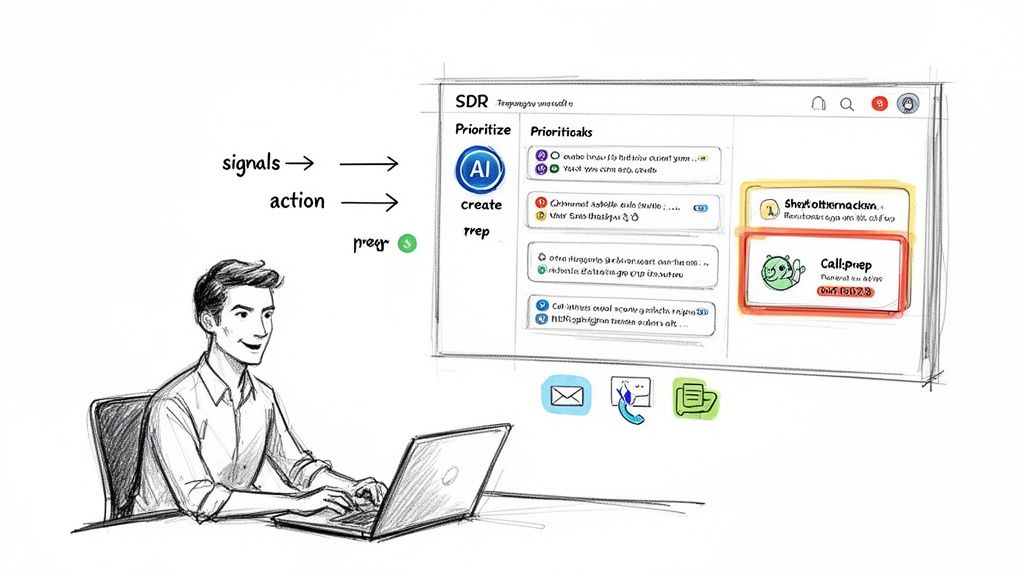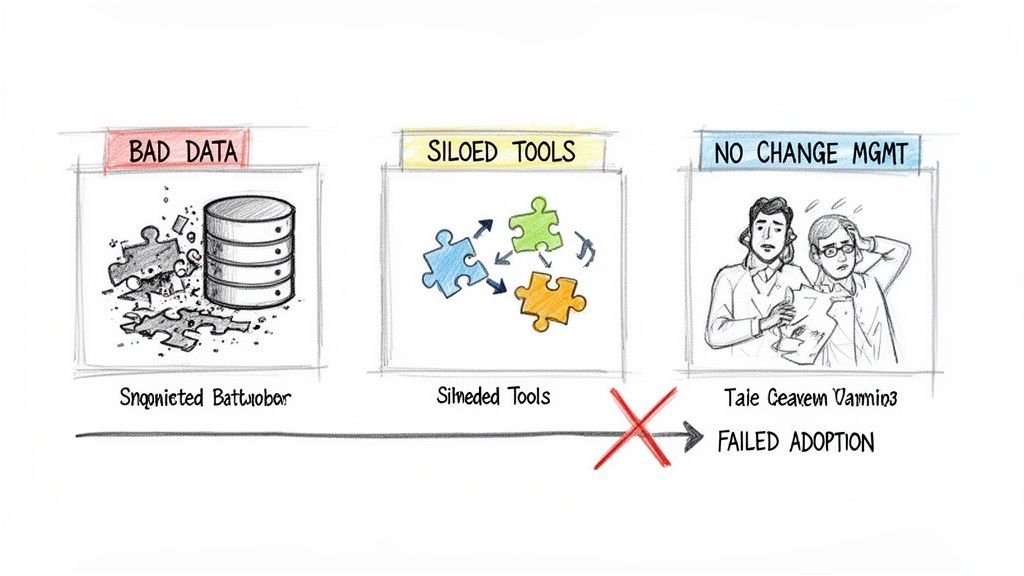
3 posts tagged with "ai in marketing"

View All Tags

Top AI Marketing Automation Tools to Boost Your Business

· 25 min read

Picture this: your marketing team is drowning. They’re swamped with manual tasks, trying to make sense of data from a dozen disconnected systems, and their attempts at "personalization" feel clumsy and generic. It's a common story, and it’s exhausting.

This is exactly the problem AI marketing automation tools are built to solve. Think of them less as software and more as a strategic partner—one that doesn't just execute tasks but actually learns, predicts, and adapts in real-time.

Welcome to the New Era of Smart Marketing

Traditional marketing automation is a lot like a pre-programmed robot on an assembly line. It’s reliable and efficient at doing the same thing over and over based on fixed rules. Someone signs up, they get a welcome email. Simple, useful, but incredibly limited.

AI marketing automation, on the other hand, is like a master craftsman who hones their technique with every single interaction. It takes the "automation" part (the system that sends emails or posts on social media) and bolts on an "artificial intelligence" brain to make every action smarter. This guide will cut through the noise and give you a practical playbook for putting these platforms to work.

From Manual Effort to Automated Success

The real shift here is in the decision-making. Instead of relying on rigid "if this, then that" logic, AI brings predictive analysis and machine learning into the mix. This lets the system make intelligent choices on the fly, turning a static workflow into a dynamic marketing engine that responds to customers as individuals.

The true power of AI in marketing isn't just about doing things faster. It's about turning a mountain of data into a single, decisive action. It’s the difference between following a paper map and using a GPS that reroutes you around traffic you can't even see yet.

This isn’t just a passing trend; it's a fundamental change in how businesses connect with people. And the market is moving fast. The AI marketing space is on track to hit $40 billion by the end of 2025—doubling from $20 billion in 2022. That growth is being driven by small and mid-sized businesses, which are cranking up their AI investments by 25% every year. You can dig deeper into what these marketing trends mean for the industry.

Why This Evolution Matters

Getting on board with AI automation isn't just about keeping up; it’s about gaining a serious competitive advantage. It tackles real, tangible problems that have been holding marketing teams back for years.

  • Solving Data Overload: AI can sift through oceans of customer data to spot meaningful patterns that a human team could never hope to find manually.
  • Enabling True Personalization: It’s about more than just slotting a first name into an email. We’re talking about dynamically changing your website content for every single visitor.
  • Boosting Team Efficiency: By taking over the repetitive analytics and grunt work, it frees up your team to focus on what they do best: high-level strategy and creative thinking.

This guide will show you exactly how these tools solve these problems, turning raw data into smart decisions and manual effort into automated success. It's all about connecting with customers in a more meaningful way.

What Exactly Are AI Marketing Automation Tools?

Image

To really get what makes AI marketing automation tools a big deal, you first have to understand what they aren't. They aren't just a faster, shinier version of the software you’re already using. This is a fundamental change in how marketing decisions get made.

Let's try a simple analogy. Think of your standard marketing automation as a basic sprinkler system you set with a timer. You program it to turn on at 7 AM every day, and it waters the whole lawn—rain or shine. It follows the command perfectly, but it’s completely rigid and has zero awareness of what's actually happening.

An AI marketing automation tool, on the other hand, is like a smart irrigation system. It has sensors in the soil checking for moisture, it pulls the local weather forecast, and it learns over time which spots in the yard need more water than others. It only waters when and where it’s needed, constantly adjusting its plan for the best possible result.

Moving Beyond Simple Rules

That jump from rigid to responsive is the heart of the matter. Traditional automation runs on simple, pre-written rules: "if this happens, then do that."

IF a user downloads our new ebook, THEN send them this specific 3-part email sequence.

It’s a linear, predictable workflow. And while it’s fine for basic tasks, it can’t adapt when a user does something unexpected or shows a subtle hint they’re ready to buy. It treats every single person who downloads that ebook exactly the same, which is a massive missed opportunity.

AI-powered platforms break out of that box by blending two key components:

  • Marketing Automation: This is the engine. It's the part of the system that actually does the work—sending emails, scheduling social posts, or managing ad campaigns.
  • Artificial Intelligence: This is the brain. It's the smart layer that analyzes data, spots patterns, and makes predictions to guide what the engine does next.

By folding in machine learning and predictive analytics, these tools can make sense of huge amounts of data—website clicks, email opens, purchase history, even social media comments. The goal isn't just to see what a customer did, but to predict what they’re likely to do next.

A Practical Comparison

Let’s put this into a real-world context to see how each system would handle a common marketing scenario.

ScenarioTraditional Automation ApproachAI-Powered Automation Approach
A User Visits a Pricing PageTriggers a generic follow-up email with a discount or a link to book a demo. Every single visitor gets the same message.Analyzes the visitor's entire history, scores their likelihood to buy, and triggers a specific action based on that score. A high-intent lead might get a personal email from a sales rep, while a low-intent browser sees a targeted ad on social media a few hours later.
Managing Ad SpendSpends a fixed budget across pre-defined audiences. To make any changes, a human marketer has to manually dig through performance data and shift the money around.Constantly monitors campaign performance in real-time. It automatically pulls budget from underperforming ads and pushes it toward the ones driving the highest ROI, often discovering valuable new audience segments all on its own.
Email NurturingA new lead gets a fixed, 5-email welcome series sent over two weeks, regardless of their actions.The AI dynamically adjusts the nurture sequence. If a lead clicks on a case study about a specific feature, the next email automatically focuses on that feature's benefits. If they don't open two emails, the system might pause the cadence and try re-engaging them on another channel.

At the end of the day, AI marketing automation tools change the game from a static set of rules into a dynamic, learning system. Instead of just running the playbook you wrote, they help you write a new, more effective one for every single customer, every single time. This is what lets marketers move from just managing campaigns to orchestrating intelligent, self-tuning customer journeys.

What AI Marketing Platforms Can Actually Do

If traditional automation is like a script—following a fixed set of "if-then" rules—then AI marketing automation tools are like improv actors. They learn, adapt, and react in real-time. They’re built with a set of core capabilities that change marketing from a series of rigid commands into a dynamic, intelligent conversation with your customers.

These aren't just minor upgrades. They represent a fundamental shift in how we can understand and interact with people. Instead of just reacting to triggers, these platforms start to anticipate needs, delivering experiences that feel genuinely personal.

Let's break down the most impactful capabilities you'll find under the hood.

Predictive Lead Scoring

In a standard system, lead scoring is simple math. Open an email? +5 points. Visit the pricing page? +10 points. It's a decent start, but it's a blunt instrument. It treats every action as if it has the same weight and misses all the nuance.

Predictive lead scoring, on the other hand, is more like a seasoned detective. An AI model sifts through thousands of data points all at once—company info, behavioral patterns, on-site engagement, and historical conversion data from customers who look just like your new lead. It doesn't just count the actions; it understands the pattern of actions that screams "this person is ready to buy."

For example, the AI might discover that prospects who download a specific whitepaper and then watch a demo video within 24 hours have a 90% higher conversion rate. It instantly flags these high-intent leads for your sales team, so they can stop chasing cold trails and focus their energy where it counts.

Hyper-Personalization at Scale

Basic personalization usually stops at dropping a {{first_name}} into an email subject line. Hyper-personalization powered by AI goes miles deeper. It gives platforms the ability to dynamically change website content, product recommendations, and special offers for every single visitor based on their real-time behavior.

Think about an e-commerce store. A brand-new visitor might see a homepage highlighting the overall best-sellers. But a returning customer who spent ten minutes browsing hiking boots last week? They’ll see a homepage featuring new outdoor gear and maybe a blog post about the "Top 5 Trails to Hike This Fall."

This isn't based on a handful of pre-set rules. It’s a fluid, one-to-one journey that changes with every click, which is a proven way to boost engagement and, ultimately, sales.

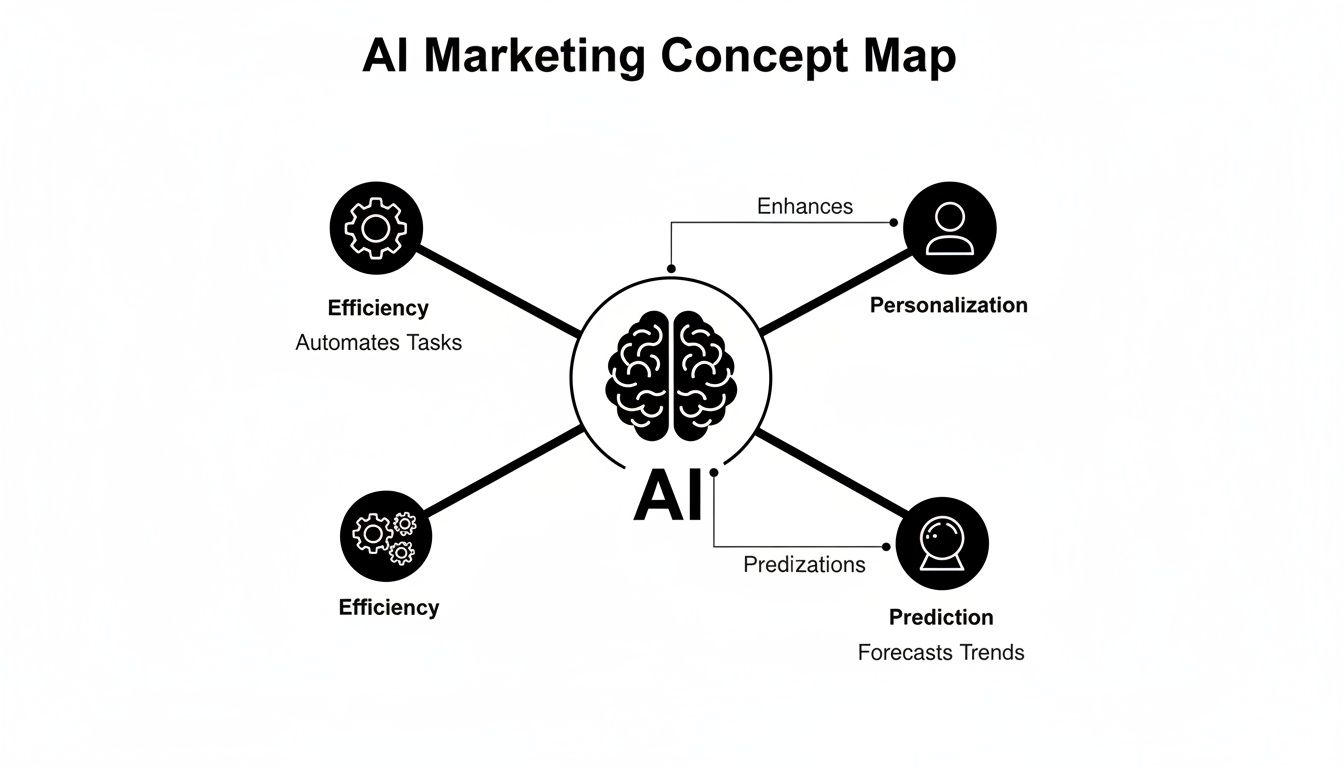
This image breaks down how these AI capabilities branch out into the marketing disciplines you already know.

Image

As you can see, core functions like email, social media, and advertising are all supercharged by the intelligent features we're talking about.

AI-Powered Content Generation

Let's be honest: content creation can be a massive bottleneck. AI helps break through that logjam by lending a hand with everything from brainstorming ideas to polishing the final copy. These tools can generate topic ideas based on what's trending, draft a dozen social media posts, create compelling ad copy variations, and even outline entire blog posts for you.

The goal here isn't to replace human creativity. It's to augment it. AI can handle the repetitive, formulaic parts of writing, freeing up marketers to focus on strategy, storytelling, and adding that human touch that truly makes a message connect.

By analyzing what's already working, these systems can even suggest headlines and article structures that are likely to resonate with your audience. To see how this really works, you can get a better sense of how to use AI content analysis to sharpen your strategy.

Intelligent Customer Segmentation

Traditional segmentation is a rearview-mirror approach. It groups customers based on what they've already done or on static info like their age or location. It's useful, but it's not forward-looking. AI introduces predictive segmentation, which groups audiences based on what they're likely to do next.

An AI model can spot a group of customers who are at high risk of churning long before they hit the "unsubscribe" button. It can also identify "lookalike" audiences of your best customers, finding new prospects who share subtle behavioral traits with the people who already love your product. This lets you run proactive retention campaigns and find new customers with startling efficiency.

Traditional Automation vs AI-Powered Automation

To really grasp the leap these tools represent, it helps to see a side-by-side comparison. The table below lays out the difference between what standard automation can do and what AI-powered platforms bring to the table.

FeatureTraditional AutomationAI-Powered Automation
Lead ScoringRelies on manual, point-based rules that treat most actions equally.Uses machine learning to analyze thousands of data points and predict conversion likelihood.
PersonalizationLimited to basic merge tags (like first name) and simple segmentation rules.Delivers dynamic, 1-to-1 experiences by altering content in real time based on user behavior.
SegmentationGroups audiences based on past actions and static demographic data.Creates predictive segments based on likely future behavior, such as churn risk or purchase intent.
Content CreationRequires 100% manual effort for brainstorming, drafting, and optimizing copy.Assists with ideation, generates drafts for ads and social media, and suggests optimizations.
OptimizationDepends on manual A/B testing and analysis performed by a human marketer.Automatically runs micro-tests, reallocates ad budgets, and optimizes campaign elements in real time.

When you put these capabilities together, you don't just get a more efficient marketing department. You get a smarter, more responsive engine for building real, meaningful relationships with your customers.

Measuring the Tangible Business Benefits

It's one thing to hear about flashy features like predictive analytics and hyper-personalization. It's another thing entirely to see how they actually move the needle. Let's get past the buzzwords and talk about what AI marketing automation tools do for your bottom line.

The real goal here is to build a rock-solid financial case for bringing one of these platforms into your world.

Image

These tools aren't just about doing things faster; they’re about doing things smarter. They draw a straight line from every marketing action to a result you can actually count—whether that’s saving time, making customers happier, or just plain growing revenue. That's how a marketing department stops being a cost center and starts becoming a predictable growth engine.

Increased Efficiency and Productivity

One of the first things you'll notice is that your team suddenly has more time. I mean, a lot more time. AI automation grabs all the repetitive, soul-crushing tasks that eat up hundreds of hours a month, freeing up your best people to think, create, and strategize.

Think about the old way of doing things. The manual A/B testing, the tedious audience segmentation, the late nights pulling performance reports. An AI tool can run thousands of micro-tests at once, find the perfect audience segments on its own, and spit out insightful reports in seconds. This isn't just a small step up; it's a total game-changer for your team's capacity.

Here’s how to make that tangible:

  • Actionable Step: For one week, ask your team to track time spent on manual data tasks (e.g., pulling reports, segmenting lists, A/B test setup). Multiply that weekly number by 52. This is the annual hour-cost you can directly reduce with an AI tool, creating a powerful ROI metric based on salary savings alone.

That saved time is a direct return on your team's salary. It lets your sharpest minds focus on innovation instead of administration.

Enhanced Customer Experience

A better customer experience isn't some fuzzy, feel-good metric. It's a direct line to revenue. When AI drives personalization, it creates a journey for each customer that actually feels relevant and engaging. And that has a clear, proven link to loyalty and lifetime value (LTV).

So, instead of blasting a generic "You left something behind!" email to every abandoned cart, an AI can figure out the right next step. A high-value customer might get a personal follow-up from a support agent. A price-sensitive shopper might get a unique, limited-time offer on the exact product they were eyeing.

This is the big shift: you move from broadcasting generic messages to having meaningful, one-to-one conversations at scale. That's what builds real brand affinity and turns one-time buyers into your biggest fans.

You can measure this impact directly with hard numbers:

  • Higher Engagement Rates: Personalized content gets more opens, more clicks, and more interaction. Period.
  • Increased Customer LTV: Relevant experiences keep people coming back, buying more, and churning less.
  • Improved Net Promoter Score (NPS): Customers who feel like you "get" them are far more likely to recommend you to others.

Improved Marketing ROI and Revenue Growth

At the end of the day, this is what it's all about: a stronger return on investment (ROI) and faster revenue growth. Predictive analytics lets you put your budget where it will have the biggest impact. The system can automatically pull ad spend from channels that are lagging and push it toward campaigns that are converting like crazy.

The result is a huge reduction in wasted ad spend and much more effective campaigns across the board. There's a reason AI-powered marketing automation has become a must-have. As of 2025, 91% of decision-makers see a growing demand for automation, and 77% of marketers are already using AI for personalized content.

The numbers back it up: businesses are seeing an average return of $5.44 for every $1 invested in this tech. If you want to dig deeper, these marketing automation statistics and their impact paint a very clear picture.

By connecting every feature to a financial outcome, you can show exactly how these tools pay for themselves and drive sustainable growth for the business.

How to Choose the Right AI Marketing Tool

With so many powerful AI marketing automation tools out there, picking the one that will actually move the needle for your business can feel overwhelming. But here’s the secret: you aren't looking for the "best" platform. You're looking for the best platform for you.

A structured, methodical approach can turn a complex decision into a series of manageable steps. This framework is designed to help you cut through the marketing fluff and evaluate tools based on what you actually need. The goal is to invest in a tool that becomes the engine of your growth, not just another line item on your credit card statement.

Audit Your Current Stack and Goals

Before you even think about booking a demo, you need to look inward. This is the most critical step. Jumping into vendor conversations without this clarity is like going to the grocery store hungry without a list—you’ll end up with a cart full of things you don’t really need.

First, map out your current marketing tech stack. What CRM, analytics platforms, and content management systems are you using? This exercise will immediately define your non-negotiable integration requirements.

Next, get brutally honest about the specific, measurable problems you need this new tool to solve. Are you drowning in low-quality leads? Is your team wasting hours on manual campaign setup? Do you lack the ability to truly personalize customer journeys at scale?

Frame these problems as concrete goals.

  • Bad Goal: "We need to get better at personalization."
  • Good Goal: "We need to increase customer lifetime value by 15% by delivering AI-driven product recommendations in our email campaigns."

This kind of specificity acts as your compass, keeping you on track through the entire selection process.

Evaluate Core Features and Integrations

Once you know your goals, you can start digging into features. It’s easy to get distracted by flashy AI capabilities, but you have to stay focused on the functions that directly solve your problems. Create a simple checklist that separates your "must-haves" from your "nice-to-haves."

  • Actionable Step: Create a comparison scorecard. List your top 3-5 potential tools in columns. In the rows, list your "must-have" features (e.g., predictive lead scoring, native Salesforce integration, AI ad copy generator). Score each tool from 1 to 5 on each feature. This creates an objective visual comparison instead of relying on memory from demos.

If improving lead quality is your primary goal, then predictive lead scoring becomes a must-have. You can get a deeper look into how AI-powered lead scoring works to understand how it could plug into your current process.

Integrations are just as important—maybe even more so. An AI tool that doesn’t talk to your existing systems, especially your CRM, will create more work than it saves. You'll end up with data silos and manual exports, completely defeating the purpose of automation.

Verify that the tool offers native, well-documented integrations with your core platforms. Don't just take the salesperson's word for it—ask for technical documentation or customer case studies that prove the integration works in the real world.

User review sites like G2 can give you a quick lay of the land.

This kind of grid is great for quickly comparing user satisfaction and market presence, but treat it as just one data point in your broader research.

Assess Scalability for Future Growth

The tool you choose today has to support your business two, three, or even five years from now. Think about where you're headed. Will your contact list double in the next 18 months? Are you planning to expand into new markets or launch new product lines?

Scalability isn't just about handling more data; it's about the platform's ability to evolve with you.

  • Pricing Tiers: Does the pricing model get crazy expensive as your database grows?
  • Feature Roadmap: What's on the vendor's roadmap? Does their vision for the future of AI in marketing align with where you want to go?
  • Support: As your needs become more complex, will the level of support you receive scale accordingly?

Picking a platform that can't scale with you means you'll be facing a painful migration down the road—a project far more costly and disruptive than making the right choice upfront.

Analyze the Total Cost of Ownership

Finally, look beyond the monthly subscription fee. The sticker price is rarely the whole story. The Total Cost of Ownership (TCO) includes all the hidden and associated costs required to actually get value from the tool. For those exploring options, a solid breakdown of the best marketing automation tools for e-commerce can shed some light on different pricing models.

To calculate the real cost, you need to factor in:

  1. Implementation Fees: Are there one-time setup or mandatory onboarding costs?
  2. Training Costs: Will your team need specialized training to use the platform effectively?
  3. Support Packages: Is premium support an extra fee, or is it included?
  4. Integration Costs: Will any of your must-have integrations require custom development or third-party connectors?
  5. Internal Resources: How much of your team's time will be dedicated to managing and running the platform?

Taking this complete view of the costs will help you make a financially sound decision that lines up with your budget and truly sets your team up for success.

An Actionable Plan for Successful Implementation

Image

So you've bought one of the top AI marketing automation tools. Great. But the real work starts now. Getting a real return on that investment isn't about the purchase—it's about a smart, well-planned rollout. Get this right, and your new software becomes a core part of your growth engine, not just another line item on the budget.

This roadmap will walk you through the process, making sure your team actually adopts the tech and gets the most out of it from day one. Avoiding the common screw-ups is just as important as following the rules.

Prepare and Cleanse Your Data

First things first: your data. Before you even think about importing a single contact, you have to get your data house in order. An AI is only as smart as the information it learns from. Feeding it messy, incomplete, or outdated data is like trying to cook a gourmet meal with rotten ingredients. It just won't work.

  • Actionable Step: Use a spreadsheet to perform a data audit. Pull a sample of 1,000 contacts from your database. Create columns for "Duplicate?", "Missing Key Info (e.g., job title)?", and "Standardized Format?". This gives you a tangible percentage of bad data to fix and a benchmark to measure against.

This cleanup job ensures your AI starts learning from a clean slate. The result? More accurate predictions, better personalization, and a foundation that pays you back for the entire life of the tool.

Launch a Focused Pilot Project

Don't try to boil the ocean with a company-wide, "big bang" launch. That's a recipe for chaos. Instead, start small with a focused pilot project. This approach lowers the risk and gives your team a safe space to learn the platform. Pick one specific campaign or workflow to test out the new tool.

A successful pilot project builds crucial momentum. It creates internal champions who have seen the benefits firsthand and can help drive broader adoption across the organization.

  • Actionable Step: Choose a pilot that is low-risk but high-impact. A good example is an AI-powered email subject line optimizer for your next newsletter. It's easy to implement, simple to measure (open rates vs. your baseline), and provides a quick, visible win for the team. To really nail this, it pays to dive into some core marketing automation best practices for extra guidance.

Train Your Team to Drive Adoption

A tool is useless if nobody uses it. But effective training is about more than showing people where to click. It's about explaining the "why" behind the new system. Show them how it will make their jobs easier, kill off repetitive tasks, and help them hit their numbers faster.

You need to connect the tool's features directly to their daily headaches. For the content team, show them how AI can smash through writer's block. For the demand gen folks, demonstrate how automated sequences mean they’ll never miss a follow-up again and can boost response rates.

Define Clear KPIs to Measure Success

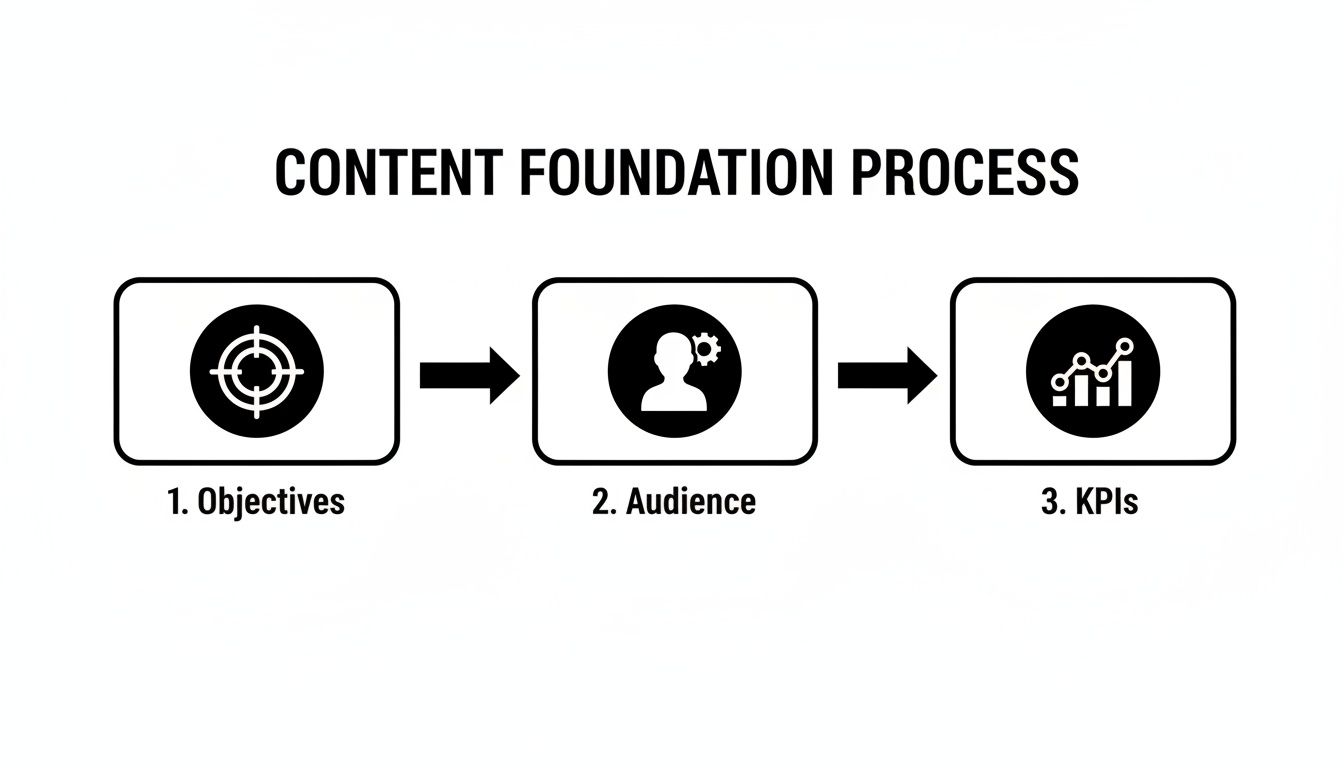
Last but not least, you need to know what winning looks like before you start. Define your Key Performance Indicators (KPIs) from the get-go. These metrics should tie directly back to the business goals you had when you started looking for a tool in the first place.

Your KPIs might look something like this:

  • Increase marketing-qualified leads (MQLs) by 20%.
  • Cut down time spent on manual reporting by 10 hours per week.
  • Improve email campaign click-through rates by 15%.

Tracking these numbers gives you cold, hard proof of the tool's impact. It’s how you justify the investment and show everyone that this wasn't just another shiny object.

Got Questions About AI Marketing? We've Got Answers.

Jumping into AI marketing automation tools always stirs up a few good questions. It's smart to have clear answers before you move forward. Here’s a quick rundown of what we hear most often from marketing leaders.

Will AI Marketing Tools Replace Our Marketing Team?

Nope. Think of it this way: you're not replacing a skilled carpenter, you're just upgrading them from a handsaw to a full set of power tools. That's what AI does for your team. It handles the heavy lifting—sifting through mountains of data, automating repetitive tasks, and spotting patterns a human just can't see at that scale.

  • Comparison: A human marketer can maybe review 5-10 campaign variables to decide what worked. An AI can analyze 5,000 variables in seconds to find hidden correlations, like how the time of day combined with a specific customer segment affects conversion rates on weekends.

This frees your people up to do what they're truly great at: strategy, creativity, and relationships.

How Much Data Do We Need to Get Started?

Less than you probably think. While a massive, perfectly organized dataset is nice to have, it's not a must-have. Most modern AI platforms can start delivering value with a moderate amount of customer information.

What really matters is data quality over sheer quantity. A smaller, clean dataset is infinitely more valuable than a huge, messy one.

The best tools are designed to learn on the fly. They start with what you give them and get smarter with every single customer interaction they process. The key is to just start with the clean data you have and let the system grow alongside your business.

Are These Tools Difficult to Implement and Use?

The learning curve isn't what it used to be. The days of clunky, year-long enterprise software rollouts are fading. Today's top vendors get that usability is everything, so they’re building tools with intuitive interfaces and guided onboarding.

The smartest way to get going is to start small. Don't try to boil the ocean.

  • Actionable Step: During the sales process, ask for access to a sandbox or trial environment. Have the team members who will actually use the tool day-to-day spend an hour trying to build a simple workflow. Their direct feedback is more valuable than any sales pitch.

Launch a focused pilot project—maybe an AI-powered email campaign for just one customer segment. This lets your team learn the ropes in a low-pressure environment, build confidence, and prove the value before you go all-in.


Ready to see how a single AI platform can pull it all together for your business? marketbetter.ai combines content generation, campaign optimization, and deep personalization into one powerful engine. Get a demo today and start making smarter marketing decisions.

How to Scale Content Marketing Effectively in 2024

· 23 min read

Trying to scale content marketing without a system is like trying to build an assembly line after the factory is already running. It's pure chaos. Before you can hit the gas, you have to build a repeatable blueprint for how your content gets made.

This means getting serious about auditing what you have, defining exactly what you sound like, and standardizing how you create everything. Skip this, and you’ll just be producing inconsistent, off-brand content faster than ever before.

Build Your Content Operations Blueprint

Image

Before you can accelerate, you have to engineer the vehicle. Scaling content isn't just about writing more articles. It’s about building a predictable system that can handle more volume without sacrificing the quality that got you here in the first place. This is what stops your brand voice from getting diluted and your messaging from going off the rails.

Think of it as the difference between a one-off custom project and a true production line. A single handcrafted piece is great, but you can't make a thousand of them efficiently. A production line, on the other hand, uses standardized processes and quality checks to get consistent, high-quality results at scale. Your content operations blueprint is that production line.

Start with a Ruthless Content Audit

First things first: you need to know what’s actually working. A real content audit isn't just a spreadsheet of blog posts. It’s a strategic deep dive to find your winners and, just as critically, the pieces that are draining your resources. Don't just look at page views.

Instead, slice up your data and look for patterns that tell a story:

  • High Traffic, Low Conversion: These posts get eyeballs but don't convince anyone to act. Action: Your job is to turn these into converters. Test new CTAs, embed a relevant webinar signup form, or add a lead magnet like a downloadable checklist.
  • Low Traffic, High Conversion: These are your hidden gems. They hit a nerve with a specific audience. Action: Don't just let them sit there. Build a content cluster around the core topic and use paid ads to drive targeted traffic directly to these high-performing pages.
  • High Traffic, High Engagement: These are your pillars. They're the foundation of your strategy. Action: Squeeze every drop of value from them by repurposing them into videos, webinars, and social content. This is your low-hanging fruit for scaling distribution.

By focusing on performance data, you move from guessing what your audience wants to knowing what drives results. This audit informs every future content decision, ensuring your scaled efforts are focused on proven winners, not just producing more noise. To dive deeper into this process, learn how to perform a comprehensive, AI-assisted content analysis to uncover these critical insights faster.

Establish Your Central Source of Truth

The moment you bring on more writers, freelancers, or AI tools, brand consistency becomes your biggest battle. The only way to win is with a centralized style guide. This isn't just a dusty document with grammar rules; it's the bible of your brand's personality.

A style guide is static, but a "source of truth" is a living, breathing resource your whole team uses and contributes to daily. It ensures that everyone—from a new hire to a seasoned writer—is speaking with one unified voice.

Your source of truth absolutely must include:

  • Tone and Voice Guidelines: Don't just say "be friendly." Compare it. Action: Provide "Say this, not that" examples. For instance, "Say: 'Here’s a quick way to solve this...' Not: 'In order to ameliorate this issue, one must...'"
  • Formatting Rules: Get specific on how to use headings, lists, bold text, and blockquotes for visual consistency.
  • Brand-Specific Terminology: List out all your product names, key features, and industry terms with the correct spelling and capitalization. No excuses.

Create Actionable Templates for Briefs and Workflows

Finally, you have to standardize the creation process itself. Ambiguity is the enemy of scale. Good templates for content briefs and workflows eliminate the guesswork and create a repeatable system that anyone can step into and execute.

A well-structured content brief template should be the non-negotiable starting point for every single piece of content. It’s the contract between the strategist and the creator, guaranteeing alignment before a single word is written. Action: Your brief should include required fields like Primary Keyword, Target Persona, Key Talking Points, Competitor Articles to Beat, Internal Linking Targets, and a Crystal-Clear Call-to-Action.

This systematic approach turns your content creation from an art form into a science, making it possible to ramp up volume while maintaining the high standards your audience expects.

Systemize Your Content Creation Engine

Image

This graphic lays out the high-level flow, showing how a proper system moves from topic planning and creation right through to automated distribution. This is the foundation for creating great content without the chaos.

Once you have your operational blueprint, the real work begins: engineering a predictable production line. Scaling isn’t about brute force—just grinding out more hours. It’s about building a smooth, repeatable engine that turns ideas into published assets with as little friction as possible.

The goal here is to get away from the frantic, ad-hoc scramble and build a system where every stage is defined. You can find some excellent frameworks in this ultimate content creation workflow guide to help make this transition. It’s how you turn content creation into a reliable, high-output machine.

Build a Multi-Source Ideation Process

Great content ideas are discovered, not invented on the spot. A scalable ideation process is one that consistently surfaces high-potential topics by tapping into different data streams across your entire business. If you only rely on keyword research tools, you'll end up writing about the same tired topics as everyone else.

To build a more resilient system, you need to blend your sources:

  • SEO Data: Of course, you’ll use tools to find keywords with good search volume and low competition. But go deeper. Look for question-based queries and the "People Also Ask" sections. These are direct pipelines into your audience's head.
  • Customer Support Tickets: Your support team is sitting on a goldmine of real-world customer problems. Action: Set up a shared Slack channel or a simple form where support reps can submit recurring customer questions that could be turned into content.
  • Sales Team Feedback: What objections or questions pop up constantly on sales calls? Answering these with content doesn't just help your audience; it arms your sales team with killer assets to close more deals.

This approach ensures your content is not only optimized for search but is also deeply relevant to what your audience actually needs right now. That's a powerful combo.

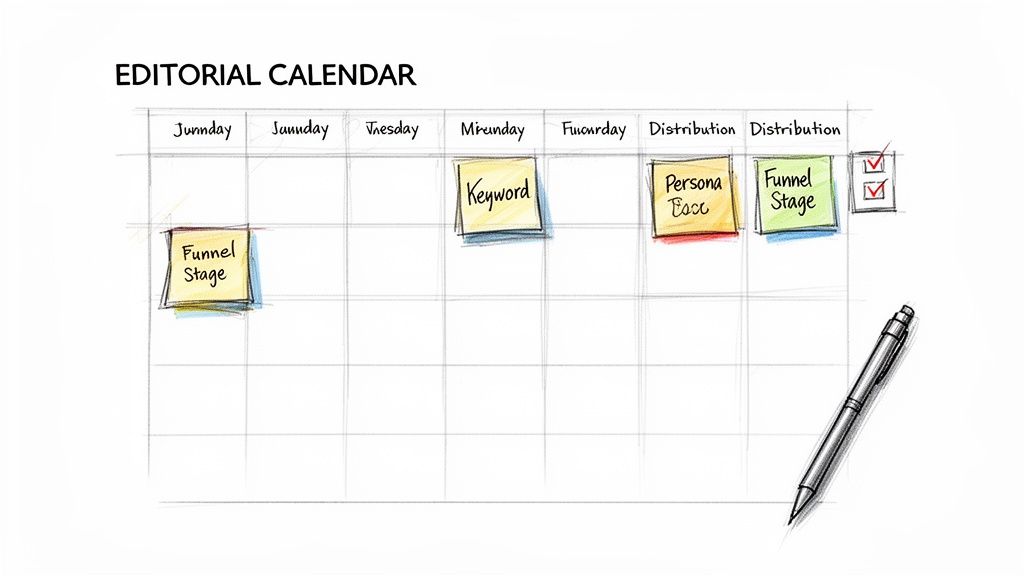
Turn Your Calendar Into a Command Center

A content calendar should be way more than a list of due dates. When you use it right, it becomes the command center for your entire operation, tying every single piece of content back to a specific business goal.

An effective, scalable calendar maps out the critical details:

  • Content Title and Format: What is it? A blog post, a video, a case study?
  • Target Persona: Who is this for? Be specific.
  • Funnel Stage: Is this for top-of-funnel awareness, mid-funnel consideration, or bottom-funnel decision-making?
  • Primary Keyword: What's the main SEO target?
  • Business Goal: What are we trying to achieve? Generate leads, build topical authority, support a product launch?

This level of detail stops you from creating content just for the sake of it. Instead, every asset becomes a deliberate move designed to get a measurable result.

The real challenge of scaling isn't just about creating more; it's about putting your resources toward the right creative work. This is how you solve that bottleneck.

Even with bigger budgets, a shocking 66.5% of marketers still struggle with resource allocation. This stat shows that throwing money at the problem doesn't work. Without a system for your people and processes, growth will always feel just out of reach.

Compare Team Building Models In-House vs Freelancers

As you grow, you're going to need more hands on deck. The two main paths are expanding your in-house team or building a network of trusted freelancers. Each has its own pros and cons, and the right choice often depends on where you are in your growth journey.

This decision is about more than just cost. You're balancing control, flexibility, and access to specialized expertise.

Scaling Your Team In-House vs Freelancers

Here’s a breakdown of how the two models stack up when you're trying to scale your content engine.

FactorIn-House TeamFreelance Network
Cost StructureFixed salaries, benefits, and overhead. A bigger upfront investment.Variable, project-based fees. Much lower initial cost.
ScalabilitySlower to scale up or down. Hiring and firing takes time and resources.Extremely flexible. You can easily ramp production up or down on demand.
Brand ImmersionThey live and breathe your company culture and brand voice every single day.Needs solid onboarding and crystal-clear style guides to maintain consistency.
ExpertiseDevelops deep knowledge of your specific product and market over time.Gives you access to a wide bench of niche specialists (e.g., technical writers, videographers).
Best ForCore strategic content and roles where deep institutional knowledge is critical.Specialized projects, filling knowledge gaps, and handling spikes in workload.

Many of the most successful content teams I've seen use a hybrid model. They keep a core in-house team for strategy and brand-defining content, then lean on a network of vetted freelancers for specialized tasks and to manage overflow. This approach often strikes the perfect balance of stability and flexibility you need to grow without breaking the bank.

Use AI and Automation to Amplify Output

Image

This kind of interface is designed to centralize and speed up the creation process, letting you turn one core idea into dozens of assets. When you embed AI into your workflow, you’re not just producing content linearly anymore—you're creating it exponentially. That's the secret to scaling content marketing that actually works.

Beyond the First Draft AI Use Cases

If you're only using AI to crank out first drafts, you're missing 90% of its power. It’s like using a supercomputer to do basic math. The real magic happens when you weave AI and automation into the repetitive, time-sucking parts of your content workflow.

This approach frees up your team to focus on what they do best: strategy, storytelling, and adding that final human polish that no machine can replicate.

Think about it this way: a single long-form blog post isn't just one piece of content. It's a goldmine.

Instead of your team manually hacking together social posts, AI can:

  • Spin up 10 different tweet variations from a single key paragraph.
  • Outline a 5-slide LinkedIn carousel based on your article's H2s.
  • Draft three distinct email newsletter snippets targeting different segments of your audience.

This isn't about replacing your writers; it's about giving them superpowers. To really get this right, you need to understand the fundamentals of what is content automation and how it uses AI to make your entire process smoother and more personalized.

Choosing Your AI and Automation Stack

Your tech stack is the engine that drives all this, but let's be honest—not all tools are created equal. The trick is to pick platforms that solve specific bottlenecks in your process, not just collect shiny objects.

Let's break down a couple of critical categories for any modern content team.

AI for Ideation and Optimization

This is where you front-load your content with data to make sure it actually performs. SEO optimization tools use AI to analyze what's already ranking and build data-driven outlines in minutes. That's a task that would take a human researcher hours of manual SERP-scrolling.

Tool CategoryClearscopeSurferSEO
Primary Use CaseBuilding comprehensive, data-driven content briefs and grading drafts.Real-time content editor with SERP analysis and keyword suggestions.
Key StrengthExcellent for creating detailed outlines for writers to follow, ensuring topical authority.Strong for on-page optimization during the writing process itself.
Best ForTeams that rely on structured briefs and want to ensure every article is comprehensive.Writers who prefer interactive feedback and want to optimize as they create.

AI for Generation and Repurposing

These tools are your content multipliers. Once you have that core pillar post, generative AI platforms can atomize it into dozens of formats. This saves your team from the soul-crushing work of rewriting the same ideas for every single channel.

A lean team of two can take one well-researched article and, in less than an hour, use a tool like Jasper or Copy.ai to generate a full week's worth of promotional content. This is how you 5x your output without burning out your people. The human role shifts from repetitive typing to strategic editing and curation.

The Shift to a Human-in-the-Loop Model

The smartest way to scale with AI is to adopt a "human-in-the-loop" model. This isn’t about hitting a button and walking away; it's about smart augmentation.

Let the AI handle the grunt work—the initial research, the first drafts, the tedious repurposing. Your human experts then swoop in to provide the critical final touches.

Your team's unique voice, strategic insights, and deep customer empathy are your most valuable assets. AI should be used to free up their time to inject those elements into more content, not to replace them entirely.

This isn't some fringe idea; it's rapidly becoming the standard. Projections show that around 40% of B2B marketers plan to increase their spending on AI-powered content tools in the next year. They're not just trying to produce more stuff; they're aiming to create smarter, more targeted content at a scale that was impossible just a few years ago.

By automating the mundane, you unlock your team's true creative potential.

Engineer a Scalable Distribution Machine

Writing great content is only half the job. If your masterpiece just sits on your blog gathering digital dust, it's not actually doing anything. To really get a content engine humming, you have to ditch the whole "publish and pray" mindset. You need a distribution machine that works just as hard as your creation team.

This is what separates a one-off launch from a sustained campaign. A launch gives you a quick sugar rush of traffic. A distribution machine, on the other hand, makes sure every single article, case study, and guide delivers value long after you hit publish. It’s about making sure your hard work actually gets seen by the right people.

Turn One Asset into a Dozen

The fastest way to scale your distribution is to stop thinking of a blog post as a single thing. Think of it as raw material—the core ingredient for a dozen smaller, channel-specific pieces of content. One pillar post can easily fuel an entire week's worth of promotion across multiple platforms.

This whole approach is often called content atomization. It’s all about squeezing every last drop of ROI from the time you spent on the initial research and writing.

  • Video Scripts: Pull the key sections from your article and you've got a ready-made script for a short, punchy YouTube or TikTok video.
  • LinkedIn Carousels: Each H2 or major point in your post can become a slide in a slick, visual carousel that's perfect for a professional audience.
  • Email Newsletter Snippets: Grab the most interesting stat or takeaway and use it as the hook for your next email blast, driving your subscribers back to the full piece.
  • Quote Graphics: Turn the best one-liners or data points into shareable images for Instagram or X.

This isn't about creating more work; it's about working smarter. A small team can maintain a high-volume, multi-channel presence without having to invent something new every single day. For a real-world look at how this works, check out our case study on Helix Wireless to see the massive results a scaled content strategy can deliver.

Pick Your Outreach Levers: Influencers vs. Paid Ads

Once you have all these repurposed assets, you need a scalable way to get them in front of new eyeballs. Two of the most powerful ways to do this are influencer collaborations and targeted paid ads. They're very different, and knowing when to pull which lever is the key to getting the most out of your budget.

The goal of a distribution machine is to create multiple on-ramps to your core content. Whether someone discovers you through an influencer’s story, a targeted ad, or an organic search, all roads should lead back to the valuable asset you created.

Here’s a quick breakdown of how these two distribution tactics stack up.

Distribution TacticInfluencer CollaborationsPaid Amplification
Primary StrengthBuilds trust and credibility through authentic, third-party validation.Offers precise targeting, guaranteed reach, and predictable scalability.
Best ForReaching niche communities and generating genuine brand affinity.Driving immediate traffic, promoting time-sensitive offers, and retargeting warm leads.
Cost ModelVaries wildly from sending free product to five-figure fees. ROI can be harder to track directly.Pay-per-click or impression. Highly measurable and controllable spend.
ScalabilityCan be challenging; requires significant time for outreach and relationship building.Extremely scalable; just increase your budget to instantly reach a larger audience.

The best part? You don't have to choose one or the other. In fact, the most effective strategies usually blend both. You might run paid ads to guarantee reach for a big launch while partnering with a few key influencers to build long-term credibility in your industry.

The data backs this up. Looking ahead to 2025, 59% of marketers are planning to increase their use of influencer marketing, because they know it drives authentic engagement. That's critical, especially when you consider that 76% of users say social content has influenced a purchase decision. Digging into the latest digital marketing statistics can give you a real edge in planning your next move.

Measure and Optimize for Sustainable Growth

Image

As you start to scale, data stops being a helpful guide and becomes your most critical asset. Pumping out more content is just noise if you can’t tell what’s actually working. This is the point where your strategy has to shift from pure production to performance-driven optimization.

Why the sudden urgency? Efficiency. We already know that content marketing costs about 62% less than old-school outbound tactics while pulling in three times the leads. To keep that massive cost advantage as you grow, you have to constantly refine your approach with hard data. Every dollar and every hour needs to be invested wisely.

Build a Dashboard That Tracks What Matters

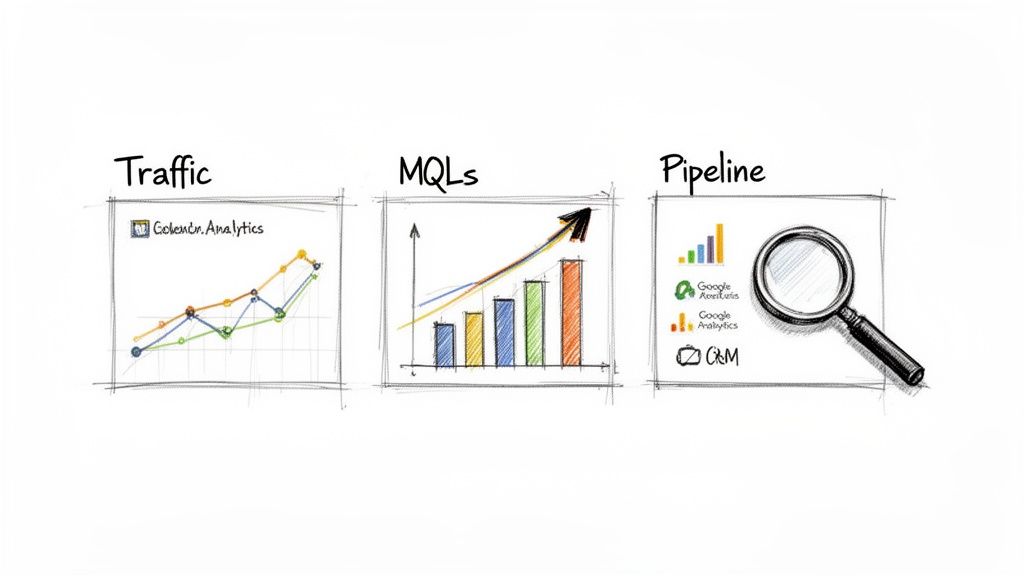
First things first: stop chasing vanity metrics. Pageviews and social shares feel good, but they don't pay the bills. A scalable content program measures success by its direct impact on the business. Your performance dashboard should be the single source of truth connecting your team's efforts to actual revenue.

This means you need to track the numbers your C-suite actually cares about.

  • Pipeline Influence: Which articles are prospects reading right before they enter the sales pipeline? Tools like HubSpot or Salesforce can connect these dots for you.
  • Content-Sourced Leads: How many people gave you their email address for an ebook or a webinar? This is a direct measurement of your content's power to generate leads.
  • Conversion Rate by Asset: Which specific blog posts or case studies are getting people to take the next step, like signing up for a trial or booking a demo?

When you focus on these KPIs, you can have much more meaningful conversations about ROI. You’re no longer just talking about traffic; you’re talking about tangible business value.

Implement a Systematic Content Refresh Program

You don’t have to create everything from scratch. Seriously, one of the most efficient ways to scale is to breathe new life into your existing content. A systematic refresh program turns your blog into a portfolio of assets that actually appreciate over time.

Instead of letting older posts collect dust, go find the ones with "good bones"—articles that still rank for a few keywords but have lost traffic or feel a bit dated.

An outdated but high-potential blog post is like a house with a solid foundation but a leaky roof. A strategic refresh fixes the issues, modernizes the interior, and dramatically increases its market value for a fraction of the cost of building new.

A proper refresh isn't just swapping out a few stats. It's a full overhaul. Action: Create a "Content Refresh Checklist" that includes: updating data and examples, optimizing for new secondary keywords, improving internal linking, upgrading visuals, and adding a new CTA. This ensures every refresh is thorough and effective.

Conduct Quarterly Performance Reviews

To make sure your scaled-up efforts are delivering compounding returns, you need a regular rhythm for strategic review. A quarterly performance review is the perfect time to zoom out from the daily grind and make smart, data-backed decisions.

This meeting isn't a data dump. It’s a strategy session to decide where to double down and what to cut loose.

Ask these action-oriented questions:

  1. What topics drove the most pipeline influence this quarter? Let's figure out how to build a whole content cluster around that theme and own the conversation.
  2. Which formats—videos, long-form guides, case studies—had the best engagement and conversion rates? We should probably put more resources there next quarter.
  3. What content completely flopped? Can we learn something from it, or should we just avoid that type of content moving forward?

This kind of rigorous, data-backed review is how you adapt and win. To keep improving, you can explore the best A/B testing tools for website optimization and make these data-driven decisions a core part of your growth strategy.

Common Questions on Scaling Content Marketing

As you start to really scale up your content marketing, some practical, in-the-weeds questions are going to pop up. Every team hits these bumps. Getting ahead of them is what separates the programs that grow from the ones that stall out.

Here are a few of the most common hurdles I've seen teams face, along with some straight-up advice on how to clear them.

How Do I Keep Our Brand Voice Consistent with More Writers?

This is the classic scaling challenge. You bring on more writers—in-house, freelance, agency—and suddenly your content starts to sound like it was written by a committee. The solution isn't a bigger, stricter style guide. The real answer is to evolve that static document into a living "source of truth."

A traditional style guide is all about rules: grammar, logo placement, approved fonts. A source of truth is about personality. It shows writers how to sound like you, with real examples.

From Static Rules to a Living Playbook

FeatureStatic Style GuideDynamic "Source of Truth"
FormatUsually a PDF that collects digital dust.A live, shared space like a Notion or Confluence page.
ContentFocuses on grammar, formatting, and technical rules.Includes rules, but adds brand personality examples, "say this/not that" scenarios, and approved phrases.
OutcomeWriters follow instructions but often miss the brand’s unique flavor.Writers get a real feel for the brand’s authentic voice and can replicate it consistently.

Here’s the key: make it a living resource. When a new blog post just nails your tone, drop a screenshot and a link into your source of truth. It becomes a practical, evolving playbook that helps everyone speak with one, unified voice.

What's the Right Budget for Scaling Content?

Forget trying to find a magic number. The best way to set a budget is to stop thinking about it as a cost and start treating it like an investment. Don't ask, "What can we afford?" Instead, ask, "What business outcome are we trying to drive?"

For instance, let’s get specific:

  • Work backward from your goal: If you need to generate 100 marketing-qualified leads (MQLs) this month, and you know from your data that your content converts visitors to leads at 2%, then the math is simple. You need 5,000 qualified visitors to hit your number. Your budget is whatever it costs to create and promote the content needed to attract those 5,000 people.

That’s a much stronger, more defensible approach than just picking a number out of thin air.

Your budget should be a direct reflection of your growth targets. When you tie content spend to concrete business goals like pipeline generation, it stops being an expense line item and becomes a predictable engine for growth.

Should I Use an AI Writer or a Human Writer?

This is probably the biggest question in content right now, but it's also the wrong one. The debate isn't "AI vs. human." The smart play is "AI and human."

The highest-performing content teams I know are all using a hybrid model. They let each side do what it does best. The real question is figuring out who gets which tasks.

  • AI is perfect for: The heavy-lifting and data-driven work. Think generating content outlines based on SERP analysis, turning one long-form article into ten social media posts, or drafting the first version of a straightforward, fact-based piece.

  • Human writers are essential for: The stuff that builds a real brand. High-level strategy, weaving in unique customer stories, conducting original interviews, and providing that final layer of polish that screams quality and authority.

AI handles the volume and the repetitive work, which frees up your human experts to focus on the high-impact, creative tasks that a machine simply can't do. We’ve seen this hybrid model produce incredible results; you can dig into some of our content marketing case studies to see how that balance drives real business impact.


Ready to stop guessing and start scaling with precision? marketbetter.ai integrates AI across your entire marketing workflow, from content creation to campaign optimization. See how our AI-powered platform can 5x your output and deliver measurable ROI. Get started with marketbetter.ai.

9 Content Marketing Best Practices for B2B Success in 2025

· 23 min read

In the crowded B2B marketplace, simply creating content is a losing strategy. The difference between content that drives pipeline and content that gets ignored lies in a sophisticated, data-driven approach. Generic advice no longer cuts it. Success requires moving past the foundational tactics and embracing a modern playbook designed for high-impact results. This guide bypasses the filler to deliver nine essential content marketing best practices tailored for today's B2B marketers who are accountable for proving ROI.

We will provide actionable strategies that combine deep audience understanding with precise execution. Instead of just telling you what to do, we'll show you how with direct comparisons, practical examples, and clear implementation steps for each practice. You'll learn how to transform your content from a simple checklist item into a powerful, results-oriented engine that builds authority and accelerates growth. For a comprehensive overview and updated strategies for the coming year, consider these 9 Content Marketing Best practices for 2025.

This listicle is structured to be a practical resource. Whether you're a demand generation manager looking to increase qualified leads, a CMO proving marketing's value, or an entrepreneur building a brand from scratch, these principles will serve as your roadmap. Each point is designed to help you refine your process, from planning and creation to distribution and measurement, ensuring your efforts translate directly to business outcomes. Let's dive into the strategies that will define high-performing content programs.

1. Know Your Audience Inside and Out

The foundation of all successful content marketing best practices is an unwavering, granular understanding of your audience. Moving beyond basic demographics is crucial. True audience intelligence involves creating detailed buyer personas that encompass psychographics, deep-seated pain points, and professional goals.

Comparison:

  • A common approach is creating a persona with basic demographics: "Marketing Manager, 30-40 years old, lives in North America."
  • An actionable, best-practice approach creates a persona with psychographics: "Ambitious Marketing Manager Maria, who feels overwhelmed by data and wants to prove her team's ROI to get a promotion. She listens to marketing podcasts during her commute and trusts recommendations from industry influencers on LinkedIn." This level of detail ensures every piece of content you create is relevant and precisely targeted.

Know Your Audience Inside and Out

Without this clarity, content creation becomes a guessing game. A company selling project management software, for example, might have two distinct personas: "Project Manager Paula," who is overwhelmed by administrative tasks and needs efficiency tools, and "CTO Charles," who is focused on team productivity metrics and software integration capabilities. Content for Paula would focus on time-saving templates, while content for Charles would highlight API documentation and ROI case studies.

How to Implement This Strategy

To build these actionable personas, combine qualitative and quantitative data.

  • Actionable Step: Conduct Interviews: Schedule 15-minute calls with 5 current customers and 5 ideal prospects. Ask: "What's the biggest challenge you're facing in your role right now?" and "Where do you go to find solutions to professional problems?" Use this direct language to build your personas.
  • Actionable Step: Analyze Data: Log into your website analytics. Identify the top 3 most-viewed blog posts and the top 3 pages where users spend the most time. These topics are clear indicators of what your audience values.
  • Actionable Step: Create Persona Documents: Use a simple template (plenty are free online) to formalize your findings. Give each persona a name, photo, and include direct quotes from your research. Update them quarterly to reflect new insights.

This deep research allows you to move from generic content to highly specific, problem-solving resources. Advanced techniques like person-level identification can further refine this process. You can discover more about using modern data techniques for precise audience targeting to elevate your strategy.

2. Create High-Quality, Original Content

At the core of all effective content marketing best practices is the commitment to creating high-quality, original content. This means moving beyond generic, rehashed articles and producing material that offers genuine value and unique insights.

Comparison:

  • A common approach is writing a "Top 5 Industry Trends" blog post by summarizing articles from other websites. This content is easy to create but offers no unique value and gets lost in the noise.
  • An actionable, best-practice approach is conducting your own survey of 100 industry professionals and publishing a "State of the Industry 2025" report with proprietary data. This original research becomes a valuable asset that attracts backlinks and establishes thought leadership.

Create High-Quality, Original Content

Without this focus on quality, content struggles to cut through the noise. A low-effort blog post summarizing obvious industry news does little to build trust. In contrast, a company like Moz built its authority with its "Whiteboard Friday" series, which offered deep, expert-level SEO education. Similarly, Buffer distinguished itself not with generic social media tips, but with transparent original research on social media trends, establishing a loyal following.

How to Implement This Strategy

To shift from content quantity to quality, integrate originality and value into your creation process.

  • Actionable Step: Conduct Original Research: You don't need a massive budget. Use SurveyMonkey or Google Forms to poll your email list or LinkedIn audience on a pressing industry question. Publish the results as a blog post with charts and analysis.
  • Actionable Step: Invest in Presentation: Use a tool like Canva to create 3-5 custom graphics or data visualizations for your next major content piece. This makes complex information digestible and highly shareable.
  • Actionable Step: Feature True Expertise: Identify one subject matter expert within your company (e.g., a top engineer or a senior salesperson). Record a 20-minute Zoom interview with them about a key customer problem and publish it as a Q&A blog post or a short video.

This commitment to originality directly builds brand equity. By becoming a primary source, you create assets that naturally attract backlinks. You can explore how to leverage AI-powered content analysis to identify content gaps and ensure your topics are truly unique.

3. Develop a Consistent Content Strategy and Calendar

Random acts of content rarely produce meaningful results. The best content marketing practices are built upon a systematic, proactive approach, which is why a documented content strategy and editorial calendar are non-negotiable.

Comparison:

  • A common approach is a reactive process: "We need a blog post for this week. What should we write about?" This leads to ad-hoc, low-impact content.
  • An actionable, best-practice approach is a proactive plan: "Our quarterly theme is 'Improving Sales Efficiency.' This month, we'll publish a pillar page on the topic, two blog posts on specific tactics, a case study video, and a webinar. All assets are planned in our calendar." This integrated approach ensures consistency and builds authority.

Develop a Consistent Content Strategy and Calendar

Without this strategic backbone, teams often fall into the trap of producing content that fails to build momentum. A robust content strategy is the blueprint that guides every decision. Understanding how to develop a comprehensive content marketing strategy is your first step to achieving this level of consistent impact.

How to Implement This Strategy

A practical content calendar is more than just a schedule; it's a central command center for your entire content operation.

  • Actionable Step: Define Core Content Pillars: Meet with your sales and product teams. Brainstorm and agree on the top 3-5 themes that directly address your ideal customer's biggest problems and align with your product's solutions.
  • Actionable Step: Use a Content Management Tool: Start with a simple, free Trello board. Create columns for "Ideas," "In Progress," "In Review," and "Published." Create a card for each piece of content with a due date, assigned owner, and target keyword.
  • Actionable Step: Plan in Advance: Block off four hours this week to map out your content for the next month. Assign a topic and format to each publishing slot. This simple act transforms your process from reactive to proactive.

By documenting your strategy and operationalizing it with a calendar, you ensure every piece of content serves a specific purpose. You can discover more about building structured workflows for consistent outreach and follow-up to complement your content distribution efforts.

4. Optimize Content for Search Engines (SEO)

Creating exceptional content is only half the battle; ensuring it gets found is the other. Search engine optimization (SEO) is the critical practice of enhancing your content's visibility on search engine results pages (SERPs). This is a cornerstone of modern content marketing best practices.

Comparison:

  • A common approach is "keyword stuffing": writing an article and sprinkling a target keyword throughout the text unnaturally.
  • An actionable, best-practice approach is "search intent optimization": analyzing the top-ranking results for a keyword to understand what users actually want. If the top results for "project management software" are all comparison lists, then a list-based article is what you should create to satisfy user intent.

Optimize Content for Search Engines (SEO)

Without a solid SEO strategy, even the most valuable content can remain undiscovered. Companies like Backlinko and Ahrefs have built empires by creating data-driven content meticulously optimized for user search intent, rewarding them with top rankings. Mastering essential content SEO best practices is indispensable.

How to Implement This Strategy

To ensure your valuable content is not just created but also discovered by your target audience, integrate SEO into your workflow.

  • Actionable Step: Focus on Search Intent: Before writing, Google your target keyword. Analyze the top 3-5 results. Are they blog posts, product pages, or videos? What kind of questions do they answer? Structure your content to be a better, more comprehensive version of what's already ranking.
  • Actionable Step: Conduct In-Depth Keyword Research: Use a free tool like Google Keyword Planner or Ubersuggest. Find one primary keyword and 3-5 related long-tail keywords (phrases of three or more words) to include naturally in your headers and body copy for your next article.
  • Actionable Step: Master On-Page SEO: For your next blog post, make sure your primary keyword is in your title tag, meta description, URL, and H1 heading. Add internal links to at least two other relevant articles on your site.

By integrating SEO from the very beginning of the content creation process, you shift from hoping for an audience to strategically building one.

5. Diversify Content Formats and Channels

Relying on a single content format limits reach and engagement. One of the most impactful content marketing best practices is to diversify both the formats you create and the channels you use for distribution.

Comparison:

  • A common approach is publishing a weekly blog post and sharing the link on all social channels. This one-size-fits-all method ignores platform nuances and user preferences.
  • An actionable, best-practice approach is adopting a "create once, distribute many" model. A single webinar is repurposed into a summary blog post, quote graphics for social media, a short video clip for LinkedIn, and a presentation deck for SlideShare. This maximizes the value of a single content effort.

Without a multi-format strategy, you're leaving potential engagement on the table. Consider HubSpot, which excels at this by offering a rich ecosystem of content including its renowned blog, the HubSpot Academy video courses, marketing-focused podcasts, and free downloadable tools. This ensures they capture attention from every type of B2B professional.

How to Implement This Strategy

A successful diversification strategy is built on strategic repurposing and gradual expansion.

  • Actionable Step: Start Small, Then Scale: Don't try to launch everything at once. Pick your best-performing blog post from the last quarter. Use Canva to create a 5-slide carousel for LinkedIn summarizing its key points. Use a tool like Loom to record a 2-minute video of yourself explaining the main concept.
  • Actionable Step: Master Content Repurposing: For your next major content piece (e.g., a whitepaper), create a "Repurposing Checklist" before you even publish. List 5-10 ways you will break it down into smaller assets for different channels.
  • Actionable Step: Match Format to Channel: When planning your next piece of content, explicitly define the primary channel and format. For example: "Topic: 'How to Automate Reporting.' Format: Short vertical video. Channel: LinkedIn." This forces you to think about distribution from the start.

By systematically diversifying your content, you create more entry points for your audience to discover your brand and reinforce key messages through multiple touchpoints.

6. Focus on Storytelling and Emotional Connection

Effective content marketing goes beyond listing features and benefits; it forges an emotional connection through compelling narratives. This involves framing your message within a story to make your brand’s value proposition more memorable and relatable.

Comparison:

  • A common approach is a feature-focused headline: "Our Software Includes Advanced Analytics."
  • An actionable, best-practice approach is a story-focused headline: "How a Marketing Manager Went from 'Data Overload' to 'Revenue Hero' in 90 Days." The second headline creates curiosity and an emotional connection by focusing on a relatable transformation.

Instead of simply stating that your software saves time, tell the story of a project manager who was on the brink of burnout before discovering a new way to reclaim their workday. This narrative approach is far more impactful. Brands like Patagonia excel at this by linking their products to a larger narrative of environmental activism, making a purchase feel like a contribution to a meaningful cause.

How to Implement This Strategy

To integrate storytelling effectively, focus on a clear narrative framework and authentic human elements.

  • Actionable Step: Adopt a Narrative Structure: For your next case study, use the popular StoryBrand framework. Frame the customer as the "hero" with a problem. Position your company as the "guide" with a plan. Show how your product was the tool that helped them succeed.
  • Actionable Step: Show, Don't Just Tell: Instead of saying your service is "reliable," interview a client and ask them to describe a specific time your service prevented a disaster. Use their direct quote in your marketing copy.
  • Actionable Step: Leverage Customer Voices: Reach out to your most successful customer this month and ask if they'd be willing to be featured in a blog post. A story told in their own words is infinitely more powerful than one told by your marketing team.

By focusing on the story, you shift the conversation from what your product does to what your customer can become, creating a powerful and lasting emotional bond.

7. Leverage User-Generated Content and Community Building

One of the most powerful content marketing best practices involves shifting the focus from brand-created content to content created by your audience. Leveraging user-generated content (UGC) and building a vibrant community turns passive consumers into active brand advocates.

Comparison:

  • A common approach is to post polished, brand-created photos of a product on social media.
  • An actionable, best-practice approach is to run a contest encouraging customers to post their own photos using the product with a branded hashtag, then re-sharing the best submissions on the official brand channels. This generates authentic social proof.

This approach builds social proof on a massive scale. When prospects see real people genuinely enjoying and succeeding with your products or services, it carries more weight than any corporate message. For instance, GoPro’s entire marketing model is built on showcasing breathtaking adventure videos shot by its users.

How to Implement This Strategy

To effectively harness UGC and build a community, you must create a framework that encourages participation.

  • Actionable Step: Launch Engaging Campaigns: This week, post a question on your primary social channel asking customers, "How do you use [Your Product] to solve [Specific Problem]?" Feature the best responses in your next email newsletter (with permission).
  • Actionable Step: Curate and Showcase Contributions: Create a simple branded hashtag (e.g., #[YourBrand]InAction). Monitor it weekly. When you find a great post, send a direct message asking, "This is amazing! Do you mind if we feature this on our official page? We'll be sure to credit you."
  • Actionable Step: Foster Community Dialogue: Don't just post content; create a space for conversation. Create a dedicated Slack channel or a private Facebook Group for your power users. Use it to ask for feedback, share exclusive content, and facilitate peer-to-peer discussions.

By systematically encouraging and amplifying your customers' voices, you create a self-sustaining content engine that strengthens brand loyalty and drives peer-to-peer marketing at scale.

8. Measure Performance and ROI Continuously

Creating excellent content is only half the battle; the other half is proving its value. A core component of modern content marketing best practices is the continuous measurement of performance and return on investment (ROI).

Comparison:

  • A common approach is reporting on "vanity metrics": "Our blog got 10,000 page views this month." This metric doesn't connect to business outcomes.
  • An actionable, best-practice approach is reporting on business metrics: "Our blog generated 50 Marketing Qualified Leads this month, influencing $25,000 in sales pipeline." This metric directly demonstrates the business impact of content.

Without consistent measurement, your strategy remains based on assumptions. Data could reveal that short-form video tutorials on LinkedIn are actually generating more qualified leads than resource-intensive whitepapers. This insight allows for a strategic pivot, reallocating resources to what demonstrably works.

How to Implement This Strategy

To build a data-driven content engine, you need a systematic approach to tracking and analysis.

  • Actionable Step: Set Up Foundational Tracking: Go into Google Analytics today. Set up one new "Goal" to track a key conversion, like when a user lands on your "Thank You for Contacting Us" page. This is a simple first step to tracking content-driven leads.
  • Actionable Step: Align Metrics with Business Goals: In your next marketing meeting, ask your sales leader: "What is one metric that would prove to you that content is working?" Align your reporting around their answer, whether it's MQLs, demo requests, or something else.
  • Actionable Step: Create Regular Performance Reports: Create a simple spreadsheet or slide deck template. At the end of each month, pull data on your top 3 performing and bottom 3 performing pieces of content. For each, write one sentence on "Why it worked/didn't work" and one "Action item for next month."

This continuous feedback loop turns your content program from a cost center into a predictable revenue driver. For those looking to dive deeper, the Content Marketing Institute offers extensive resources on establishing effective measurement frameworks.

9. Provide Genuine Value and Solve Problems

The most effective content marketing best practices prioritize the audience’s needs over the brand’s promotional messages. Creating content that genuinely solves problems, teaches new skills, or helps users achieve their goals is the core of this principle.

Comparison:

  • A common approach is a promotional blog post titled: "Why Our Security Suite is the Best." This self-serving content is often ignored.
  • An actionable, best-practice approach is a helpful content piece titled: "The Ultimate Small Business Cybersecurity Checklist." This content solves an immediate problem, earning trust that pays dividends later.

This strategy fundamentally shifts the marketing dynamic from interruption to attraction. For instance, a cybersecurity firm could create a "Small Business Cybersecurity Checklist." This content doesn't directly sell a service but solves an immediate, tangible problem for their target audience, earning trust that pays dividends when that business is ready to invest in a comprehensive security solution.

How to Implement This Strategy

To shift from self-promotion to problem-solving, integrate these tactics into your content creation workflow.

  • Actionable Step: Address Frequently Asked Questions: Ask your top salesperson, "What are the top 3 questions you get on every sales call?" Turn the answer to each question into a separate, detailed blog post.
  • Actionable Step: Create Step-by-Step Tutorials: Identify a common, complex task your customers face. Create a detailed how-to guide with screenshots and clear instructions that walks them through the process from start to finish.
  • Actionable Step: Provide Free Tools and Resources: You don't need a developer. Create a valuable checklist, a simple spreadsheet template, or a downloadable PDF guide that helps your audience solve a recurring problem. Offer it for free on your website.

By consistently providing value without asking for anything in return, you position your brand as a trusted advisor, which is the most sustainable path to long-term growth.

Content Marketing Best Practices Comparison

StrategyImplementation Complexity 🔄Resource Requirements ⚡Expected Outcomes 📊Ideal Use Cases 💡Key Advantages ⭐
Know Your Audience Inside and OutMedium - requires research and data analysisHigh - research tools and ongoing feedbackHigh engagement and conversion rates 📊Brands seeking targeted, personalized messagingStronger emotional connection; efficient content creation
Create High-Quality, Original ContentHigh - needs expertise and timeHigh - professional writing & editingBuilds authority, SEO gains, long-term value 📊Thought leadership and evergreen contentTrusted brand authority; lasting audience value
Develop a Consistent Content Strategy and CalendarMedium - planning and coordinationMedium - content management toolsRegular output; improved team efficiency 📊Teams requiring organized workflowsConsistent brand voice; better strategic planning
Optimize Content for Search Engines (SEO)Medium - technical and content balanceMedium - SEO tools and expertiseIncreased organic traffic; long-term growth 📊Boosting search visibility and organic reachCost-effective traffic growth; domain authority
Diversify Content Formats and ChannelsHigh - multiple formats and channelsHigh - diverse skills and managementBroader reach and higher engagement 📊Multi-segment, multi-channel marketingMaximize ROI via repurposing; audience preference match
Focus on Storytelling and Emotional ConnectionMedium - creative skills and narrativeMedium - creative developmentStronger emotional connection and sharing 📊Brands building loyalty and memorable contentBuilds trust; enhances engagement and recall
Leverage User-Generated Content and Community BuildingMedium - community management requiredMedium - monitoring and engagement toolsAuthentic social proof; increased loyalty 📊Brands fostering community and advocacyCost-effective content; expands reach
Measure Performance and ROI ContinuouslyHigh - setup and ongoing analysisMedium - analytics platformsData-driven optimization and proven ROI 📊Brands prioritizing measurable impactOptimizes resources; identifies high-performing content
Provide Genuine Value and Solve ProblemsMedium - requires expertiseMedium - content development resourcesBuilds trust and loyalty; higher engagement 📊Educational content and problem-solving focusEstablishes brand as trusted advisor; improves reputation

Turning Best Practices into Business Results

Navigating the landscape of modern content marketing can feel like assembling a complex puzzle. We've explored nine distinct yet interconnected pieces, from foundational audience research and strategic calendaring to advanced SEO and the art of storytelling. Implementing these content marketing best practices isn't about checking boxes; it's about building a powerful, integrated system that drives sustainable business growth.

The difference between a content program that merely exists and one that excels lies in the transition from isolated tactics to a cohesive, holistic strategy. Think of it this way: creating high-quality content without understanding your audience is like designing a key for a lock you've never seen. Similarly, distributing diverse content formats without a solid SEO foundation means you're shouting into a void, hoping someone hears you. Each practice we've discussed amplifies the others, creating a flywheel effect where momentum builds over time.

From Theory to Tangible ROI

The true value of mastering these principles is the shift from viewing content as a creative expense to recognizing it as a predictable revenue driver. When you solve genuine problems and provide tangible value, you build trust. When you measure performance relentlessly, you can directly attribute marketing efforts to sales outcomes, making a clear business case for your budget and strategy to stakeholders like your CFO or VP of Sales.

This strategic approach allows you to move beyond vanity metrics like page views and social media likes. Instead, you can focus on what truly matters: lead quality, sales pipeline velocity, customer lifetime value, and, ultimately, return on investment. This is the language that C-suite executives and sales leaders understand and respect.

Your Actionable Path Forward

To avoid overwhelm, don't try to overhaul your entire strategy overnight. Instead, adopt an iterative approach. Here’s a practical roadmap to get started:

  1. Conduct an Immediate Audit: Begin by evaluating your current efforts against the nine practices discussed. Where are the most significant gaps? Are you creating content without a documented strategy? Are you neglecting performance measurement? Identify your top one or two weakest areas.
  2. Prioritize and Focus (The Next 30 Days): Dedicate the next month to strengthening those identified weaknesses. If your audience knowledge is shallow, schedule customer interviews and survey your sales team. If your SEO is lacking, start by optimizing your top five most valuable pieces of existing content. Small, focused wins build momentum.
  3. Integrate and Systematize (The Next Quarter): Once you've shored up your initial weak points, focus on integration. Weave storytelling into your SEO-optimized blog posts. Use insights from your performance data to guide your next content calendar. Develop repeatable processes and workflows that embed these best practices into your team's daily operations.
  4. Embrace Technology as a Force Multiplier: As you scale, manual execution becomes a bottleneck. This is where technology becomes your indispensable partner. Implementing the full spectrum of content marketing best practices consistently and at scale requires sophisticated tools to automate, analyze, and optimize your efforts efficiently.

Ultimately, exceptional content marketing is a commitment to continuous improvement. It's about being relentlessly customer-centric, data-informed, and strategically agile. By weaving these nine core principles into the fabric of your marketing DNA, you transform your content from a simple communication tool into your organization's most valuable asset for attracting, engaging, and converting your ideal customers.


Ready to put these best practices into action with unprecedented speed and intelligence? marketbetter.ai is an AI-powered platform designed to help B2B teams execute a world-class content strategy, from ideation and creation to performance analytics. See how you can build a predictable revenue engine by visiting marketbetter.ai today.