15 Voice of Customer Examples That Changed Product Roadmaps (B2B Edition) [2026]

· 28 min read

Understanding your customer is the core of any successful marketing strategy. The Voice of the Customer (VoC) is the process of systematically gathering, analyzing, and acting on customer insights to drive tangible business growth. It's about listening to what customers are saying about your brand, products, and services across multiple channels, and then using that intelligence to make smarter, data-driven decisions. Without a clear VoC program, businesses risk developing products no one wants, launching campaigns that don’t resonate, and losing customers to more attentive competitors.

This article moves beyond theory to provide a deep dive into actionable voice of customer examples from leading brands. We will dissect the methods they use, compare their approaches, and provide a clear, replicable playbook you can use to transform customer feedback into your most powerful marketing engine. You will see firsthand how companies leverage everything from quantitative metrics like NPS to the qualitative goldmines found in social media conversations and live chat logs.

By breaking down these real-world scenarios, you'll learn not just what these companies did, but how they did it and why it worked. We'll explore the specific tactics behind:

  • Net Promoter Score (NPS) Surveys
  • Customer Journey Mapping with Voice Data
  • Online Review Analysis and Response
  • Social Media Listening and Sentiment Analysis
  • Customer Advisory Boards and Focus Groups
  • Live Chat and Customer Service Interaction Analysis
  • Post-Purchase and Transaction Surveys
  • Employee Feedback as a Voice of Customer Proxy

Each example is designed to give your marketing, sales, and product teams a blueprint for implementing these powerful techniques to enhance customer loyalty, refine your product, and significantly improve your marketing ROI.

1. Net Promoter Score (NPS) Surveys: The Loyalty Benchmark

The Net Promoter Score (NPS) is a cornerstone metric for gauging customer loyalty. It’s built around a single, powerful question: "On a scale of 0-10, how likely are you to recommend our company/product/service to a friend or colleague?" This simple rating segments customers into three distinct groups:

  • Promoters (9-10): Your most loyal, enthusiastic advocates.
  • Passives (7-8): Satisfied but unenthusiastic customers vulnerable to competitors.
  • Detractors (0-6): Unhappy customers who can damage your brand through negative word-of-mouth.

The true value of NPS as a voice of customer example, however, comes from the open-ended follow-up question: "What is the primary reason for your score?" This is where raw, unfiltered customer feedback provides actionable insights.

Strategic Analysis: Beyond the Score

While the final NPS score (Promoters % - Detractors %) is a useful KPI for tracking loyalty over time, the qualitative feedback is the real prize. Unlike a multi-question satisfaction survey that can prime users for specific answers, the simplicity of NPS captures top-of-mind sentiment. A detailed survey might reveal nuanced feelings about ten different features, but NPS tells you what actually matters most to the customer in that moment.

For instance, a SaaS company might notice a drop in its NPS. The quantitative score signals a problem, but the qualitative responses reveal the why. Detractors might consistently mention "a confusing user interface after the recent update," while Promoters praise the "responsive customer support." This VoC data gives teams specific areas to address and strengths to double-down on.

Key Insight: The NPS score tells you what is happening with customer loyalty, but the follow-up feedback tells you why. This qualitative data is essential for root cause analysis and targeted action.

Actionable Takeaways & Implementation

To effectively use NPS as a voice of customer tool, move beyond just collecting scores.

  1. Segment Your Feedback: Don't just analyze all feedback in one bucket. Tag and categorize responses by theme (e.g., "Pricing," "UI/UX," "Support," "Feature Request"). Compare themes between Promoters and Detractors to see what drives loyalty versus what causes churn.
  2. Close the Loop: Create a system to respond to feedback, especially from Detractors. A simple, personalized email acknowledging their issue and outlining steps for resolution can turn a negative experience into a positive one. Action Step: Set a team KPI to respond to all Detractor feedback within 24 hours.
  3. Integrate with Your CRM: Connect your NPS tool (like Delighted or AskNicely) to your CRM. This enriches customer profiles with loyalty data, allowing sales and support teams to tailor their interactions. For example, a support agent can see if they are speaking with a Promoter or a Detractor, adjusting their approach accordingly.

By pairing the simple quantitative metric with rich qualitative feedback, NPS becomes one of the most efficient and powerful voice of customer examples for any business to implement.

2. Customer Journey Mapping with Voice Data

Customer Journey Mapping goes beyond a simple timeline of interactions; it's a strategic visualization of the entire customer experience, enriched with direct feedback. This method involves charting every touchpoint a customer has with your brand-from initial awareness to post-purchase support-and overlaying that map with their actual thoughts, feelings, and pain points collected through voice of customer (VoC) channels.

This approach transforms an internal process map into a living, breathing empathy map. While a standard flowchart shows what steps a customer takes, a VoC-enriched journey map shows how they feel during those steps. For instance, British Airways uses this technique to understand the traveler's experience, pinpointing frustrations at baggage check-in or moments of delight during in-flight service by integrating feedback directly into the journey map.

The following infographic illustrates the core process of integrating VoC data into a customer journey map.
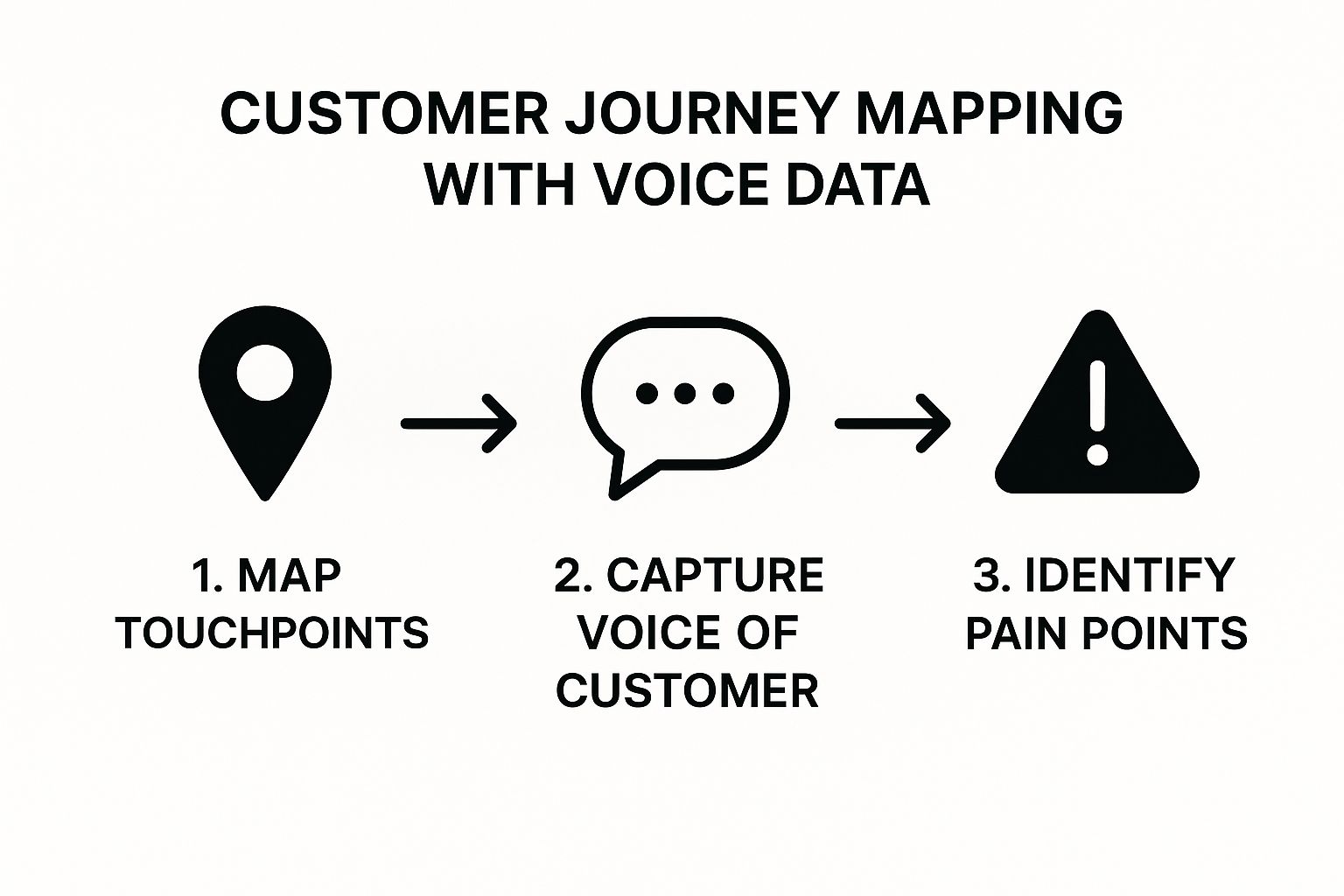
Infographic showing the three-step process of voice data journey mapping: Map Touchpoints, Capture Voice of Customer, and Identify Pain Points.

This simple workflow ensures that the journey map is grounded in authentic customer feedback, not internal assumptions.

Strategic Analysis: Uncovering the "Why" Between Touchpoints

While analytics can show where customers drop off, voice data on a journey map reveals why. The true power of this method lies in identifying the emotional friction or delight between touchpoints. A customer might successfully complete a purchase, but the journey map could reveal their anxiety about unclear shipping information or frustration with a clunky payment form.

For example, a Starbucks journey map might combine mobile app usage data with in-app survey feedback. It could reveal that while customers love the "order ahead" feature, they feel "anxious" or "confused" when they arrive in-store and can't easily locate the pickup counter. This voice of customer example gives Starbucks a specific, emotionally charged pain point to solve-something quantitative data alone would miss.

Key Insight: A journey map without voice data is just a process diagram. Adding direct customer quotes, emotions, and feedback transforms it into a powerful tool for identifying the hidden friction and opportunities that define the customer experience.

Actionable Takeaways & Implementation

To create a journey map that drives real change, focus on integrating authentic VoC.

  1. Inject Real Quotes: Don't summarize feedback. Use direct quotes from surveys, reviews, or support calls at each touchpoint. Placing "I couldn't find the return policy anywhere!" on the "Post-Purchase" stage is far more impactful than a generic "poor information" label.
  2. Involve Frontline Teams: Your support, sales, and retail staff are a primary source of VoC. Host workshops where they contribute their knowledge of common customer frustrations and questions, adding another layer of qualitative data to the map. Action Step: Schedule a quarterly 90-minute workshop with your customer support team to update the journey map with new insights.
  3. Prioritize by Emotion: Use the emotional data on your map to prioritize fixes. A touchpoint that causes "frustration" or "distrust" should be a higher priority than one that is merely "okay." Create a "pain point matrix" that scores issues based on emotional severity and frequency.

By systematically embedding the customer's voice into every stage, journey mapping becomes less of an academic exercise and more of a strategic blueprint for customer-centric improvements. Learn more about how to get a deeper customer view with person-level identification on marketbetter.ai.

3. Online Review Analysis and Response

Online reviews are a raw, public, and continuous stream of customer feedback. Unlike solicited surveys where the brand controls the questions, reviews on platforms like Google, Yelp, Amazon, or industry-specific sites (e.g., Capterra for software) represent spontaneous customer sentiment. A systematic approach to monitoring, analyzing, and responding to these reviews transforms them from a passive reputation score into an active and powerful voice of customer example.

Online Review Analysis and Response

This process involves more than just damage control for bad reviews. It's about extracting patterns and themes from both positive and negative feedback. Companies can use this data to identify product flaws, service gaps, or competitive advantages directly from the customer’s perspective. For instance, a local restaurant might notice multiple Yelp reviews mentioning "slow service on weekends," prompting a change in staffing, while an e-commerce brand can use Amazon review themes to inform its next product iteration.

Strategic Analysis: Uncovering Public Sentiment

The public nature of reviews adds a layer of urgency and authenticity that private feedback channels lack. While an NPS survey provides internal data, a Google review influences countless potential customers. Analyzing this feedback means looking for trends in language, sentiment, and recurring topics.

For example, a hotel chain might find its 5-star reviews consistently praise the "friendly front-desk staff," while 1-star reviews frequently cite "outdated bathroom fixtures." This VoC data provides clear, prioritized directives: invest in staff training recognition to maintain a key strength and budget for bathroom renovations to fix a major detractor. This is a direct line to what customers value and what drives them away.

Key Insight: Online reviews are not just a customer service channel; they are a public focus group. The trends within them reveal what truly matters to your market and directly impact acquisition.

Actionable Takeaways & Implementation

To leverage online reviews as a strategic VoC tool, implement a structured system.

  1. Use Aggregation Tools: Manually tracking reviews across multiple platforms is inefficient. Use reputation management tools (like Birdeye or Podium) to aggregate all reviews into a single dashboard. This allows for sentiment analysis and theme tagging at scale.
  2. Develop Response Protocols: Create templates and guidelines for responding to both positive and negative reviews. A professional, timely response to a negative review can mitigate damage and show accountability, while engaging with positive reviews builds community and encourages brand loyalty. Action Step: Draft three response templates—one for positive, one for negative, and one for mixed reviews—and set a 24-hour response SLA.
  3. Translate Feedback into Action: Establish a clear process for escalating recurring feedback to the relevant departments. If multiple reviews mention a specific software bug, that information must be routed directly to the product development team. Action Step: Create a monthly "Voice of the Customer" report summarizing top review themes and present it to department heads.

By treating public reviews with the same analytical rigor as internal surveys, businesses can tap into a highly influential and honest source of customer insight.

4. Social media Listening and Sentiment Analysis

Not all customer feedback comes through direct channels. Social media platforms are vast, real-time focus groups where customers openly discuss their experiences, frustrations, and desires regarding brands. Social media listening is the process of monitoring these platforms for mentions of your company, products, and competitors to capture this unsolicited voice of the customer.

Social Media Listening and Sentiment Analysis

This method goes beyond simply tracking mentions; it involves sentiment analysis, which uses AI to classify the emotional tone of a conversation as positive, negative, or neutral. While online reviews capture a post-experience summary, social listening captures the in-the-moment reaction. For instance, a brand like Nike can track real-time reactions to a new shoe launch, while a fast-food chain like Wendy's can identify and respond to a customer service complaint on Twitter within minutes.

Strategic Analysis: Tapping into the Unfiltered Conversation

Unlike surveys or reviews where customers are prompted for feedback, social media conversations are spontaneous and candid. This provides an unvarnished look into what customers truly think. The power lies in aggregating thousands of these individual mentions to identify macro trends.

A software company might notice a sudden spike in negative sentiment on Twitter and Reddit. By analyzing the conversations, they could discover a critical bug in their latest update that wasn't caught in testing. Conversely, a CPG brand might see a user-generated trend emerge around a new way to use their product, creating an unexpected marketing opportunity. To further understand how public sentiment can be captured and managed effectively, exploring methods like social media reputation monitoring can be incredibly insightful.

Key Insight: Social media listening provides access to the unsolicited, real-time voice of the customer, offering raw insights that formal feedback channels often miss. Sentiment trends can act as an early warning system for problems and an opportunity radar for market trends.

Actionable Takeaways & Implementation

To turn social chatter into a strategic asset, you need a systematic approach.

  1. Define Your Keywords: Go beyond just your brand name. Track common misspellings, product names, key executive names, and campaign hashtags. Also, monitor competitor brand names to gain competitive intelligence and identify opportunities where their customers are dissatisfied.
  2. Engage, Don't Just Monitor: Use social listening as a customer service and engagement tool. Respond publicly to praise and offer to take complaints to a private channel like DMs to resolve them. This proactive engagement shows that you are listening and value customer feedback. Action Step: Designate a point person responsible for monitoring brand mentions and responding within two hours during business hours.
  3. Channel Insights to Product Teams: Create a workflow to share relevant social media insights with product, marketing, and sales teams. A recurring theme of customers requesting a specific feature, for example, is powerful VoC data that should directly inform your product roadmap. This can be more efficient than waiting for formal survey cycles. Explore how to automate the scanning of various channels to streamline this process.

5. Customer Advisory Boards and Focus Groups: The Strategic Dialogue

While surveys capture broad sentiment, Customer Advisory Boards (CABs) and focus groups provide a forum for deep, strategic dialogue. These are structured, moderated sessions with a select group of customers chosen to represent key segments. This method moves beyond reactive feedback to proactively involve customers in a company's strategic direction.

  • Customer Advisory Boards (CABs): Typically long-term, strategic partnerships with high-value B2B customers. They meet periodically to advise on product roadmaps, market trends, and high-level strategy.
  • Focus Groups: Usually short-term, tactical sessions designed to gather in-depth feedback on a specific topic, such as a new feature, marketing campaign, or user interface design.

The power of this voice of customer example lies in the direct, unscripted interaction. Compared to a one-way survey, these are two-way conversations. They allow companies to explore the nuances behind customer opinions, ask follow-up questions in real-time, and build stronger relationships.

Strategic Analysis: Beyond Surface-Level Feedback

CABs and focus groups are invaluable for qualitative, forward-looking insights that quantitative data cannot provide. A survey might tell you that 30% of users are unhappy with a feature, but a focus group can reveal the emotional context, workflow disruptions, and specific pain points causing that dissatisfaction.

For instance, Salesforce leverages its Customer Success Advisory Board not just for product feedback, but to understand the evolving challenges of their enterprise clients. This direct dialogue informs their entire go-to-market strategy, ensuring their solutions align with the future needs of their most important customers. This approach turns feedback into a collaborative partnership.

Key Insight: These forums provide a direct line to your most strategic customers, allowing you to validate your roadmap and co-create solutions before investing significant development resources.

Actionable Takeaways & Implementation

To maximize the value of these interactive sessions, a structured approach is critical.

  1. Define a Clear Charter and Goals: Don't just "get feedback." For a CAB, define its purpose, member expectations, and the specific strategic areas it will influence. For a focus group, have a clear research question you need to answer (e.g., "Is our new pricing model clear and fair?").
  2. Select a Diverse Cohort: Avoid the pitfall of only inviting your happiest customers. A valuable board includes a mix of promoters, passives, and even thoughtful detractors representing different user personas, industries, and company sizes. This diversity prevents confirmation bias and uncovers a wider range of perspectives.
  3. Demonstrate Action and Close the Loop: These high-touch voice of customer methods require follow-through. Start each meeting by recapping feedback from the previous session and showing exactly how it was implemented. Action Step: Create a "You Said, We Did" slide for the start of every CAB meeting to explicitly link their feedback to company actions.

By facilitating a structured, ongoing dialogue, advisory boards and focus groups transform the voice of the customer from a lagging indicator into a leading strategic asset.

6. Live Chat and Customer Service Interaction Analysis

Your customer service channels are a goldmine of raw, unsolicited customer feedback. Analyzing interactions from live chat, support tickets, and phone calls transforms routine service conversations into a powerful voice of customer (VoC) program. Instead of waiting for customers to fill out a survey, this method captures their sentiment and pain points in the moment.

This approach treats every interaction as a valuable data point. It involves systematically reviewing, tagging, and quantifying conversations to uncover recurring themes, identify friction points in the customer journey, and gauge overall sentiment. This provides a direct, unfiltered line into what customers are actually experiencing, which is often more honest than solicited survey responses.

Strategic Analysis: Beyond Problem-Solving

While the primary goal of a support interaction is to solve a customer's immediate problem, the secondary, strategic value is immense. The aggregate data from thousands of these conversations reveals systemic issues that a single survey might miss. It’s the difference between asking a customer about their experience and listening to them describe it in their own words.

For example, an e-commerce company might notice a sudden spike in live chats about "discount code not working." While agents can resolve each case individually, the VoC analysis flags this as a widespread technical issue for the product team. Similarly, a SaaS company might find that 20% of support tickets mention confusion around a specific feature, signaling a clear need for better in-app guidance or a tutorial video.

Key Insight: Customer service interactions are not just a cost center; they are a real-time research and development hub. Analyzing this voice of customer data turns reactive problem-solving into proactive product and process improvement.

Actionable Takeaways & Implementation

To leverage service interactions as a robust voice of customer example, you must structure the data collection and analysis.

  1. Systematic Tagging and Categorization: Implement a mandatory tagging system in your help desk software (like Zendesk or Intercom). Agents should tag every conversation with relevant themes (e.g., "Billing Issue," "Feature Request," "UI Bug") and sentiment (Positive, Negative, Neutral). This structures the qualitative data for quantitative analysis.
  2. Create Cross-Functional Feedback Loops: Don't let insights remain siloed within the support team. Create a formal process for sharing summarized findings with product, marketing, and operations teams on a regular basis. Action Step: Implement a bi-weekly 30-minute meeting between support leads and the product team to review top issue tags.
  3. Fuel Your Knowledge Base: Use the most common questions and problems identified in chats and tickets to build a comprehensive self-service knowledge base or FAQ section. This not only empowers customers but also reduces support ticket volume, freeing up agents to handle more complex issues.

By treating every customer conversation as a piece of the VoC puzzle, companies can gain continuous, actionable insights that improve the entire customer experience.

7. Post-Purchase and Transaction Surveys: Capturing In-the-Moment Feedback

Post-purchase or transactional surveys are targeted feedback requests sent immediately following a specific customer interaction. Unlike relationship surveys like NPS that measure overall loyalty, these focus on the micro-experience, capturing sentiment while the details are still fresh in the customer's mind. This approach provides granular feedback on critical touchpoints.

These surveys are often triggered automatically after key events:

  • Purchase Confirmation: Asking about the checkout process.
  • Product Delivery: Inquiring about shipping speed and packaging.
  • Support Ticket Resolution: Evaluating the helpfulness of the agent.
  • Service Completion: Rating the quality of the service provided, like Uber's ride rating.

The power of this voice of customer example lies in its immediacy and specificity. It isolates variables, allowing you to pinpoint exactly which part of the customer journey is excelling or failing.

Strategic Analysis: Isolating Touchpoint Performance

The strategic value of transactional surveys is their diagnostic precision. If a company's overall Customer Satisfaction (CSAT) score is declining, it's difficult to know where to start fixing things. Transactional surveys act like a magnifying glass on individual stages of the customer lifecycle, providing clear, actionable data that broad surveys lack.

For instance, an e-commerce brand might have a high overall satisfaction score but receive consistently poor ratings on its "delivery experience" survey. This VoC data immediately flags a problem not with the product or the website, but with the third-party logistics partner. Without this isolated feedback, the shipping issue could have been incorrectly blamed on the product itself, leading to wasted resources trying to fix the wrong problem.

Key Insight: Transactional surveys move beyond general sentiment to provide a precise, real-time performance review of specific business operations, from checkout usability to support agent effectiveness.

Actionable Takeaways & Implementation

To maximize the value of post-interaction surveys, focus on speed and specificity.

  1. Keep it Short and Relevant: The survey should be hyper-focused on the specific interaction. If you're asking about a support call, limit questions to the agent's performance and the resolution. A one or two-question survey has a much higher completion rate.
  2. Automate and Time it Right: Use marketing automation or CRM triggers to send the survey as soon as the transaction is complete. A hotel sending a checkout survey a week later will get far less valuable feedback than one sent within an hour. Action Step: Set up an automated workflow to send a delivery feedback survey 24 hours after your shipping provider confirms delivery.
  3. Create Service Recovery Workflows: Immediately route negative feedback (e.g., a 1-star delivery rating) to a dedicated team. A prompt, personal follow-up to resolve the issue can turn a detractor into a loyal customer by demonstrating that you are listening and care. For a deeper dive into how this works, you can learn more about optimizing post-purchase feedback on marketbetter.ai.

By focusing on these specific moments, you collect a stream of highly relevant, actionable insights that enable continuous, targeted improvements across every customer touchpoint.

8. Employee Feedback as Voice of Customer Proxy: The Internal Source

Sometimes, the most insightful voice of customer data doesn't come directly from the customer but from the employees who interact with them daily. Front-line staff, such as sales associates, support agents, and service technicians, are a rich, untapped reservoir of customer sentiment, pain points, and emerging needs. This method treats their observations as a valuable proxy for direct customer feedback.

Unlike structured surveys that capture a single moment in time, employee feedback is continuous and contextual. An in-store retail associate hears dozens of candid product comments a day, while a call center agent can identify a recurring technical issue long before it appears in satisfaction scores. This approach systematizes the collection of these organic, real-time insights.

Strategic Analysis: Beyond Hearsay

The power of using employees as a voice of customer proxy is its immediacy and raw, unfiltered nature. It helps bridge the gap between high-level metrics and the day-to-day customer reality. This isn't just about anecdotal evidence; it's about creating a formal channel to aggregate front-line intelligence. Where a customer survey might provide a lagging indicator of a problem, employee feedback often acts as a leading indicator.

For example, a restaurant manager might notice servers consistently reporting that customers are asking for more vegetarian options. This qualitative data, gathered systematically, provides a strong signal for menu development, often faster than a formal customer survey would. Similarly, B2B account managers can report on the "hallway talk" from client meetings, revealing underlying concerns about pricing or a competitor's new feature that would never be captured in a formal feedback request.

Key Insight: Front-line employees hear what customers say when they aren't "on the record." This provides access to candid, unsolicited feedback that is crucial for identifying hidden problems and latent opportunities.

Actionable Takeaways & Implementation

To transform employee observations into a structured VoC program, you need a clear process.

  1. Create Formal Intake Channels: Don't rely on casual conversations. Implement dedicated Slack channels (#customer-feedback), simple forms, or a section in your CRM for employees to log customer insights. The goal is to make it easy and part of their routine. Action Step: Create a simple Google Form with fields for "Customer Comment," "Product/Service Mentioned," and "Suggested Action," and share it with all customer-facing teams.
  2. Train for Observation: Coach your teams on what to listen for. This includes not just direct complaints or praise but also competitor mentions, feature "workarounds" customers have developed, and questions that indicate confusion about your product or service.
  3. Validate and Correlate: Treat employee-sourced feedback as a directional indicator. Use this intelligence to guide more direct research. If agents report a common complaint, deploy a targeted micro-survey to the affected customer segment to quantify the issue's impact. This validates the qualitative insight with quantitative data.

By empowering employees to be the eyes and ears of the business, you create a responsive and powerful feedback loop that is one of the most cost-effective voice of customer examples to implement.

8 Voice of Customer Methods Comparison

MethodImplementation Complexity 🔄Resource Requirements ⚡Expected Outcomes 📊Ideal Use Cases 💡Key Advantages ⭐
Net Promoter Score (NPS) SurveysLow - single question, easy setupLow - minimal tech and effortLoyalty metric, revenue correlation, benchmarkingQuick pulse on customer loyalty post-interactionSimple, standardized, predictive of growth
Customer Journey Mapping with Voice DataHigh - multi-touchpoint, detailedHigh - extensive data, cross-teamHolistic experience view, pain points, emotionsComplex CX improvements, cross-department projectsDeep insights, visual storytelling, strategic
Online Review Analysis and ResponseMedium - multi-platform monitoringMedium - tools & team for responsesReal-time sentiment, product/service insightsReputation management, product/service feedbackAuthentic, competitive intelligence, broad reach
Social Media Listening and Sentiment AnalysisHigh - vast data volume, filteringHigh - advanced tools & analystsReal-time trends, brand sentiment, crisis alertsBrand monitoring, product launches, market trendsUnsolicited opinions, early issue detection
Customer Advisory Boards and Focus GroupsHigh - organizing, facilitationHigh - time, personnel, coordinationStrategic input, detailed qualitative feedbackStrategic planning, product development, advocacyHigh quality, relationship building, strategic
Live Chat and Customer Service AnalysisMedium - interaction captureMedium - analysis tools & trainingIssue identification, sentiment, operational gapsCustomer service improvement, operational insightsImmediate feedback, large interaction volume
Post-Purchase and Transaction SurveysLow-Medium - trigger-basedLow-Medium - integrated systemsSpecific, timely feedback on transactionsTransaction-focused feedback, service/process checksHigh accuracy, actionable, good response rates
Employee Feedback as Voice of Customer ProxyMedium - internal feedback systemsMedium - training and forumsProxy customer insights, trend spottingFrontline insight capture, cost-effective researchUnfiltered customer reactions, engages employees
Free Tool

Try our Marketing Plan Generator — generate a complete AI-powered marketing plan in minutes. No signup required.

From Listening to Leading: Building Your VoC Action Plan

Throughout this article, we've explored a powerful spectrum of voice of customer examples, moving from broad sentiment gauges like Net Promoter Score (NPS) surveys to the granular, qualitative insights found in live chat transcripts and employee feedback. We've seen how leading companies don't just collect data; they orchestrate a symphony of feedback channels to compose a comprehensive, actionable understanding of their customer's world. The core lesson is clear: an effective Voice of Customer (VoC) program isn't a single instrument but a full orchestra, with each method playing a vital, complementary role.

The most successful strategies weave these disparate channels together. For instance, the qualitative complaints surfacing in your online review analysis should directly inform the quantitative questions in your next post-purchase survey. Similarly, the strategic guidance from a Customer Advisory Board can provide the "why" behind the "what" you see in your social media sentiment analysis. This integration transforms feedback from a series of disconnected comments into a cohesive, strategic narrative that drives business growth.

Synthesizing Your VoC Strategy: Key Takeaways

The journey from passive listening to proactive leadership begins with understanding how these different VoC methods compare and contrast. Each offers a unique lens through which to view your customer experience.

  • Proactive vs. Reactive: Methods like Customer Advisory Boards and targeted NPS surveys are proactive, allowing you to guide the conversation and explore future needs. In contrast, social media listening and online review analysis are reactive, giving you an unfiltered look at what customers are saying organically. A balanced program needs both to anticipate trends and respond to immediate issues.
  • Qualitative vs. Quantitative: Live chat analysis provides rich, qualitative data full of emotion and specific context. Transactional surveys, on the other hand, deliver structured, quantitative data that is easy to track over time. Combining them allows you to measure the scale of a problem and understand its human impact.
  • Direct vs. Indirect: Focus groups are a form of direct feedback where you are actively soliciting input. Employee feedback often serves as an indirect or proxy channel, revealing customer pain points through the experiences of your front-line teams. Both are critical for a 360-degree view.

Your Actionable Roadmap to a World-Class VoC Program

Moving from theory to practice requires a deliberate, phased approach. You don't need to implement all eight methods at once. Instead, build a strong foundation and expand over time.

  1. Start with Your Core Channels: Identify the two most critical feedback points for your business model. For a B2C e-commerce brand, this might be online review analysis and post-purchase surveys. For a B2B SaaS company, a combination of NPS surveys and customer service interaction analysis could be the ideal starting point.
  2. Establish an Insight-to-Action Loop: Don't let feedback sit in a spreadsheet. Create a clear process for analyzing incoming data, identifying a key insight, assigning ownership for an action, and implementing a change. For example, if multiple support tickets mention a confusing checkout step, the action is to create a task for the UX team to investigate and redesign it.
  3. Scale and Integrate Your Efforts: Once you have a functional loop for your initial channels, begin layering in additional methods. Use insights from one channel to fuel another. Did a customer journey mapping session reveal a gap in post-purchase communication? Design a transactional survey to specifically measure satisfaction with that part of the experience. To effectively implement a robust VoC strategy and gather insights from various channels, consider utilizing dedicated customer feedback management software.
  4. Close the Loop: The final, most crucial step is communicating back to your customers. Let them know you heard their feedback and show them what you did about it. This builds immense trust and encourages continued engagement, transforming customers from passive buyers into active partners in your brand's evolution. By mastering the strategies behind these voice of customer examples, you're not just improving a product; you're building an unbreakable customer relationship.

Ready to turn customer conversations into your most powerful growth engine? marketbetter.ai uses advanced AI to analyze your customer feedback, reviews, and support tickets, automatically surfacing the actionable insights you need to build better products and experiences. Stop guessing what your customers want and start knowing by visiting marketbetter.ai to see how we can help you lead your market.

Customer Data Platform Integration: Connect Your Stack in 30 Days (Step-by-Step) [2026]

· 20 min read

Connecting a Customer Data Platform (CDP) to your other business tools is how you create that single, unified source of truth about your customers. It’s a synchronization process. You pull data from everywhere—your CRM, email service, analytics platforms—and then push consistent, enriched profiles right back out to those same tools. This actionable loop allows for smarter marketing and much better decision-making.

Why a Unified Customer View Isn't Just a "Nice-to-Have"

Disconnected data isn't some abstract technical headache; it’s a direct roadblock to growth. When your marketing, sales, and support teams are all working from different scripts, the customer experience falls apart.

Think about it. A customer gets a promo email for a product they just bought. Or they have to explain an issue to three different support agents because no one knows another department already solved it. These little moments of friction add up, eroding trust and sending people straight to your competitors.

The real enemy here is data silos. Your email platform knows who opens your campaigns. Your e-commerce system tracks every purchase. Your CRM logs all the sales calls. Without integration, these are just random chapters of a story nobody can read from start to finish. A customer data platform integration is the binding that pulls it all together into one coherent narrative: the single customer view.

Turning Disconnected Data into Real Business Impact

Here’s a classic scenario. A high-value customer hasn't bought anything in 90 days, but in the last week, they've visited your pricing page three times and downloaded a case study.

In a siloed world, the marketing team sees the website visits, but the sales team—the one who actually owns the relationship—is completely in the dark. That’s a massive opportunity just floating away.

With an integrated CDP, this behavioral data automatically flows into the customer's CRM profile. This is the actionable part: you can set up a workflow that triggers an instant alert for the account manager to reach out with a perfectly timed, relevant offer. This isn't just about better marketing; it’s about running a smarter business. You're turning random data points into actionable intelligence that drives revenue.

A unified customer view means you're no longer guessing what customers want. You're responding to what their actions tell you they need, creating a more relevant experience that builds loyalty and increases lifetime value.

The Tangible Returns on a Unified Strategy

Connecting your data systems is a strategic investment with real, measurable returns. The research is pretty clear on this. A 2024 Treasure Data survey found that 53% of advertisers now see CDPs as absolutely essential for creating a consistent omnichannel experience.

Even more critically, a 2023 report revealed that companies using CDPs are 2.5 times more likely to blow past their revenue goals. You can dig into more of these CDP market trends and impacts if you want to see the numbers for yourself.

To truly tap into this potential, businesses should explore the process of unifying customer experience with omnichannel solutions. At the end of the day, a CDP integration isn't about merging databases for the sake of it. It's about creating seamless journeys that make every customer feel understood and valued, no matter how they interact with you.

Mapping Your Data Ecosystem Before You Begin

Jumping into a customer data platform integration without a clear map is like setting off on a road trip with no destination. A successful project always begins with a blueprint—a thorough audit of your entire marketing and data technology stack.

Before you even think about connecting a single system, you need to know exactly what you’re working with. This means identifying every single place your customer data currently lives. And I mean everywhere.

Think beyond the obvious. Your CRM (like Salesforce) and analytics tools (like Google Analytics) are a given, but what about your email service provider, e-commerce platform, customer support software, and even offline spreadsheets? Each one holds a unique piece of the customer puzzle.

Image

Identifying Data Types And Flow

Once you have your list of sources, the real work begins. You need to understand the specific type of data each one holds. Is it behavioral data from website clicks? Transactional data from your payment processor? Or demographic data from a sign-up form?

Mapping the flow of this information is just as critical. A new lead might first appear in your marketing automation tool, then move to your CRM upon qualification, and finally generate purchase history in your e-commerce system. Visualizing these journeys reveals dependencies and potential breakpoints you'll need to address head-on during the integration.

To help you get started, here's a table outlining common systems and where they typically fall in the priority line.

Common Data Sources and Integration Priorities

System TypeExample ToolsData CapturedIntegration PriorityActionable Tip
CRMSalesforce, HubSpotContact info, sales activity, account status, lead sourceHighStart here. This is the backbone of your customer relationships.
AnalyticsGoogle Analytics, MixpanelWebsite behavior, user journeys, conversion eventsHighIntegrate this early to capture real-time user intent.
E-commerceShopify, MagentoPurchase history, order value, abandoned cartsHighTransactional data is key for LTV and segmentation.
Email/Marketing AutomationMailchimp, MarketoCampaign engagement, email opens/clicks, list membershipMediumConnect this after core systems to enrich profiles with engagement data.
Customer SupportZendesk, IntercomSupport tickets, chat history, customer satisfactionMediumThis data provides crucial context on customer health.
Ad PlatformsGoogle Ads, Facebook AdsAd impressions, clicks, audience segmentsMedium-LowUse this to improve ad targeting with first-party data.
Offline DataSpreadsheets, Event ListsIn-person event attendance, direct mail responsesLowIntegrate this last. Standardize formats before uploading.

This audit gives you a practical roadmap, ensuring you're not just collecting data for the sake of it, but focusing on the systems that drive real business value.

A common mistake is assuming all data is created equal. I've seen teams get bogged down integrating low-impact sources first. Prioritize the data streams that have the biggest impact on customer experience—like purchase history and support tickets—to ensure your integration delivers value from day one.

Building Your Data Dictionary And Identity Rules

With a clear picture of your sources and flows, you can now create a simple data dictionary. This isn't just busywork; it's a foundational document that defines key data points (e.g., "customer_LTV," "last_purchase_date") and ensures everyone in the organization speaks the same language. It prevents the chaos that arises when marketing calls something a "lead" while sales calls it a "prospect."

This leads directly to the most important part: establishing clear identity resolution rules. How will you stitch together a single customer profile from a dozen different sources?

  • Your Primary Key: The most common approach is using a universal identifier, like an email address or a unique customer ID. This becomes the "golden record" key that links every other piece of data to a specific person.
  • Your Fallback Keys: What happens if an email isn't available? You might use a phone number or even a combination of name and address as a secondary option.

Defining these rules upfront is non-negotiable for data integrity. If you want to go deeper on this, our guide on achieving person-level identification provides some actionable strategies.

This initial audit isn't a solo mission. You absolutely have to get marketing, IT, sales, and customer support in the same room (virtual or otherwise). Involving all key stakeholders ensures every important data source and use case is accounted for, building a comprehensive strategy that sidesteps the most common and costly integration failures right from the start.

Choosing Your CDP Integration Method

Alright, you’ve mapped your data ecosystem. Now for the really critical part: how are you going to plug everything together?

This isn't just a technical detail—it’s a decision that will directly control the speed, cost, and flexibility of your entire CDP integration. Getting this right means your tech execution will actually line up with your business goals. There are three main ways to connect your tools to a CDP, and each one comes with its own set of trade-offs.

Native Connectors: The Fast Lane

Think of native connectors as the plug-and-play option. These are pre-built, out-of-the-box integrations that your CDP vendor provides for popular tools like Shopify, Salesforce, or Google Analytics.

They're incredibly fast to set up, usually just needing a few clicks and an API key. This is by far the least technical and most cost-effective way to get started.

The catch? You sacrifice flexibility. You're stuck with the data fields and sync schedules the connector was built for, which might not cover every weird, custom thing your business does. But if your use case is standard—like connecting a Shopify store to sync orders and customer profiles—a native connector is a no-brainer.

API-Based Integrations: The Custom Route

What happens when a native connector doesn't exist, or it just doesn't cut it? You turn to API integrations.

This is where your developers write custom code to connect your CDP to another tool's API (Application Programming Interface). It gives you total control. You can define exactly which data points to send, how to transform them, and how often they should sync. If you’re running on a custom-built CRM or have unique data needs, an API integration is pretty much your only option.

The trade-off, of course, is a much bigger investment in developer time and money.

The decision between native and API often comes down to a simple question: Is our use case standard or unique? If it's standard, use the connector. If you have specific data needs or a custom system, you'll need the control an API provides.

For real-time data needs, which are the cornerstone of a great CDP setup, it's worth digging into more advanced techniques. This guide on Mastering Change Data Capture (CDC) is a fantastic resource for understanding how to keep data perfectly synchronized.

Webhooks: The Real-Time Trigger

Finally, there are webhooks. These are lightweight, event-driven integrations. Instead of your CDP constantly asking another system if there's new data (a process called polling), a webhook just sends a little packet of data over the moment something happens.

It’s perfect for real-time triggers. For example, if you want to send a welcome email the instant a user signs up on your website, a webhook is the tool for the job. It immediately pushes the new user's info to the CDP.

They're not built for syncing huge historical datasets, but for those instant, event-based actions, they’re ideal. The good news is that many platforms are expanding their webhook capabilities, like the ones we covered in our recent product announcement.

Comparing CDP Integration Methods

To make the choice clearer, here’s a quick breakdown of the three methods. Think of this as your cheat sheet for conversations with your technical team.

Integration MethodBest ForEffort & CostFlexibilityKey Takeaway
Native ConnectorsStandard, common platforms where speed is the priority.Low. Minimal developer time needed.Low. You're limited to pre-defined data schemas.The fastest and cheapest way to get started with popular tools.
API IntegrationsCustom systems, unique data needs, or when full control is required.High. Requires significant developer resources and ongoing maintenance.High. You can build exactly what you need.The most powerful and flexible option, but also the most expensive.
WebhooksReal-time, event-driven actions like sign-ups or purchases.Low to Medium. Simple to set up but not for bulk data.Medium. Great for specific triggers, but not full syncs.The best choice for instant actions that kick off a workflow.

Each method has its place. Most mature CDP setups I've seen use a mix of all three—native connectors for the easy wins, APIs for the custom heavy lifting, and webhooks for the real-time magic.

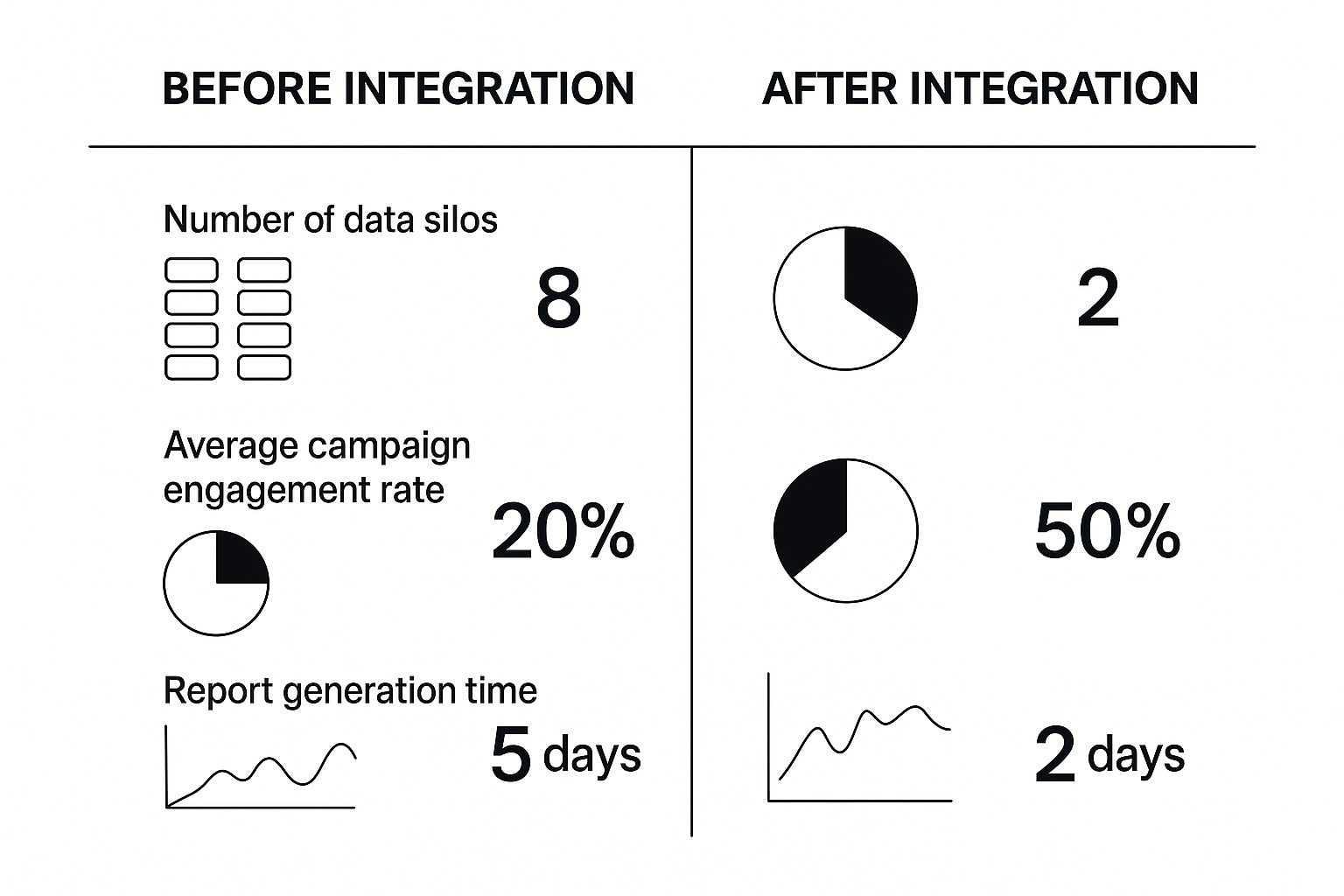
Image

As you can see, the payoff is huge. Breaking down those data silos doesn’t just clean up your database—it directly leads to faster insights and much higher engagement rates.

Getting Your Integration Live and Activated

Image

This is it—the moment where all the strategy docs and planning meetings turn into reality. You're about to physically connect your data sources and, more importantly, start using that unified data to build smarter marketing campaigns.

The first move in any customer data platform integration is getting the data in. This is all about configuring your CDP to start pulling from your most critical systems. Let's look at two classic examples.

  • Plugging in Salesforce (your CRM): This is usually priority number one and almost always an API-driven connection. You'll map standard objects like Leads and Contacts, sure, but the real power comes from mapping the custom fields unique to your business, like a Product_Interest_Score or Last_Demo_Date. The whole point is to get that rich, historical view of the sales relationship into one place.
  • Connecting Google Analytics (your web analytics): This connection is totally different—it's event-based and real-time. You'll set up tracking for user behaviors as they happen: page_view, add_to_cart, form_submission. This data gives you the crucial context of what your customers are doing right now.

Putting these two together is powerful. One gives you the long-term relationship story, the other gives you immediate behavioral intent.

From Data Ingestion to Audience Activation

Once data is flowing into your CDP and its identity resolution engine is stitching together unified profiles, the real fun begins: activation. This is where you build incredibly specific customer segments and push them out to your downstream tools to actually do something.

A perfect real-world example is creating a segment for "high-value, at-risk customers." Inside your CDP, you'd build this audience by layering rules from different data sources:

  1. From your payment system: Customers with a lifetime value over $5,000.
  2. From your app database: Users who haven't logged in or purchased anything in the last 90 days.
  3. From your email platform: Contacts who haven't opened an email in the past 60 days.

You simply can't build this segment inside your ESP or CRM alone because the data lives in three different places. With the CDP integration live, you can build this audience in minutes and push it to your marketing platforms to kick off a targeted re-engagement campaign.

The magic isn't just in collecting the data; it's in activating it. A unified profile allows you to move from generic batch-and-blast campaigns to precise, behavior-triggered actions that feel personal and timely to the customer.

Always Validate in a Staging Environment

Before you push these new, powerful segments to your entire customer base, you have to test everything. This is non-negotiable. Always, always use a staging or sandbox environment to validate your connections first. This is your chance to confirm data is flowing correctly without breaking anything in your live operations.

Here's an actionable checklist for validation:

  • Data Accuracy: Does the final count of customers in my CDP segment match what I'd expect from the source systems? Is it even close?
  • Attribute Mapping: Are those custom fields from Salesforce actually showing up correctly on the unified profiles?
  • Sync Latency: How long does it take for a new event from Google Analytics to appear in the CDP and get someone added to an audience? Is it minutes? Hours?
  • Endpoint Test: Does pushing an audience to your email tool actually create the list correctly? Send a test campaign to an internal seed list first.

The insane growth of the CDP market—skyrocketing from USD 1.75 billion to an estimated USD 5.11 billion in just a few years—is driven by exactly these capabilities. Marketers who get it understand that fixing fragmented data is the only way to create consistent experiences across every channel. You can see more data on how CDPs are transforming marketing strategies and why they’ve become so critical for advertisers.

A huge part of this is using AI for predictive segmentation. To see how this works in the real world, check out these practical playbooks on AI lead scoring.

Common Integration Pitfalls and How to Avoid Them

Even the most buttoned-up customer data platform integration can hit a few speed bumps. Honestly, it's expected. The trick is knowing where the usual traps are so you can sidestep them. Learning from the mistakes I've seen others make is the fastest way to get your project across the finish line instead of letting it become another stalled initiative.

https://www.youtube.com/embed/FgL7sMij-zo

Let's start with the biggest project killer: the classic "garbage in, garbage out" problem.

It happens every time. Teams get so excited about the possibilities of a unified customer view that they just start connecting everything, completely forgetting to check the quality of the data they're piping in. If your source systems are a mess of duplicate contacts, stale information, and wildly inconsistent formatting, your shiny new CDP will just be a faster way to look at that same mess.

Tackling Data Quality Head-On

Before you even think about connecting a single data source, you need a plan for data cleansing and standardization. This isn't a one-and-done task you check off a list; it's an ongoing discipline your team has to commit to.

I once worked with a retail company whose CDP launch was nearly torpedoed by this exact issue. Their CRM and e-commerce platform had different formats for everything—names, addresses, you name it. The result? Thousands of duplicate profiles that made any real personalization a complete fantasy.

They had to slam the brakes on the entire project, which caused a six-week delay, just to build and run the necessary data normalization scripts.

The smarter way to do this is to start small. Run a pilot with just two or three of your highest-quality data sources. Think your CRM and maybe your payment processor. This lets you build a clean, solid foundation and, more importantly, prove the CDP's value quickly before you start wrestling with your messier, secondary systems.

Resisting Scope Creep and Securing Real Buy-In

Another pitfall I see all the time is scope creep. The project kicks off with a crystal-clear goal, something like "personalize our email campaigns." Then, the folks in customer support hear about it and want to add their ticketing data. Then sales wants to pipe in their call logs. Suddenly, your focused three-month project has morphed into a year-long behemoth that feels like it will never launch.

This is almost always a symptom of a much deeper problem: a lack of genuine stakeholder buy-in from the get-go. When leaders from sales, marketing, and product aren't truly aligned on the primary business objectives, their teams will inevitably pull the project in a dozen different directions.

A successful integration needs a single, accountable project owner and a steering committee with reps from every key department. This group's most important job is to ruthlessly protect the project's core scope and learn to say "not now" to any request that doesn't directly serve that initial business goal.

To get that kind of alignment, you have to frame the project around business outcomes, not technical jargon. The difference is night and day.

ApproachThe PitchThe Outcome
The Technical Pitch"We need to integrate our martech stack to create a single customer view."Stakeholders nod politely but don't feel any urgency. The project gets branded as an "IT thing."
The Business Pitch"By integrating our data, we can identify our top 10% of at-risk customers and cut churn by 15% in the next six months."Now leaders are invested. They see a direct line to revenue and become champions for the project.

Finally, don't underestimate the need for ongoing maintenance. A CDP integration is not a "set it and forget it" kind of deal. APIs change, your company will adopt new tools, and data schemas will evolve. You absolutely have to budget time and resources for continuous monitoring and optimization to make sure the system stays reliable and keeps delivering value long after you pop the champagne at launch.

Frequently Asked Questions About CDP Integration

Image

As you start mapping out a customer data platform integration, you're bound to run into a few common—and important—questions. Let's tackle some of the ones that come up most often, based on our experience in the trenches.

How Long Does a CDP Integration Typically Take?

This is the big "it depends" question. The timeline really hinges on the complexity of your stack and the state of your data.

A straightforward setup can be surprisingly fast. If you're just connecting a few key systems with native, out-of-the-box connectors—say, pulling data from Shopify and sending it to Mailchimp—you could be looking at a 2-4 week project.

On the other hand, a heavy-duty implementation is a different beast entirely. Think custom API work, connecting to multiple data warehouses, and a serious data cleansing effort. That kind of project can easily stretch out to 6-9 months. The biggest variables are almost always the cleanliness of your data and the number of sources you need to wrangle.

CDP vs. CRM: What's the Actual Difference?

This one is critical to get right, as the tools are often confused but serve fundamentally different roles. Think of it as a System of Record versus a System of Intelligence.

FeatureCRM (Customer Relationship Management)CDP (Customer Data Platform)
Primary GoalManage direct customer interactions (sales, support).Unify all customer data (behavioral, transactional, demographic).
Data SourcesMainly manual entry by sales/support teams.Automated ingestion from dozens of sources (web, app, CRM, etc.).
User FocusSales, Customer Service.Marketing, Analytics, Business Intelligence.
Core FunctionSystem of Record for interactions.System of Intelligence for a unified customer view.

Simply put, your CRM manages your relationships, while your CDP manages the data that defines them.

A CRM tells you what a sales rep discussed with a customer. A CDP tells you that, plus what pages they browsed last night, which ad they clicked last week, and their entire purchase history. It gives you the full, unvarnished story.

Can We Build Our Own CDP?

You absolutely can, but it’s a massive commitment. Building a CDP from scratch isn't just a side project; it demands a dedicated team of data engineers to construct everything. We're talking data collection pipelines, sophisticated identity resolution logic, and all the API connectors to activate that data.

While a DIY approach gives you ultimate control, it often comes at a steep price: pulling your best engineering talent away from your actual product. For the vast majority of companies, buying a dedicated CDP solution delivers results much faster and with far less risk.

When you factor in the long-term cost of salaries, maintenance, and inevitable upgrades, the total cost of ownership for a commercial CDP is almost always lower than trying to build one yourself.


Ready to stop guessing and start personalizing? marketbetter.ai uses an integrated AI approach across content, campaigns, and customer engagement to turn your unified data into measurable revenue. Discover how our platform can accelerate your ROI by visiting https://www.marketbetter.ai.

How to Measure Marketing Effectiveness: The Attribution Framework CMOs Actually Use [2026]

· 27 min read

Figuring out if your marketing is actually working means tying what you do every day to real business results, like revenue and new customers. It’s about getting past the fluffy, surface-level numbers to see which strategies are pulling their weight. This is how you optimize your budget and prove your team's value. It all comes down to setting clear goals, picking the right metrics, and using a smart framework to turn data into decisions.

Building Your Marketing Measurement Framework

Image

Before you can measure anything accurately, you need a game plan. Think of a measurement framework as your blueprint—it ensures every single thing you do is intentional and connected to the big-picture business goals. Without one, you’re just collecting random data points that don't tell a story. With one, you're building a system to make better decisions.

The first step? Stop chasing vanity metrics. A post with 10,000 likes that generates zero leads is a failure compared to a targeted article that only brings in 50 qualified leads who actually convert. The actionable insight here is to shift your focus from metrics that feel good (likes) to metrics that drive growth (qualified leads). That’s the difference between activity and impact.

Get Aligned With Stakeholders on What "Success" Means

Your framework is useless if nobody agrees on the definition of success. The metrics that get you excited might not be the same ones your CEO or head of sales cares about. They’re thinking in terms of revenue, customer growth, and market share. Your job is to translate your marketing performance into their language.

Here's an actionable plan to get aligned: schedule a 30-minute meeting with key stakeholders and ask direct questions.

  • For your CEO: "What is the single most critical business goal for us this quarter? Is it pure customer acquisition, breaking into a new market, or boosting customer lifetime value?" This helps you anchor your KPIs to top-line business objectives.
  • For the Head of Sales: "Can we define exactly what a 'qualified lead' is for your team? What criteria must they meet?" This prevents you from delivering leads that the sales team rejects, ensuring your efforts are valued.
  • For the Product Team: "Which features are we pushing right now, and how can marketing help with user adoption and getting feedback?" This aligns your campaigns with the product roadmap.

Having these conversations upfront prevents painful misalignment later. It allows you to build a framework that directly supports company-wide objectives, making it way easier to show how your department is moving the needle.

Pick the Right Metrics for Each Stage of the Funnel

A good measurement framework tells the whole story, from the first time a prospect hears about you all the way to their purchase. This means you need specific KPIs for each stage of the customer journey, not just the final conversion. It’s like a relay race—each stage hands off to the next, and a weak link anywhere in the chain messes up the final result.

A classic mistake is getting obsessed with last-touch attribution, which gives 100% of the credit to the final ad someone clicked. A smart framework recognizes that the blog post they read last month, the social video they watched last week, and the webinar they attended yesterday all played a part.

Let's compare how you'd measure success for different channels at each stage:

  • Top-of-Funnel (Awareness): For a LinkedIn brand campaign, you might track Impressions and Share of Voice. A better, more actionable metric is qualified reach—are the right people seeing your content? Compare this to an SEO-driven blog, where you’d measure Organic Traffic and Keyword Rankings for high-intent terms.
  • Middle-of-Funnel (Consideration): A webinar’s performance is judged by its Registration Rate and Attendee Engagement. But to make this actionable, track how many attendees ask questions or respond to polls. Compare this to an ebook's success, which is all about its Landing Page Conversion Rate and the Quality of Leads it generates (i.e., how many become MQLs).
  • Bottom-of-Funnel (Conversion): For a Google Ads campaign, the most important metric is Cost Per Acquisition (CPA). For a final-push email sequence, compare the Click-Through Rate on "Book a Demo" links to the ultimate Sales Conversion Rate. If CTR is high but conversions are low, the issue is on the landing page, not the email.

By building this kind of balanced scorecard, you avoid the trap of calling a top-of-funnel campaign a "failure" just because it didn't drive sales directly. That wasn't its job. Its job was to fill the pipeline, and your framework should prove it did just that. For a deeper dive into setting up a solid foundation for tracking your efforts, check out this modern guide for impactful marketing. This approach helps you build a clear, defensible story about how every marketing dollar contributes to the bottom line.

Choosing The Right Marketing Metrics And KPIs

Image

Alright, you've got your strategy sketched out. Now comes the hard part: cutting through the noise. It’s incredibly easy to get buried in a mountain of data, staring at charts that go up and to the right without actually telling you if you're growing the business.

Effective measurement isn't about tracking everything. It’s about being ruthless and focusing only on the numbers that signal real business momentum, not just marketing activity. A spike in website traffic is a classic vanity metric. It feels good, but it means nothing if none of those visitors are the right people.

The goal is to connect every single metric you track back to a tangible business outcome. You need to tell a story with your data—a story that ends with marketing’s direct contribution to the bottom line.

Aligning Metrics To The Marketing Funnel

You wouldn't judge a sprinter on their marathon time, right? The same logic applies here. Different stages of the customer journey demand different yardsticks. One of the most common mistakes I see is teams judging an awareness campaign by its direct sales impact. It’s a recipe for killing good campaigns before they have a chance to work.

Think of your funnel metrics as a diagnostic tool. If conversions are tanking, a funnel-based view lets you look upstream. Is the problem weak leads coming from the middle of the funnel? Or is it that you just aren't getting enough eyeballs at the top?

Let's walk through what this looks like in practice, comparing standard metrics to more insightful ones:

  • Awareness Stage (Top of Funnel): Instead of just tracking Impressions (how many times your content was seen), a much sharper metric is Share of Voice (SOV). It answers a better question: "How much of the conversation in our market do we actually own compared to our competitors?" This gives you a competitive benchmark.

  • Consideration Stage (Middle of Funnel): Click-Through Rate (CTR) is a solid indicator that your creative and messaging are hitting the mark. But a more holistic metric is Engagement Rate (likes, shares, comments). It tells you if your content is truly resonating, not just getting a passing click. Actionable insight: high engagement but low CTR means your content is good, but your call-to-action is weak.

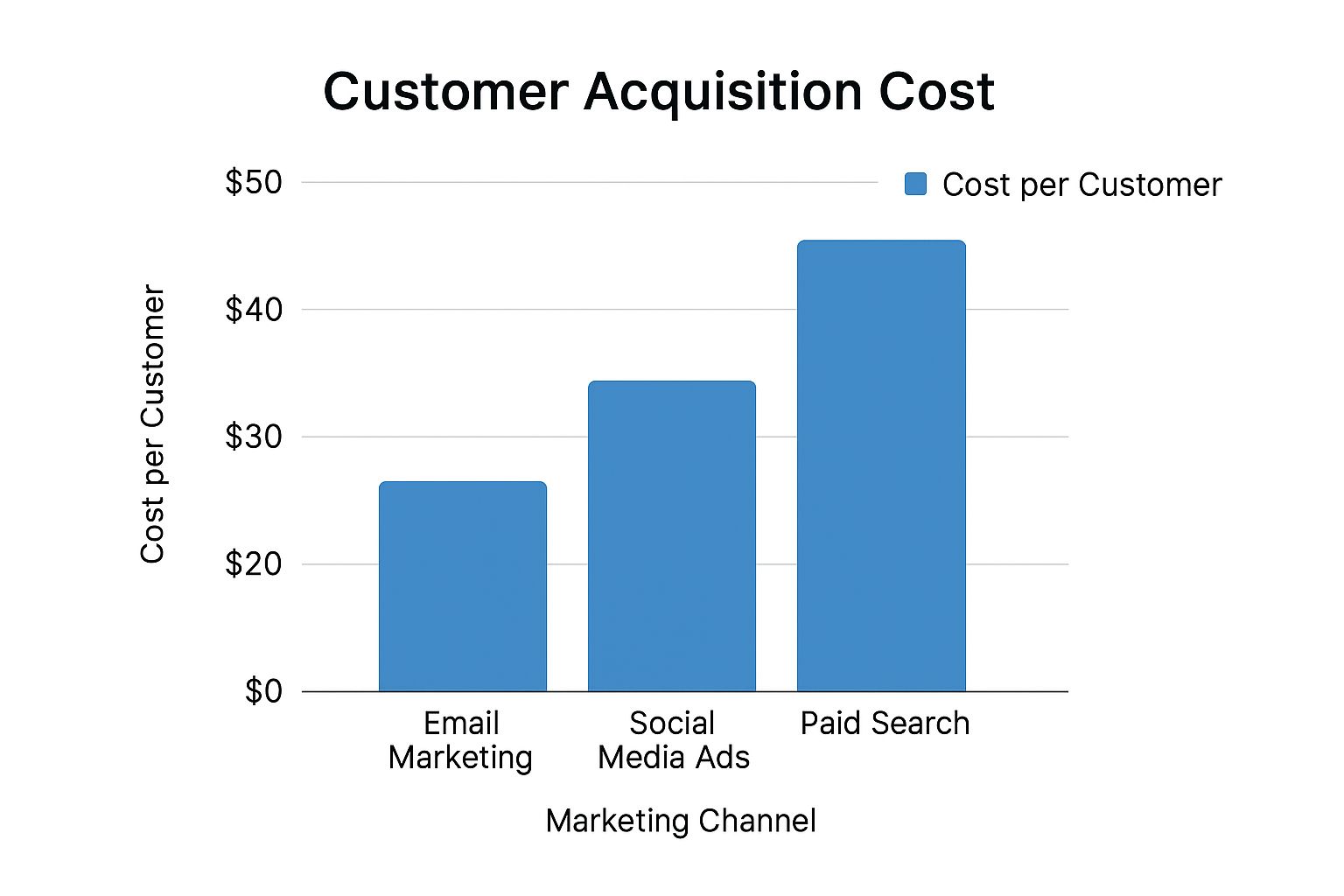
  • Conversion Stage (Bottom of Funnel): Conversion Rate is your bread and butter—it’s the percentage of people who take the action you want them to. But the real gut-check metric is Cost Per Acquisition (CPA). It tells you exactly how much you're spending to get one new customer, making it a direct line to campaign efficiency and profitability. Compare the CPA across different channels to decide where to allocate your budget.

To make this even clearer, here's a quick reference table breaking down the essential KPIs for each stage of the journey.

Key Marketing Metrics by Funnel Stage

Tracking the right metrics at each stage gives you a clear, actionable picture of your marketing performance, from initial brand exposure to the final conversion.

Funnel StageMetric/KPIWhat It MeasuresExample Tool
AwarenessImpressionsTotal times content is displayed.Google Ads
AwarenessShare of Voice (SOV)Your brand's visibility vs. competitors.Brandwatch
ConsiderationClick-Through Rate (CTR)Percentage of impressions that result in a click.HubSpot
ConsiderationEngagement RateLikes, shares, comments as a % of audience.Sprout Social
ConversionConversion RatePercentage of users who complete a desired action.Google Analytics
ConversionCost Per Acquisition (CPA)The total cost to acquire a single new customer.Salesforce

Using this framework helps you pinpoint weaknesses and double down on what’s working, ensuring your entire marketing engine is firing on all cylinders.

The Business-Level Metrics Executives Actually Care About

While funnel metrics are your day-to-day guide for optimizing campaigns, the C-suite speaks a different language. They're focused on growth, profitability, and the long-term health of the business. To earn their trust (and bigger budgets), you need to translate your marketing efforts into their language.

The most effective marketers don't just report on clicks and leads; they demonstrate how marketing drives the core financial health of the business. This is how you get a seat at the strategic table.

Two numbers matter more than almost any others here: Customer Acquisition Cost (CAC) and Customer Lifetime Value (CLV).

  • Customer Acquisition Cost (CAC): This is the total sales and marketing spend it takes to land a single new customer over a specific time. You calculate it by dividing all your acquisition costs by the number of new customers you brought in. No hiding here—it's the true cost of growth.

  • Customer Lifetime Value (CLV): This is a prediction of the total net profit you'll get from a customer over their entire relationship with you. It’s about their long-term worth, not just their first purchase.

The real power move is comparing these two. The CLV:CAC ratio is your ultimate proof point for sustainable marketing. A healthy ratio, typically 3:1 or higher, is a clear signal that you're acquiring customers who generate far more value than they cost to win. Understanding how to calculate ROI to prove investment value is non-negotiable for justifying your spend.

This isn’t just about reporting, either. It directly shapes your strategy. Actionable step: calculate the CLV for customers acquired from different channels. If you discover that leads from your webinar series have a sky-high CLV compared to those from paid social, you can confidently shift budget away from lower-performing channels and double down on webinars. This is also where AI can give you a massive edge, helping you qualify leads better and focus your team's energy only on high-value prospects. We dive deep into that topic in our guide on how to use AI for better lead scoring.

So you’ve got your KPIs locked in. The next question is the one that sparks endless debate in marketing meetings: who gets the credit? A customer might see a Facebook ad, read a couple of blog posts, open an email, and then finally click a Google Ad before they buy. Which one of those channels actually did the work? This is the classic attribution problem, and it’s where a lot of marketers get stuck trying to prove their budget is well-spent.

Attribution modeling is just a fancy term for a set of rules that assign value to the different touchpoints in that messy customer journey. If you get it right, you can confidently measure what’s working. But if you choose the wrong model, you might end up cutting the budget for a channel that’s quietly doing all the heavy lifting at the start of the journey.

Comparing Single-Touch vs. Multi-Touch Models

The simplest models are single-touch, which give 100% of the conversion credit to just one interaction. They're easy to set up but can be dangerously misleading because they only show you a tiny sliver of a much bigger picture. In contrast, multi-touch models distribute credit, offering a more realistic view.

Let's compare the common single-touch models:

  • First-Touch Attribution: This model gives all the credit to the very first interaction. It’s useful if your main goal is driving top-of-funnel awareness. The problem? It completely ignores everything that happened afterward to actually nurture that lead and convince them to buy. Actionable Use: Use this model to identify your best "introducer" channels.
  • Last-Touch Attribution: This is the default setting in a lot of analytics platforms. It gives all the credit to the final touchpoint right before the conversion. It’s great for figuring out which channels are your best "closers," but it gives zero value to the channels that introduced and educated the customer in the first place. Actionable Use: Use this model to optimize your bottom-of-funnel conversion campaigns.

Relying on these is like giving all the credit for a championship win to the person who scored the final goal, ignoring the assists, the defense, and the coaching. For a more accurate view, you have to look at multi-touch attribution.

Multi-touch models get that modern customer journeys aren't a straight line. They distribute credit across multiple touchpoints, giving you a far more balanced and realistic understanding of what’s actually driving results.

A Deeper Look at Multi-Touch Attribution

Multi-touch models give you a more nuanced view by assigning partial credit to different interactions along the path. Yes, they’re more complex, but the insights they generate are gold for making smart budget decisions.

Here’s a breakdown of the most common multi-touch models and where they shine:

Attribution ModelHow It WorksBest Used When...
LinearGives equal credit to every single touchpoint in the journey.You want a simple, balanced view and value every interaction equally, which is common for long B2B sales cycles.
Time-DecayGives more credit to touchpoints that happened closer to the conversion.The consideration phase is short, and recent interactions are genuinely more influential, like during a flash sale.
Position-BasedGives 40% credit to the first touch, 40% to the last touch, and the remaining 20% is split among the middle touches.You value both the channel that hooked them and the channel that closed them the most. This is a common and balanced approach for many businesses.

Picking the right model really depends on your business and how long it takes for a customer to decide. A B2B company with a six-month sales cycle might lean toward a Linear model, while an e-commerce brand could get more value from a Position-Based or Time-Decay model.

Actionable Step: Don't just pick one model and stick with it. In your analytics tool (like GA4), compare the results from 2-3 different models. Does your content marketing look more valuable under a Linear model than a Last-Touch model? This comparison itself is a powerful insight. Of course, this requires solid tracking, which our guide to understanding person-level identification can help you nail down.

The Rise of Marketing Mix Modeling in a Privacy-First World

With privacy rules getting stricter and third-party cookies going away, tracking individual users is getting a lot harder. This is where Marketing Mix Modeling (MMM) is making a comeback. Instead of following individual users, MMM uses statistical analysis on big-picture data—like channel spend, sales revenue, and even external factors like seasonality—to measure the impact of each marketing channel.

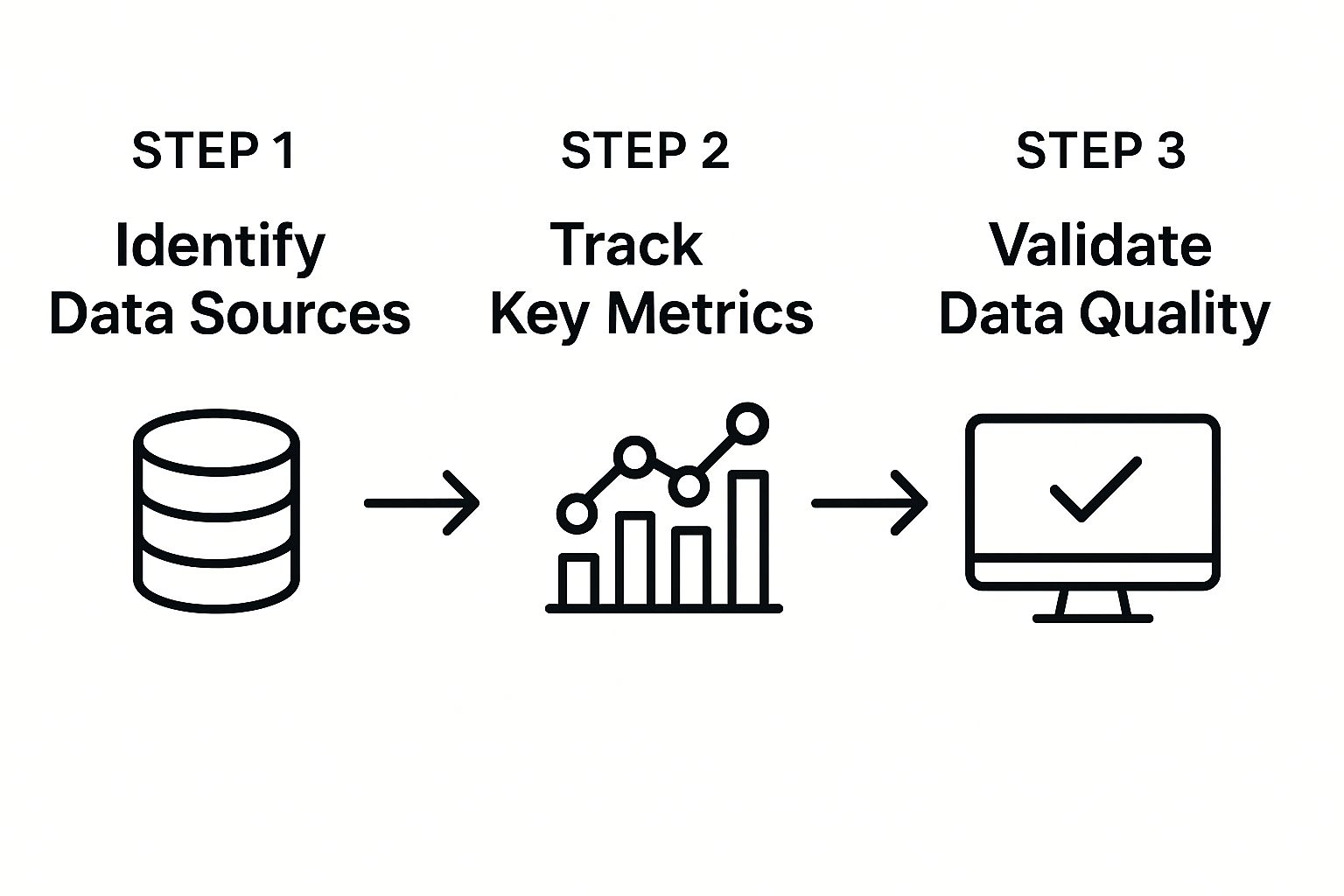
This visual lays out the foundational steps for any good measurement strategy, starting with identifying your data sources and ensuring everything is tracked correctly.

Image

This process is the bedrock for MMM, which needs high-quality, aggregated data to deliver trustworthy insights on channel performance.

MMM became the talk of the town again after privacy updates like Apple's App Tracking Transparency in 2021 made user-level attribution a nightmare. Now, many see it as the 'new gold standard' for measurement. It helps you answer the big questions like, "For every dollar we spend on TV ads, how much incremental revenue do we generate?"—all without needing to track a single cookie.

Using AI to Find Insights That Actually Matter

Let's be honest. Traditional analytics are like a rearview mirror—they tell you exactly what you just passed. That’s useful, but it won’t help you navigate what’s ahead. AI analytics, in comparison, are like a GPS with live traffic data. They don't just show you the map; they predict the traffic jams and suggest faster routes. This is the biggest shift in marketing measurement today: moving from simply reporting on what happened to proactively shaping what happens next.

Forget spending hours in spreadsheets trying to connect the dots. Modern AI tools chew through massive datasets in seconds. They spot the subtle customer behaviors your team would miss, predict which campaigns will actually hit their numbers, and automate the kind of deep analysis that used to take weeks.

This isn't just about efficiency. It's about getting a real, sustainable edge on the competition. The whole game is changing, thanks to a mix of new tech, economic pressures, and privacy rules. According to the Marketing Effectiveness Trends 2025 report by ScanmarQED, AI is now central to everything from personalizing content to forecasting ROI with startling accuracy.

Finding the "Why" Behind the "What"

One of the most valuable things AI does is find connections humans can't easily see. By looking at actual behavior—what people click, how long they stay, which content they consume—AI builds customer segments based on what they do, not just who they are. This goes so much deeper than old-school personas.

An AI tool might surface a segment it calls "high-intent researchers." These aren't just VPs of Marketing from tech companies. These are the specific people who read three of your technical blog posts, watched 75% of a product demo, and visited your pricing page twice this week.

AI isn't just grouping people together. It’s identifying the exact sequence of micro-actions that scream "I'm ready to buy." This lets you stop guessing and start focusing your best efforts on your highest-value prospects with laser precision.

This completely changes how you measure success. You move from asking, "Did our email campaign get a good open rate?" to "Did our email campaign successfully nudge our 'high-intent researchers' into booking a demo?" It shifts the focus from vanity metrics to real business impact.

Platforms like Salesforce use AI to pull all these disparate data points into a single, unified view of the customer, making these kinds of insights accessible. It's about seeing the entire journey, not just isolated touchpoints.

This kind of dashboard isn't just a pretty picture; it’s a command center that shows how AI is connecting every interaction to build an intelligent profile you can act on.

Trading Yesterday's Reports for Tomorrow's Forecasts

This is where things get really interesting. Predictive analytics uses your past performance data to forecast what's likely to happen next. Instead of waiting for a campaign to end to see if you hit your cost-per-acquisition (CPA) goal, a predictive model can tell you what your CPA is likely to be after just a few days of data.

It’s a fundamental shift from reactive to proactive. Let's compare the two approaches:

TaskThe Old Way (Reactive)The AI Way (Proactive)
Budget AllocationBased on what worked last quarter.Reallocated in real-time to channels predicted to have the highest ROI this week.
Lead ScoringStatic points system based on job title and company size.A dynamic score that changes based on a lead's real-time website behavior.
Content StrategyWriting about topics you think your audience wants.Creating content on topics AI has identified as having high engagement potential with your target segments.

This means you can optimize campaigns while they're still running. Actionable Step: If an AI tool predicts a specific ad set is on a path to fail, you can pull the plug and move that budget to a winner before you've wasted thousands of dollars. It’s about making smarter decisions, faster.

Think about an e-commerce company. An AI model could identify customers at a high risk of churning based on their recent purchasing and browsing behavior. That model flags the accounts, triggering a targeted retention campaign with a special offer—before they actually leave. That's a direct line from a marketing action to saving revenue.

A huge part of this is digging into the content they engage with. If you want to get better at that, our guide on leveraging AI for smarter content analysis is a great place to start.

Turning Analysis Into Actionable Campaign Improvements

Image

All the frameworks, KPIs, and attribution models in the world are just theory until you use them to make your marketing better. Measurement is meaningless without action. This is where you close the loop—turning raw numbers into smarter decisions that actually drive growth.

Successfully measuring marketing isn't a one-and-done project. It's a continuous rhythm of reviewing, testing, and refining. You're building a system where data doesn't just sit in a dashboard but actively fuels your next move.

It all comes down to diagnosing what’s working, understanding why, and then systematically improving your strategy based on hard evidence, not just gut feelings.

Establishing a Rhythm for Performance Reviews

To make data-driven decisions a habit, you need to get a consistent review schedule on the calendar. Sporadic check-ins lead to missed opportunities and reactive firefighting. A structured approach ensures you’re always on top of what’s happening.

Here's an actionable cadence you can implement today:

  • Weekly Tactical Check-ins: These are quick, 30-minute huddles focused on campaign-level metrics. You’re looking for immediate red flags or quick wins. Is a specific ad’s Cost Per Click (CPC) suddenly spiking? Can we shift budget to a high-performing social post? Keep it fast and actionable.
  • Monthly Strategic Reviews: This is a deeper dive into channel performance and how you’re tracking toward quarterly goals. Are we on track to hit our MQL target? How is our SEO traffic growth trending month-over-month? This is where you connect the dots between tactics and strategy.
  • Quarterly Business Reviews: Here, you zoom all the way out and connect marketing efforts directly to business outcomes. You'll be presenting your CLV:CAC ratio, overall marketing ROI, and contribution to the sales pipeline to stakeholders. It's about showing real business impact.

This tiered approach keeps everyone aligned without causing data overload. The goal is to make these meetings about insight and action, not just reading numbers off a screen.

Designing Tests That Deliver Clear Answers

The fastest way to improve is to test. But unfocused testing is just as wasteful as not testing at all. To get real answers, you need to be deliberate about what you're trying to learn. The two most common methods are A/B testing and multivariate testing.

A/B testing is your go-to for a clean, simple, and direct comparison between two versions of a single element. You get a clear winner. For example, you might test two different email subject lines to see which one gets a higher open rate.

Multivariate testing, on the other hand, is for when you want to test multiple changes at once to see which combination performs best. You could test two headlines, two images, and two calls-to-action all at the same time on one landing page. This is way more complex and requires a ton of traffic to get statistically significant results, but it can uncover powerful interaction effects between elements you’d never have spotted otherwise.

Don’t just test for the sake of testing. Start with a clear hypothesis. Something like: "I believe that changing the CTA button color from blue to orange will increase the landing page conversion rate because orange creates a stronger visual contrast." This transforms a random guess into a scientific experiment.

Here’s a quick comparison to help you choose the right approach for your needs.

A/B Testing vs. Multivariate Testing Comparison

Deciding between these two really just depends on your goal, how much traffic you have, and how quickly you need an answer.

AspectA/B TestingMultivariate Testing
Primary GoalTo determine which of two versions of a single element performs better (e.g., Headline A vs. Headline B).To determine which combination of multiple elements performs best (e.g., Headline A + Image B + CTA C).
ComplexitySimple to set up and analyze.More complex, as it tests multiple variables and their interactions simultaneously.
Traffic RequiredLower. You can get statistically significant results with less traffic since you're only comparing two versions.Much higher. It needs enough traffic to test every possible combination of elements effectively.
Best ForOptimizing specific, high-impact elements like CTAs, subject lines, or hero images for quick wins.A full redesign or overhaul of a key page, like a pricing page or homepage, where many elements are changing.

For most teams, starting with a series of simple A/B tests is the most practical way to build momentum and see immediate results. Once you’re in a good rhythm, you can explore more complex multivariate tests on your highest-traffic pages.

Diagnosing Performance and Refining Your Strategy

Once your reports and tests start generating data, the real work begins. This part is all about asking "why" and turning those answers into strategic adjustments.

Imagine your data shows a landing page has a crazy high bounce rate. The diagnosis phase is about figuring out the cause. Is the page loading too slowly? Is the headline misleading compared to the ad copy? Are there way too many form fields?

Use your analytics to formulate an actionable plan. If you suspect the form is too long, your next action is to run an A/B test with a shorter form. If the test proves your hypothesis and conversions increase by 15%, you’ve successfully turned an insight into a tangible improvement.

This is how you foster a culture of continuous, data-informed progress—closing the loop and turning your marketing measurement into a true engine for business growth.

Free Tool

Try our Marketing Plan Generator — generate a complete AI-powered marketing plan in minutes. No signup required.

Your Top Marketing Measurement Questions, Answered

Let's be honest, navigating the world of marketing analytics can feel like trying to drink from a firehose. You’ve got data coming from everywhere. Here are some straightforward answers to the questions I hear most often from marketers trying to connect their work to real results.

How Often Should I Actually Look at My Metrics?

This is a classic. The right answer depends entirely on what you're looking at. Checking your customer lifetime value every morning is a recipe for anxiety, but waiting a month to check on a new ad campaign's CPC is a great way to waste money.

You need to think in tiers. Here’s a simple, actionable schedule that works:

  • Daily or Weekly: This is for the fast-twitch metrics. Think Cost Per Click (CPC), ad impressions, social media comments, and shares. These are the numbers that tell you if a live campaign is healthy or needs immediate attention. You're looking for spikes and dips—anything that needs a quick fix.
  • Monthly: Now you can zoom out a bit. It's time to review channel performance. How is overall organic traffic growing? What's our Cost Per Lead (CPL) looking like for the month? Are email open rates trending up or down? This is where you spot broader trends and decide where to focus your energy for the next 30 days.
  • Quarterly: This is the big picture review. It’s when you report on the metrics that matter to the C-suite: Customer Lifetime Value (CLV), Customer Acquisition Cost (CAC), and total marketing-generated revenue. These high-level numbers inform major strategic decisions and budget allocations.

What's the Best Analytics Stack for a Small Business?

If you're a small business, your goal is to get the most insight for the least amount of complexity and cost. You absolutely do not need some massive, enterprise-level platform that requires a dedicated analyst to run.

Instead, a few key tools, used together, can give you a surprisingly powerful view of what's working.

Here’s a fantastic starting point:

  • Google Analytics (GA4): This is non-negotiable. It’s free, and it's the bedrock for understanding who is coming to your website, how they got there, and what they do once they arrive.
  • Your CRM's Built-in Analytics: Whether you're using HubSpot, Zoho, or something else, your CRM is a goldmine. It's where you can finally connect a specific marketing campaign to an actual closed deal.
  • Native Social Media Analytics: Don't overlook the free tools built right into platforms like LinkedIn and Instagram. They offer incredibly deep insights into your audience, what content resonates, and how people are engaging with your brand.

This simple trio gives you a 360-degree view without breaking the bank. As you grow, you can layer in more specialized tools for things like SEO or heat mapping, but this is the perfect foundation.

How Do I Prove the ROI of My Content Marketing?

This one feels tricky, right? Content marketing's impact often builds slowly and indirectly. A blog post doesn't always lead to an immediate sale like a direct-response ad. The secret is to stop focusing on vanity metrics like page views and start connecting content to tangible business goals.

The biggest mistake I see is when teams judge content on last-touch attribution alone. Someone might read five of your articles over three months before they finally click an ad, but that ad gets 100% of the credit. You need a smarter way to look at it.

Here’s a practical, step-by-step way to calculate content ROI:

  1. Find Your Content-Sourced Leads: Dive into your analytics and identify how many people who first found your site through a piece of content (like a blog post) eventually became a lead (by downloading an ebook, signing up for your newsletter, etc.).
  2. Give Those Leads a Dollar Value: Sit down with your sales team and figure out the average value of a lead. Let's say 10% of leads become customers, and the average customer is worth $5,000 in their first year. Simple math tells you each lead is worth $500 in potential revenue.
  3. Do the ROI Math: If a single blog post cost you $500 to create and it generated 4 leads in six months, it has produced $2,000 in pipeline value. That's a 300% ROI.

This approach ties your content creation costs directly to potential revenue, giving you a powerful, defensible metric that proves your content is more than just words on a page—it's a revenue driver.


Ready to stop guessing and start knowing what drives your marketing success? marketbetter.ai uses predictive analytics to connect every campaign to real business outcomes, helping you optimize spend and prove your impact. See how our AI-powered platform can transform your measurement strategy at https://www.marketbetter.ai.

15 Marketing Performance Metrics That Predict Revenue — Not Vanity [2026]

· 27 min read

Marketing performance metrics are the numbers you track to see if your campaigns are actually working. They’re the hard data that tells you what’s a hit, what’s a miss, and where to put your budget next to get the best results.

Think of it this way: running a marketing campaign without metrics is like sailing a ship without a compass. You’re definitely moving, but you have no clue if you’re heading toward your destination or just drifting out to sea. Marketing performance metrics are your navigation system, giving you the critical feedback needed to steer your strategy with confidence.

Image

In a world where every dollar needs to be justified, these metrics are what turn marketing from a perceived cost center into a predictable revenue driver. They give you the proof you need to defend your budget, show your value, and fix small problems before they become massive headaches.

Turning Data Into Decisions

The real power of metrics is how they turn vague goals into something you can actually measure and improve. Instead of just "increasing brand awareness," you can now track specific numbers like social media reach, website traffic, and share of voice. It’s this shift from guesswork to guided action that separates the top-performing teams from everyone else.

We're all swimming in data these days. Projections show that by 2025, marketers will be using 230% more data than they were back in 2020. But here’s the catch: even with all this information, a shocking 56% of marketers feel they don’t have enough time to actually analyze it.

This is exactly why having a focused set of clear, actionable metrics is non-negotiable. They help you cut through the noise and zero in on the numbers that truly move the needle for your business.

“At the simplest level, you need to measure what you set out to achieve with your marketing objectives.”

To help you get started, it's useful to group metrics into a few key categories. Each one tells a different part of your marketing story.

Key Metric Categories at a Glance

This table gives you a quick rundown of the main types of marketing metrics and what they're designed to measure. Think of it as a cheat sheet for understanding the landscape.

Metric CategoryWhat It MeasuresExample MetricActionable Insight
Traffic & EngagementHow many people are finding your content and how they're interacting with it.Website SessionsCompare session sources (e.g., Organic vs. Social) to see which channel brings more traffic.
Conversion MetricsThe effectiveness of your marketing in prompting desired actions (e.g., sign-ups).Lead Conversion RateA/B test your landing page headline to see if you can increase the conversion rate by 5%.
Revenue & ROI MetricsThe direct financial impact and profitability of your marketing efforts.Customer Acquisition Cost (CAC)If CAC is rising, analyze your ad spend to cut underperforming campaigns.
Brand MetricsThe perception and awareness of your brand in the market over time.Share of Voice (SOV)Track SOV against competitors to gauge your market presence.
Customer MetricsThe health and value of your existing customer relationships.Customer Lifetime Value (CLV)Compare CLV of customers from different channels to find your most valuable audiences.

With these categories in mind, you can start building a dashboard that gives you a complete picture of your performance, not just isolated data points.

From Vanity to Value

One of the most common traps marketers fall into is obsessing over "vanity metrics" instead of "actionable metrics." The difference is critical.

  • Vanity Metrics: These are the numbers that look great in a report but don’t really connect to your business goals. Think of things like total page views or social media likes. They might feel good, but they don't tell you if you're making money.
  • Actionable Metrics: These numbers are directly tied to your bottom line. We're talking about things like Customer Acquisition Cost (CAC), Conversion Rate, and Return on Ad Spend (ROAS). These are the metrics that give you clear insights you can actually do something with.

Actionable Comparison: Imagine your page views went up 50% (vanity), but your conversion rate dropped 20% (actionable). The actionable metric tells you the new traffic is low quality, prompting you to review your targeting. The goal is to build a measurement framework that prioritizes real value over fluff. To get a deeper look at what truly matters, check out this excellent guide on how to measure advertising effectiveness.

Drowning in marketing data? I get it. The sheer number of metrics can feel overwhelming. The trick isn't to track everything, but to organize the numbers into a story that actually makes sense—one that follows your customer from their very first click to the final sale.

Let's cut through the noise. We can sort pretty much all marketing data into three simple tiers: Acquisition, Engagement, and Conversion. Think of it as a diagnostic tool. Each tier answers a critical question about your performance, helping you pinpoint exactly what's working and what’s falling flat.

Tier 1: Acquisition Metrics That Attract Customers

Acquisition is all about your first handshake. How well are you pulling new people into your world? These metrics live at the very top of your funnel, measuring your ability to grab attention and draw in potential customers before you've even had a real conversation.

This tier answers one fundamental question: "Are we reaching the right people, and what's it costing us?"

Here are the big three to watch:

  • Customer Acquisition Cost (CAC): This is the bottom line of your growth efforts. Simply put, it’s the total you spend on marketing and sales divided by the number of new customers you actually land. A high CAC can be a red flag for inefficient ad spend, while a low CAC is a sign you're growing profitably.
  • Cost Per Lead (CPL): A more granular look, CPL tells you how much you're shelling out for a single new lead. Comparing your CPL from Google Ads versus LinkedIn, for instance, shows you where your budget is working hardest.
  • Click-Through Rate (CTR): This is the percentage of people who see your ad and are compelled enough to click it. If your CTR is in the gutter, it’s a strong signal that your creative or ad copy just isn't hitting the mark.

A pro tip? Always compare your CAC to your Customer Lifetime Value (CLV). A healthy business model usually has a CLV that's at least three times higher than its CAC. If that ratio is off, it’s time to rethink your targeting or tighten up your messaging.

To really get a handle on performance, you need to see how all your channels work together. This is where owned, paid, and earned media come into play, feeding into your overall strategy.

Image

As you can see, a strong marketing foundation doesn't lean on just one pillar. It's a balanced mix of your own assets (like your website), paid campaigns, and the social proof that builds trust.

Tier 2: Engagement Metrics That Build Relationships

Okay, so you've got their attention. Now what? The next step is holding it. Engagement metrics tell you how people are interacting with your brand once they're in the door. This is where you separate the casual window shoppers from a genuinely interested audience.

This tier answers the question: "Is our content actually connecting with people?"

Think of a high bounce rate like someone walking into your store, taking one look around, and immediately leaving. It screams "This isn't what I expected!" By comparing the bounce rate of two different landing pages, you can quickly see which one is doing a better job of delivering on its promise.

Tools like Google Analytics are your best friend here, giving you a clear dashboard view of what’s happening.

Image

Dashboards like this make it easy to see which channels are bringing in the most engaged visitors, so you know exactly where to double down.

Keep an eye on metrics like Time on Page, Bounce Rate, and Social Media Interactions (likes, shares, comments). These are the numbers that tell you if your content is truly hitting home or just creating noise.

Tier 3: Conversion Metrics That Drive Revenue

This is it. The moment of truth. Conversion is where all your hard work turns into tangible business results. These are the "money metrics" that track actions directly tied to revenue—making a purchase, booking a demo, or downloading an ebook. They prove your marketing ROI.

They answer the most important question of all: "Are we actually making money from all this?"

While there are many conversion metrics, two reign supreme:

  1. Conversion Rate: The percentage of visitors who take the specific action you want them to. A dead-simple way to improve this? A/B test your calls-to-action (CTAs). I've seen a simple text change from "Learn More" to "Get Your Free Trial" literally double a page's conversion rate overnight.
  2. Return on Ad Spend (ROAS): This measures the raw revenue you generate for every single dollar you put into advertising. A 4:1 ROAS means you're making $4 for every $1 spent. Comparing ROAS across your different campaigns is the fastest way to find your most profitable channels and cut the fat.

Comparing Metrics Across Your Marketing Channels

Image

Treating all your marketing performance metrics the same is like using a hammer for every job in your toolbox—it’s clumsy, inefficient, and you'll probably break something. A metric that signals a huge win in one channel might be a total distraction in another. The real key is learning to speak the unique language of each platform.

A high Click-Through Rate (CTR) is a clear victory for a PPC ad, proving your copy and creative were sharp enough to grab immediate attention. But for an email campaign? The hero metric is often the Open Rate. That tells you if your subject line even earned a glance in a crowded inbox. Understanding these differences is what turns a generic marketing plan into a smart, channel-specific strategy.

SEO Success Metrics That Build Long-Term Value

Search Engine Optimization (SEO) is a marathon, not a sprint. The goal here isn't a quick burst of attention; it's about attracting high-quality, organic traffic by earning real estate on search engine results pages. Success isn’t measured in flashy, short-term spikes. It's all about steady, sustainable growth.

The SEO metrics that truly matter are the ones that build over time:

  • Organic Traffic: This is your bread and butter—the total number of visitors who find your site from a search engine. A steady upward trend means your content is hitting the mark with both search algorithms and actual humans.
  • Keyword Rankings: Tracking your position for target keywords tells you how visible you are for the exact terms your customers are using. Moving from page two to page one isn't just a small jump; it can exponentially increase your traffic.
  • Backlink Profile: Think of each high-quality backlink as a vote of confidence from another credible site. The quantity and quality of these "votes" are a massive signal to search engines that you're an authority worth listening to.

A powerful way to move the needle is to focus on topic clusters instead of isolated keywords. Build a central "pillar" page on a core topic and link out to related sub-topic articles. This strategy shows search engines you have deep expertise, improving rankings across a whole range of terms and driving more organic traffic over the long haul.

PPC Metrics That Drive Immediate Action

Pay-Per-Click (PPC) advertising is all about speed and precision. You’re paying for every interaction, so efficiency is the name of the game. The goal is to get immediate, measurable results by placing ads directly in front of a highly targeted audience.

For PPC, your dashboard should be focused on these core numbers:

  • Return on Ad Spend (ROAS): This is the ultimate bottom-line metric. It cuts through the noise and tells you exactly how much revenue you’re generating for every single dollar you put into your ads.
  • Cost Per Click (CPC): This shows you what you're paying for a single click. Keeping a close eye on CPC helps you spot cost-effective keyword opportunities and avoid getting dragged into expensive bidding wars.
  • Conversion Rate: A high CTR is great, but it doesn't pay the bills. This metric tracks the percentage of users who actually take the desired action—like making a purchase—after clicking your ad. If your conversion rate is low, it's a sign your landing page isn't delivering on the ad's promise.

To sharpen your PPC performance, you have to be constantly testing. A/B test your ad copy, your headlines, your calls-to-action, and your landing pages. Even a tiny tweak can have a massive impact on your ROAS.

Comparing channels reveals their unique strengths. SEO builds a foundational asset that generates traffic over the long term, while PPC acts as a faucet you can turn on for immediate, targeted leads. A strong strategy uses both in tandem.

Social Media Metrics That Foster Community

Social media marketing plays a different game. While it can absolutely drive sales, its primary strength lies in building brand awareness, fostering a community, and actually engaging with your audience. The metrics here are less about hard conversions and more about audience sentiment and interaction.

On social, you need to be tracking:

  • Engagement Rate: This is the sum of all interactions—likes, comments, shares, and saves. It’s a direct measure of how compelling your content is and whether your audience is leaning in to be part of the conversation.
  • Reach and Impressions: Reach is the number of unique people who see your content, while impressions are the total number of times it was displayed. Tracking both helps you understand just how far your brand's voice is carrying.

For marketers looking to get a much sharper picture of their audience, new tracking technologies are making a huge difference. You can learn more about how person-level identification is changing the game in our detailed guide.

Email Marketing Metrics That Nurture Leads

Email marketing is the workhorse of lead nurturing. It’s one of the most personal and effective channels for moving subscribers down the funnel by delivering valuable content straight to their inbox. It's where you build lasting customer relationships.

Success in email marketing comes down to these key indicators:

  • Open Rate: The percentage of recipients who opened your email. This is your first and most important hurdle, heavily influenced by your subject line and sender reputation.
  • Click-Through Rate (CTR): The percentage of people who clicked on a link inside your email. A solid CTR tells you that your message and call-to-action were compelling enough to spark action.
  • Unsubscribe Rate: The percentage of subscribers who opt out. A high rate is a massive red flag that your content is missing the mark or you're sending too frequently.

Recent data shows just how powerful this channel remains for tech companies. Email marketing continues to show its strength with an average open rate of 28%, proving it’s still a vital tool for engagement. This sits alongside other key benchmarks like a 3.2% CTR for LinkedIn Ads and an average Customer Acquisition Cost of $95, which are setting new standards for performance.

Channel-Specific Metric Comparison

To bring it all together, it's helpful to see these metrics side-by-side. Each channel has a different job to do, and therefore, a different scorecard.

Marketing ChannelPrimary GoalKey Metrics to TrackIndustry Benchmark Example
SEOBuild organic visibility, attract qualified trafficOrganic Traffic, Keyword Rankings, Backlinks5-10% monthly growth in organic traffic
PPCDrive immediate conversions and targeted leadsROAS, CPC, Conversion Rate4:1 ROAS (varies widely by industry)
Social MediaBuild community, increase brand awarenessEngagement Rate, Reach, Follower Growth1-5% average engagement rate on posts
Email MarketingNurture leads, drive repeat businessOpen Rate, CTR, Unsubscribe Rate28% average open rate (tech industry)

This table isn't about declaring a "winner"—it's about clarity. By focusing on the right metrics for the right channel, you stop comparing apples to oranges and start making smarter decisions that drive real growth across your entire marketing ecosystem.

Turning Numbers Into Results: A Framework That Actually Works

Knowing your marketing performance metrics is one thing. Actually improving them is the entire game. The difference between the two is having a repeatable process—a framework that takes you from staring at a dashboard to actively shaping the numbers on it.

This isn't complicated. It’s a simple, four-stage loop: Define, Measure, Analyze, and Optimize. Think of it as a flywheel. Each time you complete the cycle, your marketing gets a little sharper, a little smarter, and a lot more effective.

Step 1: Define Your Objective

Before you can fix anything, you have to know exactly what you’re trying to achieve. "Increase traffic" isn't an objective; it's a wish. A real objective is specific, measurable, and tied directly to a business outcome.

For example, don't just say, "get more leads." Instead, get specific: "Reduce Customer Acquisition Cost (CAC) by 15% in Q3 by improving lead quality from our paid search campaigns." See the difference? Now you have a clear target and a specific area to focus your energy on.

A well-defined objective is your North Star. It stops you from chasing shiny objects and keeps the entire team focused on what actually drives growth.

Step 2: Measure the Right Things

With a clear objective locked in, the next step is picking the right metrics to track your progress. This is where so many marketers get lost, drowning in dozens of numbers that don't actually matter for their specific goal.

If your objective is to slash CAC, you shouldn’t be obsessing over social media likes. Instead, you’d zero in on a few key performance indicators (KPIs) that are directly wired to that outcome.

  • Cost Per Click (CPC): How efficient is your ad spend at the very top of the funnel?
  • Cost Per Lead (CPL): How much are you actually paying to get a potential customer to raise their hand?
  • Lead-to-Customer Conversion Rate: This one’s crucial. It tells you if the leads you’re generating are actually any good.

Just comparing CPL across different campaigns can be a powerful diagnostic tool. If Campaign A has a CPL of $50 and Campaign B is running at $150, you immediately know where to start digging. A solid CRM is non-negotiable for tracking these numbers from the first click to the final sale.

Step 3: Analyze Your Performance

Now for the fun part: connecting the dots. Analysis is all about digging into the data to understand the "why" behind the numbers. Why is one ad campaign crushing it while another is a dud? Where's the bottleneck in your funnel?

You might discover your CPC is nice and low, but your Lead-to-Customer Rate is terrible. That’s a huge insight. It suggests your ad is great at getting clicks but it’s attracting the wrong crowd, or maybe your landing page isn’t delivering on the promise you made in the ad. This is the moment data becomes intelligence.

Here’s a snapshot of a Google Ads dashboard, a primary tool for measuring and analyzing paid campaign performance.

This gives you a high-level view of critical metrics like clicks, impressions, and cost, letting you quickly check the health of your campaigns. By drilling down into these numbers, you can start to figure out which ads and keywords are driving the most valuable actions.

Step 4: Optimize for Better Results

This is where you turn your analysis into action. Based on your insights, you’ll form a hypothesis and run a test to see if you can move the needle. Optimization isn't a one-and-done task; it's an ongoing process of experimenting, learning, and iterating. You make small, calculated bets to produce better outcomes.

Here are a few common scenarios and the optimization plays that follow:

  • If your CAC is too high: Your targeting is probably too broad. Try refining it to reach a more specific audience. A great first step is to test negative keywords to filter out all the irrelevant search traffic that's eating your budget. You can see how one of our partners did just that by reading about how LevelBlue optimized their ad spend in our case study.

  • If your conversion rate is low: Your landing page is the likely culprit. A/B test your headlines, your call-to-action (CTA) buttons, and the overall page layout. Sometimes a simple change from "Submit" to "Get My Free Guide" can make a world of difference.

  • If your ROAS is weak: Time to reallocate your budget. Be ruthless. Shift spending from the campaigns that are underperforming to your proven winners. Compare the ROAS of your social media ads to your search ads to find your most profitable channel, and then double down on it.

By running through this Define, Measure, Analyze, Optimize cycle again and again, you build a powerful engine for growth. You stop guessing what works and start building a marketing strategy based on hard evidence and real results.

The Future of Measurement: AI and Analytics are Changing the Game

For years, marketing performance metrics have been a rearview mirror. They show you where you’ve been—what worked last quarter, which campaign drove clicks last month. It’s useful, sure, but it’s always historical. You're constantly reacting.

The arrival of AI and predictive analytics is flipping that script entirely. It's turning measurement from a history report into a weather forecast, giving you a real shot at seeing what’s coming before it happens. This isn't just about getting reports faster; it’s about making smarter, proactive decisions instead of constantly playing catch-up.

This isn't some far-off trend, either. The AI marketing space was already worth around $20 billion in 2022 and is on track to hit $40 billion by the end of 2025. That’s not slow adoption—that’s a full-on sprint as businesses race to get an edge. If you're curious about the numbers, Cubeo.ai has a great breakdown of AI's marketing impact.

From Reactive to Predictive Measurement

So what's the real difference here? It’s all about the questions you can ask. A traditional dashboard tells you your Customer Acquisition Cost (CAC) last quarter. An AI model can forecast your CAC for the next quarter based on your planned ad spend and expected market shifts. See the leap? It’s the difference between reaction and prediction.

This is possible because AI can chew through massive datasets and spot subtle patterns a human analyst would almost certainly miss. It connects the dots between thousands of customer behaviors, market signals, and campaign results to make some remarkably accurate guesses about the future.

AI lets us move beyond asking, "What happened?" to asking, "What’s likely to happen next, and what should we do about it?" It turns your data from a record of the past into a roadmap for the future.

How AI is Actually Used in Marketing Analytics

This all sounds great in theory, but what does it look like on the ground? We’re talking about real tools that are already changing how marketing teams work and measure success.

Here are a few game-changing applications you can use today:

  • Predictive Lead Scoring: Forget manually assigning points for email opens. AI digs into thousands of data points—from website clicks to social media engagement—to figure out which leads are genuinely hot. This lets sales teams stop chasing ghosts and focus their energy where it’ll actually count. We have a full playbook on implementing AI-powered lead scoring if you want to go deeper.

  • AI-Driven Budget Allocation: Trying to manually spread a big ad budget across dozens of campaigns is a nightmare of spreadsheets and guesswork. AI algorithms can watch performance in real-time and automatically shift money to the channels and ads that are actually working, squeezing every last drop of value from your Return on Ad Spend (ROAS).

  • Customer Churn Prediction: AI is fantastic at spotting the quiet signals that a customer is about to bail. By analyzing past behavior, it can flag at-risk accounts, giving you a critical window to step in with a retention offer or some extra support before they’re gone for good.

The Old Way vs. The New Way

When you put them side-by-side, the difference is stark. One approach is static and historical; the other is dynamic and forward-looking. This table breaks down that fundamental shift.

CapabilityTraditional AnalyticsAI-Powered Analytics
FocusHistorical performance ("What happened?")Predictive outcomes ("What will happen?")
OptimizationManual A/B testing and tweaksAutomated, real-time optimization
AudienceBroad, demographic-based segmentsHyper-personalized, behavior-based micro-segments
InsightsShows you correlations in dataUncovers causal relationships—the "why"
SpeedWeekly or monthly reportsReal-time analysis and instant alerts

This isn't just about keeping up with the latest tech. By embracing these tools, you're building a system that can anticipate and adapt. You’re setting up your marketing to be a step ahead, no matter what changes come next.

Free Tool

Try our Marketing Plan Generator — generate a complete AI-powered marketing plan in minutes. No signup required.

Common Questions About Marketing Metrics

Image

Alright, we've covered the what and the why. But let's be real—the day-to-day work of wrangling marketing data always sparks a few questions. This is where the rubber meets the road.

Here are the practical hurdles and strategic puzzles I see marketers run into all the time, along with some straight-up, actionable answers to help you get unstuck.

How Often Should I Review My Marketing Metrics?

There’s no one-size-fits-all answer here. The right cadence depends entirely on what you're measuring. Think of it like this: some metrics are speedboats, and others are oil tankers. You don't pilot them the same way.

A simple way to break it down is by speed and impact:

  • Daily or Weekly Checks: These are your fast-moving, tactical numbers. Think PPC ad spend, website traffic, social media engagement, and conversion rates on a new campaign. These metrics can change on a dime and often need quick adjustments to stop a budget leak or double down on something that's working.
  • Monthly or Quarterly Reviews: This is for your big-picture, strategic metrics. We're talking Customer Lifetime Value (CLV), Customer Acquisition Cost (CAC) trends, and overall market share. Peeking at these every day is like trying to watch a plant grow—you won't see meaningful change, and you'll drive yourself crazy.

The key is matching your review cycle to the metric's nature. Checking CLV daily is pointless. Checking a failing ad campaign monthly is a recipe for wasted cash.

What's the Difference Between a KPI and a Metric?

This is a classic point of confusion, but the distinction is simple—and powerful.

Picture your car's dashboard. All the readings are metrics: engine temperature, tire pressure, RPMs. But the ones you actually rely on to get to your destination are your Key Performance Indicators (KPIs)—your speedometer and your fuel gauge.

A metric is just a number you can track (like website visitors or email opens). A KPI is a specific metric you’ve hand-picked because it directly measures progress toward a critical business goal (like new qualified leads per month).

So, all KPIs are metrics, but not all metrics are KPIs. Your social media follower count is a metric. The number of sales-qualified leads you generate from social media? That’s a KPI, because it's directly tied to the goal of driving revenue.

How Do I Choose the Right Metrics for My Business?

Stop guessing. The most effective way to choose the right marketing metrics is to work backward from what the business actually wants to achieve. Don't start with the data you have; start with the outcome you need.

Here’s a simple, three-step framework:

  1. Define Your Primary Business Objective: Get specific. Is it to grow overall revenue by 20% this year? Or maybe to break into a new market segment within six months? Write it down.
  2. Identify the Supporting Marketing Outcomes: What has to happen in marketing for that objective to become a reality? To hit that 20% revenue goal, you might need to "generate 500 new sales-qualified leads" or "increase customer retention by 10%."
  3. Select the Metrics That Measure Those Outcomes: Now, and only now, you pick your tools. To measure those 500 leads, you'll track Cost Per Lead (CPL) and Lead Conversion Rate. For retention, you'll watch Churn Rate and Repeat Purchase Rate.

This top-down approach forces every metric on your dashboard to justify its existence. No passengers allowed.

What Are Vanity Metrics and Should I Ignore Them?

Vanity metrics are the numbers that make you feel good but don't actually tell you much about the health of the business. Think social media likes, total page views, or your raw number of email subscribers. They look great in a presentation but often have a weak-to-nonexistent link to revenue.

But should you ignore them completely? Not necessarily.

While they should never be your main measure of success, they can act as useful early warning signals or indicators of top-of-funnel health. A sudden explosion in social media likes could be a sign of growing brand awareness—the very first step in your customer journey.

The trick is to know what they're good for and what they aren't.

Metric TypePurposeExampleWhat It Really Means
Vanity MetricSignals top-of-funnel activity or brand reach.10,000 new followers."More people are aware of our brand."
Actionable MetricMeasures progress toward a business goal.15% lift in conversion rate from social traffic."Our social strategy is now generating leads."

Use vanity metrics as a canary in the coal mine, but always connect them to the actionable metrics that prove you're making a real impact.


Ready to stop reacting and start predicting? marketbetter.ai uses an integrated AI approach to turn your marketing data into a powerful roadmap for the future. Our platform helps you automate budget allocation, predict which leads will convert, and generate high-performing content at scale. Discover how marketbetter.ai can elevate your marketing strategy today.

Top Marketing Budget Allocation Best Practices for 2026

· 24 min read

In 2025, allocating your marketing budget effectively isn't just a financial exercise; it's a critical strategic advantage. The difference between a thriving marketing engine and a stalled one often comes down to how and where you invest each dollar. Making the right choices means the difference between capturing market share and losing ground to more agile competitors.

This guide moves beyond generic advice to provide a clear, actionable roundup of eight proven marketing budget allocation best practices. We will compare distinct methodologies, from data-driven historical analysis to the versatile 70-20-10 rule and agile, rebalanced approaches. You will learn not just what these strategies are, but how to implement them with practical steps and real-world examples.

Whether you're a startup founder, a demand generation manager, or a CMO, these insights will help you build a resilient and high-performing budget framework. For instance, a fundamental aspect of marketing budget allocation best practices involves carefully assessing how to approach determining your Google Ads budget to align with overall business objectives. By mastering these techniques, you'll be equipped to optimize spend, maximize ROI, and make smarter, data-informed decisions that drive sustainable growth.

1. Data-Driven Budget Allocation Based on Historical ROI Analysis

The most fundamental of all marketing budget allocation best practices is grounding your decisions in hard data. Instead of relying on assumptions or replicating last year’s plan, this method involves a systematic analysis of historical performance metrics. By examining past return on investment (ROI), customer acquisition cost (CAC), and customer lifetime value (LTV) across every channel, you can confidently direct funds toward strategies with proven success and away from those that underperform.

This approach transforms budgeting from a guessing game into a strategic, evidence-based exercise. It ensures that every dollar is invested with a clear expectation of returns, maximizing efficiency and minimizing wasted spend. Compare this to a "gut-feel" approach, which often leads to overfunding familiar but inefficient channels while overlooking hidden high-performers.

Data-Driven Budget Allocation Based on Historical ROI Analysis

How It Works in Practice

The core principle is simple: fund what works. For example, after a thorough ROI analysis, HubSpot famously shifted 60% of its budget from traditional trade shows to its content marketing engine. The data revealed that content generated leads with three times better quality at a fraction of the cost, a clear signal for reallocation.

Similarly, a company like Warby Parker might analyze its campaign data and discover that its Instagram ad campaigns have a 25% lower CAC than its programmatic display ads. In response, they would strategically increase their social media advertising budget by 40% for the next quarter to capitalize on that efficiency. This data-backed pivot is far more effective than simply spreading the budget evenly across both channels.

Actionable Implementation Tips

To effectively implement data-driven allocation, follow these steps:

  • Implement Robust Attribution Modeling: Don't just credit the last click. Action: Use multi-touch attribution models (linear, time-decay, or U-shaped) to understand the full customer journey and assign proper value to each touchpoint. This prevents you from undervaluing top-of-funnel channels that assist conversions.
  • Standardize Your ROI Calculations: Ensure you use the same formula to calculate ROI across all channels, from paid search to email marketing. Action: Create a shared document defining the ROI formula ((Net Return - Marketing Cost) / Marketing Cost) * 100 and ensure all teams use it for reporting. This creates a level playing field for direct comparison, preventing apples-to-oranges evaluations.
  • Analyze at Least 12 Months of Data: Using a full year of performance data helps smooth out anomalies and account for seasonality. Action: Pull the last 12-18 months of data from your analytics platform. A spike in sales for a retailer in Q4 doesn't mean that channel is superior year-round; historical context is crucial.
  • Automate Your Dashboards: Utilize tools like Google Analytics, HubSpot, or Salesforce Marketing Cloud to create real-time reporting dashboards. Action: Set up a dashboard that pulls key metrics (CAC, CPL, ROI by channel) automatically. This allows for continuous monitoring and agile budget adjustments rather than waiting for quarterly reviews.

2. The 70-20-10 Budget Allocation Rule

One of the most effective marketing budget allocation best practices is to adopt a framework that balances stability with innovation. The 70-20-10 rule provides exactly that: a structured approach to ensure you're protecting your core revenue drivers while simultaneously exploring future growth opportunities. It divides your budget into three distinct categories, preventing over-investment in unproven tactics and under-investment in game-changing experiments.

This model, famously used by Google, guides you to allocate 70% to proven, low-risk activities, 20% to emerging opportunities, and 10% to high-risk experiments. This creates a portfolio that ensures consistent performance today while seeding the ground for tomorrow’s breakthroughs. This structured approach is a clear contrast to chaotic, "shiny object" budgeting where funds are unpredictably diverted to the latest trend without a clear strategy.

The following pie chart visualizes this strategic split, showing how the majority of funds support core strategies while a significant portion is reserved for innovation and growth.

Infographic showing key data about The 70-20-10 Budget Allocation Rule

This visual breakdown clearly illustrates the balanced approach, with the largest slice dedicated to reliable, established marketing channels that form the bedrock of your strategy.

How It Works in Practice

The principle is to create a diversified portfolio of marketing investments. For example, Airbnb might allocate 70% of its budget to proven channels like performance marketing (Google Ads, Meta Ads) and established SEO practices. The next 20% could be directed toward expanding brand awareness campaigns on newer platforms like TikTok or investing in high-production value video content. The final 10% might be used for experimental community-building initiatives or testing nascent AI-driven advertising tools.

Similarly, Coca-Cola might dedicate 70% to traditional TV and outdoor advertising, 20% to scaling up its digital and social media marketing, and 10% to pioneering new technologies like augmented reality experiences or NFT-based loyalty programs.

Actionable Implementation Tips

To effectively implement the 70-20-10 rule, follow these steps:

  • Clearly Define Each Category: Action: Create a spreadsheet listing all your marketing activities. Add a column and categorize each one as "Proven," "Emerging," or "Experimental." Proven channels should have at least 12 months of consistent, positive ROI data. Emerging channels might have promising early results but lack long-term validation.
  • Set Different Success Metrics: Don't judge experiments by the same ROI standards as your core channels. Action: For the 70% bucket, set KPIs like CAC and ROAS. For the 10% bucket, set learning-based KPIs like engagement rates, user feedback scores, or lead quality.
  • Create a Graduation Path: Regularly review your activities. Action: Hold a quarterly review where you decide if an experimental tactic (10%) should be promoted to the emerging bucket (20%) or an emerging channel should become a core part of your proven strategy (70%). For instance, once you validate your experimental channels, you can improve conversion rates by applying AI-powered lead scoring to qualify the new influx of leads.
  • Remain Flexible with Percentages: The 70-20-10 rule is a guideline, not a rigid law. Action: If you are a startup in a rapid growth phase, consider adjusting to a 60-30-10 model to be more aggressive. In contrast, a mature, risk-averse company might prefer an 80-15-5 split.

3. Channel Diversification Strategy

Channel diversification involves strategically spreading your marketing budget across multiple channels to reduce risk, maximize reach, and engage prospects at every stage of the buying journey. Rather than leaning heavily on a single platform—a high-risk approach known as putting "all your eggs in one basket"—this strategy balances investments in social media, paid search, email, events, and more. It creates multiple touchpoints that adapt to shifting audience behaviors and ensures you’re not left vulnerable if one channel underperforms. As one of the top marketing budget allocation best practices, diversification drives resilience and long-term growth.

Channel Diversification Strategy

How It Works in Practice

In practice, brands like Nike maintain a presence across social media, influencer partnerships, traditional advertising, retail collaborations, and direct-to-consumer channels. This mix lets them capture customers at awareness (TV ads), consideration (Instagram Stories), and purchase (Nike app notifications).

Peloton balances spend on connected TV, social media, influencer partnerships, retail showrooms, and referral programs. When Facebook ad costs spiked, Peloton shifted 20 percent of that budget into CTV pilots and saw a 15 percent drop in acquisition cost. This agility is impossible with a single-channel strategy.

Actionable Implementation Tips

  • Action: Start with 3–4 core channels before expanding to avoid diluting resources and focus your efforts effectively.
  • Action: Create a brand style guide to maintain consistent messaging while tailoring creative to each platform’s unique format (e.g., vertical video for TikTok, carousels for Instagram).
  • Action: Implement a UTM tracking system and a multi-touch attribution model in your analytics platform to measure cross-channel impact accurately.
  • Action: Allocate a test budget (5-10%) for small pilot campaigns on new channels, then scale winners by reallocating 30–50% of an underperforming channel's budget.
  • Action: Schedule a quarterly channel audit in your team calendar to formally review performance and reallocate funds from underperforming tactics.

By following this channel diversification strategy, you’ll build a robust, flexible marketing mix that withstands platform shifts, optimizes ROI, and aligns with leading marketing budget allocation best practices.

4. Customer Journey-Based Budget Mapping

Instead of focusing solely on channels, this advanced strategy allocates funds across the different stages of the customer lifecycle. This method ensures you invest appropriately at each phase of the buying process, from initial awareness to post-purchase retention. By mapping your marketing budget allocation to the customer journey, you create a balanced, holistic experience that nurtures leads from prospects into loyal brand advocates.

This approach prevents the common pitfall of over-investing in top-of-funnel acquisition while neglecting the crucial mid-funnel consideration and bottom-funnel conversion stages. Compare this to a channel-based model that might overfund Google Ads (bottom-funnel) while starving the blog and social media channels (top/mid-funnel) that create demand in the first place.

How It Works in Practice

The core principle is to fund the entire customer lifecycle, not just the first touchpoint. For instance, Mailchimp might allocate its budget to support its journey-centric model: 35% on awareness (educational content, podcasts), 25% on consideration (feature comparisons, webinars), 25% on conversion (free trial optimization), and 15% on expansion (premium feature promotion to existing users).

Similarly, Salesforce is known for its massive investment in the awareness stage through its Dreamforce events and thought leadership content. It then allocates significant budget to the consideration and decision stages with targeted product demos and free trials, and finally invests heavily in retention and loyalty through its Trailhead educational platform.

Actionable Implementation Tips

To effectively map your budget to the customer journey, follow these steps:

  • Create Detailed Customer Journey Maps: Action: Hold a workshop with sales and marketing teams to visually map out every touchpoint, from the first ad a prospect sees to the post-purchase follow-up email. This map becomes the blueprint for your budget.
  • Assign Different Metrics to Each Stage: Action: Define your KPIs for each stage. For Awareness, track brand search volume and reach. For Consideration, track webinar sign-ups or case study downloads. For Decision, track conversion rates.
  • Survey Customers to Validate Your Map: Don't rely solely on assumptions. Action: Use a tool like SurveyMonkey or Typeform to ask new customers how they heard about you and what influenced their decision. Their feedback might reveal critical touchpoints you've overlooked.
  • Use Progressive Profiling: Action: Configure your marketing automation forms to ask for more information over time (e.g., ask for company size on the second download). This helps you accurately identify where they are in their journey and allows for more precise, stage-specific marketing efforts.

5. Agile Budget Allocation with Regular Rebalancing

Agile budget allocation involves setting aside a portion of your marketing budget for rapid deployment based on real-time performance data and emerging market opportunities. Rather than locking funds into an annual plan, teams conduct monthly or quarterly reviews and shift spend toward high-momentum channels. This ensures you’re always investing where ROI is peaking, not where projections once indicated.

Agile Budget Allocation with Regular Rebalancing

How It Works in Practice

The key principle is continuous rebalancing. For example:

  • Spotify reallocates up to 20% of its ad spend each month, moving budget between North America and Europe by comparing user acquisition cost (UAC) in real time.
  • Uber shifts digital ad spend between regions when competitor promotions or regulatory changes drive spikes in CPC.
  • Zoom rapidly redeployed 25% of its budget into performance channels during early COVID-19 lockdowns, capturing surging demand almost overnight.

Comparing a static annual plan to this agile approach highlights dramatic differences. Static budgeting can leave you overspending on underperforming channels for months. Agile allocation fixes that by treating your budget as a living document—always tuned to current metrics.

Actionable Implementation Tips

To adopt agile rebalancing, follow these steps:

  • Action: Reserve 15%–25% of your total budget as a "flex fund" for flexible allocation, ensuring you have room to pivot quickly.
  • Action: Set clear triggers for reallocation. For example: "If CPA on LinkedIn Ads increases by over 20% for 7 consecutive days, we reallocate 50% of its remaining monthly budget to Google Ads."
  • Action: Automate real-time dashboards with tools like Google Data Studio or Looker to monitor key metrics and your defined triggers.
  • Action: Establish fast approval workflows so budget shifts under a certain amount (e.g., $5,000) can be signed off by a manager within hours, not days.
  • Action: Maintain a base budget for long-term brand and SEO initiatives to avoid sacrificing stability for short-term gains.

For more on dynamic spending models, Learn more about Agile Budget Allocation with Regular Rebalancing on marketbetter.ai.

When and Why to Use This Approach

Use agile allocation when you operate in fast-moving markets or run multiple concurrent campaigns. It’s ideal for performance-driven teams that need to capitalize on real-time trends, seasonal spikes, or competitor moves. This practice maximizes ROI by ensuring your spend aligns continuously with the highest performing channels.

6. Competitive Intelligence-Informed Budget Allocation

Another one of the most effective marketing budget allocation best practices involves looking outside your organization to inform what happens inside. This method uses systematic competitive intelligence to guide spending decisions, turning your rivals' actions into a strategic roadmap. By monitoring competitor marketing activities, spending patterns, and channel mix, you can identify market gaps, anticipate threats, and capitalize on opportunities they miss.

This approach shifts your budget from a reactive stance to a proactive, strategic offensive. In contrast to an internally focused budget, which can create blind spots, a competitor-informed model ensures your marketing dollars are positioned to win market share and neutralize competitive threats.

How It Works in Practice

The core principle is to invest where you can gain a competitive edge. For example, Samsung famously allocates a significant portion of its mobile advertising budget to coincide with Apple product launches. By bidding heavily on related keywords, they capture high-intent search traffic and directly challenge Apple for attention at a critical moment.

Similarly, Slack strategically ramped up its investment in content marketing and SEO after its competitive intelligence revealed that Microsoft Teams was underinvesting in thought leadership. This allowed Slack to dominate conversations around the future of work, solidifying its brand authority and capturing organic traffic that its larger competitor was ignoring.

Actionable Implementation Tips

To effectively implement competitive intelligence-informed allocation, follow these steps:

  • Utilize Competitive Analysis Tools: Action: Use platforms like SEMrush, Ahrefs, and SimilarWeb to run reports on 3-5 top competitors. Analyze their traffic sources, top-performing keywords, and ad copy to pinpoint their primary channels.
  • Monitor Strategic Signals: Go beyond marketing campaigns. Action: Set up alerts to track competitor job postings (e.g., a "Head of TikTok Marketing" signals a new channel focus) and use a tool to analyze their customer reviews to identify service gaps you can exploit.
  • Analyze Messaging and Positioning: Action: Once a month, review the homepages, blog content, and social media themes of your top competitors. This helps you identify gaps in market positioning, allowing you to allocate budget toward a unique brand voice.
  • Set Up Real-Time Alerts: Action: Use tools like Google Alerts and social media monitoring software (e.g., Brand24) to track mentions of your competitors in real time. This allows you to react swiftly to new campaigns, product launches, or PR crises.

7. Lifetime Value to Customer Acquisition Cost (LTV:CAC) Optimization

Moving beyond short-term ROI, this advanced strategy centers on maximizing long-term profitability. LTV:CAC optimization involves allocating your marketing budget based on the ratio between a customer's lifetime value (LTV) and the cost to acquire them (CAC). By prioritizing channels and segments that yield a higher LTV:CAC ratio, you build a more sustainable and profitable growth engine.

This approach shifts the focus from simply minimizing acquisition costs to investing in customers who will deliver the most value over time. For example, a campaign with a $50 CAC is not necessarily worse than one with a $25 CAC. If the first campaign acquires customers with an LTV of $500 (10:1 ratio) and the second acquires customers with an LTV of $100 (4:1 ratio), the more "expensive" channel is actually more profitable. To effectively optimize your marketing budget for maximum ROI, a fundamental understanding of your customer acquisition cost is essential. For a deeper dive, you can explore this guide on What Is Customer Acquisition Cost Explained.

How It Works in Practice

The goal is to invest in profitable relationships, not just cheap leads. For example, Netflix allocates more marketing spend to channels that acquire subscribers with higher retention rates, even if the initial CAC is slightly higher. A user acquired via a targeted content partnership may cost more upfront but has a lower churn rate, resulting in a superior LTV:CAC ratio compared to a low-cost, low-intent click from a generic display ad.

Similarly, Shopify might discover that acquiring enterprise-level customers through high-touch sales and account-based marketing has a much higher CAC. However, the significantly greater LTV of these clients creates a far more attractive LTV:CAC ratio, justifying a larger budget allocation to these more expensive, higher-value channels.

Actionable Implementation Tips

To effectively implement LTV:CAC optimization, follow these steps:

  • Segment Your Ratios: Don't use a single, blended LTV:CAC ratio. Action: Calculate LTV:CAC for each acquisition channel (e.g., Google Ads vs. Organic Search), customer segment (e.g., SMB vs. Enterprise), and even geographic region to uncover hidden pockets of profitability.
  • Establish a Minimum Threshold: Action: Set a clear minimum LTV:CAC ratio for continued investment, typically 3:1 for healthy SaaS businesses. Channels or campaigns that fall below this benchmark should be flagged for re-evaluation in your next budget review.
  • Include All Acquisition Costs: Your CAC calculation must be comprehensive. Action: Create a checklist of all costs to include in your CAC formula: ad spend, salaries for marketing/sales teams, software costs, and any agency fees.
  • Regularly Update LTV Calculations: Customer behavior and retention rates change over time. Action: Schedule a quarterly or bi-annual task to update your LTV models with fresh data. This ensures your budget decisions are based on current reality, not outdated assumptions. You can also leverage modern tools to supercharge this process; learn more about using AI content analysis to better understand customer value drivers.

8. Seasonality and Market Timing-Based Allocation

Adjusting marketing spend based on seasonal trends and market timing is a core element of marketing budget allocation best practices. By aligning your budget with predictable peaks and troughs, you seize high-conversion windows and avoid wasteful spend during slow periods.

This strategy relies on analyzing historical data to pinpoint when consumers are most active. A static, evenly-spread budget will underperform compared to a dynamic one that concentrates resources at exactly the right moment and even leverages off-peak advantages when competition eases and costs drop.

How It Works in Practice

The process begins with a deep dive into at least three years of performance data. Retailers like Target often allocate 40–50% of their annual marketing budget to Q4 holiday shopping, while TurboTax concentrates 70% of spend between January and April during tax season. Fitness brands such as Peloton ramp up campaigns in January for New Year resolutions and pull back in summer months when demand dips. Similarly, B2B software firms typically cut budgets in December and August when decision-makers are offline.

Comparing these approaches reveals two tactics:

  1. Peak-Period Maximization - Invest heavily when demand spikes to capture maximum market share.
  2. Counter-Cyclical Positioning - Test modest budgets in off-peak windows to capture lower CPMs and reduced competition.

Actionable Implementation Tips

  • Action: Analyze 3+ years of Google Analytics or sales data
    Identify consistent monthly or quarterly patterns to avoid being misled by one-off anomalies.

  • Action: Blend industry and brand cycles
    Create a calendar that overlays sector-wide trends (e.g., Black Friday) with your own historical sales peaks and lulls.

  • Action: Set creative production deadlines 8–12 weeks before peak seasons
    This ensures high-quality assets are ready and prevents last-minute rushes.

  • Action: Allocate 10–15% of your experimental budget to test counter-cyclical ads and measure their cost-efficient reach.

  • Action: Schedule a pre-season kickoff meeting to sync marketing spend with sales, operations, and customer service to manage seasonal capacity.

Using seasonality and market timing-based allocation enhances efficiency, maximizes conversion, and ensures your marketing budget adapts to real-world rhythms rather than static plans.

Marketing Budget Allocation Strategies Comparison

Budget Allocation MethodImplementation Complexity 🔄Resource Requirements 🔄Expected Outcomes 📊Ideal Use Cases 💡Key Advantages ⭐
Data-Driven Budget Allocation Based on Historical ROI AnalysisHigh – Needs robust data & analytics expertiseHigh – Requires analytics infrastructureMaximizes ROI; predictable forecastingCompanies with sufficient historical dataReduces guesswork; focus on proven channels
The 70-20-10 Budget Allocation RuleMedium – Framework is simple, but requires disciplineMedium – Easy to implement across teamsBalanced growth and innovationBusinesses balancing stability and experimentationBalances risk & innovation; easy to understand
Channel Diversification StrategyHigh – Managing multiple channels increases complexityHigh – More resources and expertise requiredRisk reduction; broader reachBrands wanting multi-channel presenceReduces dependence on single channel; cross-channel synergy
Customer Journey-Based Budget MappingHigh – Requires deep customer insightsMedium to High – Needs customer journey mappingBalanced nurture and conversion across stagesBusinesses focusing on full lifecycle marketingOptimizes spend by journey stage; improves experience
Agile Budget Allocation with Regular RebalancingHigh – Demands frequent analysis and agilityHigh – Continuous monitoring and decision makingRapid response and optimizationFast-moving markets with shifting opportunitiesEnables quick adaptation; reduces waste
Competitive Intelligence-Informed Budget AllocationMedium to High – Needs ongoing competitor analysisMedium to High – Requires competitive intelligence toolsStrategic advantage; market-aware allocationHighly competitive markets seeking edgeProvides market context; identifies gaps
Lifetime Value to Customer Acquisition Cost (LTV:CAC) OptimizationHigh – Sophisticated analytics and data integrationHigh – Requires detailed tracking & segment analysisMaximizes long-term profitabilitySubscription and SaaS companies focusing on unit economicsFocuses on profitable customer segments; sustainable growth
Seasonality and Market Timing-Based AllocationMedium – Needs historical data analysisMedium – Requires forecasting & coordinationMaximizes impact during peak periodsSeasonal industries like retail, finance, travelAligns spend with market cycles; reduces waste
Free Tool

Try our Marketing Plan Generator — generate a complete AI-powered marketing plan in minutes. No signup required.

Next Steps: Putting These Practices into Action

We've explored eight powerful marketing budget allocation best practices, moving from foundational data analysis to sophisticated, agile frameworks. The journey from a reactive, gut-feel approach to a strategic, data-informed allocation model is the single most significant lever you can pull to maximize marketing ROI. Remember, the goal isn't just to spend money; it's to invest every dollar with precision and purpose.

A reactive budget often pours funds into familiar but underperforming channels, while a strategic budget is dynamic, predictive, and ruthlessly efficient. By embracing these principles, you shift from simply funding activities to architecting growth.

Synthesizing Your Strategy: Key Takeaways

The most successful marketing leaders don't just pick one method; they build a hybrid model tailored to their unique business context. Let's recap the core themes and how they interconnect:

  • Foundation First: Always start with Data-Driven Allocation (Practice #1) and LTV:CAC Optimization (Practice #7). These aren't just best practices; they are non-negotiable prerequisites for intelligent spending. Without understanding past performance and unit economics, every other decision is a guess.

  • Framework for Growth: Layer the 70-20-10 Rule (Practice #2) on top of your data foundation. This framework provides a disciplined structure for balancing proven tactics (your 70%), emerging opportunities (your 20%), and high-risk, high-reward experiments (your 10%). It ensures you exploit current wins while actively searching for future ones.

  • Dynamic and Responsive Allocation: True mastery comes from being agile. Implement Agile Budget Rebalancing (Practice #5) and adjust allocations based on Seasonality (Practice #8). This transforms your budget from a static annual document into a living, breathing tool that responds to real-time market signals and performance data. Compare this to a rigid, set-it-and-forget-it plan that quickly becomes obsolete.

  • Audience and Market Centricity: Finally, ensure your budget is aligned with your customers and competitors. Use Customer Journey Mapping (Practice #4) to fund every touchpoint effectively and leverage Competitive Intelligence (Practice #6) to identify gaps and opportunities your rivals are missing.

Your Action Plan for Smarter Budgeting

Transforming your approach from theory to practice can feel daunting, but you can start today with a few focused steps.

  1. Conduct a Performance Audit: Before planning your next quarter, pull performance data from all active channels. Calculate the ROI and CAC for each one. This initial analysis is your new baseline.
  2. Map Your Customer Journey: Whiteboard the typical path a customer takes from awareness to purchase and advocacy. Identify which channels and content assets support each stage. Are there glaring gaps in your funding?
  3. Pilot the 70-20-10 Model: For one specific campaign or product line, formally allocate your budget using this rule. Designate a small portion for an experimental channel you've been hesitant to try.
  4. Schedule a Monthly Budget Review: Put a recurring meeting on the calendar with key stakeholders. The goal is simple: review performance against targets and decide if any funds need to be reallocated. This simple habit enforces the agility needed for modern marketing.

Mastering these marketing budget allocation best practices is not a one-time task but an ongoing discipline. It's the critical link between your marketing efforts and tangible business outcomes like revenue growth, market share, and profitability. By adopting a more strategic, data-driven, and agile mindset, you empower your team to not just execute campaigns, but to drive predictable and scalable success.


Ready to move beyond spreadsheets and guesswork? marketbetter.ai harnesses the power of AI to automate ROI analysis, model allocation scenarios, and provide real-time rebalancing recommendations based on live performance data. Stop guessing and start investing with confidence by visiting us at marketbetter.ai.

Customer Acquisition Cost Calculator: Free CAC Formula + B2B Benchmarks [2026]

· 18 min read

Trying to grow your business without knowing what it costs to land a single customer is like driving with a blindfold on. It’s a gamble. A customer acquisition cost calculator is what takes the blindfold off, turning your vague marketing spend into a hard number that tells you if your growth strategy is actually working—or just burning cash.

Why You Can't Afford to Ignore Your CAC

Let's be blunt: ignoring your Customer Acquisition Cost (CAC) is one of the fastest ways to run a business into the ground. This isn't just another metric to track. It’s the key indicator of your marketing’s viability and the ultimate guardrail for your profitability. Think of it as a financial health check for your entire growth engine.

When you have a firm grip on your CAC, you stop guessing and start making smart, data-backed moves. This clarity is crucial for a few big reasons:

  • It proves your business model works. A sustainable company has to acquire customers for less than they're worth over their lifetime (their Lifetime Value, or LTV). Without tracking CAC, you have no idea if you're building a profitable business or just a very expensive hobby. For example, if your LTV is $1,000 and your CAC is $1,200, you're losing money on every sale. The business model is broken.
  • It tells you where to put your money. Knowing which channels bring in customers for the lowest cost is a superpower. You can finally double down on what’s working and cut the fat. Comparing the CAC of your Google Ads campaigns versus your content marketing efforts, for instance, shows you exactly where to invest for the best returns.
  • It sharpens your strategy. Are you actually ready to scale up your ad spend? Your CAC gives you the answer. It lets you build a predictable growth plan based on real numbers, not wishful thinking. Actionable Step: Create a simple rule: "We will not scale ad spend on a channel until its CAC is below X."

The Stakes Are Getting Higher

The pressure to nail this metric is more intense than ever. Digital channels are crowded and noisy, which means the price tag for winning a new customer is climbing. Fast. This isn’t just a small bump; it’s a major market shift that’s hitting every single business.

Customer acquisition cost has surged by an astonishing 222% between 2013 and 2025. It’s a brutal combination of rising ad prices and fierce competition, with brands now losing an average of $29 for every new customer they bring in.

This trend makes a customer acquisition cost calculator an essential tool, not a nice-to-have. Tracking this metric is no longer optional—it's about survival.

If you don't have this insight, you're flying blind, pouring money into unprofitable channels while your competitors make smarter, more efficient decisions. The interactive calculator in this guide is your first step toward taking back control, and we've seen firsthand how powerful that can be in our customer acquisition case studies.

Breaking Down the Customer Acquisition Cost Formula

Image

On the surface, the customer acquisition cost formula seems simple enough: divide your total sales and marketing spend by the number of new customers you brought in over a specific time. Easy, right?

But here’s the trap: the real work—and where most businesses stumble—is in figuring out what "total spend" actually means. A lazy calculation that only includes ad spend will give you a dangerously misleading number.

To get a true picture of your CAC, you have to go way beyond your monthly ad budget. You need a full-funnel view of every single dollar that helps win a new customer. For a deeper look at the mechanics, this guide on Customer Acquisition Cost calculation is a great resource for boosting ROI.

Identifying Every Cost Component

So, what exactly should you be adding up? Let’s break down what most people include versus the critical expenses that are too often forgotten.

Commonly Included Costs (The Obvious Stuff):

  • Direct Ad Spend: This is the no-brainer. It’s what you pay Google, Meta, LinkedIn, and any other ad platform.
  • Campaign-Specific Fees: Think agency retainers or one-off project fees for specific marketing campaigns.

Frequently Forgotten Costs (The Stuff That Really Matters):

  • Salaries and Commissions: This is often the biggest line item. The compensation for your entire marketing and sales team absolutely has to be in there.
  • Software and Tools: The monthly or annual fees for your CRM, analytics platforms, email marketing software, and the rest of your tech stack add up.
  • Content Creation Expenses: Paying freelance writers, designers, or video producers? That’s an acquisition cost.
  • Overhead Allocation: A slice of your general business overhead, like office rent or utilities, that supports your sales and marketing teams.

An incomplete cost analysis is worse than no analysis at all. Only counting ad spend might make your CAC look fantastic, but it’s a vanity metric. It creates a false sense of security that leads to terrible budget decisions and kills any chance of sustainable growth.

Putting It Into Practice: A B2B SaaS Example

Let's make this real. Imagine a B2B SaaS company trying to figure out its CAC for the last quarter (Q3). First things first, they have to meticulously gather all their expenses.

Here's their cost breakdown for July, August, and September:

  • Total Ad Spend: $40,000 (running campaigns on LinkedIn and Google Ads)
  • Marketing & Sales Salaries: $75,000 (for their three-person go-to-market team)
  • Software Subscriptions: $5,000 (for their CRM, analytics, and email tools)
  • Content & Creative: $10,000 (for freelance writers and a video editor)

Add it all up, and their Total Sales & Marketing Costs for Q3 come to $130,000.

During that same three-month window, their efforts brought in 260 new paying customers.

Now the math is straightforward: $130,000 / 260 = $500.

Their true CAC for the quarter is $500 per customer. This detailed approach gives them a number they can actually trust and use to make smart decisions. Once you've nailed this, the next step is understanding how person-level identification can refine your attribution to get even more granular.

Your Interactive Customer Acquisition Cost Calculator

Image

Alright, enough with the theory. Let's put this into practice.

All the formulas and principles we've covered come to life with a real tool. This interactive customer acquisition cost calculator is built to give you a fast, clear snapshot of how efficiently your sales and marketing machine is running.

Just plug your numbers into the fields below and get your CAC instantly.

Inputting Your Data: A B2B SaaS Walkthrough

Let's stick with that B2B SaaS company from the last section to see how this works in the real world. They've pulled their numbers for Q3 and are ready to see where they stand.

As a quick reminder, here's what their quarter looked like:

  • Total Sales & Marketing Costs: $130,000 (This bundles everything—salaries, ad spend, software tools, you name it.)
  • New Customers Acquired: 260

They pop those two figures into the calculator. $130,000 in the first field, 260 in the second. Hit 'calculate,' and the magic happens.

Your CAC Result: $500 per customer

That $500 isn't just a random number; it's a critical piece of business intelligence. It tells the team exactly what it cost them, on average, to win each new client last quarter.

Turning Your CAC Into Actionable Insight

So, what does that $500 CAC actually mean for the business? This is where the real analysis begins, comparing the cost to the value.

Let's say their average customer pays $200 a month and sticks around for two years. That gives them a lifetime value (LTV) of $4,800.

When you put the two side-by-side—a $500 cost to acquire a $4,800 customer—you’re looking at a very healthy LTV to CAC ratio of over 9:1. That’s a sign of a highly profitable and sustainable acquisition model.

But what if their LTV was only $600? Suddenly, their 1.2:1 ratio would be a massive red flag. They'd be barely breaking even on each customer, signaling an urgent need to either slash acquisition costs or find a way to increase customer value.

Actionable Step: Use this comparison to set your budget. If your LTV is $4,800, you might set a target CAC of $1,600 (a 3:1 ratio) and approve any channel that comes in under that number.

This is how a simple customer acquisition cost calculator turns two data points into a powerful, actionable directive for your entire growth strategy.

How Your CAC Stacks Up to Industry Benchmarks

So you’ve calculated your Customer Acquisition Cost. That’s a huge first step. But the number itself—say, $50—doesn’t tell you much on its own. Is that good? Bad? A sign you should be popping champagne or a five-alarm fire?

The answer, of course, is: it depends.

A $300 CAC might be a fantastic deal for a B2B SaaS company selling enterprise contracts, but it would sink an e-commerce store selling t-shirts. Context is everything. This is where industry and channel benchmarks become your strategic compass. They help you figure out if you’re winning the race or just spinning your wheels.

Industry Norms and Why They’re All Over the Map

Every industry plays by its own rules, and that dramatically impacts acquisition costs. Factors like the length of the sales cycle, the level of competition, and the average customer value create wildly different financial landscapes. A fintech company, for example, has to navigate heavy regulations and fierce competition, pushing its CAC way higher than a direct-to-consumer retail brand.

In e-commerce, keeping a lid on this cost is more critical than ever, with ad expenses rising and margins getting squeezed. The average CAC for e-commerce businesses globally hovers around $70. But even that number needs a closer look.

  • Food and Beverage: Averages $53
  • Fashion: Sits around $66
  • Jewelry: Can climb to $91 per new customer

You can dig deeper into e-commerce CAC insights to see how these benchmarks are trending. The point is, a one-size-fits-all approach just doesn't work. You have to zoom in on your specific market to get a real sense of how you're performing.

Average Customer Acquisition Cost by Industry and Channel

To give you a clearer picture, it helps to see how CAC varies not just by industry, but also by the channels used to reach customers. Some channels are built for low-cost volume, while others target high-intent buyers at a premium.

Here’s a comparative look at typical CAC values across different sectors and the marketing channels they often rely on.

Industry / ChannelAverage CAC RangeKey Influencing Factors
Travel$7 - $99Seasonality, booking value, competition from aggregators
Retail (E-commerce)$10 - $70Product margin, brand loyalty, return rates
Consumer Goods$22Brand recognition, distribution channels, repeat purchase rate
SaaS$150 - $495+Contract value (LTV), sales cycle length, churn rate
Paid Search (PPC)$50 - $100+Keyword competition, Quality Score, industry
Social Media Ads$30 - $80Platform (e.g., Facebook vs. LinkedIn), targeting precision
Email Marketing$10 - $50List quality, engagement rates, automation sophistication
Content Marketing/SEO$25 - $75Content quality, domain authority, keyword difficulty

Understanding these ranges helps you set realistic goals and identify which levers you can pull to bring your own costs in line. A high CAC in a competitive channel might be perfectly acceptable if it brings in high-value customers, while a low CAC from another might not be worth it if the churn rate is through the roof.

Channel Performance Is a Game Changer

Beyond your industry, the marketing channels you lean on will make or break your CAC. This is where you can get really tactical. Not all channels are created equal, and knowing their individual performance is key to optimizing your budget.

This infographic breaks down the typical customer acquisition cost for three popular channels.

Image

As you can see, something like email marketing is incredibly efficient from a cost perspective, while paid search requires a much bigger investment to acquire each customer.

But this isn't about ditching expensive channels for cheap ones. It's about building the right mix. A high-cost channel like paid search often delivers customers with much higher intent and lifetime value, easily justifying the upfront spend. Your job is to build a balanced portfolio that hits a blended CAC that works for your business model.

Actionable Takeaway: Don't just look at your overall CAC. Break it down channel by channel. If your social media CAC is $80 while the benchmark is $30, that's a clear signal to investigate your ad creative, targeting, or landing page performance immediately.

When you start comparing your numbers to these benchmarks, opportunities jump out. You might discover you’re overspending on an inefficient channel or realize there’s an untapped, low-cost channel your competitors are completely ignoring. This is how you move from just knowing your CAC to actively driving it down.

Actionable Strategies to Lower Your CAC

Image

Alright, you've calculated your Customer Acquisition Cost. That was the diagnosis. Now it's time for the cure.

Driving that number down isn't about gutting your marketing budget until there's nothing left. It’s about making every single dollar work harder. You need smarter, more efficient strategies that pull in the right customers without hitting the brakes on growth.

This means getting beyond the mindset of just pouring more money into ads. The real goal is to build a more effective acquisition engine—the kind that moves you from renting an audience on paid channels to owning one through sustainable, long-term assets.

Double Down on Conversion Rate Optimization

One of the absolute fastest ways to slash your CAC is to get more juice from the traffic you already have. Think about it: every visitor who lands on your site and leaves without converting is a missed opportunity and, very often, wasted ad spend.

This is where Conversion Rate Optimization (CRO) becomes your most powerful lever.

Instead of paying more to attract new eyeballs, you focus on converting a higher percentage of the ones already looking. Following established Conversion Rate Optimization Best Practices isn't just a good idea; it's a direct path to a healthier CAC.

A simple A/B test on a landing page—changing a headline, tweaking a call-to-action button, or simplifying a form—can realistically double its conversion rate. That single action effectively cuts your cost per acquisition for that channel in half without spending one extra penny on ads. Actionable Step: Launch one A/B test this week on your highest-traffic landing page. Test your main headline against a new version focused on a different benefit. Track the results for 14 days.

Build a Referral Engine That Actually Works

Referrals are the gold standard of customer acquisition, period. A customer who comes in through a referral usually has a higher lifetime value and a dramatically lower CAC than someone you brought in through a cold ad campaign.

But a great referral program doesn't just happen by accident. You have to build it with intention.

  • Offer Two-Sided Incentives: Reward both the person referring and the new customer. A classic "Give $20, Get $20" model is way more compelling than a one-sided offer.
  • Make It Effortless: Don't make people hunt for their referral link. Embed it right in their user dashboard, on post-purchase pages, and even in their email signatures.
  • Time Your Ask Perfectly: The best moment to ask for a referral is immediately after a great experience, like a 5-star review or a successful customer support chat.

A referral from a trusted source bypasses most of the skepticism new prospects have, which shortens the sales cycle and shrinks the marketing effort needed to get the deal done.

Shift Focus from Acquisition to Retention

This might sound backward, but one of the smartest ways to make your CAC sustainable is to get obsessive about keeping the customers you already have. The metric that tells this story is the LTV:CAC ratio—the relationship between Customer Lifetime Value and Customer Acquisition Cost.

Let's look at two scenarios:

ScenarioCACCustomer LTVLTV:CAC RatioBusiness Health
Scenario A$200$6003:1Healthy
Scenario B$200$2501.25:1At Risk

In both cases, the cost to land a new customer is identical. But by focusing on retention and boosting LTV, Scenario A has a profitable, scalable model. A higher LTV gives you breathing room, turning what looks like an expensive CAC into a perfectly justifiable investment.

Improving retention through solid onboarding, proactive support, and loyalty programs makes every dollar you spend on acquisition exponentially more valuable. You can also get smarter about identifying which leads are most likely to stick around. For instance, using tools for https://marketbetter.ai/playbooks/ai-lead-scoring helps your team focus on prospects with the highest potential LTV, which directly shores up your overall LTV:CAC ratio.

Common Questions About Calculating CAC

Even with a handy calculator, a few practical questions always pop up once you start digging into the numbers. Getting the details right is what turns CAC from a simple metric into a powerful tool for making smarter business decisions.

Let's walk through some of the most common hurdles people face.

How Often Should I Calculate CAC?

This is probably the first question everyone asks. The best rhythm I've found is a mix of monthly and quarterly check-ins.

  • Monthly calculations are your tactical pulse check. They’re perfect for seeing how a new campaign is performing or spotting weird trends before they snowball into bigger problems.
  • Quarterly calculations give you a more strategic, big-picture view. Looking at a three-month chunk of data smooths out any random monthly spikes or dips. This gives you much more reliable numbers for planning your next quarter's budget.

Actionable Comparison: A monthly check might show a high CAC due to a new, experimental campaign. A quarterly view, however, might reveal that the customers from that campaign have a much higher LTV, justifying the initial cost. Relying only on the monthly snapshot could lead you to prematurely kill a winning strategy.

Should I Segment My CAC by Channel?

Absolutely. In fact, if you're not doing this, you're flying blind.

Calculating a single, blended CAC for the whole business is a decent starting point, but the real gold is in the segmentation. Your blended CAC might look perfectly healthy, but it could be hiding one channel that’s wildly profitable and another that’s just burning cash.

For instance, your CAC from organic search might be $50, while your paid social ads are costing you $250 per customer. Without breaking it down, you'd never see the obvious opportunity to shift your spend for a much better return. For anyone serious about budget optimization, analyzing CAC per channel is non-negotiable.

How Does Geography Impact My CAC?

This is a big one that often gets overlooked. Your acquisition costs can swing wildly from one region to another.

Things like market saturation, the number of local competitors, and even average consumer income all play a huge role. It’s exactly why a one-size-fits-all marketing campaign rarely works when you go national, let alone global.

A great example of this is the average cost per install (CPI) for mobile apps, which is a key part of CAC for many businesses. In North America, the average CPI was $5.28. But in Europe (EMEA) and Asia-Pacific (APAC), those costs were way lower at $1.03 and $0.93, respectively.

Those numbers make it pretty clear why understanding your regional performance is critical. You can dig into more global acquisition cost trends to see how your target markets stack up.

Is It Possible for CAC to Be Too Low?

It sounds a bit crazy, but yes, a super-low CAC can actually be a red flag.

While efficiency is always the goal, a rock-bottom CAC might mean you aren't investing enough to actually grow. It could be a sign that you're only targeting a tiny, easy-to-reach niche and leaving massive market opportunities on the table.

It could also mean you're acquiring low-quality customers—the kind who sign up for a deal and churn out a month later, giving you a very low lifetime value (LTV). The real goal isn't just the lowest possible CAC; it's finding an optimal CAC that fuels sustainable, profitable growth by bringing in the right kind of high-value customers.


Ready to move from spreadsheets to strategy? marketbetter.ai integrates all your marketing data to give you a clear, real-time view of your acquisition costs and campaign performance. See how our AI-powered platform can help you optimize your marketing spend and drive profitable growth. Explore the marketbetter.ai platform today.

AI in B2B Marketing: 8 Use Cases That Actually Move Pipeline (Not Just Content) [2026]

· 22 min read

For years, B2B marketing felt like shouting into a hurricane. You’d craft a message, blast it at a broad audience, and just hope the right person noticed. It was a game of guesswork, intuition, and crossed fingers.

But what if you could skip the noise and have a direct, intelligent conversation with your most qualified prospect at the exact moment they’re ready to listen?

That’s the ground-level change AI in B2B marketing brings to the table. It’s about swapping gut feelings for data-driven precision. This isn’t some far-off sci-fi concept; it’s about practical tools, available today, that solve the toughest challenges B2B marketers face—from navigating painfully long sales cycles to getting a “yes” from a whole committee of decision-makers.

The End of Guesswork in B2B Marketing

Image

From Broad Strokes to Sharp Focus: A Comparison

Let’s be honest: the B2B buying journey is a mess. You’re not selling to one person; you’re selling to a committee of anywhere from 6 to 10 people, each with their own agenda, pain points, and priorities. The old way was to treat them all the same. The new way is much, much smarter.

AI platforms can sift through thousands of digital breadcrumbs—from website clicks to social media comments—to figure out who’s who and what they care about. This allows you to tailor your entire approach, automatically.

It’s the difference between sending one generic email and sending two perfectly tuned messages: one for the CFO that talks ROI, and another for the CTO that dives deep into the technical specs.

Here’s an actionable comparison of the two approaches:

  • Traditional Method: Create one whitepaper and promote it to a broad list of "Director-level" contacts. Hope it resonates.
  • AI-Powered Method: Use AI to identify two key personas in your target accounts: the economic buyer (CFO) and the technical evaluator (CTO). The AI then dynamically serves website content showing an ROI calculator to the CFO persona and a technical integration guide to the CTO persona.

AI helps you:

  • Spot High-Intent Leads by catching the subtle digital signals that scream, "I'm ready to buy."
  • Personalize Content at Scale so every stakeholder feels like you’re speaking directly to them.
  • Optimize Campaign Performance by predicting which channels and messages will actually work before you blow your budget.

This isn’t just a nice-to-have anymore; it's rapidly becoming the cost of entry. The AI marketing space is exploding. Valued at $47.32 billion in 2025, the industry is on track to more than double to a staggering $107.5 billion by 2028. This kind of growth isn’t just a trend—it’s a fundamental shift in how business gets done. You can dig deeper into these AI marketing statistics and what they mean for the industry.

Think of AI as the ultimate strategist's assistant. It's not here to replace you. It’s here to handle the tedious, data-crunching work so your team can focus on what humans do best: building relationships, thinking creatively, and closing deals.

Ultimately, bringing AI into your B2B marketing means you stop guessing and start knowing. You gain the power to anticipate what your customers need, personalize every touchpoint, and prove your impact on the bottom line with hard numbers.

In this guide, we’ll show you exactly how to make that happen.

How AI Is Reinventing Core Marketing Functions

Image

Let's get practical. AI isn't some abstract concept hovering over B2B marketing; it's getting its hands dirty in the day-to-day work. Think of it as a force multiplier for your team, turning manual, gut-feel processes into automated, predictive strategies.

This isn't just about doing things faster. It fundamentally changes how you find prospects, talk to them, and figure out what to do next.

Instead of casting a wide, expensive net, AI gives you the tools for surgical precision. A 2025 survey of B2B marketers backs this up, showing the biggest wins are coming from audience targeting (43%), analytics (41%), and personalization (36%). These are the areas where the impact is immediate and obvious, as you can see in this breakdown of AI automation in B2B.

Identifying High-Intent Leads with Precision

In a long B2B sales cycle, not all leads are created equal. We've all been there—the traditional approach relies on flimsy signals like a form submission, which tells you almost nothing. A junior employee downloading a whitepaper is a world away from a C-suite executive hitting your pricing page three times in a week.

This is where AI lead scoring systems come in. They analyze thousands of these subtle digital breadcrumbs in real-time. They’re tracking the digital body language—page visits, content downloads, email opens—to build a living profile of a prospect's readiness to buy.

The result? Your sales team stops wasting time on lukewarm leads and starts having conversations that are actually likely to close.

Actionable Step: Compare your current MQL (Marketing Qualified Lead) definition, which might be "downloaded one ebook," to an AI-powered one: "visited the pricing page twice, viewed a case study, and is from a target account with over 500 employees." Task your sales team with following up on five leads from each definition and track the difference in conversation quality.

This data-first approach is a massive upgrade from manual MQLs. For teams looking to make the switch, our complete guide on how to get started with AI lead scoring offers a practical blueprint.

Delivering True Personalization at Scale

Let’s be honest: personalization in B2B has always been a struggle. Dropping a {first_name} tag into an email doesn't cut it when you're trying to win over an entire buying committee. The CFO cares about ROI, the IT Director cares about integration, and the end-user just wants to know if it makes their job easier.

AI finally makes true personalization possible. Dynamic content engines can instantly swap out website copy, CTAs, and email content based on a visitor's industry, job title, or browsing history.

Imagine a CTO visiting your site and seeing a case study on technical integration, while the CFO sees an ROI calculator on the exact same page, at the exact same time. That's the power of AI at work—letting you have a unique, one-to-one conversation with every stakeholder, simultaneously.

Finally, AI is shifting marketing from a reactive job to a predictive one. For decades, we’ve optimized campaigns by looking in the rearview mirror, making decisions based on last quarter's numbers. Predictive analytics flips that script entirely.

These models analyze market data, competitor moves, and customer behavior to forecast what's coming next. This allows you to make much smarter, forward-looking decisions about where to put your time and money.

  • Anticipate Market Shifts: Spot emerging customer needs or competitive threats before they become problems.
  • Optimize Channel Spend: AI can predict which channels will deliver the best return for a specific campaign, taking the guesswork out of budget allocation.
  • Reduce Customer Churn: By analyzing usage patterns, AI can flag at-risk accounts, giving you a chance to step in before they walk away.

This shift from reacting to predicting is arguably the biggest long-term advantage AI brings to the table. The table below really drives home the difference between the old way and the new.

Comparing Traditional vs AI-Powered B2B Marketing

The move from manual, reactive marketing to an AI-powered approach isn't just an upgrade—it's a complete reimagining of what's possible. This table breaks down the contrast in core functions.

Marketing FunctionTraditional Approach (Manual)AI-Powered Approach (Automated & Optimized)
Lead ScoringRelies on simple demographics and single actions (e.g., form fills). Sales often gets low-quality leads.Analyzes thousands of real-time behavioral data points to pinpoint high-intent accounts ready to talk.
PersonalizationLimited to basic tokens like name or company. Delivers a generic message to a diverse buying committee.Dynamically adapts website content, emails, and ads for each visitor based on their role, industry, and behavior.
Campaign StrategyBased on historical data. Marketers react to what already happened to plan what's next.Uses predictive analytics to forecast market trends and customer needs, enabling proactive and smarter budget allocation.

As you can see, AI isn't just about efficiency. It's about intelligence—making smarter decisions at every stage of the buyer's journey, from first touch to final sale.

Choosing the Right AI Tools for Your Business

Image

Jumping into the world of AI in B2B marketing feels a lot like walking into a massive, noisy electronics store. Every salesperson is shouting about features, and every box promises to change your life. Making the right choice means cutting through that noise with a clear strategy.

The biggest mistake is chasing "shiny object syndrome." Instead of grabbing the newest or most hyped tool, the real work starts by looking inward. What are your team's biggest headaches? What business goals are you actually trying to hit? This understanding is your compass.

Your goal isn't just to buy another piece of software. It’s to make a smart investment that solves a real-world problem and delivers a return you can actually measure.

Categorizing Your AI Tool Options

To make sense of the landscape, most B2B marketing AI tools fall into a few key buckets. Each type is built to solve a different set of problems within your marketing operations.

  • AI-Enhanced CRMs and Marketing Hubs: Think of the platforms you already use, like Salesforce or HubSpot, but with AI features baked in. They're great at using your existing customer data for things like smarter lead scoring, email personalization, and sales forecasting.
  • Dedicated Content Intelligence Platforms: These are the specialists. Tools like Jasper or marketbetter.ai are laser-focused on generating, analyzing, and optimizing content—from blog posts and ad copy to social media updates. They keep your brand voice consistent and your messaging sharp.
  • Predictive Analytics Suites: These platforms are your crystal ball. They chew through massive datasets to forecast market trends, predict which customers might leave, and pinpoint the accounts most likely to buy. This helps you put your budget where it will have the biggest impact.

Knowing these categories helps you narrow your search from hundreds of options down to a handful of real contenders.

The All-In-One Platform vs. a Best-of-Breed Stack

One of the biggest forks in the road is deciding whether to go with a single, all-in-one platform or build a custom "stack" of specialized, best-of-breed tools. There are real pros and cons to each path.

An all-in-one platform is all about simplicity. You get one vendor, one bill, and—in theory—everything just works together. This is often a great starting point for smaller teams or companies with limited tech resources who need a straightforward, unified solution.

On the other hand, a best-of-breed stack gives you maximum power and flexibility. You can hand-pick the absolute best tool for each specific job—the top content generator, the most accurate predictive engine, and the sharpest conversational AI. This approach is perfect for larger, more sophisticated teams with the technical know-how to manage multiple integrations and demand peak performance from every function.

Here’s a head-to-head comparison to help you figure out which path makes sense for your business:

FactorAll-in-One PlatformBest-of-Breed Stack
IntegrationUsually simple and built-in, requiring less technical heavy lifting.Can get complex, often needing custom API work or third-party connectors.
FunctionalityFeatures are good across the board but might not be the best in any single category.Lets you choose the top-performing tool for every specific marketing need.
CostOften a single, predictable subscription fee.Costs can add up with multiple subscriptions, but you only pay for what you use.
Vendor ManagementSimplified. You have one point of contact for support and billing.Requires managing relationships, contracts, and support tickets with multiple vendors.

Ultimately, the right choice comes down to your team's size, budget, and technical muscle. There's no single right answer, only the one that best fits your reality.

Key Questions to Ask Every AI Vendor

Before you sign any contracts, you need to vet potential vendors with pointed, practical questions. This makes sure the tool not only does what it says on the tin but also plugs neatly into your existing workflow.

Your goal is to uncover how a tool solves your specific problems today, not just what it might do in the future. Push vendors past their marketing buzzwords and get them talking about tangible, operational outcomes.

Arm your team with this checklist for every sales demo:

  1. Integration: "How does your tool connect with our current tech stack, specifically our CRM and marketing automation platform?"
  2. Problem-Solving: "What is the single biggest business problem your tool will solve for us in the first 90 days?"
  3. Data Requirements: "What specific data do we need to provide for your AI to work well, and what does the data cleanup process look like?"
  4. Team Workflow: "How will this tool actually change our team's daily routine? What kind of training and support do you offer during onboarding?"
  5. Measuring Success: "What are the top 2-3 KPIs we should track to measure the ROI of your platform?"

Asking these questions flips the conversation from a sales pitch into a strategic evaluation. It ensures you’re choosing a partner, not just another product.

Your Actionable Plan for AI Implementation

Let's get one thing straight: you don't need to blow up your entire marketing department to start using AI. The smartest teams I've seen get into AI in B2B marketing don't go for a big-bang launch. They take a crawl, walk, run approach. It lets you learn fast, prove the value, and build momentum without scaring your team or your CFO.

The journey starts with a surprise—not with fancy new software, but with your data. Think of AI as a high-performance engine. That engine needs clean fuel to run, and your data is that fuel. If you pour in messy, disorganized information, you're just going to get sputtering results and wasted effort.

This simple workflow shows exactly how that works. Clean data goes in, and intelligent, automated marketing comes out.

Image

It’s a logical flow. Solid data collection is the foundation, and everything else is built on top of it.

Start Small With a Focused Pilot Project

Don't try to solve every problem at once. Just pick one specific, high-impact problem and solve the hell out of it. A pilot project keeps the risk low and is designed to score a quick, measurable win. That win builds confidence and gets leadership excited for what's next.

So, where do you start? Pick a challenge where you know there’s room to improve. Good candidates for a first project look like this:

  • Automate Lead Scoring: Take one product line and use an AI model to score its leads. Your goal is to see if it can spot high-intent prospects better than your current manual process.
  • Optimize Ad Copy: Fire up an AI content generator and have it create five ad copy variations for a single campaign. Then, run an A/B test against the copy your team wrote.
  • Enhance Content Analysis: Find the holes in your content strategy. Use AI to analyze what your top competitors are writing about, then use those insights to plan your next few months of content.

The idea here is to isolate one variable, test AI's impact, and get clean data on how it performed.

Integrate Your First Tool and Empower Your Team

Once you’ve picked your pilot, find the best tool for that one job. At this stage, how easily it integrates is everything. The tool has to play nice with your existing CRM or marketing automation platform, otherwise you’re just creating another data silo.

But the tech is only half the story. Your team is the other half. Success depends on giving them better workflows, not just another piece of software.

Actionable Step: Don't just announce a new tool. Run a workshop where your team can bring a real-world task (like writing an email sequence) and complete it using the new AI platform. This hands-on practice builds confidence and demonstrates immediate value, turning skepticism into adoption.

Give them clear training and set real-world expectations. Show them exactly how this AI tool helps them hit their goals, whether that’s closing their quota faster or creating content that actually gets noticed.

Measure, Learn, and Scale Your Success

From the moment your pilot goes live, track the metrics you defined upfront. Did the AI lead scoring model actually boost the sales team's lead-to-opportunity conversion rate? Did the AI-generated ad copy bring down your cost-per-click?

Use that data to build your business case. Nothing argues for expanding your use of AI in B2B marketing better than a successful pilot with a clear ROI. Once you've proven it works on a small scale, you can start hunting for the next business challenge to tackle. For teams thinking beyond marketing, this guide on implementing an AI sales agent offers a great blueprint for how sales can evolve, too.

This "measure, learn, scale" cycle turns that first small experiment into a repeatable process for improvement across the whole organization.

Measuring the True ROI of AI in B2B Marketing

Buying AI tools is the easy part. Proving they're actually making a difference? That’s where the real work begins.

To justify the spend on AI in B2B marketing, you have to look past the shiny, surface-level numbers like clicks and impressions. Real ROI is measured by how AI directly moves the needle on core business goals. It's all about connecting the dots between the platform you’re using and the tangible results that show up on the balance sheet—lower costs, more revenue, and a healthier sales pipeline.

From Vanity Metrics to Bottom-Line Impact: A Comparison

Focusing on the right Key Performance Indicators (KPIs) is everything. Instead of getting lost in engagement data, you need to track the numbers that directly tie back to your company's financial health. Here's a comparison between outdated vanity metrics and the business-focused KPIs you should be tracking.

  • Vanity Metric: Website Traffic. Actionable Metric: Lead-to-Opportunity Conversion Rate. This shows the quality, not just quantity, of your leads. A good AI lead scoring model should send this number up significantly.
  • Vanity Metric: Cost-per-Click (CPC). Actionable Metric: Customer Acquisition Cost (CAC). This is the total cost to get a new customer. AI should drive CAC down by optimizing ad spend and automating workflows.
  • Vanity Metric: Email Open Rate. Actionable Metric: Customer Lifetime Value (CLV). This tracks total customer revenue. AI-driven personalization and churn prediction models are built to increase this number.

When you track these metrics, you have a much more powerful story to tell. It’s no longer just, "we got more leads." It's "we increased our high-quality sales opportunities by 22% while spending 15% less." For a real-world look at how an AI B2B SaaS product performs and impacts revenue, check out this Honest Review of an AI B2B SaaS Product.

Connecting AI Tools to Business Results

To build an airtight case for your AI investment, you need to draw a straight line from each tool to the specific metric it’s designed to improve. This isn’t a niche strategy anymore—by 2025, a stunning 89% of leading businesses are expected to have AI deeply integrated into their marketing to drive growth and efficiency.

Here’s a simple framework to help connect the dots for stakeholders, making it instantly clear how a specific AI function translates into a measurable business outcome. You can see this same thinking applied in our own AI in B2B marketing case studies.

Mapping AI Applications to Key Business Metrics

This table shows exactly how different AI marketing applications tie directly to the big-picture business metrics they're meant to influence.

AI ApplicationPrimary Business Metric ImpactedHow to Measure It
Predictive Lead ScoringLead-to-Opportunity Conversion RateTrack the percentage of leads sales accepts and converts into active deals before and after AI implementation.
AI Content GenerationCustomer Acquisition Cost (CAC)Measure the reduction in content creation costs and the lift in inbound leads from AI-optimized content.
Personalization EnginesCustomer Lifetime Value (CLV)Analyze customer retention rates and average order value for segments exposed to personalized campaigns vs. control groups.

By zeroing in on these core business metrics, you’re not just showing that the AI works—you're proving it’s a critical driver of profitable growth for the entire company.

Free Tool

Try our Marketing Plan Generator — generate a complete AI-powered marketing plan in minutes. No signup required.

Answering Your Top Questions About AI in Marketing

Even with the best plan, jumping into a new technology always brings up a few questions. That's a good thing. Tackling those "what ifs" and "how do's" head-on is the only way to get your team comfortable and aligned.

Here are the most common hurdles B2B marketers face when bringing AI into the mix—and how to clear them.

How Do I Justify the Cost of AI Tools to Leadership?

The trick here is to stop talking about "cost" and start talking about "investment." Don't pitch it as another software subscription eating up the budget. Frame it as a direct line to more efficient, revenue-generating marketing.

The old way is to fixate on the price tag. The smart way is to connect that price tag to a business outcome. For example, you're not just buying a $1,000 per month AI lead scoring tool. You're investing in a system that can lift sales-accepted leads by 20%, directly feeding the pipeline and proving its worth.

Actionable Step: Build your business case with the ROI metrics we've already covered. Make it concrete. "By investing X in this platform, our projections show we'll cut Customer Acquisition Cost by Y and boost our lead conversion rate by Z. We expect to see these results within six months."

What Specific Skills Does My Team Need to Develop?

AI doesn't make good marketers obsolete—it just shifts their focus. Your team doesn't need to suddenly become a squad of data scientists. They just need to get good at the things that AI can't do alone.

The single biggest change? Moving from manual execution to strategic oversight.

  • Prompt Engineering: This is just a fancy way of saying "learning how to ask AI the right questions." Getting great content, ad copy, or campaign ideas depends entirely on the quality of the ask.
  • Data Interpretation: AI will surface all sorts of insights. A human still needs to look at that data and decide what it actually means for the next marketing campaign.
  • Strategic Thinking: When you're not spending hours manually segmenting lists or A/B testing ad copy, you have more time for the big stuff—dreaming up creative campaigns, building customer relationships, and figuring out where the market is headed next.

Will AI Replace My Marketing Team? A Quick Comparison

This is the big one, the fear in the back of everyone's mind. But the reality is much more interesting. AI isn't here to replace human marketers; it's a force multiplier. It's an assistant that can process data and automate grunt work at a scale no human team ever could.

Compare the roles:

TaskThe AI's Role (The "What")The Marketer's Role (The "Why" & "How")
Data AnalysisIdentifies patterns in customer behavior and flags high-intent leads.Asks why those patterns exist and develops a creative campaign to engage those leads.
Content CreationGenerates five different versions of ad copy based on a prompt.Chooses the one that best fits the brand voice and strategic goals of the campaign.
AutomationExecutes repetitive tasks like email sends and social media posting.Designs the overall customer journey and strategy that the automation follows.

By taking over the tedious work, AI in B2B marketing gives your team the space to be more strategic, more creative, and ultimately, far more valuable.


Ready to stop guessing and start knowing? The marketbetter.ai platform integrates content generation, campaign optimization, and customer personalization into a single, intelligent system. See how our AI-powered tools can help you generate better leads, deliver true personalization, and prove your marketing ROI. Explore the marketbetter.ai platform today.

8 Actionable Benefits of AI in Marketing for 2026

· 23 min read

The marketing landscape is in the midst of a seismic shift, powered by Artificial Intelligence. Gone are the days of manual segmentation, guesswork-driven campaigns, and one-size-fits-all messaging. Today, AI empowers marketers to operate with unprecedented precision, efficiency, and insight. The question is no longer if you should adopt AI, but how you can leverage it to gain a competitive edge. This article cuts through the hype to deliver actionable strategies.

We will explore the tangible benefits of AI in marketing, moving beyond theory to provide real-world comparisons, implementation steps, and data-backed proof. You will learn how to transition from traditional, reactive marketing to a proactive, predictive model. For instance, instead of analyzing campaign results after the fact, you can use AI to forecast outcomes and optimize in real time. This shift is made possible by the rapid evolution of sophisticated AI powered marketing tools that integrate directly into your existing workflows.

From hyper-personalizing customer journeys at scale to automating content creation and optimizing ad spend with unparalleled accuracy, each section is designed to be a practical guide. Prepare to see how AI is not just automating tasks but fundamentally transforming how brands connect with customers, optimize spend, and drive measurable growth.

1. Hyper-Personalized Customer Experiences

One of the most transformative benefits of AI in marketing is the ability to deliver hyper-personalized customer experiences at scale. Traditional marketing relies on broad segmentation, grouping customers by demographics like age or location. AI transcends this by analyzing vast, real-time datasets-including individual browsing behavior, purchase history, and in-app interactions-to understand each customer as a unique individual.

Traditional vs. AI-Powered Personalization:

  • Traditional: A clothing retailer sends a generic 20% off coupon to all "female customers, ages 25-35."
  • AI-Powered: The same retailer's AI analyzes an individual's browsing history and sends her a targeted offer for the specific blue dress she viewed three times, along with recommendations for matching shoes. This is a move from segment-level to one-to-one marketing.

This allows marketers to move beyond sending the same email to everyone in a segment and instead deliver dynamically generated content, product recommendations, and offers tailored to one person's specific interests and intent.

Real-World Impact and Implementation

The impact of this approach is significant. Companies like Amazon attribute as much as 35% of their total revenue to its AI-powered recommendation engine. Similarly, Netflix's system, which personalizes everything from recommended shows to the thumbnail art you see, is responsible for driving over 80% of viewer engagement. This level of personalization creates a more relevant and engaging user journey, directly boosting key performance metrics.

The infographic below highlights the tangible results marketers can expect from implementing AI-driven personalization.

Infographic showing key data about Hyper-Personalized Customer Experiences

These statistics clearly demonstrate that consumers not only prefer personalized interactions but also act on them, leading to higher engagement and conversion rates.

Actionable Tips for Implementation:

To effectively leverage AI for personalization, start by focusing on data quality and a gradual rollout.

  • Action Step 1: Unify Your Customer Data. Use a Customer Data Platform (CDP) to consolidate data from your CRM, website analytics, and e-commerce platform. This creates the single customer view necessary for true personalization.
  • Action Step 2: Start with Dynamic Product Recommendations. Implement an AI tool on your e-commerce site to suggest products based on real-time user behavior. This is a high-impact, low-risk starting point.
  • Action Step 3: Be Transparent and Offer Control. In your privacy policy and user settings, clearly explain what data you collect and how it's used for personalization. Give users control over their data to build trust.

2. Predictive Analytics and Customer Behavior Forecasting

Another of the core benefits of AI in marketing is the shift from reactive to proactive strategy through predictive analytics. While traditional analytics explains what has already happened, AI-powered predictive models use historical data, machine learning algorithms, and statistical modeling to forecast future outcomes. This capability allows marketers to anticipate customer needs, identify potential churn risks, and predict which leads are most likely to convert.

Traditional vs. AI-Powered Analytics:

  • Traditional: A marketing team reviews a report showing that 15% of subscribers churned last quarter. They then plan a win-back campaign.
  • AI-Powered: An AI model analyzes real-time user engagement (e.g., decreased login frequency, ignored emails) and flags at-risk subscribers before they churn. It can then automatically trigger a personalized retention offer to proactively prevent the loss.

By analyzing patterns in customer data, AI can forecast everything from future purchase behavior to lifetime value.

Predictive Analytics and Customer Behavior Forecasting

Real-World Impact and Implementation

The strategic advantage of forecasting is immense. For example, Starbucks utilizes predictive analytics to determine ideal new store locations based on traffic, demographics, and consumer behavior patterns. Similarly, Uber’s surge pricing is a direct result of its AI forecasting demand in real-time to dynamically adjust prices and incentivize driver supply. These companies don’t just react to the market; they actively shape it based on data-driven predictions.

This foresight is crucial for optimizing everything from inventory management to campaign timing. Knowing which products will trend next season or which customer segments are primed for a new offer transforms marketing from a guessing game into a calculated science, significantly improving efficiency and return on investment.

Actionable Tips for Implementation:

To integrate predictive analytics effectively, focus on building a strong data framework and starting with clear, achievable goals.

  • Action Step 1: Integrate Your Data Sources. Connect your CRM, website analytics, and sales data to a central repository. High-quality, comprehensive data is the fuel for accurate predictions.
  • Action Step 2: Define a Specific Predictive Goal. Start with a clear question. For example: "Which of our current leads are most likely to convert in the next 30 days?" or "Which customers are at the highest risk of churning?"
  • Action Step 3: Implement an AI-Powered Lead Scoring System. Use an AI tool to analyze lead behavior and firmographics, automatically scoring and prioritizing them for your sales team. This provides an immediate, measurable impact.

3. Intelligent Customer Segmentation and Targeting

Another significant benefit of AI in marketing lies in its ability to revolutionize customer segmentation and targeting. While traditional methods rely on static demographic or firmographic data, AI processes dynamic, multi-dimensional datasets to uncover deeper behavioral patterns. It analyzes everything from purchase frequency and browsing history to social media sentiment and real-time interactions, creating fluid, highly predictive customer segments.

Traditional vs. AI-Powered Segmentation:

  • Traditional: A B2B software company targets "VPs of Marketing in the tech industry with 500+ employees." This segment is static and broad.
  • AI-Powered: An AI platform identifies a dynamic micro-segment of "VPs who have recently visited pricing pages, downloaded a specific whitepaper, and whose companies are currently hiring for marketing roles." This segment is based on real-time intent signals, making it far more valuable.

AI-powered systems can identify these nuanced groups automatically and adjust them in real time as customer behaviors evolve. This ensures that marketing messages are not just personalized but also contextually relevant to a customer's current journey stage and intent.

Real-World Impact and Implementation

The impact of intelligent segmentation is profound, enabling brands to allocate resources more effectively and achieve higher engagement. For instance, Mastercard leverages AI to analyze vast transaction data, creating behavioral segments that help its merchant partners identify growth opportunities and tailor offers. Similarly, Unilever uses AI to segment consumers based on their expressed interest in sustainability, allowing the company to deliver targeted messaging that resonates with specific values.

These AI-driven segments are far more actionable than their traditional counterparts. They allow for precise targeting with customized creative and messaging, dramatically improving campaign performance and ROI by focusing efforts on the most receptive audiences. For more on how to identify these high-intent groups, discover how to use AI for lead scoring.

Actionable Tips for Implementation:

To deploy AI for smarter segmentation, focus on data integration and iterative refinement.

  • Action Step 1: Integrate Behavioral Data. Ensure your website and app analytics are connected to your marketing automation platform so you can segment users based on their real-time actions, not just static profiles.
  • Action Step 2: Use AI to Identify Your "Ideal Customer Profile" (ICP). Feed your existing customer data into an AI tool. It can analyze your best customers and identify common attributes, helping you build a data-driven ICP for better targeting.
  • Action Step 3: Create Lookalike Audiences. Once AI identifies a high-performing segment, use the lookalike modeling features in platforms like Google Ads or Facebook Ads to find new prospects with similar characteristics, effectively scaling your reach.

4. Automated Content Creation and Optimization

Another significant benefit of AI in marketing lies in its power to automate and optimize content creation at an unprecedented scale. Traditional content marketing is resource-intensive, requiring significant time and human effort to produce everything from blog posts to social media updates. AI streamlines this entire process by generating high-quality, relevant content, freeing up marketing teams to focus on strategy and high-level creative tasks.

Traditional vs. AI-Powered Content Creation:

  • Traditional: A content writer spends 4-6 hours researching and writing a single blog post. A social media manager spends an hour crafting five different tweets for the week.
  • AI-Powered: A marketer provides an AI tool with a topic and keywords. Within minutes, the AI generates a detailed outline, a first draft of the blog post, and ten social media variations. The marketer then spends an hour refining and adding their unique perspective, cutting production time by over 70%.

Automated Content Creation and Optimization

AI tools can instantly draft product descriptions, write email subject lines, create social media captions, and even generate blog post outlines. This automation not only accelerates content velocity but also ensures brand consistency by adhering to predefined style and voice guidelines across all outputs.

Real-World Impact and Implementation

The impact of AI-driven content is already clear across various industries. For example, The Washington Post’s AI, Heliograf, has published thousands of data-driven articles on topics like election results and Olympic events. E-commerce giant Alibaba uses an AI copywriter that can produce 20,000 product descriptions per second, a task that would be impossible for a human team.

Platforms like Persado leverage AI to generate marketing copy that has been proven to outperform human-written alternatives by a significant margin. This technology allows marketers to rapidly test different messaging variations to find what resonates most effectively with their audience, directly improving campaign performance and ROI.

Actionable Tips for Implementation:

To implement AI content creation effectively, it's crucial to balance automation with human oversight.

  • Action Step 1: Start with Short-Form Content. Use AI tools to generate ideas and drafts for social media posts, email subject lines, and ad copy. These are low-risk areas to test and refine your prompts.
  • Action Step 2: Use AI as a Research Assistant. Instead of asking AI to write a full article, ask it to summarize research, identify key statistics, or create an outline. This speeds up the most time-consuming parts of content creation.
  • Action Step 3: Develop a Brand Voice Prompt. Create a detailed prompt that includes your brand's tone, style, key messaging, and target audience. Use this "master prompt" to ensure all AI-generated content remains consistent and on-brand. Learn more about how AI can be used for comprehensive content analysis on marketbetter.ai.

5. Real-Time Customer Service and Engagement

Another of the core benefits of AI in marketing is the ability to offer real-time customer service and engagement around the clock. Traditional support models are limited by business hours and agent availability, creating frustrating delays for customers. AI-powered chatbots and virtual assistants eliminate this friction, providing instant, 24/7 support for routine inquiries, lead qualification, and personalized assistance.

Traditional vs. AI-Powered Customer Service:

  • Traditional: A customer with a simple question ("What is your return policy?") has to wait in a phone queue or for an email response the next business day.
  • AI-Powered: A chatbot on the website instantly answers the same question 24/7. It can also handle related queries like order tracking and even initiate a return process, resolving the issue in seconds without human intervention.

These AI systems can handle thousands of conversations simultaneously, freeing up human agents to focus their expertise on more complex, high-value issues that require a human touch.

Real-World Impact and Implementation

The impact of AI-driven engagement is proven and substantial. For instance, Sephora's chatbot helps customers find products and book in-store appointments, leading to an 11% higher conversion rate among users. Similarly, Bank of America's virtual assistant, Erica, has successfully handled over 100 million client requests, demonstrating the immense scale and efficiency AI can bring to customer interactions.

This technology directly improves customer satisfaction by providing immediate resolutions and enhances the marketing funnel by engaging potential leads the moment they show interest. Brands like H&M use chatbots for style advice and product recommendations, turning a simple query into a guided shopping experience.

Actionable Tips for Implementation:

To integrate AI for customer engagement effectively, focus on seamless integration and continuous improvement.

  • Action Step 1: Identify Top 5-10 Customer Questions. Analyze your support tickets and emails to find the most frequently asked questions. Use these to build the initial knowledge base for your chatbot, ensuring it can handle the most common inquiries from day one.
  • Action Step 2: Design a Clear Escalation Path. Program your chatbot with a clear and easy option to "talk to a human." This could be a live chat handover or a form to create a support ticket. This prevents user frustration.
  • Action Step 3: Integrate with Your CRM. Connect your chatbot to your CRM so it can recognize existing customers, access their order history, and create new lead records for potential customers, making every interaction more valuable. Learn how to never miss a follow-up with a well-defined escalation strategy.

6. Advanced Marketing Attribution and ROI Tracking

One of the most critical benefits of AI in marketing is its ability to solve the complex puzzle of multi-touch attribution. Traditional models, like last-click, often oversimplify the customer journey by giving all credit to the final touchpoint before a conversion. AI algorithms, however, can analyze every interaction a customer has across channels, from the initial social media ad to the final email click, to accurately weigh the influence of each touchpoint.

Traditional vs. AI-Powered Attribution:

  • Traditional (Last-Click): A customer sees a Facebook ad, reads a blog post, receives three emails, and finally converts via a Google search ad. The Google ad gets 100% of the credit.
  • AI-Powered (Data-Driven): The AI model analyzes thousands of customer journeys and assigns fractional credit to each touchpoint. It might determine the Facebook ad contributed 20%, the blog post 15%, the emails 35%, and the final Google ad 30%, giving a much more accurate picture of what worked.

This data-driven clarity allows for smarter budget allocation, moving funds away from underperforming channels and doubling down on those that deliver the highest value throughout the entire sales funnel.

Real-World Impact and Implementation

The impact of AI-driven attribution is a significant increase in marketing efficiency and a more accurate understanding of ROI. For instance, Google's AI-powered attribution models in Google Analytics 4 help advertisers move beyond simplistic models to understand cross-channel impact. Similarly, B2B companies with long sales cycles use Salesforce's AI attribution tools to connect marketing efforts to eventual revenue, even when the journey spans months and multiple touchpoints.

This shift provides a more holistic view, revealing the true value of top-of-funnel activities that build awareness but might not get credit in a last-click world. By understanding the incremental lift provided by each marketing activity, businesses can optimize their entire strategy for maximum impact.

Actionable Tips for Implementation:

To leverage AI for advanced attribution, focus on comprehensive data collection and sophisticated analysis.

  • Action Step 1: Ensure Consistent UTM Tagging. Enforce a strict, consistent UTM tagging policy across all your marketing channels (email, social, ads). This provides the clean data AI needs to connect the dots.
  • Action Step 2: Switch to a Data-Driven Model in Your Analytics. If you use a platform like Google Analytics 4, switch your default attribution model from "last click" to "data-driven attribution" to immediately start leveraging Google's AI.
  • Action Step 3: Connect Marketing Data to Sales Revenue. Use a CRM or CDP to link campaign touchpoints to actual sales data. This allows the AI to optimize for revenue, not just intermediate conversions like form fills.

7. Dynamic Pricing and Revenue Optimization

Another powerful benefit of AI in marketing is the ability to implement dynamic pricing and optimize revenue in real-time. Traditional pricing models are often static, set for long periods and based on historical data or simple competitor analysis. AI completely revolutionizes this by processing thousands of variables simultaneously, including competitor pricing, market demand, customer behavior, inventory levels, and even external factors like weather or local events.

Traditional vs. AI-Powered Pricing:

  • Traditional: A hotel sets a fixed weekend rate for all rooms for the entire summer, based on last year's performance.
  • AI-Powered: The hotel's AI pricing engine monitors flight bookings, a newly announced local concert, and competitor pricing in real-time. It automatically adjusts room rates multiple times per day to maximize occupancy and revenue, raising prices during peak demand and offering discounts during lulls.

This ensures pricing is always competitive and aligned with current market conditions.

Real-World Impact and Implementation

The impact of AI-driven pricing is profound across various industries. E-commerce giant Amazon famously changes prices on millions of its products multiple times a day, responding instantly to competitor moves and customer demand. Similarly, the airline industry has long used AI for revenue management, adjusting ticket prices based on seat availability, time until departure, and booking patterns. Ride-sharing companies like Uber use surge pricing algorithms to balance supply and demand, incentivizing more drivers to be available during peak hours.

This strategic approach moves pricing from a passive, cost-plus model to an active, value-based strategy that directly drives profitability and market responsiveness.

Actionable Tips for Implementation:

To effectively deploy dynamic pricing, a cautious and data-driven approach is essential to maintain customer trust.

  • Action Step 1: Define Clear Pricing Rules and Boundaries. Before activating any AI, set non-negotiable price floors (the minimum you'll sell for) and ceilings (the maximum). This prevents the AI from making brand-damaging decisions.
  • Action Step 2: Start with a Single Product Category. Test dynamic pricing on a limited set of products or services. Analyze the impact on both revenue and customer feedback before rolling it out more broadly.
  • Action Step 3: Be Transparent Where Appropriate. For some business models (like events or travel), customers expect dynamic pricing. For others, transparency about why prices might fluctuate (e.g., "limited stock pricing") can help maintain trust.

8. Intelligent Ad Campaign Management and Optimization

Another of the key benefits of AI in marketing lies in its ability to automate and intelligently optimize advertising campaigns. Traditional ad management requires constant manual adjustments to bids, budgets, and targeting parameters, a process that is both time-consuming and prone to human error. AI transforms this by using machine learning to analyze performance data in real-time and make autonomous optimizations to maximize ROI.

Traditional vs. AI-Powered Ad Management:

  • Traditional: A digital marketer manually reviews keyword performance each morning, adjusting bids based on the previous day's results. They might test two or three ad variations per ad group.
  • AI-Powered: An AI bidding algorithm like Google's Smart Bidding adjusts bids in real-time for every single auction, using dozens of signals (device, location, time of day, etc.). It can simultaneously test hundreds of creative combinations (headlines, descriptions, images) to find the optimal mix automatically.

This moves campaign management from a reactive, manual task to a proactive, automated strategy, ensuring every ad dollar is spent with maximum efficiency.

Real-World Impact and Implementation

The impact of AI on ad performance is substantial and well-documented. Google's own data shows that its Smart Bidding strategies, which use AI to optimize for conversions, can increase conversion rates by an average of 20% at the same cost-per-acquisition. Similarly, platforms like Facebook's Advantage+ campaigns leverage AI to automate targeting and creative delivery, simplifying campaign setup and improving results across the entire sales funnel. Tools like Wordstream also use AI to drastically cut down on management time, claiming reductions of up to 80%.

This automation frees marketers from tedious, repetitive tasks, allowing them to focus on higher-level strategy, creative development, and market analysis.

Actionable Tips for Implementation:

To effectively integrate AI into your ad campaign management, a strategic approach is necessary to guide the machine learning process.

  • Action Step 1: Ensure Your Conversion Tracking is Flawless. AI optimizes toward the goal you set. If your conversion tracking is inaccurate (e.g., double-counting conversions), the AI will make poor decisions. Audit and verify your tracking before activating AI features.
  • Action Step 2: Switch from Manual Bidding to an Automated Strategy. On platforms like Google Ads or Meta, choose an automated bid strategy aligned with your goal (e.g., "Maximize Conversions" or "Target ROAS"). Feed it enough conversion data and let it run.
  • Action Step 3: Use AI for Creative Testing. Implement features like Responsive Search Ads (Google) or Dynamic Creative (Meta). Provide multiple headlines, descriptions, and images, and let the AI determine the best-performing combinations for different audiences.

Benefits Comparison of 8 AI Marketing Strategies

AI Marketing SolutionImplementation Complexity 🔄Resource Requirements ⚡Expected Outcomes 📊Ideal Use Cases 💡Key Advantages ⭐
Hyper-Personalized Customer ExperiencesHigh setup complexity and data needsHigh-quality data and AI systemsIncreased engagement & conversion; higher order valuesPersonalized cross-channel marketing at scaleSignificantly higher engagement and loyalty
Predictive Analytics & Customer ForecastingModerate to high; requires data science expertiseStrong data infrastructure, ongoing model updatesBetter ROI, retention, and planning; early trend IDStrategic marketing and inventory managementProactive decision-making and resource optimization
Intelligent Customer Segmentation & TargetingModerate; requires continuous tuningRobust data integrationHigher campaign relevance, dynamic segmentsPrecise audience targeting & micro-segmentationDiscovery of new segments and improved engagement
Automated Content Creation & OptimizationMedium complexity; needs brand trainingAI content generators, human oversightFaster content production; cost reductionHigh-volume, routine content creationMassive time savings and consistent output
Real-Time Customer Service & EngagementMedium; ongoing tuning and integrationAI chatbot platforms, CRM systems24/7 support; improved satisfaction and scalabilityCustomer support and lead qualificationInstant response with scalable support
Advanced Marketing Attribution & ROI TrackingHigh complexity; multi-source integrationComprehensive tracking systemsAccurate ROI, optimized budget allocationMulti-channel campaign effectiveness trackingClear marketing impact insights
Dynamic Pricing & Revenue OptimizationHigh complexity; frequent updatesReal-time data feeds and AI modelsIncreased revenue and profit marginsPricing strategy in e-commerce, retail, travelMaximizes revenue with responsive pricing
Intelligent Ad Campaign Management & OptimizationModerate; platform-dependentAd platforms with AI capabilitiesBetter campaign performance; cost reductionAutomated bidding and multi-platform ad managementContinuous optimization and improved ROI
Free Tool

Try our Marketing Plan Generator — generate a complete AI-powered marketing plan in minutes. No signup required.

From Insight to Impact: Putting AI to Work in Your Marketing Strategy

We've explored eight transformative benefits of AI in marketing, moving from the broad strokes of theory to the fine details of execution. The journey has taken us from crafting hyper-personalized customer experiences that build loyalty to deploying predictive analytics that forecast market shifts with stunning accuracy. We've seen how AI dismantles traditional silos, enabling intelligent customer segmentation, automating content creation, and providing real-time support that meets customers exactly where they are. The common thread weaving through each of these advantages is a fundamental shift in operational philosophy: from reactive, assumption-based marketing to a proactive, data-driven, and highly efficient growth engine.

The implementation of AI is not a zero-sum game where technology replaces human talent. Instead, it’s a powerful partnership. The true value emerges when AI augments the strategic and creative capabilities of your marketing team. By automating the repetitive, data-heavy tasks like A/B testing ad copy or segmenting thousands of leads, AI liberates your people to focus on what they do best: building brand narratives, fostering genuine customer relationships, and innovating on a strategic level. This synergy is where the most significant competitive advantages are forged.

Your Action Plan: Moving from Theory to Reality

Translating these concepts into tangible results requires a deliberate and strategic approach. The most successful AI adoptions don't happen overnight with a massive, all-encompassing system. They begin with focused, high-impact initiatives that build momentum and demonstrate clear value.

Here is a practical roadmap to get started:

  • Identify Your Biggest Bottleneck: Where do you lose the most time or money? Is it in manually scoring leads, struggling with content production, or deciphering attribution data? Pinpoint a single, significant pain point that AI is well-suited to solve. For example, if your sales team spends too much time on unqualified leads, an AI-powered predictive lead scoring model is an ideal starting point.
  • Start Small, Prove ROI: Focus your initial efforts on that one identified area. Implement a targeted AI solution and meticulously track the results. Did lead quality improve? Did conversion rates increase? Did customer service response times decrease? Securing a clear win with measurable ROI will build the internal case for broader AI integration across your marketing functions.
  • Select the Right Technology Stack: The market is filled with powerful platforms designed to simplify implementation. To effectively put AI to work in your marketing strategy, it's crucial to identify and utilize the best AI tools for marketing available. Evaluate solutions based on their ability to integrate with your existing systems (like your CRM), their ease of use, and their scalability.

Embracing the benefits of AI in marketing is no longer a futuristic vision; it's a present-day imperative for sustainable growth. By taking a measured, strategic approach, you can transform your marketing operations from a cost center into a predictable, revenue-generating powerhouse that is more intelligent, efficient, and profoundly customer-centric.


Ready to unlock these benefits without the complexity? marketbetter.ai integrates predictive analytics, content optimization, and intelligent automation into a single, intuitive platform. See how our AI can elevate your marketing strategy by visiting marketbetter.ai to start your journey.

Improving Customer Lifetime Value for Real Growth

· 20 min read

For years, marketers have been stuck on a hamster wheel, pouring cash into acquiring new customers while the ones they already have are quietly slipping out the back door. It's a costly, exhausting, and ultimately unsustainable way to grow. The old model focused on a one-time transaction. The new, smarter model focuses on the entire relationship.

The real engine of growth isn't just getting new faces in the door; it's about keeping them around and making sure their value grows over time. That's where we need to shift our focus from one-off sales to improving customer lifetime value.

Why CLV Is Your Most Important Growth Metric

Image

Thinking in terms of Customer Lifetime Value (CLV) completely changes the game. It forces you to stop asking, "How much did this customer spend today?" and start asking, "How much revenue will this customer generate over their entire relationship with us?"

This simple shift is the difference between surviving quarter-to-quarter and building a truly resilient, profitable business.

The True Impact of CLV on Your Business

When you really lean into improving CLV, the benefits ripple out across the whole company. It’s not just a vanity metric for the marketing team; it becomes a core philosophy that shores up your financials and sharpens your brand.

Here’s what a healthy CLV actually gets you:

  • Predictable Revenue Streams: Loyal customers who buy again and again create a stable financial foundation. This makes forecasting and planning a whole lot less stressful compared to the unpredictable nature of constantly chasing new leads.
  • Increased Profitability: Here's a hard truth: it is always cheaper to keep a customer than to find a new one. A high CLV means you’re spending less on acquisition for every dollar you earn, which goes straight to your bottom line.
  • Stronger Brand Advocacy: Happy, long-term customers are your best marketers. They’re the ones leaving glowing reviews and telling their friends about you, driving organic growth that you don’t have to pay for. This is far more powerful than any paid ad campaign.

One of the biggest mistakes I see is treating acquisition and retention like they're two different sports. They're not. Your acquisition strategy should be designed from day one to attract customers with high lifetime potential, and your retention efforts make sure that potential is realized.

To help you get a handle on the core ideas, here’s a quick breakdown of the concepts we'll be working with.

Key CLV Concepts at a Glance

ConceptDescriptionActionable Tip
CLV (Customer Lifetime Value)The total net profit a business expects to make from a single customer over their entire relationship.Action: Calculate your CLV, then set a specific goal to increase it by 10% in the next six months.
CAC (Customer Acquisition Cost)The total cost of sales and marketing efforts needed to acquire a single new customer.Action: Compare your CLV to your CAC. A ratio below 3:1 means it's time to optimize your ad spend or boost retention.
Churn RateThe percentage of customers who stop doing business with you over a specific period.Action: Implement one new churn-reduction strategy this quarter, like a personalized check-in for at-risk customers.
Average Purchase Value (APV)The average amount a customer spends in a single transaction.Action: Test product bundling or a "customers also bought" feature on your checkout page to increase APV.
Purchase Frequency (PF)How often the average customer makes a purchase from your business in a given period.Action: Launch a simple email campaign that reminds customers to re-order a consumable product right before they run out.

Understanding these pieces is the first step. They are the levers you can pull to directly influence your company's long-term financial health.

Understanding the Financial Benchmarks

So, what do these numbers look like in the wild? For e-commerce in 2025, the average CLV often hovers somewhere between $100 and $300. But that number is meaningless without context.

The real test of your business's health is the CLV-to-CAC ratio. A solid benchmark to shoot for is 3:1—meaning for every dollar you spend bringing a customer in, you get three dollars back over their lifetime. This ratio is what separates businesses that are just treading water from those building real, sustainable value.

If you're curious about where you stand, it’s worth digging into some customer value statistics to see how you stack up against current industry data.

How to Calculate and Segment Your CLV

Before you can boost your customer lifetime value, you need a clear picture of where you’re starting from. The math can look a little intimidating at first, but a simple, practical formula gives you a powerful baseline for understanding your business's health.

The goal here isn't just to land on a single number. Think of it less like a final grade and more like a diagnostic tool that shows you what’s working and what isn’t.

A Straightforward Method for CLV Calculation

At its core, CLV is about multiplying three key things: how much customers spend, how often they buy, and how long they stick around. This gives you that crucial baseline to measure against as you start rolling out new strategies.

Here’s how the basic formula breaks down:

  • Average Purchase Value (APV): Total Revenue / Number of Purchases
  • Purchase Frequency (PF): Total Purchases / Number of Unique Customers
  • Average Customer Lifespan: The average time a customer remains active.

Just multiply these three together (APV x PF x Lifespan), and you've got your foundational CLV. If you want to go deeper, this article on how to calculate customer lifetime value unpacks some more advanced models.

But the real magic happens when you move beyond that one company-wide number. Averages can be incredibly deceiving because, let's be honest, not all customers are created equal. This is where segmentation becomes your secret weapon.

From Calculation to Actionable Segmentation

Imagine you run an online coffee subscription. Your average CLV might be $350. That’s a decent figure, but it completely hides the real story. Some customers might spend over $1,000 with you over their lifetime, while others bail after a single $50 order. Lumping them all together is a huge mistake because it means you treat them the same.

Effective segmentation is all about grouping customers by their actual value. It lets you stop the one-size-fits-all marketing and start putting your resources where they’ll generate the highest return. It’s the difference between shouting into a crowd and having a meaningful one-on-one conversation.

You can get started with three simple but powerful segments:

Customer SegmentCharacteristicsYour Strategic Action
High-Value ChampionsThese are your top 5-10%. They buy often, spend more, and tell their friends about you.Treat them like VIPs. Give them exclusive access, early product releases, and personalized thank-you campaigns. Your goal is to turn them into advocates.
Middle-Tier PotentialsThis is the bulk of your customer base. They're consistent but have plenty of room to grow in what they buy or how often.Focus on upselling and cross-selling. Use targeted emails to introduce complementary products or tempt them with a higher subscription tier.
At-Risk or Low-ValueThese are the customers who made one or two small purchases and then went quiet. They have a high risk of churning for good.Try a re-engagement campaign with a compelling offer. If they don’t bite, it’s better to focus your budget on the other two groups.

By segmenting, you transform CLV from a passive number on a dashboard into an active strategy. You can now allocate your marketing budget intelligently, focusing your best efforts on keeping your champions happy and growing your potentials—instead of wasting resources on customers who are unlikely to ever come back.

Building Loyalty Programs That Actually Work

Once you’ve got a handle on who your customers are, you can start moving past simple transactions and build real connections. This is where a smart loyalty program becomes one of your best tools for improving customer lifetime value.

And I’m not talking about those generic "buy ten, get one free" punch cards that just get lost in a wallet. A transactional approach gets you transactional loyalty, which disappears the moment a competitor offers a better deal.

Modern loyalty programs are all about making customers feel seen, understood, and genuinely appreciated. They create a sense of belonging that can turn a one-time buyer into a lifelong fan. The goal isn’t just a discount; it’s delivering value that goes way beyond the price tag.

Choosing the Right Loyalty Model

The structure of your loyalty program has to make sense for your business and, more importantly, for your customers. A points system that’s perfect for a high-frequency coffee shop will probably fall completely flat for a SaaS company that bills annually.

It's all about matching the reward to the customer's behavior and what they actually find valuable.

Let’s break down a few common models to see how they fit different businesses.

Loyalty ModelBest ForIneffective ForActionable Example
Tiered ProgramSaaS, Airlines, High-Value RetailLow-frequency purchase businesses (e.g., mattress sales).Action: Create "Bronze," "Silver," and "Gold" tiers. Gold members get priority support, early access to new features, and a dedicated account manager.
Exclusive AccessFashion, CPG, Creator EconomyCommodity products with low brand differentiation.Action: Give loyalty members first dibs on limited-edition products and an invite to an exclusive online community for skincare tips.
Value-Based ProgramEthical & Mission-Driven BrandsPrice-sensitive markets where value alignment isn't a key driver.Action: Let members direct a portion of their purchase to environmental causes, reinforcing what your brand stands for. Send them an impact report.

Designing Rewards That Resonate

The best rewards feel personal and meaningful, not just like another transaction. This is where you can put your customer data to work and offer perks that really stand out.

Instead of just another coupon, think about rewards that make their experience with your product or brand even better.

Some of the most effective rewards I've seen include:

  • Experiential Perks: Things like early access to sales, invitations to special events, or one-on-one consultations. You can't put a price on these kinds of memorable experiences.
  • Personalized Surprises: Use their purchase history to send a surprise gift you know they'll love. Imagine sending a free bag of their favorite coffee roast on their one-year anniversary as a subscriber. It’s a small touch with a huge impact.
  • Convenience Upgrades: Offer free shipping, faster customer support, or a more flexible return policy. These practical benefits remove friction and show you value their time.

You can even take personalization a step further with simple but powerful tactics. We've got a whole playbook on how to add a personal touch with video email automation that’s worth a look.

The psychology of a great loyalty program is simple. It's not about trapping customers; it's about making them feel so valued that they wouldn't want to go anywhere else. True loyalty is earned through consistent, positive experiences.

Investing in a solid program pays off, big time. Research shows that boosting customer retention by just 5% can increase profits anywhere from 25% to 95%. It's no surprise the loyalty management market is expected to explode from $13.31 billion in 2024 to $41.21 billion by 2032.

This isn't just a "nice-to-have" anymore; it's a core part of modern business strategy. When you focus on creating genuine value, you build a program that doesn't just work—it becomes a serious competitive advantage.

Using AI to Predict and Personalize the Customer Journey

Image

Predictive analytics and AI aren't just trendy jargon; they are the engines that will drive the next wave of growth in customer lifetime value. These tools finally let you stop guessing what your customers will do next and start anticipating it.

Instead of just reacting to a customer's last purchase or complaint, AI lets you get ahead of their next move. It chews through massive datasets—purchase history, browsing behavior, support tickets, you name it—to spot the subtle patterns a human could never see. This is how you forecast future purchases, flag customers who are about to churn, and deliver personalized experiences before they even realize what they want.

Proactive Engagement Over Reactive Service

Think about the old model of customer service. It was almost entirely reactive. A customer has a problem, they call you, and maybe you fix it. This approach is slow, expensive, and it does absolutely nothing to build a real relationship.

AI flips that entire dynamic on its head. It makes a proactive model possible—one that anticipates needs and solves problems before they even surface. This shift from playing defense to playing offense is a complete game-changer for keeping customers around and increasing their value over time.

To see just how different these two worlds are, let's break down the practical differences. The old way relied on waiting for things to break, while the new, AI-powered approach is all about getting ahead of the curve.

Traditional vs AI-Powered CLV Strategies

AspectTraditional Approach (Reactive)AI-Powered Approach (Proactive)
Problem IdentificationCustomer reports an issue after it's already a problem.AI flags potential issues based on behavior changes or usage data, triggering an automated check-in.
CommunicationGeneric, one-size-fits-all emails and canned support scripts.Hyper-personalized offers and messages timed for maximum impact based on predictive models.
Customer InsightRelies on historical reports and someone manually crunching numbers days or weeks later.Uses real-time predictive models to forecast future behavior and identify opportunities instantly.
OutcomeSolves the immediate problem but does nothing to prevent the next one.Builds loyalty by showing you understand and anticipate their needs, preventing problems from ever occurring.

This isn't some far-off future, either. The move to proactive engagement is happening right now. By 2025, it's estimated that 95% of all customer interactions will involve AI in some capacity. The companies already on board are seeing massive wins, with around 80% of businesses using AI-powered Customer Data Platforms reporting major boosts in customer satisfaction.

AI-Driven Personalization in Action

Let’s make this real. Imagine you run an online fashion store. In the past, you might blast out a generic "20% off everything!" email to your entire list and just hope for the best.

With AI, the approach is surgical.

  • Action Step 1: An AI model analyzes a customer's browsing history, picking up on their preference for sustainable fabrics and a specific color palette.
  • Action Step 2: It layers this with their purchase frequency, noticing they tend to buy a new item roughly every two months.
  • Action Step 3: Right before that two-month mark hits, the system automatically triggers a personalized email showcasing new arrivals made from sustainable materials and in their favorite colors.

The result? The customer gets an offer that feels like it was made just for them, arriving at the exact moment they're most likely to buy. It's a textbook example of turning raw data into a genuine conversation.

The real breakthrough with AI isn't just about automation. It's about delivering empathy at scale. It allows you to give every single customer the kind of personal attention that was once only possible for a small handful of VIPs.

By using technologies that enable person-level identification, you can stitch together a truly unified view of each customer. This ensures every single touchpoint—from the ad they see to the product you recommend—is perfectly synced with their individual journey. This is how you turn one-time buyers into high-value, long-term advocates for your brand.

Actionable Plays for Each Stage of the Customer Lifecycle

If you want to systematically improve customer lifetime value, you have to align your actions with where the customer is in their journey. Generic tactics just fall flat. What really drives growth are specific plays for acquisition, retention, and advocacy.

Each stage demands a different approach, but they all compound to create a much more valuable customer relationship over time.

This simple workflow shows how data should inform the entire process, from collection right through to personalized outreach.

Image

Think of this as the core engine for modern CLV optimization. It’s all about turning raw information into targeted actions that actually resonate with customers.

Sharpening Acquisition with High-CLV Lookalikes

Your first chance to boost CLV happens before someone even becomes a customer. Instead of casting a wide, expensive net, the goal is to attract prospects who mirror your existing high-value champions. This is a strategic shift from chasing quantity to pursuing quality.

  • The Old Way: Running broad ad campaigns based on general demographic data. It's like shouting into a crowd and just hoping the right person hears you.
  • The Actionable Play: Build lookalike audiences in your ad platforms using the data from your top 10% of customers. You're no longer targeting "males aged 25-40." You're targeting people who share thousands of data points with your most profitable segment, focusing your budget on leads predisposed to have a higher lifetime value from day one.

Driving Retention Through Proactive Support

Once a customer is on board, the game changes. The focus shifts to keeping them happy and engaged. But retention isn't just about preventing cancellations; it's about making the experience so seamless they wouldn’t even consider leaving. This means solving problems before they happen.

The most effective retention strategy is one the customer never sees. It’s the proactive support ticket opened by an AI that detected an issue, or the perfectly timed check-in email that anticipates a question. It shows you're paying attention.

To really maximize CLV, it's crucial to implement effective strategies to reduce customer churn at every single stage.

Fueling Advocacy with VIP Treatment

Your most loyal customers are your greatest marketing asset. Period. But advocacy has to be earned. The final stage of the lifecycle is about turning happy customers into active promoters of your brand. This requires moving beyond standard rewards and creating a sense of true exclusivity.

  • The Standard Method: Offering points for referrals. It’s functional, sure, but it can feel transactional and impersonal.
  • The Actionable Play: Create a "Customer Advisory Board" or an exclusive VIP community for your top-tier customers. Give them early access to new features, solicit their feedback on your product roadmap, and offer them experiences money can't buy. This transforms them from customers into partners, creating powerful brand evangelists who do the selling for you.

Engaging with these advocates requires consistent, personalized communication. For a great framework on keeping these valuable conversations going, our guide on how to never miss a follow-up is packed with practical tips.

By implementing tailored plays at each lifecycle stage, you create a powerful system for compounding customer value over time.

Free Tool

Try our Lookalike Company Finder — find companies similar to your best customers in seconds. No signup required.

Common Questions We Hear About CLV

When you start digging into customer lifetime value, a few practical questions always pop up. Let's tackle them head-on, based on what we see work for marketing teams every day.

What’s a Good CLV to CAC Ratio?

This is the big one. How do you know if you're spending the right amount to get a customer?

The gold standard we see most healthy businesses aim for is a 3:1 ratio. For every dollar you spend to acquire a customer, you should be getting three dollars back over their lifetime. It’s the sweet spot that balances investing in growth with healthy profitability.

Here’s a quick gut-check for your numbers:

  • Below 1:1: You're losing money on every new customer. Action: Immediately pause your worst-performing ad campaigns.
  • 1:1 to 2:1: You're either breaking even or barely profitable. Action: Focus on low-cost retention tactics like a re-engagement email campaign.
  • 3:1 or higher: Now you're talking. Action: Identify your best acquisition channels and consider scaling your investment there.

Imagine you run a subscription box service. If your average customer lifetime value is $240 and it costs you $80 to acquire them, you've hit that perfect 3:1 ratio. If your CAC was $120, you'd be at 2:1, which should prompt a hard look at your retention game or maybe even your pricing.

Of course, this isn't set in stone. Keep an eye on your industry benchmarks—what's great for SaaS might be different for e-commerce. Context is key.

How Often Should We Recalculate CLV?

Things change fast. Customer behavior shifts, you launch new products, and market dynamics evolve. Your CLV calculation can't be a "set it and forget it" metric.

For most mid-market companies, running the numbers quarterly is a good rhythm. It aligns perfectly with financial planning and gives you a regular checkpoint.

But if you're in a fast-paced space like e-commerce where purchase frequency is high, you might want to refresh it monthly. Doing so lets you spot trends much earlier and react before they become problems. For businesses with really long sales cycles, a semi-annual review might be all you need.

A pro tip? Tie a CLV recalculation to major events, like a big product launch or a new pricing rollout. It's the cleanest way to see how your strategic moves are actually impacting long-term customer value.

How Can We Improve CLV on a Tight Budget?

You don't need a massive budget to start moving the needle on CLV. In fact, some of the highest-impact plays are surprisingly low-cost. It’s all about focusing on retention and smart, personalized communication.

If you’re strapped for cash, start here with these actionable, low-cost tactics:

  • Wake up sleeping customers. Set up a simple automated re-engagement email campaign for customers who haven't purchased in a while. Action: Create a 3-email sequence offering a small incentive in the last email.
  • Offer smart upsells. Look at purchase history and suggest relevant add-ons or upgrades. Action: Add a "Frequently Bought Together" section to your product pages.
  • Launch a referral program. Give existing customers a small discount or credit for bringing in a friend. Action: Use a tool like ReferralCandy to set up a simple "Give $10, Get $10" program in an afternoon.
  • Get scientific with your emails. A/B test your subject lines for reactivation campaigns. Finding a winner can double your open rate without costing a dime.

These aren't flashy, but they work. They build momentum and generate the revenue you can reinvest into bigger initiatives down the road.

The smartest CLV strategies often start small. Low-cost retention tactics deliver incredible ROI and build the foundation for more ambitious, long-term growth.

Boosting customer lifetime value isn't a one-and-done project. It's a process of making consistent, measurable improvements. Each small win compounds, creating stronger revenue streams and the kind of predictable growth that builds lasting businesses.


Ready to supercharge your CLV? Try the marketbetter.ai AI-Powered Marketing Platform today at https://www.marketbetter.ai


10 Marketing Personalization Strategies That Lift Conversion 30%+ [2026]

· 29 min read

In a hyper-competitive market, generic messaging no longer cuts it. Customers don't just appreciate personalized interactions; they expect brands to understand their unique needs, preferences, and immediate context. The days of simply inserting a first name into an email template are over. True connection is built on a foundation of sophisticated, data-driven engagement, which is where effective marketing personalization strategies become indispensable.

This article moves beyond the basics to provide a comprehensive roundup of ten powerful and actionable tactics that create genuinely unique customer experiences. We will dissect each strategy, comparing its strengths and ideal use cases to help you build a more effective marketing engine. For those seeking a foundational understanding before diving into advanced tactics, you can read more about what is personalization in marketing to get up to speed.

From harnessing real-time behavioral data to leveraging predictive analytics, you will learn how to implement these approaches with practical, step-by-step guidance. Each item in this list includes actionable implementation tips and real-world examples to illustrate how to turn theory into practice. By mastering these diverse strategies, you can forge deeper customer relationships, significantly boost loyalty, and drive measurable ROI. We will explore everything from dynamic content optimization and purchase history-based recommendations to advanced AI-driven personalization, equipping you with the tools needed to deliver the right message to the right person at the perfect moment. Let’s explore how to build a personalization framework that not only meets customer expectations but consistently exceeds them.

1. Behavioral Personalization

Behavioral personalization is one of the most powerful marketing personalization strategies, focusing on what users do rather than just who they are. This approach leverages real-time and historical user behavior data, such as browsing history, purchase patterns, time spent on pages, and click-through rates, to customize marketing messages and website experiences. Instead of relying on static demographic profiles, it dynamically adapts to a user's journey, predicting their needs and delivering relevant content at the precise moment it matters most.

Behavioral Personalization

This method stands in contrast to demographic personalization, which groups users by attributes like age or location. While demographics provide a good starting point, behavioral data reveals intent. For example, knowing a user is a 35-year-old male is less useful than knowing he has viewed three different hiking boots in the last hour. Giants like Amazon pioneered this with its "Customers who bought this also bought" recommendations, while Netflix's content suggestions are a masterclass in using viewing history to keep users engaged.

Actionable Implementation Tips

To effectively implement this strategy, start with foundational data points and build from there. Focus on high-intent actions first to maximize your initial impact and ROI.

  • Start with Core Behaviors: Begin by tracking fundamental interactions like specific page views, items added to a cart, and past purchases. Use this data to trigger simple yet effective campaigns, such as abandoned cart emails or product recommendations based on a recently viewed category.
  • Implement Behavioral Triggers: Set up automated workflows based on specific actions. For instance, if a user downloads a whitepaper on a particular topic, trigger an email sequence offering a related webinar or case study. Actionable Step: Create a "Top 3" list of your highest-value behaviors (e.g., viewing the pricing page, watching a demo video, adding an item to cart) and build your first automated trigger for the most common one.
  • Combine with Other Data: Enhance behavioral insights by layering them with demographic or contextual data. Knowing a user repeatedly views winter coats and that their local weather forecast predicts a cold snap allows you to send a highly timely and relevant promotion.

Key Insight: The goal of behavioral personalization is to create a fluid, responsive experience that feels less like marketing and more like a helpful conversation. It’s about anticipating the next step in the customer's journey and proactively guiding them.

To execute this effectively, you must have a clear understanding of your audience segments and the data signals that define them. This often requires sophisticated tools capable of person-level identification and data analysis to connect actions across different sessions and devices.

2. Demographic Segmentation

Demographic segmentation is one of the most foundational marketing personalization strategies, involving the division of a market into segments based on variables like age, gender, income, location, education, and occupation. This approach operates on the principle that consumers with shared demographic traits are likely to have similar purchasing habits and preferences. It provides a clear, data-driven framework for creating messages that resonate with specific groups, making it an essential starting point for any personalization effort.

This method contrasts with psychographic segmentation, which focuses on lifestyle and personality traits. While demographics tell you who the customer is, psychographics explain why they buy. For example, a campaign for a luxury car might target high-income individuals (demographic), but it succeeds by appealing to their desire for status or performance (psychographic). Demographics are simpler to implement but offer less nuance. Companies like Nike master this by offering age-specific product lines for kids, teens, and adults, while L'Oréal tailors its beauty campaigns to different age groups' distinct skincare needs.

Actionable Implementation Tips

To move beyond basic demographic targeting, you must enrich this data with other insights. Use demographics as a scaffold, not a silo, to build a more nuanced understanding of your audience.

  • Combine with Other Data Types: Enhance demographic profiles by layering them with behavioral or transactional data. Knowing a customer is a 25-year-old female living in a city is useful, but knowing she recently purchased running shoes and browses for marathon gear allows for hyper-relevant product recommendations.
  • Regularly Update and Validate: Demographics are not static; people’s incomes change, they move, and their family structures evolve. Use surveys, preference centers, and third-party data enrichment tools to keep your audience information current and avoid marketing based on outdated assumptions. Actionable Step: Add a "Update Your Profile" link to your email footer that leads to a simple preference center where users can self-select interests or update their job title.
  • Test Assumptions Across Segments: Do not assume that all individuals within a demographic segment behave identically. Use A/B testing to validate your hypotheses. For instance, test different messaging or offers on a "30-35 year old, high-income" segment to discover which approach truly drives conversions.

Key Insight: Demographic data provides the fundamental "who" but is most powerful when used to answer "what next?" It is the essential first layer upon which more sophisticated personalization, such as behavioral or contextual strategies, can be built for maximum impact.

Executing this well means treating demographic segmentation not as the final goal, but as a critical first step in developing more advanced marketing personalization strategies. It offers a scalable and efficient way to create initial relevance before diving into more granular, individualized tactics.

3. Dynamic Content Optimization

Dynamic content optimization is a sophisticated marketing personalization strategy where website elements, emails, and ads automatically change in real-time based on user data. This approach moves beyond static messaging by tailoring specific components like headlines, images, offers, and calls-to-action for each individual visitor. The goal is to create a uniquely relevant experience that maximizes engagement and conversion by presenting the most compelling content at any given moment.

Dynamic Content Optimization

Unlike A/B testing, which tests variations on a broad audience to find a single "winner," dynamic content delivers the best-performing variation to specific audience segments simultaneously. The key difference is automation and scale: A/B testing is a manual experiment, while dynamic content is an ongoing, automated process. For instance, HubSpot’s "Smart Content" allows marketers to show different website banners to first-time visitors versus qualified leads. Similarly, Booking.com uses this to display personalized travel deals based on a user's search history and location, creating a sense of urgency and relevance that drives immediate action. For real-world applications of personalization in action, explore these effective personalized landing page examples.

Actionable Implementation Tips

To succeed with dynamic content, start small and scale your efforts as you gather more data and insights. A phased approach prevents complexity and ensures each change is impactful.

  • Start with High-Impact Elements: Begin by customizing simple yet powerful components like website headlines or hero images. For example, change the headline to reflect the user's industry or the call-to-action to align with their lifecycle stage (e.g., "Request a Demo" for a lead versus "Contact Support" for a customer).
  • Create a Comprehensive Content Library: Develop a repository of content variations (images, copy, offers) for each key audience segment. This ensures your system has a rich set of options to choose from, preventing repetitive experiences and enabling more granular personalization. Actionable Step: For your homepage hero image, create three variations: one for new visitors, one for leads from the finance industry, and one for existing customers. Implement a rule to show the right one based on visitor data.
  • Use Machine Learning to Optimize: Leverage AI-powered tools like Adobe Target or Optimizely to automate the selection process. These platforms can analyze user behavior in real-time to predict which content combination is most likely to convert, continuously improving performance without manual oversight.

Key Insight: Dynamic content optimization transforms a one-size-fits-all digital property into a collection of millions of potential versions, each one fine-tuned to resonate with a specific user's context, behavior, and needs.

This strategy requires a robust technology stack and a clear understanding of your audience segments. When implemented correctly, it serves as a powerful engine for improving relevance and driving significant lifts in key marketing KPIs.

4. Purchase History-Based Recommendations

Purchase history-based recommendations are a cornerstone of effective marketing personalization strategies, using past buying behavior to forecast future needs. This approach analyzes what customers have previously bought to suggest relevant products, driving repeat business and enhancing loyalty. Unlike behavioral personalization which often includes browsing actions, this method is rooted in completed transactions—a much stronger signal of a customer's preferences and budget. It leverages data to create a curated shopping experience that feels uniquely tailored to each individual.

This strategy was famously pioneered and perfected by companies like Amazon, whose recommendation engine is responsible for an estimated 35% of its revenue. It's also the engine behind Sephora’s Beauty Insider suggestions and Starbucks' personalized mobile app offers. By analyzing purchase data, brands can move beyond generic promotions and offer items that customers are highly likely to value, significantly boosting cross-sell and upsell opportunities.

The following infographic highlights the immense impact of recommendation engines on revenue and engagement.

Infographic showing key data about Purchase History-Based Recommendations

These figures demonstrate that recommendations are not just a minor feature but a central driver of business growth, directly influencing conversion rates and customer retention.

Actionable Implementation Tips

To effectively leverage purchase history, focus on combining data streams and refining the timing and logic of your recommendations for maximum impact.

  • Combine with Browsing Behavior: Enhance accuracy by integrating purchase history with recent browsing data. A customer who bought hiking boots last year and is now browsing for tents is a prime candidate for a "Complete Your Camping Gear" campaign. This hybrid approach provides a more complete view of their current intent.
  • Use Purchase Frequency to Time Offers: Analyze how often customers re-purchase certain items. If a customer buys a 30-day supply of coffee every month, send a reminder or a subscription offer around day 25. This proactive timing makes the message helpful rather than intrusive. Actionable Step: Identify your top 5 consumable products. Calculate the average re-purchase cycle for each and set up an automated email reminder that triggers 7 days before the cycle ends.
  • A/B Test Recommendation Algorithms: Don't rely on a single recommendation model. Test different approaches, such as "customers who bought this also bought" (collaborative filtering) versus "products similar to this one" (content-based filtering), to see which one performs best for different product categories and customer segments.

Key Insight: This strategy transforms a simple transaction record into a predictive tool. The goal is to make customers feel understood by showing them you remember their past choices and can help them discover their next favorite product.

5. Email Personalization and Automation

Email personalization and automation are cornerstones of modern marketing personalization strategies, moving far beyond simply inserting a subscriber's first name. This approach tailors email campaigns to individual user data, behavior, and lifecycle stage. It leverages automation to deliver highly relevant content, such as personalized product recommendations, dynamic content blocks, and behavior-triggered messages, creating a one-to-one dialogue at scale.

Email Personalization and Automation

This strategy differs from generic email blasts by treating the inbox as a personal space for conversation. A key comparison is with social media personalization: email is a direct, permission-based channel, allowing for deeper, more sequential storytelling, whereas social is better for discovery and broad interest targeting. Grammarly excels at this with its weekly writing insight reports, while Airbnb sends location-based travel suggestions that feel curated for the individual. The goal is to make every email feel anticipated, relevant, and valuable.

Actionable Implementation Tips

To implement this effectively, focus on segmenting your audience and automating workflows based on meaningful triggers. Start small and build complexity as you gather more data.

  • Segment Beyond Demographics: Group subscribers based on engagement levels (active, inactive), purchase history, and stated preferences. Create tailored campaigns for each segment, such as a re-engagement series for dormant users or exclusive offers for VIP customers.
  • Implement Trigger-Based Workflows: Set up automated email sequences for key actions like welcome series for new subscribers, abandoned cart reminders, and post-purchase follow-ups. Actionable Step: Build a 3-part abandoned cart sequence. Email 1 (1 hour later): "Did you forget something?" Email 2 (24 hours later): "Your items are selling fast." Email 3 (48 hours later): "Here's a 10% discount to complete your order."
  • Personalize Content Dynamically: Use dynamic content blocks within your email templates to show different offers, articles, or products based on a subscriber's data. For example, an e-commerce store can display items related to a user's last viewed category, making the content highly specific to their interests.

Key Insight: Effective email personalization isn't about mastering one tactic; it’s about creating an integrated system where subscriber data continuously refines automated communication. The result is an email experience that builds loyalty and drives action because it consistently provides value.

Executing this requires a platform capable of deep segmentation and robust automation. By leveraging advanced tools, you can explore new features for email personalization to unlock a deeper level of customer connection and engagement.

6. Geographic and Location-Based Targeting

Geographic and location-based targeting is one of the most contextually relevant marketing personalization strategies, leveraging a user's physical location to deliver timely and specific messages. This approach uses data from IP addresses, GPS signals from mobile devices, or user-provided information to tailor content, promotions, and experiences. By understanding where a customer is, you can serve them information that is immediately useful, from promoting local store events to adjusting offers based on regional weather.

This method moves beyond broad national campaigns to create a sense of local presence and relevance. While demographic targeting might tell you a customer's city, location-based targeting can tell you if they are currently walking past your store. This real-time component makes it more dynamic and actionable than static demographic data. For example, Starbucks uses its app to show users the nearest store and push local promotions, while REI sends emails recommending rain gear to customers in areas where a storm is forecast.

Actionable Implementation Tips

To implement this strategy successfully, focus on transparency and delivering genuine value in exchange for location data. Start with broad geo-targeting and then refine your approach with more granular, real-time tactics.

  • Create Location-Specific Landing Pages: Instead of a generic homepage, direct traffic from different regions to landing pages featuring local testimonials, store information, or region-specific offers. This simple step can significantly improve conversion rates by making the content more relatable.
  • Use Local Events and Culture in Messaging: Incorporate local holidays, sporting events, or cultural nuances into your campaigns. For example, a restaurant chain could run a special promotion in a specific city when the local sports team has a home game, connecting with the community on a personal level.
  • Implement Geo-fencing and Geo-conquesting: Set up virtual perimeters around specific locations (geo-fencing), like your own stores, to trigger push notifications with offers when a user enters. Actionable Step: To try geo-conquesting, set up a geo-fence around your top competitor's location and run a mobile ad campaign offering a 15% discount to users within that zone.

Key Insight: Geographic personalization is most powerful when it bridges the digital and physical worlds. The goal is to make your brand a convenient and relevant part of the customer's immediate environment, providing utility at the exact moment of need.

Executing this requires a platform capable of processing real-time location signals and integrating them with your marketing automation tools. Always be transparent about requesting location access and clearly state the benefit to the user, as trust is paramount for this highly personal data.

7. Predictive Analytics and AI-Driven Personalization

Predictive analytics and AI-driven personalization represent the frontier of marketing personalization strategies, using machine learning to forecast future customer behavior. This advanced approach moves beyond reacting to past actions and instead anticipates future needs, preferences, and potential churn. By analyzing vast datasets, AI algorithms identify subtle patterns and correlations that are impossible for humans to detect, enabling businesses to proactively deliver hyper-relevant experiences.

This method is a significant evolution from rules-based personalization, which relies on predefined "if-then" logic (e.g., "if user views page X, then show offer Y"). While effective, rules-based systems are static and can't adapt without manual intervention. AI, in contrast, learns and optimizes automatically, making it infinitely more scalable and precise. Netflix's recommendation engine doesn't just show you movies similar to what you've watched; it predicts what you'll be in the mood for next. Similarly, Salesforce Einstein can predict which sales leads are most likely to convert.

Actionable Implementation Tips

Adopting AI requires a strategic approach that balances technological power with practical business goals. Start with manageable projects that deliver clear value before scaling to more complex applications.

  • Start with Pre-Built AI Tools: Before investing in custom-built models, leverage the predictive capabilities within your existing marketing automation or CRM platforms. Tools like Salesforce Einstein or HubSpot's predictive lead scoring offer a lower barrier to entry and can provide immediate insights.
  • Ensure Data Quality and Consistency: AI models are only as good as the data they are trained on. Prioritize cleaning and unifying your customer data across all touchpoints. Actionable Step: Perform a data audit. Identify your top 3 sources of customer data (e.g., CRM, website analytics, purchase history) and create a plan to merge them into a single, consistent customer profile.
  • Implement Gradual Rollouts: Test your predictive models on smaller segments of your audience first. Monitor performance closely, comparing the AI-driven segment against a control group to measure uplift in engagement, conversion, and retention before a full-scale deployment.

Key Insight: The true power of predictive personalization lies in its ability to move from reactive marketing to proactive relationship-building. It allows you to solve a customer's next problem, often before they've even articulated it.

Successfully executing this strategy requires a commitment to data hygiene and a willingness to trust algorithmic insights. While maintaining human oversight is crucial, embracing AI allows marketing teams to automate complex decisions and scale personalization to a level that was previously unimaginable.

8. Lifecycle Stage Personalization

Lifecycle stage personalization is a strategic approach that tailors marketing based on a customer's evolving relationship with your brand. This method moves beyond single interactions to consider the entire customer journey, from a visitor's first touchpoint to their transformation into a loyal advocate. It acknowledges that a new prospect needs different information and messaging than a long-time, high-value customer. By aligning communication with their current stage, you create a more logical and supportive experience.

Unlike behavioral personalization, which often focuses on micro-actions (e.g., clicks, page views), lifecycle marketing looks at the macro-level journey. This makes it more strategic and relationship-focused. While a behavioral trigger might send an email about a specific abandoned cart, lifecycle personalization would identify the user as being in the "consideration" stage and nurture them with case studies, comparison guides, and trial offers. Platforms like HubSpot and Salesforce have popularized this by building powerful automation tools that allow marketers to guide leads from awareness to purchase and beyond.

Actionable Implementation Tips

To implement this strategy effectively, you must first define what each stage means for your business and then create targeted content that facilitates progression to the next.

  • Map Your Customer Journey: Clearly define the stages in your customer lifecycle (e.g., Subscriber, Lead, Marketing Qualified Lead, Customer, Advocate). Establish specific criteria and data points that automatically move a contact from one stage to the next.
  • Create Stage-Specific Content: Develop a library of content tailored to the needs of each stage. A "Lead" might receive an educational ebook, while a "Customer" gets an advanced user guide or an invitation to a loyalty program. Actionable Step: Create one high-value content asset for each defined stage. For 'Leads,' an industry report. For 'MQLs,' a detailed case study. For 'Customers,' a VIP webinar.
  • Monitor Stage Progression Rates: Analyze how quickly contacts move between stages and identify bottlenecks. If many leads are stuck in the "Marketing Qualified Lead" stage, you may need to adjust your sales handoff process or provide more bottom-of-funnel content to encourage conversion.

Key Insight: This strategy’s power lies in its long-term vision. It transforms marketing from a series of disjointed campaigns into a single, cohesive journey that builds trust and maximizes customer lifetime value.

Implementing lifecycle stage personalization requires a robust CRM or marketing automation platform capable of tracking user progression. By understanding and catering to the specific needs of each stage, you can orchestrate more meaningful and profitable customer relationships.

9. Social Media and Interest-Based Personalization

Social media and interest-based personalization is a powerful strategy that taps into the rich data users willingly share on social platforms. This approach focuses on a user's expressed interests, such as the accounts they follow, the content they engage with, and the topics they discuss, to build a detailed profile of their preferences. By leveraging this data, marketers can deliver highly relevant ads, content, and product suggestions directly within social feeds and across other channels.

This method moves beyond simple demographics by capturing an individual's passions and affinities. Compared to purchase history, which reflects past needs, social data often reveals aspirational wants and community identity. Knowing a user follows several rock-climbing brands and influencers on Instagram is far more predictive for future gear sales than knowing their age and location. Platforms like Facebook and TikTok have built their entire advertising models on this principle, using sophisticated algorithms to match content with users most likely to find it engaging.

Actionable Implementation Tips

To implement this strategy effectively, you must connect social insights with your broader marketing efforts. The goal is to create a seamless experience that reflects a user's known interests.

  • Use Social Listening Tools: Deploy tools to monitor conversations, hashtags, and trends related to your industry. This helps you identify emerging interests and create customer segments based on real-time discussions, allowing for more agile and relevant campaigns.
  • Create Interest-Based Segments: Go beyond platform-level targeting. Use data from social logins or user-provided profiles to build segments in your CRM or marketing automation platform. Actionable Step: Run a poll on Instagram Stories asking followers to vote on their favorite product feature. Use the results to create two new ad audiences: one targeting users who voted for Feature A, and another for Feature B, each with tailored messaging.
  • Engage Authentically, Don't Just Advertise: Personalization here isn't just about showing a targeted ad. It's about participating in the conversation. Engage with users who mention relevant interests, share user-generated content, and create content that genuinely adds value to their passions.

Key Insight: The power of social media personalization lies in its ability to target based on passion and identity, not just need. It allows brands to connect with customers on a cultural and emotional level, fostering loyalty that transcends transactional relationships.

Executing this requires a unified view of the customer, combining social data with other signals like email engagement. For example, you can enhance your outreach by incorporating personalized videos into your email sequences, which is particularly effective for audiences cultivated through visual platforms. You can explore a variety of engagement tactics by reviewing different approaches to video and email automation.

10. Real-Time Personalization and Contextual Marketing

Real-Time Personalization and Contextual Marketing represents one of the most advanced and responsive marketing personalization strategies. It focuses on adapting the customer experience in the moment based on immediate context, including current behavior, time of day, location, device, and even environmental factors like the weather. This approach goes beyond historical data to leverage what a user is doing right now, enabling brands to deliver hyper-relevant messages with millisecond precision.

While behavioral personalization uses past actions to predict future intent, contextual marketing reacts to the present. It's the difference between a planned conversation and a spontaneous, perfectly timed interjection. For example, knowing a user has previously bought running shoes is behavioral; noticing they are browsing for rain-proof running gear on their mobile phone while it's raining in their city is contextual. Tech giants like Amazon use this for dynamic pricing, while Spotify suggests playlists based on the time of day or a user's current activity.

Actionable Implementation Tips

Implementing real-time personalization requires a sophisticated tech stack and a clear focus on high-impact scenarios. Start small and scale your efforts as you prove the ROI.

  • Start with High-Value Touchpoints: Don't try to personalize everything at once. Focus on critical moments in the customer journey, such as the homepage for a first-time visitor, the checkout process for a returning customer, or a pricing page for a user showing high purchase intent.
  • Focus on Contexts That Matter: Identify contextual signals that genuinely add value. A travel site could use a visitor's location to highlight nearby getaways, or a food delivery app could promote warm soups and indoor dining options during a cold, rainy day. Actionable Step: Implement a simple real-time rule on your website. If a user visits from a mobile device between 12 PM and 2 PM local time, display a banner that says "Quick Lunchtime Read? Check Out Our Latest Guide."
  • Implement Robust Fallback Systems: Real-time systems can be complex. Ensure you have default experiences or non-personalized fallbacks ready to go if the technology fails or data is unavailable. This prevents a broken user experience and protects your brand reputation.

Key Insight: The power of real-time personalization lies in its ability to make marketing invisible and seamlessly integrated into the user's immediate reality. When done right, it feels less like a promotion and more like a genuinely helpful, intuitive service.

Executing this strategy effectively requires technology capable of processing vast amounts of data instantly. Platforms like Salesforce Interaction Studio and Adobe's Real-Time CDP are designed for this, enabling brands to listen to and react to customer signals as they happen.

Marketing Personalization Strategies Comparison

Personalization StrategyImplementation Complexity 🔄Resource Requirements ⚡Expected Outcomes 📊Ideal Use Cases 💡Key Advantages ⭐
Behavioral PersonalizationHigh - requires real-time tracking and analysisAdvanced tracking infrastructure, data scientists10-30% conversion uplift, real-time optimizationBehavioral targeting, cross-channel personalizationAccurate, scalable, real-time optimization
Demographic SegmentationLow - straightforward segment definitionsReadily available demographic dataBroad market segmentation, initial profilingInitial market segmentation, traditional media planningEasy, cost-effective, broad applicability
Dynamic Content OptimizationHigh - needs robust CMS, A/B testing toolsContent libraries, CMS integration, analyticsImproved engagement, reduced content costsWebsites, emails, ads with dynamic contentAutomated content, continuous optimization
Purchase History-Based RecommendationsMedium - moderate complexity with filteringPurchase data, recommendation algorithms10-30% conversion uplift, increased order valueRepeat purchase, upsell/cross-sell campaignsHigh ROI, loyalty building, decision support
Email Personalization and AutomationMedium to High - requires automation setupClean segmented lists, automation platforms6x higher transactions, 14%+ open ratesLifecycle-based email campaigns, lead nurturingScalable, cost-effective, automated nurturing
Geographic and Location-Based TargetingMedium - requires location tech & content creationGPS/IP data, geo-fencing, localized contentIncreased foot traffic, local marketing impactMobile marketing, local promotionsHighly relevant for mobile, local targeting
Predictive Analytics & AI-DrivenVery High - needs ML expertise and infrastructureAI/ML platforms, data scientists, large datasetsProactive personalization, improved accuracyAdvanced customer behavior prediction, churn preventionScalable, reveals hidden insights
Lifecycle Stage PersonalizationHigh - requires detailed journey mappingTracking systems, automation workflowsImproved conversion & retention by stageCustomer journey marketing, nurture sequencesPersonalized stage-based messaging
Social Media and Interest-BasedMedium - depends on platform integrationsSocial APIs, social listening toolsHigh social engagement, viral content potentialSocial campaigns, interest targetingRich data, real-time insights, engagement
Real-Time Personalization & ContextualVery High - complex, real-time data and techReal-time processing, in-memory DBs, ML enginesHighest relevance & conversion, superior CXInstant context-based marketing, dynamic pricingMaximum timeliness, competitive edge

Your Next Move: From Personalization Strategy to Scalable Reality

Embarking on a journey to master marketing personalization strategies can feel like assembling a complex puzzle. You have all the pieces explored in this guide-behavioral triggers, demographic data, dynamic content, predictive AI, and more. The challenge isn't merely knowing what these pieces are; it's understanding how they fit together to create a cohesive, compelling, and consistent customer experience that drives tangible business results. Moving from theory to practice requires a strategic, phased approach, not an overnight overhaul.

The core takeaway is that personalization is not a single tactic but a multifaceted philosophy. It's about shifting your entire marketing paradigm from broadcasting a one-size-fits-all message to engineering a one-to-one dialogue. This means recognizing that a first-time visitor, intrigued by a blog post (Lifecycle Stage Personalization), requires a fundamentally different interaction than a loyal customer who has made multiple purchases (Purchase History-Based Recommendations). Your goal is to build an intelligent system where these strategies work in concert.

From Foundational to Futuristic: Creating Your Implementation Roadmap

To make this transition manageable, think of your personalization efforts in progressive layers. Don't try to implement predictive AI on day one if you haven't yet mastered basic email segmentation. A practical roadmap is crucial for building momentum and demonstrating value at each stage.

  1. Phase 1: The Foundational Layer (Start Here)

    • Focus On: Combine Demographic Segmentation with Lifecycle Stage Personalization. This is your low-hanging fruit. Start by creating distinct communication paths for new leads, marketing-qualified leads (MQLs), sales-qualified leads (SQLs), and existing customers.
    • Actionable Step: Map out the key touchpoints for each lifecycle stage. For a new lead, the goal might be education, using their provided job title (demographic) to tailor a welcome email series. For an SQL, the goal is conversion, perhaps triggering a personalized case study relevant to their industry.
  2. Phase 2: The Responsive Layer (Build Momentum)

    • Focus On: Integrate Behavioral Personalization and Dynamic Content Optimization. Now, you move from static attributes to dynamic actions. What pages did they visit? What content did they download? Use this data to change website banners, CTAs, and email content in real-time.
    • Actionable Step: Set up three key behavioral triggers. For example: if a user visits your pricing page twice but doesn't convert, send them an automated email addressing common pricing questions. If they download an ebook on a specific topic, dynamically feature related blog posts on your homepage during their next visit.
  3. Phase 3: The Predictive Layer (Achieve Scale)

    • Focus On: This is where you leverage Predictive Analytics and AI-Driven Personalization. Instead of just reacting to past behavior, you begin to anticipate future needs. This layer analyzes vast datasets to predict churn risk, identify high-value leads, and recommend the "next best action" for your sales and marketing teams.
    • Actionable Step: Implement a lead scoring model that uses predictive indicators, not just explicit actions. An AI model can analyze thousands of data points-from company size and tech stack to subtle website engagement patterns-to surface the leads that are most likely to close, allowing your team to prioritize their efforts effectively.

The Ultimate Goal: An Integrated, Human-Centric Experience

As you advance through these phases, you will see that the most effective marketing personalization strategies are not isolated tactics but interconnected systems. A customer's geographic location might influence the real-time offers they see, while their social media interests inform the ad creative they are served. The end game is to create an omnichannel experience so seamless and relevant that the customer doesn't even "see" the personalization; they just feel understood.

This journey transforms your marketing from a series of disjointed campaigns into a continuous, evolving conversation. It empowers your sales teams with unparalleled context, enabling them to engage prospects with hyper-relevant insights. It builds brand loyalty not through discounts, but through genuine value and a deep understanding of the customer's needs. Mastering these strategies is no longer a competitive advantage-it's a fundamental requirement for growth in a crowded digital landscape.


Ready to unify your data and turn these sophisticated marketing personalization strategies into an automated reality? marketbetter.ai provides the AI-powered engine B2B teams need to analyze customer behavior, dynamically personalize content across channels, and scale one-to-one conversations. Explore how our platform can help you build your roadmap to personalization maturity at marketbetter.ai.