
B2B Marketing Automation in 2026: 9 Platforms Compared (Features, Pricing, and What SDR Teams Actually Need)
Ever feel like you need a clone of your best marketer? Someone who could work 24/7, engaging every single prospect with the perfect message at just the right moment. That’s not science fiction; it’s the core promise of marketing automation for B2B. And these days, it’s not just a nice-to-have—it’s the engine for modern growth.
Why Marketing Automation Is Your B2B Growth Engine

Let’s be honest: the B2B buyer’s journey is a long and winding road. It’s rarely a straight line from “hello” to a signed contract. You’re dealing with multiple decision-makers, months of research, and dozens of touchpoints along the way.
Trying to manage all that manually is like directing rush-hour traffic with a single stop sign. It’s chaotic, inefficient, and you’re going to cause a lot of pile-ups.
Marketing automation is your intelligent traffic control system for the entire sales pipeline. It uses smart technology to handle repetitive tasks, nurture leads with relevant content, and get your sales and marketing teams perfectly in sync. It turns a collection of random campaigns into one cohesive system that guides buyers from curiosity to close.
From Manual Grind to Automated Impact
Without automation, marketers are stuck in the weeds. They spend hours blasting one-off emails, wrestling with spreadsheets, and just guessing which leads are actually ready for a sales call. It’s a grind.
With automation, the system takes over the heavy lifting.
Here’s a practical comparison:
- Manual Approach: A marketer spends half a day exporting a list, importing it into an email tool, and sending a generic follow-up to everyone who attended a webinar.
- Automated Approach: The moment the webinar ends, the platform automatically sends a thank-you email with the recording, tags attendees in the CRM, and enters them into a nurture sequence based on whether they asked a question during the Q&A. This happens instantly, for every single person.
The real magic of B2B marketing automation is how it scales personalization. It lets you deliver what feels like a one-to-one conversation to thousands of prospects at once. No one ever goes cold simply because you ran out of time to follow up.
This shift gives you a serious competitive edge by solving some of the biggest headaches in B2B:
- Long Sales Cycles: Automation drips relevant content to prospects over weeks or even months. This keeps your brand top-of-mind and builds trust without a human needing to hit "send" every time.
- Complex Buying Committees: A good system can track and engage multiple people within a single target account, sending different messages to the CFO than it does to the IT manager.
- Sales and Marketing Misalignment: By automatically scoring leads and handing off only the sales-ready ones, it stops marketing from "fire-hosing" sales with unqualified contacts. Sales can finally focus on the opportunities most likely to close.
The Numbers Don't Lie
This isn't just theory; the industry is betting big on these platforms. Recent data shows that a massive 98% of B2B marketers now see automation as essential to their success.
Looking ahead, 73% of B2B marketing professionals plan to increase their automation budgets in 2025. That proves it's become a foundational piece of the revenue puzzle. You can dig into more marketing automation statistics to see just how deeply companies are investing in this tech.
The Core Tools Inside Your Automation Platform
A B2B marketing automation platform isn’t just one tool; it’s a whole workshop. You have different machines for different jobs, but their real power comes from how they work together to build a predictable revenue engine. Forget a simple hammer—this is the complete assembly line.
Instead of just rattling off a list of features, let's look at the core capabilities and see how they actually connect to turn anonymous website visitors into real, qualified sales opportunities. It's all about the "why" behind each piece of the puzzle.
Automated Email Workflows
This is the central nervous system of your whole operation. It’s so much more than just sending a monthly newsletter. Think of automated workflows (often called nurture sequences) as pre-built roadmaps that guide prospects with timely, relevant content based entirely on their behavior.
The difference is night and day:
- Manual Email Blast: One message, fired off to everyone at once. It’s like a highway billboard—tons of people see it, but it’s only relevant to a handful.
- Automated Workflow: A series of emails triggered by a specific action, like downloading a whitepaper. The system instantly sends a thank-you note. Three days later, it follows up with a related case study. A week after that, it might invite them to a demo—but only if they’re still clicking and engaging.
This intelligent follow-up changes everything. In fact, by 2025, 82% of B2B marketers were already using email automation. The results speak for themselves: an 8x increase in open rates compared to old-school campaigns. With 79% of B2B firms calling email their number one distribution channel, you simply can't compete without it.
Lead Scoring and Grading
Let’s be honest: not all leads are created equal. Some are just kicking the tires, while others are ready to pull out the company credit card. Lead scoring is how you tell the difference, automatically. It’s a system for assigning points to prospects based on who they are (demographics) and what they do (engagement).
Lead scoring is your platform’s internal compass, constantly pointing your sales team toward the hottest opportunities. It stops them from wasting time on tire-kickers and lets them focus entirely on prospects who are showing clear buying intent.
Here’s a simple scoring model you can implement today:
- High-Value Action: Visiting the pricing page? +15 points.
- Medium-Value Action: Opening a marketing email? +5 points.
- Negative Signal: Email address ends in
.edu(student)? -20 points. - Key Demographic: Title contains "Director" or "VP"? +25 points.
Once a lead hits a preset score—say, 100 points—the system automatically pings a sales rep. This data-driven handoff ensures marketing is only passing over genuinely sales-ready leads. To really dial this in, you need to understand the top features of marketing automation for B2B revenue growth.
Landing Pages and Forms
If email workflows are the nervous system, then landing pages and forms are the front door. This is where anonymous website visitors first raise their hand and become known contacts in your database.
A form connected to your automation platform does more than just grab a name and email. The moment someone hits "submit," the system adds them to your CRM, tags them based on the content they downloaded, and kicks off the right email nurture sequence. This seamless flow of data is what powers everything else. Getting this right is so critical, which is why we've put together a full guide on customer data platform integration.
Choosing the Right B2B Automation Platform
Picking your B2B marketing automation platform is a bit like choosing a new business partner. This is the system that’s going to power your growth engine, so finding the right fit is everything. The market is absolutely packed with options, but the decision doesn't have to be a headache if you focus on your actual business needs instead of just chasing the longest feature list.
Forget about finding the single "best" platform. The real goal is to find the best platform for you. We'll break down a few of the heavy hitters in the B2B space—HubSpot, Marketo, and Salesforce Marketing Cloud Account Engagement (what we all used to call Pardot)—to help you see where you might fit.
How to Evaluate Platforms for Your Business
Your company’s size, technical bench, and (most importantly) your existing CRM are the biggest factors here. A platform that feels nimble and perfect for a startup will likely drive a large enterprise team crazy, and the reverse is just as true.
Here’s an actionable checklist to guide your decision:
- Define Your Core Use Case: Are you primarily focused on email nurturing, account-based marketing (ABM), or inbound lead generation? Prioritize platforms that excel at your number one goal.
- Assess Your CRM Integration: Does the platform offer a deep, native integration with your CRM (e.g., Salesforce, HubSpot CRM)? A shallow or buggy connection is a deal-breaker.
- Evaluate Your Team's Skills: Be realistic. Does your team have the bandwidth and technical expertise for a complex tool like Marketo, or do you need the user-friendly interface of HubSpot?
- Request a Custom Demo: Don't settle for a canned presentation. Ask the sales rep to show you exactly how to build a campaign that mirrors your real-world needs.
This G2 Grid® makes it clear: there’s no single winner, just different leaders for different segments of the market.
A Comparative Look at the B2B Leaders
Let’s get practical. To help you map your needs to the right tool, we've created a simple comparison table looking at the big three. It’s designed to give you a high-level feel for where each platform shines and who it’s really built for.
B2B Marketing Automation Platform Comparison
| Platform | Ideal For | Key Strength | Pricing Model |
|---|---|---|---|
| HubSpot | Small to Mid-Sized Businesses (SMBs) who need an all-in-one system that’s easy to get started with. | Ease of Use. Its user-friendly interface covers marketing, sales, and service without needing a dedicated technical team to run it. | Tiered Subscription. Starts with free tools and scales up with different "Hubs" and features. |
| Marketo | Large Enterprises with dedicated marketing ops teams that need deep customization and control. | Power & Flexibility. Offers incredibly robust lead management and advanced features for complex, multi-layered campaigns. | Quote-Based. Pricing is customized based on database size and feature set, typically geared for enterprise budgets. |
| Pardot (Marketing Cloud Account Engagement) | Companies deeply invested in the Salesforce ecosystem, regardless of size. | Seamless Salesforce Integration. The connection to Salesforce CRM is unmatched, creating a truly unified environment for sales and marketing. | Tiered Subscription. Pricing is based on features and contact limits, designed to align with Salesforce CRM editions. |
At the end of the day, the right tool is the one your team will actually log into and use every single day to get real results.
It all boils down to your main goal. Need to get up and running fast? HubSpot is your best bet. Need to build a powerful, highly customized marketing machine? Marketo is your answer. Is your entire world built around Salesforce? Pardot is the no-brainer.
Your final decision should be a balance of features, scalability, and the total cost of ownership. The best marketing automation for b2b platform isn't the one with the most bells and whistles—it's the one that becomes an invisible, indispensable part of how you grow.
Your First Automated Lead Nurturing Campaign
Theory is one thing. Actually building your first automated workflow is where you see the magic happen. This is the moment you turn a concept into a real asset that works for you 24/7. Let's walk through building a practical, high-impact campaign from scratch.
The scenario is a classic for a reason: someone downloads a valuable ebook from your site. Instead of letting that lead turn cold, we're going to build a smart sequence that nudges them toward the real goal—booking a demo with your sales team. Think of this as a blueprint you can use again and again.
Step 1: Define Your Goal and Gather Your Assets
Every good automation starts with a single, crystal-clear objective. For this campaign, our goal is to convert ebook downloaders into qualified demo requests. That focus keeps every email, every delay, and every action pointed in the same direction.
Before you even open the workflow builder, get your pieces in place:
- The Entry Point: A solid landing page with a simple form. They give you their info; you give them the ebook.
- The Content: The ebook itself, delivered the second they hit "submit."
- The Nurture Emails: A series of 3-4 emails designed to add more value and gently introduce your solution. (Pro Tip: Write all the copy before you start building the workflow.)
Getting this right from the start is half the battle. If you're looking for more ideas, digging into some proven B2B lead nurturing strategies can give you a major head start.
Step 2: Design the Workflow Logic
This is where you get to play puppet master. We'll use simple "if/then" logic to create a personalized journey based on how each person interacts with your content. It’s like a digital conversation that adapts to the other person's level of interest.
Here’s a simple but incredibly effective structure:
- Trigger: The workflow kicks off the instant a prospect submits the ebook form.
- Immediate Action: Send "Email #1" right away. This email delivers the ebook and says thanks, establishing value from the first second.
- Time Delay: Wait three days. This gives them a chance to actually read the thing without feeling rushed.
- Second Touchpoint: Send "Email #2." This could be a related case study showing how a company just like theirs solved a big problem using your product.
- Branching Logic: Wait another four days, then check: did they click the link in Email #2?
- If YES: They’re leaning in. This person is engaged. Send "Email #3," a direct but friendly invitation to a personalized demo.
- If NO: They're cooler. Send "Email #4," which offers one last piece of value—maybe a checklist or a popular blog post—with a softer call-to-action.
This fork in the road is crucial. It sends your hottest leads a direct path to sales, while giving cooler leads another chance to warm up.
Step 3: Launch, Measure, and Optimize
Once the workflow is live, your job changes from builder to analyst. You absolutely have to track performance to see what’s hitting the mark and what’s falling flat. For each email in the sequence, keep a close eye on your key metrics.
Actionable Tip: Create a simple spreadsheet to track the Open Rate, Click-Through Rate (CTR), and Unsubscribe Rate for each email in the sequence. After the first month, identify the weakest-performing email and create an A/B test with a new subject line or call-to-action to try and beat the original.
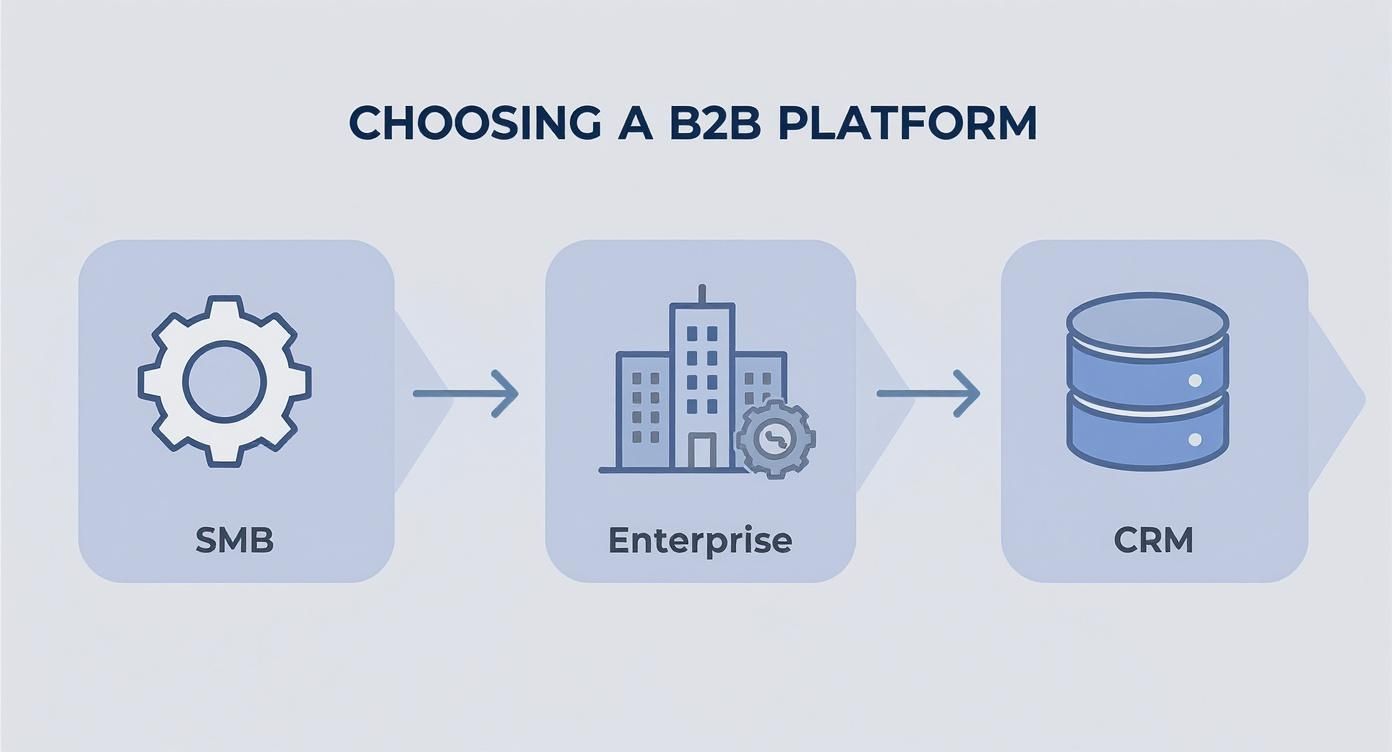
As the infographic shows, the platform you choose depends a lot on your company size and what CRM you’re already using. This choice directly impacts how you'll build and scale campaigns like the one we just designed.
The biggest mistake I see is "set it and forget it." Your first campaign is just a starting point, not the final product. Use the data to ask questions. Is the open rate on Email #2 tanking? Try a new subject line. Are clicks low on Email #3? Maybe your call-to-action isn't clear enough.
By constantly testing and tweaking, you turn a good automation into a lead-generating machine. You can even boost the quality of leads entering the funnel in the first place by using smarter tactics like AI for lead scoring to make sure you're focusing on the best prospects from the get-go.
Navigating Common Automation Hurdles
Let's be honest: just buying a powerful marketing automation platform doesn't magically solve all your problems. If it were that easy, everyone would be crushing their numbers. The reality is, success comes from sidestepping the common roadblocks that can turn a promising investment into a frustrating headache.
These hurdles aren't just about tech. They're about people and process.
In fact, a recent survey laid out the big three pretty clearly. When B2B marketers were asked about their biggest headaches, 56% pointed to data integration. Right behind that was getting sales and marketing to actually use the thing (40%), followed closely by proving it was all worth it (37%). You can dig into more of these marketing automation statistics yourself.
Let's break down how to conquer each one.
Conquering Data Integration Issues
Your automation platform is only as smart as the data you feed it. Think of it like a high-performance engine—if you fill it with dirty fuel, it’s going to sputter and fail.
If your CRM is a chaotic mess of duplicate contacts, old info, and inconsistent fields, your campaigns are dead on arrival. You'll end up sending the perfect message to the wrong person, or worse, annoying your best prospects with irrelevant content.
Action Plan: Establish your CRM as the single source of truth.
- Audit Your Data (This Week): Export a sample of 1,000 contacts from your CRM. How many have missing job titles? How many are duplicates? This will reveal the scale of the problem.
- Implement Data Hygiene Rules (This Month): Create a simple, one-page document outlining data entry standards (e.g., all state fields must use two-letter abbreviations). Make it required reading for anyone who touches the CRM.
- Schedule a Quarterly Cleanup: Dedicate one day every quarter for the marketing and sales teams to tackle data cleanup projects together.
This isn't just a technical step; it's the foundation for everything that follows.
Bridging the Sales and Marketing Divide
One of the biggest promises of automation is finally getting sales and marketing to play nice together. But a piece of software can't force teamwork.
Without a crystal-clear agreement on what makes a lead "qualified," marketing will celebrate a mountain of MQLs that sales sees as total junk. This is where the finger-pointing starts.
Action Plan: Create a Service Level Agreement (SLA). It's a simple, written contract between sales and marketing that takes all the guesswork out of the equation.
Think of an SLA as the official rulebook for the lead handoff. Marketing agrees to deliver a specific number of qualified leads each month (defined by a lead score of 100+), and sales agrees to contact those leads within 24 hours. It replaces assumptions with accountability.
Proving Your Return on Investment
"So... is this thing actually working?" It’s the question every marketer dreads if they don't have a good answer. The pressure to connect your campaigns directly to closed deals is intense, and for many, it’s the toughest hurdle.
To prove ROI, you have to look past vanity metrics like open rates and clicks. Those are nice, but they don't pay the bills.
Action Plan: Start with first-touch attribution. It's the simplest model to implement and provides immediate insight. Inside your platform, create a report that shows which marketing channel (e.g., Organic Search, Paid Social, Email Marketing) sourced the contacts that eventually became closed-won deals. This report will directly tie marketing efforts to revenue. If you're new to this, our complete guide on multi-touch attribution models is the perfect place to start.
Try our Marketing Plan Generator — generate a complete AI-powered marketing plan in minutes. No signup required.
B2B Marketing Automation FAQs
Diving into marketing automation for B2B always brings up a few big questions. We get it. You're thinking about cost, team size, and the million-dollar question: when will I actually see a return on this thing?
Let's clear the air. Here are the straight-up answers to the most common questions we hear from B2B marketing leaders. Think of it as your cheat sheet for moving forward with confidence.
| Question | Answer |
|---|---|
| How soon can I expect to see an ROI? | It comes in stages. Within 3-6 months, you'll see efficiency gains—better lead organization, faster follow-ups. The real pipeline and revenue impact usually shows up between 6-12 months, once your automated nurture campaigns have had time to work through a typical B2B sales cycle. |
| Is this stuff only for huge companies? | Not anymore. That's a common myth. While enterprise beasts like Marketo are built for massive, complex teams, a whole new category of platforms like HubSpot are designed for small and mid-sized businesses. They're user-friendly, scalable, and won't break the bank. |
| Will automation make my marketing feel robotic? | It's actually the opposite—if you do it right. Bad automation feels robotic because it's just blasting generic messages. Great automation feels personal because it uses real behavior—like which pages a prospect visited or what content they downloaded—to deliver the perfect next message at the perfect time. It scales the human touch. |
| Do I need a dedicated team to manage it? | Not on day one. Most modern platforms are intuitive enough for one or two tech-savvy marketers to get up and running. As you grow and get more sophisticated with your strategy, you might hire a dedicated marketing ops person, but that's an evolution, not a starting point. |
Hopefully, that clears up a few things. The goal isn't to replace your team's smarts; it's to give them the tools to execute those smarts at a scale you could never manage by hand.
Ready to see how an intelligent platform can transform your B2B marketing? The marketbetter.ai platform integrates AI across content creation, campaign management, and customer engagement to drive measurable growth. Discover how marketbetter.ai can help you scale personalization and prove your ROI.