
The Complete Guide to B2B Intent Data: From Signals to Pipeline [2026]

Your best prospects are researching solutions like yours right now. They're reading comparison articles, checking G2 reviews, attending webinars, and visiting your pricing page.
But they haven't filled out a form. They haven't booked a demo. As far as your CRM is concerned, they don't exist.
This is the reality of B2B buying in 2026: up to 70% of the buyer journey happens in the dark funnel — the invisible research phase where buyers evaluate vendors without ever raising their hand. By the time they contact sales, they've already shortlisted 2-3 vendors. If you're not on that shortlist, you're not in the deal.
Intent data changes the equation. Instead of waiting for buyers to come to you, it reveals who's actively researching solutions in your category — so you can engage them while they're still making decisions.
The B2B buyer intent data market is worth an estimated $4.5 billion in 2026, growing at a 15.9% CAGR. But market size doesn't mean market maturity. Most sales teams still get intent data wrong — buying expensive signals they can't activate, drowning SDRs in noise instead of giving them focus.
This guide covers everything: what intent data actually is, the different types and where they come from, how to evaluate providers, implementation frameworks that work, and the mistakes that burn budgets.
What Is B2B Intent Data?
Intent data is behavioral evidence that a company or individual is actively researching a particular topic, product category, or solution. It goes beyond static firmographic data (company size, industry, revenue) to reveal what a prospect is interested in right now.
Think of it as the digital equivalent of a buyer walking into a store, picking up three products, reading the labels, and putting two back. They haven't asked for help yet, but their behavior tells you exactly what they're evaluating.
In B2B, intent signals include:
- Content consumption: Reading articles about "CRM migration" or "visitor identification software"
- Search behavior: Googling "Salesforce alternatives for mid-market" or "intent data pricing"
- Website visits: Landing on your pricing page, case studies, or competitor comparison pages
- Review site activity: Comparing vendors on G2, TrustRadius, or Capterra
- Job changes: A VP of Sales who championed your product at their last company just moved to a new one
- Hiring patterns: A company posting 5 SDR roles signals they're investing in outbound — and probably need tools
- Social engagement: Engaging with content about sales automation or AI-driven prospecting
The insight that matters: intent data doesn't predict who will buy. It predicts who is actively considering a purchase. That distinction is everything. A company surging on "email deliverability" topics might buy an email platform, or they might just have a curious marketer. But a company surging on "email deliverability" while visiting your website and checking your G2 profile? That's a qualified signal worth acting on.
For a deeper dive into the fundamentals, see our post on what intent data is and how buyer signals work.
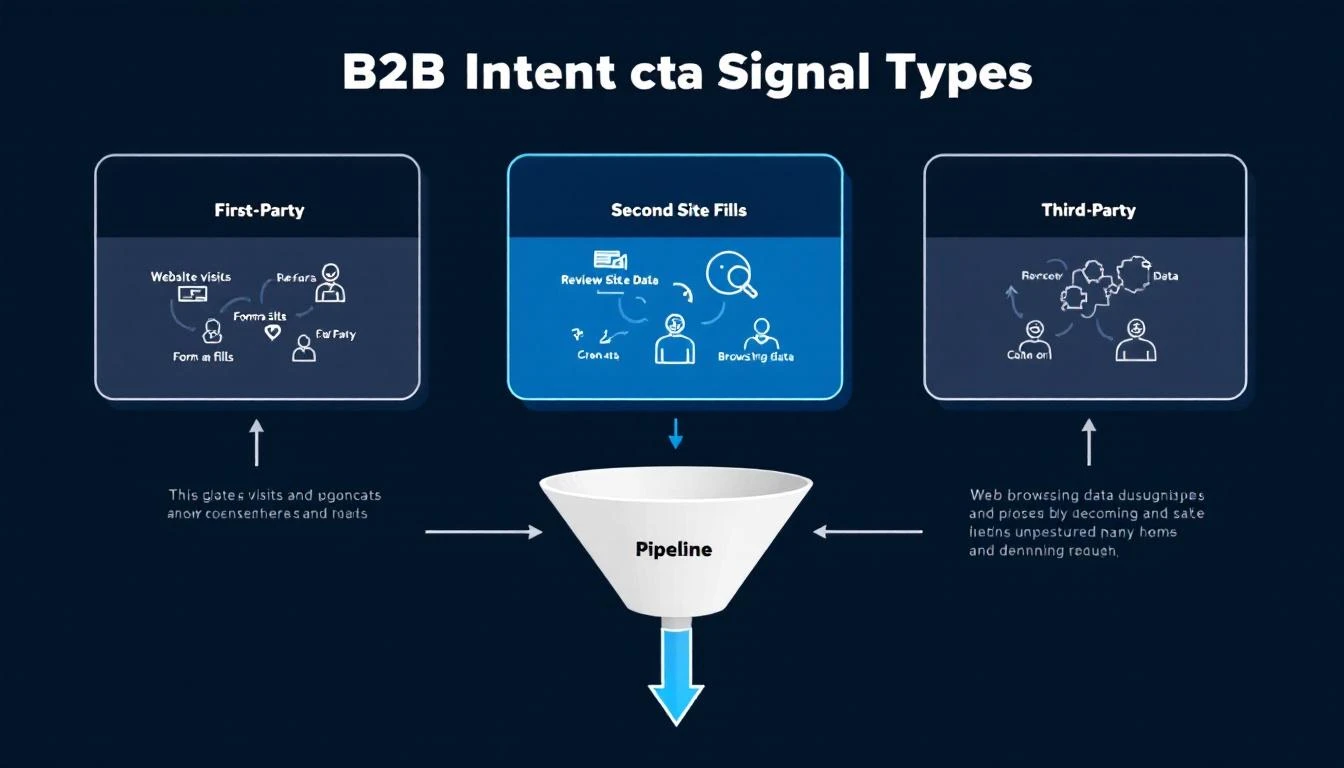
The Three Types of Intent Data
Not all intent data is created equal. The source determines the accuracy, timeliness, and actionability of every signal you receive.
1. First-Party Intent Data
What it is: Signals collected from your own digital properties — your website, app, email campaigns, and content.
Examples:
- A company visiting your pricing page 3 times in a week
- Someone downloading your "SDR Playbook" eBook
- A prospect opening 5 of your last 7 emails
- Multiple people from the same company hitting your comparison pages
Strengths:
- Highest accuracy (you know exactly what they looked at)
- Real-time (no delay between action and signal)
- Free to collect (you just need the right tools)
- Most actionable (they already know your brand)
Weaknesses:
- Limited reach (only captures people who've already found you)
- Requires traffic (if nobody visits, you get no signals)
- Can be noisy (one person researching for a school project looks the same as a VP evaluating vendors)
Who provides it: Your own analytics (Google Analytics, HubSpot), visitor identification tools (MarketBetter, Clearbit Reveal, Dealfront), marketing automation platforms.
First-party intent data is the highest-quality signal available because these prospects have already demonstrated interest in your brand specifically. They're not researching a category in the abstract — they're researching you.
To learn how to identify and act on these anonymous visitors, check out our guide on identifying anonymous website visitors and the complete breakdown of website visitor identification tools.
2. Second-Party Intent Data
What it is: Data collected by a partner organization and shared with you directly. It's essentially someone else's first-party data that you access through a partnership.
Examples:
- G2 sharing which companies are comparing products in your category
- TrustRadius providing lists of companies reading reviews of your competitors
- A media publisher sharing which companies consumed content about topics you care about
Strengths:
- Higher quality than third-party (comes from known, specific sources)
- Reveals competitor research behavior (who's looking at alternatives)
- Lower false positive rate than cooperative data
Weaknesses:
- Limited to the partner's audience (not the entire web)
- Usually requires paid relationships
- Fewer provider options
Who provides it: G2 Buyer Intent, TrustRadius, TechTarget Priority Engine, Gartner Digital Markets.
Second-party intent data is particularly valuable for catching buyers during the evaluation phase — when they're actively comparing vendors on review sites. If a company is reading reviews of your competitor on G2, that's a strong signal they're in-market.
3. Third-Party Intent Data
What it is: Signals collected across a broad network of websites, content publishers, and B2B media properties. Aggregated and sold by data providers.
Examples:
- A company consuming 3x more content than usual about "sales automation" across a network of 5,000+ B2B websites
- Topic surge detection showing a company's employees researching "visitor identification" across publisher sites
- Bidstream data showing which companies are being served ads related to your category
Strengths:
- Broadest reach (captures intent across the entire web, not just your properties)
- Early signal (catches buyers before they ever visit your site)
- Topic-level granularity (know which specific problems they're researching)
Weaknesses:
- Higher false positive rate (activity doesn't always mean buying intent)
- Aggregated at company level (you see "Acme Corp" not "Jane Smith at Acme")
- Can be stale (data cooperative models have 7-14 day delays)
- Expensive ($25K-$100K+/year for major providers)
- Privacy concerns (cooperative data models are under regulatory pressure)
Who provides it: Bombora (Company Surge), 6sense, ZoomInfo, Demandbase, TechTarget.
Third-party intent data works best when combined with first-party signals. Alone, it tells you that a company is interested in a topic. Combined with first-party data, it tells you that a company interested in your topic has already visited your site — a much stronger signal.
For an honest look at when third-party intent data falls short, read why intent data fails sales teams and what works instead.
The Intent Data Signal Hierarchy
Not all signals carry equal weight. Here's how to think about signal strength — from weakest to strongest:
| Signal Strength | Signal Type | Example | Confidence Level |
|---|---|---|---|
| 🟡 Weak | Third-party topic surge | Company consuming more content about "CRM" | 10-15% |
| 🟡 Weak | Hiring signals | Company posting SDR job listings | 15-20% |
| 🟠 Moderate | G2/review site activity | Company comparing vendors in your category | 25-35% |
| 🟠 Moderate | Champion job change | Former user moved to a new company | 30-40% |
| 🔴 Strong | Your website visit | Company visited your pricing + case study pages | 40-55% |
| 🔴 Strong | Multi-signal combination | Topic surge + website visit + G2 comparison | 55-70% |
| 🟣 Strongest | Direct engagement | Form fill, demo request, chatbot conversation | 75-90% |
The takeaway: No single intent signal should trigger outreach alone. The magic happens when you layer signals — combining first-party website behavior with third-party topic research, review site activity, and champion tracking.
This is where tools that aggregate multiple signal types outperform single-source providers. For a comparison of platforms that do this well, see our best intent data providers for B2B sales.
The Dark Funnel Problem (And Why Intent Data Matters More Than Ever)
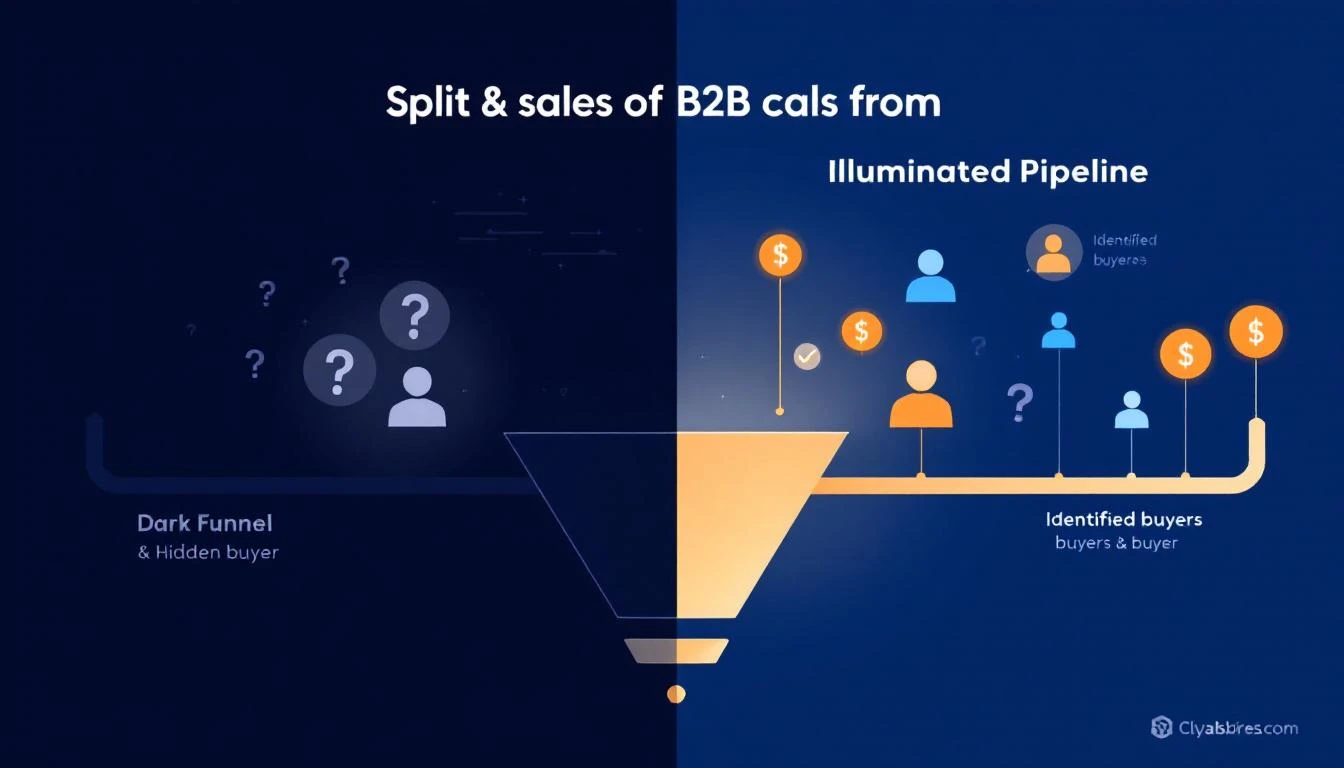
Gartner's research shows that B2B buyers spend only 17% of their total buying time actually talking to suppliers. With an average of 8-12 people in a buying committee, that means any single vendor gets about 5-6% of the entire decision-making process.
The other 94%? That's the dark funnel. It's happening in:
- AI search tools (ChatGPT, Perplexity, Gemini) where buyers ask "What's the best visitor identification tool for mid-market SaaS?"
- Peer communities (Slack groups, LinkedIn DMs, Pavilion, Revenue Collective)
- Review sites where they compare vendors anonymously
- Competitor websites where they're evaluating alternatives
- Content consumption across industry publications and blogs
Organizations with advanced buyer journey tracking reduce acquisition costs by an average of 30% (Gartner). Companies that strategically integrate intent data into their marketing processes increase lead conversion rates by 37% while reducing acquisition costs by 25%.
This is the fundamental value proposition of intent data: it illuminates the dark funnel. Not perfectly — you'll never see everything — but enough to shift from reactive selling ("wait for the form fill") to proactive engagement ("reach out while they're still researching").
We wrote an entire deep-dive on capturing invisible buyers: how to capture the B2B dark funnel.
How to Evaluate Intent Data Providers
With dozens of providers claiming to offer "the best" intent data, here's the framework that actually matters:
1. Signal Source Transparency
Ask: "Where does your data come from, exactly?"
The best providers can tell you:
- How many websites/publishers are in their data cooperative
- Whether they use bidstream data (and the privacy implications)
- How they handle consent and GDPR/CCPA compliance
- Whether signals are deterministic (verified) or probabilistic (inferred)
Red flag: If a provider can't explain their data sourcing methodology, walk away.
2. Signal Freshness
Ask: "How quickly do signals reach me after the activity happens?"
- Real-time (seconds/minutes): First-party website visit data
- Near real-time (hours): Review site engagement, some API-based providers
- Delayed (days/weeks): Data cooperative models, batch processing
For sales teams, freshness matters enormously. A buying signal that's 14 days old is often a dead signal — the buyer may have already chosen a vendor.
3. Activation Speed
Ask: "How quickly can my SDR act on a signal after it fires?"
The gap between "signal detected" and "SDR takes action" is where most intent data implementations die. Look for:
- CRM/Salesforce integration (does it push signals into your existing workflow?)
- Automated routing (does the right rep get the right signal?)
- Action recommendations (does it tell the SDR what to do, not just who to call?)
This is the difference between a dashboard full of data and a daily SDR playbook that tells reps exactly who to contact and what to say.
4. False Positive Rate
Ask: "What percentage of accounts you flag as 'in-market' actually convert?"
Most providers won't give you a straight answer. Benchmark data suggests:
- Third-party topic surges alone: 5-15% correlation with buying behavior
- First-party website visits: 15-30% correlation
- Multi-signal combinations: 30-50% correlation
- Review site + website visit + topic surge: 45-65% correlation
The honest truth: no intent data is perfect. The goal isn't zero false positives — it's making your SDRs more efficient than they would be without the data.
5. Total Cost of Ownership
Beyond the license fee, consider:
- Implementation time (weeks? months?)
- Required headcount (do you need a data analyst to run it?)
- CRM integration costs
- Training time for SDRs
- Data enrichment add-ons (many providers charge extra for contact-level data)
A $30K/year intent data tool that requires a $120K/year analyst to operationalize it is really a $150K/year tool.
For detailed pricing breakdowns and head-to-head comparisons, see our guide to the best buyer intent data tools for B2B sales.
The 4-Phase Intent Data Implementation Framework
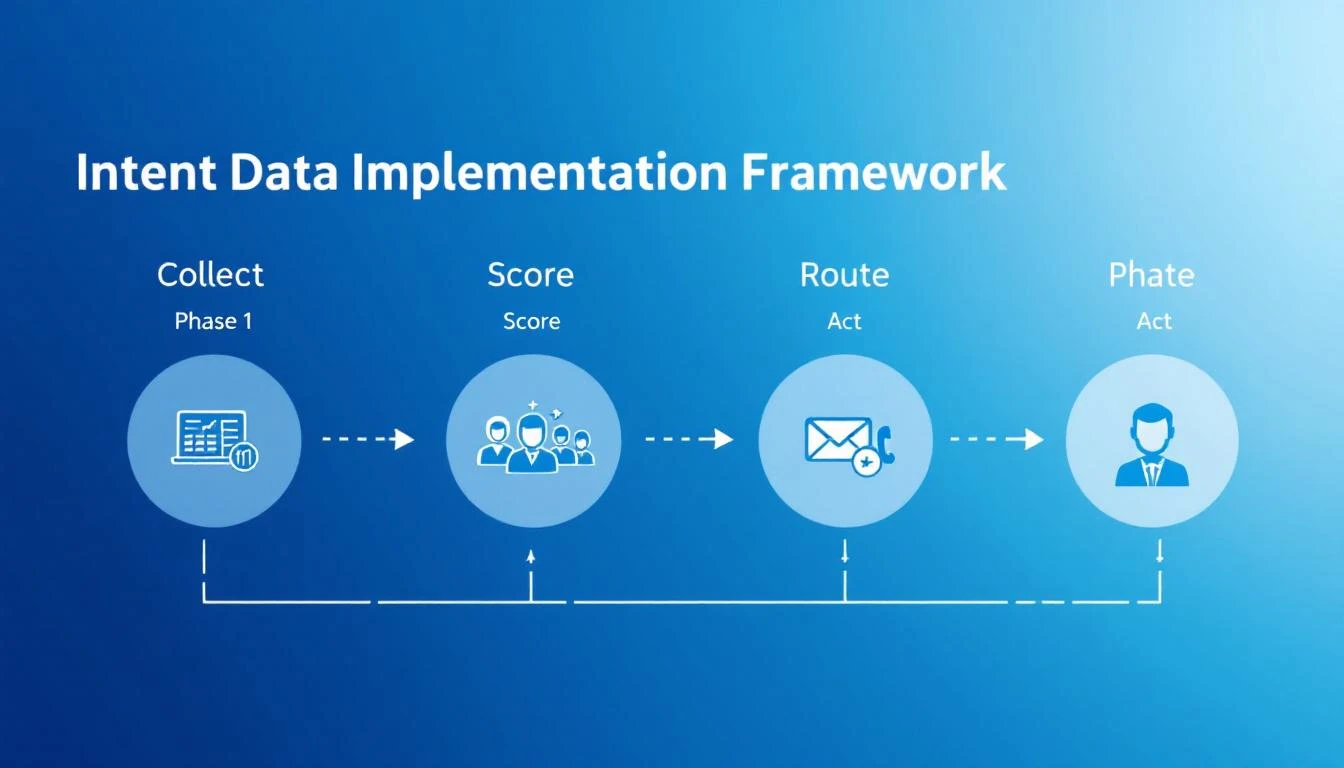
Most intent data deployments fail not because of bad data, but because of bad implementation. Here's the framework that works:
Phase 1: Collect (Week 1-2)
Goal: Establish your signal infrastructure.
Actions:
- Deploy first-party website identification (this alone delivers ROI before you spend on third-party data)
- Connect your CRM as the central data hub
- Set up your ideal customer profile (ICP) filters — industry, company size, tech stack
- Define the topics/keywords that indicate buying intent for YOUR solution
Common mistake: Turning on third-party intent data before you have first-party infrastructure. You'll drown in signals you can't act on.
Start with first-party. See how to turn website visitors into pipeline before scaling to third-party signals.
Phase 2: Score (Week 2-4)
Goal: Separate strong signals from noise.
Actions:
- Create a signal scoring model (weight different signal types based on the hierarchy above)
- Build composite scores that layer multiple signals (a company with 3 weak signals is stronger than a company with 1 moderate signal)
- Set thresholds — at what score does an account move from "monitoring" to "actionable"?
- Incorporate fit data (intent without fit is noise — a 10-person company surging on "enterprise CRM" isn't your buyer)
Pro tip: Start with simple scoring. A basic model you actually use beats a sophisticated model that sits in a spreadsheet. See our take on why traditional lead scoring is broken and what to do instead.
Phase 3: Route (Week 3-5)
Goal: Get the right signals to the right reps, instantly.
Actions:
- Map accounts to owners in your CRM (territory rules, round-robin, or named accounts)
- Set up real-time alerts (Slack, email, CRM task creation)
- Create tiered response SLAs:
- Hot signals (website visit + topic surge + G2 activity): Respond within 1 hour
- Warm signals (topic surge + fit match): Respond within 4 hours
- Monitoring signals (single weak signal): Add to nurture sequence
- Build SDR workflows that prescribe the NEXT ACTION, not just the alert
This is where most implementations break down. SDRs get alerts but no context. They see "Acme Corp is surging on sales automation" but don't know what that means or what to do about it.
The difference between an intent signal and a daily SDR playbook is the difference between "data" and "action."
Phase 4: Act (Ongoing)
Goal: Convert signals into conversations and pipeline.
Actions:
- Personalize outreach based on the specific intent signals (reference the content they consumed, the competitors they're evaluating)
- Coordinate across channels — don't just email. Call. Send LinkedIn messages. Retarget with ads.
- Involve marketing — high-intent accounts should get different ad creative, different landing pages, different nurture sequences
- Track signal-to-meeting conversion rates by signal type and source
- Feed results back into your scoring model (Phase 2) to improve over time
Expected timeline to ROI: 60-90 days for first-party signals alone. 90-180 days for full multi-source implementation.
5 Intent Data Mistakes That Burn Budgets
Mistake 1: Buying Third-Party Data Before First-Party Infrastructure
Starting with Bombora or 6sense before you can identify who's visiting your own website is like buying a telescope before you've opened your eyes. Your website visitors are your highest-quality intent signals — they've already found you. Identify them first.
Mistake 2: Treating Intent Data as a Lead List
Intent data tells you who to prioritize, not who to cold call. An account surging on "email deliverability" isn't asking you to sell them email tools. They're researching a problem. Your outreach should demonstrate expertise, not pitch a product.
Mistake 3: Ignoring Signal Decay
A buying signal from 3 weeks ago is noise. B2B buying cycles are compressed — the window between "actively researching" and "selected a vendor" can be as short as 2-4 weeks for mid-market deals. If your intent data has a 14-day delay and you take another week to act, you're too late.
Mistake 4: Single-Signal Decisioning
No one intent signal is reliable enough to justify a sales touch. A company visiting your homepage once isn't a buying signal. A company visiting your homepage, then your pricing page, then reading 3 competitor comparison posts, then showing up on G2 in your category? That's a signal.
Layer signals. Score combinations. Act on patterns, not individual data points.
Mistake 5: No Feedback Loop
If you never measure which signals led to meetings and which led to dead ends, you can't improve. Track:
- Signal-to-meeting rate by source
- Signal-to-opportunity rate
- Signal-to-revenue attribution
- False positive rate by signal type
The teams that win with intent data treat it as a learning system, not a fire-and-forget tool.
Intent Data and the AI Revolution
The landscape is shifting fast. Three trends are reshaping intent data in 2026:
1. AI Search Is Creating New Dark Funnel Channels
Buyers increasingly research vendors through ChatGPT, Perplexity, and Google AI Overviews. These interactions are invisible to traditional intent data providers. Companies that optimize for AI Engine Optimization (AEO) — ensuring their brand shows up in AI-generated answers — gain an early advantage.
2. Signal Orchestration Is Replacing Point Solutions
Instead of buying one intent data provider, leading teams layer multiple signal sources through orchestration platforms. First-party website visits + third-party topic surges + champion job changes + competitive review signals = a composite intent score that's far more accurate than any single source.
This is the model behind signal-based selling — treating every buyer interaction as a signal to be captured, scored, and acted on.
3. AI-Powered Action Recommendations
The next evolution isn't better data — it's better action. AI models that analyze intent patterns and prescribe specific next steps (call with this message, email this case study, loop in this executive sponsor) are replacing dashboards that show data without context.
The SDR of 2026 doesn't analyze intent signals. They follow a daily playbook that already incorporates intent data, fit data, and engagement history into prioritized action items.
Building Your Intent Data Stack
For most B2B sales teams, here's the recommended intent data stack in priority order:
Layer 1 (Start here):
- Website visitor identification (first-party intent)
- CRM integration for routing and tracking
Layer 2 (Add when Layer 1 is producing meetings):
- G2 or TrustRadius buyer intent (second-party, competitor research signals)
- Champion/job change tracking
Layer 3 (Add when you have SDR capacity to act on more signals):
- Third-party topic surge data (Bombora, 6sense)
- Hiring signal monitoring
- Social engagement tracking
Layer 4 (Scale phase):
- AI-powered signal orchestration
- Predictive scoring models
- Multi-channel activation (ads, email, phone, LinkedIn coordinated on intent triggers)
Don't try to boil the ocean. Start with Layer 1, prove ROI, then expand.
Key Metrics to Track
Once your intent data program is running, measure these monthly:
| Metric | Benchmark (2026) | Why It Matters |
|---|---|---|
| Signal-to-meeting rate | 5-15% | Are signals converting to conversations? |
| Time to first touch (after signal) | <4 hours for hot signals | Speed determines win rate |
| Intent-sourced pipeline | 20-40% of total pipeline | Is intent data generating real pipeline? |
| Cost per intent-sourced meeting | $150-$400 | Efficiency vs. cold outbound ($500-$1,200) |
| False positive rate | <50% for multi-signal | Is your scoring model working? |
| SDR adoption rate | >80% daily usage | If SDRs don't use it, nothing else matters |
The Bottom Line
Intent data isn't magic. It won't fix a broken sales process, compensate for a weak value proposition, or replace the need for excellent SDRs.
What it does — when implemented correctly — is give your team an unfair advantage: the ability to engage buyers while they're still making decisions, with context about what they care about, before competitors even know they exist.
The companies winning with intent data in 2026 share three traits:
- They start with first-party signals before buying expensive third-party data
- They layer multiple signal types instead of relying on any single source
- They build action workflows, not dashboards — turning signals into specific next steps for SDRs
The dark funnel isn't going away. But with the right intent data strategy, you don't need to see everything. You just need to see enough to show up first.
Ready to start capturing intent signals from your website visitors? Book a demo with MarketBetter →
Related Reading
- What Is Intent Data? The B2B Buyer Signal That Closes Deals 3x Faster
- Best Intent Data Providers for B2B Sales in 2026
- 11 Best Buyer Intent Data Tools for B2B Sales
- Why Intent Data Fails Sales Teams (And What Works Instead)
- How to Capture the B2B Dark Funnel
- The SDR Playbook Template Guide
- Website Visitor Identification: Everything You Need to Know
- Turn Website Visitors Into Pipeline
- Signal-Based Selling Guide
- Champion Tracking vs Website Visitor Intelligence