
We Built AI SEO Inside Our Marketing Platform: The Workflow 17,000 Wasted Impressions Taught Us

The problem looked stupid in a spreadsheet.
Eight blog posts on our own site, ranking somewhere between position four and position fifteen on Google, pulling in roughly seventeen thousand impressions a month between them — and almost no clicks. Apollo.io pricing. Attio CRM pricing. Marketing budget allocation. Monaco platform review. Cold email templates. The kind of buyer-intent queries that should convert. Showing up. Not getting clicked.
We were not failing at ranking. We were failing at the eight inches between Google's index and a buyer's index finger.
This is the post about what we did about it, why most of the SEO advice you have read is wrong about which half of the funnel matters at our stage, and the workflow we ran by hand for months before deciding to just ship it as a product.
The diagnosis: ranking is not the bottleneck. The title is.
Most B2B SaaS blogs at our stage — sub-$1M ARR, low domain authority, a backlog of comparison pages — get told a specific story by SEO consultants. "Build more content. Improve domain authority. Earn backlinks. Update old posts for freshness." All of it is technically true. None of it is the binding constraint.
The binding constraint is that you already rank. And nobody is clicking.
Pull your Google Search Console data and sort by impressions, descending. Then look at any post with more than five hundred impressions in the last twenty-eight days and a click-through rate under one percent. For most B2B SaaS blogs we have audited — including our own — that filter returns a depressing number of pages. Pages ranking on page one. Pages where every impression is a buyer in your category, typing your exact keyword into Google, looking at your title, and choosing somebody else.
This is a CTR problem dressed up as a content problem. The fix is not more content. The fix is rewriting the title and meta description that Google is already showing the buyer.
Concretely: we audited our top eight zero-click pages on May 6. Combined monthly impressions: roughly 17,000. Combined clicks: low single digits. Average position across the set: between four and seven. These are not pages that need more backlinks. They are pages whose titles do not match what the searcher came to do.
Once you see this pattern, you cannot un-see it. Most early-stage B2B blogs are not under-ranked. They are under-clicked.
The manual workflow we ran for months
Before we built any of this into the product, here is what one of our SEO sessions actually looked like, on a laptop, in Notion, with too many browser tabs open.
Step one: pull GSC quick-wins. Open Google Search Console. Filter to the last 28 days. Sort by impressions, descending. Look for pages where position is under fifteen and CTR is under one percent. These are pages where Google is willing to show you to a buyer; the buyer is choosing not to click. That is a title and meta description problem, not a content problem.
Step two: pick the top offender. Highest impressions, lowest CTR, ideally a buyer-intent query (pricing, alternatives, review). The one where the gap between "Google is delivering you traffic" and "you are getting traffic" is most expensive.
Step three: read the SERP. Open an incognito window. Search the actual query. Look at every other title on the page. Notice what your competitors are leading with. Specific numbers. Named tools. Year markers. A sense that the page is a real comparison and not a thin re-skin of a Wikipedia entry.
Step four: rewrite the title and meta. Lead with concrete specifics. Named tools. Named prices. Named frameworks. A reason to click that the other nine results on the SERP do not have.
Step five: ship the change. Submit the updated sitemap. Wait two weeks. Measure.
Steps three and four are the ones that move CTR. Steps one, two, and five are pure friction — context-switching between GSC, the SERP, your CMS, and Google's URL inspection tool. Three of those steps are mechanical. One is judgment. We spent ninety percent of every session on the mechanical parts.
The May 6 session: real before/after
Here are four of the eight posts we rewrote in that session. These are real titles from our repo, not illustrative examples. Numbers from GSC for the 28 days ending May 5, 2026.
| Post | Old title | New title | Why |
|---|---|---|---|
| Apollo.io pricing breakdown (~5K imp, position 4-7) | Apollo.io Pricing 2026: What You'll Actually Pay (Plans, Credits, Hidden Costs) | Apollo.io Pricing 2026: $0, $49, $79, $119 Plans (Real Costs After Credits) | Lead with the actual prices. The original title hinted at hidden costs; the new one shows you the prices in the SERP itself, which is what buyers searching "Apollo pricing" actually want. |
| Attio CRM pricing (~1.5K imp, position 4-7) | Attio Pricing 2026: Free, Plus $29, Pro $69, Enterprise | Attio CRM Pricing 2026: $0/$29/$69 Per Seat (+ Hidden Add-On Costs) | The original had the prices but no hook. The new one adds the per-seat clarification (the actual buyer question) and the hidden-cost angle that competing pages on the SERP were not making. |
| Monaco sales platform review (~830 imp combined) | Monaco Sales Platform Review 2026: Features, Pricing & Alternatives | Monaco Sales Platform Review 2026: Honest Take After Testing ($35M-Funded AI SDR) | The original was generic. The new one tells the buyer two things that nothing else on the SERP offered: we actually tested it, and we have a take on a $35M-funded competitor. |
| Cold email templates (~515 imp, position 4.7) | 7 High-Conversion Cold Email Templates & Platforms for SDRs in 2026 | 7 Cold Email Templates That Actually Book Meetings in 2026 (Real Examples) | "High-conversion" is what every other page on the SERP says. "Actually book meetings" plus "real examples" tells the buyer there is something specific inside. |
We rewrote four others in the same session — marketing budget allocation, the B2B marketing automation platforms listicle, the AI content tools listicle, and the website technology checker listicle. Same pattern every time: replace adjectives with nouns, replace abstractions with prices, replace categories with named competitors.
The point is not that these are perfect titles. The point is that the workflow that produced them is mechanical enough to do every week and judgment-heavy enough that no off-the-shelf tool can do it for you. So we did it by hand. Once a week. For months.
Then we got tired of doing it by hand.
What we shipped: AI SEO inside MarketBetter
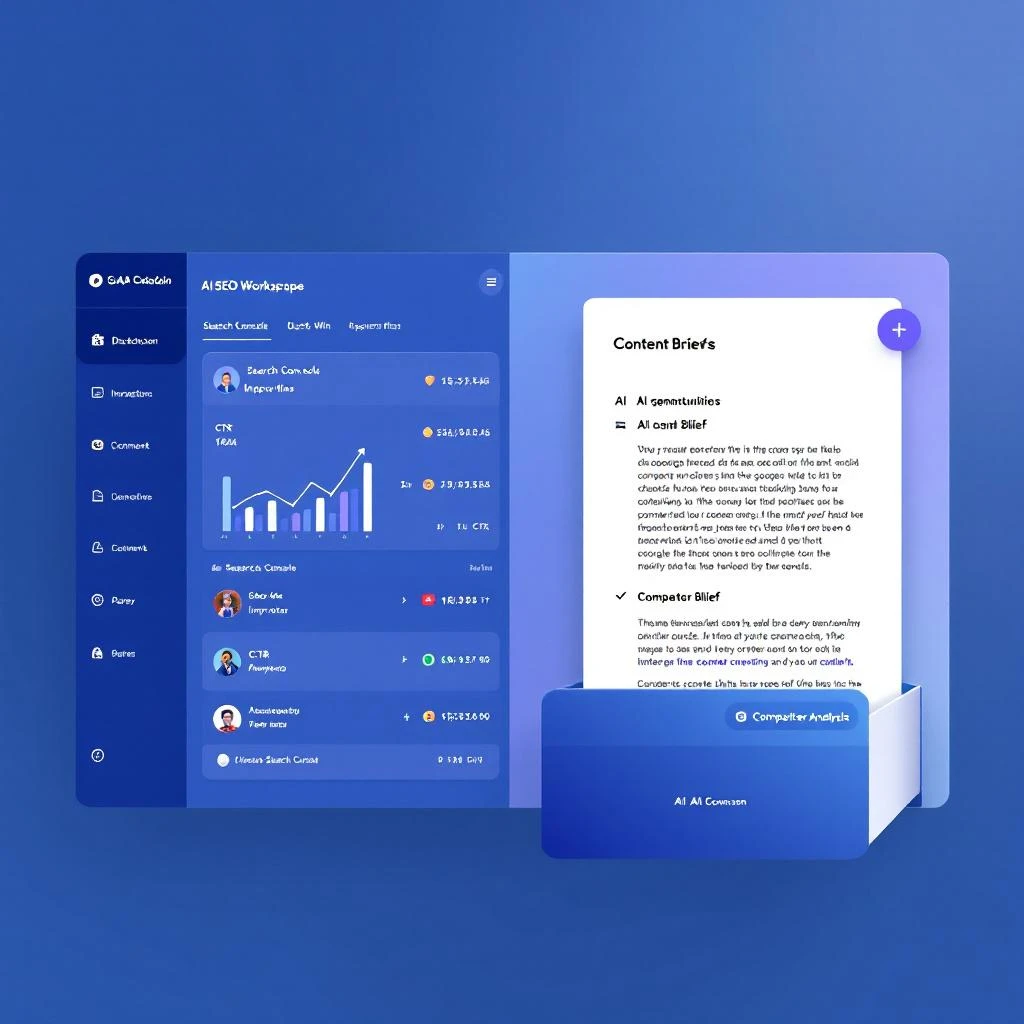
The same week we ran the May 6 session, we shipped an AI SEO workspace inside MarketBetter that does the mechanical parts of that workflow inside the product. Here is what is live now.
Google Search Console, connected and surfaced. Connect your GSC property to MarketBetter and the workspace pulls your top-performing and worst-performing pages — sorted by the impression-to-click gap, not just impressions. Quick-wins surface automatically: pages on page one with low CTR, pages on page two with high CTR potential, pages with sudden ranking drops. The same filter we ran in a spreadsheet, now a tab in your marketing platform.
AI-generated content briefs, in the same workspace. Pick a quick-win. The workspace generates a content brief tailored to the query — competing titles on the SERP, specific gaps, suggested hooks, recommended structure. Not generic SEO templates. Briefs that read the actual top-ranking pages and tell you what nobody on the SERP is saying that you could.
A document drawer for the brief itself. Briefs do not live in a separate tab you have to remember to come back to. They open in a document drawer right next to your GSC data, so the workflow — see the underperforming page, generate the brief, draft the new title — happens in one place without context switching.
Sitemap submission, automated. This is the small one most people will not notice but matters. After you ship a title rewrite or new post, you have to ping Google. The free SEO tools all stop here and tell you to manually submit your sitemap in GSC. We added the write scope to our Search Console integration so MarketBetter can submit sitemaps to Google directly when you publish. One less browser tab. One less reason to forget step five.
We are not claiming this replaces a human strategist. The judgment work — what makes a title worth clicking on the SERP — is still yours. But the mechanical workflow around the judgment, which used to eat ninety percent of an SEO session, is now a one-click loop inside the platform you already use to run campaigns.
The "WHO + WHAT TO DO" payoff
Every other tool in our category does one half of this. We have always believed marketing tools should do both halves.
Google Search Console tells you WHO. Which page is hemorrhaging impressions. Which query is sending you traffic that bounces. Which post on page two is one rewrite away from page one. GSC is the best free SEO tool ever made. It is also a diagnostic tool — it tells you the symptom, not the prescription.
The AI SEO workspace inside MarketBetter tells you WHAT TO DO. Which page to fix first. What the brief should contain. What the new title should lead with. What competing pages on the SERP are saying that you are not.
Most SEO tools stop at WHO. They show you the data and trust you to figure out the rest. That works fine if you have a senior SEO strategist on staff. It does not work if you are a B2B SaaS founder running marketing in the evenings between sales calls.
This is the same pattern that runs through everything we build at MarketBetter. Visitor identification tells you WHO is on your site; our playbook tells your SDRs WHAT to send them. Intent data tells you WHO is in market; our automation tells your team WHAT campaign to run. SEO tools tell you WHICH page is underperforming; our AI SEO workspace tells you WHAT brief to write.
WHO is half a tool. WHAT TO DO is the other half. Most platforms ship the first half and call it a product.
How this compares to Clearscope, Surfer, Frase
Fair question. Those are good tools. Let me be precise about where they overlap and where they do not.
Clearscope, Surfer, and Frase are content optimizers. Paste a draft, get a score, get suggested keywords, get a structure recommendation. They are excellent at the question "given that I am writing this post, how do I make it rank." If you have a writer on staff producing four posts a week and you need to grade their work for SEO, those tools earn their subscription.
They stop short of the workflow we just described in three ways.
First, they do not sit inside your marketing platform. You write in their tool, then export, then paste into your CMS, then go to GSC separately to track performance. Three tabs. We collapsed that into one.
Second, they do not know your ICP. They optimize against the SERP, not against the buyer. A Clearscope brief for "Apollo.io pricing" looks the same whether you sell to RevOps leaders or solo founders. The MarketBetter brief knows what audiences you have built, what campaigns you have run, what your sales team is actually closing — and writes the brief for that buyer.
Third, they do not know which pages your sales team is sending. A pricing comparison page that sales actively links from emails has a totally different optimization priority than one that gets pure organic traffic. Our workspace knows because the same platform sends the emails.
We are not better at the score. They are better at the score. We are better at the workflow around the score, because we are the only one of the four also running your marketing automation.
If you have a content team and need to optimize individual pages, use Clearscope. If you are a marketing team that needs to find the underperforming pages, generate the briefs, ship the rewrites, submit the sitemap, and track the result, all in one place — that is what we built.
What this changes for our customers
If you are already on MarketBetter, the AI SEO workspace is live. Connect Google Search Console under integrations and the quick-wins tab populates from your last 28 days of data. From there, the loop is: pick a page, open the brief, edit it, ship it.
If you are not on MarketBetter yet — this is the part of the post where we tell you to come see it. Not because the SEO workspace is the only reason to use the platform, but because it is the clearest example of how we think about marketing tooling. We do not ship dashboards that hand you a list of problems to solve in your head. We ship workflows that tell you the next action and let you take it without leaving the tab.
You can book a demo if you want a walkthrough. You can read why we think the fragmented B2B lead stack is killing more pipeline than any other single thing if you want the longer version of the "one workflow, one platform" thesis.
What we are still working on
A few things this version does not do yet, in case you are evaluating it.
Title A/B testing inside the workspace. Right now you ship a rewrite and wait. Next iteration: ship two variants, let GSC tell you which one wins, swap automatically.
Internal linking suggestions. The workspace finds underperforming pages but does not yet suggest which existing posts could link to them to boost their authority. That is on the roadmap because it is the next mechanical step that eats sessions.
Bulk rewrites. Today you fix one page at a time. For sites with hundreds of zero-click posts (which is most B2B blogs over two years old), we will need a batch flow. Working on it.
The point is not that this is a finished product. The point is that the workflow it automates is the actual workflow that moves CTR for B2B SaaS blogs at our stage, and it lives in the platform you already use to run everything else. That is the bet.
The takeaway
If you only remember three things from this post, make it these.
One. Most B2B SaaS blogs at sub-$1M ARR are not under-ranked. They are under-clicked. Pull your GSC data and sort by impressions descending. Filter to position one through fifteen, CTR under one percent. The list is your highest-leverage SEO work for the next quarter, and none of it requires a single new piece of content.
Two. Title and meta rewrites are mechanical enough to systematize. Lead with named tools, named prices, named frameworks. Replace adjectives with nouns. Replace categories with competitors. The four real before/after examples in this post are the entire pattern.
Three. The reason most SEO tools do not move the needle for early-stage B2B is that they tell you the diagnosis without the prescription, and they live in a separate tab from your marketing platform. We built ours into the same product that sends your emails because that is where the workflow actually wants to live.
We were running this loop manually every week. Now our customers run it in one tab. That is the entire feature.
See it in action: Book a demo of MarketBetter — we will walk you through the AI SEO workspace, your live GSC data, and the brief generator on real pages from your own site.
Related reading:
- Apollo.io Pricing 2026: $0, $49, $79, $119 Plans (Real Costs After Credits) — one of the rewrites referenced above.
- Attio CRM Pricing 2026: $0/$29/$69 Per Seat — another from the same session.
- Monaco Sales Platform Review 2026: Honest Take After Testing — the third rewrite from May 6.
- 7 Cold Email Templates That Actually Book Meetings in 2026 — the fourth.
- Marketing Budget Allocation 2026: 8 Proven Frameworks — for teams trying to figure out where SEO sits in the spend.
- 14 Best B2B Marketing Automation Platforms 2026 — the longer comparison if you are evaluating the category.
- The Fragmented B2B Lead Stack Is Killing Your Pipeline — the longer argument for one workflow over five tools.
- The First 30 Minutes: A Morning Workflow for SDRs Who Hit Quota Before Lunch — same workflow-first approach applied to outbound.
- From Buying Signal to Booked Meeting in 24 Hours — and applied to inbound.