How to Create Buyer Personas That Actually Work
Let's be honest: that buyer persona document you created last year is probably collecting digital dust. Many businesses treat this as a one-time, "set it and forget it" task. But that approach is precisely why so many marketing efforts fall completely flat. An outdated or assumption-based persona isn't just a harmless document; it's an active liability. It leads to wasted ad spend targeting the wrong crowd and generic messaging that gets ignored. When your understanding of the customer is built on guesswork, every marketing decision that follows is built on a shaky foundation.
Why Your Current Buyer Personas Are Failing
The real problem is the methodology. For years, personas were cobbled together from internal assumptions, a bit of anecdotal evidence, or maybe a few interviews with friendly stakeholders. This "gut feeling" approach creates a static sketch that becomes irrelevant almost immediately as markets, tech, and customer behaviors shift.
Modern, effective personas are alive. They're rooted in real-world data, not a conference room brainstorming session. The whole concept has evolved massively since it first appeared, moving from simple qualitative sketches to sophisticated, data-rich profiles. Today's best practices use algorithmic and statistical methods to strip out human bias and get you much closer to the truth. You can actually discover more about the history of buyer personas and see how this evolution is changing modern marketing.
This infographic really nails the shift from fuzzy, assumption-based personas to sharp, data-driven profiles.
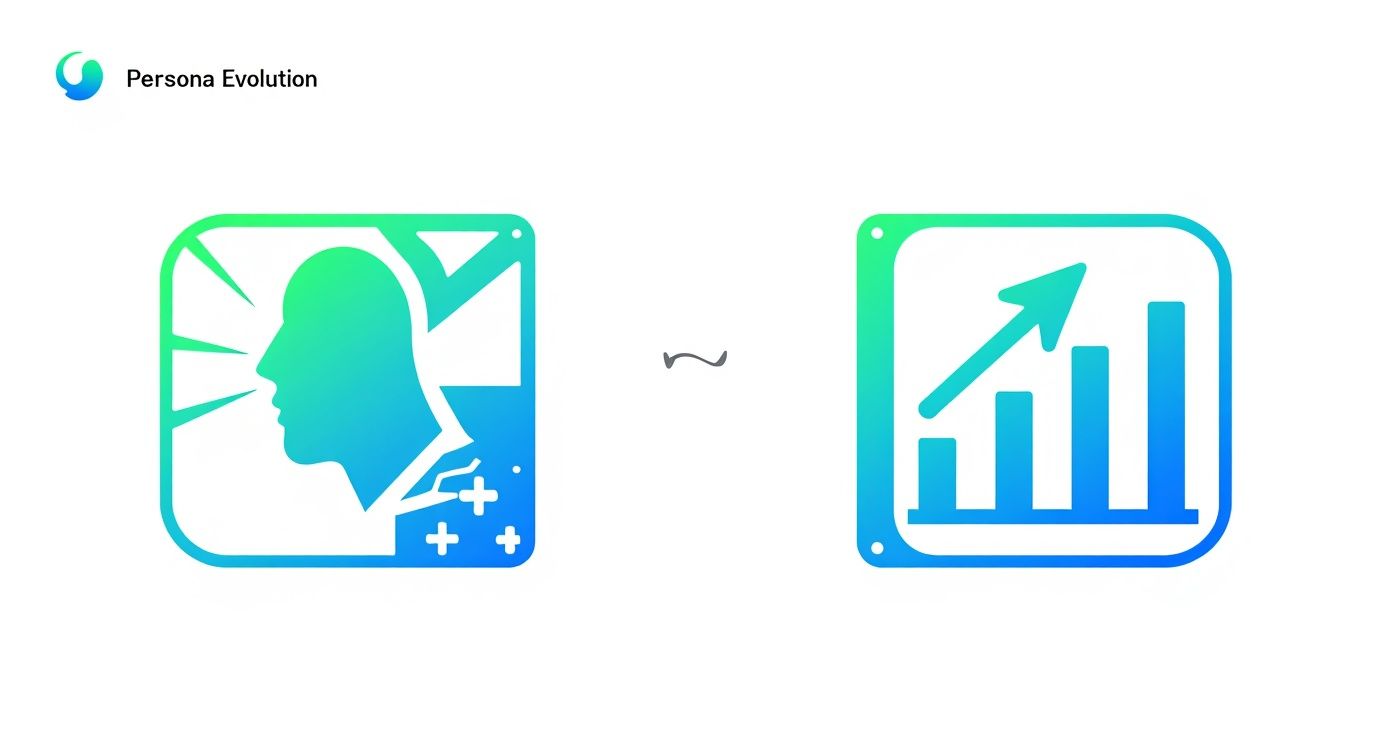
As you can see, this isn't about a one-off project anymore. It's about continuously plugging in real-time analytics and behavioral data to keep your understanding of the customer fresh and accurate.
The Critical Shift from Guesswork to Data
To really drive this home, let's compare the old way with the new. The difference isn't just about semantics; it's a strategic pivot that separates high-performing marketing teams from everyone else.
A traditional persona might say something vague like, "Marketing Mary is overwhelmed." Okay, but what do you do with that? It offers almost zero direction.
A data-driven persona, on the other hand, tells you something you can act on: "Marketing Mary from mid-market tech companies spends 45% more time on our pricing page after reading a case study on ROI. Her primary goal is proving the value of new software to her CFO."
See the difference? One is a guess. The other is a surgical insight pulled directly from data. This level of clarity lets you:
- Tailor content that speaks directly to proven challenges.
- Optimize ad campaigns based on what users are actually doing, not what you think they're doing.
- Refine product features to solve the real-world problems your customers are trying to fix.
This table breaks down the fundamental differences between the two approaches.
Traditional vs Data-Driven Persona Creation
| Attribute | Traditional Personas (The Old Way) | Data-Driven Personas (The New Way) |
|---|---|---|
| Methodology | Based on internal workshops, gut feelings, and small-scale interviews. | Based on quantitative analytics, behavioral data, and qualitative validation. |
| Data Sources | Anecdotes, sales team opinions, leadership assumptions. | Web analytics, CRM data, product usage stats, surveys, customer support tickets. |
| Focus | Broad demographic and psychographic sketches (e.g., "35-45 years old, likes tech blogs"). | Specific, observable behaviors and goals (e.g., "visits X feature page 3 times before converting"). |
| Outcome | A static, often stereotypical character that rarely gets updated. | A dynamic, evolving profile that reflects actual customer behavior in real-time. |
| Bias | Highly susceptible to internal bias and outdated beliefs about the market. | Minimizes bias by grounding insights in objective, measurable data. |
Ultimately, moving to a data-driven model makes your personas far more reliable and actionable, turning them from a decorative document into a strategic tool.
The goal is to create a living document that reflects your actual customer today, not an idealized version from a brainstorming session. This makes creating buyer personas a critical business function, not just a marketing task.
Gathering the Raw Materials for Authentic Personas

Great buyer personas aren't built on assumptions or boardroom brainstorming. They're built from raw, real-world human insights. This is where you have to roll up your sleeves and go way beyond the generic advice to "do some interviews."
To build personas that actually work—the kind that sharpen your messaging and focus your strategy—you need a smart mix of data from different places. Each source tells a piece of the story.
This means blending the what with the why. You can use a tool like Google Analytics to see what users do—segmenting by geography, tracking common paths, and noticing that, say, enterprise visitors always hit your case studies page before contacting sales. But analytics will never tell you why. That's where talking to people comes in. You can learn more about how to blend data for data-driven buyer personas.
Relying on just one source gives you a flat, one-dimensional caricature, not a customer.
Who You Need to Talk To
The richest insights always come from direct conversations, but you absolutely have to talk to the right people. Your goal is to get a full spectrum of experiences, not just a handful of glowing reviews.
Here's who should be on your list:
- Your Biggest Fans (Happy Customers): These are the people who just get it. They understand your value and can tell you, in their own words, why they chose you over everyone else. Their stories are invaluable for nailing your core strengths.
- The Ones That Got Away (Lost Prospects): This group is a goldmine. Seriously. Talking to prospects who looked you over but went with a competitor gives you brutally honest feedback. You'll uncover gaps in your product, messaging, or sales process that your own team might be blind to.
- The Ones Who Left (Unhappy Former Customers): I know, it’s tough to hear. But this feedback is essential. Why did they churn? Did you fail to deliver on your promise? Understanding their pain helps you identify weaknesses and even define negative personas—the types of customers you shouldn't be trying to attract.
- Your Front-Line Experts (Sales and Support Teams): These folks are in the trenches every single day. They hear the unfiltered objections, the recurring questions, and the real problems your audience is trying to solve. Their anecdotal evidence provides the perfect context for all your other data.
Comparing Your Data Gathering Methods
No single method gives you the whole picture. The key is to layer different types of data to see where the stories overlap and validate what you're hearing. Think of it like building a legal case—you need multiple forms of evidence.
| Data Source | Type | What It Tells You | Limitation |
|---|---|---|---|
| Customer Interviews | Qualitative | The "why" behind decisions, deep motivations, emotional triggers, and direct quotes. | Small sample size; can be time-consuming and prone to individual bias. |
| Online Surveys | Quantitative | Trends and patterns across a larger audience, demographic data, and statistically significant preferences. | Lacks emotional depth; difficult to probe deeper into unexpected answers. |
| Website & CRM Analytics | Behavioral | What people actually do, not just what they say. Reveals user paths, content engagement, and conversion points. | Doesn't explain the "why" behind the actions; can be misinterpreted without qualitative context. |
The magic happens when you combine these. Analytics might show 50% of users drop off on your pricing page. But an interview will reveal it's because they can't find information on team-based pricing—an insight you'd never get from the numbers alone.
Asking Questions That Uncover Real Motivations
When you finally get someone on a call, your goal is to get them telling stories. Ditch the simple yes/no questions. The best questions are open-ended and get people to reflect on their journey.
So, instead of asking, "Did you find our product easy to use?"
Try this: "Walk me through the first time you used our product. What were you actually trying to accomplish in that moment?"
See the difference? Here are a few more powerful, open-ended questions to get you started:
- What was the specific trigger or event that made you start looking for a solution like ours?
- Describe your evaluation process. What other options did you consider, and what were the most important criteria for you?
- What were the biggest barriers or hesitations you had right before you made a decision?
- If you could wave a magic wand, what would the perfect solution for your problem look like?
These questions get right to the heart of their goals and frustrations, which is the fuel for any useful persona. The answers you get become your voice of the customer data—the exact phrases and language you should be using in your own marketing. You can find more voice of customer examples in our guide to see how this translates into practice.
Finding the Patterns That Define Your Personas

You've done the hard work. Weeks of interviews, surveys, and digging through analytics have left you with a mountain of raw data. This is where a lot of marketers get stuck. You’re staring at transcripts, spreadsheets, and dashboards full of information, but it feels like a chaotic mess.
The real magic happens next: finding the story in all that noise. You don't need a Ph.D. in data science for this. What you need is a practical way to connect the dots and spot the recurring themes that turn abstract data points into solid, usable personas.
From Raw Notes to Coherent Themes
The goal here is simple: group similar ideas, behaviors, and pain points until clear segments start to emerge. I’ve found two incredibly effective methods for this are affinity mapping and spreadsheet segmentation. They’re different in practice but share the same goal of bringing order to chaos.
Affinity mapping is a hands-on, visual technique that’s perfect for all that qualitative gold you dug up in interviews. You simply write down individual quotes, pain points, or observations on sticky notes. Then, you and your team start clustering related notes on a wall or whiteboard.
For example, notes like "struggles with budget approval," "needs to prove ROI to their boss," and "worries about wasting money" would naturally clump together. You might label that cluster "Financial Pressure." It’s a low-tech way to let the patterns reveal themselves organically.
On the other hand, spreadsheet segmentation is your best friend for organizing a mix of quantitative and qualitative data. You create columns for key data points (like role, company size, survey answers) and rows for each customer you researched. It’s all about sorting, filtering, and finding connections in a more structured way.
Comparing Data Analysis Methods
Choosing between these two really comes down to the kind of data you're working with and how your team likes to operate. One is visual and collaborative; the other is structured and analytical.
| Feature | Affinity Mapping (Qualitative Focus) | Spreadsheet Segmentation (Mixed Data) |
|---|---|---|
| Best For | Interview transcripts, open-ended survey answers, and brainstorming sessions. | Combining survey data, CRM fields, interview notes, and website analytics. |
| Process | Visual and collaborative; uses sticky notes to physically group related ideas. | Structured and analytical; uses columns, rows, filters, and pivot tables. |
| Primary Outcome | Reveals thematic clusters and emotional drivers in your customers' own words. | Identifies correlations between demographics, behaviors, and motivations. |
| Key Advantage | Excellent for uncovering deep, nuanced insights and fostering team alignment. | Highly effective for handling larger datasets and spotting quantifiable trends. |
Neither method is "better." In fact, the most powerful approach I've seen is using both. Start with affinity mapping to find the human stories, then jump into a spreadsheet to validate those themes with hard numbers.
A Real-World Scenario Connecting the Dots
Imagine you're analyzing data for a project management software company. You start noticing a few things that, on their own, don't seem connected:
- Interview Quote: A marketing manager named Sarah tells you, "My biggest headache is getting the design team to sync with the content team. We’re always missing deadlines because of it."
- Survey Data: You see that 65% of respondents in marketing roles ranked "cross-departmental collaboration" as their top daily challenge.
- Analytics: Your website data shows that visitors who check out the "Team Collaboration Features" page are 3x more likely to sign up for a demo.
See what's happening? Individually, each of those is just a piece of information. But when you line them up, a clear pattern smacks you in the face. This isn't just a random problem; it's a significant, recurring pain point for a specific group. You've just found the bedrock of a persona: the "Collaborative Team Leader."
By triangulating data from different sources—qualitative interviews, quantitative surveys, and behavioral analytics—you move beyond simple observations to uncover validated, actionable insights that define a persona.
This is the core of creating buyer personas that actually work. These patterns let you segment your audience based on their real-world needs and behaviors, not just flimsy demographics. To go even deeper on this, check out our detailed guide on effective customer segmentation strategies. This is how you stop guessing and start building a strategy on a foundation of truth.
Alright, let's take that raw data and turn it into something your team can actually use. You've done the hard work of research; now comes the fun part: bringing your persona to life.
This is where you move from spreadsheets and interview notes to building a profile that feels like a real person. We're not creating a dusty document that gets filed away and forgotten. We're building a tool for action.
A great persona profile is the bridge between abstract data and the tangible, day-to-day decisions your marketing, sales, and product teams make.
Give Your Persona a Name and a Face
First things first: humanize your data. "Mid-Market Marketing Managers" is a segment. It's sterile and hard to rally a team around.
But "Marketing Michelle"? Now you’ve got a person.
Slap a simple, alliterative name and a stock photo on your persona. It might seem cosmetic, but it's a powerful psychological shortcut. It helps your team visualize a real human being when they're writing an email subject line, designing a new feature, or planning a campaign.
This simple act transforms a faceless data set into an individual your team can genuinely focus on serving. Don't underestimate it.
It’s a Story, Not a Spec Sheet
Too many companies stop after listing out some demographics and a few bullet points for pain points. This is a massive missed opportunity.
Facts are forgettable. Stories stick. The real magic happens when you craft a narrative that brings your persona's world to life.
| Profile Component | The "List" Approach (Forgettable) | The "Story" Approach (Actionable) |
|---|---|---|
| Daily Routine | Wakes up at 7 AM, checks email, attends meetings. | "Michelle's day starts before 7 AM with a quick scan of her email, looking for fires to put out before her back-to-back meetings begin at 9." |
| Challenges | Needs to prove ROI, lacks resources, deals with team friction. | "Her biggest stressor is the upcoming quarterly review. The CFO is going to grill her on campaign ROI, and she's struggling to connect the dots between her team's efforts and actual revenue, making her feel constantly on the defensive." |
| Goals | Increase lead generation, get a promotion. | "Beyond hitting her MQL target, Michelle’s personal goal is to be seen as a strategic leader, not just an order-taker. Earning that promotion to Director is always on her mind." |
See the difference? The narrative gives you context and emotion. It helps your team understand the why behind the what, which is crucial for building real empathy.
The Four Pillars of a Great Persona Story
To make sure your profile is both compelling and genuinely useful, build your narrative around these four pillars. They provide the structure needed to guide strategy across the company.
- A "Day in the Life" Snapshot: Write a quick paragraph that walks through their typical workday. What’s the first thing they do? Which meetings do they dread? This grounds the persona in a reality your team can understand.
- Core Goals and Motivations: What is this person really trying to achieve in their role? Dig deeper than surface-level tasks. Are they angling for a promotion? Trying to earn respect from the leadership team? Or maybe just trying to make their own job less stressful?
- Biggest Challenges and Frustrations: This is the heart of it all. What's standing in their way? Pull direct quotes from your interviews here to make it hit harder. A line like, "I feel like I'm drowning in data but starving for insights" is way more powerful than "needs better reporting."
- Their "Watering Holes" and Influencers: Where do they go for information? Do they live on industry blogs, follow specific people on LinkedIn, or trust recommendations from peers in a private Slack community? This pillar directly informs your channel and content strategy.
Think of your persona profile less like a technical spec sheet and more like a character bio for a movie. It should be interesting, memorable, and, most importantly, useful for everyone from a junior copywriter to the Head of Product.
Getting this right has a real impact. One benchmark study found that 82% of companies that get serious about personas are more successful at creating a strong value proposition.
When you translate your data into these kinds of actionable stories, you can sharpen everything from product development to your demand gen campaigns. It's how you make sure you're talking to the right people, in the right way. You can dig into the full research on these findings to see just how tight that connection is.
Activating Your Personas Across the Business

You’ve done the hard work. You've conducted the interviews, analyzed the data, and crafted a beautiful, story-driven persona profile. But here’s a truth I’ve learned the hard way: a persona that just sits in a shared drive is nothing more than a nice-to-have document.
The real value gets unlocked when it becomes a daily tool, a gut-check for decisions across your entire organization.
Your goal is to embed these personas so deeply into your company's DNA that they influence everything from a single email subject line to your multi-year product roadmap. This is where the ROI on all that research finally shows up.
Making Marketing Resonate
For any marketing team, personas are the North Star. Without them, you're marketing with a blindfold on, lobbing generic messages into the void and hoping something sticks. A well-defined persona turns every piece of content, every ad, and every campaign into a targeted conversation.
Imagine you're selling to "Startup Steve," an early-stage founder who loses sleep over cash flow. A generic approach would send him the same content you send to "Enterprise Emily," a VP at a Fortune 500 company. It’s an instant disconnect. Steve doesn’t care about scalability for 10,000 seats; he cares about survival.
Instead, use his persona to craft content he actually needs. Think blog posts like "5 Lean Marketing Hacks for Bootstrapped Startups" or a webinar on "Maximizing ROI on a Shoestring Budget." This approach transforms your marketing from noise into a genuinely valuable resource, building the kind of trust that leads to sales. For a deeper dive, see how personas fuel powerful marketing personalization strategies in our detailed guide.
Giving Sales a Strategic Edge
Top sales reps thrive on understanding their prospects on a human level. A great persona profile is basically a cheat sheet for building rapport and navigating conversations with confidence. It gives them the context to move beyond a stale product pitch and become a trusted advisor.
See how the conversation shifts:
- Without a Persona: "Our software does X, Y, and Z. Want a demo?" (Product-focused and boring.)
- With a Persona: "I see you're a 'Marketing Michelle' type, and I know proving ROI to your CFO is a huge priority. Let's talk about how our reporting dashboard can give you the exact numbers you need for that quarterly review." (Problem-focused and helpful.)
This lets reps anticipate objections, speak the customer's language, and frame the solution in a way that hits on their most urgent problems.
It's not just theory. Research shows that when sales teams properly use personas, businesses see a 14% boost in customer retention and a 19% increase in revenue growth. These aren't rounding errors; they're the direct result of having more meaningful conversations.
Guiding Product with Real User Needs
Maybe the most powerful place to use personas is in product development. It’s way too easy for a feature roadmap to be driven by the loudest voice in the room or a knee-jerk reaction to a competitor. Personas ground these critical decisions in what real users actually want.
When your product team is debating what to build next quarter, they can ask one simple, powerful question: "Which of these updates would 'Startup Steve' value most?"
Suddenly, the debate shifts from internal opinions to external customer value. If your research shows Steve is overwhelmed by complexity, the team can prioritize a simpler UI over adding a niche, advanced feature that only "Enterprise Emily" would touch. It ensures you're building a product for your actual customers, not just for yourselves.
A Persona Activation Plan for Your Teams
To make this practical, you need a simple framework that shows different departments how to put your new personas to work today. Share this with your teams to get everyone aligned and moving in the same direction. It’s a starting point to turn those profiles into action.
| Department | Primary Goal with Persona | Specific Actionable Tactics |
|---|---|---|
| Marketing | Generate high-quality, relevant leads | 1. Map content topics directly to persona pain points. 2. Tailor ad copy and imagery to resonate with the persona's industry and goals. 3. Segment email lists by persona for more targeted nurturing campaigns. |
| Sales | Close more deals, faster | 1. Refine outreach scripts to lead with the persona's key challenges. 2. Prepare for common objections specific to each persona. 3. Customize demos to showcase features that solve the persona's biggest problems. |
| Product | Build a product customers love | 1. Prioritize the feature backlog based on what would deliver the most value to the primary persona. 2. Use persona narratives to inform user stories and UX design choices. 3. Validate new feature ideas by asking, "Would this make our persona's life easier?" |
| Customer Success | Improve retention and satisfaction | 1. Develop onboarding flows that address the persona's initial goals and potential confusion points. 2. Proactively share tips and best practices that are relevant to the persona's role. 3. Frame renewal conversations around the specific value the persona has received. |
By giving each team clear, tactical ways to use the personas, you transform them from a marketing exercise into a core business asset that drives growth from every corner of the company.
Common Questions We Hear About Buyer Personas
Even with the best intentions, the persona creation process can hit a few snags. These are the small, practical questions that often pop up and grind everything to a halt. Let's get them cleared up so you can keep moving.
The whole point is to bring clarity, not create a complex academic project. Getting stuck on the small stuff is the number one reason I see teams fail to ever finish—or use—their personas.
How Many Buyer Personas Do I Really Need?
There's a huge temptation to create a persona for every slight variation of customer you can dream up. Don't fall into this trap. Having 10 personas is almost always less effective than having three that are sharp, distinct, and memorable.
Think quality, not quantity. A dozen vague profiles that all sound the same will just muddy the waters for your marketing and sales teams. You're better off with a handful of personas that represent truly different segments of your audience.
For most businesses, 3 to 5 personas is the sweet spot. It's a small enough number to keep top-of-mind during a meeting but big enough to cover the most critical parts of your customer base.
| You Might Need a New Persona If... | You Should Probably Consolidate If... |
|---|---|
| A customer segment has a completely different trigger for buying or "job-to-be-done." | Two personas share the same core pain points and definitions of success, just in different job titles. |
| Their decision-making process involves a totally unique set of influencers and stakeholders. | You find your team can't write truly distinct messaging or ads for each persona. |
The real test is whether you can take action. If you can’t create a separate marketing angle or sales talk track for a persona, it probably doesn't need to exist on its own.
How Often Should We Update Our Personas?
A buyer persona isn't a "set it and forget it" document you frame on the wall. Markets change, customer priorities evolve, and your own product roadmap introduces new capabilities. A persona you built two years ago might be targeting a ghost.
As a general rule, plan on doing a major review and refresh once a year. This is your chance to validate your assumptions, run a few new customer interviews, and update your profiles with fresh data and insights.
But some events should trigger an immediate review:
- A major product launch: A new offering could easily attract a completely new type of buyer you hadn't considered.
- Entering a new market: Moving into a new country or industry vertical will almost certainly require a new or heavily modified persona.
- A big market shift: Think about how a new technology, a recession, or a competitor's move could change your customers' priorities overnight.
Treat your personas like living documents, not stone tablets. A quick quarterly check-in to ask "does this still feel right?" is a fantastic habit to get into.
What If I Have Limited Data to Start With?
This is easily the most common hang-up, especially for startups or companies launching something new. But here's the good news: you don't need a mountain of perfect data to get started.
You just need to start with what you have, even if it feels small. Your first draft is a "proto-persona"—a working hypothesis built on educated guesses and any scraps of information you can pull together.
Here’s a practical plan for when you're data-light:
- Talk to your front-line people: Your sales reps and customer support team are sitting on a goldmine of stories about real customer challenges, objections, and "aha!" moments.
- Spy on competitor reviews: Head over to review sites like G2 or Capterra and read what people are saying about your competitors. What problems are they actually trying to solve? What frustrates them?
- Listen in on social channels: Find the LinkedIn Groups, subreddits, or Slack communities where your ideal customers hang out. Don't jump in and sell. Just listen to the language they use and the topics they care about.
Your first persona won't be perfect. That's okay—it's not supposed to be. It's a starting point that you'll sharpen and refine over time as you collect more real-world feedback.
Ready to move beyond guesswork and create data-driven personas that fuel your entire marketing strategy? marketbetter.ai uses AI to analyze customer data, uncover deep insights, and help you build accurate, actionable personas faster than ever. Stop marketing to stereotypes and start connecting with your real customers. Discover how at marketbetter.ai.