
A Modern Demand Gen Strategy That Drives Revenue
A modern demand gen strategy isn't just a marketing plan; it's a full-funnel machine built to create predictable revenue. The goal is to shift from just capturing existing leads to proactively creating new demand for whatever you sell.
When you do this right, you build trust and become the obvious choice long before a buyer is even ready to talk to sales.
Beyond Lead Capture: A New Demand Gen Strategy
Let’s get one thing straight: the old playbook of just capturing leads at the bottom of the funnel is broken. A winning demand gen strategy doesn't obsess over the tiny fraction of your market that's ready to buy today. It focuses on educating and nurturing the massive portion who aren't, making your solution the one they think of first when the need finally hits.
This is a fundamental shift in thinking. Instead of pouring all your budget into "request a demo" CTAs, you build a comprehensive engine that informs, educates, and establishes your authority. This is how you align marketing and sales around a single shared goal: creating a pipeline filled with educated, high-intent buyers who are already sold on you.
The 95-5 Rule of B2B Marketing
The entire philosophy of modern demand generation hangs on one critical market insight. Research consistently shows that only about 5% of your total addressable market is actively looking to buy at any given moment. The other 95% are future buyers who aren't in a purchasing cycle right now.
Any strategy that ignores 95% of its potential market is, by definition, broken. The real goal is to become the go-to vendor for that massive group, so when they eventually enter that 5% "in-market" segment, you're already their top choice.
This is where you move from chasing leads to building an audience.
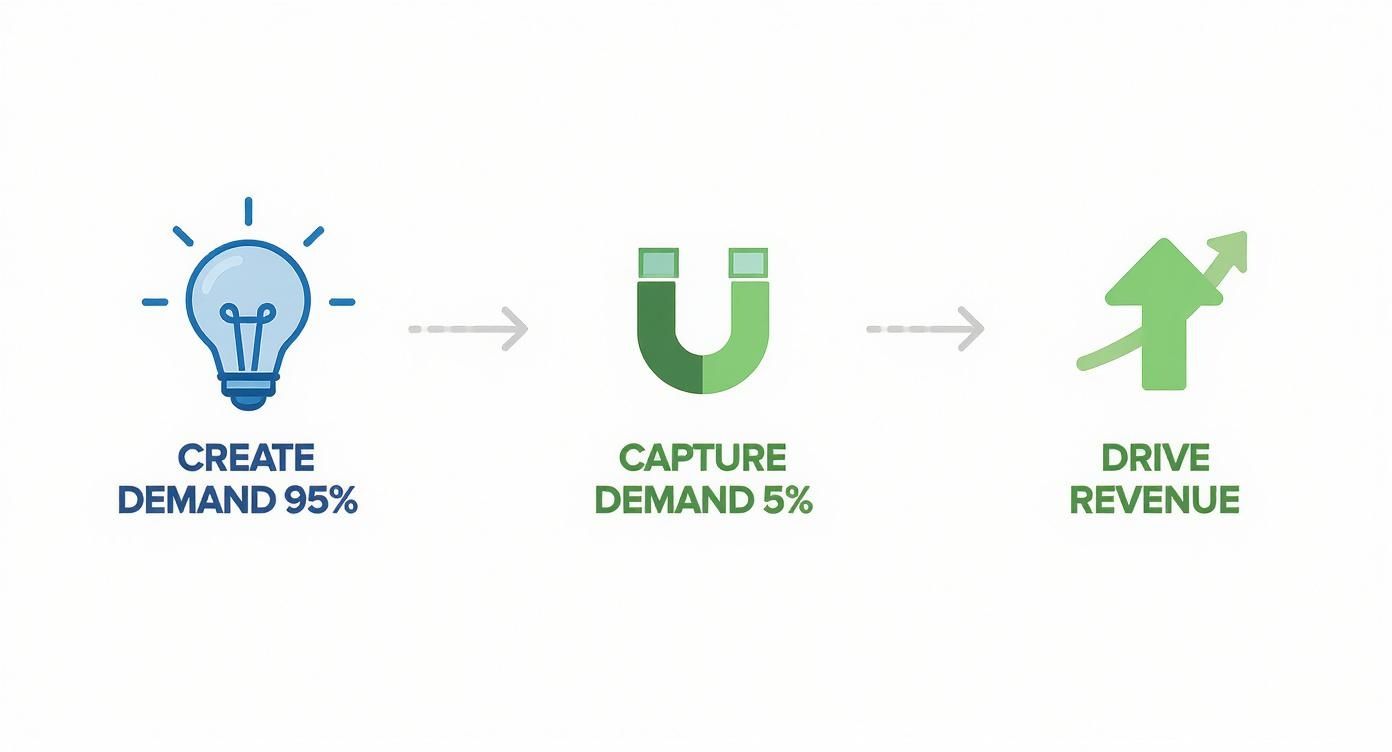
As you can see, the process starts by creating broad awareness and interest before funneling that cultivated demand into actual revenue opportunities. You play the long game.
Demand Creation vs. Demand Capture
To make this work, you have to understand the two core pillars: creating demand and capturing it. They are two sides of the same coin, and you absolutely need both for a balanced, resilient strategy.
- Demand Creation is your "educate and inform" motion. The goal is to make your audience aware of a problem they might not even know they have and position your solution as the answer. This is all about targeting that dormant 95%.
- Demand Capture is the "convert" phase. Here, you're focused on prospects who are already problem-aware and actively looking for a solution. The goal is to intercept their buying journey and make it easy for them to choose you. This targets the in-market 5%.
To see how this plays out in the real world, it helps to put them side-by-side.
| Attribute | Demand Capture | Demand Creation |
|---|---|---|
| Goal | Convert existing, high-intent interest into pipeline. | Educate the market and build brand affinity over time. |
| Audience | The 5% actively searching for a solution. | The 95% who are not currently in-market. |
| Channels | Paid search, G2, Capterra, SEO for bottom-funnel keywords. | Social media, podcasts, content hubs, communities, events. |
| Metrics | MQLs, SQLs, Demo Requests, Pipeline Generated, CAC. | Share of voice, branded search volume, direct traffic, content engagement. |
Both are essential. Without creation, your capture channels will eventually dry up. Without capture, all the brand awareness you build will never turn into revenue.
For a deeper look at the tactics involved, check out these practical B2B demand generation strategies. The key is balancing both creation and capture to build a revenue engine that works, no matter what the market is doing.
Defining Your Audience and Revenue Goals
A demand gen strategy without a laser-focused target is just wishful thinking. It's like having a map but no destination—you'll spend a lot of time, energy, and money going nowhere fast. Before you write a single line of copy or launch an ad, you need absolute clarity on two things: who you're talking to and what you want them to do.
This is the bedrock of a predictable revenue engine. Everything else builds on this foundation.

It all starts with your Ideal Customer Profile (ICP). This isn't just a list of industries or company sizes. A great ICP gets into the nitty-gritty: the specific business pains, the tech stack they use, the buying triggers that signal they need you now. It's about finding the companies that are a perfect fit for what you sell.
Move Beyond Personas to a Pinpoint ICP
Too many marketers get stuck on buyer personas—those semi-fictional profiles like "Marketing Mary." While personas are decent for nailing down your content's tone of voice, they miss the bigger picture. They don't have the business context you need for a winning demand gen strategy.
The ICP, on the other hand, is all about the account.
Think of it this way: a persona describes the person. An ICP describes the company where that person works. You absolutely need both, but the ICP has to come first. It tells you where to aim your budget.
Here’s how the two approaches stack up in the real world:
| Feature | Persona-Led Approach (Broad) | ICP-Led Approach (Focused) |
|---|---|---|
| Focus | Individual roles and their personal goals. | Firmographics, technographics, and business challenges. |
| Example | "Marketing managers who want to be more efficient." | "B2B SaaS companies with 200-1000 employees, using Salesforce, and who recently hired a new VP of Marketing." |
| Action | Create general content about marketing efficiency. | Develop targeted campaigns addressing integration pains with Salesforce. |
| Outcome | High volume of low-quality, unqualified leads. | Lower volume of high-quality, high-intent accounts. |
Building a rock-solid ICP isn't guesswork. You need to get your hands dirty. Interview your best customers. Sit down with your sales team and find out what their best deals had in common. Dig through your CRM data for patterns. For a deeper dive, our guide to customer segmentation strategies can walk you through the process step-by-step.
Set Goals That Actually Drive Revenue
Once you know who you're after, you have to define what a "win" looks like. This is where most demand gen efforts go off the rails. They get fixated on vanity metrics—impressions, clicks, even raw Marketing Qualified Leads (MQLs)—that look good in a report but don't actually tie back to business growth.
A successful demand gen strategy is measured by its impact on pipeline and revenue, not by the volume of leads it generates. Shifting your focus from MQLs to revenue-centric KPIs is non-negotiable for long-term success.
Stop chasing a high MQL count. It’s a recipe for friction between sales and marketing. Instead, focus on goals the C-suite actually cares about. That’s how you prove marketing’s value and earn the right to ask for more budget.
Actionable Revenue-Focused KPIs to Track:
- Pipeline-Influenced Revenue: This shows the total value of sales opportunities that marketing has touched. It’s about demonstrating influence, not just sourcing.
- Customer Acquisition Cost (CAC): How much are you spending to bring in each new customer? Your goal is to keep this number well below their lifetime value.
- Sales Cycle Length: A great strategy doesn't just find leads; it delivers more educated buyers to sales, which should shorten the time it takes to close a deal.
- Marketing-Sourced Revenue: This is the ultimate metric. It’s the bottom-line number—the total revenue generated directly from opportunities your team created.
For example, a weak goal is "increase MQLs by 30%." A powerful, revenue-focused goal is to "generate $2 million in marketing-sourced pipeline this quarter with a target CAC of $5,000."
See the difference? That kind of goal aligns your team’s daily work directly with the company's financial objectives. It makes your demand gen strategy an indispensable part of the business, not just a cost center.
Your Content and Channel Playbook
Alright, you know who you’re talking to and what you want to achieve. Now for the fun part: building the engine that drives your entire demand gen strategy. I’m talking about your content and the channels you use to get it in front of the right people.
Content is the fuel for every single interaction, but it’s completely useless without a smart distribution plan. This is where we stop guessing and start building an actionable playbook—one that connects the right message with the right person at exactly the right time.
The goal isn't just to crank out more stuff. It's about creating the right stuff for each stage of the buyer's journey. A big-picture, thought leadership webinar is perfect for someone just realizing they have a problem. But a detailed, data-heavy case study? That's what you need for someone who's already deep in the consideration phase, comparing their options.
Mapping Content to the Buyer's Journey
A truly effective playbook doesn't just throw content at the wall to see what sticks. It strategically maps specific formats and channels to each stage of the buying cycle, guiding prospects from that first flicker of awareness all the way to a final decision. This approach is what keeps your efforts relevant and, just as importantly, efficient.
Here's a breakdown of how this actually looks in practice:
| Buyer's Stage | Content Formats | Primary Channels | Key Metric |
|---|---|---|---|
| Awareness | Blog posts, podcasts, short-form video, infographics, industry reports, thought leadership articles. | Organic social (LinkedIn), SEO/organic search, targeted display ads, industry publications. | Website traffic, social engagement, reach, new subscribers. |
| Consideration | Webinars, in-depth guides, comparison sheets, white papers, email mini-courses. | Retargeting ads, email marketing, LinkedIn sponsored content, niche communities (Slack/Discord). | MQLs, webinar registrations, content downloads, time-on-page. |
| Decision | Case studies, customer testimonials, ROI calculators, free trials, product demos, implementation guides. | Direct email outreach, targeted search ads (branded keywords), sales-led conversations, review sites (G2/Capterra). | Demo requests, trial sign-ups, sales qualified leads (SQLs), pipeline velocity. |
As you can see, the key is to align every single piece of content with a specific purpose and audience mindset. Top-of-funnel content for the "Awareness" stage should be educational and problem-focused, never salesy. As prospects move into "Consideration," your content has to shift gears to be solution-oriented. Finally, at the "Decision" stage, you need assets that build trust and prove your solution works in the real world.
The most successful demand generation efforts don’t just happen; they are the result of strategic clarity and confidence. This allows marketing teams to allocate resources more intelligently and build personalized buyer experiences at scale.
This kind of clarity is mission-critical, especially as more companies double down on content and account-based marketing (ABM) to hit their growth targets. The top-performing teams know that a well-defined content map is non-negotiable, a fact underscored by the findings in the 2025 Demand Generation Benchmark Survey.
Choosing Your Channel Strategy
Picking the right distribution channels is just as critical as creating great content. One of the most common mistakes I see is teams trying to be everywhere at once. A focused, multi-channel approach that prioritizes the watering holes where your ICP actually spends their time is infinitely more effective.
Let's compare two common paths: the broad, high-volume shotgun blast versus a targeted, niche laser beam.
-
The Broad Strategy (Volume Play): This is where you push content across every major platform—LinkedIn, X (formerly Twitter), Facebook, broad industry pubs. The goal is maximum reach. While this might build some general brand awareness, it almost always leads to low engagement and a ton of unqualified traffic because the message is too generic.
-
The Targeted Strategy (Value Play): This approach zeroes in on a few key channels where your ideal customers are highly active and engaged. This could be a specific Slack community, a niche industry podcast, or hyper-targeted LinkedIn Ads aimed at a precise audience segment. The reach is smaller, sure, but the quality of engagement and the leads that come from it are dramatically higher.
For most B2B companies, the targeted strategy wins. Every. Single. Time. It's about depth, not breadth.
The Art of Repurposing Content
Let's be real: one of the biggest headaches for any marketing team is producing enough high-quality content consistently. The secret isn't working harder; it's working smarter by repurposing a single "pillar" piece of content into an entire ecosystem of assets. This maximizes your investment and squeezes every last drop of value out of your best ideas.
Imagine you just hosted a killer 60-minute webinar with an industry expert. That one event can fuel your content calendar for weeks.
Here's how to do it.
An Actionable Repurposing Playbook:
- The Pillar Piece: The full webinar recording. Host it on your website behind a simple email gate.
- Blog Posts: Write 2-3 detailed blog posts that dive deep into the key themes and takeaways. Don't forget to embed short video clips from the webinar directly into the posts for extra engagement.
- Social Media Videos: Edit the recording into 5-7 short, punchy video clips (30-90 seconds). Each clip should highlight one compelling insight or quote. These are gold for LinkedIn and YouTube Shorts.
- Quote Graphics: Create 10-15 slick, visually appealing graphics featuring powerful quotes from the speaker. Share them across all your social channels.
- In-Depth Guide: Combine the webinar transcript, slides, and some additional research into a comprehensive downloadable guide or eBook. This is a perfect mid-funnel asset.
- Email Nurture Sequence: Build a short email series that shares different webinar highlights over several weeks, driving traffic back to the full recording and the related blog posts.
By adopting this model, that one hour of effort can generate weeks of promotional material, making sure your demand gen strategy is both efficient and impactful. It’s a sustainable system for creating value without burning out your team.
Using AI and Automation to Scale Your Efforts
Let's be honest: trying to scale a modern demand gen strategy by hand is a losing game. To keep up with the market, you need technology—specifically, AI and automation—to work smarter, not just harder. These aren't just nice-to-have tools anymore; they are the core engine for executing at the pace and scale required to win.
This isn’t about replacing marketers. It's about augmenting their skills. It’s about automating the repetitive, soul-crushing tasks that drain their time and unlocking insights a human simply couldn't find in the noise. When you nail this, you free up your team to focus on what actually moves the needle: strategy, creativity, and building real relationships.
Shifting from Manual to AI-Driven Processes
The difference between a traditional, manual approach and an AI-powered one is night and day. It's the difference between guessing and knowing. Between reacting to the market and predicting its next move. A manual process is slow, riddled with human error, and struggles to adapt. An AI-driven one is fast, data-backed, and always learning.
Take a classic marketing function like lead scoring. The old way feels ancient by comparison.
| Feature | Manual Lead Scoring | AI-Powered Predictive Scoring |
|---|---|---|
| Method | Relies on simple actions like email opens and form fills, tied to a rigid, arbitrary points system. | Analyzes thousands of data points—behavioral signals, firmographics, and real-time buying intent. |
| Focus | Shows you who engaged, but often misses the subtle signals of true buying intent. | Predicts which accounts are actually likely to convert, sometimes before they even engage with you. |
| Speed | Slow. Requires constant manual updates and rule tweaks from the marketing team. | Happens in real-time and self-optimizes as new data flows in, no human intervention needed. |
| Outcome | Sales ends up chasing low-quality leads, creating friction and wasting everyone's time. | Delivers a prioritized, high-intent account list to sales, boosting conversion rates and efficiency. |
This same shift applies across your entire strategy, from creating content to analyzing campaign results. If you want to go deeper, we've broken down more examples in our guide to AI for marketing automation.
Scaling Personalized Content with AI
One of the most powerful places to put AI to work is content creation. Gone are the days of a one-size-fits-all blog post. Tools like marketbetter.ai let you produce high-quality, genuinely personalized content at a scale that was impossible just a few years ago. You can finally create tailored blog posts, social media updates, and ad copy for dozens of micro-segments without burning out your entire team.
Here's a look at how a platform can help teams orchestrate their content and campaign planning in one place.

This kind of centralized view is critical. It ensures every single piece of content, from a tweet to a whitepaper, is perfectly aligned with the broader demand gen strategy.
The results speak for themselves. We've seen AI-driven personalization boost customer engagement by up to 40%. In other cases, chatbot implementations have pushed conversion rates up by nearly 30%. By using AI to analyze massive datasets and spot behavior patterns, you stop guessing what your audience wants and start delivering it before they even ask.
Building Your Automation Tech Stack
Of course, none of this happens without the right tech stack. The goal isn't just to buy tools; it's to build an integrated system where data flows seamlessly, automating workflows and creating a single source of truth for your team.
Your tech stack should be a force multiplier for your strategy, not a messy garage full of disconnected tools. Pick platforms that automate the grunt work, deliver deep insights, and empower your team to do high-impact work.
A solid B2B demand gen stack usually includes a few core components:
- Marketing Automation Platform (MAP): Your central hub for email, landing pages, and nurturing. Think HubSpot or Marketo.
- Customer Relationship Management (CRM): The system of record for every customer and prospect interaction, like Salesforce.
- AI Content Platform: The engine for scaling the creation and personalization of content across every channel (e.g., marketbetter.ai).
- Analytics and Attribution Tool: To measure what's actually working and tie marketing efforts directly to revenue. This could be Google Analytics or a more dedicated attribution platform.
- Intent Data Provider: To find accounts that are actively researching solutions like yours right now. Players like Bombora or 6sense are key here.
When you carefully select and integrate these tools, you're not just buying software. You're building a powerful, automated engine that scales your demand gen strategy efficiently and gives your team the freedom to become true drivers of business growth.
Measuring Performance That Ties to Revenue
Your demand gen strategy is an engine. But without a dashboard, you're driving blind. Is it actually working?
To prove it, you have to get past the surface-level metrics like clicks and impressions. It’s time to focus on the numbers the C-suite and your CFO actually care about. This is how you stop defending marketing as a cost center and start presenting it as a predictable revenue driver.
The goal is to build a tight feedback loop: analyze performance, find what's working, and double down on it to improve your return.

From Vanity Metrics to Revenue KPIs
Too many marketing teams get stuck reporting on metrics that feel good but mean nothing to the bottom line. A spike in website traffic is nice, but if none of it converts into pipeline, who cares? The key is connecting every single activity to a real business outcome.
Don't just measure what's easy. Measure what matters. Your credibility hinges on drawing a clear, undeniable line from your team's efforts to the company's revenue goals.
This means obsessing over a handful of core metrics that tell the whole story.
The KPIs That Prove Your Worth:
- Customer Acquisition Cost (CAC): This is the total spend across sales and marketing to land one new customer. An effective demand gen strategy should consistently drive this number down.
- Lifetime Value (LTV): This is the total revenue you can expect from a single customer over their entire relationship with you. The gold standard is an LTV that's at least 3x your CAC—that’s the sign of a healthy, sustainable business.
- Pipeline Velocity: How fast are deals moving from first touch to closed-won? A solid content strategy educates buyers before they even talk to sales, which should directly shorten your sales cycle and boost velocity.
- Marketing-Sourced Revenue: This is the ultimate proof. It’s the total revenue generated from opportunities that came directly from your campaigns. There’s no ambiguity here—it’s the clearest measure of your team’s contribution.
Choosing the Right Attribution Model
Once you’re tracking the right things, the next question is: which activities get the credit? This is where attribution models come in, and getting this wrong is a huge risk. You could end up cutting budget from a channel that’s quietly doing the heavy lifting.
Let’s break down the two most common ways to look at this.
| Attribution Model | First-Touch Attribution | Multi-Touch Attribution |
|---|---|---|
| How it Works | Gives 100% of the credit to the very first marketing interaction a prospect had. | Spreads the credit across multiple touchpoints that influenced the buyer's journey. |
| Best For | Simple, top-of-funnel analysis. Good for seeing what generates initial awareness. | Complex B2B sales cycles where people interact with lots of content over time. |
| The Downside | Ignores every other interaction that nurtured the lead, giving you a skewed, incomplete picture. | Can be more complicated to set up and often requires better analytics tools to get right. |
For any modern demand gen strategy, a multi-touch model is almost always the way to go. It reflects reality. A prospect might see a LinkedIn post, attend a webinar a month later, and finally book a demo after reading a case study. Each of those moments played a part.
A multi-touch model gives you the insight to invest wisely across the entire journey. If you’re ready to get more sophisticated, you can explore the different types of multi-touch attribution models to see which approach fits your business best.
Try our Marketing Plan Generator — generate a complete AI-powered marketing plan in minutes. No signup required.
Common Demand Gen Strategy Questions
Even with the best-laid plans, building a demand gen strategy always kicks up a few tricky questions. I've heard them all. Below, I’ll tackle the ones that come up most often, giving you straight answers and practical advice to help you build and scale your revenue engine with confidence.
How Is Demand Generation Different From Lead Generation
This is, without a doubt, the most common point of confusion. Getting this right is critical because they are two fundamentally different philosophies. One is about harvesting existing demand; the other is about creating it from scratch.
Think of it like fishing.
Lead generation is like dropping a baited hook in a well-stocked pond. You know the fish are there, you know they're hungry, and your only job is to catch them. This is all about targeting that small slice of your market—maybe 3-5%—who are actively looking for a solution right now.
Demand generation, on the other hand, is like building an entire, thriving lake ecosystem. You’re not just fishing; you’re cultivating the environment. You're making sure the water is clean, the food source is rich, and the habitat is perfect. It's a long-term play focused on educating your entire market, building trust, and becoming the only name people think of when they eventually get hungry.
A lead gen mindset asks, "How can we capture more demo requests today?" A demand gen mindset asks, "How can we become the undisputed authority in our space so the best buyers come to us automatically?"
What Is a Good Starting Budget
There’s no magic number here. Anyone who gives you one is just guessing. The right budget depends completely on your context: your industry, company stage, market competition, and how aggressive your growth goals are.
Instead of picking a number out of thin air, work backward from your revenue target. It's the only way to ground your budget in reality.
- Start with the Revenue Goal: Let’s say you need to generate $500,000 in new pipeline this quarter. That's your north star.
- Calculate Required Deals: If your average deal size is $25,000, you know you need to close 20 new customers.
- Factor in Your Close Rate: Maybe your sales team closes 20% of qualified opportunities. That means you need to generate 100 sales-qualified opportunities (SQOs) for them.
- Estimate Your Costs: Now you can start looking at channel costs. If you know from experience or industry benchmarks that a paid LinkedIn campaign costs roughly $5,000 per SQO, you suddenly have a real number to build a budget around.
A seed-stage startup might start lean, maybe $5,000 - $10,000 a month, focusing on just one or two channels to prove a concept. A more established scale-up trying to grab market share might invest $50,000+ per month across a more diverse playbook. The key is to start with a data-informed estimate and be ready to pivot as the real performance data rolls in.
How Long Until I See Results
This is where patience becomes a marketer’s greatest virtue. The timeline for seeing results from demand gen depends entirely on what you're doing. I find it helpful to think about this in two buckets.
-
Demand Capture (Short-Term Results): These are activities aimed at that 5% of the market actively buying now. Think Google Ads targeting bottom-funnel keywords or sponsoring a category on a software review site. With these tactics, you can often see qualified leads and meetings hitting the calendar within 30 to 90 days.
-
Demand Creation (Long-Term Results): This is the long game. You're playing to win over the other 95% who aren't in a buying cycle. Building authority with a podcast, a killer blog, or an industry community doesn't happen overnight. You’ll see leading indicators like more website traffic, branded searches, and social engagement within 3 to 6 months. But the real, tangible impact on pipeline often takes 6 to 12 months (or more) to fully kick in.
Your best bet is to run a balanced playbook. Use demand capture tactics to get some quick wins and keep the sales team happy, while your demand creation engine builds the foundation for predictable, long-term growth.
Which Channels Are Best for B2B Demand Generation
The "best" channels are simply wherever your ideal customers hang out to learn and connect with their peers. Don’t overcomplicate it. While every business is different, a few channels are consistently heavy hitters in the B2B world.
-
LinkedIn: It’s still unbeatable for targeting specific job titles, industries, and company sizes. Great for sharing thought leadership, running sponsored content, and even tasteful, direct outreach.
-
Organic Search (SEO): This is the ultimate long-term asset. Creating genuinely helpful content that solves your ICP's problems builds a competitive moat and delivers a steady stream of high-intent visitors who are literally searching for what you do.
-
Niche Communities: This could be a specific Slack group, an industry forum, or a subreddit. These are high-signal places where you can build real trust by providing value first and selling second (or never).
-
Podcasts: Whether you're a guest on a popular show in your space or you start your own, audio is an incredibly intimate way to build brand affinity. You're literally in your prospect's ear, establishing expertise while they walk the dog or commute to work.
My advice? Start small. Pick two channels you have a strong gut feeling about and run a focused experiment. Once you find a repeatable motion that works, you can earn the right to expand from there.
Ready to stop guessing and start building a predictable revenue engine? marketbetter.ai gives you the AI-powered tools to scale your content, personalize customer journeys, and prove your marketing's impact on the bottom line. See how you can accelerate your demand gen strategy by visiting https://www.marketbetter.ai.