
SDR Onboarding Guide: How to Cut Ramp Time in Half [2026]

The average SDR takes 3 to 6 months to reach full productivity. That's 3 to 6 months of salary, benefits, and management attention before a single qualified meeting hits your pipeline.
For a team hiring 5 SDRs per quarter, that's the equivalent of $150K–$300K in unproductive payroll before anyone hits quota.
The problem isn't the SDRs. It's the onboarding.
Most sales teams still onboard reps the same way they did in 2019: dump a pile of PDFs, schedule a week of product training, assign a buddy, and pray. Then they wonder why ramp times keep stretching.
In 2026, the best SDR teams are cutting ramp time to 6–8 weeks — not by rushing training, but by replacing information dumps with structured, signal-driven onboarding systems.
This guide breaks down exactly how to do it.
Why SDR Ramp Time Is Getting Worse (Not Better)
Before we fix it, let's understand why it's broken.
The Information Overload Problem
New SDRs face more complexity than ever:
- More tools: The average sales tech stack includes 10–15 tools (CRM, sequencer, dialer, enrichment, LinkedIn, intent data, chatbot, calendar...)
- More channels: Email, phone, LinkedIn, video, chat — reps need fluency in all of them
- More data: Intent signals, visitor identification, technographics, job changes — knowing what to act on is harder than finding it
- More competition: Buyers get 50+ cold outreach messages per week. Differentiation requires deep product and persona knowledge
The Coaching Bandwidth Problem
Sales managers average 6–9 meetings per day. They don't have time to sit with every new rep. So training becomes passive: recordings to watch, docs to read, maybe a weekly 1:1 to "check in."
The result? New reps learn in isolation, build bad habits unchecked, and take months to course-correct.
The Metrics Misalignment Problem
Most onboarding programs measure the wrong things:
- ❌ "How many calls did you make today?"
- ❌ "Did you complete the training modules?"
- ❌ "How many emails did you send?"
None of these tell you whether a rep is actually learning to sell. Activity metrics during onboarding create the illusion of progress while hiding fundamental gaps in messaging, targeting, and qualification skills.
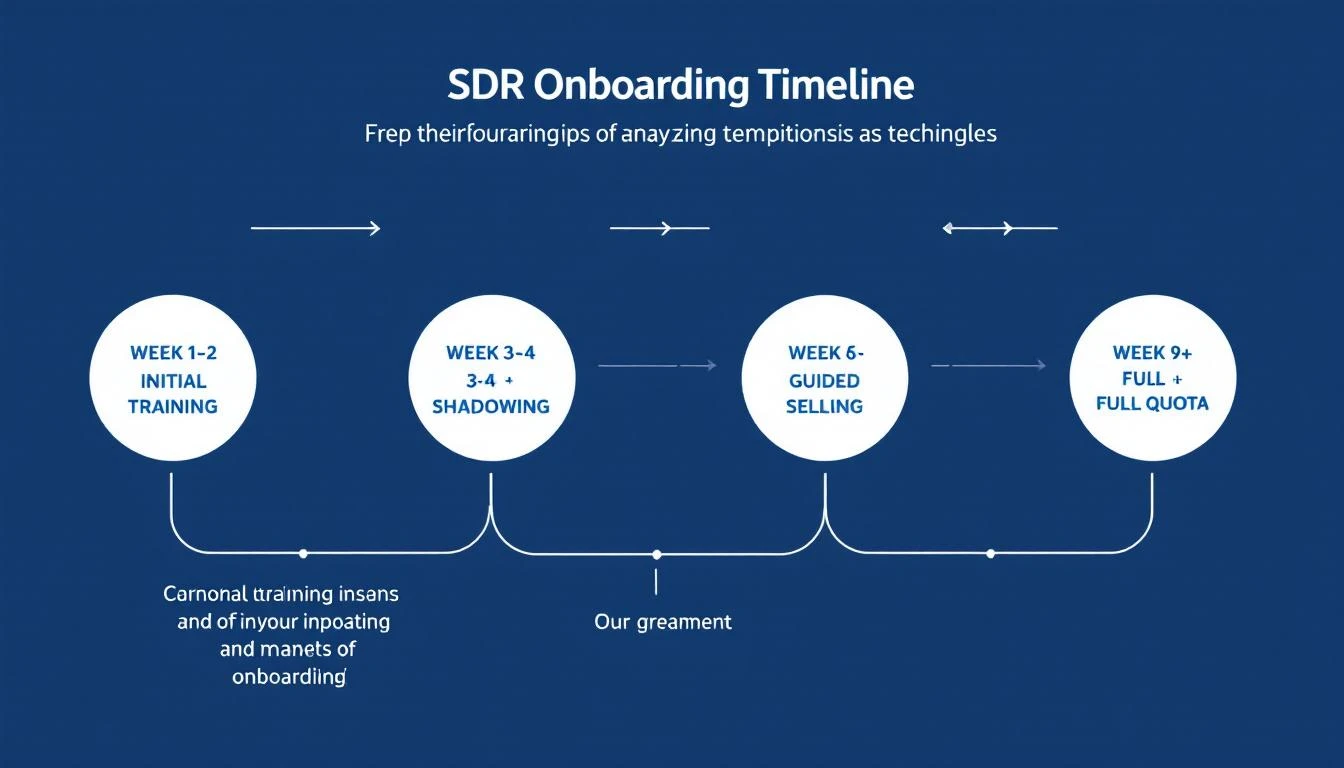
The 8-Week SDR Onboarding Framework
Here's the framework top-performing teams use to get SDRs productive in half the time:
Week 1–2: Foundation (Product, ICP, Tools)
Goal: The rep can articulate your value proposition to any persona in your ICP without reading from a script.
Day 1–3: Company and Product Immersion
- Company history, mission, and competitive positioning
- Product demo (as a buyer, not a feature walkthrough)
- Listen to 5 recorded discovery calls from top performers
- Read 10 customer case studies or G2 reviews
Day 4–7: ICP and Persona Deep Dive
- Define your top 3 buyer personas (title, pain points, language they use)
- Map the buying committee for each target account size
- Study 5 closed-won deals: what triggered the purchase? Who was involved?
- Assignment: Write a 1-paragraph pitch for each persona. Get feedback from your AE.
Day 8–10: Tool Proficiency
- CRM setup, pipeline stages, deal hygiene standards
- Sequencer/email platform: build a test sequence
- Dialer: make 10 practice calls (to internal team, not prospects)
- LinkedIn Sales Navigator: build a sample target list
- Signal tools setup: Configure visitor identification alerts, intent data filters, champion tracking notifications
Key Metric: Role-play assessment score (graded by manager or AE on value prop delivery, persona awareness, objection handling basics).
Week 3–4: Shadowing and Guided Practice
Goal: The rep can run a cold call and send a personalized email sequence without step-by-step guidance.
Shadowing Protocol:
- Shadow 10+ live calls from experienced SDRs (mix of cold calls, follow-ups, and discovery)
- After each call, write a 3-sentence debrief: what worked, what didn't, what they'd do differently
- Shadow 2 AE discovery calls to understand what "good" looks like downstream
Guided Practice:
- Co-pilot calls: rep leads the call, experienced SDR listens and coaches after
- Send first real email sequences (manager reviews before send)
- Respond to first inbound leads with manager oversight
Daily Rhythm:
- Morning: 30 min call review + coaching
- Mid-day: Outreach block (with feedback)
- End of day: 15 min debrief with manager or buddy
Key Metric: Number of "coachable moments" identified per call (not call volume). If a rep isn't making mistakes, they're not pushing themselves hard enough.
Week 5–6: Independent Outreach with Training Wheels
Goal: The rep is working their own book of business with decreasing oversight.
Transition Steps:
- Assign a real territory or account list
- Rep builds their own target list using intent data and visitor identification signals
- Rep prioritizes outreach based on buying signals (not alphabetical order)
- Manager reviews sequences weekly (not daily)
- Rep attends team call reviews and contributes feedback
Signal-Based Selling Introduction:
This is where modern onboarding diverges from the old playbook. Instead of giving reps a static list and saying "go," you teach them to read and act on buying signals:
- Website visitors: "Company X visited your pricing page 3 times this week — that's your first call"
- Champion job changes: "Your contact at Acme just moved to TechCorp — warm intro opportunity"
- Content engagement: "This VP downloaded your ROI calculator — they're evaluating"
- Tech stack signals: "They just adopted Salesforce — they'll need outbound tools next"
Reps who learn signal-based prioritization during onboarding consistently outperform those who start with cold lists. The data is clear: warm outreach based on buying signals converts 3–5x better than cold spray-and-pray.
Key Metric: Signal-to-meeting conversion rate (how many identified signals turn into booked meetings).
Week 7–8: Quota Ramp and Performance Calibration
Goal: Rep hits 50–75% of full quota with increasing independence.
This Phase Includes:
- Full quota assignment (or ramped quota at 50–75%)
- Weekly pipeline review with manager
- Monthly deal review with AE
- Peer coaching sessions (reps review each other's calls)
- Self-directed learning: rep identifies their own skill gaps
Graduation Criteria:
- Can articulate value prop for all personas without notes
- Has booked meetings from at least 2 different channels
- Pipeline generation meets or exceeds ramped quota
- AE confirms lead quality is acceptable
- Can handle top 5 objections without coaching
5 Common Onboarding Mistakes That Double Ramp Time
1. Training on Features Instead of Problems
New reps don't need to know every feature your product has. They need to know what problems buyers are trying to solve and how your product solves them differently than alternatives.
Fix: Replace feature training with "problem-solution" training. For each use case, teach: the buyer's pain → their current workaround → how your product eliminates it → proof it works (case study or metric).
2. Delaying Real Outreach Until "They're Ready"
Some managers keep reps in training mode for weeks because they're "not ready." But reps don't learn to sell by watching — they learn by doing.
Fix: Start guided outreach by Week 3. Early mistakes with coaching are more valuable than late perfection without practice.
3. Measuring Activity Instead of Quality
If your onboarding dashboard shows "calls made" and "emails sent," you're measuring effort, not skill. A rep can make 80 calls a day and learn nothing.
Fix: Measure coachable moments per call, signal-to-meeting conversion rate, and AE satisfaction scores on lead quality.
4. One-Size-Fits-All Onboarding
A rep with 3 years of SDR experience doesn't need the same training as someone straight out of college. Yet most programs run everyone through identical 4-week bootcamps.
Fix: Assess experience level on Day 1 (role play, ICP quiz, tool proficiency check). Fast-track experienced reps. Give more structure to newer ones.
5. No Feedback Loop Between AEs and SDRs
If your AEs don't give structured feedback on lead quality, SDRs have no way to calibrate. They'll keep booking meetings that go nowhere.
Fix: Weekly AE-SDR alignment meetings. AEs rate lead quality on a 1–5 scale. SDRs adjust targeting based on what converts downstream.
The Role of AI in SDR Onboarding (2026)
AI isn't replacing SDR onboarding — it's accelerating it. Here's how the best teams are using AI tools during ramp:
AI-Powered Call Coaching
Tools like Gong and Chorus record and analyze every call. During onboarding, they surface patterns that human coaches miss:
- "You're talking 70% of the time on discovery calls — flip it to 30/70"
- "Top performers mention the competitor by name — you're avoiding it"
- "Your average call is 3 minutes — qualified meetings come from 8+ minute calls"
Signal-Based Daily Playbooks
Instead of giving new reps a cold list, platforms like MarketBetter generate a daily playbook that tells each rep exactly:
- Who to contact (based on website visits, intent signals, and champion tracking)
- Why they're a priority (the specific signal that triggered the action)
- How to reach them (recommended channel and suggested messaging angle)
- What to say (personalized talking points based on their company and activity)
This is transformative for new reps. Instead of spending an hour deciding who to call, they log in and their priority list is waiting. The platform does the research; the rep does the selling.
AI Email Personalization at Scale
New reps struggle with personalization because they don't know enough yet. AI tools can analyze a prospect's LinkedIn, company news, and website to generate personalized email openers that sound like the rep did 30 minutes of research.
The rep still controls the message, but the research barrier drops from 10 minutes per prospect to 30 seconds.
Automated CRM Hygiene
Nothing kills an SDR's ramp faster than CRM confusion. AI-powered CRM automation handles:
- Auto-logging calls and emails
- Updating deal stages based on activity
- Flagging stale leads for follow-up
- Deduplicating contacts before outreach
Reps spend less time on admin and more time learning to sell.
SDR Onboarding Checklist: The Complete List
Use this checklist as a template. Customize for your team, product complexity, and typical rep experience level.
Pre-Start (1 Week Before Day 1):
- Send welcome doc with company overview, ICP summary, and competitive landscape
- Set up all tool access (CRM, dialer, sequencer, LinkedIn Sales Nav, signal platform)
- Assign onboarding buddy (experienced SDR, not AE)
- Schedule Week 1 calendar with training sessions
Week 1–2 (Foundation):
- Product demo from buyer's perspective
- Listen to 5 top performer calls
- Read 10 case studies / G2 reviews
- ICP and persona deep dive
- Write persona-specific pitches (get AE feedback)
- CRM, sequencer, and dialer proficiency test
- Signal platform setup (visitor ID, intent alerts, champion tracking)
- Role-play assessment #1
Week 3–4 (Shadowing):
- Shadow 10+ live calls
- Write call debriefs
- Shadow 2 AE discovery calls
- Complete 5 co-pilot calls
- Send first supervised email sequences
- Role-play assessment #2
Week 5–6 (Independent):
- Own territory / account list assigned
- Build target list using signals
- Prioritize outreach by buying signals
- Weekly sequence review with manager
- Attend and contribute to team call reviews
Week 7–8 (Quota Ramp):
- Hit 50-75% of quota target
- Weekly pipeline review
- Monthly deal review with AE
- Self-identified skill gaps documented
- Graduation assessment passed
How MarketBetter Accelerates SDR Ramp Time
MarketBetter's daily SDR playbook is designed specifically to solve the #1 onboarding problem: new reps don't know where to start.
Instead of handing a new SDR a list of 500 accounts and saying "figure it out," MarketBetter:
- Identifies who's visiting your website — so reps focus on accounts that are already showing interest
- Scores and prioritizes accounts by buying signals — website visits, content downloads, champion job changes, tech stack changes
- Generates a daily action list — every morning, your rep sees exactly who to contact, why, and what to say
- Tracks multi-channel engagement — email opens, LinkedIn views, call outcomes all feed back into signal scoring
- Provides AI-powered email personalization — so new reps can send relevant, personalized outreach from Day 1
The result: SDRs spend Week 1 learning the product and ICP. By Week 3, they're working signal-prioritized accounts with AI assistance. By Week 6, they're booking meetings at rates that used to take 4+ months to reach.
Ready to see how it works? Book a demo →
Try our AI Lead Generator — find verified LinkedIn leads for any company instantly. No signup required.