
3 posts tagged with "predictive lead scoring"

View All Tags

10 Lead Scoring Best Practices: The Framework Behind 3x Conversion Rates

· 30 min read

Is your sales team drowning in "qualified" leads that go nowhere? It's a common story. Many businesses implement lead scoring with high hopes, only to create a system that adds noise instead of clarity, fueling friction between sales and marketing. The problem isn't the concept; it's the execution. Generic, "set-and-forget" models ignore the nuances of your ideal customer and fail to capture true buying intent. This leads to wasted sales cycles, missed opportunities, and a frustrating disconnect between effort and results.

A well-oiled lead scoring system is foundational to an efficient revenue engine. It ensures that every lead passed to sales has a high probability of closing, which is a critical step in building a predictable pipeline. For a deeper dive into how this fits into the bigger picture, this comprehensive SaaS sales funnel guide provides excellent context on structuring your entire revenue process for growth. Optimizing lead scoring is the first step to making that funnel work seamlessly.

In this guide, we will move beyond the basics. We'll break down 10 advanced, actionable lead scoring best practices that transform your scoring from a vanity metric into a powerful revenue driver. We'll provide specific comparisons and show you not just what to do, but precisely how to implement these strategies. Get ready to turn your lead flow into a predictable source of high-value pipeline, prove marketing ROI, and achieve scalable growth.

1. Define Clear Lead Scoring Criteria and Weightings

The foundation of any successful lead scoring model is a well-defined set of criteria and a logical weighting system. This practice involves identifying the specific attributes and behaviors that indicate a lead's sales-readiness and then assigning numerical values to each. Without this clarity, your scoring system becomes arbitrary, leading to inconsistent lead quality and a breakdown in trust between marketing and sales. This is one of the most critical lead scoring best practices because it ensures every stakeholder understands precisely what constitutes a "good" lead.

This foundational step transforms lead qualification from a subjective guessing game into a data-driven process. By codifying what your ideal customer profile (ICP) looks like and how they interact with your brand, you create a universal language for evaluating leads across the entire organization.

Define Clear Lead Scoring Criteria and Weightings

How to Implement and Compare Scoring Models

Implementing a criteria-based system requires a collaborative effort, primarily between your marketing and sales departments. The goal is to translate historical conversion data and sales team insights into a mathematical model.

Actionable Steps:

  1. Hold a Sales & Marketing Workshop: Get both teams in a room to analyze the last 10-20 closed-won deals. Identify common job titles, company sizes, industries, and the marketing touchpoints they engaged with before becoming a customer.
  2. Create a Scoring Matrix: Build a simple spreadsheet listing these attributes.
    • Explicit Data: Job Title, Company Size, Industry, Geographic Location.
    • Implicit Data: Website Visits, Email Opens, Content Downloads, Webinar Attendance.
  3. Assign Initial Points: Start with a baseline. A high-value attribute like "Director" title could be +15 points, while a high-intent action like a "Pricing Page Visit" could be +10 points.

Comparison of Weighting Philosophies:

  • Behavior-Heavy Model: This approach prioritizes actions over attributes. For example, a lead with a less-than-ideal title who requests a demo gets a higher score than a C-level executive who only opens a newsletter. This is best for high-volume, transactional sales cycles where recent intent is the strongest buying signal.
  • Fit-Heavy Model: This model prioritizes firmographic and demographic fit. A lead from a Fortune 500 company in your target industry gets a high score even with minimal engagement. This is ideal for account-based marketing (ABM) or enterprise sales where getting into the right account is the primary goal.

Key Insight: The goal isn't to copy a template but to build a model that reflects your unique customer journey. Start simple with 5-10 core criteria, document everything in a shared repository, and plan to review and adjust weights quarterly based on performance data. This iterative process is a hallmark of effective lead scoring.

2. Implement Behavioral Scoring for Engagement Signals

While demographic data tells you if a lead is a good fit, behavioral scoring reveals if they are genuinely interested. This practice involves tracking and scoring a lead's explicit actions, such as website visits, content downloads, email opens, and demo requests. These engagement signals provide real-time insight into a lead's buying intent, complementing static firmographic information. This is one of the most essential lead scoring best practices because it allows you to prioritize leads who are actively seeking a solution right now.

This dynamic layer of scoring transforms your system from a simple filter into a powerful intent-detection engine. By quantifying engagement, you can differentiate between a curious researcher and a motivated buyer, ensuring your sales team focuses its energy on the most promising opportunities.

How to Implement and Compare Scoring Models

Implementing behavioral scoring requires mapping the customer journey and assigning values to key interactions. The goal is to create a hierarchy of actions that correlate with sales-readiness, a process heavily popularized by platforms like HubSpot and Pardot.

Actionable Steps:

  1. List and Categorize Touchpoints: Create three buckets for all possible lead actions.
    • High-Intent Actions (25-50 points): "Contact Sales" form, demo request, pricing page view. These signal an active buying motion.
    • Mid-Intent Actions (10-15 points): Case study download, product webinar attendance, ROI calculator use. These show active research.
    • Low-Intent Actions (1-5 points): Newsletter open, blog post read, social media follow. These indicate top-of-funnel awareness.
  2. Implement in Your Marketing Automation Platform: Build the rules to assign these point values automatically as leads engage.

Comparison of Scoring Logic:

  • Simple Additive Scoring: This is the most common approach. A pricing page visit (+10) plus a demo request (+25) equals a score of 35. It's easy to implement but can be misleading if a lead performs many low-value actions.
  • Multiplicative or Weighted Scoring: A more advanced method where certain combinations are worth more. For example, a pricing page visit from a lead with a "Director" title might trigger a "hot lead" flag, multiplying their score or adding a significant bonus. This better reflects the value of high-fit, high-intent combinations.

Key Insight: Implement score decay to maintain accuracy. A lead who visited your pricing page six months ago is less "hot" than one who did so yesterday. Actionable Tip: Set up an automation rule to subtract 5 points for every 30 days of inactivity. This ensures your data reflects current engagement levels.

3. Align Sales and Marketing on Lead Quality Definitions

Even the most sophisticated lead scoring algorithm will fail if sales and marketing operate with different definitions of a "qualified lead." This practice involves creating a shared, documented understanding of what constitutes a Marketing Qualified Lead (MQL), Sales Accepted Lead (SAL), and Sales Qualified Lead (SQL). This alignment is one of the most crucial lead scoring best practices because it eliminates the friction that causes high-potential leads to be ignored or mishandled, ensuring both teams are working toward the same revenue goals.

This collaborative step shifts the dynamic from a "lead handoff" to a unified revenue engine. By establishing a common language and agreed-upon thresholds, marketing can confidently deliver leads that sales values, and sales can provide clear feedback to refine marketing's efforts.

Align Sales and Marketing on Lead Quality Definitions

How to Implement and Compare Alignment Strategies

Achieving alignment requires proactive communication and creating a formal Service Level Agreement (SLA) between the two departments. The goal is to move beyond assumptions and codify the entire lead management process, from generation to close.

Actionable Steps:

  1. Define and Document Lead Stages: Write down the exact criteria for each stage.
    • MQL: Must have a score of 75+ AND be from a company with >50 employees.
    • SAL: An MQL that sales reviews and accepts within 24 hours. They confirm the contact is reachable and the account is not an existing customer or active opportunity.
    • SQL: An SAL that has a discovery call booked.
  2. Build a Feedback Mechanism: Create a required "Disqualification Reason" field in your CRM for sales to use when rejecting an MQL. Common reasons include "No Budget," "Wrong Contact," or "Unresponsive."

Comparison of Systems:

  • Informal "Handoff" System: Marketing sends leads over a certain score to a general sales queue. Result: Low accountability, high lead rejection rates, and friction as sales claims leads are poor quality while marketing points to high scores.
  • Formal SLA-Driven System: Marketing commits to delivering a specific number of MQLs meeting the agreed-upon criteria. Sales commits to following up within a set timeframe and providing structured feedback. Result: Mutual accountability, a data-driven feedback loop for refining scoring, and higher conversion rates. For more on building this structure, explore our guide on sales enablement best practices.

Key Insight: Create a "lead council" with members from both marketing ops and sales leadership. Hold monthly meetings to review the MQL-to-SQL conversion rate and discuss rejected leads. This creates a formal, data-driven feedback mechanism that allows you to continuously refine scoring criteria and improve lead quality for the entire organization.

4. Incorporate Firmographic and Demographic Data

Beyond a lead's behavior, their inherent characteristics are often the most powerful predictors of future value. This practice involves scoring leads based on who they are (demographic data) and where they work (firmographic data). Attributes like job title, company size, industry, and annual revenue provide crucial context, ensuring you prioritize leads that perfectly match your ideal customer profile (ICP). This is a cornerstone of effective lead scoring best practices because it prevents sales teams from wasting time on enthusiastic but unqualified prospects.

This foundational layer of scoring grounds your model in reality. While high engagement is a positive signal, it means little if the lead is from a company too small to afford your solution or from an industry you don't serve. By systematically scoring these explicit data points, you build a qualification filter that aligns marketing efforts directly with business objectives.

How to Implement and Compare Scoring Models

Implementing firmographic and demographic scoring begins with a crystal-clear definition of your ICP. Sales and marketing must agree on the exact attributes that constitute a high-value lead. This data can be sourced from form submissions or enriched using tools like ZoomInfo, Clearbit, or Apollo.io.

Actionable Steps:

  1. Define Your ICP Tiers: Don't just have one ICP. Create tiers.
    • Tier 1 (Perfect Fit): Assign the highest scores (e.g., +20 for "Director" title, +15 for target industry).
    • Tier 2 (Good Fit): Assign moderate scores (e.g., +10 for "Manager" title, +5 for adjacent industry).
    • Tier 3 (Poor Fit): Assign zero or negative scores.
  2. Automate Data Enrichment: Integrate a tool like Clearbit or ZoomInfo to automatically append firmographic data to new leads. This ensures your scoring is based on accurate, complete information, not just what a lead self-reports on a form.

Comparison of Data Strategies:

  • Relying on Form Fills: This method is free but highly unreliable. Leads often enter inaccurate data for job titles or company sizes.
  • Using a Data Enrichment Tool: This costs money but provides standardized, accurate data. The ROI is realized through more precise scoring, better lead routing, and higher conversion rates. To get this right, you can explore how a customer data platform integration can help centralize this information for more accurate scoring.

Key Insight: Don't be afraid to use negative scoring. If a lead's attributes clearly disqualify them (e.g., student, competitor, wrong country), assign a significant negative score (like -100) to automatically filter them out. This keeps your MQL pipeline clean and focused on revenue-generating opportunities.

5. Use Negative Scoring to Disqualify Unsuitable Leads

While most scoring focuses on rewarding positive signals, an equally powerful practice is to penalize negative ones. This involves applying negative point values to attributes or behaviors that indicate a lead is a poor fit, actively disengaged, or even a competitor. This subtractive approach is one of the most effective lead scoring best practices for filtering out noise and ensuring your sales team's pipeline remains clean and focused on genuine opportunities.

This method actively purges your MQL pool of unqualified contacts, preventing sales from wasting valuable time on leads that will never convert. By automatically downgrading or disqualifying contacts based on specific red flags, you sharpen the accuracy of your entire lead management process.

How to Implement and Compare Negative Scoring Models

Implementing negative scoring requires close collaboration with sales to define undeniable disqualification criteria. The goal is to identify characteristics that consistently correlate with lost deals or customers who are a poor fit for your product or service.

Actionable Steps:

  1. Brainstorm a "Red Flag" List with Sales: Ask them, "What are the instant deal-breakers?"
    • Demographic/Firmographic: Job title contains "Student" or "Intern" (-50), email domain is "gmail.com" (-10), country is outside your service area (-100).
    • Behavioral: Visited "Careers" page (-25), unsubscribed from all emails (-1000).
  2. Create Two Tiers of Negative Scores:
    • Filtering Scores (-10 to -50): These lower a lead's priority but don't remove them entirely.
    • Disqualification Scores (-100 or more): These effectively remove a lead from sales consideration, moving them to a "nurture" or "unqualified" list.

Comparison of Approaches:

  • Aggressive Disqualification: This model uses large negative scores (-100) to immediately remove any lead with a red flag. This is best for teams with very high lead volume who must ruthlessly prioritize. The risk is creating false negatives.
  • Soft Penalty Model: This model uses smaller negative scores (-10 to -20). A competitor visiting the pricing page might get a penalty, but their score won't plummet to zero. This is better for markets where roles are fluid (e.g., a competitor today might be a prospect tomorrow) and you want to keep leads in the system for future nurturing.

Key Insight: Negative scoring isn't just about disqualification; it's about resource allocation. Document your "deal-breaker" criteria with sales leadership and review them quarterly. Start with 3-5 clear negative attributes and create audit trails to monitor for any "false negatives" that were incorrectly disqualified, ensuring your model remains accurate and fair.

6. Establish Lead Score Decay and Re-engagement Mechanisms

A lead's interest is not permanent; it has a shelf life. Implementing a score decay system ensures your lead scoring model reflects current engagement, not past behavior. This practice involves systematically reducing a lead's score over time when they show no new activity, preventing your pipeline from getting clogged with cold, irrelevant contacts. This is one of the most essential lead scoring best practices because it keeps your sales team focused on genuinely active opportunities and maintains the integrity of your MQL threshold.

This mechanism transforms your lead database from a static archive into a dynamic, responsive system. By automatically downgrading disengaged leads, you create a more accurate picture of your active funnel and build triggers for proactive re-engagement before a lead goes completely cold.

Establish Lead Score Decay and Re-engagement Mechanisms

How to Implement and Compare Decay Models

Implementing score decay requires defining rules that align with your typical sales cycle. The goal is to create automated workflows that reduce scores based on inactivity and trigger campaigns to win back attention.

Actionable Steps:

  1. Calculate Your Decay Timeline: Base it on your average sales cycle. A good rule is to start decaying a score after one-third of your sales cycle passes with no engagement. (e.g., for a 90-day cycle, start decay after 30 days of inactivity).
  2. Set the Decay Rate: A common starting point is subtracting 10% of the lead's score per month of inactivity.
  3. Build a Re-engagement Workflow: Create an automation rule that triggers when a lead's score drops below a certain threshold (e.g., from MQL status of 75 down to 40). This trigger should enroll them in a targeted email sequence designed to win them back, such as offering a new piece of content or a special trial.

Comparison of Decay Models:

  • Linear Decay Model: A lead loses a fixed number of points (e.g., -5 points) every week they are inactive. This is simple to implement and works well for shorter sales cycles.
  • Percentage-Based Decay Model: A lead loses a percentage of their current score over time. This is more complex but better reflects reality, as a very "hot" lead (score of 150) cools off faster than a lukewarm one (score of 50). This is better for longer, more variable sales cycles.

Key Insight: Your decay timeline should be directly proportional to your average sales cycle length. A good starting point is to trigger the first score reduction after one-third of your sales cycle passes with no engagement. Create different decay curves for different segments, such as excluding known long-cycle enterprise deals from aggressive decay while applying it to SMB leads.

7. Integrate Intent Data for Predictive Scoring

Relying solely on your own website and email engagement provides an incomplete picture of a lead's interest. Integrating third-party intent data elevates your scoring model from reactive to predictive by revealing buying signals that occur across the wider web. This advanced practice involves tracking which topics and keywords companies are actively researching, indicating a strong, often early, interest in your solution category. This is one of the most powerful lead scoring best practices for identifying in-market buyers before they even visit your site.

This proactive approach transforms your lead qualification by capturing purchase intent that internal behavioral data would otherwise miss. By identifying accounts researching your competitors or complementary solutions, you can engage prospects at the very beginning of their buying journey, gaining a significant competitive advantage.

How to Implement and Compare Intent Data Models

Implementing intent data requires partnering with specialized providers like Bombora, 6sense, or Demandbase to access their vast data co-ops. The goal is to match this external activity with the accounts in your database and score them based on the relevance and intensity of their research.

Actionable Steps:

  1. Define Your Intent Topics: Work with your provider to create a topic cluster that includes:
    • Your Brand Name: To track awareness.
    • Your Top 3 Competitors: To identify competitive bake-offs.
    • Core Problem Keywords: The pain points your solution solves (e.g., "lead attribution," "sales pipeline management").
  2. Integrate and Score: Connect the intent data platform to your marketing automation system. Create a rule to add a significant score (e.g., +40 points) to any lead from an account showing a "surge" on a high-priority topic.
  3. Trigger Sales Alerts: Set up an automation that sends an immediate notification to the account owner in sales when a target account shows a spike in intent, providing them with the context needed for timely outreach.

Comparison of Platforms:

  • Bombora: Excellent for topic-level intent data ("what" they are researching). It identifies when an account's content consumption on a specific topic spikes above its normal baseline.
  • 6sense/Demandbase: These platforms are more holistic, combining intent data with firmographic, technographic, and predictive analytics to tell you "who" is in-market and "when" they are likely to buy. They are often used for more mature ABM strategies. Many find that combining intent data with their internal scoring, as discussed in our guide to predictive analytics in marketing, yields the most accurate results.

Key Insight: Don't replace your existing scoring model; augment it. Weight high-relevance intent signals heavily, often accounting for 40-50% of a lead's total score. Start by activating workflows that trigger alerts to sales when a target account shows a surge in intent on one of your critical topics, enabling timely and hyper-relevant outreach.

8. Implement Account-Based Scoring for Enterprise Sales

Traditional lead scoring focuses on the individual, but in enterprise B2B sales, decisions are rarely made by one person. Account-based scoring shifts the focus from a single contact to the entire buying committee within a target organization. This approach acknowledges that a high score from a junior employee means less than moderate engagement from multiple key decision-makers. This is a crucial one of the lead scoring best practices for businesses with long, complex sales cycles, as it aligns marketing efforts with the reality of how enterprise deals are won.

This strategy transforms qualification by aggregating engagement signals across an entire company. Instead of just tracking one lead, you gain a holistic view of an account's collective interest, ensuring your sales team engages with organizations that are truly showing buying intent, not just individuals doing research.

How to Implement and Compare Scoring Models

Implementing account-based scoring requires mapping out your ideal buying committee and assigning scores based on roles and aggregated actions. Platforms like 6sense and Demandbase are built specifically for this, while tools like Marketo and Salesforce Einstein can be configured to support it.

Actionable Steps:

  1. Map Your Buying Committee: Identify the key personas involved in a purchase decision.
    • Champion (e.g., Manager, Director): End-user who feels the pain point.
    • Decision-Maker (e.g., VP, C-Suite): Controls the budget.
    • Influencer (e.g., IT, Ops): Has a say in the technical requirements.
  2. Weight Personas: Assign a multiplier to each persona's individual score. For example, a Decision-Maker's score could be multiplied by 1.5x, while an Influencer's is 1.2x.
  3. Aggregate at the Account Level: Create a custom "Account Score" field in your CRM that sums the weighted scores of all known contacts at that company. Set MQL thresholds at the account level (e.g., Account Score > 200).

Comparison of Approaches:

  • Lead-Centric Scoring: Prioritizes individuals. A company with one highly active intern (score: 120) would appear "hotter" than a company with three moderately engaged Directors (individual scores: 50 each). This is misleading for enterprise sales.
  • Account-Centric Scoring: In the same scenario, the first account's score remains low because the intern's role is not weighted heavily. The second account's aggregated score would be high, accurately reflecting broad interest from key decision-makers. This provides a far more accurate signal for sales.

Key Insight: The power of account-based scoring is its ability to reveal hidden opportunities. An account might look cold if you only see one contact's score, but aggregating engagement from 8-12 contacts could reveal it's your hottest prospect. Start by identifying the top 2-3 roles in your buying committee and weighting their actions most heavily.

9. Measure and Optimize Lead Scoring Model Performance

Implementing a lead scoring model is not a one-time setup; it is an ongoing process of refinement and validation. This practice involves continuously monitoring your model's effectiveness using key performance indicators (KPIs) like MQL-to-SQL conversion rates, sales cycle length, and win rates. Without consistent measurement, even the most thoughtfully designed model can become outdated and ineffective, leading to poor lead quality and wasted sales efforts. This iterative approach is one of the most crucial lead scoring best practices as it ensures your model adapts to market changes and delivers sustained ROI.

This data-driven feedback loop transforms your lead scoring from a static system into a dynamic strategic asset. By analyzing performance data, you can pinpoint weaknesses, validate assumptions, and make informed adjustments that directly improve sales efficiency and pipeline value.

How to Implement and Compare Performance Metrics

Effective optimization begins with establishing clear baseline metrics before making any changes. This allows you to accurately measure the impact of your adjustments. The core goal is to connect scoring changes to tangible business outcomes.

Actionable Steps:

  1. Create a Lead Scoring Dashboard: Build a report in your CRM or BI tool that tracks:
    • MQL-to-SQL Conversion Rate: The single most important metric for lead quality.
    • Conversion Rate by Score Range: Compare the win rate for leads with scores of 50-75 vs. 75-100 vs. 100+.
    • Sales Cycle Length by Score: Do higher-scoring leads close faster?
  2. Run A/B Tests: Don't guess if a change will work. Test it. For example, create a new scoring rule that gives +10 points for visiting a new case study page. Apply this rule to only 50% of new leads. After a month, compare the MQL-to-SQL conversion rate of the test group against the control group.
  3. Schedule Quarterly Reviews: Set a recurring meeting with sales and marketing leadership to review the dashboard and feedback, and to decide on the next A/B test.

Comparison of Optimization Approaches:

  • Reactive Tuning: Making changes only when sales complains. This leads to inconsistent, knee-jerk adjustments that often fail to address the root cause.
  • Proactive, Data-Driven Optimization: Using performance data and controlled A/B tests to make incremental improvements. This is a more scientific approach that ensures changes are based on evidence, not anecdotes, leading to sustained gains in lead quality and sales efficiency.

Key Insight: Treat your lead scoring model like a product that requires regular updates and feature enhancements. Establish a review cadence (e.g., quarterly) to analyze performance dashboards, gather qualitative feedback from sales, and run controlled experiments to test new scoring logic. The goal is continuous improvement, not one-time perfection.

10. Automate Lead Scoring and Routing Based on Predictive Models

Moving beyond manual rule-setting, predictive lead scoring uses machine learning algorithms to analyze historical conversion data and automatically identify the attributes and behaviors most likely to result in a sale. This advanced practice bypasses the need for constant human calibration by creating a dynamic, self-optimizing model. This is one of the most powerful lead scoring best practices for mature organizations because it scales intelligence across vast datasets and adapts in real-time to shifting market trends.

This automated approach transforms lead scoring from a static, rules-based system into a predictive engine. By learning from every closed-won and closed-lost deal, the model continuously refines its understanding of what makes a high-quality lead, ensuring sales teams are always focused on the opportunities with the highest probability of closing.

How to Implement and Compare Scoring Models

Implementing a predictive model requires clean, comprehensive historical data and a platform with machine learning capabilities. The goal is to train an algorithm to recognize complex patterns that are often invisible to humans.

Comparison of Scoring Models:

  • Rule-Based Scoring: You manually define rules and assign points (e.g., "Job Title is 'VP of Sales' = +15 points").
    • Pros: Transparent, easy to understand, full control.
    • Cons: Brittle, requires constant manual updates, can't uncover hidden correlations.
  • Predictive Scoring: The algorithm analyzes all available data from past conversions to determine their statistical importance. It assigns a score (often a probability from 1-100) based on how closely a new lead matches the profile of past successful customers.
    • Pros: Self-optimizing, highly accurate, uncovers non-obvious patterns.
    • Cons: Can be a "black box," requires large and clean historical data, more expensive.

Actionable Steps for Implementation:

  1. Conduct a Data Audit: Before investing in a tool, ensure you have sufficient data. You need at least 1,000 "converted" records and 1,000 "unconverted" records from the last 1-2 years with consistent data fields.
  2. Choose the Right Platform: Tools like Salesforce Einstein, HubSpot (Enterprise), and dedicated platforms like 6sense offer predictive capabilities. Evaluate based on your existing tech stack and data volume.
  3. Run in Parallel: Don't switch off your rule-based model overnight. Run the predictive model in the background for a month. Compare the quality of leads it identifies against your existing MQLs. Once you validate its accuracy, you can make it the primary system.

Key Insight: Don't abandon your rule-based system immediately. Use it as a baseline to validate the predictive model's accuracy. Before fully committing, ensure you have a large, clean dataset of at least 1,000 conversions (both won and lost) to train the model effectively. Plan to retrain the model quarterly to incorporate new data and maintain its predictive power.

10-Point Lead Scoring Best Practices Comparison

StrategyImplementation Complexity 🔄Resource Requirements ⚡Expected Outcomes ⭐ / 📊Ideal Use CasesKey Advantages / Tip 💡
Define Clear Lead Scoring Criteria and WeightingsMedium 🔄🔄Low–Medium ⚡⚡⭐⭐⭐ — Consistent, scalable qualification; measurable benchmarks 📊Establishing baseline scoring, cross-team alignmentReduces subjectivity; document rules centrally; start with 5–10 criteria 💡
Implement Behavioral Scoring for Engagement SignalsMedium–High 🔄🔄🔄Medium ⚡⚡⚡⭐⭐⭐⭐ — Prioritizes high-intent prospects; improves outreach timing 📊High-volume digital engagement, lead prioritizationCaptures real-time intent; weight demo/trial actions heavily 💡
Align Sales and Marketing on Lead Quality DefinitionsMedium 🔄🔄Low ⚡⚡⭐⭐⭐ — Faster follow-up, improved MQL→SQL conversion 📊Organizations with separate sales & marketing teamsCreates SLAs and accountability; hold monthly reviews and track MQL→SQL rates 💡
Incorporate Firmographic and Demographic DataLow–Medium 🔄🔄Medium ⚡⚡⚡⭐⭐⭐ — Better-fit targeting; fewer wasted outreach efforts 📊ICP-driven targeting, enterprise prospectingFilters poor-fit leads at scale; define ICP and use multiple enrichment sources 💡
Use Negative Scoring to Disqualify Unsuitable LeadsLow 🔄Low ⚡⭐⭐⭐ — Removes clear negatives; saves sales time 📊High-volume inbound lists, initial triagePrevents embarrassing outreach; keep audit trails and a 'review' bucket for borderline cases 💡
Establish Lead Score Decay and Re-engagement MechanismsMedium 🔄🔄🔄Medium ⚡⚡⚡⭐⭐⭐ — Keeps database fresh; can revive stalled leads with campaigns 📊Long sales cycles, large aging databasesTailor decay to sales cycle; trigger re-engagement at key thresholds 💡
Integrate Intent Data for Predictive ScoringHigh 🔄🔄🔄🔄High ⚡⚡⚡⚡⭐⭐⭐⭐ — Detects accounts in buying mode earlier; higher conversion rates 📊ABM, competitive/market-intent detection, enterprise salesWeight topic-level intent heavily; trial providers and combine with firmographics 💡
Implement Account-Based Scoring for Enterprise SalesHigh 🔄🔄🔄🔄High ⚡⚡⚡⚡⭐⭐⭐⭐ — Reflects committee buying behavior; improves win rates for target accounts 📊Enterprise B2B, ABM programsAggregate contact scores to account level; map buying committee roles first 💡
Measure and Optimize Lead Scoring Model PerformanceMedium 🔄🔄🔄Medium ⚡⚡⚡⭐⭐⭐⭐ — Continuous improvement; validates ROI and removes ineffective criteria 📊Mature ops focusing on optimization and growthUse cohort analysis & A/B tests; establish baselines before changes 💡
Automate Lead Scoring and Routing Based on Predictive ModelsHigh 🔄🔄🔄🔄High ⚡⚡⚡⚡⭐⭐⭐⭐ — Scales accuracy and routing; reduces manual maintenance 📊Large historical datasets, teams ready for ML-driven routingEnsure data quality, retrain regularly, use explainable AI and keep backup rules 💡
Free Tool

Try our AI Lead Generator — find verified LinkedIn leads for any company instantly. No signup required.

Putting It All Together: Your Blueprint for a High-Performance Scoring Engine

We've explored ten critical lead scoring best practices, moving from foundational principles to advanced, data-driven strategies. It's clear that modern lead scoring is far more than a simple points system; it's a dynamic, intelligent engine that fuels predictable revenue growth. By transforming raw prospect data into a prioritized queue of sales-ready opportunities, a well-calibrated model becomes the central nervous system of your entire go-to-market strategy.

The journey from a basic, static model to a high-performance engine is an iterative one. A simple model might only track explicit data like job titles and company size. In contrast, a sophisticated system integrates behavioral signals (like repeated pricing page visits), firmographic details (like technology stack), and negative scoring (to filter out students or competitors). The difference is profound: one provides a vague guess, while the other delivers a high-confidence prediction of purchase intent.

From Theory to Action: Your Implementation Roadmap

Mastering this discipline requires moving beyond theoretical knowledge to practical application. The key is to start small, prove value, and build complexity over time. Don't try to implement all ten practices at once. Instead, create a phased rollout plan that aligns with your current resources and strategic priorities.

Here’s a practical, three-stage approach to get started:

  1. Stage 1: Build the Foundation (Weeks 1-4): Your immediate priority is to stop the guesswork.

    • Action: Schedule a mandatory workshop between sales and marketing leaders to formally agree on the definition of a Marketing Qualified Lead (MQL) and Sales Qualified Lead (SQL). This is the cornerstone of all lead scoring best practices.
    • Action: Implement your first scoring model based on core demographic and firmographic data (job title, industry, company size) combined with simple negative scoring to filter out obvious mismatches.
  2. Stage 2: Introduce Dynamic Signals (Weeks 5-12): Now, you can start layering in real-time indicators of interest.

    • Action: Integrate behavioral scoring that tracks high-value actions like demo requests, webinar attendance, and pricing page views. Assign higher scores to these activities than to passive ones like blog reads.
    • Action: Establish a formal sales feedback loop. Create a dedicated Slack channel or a required CRM field for reps to mark leads as "poor fit" or "unqualified," with a mandatory reason. Review this feedback weekly to adjust scoring criteria.
  3. Stage 3: Advanced Optimization & Automation (Ongoing): With a solid model in place, you can focus on predictive capabilities and efficiency.

    • Action: Explore third-party intent data providers to add a predictive layer, scoring leads who are actively researching solutions like yours across the web, even before they visit your site.
    • Action: Automate lead routing based on score thresholds. For example, leads scoring over 100 are instantly assigned to an account executive, while those between 50-99 enter a targeted nurture sequence.

The True Value of a World-Class Scoring Model

Ultimately, a world-class scoring model redefines the relationship between sales and marketing. It shifts conversations from lead quantity to lead quality, fostering a partnership built on mutual trust and shared goals. When sales reps consistently receive leads that are well-informed, actively engaged, and aligned with your ideal customer profile, their productivity soars. They spend less time on fruitless prospecting and more time closing deals.

This data-driven alignment provides marketing with a clear, defensible metric for its contribution to the bottom line. It’s no longer just about generating clicks and downloads; it's about creating pipeline and revenue. To continue refining your approach, exploring additional frameworks can provide fresh perspectives. To further enhance your high-performance scoring engine, delve into these 8 Lead Scoring Best Practices for Peak Conversion to ensure your model is always optimized. By committing to this process of continuous improvement, you build a resilient, scalable system that delivers a powerful competitive advantage.


Ready to replace manual guesswork with an intelligent, automated lead scoring engine? marketbetter.ai integrates firmographic, behavioral, and predictive intent data to build and refine a scoring model that delivers truly sales-ready leads. See how our platform can help you implement these best practices and supercharge your revenue growth at marketbetter.ai.

Predictive Analytics in Marketing: How Top B2B Teams Forecast Revenue (Not Just Leads) [2026]

· 23 min read

For years, marketing felt like driving down a highway while only looking in the rearview mirror. We’d pour over last quarter's campaign data, trying to figure out what worked yesterday. It’s a purely reactive game—like trying to steer a ship by watching its wake. Sure, it tells you where you’ve been, but it offers zero help with what’s coming up ahead.

Predictive marketing completely flips the script.

Think of it as having a real-time GPS with live traffic updates. Instead of just looking back, you’re now using data to see the road ahead. Predictive analytics in marketing doesn't just report on what happened; it forecasts what your customers are likely to do next. That shift from guesswork to informed strategy is a massive competitive advantage.

From Reactive to Proactive Strategies

The real change is in the questions we can finally ask. A traditional marketer asks, "Which customers bought our product last quarter?" But a predictive marketer asks, "Which customers are most likely to buy our product next week?"

This proactive mindset transforms how marketing gets done:

  • Audience Targeting: Forget casting a wide net with broad demographics. Now you can pinpoint the actual individuals with the highest probability of converting.
  • Customer Retention: Instead of finding out about churn after it’s too late, you can identify customers who are at risk of leaving and step in with the right offer to keep them.
  • Budget Allocation: You can put your marketing dollars into the channels that are forecasted to deliver the best ROI, before you even spend them.

Predictive analytics doesn't just tweak marketing—it redefines the entire goal. The objective is no longer just to reach a big audience. It’s about engaging the right person at the exact moment they’re ready to listen.

The New Standard for Modern Marketing

This kind of tech used to be locked away in the ivory towers of massive companies with teams of data scientists. Not anymore. The rise of more accessible AI and machine learning has put these tools in the hands of businesses of all sizes.

Now, you can use predictive models to optimize everything from a simple email subject line to a complex, multi-channel customer journey. Understanding how this powers modern tactics like data-driven content marketing is the key to seeing why it’s no longer optional. It delivers a level of personalization and raw efficiency that was pure science fiction just a decade ago, making it an essential part of any serious marketing strategy today.

How Predictive Analytics Actually Works

A marketer analyzing complex data charts on a computer screen.

Predictive analytics might have a futuristic ring to it, but the concept is surprisingly straightforward. Think of it like a master chef who knows exactly which ingredients to combine to get the perfect dish every single time. It's about looking at what you have (your data) to create a recipe for what's coming next (an accurate prediction).

This isn't just about reporting on past performance. It’s about forecasting the future.

This forward-looking magic is powered by machine learning algorithms. These algorithms are built to dig through mountains of historical data, finding the subtle patterns and hidden connections a human would miss. That’s the real secret sauce of predictive analytics in marketing—it spots the quiet signals that come right before a customer makes a move.

But here’s the catch: the whole thing falls apart without the right data. The quality and variety of the information you feed the system determines everything. You can't cook a gourmet meal with bad ingredients.

The Key Ingredients: Your Data

To make accurate predictions, these models need a rich diet of different data types. Each one adds another layer to the customer's story, giving the algorithm a much clearer picture to analyze.

The main data sources are:

  • Behavioral Data: This is all about what your customers do. Think website clicks, pages they linger on, emails they open, and content they download. It’s your direct line into their interests and engagement level.
  • Transactional Data: This covers what your customers buy. Purchase history, how often they order, average cart size, and returns—all of it reveals their buying habits and what they value.
  • Demographic Data: This is who your customers are. Age, location, job title, or company size for B2B. This data helps build the foundational segments you'll work from.

To really get how these models work, you have to start by understanding intent data, which is all about spotting the online behaviors that signal someone is ready to buy.

By blending these sources, you build a complete customer profile. The algorithm then finds the money-making correlations—like noticing that customers who view a specific product page three times are 85% more likely to buy in the next 48 hours.

Turning Data Into Actionable Predictions

Once the data is wrangled, the algorithms get to work building predictive models. These aren't generic, one-size-fits-all tools. They’re highly specialized, each trained to answer a specific marketing question.

Here are three of the most common predictive models you'll see in marketing:

Predictive ModelWhat It PredictsKey Business Question It Answers
Predictive Lead ScoringThe odds that a new lead will actually become a paying customer."Which leads should my sales team call right now?"
Customer Churn PredictionThe probability that a current customer is about to leave."Who is at risk of churning, and what can we do to save them?"
Customer Lifetime Value (CLV)The total revenue you can expect from a customer over their entire relationship with you."Who are our VIPs, and how do we find more people just like them?"

Each model spits out a clear, actionable score. A lead gets a 95 (hot) or a 20 (cold). A customer is given an 80% churn risk. This simple output shifts a marketing team from just reporting on the past to proactively shaping the future. If you want to see how these individual data points are woven together, our guide on person-level identification dives deep into the more advanced techniques.

This ability to see around the corner is why the AI in marketing industry is set to hit $107.5 billion by 2028. It’s the engine behind the hyper-personalized experiences that customers don't just want anymore—they expect.

Predictive Marketing vs. Traditional Marketing

For decades, marketing ran on a familiar playbook. It was a craft built on historical data, broad demographic segments, and a healthy dose of professional gut feeling.

Think of the traditional marketer as an archaeologist. They spend their time carefully digging through past campaign results to figure out what worked yesterday. It’s a method that relies entirely on looking backward.

Predictive marketing, on the other hand, is more like being an astronomer with a powerful telescope. Instead of digging in the dirt, you're charting the stars to forecast future movements. Predictive analytics in marketing doesn't just analyze what happened; it uses that data to calculate what’s most likely to happen next. This single shift flips the entire discipline from reactive to proactive.

This is a fundamental change that impacts everything, from how you see your audience to how you spend your budget.

The Audience Building Shift

In traditional marketing, we built audiences using static, broad buckets. A classic approach was grouping people by demographics—think age, location, or job title. It's like sorting your music library by genre. Sure, it’s organized, but it tells you nothing about what someone actually wants to listen to right now.

Predictive marketing builds dynamic clusters based on behavior. It identifies customers not by who they are, but by what their actions suggest they will do. A predictive model might create a segment of "customers showing a 90% probability of buying a specific product in the next 7 days," completely independent of their demographics. That’s a far more precise and actionable way to target.

From Blasts to Personalized Journeys

Campaign execution is another area where the contrast is stark. The old way involved broad message blasts sent to those static segments. It was a one-to-many approach that just hoped the message resonated with enough people to scrape by with a positive return.

A predictive approach makes one-to-one personalized journeys possible at scale. Instead of a generic seasonal promo sent to everyone, a predictive campaign identifies an individual customer as a high churn risk and automatically sends them a personalized "we miss you" offer. The message, timing, and discount are all determined by their forecasted behavior.

The infographic below gives you a sense of the complex data modern analytics tools are crunching to make these kinds of sophisticated strategies a reality.

Infographic about predictive analytics in marketing

This kind of synthesis is what allows marketers to move beyond simple reporting and into true forecasting.

Forecasting ROI Instead of Just Reporting It

Perhaps the biggest advantage is how you measure results. Traditional ROI analysis is almost always a look in the rearview mirror. You run a campaign, wait for the dust to settle, and then report on what happened.

With predictive marketing, you can run pre-campaign forecasting. Models can estimate the potential conversion rates and revenue lift of different campaign strategies before you spend a single dollar. This leads to much smarter budget allocation and takes a significant amount of risk out of your marketing spend.

The core difference is simple: Traditional marketing reports on the past. Predictive marketing provides a roadmap for the future.

The market is catching on fast. By 2025, over 55% of businesses globally are expected to be using AI-powered predictive analytics to sharpen their decision-making. The global predictive analytics market is projected to rocket from $9.5 billion in 2022 to $41.2 billion by 2030, a testament to its massive growth and impact. You can dig into more research on the expansion of predictive analytics statistics to see its trajectory.

To make this crystal clear, here’s a side-by-side view of the old playbook versus the new one.

Predictive Analytics vs Traditional Marketing Approaches

This table breaks down the core differences, showing how a proactive, data-driven approach changes the game across key marketing functions.

Marketing FunctionTraditional Approach (Reactive)Predictive Analytics Approach (Proactive)
Audience BuildingStatic, demographic-based segments (e.g., "males, 25-34").Dynamic, behavior-based clusters (e.g., "users likely to convert").
Campaign ExecutionBroad, one-to-many message blasts.Personalized, one-to-one customer journeys.
ROI AnalysisAfter-the-fact reporting on past performance.Pre-campaign forecasting to predict outcomes.
PersonalizationBased on basic attributes like name or location.Based on predicted intent and future needs.
Primary GoalReach a wide audience and analyze what happened.Engage the right individual at the right time and shape what happens next.

The takeaway is straightforward: while traditional methods focus on what has already occurred, predictive analytics gives marketers the tools to anticipate and influence what will happen next.

Predictive Analytics in Action: Real-World Examples

Theory is one thing, but seeing predictive analytics in marketing actually work is another. The funny thing is, you probably bump into predictive models every single day without even realizing it. These aren’t just abstract ideas cooked up in a lab; they’re the engines quietly running some of the most personalized experiences you have online.

From the next show you binge-watch to the price you pay for a ride home, predictive analytics is in the driver's seat. Let’s pull back the curtain on four powerful examples and see how this tech goes from a buzzword to a bottom-line booster.

The Netflix Effect: Hyper-Personalized Recommendations

Ever wonder how Netflix seems to know exactly what you want to watch next? It’s not a lucky guess—it’s a world-class predictive recommendation engine. The platform doesn’t just see what you’ve watched; it crunches thousands of data points to figure out what you’ll probably love in the future.

And this goes way beyond just matching genres. Netflix’s models are looking at everything:

  • Viewing Habits: What time you watch, how long you stick around, and even if you pause or re-watch a particular scene.
  • Device Information: Are you on a big-screen TV, a laptop, or your phone? That context matters.
  • User Interactions: Everything from your search queries and ratings to which movie poster artwork you’re most likely to click on.

By piecing all this together, the algorithm predicts your tastes with almost spooky accuracy. The business result is simple but powerful: a more addictive user experience that keeps people from canceling their subscriptions. A happy, engaged subscriber sticks around.

Proactive Churn Prevention in Telecommunications

The telecom world is notoriously cutthroat, and customer churn is the monster under the bed. For companies like Verizon or AT&T, every customer who walks away is a big financial hit. So instead of waiting for people to leave, they use predictive analytics to spot who’s getting restless before they switch carriers.

They do this by building a churn prediction model that looks for subtle signs of unhappiness. These might be a sudden drop in data usage, a spike in calls to customer support, or recent billing problems.

The model assigns a "churn risk score" to every single customer. Anyone with a high score gets automatically flagged. This lets the retention team jump in with a proactive, personalized offer—maybe a special discount or a data plan upgrade—to convince them to stay loyal.

This is a complete shift from the old, reactive "exit survey" model to a smart, proactive retention strategy. It directly plugs a hole in the revenue bucket, saving customers who would have otherwise been long gone. To see how companies translate these kinds of insights into real wins, check out some of the detailed marketing analytics case studies that show the before-and-after.

Dynamic Pricing for Airlines and Ride-Sharing

If you’ve ever booked a flight or hailed an Uber during rush hour, you’ve been on the receiving end of predictive pricing. Airlines and ride-sharing apps don't just set a price and forget it; they use sophisticated models to adjust fares in real-time based on what they think demand will be.

These dynamic pricing models are constantly swallowing a stream of data to make their next move:

  • Historical booking patterns for a specific route.
  • Current search volume and website traffic.
  • External factors like the weather, local events, or upcoming holidays.
  • What the competition is charging right now.

With these inputs, the algorithm predicts what's coming. If it expects a huge surge in ride requests when a concert lets out, prices automatically go up. If it sees that a Tuesday morning flight is looking empty, fares drop to fill those seats. This whole strategy is about maximizing revenue by making sure the price is always perfectly matched to the predicted demand.

Smart Budget Allocation for E-Commerce Brands

For any e-commerce brand, the question of where to spend the next advertising dollar is a million-dollar one. Predictive models help take the guesswork out of it by forecasting the potential return on investment (ROI) from every marketing channel.

Instead of just looking at the last click before a sale, these models analyze the entire customer journey. They predict which channels are most likely to bring in high-value customers. For instance, a model might reveal that while social media ads get a ton of initial clicks, email marketing is 75% more likely to convert a big spender for a specific product line.

Armed with that kind of foresight, marketing teams can confidently shift their ad spend away from channels that aren't pulling their weight and double down on the ones with the highest forecasted ROI. This makes sure every dollar in the marketing budget is working as hard as it possibly can.

Your Five-Step Predictive Analytics Implementation Plan

A professional team collaborating on a predictive analytics implementation plan in a modern office.

Jumping into predictive marketing can feel like you’re trying to boil the ocean. It’s a huge concept. But you don't have to. The best way to get started is by breaking it down into a clear, step-by-step roadmap that builds a real predictive engine for your business.

This isn’t about flipping a switch and hoping for the best. It's a methodical process. And it doesn't start with algorithms or fancy tech—it starts with a simple, focused question about what you're trying to fix.

Let's walk through the five stages to make it happen.

Step 1: Pinpoint Your Core Business Objective

Before you look at a single data point, you need to know what you’re aiming for. A fuzzy goal like "improve marketing" is useless. You need a specific, measurable target that a predictive model can actually be trained to hit.

Start with a real pain point. Are you losing customers and you don't know why? Is your cost to acquire a new customer getting out of control? Are you leaving money on the table because one-time buyers never come back?

Frame that problem as a sharp, clear goal:

  • Reduce customer churn by 15% in the next six months.
  • Increase the conversion rate of new leads by 20% this quarter.
  • Boost customer lifetime value (CLV) by 25% over the next year.

This clarity is everything. Your objective is your North Star. It guides every decision you make from here on out and ensures all this work actually connects to real business value.

Step 2: Unify and Prepare Your Data

Your predictions are only ever as good as the data you feed them. To find meaningful patterns, predictive models need clean, consolidated, and complete data. The problem? For most companies, customer data is a mess, scattered across a dozen disconnected silos—your CRM, e-commerce platform, email tools, web analytics, you name it.

The mission here is to create a single customer view. This is a unified profile that stitches together every single touchpoint and interaction a person has with your brand. It’s non-negotiable. Fragmented data leads to half-baked analysis and, worse, flat-out wrong predictions.

This means you have to invest time in a data audit and cleanup. Standardize formats, zap duplicate entries, and make sure your historical data is accurate. It’s the least glamorous part of the process, but it’s the absolute bedrock of your success.

Step 3: Select the Right Tools for Your Team

Okay, you have a clear goal and clean data. Now it's time to pick your tech. The market for predictive analytics in marketing has exploded, with options for teams of all sizes and skill levels. You basically have two paths you can go down.

This table should help you figure out which approach fits your company best.

Tooling ApproachBest ForKey AdvantagesPotential Drawbacks
User-Friendly PlatformsTeams without data scientists who need quick wins.Out-of-the-box models, easy-to-use interfaces, and fast setup.Less customizable; might not solve super-specific business problems.
Custom-Built ModelsBig companies with data science teams and unique needs.Highly tailored to your exact goals, giving you maximum control.Expensive, takes a long time to build, and requires specialized talent.

For most marketing teams, starting with a platform that has predictive features already built-in is the most practical move. It lets you prove the value of this approach without needing a massive upfront investment in hiring a data science team.

Step 4: Train and Validate Your Predictive Model

Once your tool is in place, it’s time to train your model. This is where you feed all your historical data into the algorithm so it can learn the patterns that lead to your goal. For instance, to build a lead scoring model, you'd give it data on all your past leads—the ones that converted and the ones that went cold.

The model chews through thousands of data points to find the signals that matter. It might learn, for example, that a lead who downloads a specific whitepaper and then visits your pricing page is 80% more likely to buy. Our guide on AI lead scoring goes deeper into how these models build a smarter sales pipeline.

After the initial training, you have to validate the model's accuracy. You do this by testing it on a fresh set of data it has never seen before. This step is critical—it confirms that your model's predictions are reliable and not just a lucky guess based on the training data.

Step 5: Weave Insights into Action

Here's the bottom line: a perfect prediction is completely worthless if you don't do anything with it. The final, most important step is wiring the model's output directly into your day-to-day marketing. This is how you turn foresight into automated, personalized campaigns that actually drive revenue.

For example:

  • A churn prediction model can automatically enroll at-risk customers into a "we miss you" email campaign.
  • A lead scoring model can instantly push your hottest leads to the top of the sales team's queue.
  • A CLV model can trigger exclusive offers designed to delight your most valuable customers.

This is what modern marketing looks like. Instead of just reacting to what already happened, you're proactively shaping what happens next. You’re moving from rearview-mirror reporting to dynamic forecasting. By putting your predictions to work, you close the loop and turn raw data into real, measurable growth.

Free Tool

Try our AI Lead Generator — find verified LinkedIn leads for any company instantly. No signup required.

Common Questions About Predictive Marketing

Let’s get real. Diving into predictive marketing brings up a ton of practical, "how does this actually work for me?" questions. It's one thing to talk about algorithms and another to figure out the people, data, and budget you actually need to pull it off.

So, let's cut through the noise and tackle the most common concerns marketers have. Think of this as the straight-talk guide to getting started.

Do I Need a Team of Data Scientists?

This is the big one. The myth that stops so many teams before they even start.

The short answer? No—not anymore.

Sure, big enterprise companies might have a whole team of PhDs building custom models from the ground up. But that's like building your own car engine just to get to the grocery store. It's no longer the only way to get there.

Today, a new wave of marketing platforms has incredibly powerful predictive features built right in. These tools are designed for marketers, not coders. They do all the heavy lifting behind the scenes and serve up the insights on a silver platter.

The goal isn't to become a data scientist. It's to become a marketer who can use the outputs of data science to make much, much smarter decisions.

So, what's the right path for you?

ApproachBest ForWhat It Looks Like in Practice
In-House Data Science TeamHuge enterprises with unique, complex problems and even bigger budgets.Building proprietary algorithms from scratch to predict hyper-specific customer behaviors.
User-Friendly AI PlatformsPretty much every other B2B and B2C marketing team looking for proven, scalable solutions.Using a tool with "out-of-the-box" features like predictive lead scoring or churn risk analysis.

For most businesses, the smartest move is to find your biggest marketing headache and pick a user-friendly tool that solves it.

What Kind of Data Do I Really Need?

Here’s the thing about predictive models: they're only as good as the clues you give them. Garbage in, garbage out. The good news is you probably already have most of the data you need sitting right under your nose.

The trick is getting it all in one place. To start, you need a solid foundation of historical data, which usually breaks down into three buckets:

  • Transactional Data: All the "what" and "when." Purchase history, average order value, product categories, and subscription dates. This is the story of what your customers buy.
  • Behavioral Data: The "how." Website visits, email clicks, content downloads, app usage, and support tickets. This stuff reveals how customers actually engage with you.
  • Customer Data: The "who." Demographics, firmographics, location, job titles, company size, and how they found you in the first place. This adds critical context.

If you do one thing first, make it this: break down your data silos. Get everything flowing into a central hub, like your CRM or a Customer Data Platform (CDP). If your data is a scattered, messy disaster, your first and most important project is a data cleanup. Without that single source of truth, your predictions will never be reliable.

How Can I Measure the ROI of Predictive Analytics?

Proving the value of a new investment is always job number one for marketers. Thankfully, the impact of predictive analytics isn't some fuzzy, abstract concept—it’s incredibly measurable. The key is to set a clear baseline before you start and then run a clean comparison.

Here are four simple ways to nail down your ROI:

  1. A/B Test Your Campaigns: This is the cleanest test. Send a predictive, hyper-personalized offer to one segment. Send a generic offer to a control group. The difference in the conversion rate is your lift. Simple as that.
  2. Track Customer Retention: Use your churn model to flag a group of at-risk customers. Proactively reach out to half of them with a retention offer. Do nothing for the other half. The difference in the churn rate between the two groups is pure, measurable ROI.
  3. Compare Customer Lifetime Value (CLV): Look at the CLV of customers you brought in through predictive targeting versus those who came from your old methods. A higher CLV in the predictive group shows you’re not just getting more customers—you’re getting better customers.
  4. Calculate Cost Per Acquisition (CPA): When you stop wasting ad spend on leads who were never going to convert, your CPA naturally drops. Track this metric before and after you roll out predictive lead scoring to see exactly how much you’re saving.

By setting these KPIs from day one, you’ll have no trouble connecting your predictive efforts directly to revenue gains and cost savings.


Ready to stop guessing and start predicting? marketbetter.ai integrates powerful AI across your entire marketing workflow, from content creation to campaign optimization. Our platform makes it easy to turn data into revenue without needing a team of data scientists. Discover how you can drive growth with actionable insights by exploring our solutions.

AI in B2B Marketing: 8 Use Cases That Actually Move Pipeline (Not Just Content) [2026]

· 22 min read

For years, B2B marketing felt like shouting into a hurricane. You’d craft a message, blast it at a broad audience, and just hope the right person noticed. It was a game of guesswork, intuition, and crossed fingers.

But what if you could skip the noise and have a direct, intelligent conversation with your most qualified prospect at the exact moment they’re ready to listen?

That’s the ground-level change AI in B2B marketing brings to the table. It’s about swapping gut feelings for data-driven precision. This isn’t some far-off sci-fi concept; it’s about practical tools, available today, that solve the toughest challenges B2B marketers face—from navigating painfully long sales cycles to getting a “yes” from a whole committee of decision-makers.

The End of Guesswork in B2B Marketing

Image

From Broad Strokes to Sharp Focus: A Comparison

Let’s be honest: the B2B buying journey is a mess. You’re not selling to one person; you’re selling to a committee of anywhere from 6 to 10 people, each with their own agenda, pain points, and priorities. The old way was to treat them all the same. The new way is much, much smarter.

AI platforms can sift through thousands of digital breadcrumbs—from website clicks to social media comments—to figure out who’s who and what they care about. This allows you to tailor your entire approach, automatically.

It’s the difference between sending one generic email and sending two perfectly tuned messages: one for the CFO that talks ROI, and another for the CTO that dives deep into the technical specs.

Here’s an actionable comparison of the two approaches:

  • Traditional Method: Create one whitepaper and promote it to a broad list of "Director-level" contacts. Hope it resonates.
  • AI-Powered Method: Use AI to identify two key personas in your target accounts: the economic buyer (CFO) and the technical evaluator (CTO). The AI then dynamically serves website content showing an ROI calculator to the CFO persona and a technical integration guide to the CTO persona.

AI helps you:

  • Spot High-Intent Leads by catching the subtle digital signals that scream, "I'm ready to buy."
  • Personalize Content at Scale so every stakeholder feels like you’re speaking directly to them.
  • Optimize Campaign Performance by predicting which channels and messages will actually work before you blow your budget.

This isn’t just a nice-to-have anymore; it's rapidly becoming the cost of entry. The AI marketing space is exploding. Valued at $47.32 billion in 2025, the industry is on track to more than double to a staggering $107.5 billion by 2028. This kind of growth isn’t just a trend—it’s a fundamental shift in how business gets done. You can dig deeper into these AI marketing statistics and what they mean for the industry.

Think of AI as the ultimate strategist's assistant. It's not here to replace you. It’s here to handle the tedious, data-crunching work so your team can focus on what humans do best: building relationships, thinking creatively, and closing deals.

Ultimately, bringing AI into your B2B marketing means you stop guessing and start knowing. You gain the power to anticipate what your customers need, personalize every touchpoint, and prove your impact on the bottom line with hard numbers.

In this guide, we’ll show you exactly how to make that happen.

How AI Is Reinventing Core Marketing Functions

Image

Let's get practical. AI isn't some abstract concept hovering over B2B marketing; it's getting its hands dirty in the day-to-day work. Think of it as a force multiplier for your team, turning manual, gut-feel processes into automated, predictive strategies.

This isn't just about doing things faster. It fundamentally changes how you find prospects, talk to them, and figure out what to do next.

Instead of casting a wide, expensive net, AI gives you the tools for surgical precision. A 2025 survey of B2B marketers backs this up, showing the biggest wins are coming from audience targeting (43%), analytics (41%), and personalization (36%). These are the areas where the impact is immediate and obvious, as you can see in this breakdown of AI automation in B2B.

Identifying High-Intent Leads with Precision

In a long B2B sales cycle, not all leads are created equal. We've all been there—the traditional approach relies on flimsy signals like a form submission, which tells you almost nothing. A junior employee downloading a whitepaper is a world away from a C-suite executive hitting your pricing page three times in a week.

This is where AI lead scoring systems come in. They analyze thousands of these subtle digital breadcrumbs in real-time. They’re tracking the digital body language—page visits, content downloads, email opens—to build a living profile of a prospect's readiness to buy.

The result? Your sales team stops wasting time on lukewarm leads and starts having conversations that are actually likely to close.

Actionable Step: Compare your current MQL (Marketing Qualified Lead) definition, which might be "downloaded one ebook," to an AI-powered one: "visited the pricing page twice, viewed a case study, and is from a target account with over 500 employees." Task your sales team with following up on five leads from each definition and track the difference in conversation quality.

This data-first approach is a massive upgrade from manual MQLs. For teams looking to make the switch, our complete guide on how to get started with AI lead scoring offers a practical blueprint.

Delivering True Personalization at Scale

Let’s be honest: personalization in B2B has always been a struggle. Dropping a {first_name} tag into an email doesn't cut it when you're trying to win over an entire buying committee. The CFO cares about ROI, the IT Director cares about integration, and the end-user just wants to know if it makes their job easier.

AI finally makes true personalization possible. Dynamic content engines can instantly swap out website copy, CTAs, and email content based on a visitor's industry, job title, or browsing history.

Imagine a CTO visiting your site and seeing a case study on technical integration, while the CFO sees an ROI calculator on the exact same page, at the exact same time. That's the power of AI at work—letting you have a unique, one-to-one conversation with every stakeholder, simultaneously.

Finally, AI is shifting marketing from a reactive job to a predictive one. For decades, we’ve optimized campaigns by looking in the rearview mirror, making decisions based on last quarter's numbers. Predictive analytics flips that script entirely.

These models analyze market data, competitor moves, and customer behavior to forecast what's coming next. This allows you to make much smarter, forward-looking decisions about where to put your time and money.

  • Anticipate Market Shifts: Spot emerging customer needs or competitive threats before they become problems.
  • Optimize Channel Spend: AI can predict which channels will deliver the best return for a specific campaign, taking the guesswork out of budget allocation.
  • Reduce Customer Churn: By analyzing usage patterns, AI can flag at-risk accounts, giving you a chance to step in before they walk away.

This shift from reacting to predicting is arguably the biggest long-term advantage AI brings to the table. The table below really drives home the difference between the old way and the new.

Comparing Traditional vs AI-Powered B2B Marketing

The move from manual, reactive marketing to an AI-powered approach isn't just an upgrade—it's a complete reimagining of what's possible. This table breaks down the contrast in core functions.

Marketing FunctionTraditional Approach (Manual)AI-Powered Approach (Automated & Optimized)
Lead ScoringRelies on simple demographics and single actions (e.g., form fills). Sales often gets low-quality leads.Analyzes thousands of real-time behavioral data points to pinpoint high-intent accounts ready to talk.
PersonalizationLimited to basic tokens like name or company. Delivers a generic message to a diverse buying committee.Dynamically adapts website content, emails, and ads for each visitor based on their role, industry, and behavior.
Campaign StrategyBased on historical data. Marketers react to what already happened to plan what's next.Uses predictive analytics to forecast market trends and customer needs, enabling proactive and smarter budget allocation.

As you can see, AI isn't just about efficiency. It's about intelligence—making smarter decisions at every stage of the buyer's journey, from first touch to final sale.

Choosing the Right AI Tools for Your Business

Image

Jumping into the world of AI in B2B marketing feels a lot like walking into a massive, noisy electronics store. Every salesperson is shouting about features, and every box promises to change your life. Making the right choice means cutting through that noise with a clear strategy.

The biggest mistake is chasing "shiny object syndrome." Instead of grabbing the newest or most hyped tool, the real work starts by looking inward. What are your team's biggest headaches? What business goals are you actually trying to hit? This understanding is your compass.

Your goal isn't just to buy another piece of software. It’s to make a smart investment that solves a real-world problem and delivers a return you can actually measure.

Categorizing Your AI Tool Options

To make sense of the landscape, most B2B marketing AI tools fall into a few key buckets. Each type is built to solve a different set of problems within your marketing operations.

  • AI-Enhanced CRMs and Marketing Hubs: Think of the platforms you already use, like Salesforce or HubSpot, but with AI features baked in. They're great at using your existing customer data for things like smarter lead scoring, email personalization, and sales forecasting.
  • Dedicated Content Intelligence Platforms: These are the specialists. Tools like Jasper or marketbetter.ai are laser-focused on generating, analyzing, and optimizing content—from blog posts and ad copy to social media updates. They keep your brand voice consistent and your messaging sharp.
  • Predictive Analytics Suites: These platforms are your crystal ball. They chew through massive datasets to forecast market trends, predict which customers might leave, and pinpoint the accounts most likely to buy. This helps you put your budget where it will have the biggest impact.

Knowing these categories helps you narrow your search from hundreds of options down to a handful of real contenders.

The All-In-One Platform vs. a Best-of-Breed Stack

One of the biggest forks in the road is deciding whether to go with a single, all-in-one platform or build a custom "stack" of specialized, best-of-breed tools. There are real pros and cons to each path.

An all-in-one platform is all about simplicity. You get one vendor, one bill, and—in theory—everything just works together. This is often a great starting point for smaller teams or companies with limited tech resources who need a straightforward, unified solution.

On the other hand, a best-of-breed stack gives you maximum power and flexibility. You can hand-pick the absolute best tool for each specific job—the top content generator, the most accurate predictive engine, and the sharpest conversational AI. This approach is perfect for larger, more sophisticated teams with the technical know-how to manage multiple integrations and demand peak performance from every function.

Here’s a head-to-head comparison to help you figure out which path makes sense for your business:

FactorAll-in-One PlatformBest-of-Breed Stack
IntegrationUsually simple and built-in, requiring less technical heavy lifting.Can get complex, often needing custom API work or third-party connectors.
FunctionalityFeatures are good across the board but might not be the best in any single category.Lets you choose the top-performing tool for every specific marketing need.
CostOften a single, predictable subscription fee.Costs can add up with multiple subscriptions, but you only pay for what you use.
Vendor ManagementSimplified. You have one point of contact for support and billing.Requires managing relationships, contracts, and support tickets with multiple vendors.

Ultimately, the right choice comes down to your team's size, budget, and technical muscle. There's no single right answer, only the one that best fits your reality.

Key Questions to Ask Every AI Vendor

Before you sign any contracts, you need to vet potential vendors with pointed, practical questions. This makes sure the tool not only does what it says on the tin but also plugs neatly into your existing workflow.

Your goal is to uncover how a tool solves your specific problems today, not just what it might do in the future. Push vendors past their marketing buzzwords and get them talking about tangible, operational outcomes.

Arm your team with this checklist for every sales demo:

  1. Integration: "How does your tool connect with our current tech stack, specifically our CRM and marketing automation platform?"
  2. Problem-Solving: "What is the single biggest business problem your tool will solve for us in the first 90 days?"
  3. Data Requirements: "What specific data do we need to provide for your AI to work well, and what does the data cleanup process look like?"
  4. Team Workflow: "How will this tool actually change our team's daily routine? What kind of training and support do you offer during onboarding?"
  5. Measuring Success: "What are the top 2-3 KPIs we should track to measure the ROI of your platform?"

Asking these questions flips the conversation from a sales pitch into a strategic evaluation. It ensures you’re choosing a partner, not just another product.

Your Actionable Plan for AI Implementation

Let's get one thing straight: you don't need to blow up your entire marketing department to start using AI. The smartest teams I've seen get into AI in B2B marketing don't go for a big-bang launch. They take a crawl, walk, run approach. It lets you learn fast, prove the value, and build momentum without scaring your team or your CFO.

The journey starts with a surprise—not with fancy new software, but with your data. Think of AI as a high-performance engine. That engine needs clean fuel to run, and your data is that fuel. If you pour in messy, disorganized information, you're just going to get sputtering results and wasted effort.

This simple workflow shows exactly how that works. Clean data goes in, and intelligent, automated marketing comes out.
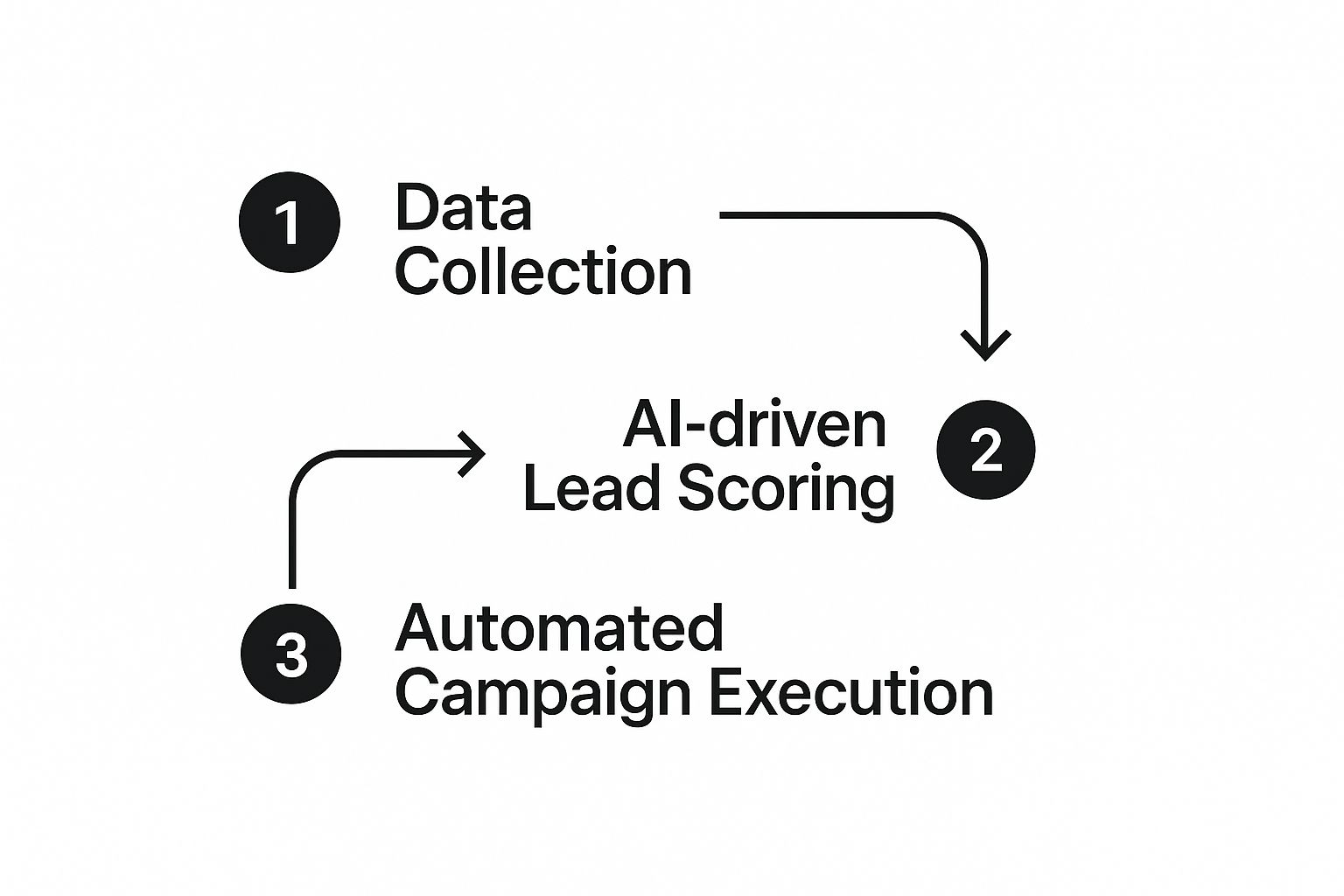
Image

It’s a logical flow. Solid data collection is the foundation, and everything else is built on top of it.

Start Small With a Focused Pilot Project

Don't try to solve every problem at once. Just pick one specific, high-impact problem and solve the hell out of it. A pilot project keeps the risk low and is designed to score a quick, measurable win. That win builds confidence and gets leadership excited for what's next.

So, where do you start? Pick a challenge where you know there’s room to improve. Good candidates for a first project look like this:

  • Automate Lead Scoring: Take one product line and use an AI model to score its leads. Your goal is to see if it can spot high-intent prospects better than your current manual process.
  • Optimize Ad Copy: Fire up an AI content generator and have it create five ad copy variations for a single campaign. Then, run an A/B test against the copy your team wrote.
  • Enhance Content Analysis: Find the holes in your content strategy. Use AI to analyze what your top competitors are writing about, then use those insights to plan your next few months of content.

The idea here is to isolate one variable, test AI's impact, and get clean data on how it performed.

Integrate Your First Tool and Empower Your Team

Once you’ve picked your pilot, find the best tool for that one job. At this stage, how easily it integrates is everything. The tool has to play nice with your existing CRM or marketing automation platform, otherwise you’re just creating another data silo.

But the tech is only half the story. Your team is the other half. Success depends on giving them better workflows, not just another piece of software.

Actionable Step: Don't just announce a new tool. Run a workshop where your team can bring a real-world task (like writing an email sequence) and complete it using the new AI platform. This hands-on practice builds confidence and demonstrates immediate value, turning skepticism into adoption.

Give them clear training and set real-world expectations. Show them exactly how this AI tool helps them hit their goals, whether that’s closing their quota faster or creating content that actually gets noticed.

Measure, Learn, and Scale Your Success

From the moment your pilot goes live, track the metrics you defined upfront. Did the AI lead scoring model actually boost the sales team's lead-to-opportunity conversion rate? Did the AI-generated ad copy bring down your cost-per-click?

Use that data to build your business case. Nothing argues for expanding your use of AI in B2B marketing better than a successful pilot with a clear ROI. Once you've proven it works on a small scale, you can start hunting for the next business challenge to tackle. For teams thinking beyond marketing, this guide on implementing an AI sales agent offers a great blueprint for how sales can evolve, too.

This "measure, learn, scale" cycle turns that first small experiment into a repeatable process for improvement across the whole organization.

Measuring the True ROI of AI in B2B Marketing

Buying AI tools is the easy part. Proving they're actually making a difference? That’s where the real work begins.

To justify the spend on AI in B2B marketing, you have to look past the shiny, surface-level numbers like clicks and impressions. Real ROI is measured by how AI directly moves the needle on core business goals. It's all about connecting the dots between the platform you’re using and the tangible results that show up on the balance sheet—lower costs, more revenue, and a healthier sales pipeline.

From Vanity Metrics to Bottom-Line Impact: A Comparison

Focusing on the right Key Performance Indicators (KPIs) is everything. Instead of getting lost in engagement data, you need to track the numbers that directly tie back to your company's financial health. Here's a comparison between outdated vanity metrics and the business-focused KPIs you should be tracking.

  • Vanity Metric: Website Traffic. Actionable Metric: Lead-to-Opportunity Conversion Rate. This shows the quality, not just quantity, of your leads. A good AI lead scoring model should send this number up significantly.
  • Vanity Metric: Cost-per-Click (CPC). Actionable Metric: Customer Acquisition Cost (CAC). This is the total cost to get a new customer. AI should drive CAC down by optimizing ad spend and automating workflows.
  • Vanity Metric: Email Open Rate. Actionable Metric: Customer Lifetime Value (CLV). This tracks total customer revenue. AI-driven personalization and churn prediction models are built to increase this number.

When you track these metrics, you have a much more powerful story to tell. It’s no longer just, "we got more leads." It's "we increased our high-quality sales opportunities by 22% while spending 15% less." For a real-world look at how an AI B2B SaaS product performs and impacts revenue, check out this Honest Review of an AI B2B SaaS Product.

Connecting AI Tools to Business Results

To build an airtight case for your AI investment, you need to draw a straight line from each tool to the specific metric it’s designed to improve. This isn’t a niche strategy anymore—by 2025, a stunning 89% of leading businesses are expected to have AI deeply integrated into their marketing to drive growth and efficiency.

Here’s a simple framework to help connect the dots for stakeholders, making it instantly clear how a specific AI function translates into a measurable business outcome. You can see this same thinking applied in our own AI in B2B marketing case studies.

Mapping AI Applications to Key Business Metrics

This table shows exactly how different AI marketing applications tie directly to the big-picture business metrics they're meant to influence.

AI ApplicationPrimary Business Metric ImpactedHow to Measure It
Predictive Lead ScoringLead-to-Opportunity Conversion RateTrack the percentage of leads sales accepts and converts into active deals before and after AI implementation.
AI Content GenerationCustomer Acquisition Cost (CAC)Measure the reduction in content creation costs and the lift in inbound leads from AI-optimized content.
Personalization EnginesCustomer Lifetime Value (CLV)Analyze customer retention rates and average order value for segments exposed to personalized campaigns vs. control groups.

By zeroing in on these core business metrics, you’re not just showing that the AI works—you're proving it’s a critical driver of profitable growth for the entire company.

Free Tool

Try our Marketing Plan Generator — generate a complete AI-powered marketing plan in minutes. No signup required.

Answering Your Top Questions About AI in Marketing

Even with the best plan, jumping into a new technology always brings up a few questions. That's a good thing. Tackling those "what ifs" and "how do's" head-on is the only way to get your team comfortable and aligned.

Here are the most common hurdles B2B marketers face when bringing AI into the mix—and how to clear them.

How Do I Justify the Cost of AI Tools to Leadership?

The trick here is to stop talking about "cost" and start talking about "investment." Don't pitch it as another software subscription eating up the budget. Frame it as a direct line to more efficient, revenue-generating marketing.

The old way is to fixate on the price tag. The smart way is to connect that price tag to a business outcome. For example, you're not just buying a $1,000 per month AI lead scoring tool. You're investing in a system that can lift sales-accepted leads by 20%, directly feeding the pipeline and proving its worth.

Actionable Step: Build your business case with the ROI metrics we've already covered. Make it concrete. "By investing X in this platform, our projections show we'll cut Customer Acquisition Cost by Y and boost our lead conversion rate by Z. We expect to see these results within six months."

What Specific Skills Does My Team Need to Develop?

AI doesn't make good marketers obsolete—it just shifts their focus. Your team doesn't need to suddenly become a squad of data scientists. They just need to get good at the things that AI can't do alone.

The single biggest change? Moving from manual execution to strategic oversight.

  • Prompt Engineering: This is just a fancy way of saying "learning how to ask AI the right questions." Getting great content, ad copy, or campaign ideas depends entirely on the quality of the ask.
  • Data Interpretation: AI will surface all sorts of insights. A human still needs to look at that data and decide what it actually means for the next marketing campaign.
  • Strategic Thinking: When you're not spending hours manually segmenting lists or A/B testing ad copy, you have more time for the big stuff—dreaming up creative campaigns, building customer relationships, and figuring out where the market is headed next.

Will AI Replace My Marketing Team? A Quick Comparison

This is the big one, the fear in the back of everyone's mind. But the reality is much more interesting. AI isn't here to replace human marketers; it's a force multiplier. It's an assistant that can process data and automate grunt work at a scale no human team ever could.

Compare the roles:

TaskThe AI's Role (The "What")The Marketer's Role (The "Why" & "How")
Data AnalysisIdentifies patterns in customer behavior and flags high-intent leads.Asks why those patterns exist and develops a creative campaign to engage those leads.
Content CreationGenerates five different versions of ad copy based on a prompt.Chooses the one that best fits the brand voice and strategic goals of the campaign.
AutomationExecutes repetitive tasks like email sends and social media posting.Designs the overall customer journey and strategy that the automation follows.

By taking over the tedious work, AI in B2B marketing gives your team the space to be more strategic, more creative, and ultimately, far more valuable.


Ready to stop guessing and start knowing? The marketbetter.ai platform integrates content generation, campaign optimization, and customer personalization into a single, intelligent system. See how our AI-powered tools can help you generate better leads, deliver true personalization, and prove your marketing ROI. Explore the marketbetter.ai platform today.