3 posts tagged with "predictive analytics"

View All Tags

Unlock Success with Predictive Analytics in Marketing

· 23 min read

For years, marketing felt like driving down a highway while only looking in the rearview mirror. We’d pour over last quarter's campaign data, trying to figure out what worked yesterday. It’s a purely reactive game—like trying to steer a ship by watching its wake. Sure, it tells you where you’ve been, but it offers zero help with what’s coming up ahead.

Predictive marketing completely flips the script.

Think of it as having a real-time GPS with live traffic updates. Instead of just looking back, you’re now using data to see the road ahead. Predictive analytics in marketing doesn't just report on what happened; it forecasts what your customers are likely to do next. That shift from guesswork to informed strategy is a massive competitive advantage.

From Reactive to Proactive Strategies

The real change is in the questions we can finally ask. A traditional marketer asks, "Which customers bought our product last quarter?" But a predictive marketer asks, "Which customers are most likely to buy our product next week?"

This proactive mindset transforms how marketing gets done:

  • Audience Targeting: Forget casting a wide net with broad demographics. Now you can pinpoint the actual individuals with the highest probability of converting.
  • Customer Retention: Instead of finding out about churn after it’s too late, you can identify customers who are at risk of leaving and step in with the right offer to keep them.
  • Budget Allocation: You can put your marketing dollars into the channels that are forecasted to deliver the best ROI, before you even spend them.

Predictive analytics doesn't just tweak marketing—it redefines the entire goal. The objective is no longer just to reach a big audience. It’s about engaging the right person at the exact moment they’re ready to listen.

The New Standard for Modern Marketing

This kind of tech used to be locked away in the ivory towers of massive companies with teams of data scientists. Not anymore. The rise of more accessible AI and machine learning has put these tools in the hands of businesses of all sizes.

Now, you can use predictive models to optimize everything from a simple email subject line to a complex, multi-channel customer journey. Understanding how this powers modern tactics like data-driven content marketing is the key to seeing why it’s no longer optional. It delivers a level of personalization and raw efficiency that was pure science fiction just a decade ago, making it an essential part of any serious marketing strategy today.

How Predictive Analytics Actually Works

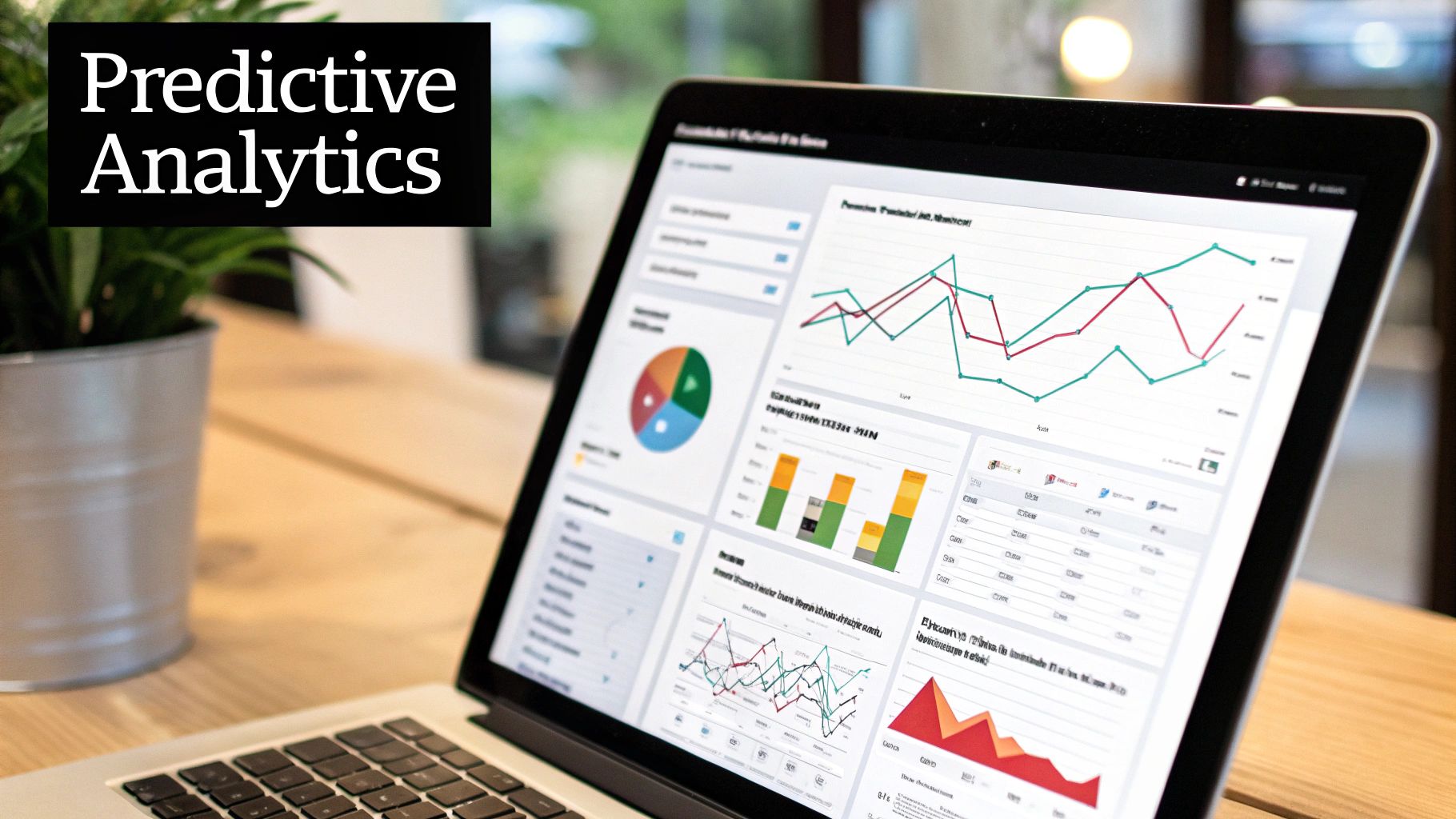
A marketer analyzing complex data charts on a computer screen.

Predictive analytics might have a futuristic ring to it, but the concept is surprisingly straightforward. Think of it like a master chef who knows exactly which ingredients to combine to get the perfect dish every single time. It's about looking at what you have (your data) to create a recipe for what's coming next (an accurate prediction).

This isn't just about reporting on past performance. It’s about forecasting the future.

This forward-looking magic is powered by machine learning algorithms. These algorithms are built to dig through mountains of historical data, finding the subtle patterns and hidden connections a human would miss. That’s the real secret sauce of predictive analytics in marketing—it spots the quiet signals that come right before a customer makes a move.

But here’s the catch: the whole thing falls apart without the right data. The quality and variety of the information you feed the system determines everything. You can't cook a gourmet meal with bad ingredients.

The Key Ingredients: Your Data

To make accurate predictions, these models need a rich diet of different data types. Each one adds another layer to the customer's story, giving the algorithm a much clearer picture to analyze.

The main data sources are:

  • Behavioral Data: This is all about what your customers do. Think website clicks, pages they linger on, emails they open, and content they download. It’s your direct line into their interests and engagement level.
  • Transactional Data: This covers what your customers buy. Purchase history, how often they order, average cart size, and returns—all of it reveals their buying habits and what they value.
  • Demographic Data: This is who your customers are. Age, location, job title, or company size for B2B. This data helps build the foundational segments you'll work from.

To really get how these models work, you have to start by understanding intent data, which is all about spotting the online behaviors that signal someone is ready to buy.

By blending these sources, you build a complete customer profile. The algorithm then finds the money-making correlations—like noticing that customers who view a specific product page three times are 85% more likely to buy in the next 48 hours.

Turning Data Into Actionable Predictions

Once the data is wrangled, the algorithms get to work building predictive models. These aren't generic, one-size-fits-all tools. They’re highly specialized, each trained to answer a specific marketing question.

Here are three of the most common predictive models you'll see in marketing:

Predictive ModelWhat It PredictsKey Business Question It Answers
Predictive Lead ScoringThe odds that a new lead will actually become a paying customer."Which leads should my sales team call right now?"
Customer Churn PredictionThe probability that a current customer is about to leave."Who is at risk of churning, and what can we do to save them?"
Customer Lifetime Value (CLV)The total revenue you can expect from a customer over their entire relationship with you."Who are our VIPs, and how do we find more people just like them?"

Each model spits out a clear, actionable score. A lead gets a 95 (hot) or a 20 (cold). A customer is given an 80% churn risk. This simple output shifts a marketing team from just reporting on the past to proactively shaping the future. If you want to see how these individual data points are woven together, our guide on person-level identification dives deep into the more advanced techniques.

This ability to see around the corner is why the AI in marketing industry is set to hit $107.5 billion by 2028. It’s the engine behind the hyper-personalized experiences that customers don't just want anymore—they expect.

Predictive Marketing vs. Traditional Marketing

For decades, marketing ran on a familiar playbook. It was a craft built on historical data, broad demographic segments, and a healthy dose of professional gut feeling.

Think of the traditional marketer as an archaeologist. They spend their time carefully digging through past campaign results to figure out what worked yesterday. It’s a method that relies entirely on looking backward.

Predictive marketing, on the other hand, is more like being an astronomer with a powerful telescope. Instead of digging in the dirt, you're charting the stars to forecast future movements. Predictive analytics in marketing doesn't just analyze what happened; it uses that data to calculate what’s most likely to happen next. This single shift flips the entire discipline from reactive to proactive.

This is a fundamental change that impacts everything, from how you see your audience to how you spend your budget.

The Audience Building Shift

In traditional marketing, we built audiences using static, broad buckets. A classic approach was grouping people by demographics—think age, location, or job title. It's like sorting your music library by genre. Sure, it’s organized, but it tells you nothing about what someone actually wants to listen to right now.

Predictive marketing builds dynamic clusters based on behavior. It identifies customers not by who they are, but by what their actions suggest they will do. A predictive model might create a segment of "customers showing a 90% probability of buying a specific product in the next 7 days," completely independent of their demographics. That’s a far more precise and actionable way to target.

From Blasts to Personalized Journeys

Campaign execution is another area where the contrast is stark. The old way involved broad message blasts sent to those static segments. It was a one-to-many approach that just hoped the message resonated with enough people to scrape by with a positive return.

A predictive approach makes one-to-one personalized journeys possible at scale. Instead of a generic seasonal promo sent to everyone, a predictive campaign identifies an individual customer as a high churn risk and automatically sends them a personalized "we miss you" offer. The message, timing, and discount are all determined by their forecasted behavior.

The infographic below gives you a sense of the complex data modern analytics tools are crunching to make these kinds of sophisticated strategies a reality.
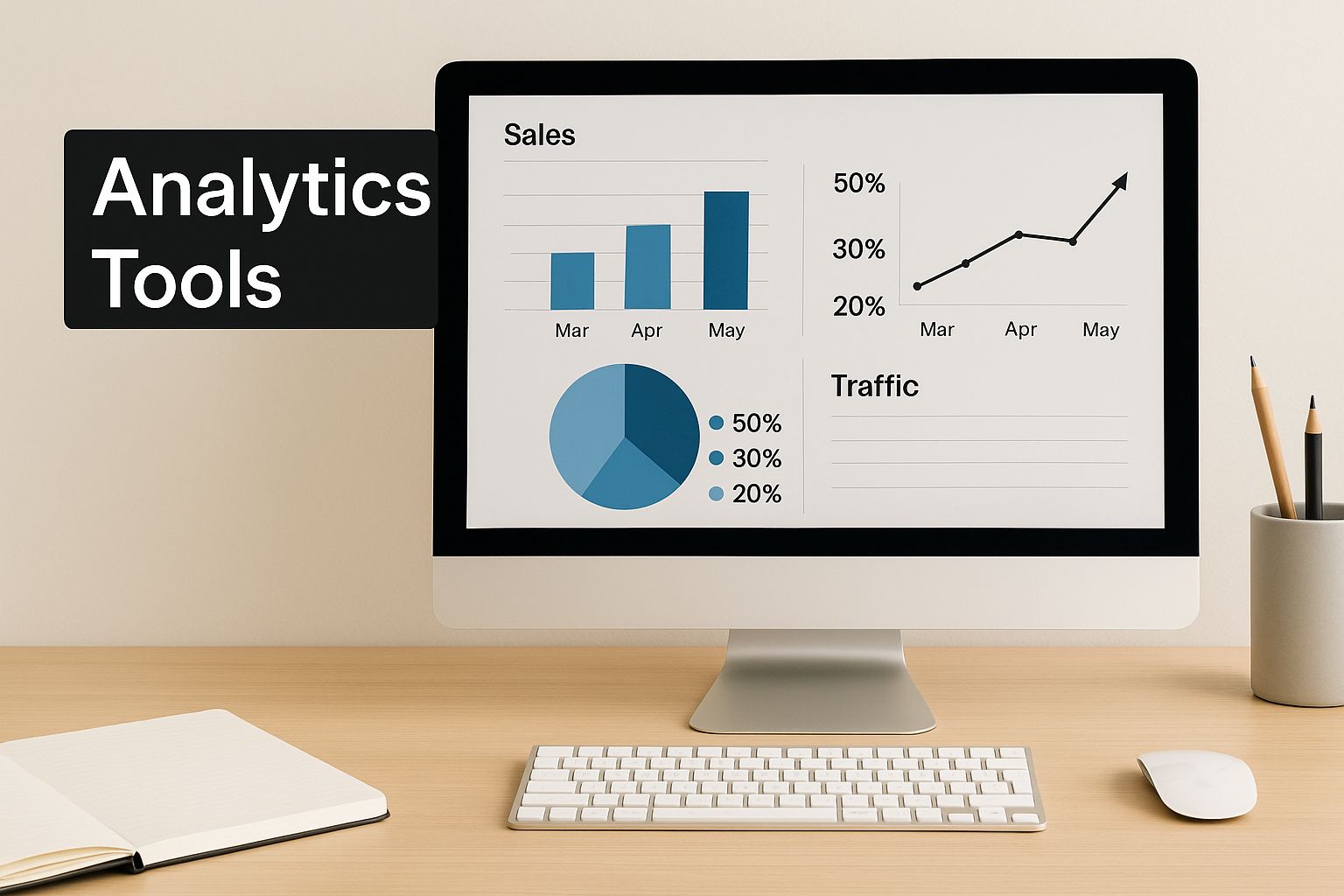
Infographic about predictive analytics in marketing

This kind of synthesis is what allows marketers to move beyond simple reporting and into true forecasting.

Forecasting ROI Instead of Just Reporting It

Perhaps the biggest advantage is how you measure results. Traditional ROI analysis is almost always a look in the rearview mirror. You run a campaign, wait for the dust to settle, and then report on what happened.

With predictive marketing, you can run pre-campaign forecasting. Models can estimate the potential conversion rates and revenue lift of different campaign strategies before you spend a single dollar. This leads to much smarter budget allocation and takes a significant amount of risk out of your marketing spend.

The core difference is simple: Traditional marketing reports on the past. Predictive marketing provides a roadmap for the future.

The market is catching on fast. By 2025, over 55% of businesses globally are expected to be using AI-powered predictive analytics to sharpen their decision-making. The global predictive analytics market is projected to rocket from $9.5 billion in 2022 to $41.2 billion by 2030, a testament to its massive growth and impact. You can dig into more research on the expansion of predictive analytics statistics to see its trajectory.

To make this crystal clear, here’s a side-by-side view of the old playbook versus the new one.

Predictive Analytics vs Traditional Marketing Approaches

This table breaks down the core differences, showing how a proactive, data-driven approach changes the game across key marketing functions.

Marketing FunctionTraditional Approach (Reactive)Predictive Analytics Approach (Proactive)
Audience BuildingStatic, demographic-based segments (e.g., "males, 25-34").Dynamic, behavior-based clusters (e.g., "users likely to convert").
Campaign ExecutionBroad, one-to-many message blasts.Personalized, one-to-one customer journeys.
ROI AnalysisAfter-the-fact reporting on past performance.Pre-campaign forecasting to predict outcomes.
PersonalizationBased on basic attributes like name or location.Based on predicted intent and future needs.
Primary GoalReach a wide audience and analyze what happened.Engage the right individual at the right time and shape what happens next.

The takeaway is straightforward: while traditional methods focus on what has already occurred, predictive analytics gives marketers the tools to anticipate and influence what will happen next.

Predictive Analytics in Action: Real-World Examples

Theory is one thing, but seeing predictive analytics in marketing actually work is another. The funny thing is, you probably bump into predictive models every single day without even realizing it. These aren’t just abstract ideas cooked up in a lab; they’re the engines quietly running some of the most personalized experiences you have online.

From the next show you binge-watch to the price you pay for a ride home, predictive analytics is in the driver's seat. Let’s pull back the curtain on four powerful examples and see how this tech goes from a buzzword to a bottom-line booster.

The Netflix Effect: Hyper-Personalized Recommendations

Ever wonder how Netflix seems to know exactly what you want to watch next? It’s not a lucky guess—it’s a world-class predictive recommendation engine. The platform doesn’t just see what you’ve watched; it crunches thousands of data points to figure out what you’ll probably love in the future.

And this goes way beyond just matching genres. Netflix’s models are looking at everything:

  • Viewing Habits: What time you watch, how long you stick around, and even if you pause or re-watch a particular scene.
  • Device Information: Are you on a big-screen TV, a laptop, or your phone? That context matters.
  • User Interactions: Everything from your search queries and ratings to which movie poster artwork you’re most likely to click on.

By piecing all this together, the algorithm predicts your tastes with almost spooky accuracy. The business result is simple but powerful: a more addictive user experience that keeps people from canceling their subscriptions. A happy, engaged subscriber sticks around.

Proactive Churn Prevention in Telecommunications

The telecom world is notoriously cutthroat, and customer churn is the monster under the bed. For companies like Verizon or AT&T, every customer who walks away is a big financial hit. So instead of waiting for people to leave, they use predictive analytics to spot who’s getting restless before they switch carriers.

They do this by building a churn prediction model that looks for subtle signs of unhappiness. These might be a sudden drop in data usage, a spike in calls to customer support, or recent billing problems.

The model assigns a "churn risk score" to every single customer. Anyone with a high score gets automatically flagged. This lets the retention team jump in with a proactive, personalized offer—maybe a special discount or a data plan upgrade—to convince them to stay loyal.

This is a complete shift from the old, reactive "exit survey" model to a smart, proactive retention strategy. It directly plugs a hole in the revenue bucket, saving customers who would have otherwise been long gone. To see how companies translate these kinds of insights into real wins, check out some of the detailed marketing analytics case studies that show the before-and-after.

Dynamic Pricing for Airlines and Ride-Sharing

If you’ve ever booked a flight or hailed an Uber during rush hour, you’ve been on the receiving end of predictive pricing. Airlines and ride-sharing apps don't just set a price and forget it; they use sophisticated models to adjust fares in real-time based on what they think demand will be.

These dynamic pricing models are constantly swallowing a stream of data to make their next move:

  • Historical booking patterns for a specific route.
  • Current search volume and website traffic.
  • External factors like the weather, local events, or upcoming holidays.
  • What the competition is charging right now.

With these inputs, the algorithm predicts what's coming. If it expects a huge surge in ride requests when a concert lets out, prices automatically go up. If it sees that a Tuesday morning flight is looking empty, fares drop to fill those seats. This whole strategy is about maximizing revenue by making sure the price is always perfectly matched to the predicted demand.

Smart Budget Allocation for E-Commerce Brands

For any e-commerce brand, the question of where to spend the next advertising dollar is a million-dollar one. Predictive models help take the guesswork out of it by forecasting the potential return on investment (ROI) from every marketing channel.

Instead of just looking at the last click before a sale, these models analyze the entire customer journey. They predict which channels are most likely to bring in high-value customers. For instance, a model might reveal that while social media ads get a ton of initial clicks, email marketing is 75% more likely to convert a big spender for a specific product line.

Armed with that kind of foresight, marketing teams can confidently shift their ad spend away from channels that aren't pulling their weight and double down on the ones with the highest forecasted ROI. This makes sure every dollar in the marketing budget is working as hard as it possibly can.

Your Five-Step Predictive Analytics Implementation Plan

A professional team collaborating on a predictive analytics implementation plan in a modern office.

Jumping into predictive marketing can feel like you’re trying to boil the ocean. It’s a huge concept. But you don't have to. The best way to get started is by breaking it down into a clear, step-by-step roadmap that builds a real predictive engine for your business.

This isn’t about flipping a switch and hoping for the best. It's a methodical process. And it doesn't start with algorithms or fancy tech—it starts with a simple, focused question about what you're trying to fix.

Let's walk through the five stages to make it happen.

Step 1: Pinpoint Your Core Business Objective

Before you look at a single data point, you need to know what you’re aiming for. A fuzzy goal like "improve marketing" is useless. You need a specific, measurable target that a predictive model can actually be trained to hit.

Start with a real pain point. Are you losing customers and you don't know why? Is your cost to acquire a new customer getting out of control? Are you leaving money on the table because one-time buyers never come back?

Frame that problem as a sharp, clear goal:

  • Reduce customer churn by 15% in the next six months.
  • Increase the conversion rate of new leads by 20% this quarter.
  • Boost customer lifetime value (CLV) by 25% over the next year.

This clarity is everything. Your objective is your North Star. It guides every decision you make from here on out and ensures all this work actually connects to real business value.

Step 2: Unify and Prepare Your Data

Your predictions are only ever as good as the data you feed them. To find meaningful patterns, predictive models need clean, consolidated, and complete data. The problem? For most companies, customer data is a mess, scattered across a dozen disconnected silos—your CRM, e-commerce platform, email tools, web analytics, you name it.

The mission here is to create a single customer view. This is a unified profile that stitches together every single touchpoint and interaction a person has with your brand. It’s non-negotiable. Fragmented data leads to half-baked analysis and, worse, flat-out wrong predictions.

This means you have to invest time in a data audit and cleanup. Standardize formats, zap duplicate entries, and make sure your historical data is accurate. It’s the least glamorous part of the process, but it’s the absolute bedrock of your success.

Step 3: Select the Right Tools for Your Team

Okay, you have a clear goal and clean data. Now it's time to pick your tech. The market for predictive analytics in marketing has exploded, with options for teams of all sizes and skill levels. You basically have two paths you can go down.

This table should help you figure out which approach fits your company best.

Tooling ApproachBest ForKey AdvantagesPotential Drawbacks
User-Friendly PlatformsTeams without data scientists who need quick wins.Out-of-the-box models, easy-to-use interfaces, and fast setup.Less customizable; might not solve super-specific business problems.
Custom-Built ModelsBig companies with data science teams and unique needs.Highly tailored to your exact goals, giving you maximum control.Expensive, takes a long time to build, and requires specialized talent.

For most marketing teams, starting with a platform that has predictive features already built-in is the most practical move. It lets you prove the value of this approach without needing a massive upfront investment in hiring a data science team.

Step 4: Train and Validate Your Predictive Model

Once your tool is in place, it’s time to train your model. This is where you feed all your historical data into the algorithm so it can learn the patterns that lead to your goal. For instance, to build a lead scoring model, you'd give it data on all your past leads—the ones that converted and the ones that went cold.

The model chews through thousands of data points to find the signals that matter. It might learn, for example, that a lead who downloads a specific whitepaper and then visits your pricing page is 80% more likely to buy. Our guide on AI lead scoring goes deeper into how these models build a smarter sales pipeline.

After the initial training, you have to validate the model's accuracy. You do this by testing it on a fresh set of data it has never seen before. This step is critical—it confirms that your model's predictions are reliable and not just a lucky guess based on the training data.

Step 5: Weave Insights into Action

Here's the bottom line: a perfect prediction is completely worthless if you don't do anything with it. The final, most important step is wiring the model's output directly into your day-to-day marketing. This is how you turn foresight into automated, personalized campaigns that actually drive revenue.

For example:

  • A churn prediction model can automatically enroll at-risk customers into a "we miss you" email campaign.
  • A lead scoring model can instantly push your hottest leads to the top of the sales team's queue.
  • A CLV model can trigger exclusive offers designed to delight your most valuable customers.

This is what modern marketing looks like. Instead of just reacting to what already happened, you're proactively shaping what happens next. You’re moving from rearview-mirror reporting to dynamic forecasting. By putting your predictions to work, you close the loop and turn raw data into real, measurable growth.

Common Questions About Predictive Marketing

Let’s get real. Diving into predictive marketing brings up a ton of practical, "how does this actually work for me?" questions. It's one thing to talk about algorithms and another to figure out the people, data, and budget you actually need to pull it off.

So, let's cut through the noise and tackle the most common concerns marketers have. Think of this as the straight-talk guide to getting started.

Do I Need a Team of Data Scientists?

This is the big one. The myth that stops so many teams before they even start.

The short answer? No—not anymore.

Sure, big enterprise companies might have a whole team of PhDs building custom models from the ground up. But that's like building your own car engine just to get to the grocery store. It's no longer the only way to get there.

Today, a new wave of marketing platforms has incredibly powerful predictive features built right in. These tools are designed for marketers, not coders. They do all the heavy lifting behind the scenes and serve up the insights on a silver platter.

The goal isn't to become a data scientist. It's to become a marketer who can use the outputs of data science to make much, much smarter decisions.

So, what's the right path for you?

ApproachBest ForWhat It Looks Like in Practice
In-House Data Science TeamHuge enterprises with unique, complex problems and even bigger budgets.Building proprietary algorithms from scratch to predict hyper-specific customer behaviors.
User-Friendly AI PlatformsPretty much every other B2B and B2C marketing team looking for proven, scalable solutions.Using a tool with "out-of-the-box" features like predictive lead scoring or churn risk analysis.

For most businesses, the smartest move is to find your biggest marketing headache and pick a user-friendly tool that solves it.

What Kind of Data Do I Really Need?

Here’s the thing about predictive models: they're only as good as the clues you give them. Garbage in, garbage out. The good news is you probably already have most of the data you need sitting right under your nose.

The trick is getting it all in one place. To start, you need a solid foundation of historical data, which usually breaks down into three buckets:

  • Transactional Data: All the "what" and "when." Purchase history, average order value, product categories, and subscription dates. This is the story of what your customers buy.
  • Behavioral Data: The "how." Website visits, email clicks, content downloads, app usage, and support tickets. This stuff reveals how customers actually engage with you.
  • Customer Data: The "who." Demographics, firmographics, location, job titles, company size, and how they found you in the first place. This adds critical context.

If you do one thing first, make it this: break down your data silos. Get everything flowing into a central hub, like your CRM or a Customer Data Platform (CDP). If your data is a scattered, messy disaster, your first and most important project is a data cleanup. Without that single source of truth, your predictions will never be reliable.

How Can I Measure the ROI of Predictive Analytics?

Proving the value of a new investment is always job number one for marketers. Thankfully, the impact of predictive analytics isn't some fuzzy, abstract concept—it’s incredibly measurable. The key is to set a clear baseline before you start and then run a clean comparison.

Here are four simple ways to nail down your ROI:

  1. A/B Test Your Campaigns: This is the cleanest test. Send a predictive, hyper-personalized offer to one segment. Send a generic offer to a control group. The difference in the conversion rate is your lift. Simple as that.
  2. Track Customer Retention: Use your churn model to flag a group of at-risk customers. Proactively reach out to half of them with a retention offer. Do nothing for the other half. The difference in the churn rate between the two groups is pure, measurable ROI.
  3. Compare Customer Lifetime Value (CLV): Look at the CLV of customers you brought in through predictive targeting versus those who came from your old methods. A higher CLV in the predictive group shows you’re not just getting more customers—you’re getting better customers.
  4. Calculate Cost Per Acquisition (CPA): When you stop wasting ad spend on leads who were never going to convert, your CPA naturally drops. Track this metric before and after you roll out predictive lead scoring to see exactly how much you’re saving.

By setting these KPIs from day one, you’ll have no trouble connecting your predictive efforts directly to revenue gains and cost savings.


Ready to stop guessing and start predicting? marketbetter.ai integrates powerful AI across your entire marketing workflow, from content creation to campaign optimization. Our platform makes it easy to turn data into revenue without needing a team of data scientists. Discover how you can drive growth with actionable insights by exploring our solutions.
AI for Marketing Automation Unlocked: An Actionable Guide

· 25 min read

Old-school marketing automation is like a sprinkler system on a timer. It turns on at 6 AM, waters the lawn for 20 minutes, and shuts off. It doesn't care if it rained all night or if it's 100 degrees out. It just follows the rules you set.

AI for marketing automation is totally different. It’s like a smart sprinkler system that checks the weather forecast, measures the moisture in the soil, and then decides how much water your garden actually needs. It learns, predicts, and adapts in real time.

The New Reality of AI in Marketing Automation

A marketing professional using a tablet with AI-driven charts and data visualizations overlayed, showing the intersection of technology and marketing strategy.

Let's be honest, the modern marketing world is drowning in data. It's getting harder and harder to cut through the noise and actually connect with people.

Traditional automation runs on rigid, "if-this-then-that" logic. If a user downloads an ebook, they get email sequence A. It works, sure, but it’s clumsy. It lacks any real foresight or flexibility.

This is where AI for marketing automation changes the game entirely. Instead of just following your pre-programmed commands, AI digs into massive datasets to figure out context, anticipate what a customer might need next, and make smart decisions all on its own. It effectively upgrades your marketing from a simple script-follower to a strategic partner that gets smarter over time.

From Static Rules to Dynamic Decisions

Think of it this way: traditional automation is a traffic light stuck on a fixed timer. It turns red every 60 seconds, no matter if there’s a traffic jam or an empty street.

AI-powered automation is more like a smart traffic grid that watches the flow of cars in real time, adjusting signals to clear accidents and manage rush hour on the fly. This dynamic approach creates much smoother, more efficient, and deeply personalized customer journeys. For a deeper look at how this plays out, the world of small business marketing automation offers some great, practical insights.

So, what does AI actually bring to the table that standard automation can't?

  • Predictive Analytics: Standard automation can segment leads based on past actions (e.g., visited pricing page). AI can look at a lead's complete behavior and predict, with spooky accuracy, which ones are most likely to buy. This lets your sales team stop chasing ghosts and focus their energy where it will actually pay off.
  • Hyper-Personalization: We're not just talking about adding a {{first_name}} token. Traditional tools might let you segment an audience by location. AI can change website content, rewrite email copy, and adjust product recommendations for every single user in real-time, not just for broad segments.
  • Optimized Timing: Traditional automation sends an email when you tell it to (e.g., 24 hours after signup). AI figures out the absolute perfect moment to send that email or show that ad based on an individual's unique patterns of behavior. No more guessing.

The real shift here is moving from reactive, rule-based chores to proactive, data-driven strategy. AI doesn't just do what you tell it to; it uncovers what you should be doing to get the biggest impact.

How AI Fundamentally Changes Marketing Automation

A split-screen image showing a traditional assembly line on one side and a futuristic, AI-powered robotic arm on the other, symbolizing the evolution of automation.

Let's be honest. Traditional marketing automation is powerful, but it's also a bit rigid. It runs on a strict script you have to write yourself. It’s fantastic at executing pre-set "if-then" rules, but it can't improvise, understand nuance, or guess what a customer might do next.

Think of it like a spell-checker. It’s great at catching typos, but it has no idea if your sentence is actually persuasive.

Plugging AI into marketing automation isn't just an upgrade; it’s a complete rewrite of the rules. We're moving from a system that just follows commands to one that makes its own intelligent, autonomous decisions. AI doesn't just play by the rules you give it—it watches the entire game, predicts the other team's next move, and tells you the best way to win.

That’s the core difference. One system reacts. The other anticipates.

This leap forward is powered by a few key technologies that act as the "brain" of the operation. And they aren't just buzzwords; they're the engines driving real business results.

Moving From Static Workflows To Intelligent Systems

At its heart, this is about shifting from a static, fixed approach to a dynamic one. Old-school automation is brittle; AI-powered systems are fluid, constantly learning and adapting as new data pours in.

The market sees the enormous potential here. Revenue from AI in marketing is on track to blow past $107.5 billion by 2028—more than doubling in just a few years as businesses scramble to get smarter. You can dig into the numbers behind this explosive growth by exploring the latest AI marketing statistics.

This growth is really driven by three foundational AI concepts:

  • Machine Learning (ML): This is the learning engine. ML algorithms chew through mountains of campaign data—email opens, click-through rates, purchase histories—to find patterns you’d never spot on your own. Instead of you manually creating a segment for "customers who bought Product X," machine learning finds clusters of users with subtle, shared behaviors that signal they're perfect candidates for Product Y, often with way more accuracy.
  • Predictive Analytics: Building on ML, predictive analytics is about forecasting what comes next. It can score leads based on their probability of converting, flag customers who are about to churn, or estimate the lifetime value of a brand-new subscriber. This pulls your strategy out of the realm of guesswork and into data-backed foresight, letting you put your resources where they’ll have the biggest impact.
  • Natural Language Processing (NLP): NLP is what gives automation the ability to actually understand human language. It's the tech behind a smart chatbot that can handle complex support questions, the sentiment analysis tools that tell you how people really feel about your brand on social media, and the systems that can perform a deep AI content analysis to make sure your messaging hits home.

The real change is that AI enables automation to answer the "why" and "what if" questions, not just execute the "if/then" commands. It transforms your platform from a task manager into a strategic advisor.

Practical Comparisons: Old vs. New

To make this less abstract, let’s look at how a simple abandoned cart email sequence gets handled in both worlds.

FeatureTraditional AutomationAI-Powered Automation
TriggerA user adds an item to their cart and leaves. A fixed timer (say, 1 hour) kicks off.AI analyzes the user’s on-site behavior, past purchases, and cart value to decide the perfect time to send the first reminder.
ContentThe email shows the exact product left behind with a generic "Complete your purchase!" message.The email is dynamically personalized. It might offer a small, tailored discount for a high-value customer, suggest complementary products based on predictive models, or rewrite the subject line to match the user's perceived urgency.
Follow-UpA rigid, pre-set sequence of 2-3 emails goes out at fixed intervals (e.g., 24 hours, 72 hours).The follow-up cadence is adaptive. If the user comes back to the site, the sequence might pause. If they open an email but don’t click, the next message might get sent via SMS or a social media ad, depending on which channel they prefer.

This side-by-side makes the upgrade crystal clear. Traditional automation is a one-size-fits-all sledgehammer. AI for marketing automation, on the other hand, crafts a unique, optimized journey for every single customer.

It scales true personalization in a way that was flat-out impossible before. That ability to learn, predict, and adapt is what truly sets it apart.

High-Impact Use Cases of AI in Automation

A split-screen showing a basic email marketing dashboard on one side and a dynamic, AI-powered customer journey map on the other, visualizing the evolution.

Alright, enough with the theory. Let's get down to brass tacks. Where does AI for marketing automation actually make a difference? The real magic isn't in some abstract concept; it's in the specific, tangible ways it helps you get better results.

We're going to look at a few examples that show a clear before-and-after picture. This isn't just about doing the same old things a little faster. It's about shifting from a manual, one-size-fits-all approach to a smart, adaptive strategy that feels personal to every single customer. This is how you get an edge.

Hyper-Personalized Email Campaigns

Email marketing is the backbone of most strategies, but let's be honest, it often hits a wall. AI blows right through that wall by enabling a kind of personalization that was pure fantasy just a few years ago.

The Old Way: You'd slice your audience into a few broad segments—maybe based on location or what they bought last year. You'd write a generic email, pop in a {{first_name}} tag to feel fancy, and blast it out. The results? Decent, but you know a ton of those emails just weren't hitting the mark.

The New Way (with AI): Forget broad strokes. An AI model is watching what each individual does in real time. It sees the pages they're browsing, knows when they're most active, and understands the products they keep coming back to. With that intel, the system automatically:

  • Optimizes Send Times: It doesn't guess. It sends the email at the exact moment that specific person is most likely to open it, based on their past behavior.
  • Generates Dynamic Content: The AI can rewrite subject lines, tweak headlines, and swap out product recommendations on the fly to perfectly match what that user is thinking about right now.
  • Predicts Future Needs: It can even offer a discount on something they haven't looked at yet, but that thousands of similar customers ended up buying next.

You’re moving from a generic broadcast to a genuinely relevant, one-to-one conversation. That’s a huge leap.

AI-Driven Ad Spend Optimization

Running paid ad campaigns can feel like spinning plates. You're constantly juggling bids, tweaking targeting, and shifting budgets around. Without AI, it's a slow, reactive process full of guesswork.

By 2025, the AI industry is projected to hit a global market valuation of around $391 billion, with its annual growth rate hovering near 35.9%. This massive investment is driven by AI’s ability to deliver clear financial impact, as seen with Netflix generating an estimated $1 billion annually from its AI-powered recommendation engine alone.

AI brings a ruthless mathematical precision to your ad spend, making sure every dollar is pulling its weight.

The Old Way: A marketer logs into Google Ads, checks some reports, and sees an ad group is tanking. They manually lower the bids or change the audience settings. The problem is, by the time they've spotted the issue and fixed it, money has already been wasted.

The New Way (with AI): An AI platform crunches thousands of data points every second—competitor bids, time of day, user device, you name it. It predicts which clicks will actually convert and automatically shifts budget toward your most profitable channels, audiences, and ad creative. It's all done in real-time, maximizing your ROAS without you lifting a finger.

Dynamic Website Experiences

Think about it: a static website gives the exact same experience to a first-time visitor from a tiny startup as it does to a loyal enterprise customer. That makes no sense. AI turns your site into a living, breathing thing that adapts to each person.

AspectStatic Website (Before AI)Dynamic Website (After AI)
Homepage ContentEveryone sees the same generic welcome, featured products, and CTAs.The headline, hero image, and content morph based on the visitor's industry, referral link, or past behavior.
Product RecommendationsA static list of "best-sellers" that rarely changes.Hyper-relevant recommendations powered by machine learning, based on what that specific user is likely to buy.
Lead CaptureThe same pop-up form appears for everyone after 30 seconds.A smart pop-up with a tailored offer appears at the precise moment AI predicts the user is about to leave or convert.

Instant Lead Qualification with AI Chatbots

Not every lead is a good lead. Your sales team knows this better than anyone. Making them sift through every single form submission is a huge waste of time they could be using to close deals. AI chatbots take over that filtering process with terrifying speed and accuracy.

A great example of this is leveraging chatbots for marketing to handle initial conversations and guide users. These aren't the clunky bots of five years ago. They are sophisticated lead-scoring engines that can ask qualifying questions, understand intent, and route only the hottest leads straight to a sales rep's calendar.

(If you want to go deeper on this, we've got a whole playbook on https://marketbetter.ai/playbooks/ai-lead-scoring.)

Choosing the Right AI Marketing Automation Platform

Let's be honest, picking an AI marketing automation platform can feel like a chore. The market is flooded with tools, and every single one promises to change your world.

The real trick is to cut through the noise and find a platform that actually fits your business—your team, your tech stack, and where you plan to be in a couple of years.

Making the right call here is a big deal. You're not just buying software; you’re choosing the central hub for your entire marketing operation. Get it right, and it becomes an engine for growth. Get it wrong, and it’s an expensive headache.

Core Factors for Your Decision

Before you jump into a dozen demos, you need a clear checklist. Otherwise, you’ll get lost in flashy feature lists and slick sales pitches.

Focus on these three pillars to keep your search grounded.

  • Business Model and Size: Are you B2B or B2C? A B2B company with a six-month sales cycle needs sophisticated lead scoring and nurturing. A B2C e-commerce brand, on the other hand, might care more about abandoned cart emails and personalizing offers for thousands of customers at once. Size matters, too. A startup needs something nimble and affordable, while an enterprise needs ironclad security and the power to scale.
  • Integration Capabilities: Your marketing platform can't be a lone wolf. It has to play nice with the rest of your tech, especially your CRM (like Salesforce or HubSpot), your e-commerce store (like Shopify), and your analytics tools. Bad integrations create data silos, and that defeats the whole purpose of using AI in the first place.
  • Scalability for Growth: The perfect tool today might hold you back in two years. Think about your growth plans. Can the platform handle 10x the contacts and campaigns without slowing to a crawl or jacking up the price? You need a partner that can grow with you, not one you’ll outgrow.

Comparing Top AI Marketing Automation Platforms

To make this tangible, let's look at a few of the big players. Each has its own vibe and is built for different kinds of teams. This isn't an exhaustive list, but it's a great starting point for figuring out where to look first. For a deeper dive, check out our Marketbetter vs. Warmly AI comparison for a real head-to-head breakdown.

This table breaks down how leading platforms stack up on AI features, who they're best for, and how well they connect with other tools. It's designed to help you quickly narrow down the options that make sense for your business.

Comparing Top AI Marketing Automation Platforms

PlatformKey AI FeaturesBest ForIntegration Capability
HubSpotPredictive lead scoring, AI content assistant, adaptive testing, AI-powered chatbot builder.Mid-market B2B and B2C companies seeking an all-in-one platform for marketing, sales, and service.Excellent. Extensive native integrations with hundreds of popular apps and a robust API.
ActiveCampaignPredictive sending, win probability models, automated segmentation, AI-driven content generation.Small to mid-sized businesses (SMBs) that need powerful automation and personalization at an accessible price.Strong. Connects well with most major e-commerce platforms, CRMs, and business tools.
Salesforce Marketing CloudEinstein AI for predictive engagement, journey optimization, and content personalization.Enterprise-level B2C companies with large customer databases and complex, multi-channel journeys.Very High. Deep native integration with the Salesforce ecosystem (Sales Cloud, Service Cloud) is its core strength.

Each of these platforms offers a different flavor of AI automation, so the "best" one really depends on whether you're a scrappy SMB or a large enterprise with a complex, existing ecosystem.

The difference between sticking with manual workflows and switching to an AI-driven approach is night and day. It changes everything from your team's daily workload to your bottom line.

This infographic really drives the point home, showing just how dramatic the improvements are when you let AI handle the heavy lifting.

An infographic comparing manual vs. AI-driven marketing across campaign time, conversion rate, and cost per lead.

The numbers don't lie. This isn't about small, incremental gains. AI fundamentally rewires the economics of your marketing. Just the time saved lets your team stop clicking buttons and start thinking about strategy.

The ultimate goal is to choose a platform that not only automates what you're already doing but also gives you the AI-powered insights to do it better.

AI is quickly becoming non-negotiable for managing marketing workflows. A 2025 survey found that 93% of marketers using AI are leaning on it to create content faster for blogs, social posts, and ads. On top of that, about 90% say they make decisions faster because of AI's ability to process data.

Platforms like HubSpot and ActiveCampaign are embedding these tools directly into their systems, freeing marketers from the grind so they can focus on the big picture.

Picking the right platform is the first—and most important—step. If you carefully weigh your needs against what these tools can do, you'll find a system that doesn't just automate tasks but actually drives real, measurable growth.

Your 5-Step AI Implementation Plan

Bringing AI into your marketing stack isn't like flipping a switch. It's more like building a house—you don't start hammering without a blueprint. A lot of teams get tripped up here, buying a powerful tool only to see it gather dust because there was no real plan.

Think of this as your blueprint. It breaks the whole process down into five clear, manageable steps. Following this framework will help you sidestep the usual traps, like chasing vanity metrics or feeding your shiny new AI a diet of messy data. Let's get it right from the start.

Step 1: Define Your North Star (Goals and KPIs)

Before you even glance at a pricing page, you have to answer one question: What, specifically, are we trying to fix or improve?

"Get better at marketing" is a wish, not a plan. You need sharp, measurable goals. This is the single most important step. Without a clear destination, you're just driving, and you'll almost certainly end up somewhere you don't want to be. Your goals are your North Star for this entire journey.

Here’s what that looks like in the real world:

Vague WishSharp, Actionable KPI
"Increase leads""Boost MQL to SQL conversion rate by 15% in Q3 using predictive lead scoring."
"Personalize emails better""Lift email click-through rates by 20% by rolling out AI-driven dynamic content."
"Be more efficient""Cut 10 hours per week from campaign reporting with automated analytics."

Step 2: Look Under the Hood (Audit Your Data and Tech)

AI runs on data. Period. If your data is a disaster—siloed, incomplete, or just plain wrong—your AI will spit out garbage. It's that simple.

So, before you plug anything new in, you have to do a serious audit of your data and current tech stack. Take an honest look at your CRM, your analytics tools, and wherever else customer information lives. Are they talking to each other? Is the data clean?

Trying to skip this is like putting cheap, dirty gas in a Ferrari. The engine will choke, and you'll go nowhere fast.

The Hard Truth: Your AI is only as smart as the data you feed it. The "garbage in, garbage out" rule is 10x truer for AI. Bad data doesn't just give you bad results; it wastes your entire investment.

Step 3: Start Small, Win Big (Launch a Pilot Project)

Don't try to boil the ocean. Seriously. Overhauling your entire marketing operation in one go is a surefire way to fail. The smart move is to start with a focused pilot project—something with a tight scope where you can score a quick, measurable win.

This builds momentum and proves the concept to everyone in the company.

A great place to start is an AI-powered email campaign. You can run a clean A/B test against your old, rules-based campaigns. Test things like AI-optimized send times, dynamic subject lines, or personalized content blocks. The results will be black and white, making it easy to show stakeholders exactly what the new tool is capable of.

Step 4: Don't Forget the People (Empower Your Team)

Dropping a powerful new tool on your team without proper training is just setting them—and your investment—up for failure. It's amazing how many companies spend a fortune on software but completely cheap out on teaching people how to actually use it.

Your team needs more than a one-hour demo. Give them real training that covers not just how to use the platform, but why you're using it. Connect the tool back to the strategic goals you set in Step 1. Show them how this AI for marketing automation is going to make their jobs easier and more impactful, not just add another login to their password manager.

Step 5: Measure, Tweak, Repeat (Analyze and Iterate)

Getting your AI running isn't the finish line. It's the starting line. This is a continuous loop: measure performance, analyze what's happening, and tweak your strategy based on what you learn.

Keep a close eye on those KPIs you defined back in Step 1. Are you hitting your numbers? Where are the surprising wins? Use the AI's own analytics to find insights you would have missed otherwise. This constant feedback loop is what separates the teams that get a little value from AI from the ones that completely transform their results.

Measuring Success and Proving ROI

Throwing money at AI for marketing automation is easy. The hard part? Proving it was worth it. The real test isn't about using shiny new toys—it's about whether they're actually making you money.

You have to connect your AI efforts directly to the bottom line, moving way past fuzzy wins like "time saved." This is how you build a rock-solid case for more budget instead of getting eye-rolls in your next meeting. It's about focusing on the metrics that actually signal business health and growth. Forget the vanity stuff and zero in on what matters.

Identifying Your Core AI-Driven KPIs

The right KPIs are your compass. They tell you if your AI strategy is pointed toward actual profit or just wandering around in the data wilderness. Don't get lost. Just concentrate on a few high-impact metrics that paint a crystal-clear picture of your return.

Here are the ones that count:

  • Lower Customer Acquisition Cost (CAC): AI is brilliant at refining ad targeting and automating lead scoring. That means you spend less money and effort to get each new customer. If your CAC is dropping, your AI is making your marketing spend smarter, period.
  • Higher Customer Lifetime Value (CLV): Through smart personalization and predicting what customers will do next, AI helps you keep them around longer and encourages them to buy again. An increasing CLV is a massive signal that your AI-driven retention plays are hitting the mark.
  • Improved Conversion Rates: AI-powered A/B testing, dynamic website content, and optimized emails are all designed to do one thing: get more people to click, sign up, or buy. Tracking conversion rates at each stage of your funnel shows exactly how good your AI is at closing the deal.

A Simple Framework for Calculating ROI

Once you’re tracking the right KPIs, calculating the return is surprisingly straightforward. This isn’t just for the finance nerds; it’s how marketers prove they're a revenue center, not a cost center.

Here’s the basic formula everyone understands:

ROI (%) = [ (Gain from Investment - Cost of Investment) / Cost of Investment ] x 100

Let's break that down into real-world terms.

  • Gain from Investment: This is the money you made or saved because of your AI. Tally up the added revenue from a higher CLV, the real dollars saved from a lower CAC, or the new profit you pocketed from better conversion rates.
  • Cost of Investment: Add up everything you spent. This includes the obvious stuff like software subscription fees, but don't forget one-time implementation costs, training, and the hours your team spends managing the new system.

By consistently measuring these core metrics and running the numbers, you change the conversation from "AI is pretty cool" to "AI generated an extra $X in revenue last quarter." That's how you prove its worth.

Your Questions About AI Automation, Answered

Even with all the benefits laid out, I get it. Stepping into AI for marketing automation can feel like a huge leap. It’s totally normal to have questions about the nuts and bolts—the costs, who you need on your team, and the real-world headaches you might run into. Let’s clear the air on the most common ones.

Think of this as the final gut-check before you commit to a smarter way of doing marketing.

Do I Need a Data Scientist to Use AI in Marketing?

Nope. Not anymore. A few years back, this was a real concern, but modern AI marketing platforms are built for marketers, not data engineers. They’re all about user-friendly interfaces and no-code workflows that make the powerful stuff accessible to anyone.

Sure, having data skills on your team is always a bonus. But the core functions—like predictive lead scoring, personalizing content on the fly, and segmenting audiences—are all handled automatically behind the curtain. Your job is to focus on the strategy and the customer data; the platform does all the heavy lifting.

The biggest hurdle isn't technical skill. It's almost always the quality of the data you feed the AI. A model is only as smart as the information it learns from, which makes a solid data audit your most important first step.

How Much Does AI Marketing Automation Cost?

This is the classic "it depends" answer, but we can definitely put some real numbers on it. The price tag changes a lot based on your needs, how big your contact list is, and how fancy you want to get with the features.

Here's a rough breakdown:

  • Entry-Level Tools: For small businesses or startups just getting their feet wet, some platforms with AI features start under $100 per month.
  • Mid-Tier Platforms: This is the sweet spot for most growing businesses. Tools like HubSpot or ActiveCampaign will usually land somewhere between a few hundred to several thousand dollars a month.
  • Enterprise Solutions: For the big players, these solutions are custom-quoted and can be a serious investment. But the ROI is built to scale right along with it.

The trick is to stop looking at it as just a cost and start comparing it to the potential return. If a platform can tangibly lower what you pay to acquire a customer or boost the lifetime value of the ones you have, it pays for itself.

What Is the Biggest Implementation Challenge?

Forgetting about data quality for a second, the next biggest roadblock is usually internal pushback or just not having a clear plan. Too many companies buy a powerful new tool without first deciding what they actually want to do with it. That’s a surefire recipe for failure.

You absolutely have to start with a clear implementation plan that kicks off with specific, measurable goals. As one expert from Harvard's Division of Continuing Education put it, your job won't be taken by AI, but by someone who knows how to use it. Success comes down to a smart strategy and a team that’s trained and ready to run with the new tech.


Ready to see how a truly integrated AI platform can transform your marketing from the ground up? marketbetter.ai combines content generation, campaign optimization, and deep customer personalization into one seamless system. Stop juggling point solutions and start driving real results. Explore what marketbetter.ai can do for you.

8 Actionable Benefits of AI in Marketing for 2025

· 23 min read

The marketing landscape is in the midst of a seismic shift, powered by Artificial Intelligence. Gone are the days of manual segmentation, guesswork-driven campaigns, and one-size-fits-all messaging. Today, AI empowers marketers to operate with unprecedented precision, efficiency, and insight. The question is no longer if you should adopt AI, but how you can leverage it to gain a competitive edge. This article cuts through the hype to deliver actionable strategies.

We will explore the tangible benefits of AI in marketing, moving beyond theory to provide real-world comparisons, implementation steps, and data-backed proof. You will learn how to transition from traditional, reactive marketing to a proactive, predictive model. For instance, instead of analyzing campaign results after the fact, you can use AI to forecast outcomes and optimize in real time. This shift is made possible by the rapid evolution of sophisticated AI powered marketing tools that integrate directly into your existing workflows.

From hyper-personalizing customer journeys at scale to automating content creation and optimizing ad spend with unparalleled accuracy, each section is designed to be a practical guide. Prepare to see how AI is not just automating tasks but fundamentally transforming how brands connect with customers, optimize spend, and drive measurable growth.

1. Hyper-Personalized Customer Experiences

One of the most transformative benefits of AI in marketing is the ability to deliver hyper-personalized customer experiences at scale. Traditional marketing relies on broad segmentation, grouping customers by demographics like age or location. AI transcends this by analyzing vast, real-time datasets-including individual browsing behavior, purchase history, and in-app interactions-to understand each customer as a unique individual.

Traditional vs. AI-Powered Personalization:

  • Traditional: A clothing retailer sends a generic 20% off coupon to all "female customers, ages 25-35."
  • AI-Powered: The same retailer's AI analyzes an individual's browsing history and sends her a targeted offer for the specific blue dress she viewed three times, along with recommendations for matching shoes. This is a move from segment-level to one-to-one marketing.

This allows marketers to move beyond sending the same email to everyone in a segment and instead deliver dynamically generated content, product recommendations, and offers tailored to one person's specific interests and intent.

Real-World Impact and Implementation

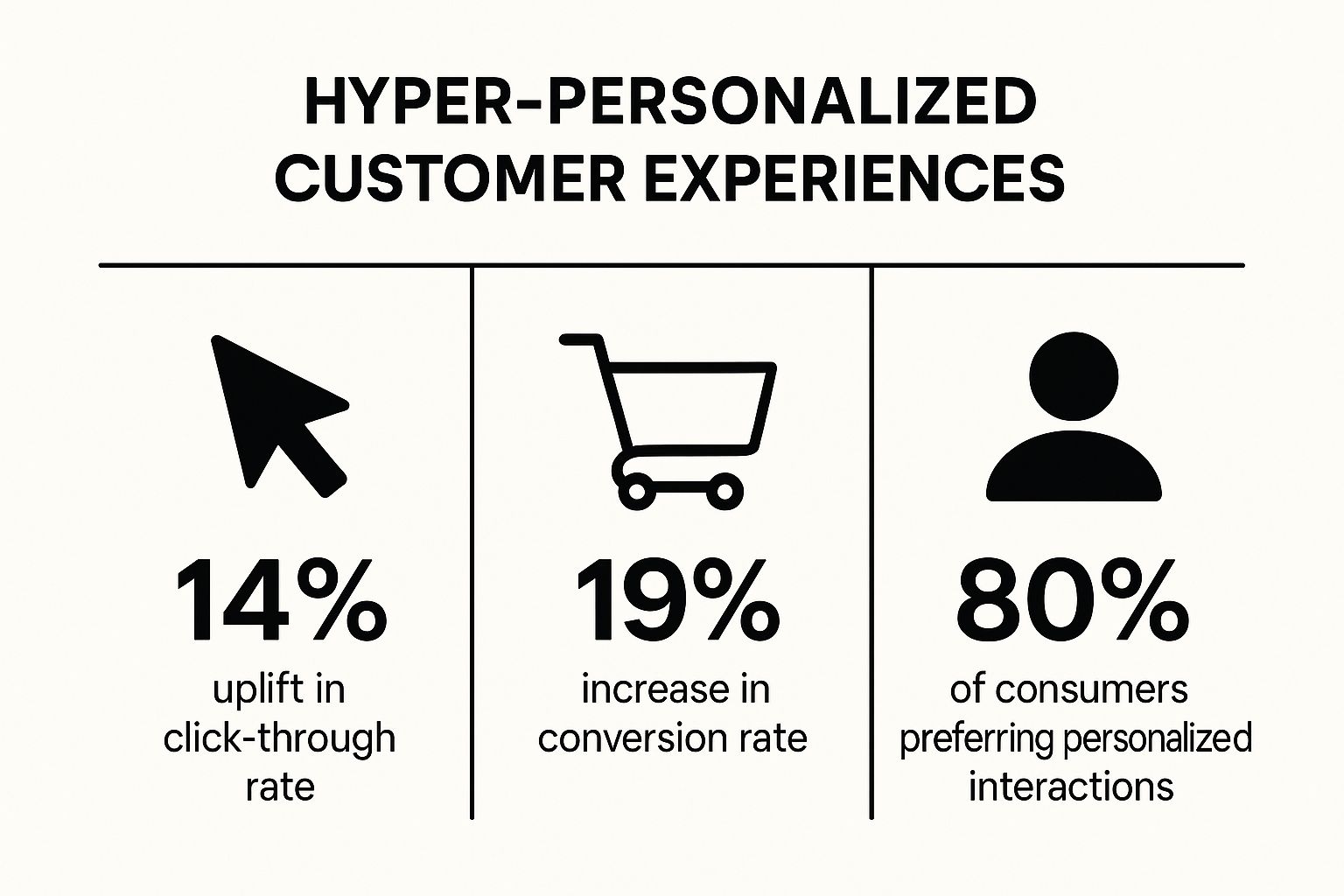
The impact of this approach is significant. Companies like Amazon attribute as much as 35% of their total revenue to its AI-powered recommendation engine. Similarly, Netflix's system, which personalizes everything from recommended shows to the thumbnail art you see, is responsible for driving over 80% of viewer engagement. This level of personalization creates a more relevant and engaging user journey, directly boosting key performance metrics.

The infographic below highlights the tangible results marketers can expect from implementing AI-driven personalization.

Infographic showing key data about Hyper-Personalized Customer Experiences

These statistics clearly demonstrate that consumers not only prefer personalized interactions but also act on them, leading to higher engagement and conversion rates.

Actionable Tips for Implementation:

To effectively leverage AI for personalization, start by focusing on data quality and a gradual rollout.

  • Action Step 1: Unify Your Customer Data. Use a Customer Data Platform (CDP) to consolidate data from your CRM, website analytics, and e-commerce platform. This creates the single customer view necessary for true personalization.
  • Action Step 2: Start with Dynamic Product Recommendations. Implement an AI tool on your e-commerce site to suggest products based on real-time user behavior. This is a high-impact, low-risk starting point.
  • Action Step 3: Be Transparent and Offer Control. In your privacy policy and user settings, clearly explain what data you collect and how it's used for personalization. Give users control over their data to build trust.

2. Predictive Analytics and Customer Behavior Forecasting

Another of the core benefits of AI in marketing is the shift from reactive to proactive strategy through predictive analytics. While traditional analytics explains what has already happened, AI-powered predictive models use historical data, machine learning algorithms, and statistical modeling to forecast future outcomes. This capability allows marketers to anticipate customer needs, identify potential churn risks, and predict which leads are most likely to convert.

Traditional vs. AI-Powered Analytics:

  • Traditional: A marketing team reviews a report showing that 15% of subscribers churned last quarter. They then plan a win-back campaign.
  • AI-Powered: An AI model analyzes real-time user engagement (e.g., decreased login frequency, ignored emails) and flags at-risk subscribers before they churn. It can then automatically trigger a personalized retention offer to proactively prevent the loss.

By analyzing patterns in customer data, AI can forecast everything from future purchase behavior to lifetime value.

Predictive Analytics and Customer Behavior Forecasting

Real-World Impact and Implementation

The strategic advantage of forecasting is immense. For example, Starbucks utilizes predictive analytics to determine ideal new store locations based on traffic, demographics, and consumer behavior patterns. Similarly, Uber’s surge pricing is a direct result of its AI forecasting demand in real-time to dynamically adjust prices and incentivize driver supply. These companies don’t just react to the market; they actively shape it based on data-driven predictions.

This foresight is crucial for optimizing everything from inventory management to campaign timing. Knowing which products will trend next season or which customer segments are primed for a new offer transforms marketing from a guessing game into a calculated science, significantly improving efficiency and return on investment.

Actionable Tips for Implementation:

To integrate predictive analytics effectively, focus on building a strong data framework and starting with clear, achievable goals.

  • Action Step 1: Integrate Your Data Sources. Connect your CRM, website analytics, and sales data to a central repository. High-quality, comprehensive data is the fuel for accurate predictions.
  • Action Step 2: Define a Specific Predictive Goal. Start with a clear question. For example: "Which of our current leads are most likely to convert in the next 30 days?" or "Which customers are at the highest risk of churning?"
  • Action Step 3: Implement an AI-Powered Lead Scoring System. Use an AI tool to analyze lead behavior and firmographics, automatically scoring and prioritizing them for your sales team. This provides an immediate, measurable impact.

3. Intelligent Customer Segmentation and Targeting

Another significant benefit of AI in marketing lies in its ability to revolutionize customer segmentation and targeting. While traditional methods rely on static demographic or firmographic data, AI processes dynamic, multi-dimensional datasets to uncover deeper behavioral patterns. It analyzes everything from purchase frequency and browsing history to social media sentiment and real-time interactions, creating fluid, highly predictive customer segments.

Traditional vs. AI-Powered Segmentation:

  • Traditional: A B2B software company targets "VPs of Marketing in the tech industry with 500+ employees." This segment is static and broad.
  • AI-Powered: An AI platform identifies a dynamic micro-segment of "VPs who have recently visited pricing pages, downloaded a specific whitepaper, and whose companies are currently hiring for marketing roles." This segment is based on real-time intent signals, making it far more valuable.

AI-powered systems can identify these nuanced groups automatically and adjust them in real time as customer behaviors evolve. This ensures that marketing messages are not just personalized but also contextually relevant to a customer's current journey stage and intent.

Real-World Impact and Implementation

The impact of intelligent segmentation is profound, enabling brands to allocate resources more effectively and achieve higher engagement. For instance, Mastercard leverages AI to analyze vast transaction data, creating behavioral segments that help its merchant partners identify growth opportunities and tailor offers. Similarly, Unilever uses AI to segment consumers based on their expressed interest in sustainability, allowing the company to deliver targeted messaging that resonates with specific values.

These AI-driven segments are far more actionable than their traditional counterparts. They allow for precise targeting with customized creative and messaging, dramatically improving campaign performance and ROI by focusing efforts on the most receptive audiences. For more on how to identify these high-intent groups, discover how to use AI for lead scoring.

Actionable Tips for Implementation:

To deploy AI for smarter segmentation, focus on data integration and iterative refinement.

  • Action Step 1: Integrate Behavioral Data. Ensure your website and app analytics are connected to your marketing automation platform so you can segment users based on their real-time actions, not just static profiles.
  • Action Step 2: Use AI to Identify Your "Ideal Customer Profile" (ICP). Feed your existing customer data into an AI tool. It can analyze your best customers and identify common attributes, helping you build a data-driven ICP for better targeting.
  • Action Step 3: Create Lookalike Audiences. Once AI identifies a high-performing segment, use the lookalike modeling features in platforms like Google Ads or Facebook Ads to find new prospects with similar characteristics, effectively scaling your reach.

4. Automated Content Creation and Optimization

Another significant benefit of AI in marketing lies in its power to automate and optimize content creation at an unprecedented scale. Traditional content marketing is resource-intensive, requiring significant time and human effort to produce everything from blog posts to social media updates. AI streamlines this entire process by generating high-quality, relevant content, freeing up marketing teams to focus on strategy and high-level creative tasks.

Traditional vs. AI-Powered Content Creation:

  • Traditional: A content writer spends 4-6 hours researching and writing a single blog post. A social media manager spends an hour crafting five different tweets for the week.
  • AI-Powered: A marketer provides an AI tool with a topic and keywords. Within minutes, the AI generates a detailed outline, a first draft of the blog post, and ten social media variations. The marketer then spends an hour refining and adding their unique perspective, cutting production time by over 70%.

Automated Content Creation and Optimization

AI tools can instantly draft product descriptions, write email subject lines, create social media captions, and even generate blog post outlines. This automation not only accelerates content velocity but also ensures brand consistency by adhering to predefined style and voice guidelines across all outputs.

Real-World Impact and Implementation

The impact of AI-driven content is already clear across various industries. For example, The Washington Post’s AI, Heliograf, has published thousands of data-driven articles on topics like election results and Olympic events. E-commerce giant Alibaba uses an AI copywriter that can produce 20,000 product descriptions per second, a task that would be impossible for a human team.

Platforms like Persado leverage AI to generate marketing copy that has been proven to outperform human-written alternatives by a significant margin. This technology allows marketers to rapidly test different messaging variations to find what resonates most effectively with their audience, directly improving campaign performance and ROI.

Actionable Tips for Implementation:

To implement AI content creation effectively, it's crucial to balance automation with human oversight.

  • Action Step 1: Start with Short-Form Content. Use AI tools to generate ideas and drafts for social media posts, email subject lines, and ad copy. These are low-risk areas to test and refine your prompts.
  • Action Step 2: Use AI as a Research Assistant. Instead of asking AI to write a full article, ask it to summarize research, identify key statistics, or create an outline. This speeds up the most time-consuming parts of content creation.
  • Action Step 3: Develop a Brand Voice Prompt. Create a detailed prompt that includes your brand's tone, style, key messaging, and target audience. Use this "master prompt" to ensure all AI-generated content remains consistent and on-brand. Learn more about how AI can be used for comprehensive content analysis on marketbetter.ai.

5. Real-Time Customer Service and Engagement

Another of the core benefits of AI in marketing is the ability to offer real-time customer service and engagement around the clock. Traditional support models are limited by business hours and agent availability, creating frustrating delays for customers. AI-powered chatbots and virtual assistants eliminate this friction, providing instant, 24/7 support for routine inquiries, lead qualification, and personalized assistance.

Traditional vs. AI-Powered Customer Service:

  • Traditional: A customer with a simple question ("What is your return policy?") has to wait in a phone queue or for an email response the next business day.
  • AI-Powered: A chatbot on the website instantly answers the same question 24/7. It can also handle related queries like order tracking and even initiate a return process, resolving the issue in seconds without human intervention.

These AI systems can handle thousands of conversations simultaneously, freeing up human agents to focus their expertise on more complex, high-value issues that require a human touch.

Real-World Impact and Implementation

The impact of AI-driven engagement is proven and substantial. For instance, Sephora's chatbot helps customers find products and book in-store appointments, leading to an 11% higher conversion rate among users. Similarly, Bank of America's virtual assistant, Erica, has successfully handled over 100 million client requests, demonstrating the immense scale and efficiency AI can bring to customer interactions.

This technology directly improves customer satisfaction by providing immediate resolutions and enhances the marketing funnel by engaging potential leads the moment they show interest. Brands like H&M use chatbots for style advice and product recommendations, turning a simple query into a guided shopping experience.

Actionable Tips for Implementation:

To integrate AI for customer engagement effectively, focus on seamless integration and continuous improvement.

  • Action Step 1: Identify Top 5-10 Customer Questions. Analyze your support tickets and emails to find the most frequently asked questions. Use these to build the initial knowledge base for your chatbot, ensuring it can handle the most common inquiries from day one.
  • Action Step 2: Design a Clear Escalation Path. Program your chatbot with a clear and easy option to "talk to a human." This could be a live chat handover or a form to create a support ticket. This prevents user frustration.
  • Action Step 3: Integrate with Your CRM. Connect your chatbot to your CRM so it can recognize existing customers, access their order history, and create new lead records for potential customers, making every interaction more valuable. Learn how to never miss a follow-up with a well-defined escalation strategy.

6. Advanced Marketing Attribution and ROI Tracking

One of the most critical benefits of AI in marketing is its ability to solve the complex puzzle of multi-touch attribution. Traditional models, like last-click, often oversimplify the customer journey by giving all credit to the final touchpoint before a conversion. AI algorithms, however, can analyze every interaction a customer has across channels, from the initial social media ad to the final email click, to accurately weigh the influence of each touchpoint.

Traditional vs. AI-Powered Attribution:

  • Traditional (Last-Click): A customer sees a Facebook ad, reads a blog post, receives three emails, and finally converts via a Google search ad. The Google ad gets 100% of the credit.
  • AI-Powered (Data-Driven): The AI model analyzes thousands of customer journeys and assigns fractional credit to each touchpoint. It might determine the Facebook ad contributed 20%, the blog post 15%, the emails 35%, and the final Google ad 30%, giving a much more accurate picture of what worked.

This data-driven clarity allows for smarter budget allocation, moving funds away from underperforming channels and doubling down on those that deliver the highest value throughout the entire sales funnel.

Real-World Impact and Implementation

The impact of AI-driven attribution is a significant increase in marketing efficiency and a more accurate understanding of ROI. For instance, Google's AI-powered attribution models in Google Analytics 4 help advertisers move beyond simplistic models to understand cross-channel impact. Similarly, B2B companies with long sales cycles use Salesforce's AI attribution tools to connect marketing efforts to eventual revenue, even when the journey spans months and multiple touchpoints.

This shift provides a more holistic view, revealing the true value of top-of-funnel activities that build awareness but might not get credit in a last-click world. By understanding the incremental lift provided by each marketing activity, businesses can optimize their entire strategy for maximum impact.

Actionable Tips for Implementation:

To leverage AI for advanced attribution, focus on comprehensive data collection and sophisticated analysis.

  • Action Step 1: Ensure Consistent UTM Tagging. Enforce a strict, consistent UTM tagging policy across all your marketing channels (email, social, ads). This provides the clean data AI needs to connect the dots.
  • Action Step 2: Switch to a Data-Driven Model in Your Analytics. If you use a platform like Google Analytics 4, switch your default attribution model from "last click" to "data-driven attribution" to immediately start leveraging Google's AI.
  • Action Step 3: Connect Marketing Data to Sales Revenue. Use a CRM or CDP to link campaign touchpoints to actual sales data. This allows the AI to optimize for revenue, not just intermediate conversions like form fills.

7. Dynamic Pricing and Revenue Optimization

Another powerful benefit of AI in marketing is the ability to implement dynamic pricing and optimize revenue in real-time. Traditional pricing models are often static, set for long periods and based on historical data or simple competitor analysis. AI completely revolutionizes this by processing thousands of variables simultaneously, including competitor pricing, market demand, customer behavior, inventory levels, and even external factors like weather or local events.

Traditional vs. AI-Powered Pricing:

  • Traditional: A hotel sets a fixed weekend rate for all rooms for the entire summer, based on last year's performance.
  • AI-Powered: The hotel's AI pricing engine monitors flight bookings, a newly announced local concert, and competitor pricing in real-time. It automatically adjusts room rates multiple times per day to maximize occupancy and revenue, raising prices during peak demand and offering discounts during lulls.

This ensures pricing is always competitive and aligned with current market conditions.

Real-World Impact and Implementation

The impact of AI-driven pricing is profound across various industries. E-commerce giant Amazon famously changes prices on millions of its products multiple times a day, responding instantly to competitor moves and customer demand. Similarly, the airline industry has long used AI for revenue management, adjusting ticket prices based on seat availability, time until departure, and booking patterns. Ride-sharing companies like Uber use surge pricing algorithms to balance supply and demand, incentivizing more drivers to be available during peak hours.

This strategic approach moves pricing from a passive, cost-plus model to an active, value-based strategy that directly drives profitability and market responsiveness.

Actionable Tips for Implementation:

To effectively deploy dynamic pricing, a cautious and data-driven approach is essential to maintain customer trust.

  • Action Step 1: Define Clear Pricing Rules and Boundaries. Before activating any AI, set non-negotiable price floors (the minimum you'll sell for) and ceilings (the maximum). This prevents the AI from making brand-damaging decisions.
  • Action Step 2: Start with a Single Product Category. Test dynamic pricing on a limited set of products or services. Analyze the impact on both revenue and customer feedback before rolling it out more broadly.
  • Action Step 3: Be Transparent Where Appropriate. For some business models (like events or travel), customers expect dynamic pricing. For others, transparency about why prices might fluctuate (e.g., "limited stock pricing") can help maintain trust.

8. Intelligent Ad Campaign Management and Optimization

Another of the key benefits of AI in marketing lies in its ability to automate and intelligently optimize advertising campaigns. Traditional ad management requires constant manual adjustments to bids, budgets, and targeting parameters, a process that is both time-consuming and prone to human error. AI transforms this by using machine learning to analyze performance data in real-time and make autonomous optimizations to maximize ROI.

Traditional vs. AI-Powered Ad Management:

  • Traditional: A digital marketer manually reviews keyword performance each morning, adjusting bids based on the previous day's results. They might test two or three ad variations per ad group.
  • AI-Powered: An AI bidding algorithm like Google's Smart Bidding adjusts bids in real-time for every single auction, using dozens of signals (device, location, time of day, etc.). It can simultaneously test hundreds of creative combinations (headlines, descriptions, images) to find the optimal mix automatically.

This moves campaign management from a reactive, manual task to a proactive, automated strategy, ensuring every ad dollar is spent with maximum efficiency.

Real-World Impact and Implementation

The impact of AI on ad performance is substantial and well-documented. Google's own data shows that its Smart Bidding strategies, which use AI to optimize for conversions, can increase conversion rates by an average of 20% at the same cost-per-acquisition. Similarly, platforms like Facebook's Advantage+ campaigns leverage AI to automate targeting and creative delivery, simplifying campaign setup and improving results across the entire sales funnel. Tools like Wordstream also use AI to drastically cut down on management time, claiming reductions of up to 80%.

This automation frees marketers from tedious, repetitive tasks, allowing them to focus on higher-level strategy, creative development, and market analysis.

Actionable Tips for Implementation:

To effectively integrate AI into your ad campaign management, a strategic approach is necessary to guide the machine learning process.

  • Action Step 1: Ensure Your Conversion Tracking is Flawless. AI optimizes toward the goal you set. If your conversion tracking is inaccurate (e.g., double-counting conversions), the AI will make poor decisions. Audit and verify your tracking before activating AI features.
  • Action Step 2: Switch from Manual Bidding to an Automated Strategy. On platforms like Google Ads or Meta, choose an automated bid strategy aligned with your goal (e.g., "Maximize Conversions" or "Target ROAS"). Feed it enough conversion data and let it run.
  • Action Step 3: Use AI for Creative Testing. Implement features like Responsive Search Ads (Google) or Dynamic Creative (Meta). Provide multiple headlines, descriptions, and images, and let the AI determine the best-performing combinations for different audiences.

Benefits Comparison of 8 AI Marketing Strategies

AI Marketing SolutionImplementation Complexity 🔄Resource Requirements ⚡Expected Outcomes 📊Ideal Use Cases 💡Key Advantages ⭐
Hyper-Personalized Customer ExperiencesHigh setup complexity and data needsHigh-quality data and AI systemsIncreased engagement & conversion; higher order valuesPersonalized cross-channel marketing at scaleSignificantly higher engagement and loyalty
Predictive Analytics & Customer ForecastingModerate to high; requires data science expertiseStrong data infrastructure, ongoing model updatesBetter ROI, retention, and planning; early trend IDStrategic marketing and inventory managementProactive decision-making and resource optimization
Intelligent Customer Segmentation & TargetingModerate; requires continuous tuningRobust data integrationHigher campaign relevance, dynamic segmentsPrecise audience targeting & micro-segmentationDiscovery of new segments and improved engagement
Automated Content Creation & OptimizationMedium complexity; needs brand trainingAI content generators, human oversightFaster content production; cost reductionHigh-volume, routine content creationMassive time savings and consistent output
Real-Time Customer Service & EngagementMedium; ongoing tuning and integrationAI chatbot platforms, CRM systems24/7 support; improved satisfaction and scalabilityCustomer support and lead qualificationInstant response with scalable support
Advanced Marketing Attribution & ROI TrackingHigh complexity; multi-source integrationComprehensive tracking systemsAccurate ROI, optimized budget allocationMulti-channel campaign effectiveness trackingClear marketing impact insights
Dynamic Pricing & Revenue OptimizationHigh complexity; frequent updatesReal-time data feeds and AI modelsIncreased revenue and profit marginsPricing strategy in e-commerce, retail, travelMaximizes revenue with responsive pricing
Intelligent Ad Campaign Management & OptimizationModerate; platform-dependentAd platforms with AI capabilitiesBetter campaign performance; cost reductionAutomated bidding and multi-platform ad managementContinuous optimization and improved ROI

From Insight to Impact: Putting AI to Work in Your Marketing Strategy

We've explored eight transformative benefits of AI in marketing, moving from the broad strokes of theory to the fine details of execution. The journey has taken us from crafting hyper-personalized customer experiences that build loyalty to deploying predictive analytics that forecast market shifts with stunning accuracy. We've seen how AI dismantles traditional silos, enabling intelligent customer segmentation, automating content creation, and providing real-time support that meets customers exactly where they are. The common thread weaving through each of these advantages is a fundamental shift in operational philosophy: from reactive, assumption-based marketing to a proactive, data-driven, and highly efficient growth engine.

The implementation of AI is not a zero-sum game where technology replaces human talent. Instead, it’s a powerful partnership. The true value emerges when AI augments the strategic and creative capabilities of your marketing team. By automating the repetitive, data-heavy tasks like A/B testing ad copy or segmenting thousands of leads, AI liberates your people to focus on what they do best: building brand narratives, fostering genuine customer relationships, and innovating on a strategic level. This synergy is where the most significant competitive advantages are forged.

Your Action Plan: Moving from Theory to Reality

Translating these concepts into tangible results requires a deliberate and strategic approach. The most successful AI adoptions don't happen overnight with a massive, all-encompassing system. They begin with focused, high-impact initiatives that build momentum and demonstrate clear value.

Here is a practical roadmap to get started:

  • Identify Your Biggest Bottleneck: Where do you lose the most time or money? Is it in manually scoring leads, struggling with content production, or deciphering attribution data? Pinpoint a single, significant pain point that AI is well-suited to solve. For example, if your sales team spends too much time on unqualified leads, an AI-powered predictive lead scoring model is an ideal starting point.
  • Start Small, Prove ROI: Focus your initial efforts on that one identified area. Implement a targeted AI solution and meticulously track the results. Did lead quality improve? Did conversion rates increase? Did customer service response times decrease? Securing a clear win with measurable ROI will build the internal case for broader AI integration across your marketing functions.
  • Select the Right Technology Stack: The market is filled with powerful platforms designed to simplify implementation. To effectively put AI to work in your marketing strategy, it's crucial to identify and utilize the best AI tools for marketing available. Evaluate solutions based on their ability to integrate with your existing systems (like your CRM), their ease of use, and their scalability.

Embracing the benefits of AI in marketing is no longer a futuristic vision; it's a present-day imperative for sustainable growth. By taking a measured, strategic approach, you can transform your marketing operations from a cost center into a predictable, revenue-generating powerhouse that is more intelligent, efficient, and profoundly customer-centric.


Ready to unlock these benefits without the complexity? marketbetter.ai integrates predictive analytics, content optimization, and intelligent automation into a single, intuitive platform. See how our AI can elevate your marketing strategy by visiting marketbetter.ai to start your journey.