
2 posts tagged with "pipeline marketing"

View All Tags

B2B Demand Generation Proven Growth Strategies

· 26 min read

Let's be real—most B2B marketing feels like trying to find a needle in a haystack. You're constantly chasing leads, hoping a few are actually ready to talk.

B2B demand generation flips that entire model on its head. Instead of just scrapping for the few buyers who are ready to pull the trigger right now, you play the long game. It's about building awareness and creating genuine desire across your entire market, so when they are ready to buy, you’re the only name they think of.

Why B2B Demand Generation Matters More Than Ever

Most B2B marketing teams are playing with a massive handicap and don't even know it. They pour their entire budget into capturing immediate leads, but this completely ignores how markets actually work.

Here’s the hard truth: only 5% of your total addressable market is actively 'in-market' at any given moment. That means a whopping 95% of your potential future customers are out there, but they just aren't ready to buy yet. This single stat should change how every B2B marketer thinks.

When you focus all your energy on that tiny 5%, you’re jumping into a hyper-competitive, high-cost cage match with every other company in your space. Everyone is bidding on the same keywords, targeting the same handful of prospects. The result? A mess of predictable problems that stall growth.

The Downfall of a Lead-Only Focus

When marketing's only job is to capture that 5%, you create a vicious cycle that burns out your team and your budget. This tunnel vision leads directly to:

  • Sky-High Acquisition Costs: The fierce competition for those few active buyers drives your ad spend and customer acquisition costs (CAC) through the roof, crushing your margins.
  • Sales Team Burnout: Marketing gets desperate and starts passing off low-quality, barely-qualified contacts just to hit a number. Your sales team wastes precious time chasing ghosts who have no real intent, leading to missed quotas and serious frustration.
  • Unpredictable Revenue: A pipeline that relies solely on the tiny fraction of the market buying today is shaky at best. It’s a recipe for wild, unpredictable swings in revenue.

A modern B2B demand generation strategy stops marketing from being a reactive cost center and turns it into a predictable revenue engine. You build a reservoir of future customers by educating and engaging the 95%, ensuring a steady, consistent flow of high-intent buyers for the long haul.

The first step is a mental shift. Stop asking, "How do we get more leads today?" Start asking, "How do we become the go-to solution for our entire market tomorrow?"

This is the philosophy that builds sustainable growth. To get a better handle on the fundamentals, it’s worth exploring what demand generation marketing entails. This approach builds brand equity and trust, so when the time is right, the sales conversation is a hell of a lot easier.

Creating Demand vs Capturing Demand

To build a B2B demand generation engine that actually works, you have to get one thing straight: the difference between creating demand and capturing demand. It’s the single most common blind spot I see. Too many marketers focus only on one side of the equation, which is like a farmer only showing up at harvest time without ever planting a single seed. A strategy that lasts requires you to master both.

Think of it like this: demand creation is the patient work of tilling the soil and planting seeds for a future harvest. It's about educating and building trust with the overwhelming majority of your market—the 95% of people who aren’t looking to buy today but will be someday.

On the flip side, demand capture is about harvesting the crops that are ripe for the picking right now. This is where you engage the tiny 5% of your market that is actively searching for a solution. They know they have a problem, and they're looking for a fix.

This breakdown isn't just a theory; it's how your market actually works.

Market segmentation diagram showing 95% future buyers and 5% in-market customers for B2B demand generation

That image makes it painfully clear. If you only focus on capturing the 5%, you're in a knife fight with every competitor for the smallest slice of the pie. The real, long-term growth comes from nurturing the other 95%.

How to Actually Create Demand

Demand creation is a long game. It's an investment in your brand’s authority and your audience’s trust. The goal isn't to get a lead today; it's to be the only company they think of when a problem comes up six months from now. This means showing up where your ideal customers hang out to learn, long before they're in a buying cycle.

Here’s an actionable plan to start:

  • Launch a Niche Podcast: Action: Identify 3 industry experts your ideal customers admire. Invite them to discuss a common pain point. This positions you as a connector and thought leader, not just a vendor.
  • Dominate Thought Leadership on LinkedIn: Action: Task your internal experts with sharing one non-promotional, genuinely helpful tip or insight each week. Engage in comments on other leaders' posts to build visibility and trust.
  • Build an Online Community: Action: Start a free Slack or Discord channel focused on a specific industry role (e.g., "B2B SaaS Marketers"). Your job is to facilitate valuable conversations and connections, not to pitch your product.

You don't measure these efforts in MQLs. You measure them with metrics that matter for brand building, like audience growth, share of voice, and direct traffic.

How to Actually Capture Demand

While you're building that future pipeline, you still need to hit this quarter's number. That's where demand capture comes in. These are the tactics aimed squarely at prospects who are waving their hands in the air, signaling they have a problem and are ready to talk solutions. The trick is to be right there, with the right message, the moment they're looking.

Here’s an actionable plan to start:

  • Run High-Intent Google Ads: Action: Instead of bidding on broad terms like "CRM software," bid on long-tail phrases that signal immediate need, such as "[Your Competitor] alternative" or "best CRM for small business."
  • Optimize Your G2 and Capterra Profiles: Action: Launch a campaign to get 10 new, positive reviews from happy customers this quarter. A profile packed with recent social proof is non-negotiable for buyers in the comparison stage.
  • Use Surgical Retargeting Ads: Action: Create a specific ad campaign targeting only visitors who viewed your pricing or demo pages in the last 14 days. This keeps you top of mind during their final decision-making window.

The core difference is timing and intent. Demand creation educates those who might have a problem in the future. Demand capture converts those who know they have a problem today.

The table below breaks down the practical differences in how you approach these two critical functions.

Comparing Demand Creation and Demand Capture Tactics

AspectDemand Creation (Targeting the 95%)Demand Capture (Targeting the 5%)
ObjectiveBuild brand awareness, trust, and authority over the long term. Educate the market.Convert existing buying intent into pipeline and revenue now.
ChannelsSocial media (LinkedIn), podcasts, communities (Slack), content hubs, organic search (informational).Paid search (Google Ads), review sites (G2, Capterra), retargeting, organic search (commercial).
Key KPIsAudience growth, share of voice, engagement rates, brand recall, direct & branded traffic.Cost per acquisition (CPA), conversion rates, pipeline value, sales cycle length.
Example Tactics- Hosting an industry podcast
- Publishing original research reports
- Building a thought leader's LinkedIn presence
- Bidding on "bottom-of-funnel" keywords
- Optimizing software review site profiles
- Running demo request landing pages

Ultimately, a winning B2B demand generation strategy doesn't choose between them—it balances them. You have to create future demand while you efficiently capture the demand that already exists. This dual focus is the only way to not only crush this quarter's target but also build a predictable revenue engine for years to come.

Your Playbook for High-Impact Channels and Tactics

Business workspace with laptop, spiral notebook with sketches, coffee cups, smartphone, and small plant on wooden desk

Alright, let's move from theory to action. A successful B2B demand generation program hinges on a smart playbook—picking the right channels and running tactics that build real authority and fill your pipeline.

Forget the old "spray-and-pray" method. The goal here is surgical precision. You need to show up exactly where your ideal customers are already learning, connecting, and making buying decisions. It’s about understanding the specific job each channel has, whether that's creating future demand or capturing the intent that’s already out there today.

Content Marketing: The Foundation of Authority

Content is the bedrock of any serious demand gen effort. It’s how you educate the 95% of your market that isn't actively buying right now, slowly but surely positioning your brand as the go-to expert.

A common mistake is creating content just to please search engines. This leads to sterile, keyword-stuffed articles that might rank but don't actually connect with a human reader. The real key is to build your content around pillar pages or content hubs.

Actionable Step: Identify the single biggest, most complex problem your ideal customer faces. Create a comprehensive "pillar page" that acts as the ultimate guide to solving it. Then, plan 5-7 "cluster" blog posts that dive deeper into specific sub-topics, all linking back to your main pillar. This strategy signals topical authority to search engines and provides immense value to your audience.

A winning B2B content strategy doesn't just answer questions; it shapes the entire conversation. Your content should be the resource your competitors' customers secretly use to get their jobs done better.

This is a long-term play, but the payoff is huge. Companies that keep up an active blog generate 67% more leads per month on average than those that don't.

LinkedIn: Dominating the B2B Social Sphere

For B2B marketers, LinkedIn isn't just another social network. It's the digital town square where your entire industry hangs out. Just posting company updates won’t move the needle. The real power is in activating the personal brands of your in-house subject matter experts.

Instead of your company page broadcasting messages, imagine your CEO, Head of Product, or a top engineer sharing genuine insights from their day-to-day. Have them ask thought-provoking questions and jump into real conversations in industry groups. This human-to-human connection builds trust in a way a corporate logo simply can't.

Actionable Step: Take your latest research report or webinar recording and have a subject matter expert repurpose the key takeaways into a 5-post LinkedIn series. Each post should share one valuable insight and ask a question to encourage comments. This multiplies the reach of your core content and puts it directly in front of a highly relevant audience.

Webinars and Virtual Events: Creating Fans, Not Just Leads

Webinars are still a powerhouse for demand generation, but the game has changed. The era of dry, hour-long product pitches is officially over. Today's best webinars feel more like live, educational shows.

These events should focus on a tangible problem and feature industry experts—not just your own team. Bringing in outside voices broadens your reach and adds a ton of credibility. The data backs this up: 53% of marketers say webinars are the top-of-funnel format that generates the highest quality leads.

Here’s a look at how the approach has shifted:

FeatureThe Old Way (Lead Gen Focus)The Modern Way (Demand Gen Focus)
Primary GoalCollect as many registrants (MQLs) as possible.Deliver an exceptional educational experience to the right audience.
Content FocusHeavily product-focused, often a thinly veiled sales demo.Focused on solving a specific audience pain point; the product is only mentioned for context.
Promotion"Register for our webinar" plastered everywhere.Promote the topic and the expert speakers to create genuine interest.
Success MetricNumber of MQLs passed to sales.Audience engagement, post-event feedback, and influence on the pipeline.

When you shift your focus from simply collecting emails to delivering real value, you don't just get a lead—you create a genuine fan of your brand.

This strategy is a cornerstone of many successful B2B demand generation programs. It works hand-in-glove with other efforts, like those we explore in our complete guide to inbound marketing and lead generation. Ultimately, the right channel mix depends on where your audience lives and how they like to learn, but these three pillars are a powerful and proven place to start.

Building Your B2B Demand Generation Tech Stack

Your tech stack shouldn't be a Frankenstein's monster of disconnected tools. Think of it as the central nervous system for your entire demand gen strategy. It's what connects data, automates the grunt work, and gives you the insights to make smarter bets with your budget.

Get it right, and everything flows. Get it wrong, and you're stuck with data silos, operational headaches, and a fuzzy picture of what's actually driving revenue.

Let's break it down with an analogy. Your Customer Relationship Management (CRM) is the brain, the single source of truth. Your Marketing Automation Platform (MAP) is the nervous system, executing the commands. And your Analytics tools are the eyes and ears, telling you what's happening in the real world. All three have to work together.

Wooden blocks displaying tech stack icons including CRM automation and analytics tools on office desk

Core Components of a Modern Stack

Every solid demand gen stack is built on a few non-negotiable pillars. These are the foundational tools for tracking engagement, nurturing relationships, and finally proving marketing's impact on the bottom line.

  • CRM (The Brain): This is where every piece of customer and prospect data lives—contact info, interaction history, deal stages, you name it. It has to be your single source of truth. Think HubSpot (often an all-in-one choice) and Salesforce.
  • Marketing Automation (The Nervous System): This is the engine that runs your campaigns. It handles email nurturing, builds landing pages, and powers your lead scoring models. Common players include Marketo, Pardot, and the automation built right into HubSpot.
  • Analytics and Attribution (The Eyes and Ears): These tools answer the golden question: "Is this working?" Google Analytics is the baseline for web traffic, but more advanced platforms like Dreamdata or HockeyStack connect the dots directly from a marketing touchpoint to a signed contract.

As you build out your stack, remember to account for specific channels. For example, if webinars are a key part of your strategy, choosing the best webinar software for small businesses ensures your content delivery is just as polished as your data tracking.

Comparing Stacks for Startups vs. Enterprises

The perfect tech stack isn't one-size-fits-all. It has to scale with your company's complexity and budget. What works for a lean startup would grind a global enterprise to a halt, and an enterprise stack would be overkill for a small team.

Company StageKey FocusExample Tech Stack
Lean StartupAffordability, ease of use, and all-in-one functionality. The goal is speed and efficiency.CRM/Automation: HubSpot Starter/Pro
Analytics: Google Analytics
Social: Buffer or Hootsuite
Established EnterpriseScalability, deep customization, and robust integrations. The goal is managing complex campaigns.CRM: Salesforce
Automation: Marketo or Pardot
Analytics: Dreamdata, Bizible
ABM: 6sense or Demandbase

For startups, an all-in-one platform like HubSpot is almost always the right call. It bundles the CRM, marketing automation, and analytics you need to get started, minimizing integration headaches and keeping costs down.

Enterprises, on the other hand, usually need best-in-class point solutions that can handle massive data volumes and complex workflows, even if it means a higher price tag and more heavy lifting on the integration front.

The most important principle is integration. Your tools must speak to each other seamlessly. A disconnected stack creates blind spots, making it impossible to see how a LinkedIn ad or a blog post ultimately influenced a closed-won deal.

The Rise of AI in the Tech Stack

AI isn't some futuristic concept anymore; it's a practical, powerful layer you can add to your stack right now. AI-powered tools are becoming essential for getting an edge in personalization and efficiency, analyzing huge datasets to spot patterns a human marketer could easily miss.

Here’s an actionable comparison of manual vs. AI-powered approaches:

TaskManual ApproachAI-Powered Approach
Lead ScoringRelies on simple demographic rules (e.g., company size, job title).Analyzes thousands of behavioral and firmographic signals for a predictive score.
Content PersonalizationCreate a few different landing pages for broad segments.Dynamically changes website copy and CTAs for each individual visitor in real-time.
Campaign OptimizationA marketer manually checks performance and adjusts ad bids weekly.The AI algorithm automatically adjusts bids and reallocates budget 24/7.

Getting started doesn't require ripping and replacing your entire system. You can explore a variety of AI marketing automation tools designed to plug right into your existing workflows, giving you an immediate boost without a massive overhaul.

Measuring What Matters for Revenue Growth

In B2B demand generation, what you measure is what you get. For too long, marketing teams celebrated vanity metrics like social media likes and website traffic that mean very little to the C-suite. To prove your value and secure bigger budgets, you have to start speaking the language of revenue.

This means shifting your focus from top-of-funnel activity to bottom-line business outcomes.

When you report on pipeline and customer acquisition cost instead of clicks, you completely change the conversation. Marketing is no longer seen as a cost center but as a primary driver of predictable business growth.

Ditching Vanity Metrics for Revenue KPIs

Vanity metrics feel good, but they don’t pay the bills. A spike in website visitors is meaningless if none of them are qualified buyers. True success in B2B demand generation is measured by its direct contribution to the sales pipeline and closed-won deals.

This isn't just a trend; it's a fundamental shift in how B2B marketing is held accountable. A recent study shows that 42% of B2B marketing teams now cite revenue generated as their top KPI—a stark contrast to the old days of clicks and impressions. With marketing budgets hovering around 7.7% of overall company revenue, the pressure is on to show a clear return on that investment. You can see more on these demand generation statistics and their impact here.

To demonstrate your impact, get laser-focused on these actionable metrics:

  • Marketing-Sourced Pipeline: This is the total dollar value of sales opportunities that came directly from marketing activities. It's the cleanest indicator of your team's contribution to future revenue.
  • Sales Cycle Length: Track how long it takes, on average, for a marketing-sourced lead to become a paying customer. An effective demand gen strategy should shorten this cycle by delivering better-educated, higher-intent leads to sales.
  • Customer Acquisition Cost (CAC): This is the total cost of your sales and marketing efforts divided by the number of new customers acquired. Your goal is to keep this number as low as possible while maintaining lead quality.

Comparing Old Metrics vs. New Metrics

The difference in focus is night and day. One approach reports on activity, while the other reports on actual business impact.

The Old Way (Vanity Metrics)The New Way (Revenue Metrics)
Website Traffic: "We had 10,000 visitors this month."Pipeline Contribution: "Marketing generated $500k in new sales pipeline this quarter."
Lead Volume: "We generated 500 MQLs."Lead-to-Customer Rate: "1 in 10 marketing-sourced leads became a paying customer."
Click-Through Rate (CTR): "Our ad campaign had a 3% CTR."Customer Acquisition Cost (CAC): "Our CAC from the ad campaign was $5,000."

This new approach aligns marketing directly with sales and executive goals, which is how you build trust and prove your team's indispensable role. You can explore a deeper dive into key performance indicators for lead generation to build out your own reporting dashboards.

A Deeper Look at Key Metrics

To make your reporting rock-solid, it helps to have a clear view of which KPIs tell the best story. Here's a breakdown of the metrics that truly matter.

Key B2B Demand Generation Metrics to Track

Metric (KPI)What It MeasuresWhy It Matters
Marketing Qualified Leads (MQLs)The number of leads deemed ready for sales follow-up based on their behavior (e.g., downloaded an ebook).Measures the volume of potential buyers your demand capture efforts are generating.
Sales Qualified Leads (SQLs)MQLs that the sales team has accepted as legitimate opportunities with real buying intent.Shows the quality of your MQLs and the alignment between marketing and sales.
MQL-to-SQL Conversion RateThe percentage of MQLs that become SQLs.This is a critical health check on your lead quality. A low rate signals a disconnect.
Pipeline ContributionThe total dollar value of sales opportunities that originated from marketing efforts.The single most important metric for proving marketing's direct impact on future revenue.
Customer Acquisition Cost (CAC)Total sales and marketing spend divided by the number of new customers acquired in a period.Measures the efficiency of your demand generation engine. Lower is better.
Customer Lifetime Value (CLV)The total revenue a business can expect from a single customer account throughout the relationship.Provides context for CAC. A high CLV justifies a higher acquisition cost.
Sales Cycle LengthThe average time it takes for a lead to become a paying customer.Effective demand generation should shorten this by delivering more educated, ready-to-buy leads.

Tracking these metrics gives you a 360-degree view of your performance, from initial interest all the way to closed revenue. It’s the difference between guessing and knowing.

Simple Revenue Attribution Models to Start With

You don’t need expensive, complicated software to start connecting marketing efforts to revenue. Revenue attribution is simply the practice of assigning credit to the marketing touchpoints a customer interacted with before they bought something.

While complex multi-touch models exist, you can get started with a simple, practical approach.

A great starting point is the First-Touch Attribution Model. This model gives 100% of the credit for a new customer to the very first marketing interaction they had with your brand.

Actionable Example: A prospect reads one of your blog posts they found through a Google search. Six months later, after attending a webinar and having multiple sales calls, they become a customer. With first-touch attribution, that blog post gets all the credit.

This model is simple to implement and powerfully demonstrates the value of your demand creation activities—like content and SEO—which often get overlooked. It helps you justify the long-term investments that build your brand and create future demand, proving that what you do today directly impacts the revenue you see tomorrow.

4-Phase Action Plan to Launch Your Demand Gen Engine

Alright, theory's one thing, but revenue comes from execution. Let's turn all this talk into a practical, step-by-step roadmap for launching or overhauling your B2B demand generation engine. I’ve broken this down into four clean phases designed to build momentum and get real results on the board.

Forget the "boil the ocean" approach. Trying to do everything at once is a recipe for wasted budget and burnout. This plan ensures you build a solid foundation first, then scale.

Phase 1: Build Your Foundation (Weeks 1-2)

Before you spend a single dollar on a campaign, you need absolute clarity on who you're talking to and what you're saying. This is the unsexy, non-negotiable work that makes everything else click. Skipping this step is the #1 reason demand gen initiatives die on the vine.

Your only mission here is to:

  • Nail Your Ideal Customer Profile (ICP): Action: Schedule 3-5 interviews with your best customers. Ask them about their "before" and "after" state, what triggered their search for a solution, and what other tools they considered.
  • Craft Your Core Messaging: Action: Based on those interviews, write a single paragraph that describes the problem you solve, for whom, and what makes your solution unique. Test this messaging with your sales team for feedback.

Phase 2: Kickstart Demand Creation (Weeks 3-8)

With your foundation poured and set, it's time to start creating some demand. This phase is all about planting seeds with the 95% of your market that isn't shopping today. The goal isn't lead capture; it's to build awareness, authority, and an audience that trusts you.

This isn’t about harvesting emails. It’s about building an audience that sees you as the go-to expert. Your first move should feel like a Trojan horse of value—give away so much insight that your brand becomes impossible to ignore.

Here’s where to start:

  • Launch a Content Series: Action: Pick one format you can execute consistently (e.g., a monthly webinar with guest experts). Commit to producing it for at least 3 months to build momentum and an audience.
  • Activate a Key Opinion Leader: Action: Choose one person inside your company with strong expertise. Their only goal for this phase is to post twice a week on LinkedIn, sharing insights from your content series and engaging in industry conversations.

Phase 3: Set Up Demand Capture (Weeks 9-10)

While you're building future demand, you can't ignore the people ready to buy right now. This phase is about setting up the plumbing to efficiently catch the 5% of the market that's actively looking for what you sell.

Phase 2 (Creation) FocusPhase 3 (Capture) Focus
Educating the marketConverting existing intent
Building an audienceGenerating qualified meetings
Long-term brand buildingNear-term pipeline impact

Your initial setup should be lean and mean:

  1. Targeted "Bottom-of-Funnel" Ads: Action: Launch one Google Ads campaign with a small budget ($500-$1000/mo). Target a maximum of 10 high-intent keywords like "[Your Competitor] alternatives" or "[Your Product Category] pricing."
  2. Conversion-Optimized Landing Pages: Action: Create a single, simple landing page for your ads. It should have a clear headline, 3-5 bullet points on value, and a form to request a demo. That's it.

Phase 4: Establish Your Measurement Framework (Weeks 11-12)

Finally, you need to prove it's all working. This last phase ensures you can track progress, show ROI, and make smarter decisions with real data. Start simple. Focus on the metrics that the C-suite actually cares about: pipeline and revenue.

  • Build a Core Metrics Dashboard: Action: In your CRM, create a dashboard with three reports: Marketing-Sourced Pipeline by Month, MQL-to-SQL Conversion Rate, and Average Sales Cycle Length for Marketing Leads. Review it weekly to track progress and identify bottlenecks.

A Few Common Questions

If you're digging into the world of B2B demand generation, a few practical questions always come up. Here are some straight answers to help you build a smarter strategy from day one.

What’s the Real Difference Between Demand Generation and Lead Generation?

It’s easy to get these two tangled up, but the distinction is critical. Think of it as the difference between farming and hunting.

AspectDemand Generation (Farming)Lead Generation (Hunting)
GoalCultivate the entire market over time, building awareness and desire.Identify and capture specific individuals who are ready to buy now.
TimeframeLong-term strategy focused on building a sustainable pipeline.Short-term tactic focused on hitting immediate targets.
AnalogyDemand generation is making the market hungry for what you sell.Lead generation is taking the order from those who are ready to eat.

One builds your future pipeline; the other harvests today's opportunities. A healthy strategy needs both.

How Long Does This Actually Take to Work?

Let's be clear: B2B demand generation is a long-term investment, not an overnight hack. The timeline really depends on where you're focusing your energy.

  • Demand Capture (like Paid Ads): You can start seeing direct responses—think demo requests or content downloads—within a few weeks. You're catching people who are already looking.
  • Demand Creation (Content, Brand, Community): This is the foundational work. Building real authority and trust takes time, and you should expect it to take 6-12 months before you see a significant, predictable impact on your sales pipeline and revenue.

But you don't have to wait a year to know if it's working. Look for early signs like an increase in your brand's search volume, more engagement from people at your target accounts on social, and your sales team telling you the quality of inbound leads is getting better. Those are the green shoots that prove your strategy is taking root.

How Can I Start Demand Generation if My Budget Is Tiny?

You don’t need a huge budget to get started—you need focus. The best first moves cost you time and expertise, not a ton of cash.

Actionable Plan for a Tiny Budget:

  1. Identify Your ICP: Get ruthlessly specific about the one type of company and role you want to reach.
  2. Choose One Channel: Don't try to be everywhere. Pick the one place your ICP hangs out most (for B2B, it's almost always LinkedIn).
  3. Activate One Expert: Find one person at your company with deep expertise. Their only job is to post two valuable, non-salesy insights on that channel per week.
  4. Repurpose Everything: Turn one blog post or customer story into five different social posts, a short video, and an email newsletter snippet. This maximizes your effort without creating net-new content.

Building authority this way is free, and it makes every dollar you eventually spend on paid ads infinitely more effective.


Ready to supercharge your entire marketing process with AI? The marketbetter.ai platform helps you create content 5x faster, improve campaign conversions, and prove your team's impact on revenue. Learn more about our AI-Powered Marketing Platform.

Your Actionable Guide to a Winning B2B Demand Generation Strategy

· 23 min read

Let's be honest, the term "demand generation" gets thrown around a lot. But a modern B2B demand gen strategy is much more than just a fancy new name for lead gen. It's a completely different way of thinking.

We're talking about a full-funnel approach designed to create genuine interest in what you do long before a prospect even thinks about filling out a form. The goal isn't just to chase leads; it's to build a predictable revenue engine by becoming the go-to resource in your space.

Moving Beyond Leads to Create Real Demand

A group of professionals collaborating on a strategic plan for demand generation.

The old playbook is broken. Gating every piece of content and hammering MQLs is a fast track to burning out your sales team and annoying your potential customers.

Today’s B2B buyers are in the driver's seat. They do their own research, read reviews, and talk to peers. A huge chunk of their decision is made before they ever want to talk to a sales rep. A smart demand generation strategy not only accepts this reality but leans into it.

Instead of just capturing contacts, the focus shifts to creating a groundswell of interest with your Ideal Customer Profile (ICP). It’s about being so consistently helpful and insightful that when a need finally arises, your brand is the only one they think of.

Demand Generation vs. Lead Generation

Getting this distinction right is everything. It dictates your entire marketing motion.

Think of it like this: lead generation is like fishing with a giant net, hoping to catch anything that swims by. Demand generation is like creating the perfect, irresistible habitat that attracts the exact fish you want.

  • Lead Generation (The "Old Way"): This is about capturing contact info. The primary metric is the quantity of leads (MQLs), and it's often a volume game.
    • Action: Gate content, run lead forms, measure cost-per-lead.
    • Outcome: A CRM full of low-quality contacts who aren't ready to buy. Your sales team wastes cycles on dead ends.
  • Demand Generation (The "Modern Way"): This is about educating the market and building brand love. The primary metric is the quality of engagement, which ultimately drives pipeline and revenue.
    • Action: Ungate valuable content, build community, measure pipeline influence.
    • Outcome: A pipeline of educated, high-intent prospects who already understand your value.

"A powerful B2B demand generation strategy helps in building brand awareness while producing highly valuable, engaging content that drives interest and nurtures leads."

This guide is your roadmap for building a strategy that does exactly that. We'll walk through the pillars of this modern approach, from defining your ICP to measuring what actually matters.

For a deeper dive, check out this excellent Full Cycle B2B Marketing Playbook). It’s a fantastic resource for building out your entire marketing function from the ground up.

Build Your Demand Gen on a Bedrock of First-Party Data

Before you even think about launching a campaign, let's talk about the single most critical piece of your B2B demand generation strategy: knowing exactly who you're aiming at. Too many marketers take the easy route, buying third-party data lists. It's a trap. Those lists are often stale, inaccurate, and a great way to burn cash.

The real gold isn't out there—it's already in your systems. Your first-party data is the ground truth.

We're not just talking about basic firmographics like company size or industry. This is about rolling up your sleeves and digging into your CRM, your analytics, and customer feedback to find the rich, behavioral clues that define your absolute best customers.

First-Party vs. Third-Party Data: Not Even a Fair Fight

It's crucial to understand the difference here. Third-party data is basically a commodity. It’s scraped together from countless sources and sold to anyone who will buy it. It's wide but incredibly shallow, lacking any real context about your specific audience.

First-party data, on the other hand, is information you've earned directly from your audience through their actions—website visits, purchase history, webinar sign-ups, and direct conversations.

Data TypeReliability & AccuracyDepth of InsightActionability
First-Party DataHigh (collected directly)Deeply contextual and specificHighly actionable for personalization
Third-Party DataLow to moderate (often outdated)Generic and lacks nuanceLimited for precise targeting

Trusting third-party lists is like trying to find a specific person in a packed stadium with a blurry photo. Using your own data is like having their direct phone number and knowing exactly what they care about.

Actionable Step: Mine Your CRM and Analytics for Gold

Your CRM isn't just a digital Rolodex; it's a collection of stories about your most successful customer relationships. Start right there. Pull a list of your top 10-20 customers and get ready to go deep. The goal is to build a hyper-specific Ideal Customer Profile (ICP), and to do that, you have to ask the right questions.

Look for the hidden patterns:

  • Business Pains: What fire were they trying to put out when they found you? Your sales team's discovery notes and call recordings are treasure troves for this.
  • Buying Committee: Who really signed the check? And who championed the deal internally? Pinpoint the roles of the champion, the economic buyer, and the end-user. This tells you who you actually need to win over.
  • Tech Stack: What other tools are they using? This isn't just trivia—it signals their technical maturity, budget, and potential integration needs, which can qualify them as a great fit.
  • Content Consumption: Which pages did they visit on your site right before they became a customer? Your web analytics will show you which blog posts, case studies, or webinars did the heavy lifting.

Actionable Takeaway: By piecing this together, you stop chasing vague personas like "Marketing Manager at a tech company." Instead, you get a razor-sharp ICP like, "A Marketing Ops Leader at a Series B SaaS company with 50-200 employees, using HubSpot, and struggling to prove marketing ROI." That level of clarity changes everything.

Turning Raw Data Into Actionable Segments

Once you have this rich profile, you can stop shouting one message to everyone. Instead, you can build powerful segments and create tailored content that speaks directly to the specific pains of each group. Your messaging for an enterprise CFO focused on cost savings should be worlds apart from how you talk to a mid-market content manager focused on productivity.

This isn't just theory. Businesses that get serious about their first-party data strategies see a 2x increase in conversion rates and a 30% reduction in customer acquisition costs. S2W Media, for example, reported a 35% jump in engagement rates and a 50% improvement in audience segmentation just by leaning into its own data. You can read more on how first-party data is shaping B2B marketing to see the full picture.

Of course, this data is useless if it's trapped in different systems. This is where a Customer Data Platform (CDP) becomes essential. A well-implemented CDP unifies all those scattered data points—from your website, CRM, and support tools—into a single customer view. This powers everything from smarter ad targeting to more relevant sales outreach. For a practical look at making this happen, check out this guide on Customer Data Platform integration.

Ultimately, grounding your strategy in first-party data isn't just a "best practice." It's your single biggest competitive advantage. It ensures every dollar you spend is aimed squarely at prospects who look just like your best customers, making your entire demand gen engine more efficient and predictable.

Matching Your Content And Channels To Buyers

Once you have a rock-solid Ideal Customer Profile built on real, first-party data, it's time to show up where your buyers actually are. But it’s not about blasting the same generic message everywhere. A smart B2B demand generation strategy is about precision—matching the right content, to the right channel, at the right moment in their journey.

Think of your channels like different tools in a toolkit. Each one has a specific job.

  • LinkedIn is where you build community and establish yourself as an authority. It's the place for nuanced conversations, sharing deep insights, and getting in front of decision-makers at your target accounts. It’s a long game for creating demand.
  • SEO, on the other hand, is your engine for capturing active, high-intent demand. When someone searches "best accounting software for mid-market," they have a problem and they're looking for a solution right now. Ranking for those terms puts you directly in their path when it matters most.

Framing it this way helps you move from "spray and pray" to strategic investment. You use LinkedIn to create demand by educating the market, and you use SEO to capture the demand that's already out there.

Aligning Content Formats With The Buyer's Journey

The goal is to create a content ecosystem that seamlessly guides a prospect from "I think I have a problem" all the way to "this is the solution I'm buying." This means mapping specific assets to the three core phases: Awareness, Consideration, and Decision. A mismatch here can kill a deal before it even starts.

You wouldn't hit someone at the top of the funnel with a detailed pricing sheet. That’s like asking for a commitment on a first date—it’s just too much, too soon.

The infographic below shows how to use your internal data to lay the groundwork for this targeted content strategy.
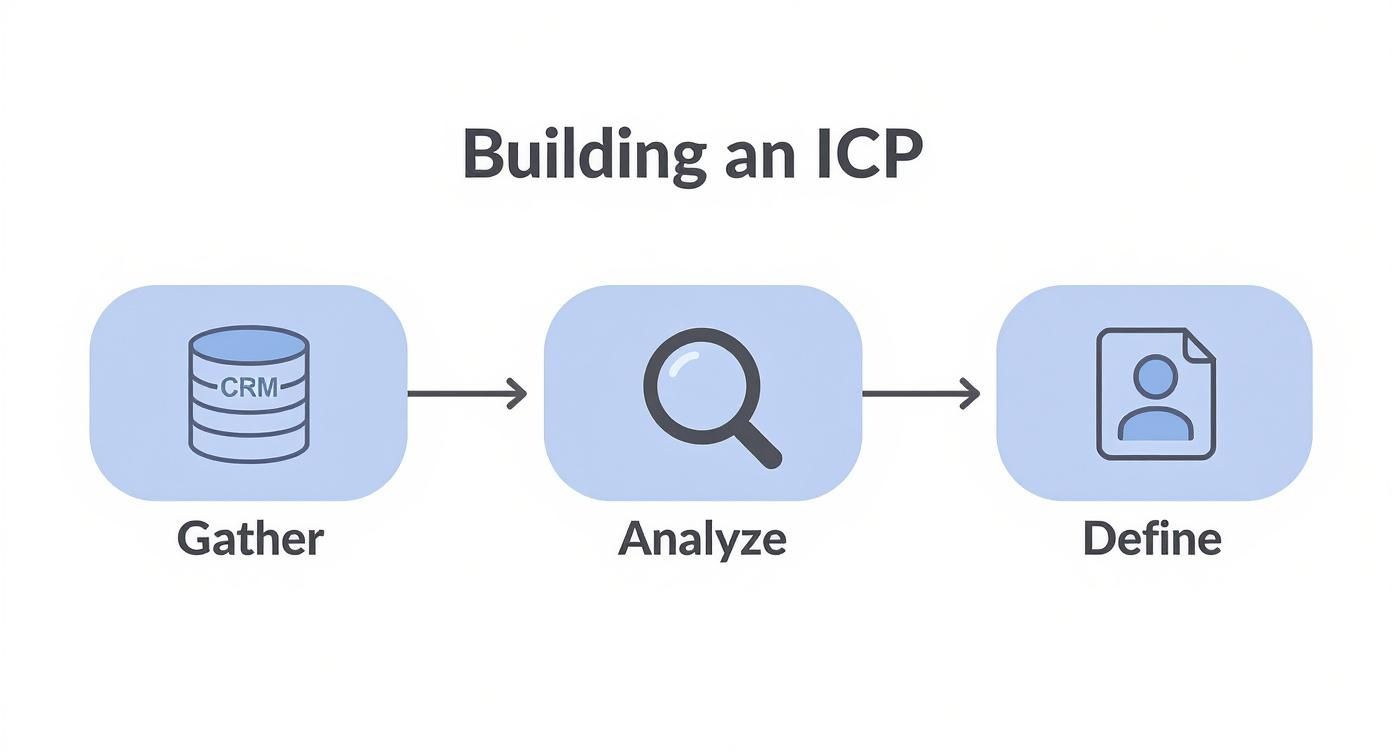
Infographic about b2b demand generation strategy

This process of gathering data, analyzing it, and defining your ICP ensures that every piece of content you create is aimed squarely at the right audience.

To help visualize this, here’s a breakdown of how different content formats fit into the buyer's journey.

Content Format vs Buyer Journey Stage

Buyer's Journey StagePrimary GoalEffective Content FormatsKey Metrics
AwarenessEducate & inform; generate initial interestBlog posts, research reports, infographics, short videos, social media contentWebsite traffic, social shares, backlink acquisition, brand mentions
ConsiderationBuild trust & showcase expertise; provide solutionsWebinars, whitepapers, ebooks, solution briefs, checklistsLead magnet downloads, webinar registrations, email sign-ups, time on page
DecisionValidate choice & remove final barriers; drive actionCase studies, customer testimonials, product demos, comparison guides, ROI calculatorsDemo requests, free trial sign-ups, sales inquiries, conversion rates

By mapping your content this way, you create a logical path for buyers to follow, building their confidence at every step.

Content For The Awareness Stage

At the top of the funnel, you're a teacher, not a salesperson. People in this stage are just starting to put a name to their problem or see a new opportunity. Your content needs to be genuinely helpful and insightful, without a heavy sales pitch.

Here’s what works well:

  • Research Reports & Industry Surveys: This kind of content positions you as an authority. Better yet, others will cite your data, earning you valuable backlinks and organic traffic.
  • Blog Posts & Articles: These are your SEO workhorses. By answering the common questions your ICP is typing into Google, you draw them to your site naturally.
  • Infographics & Short Videos: These are perfect for social channels like LinkedIn. They make complex ideas easy to grasp and are highly shareable.

Nurturing Interest In The Consideration Stage

Okay, they understand their problem. Now they're actively looking at solutions. Your content has to shift gears from general education to showing how your solution helps solve their specific challenges.

This is where you introduce your brand as a credible option. The goal is to build trust and showcase expertise, guiding them deeper into your ecosystem without a hard sell.

This middle stage of the funnel is the perfect home for:

  • Webinars & Virtual Events: These let you do a deep dive on a specific topic and engage with prospects directly, answering their questions in real-time.
  • Whitepapers & Ebooks: Gated assets like these are a classic value exchange. You provide in-depth expertise, and they provide their contact information, turning an anonymous visitor into a known lead.
  • Solution Briefs: These are the bridge between high-level content and product-specific details. They clearly outline what your product does and the exact problems it solves.

Driving Action In The Decision Stage

We're at the bottom of the funnel. Prospects are comparing you against competitors and looking for proof that they're making the right call. Now your content needs to be laser-focused on proving your value and knocking down any final hurdles. This is where social proof and product deep dives are king.

Case studies are the heavyweight champion here. A staggering 57% of marketing leaders point to them as their most effective tool for influencing buyer decisions. The same report also found that 29% of organizations now have a fully integrated approach to brand and demand, which is exactly why this strategic alignment is so critical. You can discover more insights from the 2025 Demand Generation Benchmark Survey to see how top performers are pulling this off.

Content that gets the deal signed includes:

  1. Case Studies & Customer Testimonials: Nothing beats a real success story from a happy customer. It’s concrete proof that your solution delivers on its promises.
  2. Product Demos & Free Trials: Let them get their hands on the wheel. A direct, hands-on experience is one of the fastest ways to show value and de-risk the purchase.
  3. Comparison Guides & ROI Calculators: These tools tackle last-minute objections head-on. They show exactly how you stack up against the competition and demonstrate the tangible financial upside of choosing you.

When you thoughtfully map your content and channels to each stage, you build a journey that feels natural and persuasive, turning strangers into your biggest fans.

Activating Your Strategy With ABM and Intent Data

Having a sharp Ideal Customer Profile and a library of perfectly mapped content is a fantastic start. But a plan sitting on a shelf doesn’t generate pipeline. Now comes the critical part: activation. This is where you use data to find the right accounts and engage them with a level of precision that feels almost unfair to the competition.

This is the moment the game shifts from broad marketing to surgical execution. It’s all about spotting the faint signals of buying intent and acting on them before your competitors even know an opportunity exists.

Spotting Buyers With Intent Data

Imagine knowing which of your target accounts are actively researching solutions like yours right now. That’s the magic of intent data. It tracks the digital footprints companies leave across the web, flagging signals like spikes in research on specific topics, visits to review sites, or even engagement with a competitor’s content.

This insight changes everything. Instead of your sales team burning cycles on a cold list, they can pour their energy into accounts that are already in-market and problem-aware.

You'll encounter two main flavors of intent data:

  • First-Party Intent: This is the gold you mine from your own properties—your website, your marketing channels. Think of someone who downloaded a whitepaper, attended your webinar, or spent a suspicious amount of time on your pricing page. These are the strongest signals you’ve got.
  • Third-Party Intent: This data comes from providers who monitor activity across millions of online sources. It gives you that crucial wider view, showing you which of your target accounts are researching relevant keywords or topics across the broader internet.

When you blend both, you get a powerful, 360-degree view of an account's real interest level. Our guide on what is behavioral targeting digs deeper into how you can read these digital tea leaves to inform your outreach.

Traditional Demand Gen vs. Account-Based Marketing

With solid intent data in hand, you can pick the right activation model. The two heavy hitters in B2B are traditional demand generation and Account-Based Marketing (ABM), and they’re built for different jobs.

ApproachTarget FocusPrimary GoalBest For
Traditional Demand GenBroad (ICP)Generating a high volume of individual leads (MQLs)High-velocity sales models, lower ACV products, building broad brand awareness
Account-Based Marketing (ABM)Narrow (Named Accounts)Engaging the entire buying committee at high-value accountsComplex sales cycles, high ACV products, breaking into strategic accounts

One isn’t better than the other; they're just different tools. In fact, most of the smartest companies I've seen use a hybrid approach. They run broad demand gen programs to build awareness and catch inbound interest, while simultaneously running hyper-focused ABM plays against a shortlist of their most strategic, high-value accounts.

Actionable Step: Tier Your Accounts for a Hybrid Approach

A really practical way to pull off this hybrid model is to tier your target account list. This lets you allocate your resources—time, budget, and creative energy—where they’ll make the biggest dent.

Here's a simple way to think about it:

  • Tier 1 (The "Big Fish"): These are your top 10-20 dream accounts. They get the full, bespoke, 1:1 ABM treatment. We're talking deep research, highly personalized content, slick direct mail, and tightly coordinated outreach from both sales and marketing.
  • Tier 2 (The Lookalikes): These 50-100 accounts look a lot like your Tier 1 targets. They get a "one-to-few" ABM approach. You might create industry-specific content or run small, targeted digital ad campaigns aimed at the key personas within these companies.
  • Tier 3 (The Wider Net): This is everyone else in your addressable market who fits your ICP. These accounts are handled by your broader, "one-to-many" demand gen efforts—SEO, content marketing, and general social media campaigns.

This tiered system creates a balanced portfolio. It makes sure you're still feeding the top of the funnel with broader programs while giving your most important target accounts the white-glove treatment they deserve.

Aligning Sales and Marketing for Execution

Let's be clear: this entire activation strategy completely falls apart without tight alignment between your sales and marketing teams. They absolutely have to agree on the target account list, the definition of a qualified account, and the rules of engagement.

This is where data becomes the ultimate peacemaker. Research shows that a staggering 98% of B2B marketers believe intent data is essential for finding and engaging high-potential accounts. When both teams are looking at the same intent signals and CRM data, the conversation shifts from "we need more leads" to "how can we best engage the buying committee at Account X?"

By activating your strategy with intent data and a smart ABM framework, you stop marketing at people and start creating meaningful engagements with the right accounts at the perfect time.

Measuring Success and Proving Your ROI

A dashboard displaying key performance indicators and ROI metrics for a B2B marketing campaign.

Getting a sophisticated B2B demand generation strategy off the ground is a massive win, but it’s only half the job. If you can't prove it's actually working, you'll be fighting an uphill battle for budget, trust, and the resources to scale.

The secret is to stop talking about marketing activities and start talking about business outcomes. Your leadership team isn’t losing sleep over clicks or MQLs. They care about one thing: revenue. To prove your worth, you have to speak their language.

Moving Past Vanity Metrics

It's incredibly easy to get lost in a sea of data. Website traffic spikes and social media engagement feel good, but they don't pay the bills. The real story of your success is written much deeper in the funnel.

To show you're making a real impact, your dashboard needs to be built around three metrics that carry serious weight:

  • Marketing-Sourced Pipeline: This is the big one—the total dollar value of every sales opportunity that started with one of your marketing efforts. It's the cleanest line you can draw from your team's work to future revenue.
  • Pipeline Velocity: How quickly are deals moving from that first touchpoint to a signed contract? Speeding this up means a more efficient sales cycle and cash in the bank sooner.
  • Customer Acquisition Cost (CAC): Simply put, how much does it cost you in sales and marketing to land one new customer? If this number is going down over time, your demand engine is getting more efficient.

Focusing on these KPIs completely changes the conversation. You’re no longer saying, "We got 1,000 clicks." You're saying, "We generated $500,000 in new pipeline this quarter." That’s a conversation every executive wants to be a part of.

Choosing The Right Attribution Model

To accurately claim that marketing-sourced pipeline, you need a clear way to connect the dots between your actions and a closed deal. This is where attribution models come into play, and your choice here can completely change the story your data tells.

A first-touch attribution model gives 100% of the credit to the very first interaction. Maybe it was a blog post someone read six months ago. It's simple, but it’s also wildly misleading because it ignores everything that happened in between.

On the other hand, a multi-touch attribution model spreads the credit across several key touchpoints in the buyer's journey. This paints a far more realistic picture of what's actually driving results. For instance, it recognizes that the initial blog post, a mid-funnel webinar, and the final demo request all played a role.

For any B2B company with a sales cycle longer than a few weeks, a multi-touch model is the only way to go. It acknowledges the reality that a single piece of content rarely closes a six-figure deal. If you want to dive deeper, this is a great breakdown of the different multi-touch attribution models available.

Actionable Takeaway: Choosing the right attribution model isn't just a technical exercise. It fundamentally shapes how you value your channels and content, directly influencing your budget allocation and strategic focus.

Actionable Step: Building Your ROI Dashboard

Your goal isn't to build a dashboard with 50 different charts that no one understands. It’s to create a single source of truth that tells a clear, compelling story about performance.

Here's a look at the essential metrics to include in your dashboard.

Key Demand Generation Metrics and Their Business Impact

This table breaks down the metrics that matter most, showing you exactly what they measure and why they're critical for proving the financial return on your efforts.

MetricWhat It MeasuresWhy It Matters for ROI
Marketing-Sourced Pipeline ($)The total value of sales opportunities created by marketing campaigns.Directly ties marketing spend to potential revenue, answering the "what did we get for our money?" question.
Customer Acquisition Cost (CAC)The total cost of sales and marketing to acquire a single new customer.Measures the efficiency of your go-to-market engine; a decreasing CAC shows improving ROI.
Pipeline Velocity (Days)The average time it takes for a lead to become a closed-won deal.Indicates the speed of your revenue cycle. Faster velocity means marketing is delivering more sales-ready opportunities.
Lead-to-Opportunity Rate (%)The percentage of leads that are accepted by sales and converted into a qualified opportunity.A key indicator of lead quality. A high rate proves marketing is delivering prospects who are genuinely interested and a good fit.

Tracking and reporting on these core numbers shifts you from a position of defending your budget to one of demonstrating your value. You'll be armed with hard data that proves your B2B demand generation strategy isn't just a cost center—it's a predictable engine for business growth.

Common B2B Demand Generation Questions

Even the sharpest marketers run into a few tricky questions when they're deep in the demand generation trenches. Let's tackle some of the most common ones I hear and get you clear, straightforward answers.

Demand Generation vs. Lead Generation: What Is The Real Difference?

This is the big one. Get this wrong, and your whole strategy can go sideways. The simplest way I've found to explain it is creating demand versus capturing it.

  • Lead Generation is purely transactional. It’s about getting contact info to fill the top of the funnel. The key question here is, "How many MQLs did we get?" It's a numbers game, often focused on volume.

  • Demand Generation is the whole strategy. It’s about teaching your market something valuable and building a brand they trust. The goal is to create a pipeline full of educated, high-intent buyers who actually seek you out. The question becomes, "How much qualified pipeline did we create?"

Think of lead generation as a single tactic inside your broader demand generation strategy. If you only chase leads, you end up with a huge list of low-quality contacts that just exhausts your sales team. A real demand gen approach means that when a lead does come in, they already know who you are and understand the problem you solve. If you really want to nail the fundamentals, this guide on What Is Demand Generation Marketing is a great deep dive.

How Do I Get Budget and Buy-In From Leadership?

You have to stop talking like a marketer and start sounding like the CFO. Your leadership team cares about revenue, pipeline, and how efficiently you're spending money—not the marketing activities themselves.

So instead of saying, "I need $50,000 for a new content campaign," you need to reframe it.

Try this: "I'm requesting a $50,000 investment to generate an estimated $500,000 in marketing-sourced pipeline over the next two quarters."

Actionable Takeaway: The key is to connect the dots with a clear, data-backed forecast. Dig into your historical conversion rates and build a model that links every dollar you plan to spend directly to revenue goals. Show them the math.

How Long Until I See Results?

Patience isn't just a virtue here; it's a requirement. This isn't a paid search campaign where you can see results in a few days. A true B2B demand generation engine is a long-term investment.

You'll probably start seeing leading indicators—like a bump in website traffic or more people searching for your brand name—within the first 3-6 months.

But for the metrics that really matter, like marketing-sourced pipeline, you're looking at a 9-12 month timeline. This is especially true if you have a long sales cycle. The most important thing you can do is set this expectation with your leadership team right from the start.


Ready to build a predictable revenue engine? marketbetter.ai uses an integrated AI approach to scale your content creation, optimize campaign performance, and prove your marketing impact with powerful analytics. Transform your demand generation strategy by visiting https://www.marketbetter.ai today.