
B2B Website Visitor Identification: The Complete Guide for Sales Teams [2026]
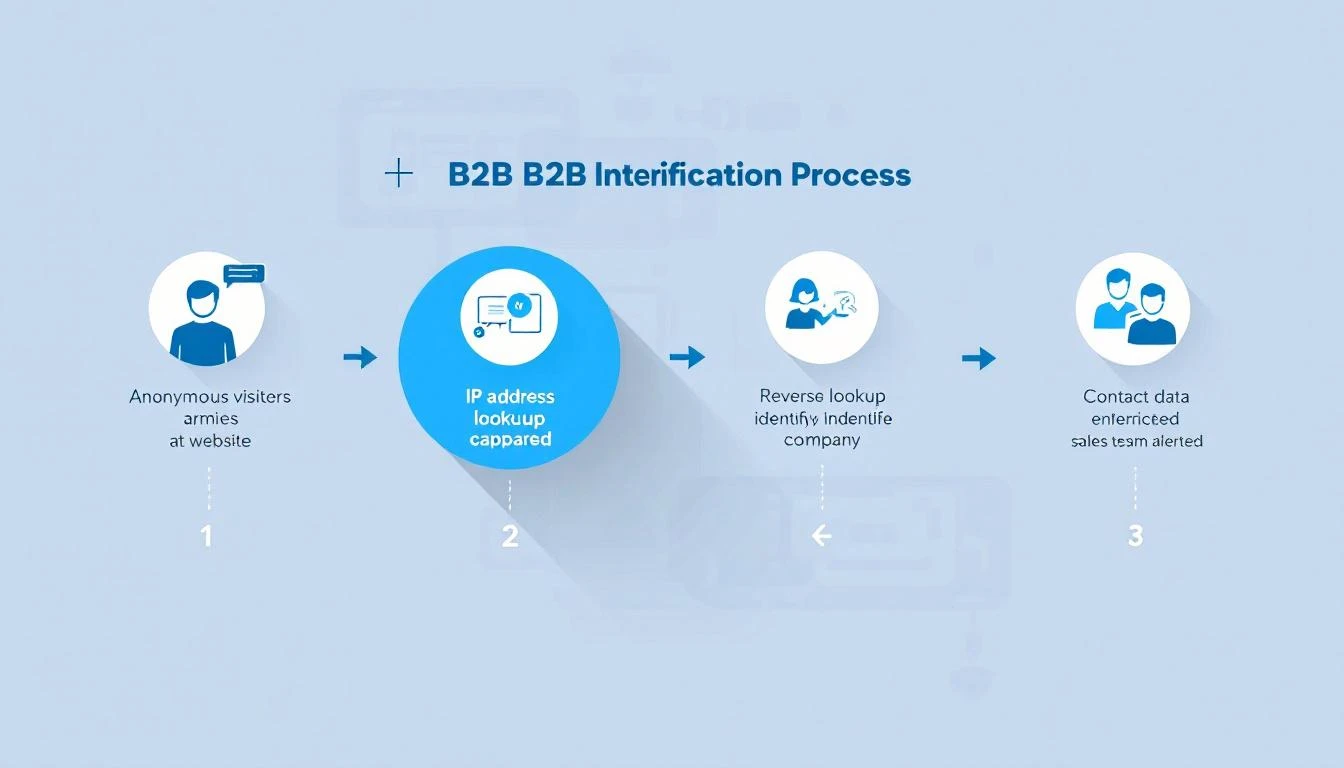
98% of B2B website visitors leave without filling out a form. They read your pricing page, compare you to competitors, check your case studies — then vanish.
You're spending thousands on Google Ads, SEO, and content to drive this traffic. And 98 out of every 100 visitors give you nothing in return. No name, no email, no company. Just another anonymous session in Google Analytics.
Website visitor identification changes that. It reveals which companies are visiting your site, what pages they're viewing, and in many cases, who the actual people are — so your sales team can reach out while the buying intent is hot.
This guide covers everything: how the technology works, what match rates you can actually expect (hint: most vendors lie), how to evaluate tools, and how to turn identified visitors into pipeline. No fluff. No vendor spin.
What Is B2B Website Visitor Identification?
B2B website visitor identification is the process of revealing the companies and individuals behind your anonymous website traffic. Instead of seeing "500 sessions from Austin, TX" in your analytics, you see "Hologram's VP of Sales visited your pricing page 3 times this week."
There are two levels of identification:
Company-Level Identification
The most common approach. When someone visits your website, their browser sends an IP address. Visitor identification tools match that IP against databases of known corporate IP ranges to identify which company the visitor works for.
How it works:
- A JavaScript snippet on your website captures the visitor's IP address
- The tool performs a reverse IP lookup (rDNS) against a database of millions of company IP ranges
- If there's a match, you see the company name, industry, size, and location
- You also see which pages they visited and for how long
Typical match rates: 20-40% of total traffic. This sounds low, but remember — most consumer traffic (personal devices, mobile networks, VPNs) will never match. The 20-40% that does match is almost entirely B2B traffic, which is exactly what you want.
The catch: Company-level ID tells you which company is looking, but not who at the company. You know Salesforce visited your pricing page — but was it an intern doing research or the VP of Revenue Operations evaluating tools?
Person-Level Identification
The newer, more powerful approach. Person-level identification goes beyond the company and attempts to identify the specific individual visiting your site.
How it works:
- Beyond IP matching, tools use a combination of first-party cookies, device fingerprinting, and cross-referencing identity graphs
- Some tools match against databases of known professional identities (built from opt-in data, public profiles, etc.)
- The result: you get a name, title, email, and LinkedIn profile — not just a company name
Typical match rates: 5-15% of B2B traffic. Person-level is significantly harder than company-level. Any vendor claiming 40%+ person-level match rates is either misleading you or conflating company-level and person-level stats.
The privacy question: Person-level ID raises legitimate GDPR/CCPA concerns. The best tools build their identity graphs from opt-in sources and comply with privacy regulations. The worst ones scrape data without consent. Always ask your vendor where their data comes from.
How Does Website Visitor Identification Actually Work?
Under the hood, visitor identification combines multiple data signals. Here's the technical reality without the marketing buzzwords.
1. Reverse IP Lookup (Foundation Layer)
Every device connected to the internet has an IP address. Companies with office networks have static IP ranges registered to their organization. When an employee visits your website from the office, their request comes from one of these known IPs.
Reverse IP lookup (rDNS) cross-references the visitor's IP against databases of corporate IP ranges. These databases are maintained by data providers like:
- Demandbase — proprietary IP intelligence network
- Clearbit (now Hubspot) — company identification API
- 6sense — predictive intelligence platform
- Bombora — intent data + IP matching
Limitation: Remote work has eroded IP-based identification. When your target buyer works from home on a Comcast connection, their IP doesn't map to their employer. This is why pure IP-based tools have seen match rates decline since 2020.
2. First-Party Cookies + Device Fingerprinting (Enhancement Layer)
To compensate for remote work, modern tools layer additional signals:
- First-party cookies track returning visitors across sessions, building a behavioral profile even before identity resolution
- Device fingerprinting uses browser attributes (screen resolution, timezone, installed fonts, WebGL renderer) to create a semi-unique identifier
- Email pixel matching — when a prospect clicks a link in your marketing email, the tool can link their known email to their website session
3. Identity Graphs (Resolution Layer)
The most sophisticated tools maintain identity graphs — massive databases that connect professional identities across multiple touchpoints. When a visitor arrives on your site, the tool checks:
- Does this device/cookie match a known identity?
- Has this IP been associated with previous known visitors?
- Does the behavioral pattern (pages visited, time on site) match a known account?
The larger and more accurate the identity graph, the higher the match rate. This is why tools backed by large data networks (Demandbase, 6sense, ZoomInfo) often outperform standalone startups on raw identification volume.
What Match Rates Should You Actually Expect?
This is where most vendors mislead you. Here's the truth.
The Match Rate Reality Check
| Identification Type | Claimed Range | Realistic Range | What Drives It |
|---|---|---|---|
| Company-level | "Up to 80%" | 20-40% | IP database coverage, % of office vs. remote traffic |
| Person-level | "Up to 50%" | 5-15% | Identity graph size, cookie persistence, email matching |
| Combined (inflated) | "70-90%" | 25-45% | Vendors often blend both numbers to inflate stats |
Why the gap? Vendors run match rate tests on their best-case scenarios — enterprise companies with mostly in-office workers, lots of direct traffic, and established cookies. Your results will vary based on:
- Your audience mix — Enterprise companies with office networks match better than SMBs with remote teams
- Traffic sources — Direct and organic traffic matches better than paid (ad blockers, VPNs)
- Geography — US and EU corporate IP databases are more complete than emerging markets
- Industry — Tech companies match well; healthcare and government often don't
How to Run Your Own Match Rate Test
Don't trust vendor demos. Run a blind test with your actual traffic:
- Install 2-3 tools on your website simultaneously (most offer free trials)
- Run for 30 days to get a statistically meaningful sample
- Compare identified visitors against known accounts in your CRM
- Calculate your real match rate: Identified visitors / Total unique B2B sessions
- Check accuracy: Are the identified companies actually relevant? Or is it mostly ISPs and universities?
The tool that identifies the most relevant accounts at the highest accuracy wins — not the one with the biggest raw number.
Turning Identified Visitors Into Pipeline
Identification alone doesn't close deals. The real value is in what your team does with the data. Here's where most companies waste their investment.
The Workflow Problem
Most visitor identification tools stop at identification. They show you a dashboard of companies that visited your site. Then what?
Your SDR logs in, scrolls through a list of 50 companies, tries to figure out who to contact, opens LinkedIn to find the right person, switches to their CRM to check if there's an existing relationship, then goes to their email tool to write outreach.
That's 5 tools and 15 minutes per lead — and they have 50 to get through. By the time they reach out, the buyer's intent has cooled.
What a Complete Visitor ID Workflow Looks Like
The best approach connects identification to action:
- Identify — Visitor arrives, company and/or person identified
- Qualify — Automatically check: does this company match your ICP? Are they in your CRM already? What's their revenue/employee count?
- Prioritize — Rank by buying signals: pricing page visits > blog reads. Repeat visitors > first-timers. Decision makers > individual contributors.
- Enrich — Pull in additional context: recent funding, job postings, tech stack, social media activity
- Route — Assign to the right SDR based on territory, industry, or account ownership
- Act — Present a daily playbook: "These 5 accounts visited your pricing page yesterday. Here's who to contact and what to say."
This is the difference between data and action. Tools that stop at step 1 create dashboards. Tools that go through step 6 create pipeline.
Measuring ROI
The ROI formula for visitor identification is straightforward:
Monthly ROI = (Meetings booked from identified visitors × Average deal value × Win rate) - Tool cost
Example for a mid-market B2B company:
- 1,000 unique B2B visitors/month
- 30% company-level match rate = 300 identified companies
- 10% are ICP-fit = 30 qualified accounts
- SDR reaches out to all 30, books 5 meetings (17% meeting rate)
- Average deal size: $30,000
- Win rate: 25%
- Monthly pipeline created: $37,500
- Tool cost: $500-$2,000/month
- ROI: 18-75x
Even conservative estimates show massive ROI — because you're reaching prospects who already demonstrated buying intent by visiting your site.
Privacy, Compliance, and Legal Considerations
Visitor identification operates in a gray area that's getting clearer (and stricter) every year. Here's what you need to know.
GDPR (EU/UK)
- Company-level identification is generally considered legitimate interest under GDPR — you're identifying organizations, not individuals
- Person-level identification requires more careful handling. The tool must source identity data from compliant, opt-in databases
- Cookie consent is required. Your cookie banner must disclose analytics and identification tracking
- Data processing agreements (DPAs) should be in place with your vendor
CCPA (California)
- Visitors can opt out of "sale" of personal information
- Company-level data is generally exempt
- Person-level data may fall under CCPA if it includes personal identifiers
SOC 2
If you're selling to enterprise, they'll ask about your security posture. Choose a vendor that's SOC 2 certified — it means they've been audited on data handling practices.
Best Practices
- Disclose tracking in your privacy policy — mention website analytics and business identification
- Honor opt-outs — if someone requests data deletion, your vendor should support it
- Use compliant data sources — ask vendors: "Where does your identity graph data come from?"
- Keep data hygiene tight — don't store identified visitor data indefinitely; set retention policies
How to Evaluate Website Visitor Identification Tools
When shopping for a visitor ID tool, here's what actually matters (and what doesn't).
What Matters
| Factor | Why It Matters | How to Evaluate |
|---|---|---|
| Match rate on YOUR traffic | Vendor benchmarks are meaningless for your specific audience | Run a 30-day trial with your actual traffic |
| Accuracy | 40% match rate with 50% accuracy = 20% usable data | Cross-reference identified companies against your CRM |
| Integration depth | Data that sits in a dashboard creates zero pipeline | Check CRM sync, Slack alerts, daily playbook features |
| Action layer | Identification without workflow = expensive analytics | Does it tell SDRs what to DO, not just what happened? |
| Person-level capability | Company-level alone requires manual research | Can it surface the specific contact to reach out to? |
| Pricing transparency | Hidden pricing usually means enterprise-only | Can you see pricing before talking to sales? |
What Doesn't Matter (Much)
- Size of the "contact database" — 300M contacts means nothing if 90% are outdated
- Number of integrations — you need 3-4 deep integrations, not 100 shallow ones
- AI buzzwords — "AI-powered identification" is marketing. The data quality matters more.
- Free tier generosity — free tools with low match rates waste your time with bad data
Questions to Ask Vendors
- "What's my expected match rate based on my traffic profile?"
- "Is your identification company-level, person-level, or both?"
- "Where does your identity graph data come from? Is it opt-in?"
- "What happens when a visitor's company is identified — what's the next step for my SDR?"
- "Are you SOC 2 certified? GDPR compliant?"
- "Can I see a breakdown of your match accuracy (not just match rate)?"
The Future of Visitor Identification (2026 and Beyond)
Three trends are reshaping this space:
1. The Post-Cookie World
Google is phasing out third-party cookies (slowly, painfully). Tools that rely heavily on third-party cookie matching will see declining match rates. First-party data and server-side tracking are becoming essential.
What this means for you: Choose tools investing in cookieless identification methods — IP intelligence, first-party data enrichment, and authenticated traffic matching.
2. AI-Powered Intent Scoring
Raw identification is becoming table stakes. The differentiator is what the tool does with the data. AI models that score buying intent based on page visit patterns, visit frequency, content consumed, and account-level behavior will separate useful tools from expensive dashboards.
3. From Identification to Orchestration
The market is moving from "tell me who visited" to "tell my SDR what to do about it." Daily playbooks, automated outreach triggers, and real-time alerts are becoming standard expectations, not premium features.
Getting Started: Your First 30 Days
Here's a practical roadmap for implementing visitor identification:
Week 1: Install and Configure
- Install 2-3 tools for a head-to-head trial
- Configure your ICP filters (industry, company size, geography)
- Connect your CRM so identified accounts are automatically matched to existing opportunities
Week 2: Baseline Measurement
- Track total identified visitors vs. total traffic
- Note how many identified companies match your ICP
- Measure how long it takes SDRs to action the identified accounts
Week 3: Optimize Workflow
- Set up automated alerts for high-intent visits (pricing page, comparison pages, demo page)
- Create SDR playbooks: "When Account X visits the pricing page, do Y"
- Build daily dashboards showing SDRs their priority outreach list
Week 4: Measure and Decide
- Calculate: meetings booked from identified visitors
- Compare tool match rates and accuracy head-to-head
- Make your vendor decision based on real data, not demos
Common Use Cases by Team
For SDR Teams
- Warm outreach priority list: Instead of cold-calling from a static list, SDRs start each day with a list of accounts that visited your website in the last 24 hours. These aren't cold — the prospect already knows you exist.
- Personalized first touch: "I noticed your team was looking at our pricing page yesterday" is 3x more effective than a generic cold email. Visitor data gives SDRs the context to write outreach that feels relevant, not random.
- Account progression tracking: See which accounts are moving from blog content to pricing pages to case studies — that's a buying signal you can act on before the prospect fills out a form.
For Demand Gen Teams
- Attribution clarity: Which campaigns drive the most identified, ICP-fit visitors? Visitor ID bridges the gap between "we got 500 clicks" and "we got visits from 12 target accounts."
- Content optimization: See which blog posts attract target accounts and which attract irrelevant traffic. Double down on what works.
- Retargeting fuel: Build retargeting audiences from identified accounts. Instead of broad display ads, target the specific companies who've already shown interest.
For Account Executives
- Deal acceleration: When a prospect you're working goes quiet but keeps visiting your site, you know the deal isn't dead — they're still evaluating. Time to re-engage.
- Multi-threading alerts: If 3 different people from the same company visit your case studies page, your champion is building internal consensus. The AE should know.
- Competitive intelligence: Prospect visiting your comparison pages? They're evaluating alternatives. Send them your win-loss analysis before they talk to the competitor.
Frequently Asked Questions
Is website visitor identification legal?
Company-level identification is legal in the US, EU, and most global markets. It uses publicly available corporate IP data and doesn't identify individuals. Person-level identification requires more careful compliance, especially under GDPR. Choose vendors that source data from opt-in, compliant databases and have clear privacy policies.
What's the difference between visitor identification and analytics?
Google Analytics tells you "50 people from Austin visited your pricing page." Visitor identification tells you "Hologram, Datadog, and Cloudflare visited your pricing page." Analytics gives you aggregate patterns. Identification gives you accounts to call.
Do I need visitor identification if I already have a CRM?
Yes. Your CRM only knows about prospects who've already identified themselves (form fills, email replies, demo requests). Visitor identification reveals the 98% who are researching you but haven't raised their hand yet. Think of it as the top-of-funnel radar your CRM can't provide.
How does remote work affect match rates?
Remote work reduces IP-based match rates because home internet connections don't map to corporate IP ranges. The best tools compensate with first-party cookies, email pixel matching, and identity graphs. Expect 10-15% lower match rates compared to pre-2020, but the identified visitors are still highly valuable.
How many visitors do I need for this to be worth it?
Most tools become cost-effective at 1,000+ unique monthly visitors. Below that, you won't identify enough accounts to justify the investment. Above 5,000 visitors, the ROI compounds quickly because each additional identified account is essentially free incremental pipeline.
Can I use visitor identification with ABM (Account-Based Marketing)?
Absolutely — this is one of the strongest use cases. Upload your target account list, and the tool alerts you the moment any of those accounts visit your site. Instead of waiting for them to fill out a form, you can trigger outreach immediately. Some tools even track which specific pages target accounts visit, giving your ABM campaigns real-time feedback on messaging effectiveness.
Bottom Line
Website visitor identification isn't magic — it's infrastructure. The 98% of visitors who leave without converting aren't gone. They're just anonymous. The right tool makes them visible. The right workflow makes them reachable. And the right team turns them into customers.
The question isn't whether to invest in visitor identification. It's whether you can afford not to — while your competitors are already reaching out to the same buyers who just left your site.
Ready to see who's visiting your website? Book a demo and see MarketBetter's visitor identification in action — complete with daily SDR playbook, AI chatbot, and multi-channel outreach built in.
Have questions about B2B website visitor identification? Check our comparison of the 12 best visitor ID tools or see how MarketBetter compares to Warmly, Clearbit, and RB2B.