Creating a marketing plan has traditionally been a weeks-long ordeal. You gather data, research competitors, define personas, map channels, set budgets, build timelines, and create a 30-page document that — let's be honest — nobody reads after the first meeting.
What if you could generate a solid first draft in 5 minutes?
AI marketing plan generators have gone from gimmicky to genuinely useful in 2026. The best ones don't just fill in a template — they research your company, analyze your market, and produce strategic recommendations that are surprisingly on-target.
This guide walks through how to create an AI marketing plan, compares the tools available, and shows you how to get a complete plan in minutes using MarketBetter's free Marketing Plan Generator.
An AI marketing plan generator takes basic inputs about your business — company name, industry, target audience, goals — and produces a structured marketing plan with strategy, channels, tactics, and timelines.
The best tools do more than fill in a template. They:
Research your company — pulling data from your website, social media, and public sources
Analyze your market — identifying competitors, market trends, and opportunities
Recommend channels — suggesting the most effective marketing channels for your specific business
A traditional marketing plan takes 2-4 weeks to research, write, and refine. An AI-generated first draft takes 5 minutes. Even if you spend 2-3 hours refining and customizing the AI output, you've saved 80%+ of the time.
Marketing plans often have blind spots. You focus on the channels you know and ignore ones you don't. AI tools consider all viable channels and tactics, reducing the risk of missing opportunities.
AI generators can pull from vast amounts of data about what works for similar businesses. A human marketer might have experience with 5-10 companies in your space. An AI has been trained on thousands.
The best use of AI marketing plans isn't to replace human thinking — it's to accelerate it. Having a structured first draft to react to is dramatically faster than starting from a blank page. You can agree, disagree, modify, and add your unique insights to an existing framework.
Not every company has a marketing team. Founders, solopreneurs, and small teams often skip marketing plans entirely because they're intimidating to create. AI generators make strategic marketing accessible to everyone.
How to Create an AI Marketing Plan (Step by Step)
Pro tip: With MarketBetter's Marketing Plan Generator, you only need your company name or URL. The AI researches everything else automatically from your website and public data.
The AI output is your starting point. Here's how to refine it:
Add your institutional knowledge. AI doesn't know that your CEO hates TikTok, that your best customer came from a podcast appearance, or that you tried Google Ads last year and lost money. Layer in what you know.
Prioritize ruthlessly. An AI plan might recommend 8 channels. If you're a 3-person team, pick 2-3 and do them well. Add the others to a "future consideration" list.
Set realistic budgets. AI budget recommendations are based on industry averages. Adjust based on your actual resources. A $5K/month marketing budget requires different tactics than a $50K/month one.
Add timelines and owners. AI plans are often light on who-does-what-by-when. Assign specific team members and deadlines to each tactic.
Validate channel recommendations. If the AI recommends LinkedIn as your top channel, does that match where your audience actually spends time? Cross-reference with your sales team's experience and your analytics data.
Most AI marketing plan generators are essentially prompt wrappers around ChatGPT. You fill in a form, it sends your inputs to an LLM with a template prompt, and you get generic output.
Enter just your company name or URL. The AI scrapes and analyzes your website, identifies your products, understands your positioning, and pulls relevant market data — before generating the plan. You don't have to describe your business; it figures it out.
The generator identifies your likely competitors and incorporates competitive positioning into its recommendations. Instead of generic channel suggestions, you get tactics that account for what your competitors are already doing.
A SaaS company's marketing plan should look nothing like a local restaurant's. MarketBetter's generator tailors channel mix, tactics, content types, and budget allocation to your specific industry and business model.
Instead of "do content marketing," you get recommendations like "publish 2 long-form comparison articles per month targeting [specific keywords] and promote via LinkedIn organic posts." Specific enough to act on immediately.
No account creation. No credit card. No "freemium" with the good parts locked behind a paywall. Generate as many plans as you want.
Real-World Example: Creating a Marketing Plan for a SaaS Startup
Let's walk through a real example. Imagine you're the marketing lead at a Series A B2B SaaS company that sells project management software to construction companies.
Input: Company URL (let's say constructionpm.io)
AI-generated plan highlights:
Target Audience: Construction project managers, general contractors, and operations directors at mid-size construction firms (50-500 employees)
Positioning: "The only project management tool built specifically for construction workflows — with field reporting, subcontractor tracking, and compliance documentation built in."
Recommended Channel Mix:
SEO/Content Marketing (40% of budget) — Target keywords like "construction project management software," "field reporting app for contractors," and "construction scheduling tool"
LinkedIn (25% of budget) — Sponsored content targeting construction industry titles + organic thought leadership
Industry Events (20% of budget) — Booth at ConExpo, World of Concrete, and regional construction tech events
Google Ads (15% of budget) — High-intent search campaigns for comparison keywords
Specific Tactics:
Publish weekly blog content on construction management best practices
Create comparison pages: "[Brand] vs Procore," "[Brand] vs Buildertrend"
Launch a "Construction PM of the Month" spotlight series on LinkedIn
Build a free construction project template library for lead generation
Partner with construction industry associations for co-branded webinars
Metrics:
Website traffic from organic search (target: 2x in 6 months)
Demo requests per month (target: 50/month by month 6)
Marketing-qualified leads (target: 150/month)
Customer acquisition cost (target: <$500)
Total time to generate: ~3 minutes
This plan isn't perfect out of the box — you'd adjust based on your actual budget, team size, and what you know about your market. But it's a dramatically better starting point than a blank Google Doc.
Startups and early-stage companies benefit most because they often lack marketing expertise on the team. An AI plan provides structure and direction when you're figuring things out.
If you're hiring a marketing agency or freelancer, generating an AI plan first ensures you have clear direction to share. It prevents the "we'll figure out strategy in month one" delay.
No proprietary insights — AI doesn't know your customer conversations, your sales team's feedback, or your unique competitive advantages that aren't public
Generic benchmarks — Budget and KPI recommendations are industry averages, not tailored to your specific situation
No brand personality — AI can suggest tone guidelines but can't capture your unique brand voice
Snapshot, not dynamic — A plan generated today doesn't update as conditions change
Execution gap — Even the best plan is worthless without execution. AI creates the plan; you still have to do the work
The best approach: AI generates the framework. Your team adds the insight, judgment, and execution.
Enter your company name or URL. Get a comprehensive, AI-researched marketing plan in minutes. No signup, no credit card, completely free.
Once your plan is ready, use our other free tools to execute: check your AI Brand Visibility to understand your current position, find Lookalike Companies for your target accounts, or use the AI Lead Generator to find buyer contacts at your target companies.
Audience segmentation is the difference between shouting into a crowded stadium and having a real conversation. It's the actionable strategy that stops you from broadcasting one generic message to everyone and helps you start talking to smaller, specific groups about what they actually care about.
This shift ensures your marketing efforts land with the people who matter most, turning generic outreach into personalized, high-impact communication.
What Is Audience Segmentation and Why Does It Matter?
Imagine you run a high-end coffee shop. You've just sourced some incredible single-origin espresso beans and you need to sell them.
You could take out a generic ad targeting everyone in your city. That’s the "spray and pray" approach—a fantastic way to waste money. It's the equivalent of mass marketing, where the message is broad and the results are unpredictable.
Now, what if you segmented your audience? This is where targeted marketing comes in. You could create a group called "Coffee Connoisseurs"—people who've bought premium beans before or attended your tasting events. Another group might be "Home Baristas," folks who recently bought an espresso machine.
You can now tailor your message. The connoisseurs get an email about a rare new bean. The home baristas get a guide on pulling the perfect shot. Suddenly, your marketing isn't just noise; it's genuinely useful. That’s the entire point of audience segmentation: treating different customers differently because you understand who they are.
Skipping segmentation is like trying to fit a square peg in a round hole. You're blasting a one-size-fits-all message at diverse groups with unique problems and motivations. It doesn't just lead to poor results; it can actively annoy potential customers who feel like you don't get them at all.
This isn't just a theory; the numbers are staggering. Companies that get this right see a 760% jump in email revenue compared to those that don't. With 81% of consumers saying they're more likely to buy from brands that offer personalized experiences, the case is closed.
Audience segmentation isn't just a marketing tactic; it's a fundamental business strategy. It transforms your communication from a monologue into a dialogue, building stronger relationships and driving sustainable growth by showing customers you understand them.
To make this crystal clear, let's compare the before and after. This table sums up the core ideas behind audience segmentation and why it's a non-negotiable for any business that wants to connect with customers in a meaningful way.
Concept
Description
Core Benefit
Who
The specific subgroups of your larger audience, defined by shared traits like behavior, location, or interests.
Moves you from speaking to a faceless crowd to engaging with distinct groups of people.
What
The process of grouping these individuals using data from your CRM, website analytics, and customer feedback.
Allows you to create targeted campaigns, content, and product offers that are highly relevant.
Why
To deliver personalized experiences that increase engagement, boost conversion rates, and foster long-term loyalty.
Improves marketing ROI by focusing resources on the most receptive and valuable customer segments.
At the end of the day, understanding audience segmentation means recognizing that relevance is the new currency in marketing. When you group your audience thoughtfully, you stop wasting time and money and start building real connections that drive your business forward.
The Four Core Segmentation Methods You Need to Know
Think of understanding your customers like getting to know a new friend. At first, you only know the basics—their name, where they live. That's surface-level stuff. To really get them, you need to understand how they think, what they care about, and what they actually do.
Audience segmentation works the same way. We start with the simple, observable facts and then layer on deeper insights to build a complete picture. These methods aren't just different ways to slice data; they're different lenses for seeing your audience. When you combine them, you move from guessing games to genuine, actionable understanding.
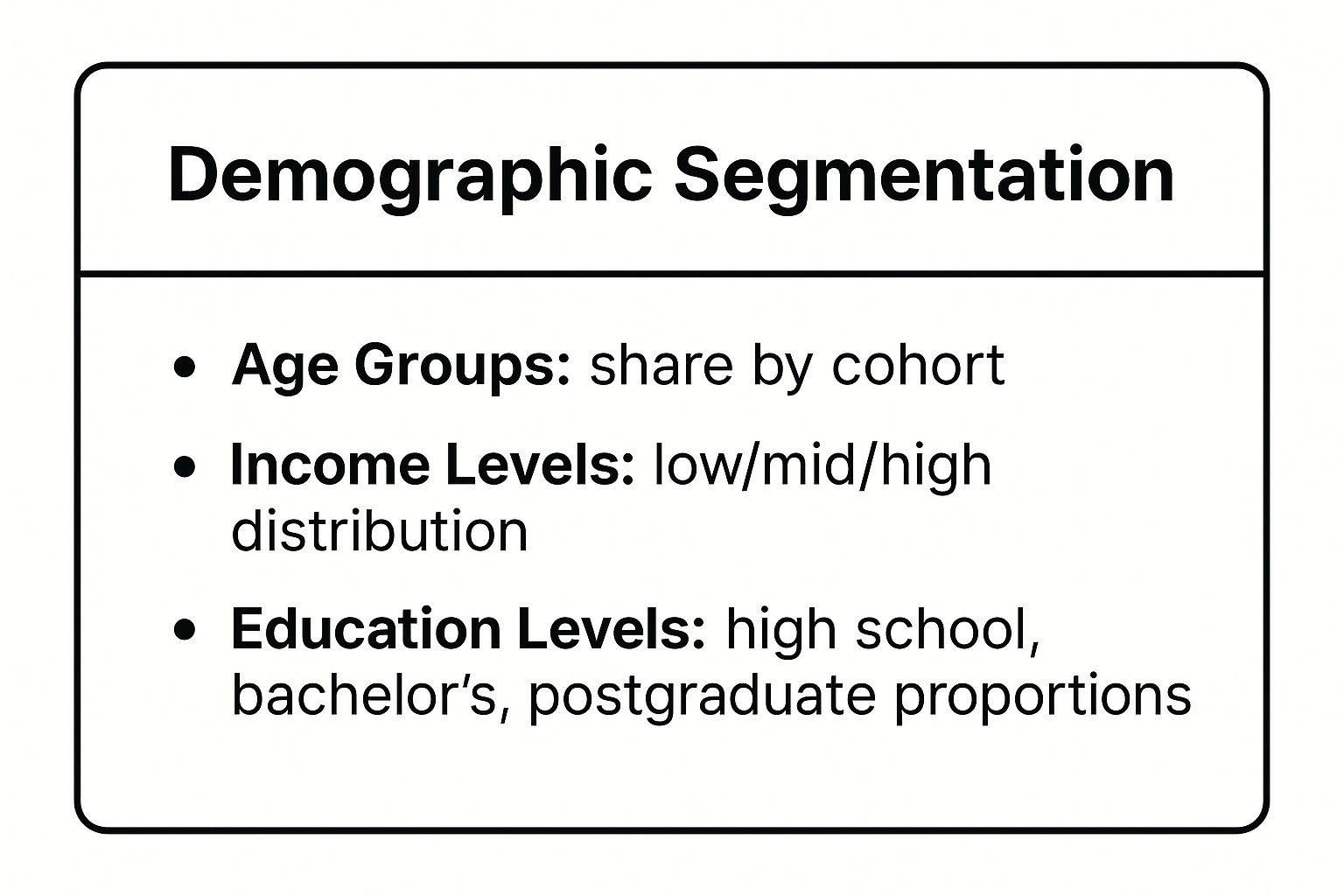
This is your starting point. Demographic segmentation is the most straightforward way to group people, answering the fundamental question: "Who, exactly, are we talking to?" It categorizes your audience based on objective, easily verifiable attributes.
It's like sorting a deck of cards by suit or number—clear, defined characteristics. For a business, that looks like:
Job Title: A B2B software company selling project management tools targets "Project Managers" or "Heads of Operations."
Company Size: An IT provider might create a segment for small businesses with 10-50 employees.
Age and Gender: A direct-to-consumer brand could target skincare products for women aged 45-60.
Income Level: A wealth management firm will focus on households earning over $250,000 annually.
Demographics are solid and easy to get, but they only tell you who is buying, not why.
Next up is geography, which answers the simple question: "Where are these people located?" This isn't just for brick-and-mortar stores. For digital businesses, location dictates everything from language and currency to cultural norms and legal rules.
Think about it: you wouldn't try to sell heavy winter coats to customers in Miami. And a global SaaS company knows that messaging that works in Silicon Valley might need a tweak for an audience in Berlin.
Common geographic data points include:
Country or Region: Crucial for localization, currency, and compliance.
Climate: Directly impacts demand for seasonal products.
Urban vs. Rural: A city-dweller's needs (food delivery, public transport) are wildly different from a rural customer's (gardening supplies, off-road vehicles).
This is where it gets really interesting. If demographics are the skeleton, psychographics are the personality. This method digs into the why behind customer choices, grouping people by their values, attitudes, interests, and lifestyles.
Psychographics uncover what truly motivates someone to buy. You could have two people who look identical on paper—say, 35-year-old men with high incomes living in the same city. But one is a risk-averse saver who values security above all else, while the other is an adventurous thrill-seeker who spends his money on experiences. You can't reach both with the same message.
Key psychographic variables look at:
Values and Beliefs: A brand built on sustainability will naturally attract environmentally conscious consumers.
Lifestyle: A meal-prep delivery service is a perfect fit for busy professionals who value convenience.
Interests and Hobbies: A tech company knows to market its new gaming laptop to people who follow esports.
Finally, we have the most powerful method of all: behavioral segmentation. This one cuts through all the assumptions and focuses on what people actually do. It answers the question, "How is my audience interacting with my brand?"
This is pure, actionable data based on observed engagement. It’s the difference between what someone says they’ll do and their real-world actions.
There are many ways to approach advanced segmentation. While these four are the foundation, experts also look at things like technographic (what tech they use) or transactional data. The key is using the right lens for the job. You can learn more about these different segmentation approaches and see which ones fit your strategy.
Common behavioral data points include:
Purchase History: Separating frequent, high-value customers from one-time discount shoppers.
Website Activity: Creating a segment for users who abandoned their carts to send a targeted follow-up.
Feature Usage: A software company can identify power users of a specific feature and reach out for a case study.
Email Engagement: Rewarding your most engaged subscribers (the ones who open every email) with an exclusive offer.
To make it even clearer, here's a simple breakdown of how these four methods stack up against each other. Each one provides a different piece of the puzzle, and knowing when to use which is key to building a smart marketing strategy.
Segmentation Type
What It Answers
Common Data Points
Example Use Case
Demographic
Who are they?
Age, job title, income, company size
A B2B SaaS company targeting "Marketing Directors" at firms with 500+ employees.
Geographic
Where are they?
Country, city, climate, urban/rural
A retailer promoting snow blowers to customers in the Northeastern US in October.
Psychographic
Why do they buy?
Values, lifestyle, interests, beliefs
A sustainable fashion brand targeting consumers who prioritize eco-friendly products.
Behavioral
What do they do?
Purchase history, website clicks, email opens
An e-commerce site sending a discount code to users who abandoned their shopping carts.
Ultimately, no single method tells the whole story. The real power comes from layering these approaches together to create a full, three-dimensional view of your customer.
The most effective strategies rarely rely on a single segmentation method. The magic happens when you layer them. A B2B company might target "Marketing Directors" (demographic) at "SaaS companies in North America" (geographic) who have "downloaded a whitepaper on AI" (behavioral). This creates a highly specific, relevant, and actionable audience segment.
Knowing the different ways to slice up an audience is one thing. Watching those slices turn into actual business results? That's another entirely. The real magic of segmentation happens when you stop thinking in theory and start applying it to solve tangible, everyday business problems. For B2B companies, especially, the shift away from generic, one-size-fits-all outreach can be dramatic.
So, let's get practical. I'm going to walk you through three real-world scenarios showing how B2B teams use segmentation to drive upgrades, sharpen their sales pitches, and find revenue hiding in plain sight.
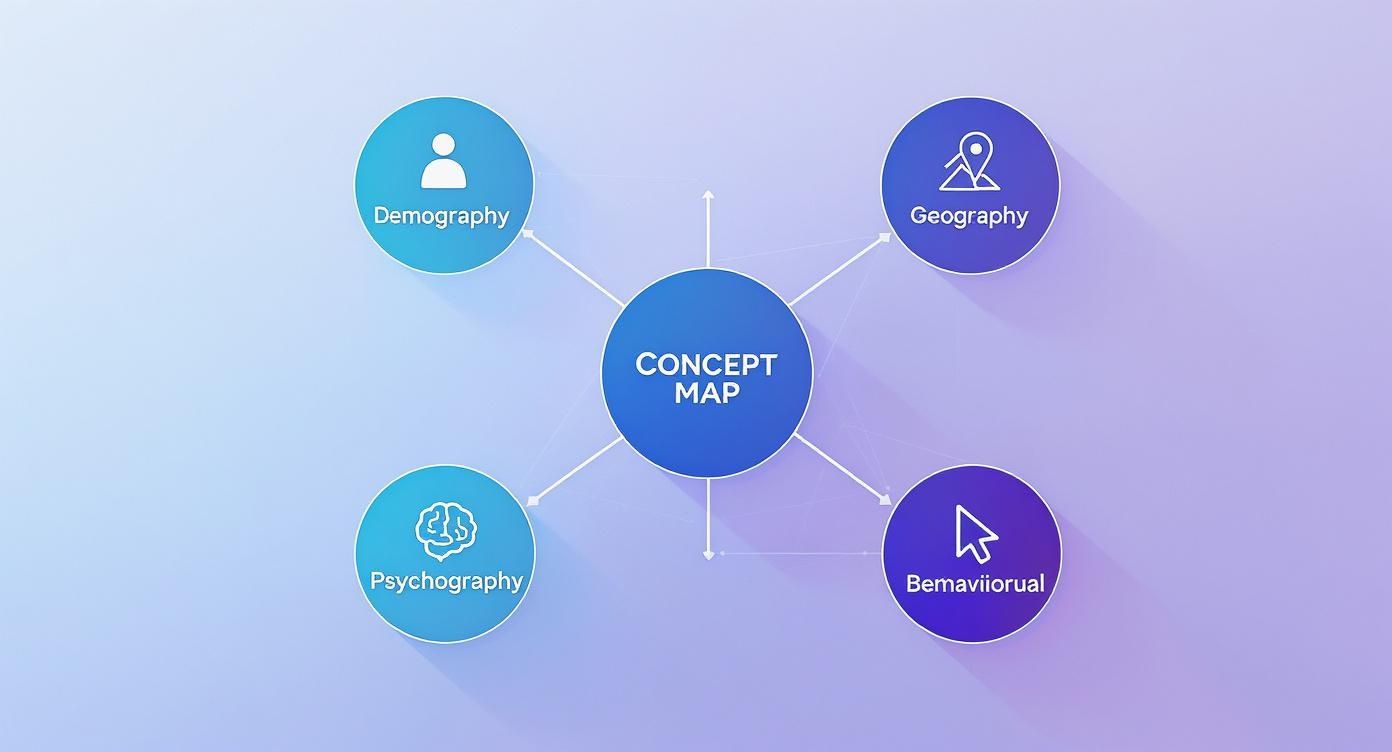
Each example is broken down into a simple Problem, Solution, and Result. Think of it as a blueprint you can steal for your own challenges. They all build on the four core pillars of segmentation you see below—the different lenses we can use to understand who our customers are and what they need.
This map is a good reminder that you can view your audience through multiple lenses—from who and where they are to why and how they act.
SaaS Company Driving Upgrades with Behavioral Segmentation
The Problem: A mid-sized project management SaaS company had a problem. A huge chunk of their "Basic" tier users never even clicked on the more advanced features. This meant upgrade rates were flat, and worse, churn risk was high because these users weren't getting the full value. Their generic "Upgrade Now!" emails were going straight to the trash.
The Solution: They stopped blasting everyone and got smart with behavioral segmentation. They split their users into two simple, action-based groups right inside their platform:
"Power Users": These were the folks constantly hitting the limits of the Basic plan—running out of projects, maxing out storage. They were using every feature available to them.
"Under-Engaged Users": These customers logged in but stuck to just one or two basic functions, completely unaware of the more powerful tools they had access to.
"Power Users" got campaigns that felt like a secret handshake, showing them exactly how premium features would solve the bottlenecks they were already experiencing. Meanwhile, the "Under-Engaged Users" received gentle, educational content—like short video tutorials—highlighting a single advanced feature that would make their current workflow even better.
The Result: It worked. They saw a 35% increase in upgrades from the "Power Users" group in just three months. They also cut churn by 15% among the "Under-Engaged" segment, simply by helping them get more value from the product.
By focusing on what customers did (behavioral data) instead of just who they were, the company made every message feel relevant. They connected the dots between user actions and business outcomes.
Manufacturing Firm Tailoring Sales Pitches by Industry
The Problem: A manufacturer of industrial automation gear was spinning its wheels. Their sales team was pitching the same generic script to everyone, from car factories to pharmaceutical labs. The message wasn't landing because it failed to address the vastly different pain points and regulations in each sector.
The Solution: The marketing team switched gears to a firmographic segmentation strategy. They looked at their best customers and broke their target market into three core industries. Then, they built a completely separate playbook for each one.
The automotive segment saw case studies and emails all about boosting assembly line speed and cutting downtime.
The pharmaceutical segment got content that hammered on precision, FDA compliance, and sterile production—the things that actually keep them up at night.
The Result: By speaking each industry's language, the company boosted its marketing-qualified leads (MQLs) by a massive 50%. Even better, the sales cycle shrank by 20% because prospects were coming to the table already knowing the company understood their world.
Professional Services Firm Cross-Selling with Client History
The Problem: A digital marketing agency offered a full suite of services—SEO, PPC, content—but most clients only ever bought one. They knew they were sitting on a goldmine of cross-sell opportunities but had no systematic way to figure out who to approach and what to say.
The Solution: The agency dug into its own data, segmenting clients based on their transactional and behavioral history. They created a hyper-specific segment they called "SEO-Only Success Stories." These were clients who had seen a huge jump in organic traffic (a behavioral metric) from their SEO service (a transactional metric).
This group then received a highly personalized campaign. It showed them their own success and then explained how adding PPC could instantly capitalize on that newfound visibility to capture high-intent leads. They even wove in testimonials from similar clients, a tactic we break down in our guide on using voice of customer examples.
The Result: The campaign was a hit, converting 25% of those single-service clients into multi-service accounts. This dramatically increased their average client lifetime value without having to go out and find a single new customer.
Alright, so we’ve covered the what and the why of segmentation. Now for the fun part: actually doing it. Moving from theory to a real, working strategy can feel like a huge leap, but it’s not. It's a step-by-step process, not some massive, all-at-once project.
Think of it like building with LEGOs. You don’t just dump the whole bin on the floor and hope a spaceship appears. You start with a plan, find the right pieces, and click them together thoughtfully. Let’s walk through the five essential steps to build your own strategy from the ground up.
Before you slice up your audience list, you have to answer one simple question: Why are we doing this? What's the business outcome you're trying to drive? Without a clear goal, you’ll end up with a bunch of interesting-but-useless segments.
This goal becomes your North Star. It guides every single decision you make from here on out. Are you trying to:
Increase customer lifetime value? Then you’ll probably segment based on purchase history to find juicy cross-sell opportunities.
Reduce churn? That means you'll want to segment by product usage to spot the accounts that are starting to drift away.
Improve lead conversion rates? Your focus would be on segmenting new leads by their industry or the specific pain point they came in with.
A well-defined goal—like "increase upgrade rates from our 'Freemium' user base by 15% in the next quarter"—provides the focus you need to build segments that actually move the needle. Start with the end in mind.
With your goal locked in, it’s time to find your LEGO bricks. This is all about pulling data from every place your customers interact with you. Good, clean data is the bedrock of any solid segmentation effort.
You’ll find gold in a few key places:
CRM: This is your home base for firmographics and basic account details like job titles, company size, and location.
Website Analytics: Tools like Google Analytics or Matomo are treasure troves of behavioral data. You can see which pages people visit, what features they click on, and how long they stick around.
Customer Surveys and Feedback: Don't be afraid to just ask. Direct feedback gives you rich psychographic insights into your customers' actual challenges, goals, and motivations that you can’t get anywhere else.
Once you have the data, you need to centralize it. For a deeper dive, there are great resources on building a data-driven customer segmentation strategy that can help you get this foundation right.
Now you get to decide how to group everyone. This is where you combine the different methods we talked about—demographic, behavioral, firmographic—to create segments that directly serve the goal you set in step one. A classic B2B starting point is to simply mix firmographics with behavior.
Actionable Comparison: Two Common Starting Models
Model Name
Description
Best For
Value-Based Segmentation
Groups customers by their economic value—past, present, or future. Think high-spend, mid-spend, and low-spend tiers.
Businesses focused on maximizing revenue from existing customers and giving their high-value accounts the white-glove treatment.
Needs-Based Segmentation
Groups customers based on the specific problems they're trying to solve or the benefits they want from your product.
Companies with multiple products or features who need to make their marketing and sales messaging hyper-relevant.
The key is to start simple. Pick one or two models that make sense. You can always get fancier later.
Your segments can't just be rows in a spreadsheet. To be useful, they need to feel like real groups of people. This is where you build a simple profile or “persona” for each one, making it dead simple for your marketing and sales teams to know exactly who they’re talking to.
Give each segment a memorable name, like “Tech-Savvy Startups” or “Established Enterprise Accounts.” Then, flesh it out with their key characteristics, common pain points, and what motivates them. This is the step that turns raw data into a practical tool your whole company can rally around.
Time to put your work into the wild. Pick one or two of your most promising segments and launch a targeted campaign. This could be anything from a tailored email sequence to a specific ad campaign on LinkedIn or even personalized content on your website.
And then? You measure everything. Track the metrics that matter for your goal—open rates, click-through rates, demo requests, conversion rates. Compare the results for each segment against your old, one-size-fits-all approach.
Segmentation isn't a "set it and forget it" project. It’s a living strategy. You’ll learn, you’ll tweak, and you’ll get better with every campaign. This is a cycle of continuous improvement.
Manual audience segmentation has its place, but let's be honest—it has limits. It’s a bit like trying to sort a mountain of LEGO bricks by hand. You can group them by color and shape, but you'll miss the subtle patterns and the really interesting combinations.
AI is the supercomputer that sorts the entire pile in seconds, uncovering connections you never knew existed. It elevates segmentation from a static, rule-based chore into a dynamic, predictive engine. Instead of just looking at what customers have done, AI helps you see what they’re likely to do next.
This isn't just a minor tweak; it's a fundamental shift. We're moving beyond simple groupings to create fluid segments that adapt in real time as customer behavior changes.
And the market reflects this. The global AI market is on a trajectory to blast from $22.6 billion in 2020 to $190.6 billion by 2025. This explosive growth is driven by businesses like yours adopting AI-powered tools to make sense of overwhelmingly complex data.
The biggest change AI brings to the table is the move from being reactive to predictive.
Think about it. Machine learning algorithms can chew through massive datasets—purchase history, website clicks, support tickets, social media mentions—and spot hidden correlations a human analyst would almost certainly miss. The system learns which signals are most likely to predict a future action, like a purchase or, just as importantly, a cancellation.
This is the heart of predictive segmentation, a way of grouping customers based on their likelihood to do something.
Traditional Segmentation: "Let's pull a list of customers who haven't bought anything in 90 days." This is reactive. You're looking backward.
Predictive Segmentation: "Let's find customers who are showing the same behavioral red flags as the ones who churned last quarter—even if they just bought something yesterday." This is predictive. You're looking forward.
AI doesn't just categorize your audience; it forecasts their future needs. This lets you step in with the right message before a customer decides to look elsewhere or cancel their plan. It's a massive competitive advantage.
This analytical firepower is a game-changer for marketers. To see how this works under the hood, check out our guide on predictive analytics in marketing.
The other huge win from AI segmentation is hyper-personalization.
Traditional methods might let you personalize an email with a customer's name and recommend a product based on their last purchase. That’s a good start, but AI takes it leagues further. It can analyze an individual's entire journey with your brand and create a "segment of one."
This means the website content, product recommendations, and marketing messages can all change dynamically for each person. It’s the difference between a store clerk who remembers your last purchase and a personal shopper who knows your style, your budget, and what you’ll be looking for next season.
Manual, rule-based campaigns ("If this, then that")
Automated, dynamic content that adapts to each user's actions
Outcome
Relevant content ("You bought X, you might like Y")
Anticipatory experiences ("We know you like X, so here’s an exclusive look at Z before it launches")
This level of granular targeting used to be the exclusive domain of giants like Amazon or Netflix. Not anymore. Modern platforms are making it accessible for everyone.
For example, AI's impact extends well into lead generation, where it can dramatically improve how you segment and target prospects. It's why so many companies are now adopting AI-powered lead generation strategies to find high-value leads with far greater precision. This shift from broad targeting to individual engagement is how modern businesses build deeper, more profitable customer relationships.
So, you've decided to get serious about audience segmentation. That’s a huge step. But like any powerful strategy, there are a few classic ways it can go sideways. Knowing what segmentation is also means knowing where the landmines are buried.
Think of this as your field guide to sidestepping the traps that can turn a brilliant plan into a complicated mess. Nail these, and your segments will stay sharp, actionable, and tied directly to your business goals. Let's walk through the most common mistakes I've seen and a simple "Instead of This, Do That" fix for each one.
It’s tempting, I get it. You have all this data, and it feels productive to slice and dice your audience into a dozen or more hyper-specific groups. This is a classic rookie mistake. While it looks precise on a spreadsheet, you've just created a management nightmare. There's no way your team can create unique, meaningful campaigns for every single micro-segment.
Instead of: Creating 15 micro-segments that are impossible to manage.
Do This: Focus on 4-6 high-impact segments that represent distinct, valuable groups. Prioritize quality and actionability over sheer quantity.
This approach lets you give each important segment the attention it deserves. It keeps you from letting the whole strategy collapse under its own weight.
Your audience isn't frozen in time—people change, companies evolve, and priorities shift. A segment you built on data from six months ago might be completely useless today. Relying on old information is like navigating with an old map. You're going to get lost.
This is how you end up with misaligned messaging and wasted ad spend. The contact who was a "New Lead" last quarter might be a "Loyal Advocate" now. They need to be treated that way.
Stale vs. Fresh Data: The Bottom Line
Mistake
The Painful Consequence
The Simple Fix
Relying on old data
Your messaging feels tone-deaf and irrelevant, killing engagement and conversions.
Refresh your data quarterly. Put a recurring reminder on your calendar to re-pull analytics and review your segment rules.
Ignoring real-time signals
You miss golden opportunities to engage customers at critical moments, like right after a purchase.
Integrate real-time behavioral triggers. Use marketing automation to move contacts between segments based on what they just did.
Here’s another common pitfall: building segments that bleed into each other. If your "Budget-Conscious SMBs" and your "Early-Stage Startups" groups are filled with mostly the same companies, your segments aren't different enough to matter. They lack clear lines.
Every segment should have unique DNA and require a distinct marketing angle. The sniff test is simple: if you can send the exact same email to two different segments, they probably shouldn't be two different segments.
Instead of: Having segments with 70% audience overlap.
Do This: Make sure each segment is clearly defined and mutually exclusive. Run a test on your criteria to confirm that less than 10% of your audience could reasonably fit into multiple segments. This clarity is what makes your targeting lethal.
By sidestepping these common errors, you're not just creating complexity. You're building a segmentation framework that’s tough, smart, and actually drives business results.
Free Tool
Try our Lookalike Company Finder — find companies similar to your best customers in seconds. No signup required.
Jumping into segmentation usually brings up the same handful of questions. Let's tackle them head-on so you can move from theory to practice with confidence.
It’s easy to fall into the trap of creating a dozen hyper-specific segments, but that just creates noise and a ton of extra work. A good rule of thumb? Start with three to five high-impact segments.
Focus on the groups that will move the needle the most. Think "High-Value Repeat Customers," "At-Risk Churn Accounts," or "New Leads from Top-Tier Industries." You can always get more granular later, once you’ve nailed the process of targeting these core groups.
Audience vs. Market Segmentation—What’s the Real Difference?
This is a big one, and the distinction is crucial. The easiest way to think about it is with an analogy.
Market Segmentation: This is like looking at a map of the entire country. You're dividing the total potential market into logical groups, including millions of people who have never even heard of your company.
Audience Segmentation: This is like looking at your personal address book. You're focused on dividing your known contacts—the people already in your world, like existing customers, leads, and email subscribers.
The key difference is scope. Market segmentation is for high-level strategy, like product development or new market entry. Audience segmentation is for tactical marketing and communication with the people you can already reach.
Your segments aren't a "set it and forget it" project. People's needs and behaviors change, so your segments need to keep up. A good rhythm is to review them quarterly or right after any major marketing campaign.
When you do, ask yourself a couple of simple questions: Are these groups still distinct from one another? Are they still driving the results we expect? This regular check-in keeps your strategy sharp and prevents you from making decisions based on old, outdated assumptions.
Ready to stop guessing and start targeting with precision? marketbetter.ai uses AI to uncover your most valuable audience segments, automate personalized campaigns, and drive real growth. Discover how our AI-powered marketing platform can transform your strategy at https://www.marketbetter.ai.
A marketing campaign planning template is more than just a document. It's the blueprint that guides your team through every single stage of a campaign, from brainstorming goals to digging into the final results.
Think of it as the single source of truth that keeps your budget, messaging, and channels all pointing in the same direction for maximum impact. It's what turns those ambitious "what if" ideas into concrete, measurable wins.
Let’s be honest: winging a marketing campaign is a recipe for disaster. We've all seen it happen. It leads to blown budgets, confusing messaging, and goals that feel more like wishes than actual objectives.
A solid marketing campaign planning template isn’t just another form to fill out. It’s your strategic anchor in a sea of creative chaos, keeping every department grounded and laser-focused. This documented plan becomes the central hub for your entire operation, getting creative, sales, and leadership on the same page. When everyone works from the same playbook, the risk of miscommunication plummets.
I've seen firsthand how a lack of planning creates friction that can derail an entire launch. Picture this: a B2B tech company is rolling out a new software feature. The social media team starts pushing flashy, high-energy videos targeting scrappy startups. At the same time, the email marketing team is sending out dense, technical whitepapers aimed at enterprise-level IT directors.
What happens next? The sales team is caught in the middle with no unified message. Prospects are confused, ad spend is wasted, and the customer experience feels completely disjointed. Each team might have hit their individual activity metrics, but the campaign failed to generate qualified leads because there was no shared vision.
Now, contrast that with a template-driven approach. Before a single ad is designed or email is written, the template forces everyone to sit down and agree on the fundamentals:
Action Step 1: Define Your Audience. Who are we actually talking to? Get specific. Instead of "small businesses," drill down to "CEOs of Series A tech startups with 10-50 employees."
Action Step 2: Set Your Core Message. What's the one core value proposition we need to land? Distill it into a single, powerful sentence.
Action Step 3: Quantify Success. What does a "win" look like, in numbers? Define the exact KPIs you'll measure.
Action Step 4: Assign Channel Roles. How does each platform support the main goal? For instance, LinkedIn for lead gen, Twitter for community engagement.
This upfront alignment gets everyone rowing in the same direction from day one. And the data backs this up—top marketers are 414% more likely to report success when they actually document their strategy. That statistic says it all; it’s the difference between just being busy and being truly effective.
To give you a clearer picture, here’s a quick comparison showing the tangible differences between unstructured campaign planning and using a strategic template.
Inconsistent messaging and branding across channels.
Uniform messaging and brand voice everywhere.
Efficiency
Wasted time reinventing processes for each campaign.
Repeatable framework that saves time and resources.
Alignment
Teams work in silos, leading to friction and confusion.
Cross-functional alignment from the start.
Accountability
Unclear ownership and vague performance metrics.
Clear roles, responsibilities, and defined KPIs.
Results
Unpredictable outcomes and difficult-to-measure ROI.
Measurable, data-driven results and clearer ROI.
The takeaway is simple: templates bring order to the chaos and create a repeatable system for success.
A great campaign isn't just about having a brilliant idea. It's about having a documented, repeatable process that turns that idea into predictable, measurable results. Your template provides that process.
If you're looking to build out a more sophisticated system, it's worth exploring specialized tools. For teams that want advanced customization and database-like power, checking out options like Airtable templates can show you what’s possible beyond a simple spreadsheet. The right structure builds a foundation that transforms creative concepts into real business growth.
A great marketing campaign plan is more than a digital checklist. It's a strategic framework that forces you to answer the tough questions before you spend a dime. It's the difference between launching a campaign with a clear destination and just throwing tactics at the wall to see what sticks.
Let's break down the core components that turn a simple plan into a powerful tool. Think of each part as a lever—get them right, and you build momentum. Get them wrong, and you're just wasting time, budget, and creative energy.
The first two pillars of any serious plan are knowing who you're talking to and what you want them to do. Without this clarity, your campaign is just shouting into a void.
A well-defined Target Audience Persona is your shield against this. It forces you to create a detailed picture of your ideal customer—what are their actual pain points? Where do they hang out online? What makes them tick?
Just as important are your SMART Goals (Specific, Measurable, Achievable, Relevant, Time-bound). Vague objectives like "increase brand awareness" are useless for planning. A real goal sounds like this: "Generate 250 marketing-qualified leads from our B2B SaaS target audience in Q3 via our LinkedIn content campaign." That’s a clear destination. It also keeps scope creep at bay.
Here’s what this looks like in a real project management tool like Asana.
Notice how the layout clearly separates objectives, key messages, and the audience. This simple step ensures everyone on the team is starting from the same page, turning abstract ideas into a shared, actionable reality.
Then, Craft Your Message and Measure What Matters
Once you know your audience and your goals, you need a message that cuts through the noise. This is where your Unique Value Proposition (UVP) comes in. It’s the core of everything you'll say.
Actionable Comparison:
Weak UVP: "We help you get organized." (Vague, generic)
Strong UVP: "The only app that combines your to-do list, calendar, and notes into one seamless view, saving you an hour every day." (Specific, benefit-driven, unique)
This leads you right to your Key Performance Indicators (KPIs). These are the metrics that prove you're actually hitting your SMART goals. A comprehensive analysis of over 500 successful marketing campaigns revealed a direct link between detailed planning and performance. Campaigns with clearly defined KPIs and personas achieved, on average, a 30% higher return on investment (ROI) than those with vague plans. You can see more on this from Forbes.com.
A plan without KPIs is just a wish list. Tying every activity back to a specific metric is non-negotiable for proving marketing’s value and making data-driven decisions.
For a B2B lead generation campaign, for example, your KPIs aren't just about website traffic. They're about tangible business results. To really get this right, check out our guide on essential lead generation key performance indicators to help you pick the right metrics for the job.
These four pieces—audience, goals, messaging, and metrics—are the strategic heart of any effective campaign plan. They make sure every decision that follows, from channel selection to content creation, is purposeful and tied to measurable success.
A generic marketing campaign planning template is a great starting point, but its real power is in its flexibility. Let's be honest, a fast-and-furious product launch on social media has completely different DNA than a slow-burn, long-term SEO content campaign.
Trying to force both into the same rigid plan is like using a hammer on a screw. It’s messy and it just doesn’t work. The goal isn’t to reinvent the wheel every time, but to know which parts of your template to lean into and which to dial back depending on the campaign. That’s what keeps your team moving, not stuck in planning quicksand.
This comparison shows why a one-size-fits-all plan fails. For a social launch, your template needs a granular content calendar, detailed down to the hour, and an audience interaction plan for responding instantly. For an SEO campaign, the template must prioritize sections for keyword research, a technical SEO audit checklist, and a long-term backlink strategy.
The core of a great marketing campaign planning template isn’t its structure, but its flexibility. A plan that can’t bend will eventually break when faced with the unique demands of different marketing channels.
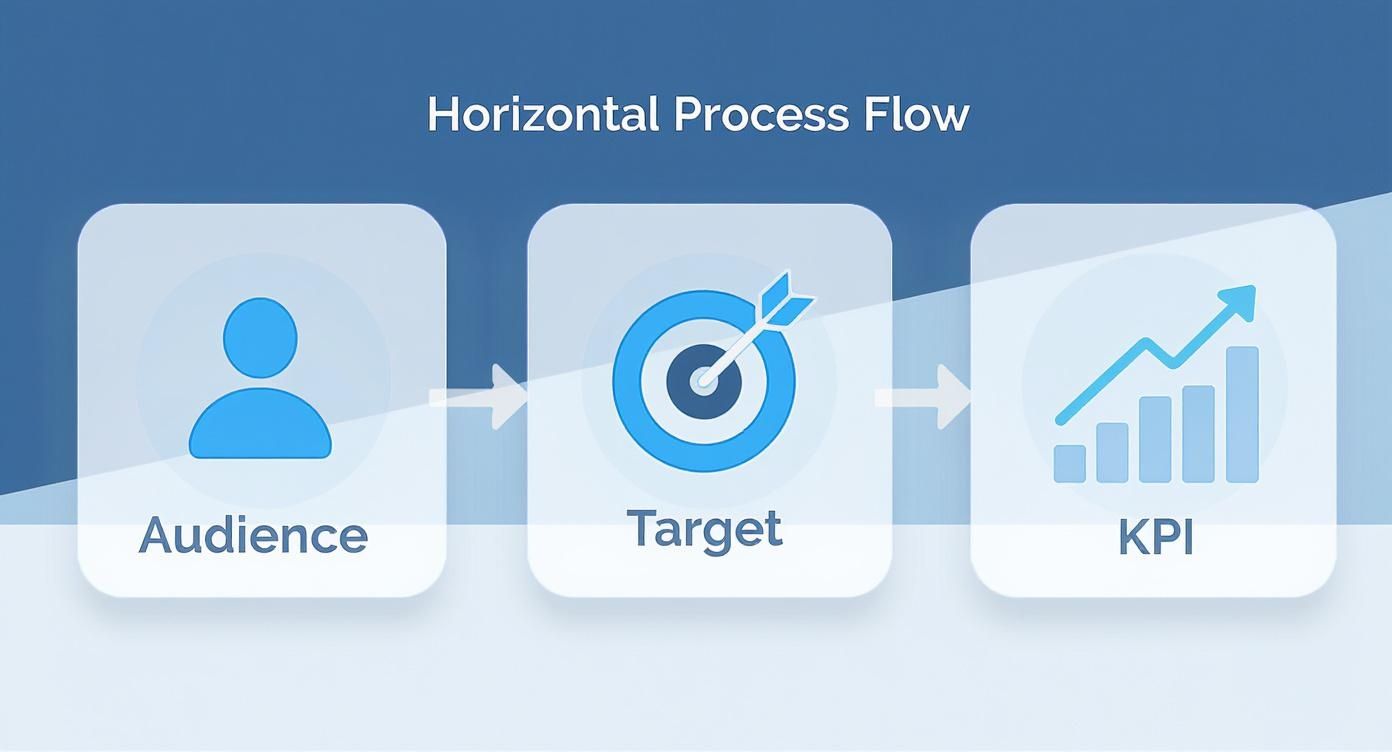
This process shows that no matter the campaign, foundational elements like audience, goals, and KPIs must be locked in before you can start tailoring the plan.
This visual just hammers home the point: a clear understanding of who you're talking to and what success looks like is non-negotiable, regardless of the channel.
What about an email nurture sequence for new leads? Here, the game is all about personalization and telling a story over time. Your template would heavily emphasize the customer journey map and a detailed messaging matrix.
Action Step: Map out the entire sequence in your template. For each email, define:
Goal: What is the one action you want the reader to take? (e.g., download a case study, book a demo).
Trigger: What action causes this email to be sent? (e.g., downloaded an ebook, visited the pricing page).
Core Message: What is the key takeaway for this specific email?
CTA: What is the exact call-to-action text?
To really nail this, you'll want to brush up on your customer segmentation strategies.
We're not just guessing here. Teams using tailored plans for digital campaigns are 60% faster at launching and adapting to market changes compared to those using a one-size-fits-all document. You can discover more insights on campaign agility from Neil Patel's blog.
To make this more concrete, here’s a quick guide showing which sections of your template to focus on for different types of campaigns. Think of it as your cheat sheet for adapting on the fly.
Campaign Type
Primary Focus Sections
Key Metrics to Emphasize
Product Launch
Content Calendar, PR/Influencer Outreach, Messaging Matrix
Media Mentions, Social Engagement, Initial Sales, Website Traffic
SEO Content
Keyword Research, Content Production, Technical SEO, Backlink Strategy
Organic Rankings, Organic Traffic, Conversion Rate, Time on Page
PPC/Paid Ads
Audience Targeting, Ad Creative, Budget Allocation, Landing Page
Cost Per Click (CPC), Click-Through Rate (CTR), Cost Per Acquisition (CPA)
Social Reach, Impressions, Brand Mentions, Share of Voice
This table isn't exhaustive, but it shows how the center of gravity shifts depending on your objective. The right focus saves an incredible amount of time and energy.
By treating your marketing campaign planning template as a modular framework—not a rigid document—you empower your team to build the right plan for the right job. Every single time.
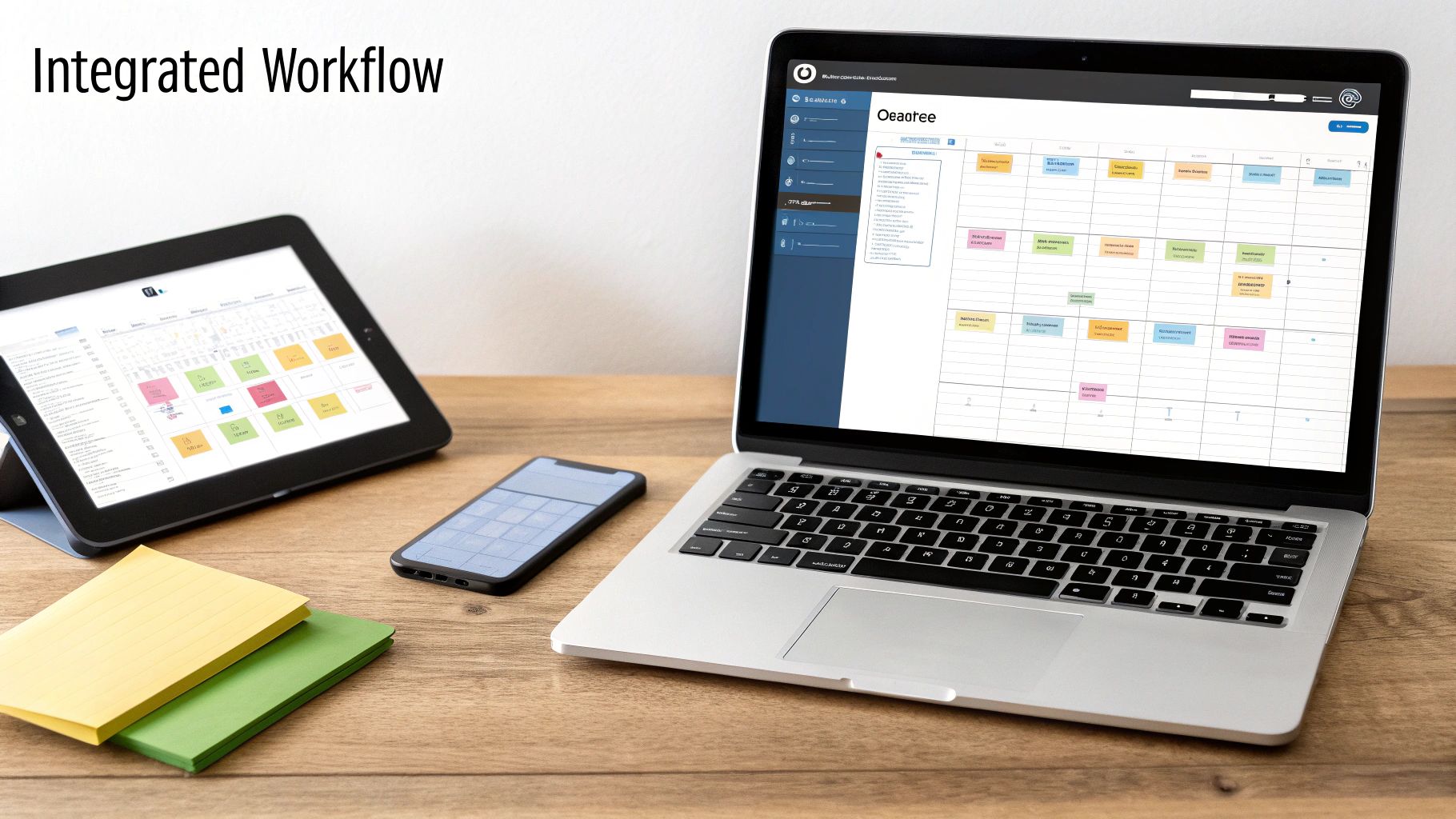
A marketing campaign plan sitting in a folder is useless. It’s just a document. But when you plug that plan directly into your daily workflow, it becomes a force multiplier—the bridge between high-level strategy and what your team actually does every day.
The goal is to stop thinking of your plan as a static file and start treating it as the central nervous system for your entire marketing operation.
This means your meticulously planned timeline shouldn't just live in a spreadsheet. It needs to sync directly with your project management software, turning abstract deadlines into real tickets assigned to real people.
This is where the magic happens. When your planning template actively feeds your tools, you eliminate the soul-crushing admin work of copying and pasting tasks from one place to another. You create a seamless flow of information that prevents crucial details from getting lost in translation.
Actionable Comparison: Two Ways to Manage Tasks
The Disconnected Way: The marketing manager manually creates tasks in a project tool based on a separate plan doc. If the plan changes, tasks become outdated, leading to confusion.
The Integrated Way: A task in the plan like "Launch social media ad creative" instantly becomes a card in Trello or a task in Asana via an integration or automation. It shows up with the due date, the assigned designer, and a link to the assets—all pulled directly from the plan. Nothing slips through the cracks.
The budget you carefully allocated? It can automatically set the spending caps in your Google or Facebook Ads accounts, making costly overruns a thing of the past.
Here’s a great example of how a plan can come to life inside a tool like Trello.
You can see how each piece of the strategy—from goals to content deliverables—is broken down into actionable cards. The plan is no longer a document; it's a living, breathing project dashboard.
Connecting your tools isn't just about moving faster; it's about being consistent.
When the content calendar from your template feeds directly into a scheduling tool like Buffer or Hootsuite, you guarantee the right message goes out on the right channel at precisely the right time. Every single time.
This kind of integration is what separates the most effective marketing teams from the rest. In fact, research from the Content Marketing Institute found that 76% of the most successful marketers use technology to manage their content processes. There's a direct line between tying your plan to your tools and making smarter, data-backed decisions.
By connecting your plan to your tools, you create a system of accountability. The plan dictates the 'what' and 'why,' while the integrated tools manage the 'who' and 'when,' ensuring seamless execution.
To get this right, you need the right tools in your corner. Exploring resources like a Marketing Plan Simplified Toolstack can give you a head start. And if you’re looking to find the perfect platform for your team, our deep dive on the top marketing campaign management software is a great place to start.
The moment a campaign goes live isn't the finish line. It's actually the starting gun for gathering the intel you’ll need for the next one.
This is where you close the loop, turning raw performance data into a smarter, more effective marketing campaign planning template for the future. Don't let the hard-won lessons from a finished campaign just evaporate.
Action Step: Build a dedicated "Post-Campaign Report" section right into your template. This simple addition transforms it from a static checklist into a dynamic tool that learns and evolves with every single launch. It becomes the bridge connecting past performance to future strategy.
The core of this process is just systematically comparing your actual results against the KPIs you set out to hit. But don't stop at a simple "we hit our goal" or "we missed it." You have to dig into the why behind the numbers.
Start by embedding a few targeted questions directly into that new section of your template:
Channel Performance: Which channels completely crushed it, and which ones fell flat? Was it the platform itself, or was our messaging just off for that audience?
Messaging Resonance: Which email subject lines or ad headlines actually got people to click? What specific copy points led to the most conversions?
Audience Behavior: Did our target persona behave like we thought they would? Did a totally different audience segment come out of nowhere and surprise us?
Budget Efficiency: Where did our money work the hardest? Which channels delivered the lowest Cost Per Acquisition (CPA)?
A structured review like this forces you to be honest about what worked and what didn't. That’s where real growth comes from—and it's how you stop making the same mistakes twice.
Your marketing campaign planning template should be a living document. Its final section shouldn't be the launch checklist, but the post-mortem analysis that makes the next plan better from the start.
Turning Learnings into Actionable Template Updates
Gathering data is only half the battle. The real magic happens when you translate those insights into concrete improvements for your template. This step is what separates the pros from the amateurs.
Seriously. Research shows that companies using data-driven insights are 23 times more likely to acquire customers. Using post-campaign data to refine your planning process is a huge part of that. You can discover more about data-driven marketing strategies at McKinsey.com.
Here’s a practical look at how a real-world learning translates into an actionable template update.
Learning from Post-Campaign Report
Actionable Template Improvement
Email open rates were 15% below target on our last product update campaign.
Add a mandatory A/B testing field for subject lines in the 'Email & Messaging' section. No excuses.
LinkedIn ads drove 3x more MQLs than Facebook ads for our B2B audience.
Update the 'Channel Strategy' section to prioritize LinkedIn, with a note to allocate 60% of the initial paid social budget there.
The "Case Study" content asset had the highest conversion rate on our landing page.
Create a new "Proof Points" subsection under "Key Messaging" to ensure a customer story is always included.
This proactive approach ensures those hard-won lessons don't get lost in a forgotten slide deck. Instead, they get baked directly into your planning process, making every future campaign smarter and more likely to win.
Even with a killer template, a few questions always pop up. Getting your team on board, keeping the plan fresh, and sharing it without causing confusion are the usual suspects. Let's tackle them head-on.
Look, nobody gets excited about more admin work. The key to getting your team to adopt the template isn't to enforce it like a new rule, but to show them how it makes their lives easier.
Action Plan for Team Adoption:
Show, Don't Tell: Pull up the messy emails and Slack threads from a past campaign. Put it side-by-side with the clean, organized view in the new template.
Highlight the "WIIFM" (What's In It For Me?): Frame it as a tool that reduces unnecessary meetings and ends the "who owns this again?" confusion.
Collaborate on the First Run: Don't just email it out. Run your first planning session for an upcoming campaign using the template together. When everyone has a hand in building it, they feel a sense of ownership. It becomes their tool.
There’s no magic number here—it really boils down to how fast your world moves. A template should be a living document, not a stone tablet.
Here’s a simple comparison to guide you:
For fast-moving B2C teams: If you're running multiple social or influencer campaigns a month, revisit your master template quarterly. Platform algorithms and audience trends shift so quickly that your plan needs to keep pace.
For long-cycle B2B teams: If your world is more about foundational content marketing or account-based marketing (ABM), a semi-annual or even annual review is probably fine. The core strategies in these areas just don't change as rapidly.
Pro Tip: Don't leave this to chance. Schedule a recurring calendar invite for your template review—whether it's quarterly or annually. That way, it actually gets done instead of being pushed to the bottom of the to-do list forever.
What's the Best Way to Share This with Stakeholders?
The biggest mistake you can make is sending the same link to everyone. Your team needs a messy, work-in-progress version. Your leadership team absolutely does not.
Tailor the format to your audience.
For the Internal Team: Give them full edit access to the live, collaborative document in Asana, Notion, or a shared Google Sheet. This is the "kitchen."
For Leadership/External Stakeholders: Create a clean, read-only summary. Export a PDF or create a simplified "dashboard" view that hits the strategic highlights: goals, audience, budget, and main KPIs. This is the "finished meal."
Ready to stop juggling scattered documents and start building campaigns that actually win? The marketbetter.ai platform pulls your entire planning process into a single system, backed by AI-powered execution tools. We help you turn that beautiful strategy into real results—from generating on-brand content to optimizing every dollar of your ad spend.
Marketing automation is no longer just about sending scheduled emails; it's a dynamic engine for scalable, personalized customer experiences. However, the difference between a high-performing automation strategy and a noisy, ineffective one lies in the details. Many organizations implement powerful platforms but treat them like simple schedulers, missing out on their full potential to drive revenue and build lasting customer relationships. Getting it right means moving beyond basic "set and forget" workflows to a strategic approach that anticipates customer behavior and delivers tangible results.
This guide outlines ten actionable marketing automation best practices designed to elevate your strategy from foundational to exceptional. We will move beyond generic advice and focus on what truly works. You will learn how to:
Compare different segmentation models to find what best fits your audience.
Implement dynamic lead scoring that aligns directly with sales criteria.
Create personalized journeys based on real-time behavioral triggers, not just static lists.
Each point provides concrete implementation steps and practical examples, showing you how to transform your automation platform from a simple tool into your most valuable marketing asset. Let's dive into the practices that create measurable growth.
1. Build and Maintain a Clean, Segmented Database
The quality of your marketing automation is directly tied to the quality of your data. A disorganized, outdated contact list leads to poor deliverability, irrelevant messaging, and wasted resources. Conversely, a clean, well-segmented database is the bedrock of effective personalization, enabling you to send the right message to the right person at the right time. This foundational step is one of the most crucial marketing automation best practices you can implement.
Sending a generic email blast to your entire list is like shouting into a void. Segmentation allows you to divide your audience into smaller, more manageable groups based on shared characteristics. This ensures your automated campaigns resonate on a personal level.
Comparison: Static segmentation (e.g., based on job title) is a good start, but dynamic, behavioral segmentation is far more powerful. A static list of "CEOs" misses context, while a dynamic list of "CEOs who visited the pricing page in the last 7 days" is a high-priority segment for sales outreach. The former is a description; the latter is a signal of intent.
Audit and Clean Regularly:Action: Schedule a quarterly task to run your database through a list cleaning service (e.g., NeverBounce) to remove invalid emails. Create a segment of contacts who haven't opened an email in 90 days and enroll them in a re-engagement campaign.
Implement Smart Segmentation:Action: Move beyond simple demographics. Create three new dynamic lists today: one for users who have visited your pricing page, one for those who have downloaded a specific lead magnet, and one for customers who have purchased more than once.
Use Progressive Profiling:Action: Convert one of your high-traffic, top-of-funnel forms to a progressive profiling form. On the first submission, ask for name and email. On the second, ask for company name and size.
Enforce Double Opt-In:Action: Go to your form settings and enable double opt-in for all new subscribers. This simple step filters out typos and spam traps, ensuring a higher-quality list from the start.
2. Define Clear Goals and Key Performance Indicators (KPIs)
Launching marketing automation without clear objectives is like setting sail without a destination. You'll be active, but you won't know if you're making progress. Establishing specific, measurable goals before you build any workflow ensures you can accurately track success and justify your investment. This is one of the most fundamental marketing automation best practices, transforming your efforts from a cost center into a predictable revenue driver.
Without KPIs, you're flying blind. You won't know which campaigns are effective and which are draining your budget. Clear goals allow you to connect marketing activities directly to business outcomes, demonstrating tangible value to stakeholders. This data-driven approach is what separates high-performing marketing teams from the rest.
Comparison: Consider two goals. Goal A is "Increase engagement." Goal B is "Increase the MQL-to-SQL conversion rate by 15% in Q3." Goal A is a vague vanity metric. Goal B is an actionable, revenue-focused KPI that directly measures the effectiveness of your lead nurturing and qualification process. Always choose goals like B.
Align Marketing and Business Goals:Action: Ask your Head of Sales or CEO for their top 2-3 revenue targets for the quarter. Tie every new automation workflow you build directly to one of those targets.
Establish a Baseline:Action: Before launching your next nurturing campaign, pull the current conversion rate for that segment and save it in a shared document. This becomes your benchmark for success.
Focus on Core Metrics:Action: Choose one primary KPI for each major workflow. For a welcome series, it might be the 30-day activation rate. For a lead nurture sequence, it's the MQL-to-SQL conversion rate.
Schedule Regular KPI Reviews:Action: Create a recurring calendar invite for the first Monday of each month titled "Automation KPI Review." Use this meeting to review a pre-built dashboard and decide on one A/B test to launch based on the data.
Not all leads are created equal. Lead scoring is the process of assigning a numerical value to each lead based on their attributes and actions, allowing you to prioritize the ones most likely to convert. This crucial practice bridges the gap between marketing and sales, ensuring that sales teams focus their energy on high-potential prospects while marketing continues to nurture cooler leads. Implementing a robust scoring model is one of the most impactful marketing automation best practices for improving sales efficiency and ROI.
Handing off every new lead to your sales team is a recipe for wasted time and strained relationships. Lead scoring automates the qualification process, creating a clear threshold for when a lead becomes "sales-ready." This prevents sales reps from chasing prospects who have only shown minimal interest while ensuring hot leads receive immediate attention.
Comparison: A manual lead qualification process relies on a marketer's gut feel to decide when to pass a lead to sales. An automated lead scoring system is a data-driven, consistent process. The manual method is unscalable and prone to bias, while the automated system ensures every lead is evaluated against the same objective criteria, 24/7.
Align with Sales:Action: Schedule a meeting with your top sales reps. Ask them: "What are the top 5 signals—actions or attributes—that make you excited to call a lead?" Build your initial scoring model around their answers.
Use Negative Scoring:Action: Create a rule that subtracts 50 points from any lead that fills out a form using a "gmail.com" or "yahoo.com" email address (if you're B2B). This instantly de-prioritizes lower-quality contacts.
Start Simple and Iterate:Action: Begin with a 100-point model. Assign points for key demographic data (e.g., job title = +20) and key behaviors (e.g., pricing page view = +15, demo request = +50). Set the MQL threshold at 75 points. Review and adjust quarterly.
Incorporate AI:Action: After establishing a baseline model, upgrade your process with AI lead scoring to analyze historical data and predict which leads are most likely to close, often revealing non-obvious conversion signals.
4. Create Personalized Customer Journeys and Workflows
Effective marketing automation moves beyond sending one-off emails and embraces the full customer lifecycle. Building personalized journeys and workflows guides prospects from initial awareness to loyal advocacy, delivering tailored content based on their specific actions, preferences, and funnel stage. This strategic approach ensures every interaction feels relevant and timely, significantly boosting engagement and conversion rates. This is one of the most impactful marketing automation best practices for turning leads into customers.
A static campaign fails to adapt to individual user behavior. Automated workflows, however, are dynamic systems that react in real-time. This creates a scalable, one-to-one conversation with your audience.
Comparison: A generic "newsletter blast" sends the same message to everyone, regardless of their history with your brand. A personalized workflow sends a new customer an onboarding tip, a prospective customer a relevant case study, and a loyal customer an exclusive offer. The blast is a monologue; the workflow is a tailored conversation.
Map Before You Build:Action: Use a free tool like Miro or Lucidchart to visually map out one key customer journey before building it in your automation tool. Identify the entry trigger, decision points (if/then branches), and the end goal.
Start with Core Workflows:Action: Don't try to boil the ocean. Build and launch a 3-email welcome series for new subscribers this week. Once it's running, move on to building a 4-email abandoned cart sequence next week.
Use A/B Testing:Action: In your most important workflow email, create an A/B test on the subject line. Let it run until it reaches 1,000 sends, then analyze the open rate to declare a winner and apply the learning to future emails.
Set Frequency Caps:Action: Go into your platform's settings and implement a global frequency cap that prevents any contact from receiving more than 3 marketing emails in a 7-day period. To learn more about this, explore these advanced marketing personalization strategies.
5. Leverage Behavioral Triggers and Real-Time Personalization
Static campaigns are a thing of the past. Modern marketing automation excels when it reacts instantly to user behavior. By setting up triggers based on real-time actions like website visits, email opens, or abandoned carts, you can deliver immediate, contextually relevant responses. This approach moves beyond scheduled sends, creating a dynamic conversation with your audience at the exact moment they are most engaged, making it one of the most powerful marketing automation best practices.
Timing is everything in marketing. Behavioral triggers enable you to capitalize on a user's intent in the moment it is expressed. This immediacy transforms your marketing from a monologue into a responsive dialogue, dramatically increasing the likelihood of conversion.
Comparison: A scheduled email promoting a webinar is sent at the marketer's convenience. A triggered email sent immediately after a user downloads a related ebook is sent at the customer's moment of highest interest. The former is an interruption; the latter is a helpful next step.
Prioritize High-Value Triggers:Action: Set up your top-priority trigger today: create an automation that sends an internal notification to a sales rep the moment a known lead visits your pricing page.
Identify Key Behavioral Signals:Action: Go to your website analytics. Find the top 3 most visited pages by converting customers (excluding the homepage and pricing page). Use visits to these pages as triggers for new nurturing workflows.
Combine Triggers for Sophistication:Action: Create a "High Intent" dynamic list. The criteria for entry should be: (Visited pricing page in last 14 days) AND (Opened at least 1 email in last 30 days) AND (Lead score is > 60). Use this list for your most aggressive offers.
Test Your Timing:Action: In your abandoned cart workflow, set up an A/B test on the timing of the first email. Send Version A after 30 minutes and Version B after 4 hours. Measure which version has a higher recovery rate after 1,000 entries.
6. Align Sales and Marketing Teams with Shared Goals
Marketing automation is not just a marketing tool; it's a revenue engine that breaks down when the sales and marketing teams operate in silos. Misalignment leads to lost leads, frustrated teams, and a disjointed customer experience. By aligning both departments with shared goals and clear processes, you transform your automation platform from a lead-generation tool into a powerful, end-to-end conversion machine. This collaborative approach is one of the most impactful marketing automation best practices for driving sustainable growth.
When marketing and sales are misaligned, automation can actually amplify problems. Marketing might generate thousands of leads that sales deems low-quality, while sales fails to follow up on promising prospects nurtured by marketing. This friction creates a "leaky funnel" where potential revenue is lost.
Comparison: In a misaligned company, marketing's goal is "number of leads," and sales' goal is "revenue." This leads to marketing generating low-quality leads to hit their number, which sales then ignores. In an aligned company, both teams share the goal of "pipeline revenue," forcing them to work together on lead quality and follow-up.
Establish a Service-Level Agreement (SLA):Action: Create a one-page document. On it, state: "Marketing will deliver X MQLs per month. Sales will contact 95% of MQLs within 24 hours." Get both department heads to sign it.
Create a Unified Lead Definition:Action: Host a 1-hour workshop with marketing and sales leaders. The only goal is to agree on and write down the exact definitions of a Marketing Qualified Lead (MQL) and Sales Qualified Lead (SQL).
Implement a Lead Feedback Loop:Action: Add a mandatory picklist field in your CRM for sales to use when they disqualify a lead (e.g., "Not a decision-maker," "Bad timing," "Low budget"). Review a report of these reasons with sales weekly.
Hold Regular Alignment Meetings:Action: Schedule a recurring 30-minute weekly meeting with key stakeholders from both sales and marketing. The agenda is simple: review the MQL-to-SQL pipeline, discuss blockers, and celebrate wins.
7. Test and Optimize Continuously (A/B Testing and Experimentation)
Even the most thoughtfully designed automation workflow can be improved. Continuous optimization through systematic testing is what separates good marketing automation from great marketing automation. By treating your campaigns as ongoing experiments rather than one-time deployments, you can make data-driven decisions that compound into significant gains in engagement, conversions, and ROI. This commitment to iterative improvement is a core tenet of modern marketing automation best practices.
Guesswork has no place in a high-performing marketing strategy. A/B testing, also known as split testing, allows you to compare two versions of an asset to see which one performs better. This data-driven approach removes subjectivity and provides clear evidence of what resonates most with your audience, enabling you to refine your strategy with confidence.
Comparison: The "HiPPO" (Highest Paid Person's Opinion) approach to marketing relies on seniority and intuition to make decisions. The A/B testing approach relies on data. The HiPPO might think a green button looks better, but testing might prove a red button converts 20% higher. Data beats opinion every time.
Test One Variable at a Time:Action: For your next email campaign, decide to test only the subject line. Keep the "from" name, email body, and CTA identical in both versions to ensure your results are valid.
Ensure Statistical Significance:Action: Use a free online A/B test significance calculator. Don't stop a test and declare a winner until the confidence level is 95% or higher.
Document and Learn:Action: Create a simple spreadsheet with four columns: "Test Hypothesis," "Version A," "Version B," and "Result & Learning." Log every test you run. Before launching a new test, review this log.
Implement Winners Quickly:Action: Once an A/B test concludes with a statistically significant winner, immediately update the control version of your email or landing page to the winning variation. Don't let valuable insights sit unused.
Your marketing automation platform is powerful, but it becomes exponentially more effective when it doesn’t operate in a silo. A disconnected tech stack leads to data inconsistencies, manual data entry, and a fragmented view of the customer journey. Integrating your tools creates a unified ecosystem where data flows seamlessly, providing a single source of truth and enabling sophisticated, cross-channel automation. This integration is one of the most impactful marketing automation best practices for scaling your efforts.
A fully integrated stack empowers every team with the data they need. When your marketing automation platform syncs with your CRM, the sales team gets real-time alerts on hot leads, complete with a full history of their marketing interactions. This alignment ensures no lead is left behind and that sales conversations are context-aware and highly relevant.
Comparison: An unintegrated stack is like a company where departments don't talk to each other. Marketing knows a lead read 10 blog posts, but sales doesn't see that history in the CRM. An integrated stack is like a perfectly aligned team where sales sees every marketing touchpoint, leading to a much smarter, more contextual conversation.
Prioritize Core Integrations:Action: If your marketing automation platform and CRM are not yet connected, make this your number one priority for the quarter. This is the foundational integration for all revenue operations.
Use Native Connectors First:Action: Before exploring complex third-party tools like Zapier, check your platform's app marketplace for a direct, pre-built integration. These are almost always more reliable.
Map Your Data Flow:Action: Before enabling an integration, draw a simple diagram. Which system is the source of truth for contact data? Which is the source for deal data? Decide this upfront to prevent data conflicts. Learn more about customer data platform integration for a deeper dive.
Test and Monitor Relentlessly:Action: Create a test lead in your marketing platform. Push it to the CRM and verify that all data fields mapped correctly. Set up an automated alert to notify you if the integration sync fails.
9. Focus on Value-Driven Content and Educational Messaging
Effective marketing automation is less about selling and more about educating. Pushing constant sales messages alienates prospects, whereas providing genuine value builds trust and establishes your brand as a credible authority. Content-driven automation focuses on delivering helpful, educational messaging that addresses customer pain points, answers their questions, and guides them naturally toward a purchase decision. This approach is a cornerstone of modern marketing automation best practices.
Automated campaigns built around educational content position your brand as a partner, not just a vendor. This is the core principle of inbound marketing, famously championed by HubSpot. Instead of a generic "Buy Now" email, you might automate a sequence that delivers a relevant ebook, followed by a case study, and then an invitation to a webinar. This value-first strategy nurtures leads by solving their problems, making them more receptive to a sales conversation when the time is right.
Comparison: A hard-sell automation sequence is like a pushy salesperson who only talks about features and price. A value-driven sequence is like a helpful consultant who first seeks to understand your problem and then offers solutions. The consultant builds trust and wins the deal long-term.
Map Content to the Buyer's Journey:Action: Create a simple 3x3 grid. Label the columns "Awareness," "Consideration," and "Decision." Label the rows with your top 3 buyer personas. Fill in each box with at least one existing piece of content that fits. Identify the gaps.
Create Buyer Personas:Action: Interview one sales rep and one customer support rep. Ask them to describe your ideal customer's biggest daily challenges. Use these insights to create a one-page "persona" document to guide your content creation.
Repurpose High-Performing Content:Action: Take your most popular blog post from the last six months. Record a short 5-minute video summarizing its key points and embed it in a new email nurture campaign.
Use Soft Calls-to-Action (CTAs):Action: Review your current lead nurturing emails. Replace every "Buy Now" or "Contact Sales" CTA with a softer alternative like "Read the Case Study" or "Watch the On-Demand Webinar."
10. Respect Privacy Regulations and Implement Preference Management
In an era of heightened data scrutiny, respecting user privacy is not just a legal obligation; it's a critical component of building customer trust. Adherence to regulations like GDPR, CCPA, and CAN-SPAM is non-negotiable, and integrating robust preference management into your strategy demonstrates respect for your audience. This practice turns a compliance requirement into a powerful tool for customer engagement, solidifying its place among essential marketing automation best practices.
Simply having a one-click unsubscribe link is the bare minimum. A modern preference center allows users to choose what they hear from you and how often. This granular control empowers your audience, reduces unsubscribe rates, and ensures the messages you do send are more welcome and effective.
Comparison: A global unsubscribe link is an all-or-nothing ultimatum. A preference center is a conversation. The global unsubscribe forces a user to break up with you completely, while the preference center allows them to say, "I'd like to see you a little less often," saving the relationship.
Get Explicit Consent:Action: Audit your lead capture forms. Ensure that any checkbox for subscribing to marketing communications is unchecked by default.
Provide a Preference Center:Action: Instead of linking directly to the unsubscribe page in your email footer, link to your platform's built-in subscription preference page. Make sure you have at least two options for users to choose from (e.g., "Monthly Newsletter" and "Product Updates").
Make Unsubscribing Easy:Action: Click the unsubscribe link in your own marketing email. Does it take more than two clicks to complete the process? If so, simplify it immediately.
Audit Your Practices Regularly:Action: Set an annual calendar reminder to review the latest privacy regulations (like GDPR and CCPA) and audit your company's consent management practices against them.
Marketing Automation: 10 Best Practices Comparison
Navigating the landscape of marketing automation can feel like managing a complex machine. You have numerous moving parts, from data hygiene and segmentation to lead scoring and A/B testing. As we've explored, success isn't about simply flipping a switch and letting the software run. True mastery lies in transforming these disparate functions into a cohesive, intelligent system that anticipates customer needs and drives measurable growth. Adopting these marketing automation best practices is the critical step in moving from basic task execution to strategic, data-driven orchestration.
The core takeaway is that technology alone is not a strategy. A pristine, segmented database (Practice #1) is useless without clear goals and KPIs (Practice #2) to guide your efforts. Likewise, a sophisticated lead scoring model (Practice #3) only delivers ROI when it’s seamlessly integrated with personalized customer journeys (Practice #4) and a tightly aligned sales team (Practice #6). Each practice builds upon the others, creating a powerful flywheel effect. Ignoring one area, such as continuous optimization (Practice #7) or strategic integrations (Practice #8), creates a weak link that can undermine your entire operation.
Actionable Next Steps: From Theory to Implementation
To put these principles into practice, avoid trying to overhaul everything at once. Instead, adopt a phased approach focused on high-impact areas.
Start with an Audit: Begin by evaluating your current database and segmentation strategy. Is your data clean and actionable? This is the foundation for every other best practice. A simple comparison between your most engaged segments and your least engaged can reveal immediate opportunities for re-engagement campaigns or list pruning.
Prioritize One Workflow: Select a single, critical customer journey to refine, such as new lead nurturing or customer onboarding. Apply the principles of personalization, behavioral triggers, and value-driven content to this specific workflow. Measure its performance against your old system to demonstrate clear value and build momentum.
Bridge the Sales and Marketing Gap: Schedule a workshop between sales and marketing leaders. The sole focus should be to define a universal definition of a "qualified lead" and agree on the specific criteria for the marketing-to-sales handoff. This single action can resolve countless points of friction and dramatically improve conversion rates.
Ultimately, the goal is to create a customer experience that feels human, not automated. It's about delivering the right message, through the right channel, at the precise moment of need. This requires a commitment to respecting customer privacy (Practice #10) while leveraging data to be profoundly relevant. By mastering these marketing automation best practices, you're not just improving campaign metrics; you're building lasting customer relationships, fostering brand loyalty, and creating a sustainable engine for business growth. The future isn’t just about automation; it’s about building an intelligent, responsive, and deeply customer-centric marketing ecosystem.
Ready to elevate your strategy from simple automation to intelligent orchestration? marketbetter.ai integrates with your existing marketing stack to unify data and layer on predictive AI, helping you optimize campaigns and anticipate customer needs in real-time. Discover how you can implement these best practices more effectively at marketbetter.ai.
Let's be honest: that buyer persona document you created last year is probably collecting digital dust. Many businesses treat this as a one-time, "set it and forget it" task. But that approach is precisely why so many marketing efforts fall completely flat. An outdated or assumption-based persona isn't just a harmless document; it's an active liability. It leads to wasted ad spend targeting the wrong crowd and generic messaging that gets ignored. When your understanding of the customer is built on guesswork, every marketing decision that follows is built on a shaky foundation.
The real problem is the methodology. For years, personas were cobbled together from internal assumptions, a bit of anecdotal evidence, or maybe a few interviews with friendly stakeholders. This "gut feeling" approach creates a static sketch that becomes irrelevant almost immediately as markets, tech, and customer behaviors shift.
Modern, effective personas are alive. They're rooted in real-world data, not a conference room brainstorming session. The whole concept has evolved massively since it first appeared, moving from simple qualitative sketches to sophisticated, data-rich profiles. Today's best practices use algorithmic and statistical methods to strip out human bias and get you much closer to the truth. You can actually discover more about the history of buyer personas and see how this evolution is changing modern marketing.
This infographic really nails the shift from fuzzy, assumption-based personas to sharp, data-driven profiles.
As you can see, this isn't about a one-off project anymore. It's about continuously plugging in real-time analytics and behavioral data to keep your understanding of the customer fresh and accurate.
To really drive this home, let's compare the old way with the new. The difference isn't just about semantics; it's a strategic pivot that separates high-performing marketing teams from everyone else.
A traditional persona might say something vague like, "Marketing Mary is overwhelmed." Okay, but what do you do with that? It offers almost zero direction.
A data-driven persona, on the other hand, tells you something you can act on: "Marketing Mary from mid-market tech companies spends 45% more time on our pricing page after reading a case study on ROI. Her primary goal is proving the value of new software to her CFO."
See the difference? One is a guess. The other is a surgical insight pulled directly from data. This level of clarity lets you:
Tailor content that speaks directly to proven challenges.
Optimize ad campaigns based on what users are actually doing, not what you think they're doing.
Refine product features to solve the real-world problems your customers are trying to fix.
This table breaks down the fundamental differences between the two approaches.
Based on internal workshops, gut feelings, and small-scale interviews.
Based on quantitative analytics, behavioral data, and qualitative validation.
Data Sources
Anecdotes, sales team opinions, leadership assumptions.
Web analytics, CRM data, product usage stats, surveys, customer support tickets.
Focus
Broad demographic and psychographic sketches (e.g., "35-45 years old, likes tech blogs").
Specific, observable behaviors and goals (e.g., "visits X feature page 3 times before converting").
Outcome
A static, often stereotypical character that rarely gets updated.
A dynamic, evolving profile that reflects actual customer behavior in real-time.
Bias
Highly susceptible to internal bias and outdated beliefs about the market.
Minimizes bias by grounding insights in objective, measurable data.
Ultimately, moving to a data-driven model makes your personas far more reliable and actionable, turning them from a decorative document into a strategic tool.
The goal is to create a living document that reflects your actual customer today, not an idealized version from a brainstorming session. This makes creating buyer personas a critical business function, not just a marketing task.
Gathering the Raw Materials for Authentic Personas
Great buyer personas aren't built on assumptions or boardroom brainstorming. They're built from raw, real-world human insights. This is where you have to roll up your sleeves and go way beyond the generic advice to "do some interviews."
To build personas that actually work—the kind that sharpen your messaging and focus your strategy—you need a smart mix of data from different places. Each source tells a piece of the story.
This means blending the what with the why. You can use a tool like Google Analytics to see what users do—segmenting by geography, tracking common paths, and noticing that, say, enterprise visitors always hit your case studies page before contacting sales. But analytics will never tell you why. That's where talking to people comes in. You can learn more about how to blend data for data-driven buyer personas.
Relying on just one source gives you a flat, one-dimensional caricature, not a customer.
The richest insights always come from direct conversations, but you absolutely have to talk to the right people. Your goal is to get a full spectrum of experiences, not just a handful of glowing reviews.
Here's who should be on your list:
Your Biggest Fans (Happy Customers): These are the people who just get it. They understand your value and can tell you, in their own words, why they chose you over everyone else. Their stories are invaluable for nailing your core strengths.
The Ones That Got Away (Lost Prospects): This group is a goldmine. Seriously. Talking to prospects who looked you over but went with a competitor gives you brutally honest feedback. You'll uncover gaps in your product, messaging, or sales process that your own team might be blind to.
The Ones Who Left (Unhappy Former Customers): I know, it’s tough to hear. But this feedback is essential. Why did they churn? Did you fail to deliver on your promise? Understanding their pain helps you identify weaknesses and even define negative personas—the types of customers you shouldn't be trying to attract.
Your Front-Line Experts (Sales and Support Teams): These folks are in the trenches every single day. They hear the unfiltered objections, the recurring questions, and the real problems your audience is trying to solve. Their anecdotal evidence provides the perfect context for all your other data.
No single method gives you the whole picture. The key is to layer different types of data to see where the stories overlap and validate what you're hearing. Think of it like building a legal case—you need multiple forms of evidence.
Data Source
Type
What It Tells You
Limitation
Customer Interviews
Qualitative
The "why" behind decisions, deep motivations, emotional triggers, and direct quotes.
Small sample size; can be time-consuming and prone to individual bias.
Online Surveys
Quantitative
Trends and patterns across a larger audience, demographic data, and statistically significant preferences.
Lacks emotional depth; difficult to probe deeper into unexpected answers.
Website & CRM Analytics
Behavioral
What people actually do, not just what they say. Reveals user paths, content engagement, and conversion points.
Doesn't explain the "why" behind the actions; can be misinterpreted without qualitative context.
The magic happens when you combine these. Analytics might show 50% of users drop off on your pricing page. But an interview will reveal it's because they can't find information on team-based pricing—an insight you'd never get from the numbers alone.
When you finally get someone on a call, your goal is to get them telling stories. Ditch the simple yes/no questions. The best questions are open-ended and get people to reflect on their journey.
So, instead of asking, "Did you find our product easy to use?"
Try this: "Walk me through the first time you used our product. What were you actually trying to accomplish in that moment?"
See the difference? Here are a few more powerful, open-ended questions to get you started:
What was the specific trigger or event that made you start looking for a solution like ours?
Describe your evaluation process. What other options did you consider, and what were the most important criteria for you?
What were the biggest barriers or hesitations you had right before you made a decision?
If you could wave a magic wand, what would the perfect solution for your problem look like?
These questions get right to the heart of their goals and frustrations, which is the fuel for any useful persona. The answers you get become your voice of the customer data—the exact phrases and language you should be using in your own marketing. You can find more voice of customer examples in our guide to see how this translates into practice.
You've done the hard work. Weeks of interviews, surveys, and digging through analytics have left you with a mountain of raw data. This is where a lot of marketers get stuck. You’re staring at transcripts, spreadsheets, and dashboards full of information, but it feels like a chaotic mess.
The real magic happens next: finding the story in all that noise. You don't need a Ph.D. in data science for this. What you need is a practical way to connect the dots and spot the recurring themes that turn abstract data points into solid, usable personas.
The goal here is simple: group similar ideas, behaviors, and pain points until clear segments start to emerge. I’ve found two incredibly effective methods for this are affinity mapping and spreadsheet segmentation. They’re different in practice but share the same goal of bringing order to chaos.
Affinity mapping is a hands-on, visual technique that’s perfect for all that qualitative gold you dug up in interviews. You simply write down individual quotes, pain points, or observations on sticky notes. Then, you and your team start clustering related notes on a wall or whiteboard.
For example, notes like "struggles with budget approval," "needs to prove ROI to their boss," and "worries about wasting money" would naturally clump together. You might label that cluster "Financial Pressure." It’s a low-tech way to let the patterns reveal themselves organically.
On the other hand, spreadsheet segmentation is your best friend for organizing a mix of quantitative and qualitative data. You create columns for key data points (like role, company size, survey answers) and rows for each customer you researched. It’s all about sorting, filtering, and finding connections in a more structured way.
Choosing between these two really comes down to the kind of data you're working with and how your team likes to operate. One is visual and collaborative; the other is structured and analytical.
Feature
Affinity Mapping (Qualitative Focus)
Spreadsheet Segmentation (Mixed Data)
Best For
Interview transcripts, open-ended survey answers, and brainstorming sessions.
Combining survey data, CRM fields, interview notes, and website analytics.
Process
Visual and collaborative; uses sticky notes to physically group related ideas.
Structured and analytical; uses columns, rows, filters, and pivot tables.
Primary Outcome
Reveals thematic clusters and emotional drivers in your customers' own words.
Identifies correlations between demographics, behaviors, and motivations.
Key Advantage
Excellent for uncovering deep, nuanced insights and fostering team alignment.
Highly effective for handling larger datasets and spotting quantifiable trends.
Neither method is "better." In fact, the most powerful approach I've seen is using both. Start with affinity mapping to find the human stories, then jump into a spreadsheet to validate those themes with hard numbers.
Imagine you're analyzing data for a project management software company. You start noticing a few things that, on their own, don't seem connected:
Interview Quote: A marketing manager named Sarah tells you, "My biggest headache is getting the design team to sync with the content team. We’re always missing deadlines because of it."
Survey Data: You see that 65% of respondents in marketing roles ranked "cross-departmental collaboration" as their top daily challenge.
Analytics: Your website data shows that visitors who check out the "Team Collaboration Features" page are 3x more likely to sign up for a demo.
See what's happening? Individually, each of those is just a piece of information. But when you line them up, a clear pattern smacks you in the face. This isn't just a random problem; it's a significant, recurring pain point for a specific group. You've just found the bedrock of a persona: the "Collaborative Team Leader."
By triangulating data from different sources—qualitative interviews, quantitative surveys, and behavioral analytics—you move beyond simple observations to uncover validated, actionable insights that define a persona.
This is the core of creating buyer personas that actually work. These patterns let you segment your audience based on their real-world needs and behaviors, not just flimsy demographics. To go even deeper on this, check out our detailed guide on effective customer segmentation strategies. This is how you stop guessing and start building a strategy on a foundation of truth.
Alright, let's take that raw data and turn it into something your team can actually use. You've done the hard work of research; now comes the fun part: bringing your persona to life.
This is where you move from spreadsheets and interview notes to building a profile that feels like a real person. We're not creating a dusty document that gets filed away and forgotten. We're building a tool for action.
A great persona profile is the bridge between abstract data and the tangible, day-to-day decisions your marketing, sales, and product teams make.
First things first: humanize your data. "Mid-Market Marketing Managers" is a segment. It's sterile and hard to rally a team around.
But "Marketing Michelle"? Now you’ve got a person.
Slap a simple, alliterative name and a stock photo on your persona. It might seem cosmetic, but it's a powerful psychological shortcut. It helps your team visualize a real human being when they're writing an email subject line, designing a new feature, or planning a campaign.
This simple act transforms a faceless data set into an individual your team can genuinely focus on serving. Don't underestimate it.
Too many companies stop after listing out some demographics and a few bullet points for pain points. This is a massive missed opportunity.
Facts are forgettable. Stories stick. The real magic happens when you craft a narrative that brings your persona's world to life.
Profile Component
The "List" Approach (Forgettable)
The "Story" Approach (Actionable)
Daily Routine
Wakes up at 7 AM, checks email, attends meetings.
"Michelle's day starts before 7 AM with a quick scan of her email, looking for fires to put out before her back-to-back meetings begin at 9."
Challenges
Needs to prove ROI, lacks resources, deals with team friction.
"Her biggest stressor is the upcoming quarterly review. The CFO is going to grill her on campaign ROI, and she's struggling to connect the dots between her team's efforts and actual revenue, making her feel constantly on the defensive."
Goals
Increase lead generation, get a promotion.
"Beyond hitting her MQL target, Michelle’s personal goal is to be seen as a strategic leader, not just an order-taker. Earning that promotion to Director is always on her mind."
See the difference? The narrative gives you context and emotion. It helps your team understand the why behind the what, which is crucial for building real empathy.
To make sure your profile is both compelling and genuinely useful, build your narrative around these four pillars. They provide the structure needed to guide strategy across the company.
A "Day in the Life" Snapshot: Write a quick paragraph that walks through their typical workday. What’s the first thing they do? Which meetings do they dread? This grounds the persona in a reality your team can understand.
Core Goals and Motivations: What is this person really trying to achieve in their role? Dig deeper than surface-level tasks. Are they angling for a promotion? Trying to earn respect from the leadership team? Or maybe just trying to make their own job less stressful?
Biggest Challenges and Frustrations: This is the heart of it all. What's standing in their way? Pull direct quotes from your interviews here to make it hit harder. A line like, "I feel like I'm drowning in data but starving for insights" is way more powerful than "needs better reporting."
Their "Watering Holes" and Influencers: Where do they go for information? Do they live on industry blogs, follow specific people on LinkedIn, or trust recommendations from peers in a private Slack community? This pillar directly informs your channel and content strategy.
Think of your persona profile less like a technical spec sheet and more like a character bio for a movie. It should be interesting, memorable, and, most importantly, useful for everyone from a junior copywriter to the Head of Product.
Getting this right has a real impact. One benchmark study found that 82% of companies that get serious about personas are more successful at creating a strong value proposition.
When you translate your data into these kinds of actionable stories, you can sharpen everything from product development to your demand gen campaigns. It's how you make sure you're talking to the right people, in the right way. You can dig into the full research on these findings to see just how tight that connection is.
You’ve done the hard work. You've conducted the interviews, analyzed the data, and crafted a beautiful, story-driven persona profile. But here’s a truth I’ve learned the hard way: a persona that just sits in a shared drive is nothing more than a nice-to-have document.
The real value gets unlocked when it becomes a daily tool, a gut-check for decisions across your entire organization.
Your goal is to embed these personas so deeply into your company's DNA that they influence everything from a single email subject line to your multi-year product roadmap. This is where the ROI on all that research finally shows up.
For any marketing team, personas are the North Star. Without them, you're marketing with a blindfold on, lobbing generic messages into the void and hoping something sticks. A well-defined persona turns every piece of content, every ad, and every campaign into a targeted conversation.
Imagine you're selling to "Startup Steve," an early-stage founder who loses sleep over cash flow. A generic approach would send him the same content you send to "Enterprise Emily," a VP at a Fortune 500 company. It’s an instant disconnect. Steve doesn’t care about scalability for 10,000 seats; he cares about survival.
Instead, use his persona to craft content he actually needs. Think blog posts like "5 Lean Marketing Hacks for Bootstrapped Startups" or a webinar on "Maximizing ROI on a Shoestring Budget." This approach transforms your marketing from noise into a genuinely valuable resource, building the kind of trust that leads to sales. For a deeper dive, see how personas fuel powerful marketing personalization strategies in our detailed guide.
Top sales reps thrive on understanding their prospects on a human level. A great persona profile is basically a cheat sheet for building rapport and navigating conversations with confidence. It gives them the context to move beyond a stale product pitch and become a trusted advisor.
See how the conversation shifts:
Without a Persona: "Our software does X, Y, and Z. Want a demo?" (Product-focused and boring.)
With a Persona: "I see you're a 'Marketing Michelle' type, and I know proving ROI to your CFO is a huge priority. Let's talk about how our reporting dashboard can give you the exact numbers you need for that quarterly review." (Problem-focused and helpful.)
This lets reps anticipate objections, speak the customer's language, and frame the solution in a way that hits on their most urgent problems.
It's not just theory. Research shows that when sales teams properly use personas, businesses see a 14% boost in customer retention and a 19% increase in revenue growth. These aren't rounding errors; they're the direct result of having more meaningful conversations.
Maybe the most powerful place to use personas is in product development. It’s way too easy for a feature roadmap to be driven by the loudest voice in the room or a knee-jerk reaction to a competitor. Personas ground these critical decisions in what real users actually want.
When your product team is debating what to build next quarter, they can ask one simple, powerful question: "Which of these updates would 'Startup Steve' value most?"
Suddenly, the debate shifts from internal opinions to external customer value. If your research shows Steve is overwhelmed by complexity, the team can prioritize a simpler UI over adding a niche, advanced feature that only "Enterprise Emily" would touch. It ensures you're building a product for your actual customers, not just for yourselves.
To make this practical, you need a simple framework that shows different departments how to put your new personas to work today. Share this with your teams to get everyone aligned and moving in the same direction. It’s a starting point to turn those profiles into action.
Department
Primary Goal with Persona
Specific Actionable Tactics
Marketing
Generate high-quality, relevant leads
1. Map content topics directly to persona pain points. 2. Tailor ad copy and imagery to resonate with the persona's industry and goals. 3. Segment email lists by persona for more targeted nurturing campaigns.
Sales
Close more deals, faster
1. Refine outreach scripts to lead with the persona's key challenges. 2. Prepare for common objections specific to each persona. 3. Customize demos to showcase features that solve the persona's biggest problems.
Product
Build a product customers love
1. Prioritize the feature backlog based on what would deliver the most value to the primary persona. 2. Use persona narratives to inform user stories and UX design choices. 3. Validate new feature ideas by asking, "Would this make our persona's life easier?"
Customer Success
Improve retention and satisfaction
1. Develop onboarding flows that address the persona's initial goals and potential confusion points. 2. Proactively share tips and best practices that are relevant to the persona's role. 3. Frame renewal conversations around the specific value the persona has received.
By giving each team clear, tactical ways to use the personas, you transform them from a marketing exercise into a core business asset that drives growth from every corner of the company.
Free Tool
Try our Lookalike Company Finder — find companies similar to your best customers in seconds. No signup required.
Even with the best intentions, the persona creation process can hit a few snags. These are the small, practical questions that often pop up and grind everything to a halt. Let's get them cleared up so you can keep moving.
The whole point is to bring clarity, not create a complex academic project. Getting stuck on the small stuff is the number one reason I see teams fail to ever finish—or use—their personas.
There's a huge temptation to create a persona for every slight variation of customer you can dream up. Don't fall into this trap. Having 10 personas is almost always less effective than having three that are sharp, distinct, and memorable.
Think quality, not quantity. A dozen vague profiles that all sound the same will just muddy the waters for your marketing and sales teams. You're better off with a handful of personas that represent truly different segments of your audience.
For most businesses, 3 to 5 personas is the sweet spot. It's a small enough number to keep top-of-mind during a meeting but big enough to cover the most critical parts of your customer base.
You Might Need a New Persona If...
You Should Probably Consolidate If...
A customer segment has a completely different trigger for buying or "job-to-be-done."
Two personas share the same core pain points and definitions of success, just in different job titles.
Their decision-making process involves a totally unique set of influencers and stakeholders.
You find your team can't write truly distinct messaging or ads for each persona.
The real test is whether you can take action. If you can’t create a separate marketing angle or sales talk track for a persona, it probably doesn't need to exist on its own.
A buyer persona isn't a "set it and forget it" document you frame on the wall. Markets change, customer priorities evolve, and your own product roadmap introduces new capabilities. A persona you built two years ago might be targeting a ghost.
As a general rule, plan on doing a major review and refresh once a year. This is your chance to validate your assumptions, run a few new customer interviews, and update your profiles with fresh data and insights.
But some events should trigger an immediate review:
A major product launch: A new offering could easily attract a completely new type of buyer you hadn't considered.
Entering a new market: Moving into a new country or industry vertical will almost certainly require a new or heavily modified persona.
A big market shift: Think about how a new technology, a recession, or a competitor's move could change your customers' priorities overnight.
Treat your personas like living documents, not stone tablets. A quick quarterly check-in to ask "does this still feel right?" is a fantastic habit to get into.
This is easily the most common hang-up, especially for startups or companies launching something new. But here's the good news: you don't need a mountain of perfect data to get started.
You just need to start with what you have, even if it feels small. Your first draft is a "proto-persona"—a working hypothesis built on educated guesses and any scraps of information you can pull together.
Here’s a practical plan for when you're data-light:
Talk to your front-line people: Your sales reps and customer support team are sitting on a goldmine of stories about real customer challenges, objections, and "aha!" moments.
Spy on competitor reviews: Head over to review sites like G2 or Capterra and read what people are saying about your competitors. What problems are they actually trying to solve? What frustrates them?
Listen in on social channels: Find the LinkedIn Groups, subreddits, or Slack communities where your ideal customers hang out. Don't jump in and sell. Just listen to the language they use and the topics they care about.
Your first persona won't be perfect. That's okay—it's not supposed to be. It's a starting point that you'll sharpen and refine over time as you collect more real-world feedback.
Ready to move beyond guesswork and create data-driven personas that fuel your entire marketing strategy? marketbetter.ai uses AI to analyze customer data, uncover deep insights, and help you build accurate, actionable personas faster than ever. Stop marketing to stereotypes and start connecting with your real customers. Discover how at marketbetter.ai.
In 2025, generic marketing messages are just noise. To capture attention and drive revenue, businesses must understand their customers on a deeper, more actionable level. This isn't about simply knowing who they are, but why they buy, how they behave, and what they truly need. The key to unlocking this understanding lies in deploying effective customer segmentation strategies.
This guide moves beyond surface-level definitions to provide an actionable, comparative roundup of the 10 most powerful approaches available today. We will dissect each strategy, compare its strengths and weaknesses, provide real-world examples, and offer step-by-step guidance on implementation. You will learn not just what each model is, but when to use it, how it compares to others, and the specific data required to make it work.
We will cover everything from foundational models like demographic and behavioral segmentation to more advanced approaches such as value-based and technographic segmentation. Each item is designed to provide a clear, practical framework for immediate application. To gain further insights into applying these methods, especially in a SaaS context, consider exploring this article on Top Customer Segmentation Strategies for SaaS. By the end of this comprehensive listicle, you'll have a clear roadmap for choosing and applying the right segmentation models to personalize your marketing, optimize your campaigns, and achieve measurable, sustainable growth.
Demographic segmentation is one of the most foundational and widely used customer segmentation strategies. It involves dividing your market into distinct groups based on observable, statistical characteristics. This approach operates on the principle that individuals with similar demographic profiles often share similar purchasing habits, needs, and media consumption patterns.
The primary variables used in this method include:
Age and Life Cycle Stage: Needs change dramatically from toddler to teenager to adult.
Gender: Certain products are inherently marketed differently to men and women.
Income and Occupation: Disposable income and professional roles heavily influence spending power and priorities.
Education Level and Family Size: These factors can impact lifestyle choices and product needs.
By leveraging this data, which is often readily available through surveys, census data, or analytics platforms, businesses can create broad but effective audience profiles.
This strategy is an excellent starting point for nearly any business. It’s particularly effective for mass-market products where broad trends are important. For example, a luxury car brand like Mercedes-Benz targets high-income individuals, while a toy company like LEGO focuses on households with children in specific age brackets. Similarly, AARP tailors its services exclusively for people aged 50 and over, a classic use of age-based demographic segmentation.
Key Insight: While powerful for initial targeting, demographic data reveals who is buying, but not why they are buying. For deeper insights, it must be combined with other segmentation types like psychographic or behavioral.
Go Beyond the Obvious: Instead of just segmenting by "age," create a segment for "Millennials entering homeownership" which combines age with a life-cycle stage for more precise targeting.
Combine and Conquer: Layer demographic data with behavioral or geographic insights. A high-income urban Millennial behaves differently from a high-income suburban Gen X-er.
Keep Data Fresh: Demographics are not static. People age, change jobs, and move. Regularly update your customer data to ensure your segments remain accurate and relevant.
The following summary box visualizes how key demographic variables can be broken down for analysis.
This visual breakdown highlights how a market can be segmented into distinct, quantifiable groups, allowing marketers to allocate resources more effectively. These clear distinctions form the basis of many successful customer segmentation strategies.
Psychographic segmentation moves beyond the "who" of demographics to uncover the "why" behind consumer behavior. It categorizes customers based on psychological attributes like personality, values, attitudes, interests, and lifestyles (often summarized as AIO variables: Activities, Interests, and Opinions). Where demographics provide a skeleton, psychographics add the personality and motivation.
The primary variables used in this method include:
Lifestyle: How a person spends their time, from hobbies and entertainment to daily routines.
Values and Beliefs: Core principles that guide a person's decisions, such as environmentalism, family, or tradition.
Personality Traits: Characteristics like being an introvert, adventurer, or innovator.
Interests and Opinions: Attitudes towards social issues, politics, business, and specific products.
By analyzing these deeper motivations, businesses can craft messaging that resonates on an emotional and personal level, fostering stronger brand loyalty.
This strategy is exceptionally powerful for brands in crowded markets where emotional connection is a key differentiator. It's ideal for products tied to identity, status, or personal values. For instance, Patagonia’s success is built on appealing to environmentally conscious outdoor enthusiasts who value sustainability. Similarly, Harley-Davidson targets a specific persona of freedom-seeking individualists, a psychographic profile that transcends age or income. Whole Foods Market also uses this approach by targeting consumers who prioritize health, wellness, and social responsibility in their purchasing decisions.
Key Insight: Psychographic segmentation provides the rich, qualitative context that demographic data lacks. It explains why a high-income, 30-year-old urban professional chooses a specific brand over its direct competitors, revealing their core motivations.
Conduct In-Depth Research: Use surveys with Likert scale questions (e.g., "On a scale of 1-5, how important is sustainability in your purchases?") to quantify attitudes.
Leverage Social Media Insights: Monitor social media conversations and followings related to your brand to understand the interests and opinions of your audience.
Use Established Frameworks: Consider models like the VALS (Values and Lifestyles) framework as a structured starting point for classifying consumers into psychographic types.
Create Rich Personas: Build out your customer personas with psychographic details. Instead of just "Jane, 35," define "Eco-Conscious Jane," who values sustainability and community.
Behavioral segmentation is one of the most powerful customer segmentation strategies, as it groups customers based on their actions and interactions with your brand. Unlike psychographics, which focuses on internal motivations, this method analyzes observable actions. It operates on the core principle that past behavior is one of the strongest predictors of future actions.
The primary variables used in this data-driven approach include:
Purchase History: What products they buy, how often, and the average order value.
Usage Rate: How frequently they use a product or service (heavy, medium, or light users).
Brand Loyalty: Their level of commitment to your brand versus competitors.
Benefits Sought: The specific value they look for in a product, such as convenience, price, or quality.
Customer Journey Stage: Where they are in the lifecycle, from awareness to loyal advocate.
This method allows businesses to move beyond assumptions and create hyper-personalized marketing campaigns that resonate with demonstrated customer habits.
This strategy is exceptionally effective for e-commerce, SaaS, and any business with a digital footprint where user actions can be easily tracked. For instance, Amazon's recommendation engine is a masterclass in behavioral segmentation, suggesting products based on a user's browsing and purchase history. Similarly, Spotify creates personalized playlists like "Discover Weekly" by analyzing listening habits, while the Starbucks Rewards program segments users by visit frequency and spending to offer tailored rewards.
Key Insight: Behavioral segmentation directly links marketing efforts to measurable actions. It reveals the why behind a purchase by focusing on the triggers and patterns that lead to conversion, making it highly actionable for personalization and retention campaigns.
Implement RFM Analysis: For e-commerce, use Recency, Frequency, and Monetary value to identify your most valuable customers. Target high-RFM customers with loyalty perks and low-RFM customers with re-engagement offers.
Track Customer Lifecycle Stages: Segment users based on where they are in their journey. A new user needs onboarding content, while a long-time loyal customer might appreciate an exclusive preview.
Leverage Abandoned Cart Data: Create specific, automated email campaigns for users who abandon their carts, offering a reminder, a small discount, or social proof to encourage them to complete the purchase.
Geographic segmentation divides a market based on location, recognizing that customer needs and purchasing habits often vary significantly depending on where they live. While simpler than behavioral or psychographic methods, it provides essential context for product offerings and messaging. It operates on the principle that local culture, weather, and regulations directly influence consumer behavior.
The primary variables used in this customer segmentation strategy include:
Location: Ranging from global regions (e.g., North America, Southeast Asia) down to specific neighborhoods or postal codes.
Climate and Season: Weather conditions dictate demand for products like air conditioners, snow blowers, and seasonal apparel.
Population Density: Urban, suburban, and rural consumers have vastly different lifestyles, accessibility to stores, and needs.
Cultural Preferences: Local traditions and tastes can impact everything from product flavors to marketing messages.
By analyzing these geographic factors, businesses can make their products and campaigns more relevant to the people in a specific area, increasing engagement and sales.
This strategy is essential for businesses operating in multiple regions, whether nationally or internationally. It is particularly powerful for retail, food and beverage, and automotive industries. For instance, a fast-food chain like McDonald's adapts its menu to local tastes, offering the McSpicy Paneer in India and the Teriyaki McBurger in Japan. Similarly, The Home Depot stocks hurricane supplies in coastal Florida but prioritizes snow removal equipment in northern states like Minnesota. This approach ensures product offerings align with immediate, location-specific needs.
Key Insight: Geographic segmentation is about more than just language translation; it's about cultural and environmental translation. True success comes from understanding how a location shapes a customer's daily life and purchasing decisions.
Combine with Demographics: Create "geodemographic" segments. For example, target high-income urban dwellers in New York City differently from high-income families in a Dallas suburb.
Leverage Localized Marketing: Run geo-targeted ad campaigns on platforms like Google Ads or Facebook to show specific offers to users within a certain radius of your store.
Adapt Products and Services: Don't assume a one-size-fits-all product will succeed everywhere. Analyze local climate, preferences, and regulations to make necessary adjustments.
Monitor Regional Economics: Keep an eye on local economic conditions, such as employment rates or housing market trends, as they directly affect the purchasing power within a segment.
Firmographic segmentation is the business-to-business (B2B) equivalent of demographic segmentation. It involves classifying organizations into distinct groups based on shared, observable company characteristics. While demographics focus on people, firmographics focus on organizations, providing a crucial framework for B2B targeting.
The primary variables used in this B2B-focused method include:
Industry: Classifying companies by their sector (e.g., SaaS, manufacturing, healthcare).
Company Size: Measured by annual revenue or number of employees.
Location: Geographic concentration, from country and state down to a specific city or region.
Organizational Structure: Such as privately held, publicly traded, or non-profit.
By leveraging firmographic data, B2B marketers can move beyond a one-size-fits-all approach and tailor their messaging, product offerings, and sales outreach to the specific context of their target accounts.
This strategy is essential for any B2B company looking to implement an efficient and scalable sales or marketing motion. It is the cornerstone of Account-Based Marketing (ABM) and is crucial for creating Ideal Customer Profiles (ICPs). For instance, Salesforce offers distinct CRM solutions for small businesses versus global enterprises, a classic application of segmentation by company size. Similarly, a cybersecurity firm might focus its efforts on financial services and healthcare companies, industries where data security is a high-stakes priority.
Key Insight: Firmographic data tells you which companies to target, but not who within those companies holds the buying power or what technologies they currently use. It provides the "where to look," but must be layered with other data for precision.
Build Your Ideal Customer Profile (ICP): Define the firmographic attributes of your best customers (e.g., "SaaS companies with 50-200 employees in North America") to focus your acquisition efforts.
Segment by Growth Stage: A fast-growing startup has different needs and a more agile buying process than a mature, established enterprise. Tailor your outreach accordingly.
Leverage B2B Data Tools: Use platforms like ZoomInfo, Clearbit, or the filters within LinkedIn Sales Navigator to gather accurate firmographic data. You can learn more about how to do this with LinkedIn prospecting automation.
Combine with Technographic Data: Enhance firmographic segments by layering in technographic data (the technologies a company uses). Targeting companies that use a complementary or competitive technology stack is a highly effective tactic.
Value-based segmentation shifts the focus from who the customer is to what they are worth to the business. This highly strategic approach groups customers according to their economic value, which is typically measured by metrics like profitability, revenue potential, and most importantly, customer lifetime value (CLV). Unlike behavioral segmentation, which tracks actions, this model focuses solely on the financial impact of those actions.
The primary variables used in this method include:
Customer Lifetime Value (CLV): A prediction of the total profit a business will make from a customer throughout their entire relationship.
Average Order Value (AOV): The average amount a customer spends per transaction.
Purchase Frequency: How often a customer makes a purchase within a specific timeframe.
Profitability per Customer: The net profit attributed to a customer after accounting for all associated costs.
By analyzing these financial metrics, businesses can allocate resources, like marketing spend and customer service attention, much more effectively.
This strategy is indispensable for businesses with varying customer profitability, especially in industries with high customer acquisition costs. It’s perfect for companies looking to optimize their loyalty programs, premium service offerings, and account management resources. For example, an airline’s tiered loyalty program (Silver, Gold, Platinum) is a classic application, offering superior perks to travelers who spend the most. Similarly, financial institutions provide private banking services with dedicated advisors exclusively for their high-net-worth clients, ensuring top-tier retention.
Key Insight: Value-based segmentation allows you to treat your best customers best. It moves marketing away from a one-size-fits-all model toward a system where investment is directly proportional to expected returns.
Develop a CLV Model: Build a robust model that incorporates purchase history, frequency, and churn rate. A crucial aspect of value-based segmentation involves accurately estimating each customer's long-term potential, and further insights can be found on embedding domain knowledge for estimating customer lifetime value.
Create Tiered Service Levels: Design exclusive benefits, priority support, or special access for your top-tier customers, as Sephora does with its VIB Rouge program. This enhances loyalty and encourages lower-tier customers to spend more.
Identify High-Potential Customers Early: Use predictive analytics and AI-powered tools to spot new customers who exhibit behaviors similar to your existing high-value segment. Discover how you can implement this with AI-powered lead scoring.
Target Win-Back Campaigns: Don’t just focus on current high-value customers. Create targeted campaigns to re-engage previously valuable customers who have become inactive.
Needs-based segmentation is a powerful customer-centric strategy that groups customers based on the specific problems they are trying to solve or the benefits they are seeking. Instead of focusing on who the customers are (demographics) or what they have done (behavioral), this approach prioritizes the why behind their purchase decisions. It is built on the understanding that customers "hire" products or services to get a job done.
This method requires a deep understanding of customer motivations, pain points, and desired outcomes. Key variables include:
Functional Needs: The practical, tangible requirements a customer has (e.g., a car that is fuel-efficient).
Emotional Needs: The feelings a customer wants to experience (e.g., feeling secure or successful).
Social Needs: How a customer wants to be perceived by others (e.g., seen as environmentally conscious).
Specific Pain Points: The frustrations or challenges a customer is currently facing.
By identifying these core needs, businesses can align product development, messaging, and service delivery to provide maximum value to distinct customer groups.
This strategy is exceptionally effective for product innovation, value proposition design, and competitive markets where differentiation is key. It helps businesses move beyond feature-based competition to create solutions that genuinely resonate. For example, Airbnb successfully caters to diverse traveler needs: budget-conscious backpackers, families needing space, business travelers seeking amenities, and luxury seekers wanting unique experiences. Similarly, Nike offers distinct product lines for various athletic needs, from elite marathon runners to casual gym-goers.
Key Insight: Needs-based segmentation uncovers the true "job" a customer is trying to accomplish. This shifts the focus from selling a product to providing a solution, which builds stronger customer loyalty and pricing power.
Embrace the "Jobs-to-be-Done" Framework: Use this theory, popularized by Clayton Christensen, to uncover the underlying progress your customers are trying to make when they buy your product.
Conduct Voice-of-Customer Research: Use in-depth interviews, surveys, and focus groups to directly ask customers about their challenges, goals, and frustrations.
Map Features to Needs: Create a clear matrix that links each of your product's features to the specific customer needs it fulfills. This helps prioritize development and refine marketing messages.
Build Need-Based Personas: Develop customer personas that are defined by their goals and pain points rather than just their demographic profiles. Understanding these motivations allows for more effective person-level identification and targeting.
The video below offers a deeper dive into the "Jobs-to-be-Done" theory, which is a cornerstone of effective needs-based customer segmentation strategies.
By understanding the "why," you can create more compelling offers and build a more resilient brand that is anchored in solving real customer problems.
Technographic segmentation groups customers based on the technology they use, from their hardware and software stack to their preferred digital platforms. This modern approach is crucial in a tech-driven world, especially for B2B companies, SaaS providers, and digital agencies. It provides a technical layer of insight that firmographic data alone cannot, showing how a company works, not just what it is.
The primary variables used in this method include:
Software Stack: CRM, ERP, marketing automation, or analytics platforms currently in use.
Hardware: Server infrastructure, mobile devices, or other physical tech.
Digital Adoption: Usage of social media platforms, cloud services, or e-commerce technologies.
Technical Sophistication: From early adopters of cutting-edge tech to laggards using legacy systems.
By analyzing this data, businesses can pinpoint opportunities, predict needs, and tailor their messaging to a prospect's specific technological environment.
This strategy is indispensable for technology companies and B2B marketers. It enables highly targeted and relevant outreach that speaks directly to a prospect’s existing infrastructure. For instance, a cybersecurity firm can target companies using specific cloud platforms known to have certain vulnerabilities. Similarly, HubSpot can identify businesses using a competitor’s marketing automation tool and create a campaign highlighting its superior features and seamless migration process. A Shopify app developer would use it to target merchants who already have a complementary app installed, ensuring a perfect product fit.
Key Insight: Technographic data tells you how a customer operates. This is a powerful advantage over competitors using broader strategies, as it allows you to frame your product not just as a solution, but as the next logical step in their technology evolution.
Leverage Data Tools: Use platforms like BuiltWith, Datanyze, or Clearbit to uncover the technology stacks of your target accounts without manual research.
Target Complementary Tech: Identify companies using technologies that integrate well with your own. If you sell a specialized analytics tool, target users of CRMs that you have a native integration with.
Segment by Adoption Curve: Classify prospects based on Everett Rogers' "Diffusion of Innovation" theory. Target "early adopters" for beta programs and "early majority" for scalable, proven solutions.
Create Competitive Campaigns: Directly target users of competing software. Highlight your key differentiators, offer competitive pricing, or showcase an easier user interface to encourage them to switch.
Generational segmentation divides a market based on the shared life experiences of different birth cohorts. This strategy operates on the idea that historical events, technological changes, and cultural shifts during a person's formative years create distinct values, attitudes, and purchasing behaviors. It's a specific application of demographic (age) and psychographic (values) segmentation, combining them into powerful, culturally relevant profiles.
The primary variables in this method group people by their shared context:
Baby Boomers (born ~1946-1964): Shaped by post-war optimism and economic growth.
Generation X (born ~1965-1980): Known for independence and skepticism, having grown up during a time of social change.
Millennials (born ~1981-1996): The first digitally native generation, valuing experiences and authenticity.
Generation Z (born ~1997-2012): True digital natives, prioritizing social responsibility, inclusivity, and short-form content.
By analyzing these generational lenses, businesses can tailor messaging, product features, and communication channels to resonate more deeply with each group’s core motivations.
This approach is highly effective for brands whose products or messaging rely heavily on cultural relevance, values, or communication styles. For instance, TikTok’s entire platform is built around the short-form, trend-driven video content that appeals directly to Gen Z. In contrast, AARP successfully serves Baby Boomers by focusing its products and content on retirement, health, and financial security, which are key concerns for that generation. It's also useful for financial services, where Robinhood captured Millennial and Gen Z investors with its mobile-first, commission-free trading model that challenged traditional brokerage firms.
Key Insight: Generational segmentation provides a powerful cultural context that demographic age data alone lacks. However, it's crucial to avoid broad stereotypes, as individual behavior within a generation can vary significantly.
Avoid Stereotypes: Use generational traits as a starting point, not a rigid rule. A Millennial parent has different needs than a Millennial just entering the workforce.
Adapt Communication Channels: Engage Gen Z on platforms like TikTok and Instagram, Millennials through social media and email, and Baby Boomers via Facebook and more traditional channels.
Focus on Core Values: Align your brand’s message with the values that define a generation. For Gen Z, this might mean highlighting sustainability and ethical practices.
Layer with Other Segments: Combine generational insights with behavioral or psychographic data for a more nuanced and accurate customer profile. A high-income, urban Millennial will have different priorities than a rural one.
Occasion-based segmentation is a powerful strategy that groups customers based on specific moments or situations when they purchase or use a product. This approach moves beyond who the customer is (demographics) or what they think (psychographics) to focus on the context of their buying decision. It is a subset of behavioral segmentation, but it focuses specifically on the timing and triggers of behavior rather than on long-term patterns.
The primary variables in this method revolve around timing and context:
Time of Day/Week/Year: Promoting different meal types at different times (e.g., breakfast vs. late-night snacks).
Life Events: Targeting customers during major milestones like weddings, graduations, or anniversaries.
Holidays and Seasons: Aligning marketing with specific holidays like Valentine's Day or seasonal needs like summer travel.
Usage Situation: Differentiating between a product used for a routine personal need versus one purchased as a special gift.
By understanding the context of a purchase, businesses can deliver highly relevant offers and messages precisely when customers are most receptive. This is a key element of effective customer segmentation strategies.
This strategy is exceptionally effective for industries where context heavily influences purchasing decisions, such as retail, food and beverage, and travel. For example, a greeting card company like Hallmark segments its entire business around occasions: birthdays, holidays, and sympathy. Similarly, Coca-Cola markets its products differently for a family meal compared to a large social party or on-the-go refreshment. Hotels also use this by targeting business travelers with different packages during the week and leisure travelers on weekends.
Key Insight: Occasion-based segmentation focuses on the purchase trigger rather than the customer profile. It answers the question, "When and why are they buying right now?" This allows for real-time marketing that can capture immediate intent.
Create an Occasion Map: Brainstorm and map out all the potential occasions, both common and unique, where customers might use your product or service.
Develop Contextual Messaging: Craft advertising copy, promotions, and creative assets that speak directly to the specific occasion. A "back-to-school" campaign should look and feel different from a "summer vacation" one.
Use Predictive Analytics: Leverage data to anticipate upcoming occasions. For instance, send an anniversary promotion to a customer who bought an engagement ring a year ago.
Bundle for the Moment: Create product bundles or packages tailored for specific events, like a "game day snack pack" or a "new home essentials kit," to increase the average order value.
Try our Lookalike Company Finder — find companies similar to your best customers in seconds. No signup required.
From Strategy to Action: Implementing Your Segmentation Plan
We’ve explored a comprehensive roundup of the most effective customer segmentation strategies available today, from the foundational demographic and geographic models to the more nuanced behavioral, psychographic, and value-based approaches. Each strategy offers a unique lens through which to view your customer base, providing the clarity needed to move beyond generic, one-size-fits-all marketing.
The core takeaway is this: customer segmentation is not about choosing a single, perfect model. Instead, the most powerful and profitable strategies emerge from the intelligent combination of multiple approaches. True market leadership is achieved not by just knowing about demographic or behavioral segmentation, but by layering them to create a multi-dimensional, actionable customer persona. For example, a B2B company might start with firmographic data (company size, industry) and then layer on technographic insights (what CRM they use) and behavioral signals (which C-level executives engaged with a recent webinar) to identify its most qualified leads.
The journey from understanding these strategies to implementing them requires a clear, goal-oriented plan. Simply collecting data is not enough; the value lies in its strategic application. Ask yourself: what business outcome are we trying to achieve? Is it to reduce churn, increase customer lifetime value, or break into a new market? Your answer will determine which segmentation model serves as your foundation.
For Boosting Retention: Start with Behavioral Segmentation. Identify at-risk customers based on declining engagement, product usage, or purchase frequency. Then, layer in Value-Based Segmentation to prioritize your efforts on retaining your most profitable customers first.
For Acquiring High-Value Customers: Begin with Psychographic and Needs-Based Segmentation. Understand the core motivations, pain points, and desired outcomes of your ideal customer profile. Use this to craft resonant messaging that speaks directly to their aspirations, rather than just their demographic profile.
For Driving Cross-Sells and Upsells: A combination of Behavioral and Value-Based Segmentation is key. Analyze past purchase history to identify customers who have bought complementary products before. From there, you can build predictive models to target similar segments with personalized offers.
Transitioning from theory to practice can feel daunting, but it can be broken down into manageable steps. The key is to embrace an iterative process of testing, learning, and refining. Segmentation is not a static, "set it and forget it" project.
Define Clear, Measurable Goals: What does success look like? Be specific. "Increase conversion rates for our premium tier by 15% in Q3" is a much stronger goal than "get more customers."
Gather and Consolidate Your Data: Pull information from your CRM, analytics platforms, customer surveys, and sales team feedback. Centralize this data to get a single, unified view of your customer.
Choose Your Primary and Secondary Models: Select a primary segmentation model that aligns directly with your goal. Then, choose one or two secondary models to add depth and precision.
Develop Segment-Specific Campaigns: Create tailored messaging, offers, and content for each of your top 2-3 priority segments. Don't try to target everyone at once.
Test, Measure, and Iterate: Launch your campaigns and closely monitor the results. Use performance data to validate your segments and refine your approach. Did your "high-value, tech-savvy" segment respond as expected? If not, why? Use these insights to continuously improve your customer segmentation strategies.
By moving from abstract knowledge to concrete action, you transform customer data from a passive repository of information into a dynamic engine for sustainable growth. This strategic focus is what separates market leaders from the rest, allowing you to build deeper relationships, deliver exceptional value, and ultimately drive superior business results.
Ready to move beyond manual analysis and unlock the full potential of your customer data? marketbetter.ai uses advanced AI to automate the entire segmentation process, from identifying your most valuable customer groups to launching personalized campaigns at scale. Turn insight into action and see measurable results faster by visiting marketbetter.ai to learn more.
Understanding your customer is the core of any successful marketing strategy. The Voice of the Customer (VoC) is the process of systematically gathering, analyzing, and acting on customer insights to drive tangible business growth. It's about listening to what customers are saying about your brand, products, and services across multiple channels, and then using that intelligence to make smarter, data-driven decisions. Without a clear VoC program, businesses risk developing products no one wants, launching campaigns that don’t resonate, and losing customers to more attentive competitors.
This article moves beyond theory to provide a deep dive into actionable voice of customer examples from leading brands. We will dissect the methods they use, compare their approaches, and provide a clear, replicable playbook you can use to transform customer feedback into your most powerful marketing engine. You will see firsthand how companies leverage everything from quantitative metrics like NPS to the qualitative goldmines found in social media conversations and live chat logs.
By breaking down these real-world scenarios, you'll learn not just what these companies did, but how they did it and why it worked. We'll explore the specific tactics behind:
Net Promoter Score (NPS) Surveys
Customer Journey Mapping with Voice Data
Online Review Analysis and Response
Social Media Listening and Sentiment Analysis
Customer Advisory Boards and Focus Groups
Live Chat and Customer Service Interaction Analysis
Post-Purchase and Transaction Surveys
Employee Feedback as a Voice of Customer Proxy
Each example is designed to give your marketing, sales, and product teams a blueprint for implementing these powerful techniques to enhance customer loyalty, refine your product, and significantly improve your marketing ROI.
1. Net Promoter Score (NPS) Surveys: The Loyalty Benchmark
The Net Promoter Score (NPS) is a cornerstone metric for gauging customer loyalty. It’s built around a single, powerful question: "On a scale of 0-10, how likely are you to recommend our company/product/service to a friend or colleague?" This simple rating segments customers into three distinct groups:
Promoters (9-10): Your most loyal, enthusiastic advocates.
Passives (7-8): Satisfied but unenthusiastic customers vulnerable to competitors.
Detractors (0-6): Unhappy customers who can damage your brand through negative word-of-mouth.
The true value of NPS as a voice of customer example, however, comes from the open-ended follow-up question: "What is the primary reason for your score?" This is where raw, unfiltered customer feedback provides actionable insights.
While the final NPS score (Promoters % - Detractors %) is a useful KPI for tracking loyalty over time, the qualitative feedback is the real prize. Unlike a multi-question satisfaction survey that can prime users for specific answers, the simplicity of NPS captures top-of-mind sentiment. A detailed survey might reveal nuanced feelings about ten different features, but NPS tells you what actually matters most to the customer in that moment.
For instance, a SaaS company might notice a drop in its NPS. The quantitative score signals a problem, but the qualitative responses reveal the why. Detractors might consistently mention "a confusing user interface after the recent update," while Promoters praise the "responsive customer support." This VoC data gives teams specific areas to address and strengths to double-down on.
Key Insight: The NPS score tells you what is happening with customer loyalty, but the follow-up feedback tells you why. This qualitative data is essential for root cause analysis and targeted action.
To effectively use NPS as a voice of customer tool, move beyond just collecting scores.
Segment Your Feedback: Don't just analyze all feedback in one bucket. Tag and categorize responses by theme (e.g., "Pricing," "UI/UX," "Support," "Feature Request"). Compare themes between Promoters and Detractors to see what drives loyalty versus what causes churn.
Close the Loop: Create a system to respond to feedback, especially from Detractors. A simple, personalized email acknowledging their issue and outlining steps for resolution can turn a negative experience into a positive one. Action Step: Set a team KPI to respond to all Detractor feedback within 24 hours.
Integrate with Your CRM: Connect your NPS tool (like Delighted or AskNicely) to your CRM. This enriches customer profiles with loyalty data, allowing sales and support teams to tailor their interactions. For example, a support agent can see if they are speaking with a Promoter or a Detractor, adjusting their approach accordingly.
By pairing the simple quantitative metric with rich qualitative feedback, NPS becomes one of the most efficient and powerful voice of customer examples for any business to implement.
Customer Journey Mapping goes beyond a simple timeline of interactions; it's a strategic visualization of the entire customer experience, enriched with direct feedback. This method involves charting every touchpoint a customer has with your brand-from initial awareness to post-purchase support-and overlaying that map with their actual thoughts, feelings, and pain points collected through voice of customer (VoC) channels.
This approach transforms an internal process map into a living, breathing empathy map. While a standard flowchart shows what steps a customer takes, a VoC-enriched journey map shows how they feel during those steps. For instance, British Airways uses this technique to understand the traveler's experience, pinpointing frustrations at baggage check-in or moments of delight during in-flight service by integrating feedback directly into the journey map.
The following infographic illustrates the core process of integrating VoC data into a customer journey map.
This simple workflow ensures that the journey map is grounded in authentic customer feedback, not internal assumptions.
Strategic Analysis: Uncovering the "Why" Between Touchpoints
While analytics can show where customers drop off, voice data on a journey map reveals why. The true power of this method lies in identifying the emotional friction or delight between touchpoints. A customer might successfully complete a purchase, but the journey map could reveal their anxiety about unclear shipping information or frustration with a clunky payment form.
For example, a Starbucks journey map might combine mobile app usage data with in-app survey feedback. It could reveal that while customers love the "order ahead" feature, they feel "anxious" or "confused" when they arrive in-store and can't easily locate the pickup counter. This voice of customer example gives Starbucks a specific, emotionally charged pain point to solve-something quantitative data alone would miss.
Key Insight: A journey map without voice data is just a process diagram. Adding direct customer quotes, emotions, and feedback transforms it into a powerful tool for identifying the hidden friction and opportunities that define the customer experience.
To create a journey map that drives real change, focus on integrating authentic VoC.
Inject Real Quotes: Don't summarize feedback. Use direct quotes from surveys, reviews, or support calls at each touchpoint. Placing "I couldn't find the return policy anywhere!" on the "Post-Purchase" stage is far more impactful than a generic "poor information" label.
Involve Frontline Teams: Your support, sales, and retail staff are a primary source of VoC. Host workshops where they contribute their knowledge of common customer frustrations and questions, adding another layer of qualitative data to the map. Action Step: Schedule a quarterly 90-minute workshop with your customer support team to update the journey map with new insights.
Prioritize by Emotion: Use the emotional data on your map to prioritize fixes. A touchpoint that causes "frustration" or "distrust" should be a higher priority than one that is merely "okay." Create a "pain point matrix" that scores issues based on emotional severity and frequency.
By systematically embedding the customer's voice into every stage, journey mapping becomes less of an academic exercise and more of a strategic blueprint for customer-centric improvements. Learn more about how to get a deeper customer view with person-level identification on marketbetter.ai.
Online reviews are a raw, public, and continuous stream of customer feedback. Unlike solicited surveys where the brand controls the questions, reviews on platforms like Google, Yelp, Amazon, or industry-specific sites (e.g., Capterra for software) represent spontaneous customer sentiment. A systematic approach to monitoring, analyzing, and responding to these reviews transforms them from a passive reputation score into an active and powerful voice of customer example.
This process involves more than just damage control for bad reviews. It's about extracting patterns and themes from both positive and negative feedback. Companies can use this data to identify product flaws, service gaps, or competitive advantages directly from the customer’s perspective. For instance, a local restaurant might notice multiple Yelp reviews mentioning "slow service on weekends," prompting a change in staffing, while an e-commerce brand can use Amazon review themes to inform its next product iteration.
The public nature of reviews adds a layer of urgency and authenticity that private feedback channels lack. While an NPS survey provides internal data, a Google review influences countless potential customers. Analyzing this feedback means looking for trends in language, sentiment, and recurring topics.
For example, a hotel chain might find its 5-star reviews consistently praise the "friendly front-desk staff," while 1-star reviews frequently cite "outdated bathroom fixtures." This VoC data provides clear, prioritized directives: invest in staff training recognition to maintain a key strength and budget for bathroom renovations to fix a major detractor. This is a direct line to what customers value and what drives them away.
Key Insight: Online reviews are not just a customer service channel; they are a public focus group. The trends within them reveal what truly matters to your market and directly impact acquisition.
To leverage online reviews as a strategic VoC tool, implement a structured system.
Use Aggregation Tools: Manually tracking reviews across multiple platforms is inefficient. Use reputation management tools (like Birdeye or Podium) to aggregate all reviews into a single dashboard. This allows for sentiment analysis and theme tagging at scale.
Develop Response Protocols: Create templates and guidelines for responding to both positive and negative reviews. A professional, timely response to a negative review can mitigate damage and show accountability, while engaging with positive reviews builds community and encourages brand loyalty. Action Step: Draft three response templates—one for positive, one for negative, and one for mixed reviews—and set a 24-hour response SLA.
Translate Feedback into Action: Establish a clear process for escalating recurring feedback to the relevant departments. If multiple reviews mention a specific software bug, that information must be routed directly to the product development team. Action Step: Create a monthly "Voice of the Customer" report summarizing top review themes and present it to department heads.
By treating public reviews with the same analytical rigor as internal surveys, businesses can tap into a highly influential and honest source of customer insight.
Not all customer feedback comes through direct channels. Social media platforms are vast, real-time focus groups where customers openly discuss their experiences, frustrations, and desires regarding brands. Social media listening is the process of monitoring these platforms for mentions of your company, products, and competitors to capture this unsolicited voice of the customer.
This method goes beyond simply tracking mentions; it involves sentiment analysis, which uses AI to classify the emotional tone of a conversation as positive, negative, or neutral. While online reviews capture a post-experience summary, social listening captures the in-the-moment reaction. For instance, a brand like Nike can track real-time reactions to a new shoe launch, while a fast-food chain like Wendy's can identify and respond to a customer service complaint on Twitter within minutes.
Strategic Analysis: Tapping into the Unfiltered Conversation
Unlike surveys or reviews where customers are prompted for feedback, social media conversations are spontaneous and candid. This provides an unvarnished look into what customers truly think. The power lies in aggregating thousands of these individual mentions to identify macro trends.
A software company might notice a sudden spike in negative sentiment on Twitter and Reddit. By analyzing the conversations, they could discover a critical bug in their latest update that wasn't caught in testing. Conversely, a CPG brand might see a user-generated trend emerge around a new way to use their product, creating an unexpected marketing opportunity. To further understand how public sentiment can be captured and managed effectively, exploring methods like social media reputation monitoring can be incredibly insightful.
Key Insight: Social media listening provides access to the unsolicited, real-time voice of the customer, offering raw insights that formal feedback channels often miss. Sentiment trends can act as an early warning system for problems and an opportunity radar for market trends.
To turn social chatter into a strategic asset, you need a systematic approach.
Define Your Keywords: Go beyond just your brand name. Track common misspellings, product names, key executive names, and campaign hashtags. Also, monitor competitor brand names to gain competitive intelligence and identify opportunities where their customers are dissatisfied.
Engage, Don't Just Monitor: Use social listening as a customer service and engagement tool. Respond publicly to praise and offer to take complaints to a private channel like DMs to resolve them. This proactive engagement shows that you are listening and value customer feedback. Action Step: Designate a point person responsible for monitoring brand mentions and responding within two hours during business hours.
Channel Insights to Product Teams: Create a workflow to share relevant social media insights with product, marketing, and sales teams. A recurring theme of customers requesting a specific feature, for example, is powerful VoC data that should directly inform your product roadmap. This can be more efficient than waiting for formal survey cycles. Explore how to automate the scanning of various channels to streamline this process.
5. Customer Advisory Boards and Focus Groups: The Strategic Dialogue
While surveys capture broad sentiment, Customer Advisory Boards (CABs) and focus groups provide a forum for deep, strategic dialogue. These are structured, moderated sessions with a select group of customers chosen to represent key segments. This method moves beyond reactive feedback to proactively involve customers in a company's strategic direction.
Customer Advisory Boards (CABs): Typically long-term, strategic partnerships with high-value B2B customers. They meet periodically to advise on product roadmaps, market trends, and high-level strategy.
Focus Groups: Usually short-term, tactical sessions designed to gather in-depth feedback on a specific topic, such as a new feature, marketing campaign, or user interface design.
The power of this voice of customer example lies in the direct, unscripted interaction. Compared to a one-way survey, these are two-way conversations. They allow companies to explore the nuances behind customer opinions, ask follow-up questions in real-time, and build stronger relationships.
CABs and focus groups are invaluable for qualitative, forward-looking insights that quantitative data cannot provide. A survey might tell you that 30% of users are unhappy with a feature, but a focus group can reveal the emotional context, workflow disruptions, and specific pain points causing that dissatisfaction.
For instance, Salesforce leverages its Customer Success Advisory Board not just for product feedback, but to understand the evolving challenges of their enterprise clients. This direct dialogue informs their entire go-to-market strategy, ensuring their solutions align with the future needs of their most important customers. This approach turns feedback into a collaborative partnership.
Key Insight: These forums provide a direct line to your most strategic customers, allowing you to validate your roadmap and co-create solutions before investing significant development resources.
To maximize the value of these interactive sessions, a structured approach is critical.
Define a Clear Charter and Goals: Don't just "get feedback." For a CAB, define its purpose, member expectations, and the specific strategic areas it will influence. For a focus group, have a clear research question you need to answer (e.g., "Is our new pricing model clear and fair?").
Select a Diverse Cohort: Avoid the pitfall of only inviting your happiest customers. A valuable board includes a mix of promoters, passives, and even thoughtful detractors representing different user personas, industries, and company sizes. This diversity prevents confirmation bias and uncovers a wider range of perspectives.
Demonstrate Action and Close the Loop: These high-touch voice of customer methods require follow-through. Start each meeting by recapping feedback from the previous session and showing exactly how it was implemented. Action Step: Create a "You Said, We Did" slide for the start of every CAB meeting to explicitly link their feedback to company actions.
By facilitating a structured, ongoing dialogue, advisory boards and focus groups transform the voice of the customer from a lagging indicator into a leading strategic asset.
6. Live Chat and Customer Service Interaction Analysis
Your customer service channels are a goldmine of raw, unsolicited customer feedback. Analyzing interactions from live chat, support tickets, and phone calls transforms routine service conversations into a powerful voice of customer (VoC) program. Instead of waiting for customers to fill out a survey, this method captures their sentiment and pain points in the moment.
This approach treats every interaction as a valuable data point. It involves systematically reviewing, tagging, and quantifying conversations to uncover recurring themes, identify friction points in the customer journey, and gauge overall sentiment. This provides a direct, unfiltered line into what customers are actually experiencing, which is often more honest than solicited survey responses.
While the primary goal of a support interaction is to solve a customer's immediate problem, the secondary, strategic value is immense. The aggregate data from thousands of these conversations reveals systemic issues that a single survey might miss. It’s the difference between asking a customer about their experience and listening to them describe it in their own words.
For example, an e-commerce company might notice a sudden spike in live chats about "discount code not working." While agents can resolve each case individually, the VoC analysis flags this as a widespread technical issue for the product team. Similarly, a SaaS company might find that 20% of support tickets mention confusion around a specific feature, signaling a clear need for better in-app guidance or a tutorial video.
Key Insight: Customer service interactions are not just a cost center; they are a real-time research and development hub. Analyzing this voice of customer data turns reactive problem-solving into proactive product and process improvement.
To leverage service interactions as a robust voice of customer example, you must structure the data collection and analysis.
Systematic Tagging and Categorization: Implement a mandatory tagging system in your help desk software (like Zendesk or Intercom). Agents should tag every conversation with relevant themes (e.g., "Billing Issue," "Feature Request," "UI Bug") and sentiment (Positive, Negative, Neutral). This structures the qualitative data for quantitative analysis.
Create Cross-Functional Feedback Loops: Don't let insights remain siloed within the support team. Create a formal process for sharing summarized findings with product, marketing, and operations teams on a regular basis. Action Step: Implement a bi-weekly 30-minute meeting between support leads and the product team to review top issue tags.
Fuel Your Knowledge Base: Use the most common questions and problems identified in chats and tickets to build a comprehensive self-service knowledge base or FAQ section. This not only empowers customers but also reduces support ticket volume, freeing up agents to handle more complex issues.
By treating every customer conversation as a piece of the VoC puzzle, companies can gain continuous, actionable insights that improve the entire customer experience.
7. Post-Purchase and Transaction Surveys: Capturing In-the-Moment Feedback
Post-purchase or transactional surveys are targeted feedback requests sent immediately following a specific customer interaction. Unlike relationship surveys like NPS that measure overall loyalty, these focus on the micro-experience, capturing sentiment while the details are still fresh in the customer's mind. This approach provides granular feedback on critical touchpoints.
These surveys are often triggered automatically after key events:
Purchase Confirmation: Asking about the checkout process.
Product Delivery: Inquiring about shipping speed and packaging.
Support Ticket Resolution: Evaluating the helpfulness of the agent.
Service Completion: Rating the quality of the service provided, like Uber's ride rating.
The power of this voice of customer example lies in its immediacy and specificity. It isolates variables, allowing you to pinpoint exactly which part of the customer journey is excelling or failing.
The strategic value of transactional surveys is their diagnostic precision. If a company's overall Customer Satisfaction (CSAT) score is declining, it's difficult to know where to start fixing things. Transactional surveys act like a magnifying glass on individual stages of the customer lifecycle, providing clear, actionable data that broad surveys lack.
For instance, an e-commerce brand might have a high overall satisfaction score but receive consistently poor ratings on its "delivery experience" survey. This VoC data immediately flags a problem not with the product or the website, but with the third-party logistics partner. Without this isolated feedback, the shipping issue could have been incorrectly blamed on the product itself, leading to wasted resources trying to fix the wrong problem.
Key Insight: Transactional surveys move beyond general sentiment to provide a precise, real-time performance review of specific business operations, from checkout usability to support agent effectiveness.
To maximize the value of post-interaction surveys, focus on speed and specificity.
Keep it Short and Relevant: The survey should be hyper-focused on the specific interaction. If you're asking about a support call, limit questions to the agent's performance and the resolution. A one or two-question survey has a much higher completion rate.
Automate and Time it Right: Use marketing automation or CRM triggers to send the survey as soon as the transaction is complete. A hotel sending a checkout survey a week later will get far less valuable feedback than one sent within an hour. Action Step: Set up an automated workflow to send a delivery feedback survey 24 hours after your shipping provider confirms delivery.
Create Service Recovery Workflows: Immediately route negative feedback (e.g., a 1-star delivery rating) to a dedicated team. A prompt, personal follow-up to resolve the issue can turn a detractor into a loyal customer by demonstrating that you are listening and care. For a deeper dive into how this works, you can learn more about optimizing post-purchase feedback on marketbetter.ai.
By focusing on these specific moments, you collect a stream of highly relevant, actionable insights that enable continuous, targeted improvements across every customer touchpoint.
8. Employee Feedback as Voice of Customer Proxy: The Internal Source
Sometimes, the most insightful voice of customer data doesn't come directly from the customer but from the employees who interact with them daily. Front-line staff, such as sales associates, support agents, and service technicians, are a rich, untapped reservoir of customer sentiment, pain points, and emerging needs. This method treats their observations as a valuable proxy for direct customer feedback.
Unlike structured surveys that capture a single moment in time, employee feedback is continuous and contextual. An in-store retail associate hears dozens of candid product comments a day, while a call center agent can identify a recurring technical issue long before it appears in satisfaction scores. This approach systematizes the collection of these organic, real-time insights.
The power of using employees as a voice of customer proxy is its immediacy and raw, unfiltered nature. It helps bridge the gap between high-level metrics and the day-to-day customer reality. This isn't just about anecdotal evidence; it's about creating a formal channel to aggregate front-line intelligence. Where a customer survey might provide a lagging indicator of a problem, employee feedback often acts as a leading indicator.
For example, a restaurant manager might notice servers consistently reporting that customers are asking for more vegetarian options. This qualitative data, gathered systematically, provides a strong signal for menu development, often faster than a formal customer survey would. Similarly, B2B account managers can report on the "hallway talk" from client meetings, revealing underlying concerns about pricing or a competitor's new feature that would never be captured in a formal feedback request.
Key Insight: Front-line employees hear what customers say when they aren't "on the record." This provides access to candid, unsolicited feedback that is crucial for identifying hidden problems and latent opportunities.
To transform employee observations into a structured VoC program, you need a clear process.
Create Formal Intake Channels: Don't rely on casual conversations. Implement dedicated Slack channels (#customer-feedback), simple forms, or a section in your CRM for employees to log customer insights. The goal is to make it easy and part of their routine. Action Step: Create a simple Google Form with fields for "Customer Comment," "Product/Service Mentioned," and "Suggested Action," and share it with all customer-facing teams.
Train for Observation: Coach your teams on what to listen for. This includes not just direct complaints or praise but also competitor mentions, feature "workarounds" customers have developed, and questions that indicate confusion about your product or service.
Validate and Correlate: Treat employee-sourced feedback as a directional indicator. Use this intelligence to guide more direct research. If agents report a common complaint, deploy a targeted micro-survey to the affected customer segment to quantify the issue's impact. This validates the qualitative insight with quantitative data.
By empowering employees to be the eyes and ears of the business, you create a responsive and powerful feedback loop that is one of the most cost-effective voice of customer examples to implement.
Frontline insight capture, cost-effective research
Unfiltered customer reactions, engages employees
Free Tool
Try our Marketing Plan Generator — generate a complete AI-powered marketing plan in minutes. No signup required.
From Listening to Leading: Building Your VoC Action Plan
Throughout this article, we've explored a powerful spectrum of voice of customer examples, moving from broad sentiment gauges like Net Promoter Score (NPS) surveys to the granular, qualitative insights found in live chat transcripts and employee feedback. We've seen how leading companies don't just collect data; they orchestrate a symphony of feedback channels to compose a comprehensive, actionable understanding of their customer's world. The core lesson is clear: an effective Voice of Customer (VoC) program isn't a single instrument but a full orchestra, with each method playing a vital, complementary role.
The most successful strategies weave these disparate channels together. For instance, the qualitative complaints surfacing in your online review analysis should directly inform the quantitative questions in your next post-purchase survey. Similarly, the strategic guidance from a Customer Advisory Board can provide the "why" behind the "what" you see in your social media sentiment analysis. This integration transforms feedback from a series of disconnected comments into a cohesive, strategic narrative that drives business growth.
The journey from passive listening to proactive leadership begins with understanding how these different VoC methods compare and contrast. Each offers a unique lens through which to view your customer experience.
Proactive vs. Reactive: Methods like Customer Advisory Boards and targeted NPS surveys are proactive, allowing you to guide the conversation and explore future needs. In contrast, social media listening and online review analysis are reactive, giving you an unfiltered look at what customers are saying organically. A balanced program needs both to anticipate trends and respond to immediate issues.
Qualitative vs. Quantitative: Live chat analysis provides rich, qualitative data full of emotion and specific context. Transactional surveys, on the other hand, deliver structured, quantitative data that is easy to track over time. Combining them allows you to measure the scale of a problem and understand its human impact.
Direct vs. Indirect: Focus groups are a form of direct feedback where you are actively soliciting input. Employee feedback often serves as an indirect or proxy channel, revealing customer pain points through the experiences of your front-line teams. Both are critical for a 360-degree view.
Your Actionable Roadmap to a World-Class VoC Program
Moving from theory to practice requires a deliberate, phased approach. You don't need to implement all eight methods at once. Instead, build a strong foundation and expand over time.
Start with Your Core Channels: Identify the two most critical feedback points for your business model. For a B2C e-commerce brand, this might be online review analysis and post-purchase surveys. For a B2B SaaS company, a combination of NPS surveys and customer service interaction analysis could be the ideal starting point.
Establish an Insight-to-Action Loop: Don't let feedback sit in a spreadsheet. Create a clear process for analyzing incoming data, identifying a key insight, assigning ownership for an action, and implementing a change. For example, if multiple support tickets mention a confusing checkout step, the action is to create a task for the UX team to investigate and redesign it.
Scale and Integrate Your Efforts: Once you have a functional loop for your initial channels, begin layering in additional methods. Use insights from one channel to fuel another. Did a customer journey mapping session reveal a gap in post-purchase communication? Design a transactional survey to specifically measure satisfaction with that part of the experience. To effectively implement a robust VoC strategy and gather insights from various channels, consider utilizing dedicated customer feedback management software.
Close the Loop: The final, most crucial step is communicating back to your customers. Let them know you heard their feedback and show them what you did about it. This builds immense trust and encourages continued engagement, transforming customers from passive buyers into active partners in your brand's evolution. By mastering the strategies behind these voice of customer examples, you're not just improving a product; you're building an unbreakable customer relationship.
Ready to turn customer conversations into your most powerful growth engine? marketbetter.ai uses advanced AI to analyze your customer feedback, reviews, and support tickets, automatically surfacing the actionable insights you need to build better products and experiences. Stop guessing what your customers want and start knowing by visiting marketbetter.ai to see how we can help you lead your market.
Let's be honest, that generic content marketing strategy template you downloaded is probably collecting digital dust somewhere on your hard drive. It’s a classic scenario, but the problem isn't the template. The problem is how we approach it.