
2 posts tagged with "market segmentation"

View All Tags

What Is Audience Segmentation? A Practical Growth Guide

· 25 min read

Audience segmentation is the difference between shouting into a crowded stadium and having a real conversation. It's the actionable strategy that stops you from broadcasting one generic message to everyone and helps you start talking to smaller, specific groups about what they actually care about.

This shift ensures your marketing efforts land with the people who matter most, turning generic outreach into personalized, high-impact communication.

What Is Audience Segmentation and Why Does It Matter?

Imagine you run a high-end coffee shop. You've just sourced some incredible single-origin espresso beans and you need to sell them.

You could take out a generic ad targeting everyone in your city. That’s the "spray and pray" approach—a fantastic way to waste money. It's the equivalent of mass marketing, where the message is broad and the results are unpredictable.

Three business professionals discuss audience segmentation in a meeting room with a stadium view.

Now, what if you segmented your audience? This is where targeted marketing comes in. You could create a group called "Coffee Connoisseurs"—people who've bought premium beans before or attended your tasting events. Another group might be "Home Baristas," folks who recently bought an espresso machine.

You can now tailor your message. The connoisseurs get an email about a rare new bean. The home baristas get a guide on pulling the perfect shot. Suddenly, your marketing isn't just noise; it's genuinely useful. That’s the entire point of audience segmentation: treating different customers differently because you understand who they are.

The True Cost of Ignoring Segmentation

Skipping segmentation is like trying to fit a square peg in a round hole. You're blasting a one-size-fits-all message at diverse groups with unique problems and motivations. It doesn't just lead to poor results; it can actively annoy potential customers who feel like you don't get them at all.

This isn't just a theory; the numbers are staggering. Companies that get this right see a 760% jump in email revenue compared to those that don't. With 81% of consumers saying they're more likely to buy from brands that offer personalized experiences, the case is closed.

In fact, a massive 77% of marketing ROI comes directly from segmented, targeted campaigns. You can explore more data on audience segmentation's impact to see the full picture.

Audience segmentation isn't just a marketing tactic; it's a fundamental business strategy. It transforms your communication from a monologue into a dialogue, building stronger relationships and driving sustainable growth by showing customers you understand them.

Audience Segmentation At a Glance

To make this crystal clear, let's compare the before and after. This table sums up the core ideas behind audience segmentation and why it's a non-negotiable for any business that wants to connect with customers in a meaningful way.

ConceptDescriptionCore Benefit
WhoThe specific subgroups of your larger audience, defined by shared traits like behavior, location, or interests.Moves you from speaking to a faceless crowd to engaging with distinct groups of people.
WhatThe process of grouping these individuals using data from your CRM, website analytics, and customer feedback.Allows you to create targeted campaigns, content, and product offers that are highly relevant.
WhyTo deliver personalized experiences that increase engagement, boost conversion rates, and foster long-term loyalty.Improves marketing ROI by focusing resources on the most receptive and valuable customer segments.

At the end of the day, understanding audience segmentation means recognizing that relevance is the new currency in marketing. When you group your audience thoughtfully, you stop wasting time and money and start building real connections that drive your business forward.

The Four Core Segmentation Methods You Need to Know

Think of understanding your customers like getting to know a new friend. At first, you only know the basics—their name, where they live. That's surface-level stuff. To really get them, you need to understand how they think, what they care about, and what they actually do.

Audience segmentation works the same way. We start with the simple, observable facts and then layer on deeper insights to build a complete picture. These methods aren't just different ways to slice data; they're different lenses for seeing your audience. When you combine them, you move from guessing games to genuine, actionable understanding.

Demographic Segmentation: The "Who"

This is your starting point. Demographic segmentation is the most straightforward way to group people, answering the fundamental question: "Who, exactly, are we talking to?" It categorizes your audience based on objective, easily verifiable attributes.

It's like sorting a deck of cards by suit or number—clear, defined characteristics. For a business, that looks like:

  • Job Title: A B2B software company selling project management tools targets "Project Managers" or "Heads of Operations."
  • Company Size: An IT provider might create a segment for small businesses with 10-50 employees.
  • Age and Gender: A direct-to-consumer brand could target skincare products for women aged 45-60.
  • Income Level: A wealth management firm will focus on households earning over $250,000 annually.

Demographics are solid and easy to get, but they only tell you who is buying, not why.

Geographic Segmentation: The "Where"

Next up is geography, which answers the simple question: "Where are these people located?" This isn't just for brick-and-mortar stores. For digital businesses, location dictates everything from language and currency to cultural norms and legal rules.

Think about it: you wouldn't try to sell heavy winter coats to customers in Miami. And a global SaaS company knows that messaging that works in Silicon Valley might need a tweak for an audience in Berlin.

Common geographic data points include:

  • Country or Region: Crucial for localization, currency, and compliance.
  • Climate: Directly impacts demand for seasonal products.
  • Urban vs. Rural: A city-dweller's needs (food delivery, public transport) are wildly different from a rural customer's (gardening supplies, off-road vehicles).

Psychographic Segmentation: The "Why"

This is where it gets really interesting. If demographics are the skeleton, psychographics are the personality. This method digs into the why behind customer choices, grouping people by their values, attitudes, interests, and lifestyles.

Psychographics uncover what truly motivates someone to buy. You could have two people who look identical on paper—say, 35-year-old men with high incomes living in the same city. But one is a risk-averse saver who values security above all else, while the other is an adventurous thrill-seeker who spends his money on experiences. You can't reach both with the same message.

Key psychographic variables look at:

  • Values and Beliefs: A brand built on sustainability will naturally attract environmentally conscious consumers.
  • Lifestyle: A meal-prep delivery service is a perfect fit for busy professionals who value convenience.
  • Interests and Hobbies: A tech company knows to market its new gaming laptop to people who follow esports.

Behavioral Segmentation: The "What"

Finally, we have the most powerful method of all: behavioral segmentation. This one cuts through all the assumptions and focuses on what people actually do. It answers the question, "How is my audience interacting with my brand?"

This is pure, actionable data based on observed engagement. It’s the difference between what someone says they’ll do and their real-world actions.

There are many ways to approach advanced segmentation. While these four are the foundation, experts also look at things like technographic (what tech they use) or transactional data. The key is using the right lens for the job. You can learn more about these different segmentation approaches and see which ones fit your strategy.

Common behavioral data points include:

  • Purchase History: Separating frequent, high-value customers from one-time discount shoppers.
  • Website Activity: Creating a segment for users who abandoned their carts to send a targeted follow-up.
  • Feature Usage: A software company can identify power users of a specific feature and reach out for a case study.
  • Email Engagement: Rewarding your most engaged subscribers (the ones who open every email) with an exclusive offer.

Comparing The Four Core Segmentation Methods

To make it even clearer, here's a simple breakdown of how these four methods stack up against each other. Each one provides a different piece of the puzzle, and knowing when to use which is key to building a smart marketing strategy.

Segmentation TypeWhat It AnswersCommon Data PointsExample Use Case
DemographicWho are they?Age, job title, income, company sizeA B2B SaaS company targeting "Marketing Directors" at firms with 500+ employees.
GeographicWhere are they?Country, city, climate, urban/ruralA retailer promoting snow blowers to customers in the Northeastern US in October.
PsychographicWhy do they buy?Values, lifestyle, interests, beliefsA sustainable fashion brand targeting consumers who prioritize eco-friendly products.
BehavioralWhat do they do?Purchase history, website clicks, email opensAn e-commerce site sending a discount code to users who abandoned their shopping carts.

Ultimately, no single method tells the whole story. The real power comes from layering these approaches together to create a full, three-dimensional view of your customer.

The most effective strategies rarely rely on a single segmentation method. The magic happens when you layer them. A B2B company might target "Marketing Directors" (demographic) at "SaaS companies in North America" (geographic) who have "downloaded a whitepaper on AI" (behavioral). This creates a highly specific, relevant, and actionable audience segment.

Real World B2B Audience Segmentation Examples

Knowing the different ways to slice up an audience is one thing. Watching those slices turn into actual business results? That's another entirely. The real magic of segmentation happens when you stop thinking in theory and start applying it to solve tangible, everyday business problems. For B2B companies, especially, the shift away from generic, one-size-fits-all outreach can be dramatic.

So, let's get practical. I'm going to walk you through three real-world scenarios showing how B2B teams use segmentation to drive upgrades, sharpen their sales pitches, and find revenue hiding in plain sight.

Each example is broken down into a simple Problem, Solution, and Result. Think of it as a blueprint you can steal for your own challenges. They all build on the four core pillars of segmentation you see below—the different lenses we can use to understand who our customers are and what they need.
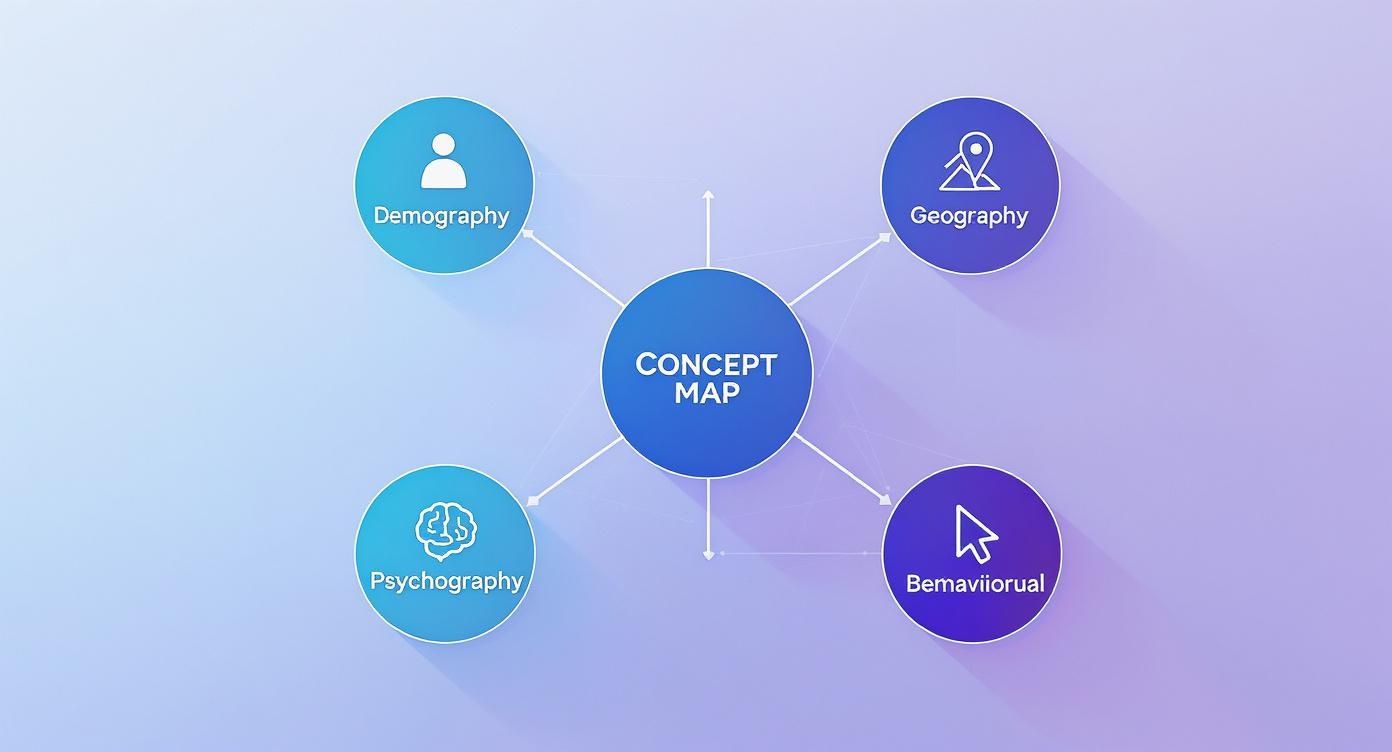
A concept map illustrating audience segmentation categories: demography, geography, psychography, and behavioral.

This map is a good reminder that you can view your audience through multiple lenses—from who and where they are to why and how they act.

SaaS Company Driving Upgrades with Behavioral Segmentation

The Problem: A mid-sized project management SaaS company had a problem. A huge chunk of their "Basic" tier users never even clicked on the more advanced features. This meant upgrade rates were flat, and worse, churn risk was high because these users weren't getting the full value. Their generic "Upgrade Now!" emails were going straight to the trash.

The Solution: They stopped blasting everyone and got smart with behavioral segmentation. They split their users into two simple, action-based groups right inside their platform:

  • "Power Users": These were the folks constantly hitting the limits of the Basic plan—running out of projects, maxing out storage. They were using every feature available to them.
  • "Under-Engaged Users": These customers logged in but stuck to just one or two basic functions, completely unaware of the more powerful tools they had access to.

"Power Users" got campaigns that felt like a secret handshake, showing them exactly how premium features would solve the bottlenecks they were already experiencing. Meanwhile, the "Under-Engaged Users" received gentle, educational content—like short video tutorials—highlighting a single advanced feature that would make their current workflow even better.

The Result: It worked. They saw a 35% increase in upgrades from the "Power Users" group in just three months. They also cut churn by 15% among the "Under-Engaged" segment, simply by helping them get more value from the product.

By focusing on what customers did (behavioral data) instead of just who they were, the company made every message feel relevant. They connected the dots between user actions and business outcomes.

Manufacturing Firm Tailoring Sales Pitches by Industry

The Problem: A manufacturer of industrial automation gear was spinning its wheels. Their sales team was pitching the same generic script to everyone, from car factories to pharmaceutical labs. The message wasn't landing because it failed to address the vastly different pain points and regulations in each sector.

The Solution: The marketing team switched gears to a firmographic segmentation strategy. They looked at their best customers and broke their target market into three core industries. Then, they built a completely separate playbook for each one.

  • The automotive segment saw case studies and emails all about boosting assembly line speed and cutting downtime.
  • The pharmaceutical segment got content that hammered on precision, FDA compliance, and sterile production—the things that actually keep them up at night.

The Result: By speaking each industry's language, the company boosted its marketing-qualified leads (MQLs) by a massive 50%. Even better, the sales cycle shrank by 20% because prospects were coming to the table already knowing the company understood their world.

Professional Services Firm Cross-Selling with Client History

The Problem: A digital marketing agency offered a full suite of services—SEO, PPC, content—but most clients only ever bought one. They knew they were sitting on a goldmine of cross-sell opportunities but had no systematic way to figure out who to approach and what to say.

The Solution: The agency dug into its own data, segmenting clients based on their transactional and behavioral history. They created a hyper-specific segment they called "SEO-Only Success Stories." These were clients who had seen a huge jump in organic traffic (a behavioral metric) from their SEO service (a transactional metric).

This group then received a highly personalized campaign. It showed them their own success and then explained how adding PPC could instantly capitalize on that newfound visibility to capture high-intent leads. They even wove in testimonials from similar clients, a tactic we break down in our guide on using voice of customer examples.

The Result: The campaign was a hit, converting 25% of those single-service clients into multi-service accounts. This dramatically increased their average client lifetime value without having to go out and find a single new customer.

How to Build Your Audience Segmentation Strategy

Alright, so we’ve covered the what and the why of segmentation. Now for the fun part: actually doing it. Moving from theory to a real, working strategy can feel like a huge leap, but it’s not. It's a step-by-step process, not some massive, all-at-once project.

Think of it like building with LEGOs. You don’t just dump the whole bin on the floor and hope a spaceship appears. You start with a plan, find the right pieces, and click them together thoughtfully. Let’s walk through the five essential steps to build your own strategy from the ground up.

A 'Segmentation Playbook' notebook on a wooden desk with a pen, plant, and laptop, showing a numbered list.

Step 1: Define Your Business Goals

Before you slice up your audience list, you have to answer one simple question: Why are we doing this? What's the business outcome you're trying to drive? Without a clear goal, you’ll end up with a bunch of interesting-but-useless segments.

This goal becomes your North Star. It guides every single decision you make from here on out. Are you trying to:

  • Increase customer lifetime value? Then you’ll probably segment based on purchase history to find juicy cross-sell opportunities.
  • Reduce churn? That means you'll want to segment by product usage to spot the accounts that are starting to drift away.
  • Improve lead conversion rates? Your focus would be on segmenting new leads by their industry or the specific pain point they came in with.

A well-defined goal—like "increase upgrade rates from our 'Freemium' user base by 15% in the next quarter"—provides the focus you need to build segments that actually move the needle. Start with the end in mind.

Step 2: Gather and Analyze Your Data

With your goal locked in, it’s time to find your LEGO bricks. This is all about pulling data from every place your customers interact with you. Good, clean data is the bedrock of any solid segmentation effort.

You’ll find gold in a few key places:

  • CRM: This is your home base for firmographics and basic account details like job titles, company size, and location.
  • Website Analytics: Tools like Google Analytics or Matomo are treasure troves of behavioral data. You can see which pages people visit, what features they click on, and how long they stick around.
  • Customer Surveys and Feedback: Don't be afraid to just ask. Direct feedback gives you rich psychographic insights into your customers' actual challenges, goals, and motivations that you can’t get anywhere else.

Once you have the data, you need to centralize it. For a deeper dive, there are great resources on building a data-driven customer segmentation strategy that can help you get this foundation right.

Step 3: Choose Your Segmentation Models

Now you get to decide how to group everyone. This is where you combine the different methods we talked about—demographic, behavioral, firmographic—to create segments that directly serve the goal you set in step one. A classic B2B starting point is to simply mix firmographics with behavior.

Actionable Comparison: Two Common Starting Models

Model NameDescriptionBest For
Value-Based SegmentationGroups customers by their economic value—past, present, or future. Think high-spend, mid-spend, and low-spend tiers.Businesses focused on maximizing revenue from existing customers and giving their high-value accounts the white-glove treatment.
Needs-Based SegmentationGroups customers based on the specific problems they're trying to solve or the benefits they want from your product.Companies with multiple products or features who need to make their marketing and sales messaging hyper-relevant.

The key is to start simple. Pick one or two models that make sense. You can always get fancier later.

Step 4: Develop Detailed Segment Profiles

Your segments can't just be rows in a spreadsheet. To be useful, they need to feel like real groups of people. This is where you build a simple profile or “persona” for each one, making it dead simple for your marketing and sales teams to know exactly who they’re talking to.

Give each segment a memorable name, like “Tech-Savvy Startups” or “Established Enterprise Accounts.” Then, flesh it out with their key characteristics, common pain points, and what motivates them. This is the step that turns raw data into a practical tool your whole company can rally around.

Step 5: Launch, Test, and Refine

Time to put your work into the wild. Pick one or two of your most promising segments and launch a targeted campaign. This could be anything from a tailored email sequence to a specific ad campaign on LinkedIn or even personalized content on your website.

And then? You measure everything. Track the metrics that matter for your goal—open rates, click-through rates, demo requests, conversion rates. Compare the results for each segment against your old, one-size-fits-all approach.

Segmentation isn't a "set it and forget it" project. It’s a living strategy. You’ll learn, you’ll tweak, and you’ll get better with every campaign. This is a cycle of continuous improvement.

How AI Is Reshaping Audience Segmentation

Manual audience segmentation has its place, but let's be honest—it has limits. It’s a bit like trying to sort a mountain of LEGO bricks by hand. You can group them by color and shape, but you'll miss the subtle patterns and the really interesting combinations.

AI is the supercomputer that sorts the entire pile in seconds, uncovering connections you never knew existed. It elevates segmentation from a static, rule-based chore into a dynamic, predictive engine. Instead of just looking at what customers have done, AI helps you see what they’re likely to do next.

A person in glasses views AI-powered data segments on a large interactive screen in a modern room.

This isn't just a minor tweak; it's a fundamental shift. We're moving beyond simple groupings to create fluid segments that adapt in real time as customer behavior changes.

And the market reflects this. The global AI market is on a trajectory to blast from $22.6 billion in 2020 to $190.6 billion by 2025. This explosive growth is driven by businesses like yours adopting AI-powered tools to make sense of overwhelmingly complex data.

From Reactive to Predictive Segmentation

The biggest change AI brings to the table is the move from being reactive to predictive.

Think about it. Machine learning algorithms can chew through massive datasets—purchase history, website clicks, support tickets, social media mentions—and spot hidden correlations a human analyst would almost certainly miss. The system learns which signals are most likely to predict a future action, like a purchase or, just as importantly, a cancellation.

This is the heart of predictive segmentation, a way of grouping customers based on their likelihood to do something.

  • Traditional Segmentation: "Let's pull a list of customers who haven't bought anything in 90 days." This is reactive. You're looking backward.
  • Predictive Segmentation: "Let's find customers who are showing the same behavioral red flags as the ones who churned last quarter—even if they just bought something yesterday." This is predictive. You're looking forward.

AI doesn't just categorize your audience; it forecasts their future needs. This lets you step in with the right message before a customer decides to look elsewhere or cancel their plan. It's a massive competitive advantage.

This analytical firepower is a game-changer for marketers. To see how this works under the hood, check out our guide on predictive analytics in marketing.

Hyper-Personalization at Scale

The other huge win from AI segmentation is hyper-personalization.

Traditional methods might let you personalize an email with a customer's name and recommend a product based on their last purchase. That’s a good start, but AI takes it leagues further. It can analyze an individual's entire journey with your brand and create a "segment of one."

This means the website content, product recommendations, and marketing messages can all change dynamically for each person. It’s the difference between a store clerk who remembers your last purchase and a personal shopper who knows your style, your budget, and what you’ll be looking for next season.

Comparing Personalization Approaches

AspectTraditional PersonalizationAI-Powered Hyper-Personalization
Data UsedBasic demographics, past purchasesEntire customer journey, real-time behavior, predictive scores
ExecutionManual, rule-based campaigns ("If this, then that")Automated, dynamic content that adapts to each user's actions
OutcomeRelevant content ("You bought X, you might like Y")Anticipatory experiences ("We know you like X, so here’s an exclusive look at Z before it launches")

This level of granular targeting used to be the exclusive domain of giants like Amazon or Netflix. Not anymore. Modern platforms are making it accessible for everyone.

For example, AI's impact extends well into lead generation, where it can dramatically improve how you segment and target prospects. It's why so many companies are now adopting AI-powered lead generation strategies to find high-value leads with far greater precision. This shift from broad targeting to individual engagement is how modern businesses build deeper, more profitable customer relationships.

Common Segmentation Mistakes to Avoid

So, you've decided to get serious about audience segmentation. That’s a huge step. But like any powerful strategy, there are a few classic ways it can go sideways. Knowing what segmentation is also means knowing where the landmines are buried.

Think of this as your field guide to sidestepping the traps that can turn a brilliant plan into a complicated mess. Nail these, and your segments will stay sharp, actionable, and tied directly to your business goals. Let's walk through the most common mistakes I've seen and a simple "Instead of This, Do That" fix for each one.

Over-Segmenting Your Audience

It’s tempting, I get it. You have all this data, and it feels productive to slice and dice your audience into a dozen or more hyper-specific groups. This is a classic rookie mistake. While it looks precise on a spreadsheet, you've just created a management nightmare. There's no way your team can create unique, meaningful campaigns for every single micro-segment.

Instead of: Creating 15 micro-segments that are impossible to manage. Do This: Focus on 4-6 high-impact segments that represent distinct, valuable groups. Prioritize quality and actionability over sheer quantity.

This approach lets you give each important segment the attention it deserves. It keeps you from letting the whole strategy collapse under its own weight.

Using Outdated or Stale Data

Your audience isn't frozen in time—people change, companies evolve, and priorities shift. A segment you built on data from six months ago might be completely useless today. Relying on old information is like navigating with an old map. You're going to get lost.

This is how you end up with misaligned messaging and wasted ad spend. The contact who was a "New Lead" last quarter might be a "Loyal Advocate" now. They need to be treated that way.

Stale vs. Fresh Data: The Bottom Line

MistakeThe Painful ConsequenceThe Simple Fix
Relying on old dataYour messaging feels tone-deaf and irrelevant, killing engagement and conversions.Refresh your data quarterly. Put a recurring reminder on your calendar to re-pull analytics and review your segment rules.
Ignoring real-time signalsYou miss golden opportunities to engage customers at critical moments, like right after a purchase.Integrate real-time behavioral triggers. Use marketing automation to move contacts between segments based on what they just did.

Creating Segments That Aren't Distinct

Here’s another common pitfall: building segments that bleed into each other. If your "Budget-Conscious SMBs" and your "Early-Stage Startups" groups are filled with mostly the same companies, your segments aren't different enough to matter. They lack clear lines.

Every segment should have unique DNA and require a distinct marketing angle. The sniff test is simple: if you can send the exact same email to two different segments, they probably shouldn't be two different segments.

  • Instead of: Having segments with 70% audience overlap.
  • Do This: Make sure each segment is clearly defined and mutually exclusive. Run a test on your criteria to confirm that less than 10% of your audience could reasonably fit into multiple segments. This clarity is what makes your targeting lethal.

By sidestepping these common errors, you're not just creating complexity. You're building a segmentation framework that’s tough, smart, and actually drives business results.

A Few Common Questions on Audience Segmentation

Jumping into segmentation usually brings up the same handful of questions. Let's tackle them head-on so you can move from theory to practice with confidence.

How Many Segments Should I Actually Create?

It’s easy to fall into the trap of creating a dozen hyper-specific segments, but that just creates noise and a ton of extra work. A good rule of thumb? Start with three to five high-impact segments.

Focus on the groups that will move the needle the most. Think "High-Value Repeat Customers," "At-Risk Churn Accounts," or "New Leads from Top-Tier Industries." You can always get more granular later, once you’ve nailed the process of targeting these core groups.

Audience vs. Market Segmentation—What’s the Real Difference?

This is a big one, and the distinction is crucial. The easiest way to think about it is with an analogy.

  • Market Segmentation: This is like looking at a map of the entire country. You're dividing the total potential market into logical groups, including millions of people who have never even heard of your company.
  • Audience Segmentation: This is like looking at your personal address book. You're focused on dividing your known contacts—the people already in your world, like existing customers, leads, and email subscribers.

The key difference is scope. Market segmentation is for high-level strategy, like product development or new market entry. Audience segmentation is for tactical marketing and communication with the people you can already reach.

How Often Should I Revisit My Segments?

Your segments aren't a "set it and forget it" project. People's needs and behaviors change, so your segments need to keep up. A good rhythm is to review them quarterly or right after any major marketing campaign.

When you do, ask yourself a couple of simple questions: Are these groups still distinct from one another? Are they still driving the results we expect? This regular check-in keeps your strategy sharp and prevents you from making decisions based on old, outdated assumptions.


Ready to stop guessing and start targeting with precision? marketbetter.ai uses AI to uncover your most valuable audience segments, automate personalized campaigns, and drive real growth. Discover how our AI-powered marketing platform can transform your strategy at https://www.marketbetter.ai.
10 Actionable Customer Segmentation Strategies for 2025

· 27 min read

In 2025, generic marketing messages are just noise. To capture attention and drive revenue, businesses must understand their customers on a deeper, more actionable level. This isn't about simply knowing who they are, but why they buy, how they behave, and what they truly need. The key to unlocking this understanding lies in deploying effective customer segmentation strategies.

This guide moves beyond surface-level definitions to provide an actionable, comparative roundup of the 10 most powerful approaches available today. We will dissect each strategy, compare its strengths and weaknesses, provide real-world examples, and offer step-by-step guidance on implementation. You will learn not just what each model is, but when to use it, how it compares to others, and the specific data required to make it work.

We will cover everything from foundational models like demographic and behavioral segmentation to more advanced approaches such as value-based and technographic segmentation. Each item is designed to provide a clear, practical framework for immediate application. To gain further insights into applying these methods, especially in a SaaS context, consider exploring this article on Top Customer Segmentation Strategies for SaaS. By the end of this comprehensive listicle, you'll have a clear roadmap for choosing and applying the right segmentation models to personalize your marketing, optimize your campaigns, and achieve measurable, sustainable growth.

1. Demographic Segmentation

Demographic segmentation is one of the most foundational and widely used customer segmentation strategies. It involves dividing your market into distinct groups based on observable, statistical characteristics. This approach operates on the principle that individuals with similar demographic profiles often share similar purchasing habits, needs, and media consumption patterns.

The primary variables used in this method include:

  • Age and Life Cycle Stage: Needs change dramatically from toddler to teenager to adult.
  • Gender: Certain products are inherently marketed differently to men and women.
  • Income and Occupation: Disposable income and professional roles heavily influence spending power and priorities.
  • Education Level and Family Size: These factors can impact lifestyle choices and product needs.

By leveraging this data, which is often readily available through surveys, census data, or analytics platforms, businesses can create broad but effective audience profiles.

When to Use Demographic Segmentation

This strategy is an excellent starting point for nearly any business. It’s particularly effective for mass-market products where broad trends are important. For example, a luxury car brand like Mercedes-Benz targets high-income individuals, while a toy company like LEGO focuses on households with children in specific age brackets. Similarly, AARP tailors its services exclusively for people aged 50 and over, a classic use of age-based demographic segmentation.

Key Insight: While powerful for initial targeting, demographic data reveals who is buying, but not why they are buying. For deeper insights, it must be combined with other segmentation types like psychographic or behavioral.

Actionable Tips for Implementation

  • Go Beyond the Obvious: Instead of just segmenting by "age," create a segment for "Millennials entering homeownership" which combines age with a life-cycle stage for more precise targeting.
  • Combine and Conquer: Layer demographic data with behavioral or geographic insights. A high-income urban Millennial behaves differently from a high-income suburban Gen X-er.
  • Keep Data Fresh: Demographics are not static. People age, change jobs, and move. Regularly update your customer data to ensure your segments remain accurate and relevant.

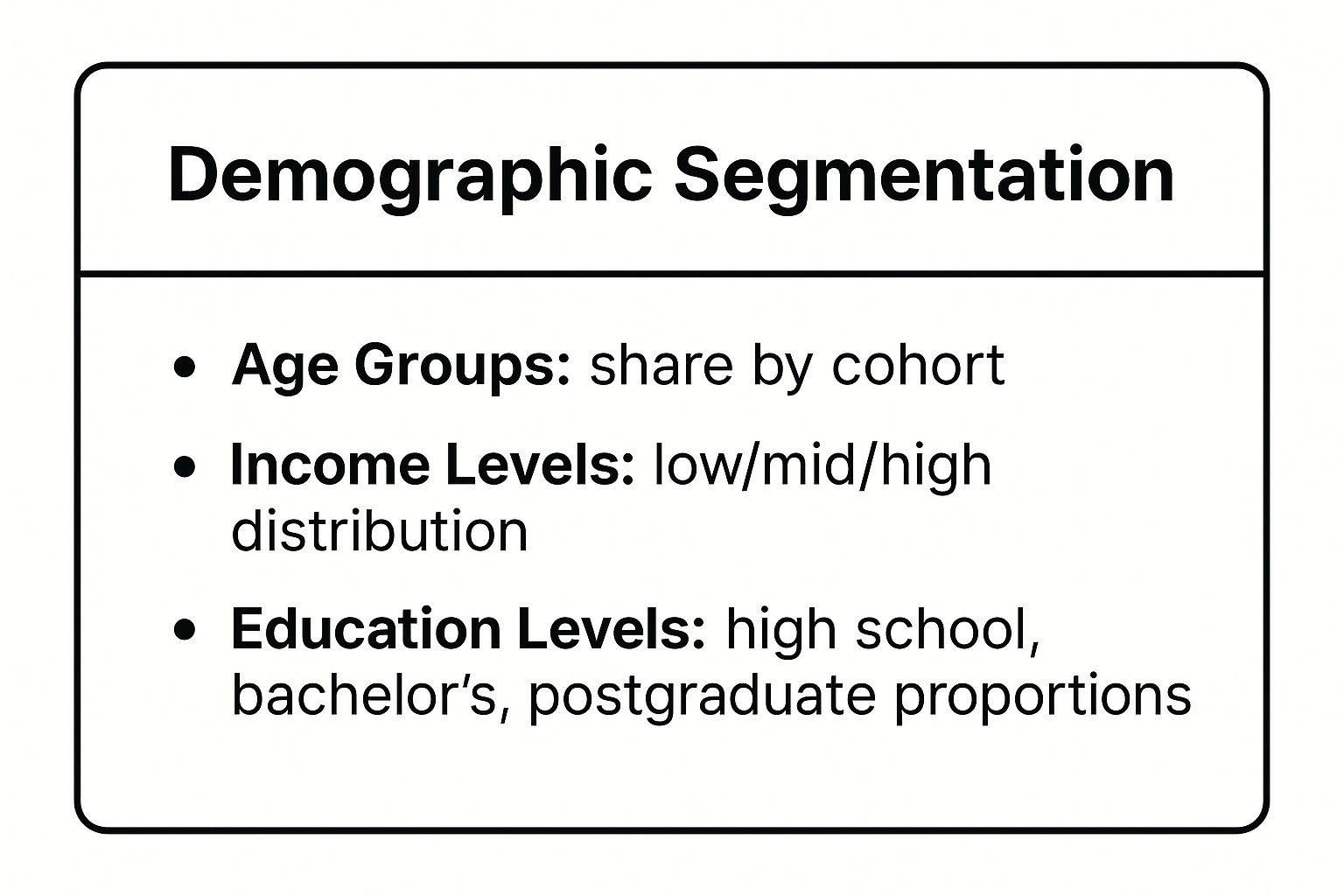
The following summary box visualizes how key demographic variables can be broken down for analysis.

Infographic showing key data about Demographic Segmentation

This visual breakdown highlights how a market can be segmented into distinct, quantifiable groups, allowing marketers to allocate resources more effectively. These clear distinctions form the basis of many successful customer segmentation strategies.

2. Psychographic Segmentation

Psychographic segmentation moves beyond the "who" of demographics to uncover the "why" behind consumer behavior. It categorizes customers based on psychological attributes like personality, values, attitudes, interests, and lifestyles (often summarized as AIO variables: Activities, Interests, and Opinions). Where demographics provide a skeleton, psychographics add the personality and motivation.

The primary variables used in this method include:

  • Lifestyle: How a person spends their time, from hobbies and entertainment to daily routines.
  • Values and Beliefs: Core principles that guide a person's decisions, such as environmentalism, family, or tradition.
  • Personality Traits: Characteristics like being an introvert, adventurer, or innovator.
  • Interests and Opinions: Attitudes towards social issues, politics, business, and specific products.

By analyzing these deeper motivations, businesses can craft messaging that resonates on an emotional and personal level, fostering stronger brand loyalty.

When to Use Psychographic Segmentation

This strategy is exceptionally powerful for brands in crowded markets where emotional connection is a key differentiator. It's ideal for products tied to identity, status, or personal values. For instance, Patagonia’s success is built on appealing to environmentally conscious outdoor enthusiasts who value sustainability. Similarly, Harley-Davidson targets a specific persona of freedom-seeking individualists, a psychographic profile that transcends age or income. Whole Foods Market also uses this approach by targeting consumers who prioritize health, wellness, and social responsibility in their purchasing decisions.

Key Insight: Psychographic segmentation provides the rich, qualitative context that demographic data lacks. It explains why a high-income, 30-year-old urban professional chooses a specific brand over its direct competitors, revealing their core motivations.

Actionable Tips for Implementation

  • Conduct In-Depth Research: Use surveys with Likert scale questions (e.g., "On a scale of 1-5, how important is sustainability in your purchases?") to quantify attitudes.
  • Leverage Social Media Insights: Monitor social media conversations and followings related to your brand to understand the interests and opinions of your audience.
  • Use Established Frameworks: Consider models like the VALS (Values and Lifestyles) framework as a structured starting point for classifying consumers into psychographic types.
  • Create Rich Personas: Build out your customer personas with psychographic details. Instead of just "Jane, 35," define "Eco-Conscious Jane," who values sustainability and community.

3. Behavioral Segmentation

Behavioral segmentation is one of the most powerful customer segmentation strategies, as it groups customers based on their actions and interactions with your brand. Unlike psychographics, which focuses on internal motivations, this method analyzes observable actions. It operates on the core principle that past behavior is one of the strongest predictors of future actions.

Behavioral Segmentation

The primary variables used in this data-driven approach include:

  • Purchase History: What products they buy, how often, and the average order value.
  • Usage Rate: How frequently they use a product or service (heavy, medium, or light users).
  • Brand Loyalty: Their level of commitment to your brand versus competitors.
  • Benefits Sought: The specific value they look for in a product, such as convenience, price, or quality.
  • Customer Journey Stage: Where they are in the lifecycle, from awareness to loyal advocate.

This method allows businesses to move beyond assumptions and create hyper-personalized marketing campaigns that resonate with demonstrated customer habits.

When to Use Behavioral Segmentation

This strategy is exceptionally effective for e-commerce, SaaS, and any business with a digital footprint where user actions can be easily tracked. For instance, Amazon's recommendation engine is a masterclass in behavioral segmentation, suggesting products based on a user's browsing and purchase history. Similarly, Spotify creates personalized playlists like "Discover Weekly" by analyzing listening habits, while the Starbucks Rewards program segments users by visit frequency and spending to offer tailored rewards.

Key Insight: Behavioral segmentation directly links marketing efforts to measurable actions. It reveals the why behind a purchase by focusing on the triggers and patterns that lead to conversion, making it highly actionable for personalization and retention campaigns.

Actionable Tips for Implementation

  • Implement RFM Analysis: For e-commerce, use Recency, Frequency, and Monetary value to identify your most valuable customers. Target high-RFM customers with loyalty perks and low-RFM customers with re-engagement offers.
  • Track Customer Lifecycle Stages: Segment users based on where they are in their journey. A new user needs onboarding content, while a long-time loyal customer might appreciate an exclusive preview.
  • Leverage Abandoned Cart Data: Create specific, automated email campaigns for users who abandon their carts, offering a reminder, a small discount, or social proof to encourage them to complete the purchase.

4. Geographic Segmentation

Geographic segmentation divides a market based on location, recognizing that customer needs and purchasing habits often vary significantly depending on where they live. While simpler than behavioral or psychographic methods, it provides essential context for product offerings and messaging. It operates on the principle that local culture, weather, and regulations directly influence consumer behavior.

Geographic Segmentation

The primary variables used in this customer segmentation strategy include:

  • Location: Ranging from global regions (e.g., North America, Southeast Asia) down to specific neighborhoods or postal codes.
  • Climate and Season: Weather conditions dictate demand for products like air conditioners, snow blowers, and seasonal apparel.
  • Population Density: Urban, suburban, and rural consumers have vastly different lifestyles, accessibility to stores, and needs.
  • Cultural Preferences: Local traditions and tastes can impact everything from product flavors to marketing messages.

By analyzing these geographic factors, businesses can make their products and campaigns more relevant to the people in a specific area, increasing engagement and sales.

When to Use Geographic Segmentation

This strategy is essential for businesses operating in multiple regions, whether nationally or internationally. It is particularly powerful for retail, food and beverage, and automotive industries. For instance, a fast-food chain like McDonald's adapts its menu to local tastes, offering the McSpicy Paneer in India and the Teriyaki McBurger in Japan. Similarly, The Home Depot stocks hurricane supplies in coastal Florida but prioritizes snow removal equipment in northern states like Minnesota. This approach ensures product offerings align with immediate, location-specific needs.

Key Insight: Geographic segmentation is about more than just language translation; it's about cultural and environmental translation. True success comes from understanding how a location shapes a customer's daily life and purchasing decisions.

Actionable Tips for Implementation

  • Combine with Demographics: Create "geodemographic" segments. For example, target high-income urban dwellers in New York City differently from high-income families in a Dallas suburb.
  • Leverage Localized Marketing: Run geo-targeted ad campaigns on platforms like Google Ads or Facebook to show specific offers to users within a certain radius of your store.
  • Adapt Products and Services: Don't assume a one-size-fits-all product will succeed everywhere. Analyze local climate, preferences, and regulations to make necessary adjustments.
  • Monitor Regional Economics: Keep an eye on local economic conditions, such as employment rates or housing market trends, as they directly affect the purchasing power within a segment.

5. Firmographic Segmentation (B2B)

Firmographic segmentation is the business-to-business (B2B) equivalent of demographic segmentation. It involves classifying organizations into distinct groups based on shared, observable company characteristics. While demographics focus on people, firmographics focus on organizations, providing a crucial framework for B2B targeting.

The primary variables used in this B2B-focused method include:

  • Industry: Classifying companies by their sector (e.g., SaaS, manufacturing, healthcare).
  • Company Size: Measured by annual revenue or number of employees.
  • Location: Geographic concentration, from country and state down to a specific city or region.
  • Organizational Structure: Such as privately held, publicly traded, or non-profit.

By leveraging firmographic data, B2B marketers can move beyond a one-size-fits-all approach and tailor their messaging, product offerings, and sales outreach to the specific context of their target accounts.

When to Use Firmographic Segmentation

This strategy is essential for any B2B company looking to implement an efficient and scalable sales or marketing motion. It is the cornerstone of Account-Based Marketing (ABM) and is crucial for creating Ideal Customer Profiles (ICPs). For instance, Salesforce offers distinct CRM solutions for small businesses versus global enterprises, a classic application of segmentation by company size. Similarly, a cybersecurity firm might focus its efforts on financial services and healthcare companies, industries where data security is a high-stakes priority.

Key Insight: Firmographic data tells you which companies to target, but not who within those companies holds the buying power or what technologies they currently use. It provides the "where to look," but must be layered with other data for precision.

Actionable Tips for Implementation

  • Build Your Ideal Customer Profile (ICP): Define the firmographic attributes of your best customers (e.g., "SaaS companies with 50-200 employees in North America") to focus your acquisition efforts.
  • Segment by Growth Stage: A fast-growing startup has different needs and a more agile buying process than a mature, established enterprise. Tailor your outreach accordingly.
  • Leverage B2B Data Tools: Use platforms like ZoomInfo, Clearbit, or the filters within LinkedIn Sales Navigator to gather accurate firmographic data. You can learn more about how to do this with LinkedIn prospecting automation.
  • Combine with Technographic Data: Enhance firmographic segments by layering in technographic data (the technologies a company uses). Targeting companies that use a complementary or competitive technology stack is a highly effective tactic.

6. Value-Based Segmentation

Value-based segmentation shifts the focus from who the customer is to what they are worth to the business. This highly strategic approach groups customers according to their economic value, which is typically measured by metrics like profitability, revenue potential, and most importantly, customer lifetime value (CLV). Unlike behavioral segmentation, which tracks actions, this model focuses solely on the financial impact of those actions.

The primary variables used in this method include:

  • Customer Lifetime Value (CLV): A prediction of the total profit a business will make from a customer throughout their entire relationship.
  • Average Order Value (AOV): The average amount a customer spends per transaction.
  • Purchase Frequency: How often a customer makes a purchase within a specific timeframe.
  • Profitability per Customer: The net profit attributed to a customer after accounting for all associated costs.

By analyzing these financial metrics, businesses can allocate resources, like marketing spend and customer service attention, much more effectively.

When to Use Value-Based Segmentation

This strategy is indispensable for businesses with varying customer profitability, especially in industries with high customer acquisition costs. It’s perfect for companies looking to optimize their loyalty programs, premium service offerings, and account management resources. For example, an airline’s tiered loyalty program (Silver, Gold, Platinum) is a classic application, offering superior perks to travelers who spend the most. Similarly, financial institutions provide private banking services with dedicated advisors exclusively for their high-net-worth clients, ensuring top-tier retention.

Key Insight: Value-based segmentation allows you to treat your best customers best. It moves marketing away from a one-size-fits-all model toward a system where investment is directly proportional to expected returns.

Actionable Tips for Implementation

  • Develop a CLV Model: Build a robust model that incorporates purchase history, frequency, and churn rate. A crucial aspect of value-based segmentation involves accurately estimating each customer's long-term potential, and further insights can be found on embedding domain knowledge for estimating customer lifetime value.
  • Create Tiered Service Levels: Design exclusive benefits, priority support, or special access for your top-tier customers, as Sephora does with its VIB Rouge program. This enhances loyalty and encourages lower-tier customers to spend more.
  • Identify High-Potential Customers Early: Use predictive analytics and AI-powered tools to spot new customers who exhibit behaviors similar to your existing high-value segment. Discover how you can implement this with AI-powered lead scoring.
  • Target Win-Back Campaigns: Don’t just focus on current high-value customers. Create targeted campaigns to re-engage previously valuable customers who have become inactive.

7. Needs-Based Segmentation

Needs-based segmentation is a powerful customer-centric strategy that groups customers based on the specific problems they are trying to solve or the benefits they are seeking. Instead of focusing on who the customers are (demographics) or what they have done (behavioral), this approach prioritizes the why behind their purchase decisions. It is built on the understanding that customers "hire" products or services to get a job done.

This method requires a deep understanding of customer motivations, pain points, and desired outcomes. Key variables include:

  • Functional Needs: The practical, tangible requirements a customer has (e.g., a car that is fuel-efficient).
  • Emotional Needs: The feelings a customer wants to experience (e.g., feeling secure or successful).
  • Social Needs: How a customer wants to be perceived by others (e.g., seen as environmentally conscious).
  • Specific Pain Points: The frustrations or challenges a customer is currently facing.

By identifying these core needs, businesses can align product development, messaging, and service delivery to provide maximum value to distinct customer groups.

When to Use Needs-Based Segmentation

This strategy is exceptionally effective for product innovation, value proposition design, and competitive markets where differentiation is key. It helps businesses move beyond feature-based competition to create solutions that genuinely resonate. For example, Airbnb successfully caters to diverse traveler needs: budget-conscious backpackers, families needing space, business travelers seeking amenities, and luxury seekers wanting unique experiences. Similarly, Nike offers distinct product lines for various athletic needs, from elite marathon runners to casual gym-goers.

Key Insight: Needs-based segmentation uncovers the true "job" a customer is trying to accomplish. This shifts the focus from selling a product to providing a solution, which builds stronger customer loyalty and pricing power.

Actionable Tips for Implementation

  • Embrace the "Jobs-to-be-Done" Framework: Use this theory, popularized by Clayton Christensen, to uncover the underlying progress your customers are trying to make when they buy your product.
  • Conduct Voice-of-Customer Research: Use in-depth interviews, surveys, and focus groups to directly ask customers about their challenges, goals, and frustrations.
  • Map Features to Needs: Create a clear matrix that links each of your product's features to the specific customer needs it fulfills. This helps prioritize development and refine marketing messages.
  • Build Need-Based Personas: Develop customer personas that are defined by their goals and pain points rather than just their demographic profiles. Understanding these motivations allows for more effective person-level identification and targeting.

The video below offers a deeper dive into the "Jobs-to-be-Done" theory, which is a cornerstone of effective needs-based customer segmentation strategies.

By understanding the "why," you can create more compelling offers and build a more resilient brand that is anchored in solving real customer problems.

8. Technographic Segmentation

Technographic segmentation groups customers based on the technology they use, from their hardware and software stack to their preferred digital platforms. This modern approach is crucial in a tech-driven world, especially for B2B companies, SaaS providers, and digital agencies. It provides a technical layer of insight that firmographic data alone cannot, showing how a company works, not just what it is.

The primary variables used in this method include:

  • Software Stack: CRM, ERP, marketing automation, or analytics platforms currently in use.
  • Hardware: Server infrastructure, mobile devices, or other physical tech.
  • Digital Adoption: Usage of social media platforms, cloud services, or e-commerce technologies.
  • Technical Sophistication: From early adopters of cutting-edge tech to laggards using legacy systems.

By analyzing this data, businesses can pinpoint opportunities, predict needs, and tailor their messaging to a prospect's specific technological environment.

When to Use Technographic Segmentation

This strategy is indispensable for technology companies and B2B marketers. It enables highly targeted and relevant outreach that speaks directly to a prospect’s existing infrastructure. For instance, a cybersecurity firm can target companies using specific cloud platforms known to have certain vulnerabilities. Similarly, HubSpot can identify businesses using a competitor’s marketing automation tool and create a campaign highlighting its superior features and seamless migration process. A Shopify app developer would use it to target merchants who already have a complementary app installed, ensuring a perfect product fit.

Key Insight: Technographic data tells you how a customer operates. This is a powerful advantage over competitors using broader strategies, as it allows you to frame your product not just as a solution, but as the next logical step in their technology evolution.

Actionable Tips for Implementation

  • Leverage Data Tools: Use platforms like BuiltWith, Datanyze, or Clearbit to uncover the technology stacks of your target accounts without manual research.
  • Target Complementary Tech: Identify companies using technologies that integrate well with your own. If you sell a specialized analytics tool, target users of CRMs that you have a native integration with.
  • Segment by Adoption Curve: Classify prospects based on Everett Rogers' "Diffusion of Innovation" theory. Target "early adopters" for beta programs and "early majority" for scalable, proven solutions.
  • Create Competitive Campaigns: Directly target users of competing software. Highlight your key differentiators, offer competitive pricing, or showcase an easier user interface to encourage them to switch.

9. Generational Segmentation

Generational segmentation divides a market based on the shared life experiences of different birth cohorts. This strategy operates on the idea that historical events, technological changes, and cultural shifts during a person's formative years create distinct values, attitudes, and purchasing behaviors. It's a specific application of demographic (age) and psychographic (values) segmentation, combining them into powerful, culturally relevant profiles.

The primary variables in this method group people by their shared context:

  • Baby Boomers (born ~1946-1964): Shaped by post-war optimism and economic growth.
  • Generation X (born ~1965-1980): Known for independence and skepticism, having grown up during a time of social change.
  • Millennials (born ~1981-1996): The first digitally native generation, valuing experiences and authenticity.
  • Generation Z (born ~1997-2012): True digital natives, prioritizing social responsibility, inclusivity, and short-form content.

By analyzing these generational lenses, businesses can tailor messaging, product features, and communication channels to resonate more deeply with each group’s core motivations.

When to Use Generational Segmentation

This approach is highly effective for brands whose products or messaging rely heavily on cultural relevance, values, or communication styles. For instance, TikTok’s entire platform is built around the short-form, trend-driven video content that appeals directly to Gen Z. In contrast, AARP successfully serves Baby Boomers by focusing its products and content on retirement, health, and financial security, which are key concerns for that generation. It's also useful for financial services, where Robinhood captured Millennial and Gen Z investors with its mobile-first, commission-free trading model that challenged traditional brokerage firms.

Key Insight: Generational segmentation provides a powerful cultural context that demographic age data alone lacks. However, it's crucial to avoid broad stereotypes, as individual behavior within a generation can vary significantly.

Actionable Tips for Implementation

  • Avoid Stereotypes: Use generational traits as a starting point, not a rigid rule. A Millennial parent has different needs than a Millennial just entering the workforce.
  • Adapt Communication Channels: Engage Gen Z on platforms like TikTok and Instagram, Millennials through social media and email, and Baby Boomers via Facebook and more traditional channels.
  • Focus on Core Values: Align your brand’s message with the values that define a generation. For Gen Z, this might mean highlighting sustainability and ethical practices.
  • Layer with Other Segments: Combine generational insights with behavioral or psychographic data for a more nuanced and accurate customer profile. A high-income, urban Millennial will have different priorities than a rural one.

10. Occasion-Based Segmentation

Occasion-based segmentation is a powerful strategy that groups customers based on specific moments or situations when they purchase or use a product. This approach moves beyond who the customer is (demographics) or what they think (psychographics) to focus on the context of their buying decision. It is a subset of behavioral segmentation, but it focuses specifically on the timing and triggers of behavior rather than on long-term patterns.

The primary variables in this method revolve around timing and context:

  • Time of Day/Week/Year: Promoting different meal types at different times (e.g., breakfast vs. late-night snacks).
  • Life Events: Targeting customers during major milestones like weddings, graduations, or anniversaries.
  • Holidays and Seasons: Aligning marketing with specific holidays like Valentine's Day or seasonal needs like summer travel.
  • Usage Situation: Differentiating between a product used for a routine personal need versus one purchased as a special gift.

By understanding the context of a purchase, businesses can deliver highly relevant offers and messages precisely when customers are most receptive. This is a key element of effective customer segmentation strategies.

When to Use Occasion-Based Segmentation

This strategy is exceptionally effective for industries where context heavily influences purchasing decisions, such as retail, food and beverage, and travel. For example, a greeting card company like Hallmark segments its entire business around occasions: birthdays, holidays, and sympathy. Similarly, Coca-Cola markets its products differently for a family meal compared to a large social party or on-the-go refreshment. Hotels also use this by targeting business travelers with different packages during the week and leisure travelers on weekends.

Key Insight: Occasion-based segmentation focuses on the purchase trigger rather than the customer profile. It answers the question, "When and why are they buying right now?" This allows for real-time marketing that can capture immediate intent.

Actionable Tips for Implementation

  • Create an Occasion Map: Brainstorm and map out all the potential occasions, both common and unique, where customers might use your product or service.
  • Develop Contextual Messaging: Craft advertising copy, promotions, and creative assets that speak directly to the specific occasion. A "back-to-school" campaign should look and feel different from a "summer vacation" one.
  • Use Predictive Analytics: Leverage data to anticipate upcoming occasions. For instance, send an anniversary promotion to a customer who bought an engagement ring a year ago.
  • Bundle for the Moment: Create product bundles or packages tailored for specific events, like a "game day snack pack" or a "new home essentials kit," to increase the average order value.

Customer Segmentation Strategies Comparison

Segmentation Type🔄 Implementation Complexity⚡ Resource Requirements📊 Expected Outcomes💡 Ideal Use Cases⭐ Key Advantages
Demographic SegmentationLow - straightforward data gatheringLow - census & market researchBasic groupings by age, gender, income; easy targetingConsumer packaged goods, retail, financial servicesSimple, cost-effective, data easily available
Psychographic SegmentationHigh - deep qualitative researchHigh - surveys, interviews, analysisRich insights into motivations and valuesLuxury, lifestyle brands, automotive, travel, hospitalityDeeper customer understanding; emotional connections
Behavioral SegmentationMedium - requires robust trackingMedium to High - analytics toolsActionable, data-driven targeting based on behaviorE-commerce, SaaS, subscriptions, retailHighly measurable; tied to revenue and conversions
Geographic SegmentationLow - location-based dataLow to Medium - GIS, geofencingLocalized marketing; adapts to climate and cultureRetail chains, restaurants, real estate, tourismCost-effective; supports logistics and local adaptation
Firmographic SegmentationMedium - B2B company data collectionMedium - public & proprietary dataTargeted B2B marketing and account prioritizationB2B software, professional services, industrial equipmentFocused on company traits; supports account-based sales
Value-Based SegmentationHigh - requires sophisticated analyticsHigh - predictive modeling toolsMaximized ROI by focusing on high-value customersSubscription services, financial, luxury, B2BOptimizes resource allocation; improves profitability
Needs-Based SegmentationHigh - deep customer research neededHigh - interviews, ethnographyCustomer-centric product innovation and value offersProduct development, SaaS, healthcare, diverse marketsAligns offerings directly with customer needs
Technographic SegmentationMedium to High - tech usage trackingMedium to High - data toolsUnderstanding tech stack and digital maturityB2B SaaS, tech vendors, marketing agencies, IT servicesPrecise targeting for tech compatibility and adoption
Generational SegmentationLow - based on birth cohortsLow - demographic dataCultural and behavioral targeting by generationConsumer goods, media, education, financial servicesCaptures cultural context; guides communication styles
Occasion-Based SegmentationMedium - requires timing & context insightMedium - predictive analyticsTimely, context-relevant marketing; increased frequencyRetail, hospitality, restaurants, event-driven productsSupports seasonal/event campaigns; enhances relevance

From Strategy to Action: Implementing Your Segmentation Plan

We’ve explored a comprehensive roundup of the most effective customer segmentation strategies available today, from the foundational demographic and geographic models to the more nuanced behavioral, psychographic, and value-based approaches. Each strategy offers a unique lens through which to view your customer base, providing the clarity needed to move beyond generic, one-size-fits-all marketing.

The core takeaway is this: customer segmentation is not about choosing a single, perfect model. Instead, the most powerful and profitable strategies emerge from the intelligent combination of multiple approaches. True market leadership is achieved not by just knowing about demographic or behavioral segmentation, but by layering them to create a multi-dimensional, actionable customer persona. For example, a B2B company might start with firmographic data (company size, industry) and then layer on technographic insights (what CRM they use) and behavioral signals (which C-level executives engaged with a recent webinar) to identify its most qualified leads.

Synthesizing Your Segmentation Approach

The journey from understanding these strategies to implementing them requires a clear, goal-oriented plan. Simply collecting data is not enough; the value lies in its strategic application. Ask yourself: what business outcome are we trying to achieve? Is it to reduce churn, increase customer lifetime value, or break into a new market? Your answer will determine which segmentation model serves as your foundation.

  • For Boosting Retention: Start with Behavioral Segmentation. Identify at-risk customers based on declining engagement, product usage, or purchase frequency. Then, layer in Value-Based Segmentation to prioritize your efforts on retaining your most profitable customers first.
  • For Acquiring High-Value Customers: Begin with Psychographic and Needs-Based Segmentation. Understand the core motivations, pain points, and desired outcomes of your ideal customer profile. Use this to craft resonant messaging that speaks directly to their aspirations, rather than just their demographic profile.
  • For Driving Cross-Sells and Upsells: A combination of Behavioral and Value-Based Segmentation is key. Analyze past purchase history to identify customers who have bought complementary products before. From there, you can build predictive models to target similar segments with personalized offers.

Putting Your Plan into Action: A Quick Guide

Transitioning from theory to practice can feel daunting, but it can be broken down into manageable steps. The key is to embrace an iterative process of testing, learning, and refining. Segmentation is not a static, "set it and forget it" project.

  1. Define Clear, Measurable Goals: What does success look like? Be specific. "Increase conversion rates for our premium tier by 15% in Q3" is a much stronger goal than "get more customers."
  2. Gather and Consolidate Your Data: Pull information from your CRM, analytics platforms, customer surveys, and sales team feedback. Centralize this data to get a single, unified view of your customer.
  3. Choose Your Primary and Secondary Models: Select a primary segmentation model that aligns directly with your goal. Then, choose one or two secondary models to add depth and precision.
  4. Develop Segment-Specific Campaigns: Create tailored messaging, offers, and content for each of your top 2-3 priority segments. Don't try to target everyone at once.
  5. Test, Measure, and Iterate: Launch your campaigns and closely monitor the results. Use performance data to validate your segments and refine your approach. Did your "high-value, tech-savvy" segment respond as expected? If not, why? Use these insights to continuously improve your customer segmentation strategies.

By moving from abstract knowledge to concrete action, you transform customer data from a passive repository of information into a dynamic engine for sustainable growth. This strategic focus is what separates market leaders from the rest, allowing you to build deeper relationships, deliver exceptional value, and ultimately drive superior business results.


Ready to move beyond manual analysis and unlock the full potential of your customer data? marketbetter.ai uses advanced AI to automate the entire segmentation process, from identifying your most valuable customer groups to launching personalized campaigns at scale. Turn insight into action and see measurable results faster by visiting marketbetter.ai to learn more.