The Top 10 Email Subject Line for Sales Strategies That Win in 2026
In a world of automated outreach and overflowing inboxes, the email subject line for sales has evolved from a simple curiosity trigger into a critical strategic tool. A great subject line doesn't just earn an open; it sets the stage for the entire conversation. It signals relevance, establishes credibility, and aligns your solution with a prospect's most urgent priorities before they even read the first sentence of your message.
Getting this first touchpoint right is foundational. Understanding the strategic importance of your email subject line for sales is key to mastering customer communication, a tech-driven skill every online seller needs. The difference between a subject line like "Quick Question" and one like "Idea for [Prospect's Goal]" is the difference between being ignored and starting a meaningful dialogue. The former is generic and self-serving, while the latter is specific, valuable, and prospect-centric.
This guide goes beyond generic templates that get your emails deleted. We'll dissect 10 battle-tested subject line categories, providing actionable comparisons and tactical breakdowns for each. You will learn:
- The psychological principles behind high-performing subject lines.
- How to craft compelling copy for both first-touch and follow-up emails.
- Actionable strategies for personalizing outreach at scale.
- Practical A/B testing methods to identify what resonates with your audience.
We will provide specific, replicable examples and analyze why they work, comparing effective and ineffective approaches side-by-side. Get ready to turn your subject lines into your sharpest outbound weapon and book more meetings.
1. Curiosity Gap Subject Lines
Curiosity is a powerful psychological trigger, and a well-crafted email subject line for sales can leverage it to dramatically boost open rates. This strategy, often called creating an "open loop," works by intentionally withholding a key piece of information, compelling the recipient to click and discover the answer. Instead of revealing the full benefit upfront, you create a mystery that can only be solved by opening the email.
Strategic Breakdown
The key to a successful curiosity gap subject line is relevance. Generic clickbait like "You won't believe this" is transparent and damages credibility. Instead, anchor your curiosity in something specific to the prospect's world, such as their company, industry, or a recent action they took. This approach shows you've done your homework and aren't just sending a mass blast.
Examples in Action
- Weak: "A quick question"
- Strong: "[First Name], one thought on [Company Name]'s recent launch" — This is highly specific and timely, making the recipient wonder what insight you have about their big news.
- Weak: "Checking in"
- Strong: "A question about your [Department]'s process" — This directly targets the recipient's professional role and implies you've identified a potential gap or opportunity.
- Weak: "Some ideas for you"
- Strong: "Is this your top priority for Q3?" — This feels personal and urgent, prompting the prospect to open the email to see what "this" refers to.
Actionable Takeaways
To make this strategy work, follow these specific tactics:
- Deliver Immediately: The email's first sentence must immediately satisfy the curiosity. If you promise a question about their company, ask it right away. Action: Draft your email body first to ensure your subject line has a clear payoff in the opening line.
- A/B Test Against Benefits: Compare curiosity-driven subject lines (e.g., "A thought on your MQL process") against benefit-driven ones (e.g., "A way to double your MQL conversion"). This helps you understand what resonates with your audience. Action: Run a 100-email test, sending 50 of each type, and measure the reply rate, not just opens. Tools like marketbetter.ai can automate this testing.
- Context is King: Never use a curiosity gap subject line in a completely cold email without context. It’s most effective when you can reference a recent blog post they read, a webinar they attended, or a mutual connection. Action: Before sending, find one piece of context (LinkedIn post, company news) to anchor your subject line.
2. Personalized Trigger-Based Subject Lines
Moving beyond basic personalization like a first name, trigger-based subject lines reference a specific, recent event related to the prospect or their company. This approach transforms a cold email into a timely, relevant conversation starter. By tying your outreach to a real-world signal like a funding round, new hire, or content download, you demonstrate that you've done your research and have a legitimate reason for reaching out now.
Strategic Breakdown
The power of a trigger-based email subject line for sales lies in its immediacy and context. Unlike a generic benefit-focused subject line, a trigger-based one answers the prospect's unspoken question: "Why are you emailing me today?" This strategy is highly effective because it aligns your solution with a moment of change or growth for the prospect's company, making your message feel less like an interruption and more like a well-timed opportunity.
Examples in Action
- Weak: "Congratulations!"
- Strong: "Congrats on the Series B funding, [Company Name]" — This acknowledges a major milestone and positions your outreach as supportive, implying you have a solution that can help them manage their new growth.
- Weak: "Your new product"
- Strong: "Saw your new [Product] launch yesterday" — This is incredibly timely and shows you're paying close attention to their business. It creates a natural entry point to discuss how you can support their new offering.
- Weak: "Hiring update"
- Strong: "Just noticed [Company Name] is hiring for [Role]" — Referencing a specific job posting allows you to connect your value proposition directly to a stated need, such as improving efficiency for a growing team.
Actionable Takeaways
To execute this strategy effectively, focus on precision and speed:
- Pair Signal with Substance: The signal you reference in the subject line must be immediately connected to the value you offer in the email's opening sentence. Action: Use this template for your first line: "Saw you [trigger event], which often means companies struggle with [problem you solve]. We help by..."
- Test Signal Freshness: The impact of a trigger event diminishes over time. A signal from yesterday will almost always outperform one from three weeks ago. Action: Create two email templates—one for signals <48 hours old and another for signals 1-2 weeks old. Measure the difference in reply rates.
- Leverage Intent Data: Use tools that provide real-time intent signals, such as website visits or content engagement, to automate and scale this process. Action: Set up alerts using a tool like marketbetter.ai to get notified of fresh signals for your target accounts, allowing you to act within hours, not days.
3. Benefit-Driven Subject Lines with a Twist
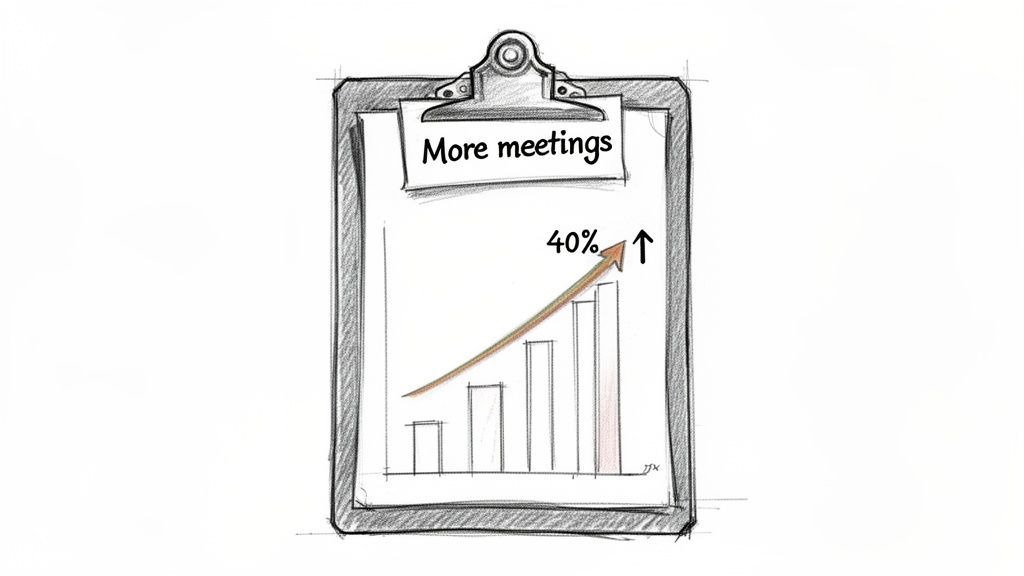
Leading with a clear, quantifiable benefit is a classic sales approach, but it often gets lost in a sea of generic promises. This strategy revitalizes the benefit-driven email subject line for sales by adding a specific, personalized twist. It moves beyond vague claims like "Increase your ROI" and instead presents a tangible, relevant outcome tied directly to the prospect's company, role, or industry, making it impossible to ignore.
Strategic Breakdown
The power of this technique comes from its blend of value and specificity. A generic benefit is easy to dismiss, but a benefit grounded in the prospect's reality creates instant credibility and relevance. By including a detail like their industry, a competitor they know, or a metric their role is judged on, you signal that this isn't a mass email. You're speaking their language and promising a solution to a problem they actively face.
Examples in Action
- Weak: "Increase meetings and save time"
- Strong: "[Company Name] SDRs: 40% more meetings, 20% less prep time" — This is highly targeted, calling out the company and the specific roles (SDRs) while offering two compelling, quantifiable outcomes.
- Weak: "How companies save time"
- Strong: "SaaS companies like [Competitor] cut dialing time by 50%" — This uses social proof by naming a competitor, making the benefit feel achievable and directly relevant to their market.
- Weak: "Improve team efficiency"
- Strong: "Cut cold email research time in half for your team" — This focuses on a common pain point (time-consuming research) and promises a significant efficiency gain, which is a key priority for any sales leader.
Actionable Takeaways
To execute this strategy effectively, use these precise tactics:
- Reinforce Immediately: The first sentence of your email must connect directly to the benefit promised in the subject line. Action: If your subject line claims "40% more meetings," start your email with: "Companies like yours use our platform to get 40% more meetings by..."
- Segment Your Data: Pull success metrics from customer segments that mirror the prospect's company profile. A claim is more believable if it's from a peer. Action: Create a simple spreadsheet mapping your case studies to industries and company sizes. Refer to it before every outreach sequence.
- Test Benefit Magnitude: A/B test different numbers. Does "35% more pipeline" get a better open rate than "40% more pipeline"? Sometimes a slightly more conservative number can feel more credible. Action: Run a test comparing a specific number (e.g., 37%) versus a rounded one (e.g., 40%) to see which performs better with your audience.
4. Problem-Agitator Subject Lines
This approach to writing an email subject line for sales goes straight for the pain point. Instead of hinting at a solution, you lead by naming a specific, frustrating problem your prospect likely faces. This strategy works by creating instant relevance and demonstrating empathy, making the recipient feel understood and more inclined to see what you have to say. When you accurately diagnose a prospect's challenge in the subject line, you position yourself as a problem-solver from the very first interaction.
Strategic Breakdown
The power of a problem-agitator subject line lies in its accuracy. A generic guess will fall flat, but a well-researched, specific problem makes your outreach feel less like a cold email and more like a timely intervention. This technique is especially potent for sales development representatives (SDRs) targeting personas with well-defined, industry-standard challenges. By articulating their pain better than they can, you immediately establish credibility and authority.
Examples in Action
- Weak: "Time management issues?"
- Strong: "SDRs still spending 3 hours on research daily?" — This is highly specific and quantifiable, calling out a common time-wasting activity that resonates with sales leaders.
- Weak: "Email problems"
- Strong: "Cold emails not getting replies? Let's talk why" — A direct and conversational subject line that targets a universal frustration for anyone in a sales or marketing role.
- Weak: "CRM challenges"
- Strong: "[Company Name] struggling with call logging in Salesforce?" — This shows you've done your homework by naming the prospect's company and a common CRM-related issue, making it highly personalized.
Actionable Takeaways
To effectively implement this strategy, focus on precision and empathy:
- Validate the Problem: Before sending, use context clues from job descriptions, LinkedIn posts, or case studies to validate the prospect is likely facing this issue. Action: Spend 2 minutes reviewing the company’s recent job postings for roles you impact. The job description is a goldmine of stated problems.
- Use Qualifier Language: Avoid absolutes that can seem presumptuous. Words like "likely," "struggling with," or posing it as a question soften the claim and invite dialogue. Action: Change "You are losing deals because..." to "Struggling with [problem]?" to be less accusatory.
- Compare Against Curiosity: Test a problem-focused subject line like "Low MQL to SQL conversion?" against a curiosity-based one like "A thought on your MQL process." Action: Split your next prospect list in two and send each a different version. Track which one generates more qualified meetings using a platform like marketbetter.ai.
- Align with High Intent: This strategy is most effective for prospects showing high-intent signals, such as visiting your pricing page or downloading a problem-focused whitepaper. Action: Set up an automated sequence with problem-agitator subject lines that triggers only for high-intent website visitors.
5. Question-Based Subject Lines (Provocative)
Posing a provocative question in an email subject line for sales directly engages the prospect's analytical mind. Unlike curiosity gaps that create a mystery, this approach frames a specific, relevant business problem as a direct question, prompting introspection and positioning your email as a potential solution. It assumes the prospect is already aware of the challenge and invites them into a dialogue about it.
Strategic Breakdown
The power of a question-based subject line lies in its ability to immediately qualify the reader. If the question resonates with a real pain point, the recipient is compelled to open the email to see if you understand their problem and have a credible answer. This method is rooted in consultative selling principles like SPIN, focusing on the problem before ever mentioning a solution. It's a direct challenge to the status quo.
Examples in Action
- Weak: "Question about your tech stack"
- Strong: "Is your dialer actually inside Salesforce?" — This is a hyper-specific technical question that instantly segments the audience. A sales leader using a disconnected dialer will feel this pain point immediately.
- Weak: "Thinking about your challenges"
- Strong: "[First Name], what's your biggest blocker with cold outreach?" — This open-ended, personalized question invites a genuine response and opens the door for a consultative conversation rather than a hard pitch.
- Weak: "Can you improve your team?"
- Strong: "Want to cut your SDR ramp time from 3 months to 6 weeks?" — While a yes/no question, this frames a powerful benefit in a way that feels less like a claim and more like a challenge, daring the recipient to find out how.
Actionable Takeaways
To effectively use this provocative email subject line for sales, apply these tactics:
- Focus on Measurable Outcomes: Your question should point to a specific business metric or operational inefficiency. Action: Frame your question around time, money, or risk. For example, instead of "Is your process slow?" ask, "How many hours a week do your reps lose to manual data entry?"
- Prioritize Open-Ended Questions: Questions that can't be answered with a simple "yes" or "no" are more likely to elicit a thoughtful response. Action: For your top-tier accounts, change yes/no questions like "Are you struggling with X?" to open-ended ones like "How are you approaching X in Q3?"
- Personalize with Persona Data: Tailor your question to the recipient's role. A VP of Sales cares about ramp time, while an SDR manager is focused on daily workflow blockers. Action: For each of your key personas, write down their #1 KPI. Craft three questions that directly relate to improving that KPI.
- Test Against Direct Statements: Compare a question like "Is your team hitting quota?" against a statement like "A new way to hit quota." Action: Run an A/B test to see if your audience responds better to direct inquiry or bold claims. The results may vary by seniority level.
6. Time-Sensitive / Scarcity Subject Lines
Urgency is a powerful motivator that drives immediate action. A time-sensitive email subject line for sales taps into the psychological principle of scarcity, signaling that an opportunity is limited or a deadline is approaching. This method compels prospects to prioritize your email over others by linking your message to a specific, tangible timeline, preventing it from being archived for "later."
Strategic Breakdown
The effectiveness of this strategy hinges on credibility. Artificial urgency, such as a "limited-time offer" with no real deadline, can erode trust and make your outreach feel like generic marketing spam. The most successful scarcity-based subject lines are anchored to real-world events that are verifiable and relevant to the prospect, such as an upcoming industry conference, a company earnings call, or the end of a fiscal quarter.
Examples in Action
- Weak: "Urgent: Read now"
- Strong: "[Company Name] is hiring: quick question about your outbound strategy" — This connects your outreach to a public signal of growth (hiring), creating a timely and relevant reason to discuss their strategy now.
- Weak: "Meeting before the event?"
- Strong: "Before [Industry Conference] next week, let's align on your pipeline goals" — This creates a hard, non-negotiable deadline (the conference date), making a pre-event conversation a logical priority.
- Weak: "End of quarter"
- Strong: "[First Name], closing window for Q4 planning - 3 weeks left" — This is highly relevant for decision-makers, as it ties directly into their own internal planning cycles and responsibilities.
Actionable Takeaways
To execute this strategy without damaging your reputation, follow these tactics:
- Anchor to Real Events: Tie your urgency to verifiable public information. Use signal data like hiring trends, technology adoption, or event attendance to justify your timing. Action: Set up Google Alerts for your top 20 accounts for terms like "hiring," "funding," and "launch."
- Be Transparent: Clearly state the deadline or event in the subject line. Ambiguity undermines the entire premise. Action: Compare "Before the end of the month" with "Before the Nov. 30th deadline." The specific date is almost always more effective.
- Perfect Your Timing: Send the email 3-5 days before the actual deadline or event. This provides enough time for the prospect to see, open, and act on your message without feeling rushed. Action: Schedule these emails in your sales engagement platform to go out automatically at the optimal time.
- Pair with Value: The email body must deliver on the urgency. Offer a specific insight or resource that is genuinely more valuable before the deadline passes. Action: Create a "pre-event" one-pager with insights relevant to the conference and attach it to your email to justify the time-sensitive outreach.
7. Social Proof / Authority Subject Lines
Leveraging social proof is a fundamental principle of influence, and it translates powerfully into an email subject line for sales. This strategy works by referencing a credible third party, a well-known customer, or a specific achievement to build instant trust and reduce the recipient's perceived risk. Instead of asking a prospect to believe your claims, you're showing them that their respected peers or competitors already do.
Strategic Breakdown
The effectiveness of a social proof subject line hinges on relevance and specificity. A generic "Trusted by thousands" is weak, but mentioning a direct competitor or a similar-tier company in the prospect's industry creates an immediate connection. The prospect's thought process shifts from "Who is this?" to "If my competitor is using this, I need to know why." This tactic borrows authority, making your cold outreach feel more like a warm, relevant introduction.
Examples in Action
- Weak: "How we help our customers"
- Strong: "Helps teams at [Competitor/Peer Company] close 30% more deals" — This is a double-win. It names a direct competitor and ties it to a quantifiable, high-value result.
- Weak: "See how we help companies like yours"
- Strong: "[Company Name] & [Similar Tier Company] cut SDR ramp time by 50%" — Mentioning a company of similar size or status makes the results feel achievable and directly applicable to the prospect's own challenges.
- Weak: "As seen in the news"
- Strong: "Recommended by [Industry Authority or Publication]" — This borrows credibility from a trusted source within the prospect's ecosystem, positioning your solution as vetted and reliable.
Actionable Takeaways
To make this strategy work, follow these specific tactics:
- Get Permission: Always ensure you have permission before name-dropping a customer. A case study or public testimonial is your best source of approved proof. Action: Create a central repository of approved customer logos and case studies for your sales team to easily access.
- Test Specificity: A/B test a specific customer name against a broader category. Action: Compare "How [Competitor Company] solved X" with "How SaaS leaders solve X" to see which resonates more with your target persona. The former works best when you have a direct, well-known competitor.
- Connect to the Body: The social proof in the subject line must be the focal point of your email's opening. Action: Immediately expand on the result you referenced, providing a link to a case study or a direct quote in the first two sentences.
8. Contrarian / Challenger Subject Lines
Inspired by "The Challenger Sale," this advanced email subject line for sales is designed to disrupt the prospect's status quo. Instead of agreeing with common assumptions, it introduces a provocative, contrarian viewpoint that challenges their current thinking. This positions you not as a vendor selling a product, but as a strategic partner with a unique and valuable perspective.
Strategic Breakdown
The goal of a challenger subject line is to make the recipient pause and reconsider a deeply held belief about their business. It works by creating cognitive dissonance, sparking enough curiosity and professional intrigue to earn an open. This approach is not about being aggressive; it's about being insightful and demonstrating that you understand their world so deeply you can identify a flaw in their common strategy.
Examples in Action
- Weak: "A better way to email"
- Strong: "Cold email isn't dying. Your approach is." — This directly confronts a common industry complaint and promises a new perspective, making it irresistible for a sales leader struggling with outreach.
- Weak: "How to grow your sales team"
- Strong: "[Company Name], you don't need more SDRs - you need better systems" — This challenges a typical solution (hiring more people) and suggests a more efficient, systemic fix, appealing to leaders focused on scalability.
- Weak: "Sales tips"
- Strong: "Forget outreach volume. Here's what actually moves the needle." — This speaks directly to the "more is better" mindset and offers a smarter, alternative path to achieving key results.
Actionable Takeaways
To execute this strategy effectively, follow these precise tactics:
- Earn the Right: Only use this on well-researched, high-value accounts. You must have evidence to support your claim. Action: Reserve this for Tier 1 accounts where you've spent at least 15 minutes researching their specific situation.
- Back It Up Immediately: The first line of your email must substantiate the claim with a compelling data point or a sharp insight. Action: After "Forget outreach volume," start with "Our data from 1M+ emails shows personalized multi-touch sequences outperform high-volume cadences by 3x."
- Test Against Safer Bets: A/B test your challenger subject lines against benefit-driven or curiosity-based alternatives. This will show you which segments are receptive to a provocative approach. Action: Use a tool like marketbetter.ai to track which messaging drives meetings, not just opens, as this style can sometimes generate opens from curiosity without buying intent.
9. Reciprocity / Value-First Subject Lines
The principle of reciprocity is a fundamental aspect of human psychology: when someone gives you something of value, you feel an innate obligation to give something back. A well-executed email subject line for sales can trigger this response by leading with genuine, no-strings-attached value. This strategy positions you as a helpful resource rather than just another salesperson, building trust and rapport from the very first interaction.
Strategic Breakdown
The core of this approach is to offer a valuable insight, resource, or piece of data directly in your subject line. Unlike curiosity-based subject lines that create a mystery, this method is transparent about the benefit. The key is that the value must be specific, relevant, and genuinely useful to the prospect's role or industry. Generic offers are easily dismissed, but a targeted piece of analysis shows you understand their challenges and have something tangible to contribute.
Examples in Action
- Weak: "Some data for you"
- Strong: "[Company Name]: How your SDR productivity compares" — This offers a competitive benchmark, a highly valuable piece of information for any sales leader looking to optimize their team.
- Weak: "Free resource"
- Strong: "[First Name], free analysis of your website's lead capture" — This is incredibly specific and promises a personalized assessment of a critical business function, making it almost irresistible to open.
- Weak: "Tips for your strategy"
- Strong: "3 reasons your cold email strategy isn't working (+ fix)" — This subject line not only identifies a common pain point but also promises a solution, framing the email as immediate, actionable advice.
Actionable Takeaways
To effectively implement value-first subject lines, follow these guidelines:
- Deliver Value Instantly: The value promised must be delivered immediately in the email body. Don't use it as bait to get a click to a blog post. Action: If you promise an analysis, include 2-3 bullet points of your findings directly in the email text itself.
- Be Hyper-Specific: Vague offers like "Helpful resource inside" are ineffective. Action: Instead of "A report on your industry," try "Data on [competitor]'s marketing spend for Q3."
- Test Against Pain Points: Compare value-driven subject lines (e.g., "A benchmark for your SDR team") against pain-point-driven ones (e.g., "Frustrated with low SDR meeting rates?"). Action: Use a tool like marketbetter.ai to determine if your audience responds better to a promised gain or the solution to a current problem.
- Use as a Nurture Tactic: While it can work for a first touch, this strategy is exceptionally powerful in a follow-up sequence. Action: Create a 3-step sequence. Step 1: Intro. Step 2 (if no reply): Follow up with a value-first subject line like "A resource for your [Job Title] role."
10. Role-Specific / Segmented Subject Lines
Speaking directly to a prospect's job function is one of the most effective ways to craft a compelling email subject line for sales. This strategy moves beyond simple name personalization and tailors the message to the specific challenges, goals, and language of a particular role or department. It demonstrates immediate relevance and shows the prospect that you understand their unique world, instantly setting your email apart from generic, one-size-fits-all blasts.
Strategic Breakdown
The power of role-specific subject lines comes from leveraging buyer persona research. Instead of sending the same message to a VP of Sales and a RevOps Manager, you create distinct messaging that addresses their different priorities. A sales leader cares about ramp time and quota attainment, while a RevOps manager is focused on data integrity and process efficiency. Acknowledging this difference in the subject line proves you've done your homework and have a relevant solution.
Examples in Action
- Weak: "A tool for sales leaders"
- Strong: "VP of Sales: Cut SDR onboarding from 3 months to 6 weeks" — This subject line combines the recipient's title with a specific, quantifiable outcome directly tied to their responsibilities.
- Weak: "Fix your Salesforce data"
- Strong: "RevOps Manager: Salesforce call logging-solved" — This is incredibly direct, naming a common, frustrating pain point for this specific role and offering a definitive solution.
- Weak: "Help for your SDRs"
- Strong: "Head of SDR: Your team might be missing this obvious win" — This creates curiosity while speaking the language of a sales development leader who is always looking for an edge to improve team performance.
Actionable Takeaways
To make this strategy work, follow these specific tactics:
- Create Persona-Specific Variations: Develop 3-5 distinct subject line templates, each one mapped to a key buyer persona. Action: Build a simple "persona card" for each role that lists their top 3 priorities. Write one subject line for each priority.
- Mirror the Message: The promise made in the role-specific subject line must be the immediate focus of the email body. Action: If your subject line is for a RevOps Manager about Salesforce logging, the first sentence must address that exact topic. Don't bury the lead.
- Test Against Generic Messaging: A/B test your role-specific subject lines against more general, benefit-driven ones. Action: For your next campaign, send 50% with a generic subject like "A new way to boost sales" and 50% with a role-specific one like "VP of Sales: A new way to boost sales." Measure the reply rate difference.
- Update Personas Quarterly: Business priorities and pain points shift. Action: Set a recurring calendar reminder to review your persona messaging with your marketing and product teams each quarter to ensure it remains relevant.
10 Sales Email Subject Lines Compared
| Subject Line Type | Implementation 🔄 (complexity) | Resources 💡 (requirements) | Expected Outcomes ⭐📊 | Ideal Use Cases | Key Advantages ⚡ |
|---|---|---|---|---|---|
| Curiosity Gap Subject Lines | Moderate — simple copy but needs contextual personalization and strong follow-up | Low–Medium — copywriting + some account/context signals | ⭐📊 Large open lift (often 35–50%+); CTR may be lower if body doesn't deliver | Cold outreach to new accounts; follow-ups after no response; intent-signaled prospects | ⚡ Quick to craft, mobile-friendly, drives opens |
| Personalized Trigger-Based Subject Lines | High — requires real-time signal integration and validation | High — intent data, automation, real‑time feeds, verification | ⭐📊 Very high open/relevance (40–60%+); better replies/connects when accurate | Priority accounts, first-touch on fresh intent, signal-driven campaigns | ⚡ Extremely relevant; reduces unsubscribe risk and fuels conversations |
| Benefit-Driven Subject Lines with a Twist | Medium — needs credible metrics and tailored benefit framing | Medium — customer metrics, account research, persona fit | ⭐📊 Strong open→reply conversion when claims are believable | Busy C‑level and manager personas; persona-targeted campaigns; follow-ups | ⚡ Clear value reduces friction; easy to A/B test |
| Problem-Agitator Subject Lines | Medium–High — needs accurate diagnosis and careful tone | Medium — task/context checks, intent signals, persona insight | ⭐📊 High engagement for accurately identified pains; risk of misfires | Mid‑market+/warmed prospects; sequences targeting known pain points | ⚡ Triggers emotional resonance and prompts conversation |
| Question-Based Subject Lines (Provocative) | Low–Medium — templatable but must be specific and thoughtful | Low–Medium — persona data, focused copywriting | ⭐📊 Higher cognitive engagement vs. statements; variable opens if generic | Strategic accounts, consultative selling, multi‑touch outreach | ⚡ Invites replies and discovery; easy to personalize at scale |
| Time‑Sensitive / Scarcity Subject Lines | Medium — must tie to real events and timing | Medium — event calendars, signal tracking, honest deadlines | ⭐📊 Increased CTR and immediate action when urgency is genuine; short shelf life | Follow‑ups tied to events (funding, conferences), seasonal campaigns | ⚡ Drives fast action and reduces procrastination |
| Social Proof / Authority Subject Lines | Medium — requires verifiable proof and careful selection | Medium–High — case studies, customer lists, approvals, relevant examples | ⭐📊 Lowers trust barriers; higher replies from decision‑makers evaluating options | Enterprise/mid‑market outbound; competitor-targeting; evaluation-stage prospects | ⚡ Builds credibility quickly; boosts reply rates from influencers |
| Contrarian / Challenger Subject Lines | High — needs strong research and confident, evidence-backed claims | Medium–High — data, thought leadership, tailored messaging | ⭐📊 High opens/replies with receptive audiences; risk of alienation if wrong | Strategic/high‑value accounts; forward‑thinking personas; thought leadership outreach | ⚡ Differentiates from competitors; sparks dialogue |
| Reciprocity / Value‑First Subject Lines | Medium — requires creating & delivering genuine value up front | High — bespoke analysis, reports, actionable insights | ⭐📊 Higher trust and engagement; slower path to conversion but better relationship | High‑value/complex deals, C‑level relationship building, warmed prospects | ⚡ Builds rapport and triggers reciprocity; lowers unsubscribe risk |
| Role‑Specific / Segmented Subject Lines | Medium–High — needs segmentation strategy and template maintenance | High — persona mapping, list hygiene, dynamic templates, testing | ⭐📊 Significant relevance lift (20–30%+ open increases) and improved reply quality | Multi‑threaded outreach, complex B2B deals, campaigns targeting multiple stakeholders | ⚡ Targets the right buyer; improves conversion and reply relevance |
From Theory to Execution: Activating Your Subject Line Strategy
You've just explored ten distinct, powerful frameworks for crafting an effective email subject line for sales. We’ve moved beyond generic templates, diving deep into the psychological triggers that drive opens, clicks, and, most importantly, replies. From sparking intrigue with the Curiosity Gap to leveraging timely Personalization and agitating problems your prospect is actively trying to solve, the goal is clear: your subject line is the tip of the spear in your entire sales motion.
The difference between a mediocre and a masterful subject line isn't just a few percentage points on your open rate. It's the difference between being deleted and starting a conversation that leads to a closed deal. The key is to stop thinking in terms of one-off "tricks" and start building a strategic, adaptable system.
Synthesizing the Strategies: From List to Live Cadence
The true power of these examples is unlocked when you see them not as a menu to pick from, but as a toolkit to combine and deploy based on context. A new SDR might start with a straightforward, Benefit-Driven subject line. It's a low-risk, high-clarity approach. In contrast, a seasoned BDR targeting a C-level executive who has ignored previous outreach might deploy a bold Contrarian or a hyper-specific Question-Based subject line to break through the noise.
Actionable Comparison: For a first touch, a Trigger-Based subject line ("Saw you're hiring SDRs") is often superior to a generic Benefit-Driven one ("Improve SDR performance"). The trigger provides immediate, undeniable relevance that the benefit alone lacks. For a follow-up, a Value-First line ("A benchmark for your new SDR team") can re-engage a prospect by offering help instead of just asking for their time again.
Your subject line strategy must be as dynamic as your prospects themselves.
The Litmus Test: Moving Beyond Open Rates
Let’s be brutally honest: open rates are a vanity metric if they don't lead to action. An intriguing subject line that leads to a disappointing email body creates a negative brand impression. Your primary metrics for subject line success should be reply rate and meetings booked. These are the indicators of true engagement.
To get there, you must embrace systematic testing. Don't just test random ideas; test entire strategies against each other. For your next campaign targeting a specific persona, try this:
- Group A (Control): Use your current best-performing subject line style.
- Group B (Challenger): Test a completely different framework. If you normally use Benefit-Driven lines like "A better way to manage X," test a Curiosity Gap approach like "question about your Q3 goals."
Actionable Step: Create a simple tracking sheet with columns for "Subject Line," "Strategy Type," "Emails Sent," "Opens," "Replies," and "Meetings Booked." After sending 100 emails for each group, calculate the reply and meeting rates. This data, not just opens, will tell you the real winner.
Activating Your Strategy with Intelligent Workflows
The final, critical piece is operationalizing this intelligence. A brilliant subject line is useless if it’s sent to the wrong person at the wrong time. This is where modern sales tools bridge the gap between theory and revenue. An SDR shouldn't spend an hour searching for the perfect trigger event and another 30 minutes crafting the perfect personalized subject line. The process must be scalable.
Platforms like marketbetter.ai are designed for this exact purpose. They integrate with your CRM to monitor buyer signals, such as a prospect's company posting a relevant job or a key executive engaging with your content. The system then prompts your sales team with an AI-generated, context-aware email and subject line, turning a powerful strategy into a repeatable, daily workflow. This ensures that every high-impact email subject line for sales you've learned about is delivered with perfect timing and relevance, transforming your outbound efforts from a guessing game into a data-driven science.
Ready to stop guessing and start executing a world-class sales email strategy? marketbetter.ai turns the buyer signals and subject line tactics from this article into a prioritized, AI-powered workflow directly inside your CRM. See how you can build a repeatable pipeline-generating machine by visiting marketbetter.ai today.