
How to Generate Leads for B2B: 11-Step Playbook That Built $2M Pipeline [2026]
Generating B2B leads isn't just about blasting emails and hoping for the best. It's a two-part play: first, you build a rock-solid strategic foundation, and then you execute hyper-targeted campaigns. The whole process starts with knowing your ideal customer inside and out and ends with handing off sales-ready relationships. Get this right, and lead gen stops being a guessing game and starts being a predictable revenue engine.
Building Your B2B Lead Generation Foundation
Jumping straight into tactics without a plan is like building a house without a blueprint—it’s destined to crumble. To get a steady stream of high-quality B2B leads, you have to lay the groundwork first. This phase isn't about flashy campaigns; it’s about deep strategic work that makes every future marketing dollar you spend more effective.
And this foundational work is critical. Lead generation is still the lifeblood of B2B marketing, with a staggering 91% of marketers calling it their most important goal. Yet, the data shows that up to 80% of new leads never convert into sales. That’s a massive disconnect, and it screams for a quality-first approach, not just chasing volume.
Defining Your Ideal Customer Profile
First things first: you need a razor-sharp Ideal Customer Profile (ICP). This goes way beyond surface-level details like company size or industry. A truly useful ICP is a detailed portrait of the perfect company to sell to—the one that gets the most value from your solution, sticks around the longest, and is your most profitable.
Think of it as the difference between a blurry photo and a high-resolution image. A weak ICP says, "tech companies with 50-200 employees." A strong, actionable one gets specific: "SaaS companies between 75-150 employees in the FinTech space that just hired a VP of Sales and are struggling with CRM data integration." See the difference?
To get that level of clarity, here's what to do:
- Action Step 1: Analyze Your Best Customers. Pull a list of your top 10 happiest, most successful clients. Interview them. Find the common threads—their business model, their tech stack, the exact problems they were trying to solve before they found you.
- Action Step 2: Talk to Sales and Success. Schedule 30-minute interviews with your top sales rep and a customer success manager. Ask them: "What are the real pain points that make someone buy?" and "What are the objections that kill a deal in its tracks?"
- Action Step 3: Map Their Buying Journey. Who’s actually involved in the decision? What content do they need at each stage? Create a simple flowchart that outlines who needs what information, and when, to move a deal forward.
For a deeper dive into organizing your target audience, check out our comprehensive guide on customer segmentation strategies.
Uncovering Market Gaps with Competitor Analysis
Once you know exactly who you're targeting, you need to understand the competitive landscape. The goal isn't to copy your competitors. It's to find the gaps they've left open—the underserved customer needs, the marketing channels they’re ignoring, or the messaging they haven't claimed.
For example, if all your competitors are banging the drum about "enterprise-grade security," you might find an opening by positioning your solution around "effortless implementation for mid-market teams."
Actionable Tactic: Don't just read your competitors' websites. Go to G2 or Capterra and filter their reviews for 1, 2, and 3-star ratings. This is a goldmine for finding unmet needs and common frustrations you can solve. Note down the exact language customers use to describe their problems.
This chart shows what happens when you nail these foundational pieces, comparing metrics like ICP match rate against the crucial MQL-to-SQL handoff.
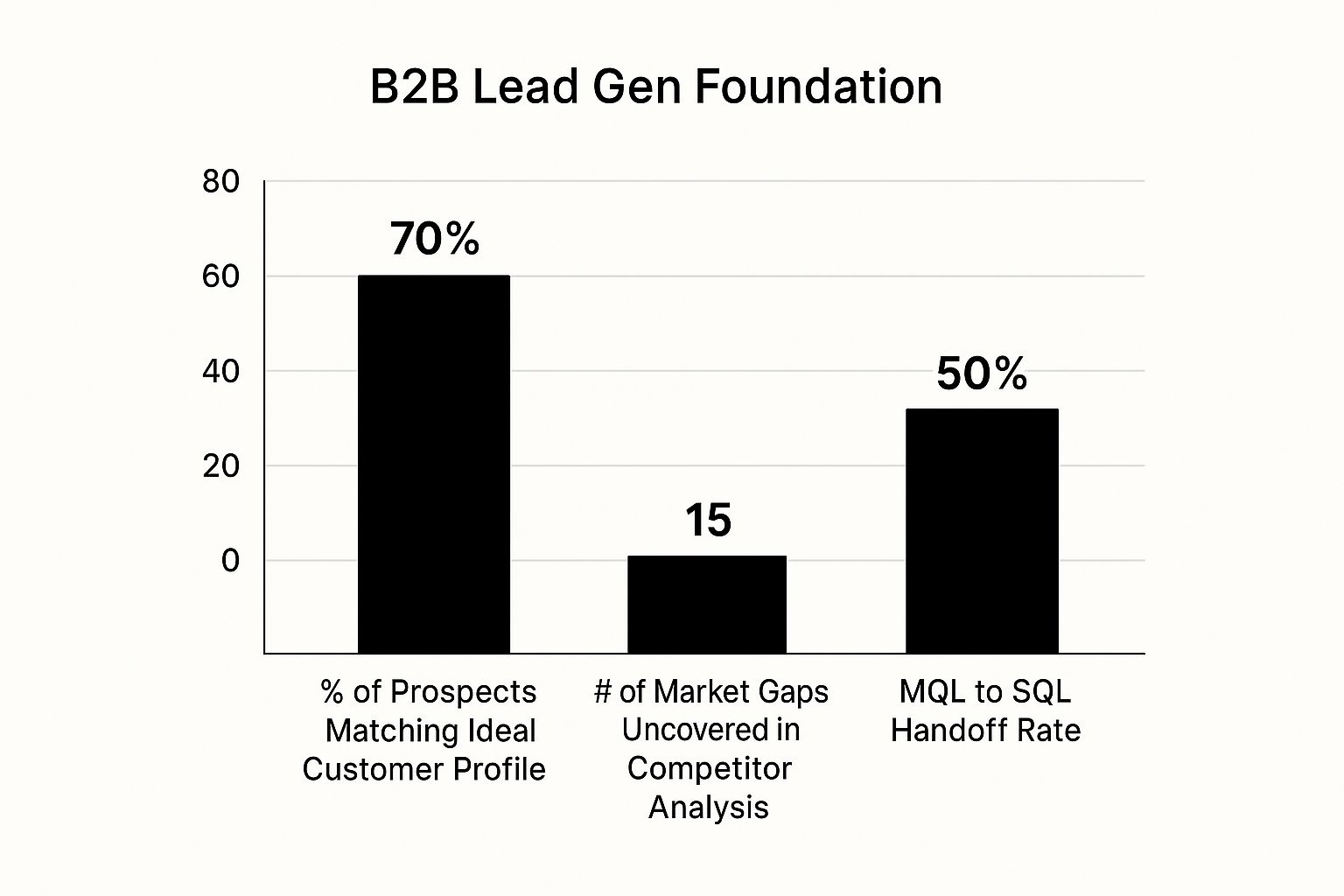
The data is clear: a stronger foundation—meaning better ICP alignment and competitor insight—leads directly to a more efficient sales handoff and plugs the leaks in your funnel.
Creating a Sales and Marketing Service Level Agreement
Finally, let's talk about the most common point of failure in B2B lead gen: the chasm between sales and marketing. Marketing generates leads, sales says they’re junk, and the whole process grinds to a halt. This friction kills momentum and wastes a ton of money.
The fix is a formal Service Level Agreement (SLA). This isn’t just a document; it’s a pact between the two teams that defines the rules of engagement. It answers the hard questions:
- What exactly qualifies a lead as a Marketing Qualified Lead (MQL)? (e.g., Downloaded an eBook AND works at a company of 50+ employees).
- What actions turn an MQL into a Sales Qualified Lead (SQL)? (e.g., Attended a demo OR requested a price quote).
- What’s the agreed-upon time for sales to follow up on an SQL? (e.g., 24 hours maximum).
- What’s the process for handing leads back to marketing for more nurturing? (e.g., A specific "Nurture" status in the CRM).
Getting this shared language and process down on paper eliminates the finger-pointing. It ensures a seamless handoff and transforms your lead generation efforts into a cohesive, revenue-focused machine.
Mastering Inbound Marketing for a Sustainable Lead Flow
Outbound is about chasing. Inbound is about attracting. It’s the difference between knocking on doors and having your ideal customers line up at yours. When you get it right, inbound marketing becomes a powerful magnet—a system that pulls in, engages, and qualifies leads 24/7. It’s no longer a nice-to-have; it’s the core of any predictable B2B growth engine.

The data tells the story. Confidence in old-school outbound is cratering, with just 18% of marketers believing it delivers high-quality leads. The real action is online, where a sharp digital presence is fueling modern B2B growth. If you want to dive deeper, check out these complete B2B sales statistics to see just how much the game has changed.
Before we get into the inbound weeds, it helps to see how it stacks up against its outbound counterpart. They're two sides of the same coin, each with its own strengths.
Inbound vs Outbound Lead Generation Strategies
Here’s a quick breakdown of how these two core approaches compare, from how they work to what they cost and where they shine.
| Strategy | Approach | Cost Per Lead | Sales Cycle | Best For |
|---|---|---|---|---|
| Inbound Marketing (SEO, Content) | Attracts prospects with helpful content and resources, pulling them into your orbit. | Lower over time | Longer | Building long-term brand authority and a sustainable, scalable lead pipeline. |
| Outbound Marketing (Cold Calls, Email) | Proactively reaches out to a targeted list of prospects, pushing a message out to them. | Higher upfront | Shorter | Generating immediate meetings and targeting specific high-value accounts (ABM). |
Ultimately, the strongest B2B strategies don't choose one or the other—they blend both. But for creating that sustainable, always-on engine, inbound is where you lay the foundation.
B2B SEO: Finding Keywords That Signal Buying Intent
Getting tons of website traffic is a B2C game. For B2B, the only traffic that matters is the right traffic. That means targeting keywords that scream "I have a business problem and I need to solve it now"—the exact problem your product fixes.
A comparison highlights the difference. Someone searching "what is CRM" is just kicking tires (informational intent). But a search for "CRM for manufacturing companies" shows someone actively looking for a solution in their industry (commercial intent). That's a warm lead.
To dig up these high-intent keywords, here's your action plan:
- Action Step 1: Brainstorm Problem-Based Searches. List the top 5 pain points your product solves. Turn them into "how to" or "fix" queries (e.g., "how to reduce sales cycle length" or "improve marketing attribution").
- Action Step 2: Hunt for Comparison Keywords. Use an SEO tool to find searches like "[Your Competitor] alternative" or "[Your Product Category] pricing." Anyone searching these is deep in the buying cycle.
- Action Step 3: Identify Feature-Specific Terms. Look for queries like "salesforce integration for email marketing" that signal a very specific technical need you can fulfill.
Once you have these keywords, don't just throw them on your blog. Your core service and solution pages are your money pages in B2B. Optimize them. This is where serious buyers land to see if you can actually solve their problem.
Content Marketing That Converts
A blog is table stakes. Real B2B content marketing creates high-value assets that prospects will gladly trade their contact information for. These are your lead magnets, and you need to match the format to the buyer.
An engineer will download a dense, 20-page technical white paper. A CFO? They want to plug numbers into an ROI calculator and see the business case in 60 seconds.
Here's a look at how three popular lead magnets stack up in the real world:
| Lead Magnet Format | Best For | Why It Works | Downside |
|---|---|---|---|
| White Papers & eBooks | Establishing deep expertise on complex topics. | Positions your brand as a thought leader. Perfect for prospects in the early research phase. | Can be a slog to create and might feel less urgent or interactive than other options. |
| Webinars | Demonstrating your product to an engaged live audience. | The real-time interaction is gold. You can answer questions and build personal connections at scale. | Takes serious promotion to get people to show up and a confident speaker to keep them engaged. |
| ROI Calculators & Tools | Grabbing the attention of bottom-of-funnel prospects. | These give instant, personalized value and help buyers build a solid business case for your solution. | Can be tricky to develop and requires a deep understanding of your customer's financial drivers. |
Choosing the right format isn't a trivial decision—it directly impacts the quality and type of leads you generate.
Leveraging LinkedIn for Genuine Authority
LinkedIn isn't just a digital Rolodex. For B2B, it's a powerhouse for building authority, talking directly with prospects, and getting your best content in front of the right eyeballs. The numbers back it up: B2B companies with active blogs generate 67% more leads, and LinkedIn is the number one place to amplify that content.
Actionable Tactic: Don't just post a link and run. Pull a key insight, stat, or quote from your content. Turn it into a native LinkedIn text post that starts a conversation. Then, drop the link to the full article in the first comment. The algorithm favors native content and this approach sparks more engagement.
Let's compare the two approaches:
- The Passive Approach: A company posts a link: "Check out our new case study!" It gets a handful of likes, mostly from their own employees. Crickets.
- The Authority-Building Approach: A marketing director pulls the single most surprising statistic from that case study. They write a short post on what that stat means for the industry, ask a smart question, and then drop the link to the full study in the comments. This sparks debate, positions them as an expert, and drives clicks from people who are genuinely interested.
This is how you turn a passive content library into an active conversation starter—generating leads who already see you as someone they can trust.
Executing Targeted Outbound and Paid Campaigns
Inbound marketing is a fantastic long-term play, like planting an orchard. But sometimes, you need fruit now. This is where targeted outbound and paid campaigns come in. They give you the speed and precision to spark conversations with high-value accounts, test new messaging, and keep the pipeline full while your inbound engine gets up to speed.

Let's be clear: this isn't about spamming the masses. Modern outbound is a surgical strike, not a carpet bomb. When you learn how to generate leads for B2B, you realize it’s all about controlling your timing and targeting with absolute accuracy. Forget those stale, impersonal templates. Success today is built on real personalization and coordinating your outreach across multiple channels.
Crafting Outbound Sequences That Actually Get Replies
The first rule of modern outbound? Stop selling and start a conversation. Your only goal with that first email isn't to close a deal—it's just to get a response. That means shifting away from generic pitches and toward genuinely helpful, personalized outreach.
It all starts with a rock-solid, curated list. Stop buying massive, stale contact databases. Instead, fire up tools like LinkedIn Sales Navigator or ZoomInfo to build a small, hyper-focused list of people who are a perfect match for your Ideal Customer Profile (ICP).
With your list in hand, you can build a multi-step sequence that uses a few different touchpoints. Here's an actionable template:
- Day 1: Email 1 (The Hook). Lead with a personalized insight. Did their company just announce something? Do you have a shared connection? Did you notice a problem relevant to their role? Start there.
- Day 3: Email 2 (The Value Add). Send over a helpful resource. This isn't a sales pitch. It’s a relevant case study, a benchmark report, or an interesting article.
- Day 4: LinkedIn Connection. Send a connection request. Add a short, personalized note that references your email so they have some context.
- Day 7: Email 3 (The Gentle Nudge). One last, brief follow-up. Just a quick check-in to see if your initial message resonated.
The key is being persistent without being a pest. Every single touchpoint has to deliver some kind of value.
Paid Acquisition: The Google Ads vs. LinkedIn Ads Showdown
Paid campaigns are your direct, scalable line to buyers, right at the moment they’re looking for what you sell. For most of us in B2B, the two main battlegrounds are Google Ads and LinkedIn Ads. They both get the job done, but they serve completely different strategic purposes.
Figuring out the core differences is the key to spending your budget wisely.
| Platform | Best For | Audience Targeting | User Intent |
|---|---|---|---|
| Google Ads | Capturing high-intent demand. | Based on keywords and search behavior. | Active Intent: Users are actively searching for a solution to a problem. |
| LinkedIn Ads | Generating new demand and ABM. | Based on firmographics like job title, industry, and company size. | Passive Intent: Users are not actively searching but fit your ideal customer profile. |
Actionable Takeaway: Use Google Ads to target people already looking for you (or a solution like yours). Use LinkedIn Ads to target the specific people at the specific companies you want to do business with, even if they aren't looking yet. A mature strategy uses both.
Optimizing Your Paid Campaigns for Maximum ROI
Anyone can launch a campaign. Making it profitable is the hard part. The gap between burning cash and generating quality leads is closed by relentless, obsessive optimization.
Here are actionable tips for each platform:
For Google Ads:
- Action Step 1: Focus on Long-Tail Keywords. Don’t waste your budget bidding on broad, expensive terms like "CRM software." Get specific. Target phrases like "CRM for small manufacturing firms." The search volume is lower, but the intent—and the lead quality—is sky-high.
- Action Step 2: Create Hyper-Relevant Landing Pages. Your ad copy and your landing page need to be perfectly in sync. If your ad promises an "ROI calculator," the landing page better have an ROI calculator front and center, not your generic homepage.
- Action Step 3: Use Negative Keywords Aggressively. Actively block your ads from showing up for search terms you don't want. Add terms like "free," "jobs," or "training" to your negative keyword list. This is one of the easiest ways to protect your budget.
For LinkedIn Ads:
- Action Step 1: Get Granular with Audience Targeting. Layer those targeting options. Don't just target "Marketing Managers." Target "Marketing Managers" at "SaaS companies" with "100-500 employees" who are members of specific industry groups. The more specific, the better.
- Action Step 2: Test Compelling Offers. A "Request a Demo" CTA is a big ask. Instead, try offering high-value content—a webinar, an exclusive report, or a free assessment tool. Give them something valuable in exchange for their contact info.
- Action Step 3: Use Retargeting. Install the LinkedIn Insight Tag on your website. This is crucial. It lets you run specific campaigns targeting people who have already visited your site, keeping your brand top-of-mind with a warm audience.
Leveraging AI and Technology to Scale Your Efforts
Let's be honest: manual effort alone won't get you there. In B2B lead generation, technology is the great equalizer. It’s the force multiplier that lets you work smarter, not just harder.
The right tech stack can turn a series of disconnected actions into a cohesive, humming system. It automates the grunt work and digs up the data insights that actually matter.

This isn’t about chasing every shiny new tool. It’s about building a solid foundation with a few core platforms, then layering in AI to get a real competitive edge. The goal is simple: automate the mundane so your team can focus on what humans do best—building relationships.
The Essential B2B Tech Trio
Every serious B2B marketing team runs on a foundational tech stack. This trio is the central nervous system for your entire operation, responsible for capturing data, managing relationships, and figuring out what's actually working.
- Customer Relationship Management (CRM): This is your single source of truth for every prospect and customer. Think of it as your team's collective memory.
- Marketing Automation Platform: This is the engine that drives your campaigns, handling everything from email nurturing and lead scoring to landing pages.
- Analytics Tools: These platforms cut through the noise to show you what’s driving results and what’s a waste of time, helping you make decisions based on data, not guesses.
Many platforms now bundle these functions. HubSpot, for example, is a fantastic all-in-one solution for small to mid-sized businesses that need a system that just works out of the box. On the other end of the spectrum, a platform like Marketo (Adobe) offers incredibly deep customization, making it a better fit for enterprise teams with dedicated ops staff.
It boils down to the classic "ease of use vs. raw power" debate. If you need to get running quickly with a less technical team, HubSpot is a no-brainer. If you have complex workflows and need granular control over every little detail, Marketo provides that power.
Game-Changing AI Applications in Lead Generation
Once your foundation is solid, AI is where you really start to pull away from the competition. It goes way beyond simple automation to make intelligent predictions and personalize interactions in ways that just weren't possible a few years ago.
AI doesn't replace marketers; it gives them superpowers. It handles the repetitive, data-heavy lifting, freeing up your team to be more creative and strategic. The real win is using AI to deliver a better, more relevant experience to your prospects at scale.
Here are three practical ways B2B teams are using AI right now to generate more qualified leads:
- Predictive Lead Scoring: Traditional lead scoring relies on rules you set up manually (e.g., "add 10 points if they visit the pricing page"). Predictive scoring is different. It uses AI to analyze historical data from all your won and lost deals, identifying the subtle patterns of your best customers. It then automatically scores new leads based on their likelihood to close, letting your sales team focus only on the absolute hottest prospects.
- AI-Powered Personalization: Writing truly personalized emails for hundreds of prospects is a massive time sink. AI tools can analyze a prospect's LinkedIn profile, company news, and industry trends to suggest hyper-relevant opening lines or talking points for your outreach. This gives you the scale of automation with the personal touch that actually gets replies.
- Intelligent Chatbots: Forget the clunky, rules-based chatbots of the past. Modern AI chatbots understand natural language, answer complex questions, and qualify visitors in real-time on your website. They can even book meetings directly on a sales rep's calendar, ensuring you never miss an opportunity with a high-intent visitor—even at 2 AM.
Building Your Tech Stack Without Creating Chaos
Adding new tools is exciting, but it can quickly lead to a messy, disconnected system if you're not careful. The key is to start with a clear problem you're trying to solve. Don't buy an AI personalization tool just because it's trendy; buy it because your sales team is struggling to personalize outreach effectively.
Here’s a look at the core categories that make up a powerful B2B lead gen stack.
Essential B2B Lead Generation Tech Stack
| Tool Category | Core Functionality | Example Tools |
|---|---|---|
| CRM | Manages all prospect and customer interactions and data. | Salesforce, HubSpot CRM, Zoho CRM |
| Marketing Automation | Automates email campaigns, lead nurturing, and scoring. | Marketo, Pardot, ActiveCampaign |
| AI Personalization | Creates personalized outreach content at scale. | Lavender, Jasper, Regie.ai |
| Analytics & BI | Tracks and visualizes marketing performance and ROI. | Google Analytics, Tableau, Looker Studio |
By building your tech stack one piece at a time, you ensure each tool serves a distinct purpose. This strategic approach helps you create an efficient machine for generating B2B leads. To see how these pieces fit together, you can learn more about how to use AI for marketing automation in our detailed guide.
Turning Interest Into Revenue: Funnel Nurturing and Measurement
Getting a lead is the starting line, not the finish line. The real work—and where most deals are won or lost—is in the careful process of guiding that initial flicker of interest into a signed contract. This is where smart nurturing and relentless measurement come into play.
Just tossing a raw lead over the fence to the sales team is a recipe for wasted effort. You need to build trust, educate your prospects, and move them through the funnel until they're not just qualified, but genuinely ready for a sales conversation.
Designing Automated Nurturing Sequences That Actually Work
Good nurturing isn't about spamming prospects with random emails. It’s a strategic, automated sequence designed to deliver the right message at exactly the right time. Your goal is to be a helpful guide, not just another pushy salesperson in their inbox.
One of the biggest mistakes I see is treating every lead the same way. A prospect who downloaded a top-of-funnel eBook needs a completely different conversation than someone who just sat through a 45-minute product demo.
Here’s a direct comparison of how that plays out:
| Nurturing Scenario | Primary Goal | Content Focus |
|---|---|---|
| Post-Webinar Follow-Up | Capitalize on high engagement and drive immediate action. | Send the recording, share related resources, and offer a direct call-to-action for a demo. |
| Cold Lead Re-engagement | Reignite interest from leads who have gone dark. | Offer a new, high-value asset, share a compelling case study, or invite them to a different event. |
Think of these sequences as conversation pathways. If someone clicks on a case study about ROI, your next touchpoint should probably focus on financial benefits. If they downloaded a technical white paper, send them more feature-focused information next. It’s all about relevance.
Moving Beyond Vanity Metrics
Knowing how to generate leads for B2B is only half the battle; you have to measure what actually matters. It's way too easy to get mesmerized by vanity metrics like total lead volume or website traffic. Sure, they look great on a slide, but they don’t tell you if you're actually making money.
Actionable Takeaway: Connect your marketing platform to your CRM. This is non-negotiable. You must be able to track performance from the first click to the final close. This allows you to tie every dollar spent back to a measurable business outcome.
To get serious about performance, you need to focus on KPIs that truly signal business health. This isn't just a trend; it's a fundamental shift. A recent look at B2B lead generation metrics shows that while things like clicks are still tracked, 28.6% of marketers now consider direct sales or revenue generated as their most important metric. That’s a clear signal that the focus is on bottom-line impact. You can see more B2B lead generation stats over at databox.com.
This means zeroing in on a handful of business-critical KPIs.
Pinpointing KPIs That Signal Business Health
To really understand if your marketing is working, you need metrics that connect your activities directly to sales outcomes. These are the numbers your CFO and CEO actually care about.
Here are the three you absolutely can't ignore:
- Lead-to-Customer Rate: This is the ultimate sniff test for lead quality. It tells you exactly what percentage of the leads you generate become paying customers. If this number is low, you either have a targeting problem (Action: Revisit your ICP) or your nurturing process is broken (Action: Analyze your email sequence performance).
- Cost Per Acquisition (CPA): This is the bottom line. It calculates the total cost to acquire one new customer, rolling up everything from ad spend and software licenses to salaries. A healthy business ensures the CPA is significantly lower than a customer's lifetime value (LTV). (Action: If CPA is too high, audit your ad spend for inefficient campaigns).
- Sales Cycle Length: How long does it take for a lead to become a customer? Tracking this helps you forecast revenue and spot bottlenecks in your funnel. If your sales cycle is getting longer, it could mean leads aren't being properly qualified before the sales handoff. (Action: Review your MQL/SQL definitions with sales).
When you focus on these metrics, the conversation shifts from "we generated 500 leads" to "we generated $250,000 in new pipeline with a CPA of $5,000." For a comprehensive look at what to track, check out our guide on essential lead generation key performance indicators. This is how you start speaking the language of business impact and prove real marketing ROI.
Try our AI Lead Generator — find verified LinkedIn leads for any company instantly. No signup required.
Common B2B Lead Generation Questions
You're not alone. The world of B2B lead generation is full of the same recurring questions and challenges. Here are some straight answers to the hurdles most marketers hit on the path to building a predictable sales pipeline.
How Long Until I See B2B Lead Generation Results?
This really comes down to a classic speed vs. sustainability trade-off. The timeline depends entirely on the channels you pick.
- Inbound Marketing (SEO & Content): Think of this as a long-term investment. You're building an asset—organic authority—and that just takes time. Realistically, expect to see a consistent flow of high-quality leads after 6 to 12 months of dedicated effort.
- Outbound & Paid Ads: These tactics are built for pure speed. A well-tuned LinkedIn or Google Ads campaign can start pulling in leads within a few days. The catch? The moment you turn off the budget, the leads stop.
The smartest approach is usually a blended one. Use paid campaigns to get some immediate wins and sales pipeline flowing while your more sustainable inbound engine is warming up in the background.
What Is the Biggest Mistake in B2B Lead Generation?
The single most common—and most expensive—mistake is the disconnect between sales and marketing. It’s a classic story: marketing generates leads that sales immediately dismisses as unqualified. This misalignment doesn't just waste budget; it creates massive internal friction.
It's no surprise that 85% of B2B marketers point to lead generation as their number one challenge. This siloed thinking is a huge reason why.
Actionable Fix: Implement a formal Service Level Agreement (SLA). Don't think of it as just another document. It's a pact. Schedule a meeting with sales and marketing leadership to agree on the exact definition of a "qualified lead" and map out the handoff process step-by-step.
Getting this alignment in place ensures everyone is pulling in the same direction: revenue.
Should I Focus on Lead Quality or Quantity?
For pretty much every B2B business out there, the answer is simple: quality trumps quantity, every single time.
A massive volume of leads might look great on a marketing dashboard, but it often just buries the sales team in dead-end conversations. That tanks both their morale and their efficiency.
It’s far more effective to focus on attracting a smaller number of high-quality leads who are a perfect match for your Ideal Customer Profile (ICP). This leads to a much smoother sales process and a way higher chance of landing valuable, long-term customers.
Which Lead Generation Channel Has the Best ROI?
There's no magic bullet that works for every single industry, but a couple of channels consistently deliver the best bang for your buck.
Organic search (SEO) and email marketing frequently come out on top. Why? Because they're owned channels. Once you build them up, the long-term costs are significantly lower than paid alternatives.
For companies that need results faster and have the budget for a higher cost per lead, targeted LinkedIn Ads can provide a fantastic return by letting you reach specific decision-makers with surgical precision.
The real key is to test a few channels, see what resonates with your specific audience, and then double down on what works.
Ready to transform your marketing with a platform that scales content, optimizes campaigns, and personalizes customer journeys? marketbetter.ai integrates AI across your entire strategy to drive measurable growth. Discover how our AI-powered marketing platform can help you generate higher-quality B2B leads by visiting us at https://www.marketbetter.ai.