4 posts tagged with "generative ai"

View All Tags

A Practical Guide to AI Driven Content Creation

· 20 min read

So, what exactly is AI driven content creation? It's not about robots taking over your keyboard. Think of it as a super-powered creative partner—like giving your best writer the research skills of a data analyst and the speed of a supercomputer. The goal is to scale your marketing in ways that weren’t possible before by making your team faster, smarter, and more strategic.

What Is AI Driven Content Creation?

A modern workspace with a laptop displaying 'AI CREATIVE PARTNER', a plant, notebook, and bar chart.

At its heart, AI driven content creation means using smart algorithms to generate and optimize content far more efficiently than any human could alone. This isn't a magic button that spits out a perfect, finished article. Instead, it’s a genuine collaboration where the tech does the heavy lifting—research, outlining, drafting—freeing up your team to focus on what humans do best: strategy, creativity, and adding that final, essential polish.

Let's make it actionable. Imagine you need a deep-dive blog post on a tricky subject.

  • The Old Way: Hours of keyword research, sifting through competitor articles, and sketching out an outline before you even type the first sentence. A multi-day process.
  • The AI-Driven Way: An AI tool can crush that entire process down to minutes. It analyzes search data to find what people are actually looking for, spots content gaps your competitors missed, and builds a solid, data-backed outline for you to start with.

The engine behind all this is a combination of generative AI and Natural Language Processing (NLP). These models have been trained on mind-boggling amounts of data, which is why they can grasp context, adopt different writing styles, and produce text that feels surprisingly human.

Traditional vs AI Driven Content Creation At a Glance

The difference between a manual process and an AI-assisted workflow is night and day. One is slow and linear; the other is fast, dynamic, and built for modern marketing demands.

Here’s a quick breakdown of how they stack up.

AspectTraditional Content CreationAI Driven Content Creation
SpeedSlow and methodical, often taking days or weeks for a single asset.Rapid ideation and drafting, reducing timelines from weeks to hours.
ScaleLimited by individual or team capacity, making it difficult to produce high volumes.Nearly unlimited, enabling the production of hundreds of content pieces at once.
Data UseRelies on manual research and intuition for topic selection and SEO.Uses real-time data to identify trends, keywords, and user intent for optimization.
PersonalizationBroadly targeted content; one-to-one personalization is nearly impossible.Enables hyper-personalization, tailoring messages to specific audience segments.

As you can see, the shift isn't just about doing the same things faster—it's about unlocking entirely new capabilities.

The goal isn't to replace human creators but to amplify their abilities. AI handles the repetitive, data-intensive tasks, allowing marketers to focus on the strategic and creative elements that AI cannot replicate.

This isn't just a passing trend; it's a massive market shift. The global AI content creation market was valued at USD 2.15 billion in 2024 and is expected to explode to USD 10.59 billion by 2033. That kind of growth shows just how foundational AI is becoming for content strategy.

If you're looking to understand how this plays out in the real world, our guide on how to use AI in marketing is a great next step. It’s clear that businesses are no longer asking if they should use AI, but how they can integrate it to get ahead.

Why AI Is a Strategic Move for Your Business

A tablet displaying business charts and data, a coffee cup, and a notebook on a wooden desk with "FASTER ROI" text.

Using AI driven content creation isn't a futuristic "what if" anymore. It’s a practical, right-now decision that hits your bottom line. Smart businesses now see AI as the tool that turns content from a cost center into a genuine growth engine. The core idea is simple: AI collapses the time, effort, and money it takes to produce high-value content.

Think about the old way. A single, well-researched blog post could take weeks to get from idea to live. AI compresses that entire timeline, turning weeks into days, or even hours. This isn't just about being faster; it's a massive competitive edge that lets you jump on market trends and own niche topics before your competitors have even finished their keyword research.

Radically Reduce Content Production Costs

The numbers here are impossible to ignore. By automating the most grinding parts of content creation—like initial research, outlining, and first drafts—you free up a serious amount of cash and time. The most immediate win? Less reliance on freelancers or the need to hire more writers just to keep up.

Let's compare the time investment for a single blog post:

TaskTraditional Manual ApproachAI-Assisted Approach
Research & Outlining4-6 hours of a strategist's time30 minutes of prompt refinement
First Draft Writing6-8 hours from a skilled writer1 hour for generation and initial review
SEO Optimization2-3 hours of manual keyword work45 minutes for AI-driven analysis & edits
Total Estimated Time12-17 hours~2.25 hours

The math is brutal. Tools for AI driven content creation can slash production time by over 85%. For any marketing team, that reclaimed time is gold. It lets them stop focusing on the manual grind and start thinking about high-level strategy, creative direction, and what’s actually moving the needle.

Unlock Hidden Revenue Opportunities

This is about more than just saving money. AI opens up growth opportunities that were just too difficult or expensive to chase before. For instance, AI-powered SEO tools can chew through enormous amounts of search data to find profitable, low-competition keywords your team would almost certainly miss with manual research.

Actionable Tip: Use an AI tool to analyze your top 10 competitor websites. Ask it to identify the keywords they rank for that you don't. This five-minute task can reveal dozens of high-intent content ideas to directly feed your sales pipeline.

Adopting AI isn't just about operational efficiency. It's about empowering your team to make smarter, faster decisions that drive tangible revenue growth and build a more resilient content engine for the future.

This is exactly why the market is exploding. Between 2024 and 2029, the market for AI content creation tools is projected to grow by an incredible USD 60.47 billion. That growth is happening because businesses are seeing a clear ROI. You can learn more about the market forces driving AI adoption on Technavio.com.

Scale Personalization and Boost Engagement

Finally, AI gives you the power to personalize content at a scale that's just not humanly possible. Instead of one generic message for your entire audience, you can instantly spin up dozens of variations tailored for different segments, industries, or stages in the buyer's journey.

The impact is immediate:

  • Increased Lead Quality: Content that nails a prospect's specific pain point is far more likely to convert.
  • Better Engagement Metrics: Personalized emails see higher open rates and click-through rates.
  • Stronger Brand Loyalty: Customers feel seen when you deliver content that’s actually relevant to them.

By making your content creation faster, cheaper, and smarter, AI gives you a direct path to a healthier bottom line.

Choosing the Right AI Content Creation Tools

Jumping into AI content creation feels like walking into a massive hardware store for the first time. There are tools for everything, each promising to change the game. The secret isn't finding one magic tool—it's about building a smart toolkit that actually fits your business needs.

If you choose wisely, you’ll build a powerful, efficient content engine. If you don’t, you’ll end up with expensive software nobody uses. The first step is understanding the different types of tools available.

The Three Flavors of AI Content Tools

Not all AI is built the same. Some tools are specialists, designed to do one thing exceptionally well. Others are more like a Swiss Army knife. Your job is to figure out which problems you actually need to solve.

  • The Wordsmiths (Text Generators): Think of these as your workhorse writers. Tools like Jasper are masters at churning out high-quality drafts for blogs, ad copy, and emails. They're perfect for teams that need to scale up written content without losing their brand voice.
  • The Visualizers (Image & Video Creators): Let's face it, visuals grab attention. AI tools like Midjourney or Synthesia make creating custom images or entire videos from a simple text prompt ridiculously easy. If you need compelling visuals but don't have a big design team, these are for you. You can find great comparisons of AI video generator tools that break down the options.
  • The Command Centers (All-in-One Suites): This is where platforms like our own marketbetter.ai or HubSpot's AI tools come in. They don't just create content; they plug it directly into your marketing machine, combining text generation with campaign management, analytics, and personalization.

Feature Comparison of Leading AI Content Tools

To help you cut through the noise, here’s a quick breakdown of how these different tool categories stack up. A flashy feature is only useful if it solves a real problem for your team.

Tool CategoryExample ToolsPrimary Use CaseKey StrengthsIdeal For
Text GeneratorsJasper, Copy.aiScaling written content like blogs, emails, and ad copy.High-quality text output, brand voice consistency, speed.Content marketing teams needing high-volume written assets.
Visual CreatorsMidjourney, SynthesiaCreating custom images and videos from text prompts.Fast visual asset production, creative ideation, cost-effective.Social media managers and creative teams on a budget.
All-in-One Suitesmarketbetter.ai, HubSpotIntegrating content creation with full marketing campaigns.Unified workflow, data-driven insights, personalization at scale.B2B marketing departments focused on ROI and lead generation.

The best strategy usually involves a mix-and-match approach. You might use a specialized text generator to draft blog posts, then plug that content into an all-in-one suite to run the email campaign that promotes it. The goal is synergy, not a single silver bullet.

A No-Nonsense Checklist for Picking Your Tools

Before you pull out the company card, run every potential tool through this simple checklist. It’ll help you get past the marketing hype and focus on what matters.

  1. What’s the Real Problem? Be honest. Is your bottleneck writing blog posts fast enough? Is it the cost of video production? Or is it that your email campaigns feel generic? Pinpoint your single biggest pain point and find a tool that crushes it.
  2. Will Your Team Actually Use It? A powerful tool with a clunky interface is just expensive shelfware. Is it intuitive? Look for a free trial and have your team members test it on a real project.
  3. How Good Is the Output? Run some real-world tests. Give it prompts your team would actually use. Does the output sound like your brand? Critically, how much editing does it need? The best tools let you refine output to meet your standards. For a deeper look, check out our guide on the top social media content creation tools.
  4. Does It Play Well with Others? Your new AI tool must fit into your existing tech stack. Does it integrate with WordPress? Your marketing automation platform? If it doesn’t, you’re just creating more manual work.
  5. What’s the Real Cost? Don't just look at the monthly price tag. Dig into the usage limits—word counts, video minutes, seats. A plan that looks cheap can get expensive fast if you keep hitting the limits.

Your Step-By-Step AI Implementation Plan

Let's get practical. Talking about AI-driven content creation is one thing, but actually wiring it into your daily operations is where the real wins happen. A smart rollout is a phased approach that builds confidence, proves value, and scales without breaking your existing workflow. The key is to start small with tasks that have a clear, immediate payoff. This gets the team on board and gives you tangible results to justify going further.

Phase 1: Start with Low-Risk, High-Reward Tasks

Your first dip into the AI pool should focus on speed and efficiency gains. The goal is to use AI as a smart assistant to slash the time spent on tedious prep work. It’s the safest, fastest way to show your team how this tech makes their jobs easier.

Actionable First Steps:

  • Topic Ideation: Prompt an AI with: "Analyze the top 5 articles for the keyword '[your target keyword]'. Identify common themes and suggest 10 new blog titles that cover a unique angle."
  • Outline Generation: Feed a chosen title back to the AI: "Create a detailed, SEO-friendly blog post outline for the title '[your new title]'. Include H2s, H3s, and bullet points covering key topics."
  • Social Media Snippets: Once a post is written, ask the AI: "Write 5 promotional tweets and 2 LinkedIn posts for this article. Make the tone [witty/professional/etc.] and include relevant hashtags."

By starting here, you prove the concept internally. Your team sees firsthand that AI is great at handling the grunt work, freeing them up to focus on strategy and creativity.

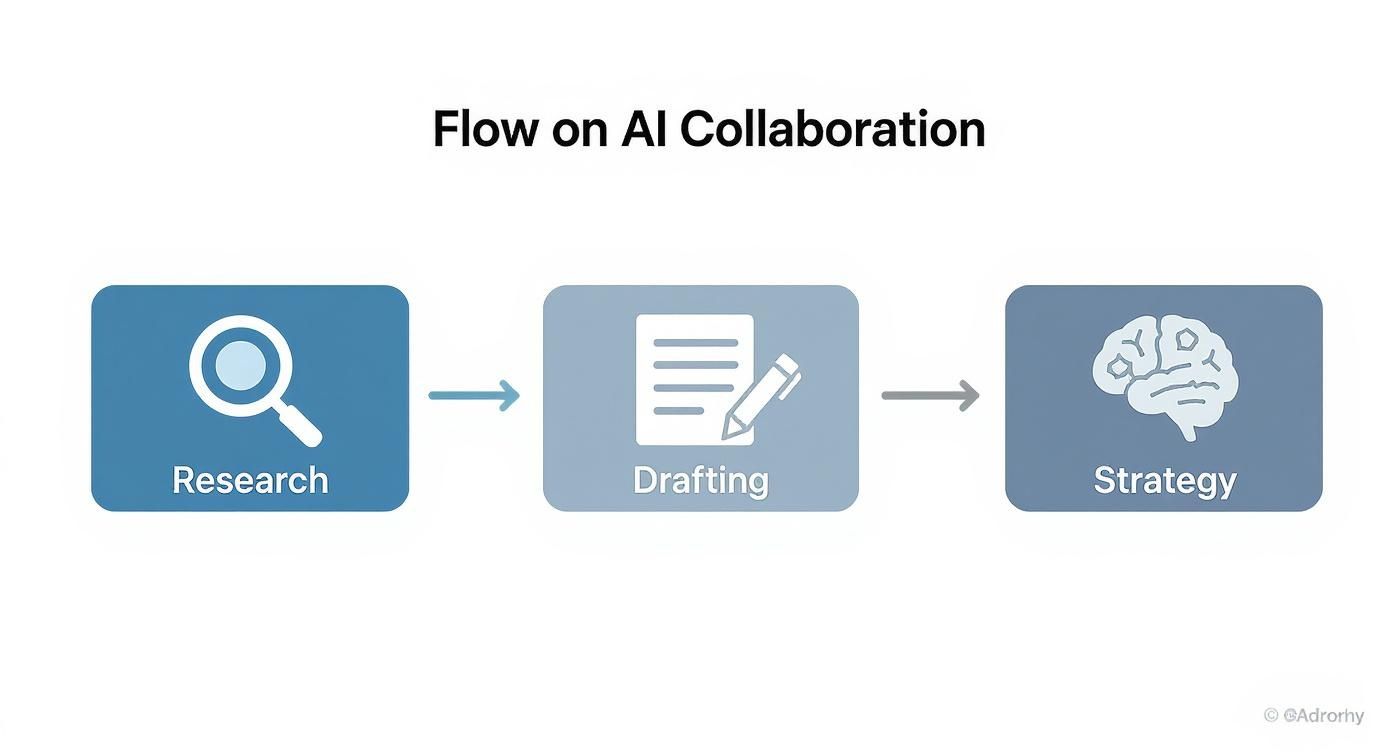
The first phase isn't about replacing writers; it's about supercharging your researchers. Focus on using AI to gather and structure information faster than any human ever could. Turn hours of manual labor into minutes of smart prompting.

This simple framework can help you categorize, compare, and select the right tools for these initial jobs.
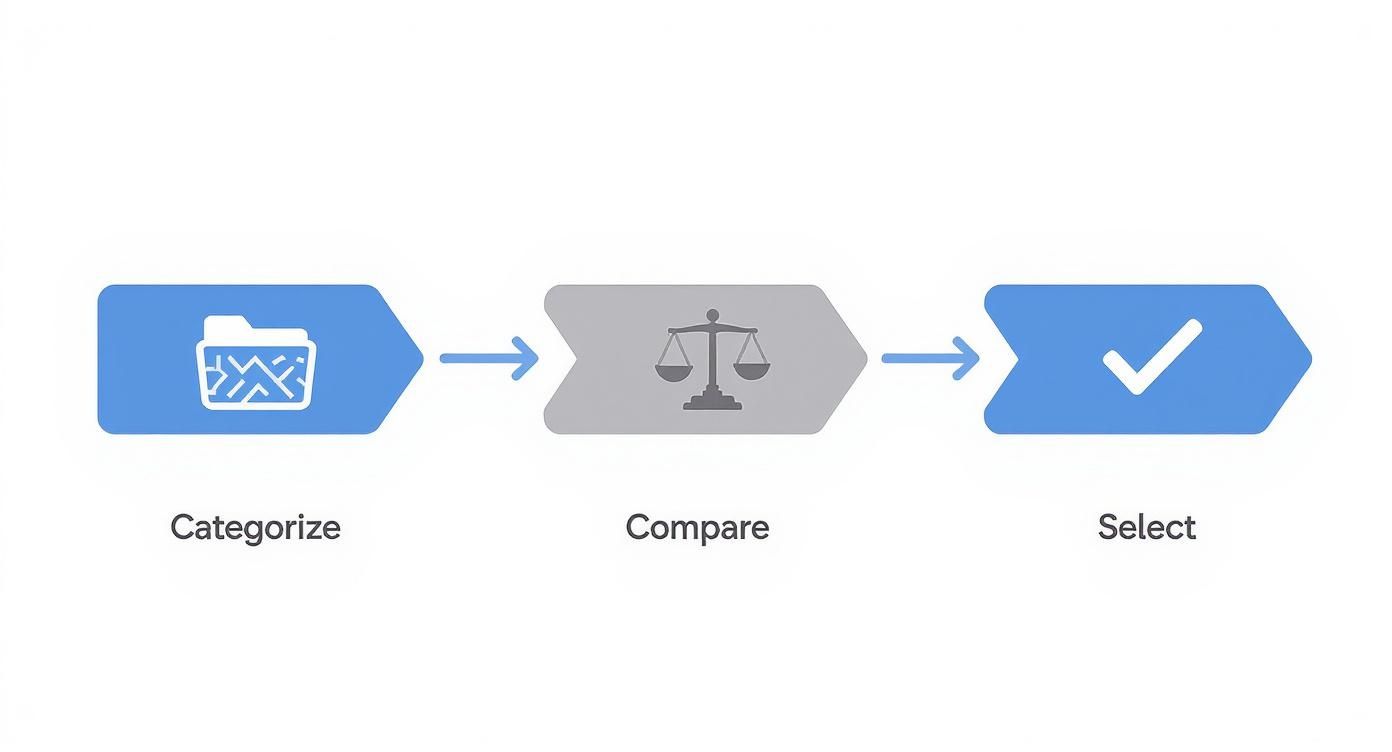
A three-step process infographic showing Categorize, Compare, and Select with respective icons.

Breaking down the selection process makes it much easier to pick a tool that solves a specific, nagging problem in your current workflow.

Phase 2: Move on to Drafts and Personalization

Once the team is comfortable using AI for research, it's time to level up. In this phase, AI graduates from research assistant to drafting partner. The focus shifts to generating complete first drafts and creating personalized content at scale. A human-in-the-loop process becomes non-negotiable. The AI generates the initial draft, but a human editor must always review, refine, and add the final layer of brand voice, nuance, and strategic insight.

Here’s a quick look at how the workflow changes:

Workflow StageThe Old Manual WayThe New AI-Assisted Way
First Draft CreationA writer spends 6-8 hours staring at a blank page, crafting a draft.An AI tool produces a solid first draft in less than 30 minutes.
Editing & RefinementAn editor spends 3-4 hours on structural edits and polishing.An editor spends 2-3 hours enhancing the AI draft with expertise.
The ResultA process that eats up a full day, maybe more.A workflow that's 60-70% faster, letting you publish more, faster.

Phase 3: Lock in Governance and Scale Up

The final phase is all about formalizing your process so you can scale your AI-driven content creation without sacrificing quality. This means creating clear guardrails and quality control checkpoints that everyone on the team understands.

Actionable Step: Create an AI Brand Guideline document. It should include:

  1. Tone & Voice Prompts: Give the AI specific, copy-pasteable examples of your brand's voice (e.g., "Write in a helpful, expert tone like a friendly mentor. Use analogies but avoid clichés.").
  2. Formatting Rules: Detail exactly how you want headlines, lists, and other elements structured.
  3. Fact-Checking Protocol: Make it a rule that any statistic, data point, or claim from the AI must be verified against a primary source.

This governance structure is what turns AI from a cool new toy into a core, scalable part of your content engine.

How to Maintain Quality and Ethical Standards

A desk setup with an open book, magnifying glass, keyboard, and plant, displaying 'MAINTAIN TRUST'.

Simply cranking out content faster isn't the point. The real challenge of AI-driven content creation is scaling up your output without torching the quality, accuracy, and trust you’ve worked so hard to build. Without a strong governance framework, AI can quickly dilute your brand and erode your credibility.

The content creation market is projected to hit USD 66.8 billion by 2030. Unchecked automation in this booming space can seriously degrade the quality of information online, a huge problem for brands that rely on expertise to win customers. You can dig into the numbers in this market forecast on Mordor Intelligence.

Adopting a responsible approach is the only way to make sure AI becomes a sustainable asset, not a ticking time bomb.

Building Your AI Governance Checklist

Think of AI governance as the quality control system for your content engine. It's a set of non-negotiable rules and processes ensuring every piece of content meets your standards.

Here’s a practical checklist to get you started:

  1. Mandatory Fact-Checking: Treat every statistic from an AI as a placeholder. It's not real until a human has checked it against a primary source. This is the most critical firewall for maintaining trust.
  2. Originality Audits: Run every AI-generated draft through a reliable plagiarism checker. While these tools aim to create original text, weird overlaps can happen. It’s your job to catch them.
  3. Brand Voice Refinement: An AI can mimic your tone, but it can’t replicate your brand’s soul. Your human editors are there to inject nuance, storytelling, and the kind of strategic messaging that is uniquely yours. An AI content analysis can pinpoint where the AI's output is drifting away from your core voice.

The Rise of the AI Editor

The most important piece of any responsible AI workflow is the human-in-the-loop. This has created a new, vital role on content teams: the AI Editor. This person is more than a proofreader; they're a strategist who guides, refines, and validates what the AI produces.

Traditional Editor RoleModern AI Editor Role
Focuses on grammar, style, and flow of human-written drafts.Guides AI with expert prompts to generate high-quality first drafts.
Spends significant time on structural and developmental edits.Spends more time on fact-checking, adding expertise, and brand alignment.
Works linearly on one piece of content at a time.Oversees and quality-controls multiple AI-generated assets simultaneously.

This role shifts the team's focus from manual creation to strategic curation. The AI Editor ensures technology speeds up the process without ever compromising the integrity of the final product.

Adopting AI responsibly means you never fully outsource your thinking. The technology is a powerful assistant for the "how," but your human team must always own the "why" and the "what."

Finally, using AI ethically is also about how you talk to your audience. The question of whether to disclose AI usage is getting bigger. While there’s no single law on the books yet, transparency is almost always the right call for building long-term trust.

Actionable Tip: Consider adding a simple disclosure at the end of articles where AI played a big role in drafting or research. It shows respect for your readers and signals that you're confident in your quality control. And beyond the content itself, sticking to legal frameworks is crucial; a practical guide to AI GDPR compliance is a good starting point for navigating these complex rules.

Burning Questions About AI Content

Stepping into AI-driven content always brings up a few big questions. Everyone wants to know about search engine penalties, brand voice, and where to start without breaking the bank. Let's tackle these head-on.

Will Google Punish Me for Using AI Content?

No. Google doesn't care how content is made; they care if it's helpful and high-quality. Their entire E-E-A-T framework (Experience, Expertise, Authoritativeness, Trustworthiness) is the only yardstick that matters.

  • Bad AI Content: AI used to churn out spammy, keyword-stuffed articles. This will be punished.
  • Good AI Content: AI used as an assistant to draft, research, and outline, with a human expert reviewing, editing, and adding real insight. This content can rank very well.

The takeaway: Value beats origin, every time. Focus on creating helpful, human-polished content, and you’ll be perfectly aligned with what search engines want to see.

How Can I Keep My Brand Voice from Sounding Like a Robot?

This is a huge concern, and rightly so. The key is to give the AI specific marching orders. Don't just ask it to "write a blog post." Instead, feed it a detailed brand style guide using custom instructions.

Actionable Tip: Create a "Master Brand Prompt" that you can use every time. Include details on your:

  • Tone: "Write in a witty but professional tone for tech executives."
  • Style: "Use short, punchy sentences and avoid industry jargon."
  • Audience: "Our audience is marketing VPs who are short on time and need actionable advice."

But the single most important step? A human must always have the final say. An editor needs to review and refine every piece of AI-generated output, weaving in the strategic messaging and unique personality that makes your brand yours.

What's the Smartest Way to Start If I'm on a Tight Budget?

You do not need a massive budget to get started. The best approach is to start small and prove the value. Many leading AI tools have free or low-cost plans that are surprisingly powerful.

Don't try to boil the ocean. Instead, pick one or two repetitive, time-sucking tasks you're already doing and see if AI can help.

Actionable Ideas for a Small Budget:

  • Brainstorming: Use a free tool to generate a month's worth of blog titles and outlines in minutes.
  • Repurposing: Turn a single blog post into a week's worth of social media updates.
  • Meta Descriptions: Have an AI write compelling, SEO-friendly meta descriptions for your top 20 pages.

Track the time you save. That simple number—"we saved 8 hours this month"—is all you need to build a rock-solid business case for a bigger investment down the road.


Ready to integrate a powerful, all-in-one AI solution into your marketing strategy? marketbetter.ai combines content creation, campaign optimization, and deep analytics to drive measurable growth. Explore the platform today.
Top AI Content Marketing Tools for Enterprise Teams in 2025

· 29 min read

Welcome to your definitive, actionable guide to the top AI content marketing tools available today. We've gone beyond surface-level feature lists to provide a deep, comparative analysis tailored specifically for marketing decision-makers at mid-market and enterprise companies. This isn't just another list; it's a strategic resource built to solve a critical problem: identifying which AI solution will actually drive results for your specific business needs.

This guide is designed for practical application. For each of the 12 platforms reviewed, you will find:

  • Detailed feature analysis with screenshots for clarity.
  • Direct comparisons to help you differentiate between similar tools.
  • Integration and security notes for seamless tech stack adoption.
  • Actionable implementation tips to get you started quickly.

Whether you're a CMO focused on strategic impact, a content manager aiming for higher velocity, or a marketing operations leader optimizing your tech stack, this resource will help you navigate the crowded landscape. We'll compare point solutions like Jasper and Copy.ai against integrated platforms like HubSpot, helping you make an informed investment. For instance, while some tools excel at long-form content, others are essential for social media. To accelerate your professional networking, leveraging an AI LinkedIn Post Generator Playbook can significantly enhance your content strategy and engagement.

Our goal is to equip you with the insights needed to select the best AI content marketing tools that align with your team's workflow, security requirements, and business goals. Let's dive in.

1. marketbetter.ai

Best for: All-in-one, revenue-focused Go-to-Market execution.

For marketing and sales leaders seeking to consolidate their tech stack and directly tie AI efforts to revenue, marketbetter.ai stands out as our top choice. It’s an AI-native, end-to-end platform that moves beyond isolated content generation to orchestrate the entire go-to-market motion. Unlike single-point solutions like Jasper or Copy.ai that only write blog posts or social copy, marketbetter.ai integrates AI content creation with automated, multi-channel outbound sequencing, campaign optimization, and real-time analytics. This unified approach eliminates the tool sprawl common in marketing departments, with customers reporting the replacement of up to four separate tools.

This platform is one of the most comprehensive ai content marketing tools available, designed specifically for mid-market and enterprise B2B teams. It generates on-brand content for blogs, ads, and emails, but its real power lies in connecting that content directly to action. It automates prospect research, personalizes outreach across email, LinkedIn, and voice, and handles follow-ups and calendar handoffs, writing all activity back to your CRM.

marketbetter.ai

Key Features and Strategic Impact

What sets marketbetter.ai apart is its measurable impact on pipeline velocity. The platform reports significant lift for its users, including a 1.6× increase in inbound SQLs and a 2× rise in first meetings booked. This is achieved by creating a seamless, AI-driven workflow that turns market signals into qualified conversations.

  • Unified Content & Campaign Engine: Generate a blog post, then immediately create and launch a multi-channel distribution campaign with personalized emails and social copy targeting ideal customer profiles, all within one interface.
  • Automated Sequencing & Engagement: Go beyond static content by automating sequences across email, LinkedIn, and even voice calls. The AI manages follow-ups and hands off booked meetings directly to sales calendars, with full data sync to Salesforce, HubSpot, or Dynamics.
  • Enterprise-Grade & Secure: Built for serious B2B teams, it offers robust security features like encryption in transit and at rest, privacy compliance, and detailed audit logs.
  • Rapid Implementation: Deployment is fast. With a simple tracking code, pre-built templates, and no-cost integrations for tools like Slack, Gmail, and LinkedIn Ads, teams can be operational in minutes, not months.

Actionable Tip

A demand generation manager can use marketbetter.ai to identify a target account list, generate a hyper-relevant article, then instantly build a multi-touch sequence to engage key decision-makers at those accounts with personalized messaging derived from the article. The AI handles the outreach and follow-up, freeing up the team to focus on strategy while the platform generates and tracks meetings.

Pricing and Access

Marketbetter.ai does not list public pricing, opting for a demo-led sales process. This positions it for teams focused on ROI rather than the lowest upfront cost. You can get started with a free trial or by booking a demo to receive a custom quote.

FeatureDetails
Ideal UserMid-market to enterprise B2B marketing and sales teams.
Primary Use CaseConsolidating content generation, campaign automation, and sales engagement to accelerate pipeline and revenue.
IntegrationsSalesforce, HubSpot, Dynamics, Slack/Teams, Gmail/Outlook, LinkedIn Ads, webhooks (no extra cost).
Standout MetricSite-reported 3× higher campaign ROI and automation of 80% of outreach tasks.
LimitationsPricing requires a demo; may be too comprehensive for very small startups or teams without a defined go-to-market process.
Social ProofStrong customer testimonials (CallRail, Kajeet) and a 4.97/5 G2 rating.

Learn more at marketbetter.ai.

2. Jasper

Jasper is a generative AI platform built from the ground up for marketing and sales teams. Unlike general-purpose AI writers, Jasper excels at maintaining a consistent brand voice across all generated content, from blog posts and social media updates to ad copy and email campaigns. It serves as a central hub for planning, creating, and orchestrating multi-channel content, making it one of the most comprehensive ai content marketing tools for teams that require governance and scale.

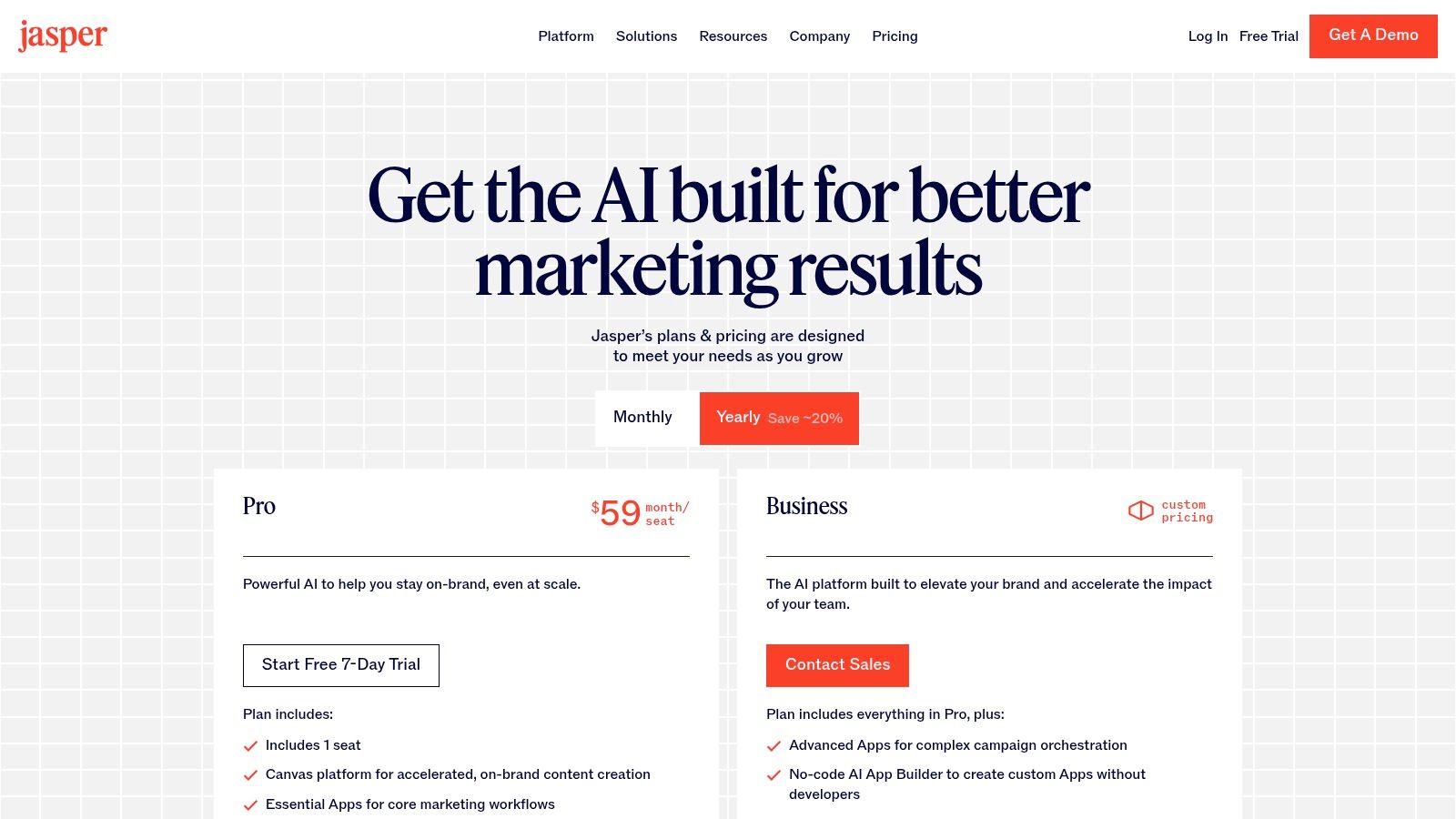
Jasper pricing page screenshot

The platform’s key differentiator is its focus on enterprise-grade workflows. Compared to Copy.ai's self-serve model, Jasper is built for top-down brand governance. The Business plan introduces a no-code AI app builder and customizable AI agents, allowing marketing ops teams to create repeatable processes and automate campaign orchestration. This moves beyond simple text generation into true content operations.

Key Details & Recommendations

  • Best Use Case: Mid-market to enterprise marketing teams that need to enforce brand consistency across multiple writers and channels. The platform’s collaboration features and campaign-level tools are ideal for coordinated marketing efforts.
  • Actionable Tip: Start by thoroughly training Jasper on your brand voice. Upload your style guides, best-performing content, and product catalogs to create a robust knowledge base. This initial investment is critical for generating truly on-brand assets.
  • Pricing: The Pro plan is suitable for individuals, but teams needing collaboration, SSO, and governance features must opt for the custom-priced Business plan. A 7-day free trial is available. You can learn more about Jasper and other top AI platforms to compare which fits your budget.
  • Security: Jasper is SOC 2 compliant, a crucial consideration for enterprises handling sensitive customer or company data within their content workflows.

Website: https://www.jasper.ai/pricing

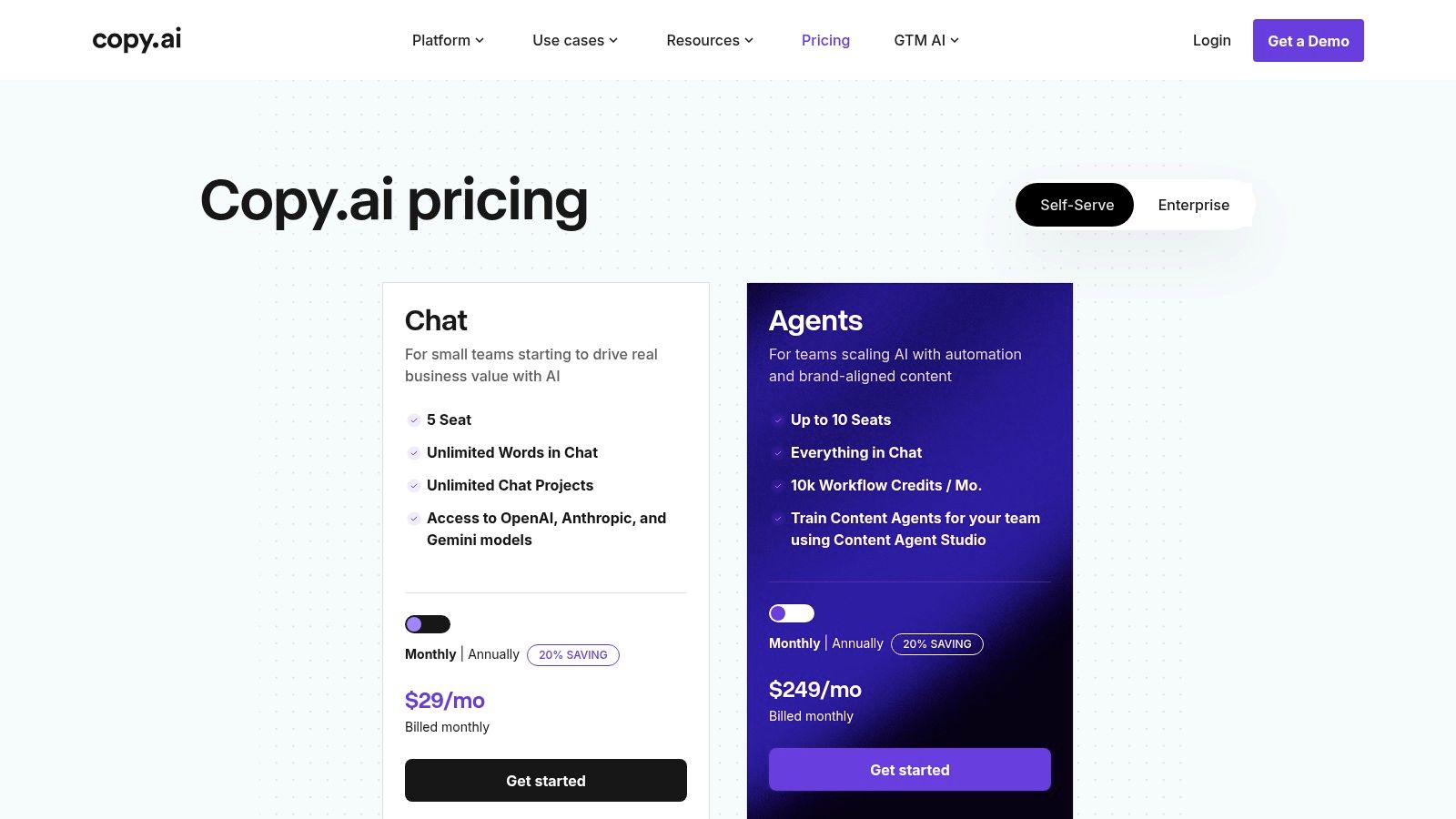
3. Copy.ai

Copy.ai positions itself as an AI-powered go-to-market platform designed for speed and efficiency. It combines a user-friendly chat interface with a powerful workflow builder, allowing marketing and sales teams to automate repeatable content tasks. Unlike platforms like Jasper that require extensive setup for brand voice, Copy.ai excels at rapid deployment for creating everything from blog briefs and social media posts to sales emails and ad copy, making it one of the most accessible ai content marketing tools for teams that prioritize self-serve onboarding.

Copy.ai

The platform’s core differentiator is its focus on workflow automation. Users can build custom "Agents" that connect to different data sources and execute multi-step content processes, like enriching leads from a CRM and then drafting personalized outreach sequences. This is a more technical approach than Writesonic's template-driven model, allowing for scalable, automated systems for common go-to-market activities—a significant advantage for lean teams looking to maximize output without increasing headcount.

Key Details & Recommendations

  • Best Use Case: Go-to-market teams (sales and marketing) in small to mid-sized businesses that need to automate repetitive content creation and outreach processes. Its strength lies in building simple, scalable workflows without needing deep technical expertise.
  • Actionable Tip: Start by identifying your most time-consuming, repeatable content task, such as writing weekly social media posts or drafting first-touch sales emails. Build a simple workflow for that single process to learn the platform and demonstrate immediate ROI before expanding to more complex automations.
  • Pricing: Offers a free plan for individuals and tiered paid plans (Pro, Team, Enterprise) that scale based on user seats and advanced features like workflow credits. The self-serve pricing model allows teams to get started quickly, with guided onboarding available for larger deployments.
  • Security: Copy.ai is SOC 2 Type II compliant, ensuring enterprise-grade security for teams that need to connect the platform to their CRM or other sensitive data sources.

Website: https://www.copy.ai/prices

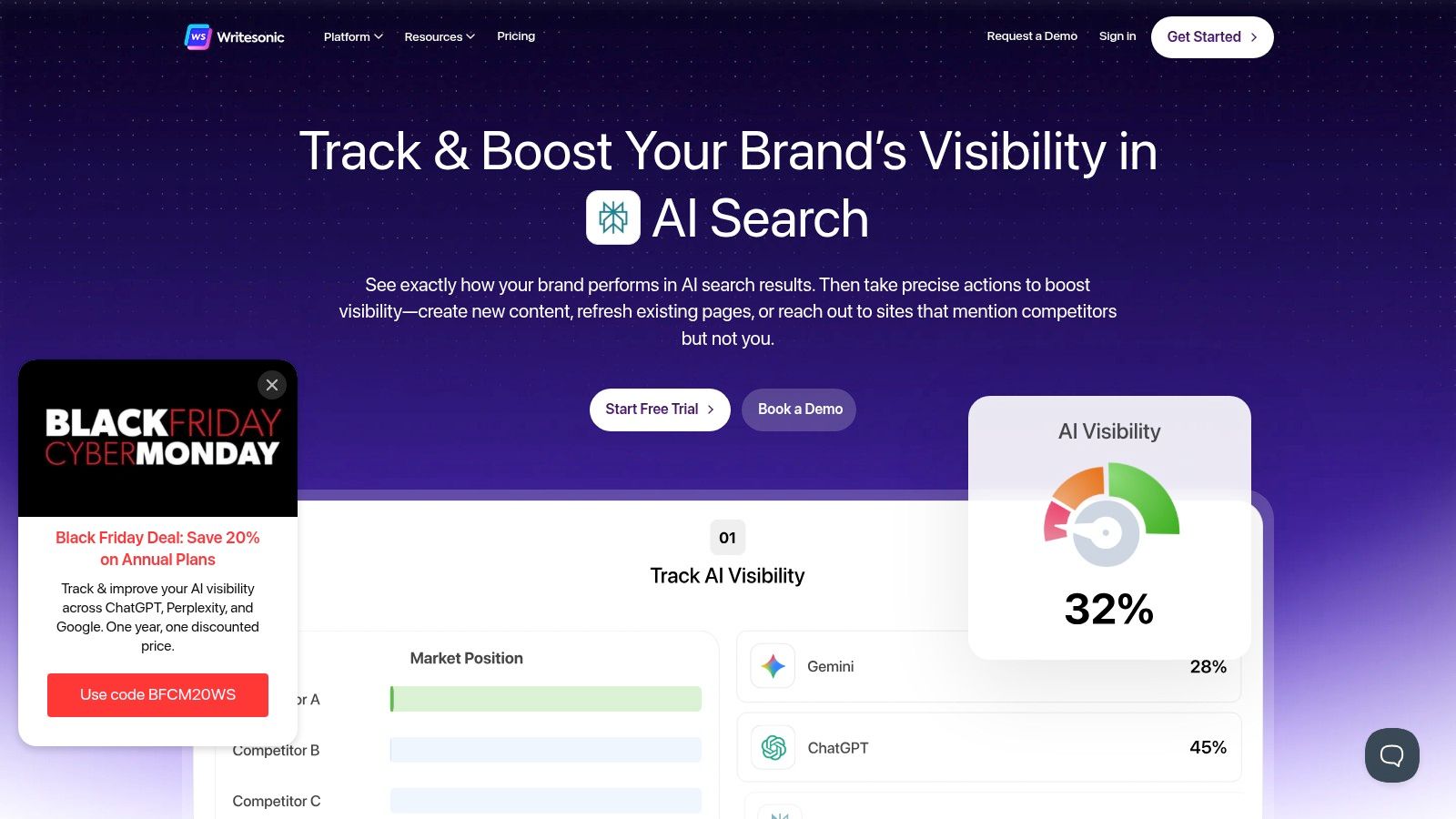
4. Writesonic

Writesonic is an AI writing suite designed for speed and volume, particularly excelling at long-form content generation for SEO and e-commerce. It offers a broad toolkit with over 100 templates for articles, blogs, product descriptions, and social media posts. Unlike Jasper, which focuses heavily on brand voice management, Writesonic prioritizes rapid, bulk content creation, making it one of the most practical ai content marketing tools for teams and individuals under pressure to publish consistently.

Writesonic

The platform's main differentiator is its straightforward, output-focused interface combined with flexible pricing. While Jasper is built for enterprise-level brand governance, Writesonic appeals to users who need a powerful engine for drafting content quickly. Features like its bulk generation mode allow users to produce multiple articles or descriptions simultaneously, a significant time-saver for e-commerce stores or affiliate marketing sites.

Key Details & Recommendations

  • Best Use Case: Solo marketers, SEO specialists, and small teams that require a high volume of long-form content like blog posts and product descriptions. Its competitive entry pricing makes it accessible for those not needing enterprise-level collaboration.
  • Actionable Tip: Use the "Bulk Generate" feature for product descriptions to maintain a consistent structure across hundreds of SKUs. For blog posts, leverage the one-click article writer to create a first draft, then spend your time refining and adding unique insights.
  • Pricing: Writesonic offers a Free Trial and a Small Team plan starting at $19/month with user and word limits. The Business plan offers higher limits and more features, while the Enterprise plan provides custom pricing, SSO, and dedicated support. Audiosonic text-to-speech minutes are available as an add-on.
  • Security: The platform offers SOC 2 compliance on its Enterprise plan, making it a viable option for larger organizations that require verified data security and privacy controls for their content operations.

Website: https://writesonic.com

5. Semrush

Semrush is an established powerhouse in online visibility, and its platform now integrates powerful AI features directly into its SEO and content marketing workflows. Tools like ContentShake AI and the broader Content Marketing Toolkit allow teams to move seamlessly from data-driven keyword research to AI-assisted content creation and optimization. This direct link between SEO analytics and generative AI is what makes it one of the most effective ai content marketing tools for performance-focused marketers.

Unlike pure-play AI writers like Jasper or Writesonic, Semrush's strength lies in grounding every AI-generated draft in hard performance data. It helps you identify content gaps, analyze competitor strategies, and then use AI to create articles engineered to rank for specific keywords. With features like one-click WordPress publishing and AI-generated images, it streamlines the entire content production pipeline from ideation to publication.

Key Details & Recommendations

  • Best Use Case: SEO-led marketing teams who want to use AI to scale content production without sacrificing data-driven optimization. It is ideal for organizations where content performance is measured directly by organic traffic and keyword rankings.
  • Actionable Tip: Begin by using the Topic Research and Keyword Magic Tool to build a content plan based on opportunities. Feed these data-backed topics into ContentShake AI to ensure your AI-generated drafts are strategically aligned with your SEO goals from the start.
  • Pricing: Semrush offers modular pricing with separate plans for its different toolkits (SEO, Content Marketing, etc.). This can be cost-effective if you only need specific functions, but costs can accumulate for full-suite access and multiple user seats.
  • Integration: The platform’s one-click WordPress export is a significant time-saver for content teams. Beyond that, its App Center offers integrations with various third-party tools, extending its capabilities. You can discover how to align Semrush's tools with a broader strategy to maximize your investment.

Website: https://www.semrush.com

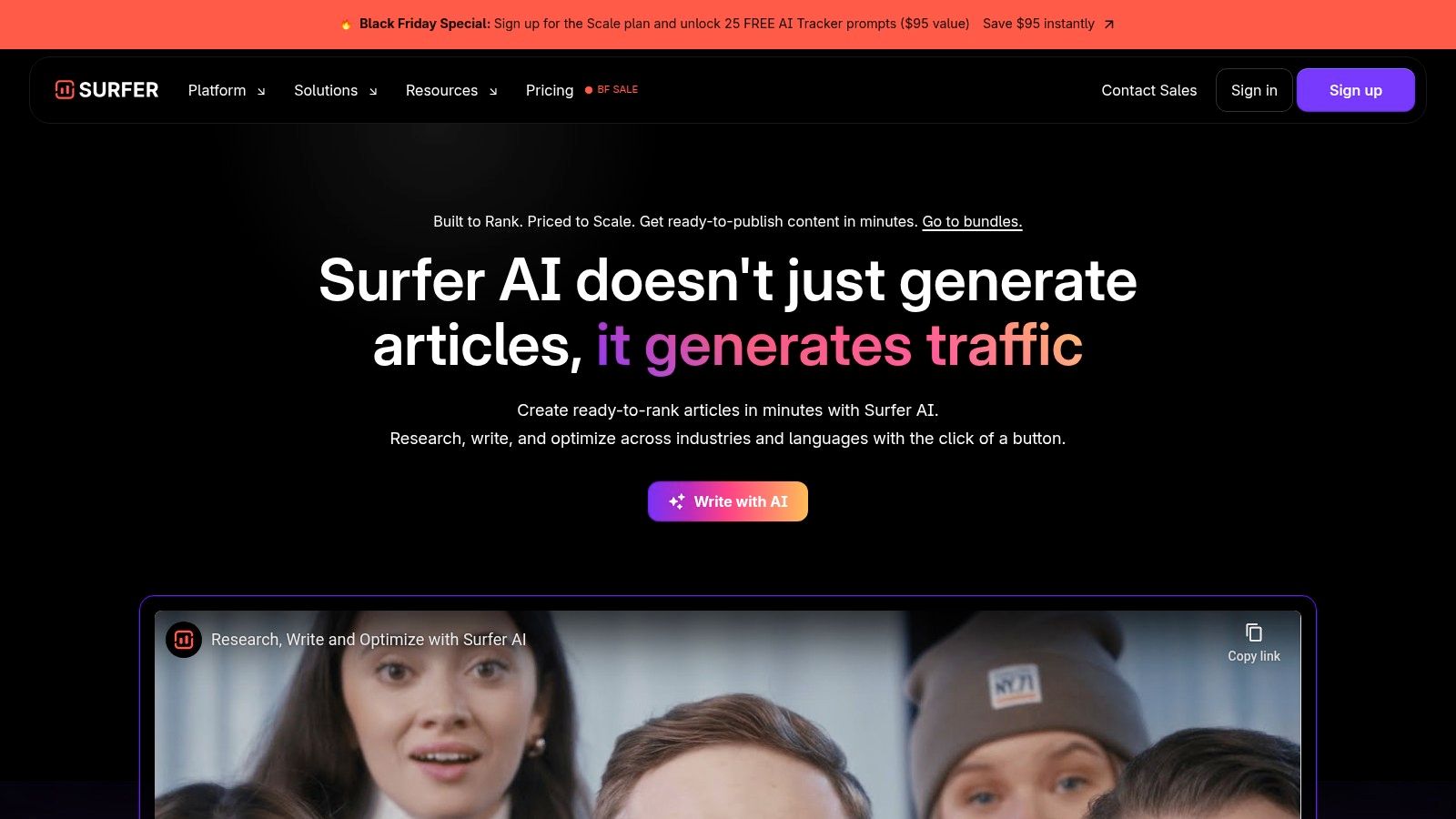
6. Surfer

Surfer bridges the gap between AI content creation and technical on-page SEO. Unlike Semrush, which offers a broad suite of marketing tools, Surfer is hyper-focused on producing articles optimized to rank in search engines from the moment they are published. It analyzes top-ranking pages for a target keyword to provide data-driven guidelines on structure, keyword density, and internal linking, making it one of the most effective ai content marketing tools for teams focused on organic traffic.

Surfer

The platform’s standout feature is its Content Editor, which integrates SERP analysis with LLM insights to guide writers in real-time. This actionable, data-first approach removes the guesswork from SEO, allowing marketing teams to create content that satisfies both user intent and search engine algorithms. Integrations with Google Docs and WordPress streamline the workflow from creation to publication.

Key Details & Recommendations

  • Best Use Case: SEO-focused content teams and agencies that need to produce high-volume, rank-ready articles consistently. It's ideal for organizations where organic search performance is a primary marketing KPI.
  • Actionable Tip: Use Surfer’s Audit tool on your existing high-value content first. This will identify immediate optimization opportunities and help you understand Surfer’s data-driven recommendations before you start creating new articles from scratch.
  • Pricing: Surfer operates on a subscription model supplemented by AI credits for article generation. These credits can be purchased in flexible bundles, allowing teams to scale content creation on-demand. However, unlocking the full feature set requires higher-tier plans.
  • Flexibility: The on-demand credit system offers a clear advantage for budget planning and scaling content velocity. Teams can purchase credits as needed for major content pushes without being locked into a higher monthly subscription.

Website: https://surferseo.com/ai

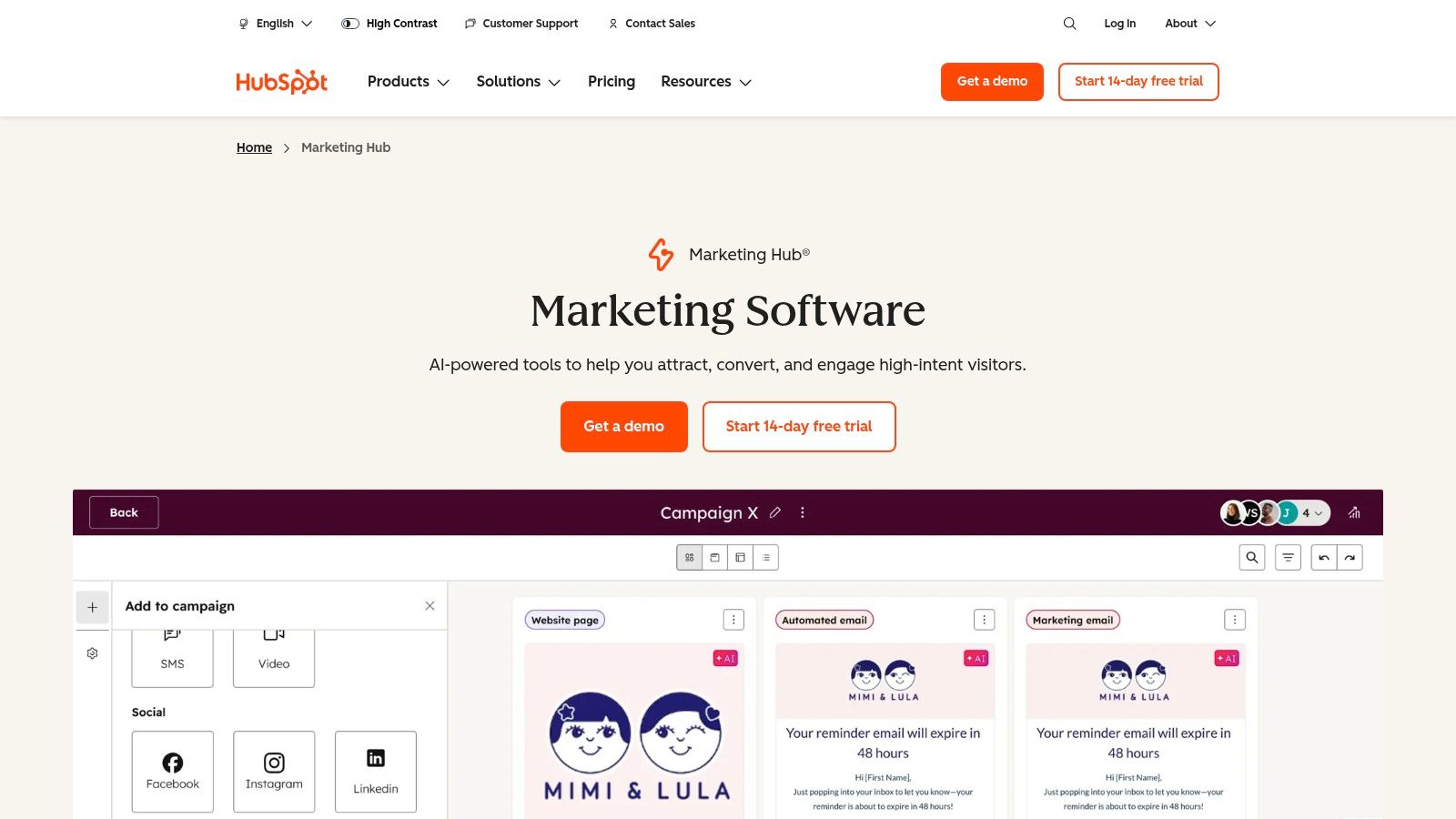
7. HubSpot Marketing Hub

HubSpot Marketing Hub is an AI-powered marketing automation platform that integrates content creation directly with its foundational CRM. While tools like marketbetter.ai focus on the entire Go-to-Market motion including sales, HubSpot embeds AI assistance across its marketing suite, from blogging and email to social media and landing pages. This unified approach makes it one of the most powerful ai content marketing tools for teams aiming to connect content performance directly to customer lifecycle data and revenue.

HubSpot Marketing Hub

The platform’s core advantage is its end-to-end operational view. Marketers can use AI to draft a blog post, then immediately build an automated email nurture sequence around it, and finally track every lead's interaction through the CRM. This tight integration provides clear attribution, connecting content efforts to closed deals in a way that standalone AI writers cannot.

Key Details & Recommendations

  • Best Use Case: Marketing teams already using or planning to adopt the HubSpot CRM. It’s ideal for organizations that want to centralize their marketing operations and leverage AI to enhance existing workflows rather than just generate text in isolation.
  • Actionable Tip: Leverage the native CRM data to personalize AI-generated content. Use smart rules and contact properties to inform the AI, creating dynamic email campaigns or landing page copy that adapts to specific audience segments for higher engagement.
  • Pricing: AI features are included across various tiers, from Starter to Enterprise. However, the true power of automation and advanced reporting is unlocked in the Professional and Enterprise plans, which come with significant monthly costs and often require onboarding fees.
  • Security: As an established enterprise platform, HubSpot offers robust security features, including SOC 2 and SOC 3 compliance, making it suitable for organizations with stringent data governance and privacy requirements.

Website: https://www.hubspot.com/products/marketing

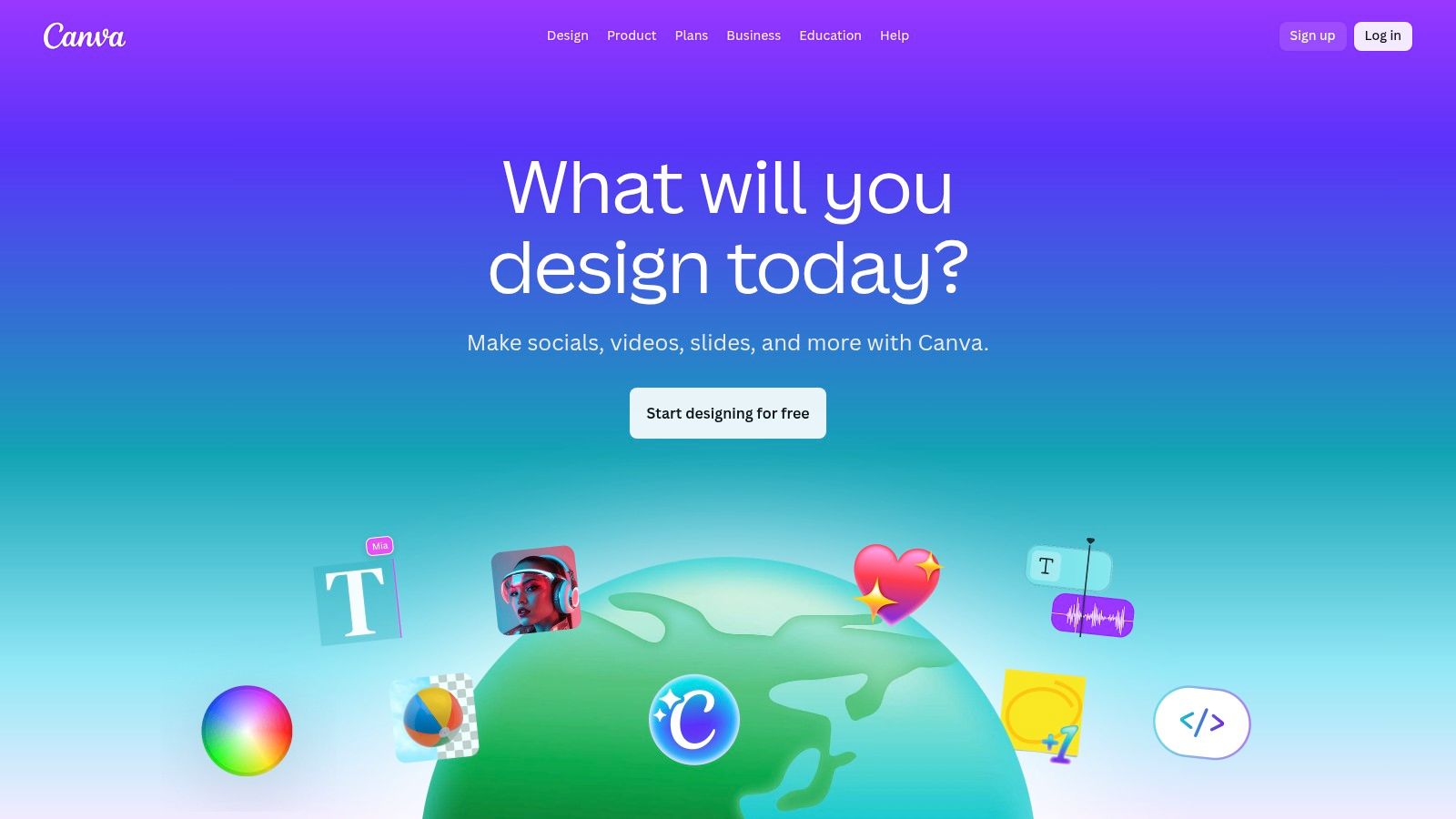
8. Canva (Magic Studio / Canva Business)

Canva has evolved from a simple design tool into a comprehensive, AI-powered content creation platform. Its Magic Studio suite integrates generative AI directly into the visual editing workflow, allowing marketing teams to produce on-brand assets at an unprecedented speed. Unlike standalone AI image generators like Adobe Firefly, Canva combines text, design, and video creation with vast template libraries, brand kits, and a content planner, making it one of the most versatile ai content marketing tools for teams that prioritize visual content production.

Canva (Magic Studio / Canva Business)

The platform's primary advantage is its unified environment. A marketing manager can use Magic Write to draft social media copy, instantly convert it into a video script with Magic Video, and generate corresponding visuals with Magic Design, all without leaving the editor. This dramatically reduces the friction and tool-switching typically associated with multi-format content campaigns, making it a powerhouse for agile marketing operations.

Key Details & Recommendations

  • Best Use Case: Marketing teams focused on high-velocity social media, advertising, and presentation creation. The platform excels at empowering non-designers to produce professional, on-brand visual assets quickly.
  • Actionable Tip: Immediately configure your Brand Kit. Upload logos, color palettes, and fonts, and create branded templates. This ensures that every piece of AI-generated content adheres to company guidelines, maintaining consistency across all channels.
  • Pricing: While a free version exists, meaningful AI usage requires the Canva Pro or Canva for Teams plan. These paid tiers provide higher credit limits for Magic Studio features, Brand Kits, and the content planner. You can discover how Canva compares to other social media tools to find the best fit for your team.
  • Collaboration: The Canva for Teams plan offers real-time collaboration, approval workflows, and centralized asset management. This is essential for teams needing to streamline their review process and maintain a single source of truth for creative assets.

Website: https://www.canva.com

9. Adobe Firefly

Adobe Firefly is a family of creative generative AI models designed for the safe creation of commercial content. Unlike Canva's all-in-one approach, Firefly is a specialized image generator deeply integrated into Adobe's professional ecosystem, including Photoshop and Adobe Express. It excels at generating high-quality, commercially viable images, vectors, and text effects that align with existing design workflows.

Adobe Firefly

The platform’s key differentiator is its enterprise-ready governance and commercial safety. Since Firefly is trained on Adobe Stock's licensed library and public domain content, the outputs are designed to be commercially safe, indemnifying businesses from copyright claims. This makes it one of the few ai content marketing tools that provides a clear and defensible path for using AI-generated visuals in brand campaigns. The generative credit system offers predictable cost management, a crucial feature for teams at scale.

Key Details & Recommendations

  • Best Use Case: Enterprise and mid-market marketing teams that rely on Adobe Creative Cloud for design and content creation. It is ideal for producing on-brand visuals for social media, ad campaigns, and website assets without leaving the established Adobe workflow.
  • Actionable Tip: Leverage Firefly's integration within Adobe Express to empower non-designers on your marketing team. They can use text-to-image and generative fill features to create campaign assets that remain consistent with brand templates managed by the core design team.
  • Pricing: Firefly is included in many Creative Cloud plans with a set number of monthly generative credits. Standalone Premium plans are available, and credit packs can be purchased to supplement usage. A free tier is offered with a limited number of credits.
  • Security: As part of the Adobe ecosystem, Firefly benefits from enterprise-grade security and content credentialing, providing transparency and trust for all generated assets.

Website: https://www.adobe.com/products/firefly

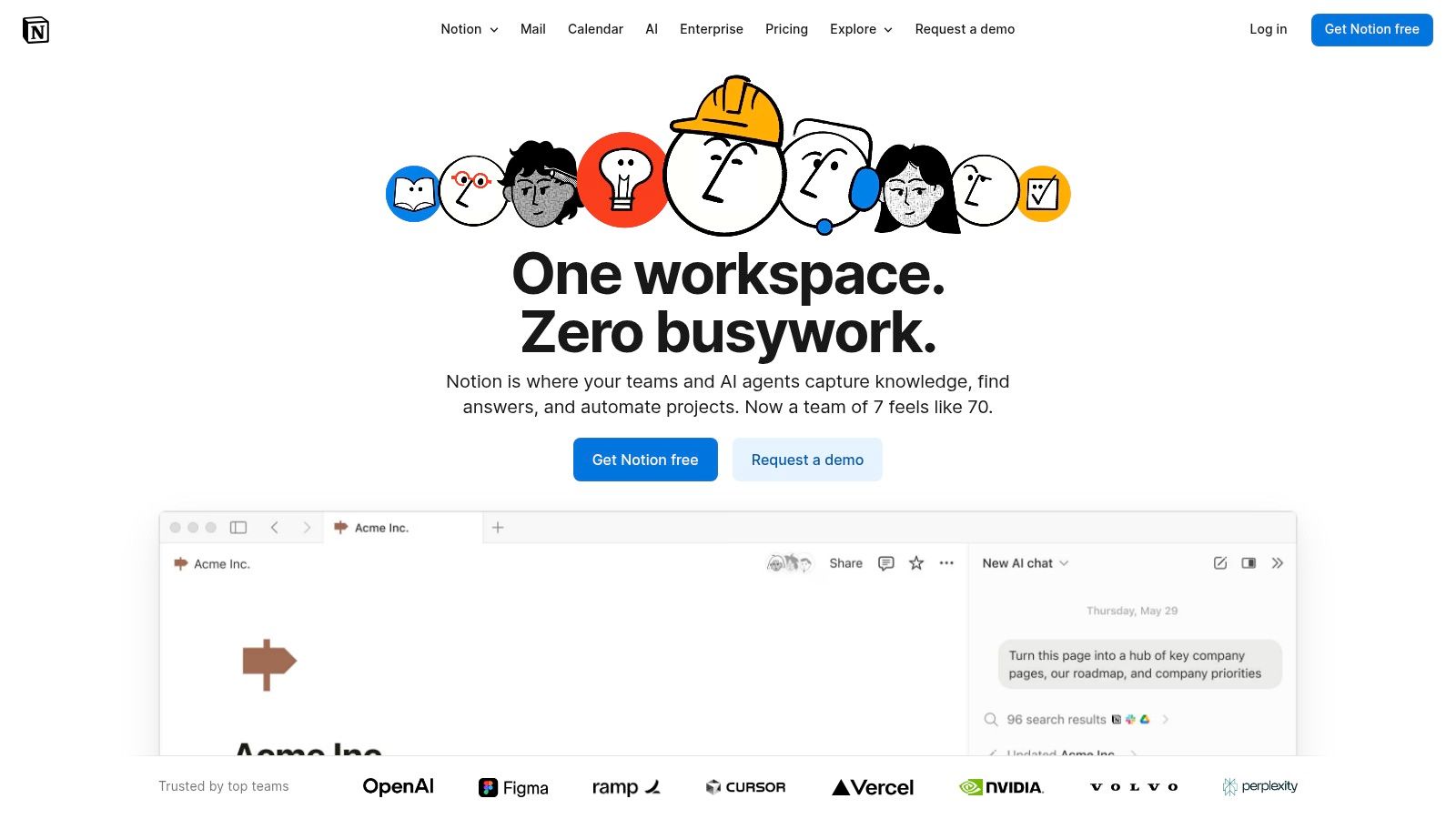
10. Notion AI

Notion AI embeds generative AI capabilities directly within its connected workspace, transforming it from a mere documentation tool into an integrated content operations hub. Instead of using separate apps for planning and drafting, marketing teams can manage editorial calendars, write creative briefs, and generate first drafts all in one place. This consolidation is Notion AI’s core advantage over standalone AI writers like Jasper, as it keeps AI-driven creation tightly coupled with project management and knowledge bases.

Notion AI

The platform excels at contextual tasks like summarizing meeting notes into action items, expanding on brief outlines, or translating content into different languages directly on the page. For teams already using Notion for their content lifecycle management, adding the AI features eliminates the friction of context-switching, making it a powerful accelerator for brainstorming, research, and initial content production.

Key Details & Recommendations

  • Best Use Case: Marketing teams that have centralized their content operations, knowledge management, and project tracking within Notion. It’s ideal for streamlining the workflow from brief to draft without leaving the platform.
  • Actionable Tip: Create and save custom AI block templates for repeatable tasks like generating blog post outlines from a brief, writing social media posts from a long-form article, or creating standardized meeting summaries. This leverages Notion’s database structure for consistent AI-powered outputs.
  • Pricing: Notion AI is an add-on for $8 per member/month (billed annually) for all paid plans. It is included by default in the custom-priced Enterprise plan. Unlike some competitors, it is not available as a standalone purchase or for free plan users.
  • Security: Notion offers enterprise-grade security controls, including SAML SSO and advanced security features on its Enterprise plan. Data submitted to Notion AI is not used to train models for other customers.

Website: https://www.notion.so/product/ai

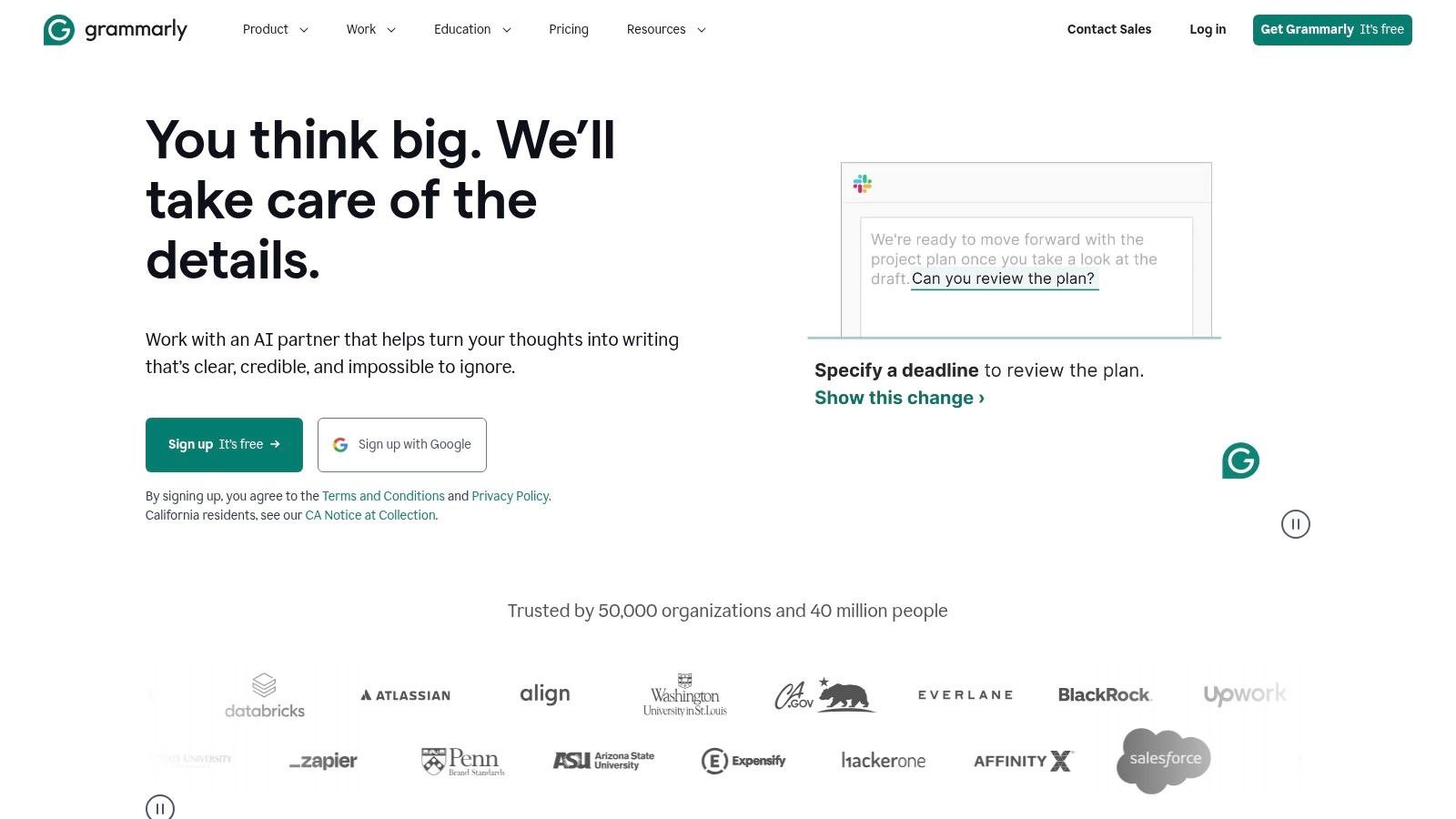
11. Grammarly for Work

While often seen as a grammar checker, Grammarly for Work has evolved into a comprehensive AI writing partner that enforces brand consistency wherever content is created. It moves beyond basic spelling and punctuation to provide real-time suggestions on clarity, tone, and brand style, acting as a distributed quality control layer across your entire marketing team’s digital footprint. Its generative AI features, including ideation, rewriting, and a conversational chat, make it a versatile tool for both polishing final drafts and kickstarting the creative process.

Grammarly for Work

Unlike dedicated AI writing platforms like Jasper that require users to work within a specific interface, Grammarly’s strength is its ubiquity. Through browser extensions, desktop apps, and deep integrations, it brings AI assistance directly into the tools your team already uses, from Google Docs and email clients to social media platforms. This seamless integration makes it one of the most practical ai content marketing tools for standardizing content quality at scale with minimal friction.

Key Details & Recommendations

  • Best Use Case: Enterprise marketing and sales teams that need to ensure brand and style guide compliance across a high volume of daily communications, from internal emails to external ad copy. It excels at improving the polish and consistency of content created by non-writers.
  • Actionable Tip: Invest time in setting up your brand style guide within the Business plan. Define your brand tones, add custom vocabulary (like product names), and create snippets for frequently used phrases. This centralizes governance and ensures every team member writes on-brand.
  • Pricing: Business plans are required for team-level features like style guides and centralized billing. Invoicing is available for teams with 10 or more seats purchasing an annual plan. It is also available via procurement channels like AWS Marketplace for streamlined purchasing.
  • Security: Grammarly is SOC 2 (Type 2) and ISO 27001/27017/27018 certified, providing enterprise-grade security and data privacy assurances for organizations that handle sensitive information.

Website: https://www.grammarly.com

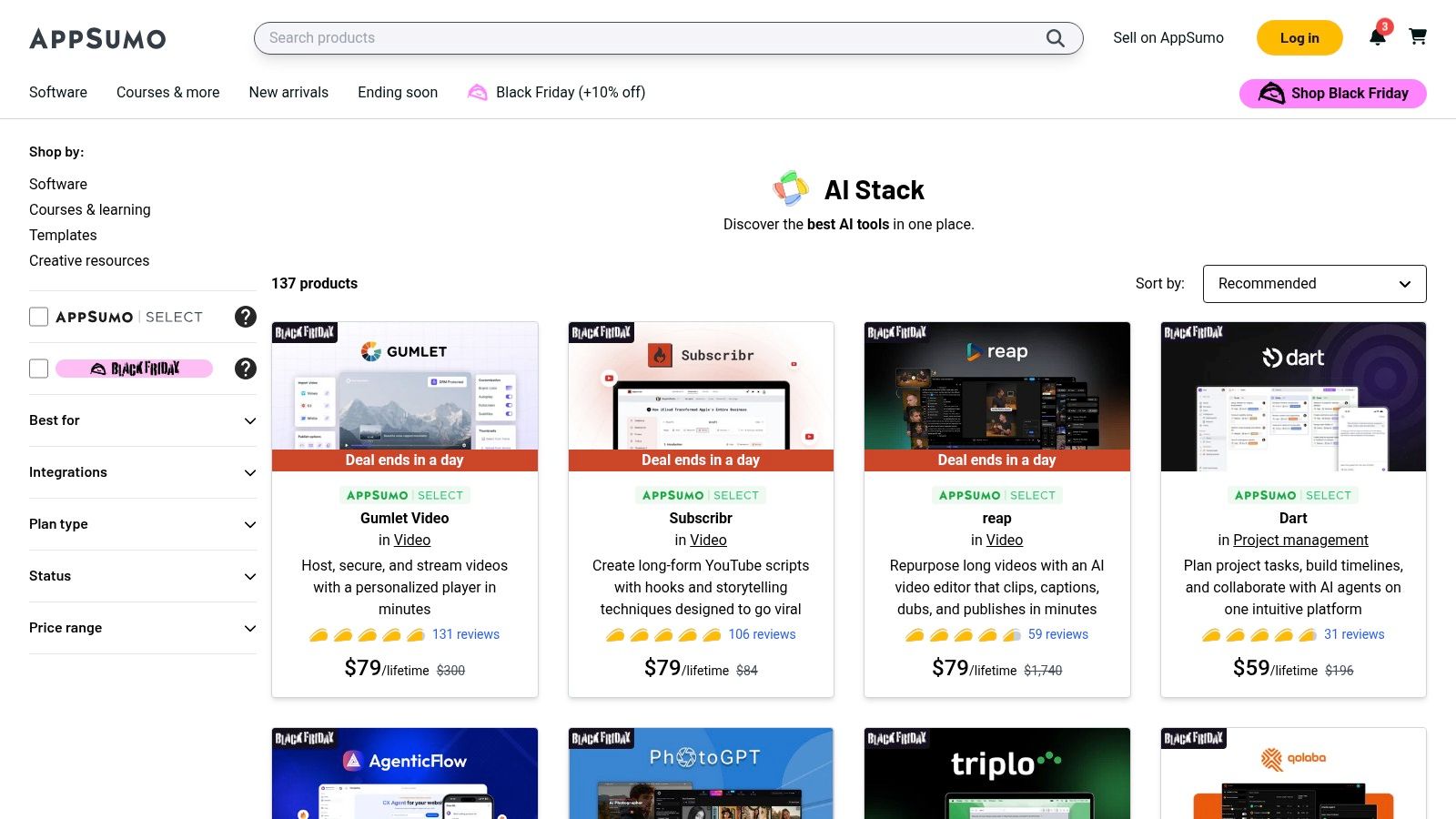
12. AppSumo – AI Stack

AppSumo is not a single tool, but a marketplace where hundreds of emerging software companies, including many ai content marketing tools, launch with lifetime deals. Its "AI Stack" is a curated collection that allows marketing teams to discover and test niche applications for a one-time cost, providing an affordable way to experiment with new capabilities without committing to a monthly subscription. This makes it an excellent resource for finding specialized solutions for tasks like video repurposing, AI-powered SEO analysis, or unique creative generation.

AppSumo – AI Stack

The platform's primary value for marketing leaders is as an innovation pipeline. In contrast to investing in a single, comprehensive platform like HubSpot, teams can use AppSumo to acquire several single-purpose AI tools for the price of one month's subscription to a major vendor. While this approach carries risks regarding a tool's long-term viability, the user reviews and generous 60-day refund policy help mitigate poor investments. It is a strategic way to build a custom, cost-effective AI marketing stack.

Key Details & Recommendations

  • Best Use Case: Agile marketing teams and entrepreneurs looking to test new AI capabilities or find highly specific, low-cost solutions for tasks not covered by their core platforms. It's ideal for exploration and supplementing an existing toolset.
  • Actionable Tip: Vet each deal carefully. Read user reviews on AppSumo, check the company's external website and social media for signs of an active roadmap, and test the tool extensively within the 60-day refund window before integrating it into critical workflows.
  • Pricing: The main draw is the one-time payment for a lifetime deal (LTD), often ranging from $49 to $99. These deals are for a limited time. For established tools, AppSumo also offers annual subscription discounts.
  • Security: Due diligence is on the buyer. Since these are often newer companies, you must verify the security compliance (e.g., SOC 2, GDPR) of each individual tool you purchase, especially if you plan to process sensitive data.

Website: https://appsumo.com/collections/ai-stack/

Top 12 AI Content Marketing Tools Comparison

ProductCore features★ Quality💰 Price / value👥 Target audience✨ Unique selling point
marketbetter.ai 🏆AI content, campaign optimization, multichannel sequencing, CRM write‑back★ 4.97 (G2); enterprise‑ready💰 Demo / free trial; consolidates 4+ tools for ROI👥 Mid‑market & enterprise B2B marketing teams✨ Holistic AI stack: content → campaigns → engagement; fast time‑to‑value
JasperOn‑brand content apps, Canvas workspace, agents, visual suite★ High; SOC2 & enterprise features💰 Pro / Business tiers; 7‑day trial👥 Marketing teams needing brand workflows✨ Brand voice + visual generation + AI agents
Copy.aiChat, agents, workflow builder, model access★ Good; self‑serve UX💰 Self‑serve pricing; scalable credits👥 Teams & solo marketers automating content ops✨ Fast setup + workflow automation for repeatable tasks
WritesonicLong‑form articles, bulk generation, Audiosonic (TTS)★ Good for long‑form💰 Competitive entry pricing; credits/unlimited options👥 Solo marketers & small teams needing bulk content✨ Bulk long‑form generation + text‑to‑speech add‑on
SemrushContent Toolkit, SEO data, AI drafting & optimization★ High (SEO‑driven)💰 Modular pricing; add‑ons can raise cost👥 SEO‑focused marketing teams✨ Deep SEO data + AI optimization & 1‑click exports
SurferAI articles via credits, Content Editor, SERP/LLM insights★ Good (SEO optimization)💰 Credit‑based; flexible per‑article scaling👥 Content teams focused on ranking✨ On‑demand credits + SERP‑aware editor
HubSpot Marketing HubMarketing automation, CRM integration, analytics★ High (enterprise ops)💰 Tiered (Starter→Enterprise); onboarding fees👥 Mid→enterprise teams needing end‑to‑end platform✨ Native CRM + omnichannel automation & attribution
Canva (Magic Studio)Design editor, Magic Write/Design/Video, brand kits★ High (visual content)💰 Free → Pro/Business; higher AI limits on paid👥 Social & design teams, agencies✨ Fast on‑brand visuals with extensive templates
Adobe FireflyGenerative image/video, Photoshop/Express integration★ High (design quality); commercial use💰 Credit system; Pro integrations👥 Design teams using Adobe workflows✨ Adobe‑native generative tools + governed credits
Notion AIAI drafting, meeting notes, research mode, embedded blocks★ Good (collaboration + drafting)💰 Included in Business/Enterprise; limited on free👥 Teams centralizing briefs, editorial workflows✨ Embedded AI inside collaborative workspace
Grammarly for WorkReal‑time suggestions, brand style, AI chat, extensions★ Excellent (copy polish & consistency)💰 Seat‑based; invoice options for teams👥 Teams focused on writing quality & governance✨ Brand style controls + broad app integrations
AppSumo – AI StackMarketplace of AI deals, lifetime offers, curated collections★ Variable (deal‑dependent)💰 One‑time deals; potentially high value👥 Early‑stage teams, tool explorers✨ Discover niche tools & score lifetime bargains

Making Your Final Decision: How to Choose the Right AI Tool for Your Team

Navigating the expansive landscape of AI content marketing tools can feel overwhelming. We've explored a wide array of options, from comprehensive platforms like marketbetter.ai and HubSpot to specialized powerhouses like Surfer for SEO and Adobe Firefly for visuals. The central takeaway is clear: the "best" tool is not a one-size-fits-all solution. Instead, it is the one that most precisely aligns with your unique marketing workflow, strategic goals, and operational realities.

The right AI integration is a strategic force multiplier, capable of breaking down content bottlenecks, personalizing customer journeys at scale, and directly tying marketing efforts to revenue. Conversely, the wrong tool can become expensive "shelfware," adding complexity without delivering tangible ROI. Your final decision should hinge less on a flashy feature list and more on a deep understanding of your team's most significant challenges.

A Practical Framework for Selection

Before committing to a subscription, it's crucial to move from theoretical benefits to practical application. A structured evaluation process will ensure you invest in a solution that empowers your team rather than encumbering it. Follow these actionable steps to make an informed choice.

1. Audit Your Current Workflow and Identify Core Needs

First, map out your entire content lifecycle, from ideation to publication and analysis. Pinpoint the exact stages where your team experiences the most friction.

  • For Ideation & First Drafts: If your primary bottleneck is simply getting words on the page, generative AI tools like Jasper or Copy.ai excel at producing high-quality initial drafts and creative copy variations quickly.
  • For SEO & Performance: If your content struggles to rank and drive organic traffic, a specialized SEO tool is non-negotiable. Surfer and the SEO features within Semrush provide the data-driven insights needed to optimize content for search engines effectively.
  • For Unified Operations & Revenue Attribution: If your pain point is a disconnected martech stack and an inability to prove ROI, an integrated platform is the answer. A solution like marketbetter.ai is designed to connect content creation directly to your CRM and sales pipeline, providing a holistic view of performance that standalone writing tools cannot offer.

2. Run a Pilot Program with a Real-World Project

Demos are useful, but a hands-on trial is where you discover a tool's true value and limitations. Take advantage of the free trials offered by vendors.

  • Assemble a Small Team: Include a content writer, an SEO specialist, and a campaign manager.
  • Assign a Specific Task: Task the team with creating a complete content package, such as a blog post, corresponding social media captions, and an email newsletter announcement.
  • Measure Everything: Track the time saved, gauge the quality of the output, and note any difficulties with the user interface or integration. This provides concrete data for your business case.

3. Scrutinize Integration, Security, and Scalability

For mid-market and enterprise teams, a tool's ability to fit within the existing technology ecosystem is paramount.

  • Integration: Does the tool offer native integrations with your CRM (e.g., Salesforce), marketing automation platform, and communication tools (e.g., Slack)? A lack of seamless integration can create new data silos.
  • Security: Verify the vendor's security credentials. Look for SOC 2 compliance, GDPR adherence, and clear data privacy policies, especially when handling sensitive customer information.
  • Scalability: Consider your team's future needs. Can you easily add new users? Does the pricing model support growth, or will it become prohibitively expensive as you scale your content operations?

4. Calculate the True Total Cost of Ownership (TCO)

Look beyond the advertised monthly fee. The initial price is only one part of the equation.

  • Hidden Costs: Factor in potential one-time setup fees, charges for additional seats or usage credits, and the cost of any necessary training.
  • Consolidation Savings: Calculate the potential savings from replacing multiple niche tools. An all-in-one platform like HubSpot Marketing Hub or marketbetter.ai might have a higher initial cost but can deliver significant savings and operational efficiency by consolidating your stack.

As you integrate these powerful AI content marketing tools, maintaining brand authenticity and trust is vital. It's wise to consider how you will verify the originality and accuracy of AI-generated assets. For this purpose, you can use a solution like the aibusted platform to help ensure your content remains credible.

Ultimately, the goal is to choose a partner, not just a product. The right AI tool will evolve with you, empowering your team to not only create more content faster but to create smarter, higher-performing content that drives measurable business growth.


Ready to see how a unified AI platform can connect your content strategy directly to revenue? marketbetter.ai is the all-in-one solution designed for B2B marketing teams to plan, create, and measure content performance within a single, integrated workflow. Discover how marketbetter.ai can transform your content marketing ROI today.

Boost Growth With AI for B2B Marketing

· 20 min read

AI for B2B marketing taps into advanced algorithms to sift through complex customer data and automate critical tasks at scale. AI systems can spot high-value leads, craft tailored campaigns, and even replace those endless manual spreadsheets. This guide walks you from static lists to live, actionable insights—complete with head-to-head comparisons, clear action steps, and next steps you can implement today.

Why AI Transforms B2B Marketing

AI orchestrating data

Picture a B2B team juggling half a dozen disconnected spreadsheets. Each one feels like its own silo—data everywhere but nowhere in sync.

AI steps in as the conductor, pulling in streams of metrics, spotting hidden patterns, and steering campaigns on the fly.

  • Predictive segmentation replaces manual contact lists
  • Dynamic creatives outpace one-size-fits-all templates
  • Budget shifts in real time versus fixed allocations

At the same time, early adoption bumps like data silos and integration hurdles must be tackled head-on.

Comparing Manual Vs AI-Driven Processes

Old-school workflows drag campaign timelines and mask the insights you need. AI platforms gather every metric under one roof and automate the next best action, slashing cycle times by more than half.

Key takeaway AI-driven B2B marketing boosts efficiency by up to 40% and improves lead conversion.

Action Steps:

  1. Audit existing campaign workflows and identify 2 manual pain points.
  2. Benchmark current cycle times and set target reductions.
  3. Pilot an AI-driven segment or creative test in one campaign.

Adoption speeds differ across teams—often because of where data lives and how smoothly tools connect. Start by:

  • Mapping existing data sources and tagging missing fields
  • Choosing a pilot with obvious ROI potential
  • Monitoring performance weekly and tuning your models

These feedback loops let you refine your approach before scaling up.

Next In This Guide

Up next, we’ll unpack core AI concepts, weigh different implementation methods, and share real-world success stories.

You’ll discover how to gauge shifts in pipeline velocity and content engagement, building a data-driven case for a wider AI rollout.

Pro Tip Align AI metrics with sales KPIs to secure and sustain executive support.

With clear comparisons and a structured roadmap, you’ll deliver measurable results from AI initiatives in B2B marketing.

Understanding AI Concepts for B2B Marketing

Before you dive into vendor demos or write a single line of code, it helps to sketch out a clear picture of AI for B2B marketing. Picture AI as a toolkit brimming with specialized instruments—not a mysterious black box.

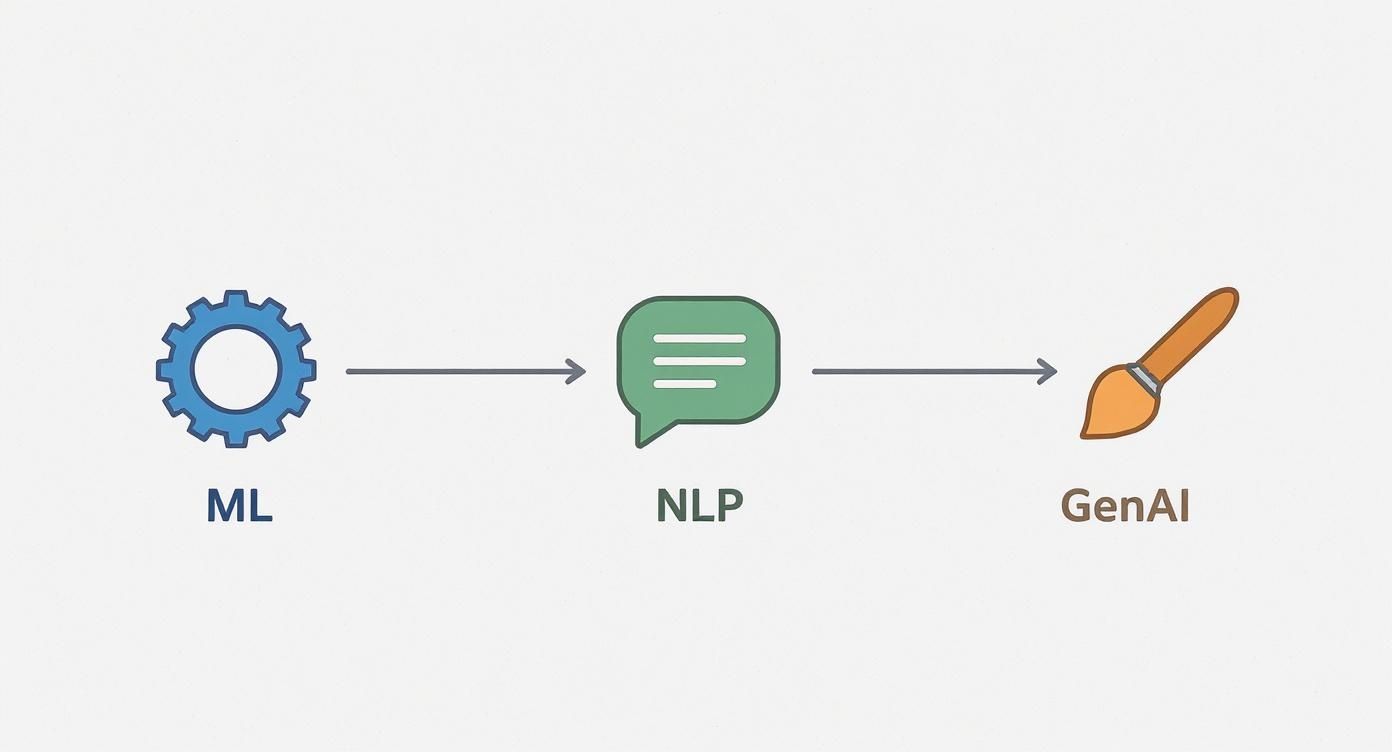
At its foundation, AI in this space breaks down into three main approaches:

  • Machine Learning
  • Natural Language Processing
  • Generative AI

Each of these fits specific use cases—from predictive lead scoring to automated content drafts—and choosing the right one starts with matching its strengths to your goals.

Machine Learning As Data Analyst

Machine Learning thrives on data pulled in from your CRM, web analytics, and engagement logs. Over time, it spots patterns in customer behavior and generates lead scores based on things like click paths and firmographic details.

For instance, an ML model might surface accounts with climbing engagement metrics as prime targets.

Key Takeaway
Machine Learning helps you invest in leads where the data signals are loudest—and that focus often translates into higher conversion rates.

Natural Language Processing As Translator

When you’re swimming in customer feedback, email threads, or social media chatter, NLP steps in to make sense of all that unstructured text. By applying sentiment analysis, it identifies enthusiastic advocates and critical detractors.

You could, for example:

  • Tag email sentiment to speed up urgent replies
  • Run social listening to catch emerging industry trends
  • Analyze chatbot transcripts to sharpen automated responses

Generative AI As Creative Partner

Generative AI serves as your idea factory. Feed it brand guidelines and a tone brief, then let it produce:

  • Blog post outlines
  • Ad copy variations
  • Email subject line experiments

Having multiple drafts on tap can dramatically speed up your content workflow.

AI Workflow From Data To Automation

A solid AI workflow ties data capture to real-world action. Here’s the sequence most teams follow:

  1. Data Ingestion: Gather CRM entries, web analytics, and third-party data.
  2. Model Training: Run your cleaned data through ML algorithms to detect patterns.
  3. Model Validation: Compare predictions against actual outcomes and tweak parameters.
  4. Decision Automation: Push lead scores and content suggestions into campaign tools.
  5. Continuous Monitoring: Keep an eye on performance, retrain models, and adjust triggers as new data flows in.

Pro Tip
A tidy, well-structured dataset at the ingestion stage can make or break your model’s accuracy—and the relevance of your campaigns.

According to a survey, 75% of B2B marketers globally already use AI tools for content creation, data analysis, and campaign optimization. 90% report productivity gains, 39% say content performance improved, and 12% note mixed results on quality. Learn more about these insights in the survey on SurferSEO.

To truly leverage AI, B2B marketers must first grasp how it transforms raw data into actionable insights, enabling them to master competitive marketing intelligence.

Check out our guide on predictive analytics in marketing for a detailed workflow from data ingestion to decision automation.

Action Steps

  • Map your top 3 use cases to ML, NLP, and Generative AI.
  • Audit your data sources for completeness and quality.
  • Define success metrics (e.g., lift in conversion rate or time saved).

This framework sets you up to compare different AI approaches side by side—and choose the one that fits your objectives like a glove. Stay tuned for practical checklists and tips coming up next.

Comparing AI Approaches For B2B Marketing

Choosing the right AI tool is like picking the right lens for a camera—you need clarity on what you want to capture. Do you need pinpoint lead scoring or a high-volume content engine? Your objectives and resources should steer the decision.

Below, you’ll find a concept map that lays out three pillars of AI in B2B marketing: machine learning, natural language processing, and generative AI.

Infographic about ai for b2b marketing

This visual highlights how ML digs into data patterns, NLP handles conversational text, and Gen AI powers large-scale content creation.

Comparison Of AI Approaches

Here’s a side-by-side look at three distinct methods. Use this snapshot to spot which approach matches your goals, budget, and team skills.

ApproachUse CaseProsCons
Rule-Based AILead qualification, workflow automationPredictable outcomes; quick setupRigid rules; struggles with nuance
Machine LearningDemand forecasting, account scoringLearns over time; tackles complexityNeeds clean data; less transparent
Generative AIScalable content creation, personalizationEndless variations; creative flexibilityQuality varies; higher compute cost

Use this table as your quick reference before you dive into vendor pitches.

Real-World Pros And Insights

Rule-based systems often win on speed to launch. Think of simple “if-then” triggers that qualify leads in minutes. A tech firm might set a form-response rule and instantly sort high-value prospects—but if your scenarios shift, those rules can crack.

On the flip side, machine learning layers in adaptability. One B2B team used ML on engagement logs and saw conversion rates climb by 18% over three months. The catch? You’ll need a steady stream of quality data and someone to tune the models.

Generative AI feels a bit like having a junior copywriter on demand. Marketing teams have spun out 50+ email or ad variations in under ten minutes. Still, you’ll want a human in the loop to fact-check and keep the tone on-brand.

And here are a few industry benchmarks to keep in mind:

  • 73% of B2B marketers lean on ML for predictive insights, improving forecast accuracy by 20%
  • Generative AI adoption climbed 45% last year, slashing content production time by half
  • 62% of companies rely on rule-based workflows for basic lead qualification

Decision Checklist

  1. Define Budget Range – Compare implementation and ongoing costs.
  2. Assess Data Readiness – Confirm your CRM and analytics data are clean and tagged.
  3. Evaluate Vendor Expertise – Look for case studies in your vertical.
  4. Pilot A Small Use Case – Start with lead scoring or a few content snippets.
  5. Review Scalability – Make sure the platform grows with your volume and complexity.

Key Takeaway: Match the approach to your team’s data maturity and outcome targets to boost ROI in AI for B2B marketing.

Action Steps

  • Pilot ML vs Gen AI: run both on a sample dataset and compare accuracy and speed.
  • Score rule-based workflows against machine-learned scores to measure lift.
  • Define vendor evaluation criteria based on pros, cons, and benchmarks above.

Vendor Selection Tips

  • Test integration with your CRM (for example, Salesforce or HubSpot) and CMS in a sandbox before signing on
  • Look for security certifications like SOC 2 or ISO 27001 to safeguard sensitive information
  • Confirm access to responsive support and training materials for faster onboarding
  • Compare customization options so you can tweak AI models to your marketing playbook
  • Scan community forums and peer reviews for real-world feedback, warts and all

With these insights and practical steps, you’ll be ready to pick the AI approach that delivers real, measurable value in your next B2B marketing campaign. Next, roll out your pilot, track key metrics, and iterate toward peak performance.

Implementing AI Personalization And Automation

Driving growth in B2B marketing isn’t just about more data—it’s about the right data, at the right time, for the right person. Personalization fuels engagement, and automation keeps your team focused on strategy rather than spreadsheets.

Here’s how to move from raw inputs to campaign-ready audiences:

  • Gather Data Sources: Pull CRM records, web behavior logs, and third-party intent feeds.
  • Segment With AI Models: Group contacts by browsing patterns and firmographic signals.
  • Build Dynamic Workflows: Automate emails, landing pages, and ads that shift based on real-time triggers.
  • Integrate Platforms: Connect your CRM and marketing stack for seamless data flow.
  • Monitor And Adjust: Track performance metrics, retrain models, and enforce privacy measures.

Think of your data as puzzle pieces. Alone, they don’t show much—but when AI spots the edges and corners, suddenly you see the big picture. Timestamped website clicks, whitepaper downloads and form fills often hint at buying intent days before a salesperson even reaches out.

Once your data is in place, AI-driven segmentation carves your audience into hyper-relevant cohorts. Each micro-segment then gets messaging crafted to its exact journey stage—no more guessing which email or offer will stick.

Building Real-Time AI Workflows

Dynamic workflows are where the magic happens: content adapts on the fly, delivering exactly what a prospect needs in that very moment. Picture a user who downloads your ROI case study—within seconds, they’re served a landing page packed with testimonials from companies just like theirs.

  • Select Triggers: Identify actions such as link clicks or form submissions.
  • Design Rules: Map those triggers to specific content variants and offers.
  • Configure Tools: Implement on platforms like Marketo or Pardot for execution.
  • Test Thoroughly: Run A/B experiments to confirm which variants perform best.
  • Launch And Scale: Start small, then widen the net as you monitor engagement.

Dynamic AI Workflow

With workflows live, your CRM becomes the central hub. Native connectors in Salesforce or HubSpot push AI scores and segment tags straight into contact records—no manual imports needed.

Always encrypt data at rest and in transit. And don’t skip regular audits of your model inputs to guard against bias or inadvertent PII exposure.

Tracking Key Metrics

Success hinges on clear KPIs: think conversion rate lift, average deal size, and engagement uplift. Start by comparing email click-through rates or account engagement scores before and after AI deployment.

83% of businesses say AI lets them scale personalization more effectively, and 87% agree it boosts automation efficiency. Organizations using AI-powered segmentation see higher engagement rates and are seven times more likely to exceed their goals compared to those without AI. Discover more insights about B2B marketing trends on Adobe

To practically apply ai for b2b marketing, exploring the best sales chatbot platforms can boost conversions and enhance customer interactions.
Check out our guide on AI marketing automation tools for a deep dive into platform comparisons and integration tips.

But remember—over-automation can feel robotic. Build in human reviews and set throttle points so every outreach still sounds like it came from a real person.

Rollout Checklist

  1. Pilot Segment – Start with 500 high-intent accounts for initial testing.
  2. Weekly Reviews – Measure engagement lift, click rates, and automation health.
  3. Data Audit – Confirm segmentation tags, purge stale or duplicate records.
  4. Human Oversight – Schedule spot checks on automated messages.
  5. Privacy Compliance – Validate encryption, consent logs, and data-flow rules.
  6. Scale Gradually – Broaden cohorts once KPIs show 15% lift in engagement.
  7. Document Findings – Share performance reports and lessons learned.
  8. Continuous Optimization – Iterate workflows and segments quarterly based on new insights.

Action Steps

  • Map your key triggers and design 3 workflow scenarios.
  • Test a dynamic email and landing page variation side by side.
  • Schedule bi-weekly performance reviews to refine triggers and content.

Evaluating Financial Impact Of AI In B2B Marketing

Investing in AI without hard figures can leave your finance team uneasy. In B2B marketing, you need clear benchmarks to justify every dollar.

For instance, swapping manual segmentation for AI-driven personalization often cuts campaign costs and lifts close rates. With that kind of proof, allocating budget becomes a whole lot easier.

  • Revenue Increase: Average uplift of 15–30% from predictive lead scoring
  • Cost Reduction: Automated workflows trim marketing spend by 20–25%
  • Lead Volume Boost: AI chatbots drive 10–20% more net leads

Financial Impact Metrics For AI Adoption

Key ROI figures, revenue growth percentages, cost savings, and market projections in one view.

MetricValueSource
Revenue Increase15–30%Industry Benchmarks
Cost Savings20–25%Market Surveys
Market Size Projection$107.5B by 2028DBS Website
Chatbot Adoption57% of B2BDBS Website
Lead Volume from Chatbots10–20% boostDBS Website

These numbers aren’t pulled from thin air. They come from surveys and market studies showing how AI reshapes budgets and performance.

Expert polls reveal that 65% of organizations report higher revenue after rolling out AI in marketing and sales. At the same time, 41% of teams see spending dip, and 26% of chatbot adopters note a 10–20% lift in leads. For the full breakdown, learn more about these findings.

Statistical Highlight
65% revenue growth and 41% cost reduction underscore AI’s measurable impact on marketing budgets.

Building Your Business Case

To get the green light, model different scenarios so stakeholders can see projected returns side by side with costs. Factor in everything: licensing, integration, training, even ongoing maintenance.

Budgets vary by company size. Small teams often plan for $50K–$100K a year. Midsize firms might set aside $200K–$500K, and enterprises frequently budget $1M+.

Follow these steps when you craft your proposal:

  • Calculate licensing and subscription fees
  • Estimate integration and customization expenses
  • Factor in internal training hours and vendor support
  • Account for maintenance, updates, and retraining

For a deeper dive on putting these figures into your spreadsheet, check out our guide on how to calculate marketing ROI.

Scenario Modeling Tips

Start by mapping current marketing costs across each channel. Then layer in AI-related expenses and forecast the gains you expect.

  • Licensing: Compare annual fees and seat-based models
  • Integration: Include setup, testing, and customization costs
  • Training: Estimate internal hours plus vendor-led workshops
  • Maintenance: Plan for periodic retraining and software updates

Run best-case and worst-case scenarios to show how swings in performance affect ROI. A simple sensitivity analysis can reveal which variables matter most.

Tip
Test small shifts—like a 5% change in lead volume—and see how your overall ROI adjusts.

With well-structured scenarios, your finance team will view AI investment as a low-risk, high-reward decision. Keep revisiting these models quarterly, involve sales, IT, and operations, and update your assumptions. That transparency ensures your AI initiatives stay on track as market conditions evolve.

Real World AI Case Studies In B2B Marketing

B2B AI case study overview

There’s nothing like seeing AI in motion to bridge the gap between idea and impact. Below are three stories—one from a mid-sized SaaS vendor, one from a global manufacturer, and one from a boutique consultancy. Each walks through goals, rollout steps, results, and the single insight you can apply right away.

Predictive Lead Scoring For Tech Provider

A mid-sized SaaS company was wrestling with a slow MQL-to-SQL funnel. Their fix? An AI-driven scoring model built on 20 variables spanning firmographics, engagement signals, and buying intent.

  • Data Cleansing: Unified fields, purged duplicates
  • Model Training: Fed historical pipeline data into a supervised ML engine
  • CRM Integration: Pushed fresh scores into Salesforce every 24 hours

In just three months, conversion rates jumped by 18%, and the average hand-off time fell by 30%. The big lesson: without clean, well-labeled data and routine drift checks, even the smartest model will underperform.

Automated Support With Chatbots

A global manufacturing firm faced a torrent of support tickets and sluggish response times. Their answer was an AI chatbot for first-level queries on web and mobile.

They assembled a knowledge base of 5,000 FAQs, trained the bot on past tickets, then linked it to CRM and ERP systems.

“The chatbot handles 65% of incoming questions without any human handoff,” says their operations director. “That freed our engineers to tackle the tough stuff.”

The outcome? A 45% drop in escalations and a shift from 4-hour resolutions to 1.5-hour averages. The secret: continuous updates fueled by agent feedback keep the bot sharp.

Generative AI For Consultancy Content

A boutique B2B consultancy needed to ramp up thought leadership without blowing its budget. They turned to a generative AI platform to draft blogs, white papers, and social posts.

Feed in brand voice guidelines and example articles, and the system spit out first drafts for 50+ assets in under a week.

  • Content Briefing: Defined tone, style, and audience
  • Draft Generation: Automated outlines and supporting copy
  • Human Review: Editors refined facts and brand alignment

This slashed writing time by 70% and tripled output, delivering a 60% cost cut per asset versus an all-manual process. The key? A human-in-the-loop step ensures quality never takes a back seat.

Practical Steps To Adapt These Cases

  1. Audit Data Sources – Confirm your datasets are clean and tagged.
  2. Pilot One Workflow – Start with lead scoring or a chatbot trial.
  3. Embed Human Oversight – Schedule review checkpoints to catch issues early.
  4. Measure Key Metrics – Track conversion lift, resolution times, and content velocity.
  5. Scale Gradually – Expand once you’ve demonstrated ROI.
  6. Review Models Quarterly – Guard against performance drift with retraining.

Key Takeaway: Effective AI in B2B marketing thrives on data readiness, phased pilots, and ongoing human checks.

Best Practices And Next Steps For AI Integration

Starting an AI initiative without a clear plan is like setting off on a road trip without a map—you’ll burn through resources and still wonder where you’re headed. Here, we’ll walk through how to pilot, govern, and scale AI in your B2B marketing efforts, step by step.

First, get everyone aligned on strategic goals before touching any data or code. That shared vision becomes your decision-making compass and prevents costly detours.

Think of your AI roadmap as a GPS: pick a destination, choose the fastest route, and follow the directions.

“When strategy and technology move in sync, your AI investment turns into an engine, not an expense.”

Pilot Projects And Team Setup

Every major AI deployment should begin with a tight pilot. It helps you validate assumptions fast and spot unexpected hurdles.

Pull together a cross-functional crew—marketing, IT, data science—and secure an executive sponsor who can clear roadblocks.

  • Define Pilot Scope: Select 1–2 high-impact use cases with clear KPIs.
  • Assign Roles: Who handles data ingestion? Who trains models? Who runs campaigns?
  • Set Timelines: Aim for a 6–8 week minimum viable test phase.

“A focused pilot with concrete success criteria accelerates buy-in and minimizes risk.”
– AI Strategy Lead

Once you’ve demonstrated value, evolve that team into a dedicated AI Center of Excellence. This hub will govern standards, share best practices, and oversee multiple projects.

  • AI Program Manager: Coordinates across teams.
  • Data Engineer: Keeps data pipelines clean.
  • ML Engineer: Tunes models and tracks performance.

A Center of Excellence ensures consistency and speeds up growth.

Governing Data And Model Monitoring

Healthy data and robust models require ongoing attention. Without governance, models drift and campaigns plateau.

ElementFocus AreaFrequency
Data Quality ChecksCompleteness & AccuracyWeekly
Bias AuditsFairness & Ethical RisksMonthly
Performance ReviewsKey Metrics & ROIQuarterly

Set up automated alerts for sudden dips in lead scores or relevance. That way, your AI stays sharp and reliable.

Vendor Evaluation And Change Management

Choosing the right AI vendor can make or break your initiative. Rather than chasing features, match platforms to your priorities and workflows.

  1. Identify Must-Have Features: segmentation, predictive analytics, content generation.
  2. Check Security Certifications: SOC 2, ISO 27001.
  3. Request Case Studies: find examples in your industry.
  4. Pilot Integrations: test connectors in your CRM/CMS sandbox.
  5. Negotiate SLAs: agree on uptime and support commitments.

Rolling out new tech also means winning hearts and minds:

  • Communicate benefits early and often.
  • Provide hands-on training sessions.
  • Gather feedback and iterate quickly.
CriteriaImportanceNotes
IntegrationHighNative CRM connectors required
CostMediumFactor TCO over 2 years
SupportHighResponse time under 4 hrs

Continuous Improvement And Ethical Oversight

Adopting AI is a marathon, not a sprint. After launch, establish a cycle of learning and optimization.

  • Quarterly Reviews: Measure results against your baseline.
  • Model Retraining: Refresh algorithms with new datasets.
  • Stakeholder Feedback: Collect input from sales and customer success.
  • Governance Updates: Tighten privacy and ethics policies.

Privacy must be baked in from day one:

  • Consent Audits: Verify opt-in status every quarter.
  • Legal Review: Ensure GDPR and CCPA compliance.
  • Audit Logs: Track data access and processing events.

Think of your AI like a garden—it needs regular watering and weeding to thrive. Ethical guardrails keep you from harvesting bias.

Set realistic timelines based on your maturity level:

Maturity LevelTimelineGoals
Early3–6 monthsPilot and initial team formation
Intermediate6–12 monthsDeploy multiple use cases
Advanced12+ monthsFull Center of Excellence and enterprise scale

By combining structured pilots, strong governance, and continuous iteration, you’ll build a marketing engine that delivers real, lasting AI impact.


Ready to accelerate your marketing with AI? Experience how marketbetter.ai streamlines content creation, campaign optimization, and customer personalization. Start Your Free Trial today and unlock your AI advantage.

A Guide to AI in Content Creation

· 24 min read

Let’s be real for a second. When you hear “AI in content creation,” it’s easy to picture robots churning out soulless blog posts. Forget that. The reality is far more practical and, honestly, more exciting.

Think of AI less as a replacement for your creativity and more as the ultimate co-pilot. It’s the tireless assistant that handles the grunt work—the endless research, the first-pass drafting, the mind-numbing data sifting. This frees you up to do what humans do best: focus on strategy, nail the nuance, and build a genuine connection with your audience.

The New Content Creation Playbook is Here

This guide isn't about sci-fi futures; it's about showing you exactly how artificial intelligence fits into your workflow today. We’re going to break down how the sharpest content teams are using AI to scale their output and stay ahead in a ridiculously crowded digital world.

The core idea is simple. Let the machine manage the repetitive, time-sucking tasks, while you steer the ship. A classic example is keyword research. The old way involved manually digging through spreadsheets for hours. The new, actionable approach? Use an AI tool to generate a list of high-potential topics with search volumes and difficulty scores in under five minutes. It’s a no-brainer.

Your Role is Shifting from Writer to Content Director

This is the most important change to grasp. Adopting AI fundamentally flips your job description on its head. Instead of spending 80% of your time on the nitty-gritty of drafting and only 20% on strategy, you get to reverse that.

Your expertise becomes the most valuable part of the equation. You're the one directing the AI, refining its output, and making sure every piece of content perfectly captures your brand’s voice and hits its strategic goals.

This shift is what makes true scalability possible. Compare these two scenarios: you need 100 unique product descriptions for a new launch.

  • Traditional Method: A human writer could be tied up for weeks, writing each one from scratch.
  • AI-Assisted Method: An AI generates the initial drafts for all of them in an afternoon, leaving you with the much faster job of reviewing, refining, and adding a human touch.

Before we go any further, it helps to know a little about the engine driving all this. If you want a quick primer, this simple guide explains What is Generative AI? and how the technology actually works.

The numbers don't lie, either. The generative AI market is on a tear, hitting a global value of $63 billion by 2025. With North America making up over 40% of that revenue and the market projected to grow at a compound annual rate of 42%, it’s clear this isn’t just a trend—it's a fundamental business shift.

The Real-World Benefits of Bringing AI into Your Workflow

This is about more than just moving faster. It's about creating smarter, more effective content. Here are the biggest wins, compared to traditional methods:

  • Serious Scalability: Instead of being limited by human hours, you can produce high volumes of content—from social posts to in-depth articles—without needing to hire an army of writers.
  • Off-the-Charts Efficiency: Automate tasks that drain your time, like research and outlining. This turns production timelines from days into hours, allowing you to react faster to market trends.
  • Data-Driven Decisions: Manually analyzing data is slow and prone to error. Use AI to chew through performance data and spot content gaps so your strategy is always guided by what your audience actually cares about.

Think of AI as your creative co-pilot. It crunches the data and draws the map, but you're still the one in the captain's chair, steering the ship to its final destination. This human-machine partnership is the future of content.

How AI Is Rewriting the Content Lifecycle

Let's get one thing straight: AI isn't just another tool you pull out for one part of the job. It’s a collaborator that plugs into every single stage of the content lifecycle. What used to be a slow, step-by-step march from idea to published piece is now a fast, dynamic cycle. This shift helps you move quicker, make smarter calls, and ultimately, create content that actually hits the mark.

The whole game changes before you even write a single word. Traditionally, topic research was a mix of guesswork and manual keyword tool analysis. With AI, tools can chew through massive amounts of data—search trends, what your competitors are doing, audience engagement—to find topic opportunities a human would almost certainly miss. This isn't about guesswork anymore; it's about focusing your energy on what your audience is already telling you they want.

This new partnership between creator and machine is reshaping how modern content teams operate. This infographic gives you a good look at how AI jumps in to help with everything from research and drafting to optimization.

Infographic about ai in content creation

As you can see, AI acts like a force multiplier at every stage. It turns tedious manual tasks into automated processes, freeing up humans to focus on strategy and creativity.

From Blank Page To First Draft

Once you've landed on a winning topic, AI puts the drafting process into overdrive. The terror of the blank page? Gone. You can generate a structured outline in seconds, complete with H2s, H3s, and the main talking points you need to cover. This gives you a solid skeleton to build on, so you can pour your time into adding your own unique insights, telling great stories, and providing real expert analysis.

Let's compare the old way versus the new way:

  • Old: Spend hours researching and structuring an outline, then more hours writing a messy first draft from scratch.
  • New: Generate a data-informed outline in 60 seconds. Use that outline to prompt an AI for a first draft, handling the foundational work. Your job shifts from writer to strategic editor.

AI fundamentally changes the starting line for content creation. Instead of beginning with zero, you start with a structured, well-researched draft that’s ready for your expertise and refinement.

This isn't some future-gazing prediction; it's happening right now. In 2025, a massive 76% of marketers are using generative AI for content creation, with 71% leaning on it for creative inspiration. The proof is in the output, too, with 74.2% of new webpages published in 2025 including AI-generated content. But—and this is a big but—the human touch is still critical. 86% of marketers report editing AI outputs to match their brand voice and hit quality standards.

Optimizing And Repurposing At Scale

Once the draft is solid, AI slips into its optimizer role. These tools can scan your text for SEO, suggesting keywords, flagging readability issues, and even checking the emotional tone. This step is all about making sure every piece is fine-tuned to perform, whether that’s ranking on Google or connecting with a specific audience on social media.

But the real magic happens when it’s time to repurpose. This is where AI becomes a game-changer. It makes it almost ridiculously easy to spin one core piece of content into a dozen different assets.

  • Actionable Tip: Blog Post to Social Media. Feed your article to an AI with the prompt: "Create an 8-tweet thread from this article. Make the first tweet a strong hook and the last one a question to drive engagement."
  • Actionable Tip: Webinar to Email Series. Use an AI transcription tool on your webinar recording. Then prompt it: "Based on this transcript, write a 3-part email nurture sequence highlighting the most valuable takeaways."
  • Article to Audio: The tech is getting incredibly good at multimedia, too. Understanding models like OpenAI's Whisper AI for speech recognition shows just how far we've come in turning text into high-quality audio.

This ability to repurpose content on the fly is a massive win for any team trying to maximize its reach. By automating the grunt work of converting content from one format to another, you can scale content marketing without having to scale your team or budget. It’s about getting your message in front of your audience, wherever they happen to be.

Let's be honest, the real "aha!" moment with AI in content creation happens when you put it side-by-side with the old way of doing things. The difference is night and day. It’s not just about going faster; it’s a complete overhaul of the entire production line, turning a manual marathon into a strategic sprint.

This shift changes everything—it redefines roles, crushes timelines, and unlocks a scale that most teams could only dream of before.

Think about the classic process for writing a solid blog post. It always started with hours of grunt work: digging through SERPs, pulling stats, and vetting sources. Then came the slow, painful process of outlining, followed by the even slower staring contest with a blank page. After all that, you still had editing, proofing, and SEO optimization. It was a linear, exhausting slog that could easily eat up a full day (or more) for one quality piece.

Now, let's look at the AI-assisted workflow. Forget hours of research; an AI tool can analyze the top-ranking content and spit out a data-driven brief in minutes. That terrifying blank page? It’s gone, replaced by a solid first draft built from that brief.

This frees up the writer to do what they do best. Their role flips from assembly-line worker to strategic director—guiding the AI, injecting unique expertise, and polishing the final piece until it shines.

Image

The Creator’s Role Gets an Upgrade

When AI handles the heavy lifting, the content creator is suddenly free to focus on high-value work. Your brainpower is no longer wasted on basic drafting. Instead, you're refining, fact-checking, and adding the human insight that AI simply can't replicate. You become the editor, the strategist, and the final quality gatekeeper.

This isn’t about replacing creativity. It’s about amplifying it.

Imagine an e-commerce brand that needs to write 500 unique product descriptions for a new launch. Traditionally, that's a soul-crushing project. A human writer might get through twenty in a good day. With an AI partner, the first drafts for all 500 can be generated in the time it takes to write just a handful, leaving the team to focus on perfecting the copy that actually sells.

A Head-to-Head Workflow Comparison

The practical differences in speed, cost, and output are stark. What once took a full day can now be done in a fraction of the time, leading to a massive return on your investment.

To make this crystal clear, here’s a direct comparison that shows how the workflows stack up on key performance indicators.

AI-Assisted vs Traditional Content Workflow Comparison

MetricTraditional WorkflowAI-Assisted WorkflowImpact
Research Time2-4 hours15-30 minutesOver 85% reduction in manual research time
Drafting Time3-5 hours1 hourFrees up hours for strategic editing and refinement
Total Time-to-Publish8-12 hours2-4 hours3x faster content delivery and increased velocity
Cost Per ArticleHigh (based on hourly rates)Low (fixed subscription cost)Drastically reduces content production expenses
ScalabilityLimited by team sizeNearly unlimitedEnables mass content production without hiring more staff

The numbers don't lie. An AI-assisted approach doesn't just speed up the old process; it creates an entirely new, more efficient model for getting content out the door.

The real win here is how you reallocate your team's talent. Instead of spending 80% of their time on manual tasks like research and first drafts, creators can now invest that time in strategy, creativity, and adding unique value—the very things that make content great.

At the end of the day, bringing AI into your content process lets your team produce more, publish faster, and operate with a sharper strategic focus. It empowers creators to break free from the constraints of manual labor and hit a level of output and quality that was once completely out of reach.

Putting AI to Work in the Real World

Theory is great, but the real magic happens when you see how actual businesses are using AI in content creation to solve problems they face every single day. This is where the rubber meets the road.

These aren't just hypotheticals. We’re talking about marketing agencies doubling their output and SaaS companies finally getting a handle on their technical documentation. Let's dig into some concrete examples of companies winning with AI right now.

Scaling SEO Content for a Marketing Agency

Picture a boutique marketing agency hitting a wall. They're good at what they do—maybe too good. Their client list is growing, but their ability to produce high-quality SEO content isn't keeping pace. The manual grind of creating detailed content briefs and writing first drafts was a serious bottleneck, capping how many clients they could actually serve.

Their solution? Weave AI into their core workflow with these actionable steps:

  1. Automated Brief Generation: First, they used an AI tool to scope out the competition. It analyzed the top-ranking articles for a target keyword and, in minutes, spit out a comprehensive brief—complete with word count targets, key topics, semantic keywords, and a suggested outline.
  2. AI-Powered First Drafts: With that detailed brief in hand, a generative AI model knocked out a solid first draft. This handled all the heavy lifting of basic research and structure.
  3. Strategic Human Refinement: This is the key part. Their expert writers then stepped in to transform the AI draft into something great. They fact-checked, added unique insights, sprinkled in the client's brand voice, and polished it until it shined.

The results were immediate. The agency sliced its content production time by over 50%. Suddenly, they could handle twice the client work without hiring more people. This shifted their writers from content grinders to strategic editors, which not only improved job satisfaction but also the final product.

Automating Technical Documentation for a SaaS Company

For any fast-growing SaaS company, keeping technical docs up-to-date is a nightmare. Engineers are busy building the product; writing documentation feels like a chore. This common problem leads to outdated guides, frustrated customers, and a support team drowning in preventable tickets.

They got clever and built an AI-powered system that created documentation straight from developer notes.

By plugging AI directly into their development cycle, they saved hundreds of engineering hours each quarter and saw a 30% drop in support tickets related to documentation. The AI essentially became the translator between technical jargon and user-friendly guides.

The process was deceptively simple. Whenever a developer committed new code, their technical notes were automatically piped into a custom-trained AI. This model was taught to turn dense, technical language into clear, step-by-step instructions, perfectly formatted for their knowledge base. Just like that, their documentation was always in sync with the product—a feat that was nearly impossible to achieve manually.

Repurposing Content for a Media Publisher

A digital media publisher was creating fantastic long-form articles but struggling to get the most out of them. Manually turning one great article into a video script, a social media thread, and an email newsletter was a huge time sink. They were leaving a ton of audience engagement on the table.

So, they turned to AI to become a content repurposing machine. After publishing a big article, they would feed it into an AI tool with specific, actionable prompts:

  • For Video: "Create a 3-minute video script from this article, focusing on the most compelling points. Include visual suggestions."
  • For Social Media: "Turn this article into an engaging 8-part Twitter thread. Start with a strong hook and end with a question."
  • For Email: "Draft a concise email newsletter summarizing the key takeaways from this article for our subscriber list."

This simple change allowed them to spin a single piece of content into a full-blown multi-channel campaign in less than an hour. If you want to see this strategy in action, there are many social media content creation tools that can help automate the process. Their reach and engagement shot up across all platforms, all without adding to the team's workload. It’s a perfect example of how AI can amplify your best work.

Building Your AI Content Strategy From Scratch

Jumping into AI in content creation without a plan is like trying to build furniture without the instructions. You might end up with something, but it probably won’t be the sturdy, functional piece you imagined. A real strategy is what separates teams generating soulless, generic copy from those producing high-quality content that actually moves the needle.

The goal here isn't just "using AI." It's about weaving it so seamlessly into your workflow that it becomes a natural extension of your team's own talent. This means getting past the fun of just playing with prompts and taking a more deliberate approach. You need to spot the right opportunities, pick the right tech, and set up clear rules to protect your brand.

Here’s a practical, step-by-step roadmap to get you started without turning your content process upside down.

Start Small and Target High-Impact Areas

The single biggest mistake you can make is trying to automate everything all at once. That's a recipe for chaos. A much smarter approach is to find a low-risk, high-impact area to dip your toes in. This lets your team get comfortable with the tools and see some early wins before you go all-in.

Think about the most grinding, repetitive tasks in your current workflow. Those are your prime candidates for a first experiment. Here’s an actionable list to choose from:

  • Blog Topic Ideation: Instead of staring at a blank page, use an AI to analyze search trends and see what your competitors are ranking for. You'll get a list of data-backed ideas in minutes.
  • Social Media Captions: Ask an AI to generate 5 or 10 different captions for a single post. Test them out and see what your audience actually responds to.
  • Meta Descriptions: Automate the creation of SEO-friendly meta descriptions for your blog posts or product pages. It’s a small task that adds up to a ton of saved time.

Starting with these smaller tasks lets you prove the value of AI in content creation on a manageable scale. You build momentum and get team buy-in by showing results, not just making promises.

Choose the Right Tools for Your Team

Let's be clear: not all AI tools are created equal. The market is absolutely flooded with options, and each has its own strengths, weaknesses, and quirks. The "best" tool isn't the one with the flashiest features; it's the one that fits your team's specific needs, budget, and existing tech stack.

When you're kicking the tires on different platforms, use this actionable checklist to compare them:

  1. Functionality: Does this thing do one thing really well (like writing), or is it more of an all-in-one suite with features for SEO, image generation, and analytics?
  2. Ease of Use: How steep is the learning curve? A super-powerful tool is worthless if your team finds it too confusing to actually use.
  3. Integration: Can it talk to the tools you already rely on, like your CMS or project management software? You want to reduce friction, not create more of it.
  4. Cost: Does the pricing model—per-user, per-word, or a flat subscription—make sense for how much you'll use it?

Take the time to actually compare your options. For a deep dive, this guide on the best AI marketing tools is a great resource for seeing how different platforms stack up against each other. Making the right choice upfront will save you a world of headaches later on.

Create Your AI Rulebook

Before you hand over the keys and let your team run wild with generative AI, you need to establish some guardrails. Think of it as your "AI Rulebook"—a clear set of guidelines for maintaining your brand's voice, ensuring accuracy, and just generally using the tech responsibly.

Your AI rulebook isn't about restricting creativity; it's about protecting quality. It ensures that every piece of content, whether human- or AI-assisted, meets your brand's high standards.

This document should give clear, simple answers to the big questions. Here are actionable items to include in your rulebook:

  • Brand Voice: How do you make sure the AI's output doesn't sound like a generic robot? Provide it with concrete examples of your tone and build a style guide for it to follow.
  • Fact-Checking: What's the non-negotiable process for verifying every statistic, claim, and quote the AI produces?
  • Disclosure: Will you tell your audience when AI was used? If so, when and how?
  • Human Oversight: Which steps in the content process must have a human review and final sign-off? (Hint: it’s probably more than you think.)

This rulebook becomes the single source of truth for your team. It’s not set in stone, either. Treat it as a living document that you update as you learn what works and what doesn't.

The Future Is Human and AI Collaboration

A person and a robot collaborating on a project together

As we look at the horizon of AI in content creation, one thing is becoming crystal clear: this isn't about humans being replaced. Not even close. It's about collaboration—a powerful, symbiotic partnership between creator and machine.

The future belongs to the people who learn to treat AI less like a vending machine for words and more like a strategic partner. A partner that can amplify their vision and execute on ambitious ideas that were, until recently, just too time-consuming or complex to even attempt. It’s a shift from just generating text to building a sophisticated, AI-assisted workflow.

The real magic of AI won't come from letting it run wild. It comes from skillfully guiding it. Your expertise, your creativity, and your strategic oversight are what turn a generic AI output into something truly exceptional.

This partnership model is essential. Why? Because while AI crushes speed and scale, it has zero lived experience. It can't feel empathy or build a genuine connection with your audience. That’s your job. You provide the context, the nuance, and the storytelling that resonates. The AI provides the raw processing power to bring those ideas to life at a pace we've never seen before.

The Next Wave of Content Innovation

The evolution of AI in content is speeding up, pushing the boundaries of what’s possible every single day. There are two huge trends you need to have on your radar right now. Getting ahead of them will give you a serious advantage.

First up is hyper-personalization at scale. Think about tailoring every blog post, every email, every social update to the specific interests of each individual user. That's always been the dream, but it was manually impossible. AI makes it feasible. You can finally create content that feels uniquely personal to every single person in your audience.

Second, AI is moving way beyond just text. We're seeing the automation of video and audio creation, where AI can generate scripts, create visuals, and even produce shockingly realistic voiceovers.

The difference between the old way and the new way is stark.

TaskTraditional MethodAI-Assisted Method
Video ScriptingDays of writing and reviewMinutes to generate drafts
Voiceover RecordingHours in a recording studioSeconds with realistic AI voices
B-Roll SourcingHours searching stock sitesAutomated selection based on script

The message here is simple: the future is a partnership. The best way to prepare is to start experimenting with the tools available today. Get your hands dirty. Learn what works, sharpen your prompting skills, and position yourself at the front of this massive shift. The creators who embrace this collaborative spirit are the ones who will lead the next wave of content innovation.

Got Questions About AI in Content Creation?

Let’s be honest, jumping into AI feels a bit like stepping into the deep end. It's natural to have questions. The good news is the answers are usually simpler than you'd expect. Let's clear up some of the most common ones.

Will AI Replace Content Writers?

No, but it will absolutely change the job description. Think of it less as a replacement and more as a promotion.

Compare the roles: A traditional writer spends most of their time on research and drafting. An AI-powered writer spends most of their time on strategy, editing, and adding unique insights. AI handles the grunt work, freeing up human writers to focus on what really moves the needle. The future belongs to creators who learn to work with AI, not the ones trying to outrun it.

How Do I Make Sure My AI Content Is Actually Original?

Originality comes down to one thing: your oversight. AI models are trained on the internet, so there's always a chance they'll spit out something that sounds a little too familiar. The golden rule is to treat AI output as a starting point, never a finished product.

Here’s an actionable playbook:

  • Run it through a plagiarism checker. Always. No exceptions.
  • Inject your own secret sauce. Weave in your personal stories, proprietary data, and expert opinions that an AI could never dream up.
  • Rewrite and refine. Never just copy and paste. Your job is to take the clay the AI gives you and shape it into something that sounds like you.

What's the Best Way for a Small Business to Start?

Start small and solve one specific problem. Don't try to overhaul your entire content machine on day one.

A perfect first step is using an AI tool for ideation. Ask it to generate a list of blog topics or social media post ideas based on a few of your target keywords. It’s a low-risk, high-reward way to see the value immediately without getting bogged down in a steep learning curve. Actionable step: Sign up for a free trial of an AI writer and give it this prompt: "Generate 10 blog post ideas for a [your business type] targeting [your ideal customer]."

Can AI Really Capture My Brand Voice?

Not right out of the box, no. But with a little coaching, it can get surprisingly close.

The trick is to give the AI a crystal-clear "brand voice" brief. This isn't just a vague instruction; it's a detailed prompt that includes your tone (e.g., "witty and informative," "professional and authoritative"), who you're talking to, and specific words you love or hate. Actionable tip: Create a document with examples of your best-performing content and feed it to the AI as context before asking it to write. When you feed it this prompt consistently, you're effectively training the AI to mimic your style over time.


Ready to stop guessing and start building a smarter content engine? The marketbetter.ai platform puts powerful AI across your entire workflow, from first idea to final polish. See how you can scale your content strategy today.