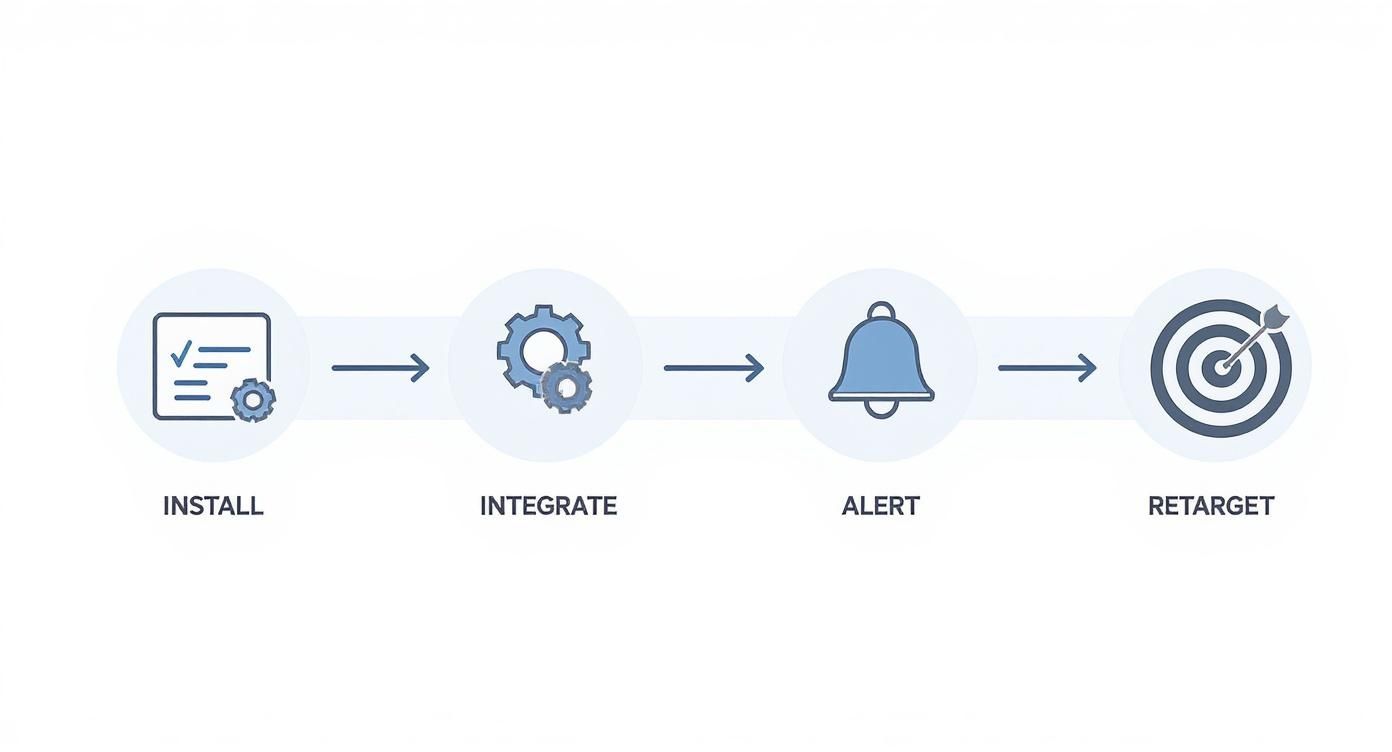
Website Visitor Identification: How SDRs Turn Anonymous Traffic Into $47K Deals [2026]
Website visitor identification software is the tech that unmasks the anonymous companies checking out your website. For a Sales Development Representative (SDR), this isn't just another tool; it's a competitive advantage. It takes invisible digital footprints and turns them into real, actionable sales intelligence, transforming "ghost" visitors into tangible, high-intent accounts your sales team can engage with right now.
Think of it this way: instead of starting your day with a cold, static list, you get a live feed of companies that are already evaluating you. The difference is night and day.
Your Best Leads Are Already on Your Website
Picture this: your absolute ideal customer—a perfect-fit, high-value account—is clicking around your pricing page right now. They're weighing your features, seeing if you're the right solution, and showing all the signs of being ready to buy.
And then… they're gone. Vanished, without a trace.
For most Sales Development Reps (SDRs), this isn't just a story. It’s what happens every single day. The brutal reality is that the vast majority of your website traffic stays completely anonymous. A staggering 97% of B2B website visitors never fill out a form, leaving your sales and marketing teams totally in the dark.
This creates a massive blind spot in your pipeline. If you want to learn more about closing that gap, Factors.ai has a great guide on anonymous website visitor identification. Without this insight, SDRs are stuck doing the one thing they hate most: cold, uninformed outreach.
From Cold Outreach to Warm Engagement
The old-school SDR playbook is a grinding numbers game. You start with a giant list of cold accounts, burn hours digging for contacts, and blast out countless emails, just hoping something sticks. It’s wildly inefficient, frustrating, and, frankly, pretty demoralizing.
Website visitor identification flips that entire model on its head.
Instead of guessing who might be interested, you get a clean, prioritized list of companies that have already raised their hands simply by showing up. This one shift changes everything about an SDR's day-to-day work and their odds of success. It turns a reactive, volume-based job into a proactive, value-driven role.
"The difference is like fishing with a sonar versus casting a net into an empty ocean. One is strategic and targeted; the other is pure chance. Visitor identification gives SDRs the sonar."
This tech lets you stop playing a guessing game and start playing chess. To see just how stark the difference is, let's compare an SDR's workflow with and without this crucial intelligence.
Table: Anonymous Visitors vs Identified Opportunities
This table breaks down the day-to-day reality for an SDR. On one side, you have the frustrating guesswork of dealing with anonymous traffic. On the other, you have the focused, high-impact work that comes from knowing exactly who is showing interest. This is the core reason SDRs benefit from this technology.
| SDR Challenge | Anonymous Visitor (Without Identification) | Identified Visitor (With Identification) |
|---|---|---|
| Prioritization | Chasing a massive, cold list. Every account looks the same. | Focusing on a small, warm list of companies already on the site. |
| Research | Spending hours on LinkedIn trying to find the right people at the right accounts. | Instantly knowing the company. Research is focused on finding key contacts. |
| Outreach | Generic, templated emails. "Hope you're having a great week..." | Personalized outreach based on the pages they viewed. "Saw you were on our pricing page..." |
| Timing | A complete guess. Reaching out at a random time, hoping it's relevant. | Perfect timing. Engaging the account while they are actively in a buying cycle. |
| Conversation | Cold start. "Hi, let me introduce our company..." | Warm start. "I can help answer any questions you might have about our solution." |
| Efficiency | Low. High volume of activity, very few positive replies. | High. Lower volume of outreach, much higher reply and meeting booking rates. |
The takeaway is crystal clear. One path leads to SDR burnout and missed quotas; the other leads to a smarter, more effective sales process that consistently builds pipeline.
The SDR Advantage of Knowing Who Is Visiting
Knowing which companies are on your site gives your SDRs a powerful edge. It delivers the context they desperately need to craft relevant, timely, and personalized outreach that actually gets noticed.
Instead of starting a conversation from scratch, you're jumping in with the knowledge that the account is already aware of the problem and actively looking for a solution. This single insight is the bedrock of a more strategic and successful outbound engine, turning your anonymous traffic into your single best source of qualified leads.
How Website Visitor Identification Actually Works
So, how does this black box actually work? How do you unmask the companies checking out your site? Let's pull back the curtain on the mechanics, but for sales teams, not engineers. The goal is to show you why you can trust this data for your daily outreach.
The engine driving all of this is IP-to-company resolution, sometimes called reverse IP lookup.
Think of it as a digital Caller ID for your website. When someone from a company browses your site from their office network, their computer broadcasts its IP address. This unique digital address is almost always registered to their company. The identification software then cross-references that IP against a massive database to find the matching company name, industry, size, and even location.
In an instant, an anonymous digital footprint becomes a named account, giving your SDRs a massive head start.
It’s a simple, three-step flow that turns invisible traffic into real opportunities your sales team can jump on.
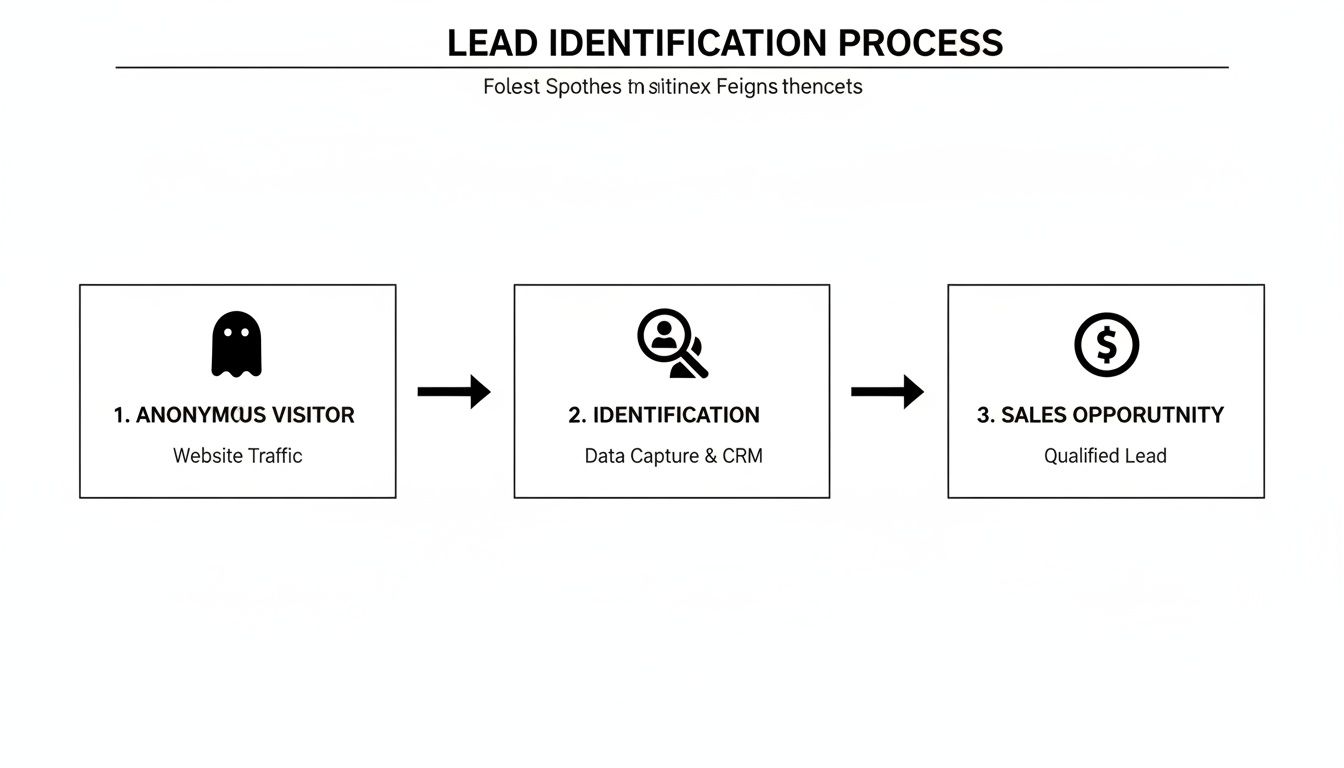
This process shows exactly how an anonymous visitor gets identified by the tech and then turned into a tangible sales opportunity. It's that crucial middle step that makes all the difference for an SDR.
IP Resolution vs. The Old Way with Cookies
It’s important for SDRs to understand the difference between this modern, privacy-first approach and the old world of third-party cookies. For years, advertisers dropped cookies on browsers to track individual people across the web, building creepy, detailed profiles of their habits. It was powerful, but it created a major privacy backlash.
Now, major browsers are killing off third-party cookies, making that kind of tracking a thing of the past. To really get into the weeds, you need a solid grasp of understanding cookie policies and what they mean for businesses today.
This massive shift is what makes IP-to-company resolution so vital for B2B sales. Unlike cookies that stalk individuals, reverse IP lookup focuses on the company. This gives SDRs the account-level context they need without stepping over the privacy line. You know a target account is on your site, which is the perfect signal to start a confident, relevant conversation.
The real win for an SDR isn't knowing a specific person's name right away. It's knowing that a high-value account is actively researching your solution right now. That knowledge is what turns a cold call into a perfectly timed, warm conversation.
What This Means For An SDR
Look, for a Sales Development Rep, the tech itself doesn't matter as much as what it lets you do. You don't need to be a network guru to cash in. The bottom line is this: you get a reliable, real-time feed of companies showing legitimate buying intent.
Here’s what this process empowers you to do:
- Trust the Signal: You know the data is based on a direct action—a visit from a company's network—not some fuzzy, third-party guess.
- Act with Confidence: You can build your day around accounts that are already warm, which dramatically lifts your chances of booking a meeting.
- Personalize Your Outreach: Your opener can be, "I saw someone from your company was checking out our features..." instead of a generic, shot-in-the-dark pitch.
The best visitor identification tools are built to be a source of truth for SDRs. While most tools today focus on the company level, the industry is always evolving. You can get a glimpse of what's next by learning about the future of person-level visitor identification vectors.
For now, though, the focus is squarely on giving you the clear, actionable signals you need to build pipeline, period.
The Hidden Cost of Inaccurate Visitor Data
On paper, a website visitor identification tool sounds like a slam dunk for any sales team. You get a list of companies poking around your site, and suddenly your Sales Development Reps (SDRs) have a fresh, warm pool of leads to dive into. It feels like a sure thing.
But what happens when that data is just plain wrong?
The hard truth is that not all identification tools are created equal. And bad data is far, far worse than no data at all.
Low-quality visitor information doesn't just fall flat—it actively poisons your sales efforts. For an SDR, this mess translates into hours of wasted productivity, day in and day out. They spend their time chasing ghosts, meticulously researching contacts at the wrong companies and crafting personalized outreach that lands in the wrong inboxes. All the while, the real high-intent accounts slip right through their fingers.
This digital "noise" pollutes your entire sales operation. It clogs your CRM with useless records, creates reporting nightmares, and slowly undermines the very pipeline you're trying to build.
When Good Intentions Lead to Bad Outreach
Picture this: an SDR gets a hot alert in Slack. "XYZ Corp just visited the pricing page." They spring into action, find what looks like the perfect contact on LinkedIn, and fire off a perfectly timed, relevant email.
The problem? The tool misidentified the IP address. It wasn't the Fortune 500 company, XYZ Corp. It was a local coffee shop's shared Wi-Fi, located in the same office building.
This happens way more often than you think. Your SDR has now wasted valuable time and sent a completely irrelevant message, making your brand look sloppy. The hidden cost of crappy data is staggering, hitting sales pipelines right where it hurts.
A bombshell 2025 report from Customers.ai, based on some serious head-to-head testing, lays it all bare. A shocking 75% of providers deliver laughably low accuracy, averaging just a 5-30% true match rate. The leaders? They're hitting 65-85%. You can dive deeper into this data accuracy crisis by reading the full report on AgileBrandGuide.com.
This single error creates a domino effect of bad outcomes for SDR teams:
- Wasted SDR Hours: Time spent on dead ends is time not spent on real opportunities.
- Damaged Brand Reputation: Reaching out with the wrong context makes you look amateurish.
- Plummeting Email Deliverability: Sending emails to bogus contacts gets your domain flagged as spam.
- Polluted CRM Data: Every wrong entry degrades the quality of your most critical system, making future campaigns less effective.
Differentiating Signal from Noise
The core issue here is that many tools prioritize quantity over quality. They cast a wide, sloppy net and leave your SDRs to clean up the mess. But a high-performing sales team doesn’t need more noise; it needs clean, reliable signals that point to actual opportunities.
The goal of website visitor identification isn't just to get a list—it's to get the right list.
A great visitor identification tool doesn’t just tell you who visited; it gives you the confidence to act immediately. Without that confidence, the data is just another distraction in an already crowded workflow.
To avoid these pitfalls, SDRs and their managers have to become savvy consumers of this tech. It means asking tough questions and demanding proof from vendors before you sign on the dotted line.
Your Vendor Vetting Checklist
Don't just take a sales pitch at face value. Use these questions to cut through the marketing fluff and get to the truth about a vendor's data quality. This is how you choose a tool that provides genuine signals for your SDRs, not one that just creates more work.
| Category | Key Question to Ask Your Vendor | Why It Matters for SDRs |
|---|---|---|
| Data Accuracy | "What is your verified match rate, and how do you validate it? Can you prove it with a trial?" | A high match rate means SDRs spend less time chasing ghosts and more time engaging real, interested accounts. |
| Identification Method | "How do you distinguish between a corporate IP, a public Wi-Fi hotspot, and an ISP?" | This determines if you're getting true business visitors or just random internet traffic, preventing wasted outreach. |
| Data Freshness | "How often is your IP-to-company database updated? What is your process for refreshing data?" | An outdated database means you’ll misidentify companies that have moved or changed providers, sending your SDRs on a wild goose chase. |
| Filtering & Segmentation | "Can we filter out ISPs, bots, and non-ICP traffic automatically within the platform?" | Your SDRs shouldn't have to manually sift through junk. Good filtering is non-negotiable for efficiency. |
Choosing the right partner for website visitor identification is a critical decision. By prioritizing data accuracy and asking the right questions, you ensure your SDR team gets a powerful asset, not a productivity-killing liability.
Turning Visitor Signals Into Prioritized SDR Actions
Getting a list of companies that visited your website is a great start, but it's just raw data. The real magic—and the part that actually grows the pipeline—is turning those digital footprints into a crystal-clear action plan for your Sales Development Reps (SDRs).
This is where the idea of website visitor identification stops being a theory and starts being a powerful sales tool. It's not about giving your SDRs another dashboard to stare at. It's about feeding them a prescriptive to-do list that tells them exactly who to call, why today is the day, and what to say.
The shift is huge. An SDR’s day goes from a chaotic, reactive scramble through a cold list to a focused, proactive workflow guided by real-time buyer intent. They stop guessing and start acting with precision.
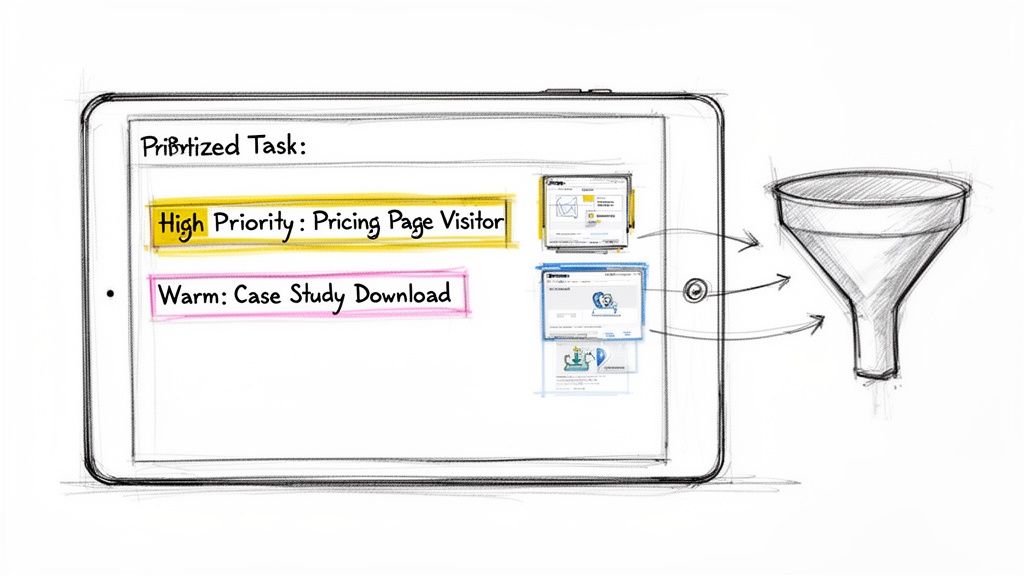
From a Chaotic List to an Intelligent Workflow
Let's look at a simple before-and-after to see how an SDR's entire approach changes when they have visitor signals.
Before Website Visitor Identification: An SDR opens their CRM to a static list of 200 accounts. Every single one looks the same. The first hour is wasted just trying to figure out where to even begin, usually defaulting to alphabetical order or just picking one at random. The outreach is generic because there's zero context, leading to terrible engagement and a constant feeling of falling behind.
After Website Visitor Identification: An SDR logs in and sees a dynamic, prioritized task queue. The system has automatically surfaced five key accounts. Why? Because one just spent ten minutes on your pricing page, another downloaded a high-value case study, and three others from their target list came back for the second or third time this week. The SDR knows exactly where to put their energy for the biggest impact.
This isn't just about efficiency. It's about morale and momentum. When SDRs engage with accounts that are already showing interest, their confidence skyrockets, conversations are better, and they book more meetings. It completely changes the dynamic of the job.
Actionable Plays SDRs Can Run Immediately
The real payoff comes from creating specific, repeatable plays based on different visitor behaviors. Each signal suggests a different level of intent, which should trigger a corresponding action from your sales team.
A good system doesn't just identify visitors; it scores their intent. If you're looking to build something more advanced, exploring AI lead scoring can give you a solid framework for ranking these signals automatically.
Here’s a practical playbook that maps common visitor signals to concrete SDR actions. It turns raw data into a clear set of instructions, taking the guesswork out of the equation.
Actionable SDR Plays Based on Visitor Behavior
| Visitor Signal | Priority Level | Recommended SDR Action | Example Opening Line |
|---|---|---|---|
| Pricing Page Visit | High | Immediate, personalized email and a follow-up call within 24 hours. | "Saw someone from your company was exploring our pricing. I wanted to reach out and offer to clarify any of the features included in our different tiers." |
| Case Study Download | High | Email referencing the specific case study topic. Connect with a relevant person on LinkedIn. | "Noticed you downloaded our case study on [Industry/Problem]. Since you're interested in how we helped [Client Name], I thought a quick chat might be valuable." |
| Multiple Return Visits | Medium | Add the account to a multi-touch sequence. Focus on providing value with helpful resources. | "My system flagged that your team has been back to our site a few times. Clearly, something has piqued your interest, so I wanted to introduce myself." |
| Solutions Page View | Medium | Research the company's industry and pain points. Craft a message that connects your solution to their likely business challenges. | "Given your team was looking at our [Solution Name] page, I took a look at your company and had a few ideas on how we could help with [Specific Business Challenge]." |
| Homepage Visit Only | Low | Add to a nurturing campaign for brand awareness. Monitor for any future, higher-intent activity before direct outreach. | N/A (No direct outreach yet) |
This playbook structure empowers SDRs to engage with relevance and confidence. By aligning specific actions to specific signals, you build a systematic process for converting anonymous interest into qualified sales pipeline. You ensure your team is always working smarter, not just harder.
Integrating Visitor ID Into Your Sales Tech Stack
A powerful tool is useless if it lives on an island. Even the most accurate website visitor identification data won't generate a single dollar of pipeline if your Sales Development Reps (SDRs) have to hunt for it across five different browser tabs. To actually make an impact, this intelligence has to flow seamlessly into the platforms where your sales team lives and breathes every single day.
This means native, frictionless integrations with your CRM (like Salesforce or HubSpot) and sales engagement platforms are completely non-negotiable. Without them, you’re not making your SDRs’ lives easier; you’re just adding another tedious task to their already packed workflow.
Think of it like this: a sales dialer built directly into Salesforce is a dream. An SDR can click-to-call, log notes, and move on to the next prospect in seconds. Now, imagine a clunky third-party dialer that forces them to copy and paste numbers and manually log every single call. It’s a productivity killer. The best tools don't add steps; they remove them.
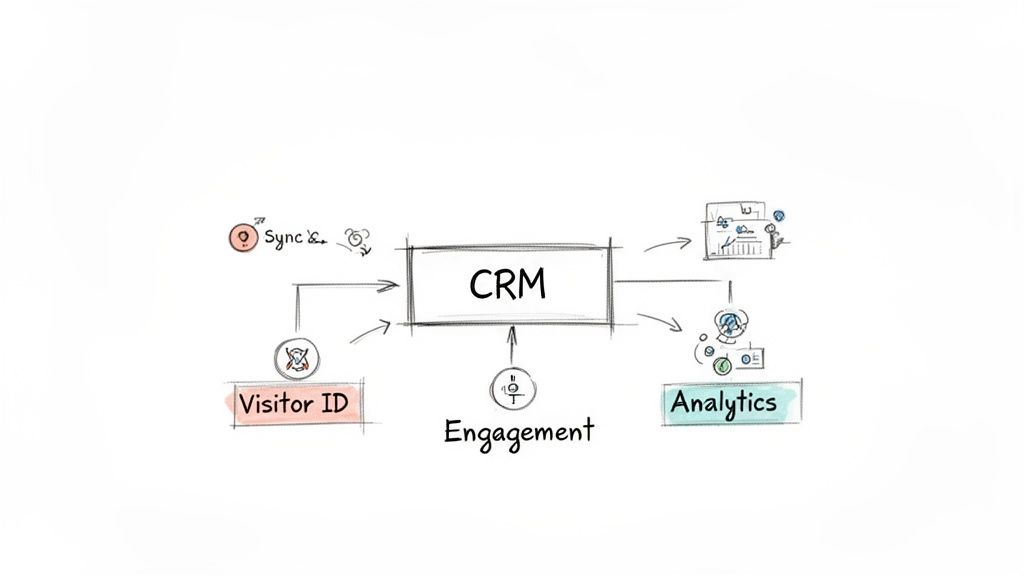
Why Seamless Integration is a Game Changer for SDRs
A proper integration does way more than just shuttle data from point A to point B. It transforms raw visitor signals into prioritized, actionable tasks right inside the exact environment an SDR uses for outreach. This is the secret to driving adoption and seeing real results.
When your visitor identification data is deeply embedded in your tech stack, it enhances the existing workflow instead of blowing it up. This creates some huge wins for your sales team.
Here’s a quick breakdown comparing a connected system versus a standalone tool from an SDR's perspective:
| Feature | Standalone Visitor ID Tool | Integrated Visitor ID System |
|---|---|---|
| SDR Workflow | Requires manually checking a separate platform, then hunting for the account in the CRM. | Automatically creates prioritized tasks or surfaces accounts directly within the CRM. |
| Data Logging | SDRs have to manually log all outreach activities related to the visitor signal. | All calls and emails are automatically logged to the correct account record in the CRM. |
| Speed to Lead | Slow. The lag between a site visit and an SDR action can stretch for hours. | Fast. Real-time alerts can trigger immediate outreach, capitalizing on that peak moment of interest. |
| CRM Hygiene | High risk of duplicate records and sloppy data entry, polluting your CRM. | Clean and consistent. Automated logging keeps your data accurate and standardized. |
The difference is night and day. One approach creates friction and relies on manual grunt work, while the other automates the busywork and lets SDRs focus entirely on selling.
Automating the Flow of Intelligence
The end goal is to create a closed-loop system where data flows effortlessly. A visitor from a target account hits your pricing page, a task is instantly created in Salesforce for the account owner, and the SDR can fire off a call or email directly from that task with all the context they need.
This is the automated process that separates a nice-to-have tool from a must-have revenue engine for any SDR team.
The right integration ensures that your CRM remains the single source of truth. It prevents data silos and gives sales leaders a clear, accurate picture of which activities are driving pipeline, allowing for precise reporting and attribution.
To get the most out of your visitor identification efforts and truly empower your SDRs, seamless integration is everything. You can learn more about what CRM integration entails to see how unifying this data automates workflows and boosts the efficiency of your whole sales process. These connections are also the foundation for more advanced setups, like tying into a customer data platform integration for a true full-funnel view.
Ultimately, by embedding website visitor identification into your core sales tools, you equip your SDRs to act faster, with better context, and with far less administrative headache. It makes their jobs easier, their outreach more effective, and their impact on the pipeline undeniable.
Measuring the ROI of Your Visitor Identification Strategy
So, how do you prove that a website visitor identification tool is actually making you money and not just another line item on the expense report? For any sales leader, justifying this spend is everything. It means moving past flashy vanity metrics like ‘total visitors identified’ and zeroing in on the real-world results that drive revenue.
The true return isn’t hiding in a dashboard full of company logos. You'll find it in the day-to-day performance of your Sales Development Rep (SDR) team. When SDRs get to act on genuine, high-intent buying signals, their entire workflow changes—and that produces measurable results you can take straight to the bank.
Key Metrics That Actually Matter for SDRs
Forget the abstract numbers. The real value of this tech shows up in your SDRs' weekly and monthly performance. Instead of just tallying up identified accounts, you need to track the core business metrics that tell the real story.
Here are the specific, SDR-focused KPIs to watch:
- Increase in Meetings Booked: When your SDRs can reach out to accounts that are already warm and actively researching your solution, conversations just flow better. This translates directly into more meetings booked per rep, period.
- Higher Outbound Conversation Rates: We all know cold calls are a grind. But calling a company that was just on your pricing page? That's a completely different ballgame. Track the percentage of dials that turn into actual, meaningful conversations—this number should climb, and fast.
- Reduction in SDR Ramp Time: New SDRs often waste their first few months guessing which accounts to prioritize. Visitor identification gives them a clear, data-driven roadmap from day one, helping them build pipeline faster and slash the time it takes to become a fully productive member of the team.
- Measurable Lift in Qualified Pipeline: At the end of the day, it’s all about pipeline. The goal is to draw a straight line from identifying a visitor to creating a new, qualified sales opportunity.
The most powerful ROI story you can tell is simple: we saw a high-intent visitor on our site, an SDR took immediate and relevant action, and that action directly created a new sales opportunity. That’s how you justify the investment, every single time.
A Simple Framework for Calculating ROI
To put this in real terms, you need a straightforward way to calculate the return. No need for a complex financial model. You can build a simple, powerful business case by comparing the cost of the tool against the value of the pipeline it helps create.
Follow these steps to build your case:
- Calculate the Total Cost: Start with the annual or monthly subscription price of your visitor identification software. This is your total investment.
- Track Attributed Opportunities: This is crucial. Work with your RevOps team to tag every opportunity in your CRM that started with a visitor identification signal. Good CRM hygiene is non-negotiable here.
- Determine the Value of New Pipeline: Tally up the total dollar value of all the opportunities created from these signals over a set period, like a quarter or six months.
- Calculate the ROI: Use this simple formula:
(Value of New Pipeline - Tool Cost) / Tool Cost x 100 = ROI %
For example, if your tool costs $15,000 a year and helps you generate $150,000 in new, qualified pipeline, your ROI is a massive 900%. This kind of clear, data-backed calculation completely changes the conversation from a discussion about cost to a strategic decision about revenue growth.
Try our AI Lead Generator — find verified LinkedIn leads for any company instantly. No signup required.
Still Have Questions? Let's Clear a Few Things Up.
When you're looking at tools that promise to identify who's on your website, a healthy dose of skepticism is a good thing. Sales Development Reps (SDRs) and their managers tend to ask the same smart questions. Let's tackle them head-on, no fluff.
How Is This Different from Google Analytics?
This is the most common question, and the answer is simple. They solve two totally different problems.
Think of it this way: Website analytics tools like Google Analytics are brilliant at showing you the big picture. They tell you what is happening on your website—how many people visited, which pages are popular, and where the traffic came from. It’s all anonymous, aggregate data. Great for marketers.
Website visitor identification software, on the other hand, tells you who is on your site. It’s built to peel back the anonymity and reveal the specific companies showing interest. This turns a sea of anonymous clicks into a prioritized list of accounts for your SDRs to engage.
In short, analytics helps you optimize your website. Identification helps you build your pipeline.
Is Website Visitor Identification Legal and GDPR Compliant?
Yes, but only when it's done right. This is a critical point.
The best, most reputable tools are designed to identify the company, not the individual person. This is the key distinction. The main technique, reverse IP lookup, links a visitor's IP address to the business network they're using. This is considered standard B2B marketing intelligence, not personal data surveillance.
To stay on the right side of regulations like GDPR and CCPA:
- Stick with vendors that focus on account-level identification.
- Run from any tool that claims it can magically reveal anonymous individual identities. That's a massive legal gray area.
- Make sure your own privacy policy is clear and you're getting the right consent for data processing on your site.
Will This Just Create More Noise for My SDRs?
This is a totally fair concern, especially if you've been burned by bad lead lists before. A cheap, low-quality tool will absolutely bury your team in junk—useless traffic from ISPs, coffee shops, and companies that are a terrible fit.
But a truly high-quality platform is built to do the exact opposite.
It’s a filter, not a firehose. It automatically screens out the noise so your SDRs only see legitimate companies that actually match your ideal customer profile. The goal isn't to give your team a bigger list; it's to give them a smarter, more focused list of accounts that are already showing they're interested.
It cuts out the guesswork and points your team directly to the warmest opportunities in your pipeline.
Ready to stop guessing and start engaging the best accounts visiting your site? marketbetter.ai turns anonymous visitor signals into a prioritized task list for your SDRs, complete with AI-powered tools to execute outreach fast—all inside your CRM.

 Okay, knowing the company name behind a visit is a huge win. But the real magic happens when you figure out why they’re on your site at all. This is where you graduate from identification to interpretation, shifting the focus from "who" to "what do they actually want?"