4 posts tagged with "customer retention"

View All Tags

Reducing customer churn: Practical retention strategies that work

· 21 min read

Let's be honest: tackling customer churn isn't about just plugging a leak. It’s about understanding the true cost of losing a customer and reframing retention as a core growth engine. The game shifts entirely when you move from a reactive mindset—frantically trying to save customers who are already leaving—to a proactive strategy that builds loyalty from day one. Inaction is a strategy of its own, leading to a slow bleed of revenue, whereas a proactive approach turns retention into your most powerful growth lever.

Why Churn Is So Much More Than Just a Number

Customer churn often gets flattened into a single percentage on a dashboard. But that simple metric hides a far more complex and costly reality. It's not just a number; it’s a direct reflection of your company's health, your product-market fit, and the actual value you deliver.

One of the biggest mistakes is treating churn as a lagging indicator. This locks businesses into an expensive and exhausting cycle of constantly acquiring new customers just to replace the ones who leave—a treadmill you can't win on. A reactive approach means you're always playing catch-up, whereas a proactive one lets you set the pace.

The financial drain is almost always bigger than teams realize. That seemingly small monthly churn rate? It has a massive compounding effect. For instance, a 3% monthly churn rate doesn't just mean you lose 36% of your customers annually. Because of compounding losses, you actually lose nearly 43% of your customer base. Your sales and marketing teams end up running faster and faster just to stand still.

The Real-World Cost of a Leaky Bucket

The damage from high churn goes way beyond lost subscription fees. Globally, companies are estimated to lose $4.7 trillion every single year because of poor customer experiences, with a huge chunk of that coming directly from churn.

Think about this: 67% of consumers will jump to a competitor after just one bad experience. That's how little room for error you have. Nextiva's research digs into the impact of poor service, and it's a real eye-opener.

This is why having a simple, repeatable framework to understand and act on your churn data is non-negotiable.
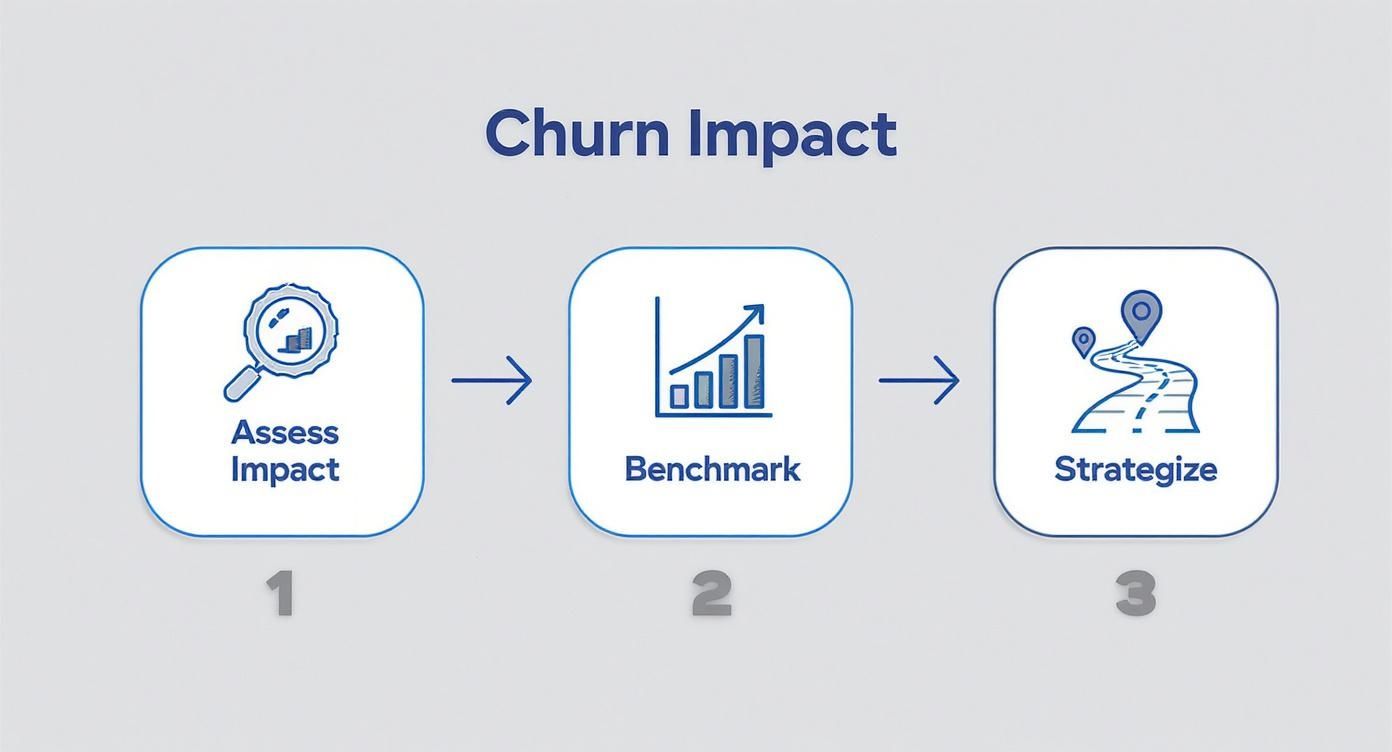
Three-step churn impact framework showing assess impact, benchmark performance, and strategize retention solutions

The path forward is clear: assess the real impact, benchmark your performance against what’s possible, and then build a targeted plan to fix it. This guide will walk you through each of those pillars, providing actionable steps you can implement today.

Your Churn Reduction Strategy at a Glance

Strategy AreaKey ActionPrimary Goal
Measurement & AnalysisImplement cohort analysis and track churn KPIs.Gain a clear, accurate picture of when and why churn happens.
Root-Cause DiagnosisConduct qualitative surveys and customer interviews.Uncover the "human story" behind the numbers.
Segmentation & PredictionUse predictive modeling to identify at-risk customers.Focus retention efforts where they'll have the most impact.
Proactive EngagementOptimize onboarding and drive product adoption.Build loyalty and "stickiness" from the very beginning.
Personalized RetentionLaunch targeted campaigns for at-risk segments.Deliver the right message at the right time to save customers.
Cross-Functional AlignmentCreate feedback loops between CS, Product, and Marketing.Make retention a company-wide responsibility.
AI-Powered OperationalizationAutomate workflows and personalization with tools like marketbetter.ai.Scale your retention efforts efficiently and effectively.

This table is your roadmap. Each area builds on the last, creating a comprehensive system for turning churn into a source of sustainable growth.

Customer Churn vs. Revenue Churn

Before we dive deeper, it's absolutely critical to distinguish between two types of churn. They tell very different stories about your business, and you need to be tracking both.

  • Customer Churn (or Logo Churn): This is the percentage of customers you lose in a given period. Actionable Step: Calculate this weekly to get an early warning signal on volume. It tells you exactly how many logos walked out the door.
  • Revenue Churn (or MRR Churn): This measures the percentage of monthly recurring revenue lost from existing customers. This includes downgrades and cancellations. Actionable Step: Track this monthly alongside customer churn to understand the financial impact.

Imagine you lose ten small, low-tier customers but manage to keep one massive enterprise client. Your customer churn rate might look terrible, but your revenue churn could be minimal. Conversely, losing just one of those enterprise clients could obliterate your revenue, even if your customer churn percentage barely moves. This is why revenue churn is often the more critical metric for understanding the financial health of a subscription business. It’s where the real pain is felt.

Finding the Real Reasons Customers Leave

Guesswork is the enemy of retention. To stop customers from walking away, you must kill your assumptions and find out why they actually leave. Churn isn't just a single event; it's the final, painful outcome of a journey that went sideways long before they hit "cancel." Comparing a guess-based strategy to a data-driven one is like navigating with a treasure map versus a GPS—one leads to dead ends, the other to your destination.

Your overall churn rate is just a flashing red light on the dashboard. It tells you there's a problem, but it doesn't tell you where the engine is smoking. The real answers only surface when you blend different types of data.

Tablet displaying stop revenue leak message on desk with financial documents and smartphone

Using Cohort Analysis to Pinpoint Problems

One of the most powerful tools in your diagnostic kit is cohort analysis. Instead of lumping all your customers into one giant pool, you group them by the month they signed up. This lets you track each group's behavior over their lifecycle, revealing patterns that are otherwise invisible.

Imagine your cohort analysis shows that customers who signed up in March have a 30% higher churn rate in their first month compared to those who joined in February. That’s a massive red flag.

Suddenly, you're not just guessing. Your investigation shifts from a vague "is our product bad?" to a laser-focused "what happened in March?"

The culprit could be anything:

  • A buggy new feature release that soured the initial experience.
  • A tweak to the onboarding flow that created a new point of friction.
  • A new marketing campaign that brought in a flood of poorly-fit customers.

Actionable Step: Run a cohort analysis this week. Compare the first 90-day retention rates for your last three monthly cohorts. If you see a dip, start investigating marketing campaigns or product changes from that period.

Blending Quantitative and Qualitative Insights

Pinpointing the "when" is only half the battle; you still need to understand the "why." This is where you combine the hard numbers from your analytics with the human stories from your customers. The best churn reduction strategies live at this intersection.

Data TypeWhat It Tells YouHow to Collect It
Quantitative (The "What")Identifies behavior at scale—feature adoption, login frequency, time in-app.Product analytics tools (like Mixpanel or Amplitude), CRM data, usage logs.
Qualitative (The "Why")Uncovers the motivations, frustrations, and context behind the numbers.Exit surveys, NPS comments, customer interviews, support tickets, sales call notes.

Let's say your quantitative data shows 70% of churned users never touched your "Project Reporting" feature. That’s an interesting correlation. This is where qualitative data closes the loop. Digging into exit surveys, you might find comments like, "I couldn't figure out how to generate a report." Now you have a clear, actionable problem to solve.

Your product analytics show you where the smoke is, but your customer feedback tells you what’s actually on fire. Neglecting one for the other is like trying to diagnose a patient by only looking at their lab results without ever speaking to them.

Turning Raw Data into a Clear Narrative

The final step is to weave all this information into a cohesive story. You're not just collecting data points; you're building a narrative that explains why a specific group of customers isn't succeeding.

Here’s an actionable framework to connect the dots:

  1. Map the Churned Customer Journey: Use analytics to trace the typical path of a user who churns. Compare it to the path of a highly retained power user. Actionable Step: Identify the top 3 divergence points where at-risk users fail to take a critical action—like inviting a teammate or completing onboarding.
  2. Analyze In-App Behavior vs. Support Tickets: Cross-reference product usage data with support tickets. If you see tickets about "billing confusion" from users with low login rates, it’s a signal that perceived value isn't justifying the price.
  3. Listen to the Voice of the Customer (VoC): Systematically categorize feedback. Create buckets for every source (surveys, support) and tag themes. You can find excellent voice of customer examples and frameworks to structure this. This transforms anecdotes into quantifiable insights like "poor onboarding experience."

By combining these diagnostic tools, you move past symptoms and uncover true root causes—be it a confusing onboarding process or a competitor's killer offer—and build a targeted retention plan that actually works.

Don’t Just React to Churn—Get Ahead of It

The best time to stop a customer from leaving is long before they’ve even thought about it.

If you’re only scrambling to save accounts after they hit the cancel button, you’re playing a losing game. A proactive strategy isn’t damage control; it's about creating an environment where customers are so successful that looking elsewhere never crosses their minds. This is the difference between being a firefighter and an architect—one reacts to disasters, the other designs a structure to prevent them.

And you need to get on this, fast. A monthly churn rate of just 5% might sound manageable, but it compounds to losing nearly half (46%) of your customers over a year. As the Churnkey’s 2025 State of Retention report shows, it gets catastrophic very quickly.

Business professional using magnifying glass to analyze data charts and graphs for root cause analysis

Segment Your Customers to Make Your Outreach Count

Trying to talk to all your customers at once is like shouting into a void. The foundation of any good proactive strategy is smart segmentation. You group customers by shared traits to deliver timely, personalized help.

Here are a few powerful ways to slice up your customer base:

  • Lifecycle Stage: A new user needs help getting started; a two-year veteran might be a fit for a beta program. Match your message to their journey.
  • Customer Health Score: This early-warning system combines metrics like login frequency, key feature adoption, and NPS scores. Segment customers into "Healthy," "At-Risk," and "Endangered" buckets to create a specific playbook for each.
  • Behavioral Data: Group users based on what they do. Actionable Step: Build a segment of users who haven’t used a key sticky feature in their first 30 days and hit them with a targeted tutorial campaign this month.

High-Touch vs. Low-Touch: Know When to Automate and When to Call

Once you have your segments, you can decide how much attention each one gets. Wasting your best customer success manager on a low-value account is as inefficient as neglecting an enterprise client with a generic email.

Here’s how the two approaches stack up:

Tactic ComparisonHigh-Touch (Top-Tier Accounts)Low-Touch (Scalable for Everyone Else)
OnboardingDedicated 1-on-1 calls, custom implementation plan, and success goals.Automated email sequences, in-app product tours, and group webinars.
EngagementQuarterly business reviews (QBRs), proactive check-ins, direct line of access.Monthly newsletters, product update announcements, educational content.
At-Risk InterventionA personal call from their CSM, a custom success plan, and maybe even executive outreach.An automated re-engagement email campaign or targeted in-app messages.
Loyalty & AdvocacyExclusive access to new features and invitations to customer advisory boards.Milestone-based rewards and bonuses for the referral program.

This two-pronged approach ensures your most critical accounts get white-glove service while you still nurture the rest of your customers efficiently.

Actionable Campaigns That Keep Customers Hooked

Okay, you have your segments and you know your tactics. Now it’s time to build campaigns that continuously prove your value.

Here are three campaigns you can implement this quarter:

  1. The "Aha!" Moment Onboarding Flow: Forget the generic welcome email. Map out the one critical action a new user must take to see your product's value. Then, focus your entire onboarding sequence on getting them to complete just that.
  2. The "Sleeping User" Re-engagement Drip: Set up an automated email sequence for users who haven't logged in for 30 days. The first email highlights a new feature. The next shares a case study. The last is a simple, plain-text email asking for feedback.
  3. The Proactive "Feature Adoption" Nudge: When you launch a new reporting tool, send a targeted email to power users of a related feature, explaining exactly how this new tool solves a problem you know they have.

A core component of any proactive retention strategy is fostering deep brand loyalty, which can be significantly enhanced by providing exceptional customer support. Learn more about building brand loyalty through exceptional customer support.

This kind of targeted effort is what separates companies with killer retention from those stuck on the hamster wheel of endless acquisition. By getting the right message to the right customer at the right time, you don't just stop churn—you create opportunities for expansion and end up improving customer lifetime value across the board.

Using AI to Predict and Prevent Churn

Welcome to the new era of customer retention. The game has shifted from a reactive scramble to a proactive, intelligent system that spots trouble long before it ever surfaces. This is where you learn to see the future.

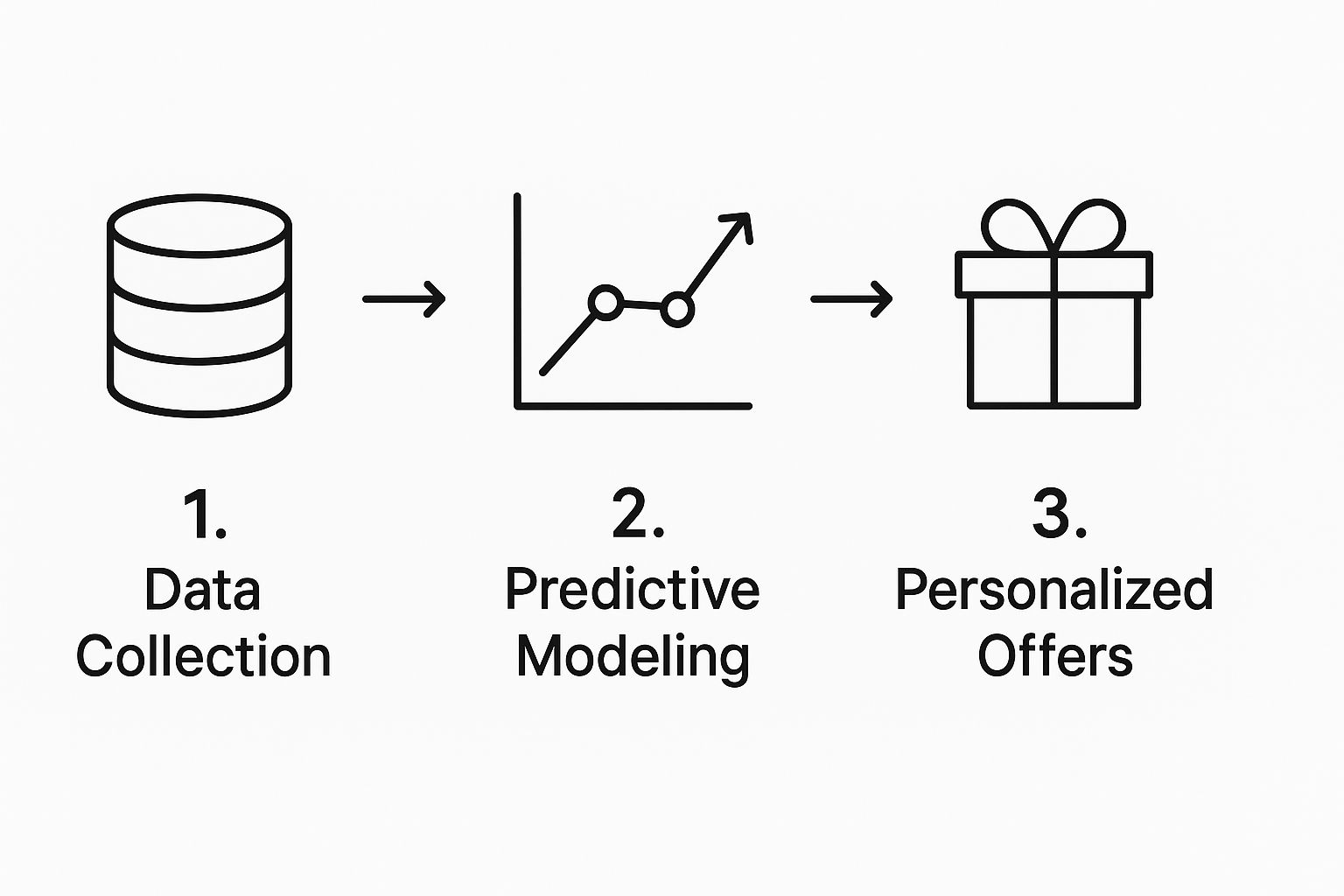
Forget waiting for a customer to complain or stop logging in. Modern AI tools analyze massive datasets in real time—support ticket sentiment, login frequency, payment history, and feature usage patterns. This creates a rich, multi-dimensional view of each customer's health.

The goal is to get beyond simple metrics. A drop in logins is a clue, but an AI model might find that a drop in logins combined with a recent failed payment and a support ticket tagged "bug" is a 90% predictor of churn within 30 days. That’s the kind of insight you can act on.

From Raw Data to Actionable Health Scores

This is where the magic happens. AI solutions synthesize raw data into a simple, actionable metric: a predictive customer health score. Think of it like a credit score for customer loyalty, telling your team who needs attention right now.

Here's how the old way compares to the new:

  • Rule-Based Systems (The Old Way): You manually set triggers like, "If a user hasn't logged in for 14 days, mark them as 'at-risk'." It's rigid and misses subtle signals. It's like only looking at a patient's temperature to diagnose an illness.

  • AI-Powered Predictive Models (The New Way): These systems learn from your actual historical data. They identify the complex, non-obvious patterns your past churned customers exhibited. The model might discover that users who ignore a specific feature during onboarding and then contact support about billing are your highest flight risk. It’s far more nuanced and accurate.

By using predictive analytics, companies can reduce churn by up to 15%. The power lies in spotting disengagement early, giving you more time and options to intervene with the right support.

Turning AI Insights into Proactive Interventions

A predictive score is useless if it just sits on a dashboard. The real value comes from plugging these AI insights directly into your operational workflows. To pull this off, businesses often need to integrate real-time customer data. Understanding how to approach integrating customer insights via a Widget API can be a key technical step in making these insights truly operational.

Here’s how you can make it actionable:

  1. Automated Alerts for Customer Success: When a high-value customer's health score drops from "Green" to "Yellow," the system should automatically create a task in your CRM for their CSM: "Proactive Check-In: [Customer Name]'s engagement has dipped."
  2. Personalized Marketing Campaigns: For a segment of "at-risk" users who haven’t adopted a key feature, trigger an automated email campaign showing them exactly how to use it. This is a core part of how predictive analytics in marketing is changing the game.
  3. In-App Nudges and Guidance: If a user’s behavior indicates they are struggling, an AI-driven tool can trigger a helpful in-app pop-up or guided tour at the perfect moment.

This approach completely flips the script on churn management. You stop fighting fires and start fireproofing your entire customer base.

Making Retention a Company-Wide Mission

Too many companies treat customer churn like a leaky faucet in the Customer Success team's office. But churn isn't a CS problem. It's a company problem. It's a lagging indicator of a breakdown that happened much earlier in the customer's journey. Lasting retention happens when every single team views the customer journey as a shared mission. A unified front isn't just nice to have; it's the only way to win.

Customer service representative wearing headset viewing AI health score dashboard showing performance metrics

Building Your Cross-Functional Feedback Loops

The bedrock of a retention-focused culture is a set of powerful, automated feedback loops. Imagine a customer fills out an exit survey, saying they left because a key reporting feature was too confusing. In a siloed company, that feedback dies in a spreadsheet. In a connected company, it becomes a catalyst for action.

Here’s how that looks in the real world:

  • CS to Product: Insights from support tickets and exit surveys are tagged and funneled directly into the product team's backlog in a tool like Jira or Asana. The product team stops guessing and starts building based on direct user pain.
  • Product to Marketing: Once the product team ships a fix, they close the loop with marketing. Marketing can then craft campaigns to re-engage users who churned for that exact reason, reinforcing the message: "We hear you, and we're taking action."
  • CS to Marketing: Churn data is a goldmine for refining your ideal customer profile (ICP). By analyzing the traits of customers who churn quickly versus those who stay, CS provides priceless intel to Marketing to attract better-fit prospects.

The most powerful retention strategies aren't born from last-minute heroics. They are the cumulative result of hundreds of small, interconnected improvements made across the entire organization.

How Each Team Fights Customer Churn

Every department plays a crucial, distinct role in the fight against churn. Clearly defining these roles and the metrics they own is the key to creating accountability. When responsibilities are clear, finger-pointing disappears.

Here’s a simple breakdown of how different departments contribute to a unified customer retention strategy.

How Each Team Fights Customer Churn

DepartmentPrimary Role in RetentionKey Metrics Owned
MarketingAttract and qualify the right customers who align with the product's core value.Lead-to-Customer Conversion Rate, Customer Acquisition Cost (CAC) by Channel, and Churn Rate by Acquisition Cohort.
ProductBuild an intuitive, valuable, and "sticky" product that solves real problems and encourages deep engagement.Feature Adoption Rate, Time to Value (TTV), and User Engagement Scores.
Customer SuccessEnsure customers achieve their desired outcomes through proactive guidance, support, and relationship management.Net Revenue Retention (NRR), Customer Health Score, and Net Promoter Score (NPS).

This table isn't just about assigning tasks; it’s about creating a common language and shared goals.

Running Meetings That Actually Drive Action

Building these feedback loops isn't just about software; it demands a structured, human touch. A recurring, cross-functional churn meeting is where raw data gets turned into actionable strategy.

Here's an actionable agenda to keep the meeting focused:

  1. Review the Numbers (5 mins): Briefly look at key churn and retention metrics from the last period.
  2. Analyze the "Why" (15 mins): CS presents the top 3-5 themes from recent churn feedback.
  3. Connect to the Roadmap (10 mins): Product discusses how these themes align with or challenge current priorities.
  4. Refine the Target (10 mins): Marketing shares how these insights are being used to sharpen targeting.
  5. Assign Action Items (5 mins): No discussion ends without a clear "who, what, and when."

This simple process transforms churn from a dreaded metric into a strategic asset. And that’s critical, because churn rates vary wildly by industry. For instance, the average churn rate for professional services can be 27%, while the wholesale sector can see rates as high as 56%. This data underscores why a one-size-fits-all approach fails. You can dig into more of these numbers by checking out these churn benchmarks from Customer Gauge's 2025 report.

Common Questions About Reducing Churn

When you're in the trenches trying to plug the leaks, a handful of questions always pop up. Let's tackle some of the most common ones head-on.

What Is a Good Customer Churn Rate?

This is the million-dollar question, and the honest answer is: it depends. A young B2B SaaS company might be okay with a 3-5% monthly churn. But an established enterprise player? The expectation is to keep that number well under 1%. A B2C subscription box will naturally have a much higher churn rate than enterprise software.

Comparison Point: Instead of chasing an arbitrary benchmark, compare your churn rate to your own performance last quarter. The goal is a consistent downward trend. Improvement is the name of the game.

How Do You Calculate Customer Churn?

The basic formula is straightforward: take the number of customers you lost, divide it by the number you had at the start, and multiply by 100.

(30 lost customers ÷ 1,000 starting customers) x 100 = 3%

But that only tells you part of the story. You must also track revenue churn (MRR churn) to measure the actual dollars you lost. Losing three small customers is a completely different problem than losing one massive enterprise account.

Actionable Step: Calculate both customer churn and revenue churn for the last month. The difference between the two will immediately tell you if you are losing high-value or low-value customers.

What Is the First Step to Reduce Churn?

Before you do anything else, you have to diagnose the root cause. Jumping straight into solutions without understanding why people are leaving is like trying to fix an engine by randomly replacing parts.

To get started, triangulate your data:

  • Set up an Exit Survey: This is non-negotiable. When a customer cancels, an automated survey should immediately ask them why.
  • Dive into Product Analytics: Look for patterns among churned users. Did they never adopt that one sticky feature?
  • Talk to Your Front-Line Teams: Your support and success teams are a goldmine of insights. Actionable Step: Schedule a 30-minute meeting with them this week and ask one simple question: "What are the top three frustrations you hear from customers?"

By blending the quantitative "what" (analytics) with the qualitative "why" (surveys and team feedback), you can build a retention roadmap that solves real problems.

Should I Focus on Churn Prevention or New Customers?

Both are critical, but pound for pound, retention almost always delivers a better return. It can be anywhere from 5 to 25 times more expensive to acquire a new customer than to keep an existing one. A tiny 5% bump in customer retention can boost profits by 25% to 95%.

Think of your business as a leaky bucket. Pouring more water (new customers) in is a fool's errand if you don't plug the holes first. A balanced approach is ideal, but a rock-solid retention strategy creates the stable foundation you need for sustainable growth. Plus, happy, loyal customers become part of your acquisition engine through referrals.


Ready to stop guessing and start predicting? marketbetter.ai uses AI to identify at-risk customers, automate personalized retention campaigns, and give your teams the insights they need to act before it's too late. See how you can reduce churn and drive sustainable growth by visiting https://www.marketbetter.ai today.


Build a Winning Customer Success Strategy

· 21 min read

Let’s be honest, for a long time, "customer success" sounded like a fluffier, trendier name for customer support. It’s not. The difference is night and day, and it’s a distinction that can make or break your business.

Think of it this way: traditional support is the firefighter. When a fire breaks out—a bug, a billing issue, a user question—they rush in and expertly put it out. They are absolutely essential.

A customer success strategy, on the other hand, makes you the architect. You're designing the entire customer journey to be fireproof from the start, preventing problems before they ever happen. This proactive versus reactive mindset is the core difference. While support closes tickets to solve immediate pain, success builds relationships to deliver long-term value.

Why Customer Success Is Your Growth Engine

A group of professionals collaborating around a table, illustrating a proactive customer success strategy.

This proactive mindset isn't just a nice-to-have anymore. In a world dominated by subscription models, it's the core of sustainable growth. When customers pay you month after month, just "keeping them" isn't enough. You have to ensure they’re getting real, tangible value.

When their success becomes your success, it directly fuels the three most important levers for growth:

  • Retention: Customers who are winning with your product don't churn. Why would they? This directly contrasts with acquisition-focused models where the relationship often ends at the point of sale.
  • Expansion: Customers who see results are the first to upgrade plans, add more seats, or buy new features. This is a far more efficient growth path than acquiring new customers.
  • Advocacy: Delighted customers become your most powerful (and cheapest) marketing channel, driving word-of-mouth referrals and glowing reviews.

From Cost Center to Revenue Driver

Viewing it this way flips the entire script. Customer success isn't an expense line item; it's a revenue-generating powerhouse. While support focuses on closing tickets to manage costs, customer success focuses on proactive engagement to create value.

For a deeper look at how this plays out in the real world, this customer success SaaS guide to growth is a fantastic resource.

The global Customer Success Platforms Market is expected to hit $3.1 billion by 2026. And yet, a shocking 37% of companies admit they don't even have a clearly defined customer success strategy.

That gap is a massive opportunity. The companies that get serious about formalizing their customer success efforts are the ones poised to pull away from the competition.

By building a strategy around proactive engagement, you're not just solving problems—you're building a more resilient, profitable business. This is the very foundation of modern customer retention marketing strategies that protect and expand your revenue base.

The Core Pillars of a Strong Strategy

Three icons representing the core pillars of a customer success strategy.

A great customer success strategy isn’t just one thing. It's a system, a mindset, and it rests on three core pillars that work together. Each one supports the customer at a different point in their journey with you, all with the goal of killing churn and sparking real, meaningful growth.

Think of it as building a relationship in stages. You can't skip a step.

First, you need to make a great first impression. That starts with getting customers to their first "aha!" moment as fast as humanly possible. It’s not about just showing them features; it's about connecting those features directly to the outcome they hired your product to deliver in the first place.

Pillar 1: Proactive Onboarding

The whole point of onboarding is value realization, not just a product tour. A typical tour shows a user what a button does. A strategic onboarding process shows them why they should care enough to click it. It’s the difference between wandering through a museum on your own and getting a curated tour that tells a compelling story.

Actionable Steps for Proactive Onboarding:

  • Personalized Implementation Plans: Instead of a generic checklist, create a simple, one-page "Success Plan" during the sales handoff. Outline the customer's top 1-3 goals and the key product features that will help them achieve those goals.
  • Targeted "First Win" Milestones: Identify the single action that delivers the first taste of value. Is it creating their first report? Inviting a teammate? Build your entire initial onboarding flow to guide them directly to that one action.
  • Contextual Education: Don’t dump a mountain of information on them day one. Use in-app tools like Pendo or Appcues to trigger a 30-second video tutorial the very first time a user navigates to a complex feature.

Once they're up and running, the job shifts from setup to sustained engagement. You’ve got to keep an eye on their progress to make sure they’re still on the right track. This is where the second pillar comes in.

Pillar 2: Continuous Health Monitoring

Think of customer health monitoring as a regular check-up for your client relationships. It’s how you spot the little warning signs before they blow up into five-alarm fires. A smart strategy pulls together different kinds of data to paint a complete, predictive picture of every account. A reactive approach waits for the customer to complain; a proactive one looks for signs of trouble before the customer is even aware of it.

To really nail this, you have to blend the numbers with the narrative:

Data TypeExamplesWhat It Tells YouActionable Trigger
Product Usage DataFeature adoption, login frequency, key actions completed.Is the customer actually using the product the way they should be?Set an alert if a key user's login frequency drops by 50% in a 30-day period.
Relationship SignalsSupport ticket volume, survey responses, CSM sentiment scores.How does the customer feel about your company and your product?Automatically create a task for a CSM to call a client if they submit two or more negative survey responses.

When you combine these signals, you get a powerful customer health score. It’s your early-warning system for flagging at-risk accounts before they even think about churning.

This data-driven approach is critical, but remember, tech alone isn’t a silver bullet. Your team's emotional intelligence is just as important—it contributes to a staggering 58% of job performance in customer success roles.

Pillar 3: Value Realization and Expansion

This final pillar is where you close the loop and prove your worth. You move from simply helping the customer use the product to demonstrating the real, tangible business impact it's creating for them. The best tool for this job? The Quarterly Business Review (QBR).

A good QBR is not a sales pitch; it's a strategic consultation. A bad QBR is a one-sided presentation of product usage stats. A great QBR is a collaborative session focused on the customer's business outcomes.

Actionable Steps for a Better QBR:

  1. Start with Their ROI: Lead with a slide titled "The Value You've Realized," showing hard numbers like "Saved 40 hours in manual reporting this quarter" or "Increased lead conversion by 15%."
  2. Benchmark Their Performance: Compare their usage of a key feature against other anonymous, top-performing customers in their industry. This creates a powerful sense of FOMO (fear of missing out) and encourages deeper adoption.
  3. Align on Future Goals: End the meeting by mapping their goals for the next quarter to new features or expanded usage. This makes the renewal and upsell conversation a natural next step, not an awkward sales pitch.

By consistently proving the value you deliver, your product becomes indispensable. It aligns perfectly with core lean methodology principles by eliminating waste and focusing on customer value. To do this at scale, you'll want to explore different customer segmentation strategies to tailor your approach.

How to Build Your Strategy Step by Step

Building a customer success strategy from the ground up can feel like a huge undertaking. But it's not magic. It's a methodical process that, when broken down, creates a repeatable system for turning new customers into your biggest fans.

It all starts with a single, deceptively simple question.

Step 1: Define the Customer’s Desired Outcome

Before you write a single onboarding email or schedule a QBR, you have to get inside your customer's head. What are they really trying to accomplish? They didn't just buy your product; they bought a better future for their business. This is the difference between selling a feature (e.g., "our tool has a dashboard") and selling an outcome (e.g., "our tool gives you the insights to cut costs by 10%").

Defining that desired outcome is the North Star for your entire strategy.

Actionable Tip: During your next three sales calls, listen for the "pain" words customers use. Are they saying "inefficient," "frustrated," "falling behind"? Create a simple document listing these pain points and the "dream" outcomes they describe. This becomes the foundation for your messaging.

Step 2: Map the Entire Customer Journey

Once you know the destination, you can draw the map. A customer journey map is your blueprint for every touchpoint a customer has with your company, from the moment they first see an ad all the way through renewal and expansion.

The goal here is twofold. First, identify key value milestones. Second, and just as important, spot the friction points. Where are they likely to get stuck or frustrated?

Actionable Tip: Get a small team together (from sales, success, and support) and use a virtual whiteboard. For each stage of the journey (Onboarding, Adoption, Renewal), add sticky notes for "Positive Moments" (e.g., "First report generated") and "Pain Points" (e.g., "Confusing integration setup"). This visual map will immediately highlight your biggest problem areas and opportunities for proactive intervention.

Infographic about customer success strategy

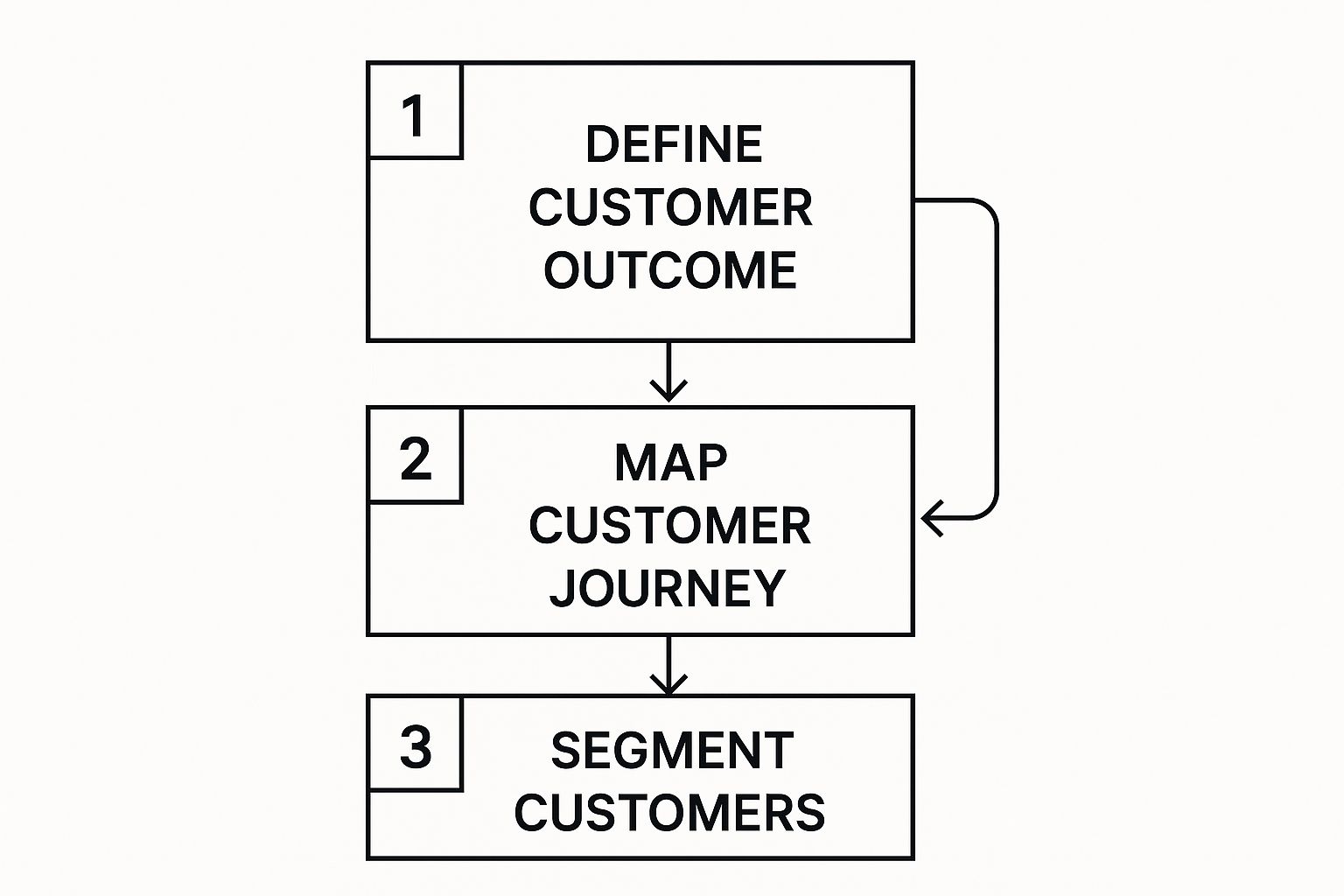
As you can see, defining outcomes and mapping the journey naturally lead to the next crucial step: treating different customers differently.

Step 3: Segment Customers for Scalability

Let's be real: not all customers are created equal. And your engagement model shouldn't be a one-size-fits-all affair. Segmentation is the secret to delivering the right level of service without burning out your team or your budget.

This is where you'll decide between a hands-on approach and a more automated one.

A high-touch model, with dedicated Customer Success Managers (CSMs) and white-glove support, makes perfect sense for your high-value, enterprise accounts. On the flip side, a tech-touch model uses automation, digital resources, and community forums to serve a larger volume of smaller accounts efficiently.

Comparing High-Touch vs. Tech-Touch Engagement Models

Deciding which model fits which customer segment is critical for scaling your efforts. This table breaks down the core differences to help guide your thinking.

CharacteristicHigh-Touch ModelTech-Touch (or Low-Touch) Model
Ideal ForEnterprise clients, complex productsSMBs, simple, plug-and-play products
Primary ContactDedicated Customer Success ManagerAutomated emails, in-app guides, community forums
Cost to ServeHighLow
ScalabilityLow (relies on human headcount)High (relies on systems and automation)
Example ActionsWeekly strategy calls, custom onboarding plans, onsite QBRs.Automated onboarding sequences, monthly webinars, knowledge base articles.

By matching the right engagement model to the right customer segment, you create a system that can actually grow with your business instead of holding it back.

Step 4: Implement Your Tech Stack

Your team can't execute this strategy with spreadsheets and sticky notes. You need the right tools. A smart tech stack is what gives your team the data and automation needed to be proactive, not reactive. Without it, you're guessing; with it, you're predicting.

The centerpiece is usually a Customer Success Platform (CSP) like Catalyst or ChurnZero. These platforms act as a central hub, pulling in data from your CRM, help desk, and product analytics tools.

Actionable Tip: Don't boil the ocean. Start by integrating just two data sources into your CSP: your CRM (like Salesforce) to see contract value and your product analytics tool to see login data. This simple combo alone will allow you to build a basic health score that separates active high-value customers from inactive ones.

Step 5: Establish Success Metrics

Finally, you can't improve what you don't measure. You need to establish a clear set of Key Performance Indicators (KPIs) to know if your strategy is actually working. These numbers are how you'll prove the value of customer success to the rest of the company.

While we'll dive deeper into these metrics later, some of the non-negotiables include:

  • Net Revenue Retention (NRR)
  • Churn Rate
  • Customer Health Scores

These metrics aren't just for reporting; they're your feedback loop. They tell you what's working, what's not, and where to focus your energy next.

Metrics That Actually Measure Success

A dashboard displaying various customer success metrics and KPIs.

A customer success strategy without hard numbers is just a collection of good intentions. To prove your team’s value—and to make smart decisions about where to invest your time—you have to track the KPIs that tell the real story of your impact.

It's tempting to lean on vanity metrics like Net Promoter Score (NPS), and while they’re useful for a quick vibe check on customer sentiment, they don't connect your team's hard work directly to revenue. The best CS teams obsess over the numbers the C-suite actually cares about: revenue metrics.

There's a reason 93.7% of companies that measure their CS impact use revenue-focused targets. When you tie your efforts to financial outcomes, you stop being a "cost center" and start being seen for what you are: a powerful growth engine. You can see more on these benchmarks in the latest customer success statistics and trends.

Revenue Retention: The Ultimate Proof

If you track nothing else, track these two: Gross Revenue Retention (GRR) and Net Revenue Retention (NRR). They are the purest measures of your ability to hold onto the revenue you’ve already earned.

  • Gross Revenue Retention (GRR): This is your defensive game. It shows how much revenue you kept from your existing customers, without counting any upsells or expansion. It's a raw look at how well you're preventing churn and downgrades. A GRR of 90% means you lost 10% of your revenue to churn.
  • Net Revenue Retention (NRR): Now we’re on offense. This metric starts with GRR but then adds in all the expansion revenue from upsells and cross-sells. If your NRR is over 100%, it means you're growing your business from your current customer base alone, even before signing a single new logo.

NRR is the gold standard for a customer success strategy. It proves you're not just plugging leaks in the bucket; you're actively adding more water. It's the number that makes a CS team indispensable.

Another powerhouse metric is Customer Lifetime Value (CLV), which forecasts the total revenue you can expect from a single customer over their entire relationship with you. When your team focuses on activities that increase CLV, you're guaranteeing a long-term, profitable impact. For a deeper look, check out our guide on improving Customer Lifetime Value.

Leading vs. Lagging Indicators

A truly solid measurement framework uses both leading and lagging indicators to get the full picture. One tells you where you’re going; the other tells you where you've been. Relying only on lagging indicators is like trying to drive a car by looking only in the rearview mirror.

Here’s a simple way to think about the difference:

Indicator TypeDescriptionExamplesActionability
LeadingPredictive metrics that signal future outcomes.Customer health scores, product adoption rates, support ticket trends.Proactive: Allows you to intervene before a problem occurs.
LaggingHistorical metrics that report past outcomes.Churn rate, NRR, GRR, CLV.Reactive: Confirms what has already happened.

Think of it like driving a car. Your leading indicators are the warning lights on your dashboard—low fuel, check engine. They give you a chance to pull over and fix something before you’re stranded on the side of the road.

Lagging indicators? That’s the repair bill you get a week later. It confirms a problem happened, but it's too late to prevent it.

A world-class customer success strategy is built on leading indicators. You have to anticipate needs and prevent churn before it ever shows up in a financial report.

How to Sidestep the Common Pitfalls

Let's be honest: rolling out a customer success strategy isn't always a straight line to victory. Even the sharpest teams hit a few predictable bumps in the road. Knowing what they are ahead of time is the difference between a strategy that lives in a slide deck and one that actually drives growth.

You’ll almost certainly run into three classic hurdles: getting executive buy-in, breaking down departmental silos, and scaling without losing the human touch.

Let’s break them down.

Getting the Executive Team on Board

This is usually the first and biggest wall you’ll hit. Leadership often sees "customer success" and thinks "cost center"—just another name for customer support. To get them to open up the budget, you have to stop talking about happiness and start talking their language: revenue.

Compare these two requests to a CEO:

  • Weak Pitch: "We need to hire two CSMs to improve customer satisfaction."
  • Strong Pitch: "Investing $150k in two new CSMs will allow us to implement proactive QBRs for our top 20 accounts. Based on a pilot program, we project this will increase our NRR from 95% to 105%, adding $500k in expansion revenue next year."

See the difference? One is a cost; the other is a clear ROI.

Actionable Tip: Build a dead-simple dashboard. On one side, show the upsell and cross-sell revenue your CS team sourced this quarter. On the other, compare the lifetime value (CLV) of customers who got your white-glove onboarding versus those who didn’t. Suddenly, you’re not asking for a "cost"—you're proposing a clear "investment."

Getting Other Departments to Play Nice

A clunky customer experience is almost always a sign that your internal teams aren't talking to each other. When Sales, Product, and Customer Success are living on separate islands, the customer is the one left stranded. The only fix is to get everyone chasing the same goals.

Think about it: Sales is paid to close deals fast. Sometimes that means setting expectations that your CS team has to spend the next three months cleaning up. You’ve got to build some bridges.

Here are two quick ways to start:

  • Shared KPIs: Work with the head of sales to tie a small piece of their team's bonus to a metric like the "first-year renewal rate." Watch how fast they start closing good-fit customers who are actually set up to succeed.
  • Structured Feedback Loops: Set up a formal, no-fluff monthly meeting where CSMs present the top three customer pain points or feature requests directly to the Product team. This ensures the voice of the customer gets a real seat at the table, shaping the roadmap.

Getting everyone aligned is a huge challenge, but it's where the game is won or lost. The industry is moving away from soft scores and toward revenue ownership for CS teams. You can get a deeper look at how this impacts revenue growth in the years to come.

Scaling Without Burning Out Your Team

As your company grows, you can't just keep throwing more CSMs at the problem. That math doesn't work—it’s not scalable and it kills your margins. The secret is using tech to automate the predictable, low-value stuff so your team can focus on the high-impact, strategic work.

The goal isn’t to replace your people. It's to make them superhuman.

I like to think of it as a tech-touch vs. human-touch model. Automation crushes repetitive tasks, while your team builds the relationships that renewal checks are made of.

Task TypeBest ApproachExample
Routine & RepetitiveAutomationFiring off a welcome email, flagging an account with low product usage, or pointing a user to a knowledge base article.
Strategic & ComplexHuman EngagementRunning a quarterly business review, negotiating a tricky renewal, or jumping on a call to handle a major escalation.

When you let technology handle the grunt work, your team has the time and energy to deliver the proactive, thoughtful guidance that truly matters. That’s how a customer success strategy grows up and starts paying for itself.

Frequently Asked Questions

Got questions? You're not alone. When you're building a customer success program from the ground up, a lot of practical "how-to" questions come up. Let's tackle some of the most common ones we hear.

What Is the Difference Between Customer Success and Customer Support

This is the big one, and the distinction is everything. It boils down to one simple idea: proactive versus reactive.

  • Customer Support is reactive. They are the heroes who jump in when something breaks. A customer finds a bug, has a question about an invoice, or can't figure out a feature—the support team is there to solve that specific problem, close the ticket, and move on. Their key metric is often "time to resolution."
  • Customer Success is proactive. Their job is to make sure the customer never has to file that ticket in the first place. They’re obsessed with the customer's goals and outcomes, building a long-term partnership to ensure the customer is getting every ounce of value out of the product. Their key metric is often "Net Revenue Retention."

In short, support puts out fires. Success prevents them from ever starting.

How Should We Structure a Customer Success Team

There’s no magic formula here. The right structure depends entirely on who your customers are and how complex your product is. But most models fall into two camps: high-touch and tech-touch.

A high-touch model is exactly what it sounds like—deeply personal. You see this with large, enterprise clients where a dedicated Customer Success Manager (CSM) manages a tiny handful of accounts. They become a strategic advisor, learning the client's business inside and out.

A tech-touch model, on the other hand, is built for scale. It’s how you serve thousands of smaller accounts efficiently using automation, webinars, and a solid knowledge base. Many companies land somewhere in the middle, using a hybrid approach that matches the touch-level to the customer tier.

What’s the single most important metric for a customer success strategy?

It's often Net Revenue Retention (NRR). While things like churn and customer health scores are critical, NRR is the ultimate proof. It shows you're not just stopping customers from leaving but are actively growing revenue from the ones who stay. It’s the clearest sign of a healthy, thriving business.

When Should a Startup Invest in Customer Success

Honestly? From day one. Even if your "team" is just you, the founder, personally emailing every new user. The core principles—making sure customers get early wins and achieve their goals—are baked into the DNA of any successful startup.

But the move to a formal customer success strategy and a dedicated hire usually happens at a clear inflection point. It’s that moment when you have a repeatable sales process and you physically can't manage every customer relationship on an ad-hoc basis anymore. If you wait too long, you end up reacting to a churn problem instead of preventing it from the start.


Ready to turn strategy into action with smart, AI-driven tools? marketbetter.ai helps you scale engagement, personalize every touchpoint, and prove the value of your customer success efforts. See how our AI-Powered Marketing Platform can transform your customer relationships by visiting https://www.marketbetter.ai.

Ecommerce Marketing Automation Guide

· 24 min read

At its core, ecommerce marketing automation is simply using smart software to handle the repetitive, manual marketing chores that eat up your day. Think about tasks like sending welcome emails, personalizing product recommendations, or segmenting your audience—automation does the heavy lifting for you.

This lets online stores get the right message to the right person at the perfect time, without a human needing to click "send" for every single interaction. For any online business looking to grow beyond a handful of orders, it’s not just a nice-to-have; it's fundamental.

What Is Ecommerce Marketing Automation

Imagine you ran a small-town shop. You’d greet every customer by name, remember what they bought last time, and maybe even send them a postcard if you haven't seen them in a while. Now imagine trying to do that with thousands of online customers. Impossible, right?

That's the exact problem ecommerce marketing automation was built to solve. It acts like a tireless digital assistant, working 24/7 to create those personal, timely, and relevant experiences for every single person who visits your store.

Instead of blasting a generic newsletter to your entire email list, automation software sends messages based on what a customer actually does. These actions are often called "triggers." When a customer leaves items in their cart, for example, it can automatically trigger a sequence of reminder emails. This shift from a one-to-many broadcast to a one-to-one conversation is where the magic really happens.

Moving from Manual to Automated Marketing

Without automation, most of your marketing is reactive and incredibly time-consuming. You're always playing catch-up. An automated system, on the other hand, runs on simple rules you set up just once. After that, your marketing basically runs itself. If you're new to the concept, this guide explaining what ecommerce automation is and how it works is a great place to start.

Here’s a quick look at how the two approaches stack up:

TaskManual Marketing ApproachAutomated Marketing Approach
New SubscribersYou might remember to send a welcome email once a week to all the new sign-ups.A personalized welcome email hits their inbox the instant they subscribe.
Abandoned CartsYou see the high abandonment rate in your analytics but have no practical way to follow up.A reminder email goes out automatically 2-4 hours after a cart is abandoned, often saving the sale.
Customer FeedbackYou manually pull a list of recent buyers and send them a survey request.A feedback request is triggered automatically 14 days after a product is delivered.

This systematic approach frees up your team to focus on the big picture—like developing new products or building your brand—instead of getting lost in the weeds of daily, repetitive tasks.

The real power of marketing automation isn't just about saving time. It's about creating a customer journey that feels personal and responsive at a scale that would be completely impossible to manage by hand.

Ultimately, ecommerce marketing automation is more than just a piece of tech; it’s a strategy for building stronger, more profitable customer relationships. By delivering the right content at the moments that matter most, you can:

  • Turn curious new leads into first-time buyers.
  • Recover sales you would have otherwise lost.
  • Encourage repeat purchases with smart post-purchase follow-ups.
  • Win back old customers who have gone quiet.

Building Your Most Profitable Automation Workflows

Once you get the hang of what ecommerce marketing automation can do, the real fun begins: building the specific workflows that actually make you money. Don't think of these as just a bunch of emails. Think of them as automated conversations, carefully designed to guide shoppers along their journey with you.

Each workflow targets a critical moment—a fork in the road where the right message at the right time can turn a window shopper into a loyal customer for life.

The trick is to start with the heavy hitters. Focus on the automations that solve your biggest, most expensive problems, like abandoned carts or making a great first impression with new subscribers. Nail these first, and you'll see a real return on your efforts, fast.

The Essential Four Automation Workflows

While you can automate just about anything, four core workflows are the bedrock of any profitable ecommerce strategy. Master these, and you'll see an immediate lift in sales, engagement, and customer loyalty.

  • The Welcome Series: This is your digital handshake. It’s a sequence of emails you send to new subscribers to introduce your brand, build some trust, and nudge them toward that all-important first purchase.
  • The Abandoned Cart Sequence: This is your safety net. It targets shoppers who add products to their cart but bail before checking out. It’s the single most powerful tool you have for clawing back lost sales.
  • The Post-Purchase Follow-Up: This kicks in right after a customer buys. It’s all about squashing buyer's remorse, gathering priceless reviews, and planting the seed for their next purchase.
  • The Win-Back Campaign: This one’s for the customers who’ve gone quiet. The goal is to reignite their interest and bring them back into the fold before they forget about you completely.

The Welcome Series: Turning Subscribers into Customers

A welcome series is so much more than a simple "hello." A great one starts building a genuine relationship from the moment someone signs up. Instead of a single, lonely email, a 3-part series usually hits the sweet spot, with each message playing a specific role.

  1. Email 1 (Immediately): Deliver the goods. If you promised a discount for signing up, send it right away. This simple act builds instant trust and gives them a clear reason to shop.
  2. Email 2 (Day 2): Tell your story. What makes you different? Maybe it’s your unique founding story or your commitment to sustainable materials. This is where you connect on a human level.
  3. Email 3 (Day 4): Show, don't just tell. This is where you bring in the social proof. Feature your best-sellers, glowing reviews, and photos from happy customers to build confidence and help them decide what to buy first.

A strong welcome series is your best shot at converting a curious browser into a paying customer. It sets the tone for everything that follows and can give your conversion rates a serious boost.

The numbers don't lie. Even though automated messages account for just 1.8% of all email sends, they drive a staggering 31% of all email orders. That massive gap shows you just how powerful it is to send the right message at the right moment. And leading the charge are cart abandonment workflows, which make up 54.2% of all ecommerce automation, making them the undisputed king of revenue recovery.

This is what that impact looks like in practice:

Image

As you can see, putting these targeted automations in place is a straight line to better ROI. It's about turning those near-misses into wins.

The Abandoned Cart Sequence: Recovering Lost Sales

Every online store deals with abandoned carts. It's just part of the game. But they're also a golden opportunity. A well-timed abandoned cart sequence can pull a huge chunk of that lost revenue right back into your business. This is where ecommerce marketing automation has a direct, measurable impact on your bottom line.

A classic three-email sequence is the standard for a reason—it works.

  • Email 1 (1-4 hours after abandonment): The gentle nudge. Keep it low-pressure. You're just reminding them they left something behind. Life happens, and sometimes a simple reminder is all it takes.
  • Email 2 (24 hours later): Address the hesitation. Use this email to tackle common worries. Talk up your easy return policy, highlight your customer support, or sprinkle in a few product reviews to build confidence.
  • Email 3 (48-72 hours later): Create a little urgency. This is your final push. Try offering a small, limited-time incentive like a discount or free shipping to give them a compelling reason to finish their purchase now.

Expanding Automation with Chatbots and Post-Purchase Care

Email is powerful, but it's not the only game in town. Other automated tools can seriously level up the customer experience and drive more sales. For a deep dive, check out this ultimate guide to chatbot in ecommerce. Chatbots, for example, can answer questions on product pages or during checkout, stopping cart abandonment before it even starts.

And don't forget what happens after the sale. The post-purchase and win-back automations are your keys to long-term growth. A post-purchase series can ask for a review, offer tips on using the new product, or cross-sell related items. A win-back campaign can re-engage customers who've gone cold with an exclusive offer, reminding them why they liked you in the first place.

How To Choose the Right Automation Platform

Image

Picking the right ecommerce marketing automation software is like choosing a co-pilot for your business. The right one makes the journey smoother, faster, and way more profitable. The wrong one? It just leads to frustration, wasted cash, and a whole lot of turbulence.

This decision isn't about finding the single "best" platform on the market; it's about finding the best one for you. A tool that’s perfect for a multi-million dollar enterprise is going to be total overkill for a startup. And that simple tool a small shop loves could seriously hold a growing business back.

Before you even glance at a feature list, you need to get crystal clear on your own needs. Nail this part, and you’ll save yourself from being dazzled by flashy features you’ll never use or, even worse, getting locked into a contract that just doesn't fit.

Start By Answering These Four Questions

To cut through the noise and narrow down the options, you have to start with an honest look in the mirror. This little internal audit is the most critical step in the whole process.

  • What's your budget? Be realistic. Platforms range from free starter plans to thousands of dollars a month. Knowing what you can actually spend immediately filters out a huge chunk of the market.
  • How tech-savvy is your team? Do you need a dead-simple, drag-and-drop interface, or is your team comfortable getting their hands dirty with more complex setups? Matching the tool to your team's skills prevents a steep, painful learning curve.
  • What ecommerce platform are you on? This is a big one. Your automation tool must play nicely with your store (think Shopify, WooCommerce, BigCommerce). Bad integrations create data headaches and totally defeat the purpose of automating anything.
  • What's your #1 goal right now? Are you laser-focused on recovering abandoned carts? Building a killer welcome series for new subscribers? Or diving deep with advanced segmentation? Pinpointing your top priority helps you focus on platforms that crush that specific task.

Answering these gives you a clear checklist. As you start looking at tools, you can quickly say "no" to anything that doesn't line up, saving you countless hours of demos and research.

Your ecommerce marketing automation platform should feel like a natural extension of your business, not some foreign piece of tech you have to wrestle with. The goal is to find a tool that bends to your workflow, not the other way around.

Comparing Key Platform Features

Once you've mapped out your internal needs, you can start comparing platforms based on the features that actually move the needle. Every tool has a laundry list of capabilities, but they aren't all created equal. Zero in on these core areas.

A side-by-side comparison really clarifies where each platform shines. You’ll quickly see that some are built for ease of use, while others offer incredibly powerful—but complex—segmentation engines.

Comparing Top Marketing Automation Platforms

To help you visualize the differences, let’s look at how the top ecommerce marketing automation platforms stack up. This isn’t about declaring a single winner, but about matching the right tool to the right job. Each one has its own strengths, ideal user, and pricing philosophy.

PlatformIdeal ForKey FeaturesIntegration StrengthPricing Model
KlaviyoEcommerce Stores (especially Shopify)Deep data integration, pre-built flows, email & SMS, predictive analytics.Excellent with major ecommerce platforms.Based on contact/profile count and email/SMS volume.
HubSpotB2B & Complex Sales CyclesAll-in-one CRM, sales, marketing & service hubs, powerful workflow builder.Extremely strong across a vast app ecosystem.Tiered plans (Starter, Pro, Enterprise) based on features.
MailchimpStartups & Small BusinessesUser-friendly email editor, basic automations, landing pages, simple CRM.Good, with many integrations but less deep data sync.Based on contact count and feature tier.
MarketBetterGrowth-Focused TeamsAI-powered personalization, multichannel outreach (email, video, chat), lead enrichment.Strong with CRMs and sales tools; designed for end-to-end workflows.Tiered plans based on credits and features.

This comparison highlights a critical truth: there's always a trade-off. The most user-friendly platform might not have the deepest analytics. The most powerful AI tool might come with the highest price tag. Knowing your priorities allows you to make the right compromise. If you're curious how AI-powered platforms like ours are structured, you can explore the different options available in our pricing and plans.

Ultimately, your goal is to find the sweet spot—a platform that nails 80% of your needs today and has the room to grow with you tomorrow. Don't chase perfection; chase the perfect fit for your business.

Putting Your First Automation Workflow Into Motion, Step-by-Step

Alright, enough theory. It's time to get your hands dirty. The single best way to really get the power of ecommerce marketing automation is to build your first workflow, and there's no better place to start than the abandoned cart sequence.

Why this one first? Because it’s the highest-impact automation you can possibly build, going straight after lost revenue. You’ll see measurable results almost immediately.

This isn’t going to be some technical deep dive. We’ll keep it simple and practical, breaking the whole thing down into small, manageable steps. We'll walk through setting the trigger all the way to writing a simple three-email series. No coding, no wizardry required.

Step 1: Define Your Trigger and Your Goal

Every automation kicks off with a "trigger"—a specific action a customer takes that starts the whole process. For an abandoned cart sequence, that trigger is beautifully simple: someone adds an item to their cart, maybe even starts the checkout, but then vanishes before paying.

Your goal is just as clear: recover the sale. Every single part of this workflow—from the timing of each email to the words you use—needs to be laser-focused on one thing: gently nudging that customer to come back and finish what they started.

Step 2: Map Out a Simple Three-Email Sequence

A three-email sequence is the industry standard for a reason. It hits the sweet spot between being persistent and just being annoying. One of the biggest mistakes I see is rushing to throw a discount at them in the first email. A more gradual, helpful approach almost always works better.

Here’s a proven structure that just plain works:

  1. Email 1 (Send 1-4 hours after they leave): The Gentle Reminder. This is a low-pressure, "hey, did you forget something?" kind of email. Life happens. Maybe their internet dropped, or the dog started barking. A simple nudge is often all it takes.
  2. Email 2 (Send 24 hours later): The Confidence Builder. Okay, they didn't come back right away. Now it's time to address whatever might be holding them back. Use this email to showcase glowing customer reviews, remind them of your easy return policy, or link directly to your support chat.
  3. Email 3 (Send 48-72 hours later): The Final Incentive. If they're still on the fence, it's time to create a little friendly urgency. This is where you can offer a small, time-sensitive incentive like 10% off or free shipping to get them over the finish line.

Here’s a peek at what this looks like inside an automation tool like Klaviyo. You can visually see the trigger, the time delays, and how the emails are spaced out.

Seeing it mapped out like this makes it obvious how each step flows logically into the next, ensuring your messages land at just the right time.

Step 3: Write Email Copy That Actually Gets Clicked

Now for the fun part: writing the emails. Keep your copy short, personal, and focused on a single, clear call-to-action (CTA).

The best abandoned cart emails feel less like a marketing blast and more like helpful customer service. Use a friendly, conversational tone and make it incredibly easy for the shopper to pick up where they left off.

A few tips to get you started:

  • Write an Intriguing Subject Line: Ditch "You left items in your cart." Try something with a little more personality, like "Your tea is waiting for you" or "Did you see something you liked?"
  • Show, Don't Just Tell: This is non-negotiable. Always include images of the exact products they left behind. That visual reminder is incredibly powerful.
  • Create Scarcity (But Be Honest): If an item is genuinely low in stock, say so. A simple "Items are selling fast" can add a little push without being sleazy.
  • End with a Crystal-Clear CTA: Your button should be big, bold, and impossible to miss. Use direct, action-focused text like "Return to Your Cart" or "Complete My Purchase."

Follow these steps, and you'll have a powerhouse abandoned cart workflow running on autopilot, winning back sales while you focus on growing your business.

And if you want to take it a step further, you can explore adding dynamic visuals to your messages. Learning more about video email automation can show you how to make your follow-ups even more engaging and persuasive.

Using AI for Smarter Ecommerce Personalization

Image

Rule-based automation is a fantastic workhorse. You set up "if-this-then-that" rules, and it executes them flawlessly, like a perfect employee following a script. But what if your automation could do more than just follow orders? What if it could think?

This is where artificial intelligence (AI) comes in. It takes your ecommerce marketing automation from a reliable tool to a strategic powerhouse. Instead of just following the rules you give it, AI learns from your customer data to make its own smart decisions. It's the difference between an employee who sticks to a script and one who truly understands what a customer wants and adapts on the fly.

And this isn't some far-off future concept; it's happening right now. The AI-enabled ecommerce automation market is already worth around $8.65 billion, and by 2025, 92% of companies expect automation to be essential. With 93% of businesses already seeing AI as a competitive advantage, the writing is on the wall. To learn more, read about the growing adoption of automation and see how businesses are gearing up.

Moving Beyond Simple Triggers

Your standard automation runs on simple triggers. A customer buys running shoes, so your system sends them an email about running socks a week later. It’s logical, but it’s still just a guess—a one-size-fits-all approach.

AI goes so much deeper. It doesn't just look at that single purchase. It analyzes thousands of other data points: what other runners bought, what this specific customer browsed before buying, how long they hovered over certain product pages, and even their typical shopping times.

From all that data, the AI might figure out this particular customer is way more likely to be interested in a high-tech GPS watch than a pair of socks. So, it dynamically swaps out the email content to feature that specific watch, pulling in top reviews and highlighting key features.

AI flips your marketing from reactive to predictive. It stops making educated guesses based on the past and starts anticipating what your customers will want next, creating an experience that feels like it was built just for them.

Predictive Analytics and Dynamic Content

One of the most powerful things AI brings to the table is its ability to predict customer behavior. By crunching the numbers and spotting patterns, AI models can flag customers who are at risk of churning long before they actually stop buying. This gives your automation the heads-up to trigger a proactive win-back campaign with a targeted offer to keep them in the fold.

This same intelligence fuels dynamic content, turning your static website into a living, breathing storefront that adapts to every visitor.

  • A first-time visitor arrives from a tech blog? The AI might greet them with your latest gadgets and cutting-edge products.
  • A loyal customer who always buys outdoor gear logs in? The homepage immediately showcases new hiking boots and waterproof jackets.

This isn't just about changing a banner image. AI can adjust everything—product recommendations, headlines, promotional offers—all in real-time, based on who's looking. This kind of personal touch makes the entire shopping journey more relevant and engaging, which is a surefire way to boost conversions and build lasting loyalty.

Measuring and Improving Your Automation ROI

Getting your automation workflows live is a huge win, but it’s the starting line, not the finish. If you really want to see game-changing results, you have to shift your mindset from "set it and forget it" to "measure, test, and improve."

Think of it like a chef perfecting a new soup. You wouldn't just throw the ingredients in the pot and hope for the best. You'd taste it, adjust the seasoning, taste again, and keep refining until it's perfect. That's exactly how you should treat your automation. The goal isn’t just to see if people opened your emails; it's to prove—with hard numbers—that your efforts are making the business money.

Key Metrics That Actually Matter

To get a real picture of your ROI, you have to look past vanity metrics like open rates. You need KPIs that tell the true story of your financial impact.

  • Revenue Per Automated Email: This is your north star. It’s a simple, brutal calculation of exactly how much money each automated message generates. No hiding from this number.
  • Automated Conversion Rate: This shows you the percentage of people who actually took the action you wanted—usually making a purchase—after getting an automated touchpoint.
  • Cart Recovery Rate: For your abandoned cart flows, this is the big one. It measures the percentage of carts that your automation successfully brought back from the dead and turned into sales.
  • Customer Lifetime Value (CLV) Impact: This is the long game. It analyzes how your automation influences the total amount a customer spends with you over their entire relationship. Getting your lead scoring right can have a massive effect here; you can learn more about using AI for smarter lead scoring to zero in on your most valuable prospects from the start.

How to Systematically Get Better Results

Knowing your numbers is one thing. Using them to make smarter decisions is where the real growth happens. This is where A/B testing (or split testing) becomes your most powerful tool.

A/B testing takes the guesswork out of the equation. Instead of thinking you know what works, you let your customers’ actions give you a definitive, data-backed answer.

The process is simple: you create two different versions of one element in your workflow, show each version to a different slice of your audience, and see which one performs better.

Easy A/B Tests You Can Run Tomorrow:

  • Subject Lines: Test something direct like "Your items are waiting" against a subject line that dials up the urgency, like "Your cart expires soon!"
  • Call-to-Action (CTA) Copy: Pit different button text against each other. Does "Complete Your Order" work better than "Take Me Back to My Cart"? Only one way to find out.
  • Timing and Cadence: Experiment with the delay on your abandoned cart emails. Does sending the first reminder after just one hour outperform waiting four hours?

By constantly testing, learning, and rolling out the winners, you build a powerful feedback loop. It's a cycle of continuous improvement that will squeeze every last drop of ROI out of your marketing automation.

A Few Common Questions About Ecommerce Automation

Even with a solid game plan, it’s smart to have a few questions before you jump headfirst into ecommerce marketing automation. Let's tackle some of the most common ones I hear from B2B marketers, so you can move forward feeling confident.

Getting these answers straight helps you build the business case for automation. This isn't about just bolting on another tool; it's about investing in a system that drives real, measurable growth and gives your team back some precious time.

How Much Does Ecommerce Marketing Automation Cost?

The price tag can swing pretty wildly depending on your contact list size and the features you actually need. A lot of platforms offer free starter plans if you're working with a small database, usually under 500 subscribers. This is a great way for smaller businesses to kick the tires on core features without a big financial commitment.

Once you start growing, paid plans can run anywhere from $20-$50 per month for the essentials, like abandoned cart reminders. More sophisticated platforms that use AI for personalization and sync across multiple channels can climb into the hundreds per month. The trick is to find a plan that fits you now but has room to grow with you.

The classic mistake is paying a premium for a ton of advanced features you won't touch for another two years. Start lean. Prove the ROI on the basics, and then level up your plan as your revenue and needs expand.

Will This Make My Marketing Feel Robotic to Customers?

That’s a totally fair question. But honestly, the goal of good automation is the complete opposite. It’s about using rich customer data—what they’ve bought, what they’ve browsed, how they engage with your emails—to send messages that are incredibly relevant and perfectly timed.

Think about it. Instead of getting a generic weekly newsletter, a customer gets a helpful tip about the product they just bought. Or a recommendation for something that pairs perfectly with their last purchase. When you do it right, ecommerce marketing automation feels less like a robot and more like a genuinely helpful personal shopper.

What’s the Real Difference Between Email Marketing and Marketing Automation?

This is a big one, because it gets to the heart of the strategic shift you're making. Standard email marketing is often about "blast" campaigns—one-off messages sent to a big list. Automation, on the other hand, is a smarter system built on triggers from customer behavior.

AspectStandard Email MarketingMarketing Automation
TriggerManual send (e.g., weekly newsletter)Customer action (e.g., abandons cart)
AudienceOne-to-many (the whole list)One-to-one (based on individual behavior)
TimingScheduled by youInstant and in the moment
ComplexitySimple, single messagesMulti-step, "if-then" workflows

Here’s an analogy: email marketing is like handing out flyers on a busy street. Marketing automation is like having a personal conversation with every single person who shows real interest in your shop. You're moving from broadcasting to conversing.


Ready to stop guessing and start growing with AI-driven precision? marketbetter.ai integrates content creation, campaign management, and customer personalization into a single, powerful platform. See how our AI can help you create better content 5x faster and improve campaign conversions by 15%.

Discover marketbetter.ai and book your demo today

Improving Customer Lifetime Value for Real Growth

· 20 min read

For years, marketers have been stuck on a hamster wheel, pouring cash into acquiring new customers while the ones they already have are quietly slipping out the back door. It's a costly, exhausting, and ultimately unsustainable way to grow. The old model focused on a one-time transaction. The new, smarter model focuses on the entire relationship.

The real engine of growth isn't just getting new faces in the door; it's about keeping them around and making sure their value grows over time. That's where we need to shift our focus from one-off sales to improving customer lifetime value.

Why CLV Is Your Most Important Growth Metric

Image

Thinking in terms of Customer Lifetime Value (CLV) completely changes the game. It forces you to stop asking, "How much did this customer spend today?" and start asking, "How much revenue will this customer generate over their entire relationship with us?"

This simple shift is the difference between surviving quarter-to-quarter and building a truly resilient, profitable business.

The True Impact of CLV on Your Business

When you really lean into improving CLV, the benefits ripple out across the whole company. It’s not just a vanity metric for the marketing team; it becomes a core philosophy that shores up your financials and sharpens your brand.

Here’s what a healthy CLV actually gets you:

  • Predictable Revenue Streams: Loyal customers who buy again and again create a stable financial foundation. This makes forecasting and planning a whole lot less stressful compared to the unpredictable nature of constantly chasing new leads.
  • Increased Profitability: Here's a hard truth: it is always cheaper to keep a customer than to find a new one. A high CLV means you’re spending less on acquisition for every dollar you earn, which goes straight to your bottom line.
  • Stronger Brand Advocacy: Happy, long-term customers are your best marketers. They’re the ones leaving glowing reviews and telling their friends about you, driving organic growth that you don’t have to pay for. This is far more powerful than any paid ad campaign.

One of the biggest mistakes I see is treating acquisition and retention like they're two different sports. They're not. Your acquisition strategy should be designed from day one to attract customers with high lifetime potential, and your retention efforts make sure that potential is realized.

To help you get a handle on the core ideas, here’s a quick breakdown of the concepts we'll be working with.

Key CLV Concepts at a Glance

ConceptDescriptionActionable Tip
CLV (Customer Lifetime Value)The total net profit a business expects to make from a single customer over their entire relationship.Action: Calculate your CLV, then set a specific goal to increase it by 10% in the next six months.
CAC (Customer Acquisition Cost)The total cost of sales and marketing efforts needed to acquire a single new customer.Action: Compare your CLV to your CAC. A ratio below 3:1 means it's time to optimize your ad spend or boost retention.
Churn RateThe percentage of customers who stop doing business with you over a specific period.Action: Implement one new churn-reduction strategy this quarter, like a personalized check-in for at-risk customers.
Average Purchase Value (APV)The average amount a customer spends in a single transaction.Action: Test product bundling or a "customers also bought" feature on your checkout page to increase APV.
Purchase Frequency (PF)How often the average customer makes a purchase from your business in a given period.Action: Launch a simple email campaign that reminds customers to re-order a consumable product right before they run out.

Understanding these pieces is the first step. They are the levers you can pull to directly influence your company's long-term financial health.

Understanding the Financial Benchmarks

So, what do these numbers look like in the wild? For e-commerce in 2025, the average CLV often hovers somewhere between $100 and $300. But that number is meaningless without context.

The real test of your business's health is the CLV-to-CAC ratio. A solid benchmark to shoot for is 3:1—meaning for every dollar you spend bringing a customer in, you get three dollars back over their lifetime. This ratio is what separates businesses that are just treading water from those building real, sustainable value.

If you're curious about where you stand, it’s worth digging into some customer value statistics to see how you stack up against current industry data.

How to Calculate and Segment Your CLV

Before you can boost your customer lifetime value, you need a clear picture of where you’re starting from. The math can look a little intimidating at first, but a simple, practical formula gives you a powerful baseline for understanding your business's health.

The goal here isn't just to land on a single number. Think of it less like a final grade and more like a diagnostic tool that shows you what’s working and what isn’t.

A Straightforward Method for CLV Calculation

At its core, CLV is about multiplying three key things: how much customers spend, how often they buy, and how long they stick around. This gives you that crucial baseline to measure against as you start rolling out new strategies.

Here’s how the basic formula breaks down:

  • Average Purchase Value (APV): Total Revenue / Number of Purchases
  • Purchase Frequency (PF): Total Purchases / Number of Unique Customers
  • Average Customer Lifespan: The average time a customer remains active.

Just multiply these three together (APV x PF x Lifespan), and you've got your foundational CLV. If you want to go deeper, this article on how to calculate customer lifetime value unpacks some more advanced models.

But the real magic happens when you move beyond that one company-wide number. Averages can be incredibly deceiving because, let's be honest, not all customers are created equal. This is where segmentation becomes your secret weapon.

From Calculation to Actionable Segmentation

Imagine you run an online coffee subscription. Your average CLV might be $350. That’s a decent figure, but it completely hides the real story. Some customers might spend over $1,000 with you over their lifetime, while others bail after a single $50 order. Lumping them all together is a huge mistake because it means you treat them the same.

Effective segmentation is all about grouping customers by their actual value. It lets you stop the one-size-fits-all marketing and start putting your resources where they’ll generate the highest return. It’s the difference between shouting into a crowd and having a meaningful one-on-one conversation.

You can get started with three simple but powerful segments:

Customer SegmentCharacteristicsYour Strategic Action
High-Value ChampionsThese are your top 5-10%. They buy often, spend more, and tell their friends about you.Treat them like VIPs. Give them exclusive access, early product releases, and personalized thank-you campaigns. Your goal is to turn them into advocates.
Middle-Tier PotentialsThis is the bulk of your customer base. They're consistent but have plenty of room to grow in what they buy or how often.Focus on upselling and cross-selling. Use targeted emails to introduce complementary products or tempt them with a higher subscription tier.
At-Risk or Low-ValueThese are the customers who made one or two small purchases and then went quiet. They have a high risk of churning for good.Try a re-engagement campaign with a compelling offer. If they don’t bite, it’s better to focus your budget on the other two groups.

By segmenting, you transform CLV from a passive number on a dashboard into an active strategy. You can now allocate your marketing budget intelligently, focusing your best efforts on keeping your champions happy and growing your potentials—instead of wasting resources on customers who are unlikely to ever come back.

Building Loyalty Programs That Actually Work

Once you’ve got a handle on who your customers are, you can start moving past simple transactions and build real connections. This is where a smart loyalty program becomes one of your best tools for improving customer lifetime value.

And I’m not talking about those generic "buy ten, get one free" punch cards that just get lost in a wallet. A transactional approach gets you transactional loyalty, which disappears the moment a competitor offers a better deal.

Modern loyalty programs are all about making customers feel seen, understood, and genuinely appreciated. They create a sense of belonging that can turn a one-time buyer into a lifelong fan. The goal isn’t just a discount; it’s delivering value that goes way beyond the price tag.

Choosing the Right Loyalty Model

The structure of your loyalty program has to make sense for your business and, more importantly, for your customers. A points system that’s perfect for a high-frequency coffee shop will probably fall completely flat for a SaaS company that bills annually.

It's all about matching the reward to the customer's behavior and what they actually find valuable.

Let’s break down a few common models to see how they fit different businesses.

Loyalty ModelBest ForIneffective ForActionable Example
Tiered ProgramSaaS, Airlines, High-Value RetailLow-frequency purchase businesses (e.g., mattress sales).Action: Create "Bronze," "Silver," and "Gold" tiers. Gold members get priority support, early access to new features, and a dedicated account manager.
Exclusive AccessFashion, CPG, Creator EconomyCommodity products with low brand differentiation.Action: Give loyalty members first dibs on limited-edition products and an invite to an exclusive online community for skincare tips.
Value-Based ProgramEthical & Mission-Driven BrandsPrice-sensitive markets where value alignment isn't a key driver.Action: Let members direct a portion of their purchase to environmental causes, reinforcing what your brand stands for. Send them an impact report.

Designing Rewards That Resonate

The best rewards feel personal and meaningful, not just like another transaction. This is where you can put your customer data to work and offer perks that really stand out.

Instead of just another coupon, think about rewards that make their experience with your product or brand even better.

Some of the most effective rewards I've seen include:

  • Experiential Perks: Things like early access to sales, invitations to special events, or one-on-one consultations. You can't put a price on these kinds of memorable experiences.
  • Personalized Surprises: Use their purchase history to send a surprise gift you know they'll love. Imagine sending a free bag of their favorite coffee roast on their one-year anniversary as a subscriber. It’s a small touch with a huge impact.
  • Convenience Upgrades: Offer free shipping, faster customer support, or a more flexible return policy. These practical benefits remove friction and show you value their time.

You can even take personalization a step further with simple but powerful tactics. We've got a whole playbook on how to add a personal touch with video email automation that’s worth a look.

The psychology of a great loyalty program is simple. It's not about trapping customers; it's about making them feel so valued that they wouldn't want to go anywhere else. True loyalty is earned through consistent, positive experiences.

Investing in a solid program pays off, big time. Research shows that boosting customer retention by just 5% can increase profits anywhere from 25% to 95%. It's no surprise the loyalty management market is expected to explode from $13.31 billion in 2024 to $41.21 billion by 2032.

This isn't just a "nice-to-have" anymore; it's a core part of modern business strategy. When you focus on creating genuine value, you build a program that doesn't just work—it becomes a serious competitive advantage.

Using AI to Predict and Personalize the Customer Journey

Image

Predictive analytics and AI aren't just trendy jargon; they are the engines that will drive the next wave of growth in customer lifetime value. These tools finally let you stop guessing what your customers will do next and start anticipating it.

Instead of just reacting to a customer's last purchase or complaint, AI lets you get ahead of their next move. It chews through massive datasets—purchase history, browsing behavior, support tickets, you name it—to spot the subtle patterns a human could never see. This is how you forecast future purchases, flag customers who are about to churn, and deliver personalized experiences before they even realize what they want.

Proactive Engagement Over Reactive Service

Think about the old model of customer service. It was almost entirely reactive. A customer has a problem, they call you, and maybe you fix it. This approach is slow, expensive, and it does absolutely nothing to build a real relationship.

AI flips that entire dynamic on its head. It makes a proactive model possible—one that anticipates needs and solves problems before they even surface. This shift from playing defense to playing offense is a complete game-changer for keeping customers around and increasing their value over time.

To see just how different these two worlds are, let's break down the practical differences. The old way relied on waiting for things to break, while the new, AI-powered approach is all about getting ahead of the curve.

Traditional vs AI-Powered CLV Strategies

AspectTraditional Approach (Reactive)AI-Powered Approach (Proactive)
Problem IdentificationCustomer reports an issue after it's already a problem.AI flags potential issues based on behavior changes or usage data, triggering an automated check-in.
CommunicationGeneric, one-size-fits-all emails and canned support scripts.Hyper-personalized offers and messages timed for maximum impact based on predictive models.
Customer InsightRelies on historical reports and someone manually crunching numbers days or weeks later.Uses real-time predictive models to forecast future behavior and identify opportunities instantly.
OutcomeSolves the immediate problem but does nothing to prevent the next one.Builds loyalty by showing you understand and anticipate their needs, preventing problems from ever occurring.

This isn't some far-off future, either. The move to proactive engagement is happening right now. By 2025, it's estimated that 95% of all customer interactions will involve AI in some capacity. The companies already on board are seeing massive wins, with around 80% of businesses using AI-powered Customer Data Platforms reporting major boosts in customer satisfaction.

AI-Driven Personalization in Action

Let’s make this real. Imagine you run an online fashion store. In the past, you might blast out a generic "20% off everything!" email to your entire list and just hope for the best.

With AI, the approach is surgical.

  • Action Step 1: An AI model analyzes a customer's browsing history, picking up on their preference for sustainable fabrics and a specific color palette.
  • Action Step 2: It layers this with their purchase frequency, noticing they tend to buy a new item roughly every two months.
  • Action Step 3: Right before that two-month mark hits, the system automatically triggers a personalized email showcasing new arrivals made from sustainable materials and in their favorite colors.

The result? The customer gets an offer that feels like it was made just for them, arriving at the exact moment they're most likely to buy. It's a textbook example of turning raw data into a genuine conversation.

The real breakthrough with AI isn't just about automation. It's about delivering empathy at scale. It allows you to give every single customer the kind of personal attention that was once only possible for a small handful of VIPs.

By using technologies that enable person-level identification, you can stitch together a truly unified view of each customer. This ensures every single touchpoint—from the ad they see to the product you recommend—is perfectly synced with their individual journey. This is how you turn one-time buyers into high-value, long-term advocates for your brand.

Actionable Plays for Each Stage of the Customer Lifecycle

If you want to systematically improve customer lifetime value, you have to align your actions with where the customer is in their journey. Generic tactics just fall flat. What really drives growth are specific plays for acquisition, retention, and advocacy.

Each stage demands a different approach, but they all compound to create a much more valuable customer relationship over time.

This simple workflow shows how data should inform the entire process, from collection right through to personalized outreach.

Image

Think of this as the core engine for modern CLV optimization. It’s all about turning raw information into targeted actions that actually resonate with customers.

Sharpening Acquisition with High-CLV Lookalikes

Your first chance to boost CLV happens before someone even becomes a customer. Instead of casting a wide, expensive net, the goal is to attract prospects who mirror your existing high-value champions. This is a strategic shift from chasing quantity to pursuing quality.

  • The Old Way: Running broad ad campaigns based on general demographic data. It's like shouting into a crowd and just hoping the right person hears you.
  • The Actionable Play: Build lookalike audiences in your ad platforms using the data from your top 10% of customers. You're no longer targeting "males aged 25-40." You're targeting people who share thousands of data points with your most profitable segment, focusing your budget on leads predisposed to have a higher lifetime value from day one.

Driving Retention Through Proactive Support

Once a customer is on board, the game changes. The focus shifts to keeping them happy and engaged. But retention isn't just about preventing cancellations; it's about making the experience so seamless they wouldn’t even consider leaving. This means solving problems before they happen.

The most effective retention strategy is one the customer never sees. It’s the proactive support ticket opened by an AI that detected an issue, or the perfectly timed check-in email that anticipates a question. It shows you're paying attention.

To really maximize CLV, it's crucial to implement effective strategies to reduce customer churn at every single stage.

Fueling Advocacy with VIP Treatment

Your most loyal customers are your greatest marketing asset. Period. But advocacy has to be earned. The final stage of the lifecycle is about turning happy customers into active promoters of your brand. This requires moving beyond standard rewards and creating a sense of true exclusivity.

  • The Standard Method: Offering points for referrals. It’s functional, sure, but it can feel transactional and impersonal.
  • The Actionable Play: Create a "Customer Advisory Board" or an exclusive VIP community for your top-tier customers. Give them early access to new features, solicit their feedback on your product roadmap, and offer them experiences money can't buy. This transforms them from customers into partners, creating powerful brand evangelists who do the selling for you.

Engaging with these advocates requires consistent, personalized communication. For a great framework on keeping these valuable conversations going, our guide on how to never miss a follow-up is packed with practical tips.

By implementing tailored plays at each lifecycle stage, you create a powerful system for compounding customer value over time.

Common Questions We Hear About CLV

When you start digging into customer lifetime value, a few practical questions always pop up. Let's tackle them head-on, based on what we see work for marketing teams every day.

What’s a Good CLV to CAC Ratio?

This is the big one. How do you know if you're spending the right amount to get a customer?

The gold standard we see most healthy businesses aim for is a 3:1 ratio. For every dollar you spend to acquire a customer, you should be getting three dollars back over their lifetime. It’s the sweet spot that balances investing in growth with healthy profitability.

Here’s a quick gut-check for your numbers:

  • Below 1:1: You're losing money on every new customer. Action: Immediately pause your worst-performing ad campaigns.
  • 1:1 to 2:1: You're either breaking even or barely profitable. Action: Focus on low-cost retention tactics like a re-engagement email campaign.
  • 3:1 or higher: Now you're talking. Action: Identify your best acquisition channels and consider scaling your investment there.

Imagine you run a subscription box service. If your average customer lifetime value is $240 and it costs you $80 to acquire them, you've hit that perfect 3:1 ratio. If your CAC was $120, you'd be at 2:1, which should prompt a hard look at your retention game or maybe even your pricing.

Of course, this isn't set in stone. Keep an eye on your industry benchmarks—what's great for SaaS might be different for e-commerce. Context is key.

How Often Should We Recalculate CLV?

Things change fast. Customer behavior shifts, you launch new products, and market dynamics evolve. Your CLV calculation can't be a "set it and forget it" metric.

For most mid-market companies, running the numbers quarterly is a good rhythm. It aligns perfectly with financial planning and gives you a regular checkpoint.

But if you're in a fast-paced space like e-commerce where purchase frequency is high, you might want to refresh it monthly. Doing so lets you spot trends much earlier and react before they become problems. For businesses with really long sales cycles, a semi-annual review might be all you need.

A pro tip? Tie a CLV recalculation to major events, like a big product launch or a new pricing rollout. It's the cleanest way to see how your strategic moves are actually impacting long-term customer value.

How Can We Improve CLV on a Tight Budget?

You don't need a massive budget to start moving the needle on CLV. In fact, some of the highest-impact plays are surprisingly low-cost. It’s all about focusing on retention and smart, personalized communication.

If you’re strapped for cash, start here with these actionable, low-cost tactics:

  • Wake up sleeping customers. Set up a simple automated re-engagement email campaign for customers who haven't purchased in a while. Action: Create a 3-email sequence offering a small incentive in the last email.
  • Offer smart upsells. Look at purchase history and suggest relevant add-ons or upgrades. Action: Add a "Frequently Bought Together" section to your product pages.
  • Launch a referral program. Give existing customers a small discount or credit for bringing in a friend. Action: Use a tool like ReferralCandy to set up a simple "Give $10, Get $10" program in an afternoon.
  • Get scientific with your emails. A/B test your subject lines for reactivation campaigns. Finding a winner can double your open rate without costing a dime.

These aren't flashy, but they work. They build momentum and generate the revenue you can reinvest into bigger initiatives down the road.

The smartest CLV strategies often start small. Low-cost retention tactics deliver incredible ROI and build the foundation for more ambitious, long-term growth.

Boosting customer lifetime value isn't a one-and-done project. It's a process of making consistent, measurable improvements. Each small win compounds, creating stronger revenue streams and the kind of predictable growth that builds lasting businesses.


Ready to supercharge your CLV? Try the marketbetter.ai AI-Powered Marketing Platform today at https://www.marketbetter.ai