
Build a Winning Customer Success Strategy
Let’s be honest, for a long time, "customer success" sounded like a fluffier, trendier name for customer support. It’s not. The difference is night and day, and it’s a distinction that can make or break your business.
Think of it this way: traditional support is the firefighter. When a fire breaks out—a bug, a billing issue, a user question—they rush in and expertly put it out. They are absolutely essential.
A customer success strategy, on the other hand, makes you the architect. You're designing the entire customer journey to be fireproof from the start, preventing problems before they ever happen. This proactive versus reactive mindset is the core difference. While support closes tickets to solve immediate pain, success builds relationships to deliver long-term value.
Why Customer Success Is Your Growth Engine

This proactive mindset isn't just a nice-to-have anymore. In a world dominated by subscription models, it's the core of sustainable growth. When customers pay you month after month, just "keeping them" isn't enough. You have to ensure they’re getting real, tangible value.
When their success becomes your success, it directly fuels the three most important levers for growth:
- Retention: Customers who are winning with your product don't churn. Why would they? This directly contrasts with acquisition-focused models where the relationship often ends at the point of sale.
- Expansion: Customers who see results are the first to upgrade plans, add more seats, or buy new features. This is a far more efficient growth path than acquiring new customers.
- Advocacy: Delighted customers become your most powerful (and cheapest) marketing channel, driving word-of-mouth referrals and glowing reviews.
From Cost Center to Revenue Driver
Viewing it this way flips the entire script. Customer success isn't an expense line item; it's a revenue-generating powerhouse. While support focuses on closing tickets to manage costs, customer success focuses on proactive engagement to create value.
For a deeper look at how this plays out in the real world, this customer success SaaS guide to growth is a fantastic resource.
The global Customer Success Platforms Market is expected to hit $3.1 billion by 2026. And yet, a shocking 37% of companies admit they don't even have a clearly defined customer success strategy.
That gap is a massive opportunity. The companies that get serious about formalizing their customer success efforts are the ones poised to pull away from the competition.
By building a strategy around proactive engagement, you're not just solving problems—you're building a more resilient, profitable business. This is the very foundation of modern customer retention marketing strategies that protect and expand your revenue base.
The Core Pillars of a Strong Strategy

A great customer success strategy isn’t just one thing. It's a system, a mindset, and it rests on three core pillars that work together. Each one supports the customer at a different point in their journey with you, all with the goal of killing churn and sparking real, meaningful growth.
Think of it as building a relationship in stages. You can't skip a step.
First, you need to make a great first impression. That starts with getting customers to their first "aha!" moment as fast as humanly possible. It’s not about just showing them features; it's about connecting those features directly to the outcome they hired your product to deliver in the first place.
Pillar 1: Proactive Onboarding
The whole point of onboarding is value realization, not just a product tour. A typical tour shows a user what a button does. A strategic onboarding process shows them why they should care enough to click it. It’s the difference between wandering through a museum on your own and getting a curated tour that tells a compelling story.
Actionable Steps for Proactive Onboarding:
- Personalized Implementation Plans: Instead of a generic checklist, create a simple, one-page "Success Plan" during the sales handoff. Outline the customer's top 1-3 goals and the key product features that will help them achieve those goals.
- Targeted "First Win" Milestones: Identify the single action that delivers the first taste of value. Is it creating their first report? Inviting a teammate? Build your entire initial onboarding flow to guide them directly to that one action.
- Contextual Education: Don’t dump a mountain of information on them day one. Use in-app tools like Pendo or Appcues to trigger a 30-second video tutorial the very first time a user navigates to a complex feature.
Once they're up and running, the job shifts from setup to sustained engagement. You’ve got to keep an eye on their progress to make sure they’re still on the right track. This is where the second pillar comes in.
Pillar 2: Continuous Health Monitoring
Think of customer health monitoring as a regular check-up for your client relationships. It’s how you spot the little warning signs before they blow up into five-alarm fires. A smart strategy pulls together different kinds of data to paint a complete, predictive picture of every account. A reactive approach waits for the customer to complain; a proactive one looks for signs of trouble before the customer is even aware of it.
To really nail this, you have to blend the numbers with the narrative:
| Data Type | Examples | What It Tells You | Actionable Trigger |
|---|---|---|---|
| Product Usage Data | Feature adoption, login frequency, key actions completed. | Is the customer actually using the product the way they should be? | Set an alert if a key user's login frequency drops by 50% in a 30-day period. |
| Relationship Signals | Support ticket volume, survey responses, CSM sentiment scores. | How does the customer feel about your company and your product? | Automatically create a task for a CSM to call a client if they submit two or more negative survey responses. |
When you combine these signals, you get a powerful customer health score. It’s your early-warning system for flagging at-risk accounts before they even think about churning.
This data-driven approach is critical, but remember, tech alone isn’t a silver bullet. Your team's emotional intelligence is just as important—it contributes to a staggering 58% of job performance in customer success roles.
Pillar 3: Value Realization and Expansion
This final pillar is where you close the loop and prove your worth. You move from simply helping the customer use the product to demonstrating the real, tangible business impact it's creating for them. The best tool for this job? The Quarterly Business Review (QBR).
A good QBR is not a sales pitch; it's a strategic consultation. A bad QBR is a one-sided presentation of product usage stats. A great QBR is a collaborative session focused on the customer's business outcomes.
Actionable Steps for a Better QBR:
- Start with Their ROI: Lead with a slide titled "The Value You've Realized," showing hard numbers like "Saved 40 hours in manual reporting this quarter" or "Increased lead conversion by 15%."
- Benchmark Their Performance: Compare their usage of a key feature against other anonymous, top-performing customers in their industry. This creates a powerful sense of FOMO (fear of missing out) and encourages deeper adoption.
- Align on Future Goals: End the meeting by mapping their goals for the next quarter to new features or expanded usage. This makes the renewal and upsell conversation a natural next step, not an awkward sales pitch.
By consistently proving the value you deliver, your product becomes indispensable. It aligns perfectly with core lean methodology principles by eliminating waste and focusing on customer value. To do this at scale, you'll want to explore different customer segmentation strategies to tailor your approach.
How to Build Your Strategy Step by Step
Building a customer success strategy from the ground up can feel like a huge undertaking. But it's not magic. It's a methodical process that, when broken down, creates a repeatable system for turning new customers into your biggest fans.
It all starts with a single, deceptively simple question.
Step 1: Define the Customer’s Desired Outcome
Before you write a single onboarding email or schedule a QBR, you have to get inside your customer's head. What are they really trying to accomplish? They didn't just buy your product; they bought a better future for their business. This is the difference between selling a feature (e.g., "our tool has a dashboard") and selling an outcome (e.g., "our tool gives you the insights to cut costs by 10%").
Defining that desired outcome is the North Star for your entire strategy.
Actionable Tip: During your next three sales calls, listen for the "pain" words customers use. Are they saying "inefficient," "frustrated," "falling behind"? Create a simple document listing these pain points and the "dream" outcomes they describe. This becomes the foundation for your messaging.
Step 2: Map the Entire Customer Journey
Once you know the destination, you can draw the map. A customer journey map is your blueprint for every touchpoint a customer has with your company, from the moment they first see an ad all the way through renewal and expansion.
The goal here is twofold. First, identify key value milestones. Second, and just as important, spot the friction points. Where are they likely to get stuck or frustrated?
Actionable Tip: Get a small team together (from sales, success, and support) and use a virtual whiteboard. For each stage of the journey (Onboarding, Adoption, Renewal), add sticky notes for "Positive Moments" (e.g., "First report generated") and "Pain Points" (e.g., "Confusing integration setup"). This visual map will immediately highlight your biggest problem areas and opportunities for proactive intervention.
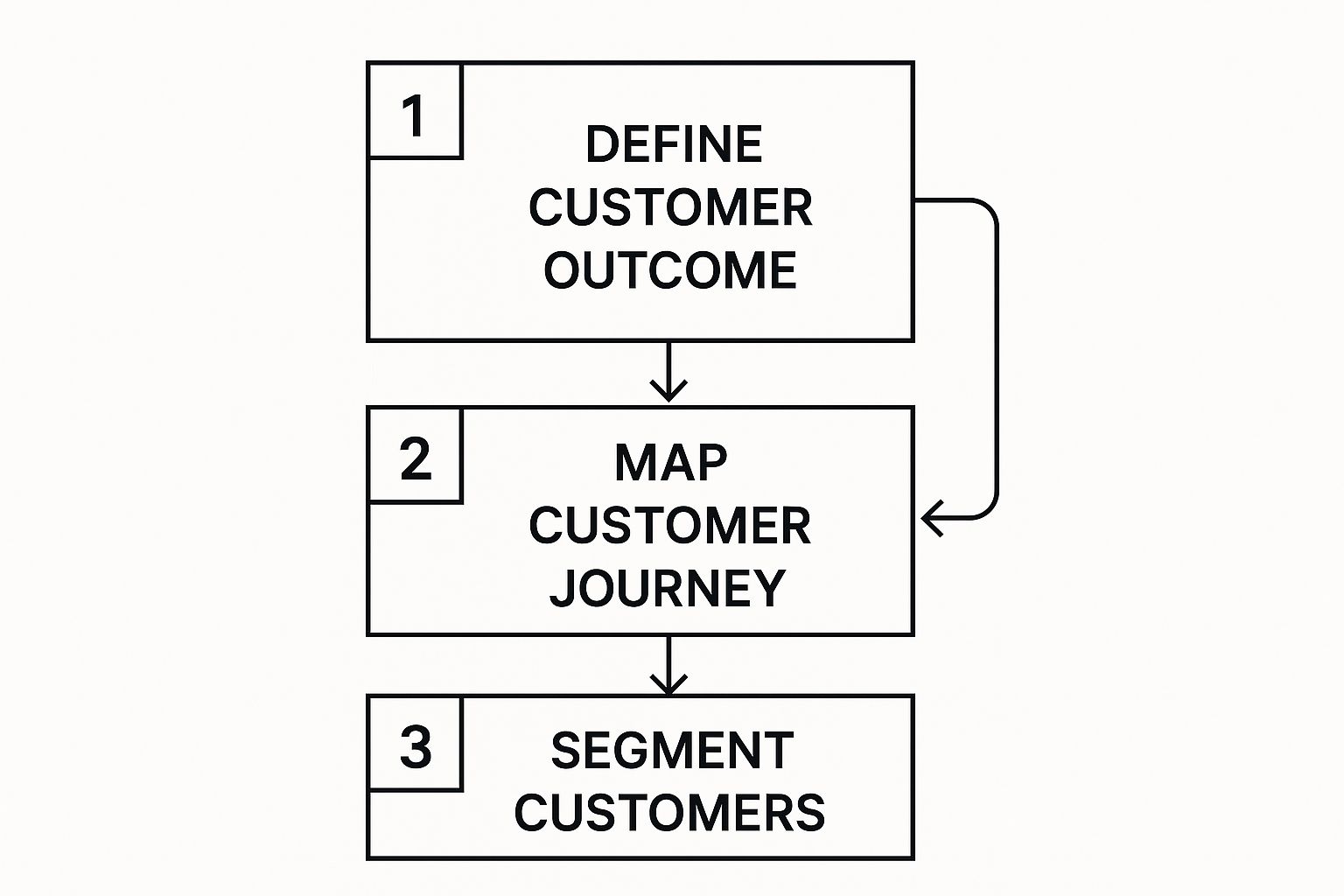
As you can see, defining outcomes and mapping the journey naturally lead to the next crucial step: treating different customers differently.
Step 3: Segment Customers for Scalability
Let's be real: not all customers are created equal. And your engagement model shouldn't be a one-size-fits-all affair. Segmentation is the secret to delivering the right level of service without burning out your team or your budget.
This is where you'll decide between a hands-on approach and a more automated one.
A high-touch model, with dedicated Customer Success Managers (CSMs) and white-glove support, makes perfect sense for your high-value, enterprise accounts. On the flip side, a tech-touch model uses automation, digital resources, and community forums to serve a larger volume of smaller accounts efficiently.
Comparing High-Touch vs. Tech-Touch Engagement Models
Deciding which model fits which customer segment is critical for scaling your efforts. This table breaks down the core differences to help guide your thinking.
| Characteristic | High-Touch Model | Tech-Touch (or Low-Touch) Model |
|---|---|---|
| Ideal For | Enterprise clients, complex products | SMBs, simple, plug-and-play products |
| Primary Contact | Dedicated Customer Success Manager | Automated emails, in-app guides, community forums |
| Cost to Serve | High | Low |
| Scalability | Low (relies on human headcount) | High (relies on systems and automation) |
| Example Actions | Weekly strategy calls, custom onboarding plans, onsite QBRs. | Automated onboarding sequences, monthly webinars, knowledge base articles. |
By matching the right engagement model to the right customer segment, you create a system that can actually grow with your business instead of holding it back.
Step 4: Implement Your Tech Stack
Your team can't execute this strategy with spreadsheets and sticky notes. You need the right tools. A smart tech stack is what gives your team the data and automation needed to be proactive, not reactive. Without it, you're guessing; with it, you're predicting.
The centerpiece is usually a Customer Success Platform (CSP) like Catalyst or ChurnZero. These platforms act as a central hub, pulling in data from your CRM, help desk, and product analytics tools.
Actionable Tip: Don't boil the ocean. Start by integrating just two data sources into your CSP: your CRM (like Salesforce) to see contract value and your product analytics tool to see login data. This simple combo alone will allow you to build a basic health score that separates active high-value customers from inactive ones.
Step 5: Establish Success Metrics
Finally, you can't improve what you don't measure. You need to establish a clear set of Key Performance Indicators (KPIs) to know if your strategy is actually working. These numbers are how you'll prove the value of customer success to the rest of the company.
While we'll dive deeper into these metrics later, some of the non-negotiables include:
- Net Revenue Retention (NRR)
- Churn Rate
- Customer Health Scores
These metrics aren't just for reporting; they're your feedback loop. They tell you what's working, what's not, and where to focus your energy next.
Metrics That Actually Measure Success

A customer success strategy without hard numbers is just a collection of good intentions. To prove your team’s value—and to make smart decisions about where to invest your time—you have to track the KPIs that tell the real story of your impact.
It's tempting to lean on vanity metrics like Net Promoter Score (NPS), and while they’re useful for a quick vibe check on customer sentiment, they don't connect your team's hard work directly to revenue. The best CS teams obsess over the numbers the C-suite actually cares about: revenue metrics.
There's a reason 93.7% of companies that measure their CS impact use revenue-focused targets. When you tie your efforts to financial outcomes, you stop being a "cost center" and start being seen for what you are: a powerful growth engine. You can see more on these benchmarks in the latest customer success statistics and trends.
Revenue Retention: The Ultimate Proof
If you track nothing else, track these two: Gross Revenue Retention (GRR) and Net Revenue Retention (NRR). They are the purest measures of your ability to hold onto the revenue you’ve already earned.
- Gross Revenue Retention (GRR): This is your defensive game. It shows how much revenue you kept from your existing customers, without counting any upsells or expansion. It's a raw look at how well you're preventing churn and downgrades. A GRR of 90% means you lost 10% of your revenue to churn.
- Net Revenue Retention (NRR): Now we’re on offense. This metric starts with GRR but then adds in all the expansion revenue from upsells and cross-sells. If your NRR is over 100%, it means you're growing your business from your current customer base alone, even before signing a single new logo.
NRR is the gold standard for a customer success strategy. It proves you're not just plugging leaks in the bucket; you're actively adding more water. It's the number that makes a CS team indispensable.
Another powerhouse metric is Customer Lifetime Value (CLV), which forecasts the total revenue you can expect from a single customer over their entire relationship with you. When your team focuses on activities that increase CLV, you're guaranteeing a long-term, profitable impact. For a deeper look, check out our guide on improving Customer Lifetime Value.
Leading vs. Lagging Indicators
A truly solid measurement framework uses both leading and lagging indicators to get the full picture. One tells you where you’re going; the other tells you where you've been. Relying only on lagging indicators is like trying to drive a car by looking only in the rearview mirror.
Here’s a simple way to think about the difference:
| Indicator Type | Description | Examples | Actionability |
|---|---|---|---|
| Leading | Predictive metrics that signal future outcomes. | Customer health scores, product adoption rates, support ticket trends. | Proactive: Allows you to intervene before a problem occurs. |
| Lagging | Historical metrics that report past outcomes. | Churn rate, NRR, GRR, CLV. | Reactive: Confirms what has already happened. |
Think of it like driving a car. Your leading indicators are the warning lights on your dashboard—low fuel, check engine. They give you a chance to pull over and fix something before you’re stranded on the side of the road.
Lagging indicators? That’s the repair bill you get a week later. It confirms a problem happened, but it's too late to prevent it.
A world-class customer success strategy is built on leading indicators. You have to anticipate needs and prevent churn before it ever shows up in a financial report.
How to Sidestep the Common Pitfalls
Let's be honest: rolling out a customer success strategy isn't always a straight line to victory. Even the sharpest teams hit a few predictable bumps in the road. Knowing what they are ahead of time is the difference between a strategy that lives in a slide deck and one that actually drives growth.
You’ll almost certainly run into three classic hurdles: getting executive buy-in, breaking down departmental silos, and scaling without losing the human touch.
Let’s break them down.
Getting the Executive Team on Board
This is usually the first and biggest wall you’ll hit. Leadership often sees "customer success" and thinks "cost center"—just another name for customer support. To get them to open up the budget, you have to stop talking about happiness and start talking their language: revenue.
Compare these two requests to a CEO:
- Weak Pitch: "We need to hire two CSMs to improve customer satisfaction."
- Strong Pitch: "Investing $150k in two new CSMs will allow us to implement proactive QBRs for our top 20 accounts. Based on a pilot program, we project this will increase our NRR from 95% to 105%, adding $500k in expansion revenue next year."
See the difference? One is a cost; the other is a clear ROI.
Actionable Tip: Build a dead-simple dashboard. On one side, show the upsell and cross-sell revenue your CS team sourced this quarter. On the other, compare the lifetime value (CLV) of customers who got your white-glove onboarding versus those who didn’t. Suddenly, you’re not asking for a "cost"—you're proposing a clear "investment."
Getting Other Departments to Play Nice
A clunky customer experience is almost always a sign that your internal teams aren't talking to each other. When Sales, Product, and Customer Success are living on separate islands, the customer is the one left stranded. The only fix is to get everyone chasing the same goals.
Think about it: Sales is paid to close deals fast. Sometimes that means setting expectations that your CS team has to spend the next three months cleaning up. You’ve got to build some bridges.
Here are two quick ways to start:
- Shared KPIs: Work with the head of sales to tie a small piece of their team's bonus to a metric like the "first-year renewal rate." Watch how fast they start closing good-fit customers who are actually set up to succeed.
- Structured Feedback Loops: Set up a formal, no-fluff monthly meeting where CSMs present the top three customer pain points or feature requests directly to the Product team. This ensures the voice of the customer gets a real seat at the table, shaping the roadmap.
Getting everyone aligned is a huge challenge, but it's where the game is won or lost. The industry is moving away from soft scores and toward revenue ownership for CS teams. You can get a deeper look at how this impacts revenue growth in the years to come.
Scaling Without Burning Out Your Team
As your company grows, you can't just keep throwing more CSMs at the problem. That math doesn't work—it’s not scalable and it kills your margins. The secret is using tech to automate the predictable, low-value stuff so your team can focus on the high-impact, strategic work.
The goal isn’t to replace your people. It's to make them superhuman.
I like to think of it as a tech-touch vs. human-touch model. Automation crushes repetitive tasks, while your team builds the relationships that renewal checks are made of.
| Task Type | Best Approach | Example |
|---|---|---|
| Routine & Repetitive | Automation | Firing off a welcome email, flagging an account with low product usage, or pointing a user to a knowledge base article. |
| Strategic & Complex | Human Engagement | Running a quarterly business review, negotiating a tricky renewal, or jumping on a call to handle a major escalation. |
When you let technology handle the grunt work, your team has the time and energy to deliver the proactive, thoughtful guidance that truly matters. That’s how a customer success strategy grows up and starts paying for itself.
Try our Lookalike Company Finder — find companies similar to your best customers in seconds. No signup required.
Frequently Asked Questions
Got questions? You're not alone. When you're building a customer success program from the ground up, a lot of practical "how-to" questions come up. Let's tackle some of the most common ones we hear.
What Is the Difference Between Customer Success and Customer Support
This is the big one, and the distinction is everything. It boils down to one simple idea: proactive versus reactive.
- Customer Support is reactive. They are the heroes who jump in when something breaks. A customer finds a bug, has a question about an invoice, or can't figure out a feature—the support team is there to solve that specific problem, close the ticket, and move on. Their key metric is often "time to resolution."
- Customer Success is proactive. Their job is to make sure the customer never has to file that ticket in the first place. They’re obsessed with the customer's goals and outcomes, building a long-term partnership to ensure the customer is getting every ounce of value out of the product. Their key metric is often "Net Revenue Retention."
In short, support puts out fires. Success prevents them from ever starting.
How Should We Structure a Customer Success Team
There’s no magic formula here. The right structure depends entirely on who your customers are and how complex your product is. But most models fall into two camps: high-touch and tech-touch.
A high-touch model is exactly what it sounds like—deeply personal. You see this with large, enterprise clients where a dedicated Customer Success Manager (CSM) manages a tiny handful of accounts. They become a strategic advisor, learning the client's business inside and out.
A tech-touch model, on the other hand, is built for scale. It’s how you serve thousands of smaller accounts efficiently using automation, webinars, and a solid knowledge base. Many companies land somewhere in the middle, using a hybrid approach that matches the touch-level to the customer tier.
What’s the single most important metric for a customer success strategy?
It's often Net Revenue Retention (NRR). While things like churn and customer health scores are critical, NRR is the ultimate proof. It shows you're not just stopping customers from leaving but are actively growing revenue from the ones who stay. It’s the clearest sign of a healthy, thriving business.
When Should a Startup Invest in Customer Success
Honestly? From day one. Even if your "team" is just you, the founder, personally emailing every new user. The core principles—making sure customers get early wins and achieve their goals—are baked into the DNA of any successful startup.
But the move to a formal customer success strategy and a dedicated hire usually happens at a clear inflection point. It’s that moment when you have a repeatable sales process and you physically can't manage every customer relationship on an ad-hoc basis anymore. If you wait too long, you end up reacting to a churn problem instead of preventing it from the start.
Ready to turn strategy into action with smart, AI-driven tools? marketbetter.ai helps you scale engagement, personalize every touchpoint, and prove the value of your customer success efforts. See how our AI-Powered Marketing Platform can transform your customer relationships by visiting https://www.marketbetter.ai.