5 posts tagged with "customer experience"

View All Tags

10 Actionable Omnichannel Marketing Examples to Inspire You in 2025

· 28 min read

Omnichannel is not just a marketing trend; it is the new standard for customer engagement. It represents the art and science of creating a single, unified experience for customers across every touchpoint, from their first social media interaction to an in-store purchase and post-sale support. The core challenge is moving from theory to reality. Success requires a fundamental shift: stop thinking in siloed channels and start building a cohesive ecosystem where digital and physical worlds merge seamlessly.

This article provides the blueprint. We will dissect 10 powerful omnichannel marketing examples from industry leaders like Nike, Sephora, and Starbucks. Instead of offering surface-level descriptions, we will break down the specific strategies, tactics, and technologies behind their success. You will gain actionable insights into how they orchestrate customer journeys that are both context-aware and deeply personal.

For each example, we will provide a comprehensive analysis covering:

  • The Strategic Goal: What specific business problem were they trying to solve?
  • Channel Integration: How did they connect digital and physical touchpoints?
  • Execution Details: A look at the specific tactics and tools used.
  • Performance Metrics: The tangible results and ROI of their approach.
  • Actionable Takeaways: Replicable methods you can adapt for your own business.

We will also explore how an AI-powered platform like marketbetter.ai can help you orchestrate these complex journeys, transforming your customer engagement from fragmented to fluid. This deep dive moves beyond the buzzword to give you a clear, strategic framework for building a truly connected and profitable customer experience.

1. Starbucks Mobile App & In-Store Integration

Starbucks stands as a premier example of omnichannel marketing, masterfully blending its digital and physical customer experiences. The core of its strategy is the seamless integration between its mobile app and its brick-and-mortar stores. This creates a cohesive journey where customers can browse, order, pay, and earn rewards across channels without friction. A user can start their order on the mobile app while commuting, pay digitally using a stored card or rewards points, and then walk into the store to pick up their beverage, often bypassing the main queue entirely. This convenience is a powerful differentiator.
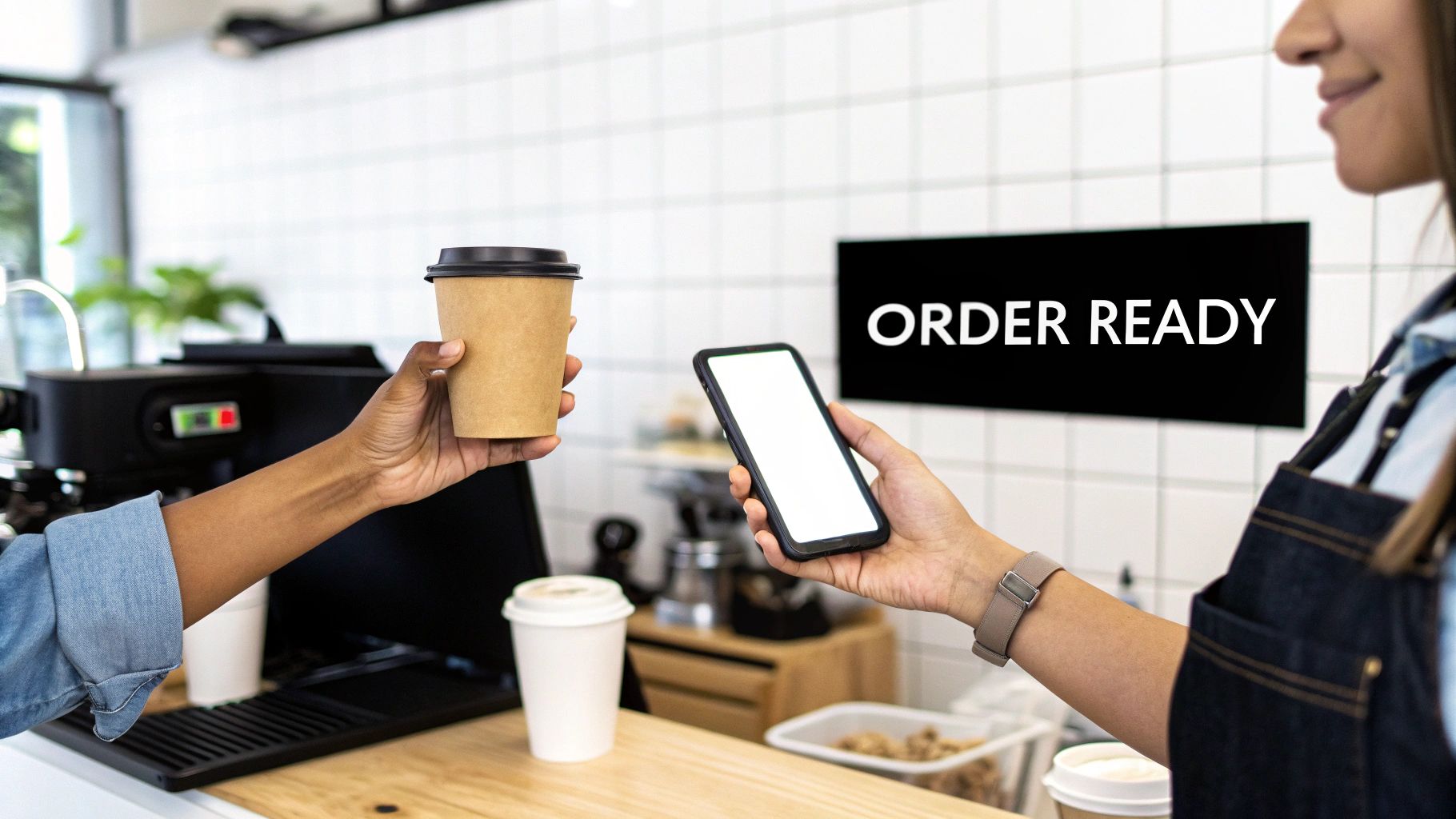
Hands exchanging a takeaway coffee and a smartphone at a cafe counter with an 'ORDER READY' sign.

Comparative Edge: Unlike many retailers whose apps are merely digital storefronts, Starbucks transforms its app into a central hub for the entire customer relationship. The app's Order & Pay feature now accounts for over 25% of all transactions, a testament to its successful adoption and deep integration into the daily habits of its customers.

Strategic Breakdown

The brilliance of this omnichannel marketing example lies in its data-driven personalization. Every transaction, whether in-app or in-store via the app, feeds into a unified customer profile. This allows Starbucks to deliver hyper-personalized offers, such as "double star" days on a customer's favorite drink or suggesting a new pastry based on their purchase history.

Key Insight: The Starbucks model proves that a successful omnichannel strategy isn't just about being present on multiple channels; it's about making those channels communicate in real-time to enhance the customer experience and drive business intelligence.

Actionable Takeaways for Your Business

  • Unify Customer Data: Invest in a CRM or CDP that can sync customer data from all touchpoints, including your app, website, and physical POS systems. This is the foundation for personalization.
  • Prioritize Convenience: Identify friction points in your customer journey. Can a mobile pre-order system reduce wait times? Can digital payments speed up checkout?
  • Incentivize Channel Integration: Use your loyalty program to encourage customers to connect their in-store and online activities, just as Starbucks Rewards links every purchase to a single account.

2. Nike's Digital-First Retail Strategy

Nike has redefined athletic retail by fusing its powerful digital ecosystem with its physical stores, creating an immersive, high-touch shopping journey. The strategy revolves around the Nike app, which acts as a remote control for the in-store experience, effectively erasing the line between online browsing and in-person shopping. Customers can use the app to check real-time inventory, reserve products for pickup, and even unlock exclusive rewards or content simply by walking into a store. This transforms a simple shopping trip into a personalized, interactive event.
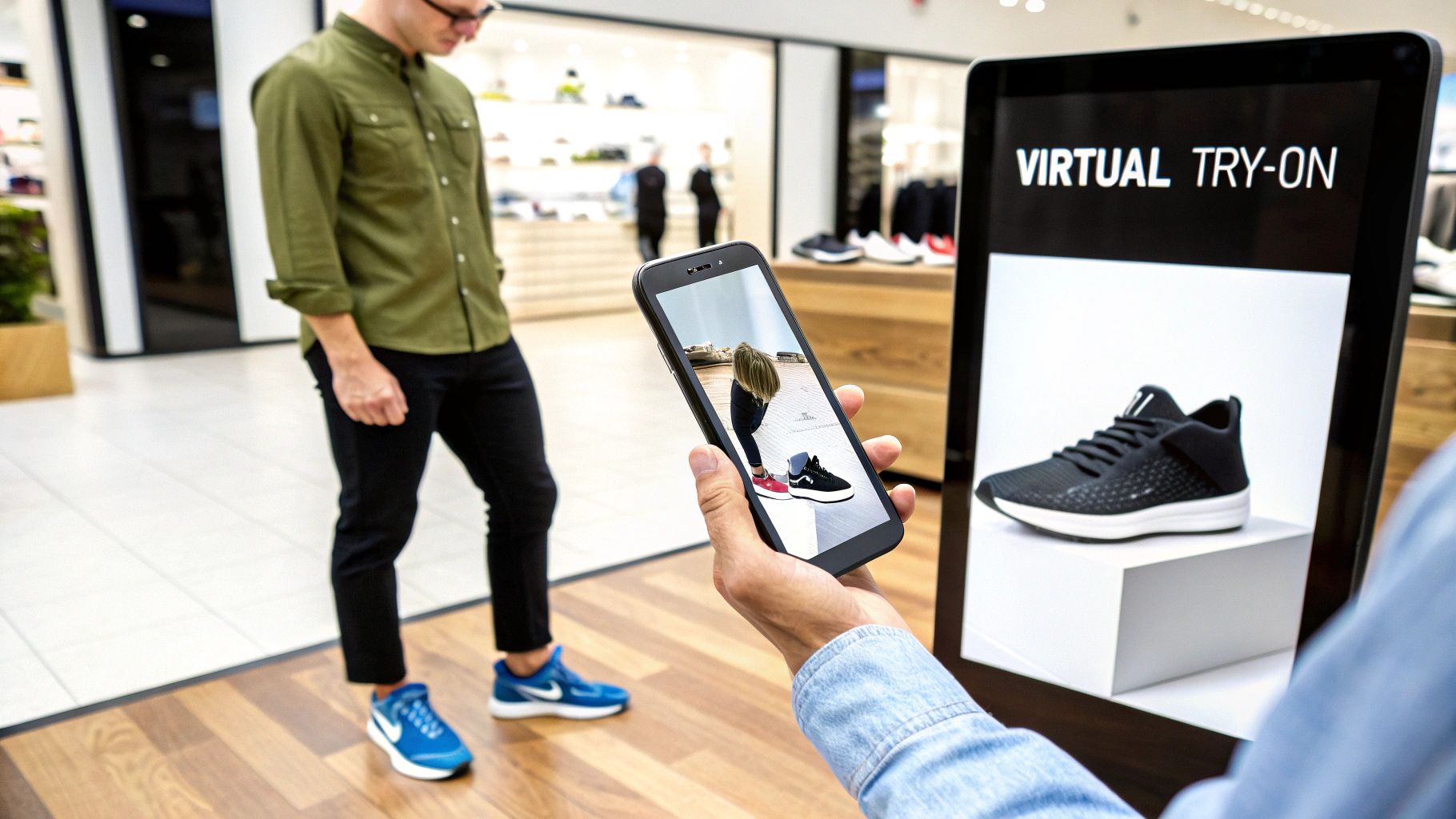
Customer uses a smartphone for augmented reality virtual shoe try-on in a modern retail store.

This digital integration empowers both the customer and the store associates. Shoppers can use features like AR-powered virtual shoe try-ons, while employees are equipped with mobile devices to provide on-the-spot service, check stock, and process sales anywhere on the floor. The success is evident in apps like SNKRS, which boasts over 100 million downloads, turning product drops into major cultural moments.

Strategic Breakdown

Comparative Edge: Nike’s approach is a masterclass in using technology to add value, not just to facilitate transactions. While many retailers focus on "buy online, pick up in-store," Nike goes further by making its app an indispensable in-store companion. This creates a data feedback loop where online behavior informs the physical experience, and vice versa, allowing for deeply personalized member benefits and product recommendations.

Key Insight: A truly effective omnichannel strategy uses technology to enhance the physical environment, creating unique, engaging experiences that cannot be replicated online-only. Nike proves that retail stores can be powerful hubs for brand engagement, not just sales.

Actionable Takeaways for Your Business

  • Empower In-Store Staff: Equip your retail teams with mobile tools that provide access to customer profiles, inventory data, and a mobile POS. This untethers them from the cash register and turns them into versatile consultants.
  • Bridge Digital and Physical with Value: Develop app features that are specifically designed for in-store use. Think product scanning for reviews, access to exclusive in-store content, or easy booking for appointments or events.
  • Pilot and Iterate: Start with high-traffic flagship locations to test new technologies like AR or mobile checkout. Gather customer feedback and refine the experience before a wider rollout.

3. Sephora's Beauty Insider Program & Cross-Channel Experience

Sephora sets the gold standard for omnichannel marketing in the beauty industry by building its entire customer experience around the wildly successful Beauty Insider loyalty program. The strategy masterfully erases the lines between its mobile app, website, and physical stores, creating a single, unified ecosystem. A customer can use the app's Virtual Artist feature to try on lipstick shades, add their favorite to a wish list, and later receive a notification about an in-store event where they can get a sample, all while their purchase history and preferences sync across every touchpoint.
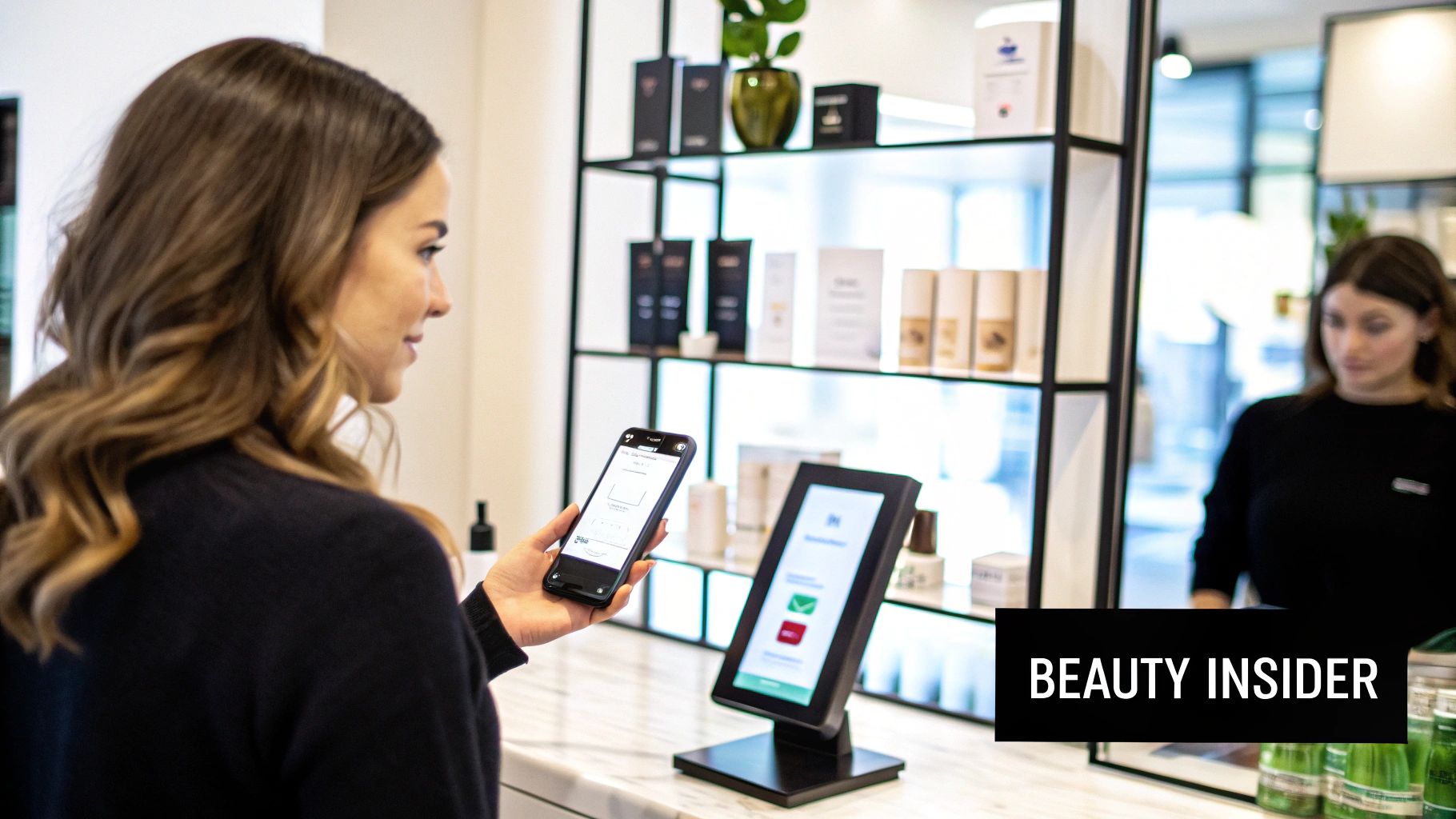
Customer uses a mobile app to interact with an in-store display, showcasing modern retail technology.

Comparative Edge: Unlike competitors whose loyalty programs are simple point-collection systems, Sephora's Beauty Insider program, with its 25 million-plus members, acts as a personalized beauty passport. The app allows customers to book in-store makeovers, scan products for reviews and information, and access exclusive tutorials, making it an indispensable tool both at home and in the aisle.

Strategic Breakdown

The power of Sephora's omnichannel marketing example is how it uses technology not as a gimmick, but as a genuine utility to enhance the shopping experience. The Beauty Insider program is the data backbone, capturing every interaction to fuel hyper-personalization. For instance, in-store associates can access a customer's online purchase history and wish lists to provide tailored recommendations, bridging the digital-physical gap effectively. This deep integration makes every channel smarter and more responsive to the individual shopper's needs.

Key Insight: Sephora proves that a loyalty program should be more than a transaction ledger; it should be the central thread that connects all channels, enriching the customer journey with data-driven value at every step.

Actionable Takeaways for Your Business

  • Elevate Your Loyalty Program: Transform your rewards program into a multi-channel hub. Integrate features that are useful both online and in-store, like appointment booking, product scanning, and exclusive content.
  • Arm Associates with Data: Equip your front-line staff with tools (like tablets) that provide access to a customer's unified profile. This allows them to offer a level of service that feels personal and informed.
  • Leverage Technology for Utility: Use AI and AR not just for novelty but to solve real customer problems, like Sephora’s Virtual Artist helps with shade matching. Explore more about how technology drives these kinds of marketing personalization strategies.

4. Target's Buy Online, Pick Up In Store (BOPIS)

Target has become a dominant force in retail by perfecting the "Buy Online, Pick Up In Store" (BOPIS) model, effectively transforming its physical stores into hyper-local fulfillment centers. The strategy flawlessly merges the convenience of e-commerce browsing with the immediacy of in-person shopping. Customers can purchase from a massive online inventory and, often within a couple of hours, pick up their order via in-store pickup or its popular Drive Up service without ever leaving their car. This approach directly addresses the consumer demand for speed and flexibility.

Comparative Edge: While many retailers offer BOPIS, Target has made it a core, highly efficient component of its business model, not just a tacked-on feature. In fact, over 95% of Target's digital and physical sales are fulfilled by its stores. This deep integration of inventory, digital interfaces, and in-store operations sets a high standard for operational excellence that few can match.

Strategic Breakdown

The genius of Target's BOPIS strategy lies in its operational excellence and how it leverages existing assets: its physical stores. Instead of building expensive, dedicated e-commerce warehouses, Target activated its entire network of nearly 2,000 stores as last-mile distribution hubs. This decentralized model reduces shipping costs and times significantly. The system relies on real-time inventory tracking, efficient in-store picking processes for employees, and a seamless customer notification system via the app and email.

Key Insight: Target proves that a successful omnichannel strategy can transform a potential liability (large physical store footprints) into a powerful competitive advantage by using them to solve the last-mile delivery challenge more efficiently than pure-play e-commerce rivals.

Actionable Takeaways for Your Business

  • Integrate Inventory Systems: Your first step must be to ensure your website's inventory syncs perfectly with your physical store's stock levels. Inaccurate data is the fastest way to create a frustrating BOPIS experience.
  • Optimize In-Store Fulfillment: Designate specific areas and train staff for efficient order picking and packing. This minimizes disruption to in-store shoppers and speeds up order readiness. To streamline these notifications and inventory updates, businesses can implement powerful e-commerce marketing automation.
  • Communicate Proactively: Use automated alerts to inform customers the moment their order is received, being processed, and ready for pickup. Clear communication manages expectations and enhances satisfaction.

5. Amazon's Seamless Online-to-Offline Integration

Amazon has evolved from an e-commerce giant into the quintessential example of a complete omnichannel ecosystem. The company masterfully connects its online marketplace with physical retail locations like Amazon Go and Whole Foods, creating a unified customer journey. A customer can add an item to their cart online, see related product recommendations based on a past Whole Foods purchase, and choose from multiple fulfillment options like Prime delivery or in-store pickup, all within a single, consistent account. This strategy turns every touchpoint into a cohesive part of the larger Amazon experience.

Comparative Edge: Unlike competitors who might treat their online and physical stores as separate business units, Amazon uses them to reinforce each other. Prime members, for example, receive exclusive discounts at Whole Foods, which not only drives foot traffic but also deepens loyalty to the Prime subscription service. This flywheel effect, where each channel strengthens the others, is a hallmark of their sophisticated omnichannel marketing that is difficult for siloed companies to replicate.

Strategic Breakdown

The genius of Amazon's approach is its relentless focus on building a proprietary, data-rich ecosystem. By owning the technology stack from the "Just Walk Out" tech in Amazon Go stores to the complex logistics of Prime Now, Amazon captures unparalleled data at every interaction. This data then fuels its powerful recommendation engine, personalizing the experience whether a customer is browsing online, shopping at Whole Foods, or using an Alexa device.

Key Insight: Amazon proves that a true omnichannel strategy is about building an inescapable ecosystem. By connecting disparate services through a unified account and a compelling membership program (Prime), they make it more convenient for customers to stay within their network than to leave.

Actionable Takeaways for Your Business

  • Create Ecosystem Effects: Connect your different products or services. If you have a subscription service, offer exclusive benefits at your physical locations or on your e-commerce site to incentivize cross-channel engagement.
  • Invest in a Unified Customer ID: Ensure that a customer is recognized as the same person whether they are on your app, website, or in your store. This is the technical foundation for any true omnichannel personalization.
  • Leverage Physical Data Online: Use insights from in-store purchases to inform online marketing. If a customer frequently buys a certain brand in-store, feature it prominently for them on your website and in email campaigns.

6. Adidas's Digital-First Brand Experience

Adidas has masterfully pivoted from a traditional product company to a digital-first brand, creating an integrated ecosystem that blurs the lines between online and offline commerce. Their strategy focuses on building a direct-to-consumer relationship through a network of interconnected digital platforms, including their mobile apps, e-commerce site, social channels, and technologically enhanced physical stores. This creates a cohesive brand world where a customer can discover a new shoe in an Instagram story, enter a raffle for it on the CONFIRMED app, and then try on a related apparel item in-store using a digitally connected fitting room.

Comparative Edge: Unlike competitors who may treat their app as just another sales channel, Adidas uses apps like CONFIRMED to cultivate a community around its most sought-after products. By offering exclusive content, raffles for limited-edition sneakers, and behind-the-scenes stories, Adidas transforms a simple transaction into a high-engagement brand experience, driving both loyalty and incredible demand.

Strategic Breakdown

The core of this powerful omnichannel marketing example is its use of exclusivity and community to drive channel adoption. Instead of just asking customers to download an app, Adidas gives them compelling, can't-get-anywhere-else reasons to do so. This data is then used to personalize the experience across all touchpoints, from targeted push notifications about an upcoming drop to in-store recommendations based on app activity. It’s a symbiotic loop where digital engagement enhances the physical experience and vice-versa.

Key Insight: Adidas proves that an omnichannel strategy thrives when it creates unique value propositions for each channel that work together. Exclusivity on one channel (the app) can drive traffic and excitement across the entire ecosystem.

Actionable Takeaways for Your Business

  • Create Channel-Exclusive Value: Don't just replicate your website on your app. Offer app-only products, early access, or exclusive content to incentivize downloads and create a "fear of missing out" (FOMO).
  • Bridge Digital and Physical Worlds: Use in-store technology like QR codes or NFC tags to connect physical products to rich digital content, reviews, or related items in your app.
  • Leverage Social for Commerce and Community: Move beyond simple promotions on social media. Host live shopping events, run interactive polls, and use influencer partnerships to create authentic conversations that naturally lead to commerce.

7. Walmart's Omnichannel Logistics and Fulfillment Network

Walmart transformed its massive physical footprint into a powerful, decentralized fulfillment network, creating one of the most effective omnichannel marketing examples in retail. Instead of treating its e-commerce and brick-and-mortar operations as separate entities, Walmart leverages its 4,700+ stores as mini-distribution centers. This integration allows for a seamless flow of inventory and services, supporting options like Buy Online, Pick Up In-Store (BOPIS), curbside pickup, and ship-from-store. A customer can order groceries online for same-day delivery fulfilled by their local store, or purchase a non-grocery item online and pick it up within hours.

Comparative Edge: This strategy directly competes with Amazon's centralized warehouse model by using existing infrastructure to offer unparalleled speed and convenience for local customers. The Walmart+ subscription service, with over 20 million members, bundles these fulfillment benefits with other perks, creating a sticky ecosystem that blends digital convenience with physical accessibility.

Strategic Breakdown

The genius of Walmart’s approach is turning a potential liability, its vast network of expensive physical stores, into its greatest omnichannel asset. By empowering local store associates with mobile devices and real-time inventory data, each location becomes a node in a dynamic logistics web. This allows Walmart to fulfill online orders faster and more cost-effectively than shipping from a distant warehouse, meeting modern consumer expectations for speed.

Key Insight: A successful omnichannel strategy can be built by re-imagining the role of existing physical assets. Walmart proved that stores aren't just for in-person shopping; they can be the backbone of a sophisticated, hyper-local e-commerce fulfillment operation.

Actionable Takeaways for Your Business

  • Leverage Physical Locations: If you have physical stores, view them as fulfillment centers. Implement ship-from-store and BOPIS options to reduce shipping times and costs while driving foot traffic.
  • Empower Frontline Staff: Equip your store associates with the technology (like handheld scanners and mobile apps) and training needed to accurately and efficiently pick, pack, and manage online orders.
  • Integrate Inventory Systems: Your website's inventory must sync in real-time with each store's stock. A customer should never be able to order an item for pickup that is out of stock at their chosen location.

8. Ulta Beauty's Integrated Services and Digital Ecosystem

Ulta Beauty has redefined the retail experience by seamlessly merging its physical services with a powerful digital ecosystem. The core of its strategy is the symbiotic relationship between its in-store beauty services like salons and skin bars, and its e-commerce platform and mobile app. This creates a holistic journey where a customer can discover a service online, book an appointment through the app, receive personalized product recommendations during their visit, and then easily repurchase those products later online. This fusion of service and retail is a prime omnichannel marketing example that builds deep, lasting customer loyalty.

Comparative Edge: Unlike competitors who might treat services as a separate business unit, Ulta integrates them directly into the retail journey. The mobile app features GLAMlab, an AI-powered virtual try-on tool, and a skin analysis feature that provides tailored suggestions, bridging the gap between digital exploration and physical purchase in a way that product-only retailers cannot.

Strategic Breakdown

The genius of Ulta's omnichannel strategy lies in its use of services as a powerful data collection and sales conversion tool. An in-store haircut or facial is not just a transaction; it is an opportunity for a trained professional to understand a customer's needs and recommend specific products. This information feeds into the customer's unified profile, allowing the app and website to provide hyper-relevant product suggestions and content long after the appointment ends. The Ultamate Rewards program further connects every touchpoint, rewarding customers for both product purchases and service appointments.

Key Insight: Ulta's model demonstrates that integrating high-touch physical services with a data-rich digital platform creates a powerful "stickiness." Services drive store traffic and create personalized consultations, while the digital ecosystem captures those insights to drive ongoing e-commerce sales.

Actionable Takeaways for Your Business

  • Link Services to Sales: If you offer services, ensure they are not siloed from your retail operations. Equip service professionals with tools to access customer purchase history and make data-informed product recommendations.
  • Digitize Service Booking: Implement a seamless online and in-app booking system for any appointments or consultations you offer. Use appointment confirmations and reminders as opportunities for upselling or cross-selling relevant products.
  • Create a Unified Loyalty Program: Design a rewards program that recognizes and incentivizes all forms of customer engagement, including both service appointments and product purchases, across all channels.

9. Uniqlo's Data-Driven Omnichannel Personalization

Japanese apparel brand Uniqlo provides a powerful omnichannel marketing example by placing data at the core of its customer experience. The company excels at unifying customer behavior across its mobile app, website, and physical stores to create a deeply personalized and efficient shopping journey. This data-driven approach allows Uniqlo to connect online browsing habits with in-store purchases, fueling everything from product recommendations to localized inventory management. A customer might scan a product barcode in-store to check online stock, which then informs the personalized offers they see in the app later that day.

Comparative Edge: Unlike competitors that often treat their digital and physical channels as separate entities, Uniqlo sees them as two sides of the same coin. With its app boasting over 50 million downloads, the brand has created a massive, connected ecosystem. In-store digital terminals allow shoppers to access the full online inventory, order out-of-stock items for home delivery, and view exclusive content, effectively erasing the line between brick-and-mortar and e-commerce.

Strategic Breakdown

Uniqlo’s strategic brilliance lies in its ability to translate a unified customer view into tangible operational advantages and a better shopping experience. By analyzing data from all touchpoints, Uniqlo can accurately predict demand for specific styles in particular locations, optimizing inventory to reduce stockouts and markdowns. This means a store in a colder climate is more likely to be stocked with HEATTECH items, based not on guesswork, but on the aggregated purchase and browsing data of local customers.

Key Insight: A truly effective omnichannel strategy uses unified customer data not just for marketing personalization, but to drive core business operations like inventory, logistics, and product development, creating a virtuous cycle of customer satisfaction and efficiency.

Actionable Takeaways for Your Business

  • Build a Data Foundation: Your first step is to centralize customer information. Investing in a robust system is crucial for collecting and syncing data from your app, website, and physical stores. Learn more about customer data platform integration to get started.
  • Empower In-Store Teams: Equip your physical stores with technology that connects to your digital ecosystem. In-store terminals or tablets that allow customers and staff to access online inventory can prevent lost sales and improve service.
  • Personalize at Scale: Use customer data to tailor marketing beyond just using a first name. Segment your audience based on cross-channel purchase history to send relevant product recommendations and offers that reflect their genuine preferences.

10. ASOS's Social Commerce and Digital Community Integration

ASOS has pioneered a digital-first approach to omnichannel marketing, focusing on the seamless integration of social media, e-commerce, and community engagement. The brand treats its social channels not just as marketing outlets but as core components of the shopping experience itself. This strategy allows customers to discover, engage, and purchase products directly within the platforms where they spend most of their time, creating a frictionless path from inspiration to checkout. A user might see a style on an Instagram Reel, click the tagged product, and complete the purchase without ever leaving the app.

and collaborating with a diverse range of influencers. This creates a powerful sense of authenticity and social proof that resonates deeply with its Gen Z audience. Unlike traditional retailers that rely on polished, top-down campaigns, ASOS builds its brand from the ground up, letting its community dictate trends and styles.

Strategic Breakdown

The genius of ASOS's strategy is its ability to use social channels as a two-way street for data and engagement. By monitoring trends and conversations on platforms like TikTok and Instagram, the company gains real-time insights into what consumers want, allowing it to rapidly adapt its product offerings and marketing messages. This feedback loop ensures that ASOS remains culturally relevant and that its inventory aligns with fast-moving fashion cycles. Their integration of virtual try-on tools further bridges the digital-physical gap, reducing purchase anxiety and improving conversion rates.

Key Insight: The ASOS model demonstrates that in a digital-first world, the most effective omnichannel strategy is one that builds a community, not just a customer base. Integrating commerce directly into social platforms transforms passive browsing into active purchasing.

Actionable Takeaways for Your Business

  • Embed Commerce in Content: Utilize features like Instagram Shopping, TikTok Shop, and Pinterest Product Pins to make your social content instantly shoppable. Reduce the number of clicks needed to get from discovery to purchase.
  • Champion User-Generated Content: Actively encourage and feature customer photos and videos. Create branded hashtags and run contests to build a library of authentic content that serves as powerful social proof.
  • Leverage Social Listening: Use social media monitoring tools to understand emerging trends, customer sentiment, and competitor activity. Let these insights inform your product development and marketing campaigns.

10-Brand Omnichannel Marketing Comparison

ExampleImplementation Complexity 🔄Resource Requirements 💡Speed / Efficiency ⚡Expected Outcomes ⭐📊Ideal Use Cases
Starbucks Mobile App & In-Store IntegrationHigh — POS + real-time backend integration; staff workflowsSignificant: backend systems, POS integration, training, data/privacy controlsHigh — order-ahead and digital payments reduce wait timesIncreased repeat purchases; digital ≈25%+ of sales; 13% comp growth (2019)QSR/coffee chains and high-frequency retail with loyalty focus
Nike's Digital-First Retail StrategyHigh — AR, inventory sync, mobile POS across storesHigh: AR tech, app development, in-store devices, trained staffMedium–High — AR reduces returns; mobile POS speeds checkoutStrong DTC growth ($9B digital revenue 2023); higher conversion and personalizationApparel/footwear brands targeting tech-savvy customers and flagship pilots
Sephora Beauty Insider & Cross-ChannelHigh — loyalty, AR try-on, service booking integrationHigh: loyalty platform, AR, in-store service systems, data integrationMedium — virtual try-on speeds decisions; bookings require schedulingLarge loyalty base (25M+); members drive 80%+ in-store transactions; higher CLVBeauty and premium retailers combining services and product sales
Target BOPIS (Buy Online, Pick Up In Store)Medium — inventory & fulfillment workflow changes; pickup opsModerate: inventory integration, fulfillment staffing, app notificationsHigh — same‑day pickup and curbside reduce delivery time/costHigher online-to-store conversion; increased add-on sales; BOPIS high conversion ratesBig-box and mass retailers with wide assortments and physical footprints
Amazon Online-to-Offline EcosystemVery High — unified accounts, logistics, cashierless storesMassive: proprietary tech, logistics network, retail real estate, data systemsVery High — Prime, cashierless, same-day options minimize frictionEcosystem drives loyalty; $575B revenue (2023); Prime members spend ~2.5xLarge marketplaces seeking end-to-end control and scale across channels
Adidas Digital-First Brand ExperienceHigh — live commerce, exclusive drops, social integrationsHigh: app features, social/live production, supply chain readinessMedium — live drops create urgency; fulfillment must scale quicklyNotable e‑commerce growth (32% in 2022); strong engagement from youthLifestyle and limited-release brands focused on community and drops
Walmart Omnichannel Logistics & FulfillmentHigh — store-as-fulfillment, ship-from-store orchestrationSignificant: associate tools, store layout changes, inventory systemsHigh — same‑day delivery and BOPIS scale via store networkImproved delivery costs/times; same‑day services growth; e‑commerce ↑7% (2023)Large-format retailers leveraging dense store networks for local fulfillment
Ulta Beauty Integrated Services & Digital EcosystemMedium–High — booking systems + inventory and service integrationModerate–High: trained professionals, booking platform, AI recommendationsMedium — bookings drive scheduled traffic; app eases conversionComparable sales ↑13%; services >15% of store sales; higher basket valueBeauty retailers blending in-store services with product retail
Uniqlo Data-Driven Omnichannel PersonalizationHigh — unified customer data platform, dynamic allocationHigh: CDP, analytics, inventory optimization systemsMedium — optimized inventory reduces markdowns; in-store terminals speed discoveryRevenue ↑11% (2023); digital ≈40%+ of sales; better assortment fit by locationApparel retailers optimizing assortments and local merchandising via data
ASOS Social Commerce & Digital CommunityMedium — social shoppable integrations, UGC and virtual try-onModerate: social commerce tooling, content creation, influencer programsHigh — social commerce enables impulse buys and fast acquisitionHigh social engagement (35%+ Instagram); social channels drive new-customer acquisitionDigital-first fashion brands targeting Gen Z and social-native shoppers

Your Next Move: Building Your Own Omnichannel Engine

Throughout this deep dive into premier omnichannel marketing examples, a powerful, unifying thread has emerged. The strategies employed by giants like Nike, Starbucks, and Sephora are not random acts of multichannel presence; they are meticulously engineered ecosystems designed around a single, immovable center: the customer. They prove that true omnichannel excellence isn't about being everywhere, but about being cohesive, convenient, and contextually relevant wherever your customer chooses to engage.

From Sephora's Beauty Insider program that turns every interaction into a loyalty-building moment to Target's mastery of BOPIS logistics that erases the line between digital cart and physical store, the lesson is clear. The goal is to make the transition between your app, website, social media, and physical locations so fluid that the customer doesn't even notice the channel switch. They only experience one unified, helpful, and personalized brand journey.

Deconstructing Success: Core Principles to Apply Now

While the scale of Amazon's fulfillment network or Nike's global digital footprint might seem out of reach, the core principles are universally applicable. Distilling these diverse omnichannel marketing examples down to their essence reveals a replicable blueprint for success:

  1. Data as the Foundation: Every standout example, from Uniqlo's AI-powered recommendations to Starbucks' personalized offers, is built on a foundation of unified customer data. They don't just collect data; they centralize it to create a single, dynamic customer profile that informs every marketing action.
  2. Friction is the Enemy: The most successful strategies are born from an obsession with removing customer friction. Adidas makes it easy to check in-store stock from its app, and Walmart’s multiple fulfillment options cater to the customer's immediate need for convenience. Your first step should be to map your own customer journey and ruthlessly identify and eliminate these pain points.
  3. Value Exchange is Paramount: Customers willingly share data and engage across channels when they receive tangible value in return. This could be the convenience of a pre-ordered coffee (Starbucks), the exclusive access and rewards of a loyalty program (Ulta Beauty), or the hyper-personalized shopping experience that makes them feel understood (ASOS).

Your Actionable Roadmap to an Omnichannel Future

Moving from inspiration to implementation is the most critical step. Don't try to replicate these complex systems overnight. Instead, adopt a phased, strategic approach focused on high-impact integrations.

  • Start Small, Integrate Smart: Begin by connecting your two most critical channels. This might be integrating your e-commerce inventory with your physical store's point-of-sale system or linking your CRM data to your email marketing platform to personalize campaigns based on purchase history.
  • Prioritize a Single Customer View: Your immediate priority should be breaking down data silos. A platform that can unify data from your website, mobile app, and in-store transactions is no longer a luxury; it's a foundational requirement for modern marketing. This unified view is what powers the personalization and consistency seen in our top examples.
  • Leverage Technology as a Force Multiplier: This is where a platform like marketbetter.ai becomes your strategic partner. Instead of manually trying to connect disparate systems, our AI-powered engine is designed to unify customer data, automate the creation of personalized content across your key channels, and continuously optimize campaigns for maximum impact. It allows you to execute a sophisticated omnichannel strategy without requiring an enterprise-level budget or a massive data science team.

The landscape is constantly evolving, driven by new technologies and shifting consumer expectations. To truly future-proof your omnichannel engine and find inspiration for tomorrow's market, explore these 7 key omnichannel retail trends for 2025 to stay ahead of the curve.

Ultimately, the journey to omnichannel mastery is an investment in customer-centricity. It's a commitment to understanding and serving your audience on their terms, creating experiences that are not only seamless but also memorable and loyalty-inspiring. The examples we’ve explored prove that when done right, an omnichannel strategy is the most powerful engine for sustainable growth and lasting brand affinity.


Ready to stop just admiring great omnichannel marketing and start building your own? marketbetter.ai provides the unified data platform and AI-powered tools you need to connect your channels, personalize every interaction, and drive measurable results. See how our platform can turn the strategies from these examples into your reality at marketbetter.ai.

how to reduce customer churn: Proven strategies for loyalty

· 22 min read

You know that sinking feeling when your recurring revenue number dips? That’s customer churn, and it’s a quiet killer for growth. The only way to really reduce customer churn is to stop guessing and start digging: find out why customers are leaving, turn your entire customer experience into a retention machine, and use data to proactively keep them happy.

Why Your Business Is Leaking Revenue Through Churn

Customer churn is way more than just a lost sale. Think of it as a leak in your revenue bucket. Every time a customer leaves, you’re not just losing their subscription fee; you're losing future revenue, undermining growth, and even hurting team morale. It's a clear signal that there's a disconnect between the value you promised and the experience you're actually delivering.

While everyone loves the thrill of chasing new logos, the real path to sustainable, profitable growth is keeping the customers you already have.

The financial hit is staggering. Globally, businesses lose an estimated $4.7 trillion every single year because of bad customer experiences. That number should tell you one thing: there’s a massive opportunity for companies that get retention right. You can dig into the full findings on customer experience statistics to see the whole picture.

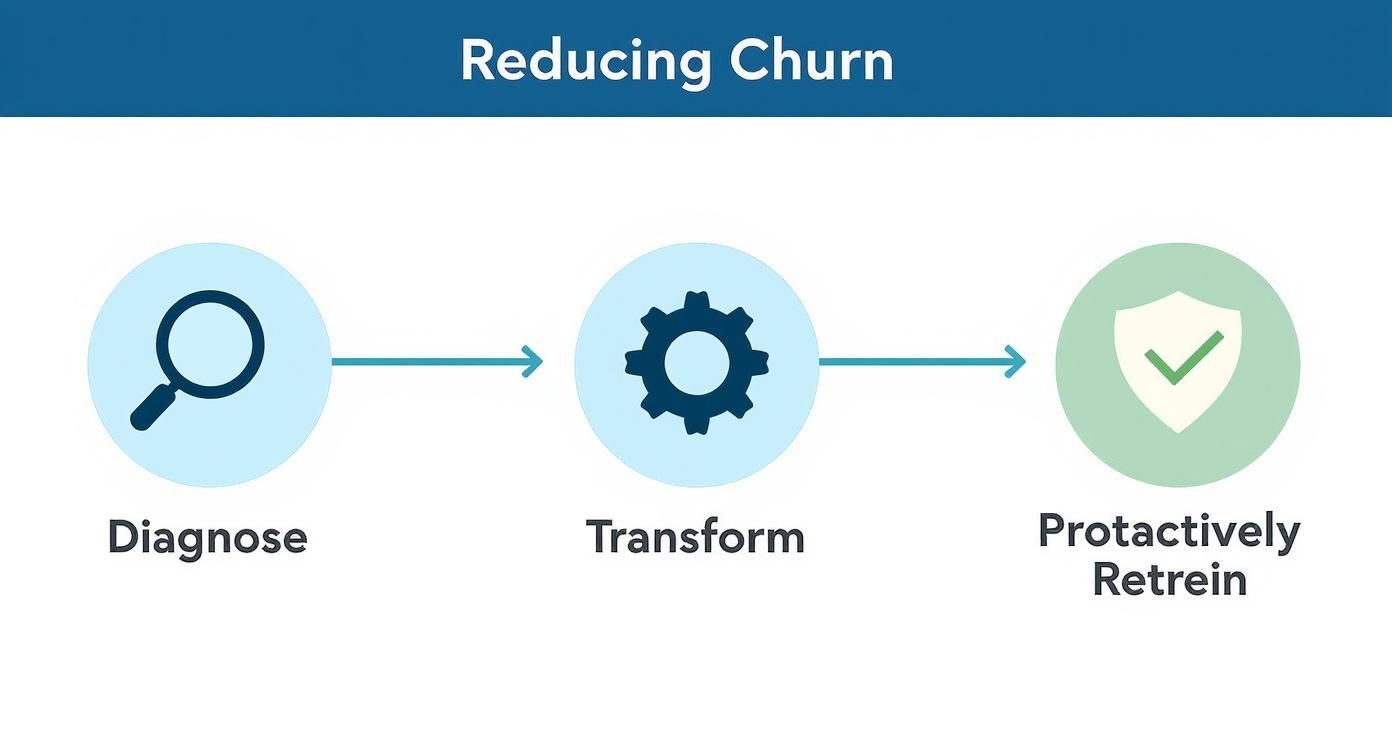
This flow chart breaks down the three core pillars of a solid churn reduction strategy: diagnosing the real problems, transforming the customer journey, and proactively keeping customers engaged.

Infographic about how to reduce customer churn

The key takeaway here is that fighting churn isn’t about panic-driven, one-off fixes. It’s a structured process. You have to understand the "why" before you can start implementing the "how."

For a quick reference, these pillars form the foundation of any effective retention strategy.

Key Churn Reduction Pillars At a Glance

PillarCore FocusActionable First Step
Diagnose Root CausesUnderstanding why customers are leaving.Implement a simple multiple-choice exit survey the next time a customer cancels.
Transform ExperienceBuilding loyalty into every customer interaction.Review your last 20 support tickets for recurring themes and fix the most common issue.
Retain ProactivelyUsing data to predict and prevent churn.Identify one key user action that signals engagement (e.g., creating a report) and track it.

This framework isn't just theory; it's a practical roadmap for turning churn into a manageable—and shrinking—metric.

The True Cost of Losing a Customer

So many businesses track churn as a simple percentage, but that number barely scratches the surface. The real cost is hiding in plain sight.

It’s an old saying because it’s true: acquiring a new customer can cost five times more than keeping an existing one. That means for every customer you lose, you have to work five times harder on sales and marketing just to break even. It’s a hamster wheel you can’t afford to be on.

And the damage doesn't stop at your bank account. Churn also poisons:

  • Team Morale: Nothing burns out a customer success team faster than constantly fighting fires and feeling like they’re in a losing battle.
  • Brand Reputation: Unhappy customers don't just leave quietly. They post reviews and tell their friends, scaring away potential new leads before they even talk to you.
  • Growth Momentum: High churn is like trying to drive with the emergency brake on. Even if your acquisition engine is firing on all cylinders, churn will always slow you down.

Let’s be blunt: You can’t out-sell a high churn rate forever. Eventually, the leak gets too big, the bucket runs dry, and growth grinds to a halt. Making churn reduction a priority isn't optional—it's essential for long-term survival.

Find the Real Reasons Your Customers Are Leaving

You can't fix a leaky bucket if you don't know where the holes are. Before you can slash your churn rate, you have to become a detective and figure out why customers are actually leaving—not just why you think they are. Guesswork leads to wasted effort. Data points you to real solutions.

The goal here is to get past the surface-level excuses. A customer might check the "price" box on their way out, but the real issue was probably that they never understood the product's value in the first place. When value is unclear, any price feels too high. This is where digging a little deeper pays off big.

Craft Exit Surveys That Get Real Answers

When a customer hits "cancel," it’s your last, best shot at getting unvarnished truth. But let's be honest, a generic "Why are you leaving?" survey usually gets ignored or a one-word, useless response. The trick is to make it specific and dead simple to answer. Ditch the open-ended text box. Instead, use a multiple-choice format with a few well-thought-out options and an optional comment field.

Here's a comparison between the old way and the actionable way:

The Vague Way (Low Completion)The Actionable Way (High Completion)
Question: "Please tell us why you're canceling."Question: "What's the main reason you're leaving?"
Format: Large, open text box.Format: Multiple choice options like: "Missing a key feature," "Found a better tool," "Price is too high for the value," "Temporary project ended."
Result: Vague, hard-to-quantify answers like "it didn't work" or no response at all.Result: Clean, structured data you can put into a chart to spot trends immediately.

This small tweak turns a chore into a simple click, boosting your response rate and giving you quantifiable data to work with.

Mine Your Support Tickets for Hidden Clues

Your support desk is a goldmine of churn signals hiding in plain sight. Stop seeing support tickets as just problems to solve; they are patterns waiting to be found. Are people constantly asking how to use the same feature? That isn't a user problem—it's an onboarding or design problem.

A Forrester study found that a staggering 70% of customers churn simply because they feel the company doesn't care about them. Analyzing support tickets is proof that you're listening. It lets you proactively fix the little frustrations that make people feel ignored.

Actionable Step: For the next two weeks, have your support team tag every incoming ticket with a category (e.g., 'Billing Issue', 'Feature X Confusion', 'Bug Report'). At the end, tally up the tags. The biggest pile is your top priority for a fix, whether it's a better help doc or a UX tweak. This is more than just counting tickets; it’s about tagging and categorizing them to spot recurring themes. For a masterclass on turning this raw feedback into strategy, digging into some voice of customer examples is a great next step.

Segment Your Churn Data to Find Hotspots

Not all churn is created equal. One of the most powerful things you can do is slice up your churn data by segment. Break down your churned users into groups and see if any one group is leaving at a higher rate than the others.

You might find, for instance, that customers who came in from a specific Google Ads campaign churn at twice the rate of your organic traffic.

That doesn't mean the ad is garbage. It probably means there’s a massive disconnect between the promise in your ad copy and the reality of your product experience. Maybe the ad over-promised a benefit that users couldn't find right away, leading to a wave of disappointed customers who bailed quickly.

By comparing acquisition channels, user personas, or pricing tiers, you can stop guessing and start taking precise, targeted action to fix the real leaks in your business.

Turn Customer Experience Into Your Best Retention Tool

Once you’ve figured out why customers are leaving, it's time to build a customer experience (CX) so good they wouldn't dream of going anywhere else. A great product might get them in the door, but it’s an exceptional experience that convinces them to stay.

This is where you stop thinking of support as a cost center and start seeing it for what it is: your single most powerful retention tool.

A huge part of that comes down to response time. This isn't just about speed for speed's sake; it's about showing up for customers when they're frustrated and need you most. When you dig into the numbers, it's pretty staggering: a whopping 68% of customer cancellations are tied directly to poor response times.

Flip that around, and the opportunity is clear. Businesses with an average first response time under a single minute see a 42% lower churn rate than their slower competitors. It’s a massive lever to pull.

A customer support agent helping a happy customer at their desk

To make this happen, you have to shift your entire support philosophy from being reactive to proactive.

From Reactive Fixes to Proactive Solutions

The difference between these two approaches is night and day. It fundamentally changes the customer relationship and is the key to actually reducing churn.

AspectReactive Support (The Old Way)Proactive Support (The Better Way)
TriggerCustomer hits a wall and has to contact you.You spot a potential issue and reach out first.
Customer Feeling"Great, now I have to solve this myself.""Wow, they're actually looking out for me."
Business ImpactHigher support costs, customer frustration, churn risk.Lower churn, stronger loyalty, a direct line to product gaps.

Getting proactive isn't as complicated as it might sound. It really starts with using your data to anticipate what your customers need before they even ask.

Actionable Step: Set up a simple alert. For example, if a user logs in 3 times in one day but doesn't perform a key action (like exporting a report), trigger an automated, personalized email. "Hey [Name], just wanted to check in. If you're looking to create your first report, here's a 2-minute video that walks you through it. Let me know if I can help!"

That single, timely outreach can be the difference between a customer who feels lost and one who becomes a lifelong advocate. You’re not just solving a problem; you’re preventing the frustration that causes churn in the first place.

Create a Seamless Omnichannel Experience

Another massive source of friction is a disjointed support journey. Nothing kills goodwill faster than making a customer repeat their entire story every time they switch from a chatbot, to an email, to a live agent. It's infuriating.

An omnichannel experience is the fix. It ensures the conversation flows seamlessly, no matter where it happens.

If a customer starts a chat and needs to escalate to a human, that agent should have the full transcript right in front of them. They should be able to jump in with, "Hi Alex, I see you were having trouble with the new reporting feature. Let's get that sorted out," instead of the dreaded, "How can I help you?"

This is where exploring some of the ultimate CX automation platforms can make a real difference, helping to unify all those conversations into a single thread.

By focusing on speed, proactivity, and seamless conversations, you build a support system that does more than just fix problems—it actively builds loyalty and turns your customer experience into a true competitive advantage.

Nail Your Onboarding to Stop Early Churn

You can win or lose a customer in the first few weeks. It’s a make-or-break period. They’re excited to get going, but they're also on a hair trigger to leave if they get confused, overwhelmed, or just don't see the value you promised.

A shaky onboarding experience is a fast track to churn. A great one, on the other hand, makes your product feel essential from the get-go.

Your goal isn’t to dump a pile of features on them. It’s to get them to their first “aha!” moment as fast as humanly possible—that instant where they see your product solve the exact problem they hired it for. Get this right, and their decision to choose you feels brilliant. In fact, research shows 68% of users stick with businesses that get onboarding and education right. It’s a huge leverage point.

Connect Onboarding to Their Goals

There’s a world of difference between a generic "Welcome!" email and a truly personalized onboarding flow. One is a monologue; the other is a conversation that builds real momentum.

Think about it this way:

AspectThe Generic WayThe Goal-Oriented Way
First Touch"Welcome to our product!" email with a link to a help doc.Asks, "What are you trying to accomplish?" and adapts the next steps.
Product TourA long, one-size-fits-all slog through every single feature.A targeted in-app guide showing them exactly how to hit their stated goal.
The ResultThe user is overwhelmed, unsure where to start, and gets frustrated.The user gets a quick win, feels smart, and is hungry to explore more.

This isn't just about being nice; it's a core part of any real customer retention plan. To see how this fits into the bigger picture, you can find a broader framework in this guide to building a customer success strategy.

Make Your In-App Guidance Actually Helpful

In-app tours and tooltips are fantastic when they’re relevant. But if they're not, they just become annoying pop-ups that people instinctively close.

The secret is context. Don't bombard a new user with a dozen pop-ups the second they log in. Instead, trigger your guidance based on what they're actually doing.

An effective in-app tour shouldn't feel like a lecture. It should feel like a helpful guide showing up at the exact moment you need directions. It anticipates what you need and gives you a shortcut.

Actionable Step: Map out the first key action a user must take to see value. For instance, if you're a project management tool, it might be 'Create First Project'. Build a single, contextual tooltip that only appears the first time they navigate to that page. Ignore everything else until they've completed that one crucial step. That’s infinitely more useful than a generic tour they clicked through three days ago and have already forgotten.

And don't forget the human element. For your high-value customers, a quick check-in call during that first week can uncover problems that no automated system will ever catch. It can be as simple as, "Hey [Name], just calling to see how you're settling in with [Product]. Anything I can help with to get you started?" It shows you care, and it lets you put out fires before they even start.

Use Data to Predict and Prevent Customer Churn

Trying to fix churn after a customer has already hit the "cancel" button is a losing game. It’s like trying to patch a hole in a boat that's already sinking.

The real shift happens when you stop reacting to cancellations and start proactively hunting for the warning signs that pop up long before a customer decides to leave. This is how you get ahead of the problem. You turn churn reduction into a systematic part of your business, not just a series of last-ditch heroics.

Data dashboard showing customer health scores and churn risk indicators

Instead of waiting for that dreaded "we're leaving" email, you have to look for the quiet signals that come first. These are the behavioral breadcrumbs that tell you a customer is slowly disengaging and becoming a flight risk.

Spotting the Early Warning Signs

At-risk customers almost always show their hand through their actions—or more often, their inaction. Your job is to learn how to read the room.

What are you looking for? It's usually a mix of these classic predictors:

  • A Drop in Login Frequency: Someone who used to log in daily but now only shows up once a week is sending a very clear signal. They're drifting.
  • Decline in Key Feature Usage: Are they ghosting the core features that once brought them value? This often means your product is no longer essential to their workflow.
  • A Spike in Support Tickets: A sudden flood of support requests, especially about the same nagging issue, points directly to mounting frustration.
  • Ignoring New Feature Announcements: When your best customers stop caring about your product's evolution, their long-term commitment is probably on the decline.

When you track these behaviors, you stop guessing and start making data-informed moves. And this is the fundamental difference between simply managing churn and actively preventing it.


Proactive vs Reactive Churn Management Strategies

AspectReactive ApproachProactive Approach
TriggerCustomer submits cancellation request or complaintLeading indicators (e.g., low usage, poor health score) are flagged
TimingAt the end of the customer lifecycle (often too late)Early to mid-lifecycle (while there's still time to intervene)
Goal"Save" the account with discounts or last-minute offersUnderstand and resolve the root cause of disengagement
Tools UsedCancellation surveys, support ticket escalationsCustomer health scores, usage analytics, predictive models
OutcomeLow success rate, often results in temporary retention at bestHigher success rate, strengthens the relationship, improves the product

As you can see, the proactive model is where the real leverage is. You're not just firefighting; you're building a more fire-resistant business.

A study by McKinsey found that companies using predictive analytics can slash customer churn by as much as 15%. The earlier you spot someone drifting away, the more time and options you have to bring them back into the fold.

From Raw Data to Actionable Health Scores

Tracking individual metrics is a good start, but the real magic happens when you combine them into a single customer health score. This gives your team a simple, at-a-glance way to prioritize who needs attention right now. Think of it as a credit score for customer loyalty.

A health score rolls up various data points—product usage, support history, survey responses—into a single metric or color code.

For example:

  • A customer with high feature adoption and a recent positive NPS score is Green (Healthy).
  • One with declining logins and an unresolved support ticket might be Yellow (At-Risk).
  • A customer who hasn't logged in for 30 days and ignored your last three emails is squarely in the Red (Critical) zone.

This system turns a mountain of complex data into clear, undeniable action triggers. It’s no longer about who shouts the loudest; it’s about who truly needs your help the most. The insights you gain here are the foundation for using predictive analytics in marketing to not only keep customers but also spot future growth opportunities.

Personalizing Your Intervention

Once you’ve flagged an at-risk account, your response has to be tailored to the problem. A one-size-fits-all email blast just won't cut it.

Consider a tiered approach like this:

  • Low Health Score (Yellow): This is perfect for an automated but personalized email. You could offer a helpful guide, a link to a tutorial for a feature they aren't using, or an invite to a 1-on-1 strategy session to help them get more value.
  • Critical Health Score (Red): This demands a human touch. A red flag should immediately alert a dedicated customer success manager to pick up the phone. The goal isn't to sell them something; it's to listen, diagnose the friction, and actually solve the underlying problem.

By matching the intervention to the risk level, you use your resources far more effectively and show customers you’re genuinely paying attention. You’re not just trying to save a subscription—you're working to rebuild a valuable relationship.

Measure and Improve Your Retention Strategy

Launching a few initiatives to curb customer churn is a solid first move. But that's just the start. If you're not measuring the impact, you're essentially flying blind, guessing which efforts are hitting the mark and which are just wasting time and money.

The real goal is to get into a rhythm—a continuous cycle of testing, learning, and improving that’s fueled by real data.

A person analyzing graphs and charts on a large screen, symbolizing the measurement of retention strategies.

This doesn't mean you need to track every metric under the sun. In fact, that's a great way to get overwhelmed. Instead, focus on a handful of critical numbers that tell the true story of your customer relationships.

Key Retention Metrics to Track

  • Customer Churn Rate: This is your headline number. It’s the percentage of customers you lose over a given period (usually monthly or annually) and gives you the clearest signal of your overall retention health.
  • Revenue Churn Rate: Often more telling than customer churn, this tracks the percentage of monthly recurring revenue (MRR) lost from existing customers. Losing one high-value account can sting a lot more than losing ten smaller ones, and this metric puts that into perspective.
  • Customer Lifetime Value (LTV): This is the total revenue you can reasonably expect from a single customer throughout your relationship. As you get better at reducing churn, your LTV should climb right alongside it.

Churn benchmarks can be all over the map depending on the industry. Media and professional services often boast a healthy 84% retention rate. On the other hand, telecom and financial services might see churn closer to 25%.

Don't be fooled by small numbers, either. What looks like a low 5% monthly churn actually compounds to a staggering 46% annual loss—a quiet but devastating leak in your customer base.

Connect Your Actions to Outcomes

Once you have these core metrics on your dashboard, the next step is to draw a direct line between them and your retention efforts. Did that new onboarding flow you rolled out actually reduce churn in the first 30 days? Did your proactive support calls boost the LTV of at-risk accounts?

Actionable Step: Run a simple A/B test on your next retention campaign. For customers whose subscriptions are about to expire, send half of them a standard reminder email. Send the other half an email that includes a special offer or highlights a new feature they haven't used. Compare the renewal rates after 30 days. This gives you concrete data on what message resonates best.

The idea is to build a playbook of what actually works for your audience, not just what a blog post says should work. To get more ideas for your playbook and make sure your plan is solid, it’s always smart to review some of the top customer retention strategies that have proven successful for others.

Got Questions About Cutting Churn? We've Got Answers.

We've walked through the big strategies, but the same handful of questions always pop up. Let's tackle them head-on with some quick, no-fluff answers.

What’s a Good Churn Rate to Aim For?

This is the million-dollar question, and the honest answer is: it depends. A "good" churn rate is completely relative to your industry and business model.

If you're a SaaS company selling to enterprise clients, anything around 1-2% monthly churn is fantastic. But if you're an e-commerce brand, you might see rates closer to 5-7% and still be in great shape.

The real goal isn’t to hit some magic universal number. It's to beat your number from last month. Focus on consistent, incremental improvement rather than chasing someone else’s benchmark.

How Often Should We Be Looking at Churn Metrics?

Don’t just glance at it during a quarterly review. By then, the damage is done.

Your team needs to be digging into churn metrics on a monthly basis, at a minimum. This is how you spot a dangerous trend before it turns into a five-alarm fire.

Even better? Look at leading indicators weekly—things like customer health scores, ticket volume, or product usage. The final churn rate is a lagging indicator; it tells you what already happened. Proactive checks on the early warning signs are what really prevent surprises.

What's the Fastest Way to Make a Dent in Churn?

If you want the biggest impact in the shortest amount of time, fix your onboarding process for new customers.

Early-stage churn is almost always the easiest to solve. It usually boils down to a new user getting confused, not finding that "aha!" moment quickly, or just failing to see the value they were promised. A few simple tweaks to your welcome emails, in-app guides, or initial check-in calls can produce a measurable drop in churn within a single quarter.

Can a Small Business Do This Stuff Without a Huge Budget?

Absolutely. You don't need a massive war chest to fight churn.

Some of the most powerful retention tactics are low-cost or completely free. Think about it:

  • Personally calling a few customers who canceled to understand why.
  • Sending out a simple feedback survey using Google Forms.
  • Improving your help documentation and FAQ pages.

These things cost you time, not a ton of money. A small business might not have enterprise-grade predictive analytics, but you have something the big guys don't: the ability to build genuine, personal relationships. That's a massive competitive advantage.


Ready to turn customer insights into unstoppable growth? marketbetter.ai uses AI to help you create content, personalize engagement, and optimize campaigns at scale, so you can build loyalty and keep your best customers for good. Discover how our AI-powered marketing platform can transform your retention strategy at https://www.marketbetter.ai.

B2B Customer Journey Mapping: A Practical, Actionable Guide

· 24 min read

A B2B customer journey map is your attempt to visualize every single interaction a business customer has with your company. Think of it as a strategic roadmap, charting the course from that first flicker of awareness all the way through to post-purchase loyalty. An effective map pinpoints the key touchpoints, decision-makers, and pain points so you can get marketing, sales, and service singing from the same hymn sheet.

Why Most B2B Journey Maps Fail to Deliver

Let’s be honest. A lot of B2B customer journey maps are just pretty documents. They look great in a quarterly meeting, get pinned to a Miro board, and then... nothing. They gather digital dust. The core problem? Teams treat mapping as a one-and-done project instead of a dynamic, actionable playbook.

This static approach fundamentally misunderstands the B2B buying process. It's not a straight line like buying a pair of sneakers; it's a messy, cyclical process involving multiple stakeholders, ridiculously long evaluation cycles, and a tangled web of interactions. A simple, linear diagram can't capture that reality.

Worse yet, many teams just copy-paste B2C mapping techniques. Compare the two: a B2C map might follow one person buying one thing. A B2B map, however, must account for an entire buying committee—from the engineer who will use the product to the CFO signing the check—and each of them has different goals and headaches. You can get a better handle on these groups by exploring different customer segmentation strategies.

The Digital Shift Changes Everything

The way businesses buy has fundamentally changed. Gartner’s research shows that by 2025, a whopping 80% of B2B sales interactions will happen on digital channels. The days of relying solely on face-to-face meetings are over. Today's buyers expect smart, personalized experiences everywhere they look. For more on this, check out the B2B digital transformation insights on linkgraph.com.

This digital-first world makes static maps obsolete the second you finish them. To be effective, a B2B journey map has to be a living, breathing tool. It needs to be plugged into your CRM, marketing automation, and analytics, evolving right alongside your customers.

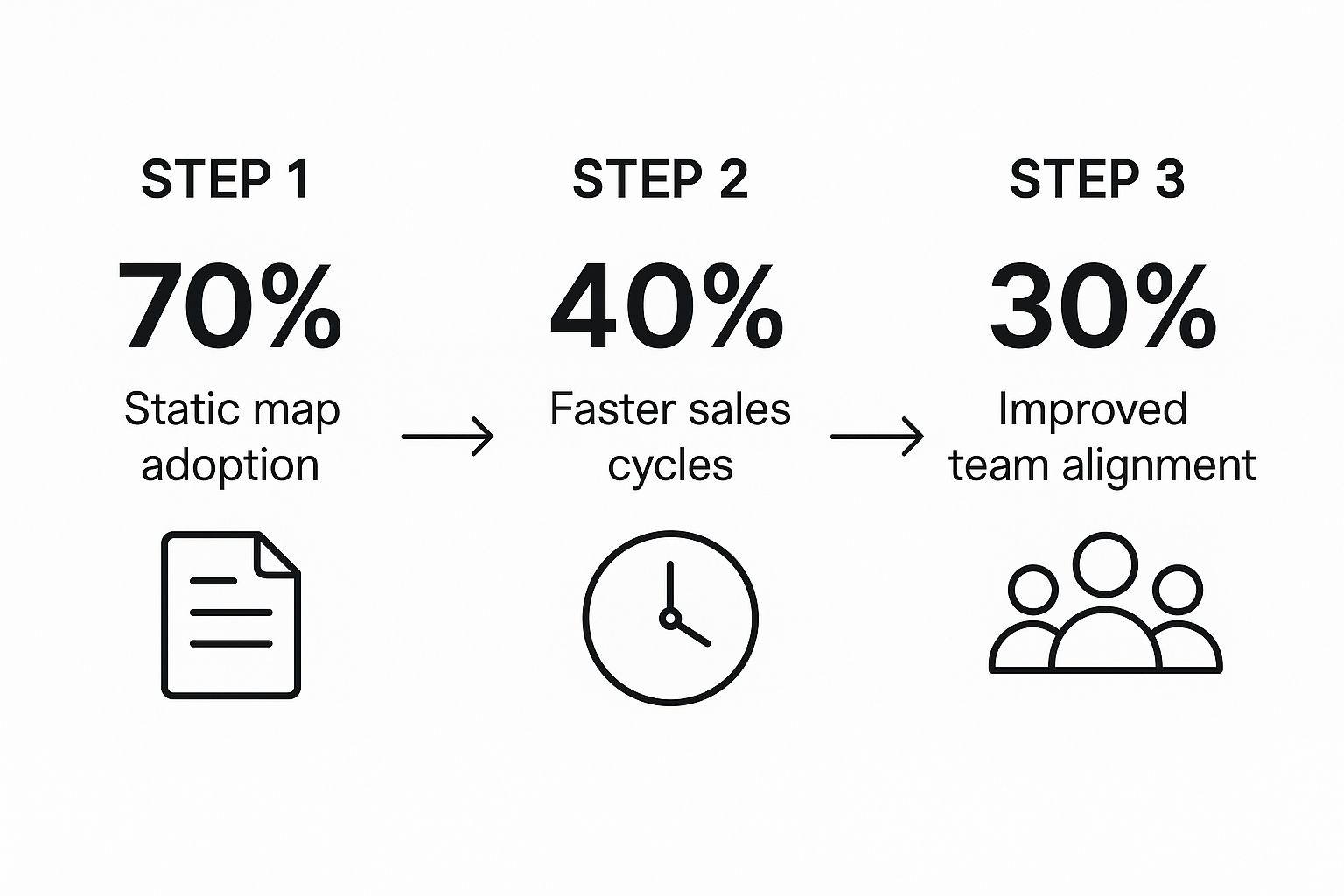
The infographic below really drives home what happens when you move from a static diagram to a dynamic, actionable map.

Infographic about b2b customer journey mapping

As you can see, making that shift isn't just a theoretical exercise—it leads to faster sales cycles and gets everyone on the same page.

From Theoretical Diagram to Revenue Driver

The difference between a map that works and one that doesn't comes down to one word: action. An actionable map doesn't just sit there. It forces conversations and guides your strategy.

A successful journey map is not a deliverable; it’s a decision-making tool. It should provoke questions, challenge assumptions, and guide your marketing, sales, and customer success teams toward a unified goal.

Let’s quickly compare the old way versus the right way.

Outdated vs Actionable B2B Journey Maps

Too many maps are built on guesswork and end up in a forgotten folder. A modern, actionable map is a living tool powered by real data that your entire revenue team can use to spot and fix friction.

CharacteristicOutdated ApproachActionable Approach
FormatStatic PDF or slide deckDynamic, cloud-based platform
Data SourceInternal assumptions, workshopsReal-time customer data (CRM, analytics)
Team FocusSiloed (e.g., marketing-only)Cross-functional (sales, marketing, success)
Primary GoalCreate a "finished" documentIdentify and fix friction points continuously

When you stop treating journey mapping as a box-checking exercise and start seeing it as a dynamic, collaborative tool, it transforms. It goes from a theoretical project to a powerful engine for driving real revenue and keeping customers happy.

Building Your B2B Journey Map From Scratch

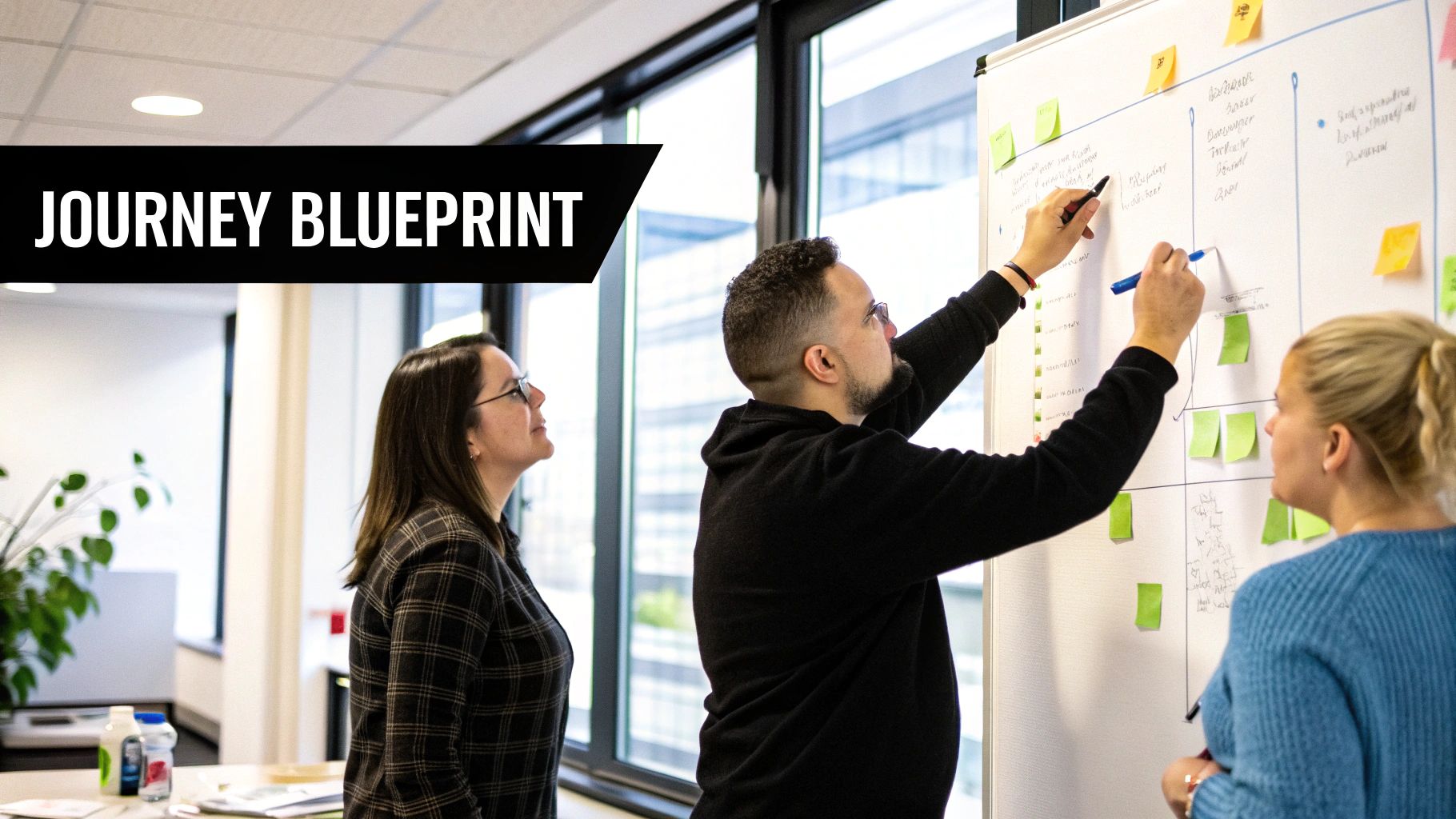
Group of people working together on a journey map with sticky notes and diagrams on a whiteboard.

Alright, enough with the theory. This is where the real work of B2B customer journey mapping kicks in. Building a map that actually works isn't some abstract whiteboard session; it’s a hands-on process to create a visual playbook your entire company—from sales and marketing right through to customer success—can rally around.

First thing to accept: the B2B buying process is messy. Forget the idea of a neat, linear path. It’s cyclical, confusing, and dragged out by multiple people with competing agendas. Your map has to reflect that chaos to be of any real use.

It all starts with a crystal-clear business goal and a genuine understanding of the people you’re trying to help.

First Things First: What’s the Point?

Before you touch a single sticky note, you have to answer one simple question: Why are we even doing this? Without a clear objective, your journey map will be a fuzzy, aimless document that gathers digital dust. A map designed to shorten a bloated sales cycle looks completely different from one built to stop new customers from churning.

Compare these two very different goals:

  • Goal A: Shrink the Sales Cycle. Here, your map becomes a magnifying glass for friction. You'll hunt for bottlenecks in the consideration phase, pinpoint where decision-makers get stuck, and scrutinize every single interaction from the demo request to the final signature. Your action item might be to create a "competitor comparison" one-pager for champions.
  • Goal B: Drive Product Adoption After the Sale. This map stretches far beyond the "buy" button. It’s all about the first 90 days—the onboarding experience, initial logins, support tickets, and training webinars. The whole point is to find opportunities to deliver value faster. Your action item could be to launch a targeted email nurture sequence for new users.

Tying your map to a specific, measurable outcome is non-negotiable. It’s what keeps this from becoming just another pretty diagram.

You’re Selling to a Committee, Not a Person

This is one of the biggest traps in B2B mapping: focusing on a single buyer persona. B2B deals are almost never made by one individual. You’re selling to a buying committee, a quirky cast of characters who each have their own worries, motivations, and definitions of "success."

For a typical mid-market software purchase, that committee probably looks something like this:

Stakeholder RoleTheir Big QuestionActionable Content to Create for Them
The End User (e.g., Marketing Manager)"Is this going to make my day-to-day job less painful?"Simple tutorials, interactive product tours, and no-nonsense quick-start guides.
The IT Specialist (e.g., Security Lead)"Is this secure? Will it break our existing tech stack?"Hardcore technical docs, security compliance reports, and clear integration guides.
The Economic Buyer (e.g., CFO/VP Finance)"What's the real ROI here, and what's the total cost?"Transparent pricing, case studies with hard numbers, and a solid business case.
The Champion (e.g., Director of Marketing)"How do I convince my boss to sign off on this?"Shareable slides, competitor smackdowns, and a compelling executive summary.

Your journey map has to chart the parallel—and often conflicting—journeys of every single one of these people. The IT lead could be buried in your API documentation at the exact same moment the CFO is scrutinizing your pricing page. Both are critical touchpoints, and they’re happening at the same time.

A truly effective B2B journey map doesn't just track a company logo. It tracks the individuals inside that company as they stumble toward a collective "yes." Nail these micro-journeys, and you'll win the deal.

This multi-threaded view is what gives you the full picture, not just one narrow slice of it.

Map Every Single Touchpoint—Even the Small Ones

With your goal set and your committee profiled, it's time to map out every single interaction a potential customer has with your brand. And I mean every interaction. A touchpoint isn’t just a visit to your homepage; it’s any moment of engagement, big or small.

Start by brainstorming all the possibilities, then group them into the classic journey stages.

1. Awareness Stage Touchpoints

This is where it all begins. A prospect realizes they have a problem and starts poking around for answers. Your job is to be the most helpful resource they find.

  • Content: They stumble upon a blog post you wrote about a common industry headache.
  • Social Media: A targeted LinkedIn ad catches their eye, or they see a smart post from someone on your team.
  • Events: They sign up for a webinar you’re hosting on a relevant topic.
  • Third-Party Sites: They see your name pop up on a review site like G2 or Capterra.

2. Consideration Stage Touchpoints

Okay, now they’re serious. The committee is actively vetting solutions, comparing features, and trying to figure out who to trust.

  • Website: They’re playing with your pricing calculator or digging into a product comparison page.
  • Sales: The first discovery call happens, or they sit through a personalized demo.
  • Product: They sign up for a free trial or click through an interactive demo.
  • Proof: They download a case study that speaks directly to their industry’s challenges.

3. Decision Stage Touchpoints

We’re in the home stretch. The committee is trying to build internal consensus and de-risk the purchase. The focus shifts from "what it does" to "how we justify it."

  • Paperwork: They’re reviewing your formal proposal and negotiating the contract terms.
  • Security: Your team is fielding questions for a security and compliance review.
  • References: They’re on the phone with one of your happy customers.
  • Kickoff: They have their first onboarding call with your customer success team to plan the rollout.

Plotting these touchpoints visually is what makes the journey tangible. You can literally see how different people engage with you at different times. It also shows you where all your data is coming from—each touchpoint is a source of truth. To get more out of that data, it helps to centralize it. You can learn more about pulling it all together with a customer data platform integration. When you connect these dots, the map starts to tell a real story about the path your customers actually take.

Gathering Data That Reveals the Real Story

A person analyzing charts and graphs on multiple computer screens, representing data collection for a journey map.

A journey map built on assumptions is just a pretty diagram. It’s a work of fiction. To create a tool that actually drives decisions, you need to ground it in real data that shows what your buyers are truly thinking, feeling, and doing. The goal isn't just to collect data, but to gather the right data—a mix of hard numbers and human stories.

This means you have to break down the walls between your data silos. Too often, the goldmine of insights in a CRM is completely disconnected from the behavioral trends in web analytics. When you bring these together, you move from a fragmented view to a unified picture of your buyer's actual path.

It’s not easy, especially as B2B interactions get more complex. While 63% of decision-makers see the growing importance of customer experience, a staggering 88% admit they don’t have the resources or know-how to actually improve their digital journeys. You can discover additional insights into B2B journey tracking to see just how wide that gap is. A data-driven mapping process is exactly what closes it.

Combining Quantitative and Qualitative Insights

The best journey maps are built on two types of data: quantitative (the "what") and qualitative (the "why"). If you only have one, you only have half the story.

Compare the two: a purely quantitative map might show a high drop-off rate on your pricing page, but it can't tell you why people are leaving. A purely qualitative map might be full of compelling anecdotes, but you won't know if those problems are widespread or just one-offs.

The real magic happens when you let these two data types inform each other.

Data TypeWhat It Tells YouActionable Source
Quantitative DataWhat customers are doing at scale.Check Google Analytics, CRM reports, marketing automation logs, and heatmaps.
Qualitative DataWhy customers are doing it—their motivations, feelings, and frustrations.Conduct customer interviews, poll the sales team, analyze support tickets, and send surveys.

For example, your Google Analytics might show that prospects from the finance industry spend an average of only 30 seconds on a key feature page (the what). That's an interesting but incomplete fact.

But after interviewing a few of them, you might discover they found the technical jargon confusing and couldn't see how it applied to their compliance needs (the why). That combined insight is what you can actually act on. Your action item: rewrite the page copy to directly address finance compliance.

Uncovering the "Why" with Human Intelligence

While analytics platforms are essential, some of the most valuable data you'll get for a B2B journey map comes from talking to actual people. Your teams on the front lines—and your customers themselves—hold the keys to the emotional and rational drivers behind every decision.

Here are actionable steps to tap into that human intelligence:

  • Interview Your Sales Team: Your reps live and breathe customer objections. Ask them: "At what point in the deal do prospects get confused?" or "What's the one piece of content that champions always ask for to convince their boss?" They know exactly where deals stall and why.
  • Talk to Customer Support: Support agents are a goldmine for post-purchase pain points. Dig through support ticket logs and look for recurring issues during onboarding or implementation. These are the friction points that lead directly to churn.
  • Speak Directly with Customers: This is non-negotiable. You have to talk to them. Interview new customers who just went through the buying process and, if you can, those who chose a competitor. Ask open-ended questions like, "Walk me through the moment you realized you needed a solution like ours," to uncover their initial triggers.

Capturing direct customer feedback isn't just about collecting quotes; it's about understanding their world. By actively listening, you can build a map that reflects their reality, not just your company's internal process.

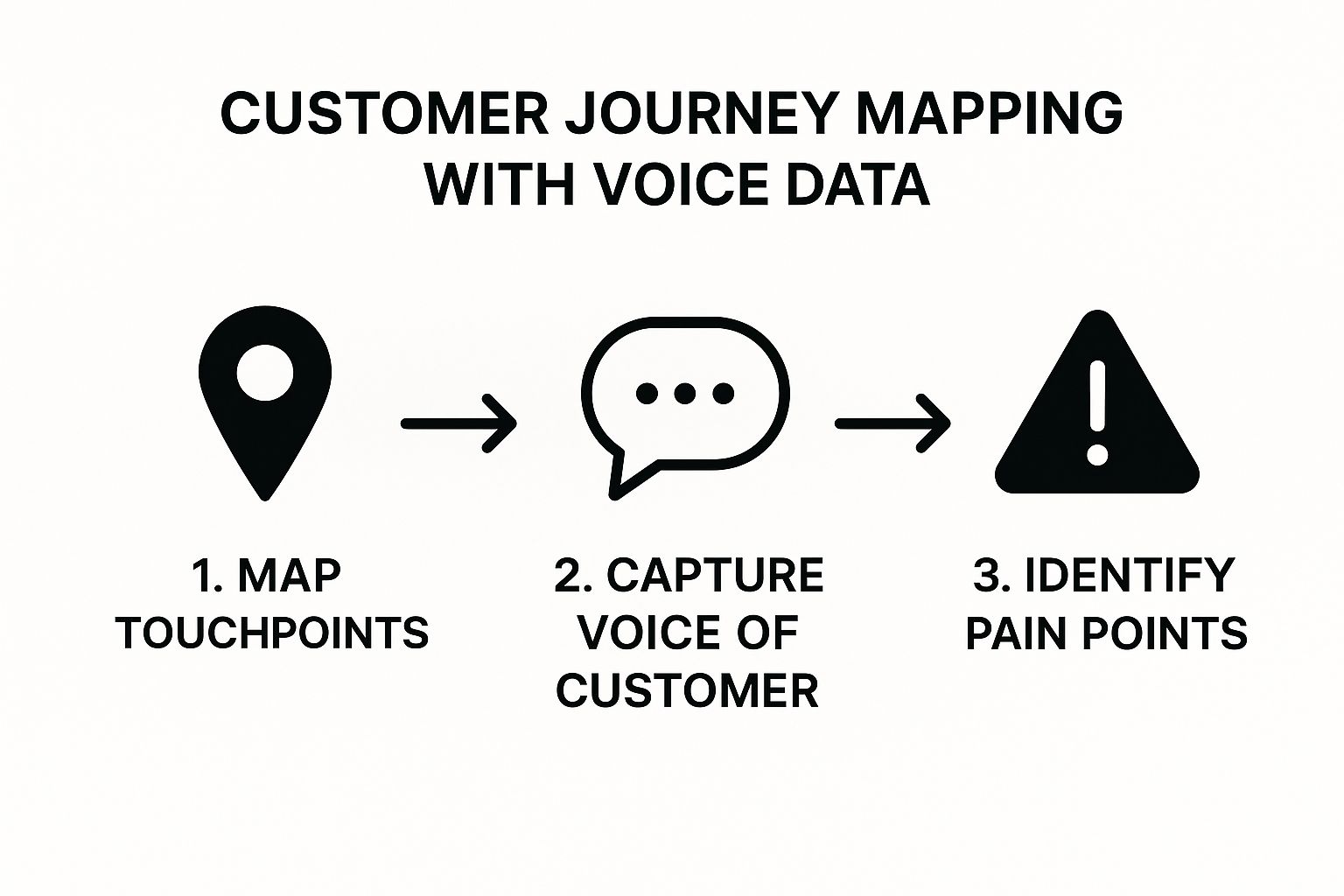
These conversations provide the rich, nuanced context that raw numbers simply can't. You can find excellent guidance on structuring these discussions by exploring some real-world Voice of the Customer examples. It’s how you ensure your map is built on a foundation of genuine empathy.

Choosing the Right Journey Mapping Tools

A digital dashboard showing various journey mapping tools and analytics charts.

Alright, you've set your goals and done the hard work of gathering data. Now for the fun part: picking the right tech to bring your B2B customer journey mapping to life. This is a critical decision. The right software turns your map from a static diagram that's outdated the second you finish it into a living, breathing tool that actually helps you make better decisions.

The market for these tools is packed, but they really boil down to three main types. Each one serves a different purpose, and the best fit for you will come down to your team's size, budget, and just how complex your sales cycle really is.

Collaborative Whiteboards: Flexible and Visual

First up are the digital whiteboards. Think of platforms like Miro or Mural. These are essentially giant, endless canvases where your team can get together, throw virtual sticky notes around, and sketch out the customer journey from the ground up.

Their biggest selling point is pure flexibility. You're not boxed in by rigid templates, which makes them absolutely perfect for those initial workshops and brainstorming sessions when you're still just trying to figure out the basic stages and touchpoints. They're built for real-time, cross-functional teamwork.

But that strength can also be a weakness. Compare this to a data-driven tool: these maps are built by hand. They won't automatically suck in live data from your CRM or analytics tools. That means they're just a snapshot in time and need constant manual updates to stay useful.

  • Best For: Teams who are brand new to journey mapping, running initial discovery workshops, or just need to visualize a high-level flow.
  • Key Challenge: The lack of direct data integration means maps can get stale fast if you're not disciplined about keeping them updated.

Dedicated Journey Mapping Platforms: Structured and Insightful

Next, you have dedicated journey mapping platforms like Smaply or TheyDo. These tools are purpose-built for one thing: creating, managing, and analyzing customer journeys in a structured way. They come with templates and frameworks designed specifically for mapping out touchpoints, customer emotions, pain points, and opportunities.

Compared to a free-for-all whiteboard, these platforms enforce a more disciplined process. They often have features for building out detailed personas, tying specific journeys to business goals, and pinpointing those crucial "moments of truth." Many can even pull in qualitative feedback from surveys or support tickets, which adds a layer of real-world proof to your map.

The tradeoff? A steeper learning curve and a higher price tag. These are specialist tools for teams who are serious about making journey mapping a core business function. It's less about freeform brainstorming and more about building a systematic, scalable library of customer insights.

A dedicated mapping platform transforms your journey map from a simple picture into a structured database of customer experience insights. It's the right move when you're ready to make this a core, ongoing business process.

All-in-One Analytics and CRM Suites: Data-Rich and Action-Oriented

Finally, we have the all-in-one giants like HubSpot or Salesforce Marketing Cloud. While they aren't just journey mapping tools, their real power comes from tracking and visualizing the journey using actual, live customer data. These systems automatically log every touchpoint—email opens, website visits, content downloads, and sales calls.

This gives you a journey map that is inherently data-driven and always current. You get to see the real paths customers are taking, not just the ones you sketched out in a meeting. The huge benefit here is the direct line from insight to action; you can trigger automated marketing campaigns or sales tasks right from what you learn in the journey.

The main limitation is that these platforms are much better at telling you the "what" (the quantitative data) than the "why" (the qualitative insight). They’ll show you a prospect fell off the map, but they won’t capture the frustration or confusion that caused it. To get the full picture, you almost always have to pair this data with qualitative feedback you've gathered elsewhere.

Making the Right Choice: A Comparative Look

Choosing your tool isn't about finding the "best" one on the market. It's about finding the one that fits what you need right now and where you want to go. A small startup might kick things off with a collaborative whiteboard to get the whole team on the same page, while a big enterprise might need an all-in-one suite to wrangle its complex, multichannel customer interactions.

To make it easier, here's a quick overview of how the different software categories stack up.

Comparison of B2B Journey Mapping Tool Types

Tool TypeBest ForKey FeaturesExample Platforms
Collaborative WhiteboardsInitial workshops, creative brainstorming, and high-level flow design.Infinite canvas, real-time collaboration, drag-and-drop templates.Miro, Mural
Dedicated Mapping PlatformsCreating structured, detailed, and scalable journey repositories.Persona builders, structured templates, insight management, basic integrations.Smaply, TheyDo
All-in-One Analytics & CRM SuitesBuilding dynamic, data-driven maps tied directly to marketing and sales execution.Deep CRM integration, real-time behavioral tracking, marketing automation triggers.HubSpot, Salesforce

At the end of the day, the tool should serve your strategy, not the other way around. Figure out exactly what you want to accomplish first, and then pick the software that will help you see, understand, and act on your B2B customer journey most effectively.

Turning Your Map Into Measurable Results

So you've built your B2B customer journey map. Nice work. But let’s be honest: a map that just hangs on a wall or gets buried in a Google Drive folder is a waste of everyone's time.

The real value isn't in the diagram itself. It's in using that diagram to drive strategic actions that show up in your P&L. A map that guides your daily decisions is a revenue engine. Now it's time to translate those insights into impact.

Finding the Friction Points and Content Gaps

Think of your journey map as a diagnostic tool. Its main job is to show you where the buying process grinds to a halt or breaks down completely. You're not just looking at the touchpoints; you're hunting for the painful, momentum-killing gaps between them.

Maybe your map shows the technical evaluator downloading a whitepaper (a marketing win!) but then waiting a full week before sales ever reaches out. That gap is pure friction. Why the delay? Was the handoff process broken? Did the whitepaper fail to inspire any real urgency?

This is where you have to compare the ideal versus the real journey:

  • Ideal Journey: The evaluator reads the paper, is blown away by its technical depth, and immediately clicks the embedded link to request a demo.
  • Actual Journey: The evaluator reads the paper, has a few unanswered questions, gets pulled into another project, and the initial spark is gone.

The most powerful insights from a journey map don't come from tracking successful touchpoints, but from identifying and quantifying the moments of friction. Each one is a golden opportunity to improve the buyer experience and shorten the sales cycle.

Your analysis will also shine a light on glaring content gaps. Does your map show the CFO stepping in at the decision stage, yet you have zero content that speaks their language—ROI, total cost of ownership, financial risk? That’s a content gap your map just handed you on a silver platter. Your action item: create a downloadable ROI calculator and a case study focused on financial outcomes.

Connecting Your Actions to Business Outcomes

Once you’ve pinpointed the friction and the gaps, the next move is to develop concrete actions and tie them to specific business metrics. This is what separates a fuzzy academic exercise from a revenue-driving strategy. Without that connection, your efforts are just guesswork.

Let’s compare a vague observation with a sharp, metric-driven initiative.

Vague ObservationActionable Initiative
"Our onboarding process seems confusing for new customers.""Implement an interactive, in-app product tour during the first 7 days to reduce support tickets by 20% and improve our 30-day user retention rate."
"Sales and marketing aren't aligned on lead quality.""Redefine the MQL-to-SQL handoff criteria based on journey map insights (e.g., prospects who view the pricing page twice) to increase the SQL conversion rate by 15%."

See the difference? Each action is specific, measurable, and hooks directly into a real business outcome like customer retention or conversion rate. This is how you turn your map from a picture of the past into a concrete plan for the future.

Unlocking Personalization and Attributing Revenue

A detailed journey map is a goldmine for personalization that actually works. When you understand the distinct paths different members of the buying committee take, you can stop blasting generic messages and start delivering tailored content at the perfect moment.

The IT manager gets a security-focused email. The finance lead sees an ad about proven ROI.

This level of precision has a direct and measurable impact on revenue. We’ve seen it firsthand: a precisely targeted LinkedIn ad campaign, informed by journey insights, influenced 35% of new business deals and delivered a 113% Return On Ad Spend (ROAS). Compare that to a less-targeted campaign on another platform, which contributed to just 2% of deals with a pathetic 29% ROAS.

That massive difference shows why connecting detailed journey mapping directly to revenue attribution is non-negotiable. You can dig into more data on how B2B customer journeys directly influence revenue on dreamdata.io. Understanding the journey isn't just about making buyers happy—it's about making smarter investments that generate real returns.

Your map should be the guide for these big strategic decisions. Use it to answer the tough questions:

  • Which channels are actually reaching our economic buyers?
  • What content is most influential during the technical evaluation phase?
  • Where should our sales team jump in for maximum impact?

When you let the map guide everything from ad spend to sales outreach, you create a cohesive and brutally effective buying experience. This is how your B2B customer journey mapping effort becomes a powerful, measurable driver of business growth, directly impacting conversion rates, sales cycle length, and ultimately, customer lifetime value.

Common Questions We Hear About B2B Journey Mapping

Even with the best plan in hand, you're going to hit a few roadblocks when building out your first B2B journey map. It’s totally normal. Getting the answers right is what separates a map that actually drives your strategy from one that just ends up as a pretty PDF in a forgotten folder.

Here are a few of the most common questions that pop up and how we've learned to tackle them.

How Often Should I Update My Journey Map?

Think of your journey map less like a framed picture and more like a live dashboard. It's a snapshot in time, and time moves on. Markets shift, your product gets new features, and your buyers' expectations are always climbing. A map from six months ago might already be dangerously out of date.

Here's an actionable schedule:

  • Quarterly: Conduct a major review and refresh of the entire map.
  • Immediately: Revisit the map when a significant event occurs, like a major product launch, entering a new market, or a competitor's big move. This keeps it relevant and, more importantly, actionable.

What’s the Single Biggest Mistake to Avoid?

Easy. Building the map based entirely on internal assumptions.

I’ve seen it happen a dozen times: a team gets together in a conference room, grabs a whiteboard, and starts guessing what the customer journey looks like. What they end up with isn't a customer journey map at all—it's a map of their own internal sales process. It reflects how they want to sell, not how their customers actually buy.

The fix is simple but non-negotiable: ground every single touchpoint and pain point in real data. Use your CRM and analytics for quantitative insights, but the real gold comes from qualitative feedback from actual customer interviews. A map built on evidence is a tool; a map built on guesswork is just a fantasy.

How Do I Map for Multiple Buyer Personas?

This one trips people up all the time, especially in B2B where you're selling to a buying committee of five different people. Trying to cram the CFO, the IT Lead, and the end-user all onto one giant, chaotic map is a recipe for disaster. It becomes useless to everyone.

Here’s a much cleaner, actionable approach.

  1. Create a Foundational Master Journey: Start by outlining the core stages everyone goes through (Awareness, Consideration, etc.). This is your skeleton.
  2. Use Persona "Swimlanes": For each key persona, create a separate horizontal lane on the map. This lets you clearly see how the IT Lead's journey overlaps with the main path and, crucially, where it diverges.
  3. Pinpoint Unique Needs: In each swimlane, document the unique pain points, questions, and decision criteria for that persona at each stage. This gives you the clarity you need to engage each stakeholder effectively.

Ready to move beyond static diagrams and build a dynamic, data-driven journey map that drives real results? marketbetter.ai integrates your customer data, content creation, and campaign analytics into one AI-powered platform, giving you a live view of your B2B customer journey. Optimize every touchpoint with marketbetter.ai.

7 Best Omnichannel Marketing Example Breakdowns for 2025

· 21 min read

Omnichannel marketing isn't just about being on multiple channels; it's about creating a unified, seamless customer conversation across all of them. A multichannel strategy simply offers various ways to engage, but a true omnichannel approach integrates them. The customer's cart follows them from their phone to their laptop, a store associate knows their online wishlist, and support tickets are resolved without repeating information. To make it look this easy requires a complex, data-driven strategy.

This article moves beyond theory to dissect 7 powerful omnichannel marketing example breakdowns from leading brands and platforms. We will analyze their specific strategies, compare their approaches, and provide actionable takeaways you can use to build your own cohesive customer journeys. Each breakdown will show you exactly how these companies connect disparate touchpoints and what you can do to replicate their success.

To understand the technical aspects that enable a truly seamless customer journey, exploring specific platform omnichannel features is essential. Get ready to see what a truly integrated customer experience looks like in practice and learn how to replicate these successes in your own marketing efforts.

1. Amazon: A Deep Dive into Omnichannel Case Studies

When searching for a detailed omnichannel marketing example, starting with foundational knowledge is crucial. Amazon serves as the world's largest digital bookstore, offering an unparalleled collection of books, case studies, and strategic guides dedicated to this very topic. While other platforms offer articles, Amazon provides access to comprehensive, long-form content from marketing experts, academics, and industry veterans.

Unlike a standard Google search that returns a mix of blog posts and ads, Amazon’s platform is structured to help you evaluate and select in-depth resources. You can instantly compare frameworks, check author credentials, and read peer reviews from other marketing professionals. This curated experience is ideal for anyone looking to move beyond surface-level definitions and into actionable, strategic analysis.

Why It Excels for Finding Examples

Amazon’s primary advantage is its sheer volume and user-driven filtering system. The platform allows for a more targeted research process than general search engines.

  • Massive Selection: Access thousands of titles, from academic textbooks to practical handbooks filled with real-world case studies of omnichannel success.
  • User-Generated Vetting: Leverage thousands of reader ratings and detailed reviews to gauge a book's quality and relevance before purchasing. This is a significant advantage over single-author blogs.
  • "Look Inside" Feature: Preview chapters, tables of contents, and indexes to confirm a book contains the specific examples and strategic breakdowns you need.

Actionable Tips for Using Amazon

To maximize your search for a powerful omnichannel marketing example, use the platform strategically.

  1. Use Specific Search Queries: Instead of "omnichannel marketing," try "omnichannel retail case studies," "B2B omnichannel strategy," or "omnichannel customer journey examples." This will surface more targeted and useful content.
  2. Filter by Publication Date: Ensure the examples are current by filtering your search results to show books published in the last 1-2 years. Omnichannel tactics evolve quickly.
  3. Check Kindle Samples: Download free Kindle samples to your phone or desktop to get a substantial preview of the content before committing to a purchase.
Feature ComparisonAmazonGeneral Blog Search
Content DepthHigh (full books, case studies)Variable (often surface-level)
VettingStrong (reviews, ratings)Weak (author bias is common)
StructureOrganized (chapters, index)Unstructured
CostVaries (free samples, affordable eBooks)Free

While some books may present dated information, the ability to sort by publication date and read recent reviews mitigates this risk. For professionals seeking vetted, in-depth examples to model their strategies after, Amazon remains the most comprehensive and reliable starting point.

Website: https://www.amazon.com

2. Coursera: Structured Learning with Real-World Applications

For those seeking a more academic and structured approach to finding an omnichannel marketing example, Coursera offers a powerful alternative. The platform hosts university-backed courses, such as the Wharton School's Omnichannel Retail Strategy Specialization, which moves beyond theory and into guided application. This specialization is designed to teach professionals how to apply omnichannel concepts using detailed case studies from brands like Disney and Starbucks.

Coursera

Unlike passively reading a blog post, Coursera provides a hands-on learning environment. The platform’s courses include video lectures, readings, and graded assignments that require you to analyze and deconstruct successful strategies. This structured format is ideal for marketing professionals who want not only to see examples but also to build the analytical skills needed to implement similar tactics in their own organizations.

Why It Excels for Finding Examples

Coursera's primary strength is its rigorous, curriculum-based approach combined with flexible, self-paced learning. It offers a clear path from understanding concepts to applying them.

  • University-Vetted Content: Courses are developed by top institutions like the Wharton School, ensuring the examples and frameworks are credible and academically sound.
  • Project-Based Learning: The specializations often culminate in a hands-on project where you apply omnichannel principles to a real-world business problem.
  • Expert-Led Instruction: Learn directly from professors and industry experts who break down complex case studies into digestible lessons.
  • Professional Certification: Earn a shareable certificate upon completion to showcase your expertise in omnichannel strategy to employers and professional networks.

Actionable Tips for Using Coursera

To get the most value from Coursera for finding an omnichannel marketing example, approach it like a professional development tool.

  1. Audit Courses First: Many courses, including the Wharton specialization, allow you to audit the content for free. This lets you access the video lectures and readings to see the examples before committing to the paid certificate track.
  2. Focus on Specializations: Look for multi-course "Specializations" instead of individual courses for a more comprehensive and in-depth exploration of the topic.
  3. Engage with Discussion Forums: Use the student forums to ask questions and discuss case studies with peers and instructors, gaining different perspectives on the strategies presented.
Feature ComparisonCoursera SpecializationGeneral Marketing Blog
Content DepthHigh (structured curriculum, projects)Variable (often single-focus articles)
VettingStrong (university-backed)Weak (author opinion, sponsored content)
StructureOrganized (modules, graded tasks)Unstructured
CostSubscription-based (free audit option)Free

While some case studies may use simulated data rather than live metrics, the platform's academic rigor ensures the strategic principles are sound. For marketers seeking a guided, educational experience that translates directly into applicable skills, Coursera provides an unmatched learning environment.

Website: https://www.coursera.org/specializations/wharton-retail-strategy

3. HubSpot: Your Hub for Actionable Omnichannel Frameworks

For those seeking a practical omnichannel marketing example without the commitment of purchasing a book, HubSpot is an indispensable resource. It offers a rich library of free articles, templates, webinars, and tools focused on omnichannel implementation. This makes it an ideal destination for marketers who need to quickly translate theory into action.

Unlike platforms that only provide theoretical discussions, HubSpot equips you with tangible assets. Their content often breaks down how well-known brands like Disney and Sephora orchestrate their customer experiences. More importantly, it provides downloadable templates for mapping out your own customer journeys, turning abstract concepts into concrete project plans. This blend of inspiration and application is what sets HubSpot apart as a go-to educational hub.

Why It Excels for Finding Examples

HubSpot's strength lies in its ability to bridge the gap between examples and execution. The platform is designed to not only show you what good omnichannel looks like but also give you the tools to build it yourself.

  • Curated Brand Breakdowns: Access detailed analyses of successful omnichannel strategies from leading consumer brands, updated regularly for relevance.
  • Free Journey Mapping Templates: Download ready-to-use templates to visually orchestrate your own omnichannel customer journeys, saving significant time.
  • On-Demand Webinars: Watch expert-led sessions that dive deep into the tactics and technologies behind effective omnichannel campaigns.

Actionable Tips for Using HubSpot

To get the most value from HubSpot, focus on its practical tools rather than just reading articles.

  1. Download and Customize Templates: Don't just read about customer journeys; actively map your own using their free templates as a starting point. This is the first step to making the strategy real for your business.
  2. Filter by Content Type: Use the blog's search functionality to find "templates," "webinars," or "guides" specifically related to omnichannel to access the most actionable assets.
  3. Analyze Their Use Cases: Pay attention to how HubSpot positions its own software as a solution. These case studies provide insight into how a CRM can enable person-level identification and seamless cross-channel experiences. You can learn more about HubSpot's approach to identity resolution and its impact on omnichannel strategies.
Feature ComparisonHubSpotGeneral Marketing Blogs
Content DepthMedium-High (templates, webinars)Variable (often surface-level)
VettingStrong (in-house expert content)Weak (author bias is common)
ActionabilityHigh (downloadable tools)Low (mostly theoretical)
CostFree (some content is gated)Free

While some of the best resources require an email signup, the value provided in return is substantial. For marketing professionals and teams needing to quickly build and deploy an omnichannel strategy, HubSpot offers the most direct path from learning to doing.

Website: https://blog.hubspot.com/service/omni-channel-experience

4. Shopify: From Inspiration to Omnichannel Implementation

For businesses seeking a practical omnichannel marketing example, Shopify offers a unique combination of inspiration and execution. The platform showcases real-world brand case studies that detail how retailers unified their online stores, physical point-of-sale (POS), and social commerce channels. Unlike purely informational blogs, Shopify connects these success stories directly to the tools that made them possible.

This approach transitions the concept of omnichannel from an abstract strategy to a tangible business model. Users can read about a brand's success with curbside pickup and then immediately explore the Shopify POS features and app integrations required to implement it. This dual focus on "how they did it" and "how you can do it" makes it an invaluable resource for entrepreneurs and marketing professionals ready to take action.

Shopify

Why It Excels for Finding Examples

Shopify’s strength lies in demonstrating achievable omnichannel strategies powered by its own ecosystem. The platform provides a clear pathway from case study to implementation, which is a distinct advantage over theoretical articles.

  • Actionable Case Studies: Each example is a brand actively using Shopify, providing a transparent look at how features like unified inventory and social selling work in practice.
  • Integrated Toolset: It presents a native POS system, extensive app marketplace, and logistics support (BOPIS/BOPAC), showing exactly what's needed to build a similar experience.
  • Unified Commerce Focus: The examples emphasize a seamless customer journey, from an Instagram ad to an in-store purchase, all tracked within a single system.

Actionable Tips for Using Shopify

To get the most out of Shopify’s resources, focus on both the strategic narrative and the underlying technology.

  1. Deconstruct the Customer Journey: As you read a case study, map out the customer's path. Note every touchpoint, from social media discovery to the final sale, and identify the Shopify feature enabling it.
  2. Explore the App Ecosystem: If a case study mentions a specific function (like loyalty programs or advanced inventory), search the Shopify App Store to find the exact tools they used. This turns inspiration into a concrete shopping list.
  3. Use Case Studies for Your Business Case: Leverage these real-world examples to justify technology investments to stakeholders, showing proven ROI from other merchants. You can learn more about how successful brands leverage platforms like Shopify.
Feature ComparisonShopify ExamplesMarketing Blogs
Content FocusPlatform-driven implementationBroad strategic theory
ActionabilityHigh (linked tools and apps)Low (often lacks specific tools)
PerspectiveMerchant-centric (real results)Analyst-centric (observations)
CostFree (for case studies)Free

While the examples are inherently platform-centric, they offer an unparalleled, replicable blueprint for building an omnichannel strategy. For businesses wanting to see how theory translates into sales, Shopify provides the most direct and actionable examples available.

Website: https://www.shopify.com/retail/omnichannel-retail-examples

5. Salesforce Service Cloud: Bridging Marketing and Service

To truly understand an omnichannel marketing example, one must look beyond campaigns and into the technology that powers seamless customer interactions. Salesforce Service Cloud provides the operational backbone for connecting marketing efforts with real-time customer service. It enables businesses to manage and route customer queries from any channel, ensuring the conversation continues fluidly whether it started on social media, email, or a phone call.

Salesforce Service Cloud

Unlike platforms focused solely on marketing automation, Service Cloud integrates support touchpoints directly into the customer profile. This gives both marketing and service teams a unified view of every interaction, preventing disjointed experiences where a customer has to repeat information. For professionals mapping out a true end-to-end omnichannel strategy, exploring how a tool like Service Cloud handles post-conversion engagement is essential.

Why It Excels for Omnichannel Execution

Salesforce Service Cloud's strength lies in its robust, enterprise-grade routing and workload management, which ensures marketing promises are met with exceptional service. It transforms support from a cost center into a core part of the customer journey.

  • Unified Agent Experience: Consolidates interactions from voice, messaging, and digital channels into a single console, giving agents full context on a customer's marketing history.
  • Intelligent Omni-Channel Routing: Automatically directs cases to the right agent based on skill, availability, and workload, ensuring prompt and effective resolutions.
  • Comprehensive Analytics: Provides dashboards that track service metrics across all channels, allowing marketers to see how support interactions impact customer loyalty and lifetime value.

Actionable Tips for Using Salesforce Service Cloud

To leverage this platform for a holistic omnichannel strategy, focus on integrating its capabilities with your marketing goals.

  1. Map Customer Service Journeys: Use its tools to outline how inquiries initiated from marketing campaigns (e.g., a chatbot on a landing page) are routed and resolved. This connects marketing actions to service outcomes.
  2. Explore the AppExchange: Look for integrations that connect your specific marketing automation tools (like Pardot or Marketo) directly with Service Cloud to create a seamless data flow.
  3. Analyze Pricing Tiers: Carefully review the different pricing editions to identify which one includes the necessary "Omni-Channel" features for your specific use case, as these are critical for execution.
Feature ComparisonSalesforce Service CloudStandard Help Desk Software
Channel IntegrationNative (voice, chat, social, email)Often siloed or requires add-ons
Routing LogicAdvanced (skills-based, workload)Basic (round-robin or manual)
Marketing IntegrationDeep (part of unified CRM)Limited (basic data sync)
CostHigher (per-user, tiered plans)Lower (often simpler pricing)

While the platform’s implementation can be complex and its pricing is at a premium, its ability to unify marketing and service is unmatched for enterprises. For teams looking to build a resilient omnichannel experience that extends beyond the initial sale, Salesforce Service Cloud offers the foundational technology. You can explore a detailed case study to see how TWNEX achieved this synergy.

Website: https://www.salesforce.com/service/pricing/

6. Adobe Journey Optimizer: Orchestrating the Enterprise Omnichannel Experience

When an omnichannel marketing example needs to be executed at an enterprise scale, the conversation shifts from individual tools to unified orchestration platforms. Adobe Journey Optimizer is an industry-leading solution built for large organizations that need to manage complex, real-time customer journeys across a vast array of digital and physical touchpoints. It moves beyond simple campaign management to offer a centralized hub for data, decisioning, and delivery.

Adobe Journey Optimizer

Unlike point solutions that handle a single channel like email or SMS, Adobe Journey Optimizer is engineered to unify customer profiles from disparate sources and use that data to trigger personalized interactions at the exact right moment. Its visual journey canvas allows marketers to design, test, and deploy sophisticated workflows that adapt to customer behavior in real time, making it a powerful engine for building a truly connected experience.

Why It Excels for Omnichannel Execution

Adobe’s strength lies in its deep integration with the Adobe Experience Cloud and its ability to handle immense volumes of data and customer interactions. This makes it an ideal platform for enterprises aiming to deliver hyper-personalized experiences.

  • Real-Time Unified Profile: It consolidates data from CRM, analytics, and other sources into a single, continuously updated customer profile.
  • AI-Powered Decisioning: The platform uses artificial intelligence to determine the next best action or offer for each individual, optimizing for business goals.
  • Native Cross-Channel Support: Seamlessly orchestrate messages across email, SMS, push notifications, in-app messages, and web channels from one interface.

Actionable Tips for Using Adobe Journey Optimizer

To effectively leverage this powerful platform, teams must focus on data strategy and iterative testing.

  1. Start with Data Unification: Prioritize connecting your key customer data sources to build a robust unified profile. A journey is only as good as the data powering it. This is your foundational action item.
  2. Map a Core Customer Journey: Instead of trying to orchestrate everything at once, select one high-impact journey (e.g., cart abandonment or new user onboarding) to build and optimize first.
  3. Utilize AI Experimentation: Use the built-in AI tools to A/B test different paths, messages, and timing within your journeys to continuously improve performance.
Feature ComparisonAdobe Journey OptimizerStandard Marketing Automation
Data IntegrationDeep (real-time, unified profile)Basic (list-based, often siloed)
Personalization1:1, AI-drivenSegment-based
Channel ScopeNative cross-channel orchestrationPrimarily email-focused with add-ons
Cost & ComplexityHigh (quote-based, requires resources)Low to Medium (SaaS pricing)

The primary drawbacks are the significant cost and implementation complexity, which place it out of reach for most small to mid-sized businesses. However, for large enterprises seeking a scalable, governed, and intelligent platform to build a true omnichannel marketing example from the ground up, Adobe Journey Optimizer is a top-tier choice.

Website: https://business.adobe.com/products/journey-optimizer/adobe-journey-optimizer.html

7. Harvard Business Review Store

When you need an omnichannel marketing example backed by rigorous academic research and strategic business analysis, the Harvard Business Review (HBR) Store is an indispensable resource. It shifts the focus from purely tactical descriptions to high-level strategic frameworks, profitability models, and leadership perspectives. HBR provides access to concise, data-driven articles, case studies, and reports authored by leading academics and industry consultants.

Harvard Business Review Store

Unlike general marketing blogs that may offer anecdotal evidence, HBR delivers content grounded in quantitative and qualitative research. This makes it a go-to source for CMOs, VPs, and strategists who need authoritative material to build a business case, inform executive-level decisions, or train their teams. The platform is designed for professionals seeking citable, credible insights rather than just inspiration.

Why It Excels for Finding Examples

HBR’s strength lies in its credibility and focus on the "why" behind an omnichannel strategy, not just the "how." It connects omnichannel execution directly to financial outcomes and competitive advantage.

  • Data-Backed Insights: Articles are based on extensive research, providing reliable data and frameworks for analyzing omnichannel profitability and customer lifetime value.
  • Leadership Perspective: Content is tailored for senior leaders, focusing on the organizational changes, investment decisions, and strategic shifts required for successful implementation.
  • Curated Learning Paths: HBR often suggests related reading, helping you build a comprehensive understanding of a topic by connecting articles on customer experience, retail innovation, and digital transformation.

Actionable Tips for Using HBR Store

To extract maximum value, approach the HBR Store with a strategic mindset.

  1. Search for "Topic + Case Study": Use queries like "omnichannel retail case study" or "customer journey integration" to find specific, in-depth analyses.
  2. Utilize Preview Options: Read the article abstracts and executive summaries to quickly assess relevance before purchasing the full PDF. This is a crucial cost-saving step.
  3. Explore Related Content: When you find a relevant article, check the "Related" section for complementary pieces that provide a more holistic view of the strategy.
Feature ComparisonHarvard Business Review StoreIndustry Blogs
Content DepthHigh (research-based, strategic)Variable (often tactical, anecdotal)
VettingVery Strong (peer-reviewed)Weak (author or brand bias)
StructureOrganized (abstract, key findings)Often unstructured, list-based
CostPaid (per article/subscription)Free

While individual articles carry a price tag, their value as authoritative, citable resources for building internal strategy presentations is unparalleled. For leaders needing to justify significant omnichannel investments, the data-driven examples found on the HBR Store are a critical tool.

Website: https://store.hbr.org/product/how-to-make-the-most-of-omnichannel-retailing/F1607A

Omnichannel Marketing Examples Comparison

PlatformImplementation Complexity 🔄Resource Requirements ⚡Expected Outcomes 📊Ideal Use Cases 💡Key Advantages ⭐
AmazonLow – simple search and purchase processMinimal – requires internet and deviceQuick access to diverse examples and user reviewsFinding broad, practical omnichannel marketing examplesVast catalog with fast delivery and ratings
CourseraMedium – structured courses with projectsModerate – time investment, course feesDeep, academic understanding with certificationLearners seeking structured, university-backed contentRigorous, real-world case studies and projects
HubSpotLow – mostly free resources, some signupsLow – free content, some lead-gen gatingPractical templates and brand example accessMarketers needing free, ready-to-use materialsFrequent content updates and downloadable tools
ShopifyMedium – platform and app ecosystem setupModerate to high – platform fees and appsUnified commerce execution and retail case insightsMerchants wanting integrated POS and social commerceClear case narratives with practical tools
Salesforce Service CloudHigh – complex platform and integrationsHigh – licensing, setup, and trainingRobust omni-channel service and marketing integrationEnterprises requiring advanced customer support workflowsEnterprise-grade features and analytics
Adobe Journey OptimizerVery High – enterprise-level orchestrationVery high – dedicated setup and servicesScalable, personalized omnichannel campaign managementLarge brands needing AI-driven personalizationStrong AI and governance capabilities
Harvard Business ReviewLow – easy digital access or print purchaseLow to medium – purchase cost per articleResearch-backed insights and strategic recommendationsExecutives seeking credible, data-driven analysisAuthoritative content for leadership use

From Inspiration to Implementation: Your Next Steps

We've explored a range of powerful omnichannel marketing example showcases, from Amazon's integrated retail ecosystem to HubSpot's seamless educational journey. The common thread weaving through each success story is a relentless focus on the customer, powered by a unified data strategy and the right technology stack. They prove that omnichannel isn't just a buzzword; it's a fundamental shift in how businesses build relationships.

The core lesson is clear: true omnichannel excellence begins with breaking down internal silos. Whether it's connecting sales data from Salesforce Service Cloud with marketing campaigns in Adobe Journey Optimizer, or integrating your Shopify store with your support channels, the goal is to create a single, coherent view of each customer. This unified profile is the bedrock upon which personalized, context-aware experiences are built.

Turning Examples into Actionable Strategy

Studying a great omnichannel marketing example is one thing, but replicating its success requires a strategic approach. Here are the actionable next steps to bridge that gap:

  • Map Critical Customer Journeys: Don't try to boil the ocean. Identify the 2-3 most critical paths your customers take, such as the journey from initial awareness to first purchase, or from active user to loyal advocate. Focus your initial efforts here.
  • Audit Your Data and Tech Stack: Analyze where your customer data currently lives. Is it fragmented across different platforms? For many, the first step is investing in a solution that can unify this information. This might mean better integrating your existing tools or adopting a centralized platform.
  • Prioritize a Single Source of Truth: The success of brands like Coursera and HBR relies on knowing a user's history across all touchpoints. Your CRM, CDP, or marketing automation platform should serve as the central hub for all customer interactions, ensuring every channel has access to the same up-to-date information.
  • Operationalize Your Vision: Building the strategy is crucial, but execution is what delivers results. For businesses looking to operationalize a truly seamless marketing and sales experience, exploring a guide to leveraging outsourced ecommerce solutions can provide actionable insights for streamlining operations and scaling efforts effectively.

Ultimately, the best approach is iterative. Start small, prove the value with one key customer journey, and then scale your omnichannel efforts across the organization. The examples in this article demonstrate that a consistent, customer-centric experience isn't just a competitive advantage; it's the new standard.


Ready to move from studying examples to building your own best-in-class omnichannel experience? marketbetter.ai unifies your customer data, automates personalization across channels, and provides the predictive analytics needed to turn insights into revenue. See how our platform can help you orchestrate seamless customer journeys by visiting marketbetter.ai to learn more.

Top Voice of Customer Examples to Boost Growth in 2025

· 28 min read

Understanding your customer is the core of any successful marketing strategy. The Voice of the Customer (VoC) is the process of systematically gathering, analyzing, and acting on customer insights to drive tangible business growth. It's about listening to what customers are saying about your brand, products, and services across multiple channels, and then using that intelligence to make smarter, data-driven decisions. Without a clear VoC program, businesses risk developing products no one wants, launching campaigns that don’t resonate, and losing customers to more attentive competitors.

This article moves beyond theory to provide a deep dive into actionable voice of customer examples from leading brands. We will dissect the methods they use, compare their approaches, and provide a clear, replicable playbook you can use to transform customer feedback into your most powerful marketing engine. You will see firsthand how companies leverage everything from quantitative metrics like NPS to the qualitative goldmines found in social media conversations and live chat logs.

By breaking down these real-world scenarios, you'll learn not just what these companies did, but how they did it and why it worked. We'll explore the specific tactics behind:

  • Net Promoter Score (NPS) Surveys
  • Customer Journey Mapping with Voice Data
  • Online Review Analysis and Response
  • Social Media Listening and Sentiment Analysis
  • Customer Advisory Boards and Focus Groups
  • Live Chat and Customer Service Interaction Analysis
  • Post-Purchase and Transaction Surveys
  • Employee Feedback as a Voice of Customer Proxy

Each example is designed to give your marketing, sales, and product teams a blueprint for implementing these powerful techniques to enhance customer loyalty, refine your product, and significantly improve your marketing ROI.

1. Net Promoter Score (NPS) Surveys: The Loyalty Benchmark

The Net Promoter Score (NPS) is a cornerstone metric for gauging customer loyalty. It’s built around a single, powerful question: "On a scale of 0-10, how likely are you to recommend our company/product/service to a friend or colleague?" This simple rating segments customers into three distinct groups:

  • Promoters (9-10): Your most loyal, enthusiastic advocates.
  • Passives (7-8): Satisfied but unenthusiastic customers vulnerable to competitors.
  • Detractors (0-6): Unhappy customers who can damage your brand through negative word-of-mouth.

The true value of NPS as a voice of customer example, however, comes from the open-ended follow-up question: "What is the primary reason for your score?" This is where raw, unfiltered customer feedback provides actionable insights.

Strategic Analysis: Beyond the Score

While the final NPS score (Promoters % - Detractors %) is a useful KPI for tracking loyalty over time, the qualitative feedback is the real prize. Unlike a multi-question satisfaction survey that can prime users for specific answers, the simplicity of NPS captures top-of-mind sentiment. A detailed survey might reveal nuanced feelings about ten different features, but NPS tells you what actually matters most to the customer in that moment.

For instance, a SaaS company might notice a drop in its NPS. The quantitative score signals a problem, but the qualitative responses reveal the why. Detractors might consistently mention "a confusing user interface after the recent update," while Promoters praise the "responsive customer support." This VoC data gives teams specific areas to address and strengths to double-down on.

Key Insight: The NPS score tells you what is happening with customer loyalty, but the follow-up feedback tells you why. This qualitative data is essential for root cause analysis and targeted action.

Actionable Takeaways & Implementation

To effectively use NPS as a voice of customer tool, move beyond just collecting scores.

  1. Segment Your Feedback: Don't just analyze all feedback in one bucket. Tag and categorize responses by theme (e.g., "Pricing," "UI/UX," "Support," "Feature Request"). Compare themes between Promoters and Detractors to see what drives loyalty versus what causes churn.
  2. Close the Loop: Create a system to respond to feedback, especially from Detractors. A simple, personalized email acknowledging their issue and outlining steps for resolution can turn a negative experience into a positive one. Action Step: Set a team KPI to respond to all Detractor feedback within 24 hours.
  3. Integrate with Your CRM: Connect your NPS tool (like Delighted or AskNicely) to your CRM. This enriches customer profiles with loyalty data, allowing sales and support teams to tailor their interactions. For example, a support agent can see if they are speaking with a Promoter or a Detractor, adjusting their approach accordingly.

By pairing the simple quantitative metric with rich qualitative feedback, NPS becomes one of the most efficient and powerful voice of customer examples for any business to implement.

2. Customer Journey Mapping with Voice Data

Customer Journey Mapping goes beyond a simple timeline of interactions; it's a strategic visualization of the entire customer experience, enriched with direct feedback. This method involves charting every touchpoint a customer has with your brand-from initial awareness to post-purchase support-and overlaying that map with their actual thoughts, feelings, and pain points collected through voice of customer (VoC) channels.

This approach transforms an internal process map into a living, breathing empathy map. While a standard flowchart shows what steps a customer takes, a VoC-enriched journey map shows how they feel during those steps. For instance, British Airways uses this technique to understand the traveler's experience, pinpointing frustrations at baggage check-in or moments of delight during in-flight service by integrating feedback directly into the journey map.

The following infographic illustrates the core process of integrating VoC data into a customer journey map.

Infographic showing the three-step process of voice data journey mapping: Map Touchpoints, Capture Voice of Customer, and Identify Pain Points.

This simple workflow ensures that the journey map is grounded in authentic customer feedback, not internal assumptions.

Strategic Analysis: Uncovering the "Why" Between Touchpoints

While analytics can show where customers drop off, voice data on a journey map reveals why. The true power of this method lies in identifying the emotional friction or delight between touchpoints. A customer might successfully complete a purchase, but the journey map could reveal their anxiety about unclear shipping information or frustration with a clunky payment form.

For example, a Starbucks journey map might combine mobile app usage data with in-app survey feedback. It could reveal that while customers love the "order ahead" feature, they feel "anxious" or "confused" when they arrive in-store and can't easily locate the pickup counter. This voice of customer example gives Starbucks a specific, emotionally charged pain point to solve-something quantitative data alone would miss.

Key Insight: A journey map without voice data is just a process diagram. Adding direct customer quotes, emotions, and feedback transforms it into a powerful tool for identifying the hidden friction and opportunities that define the customer experience.

Actionable Takeaways & Implementation

To create a journey map that drives real change, focus on integrating authentic VoC.

  1. Inject Real Quotes: Don't summarize feedback. Use direct quotes from surveys, reviews, or support calls at each touchpoint. Placing "I couldn't find the return policy anywhere!" on the "Post-Purchase" stage is far more impactful than a generic "poor information" label.
  2. Involve Frontline Teams: Your support, sales, and retail staff are a primary source of VoC. Host workshops where they contribute their knowledge of common customer frustrations and questions, adding another layer of qualitative data to the map. Action Step: Schedule a quarterly 90-minute workshop with your customer support team to update the journey map with new insights.
  3. Prioritize by Emotion: Use the emotional data on your map to prioritize fixes. A touchpoint that causes "frustration" or "distrust" should be a higher priority than one that is merely "okay." Create a "pain point matrix" that scores issues based on emotional severity and frequency.

By systematically embedding the customer's voice into every stage, journey mapping becomes less of an academic exercise and more of a strategic blueprint for customer-centric improvements. Learn more about how to get a deeper customer view with person-level identification on marketbetter.ai.

3. Online Review Analysis and Response

Online reviews are a raw, public, and continuous stream of customer feedback. Unlike solicited surveys where the brand controls the questions, reviews on platforms like Google, Yelp, Amazon, or industry-specific sites (e.g., Capterra for software) represent spontaneous customer sentiment. A systematic approach to monitoring, analyzing, and responding to these reviews transforms them from a passive reputation score into an active and powerful voice of customer example.

Online Review Analysis and Response

This process involves more than just damage control for bad reviews. It's about extracting patterns and themes from both positive and negative feedback. Companies can use this data to identify product flaws, service gaps, or competitive advantages directly from the customer’s perspective. For instance, a local restaurant might notice multiple Yelp reviews mentioning "slow service on weekends," prompting a change in staffing, while an e-commerce brand can use Amazon review themes to inform its next product iteration.

Strategic Analysis: Uncovering Public Sentiment

The public nature of reviews adds a layer of urgency and authenticity that private feedback channels lack. While an NPS survey provides internal data, a Google review influences countless potential customers. Analyzing this feedback means looking for trends in language, sentiment, and recurring topics.

For example, a hotel chain might find its 5-star reviews consistently praise the "friendly front-desk staff," while 1-star reviews frequently cite "outdated bathroom fixtures." This VoC data provides clear, prioritized directives: invest in staff training recognition to maintain a key strength and budget for bathroom renovations to fix a major detractor. This is a direct line to what customers value and what drives them away.

Key Insight: Online reviews are not just a customer service channel; they are a public focus group. The trends within them reveal what truly matters to your market and directly impact acquisition.

Actionable Takeaways & Implementation

To leverage online reviews as a strategic VoC tool, implement a structured system.

  1. Use Aggregation Tools: Manually tracking reviews across multiple platforms is inefficient. Use reputation management tools (like Birdeye or Podium) to aggregate all reviews into a single dashboard. This allows for sentiment analysis and theme tagging at scale.
  2. Develop Response Protocols: Create templates and guidelines for responding to both positive and negative reviews. A professional, timely response to a negative review can mitigate damage and show accountability, while engaging with positive reviews builds community and encourages brand loyalty. Action Step: Draft three response templates—one for positive, one for negative, and one for mixed reviews—and set a 24-hour response SLA.
  3. Translate Feedback into Action: Establish a clear process for escalating recurring feedback to the relevant departments. If multiple reviews mention a specific software bug, that information must be routed directly to the product development team. Action Step: Create a monthly "Voice of the Customer" report summarizing top review themes and present it to department heads.

By treating public reviews with the same analytical rigor as internal surveys, businesses can tap into a highly influential and honest source of customer insight.

4. Social media Listening and Sentiment Analysis

Not all customer feedback comes through direct channels. Social media platforms are vast, real-time focus groups where customers openly discuss their experiences, frustrations, and desires regarding brands. Social media listening is the process of monitoring these platforms for mentions of your company, products, and competitors to capture this unsolicited voice of the customer.

Social Media Listening and Sentiment Analysis

This method goes beyond simply tracking mentions; it involves sentiment analysis, which uses AI to classify the emotional tone of a conversation as positive, negative, or neutral. While online reviews capture a post-experience summary, social listening captures the in-the-moment reaction. For instance, a brand like Nike can track real-time reactions to a new shoe launch, while a fast-food chain like Wendy's can identify and respond to a customer service complaint on Twitter within minutes.

Strategic Analysis: Tapping into the Unfiltered Conversation

Unlike surveys or reviews where customers are prompted for feedback, social media conversations are spontaneous and candid. This provides an unvarnished look into what customers truly think. The power lies in aggregating thousands of these individual mentions to identify macro trends.

A software company might notice a sudden spike in negative sentiment on Twitter and Reddit. By analyzing the conversations, they could discover a critical bug in their latest update that wasn't caught in testing. Conversely, a CPG brand might see a user-generated trend emerge around a new way to use their product, creating an unexpected marketing opportunity. To further understand how public sentiment can be captured and managed effectively, exploring methods like social media reputation monitoring can be incredibly insightful.

Key Insight: Social media listening provides access to the unsolicited, real-time voice of the customer, offering raw insights that formal feedback channels often miss. Sentiment trends can act as an early warning system for problems and an opportunity radar for market trends.

Actionable Takeaways & Implementation

To turn social chatter into a strategic asset, you need a systematic approach.

  1. Define Your Keywords: Go beyond just your brand name. Track common misspellings, product names, key executive names, and campaign hashtags. Also, monitor competitor brand names to gain competitive intelligence and identify opportunities where their customers are dissatisfied.
  2. Engage, Don't Just Monitor: Use social listening as a customer service and engagement tool. Respond publicly to praise and offer to take complaints to a private channel like DMs to resolve them. This proactive engagement shows that you are listening and value customer feedback. Action Step: Designate a point person responsible for monitoring brand mentions and responding within two hours during business hours.
  3. Channel Insights to Product Teams: Create a workflow to share relevant social media insights with product, marketing, and sales teams. A recurring theme of customers requesting a specific feature, for example, is powerful VoC data that should directly inform your product roadmap. This can be more efficient than waiting for formal survey cycles. Explore how to automate the scanning of various channels to streamline this process.

5. Customer Advisory Boards and Focus Groups: The Strategic Dialogue

While surveys capture broad sentiment, Customer Advisory Boards (CABs) and focus groups provide a forum for deep, strategic dialogue. These are structured, moderated sessions with a select group of customers chosen to represent key segments. This method moves beyond reactive feedback to proactively involve customers in a company's strategic direction.

  • Customer Advisory Boards (CABs): Typically long-term, strategic partnerships with high-value B2B customers. They meet periodically to advise on product roadmaps, market trends, and high-level strategy.
  • Focus Groups: Usually short-term, tactical sessions designed to gather in-depth feedback on a specific topic, such as a new feature, marketing campaign, or user interface design.

The power of this voice of customer example lies in the direct, unscripted interaction. Compared to a one-way survey, these are two-way conversations. They allow companies to explore the nuances behind customer opinions, ask follow-up questions in real-time, and build stronger relationships.

Strategic Analysis: Beyond Surface-Level Feedback

CABs and focus groups are invaluable for qualitative, forward-looking insights that quantitative data cannot provide. A survey might tell you that 30% of users are unhappy with a feature, but a focus group can reveal the emotional context, workflow disruptions, and specific pain points causing that dissatisfaction.

For instance, Salesforce leverages its Customer Success Advisory Board not just for product feedback, but to understand the evolving challenges of their enterprise clients. This direct dialogue informs their entire go-to-market strategy, ensuring their solutions align with the future needs of their most important customers. This approach turns feedback into a collaborative partnership.

Key Insight: These forums provide a direct line to your most strategic customers, allowing you to validate your roadmap and co-create solutions before investing significant development resources.

Actionable Takeaways & Implementation

To maximize the value of these interactive sessions, a structured approach is critical.

  1. Define a Clear Charter and Goals: Don't just "get feedback." For a CAB, define its purpose, member expectations, and the specific strategic areas it will influence. For a focus group, have a clear research question you need to answer (e.g., "Is our new pricing model clear and fair?").
  2. Select a Diverse Cohort: Avoid the pitfall of only inviting your happiest customers. A valuable board includes a mix of promoters, passives, and even thoughtful detractors representing different user personas, industries, and company sizes. This diversity prevents confirmation bias and uncovers a wider range of perspectives.
  3. Demonstrate Action and Close the Loop: These high-touch voice of customer methods require follow-through. Start each meeting by recapping feedback from the previous session and showing exactly how it was implemented. Action Step: Create a "You Said, We Did" slide for the start of every CAB meeting to explicitly link their feedback to company actions.

By facilitating a structured, ongoing dialogue, advisory boards and focus groups transform the voice of the customer from a lagging indicator into a leading strategic asset.

6. Live Chat and Customer Service Interaction Analysis

Your customer service channels are a goldmine of raw, unsolicited customer feedback. Analyzing interactions from live chat, support tickets, and phone calls transforms routine service conversations into a powerful voice of customer (VoC) program. Instead of waiting for customers to fill out a survey, this method captures their sentiment and pain points in the moment.

This approach treats every interaction as a valuable data point. It involves systematically reviewing, tagging, and quantifying conversations to uncover recurring themes, identify friction points in the customer journey, and gauge overall sentiment. This provides a direct, unfiltered line into what customers are actually experiencing, which is often more honest than solicited survey responses.

Strategic Analysis: Beyond Problem-Solving

While the primary goal of a support interaction is to solve a customer's immediate problem, the secondary, strategic value is immense. The aggregate data from thousands of these conversations reveals systemic issues that a single survey might miss. It’s the difference between asking a customer about their experience and listening to them describe it in their own words.

For example, an e-commerce company might notice a sudden spike in live chats about "discount code not working." While agents can resolve each case individually, the VoC analysis flags this as a widespread technical issue for the product team. Similarly, a SaaS company might find that 20% of support tickets mention confusion around a specific feature, signaling a clear need for better in-app guidance or a tutorial video.

Key Insight: Customer service interactions are not just a cost center; they are a real-time research and development hub. Analyzing this voice of customer data turns reactive problem-solving into proactive product and process improvement.

Actionable Takeaways & Implementation

To leverage service interactions as a robust voice of customer example, you must structure the data collection and analysis.

  1. Systematic Tagging and Categorization: Implement a mandatory tagging system in your help desk software (like Zendesk or Intercom). Agents should tag every conversation with relevant themes (e.g., "Billing Issue," "Feature Request," "UI Bug") and sentiment (Positive, Negative, Neutral). This structures the qualitative data for quantitative analysis.
  2. Create Cross-Functional Feedback Loops: Don't let insights remain siloed within the support team. Create a formal process for sharing summarized findings with product, marketing, and operations teams on a regular basis. Action Step: Implement a bi-weekly 30-minute meeting between support leads and the product team to review top issue tags.
  3. Fuel Your Knowledge Base: Use the most common questions and problems identified in chats and tickets to build a comprehensive self-service knowledge base or FAQ section. This not only empowers customers but also reduces support ticket volume, freeing up agents to handle more complex issues.

By treating every customer conversation as a piece of the VoC puzzle, companies can gain continuous, actionable insights that improve the entire customer experience.

7. Post-Purchase and Transaction Surveys: Capturing In-the-Moment Feedback

Post-purchase or transactional surveys are targeted feedback requests sent immediately following a specific customer interaction. Unlike relationship surveys like NPS that measure overall loyalty, these focus on the micro-experience, capturing sentiment while the details are still fresh in the customer's mind. This approach provides granular feedback on critical touchpoints.

These surveys are often triggered automatically after key events:

  • Purchase Confirmation: Asking about the checkout process.
  • Product Delivery: Inquiring about shipping speed and packaging.
  • Support Ticket Resolution: Evaluating the helpfulness of the agent.
  • Service Completion: Rating the quality of the service provided, like Uber's ride rating.

The power of this voice of customer example lies in its immediacy and specificity. It isolates variables, allowing you to pinpoint exactly which part of the customer journey is excelling or failing.

Strategic Analysis: Isolating Touchpoint Performance

The strategic value of transactional surveys is their diagnostic precision. If a company's overall Customer Satisfaction (CSAT) score is declining, it's difficult to know where to start fixing things. Transactional surveys act like a magnifying glass on individual stages of the customer lifecycle, providing clear, actionable data that broad surveys lack.

For instance, an e-commerce brand might have a high overall satisfaction score but receive consistently poor ratings on its "delivery experience" survey. This VoC data immediately flags a problem not with the product or the website, but with the third-party logistics partner. Without this isolated feedback, the shipping issue could have been incorrectly blamed on the product itself, leading to wasted resources trying to fix the wrong problem.

Key Insight: Transactional surveys move beyond general sentiment to provide a precise, real-time performance review of specific business operations, from checkout usability to support agent effectiveness.

Actionable Takeaways & Implementation

To maximize the value of post-interaction surveys, focus on speed and specificity.

  1. Keep it Short and Relevant: The survey should be hyper-focused on the specific interaction. If you're asking about a support call, limit questions to the agent's performance and the resolution. A one or two-question survey has a much higher completion rate.
  2. Automate and Time it Right: Use marketing automation or CRM triggers to send the survey as soon as the transaction is complete. A hotel sending a checkout survey a week later will get far less valuable feedback than one sent within an hour. Action Step: Set up an automated workflow to send a delivery feedback survey 24 hours after your shipping provider confirms delivery.
  3. Create Service Recovery Workflows: Immediately route negative feedback (e.g., a 1-star delivery rating) to a dedicated team. A prompt, personal follow-up to resolve the issue can turn a detractor into a loyal customer by demonstrating that you are listening and care. For a deeper dive into how this works, you can learn more about optimizing post-purchase feedback on marketbetter.ai.

By focusing on these specific moments, you collect a stream of highly relevant, actionable insights that enable continuous, targeted improvements across every customer touchpoint.

8. Employee Feedback as Voice of Customer Proxy: The Internal Source

Sometimes, the most insightful voice of customer data doesn't come directly from the customer but from the employees who interact with them daily. Front-line staff, such as sales associates, support agents, and service technicians, are a rich, untapped reservoir of customer sentiment, pain points, and emerging needs. This method treats their observations as a valuable proxy for direct customer feedback.

Unlike structured surveys that capture a single moment in time, employee feedback is continuous and contextual. An in-store retail associate hears dozens of candid product comments a day, while a call center agent can identify a recurring technical issue long before it appears in satisfaction scores. This approach systematizes the collection of these organic, real-time insights.

Strategic Analysis: Beyond Hearsay

The power of using employees as a voice of customer proxy is its immediacy and raw, unfiltered nature. It helps bridge the gap between high-level metrics and the day-to-day customer reality. This isn't just about anecdotal evidence; it's about creating a formal channel to aggregate front-line intelligence. Where a customer survey might provide a lagging indicator of a problem, employee feedback often acts as a leading indicator.

For example, a restaurant manager might notice servers consistently reporting that customers are asking for more vegetarian options. This qualitative data, gathered systematically, provides a strong signal for menu development, often faster than a formal customer survey would. Similarly, B2B account managers can report on the "hallway talk" from client meetings, revealing underlying concerns about pricing or a competitor's new feature that would never be captured in a formal feedback request.

Key Insight: Front-line employees hear what customers say when they aren't "on the record." This provides access to candid, unsolicited feedback that is crucial for identifying hidden problems and latent opportunities.

Actionable Takeaways & Implementation

To transform employee observations into a structured VoC program, you need a clear process.

  1. Create Formal Intake Channels: Don't rely on casual conversations. Implement dedicated Slack channels (#customer-feedback), simple forms, or a section in your CRM for employees to log customer insights. The goal is to make it easy and part of their routine. Action Step: Create a simple Google Form with fields for "Customer Comment," "Product/Service Mentioned," and "Suggested Action," and share it with all customer-facing teams.
  2. Train for Observation: Coach your teams on what to listen for. This includes not just direct complaints or praise but also competitor mentions, feature "workarounds" customers have developed, and questions that indicate confusion about your product or service.
  3. Validate and Correlate: Treat employee-sourced feedback as a directional indicator. Use this intelligence to guide more direct research. If agents report a common complaint, deploy a targeted micro-survey to the affected customer segment to quantify the issue's impact. This validates the qualitative insight with quantitative data.

By empowering employees to be the eyes and ears of the business, you create a responsive and powerful feedback loop that is one of the most cost-effective voice of customer examples to implement.

8 Voice of Customer Methods Comparison

MethodImplementation Complexity 🔄Resource Requirements ⚡Expected Outcomes 📊Ideal Use Cases 💡Key Advantages ⭐
Net Promoter Score (NPS) SurveysLow - single question, easy setupLow - minimal tech and effortLoyalty metric, revenue correlation, benchmarkingQuick pulse on customer loyalty post-interactionSimple, standardized, predictive of growth
Customer Journey Mapping with Voice DataHigh - multi-touchpoint, detailedHigh - extensive data, cross-teamHolistic experience view, pain points, emotionsComplex CX improvements, cross-department projectsDeep insights, visual storytelling, strategic
Online Review Analysis and ResponseMedium - multi-platform monitoringMedium - tools & team for responsesReal-time sentiment, product/service insightsReputation management, product/service feedbackAuthentic, competitive intelligence, broad reach
Social Media Listening and Sentiment AnalysisHigh - vast data volume, filteringHigh - advanced tools & analystsReal-time trends, brand sentiment, crisis alertsBrand monitoring, product launches, market trendsUnsolicited opinions, early issue detection
Customer Advisory Boards and Focus GroupsHigh - organizing, facilitationHigh - time, personnel, coordinationStrategic input, detailed qualitative feedbackStrategic planning, product development, advocacyHigh quality, relationship building, strategic
Live Chat and Customer Service AnalysisMedium - interaction captureMedium - analysis tools & trainingIssue identification, sentiment, operational gapsCustomer service improvement, operational insightsImmediate feedback, large interaction volume
Post-Purchase and Transaction SurveysLow-Medium - trigger-basedLow-Medium - integrated systemsSpecific, timely feedback on transactionsTransaction-focused feedback, service/process checksHigh accuracy, actionable, good response rates
Employee Feedback as Voice of Customer ProxyMedium - internal feedback systemsMedium - training and forumsProxy customer insights, trend spottingFrontline insight capture, cost-effective researchUnfiltered customer reactions, engages employees

From Listening to Leading: Building Your VoC Action Plan

Throughout this article, we've explored a powerful spectrum of voice of customer examples, moving from broad sentiment gauges like Net Promoter Score (NPS) surveys to the granular, qualitative insights found in live chat transcripts and employee feedback. We've seen how leading companies don't just collect data; they orchestrate a symphony of feedback channels to compose a comprehensive, actionable understanding of their customer's world. The core lesson is clear: an effective Voice of Customer (VoC) program isn't a single instrument but a full orchestra, with each method playing a vital, complementary role.

The most successful strategies weave these disparate channels together. For instance, the qualitative complaints surfacing in your online review analysis should directly inform the quantitative questions in your next post-purchase survey. Similarly, the strategic guidance from a Customer Advisory Board can provide the "why" behind the "what" you see in your social media sentiment analysis. This integration transforms feedback from a series of disconnected comments into a cohesive, strategic narrative that drives business growth.

Synthesizing Your VoC Strategy: Key Takeaways

The journey from passive listening to proactive leadership begins with understanding how these different VoC methods compare and contrast. Each offers a unique lens through which to view your customer experience.

  • Proactive vs. Reactive: Methods like Customer Advisory Boards and targeted NPS surveys are proactive, allowing you to guide the conversation and explore future needs. In contrast, social media listening and online review analysis are reactive, giving you an unfiltered look at what customers are saying organically. A balanced program needs both to anticipate trends and respond to immediate issues.
  • Qualitative vs. Quantitative: Live chat analysis provides rich, qualitative data full of emotion and specific context. Transactional surveys, on the other hand, deliver structured, quantitative data that is easy to track over time. Combining them allows you to measure the scale of a problem and understand its human impact.
  • Direct vs. Indirect: Focus groups are a form of direct feedback where you are actively soliciting input. Employee feedback often serves as an indirect or proxy channel, revealing customer pain points through the experiences of your front-line teams. Both are critical for a 360-degree view.

Your Actionable Roadmap to a World-Class VoC Program

Moving from theory to practice requires a deliberate, phased approach. You don't need to implement all eight methods at once. Instead, build a strong foundation and expand over time.

  1. Start with Your Core Channels: Identify the two most critical feedback points for your business model. For a B2C e-commerce brand, this might be online review analysis and post-purchase surveys. For a B2B SaaS company, a combination of NPS surveys and customer service interaction analysis could be the ideal starting point.
  2. Establish an Insight-to-Action Loop: Don't let feedback sit in a spreadsheet. Create a clear process for analyzing incoming data, identifying a key insight, assigning ownership for an action, and implementing a change. For example, if multiple support tickets mention a confusing checkout step, the action is to create a task for the UX team to investigate and redesign it.
  3. Scale and Integrate Your Efforts: Once you have a functional loop for your initial channels, begin layering in additional methods. Use insights from one channel to fuel another. Did a customer journey mapping session reveal a gap in post-purchase communication? Design a transactional survey to specifically measure satisfaction with that part of the experience. To effectively implement a robust VoC strategy and gather insights from various channels, consider utilizing dedicated customer feedback management software.
  4. Close the Loop: The final, most crucial step is communicating back to your customers. Let them know you heard their feedback and show them what you did about it. This builds immense trust and encourages continued engagement, transforming customers from passive buyers into active partners in your brand's evolution. By mastering the strategies behind these voice of customer examples, you're not just improving a product; you're building an unbreakable customer relationship.

Ready to turn customer conversations into your most powerful growth engine? marketbetter.ai uses advanced AI to analyze your customer feedback, reviews, and support tickets, automatically surfacing the actionable insights you need to build better products and experiences. Stop guessing what your customers want and start knowing by visiting marketbetter.ai to see how we can help you lead your market.